NZ's Island MPs' early impacts
pp. 34-35 · Read in the full issue
By Atama Raganivatu
As New Zealand’s parlia ment progressed beyond the halfway mark in the first year of a three-year term, its new Pacific Island representa tives could look at their accomplish ments to date with varying degrees of satisfaction.
Of the trio, Tukuoroirangi Morgan has certainly ‘achieved’ the highest profile. His role in the Aotearoa TV shambles (PIM April) ensured he became the subject of malice and ridicule throughout the nation, although the only “crimes” he can legiti mately be accused of at the current time are naivete, insensitivity and opportunism.
In parliament, Morgan represents Te Tai Hauauru, one of five seats designated for the Maori roll. He first came into public prominence as a Maori affairs correspon dent on television. Very few New Zealanders are aware of Morgan’s Pacific Island connection, which was gained through his Mangaia (Cook Islands)-bom father.
However, the 39-year-old Morgan was raised by his maternal grandparents on a marae (small traditional Maori dwelling area) and Tainui tribal influences have been paramount in his life.
Despite this and aware that the concerns of Pacific Island people are, very often, also the concerns of Maori, Morgan does not shy away from the responsibilities of being the first part-Cook Islander MP. He states: “I am confident that this government will come up with a programme for the Pacific Island community’s economic and social recovery. If we don’t address their prob lems, it will be at our peril.”
The community’s economic and social recovery is also very much on the mind of the coalition government’s other Pacific Island parliamentarian, Arthur Anae.
During a well constructed maiden speech, Anae summarised the history of Pacific Island people in NZ and presented his vision of their economic future.
“Our forebearers were always self-suffi cient at home,” he proclaimed. “But, after traditional [manufacturing and labouring] jobs began drying up in New Zealand dur ing the 1980 s, we have become more and
more dependent upon the state [for welfare] here. In the modem economy, different skills are required from the manual skills which were previously sufficient for us. We have suffered because of our lack of lan guage, numerical and social abilities and, without retraining, we have lapsed into ben eficiaries.
“We were not beggars at home and I want to see welfare dependency buried for ever as far as the Pacific ikland community is concerned. Through greater educational
opportunities and increased employment,
we can get our people back to work.”
Bom on Christmas Eve, 1945, Anae left Auckland Technical Institute 25 years later,
having gained a Diploma in Business
Administration.
His business interests now include a travel agency, a taxi company, residential and commercial property and a sheep and cattle station. He can also claim four years as the commercial manager of Polynesian Airlines and two years’ employment with the United Nations at Rarotonga in the capacity of Air Transport Consultant.
Anae has served, in various functions, no fewer than 16 community organisations.
Eleven of these cater predominantly for the Pacific Island community.
If Anae’s maiden speech and earlier utterances are any indication, he regards the fulfilment of full employment amongst New Zealand’s Pacific Islanders as a per sonal crusade.
Mark Gosche shares the same goal.
However, the means by which he proposes to bring it about are very different from Anae’s.
The Employment Contracts Act, intro duced by the previous National govern ment, remains a cornerstone of the current National-New Zealand First coalition’s
employment-creation policy. Anae will
point out that the ECA has delivered many new jobs over the past six years through deregulating the labour market, but its detractors claim (with considerable evi dence to back them) the act has adversely affected the wages and conditions of work ers, particularly in the sectors of employ ment in which Pacific Island people are engaged in large numbers.
Gosche spent much of his maiden
speech attacking the controversial legisla
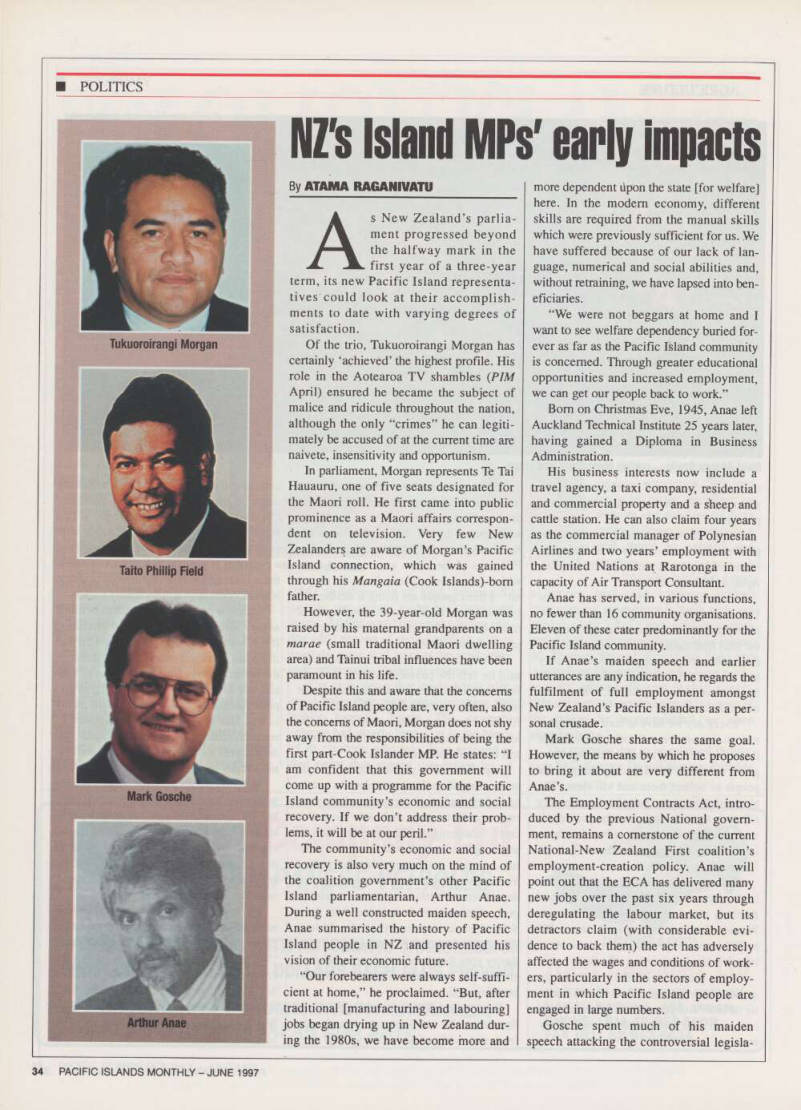
Tukuoroirangi Morgan
Taito Phillip Field
Mark Gosche
Arthur Anae
tion, stating: “Working people have produced much of this country’s wealth. Yet, this fact has been ignored by our leaders who treat workers as just another commodity in the market place or, even worse, as an enemy to be van
quished. During my term in parliament,
I intend to campaign to get rid of the Employment Contracts Act.”
Exactly how Gosche’s Labour Party
can maintain job growth, having dis
posed of the ECA, it must be said, remains a matter for conjecture.
Just as Anae is very much a product of the free market and commerce, Gosche boasts a conventional socialist pedigree. For most of his 41 years, he has been actively involved in the trade union movement and served as a full time official with the Service Workers’
Union since 1981 before entering par liament. His earliest jobs include jour nalist, freezing worker, student teacher, hotel worker and groundsman.
The differences in backgrounds and philosophies between Anae and Gosche do not augur well for the hope, com monly expressed immediately after they were elected, that the four Pacific Island MPs would form a lobby group and work together for the welfare of
their community.
Taito Phillip Field, who must now be regarded as the “elder statesman” of the New Zealand Pacific Islands politi cal scene despite being a comparative ly youthful 44 and with only one full term in parliament under his belt, con firmed: “I have seen little evidence of any great will for us to work together so far.
“Having four members in the house is very significant but we must use it for effective representation and deliv ery to meet the needs of our communi ty. I am still hopeful we can co-operate
together.”
Education is one obvious area of common ground for the quartet. All agree it is an essential ingredient in the betterment of Pacific Islanders.
But, here again, there may be con flict between Gosche’s desire to estab lish Samoan-language nests for
preschoolers (amongst his greatest
regrets, he says, is being unable to speak the language of his father) and the importance Anae places upon assimilation. Even if the four do man
age to form an informal grouping, there is not a great deal these still inexperienced backbenchers can attain at the current time.
But each has acquired a place on one or more of the all-important select committees and that is a sign they will be considered for more influential positions in the future.
Anae has been appointed to the Maori Affairs, Social Services and Regulations Review committees; Morgan also features on the Maori Affairs Committee, as well as the
Health Committee; Field gained a seat on the Social Services Committee too, and Gosche will doubtless make his presence felt on the Government Administration Committee.
New Zealand’s Pacific Islanders would be unrealistic to believe that the presence of Morgan, Gosche, Field and Anae in parlia ment will immediately enhance their lives.
However, having four voices in the corri dors of power must be regarded as a very
positive development. ■