Creepies and
pp. 31-33 · Read in the full issue
Agriculture
Creepies and crawlies The problem of the Giant African Snail
By Chris Peteru
Anybody who has seen the Giant African Snail (Achantina Fulica) sliding around a plantation or garden may sense this member of the gastropod (liter
ally meaning Belly booted animal)
family is a serious contender for most unwanted mollusc on the plan et. As Western Samoans are discov ering, this pest is big, ugly and look
ing to relocate permanently.
If ever there was a bunch of people wondering if the aliens in the movie.
Independence Day, were based broadly on what they’ve been battling since 1993, it’s the agricultural department staff. The military equivalent is called a full scale invasion. So how did things get to the situation where parts of the coun try now look like a Giant African Snail convention centre?
The arrival of the snail could not have come at a worse time for the struggling agricultural sector. Produce prices, due in part to the introduction of a 10 per cent goods and services tax, were doing cartwheels locally. Cyclones had tom the heart out of the taro industry that brought in more than SUS 4 million in overseas earnings and, to top it off, a taro blight eventually destroyed any taro not being exported, which was most of it. Fruit fly had been around for a long time already.
Farmers were a despondent lot, one sign being the scores of rural villagers playing cricket on weekdays, instead of tending plantations as their farming instincts had told them to for genera tions. Looking to reverse the trend, the
agriculture department initiated a cash bonus scheme to rev up productivity and morale. However, that eventually came under a cloud, and was eventually shelved when scams began to emerge involving farmers being paid for non
existent plantations by agriculture offi
cers, and other pyramid-game-type rip offs. The agriculture minister, Misa Telefoni Retzlaff, a lawyer, farmer, and millionaire publicly stated that we wouldn’t see the results of all the pro ductivity from the bonus scheme for five years. He can bet on it.
By then, the initial wave of snails had spread, after arriving from Apia wharf via container, allegedly from neighbour ing American Samoa, which had also been fingered by customs officials here for causing the taro blight.
With the failure of quarantine officers to do their job, agriculture minister Retzlaff tried an intensive spray pro gramme to napalm them. It was only par tially successful as some families, for reasons possibly explained later on, refused to have their plantations sprayed.
Urgency was needed but despite the tremendous efforts of some villages and officials it didn’t really happen.
Because nine times out of 10, a state of urgency for state officials is often responded to down the power line as a call for no urgency. And getting state employees to operate with urgency is like asking the finance minister how much money Polynesian Airlines has cost the taxpayer in the last four years.
Neither question is likely to draw a response in the near future. So, the years rolled by with plenty of publicity, but never enough cash to buy the chemicals to see the snails off, says government.
Not that the African Snail
was in danger of being wiped
out in a hurry. It is hermaphroditic, (self breeding) and can lay hundreds of eggs in a sitting. Nocturnal by nature, hardy and able to grow up to
eight inches (20 centimetres)
long, it is custom made for the humid Pacific Island climate.
And if it rains, hey, it just makes it easier to slide around.
The diet is a hundred per cent organic, including all kinds of crops, and plant materials.
Then a single 40-watt light bulb went on in the Brains Trust of the agriculture depart ment: pay people a set amount per kilo to collect snails. If it had been a rap song they would have called it Bonus Scheme, it’s the Bomb and gone triple platinum. Farmers and citizens alike were to go on a national track down the snail campaign, to knock one over for their country and their bank accounts.
The message went out and
the hunt began with the enthusiasm Samoans usually reserve for collecting telegraphic transfers at the Bank, of Western Samoa. Buckets of snails began turning up at the Ag department. Followed by tens of thousands more. It was amazing.
Television and newspapers ran stories of Buffalo Bill proportions as snail bounty hunters talked about the merits of sea water over boiling water to finish the pest off.
For a time it looked like the island had licked the problem the island way, that the
2842 sq kilometres of land, housing 57 people per square kilometre, would be saved. All this could have had a happy end ing'until reports of snail breeding with at least the same skill level as the snail geno cide programme started to emerge.
The only thing that made triple plat inum sales then were snail numbers and public hysteria levels. The payment scheme had clearly blown up in the hands of its creators, who may have realised at that point that money can buy a lot of
things but it can’t guarantee good honest service.
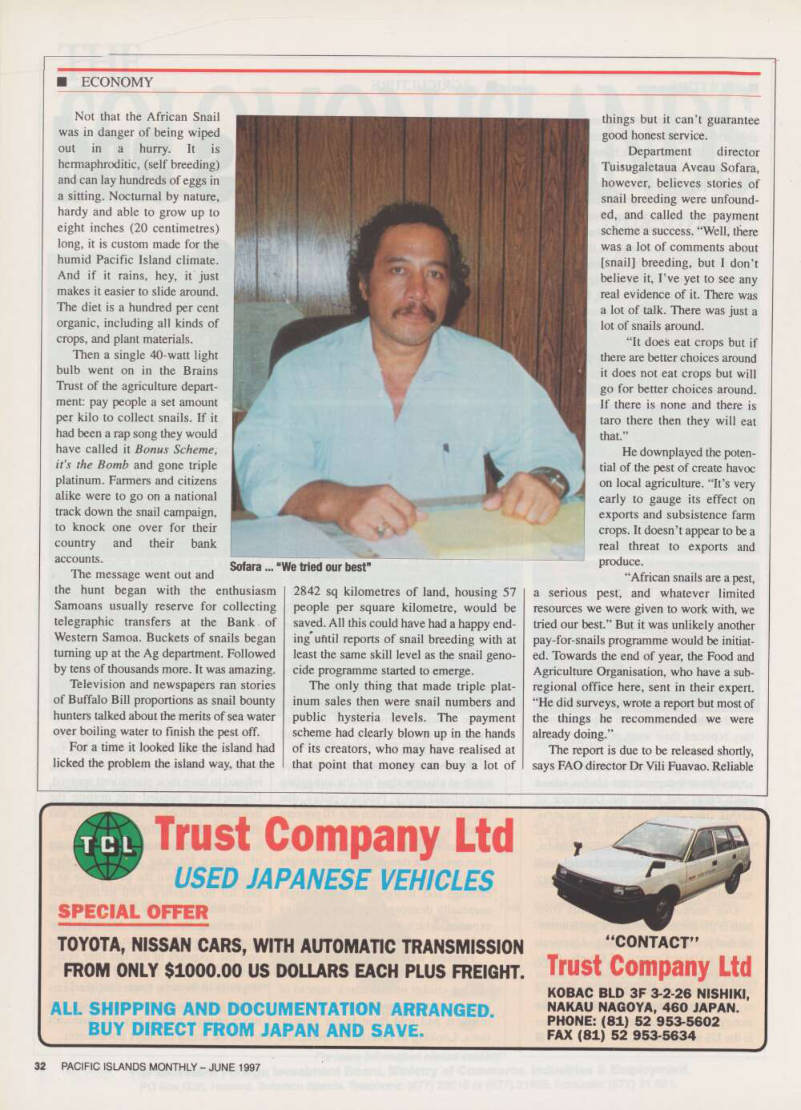
Department director Tuisugaletaua Aveau Sofara, however, believes stories of snail breeding were unfound ed, and called the payment scheme a success. “Well, there was a lot of comments about [snail] breeding, but I don’t believe it. I’ve yet to see any real evidence of it. There was a lot of talk. There was just a lot of snails ground.
“It does eat crops but if there are better choices around it does not eat crops but will go for better choices around.
If there is none and there is taro there then they will eat that.”
He downplayed the poten tial of the pest of create havoc on local agriculture. “It’s very early to gauge its effect on exports and subsistence farm crops. It doesn’t appear to be a real threat to exports and produce.
“African snails are a pest,
a serious pest, and whatever limited resources we were given to work with, we tried our best.” But it was unlikely another pay-for-snails programme would be initiat ed. Towards the end of year, the Food and Agriculture Organisation, who have a sub regional office here, sent in their expert.
“He did surveys, wrote a report but most of the things he recommended we were
already doing.”
The report is due to be released shortly, says FAO director Dr Vili Fuavao. Reliable
Sofara...“We tried our best”
sources say its overall conclusion may be at variance with the agriculture department position.
In spite of ever-increasing numbers, the problem has been confined to the main island of Upolti, in particular the capital, Apia, and nearby suburbs.
Recent sightings in the southern side of Upolu have been brought to the depart ment’s attention. About seven per cent of the total land mass has so far been infested.
Even with stringent inspections it will only be a matter of time though before it will be found on neighbouring Savaii, a 90-minute boat ride away, says Sofara.
“Every day we have at least two inspec tors on the wharves of both islands and at the airport running checks. This has been going on since ’93. The only thing is for people to collect them and kill them. The alternative is to use bait. Sprays are very effective against snails, but the problem is we haven’t got the money to buy the chem icals. You gotta spray the area to kill the foliage, then you bait.”
That may soon change, if grant assis tance from Japan through the Second Kennedy round agreement comes through.
Western Samoa is asking for between 300 to 500 tonnes of pesticide and herbicide to launch a blanket spraying offensive.
“I am pleased with the results of the quarantine programme but it is only a mat ter of time. But you need to get together to cooperate. One family will do it and anoth er won’t.
There are a lot of ways to inadvertently introduce these things. As well, people are careless, some do it to try and be funny, while others do it to be spiteful,” says Mr Sofara. Agriculture Minister Molio’o Teo Filo says of the urban areas around Apia which have continuously been the worst hit: “I think people are doing it deliberate ly. There have been reports from Fagalii [a town suburb] that people have dropped sacks of snails in the street.”
Shortly after his cabinet posting, Filo said he felt the payment scheme had not been very effective and that he did not see much chance of full eradication in the near future. A former businessman, he told the local media that people were the main rea son for snail numbers increasing.
Says Filo; “The problem is that people are moving them from one place to anoth er. If they don’t shift them around, they are only a small creature and can’t move that fast.” Encouraging Samoans to harvest anything that can’t be sold or eaten is prov ing a tough assignment despite village awareness programmes using the seven department officials assigned to contain the pest. Agriculture board member John Schwalger reckons everyone should look under their cars before leaving home. His theory goes that the snails cling to the chas sis of the vehicles, fall off and start
breeding again.
Fat chance. There must be plenty of Samoans who can’t even look under the front seat, without stomachs two and three
colliding then rebounding and whacking them in the face. Unlike the escargots (Haliotos) variety, the French enjoy with a Bordeaux red, Western Samoa, along with several other island nations, have received a type that is gastronomically and (unless there is an agriculture department payment scheme operating) commercially useless.
Samoans love their food almost as much as they love going to church and gambling.
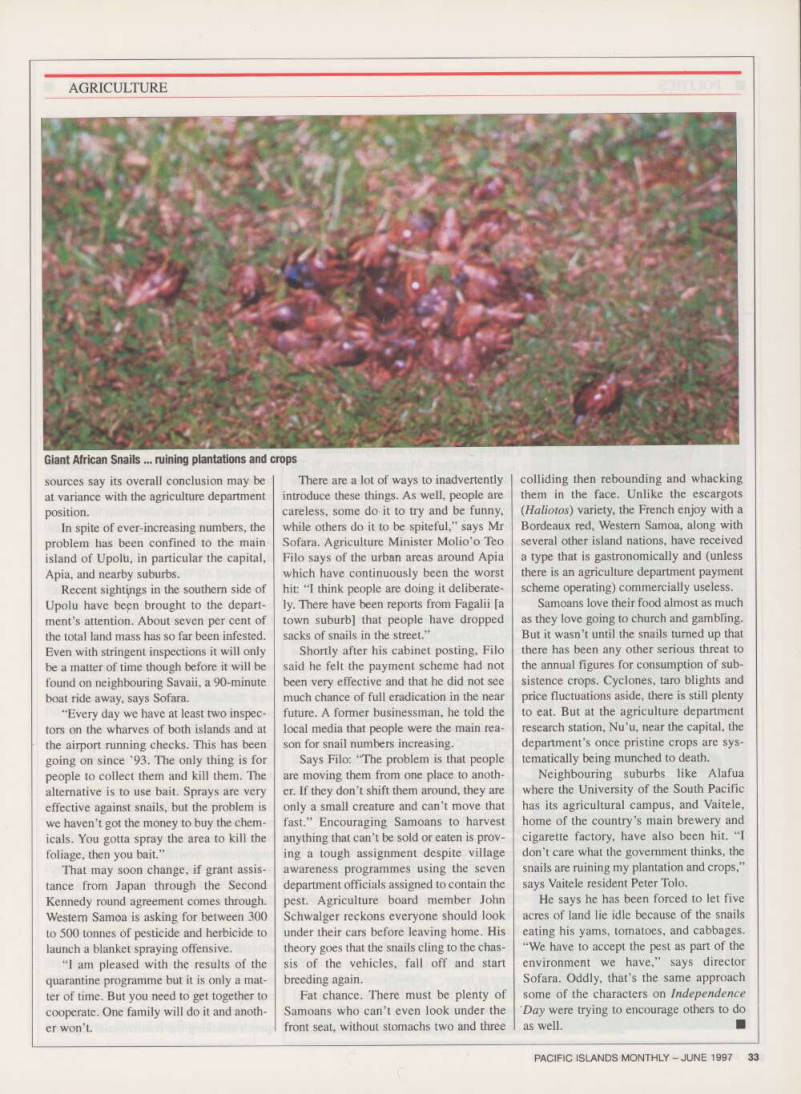
But it wasn’t until the snails turned up that there has been any other serious threat to the annual figures for consumption of sub sistence crops. Cyclones, taro blights and price fluctuations aside, there is still plenty to eat. But at the agriculture department research station, Nu’u, near the capital, the department’s once pristine crops are sys tematically being munched to death.
Neighbouring suburbs like Alafua where the University of the South Pacific has its agricultural campus, and Vaitele, home of the country’s main brewery and cigarette factory, have also been hit. “I don’t care what the government thinks, the snails are ruining my plantation and crops,” says Vaitele resident Peter Tolo.
He says he has been forced to let five acres of land lie idle because of the snails eating his yams, tomatoes, and cabbages.
“We have to accept the pest as part of the environment we have,” says director Sofara. Oddly, that’s the same approach some of the characters on Independence Day were trying to encourage others to do as well. ■
Giant African Snails...ruining plantations and crops