Campaign cash for more independence
pp. 28-31 · Read in the full issue
Politics
By David North
Did the presiding officer of Fiji’s Great Council of Chiefs back in 1969- 1970 send major cash contributions to Britain’s then ruling Labour Party to speed independence?
I doubt it, but that is exactly the tech nique used by Guam’s Governor, Carl Gutierrez, as he seeks to secure more (but not total) independence from Washington.
According to the mainland press, Gutierrez put on a campaign fund-raiser when First Lady Hillary Rodham Clinton stopped in Guam (in 1995) on her way to the United Nations’ Women’s Conference in Beijing. Subsequently Gutierrez and his allies sent more than $640,000 to various
parts of the Clinton-Gore campaign.
The governor’s objective: to use the money to attract the attention of the White House regarding Guam’s long-delayed bid for more independence. Guam wants to control its own labour and immigration policies, and wants to use much of the land now occupied by the US military.
Gutierrez, a traditional Democratic politico now in his first term as governor, must have figured that he knew how main land polls operate; if you give really signif icant amounts of campaign money, the White House grants “access” and, maybe (this is where it gets both clouded and con troversial) the gifts result in the adjustment of federal policies to meet the donors’ needs. At least that is what Gutierrez must have hoped.
The Guam gifts, while remarkable in several ways, were small change compared to the hundreds of millions poured into var ious Democratic coffers by well-heeled interest groups, such as bankers, lawyers and bankruptcy specialists. (The Republicans actually raised much more money than the Democrats did, often in similar ways, but their behaviour has secured much less media attention).
The mainland press had been full of sto ries about big donors being invited to spend the night in the Lincoln Bedroom of the White House, and of various Asians making apparently illegal contributions to
the campaign.
Non-US citizens cannot give money to US political parties, and enough foreign money was channelled through various fronts so that the Democratic National Committee, under heavy pressure, has given back millions of dollars.
A particularly unattractive case involved the presence of a representative of the mainland Chinese Government, a gunrunner, at a White House function.
While it is not clear that the Guam con tributions were illegal - residents of the islands are US citizens, and if they move'to Hawaii or the mainland, they can vote - all this money from this unusual source did raise some eyebrows.
For example, it is clear that the amount of money raised per adult resident in Guam (about $lO a head) was much higher than in any other territory, and perhaps more (per capita) than in any of the states.
Further, according to the Washington Post “Guam Government employees also gave more to President Clinton’s campaign than public servants in any other state or territory.” Perhaps this, too, was figured on a per capita basis.
But did the governor get what he want ed from the president? Well, no, or at least not yet; but before we get to that, a little
background.
For years Guam has been seeking a Commonwealth status, which would free the island from many federal laws; many of its leaders want a deal like that given to the nearby Commonwealth of the Northern Mariana Islands, which sets is own labour, gambling and immigration laws. (Taxation is not an issue; the federal income tax does
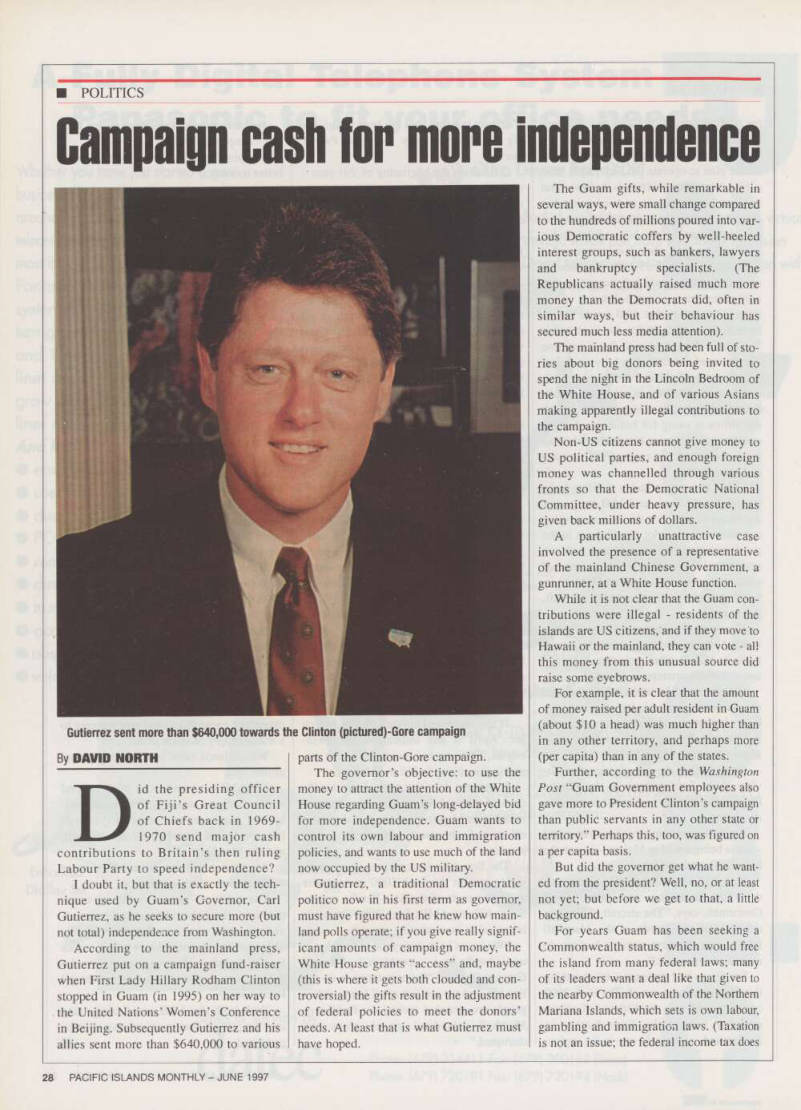
Gutierrez sent more than $640,000 towards the Clinton (pictured)-Gore campaign
not apply to any of the US flag territories; there are local income taxes, but the money stays on island).
There is nothing in the US constitution, or even tradition, providing a mutually agreeable way for a territory to evolve into something other than a state (as both Alaska and Hawaii opted to do).
So each time a territory wants more freedom, a new mechanism must be estab lished. (The Brits on the other hand, in the decades after World War 11, worked out an almost mass-production system for spin ning colonies into independent nations.) Guam set up a Commonwealth Commission, and conducted some quite
specific referenda on specific provisions.
Later the Territorial Legislature passed the draft agreement, and the governor signed it, taking the whole process very seriously.
Successive mainland governments have been less interested in the process, and wary of some of the provisions.
Were Guam to seek independence, rather than continued existence in associa tion with the US, these provisions would be less troublesome to Washington.
But three elements have given both the Bush and the Clinton Administrations
problems:
1. The Commonwealth Act established a special political status for Chamorros, allowing only such persons to vote on any eventual decision to seek independence.
Washington, with its own black-white con troversies, does not want to give any class of people more rights than others on the basis of race.
While Guam has cleverly blurred the issue ... saying, in effect, that Chamorros are people who lived on the island in 1950 and their descendants (thus defining away thousands of mainlanders and post-1950 immigrants) - Washington does not like this notion. 2. Immigration regulation. The US. (like Australia and New Zealand) has a
welcoming immigration policy and a rela
tively easy naturalisation process; on the whole these three nations’ policies are based on an egalitarian tradition.
The Chamorros of CNMI, however, have opted for a two-caste society; native born Chamorros on top, and tens of thou sands of guest workers (who can not become CNMI citizens) on the bottom.
Many US policymakers worry that Guam, given its druthers, would adopt a CNMl like immigration system.
3. Labour regulation. Guam is covered by the US minimum wage and by mainland labour laws; CNMI has its own minimum wage, a fraction of the $5.15 an hour going into effect on Guam and the mainland on October 1. Again, some US officials worry that Guam would adopt a CNMI-type set of labour standards, in which Asian tempo rary workers would word for below-pover ty wages.
These are major, gut-level policy issues,
and it is no wonder that Washington has been leery of Guam’s proposals. Rather than seeking to modify Guam’s position on these three matters, the Governor decided he would go the political route - flood the Democratic National Committee with unexpected money from his island, and hope that Clinton would order his under lings to give Guam’s leaders what they want.
Meanwhile Gutierrez’s underlings were enlisted in the cause, and the Pacific Daily News, working within the US tradition of reporting campaign contributions, ran a partial list of the Guam donors, most of whom were identified by title and most of whom gave an even $lOOO. One ex-Guam journalist, looking over the list, wondered how so many $30,000-to-$50,000-a-year officials had scared up the $lOOO.
“Did some of them only give their names, and not their money?” He said to me. He was alluding to the practice among some of the Asian donors to the campaign, of funnelling overseas money through American names when reporting contribu tions.
While there is no firm answer to that question, yet, there is an interim answer to the earlier question - did the President give the governor what he wanted on the issue of Commonwealth Status?
Maybe such a move was in the works, but when the story on major campaign con tributions from Guam hit the front pages it was only a day or two before the White House announced that it was still studying the Guam issue, and it had not changed its
policies.
Earlier there had been stories that the administration posture had changed. The Washington Post quoted a couple of name less officials who said that their agencies’ posture on Guam had shifted, at the direc tion of the “political people” after the cam paign money arrived. Another story was that the latest working paper circulated by Washington’s Guam Commonwealth
Negotiator, John Garamendi, was said to contain some elements favourable to Guam.
“Maybe Garamendi is saying something a little different, but that’s not Department of Interior policy yet, much less that of the White House, or of the Congress,” I was told by a reliable source.
Garamendi, an active Democrat, per haps was, in fact, making a difference on this matter. He is the latest of half a dozen senior officials to hold the thankless, part time post of Commonwealth Negotiator,
nominally a presidential appointment, but
usually the choice of the Interior Secretary.
Garamendi, as Deputy Secretary of Interior, is the highest ranking of the string of negotiators, and brings to the post a self confidence based on, among other things, his record of having won a competitive state-wide election in California, America’s most-populous state. (After service in the state senate, he became California’s first elected insurance commissioner, a post he gave up in a losing race for the governor ship.) He may well be willing to go further than his frustrated predecessors as negotia tor, in the hopes of breaking the deadlock between the islands and the mainland.
But at the moment, the governor’s efforts to buy “access” may have backfired on him and on his island.
Meanwhile, two other US flag territo ries in the Pacific, both with complex rela tions with Washington, are taking quite dif ferent approaches. There is the CNMI pos ture, and then there is that of American Samoa.
CNMI’s embattledgovemor, a nominal Democrat, is Froilan Tenorio; while no champion of Saipan’s notorious sweat shops in the garment industry, he is adamant that CNMI must maintain its con trol of labour and immigration matters.
Various Congressmen, on the right and left, have threatened to place CNMI back under Washington’s control on these matters, and Tenorio, up for re-election this November, wants to defeat these efforts.
His strategy: invite conservative mem bers of the Congress of the US, their staff members, and other opinion-makers to visit Saipan, at CNMI expense, to play golf and swim (during the Washington winter) and to take a very carefully-controlled look at the conditions of the temporary workers on the islands. (There are more temporary workers than permanent residents of the islands- a situation which exists nowhere
else under the American flag, and is prob ably something for the Guinness Book of Records). If CNMI were a hotel - or a gar ment factory, for that matter - it would be illegal to pay the (considerable) expenses involved in flying Congressmen and staff to the islands, but under the ethics rules of the US Congress, CNMI is treated like a state or local government, so there is no legal problem, although some segments of the media have expressed outrage. (CNMI is said to have spent more than $1 million on these trips and other PR measures).
One of the visitors, Doug Bandow of the far-right, Washington-based Cato Institute, called CNMI a “remarkable lab oratory of liberty,” according to the Post.
A Department of Interior official replied to the paper; “there are still widespread abuses of overseas contract workers in the CNMI.” This was a refer ence to the garment factories that continue to produce goods marked “made in the US” which are then shipped to the main land without paying customs fees or being counted against quotas. The raw materials, the workers, and many of the factory own ers all come from outside the US, but the garments are assembled on Saipan.
Most of the tours of the island include visits to clothing factories owned by Willie Tan, who was fined $9 million by US authorities for widespread violation of the local minimum wage law. Tan is a major figure in CNMI politics. Recently 20 of his workers, saying that they had not been paid even the minimal CNMI mini mum wage, reported that Tan’s foremen had threatened them with deportation if they reported their wage problems to the government While the governor of Guam tries to secure more independence for his island (with cash) and while the Governor of CNMI tries (with junkets) to preserve Saipan’s freedom of action, there is no such effort underway in American Samoa, where all concerned appear content with Washington’s light supervision and heavy subsidies.
One institution which benefits from both is the territorial senate, a governmen tal body which is, in effect, American Samoa’s Great Council Of Chiefs. Only chiefs ( matai ) can serve, and only matai vote in the elections. And, to the best of my knowledge, the chiefs do not raise money for any off-island elections, neither in the US nor in the UK. ■