Beyond
pp. 25-27 · Read in the full issue

Aviation
Beyond 2000 Can the Saab carry Air Marshalls into the new century?
By Giff Johnson
That Air Marshall Islands felt compelled to take out an advertisement in the Marshall Islands Journal in mid-April to proclaim that the Saab 2000 had operated for two weeks with a perfect on-time record is an indica
tion of how much difficulty the SUSI6-million plane has had since inception of service in June 1995.
The plane, hailed as the answer to the long, thin air-routes in the Pacific, has not lived up to the claims; repeated break downs have cost Air Marshalls dearly in money and passenger confidence by stranding scores of passengers travelling
between Fiji and the Marshalls. The real challenge facing AMI is how to make the high-tech Saab function reliably in a tech nology-unfriendly environment, and where parts are as far away from the central Pacific as they can be (Europe and Scandinavia).
As AMI labours to resurrect an admirable record established by a slow, noisy and gas-guzzling (relative to the Saab) workshore British-built HS74B air craft that serviced the Fiji route prior to the Saab, there is some reason for optimism that improvements may, in fact, be
happening.
Two proposals are on the table for
launching regional airline operations;
moves that would take the pressure off a single airline and base operations in a more central location such as Fiji.
The Asian Development Bank recently completed a study for a central Pacific air line involving the governments of the Marshalls, Kiribati, Tuvalu and other islands.
The ADB study followed up an initia tive of the Marshalls that first surfaced in 1995, getting verbal - but not any financial - support from other governments in the sub-region. The study could pave the way
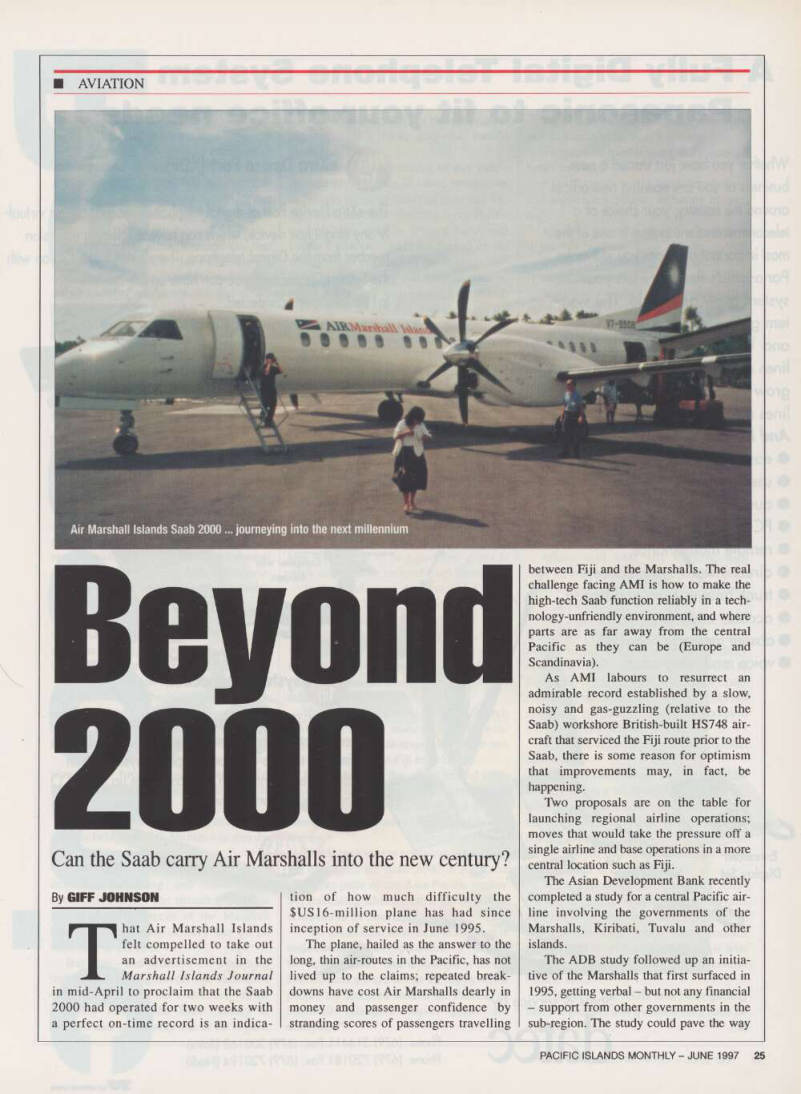
Air Marshall Islands Saab 2000...journeying into the next millennium
for ADB financing of a sub-regional gov ernment airline utilising the Saab.
Saab itself is proposing a commercial airline plan to operate the Saab 2000 from a Fiji base. Saab officials believe that improved maintenance and servicing that could be had from a major airline operation would increase the reliability of the Saab.
There are two other developments that spell improvement for AMl’s international operations and should help to restore not only passenger confidence, but that of air lines in the region that AMI would like to be selling air time to for the Saab - Air Vanuatu is the only South Pacific airline that has used the Saab regularly since last year for a weekly Nadi-Port Vila run.
The ADB recently injected SUS 2 mil lion of a SUS 4 million loan to AMI, which the airline is using for building a hangar suitable for servicing the Saab and other large planes and for engineering training and spare parts.
AMI has never had a facility large enough for the Saab, and AMI mechanics are frequently seen on the tarmac carrying out maintenance under plastic tarps in the pouring rain or the blistering sun with salt spray enveloping them; this is the normal environment in which the Saab 2000, a vir tually entirely computer-driven aircraft, must operate.
The other development of significance is that AMI has made the sound decison to retain its HS74B, after more than a year of unsuccessfully attempting to sell it.
The plane may be based in Fiji and used on a lease/charter basis by other airlines; but by keeping it, AMI maintains an essen tial backup for the Saab and the Fiji- Marshalls route.
Since AMI is the only carrier that ser vices these four nations in the central Pacific, the backup is crucial to reliable operations.
But the big question that has to be asked - and is being asked in Majuro - is; can the Saab 2000 work out here?
Saab 2000’s Australia-based vice-presi dent for marketing and sales, Peter Greensmith, says, “The aircraft is the right one to meet the needs of the Marshall Islands into the next century but we do need time to prove it.”
But time - and patience - is something that AMI is running out of. The Saab 2000 owned by AMI was the 17th to roll off the assembly line at the Saab factory in Sweden and, as the only one in the region,
it’s fair to say that AMI has been the guinea pig for Saab’s foray into • the Pacific market.
And since the beginning of this year particularly since an ill-timed breakdown in January stranded heads of state and for eign ministers from virtually every Pacific country who were in Majuro for Amata Kabua’s funeral - AMI has turned up the volume of its criticism of the Saab.
Saab officials say that improved main tenance, coupled with basing the mainte nance operation in Fiji, can cut days off delivery time for parts from Europe, and will improve the operations - one reason that AMI negotiated a deal late last year to have major maintenance done at Air Pacific in Nadi.
But government officials in Majuro say that the expectation that the Saab would get better with improved maintenance is a pre diction that has turned out to be “a mirage”.
“There have been quite an amazing number of breakdowns in the last year.”
And AMI general manager Randy Hanna observed that despite a SUS3-mil lion spare-parts package provided by Saab, just about every time the plane has a prob lem it turns out to be a part that is not in stock and must be ordered from Europe.
In late February, however, the Saab went through its first C-check, the 3000hour FAA-required overhaul.
While in the hangar for the C-check, Saab and AMI engineers installed a series of what Hanna described as “non-mandato ry improvements that will assist the plane’s
reliability”.
If the improved service in late March into April is any indication, the twin engine, 50-seater has responded to the ser vicing it received in Fiji in February.
It appears, too, that some heated criti cism of the Saab by AMI and government officials in Majuro has stimulated greater efforts on Saab’s part to improve the Saab’s service.
The Scandinavian company is attempt ing to market the Saab 2000 in Australia and other parts of the Asia-Pacific region.
So, stabilising AMl’s Saab 2000 operation is crucial to its marketing success.
“We are as keen as anyone to fix what is
undoubtedly a problem,” Saab’s
Greensmith said. “Our reputation is on the line too and we are not at all happy when people are stranded around the Pacific, or Marshall Islanders’ travel plans are
disrupted.”
He believes that three things must hap pen to improve the Saab’s service: • improving maintenance skills through
better training;
• investing in better facilities, tooling
and support equipment, including hangar;
and • getting a second aircraft in operation
to provide back-up.
When the Marshalls government initial ly negotiated the deal with Saab in the early 1990 s - while the 2000 was still a drawing-board concept - it signed a deal to buy two Saabs, with an option to purchase two more.
The Marshalls bought the first SUS 16million Saab, but the second one, to have been delivered in mid-96, has been leased to another airline for operations because
the Marshalls, facing increasing fundng
cutbacks, couldn’t pay for the second one; after the experience with the first, it’s doubtful that the Marshalls government and AMI would want to take the risk of buying a second one - another reason the sub-regional idea makes sense, since so many other countries gain the benefit of the service AMI is currently providing.
Hanna said AMI was working with Saab to develop a long-term plan for Saab 2000 maintenance, and that Saab had been very helpful in this.
But a related issue to whether the Saab is the right plane is simply this: can a small airline in an isolated area successfully operate a single plane that, because it is so high-tech, requires extreme levels of main tenance precision and computer-driven diagnostic capabilities, and quick access to a ready supply of spare parts?
Which leads back to the sub-regional airline idea.
For AMI has proven one thing beyond doubt: there is a steady and increasing vol ume of passenger and (especially) cargo business to and from Fiji, Tuvalu, Kiribati, and the Marshalls.
Air service that can be stabilised has a ready market in this sub-region.
The question - given that many coun tries have their own ideas abut air service, and are somewhat less than enthusiastic about airline coopreration when it comes time to anti-up with some money - is who will finance air cooperation in the central Pacific area?
With both the ADB and Saab getting into the picture, that question may soon be answered. ■