Caught napping
pp. 22-24 · Read in the full issue
Legislation
Govt bulldozes through with legislation on chief auditor’s term while Opposition researches
By Chris Peteru
Saying you were in the library while legislation crucial to Western Samoa’s financial well being is about to be voted on is a good reason not to take any interest, except if you’re the Opposition leader.
It wasn’t as if Samoa National Development Party boss Tuiatua Tupua Tamasese hadn’t been given enough notice.
Debate on the motion to amend Article 97 of the island state’s constitution had been
raging for a month or so in parliament, and for several months at every bar and kava bowl in the country. The guts of it meant slashing the chief auditor’s term from until age 60 into a three-year contract.
In 1995 Controller and Chief Auditor Su’a Rimoni Ah Chong was suspended for tabling a report alleging big-time govern ment corruption. Despite a government appointed Commission of Inquiry negating key aspects of the report, it failed to allevi ate public cynicism over the issues raised, more so when none of the inquiry’s recom mendations to the government to guard
against further abuses were acted on. The proposed amendment marked the first time government had brought constitutional change because of action taken by the audit office.
How the likelihood of something this important could be overtaken by an over due book fine is hard to understand. As it turned out Tamasese had actually gone in to get some last-minute research on the amendment itself, which wasn’t a bad idea, even if his modus operandi was.
Anti-amendment supporters and the Samoa Civil Liberties Organisation were more concerned about the chief auditor los ing its pivotal role as independent watch dog (the acting chief auditor now is the wife of the deputy speaker) and instead becoming a rubber stamp for the govern ment.
The Human Rights Protection Party (now in a fourth consecutive term of office) faces a chronic debt problem now close on $4OO million dollars and rising. It could easily be a lot more considering that audits of a number of government departments, including Treasury, have not been made public for at least five years. Clear regula tions under the Public Monies Act says Treasury is required to table audited finan cial accounts to the public regularly.
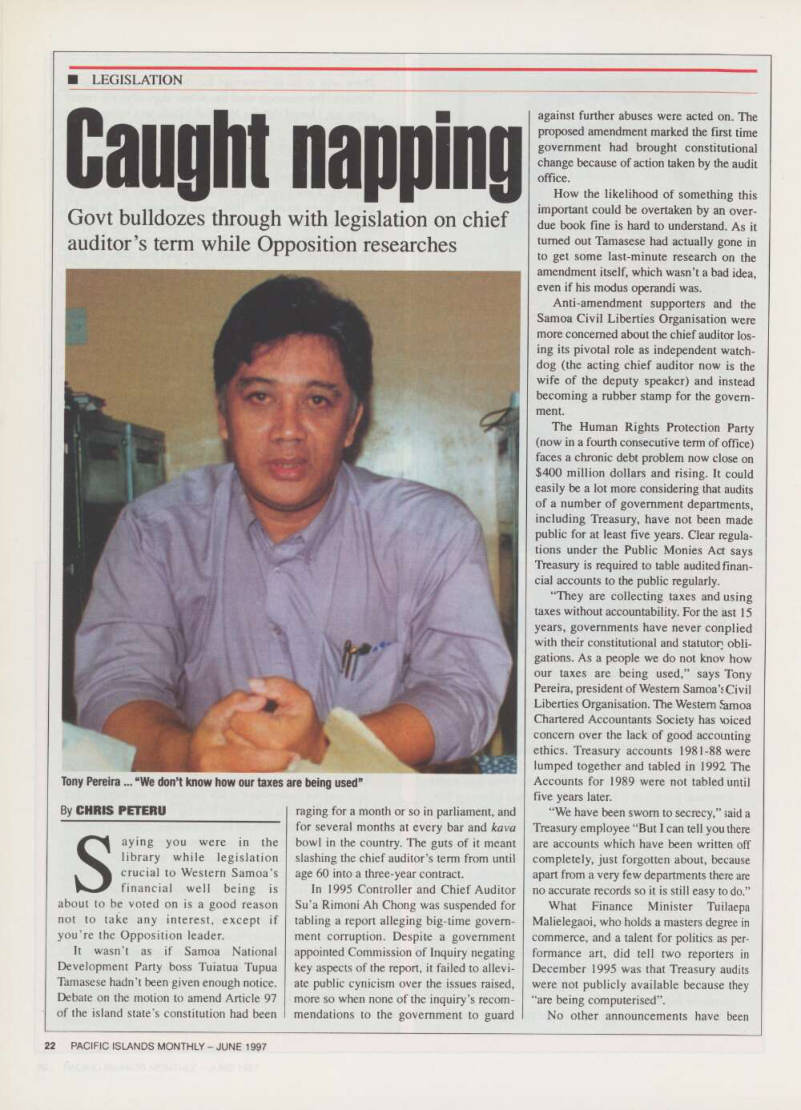
“They are collecting taxes and using taxes without accountability. For the ast 15 years, governments have never conplied with their constitutional and statutory obli gations. As a people we do not knov how our taxes are being used,” says Tony Pereira, president of Western Samoa ’s Civil Liberties Organisation. The Western Samoa Chartered Accountants Society has \oiced concern over the lack of good accointing ethics. Treasury accounts 1981-88 were lumped together and tabled in 1992 The Accounts for 1989 were not tabled until five years later.
“We have been sworn to secrecy,” said a Treasury employee “But I can tell you there are accounts which have been written off completely, just forgotten about, because apart from a very few departments there are no accurate records so it is still easy to do.”
What Finance Minister Tuilaepa Malielegaoi, who holds a masters degree in commerce, and a talent for politics as per formance art, did tell two reporters in December 1995 was that Treasury audits were not publicly available because they “are being computerised”.
No other announcements have been
Tony Pereira...“We don’t know how our taxes are being used”
made since, although late last year the audit office promised to audit and update most government departments by the end of this year.
“Although the minister has in the past referred to himself as an auditor or gives the impression that he is an auditor, and therefore some measure of credibility is attached to his explanations in parliament, he is a non-practising accountant,” says the chief auditor.
Malielegaoi was unavailable to com ment as he was on government business overseas.
For its part, the Opposition seemed reluctant to highlight aspects of the finan cial bungling, leaving it open to sugges tions it carried out some funky accounting of its own when it last sat on the Treasury benches. A salient reminder during Tamasese’s last prime ministership is how from 1979-81 there were massive basic food shortages, forcing Samoans to queue Russian-style for goods in near empty stores.
Twenty-five submissions to a parlia mentary bills committee, gave the whole constitution amendment idea the thumbs down. An excerpt from the committee’s report said, “It was evident from the views that any proposed amendment to the con stitution is inappropriate.” Other submis sions called for a referendum as a more accurate forum to gauge public feeling.
Supreme court proceedings brought by the chief auditor against the prime minister over the report are continuing, although the PM repeatedly denies he has been served notice of any charges being made against him.
Given the backgrounds of the individu als, the two parties, and the political cordite in the air, it was hardly surprising parliamentary broadcasts became more popular on the radio than requests for songs by nerdy Swedish popsters Abba (Waterloo , Dancing Queen) who have managed to keep Western Samoa in a musical time warp, long after their wel
come break-up.
Back in parliament, the government, noting Tamasese’s vacant chair, suspended
standing orders and charged through the
second reading of the amendment bill in just under 15 minutes. Like the opposition, the HRPP MPs had expected a day of fren zied, tough debate. Instead, the remaining opposition members sat silent, like rabbits frozen in the lights of a very big truck bear
ing down on them at alarming speed. It was the kind of silence that could have remind ed listeners around the country of a library, where no doubt some of the opposition wished they were with their missing lead er. No one even tried to hold the fort, which was surprising but not unexplainable.
Without the eloquent Tamasese rhetoric, the opposition frequently turns out sound ing unconvincing. The government, in con trast, just sounds too good to be true.
Even the opposition number two hit
man, outspoken independent Le Tagaloa
Pita, was invisible. A former cabinet minis ter, his reputation in the debating chamber can be summed up in one word: Aayyaaahhh. But right then, he wasn’t there either. Nor was he at the library look ing for something to talk about.
Although both men eventually made it for the third reading vote, the government had slammed the door shut. The last ses sion day, parliament had adjourned while debating a Customs Amendment Act.
Normally, discussion on the last bill dis cussed, resumes immediately the next ses sion.
“I assumed as did Tagaloa that the [finance] minister would continue on Wednesday,” said Tamasese. pointing to
parliamentary convention and Tuesday’s
agenda paper. Assumptions aside, a politi cian with four election losses against the same people, should have been able to come up with better strategies on how the HRPP operates, than thinking if he was late to parliament the government was not going to try and stitch the opposition up.
Ageing Prime Minister Alesana, who nowadays invokes God’s name with the enthusiasm with which the Mormon church proclaims “the church is true” to anyone within earshot, was in no such doubt about what his mission was that morning. Thanking God for the beautiful day, he launched into a brief history of the constitution. Basically, it amounted to something like, “Out of the way man, there’s a constitutional amendment coming through.” He then moved the constitution al amendment bill be put to the vote.
Alesana also reassured the public the amendment was in the best interests of the nation, and that suspended auditor Ah Chong was free to reapply for the chief auditor’s office. “Whoever is involved in this job should be free from political inter ference, he need not be afraid to carry out his duties even if he is appointed for a
three-year term,” said Alesana.
Holding the required two-thirds majori
ty in the house, it came down 36-11 in the government’s favour. The Opposition later claimed that the vote had been sprung on them. Of course, it had. In fact, they’ve been sprung, rolled over, and tossed up in the air so many times now, they could ride a bull market in carnival ride futures.
“It was a strategy employed by the gov ernment in order to silence debate,” oppo sition member Te’a Peato told local tabloid papers. What a revelation.
“Predictable,” was the chief auditor’s only response. What is also becoming pre dictable is a duopoly of power between Alesana, and deputy Malielegaoi, who, as a result of the decision, is free to roam carte blanche through Western Samoa’s main bank vault, say critics. Of course, the invitation for Ah Chong to reapply for the chief auditor’s job could be damage con trol by Alesana, given the lousy publicity the report caused locally and abroad.
If the chief auditor is reinstated, it will be surprising if he is allowed to even audit his own pay check, such is the trust level between the HRPP leadership and the longest suspended government employee in history.
This is not the first time the HRPP has fiddled with the constitution since the 1962
independence. Earlier, universal suffrage
was introduced, allowing those over 21 to vote for the first time during the 1991 elec tions. Soon after, the term of government office was extended from three to five years. Civil Liberties president Pereira: “Do we need a minister of finance, one with a Masters degree in Commerce?”
“I suppose I have a fair bit to learn about the nature of politics, I had thought that some members of the HRPP would consider this not as a partisan party matter, but more a conscience matter. But I am sur
prised”
The punchline to a joke over the chief auditor’s term being reduced to three years goes: “So there will be enough time to audit all the accounts for 1993.”
What level of professionalism will be applied to the job by the next chief auditor, given the amount of bungy jumping the government did over Ah Chong’s report, will be interesting. Ethics and accountabil ity though could still be as hard to find as accurate Treasury accounts for public inspection, and the protection of human rights this Alesana administration built its