Ferrieux-Patterson discusses
pp. 20-21 · Read in the full issue
Interview
Ferrieux-Patterson discusses Vanuatu’s financial scam and its impact on investment
PIM: The recent financial scams you have exposed, would they have an impact on the off-shore banking sector here?
FP: My report at the time indicated that there were some con cerns about the reputation of Vanuatu. I think there's still the same concern to see political people signing documents involving big amounts of money and not taking the appro priate steps to check and follow their own financial rules that can create a bad image overseas. This also concerns the heavy commitment a government can take in terms of over seas debts. Overseas indebtedness is alwdys a concern. A country could collapse - like what happened in the Cook Islands. They suddenly realised they owed more than they could repay and all systems suffer.
As far as the off-shore financial centres are concerned, I still see that they would be more generally affected by the repu tation. If people hear that the situation is not stable, the politi cians don't know what they are doing, it might be a concern.
But generally the off-shore community is almost a different entity. You have a lot of professionals involved in it. I don't
think politicians are involved in any of the off-shore acitivities at this stage. Accountancy, banks and trust companies already have their own reputations. I think they would main tain themselves with their own clients.
PIM; If these scams have had an impact on the image of Vanuatu, how would you see the government playing a role in clearing up Vanuatu's name?
FP: They did; they proceeded quite effectively. Once they made a mistake, there was a bit of political turmoil following that.
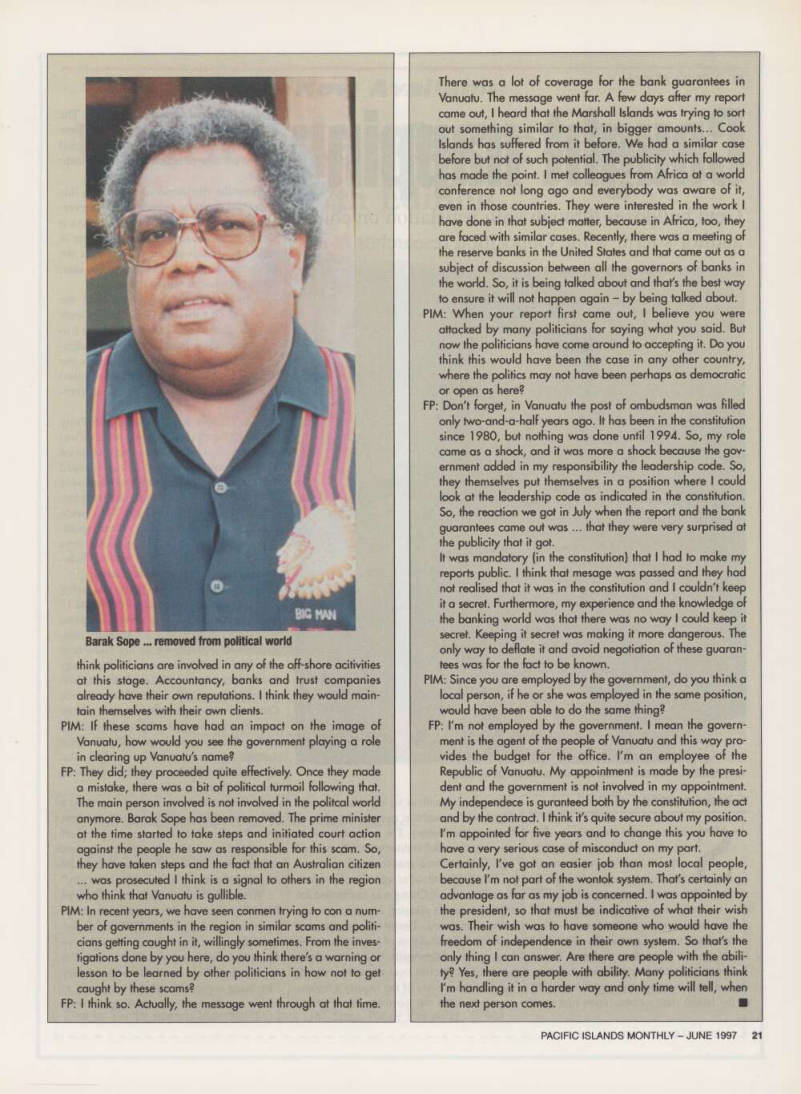
The main person involved is not involved in the politcal world anymore. Barak Sope has been removed. The prime minister at the time started to take steps and initiated court action against the people he saw as responsible for this scam. So, they have taken steps and the fact that an Australian citizen ... was prosecuted I think is a signal to others in the region who think that Vanuatu is gullible.
PIM: In recent years, we have seen conmen trying to con a num ber of governments in the region in similar scams and politi cians getting caught in it, willingly sometimes. From the inves tigations done by you here, do you think there's a warning or lesson to be learned by other politicians in how not to get caught by these scams?
FP: I think so. Actually, the message went through at that time.
There was a lot of coverage for the bank guarantees in Vanuatu. The message went far. A few days after my report came out, I heard that the Marshall Islands was trying to sort out something similar to that, in bigger amounts... Cook Islands has suffered from it before. We had a similar case before but not of such potential. The publicity which followed has made the point. I met colleagues from Africa at a world conference not long ago and everybody was aware of it, even in those countries. They were interested in the work I have done in that subject matter, because in Africa, too, they are faced with similar cases. Recently, there was a meeting of the reserve banks in the United States and that came out as a subject of discussion between all the governors of banks in the world. So, it is being talked about and that's the best way to ensure it will not happen again - by being talked about.
PIM: When your report first came out, I believe you were attacked by many politicians for saying what you said. But now the politicians have come around to accepting it. Do you think this would have been the case in any other country, where the politics may not have been perhaps as democratic or open as here?
FP: Don't forget, in Vanuatu the post of ombudsman was filled only two-and-a-half years ago. It has been in the constitution since 1980, but nothing was done until 1994. So, my role came as a shock, and it was more a shock because the gov ernment added in my responsibility the leadership code. So, they themselves put themselves in a position where I could look at the leadership code as indicated in the constitution.
So, the reaction we got in July when the report and the bank guarantees came out was ... that they were very surprised at the publicity that it got.
It was mandatory (in the constitution) that I had to make my reports public. I think that mesage was passed and they had not realised that it was in the constitution and I couldn't keep it a secret. Furthermore, my experience and the knowledge of the banking world was that there was no way I could keep it secret. Keeping it secret was making it more dangerous. The only way to deflate it and avoid negotiation of these guaran tees was for the fact to be known.
PIM: Since you are employed by the government, do you think a local person, if he or she was employed in the same position, would have been able to do the same thing?
FP: I'm not employed by the government. I mean the govern ment is the agent of the people of Vanuatu and this way pro vides the budget for the office. I'm an employee of the Republic of Vanuatu. My appointment is made by the presi dent and the government is not involved in my appointment.
My independece is guranteed both by the constitution, the act and by the contract. I think it's quite secure about my position.
I'm appointed for five years and to change this you have to have a very serious case of misconduct on my part.
Certainly, I've got an easier job than most local people, because I'm not part of the wontok system. That's certainly an advantage as far as my job is concerned. I was appointed by the president, so that must be indicative of what their wish was. Their wish was to have someone who would have the freedom of independence in their own system. So that's the only thing I can answer. Are there are people with the abili ty? Yes, there are people with ability. Many politicians think I'm handling it in a harder way and only time will tell, when the next person comes. ■
Barak Sope...removed from political world