Scaring away the investors
pp. 19-20 · Read in the full issue
Economy
Reports By Kalinga Senevirante
Port Vila
For small island economies in the Pacific, the develop ment of off-shore banking centres could become an important foreign exchange earner. In recent years, Vanuatu has shown that it could bring in a substantial income to the national economy. But, last year’s “Letters of Guarantee” finan cial scan involving the Reserve Bank has sent a shiver through the spine of Vanuatu’s off-shore banking sector.
Port Vila’s “financial centre” - a codec
tion of foreign banks, trust companies, accountancy and law firms - is one of the well established off shore banking centres in the region, which brings in about SUS 4.4 million a year to the economy. In addition, it provides employment to over 300 local people and the 60 or so expatriate staff and families who bring more money into the economy.
The income created by this industry makes up a substantial amount for the country when you consid er the fact that the total export income of Vanuatu in 1995 was SUS2B.3 mil lion.
The financial scandal last year, which was, how ever, unconnected to the off-shore banking sector, has made the industry ner vous. "It has certainly had a negative impact on peo
ple thinking about invest
ing in Vanuatu because there was uncertainty about whether this gov ernment understands what they are doing,” Thomas Bayer, executive chairman of Pacific International
Trust Company told Pacific Islands Monthly.
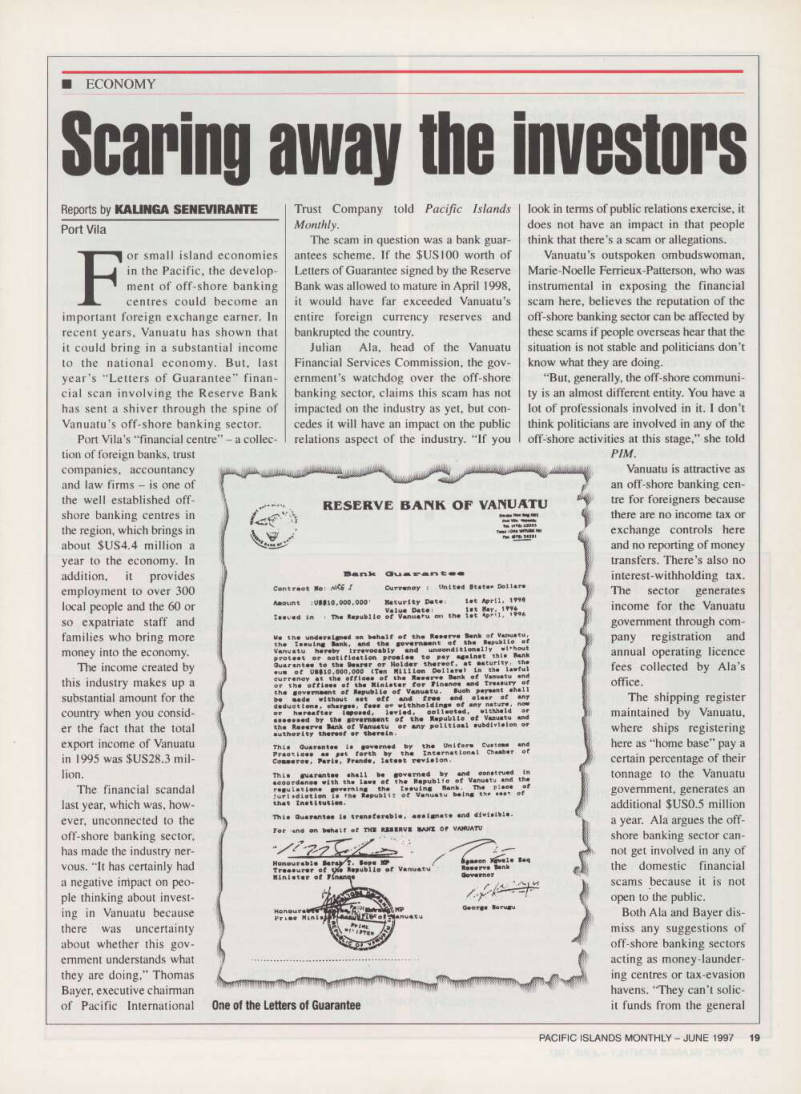
The scam in question was a bank guar antees scheme. If the SUSIOO worth of Letters of Guarantee signed by the Reserve Bank was allowed to mature in April 1998, it would have far exceeded Vanuatu’s entire foreign currency reserves and bankrupted the country.
Julian Ala, head of the Vanuatu Financial Services Commission, the gov ernment’s watchdog over the off-shore banking sector, claims this scam has not impacted on the industry as yet, but con cedes it will have an impact on the public relations aspect of the industry. “If you
look in terms of public relations exercise, it does not have an impact in that people think that there’s a scam or allegations.
Vanuatu’s outspoken ombudswoman, Marie-Noelle Ferrieux-Patterson, who was instrumental in exposing the financial scam here, believes the reputation of the off-shore banking sector can be affected by these scams if people overseas hear that the situation is not stable and politicians don’t know what they are doing.
“But, generally, the off-shore communi ty is an almost different entity. You have a lot of professionals involved in it. I don’t think politicians are involved in any of the off-shore activities at this stage,” she told
Pim.
Vanuatu is attractive as an off-shore banking cen tre for foreigners because there are no income tax or exchange controls here and no reporting of money transfers. There’s also no interest-withholding tax.
The sector generates income for the Vanuatu government through com pany registration and annual operating licence fees collected by Ala’s office.
The shipping register maintained by Vanuatu, where ships registering here as “home base” pay a certain percentage of their tonnage to the Vanuatu government, generates an additional SUSO.S million a year. Ala argues the off shore banking sector can not get involved in any of the domestic financial scams because it is not open to the public.
Both Ala and Bayer dis miss any suggestions of off-shore banking sectors acting as money-launder ing centres or tax-evasion havens. “They can’t solic it funds from the general
One of the Letters of Guarantee
public - they are limited to dealing with groups of companies or individuals associated with the bank,” Ala points out.
“Money is laundered when it enters the banking system.
That’s the point of laundering. It doesn’t get laundered later or before... Virtually no money [in cash] enters the [off-shore] bahking system in Vanuatu,” explains Bayer. “It has to come through another bank overseas.
“Drug dealers won’t cart a suitcase of money to Vanuatu because none of the banks in Vanuatu would take notes.”
Because notes are not accepted here, overseas companies trans ferring their profits to Vanuatu banks will have to do so through their banking system.
But any of the interest paid on those funds once they’re here are not taxed in Vanuatu. “Whether you pay tax or not, on your interest received here, is not our problem,” says Bayer.
“Whether you declare it or not is a problem in your home coun try.” Ala says they have never been accused of helping people in neighbouring countries to avoid taxes back home. “We work very closely with law enforcement officials in New Zealand and Australia,” he says.
Vanuatu is facing stiff competition from new off-shore finan cial centres opened in Malaysia and Guam, as well as from the older ones in Hong Kong and Singapore, says Ala. “Companies from China, Indonesia and Malaysia have been coming here slowly,” he adds. “We are targeting Hong Kong. We believe with the handover to China, there might be an opening to get some of the business which might be coming out.” ■