speaking...
pp. 37-40 · Read in the full issue
Advertising Feature
Western Samoa Independence
Economically speaking...
Prospects have seldom been better
Reports by CHRIS PETERU
With 35 years as an independent nation up on the clock this month. Western Samoa will be pulling out the party hats for what is expected to be the biggest celebration the country has held in years.
This comes after independence birth days, once the main event on the social cal endar, went from the sublime to the sub merged over the past few years. Since 1993, Deputy Prime Minister and Minister of Finance Tuilaepa Sailele Malieleagoi began placing more emphasis on an annual
tourism festival which has brought an indifferent response from Samoans and tourists alike.
The decision to beef up the festivities was talked over since last year, and could indicate that marking independence in the style of old may have edged ahead of moves to go all out for the tourist dollar.
Economically, though, prospects have sel dom been better.
Following little growth in the 80s, then a series of cyclones in 1990/91 which caused an estimated $6OO million of destruction, the turnaround has been
remarkably swift.
The International Monetary Fund reports Western Samoa as being the only
Pacific Island nation to have recorded any real growth (six per cent) in gross domestic product for the 1995-96 financial year, the second year running. Treasury is projecting a further growth for the current financial
period.
A 10 per cent goods and services tax introduced in 1994 has added millions of extra tala into government coffers. The 35 years of independence arrives at a time when confidence in the economy is fueled by a new sense of entrepreneurship and business optimism. Inflation is currently at 7.6 per cent.
President of the Manufacturers Association Eddie Wilson, whose choco late and coconut-processing company, Wilix, was nominated 1996 Exporter of the Year, says all the signs for success are
coming together.
“Things are great. You will find there is an unbelievable atmosphere of enthusi asm, of confidence. Gone are the days when you had a few people running busi nesses. You look around now - nearly every Samoan is running a business; it’s a
vibrant atmosphere.
“What we are adopting now is an atti tude of more adoptive, more integrated, more cooperative atmosphere. Before, the mentality was, ‘lts only me and I’, but now
it’s opened up.”
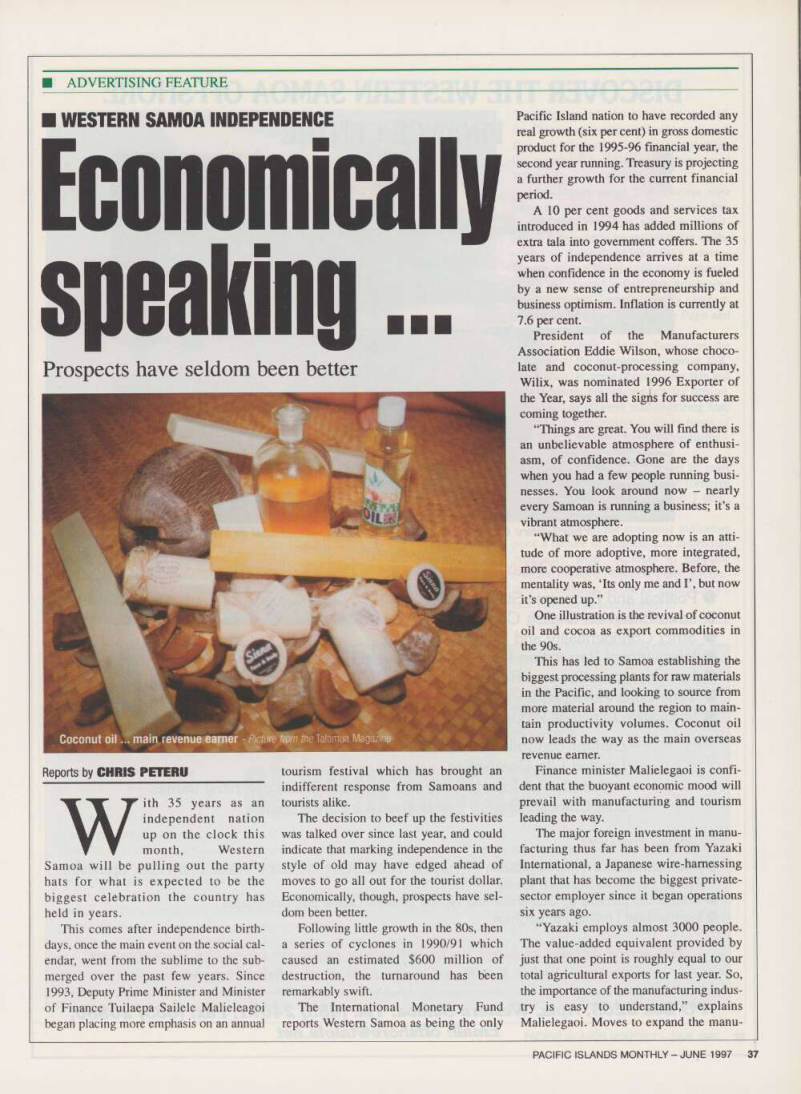
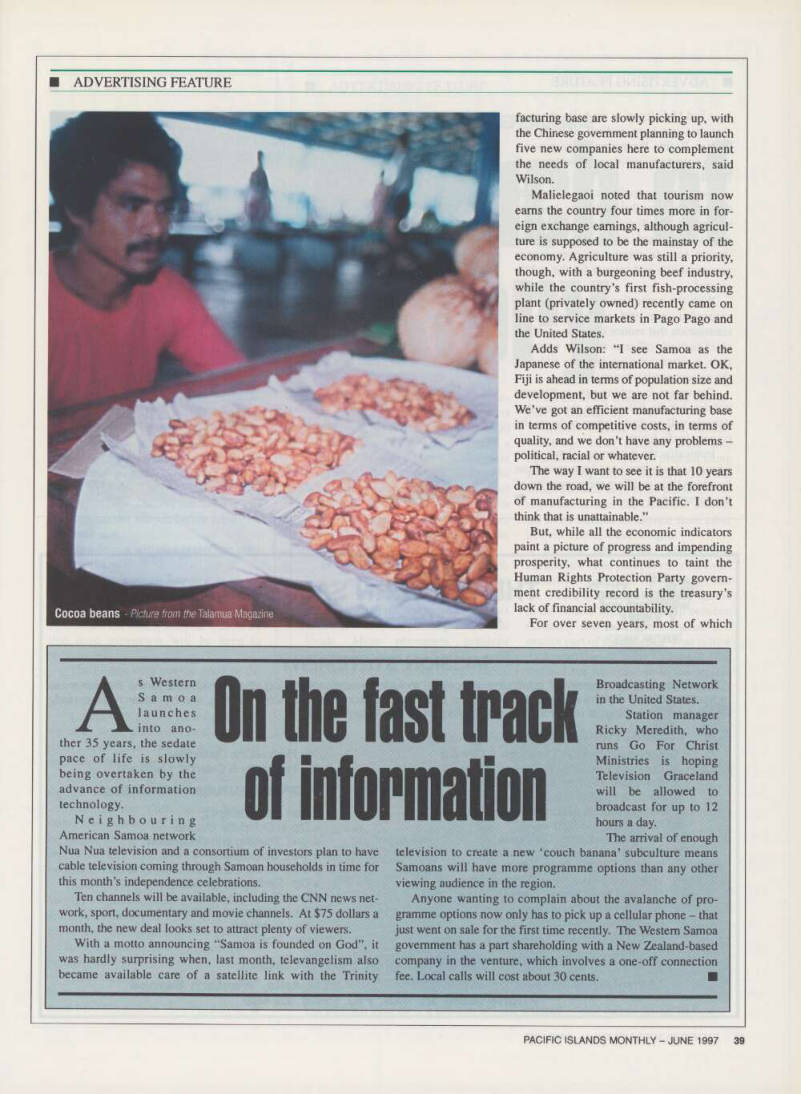
One illustration is the revival of coconut oil and cocoa as export commodities in the 90s.
This has led to Samoa establishing the
biggest processing plants for raw materials
in the Pacific, and looking to source from more material around the region to main tain productivity volumes. Coconut oil now leads the way as the main overseas revenue earner.
Finance minister Malielegaoi is confi dent that the buoyant economic mood will prevail with manufacturing and tourism leading the way.
The major foreign investment in manu facturing thus far has been from Yazaki
International, a Japanese wire-hamessing
plant that has become the biggest private sector employer since it began operations six years ago.
“Yazaki employs almost 3000 people.
The value-added equivalent provided by just that one point is roughly equal to our total agricultural exports for last year. So, the importance of the manufacturing indus try is easy to understand,” explains Malielegaoi. Moves to expand the manu-
Coconut oil...main revenue earner - Picture from the Talamua Magazine
factoring base are slowly picking up, with the Chinese government planning to launch five new companies here to complement the needs of local manufacturers, said Wilson.
Malielegaoi noted that tourism now earns the country four times more in for
eign exchange earnings, although agricul
ture is supposed to be the mainstay of the economy. Agriculture was still a priority,
though, with a burgeoning beef industry,
while the country’s first fish-processing
plant (privately owned) recently came on
line to service markets in Pago Pago and the United States.
Adds Wilson: “I see Samoa as the Japanese of the international market. OK, Fiji is ahead in terms of population size and development, but we are not far behind.
We’ve got an efficient manufacturing base in terms of competitive costs, in terms of quality, and we don’t have any problems political, racial or whatever.
The way I want to see it is that 10 years down the road, we will be at the forefront of manufacturing in the Pacific. I don’t think that is unattainable.”
But, while all the economic indicators paint a picture of progress and impending prosperity, what continues to taint the Human Rights Protection Party govern ment credibility record is the treasury’s lack of financial accountability.
For over seven years, most of which
Cocoa beans - Picture from the Talamua Magazine
have had Malielegaoi at the helm, the trea sury has not been audited, leaving the Human Rights Protection Party govern ment open to suggestions of widespread skullduggery.
Ramming supplementary budgets through the house that exceed the designat ed one per cent discretion allowed by law is just one example of how the HRPP has chosen to ride roughshod over proper accountability and respect for the public interest.
With the controller and chief auditor suspended since 1995, and changes to the constitution that reduce the powers of the chief auditor’s office to that of a toothless tiger, it raises questions as to the ethics of the present administration.
Corruption is nothing new in Samoan politics, but the fallout from this ongoing debacle will no doubt return to haunt the country in the future.
Ironically, the deafening silence as to why the checks have not been caried out has done little to affect the popularity of the government. ■
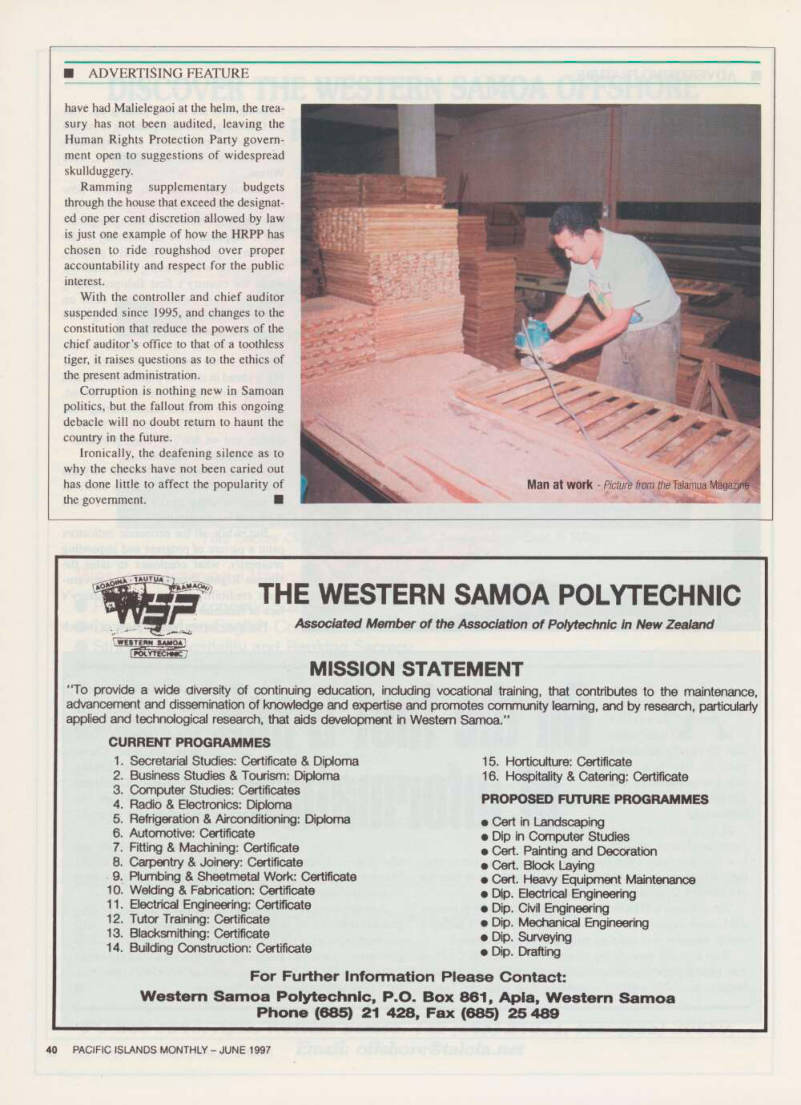
Man at work - Picture from the Talamua Magazine