Wave of music
pp. 49-50 · Read in the full issue
Culture
Wave of music and culture
Text and photography
by Liz Thompson
It’s Sunday afternoon at Sydney’s
Bondi beach and the streets are packed with cars vying for parking places. The heat is intense and the pave ments are filled with people, most of whom are heading towards Bondi Pavilion. Many of them are Tongans, Samoans, Maoris, Papua New Guineans, Torres Strait Islanders, as well as a large Black and White Australian contingent.
This shared point of interest is the Pacific Wave, a day of Pacific music and cultural events established as part of the Pacific Festival which has been staged over a number of weeks at various venues around the city and suburbs. Out in the grassy courtyard people dance to the sound of Going Home a Sydney-based Pacific Islander and Maori group. There is a sense of celebration and of a diverse and tolerant community in which people enjoy each other’s differences and believe they have things to leam from each other; a mood much welcomed after Australia has been plagued by the Pauline Hanson debate in recent months and the ugly face of racial intolerance.
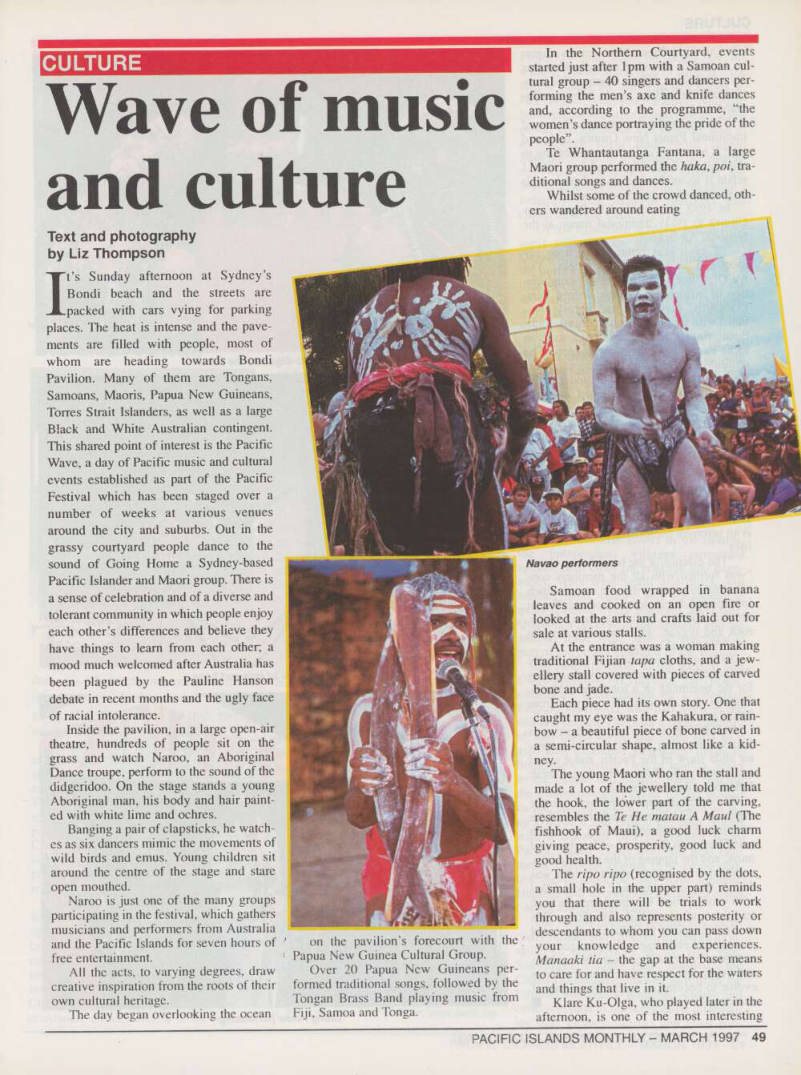
Inside the pavilion, in a large open-air theatre, hundreds of people sit on the grass and watch Naroo, an Aboriginal Dance troupe, perform to the sound of the didgeridoo. On the stage stands a young Aboriginal man, his body and hair paint ed with white lime and ochres.
Banging a pair of clapsticks, he watch es as six dancers mimic the movements of wild birds and emus. Young children sit around the centre of the stage and stare open mouthed.
Naroo is just one of the many groups participating in the festival, which gathers musicians and performers from Australia and the Pacific Islands for seven hours of free entertainment.
All the acts, to varying degrees, draw creative inspiration from the roots of their own cultural heritage.
The day began overlooking the ocean
on the pavilion’s forecourt with the Papua New Guinea Cultural Group.
Over 20 Papua New Guineans per formed traditional songs, followed by the Tongan Brass Band playing music from Fiji, Samoa and Tonga.
In the Northern Courtyard, events started just after Ipm with a Samoan cul tural group - 40 singers and dancers per forming the men’s axe and knife dances and, according to the programme, “the women’s dance portraying the pride of the people”.
Te Whantautanga Fantana, a large Maori group performed the haka, poi , tra ditional songs and dances.
Whilst some of the crowd danced, oth ers wandered around eating
Samoan food wrapped in banana leaves and cooked on an open fire or looked at the arts and crafts laid out for sale at various stalls.
At the entrance was a woman making traditional Fijian tapa cloths, and a jew ellery stall covered with pieces of carved bone and jade.
Each piece had its own story. One that caught my eye was the Kahakura, or rain bow - a beautiful piece of bone carved in a semi-circular shape, almost like a kid ney.
The young Maori who ran the stall and made a lot of the jewellery told me that the hook, the lower part of the carving, resembles the Te He matau A Maul (The fishhook of Maui), a good luck charm
giving peace, prosperity, good luck and
good health.
The ripo ripe (recognised by the dots, a small hole in the upper part) reminds you that there will be trials to work through and also represents posterity or descendants to whom you can pass down your knowledge and experiences.
Manaaki tia - the gap at the base means to care for and have respect for the waters and things that live in it.
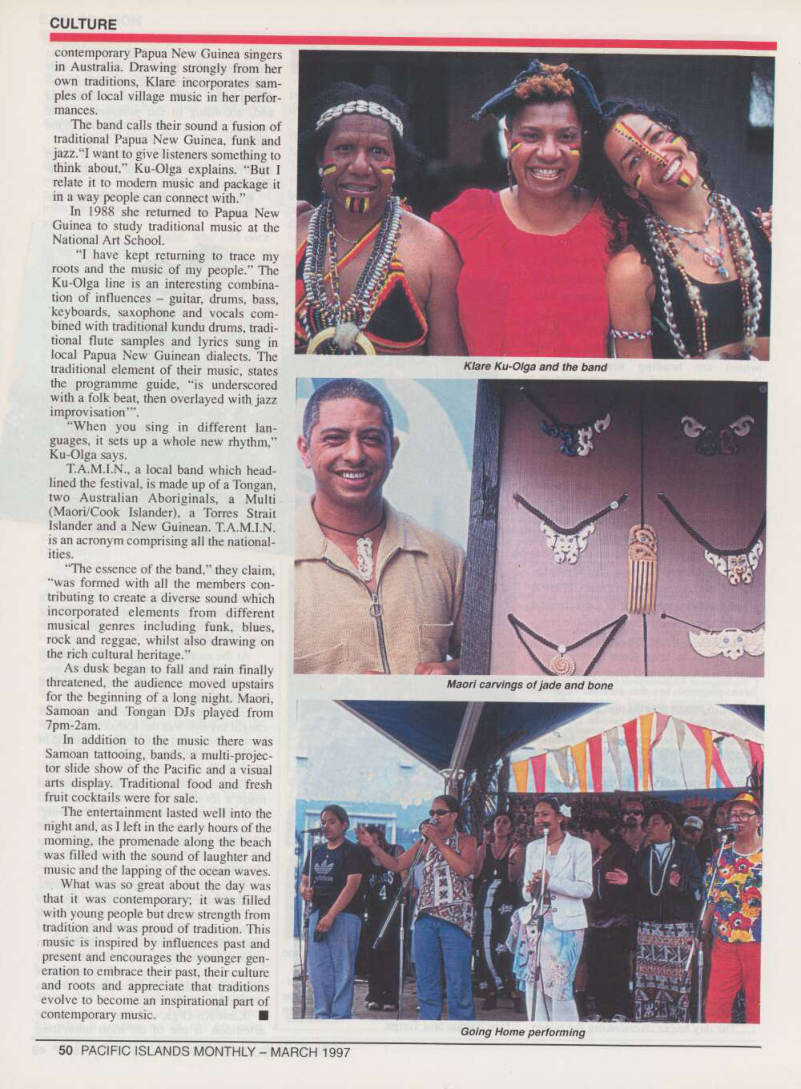
Klare Ku-Olga, who played later in the afternoon, is one of the most interesting
Navao performers
contemporary Papua New Guinea singers in Australia. Drawing strongly from her own traditions, Klare incorporates sam ples of local village music in her perfor mances.
The band calls their sound a fusion of traditional Papua New Guinea, funk and jazz.‘T want to give listeners something to think about,” Ku-Olga explains. “But I relate it to modem music and package it in a way people can connect with.”
In 1988 she returned to Papua New Guinea to study traditional music at the National Art School.
“I have kept returning to trace my roots and the music of my people.” The Ku-Olga line is an interesting combina tion of influences - guitar, drums, bass, keyboards, saxophone and vocals com bined with traditional kundu drums, tradi tional flute samples and lyrics sung in local Papua New Guinean dialects. The traditional element of their music, states the programme guide, “is underscored with a folk beat, then overlayed with jazz improvisation’”.
“When you sing in different lan guages, it sets up a whole new rhythm,”
Ku-Olga says.
T.A.M.1.N., a local band which head lined the festival, is made up of a Tongan, two Australian Aboriginals, a Multi (Maori/Cook Islander), a Torres Strait Islander and a New Guinean. T.A.M.I.N. is an acronym comprising all the national ities.
“The essence of the band,” they claim, “was formed with all the members con tributing to create a diverse sound which incorporated elements from different musical genres including funk, blues, rock and reggae, whilst also drawing on the rich cultural heritage.”
As dusk began to fall and rain finally threatened, the audience moved upstairs for the beginning of a long night. Maori, Samoan and Tongan DJs played from 7pm-2am.
In addition to the music there was Samoan tattooing, bands, a multi-projec tor slide show of the Pacific and a visual arts display. Traditional food and fresh fruit cocktails were for sale.
The entertainment lasted well into the night and, as I left in the early hours of the morning, the promenade along the beach was filled with the sound of laughter and music and the lapping of the ocean waves.
What was so great about the day was that it was contemporary; it was filled with young people but drew strength from tradition and was proud of tradition. This music is inspired by influences past and present and encourages the younger gen eration to embrace their past, their culture and roots and appreciate that traditions evolve to become an inspirational part of contemporary music. ■
Klare Ku-Olga and the band
Maori carvings of jade and bone
Going Home performing