intervention
pp. 51-52 · Read in the full issue
Literature
Divine intervention
The 17th century Jesuit mission in the Marianas
By David North
Their letters speak of boundless Christian love struggling with Satan to save souls from eternal darkness. Their religious conquest of the islands is proof, they write, of God’s glory, the intercession of his blessed mother, and the majesty of Spain.
Guam will be the cornerstone of an archipelagic “fourth part of the world”, stretching from the great unknown south ern continent to the doorstep of Japan.
This ecclesiastical empire will enable the missionaries to breach Japan’s seclusion policy and link up with thousands of Christian converts there. In conception, it is a grand and glorious geopolitical enter prise to evangelise the Asia-Pacific
region.
The 17th century correspondence of Jesuit missionaries in the Marianas also speaks of the tragedy of this first sus tained encounter between a European colonial power and a Pacific Island peo ple. The letters relate the wholesale, and many times forced, conversion of the Chamorro people; the Islanders’ war of resistance; the decimation of the popula
tion by European disease and war; and the creation of the first European colony in the Pacific.
The letters and reports were addressed to popes, Spanish kings and queens, Jesuit leaders, and colonial officials. Written in Latin, Spanish, or French and filed away for centuries in European archives, most of the letters have been unavailable to the general reader. But an annotated collec tion of these historic communications is now available in English. The compila tion, and some of the translation, was
accomplished by Rodrique Levesque, an
enterprising French-Canadian with a pas sion for Pacific history.
As editor and publisher of the multi volume History of Micronesia, Levesque has tracked down original source docu ments for early European interaction with the region and made them available for the English-reading public, teachers and scholars. Volumes 4 through 6 encompass the years 1638 to 1678, covering the gen esis of the Marianas Mission, the landing of the Jesuit group on Guam, and the first 10 years of interaction with the Chamorros.
The Jesuits were educated, energetic, observant, literate Soldiers of Christ.
Inveterate letter writers, their communi cations are invaluable sources for a pic ture of traditional Chamorro society, circa the 16605. Care must be taken to sift their observations and screen out the religious and cultural bias, but the nuggets of solid history that remain are well worth the effort.
The personalities, passions, and con flicts that emerge from these documents are worthy of a dramatist. The mission is the obsession of a Spanish Jesuit, Father Diego Luis de Sanvitores, who in 1662, on his way to the Philippines, decides that the souls of the Chamorro people of Guam must be saved.
Of noble blood, Sanvitores had power ful connections at court, including his father, Don Jeronimo Sanvitores - a member of the Treasury Council. The mission is offered as a way of regaining entry to Japan, from which the Jesuits and other Europeans had been expelled earlier in the century. The plan is approved by
Philip IV and, after his death, by his widow, Queen Maria Ana of Austria - the regent during the minority of Charles 11.
Her Jesuit confessor, Father Nidhard, believed the initiative would extend Jesuit power and influence and possibly lead to a lucrative royal trade with Japan.
Sanvitores was so grateful for her patron age that he renamed the islands the Marianas in her honour. Since Magellan’s unhappy visit, Spanish mariners had called them the Ladrones (Thieves).
Of the Chamorro leaders, perhaps the most tragic figure in the drama was Quipuha, paramount chief of Hagatna on the northwest coast of Guam - the site of today’s capital of Agana. By the time the
41-year-old Sanvitores arrived, Quipuha
and his clan chiefs had been friends of the Spanish for more than 30 years.
They had succoured shipwrecked
Spanish seamen and been rewarded with large amounts of iron. Each year, his best sailors awaited the first sight of the annu al galleons and raced in their fleet canoes to trade. Often they fought with men from neighbour islands for the best position alongside the ships to barter food and water for iron nails, hoops, tools, and weapons. The galleon trade was virtually the sole source of this new technology for the islanders. Controlling the trade and the supply of iron had become a source of prestige and influence.
With no central power in the islands, the independent villages competed against each other for position and hege mony. Wars were small and quick, but
holding onto victory and consolidating
gains required every possible advantage.
Quipuha’s pacts with the Spanish and the galleon trade were now an inseparable part of the power equation in the islands.
On June 16, 1668, as the galleon San Diego anchored off Hagatna, Sanvitores’ emissaries, accompanied by a Christian Filipino interpreter who had lived in the islands, brought Quipuha a large quantity of iron barrel hoops and some hats as a
gift. They explained Sanvitores’ desire to
bring the Christian God of mighty Spain to the people and baptise them, making the Chamorros subjects of Christ as well as the Spanish queen. They asked to set up a mission and preach the faith. Faced with a dilemma that confronted many Pacific Island chiefs over the next cen turies, Quipuha agreed. If he could con trol the mission, he may have thought, Hagatna and its associated villages could control the galleon trade.
The Jesuits baptised relentlessly, espe cially infants and children, claiming thou sands of conversions in the first year.
Sanvitores, who had learned the Chamorro language aboard ship from the Filipino interpreter, preached widely and enticed people to his services by distribut ing iron, clothes, mirrors and other trim
kets to those who attended. Quipuha gave Sanvitores land and helped him build a stone church, but became concerned when the missionaries roamed far and wide, insisting on entering any village in the islands and baptising any child despite the parents’ protests.
Over the first few years, as supplies of iron and clothing dwindled, and the annu al galleons were late or passed without stopping, the mission’s situation waxed from precarious to desperate. The mis sionaries became entangled in inter-vil lage warfare and after Quipuha’s death in 1669, Sanvitores’ zealotry intensified as he and his followers pressed Spanish reli gious views on reluctant converts. They condemned Chamorro manners of dress and class deference, assailed customs dealing with pre-marital sex, burial rites, and ancestor respect rituals. For many Chamorro chiefs, the mission became an alien invasion, undermining their power structures.
The first Jesuit and his companion were slain in 1670. Sanvitores was killed in 1672 by the Chamorro chief, Matapang, after the priest had ignored the chief’s warning not to baptise his child.
The Spanish garrison was expanded and
the fortification enlarged. Sporadic killings and small-scale clashes contin ued. But the killing of missionaries and companions was often followed by large scale retaliation - the killing of all the inhabitants of the suspected village.
By the late 1670 s the garrison num bered more than 100 soldieirs. The com mander of the soldiers became the mili tary governor of the island, supplanting Sanvitores’ theocracy, and the Marianas became known as one of the most danger ous assignments for Jesuits. Opponents of the Spanish who escaped death began to flee to the mountains of Guam or the northern islands, while other Chamorros began to take on the manners of the Spanish and adopt their dress and cus toms.
Coordinated attacks by several hun dred islanders nearly wiped out the mis sionary band and garrison in 1675 and
1684. Desperate for help against the
Spanish, some resistance fighters tried to enlist English privateers in the war, promising to assist the Englishmen in the conquest of the island.
The Chamorro resistance movement was gradually exterminated over the next several years and the population of the northern islands was relocated to Guam.
Smallpox epidemics, especially one in
1688, contributed to the population decline. The last stand of Chamorro resis tance occurred in 1695.
The population, estimated at between 30,000 and 50,000 in the 16605, was reduced to fewer than 5000 by the end of the century.
Though the Divine Sect was expelled from the Marianas in 1769 when the Jesuits were banished from all Spanish
territory, the drama and dynamics unveiled in their letters from Guam con tinues today in different forms - histori cal, political, and mythic.
The direct descendants of the Chamorro families that remained allied with the Spanish and intermarried with them over the centuries saw Spanish rule end in 1898, when the United States arrived off Guam to seize the island from
Spain.
By that time, the hispanicised Chamorros had regained virtual control of their island, owning most of the land and running the local government under fig ure-head Spanish governors.
Sanvitores was beatified by the Catholic Church in 1985 and efforts con tinue to canonise him as a saint.
Though Quipuha has the grandest stat ue in downtown Agana, not far from where Sanvitores came ashore, Matapang has become the culture hero for young Chamorros and the Chamorro Rights Movement, which wages a new war of liberation through protests and legal action. The beach where Matapang killed Sanvitores is now crowded with Japanese tourists and ringed by multi-million-dol lar Japanese hotels, signs of the island’s most recent invasion. ■
History of Micronesia volumes can be ordered from Levesque Publications, 189 Dufresne, Gatineau, Quebec, Canada, JBR 3EI. Each volume costs SUSSO.
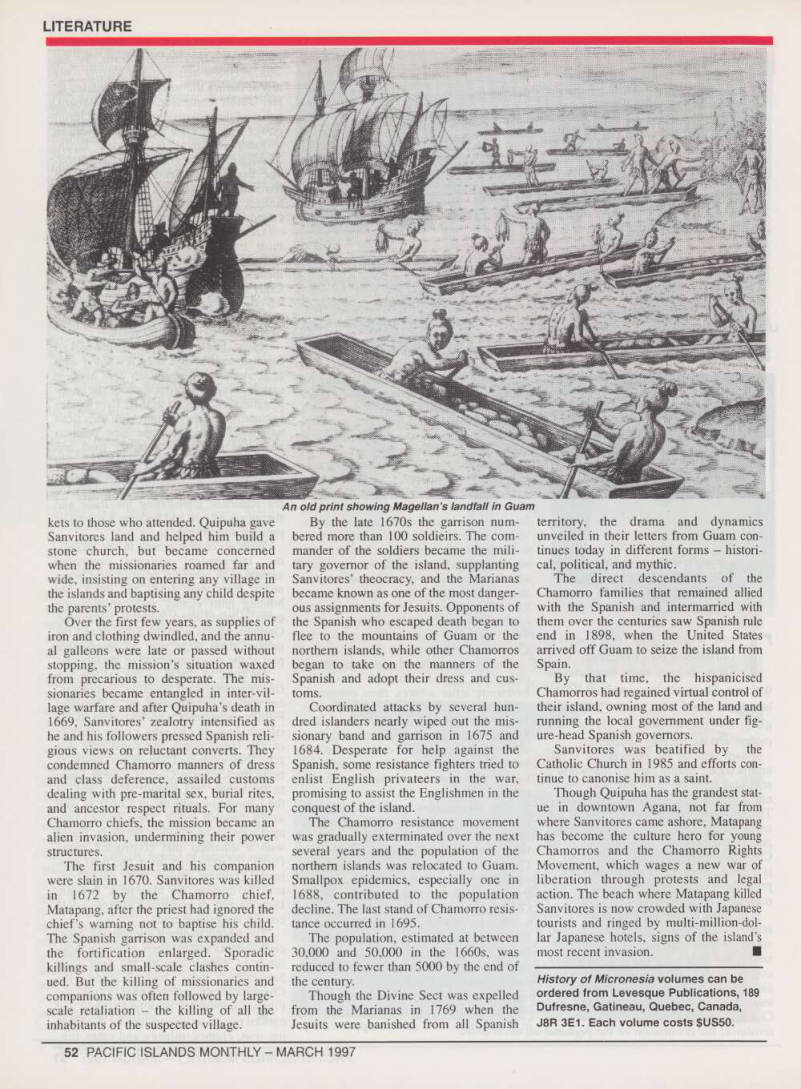
An old print showing Magellan's landfall in Guam