Advertisements & other items, pp. 1-3 (3 items)
iPyeorsi
PACIFIC
ISLANDS
MONTHLY
UMvmAmi
iPyeorsi
j The question of asylum
Cover: Andrew Williams
CitiStudlo#96Bsc
For whatever reason...
The safest and the quickest way to Papua New Guinea
is by phone...
fust dial +675 plus the number and you're hone.
In Papua New Guinea , Telikom does the connection for you.
TELIKOM
PAPUA NEW GUINEA
Pacific
ISLANDS
MONTHLY
Vol. 67 No. 03
THE NEWS MAGAZINE
MARCH 1997
Cover

Special Reports
Exclusive
10: Crime and
punishment
Former gang leader speaks out on PNG’s crime situation
6: Redfern Its other face 13: Bougainville
Backs cannot be turned on Bougainville... but eight years later the possibilities of a solution still seem remote
35: SPC’s golden year But challenges lie ahead
28: The Dalai Lama in Australia
Advertising Feature
33: Investing in Papua New Guinea
Cover
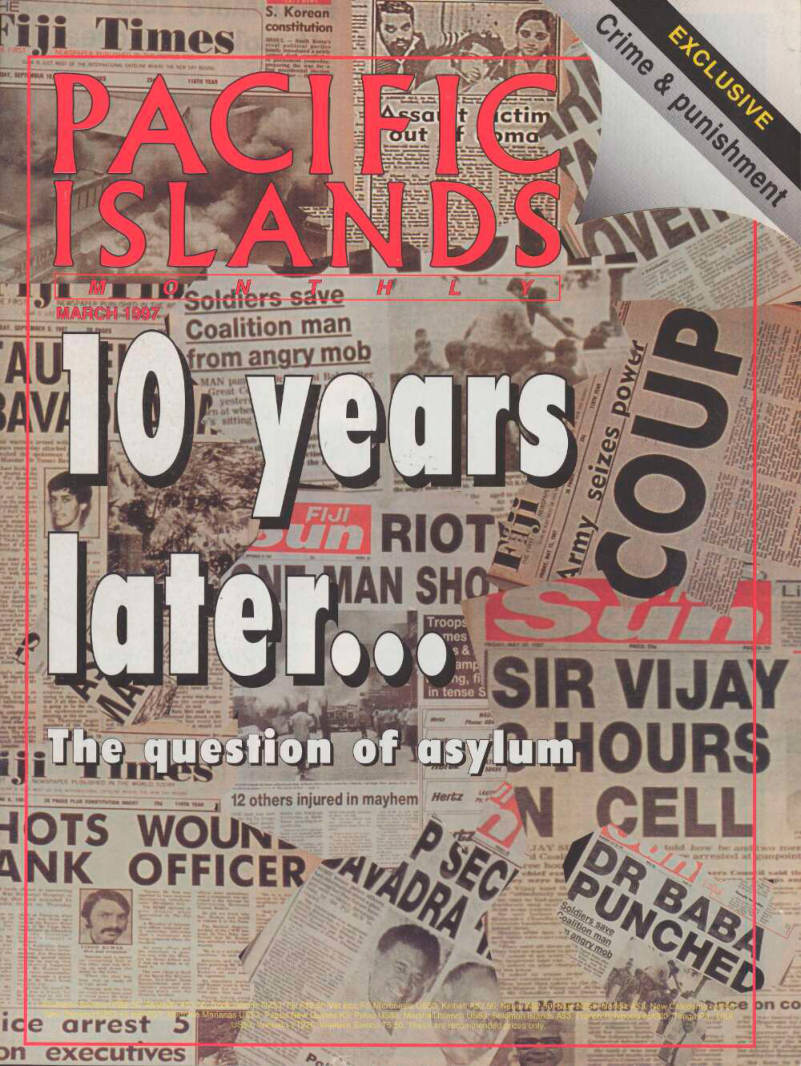
is: 10 years later...
Nearly 10 years after Fiji’s first military coup, asylum seekers are still awaiting the outcome of thier applications. Yet, questions abound on the authenticity of their claims and the sort of immigration procedures in place to verify such claims.
4: Letters 16: Crossing the line 25: How safe is safe 46: The Earhart mystry 49: Wave of music and culture 51: Divine intervention 53: From London to
the Antipodes
54: Dreaded Drena
Opinion
56: Debbie Singh (SPC) Conserving Pacific culture 57: Jemima Garrett Saving Radio Australia 58: David Barber NZ’s aid dilemma
Sports
41: Pacific superstars provide Super 12 its gloss 43: Second change 44: Sevens glory for region’s players
Advertisements & other items, p. 3 (1 item)
PUBLISHER: Alan Robinson
EDITOR: Manivannan Naidu SENIOR WRITER: Bernadette Hussein
CORRESPONDENTS:
Sally Andrew, Patrick Decloitre, David North, Chris Peteru, Atama Raganivatu, Kalinga Seneviratne, Liz Thompson, Lili Tuwai, Sam Vulum Ian Williams COLUMNISTS: David Barber (Wellington), Jemima Garrett (Sydney), Alfred Sasako (The Forum), Debbie Singh (South Pacific Commission).
GRAPHIC ARTIST: Andrew Williams
ADVERTISING SALES
Senior Regional Sales (South Pacific) Shailendra Kumar Shabana Naaz Tel (679) 304111,303244, Fax(679)303809.
Sydney, Canberra: Bob Hill Media Representation, Tel (61-2) 4164245, Fax (61-2) 4165064.
Brisbane: Jane Fewings Media and Advertising Associates Tel (61-7) 3378 4522, Fax (61-7) 3878 1071.
Adelaide: Hastwell Williamsons Representatives, Tel (61-8) 3799522, Fax (61-8) 3799735.
Melbourne: Brown Orr Fletcher Burrows (Aust) Pty Ltd.
Tel(61-3) 98265188, Fax (61-3) 98265644.
Auckland: McKay & Bowman, International Media Representatives Limited, Tel (64-9)4190561, Fax (64-9)4192243.
Japan: Universal Media Corporation, Tokyo, Tel (3) 3266626741, Cable: UNI-MEDIA Tokyo, Fax(3)32626742.
Pacific Islands Monthly was founded in
1930 (USPS 9522480).
A Fiji Times Limited production.
Cover prices are recommended retail only. Registered by Australia Post, Publication No. NBP1210. © Copyright Fiji Times Limited, 177 Victoria Parade, Suva, Fiji.
Tel (679) 304111, fax (679) 303809.
Pacific Islands Monthly is published monthly by Fiji Times Limited, a division of Nationwide News, 2 Holt Street, Surry Hills, Sydney, NSW 2010.
SEND ADDRESS CHANGES TO:
Pacific Islands Monthly POBox 1167 Suva, Fiji.
Typeset and printed by The Fiji Times Limited, 177 Victoria Parade, Suva, Fiji.
testing
French testing
Dear Sir,
Your January issue offered exten sive coverage of Gaby Tetiarahi’s allegations concern ing health problems related to French
nuclear testing.
I suppose that your readers will have accorded to them the credit they deserve when Tetiarahi states that “it was not before 1995 that we got to know what happened at Hiroshima and Nagasaki”.
What happened in the two Japanese cities has, of course, been well known everywhere in the world and in French Polynesia since August 1945. In addi tion, both foreign and local anti-nuclear movements have been very active in Tahiti, and have been free to do so, for the past 30 years.
I do not see how, as Tetiarahi alleges, workers might be suffering from cancer for 20 years, and pass on their jobs to their healthy children. His claims imply that radioactivity would affect only Polynesian workers. What about the many thousands who came from France?
What about the population of Pitcairn or Cook Islands, which are as close to Mururoa as some parts of French
Polynesia?
Court claims pleading for state responsibility are easy and common in Tahiti as well as in France: why not a sin gle one in relation to cancer amongst Mururoa’s workers; amongst the nearly 200,000 tourists who visit French Polynesia every year; amongst pearl oys ter farmers or fishermen on islands near the former testing site? How could widespread cancer have remained unno ticed for decades in a population so easy
to identify?
How does one hide this epidemic in an open and democratic country like French Polynesia? In Tahiti, the pro independence party led by (Oscar) Temaru scored 25 per cent of votes at last year’s election. Tetiarahi’s movement was not in a position to contest even one
seat. Why?
There are already many studies about radioactivity and cancer in the Pacific, including some by scientists of the United Nations Environment Programme as well as of the South Pacific Commission. [A list of studies was attached with the letter.] None of them ever showed that any thing went wrong in Tahiti, contrary to
groundless rumours spread by self
appointed experts.
Nevertheless, a special medical com mission was set up in Papeete in order to examine and possibly treat free of charge, anyone who might have thought he was suffering from radiation contami nation. Orfly one person turned up - just in order to have a free check-up. No names or list of people supposed to be suffering from radiation exposure were ever released.
Despite accusations of secrecy, France is the only nuclear power which has made public scientific data on all its nuclear experiments, opened its testing ground to international scientific mis sions and world media, closed its testing facility, started to dismantle it, and final ly asked the International Atomic Energy Agency (lAEA) to conduct an indepen dent and comprehensive study on its radiological situation. France did so because she has nothing to hide.
Of all testing sites, Mururoa has been the most visited (by many protesters as well), has received the largest media cov erage and been the most studied: visitors have seen for themselves local military and civil staff drinking desalinated
lagoon water, swimming and enjoying a
beautiful environment. They could also see that Mururoa was one of the very few places in the Pacific to have facilities such as a domestic waste and used lubri cants incinerator, as well as a fresh water plant.
Gail de Planque, head of the lAEA mission swam in the lagoon and declared in Suva on December 4 last year that it
was “wonderful” and that she found “a beautiful bird colony, thriving there, unafraid”.
But there are still ‘reports’ ... There have also been, for a longer time, reports about the Loch Ness monster and flying saucers.
Alarming rumours about cancer in Tahiti exist only in the minds of people who dare not expose their bias to reality, or in those who use their imagination for political purposes.
Michel Jolivet
Ambassador of France to Fiji Suva Fiji
conservation
Culture and conservation
Dear Sir, Bernadette Hussein’s report
(Pacific Islands Monthly
October, 1996) and Inge Mathiesen’s comments (PIM December, 1996) irritate me for such cheap journal ism and suggest that these reports should not have been published in the first place.
No wonder we find a number of our gov ernments trying to mitigate the freedom
our good journalists!
The bottom line here is Hussein’s story is poorly researched, politically, culturally and traditionally insensitive to the governments of the Forum Island Countries and, importantly, did very well in insulting the government and the peo ple of the Republic of the Marshall Islands (RMI).
Let me elaborate and give you my reasons: • Every sovereign nation is entitled to extract and exploit her land and marine resources in a sustainable manner (under the UNCED Treaty) and incorporating environmental and conservation mea sures. • The Pacific Island governments have always sustained their land and marine resources through their tradition al and cultural practices for generations, until western ideologies, financial con straints and competitive international trade (north versus south issues) forced the Island governments to exploit their already limited natural base resources to keep their heads above the oceans rather than sink into the already complicated
global trade wars, for example, exporting
turtle meat and shells outside the region.
Is it worth it? Why not target your report at importers and exporters in this region?
The political leaders of the Forum
Island Countries (FIC) are very much aware of the turtle plight at global and regional levels - the reason why they endorsed and supported the regional pro gramme implemented by the South Pacific Regional Environment Programme (SPREP) and known as 1995 The Year of the Turtle. (Write to the so-called the “Turtle lady” in SPREP she would love to give you all the assis tance you require.) Their actions are very visible at their national level as well, for your information.
Marine biodiversity/resources,
including fish, crayfish, whales, birds, coral reefs and turtles, are harvested as food in a sustainable manner in all the islands.
The catching and killing of turtles in itself is traditionally, culturally accept able and takes into account conservation concerns.
In the majority of PIC, only certain groups/clans or islanders are allowed to catch turtles.
For your information, the RMI inci dent is no different here. The chief/lead er of one of the outer islands in RMI tra ditionally presents this offering of turtles as the highest honour or gift to the pres ident/paramount chief of RMI and his special guests (leaders of forum coun tries), including the journalists - did you taste this meat or did you insult your host?
The harvesting and eating of turtles in Majuro in RMI in its purest form in a tra ditional and cultural setting is a mark of respect from one chief to another in the midst of all the leaders and their guests,
including journalists in the region.
There are a lot of important issues here and I hope outsiders realise them; protection and conservation of turtles or any so-called endangered species does not mean that we stop eating our marine resources.
Eating turtles once a year being acceptable to our leaders at this very spe cial cultural setting is understandable, don’t you agree? Mindful of managing our marine resources, I will have my tur tle meat when it is served to me as part of any of the islands’ cultural obliga tions.
Give credit to the leaders of the FIC, including the people of RMI, who have endorsed and started implementing a tur tle and biodiversity conservation pro gramme at national and regional levels to take our outside friends’ interest into account as well. 1997 is the Year of the Coral Reef, organised by SPREP. I have a number of suggestions: let’s look at conservation of koala bears or kangaroos (Australia) or possums (New Zealand).
Any other suggestions?
Who said conservation of marine
resources is a more important priority than the people of the Pacific? Yes, a brilliant programme just surfaced - con servation of endangered Pacific people in the plight of global warming and sea level rise coupled with environmental changes coordinated by the South Pacific Commission would be an ideal issue.
The challenge of managing and developing the scarce land and ocean resources in Pacific Islands is awesome,
especially when incorporating conserva
tion, cultural, social and traditional aspects. Give the governments of PICs, and especially RMI, the respect and dig
nity they deserve in maintaining their
cultural and traditional values in enhanc ing their conservation and economic pro grammes.
Finally, a cheap and poorly researched report is as good a part of a trash bin when it is produced today.
Makania Ehor
Nadi Fiji
Dear Sir Timeon loane of Honolulu used two words in his letter to the edi tor (Pacific Islands Monthly December, 96): “radical conservation ists”.
My reply: what chance did a handful of whales have (25 years ago) to stay alive against a world population (1972) of over 4,000,000,000 people? Who was on the way to extinction in 1972? The whales or humans? What does it look like, loane? Because the world popula tion will reach close to 7,000,000,000 people by the year 2000, the human race is hardly on its way out; we are on the way towards a population explosion.
Unfortunately, still too many people around the globe do not know the mean ing of the word birthcontrol.
Thanks to Greenpeace, there is still fish in the oceans. Greenpeace did lead the fight to outlaw 50km-long driftnets the walls of death - killing between 250,000 and 300,000 dolphins each year, plus half a million sea birds, many whales, etc besides fish.
And last, but not least, loane, how would you like to be put on your back, unable to move whatsoever in the boil ing hot sun on a beach for hours, getting roasted alive, like the sea turtles a few months ago in the Marshall Islands?
Animals feel pain too, just like humans do.
Inge Mathiesen
Montana
Usa
Crime
in PNG
Dear Sir I refer to the report by Sam Vulum in Pacific Islands Monthly (December, 1996) on crime in Papua New Guinea.
To be brief, I shall quote only two short passages from Vulum’s report: “Police recorded 875 serious offences throughout the country and only 398 arrests in October”; with 212 serious offences and 119 arrests”. Those and other numbers can be misleading and lead to possible wrong inferences.
The question arises: of the 398 people arrested and the 119 people arrested, how many were innocent of the crime(s) for which they were arrested? After all, just because someone was arrested for committing a given crime does not mean that person did, in fact, commit that crime (even if the police, in good faith, believed the crime was done by the per son arrested).
Robert Silberstorf
Antioquia Colombia • Editor’s note: In no way did the arti cle in question seek to imply that any of those arrested were guilty of the crimes they were arrested for.
Letters to the Editor should be addressed to: The Editor Pacififc Islands Monthly P O Box 1167 Suva
Fiji
Advertisements & other items, pp. 6-9 (1 item)
sdsdsdsdsds
SPECIAL REPORT
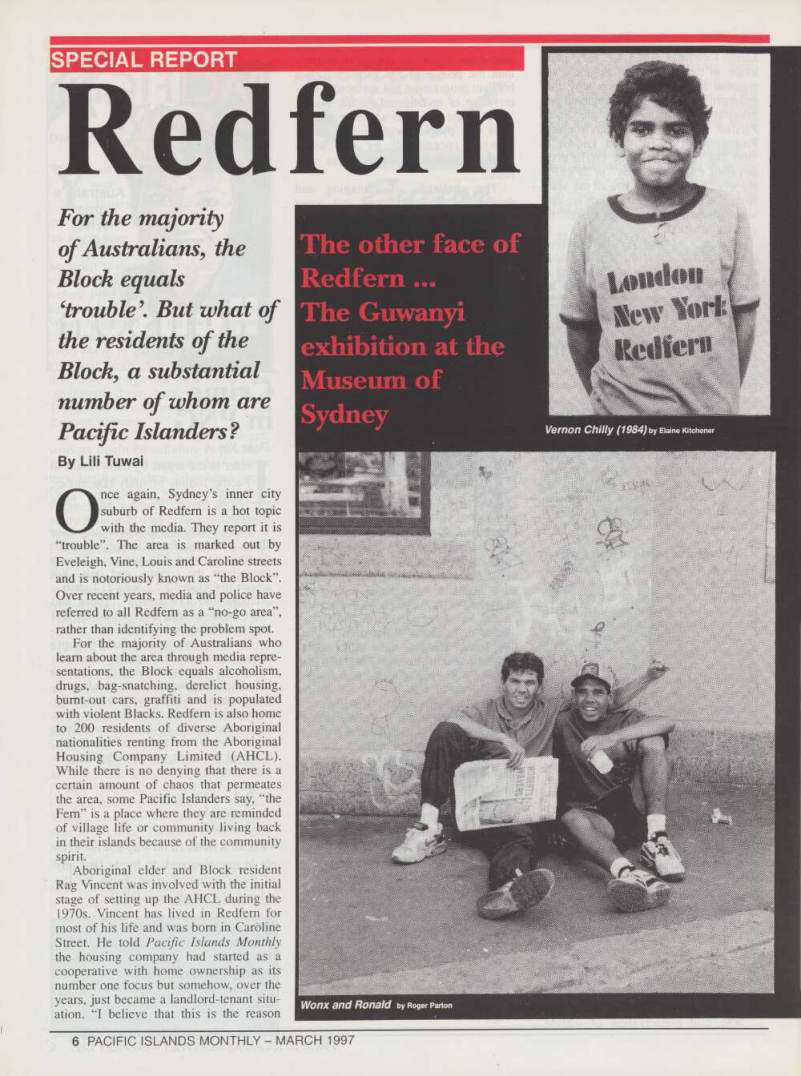
Redfern
For the majority of Australians, the
Block equals
‘trouble’. But what of the residents of the Block, a substantial number of whom are
Pacific Islanders?
By Lili Tuwai
Once again, Sydney’s inner city
suburb of Redfem is a hot topic with the media. They report it is “trouble”. The area is marked out by Eveleigh, Vine, Louis and Caroline streets and is notoriously known as “the Block”.
Over recent years, media and police have referred to all Redfem as a “no-go area”, rather than identifying the problem spot.
For the majority of Australians who learn about the area through media repre sentations, the Block equals alcoholism,
drugs, bag-snatching, derelict housing,
bumt-out cars, graffiti and is populated with violent Blacks. Redfem is also home to 200 residents of diverse Aboriginal nationalities renting from the Aboriginal
Housing Company Limited (AHCL).
While there is no denying that there is a certain amount of chaos that permeates the area, some Pacific Islanders say, “the Fern” is a place where they are reminded of village life or community living back in their islands because of the community
spirit.
Aboriginal elder and Block resident Rag Vincent was involved with the initial stage of setting up the AHCL during the 19705. Vincent has lived in Redfem for most of his life and was bom in Caroline Street. He told Pacific Islands Monthly the housing company had started as a cooperative with home ownership as its number one focus but somehow, over the years, just became a landlord-tenant situ ation. “I believe that this is the reason
sdsdsdsdsds
Vernon Chilly (1984) by Elaine Kitchener
Wonx and Ronald by Roger Parton
why it became a no-go area because peo ple living there had a tenants’ mentally the houses still do not belong to the ten ants so who cares one way or another.”
“Let’s face it, whether they want to admit it or not, this is a racist country 99
Strong connections have developed
between the Fijian and Aboriginal com munities over the past 10 years. A church on Louis Street has been attended regular ly by members of the Fijian community.
According to Vincent, the Block hasn’t always had good relationship with Pacific Islanders. Over recent years there has been a building of relationships with other indigenous groups from the Pacific Islands. “We have Pacific Island people that live in the community and their chil dren intermingle with the Aboriginal community.
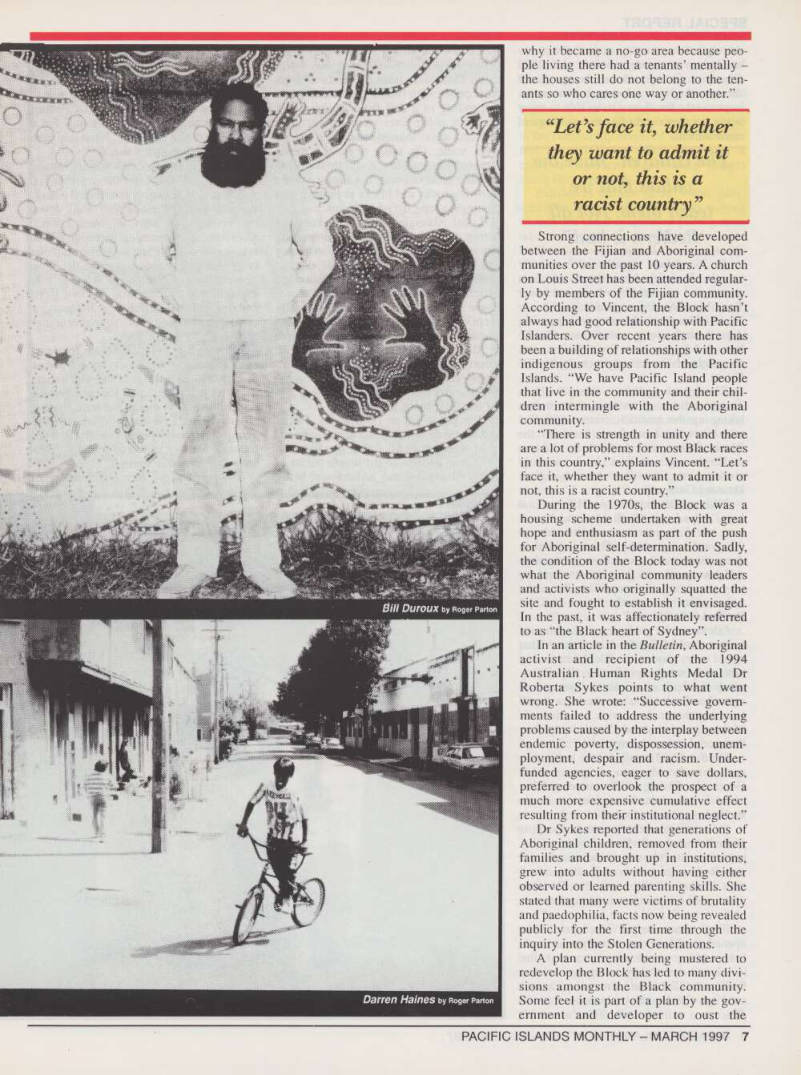
“There is strength in unity and there are a lot of problems for most Black races in this country,” explains Vincent. “Let’s face it, whether they want to admit it or not, this is a racist country.”
During the 19705, the Block was a housing scheme undertaken with great hope and enthusiasm as part of the push
for Aboriginal self-determination. Sadly,
the condition of the Block today was not what the Aboriginal community leaders and activists who originally squatted the site and fought to establish it envisaged.
In the past, it was affectionately referred to as “the Black heart of Sydney”.
In an article in the Bulletin, Aboriginal activist and recipient of the 1994 Australian Human Rights Medal Dr Roberta Sykes points to what went wrong. She wrote: “Successive govern ments failed to address the underlying problems caused by the interplay between endemic poverty, dispossession, unem ployment, despair and racism. Under funded agencies, eager to save dollars, preferred to overlook the prospect of a much more expensive cumulative effect resulting from their institutional neglect.”
Dr Sykes reported that generations of Aboriginal children, removed from their families and brought up in institutions, grew into adults without having either observed or learned parenting skills. She stated that many were victims of brutality and paedophilia, facts now being revealed publicly for the first time through the inquiry into the Stolen Generations.
A plan currently being mustered to redevelop the Block has led to many divi sions amongst the Black community.
Some feel it is part of a plan by the gov ernment and developer to oust the
Bill Duroux by Roger Parton
Darren Haines by Roger Parton
Aboriginal community as part of a clean up-Sydney campaign before the 2000 Olympics. Others, who are being offered the opportunity to relocate to other areas, hope to take the chance to be able to enjoy better housing conditions and a change of environment.
The children “have the values that we teach them. Not all Redfern is bad”
Pacific Island sportsmen frequently use the Eveleigh Street gym, which is
owned and operated by Aboriginal boxer
Tony Mundine. Fijian professional boxer
Mosese Sorovi works out at the gym six days a week along with Fijians Charlie Fotu and former New South Wales mid dleweight and superweight champion Joe Nitiva.
The gym coordinator, Alex Tui, is a Tongan who used to train there before taking up this position. Since 1989, Tui and his wife, Lani, have lived on the Block. Today, they have three children under the age of five. Lani currently works part time for the Aboriginal
Housing Company.
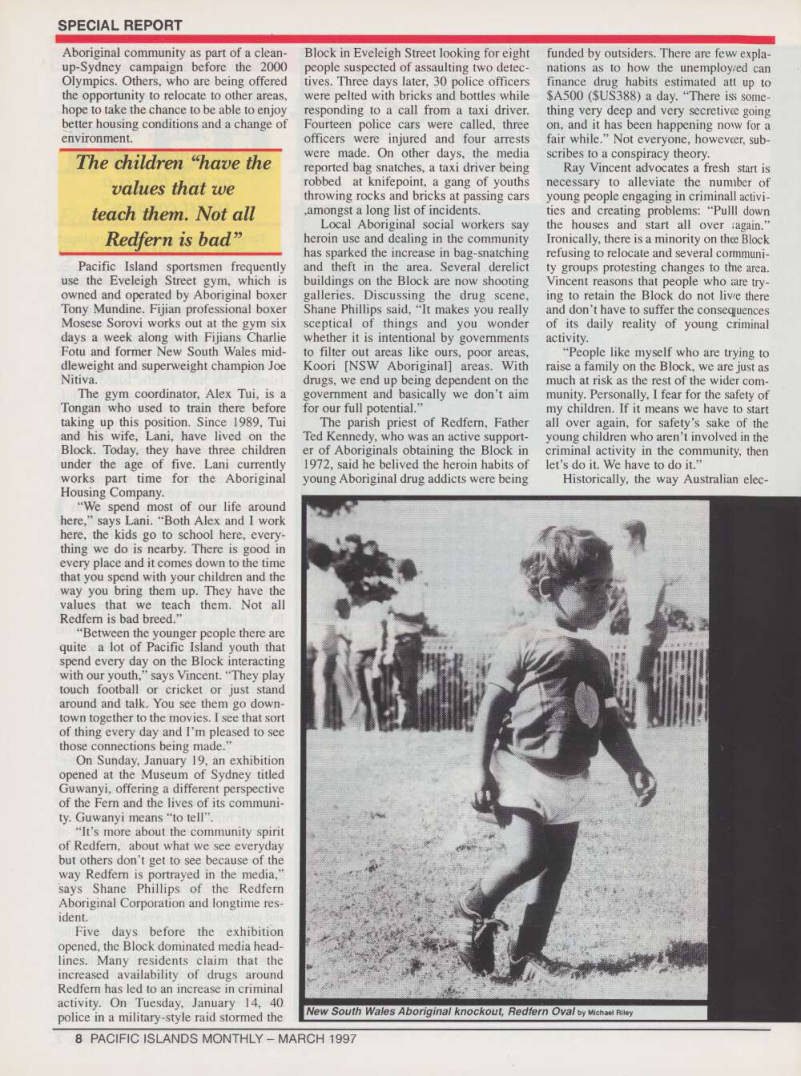
“We spend most of our life around here,” says Lani. “Both Alex and I work here, the kids go to school here, every thing we do is nearby. There is good in every place and it comes down to the time that you spend with your children and the way you bring them up. They have the values that we teach them. Not all Redfem is bad breed.”
“Between the younger people there are quite a lot of Pacific Island youth that spend every day on the Block interacting with our youth,” says Vincent. “They play touch football or cricket or just stand around and talk. You see them go down town together to the movies. I see that sort of thing every day and I’m pleased to see those connections being made.”
On Sunday, January 19, an exhibition opened at the Museum of Sydney titled
Guwanyi, offering a different perspective
of the Fem and the lives of its communi ty. Guwanyi means “to tell”.
“It’s more about the community spirit of Redfem, about what we see everyday but others don’t get to see because of the way Redfem is portrayed in the media,” says Shane Phillips of the Redfem Aboriginal Corporation and longtime res ident.
Five days before the exhibition opened, the Block dominated media head lines. Many residents claim that the increased availability of drugs around Redfem has led to an increase in criminal
activity. On Tuesday, January 14, 40
police in a military-style raid stormed the
Block in Eveleigh Street looking for eight people suspected of assaulting two detec tives. Three days later, 30 police officers were pelted with bricks and bottles while responding to a call from a taxi driver.
Fourteen police cars were called, three officers were injured and four arrests were made. On other days, the media reported bag snatches, a taxi driver being robbed at knifepoint, a gang of youths throwing rocks and bricks at passing cars ,amongst a long list of incidents.
Local Aboriginal social workers say heroin use and dealing in the community has sparked the increase in bag-snatching and theft in the area. Several derelict buildings on the Block are now shooting
galleries. Discussing the drug scene,
Shane Phillips said, “It makes you really sceptical of things and you wonder whether it is intentional by governments to filter out areas like ours, poor areas, Koori [NSW Aboriginal] areas. With drugs, we end up being dependent on the government and basically we don’t aim for our full potential.”
The parish priest of Redfem, Father Ted Kennedy, who was an active support er of Aboriginals obtaining the Block in 1972, said he belived the heroin habits of young Aboriginal drug addicts were being
funded by outsiders. There are fewv expla nations as to how the unemploy/ed can finance drug habits estimated att up to SASOO (SUS3BB) a day. “There iss some thing very deep and very secretivee going on, and it has been happening now for a fair while.” Not everyone, howeveer, sub scribes to a conspiracy theory.
Ray Vincent advocates a fresh start is necessary to alleviate the numiber of young people engaging in criminall activi ties and creating problems; “Pulll down the houses and start all over lagain.”
Ironically, there is a minority on thee Block refusing to relocate and several coimmuni ty groups protesting changes to thie area.
Vincent reasons that people who are try ing to retain the Block do not liwe there and don’t have to suffer the consequences of its daily reality of young criminal
activity.
“People like myself who are trying to raise a family on the Block, we are just as much at risk as the rest of the wider com munity. Personally, I fear for the safety of my children. If it means we have to start all over again, for safety’s sake of the young children who aren’t involved in the criminal activity in the community, then let’s do it. We have to do it.”
Historically, the way Australian elec-
New South Wales Aboriginal knockout, Redfern Oval by Michael Riley
tronic media has represented indigenous Australians has been a major weapon of Black oppression. Aboriginals are depict ed as either threats or victims. It is rare to witness affirmative Black voices or images even though they do exist. Those in the community involved with Guwanyi feel the exhibition offers the Block a space to represent empowering images about life in Redfem.
Exhibition curator Brad Webb gath ered photographs of sports teams, school friends and families and used photographs taken by artists who have interacted with
Redfern’s Aboriginal community.
“Redfern has fought the good fight,
walked the walk and continues to survive ... even against the adversity of govern ment and their unworkable policies, police and unjust actions,” said Webb.
Fijian ex-soccer player Bale Raniga
has worked as a security guard for the WestPac Bank in Redfem for the past two years.
He says even though he has heard reports of bag-snatching and drug abuse, he has not seen it. “I think what is going on at the moment, the tension between the community and the police, is made worse by the news and television coverage.”
Raniga uses the Block gym regularly to train. “I respect the Block as if it were a village.” Raniga explained that the first time he went to the Block, he felt com fortable wth the community.
While he acknowledges there are many problems that need to be addressed, he says, “I feel welcome there and I’m made to feel at home.”
Discussing the increase in crime in the area, Raniga, like Aboriginal elder Ray Vincent, believes that, in some cases, youths who are causing problems are, in fact, not from the community.
“They come in, create trouble, and then go back to their suburbs, leaving the Block residents to face the police,” says Vincent.
Several days ago, the Aboriginal and Torres Strait Islands announced they had committed SA6 million (SUS 4.6 million) towards a rescue scheme for the area.
They have called upon the state gov ernment to match this amount so houses can be demolished and families relocated to places of their choice in NSW.
The AHCL will then renovate and upgrade the buildings and rent the premis es out on the open market in an attempt to make what has been known as the Block
into an integrated neighbourhood.
Chairman of the AHCL Peter Walker told the media “What you see in Redfern is not Aboriginal culture and it never will be.lt’s something that has been imposed a mission-type culture that has been imposed upon us in the last 200 years and that has unfortunately found its way into places such as Redfem.” ■
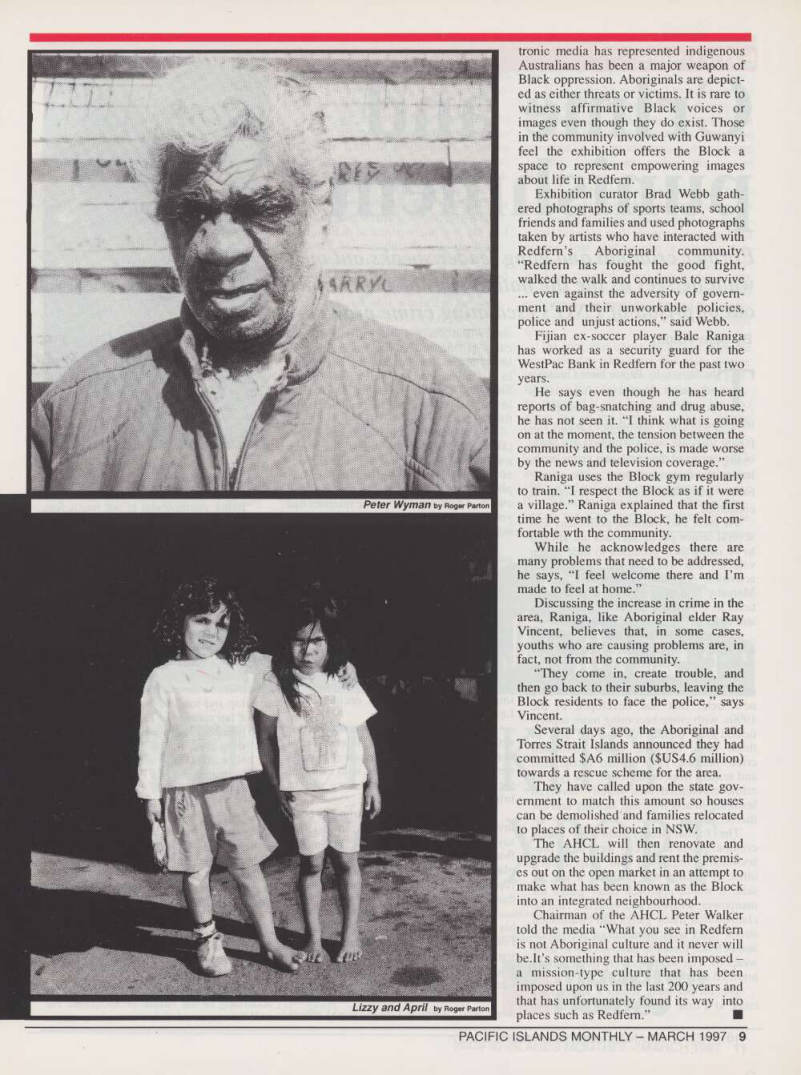
Peter Wyman by Roger Parton
Lizzy and April by Roger Parton
punishment
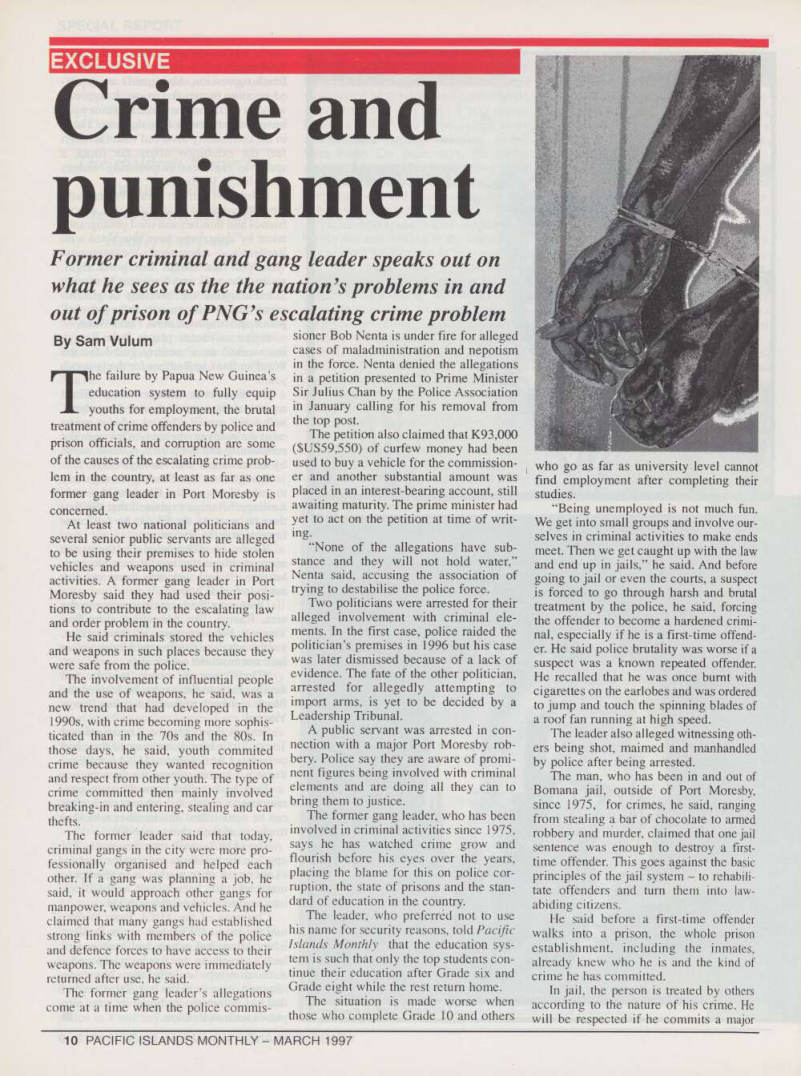

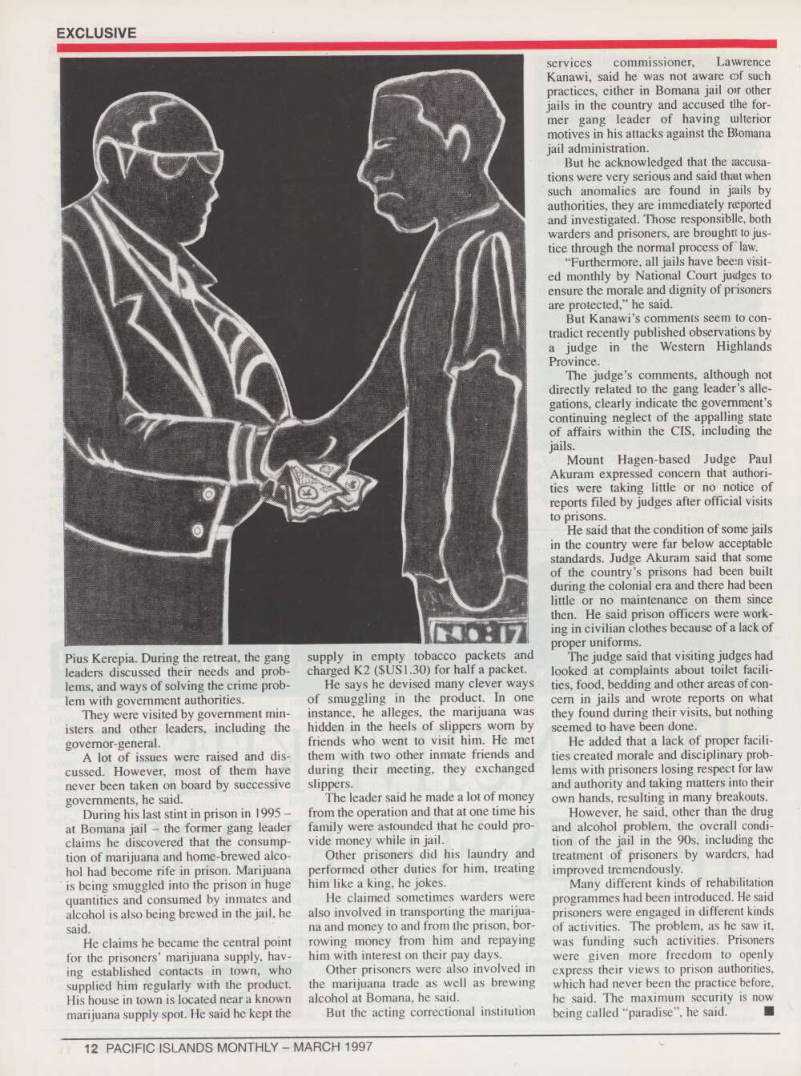
Exclusive
Crime and punishment
Former criminal and gang leader speaks out on what he sees as the the nation’s problems in and out of prison of PNG’s escalating crime problem
By Sam Vulum
The failure by Papua New Guinea’s
education system to fully equip youths for employment, the brutal treatment of crime offenders by police and prison officials, and corruption are some of the causes of the escalating crime prob lem in the country, at least as far as one former gang leader in Port Moresby is concerned.
At least two national politicians and several senior public servants are alleged to be using their premises to hide stolen vehicles and weapons used in criminal activities. A former gang leader in Port Moresby said they had used their posi tions to contribute to the escalating law and order problem in the country.
He said criminals stored the vehicles and weapons in such places because they were safe from the police.
The involvement of influential people and the use of weapons, he said, was a new trend that had developed in the 19905, with crime becoming more sophis ticated than in the 70s and the 80s. In those days, he said, youth commited crime because they wanted recognition and respect from other youth. The type of crime committed then mainly involved breaking-in and entering, stealing and car thefts.
The former leader said that today, criminal gangs in the city were more pro
fessionally organised and helped each
other. If a gang was planning a job, he said, it would approach other gangs for manpower, weapons and vehicles. And he claimed that many gangs had established strong links with members of the police and defence forces to have access to their weapons. The weapons were immediately returned after use. he said.
The former gang leader’s allegations come at a time when the police commis
sioner Bob Nenta is under fire for alleged cases of maladministration and nepotism in the force. Nenta denied the allegations in a petition presented to Prime Minister Sir Julius Chan by the Police Association in January calling for his removal from the top post.
The petition also claimed that K 93,000 ($U559,550) of curfew money had been used to buy a vehicle for the commission er and another substantial amount was placed in an interest-bearing account, still
awaiting maturity. The prime minister had
yet to act on the petition at time of writ
ing.
“None of the allegations have sub stance and they will not hold water,”
Nenta said, accusing the association of trying to destabilise the police force.
Two politicians were arrested for their alleged involvement with criminal ele ments. In the first case, police raided the politician’s premises in 1996 but his case was later dismissed because of a lack of evidence. The fate of the other politician, arrested for allegedly attempting to import arms, is yet to be decided by a Leadership Tribunal.
A public servant was arrested in con nection with a major Port Moresby rob bery. Police say they are aware of promi nent figures being involved with criminal elements and are doing all they can to
bring them to justice.
The former gang leader, who has been involved in criminal activities since 1975, says he has watched crime grow and flourish before his eyes over the years, placing the blame for this on police cor ruption, the state of prisons and the stan dard of education in the country.
The leader, who preferred not to use his name for security reasons, told Pacific- Islands Monthly that the education sys tem is such that only the top students con tinue their education after Grade six and Grade eight while the rest return home.
The situation is made worse when those who complete Grade 10 and others
who go as far as university level cannot find employment after completing their studies.
“Being unemployed is not much fun.
We get into small groups and involve our selves in criminal activities to make ends meet. Then we get caught up with the law and end up in jails,” he said. And before going to jail or even the courts, a suspect is forced to go through harsh and brutal treatment by the police, he said, forcing the offender to become a hardened crimi nal, especially if he is a first-time offend er. He said police brutality was worse if a suspect was a known repeated offender.
He recalled that he was once burnt with cigarettes on the earlobes and was ordered to jump and touch the spinning blades of a roof fan running at high speed.
The leader also alleged witnessing oth ers being shot, maimed and manhandled by police after being arrested.
The man, who has been in and out of Bomana jail, outside of Port Moresby, since 1975, for crimes, he said, ranging from stealing a bar of chocolate to armed robbery and murder, claimed that one jail sentence was enough to destroy a first time offender. This goes against the basic principles of the jail system - to rehabili tate offenders and turn them into law
abiding citizens.
He said before a first-time offender walks into a prison, the whole prison establishment, including the inmates, already knew who he is and the kind of crime he has committed.
In jail, the person is treated by others according to the nature of his crime. He will be respected if he commits a major
crime like armed robbery, but he will be subjected to constant harassment and ridicule if has stolen a chicken.
While there, he realises that he is a nobody. His time in prison encourages him to commit bigger crimes once he gets out of jail, especially the first-time offender, so that the next time he walks in, he’ll be respected. He picks up ideas on how to commit more crime and defend himself in court.
“They build up their links in jail. It’s like a school, the former leader said.
He said new and weak prisoners suffer the most. The most humiliating experience is sexual abuse. This, he said, usual-
ly occured during the regular fellowship
sessions, organised by the various church denominations for prisoners. The victim or the “lost sheep”, the term used by prisoners, is identified beforehand and when everyone is going for the fellowship the attackers attempt to discourage him from attending. He is “raped” if he agrees to stay back. Other times, such innmates are made to drink soapy water or their own urine - These prisoners are often convicted
policemen, security personnel and police
informers. Sometimes, for their own safety, such inmates are kept away from the others. The area is referred as “Iraq” by prisoners.
“You have to show that you don’t get pushed around. Sometimes you have to join well-known groups in jail for protec tion,” he said.
There are rules in place in prison to deal with those who carry out such activ ities. One form of punishment involves locking up the conflicting parties in cage like enclosures and having them physical ly fight it out.
The former leader also recalled that the maximum security, for hardened crim inals, used to be a man-made hell. He said that once he was thrown into the maxi mum security cell for trying to escape after cutting through a steel bar. He had used a four-inch hacksaw smuggled to him by a friend who worked in the work shop hidden in the hem of a towel.
He was in for murder then and had decided to escape after being told by other inmates that he would get life sentence for the offence.
He worked out the plan with three other friends. They took turns to cut the
bar during four morning roll-call periods.
After each cutting session, they used soap and burnt tyre ashes to hide their work. It was never discovered by warders on rou tine checks. On the day of their planned escape, they waited until midnight and then made for the security fences. They had to climb and jump over four high
security fences with razor-sharp edges, he said.
He recalls he managed to get over the first fence when he slipped, raising the security alarm. He panicked and, when jumping off, twisted his ankle. Only one member of the group managed to escape but was later caught making his way to
Port Moresby.
He said that he suffered the worst beat ing he could remember during his days as a criminal. He was thrown into the maxi mum security cell, stripped and made to sit the first night under a running tap.
Although he had his clothes back, he was made to spend the next few nights on the concrete floor. He said the cold was unbearable at times and he had to do sev eral push-ups regularly to keep himself warm.
He said that about four days later, he was issued two blankets. His daily routine included removing his waste from a half filled bucket of water. He rinsed the buck et, returned it and had breakfast. He also came out in the evening to have dinner but spent the whole day in his cell block.
Most of these problems were high lighted at a week’s gathering of gang leaders and government authorities in 1985 at the Goldie Army Barracks near Port Moresby, led by the former correc tional services commissioner, the late
Pius Kerepia. During the retreat, the gang leaders discussed their needs and prob lems, and ways of solving the crime prob lem with government authorities.
They were visited by government min isters and other leaders, including the
governor-general.
A lot of issues were raised and dis cussed. However, most of them have never been taken on board by successive governments, he said.
During his last stint in prison in 1995 at Bomana jail - the former gang leader claims he discovered that the consump tion of marijuana and home-brewed alco hol had become rife in prison. Marijuana is being smuggled into the prison in huge quantities and consumed by inmates and alcohol is also being brewed in the jail, he said.
He claims he became the central point for the prisoners’ marijuana supply, hav ing established contacts in town, who supplied him regularly with the product.
His house in town is located near a known marijuana supply spot. He said he kept the
supply in empty tobacco packets and charged K 2 (SUSI.3O) for half a packet.
He says he devised many clever ways of smuggling in the product. In one instance, he alleges, the marijuana was hidden in the heels of slippers worn by friends who went to visit him. He met them with two other inmate friends and during their meeting, they exchanged slippers.
The leader said he made a lot of money from the operation and that at one time his family were astounded that he could pro vide money while in jail.
Other prisoners did his laundry and performed other duties for him, treating him like a king, he jokes.
He claimed sometimes warders were also involved in transporting the marijua na and money to and from the prison, bor rowing money from him and repaying him with interest on their pay days.
Other prisoners were also involved in the marijuana trade as well as brewing alcohol at Bomana, he said.
But the acting correctional institution
services commissioner, Lawrence Kanawi, said he was not aware of such practices, either in Bomana jail o>r other jails in the country and accused tlhe for mer gang leader of having uilterior motives in his attacks against the Blomana
jail administration.
But he acknowledged that the zaccusa tions were very serious and said thait when such anomalies are found in jails by authorities, they are immediately reported and investigated. Those responsible, both warders and prisoners, are broughtt to jus tice through the normal process of law.
“Furthermore, all jails have bee;n visit ed monthly by National Court jucdges to ensure the morale and dignity of prisoners are protected,” he said.
But Kanawi’s comments seem to con
tradict recently published observations by
a judge in the Western Highlands Province.
The judge’s comments, although not directly related to the gang leader’s alle
gations, clearly indicate the government’s
continuing neglect of the appalling state
of affairs within the CIS, including the
jails.
Mount Hagen-based Judge Paul
Akuram expressed concern that authori ties were taking little or no notice of reports filed by judges after official visits to prisons.
He said that the condition of some jails in the country were far below acceptable standards. Judge Akuram said that some of the country’s prisons had been built during the colonial era and there had been little or no maintenance on them since then. He said prison officers were work ing in civilian clothes because of a lack of proper uniforms.
The judge said that visiting judges had looked at complaints about toilet facili ties, food, bedding and other areas of con cern in jails and wrote reports on what they found during their visits, but nothing seemed to have been done.
He added that a lack of proper facili ties created morale and disciplinary prob lems with prisoners losing respect for law and authority and taking matters into their own hands, resulting in many breakouts.
However, he said, other than the drug and alcohol problem, the overall condi tion of the jail in the 90s, including the treatment of prisoners by warders, had
improved tremendously.
Many different kinds of rehabilitation programmes had been introduced. He said prisoners were engaged in different kinds of activities. The problem, as he saw it, was funding such activities. Prisoners were given more freedom to openly express their views to prison authorities, which had never been the practice before, he said. The maximum security is now being called “paradise”, he said. ■
Advertisements & other items, p. 11 (1 item)
Distinctive kitset
HOMES FOR EXPORT
Maddren Homes, New Zealand's most experienced exporters of kitset homes, has just announced a new range of superior dwellings.
Available in a variety of architectural styles and appointments, these homes can be reconfigured easily to suit your individual needs.
Apart from their aesthetic appeal, these homes feature proven cyclone resistant construction methods as well as durable termite resistant timbers.
CONTACT MADDREN HOMES: PO Box 244. Kumeu. Auckland, New Zealand.
Phone: 64-9-412 9070. fax: 64-9-412 7251
■Maddren
Homes
Bougainville

Crisis
Is there a solution?
By Sam Vulum
Apolitical solution for the Bougainville crisis will not be reached as long as leaders remain divided over the issue. What is a serious national issue has become a political game over the past eight years, used to score political points. The situation on Bougainville has caused massive destruc tion to property and human life, forcing misery upon thousands on the island and in other parts of the country. Two security force members were killed in a Bougainville Revolutionary Army ambush in mid-January, the first casual ties for 1997.
There is a lack of any real political will
and commitment towards finding solu tions to the problem. Peace efforts by the government have always been met with different responses, causing divisions between leaders. On record, there has never been an absolute compromise between leaders on any of the initiatives taken so far.
The recent heated debate between Prime Minister Sir Julius Chan and one of PNG’s most senior statesmen. Sir Michael Somare, is another clear indica tion of the type of political approach that has taken root over the years. It appears that a major division has developed between leaders over the issue. One fac tion is being led by Sir Julius and the other by Sir Michael.
The debate was over a visit by a group of members of parliament led by Sir Michael to Bougainville in January, it was
their second visit in a bid to negotiate the release of five security force members captured and held hostage by the BRA following the Kangu massacre.
It appears that a major division has developed between leaders
Sir Julius accused the MPs, including his own provincial affairs and local-level government minister, Peter Barter, of breaching protocol by not consulting with or informing him about the trip. He said there was potential for the government losing ground if any of the MPs had been
taken hostage.
The other members of the delegation were Wewak MP Bernard Narokobi, South Bougainville MP Michael Laimo and Bougainville MP John Momis. Sir Julius told parliament that the delegation was not a parliamentary delegation because it didn’t have his, cabinet’s or parliament’s approval.
However, Sir Michael, in presenting a report on their visit, blamed the “difficul ty of solving the Bougainville crisis” on Sir Julius’ “one-man efforts”.
“It is clear that the Bougainville prob lem is being addressed by one man and that one man [seems] to me to be either deliberately or intentionally refusing to or not courageous enough to - turn all the stones available to him,” he said, adding that the prime minister did not have the courtesy to acknowledge the delegation’s briefing with him.
He thanked Speaker Sir Rabbie Namaliu as “head of the legislature” for facilitating the mission. He said the trip had been taken on humanitarian grounds.
However, Sir Julius said the two trips did not give Sir Michael the authority to speak on solving the crisis. He said the report would be accepted as from a pri vate MPs’ team rather than as a parlia mentary report.
Sir Rabbie, who was caught in the crossfire, told parliament he would be neutral and support both the national gov ernment and “consider favourably” any parliamentarians’ initiatives to restore peace, minimise human suffering and
resolve the Bougainville dispute.
The legislature (parliament) had spent up to KBO,OOO ($U552,300) on the two trips. Sir Rabbie said his decision to accept the MPs’ request to fund the trip was based on the facts that; • the four MPs had been formal ly invited to visit the hostages and hold talks with rebel leaders; • it was a real opportunity to attempt to secure the hostages’ release; • the security of the delegation
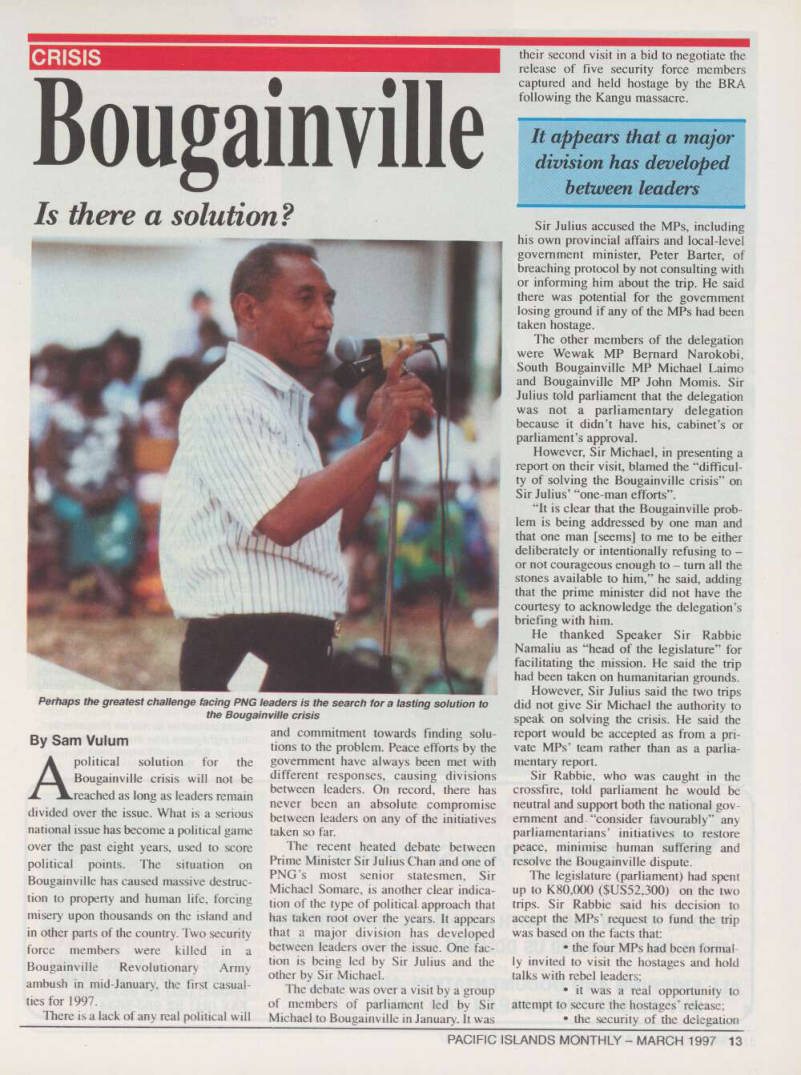
Perhaps the greatest challenge facing PNG leaders is the search for a lasting solution to the Bougainville crisis
had been assured by the rebels; • it was a real opportunity for the legislature to contribute to the execu tive government to establish some mean ingful dialogue with the rebels; and • the four MPs and their staff were risking their lives. “As speaker of parliament, I have to be neutral. I fully support the national government’s initia tives to restore peace on the island.
“Likewise, I will consider any move by MPs if it will help minimise human suffering and lead to a peaceful resolution of the dispute.”
Ijape said the government would help in any way it could to enable rebel leaders leave the island
The division was clearly apparent when a vote was taken on the Langui trip report. Thirty-five members voted for the report and 34 voted against it.
With the national election only months away, the future of the peace process lies with whoever takes the helm of politics after June.
For the Sir Julius faction, Bougainville was the first issue addressed by the gov ernment upon taking office in 1994. Only days after his election. Sir Julius met with Bougainville Revoloutionary Army Commander Sam Kauona in Solomon Islands and signed the Honiara Accord.
A series of peace initiatives were made, including the deployment of the South Pacific peacekeeping force, and the failed KlO-million (SUS6.S-million) Operation High Speed 11. Sir Michael also played a major role in the Bougainville peace efforts, which involved the signing of the first peace deal on a New Zealand
Backs cannot be turned on Bougainville ... but eight years later the possibilities of a solution still seem remote Photograph by ASAELI LAVE
Navy boat, the Endeavour, hence named the Endeavour Accord. Sir Michael,
accompanied by fellow Sepik MP
Narokobi, signed the accord with BRA leaders.
Teaming up with Narokobi, Momis and Laimo, they formed what looked to be an influential pact which might turn out some positive results if given the nec essary backing. Although they failed to release the captives on both occasions, at least they established some form of dia logue with the rebels.
One major hurdle was that there was no guarantee on the part of the leaders
that they were genuiney representing the
views of their government - or their own.
This concern was highlighted by BRA leaders during the meeting.
The government’s opposition to the visit was evident in the move by Defence Minister Mathias Ijape placing a total ban on further private visits by leaders and other citizens to Bougainville. Ijape said he had made the decision to safeguard the safety of leaders and citizens. The latest attempt by Ijape to assist BRA leaders seek asylum in other countries has drawn mixed reactions from different quarters.
“We see no reason for
BRA leadership leaving
Bougainville as they are
safe and in control of the island”
The general secretary of the outlawed Bougainville Interim Government (BIG) sought and was granted asylum in Holland in February, 1996, having been forced to flee after his house on Koala Ridge, Honiara, Solomon Islands, was
burnt down by six masked men believed to be Bougainvilleans.
The PNG government had strongly condemned the move. However, a day before the crisis reached its ninth year, the government was seen to have unofficially changed its stand. Ijape announced on December 24 that the government had offered to help Bougainville leaders secure political asylum, although Sir Julius had yet to public acknowledge any such move at the time of writing.
Seen as the latest peace initiative, Ijape said the government would help in any way it could to enable rebel leaders on Bougainville to leave the island and settle in another country.
Ijape said he had considered the polit ical asylum proposal for some time and believed that Christmas Eve was an appropriate time for the announcement.
He said, “I am willing to negotiate this for them with the national government. I firmly believe the move will create
greater understanding and cooperation
among all parties in the conflict.”
He said once Francis Ona, Joseph Kabui, Sam Kauona and other hard-line rebels left, the security forces would be
gradually withdrawn.
Ijape said if the rebel leadership con sidered political asylum, the defence force could be totally withdrawn in the name of peace.
“I hope this new proposal is digested during Christmas and New Year as the year of reconciliation and peace,” Ijape said. However, the Bougainville Transitional Government, feels otherwise.
Premier Gerard Sinato said such action would result in independence for
Bougainville. The general feeling among
BTG government members is that the MPs should not raise the rebels’ expecta tions on long-term measures, saying that
long-term measures should be left for them as the legitimate authority to discuss with both the national government and rebel leaders.
The BRA has clearly indicated its willingness
to negotiate a political
solution
“The withdrawal of security forces from Bougainville is one of the conditions set by the BRA. This must not happen ... this would mean independence for
Bougainville,” Sinato said. Speaking
against the possibility of granting political
asylum to rebel BTG leaders Ona, Kabui and Kauona, Sinato questioned whether this was the “prize for all the bloodshed on Bougainville”.
“We have to face these rebel leaders, talk to them and agree on a peaceful solu tion to the crisis ... Our position is clear.
We want to proceed with dialogue to pur sue the national government’s undertak
ings for Bougainville.
“At no stage [have] Bougainville lead ers and the prime minister discussed
granting political asylum to BRA/BIG
hardliners,” he said. The BRA meanwhile has branded the offer of asylum as “calcu lating, ill-informed, nonsensical and very dangerous”. Ona is firm on his stand that the only way he is going to leave Bougainville is “in a coffin”, while BIG spokesman Moses Havini said they would never accept any such offer from the likes of Ijape, which was a move to destabilise
BRA leadership.
“That is the last thing BRA leaders will accept. We see no reason for BRA
leadership leaving Bougainville as they
are safe and in control of the island,”
Havini said.
“We would like to suggest, however,
that PNG start accepting political asylum
seekers from other countries such as West Papua, East Timor, Burma and Nigeria, who have sought asylum in PNG,” Ona said. Havini has repeated calls for the total withdrawal of security forces from Bougainville who would be replaced by a neutral international peacekeeping force under United Nations mandate.
The BRA has clearly indicated its will
ingness to negotiate a political solution
for the Bougainville.
Havini said that the BIG/BRA were
being pressured by sections of the
Bougainville community, including
women and churches, to engage in peace dialogue with the government because of the suffering on the island. The onus is on the government now to take the opportu
nity. ■
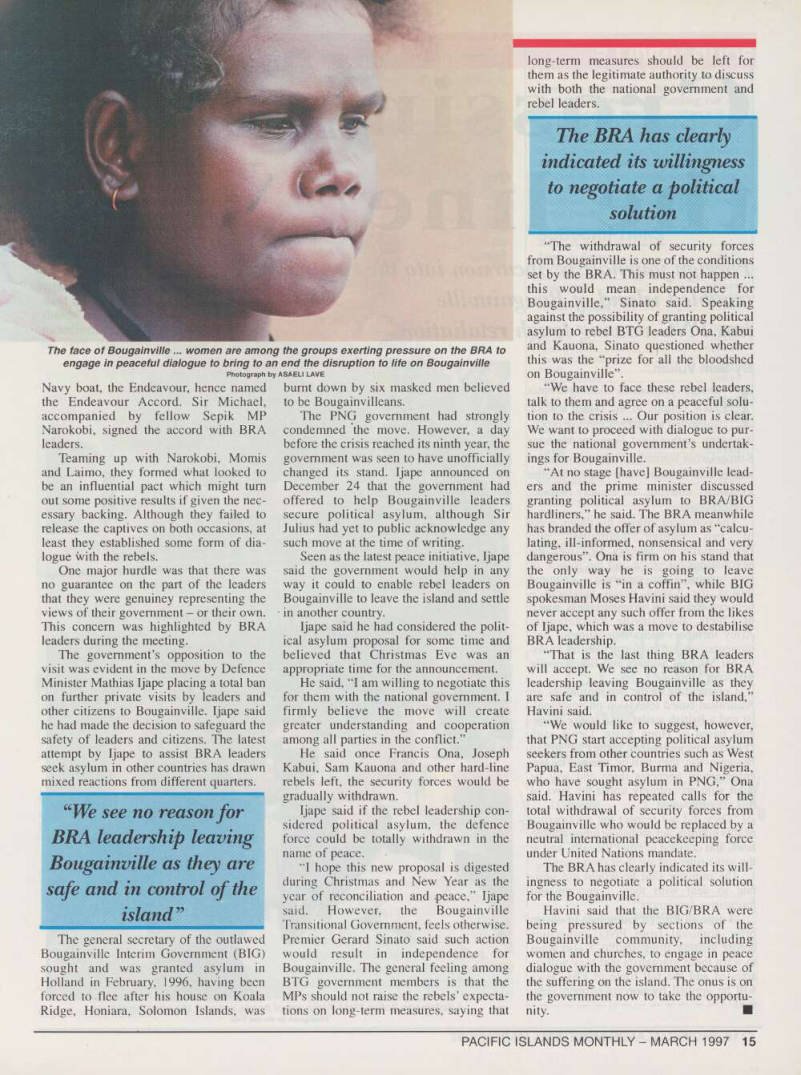
The face of Bougainville...women are among the groups exerting pressure on the BRA to engage in peaceful dialogue to bring to an end the disruption to life on Bougainville Photograph by ASAELI LAVE
Advertisements & other items, p. 14 (2 items)
Crisis
Trust Company Ltd
(^pi)
USED JAPANESE VEHICLES
SPECIAL OFFER
TOYOTA, NISSAN CARS, WITH AUTOMATIC TRANSMISSION
ROM ONLY $lOOO.OO US DOLLARS EACH PLUS REIGHT.
ALL SHIPPING AND DOCUMENTATION ARRANGED.
BUY DIRECT FROM JAPAN AND SAVE.
r
CONTACT”
Trust Company Ltd
KOBAC BLD 3F 3-2-26 NISHIKI,
NAKAU NAGOYA, 460 JAPAN.
PHONE: (81) 52 953-5602
FAX (81) 52 953-5634
Crossing
Bougainville
Crossing the line
Foreign journalists’ incursion into the
troubled island of Bougainville
has PNG vowing tough retaliation
By Sam Vulum
Foreign journalists visiting Papua
New Guinea in the future will be subjected to tough screening proce dures by authorities. Foreign Minister Kilroy Genia warned that the government would take a tough stand against foreign journalists entering the country without proper clearance.
The comment follows the illegal entry of two foreign journalists into Bougainville in January to cover the negotiations for peace and the release of five security force members - captured during the Kangu beach massacre between the South Bougainville Council of Chiefs, Bougainville Revolutionary Army members and a delegation of par liamentarians led by former prime minis ter Sir Michael Somare and Bougainville MP John Momis.
Commenting on the two journalists, an Australian-based television photojoumal ist and a British writer for Esquire maga zine based in Hong Kong, Genia said: “For the two journalists, if they are still in Bougainville, they will be arrested by law enforcement agencies there and will be dealt with accordingly under the laws of this country.
“They did not respect the sovereignty of this country, let alone our immigration laws, and decided to enter illegally, and at the same time risking their own lives.”
The minister said he would not hesi tate to deal with these “ignorant and
insensitive foreigners”.
“I urge all foreign journalists to obtain prior approval from PNG authorities before visiting Bougainville. I also want to warn these journalists that they will be arrested and the full force of PNG laws will be applied by our government,” he said.
“They did not respect the sovereignty of this country, let alone our immigration laws ”
According to sources on Bougainville, the crossed from Gizo, Solomon Islands, to Kieta, Central Bougainville, and hiked to Lagui to cover the event.
PNG has sent a protest note to the Solomon Islands government.
Defence Minister Mathias Ijape, who has confirmed that the two journalists are still on Bougainville, has ordered security forces to arrest them. “The two are find ing it hard to get back to Solomon Islands because we have increased surveillance on the border. The journalists have no
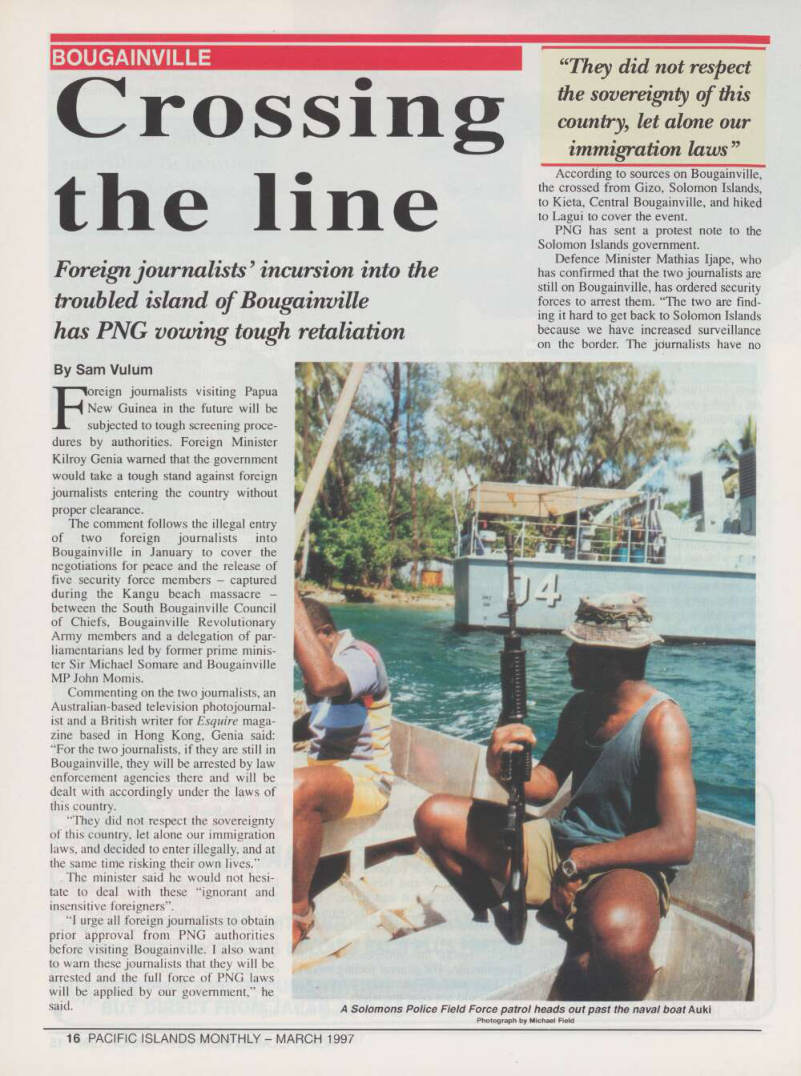
A Solomons Police Field Force patrol heads out past the naval boat Auki Photograph by Michael Field
respect for the sovereignty of this nation and have moved freely in and out of Bougainville. This has to stop,” he said.
“The Solomon Islands police ... have been ■f instructed to destroy . all equipment oj the . j. ??
JOUVnatlStS
“The Solomon Islands police have been notified to assist our security forces
to detain the two. They have been instructed to destroy all equipment of the journalists and have them detained, ques tioned and arrested, and taken to Port Moresby.”
Major Bill Nende, deputy commander of the battallion stationed there said that, according to their information, the two had not crossed over to Solomon Islands.
Major Nende said another foreign radio technician, identified as Sam Veron, from Australia was also on the island. He said that according to information received, the three were expected to leave for Solomon Islands at the end of February. ■
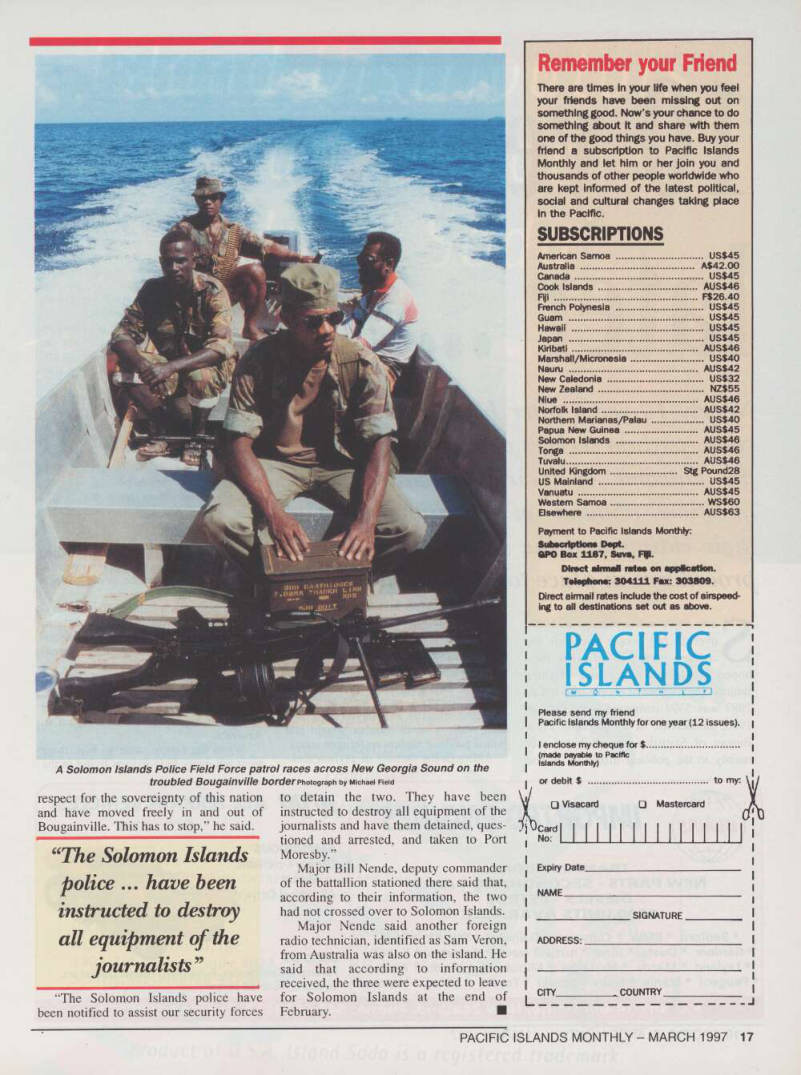
A Solomon Islands Police Field Force patrol races across New Georgia Sound on the troubled Bougainville border Photograph by Michael Field
Advertisements & other items, p. 17 (1 item)
Pacific
Remember your Friend
There are times in your life when you feel your friends have been missing out on something good. Now’s your chance to do something about it and share with them one of the good things you have. Buy your friend a subscription to Pacific Islands Monthly and let him or her Join you and thousands of other people worldwide who are Kept informed of the latest political, social and cultural changes taking place in the Pacific.
SUBSCRIPTIONS
American Samoa US$45 Australia A 542.00 Canada US$45 Cook Islands AUSS46 Fiji F 526.40 French Polynesia US$45 Guam US$45 Hawaii US$45 Japan US$45 Kiribati AUSS46 Marshall/Micronesia US$4O Nauru AUSS42 New Caledonia US$32 New Zealand NZ$55 Niue AUSS46 Norfolk Island AUSS42 Northern Marianas/Palau US$4O Papua New Guinea AUSS4S Solomon Islands AUSS46 Tonga AUSS46 Tuvalu AUSS46 United Kingdom Stg Pound2B US Mainland US$45 Vanuatu AUSS4S Western Samoa WS$6O Elsewhere AUSS63 Payment to Pacific Islands Monthly; Subscriptions Dept.
QPO Box 1167, Suva. FJI.
Direct airmail rates on application.
Telephone: 304111 Fax: 303809.
Direct airmail rates include the cost of airspeeding to all destinations set out as above.
PACIFIC
ISLANDS
Please send my friend Pacific Islands Monthly for one year (12 issues).
I enclose my cheque for $. (made payable to Pacific Islands Monthly) or debit $ to my: □ Visacard □ Mastercard JCard No.- Expiry Date_
NAME
ADDRESS:,
. SIGNATURE.
CITY_
.COUNTRY.
I
10 years


Cover Stories
10 years later...
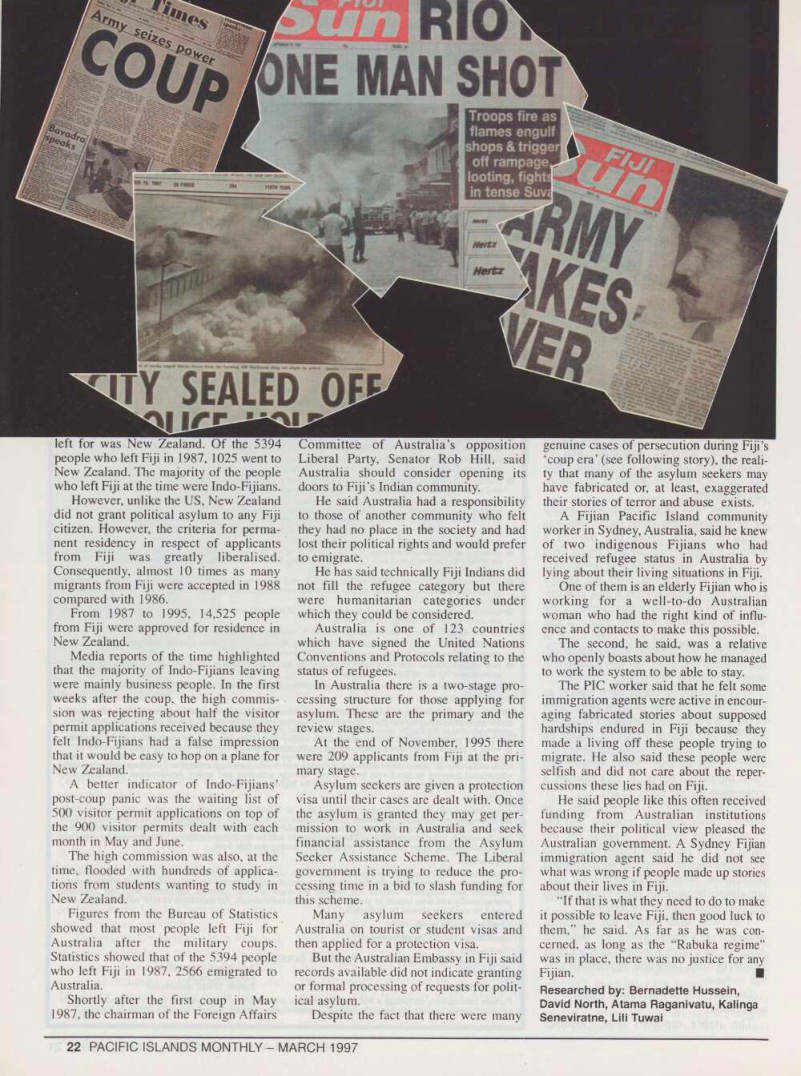
Nearly 10 years after Fiji’s first military coup, asylum seekers are still awaiting the outcome of their applications. Yet, questions abound on the authenticity of their claims and the sort of immigration procedures in place to verify such claims
Since Fiji’s military coups in 1987, over 51,240 people have left the country in search of what they hoped would be better and brighter futures. The number of people who left in 1987 was 5394 compared with 3048 in 1986, an increase of 77 per cent. Fiji’s Bureau of Statistics has attributed this mainly to the political instability in the
country at the time. Of those who left Fiji at the time, 363 were Fijians while 4395
were Indo-Fijians.
Some left immediately after the coups, thanks to their permanent resident status in other countries, some went on tourist visas and illegally overstayed their per mits, while a small number sought and gained political asylum or refugee status.
Although the number of asylum seek
ers from Fiji may be small compared with some other parts of the world, ques tions have been raised about the proce dures used by various countries to grant political asylum or refugee status as well as concern that the facts offered by asy lum seekers may have been fabricated.
“There is no set procedure that must be followed. But, basically, the authori ties of the foreign country concerned need to establish first how genuine is the claim in seeking asylum or refuge in a foreign country,” John Tevita, the direc tor of immigration in Fiji, said.
“This is a long and time-consuming process which can involve govemment to-government consultations by the appropriate authorities which would nor mally be the foreign ministries.
“This department would normally be required to establish from records the person’s true identity as a Fiji citizen and other relevant personal details that may be necessary.”
Fiji’s Foreign Affairs Department,
however, has said that the department has not to date been required to provide any such information on Fiji citizens.
Fiji’s Bureau of Statistics figures show that from 1987 to 1992 over 6070 Fiji citizens left for the US.
In the nine years since the coups, more than 1000 Fijians, presumably mostly Indo-Fijians, have used stories of persecution in Fiji to secure permanent or temporary legal status in the United States. (The US immigration system is vigorous in its insistence in not collect ing ethnic data.) It is now much harder to secure asy lum in the US than it was a couple of years ago, before the Clinton administra tion began a drastic change in the screen ing system.
Fewer Indo-Fijians seek this status with each passing year, but for some 1200 Indo-Fijians, it has given them a chance to begin life all over again in America.
When the coups came to Fiji, there were not many Indo-Fijians living in the
US as compared to Australia and New Zealand, so the American immigrantvisas-for-relatives system was of little use to Indo-Fijians. And the US was not busily looking for refugees in Fiji as it was in Vietnam and among several groups within Russia. So Indo-Fijians who were really persecuted or who felt they were, or who simply wanted to emigrate to the US had one remaining obscure option - they could fly to the US and then apply for asylum once they got there.
The extent to which to which they had, in fact, actually been persecuted, in previous years, played little role in their ability to secure temporary legal presence and the ability to work legally in the US.
Before January 3, 1995, Indo-Fijians, or anyone could apply at an office of the
US Immigration and Naturalisation Service (INS). There was an extensive process before one could be judged to be an asylee on a permanent basis (one small step from full immigrant status), but there was no screening at all for those seeking temporary asylum status and the work
permit that accompanied it.
There was no interview, No fee.
Nothing.
All one had to do was fill out the right form (1-589) and mail it to the INS. After a couple of months, the applicant got the work permit, but the actual interview for the permanent status of the asylee might not take place for many years. About 900
Indo-Fijians applied for asylum years ago
and continue to work legally in the US
waiting until their cases are called.
Another 300 have gone through the permanent status interview and secured a favourable ruling from an INS officer or from a judge acting on cases rejected by INS staff. At no point in this process does a US government official call or send a letter to Fiji asking about what happened to the individual in question. The US offi cials made their decision (often unfavourable to the applicant) on the basis of written and verbal testimony pre sented to them in US government office buildings. In fact, a large majority of the Indo-Fijian cases that did not come to a final decision resulted in denials, but that is not the end of the story.
The part of the American Justice Department that says that an asylum applicant has a bad claim is different from the unit in the department which deports aliens. The latter has so few resources, and so many high-priority criminal aliens to cope with, that rejected asylum appli cants are rarely, if ever, deported. They stay in the US in a sort of limbo, not pre sent legally but facing no active pressure to leave the country.
Since January, 1995, the lot of an asy lum seeker is less attractive. The Justice Department hears cases quickly and rejects most of them. Most importantly, the applicant does not get a work permit until the application is approved or has been in motion for six months. If there is a negative decision in less than six months, then there is never a work permit or a chance to work legally in the US.
The number of Fiji citizenswho tried to use this programme in the US since the coups was as follows:
1988 - 31 1989 - 192 1990- 421 1991 - no data 1992 - 360 1993 - 263 1994- 164 1995 - 62
At the last count last year, there were, in addition to the 963 Fijian applications pending in INS offices, hundreds more waiting for decisions in the courts.
At least two of these cases made it to the step just below the US Supreme Court, that of the Circuit Courts of Appeals. Both of these cases involved Indo-Fijians named Prasad, both were heard in the West Coast Circuit; one won and one lost.
The loser was Kamla Prasad, described by the judge as a “cook and a taxi driver [who] departed Fiji in October of 1987, soon after the coup”.
“Prasad contended that in September of 1987, while he was driving his taxi, he was stopped at a roadblock by a number
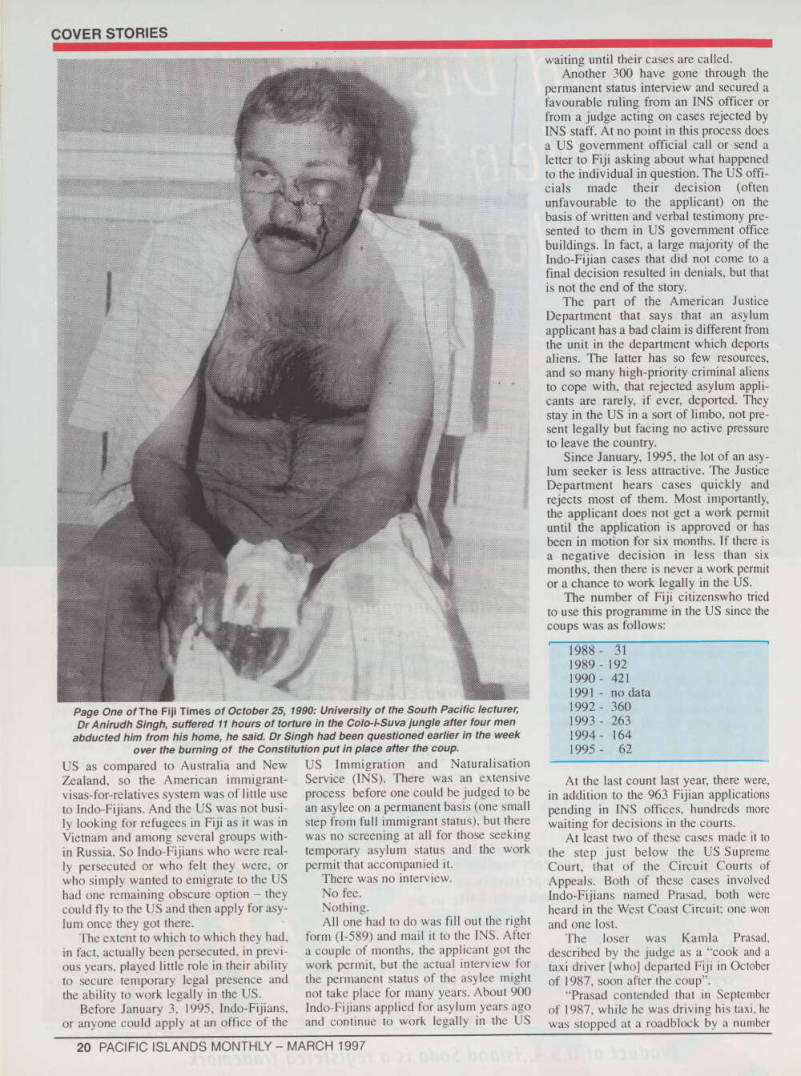
Page One of The Fiji Times of October 25, 1990: University of the South Pacific lecturer, Dr Anirudh Singh, suffered 11 hours of torture in the Colo-i-Suva jungle after four men abducted him from his home, he said. Dr Singh had been questioned earlier in the week over the burning of the Constitution put in place after the coup.
of ethnic Fijians, some of whom were dressed in military uniforms ... Prasad was taken to ... a jail cell. At some point Prasad was hit on his stomach and kicked from behind. His captors questioned Prasad regarding his support for the eth nic Indian Labour Party. Prasad assumed that if he continued his active support for the Labour Party, he would again be arrested and beaten. After four to six hours, Prasad was released.”
The judges found (early in 1995) Kamla had been mistreated in Fiji but not to the extent that he could prove that he was a political refugee under US law.
About a year later, the case of Gaya Prasad came before different judges of the same court.
According to the judge’s decision: “One year before the 1987 general elec tion in Fiji, Prasad became active as a local delegate of the Hindu-dominated Labour Party. He was also the secretary of the labour union at the cement factory where he had worked for 16 years.”
The judges continued that Prasad had been out of the country during the coup and upon his return found that “civil rights were severely restricted” and he “testified that friends in the Labour Party told him he would be killed if he contin
ued organising”.
“Prasad was jailed twice and beaten by military officers three times. He was forced to resign from his job as a chemist’s assistant on threat of being fired ... during his detention he was questioned about his involvement with the ousted Labour Party, beaten with a gun and uri nated on by his military interrogators. He was also forced to lick the officer’s spit off the floor ... After a scecond coup in
September, 1987, Prasad was again jailed,
this time for two days. He was beaten less severely than the first time...”
It is difficult to verify such claims as there were no records of such abuse kept by the Fiji Police Force during Fiji’s coup era. The Fiji Labour Party, of which he claimed to be a strong supporter, were not aware of his identity. Many people had “used the party’s name” to seek asylum, a spokesman for the party added.
On September 9, 1996, the Los Angeles Daily Journal reported that the United States Court of Appeal for the Ninth Circuit held that Indo-Fijians who were subjected to government-sanctioned persecution, were not ineligible for asy lum simply because all Indo-Fijians could be considered eligible for asylum.
This was said during the judgment delivered on a Ranjit Singh, his wife and daughter who were admitted to the US as visitors in May, 1989 and applied for asy lum in June.
On July 18, 1991, their application was denied.
The paper reported that evidence
showed that Indo-Fijians had been sub jected to discrimination, harassment and
violence by indigenous Fijians.
The alleged attacks included women being raped in front of their children, bru tal beatings, detainees being forced to walk naked on the street while holding human excrement, forced swims in sewage pools and children being beaten.
Additionally, several Hindu temples were burned.
The Singhs testified that they received death threats and there were attempts on their lives. They said that police did not respond to crime reports even when the attackers were identified.
But, according to police in Fiji, there
are no records kept from that time because the situation was out of hand and the military had taken over police duties.
The immigration judges held that the Singhs faced harassment and discrimina tion but that this was not persecution since the majority of Indo-Fijians suffered the same treatment and were still in Fiji.
It was decided that any harassment and discrimination suffered by Singh and his family did not constitute persecution because Singh “failed to establish that anyone in Fiji was interested in him”. On October 31, 1994, the Singhs’ appeal was dismissed and they were ordered volun
tary departure.
Another country which many people
left for was New Zealand. Of the 5394 people who left Fiji in 1987, 1025 went to New Zealand. The majority of the people who left Fiji at the time were Indo-Fijians.
However, unlike the US, New Zealand did not grant political asylum to any Fiji citizen. However, the criteria for perma nent residency in respect of applicants from Fiji was greatly liberalised.
Consequently, almost 10 times as many migrants from Fiji were accepted in 1988 compared with 1986.
From 1987 to 1995, 14,525 people from Fiji were approved for residence in New Zealand.
Media reports of the time highlighted that the majority of Indo-Fijians leaving were mainly business people. In the first weeks after the coup, the high commis sion was rejecting about half the visitor permit applications received because they felt Indo-Fijians had a false impression that it would be easy to hop on a plane for New Zealand.
A better indicator of Indo-Fijians’ post-coup panic was the waiting list of 500 visitor permit applications on top of the 900 visitor permits dealt with each month in May and June.
The high commission was also, at the time, flooded with hundreds of applica tions from students wanting to study in New Zealand.
Figures from the Bureau of Statistics showed that most people left Fiji for Australia after the military coups.
Statistics showed that of the 5394 people who left Fiji in 1987, 2566 emigrated to Australia.
Shortly after the first coup in May 1987, the chairman of the Foreign Affairs
Committee of Australia’s opposition Liberal Party, Senator Rob Hill, said Australia should consider opening its doors to Fiji’s Indian community.
He said Australia had a responsibility to those of another community who felt they had no place in the society and had lost their political rights and would prefer to emigrate.
He has said technically Fiji Indians did not fill the refugee category but there were humanitarian categories under which they could be considered.
Australia is one of 123 countries which have signed the United Nations Conventions and Protocols relating to the status of refugees.
In Australia there is a two-stage pro cessing structure for those applying for asylum. These are the primary and the review stages.
At the end of November, 1995 there were 209 applicants from Fiji at the pri mary stage.
Asylum seekers are given a protection
visa until their cases are dealt with. Once the asylum is granted they may get per mission to work in Australia and seek financial assistance from the Asylum Seeker Assistance Scheme. The Liberal government is trying to reduce the pro cessing time in a bid to slash funding for this scheme.
Many asylum seekers entered
Australia on tourist or student visas and then applied for a protection visa.
But the Australian Embassy in Fiji said records available did not indicate granting or formal processing of requests for polit
ical asylum.
Despite the fact that there were many
genuine cases of persecution during Fiji’s
‘coup era’ (see following story), the reali ty that many of the asylum seekers may have fabricated or, at least, exaggerated their stories of terror and abuse exists.
A Fijian Pacific Island community worker in Sydney, Australia, said he knew of two indigenous Fijians who had received refugee status in Australia by lying about their living situations in Fiji.
One of them is an elderly Fijian who is working for a well-to-do Australian woman who had the right kind of influ ence and contacts to make this possible.
The second, he said, was a relative who openly boasts about how he managed to work the system to be able to stay.
The PIC worker said that he felt some immigration agents were active in encour aging fabricated stories about supposed
hardships endured in Fiji because they
made a living off these people trying to migrate. He also said these people were selfish and did not care about the reper cussions these lies had on Fiji.
He said people like this often received funding from Australian institutions because their political view pleased the Australian government. A Sydney Fijian immigration agent said he did not see what was wrong if people made up stories about their lives in Fiji.
“If that is what they need to do to make it possible to leave Fiji, then good luck to them,” he said. As far as he was con cerned, as long as the “Rabuka regime” was in place, there was no justice for any
Fijian. ■
Researched by: Bernadette Hussein, David North, Atama Raganivatu, Kalinga Seneviratne, Lili Tuwai
Advertisements & other items, pp. 18-21 (1 item)
Imported Engines
BLAIRS
TRANSMISSIONS
NEW PARTS - SECONDHAND PARTS
DIESELS - PETROL
1000 UNITS AVAILABLE
* Bedford * BMW * Cummins * Daihatsu * Detroit * Ford * Gardner * Duetz * Hino * Isuzu * Iveco * Komatsu * Kubota * Leyland * Mazda * Mercedes * Mitsubishi * Nissan * Perkins * Peugeot * Scania * Main * Suzuki * Toyota * Volvo * Yanmar
4 rga all terrain vehicles
6X6 - BXB
AMPHIBIOUS
Carries 6 persons
or 454kgs
All Wheel Drive
USED BY
Foresters, Contractors, Fishermen, Tourist Operators, Councils, Disabled persons P.O Box 14 Geraldine, New Zealand. Phone: 643-6938122. Fax: 643-6938120
Island Distributors
Wanted For
"Island Soda"
l ISLAND
S' I NEAPPIi
Q m . -
coo*
31 % J *0 fit ♦i * ii
/s/onof Pineapple
Island Orange
Island Dew Island Cola
Tropical Soda
Grape Lemon-Lime
Strawberry
Lcl or full container shipments available.
For information on our competitively priced line of quality beverages, fax, phone or write us at: US Mainland: Aspen International, Inc. 1402-3rd Avenue, Suite 1024 Seattle, Washington 98101 Phone (206) 628-6151 Fax (206) 628-6421 Tahiti Oistr P.O. Box 18 Papeete - T Phone 421 Fax 429 83
> AGiMC
RA6MOX
\U P
ISLAND
M ; ■
South Pacific Regional Environment Programme (SPREP)
Vacancy: CLIMATE CHANGE OFFICER
Applications are invited for the position of CLIMATE CHANGE OFFICER with the South Pacific Regional Environment Programme (SPREP) in Apia, Western Samoa.
Post Description
The Climate Change Officer will be responsible to the Director, through the Head of the Environmental Management and Planning Division, for; • liaison between the National Tidal Facility of Flinders University, in Adelaide, Australia, and Forum Island Countries on relevant matters relating to the South Pacific Sea Level and Climate Monitoring Project; 9 maintaining up-to-date information on sea level rise and climate change relating to Pacific island countries, including planning and policy implications of any emerging trends; • distribution of data, information and products generated by the Sea Level and Climate Monitoring Project and other organisations conducting research on sea level and climate change relating to the Pacific; • preparing reports, broadcasts, newsletters, educational materials and public seminars on sea level and climate change throughout the Pacific in close consultation with the National Tidal Facility and SPREP staff, in particular the Environmental Education Officer and Information and Publication Officer; • developing and maintaining a cooperative relationship with other regional and international organisations involved in sea level and climate change research; • assisting with arrangements for and the conduct of all training workshops, seminars and conferences as identified in the Sea Level and Climate Monitoring Project, including relevant consultations with Pacific island countries; • collaborating with other SPREP staff to monitor and report on regional and international bodies involved in sea level monitoring, climate change studies, greenhouse effect research and general environment issues that may impact on the region; • assisting with the designing and implementation of other climate change projects within SPREP related to sea level or climate change in the region; 9 participating in appropriate meetings, seminars, workshops or conferences as required; • assisting Forum Islands Countries in developing appropriate response options and policies on climate change and sea level rise and regional environmental changes; • providing technical and secretariat assistance to specialist meetings convened in the region as deemed appropriate by the SPREP Director; and 9 undertaking other duties commensurate with this position as required by SPREP Management.
Desired Qualifications and Experience Candidates must have appropriate tertiary qualifications in either oceanography, meteorology, atmospheric and environmental sciences or relevant field from a recognised institution and at least 5 years' work experience, preferably within the Pacific islands region, in this field or related to this position. Other essential requirements are: proven project management experience; the ability to manage the work of consultants; a proven ability to work as part of a inter-disciplinary and/or multi-cultural team; the ability to meet project deadlines (often under difficult circumstances); a proven ability to prepare proposals and reports; a proven ability to live and work within Pacific island communities. Applicants with a demonstrated interest and involvement in research, educational training in Sea Level and Climate Change activities and policy development on climate and environmental changes affecting the region will be highly regarded.
Conditions Appointment will be at the Project Officer Level of SPREP's authorised salary scales for contract staff, depending on the successful applicants' qualifications and experience. The package will include annual return airfares for appointee and dependants, a housing subsidy and other benefits. SPREP remuneration may be taxfree depending upon circumstances. The appointment will be for 3 years initially, with renewal for a further 3 years depending upon the officer's performance during the first term.
Applications
Applications should be accompanied by curriculum vitae containing full personal details, information on qualifications and experience for the position, previous appointments, current position and salary, names, addresses and telephone and/or fax contact numbers of three persons associated with the applicant professionally and who would be prepared to provide testimonials. An indication of how soon the applicants would be available should be indicated.
Closing Date: 30 April, 1997.
Applications should be addressed to: The Director South Pacific Regional Environment Programme (SPREP) PO Box 240
APIA
Western Samoa
Telephone: (685) 21929
Fax: (685) 20231 E-mail: SPREP @talofa.net Further information, including a full post description and details of remuneration and terms and conditions of appointment is available from the SPREP Administration Officer, Telephone (685) 21929, Extension 237. 143739 V/
The chaos of 1987
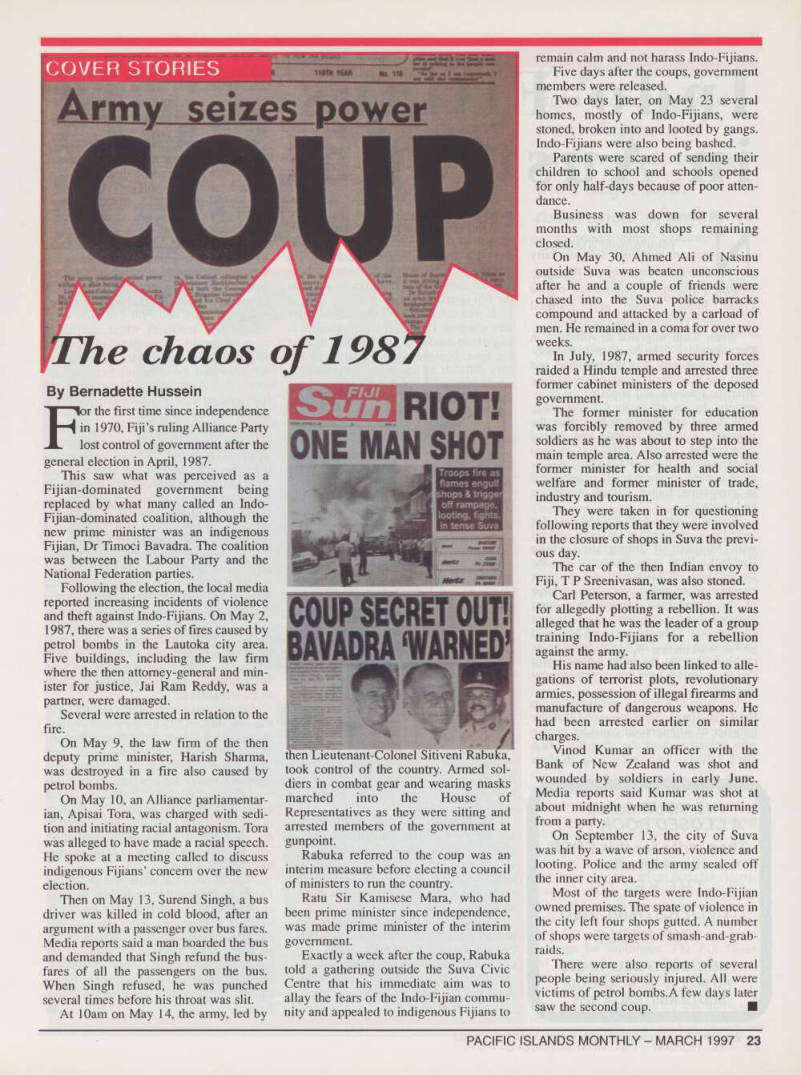
By Bernadette Hussein
For the first time since independence in 1970, Fiji’s ruling Alliance Party lost control of government after the general election in April, 1987.
This saw what was perceived as a
Fijian-dominated government being
replaced by what many called an Indo-
Fijian-dominated coalition, although the
new prime minister was an indigenous Fijian, Dr Timoci Bavadra. The coalition was between the Labour Party and the National Federation parties.
Following the election, the local media reported increasing incidents of violence and theft against Indo-Fijians. On May 2, 1987, there was a series of fires caused by petrol bombs in the Lautoka city area.
Five buildings, including the law firm where the then attorney-general and min ister for justice, Jai Ram Reddy, was a partner, were damaged.
Several were arrested in relation to the fire.
On May 9, the law firm of the then deputy prime minister, Harish Sharma, was destroyed in a fire also caused by petrol bombs.
On May 10, an Alliance parliamentar ian, Apisai Tora, was charged with sedi tion and initiating racial antagonism. Tora was alleged to have made a racial speech.
He spoke at a meeting called to discuss indigenous Fijians’ concern over the new election.
Then on May 13, Surend Singh, a bus driver was killed in cold blood, after an argument with a passenger over bus fares.
Media reports said a man boarded the bus and demanded that Singh refund the bus fares of all the passengers on the bus.
When Singh refused, he was punched several times before his throat was slit.
At 10am on May 14, the army, led by
then Lieutenant-Colonel Sitiveni Rabuka, took control of the country. Armed sol diers in combat gear and wearing masks marched into the House of
Representatives as they were sitting and
arrested members of the government at
gunpoint.
Rabuka referred to the coup was an interim measure before electing a council of ministers to run the country.
Ratu Sir Kamisese Mara, who had been prime minister since independence, was made prime minister of the interim government.
Exactly a week after the coup, Rabuka told a gathering outside the Suva Civic Centre that his immediate aim was to allay the fears of the Indo-Fijian commu nity and appealed to indigenous Fijians to
remain calm and not harass Indo-Fijians.
Five days after the coups, government members were released.
Two days later, on May 23 several homes, mostly of Indo-Fijians, were stoned, broken into and looted by gangs.
Indo-Fijians were also being bashed.
Parents were scared of sending their children to school and schools opened for only half-days because of poor atten dance.
Business was down for several months with most shops remaining closed.
On May 30, Ahmed Ali of Nasinu outside Suva was beaten unconscious after he and a couple of friends were chased into the Suva police barracks compound and attacked by a carload of men. He remained in a coma for over two weeks.
In July, 1987, armed security forces raided a Hindu temple and arrested three former cabinet ministers of the deposed government.
The former minister for education was forcibly removed by three armed soldiers as he was about to step into the main temple area. Also arrested were the former minister for health and social welfare and former minister of trade, industry and tourism.
They were taken in for questioning following reports that they were involved in the closure of shops in Suva the previ ous day.
The car of the then Indian envoy to Fiji, T P Sreenivasan, was also stoned.
Carl Peterson, a farmer, was arrested for allegedly plotting a rebellion. It was alleged that he was the leader of a group training Indo-Fijians for a rebellion against the army.
His name had also been linked to alle
gations of terrorist plots, revolutionary
armies, possession of illegal firearms and manufacture of dangerous weapons. He had been arrested earlier on similar
charges.
Vinod Kumar an officer with the Bank of New Zealand was shot and wounded by soldiers in early June.
Media reports said Kumar was shot at about midnight when he was returning from a party.
On September 13, the city of Suva was hit by a wave of arson, violence and looting. Police and the army sealed off the inner city area.
Most of the targets were Indo-Fijian owned premises. The spate of violence in the city left four shops gutted. A number of shops were targets of smash-and-grab raids.
There were also reports of several
people being seriously injured. All were
victims of petrol bombs.A few days later saw the second coup. ■
Indo-Fijians
in Australia
By Lili Tuwai
Nowadays, former member of par liament for Fiji’s Labour Party Govind Sami enjoys the chal
lenging position of chairperson of the
Fijian Indian Social and Cultural Association (FISCA) based in Sydney.
When Sami migrated to Australia in December, 1987, he found that the Indo- Fijian community was disintegrated and there was no support organisation looking after the interests and needs of the com munity. In an effort to fill that void, FISCA was established to look after the interests of Indians at state and federal government levels. FISCA’s current membership numbers 600 and the associ ation is open to anyone who is interested in promoting Indian culture, traditions
and heritages.
Recently, Sami took up the case for Indo-Fijian refugee or asylum seekers with Minister of Immigration Philip Ruddock. Sami was frustrated by the Department of Immigration’s extreme slowness when making decisions on some of the Indo-Fijian applications. Sami reported that the minister’s response was encouraging. “The minister said he would look at each individual’s application on its merit. Following my letter I have leamt that some people have now got permanent
residency.”
In a letter to Ruddock, published in the local Fiji Times, Sami requested that the minister of immigration consider people who arrived in Australia after Fiji’s first 1987 military coup and whose children
have grown up in Australia. Talking to Pacific Islands Monthly , Sami said, “Some of these children have spent half their life in Australia and by asking them now to go back to Fiji, it would be diffi cult for these young children to adapt to the Fiji situation.”
It was not long after the second mili tary coup in 1987 that Sami decided to migrate to Australia. He told PIM that “at the time, being a parliamentarian it was very difficult to find work”. Attending a conference in Australia, he was offered work as a teacher. Not long after securing a teaching position in Sydney, Sami and his family had few obstacles receiving permanent residency because of his pro fessional qualifications, but he sympathis es with those who wait in uncertainty for extended periods of time.
Discussing the way the Australian and Western media have covered the political situation in Fiji since the first military coup, Sami believes the media incapable of reporting fairly or accurately because of their limited knowledge of the Fijian and Indian cultures. He stated that “at times they have exaggerated what has been going on”.
Media reports in Australia and New Zealand conveyed many Indians in Fiji lived in great fear following the coups.
“Some of them were threatened,” says Sami. “Some of them still have scars on their bodies - they were quite genuine.
Since then I think things have improved in Fiji, but, unfortunately, there are still people who fear if they go back they will be attacked or be in some sort of trouble.”
But at the same time Sami confesses that his view from Australia still causes him to feel concern for the Indo-Fijian community in Fiji.
“Looking at the crime problems that are reported in The Fiji Times, it is of great concern to Indo-Fijians because our community has become a predominant target whereby Indians are affected by raids, and when there is theft it is mostly around Indian homes.”
He believes current government eco nomic policies disadvantage the Indo- Fijians as a race. Sami feels there is obvi ous discrimination in education and allo cation of resources for education, rural
development, and community projects.
“If you look at all of that, it is in favour of
Fijians whereby it disadvantages the Indians. They (governments) have got to look at the way Indo-Fijians perceive things - that (indigenous) Fijians control and dominate in many areas of our soci ety.”
Following the first coup in 1987, peo ple who applied to Australia for refugee status were more likely to have been con sidered under that category because of how the Western world viewed that peri od in Fiji where there was civil unrest and what they perceived as an unstable gov ernment. Sami says that about that time, 40 people were granted permanent resi dency. People wishing to leave Fiji since then because of fear of persecution in Fiji have had difficulty in gaining permanent residency. Sami told PIM that there have been a few instances where applicants were successful. “I am aware of a couple of people, because of (he positions of authority that these people held in Fiji, who the Australian Department of Immigration saw the necessity to grant permanent residency.”
Giving an example, he said “a police officer was granted permanent residency on the basis that his life was under threat if he had gone back to Fiji at that time”.
At the end of November 1995, the official figure for Fijians seeking refugee status or asylum in Australia was 209. “The major ity of these people are still waiting - I don’t know what their future holds.”
The Howard government’s cuts to wel fare programmes designed to help migrants settle have been a major concern for many migrant organisations.
“Generally speaking,” Sami explains, “Indo-Fijian asylum seekers to Australia do not rely on immigrant welfare pro grammes, they have a tendency to help one another. They would rather get help from their communities already over here or their relatives.”
Sami is optimistic about a resolution in the near future. “If the new constitution that has been drawn up by three very hon ourable gentlemen comes into place, then there will be no reason for people to seek refugee status or asylum here because Fiji really is quite all right.” Pondering on the current constitution, he says, “a situation of powerlessness for Indian political lead ers was evident in the 1990 constitution which condemns Indians to being in per manent opposition”.
“I hope common sense will prevail in Fiji and people will leave behind whatev er thoughts they had about Fiji and work together in harmony. Prior to the 1987 elections things were quite all right. What people in Fiji need to do now is get together once again, leave all selfish motives behind and work towards a better Fiji by adopting this constitution,” says Sami. ■
Advertisements & other items, p. 24 (1 item)
Is Your Bible
A CLOSED BOOK ???
Then write for this FREE booklet offer
THE KEY TO
UhJVEKSTAhJVIhJG
THE BIBLE
THE CHRISTADELPHIANS
PO BOX 43 BLACKWOOD
SOUTH AUSTRALIA 5051
How safe
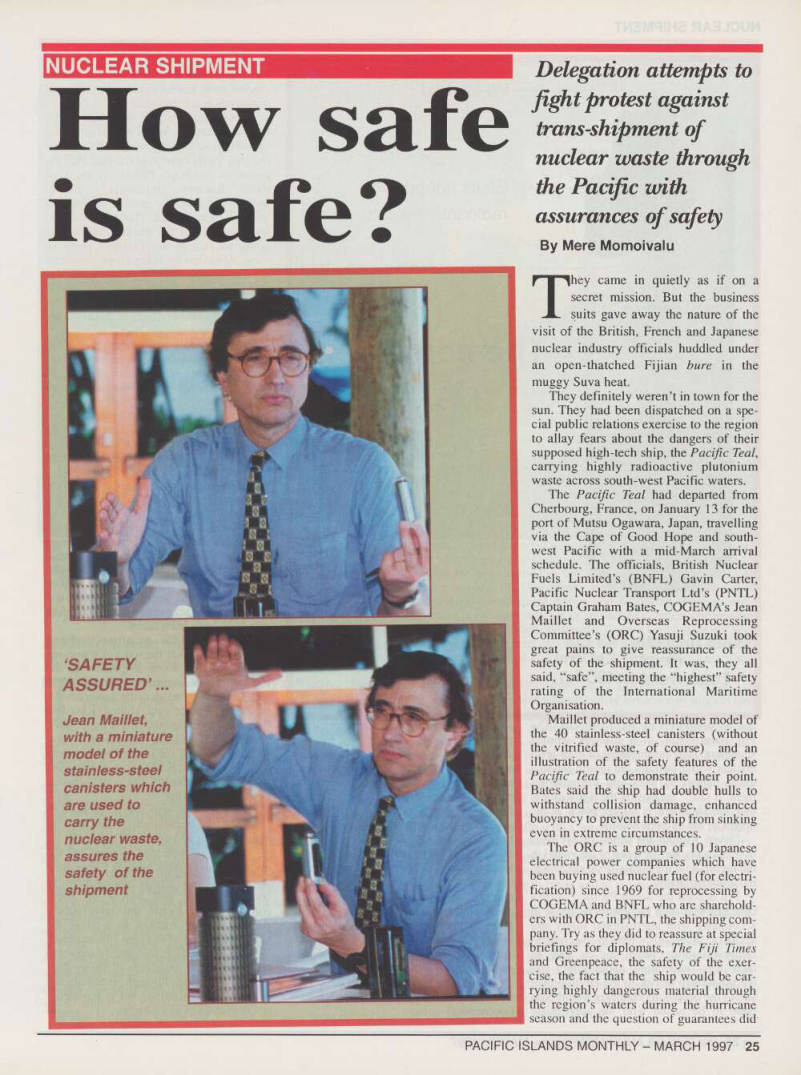

is safe?
Nuclear Shipment
Delegation attempts to fight protest against trans-shipment of nuclear waste through the Pacific with assurances of safety
By Mere Momoivalu
They came in quietly as if on a secret mission. But the business suits gave away the nature of the visit of the British, French and Japanese nuclear industry officials huddled under an open-thatched Fijian bare in the muggy Suva heat.
They definitely weren’t in town for the sun. They had been dispatched on a spe cial public relations exercise to the region to allay fears about the dangers of their supposed high-tech ship, the Pacific Teal, carrying highly radioactive plutonium waste across south-west Pacific waters.
The Pacific Teal had departed from Cherbourg, France, on January 13 for the
port of Mutsu Ogawara, Japan, travelling
via the Cape of Good Hope and south west Pacific with a mid-March arrival schedule. The officials, British Nuclear Fuels Limited’s (BNFL) Gavin Carter, Pacific Nuclear Transport Ltd’s (PNTL) Captain Graham Bates, COGEMA’s Jean Maillet and Overseas Reprocessing Committee’s (ORC) Yasuji Suzuki took great pains to give reassurance of the safety of the shipment. It was, they all said, “safe”, meeting the “highest” safety rating of the International Maritime
Organisation.
Maillet produced a miniature model of the 40 stainless-steel canisters (without the vitrified waste, of course) and an illustration of the safety features of the Pacific Teal to demonstrate their point.
Bates said the ship had double hulls to withstand collision damage, enhanced buoyancy to prevent the ship from sinking even in extreme circumstances.
The ORC is a group of 10 Japanese electrical power companies which have been buying used nuclear fuel (for electri fication) since 1969 for reprocessing by COGEMA and BNFL who are sharehold ers with ORC in PNTL, the shipping com pany. Try as they did to reassure at special briefings for diplomats, The Fiji Times and Greenpeace, the safety of the exer cise, the fact that the ship would be car
rying highly dangerous material through
the region’s waters during the hurricane season and the question of guarantees did
'Safety
Assured’...
Jean Maillet, with a miniature model of the stainless-steel canisters which are used to carry the nuclear waste, assures the safety of the shipment
not go unnoticed by local officials. The Fiji government, in a strongly worded statement, said the shipment of high-level nuclear waste through the region posed a grave danger to lives and the environ ment. It said: “Increasing the risk factor is that the shipment is taking place at the height of the cyclone season.
“Even without the threat of cyclones or hurricanes, the presence of the vessel in the region with the highly toxic cargo was
most objectionable.”
Fiji echoed the South Pacific Forum’s concerns that such shipments be made in accordance with international safety and
security standards. Forum Secretary-
General leremia Tabai said as long as there was uncertainty about safety and the possibility of risk to the environment and to the people, its concerns would con tinue to be raised with the appropriate
authorities. Non-govemment organisa tions in Vanuatu, angered by France’s decision to ship nuclear waste through the south-west Pacific to Japan accused both countries of ignorance about the environ ment and the Pacific, Agence France Presse reported. The NGOs called on their government to ensure the island’s 322 km boundary would be protected if the Pacific Teal came near it. Missing was at least a touch of the vocal campaign of concern that had marked the French nuclear tests.
It was a whimper of a protest com pared to other regional stances on nuclear issues and it died down no sooner had it been raised by the regional news agencies and a handful of national media.
In fact, the shipment would have gone through undiscovered had it not been for Greenpeace.
Greenpeace alerted the region about the shipment after French diplomatic doc uments were leaked to the environmental organisation late last year.
Greenpeace Pacific said the public relations exercise would not sway public opposition to the shipment. “The nuclear industry cannot disguise the fact that the people of the South Pacific do not want
these nuclear shipments,” Bunny
McDiarmid said. She said: “It is arrogant in the extreme to think that a public rela tions visit from the nuclear industry is going to change the Pacific’s point of view. After finally ridding our region of nuclear testing and 50 years of nuclear colonialism last year, what people want is for Japan, France and Britain to hear the message that these nuclear shipments are
unacceptable and must stop.”
Other than Greenpeace, the issue appeared to have drawn more interest and stronger words of criticisms from both governments and non-govemment organ isations elsewhere.
Anti-nuclear leader New Zealand made its protest known to the Japanese, whereas Australia refused to make a stand saying it was satisfied with the safety standards of the shipment.
In Tokyo, an anti-nuclear organisation - the Citizens’ Nuclear Information Centre - protested against the return of reprocessed nuclear waste from France, saying the public had not been assured of its safety. It said it “vehemently protests this shipment on the grounds that the safe ty of the vitrified high-level waste has not been proved and because of a complete lack of public accounting for what safety measures have been taken.”
Latin American countries declared their concerns over the risks of transport ing radioactive waste shipments in the Pacific region. Argentina, Brazil, Chile and Uruguay reminded the governments of Japan, France and United Kingdom that under international and national laws, coastal states had the jurisdiction to pro tect and preserve the marine environment in their exclusive economic zones in order to reduce and control the contamination of their ecosystems.
The countries also urged the need to reinforce the regulation of transport of nuclear waste and spent nuclear fuel.
They also expressed support for the reviewing and a more binding Convention of Liability and Safe Management of Nuclear Waste and Safety of Spent Nuclear Fuel, inside the International Atomic Energy Agency, as well as the Code for Transport of Spent Nuclear Fuel.
New Zealand has also sought moves to raise the safety standards of these ship
ments, lobbying through International
Maritime Organisations but is reportedly not confident of any progress. ■
What if?
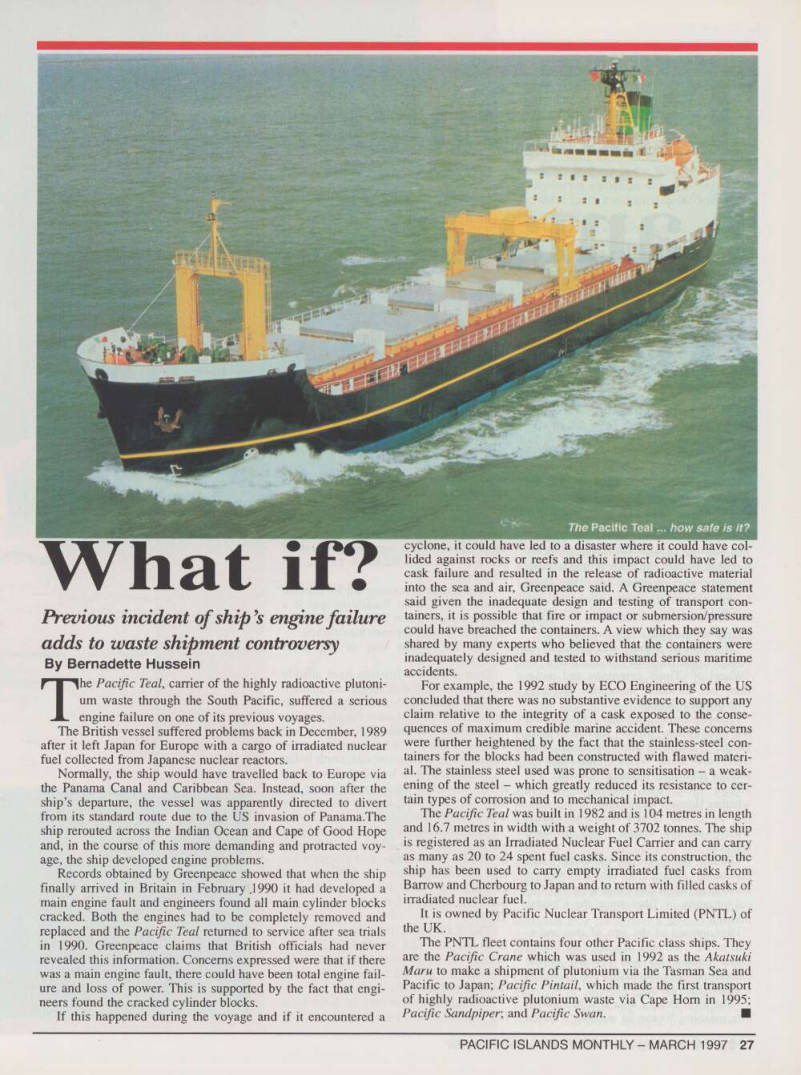
Previous incident of ship’s engine failure adds to waste shipment controversy
By Bernadette Hussein
The Pacific Teal, carrier of the highly radioactive plutoni um waste through the South Pacific, suffered a serious engine failure on one of its previous voyages.
The British vessel suffered problems back in December, 1989 after it left Japan for Europe with a cargo of irradiated nuclear fuel collected from Japanese nuclear reactors.
Normally, the ship would have travelled back to Europe via the Panama Canal and Caribbean Sea. Instead, soon after the ship’s departure, the vessel was apparently directed to divert from its standard route due to the US invasion of Panama. The ship rerouted across the Indian Ocean and Cape of Good Hope and, in the course of this more demanding and protracted voy
age, the ship developed engine problems.
Records obtained by Greenpeace showed that when the ship finally arrived in Britain in February ,1990 it had developed a main engine fault and engineers found all main cylinder blocks cracked. Both the engines had to be completely removed and replaced and the Pacific Teal returned to service after sea trials in 1990. Greenpeace claims that British officials had never revealed this information. Concerns expressed were that if there was a main engine fault, there could have been total engine fail ure and loss of power. This is supported by the fact that engi neers found the cracked cylinder blocks.
If this happened during the voyage and if it encountered a
cyclone, it could have led to a disaster where it could have col lided against rocks or reefs and this impact could have led to cask failure and resulted in the release of radioactive material into the sea and air, Greenpeace said. A Greenpeace statement said given the inadequate design and testing of transport con tainers, it is possible that fire or impact or submersion/pressure could have breached the containers. A view which they say was shared by many experts who believed that the containers were inadequately designed and tested to withstand serious maritime accidents.
For example, the 1992 study by ECO Engineering of the US concluded that there was no substantive evidence to support any claim relative to the integrity of a cask exposed to the conse quences of maximum credible marine accident. These concerns were further heightened by the fact that the stainless-steel con tainers for the blocks had been constructed with flawed materi al. The stainless steel used was prone to sensitisation - a weak ening of the steel - which greatly reduced its resistance to cer tain types of corrosion and to mechanical impact.
The Pacific Teal was built in 1982 and is 104 metres in length and 16.7 metres in width with a weight of 3702 tonnes. The ship is registered as an Irradiated Nuclear Fuel Carrier and can carry as many as 20 to 24 spent fuel casks. Since its construction, the ship has been used to carry empty irradiated fuel casks from Barrow and Cherbourg to Japan and to return with filled casks of irradiated nuclear fuel.
It is owned by Pacific Nuclear Transport Limited (PNTL) of the UK.
The PNTL fleet contains four other Pacific class ships. They are the Pacific Crane which was used in 1992 as the Akatsuki Maru to make a shipment of plutonium via the Tasman Sea and Pacific to Japan; Pacific Pintail, which made the first transport of highly radioactive plutonium waste via Cape Horn in 1995; Pacific Sandpiper, and Pacific Swan. ■
The Pacific Teal... how safe is it?
Lama in
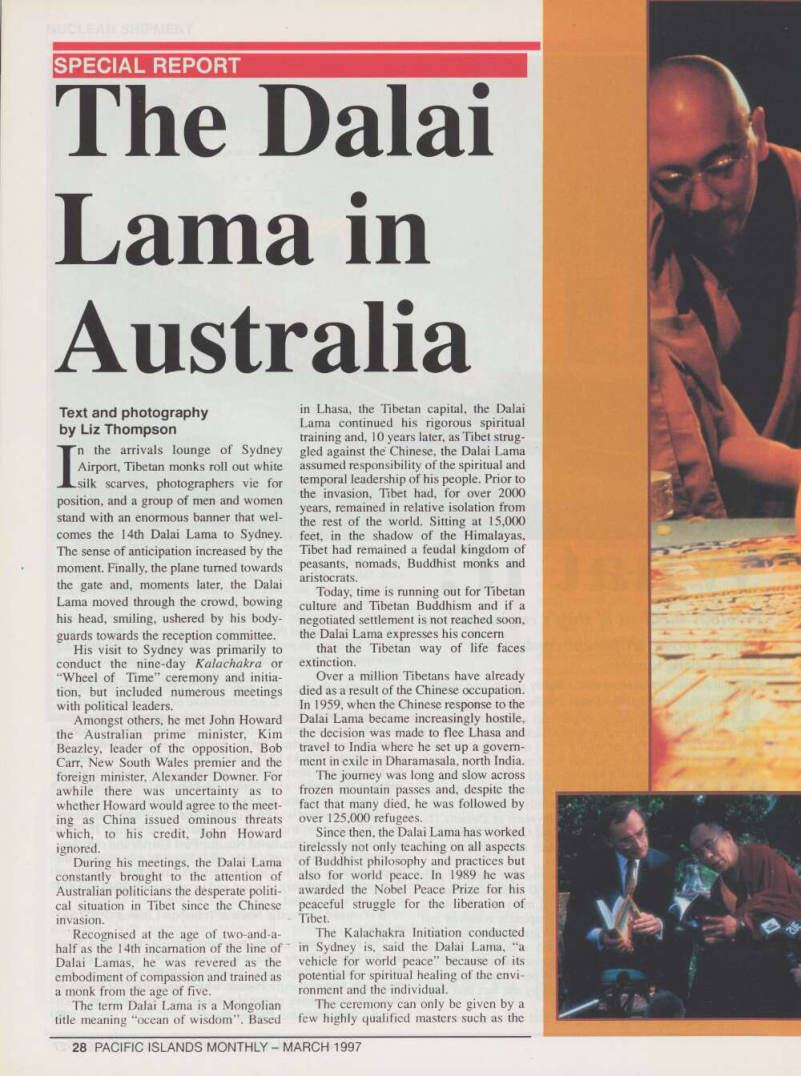
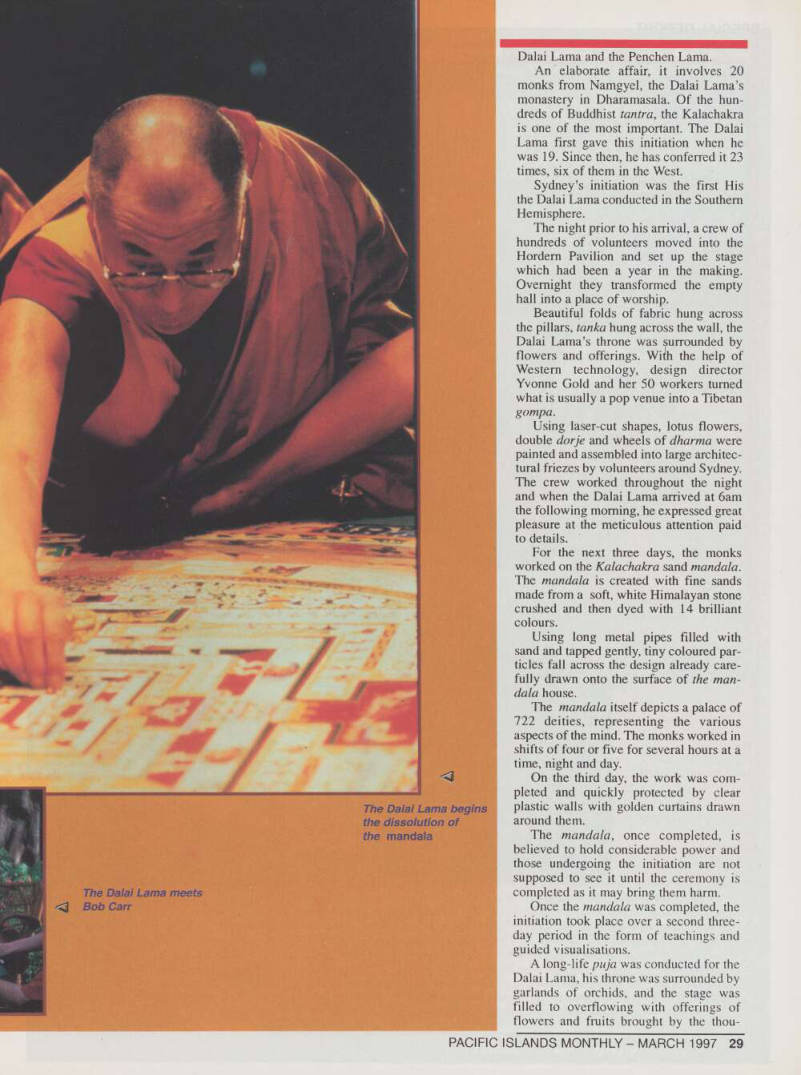
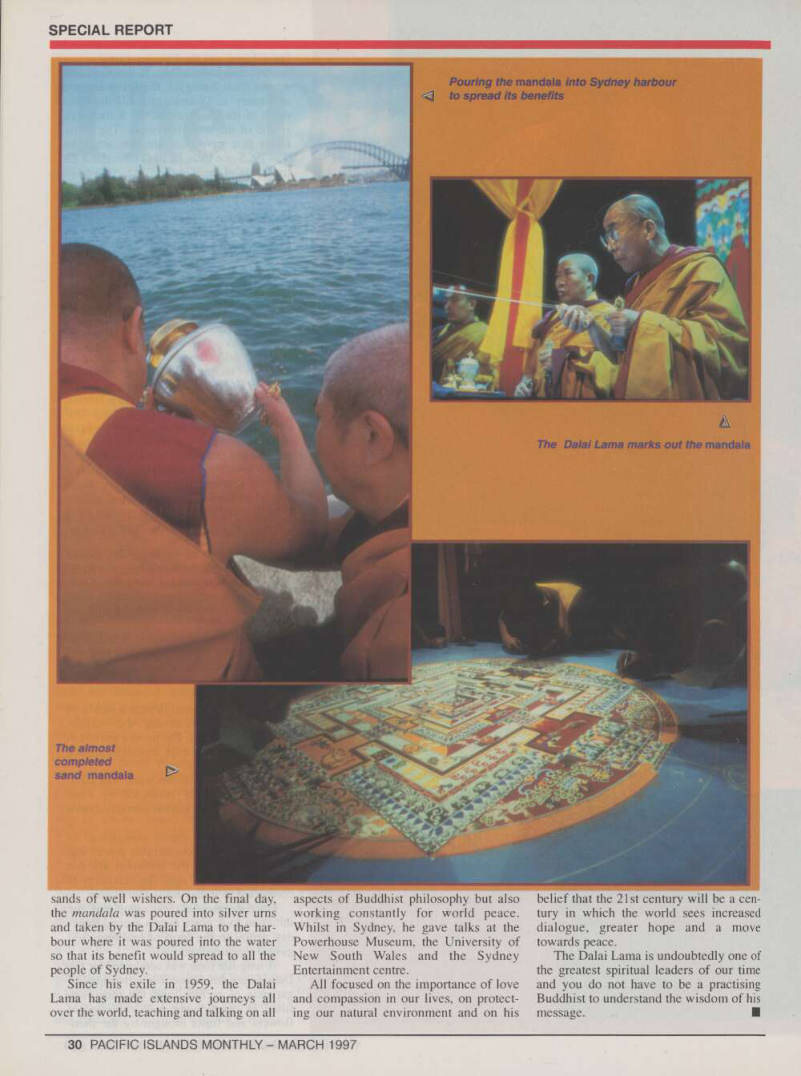
The Dalai Lama in Australia
Text and photography
by Liz Thompson
In the arrivals lounge of Sydney
Airport, Tibetan monks roll out white silk scarves, photographers vie for position, and a group of men and women stand with an enormous banner that wel comes the 14th Dalai Lama to Sydney.
The sense of anticipation increased by the moment. Finally, the plane turned towards the gate and, moments later, the Dalai Lama moved through the crowd, bowing his head, smiling, ushered by his body guards towards the reception committee.
His visit to Sydney was primarily to conduct the nine-day Kalachakra or “Wheel of Time” ceremony and initia tion, but included numerous meetings with political leaders.
Amongst others, he met John Howard the Australian prime minister, Kim Beazley, leader of the opposition. Bob Carr, New South Wales premier and the foreign minister, Alexander Downer. For awhile there was uncertainty as to whether Howard would agree to the meet ing as China issued ominous threats which, to his credit, John Howard
ignored.
During his meetings, the Dalai Lama constantly brought to the attention of
Australian politicians the desperate politi
cal situation in Tibet since the Chinese invasion.
Recognised at the age of two-and-a half as the 14th incarnation of the line of Dalai Lamas, he was revered as the embodiment of compassion and trained as a monk from the age of five.
The term Dalai Lama is a Mongolian title meaning “ocean of wisdom”. Based
in Lhasa, the Tibetan capital, the Dalai Lama continued his rigorous spiritual training and, 10 years later, as Tibet strug gled against the Chinese, the Dalai Lama assumed responsibility of the spiritual and temporal leadership of his people. Prior to the invasion, Tibet had, for over 2000 years, remained in relative isolation from the rest of the world. Sitting at 15,000 feet, in the shadow of the Himalayas, Tibet had remained a feudal kingdom of peasants, nomads, Buddhist monks and aristocrats.
Today, time is running out for Tibetan culture and Tibetan Buddhism and if a negotiated settlement is not reached soon, the Dalai Lama expresses his concern that the Tibetan way of life faces extinction.
Over a million Tibetans have already died as a result of the Chinese occupation.
In 1959, when the Chinese response to the Dalai Lama became increasingly hostile, the decision was made to flee Lhasa and travel to India where he set up a govern ment in exile in Dharamasala, north India.
The journey was long and slow across frozen mountain passes and, despite the fact that many died, he was followed by over 125,000 refugees.
Since then, the Dalai Lama has worked tirelessly not only teaching on all aspects of Buddhist philosophy and practices but also for world peace. In 1989 he was awarded the Nobel Peace Prize for his peaceful struggle for the liberation of Tibet.
The Kalachakra Initiation conducted in Sydney is, said the Dalai Lama, “a vehicle for world peace” because of its potential for spiritual healing of the envi ronment and the individual.
The ceremony can only be given by a few highly qualified masters such as the
Dalai Lama and the Penchen Lama.
An elaborate affair, it involves 20 monks from Namgyel, the Dalai Lama’s monastery in Dharamasala. Of the hun dreds of Buddhist tantra, the Kalachakra is one of the most important. The Dalai Lama first gave this initiation when he was 19. Since then, he has conferred it 23 times, six of them in the West.
Sydney’s initiation was the first His the Dalai Lama conducted in the Southern Hemisphere.
The night prior to his arrival, a crew of hundreds of volunteers moved into the Hordern Pavilion and set up the stage which had been a year in the making.
Overnight they transformed the empty hall into a place of worship.
Beautiful folds of fabric hung across the pillars, tanka hung across the wall, the Dalai Lama’s throne was surrounded by flowers and offerings. With the help of
Western technology, design director
Yvonne Gold and her 50 workers turned what is usually a pop venue into a Tibetan gompa.
Using laser-cut shapes, lotus flowers, double dorje and wheels of dharma were painted and assembled into large architec tural friezes by volunteers around Sydney.
The crew worked throughout the night and when the Dalai Lama arrived at 6am the following morning, he expressed great pleasure at the meticulous attention paid to details.
For the next three days, the monks worked on the Kalachakra sand mandala.
The mandala is created with fine sands made from a soft, white Himalayan stone crushed and then dyed with 14 brilliant colours.
Using long metal pipes filled with
sand and tapped gently, tiny coloured par ticles fall across the design already care fully drawn onto the surface of the man dala house.
The mandala itself depicts a palace of 722 deities, representing the various aspects of the mind. The monks worked in shifts of four or five for several hours at a time, night and day.
On the third day, the work was com
pleted and quickly protected by clear
plastic walls with golden curtains drawn around them.
The mandala , once completed, is believed to hold considerable power and those undergoing the initiation are not supposed to see it until the ceremony is completed as it may bring them harm.
Once the mandala was completed, the initiation took place over a second three day period in the form of teachings and guided visualisations.
A long-life puja was conducted for the Dalai Lama, his throne was surrounded by garlands of orchids, and the stage was filled to overflowing with offerings of flowers and fruits brought by the thou-
The Dalai Lama meets Bob Carr
The Dalai Lama begins the dissolution of the mandala
sands of well wishers. On the final day, the mandala was poured into silver ums and taken by the Dalai Lama to the har bour where it was poured into the water so that its benefit would spread to all the
people of Sydney.
Since his exile in 1959, the Dalai Lama has made extensive journeys all over the world, teaching and talking on all
aspects of Buddhist philosophy but also working constantly for world peace.
Whilst in Sydney, he gave talks at the Powerhouse Museum, the University of New South Wales and the Sydney Entertainment centre.
All focused on the importance of love and compassion in our lives, on protect ing our natural environment and on his
belief that the 21st century will be a cen tury in which the world sees increased dialogue, greater hope and a move towards peace.
The Dalai Lama is undoubtedly one of the greatest spiritual leaders of our time and you do not have to be a practising Buddhist to understand the wisdom of his message. ■
The almost completed sand mandate
Pouring the mandate into Sydney harbour to spread its benefits
The Dalai Lama marks out the mandate
Advertisements & other items, pp. 31-32 (1 item)
Investment Corporation
w /./J * *
I lih'i‘i
of Papua New Guinea
The Investment Corporation was established in 1971 by the National Government. ;’V PApua Ne\v Guinea is known worldwide for its mineral wealth, x' but. potential exists for the further development of both priw&ry and secondary industries, particularly for value added produQts| In keeping with the Government's policy of encouraging 1 v.’jrtpvcstmem in Papua New Guinea, the Corporation is keen to . '// '‘ ‘identify and implement viable new business projects in conjunction
■%r th overseas partners.
position and wide experience, the Investment ilified to provide a wide range of services for ■s.
Gi mL m 5# ■ ■ % Helo hi cat Hg ii Insurance House own. Pari Moresby is vestment Corporation ft m msiSim ai ( ’ / pi ' •> : ™ n ■ s ■ it: .<•- tr-~ Z'* .<erv I .. t m
SSI
a. ; ■ : V Investors who would like to lake advantage of the excellent business opportunities available in Papua blew Guinea are invited to contact r * v £ ■ sfy* m \ the Managing Director investment Corporation of Papua New Guinea PO Box 155 Fort Moresby
PAPUA NEW GUINEA
.. ielephone: Facsimile: 675 - 3212855 675 - 3211240 I V 4
trukai RICE TERMINAL 7^ m m / ■ *** > <- i U. ‘ * hi: W 7 \, 7 ' % \ tL f • I r/E*s m miF Hi « I sx
-SS^teSSr^
p^9hs*
LE - For information about the Fund and how to become a shareholder contact the Fund Manager RO. Box 155, Port Moresby, N.C.D.
Phone: 321 2855 Fax: 321 1240 hen you buy shares from us this means that you own a small part of each of the companies in which we invest your money. You receive dividends annually and your shares grow in value.
The Investment Corporation fund has shares in many different types of companies. Timber, heavy machinery, retail stores, farm products, iron and steel, gas . . . these are just a few of the industries in which we invest shareholders' money.
Shareholders include individuals, small groups, and large associations or institutions representing tens of thousands of Papua New Guineans. Shares in the Investment Corporation Fund of Papua New Guinea may be purchased at the Corporation's Head Office in Port Moresby.
Shares can be purchased outright or through pay deduction from employees salaries. The money you invest helps create jobs and the future development of Papua New Guinea
SHARING AND CARING NATIONWIDE
Investing in
Business And Finance
Advertising Feature
Investing in P-N-Guinea
The Investment Corporation of Papua New Guinea is a statutory body established by an Act of Parliament in 1971.
Under the terms of the Act, the objec tive of the corporation is to provide for Papua New Guinea equity in enterprises operating in the country in cases where: • a significant degree of local equity might not otherwise be readily achieved; • it is considered to be in the long-term national interest; and • the enterprise is operating, or will operate, profitably.
In keeping with the PNG govern ment’s emphasis on self-reliance, the Corporation says, it has been entirely self financing since 1975. Starting with grants totalling K 5.5 million, the corporation now holds assets of over K 34 million.
The Corporation’s Act gives it power to engage in a wide range of commercial activities in the furtherance of its object.
But the corporation has no power of com pulsory acquisition of equality in an enterprise.
In fulfilling its object, the Corporation performs two principal functions, namely purchasing shares in enterprises operating in PNG and holding these shares for even tual sale to eligible PNG interests.
Under the provision of the Investment Corporation Act, eligible individuals and groups include; • a citizen, whether by automat ic right or by naturalisation; • the national government or a statutory body; • a provincial government, provincial development corporation or local government council; • a society registered under the Co-operative Societies Act; and
• any other group or body (cor porate or incorporate) recommended by the Investment Corporation group and approved by the minister of finance.
For Papua New Guinea groups wish ing to expand an existing business, estab lish a new business or take over a foreign owhed business, the Corporation will: • advise on financing; • underwrite share issue; and • subscribe for capital.
For foreign investors wishing to pro vide for local equity participation in exist ing enterprises, the Corporation will: • underwrite the share issue;
• acquire significant minority
shareholding; and • provide local board represen tation.
Within a policy framework laid down by the minister of finance and approved by the national executive council, the Corporation is administered by a board of directors, of eight to 12.
Day-today administration is provided by a management group comprising seven senior executives of the Corporation, each with specific responsibilities on a func tional basis. The Corporation’s invest ment policy is based on both financial and social considerations. Specifically, it seeks equity investments in business activities which are consistent with the
development objectives and policies of
the government of PNG.
Guidance is drawn from the: • National Development Strategy; • National Investment Programmes; and • National Budget Priorities Schedule.
However, the Corporation says it only considers purchasing equity in business
activities which, on the basis of proper analysis and investigation, are deemed
technically feasible and financially
viable.
Generally, the Corporation negotiates
directly for 20 to 30 per cent of equity in a company and seeks the board’s repre sentation. It also purchases shares listed on the Australian Stock Exchange, but only in cases where the company is regis tered in Papua New Guinea.
Sale of shares to eligible Papua New Guinean individuals and groups is achieved in two ways: • indirectly, through the sale of units in the Investment Corporation Fund; and • by direct sale of shares through
private treaty.
The Investment Corporation Fund is a unit trust administered by the Corporation, under the terms of a Management Declaration (Trust Deed).
Simply stated, the Fund operates in the following manner; • eligible groups and individuals buy units in the Fund; • the Fund uses their money to buy beneficial interests in the Corporation’s property and equity hold ings; and • returns generated through this method are divided amongst the unit holders after deducting the running costs of the Fund.
There are now over 26,000 unit hold ers comprising individuals, small groups and large associations and institutions representing tens of thousands of Papua New Guineans.
Over the past five years, the fund has paid an average dividend yield of about eight per cent. In addition, there has been an annual increase in the value of the Fund units of about nine per cent in the same period. As at year end 1996, the Corporation’s net asset was K 23 million (unaudited) while the Fund’s net assets stood at K 63 million (unaudited).
Both organisations hold equity inter ests in over 30 businesses in Papua New Guinea. These include BPT (PNG) Ltd, Associated Mills Ltd, Rothmans of Pall Mall (PNG) Pty Ltd, Trukai Industries Pty Ltd, Travelodge PNG Ltd, BOC Gases (PNG) Pty Ltd, llimo Poultry Products Pty Ltd, Boral Gas (PNG) Pty Ltd. ■
Advertisements & other items, p. 34 (1 item)
Sou3Monislwds
THE
Welcomes Your Investment
h “t The Solomon Islands - over 100 islands and 27,000 square kilometres of rainforests,
mountains, lagoons and picture-perfect
coral beaches set in the heart of Melanesia.
Independent since 1978, the Solomon Islands have a democratic constitution of national and provincial government.
Solomon Islanders are a lively and healthy collection of 370,000 law-abiding and cheerful Pacific islanders whose diverse culture (over 87 languages) has blended with the modern technological world.
The islands enjoy a free and active press and radio (with television coming soon); and high-technology satellite communications links (including ISD telephone, telex and facsimile facilities) which link the islands both domestically
SOLOMON
ISLANDS
Vv
VANUATU
NEW
CALEDONIA
NEW
ZEALAND
AUSTRALIA
and internationally.
In addition regular, scheduled sea and air transport links can connect you with any place in the world from our central location in the South-West Pacific.
The Solomon Islands seeks and welcomes investment from genuine private commercial investors interested in
manufacturing, commercial agriculture,
timber processing, fisheries, electronics, electrical engineering, tourism and hotels, mining, food processing, textile and garment manufacturing or one of the many other opportunities available.
For more information please contact: The Secretary, Foreign Investment Board, Ministry of Commerce, Industries & Employment PO Box G 26, Honiara, Solomon Islands. Telephone: (677) 23015 or (677) 21928. Facsimile: (677) 21 651.
SPC’s golden year
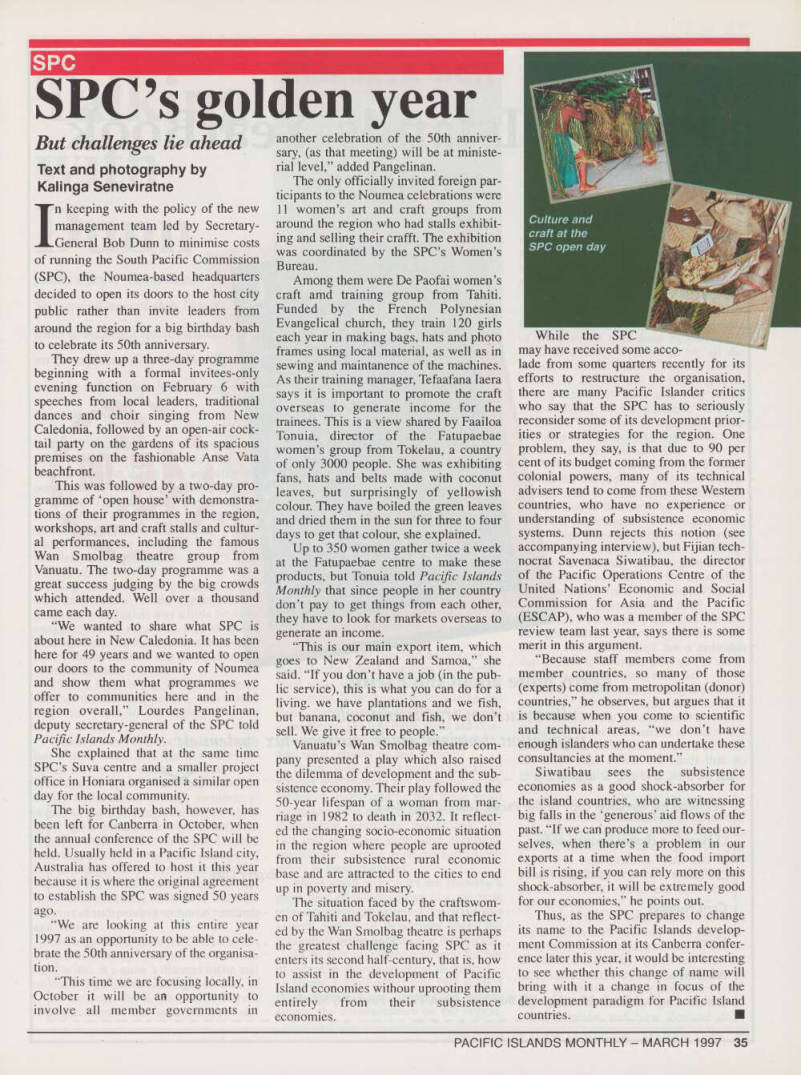
Spc
But challenges lie ahead
Text and photography by
Kalinga Seneviratne
In keeping with the policy of the new management team led by Secretary- General Bob Dunn to minimise costs of running the South Pacific Commission (SPC), the Noumea-based headquarters decided to open its doors to the host city public rather than invite leaders from around the region for a big birthday bash to celebrate its 50th anniversary.
They drew up a three-day programme beginning with a formal invitees-only evening function on February 6 with speeches from local leaders, traditional dances and choir singing from New Caledonia, followed by an open-air cock tail party on the gardens of its spacious premises on the fashionable Anse Vata beachfront.
This was followed by a two-day pro gramme of ‘open house’ with demonstra tions of their programmes in the region, workshops, art and craft stalls and cultur al performances, including the famous Wan Smolbag theatre group from Vanuatu. The two-day programme was a great success judging by the big crowds which attended. Well over a thousand came each day.
“We wanted to share what SPC is about here in New Caledonia. It has been here for 49 years and we wanted to open our doors to the community of Noumea and show them what programmes we offer to communities here and in the
region overall,” Lourdes Pangelinan,
deputy secretary-general of the SPC told Pacific Islands Monthly.
She explained that at the same time SPC’s Suva centre and a smaller project office in Honiara organised a similar open day for the local community.
The big birthday bash, however, has been left for Canberra in October, when the annual conference of the SPC will be held. Usually held in a Pacific Island city, Australia has offered to host it this year because it is where the original agreement to establish the SPC was signed 50 years ago.
“We are looking at this entire year 1997 as an opportunity to be able to cele brate the 50th anniversary of the organisa tion.
“This time we are focusing locally, in October it will be an opportunity to involve all member governments in
another celebration of the 50th anniver sary, (as that meeting) will be at ministe rial level,” added Pangelinan.
The only officially invited foreign par
ticipants to the Noumea celebrations were 11 women’s art and craft groups from around the region who had stalls exhibit ing and selling their crafft. The exhibition was coordinated by the SPC’s Women’s Bureau.
Among them were De Paofai women’s craft amd training group from Tahiti.
Funded by the French Polynesian Evangelical church, they train 120 girls each year in making bags, hats and photo frames using local material, as well as in sewing and maintanence of the machines.
As their training manager, Tefaafana laera says it is important to promote the craft overseas to generate income for the trainees. This is a view shared by Faailoa Tonuia, director of the Fatupaebae women’s group from Tokelau, a country of only 3000 people. She was exhibiting fans, hats and belts made with coconut leaves, but surprisingly of yellowish colour. They have boiled the green leaves and dried them in the sun for three to four days to get that colour, she explained.
Up to 350 women gather twice a week at the Fatupaebae centre to make these products, but Tonuia told Pacific Islands Monthly that since people in her country don’t pay to get things from each other, they have to look for markets overseas to generate an income.
“This is our main export item, which goes to New Zealand and Samoa,” she said. “If you don’t have a job (in the pub lic service), this is what you can do for a living, we have plantations and we fish, but banana, coconut and fish, we don’t sell. We give it free to people.”
Vanuatu’s Wan Smolbag theatre com pany presented a play which also raised the dilemma of development and the sub sistence economy. Their play followed the 50-year lifespan of a woman from mar riage in 1982 to death in 2032. It reflect ed the changing socio-economic situation in the region where people are uprooted from their subsistence rural economic base and are attracted to the cities to end up in poverty and misery.
The situation faced by the craftswom en of Tahiti and Tokelau, and that reflect ed by the Wan Smolbag theatre is perhaps the greatest challenge facing SPC as it enters its second half-century, that is, how to assist in the development of Pacific Island economies withour uprooting them entirely from their subsistence economies.
While the SPC may have received some acco lade from some quarteHs recently for its efforts to restructure the organisation, there are many Pacific Islander critics who say that the SPC has to seriously reconsider some of its development prior ities or strategies for the region. One problem, they say, is that due to 90 per cent of its budget coming from the former colonial powers, many of its technical advisers tend to come from these Western countries, who have no experience or understanding of subsistence economic systems. Dunn rejects this notion (see accompanying interview), but Fijian tech nocrat Savenaca Siwatibau, the director of the Pacific Operations Centre of the United Nations’ Economic and Social Commission for Asia and the Pacific (ESCAP), who was a member of the SPC review team last year, says there is some merit in this argument.
“Because staff members come from member countries, so many of those (experts) come from metropolitan (donor) countries,” he observes, but argues that it is because when you come to scientific and technical areas, “we don’t have enough islanders who can undertake these consultancies at the moment.”
Siwatibau sees the subsistence economies as a good shock-absorber for the island countries, who are witnessing big falls in the ‘generous’ aid flows of the past. “If we can produce more to feed our selves, when there’s a problem in our exports at a time when the food import bill is rising, if you can rely more on this shock-absorber, it will be extremely good for our economies,” he points out.
Thus, as the SPC prepares to change its name to the Pacific Islands develop ment Commission at its Canberra confer ence later this year, it would be interesting to see whether this change of name will bring with it a change in focus of the development paradigm for Pacific Island countries. ■
Culture and craft at the SPC open day
Advertisements & other items, p. 36 (1 item)
Pacific Islands Yearßook
Now Available
17th Edition
Price
AUD
oo r ® Si
PLUS
POSTAGE
Leam more about the Pacific
culture/custom tradition!people
population, tourism, trade, airlines, tax system etc.
X Expiry Date Name .. .. Signature Address I Yes, send me the latest copy of the Pacific Islands Year Book. □ Here is a cheque/money order □ Visa □ Master Card Card Number , Post to: Pacific Islands Monthly, PO Box 1167 Suva, Fiji or Fax (679) 303809.
I J
Talking
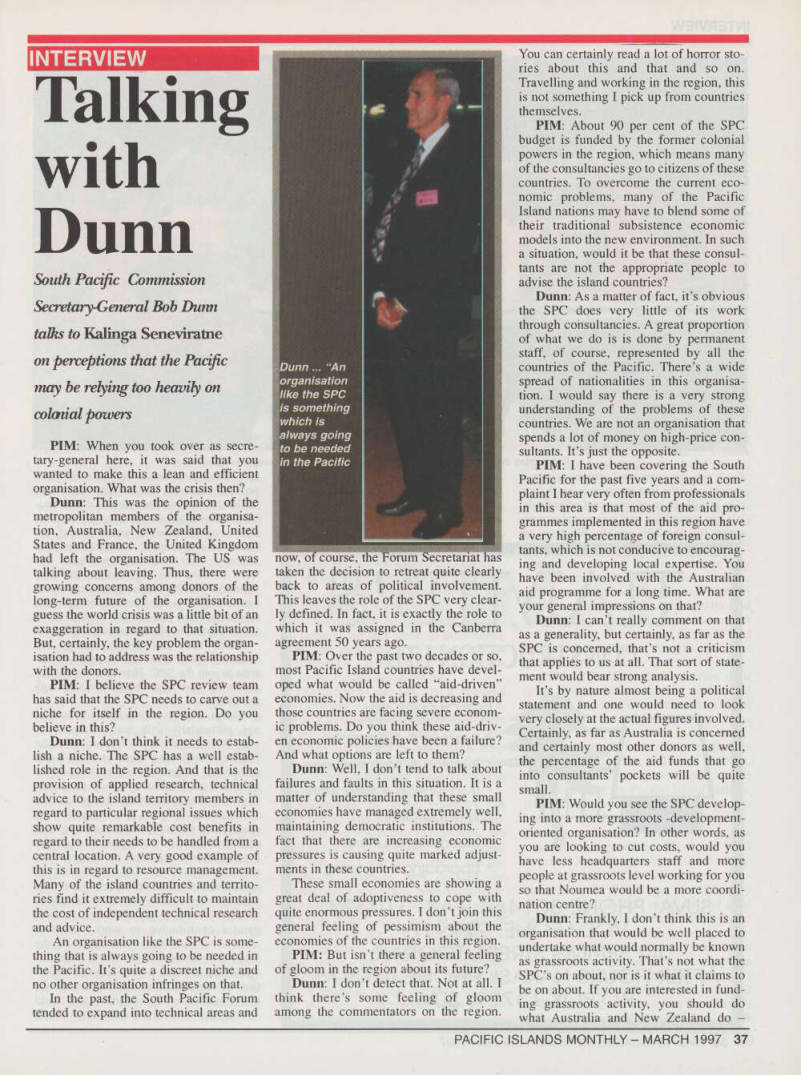

Interview
with Dunn
South Pacific Commission
Secretary-General Boh Dunn
talks to Kalinga Seneviratne
on perceptions that the Pacific
may he relying too heavily on
colonial powers
PIM: When you took over as secre tary-general here, it was said that you wanted to make this a lean and efficient organisation. What was the crisis then?
Dunn: This was the opinion of the metropolitan members of the organisa tion, Australia, New Zealand, United States and France, the United Kingdom had left the organisation. The US was talking about leaving. Thus, there were growing concerns among donors of the long-term future of the organisation. I guess the world crisis was a little bit of an exaggeration in regard to that situation.
But, certainly, the key problem the organ isation had to address was the relationship with the donors.
PIM: I believe the SPC review team has said that the SPC needs to carve out a niche for itself in the region. Do you believe in this?
Dunn: I don’t think it needs to estab lish a niche. The SPC has a well estab lished role in the region. And that is the provision of applied research, technical advice to the island territory members in
regard to particular regional issues which
show quite remarkable cost benefits in regard to their needs to be handled from a central location. A very good example of this is in regard to resource management.
Many of the island countries and territo ries find it extremely difficult to maintain the cost of independent technical research and advice.
An organisation like the SPC is some thing that is always going to be needed in the Pacific. It’s quite a discreet niche and no other organisation infringes on that.
In the past, the South Pacific Forum tended to expand into technical areas and
now, of course, the Forum Secretariat has taken the decision to retreat quite clearly back to areas of political involvement.
This leaves the role of the SPC very clear ly defined. In fact, it is exactly the role to which it was assigned in the Canberra agreement 50 years ago.
PIM: Over the past two decades or so, most Pacific Island countries have devel oped what would be called “aid-driven” economies. Now the aid is decreasing and those countries are facing severe econom ic problems. Do you think these aid-driv en economic policies have been a failure?
And what options are left to them?
Dunn; Well, I don’t tend to talk about failures and faults in this situation. It is a matter of understanding that these small economies have managed extremely well, maintaining democratic institutions. The fact that there are increasing economic pressures is causing quite marked adjust ments in these countries.
These small economies are showing a great deal of adoptiveness to cope with quite enormous pressures. I don’t join this
general feeling of pessimism about the
economies of the countries in this region.
PIM: But isn’t there a general feeling of gloom in the region about its future?
Dunn: I don’t detect that. Not at all. I think there’s some feeling of gloom among the commentators on the region.
You can certainly read a lot of horror sto ries about this and that and so on.
Travelling and working in the region, this is not something I pick up from countries themselves.
PIM: About 90 per cent of the SPC budget is funded by the former colonial powers in the region, which means many of the consultancies go to citizens of these countries. To overcome the current eco nomic problems, many of the Pacific Island nations may have to blend some of their traditional subsistence economic models into the new environment. In such a situation, would it be that these consul tants are not the appropriate people to advise the island countries?
Dunn: As a matter of fact, it’s obvious the SPC does very little of its work through consultancies. A great proportion of what we do is is done by permanent staff, of course, represented by all the countries of the Pacific. There’s a wide spread of nationalities in this organisa tion. I would say there is a very strong understanding of the problems of these countries. We are not an organisation that spends a lot of money on high-price con sultants. It’s just the opposite.
PIM: I have been covering the South Pacific for the past five years and a com plaint I hear very often from professionals in this area is that most of the aid pro grammes implemented in this region have a very high percentage of foreign consul tants, which is not conducive to encourag ing and developing local expertise. You have been involved with the Australian aid programme for a long time. What are your general impressions on that?
Dunn; I can’t really comment on that as a generality, but certainly, as far as the SPC is concerned, that’s not a criticism that applies to us at all. That sort of state ment would bear strong analysis.
It’s by nature almost being a political statement and one would need to look very closely at the actual figures involved.
Certainly, as far as Australia is concerned and certainly most other donors as well, the percentage of the aid funds that go into consultants’ pockets will be quite small.
PIM: Would you see the SPC develop ing into a more grassroots -development oriented organisation? In other words, as you are looking to cut costs, would you have less headquarters staff and more people at grassroots level working for you so that Noumea would be a more coordi nation centre?
Dunn: Frankly, I don’t think this is an organisation that would be well placed to undertake what would normally be known as grassroots activity. That’s not what the SPC’s on about, nor is it what it claims to be on about. If you are interested in fund ing grassroots activity, you should do what Australia and New Zealand do -
Dunn...“An organisation like the SPC is something which is always going to be needed in the Pacific
fund non-govemmental organisations -
people who are in a position to work hap pily at village level very cost effectively.
It’s not something that a regional organi sation like the SPC can do. What we are
involved in is issues and problems which have a regional significance, where we can have a cost-effective input. A good example of that is the future of tuna resources in the Pacific. You have to have
an organisation which can provide data, provide research, data which measures the health of those tuna stocks, which pro vide information of value to discussions which occur between countries of the Pacific with regard to the future of that industry. That is something which you have to have this organisation do. You wouldn’t decribe that as grassroots inter vention. This is the greatest resource the region has and you simply have to have the information which relates to its future.
PIM: Your predecessor, George Ati Sokomanu, has tried to woo Asian coun tries to join the SPC. How do you see the scope for more Asia-Pacific links through the SPC?
Dunn; There’s excellent future in link age, particularly with those Asian coun tries who are users of resources in the Pacific - both land-based and sea-based resources. I think there’s real room for quite a contribution by these countries.
One of the interesting things at the moment is if you take fisheries or research in forestry, the researching cost of this activity in the region through our organisation is provided by donors, who themselves have very little to do with the actual use of those resources. Countries who are very much involved in the use of those resources might very well make a greater contribution to work which is associated with the maintenance of the long-term future of this work. Just this week, Japan made a very large contribu tion to our education training centre for the provision of classrooms. One could see this as a very strong development. ■
Polynesian dancers at the SPC open day last month Picture: Kaimga seneviratne
Advertisements & other items, p. 38 (2 items)
Interview
Construction Ltd
SPECIALIST IN:-
* Building & Steel Works * Building & Maintenance * Renovation & Extension * Window Grills * Hurricane Shutters * Upgrading * Fencing
SUVA: PHONE 301464, FAX: 310323.
VODAFONE: 922978
42 SPRING STREET, TOORAK.
AFTER HOURS NAKASI: PHONE 410978
PO.BOX 13727, SUVA.
Dollars
and sense
Former Secretary-General of the
South Pacific Commission
George Sokomanu looks at the
decreasing aid situation in the
Pacific and offers his solution to
the problems. Kaiinga
Seneviratne reports.
PIM; Foreign aid is decreasing to this region and many Pacific Island countries are getting into financial difficulties. Does this mean that the development strategies followed by the island nations since inde pendence have been defective?
Sokomanu; One of the most funda mental things for the governments here is that if they know aid is decreasing from traditional donors, they will have to look elsewhere. But before they do that, they will have to look at their own ... structure of government, the economy, various social problems they have, and try to work something out ... Once you have sorted out your structural problems, then let’s look elsewhere.
PIM: The old subsistence system has been done away with, especially in the urban areas, with people becoming more consumerist with imports coming in. Is this the main problem?
Sokomanu: On some of these islands you have everything. Why do they need to buy from outside? There are pigs, you could even have a domestic piggery, you can have a farm, if you have a net or something, you can catch fish. There is everything, but it is a colonial legacy.
They have been told you must buy tinned food and because they have been given free supplies of these while working on
the plantations by Europeans and others,
they have taken easily to it rather than go out and look for food. People living in cities are vulnerable to this and you will find islands getting into this because the
small co-operative shops are stocking
these. They don’t sell fresh food but this canned food. If changes have to take place because aid ... is decreasing, we have to restructure these systems. We have to go back to some of this old system.
We used to have the barter system where the people near the sea used to go out to catch [seafood] and they bartered with people living up in the mountains who would come down to the village with
wild pigs, wild birds, yams and carrots and so on, and they exchanged. Life went on. If we go back to this system, it’s not going to cost us much. We must introduce this by setting up agricultural schools, for example, which will train people to go back to the village and start telling people to do this. If the government wants this to be a success, [it] must do a lot to get peo ple back to that system. People in the rural areas will easily accept it and be motivat ed. It’s people in the urban areas who will face a lot of problems.
PIM: In that sense, would you say that an organisation like the SPC must rethink its policies, as there are a lot of experts and consultants from non-Pacific Island countries, some of whom may not under stand these old subsistence economies in the Pacific Islands?
Sokomanu: It’s a good question, a question many of us Pacific leaders have pondered since the SPC’s existence. Many of the metropolitan countries have seen it as their organisation and that is why Ratu [Sir Kamisese] Mara, the president of Fiji, said let’s get out of this, this is not our club. Let’s do things the way we know it and the way we want it. That’s how the
whole thing changed. Instead of having
the usual metropolitan governments appointing their secretary-general to take over the SPC; for the last 20 years, the SPC has been guided by Pacific Islanders and we feel that it ought to be like that for the rest of the time. We have to work hard to ensure that we have our own experts ... [to] do the job. It’s our leaders who have failed us. Most leaders think that Europeans know better than our people. I think the Islander people know better... but because we lack some of the training to become an expert... we tend to rely on ... expatriates. I prefer to see my own peo ple in the Pacific doing the job.
PIM: Since the SPC is a regional development agency which is predomi nantly funded by the ex-colonial powers of the region, where many of its pro grammes are guided by consultants from these countries, you seem to say that the political will is not there at the moment to change this set-up.
Sokomanu; In certain countries you have people who come forward and artic ulate this, but others tend to hold back. We need to speak out and point to our people that you can’t just stand there and let things go. Australia, New Zealand, the United States and UK - which has with drawn from the SPC - because they give so much money, they tend to dictate in certain terms to the SPC’s organisation.
Independent countries should have equal voice - not in terms of “I have no money, so I have to give in”. If our lead ers are going to accept that then the SPC will not fully address the needs of the Pacific Island people.
PIM: I understand that when you were SPC secretary-general, you tried to get some Asian countries to join. How do you see the scope for establishing greater links with Asian countries through the SPC so that they would ultimately become donors to development projects in Pacific Island countries?
Sokomanu; I was invited twice to sit in as an observer at ASEAN meetings. I attended these with the secretary-general of the Forum Secretariat, leremia Tabai.
As secretary-general, my main aim was to bring Asian countries closer to the SPC. I don’t think we need to look at Australia, New Zealand, US or UK as the source of everything we need. Asia is so near to us and certainly they are very productive in their economic and social development.
Japan spends one per cent of the total budget of that nation, it goes into billions, on development aid. So why can’t they come in as a donor? When we talked to them, they seemed to say they were chan nelling our funds to the Forum, and if you can combine the two together and have it as one. The South Pacific Forum is not a
development training ground for the
region. The SPC is the one ... I think South-East Asia can help us. I will look at
Malaysia, Indonesia, Singapore, Japan,
Taiwan and South Korea. They are giving a little bit and I think they are feeling their way around. Once our ... nations accept the reality to look for new areas of help, I’m sure they will join in. I sent five invi tations to countries to join in and the only country that said no was Canada because they said they were to far away... I don’t think we should stick to Australia and New Zealand as the only areas that we get our help from. If we do that they will tend to have more say in anything that we do at the SPC.
PIM: If Pacific Island countries want to set up an organisation linking Asia and the South Pacific, could it be done without the support of Australia and New Zealand?
Sokomanu: I don’t think our leaders should fear Australia and New Zealand.
They are still a part of the Pacific ... and have done a lot for Pacific Island nations.
If they resent bringing Asians to our coun tries let them say so. For example, Vanuatu gets between $ll and $l6 million annually from Australia. They give PNG about $3OO million, when we ask them, they they say “PNG was our former colo nial territory”. They forget to tell us they are interested in their minerals and send most of their investors there... If they give us $lOO million for our social develop ment, we will certainly say, “Let’s listen to Australia.” I’m sure if we ... go to Singapore, Japan and Malaysia and say, “I come with this package, it’s about $lOO million, will you help us in the next 20 years...?” I’m sure they will. ■
Advertisements & other items, p. 40 (1 item)
'suoiivaijvaarfs inoi
01 paunpvm puv paup upiq paivaii ipvuoissafoij saaucf aaipp)4uwj fyqSiq iv sxamoisno ]AO(Jxa puv praoj 01 diqvjwav si laqmti aaiivu Jo aSum ijn) y
Super 12
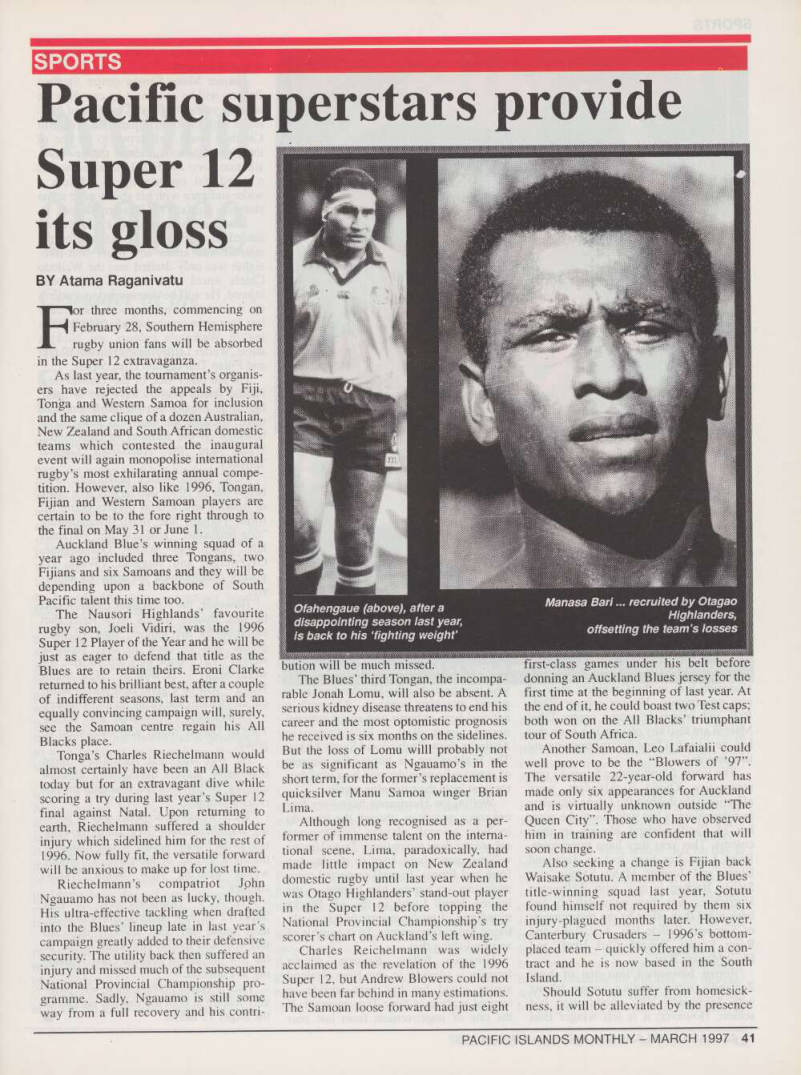
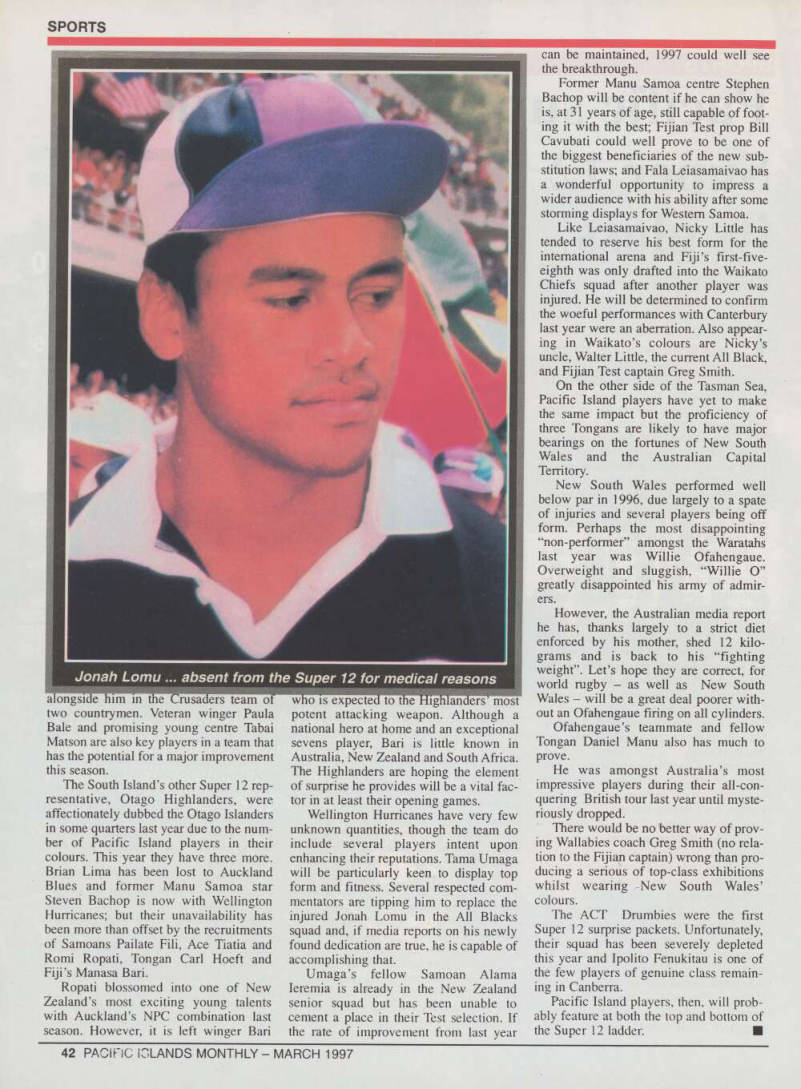
Sports
Pacific superstars provide
Super 12 its gloss
BY Atama Raganivatu
For three months, commencing on
February 28, Southern Hemisphere
rugby union fans will be absorbed in the Super 12 extravaganza.
As last year, the tournament’s organis ers have rejected the appeals by Fiji, Tonga and Western Samoa for inclusion and the same clique of a dozen Australian, New Zealand and South African domestic teams which contested the inaugural event will again monopolise international rugby’s most exhilarating annual compe tition. However, also like 1996, Tongan, Fijian and Western Samoan players are certain to be to the fore right through to the final on May 31 or June 1.
Auckland Blue’s winning squad of a year ago included three Tongans, two Fijians and six Samoans and they will be depending upon a backbone of South Pacific talent this time too.
The Nausori Highlands’ favourite rugby son, Joeli Vidiri, was the 1996 Super 12 Player of the Year and he will be just as eager to defend that title as the Blues are to retain theirs. Eroni Clarke returned to his brilliant best, after a couple of indifferent seasons, last term and an
equally convincing campaign will, surely,
see the Samoan centre regain his All Blacks place.
Tonga’s Charles Riechelmann would almost certainly have been an All Black today but for an extravagant dive while scoring a try during last year’s Super 12 final against Natal. Upon returning to earth, Riechelmann suffered a shoulder injury which sidelined him for the rest of 1996. Now fully fit, the versatile forward will be anxious to make up for lost time.
Riechelmann’s compatriot John Ngauamo has not been as lucky, though.
His ultra-effective tackling when drafted into the Blues’ lineup late in last year’s campaign greatly added to their defensive security. The utility back then suffered an injury and missed much of the subsequent National Provincial Championship pro gramme. Sadly, Ngauamo is still some way from a full recovery and his contri-
bution will be much missed.
The Blues’ third Tongan, the incompa rable Jonah Lomu, will also be absent. A serious kidney disease threatens to end his career and the most optomistic prognosis he received is six months on the sidelines.
But the loss of Lomu will! probably not be as significant as Ngauamo’s in the short term, for the former’s replacement is quicksilver Manu Samoa winger Brian Lima.
Although long recognised as a per former of immense talent on the interna tional scene, Lima, paradoxically, had made little impact on New Zealand domestic rugby until last year when he was Otago Highlanders’ stand-out player in the Super 12 before topping the National Provincial Championship’s try scorer’s chart on Auckland’s left wing.
Charles Reichelmann was widely acclaimed as the revelation of the 1996 Super 12, but Andrew Blowers could not have been far behind in many estimations.
The Samoan loose forward had just eight
first-class games under his belt before donning an Auckland Blues jersey for the first time at the beginning of last year. At the end of it, he could boast two Test caps; both won on the All Blacks’ triumphant tour of South Africa.
Another Samoan, Leo Lafaialii could well prove to be the “Blowers of ’97”.
The versatile 22-year-old forward has made only six appearances for Auckland and is virtually unknown outside “The Queen City”. Those who have observed him in training are confident that will soon change.
Also seeking a change is Fijian back Waisake Sotutu. A member of tbe Blues’ title-winning squad last year, Sotutu found himself not required by them six injury-plagued months later. However, Canterbury Crusaders - 1996’s bottom placed team - quickly offered him a con tract and he is now based in the South Island.
Should Sotutu suffer from homesick ness, it will be alleviated by the presence
Ofahengaue (above), after a disappointing season last year, is back to his 'fighting weight’
Manasa Bari...recruited by Otagao Highlanders, offsetting the team’s losses
alongside him in the Crusaders team of two countrymen. Veteran winger Paula Bale and promising young centre Tabai Matson are also key players in a team that has the potential for a major improvement this season.
The South Island’s other Super 12 rep
resentative, Otago Highlanders, were
affectionately dubbed the Otago Islanders in some quarters last year due to the num ber of Pacific Island players in their colours. This year they have three more.
Brian Lima has been lost to Auckland Blues and former Manu Samoa star Steven Bachop is now with Wellington Hurricanes; but their unavailability has been more than offset by the recruitments of Samoans Pailate Fili, Ace Tiatia and Romi Ropati, Tongan Carl Hoeft and Fiji’s Manasa Bari.
Ropati blossomed into one of New Zealand’s most exciting young talents with Auckland’s NPC combination last season. However, it is left winger Bari
who is expected to the Highlanders’ most potent attacking weapon. Although a national hero at home and an exceptional sevens player, Bari is little known in Australia, New Zealand and South Africa.
The Highlanders are hoping the element of surprise he provides will be a vital fac tor in at least their opening games.
Wellington Hurricanes have very few unknown quantities, though the team do include several players intent upon enhancing their reputations. Tama Umaga will be particularly keen to display top form and fitness. Several respected com mentators are tipping him to replace the injured Jonah Lomu in the All Blacks squad and, if media reports on his newly found dedication are true, he is capable of
accomplishing that.
Umaga’s fellow Samoan Alama leremia is already in the New Zealand senior squad but has been unable to cement a place in their Test selection. If the rate of improvement from last year
can be maintained, 1997 could well see the breakthrough.
Former Manu Samoa centre Stephen Bachop will be content if he can show he is, at 31 years of age, still capable of foot ing it with the best; Fijian Test prop Bill Cavubati could well prove to be one of the biggest beneficiaries of the new sub stitution laws; and Fala Leiasamaivao has a wonderful opportunity to impress a wider audience with his ability after some storming displays for Western Samoa.
Like Leiasamaivao, Nicky Little has tended to reserve his best form for the international arena and Fiji’s first-five eighth was only drafted into the Waikato Chiefs squad after another player was injured. He will be determined to confirm the woeful performances with Canterbury last year were an aberration. Also appear ing in Waikato’s colours are Nicky’s uncle, Walter Little, the current All Black, and Fijian Test captain Greg Smith.
On the other side of the Tasman Sea, Pacific Island players have yet to make the same impact but the proficiency of three Tongans are likely to have major bearings on the fortunes of New South Wales and the Australian Capital Territory.
New South Wales performed well below par in 1996, due largely to a spate of injuries and several players being off form. Perhaps the most disappointing “non-performer” amongst the Waratahs last year was Willie Ofahengaue.
Overweight and sluggish, “Willie O” greatly disappointed his army of admir ers.
However, the Australian media report he has, thanks largely to a strict diet enforced by his mother, shed 12 kilo grams and is back to his “fighting weight”. Let’s hope they are correct, for world rugby - as well as New South Wales - will be a great deal poorer with out an Ofahengaue firing on all cylinders.
Ofahengaue’s teammate and fellow Tongan Daniel Manu also has much to prove.
He was amongst Australia’s most impressive players during their all-con quering British tour last year until myste riously dropped.
There would be no better way of prov ing Wallabies coach Greg Smith (no rela tion to the Fijian captain) wrong than pro ducing a serious of top-class exhibitions whilst wearing -New South Wales’ colours.
The ACT Drumbies were the first Super 12 surprise packets. Unfortunately, their squad has been severely depleted this year and Ipolito Fenukitau is one of the few players of genuine class remain ing in Canberra.
Pacific Island players, then, will prob ably feature at both the top and bottom of the Super 12 ladder. ■
Jonah Lomu...absent from the Super 12 for medical reasons
Advertisements & other items, p. 42 (1 item)
42
PACIFIC iCLANDS MONTHLY - MARCH 1997
SPORTS
Second
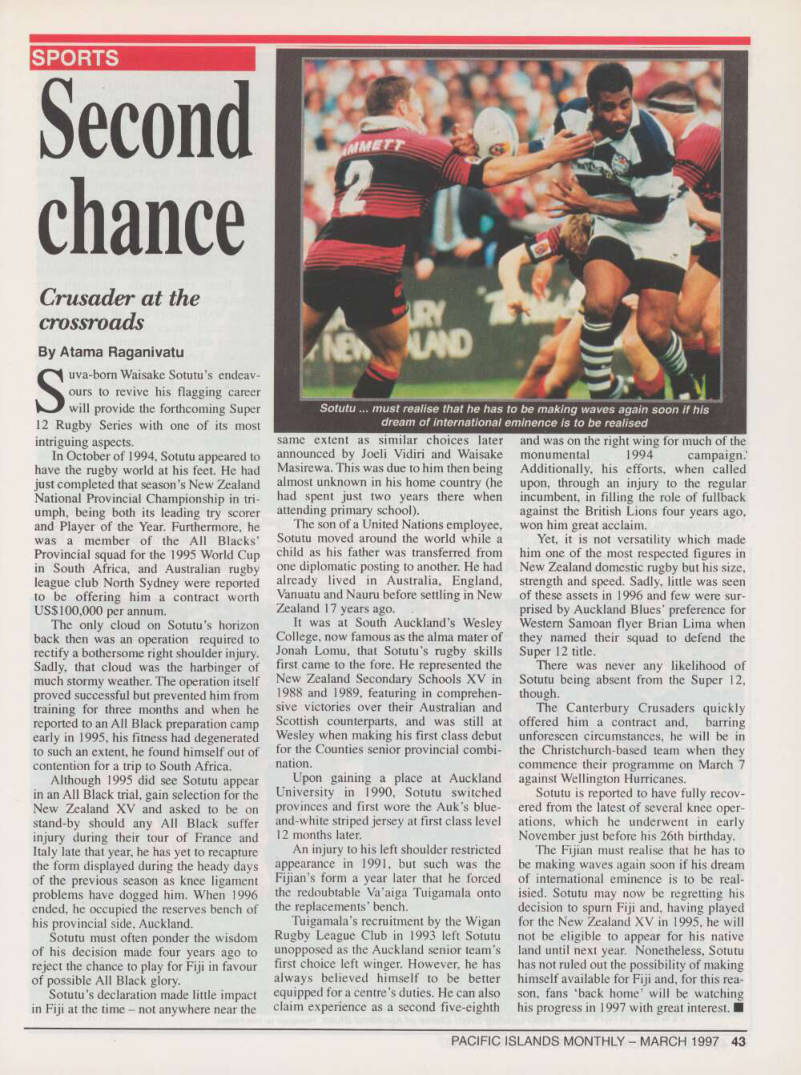
chance Crusader at the crossroads
By Atama Raganivatu
Suva-bom Waisake Sotutu’s endeav ours to revive his flagging career
will provide the forthcoming Super
12 Rugby Series with one of its most
intriguing aspects.
In October of 1994, Sotutu appeared to have the rugby world at his feet. He had just completed that season’s New Zealand National Provincial Championship in tri umph, being both its leading try scorer and Player of the Year. Furthermore, he was a member of the All Blacks’
Provincial squad for the 1995 World Cup in South Africa, and Australian rugby league club North Sydney were reported to be offering him a contract worth US$lOO,OOO per annum.
The only cloud on Sotutu’s horizon back then was an operation required to rectify a bothersome right shoulder injury.
Sadly, that cloud was the harbinger of much stormy weather. The operation itself proved successful but prevented him from training for three months and when he reported to an All Black preparation camp early in 1995, his fitness had degenerated to such an extent, he found himself out of contention for a trip to South Africa.
Although 1995 did see Sotutu appear in an All Black trial, gain selection for the New Zealand XV and asked to be on stand-by should any All Black suffer injury during their tour of France and Italy late that year, he has yet to recapture the form displayed during the heady days of the previous season as knee ligament problems have dogged him. When 1996 ended, he occupied the reserves bench of his provincial side, Auckland.
Sotutu must often ponder the wisdom of his decision made four years ago to reject the chance to play for Fiji in favour of possible All Black glory.
Sotutu’s declaration made little impact in Fiji at the time - not anywhere near the
same extent as similar choices later announced by Joeli Vidiri and Waisake Masirewa. This was due to him then being almost unknown in his home country (he had spent just two years there when attending primary school).
The son of a United Nations employee, Sotutu moved around the world while a child as his father was transferred from one diplomatic posting to another. He had already lived in Australia, England, Vanuatu and Nauru before settling in New Zealand 17 years ago.
It was at South Auckland’s Wesley College, now famous as the alma mater of Jonah Lomu, that Sotutu’s rugby skills first came to the fore. He represented the New Zealand Secondary Schools XV in 1988 and 1989, featuring in comprehen sive victories over their Australian and Scottish counterparts, and was still at Wesley when making his first class debut for the Counties senior provincial combi nation.
Upon gaining a place at Auckland University in 1990, Sotutu switched provinces and first wore the Auk’s blue and-white striped jersey at first class level 12 months later.
An injury to his left shoulder restricted appearance in 1991, but such was the Fijian’s form a year later that he forced the redoubtable Va’aiga Tuigamala onto the replacements’ bench.
Tuigamala’s recruitment by the Wigan
Rugby League Club in 1993 left Sotutu unopposed as the Auckland senior team’s first choice left winger. However, he has always believed himself to be better equipped for a centre’s duties. He can also claim experience as a second five-eighth
and was on the right wing for much of the
monumental 1994 campaign. 1
Additionally, his efforts, when called upon, through an injury to the regular incumbent, in filling the role of fullback against the British Lions four years ago, won him great acclaim.
Yet, it is not versatility which made him one of the most respected figures in New Zealand domestic rugby but his size, strength and speed. Sadly, little was seen of these assets in 1996 and few were sur prised by Auckland Blues’ preference for Western Samoan flyer Brian Lima when they named their squad to defend the Super 12 title.
There was never any likelihood of Sotutu being absent from the Super 12, though.
The Canterbury Crusaders quickly offered him a contract and, barring unforeseen circumstances, he will be in the Christchurch-based team when they commence their programme on March 7
against Wellington Hurricanes.
Sotutu is reported to have fully recov ered from the latest of several knee oper ations, which he underwent in early November just before his 26th birthday.
The Fijian must realise that he has to be making waves again soon if his dream of international eminence is to be real isied. Sotutu may now be regretting his decision to spurn Fiji and, having played for the New Zealand XV in 1995, he will not be eligible to appear for his native land until next year. Nonetheless, Sotutu has not ruled out the possibility of making himself available for Fiji and, for this rea son, fans ‘back home’ will be watching his progress in 1997 with great interest. ■
Sotutu...must realise that he has to be making waves again soon if his dream of international eminence is to be realised
Sevens glory for region's players
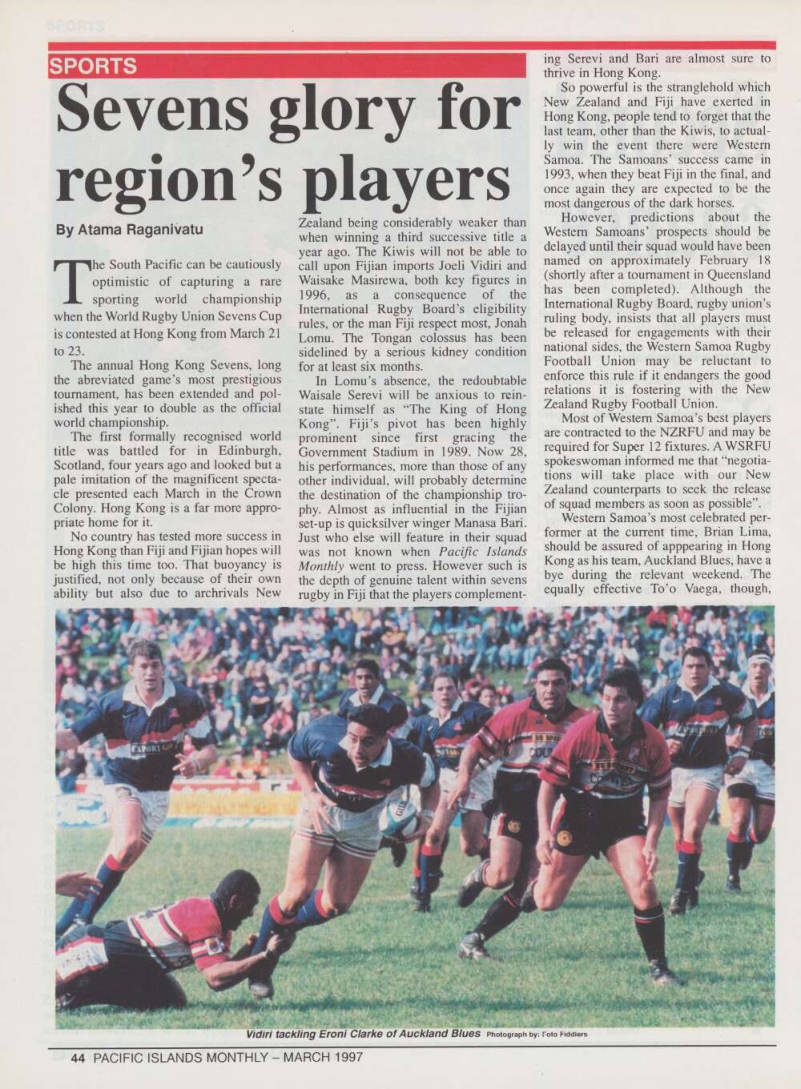
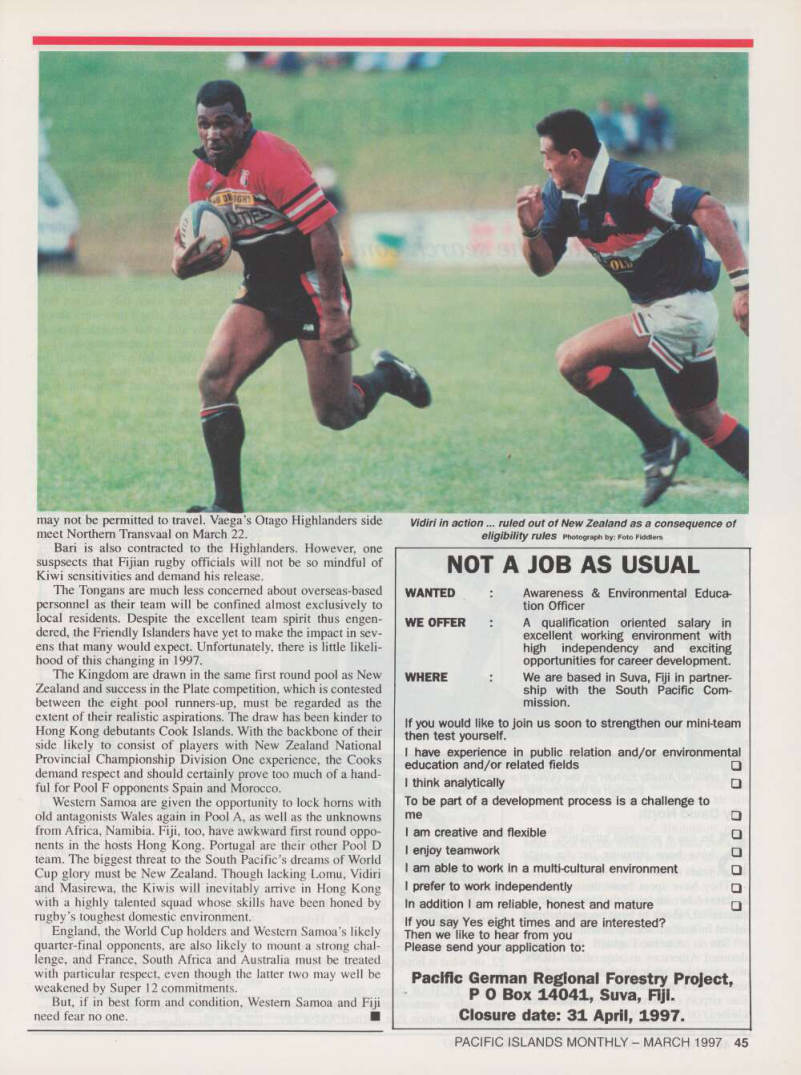
region's players
By Atama Raganivatu
The South Pacific can be cautiously optimistic of capturing a rare snorting world chamnionshin sporting world championship when the World Rugby Union Sevens Cup is contested at Hong Kong from March 21 to 23.
The annual Hong Kong Sevens, long
the abreviated game’s most prestigious tournament, has been extended and polished this year to double as the official
world championship.
The first formally recognised world title was battled for in Edinburgh, Scotland, four years ago and looked but a pale imitation of the magnificent spectacle presented each March in the Crown Colony. Hong Kong is a far more appropriate home for it.
No country has tested more success in Hong Kong than Fiji and Fijian hopes will be high this time too. That buoyancy is justified, not only because of their own ability but also due to archrivals New
Zealand being considerably weaker than when winning a third successive title a year ago. The Kiwis will not be able to call upon Fijian imports Joeli Vidiri and Waisake Masirewa, both key figures in 1996, as a consequence of the International Rugby Board’s eligibility rules, or the man Fiji respect most, Jonah Lomu. The Tongan colossus has been sidelined by a serious kidney condition for at least six months.
In Lomu’s absence, the redoubtable Waisale Serevi will be anxious to rein state himself as “The King of Hong
Kong”. Fiji’s pivot has been highly
prominent since first gracing the Government Stadium in 1989. Now 28, his performances, more than those of any other individual, will probably determine the destination of the championship tro phy. Almost as influential in the Fijian set-up is quicksilver winger Manasa Bari.
Just who else will feature in their squad was not known when Pacific Islands Monthly went to press. However such is the depth of genuine talent within sevens rugby in Fiji that the players complement
ing Serevi and Bari are almost sure to thrive in Hong Kong.
So powerful is the stranglehold which New Zealand and Fiji have exerted in Hong Kong, people tend to forget that the last team, other than the Kiwis, to actual ly win the event there were Western Samoa. The Samoans’ success came in 1993, when they beat Fiji in the final, and once again they are expected to be the most dangerous of the dark horses.
However, predictions about the Western Samoans’ prospects should be delayed until their squad would have been named on approximately February 18 (shortly after a tournament in Queensland has been completed). Although the International Rugby Board, rugby union’s ruling body, insists that all players must be released for engagements with their national sides, the Western Samoa Rugby Football Union may be reluctant to enforce this rule if it endangers the good relations it is fostering with the New Zealand Rugby Football Union.
Most of Western Samoa’s best players are contracted to the NZRFU and may be required for Super 12 fixtures. A WSRFU spokeswoman informed me that “negotia tions will take place with our New Zealand counterparts to seek the release of squad members as soon as possible”.
Western Samoa’s most celebrated per former at the current time, Brian Lima, should be assured of apppearing in Hong Kong as his team, Auckland Blues, have a bye during the relevant weekend. The equally effective To’o Vaega, though,
Vidiri tackling Eroni Clarke of Auckland Blues Photograph by: Foto Fiddlers
may not be permitted to travel. Vaega’s Otago Highlanders side meet Northern Transvaal on March 22.
Bari is also contracted to the Highlanders. However, one suspsects that Fijian rugby officials will not be so mindful of Kiwi sensitivities and demand his release.
The Tongans are much less concerned about overseas-based personnel as their team will be confined almost exclusively to local residents. Despite the excellent team spirit thus engen dered, the Friendly Islanders have yet to make the impact in sev ens that many would expect. Unfortunately, there is little likeli hood of this changing in 1997.
The Kingdom are drawn in the same first round pool as New Zealand and success in the Plate competition, which is contested between the eight pool runners-up, must be regarded as the extent of their realistic aspirations. The draw has been kinder to Hong Kong debutants Cook Islands. With the backbone of their side likely to consist of players with New Zealand National Provincial Championship Division One experience, the Cooks demand respect and should certainly prove too much of a hand ful for Pool F opponents Spain and Morocco.
Western Samoa are given the opportunity to lock horns with old antagonists Wales again in Pool A, as well as the unknowns from Africa, Namibia. Fiji, too, have awkward first round oppo nents in the hosts Hong Kong. Portugal are their other Pool D team. The biggest threat to the South Pacific’s dreams of World Cup glory must be New Zealand. Though lacking Lomu, Vidiri and Masirewa, the Kiwis will inevitably arrive in Hong Kong with a highly talented squad whose skills have been honed by
rugby’s toughest domestic environment.
England, the World Cup holders and Western Samoa’s likely quarter-final opponents, are also likely to mount a strong chal lenge, and France, South Africa and Australia must be treated with particular respect, even though the latter two may well be weakened by Super 12 commitments.
But, if in best form and condition. Western Samoa and Fiji need fear no one. ■
Vidiri in action...ruled out of New Zealand as a consequence of eligibility rules Photograph by: Foto Fiddlers
Advertisements & other items, p. 45 (1 item)
Not A Job As Usual
WANTED : Awareness & Environmental Education Officer WE OFFER : A qualification oriented salary in excellent working environment with high independency and exciting opportunities for career development.
WHERE : We are based in Suva, Fiji in partnership with the South Pacific Commission.
If you would like to join us soon to strengthen our mini-team then test yourself.
I have experience in public relation and/or environmental education and/or related fields □ I think analytically □ To be part of a development process is a challenge to me □ I am creative and flexible □ I enjoy teamwork □ I am able to work in a multicultural environment □ I prefer to work independently □ In addition I am reliable, honest and mature □ If you say Yes eight times and are interested?
Then we like to hear from you Please send your application to:
Pacific German Regional Forestry Project,
P 0 Box 14041, Suva, Fiji.
Closure date: 31 April, 1997.
mystery
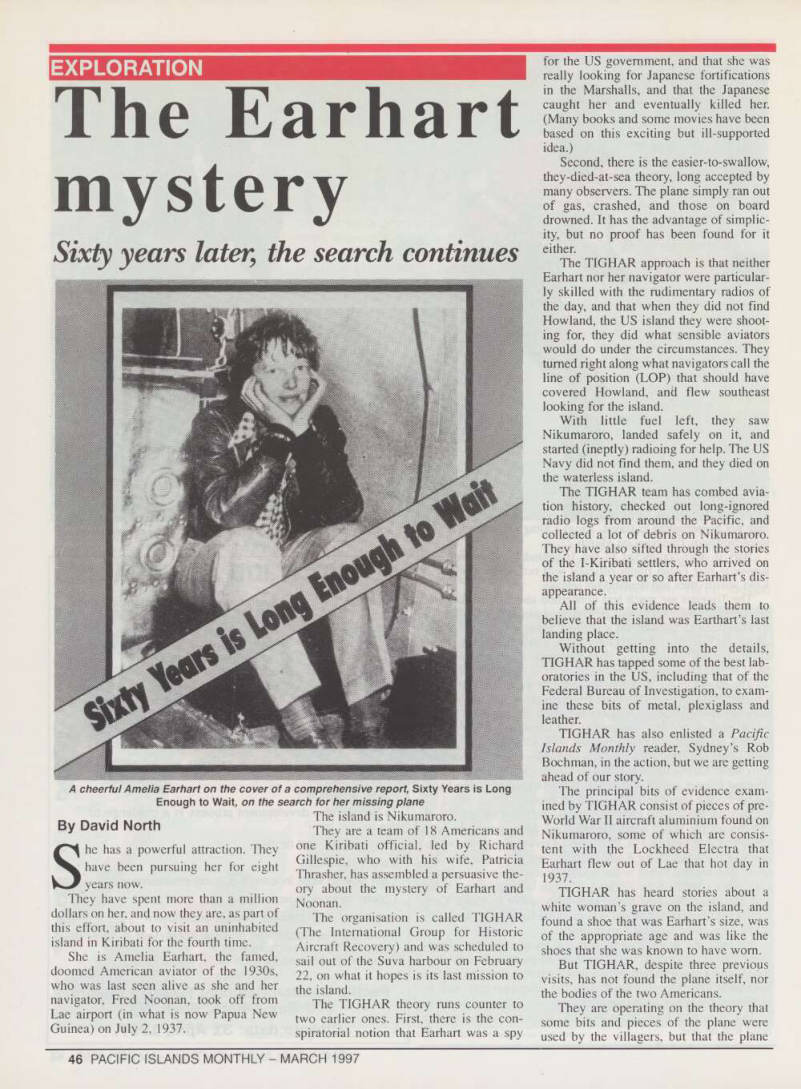
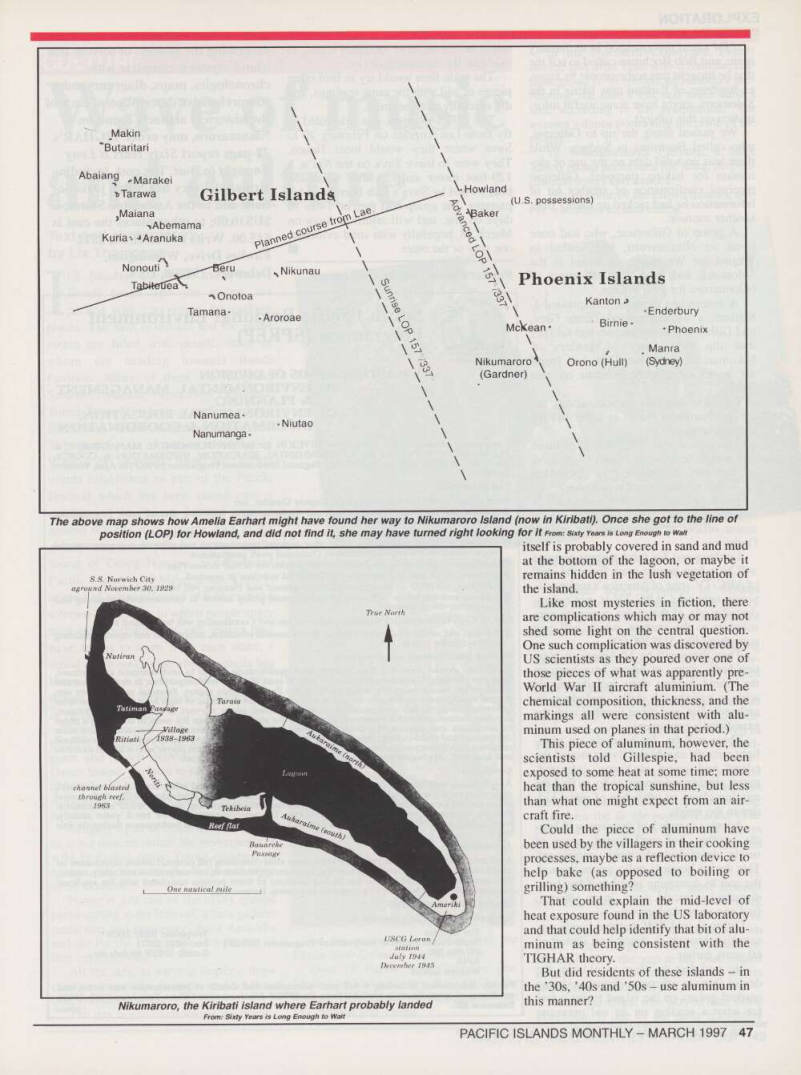
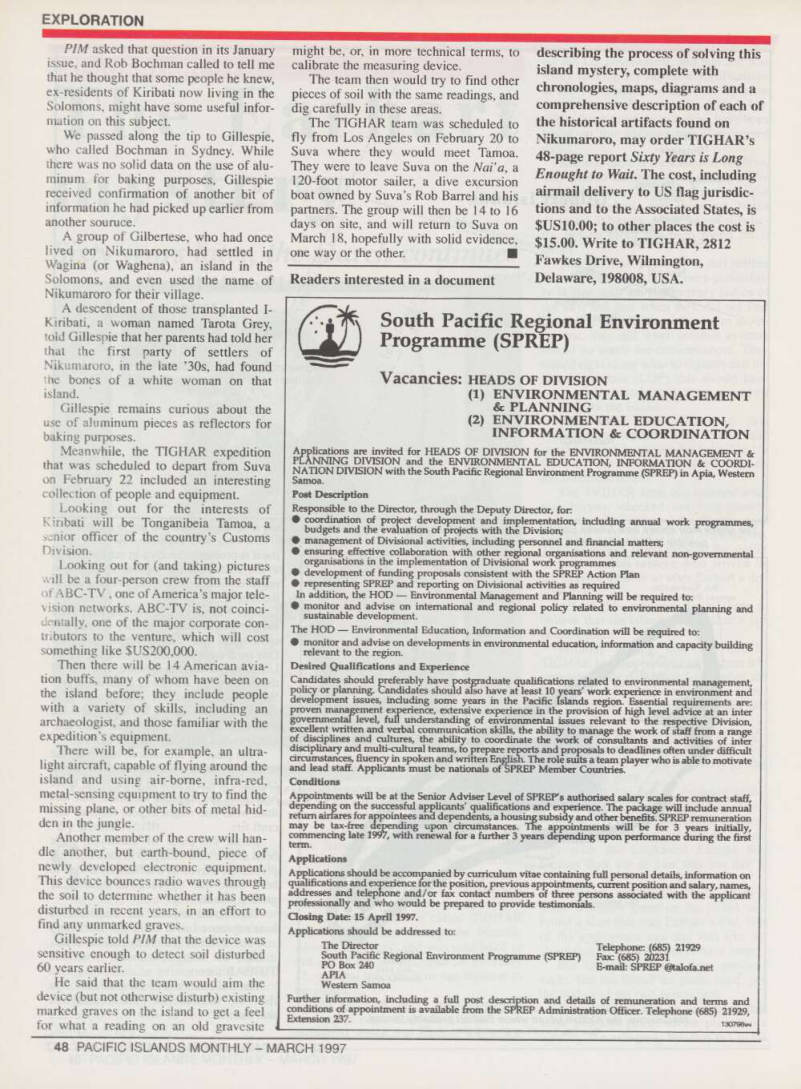
Exploration
The Earhart mystery Sixty years later, the search continues
By David North
She has a powerful attraction. They
have been pursuing her for eight years now.
They have spent more than a million dollars on her, and now they are, as part of this effort, about to visit an uninhabited island in Kiribati for the fourth time.
She is Amelia Earhart, the famed, doomed American aviator of the 19305, who was last seen alive as she and her navigator, Fred Noonan, took off from Lae airport (in what is now Papua New Guinea) on July 2, 1937.
The island is Nikumaroro.
They are a team of 18 Americans and one Kiribati official, led by Richard Gillespie, who with his wife, Patricia Thrasher, has assembled a persuasive the ory about the mystery of Earhart and Noonan.
The organisation is called TIGHAR (The International Group for Historic Aircraft Recovery) and was scheduled to sail out of the Suva harbour on February 22, on what it hopes is its last mission to the island.
The TIGHAR theory runs counter to two earlier ones. First, there is the con spiratorial notion that Earhart was a spy
for the US government, and that she was
really looking for Japanese fortifications
in the Marshalls, and that the Japanese caught her and eventually killed her. (Many books and some movies have been based on this exciting but ill-supported idea.) Second, there is the easier-to-swallow, they-died-at-sea theory, long accepted by many observers. The plane simply ran out of gas, crashed, and those on board drowned. It has the advantage of simplic ity, but no proof has been found for it either.
The TIGHAR approach is that neither Earhart nor her navigator were particular ly skilled with the rudimentary radios of the day, and that when they did not find Howland, the US island they were shoot ing for, they did what sensible aviators would do under the circumstances. They turned right along what navigators call the line of position (LOP) that should have covered Howland, and flew southeast looking for the island.
With little fuel left, they saw Nikumaroro, landed safely on it, and started (ineptly) radioing for help. The US Navy did not find them, and they died on the waterless island.
The TIGHAR team has combed avia tion history, checked out long-ignored radio logs from around the Pacific, and collected a lot of debris on Nikumaroro.
They have also sifted through the stories of the I-Kiribati settlers, who arrived on the island a year or so after Earhart’s dis appearance.
All of this evidence leads them to believe that the island was Eartharfs last
landing place.
Without getting into the details, TIGHAR has tapped some of the best lab oratories in the US, including that of the Federal Bureau of Investigation, to exam ine these bits of metal, plexiglass and leather.
TIGHAR has also enlisted a Pacific Islands Monthly reader, Sydney’s Rob Bochman, in the action, but we are getting ahead of our story.
The principal bits of evidence exam ined by TIGHAR consist of pieces of pre- World War II aircraft aluminium found on Nikumaroro, some of which are consis tent with the Lockheed Electra that Earhart flew out of Lae that hot day in 1937.
TIGHAR has heard stories about a white woman’s grave on the island, and found a shoe that was Earhart’s size, was of the appropriate age and was like the shoes that she was known to have worn.
But TIGHAR, despite three previous visits, has not found the plane itself, nor the bodies of the two Americans.
They are operating on the theory that some bits and pieces of the plane were used by the villagers, but that the plane
A cheerful Amelia Earhart on the cover of a comprehensive report, Sixty Years is Long Enough to Wait, on the search for her missing plane
itself is probably covered in sand and mud at the bottom of the lagoon, or maybe it remains hidden in the lush vegetation of the island.
Like most mysteries in fiction, there are complications which may or may not shed some light on the central question.
One such complication was discovered by US scientists as they poured over one of those pieces of what was apparently pre- World War II aircraft aluminium. (The chemical composition, thickness, and the markings all were consistent with alu minum used on planes in that period.) This piece of aluminum, however, the scientists told Gillespie, had been exposed to some heat at some time; more heat than the tropical sunshine, but less than what one might expect from an air craft fire.
Could the piece of aluminum have been used by the villagers in their cooking processes, maybe as a reflection device to help bake (as opposed to boiling or
grilling) something?
That could explain the mid-level of heat exposure found in the US laboratory and that could help identify that bit of alu minum as being consistent with the
TIGHAR theory.
But did residents of these islands - in the ’3os, ’4os and ’sos - use aluminum in this manner?
The above map shows how Amelia Earhart might have found her way to Nikumaroro Island (now in Kiribati). Once she got to the line of position (LOP) for Howland, and did not find it, she may have turned right looking for it From: sixty Years is Long Enough to wait
Nikumaroro, the Kiribati island where Earhart probably landed From: Sixty Years is Long Enough to Wait
PIM asked that question in its January issue, and Rob Bochman called to tell me that he thought that some people he knew, ex-residents of Kiribati now living in the Solomons, might have some useful infor mation on this subject.
We passed along the tip to Gillespie, who called Bochman in Sydney. While there was no solid data on the use of alu minum for baking purposes, Gillespie received confirmation of another bit of information he had picked up earlier from another souruce.
A group of Gilbertese, who had once lived on Nikumaroro, had settled in Wagina (or Waghena), an island in the Solomons, and even used the name of Nikumaroro for their village.
A descendent of those transplanted I- Kiribati, a woman named Tarota Grey, told Gillespie that her parents had told her that the first party of settlers of Nikumaroro, in the late ’3os, had found he bones of a white woman on that island.
Gillespie remains curious about the use of aluminum pieces as reflectors for
baking purposes.
Meanwhile, the TIGHAR expedition that was scheduled to depart from Suva on February 22 included an interesting collection of people and equipment.
Looking out for the interests of Kiribati will be Tonganibeia Tamoa, a senior officer of the country’s Customs Division.
Looking out for (and taking) pictures
will be a four-person crew from the staff of ABC-TV, one of America’s major tele vision networks. ABC-TV is, not coinci dcntally, one of the major corporate con tributors to the venture, which will cost something like SUS2OO,OOO.
Then there will be 14 American avia tion buffs, many of whom have been on the island before; they include people with a variety of skills, including an archaeologist, and those familiar with the expedition’s equipment.
There will be, for example, an ultra light aircraft, capable of flying around the island and using air-borne, infra-red, metal-sensing equipment to try to find the missing plane, or other bits of metal hid den in the jungle.
Another member of the crew will han dle another, but earth-bound, piece of
newly developed electronic equipment.
This device bounces radio waves through the soil to determine whether it has been disturbed in recent years, in an effort to find any unmarked graves.
Gillespie told PIM that the device was sensitive enough to detect soil disturbed 60 years earlier.
He said that the team would aim the device (but not otherwise disturb) existing marked graves on the island to get a feel for what a reading on an old gravesite .
might be, or, in more technical terms, to calibrate the measuring device.
The team then would try to find other pieces of soil with the same readings, and dig carefully in these areas.
The TIGHAR team was scheduled to fly from Los Angeles on February 20 to Suva where they would meet Tamoa.
They were to leave Suva on the Nai’a, a 120-foot motor sailer, a dive excursion boat owned by Suva’s Rob Barrel and his partners. The group will then be 14 to 16 days on site, and will return to Suva on March 18, hopefully with solid evidence, one way or the other. ■
Readers interested in a document
describing the process of solving this island mystery, complete with chronologies, maps, diagrams and a comprehensive description of each of the historical artifacts found on Nikumaroro, may order TIGHAR’s 48-page report Sixty Years is Long Enought to Wait. The cost, including airmail delivery to US flag jurisdic tions and to the Associated States, is $US10.00; to other places the cost is $15.00. Write to TIGHAR, 2812 Fawkes Drive, Wilmington, Delaware, 198008, USA.
Advertisements & other items, p. 48 (1 item)
Programme (SPREP)
South Pacific Regional Environment
Vacancies: heads of division
(1) ENVIRONMENTAL MANAGEMENT
& PLANNING
(2) ENVIRONMENTAL EDUCATION,
INFORMATION & COORDINATION
Applications are invited for HEADS OF DIVISION for the ENVIRONMENTAL MANAGEMENT & PLANNING DIVISION and the ENVIRONMENTAL EDUCATION, INFORMATION & COORDI- NATION DIVISION with the South Pacific Regional Environment Programme (SPREP) in Apia, Western Samoa.
Post Description
Responsible to the Director, through the Deputy Director, for: • coordination of project development and implementation, including annual work programmes, budgets and the evaluation of projects with the Division; • management of Divisional activities, including personnel and financial matters; • ensuring effective collaboration with other regional organisations and relevant non-govemmental organisations in the implementation of Divisional work programmes • development of funding proposals consistent with the SPREP Action Plan • representing SPREP and reporting on Divisional activities as required In addition, the HOD Environmental Management and Planning will be required to: • monitor and advise on international and regional policy related to environmental planning and
sustainable development.
The HOD Environmental Education, Information and Coordination will be required to: • monitor and advise on developments in environmental education, information and capacity building relevant to the region.
Desired Qualifications and Experience Candidates should preferably have postgraduate qualifications related to environmental management, policy or planning. Candidates should also have at least 10 years' work experience in environment and development issues, including some years in the Pacific Islands region. Essential requirements are; proven management experience, extensive experience in the provision of high level advice at an inter governmental level, full understanding of environmental issues relevant to the respective Division, excellent written and verbal communication skills, the ability to manage the work of staff from a range of disciplines and cultures, the ability to coordinate the work of consultants and activities of inter disciplinary and multi-cultural teams, to prepare reports and proposals to deadlines often under difficult circumstances, fluency in spoken and written English. The role suits a team player who is able to motivate and lead staff. Applicants must be nationals of SPREP Member Countries.
Conditions Appointments will be at the Senior Adviser Level of SPREFs authorised salary scales for contract staff, depending on the successful applicants' qualifications and experience. The package will include annual return airfares for appointees and dependents, a housing subsidy and other benefits. SPREP remuneration may be tax-free depending upon circumstances. The appointments will be for 3 years initially, commencing late 1997, with renewed for a further 3 years depending upon performance during the first
Applications
Applications should be accompanied by curriculum vitae containing full personal details, information on qualifications and experience for the position, previous appointments, current position and salary, names, addresses and telephone and/or fax contact numbers of three persons associated with the applicant professionally and who would be prepared to provide testimonials.
Closing Date: 15 April 1997.
Applications should be addressed to; The Director Telephone; (685) 21929 South Pacific Regional Environment Programme (SPREP) Fax; (685) 20231 PO Box 240 E-mail: SPREP @talo£a.net
APIA
Western Samoa Further information, including a full post description and details of remuneration and terms and conditions of appointment is available from the SPREP Administration Officer. Telephone (685) 21929 Extension 237. 130798 w
Wave of music
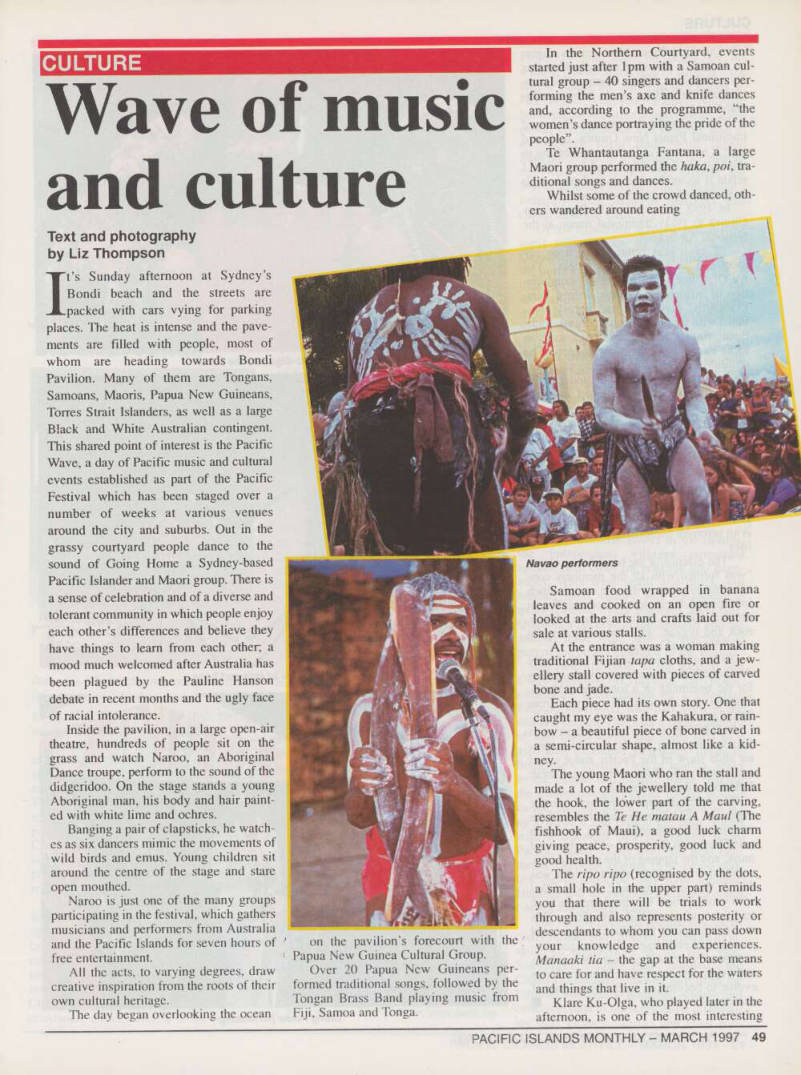
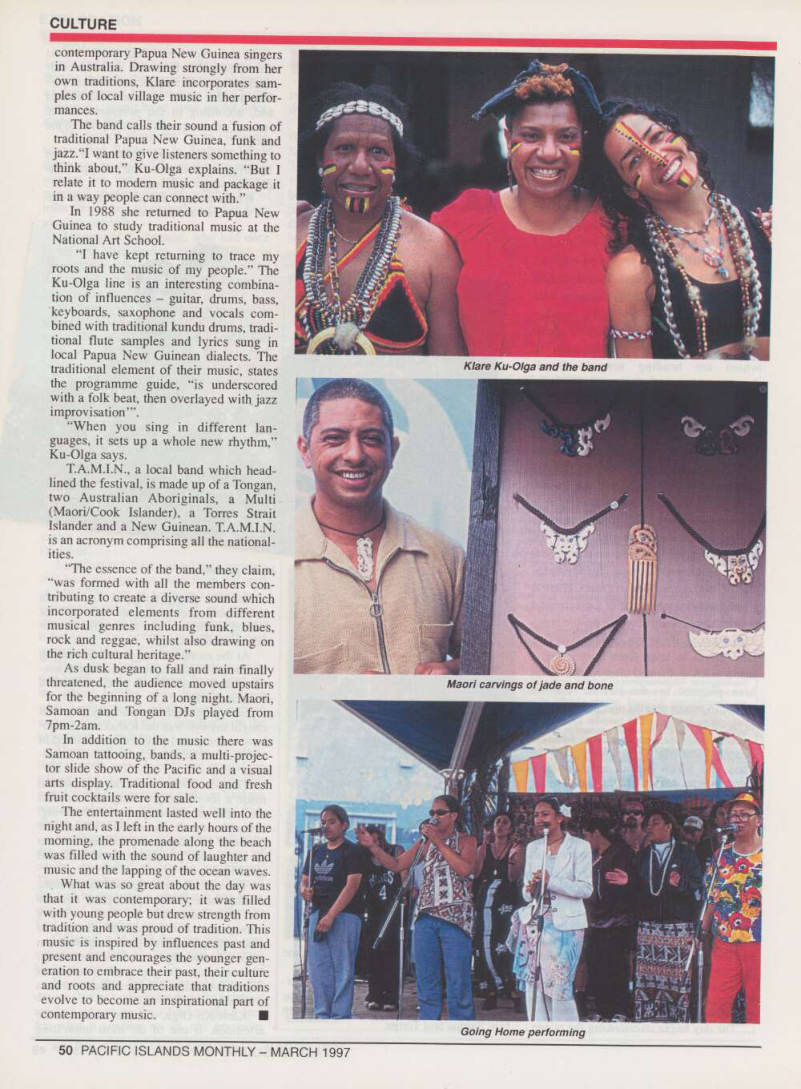
Culture
Wave of music and culture
Text and photography
by Liz Thompson
It’s Sunday afternoon at Sydney’s
Bondi beach and the streets are packed with cars vying for parking places. The heat is intense and the pave ments are filled with people, most of whom are heading towards Bondi Pavilion. Many of them are Tongans, Samoans, Maoris, Papua New Guineans, Torres Strait Islanders, as well as a large Black and White Australian contingent.
This shared point of interest is the Pacific Wave, a day of Pacific music and cultural events established as part of the Pacific Festival which has been staged over a number of weeks at various venues around the city and suburbs. Out in the grassy courtyard people dance to the sound of Going Home a Sydney-based Pacific Islander and Maori group. There is a sense of celebration and of a diverse and tolerant community in which people enjoy each other’s differences and believe they have things to leam from each other; a mood much welcomed after Australia has been plagued by the Pauline Hanson debate in recent months and the ugly face of racial intolerance.
Inside the pavilion, in a large open-air theatre, hundreds of people sit on the grass and watch Naroo, an Aboriginal Dance troupe, perform to the sound of the didgeridoo. On the stage stands a young Aboriginal man, his body and hair paint ed with white lime and ochres.
Banging a pair of clapsticks, he watch es as six dancers mimic the movements of wild birds and emus. Young children sit around the centre of the stage and stare open mouthed.
Naroo is just one of the many groups participating in the festival, which gathers musicians and performers from Australia and the Pacific Islands for seven hours of free entertainment.
All the acts, to varying degrees, draw creative inspiration from the roots of their own cultural heritage.
The day began overlooking the ocean
on the pavilion’s forecourt with the Papua New Guinea Cultural Group.
Over 20 Papua New Guineans per formed traditional songs, followed by the Tongan Brass Band playing music from Fiji, Samoa and Tonga.
In the Northern Courtyard, events started just after Ipm with a Samoan cul tural group - 40 singers and dancers per forming the men’s axe and knife dances and, according to the programme, “the women’s dance portraying the pride of the people”.
Te Whantautanga Fantana, a large Maori group performed the haka, poi , tra ditional songs and dances.
Whilst some of the crowd danced, oth ers wandered around eating
Samoan food wrapped in banana leaves and cooked on an open fire or looked at the arts and crafts laid out for sale at various stalls.
At the entrance was a woman making traditional Fijian tapa cloths, and a jew ellery stall covered with pieces of carved bone and jade.
Each piece had its own story. One that caught my eye was the Kahakura, or rain bow - a beautiful piece of bone carved in a semi-circular shape, almost like a kid ney.
The young Maori who ran the stall and made a lot of the jewellery told me that the hook, the lower part of the carving, resembles the Te He matau A Maul (The fishhook of Maui), a good luck charm
giving peace, prosperity, good luck and
good health.
The ripo ripe (recognised by the dots, a small hole in the upper part) reminds you that there will be trials to work through and also represents posterity or descendants to whom you can pass down your knowledge and experiences.
Manaaki tia - the gap at the base means to care for and have respect for the waters and things that live in it.
Klare Ku-Olga, who played later in the afternoon, is one of the most interesting
Navao performers
contemporary Papua New Guinea singers in Australia. Drawing strongly from her own traditions, Klare incorporates sam ples of local village music in her perfor mances.
The band calls their sound a fusion of traditional Papua New Guinea, funk and jazz.‘T want to give listeners something to think about,” Ku-Olga explains. “But I relate it to modem music and package it in a way people can connect with.”
In 1988 she returned to Papua New Guinea to study traditional music at the National Art School.
“I have kept returning to trace my roots and the music of my people.” The Ku-Olga line is an interesting combina tion of influences - guitar, drums, bass, keyboards, saxophone and vocals com bined with traditional kundu drums, tradi tional flute samples and lyrics sung in local Papua New Guinean dialects. The traditional element of their music, states the programme guide, “is underscored with a folk beat, then overlayed with jazz improvisation’”.
“When you sing in different lan guages, it sets up a whole new rhythm,”
Ku-Olga says.
T.A.M.1.N., a local band which head lined the festival, is made up of a Tongan, two Australian Aboriginals, a Multi (Maori/Cook Islander), a Torres Strait Islander and a New Guinean. T.A.M.I.N. is an acronym comprising all the national ities.
“The essence of the band,” they claim, “was formed with all the members con tributing to create a diverse sound which incorporated elements from different musical genres including funk, blues, rock and reggae, whilst also drawing on the rich cultural heritage.”
As dusk began to fall and rain finally threatened, the audience moved upstairs for the beginning of a long night. Maori, Samoan and Tongan DJs played from 7pm-2am.
In addition to the music there was Samoan tattooing, bands, a multi-projec tor slide show of the Pacific and a visual arts display. Traditional food and fresh fruit cocktails were for sale.
The entertainment lasted well into the night and, as I left in the early hours of the morning, the promenade along the beach was filled with the sound of laughter and music and the lapping of the ocean waves.
What was so great about the day was that it was contemporary; it was filled with young people but drew strength from tradition and was proud of tradition. This music is inspired by influences past and present and encourages the younger gen eration to embrace their past, their culture and roots and appreciate that traditions evolve to become an inspirational part of contemporary music. ■
Klare Ku-Olga and the band
Maori carvings of jade and bone
Going Home performing
intervention
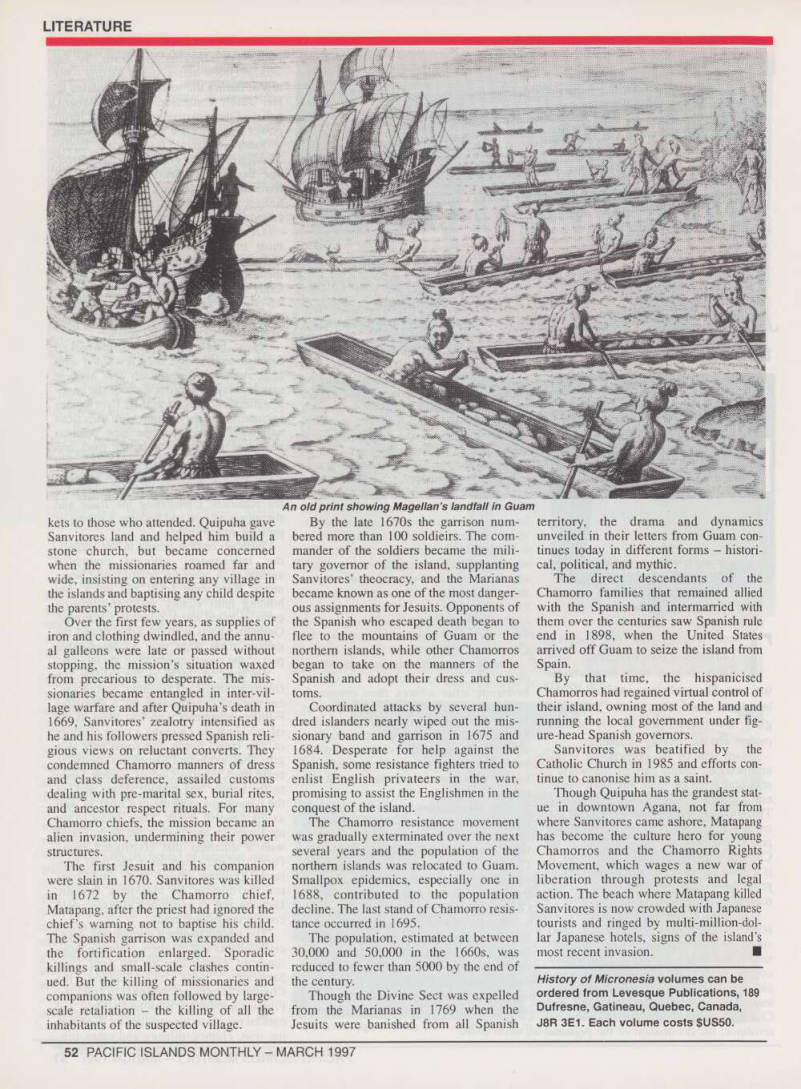
Literature
Divine intervention
The 17th century Jesuit mission in the Marianas
By David North
Their letters speak of boundless Christian love struggling with Satan to save souls from eternal darkness. Their religious conquest of the islands is proof, they write, of God’s glory, the intercession of his blessed mother, and the majesty of Spain.
Guam will be the cornerstone of an archipelagic “fourth part of the world”, stretching from the great unknown south ern continent to the doorstep of Japan.
This ecclesiastical empire will enable the missionaries to breach Japan’s seclusion policy and link up with thousands of Christian converts there. In conception, it is a grand and glorious geopolitical enter prise to evangelise the Asia-Pacific
region.
The 17th century correspondence of Jesuit missionaries in the Marianas also speaks of the tragedy of this first sus tained encounter between a European colonial power and a Pacific Island peo ple. The letters relate the wholesale, and many times forced, conversion of the Chamorro people; the Islanders’ war of resistance; the decimation of the popula
tion by European disease and war; and the creation of the first European colony in the Pacific.
The letters and reports were addressed to popes, Spanish kings and queens, Jesuit leaders, and colonial officials. Written in Latin, Spanish, or French and filed away for centuries in European archives, most of the letters have been unavailable to the general reader. But an annotated collec tion of these historic communications is now available in English. The compila tion, and some of the translation, was
accomplished by Rodrique Levesque, an
enterprising French-Canadian with a pas sion for Pacific history.
As editor and publisher of the multi volume History of Micronesia, Levesque has tracked down original source docu ments for early European interaction with the region and made them available for the English-reading public, teachers and scholars. Volumes 4 through 6 encompass the years 1638 to 1678, covering the gen esis of the Marianas Mission, the landing of the Jesuit group on Guam, and the first 10 years of interaction with the Chamorros.
The Jesuits were educated, energetic, observant, literate Soldiers of Christ.
Inveterate letter writers, their communi cations are invaluable sources for a pic ture of traditional Chamorro society, circa the 16605. Care must be taken to sift their observations and screen out the religious and cultural bias, but the nuggets of solid history that remain are well worth the effort.
The personalities, passions, and con flicts that emerge from these documents are worthy of a dramatist. The mission is the obsession of a Spanish Jesuit, Father Diego Luis de Sanvitores, who in 1662, on his way to the Philippines, decides that the souls of the Chamorro people of Guam must be saved.
Of noble blood, Sanvitores had power ful connections at court, including his father, Don Jeronimo Sanvitores - a member of the Treasury Council. The mission is offered as a way of regaining entry to Japan, from which the Jesuits and other Europeans had been expelled earlier in the century. The plan is approved by
Philip IV and, after his death, by his widow, Queen Maria Ana of Austria - the regent during the minority of Charles 11.
Her Jesuit confessor, Father Nidhard, believed the initiative would extend Jesuit power and influence and possibly lead to a lucrative royal trade with Japan.
Sanvitores was so grateful for her patron age that he renamed the islands the Marianas in her honour. Since Magellan’s unhappy visit, Spanish mariners had called them the Ladrones (Thieves).
Of the Chamorro leaders, perhaps the most tragic figure in the drama was Quipuha, paramount chief of Hagatna on the northwest coast of Guam - the site of today’s capital of Agana. By the time the
41-year-old Sanvitores arrived, Quipuha
and his clan chiefs had been friends of the Spanish for more than 30 years.
They had succoured shipwrecked
Spanish seamen and been rewarded with large amounts of iron. Each year, his best sailors awaited the first sight of the annu al galleons and raced in their fleet canoes to trade. Often they fought with men from neighbour islands for the best position alongside the ships to barter food and water for iron nails, hoops, tools, and weapons. The galleon trade was virtually the sole source of this new technology for the islanders. Controlling the trade and the supply of iron had become a source of prestige and influence.
With no central power in the islands, the independent villages competed against each other for position and hege mony. Wars were small and quick, but
holding onto victory and consolidating
gains required every possible advantage.
Quipuha’s pacts with the Spanish and the galleon trade were now an inseparable part of the power equation in the islands.
On June 16, 1668, as the galleon San Diego anchored off Hagatna, Sanvitores’ emissaries, accompanied by a Christian Filipino interpreter who had lived in the islands, brought Quipuha a large quantity of iron barrel hoops and some hats as a
gift. They explained Sanvitores’ desire to
bring the Christian God of mighty Spain to the people and baptise them, making the Chamorros subjects of Christ as well as the Spanish queen. They asked to set up a mission and preach the faith. Faced with a dilemma that confronted many Pacific Island chiefs over the next cen turies, Quipuha agreed. If he could con trol the mission, he may have thought, Hagatna and its associated villages could control the galleon trade.
The Jesuits baptised relentlessly, espe cially infants and children, claiming thou sands of conversions in the first year.
Sanvitores, who had learned the Chamorro language aboard ship from the Filipino interpreter, preached widely and enticed people to his services by distribut ing iron, clothes, mirrors and other trim
kets to those who attended. Quipuha gave Sanvitores land and helped him build a stone church, but became concerned when the missionaries roamed far and wide, insisting on entering any village in the islands and baptising any child despite the parents’ protests.
Over the first few years, as supplies of iron and clothing dwindled, and the annu al galleons were late or passed without stopping, the mission’s situation waxed from precarious to desperate. The mis sionaries became entangled in inter-vil lage warfare and after Quipuha’s death in 1669, Sanvitores’ zealotry intensified as he and his followers pressed Spanish reli gious views on reluctant converts. They condemned Chamorro manners of dress and class deference, assailed customs dealing with pre-marital sex, burial rites, and ancestor respect rituals. For many Chamorro chiefs, the mission became an alien invasion, undermining their power structures.
The first Jesuit and his companion were slain in 1670. Sanvitores was killed in 1672 by the Chamorro chief, Matapang, after the priest had ignored the chief’s warning not to baptise his child.
The Spanish garrison was expanded and
the fortification enlarged. Sporadic killings and small-scale clashes contin ued. But the killing of missionaries and companions was often followed by large scale retaliation - the killing of all the inhabitants of the suspected village.
By the late 1670 s the garrison num bered more than 100 soldieirs. The com mander of the soldiers became the mili tary governor of the island, supplanting Sanvitores’ theocracy, and the Marianas became known as one of the most danger ous assignments for Jesuits. Opponents of the Spanish who escaped death began to flee to the mountains of Guam or the northern islands, while other Chamorros began to take on the manners of the Spanish and adopt their dress and cus toms.
Coordinated attacks by several hun dred islanders nearly wiped out the mis sionary band and garrison in 1675 and
1684. Desperate for help against the
Spanish, some resistance fighters tried to enlist English privateers in the war, promising to assist the Englishmen in the conquest of the island.
The Chamorro resistance movement was gradually exterminated over the next several years and the population of the northern islands was relocated to Guam.
Smallpox epidemics, especially one in
1688, contributed to the population decline. The last stand of Chamorro resis tance occurred in 1695.
The population, estimated at between 30,000 and 50,000 in the 16605, was reduced to fewer than 5000 by the end of the century.
Though the Divine Sect was expelled from the Marianas in 1769 when the Jesuits were banished from all Spanish
territory, the drama and dynamics unveiled in their letters from Guam con tinues today in different forms - histori cal, political, and mythic.
The direct descendants of the Chamorro families that remained allied with the Spanish and intermarried with them over the centuries saw Spanish rule end in 1898, when the United States arrived off Guam to seize the island from
Spain.
By that time, the hispanicised Chamorros had regained virtual control of their island, owning most of the land and running the local government under fig ure-head Spanish governors.
Sanvitores was beatified by the Catholic Church in 1985 and efforts con tinue to canonise him as a saint.
Though Quipuha has the grandest stat ue in downtown Agana, not far from where Sanvitores came ashore, Matapang has become the culture hero for young Chamorros and the Chamorro Rights Movement, which wages a new war of liberation through protests and legal action. The beach where Matapang killed Sanvitores is now crowded with Japanese tourists and ringed by multi-million-dol lar Japanese hotels, signs of the island’s most recent invasion. ■
History of Micronesia volumes can be ordered from Levesque Publications, 189 Dufresne, Gatineau, Quebec, Canada, JBR 3EI. Each volume costs SUSSO.
An old print showing Magellan's landfall in Guam
the Antipodes
From London to the Antipodes
Journey
through
Polynesia
The French Polynesian atoll of Hao, lying in the remote waters of the eastern Tuamotu Archipelago, has achieved some notoriety in past decades as a support base for nuclear testing, and as the place of incarceration of the Rainbow Warrior bombers. In the early 19th Century, however, it was the focus of a pearling trade that was at the heart of Britain’s mercantile expansion into the South Pacific.
Science In a Sea of Commerce, a groundbreaking work of historical recla mation, highlights this chapter in the story of Polynesia.
Lovingly edited by Sydney academic David Branagan, it is the journal of a South Seas trading mission, kept by one of those remarkable men of science thrown up in the golden age of British exploration, Samuel Stutchbury - a figure who rose from humble origins to become the government geological surveyor of New South Wales.
Stutchbury’s journal of the voyage from London to the Antipodes, in a ship laden with passengers, a diving bell and large numbers of saxon sheep, is a miracle of precise detail and dispassionate obser vation.
Arrival in Sydney on December 18, 1825 provokes this rare outburst of opin ion from the official voyage naturalist; “The hands returned on board at Sam in a state of intoxication, when they behaved in a most disgraceful manner; in fact the behaviour of these men has been the most unbecoming it is possible to conceive dur ing the whole of the passage.”
But most of the jottings of the 27-year old scientist are sternly focused on the world unfolding beyond the ship’s deck and not the least of the charms of this vol ume is its inclusion of the many sketches with which Stutchbury enlivened his account: bird-portraits, cross-sections of a
By Nicolas Rothwell
Portugese man-of-war, views of reefs and coastlines. Stutchbury’s intellectual bent was clearly empirical. There was nothing he felt unwilling to describe - the lan guages of the Pacific, the behaviour of the Polynesians, weather patterns, wildlife and landforms.
As the route of the pearling venture took Stutchbury through much of Polynesia, including New Zealand, the Society Islands, and even far-off Rapa, before cruising the Tuamotus, and remaining on station at Hao for three months, the journal is full of suggestive and intriguing details - providing a snap shot of the activities of missionaries and traders in an epoch when changes were sweeping through the islands. Canoe making, the ceremonies at the marae, the construction of the early churches, the doings of the royal house of Tahiti - all are touched on in Stutchbury’s precise fashion.
Perhaps most important is the correc tive emphasis this book sheds on the opening up of the ocean. It gives us a Pacific teeming with enterprise: whalers, missionaries and beachcombers fill its pages.
As the title suggests, discovery and trading went hand in hand.
Stutchbury’s notes and speculations were the product of a venture bankrolled by City of London and Sydney financiers and the prevailing tone is very much one of unfettered, detached, not to say critical,
enquiry.
Stutchbury’s youthful journals would
be of interest even had their author not
gone on to become one of the founding fathers of Australian geology. It is an almost unique record of the pearling activities of the time, and of a pioneering
commercial exchange between Europeans
and Tuamotu islanders - indeed this was probably the most extensive and impor tant early contact between these two cul tures.
There is a certain formal sheen to other, better-known journals of Pacific voyages.
Stutchbury, who was not writing for eventual publication and was on board a no-nonsense commercial vessel, gives a distinctly unsentimental portrait of the
region.
He was obviously a man of clarity and principle. In his later Australian career, according to Dr Branagan, he underwent “the trials and triumphs of a skilled scien tist in a long and lonely task”.
“His skills were not appreciated by those in authority in the colony and he suffered jealousy and opposition through out much of his stay.”
On his death in Britain, some 33 years after his Pacific adventuring, Stutchbury’s obituarist wrote that “his scientific attain ments were of unusually high order ... in private life he was much beloved for his excellent social qualities, for his cultivat ed powers of conversation, and his pos session of the personal modesty which is always found to accompany true genius.”
Science In a Sea of Commerce stands not merely as a record of the 19th Century enterprise of knowledge. It is also, in some sense, a tribute to Stutchbury, and there is a personal note shining through the dispassionate lines of its introduction; “It is about 20 years since I embarked on preparing the journal for publication,” writes Branagan.
“Many matters conspired to prevent completion ... unravelling the strands of this manuscript has involved considerable time, and has required work in New Zealand, Australia and Britain. In looking through the extensive lists of those who have helped me I am saddened that so many have died, while others have long retired, and institutions have ceased to exist, or have changed their names or functions, or have amalgamated.”
The Pacific, and the broader world,
have changed.
This dream, though, has at last seen the light of day. The book is rather touch ingly dedicated to “The early scientific explorers of the Pacific”.
It deserves to be widely read and
appreciated. ■
Science in a Sea of Commerce - the jour nal of Samuel Stutchbury edited by David Branagan. Published 1996 by DB Books, 83 Minimbah Rd, Northbridge, NSW 2063.
Australia. $A44.00
Dreaded Drena
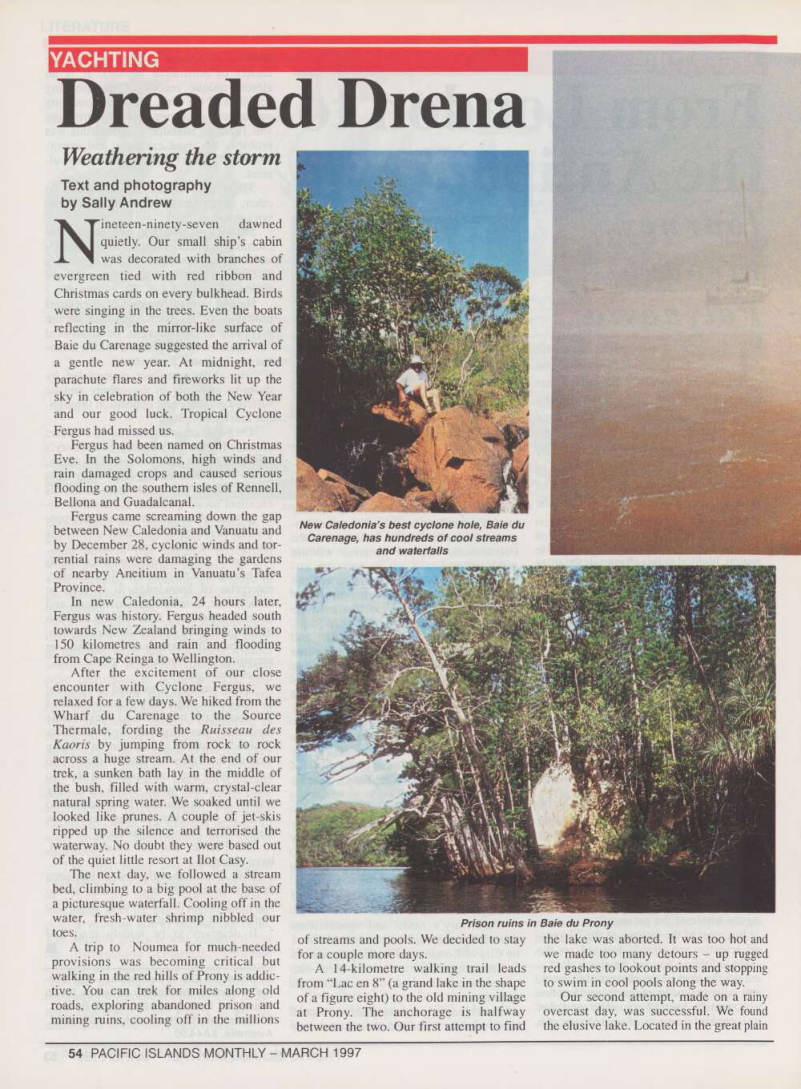
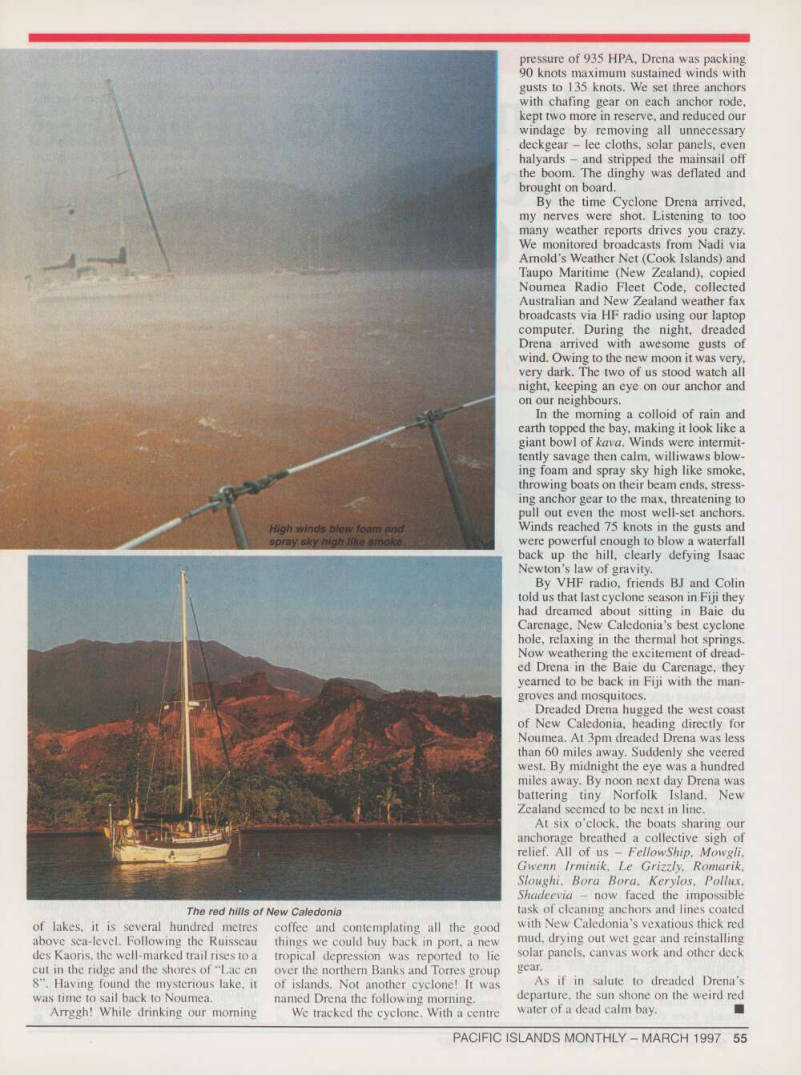
Yachting
Weathering the storm Text and photography
by Sally Andrew
Nineteen-ninety-seven dawned
quietly. Our small ship’s cabin was decorated with branches of evergreen tied with red ribbon and Christmas cards on every bulkhead. Birds were singing in the trees. Even the boats reflecting in the mirror-like surface of Baie du Carenage suggested the arrival of a gentle new year. At midnight, red parachute flares and fireworks lit up the sky in celebration of both the New Year and our good luck. Tropical Cyclone Fergus had missed us.
Fergus had been named on Christmas Eve. In the Solomons, high winds and rain damaged crops and caused serious flooding on the southern isles of Rennell, Bellona and Guadalcanal.
Fergus came screaming down the gap between New Caledonia and Vanuatu and by December 28, cyclonic winds and tor rential rains were damaging the gardens of nearby Aneitium in Vanuatu’s Tafea Province.
In new Caledonia, 24 hours later, Fergus was history. Fergus headed south towards New Zealand bringing winds to 150 kilometres and rain and flooding from Cape Reinga to Wellington.
After the excitement of our close encounter with Cyclone Fergus, we relaxed for a few days. We hiked from the Wharf du Carenage to the Source Thermale, fording the Ruisseau des Kaoris by jumping from rock to rock across a huge stream. At the end of our trek, a sunken bath lay in the middle of the bush, filled with warm, crystal-clear natural spring water. We soaked until we looked like prunes. A couple of jet-skis ripped up the silence and terrorised the waterway. No doubt they were based out of the quiet little resort at Hot Casy.
The next day, we followed a stream bed, climbing to a big pool at the base of a picturesque waterfall. Cooling off in the water, fresh-water shrimp nibbled our toes.
A trip to Noumea for much-needed provisions was becoming critical but walking in the red hills of Prony is addic tive. You can trek for miles along old roads, exploring abandoned prison and mining ruins, cooling off in the millions
of streams and pools. We decided to stay for a couple more days.
A 14-kilometre walking trail leads from “Lac en 8” (a grand lake in the shape of a figure eight) to the old mining village at Prony. The anchorage is halfway between the two. Our first attempt to find
the lake was aborted. It was too hot and we made too many detours - up rugged red gashes to lookout points and stopping to swim in cool pools along the way.
Our second attempt, made on a rainy overcast day, was successful. We found the elusive lake. Located in the great plain
New Caledonia’s best cyclone hole, Bale du Carenage, has hundreds of cool streams and waterfalls
Prison ruins in Bale du Prony
of lakes, it is several hundred metres above sea-level. Following the Ruisseau des Kaoris, the well-marked trail rises to a cut in the ridge and the shores of "Lac en 8”. Having found the mysterious lake, it was time to sail back to Noumea.
Arrggh! While drinking our morning
coffee and contemplating all the good things we could buy back in port, a new tropical depression was reported to lie over the northern Banks and Torres group of islands. Not another cyclone! It was named Drena the following morning.
We tracked the cyclone. With a centre
pressure of 935 HPA, Drena was packing 90 knots maximum sustained winds with gusts to 135 knots. We set three anchors with chafing gear on each anchor rode, kept two more in reserve, and reduced our windage by removing all unnecessary deckgear - lee cloths, solar panels, even halyards - and stripped the mainsail off the boom. The dinghy was deflated and brought on board.
By the time Cyclone Drena arrived, my nerves were shot. Listening to too many weather reports drives you crazy.
We monitored broadcasts from Nadi via Arnold’s Weather Net (Cook Islands) and Taupo Maritime (New Zealand), copied Noumea Radio Fleet Code, collected Australian and New Zealand weather fax broadcasts via HF radio using our laptop computer. During the night, dreaded Drena arrived with awesome gusts of wind. Owing to the new moon it was very, very dark. The two of us stood watch all night, keeping an eye on our anchor and on our neighbours.
In the morning a colloid of rain and earth topped the bay, making it look like a giant bowl of kava. Winds were intermit tently savage then calm, williwaws blow ing foam and spray sky high like smoke, throwing boats on their beam ends, stress ing anchor gear to the max, threatening to pull out even the most well-set anchors.
Winds reached 75 knots in the gusts and were powerful enough to blow a waterfall back up the hill, clearly defying Isaac Newton’s law of gravity.
By VHF radio, friends BJ and Colin told us that last cyclone season in Fiji they had dreamed about sitting in Bale du Carenage, New Caledonia’s best cyclone hole, relaxing in the thermal hot springs.
Now weathering the excitement of dread ed Drena in the Baie du Carenage, they yearned to be back in Fiji with the man groves and mosquitoes.
Dreaded Drena hugged the west coast of New Caledonia, heading directly for Noumea. At 3pm dreaded Drena was less than 60 miles away. Suddenly she veered west. By midnight the eye was a hundred miles away. By noon next day Drena was battering tiny Norfolk Island. New Zealand seemed to be next in line.
At six o’clock, the boats sharing our anchorage breathed a collective sigh of relief. All of us - Fellowship, Mowgli, Gwenn Irminik, Le Grizzly, Romarik,
Sloughi, Bora Bora , Kerylos, Pollux,
Shadeevia - now faced the impossible task of cleaning anchors and lines coated with New Caledonia’s vexatious thick red mud, drying out wet gear and reinstalling solar panels, canvas work and other deck gear.
As if in salute to dreaded Drena’s departure, the sun shone on the weird red water of a dead calm bay. ■
The red hills of New Caledonia
High winds blew foam and spray sky high like smoke
Conserving

Opinion
Pacific culture
The appointment of a non-Pacific Islander to the post of Cultural Affairs Adviser (CAA) at the South Pacific Commission (SPC) has been viewed with a certain degree of scep ticism by some countries in the region.
Yves Corbel took up the post of CAA in August, 1996 and while not naive of the fact that he was a non-islander, said he did not anticipate the degree of hostility to which he was subject. Corbel says he faced strong competition from regional applicants for the French-funded CAA post and anticipated some degree of hos tility but the level of bad feeling took him
by surprise.
“The concept of cultural development has been recently developed,” Corbel says. “Aid agencies have realised that projects fail when consideration is not given to culture.
“There is now a global move toward redefinition of development and cultural analysis is an important issue.
“Culture is the hand of development.
There are other issues which have tradi tionally been considered part of culture
such as preserving the heritage of indige nous pe o pi e “However, how this is to be preserved
is important.”
Corbel says differences exist in terms of cultural preservation and revival in n r- \ • . . . • , Pacific countries and territories such as the Federated States of Micronesia and Guam, where the former is attempting to preserve culture and the latter revive it.
“Pacific Islanders are wanting to forge a new identity while trying to preserve t heir traditional values. Some communi tjes need to redefine culture and return to their roo t s to nurture a process of building a new identity ” a second aspect of Corbel is to devel 0p new wa y S to showcase cultures. Many p ac if lc Island countries and territories h aV e seen traditional structures destroyed through migration and the introduction of ou tside influences Corbel’s first physical contact with the region in his capacity as CAA came at the South Pacific festival of Arts in Apia, Western Samoa, in September, 1996. The Council of Pacific Arts is the ruling body Q f t he f es pval The §pg j s the interim secretariat of
the festival although the council is its own
decision-making body.
Corbel, who visited the Commonwealth of the Northern Mariana Islands (CNMI) and Guam a few weeks after the festival of arts, says it is easy to understand the arduous task of those fighting to revive the island’s Chamorro identity but efforts are beginning to show results.
“Chamorro language has been reinstat ed in schools. Considerable efforts are being made to ensure that traditional knowledge and skills are passed on to the younger generation and traditional dance is undergoing a vigorous renaissance,” he says.
“Experimental ways of firing tradi tional Chamorro pottery are being tried without there being any plans to resume
pottery-making.
“On the other hand, no one seems capable of making the traditional canoes of Guam any longer and traditional fish
ing techniques are dying out.
“However, the revival of the Chamorro culture raises great enthusiasm on the island.
“Chamorro culture is today facing
formidable challenges [particularly] when
the younger generation appears to be per meated with American culture.
“[The question arises whether or not] a culture severed from its social and eco nomic foundations can be revived.”
Corbel says discussions enabled him to determine the extreme diversity of atti tudes of regional states and territories
with regard to heritage site protection.
“Where protection itself is concerned, many factors need to be considered in order to evaluate the legislation (when it exists) and its application: who is the landowner? What is the community atti tude to the heritage? What is the state’s real power in this sphere? How do coun tries resist economic interests when they come into conflict with protection of a
heritage site?”
Corbel says his trip to the Northern Pacific revealed strong contrasts between Micronesian countries and territories
enjoying economic prosperity, accompa
nied by an advanced stage of accultura tion, including those with difficulty in achieving development but which to vary ing degrees (appear) to have managed to preserve their indigenous cultures. He says countries and territories have expressed a desire to refuse imposed cul tural integration and to forge individual identities through the protection and pro motion of cultural heritage while develop ing contact with other Pacific cultures. Corbel says there exists a wide range of expectations of the SPC’s cultur al programme, particularly with regard to the protection of intellectual property rights and rights over cultural heritage. ■
The Spc
Debbie
Singh
Saving Radio
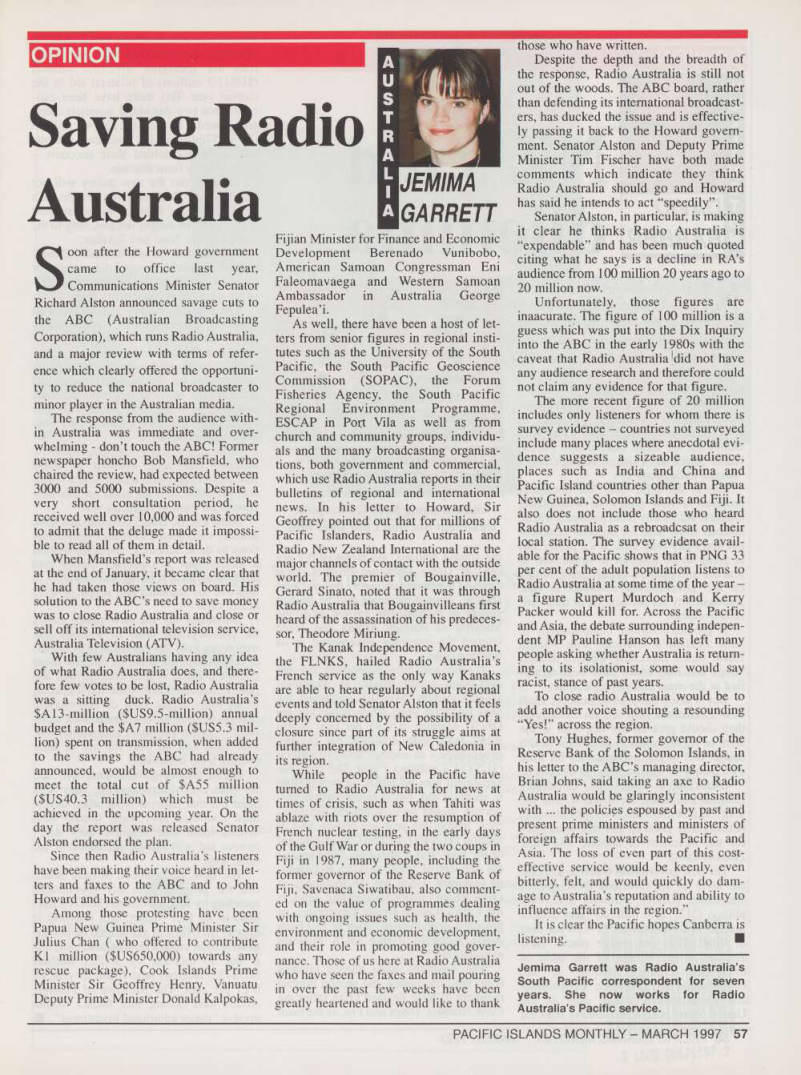
Australia
Soon after the Howard government came to office last year, Communications Minister Senator Richard Alston announced savage cuts to the ABC (Australian Broadcasting Corporation), which runs Radio Australia, and a major review with terms of refer ence which clearly offered the opportuni ty to reduce the national broadcaster to minor player in the Australian media.
The response from the audience with in Australia was immediate and over whelming - don’t touch the ABC! Former newspaper honcho Bob Mansfield, who chaired the review, had expected between 3000 and 5000 submissions. Despite a very short consultation period, he received well over 10,000 and was forced to admit that the deluge made it impossi ble to read all of them in detail.
When Mansfield’s report was released at the end of January, it became clear that he had taken those views on board. His solution to the ABC’s need to save money was to close Radio Australia and close or sell off its international television service, Australia Television (ATV).
With few Australians having any idea of what Radio Australia does, and there fore few votes to be lost. Radio Australia was a sitting duck. Radio Australia’s SAI3-million (SUS9.S-million) annual budget and the SA7 million (SUSS.3 mil lion) spent on transmission, when added to the savings the ABC had already announced, would be almost enough to meet the total cut of SASS million (SUS4O.3 million) which must be achieved in the upcoming year. On the day the report was released Senator Alston endorsed the plan.
Since then Radio Australia’s listeners have been making their voice heard in let ters and faxes to the ABC and to John Howard and his government.
Among those protesting have been Papua New Guinea Prime Minister Sir Julius Chan ( who offered to contribute
K 1 million ($U5650,000) towards any
rescue package), Cook Islands Prime Minister Sir Geoffrey Henry, Vanuatu Deputy Prime Minister Donald Kalpokas,
Fijian Minister for Finance and Economic Development Berenado Vunibobo, American Samoan Congressman Eni Faleomavaega and Western Samoan Ambassador in Australia George
Fepulea’i.
As well, there have been a host of let ters from senior figures in regional insti tutes such as the University of the South Pacific, the South Pacific Geoscience Commission (SOPAC), the Forum Fisheries Agency, the South Pacific Regional Environment Programme, ESCAP in Pofl Vila as well as from church and community groups, individu als and the many broadcasting organisa tions, both government and commercial, which use Radio Australia reports in their bulletins of regional and international news. In his letter to Howard, Sir Geoffrey pointed out that for millions of Pacific Islanders, Radio Australia and Radio New Zealand International are the major channels of contact with the outside world. The premier of Bougainville, Gerard Sinato, noted that it was through Radio Australia that Bougainvilleans first heard of the assassination of his predeces sor, Theodore Miriung.
The Kanak Independence Movement, the FUNKS, hailed Radio Australia’s French service as the only way Kanaks are able to hear regularly about regional events and told Senator Alston that it feels deeply concerned by the possibility of a closure since part of its struggle aims at further integration of New Caledonia in
its region.
While people in the Pacific have turned to Radio Australia for news at times of crisis, such as when Tahiti was ablaze with riots over the resumption of French nuclear testing, in the early days of the Gulf War or during the two coups in Fiji in 1987, many people, including the former governor of the Reserve Bank of Fiji, Savenaca Siwatibau, also comment ed on the value of programmes dealing with ongoing issues such as health, the environment and economic development, and their role in promoting good gover nance. Those of us here at Radio Australia who have seen the faxes and mail pouring in over the past few weeks have been greatly heartened and would like to thank
those who have written.
Despite the depth and the breadth of the response. Radio Australia is still not out of the woods. The ABC board, rather than defending its international broadcast ers, has ducked the issue and is effective ly passing it back to the Howard govern ment. Senator Alston and Deputy Prime Minister Tim Fischer have both made comments which indicate they think Radio Australia should go and Howard has said he intends to act “speedily”.
Senator Alston, in particular, is making it clear he thinks Radio Australia is “expendable” and has been much quoted citing what he says is a decline in RA’s audience from 100 million 20 years ago to 20 million now.
Unfortunately, those figures are inaacurate. The figure of 100 million is a guess which was put into the Dix Inquiry into the ABC in the early 1980 s with the caveat that Radio Australia ! did not have any audience research and therefore could not claim any evidence for that figure.
The more recent figure of 20 million includes only listeners for whom there is survey evidence - countries not surveyed include many places where anecdotal evi dence suggests a sizeable audience, places such as India and China and Pacific Island countries other than Papua New Guinea, Solomon Islands and Fiji. It also does not include those who heard Radio Australia as a rebroadcsat on their local station. The survey evidence avail able for the Pacific shows that in PNG 33 per cent of the adult population listens to Radio Australia at some time of the year a figure Rupert Murdoch and Kerry Packer would kill for. Across the Pacific and Asia, the debate surrounding indepen dent MP Pauline Hanson has left many people asking whether Australia is return ing to its isolationist, some would say racist, stance of past years.
To close radio Australia would be to add another voice shouting a resounding “Yes!” across the region.
Tony Hughes, former governor of the Reserve Bank of the Solomon Islands, in his letter to the ABC’s managing director, Brian Johns, said taking an axe to Radio Australia would be glaringly inconsistent with ... the policies espoused by past and present prime ministers and ministers of foreign affairs towards the Pacific and Asia. The loss of even part of this cost effective service would be keenly, even bitterly, felt, and would quickly do dam age to Australia’s reputation and ability to influence affairs in the region.”
It is clear the Pacific hopes Canberra is listening. ■
Jemima Garrett was Radio Australia’s South Pacific correspondent for seven years. She now works for Radio Australia’s Pacific service.
Australia
Jemima
Garrett
NZ’s aid
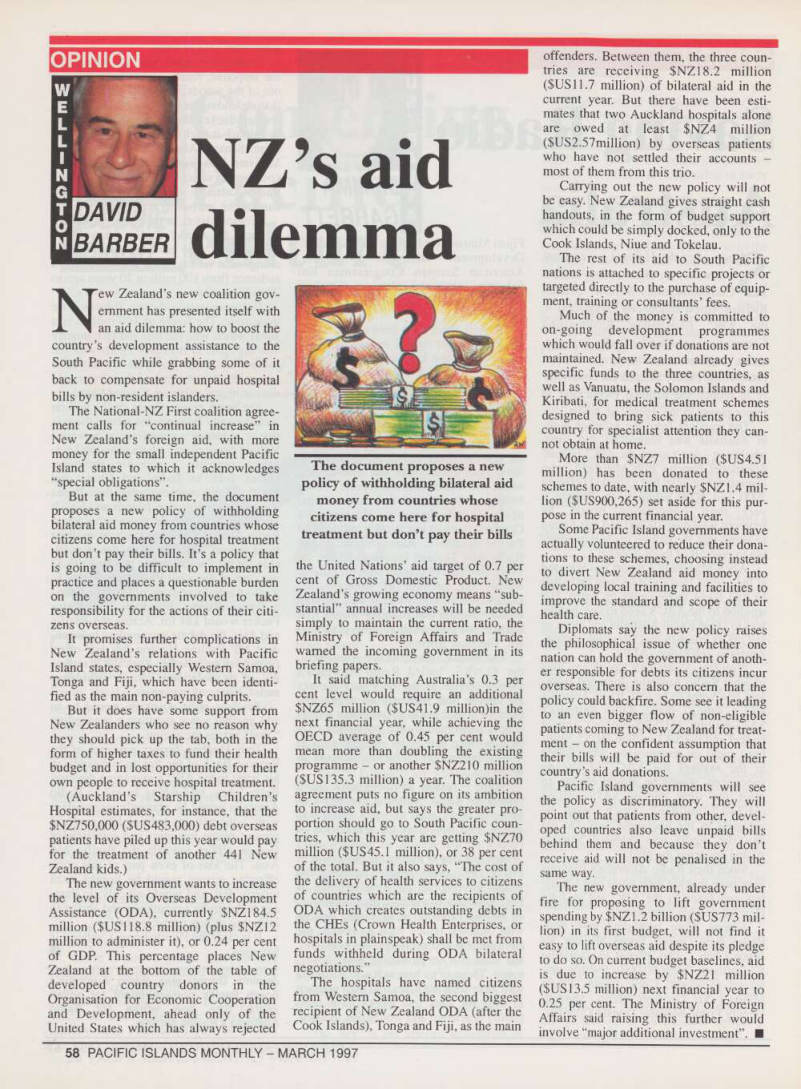
dilemma
New Zealand’s new coalition gov ernment has presented itself with an aid dilemma: how to boost the country’s development assistance to the South Pacific while grabbing some of it back to compensate for unpaid hospital bills by non-resident islanders.
The National-NZ First coalition agree ment calls for “continual increase” in New Zealand’s foreign aid, with more money for the small independent Pacific Island states to which it acknowledges
“special obligations”.
But at the same time, the document proposes a new policy of withholding bilateral aid money from countries whose citizens come here for hospital treatment but don’t pay their bills. It’s a policy that is going to be difficult to implement in
practice and places a questionable burden
on the governments involved to take responsibility for the actions of their citi zens overseas.
It promises further complications in New Zealand’s relations with Pacific Island states, especially Western Samoa, Tonga and Fiji, which have been identi fied as the main non-paying culprits.
But it does have some support from New Zealanders who see no reason why they should pick up the tab, both in the form of higher taxes to fund their health budget and in lost opportunities for their own people to receive hospital treatment. (Auckland’s Starship Children’s Hospital estimates, for instance, that the $NZ750,000 ($U5483,000) debt overseas patients have piled up this year would pay for the treatment of another 441 New Zealand kids.) The new government wants to increase the level of its Overseas Development Assistance (ODA), currently $NZ184.5 million (SUSIIB.B million) (plus SNZI2 million to administer it), or 0.24 per cent of GDP. This percentage places New Zealand at the bottom of the table of developed country donors in the Organisation for Economic Cooperation and Development, ahead only of the United States which has always rejected
the United Nations’ aid target of 0.7 per cent of Gross Domestic Product. New Zealand’s growing economy means “sub stantial” annual increases will be needed simply to maintain the current ratio, the Ministry of Foreign Affairs and Trade warned the incoming government in its
briefing papers.
It said matching Australia’s 0.3 per cent level would require an additional SNZ6S million (SUS4I.9 millionjin the next financial year, while achieving the OECD average of 0.45 per cent would mean more than doubling the existing programme - or another SNZ2IO million (SUS 135.3 million) a year. The coalition agreement puts no figure on its ambition to increase aid, but says the greater pro portion should go to South Pacific coun tries, which this year are getting SNZ7O million (SUS4S.I million), or 38 per cent of the total. But it also says, “The cost of the delivery of health services to citizens of countries which are the recipients of ODA which creates outstanding debts in the CHEs (Crown Health Enterprises, or hospitals in plainspeak) shall be met from funds withheld during ODA bilateral negotiations.”
The hospitals have named citizens from Western Samoa, the second biggest recipient of New Zealand ODA (after the Cook Islands), Tonga and Fiji, as the main
offenders. Between them, the three coun tries are receiving SNZIB.2 million (SUS 11.7 million) of bilateral aid in the current year. But there have been esti mates that two Auckland hospitals alone are owed at least SNZ4 million
(sUS2.s7million) by overseas patients
who have not settled their accounts most of them from this trio.
Carrying out the new policy will not be easy. New Zealand gives straight cash handouts, in the form of budget support which could be simply docked, only to the Cook Islands, Niue and Tokelau.
The rest of its aid to South Pacific nations is attached to specific projects or targeted directly to the purchase of equip ment, training or consultants’ fees.
Much of the money is committed to
on-going development programmes
which would fall over if donations are not maintained. New Zealand already gives specific funds to the three countries, as well as Vanuatu, the Solomon Islands and Kiribati, for medical treatment schemes designed to bring sick patients to this country for specialist attention they can not obtain at home.
More than SNZ7 million (SUS4.SI million) has been donated to these schemes to date, with nearly SNZI.4 mil lion ($U5900,265) set aside for this pur pose in the current financial year.
Some Pacific Island governments have actually volunteered to reduce their dona tions to these schemes, choosing instead to divert New Zealand aid money into developing local training and facilities to improve the standard and scope of their health care.
Diplomats say the new policy raises the philosophical issue of whether one nation can hold the government of anoth er responsible for debts its citizens incur overseas. There is also concern that the policy could backfire. Some see it leading to an even bigger flow of non-eligible patients coming to New Zealand for treat ment - on the confident assumption that their bills will be paid for out of their country’s aid donations.
Pacific Island governments will see the policy as discriminatory. They will point out that patients from other, devel oped countries also leave unpaid bills behind them and because they don’t receive aid will not be penalised in the same way.
The new government, already under fire for proposing to lift government spending by SNZI.2 billion (SUS 773 mil lion) in its first budget, will not find it easy to lift overseas aid despite its pledge to do so. On current budget baselines, aid is due to increase by SNZ2I million (SUSI3.S million) next financial year to 0.25 per cent. The Ministry of Foreign Affairs said raising this further would involve “major additional investment”. ■
Wellington
David
Barber
The document proposes a new policy of withholding bilateral aid money from countries whose citizens come here for hospital treatment but don’t pay their bills
Advertisements & other items, pp. 59-60 (1 item)
What Would You Like Them To Say About You
K£ * ' He knew
Grand Pacific
would look after his fam ily His bills are covered mmi O * , > *iK His children will get a good education
Sine trusted someone local,
Grand Pacific Life
She put her family first
What Would You Like Them To Say About You
After You’re Gone?
Ordinarily, it takes a lifetime to accumulate a fortune. Not with life insurance.
Life insurance is the only sure way to build a legacy - one that will instantly perpetuate your good name as a provider and sustain your family’s financial security.
Let us help you choose a plan that meets your goals. © Grand Pacific Life Insurance, Ltd.
A member of the Finance Factors Family American Samoa Mark Solofa Pacific Insurance & Finance, Inc.
Mark Solofa, GA Phone; 684-699-5796 Western Samoa Mark Solofa Pacific Insurance & Finance, Inc.
Mark Solofa, GA Phone: 685-24059 Chuuk State.
Federated States of Micronesia Pacific Basin Insurance & General Services, Inc.
Kachutosy Paulus, GA Phone: 691-330-2606 Guam Great National Insurance Underwriters, Inc.
Domie Bumagat Jr., GA Phone: 671-646-5736 Pacific Financial Corporation Eduardo Camacho, GA Phone; 671-646-1990 Takagi & Associates Pamela Cruz, GA Phone: 671-475-4373 Marshall Islands Marshalls Insurance Agency Jerry Kramer, GA Phone: 692-625-3366 Saipan Pacific Basin Insurance Underwriters, Inc.
Mary Ann Milne, GA Phone: 670-234-7861 Pacific Insurance Underwriters, Inc.
Norman Tenorio, GA Phone: 670-234-6267 Tonga Peseti Ma‘afu Insurance & Finance, Ltd. - Peseti Ma‘afu, GA Phone: 676-24-777 1111111!!!; A -nr, rtnc 9
MITSUBISHI’S DOMINANT RECORD OF
1996 RALLY TITLES INCLUDES:
Asia-Pacific Rally Championship for Manufacturers (2nd year in a row)
World Rally Championship for Drivers
World Cup of Production Cars Most Overall Victories (5 of 9 WRC events) The 26 T>rof tecl Mitsubishi Lancer obviously has more than just engine power filing it into the upper class of international rallying. It also has the •logical expertise accumulated from years of winning individual and series championships. We like to think of the Lancer as our UJS - Tesciirdi centre on wheels—because only technologies and systems capable of enduring the gruelling conditions of the world's rally circuits are deemed worthy for use in our production cars. Upwardly mobile? Claim the status you deserve. Drive a Lancer.
Experience the Mitsubishi Way
y V
MITSUBISHI
LRNCER
AMERICAN SAMOA: PACIFIC MARKETING INC. P.O. Box 698, Pago Pago, Tel. 699-9140/ AUSTRALIA: MITSUBISHI MOTORS AUSTRALIA LTD. 1284 South Road, Clovelly Park, South Australia, 5042, Tel (08)2757297 / FIJI’ NIVIS MOTOR & MACHINERY CO. LTD. G.P.O. Box 150, Suva, Tel. 383411 / GUAM: TRIPLE J ENTERPRISES INC. P.O. Box 6066, Tamuning, Tel. 6469126 / NEW CALEDONIA: SOCIETE D’IMPORTATION D'AUTO DU PACIFIQUE SUD S.A, P.O. Box 2548, NOUMEA, TEL. 272-562 / NEW ZEALAND: MITSUBISHI MOTORS NEW ZEALAND LTD. Private Bag. Porirua, Tel. 237-0109 / NORFOLK ISLAND: BORRYS PTY LTD. P,O. Box 169, Taylors Road, Burnt, Tel. 22114 / PAPUA NEW GUINEA: TOBA MOTORS PTY LTD. P.O. Box 503, Port Moresby / SAIPAN: SAIPAN AUTOWORLO INC.
P.O, Box 487, Tel. 234-7133/ SOLOMON ISLANDS: HARVEST PACIFIC LTD. G.P.O. 80x823, Honiara, Tel. 30407 /TAHITI: SOPADEP S.A. B.P. 1617, Papeete, Tel. 436604 / TONGA: SITANIMAFI CO,. LTD.
P.O. Box 83, Nukualofa, Tel. 24044 / VANUATU; SOCOMETRA VANUATU LTD. B.P. 6, Port-Vila, Tel. 2314 / WESTERN SAMOA: MOTOR DISTRIBUTORS (SAMOA) LTD. P.O. Box 576, Apia, Tel. 20957 A
MITSUBISHI
MOTORS
CREATING TOGETHER