Pacific

Island S
Monthly
t
w.
I^L
jj H “j jjl jf^} KTsy^s
Australia’s great White debate
-i~k \ !_U CiljlOD QJ
KB g iff mt .jagSD > Mr - jflljß
Advertisements & other items, p. 2 (1 item)
|{W)Telikom
I •Sri': N.V . -
For whatever
reason.
The safest
and the quickest
way to
Papua New Guinea
is by phone
Just dial +675 plus the number and you're hone.
In Papua New Guinea, Telikom does the connection for you.
|{W)TELIKOM
1 ■ PAPUA NEW GUINEA
Pacific
Islands
Mon T H Ly
Vol. 67 No. 02
The News Magazine
February 1997
PUBLISHER: Alan Robinson EDITOR: Manivannan Naidu SENIOR WRITER: Bernadette Hussein
Correspondents:
David North, Sam Vulum lan Williams, Liz Thompson, Atama Raganivatu, Sally Andrew, Patrick Decloitre, Chris Peteru COLUMNISTS: David Barber (Wellington), Jemima Garrett (Sydney), Alfred Sasako (The Forum), Debbie Singh (South Pacific Commission).
GRAPHIC ARTIST: Andrew Williams
Advertising Sales
Senior Regional Sales (South Pacific) Shailendra Kumar Emmett Simpson Tel (679) 304 111, 303244, Fax(679) 303809.
Sydney, Canberra: Bob Hill Media Representation, Tel (61-2) 4164245, Fax (61-2)4165064.
Brisbane: Jane Fewings Media and Advertising Associates Tel (61-7) 3378 4522, Fax (61-7) 3878 1071.
Adelaide: Hastwell Williamsons Representatives, Tel (61-8) 3799522, Fax (61-8) 3799735.
Melbourne; Brown Orr Fletcher Burrows (Aust) Pty Ltd.
Tel(6l-3) 98265188, Fax (61-3) 98265644.
Auckland: McKay & Bowman, International Media Representatives Limited, Tel (64-9)4190561, Fax (64-9) 4192243.
Japan: Universal Media Corporation, Tokyo, Tel (3) 3266626741, Cable; UNI-MEDIA Tokyo, Fax(3)32626742.
Pacific Islands Monthly was founded in
1930 (Usps 9522480).
A Fiji Times Limited production.
Cover prices are recommended retail only. Registered by Australia Post, Publication No. NBPI2IO. © Copyright Fiji Times Limited, 177 Victoria Parade, Suva, Fiji.
Tel (679) 304111, fax (679) 303809.
Pacific Islands Monthly is published monthly by Fiji Times Limited, a division of Nationwide News, 2 Holt Street, Surry Hills, Sydney, NSW 2010.
Send Address Changes To:
Pacific Islands Monthly PO Box 1167 Suva, Fiji.
Typeset and printed by The Fiji Times Limited, 177 Victoria Parade, Suva, Fiji.
Cover: Andrew Williams
Inside
COVER: Pauline Hanson’s controversial fj f and untempered remarks on racial issues £ I have branded her a “racist” and brought ■i I into the foreground and the public forum what may always have been lurking just beneath the surface of Australia’s multiculturalism - the great race debate.
4 Letters 10: The lost boys 19: Robbery 20: Trading places 23: Pacific spies 25: Government accounts and
accountability
37: The Boutros-Ghali incident 38: Chewing the qat 44: Marina’s mission 45: Uncovering the past 48: Striking oil 51: Annie expands her horizons 53: The politics of music 55: Medical insights
57: Voyage to Tonga
Views
6: Debbie Singh (SPC): Bravo, SPC 7: David Barber (NZ): Uniting to save our resources 8: Jemima Garrett (Aust): APEC gears up for action 9: Alfred Sasako (Forum Secretariat): Readying for the 28th Forum
Special Report
am A region in
mourning
The region gathers in the Republic of the Marshall Islands to pay its last respects to the country’s president, Amata Kabua, who died in Hawaii in December.
Qc; Ph2Ii -A
tragedy
Polynesian Airline’s fateful flight PH2II, which has killed three, brings under scrutiny the dead pilot’s past record, posing questions from both inside and outside the organisation on the airline’s operations
Sport
40: Bodyworks 42: Manu Samoa bounce back... again
Kiribati
Letters
Kiribati rocket
Dear Sir,
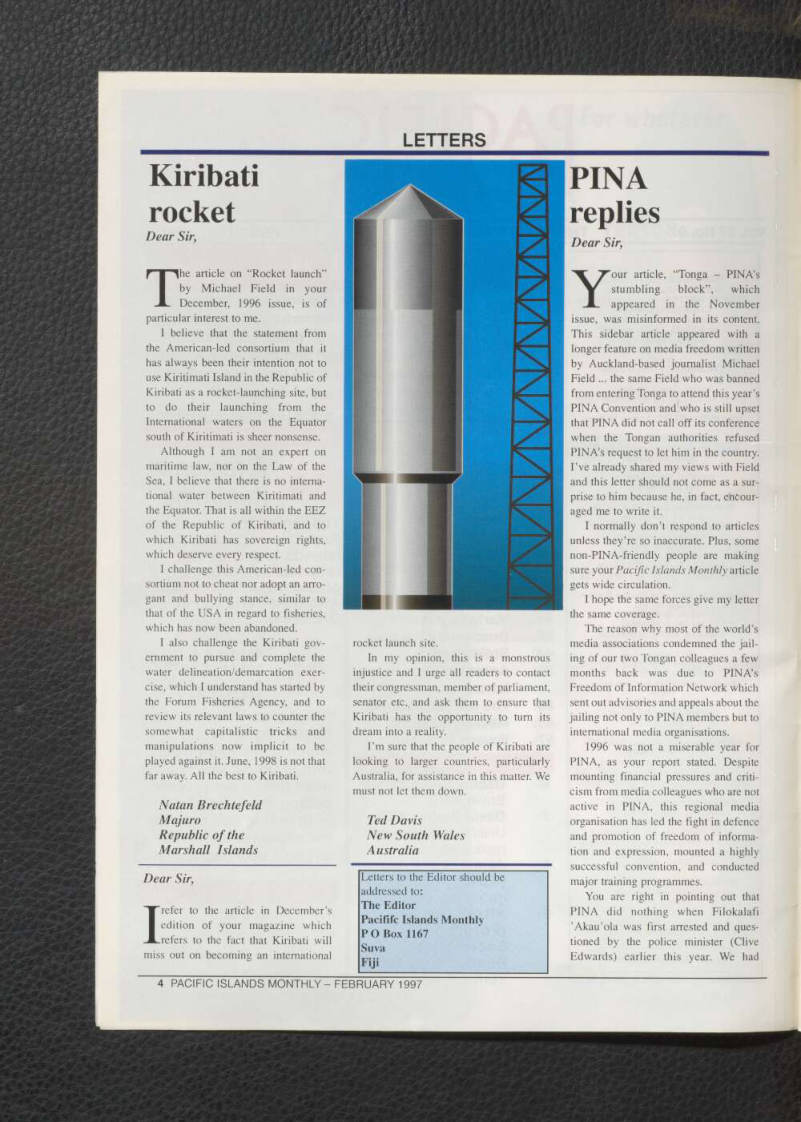
The article on “Rocket launch” by Michael Field in your December, 1996 issue, is of particular interest to me.
I believe that the statement from the American-led consortium that it has always been their intention not to use Kiritimati Island in the Republic of Kiribati as a rocket-launching site, but to do their launching from the International waters on the Equator south of Kiritimati is sheer nonsense.
Although I am not an expert on maritime law, nor on the Law of the Sea, I believe that there is no interna tional water between Kiritimati and the Equator. That is all within the FEZ of the Republic of Kiribati, and to which Kiribati has sovereign rights, which deserve every respect.
I challenge this American-led con sortium not to cheat nor adopt an arro gant and bullying stance, similar to that of the USA in regard to fisheries, which has now been abandoned.
I also challenge the Kiribati gov ernment to pursue and complete the water delineation/demarcation exer cise, which I understand has started by the Forum Fisheries Agency, and to review its relevant laws to counter the somewhat capitalistic tricks and manipulations now implicit to be played against it. June, 1998 is not that far away. All the best to Kiribati.
Natan Brechtefeld
Majuro Republic of the Marshall Islands
Dear Sir,
I refer to the article in December’s edition of your magazine which refers to the fact that Kiribati will miss out on becoming an international
rocket launch site.
In my opinion, this is a monstrous injustice and I urge all readers to contact their congressman, member of parliament, senator etc,, and ask them to ensure that Kiribati has the opportunity to turn its dream into a reality.
I’m sure that the people of Kiribati are
looking to larger countries, particularly
Australia, for assistance in this matter. We must not let them down.
Ted Davis
New South Wales Australia
Letters to the Editor should be addressed to: The Editor Pacififc Islands Monthly PO Box 1167 Suva Fiji
replies
Pina
Dear Sir,
Your article, “Tonga - PINA’s stumbling, block”, which appeared in the November issue, was misinformed in its content.
This sidebar article appeared with a longer feature on media freedom written
by Auckland-based journalist Michael
Field ... the same Field who was banned from entering Tonga to attend this year’s PINA Convention and who is still upset that PINA did not call off its conference when the Tongan authorities refused PINA’s request to let him in the country.
I’ve already shared my views with Field and this letter should not come as a sur prise to him because he, in fact, encour aged me to write it.
I normally don’t respond to articles unless they’re so inaccurate. Plus, some non-PINA-friendly people are making sure your Pacific Islands Monthly article gets wide circulation.
I hope the same forces give my letter the same coverage.
The reason why most of the world’s media associations condemned the jail ing of our two Tongan colleagues a few months back was due to PINA’s Freedom of Information Network which sent out advisories and appeals about the jailing not only to PINA members but to international media organisations. 1996 was not a miserable year for PINA, as your report stated. Despite mounting financial pressures and criti cism from media colleagues who are not active in PINA, this regional media organisation has led the fight in defence and promotion of freedom of informa tion and expression, mounted a highly successful convention, and conducted
major training programmes.
You are right in pointing out that PINA did nothing when Filokalafi ’Akau’ola was first arrested and ques tioned by the police minister (Clive Edwards) earlier this year. We had
checked with out colleagues in Tonga and had been advised that it was not a press freedom issue.
However, during a question-and answer session with the police minister at the PINA Convention, we journalists from outside Tonga found out more about the incident from Edwards himself. ’Akau’ola was indeed threatened and intimidated and, yes, PINA should have protested.
We learn from our mistakes, which is why when ’Akau’ola and his editor were jailed, PINA diversified its sources of information and responded in the way it did.
Tavake Fusimalohi has not quit PINA as your reporter stated. He resigned as executive director but he is still a PINA member.
Your report concluded with the state ment, “...PINA was struggling to survive as aid donors backed away from the
organisation.”
The only aid donor we’ve lost is The Asia Foundation, which has withdrawn from the region totally because of budget cuts in Washington and changing
American priorities.
They were gone before the Tongan sit uation.
Scores of Pacific Island organisations and projects have been hit by this, not just
Pina.
PINA this year got support from more international organisations than ever for its training programmes but total aid to the region is dropping and much bigger
organisations than PINA are affected. Talk to the South Pacific Commission.
PINA, like many other Pacific Island organisations, is currently working on ways to make up for the loss of The Asia Foundation funding for our secretariat, which has only one staff member to serve our large PINA family of members in 21 Pacific Island countries and territories.
Our executives help out by paying for their own accommodation, meals, stopovers and other costs for board meet
ings.
Next year, we’re asking that they also pay their airfares. Can you name another regional organisation with this level of personal commitment and sacrifice from its members?
Have a happy news-hunting New Year!
Monica Miller
President Pacific Islands News Association Pago Pago American Samoa
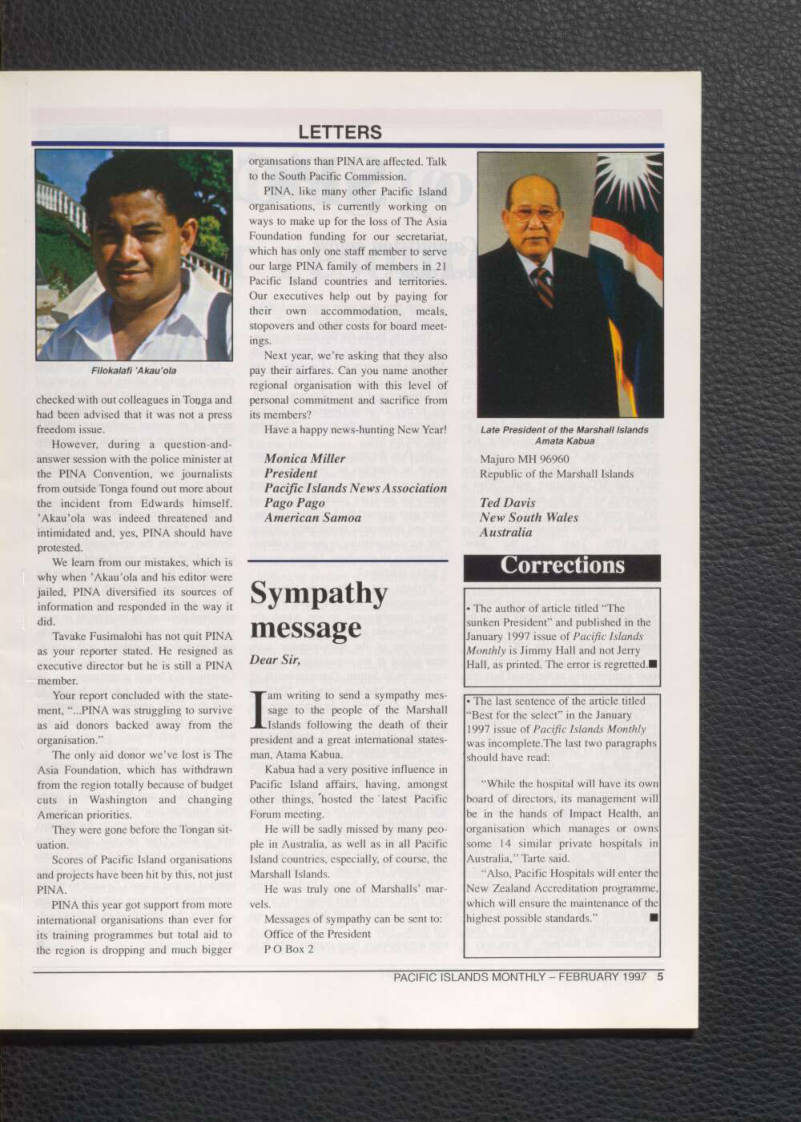
Filokalafi Akau'ola
Sympathy
message
Dear Sir,
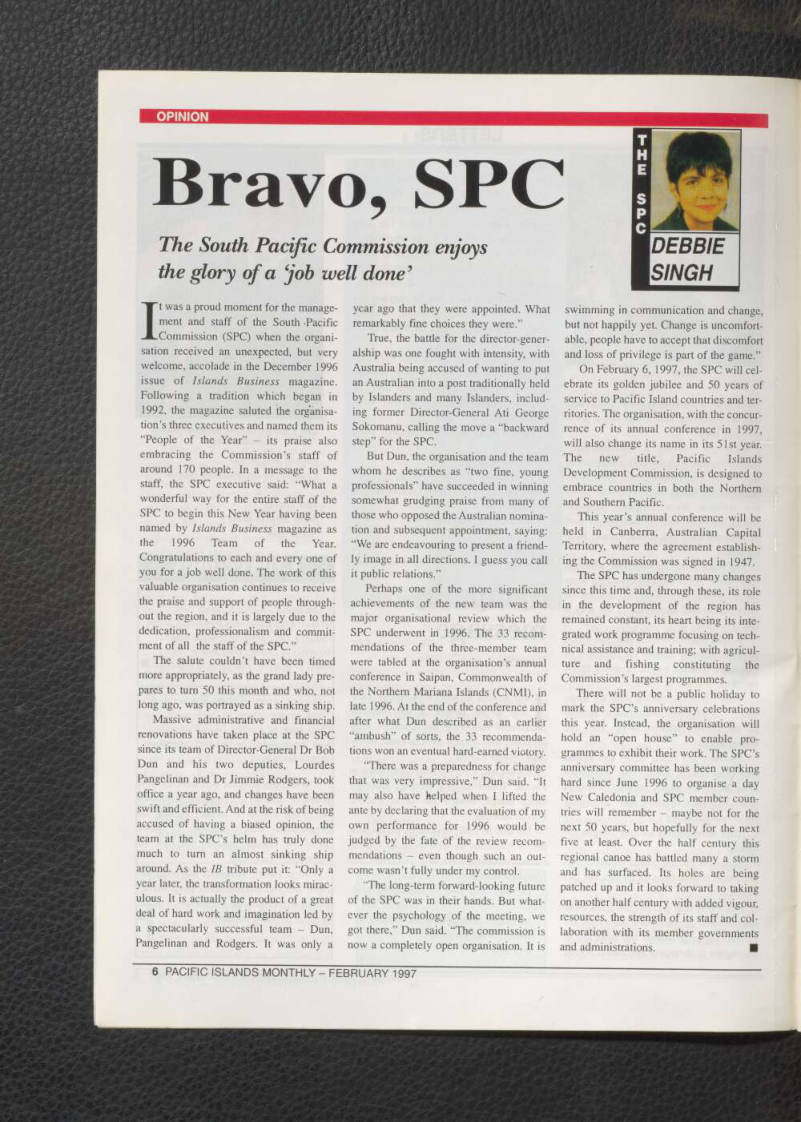
lam writing to send a sympathy mes sage to the people of the Marshall Islands following the death of their president and a great international states man, Atama Kabua.
Kabua had a very positive influence in Pacific Island affairs, having, amongst other things, the latest Pacific Forum meeting.
He will be sadly missed by many peo ple in Australia, as well as in all Pacific Island countries, especially, of course, the Marshall Islands.
He was truly one of Marshalls’ mar vels.
Messages of sympathy can be sent to: Office of the President P O Box 2
Majuro MH 96960 Republic of the Marshall Islands
Ted Davis
New South Wales Australia
Late President of the Marshall Islands Amata Kabua
Corrections
• The author of article titled “The sunken President” and published in the January 1997 issue of Pacific Islands Monthly is Jimmy Hall and not Jerry Hall, as printed. The error is regretted.■
• The last sentence of the article titled “Best for the select” in the January 1997 issue of Pacific Islands Monthly was incomplete. The last two paragraphs should have read: “While the hospital will have its own board of directors, its management will be in the hands of Impact Health, an organisation which manages or owns some 14 similar private hospitals in Australia,” Tarte said.
“Also, Pacific Hospitals will enter the New Zealand Accreditation programme, which will ensure the maintenance of the highest possible standards.” ■
Bravo, SPC
Opinion
T H E S P C
\Debbie
Isingh
It was a proud moment for the manage ment and staff of the South -Pacific Commission (SPC) when the organi sation received an unexpected, but very welcome, accolade in the December 1996 issue of Islands Business magazine.
Following a tradition which began in 1992, the magazine saluted the organisa tion’s three executives and named them its “People of the Year” - its praise also embracing the Commission’s staff of around 170 people. In a message to the staff, the SPC executive said; “What a wonderful way for the entire staff of the SPC to begin this New Year having been named by Islands Business magazine as the 1996 Team of the Year.
Congratulations to each and every one of you for a job well done. The work of this valuable organisation continues to receive the praise and support of people through out the region, and it is largely due to the dedication, professionalism and commit ment of all the staff of the SPC.”
The salute couldn’t have been timed more appropriately, as the grand lady pre pares to turn 50 this month and who, not long ago, was portrayed as a sinking ship.
Massive administrative and financial renovations have taken place at the SPC since its team of Director-General Dr Bob Dun and his two deputies, Lourdes Pangelinan and Dr Jimmie Rodgers, took office a year ago, and changes have been swift and efficient. And at the risk of being accused of having a biased opinion, the team at the SPC’s helm has truly done much to turn an almost sinking ship around. As the IB tribute put it: “Only a year later, the transformation looks mirac ulous. It is actually the product of a great deal of hard work and imagination led by a spectacularly successful team - Dun, Pangelinan and Rodgers. It was only a
The South Pacific Commission enjoys the glory of a job well done’
year ago that they were appointed. What remarkably fine choices they were.”
True, the battle for the director-gener alship was one fought with intensity, with Australia being accused of wanting to put an Australian into a post traditionally held by Islanders and many Islanders, includ ing former Director-General Ati George Sokomanu, calling the move a “backward step” for the SPC.
But Dun, the organisation and the team whom he describes as “two fine, young professionals” have succeeded in winning somewhat grudging praise from many of those who opposed the Australian nomina tion and subsequent appointment, saying: “We are endeavouring to present a friend ly image in all directions. I guess you call it public relations.”
Perhaps one of the more significant achievements of the new team was the major organisational review which the SPC underwent in 1996. The 33 recom mendations of the three-member team were tabled at the organisation’s annual conference in Saipan, Commonwealth of the Northern Mariana Islands (CNMI), in late 1996. At the end of the conference and after what Dun described as an earlier “ambush” of sorts, the 33 recommenda tions won an eventual hard-earned victory.
“There was a preparedness for change that was very impressive,” Dun said. “It may also have helped when- I lifted the ante by declaring that the evaluation of my own performance for 1996 would be judged by the fate of the review recom mendations - even though such an out come wasn’t fully under my control.
“The long-term forward-looking future
of the SPC was in their hands. But what ever the psychology of the meeting, we got there,” Dun said. “The commission is now a completely open organisation. It is
swimming in communication and change, but not happily yet. Change is uncomfort able, people have to accept that discomfort and loss of privilege is part of the game.”
On February 6, 1997, the SPC will cel ebrate its golden jubilee and 50 years of service to Pacific Island countries and ter ritories. The organisation, with the concur rence of its annual conference in 1997, will also change its name in its 51st year.
The new title, Pacific Islands Development Commission, is designed to embrace countries in both the Northern and Southern Pacific.
This year’s annual conference will be held in Canberra, Australian Capital Territory, where the agreement establish ing the Commission was signed in 1947.
The SPC has undergone many changes since this time and, through these, its role in the development of the region has remained constant, its heart being its inte grated work programme focusing on tech nical assistance and training; with agricul ture and fishing constituting the Commission’s largest programmes.
There will not be a public holiday to mark the SPC’s anniversary celebrations this year. Instead, the organisation will hold an “open house” to enable pro grammes to exhibit their work. The SPC’s anniversary committee has been working hard since June 1996 to organise a day New Caledonia and SPC member coun tries will remember - maybe not for the next 50 years, but hopefully for the next five at least. Over the half century this regional canoe has battled many a storm and has surfaced. Its holes are being patched up and it looks forward to taking on another half century with added vigour, resources, the strength of its staff and col laboration with its member governments and administrations. ■
Uniting to save
our resources
w E L L I N G T O N
David
Barber
It’s a sobering thought for anyone who lives in the Pacific that all the world’s oceans are fast being plundered of their fish. In 1993, the United Nations Food and Agriculture Organisation esti mated that 70 per cent of the world’s marine stocks were either fully exploited,
over exploited, depleted or very slowly
recovering from over-fishing. There is no reason to believe much has changed since then and that estimate covered only species and areas for which data were available. “The high seas,” New Zealand’s former fisheries minister, Doug Kidd, pre dicted gloomily last year, “will be a desert in a decade or two unless drastic action is taken and soon.”
Most of the damage has been done in the Northern Hemisphere, where depleted fishing grounds have increasingly forced local fleets - many of them subsidised, inefficient and debt-ridden - to head south of the Equator, bringing their plundering tactics to our part of the world. The Pacific’s several species of tuna are one of the few fisheries in the world yet to be over exploited. But the big question is: How long will it be preserved? There are already signs that stocks of big eye and albacore are beginning to show stress.
The island states have some of the biggest Exclusive Economic Zones on the
globe - collectively covering 30 million
sq km of ocean - and most of the highly migratory tuna passes through them. But effectively policing the zones to prevent them being raped by far-away fleets is beyond their capabilities, even with the Forum Fisheries Agency work in coordi nating surveillance by the Royal New Zealand and Australian air forces.
Tiny Kiribati, for instance, with only 77,000 people spread over a total land area of 817 sq km on 33 atolls and islands, has
an EEZ covering 3.6 million sq km, the biggest in the Pacific. The Republic of the Marshall Islands’ 54,000 population on only 170 sq km of land, has a 2.1 -million sq-km EEZ to worry about.
Tuna is the most valuable economic resource of all the island states. They can not rely on tourism to boost their economies because they don’t have the air links or infrastructure. Some have timber but, unlike fish, its harvest is not sustain able. Estimates put the landed value of all fish taken from the Pacific EEZs at around SUSI.S billion a year. But the countries who under international law own the resource get about five per cent of this or less. It’s one thing to have sovereign con trol over a huge area of ocean packed with a high-value product, it’s another to get a fair return from it and be confident the resource is being exploited sustainably.
Policing the zones, which are fished by up to 1000 ships from the United States, Korea, Japan, China and Taiwan a year, is virtually impossible. Striking a hard bar gain with their governments for a reason able payment for the right to take their resource is difficult.
This year should see two major devel opments which will help the island states get a fair deal for their marine resorces.
A satellite-based Vessel Monitoring System should be installed at the FFA’s Honiara headquaters by the end of the year allowing the agency to monitor the whereabouts of boats within Forum mem bers’ EEZs. But that alone will not solve the problem. There is a crying need for the region itself to establish proper conserva tion and management practices. Given their vast EEZs, island states do not have the technical, financial and manpower resources to honour their obligations in this respect. And if they don’t do their bit,
they can hardly expect the countries fish ing in the high seas through which the migratory tuna move to play their part in conservation and resource management.
To this end a conference, officially dubbed the High Level Multilateral Consultation on the Conservation and Management of Fisheries Resources of the Central Western Pacific, will be held in Majuro in June. The FFA members will meet representatives of the five fishing states to try to develop strategies for the sustainable management of tuna stocks in accordance with decisions of the United Nations High Seas Fisheries Conference which ended in August 1995.
The challenge, says Fiji’s Satya Nandan, probably the world’s leading authority on the subject, who will chair the Majuro conference, is not “whether” but “how” to establish cooperation between the island states and the distant fishing countries. This will require the island nations to agree among themselves on whether to seek further multilateral arrangements such as the 1988 treaty with the United States which pays all countries for access to the EEZs of FFA members, or continue with bilateral agreements like the other four fishing states have negotiat ed. Last year’s Forum communique from Majuro said regional fisheries “must be developed sustainably and in a way that maximises the benefit to Forum mem bers”. New Zealand and Australia believe the FFA members have more clout work ing together and will strike better deals using the multilateral course. But some island states, keen to build up their own fishing capabilities through joint ventures, favour going it alone. It looks as though, once again, the concept of cooperation for the common good will be put to the test in the Pacific this year. ■
APEC gears
up for action
A U S T R A L I A
Jemima
\Garrett
There is no doubt that the Asia Pacific Economic Cooperation (APEC) process has established itself as the pre-eminent force in this vast, diverse and dynamic region, actively attacking its core function of trade liberal isation between its 18 member countries, which range from Mexico, Chile and the United States in the east, Thailand in the west and Australia and New Zealand in the south and include all the members of the Association of South-East Asian Nations (ASEAN) as well as China, Japan, Hong Kong and Taiwan.
More than that, its annual leaders’ meeting is proving an immense asset, tying the United States into east Asia as APEC’s originators had hoped it would and creating a greater sense of genuine community of interest than had ever been there before.
At the most recent APEC leaders’ sum mit in Subic Bay in the Philippines, it was meetings outside the summit itself which in many ways produced the most signifi cant progress. APEC provided a neutral venue allowing US President Bill Clinton to meet Chinese President Jiang Zemin to begin to sort out political tensions fester ing between the two countries in the past three years.
Australian Prime Minister John Howard also had resolving tensions with China as his first priority, and also met with Zemin to put relations back on a pos itive footing. Howard is one of the few Australian prime ministers in recent years to come into the nation’s top job without a
strong background in foreign policy. The
fact that a small part of his predecessor Paul Keating’s demise was attributed to his failure to explain his Asian exploits and Howard’s weak stand against the maverick, MP Pauline Hanson, had left
many wondering about Howard’s commit ment to APEC and its agenda. By the end of the Subic Bay meeting, Howard was clearly a convert. “Leaders of govern ments must constantly explain the benefits of trade liberalisations, trade globalisation and economic globalisation,” he said.
“One of the things I am certainly going to do as a result of this meeting is to step up the explanation ... and communication to the Australian public of the benefits ... because there are great benefits.”
At Subic Bay, APEC countries pledged to move from vision to action. Developed APEC nations have promised to reduce tariffs to zero by 2010 and developing nations (including Papua New Guinea, the Pacific’s only APEC member) by 2020.
Since they first set these targets back in 1994, reform has accelerated dramatically.
For the Pacific, tariff cuts spell the end of preferential trade agreements on which many exports have relied. The Lome agreement with Europe which has sup ported sugar and coffee exports to Europe expires in 2000 and by 2010, when Australia, New Zealand and the US must meet their APEC commitments, the value of the SPARTECA agreement and the General System of Preferences, which have given life-blood to Fiji’s garment industry, will become valueless.
So how can the Pacific gain from APEC? APEC is about a lot more than tar iff cuts. Within its trade facilitation initia tives are developments which will make it much easier and cheaper for island nations to enter Asian markets. Take customs, for instance.
The average international transaction involves 27 to 30 different parties and 40 documents. Import documentation and other formalities add seven to 10 percent to the value of goods traded intemational
ly. By next year, APEC aims to have one simplified set of customs procedures for all countries and introduce a new comput erised messaging system in 1998 to fur ther reduce paperwork.
Similar moves are being made in areas such as investment procedures, quality
control standards, simplified labelling
requirements and streamlined visa pro cessing for business travellers. Island exporters could also benefit from work done to improve access for small- and medium-sized enterprises to markets, market information, finance, managerial skills and technology.
Although most Pacific Island countries are not members of APEC, they have access to APEC’s meetings and working groups through the South Pacific Forum Secretariat which has observer status. In the past year, two Pacific Island ministers attended APEC ministers’ meetings. With the effects of the Secretariat’s restructure starting to be felt, the Forum will now have the capacity to attend APEC working groups with relevance to the Pacific, such as those on fisheries and tourism. PNG is also hoping to play a role in disseminating information about what is happening in APEC and plans to set up an APEC Study Centre in Port Moresby.
As trade facilitation measures make business with Asia easier, they will put pressure on island nations to introduce reforms themselves if they want to contin ue to attract trade and investment.
Successive meetings of Forum heads of government and of Forum finance minis ters have shown growing interest in tack ling these issues. At this year’s Forum Finance Ministers’ meeting in Caims, in July, tariff reform options and investment transparency will be at the top of the agenda. ■
Readying for the 28th Forum
28th Forum
T H E F O R U M
\Alfred
I Sasakq
The tiny eastern Pacific nation of the Cook Islands is this year’s host of the 28th South Pacific Forum. It will be its third. A founding member, the Cook Islands first hosted the Forum in 1974 - the fifth gathering of the regional bloc. Then, it was a handful .of countries as many of the island neighbours were still under colonial rule. As well, there was not that much business, as it were, for the leaders to discuss. Leadership style on Rarotonga then was also vastly different from the incumbent Sir Geoffrey Henry’s approach to business.
The second time the Cook Islands gov ernment hosted the Forum was in 1985.
Except for the remaining territories of France, many of the other colonies had by
then gained their political independence.
Up until then, it was more or less a period of adjustmen for the newly inde pendent island countries. Many, if not all, had to adjust quickly to the realities of international politics. With the benefit of exposure to outside realities, island lead
ers suddenly realised that banding togeth
er was their best survival kit. And so, 1985 was a year which many would remeber as
the turning point in international politics
for the island nations of the South Pacific.
It was a time when differences were tossed aside and consensus put to work. It was in 1985 that Rarotonga became the birthplace for the Forum’s hardline stand on nuclear issues. It was there that the leaders agreed on the text of the South Pacific Nuclear Free Zone Treaty (SPNFZ). Except for the new members of the Forum, such as the Federated States of Micronesia, Palau and the Republic of the Marshall Islands, the other 13 members of the group have signed the Rarotonga Treaty. Of those that have signed the treaty, 12 have ratified it, including
Vanuatu, which did so last year.
The signing of the protocols to the treaty by the United States of America last year will no doubt help facilitate the deci sion by the three former US Trust Territories on the treaty.
Over the years, the mandate(s) of the Forum had grown, and shrunk in some cases. There were technical programmes ... that was until the beginning of this year.
Now it seems the business of the Forum will strictly be conducted in the confines of the intangible matters of eco
nomic development. Published figures
showed that in 1992/93 the world spent SUSI 2 billion in consultancies, mostly to do with economic development. Ninety per cent of this amount was spent in the donor countries. Are we any better? Past experiences have shown that the island member countries of the Forum have become mere statistics, earning the region the so-called Pacific Paradox where aid donors thrived on the idea of pumping so much money into the Pacific region in per capita terms but with very little to show for it.
The figures above should give us some idea as to where the money was going and answer the question on the donors’ minds as to why there was little to show for their millions. A report put together last year by the Heritage foundation think tank and the Wall Street Journal echoed the same sentiment when it asked: “If development aid is essential to economic prosperity, why has there been so little progress by the countries most dependent on foreign aid? The fact is, poverty is largely a con
dition imposed on people by ill-conceived
and repressive economic policies.” The findings of the report were published in The Fiji Times newspaper on January 5, this year. The study on free economics
also found that “faulting foreign aid” is one of the factors keeping nations from
forging ahead.
And so it is against this economic background that the Forum meets in Rarotonga later this year. This meeting will be important. Many island leaders will by now be aware of many of the lies and myths surrounding the argument by some donors that the Pacific region absorbed more aid money per capita than any other region. It is true in generalisa tion, but when the figures are broken down, they tell a different story.
The 28th Forum in Rarotonga will also be very important for continuing to con solidate the organisation’s international
linkages with Malaysia becoming a Post-
Forum Dialogue partner.
But there’s a somewhat sad note to the Rarotonga Forum. For the first time since its inception in August 1971, the South Pacific Forum has lost a chairman whilst in office. President Amata Kabua of the Republic of the Marshall Islands died in December last year. The late President Kabua’s presence would, no doubt, be missed. Some new faces are also expected at the meeting. Prime Minister Bikenibeu Paeniu of Tuvalu is one - having success fully won power in a vote of no confi dence over the Christmas-New Year peri od. The central Pacific Island of Nauru goes to the poll this month with a possi bility of a change of government. Papua New Guinea and Solomon Islands go to the poll around June/July with the possi bility of new faces from the two not-so neighbourly Melanesian countries. ■
This month’s column has been Alfred Sasko’s last as he completes his term with the Forum Secretariat in Suva. Pacific Islands Monthly wishes him all the best in the future.
Advertisements & other items, p. 10 (1 item)
boys
The lost boys
US prisons ’ young Island
population
them in jail”

Crime
“There are not a lot of Islanders in Washington, hut there are a lot of them in jail”
By David North
There were four strong, proud Island men in that room in Washington.
One identified himself as being from Papua New Guinea, and the others were from the capitals of Tonga, American Samoa, and Western Samoa.
The talk was serious, but it was no international conference room, and it was not in the city of Washington.
The room was a 10-by-10 concrete prison cell, the four were convicts, and they were in the Coyote Ridge Correctional Facility in the State of Washington, on America’s West Coast.
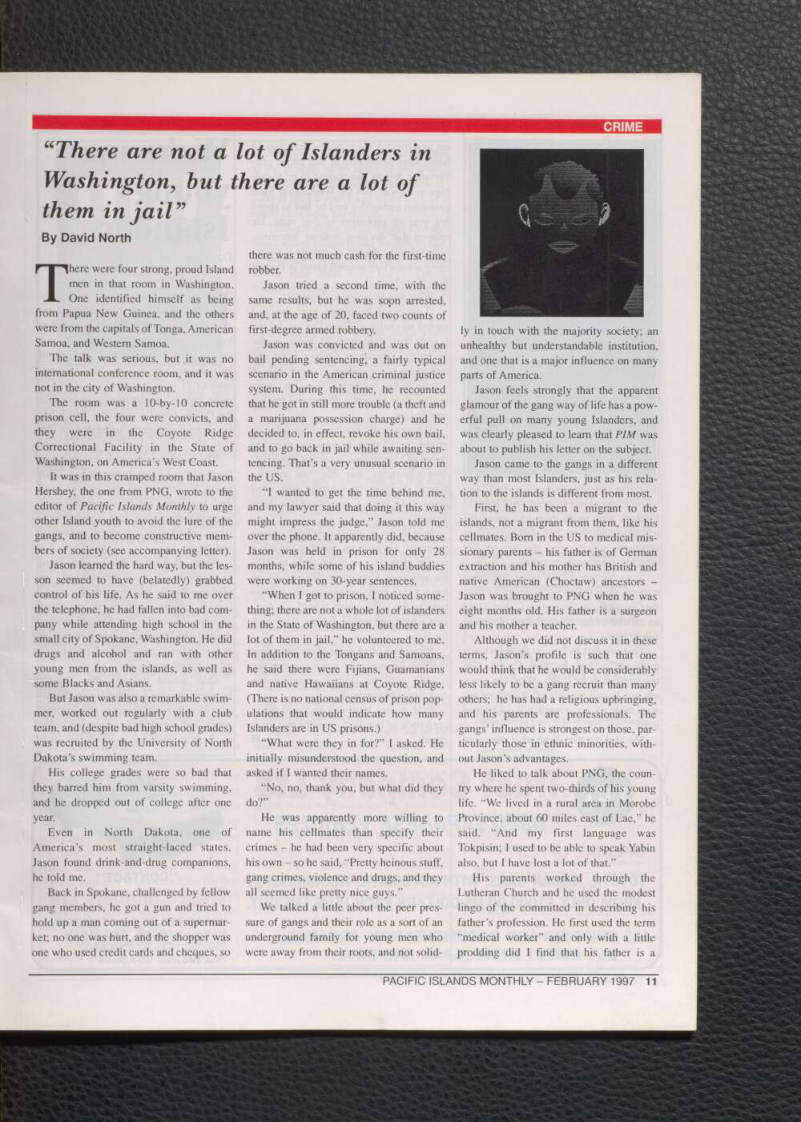
It was in this cramped room that Jason Hershey, the one from PNG, wrote to the editor of Pacific Islands Monthly to urge other Island youth to avoid the lure of the gangs, and to become constructive mem bers of society (see accompanying letter).
Jason learned the hard way, but the les son seemed to have (belatedly) grabbed control of his life. As he said to me over the telephone, he had fallen into bad com pany while attending high school in the small city of Spokane, Washington. He did drugs and alcohol and ran with other young men from the islands, as well as some Blacks and Asians.
But Jason was also a remarkable swim mer, worked out regularly with a club team, and (despite bad high school grades) was recruited by the University of North Dakota’s swimming team.
His college grades were so bad that
they barred him from varsity swimming,
and he dropped out of college after one year.
Even in North Dakota, one of America’s most straight-laced states,
Jason found drink-and-drug companions,
he told me.
Back in Spokane, challenged by fellow gang members, he got a gun and tried to hold up a man coming out of a supermar ket; no one was hurt, and the shopper was one who used credit cards and cheques, so
there was not much cash for the first-time robber.
Jason tried a second time, with the same results, but he was soon arrested, and, at the age of 20, faced two counts of first-degree armed robbery.
Jason was convicted and was Out on
bail pending sentencing, a fairly typical
scenario in the American criminal justice system. During this time, he recounted that he got in still more trouble (a theft and a marijuana possession charge) and he decided to, in effect, revoke his own bail, and to go back in jail while awaiting sen tencing. That’s a very unusual scenario in the US.
“I wanted to get the time behind me, and my lawyer said that doing it this way might impress the judge,” Jason told me over the phone. It apparently did, because Jason was held in prison for only 28 months, while some of his island buddies were working on 30-year sentences.
“When I got to prison, I noticed some thing; there are not a whole lot of islanders in the State of Washington, but there are a lot of them in jail,” he volunteered to me.
In addition to the Tongans and Samoans, he said there were Fijians, Guamanians and native Hawaiians at Coyote Ridge. (There is no national census of prison pop ulations that would indicate how many Islanders are in US prisons.) “What were they in for?” I asked. He initially misunderstood the question, and asked if I wanted their names.
“No, no, thank you, but what did they do?”
He was apparently more willing to name his cellmates than specify their crimes - he had been very specific about his own - so he said, “Pretty heinous stuff, gang crimes, violence and drugs, and they all seemed like pretty nice guys.”
We talked a little about the peer pres sure of gangs and their role as a sort of an underground family for young men who were away from their roots, and not solid-
ly in touch with the majority society; an unhealthy but understandable institution, and one that is a major influence on many parts of America.
Jason feels strongly that the apparent glamour of the gang way of life has a pow erful pull on many young Islanders, and was clearly pleased to leam that PIM was about to publish his letter on the subject.
Jason came to the gangs in a different way than most Islanders, just as his rela tion to the islands is different from most.
First, he has been a migrant to the islands, not a migrant from them, like his cellmates. Bom in the US to medical mis sionary parents - his father is of German extraction and his mother has British and native American (Choctaw) ancestors - Jason was brought to PNG when he was eight months old. His father is a surgeon and his mother a teacher.
Although we did not discuss it in these terms, Jason’s profile is such that one would think that he would be considerably less likely to be a gang recruit than many others; he has had a religious upbringing, and his parents are professionals. The gangs’ influence is strongest on those, par ticularly those in ethnic minorities, with out Jason’s advantages.
He liked to talk about PNG, the coun try where he spent two-thirds of his young life. “We lived in a rural area in Morobe Province, about 60 miles east of Lae,” he said. “And my first language was Tokpisin; I used to be able to speak Yabin also, but I have lost a lot of that.”
His parents worked through the Lutheran Church and he used the modest lingo of the committed in describing his father’s profession. He first used the term “medical worker” and only with a little prodding did I find that his father is a
physician and surgeon. Jason wants to fol low in his mother’s footsteps, and teach in PNG. “I want to go there and spend the rest of my life there,” he said in our con versation, which came the second day after his departure from prison.
It so happened that Jason had been released from prison hours before I called the Coyote Ridge Correction Centre. I told an official of his letter and my desire to talk to him.
That seemed to present some privacy problems to her, so then I said: “He reached out to us {PIM). Why don’t you ask him to call me collect? If he does not want to do so, his privacy will not be vio lated.”
She said she would see what she could
do, and she did. He called me less than 24 hours later. Jason said in that phone con versation that he had wanted to go to col lege in Hawaii, but the Washington State probation authorities said he had to spend his year of probation in that state. He relayed that decision without bitterness, although his chances of getting a swim ming scholarship seemed better in Hawaii than elsewhere.
What was he going to do next?
“I am going to college, even though I earned no credits at North Dakota; I think I will start right here at home at the
Spokane Community College.” He had
picked up some college credits while at Coyote Ridge, but he still faces four more years before he gets a degree and teacher certification.
A bureaucratic botch-up kept Jason in prison for 17 days beyond the expected length of his sentence, retaining him in jail over Christmas. But this, like the no- Hawaii decision, he accepted with good grace. “At least I got home for New Year’s.”
It will be a sober holiday, Jason promised. He gave up drinking and pot a couple of years ago, as he seeks to fulfil his ambition, a return to PNG which he has not seen since his parents brought him back to the US for high school - a deci sion which apparently did not work well for Jason.
While one often reads of serious crime in PNG, Jason said he never got into any trouble until he started attending (an American) high school.
PIM wishes him well and will try to keep track of him in the months and years ahead. ■
Wake up,
young Islanders
Dear Sir
lam writing on behalf of all Pacific Islanders who are incarcerated. I am currently finishing up a two-and-a half-year prison sentence for first-degree roberry in the American state of Washington. I am a Papua New Guinean male of 21 years of age. I would like to make known an unfortunate problem in the Pacific Island community which has not been sufficiently addressed in the past.
The problem is the high percentage of Pacific Island youth being locked up in prison for severe offences such as mur der, burglarly, robbery, assault, drug posession, drug sales, rape, domestic vio lence, unauthorised weapon posession and more.
Many of these problems stem from association with street gangs which are plaguing Pacific Island youth. The prob lem is mainly occuring in mainland nations (primarily the United States, Australia and New Zealand). However, it is also a small problem in island-based urban environments.
One would assume that Pacific Islanders, having a strong family-orient ed culture, wouldn’t need to turn to street gangs, but unfortunatly many are doing so. With street gangs come all the other
problems associated with that lifestyle.
Unfortunately, this lifestyle that many young Pacific Islanders are turning to is putting them in only two places: prison or the cemetery. That is, unless they change and reject that ignorant mentality before its too late.
I would like the readers of PIM to be informed of this problem afflicting the Island youth. I believe many parents are unaware of this problem of gangs and crime, or may be in denial.
It is an unfortunate fact that upon this matter I am a voice of experience. In 1993 I was recruited to swim for a university.
Toward the end of my first year, after becoming ineligible to swim because of poor grades, I quit school and pursued the street gang lifestyle which had been knocking at my door for some time. I became heavily involved with drugs, alcohol and crime. In late 1994 I was arrested for first-degree armed robbery. A so-called “friend” and I decided to point a gun at someone and demand their money, not because we needed it, but because it was showing that we were “hard”.
When I think back on that lifestyle that I chose, it seems hard to believe that I let my morality and priorities slip away from me so far. Although I have since grown up a lot and left that bad lifestyle behind me as well as enrolled in college again, I know that there are many other young Pacific Islanders who won’t leam the first time, or even the second or third. I was 19 years of age when I was put in prison but many are as young as 14.
I don’t know what the solution is but I do know that I would like to be a part of
it, if possible. I can’t help but feel sorrow at the thought of so many of our young Island brothers (and sisters) being ex-con victs at such a young age when a lot of it could have been prevented.
Throughout my incarceration I’ve met many young Islanders like myself. In fact, it surprised me to see so many of these young men from Fiji, Tonga, Guam, Samoa and Hawaii and all in between; the norm seemed to be that they had no direc tion, that many would return after they were released. When I think about where all these young men come from, I wonder why they would do things that would cause them to have to live in a lOft-by 10ft concrete cage with three other peo
ple.
Although I have turned my life around and left all that foolishness behind me, I know that many have not. If this article can be a wake-up call for just one young Islander, or any young man for that mat ter, than my time is not wasted.
I plan on getting a teaching degree and returning to PNG after I am released and I applaud any other Islanders who have learned from being convicted of a crime and chosen to begin a new life. At the same time I warn the young Islanders in the cities who are living the gang and crime lifestyle, that prison is a horrible experience that hurts not only them but their families as well. No matter what the sentence is, the label of “ex-convict” is like a life sentence in itself.
I feel in my situation it is my duty to bring this issue to light. I feel some good could come out of people reading this.
To the young ones who are out on the streets committing crime, running with gangs, and doing drugs, I say only this; THERE IS NO FUTURE IN THAT WAY OF LIFE! I’ve had to leam the hard way which is not the good way; The good way is the PACIFIC way.
*pa.cif.ic adj. 1. Peaceful: serene
Young Islanders need to remember where they come from and which culture is theirs. Holding on to that culture will light the way for many generations to come.
Jason Hershey
Usa
Advertisements & other items, pp. 12-13 (1 item)
Trust Company Ltd
USED JAPANESE VEHICLES
SPECIAL OFFER
TOYOTA, NISSAN CARS, WITH AUTOMATIC TRANSMISSION
FROM ONLY $lOOO.OO US DOLLARS EACH PLUS FREIGHT.
ALL SHIPPING AND DOCUMENTATION ARRANGED.
BUY DIRECT FROM JAPAN AND SAVE.
r
“CONTACT”
Trust Company Ltd
KOBAC BLD 3F 3-2-26 NISHIKI,
NAKAU NAGOYA, 460 JAPAN.
PHONE: (81) 52 953-5602
FAX (81) 52 953-5634
Remember your Friend
There are times in your life when you feel your friends have been missing out on something good. Now's your chance to do something about it and share with them one of the good things you have. Buy your friend a subscription to Pacific Islands Monthly and let him or her join you and thousands of other people worldwide who are kept informed of the latest political, social and cultural changes taking place in the Pacific.
SUBSCRIPTIONS
American Samoa US$45 Australia A 542.00 Canada US$45 Cook Islands AUSS46 Fiji F 526.40 French Polynesia US$45 Guam US$45 Hawaii US$45 Japan US$45 Kiribati AUSS46 Marshall/Micronesia US$4O Nauru AUSS42 New Caledonia US$32 New Zealand NZ$55 Niue AUSS46 Norfolk Island AUSS42 Northern Marianas/Palau US$4O Papua New Guinea AUSS4S Solomon Islands AUSS46 Tonga AUSS46 Tuvalu AUSS46 United Kingdom Stg Pound2B US Mainland US$45 Vanuatu AUSS4S Western Samoa WS$6O Elsewhere AUSS63 Payment to Pacific Islands Monthly; Subscriptions Dept QPO Box 1167, Suva, F*.
Direct airmail rates on applcation.
Telephone: 304111 Fax: 303809.
Direct airmail rates include the cost of airspeeding to alt destinations set out as above.
PACIFIC
: ISLANDS
I w 0 » ’ * l Please send my friend I Pacific Islands Monthly for one year (12 issues).
I I enclose my cheque for $., I (made payable to Pacific , Islands Monthly) or debit $ to my: □ Visacard □ Mastercard JCard No; I Expiry Date
1 NAME
I
SIGNATURE
I
. ADDRESS:
I
! CITY COUNTRY
J
mourning
Special Report
A region in
Nation unites for AmataKahua’s funeral
Text and photography by Alfred Sasako After President Amata Kabua died in a Honolulu hospital on December 20, the Republic of the Marshall Islands went into national mourning. The death of the 68-year-old president had shaken the country’s politi cal and chiefly systems to their founda tions. It was a death that has also left a vacuum in the chairmanship of the region’s premier political bloc, the South Pacific Forum.
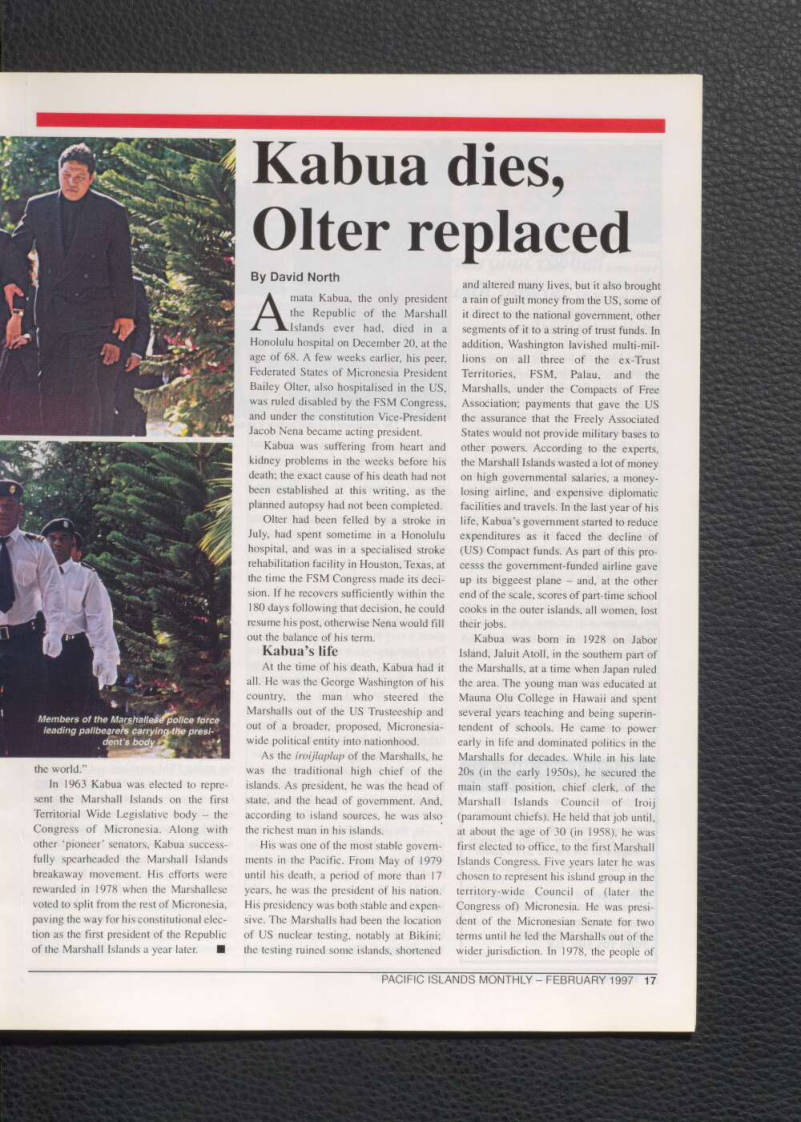
Whatever divides the 50,000 Marshallese at home, was promptly and appropriately forgotten. The nation was united, if only temporarily. The mood in the nation’s capital, Majuro, clearly showed that during the state funeral on January 6. Clad in mourning costumes, they came from all over the archipelago chiefs, clansmen, women and children - to bid farewell to their founding president
and iroijlaplap (paramount chief).
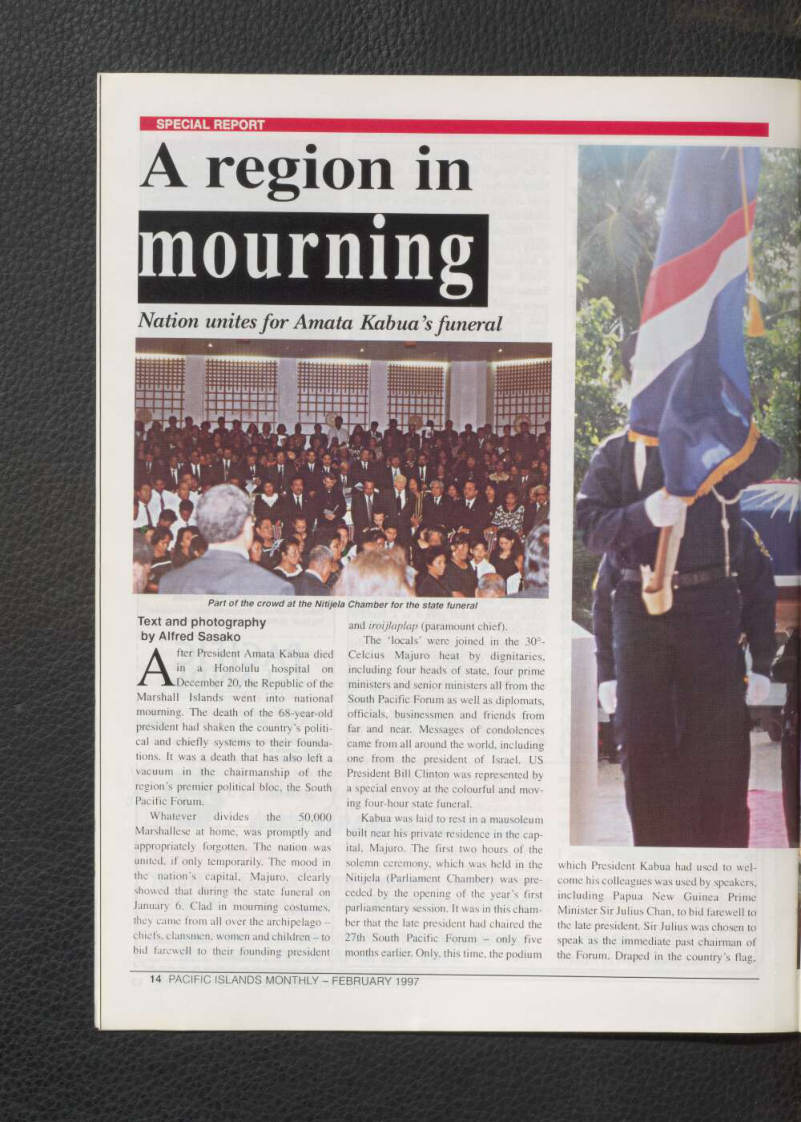
The ‘locals’ were joined in the 30°- Celcius Majuro heat by dignitaries, including four heads of state, four prime ministers and senior ministers all from the South Pacific Forum as well as diplomats, officials, businessmen and friends from far and near. Messages of condolences came from all around the world, including one from the president of Israel. US President Bill Clinton was represented by a special envoy at the colourful and mov ing four-hour state funeral.
Kabua was laid to rest in a mausoleum built near his private residence in the cap ital, Majuro. The first two hours of the solemn ceremony, which was held in the Nitijela (Parliament Chamber) was pre ceded by the opening of the year’s first parliamentary session. It was in this cham ber that the late president had chaired the 27th South Pacific Forum - only five months earlier. Only, this time, the podium
which President Kabua had used to wel come his colleagues was used by speakers, including Papua New Guinea Prime Minister Sir Julius Chan, to bid farewell to the late president. Sir Julius was chosen to speak as the immediate past chairman of the Forum. Draped in the country’s flag.
Part of the crowd at the Nitijela Chamber for the state funeral
the casket bearing Kabua’s body lay just behind the speaker’s chair surrounded by floral tributes. Hanging on the wall above was Kabua’s signed portrait. Well over 600 people packed the Nitijela Chamber about three times its seating capacity with the crowd spilling outside on either
side of the building.
Hundreds descended on the private res idence compound to watch the president’s body finally being laid to rest.
Many who spoke at the funeral were lost for words in attempting to describe
the schoolteacher-turned-politician,
lamenting that there were no words to ade quately describe the depth of his under standing, his humbleness and the role he played at home and abroad. Kabua was a “friend”, “mentor”, “statesman”, “region al leader” and a “world citizen”.
At home, he was a loving and dedicat ed husband, father and grandfather. At national level, President Kabua was a hero, a “George Washington” of the Marshall Islands - a man who led his country to independence from the United States, a man who successfully negotiated the 15-year Compact of Free Association with the United States. The agreement provides the Marshall Islands with SUSI billion as compensation for nuclear test
ing. It expires in 2001.
At an earlier funeral service held in Honolulu before his body was flown back to Majuro aboard a US Air Force jet, the
country’s foreign minister, Phillip Muller,
described his late boss as the “George Washington of Marshall Islands”.
“He was more than a leader, friend and conqueror. President Kabua was a shining beacon. His spontaneous, overpowering
awe would be missed by those who came to know him and work with him,” Muller said.
Speaking in Honolulu, US Senator Daniel Akaka, a long-time friend, said President Kabua’s death was a “tremen dous loss”. Kabua, he said, was one of the giants of the generation who helped shape not only the destiny of the Marshall Islands but those of other Pacific Island nations as well.
Education minister Christopher Loeak, who read President Kabua’s official eulo gy, bemoaned his daunting task of describ ing a man who had come to be the symbol of the Marshall Islands. “It is a daunting task for us all to attempt to mourn, in a befitting manner, the loss of someone who had become an inextricable part of our lives; someone who had become more than just a leader, more than just a coun sellor,” Loeak said. “It is a difficult task to attempt to draw out in a few words the dis tilled essence of this great man, this great visionary. He shall forever be admired for so perfectly harmonising within himself the best qualities there are to be found in a leader.
“President Kabua was our solid rock, our Gibraltar. He was the vanguard of our struggles, our experiences and our chal lenges. In moments of uncertainties, he was our true, wise and unfailing guide. In times of trouble, he was our armour. In
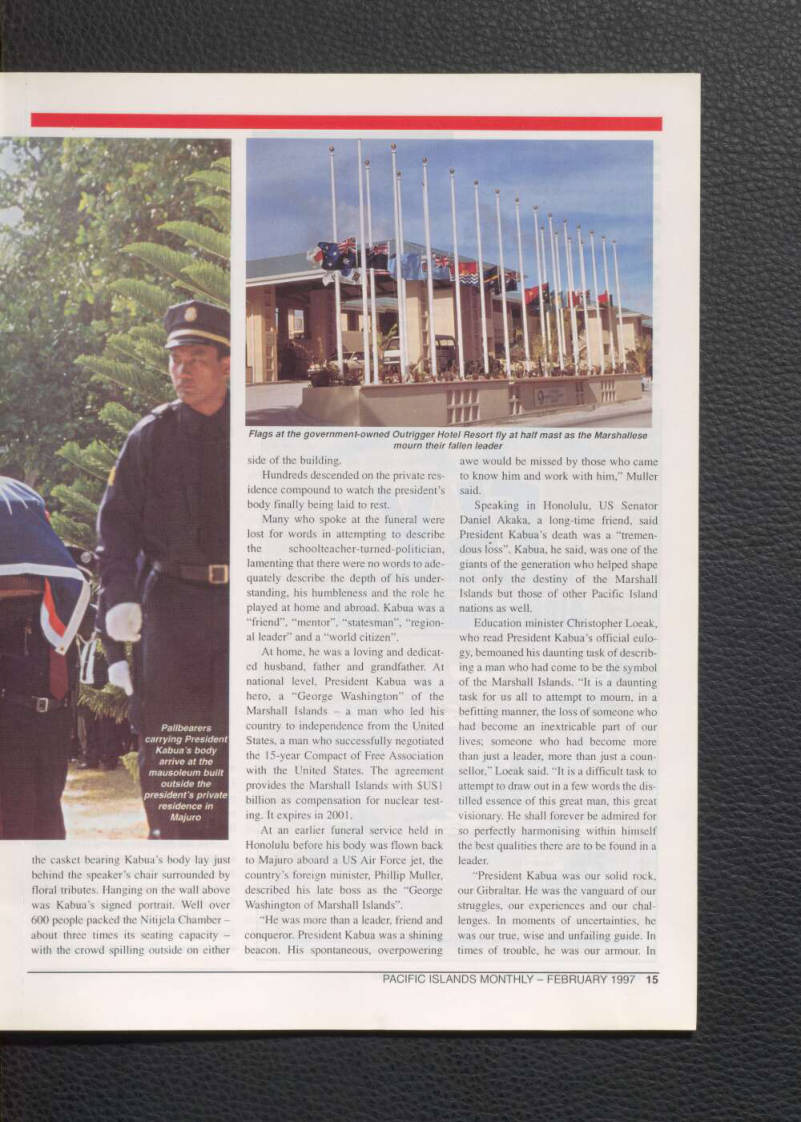
Flags at the government-owned Outrigger Hotel Resort fly at half mast as the Marshallese mourn their fallen leader
Pallbearers
carrying President
Kabua's body
arrive at the mausoleum built outside the
president's private
residence in
Majuro
times of stormy weather, he was our anchor. He was our rare and precious national treasure, dear and beloved.”
Sir Julius described Kabua as “heredi tary chief, president, father and grandfa ther of the Republic of the Marshall Islands”.
“He was a pillar of strength, vision and wisdom, both a friend and mentor,” Sir Julius said.
At regional level, Kabua was seen as a “kind and humble man who had ... brought humanity into the business of internation al politics”.
“President Kabua’s drive, the under standing of his country, people and regional commitment was fittingly dis-
played during the 27th South Pacific Forum which the late president hosted last September," he said. “It was a magnificent performance. His great command perfor-
mance, the people’s (South Pacific) Forum in Majuro in September, is potent proof that you do not have to be an eco nomic power of dehumanised size to carry the message.
“The late president showed through his countrymen how a government can run and develop a difficult and complex small island nation. The world, and more so the South Pacific, has lost a great man.”
Said Muller; “President.Kabua was the founder of regional solidarity and a states man for peace. He was truly a citizen of
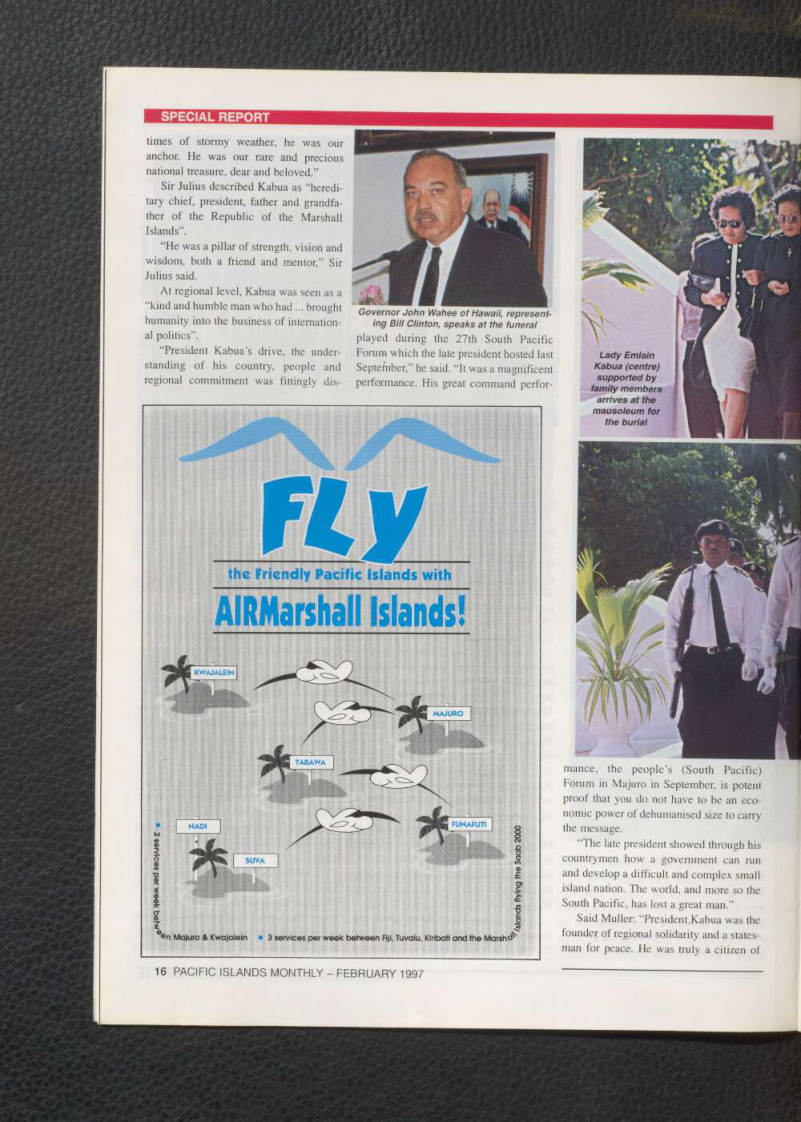
Governor John Wahee of Hawaii, represent ing Bill Clinton, speaks at the funeral
Lady Emlain Kabua (centre) supported by family members arrives at the mausoleum for the burial
the world.”
In 1963 Kabua was elected to repre sent the Marshall Islands on the first Territorial Wide Legislative body - the Congress of Micronesia. Along with other ‘pioneer’ senators, Kabua success fully spearheaded the Marshall Islands breakaway movement. His efforts were rewarded in 1978 when the Marshallese voted to split from the rest of Micronesia, paving the way for his constitutional elec tion as the first president of the Republic of the Marshall Islands a year later. ■
Members of the Marchallese police force leading pallbearers carrying the presi dent's body
Advertisements & other items, p. 16 (1 item)
AlRMarshall Islands!
2 services per week bet**
the Friendly Pacific Islands with
KWAJALEIH
MAJURO
TARAWA
FUNAFUTI
NADI
SUVA
®n Majuro & Kwajalein • 3 services per week between Rji, Tuvalu, Kiribati and the MarshO^
/stands flying the Saab 2000
Olter replaced
Kabua dies, Olter replaced
By David North
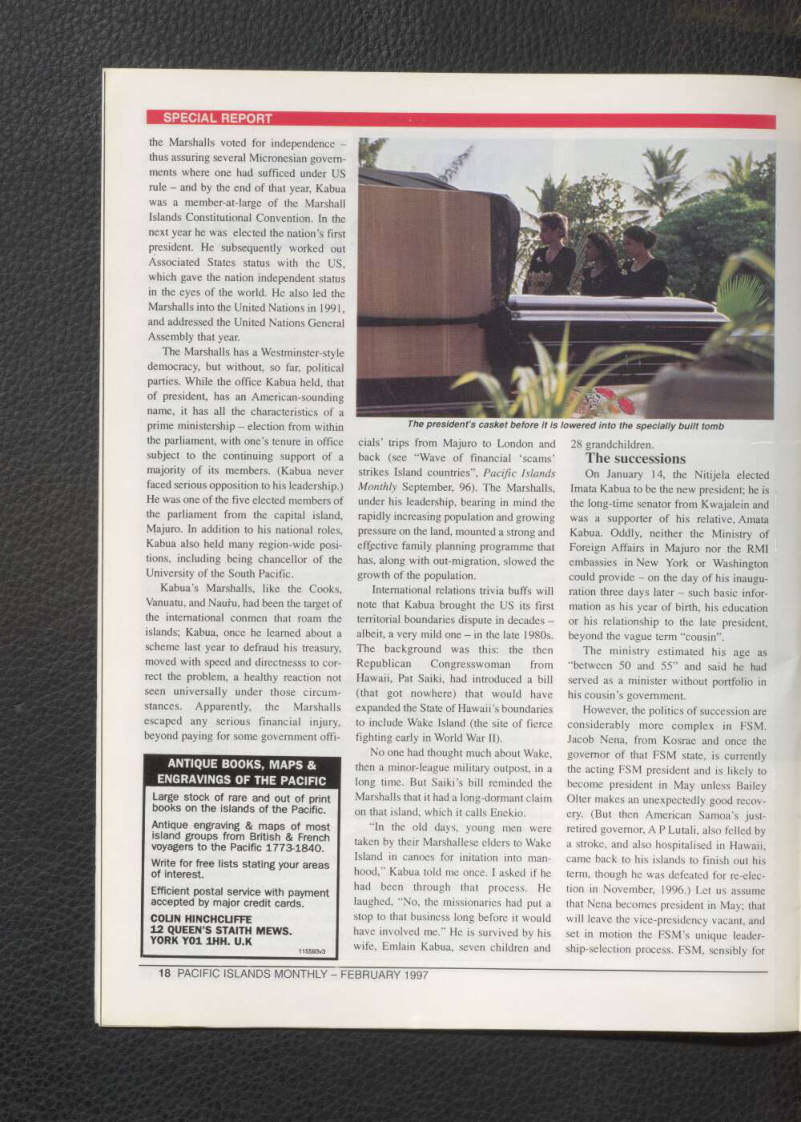
Amata Kabua, the only president the Republic of the Marshall Islands ever had, died in a Honolulu hospital on December 20, at the age of 68. A few weeks earlier, his peer, Federated States of Micronesia President Bailey Olter, also hospitalised in the US, was ruled disabled by the FSM Congress, and under the constitution Vice-President Jacob Nena became acting president.
Kabua was suffering from heart and kidney problems in the weeks before his death; the exact cause of his death had not been established at this writing, as the planned autopsy had not been completed.
Olter had been felled by a stroke in July, had spent sometime in a Honolulu hospital, and was in a specialised stroke rehabilitation facility in Houston, Texas, at the time the FSM Congress made its deci sion. If he recovers sufficiently within the 180 days following that decision, he could resume his post, otherwise Nena would fill out the balance of his term.
Kabua’s life
At the time of his death, Kabua had it all. He was the George Washington of his country, the man who steered the Marshalls out of the US Trusteeship and out of a broader, proposed, Micronesia wide political entity into nationhood.
As the iroijlaplap of the Marshalls, he was the traditional high chief of the islands. As president, he was the head of state, and the head of government. And, according to island sources, he was also the richest man in his islands.
His was one of the most stable govern ments in the Pacific. From May of 1979 until his death, a period of more than 17 years, he was the president of his nation.
His presidency was both stable and expen sive. The Marshalls had been the location of US nuclear testing, notably at Bikini; the testing ruined some islands, shortened
and altered many lives, but it also brought a rain of guilt money from the US, some of it direct to the national government, other segments of it to a string of trust funds. In addition, Washington lavished multi-mil lions on all three of the e\-Trust Territories, FSM, Palau, and the Marshalls, under the Compacts of Free Association; payments that gave the US the assurance that the Freely Associated States would not provide military bases to other powers. According to the experts, the Marshall Islands wasted a lot of money on high governmental salaries, a money losing airline, and expensive diplomatic facilities and travels. In the last year of his life, Kabua’s government started to reduce expenditures as it faced the decline of (US) Compact funds. As part of this pro cesss the government-funded airline gave up its biggeest plane - and, at the other end of the scale, scores of part-time school cooks in the outer islands, all women, lost
their jobs.
Kabua was bom in 1928 on labor Island, Jaluit Atoll, in the southern part of the Marshalls, at a time when Japan ruled the area. The young man was educated at Mauna Olu College in Hawaii and spent several years teaching and being superin tendent of schools. He came to power early in life and dominated politics in the Marshalls for decades. While in his late 20s (in the early 19505), he secured the main staff position, chief clerk, of the Marshall Islands Council of Iroij (paramount chiefs). He held that job until, at about the age of 30 (in 1958), he was first elected to office, to the first Marshall Islands Congress. Five years later he was chosen to represent his island group in the territory-wide Council of (later the Congress of) Micronesia. He was presi dent of the Micronesian Senate for two terms until he led the Marshalls out of the wider jurisdiction. In 1978, the people of
the Marshalls voted for independence thus assuring several Micronesian govern ments where one had sufficed under US rule - and by the end of that year, Kabua was a member-at-large of the Marshall Islands Constitutional Convention. In the next year he was elected the nation’s first president. He subsequently worked out Associated States status with the US, which gave the nation independent status in the eyes of the world. He also led the Marshalls into the United Nations in 1991, and addressed the United Nations General Assembly that year.
The Marshalls has a Westminster-style democracy, but without, so far, political parties. While the office Kabua held, that of president, has an American-sounding name, it has all the characteristics of a prime ministership - election from within the parliament, with one’s tenure in office subject to the continuing support of a majority of its members. (Kabua never faced serious opposition to his leadership.) He was one of the five elected members of the parliament from the capital island, Majuro. In addition to his national roles, Kabua also held many region-wide posi tions, including being chancellor of the University of the South Pacific.
Kabua’s Marshalls, like the Cooks, Vanuatu, and Nauru, had been the target of the international conmen that roam the islands; Kabua, once he learned about a scheme last year to defraud his treasury, moved with speed and directnesss to cor rect the problem, a healthy reaction not seen universally under those circum stances. Apparently, the Marshalls escaped any serious financial injury, beyond paying for some government offi-
dais’ trips from Majuro to London and back (see “Wave of financial ‘scams’ strikes Island countries”. Pacific Islands Monthly September, 96). The Marshalls, under his leadership, bearing in mind the
rapidly increasing population and growing
pressure on the land, mounted a strong and effective family planning programme that has, along with out-migration, slowed the growth of the population.
International relations trivia buffs will note that Kabua brought the US its first territorial boundaries dispute in decades albeit, a very mild one - in the late 1980 s.
The background was this: the then
Republican Congresswoman from
Hawaii, Pat Saiki, had introduced a bill (that got nowhere) that would have expanded the State of Hawaii’s boundaries to include Wake Island (the site of fierce fighting early in World War II).
No one had thought much about Wake, then a minor-league military outpost, in a long time. But Saiki’s bill reminded the Marshalls that it had a long-dormant claim on that island, which it calls Enekio.
“In the old days, young men were taken by their Marshallese elders to Wake Island in canoes for initation into man hood,” Kabua told me once. I asked if he had been through that process. He laughed, “No, the missionaries had put a stop to that business long before it would have involved me.” He is survived by his wife, Emlain Kabua, seven children and
28 grandchildren.
The successions On January 14, the Nitijela elected Imata Kabua to be the new president; he is the long-time senator from Kwajalein and was a supporter of his relative, Amata Kabua. Oddly, neither the Ministry of Foreign Affairs in Majuro nor the RMI embassies in New York or Washington could provide - on the day of his inaugu ration three days later - such basic infor mation as his year of birth, his education or his relationship to the late president, beyond the vague term “cousin”.
The ministry estimated his age as “between 50 and 55” and said he had served as a minister without portfolio in his cousin’s government.
However, the politics of succession are considerably more complex in FSM.
Jacob Nena, from Kosrae and once the governor of that FSM state, is currently the acting FSM president and is likely to become president in May unless Bailey Olter makes an unexpectedly good recov ery. (But then American Samoa’s Just retired governor, A P Lutali, also felled by a stroke, and also hospitalised in Hawaii, came back to his islands to finish out his term, though he was defeated for re-elec tion in November, 1996.) Let us assume that Nena becomes president in May; that will leave the vice-presidency vacant, and set in motion the FSM’s unique leader ship-selection process. FSM, sensibly for
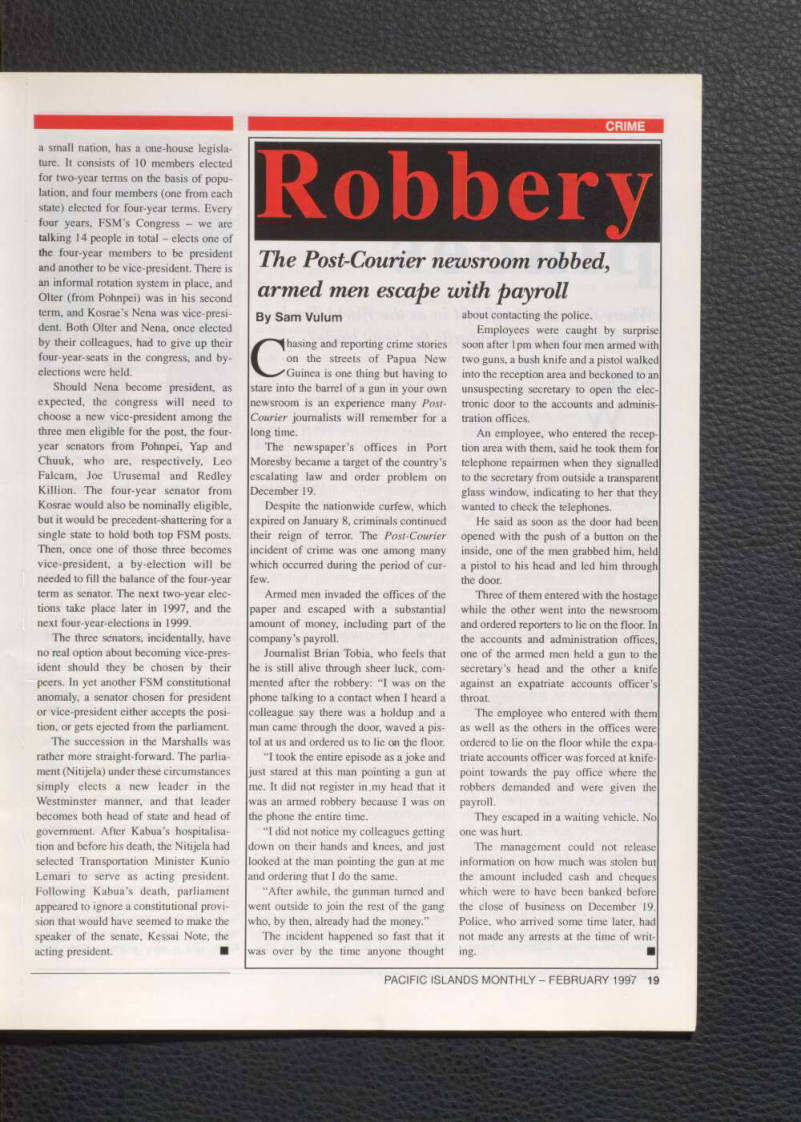
The president's casket before it is lowered into the specially built tomb
a small nation, has a one-house legisla ture. It consists of 10 members elected for two-year terms on the basis of popu lation, and four members (one from each state) elected for four-year terms. Every four years, FSM’s Congress we are talking 14 people in total - elects one of the four-year members to be president and another to be vice-president. There is an informal rotation system in place, and Olter (from Pohnpei) was in his second term, and Kosrae’s Nena was vice-presi dent. Both Olter and Nena, once elected by their colleagues, had to give up their four-year-seats in the congress, and by elections were held.
Should Nena become president, as expected, the congress will need to choose a new vice-president among the three men eligible for the post, the four year senators from Pohnpei, Yap and Chuuk, who are, respectively, Leo Falcam, Joe Urusemal and Redley Killion. The four-year senator from Kosrae would also be nominally eligible, but it would be precedent-shattering for a single state to hold both top FSM posts.
Then, once one of those three becomes vice-president, a by-election will be needed to fill the balance of the four-year term as senator. The next two-year elec tions take place later in 1997, and the next four-year-elections in 1999.
The three senators, incidentally, have no real option about becoming vice-pres ident should they be chosen by their peers. In yet another FSM constitutional anomaly, a senator chosen for president or vice-president either accepts the posi tion, or gets ejected from the parliament.
The succession in the Marshalls was rather more straight-forward. The parlia ment (Nitijela) under these circumstances simply elects a new leader in the Westminster manner, and that leader becomes both head of state and head of government. After Kabua’s hospitalisa tion and before his death, the Nitijela had selected Transportation Minister Kunio Lemari to serve as acting president.
Following Kabua’s death, parliament
appeared to ignore a constitutional provi
sion that would have seemed to make the speaker of the senate, Kessai Note, the acting president. ■
Advertisements & other items, p. 18 (1 item)
Antique Books, Maps &
ENGRAVINGS OF THE PACIFIC
Large stock of rare and out of print books on the islands of the Pacific.
Antique engraving & maps of most island groups from British & French voyagers to the Pacific 1773-1840.
Write for free lists stating your areas of interest.
Efficient postal service with payment accepted by major credit cards.
COUN HINCHCUFFE
12 QUEEN’S STAITH MEWS.
YORK YOIIHH. U.K
115593v3
Robbery
The Post-Courier newsroom robbed, armed men escape with payroll
By Sam Vulum
Chasing and reporting crime stories on the streets of Papua New Guinea is one thing but having to stare into the barrel of a gun in your own newsroom is an experience many Post \Courier journalists will remember for a long time.
The newspaper’s offices in Port Moresby became a target of the country’s escalating law and order problem on December 19.
Despite the nationwide curfew, which expired on January 8, criminals continued their reign of terror. The Post-Courier incident of crime was one among many which occurred during the period of cur few.
Armed men invaded the offices of the paper and escaped with a substantial amount of money, including part of the company’s payroll.
Journalist Brian Tobia, who feels that he is still alive through sheer luck, com mented after the robbery; “I was on the phone talking to a contact when I heard a colleague say there was a holdup and a man came through the door, waved a pis tol at us and ordered us to lie on the floor.
“I took the entire episode as a joke and just stared at this man pointing a gun at me. It did not register in.my head that it was an armed robbery because I was on the phone the entire time.
“I did not notice my colleagues getting down on their hands and knees, and just looked at the man pointing the gun at me and ordering that I do the same.
“After awhile, the gunman turned and went outside to join the rest of the gang who, by then, already had the money.”
The incident happened so fast that it was over by the time anyone thought
about contacting the police.
Employees were caught by surprise
soon after 1 pm when four men armed with two guns, a bush knife and a pistol walked into the reception area and beckoned to an unsuspecting secretary to open the elec tronic door to the accounts and adminis tration offices.
An employee, who entered the recep tion area with them, said he took them for telephone repairmen when they signalled to the secretary from outside a transparent glass window, indicating to her that they wanted to check the telephones.
He said as soon as the door had been opened with the push of a button on the inside, one of the men grabbed him, held a pistol to his head and led him through the door.
Three of them entered with the hostage while the other went into the newsroom and ordered reporters to lie on the floor. In the accounts and administration offices, one of the armed men held a gun to the secretary’s head and the other a knife against an expatriate accounts officer’s throat.
The employee who entered with them as well as the others in the offices were ordered to lie on the floor while the expa triate accounts officer was forced at knife point towards the pay office where the robbers demanded and were given the
payroll.
They escaped in a waiting vehicle. No one was hurt.
The management could not release information on how much was stolen but the amount included cash and cheques which were to have been banked before the close of business on December 19.
Police, who arrived some time later, had not made any arrests at the time of writ
ing. ■
Trading
Economy
Trading places
Where does the Pacific fit in as the World Trade Organisation sets standards for free’ trade?
By Kalinga Seneviratne in Singapore
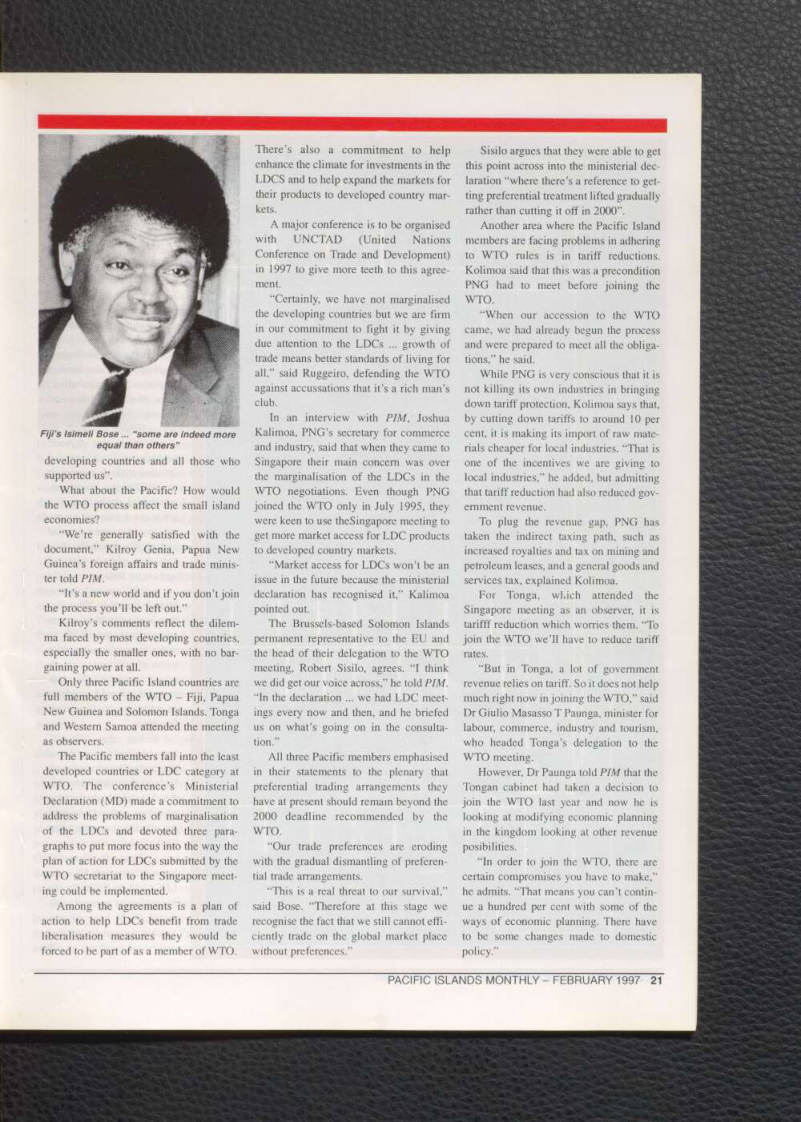
£ T" e are a f° rum such as this that we are T V all equal and we have a level playing field. However, when I con sider my inability to influence opinion, to mobilise razor-sharp executives who lobby convincingly on our behalf, to stage-manage events as they unfold, and my lack of authority to influence the debate, then I realise that there is no level playing field in trade, and some are indeed more equal than others,” said Isimeli Bose, Fiji’s minister for trade, industry and commerce, in his statement made to the plenary session of the Inaugural World Trade Organisation (WTO) Ministerial meeting in Singapore in December.
The Fijian minister articulated very clearly the feelings of a large number of developing countries represented here, who said in one way or another the same
thing.
That is, the WTO negotiation process is dominated by a handful of powerful rich countries known as the “Quads” the United States, Japan, the European Community and Canada - with the rest just making up the numbers to give legit imacy to whatever deal they come up with at the end.
Except for the first plenary session when Singapore Prime Minister Goh Chok Tong, Secretary-General of the WTO Renato Ruggeiro and most of the leading industrialised countries’ trade ministers spoke - speakers during the other sessions were addressing mainly
empty chairs.
Most delegates were busy elsewhere attending closed door meetings within the vast Singapore Convention Centre.
The developing countries of the south
came to the Singapore meeting looking
forward to a review of the implementa tion process of the Uruguay Round’s trade agreements made in Marrakesh two years ago. After five days of “negotia tions” they went away without such a review, but with more agreements to ply open their markets for developed country products - especially in Information Technology - and studies to look at labour standards, procurement and investment policies.
Most developing countries wanted a review of the implementation of WTO rules because many of them have faced domestic opposition when legislation was changed to fall in line with the Marrakesh agreements. Yet many others felt that the rich countries of the north were not keep ing their side of the bargain and were using measures outside the WTO agree ments, such as anti-dumping rules, to keep out cheaper imports from the south.
Developing countries were also opposed to the new issues of labour stan dards, procurements and investments coming within the WTO ambit because it could lead to the north using any such agreements to infringe on national
sovereignty.
All negotiations in WTO are made in secret, unlike other United Nations-spon sored global conferences, no journalists are allowed access to any of the meet ings, thus they had no idea about what
was discussed, debated or disagreed on.
The only sources of information were the press briefings by WTO officials and some ministers or through ‘off-the
record’ information given by delegation
heads to journalists.
“The problem with transparency and democracy here is that, even within the official process, that does not exist. You have a process they say operates via con sensus, but it’s mainly a consensus via ‘Quad’ countries,” Dr Walden Bello, co director of the Bangkok-based Focus On Global South research centre, told Pacific
Islands Monthly.
Dr Bello was one of many developing country representatives - both from non governmental organisations (NGO) and governmental delegations - attending the WTO meeting, who felt that the world’s premier body which aims to promote free trade worldwide would need to learn
something about democracy first.
Though the WTO has 127 member nations, it was clear to most of the partic ipants in Singapore that it was the “Quad” countries which set the agenda.
“The ‘Quad’ countries basically deter mine which issues are important and come to the floor, and which issues do not come to the floor,” explained Dr Bello.
Since WTO was set up nearly two years ago as a successor to GATT (General Agreement on Trade and Tariffs) the Singapore gathering was the first time that trade ministers of all the 127 member states met.
While GATT was basically a set of rules with no institutional foundation, the agreements WTO comes up with are legally binding on all member nations.
Compared with GATT - which dealt with only trade in merchandise goods - WTO covers trade in services and trade-related aspects of intellectual property rights. If the "Quads” have their way, very soon it could involve labour standards, invest ment policies and government tender pro cedures.
But, at the end of the Singapore con
ference, everyone, including the develop
ing countries, was giving a positive spin to the final outcome. Pakistan’s com merce minister, Muhammad Zubair Khan, said it was “a great victory for
developing countries and all those who supported us”.
What about the Pacific? How would the WTO process affect the small island economies?
“We’re generally satisfied with the document,” Kilroy Genia, Papua New Guinea’s foreign affairs and trade minis ter told PIM.
“It’s a new world and if you don’t join the process you’ll be left out.”
Kilroy’s comments reflect the dilem ma faced by most developing countries, especially the smaller ones, with no bar gaining power at all.
Only three Pacific Island countries are full members of the WTO - Fiji, Papua New Guinea and Solomon Islands. Tonga and Western Samoa attended the meeting as observers.
The Pacific members fall into the least developed countries or LDC category at WTO. The conference’s Ministerial Declaration (MD) made a commitment to address the problems of marginalisation of the LDCs and devoted three para graphs to put more focus into the way the plan of action for LDCs submitted by the WTO secretariat to the Singapore meet ing could be implemented.
Among the agreements is a plan of action to help LDCs benefit from trade liberalisation measures they would be forced to be part of as a member of WTO.
There’s also a commitment to help enhance the climate for investments in the LDCS and to help expand the markets for their products to developed country mar kets.
A major conference is to be organised with UNCTAD (United Nations Conference on Trade and Development) in 1997 to give more teeth to this agree ment.
“Certainly, we have not marginalised the developing countries but we are firm in our commitment to fight it by giving due attention to the LDCs ... growth of trade means better standards of living for all,” said Ruggeiro, defending the WTO against accussations that it’s a rich man’s club.
In an interview with PIM, Joshua Kalimoa, PNG’s secretary for commerce and industry, said that when they came to Singapore their main concern was over the marginalisation of the LDCs in the WTO negotiations. Even though PNG joined the WTO only in July 1995, they were keen to use the Singapore meeting to get more market access for LDC products to developed country markets.
“Market access for LDCs won’t be an issue in the future because the ministerial declaration has recognised it,” Kalimoa pointed out.
The Brussels-based Solomon Islands permanent representative to the EU and the head of their delegation to the WTO meeting, Robert Sisilo, agrees. “I think we did get our voice across,” he told PIM.
“In the declaration ... we had LDC meet ings every now and then, and he briefed us on what’s going on in the consulta tion.”
All three Pacific members emphasised in their statements to the plenary that
preferential trading arrangements they
have at present should remain beyond the 2000 deadline recommended by the
Wto.
“Our trade preferences are eroding with the gradual dismantling of preferen tial trade arrangements.
“This is a real threat to our survival,” said Bose. “Therefore at this stage we recognise the fact that we still cannot effi ciently trade on the global market place without preferences.”
Sisilo argues that they were able to get this point across into the ministerial dec laration “where there’s a reference to get
ting preferential treatment lifted gradually
rather than cutting it off in 2000”.
Another area where the Pacific Island members are facing problems in adhering to WTO rules is in tariff reductions.
Kolimoa said that this was a precondition PNG had to meet before joining the
Wto.
“When our accession to the WTO came, we had already begun the process and were prepared to meet all the obliga tions,” he said.
While PNG is very conscious that it is not killing its own industries in bringing down tariff protection, Kolimoa says that, by cutting down tariffs to around 10 per cent, it is making its import of raw mate rials cheaper for local industries. “That is one of the incentives we are giving to local industries,” he added, but admitting that tariff reduction had also reduced gov ernment revenue.
To plug the revenue gap, PNG has taken the indirect taxing path, such as increased royalties and tax on mining and petroleum leases, and a general goods and services tax, explained Kolimoa.
For Tonga, which attended the Singapore meeting as an observer, it is tarifff reduction which worries them. “To join the WTO we’ll have to reduce tariff rates.
“But in Tonga, a lot of government revenue relies on tariff. So it does not help much right now in joining the WTO,” said Dr Giulio Masasso T Paunga, minister for labour, commerce, industry and tourism, who headed Tonga’s delegation to the
WTO meeting.
However, Dr Paunga told PIM that the Tongan cabinet had taken a decision to join the WTO last year and now he is
looking at modifying economic planning
in the kingdom looking at other revenue posibilities.
“In order to join the WTO, there are certain compromises you have to make,” he admits. “That means you can’t contin ue a hundred per cent with some of the ways of economic planning. There have to be some changes made to domestic policy.”
Fiji's Isimeli Bose ... “some are indeed more equal than others"
Dr Paunga believes that since most of Tonga’s trading partners in the
region are already members
of the WTO or are planning to join, if you don’t make concessions to the WTO, you could be left out of international trading net works and this could affect Tonga’s trade prospects. As telecommunications and
information technology
have become part of the WTO process, with Tonga’s involvement in the satellite business, “it’s important to be a part of the decision making”, he added.
While it was no secret that the “Quad” countries still dominate the decision-making process at the WTO, the Singapore ministerial declaration has left room for almost every one to claim some form of victory. The South Pacific’s case was perhaps summed up best by Sisilo.
“We gained some thing,” he said. “The fact that having market access and getting the WTO to make some commitment in terms of assisting us in our own domestic develop ments that would enable us to meet the challenges of free trade.”
Yet the “Quads” have blocked any review of the implementation of simi lar commitments made in the Marrakesh declaration two years ago, which many developing countries say have not been met.
Thus, the sceptics are entitled to ask: Have the LDCs and the South Pacific in particular gained any thing? We’ll have to wait another two years to find out. ■
Pacific spies
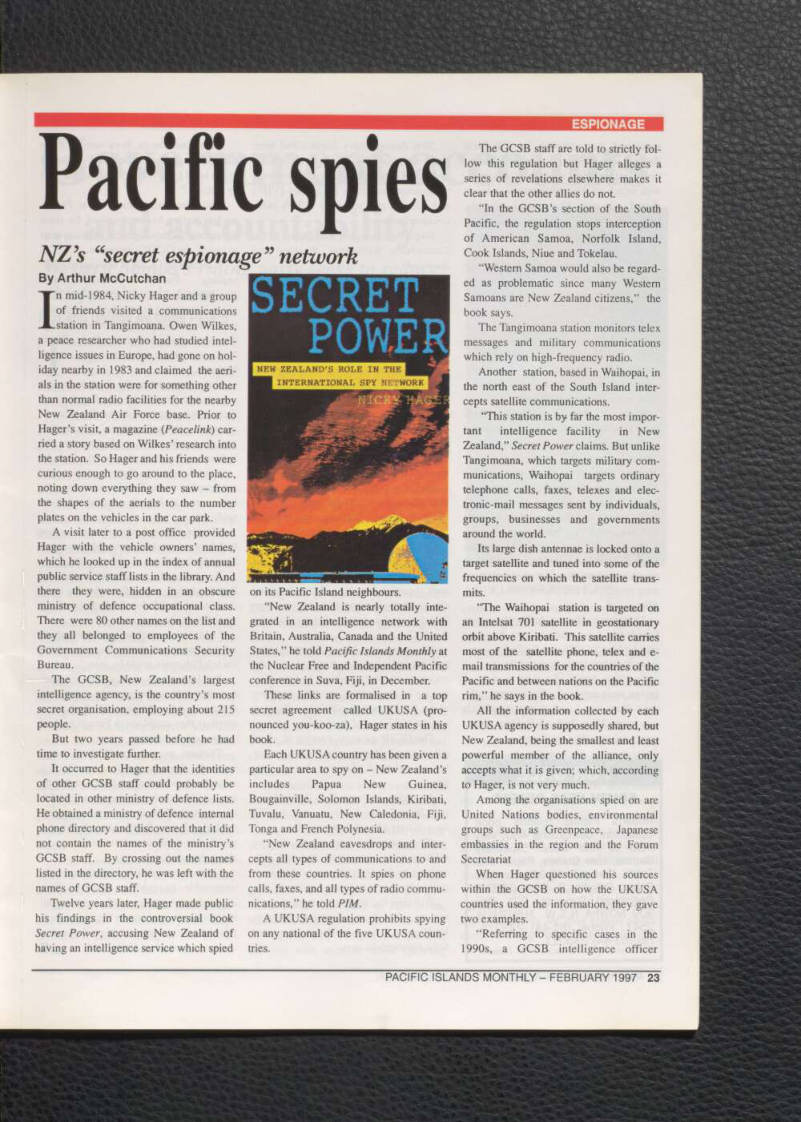
Espionage
NX’s “secret espionage” network
By Arthur McCutchan
In mid-1984, Nicky Hager and a group of friends visited a communications station in Tangimoana. Owen Wilkes, a peace researcher who had studied intel ligence issues in Europe, had gone on hol iday nearby in 1983 and claimed the aeri als in the station were for something other than normal radio facilities for the nearby New Zealand Air Force base. Prior to Hager’s visit, a magazine (Peace link ) car ried a story based on Wilkes’ research into the station. So Hager and his friends were curious enough to go around to the place, noting down everything they saw - from the shapes of the aerials to the number plates on the vehicles in the car park.
A visit later to a post office provided Hager with the vehicle owners’ names, which he looked up in the index of annual public service staff lists in the library. And there they were, hidden in an obscure ministry of defence occupational class.
There were 80 other names on the list and they all belonged to employees of the Government Communications Security Bureau.
The GCSB, New Zealand’s largest intelligence agency, is the country’s most secret organisation, employing about 215
people.
But two years passed before he had time to investigate further.
It occurred to Hager that the identities of other GCSB staff could probably be located in other ministry of defence lists.
He obtained a ministry of defence internal phone directory and discovered that it did not contain the names of the ministry’s GCSB staff. By crossing out the names listed in the directory, he was left with the names of GCSB staff.
Twelve years later, Hager made public his findings in the controversial book Secret Power , accusing New Zealand of having an intelligence service which spied
on its Pacific Island neighbours.
“New Zealand is nearly totally inte grated in an intelligence network with Britain, Australia, Canada and the United States,” he told Pacific Islands Monthly at the Nuclear Free and Independent Pacific conference in Suva, Fiji, in December.
These links are formalised in a top secret agreement called UKUSA (pro nounced you-koo-za), Hager states in his book.
Each UKUSA country has been given a particular area to spy on - New Zealand’s includes Papua New Guinea, Bougainville, Solomon Islands, Kiribati, Tuvalu, Vanuatu, New Caledonia, Fiji,
Tonga and French Polynesia.
“New Zealand eavesdrops and inter cepts all types of communications to and from these countries. It spies on phone calls, faxes, and all types of radio commu nications,” he told PIM.
A UKUSA regulation prohibits spying
on any national of the five UKUSA coun tries.
The GCSB staff are told to strictly fol low this regulation but Hager alleges a series of revelations elsewhere makes it clear that the other allies do not.
“In the GCSB’s section of the South Pacific, the regulation stops interception of American Samoa, Norfolk Island, Cook Islands, Niue and Tokelau.
“Western Samoa would also be regard ed as problematic since many Western Samoans are New Zealand citizens,” the book says.
The Tangimoana station monitors telex messages and military communications which rely on high-frequency radio.
Another station, based in Waihopai, in the north east of the South Island inter cepts satellite communications.
“This station is by far the most impor tant intelligence facility in New Zealand,” Secret Power claims. But unlike Tangimoana, which targets military com
munications, Waihopai targets ordinary
telephone calls, faxes, telexes and elec tronic-mail messages sent by individuals, groups, businesses and governments around the world.
Its large dish antennae is locked onto a target satellite and tuned into some of the frequencies on which the satellite trans mits.
“The Waihopai station is targeted on an Intelsat 701 satellite in geostationary orbit above Kiribati. This satellite carries most of the satellite phone, telex and e mail transmissions for the countries of the Pacific and between nations on the Pacific rim,” he says in the book.
All the information collected by each UKUSA agency is supposedly shared, but New Zealand, being the smallest and least powerful member of the alliance, only accepts what it is given; which, according to Hager, is not very much.
Among the organisations spied on are United Nations bodies, environmental groups such as Greenpeace, Japanese embassies in the region and the Forum Secretariat When Hager questioned his sources within the GCSB on how the UKUSA countries used the information, they gave
two examples.
“Referring to specific cases in the 19905, a GCSB intelligence officer
explained that although he felt New Zealand was definitely ‘monitoring situa tions’ rather than meddling, Australia, with which all the intelligence was being shared, was quite likely to be using the information gained from Vanuatu commu nications to interfere and ‘throw its weight around’,” the book said.
The second example was from the mid-1980s when Kiribati was negotiating a fishing agreement with the then Soviet Union.
This was one of the few ways the small state could attain some economic indepen dence, but US fishing boats had been refusing to recognise its five-million square-kilometre exclusive economic zone and were fishing illegally.
“Proposals that the agreement include shore facilities for Soviet fishing boats led to alarmist publicity in Australia and New Zealand about the implications of a ‘Russian base’ in the South Pacific. This was despite the fact that large numbers of Soviet fishing boats used New Zealand ports, where the business they brought was welcomed,” the book states.
Tangimoana was directed to monitor Kiribati intensively and huge quantities of communications relating to the agreement were intercepted and shared with UKUSA allies.
Diplomatic efforts, aided by this secret knowledge, were made to stop the plans and, by March, 1985, the Kiribati govern ment had completely dropped the idea.
In 1994, details of a third method of spying were revealed, after an army offi cer’s diary was found - that the GCSB was using New Zealand Defence Force personnel to collect intelligence.
New Zealand navy frigates had been fitted with classified equipment because they could patrol close enough to intercept
short-range Very High Frequency (VHF)
and Ultra High Frequency (UHF) radio communications.
Hager has identified the frigates as the
Canterbury, Wellington, Waikato and
Southland.
“Whenever any of these ships are in port, you can be sure that they are moni toring communications on shore.
“Their crew could be enjoying a cock tail on land with government officials while back on the ship, others would be listening to mobile phones and police communications,” he told PIM.
When questioned on Hager’s allega tions, Vince Mcßride, deputy head of mis sion at the New Zealand Embassy in Suva said New Zealand’s official policy was not to comment on any intelligence mat ters.
But Hager, in his book, challenges the need for secrecy and the need for New Zealand, whose efforts he sees as rather ineffectual, to remain in the 50-year-old UKUSA alliance.
“The alliance is more like a Hells Angels gang on a quiet Monday night, with countries like New Zealand having almost no say in who will be beaten up on Friday night “... but it still goes along for the ride”.
Hager describes how NZ’s intelligence and security services fumbled on two major events which perhaps had the most impact on the Pacific - the 1985 bombing of the Greenpeace ship Rainbow Warrior, and the 1987 coup d’etat in Fiji.
The GCSB gave no warning at all of either event, Hager says, claiming they had no inkling of what was about to hap pen.
According to Hager, New Zealand sent two Special Air Services men to Fiji immediately after the coup in May.
“Soon after they went ashore, the two soldiers were recognised and one was arrested by Fijian soldiers who had been trained by the New Zealand military.”
With Fiji the centre of attention in the region, the New Zealand Security Intelligence Service decided it too wanted to be involved, he says.
“The situation in Suva was so tense that he (the SIS agent sent to Fiji) stayed in his hotel for a few days, achieving next
to nothing.”
Collecting information about French nuclear testing has been one of the main arguments NZ intelligence officials used to justify the GCSB’s existence.
A section of GCSB is devoted to inter cepting French communications.
Beginning in 1983, all the French mes sages intercepted by the Tangimoana sta tion were analysed, in particular the long distance radio links between Paris, Tahiti, Noumea and the nuclear testing site at Mururoa.
Hager says when the French section was started, “they did a lot of analysis of French police and military radio commu nications in New Caledonia”. During this period, tension was high between the indigenous Kanak people and the French.
“Needless to say, the information was not supplied to the Kanaks, who are seek ing an end to French colonial rule,” he said.
Most of the work of the French section had focused on testing on Mururoa and Fangataufa atolls.
By monitoring the movement of French aircraft to and from the test sites, they would be able to tell when something was about to happen.
“Also, as a nuclear test approached, tell-tale patterns in the messages sent from French Polynesia could be seen.”
But Hager says most of the informa tion they collected went to the Americans and the British, who wanted to find out as much as they could about French nuclear
weapons development.
Thirteen years after Wilkes’ initial research, the issue has developed into a major book, with the possibility of putting a new twist in relations between UKUSA countries, the UN, France, and more par ticularly, South Pacific Island nations, which have remained relatively quiet about the whole issue.
“I am aware that it is diplomatically impossible to publicly criticise New Zealand and Australia, but 1 am hoping all independent countries in the region will privately put pressure on New Zealand to change its policies,” Hager said. ■
Advertisements & other items, p. 24 (2 items)
Espionage
For Sale
SOUTH SEAS PEARLS
Roberts Pacific Islands book collection. Comprising 430, very hard to find titles. Especially Samoa, New Guinea, Papua and Tahiti. Asking $A13,000. Contact Robert Prikulis, B. Surv. (UNSW) Registered Surveyor. P.O. Box
309 NOWRA N.S.W. AUSTRALIA
2541. Phone: (61-44) 233375, Fax (6144) 233011.
Government accounts
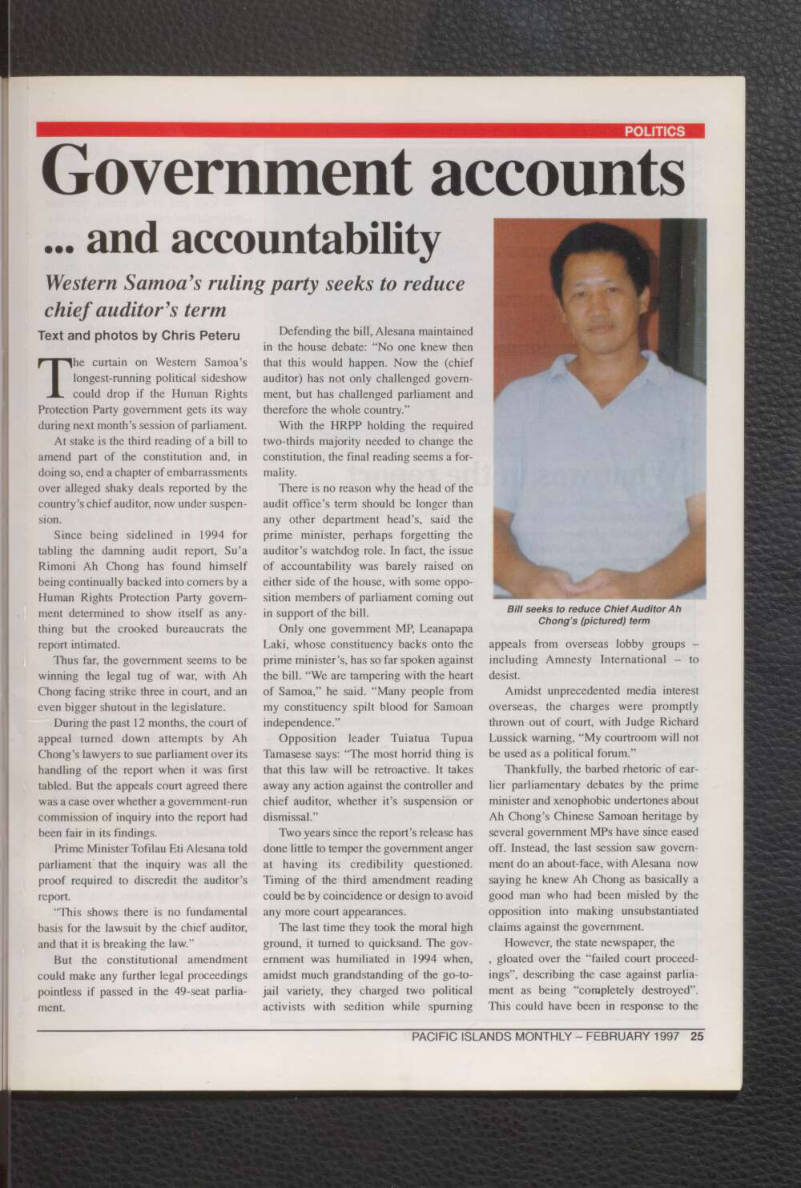
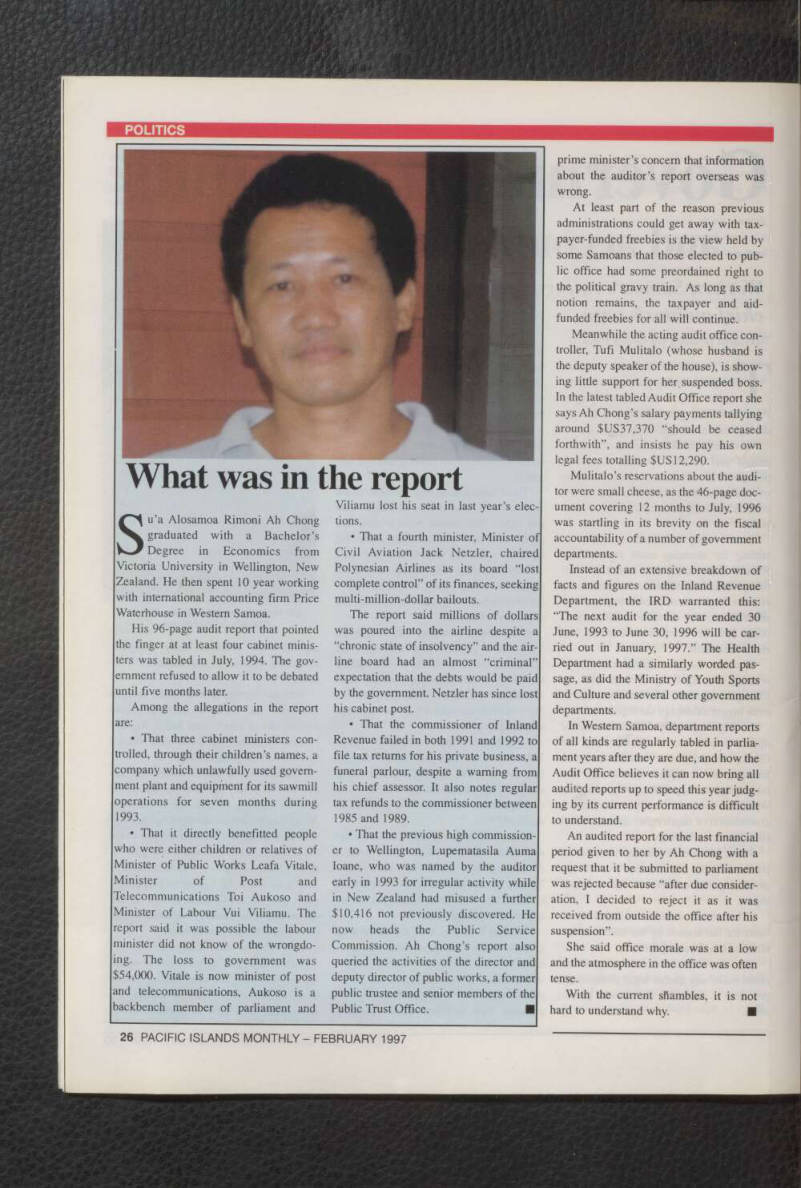
Politics
... and accountability
Western Samoa’s ruling party seeks to reduce chief auditor’s term
Text and photos by Chris Peteru The curtain on Western Samoa’s longest-running political sideshow could drop if the Human Rights Protection Party government gets its way during next month’s session of parliament.
At stake is the third reading of a bill to amend part of the constitution and, in doing so, end a chapter of embarrassments over alleged shaky deals reported by the country’s chief auditor, now under suspen sion.
Since being sidelined in 1994 for tabling the damning audit report, Su’a Rimoni Ah Chong has found himself being continually backed into comers by a Human Rights Protection Party govern ment determined to show itself as any thing but the crooked bureaucrats the report intimated.
Thus far, the government seems to be winning the legal tug of war, with Ah Chong facing strike three in court, and an even bigger shutout in the legislature.
During the past 12 months, the court of appeal turned down attempts by Ah Chong’s lawyers to sue parliament over its handling of the report when it was first tabled. But the appeals court agreed there was a case over whether a government-run commission of inquiry into the report had been fair in its findings.
Prime Minister Tofilau Eti Alesana told parliament that the inquiry was all the proof required to discredit the auditor’s report.
“This shows there is no fundamental basis for the lawsuit by the chief auditor, and that it is breaking the law.”
But the constitutional amendment could make any further legal proceedings pointless if passed in the 49-seat parlia ment.
Defending the bill, Alesana maintained in the house debate: “No one knew then that this would happen. Now the (chief auditor) has not only challenged govern ment, but has challenged parliament and therefore the whole country.”
With the HRPP holding the required two-thirds majority needed to change the constitution, the final reading seems a for mality.
There is no reason why the head of the audit office’s term should be longer than any other department head’s, said the prime minister, perhaps forgetting the auditor’s watchdog role. In fact, the issue of accountability was barely raised on either side of the house, with some oppo sition members of parliament coming out in support of the bill.
Only one government MP, Leanapapa Laki, whose constituency backs onto the prime minister’s, has so far spoken against the bill. “We are tampering with the heart of Samoa,” he said. “Many people from my constituency spilt blood for Samoan
independence.”
Opposition leader Tuiatua Tupua Tamasese says: “The most horrid thing is that this law will be retroactive. It takes away any action against the controller and chief auditor, whether it’s suspension or dismissal.”
Two years since the report’s release has done little to temper the government anger at having its credibility questioned.
Timing of the third amendment reading could be by coincidence or design to avoid any more court appearances.
The last time they took the moral high ground, it turned to quicksand. The gov ernment was humiliated in 1994 when, amidst much grandstanding of the go-to
jail variety, they charged two political
activists with sedition while spuming
appeals from overseas lobby groups including Amnesty International - to desist.
Amidst unprecedented media interest overseas, the charges were promptly thrown out of court, with Judge Richard Lussick warning, “My courtroom will not be used as a political forum.”
Thankfully, the barbed rhetoric of ear lier parliamentary debates by the prime minister and xenophobic undertones about Ah Chong’s Chinese Samoan heritage by several government MPs have since eased off. Instead, the last session saw govern ment do an about-face, with Alesana now saying he knew Ah Chong as basically a good man who had been misled by the opposition into making unsubstantiated claims against the government.
However, the state newspaper, the , gloated over the “failed court proceed ings”, describing the case against parlia ment as being “completely destroyed”.
This could have been in response to the
Bill seeks to reduce Chief Auditor Ah Chong’s (pictured) term
prime minister’s concern that information about the auditor’s report overseas was wrong.
At least part of the reason previous administrations could get away with tax payer-funded freebies is the view held by some Samoans that those elected to pub lic office had some preordained right to the political gravy train. As long as that notion remains, the taxpayer and aid funded freebies for all will continue.
Meanwhile the acting audit office con troller, Tufi Mulitalo (whose husband is the deputy speaker of the house), is show ing little support for her suspended boss.
In the latest tabled Audit Office report she says Ah Chong’s salary payments tallying around $U537,370 “should be ceased forthwith”, and insists he pay his own legal fees totalling SUS 12,290.
Mulitalo’s reservations about the audi tor were small cheese, as the 46-page doc ument covering 12 months to July, 1996 was startling in its brevity on the fiscal accountability of a number of government
departments.
Instead of an extensive breakdown of facts and figures on the Inland Revenue Department, the IRD warranted this; “The next audit for the year ended 30 June, 1993 to June 30, 1996 will be car ried out in January, 1997.” The Health Department had a similarly worded pas sage, as did the Ministry of Youth Sports and Culture and several other government
departments.
In Western Samoa, department reports of all kinds are regularly tabled in parlia ment years after they are due, and how the Audit Office believes it can now bring all audited reports up to speed this year judg ing by its current performance is difficult to understand.
An audited report for the last financial period given to her by Ah Chong with a request that it be submitted to parliament was rejected because “after due consider ation, I decided to reject it as it was received from outside the office after his suspension”.
She said office morale was at a low and the atmosphere in the office was often tense.
With the current shambles, it is not hard to understand why. ■
What was in the report
Su’a Alosamoa Rimoni Ah Chong graduated with a Bachelor’s Degree in Economics from Victoria University in Wellington, New Zealand. He then spent 10 year working with international accounting firm Price Waterhouse in Western Samoa.
His 96-page audit report that pointed the finger at at least four cabinet minis ters was tabled in July, 1994. The gov ernment refused to allow it to be debated until five months later.
Among the allegations in the report are: • That three cabinet ministers con trolled, through their children’s names, a company which unlawfully used govern ment plant and equipment for its sawmill operations for seven months during 1993. • That it directly benefitted people who were either children or relatives of Minister of Public Works Leafa Vitale, Minister of Post and Telecommunications Toi Aukoso and Minister of Labour Vui Viliamu. The report said it was possible the labour minister did not know of the wrongdo ing. The loss to government was $54,000. Vitale is now minister of post and telecommunications, Aukoso is a tackbench member of parliament and
Viliamu lost his seat in last year’s elec tions. • That a fourth minister, Minister of Civil Aviation Jack Netzler, chaired Polynesian Airlines as its board “lost complete control” of its finances, seeking multi-million-dollar bailouts.
The report said millions of dollars was poured into the airline despite a “chronic state of insolvency” and the air line board had an almost “criminal” expectation that the debts would be paid by the government. Netzler has since lost his cabinet post. • That the commissioner of Inland Revenue failed in both 1991 and 1992 to file tax returns for his private business, a funeral parlour, despite a warning from his chief assessor. It also notes regular tax refunds to the commissioner between 1985 and 1989. • That the previous high commission er to Wellington, Lupematasila Auma loane, who was named by the auditor early in 1993 for irregular activity while in New Zealand had misused a further $10,416 not previously discovered. He now heads the Public Service Commission. Ah Chong’s report also queried the activities of the director and deputy director of public works, a former public trustee and senior members of the Public Trust Office. ■
The Hanson
Cover Stories
The Hanson debate
By Lili Tuwai
The Federal Independent member of the Queensland electorate of Oxley, Pauline Hanson, has been accused by many Australians of nurturing racist attitudes throughout Australia. As the new government reviews previous
policies regarding multiculturalism and
immigration, the ensuing debates are showing signs of potentially doing a lot more harm to the country than good. The “Hanson debate” or “Hansonism” are popular abbreviating terms used by the media as catch phrases to describe the race and immigration debate.
The Oxley electorate was once a safe Labour seat but was won by Hanson in the last election despite her having earlier lost Labour Party endorsement for comments critical of welfare spending on Aboriginals. Although Hanson was virtu allyt unknown in the electorate prior to
the elections, her public profile height
ened when media attention highlighted outrageous statements she was making.
Her claim that too much attention had been given to Aboriginal deaths in cus tody and that Aboriginals could “walk into a job too easily”, won her support.
Hanson scored a 23 per cent swing to win the seat.
Few Australian politicians have exer cised their racist attitudes so publicly and defiantly as Hanson when she delivered her controversial maiden speech in parlia ment last September. Her presence on the scene instantly challenged the belief that Australia is a shining example to the world of a successful multicultural nation; after all it was on the very basis of “mul ticulturalism” that Sydney secured the opportunity of hosting the 2000 Olympic games.
During her maiden speech she made claims to be speaking for “the majority”
and maintained that “most Australians
want our immigration policy radically
reviewed and that of multiculturalism abolished”. She then stated, “I believe we are in danger of being swamped by Asians.” After paying tribute to the late Australian Labour leader Arthur Calwell she then quoted him saying, “Japan, India Burma, Ceylon and every new African nation are fiercely anti-white and anti one-another. Do we want or need these people here? I am one red-blooded Australian who says ‘no’ and who speaks for 90 per cent of Australians.”
Contrary to Hanson’s warning of an “Asian invasion”, Australian Bureau of Statistics figures for 1991 show that 0.2 per cent of people in Australia were bom in Japan, 0.5 per cent |n China, 0.3 per cent in Hong Kong, 0.4 per cent in Malaysia, 0.4 per cent in the Philippines and 0.7 per cent in Vietnam.
Kiri Hata is a Maori woman who migrated to Australia 18 years ago.
Although an experienced journalist, she
currently works as a community develop ment officer for Pacific Island Communities. Hata says that she can’t believe that the majority of Australians
feel as Hanson describes. She reasons she “had hoped that people are now at a level where they are more educated about race and cultural differences than they have been in the past”.
The Fijian Australian Community
Council (FACC) is an agency that was established in Sydney three years ago to liaise between government departments and Fijian community groups. Toady, the FACC provides a vital service to approxi mately 10,000 indigenous Fijians living within the state of New South Wales. The race and immigration debate emphasises the importance for such services to exist for Pacific Islanders and other
marginalised groups. Fijian community
worker William Pawa says, “I am con vinced now more than ever of the necessi ty for an organisation like the FACC to exist for the Fijian community.”
FACC’s main objectives are working toward advocating access and equity issues in the area of immigration and set tlement services. The council also pro motes multiculturalism in the context of human rights and is active in devising strategies addressing racism and harass ment. Pawa is quick to point out when asked if the current climate of racism affects Fijians that “racism issues have already been an on-going concern even before Hanson’s public participation in the debate.”
Acknowledging the everyday reality of racism that many Pacific Islanders deal with, Hata says; “Racism is inherent in Australian society - we all know that. But, now it is much more open, it’s more
aggresive. I am coming across people
(Pacific Islanders) in my work who are really having a difficult time, people who have always experienced some level of racism but now feel like they have become targets purely because of their colour or race.”
Referring to Australia’s indigenous
population, Hanson has been very vocal about radical changes the federal govern ment should make. She advocated that “present governments are encouraging
separatism in Australia by providing
opportunities, land, money and facilities
only to Aboriginals”.
During one of many verbal assaults
“Japan, India, Burma,
Ceylon and every new African nation are
fiercely anti-White...
Do we want or need these people here?”
Hanson has directed toward the
Aboriginal community, she expressed
that, unlike the Blacks, she did not sit on her backside and accept handouts. Hanson qualified her controversial perspective by stressing that her view on issues are based on common sense and experience as a mother of four, as a sole parent and as a businesswoman running a fish and chip shop. Many opposed to Hanson’s view conclude her experience and common sense haven’t helped her to gain insight or build awareness regarding the historical and social afflictions that Aboriginal Australians face in 1997 or make her aware of the economic position that neigh bouring Pacific Island nations are in as a legacy of colonialism.
Prior to the British ‘discovery’ of Australia in 1788, there were over 500 Aboriginal tribes spread throughout Australia, who had lived semi-nomadic lifestyles for well over 40,000 years, each with their own distinct dialect, history, ter ritory and culture. When the Crown took possession of the land, they declared it “terra nullis ” (not inhabited), deliberately
ignoring the Aboriginal people as having
any land rights or prior ownership.
Two hundred years later. Aboriginal Australians are still reeling from the impact of colonialism and the racist oppressive system that was imposed on their people. It wasn’t until 1967 that Aboriginal people gained citizen rights in their own country.
Though today there have been signifi cant shifts toward rectifying the atrocities of the past, unemployment, illiteracy, high infant mortality and deaths in custody and numerous debilitating realities continue to
plague indigenous Australians, placing
their living conditions on par with the experiences of third world nations.
It was only in recent years that the White Australia Immigration Policy was reiaxed to allow access to non-White peo ple. With a colonial track record such as Australia’s it is not too difficult to imagine why Hanson and like-minded people remain ignorant and misinformed about the complex historical realities that have shaped the Australian nation.
The majority of migrants that have set tled in Australia have their historical roots tied to England and many don’t recognise or need to contemplate the impact that their cultures have had and continue to have on contemporary Australia and other nations in the Asia-Pacific region.
Satish Rai is a writer and community worker for the Indo-Fijian community in Sydney. He was bom in Fiji but prior to migrating to Australia a year ago had spent 15 years living in the United Kingdom where he worked as an anti racist worker. Referring to Hanson’s com ments that Australia “is being divided into black and white” and remarks that "Anglo-Saxons are being discriminated against”, Rai says: “How she can say that other cultures are discriminating against Anglo Saxons, I can’t understand. Racism is a power possibility to discriminate and in Australia it is the Anglo Saxons
who have got the power.” He adds that “in Australia other communities, economical ly, are far inferior or below the level of Anglo Saxons and ethnic communities don’t have economic or numerical power”.
Hanson’s statement that she does not believe the colour of one’s skin deter mines whether people are disadvantaged has Rai shaking his head in disbelief. “She must be living in cloud cuckoo land.”
He adds, “As in the UK, racism has everything to do with skin colour, and also the treatment given out to Aborigines had everything to do with skin colour.”
Rai wonders “if they (Aboriginals) would have been annihilated if there were White people living here prior to the arrival of the British.”
“I think she (Hanson) has very little knowledge of how racism works or what it is,” he says.
There are 60,000-70,000 Indians living in Sydney with approximately 50 per cent of the Indian population from Fiji and the rest from India. Rai says that within the Indo-Fijian community there are two trains of thoughts in response to Hanson.
The first is to ignore her. Rai explains that many “see her (Hanson) as a slightly mad person”. The second is that others believe she has been “put up to it” in order to stir up racial problems. According to Tongan Minister Pastor Siaosi Finau, the Tongan
Many
believe she has been
“put up to it 99 in order to stir up racial problems
population nationally in Australia is esti mated between 3000-4000. Pastor Finau oversees the Tongan Church of God, located in Mount Druitt and demonstrates a generous spirit when addressing his con gregation. When Pacific Islands Monthly asked him how he would advise his fol lowers to deal with racism, he responded: “I would tell them to love your enemies and befriend them. I would ask them to have a forgiving heart and to forget about retaliating.” He stressed the need to “love, forgive and forget”.
Papua New Guinean Robert Lapatu is employed as a community worker for the Pacific Island Resource Centre (PIC) in Sydney’s outer west suburb of Plumton.
Asked about his observations as to whether the Hanson debate and the upsurge in racism is affecting any of the 19 Pacific Island communities that the PIC provides services to, he stated that the topic was a very complex issue that could n’t be discussed in isolation from numer ous other social and cultural factors or experiences that Pacific Island communi ties experience daily as migrants in Australia.
“I think the younger ones (Pacific Islanders) tend to take the racist remarks personally because of the social pressure that is out there, but for many older Pacific Islanders the concept (racism) has always been there and, one way or another, they kind of look down upon themselves at times; this has deeply affected a few.
“However, most Pacific Islanders tend to suppress their feelings and try to forget about the racism that is out there,” he added. Australian politicians and interna tional political leaders have accused Prime Minister John Howard of encouraging
Hanson’s racist campaign by not taking a stand publicly to rebuff Hanson’s contro versial comments. Others have suggested that they don’t believe that Howard has a firm grip on the political reality and that by not saying anything is causing massive damage to race relations within the coun try. “I think that John Howard has been appallingly remiss in not saying any thing... I cannot believe that he is thick enough to believe that it will all just dis appear - it won’t,” says Kiri Hata.
In late 1996, the Howard government passed a motion restating, its commitment to a non-discriminatory immigration poli cy, emphasising the importance of immi gration in developing Australia’s links with its regional neighbours. However, whilst the government talks about the importance of such connections, the prime minister refused to publicly endorse mul ticulturalism. What this has suggested to many Australians is that, in the economic context, the government fears an econom ic backlash because of the levels of racism in Australia and that human rights don’t
figure in the equation.
For Aboriginal Australia, the drastic SA43O-million funding (SUS334-million) cuts to the Aboriginal and Torres Strait Islander Commission (ATSIC) by the Howard government will present a further challenge to the very survival of many Aboriginal organisations and impede the possibility of self-determination for many of these groups. But amid the continuing struggle for justice, a strong sense of humour and survival prevails.
The artistic director of the internation ally renowned Aboriginal dance company Bangarra, Stephen Page, was also the cre ative director for the hand-over of the flag ceremony at the Atlanta Games.
Commenting on the racist views of Hanson and others that share them, Page says: “I think Pauline Hanson is a big joke - you never see John Howard around when you see Pauline Hanson or see Pauline Hanson around when you see John Howard.” Page jovially adds, “I always thought it was John Howard in drag.” Shifting back to serious thoughts and looking at constructive changes that may manifest as a result of the debates, he said, “I think it’s healthy to react and it’s
healthy to debate - it gets people out of their comfortability.” A major point of frustration and concern for many ethnic communities is that the leadership of the country has not to date made any serious moves to ensure that all Australians from all backgrounds are protected from racist abuse and violence.
According to Aboriginal activist
Charlie Perkins, “The prime minister of Australia didn’t have the guts to get up to say something to set the record straight and, as a result, we now have the racist debate which has taken hold of this coun try and a lot of the rednecks are coming out of the woodwork.”
“While that is probably a good thing, it’s taken the courtesy out of relations between Blacks and Whites in this coun try,” he continued. “What amazes me is that White people in this country have the audacity to think they own Australia... The Blacks, migrants and Asians are right at the bottom and members of parliament continue to act in racist-fascist manner.”
“I heard this hysterical statement on the level of the debate,” says Kiri Hata.
She explains she heard it from Father Brian Gore, the Colombian priest who was placed in gaol in the Philippines for being sympathetic to the poorer people of the community. “He was talking about the immigration debate here and described it as ‘Hanson’s Disease’. We all looked at him with surprise and he said, ‘No, that is an actual medical term for leprosy.’ He explained to us that it is just like leprosy; you look OK, you feel OK, then all of a sudden there are these outbreaks of really dreadful rashes and things start falling off.’ He said, ‘The immigration debate is exactly like that - we all think it is going well, then somebody makes a racist state ment and all the rednceks come out with ‘bongs’ and ‘coons’ and other derogatory remarks and then you think, ‘Wait just a second, where did all of that just come from?”’
Hata lets out a mindful sigh and says, “The current debate is a debate about the past policies - and many of the discus sions going on out there around the Hanson debate have no real bearing on the future of immigration.” ■
More on Page 33
"... can’t believe that the
majority of people
feel as Hanson describes ”
Advertisements & other items, pp. 28-30 (1 item)
Engines
BLAIRS
IMPORTED
TRANSMISSIONS
NEW PARTS SECONDHAND PARTS
DIESELS PETROL
1000 UNITS AVAILABLE
★ Bedford ★ BMW ★ Cummins ★ Daihatsu ★ Detroit ★ Ford ★ Gardner ★ Duetz ★ Hino ★ Isuzu ★ Iveco ★ Komatsu ★ Kubota ★ Leyland ★ Mazda ★ Mercedes ★ Mitsubishi ★ Nissan ★ Perkins ★ Peugeot ★ Scania ★ Main ★ Suzuki ★ Toyota ★ Volvo ★ Yanmar Phone: 643-6938122 Fax :643-6938120 P.O. Box 14 Geraldine, New Zealand.
£ rf O o i o 03 m o m (/> '■
Solßr
MS R £ 0 •>; * Sol Brow * Li ol Brew
SOLOMON ISLANDS ORIGINAL
quality export lager
Solomon Islands
own Beer now
available
for export.
Brewing
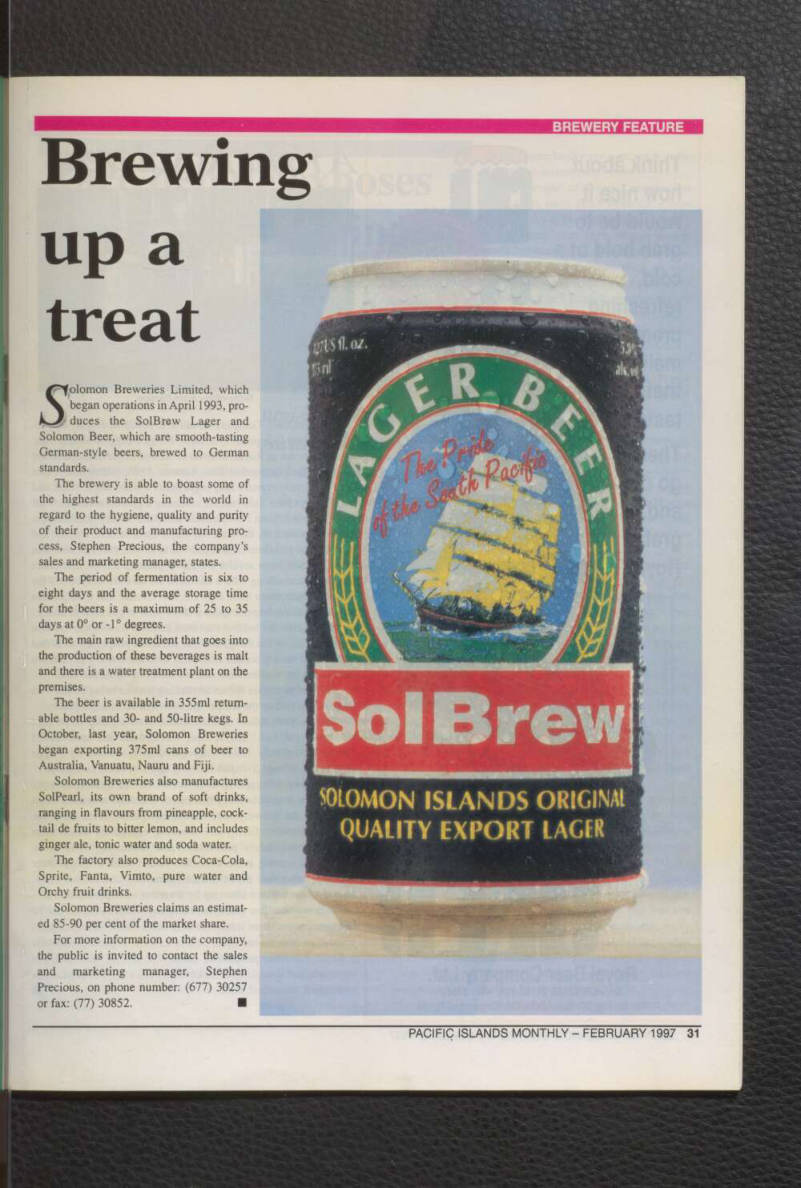
Brewery Feature
up a treat
Breweries Limited, which began operations in April 1993, pro duces the Solßrew Lager and Solomon Beer, which are smooth-tasting German-style beers, brewed to German standards.
The brewery is able to boast some of the highest standards in the world in regard to the hygiene, quality and purity of their product and manufacturing pro cess, Stephen Precious, the company’s sales and marketing manager, states.
The period of fermentation is six to eight days and the average storage time for the beers is a maximum of 25 to 35 days at 0° or -1° degrees.
The main raw ingredient that goes into the production of these beverages is malt and there is a water treatment plant on the premises.
The beer is available in 355 ml return able bottles and 30- and 50-litre kegs. In October, last year, Solomon Breweries began exporting 375 ml cans of beer to Australia, Vanuatu, Nauru and Fiji.
Solomon Breweries also manufactures Sol Pearl, its own brand of soft drinks, ranging in flavours from pineapple, cock tail de fruits to bitter lemon, and includes ginger ale, tonic water and soda water.
The factory also produces Coca-Cola, Sprite, Fanta, Vimto, pure water and Orchy fruit drinks.
Solomon Breweries claims an estimat ed 85-90 per cent of the market share.
For more information on the company, the public is invited to contact the sales and marketing manager, Stephen Precious, on phone number: (677) 30257 or fax; (77) 30852. ■
A right Royal treat

m oyal Beer Company Limited is proud of Royal, its pre
mium European-style lager, Tonga’s biggest-selling beer.
Jl. V Known as Royal, the beer is brewed in the tradition of the German Rheinheitsgebot Beer Law of 1516, which states that beer must only contain four ingredients - malt, hops, yeast and water”, says John Sullivan, the company’s general manager. Malt and hops come from New Zealand and yeast comes from Europe.
Water is treated on the site. All Royal Beer is cold filtered and available as premium or draught. “It is an international beer that takes the best from several worlds to produce a brew that tastes like, well, something with a character all its own. Maybe it’s the water. Tongan water has a high calcium content that is noticeable when you have to spend quite a bit of time to get soap to lather.
“Some brewers believe that beer benefits from some calcium in water. One of the things that our technical people tell us is that water must have a certain amount of calcium and if you take too much of it out it affects the taste of the beer,” Sullivan said.
Sullivan describes the art of making beer to being a chef - as long as you follow the recipe, the beer will be of high quality.
“If you don’t follow specifications, even a good-recipe beer will come out bad.” Royal Beer was formed and commenced operations in May 1987. Fifty per cent is owned by Pripps Bryhherier, a large Swedish brewing and soft drink company.
The production capacity of Royal is over one million litres per annum. The best technology from all over Europe was used when setting up the brewery. Brewhouse equipment came from the United Kingdom, filling and labelling equipment came from Germany and steam production and technology was from Sweden. According to Sullivan, the market share of Royal Beer is half or more than the estimated 1.2-million-litre market avail able with the balance taken up by a variety of imported beers.
Over the next few years, the company wants to regain the 70 per cent market share it held for beer sales before strong compe tition from imports emerged. One of its more popular products is a Royal Premium pasteurised brew with a long shelf life. An unpasteurised draught beer makes up about a third of production and is best consumed fresh. ■
Technology from Europe
Advertisements & other items, p. 32 (1 item)
Think about
how nice it would be to grab hold of a cold, refreshing, premium all malt beer thats full of taste...
Then go out and grab a Royal! m ROYAL BEER COMPANY LTD, NUKCJ' ALOFA THE KINGDOM OF TONGA, Royal Beer Company Ltd.
Tel: +676 22155,21157. Fax: +676 21552 Private Bag 20, Nukualofa, The Kingdom of Tonga
media shortcomings
Opinion
Race debate exposes media shortcomings
By Kalinga Seneviratne
At the end of September last year, Prime Minister John Howard claimed in a speech to his party faithfuls in Brisbane that since his elec tion victory in March, his government had created a new climate for “free speech” in Australia.
“One of the great changes that has come over Australia in the past six months is that people do feel able to speak a little more freely and a little more open ly about what they feel,” he said, “without living in fear of being branded a bigot or a racist.”
These comments, coming close on the heels of independent Brisbane MP Pauline Hanson’s maiden speech in par liament, obviously helped trigger the bit ter race debate we have seen in the media since then.
At the same time, it has raised ques tions about the Australian media’s short comings in responding to such issues, especially its cultural bias.
It was only when the economic back lash from Asia became apparent that Australian politicians and social analysts began to criticise the media for its role in triggering off the debate.
The economic backlash was mainly felt by Australia’s largest foreign exchange earner - the tourist industry when large numbers of Asians, especially Singaporeans, cancelled their Christmas holidays to Australia.
The tertiary education sector, which earns another SAI.7 billion (SUSI. 3 bil lion) a year via full-fee-paying overseas students began to get worried as well when Malaysia and other Asian countries raised fears about the safety of their stu dents here.
There is no doubt that this “Hanson race debate” would have been a non-issue if the Australian media had not aided and abetted her.
This Hanson Race debate
would have been a non-issue if the Australian media had not aided her
Howard’s “free speech” thesis has pro vided the media with a passport to give exposure to racist views under the pretext of freedom of speech.
A major theme of this debate has been Asian migrants’ perceived inability to integrate with the Australian society. But, as an Asian migrant who has lived here for the past 18 years, I see this debate more as a fear among predominantly White Anglo-Celtic working-class Australians that they would be the losers because of the very success of Asian migrants in integrating into Australian society in the past two decades.
They resent the fact that children of Asian migrants are doing well at school and are taking most of the places in the elite “selective” high schools and later in the universities.
They also resent it when new Asian migrants, especially accountants and computer specialists, get high-paid jobs almost immediately after arriving here, when they themselves have to struggle to make ends meet. In addition, they don’t like the sight of recent Asian business migrants driving expensive cars and buy ing into expensive suburbs in the city which they can only dream of.
While the majority of Asian migrants may be integrating well into Australian society, as well as doing well economical
ly, they have hardly got a presence in the Australian mainstream media.
The couple of ‘exotic’ newsreaders with Asian faces don’t mean the Asians have a voice in the media. This is why the “race debate” has been able to sustain itself by feeding on stereotypes such as unskilled Asian migrants living on wel fare benefits and swelling unemployment numbers or non-English speaking Asians setting up ghettos in suburban Australia.
For so long, Australia’s media believed they were the moral conscience of the region - it was only they who could expose racism, corruption and human rights violations in the Asia-Pacific region, but tables are turning now.
In an unprecedented attack on the Asian media in federal parliament, Howard said on October 29 last year that editorials written in leading newspapers in the region condemning him for failing to take a tougher stand against Hanson were “written in ignorance of what I have said, of what I believe, and of the policies of the government”.
After Australia’s carefully nurtured international reputation as a “fair go” country has been damaged in Asia, with the potential to damage Australia’s own economic future, political leaders are now beginning to accuse the media for trigger ing off the whole episode.
The former Labour Party leader, for eign minister and governor-general. Bill Hayden (whose old seat of Oxley is now occupied by Hanson), said in a letter to the Sydney Morning Herald ( SMH ) on November 4 that it was the “dominant influence of the media” which had made Hanson a celebrity.
“They are the ones who have convert ed an otherwise undistinguished and poorly informed backbencher into a national cult figure in her first six months in parliament,” observed Hayden. “In my more than 35 years in public life, I have seen nothing like this behaviour of the media before.” Hayden also said that at a time of great social and economic dislo cation in Australia for vast numbers, what was driving this debate was the feeling that the media and governments had not listened to the ordinary people.
Though Hayden may be correct, both
these parties have been preoccupied with Asia’s riches in recent years. As social critic and broadcaster Philip Adams observed recently in a column in The Australian, the increase in Asian immi gration to Australia in the last decade had occurred not because of idealism but as a result of opportunism. “The tables have turned dramatically and we now scramble for the crumbs of the rich man’s meal,” he said.
Australia’s carefully nurtured reputation
as a yair go”country
has been damaged in Asia
“We know the best way to plug into the Asian markets is through the diaspo ra, through the network of friends and rel atives that connects the economies of Dixon Street (Sydney’s Chinatown) with Singapore, with Taiwan, with mainland China.”
While Australia is scrambling to get a piece of the Asian economic pie in the 21st century, the Asian migrant popula tion here, especially those of Chinese extraction, may be able to ride the latest wave of racism.
But for other non-white races, such as the Aboriginals and Pacific Islanders, it is another story.
As Aboriginal leader Noel Pearson, the former chairman of the Cape York Land Council, observed recently, the “new free speech is tabloid free speech”, where debate is conducted in the media through tabloid-style slogans “carefully crafted to activate those hot buttons in our community”.
Thus, for Aborigines, whose land rights are under intense attack as a result of this race debate, the 2000 Sydney Olympics will be the last chance for awhile to get a fair deal. The next three years will be crucial for them. ■
Native vs pastoral land rights
By Andrew Kacimaiwai
The ongoing land debate and racial reconciliation process in Australia took a new twist in late December when the Federal High Court ruled that native land status could coexist alongside existing pastoral leases.
The subsequent outcry from farmers, miners and politicians to protect leases has thrown the country’s touted reconcil iation process between Aborigines and White Australians into doubt.
The saga began when the Wik people of Cape York claimed native land status over 35,000 square kilometres in the far north of the Queensland peninsula, a claim rejected in late January 1996 by the federal court but appealed by the Wik people.
In late December, the Federal High Court partly upheld the appeal, ruling that native title could coexist with pastoral leases, but added that claims would have to be dealt with on their merits on a case by-case basis.
In the judgment, the court ruled that: • pastoral use would prevail in any conflict of claims; • the federal court would determine the application of the Wik people’s rights; • the Queensland government and two mining companies did not breach their duty to native landowners.
The previous ruling was that pastoral leases extinguished all native title land rights.
The judgment has overturned an almost 200-year-old system that pastoral leases had exclusive possession of graz ing land.
While Aboriginal groups applauded the court ruling, the powerful National Farmers Federation predicted an end to any chances of reconciliation between Black and White Australians.
Immediately after the ruling, the NFF called on the John Howard government to amend the Native Title Act, a move backed by state governments but opposed by the Aboriginal and Torres Strait Islander Commission (among others).
Since then, Howard has come under pressure from the states most affected by the ruling. West Australia and Queensland, to amend existing legislation to protect existing leases.
However, Prime Minister Howard has since been advised by the attorney-gener al that such amendments would breach their Racial Discrimination Act and has called for urgent talks on ways to amend the Discrimination Act.
State governments are already seeking ways to circumvent the ruling.
West Australia is seeding to resurrect a 1993 Labour plan to extinguish native title claims over leases by validating all leases since the implementation of the Racial Discrimination Act in 1975 and
January 1994.
They are pressuring the federal gov ernment to take action. Queensland’s government lately called for a stop to new lease applications in a move soundly con demned by both Aboriginal groups and the private sector.
Aboriginal community leaders have
been particularly upset by the scaremon gering tactics adopted by groups like the NFF, accusing them of deliberately dis torting the truth by saying that leases are now under threat.
The high court judges have also been quick to emphasise the limits to native land' claims, and the protection given to lease-holders by the priority given in their decision to farmers and miners.
The Wik ruling is also an extension of the terra nullis belief of colonial law that Australia was uninhabited before
Europeans arrived and fairly recently
rejected.
Meanwhile for the Wik people it has been time for celebration for a ruling that has revived their hopes and, more impor tantly, faith in the legal system.
According to Wik senior woman Gladys Tybingoompa, the decision means a positive step forward in the reconcilia tion process.
Unfortunately, that view is not shared by those on the other side of the racial reconciliation fence. ■
a tragedy

Disaster
PH211 a tragedy
PAL’s ill-fated flight leaves three dead and a series of unanswered questions
Text and photography by Chris Peteru Most everyone in the airline industry seems to have a theory on why Polynesian Airline’s flight PH2II, servicing a routine flight to Western Samoa from neighbouring Pago Pago never made home base.
Instead, in pouring rain and descending mist, the Twin Otter SW-FAU ploughed into the hillside, miles off the designated flight paths. Three of the five people on board, including 49-year-old New Zealand pilot Captain Colin “Gus” Pyber, were killed. First officer Tautai “Toko”
Tofaeono, a Samoan, survived with a bro ken back. And a five-year-old girl, Vi Laupola, from American Samoa, received minor injuries.
After leaving Pago Pago at 9.40 am for the scheduled 60-minute island hop, Captain Pyber was informed by the tower at Fagalii Domestic Airport, near the cap ital, Apia, that conditions were unsuitable for landing. It was recommended the plane divert to Faleolo International Airport, 25 kilometres to the west, where conditions were more suitable.
Heeding that advice, flight PH2II altered course for Faleolo, a journey of about five minutes. About 10 minutes ahead, another Twin Otter from rival domestic airline, Samoa Air, that had also diverted from Fagalii, touched down with out incident at Faleolo. The air traffic con trollers were expecting the PAL flight to follow and had given clearance to land. By now, the aircraft was over Satupuala, a stone’s throw to the airport and safety.
For some reason, PH2II then changed its heading and turned back toward Fagalii. But instead of flying back over
Apia, or following the shoreline from Faleolo, both accepted flight paths, in
atrocious flying conditions Captain Pyber
turned his aircraft southwest, directly into the Moamoa hills they would now have to fly over to get back to Fagalii airport.
Within 15 minutes of that manoeuvre, flight PH2II crashed. Both wings were tom from the fuselage with crash-strewn debris everywhere.
“The plane flew at a very low altitude towards the mountain, and then suddenly there was a loud crashing noise like thun der. We knew it was the plane,” says Tomasi Robeck, a Moamoa resident.
With mechanics from a nearby garage, Robeck headed up the steep incline. About 40 minutes later, they found the wreckage.
“Once we found the plane, one of the boys came back down to call the cops, but it was about two hours before they turned up.
“The hardest thing was when the girl cried, and she didn’t want to come away from her father (who died in the crash).”
The two survivors were driven to the
National Hospital. After stabilising, flight
officer Tofaeono, a former rugby interna tional, was taken to New Zealand for fur ther treatment.
Family members at his bedside said he was lucid and “very angry” as he recount ed what happened, but was not ready to comment publicly. Others, including PAL employees, believe the accident could have been avoided had a landing at Faleolo been carried out.
Significantly, a PAL pilot said: “No one flies through Moamoa; it’s too dan gerous. I think Pyber was disorientated ... and got lost.”
Although a number of other factors
could have contributed to the accident, including a total instrument failure, not one local pilot spoken to has disagreed with the scenario that PH2II had lost its way. Indications from the crash site sug gest the plane was flying in the wrong direction when it crashed.
The doubts over Pyber’s flying ability had been noticed earlier.
Having previously flown old DC-3s for a company in Wellington that eventually went bankrupt, Pyber had only minimal experience with the Twin Otters during his two years with the carrier, where he was made senior pilot on domestic services. In an open letter to Polynesian Airlines, pub lished by the Samoa Observer last November, Antipa Finau, a former airport controller with 17 years’ experience,
claimed Pyber’s “stupidity and inexperi
ence” almost caused a collision with a Samoa Air flight with 20 people on board.
Pyber was captain of a PAL flight at Fagalaii airport that entered a runway without clearance from the tower. His actions forced the other plane to abort its
landing.
Apparently, PAL took no disciplinary action against Pyber, who failed to report the incident. Only a complaint from a Samoa Air passenger to Transport Minister Joe Keil, a former pilot, and an anonymous letter to the Samoa Observer calling for an immediate investigation, brought the mistake out in the open.
“Also, another pilot with a passenger on board aborted landing when this same man (Pyber) crossed the runway in train ing,” said Finau. At the end of the flight training by “repeating the mistakes of his own students ... failing to respond and act
accordingly, he was obviously seen (by
other pilots) as the poorest performer of all”. Other PAL employees viewed him as something of an arrogant expatriate, who was patronising toward local pilots and disliked by office staff at Fagalii, where he was in charge of the overall running of the
airport.
“No one wanted to fly with him because of that, and he gave everyone a hard time. It’s not nice to say, but he is not really missed,” said one employee.
But the managment of Polynesian Airlines have stuck by Pyber.
“We trust he did what he felt was best and safe to do. It was his choice to go from one airport to the other, but it apparently didn’t work out,” said company secretary Leaupepe Muliaumasealii. He said Pyber
was an experienced pilot and had the con fidence of the airline. Chief Executive Officer Richard Gates has said he’s con cerned at the mounting speculation over the incident. He told the local media: “It is
unwise to be speculating at this stage, and it does not help anyone at a 11... It’s impor tant to try and protect the families of those who perished, both passengers and crew.
“We are asking for support and under standing. This tragedy has affected all of us here at Polynesian personally, and we must also try and continue to provide a service to the people. We are also keen to know the reasons ourselves.”
Investigations by a New Zealand air accident inspector, Alister Parkingham, are almost complete. The wingless fuse lage has since been airlifted to a PAL hangar.
In those conditions, says a veteran pilot, it could have been something as sim ple as the pilot not wanting to land miles away from home and having to catch the airport transport back on a wet and lousy day. Others suggest that simple ego and aviation one-up-manship between the two airlines could have played a part in flight PH2II attempting a return to Fagalii.
A full accident report is expected in about three months. ■
The body of one of the three victims is carried down on a stretcher
Advertisements & other items, p. 36 (1 item)
Distinctive kitset
c L
HOMES FOR EXPORT
Maddren Homes, New Zealand's most experienced exporters of kitset homes, has just announced a new range of superior dwellings.
Available in a variety of architectural styles and appointments, these homes can be reconfigured easily to suit your individual needs.
Apart, from their aesthetic appeal, these homes feature proven cyclone resistant construction methods as well as durable termite resistant timbers.
CONTACT MADDREN HOMES: PO Box 244. Kumeu. Auckland. New Zealand.
Phone: 64-9-412 9070. fax: 64-9-412 725/
■Maddren
Homes
Boutros-Ghali
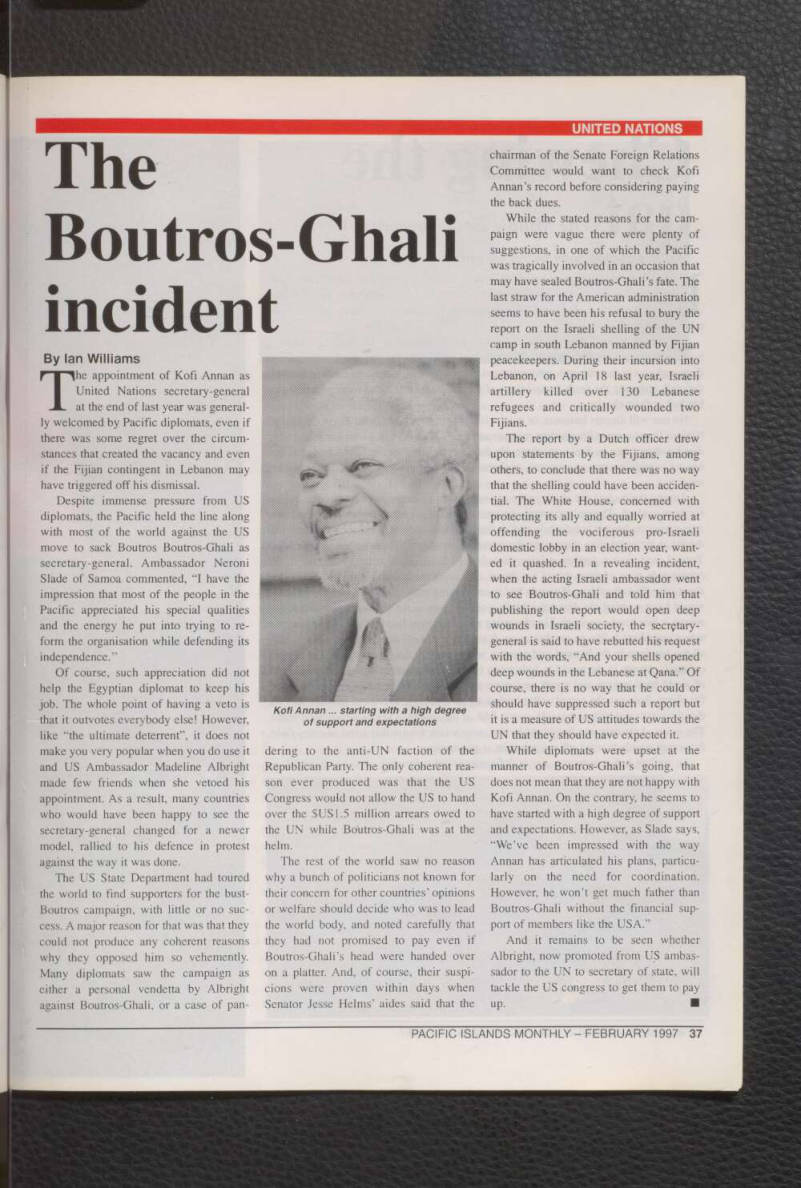
United Nations
The Boutros-Ghali incident
By Ian Williams
The appointment of Kofi Annan as United Nations secretary-general at the end of last year was general ly welcomed by Pacific diplomats, even if there was some regret over the circum stances that created the vacancy and even if the Fijian contingent in Lebanon may have triggered off his dismissal.
Despite immense pressure from US diplomats, the Pacific held the line along with most of the world against the US move to sack Boutros Boutros-Ghali as secretary-general. Ambassador Neroni Slade of Samoa commented, “I have the impression that most of the people in the Pacific appreciated his special qualities and the energy he put into trying to re form the organisation while defending its independence.”
Of course, such appreciation did not help the Egyptian diplomat to keep his job. The whole point of having a veto is that it outvotes everybody else! However, like “the ultimate deterrent”, it does not make you very popular when you do use it and US Ambassador Madeline Albright made few friends when she vetoed his appointment. As a result, many countries who would have been happy to see the secretary-general changed for a newer model, rallied to his defence in protest against the way it was done.
The US State Department had toured the world to find supporters for the bust- Boutros campaign, with little or no suc cess. A major reason for that was that they could not produce any coherent reasons
why they opposed him so vehemently.
Many diplomats saw the campaign as either a personal vendetta by Albright against Boutros-Ghali, or a case of pan-
dering to the anti-UN faction of the Republican Party. The only coherent rea son ever produced was that the US Congress would not allow the US to hand over the SUSI.S million arrears owed to the UN while Boutros-Ghali was at the helm.
The rest of the world saw no reason why a bunch of politicians not known for their concern for other countries’ opinions or welfare should decide who was to lead the world body, and noted carefully that they had not promised to pay even if Boutros-Ghali’s head were handed over on a platter. And, of course, their suspi cions were proven within days when Senator Jesse Helms’ aides said that the
chairman of the Senate Foreign Relations Committee would want to check Kofi Annan’s record before considering paying the back dues.
While the stated reasons for the cam paign were vague there were plenty of suggestions, in one of which the Pacific was tragically involved in an occasion that may have sealed Boutros-Ghali’s fate. The last straw for the American administration seems to have been his refusal to bury the report on the Israeli shelling of the UN camp in south Lebanon manned by Fijian peacekeepers. During their incursion into Lebanon, on April 18 last year, Israeli artillery killed over 130 Lebanese refugees and critically wounded two
Fijians.
The report by a Dutch officer drew upon statements by the Fijians, among others, to conclude that there was no way that the shelling could have been acciden tial. The White House, concerned with protecting its ally and equally worried at
offending the vociferous pro-Israeli
domestic lobby in an election year, want ed it quashed. In a revealing incident, when the acting Israeli ambassador went to see Boutros-Ghali and told him that publishing the report would open deep wounds in Israeli society, the secretary general is said to have rebutted his request with the words, “And your shells opened deep wounds in the Lebanese at Qana.” Of course, there is no way that he could or should have suppressed such a report but it is a measure of US attitudes towards the UN that they should have expected it.
While diplomats were upset at the manner of Boutros-Ghali’s going, that does not mean that they are not happy with Kofi Annan. On the contrary, he seems to have started with a high degree of support and expectations. However, as Slade says, “We’ve been impressed with the way Annan has articulated his plans, particu larly on the need for coordination.
However, he won’t get much father than Boutros-Ghali without the financial sup port of members like the USA.”
And it remains to be seen whether Albright, now promoted from US ambas sador to the UN to secretary of state, will tackle the US congress to get them to pay up. ■
Kofi Annan ... starting with a high degree of support and expectations
Chewing the
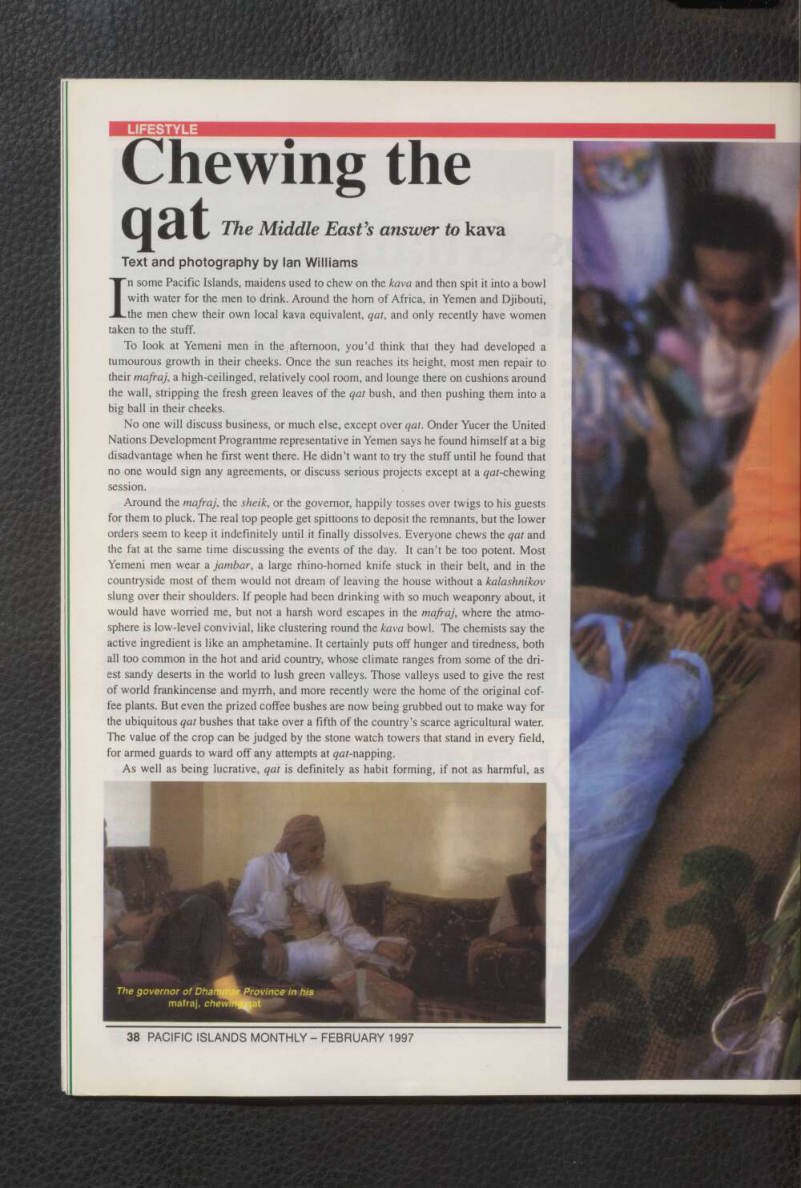
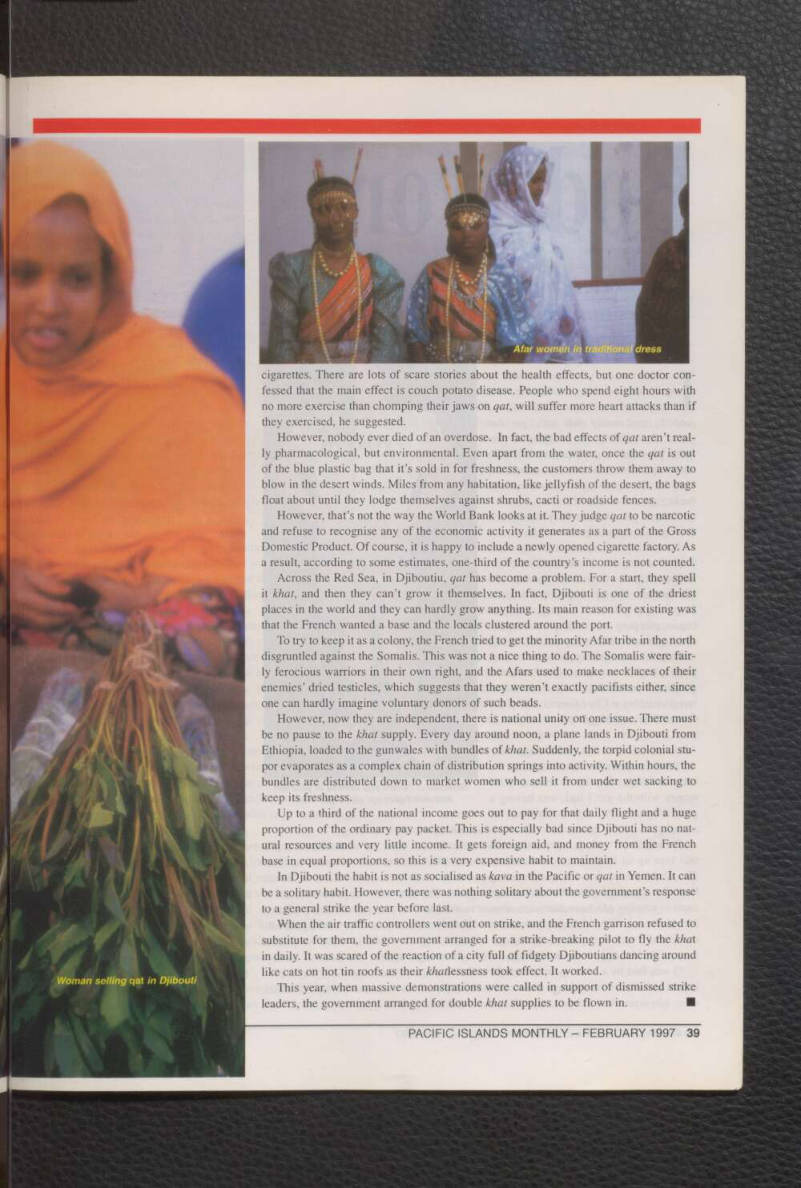
Lifestyle
qat
The Middle East’s answer to kava
Text and photography by lan Williams
In some Pacific Islands, maidens used to chew on the kava and then spit it into a bowl with water for the men to drink. Around the horn of Africa, in Yemen and Djibouti, the men chew their own local kava equivalent, qat, and only recently have women taken to the stuff.
To look at Yemeni men in the afternoon, you’d think that they had developed a tumourous growth in their cheeks. Once the sun reaches its height, most men repair to their mafraj, a high-ceilinged, relatively cool room, and lounge there on cushions around the wall, stripping the fresh green leaves of the qat bush, and then pushing them into a big ball in their cheeks.
No one will discuss business, or much else, except over qat. Onder Yucer the United Nations Development Programme representative in Yemen says he found himself at a big disadvantage when he first went there. He didn’t want to try the stuff until he found that no one would sign any agreements, or discuss serious projects except at a gat-chewing session.
Around the mafraj, the sheik, or the governor, happily tosses over twigs to his guests for them to pluck. The real top people get spittoons to deposit the remnants, but the lower orders seem to keep it indefinitely until it finally dissolves. Everyone chews the qat and the fat at the same time discussing the events of the day. It can’t be too potent. Most Yemeni men wear a jambar, a large rhino-homed knife stuck in their belt, and in the countryside most of them would not dream of leaving the house without a kalashnikov slung over their shoulders. If people had been drinking with so much weaponry about, it would have worried me, but not a harsh word escapes in the mafraj, where the atmo sphere is low-level convivial, like clustering round the kava bowl. The chemists say the active ingredient is like an amphetamine. It certainly puts off hunger and tiredness, both all too common in the hot and arid country, whose climate ranges from some of the dri est sandy deserts in the world to lush green valleys. Those valleys used to give the rest of world frankincense and myrrh, and more recently were the home of the original cof fee plants. But even the prized coffee bushes are now being grubbed out to make way for the übiquitous qat bushes that take over a fifth of the country’s scarce agricultural water.
The value of the crop can be judged by the stone watch towers that stand in every field, for armed guards to ward off any attempts at gar-napping.
As well as being lucrative, qat is definitely as habit forming, if not as harmful, as
The governor of Dhammar Province in his mafraj, chewing qat
cigarettes. There are lots of scare stories about the health effects, but one doctor con fessed that the main effect is couch potato disease. People who spend eight hours with no more exercise than chomping their jaws on qat, will suffer more heart attacks than if they exercised, he suggested.
However, nobody ever died of an overdose. In fact, the bad effects of qat aren’t real ly pharmacological, but environmental. Even apart from the water, once the qat is out of the blue plastic bag that it’s sold in for freshness, the customers throw them away to blow in the desert winds. Miles from any habitation, like jellyfish of the desert, the bags float about until they lodge themselves against shrubs, cacti or roadside fences.
However, that’s not the way the World Bank looks at it. They judge qat to be narcotic and refuse to recognise any of the economic activity it generates as a part of the Gross Domestic Product. Of course, it is happy to include a newly opened cigarette factory. As a result, according to some estimates, one-third of the country’s income is not counted.
Across the Red Sea, in Djiboutiu, qat has become a problem. For a start, they spell it khat, and then they can’t grow it themselves. In fact, Djibouti is one of the driest places in the world and they can hardly grow anything. Its main reason for existing was that the French wanted a base and the locals clustered around the port.
To try to keep it as a colony, the French tried to get the minority Afar tribe in the north disgruntled against the Somalis. This was not a nice thing to do. The Somalis were fair ly ferocious warriors in their own right, and the Afars used to make necklaces of their enemies’ dried testicles, which suggests that they weren’t exactly pacifists either, since one can hardly imagine voluntary donors of such beads.
However, now they are independent, there is national unity on one issue. There must be no pause to the khat supply. Every day around noon, a plane lands in Djibouti from Ethiopia, loaded to the gunwales with bundles of khat. Suddenly, the torpid colonial stu por evaporates as a complex chain of distribution springs into activity. Within hours, the bundles are distributed down to market women who sell it from under wet sacking to keep its freshness.
Up to a third of the national income goes out to pay for that daily flight and a huge proportion of the ordinary pay packet. This is especially bad since Djibouti has no nat ural resources and very little income. It gets foreign aid, and money from the French base in equal proportions, so this is a very expensive habit to maintain.
In Djibouti the habit is not as socialised as kava in the Pacific or qat in Yemen. It can be a solitary habit. However, there was nothing solitary about the government’s response to a general strike the year before last.
When the air traffic controllers went out on strike, and the French garrison refused to substitute for them, the government arranged for a strike-breaking pilot to fly the khat in daily. It was scared of the reaction of a city full of fidgety Djiboutians dancing around like cats on hot tin roofs as their khat\essness took effect. It worked.
This year, when massive demonstrations were called in support of dismissed strike leaders, the government arranged for double khat supplies to be flown in. ■
Afar women in traditional dress
Woman selling qatin Djibouti
Bodyworks
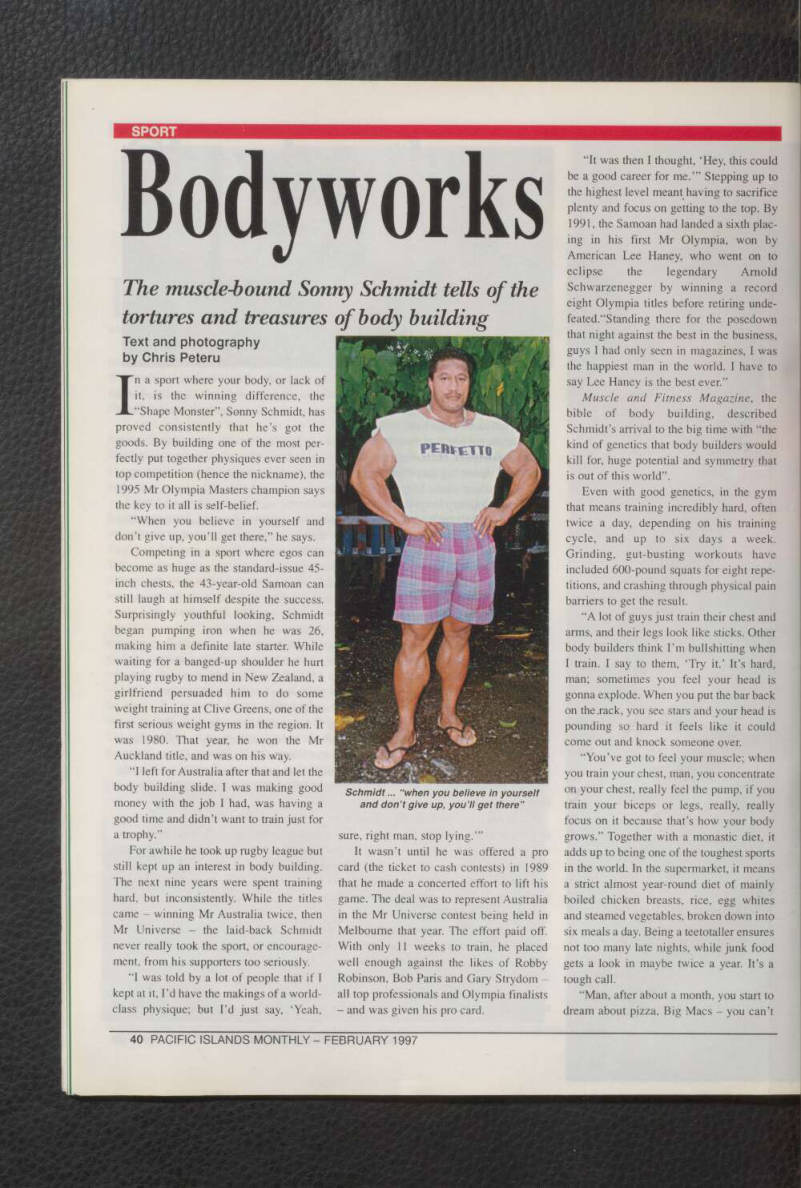
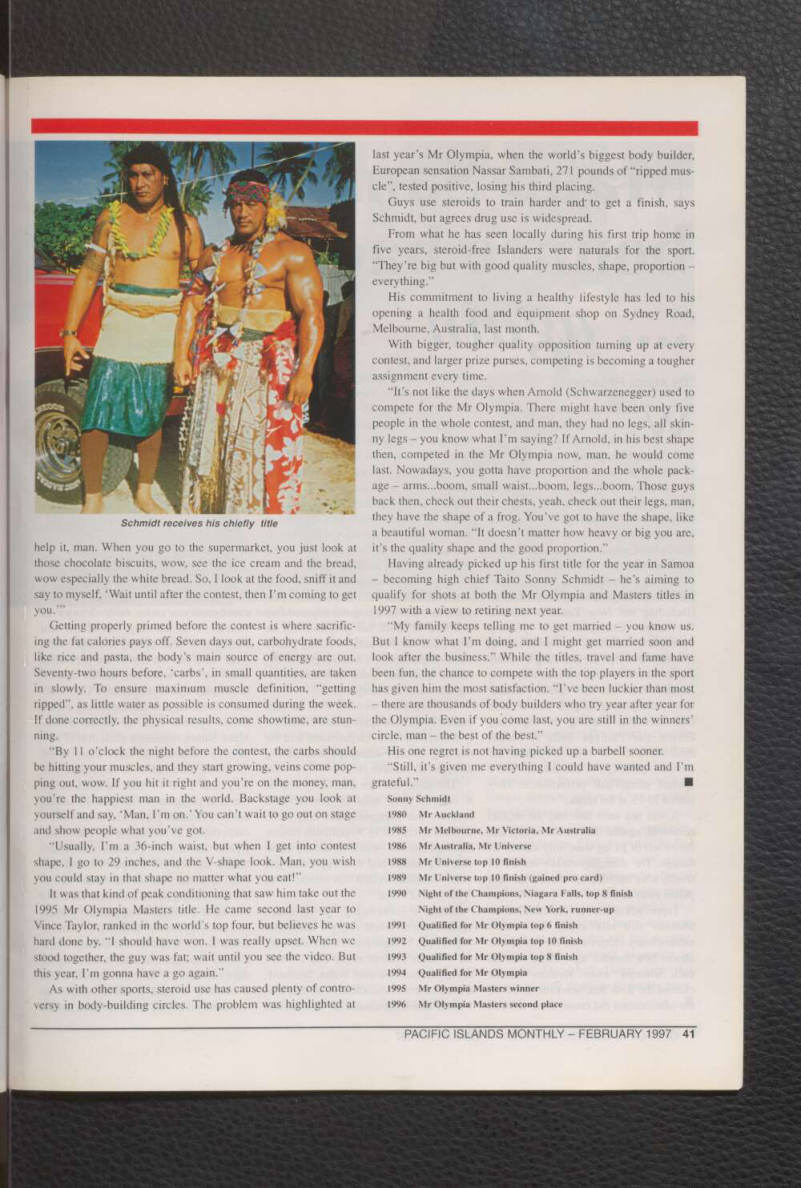
Sport
The muscle-bound Sonny Schmidt tells of the tortures and treasures of body building
Text and photography by Chris Peteru
In a sport where your body, or lack of it, is the winning difference, the “Shape Monster”, Sonny Schmidt, has proved consistently that he’s got the goods. By building one of the most per fectly put together physiques ever seen in top competition (hence the nickname), the 1995 Mr Olympia Masters champion says the key to it all is self-belief.
“When you believe in yourself and don’t give up, you’ll get there,” he says.
Competing in a sport where egos can become as huge as the standard-issue 45inch chests, the 43-year-old Samoan can still laugh at himself despite the success.
Surprisingly youthful looking, Schmidt
began pumping iron when he was 26, making him a definite late starter. While waiting for a banged-up shoulder he hurt playing rugby to mend in New Zealand, a girlfriend persuaded him to do some weight training at Clive Greens, one of the first serious weight gyms in the region. It was 1980. That year, he won the Mr Auckland title, and was on his way.
“I left for Australia after that and let the body building slide. I was making good money with the job I had, was having a good time and didn’t want to train just for a trophy.”
For awhile he took up rugby league but still kept up an interest in body building.
The next nine years were spent training hard, but inconsistently. While the titles came - winning Mr Australia twice, then Mr Universe - the laid-back Schmidt never really took the sport, or encourage ment, from his supporters too seriously.
“I was told by a lot of people that if I kept at it, I’d have the makings of a world class physique; but I’d just say, ‘Yeah,
sure, right man, stop lying.’”
It wasn’t until he was offered a pro card (the ticket to cash contests) in 1989 that he made a concerted effort to lift his game. The deal was to represent Australia in the Mr Universe contest being held in Melbourne that year. The effort paid off.
With only 11 weeks to train, he placed well enough against the likes of Robby Robinson, Bob Paris and Gary Strydom all top professionals and Olympia finalists - and was given his pro card.
“It was then I thought, ‘Hey, this could be a good career for me.”’ Stepping up to the highest level meant having to sacrifice plenty and focus on getting to the top. By 1991, the Samoan had landed a sixth plac ing in his first Mr Olympia, won by American Lee Haney, who went on to
eclipse the legendary Arnold
Schwarzenegger by winning a record
eight Olympia titles before retiring unde
feated.“ Standing there for the posedown that night against the best in the business, guys I had only seen in magazines, I was the happiest man in the world. I have to say Lee Haney is the best ever.”
Muscle and Fitness Magazine, the bible of body building, described Schmidt’s arrival to the big time with "the kind of genetics that body builders would kill for, huge potential and symmetry that is out of this world”.
Even with good genetics, in the gym that means training incredibly hard, often twice a day, depending on his training cycle, and up to six days a week.
Grinding, gut-busting workouts have included 600-pound squats for eight repe titions, and crashing through physical pain barriers to get the result.
“A lot of guys just train their chest and arms, and their legs look like sticks. Other body builders think I’m bullshitting when I train. I say to them, ‘Try it.’ It’s hard, man; sometimes you feel your head is gonna explode. When you put the bar back on the .rack, you see stars and your head is pounding so hard it feels like it could come out and knock someone over.
“You’ve got to feel your muscle; when you train your chest, man, you concentrate on your chest, really feel the pump, if you train your biceps or legs, really, really focus on it because that’s how your body grows.” Together with a monastic diet, it adds up to being one of the toughest sports in the world. In the supermarket, it means a strict almost year-round diet of mainly boiled chicken breasts, rice, egg whites and steamed vegetables, broken down into six meals a day. Being a teetotaller ensures not too many late nights, while junk food gets a look in maybe twice a year. It’s a
tough call.
“Man, after about a month, you start to dream about pizza, Big Macs - you can’t
Schmidt... "when you believe in yourself and don’t give up, you’ll get there”
help it, man. When you go to the supermarket, you Just look at those chocolate biscuits, wow, see the ice cream and the bread, wow especially the white bread. So, I look at the food, sniff it and say to myself, ‘Wait until after the contest, then I’m coming to get you.’”
Getting properly primed before the contest is where sacrific ing the fat calories pays off. Seven days out, carbohydrate foods, like rice and pasta, the body’s main source of energy are out.
Seventy-two hours before, ‘carbs’, in small quantities, are taken in slowly. To ensure maximum muscle definition, “getting ripped”, as little water as possible is consumed during the week.
If done correctly, the physical results, come showtime, are stun ning.
“By 11 o’clock the night before the contest, the carbs should be hitting your muscles, and they start growing, veins come pop ping out, wow. If you hit it right and you’re on the money, man, you’re the happiest man in the world. Backstage you look at yourself and say, ‘Man, I’m on.’ You can’t wait to go out on stage and show people what you’ve got.
“Usually, I’m a 36-inch waist, but when I get into contest shape, I go to 29 inches, and the V-shape look. Man, you wish you could stay in that shape no matter what you eat!”
It was that kind of peak conditioning that saw him take out the 1995 Mr Olympia Masters title. He came second last year to Vince Taylor, ranked in the world’s top four, but believes he was hard done by. “I should have won. 1 was really upset. When we stood together, the guy was fat; wait until you see the video. But this year. I’m gonna have a go again."
As with other sports, steroid use has caused plenty of contro versy in body-building circles. The problem was highlighted at
last year’s Mr Olympia, when the world’s biggest body builder, European sensation Nassar Sambati, 271 pounds of “ripped mus cle”, tested positive, losing his third placing.
Guys use steroids to train harder and' to get a finish, says Schmidt, but agrees drug use is widespread.
From what he has seen locally during his first trip home in five years, steroid-free Islanders were naturals for the sport.
“They’re big but with good quality muscles, shape, proportion -
everything.”
His commitment to living a healthy lifestyle has led to his opening a health food and equipment shop on Sydney Road, Melbourne, Australia, last month.
With bigger, tougher quality opposition turning up at every contest, and larger prize purses, competing is becoming a tougher assignment every time.
“It’s not like the days when Arnold (Schwarzenegger) used to compete for the Mr Olympia. There might have been only five people in the whole contest, and man, they had no legs, all skin ny legs - you know what I’m saying? If Arnold, in his best shape then, competed in the Mr Olympia now, man, he would come last. Nowadays, you gotta have proportion and the whole pack age - arms...boom, small waist...boom, legs...boom. Those guys back then, check out their chests, yeah, check out their legs, man, they have the shape of a frog. You’ve got to have the shape, like a beautiful woman. “It doesn’t matter how heavy or big you are, it’s the quality shape and the good proportion.”
Having already picked up his first title for the year in Samoa - becoming high chief Taito Sonny Schmidt - he’s aiming to qualify for shots at both the Mr Olympia and Masters titles in 1997 with a view to retiring next year.
“My family keeps telling me to get married - you know us.
But I know what I’m doing, and I might get married soon and look after the business.” While the titles, travel and fame have been fun, the chance to compete with the top players in the sport has given him the most satisfaction. “I’ve been luckier than most - there are thousands of body builders who try year after year for the Olympia. Even if you come last, you are still in the winners’ circle, man - the best of the best.”
His one regret is not having picked up a barbell sooner.
“Still, it’s given me everything I could have wanted and I’m
grateful.” ■
Sonny Schmidt 1980 Mr Auckland 1985 iMr Melbourne, Mr Victoria, Mr Australia 1986 Mr Australia, Mr Universe 1988 Mr Universe top 10 finish 1989 Mr Universe top 10 finish (gained pro card) 1990 Night of the Champions, Niagara Falls, top 8 finish Night of the Champions, New York, runner-up 1991 Qualified for Mr Olympia top 6 finish 1992 Qualified for Mr Olympia top 10 finish 1993 Qualified for Mr Olympia top 8 finish 1994 Qualified for Mr Olympia 1995 Mr Olympia Masters winner 1996 Mr Olympia Masters second place
Schmidt receives his chiefly title
.... again
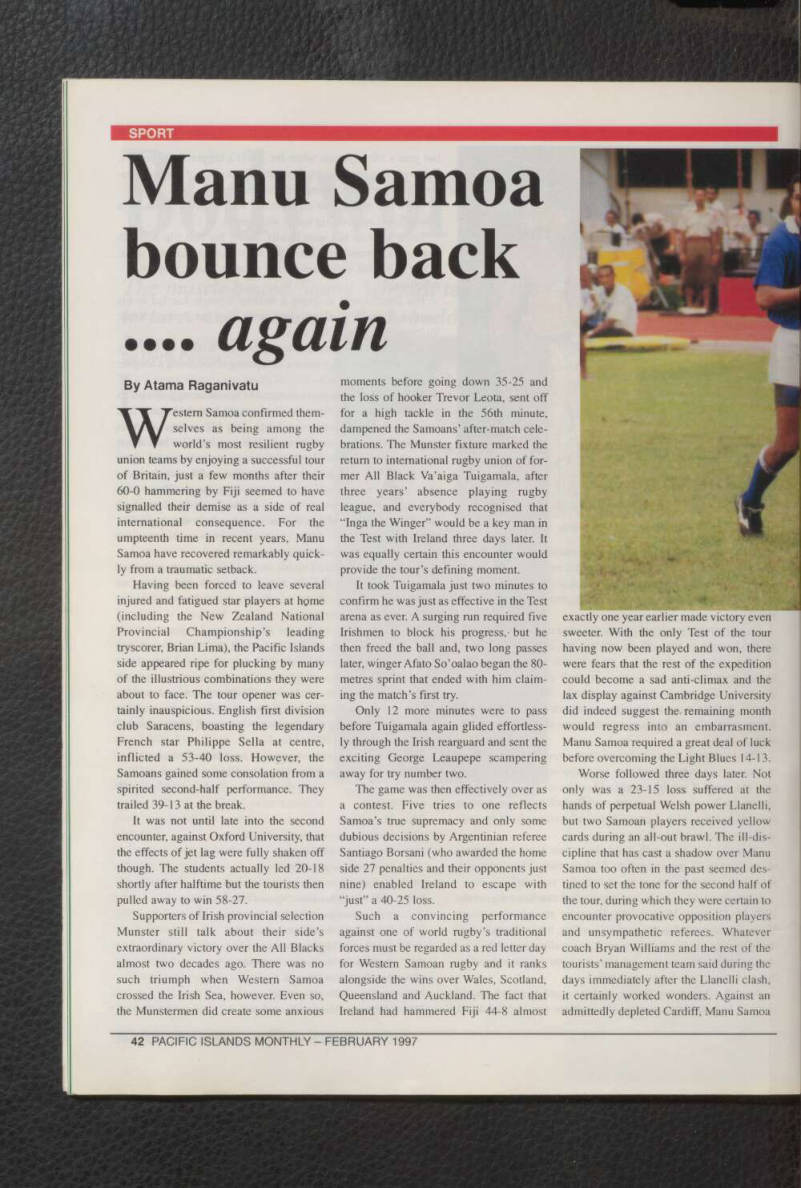
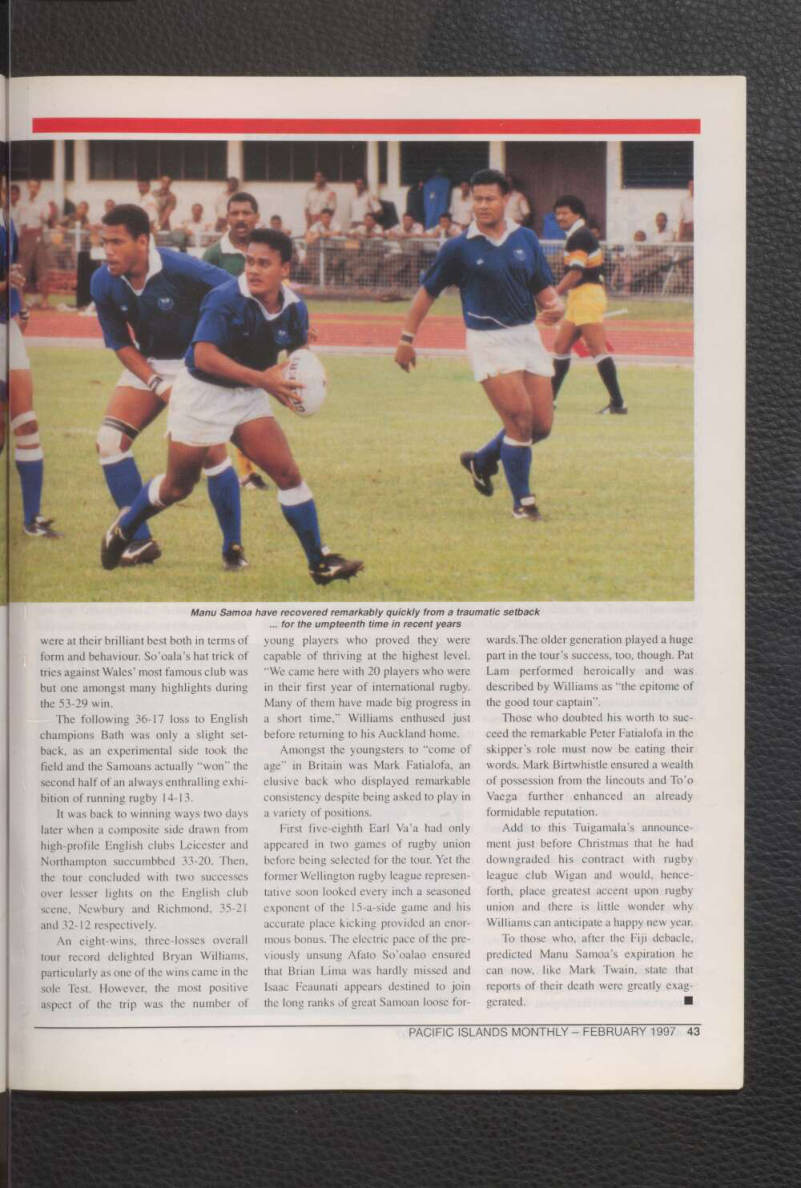
Manu Samoa bounce back ... again
By Atama Raganivatu
Western Samoa confirmed them selves as being among the world’s most resilient rugby union teams by enjoying a successful tour of Britain, just a few months after thqir 60-0 hammering by Fiji seemed to have signalled their demise as a side of real international consequence. For the umpteenth time in recent years, Manu Samoa have recovered remarkably quick ly from a traumatic setback.
Having been forced to leave several injured and fatigued star players at home (including the New Zealand National
Provincial Championship’s leading
tryscorer, Brian Lima), the Pacific Islands side appeared ripe for plucking by many of the illustrious combinations they were about to face. The tour opener was cer tainly inauspicious. English first division club Saracens, boasting the legendary French star Philippe Sella at centre, inflicted a 53-40 loss. However, the Samoans gained some consolation from a
spirited second-half performance. They
trailed 39-13 at the break.
It was not until late into the second encounter, against Oxford University, that the effects of jet lag were fully shaken off though. The students actually led 20-18 shortly after halftime but the tourists then pulled away to win 58-27.
Supporters of Irish provincial selection Munster still talk about their side’s extraordinary victory over the All Blacks almost two decades ago. There was no such triumph when Western Samoa crossed the Irish Sea, however. Even so, the Munstermen did create some anxious
moments before going down 35-25 and the loss of hooker Trevor Leota, sent off for a high tackle in the 56th minute, dampened the Samoans’ after-match cele brations. The Munster fixture marked the return to international rugby union of for mer All Black Va’aiga Tuigamala, after three years’ absence playing rugby league, and everybody recognised that “Inga the Winger” would be a key man in the Test with Ireland three days later. It was equally certain this encounter would provide the tour’s defining moment.
It took Tuigamala just two minutes to confirm he was just as effective in the Test arena as ever. A surging run required five Irishmen to block his progress, - but he then freed the ball and, two long passes later, winger Afato So’oalao began the 80metres sprint that ended with him claim ing the match’s first try.
Only 12 more minutes were to pass before Tuigamala again glided effortless ly through the Irish rearguard and sent the exciting George Leaupepe scampering away for try number two.
The game was then effectively over as a contest. Five tries to one reflects Samoa’s true supremacy and only some dubious decisions by Argentinian referee Santiago Borsani (who awarded the home side 27 penalties and their opponents just nine) enabled Ireland to escape with “just” a 40-25 loss.
Such a convincing performance
against one of world rugby’s traditional forces must be regarded as a red letter day for Western Samoan rugby and it ranks alongside the wins over Wales, Scotland, Queensland and Auckland. The fact that Ireland had hammered Fiji 44-8 almost
exactly one year earlier made victory even sweeter. With the only Test of the tour having now been played and won, there were fears that the rest of the expedition could become a sad anti-climax and the
lax display against Cambridge University
did indeed suggest the-remaining month would regress into an embarrasment.
Manu Samoa required a great deal of luck before overcoming the Light Blues 14-13.
Worse followed three days later. Not only was a 23-15 loss suffered at the hands of perpetual Welsh power Llanelli, but two Samoan players received yellow cards during an all-out brawl. The ill-dis cipline that has cast a shadow over Manu Samoa too often in the past seemed des tined to set the tone for the second half of the tour, during which they were certain to encounter provocative opposition players and unsympathetic referees. Whatever coach Bryan Williams and the rest of the tourists’ management team said during the days immediately after the Llanelli clash, it certainly worked wonders. Against an admittedly depleted Cardiff, Manu Samoa
were at their brilliant best both in terms of form and behaviour. So’oala’s hat trick of tries against Wales’ most famous club was but one amongst many highlights during the 53-29 win.
The following 36-17 loss to English champions Bath was only a slight set back, as an experimental side took the field and the Samoans actually “won” the second half of an always enthralling exhi bition of running rugby 14-13.
It was back to winning ways two days later when a composite side drawn from high-profile English clubs Leicester and Northampton succumbbed 33-20. Then, the tour concluded with two successes over lesser lights on the English club scene, Newbury and Richmond, 35-21 and 32-12 respectively.
An eight-wins, three-losses overall tour record delighted Bryan Williams, particularly as one of the wins came in the sole Test. Flowever, the most positive aspect of the trip was the number of
young players who proved they were capable of thriving at the highest level.
“We came here with 20 players who were in their first year of international rugby.
Many of them have made big progress in a short time,” Williams enthused just before returning to his Auckland home.
Amongst the youngsters to “come of age” in Britain was Mark Fatialofa, an elusive back who displayed remarkable consistency despite being asked to play in a variety of positions.
First five-eighth Earl Va’a had only appeared in two games of rugby union before being selected for the tour. Yet the former Wellington rugby league represen tative soon looked every inch a seasoned exponent of the 15-a-side game and his accurate place kicking provided an enor mous bonus. The electric pace of the pre viously unsung Afato So’oalao ensured that Brian Lima was hardly missed and Isaac Feaunati appears destined to join the long ranks of great Samoan loose for
wards. The older generation played a huge part in the tour’s success, too, though. Pat Lam performed heroically and was described by Williams as “the epitome of the good tour captain”.
Those who doubted his worth to suc ceed the remarkable Peter Fatialofa in the skipper’s role must now be eating their words. Mark Birtwhistle ensured a wealth of possession from the lineouts and To’o Vaega further enhanced an already
formidable reputation.
Add to this Tuigamala’s announce ment just before Christmas that he had downgraded his contract with rugby league club Wigan and would, hence forth, place greatest accent upon rugby union and there is little wonder why Williams can anticipate a happy new year.
To those who, after the Fiji debacle, predicted Manu Samoa’s expiration he can now, like Mark Twain, state that reports of their death were greatly exag
gerated. ■
Manu Samoa have recovered remarkably quickly from a traumatic setback ... for the umpteenth time in recent years
Marina’s
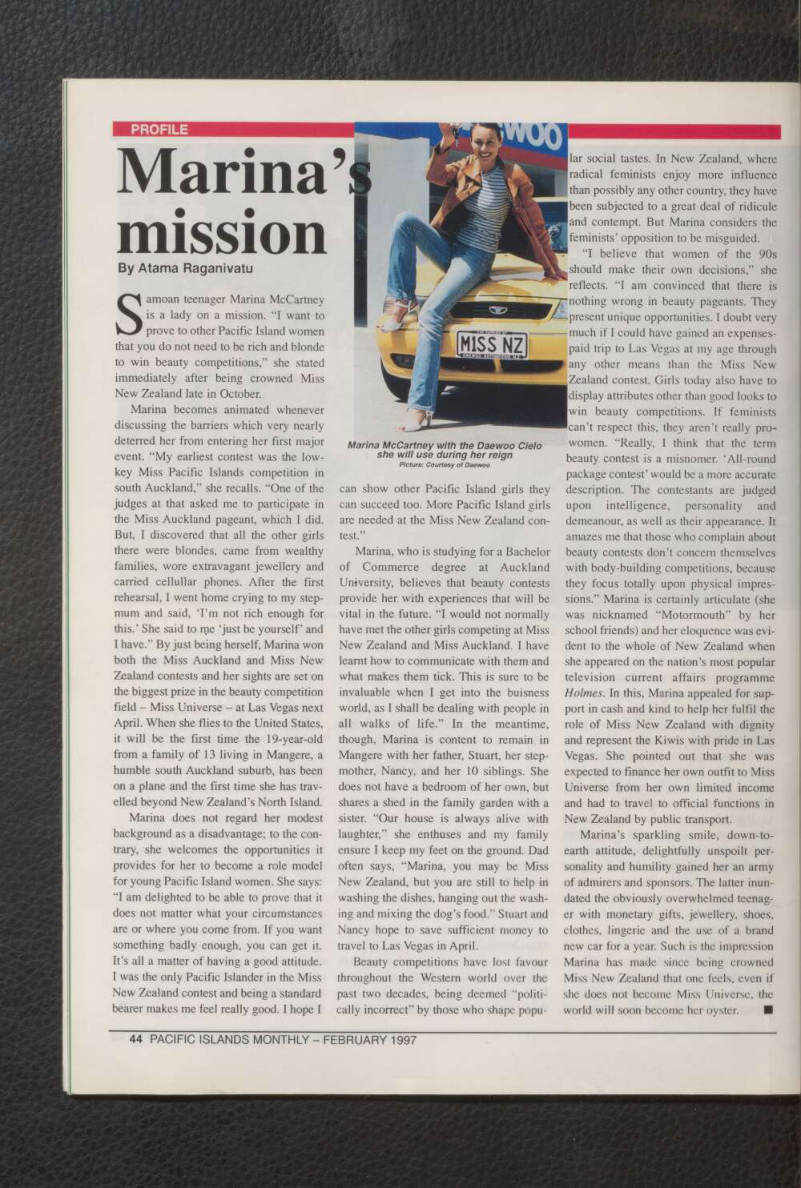
Profile
Marina’s mission
By Atama Raganivatu
Samoan teenager Marina McCartney
is a lady on a mission. “I want to prove to other Pacific Island women that you do not need to be rich and blonde to win beauty competitions,” she stated immediately after being crowned Miss New Zealand late in October.
Marina becomes animated whenever discussing the barriers which very nearly deterred her from entering her first major event. “My earliest contest was the low key Miss Pacific Islands competition in south Auckland,” she recalls. “One of the judges at that asked me to participate in the Miss Auckland pageant, which I did.
But, I discovered that all the other girls there were blondes, came from wealthy families, wore extravagant jewellery and carried cellullar phones. After the first rehearsal, I went home crying to my step mum and said, T’m not rich enough for this.’ She said to me ‘just be yourself’ and I have.” By just being herself, Marina won both the Miss Auckland and Miss New Zealand contests and her sights are set on the biggest prize in the beauty competition field - Miss Universe - at Las Vegas next April. When she flies to the United States, it will be the first time the 19-year-old from a family of 13 living in Mangere, a humble south Auckland suburb, has been on a plane and the first time she has trav elled beyond New Zealand’s North Island.
Marina does not regard her modest background as a disadvantage; to the con trary, she welcomes the opportunities it provides for her to become a role model for young Pacific Island women. She says: “I am delighted to be able to prove that it does not matter what your circumstances are or where you come from. If you want something badly enough, you can get it.
It’s all a matter of having a good attitude.
I was the only Pacific Islander in the Miss New Zealand contest and being a standard bearer makes me feel really good. I hope I
can show other Pacific Island girls they can succeed too. More Pacific Island girls are needed at the Miss New Zealand con test.”
Marina, who is studying for a Bachelor of Commerce degree at Auckland University, believes that beauty contests provide her with experiences that will be vital in the future. “I would not normally have met the other girls competing at Miss New Zealand and Miss Auckland. I have leamt how to communicate with them and what makes them tick. This is sure to be invaluable when I get into the buisness world, as I shall be dealing with people in all walks of life.” In the meantime, though, Marina is content to remain in Mangere with her father, Stuart, her step mother, Nancy, and her 10 siblings. She does not have a bedroom of her own, but shares a shed in the family garden with a sister. “Our house is always alive with laughter,” she enthuses and my family ensure I keep my feet on the ground. Dad often says, “Marina, you may be Miss New Zealand, but you are still to help in washing the dishes, hanging out the wash ing and mixing the dog’s food.” Stuart and Nancy hope to save sufficient money to travel to Las Vegas in April.
Beauty competitions have lost favour throughout the Western world over the past two decades, being deemed “politi cally incorrect” by those who shape popu
liar social tastes. In New Zealand, where ■ radical feminists enjoy more influence p than possibly any other country, they have ■ been subjected to a great deal of ridicule land contempt. But Marina considers the ■ feminists’ opposition to be misguided.
P “I believe that women of the 90s make their own decisions,” she reflects. “I am convinced that there is
7nothing wrong in beauty pageants. They
unique opportunities. I doubt very much if I could have gained an expenses paid trip to Las Vegas at my age through I any other means than the Miss New Zealand contest. Girls today also have to Idisplay attributes other than good looks to ■win beauty competitions. If feminists ■can’t respect this, they aren’t really pro women. “Really, I think that the term beauty contest is a misnomer. ‘All-round package contest’ would be a more accurate description. The contestants are judged
upon intelligence, personality and
demeanour, as well as their appearance. It amazes me that those who complain about beauty contests don’t concern themselves with body-building competitions, because they focus totally upon physical impres sions.” Marina is certainly articulate (she was nicknamed “Motormouth” by her school friends) and her eloquence was evi dent to the whole of New Zealand when she appeared on the nation’s most popular television current affairs programme Holmes. In this, Marina appealed for sup port in cash and kind to help her fulfil the role of Miss New Zealand with dignity and represent the Kiwis with pride in Las Vegas. She pointed out that she was expected to finance her own outfit to Miss Universe from her own limited income and had to travel to official functions in New Zealand by public transport.
Marina’s sparkling smile, down-to earth attitude, delightfully unspoilt per sonality and humility gained her an army of admirers and sponsors. The latter inun dated the obviously overwhelmed teenag er with monetary gifts, jewellery, shoes, clothes, lingerie and the use of a brand new car for a year. Such is the impression Marina has made since being crowned Miss New Zealand that one feels, even if she does not become Miss Universe, the world will soon become her oyster. ■
Marina McCartney with the Daewoo Cielo she will use during her reign Picture: Courtesy of Daewoo
Uncovering
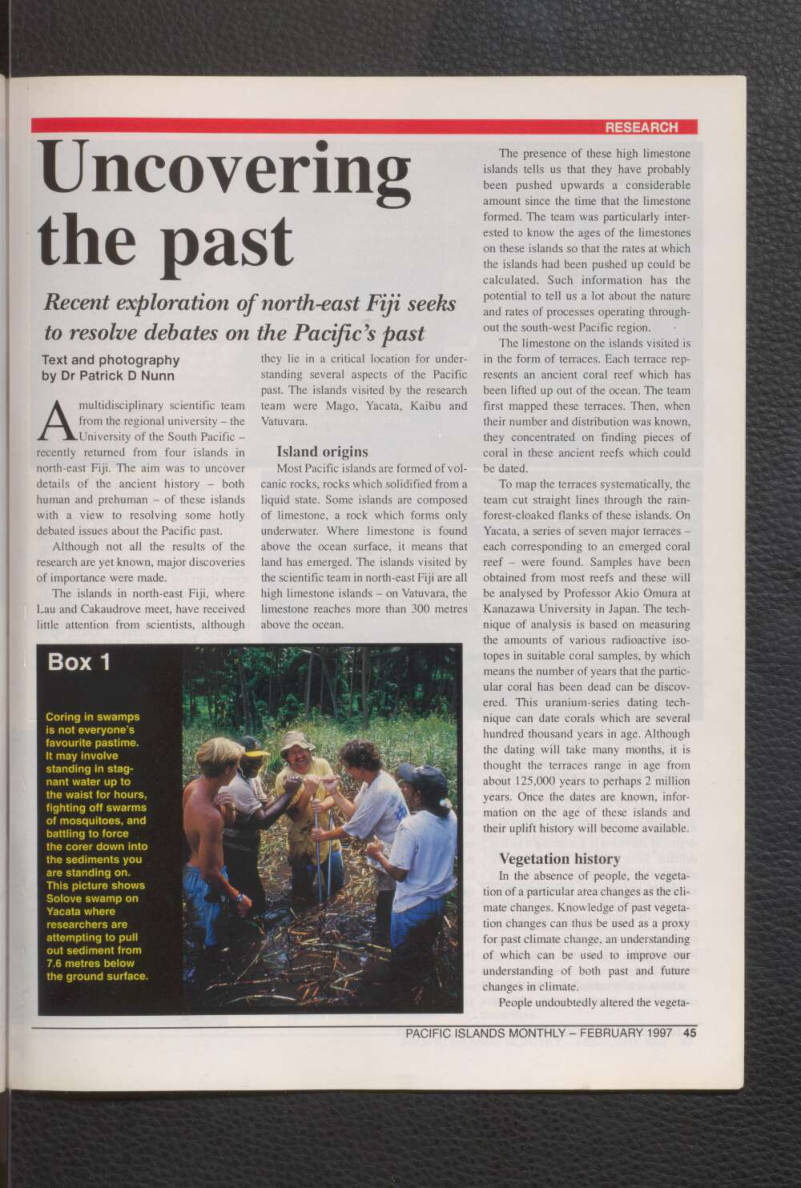
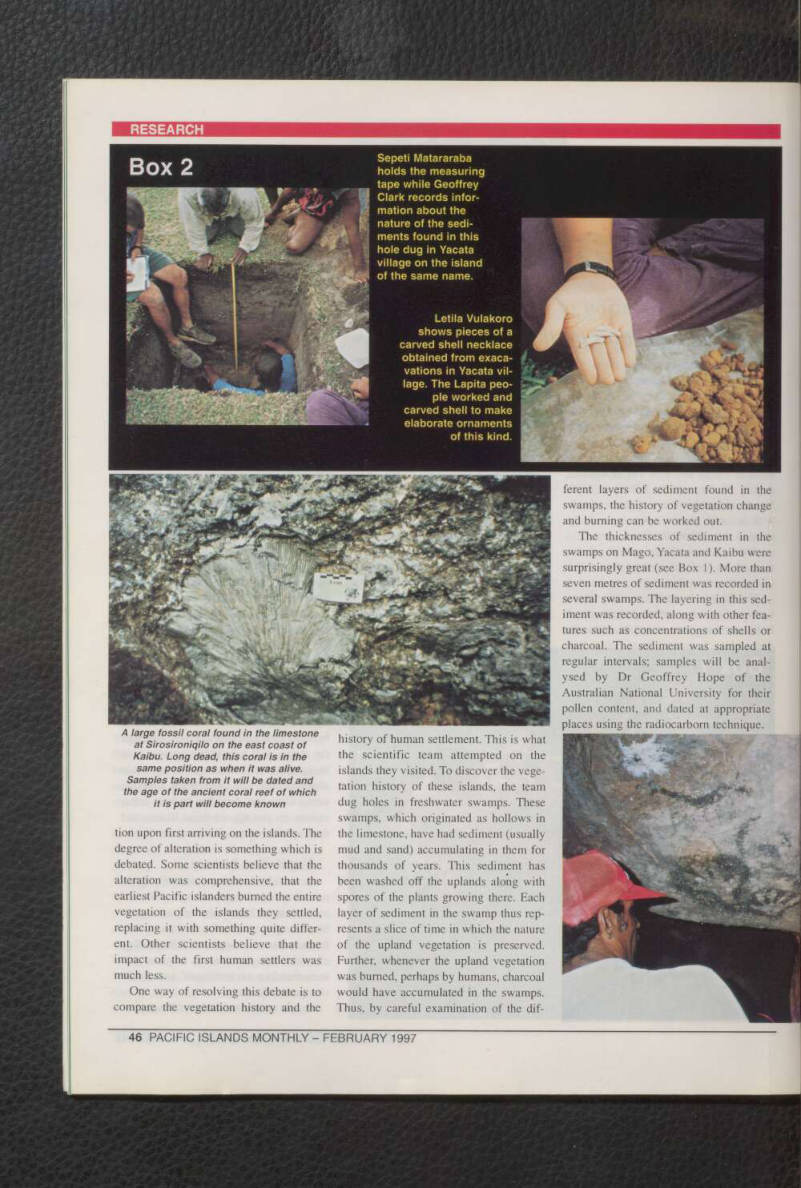
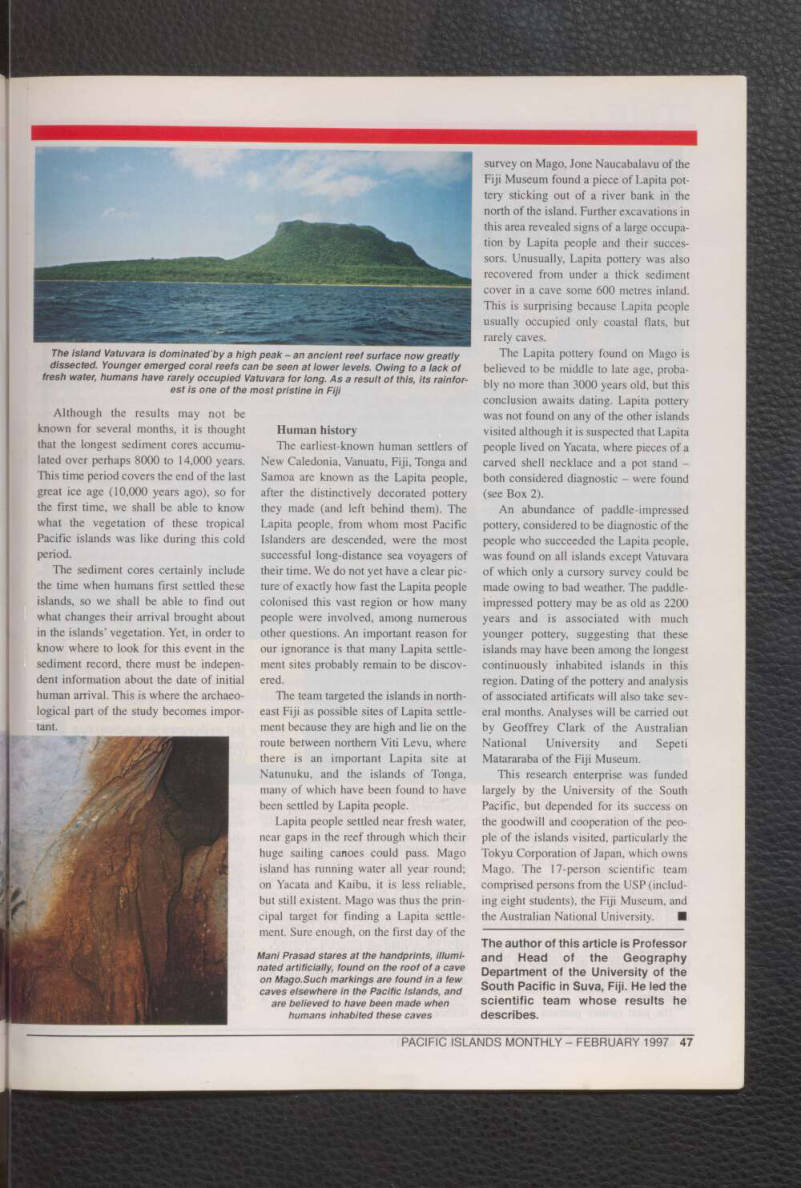
Research
Uncovering the past
Recent exploration of north-east Fiji seeks to resolve debates on the Pacific’s past
Text and photography by Dr Patrick D Nunn
A multidisciplinary scientific team
from the regional university - the University of the South Pacific recently returned from four islands in north-east Fiji. The aim was to uncover details of the ancient history - both human and prehuman - of these islands with a view to resolving some hotly debated issues about the Pacific past.
Although not all the results of the research are yet known, major discoveries of importance were made.
The islands in north-east Fiji, where Lau and Cakaudrove meet, have received little attention from scientists, although
they lie in a critical location for under standing several aspects of the Pacific past. The islands visited by the research team were Mago, Yacata, Kaibu and Vatuvara.
Island origins
Most Pacific islands are formed of vol canic rocks, rocks which solidified from a liquid state. Some islands are composed of limestone, a rock which forms only underwater. Where limestone is found above the ocean surface, it means that land has emerged. The islands visited by the scientific team in north-east Fiji are all high limestone islands - on Vatuvara, the limestone reaches more than 300 metres above the ocean.
The presence of these high limestone islands tells us that they have probably been pushed upwards a considerable amount since the time that the limestone formed. The team was particularly inter ested to know the ages of the limestones on these islands so that the rates at which the islands had been pushed up could be calculated. Such information has the potential to tell us a lot about the nature and rates of processes operating through out the south-west Pacific region.
The limestone on the islands visited is in the form of terraces. Each terrace rep resents an ancient coral reef which has been lifted up out of the ocean. The team first mapped these terraces. Then, when their number and distribution was known, they concentrated on finding pieces of coral in these ancient reefs which could be dated.
To map the terraces systematically, the team cut straight lines through the rain forest-cloaked flanks of these islands. On Yacata, a series of seven major terraces each corresponding to an emerged coral reef - were found. Samples have been obtained from most reefs and these will be analysed by Professor Akio Omura at Kanazawa University in Japan. The tech nique of analysis is based on measuring the amounts of various radioactive iso topes in suitable coral samples, by which means the number of years that the partic ular coral has been dead can be discov ered. This uranium-series dating tech nique can date corals which are several hundred thousand years in age. Although the dating will take many months, it is thought the terraces range in age from about 125,000 years to perhaps 2 million years. Once the dates are known, infor mation on the age of these islands and their uplift history will become available.
Vegetation history
In the absence of people, the vegeta tion of a particular area changes as the cli mate changes. Knowledge of past vegeta tion changes can thus be used as a proxy for past climate change, an understanding of which can be used to improve our understanding of both past and future changes in climate.
People undoubtedly altered the vegeta-
Box 1
Coring in swamps is not everyone’s favourite pastime.
It may involve standing in stag nant water up to the waist for hours, fighting off swarms of mosquitoes, and battling to force the corer down into the sediments you are standing on.
This picture shows Solove swamp on Yacata where researchers are attempting to pull out sediment from 7,6 metres below the ground surface.
tion upon first arriving on the islands. The degree of alteration is something which is debated. Some scientists believe that the alteration was comprehensive, that the earliest Pacific islanders burned the entire vegetation of the islands they settled, replacing it with something quite differ ent. Other scientists believe that the impact of the first human settlers was much less.
One way of resolving this debate is to compare the vegetation history and the
history of human settlement. This is what the scientific team attempted on the islands they visited. To discover the vege tation history of these islands, the team dug holes in freshwater swamps. These swamps, which originated as hollows in the limestone, have had sediment (usually mud and sand) accumulating in them for thousands of years. This sediment has been washed off the uplands along with spores of the plants growing there. Each layer of sediment in the swamp thus rep resents a slice of time in which the nature of the upland vegetation is preserved.
Further, whenever the upland vegetation was burned, perhaps by humans, charcoal would have accumulated in the swamps.
Thus, by careful examination of the dif
ferent layers of sediment found in the swamps, the history of vegetation change and burning can be worked out.
The thicknesses of sediment in the swamps on Mago, Yacata and Kaibu were surprisingly great (see Box 1). More than seven metres of sediment was recorded in several swamps. The layering in this sed iment was recorded, along with other fea tures such as concentrations of shells or charcoal. The sediment was sampled at regular intervals; samples will be anal ysed by Dr Geoffrey Hope of the Australian National University for their pollen content, and dated at appropriate places using the radiocarbom technique.
Sepeti Matararaba holds the measuring tape while Geoffrey Clark records infor mation about the nature of the sedi ments found in this hole dug in Yacata village on the island of the same name.
Letila Vulakoro shows pieces of a carved shell necklace obtained from exaca vations in Yacata vil lage. The Lapita peo ple worked and carved shell to make elaborate ornaments of this kind.
Box 2
A large fossil coral found in the limestone at Sirosironiqilo on the east coast of Kaibu. Long dead, this coral is in the same position as when it was alive.
Samples taken from it will be dated and the age of the ancient coral reef of which it is part will become known
Although the results may not be known for several months, it is thought that the longest sediment cores accumu lated over perhaps 8000 to 14,000 years.
This time period covers the end of the last great ice age (10,000 years ago), so for the first time, we shall be able to know what the vegetation of these tropical Pacific islands was like during this cold
period.
The sediment cores certainly include the time when humans first settled these islands, so we shall be able to find out what changes their arrival brought about in the islands’ vegetation. Yet, in order to know where to look for this event in the sediment record, there must be indepen dent information about the date of initial human arrival. This is where the archaeo logical part of the study becomes impor tant.
Human history The earliest-known human settlers of New Caledonia, Vanuatu, Fiji, Tonga and Samoa are known as the Lapita people, after the distinctively decorated pottery they made (and left behind them). The Lapita people, from whom most Pacific Islanders are descended, were the most successful long-distance sea voyagers of their time. We do not yet have a clear pic ture of exactly how fast the Lapita people colonised this vast region or how many people were involved, among numerous other questions. An important reason for our ignorance is that many Lapita settle ment sites probably remain to be discov ered.
The team targeted the islands in north east Fiji as possible sites of Lapita settle ment because they are high and lie on the route between northern Viti Levu, where there is an important Lapita site at Natunuku, and the islands of Tonga, many of which have been found to have
been settled by Lapita people.
Lapita people settled near fresh water, near gaps in the reef through which their huge sailing canoes could pass. Mago island has running water all year round; on Yacata and Kaibu, it is less reliable, but still existent. Mago was thus the prin cipal target for finding a Lapita settle ment. Sure enough, on the first day of the
survey on Mago, Jone Naucabalavu of the Fiji Museum found a piece of Lapita pot tery sticking out of a river bank in the north of the island. Further excavations in this area revealed signs of a large occupa tion by Lapita people and their succes sors. Unusually, Lapita pottery was also recovered from under a thick sediment cover in a cave some 600 metres inland.
This is surprising because Lapita people
usually occupied only coastal flats, but
rarely caves.
The Lapita pottery found on Mago is believed to be middle to late age, proba bly no more than 3000 years old, but this conclusion awaits dating. Lapita pottery was not found on any of the other islands visited although it is suspected that Lapita people lived on Yacata, where pieces of a carved shell necklace and a pot stand both considered diagnostic - were found (see Box 2).
An abundance of paddle-impressed pottery, considered to be diagnostic of the people who succeeded the Lapita people, was found on all islands except Vatuvara of which only a cursory survey could be made owing to bad weather. The paddle impressed pottery may be as old as 2200 years and is associated with much younger pottery, suggesting that these islands may have been among the longest continuously inhabited islands in this region. Dating of the pottery and analysis of associated artificats will also take sev eral months. Analyses will be carried out by Geoffrey Clark of the Australian
National University and Sepeti
Matararaba of the Fiji Museum.
This research enterprise was funded largely by the University of the South Pacific, but depended for its success on the goodwill and cooperation of the peo ple of the islands visited, particularly the Tokyu Corporation of Japan, which owns Mago. The 17-person scientific team comprised persons from the USP (includ ing eight students), the Fiji Museum, and the Australian National University. ■
The author of this article is Professor and Head of the Geography Department of the University of the South Pacific in Suva, Fiji. He led the scientific team whose results he describes.
The island Vatuvara is dominated by a high peak —an ancient reel surface now greatly dissected. Younger emerged coral reefs can be seen at lower levels. Owing to a lack of fresh water, humans have rarely occupied Vatuvara for long. As a result of this, its rainfor est is one of the most pristine in Fiji
Marti Prasad stares at the handprints, illumi nated artificially, found on the roof of a cave on Mago.Such markings are found in a few caves elsewhere in the Pacific Islands, and are believed to have been made when humans inhabited these caves
Advertisements & other items, p. 46 (1 item)
Research
Striking oil
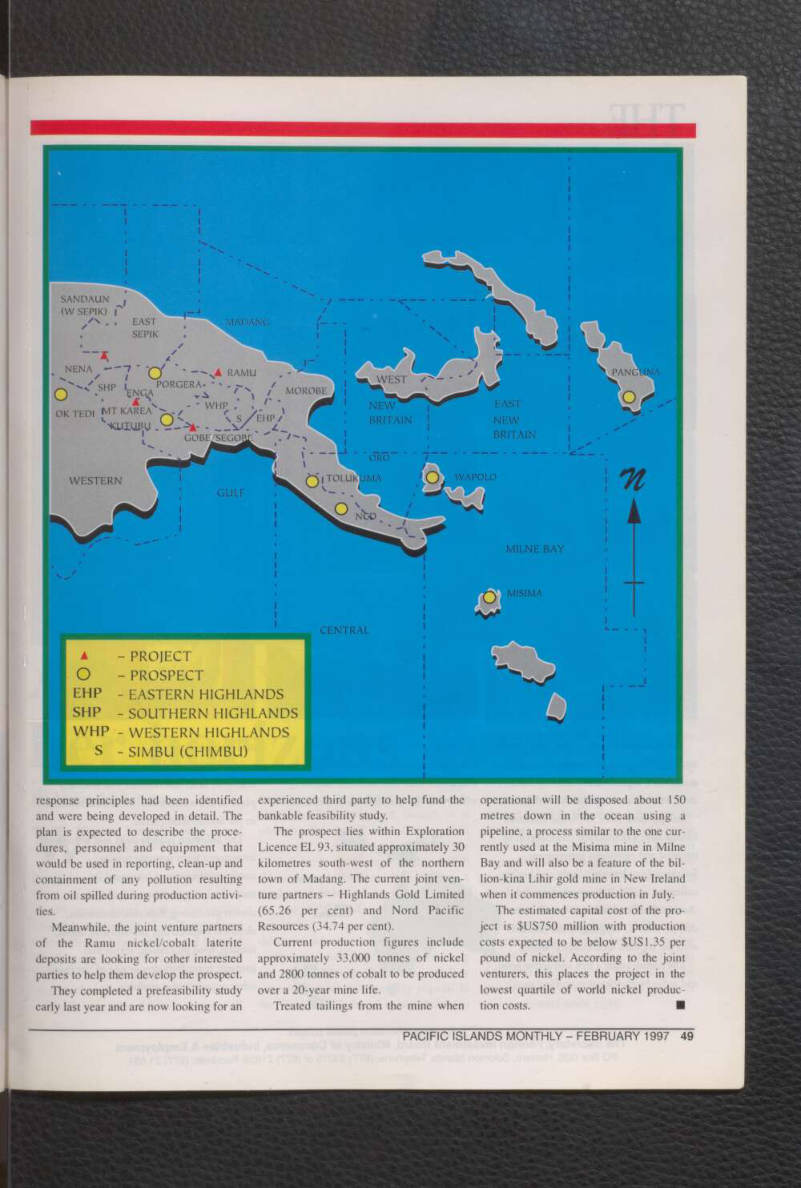
Development
PNG’s second petroleum development project takes off as interest builds in nickel and cohalt mining
By Ruth Waram
Work is already under way on the development of Papua New Guinea’s second
petroleum development project, located
approximately 500 kilometres north-west of Port Moresby.
The Gobe petroleum development pro ject includes the development of two sep arate oil fields. South East Gobe and Gobe Main are located 85 kilometres southeast of the current producing Kutubu fields in PNG’s Southern Highlands
province.
The two fields are located approxi mately 15 kilometres from the existing Kutubu export pipeline, in rugged moun tainous and swampy country, with one field lying across the Gulf and Southern Highlands provinces.
The two fields are forecast to produce at a combined peak rate of approximately 50,000 barrels of oil per day for over five years.
Direct benefits to the state from the project include direct taxes and duties through the petroleum income tax (50 per cent), payroll taxes, import duties and, if appropriate, additional profits tax of 50 per cent on after-tax profits.
Indirect benefits to people in the pro ject area include employment, education, training and educational assistance.
Project employment during construction
is expected to exceed 1000 while employ ment during production is expected to be much less.
Non-cash benefits to the project area landowners include the funding of com munity development and public health programmes.
The joint venture partners in the two
fields, which include some of the biggest names in the business, submitted their applications for two petroleum develop ment licences and a pipeline licence on April 12 last year and had expected gov ernment approval by October. The pro cess normally takes about six months.
However, landowners claiming they
were not being considered by the devel oper for civil works contracts and wanting greater equity in the project, stopped phase one of the civil works.
The developer then withdrew all machinery from the project site, while the landowners and the government held sev eral meetings to address the landowners’ demands.
Under government policy, landowners in petroleum project areas will receive a two-per-cent free equity in any project while landowners in mining project areas will receive a five-per-cent-free equity.
When submitting their applications,
the joint venturers had forecast first oil to be produced by December this year.
However, the delays mean first oil from the fields is expected by March 1998.
PNG’s mining and petroleum minister, John Giheno, after several meetings with landowners, granted the two development licences and a pipeline licence to the Gobe joint venturers on Christmas Eve.
The field will be developed under a joint venture arrangement between the various licencees in the project, with Chevron Niugini, also the developer of the Kutubu project, being the operator.
After months of negotiations, landowners from the project area signed a Memorandum of Understanding (MOU) with the developer, Chevron Niugini, which are prerequisites to granting a licence.
As per the MO A, the landowners’ equity in the project will be held by a trustee company, whose memorandums and articles of association will need to be approved by the state under a deed of trust.
The landowners’ two-per-cent equity will come from the state’s 22.5-per-cent equity in the project, with the state also bearing their cost of production until first oil, after which they will be required to fulfil all financial commitments like other
joint venturers.
The money from the sale of the landowners’ share of oil will be paid into an escrow account and used to pay royal ties, joint-venture cash calls, contribute to an abandonment fund for the project, and to maintain a balance in the escrow account sufficient to pay joint-venture cash calls for three months.
The MOA to be reviewed two years after the signing also addresses local busi ness opportunities, dispute resolution pro cedures and training and localisation.
Two petroleum licences are required to develop the fields because the SE Gobe discovery straddles two licence areas.
Following the completion of the appraisal drilling, the two licence parties decided to utilise the field.
The developers have said that the close proximity of the two fields provides them with an opportunity to reduce develop ment and operating costs.
According to Chevron, the Gobe pro ject is designed to function as a closed system, with only minor environmental discharges of site rain water run-off, treat ed sewerage effluent and combustion gas.
They said during periods when the water injection well is not available, some treated produced water may be discharged after additional infiltration.
Chevron has also said they have an oil spill response plan for the Kutubu project and the Gobe plan will be integrated into it. Measures will include the adoption of
stringent design standards, computerised
leak detection for the export pipeline, a
high degree of training, secondary con
tainment around higher risk areas and design measures to minimise the volume of a possible spill.
Chevron said last year that their spill
response principles had been identified and were being developed in detail. The plan is expected to describe the proce dures, personnel and equipment that would be used in reporting, clean-up and containment of any pollution resulting from oil spilled during production activi ties.
Meanwhile, the joint venture partners of the Ramu nickel/cobalt laterite deposits are looking for other interested parties to help them develop the prospect.
They completed a prefeasibility study early last year and are now looking for an
experienced third party to help fund the
bankable feasibility study.
The prospect lies within Exploration Licence EL 93, situated approximately 30 kilometres south-west of the northern town of Madang. The current joint ven ture partners - Highlands Gold Limited (65.26 per cent) and Nord Pacific Resources (34.74 per cent).
Current production figures include
approximately 33,000 tonnes of nickel and 2800 tonnes of cobalt to be produced over a 20-year mine life.
Treated tailings from the mine when
operational will be disposed about 150 metres down in the ocean using a pipeline, a process similar to the one cur rently used at the Misima mine in Milne Bay and will also be a feature of the bil lion-kina Lihir gold mine in New Ireland when it commences production in July.
The estimated capital cost of the pro ject is SUS7SO million with production costs expected to be below SUSI.3S per pound of nickel. According to the joint venturers, this places the project in the lowest quartile of world nickel produc tion costs. ■
Advertisements & other items, p. 50 (1 item)
Solomon Islands
THE
Welcomes Your Investment
M W -■ W, -aw
skissi
v-:
z. ri
■ ■ MB 1 n The Solomon Islands - over 100 islands and 27,000 square kilometres of rainforests,
mountains, lagoons and picture-perfect
coral beaches set in the heart of Melanesia.
Independent since 1978, the Solomon Islands have a democratic constitution of national and provincial government.
Solomon Islanders are a lively and healthy collection of 370,000 law-abiding and cheerful Pacific islanders whose diverse culture (over 87 languages) has blended with the modern technological world.
The islands enjoy a free and active press and radio (with television coming soon); and high-technology satellite communications links (including ISD telephone, telex and facsimile facilities) which link the islands both domestically
PNG
SOLOMON
ISLANDS
Vv
FIJI
AUSTRALIA
NEW
CALEDONIA
NEW
ZEALAND
and internationally.
In addition regular, scheduled sea and air transport links can connect you with any place in the world from our central location in the South-West Pacific.
The Solomon Islands seeks and welcomes investment from genuine private commercial investors interested in
manufacturing, commercial agriculture,
timber processing, fisheries, electronics, electrical engineering, tourism and hotels, mining, food processing, textile and garment manufacturing or one of the many other opportunities available.
For more information please contact: The Secretary, Foreign Investment Board, Ministry of Commerce, Industries & Employment PO Box G 26, Honiara, Solomon Islands. Telephone: (677) 23015 or (677) 21928. Facsimile: (677) 21 651.
Annie expands
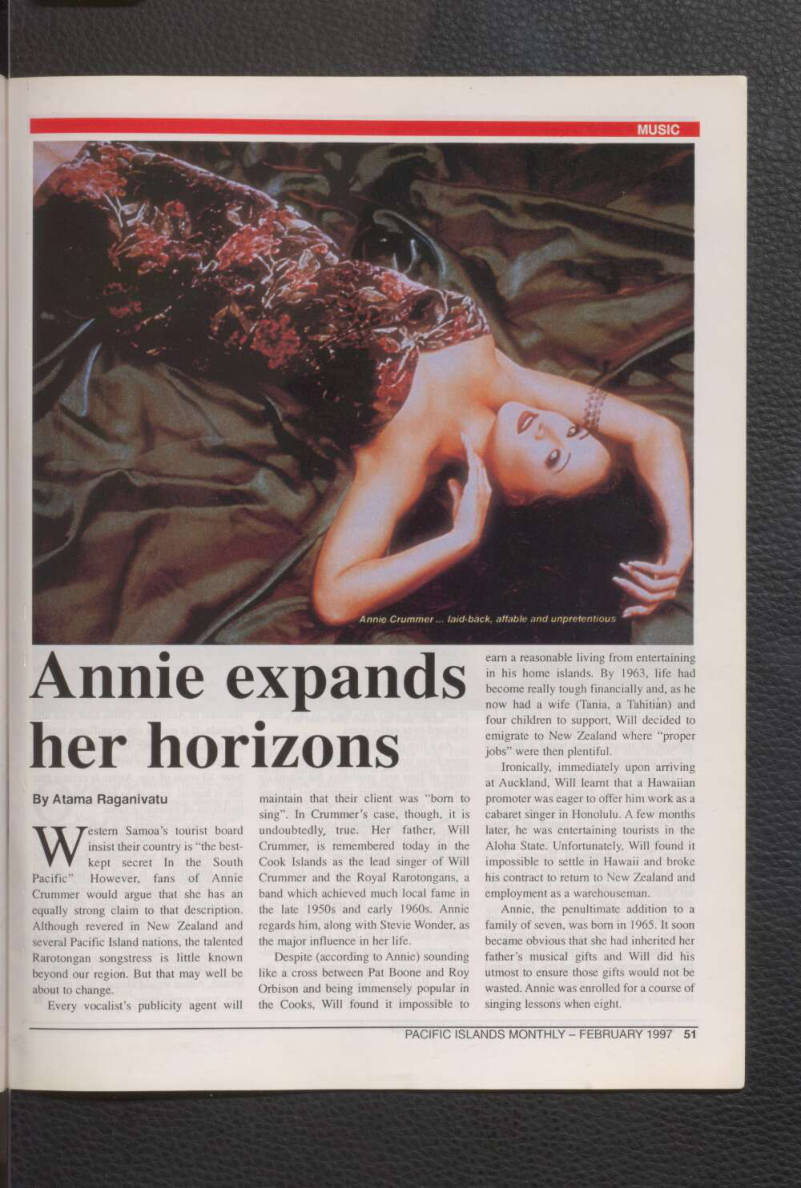
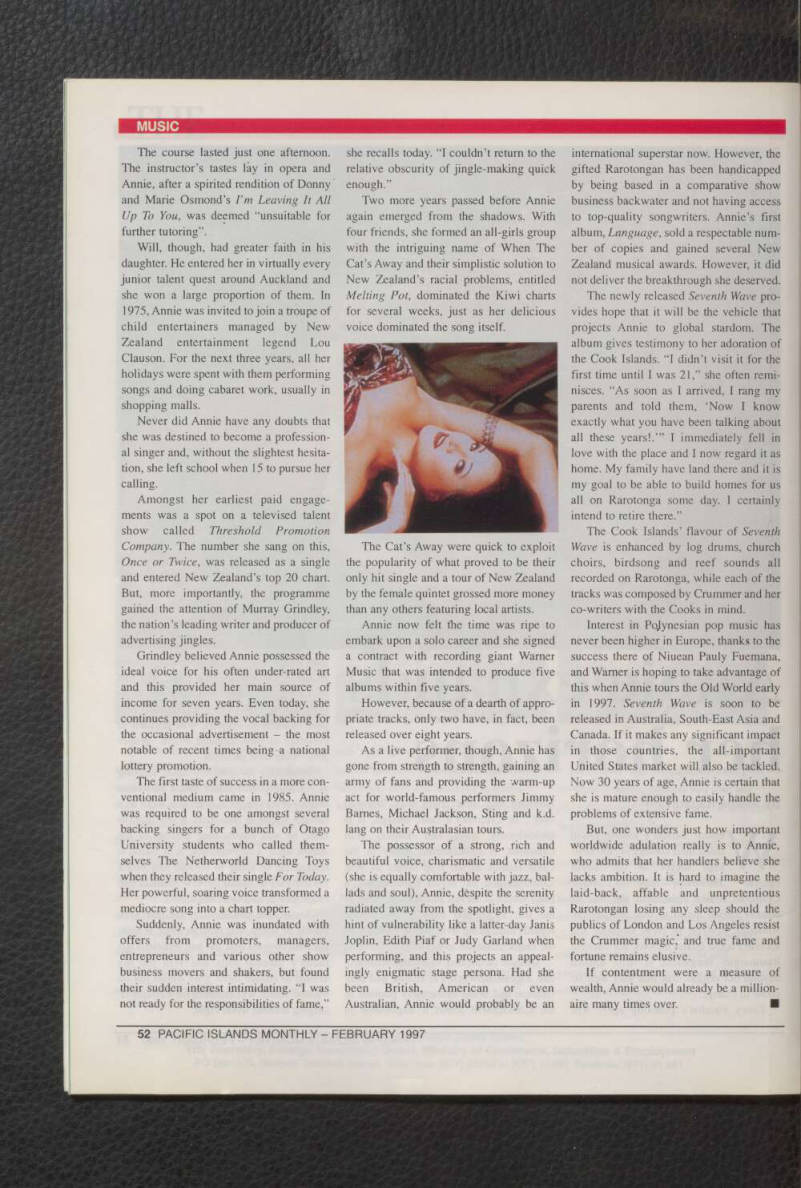
Music
Annie expands her horizons
By Atama Raganivatu
Western Samoa’s tourist board insist their country is “the best kept secret In the South Pacific” However, fans of Annie Crummer would argue that she has an equally strong claim to that description.
Although revered in New Zealand and several Pacific Island nations, the talented Rarotongan songstress is little known beyond our region. But that may well be about to change.
Every vocalist’s publicity agent will
maintain that their client was “bom to sing”. In Crummer’s case, though, it is undoubtedly, true. Her father, Will Crummer, is remembered today in the Cook Islands as the lead singer of Will Crummer and the Royal Rarotongans, a band which achieved much local fame in the late 1950 s and early 19605. Annie regards him, along with Stevie Wonder, as the major influence in her life.
Despite (according to Annie) sounding
like a cross between Pat Boone and Roy Orbison and being immensely popular in the Cooks, Will found it impossible to
earn a reasonable living from entertaining in his home islands. By 1963, life had become really tough financially and, as he now had a wife (Tania, a Tahitian) and four children to support, Will decided to emigrate to New Zealand where “proper jobs” were then plentiful.
Ironically, immediately upon arriving
at Auckland, Will leamt that a Hawaiian promoter was eager to offer him work as a cabaret singer in Honolulu. A few months later, he was entertaining tourists in the Aloha State. Unfortunately, Will found it impossible to settle in Hawaii and broke his contract to return to New Zealand and employment as a warehouseman.
Annie, the penultimate addition to a family of seven, was bom in 1965. It soon became obvious that she had inherited her father’s musical gifts and Will did his utmost to ensure those gifts would not be wasted. Annie was enrolled for a course of
singing lessons when eight.
Annie Crummer... laid-back, affable and unpretentious
The course lasted just one afternoon.
The instructor’s tastes lay in opera and Annie, after a spirited rendition of Donny and Marie Osmond’s I’m Leaving It All Up To You, was deemed “unsuitable for
further tutoring”.
Will, though, had greater faith in his daughter. He entered her in virtually every junior talent quest around Auckland and she won a large proportion of them. In 1975, Annie was invited to join a troupe of child entertainers managed by New Zealand entertainment legend Lou Clauson. For the next three years, all her holidays were spent with them performing songs and doing cabaret work, usually in
shopping malls.
Never did Annie have any doubts that she was destined to become a profession al singer and, without the slightest hesita tion, she left school when 15 to pursue her calling.
Amongst her earliest paid engage ments was a spot on a televised talent show called Threshold Promotion Company. The number she sang on this.
Once or Twice, was released as a single and entered New Zealand’s top 20 chart.
But, more importantly, the programme gained the attention of Murray Grindley, the nation’s leading writer and producer of
advertising jingles.
Grindley believed Annie possessed the ideal voice for his often under-rated art and this provided her main source of income for seven years. Even today, she continues providing the vocal backing for the occasional advertisement - the most notable of recent times being a national
lottery promotion.
The first taste of success in a more con ventional medium came in 1985. Annie was required to be one amongst several backing singers for a bunch of Otago University students who called them selves The Netherworld Dancing Toys when they released their single For Today.
Her powerful, soaring voice transformed a mediocre song into a chart topper.
Suddenly, Annie was inundated with offers from promoters, managers, entrepreneurs and various other show business movers and shakers, but found their sudden interest intimidating. “I was not ready for the responsibilities of fame,”
she recalls today. “I couldn’t return to the
relative obscurity of jingle-making quick
enough.”
Two more years passed before Annie again emerged from the shadows. With four friends, she formed an all-girls group with the intriguing name of When The Cat’s Away and their simplistic solution to New Zealand’s racial problems, entitled Melting Pot, dominated the Kiwi charts for several weeks, just as her delicious voice dominated the song itself.
The Cat’s Away were quick to exploit the popularity of what proved to be their only hit single and a tour of New Zealand by the female quintet grossed more money than any others featuring local artists.
Annie now felt the time was ripe to embark upon a solo career and she signed a contract with recording giant Warner Music that was intended to produce five albums within five years.
However, because of a dearth of appro priate tracks, only two have, in fact, been released over eight years.
As a live performer, though, Annie has gone from strength to strength, gaining an army of fans and providing the warm-up act for world-famous performers Jimmy Bames, Michael Jackson, Sting and k.d. lang on their Australasian tours.
The possessor of a strong, rich and beautiful voice, charismatic and versatile (she is equally comfortable with jazz, bal lads and soul), Annie, despite the serenity radiated away from the spotlight, gives a hint of vulnerability like a latter-day Janis Joplin, Edith Piaf or Judy Garland when
performing, and this projects an appeal
ingly enigmatic stage persona. Had she been British, American or even Australian, Annie would probably be an
international superstar now. However, the gifted Rarotongan has been handicapped by being based in a comparative show business backwater and not having access to top-quality songwriters. Annie’s first album, Language, sold a respectable num ber of copies and gained several New Zealand musical awards. However, it did not deliver the breakthrough she deserved.
The newly released Seventh Wave pro vides hope that it will be the vehicle that projects Annie to global stardom. The album gives testimony to her adoration of the Cook Islands. “I didn’t visit it for the first time until I was 21,” she often remi nisces. “As soon as I arrived, I rang my parents and told them, ‘Now I know exactly what you have been talking about all these years!.”’ I immediately fell in love with the place and I now regard it as home. My family have land there and it is my goal to be able to build homes for us all on Rarotonga some day. I certainly intend to retire there.”
The Cook Islands’ flavour of Seventh Wave is enhanced by log drums, church choirs, birdsong and reef sounds all recorded on Rarotonga, while each of the tracks was composed by Crummer and her co-writers with the Cooks in mind.
Interest in Polynesian pop music has never been higher in Europe, thanks to the success there of Niuean Pauly Fuemana, and Warner is hoping to take advantage of this when Annie tours the Old World early in 1997. Seventh Wave is soon to be released in Australia, South-East Asia and Canada. If it makes any significant impact in those countries, the all-important United States market will also be tackled.
Now 30 years of age, Annie is certain that she is mature enough to easily handle the problems of extensive fame.
But, one wonders just how important worldwide adulation really is to Annie, who admits that her handlers believe she lacks ambition. It is hard to imagine the laid-back, affable and unpretentious Rarotongan losing any sleep should the publics of London and Los Angeles resist the Crummer magic,' and true fame and fortune remains elusive.
If contentment were a measure of wealth, Annie would already be a million aire many times over. ■
The politics
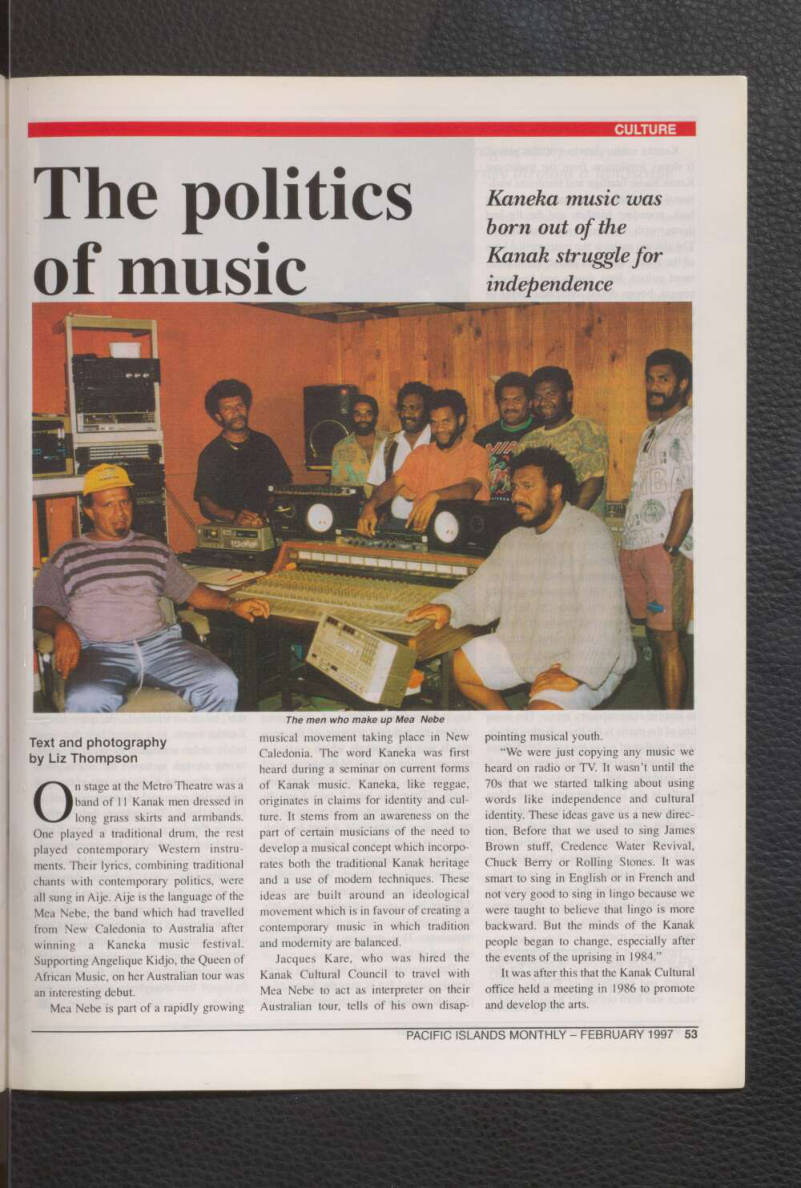
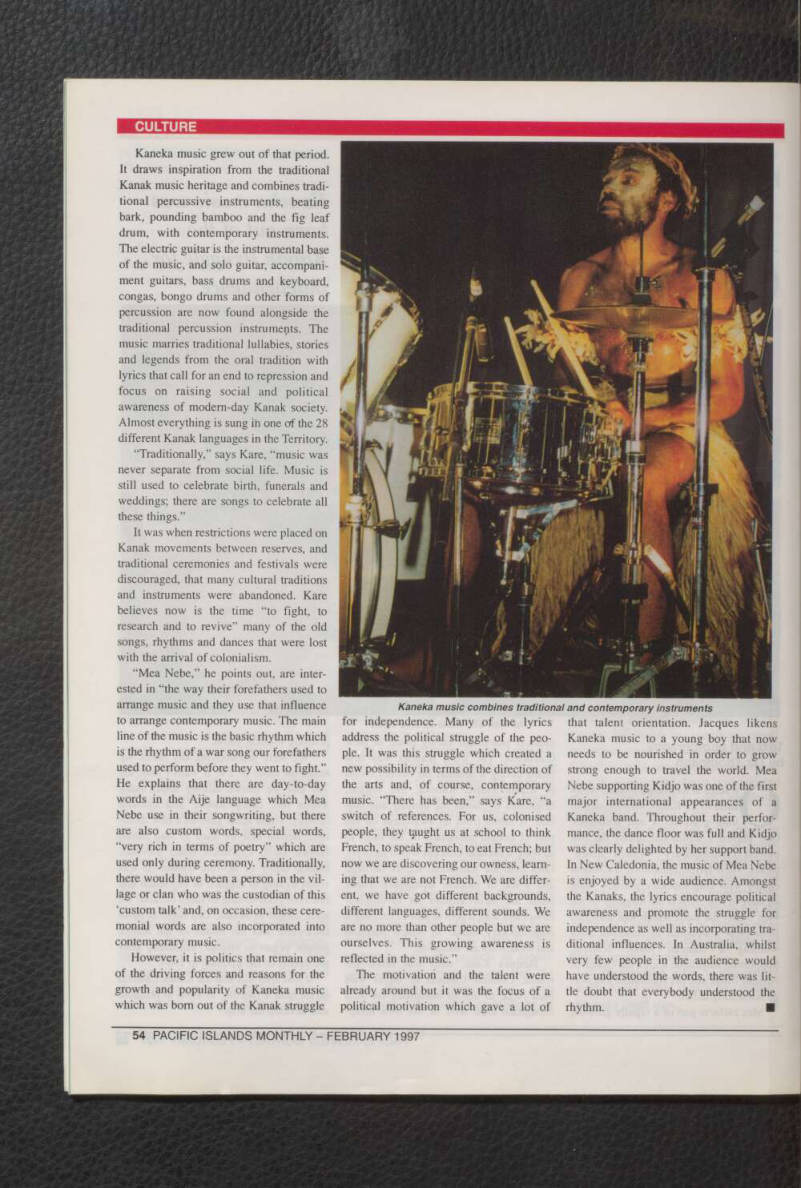
Culture
The politics of music
Kaneka music was horn out of the Kanak struggle for independence
Text and photography
by Liz Thompson
On stage at the Metro Theatre was a band of 11 Kanak men dressed in long grass skirts and armbands.
One played a traditional drum, the rest played contemporary Western instru ments. Their lyrics, combining traditional chants with contemporary politics, were all sung in Aije. Aije is the language of the Mea Nebe, the band which had travelled from New Caledonia to Australia after winning a Kaneka music festival.
Supporting Angelique Kidjo, the Queen of
African Music, on her Australian tour was an interesting debut.
Mea Nebe is part of a rapidly growing
musical movement taking place in New Caledonia. The word Kaneka was first heard during a seminar on current forms of Kanak music. Kaneka, like reggae, originates in claims for identity and cul ture. It stems from an awareness on the part of certain musicians of the need to develop a musical concept which incorpo rates both the traditional Kanak heritage and a use of modem techniques. These ideas are built around an ideological movement which is in favour of creating a contemporary music in which tradition and modernity are balanced.
Jacques Kare, who was hired the Kanak Cultural Council to travel with Mea Nebe to act as interpreter on their Australian tour, tells of his own disap
pointing musical youth.
“We were just copying any music we heard on radio or TV. It wasn’t until the 70s that we started talking about using words like independence and cultural identity. These ideas gave us a new direc tion, Before that we used to sing James Brown stuff, Credence Water Revival, Chuck Berry or Rolling Stones. It was smart to sing in English or in French and not very good to sing in lingo because we were taught to believe that lingo is more backward. But the minds of the Kanak
people began to change, especially after
the events of the uprising in 1984.”
It was after this that the Kanak Cultural office held a meeting in 1986 to promote and develop the arts.
The men who make up Mea Nebe
Kaneka music grew out of that period.
It draws inspiration from the traditional Kanak music heritage and combines tradi tional percussive instruments, beating bark, pounding bamboo and the fig leaf drum, with contemporary instruments.
The electric guitar is the instrumental base of the music, and solo guitar, accompani ment guitars, bass drums and keyboard, congas, bongo drums and other forms of percussion are now found alongside the traditional percussion instruments. The music marries traditional lullabies, stories and legends from the oral tradition with lyrics that call for an end to repression and focus on raising social and political awareness of modem-day Kanak society.
Almost everything is sung in one of the 28 different Kanak languages in the Territory.
“Traditionally,” says Kare, “music was never separate from social life. Music is still used to celebrate birth, funerals and weddings; there are songs to celebrate all
these things.”
It was when restrictions were placed on Kanak movements between reserves, and traditional ceremonies and festivals were discouraged, that many cultural traditions and instruments were abandoned. Kare believes now is the time “to fight, to research and to revive” many of the old songs, rhythms and dances that were lost with the arrival of colonialism.
“Mea Nebe,” he points out, are inter ested in “the way their forefathers used to arrange music and they use that influence to arrange contemporary music. The main line of the music is the basic rhythm which is the rhythm of a war song our forefathers used to perform before they went to fight.”
He explains that there are day-to-day words in the Aije language which Mea Nebe use in their songwriting, but there are also custom words, special words, “very rich in terms of poetry” which are
used only during ceremony. Traditionally,
there would have been a person in the vil lage or clan who was the custodian of this ‘custom talk’ and, on occasion, these cere monial words are also incorporated into contemporary music.
However, it is politics that remain one of the driving forces and reasons for the growth and popularity of Kaneka music which was bom out of the Kanak struggle
for independence. Many of the lyrics address the political struggle of the peo ple. It was this struggle which created a new possibility in terms of the direction of the arts and, of course, contemporary music. “There has been,” says Kare, “a switch of references. For us, colonised people, they taught us at school to think French, to speak French, to eat French; but now we are discovering our owness, learn ing that we are not French. We are differ ent, we have got different backgrounds, different languages, different sounds. We are no more than other people but we are ourselves. This growing awareness is reflected in the music.”
The motivation and the talent were already around but it was the focus of a political motivation which gave a lot of
that talent orientation. Jacques likens Kaneka music to a young boy that now needs to be nourished in order to grow strong enough to travel the world. Mea Nebe supporting Kidjo was one of the first major international appearances of a Kaneka band. Throughout their perfor mance, the dance floor was full and Kidjo was clearly delighted by her support band.
In New Caledonia, the music of Mea Nebe is enjoyed by a wide audience. Amongst the Kanaks, the lyrics encourage political awareness and promote the struggle for independence as well as incorporating tra ditional influences. In Australia, whilst very few people in the audience would have understood the words, there was lit tle doubt that everybody understood the
rhythm. ■
Kaneka music combines traditional and contemporary instruments
insights
Literature
Medical
An elusive, fragmentary and yet satisfying journey through a landscape
self examination
Book
Review
By Nicolas Rothwell
In the country of the blind, the one eyed man is king, so the saying goes; but in the country of the colour-blind, what there of the neurologist, the privi leged observer, the man of knowledge? In a remarkable Pacific memoir, Dr Oliver Sacks, the Western world’s most persua sive explainer of the tics, tricks and mys teries of the human mind, explores the strange Micronesian realms of Guam, Pohnpei and Pingelap - each, in its own way, a special kingdom of medical wonder and pathological challenge.
The Island of the Colour-blind, an account of two separate journeys under taken by the engaging, fluent Dr Sacks on the trail of unusual diseases, unfolds its tale in tranquil, gradual fashion, com mencing with the author’s childhood mus
ings on primitive trees and broadening
only in the most relaxed and tentative style to include his more developed themes: the splendours and miseries of neurology; the subtleties and sadnesses of island societies; the collision between tra dition and modernity; the texture, the feel of individual, disease-stricken human life.
Perhaps it was an inevitable coming together: the inquisitive Dr Sacks and the bizarre medical conditions of the Pacific a cluster of colour-blindness cases on the Pohnpei atoll of Pingelap, and the beset ting sicknesses of Guam, known by their local name, lytico-bodig, and as yet unde ciphered by modem medicine. In com plex, glancing narratives, reinforced by detailed footnotes on such fascinating top ics as radiation, cycad growth, obesity, and pigs in the Pacific, Dr Sacks tells the story of his brief journeys. The Carolines, he tells us, are “some of the most remote and least known islands in the world” but after a trip with Dr Sacks, their atmo sphere is palpable. Chance encounters and profound episodes succeed each other, until not only the quality of Pingelap colour-blindness, but the nature of atoll
life is captured, pinned down, conveyed.
In this little community of 700 souls, one in 12 is ‘achromatopic’ - completely colour-blind, seeing no hues, only shades of grey. Why? The explanation is intrigu ing: a population collapse in Pingelap spread a particular gene widely through the surviving community. Hence, in the glare-ridden, gleaming ocean, a group of squinting, half-blinded islanders, afflicted by their specific disease-cluster, known in the local tongue only as “ maskun ” - “not see”.
Dr Sacks travels back to lethargic Pohnpei, describes the lost city of Nan Madol and, before leaving, tastes the local kava, or sakau. This provides his most poignant pages. He is told that this Pacific drug is “one of the moral vines which holds us together” and in him it certainly produces impressive visual and auditory effects - which he proceeds, as- a neurolo gist, to gloss. It must have been one of the most mirrored, self-reflecting highs on record. Guam, however, -offered a more painful spectacle of disease. Here, the lyti co-bodig, an illness with affinities to Parkinsonism, motor neurone disease and Alzheimer’s rages in a given age-section of the Chamorro population. Virus, genet ic condition, environmental contaminant?
No one knows what provokes the multiple effects of the diseases which seem distinct yet inter-related. Cycad flour poisoning, mineral deficiency and mineral toxicity
have all been proposed as sole causes, and found wanting. Perhaps the illnesses, which have come almost to define an aspect of Guam’s life, may be the result of some complex combination of factors, Dr Sacks and his various colleagues and col laborators in this neurological detective story suggest, in between lyrical descrip tions of the old ways of island life and the present crudities of American military intrusion. So intensely do the resident doc tors involve themselves with the lytico bodig that they come to identify with it, as if it held the answer to some Pacific puz zle: indeed, Dr Sacks too feels the call of the disease, which, perversely, is dying out just as medical science gathers itself for a final assault on its secrets: “So it will be with Pingelap; and so, in all likelihood, it will be with Guam - odd genetic anoma lies, swirls, transients, given a brief possi bility, existence, by the nature of islands and isolation. But islands open up, people die or intermarry; genetic attenuation sets in, and the condition disappears. The life of such a genetic disease in an isolate tends to be six or eight generations, two hundred years perhaps, and then it vanish es, as do its memories and traces, lost in the ongoing stream of time.”
How elusive, how fragmentary, and yet how satisfying, ultimately, this strange, casually composed, almost off-hand book proves to be: its effect is one of smooth passage through a landscape of self-exam ination, through a human laboratory. The Pacific, that most evocative of stages, speaks to Dr Sacks, and speaks, through him, to his reader. He closes in a develop
ment-threatened primeval cycad forest
upon Guam’s companion island, Rota.
Here he receives an intimate impression of the antiquity of our planet, and the slow processes of life’s evolution: “Standing here in the jungle, 1 feel part of a larger, calmer identity; I feel a profound sense of being at home, a sort of companionship with the earth.” ■
The Island of the Colour-blind by Oliver Sacks. Published December 1996 by Picador, £16.99 (UK)
Advertisements & other items, p. 56 (1 item)
Asian Development Bank-Japan
SCHOLARSHIP PROGRAM
Qualified citizens of developing member countries of the Asian Development Bank, who intend to pursue post-graduate studies in selected disciplines are invited to apply for scholarships under the Asian Development Bank-Japan Scholarship Program. It is anticipated that upon successful completion of their graduate studies under the Program, the scholars will return to their countries and contribute to its socioeconomic development. Scholarships are awarded for graduate studies at designated institutions in courses of study approved by ADB. The Program especially welcomes women applicants who are qualified but have limited financial means to obtain university education.
THE SCHOLARSHIPS
* Level of education: * Duration:
* Coverage:
Post-graduate (Diploma, Masters and Doctorate degrees) From one to three years Tuition fees, books and subsistence allowance, insurance, return economy air fare
ELIGIBILITY REQUIREMENTS
Prospective applicants must: ♦ be a citizen of an ADB member country ♦ have at least two years work experience ♦ have gained admission to an approved course in a designated institution ♦ be in good health (Staff of ADB and the designated institutions and their close relatives are not eligible to apply)
DESIGNATED INSTITUTIONS
1. ASIAN INSTITUTE OF MANAGEMENT
123 Paseo de Roxas, Makati City Metro Manila, Philippines
2. ASIAN INSTITUTE OF TECHNOLOGY
P.O. Box 2754 Bangkok 10501, Thailand
3. EAST-WEST CENTER/UNIVERSITY OF HAWAII
1777 East-West Road, Honolulu Hawaii 96848, U.S.A.
4. INDIAN INSTITUTE OF TECHNOLOGY
New Delhi 110016, India
5. INTERNATIONAL RICE RESEARCH INSTITUTE/
UNIVERSITY OF THE PHILIPPINES IN LOS BANOS P.O. Box 933, Manila, Philippines
6. INTERNATIONAL UNIVERSITY OF JAPAN
777 Anajishinden, Vamato-Machi, Minami Niigata 949-72, Japan
7. LAHORE UNIVERSITY OF MANAGEMENT SCIENCES
103-C/2 Gulberg 111, Lahore, Pakistan
8. NATIONAL CENTER FOR DEVELOPMENT STUDIES/
AUSTRALIAN NATIONAL UNIVERSITY
GPO Box 4, Canberra ACT 0200, Australia
9. NATIONAL UNIVERSITY OF SINGAPORE
10 Kent Ridge Crescent, Singapore 0511
10. SAIT AM A UNIVERSITY
255 Shimo-Okubo, Urawa City 338, Japan
11. THAMMASAT UNIVERSITY
2 Prachand Road, Bangkok 10200, Thailand
12. UNIVERSITY OF AUCKLAND
Private Bag 92019, Auckland, New Zealand
13. UNIVERSITY OF HONG KONG
Pokfulam Road, Hong Kong
14. UNIVERSITY OF MELBOURNE
Parkville, Victoria, 3052 Australia
15. UNIVERSITY OF SYDNEY
Sydney 2006, Australia
16. UNIVERSITY OF TOKYO
3-Hongo, 7-Chome, Bunkyo-ku, Tokyo 113, Japan
APPLICATION REQUIREMENTS
Applicants should: ♦ obtain application forms from the designated institutions of their choice ♦ submit the completed application form and required documentation to the institution ♦ indicate on the application form that the applicant wishes to be considered for an Asian Development Bank-Japan Scholarship (From among those admitted by the institutions, ADB will select candidates for award of scholarships. A separate application to ADB is not necessary).
APPROVED HELDS OF STUDY
Business Management, Development Management, Management Science and Technology (including Environmental Management and Engineering), Management of Technology Economics, Business Administration, Japan-focused Executive MBA, Urban and Regional Planning Science and Technology Reids related to Rice and Rice-Based Farming International Relations, International Management Business Administration Economics of Development, Development Administration, Demography, Environmental Management and Development Business Administration, Management of Technology Civil and Environmental Engineering and Related Subjects, Development Studies, Public Analysis, Public Policy Economics, Engineering International Business, Development Studies, Environmental Science and Mannagement, Engineering, Public Health Urban Planning, Urban Design Business Administration, Commerce, International Business, Economics, Engineering, Public Health Business Administration, Economics Commerce, Transport Management, Public Health Civil Engineering and Related Subjects, Public Health
Voyage
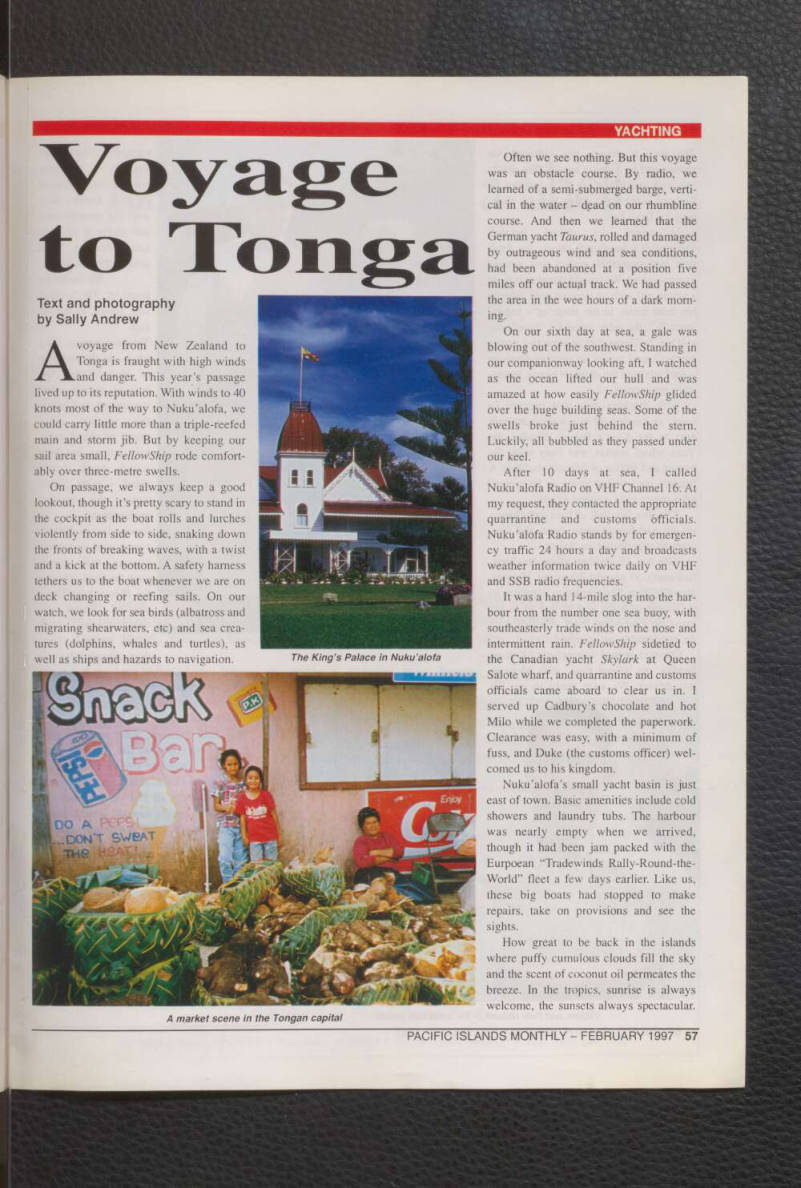
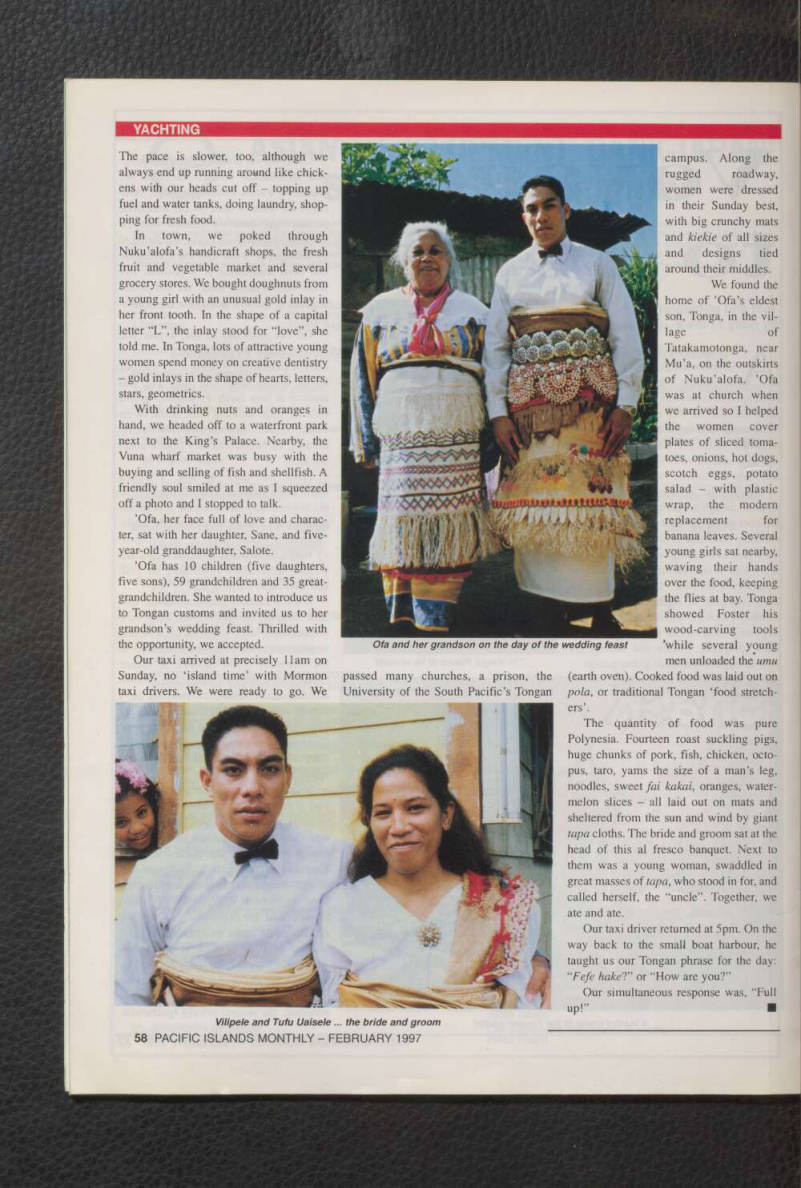
Yachting
Voyage to Tonga
Text and photography
by Sally Andrew
A voyage from New Zealand to Tonga is fraught with high winds and danger. This year’s passage lived up to its reputation. With winds to 40 knots most of the way to Nuku’alofa, we could carry little more than a triple-reefed main and storm jib. But by keeping our sail area small, Fellowship rode comfort ably over three-metre swells.
On passage, we always keep a good lookout, though it’s pretty scary to stand in the cockpit as the boat rolls and lurches violently from side to side, snaking down the fronts of breaking waves, with a twist and a kick at the bottom. A safety harness tethers us to the boat whenever we are on deck changing or reefing sails. On our watch, we look for sea birds (albatross and migrating shearwaters, etc) and sea crea tures (dolphins, whales and turtles), as well as ships and hazards to navigation.
Often we see nothing. But this voyage was an obstacle course. By radio, we learned of a semi-submerged barge, verti cal in the water - dead on our rhumbline course. And then we learned that the German yacht Taurus, rolled and damaged by outrageous wind and sea conditions, had been abandoned at a position five miles off our actual track. We had passed the area in the wee hours of a dark morn
ing.
On our sixth day at sea, a gale was blowing out of the southwest. Standing in our companionway looking aft, I watched as the ocean lifted our hull and was amazed at how easily Fellowship glided over the huge building seas. Some of the swells broke just behind the stern.
Luckily, all bubbled as they passed under our keel.
After 10 days at sea, I called Nuku’alofa Radio on VHP Channel 16. At my request, they contacted the appropriate quarrantine and customs officials.
Nuku’alofa Radio stands by for emergen cy traffic 24 hours a day and broadcasts weather information twice daily on VHP and SSB radio frequencies.
It was a hard 14-mile slog into the har bour from the number one sea buoy, with southeasterly trade winds on the nose and intermittent rain. Fellowship sidetied to the Canadian yacht Skylark at Queen Salote wharf, and quarrantine and customs officials came aboard to clear us in. I served up Cadbury’s chocolate and hot Milo while we completed the paperwork.
Clearance was easy, with a minimum of fuss, and Duke (the customs officer) wel comed us to his kingdom.
Nukualofa’s small yacht basin is just east of town. Basic amenities include cold showers and laundry tubs. The harbour was nearly empty when we arrived, though it had been jam packed with the Eurpoean “Tradewinds Rally-Round-the- World” fleet a few days earlier. Like us, these big boats had stopped to make repairs, take on provisions and see the
sights.
How great to be back in the islands where puffy cumulous clouds fill the sky and the scent of coconut oil permeates the breeze. In the tropics, sunrise is always welcome, the sunsets always spectacular.
A market scene in the Tongan capital
The King's Palace in Nuku'alofa
The pace is slower, too, although we always end up running around like chick ens with our heads cut off - topping up fuel and water tanks, doing laundry, shop ping for fresh food.
In town, we poked through Nukualofa’s handicraft shops, the fresh fruit and vegetable market and several grocery stores. We bought doughnuts from a young girl with an unusual gold inlay in her front tooth. In the shape of a capital letter “L”, the inlay stood for “love”, she told me. In Tonga, lots of attractive young women spend money on creative dentistry - gold inlays in the shape of hearts, letters,
stars, geometries.
With drinking nuts and oranges in hand, we headed off to a waterfront park next to the King’s Palace. Nearby, the Vuna wharf market was busy with the buying and selling of fish and shellfish. A friendly soul smiled at me as I squeezed off a photo and I stopped to talk. ’Ofa, her face full of love and charac ter, sat with her daughter, Sane, and five year-old granddaughter, Salote. ’Ofa has 10 children (five daughters, five sons), 59 grandchildren and 35 great grandchildren. She wanted to introduce us to Tongan customs and invited us to her grandson’s wedding feast. Thrilled with
the opportunity, we accepted.
Our taxi arrived at precisely 11am on Sunday, no ‘island time’ with Mormon taxi drivers. We were ready to go. We
passed many churches, a prison, the University of the South Pacific’s Tongan
campus. Along the
rugged roadway,
women were dressed in their Sunday best,
with big crunchy mats
and kiekie of all sizes and designs tied around their middles.
We found the home of ’Ofa’s eldest son, Tonga, in the vil
lage of
Tatakamotonga, near
Mu’a, on the outskirts of Nuku’alofa. ’Ofa was at church when we arrived so I helped the women cover plates of sliced toma toes, onions, hot dogs, scotch eggs, potato salad - with plastic wrap, the modern
replacement for
banana leaves. Several
young girls sat nearby,
waving their hands over the food, keeping the flies at bay. Tonga showed Foster his
wood-carving tools
’while several young men unloaded the umu
(earth oven). Cooked food was laid out on pola, or traditional Tongan ‘food stretch ers’.
The quantity of food was pure Polynesia. Fourteen roast suckling pigs, huge chunks of pork, fish, chicken, octo pus, taro, yams the size of a man’s leg, noodles, sweet fai kakai, oranges, water melon slices - all laid out on mats and sheltered from the sun and wind by giant tapa cloths. The bride and groom sat at the head of this al fresco banquet. Next to them was a young woman, swaddled in great masses of tapa, who stood in for, and called herself, the “uncle”. Together, we ate and ate.
Our taxi driver returned at spm. On the way back to the small boat harbour, he taught us our Tongan phrase for the day: “Fefe hakeT ’ or “How are you?”
Our simultaneous response was, “Full up!” ■
Vilipele and Tufu Uaisele ... the bride and groom
Ofa and her grandson on the day of the wedding feast
Advertisements & other items, pp. 59-60 (1 item)
Life Insurance is a Shell
P grows protects customized
portable
natural
What nature does to protect the inhabitants of the ocean, Grand Pacific Life Insurance does for the people of the Islands.
Just as the shell grows with its occupant, our insurance grows in value as an investment in your life.
Every shell is tailored to its environment. Each one of our policies is customized; yours will be perfectly suited to you.
Within a shell’s protection, there’s future safety and security.
In somewhat the same way, Grand Pacific Life Insurance
helps protect your family’s
financial security.
Many shells are a rarity.
You’re respected as a rare individual because there is
And shells are “portable” to their owners. With the help of your Grand Pacific agent, your policy easily keeps up with you.
For more information on security much as nature intended, call your Grand Pacific Life representative.
Let us provide a protective shell for you.
only one of you.
NATIONAL library
mir
2 6 MAR 1997
Grand Pacific Life Insurance} Hj£faustralia A member of the Finance Factors Family 1164 Bishop Street, 5th Floor • Honolulu, HI 96813 • Phone: (808) 548-3333 • Fax; (808) 548-5122
V. SV'OC-'
CoA
Hr) US tern ib kJ m q\q p&e wu wmr&r. m » m ,
RY in AFRICA
996 Safari Rally ■d Mi
VICTORY in OCEANIA
1996 Rally of Australia & 1996 Rally New Zealand
VICTORY in SOUTH AMERICA
1996 Argentina Rally ***
mW 9USM
MITSUBISHI’S DOMINANT RECORD OF
1996 RALLY TITLES INCLUDES:
Asia-Pacific Rally Championship for Manufacturers (2nd year in a row)
World Rally Championship for Drivers
World Cup of Production Cars Most Overall Victories (5 of 9 WRC events) The Mitsubishi Lancer obviously has more than just engine power propelling it into the upper class of international rallying. It also has the technological expertise accumulated from years of winning individual events and series championships. We like to think of the Lancer as our research centre on wheels —because only technologies and systems capable of enduring the gruelling conditions of the world's rally circuits are deemed worthy for use in our production cars. Upwardly mobile? Claim the status you deserve. Drive a Lancer.
Experience the Mitsubishi Way
MITSUBISHI
LRNCER
AMERICAN SAMOA: PACIFIC MARKETING INC. P.O. Box 698, Pago Pago, Tel. 699-9140 / AUSTRALIA: MITSUBISHI MOTORS AUSTRALIA LTD. 1284 South Road, Clovelly Park, South Australia, 5042, Tel. (08)2757297 / FUI: NIVIS MOTOR & MACHINERY CO. LTD. G.P.O. Box 150, Suva, Tel. 383411 / GUAM: TRIPLE J ENTERPRISES INC. P.O. Box 6066, Tamuning, Tel. 6469126 / NEW CALEDONIA: SOCIETE O'IMPORTATION D'AUTO DU PACIFIQUE SUD SA P.O. Box 2548, NOUMEA, TEL. 272-562 / NEW ZEALAND: MITSUBISHI MOTORS NEW ZEALAND LTD. Private Bag, Porirua, Tel. 237-0109 / NORFOLK ISLAND: BORRYS PTY LTD. P.O. Box 169, Taylors Road, Burnt Tel. 22114/ PAPUA NEW GUINEA; TOBA MOTORS PTY LTD. P.O. Box 503, Port Moresby / SAIPAN: SAIPAN AUTOWORLD INC.
P.O. Box 487, Tel. 234-7133 / SOLOMON ISLANDS: HARVEST PACIFIC LTD. G.P.O. Box 823, Honiara, Tel. 30407/ TAHITI: SOPADEP S.A. B.P. 1617, Papeete, Tel. 436604 / TONGA: SITANI MAPI CO,. LTD.
P.O. Box 83, Nukualofa, Tel. 24044 / VANUATU: SOCOMETRA VANUATU LTD. B.P. 6, Port-Vila, Tel. 2314 / WESTERN SAMOA; MOTOR DISTRIBUTORS (SAMOA) LTD. P.O. Box 576, Apia, Tel. 20957 A
MITSUBISHI
MOTORS
CREATING TOGETHI