Advertisements & other items, pp. 1-3 (2 items)
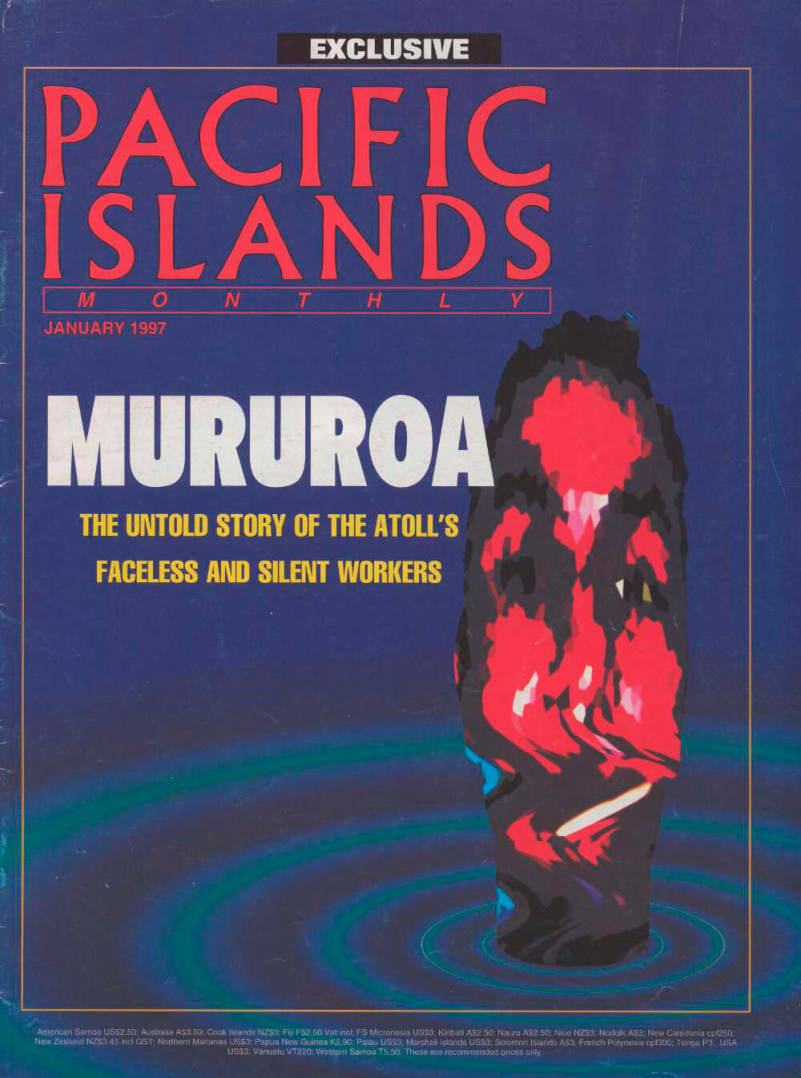
Murutoa
PACIFIC
ISLANDS
MONTHLY
EXCLUSIVE
sdsdsdsd
MURUtOA
THE UNTOLD STORY OF THE ATOLL'S
FACELESS AND SILENT WORKERS
American Samoa USS2.SO; Australia A 53.50; Cook Islands NZ$3; Fiji F 52.50 Vat incl; FS Micronesia US$3; Kiribati A 52.50; Nauru A 52.50; Niue NZS3; Norfolk As 3; New Caledonia cp(2so; New Zealand NZ53.45 incl GST: Northern Marianas US$3; Papua New Guinea K 2.90; Palau US$3; Marshall Islands US$3; Solomon Islands As 3; French Polynesia cpf3oo; Tonga P 3; USA US$3; Vanuatu VT22O; Western Samoa T 5.50. These are recommended prices only.
Cover: JAMES RANUKU
CtiStudi o#96BSc
For whatever reason...
The safest and the quickest way to Papua New Guinea
is by phone...
Just dial +675 plus the number and you're hone.
In Papua New Guinea, Telikom does the connection for you.
TELIKOM
PAPUA NEW GUINEA
Pacific
Islands
Monthly
Vol. 67 No. 01
The News Magazine
January 1997
PUBLISHER: Alan Robinson EDITOR: Manivannan Naidu SENIOR WRITER: Bernadette Hussein
Correspondents:
David North, Sam Vulum lan Williams, Liz Thompson, Atama Raganivatu, Sally Andrew, Patrick Decloitre, Chris Peteru COLUMNISTS: David Barber (Wellington), Jemima Garrett (Sydney), Alfred Sasako (The Forum), Debbie Singh (South Pacific Commission).
GRAPHIC ARTIST: James Ranuku
Advertising Sales
Senior Regional Sales (South Pacific) Shailendra Kumar Emmett Simpson Tel (679)304111,303244, Fax (679) 303809.
Sydney, Canberra: Bob Hill Media Representation, Tel (61-2) 4164245, Fax (61-2) 4165064.
Brisbane: Jane Fewings Media and Advertising Associates Tel (61-7) 3378 4522, Fax (61-7) 3878 1071.
Adelaide: Hastwell Williamsons Representatives, Tel (61-8) 3799522, Fax (61-8) 3799735.
Melbourne; Brown Orr Fletcher Burrows (Aust) Pty Ltd.
Tel (61-3) 98265188, Fax (61-3) 98265644.
Auckland: McKay & Bowman, International Media Representatives Limited, Tel (64-9) 4190561, Fax (64-9) 4192243.
Japan: Universal Media Corporation, Tokyo, Tel (3) 3266626741, Cable: UNI-MEDIA Tokyo, Fax (3) 32626742.
Pacific Islands Monthly was founded in
1930 (Usps 9522480).
A Fiji Times Limited production.
Cover prices are recommended retail only. Registered by Australia Post, Publication No. NBPI2IO. © Copyright Fiji Times Limited, 177 Victoria Parade, Suva, Fiji.
Tel (679) 304111, fax (679) 303809.
Pacific Islands Monthly is published monthly by Fiji Times Limited, a division of Nationwide News, 2 Holt Street, Surry Hills, Sydney, NSW 2010.
Send Address Changes To:
Pacific Islands Monthly POBox 1167 Suva, Fiji.
Typeset and printed by The Fiji Times Limited, 177 Victoria Parade, Suva, Fiji.
Inside
. COVER: A recent health study into the ■ Q lives of a thousand of the faceless and I 1 1 heretofore silent men and women who I W worked on the French nuclear test site alleges astounding terms of their employment contracts and the sad medical conditions they are subjected to
4 Letters 10: Good news on global warming 22: The fury of Manam 23: Nauru’s new-new president 24: Winston’s u-turn 26: Samoa elects Tauese and Eni 27: Soldiers or assassins? 35: Coconut oil up, copper, coffee down 37: Best for the select 39: Talking with Wingti 42: The first day 47: A song of protest 50: Celebrating the Pacific 53: The sunken president
Sport
43: At the crosroads 44: Tony emerges from shadows
Book Review
46: Life of a master carver
Views
6: David Barber (NZ): NZ’s defence ‘farce’ 7: Alfred Sasako (Forum Secretariat): 1997 - the hopes and aspirations 8: Jemima Garrett (Aust): 1997 - a year for Greenhouse action
Yachting
56: Megayachts in the Pacific
Feature
29: Exporter of the year
NZ politics
Letters
Islanders and NZ politics
Dear Sir Whilst I read Atama
Ranganivatu’s article (Pacific
Islands Monthly November, 1996) with interest, I was concerned that his opinion was not a balanced point of view and the article failed to spell out rel evant facts resulting from the election.
The 1996 election results gave Labour its lowest result since 1928, while Alliance support plummeted to 10 per cent. In my opinion, these results alone give a clear message from voters to coali
tion negotiators.
The bulk of the people in this country voted for an end to dependency and are looking to the MMP environment to pro
vide employment, education opportuni
ties and an improvement in health issues.
Since 1990, the National government has created in excess of 200,000 new jobs. Compare this to the thousands of jobs that were lost under Labour between 1984 and 1990. The recent Revolution programme on television has reminded people of that. Your article states that “...Kiwis no longer want Bolger as their
prime minister”.
What is the basis of this statement?
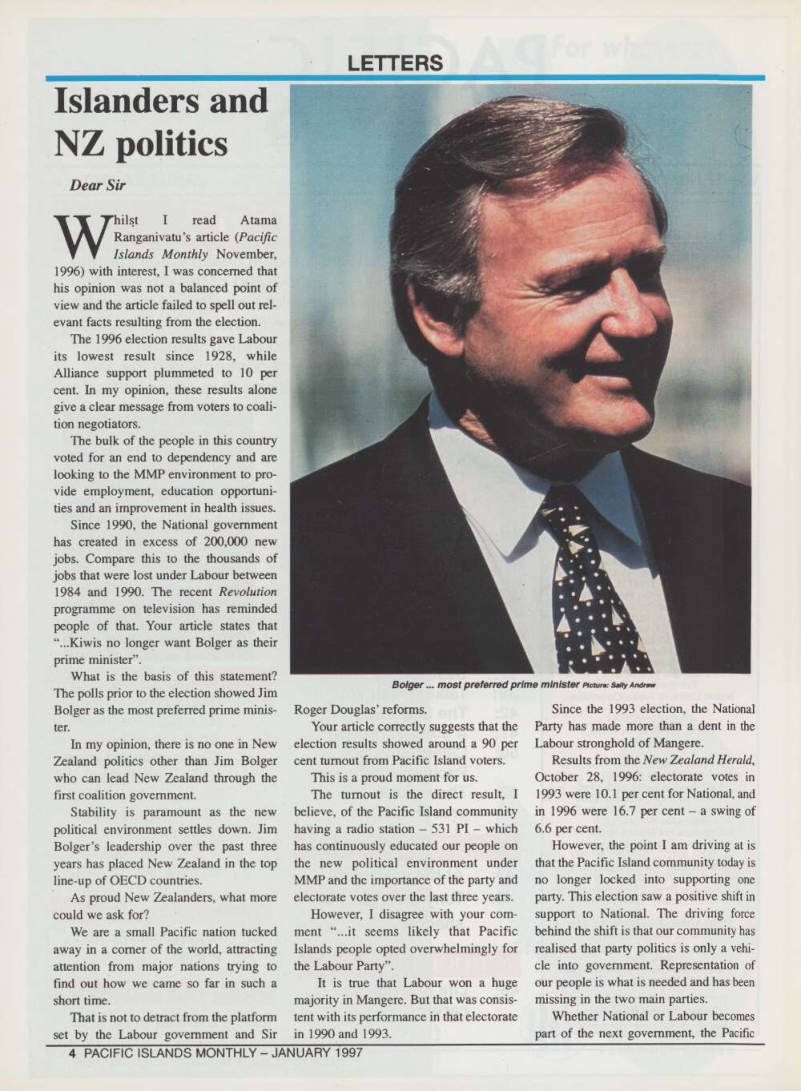
The polls prior to the election showed Jim Bolger as the most preferred prime minis ter.
In my opinion, there is no one in New Zealand politics other than Jim Bolger who can lead New Zealand through the first coalition government.
Stability is paramount as the new political environment settles down. Jim Bolger’s leadership over the past three years has placed New Zealand in the top line-up of OECD countries.
As proud New Zealanders, what more could we ask for?
We are a small Pacific nation tucked away in a comer of the world, attracting attention from major nations trying to find out how we came so far in such a short time.
That is not to detract from the platform set by the Labour government and Sir
Roger Douglas’ reforms.
Your article correctly suggests that the election results showed around a 90 per cent turnout from Pacific Island voters.
This is a proud moment for us.
The turnout is the direct result, I believe, of the Pacific Island community having a radio station - 531 PI - which has continuously educated our people on the new political environment under MMP and the importance of the party and electorate votes over the last three years.
However, I disagree with your com ment “...it seems likely that Pacific Islands people opted overwhelmingly for the Labour Party”.
It is true that Labour won a huge majority in Mangere. But that was consis tent with its performance in that electorate in 1990 and 1993.
Since the 1993 election, the National Party has made more than a dent in the Labour stronghold of Mangere.
Results from the New Zealand Herald, October 28, 1996: electorate votes in 1993 were 10.1 per cent for National, and in 1996 were 16.7 per cent - a swing of 6.6 per cent.
However, the point I am driving at is that the Pacific Island community today is no longer locked into supporting one party. This election saw a positive shift in support to National. The driving force behind the shift is that our community has realised that party politics is only a vehi cle into government. Representation of our people is what is needed and has been missing in the two main parties.
Whether National or Labour becomes part of the next government, the Pacific
Bolger...most preferred prime minister picture: selly Andrew
Islands people need a voice in parlia ment.
The other point that has been missed in your article is that our parliament now has four MPs with Pacific Islands ethnic ity. Taito Philip Field and Mark Gosche
for Labour, Tukuoroirangi Morgan (part
Cook Islander) for NZ First and myself.
This representation gives us the opportunity to get together as an infor mal caucus to discuss Pacific Island issues. I hope that as a result of this cau cus, Pacific Island issues will be taken back to each individual’s party for seri ous consideration, and not used as politi cal footballs in the house.
It cannot be stressed enough that Pacific Islanders are part of New Zealand and do not expect to be treated different ly. But there are also specific issues which need to be addressed to enable us to contribute fully to New Zealand and share the fruits of our adopted country.
The main issues I want to tackle are
employment opportunities, immigration,
education (especially early childhood
development), broadcasting and superan nuation.
New Zealand has given us the oppor tunity to succeed, and many of our peo ple have. We only need to look at the results of our students graduating each year from university and polytechnic.
Back home such progress would have
been impossible.
I don’t believe the few that fail should distract from the achievements Pacific Islanders have proven we can make.
Arthur Anae MP
New Zealand
debate
The meat debate
Dear Sir,
I read Mr Brandit’s letter to the editor: “Meat and violence” (Pacific Islands Monthly November, 1996).
I agree with Mr Brandit 100 per cent, and would like to add a few more facts.
Beef and poultry producers are among the
most Environmentally unfriendly indus
tries on the planet. To get one pound of beef, we have to feed 16 pounds of grain to the cow! This ties up acre after acre of land just to grow animal feed.
Even range-grazed cattle end up in feed lots, consuming vast quantities of feed crops.
If we were to stop animal agriculturel, fully 200 million acres couldbe reforested.
One-fourth of all soil erosion is caused by growing com, nearly all of which becomes animal feed. Irrigation of animal feed crops takes an enormous amount of water.
Runoffs from feed lots are a major pol lutant of our rivers. Vegetarians have a lot lower incidence of heart disease and can cer and live years longer than meat eaters.
So, have a spaghetti dinner with toma to sauce instead of meat sauce; have oat meal and toast for breakfast instead of bacon and eggs. Pick up a vegetarian cookbook.
The earth and your coronary arteries will thank you.
And last but not least: if red-meat eaters could see and hear what goes on in slaughter houses and the brutality and cru elty animals have to endure in the process of being killed, most meat eaters wpuld turn vegetarian on the spot.
Inge Mathiesen
Montana United States
Protecting
turtles
Dear Sir Thanks for your very generous arti cle on the Wan Smolbag Theatre. I have two comments to make, plus a sort of related comment on a letter in the same issue (PIM December, 1996).
First, in my faxed reply to Atama Raganivatu’s questions, I fear my hand writing let me down. I hope I would never
claim that the WSB was “a king of the media unit”, but believe I said “a kind of media unit”.
Also, I hope we would never claim immunisation rates jumped fourfold in the light of our visits. We like to think our work effects some changes, but it can’t change the world!
I point these things out lest people feel our heads have swollen beyond all recog nition (not unknown amongst the theatre
community)
Regarding our turtle work, we do have a certain pride.
We have worked closely with several communitieswho sybsequently put taboos on the killing of turtles, the steal ing of eggs and have also appointed ‘tur tle monitors’ in the village.
Would that turtles could bury their eggs as deep in the sand as Timeon loane (PIM Dec, 96) does his head. If Pacific communities limited turtle killing to the needs of the occasional ceremony, there would be some hope. But, in most places, turtles of all ages are killed (despite the fact that they never breed before they are 20 years old) and eggs are regularly eaten.
It is, for me, the mindless killings of turtles that puts humans ‘on a par’ with animals. As one village turtle monitor (a Pacific Islander, not loane’s demon Western radical conservationist) put it, if we do not care about the fate of such a weird, unique creature, what hope is there for the universe?
It is also worth noting that there is an element of the culture that does empathise with animals. Most islands here in Vanuatu would have a ‘turtle clan’, a family for whom it is taboo to eat turtles.
Peter Walker
Director Wan Smolbag Theatre Port Vila Vanuatu
Letters to the Editor should be addressed to: The Editor Pacififc Islands Monthly P O Box 1167 Suva
Fiji
NZ’s defence ‘farce’
Budget cuts, staffing problems and obsolete equipment plague the armed forces
One job New Zealand’s new gov ernment is going to have to face this year is to take a serious look at the state of the country’s defence force.
It may not like what it finds.
It could, in fact, discover what one newspaper editorial has suggested - the defence force has become a defence farce.
There is certainly plenty of evidence to suggest the commitment to maintain a “credible minimum force” spelled out in the 1991 defence policy paper has been seriously compromised.
Look at some facts: the defence budget has been cut by 37 per cent since 1989;; the force has lost 15 per cent of its total number over the last year or so; and the 9552 staff remaining in mid-1996 was at the lowest level since World War 11.
The army, air force and navy are all operating at about 20 per cent below strength.
The army’s two vital regular force rifle battalions have only 70 per cent of their normal complement.
The air force revealed in October that it was close to a crisis situation, having lost 908 highly qualified technicians dur ing the previous two years and being 70 pilots short.
Of greatest concern to the Pacific was news about New Zealand’s Orion mar itime patrol aircraft which have a search and rescue responsibility for 12.3 per cent of the earth’s surface - from Antarctica to north of the Equator. The RNZAE has six Orions but only enough crew for four of them.
It’s not just a staffing problem. The force’s credibility is additionally strained by obsolescent equipment, as even the prime minister is aware.
Every time he travels overseas in an RNZAE VIP Boeing-727, it seems to break down.
The air force’s Hercules transport planes and Iroquois helicopters are con siderably older than most of the people who fly them and would be military museum pieces in most other countries.
When the army was sent to Bosnia as part of a United Nations peace-keeping force, it took the same armoured person nel carriers it had in Vietnam in the late 19605, their protection and firepower woefully inadequate 30 years later.
The previous government deferred a decision on their replacement as well as on new Navy helicopters to replace the obsolete Wasps. The biggest issue for the
new government this year is going to be whether to buy two more Anzac frigates to join the two already being built in Australia and ensure continuation of a
four-frigate Navy.
The decision, which must be made by November, will inevitably spark a bitter controversy (as did the purchase of the first two) and focus renewed attention on the trans-Tasman defence relationship.
The Australians will see failure to buy the extra ships as New Zealand reneging on repeated pledges to maintain the afore mentioned “credible minimum force” and there are many in this country who believe a two-frigate Navy would be
meaningless.
On the other hand, many say New Zealand does not need any more expen sive ships, a view shared by three of the
four biggest political parties in parliament
and some MPs of the fourth, the National Party. Others warn that New Zealand should maintain an independent stance in the post-Cold War environment and stay out of Australia’s military expansionism.
They see Australian moves to lift military preparedness in conjunction with the United States as being aimed at a non existent threat from China and say New
Wellington
David
Barber
Zealand has nothing to gain from being associated with them.
Canberra is bound to put pressure on New Zealand if the government decides against buying more ships, though that will almost certainly be counter-produc tive in the new political environment.
But as Richard Prebble, leader of the ACT Party, said last year, decisions like frigate purchase cannot continue to be made in isolation of New Zealand’s wider defence and foreign policy.
The only party leader to make a speech on the issue during the election campaign, he warned that New Zealand did not have a credible defence policy.
“Either we believe we do not need a defence force-then the expenditure of SNZI billion (SUSO.69 billion) a year is a waste,” he said, “or we do think it’s possible we may need to call on defence forces - in which case they need to be
strengthened.”
With this statement, Prebble has put his finger on the real question for 1997.
The answer surely is that New Zealand does need a military force even if its role is to be limited to civil defence. South Pacific resource protec tion, disaster relief and UN peacekeeping
operations.
And all the evidence late last year pointed to a force that was singularly ill equipped for even these basic roles.
Updating equipment is one thing -
and the National Party government insisted it had spent SNZ92 million (SUS 64 million) in the last six months
doing just that.
But the best equipment in the world is worthless if the military do not have the skilled people to operate it and the trend from uniform to better paid jobs in Civvy Street has seemed inexorable.
National’s defence minister, Paul East, said the military always had prob lems retaining stalf when the economy was buoyant.
But if his government had laid a foun dation for sustainable economic growth, as it claimed, this begged the question.
If New Zealand wants a well equipped military force for whatever reason - it will have to pay for it and the politicians will have to persuade voters that it’s necessary. ■
Advertisements & other items, p. 6 (1 item)
Trust Company Ltd
USED JAPANESE VEHICLES
SPECIAL OFFER
TOYOTA, NISSAN CARS, WITH AUTOMATIC TRANSMISSION
FROM ONLY $lOOO.OO US DOLLARS EACH PLUS FREIGHT.
ALL SHIPPING AND DOCUMENTATION ARRANGED.
BUY DIRECT FROM JAPAN AND SAVE.
r
“CONTACT”
Trust Company Ltd
KOBAC BID 3F 3-2-26 NISHIKI,
NAKAU NAGOYA, 460 JAPAN.
PHONE: (81) 52 953-5602
FAX (81) 52 953-5634
aspirations
1997-the hopes and aspirations
1 997 is here. It could be a great year.
True, it is too early to say with a degree of certainty that 1997 will be a great year, but global changes taking place almost on a daily basis appear to be pointing that way.
One thing is certain. No one can dis miss the fact that as the last 100 years of this century draw to a close, men and women have never been surrounded by greater and more ample opportunities to excel. Yes, the possibility of failure also exists.
Great advances in technology have given mankind an added advantage. For instance, communicating with friends or business colleagues as well as advertising whatever product one has for sale is now at our fingertips.
Through the Internet, the information
super-highway is truly here.
Three years from now the annals will have closed on the last 100 years of this century.
A great century, it was. But one which would be remembered by the world’s 800 million malnourished and hungry people as a century whose achievements have been overshadowed by greed and individ ualism. Sad, but true.
In business and commerce, companies are turning out more profits than ever before. In the banking sector, for instance, profits continued to soar at the expense of encouraging ordinary people to save.
Machines are taking over from men and women whose livelihood depend on their employment, at least in the urban centres.
Interests paid on savings are stagnant or continue to nose-dive while lending rates remain abnormally and unreason ably high. Leniency on the part of gov ernments to allow commercial banks to
get away with this practice is mind-bog
gling.
Never before has one heard of a bank charging fees on clients’ savings. It is happening now - all in the name of the user-pay concept.
It’s all well and good, but some have the habit of stretching this beyond the imagination.
And so, as humanity takes the last bend on its race on the super-highway called the 90s, a lot more changes can be expected. Some for the better, others for the worse.
Here at the South Pacific Forum Secretariat, things are also changing.
In the last few years there have been debates about what the focus of this organisation should be as humanity stands on the verge of the next millenni um.
That question has now been resolved with the Secretariat’s governing body, known as the Forum Officials Committee, having approved the shift in
emphasis.
As of the beginning of this month, all technical programmes in the Secretariat would have ceased to function, except for the Energy Division. The division will continue to operate until a permanent home is found.
Civil Aviation, Maritime and Telecommunications divisions, on the other hand, have now closed shop.
Their contribution to the different sec tors in the overall development of the region cannot be disputed, thanks to the various donors who have made resources, including funding, available at the dispos al of the Secretariat to implement projects funded under these programmes.
Many of the personnel who had been involved in these programmes either from
The Forum
Alfred
Sasako
the beginning or midway have left. One thousand nine hundred and ninety-seven is quite a year.
For us here at the South Pacific Forum Secretariat, 1997 indeed marks the begin ning of a new era: the out-migration of the technical programmes and internal
changes triggered by the restructure.
Many of the contract staff here will be new. New terms and conditions of
employment now apply.
Four divisions will remain at the Secretariat. Renamed to reflect their
expanded policy advisory roles, these
divisions are the Development & Economic Policy, Political & International Affairs, Trade & Investment and Corporate Services.
The year also marked the return of the Secretariat to the late 80s when there was
only one Deputy Secretary-General. As of
the beginning of this month, there is only
one Deputy Secretary-General.
In December, senior officials of the South Pacific Forum approved a budget of $F14.1 million (SUS9.B million) for the Secretariat’s 1997 work programmes and activities.
Drawn up to accommodate costs asso ciated with the major internal changes brought about by the restructuring, the budget registered an overall 9.3 per cent increase over the 1996 figures.
But the biggest increase was in the reg ular budget which comes from assessed member contributions or membership fees. Here, the increase was a staggering 25 per cent.
Papua New Guinea and Fiji bore the brunt of this increase. In Fiji’s case, its annual contribution went up by well over 16 per cent. Papua New Guinea’s lot is a cool 185 per cent increase over its 1996
membership contribution.
This year also marks an era for me as an individual. After six years, this is my last month with the South Pacific Forum Secretariat.
It has been a memorable time.
For my avid readers, colleagues and people that I have come to know through this column it has been a joy to work and know all of you.
It would have been impossible to say “vinaka vakalevu ” to all of you individu
ally.
I am really privileged to be part of the many changes that have taken place and continue to take place, particularly in the area of relations between the South Pacific Forum and members of the jour
nalist fraternity.
I remember vividly when I put my foot in the door of the Secretariat in 1991, hor ror stories of officials and police mar shalling journalists from meeting venues year after year.
In one particular case, I was told that journalists were marched to a pen-like enclosure and told to remain there or face arrest.
This was happening when the South Pacific Forum was in session.
I wasn’t sure whether I was afraid to face my colleagues in those situations.
But I was determined to play a mediating role in a truce. Being a journalist with an understanding of the need to meet dead lines, getting the bosses’ money’s worth and so on helped make my job a lot easi er.
But much of the credit for the improved relations between the South Pacific Forum and the media must go to Secretary-General leremia Tabai.
His understanding and appreciation of the critical role the media plays in the overall development in the region makes all the difference.
It made my job so easy.
While it is sad to leave, I am pleased with the overall improvement, particular ly with accessibility to leaders during the South Pacific Forum. Many of my col leagues, if not all, will agree with me that it is a lot easier now for journalists to arrange an interview with a Forum leader than, say, six years ago.
We have come a long way. And so we should have.
The world has so changed in the last decade that there is no more room for those who still harbour the idea of going it alone. We all need each other.
And so, to all my friends and col leagues, it’s been great knowing and working with you. I hope that in my next (and perhaps final) column, I shall be able to introduce my replacement out of the 43 applicants who responded to the adver tisement.
Goodbye! ■
This is the year when the industri alised nations of the world - the ones which produce 80 per cent of the Greenhouse gases which are causing global warming - have promised to set legally binding tragets to limit their gas emissions.
The high-level meeting at which the nations are to sign on takes place in Kyoto in Japan in December. The debate and the lobbying over the sort of targets which should be set is well under way with the Pacific Islands, as usual, in the forefront of moves to secure significant emission reductions.
At this stage there are four proposals being given serious consideration. Other solutions, based on minimal action or spe cial pleading, are being touted by some of the worst Greenhouse offenders such as Japan and Australia (which has the high est per capita output of Greenhouse gases of any country in the world).
The four main options are those being assessed by the Intergovernmental Panel on Climate Change (IPCC), the presti gious scientific body which is tracking the impact of global warming.
They are: • A 20 per cent reduction on the 1990 level of Greenhouse emissions by the year 2005. This is the most stringent option. It was proposed by the Alliance of Small Island States (AOSIS). • A 10 per cent reduction in emissions by 2005 and a 15-20 per cent reduction by 2010 - the option put up by Germany. • A five to 10 per cent reduction by 2010 - the British proposal. • A return to 1990 emission lev els - an option which simply extends the deadline for reductions already promised.
According to the scientists of the IPCC, even the most stringent measures
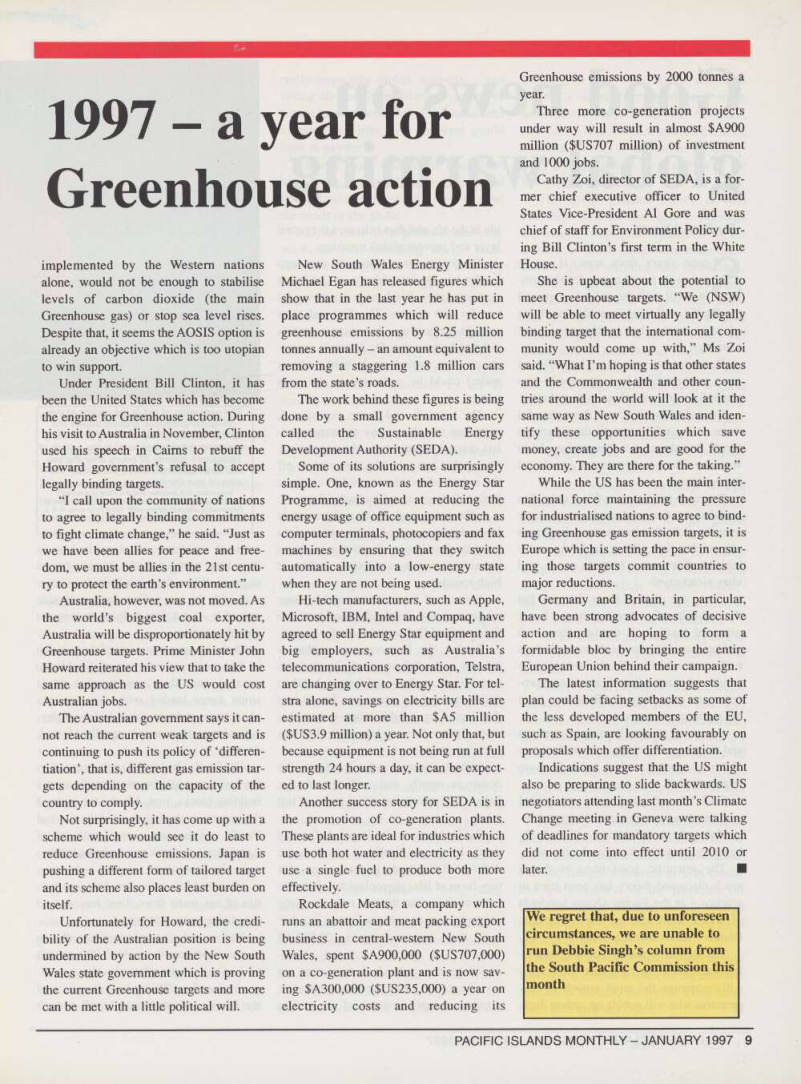
Jemima
Garrett
Australia
1997-a year for Greenhouse action
implemented by the Western nations alone, would not be enough to stabilise levels of carbon dioxide (the main Greenhouse gas) or stop sea level rises.
Despite that, it seems the AOSIS option is already an objective which is too utopian to win support.
Under President Bill Clinton, it has been the United States which has become the engine for Greenhouse action. During his visit to Australia in November, Clinton used his speech in Cairns to rebuff the Howard government’s refusal to accept
legally binding targets.
“I call upon the community of nations to agree to legally binding commitments to fight climate change,” he said. “Just as we have been allies for peace and free dom, we must be allies in the 21 st centu ry to protect the earth’s environment.”
Australia, however, was not moved. As the world’s biggest coal exporter, Australia will be disproportionately hit by Greenhouse targets. Prime Minister John Howard reiterated his view that to take the same approach as the US would cost
Australian jobs.
The Australian government says it can not reach the current weak targets and is continuing to push its policy of ‘differen tiation’, that is, different gas emission tar gets depending on the capacity of the country to comply.
Not surprisingly, it has come up with a scheme which would see it do least to reduce Greenhouse emissions. Japan is pushing a different form of tailored target and its scheme also places least burden on itself.
Unfortunately for Howard, the credi bility of the Australian position is being undermined by action by the New South Wales state government which is proving the current Greenhouse targets and more can be met with a little political will.
New South Wales Energy Minister Michael Egan has released figures which show that in the last year he has put in place programmes which will reduce greenhouse emissions by 8.25 million tonnes annually - an amount equivalent to removing a staggering 1.8 million cars from the state’s roads.
The work behind these figures is being done by a small government agency called the Sustainable Energy Development Authority (SEDA).
Some of its solutions are surprisingly simple. One, known as the Energy Star Programme, is aimed at reducing the energy usage of office equipment such as computer terminals, photocopiers and fax machines by ensuring that they switch automatically into a low-energy state when they are not being used.
Hi-tech manufacturers, such as Apple, Microsoft, IBM, Intel and Compaq, have agreed to sell Energy Star equipment and big employers, such as Australia’s telecommunications corporation, Telstra, are changing over to Energy Star. For tel stra alone, savings on electricity bills are estimated at more than SAS million (SUS 3.9 million) a year. Not only that, but because equipment is not being run at full strength 24 hours a day, it can be expect ed to last longer.
Another success story for SEDA is in
the promotion of co-generation plants.
These plants are ideal for industries which use both hot water and electricity as they use a single fuel to produce both more
effectively.
Rockdale Meats, a company which runs an abattoir and meat packing export business in central-western New South Wales, spent $A900,000 ($U5707,000) on a co-generation plant and is now sav ing $A300,000 ($U5235,000) a year on electricity costs and reducing its
Greenhouse emissions by 2000 tonnes a year.
Three more co-generation projects
under way will result in almost SA9OO million (SUS7O7 million) of investment and 1000 jobs.
Cathy Zoi, director of SEDA, is a for mer chief executive officer to United States Vice-President A 1 Gore and was chief of staff for Environment Policy dur ing Bill Clinton’s first term in the White House.
She is upbeat about the potential to meet Greenhouse targets. “We (NSW) will be able to meet virtually any legally binding target that the international com munity would come up with,” Ms Zoi said. “What I’m hoping is that other states and the Commonwealth and other coun tries around the world will look at it the same way as New South Wales and iden tify these opportunities which save money, create jobs and are good for the economy. They are there for the taking.”
While the US has been the main inter national force maintaining the pressure for industrialised nations to agree to bind ing Greenhouse gas emission targets, it is Europe which is setting the pace in ensur ing those targets commit countries to major reductions.
Germany and Britain, in particular, have been strong advocates of decisive action and are hoping to form a formidable bloc by bringing the entire European Union behind their campaign.
The latest information suggests that plan could be facing setbacks as some of the less developed members of the EU, such as Spain, are looking favourably on proposals which offer differentiation.
Indications suggest that the US might also be preparing to slide backwards. US negotiators attending last month’s Climate
Change meeting in Geneva were talking
of deadlines for mandatory targets which did not come into effect until 2010 or later. ■
We regret that, due to unforeseen circumstances, we are unable to run Debbie Singh’s column from the South Pacific Commission this month
global warming
Environment
Good news on global warming
By David North
Some years from now, if man’s habits do not change, global warm ing will melt the polar icecaps and the Pacific will wash over the low-lying islands: that’s the environmentalists’
warning.
Recently, however, three bits of good news on the subject have appeared - one scientific, one medical, and one political.
But before we deal with these cheerful items, it is useful to recall the enormous forces that threaten to perpetuate global
warming. They are ignorance, greed, and
momentum.
It is easy to ignore anything as hard to visualise as the weakening ozone layer over the globe that lets in more dangerous ultra-violet rays. What could be more invisible than ozone, holes in ozone, and
ultra-violet rays?
These are distant, fuzzy dangers, but the real costs of preventing them - lower usage of fossil fuels creating too much carbon dioxide - are much more obvious to the powerful First World interests who would rather not adjust their business pro cesses to save, say, the Bikinians from
having to move again.
It is easier to keep burning a lot of gas and oil, to continue to operate in the same old (momentum), and it certainly saves
money (greed).
Each bit of good news on global
warming has appeared quite independent
ly of the others, and the trio will probably be brought together here for the first time.
The scientific good news is that a much discussed theory has been tried in practice - in the Pacific Ocean hundreds of miles southwest of the Galapagos Islands - and it seems to work.
The notion is that if you put enough iron particles in the right part of the sea it will encourage the rapid growth of tiny creatures who will gobble up carbon diox
ide in the air, and thus help save the ozone
layer and prevent global warming.
The theory, set in motion 10 years ago by the late Dr John Martin, a California oceanographer, has been a controversial one for two reasons. The first and most straight-forward was that many scientists did not believe that Dr Martin’s experi ments (first carried out in bottles of sea water) could be replicated in the open ocean.
The second, and more convoluted, argument was this; many environmental ists reacted negatively to the suggestion, saying that it would take the pressure off the industrialists who wanted to continue their polluting ways. (Similarly, if you are a traffic safety enthusiast, and you want
lower highway speed limits, you might
greet the installation of collision-cushion ing airbags in cars as an excuse to drive at high speeds.) Because of these reasons and because of the expense involved, there were no field trials of Dr Martin’s idea for years.
Further, the first one was neithter a success nor a failure, as the seeded sea water began to show useful signs, but then that portion of the ocean was forced into the depths by neighbouring waters that were lighter (having less salt) than the
experimental waters.
As both scientists and sailors know, the ocean is unruly and will not always behave like a well-mannered group of test tubes.
But Dr Martin’s idea lingered after this death. More specifically, it relates to the differential incidence in the oceans of a tiny form of life, phytoplankton. In some parts of the ocean there is only one little phytoplankton to a drop of water, in other areas there are as many as 100,000 of them.
While the individual creatures are invisible to the naked eye, their collective presence is not; a stretch of sea with a
minimal incidence of phytoplankton is deep blue, with a lot of it, it turns brown or green. When there is a lot of it, it inter acts with the air, pulling carbon dioxide out of it - and thus helping to prevent
global warming.
But why are some parts of the sea rich in this stuff, and others not? Dr Martin puzzled over this, noticing that while some areas loaded with the nutrients phosphorus and nitrogen have lots of phy toplankton, other areas, equally blessed, do not.
He finally decided that the answer to the mystery might be another of nature’s building blocks, iron. Maybe the parts of the ocean - including parts of the tropical Pacific and the vast waters just North of Antarctica - without much phytoplankton were also low in iron.
He sprinkled some iron dust into bot tles of sea water from these regions and the phytoplankton bloomed.
The second sea test (scientists call it an in situ experiment) involved 990 pounds of iron filings (a relatively cheap com modity) and a 200-square-mile piece of the Pacific, which behaved well enough
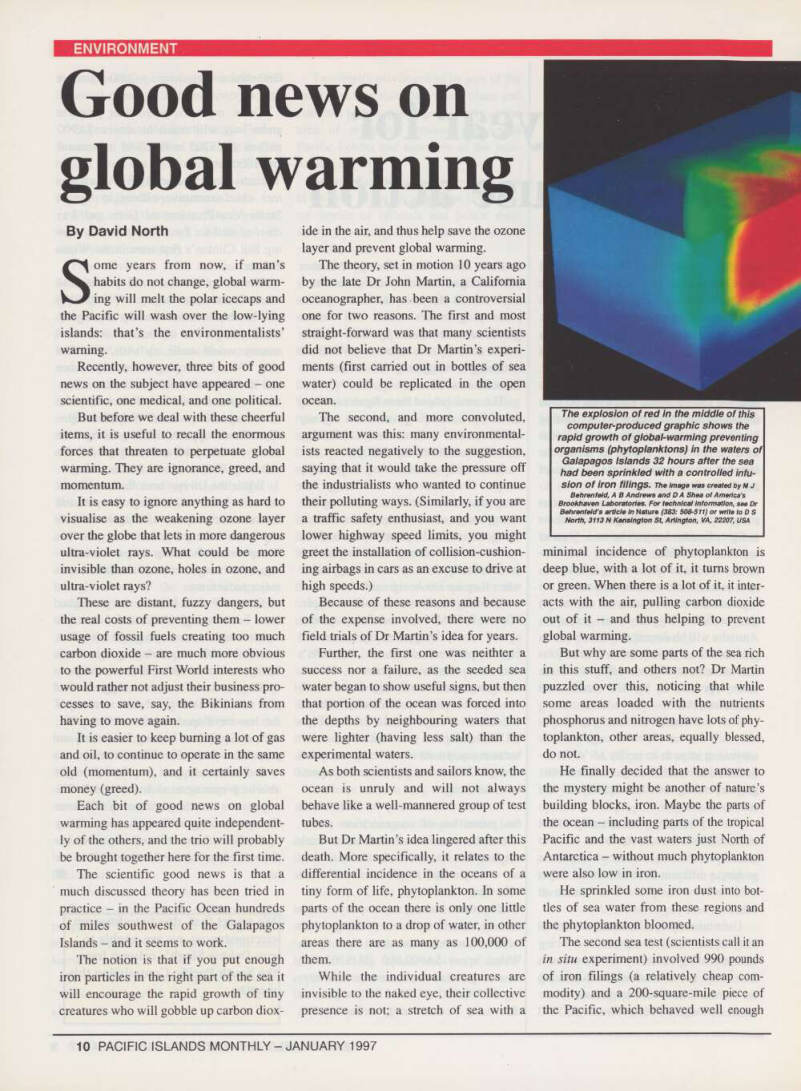
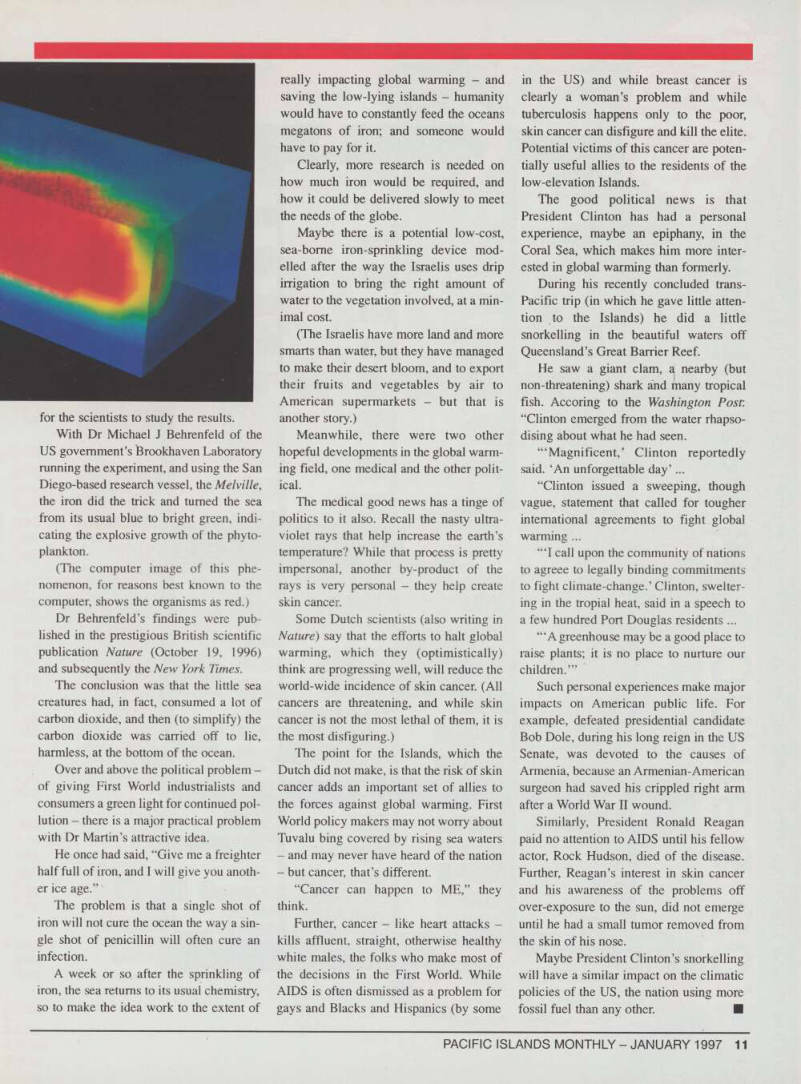
The explosion of red in the middle of this computer-produced graphic shows the
rapid growth of global-warming preventing
organisms (phytoplanktons) in the waters of Galapagos Islands 32 hours after the sea had been sprinkled with a controlled infu sion Of iron filings. The Image was created by M J Behrenfeld, A B Andrews and D A Shea of America’s Brookhaven Laboratories. For technical Information, see Dr Behrenfeld’s article In Nature (383: 508-511) or write to D S North, 3113 N Kensington St, Arlington, VA, 22207, USA
for the scientists to study the results.
With Dr Michael J Behrenfeld of the US government’s Brookhaven Laboratory running the experiment, and using the San Diego-based research vessel, the Melville, the iron did the trick and turned the sea from its usual blue to bright green, indi cating the explosive growth of the phyto plankton. (The computer image of this phe nomenon, for reasons best known to the computer, shows the organisms as red.) Dr Behrenfeld’s findings were pub lished in the prestigious British scientific publication Nature (October 19, 1996) and subsequently the New York Times.
The conclusion was that the little sea creatures had, in fact, consumed a lot of carbon dioxide, and then (to simplify) the carbon dioxide was carried off to lie, harmless, at the bottom of the ocean.
Over and above the political problem of giving First World industrialists and consumers a green light for continued pol lution - there is a major practical problem with Dr Martin’s attractive idea.
He once had said, “Give me a freighter half full of iron, and I will give you anoth er ice age.”
The problem is that a single shot of iron will not cure the ocean the way a sin gle shot of penicillin will often cure an infection.
A week or so after the sprinkling of iron, the sea returns to its usual chemistry, so to make the idea work to the extent of
really impacting global warming - and
saving the low-lying islands - humanity
would have to constantly feed the oceans megatons of iron; and someone would have to pay for it.
Clearly, more research is needed on how much iron would be required, and how it could be delivered slowly to meet the needs of the globe.
Maybe there is a potential low-cost, sea-borne iron-sprinkling device mod elled after the way the Israelis uses drip irrigation to bring the right amount of water to the vegetation involved, at a min imal cost. (The Israelis have more land and more smarts than water, but they have managed to make their desert bloom, and to export their fruits and vegetables by air to American supermarkets - but that is
another story.)
Meanwhile, there were two other hopeful developments in the global warm ing field, one medical and the other polit ical.
The medical good news has a tinge of politics to it also. Recall the nasty ultra violet rays that help increase the earth’s temperature? While that process is pretty impersonal, another by-product of the rays is very personal - they help create skin cancer.
Some Dutch scientists (also writing in Nature) say that the efforts to halt global warming, which they (optimistically) think are progressing well, will reduce the world-wide incidence of skin cancer. (All cancers are threatening, and while skin cancer is not the most lethal of them, it is the most disfiguring.) The point for the Islands, which the Dutch did not make, is that the risk of skin cancer adds an important set of allies to
the forces against global warming. First
World policy makers may not worry about Tuvalu bing covered by rising sea waters - and may never have heard of the nation - but cancer, that’s different.
“Cancer can happen to ME,” they think.
Further, cancer - like heart attacks kills affluent, straight, otherwise healthy white males, the folks who make most of the decisions in the First World. While AIDS is often dismissed as a problem for gays and Blacks and Hispanics (by some
in the US) and while breast cancer is clearly a woman’s problem and while tuberculosis happens only to the poor, skin cancer can disfigure and kill the elite.
Potential victims of this cancer are poten tially useful allies to the residents of the low-elevation Islands.
The good political news is that President Clinton has had a personal experience, maybe an epiphany, in the Coral Sea, which makes him more inter ested in global warming than formerly.
During his recently concluded trans pacific trip (in which he gave little atten tion to the Islands) he did a little snorkelling in the beautiful waters off Queensland’s Great Barrier Reef.
He saw a giant clam, a, nearby (but non-threatening) shark and many tropical fish. Accoring to the Washington Post.
“Clinton emerged from the water rhapso dising about what he had seen.
“‘Magnificent,’ Clinton reportedly said. ‘An unforgettable day’...
“Clinton issued a sweeping, though vague, statement that called for tougher international agreements to fight global warming ...
“T call upon the community of nations to agreee to legally binding commitments to fight climate-change.’ Clinton, swelter ing in the tropial heat, said in a speech to a few hundred Port Douglas residents ...
“‘A greenhouse may be a good place to raise plants; it is no place to nurture our children.’”
Such personal experiences make major impacts on American public life. For example, defeated presidential candidate Bob Dole, during his long reign in the US Senate, was devoted to the causes of Armenia, because an Armenian-American surgeon had saved his crippled right arm after a World War II wound.
Similarly, President Ronald Reagan paid no attention to AIDS until his fellow actor, Rock Hudson, died of the disease.
Further, Reagan’s interest in skin cancer and his awareness of the problems off over-exposure to the sun, did not emerge until he had a small tumor removed from the skin of his nose.
Maybe President Clinton’s snorkelling will have a similar impact on the climatic policies of the US, the nation using more fossil fuel than any other. ■
Advertisements & other items, p. 12 (1 item)
Distributed
Quality products from Australia now in Fiji. r, % w m
FRUUT
RINGS
: 200 . lE* POT sues 0
COCOA
FRUUT
RINGS
CORN FLAKES
0 WHEAT
BISCUITS
too
SERVIETTES
- 0 $
JO MEDIUM
PANTY SHAPED NAPPIES
' ~' A Hi m
IMI
URGE
PARTY SHAPED
HAPPtES
LAUNDRY
DETERGENT
POWDER
4 kg NET NT
LAUNDRY
DETERGENT
POWDER
V 5 kg NET >T
10
GARDEN
CLEANUP
BASE
ir*
GARBAGE
BAGS
Distributed
i
CORRIE & CO.
jm ’
Suva: Phone 312 666 Fax 3! I 307. Lautoka: Phone 660 137 Fax 666 088. Labasa: Phone 81 1 455 Fax 814 078. s®W®ftSßi'
Mururoa
the untold story
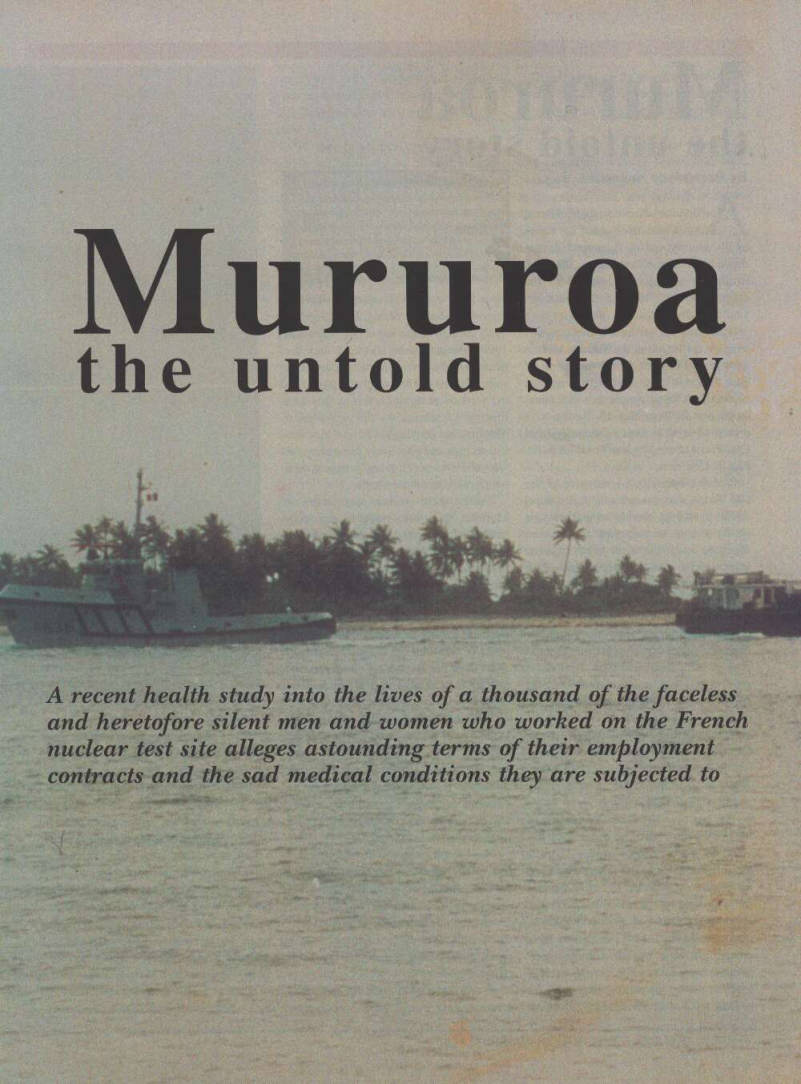
A recent health study into the lives of a thousand of the faceless and heretofore silent men and women who worked on the French nuclear test site alleges astounding terms of their employment contracts and the sad medical conditions they are subjected to
Mururoa
Cover Stories
Mururoa the untold story
By Bernadette Hussein
As he lay on his deathbed, a Tahitian who worked on Mururoa Atoll, wondered about the future of his country and its fight for indepen dence from France, having been subjected to nuclear testing in the region by the colonial power. The man died late last year from thyroid cancer.
Choosing an oar as a symbol of this struggle for freedom, the Tahitian worker asked that it be passed on to the people of East Timor in their similar fight against colonialism. In a simple but emotional ceremony on December 11, the oar was presented to the head of a delegation from East Timor at the Nuclear Freedom in the Pacific Conference in Suva, Fiji.
Gabriel Tetiarahi, co-ordinator of the Hiti Tau, a non-government organisation in Tahiti, told the conference that pressure on the French to stop their tests before schedule was the first step towards achieving the goal of independence. But, he reiterated, the end to testing did not mean that they were actually free.
France continued to conduct nuclear tests at Mururoa and Fangataufa atolls in
French Polynesia, despite international
protest, until last year. And the French government has maintained throughout that the tests did not present any adverse effects on the environment. The world has known very little of the nature of the French tests, carried out under tight secu rity, in the region and even less about the Tahitians working on the site and the nature of their work.
But just over 30 years after the first of the French tests, Hiti Tau has become the voice of these faceless workers with a recently compiled health report scheduled for release on January 28. After the last series of tests in 1995, Hiti Tau, with the Protestant Church of French Polynesia (E(n)glise Evangelique) initiated the first
comprehensive independent study on the
possible consequences of French nuclear tests on the health and wellbeing of the
people of French Polynesia. (Among
those interviewed were workers who had served on Mururoa during the first test in 1966 through to the last series of tests in 1995.) Perhaps more shocking than the medical findings are what the report states were the terms of the contracts signed by the workers pledging them not only to a lifestyle of silence on the activities at Mururoa, but denying access to their med ical records and effectively preventing the workers from seeking any compensation for possible health problems.
“When these workers were taken to Mururoa, they were made to sign con tracts which were designed to prohibit them from doing a number of things. The first condition was that they would never speak to anyone about the nature of their work,” Tetiarahi said.
“The second condition, that they (the workers) agreed to was that if they died while on Mururoa, the military would not allow their families access to information relating to their work, health and medical history.
“For the workers, it was just another job, a way of getting paid - so they did not ask any questions.”
“The French were very strict with their rules and if someone was found to be
breaking or disobeying them, they were
sent back to Papeete on the first flight out of Mururoa,” Tetiarahi said.
The French ambassador in Fiji, Michel Jolivet, said the confidentiality demanded by the workers’ contracts was natural practice with French governmental work.
It was “totally false and stupid gossip” that people were dying from cancer as a result of the Mururoa tests, Jolivet main tained.
People have gone there for years and no one has ever complained of contracting
cancer and the environment, he said.
However, he strongly denied that workers families were not provided access to medical reports.
But according to Tetiarahi about 90 per cent of the (1000) on-site workers (inter viewed) suffer from various types of can cers, including leukaemia and thyroid cancer.
“During the time we spent meeting and interviewing these workers, we noticed how some of them suffered from a partic ular kind of skin disorder. Their skin seemed to lack pigmentation - but, in fact, this was because there was no skin, just flesh,” Tetiarahi.
“It was really a sad sight, and when they pressed themselves too hard they
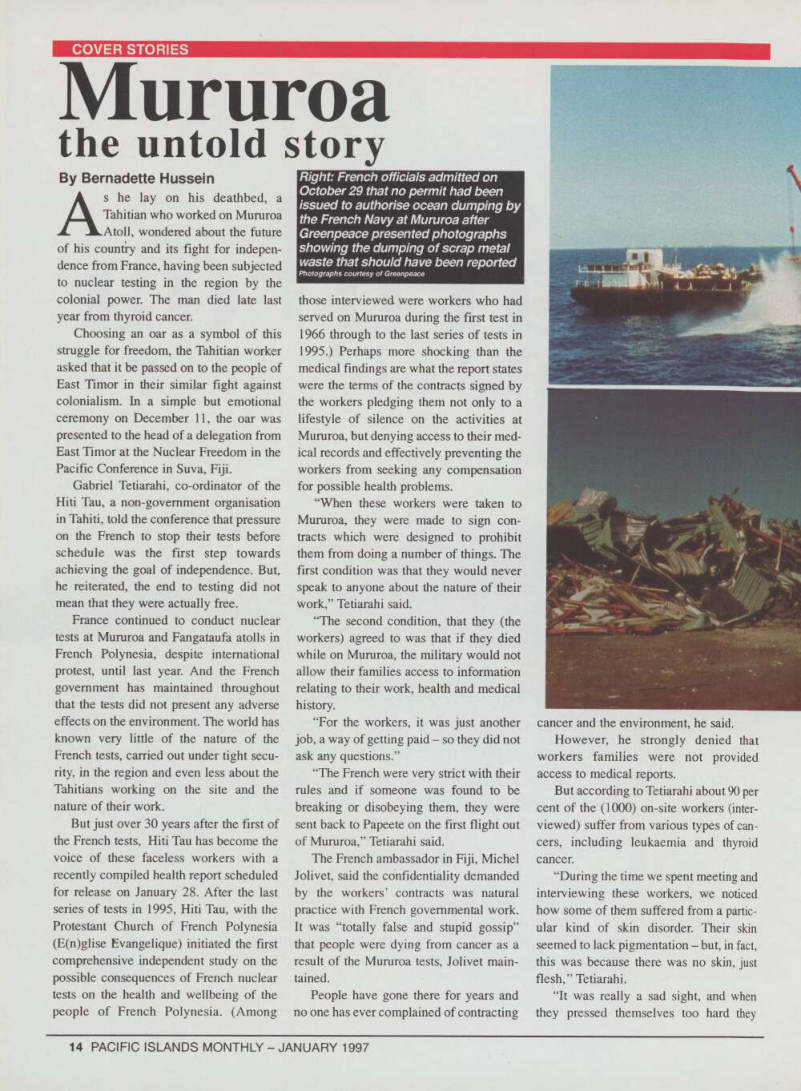
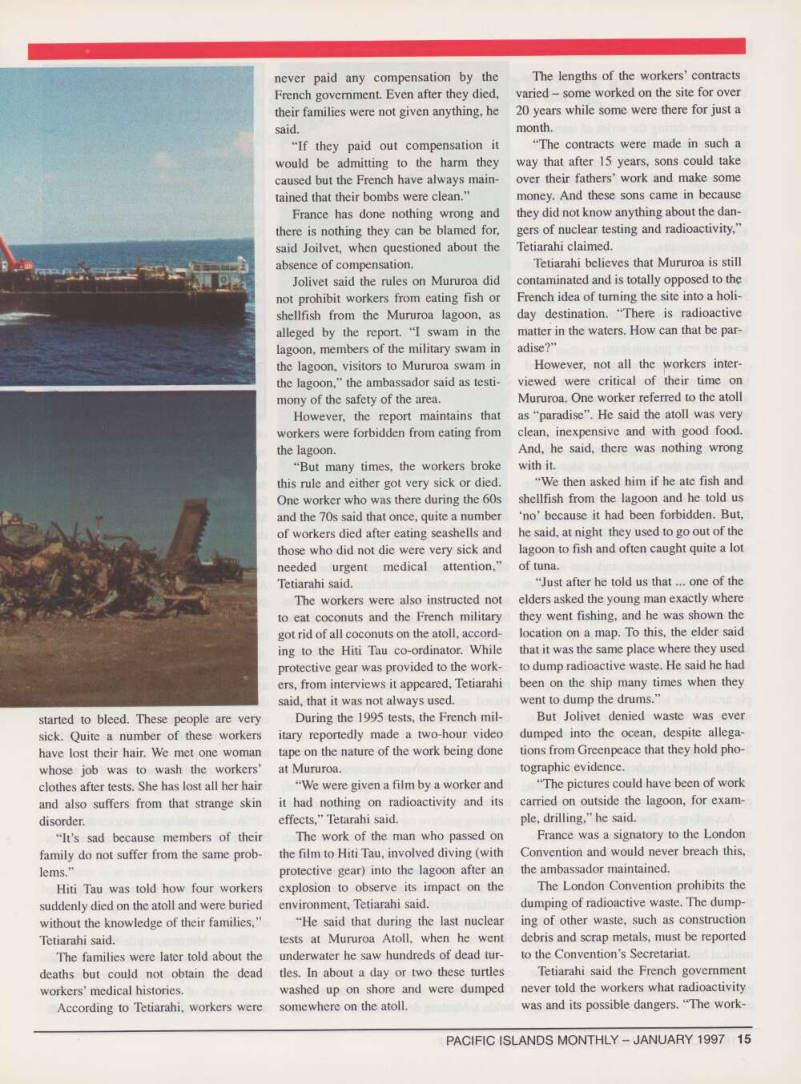
Right: French officials admitted on October 29 that no permit had been issued to authorise ocean dumping by the French Navy at Mururoa after Greenpeace presented photographs showing the dumping of scrap metal waste that should have been reported Photographs courtesy of Greenpeace
started to bleed. These people are very sick. Quite a number of these workers have lost their hair. We met one woman whose job was to wash the workers’ clothes after tests. She has lost all her hair and also suffers from that strange skin disorder.
“It’s sad because members of their family do not suffer from the same prob lems.”
Hiti Tau was told how four workers suddenly died on the atoll and were buried without the knowledge of their families,”
Tetiarahi said.
The families were later told about the deaths but could not obtain the dead workers’ medical histories.
According to Tetiarahi, workers were
never paid any compensation by the
French government. Even after they died, their families were not given anything, he said.
“If they paid out compensation it
would be admitting to the harm they caused but the French have always main tained that their bombs were clean.”
France has done nothing wrong and there is nothing they can be blamed for, said Joilvet, when questioned about the absence of compensation.
Jolivet said the rules on Mururoa did not prohibit workers from eating fish or shellfish from the Mururoa lagoon, as alleged by the report. “I swam in the lagoon, members of the military swam in the lagoon, visitors to Mururoa swam in the lagoon,” the ambassador said as testi mony of the safety of the area.
However, the report maintains that workers were forbidden from eating from
the lagoon.
“But many times, the workers broke this rule and either got very sick or died.
One worker who was there during the 60s and the 70s said that once, quite a number of workers died after eating seashells and those who did not die were very sick and needed urgent medical attention,”
Tetiarahi said.
The workers were also instructed not to eat coconuts and the French military got rid of all coconuts on the atoll, accord ing to the Hiti Tau co-ordinator. While protective gear was provided to the work ers, from interviews it appeared, Tetiarahi said, that it was not always used.
During the 1995 tests, the French mil itary reportedly made a two-hour video tape on the nature of the work being done at Mururoa.
“We were given a film by a worker and it had nothing on radioactivity and its effects,” Tetarahi said.
The work of the man who passed on the film to Hiti Tau, involved diving (with protective gear) into the lagoon after an explosion to observe its impact on the environment, Tetiarahi said.
“He said that during the last nuclear tests at Mururoa Atoll, when he went underwater he saw hundreds of dead tur tles. In about a day or two these turtles washed up on shore and were dumped somewhere on the atoll.
The lengths of the workers’ contracts varied - some worked on the site for over 20 years while some were there for just a month.
“The contracts were made in such a way that after 15 years, sons could take over their fathers’ work and make some money. And these sons came in because they did not know anything about the dan gers of nuclear testing and radioactivity,”
Tetiarahi claimed.
Tetiarahi believes that Mururoa is still contaminated and is totally opposed to the French idea of turning the site into a holi day destination. “There is radioactive matter in the waters. How can that be par adise?”
However, not all the workers inter viewed were critical of their time on Mururoa. One worker referred to the atoll as “paradise”. He said the atoll was very clean, inexpensive and with good food.
And, he said, there was nothing wrong with it.
“We then asked him if he ate fish and shellfish from the lagoon and he told us ‘no’ because it had been forbidden. But, he said, at night they used to go out of the lagoon to fish and often caught quite a lot of tuna.
“Just after he told us that... one of the elders asked the young man exactly where they went fishing, and he was shown the location on a map. To this, the elder said that it was the same place where they used to dump radioactive waste. He said he had been on the ship many times when they went to dump the drums.”
But Jolivet denied waste was ever dumped into the ocean, despite allega tions from Greenpeace that they hold pho
tographic evidence.
“The pictures could have been of work carried on outside the lagoon, for exam ple, drilling,” he said.
France was a signatory to the London Convention and would never breach this, the ambassador maintained.
The London Convention prohibits the dumping of radioactive waste. The dump ing of other waste, such as construction debris and scrap metals, must be reported to the Convention’s Secretariat.
Tetiarahi said the French government never told the workers what radioactivity was and its possible dangers. “The work
ers knew that bombs were being exploded but did not understand radioactivity.”
According to Tetiarahi, the workers who were there during the series of tests from the 60s to the 80s had no idea what nucle ar testing and radioactivity meant.
“It wasn’t until June 1995 that they got to know what was actually happening because, prior to that, the local (Tahitian) media never carried any stories relating to the nuclear issue.
“It wasn’t until 1995 that we got to know what happened at Hiroshima and Nagasaki, in Japan. The media had done a
very bad job highlighting this problem
because our newspapers at the national level are very pro-nuclear.
“We saw what was happening around the world on CNN and realised that nucle ar testing was an international issue. This is / when we decided that, no, we were not going to let this happen.
“People were angry because for so many years they had had no idea about what was happening and it was this anger which resulted in what happened at Papeete airport and the riots around Tahiti.” (September 6, 1995) saw rioting and violent confrontations between police and pro-independence and anti-nuclear demonstrators in French Polynesia as a reaction to French nuclear testing.) “We received great support from all over the world. For example, my organi sation received support from 1900 organ isations around the world.
“Last year, we sent 2000 Tahitian peo ple around the world to talk about our sit uation and what was happening in Tahiti without the knowledge of its people,”
Tetiarahi said.
But Jolivet brushed aside the claim saying the said the media had never been prevented from carrying nuclear reports.
According to Tetiarahi, 99 per cent of the workers interviewed attributed the dis eases many were now victims of to nucle
ar testing.
“They say they got these illness during their time on Mururoa but, because we had no access to medical archives during our research, we don’t know the workers’
medical history.
“The last statistics we got from the government shows the growth rate of can cer in Tahiti was very high - in fact, twice
the normal rate than in other parts of the region. If it’s not the testing, what else can the cancers be related to?”
Tetiarahi said the report was the voice, the testimony of the thousands of workers who spent their lives helping set up this service for the French in the Pacific, while being completely unaware of its possible consequences on them.
The French Embassy in Suva categori cally denied the alleged findings of the report, which the ambassador he said was biased and was started with an attitude that something negative happened at Mururoa.
“The conclusions of the report had been drawn in advance because the ques tionnaire about the alleged effects of nuclear testing were taken for granted,” he said.
The study, which began in late June, 1996, cost SUS2OO,OOO and was funded by the World Council of Churches. It was conducted by two social economists from the University of Wageningen in the Netherlands - Dr Pieter de Vries and Dr Han Seur.
Dr de Vries, a lecturer in the Sociology of Policy and Planning and Sociology of Organisations and Rural Institutions, holds a Masters degree in the Sociology
of Rural Development and a Doctorate in agricultural and environmental science.
He is a member of a number of interna tional organisations including the Centre for Rural Studies of El Colegio de Michoacan, Mexico, and the co-ordinat ing committee of ALFA-Neruda network, an academic network funded by the European union involving nine Latin American and nine European universities and research institutes.
He also has a number of publications to his credit.
Dr Seur holds a Masters in develop ment sociology, rural economy and anthropology. He is a part time lecturer at the university and has a number of publi cations to his name.
The group met 2000 of these workers, interviewing just over a 1000.
“It (the report) is the voice of the work ers. It is the testimony of these workers on the barbarity of the nuclear system.
“We were told by one worker that what France did was the best way to take away the life of future generations,” Tetiarahi said.
“In many parts of the world, people are being killed by automatic guns, bullets and bombs.
“But in Mururoa, while the enemy is invisible, the results are the same because these great and powerful nations want to create a path of death which will destroy our beautiful Pacific Island.” ■
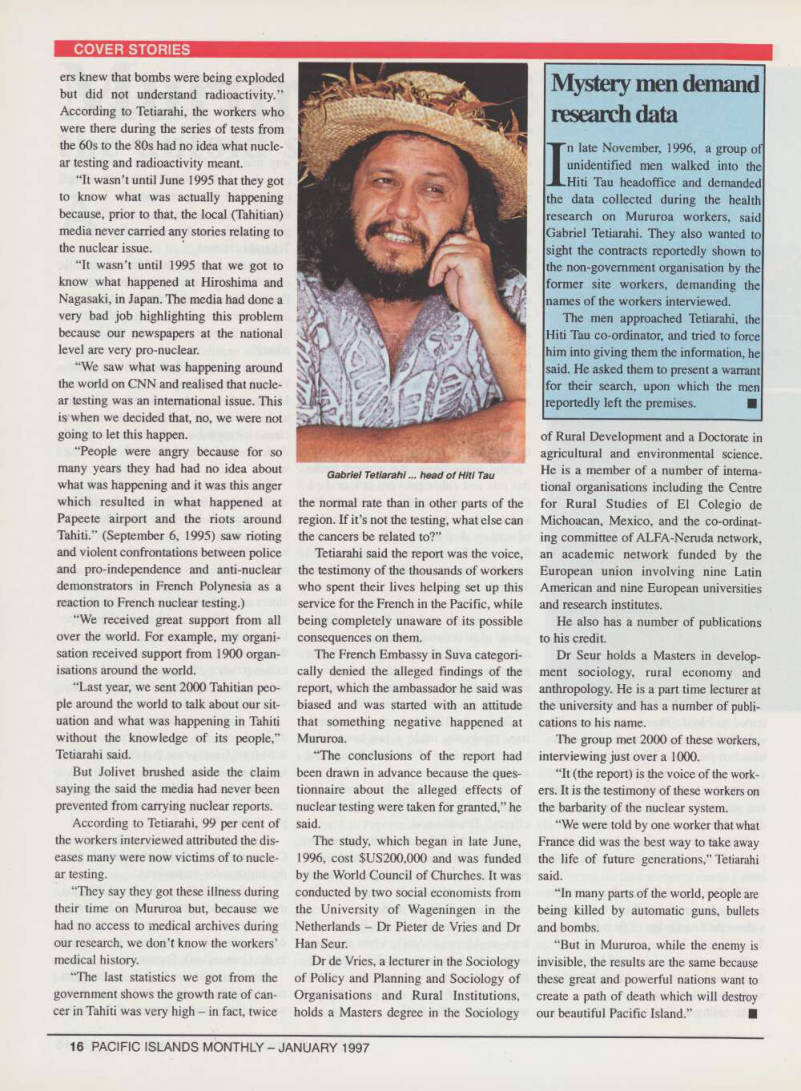
Gabriel Tetiarahi...head of Hiti Tau
Mystery men demand
research data
In late November, 1996, a group of unidentified men walked into the Hiti Tau headoffice and demanded the data collected during the health research on Mururoa workers, said Gabriel Tetiarahi. They also wanted to sight the contracts reportedly shown to the non-govemment organisation by the former site workers, demanding the names of the workers interviewed.
The men approached Tetiarahi, the Hiti Tau co-ordinator, and tried to force him into giving them the information, he said. He asked them to present a warrant for their search, upon which the men reportedly left the premises. ■
Checking the damage
International team studies impact of French tests on the environment and nearby communities
By Bernadette Hussein
An international study into the radiological situation at the for mer French nuclear sites of Mururoa and Fangataufa atolls in French Polynesia is currently under way at the request of French authorities.
The study is being carried out under the guidance and direction of an International Advisory Committee con vened by the International Atomic Energy Agency.
Over 75 scientists from 20 countries are part of the study to assess the radio logical situation, both present and future, at the atolls and involved areas from the point of view of radiological safety, ascer tain whether there are any radiological hazards to people and make recommenda tions on the form, scale and duration of any monitoring, remedial action or other follow-up action that may be required.
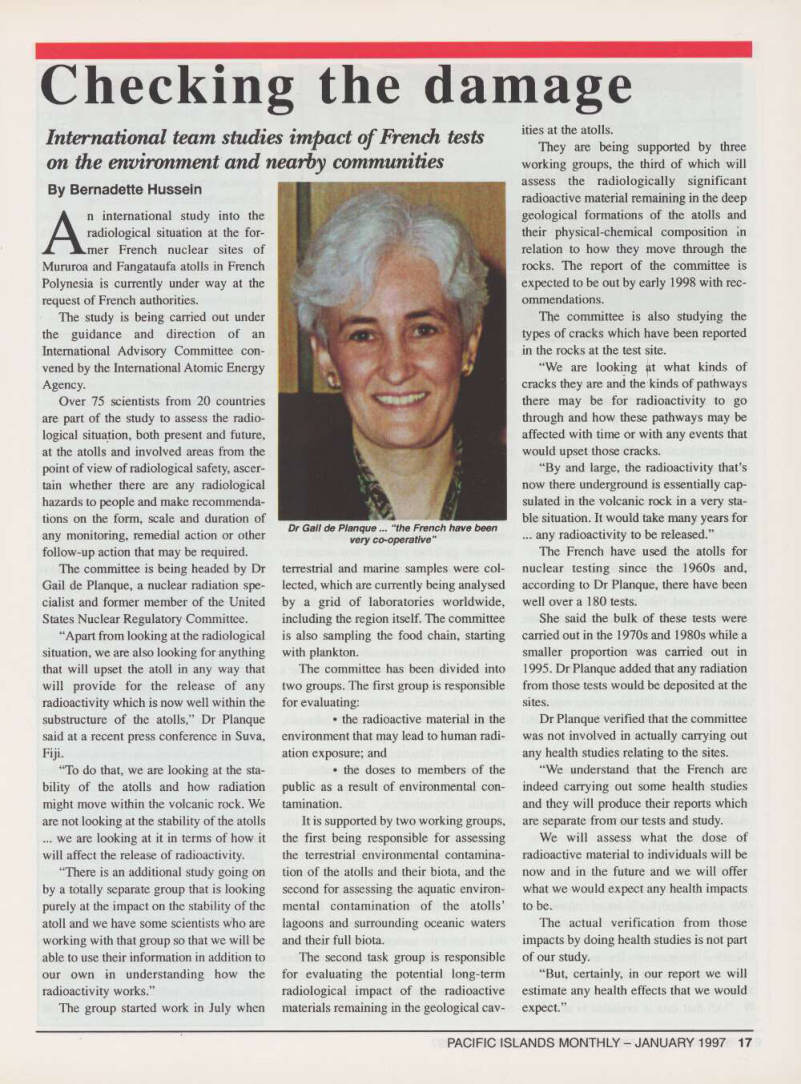
The committee is being headed by Dr Gail de Planque, a nuclear radiation spe cialist and former member of the United States Nuclear Regulatory Committee.
“Apart from looking at the radiological
situation, we are also looking for anything that will upset the atoll in any way that will provide for the release of any radioactivity which is now well within the substructure of the atolls,” Dr Planque said at a recent press conference in Suva,
Fiji.
“To do that, we are looking at the sta bility of the atolls and how radiation might move within the volcanic rock. We are not looking at the stability of the atolls ... we are looking at it in terms of how it will affect the release of radioactivity.
“There is an additional study going on by a totally separate group that is looking purely at the impact on the stability of the atoll and we have some scientists who are working with that group so that we will be able to use their information in addition to our own in understanding how the
radioactivity works.”
The group started work in July when
terrestrial and marine samples were col lected, which are currently being analysed by a grid of laboratories worldwide, including the region itself. The committee is also sampling the food chain, starting with plankton.
The committee has been divided into two groups. The first group is responsible for evaluating: • the radioactive material in the environment that may lead to human radi ation exposure; and • the doses to members of the public as a result of environmental con tamination.
It is supported by two working groups, the first being responsible for assessing the terrestrial environmental contamina tion of the atolls and their biota, and the second for assessing the aquatic environ mental contamination of the atolls’ lagoons and surrounding oceanic waters and their full biota.
The second task group is responsible for evaluating the potential long-term radiological impact of the radioactive materials remaining in the geological cav
ities at the atolls.
They are being supported by three
working groups, the third of which will
assess the radiologically significant
radioactive material remaining in the deep geological formations of the atolls and
their physical-chemical composition in
relation to how they move through the rocks. The report of the committee is expected to be out by early 1998 with rec ommendations.
The committee is also studying the types of cracks which have been reported in the rocks at the test site.
“We are looking what kinds of cracks they are and the kinds of pathways there may be for radioactivity to go through and how these pathways may be affected with time or with any events that would upset those cracks.
“By and large, the radioactivity that’s now there underground is essentially cap sulated in the volcanic rock in a very sta ble situation. It would take many years for ... any radioactivity to be released.”
The French have used the atolls for nuclear testing since the 1960 s and, according to Dr Planque, there have been well over a 180 tests.
She said the bulk of these tests were carried out in the 1970 s and 1980 s while a smaller proportion was carried out in 1995. Dr Planque added that any radiation from those tests would be deposited at the sites.
Dr Planque verified that the committee was not involved in actually carrying out any health studies relating to the sites.
“We understand that the French are indeed carrying out some health studies and they will produce their reports which are separate from our tests and study.
We will assess what the dose of radioactive material to individuals will be now and in the future and we will offer what we would expect any health impacts to be.
The actual verification from those impacts by doing health studies is not part of our study.
“But, certainly, in our report we will estimate any health effects that we would
expect.”
Dr Gail de Planque...“the French have been very co-operative"
The committee is also working out the diet of the people on the atolls and nearby areas.
“We have a lot of worldwide informa tion on typical diets. There is some infor mation available in this part of the world.
We will be looking at all of that and mak ing a choice on what we assume is a typi cal diet or most likely diet that people would have and would be impacted by any radioactivity in that diet.
“At present, we are sampling all of the typical components of the diet like coconuts and fish. We do not have any findings on how the food chain has been affected and since we have just really begun studying, we are not in a position to give any information at this point.
“As I indicated, the samples that were taken in July are just now being analysed.
We have seen some of the French data but we are not prepared to make any judg ment until we analyse our own. It will be a little while before we can do that.”
On access to information, Dr Planque said her committee really had no problem with that since the French were extremely
co-operative.
“We were worried that we would have problems accessing the information but the French have been very co-operative.
We have asked for a lot of information and got everything that was asked for.
“The French have had a very compre hensive programme for measurements and monitors since the beginning of the testing.
“All that data is available to us. It has
taken awhile to get some of them simply because we asked that they be translated
into English.
“Our scientists are studying those doc uments now and we expect we will have even more requests for information and we trust we will receive that information.
“Nothing that we asked for has been withheld and when our sampling team went to the atolls, they were free to move around, go to any place they wanted to and take any amount and kind of samples that they wanted to.”
The study is expected to cost close to SUS 3 million with the French contribut ing SUSI.B million.
There is also a contribution from the lAEA and also contributions in kind by a number of agency member states, which are Argentina, Australia, Austria, Belgium, Denmark, Germany, Indonesia, Japan, New Zealand, the Russian Federation, Slovenia, Spain, Sweden, Switzerland, the United Kingdom, the United States of America, Fiji, the World
Health Organisation, the European
Commission and the South Pacific Forum.
The Forum is represented by V A Fuavai, the director of the South Pacific Environment Programme.
On the recommendations. Dr Planque said the committee would make them but did not have the authority to enforce them.
Although she did add that the calibre of people involved in the study carried sufficient weight for the recommenda tions to be taken seriously. ■
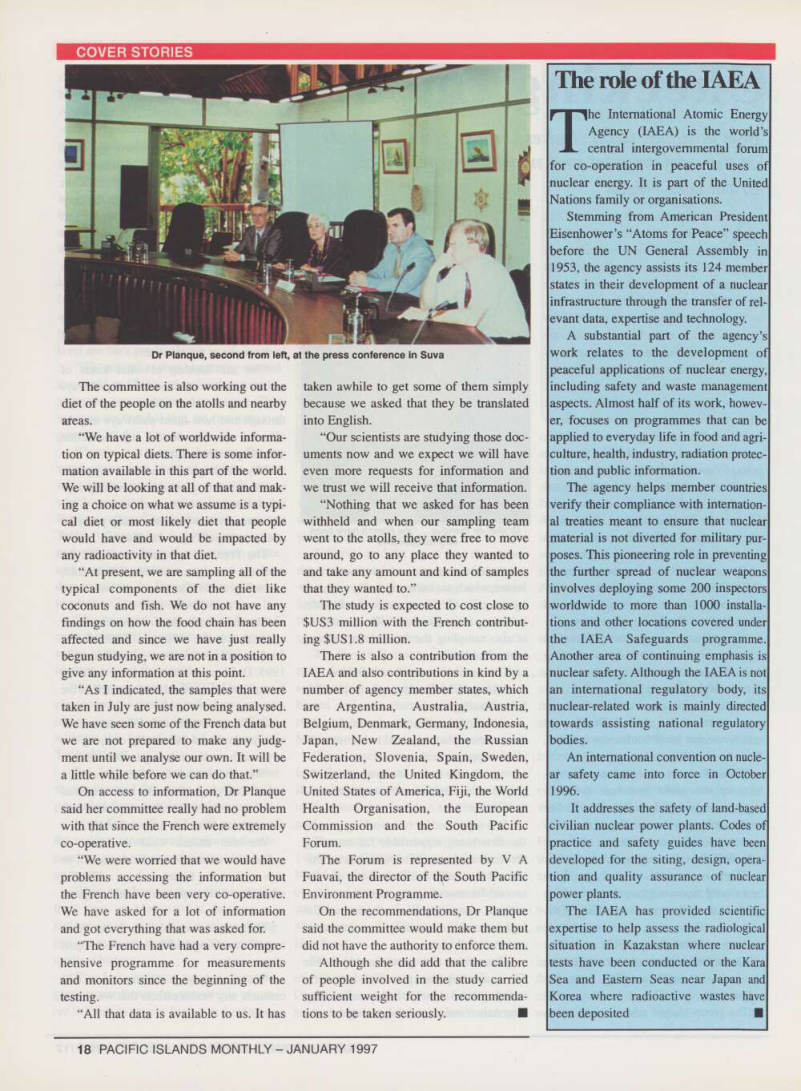
Dr Planque, second from left, at the press conference in Suva
The role of the IAEA
The International Atomic Energy
Agency (lAEA) is the world’s central intergovernmental forum for co-operation in peaceful uses of nuclear energy. It is part of the United Nations family or organisations.
Stemming from American President Eisenhower’s “Atoms for Peace” speech before the UN General Assembly in 1953, the agency assists its 124 member states in their development of a nuclear infrastructure through the transfer of rel evant data, expertise and technology.
A substantial part of the agency’s work relates to the development of peaceful applications of nuclear energy, including safety and waste management aspects. Almost half of its work, howev er, focuses on programmes that can be applied to everyday life in food and agri culture, health, industry, radiation protec tion and public information.
The agency helps member countries verify their compliance with internation al treaties meant to ensure that nuclear material is not diverted for military pur poses. This pioneering role in preventing the further spread of nuclear weapons involves deploying some 200 inspectors worldwide to more than 1000 installa tions and other locations covered under the lAEA Safeguards programme.
Another area of continuing emphasis is nuclear safety. Although the lAEA is not an international regulatory body, its nuclear-related work is mainly directed towards assisting national regulatory bodies.
An international convention on nucle ar safety came into force in October 1996.
It addresses the safety of land-based civilian nuclear power plants. Codes of practice and safety guides have been developed for the siting, design, opera tion and quality assurance of nuclear power plants.
The lAEA has provided scientific expertise to help assess the radiological situation in Kazakstan where nuclear tests have been conducted or the Kara Sea and Eastern Seas near Japan and Korea where radioactive wastes have been deposited ■
The nuclear debate
By ian Williams
at the United Nations
On the surface and underground, nuclear issues reverberated
throughout this year’s United
Nations General Assembly. Although it is a fighting retreat, the .nuclear powers and their dwindling band of supporters are increasingly on the defensive.
For example, on the surface, the suc cessful adoption of the UN resolution res cuing the Test Ban treaty from deadlock in Geneva was a big step forward and a triumph for the Australians.
However, underground, the French seem to have been behind Australia’s sur prising defeat for its bid for election to the Security Council. Even though Paris had supported the Australian resolution, the fallout from Australian opposition to the French Pacific tests clearly had a long half life.
On the brighter side, the small Pacific states, Samoa, Solomons and the Marshalls, proved that you can defy the bigger powers with their victory at the International Court of Justice, which has strengthened the hands of the antinuclear forces at the UN.
“It was a challenge to the international legal system,” says Solomon Islands Ambassador to the UN Rex Horoi about the diplomatic after-effects of the court decision declaring nuclear weapons to be against international law.
“It shows that as we approach the 21st century, international law is a package that applies to big nations as well as small ones. That’s every important for us because, as small nations, in the end our only protection is the body of internation al law. And it has opened up new pres sures for international disarmament.”
The actual resolution welcoming the ICJ decision - and, in particular, its unan imous ruling that there was a legal obliga tion “to bring to a conclusion negotiations leading to nuclear disarmament in all its aspects” - was greeted frostily by all the nuclear powers except China, especially its suggestion that the negotiations should begin in 1997.
The Americans accused the sponsors of trying to turn the advisory opinion into “a legal edict”, while the Russians, who by all accounts are having difficulty feed ing and clothing their troops, let alone arming them with nukes, claimed the text was “inaccurate and incomplete”. The British said that their vote against should not “be seen as diminishing its high regard for the court”. Just, presumably, that they disagreed with it.
Much of the opposition invoked the split among the ICJ judges that allowed the use of nuclear weapons “in exception al circumstances”.
However, they mostly went on to dis agree equally strongly with the parts of the resolution that cited the unanimous decision of the judges that nuclear powers should be working hard towards disarma ment.
Consistency has never played a big
part in the arguments of the nuclear pow ers, however, who have never been able to prove their assertions that they alone are uniquely required to have nuclear weapons to defend themselves.
A much blander Japanese resolution on “Nuclear disarmament with a view to the ultimate elimination of nuclear weapons”, was carried with no opposi tion, except abstentions from anti-nuclear states who objected to its toothlessness.
More substantially, the General Assembly decided that preparations for the review of the Non-Proliferation Treaty confer ence would begin in April 1997.
Other resolutions passed with the opposition of the industrialised and nucle ar powers.
Normally, small nations have only apprehension when faced with mergers
and globalisation, but surfing along the
anti-nuclear tide is an intriguing resolu tion merging all the various nuclear-free zones into one huge united Southern Hemisphere, and adjacent areas. Nuclear Weapon Free Zone.
The resolution urged the creation of new zones and the emergence of the new
mega-non-nuke hemisphere. China
agreed, the Russians abstained and the
Western powers opposed it, claiming to be concerned at the threat to freedom of navigation on the high seas.
To celebrate, the assembly called for the implementation of existing declara tions making Africa and Latin America NWFZs and called for the setting up of such a zone in South Asia.
Much of South Asia - in the form of India - objected to this, but it was passed overwhelmingly.
In the Middle East, the position is
complicated because everyone, including
the USA, knows that Israel has a nuclear arsenal but as soon as it is openly admit ted then US aid to Israel would have to be cut off, creating a tremendous domestic problem for any American government from the immensely powerful pro-Israel
lobby in Washington.
So in typical UN style, the resolution called upon “the only state in the region not party to the NPT” to sign up prompt ly. However, this was not weaselly enough for either the US or Israel, who both voted against it. The same two were also alone in voting against the convening of the fourth special session of the General Assembly devoted to disarma ment in 1999.
So what is the fallout from this mush room cloud of hot air rising from the UN building in New York? In fact, quite a lot.
The pushes by the Pacific States in the ICJ, by Australia and the Pacific on the Test Ban Treaty and by the non-Aligned on the Non-Proliferation Treaty have been very effective in cutting the moral ground from under the feet of the nuclear powers. Each victory for the anti-nuclear lobby increases the pressure on the nucle ar powers, who no longer even have the Cold War and its associated paranoia to justify their lethal toys. In fact, ironically, it is beginning to look as if it is the nucle ar powers engaged in diplomatic war with the rest of the world rather than each other.
In this particular war, the Pacific Island states are on the frontline again but this time it is a safe and honourable position to be in. ■
batteries from failed Russian spacecraft Mars 96

Red
alert
By Kalinga Seneviratne
On the morning of November 18, for just a few hours, Australia was gripped in the drama of a nuclear device possibly landing in the continent - heralded by a phone call from US President Bill Clinton to Australian Prime Minister John Howard at Sam, warning him that debris from a failed Russian rocket with four plutonium bat teries was speeding at 27,000 kilometres per hour towards Australia.
The prime minister immediately called a meeting of the National Security Council and, after putting the country’s armed forces and emergency services on red alert, announced the news to the nation at a hastly arranged press confer ence in Canberra.
For four hours, Australian emergency
crews waited and watched as debris from the failed Russian Mars probe, which included 200 grams of plutonium batter ies, plunged out of control and headed towards the continent, according to both Australian and US radar screens. Between 10am and noon, all predictions were that the plutonium batteries would land in either central or eastern Australia.
In central Australia, an Alice Springs bookmaker - Centreßet - had even got a number of calls by punters wanting to take a bet on the exact location in Australia where the rocket would land.
A republican in the north-western New South Wales town of Tibooburra offered free beers to his customers after the news came in at around 12.30 pm that the debris had fallen in the Pacific Ocean. Just a few hours earlier, people in the town had been warned by state emergency services that
Australia declares state of emergency as plutonium batteries from failed Russian spacecraft Mars 96 almost crash into the Island continent
the plutonium batteries were heading towards them.
The debris ultimately landed in the Pacific Ocean, 1300 km west of the
Chilean capital, Santiago, according to
tracking agencies around the world.
Australian government sources said it had passed over Tibooburra at 120 km above ground and over the east coast of Australia just south of Sydney, 15 minutes before splashing into the ocean.
While there was real concern and quite a bit of drummed-up drama of a nuclear ‘fallout’ in Australia, Russians were giv ing assurances that the batteries would not bum up in the atmosphere nor break on
impact.
The Russian spacecraft, called Mars 96, was launched from Baikonur space centre in the former Soviet Republic of Kazakhstan in Central Asia on November 17 and was expected to land on Mars in September this year. It had two small landing vehicles for this purpose weigh ing 65 kg each to be powered by two plu tonium batteries. It was these batteries which created all the drama once the third stage of firing failed half an hour after the launch, thus plunging the spacecraft back to earth, out of control.
Naval sources in Australia said the plu tonium batteries seemed to have landed in an area of the ocean about 6000 metres deep. A Chilean naval officer confirmed this and told The Australian newspaper that the recovery of the debris would be
almost impossible.
“This area has one of the deepest ocean floors in the world. Any kind of recovery, if it were possible, would be very, very tough,” he said.
Yuri Milov, the director of the Russian
Space Agency’s automated flight pro
gramme, has given assurances that the debris lying on the bottom of the Pacific Ocean poses no danger to the region. “The production process does not allow its breakdown in any extraordinary situa tion,” he said in a statement from Moscow, adding, “there is no danger that
the isotopes will disintegrate.”
The type of plutonium in the batteries could cause lung and bone cancer if it enters the body, according to medical experts. But scientists in both Australia and New Zealand tend to agree that the
‘space junk’, even though it includes four plutonium batteries of 200 grams, will not pose any threat to people or marine life in the Pacific. However, environmentalists in Australia have used the opportunity to press the Australian government to stop uranium mining and export, citing this as a typical example of the dangers involved in this trade.
Dr Murray Mathews, a scientist at the National Radiation Laboratory in New Zealand, says that there is only a tiny chance of the canisters breaking up and exposing bottom-dwelling fish to radia tion. Also, he adds that the deep-water conditions in this area are stable enough to prevent the material dissolving or cor roding and entering the food chain.
Peter Bums, the acting director of the Australian Radiation Laboratory, told Pacific Islands Monthly that it would be a futile exercise trying to locate the debris as the “ocean is so vast”. Compared with the dangers facing the Pacific people and marine life by the recent French nuclear testing at Mururoa and Fangataufa atolls, he argues that there is nothing to worry about with these tiny plutonium batteries.
The French tests used plutonium in kilo grams compared with the 200 grams in the Russian batteries, and the nature of the explosions had made it much more likely for nuclear contamination to occur, he pointed out.
“If there’s any radiation which could be harmful, they (monitoring bodies) would have by now had measurements of the atmospheric damage,” he added.
Jim Downey, executive director of the Australian Conservation Foundation (ACF), called upon the government to end uranium mining. “The ACF wants an end to Australian uranium mining that makes possible the production of plutonium and nuclear wastes. This is the ideal time to end Australia’s destructive role in the nuclear industry,” he said.
“There are some things we should never do. We should not be mining urani um, using uranium, sending it into space or sending it anywhere else,” said Senator Meg Lees, the environmental spokeswoman for the Australian Democrats, in a press statement from Canberra. After the drama had subsided, the Sydney Morning Herald reported on
November 20, quoting unnamed Russian space officials, that the plutonium-con taining spacecraft debris had actually crashed to earth 24 hours before the alert was sounded in Australia. They claimed that, on calculations based on data obtained from the Russian space-tracking station at Yevpatoria in the Crimea, the US Space Command had been tracking the debris from the fourth stage of the Proton rocket which did not contain the plutonium batteries. There has, however, been no further comment from the Russians on this matter. Nor have they said where the plutonium batteries might have landed in that case. ■
Advertisements & other items, p. 20 (1 item)
Conservation Program
WWF
Senior Vacancy with WWF
South Pacific Program
WWF World Wide Fund for Nature is an independent conservation organisation with a network of offices in over 50 countries. WWF works closely with governments, NGOs and regional institutions to support initiatives in natural resource management and sustainable development. In the South Pacific, WWF has focussed on local community action, awareness-raising local capacitybuilding and the sustainable use of forests, coasts and near shore resources.
Conservation Program
Manager
a new senior management position with WWF South Pacific Program: based in Fiji but working region-wide, with extensive travel.
Responsibilities include:
design, development, supervision
and evaluation of WWF projects strengthening management systems and skills of project staff liaison with partner organisations and project donors.
Requirements are: a higher degree in management, planning, law or natural sciences minimum of 10 years’ relevant
experience
excellent analytical and written and verbal communication skills proven abilities in administration and senior level management.
Pacific Islanders are encouraged to apply. If you are interested in this
challenging position, please apply in
writing with your CV by 20 January, 1997 to the WWF Representative, Peter Hunnam.
WWF South Pacific Program, Private Mail Bag, GPO Suva, Fiji
te1.(+679)315533 fax.(+679)315410
e-mail [email protected]
space junk crashing
History of plutonium space junk crashing into earth
Since the dawn of the space age on October 4, 1957, when the Soviet Union launched Sputnik I, 15,948 space objects have fallen back to earth, including 2430 satellites. There have been at least four instances when nuclear (plu toniumj-powered batteries have come crashing in.
The first was in 1964 when a US plu tonium-powered staellite crashed into the Atlantic after failing to reach orbit. Four years later, another US spacecraft.
Nimbus B-l, a weather-forecasting satel lite, crashed into the Pacific with two plu tonium batteries which were recovered and used in another satellite later.
Two years later, the ill-fated Apollo 13-manned US space mission to the moon, jettisoned its nuclear generators and lunar module which crashed into the Pacific Ocean. All attempts to find the plutonium batteries failed.
In 1978, a Soviet spy satellite. Cosmos 954, crashed into Canada, widely scatter ing radioactive material. In 1979, US space station Skylab fell to earth, leaving a trail of metal debris across a 1000 km swathe in the Western Australian desert and the Indian Ocean and in 1991, debris from the Russian space station Salyut 7 crashed into Argentina and the Atlantic Ocean. On both these occasions, nuclear devices were not suspected to be part of the space junk. ■
The fury of Manam
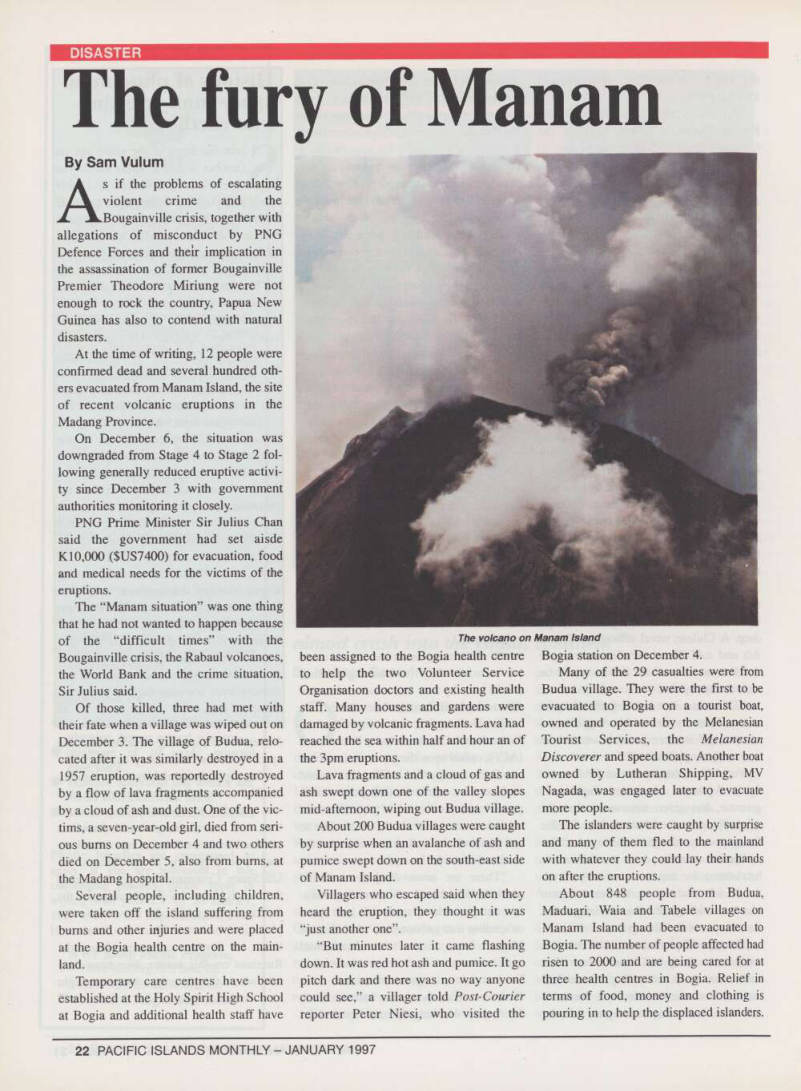
Disaster
By Sam Vulum
As if the problems of escalating violent crime and the Bougainville crisis, together with allegations of misconduct by PNG Defence Forces and their implication in the assassination of former Bougainville Premier Theodore Miriung were not enough to rock the country, Papua New Guinea has also to contend with natural disasters.
At the time of writing, 12 people were confirmed dead and several hundred oth ers evacuated from Manam Island, the site of recent volcanic eruptions in the Madang Province.
On December 6, the situation was downgraded from Stage 4 to Stage 2 fol lowing generally reduced eruptive activi ty since December 3 with government authorities monitoring it closely.
PNG Prime Minister Sir Julius Chan said the government had set aisde K 10,000 (SUS74OO) for evacuation, food and medical needs for the victims of the eruptions.
The “Manam situation” was one thing that he had not wanted to happen because of the “difficult times” with the Bougainville crisis, the Rabaul volcanoes, the World Bank and the crime situation.
Sir Julius said.
Of those killed, three had met with their fate when a village was wiped out on December 3. The village of Budua, relo cated after it was similarly destroyed in a 1957 eruption, was reportedly destroyed by a flow of lava fragments accompanied by a cloud of ash and dust. One of the vic tims, a seven-year-old girl, died from seri ous bums on December 4 and two others died on December 5, also from bums, at the Madang hospital.
Several people, including children, were taken off the island suffering from bums and other injuries and were placed at the Bogia health centre on the main land.
Temporary care centres have been established at the Holy Spirit High School at Bogia and additional health staff have
been assigned to the Bogia health centre to help the two Volunteer Service Organisation doctors and existing health staff. Many houses and gardens were damaged by volcanic fragments. Lava had reached the sea within half and hour an of the 3pm eruptions.
Lava fragments and a cloud of gas and ash swept down one of the valley slopes mid-aftemoon, wiping out Budua village.
About 200 Budua villages were caught by surprise when an avalanche of ash and pumice swept down on the south-east side of Manam Island.
Villagers who escaped said when they heard the eruption, they thought it was “just another one”.
“But minutes later it came flashing down. It was red hot ash and pumice. It go pitch dark and there was no way anyone could see,” a villager told Post-Courier reporter Peter Niesi, who visited the
Bogia station on December 4.
Many of the 29 casualties were from Budua village. They were the first to be evacuated to Bogia on a tourist boat, owned and operated by the Melanesian Tourist Services, the Melanesian Discoverer and speed boats. Another boat owned by Lutheran Shipping, MV Nagada, was engaged later to evacuate more people.
The islanders were caught by surprise and many of them fled to the mainland with whatever they could lay their hands on after the eruptions.
About 848 people from Budua, Maduari, Waia and Tabele villages on Manam Island had been evacuated to Bogia. The number of people affected had risen to 2000 and are being cared for at three health centres in Bogia. Relief in terms of food, money and clothing is pouring in to help the displaced islanders.
The volcano on Manam Island
Nauru’s new-new president
Politics
Adeang, the third president in 20 days, faces the challenge of achieving a basis for political and financial stability in the once phosphate-rich Island state
By David North
Naum had three presidents (really prime ministers) in a period of 20 days.
On November 26, the parliament elect ed Kennan Adeang, MP, a fiscal reformer, to that post by a nine-to-eight margin. He replaced Bernard Dowiyogo, once a long time incumbent in the position, but most recently elected to the presidency on November 7.
On that date, Dowiyogo replaced Lagumot Harris, who had been president for about a year prior to his ousting.
The once-rich Island’s politics consists of one part substantive issues - how to cope with a severe, self-created financial crisis (see “Dowiyogo takes over Naum”
Pacific Islands Monthly December, 1996) and one part intense personal rivalries among the 18 members of this, one of the world’s smallest national parliaments. (Tuvalu’s, with 12 members, is smaller.)
The basic political problem in Nauru is a closely divided
parliament
Observers sense that Adeang, among the current cohort of local politicians, is probably the most careful with his Island’s resources, with Dowiyogo proba bly less so, and Harris somewhere in between.
Adeang, long a member of the parlia ment, had been the de facto leader of the opposition for years while Naum’s ruling faction made a number of bad investment decisions, and was gulled by international conmen.
The basic political problem in Naum is a closely divided parliament. Harris took power, with Adeang in his cabinet, by a nine-to-eight vote in 1995, with the
speaker staying neutral.
Harris was overthrown by Dowiyogo after a series of close votes, with absen tees and abstentions playing a major role in the internal manoeuvering. Adeang and
his close ally. Ruby Dediya, eventually brought down their one-time leader, Harris, by supporting Dowiyogo - if briefly.
Out of this political chaos has emerged one of the highest-ranking women in Pacific insular politics
Then on November 26, the Adeang and Harris factions came together, appar ently out of a joint antipathy for Dowiyogo and his policies, and carried a nine-to-eight vote for the new govern ment. Dowiyogo had never been able to count on more than eight votes during his short, minority government.
The speculation is that Adeang will continue to press forward with a tight budget to try to bring some financial sta bility for the Island.
Further, it is known that many of the Island’s leaders are worried about how the
Island’s public and, equally importantly,
the overseas financial community thinks about the recent lack of political stability.
These two concerns may work to
steady Adeang’s slimmest of possible
majorities.
Meanwhile, out of this political chaos has emerged one of the highest-ranking women in Pacific insular politics.
Ruby Dediya, a nurse by training, was elected to parliament a year ago, and in this past November became finance min ister and minister assisting the president.
Shortly after being chosen president,
Adeang left the Island to attend to press ing financial matters in Melbourne (where Nauru’s investments are managed) and in Honolulu (location of one of Nauru’s more successful real estate ventures).
Dediya became the acting president as
a result and served in that capacity for most of the first two weeks of the Adeang ministry.
This is an unusual distinction for a woman in the Islands. (In Guam,
Lieutenant Governor Madeleine Bordallo serves as acting governor from time to time.) The rest of the new cabinet includes Clinton Benjamin, who had served in the year-long Harris cabinet, and cabinet newcomers Anthony Audoa, Remy Namaduk and Godfrey Thoma .
The other three voting for Adeang were ex-President Harris, ex-Finance Minister Rueben Kun and Nimrod Botelanga. Keeping his group of eight supporters happy will present a continu ing challenge to Adeang.
Under these circumstances there is talk
I Adeang will have to continue to struggle with the need to make ends meet
about the need for an air-clearing election to give Nauru some political stability. At the moment, no election is slated until 1998, and it will be interesting to see if a majority of the currently elected members of the parliament would be willing to risk their seats in exchange for a little more political stability for their country. That’s a tough call for any politician, anywhere in the world.
Meanwhile, Adeang will have to con tinue to struggle with the need to make ends meet, given a future of rapidly
declining phosphate production and a past
of spend-thrift policies.
At last report. Air Nauru, the govern ment’s money-losing airline, continued to operate with only one plane, as opposed to the luxurious two or three of the past; but while the reduction of flights was helpful to the treasury, Nauru, a small Island with 8000 residents, still had two government
supported hospitals.
It is clearly harder to sell or lease a redundant hospital on Nauru than to sell or lease a redundant airplane. Hospitals cannot fly away; even Kennan Adeang cannot manage that feat. ■
Winston’s

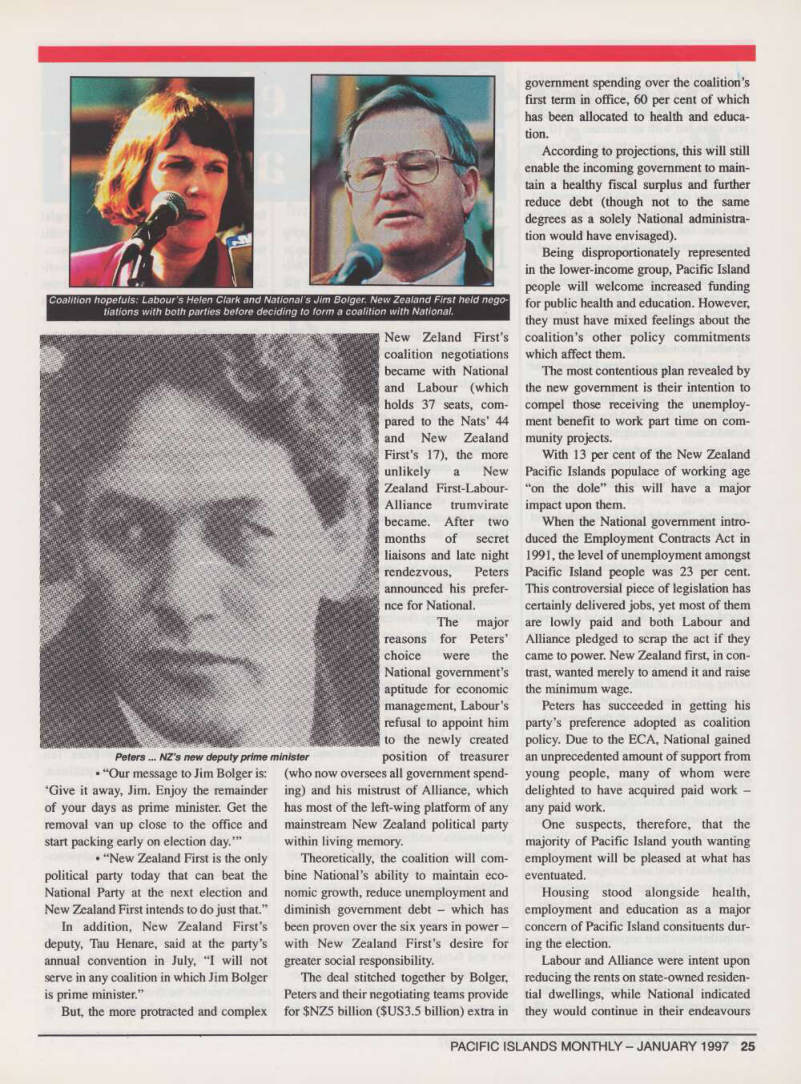
u-turn
By Atama Raganivatu
In an amazing about face. New Zealand First Party head Winston Peters ended two months of uncertain ty by entering into coalition agreement with the governing National Party and permitting National’s leader, Jim Bolger,, to retain his position as prime minister.
When the October 12 general election ended in a stalemate with no party com manding a parliamentary majority, thus ensuring that New Zealand would have its first coalition government in modem times, a New Zealand First-National asso ciation led by Bolger appeared one of the least likely scenarios.
Throughout the election, voters were apparently faced with the choice of re electing National - possibly bolstered by
Despite earlier statements to the contrary, the New Zealand First Party leader joins forces with Bolger’s National Party to form NZ’s coalition government
support from the right-wing ACT and/or Christian party - or bringing to power a coalition comprising the three main oppo sition parties - Labour, Alliance and New Zealand First. The former two are left leaning, while New Zealand First posi tions themselves at the centre of the Kiwi political spectrum.
The only other possibility perceived was a union between New Zealand First and a National Party headed by someone more responsive to New Zealand First’s philosophies than the rigidly conservative Bolger.
A working arrangement between Bolgers and Peters had long ago been dis missed as inconceivable, such is the antipathy between the two.
Peter’s comments in 1996 about Bolger and his National government included the following; • “Jim Bolger is not fit for the job of prime minister and come 12th October, he will be out. He should not get on his phone and call me (to form a coali tion) because we are not interested in political quisling behaviour. We are not into state treachery.” • “This government is bereft of ideas and bereft of economic and social performance.” • “We (New Zealand First) believe the kind of politician depicted by Bolger is not to be promoted into Cabinet.
As a consequence, we will not have any truck with him.”
• “Our message to Jim Bolger is: ‘Give it away, Jim. Enjoy the remainder of your days as prime minister. Get the removal van up close to the office and start packing early on election day.’” • “New Zealand First is the only political party today that can beat the National Party at the next election and New Zealand First intends to do just that.”
In addition. New Zealand First’s deputy, Tau Henare, said at the party’s annual convention in July, “I will not serve in any coalition in which Jim Bolger is prime minister.”
But, the more protracted and complex
New Zeland First’s coalition negotiations became with National and Labour (which holds 37 seats, com pared to the Nats’ 44 and New Zealand First’s 17), the more unlikely a New Zealand First-Labour- Alliance trumvirate became. After two months of secret liaisons and late night rendezvous, Peters announced his prefer nce for National.
The major reasons for Peters’ choice were the National government’s aptitude for economic management. Labour’s refusal to appoint him to the newly created position of treasurer
(who now oversees all government spend ing) and his mistrust of Alliance, which has most of the left-wing platform of any mainstream New Zealand political party within living memory.
Theoretically, the coalition will com bine National’s ability to maintain eco nomic growth, reduce unemployment and diminish government debt - which has been proven over the six years in power with New Zealand First’s desire for greater social responsibility.
The deal stitched together by Bolger, Peters and their negotiating teams provide for SNZS billion (SUS3.S billion) extra in
government spending over the coalition’s first term in office, 60 per cent of which has been allocated to health and educa tion.
According to projections, this will still enable the incoming government to main tain a healthy fiscal surplus and further reduce debt (though not to the same degrees as a solely National administra tion would have envisaged).
Being disproportionately represented in the lower-income group, Pacific Island people will welcome increased funding for public health and education. However, they must have mixed feelings about the coalition’s other policy commitments which affect them.
The most contentious plan revealed by the new government is their intention to compel those receiving the unemploy ment benefit to work part time on com munity projects.
With 13 per cent of the New Zealand Pacific Islands populace of working age “on the dole” this will have a major impact upon them.
When the National government intro duced the Employment Contracts Act in 1991, the level of unemployment amongst Pacific Island people was 23 per cent.
This controversial piece of legislation has certainly delivered jobs, yet most of them are lowly paid and both Labour and Alliance pledged to scrap the act if they came to power. New Zealand first, in con trast, wanted merely to amend it and raise the minimum wage.
Peters has succeeded in getting his party’s preference adopted as coalition policy. Due to the ECA, National gained an unprecedented amount of support from young people, many of whom were delighted to have acquired paid work any paid work.
One suspects, therefore, that the majority of Pacific Island youth wanting employment will be pleased at what has eventuated.
Housing stood alongside health, employment and education as a major concern of Pacific Island consituents dur ing the election.
Labour and Alliance were intent upon reducing the rents on state-owned residen tial dwellings, while National indicated they would continue in their endeavours
Coalition hopefuls: Labour's Helen Clark and National's Jim Bolger. New Zealand First held nego tiations with both parties before deciding to form a coalition with National.
Peters ... NZ’s new deputy prime minister
to gradually increase rents up to “market levels”. New Zealand First preferred state house rents to remain at their cur rent rates but with an increase of 10 per cent in the Accommodation Supplement available to low-income earners.
Once again, the New Zealand First viewpoint is the one which has prevailed.
Peters, though, had to make concessions in one of his major objectives.
Immigration will not be cut immediately, as he wished.
Instead, a “Population Conference” is to be convened during the coalition gov ernment’s first term in office and, they hope, a consensus will be reached there on what promises to be the biggest bone of contention between New Zealand First and National.
It was New Zealand First’s intention to placate Pacific Island governments for a reduction in immigration levels by offering more foreign aid.
However, the coalition’s aid policy mirrors that of its National party prede cessor with 2.4 per cent of Gross Domestic Product being allocated and the ratio between recipients in the South Pacific region and elsewhere only gradu ally becoming more slanted in favour of the Island nations. Doubtless, most members of New Zealand’s Pacific Island community would have preferred to see a government featuring the Labour Party.
Although no figures are available for voting patterns of different sectors of the community, returns from Mangere - the official constituency with the largest pro portion of Pacific Island people - suggest that 55 per cent opted for Labour, while National and New Zealand First netted 28 per cent between them.
Even so, the Kiwi Pacific Island pop ulation does, through National’s Arthur Anae and New Zealand First’s Tukuoroirangi (as well as Labour MPs Phillip Taito Field and Samoan Gosche), have greater leverage in this parliament than the previous one and, by and large, the coalition appears likely to be more sympathetic to their aspirations than the earlier administration.
The New Zealand First-National coalition, then, should be regarded with cautious optimism. ■
Advertisements & other items, p. 24 (1 item)
Imported Engines
★ Bedford ★ BMW ★ Cummins ★ Daihatsu ★ Detroit ★ Ford ★ Gardner ★ Duetz ★ Hino ★ Isuzu ★ Iveco ★ Komatsu ★ Kubota ★ Leyland ★ Mazda ★ Mercedes ★ Mitsubishi ★ Nissan ★ Perkins ★ Peugeot ★ Scania ★ Man ★ Suzuki ★ Toyota ★ Volvo ★ Yanmar Mercedes 837 728 HP/2200 V/8 Twin Turbo Test hours only
$30,000 + GST
Ph (03) 693-8122, 348-0729 Fax (03) 693-8120, 348-0728
BLAIRS
TRANSMISSIONS
NEW PARTS SECONDHAND PARTS
DIESELS PETROL
1000 UNITS AVAILABLE
Samoa elects
Tauese and Eni
By David North
Most Islands space their elections years apart. American Samoa just had two elections - two weeks apart. The new governor will be the sitting Lieutenant Governor, Tauese Sunia, who won by a slim margin. The re elected congressman is Eni Faleomavaega, who won by a more hand some majority. Elected along with Tauese is Togiola Tulafono, the new Lt Governor.
Both serve four-year terms, but the con gressional seat (as on the Mainland) is a
two-year operation.
Why two elections, 14 days apart?
Unlike most Island jurisdictions (and unlike most of the US Mainland), Samoa requires an absolute majority on election day, not the usual first-past-the-post result.
There were five candidates for governor and three for the seat in the House of Representatives. No candidate got 50 per cent plus one vote in the first round on November 5, so a second election, runoffs between the top two candidates for each position, took place two weeks later.
Voting was equally heavy in both elec tions; there were 11,337 votes cast for congressman, for example, on November 5, and 11,192 cast for the same office two weeks later. But some people who had returned to American Samoa to vote on November 5 could not stick around for two weeks to vote again.
American Samoa’s voters put the Mainland voters to shame. About 87 per cent of the Island voters participated in the
gubernatorial and congressional races,
while less than a half of the Mainland vot ers bothered to vote for president.
When reading about US elections, one usually hears a lot about Democrats and Republicans, but Samoa wears its party labels lightly, tending to vote on personal ities and family ties, rather than ideology or party affiliations. The winners are asso ciated with the Democratic Party and at least one of the losers was allied with the
Republicans, but an equally meaningful way to describe the results is to say that the Sunias won and the Colemans lost.
Tauese Sunia is a member of a well connected family with strong political ties in both Samoas; his uncle, Tofilau Eti Alesana, has long been the prime minister of Western Samoa. His brother, Fofo, now the ranking staffer of American Samoa’s legislature, became a hig|t chief and a talk ing chief (orator) at an early age, and was elected by his fellow matai (chiefs) to the territorial senate. Later, Fofo served as the delegate to the US House of Representatives, until a payroll-padding scandal forced him out of the House and, briefly, into a Mainland jail.
Another brother of Tauese, Aitofele Sunia, worked for a while as treasurer in Governor A P Lutali’s cabinet, while a sis ter, Vaoita Savali, ran the territory’s gov ernment-owned broadcasting system. The family is familiar with political power.
Tauese Sunia got 5739 votes in the run off election, while his one remaining opponent, Leala Peter Reid Jr, secured 5449. The two had been separated by a slimmer margin in the first race, with Tauese leading. In the earlier race, there were three other candidates, Lutali (seek ing his third term) and two others.
Leala, a member of the Senate, is nephew to former Governor Peter Tali Coleman, Samoa’s ranking Republican, and life-long foe of Lutali. But Governor Lutali, finding himself out of the running for re-election, endorsed Leala to succeed him, apparently on the grounds that Leala’s position on health care was prefer able to Tauese’s.
Lutali had wanted to leave a legacy of a new hospital, and Leala made that his number one health priority as well. Tauese preferred to concentrate on improving the services of the existing medical system before building a new structure. While the endorsement of the third candidate (Lutali in this case) is often a key to victory in
runoff elections, it did not work for Leala. In the other race, Faleomavaega had tried to avoid a runoff by calling for a recount. One was mounted quickly and showed the congressman just 36 votes shy of a majority, hence he had to face the second race against runner-up Gun Hannemann, a former member of the Fono (and brother to Muffi Hannemann, Harvard grad and one-time Democratic candidate for Congress in Hawaii).
While the third candidate for gover nor, Lutali, called for the election of Tauese, the third candidate for Congress, Amata Coleman Radewagen, did not endorse either of the two other candi
dates. Radewagen improved her standing
from a run two years ago against Faleomavaega, but Hannemann nosed her out for second place. (No woman, it should be noted, has ever won a territory wide election in American Samoa.) Radewagen did come around to the congressman’s office to see the incum bent the day after the election, but missed him; he was probably out campaigning.
The fact that she did not endorse Hannemann hurt his long-shot hopes of upsetting the congressman. Radewagen is daughter to former Governor Coleman, cousin to Leala, and, in her own right, a member of the Republican National Committee and Washington representa tive for Samoa’s publicly owned utility company. When the votes were counted after the second election, Faleomavaega had 6321 to 4871 for Hannemann. While it may be better to win than to lose, both the winners face difficult tasks in the years ahead.
Faleomavaega, a staunch Democrat, will have to work with the Republican majority in the US House of Representatives, a difficult task for any Democrat and particularly difficult for one with limited voting rights. (The terri torial delegates vote in committees and caucuses, but not on the floor). Tauese Sunia will either have to do something that neither Coleman nor Lutali would do - cut the size of the Island government, which can only be done by pushing vot ers out of their jobs - or find some other way out of the unremitting financial problems that face American Samoa. It will be a challenge for both of them. ■
assassins?
Soldiers or assassins?
Investigation links
PNGDF soldiers to Miriung 9 s assassination
By Sam Vulum
Recent findings of a coroner’s
inquest involving the Papua New
Guinea Defence Force soldiers in the assassination of Bougainville Transitional Government Premier Theodore Miriung have dealt another blow to an already depressed force - still reeling from the damning revelations of the Kangu massacre report.
The findings of the inquest, led by retired Sri Lankan Judge Thirunavukkarasu Suntheralingam, have thrown into despair the efforts of the force in trying to reclaim lost pride and respect, and restore confidence in an administra tion marked by widespread deterioration of self-discipline and morale among ser vicemen. This was clearly evident in the recent sacking of 19 soldiers who refused to take up duties in the Bougainville oper ations.
The force’s commander, Brigadier- General Jerry Singirok, had initiated a major shake-up of the force, which includ
ed sweeping changes to senior positions,
several involving majors being promoted
to lieutenant colonels. He said the changes were necessary to ensure discipline and enable a better management of the force.
He followed through with the introduction of pay increases and allowances for ser vicemen.
But a senior defence force official con firmed claims by Defence Minister Mathaias Ijape that the soldiers implicated in the plot were not interviewed by the coroner. Ijape said that although defence officials on the ground in Bougainville were willing to be interviewed, they were ignored.
Judge Suntheralingam was appointed
by Commonwealth Secretary-General
Chief Emeka Anyaoku following a request
by PNG Prime Minister Sir Julius Chan for an independent inquiry into the assas sination He arrived in PNG on November 11 and heard evidence in Port Moresby and in Buka. He revealed that security force personnel based at Tonu were involved in the assassination of Miriung on October 12. Before flying out of the country on December 1, Judge Suntheralingam told reporters that about eight men were involved in the assassina tion at Kapena village in Siwai, south west Bougainville. Most of them, he said, were members of the security forces and a resistance unit based at nearby Tonu, two of whom actually fired the shot which killed the premier as he sat with his fami ly at dinner.
But the judge said he could not estab lish from the available evidence whether the assassination was ordered by military superiors or was a unilateral initiative of the security forces and/or resistance on the ground. “From my analysis of the evi dence made available, I am certain that certain members of that unit and a few members of the resistance that normally work with the army unit were responsible for the killing,” he said.
They included the “people who actual ly fired the shots - it would appear to be two persons, and the rest of the persons who aided or supported them after the event - from what has been made avail able now we have five or seven others”.
The judge said he based his findings on evidence gathered by the police Criminal Investigation Division and on testimony of witnesses, including seven or eight Kapena villagers, who gave evidence in either Port Moresby or Buka.
“I would not say it’s the entire evi dence that the CID has uncovered. I would say the suspects are ... members of the defence force. “That’s all I can say. Even though there are names that have come up, I don’t think it is proper for me to mention the names.” He said the investigations had
not been completed. “There are a few names that we would like to know that are not available to use,” he said.
“CID investigators themselves are very keen on going to the village, but the situation on the ground is not that favourable for anyone to move in. In fact, from what I know, the CID has made a request for that particular unit to be moved out but so far nothing has been done.” He said there was some intimida tion, citing the way witnesses looked around nervously and the fact that those who had given evidence in Port Moresby refused to speak to him in Buka. The coroner said that a “fairly important wit ness” from the resistance movement in the Konga area, who was summoned by the police, had been whisked away from Buka on the way to Port Moresby.
“On his way to the plane,” the judge said, “there was one of those helicopters which is managed by the army - they got him in and had him flown out.”
Judge Sutheralingam confirmed earlier reported allegations that an ambulance used by the security forces had been sight ed at the time of the assassination and there was evidence tying the weapons used to the armed forces. Commander of the defence force soldiers on Bougainville Lieutenant-Colonel Tokam Kanene decribed the findings as one-sided and unprofessional. He also rejected claims by the judge that soldiers had intimidated witnesses into not giving evidence.
“I’m questioning the whole integrity of the inquiry. They’ve just interviewed peo ple from one side. They haven’t done jus
tice to the security force,” he was quoted as saying in a newspaper report.
Reacting to the findings. Prime Minister Sir Julius Chan said the courts would now have the responsibility of ensuring that justice be done.
“It is in everyone’s interests that jus tice be done, be seen to be done, and be done quickly. And this extends to the defence force personnel and the one resis tance fighter who are alleged to have been involved,” Sir Julius said.
Meanwhile, the defence force is left with a lot of convincing work to do to dis pel any suggestions that the defence administration had failed miserably in keeping the men on the ground in tag at the time of the assassination, especially after its initial public denial about any involvement in the killing.
None other than those in the force know the real problems which may have contributed immensely to the Kangu mas sacre and the Miriung assassination.
A highly placed source within the force, who claimed to have had enough of the current administration, had called for the suspension of relief of commanders at various levels to allow for an independent inquiry into the force. He alleged the cur rent defence hierarchy was corrupt and inefficient. He said it was rife with nepo tism and glory seekers in the highest brackets of power in the force. He said this had resulted in the complete break down of discipline, which was reflected in the Kangu massacre, Miriung’s assassina tion and the constant involvement of ser vicemen in criminal activities. Among
other concerns, the source, a captain, was highly critical of the imposition of Operation High Speed II which, he said, was a repetition of the failed Operation High Speed I in 1994 in Panguna. He said the KlO million (SUS 7.4 million) allocat ed for the operation was a complete waste of public money, which was squandered in only two weeks.
The captain also raised serious doubts about Defence Minister Mathaias Ijape’s plan to spend KlOO million (SUS74.I mil lion) on arsenal for the force. “We don’t need ground support aircraft, tanks, artilleries, missile-fitted choppers, frigates, armoured troop-carrying vehicles and the fancy staff to fight the BRA. All we need is to beef up our existing units, weapons, uniforms, ammunition, medical supplies to boost our morale and fighting spirit to go into battle,” he said.
The captain said he was also aware that the proposed KlOO million to be used to purchase the weapons, would be divert ed to the raising of the Third Battalion in the Goldie River Barracks at the end of 1996 - the mass repatriation of stores, personnel and families from Goldie in Port Moresby to Igam Barracks in Lae.
“The money will also be used for more salary hikes for the commander to be pro moted to major-general, three lieutenant colonels to brigadier-generals and lieu tenant colonels to colonels,” he said.
Meanwhile Miriung’s successor, Gerard Sinato, has appealed to the securi ty forces, resistance and rebel forces to remain calm to avoid repercussions aris ing from the coroner’s findings. ■
Parliament passes legislation banning firearms
By Sam Vulum
Papua New Guinea has made some serious headway in its struggle against its chronic crime problem with the passage of legislation in parlia ment to ban firearms in the country.
This was the first of any direct attack on the problem and a major shift away from the tradidtional emphasis by succes sive governments, which was always on the long-term view of job creation for unemployed youths.
Police Minister Castan Maibawa pre sented the legislation in the form of amendments to the Firearms Act on November 13 amid widespread concerns
expressed over the use of firearms in criminal activities in recent months.
Under the amendments, passed on 61 to nine votes, a three-year amnesty, which will expire on October 1, 1999, has been given to all firearms owners, both legal and illegal, to hand in their weapons to the police.
Maibawa said compensation would be paid to legal owners while illegal owners would not be expected to provide their names or personal details.
The amendments also provide for the following: • That police to use necessary force to search people and residences without
warrants to recover weapons and arrest suspects after the amnesty period. • That those found guilty of possession of firearms will be fined K5OOO (SUS37OO) or imprisoned for five years. • That illegal arms dealers will be fined double or be sentenced to 10 years while manufacturers and anyone who attempts, conspires and aids a manufacturer be imprisoned for five years. • That warehouses, garages, houses and enclosed yards in which illegal arms are manufactured together wtith ships, aircraft and vehicles which transport arms, be forfeited to the state. ■
Advertisements & other items, pp. 29-30 (1 item)
Hjf United Apparel (Mfg) Limited
WINNER
THE FTIB 1996 PRIME MINISTER’S
EXPORTER OF THE YEAR AWARDS
1993 • WINNER CLOTHING, TEXTILE AND FOOTWEAR AWARD
1993 • RUNNER-UP PRIME MINISTER’S AWARD
<3* & iia s' .
Manufacturers & Exporters of finest quality tailored garments Tailored Suits, Sportscoats, Wrinkle Free Trousers and Shorts
100% EXPORT ORIENTED
Hjf United Apparel (Mfg) Limited
Factory 64-78 Rodwell Road, Suva, Bji Office 86 Rodwell Road, Suva, Fiji GPO Box 12426, Suva, Bji Telephone: (679) 303046, 303545, 304175, Fax: (679) 302312
Invest in
New Caledonia
1 It O O #sr - *■% 2 f Authorities in France and New Caledonia recently formed ADECAL : The Economic Development Bureau of New Caledonia.
M m Member of the "Invest in France Network", ADECAL advises foreign investors and entrepreneurs on doing business in New Caledonia, from tourism to industry.
Our free of charge services include: - Identification of opportunities and strategic alliances, - Liaison with government and local economic actors, -Assistance in financial negotiations and business plan preparation, - Advice on regulatory environment and bridging cultures.
Your contacts at ADECAL: Tourism and Domestic Business Development: Yam Pitollet International Projects: David H. Delisle 15, rue Guynemer •PO Box 2384 • 98846 Noumea Cedex • New Caledonia • Tel: (687) 24 90 77 • Fax: (687) 24 90 87
of success
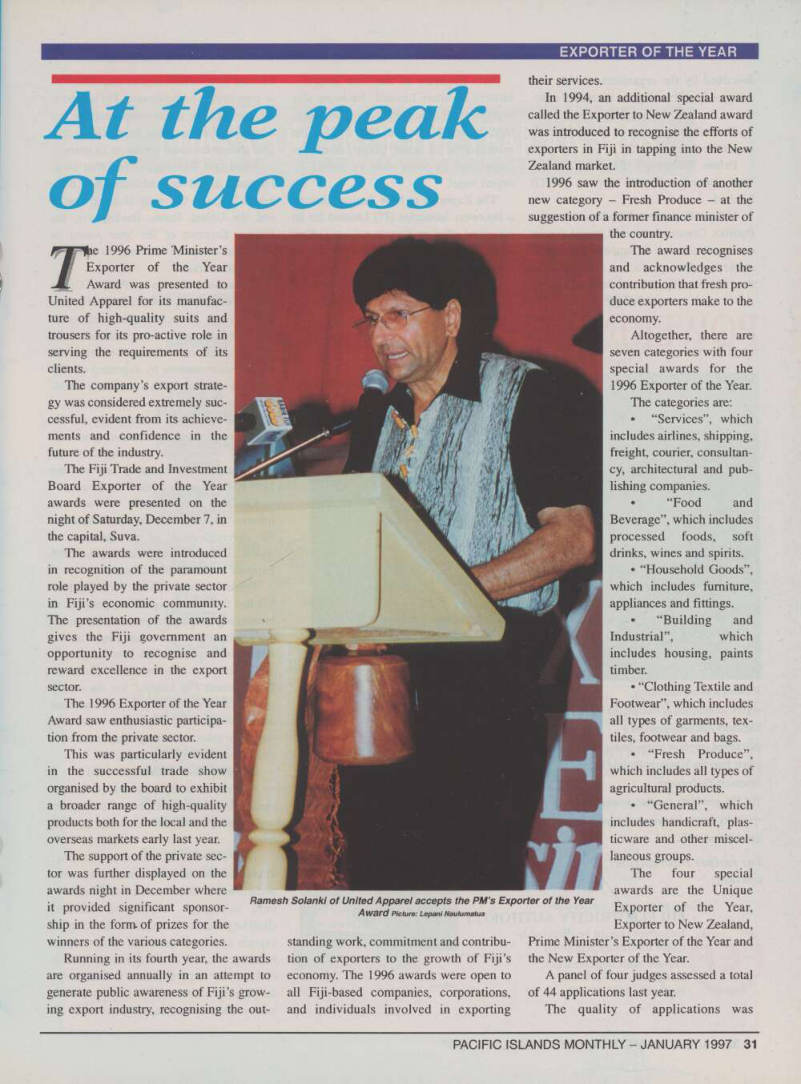
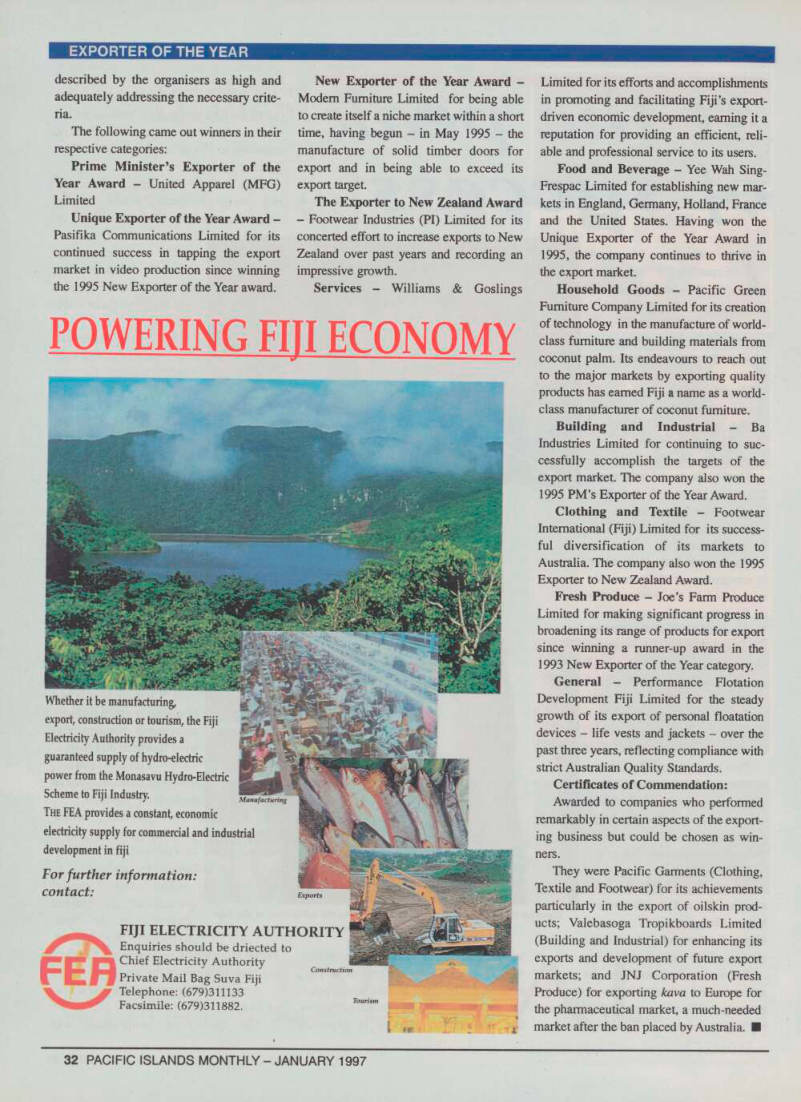
Exporter Of The Year
At the peak of success
1996 Prime Minister’s m' Exporter of the Year JL Award was presented to United Apparel for its manufac ture of high-quality suits and trousers for its pro-active role in serving the requirements of its clients.
The company’s export strate gy was considered extremely suc cessful, evident from its achieve ments and confidence in the future of the industry.
The Fiji Trade and Investment Board Exporter of the Year awards were presented on the night of Saturday, December 7, in the capital, Suva.
The awards were introduced in recognition of the paramount
role played by the private sector
in Fiji’s economic community.
The presentation of the awards gives the Fiji government an
opportunity to recognise and
reward excellence in the export sector.
The 1996 Exporter of the Year Award saw enthusiastic participa tion from the private sector.
This was particularly evident in the successful trade show organised by the board to exhibit a broader range of high-quality products both for the local and the overseas markets early last year.
The support of the private sec tor was further displayed on the awards night in December where
it provided significant sponsor
ship in the form, of prizes for the winners of the various categories.
Running in its fourth year, the awards are organised annually in an attempt to generate public awareness of Fiji’s growing export industry, recognising the out-
standing work, commitment and contribu tion of exporters to the growth of Fiji’s economy. The 1996 awards were open to all Fiji-based companies, corporations, and individuals involved in exporting
their services.
In 1994, an additional special award called the Exporter to New Zealand award was introduced to recognise the efforts of exporters in Fiji in tapping into the New Zealand market. 1996 saw the introduction of another new category - Fresh Produce - at the suggestion of a former finance minister of
the country.
The award recognises and acknowledges the contribution that fresh pro duce exporters make to the economy.
Altogether, there are seven categories with four special awards for the 1996 Exporter of the Year.
The categories are: • “Services”, which includes airlines, shipping, freight, courier, consultan cy, architectural and pub lishing companies. • “Food and Beverage”, which includes processed foods, soft drinks, wines and spirits. • “Household Goods”, which includes furniture, appliances and fittings. • “Building and Industrial”, which includes housing, paints timber. • “Clothing Textile and Footwear”, which includes all types of garments, tex tiles, footwear and bags. • “Fresh Produce”, which includes all types of agricultural products. • “General”, which includes handicraft, plas ticware and other miscel laneous groups.
The four special awards are the Unique Exporter of the Year, Exporter to New Zealand,
Prime Minister’s Exporter of the Year and the New Exporter of the Year.
A panel of four judges assessed a total of 44 applications last year.
The quality of applications was
Ramesh Solanki of United Apparel accepts the PM’s Exporter of the Year Award Picture: Lepani Naulumatua
described by the organisers as high and adequately addressing the necessary crite ria.
The following came out winners in their
respective categories:
Prime Minister’s Exporter of the Year Award - United Apparel (MFG) Limited Unique Exporter of the Year Award - Pasifika Communications Limited for its continued success in tapping the export market in video production since winning the 1995 New Exporter of the Year award.
New Exporter of the Year Award - Modem Furniture Limited for being able to create itself a niche market within a short time, having begun - in May 1995 - the manufacture of solid timber doors for export and in being able to exceed its export target.
The Exporter to New Zealand Award - Footwear Industries (PI) Limited for its concerted effort to increase exports to New Zealand over past years and recording an impressive growth.
Services - Williams & Goslings
Limited for its efforts and accomplishments
in promoting and facilitating Fiji’s export
driven economic development, earning it a reputation for providing an efficient, reli able and professional service to its users.
Food and Beverage - Yee Wah Sing- Frespac Limited for establishing new mar kets in England, Germany, Holland, France and the United States. Having won the Unique Exporter of the Year Award in 1995, the company continues to thrive in the export market.
Household Goods - Pacific Green Furniture Company Limited for its creation of technology in the manufacture of world class furniture and building materials from coconut palm. Its endeavours to reach out to the major markets by exporting quality products has earned Fiji a name as a world class manufacturer of coconut furniture.
Building and Industrial - Ba Industries Limited for continuing to suc cessfully accomplish the targets of the export market. The company also won the 1995 PM’s Exporter of the Year Award.
Clothing and Textile Footwear International (Fiji) Limited for its success ful diversification of its markets to Australia. The company also won the 1995 Exporter to New Zealand Award.
Fresh Produce - Joe’s Farm Produce Limited for making significant progress in broadening its range of products for export since winning a runner-up award in the 1993 New Exporter of the Year category.
General - Performance Flotation Development Fiji Limited for the steady growth of its export of personal floatation devices - life vests and jackets - over the past three years, reflecting compliance with strict Australian Quality Standards.
Certificates of Commendation: Awarded to companies who performed remarkably in certain aspects of the export ing business but could be chosen as win ners.
They were Pacific Garments (Clothing, Textile and Footwear) for its achievements particularly in the export of oilskin prod ucts; Valebasoga Tropikboards Limited (Building and Industrial) for enhancing its exports and development of future export markets; and JNJ Corporation (Fresh Produce) for exporting kava to Europe for the pharmaceutical market, a much-needed market after the ban placed by Australia. ■
Advertisements & other items, pp. 32-34 (2 items)
32
EXPORTER OF THE YEAR
PACIFIC ISLANDS MONTHLY - JANUARY 1997
Powering Fill Economy
Ms 2a ■ ■ 4 v..
CS.
Wt & & >3^ Wi- >': . ' :
fe:. J
Whether it be manufacturing, iWr mys '■ j , .#2l „ * , <2gf export, construction or tourism, the Fiji ■»
Electricity Authority provides a W
guaranteed supply of hydro-electric
power from the Monasavu Hydro-Electric Scheme to Fiji Industry. Manufacturing The FEA provides a constant, economic electricity supply for commercial and industrial
development in fiji
For further information:
contact: ai m 3T Exports mt
FIJI ELECTRICITY AUTHORITY ’
Enquiries should be driected to Chief Electricity Authority Constru Private Mail Bag Suva Fiji Telephone: (679)311133 Facsimile; (679)311882. ft! [ »r
FTIB EXPORTER OF THE YEAR AWARDS
PAST WINNERS
PIM GRAPHICS : James Ranuku J
«■? 'i'gkv cs- • t *& .. 2 •*: , ‘ * “v ' V''P i •. .. -i ■• . ■ ■•;■. ■—* ■ * WINNER OF THE FTIB 1996 PRIME MINISTER'S
EXPORTER OF THE YEAR AWARDS.
GENERAL CATERGORY
Jk few Btt ‘ f‘ ' 1
HlBSi
r* c u I
FTIB 1996
Performance Fit
Developments
P.0.80x 772 Suva Fiji Islands PH:(679)387466 FAX:(679)387310. ■* «
copper, coffee down
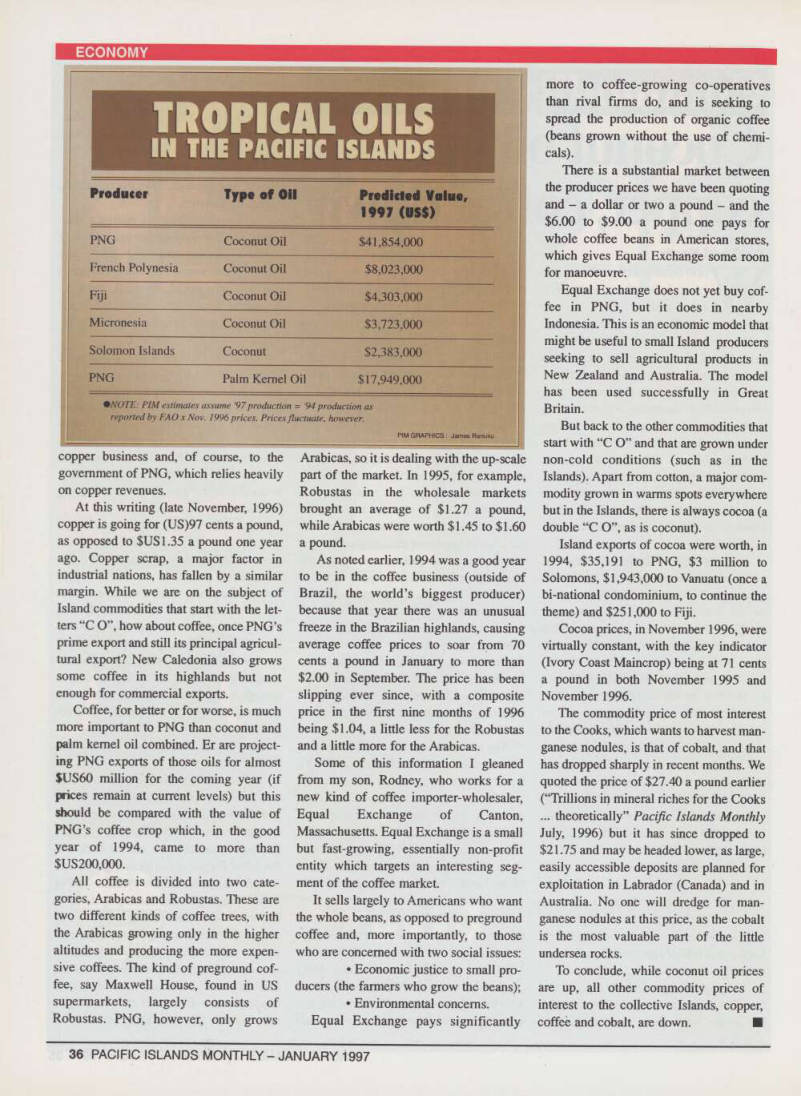
Commodity prices:
Coconut oil up, copper, coffee down
By David North
World commodity prices, direct ly or indirectly, affect every Island nation.
If the price of imports - like meat or grain - increases, it is belt-tightening time, but if the price goes up for the Islands’ exports, it is good news for at least some Islanders - and, of course, the reverse of both statements is equally true.
At the moment, the price for two major Island exports, copper and coconut oil, are charging off in different directions: coconut oil to new highs, and copper off sharply. The price movements of both are tied directly to two different Pacific Rim disasters, one in the Philippines, and the other in Japan.
When Pacific Islands Monthly last wrote about the subject (“Coconut oil price soars” December, 1994), the price on the index market had moved from (US)2O cents to 30 cents cents a pound, a 50 per cent increase in less than a year.
Now, the Wall Street Journal, which car ries this and other prices daily, reports coconut oil at 47 cents a pound. (The price, like most commodity prices, is for delivery at a particular place; in this instance, dockside in New Orleans.) Currently, coconut oil, which is pro duced in commercial quantities in at least five South Pacific nations, is the priciest major vegetable oil around; compare its price to that of soybean or com oil (both produced in the US) at about 22 cents, or tropical palm oil, at 21 cents.
Why is coconut oil doing so well? It is, after all, shot through with fats and is avoided as cooking oil by weight-con scious people all over the world (except for the slim folk of Japan, who continue to use it in their diet).
There is a two-part answer to the ques tion. First, coconut oil is regarded highly by people who make and buy beauty
products, like shampoo; this is its princi pal use in the United States - the texture and fragrance are hard to beat.
Second, there was a terrible typhoon in the coconut-producing part of the Philippines about a year ago, which ruined literally millions of trees. Since the Philippines exports more coconut prod ucts than any other nation, the shortfall in that crop boosted prices elsewhere.
There is even a spill-over effect that works to the benefit of the Islands; when the price of coconut oil soars, some users switch to palm kernel oil, which has many of the same qualities. It is now going for 37 cents a pound, as opposed to 32 cents a year ago. Papua New Guinea is the princi pal Island exporter of this commodity. For the impact of the price increases on the five major producers of tropical oils, see the table (Page 36). These estimates, for the value of tropical oils delivered over seas in 1997, are based on the 1994 pro duction as reported by the Food and Agricultural Organisation (FAO) in Rome, multiplied by November, 1996 prices. The actual value of the production may be considerably different, given the fluidity of pricing.
The table, incidentally, carries the term “Micronesia” which reflects the FAO’s less-than-flrm grasp on its insular statis tics. FAO - like other international enti ties of a decade ago - still groups the CNMI, FSM, the Marshalls and Palau as “Micronesia”, as if the US trust territory were still in being. In fact, most, if not all of the area’s coconut oil production is from the Tobolar plant in Majuro.
Similarly, FAO calls Western Samoa (which is a major producer of coconuts) “Samoa” and shows some coconut oil production in 1992, but none since. FAO produces country profiles on agricultural activities of most nations in the world, but none for either of the Samoas. (American
Samoa’s heavily subsidised economy exports no agricultural products of any kind except tuna.) The previously mention far-away disasters, however, although helpful to the coconut and palm kernel oil producers, do not always work to the Islands’ best interests. Take the copper sit uation, for instance.
The world economy is getting a little busier, and that means more production of consumer goods, industrial goods and houses. That means that more copper is used and this would, routinely, drive up the price, encouraging news for PNG, which in a good year exports half-a-bil lion dollars worth of the stuff.
Watching this potential good news from Tokyo was a Japanese businessman, Yasuo Hamanaka, a copper trader for the giant Sumitomo corporation. He figured that if his firm could get a lot of copper under its control - some of it in its own warehouses, and some of it in futures - his firm (and he) could make a lot of money.
In the old days, this was called “cornering the market”.
Hamanaka’s idea was sound (if greedy) but his implementation skills were not up to his conceptual brilliance.
He mucked around in the world copper markets for years, seeking to run up prices by controlling a lot of the supply, but managed - and this is hard to believe - to lose SUS 2.2 billion, playing the copper market before his bosses noticed some thing was wrong. (The company is rich enough, or Japanese accounting standards are loose enough, so that the firm did not go bankrupt.) How does that impact the insular Pacific?
Well, the word in the copper business was that Hamanaka must have purchased, and hidden, millions of tons of copper; the statistical systems reporting on copper holdings apparently are not the best, and the other copper speculators figured that he had manipulated those systems, just as he had juggled the accounting systems of his firm. Thus, there must be a lot of extra copper out there, not recorded in the cus tomary way. More supplies, even hidden or suspected supplies, of course, means that the price drops, and so it was with copper, to the dismay of the Austrailain mine owners and their allies in the PNG
9NOTE: PIM estimates assume '97 production = '94 production as reported by FAO x Nov. 1996 prices. Prices fluctuate, however.
PIM GRAPHICS : James Ranuku
copper business and, of course, to the government of PNG, which relies heavily on copper revenues.
At this writing (late November, 1996) copper is going for (US)97 cents a pound, as opposed to SUSI.3S a pound one year ago. Copper scrap, a major factor in industrial nations, has fallen by a similar margin. While we are on the subject of Island commodities that start with the let ters “C O”, how about coffee, once PNG’s prime export and still its principal agricul tural export? New Caledonia also grows some coffee in its highlands but not enough for commercial exports.
Coffee, for better or for worse, is much more important to PNG than coconut and palm kernel oil combined. Er are project ing PNG exports of those oils for almost SUS6O million for the coming year (if prices remain at current levels) but this should be compared with the value of PNG’s coffee crop which, in the good year of 1994, came to more than
Sus2Oo,Ooo.
All coffee is divided into two cate gories, Arabicas and Robustas. These are two different kinds of coffee trees, with the Arabicas growing only in the higher altitudes and producing the more expen sive coffees. The kind of preground cof fee, say Maxwell House, found in US supermarkets, largely consists of Robustas. PNG, however, only grows
Arabicas, so it is dealing with the up-scale part of the market. In 1995, for example, Robustas in the wholesale markets brought an average of $1.27 a pound, while Arabicas were worth $1.45 to $1.60 a pound.
As noted earlier, 1994 was a good year to be in the coffee business (outside of Brazil, the world’s biggest producer) because that year there was an unusual freeze in the Brazilian highlands, causing average coffee prices to soar from 70 cents a pound in January to more than $2.00 in September. The price has been slipping ever since, with a composite price in the first nine months of 1996 being $1.04, a little less for the Robustas and a little more for the Arabicas.
Some of this information I gleaned from my son, Rodney, who works for a new kind of coffee importer-wholesaler, Equal Exchange of Canton, Massachusetts. Equal Exchange is a small but fast-growing, essentially non-profit entity which targets an interesting seg ment of the coffee market.
It sells largely to Americans who want the whole beans, as opposed to preground coffee and, more importantly, to those who are concerned with two social issues: • Economic justice to small pro ducers (the farmers who grow the beans); • Environmental concerns.
Equal Exchange pays significantly
more to coffee-growing co-operatives than rival firms do, and is seeking to spread the production of organic coffee (beans grown without the use of chemi cals).
There is a substantial market between the producer prices we have been quoting and - a dollar or two a pound - and the $6.00 to $9.00 a pound one pays for whole coffee beans in American stores, which gives Equal Exchange some room for manoeuvre.
Equal Exchange does not yet buy cof fee in PNG, but it does in nearby Indonesia. This is an economic model that might be useful to small Island producers seeking to sell agricultural products in New Zealand and Australia. The model has been used successfully in Great Britain.
But back to the other commodities that start with “C O” and that are grown under non-cold conditions (such as in the Islands). Apart from cotton, a major com modity grown in warms spots everywhere but in the Islands, there is always cocoa (a double “C O”, as is coconut).
Island exports of cocoa were worth, in 1994, $35,191 to PNG, $3 million to Solomons, $1,943,000 to Vanuatu (once a bi-national condominium, to continue the theme) and $251,000 to Fiji.
Cocoa prices, in November 1996, were virtually constant, with the key indicator (Ivory Coast Maincrop) being at 71 cents a pound in both November 1995 and November 1996.
The commodity price of most interest to the Cooks, which wants to harvest man ganese nodules, is that of cobalt, and that has dropped sharply in recent months. We quoted the price of $27.40 a pound earlier (“Trillions in mineral riches for the Cooks ... theoretically” Pacific Islands Monthly July, 1996) but it has since dropped to $21.75 and may be headed lower, as large, easily accessible deposits are planned for exploitation in Labrador (Canada) and in Australia. No one will dredge for man ganese nodules at this price, as the cobalt is the most valuable part of the little undersea rocks.
To conclude, while coconut oil prices are up, all other commodity prices of interest to the collective Islands, copper, coffee and cobalt, are down. ■
Tropical Oils
In The Paciric Islands
Producer Type of Oil Predicted Value,
1997 (Iiss)
Png
Coconut Oil $41,854,000 French Polynesia Coconut Oil $8,023,000 Fiji Coconut Oil $4,303,000 Micronesia Coconut Oil $3,723,000 Solomon Islands Coconut $2,383,000
Png
Palm Kernel Oil $17,949,000
Best for the select
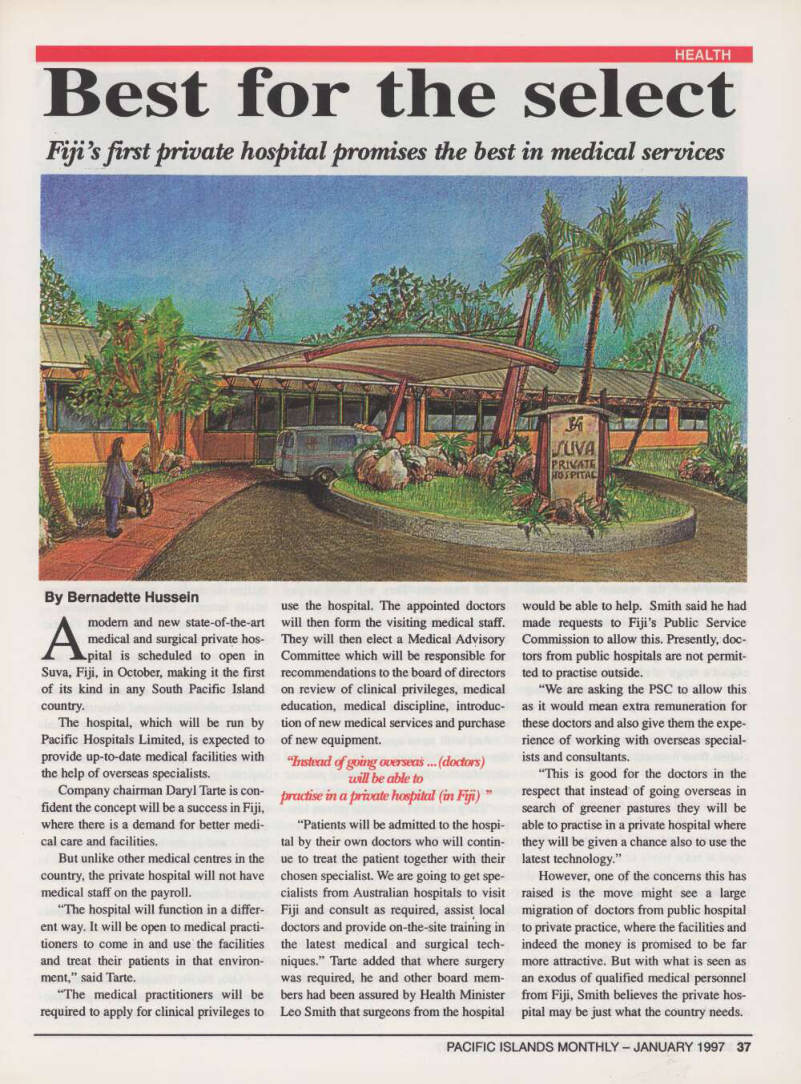
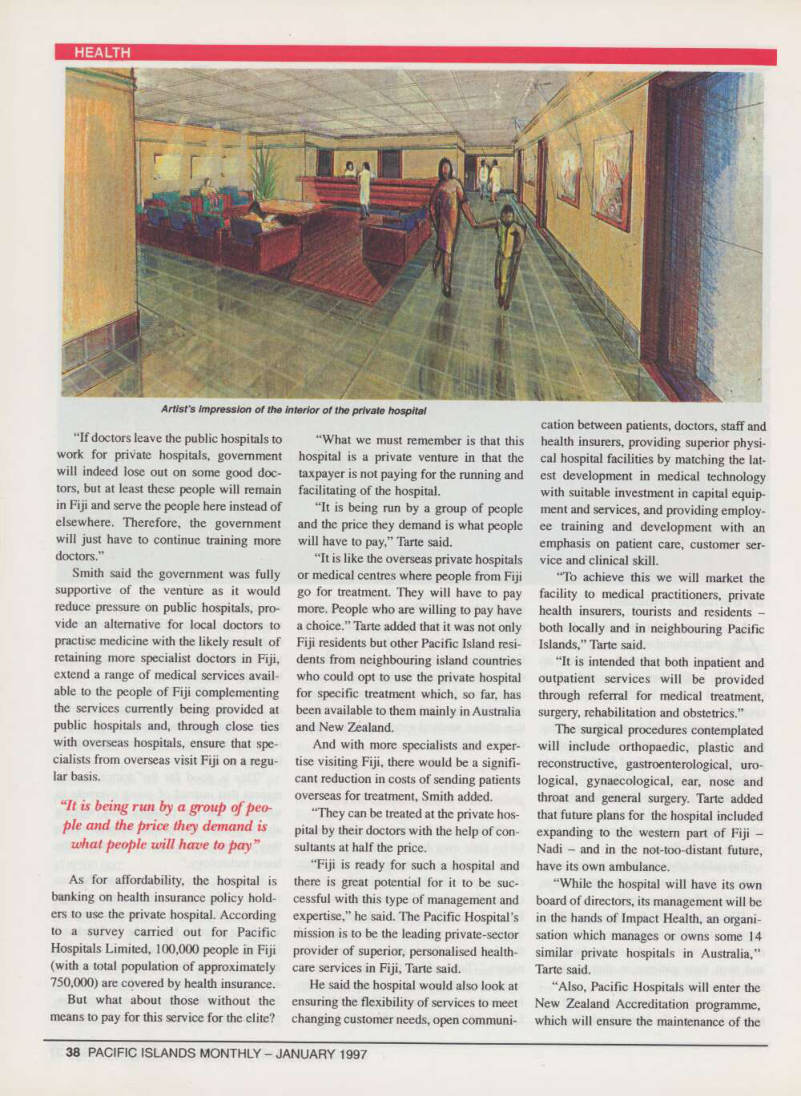
Health
Fiji’s first private hospital promises the best in medical services
By Bernadette Hussein
A modem and new state-of-the-art medical and surgical private hos pital is scheduled to open in Suva, Fiji, in October, making it the first of its kind in any South Pacific Island country.
The hospital, which will be run by Pacific Hospitals Limited, is expected to provide up-to-date medical facilities with the help of overseas specialists.
Company chairman Daryl Tarte is con fident the concept will be a success in Fiji, where there is a demand for better medi cal care and facilities.
But unlike other medical centres in the country, the private hospital will not have medical staff on the payroll.
“The hospital will function in a differ ent way. It will be open to medical practi tioners to come in and use the facilities and treat their patients in that environ ment,” said Tarte.
“The medical practitioners will be required to apply for clinical privileges to
use the hospital. The appointed doctors will then form the visiting medical staff.
They will then elect a Medical Advisory Committee which will be responsible for recommendations to the board of directors on review of clinical privileges, medical education, medical discipline, introduc tion of new medical services and purchase of new equipment.
“Instead of going overseas... (doctors) will he able to practise in a private hospital (in Fiji) ”
“Patients will be admitted to the hospi tal by their own doctors who will contin ue to treat the patient together with their chosen specialist. We are going to get spe cialists from Australian hospitals to visit Fiji and consult as required, assist local doctors and provide on-the-site training in the latest medical and surgical tech niques.” Tarte added that where surgery was required, he and other board mem bers had been assured by Health Minister Leo Smith that surgeons from the hospital
would be able to help. Smith said he had made requests to Fiji’s Public Service Commission to allow this. Presently, doc tors from public hospitals are not permit ted to practise outside.
“We are asking the PSC to allow this as it would mean extra remuneration for these doctors and also give them the expe rience of working with overseas special ists and consultants.
“This is good for the doctors in the respect that instead of going overseas in search of greener pastures they will be able to practise in a private hospital where they will be given a chance also to use the latest technology.”
However, one of the concerns this has raised is the move might see a large migration of doctors from public hospital to private practice, where the facilities and indeed the money is promised to be far more attractive. But with what is seen as an exodus of qualified medical personnel from Fiji, Smith believes the private hos pital may be just what the country needs.
“If doctors leave the public hospitals to work for private hospitals, government will indeed lose out on some good doc tors, but at least these people will remain in Fiji and serve the people here instead of elsewhere. Therefore, the government will just have to continue training more doctors.”
Smith said the government was fully supportive of the venture as it would reduce pressure on public hospitals, pro vide an alternative for local doctors to practise medicine with the likely result of
retaining more specialist doctors in Fiji,
extend a range of medical services avail able to the people of Fiji complementing the services currently being provided at public hospitals and, through close ties with overseas hospitals, ensure that spe cialists from overseas visit Fiji on a regu lar basis.
“It is being run by a group of peo ple and the price they demand is what people will have to pay ”
As for affordability, the hospital is banking on health insurance policy hold ers to use the private hospital. According to a survey carried out for Pacific Hospitals Limited, 100,000 people in Fiji (with a total population of approximately 750,000) are covered by health insurance.
But what about those without the means to pay for this service for the elite?
“What we must remember is that this hospital is a private venture in that the taxpayer is not paying for the running and
facilitating of the hospital.
“It is being run by a group of people and the price they demand is what people will have to pay,” Tarte said.
“It is like the overseas private hospitals or medical centres where people from Fiji go for treatment. They will have to pay more. People who are willing to pay have a choice.” Tarte added that it was not only Fiji residents but other Pacific Island resi dents from neighbouring island countries who could opt to use the private hospital for specific treatment which, so far, has been available to them mainly in Australia and New Zealand.
And with more specialists and exper tise visiting Fiji, there would be a signifi cant reduction in costs of sending patients overseas for treatment. Smith added.
“They can be treated at the private hos pital by their doctors with the help of con sultants at half the price.
“Fiji is ready for such a hospital and there is great potential for it to be suc cessful with this type of management and expertise,” he said. The Pacific Hospital’s mission is to be the leading private-sector provider of superior, personalised health care services in Fiji, Tarte said.
He said the hospital would also look at ensuring the flexibility of services to meet changing customer needs, open communi
cation between patients, doctors, staff and health insurers, providing superior physi cal hospital facilities by matching the lat est development in medical technology with suitable investment in capital equip ment and services, and providing employ ee training and development with an emphasis on patient care, customer ser vice and clinical skill.
“To achieve this we will market the facility to medical practitioners, private health insurers, tourists and residents both locally and in neighbouring Pacific Islands,” Tarte said.
“It is intended that both inpatient and outpatient services will be provided through referral for medical treatment, surgery, rehabilitation and obstetrics.”
The surgical procedures contemplated will include orthopaedic, plastic and reconstructive, gastroenterological, uro logical, gynaecological, ear, nose and throat and general surgery. Tarte added that future plans for the hospital included expanding to the western part of Fiji - Nadi - and in the not-too-distant future, have its own ambulance.
“While the hospital will have its own board of directors, its management will be in the hands of Impact Health, an organi sation which manages or owns some 14 similar private hospitals in Australia,”
Tarte said.
“Also, Pacific Hospitals will enter the New Zealand Accreditation programme, which will ensure the maintenance of the
Artist’s impression of the interior of the private hospital
Talking
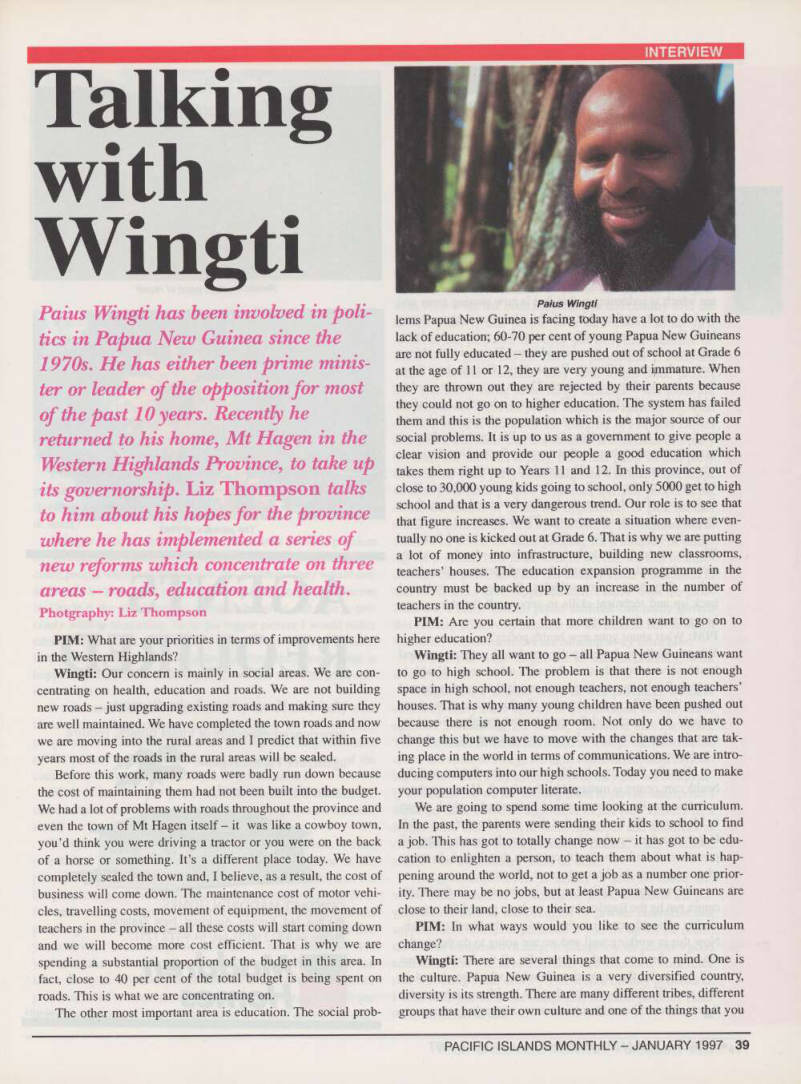
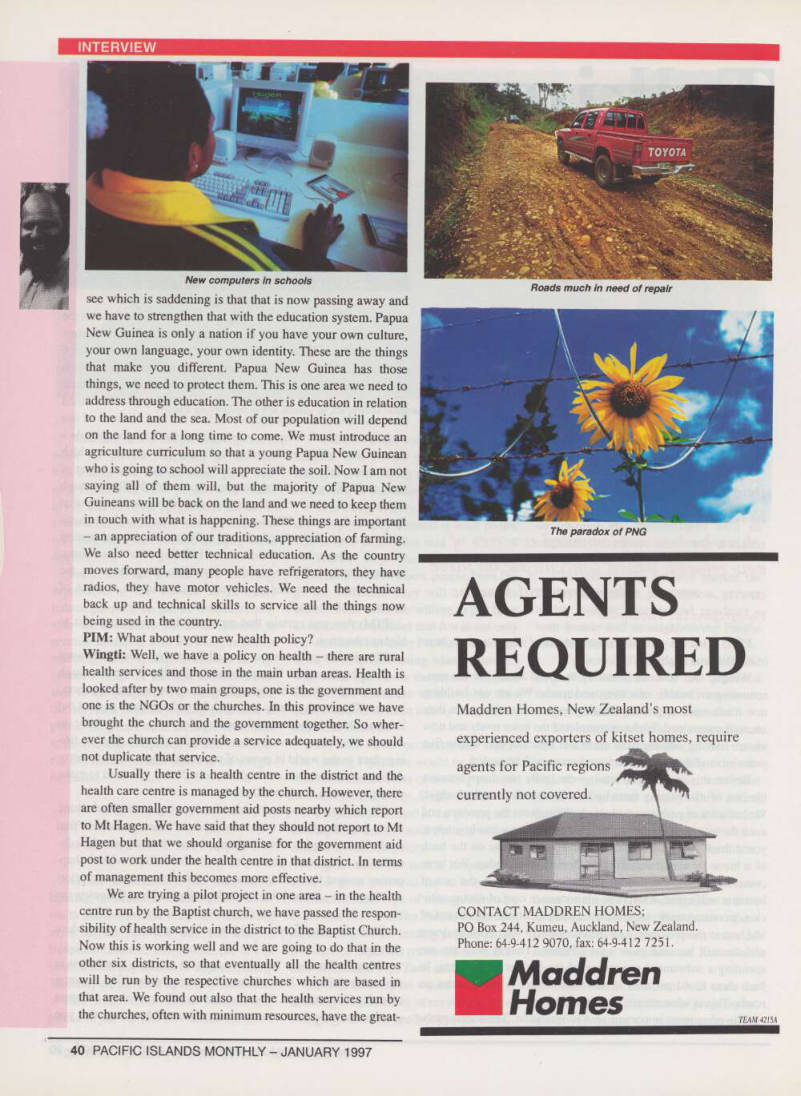
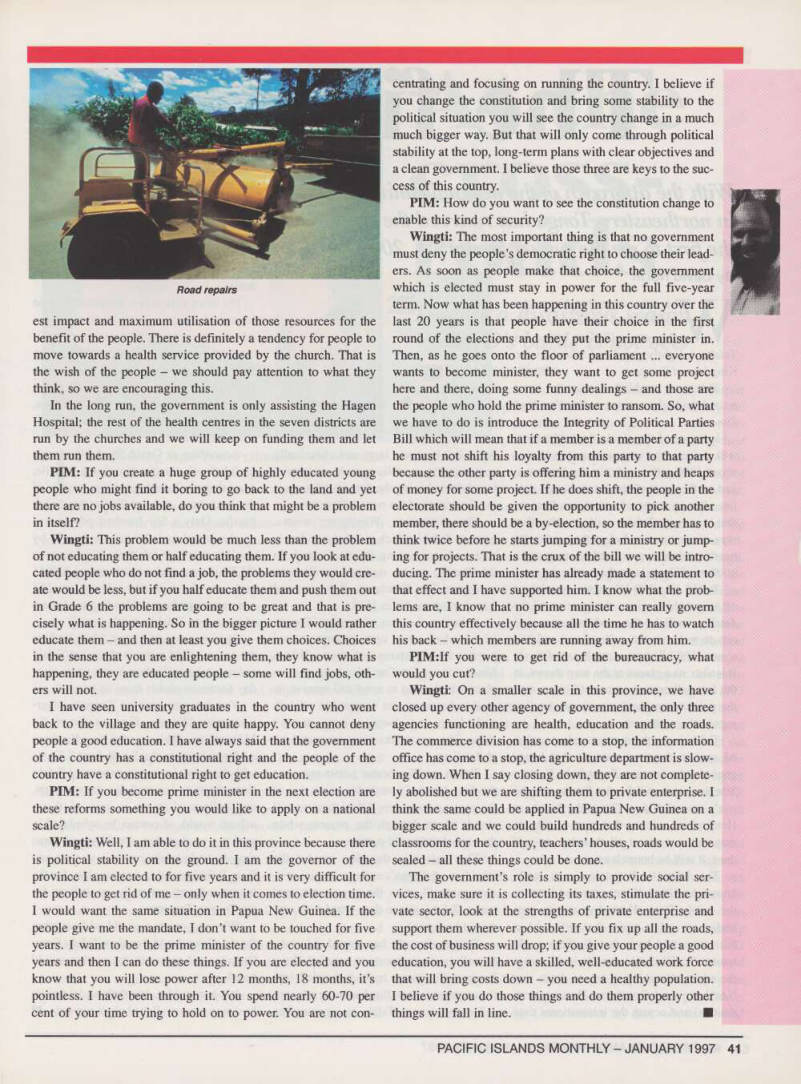
with Wingti
Pains Wingti has been involved in poli tics in Papua New Guinea since the 19705. He has either been prime minis ter or leader of the opposition for most of the past 10 years. Recently he returned to his home, Mt Hagen in the Western Highlands Province, to take up its governorship. Liz Thompson talks to him about his hopes for the province where he has implemented a series of new reforms which concentrate on three areas roads, education and health.
Photgraphy: Liz Thompson
PIM: What are your priorities in terms of improvements here in the Western Highlands?
Wingti: Our concern is mainly in social areas. We are con centrating on health, education and roads. We are not building new roads - just upgrading existing roads and making sure they are well maintained. We have completed the town roads and now we are moving into the rural areas and I predict that within five years most of the roads in the rural areas will be sealed.
Before this work, many roads were badly run down because the cost of maintaining them had not been built into the budget.
We had a lot of problems with roads throughout the province and even the town of Mt Hagen itself - it was like a cowboy town, you’d think you were driving a tractor or you were on the back of a horse or something. It’s a different place today. We have completely sealed the town and, I believe, as a result, the cost of business will come down. The maintenance cost of motor vehi cles, travelling costs, movement of equipment, the movement of teachers in the province - all these costs will start coming down and we will become more cost efficient. That is why we are spending a substantial proportion of the budget in this area. In fact, close to 40 per cent of the total budget is being spent on roads. This is what we are concentrating on.
The other most important area is education. The social prob-
lems Papua New Guinea is facing today have a lot to do with the lack of education; 60-70 per cent of young Papua New Guineans are not fully educated - they are pushed out of school at Grade 6 at the age of 11 or 12, they are very young and immature. When they are thrown out they are rejected by their parents because they could not go on to higher education. The system has failed them and this is the population which is the major source of our social problems. It is up to us as a government to give people a clear vision and provide our people a good education which takes them right up to Years 11 and 12. In this province, out of close to 30,000 young kids going to school, only 5000 get to high school and that is a very dangerous trend. Our role is to see that that figure increases. We want to create a situation where even tually no one is kicked out at Grade 6. That is why we are putting a lot of money into infrastructure, building new classrooms, teachers’ houses. The education expansion programme in the country must be backed up by an increase in the number of teachers in the country.
PIM: Are you certain that more children want to go on to higher education?
Wingti: They all want to go all Papua New Guineans want to go to high school. The problem is that there is not enough space in high school, not enough teachers, not enough teachers’ houses. That is why many young children have been pushed out because there is not enough room. Not only do we have to change this but we have to move with the changes that are tak ing place in the world in terms of communications. We are intro ducing computers into our high schools. Today you need to make your population computer literate.
We are going to spend some time looking at the curriculum.
In the past, the parents were sending their kids to school to find a job. This has got to totally change now - it has got to be edu cation to enlighten a person, to teach them about what is hap pening around the world, not to get a job as a number one prior ity. There may be no jobs, but at least Papua New Guineans are close to their land, close to their sea.
PIM: In what ways would you like to see the curriculum
change?
Wingti: There are several things that come to mind. One is the culture. Papua New Guinea is a very diversified country, diversity is its strength. There are many different tribes, different groups that have their own culture and one of the things that you
Paius Wingti
see which is saddening is that that is now passing away and we have to strengthen that with the education system. Papua New Guinea is only a nation if you have your own culture, your own language, your own identity. These are the things that make you different. Papua New Guinea has those things, we need to protect them. This is one area we need to address through education. The other is education in relation to the land and the sea. Most of our population will depend on the land for a long time to come. We must introduce an agriculture curriculum so that a young Papua New Guinean who is going to school will appreciate the soil. Now I am not saying all of them will, but the majority of Papua New Guineans will be back on the land and we need to keep them in touch with what is happening. These things are important - an appreciation of our traditions, appreciation of farming.
We also need better technical education. As the country moves forward, many people have refrigerators, they have radios, they have motor vehicles. We need the technical back up and technical skills to service all the things now being used in the country.
PIM: What about your new health policy?
Wingti: Well, we have a policy on health - there are rural health services and those in the main urban areas. Health is looked after by two main groups, one is the government and one is the NGOs or the churches. In this province we have brought the church and the government together. So wher ever the church can provide a service adequately, we should not duplicate that service.
Usually there is a health centre in the district and the health care centre is managed by the church. However, there are often smaller government aid posts nearby which report to Mt Hagen. We have said that they should not report to Mt Hagen but that we should organise for the government aid post to work under the health centre in that district. In terms of management this becomes more effective.
We are trying a pilot project in one area - in the health centre run by the Baptist church, we have passed the respon sibility of health service in the district to the Baptist Church.
Now this is working well and we are going to do that in the other six districts, so that eventually all the health centres will be run by the respective churches which are based in that area. We found out also that the health services run by the churches, often with minimum resources, have the great-
New computers in schools
Roads much in need of repair
The paradox of PNG
est impact and maximum utilisation of those resources for the benefit of the people. There is definitely a tendency for people to move towards a health service provided by the church. That is the wish of the people - we should pay attention to what they think, so we are encouraging this.
In the long run, the government is only assisting the Hagen Hospital; the rest of the health centres in the seven districts are run by the churches and we will keep on funding them and let them run them.
PIM: If you create a huge group of highly educated young people who might find it boring to go back to the land and yet there are no jobs available, do you think that might be a problem in itself?
Wingti: This problem would be much less than the problem of not educating them or half educating them. If you look at edu cated people who do not find a job, the problems they would cre ate would be less, but if you half educate them and push them out in Grade 6 the problems are going to be great and that is pre cisely what is happening. So in the bigger picture I would rather educate them - and then at least you give them choices. Choices in the sense that you are enlightening them, they know what is happening, they are educated people - some will find jobs, oth ers will not.
I have seen university graduates in the country who went back to the village and they are quite happy. You cannot deny people a good education. I have always said that the government of the country has a constitutional right and the people of the country have a constitutional right to get education.
PIM: If you become prime minister in the next election are these reforms something you would like to apply on a national scale?
Wingti: Well, I am able to do it in this province because there is political stability on the ground. I am the governor of the province I am elected to for five years and it is very difficult for the people to get rid of me - only when it comes to election time.
I would want the same situation in Papua New Guinea. If the people give me the mandate, I don’t want to be touched for five years. I want to be the prime minister of the country for five years and then I can do these things. If you are elected and you know that you will lose power after 12 months, 18 months, it’s pointless. I have been through it. You spend nearly 60-70 per cent of your time trying to hold on to power. You are not con
centrating and focusing on running the country. I believe if you change the constitution and bring some stability to the political situation you will see the country change in a much much bigger way. But that will only come through political stability at the top, long-term plans with clear objectives and a clean government. I believe those three are keys to the suc cess of this country.
PIM: How do you want to see the constitution change to enable this kind of security?
Wingti: The most important thing is that no government must deny the people’s democratic right to choose their lead ers. As soon as people make that choice, the government which is elected must stay in power for the full five-year term. Now what has been happening in this country over the last 20 years is that people have their choice in the first round of the elections and they put the prime minister in.
Then, as he goes onto the floor of parliament ... everyone wants to become minister, they want to get some project here and there, doing some funny dealings - and those are the people who hold the prime minister to ransom. So, what we have to do is introduce the Integrity of Political Parties Bill which will mean that if a member is a member of a party he must not shift his loyalty from this party to that party because the other party is offering him a ministry and heaps of money for some project. If he does shift, the people in the electorate should be given the opportunity to pick another member, there should be a by-election, so the member has to think twice before he starts jumping for a ministry or jump ing for projects. That is the crux of the bill we will be intro ducing. The prime minister has already made a statement to that effect and I have supported him. I know what the prob lems are, I know that no prime minister can really govern this country effectively because all the time he has to watch his back - which members are running away from him.
PIM:If you were to get rid of the bureaucracy, what would you cut?
Wingti: On a smaller scale in this province, we have closed up every other agency of government, the only three agencies functioning are health, education and the roads.
The commerce division has come to a stop, the information office has come to a stop, the agriculture department is slow ing down. When I say closing down, they are not complete ly abolished but we are shifting them to private enterprise. I think the same could be applied in Papua New Guinea on a bigger scale and we could build hundreds and hundreds of classrooms for the country, teachers’ houses, roads would be sealed - all these things could be done.
The government’s role is simply to provide social ser vices, make sure it is collecting its taxes, stimulate the pri vate sector, look at the strengths of private enterprise and support them wherever possible. If you fix up all the roads, the cost of business will drop; if you give your people a good education, you will have a skilled, well-educated work force that will bring costs down - you need a healthy population.
I believe if you do those things and do them properly other things will fall in line. ■
Road repairs
Advertisements & other items, p. 40 (1 item)
Required
AGENTS
Maddren Homes, New Zealand's most experienced exporters of kitset homes, require agents for Pacific regions currently not covered. ■ 3H
CONTACT MADDREN HOMES;
PO Box 244, Kumeu, Auckland, New Zealand.
Phone: 64-9-412 9070, fax; 64-9-412 7251.
Maddren
Homes
TEAM42ISA
The first day
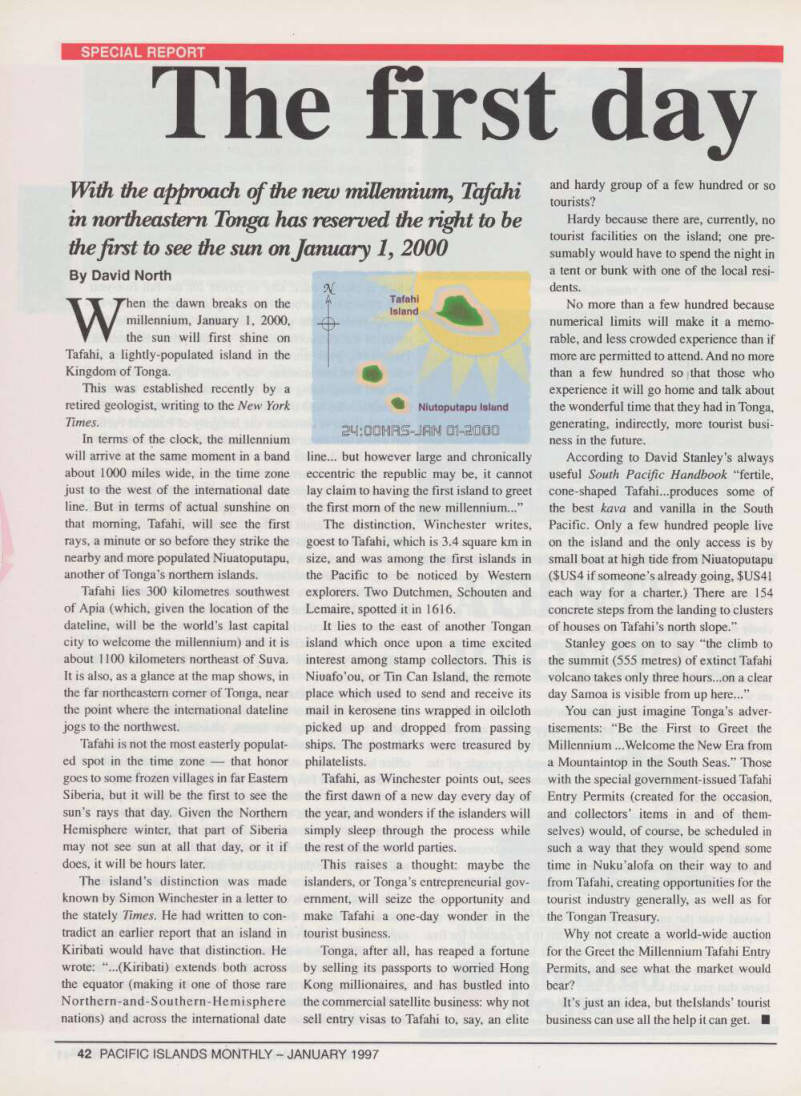
With the approach of die new millennium, Tafahi in northeastern Tonga has reserved die right to be die first to see die sun on January 1, 2000
By David North
When the dawn breaks on the millennium, January 1, 2000, the sun will first shine on Tafahi, a lightly-populated island in the
Kingdom of Tonga.
This was established recently by a retired geologist, writing to the New York Times.
In terms of the clock, the millennium will arrive at the same moment in a band about 1000 miles wide, in the time zone just to the west of the international date line. But in terms of actual sunshine on that morning, Tafahi, will see the first rays, a minute or so before they strike the nearby and more populated Niuatoputapu, another of Tonga’s northern islands.
Tafahi lies 300 kilometres southwest of Apia (which, given the location of the dateline, will be the world’s last capital city to welcome the millennium) and it is about 1100 kilometers northeast of Suva.
It is also, as a glance at the map shows, in the far northeastern comer of Tonga, near the point where the international dateline jogs to the northwest.
Tafahi is not the most easterly populat ed spot in the time zone that honor goes to some frozen villages in far Eastern Siberia, but it will be the first to see the sun’s rays that day. Given the Northern Hemisphere winter, that part of Siberia may not see sun at all that day, or it if does, it will be hours later.
The island’s distinction was made known by Simon Winchester in a letter to the stately Times. He had written to con tradict an earlier report that an island in Kiribati would have that distinction. He wrote: “...(Kiribati) extends both across the equator (making it one of those rare
Northern-and-Southern-Hemisphere
nations) and across the international date
line... but however large and chronically eccentric the republic may be, it cannot lay claim to having the first island to greet the first mom of the new millennium...”
The distinction, Winchester writes, goest to Tafahi, which is 3.4 square km in size, and was among the first islands in the Pacific to be noticed by Western explorers. Two Dutchmen, Schouten and Lemaire, spotted it in 1616.
It lies to the east of another Tongan island which once upon a time excited interest among stamp collectors. This is Niuafo’ou, or Tin Can Island, the remote place which used to send and receive its mail in kerosene tins wrapped in oilcloth
picked up and dropped from passing
ships. The postmarks were treasured by
philatelists.
Tafahi, as Winchester points out, sees the first dawn of a new day every day of the year, and wonders if the islanders will simply sleep through the process while the rest of the world parties.
This raises a thought: maybe the islanders, or Tonga’s entrepreneurial gov ernment, will seize the opportunity and make Tafahi a one-day wonder in the tourist business.
Tonga, after all, has reaped a fortune by selling its passports to worried Hong Kong millionaires, and has bustled into the commercial satellite business: why not sell entry visas to Tafahi to, say, an elite
and hardy group of a few hundred or so tourists?
Hardy because there are, currently, no tourist facilities on the island; one pre sumably would have to spend the night in a tent or bunk with one of the local resi dents.
No more than a few hundred because numerical limits will make it a memo rable, and less crowded experience than if more are permitted to attend. And no more than a few hundred so (that those who experience it will go home and talk about the wonderful time that they had in Tonga, generating, indirectly, more tourist busi ness in the future.
According to David Stanley’s always
useful South Pacific Handbook “fertile, cone-shaped Tafahi...produces some of the best kava and vanilla in the South Pacific. Only a few hundred people live on the island and the only access is by small boat at high tide from Niuatoputapu (SUS 4 if someone’s already going, SUS4I each way for a charter.) There are 154 concrete steps from the landing to clusters of houses on Tafahi’s north slope.”
Stanley goes on to say “the climb to the summit (555 metres) of extinct Tafahi volcano takes only three hours...on a clear day Samoa is visible from up here...”
You can just imagine Tonga’s adver
tisements: “Be the First to Greet the Millennium ...Welcome the New Era from a Mountaintop in the South Seas.” Those with the special government-issued Tafahi Entry Permits (created for the occasion, and collectors’ items in and of them selves) would, of course, be scheduled in such a way that they would spend some time in Nuku’alofa on their way to and from Tafahi, creating opportunities for the tourist industry generally, as well as for
the Tongan Treasury.
Why not create a world-wide auction for the Greet the Millennium Tafahi Entry Permits, and see what the market would bear?
It’s just an idea, but thelslands’ tourist business can use all the help it can get. ■
Advertisements & other items, pp. 43-44 (1 item)
At the
SPORT
At the cross roads
The forthcoming Super Twelve tournament will be crucial in the career of Viliame Ofahengaue - the Tongan rugby union legend who is better known to sports fans around the world by his nickname of “Willie O”.
Last season was an unmitigated disaster for Ofahengaue. It commenced with him universally recognised as a loose forward without peer and ended with him having lost his place in both the New South Wales state selection and the Australian national squad. His loss of form was so complete that many rugby com mentators have already written him off as a spent force and there was speculation in October he would not even gain inclusion in the New South Wales squad chosen for the 1997 Super Twelve competition. By retaining faith, the Waratahs’ selectors have thrown Ofahengaue a lifeline. Should he be able to grasp it and resurrect his career, it would be the third major crisis Willie O has overcome.
The first occurred two years after he had left Tonga’s presti gious Tupou College for New Zealand in order to further his edu cation and rugby opportunities. Ofahengaue certainly succeeded in respect of the latter; to the extent that he captained the New Zealand Secondary School side which toured Australia in 1988.
However, when the young tourists returned to Auckland Airport, a zealous immigration officer noticed that the visa in Ofahengaue’s Tongan passport had elapsed and he was refused readmission. The bemused Ofahengaue then flew to Sydney, where a favourite uncle resides, to ponder his few options.
He was living in the uncle’s cellar, at the North Shore suburb of Brookvale, when officials of the Manly Rugby Union Football Club heard of his predicament. They immediately obtained employment, more suitable accommodation and permanent resi dency in Australia for Ofahengaue. All that was required of him in return was to produce sterling performances for Manly’s first grade side. Willie O certainly lived up to his part of the bargain.
After just one season with Manly, he was drafted into the
Despite a disastrous season, Willie o’s battle is not over
By Atama Raganivatu
Australian senior squad that toured New Zealand in 1990 despite having made no appearances for New South Wales and only one for the Sydney representative XV. Ofahengaue was such a reve lation in the Shaky Isles that he had the Kiwis cursing their immigration department. During the tour, the best known of his many nicknames were coined. “The Tongan Torpedo” and, of course, “Willie O” have been the most enduring. However, “Willie Often-Going-Away” is probably the most appropriate.
He completed the tour having secured his place in the Wallabies lineup. At that time, Ofahengaue was little known out side of Australia, New Zealand and Tonga. A year later, though, he had gained fame throughout the rugby-playing world. Willie O played superbly throughout the 1991 World Cup in Britain and France. His bulldozing upfield surges and bone-crushing tackles provided the tournament with many memorable moments and he was a keystone in the Wallabies’ triumph. When Australia beat England 12-6 in the final at Twickenham, Ofahengaue became Tonga’s first world champion in a mainstream sport. Inclusion amongst the World XV that toured New Zealand during the 1992 season confirmed Ofahengaue’s status in the game. When leav ing Sydney for Italy late in that year to spend the Northern Hemisphere winter playing for the Rovigo club, he stood at the very pinnacle of world rugby. Then came career catastrophe number two. A horrendous knee injury, sustained while playing for Rovigo, kept Ofahengaue out of action for the whole of 1993.
A series of operations eventually fixed his knee. However, match fitness and form took longer to acquire.
Overweight and sluggish, he was only a shadow of his old self when the 1994 campaign commenced and rumours began to circulate that both the Australian and New South Wales selectors were looking elsewhere for a blindside flanker. Ofahengaue, the whispers insisted, simply did not have the motivation to com plete a successful comeback. Drive and enthusiasm for training have certainly never been Ofahengaue’s fortes. He does little gym work and, during a rare interview, he admitted: “I avoid weight training and hard fitness training. I don’t think they are necessary to me. I only require normal training and gain fitness mostly through playing. I also believe my diet, which is based
upon taro, is an important factor for me.”
His dislike of strenuous gym work was the main reason why he did not join the St
George Rugby League Club in 1991.
Ofahengaue actually signed a contract
with “The Dragons” for a huge signing-on fee that year. However, after seeing the weights stored at their training grounds, he immediately got the document annulled.
Thankfully, light training and regulated
intakes of taro were sufficient for Willie O to return to peak fitness and top form midway through 1994 and he was back to his best for the next year’s World Cup.
There was to be no glory this time though and the Wallabies suffered a surprise quar ter-final defeat at the hands of England.
The loss of the World Cup did not diminish the affection felt for Ofahengaue by the Australian public. It is customary each year for an overseas-bom resident to take out Australian citizenship just before Australia Day is celebrated on January 26 and, in 1996, it was the turn of an obvi ously reluctant Willie O for this honour.
“I’m a Tongan and nobody can change that,” he said at the time. “Tonga will always be where home is, although I will probably remain in Australia for the rest of my life.” Unfortunately, a change of nationality coincided with a slump in for tune and Ofahengaue experienced a dread ful 1996.
Once more his weight rose well over its natural 115kgs and on the pitch, he appeared to be merely going through the motions. Bob Dwyer, the coach of Australia’s 1991 World Cup team who is now in charge of British club Leicester, attempted to lure him to the English Midlands where he could have wound down his career with undemanding match es and large pay cheques.
Willie O, though, did not accept the easy option. He is determined to return to his rampaging, awesome-tackling self of old, win back the Wallaby flanker’s jersey and prove the detractors wrong. No 29 until May 3, Ofahengaue is over three years younger than Michael Jones, the only other flanker in world rugby able to match him when 100 per cent effective.
It may still be too early to say the Tongan Torpedo has shot his bolt.
After all, every legend deserves a happy ending. ■
Tony emerges
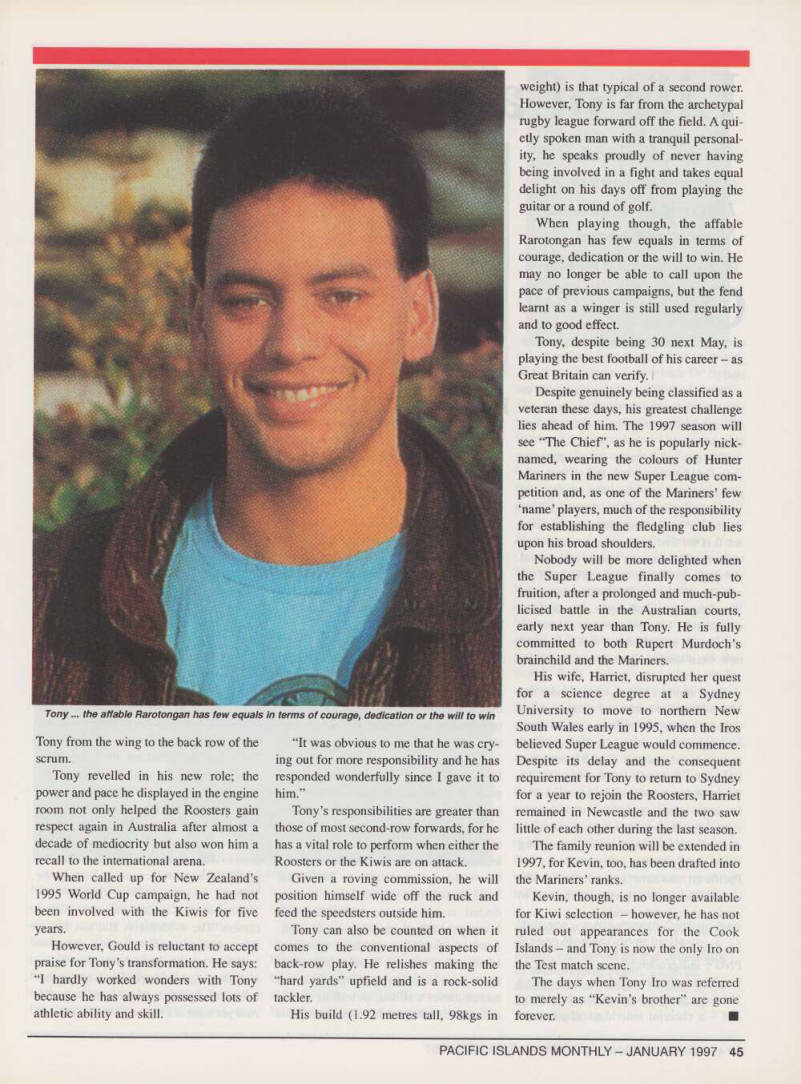
from shadows
By Atama Raganivatu
The New Zealand national rugby league selection’s recent three matches-to-nil Test series victory over Great Britain marked both the second clean sweep gained by the Kiwis since the two countries commenced playing each other in 1907 and Tony Iro’s ‘internation
al coming of age’.
Prior to him featuring prominently in the Lions’ demise, Iro’s entire career had been spent in the shadow of his younger brother, Kevin Iro.
It was Kevin who created a world
record when scoring 20 points against
Papua New Guinea on Test debut, it was Kevin who scored an extraordinary six tries in his first three British Challenge Cup final appearances at Wembley Stadium and it was Kevin who was wide ly tipped as Mai Meninga’s natural suc cessor as the World’s best centre in the late 1980 s.
Tony had only made a couple of senior appearances for the unsung Auckland club. Mount Albert, when, in 1987, he was
signed by English giants Wigan.
Wigan, it was believed at the time,
acquired Tony primarily to provide moral
support for Kevin, who had just joined them.
The older Iro (by five days short of one year) was initially required to play for Wigan’s reserve side.
However, he quickly caught the eye of the Riversiders’ New Zealand coach, Graham Lowe, and gained promotion to their senior XIII. The 1987-88 English season ended with Tony scoring a try at
Wembley as Wigan captured the
Challenge Cup with a victory over holders Halifax.
Tony’s exploits on Wigan’s right wing
secured him a berth in the New Zealand combination which faced Australia in the World Cup final at Auckland in October, 1988. It was an international baptism of fire and, like most of his team-mates, he
struggled against an inspired Kangaroos
lineup. A late try proved only a small con solation for Tony and the badly beaten Kiwis.
The New Zealand selectors forgave
Tony for that below-par performance and
he won seven more caps in the following two years a couple more against Australia, three opposing Great Britain and two for appearances against Papua New Guinea.
Iro left Wigan in 1990. While there, his fifty-first team outings yielded 23 tries and two Challenge Cup winner’s medals.
However, he has mixed feelings about the time spent at Central Park.
“Really, it was all a little bit too easy for me,” he concedes today. “I walked into a champion team almost immediately after arriving at Wigan. “I really didn’t have to come through the ranks and strive hard to gain success as most other young
players do.
“I don’t think that I appreciated how lucky I was back then and certainly didn’t work particularly hard to keep myself at the top because I did an awful lot of par
tying.”
Tony discovered that Australian rugby league was a totally different ball game upon moving to Manly with Lowe. In con trast to his experience in Britain, every match in the Winfield Cup provided a tough challenge and he struggled to come to terms with his new, much more exact
ing environment.
Kevin, who joined him a year later, lasted just two seasons with Manly before
returning to Britain. Tony, though, proved
more resilient and has remained in Australia. In 1994, he was transferred to
Sydney City Roosters.
By this time, as Tony’s career approached its twilight stage, most pun dits had written him off as little more than a journeyman. Then, Roosters coach Phil Gould provided a new lease on life through a masterly inspiration. He moved
Tony from the wing to the back row of the scrum.
Tony revelled in his new role; the power and pace he displayed in the engine room not only helped the Roosters gain respect again in Australia after almost a decade of mediocrity but also won him a recall to the international arena.
When called up for New Zealand’s 1995 World Cup campaign, he had not been involved with the Kiwis for five years.
However, Gould is reluctant to accept praise for Tony’s transformation. He says; “I hardly worked wonders with Tony because he has always possessed lots of athletic ability and skill.
“It was obvious to me that he was cry ing out for more responsibility and he has responded wonderfully since I gave it to him.”
Tony’s responsibilities are greater than those of most second-row forwards, for he has a vital role to perform when either the Roosters or the Kiwis are on attack.
Given a roving commission, he will position himself wide off the ruck and feed the speedsters outside him.
Tony can also be counted on when it comes to the conventional aspects of back-row play. He relishes making the “hard yards” upfield and is a rock-solid tackier.
His build (1.92 metres tall, 98kgs in
weight) is that typical of a second rower.
However, Tony is far from the archetypal rugby league forward off the field. A qui etly spoken man with a tranquil personal ity, he speaks proudly of never having being involved in a fight and takes equal delight on his days off from playing the guitar or a round of golf.
When playing though, the affable Rarotongan has few equals in terms of courage, dedication or the will to win. He may no longer be able to call upon the pace of previous campaigns, but the fend learnt as a winger is still used regularly and to good effect.
Tony, despite being 30 next May, is playing the best football of his career - as Great Britain can verify. I Despite genuinely being classified as a veteran these days, his greatest challenge lies ahead of him. The 1997 season will see “The Chief’, as he is popularly nick named, wearing the colours of Hunter Mariners in the new Super League com petition and, as one of the Mariners’ few ‘name’ players, much of the responsibility for establishing the fledgling club lies upon his broad shoulders.
Nobody will be more delighted when the Super League finally comes to fruition, after a prolonged and much-pub licised battle in the Australian courts, early next year than Tony. He is fully committed to both Rupert Murdoch’s brainchild and the Mariners.
His wife, Harriet, disrupted her quest for a science degree at a Sydney University to move to northern New South Wales early in 1995, when the Iros believed Super League would commence.
Despite its delay and the consequent requirement for Tony to return to Sydney for a year to rejoin the Roosters, Harriet remained in Newcastle and the two saw little of each other during the last season.
The family reunion will be extended in 1997, for Kevin, too, has been drafted into the Mariners’ ranks.
Kevin, though, is no longer available for Kiwi selection - however, he has not ruled out appearances for the Cook Islands - and Tony is now the only Iro on the Test match scene.
The days when Tony Iro was referred to merely as “Kevin’s brother” are gone forever. ■
Tony...the affable Rarotongan has few equals in terms of courage, dedication or the will to win
Life of a master carver
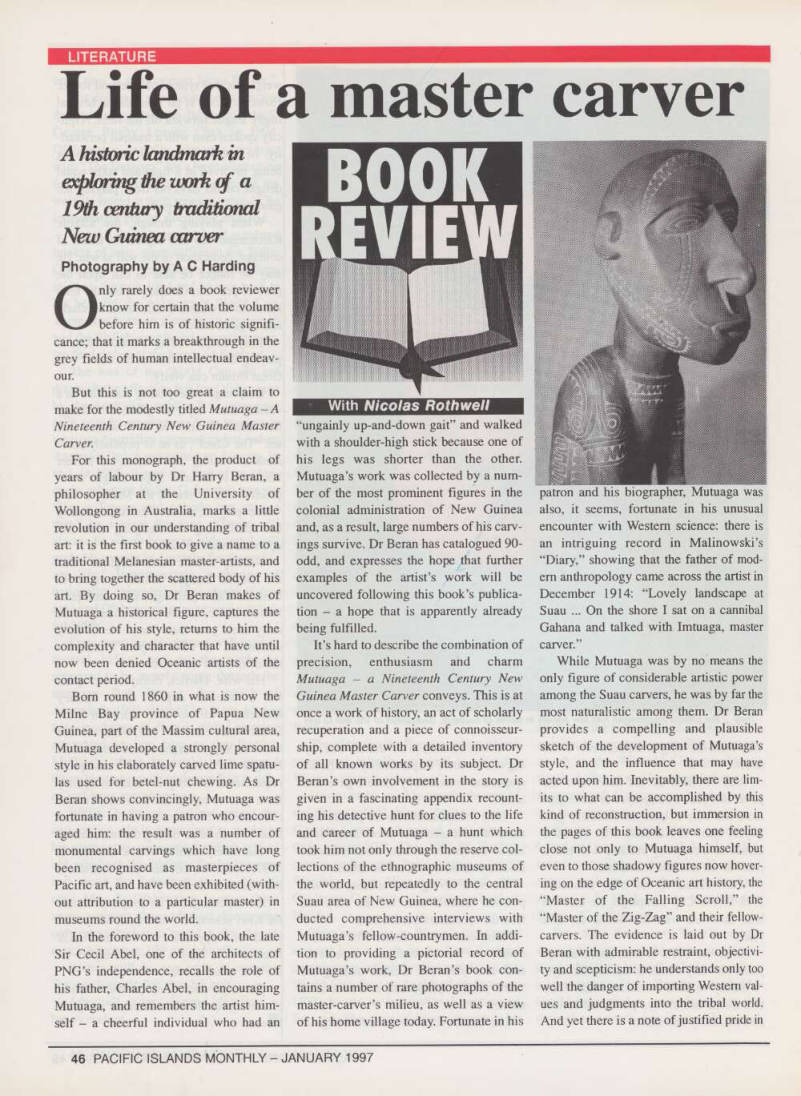
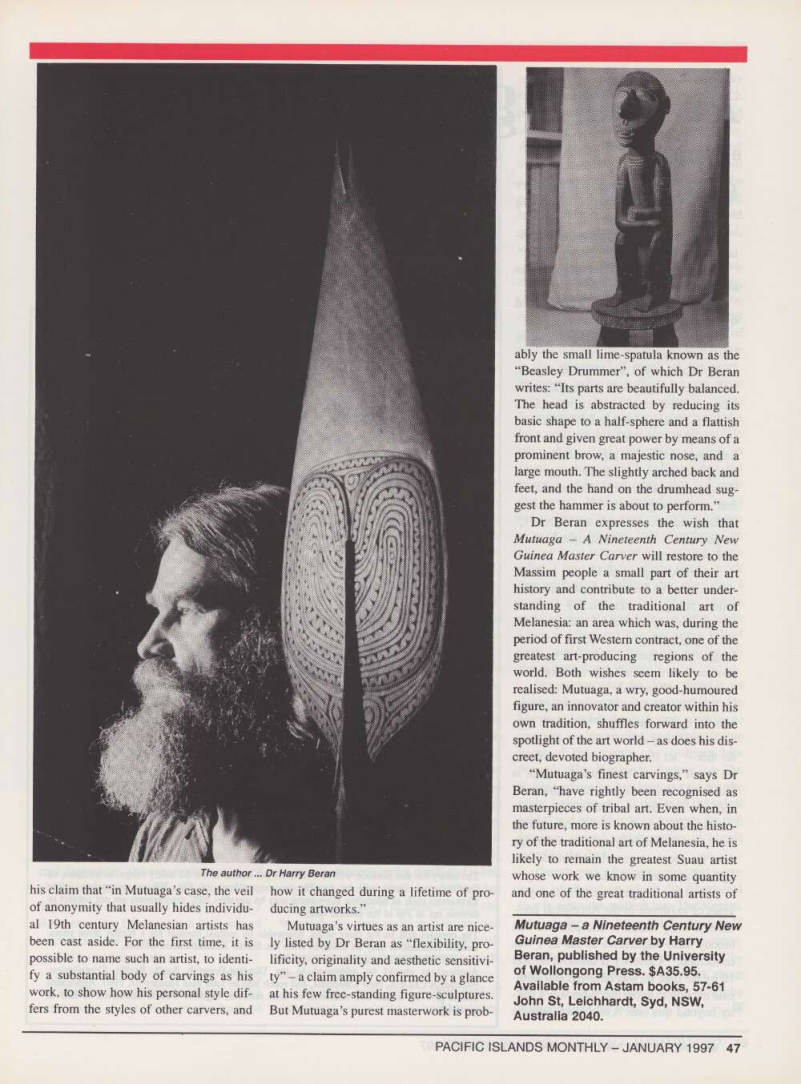
Literature
A historic landmark in exploring the work of a 19th century traditional New Guinea carver Photography by A C Harding
Only rarely does a book reviewer know for certain that the volume before him is of historic signifi cance; that it marks a breakthrough in the grey fields of human intellectual endeav our.
But this is not too great a claim to make for the modestly titled Mutuaga - A Nineteenth Century New Guinea Master Carver.
For this monograph, the product of years of labour by Dr Harry Beran, a philosopher at the University of Wollongong in Australia, marks a little revolution in our understanding of tribal art; it is the first book to give a name to a traditional Melanesian master-artists, and to bring together the scattered body of his art. By doing so. Dr Beran makes of Mutuaga a historical figure, captures the evolution of his style, returns to him the complexity and character that have until now been denied Oceanic artists of the
contact period.
Bom round 1860 in what is now the Milne Bay province of Papua New Guinea, part of the Massim cultural area,
Mutuaga developed a strongly personal
style in his elaborately carved lime spatu las used for betel-nut chewing. As Dr Beran shows convincingly, Mutuaga was fortunate in having a patron who encour aged him: the result was a number of monumental carvings which have long been recognised as masterpieces of Pacific art, and have been exhibited (with out attribution to a particular master) in museums round the world.
In the foreword to this book, the late Sir Cecil Abel, one of the architects of PNG’s independence, recalls the role of his father, Charles Abel, in encouraging Mutuaga, and remembers the artist him self - a cheerful individual who had an
“ungainly up-and-down gait” and walked with a shoulder-high stick because one of his legs was shorter than the other.
Mutuaga’s work was collected by a num ber of the most prominent figures in the colonial administration of New Guinea and, as a result, large numbers of his carv ings survive. Dr Beran has catalogued 90odd, and expresses the hope that further examples of the artist’s work will be uncovered following this book’s publica tion - a hope that is apparently already
being fulfilled.
It’s hard to describe the combination of precision, enthusiasm and charm Mutuaga - a Nineteenth Century New Guinea Master Carver conveys. This is at once a work of history, an act of scholarly recuperation and a piece of connoisseur ship, complete with a detailed inventory of all known works by its subject. Dr Beran’s own involvement in the story is
given in a fascinating appendix recount
ing his detective hunt for clues to the life and career of Mutuaga - a hunt which took him not only through the reserve col lections of the ethnographic museums of the world, but repeatedly to the central Suau area of New Guinea, where he con ducted comprehensive interviews with
Mutuaga’s fellow-countrymen. In addi
tion to providing a pictorial record of Mutuaga’s work. Dr Beran’s book con tains a number of rare photographs of the master-carver’s milieu, as well as a view of his home village today. Fortunate in his
patron and his biographer, Mutuaga was also, it seems, fortunate in his unusual encounter with Western science; there is an intriguing record in Malinowski’s “Diary,” showing that the father of mod em anthropology came across the artist in December 1914: “Lovely landscape at Suau ... On the shore I sat on a cannibal Gahana and talked with Imtuaga, master carver.”
While Mutuaga was by no means the only figure of considerable artistic power among the Suau carvers, he was by far the most naturalistic among them. Dr Beran
provides a compelling and plausible
sketch of the development of Mutuaga’s style, and the influence that may have acted upon him. Inevitably, there are lim its to what can be accomplished by this kind of reconstruction, but immersion in the pages of this book leaves one feeling close not only to Mutuaga himself, but even to those shadowy figures now hover ing on the edge of Oceanic art history, the “Master of the Falling Scroll,” the “Master of the Zig-Zag” and their fellow carvers. The evidence is laid out by Dr Beran with admirable restraint, objectivi ty and scepticism: he understands only too well the danger of importing Western val ues and judgments into the tribal world.
And yet there is a note of justified pride in
With Nicolas Roth well
his claim that “in Mutuaga’s case, the veil of anonymity that usually hides individual 19th century Melanesian artists has been cast aside. For the first time, it is possible to name such an artist, to identify a substantial body of carvings as his work, to show how his personal style differs from the styles of other carvers, and
how it changed during a lifetime of pro ducing artworks.”
Mutuaga’s virtues as an artist are nice ly listed by Dr Beran as “flexibility, pro lificity, originality and aesthetic sensitivi ty” - a claim amply confirmed by a glance at his few free-standing figure-sculptures.
But Mutuaga’s purest masterwork is prob-
ably the small lime-spatula known as the “Beasley Drummer”, of which Dr Beran writes: “Its parts are beautifully balanced.
The head is abstracted by reducing its basic shape to a half-sphere and a flattish front and given great power by means of a prominent brow, a majestic nose, and a large mouth. The slightly arched back and feet, and the hand on the drumhead sug gest the hammer is about to perform.”
Dr Beran expresses the wish that Mutuaga A Nineteenth Century New Guinea Master Carver will restore to the Massim people a small part of their art history and contribute to a better under standing of the traditional art of Melanesia: an area which was, during the period of first Western contract, one of the greatest art-producing regions of the world. Both wishes seem likely to be realised: Mutuaga, a wry, good-humoured figure, an innovator and creator within his own tradition, shuffles forward into the spotlight of the art world - as does his dis creet, devoted biographer.
“Mutuaga’s finest carvings,” says Dr Beran, “have rightly been recognised as masterpieces of tribal art. Even when, in the future, more is known about the histo ry of the traditional art of Melanesia, he is likely to remain the greatest Suau artist whose work we know in some quantity and one of the great traditional artists of
Mutuaga - a Nineteenth Century New Guinea Master Carver by Harry Beran, published by the University of Wollongong Press. $A35.95.
Available from Astam books, 57-61 John St, Leichhardt, Syd, NSW, Australia 2040.
The author...Dr Harry Beran
A song of protest
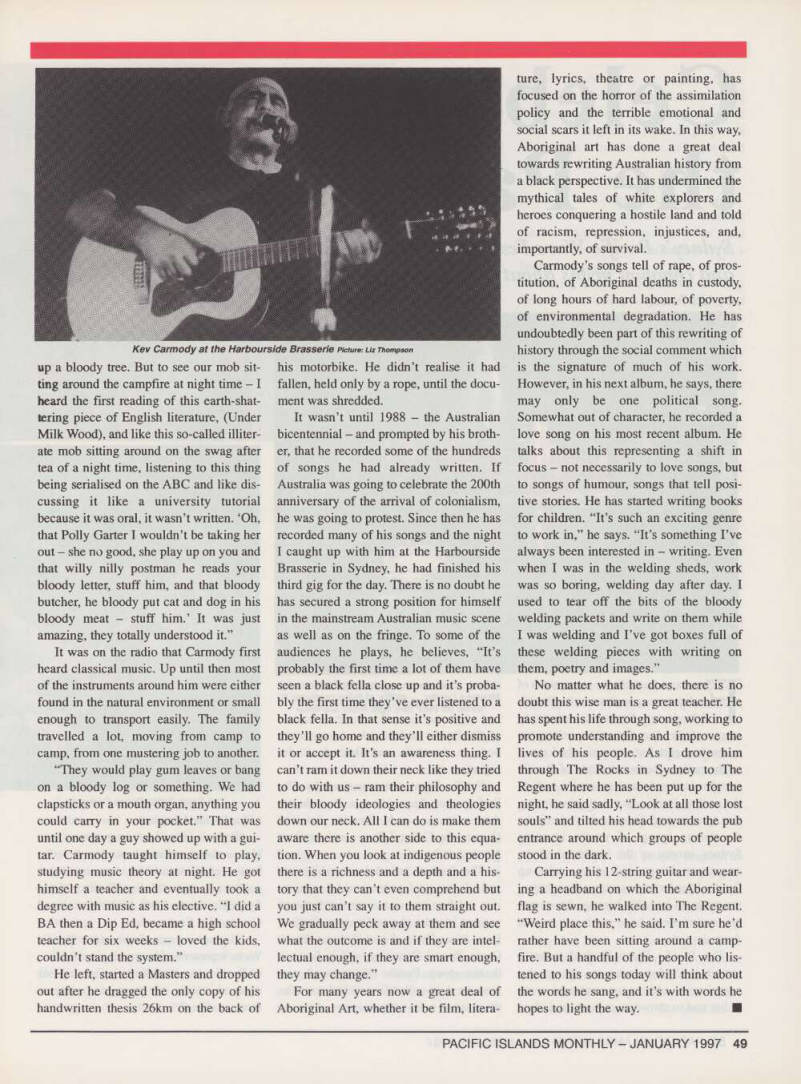
Music
By Liz Thompson
/ / m 200 years, us blacks are beaten down here too long JL on the dole My dignity I’m losing here and men tally I’m old There’s a system here that nails us ain’t we left out in the cold They took our life and liberty friend by they couldn’t buy our soul”
First verse of Cannot Buy My Soul by Kev Carmody.
Kev Carmody is one of the most polit ical singer songwriters in Australia. He has recorded three highly successful albums - Eulogy, Images & Illusions and Pillars of Society. He is constantly travel
ling, performing at gigs and festivals,
being interiewed, writing new songs in his quest to raise awareness. He uses music and songwriting as a form of protest.
“Selling the records isn’t the objective,” he points out. “It’s just propaganda as far as I’m concerned.”
As an Aboriginal child who suffered the atrocities of the white Australia assim ilation policy, he was forcibly removed from his family and land at the age of 10.
He’d only managed to stay at home as long as he did because whenever he or his brother heard a car approaching they would run off and hide in the scrub.
Once the authorities found him, there was no option but to go “because”, says Carmody, “they said to Mum, if you don’t do this - ‘let the children come with us, we’ll put you on Palm Island’, which is like the Alcatraz of Australia - ‘and we’ll split you up from your husband’.”
Carmody, who has the air of a gentle man, found when he got to the orphanage that “the people were so brutal and so sav age and so cruel to children”.
“I had never experienced that in my 10 years of existence in the Aboriginal com munity. They called it discipline. It was bloody sado-masochism as far as I was concerned.” Carmody is thankful he was 10 by the time he was removed and fortu nate enough to know that there was a real ity beyond this one. A few years later he
decided to get himself expelled from school, which he did - “hopped on a horse” and left town.
It is this experience and the experience of his people that has motivated his song writing. “Music,” he says when I ask him how he got into it, “got into me. I can never remember a time in my memory where there wasn’t music around. You
had to entertain yourself around a camp fire with music and storytelling. Some of those so-called illiterate people made up wonderful poems and rhymes and sto ries.” He recalls being back home on the land in the early 50s. “There was a big technological innovation when the old fella brought out a dry cell wireless and it was portable and you had to run an aerial
up a bloody tree. But to see our mob sit ting around the campfire at night time -1 heard the first reading of this earth-shat
tering piece of English literature, (Under
Milk Wood), and like this so-called illiter ate mob sitting around on the swag after tea of a night time, listening to this thing being serialised on the ABC and like dis cussing it like a university tutorial because it was oral, it wasn’t written. ‘Oh, that Polly Garter I wouldn’t be taking her out - she no good, she play up on you and that willy nilly postman he reads your bloody letter, stuff him, and that bloody butcher, he bloody put cat and dog in his bloody meat - stuff him.’ It was just amazing, they totally understood it.”
It was on the radio that Carmody first heard classical music. Up until then most of the instruments around him were either found in the natural environment or small
enough to transport easily. The family
travelled a lot, moving from camp to camp, from one mustering job to another.
“They would play gum leaves or bang on a bloody log or something. We had clapsticks or a mouth organ, anything you could carry in your pocket.” That was until one day a guy showed up with a gui tar. Carmody taught himself to play, studying music theory at night. He got himself a teacher and eventually took a degree with music as his elective. “I did a BA then a Dip Ed, became a high school teacher for six weeks - loved the kids, couldn’t stand the system.”
He left, started a Masters and dropped out after he dragged the only copy of his handwritten thesis 26km on the back of
his motorbike. He didn’t realise it had fallen, held only by a rope, until the docu ment was shredded.
It wasn’t until 1988 - the Australian bicentennial - and prompted by his broth er, that he recorded some of the hundreds of songs he had already written. If Australia was going to celebrate the 200th anniversary of the arrival of colonialism, he was going to protest. Since then he has recorded many of his songs and the night I caught up with him at the Harbourside Brasserie in Sydney, he had finished his third gig for the day. There is no doubt he has secured a strong position for himself in the mainstream Australian music scene as well as on the fringe. To some of the audiences he plays, he believes, “It’s probably the first time a lot of them have seen a black fella close up and it’s proba bly the first time they’ve ever listened to a black fella. In that sense it’s positive and they’ll go home and they’ll either dismiss it or accept it. It’s an awareness thing. I can’t ram it down their neck like they tried to do with us - ram their philosophy and
their bloody ideologies and theologies
down our neck. All I can do is make them aware there is another side to this equa tion. When you look at indigenous people there is a richness and a depth and a his tory that they can’t even comprehend but you just can’t say it to them straight out.
We gradually peck away at them and see what the outcome is and if they are intel lectual enough, if they are smart enough,
they may change.”
For many years now a great deal of Aboriginal Art, whether it be film, litera
ture, lyrics, theatre or painting, has focused on the horror of the assimilation policy and the terrible emotional and social scars it left in its wake. In this way.
Aboriginal art has done a great deal towards rewriting Australian history from a black perspective. It has undermined the mythical tales of white explorers and heroes conquering a hostile land and told of racism, repression, injustices, and, importantly, of survival.
Carmody’s songs tell of rape, of pros titution, of Aboriginal deaths in custody, of long hours of hard labour, of poverty, of environmental degradation. He has undoubtedly been part of this rewriting of history through the social comment which is the signature of much of his work.
However, in his next album, he says, there may only be one political song.
Somewhat out of character, he recorded a love song on his most recent album. He talks about this representing a shift in focus - not necessarily to love songs, but to songs of humour, songs that tell posi tive stories. He has started writing books for children. “It’s such an exciting genre to work in,” he says. “It’s something I’ve always been interested in - writing. Even when I was in the welding sheds, work was so boring, welding day after day. I used to tear off the bits of the bloody welding packets and write on them while I was welding and I’ve got boxes full of
these welding pieces with writing on
them, poetry and images.”
No matter what he does, there is no doubt this wise man is a great teacher. He has spent his life through song, working to promote understanding and improve the lives of his people. As I drove him through The Rocks in Sydney to The Regent where he has been put up for the night, he said sadly, “Look at all those lost souls” and tilted his head towards the pub entrance around which groups of people stood in the dark.
Carrying his 12-string guitar and wear
ing a headband on which the Aboriginal flag is sewn, he walked into The Regent.
“Weird place this,” he said. I’m sure he’d rather have been sitting around a camp fire. But a handful of the people who lis tened to his songs today will think about the words he sang, and it’s with words he hopes to light the way. ■
Kev Carmody at the Harbourside Brasserie picture: Liz Thompson
Advertisements & other items, p. 48 (1 item)
(Community Education Training Centre)
South Pacific Commission
PRINCIPAL
The South Pacific Commission is an international, bilingual (English and French), technical assistance organisation serving the Pacific Islands. Applications are invited for the position of Principal (CETC), to be based in Suva, Fiji. The Principal will assume responsibility for management of the Community Education Training Centre (CETC) and Courses in Community Development, Home Economics, Health and Nutrition and Agriculture for Community Workers and other Courses at the CETC, Suva, Fiji. The Principal will be required to perform the following duties and responsibilities: Develop and upgrade the content of the training course as well as appropriate teaching methods, instructional materials and practical field training experiences for the students as may be necessary; Advise the Deputy Director-General on further development of the training course with special reference to its role in meeting the emerging economic, social and health needs of the region; Guide and supervise the teaching staff at the Centre and arrange for visiting lecturers and tutors as appropriate, including input from other SPC programmes; Provide advice and technical assistance in planning and implementing in-service training course in countries and territories; Evaluate the activities of the training course graduates in their home countries/territories to assess the impact of their work in the community and provide suitable refresher training and such other encouragement as may be required; Prepare the annual CETC budget and monitor and manage the approved budget; Perform such other duties as the Deputy Director-General may require in regard to the Community Education and Training Centre, its staff and students.
QUALIFICATIONS AND EXPERIENCE:
An advanced University Degree in education with majors in adult education/curriculum development/education management, with at least ten (10) years practical work experience in any of the above fields, as required. Experience in managing a learning institution and in supervision of professional/support staff is highly desirable.
SALARY AND ALLOWANCES:
The salary for this position will be FJD4.431 per month in the S 2 salary range. In addition, an Establishment Grant will be payable to non-residents of Fiji. Where appropriate, other allowances such as education allowances may be payable. SPC emoluments are not subject to income tax in Fiji at the present time.
The contract will be for three years, renewable by mutual consent for a further three years.
Further information may be obtained from the Senior Administration Officer, fax; (687) 2638288; telephone (687) 262000.
Applications should be addressed to the Director-General; South Pacific Commission, NOUMEA CEDEX, New Caledonia, and reach him no later than January 31,1997. Applicants should give the names and addresses of three referees, together with an indication of date of availability.
Celebrating
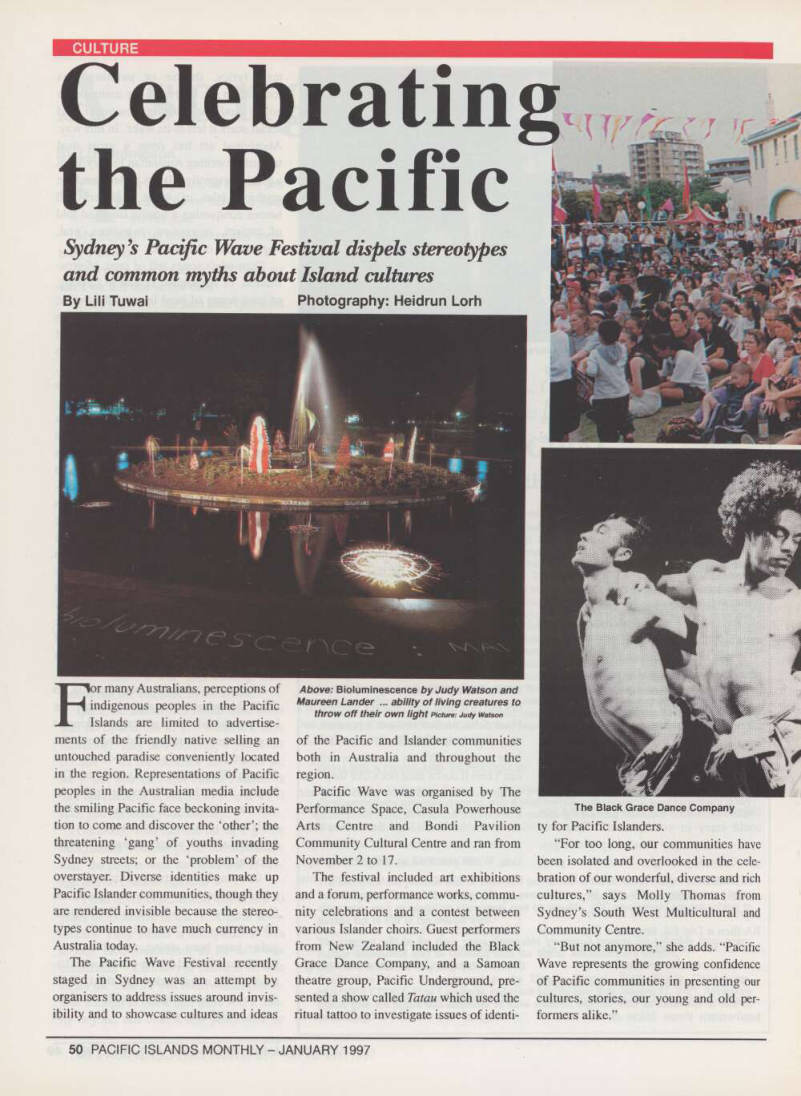
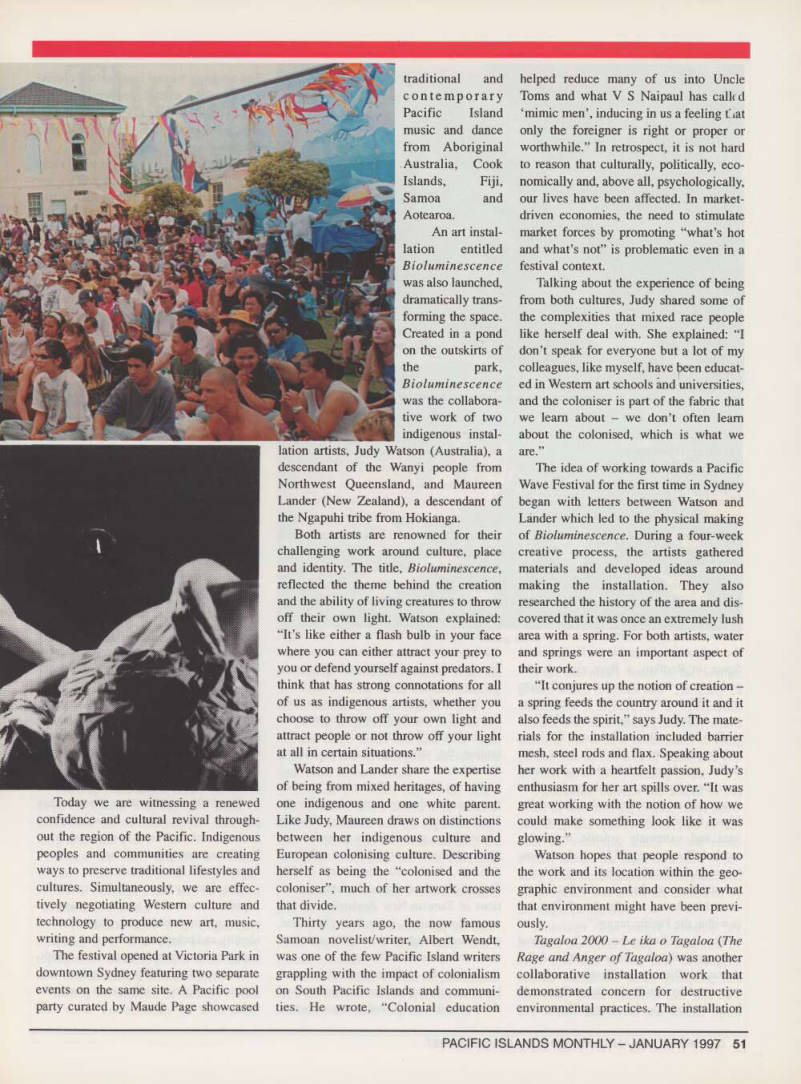
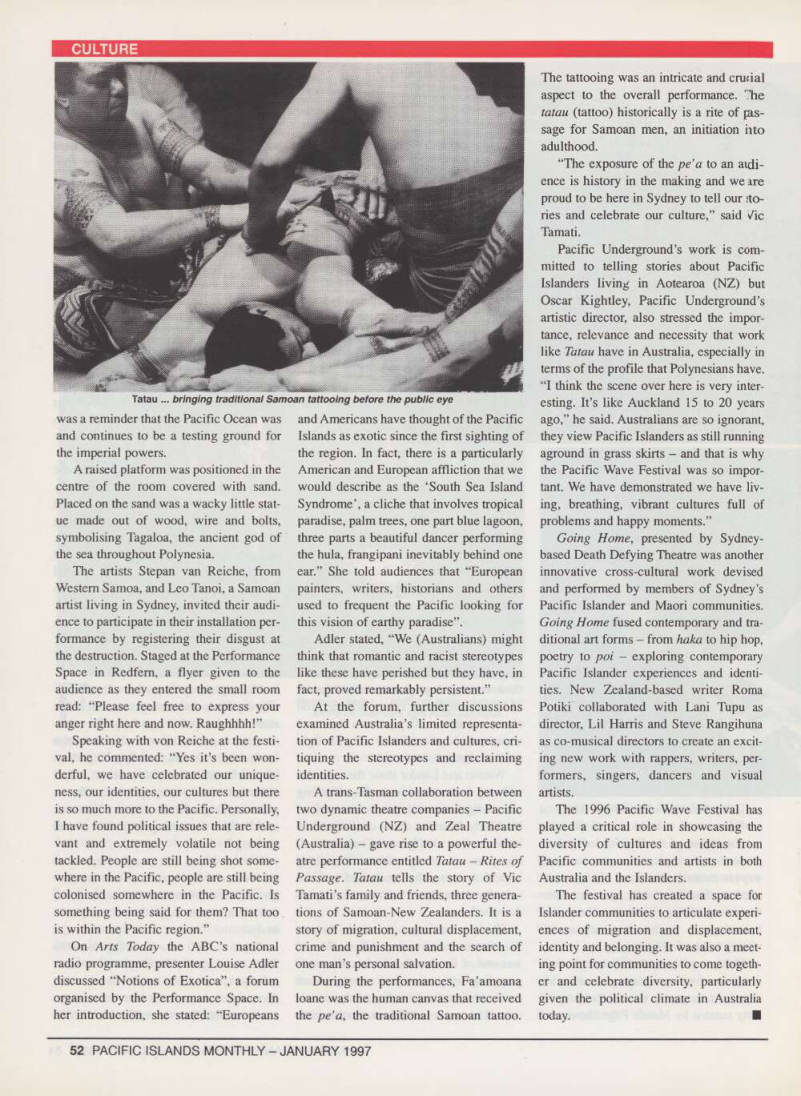
Culture
Celebrating the Pacific
Sydney’s Pacific Wave Festival dispels stereotypes and common myths about Island cultures
By Lili Tuwai
For many Australians, perceptions of indigenous peoples in the Pacific Islands are limited to advertise ments of the friendly native selling an untouched paradise conveniently located in the region. Representations of Pacific peoples in the Australian media include the smiling Pacific face beckoning invita tion to come and discover the ‘other’; the threatening ‘gang’ of youths invading Sydney streets; or the ‘problem’ of the overstayer. Diverse identities make up Pacific Islander communities, though they are rendered invisible because the stereo types continue to have much currency in Australia today.
The Pacific Wave Festival recently staged in Sydney was an attempt by organisers to address issues around invis ibility and to showcase cultures and ideas
of the Pacific and Islander communities both in Australia and throughout the
region.
Pacific Wave was organised by The Performance Space, Casula Powerhouse Arts Centre and Bondi Pavilion Community Cultural Centre and ran from November 2 to 17.
The festival included art exhibitions and a forum, performance works, commu nity celebrations and a contest between various Islander choirs. Guest performers from New Zealand included the Black Grace Dance Company, and a Samoan theatre group. Pacific Underground, pre sented a show called Tatau which used the ritual tattoo to investigate issues of identi-
ty for Pacific Islanders.
“For too long, our communities have been isolated and overlooked in the cele bration of our wonderful, diverse and rich cultures,” says Molly Thomas from Sydney’s South West Multicultural and
Community Centre.
“But not anymore,” she adds. “Pacific Wave represents the growing confidence of Pacific communities in presenting our cultures, stories, our young and old per formers alike.”
Photography: Heidrun Lorh
Above: Bioluminescence by Judy Watson and Maureen Lander ... ability of living creatures to throw off their own light Picture: Judy Watson
The Black Grace Dance Company
Today we are witnessing a renewed confidence and cultural revival through out the region of the Pacific. Indigenous peoples and communities are creating ways to preserve traditional lifestyles and cultures. Simultaneously, we are effec tively negotiating Western culture and technology to produce new art, music, writing and performance.
The festival opened at Victoria Park in downtown Sydney featuring two separate events on the same site. A Pacific pool party curated by Maude Page showcased
traditional and contemporary Pacific Island music and dance from Aboriginal Australia, Cook Islands, Fiji, Samoa and Aotearoa.
An art instal lation entitled Bioluminescence was also launched, dramatically trans forming the space.
Created in a pond on the outskirts of the park, Bioluminescence was the collabora tive work of two indigenous instal
lation artists, Judy Watson (Australia), a descendant of the Wanyi people from Northwest Queensland, and Maureen Lander (New Zealand), a descendant of the Ngapuhi tribe from Hokianga.
Both artists are renowned for their challenging work around culture, place and identity. The title, Bioluminescence , reflected the theme behind the creation and the ability of living creatures to throw off their own light. Watson explained: “It’s like either a flash bulb in your face where you can either attract your prey to you or defend yourself against predators. I think that has strong connotations for all of us as indigenous artists, whether you choose to throw off your own light and attract people or not throw off your light at all in certain situations.”
Watson and Lander share the expertise of being from mixed heritages, of having one indigenous and one white parent.
Like Judy, Maureen draws on distinctions between her indigenous culture and
European colonising culture. Describing
herself as being the “colonised and the coloniser”, much of her artwork crosses that divide.
Thirty years ago, the now famous Samoan novelist/writer, Albert Wendt, was one of the few Pacific Island writers grappling with the impact of colonialism on South Pacific Islands and communi ties. He wrote, “Colonial education
helped reduce many of us into Uncle Toms and what V S Naipaul has called ‘mimic men’, inducing in us a feeling f iat only the foreigner is right or proper or worthwhile.” In retrospect, it is not hard to reason that culturally, politically, eco nomically and, above all, psychologically, our lives have been affected. In market driven economies, the need to stimulate market forces by promoting “what’s hot and what’s not” is problematic even in a festival context.
Talking about the experience of being
from both cultures, Judy shared some of the complexities that mixed race people like herself deal with. She explained: “I don’t speak for everyone but a lot of my colleagues, like myself, have been educat ed in Western art schools and universities, and the coloniser is part of the fabric that we leam about - we don’t often learn about the colonised, which is what we are.”
The idea of working towards a Pacific Wave Festival for the first time in Sydney began with letters between Watson and Lander which led to the physical making of Bioluminescence. During a four-week creative process, the artists gathered materials and developed ideas around making the installation. They also researched the history of the area and dis covered that it was once an extremely lush area with a spring. For both artists, water and springs were an important aspect of their work.
“It conjures up the notion of creation a spring feeds the country around it and it also feeds the spirit,” says Judy. The mate rials for the installation included barrier mesh, steel rods and flax. Speaking about her work with a heartfelt passion, Judy’s enthusiasm for her art spills over. “It was great working with the notion of how we could make something look like it was
glowing.”
Watson hopes that people respond to the work and its location within the geo graphic environment and consider what that environment might have been previ
ously.
Tagaloa 2000 - Le ika o Tagaloa (The Rage and Anger of Tagaloa) was another collaborative installation work that demonstrated concern for destructive environmental practices. The installation
was a reminder that the Pacific Ocean was and continues to be a testing ground for the imperial powers.
A raised platform was positioned in the centre of the room covered with sand.
Placed on the sand was a wacky little stat ue made out of wood, wire and bolts, symbolising Tagaloa, the ancient god of
the sea throughout Polynesia.
The artists Stepan van Reiche, from Western Samoa, and Leo Tanoi, a Samoan artist living in Sydney, invited their audi ence to participate in their installation per
formance by registering their disgust at
the destruction. Staged at the Performance Space in Redfem, a flyer given to the audience as they entered the small room read: “Please feel free to express your anger right here and now. Raughhhh!”
Speaking with von Reiche at the festi val, he commented: “Yes it’s been won derful, we have celebrated our unique ness, our identities, our cultures but there is so much more to the Pacific. Personally, I have found political issues that are rele vant and extremely volatile not being tackled. People are still being shot some where in the Pacific, people are still being colonised somewhere in the Pacific. Is something being said for them? That too is within the Pacific region.”
On Arts Today the ABC’s national radio programme, presenter Louise Adler discussed “Notions of Exotica”, a forum organised by the Performance Space. In her introduction, she stated: “Europeans
and Americans have thought of the Pacific Islands as exotic since the first sighting of the region. In fact, there is a particularly American and European affliction that we would describe as the ‘South Sea Island Syndrome’, a cliche that involves tropical paradise, palm trees, one part blue lagoon, three parts a beautiful dancer performing the hula, frangipani inevitably behind one ear.” She told audiences that “European painters, writers, historians and others used to frequent the Pacific looking for this vision of earthy paradise”.
Adler stated, “We (Australians) might think that romantic and racist stereotypes like these have perished but they have, in
fact, proved remarkably persistent.”
At the forum, further discussions examined Australia’s limited representa tion of Pacific Islanders and cultures, cri tiquing the stereotypes and reclaiming identities.
A trans-Tasman collaboration between two dynamic theatre companies - Pacific Underground (NZ) and Zeal Theatre (Australia) - gave rise to a powerful the atre performance entitled Tatau - Rites of Passage. Tatau tells the story of Vic Tamati’s family and friends, three genera tions of Samoan-New Zealanders. It is a story of migration, cultural displacement, crime and punishment and the search of one man’s personal salvation.
During the performances, Fa’amoana
loane was the human canvas that received the pe’a, the traditional Samoan tattoo.
The tattooing was an intricate and crucial aspect to the overall performance. The tatau (tattoo) historically is a rite of pas sage for Samoan men, an initiation hto adulthood.
“The exposure of the pe’a to an atdi ence is history in the making and we ire proud to be here in Sydney to tell our do ries and celebrate our culture,” said Vic Tamati.
Pacific Underground’s work is com mitted to telling stories about Pacific Islanders living in Aotearoa (NZ) but
Oscar Kightley, Pacific Underground’s
artistic director, also stressed the impor tance, relevance and necessity that work like Tatau have in Australia, especially in terms of the profile that Polynesians have.
“I think the scene over here is very inter esting. It’s like Auckland 15 to 20 years ago,” he said. Australians are so ignorant, they view Pacific Islanders as still running aground in grass skirts - and that is why the Pacific Wave Festival was so impor tant. We have demonstrated we have liv ing, breathing, vibrant cultures full of problems and happy moments.”
Going Home, presented by Sydney
based Death Defying Theatre was another innovative cross-cultural work devised and performed by members of Sydney’s Pacific Islander and Maori communities.
Going Home fused contemporary and tra ditional art forms - from haka to hip hop, poetry to poi - exploring contemporary Pacific Islander experiences and identi ties. New Zealand-based writer Roma Potiki collaborated with Lani Tupu as director, Lil Harris and Steve Rangihuna as co-musical directors to create an excit ing new work with rappers, writers, per formers, singers, dancers and visual artists.
The 1996 Pacific Wave Festival has played a critical role in showcasing the diversity of cultures and ideas from Pacific communities and artists in both Australia and the Islanders.
The festival has created a space for Islander communities to articulate experi ences of migration and displacement, identity and belonging. It was also a meet ing point for communities to come togeth er and celebrate diversity, particularly given the political climate in Australia today. ■
Tatau... bringing traditional Samoan tattooing before the public eye
The sunken
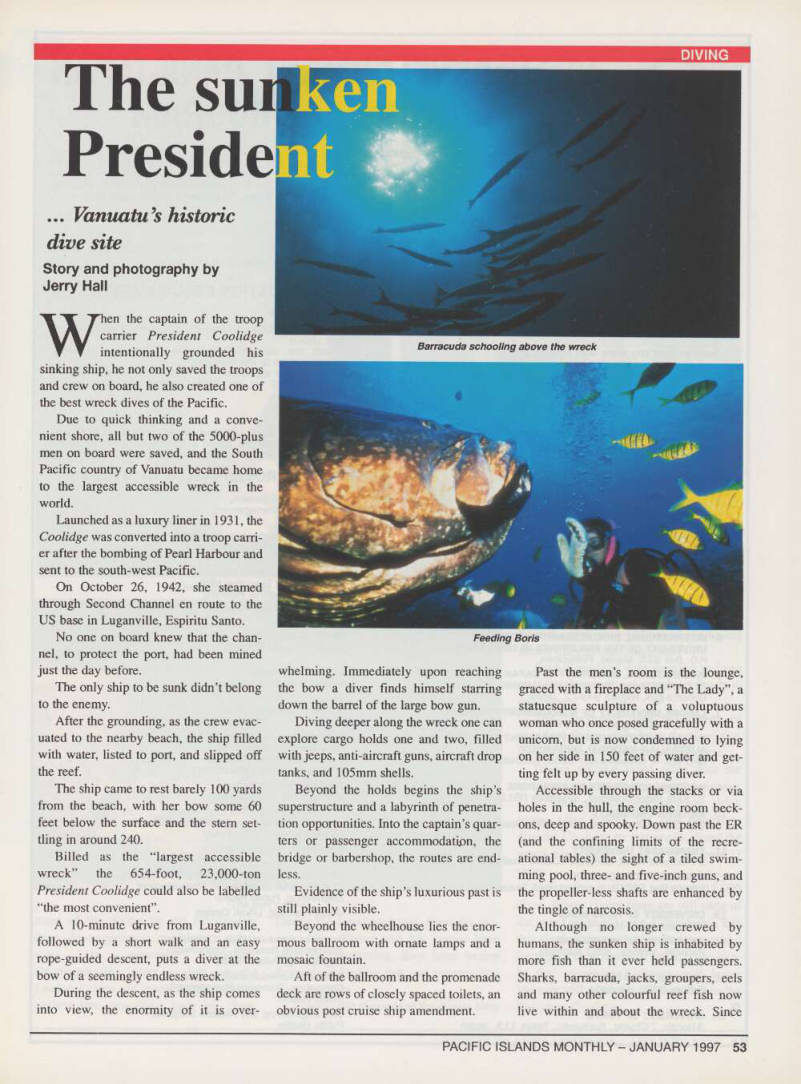
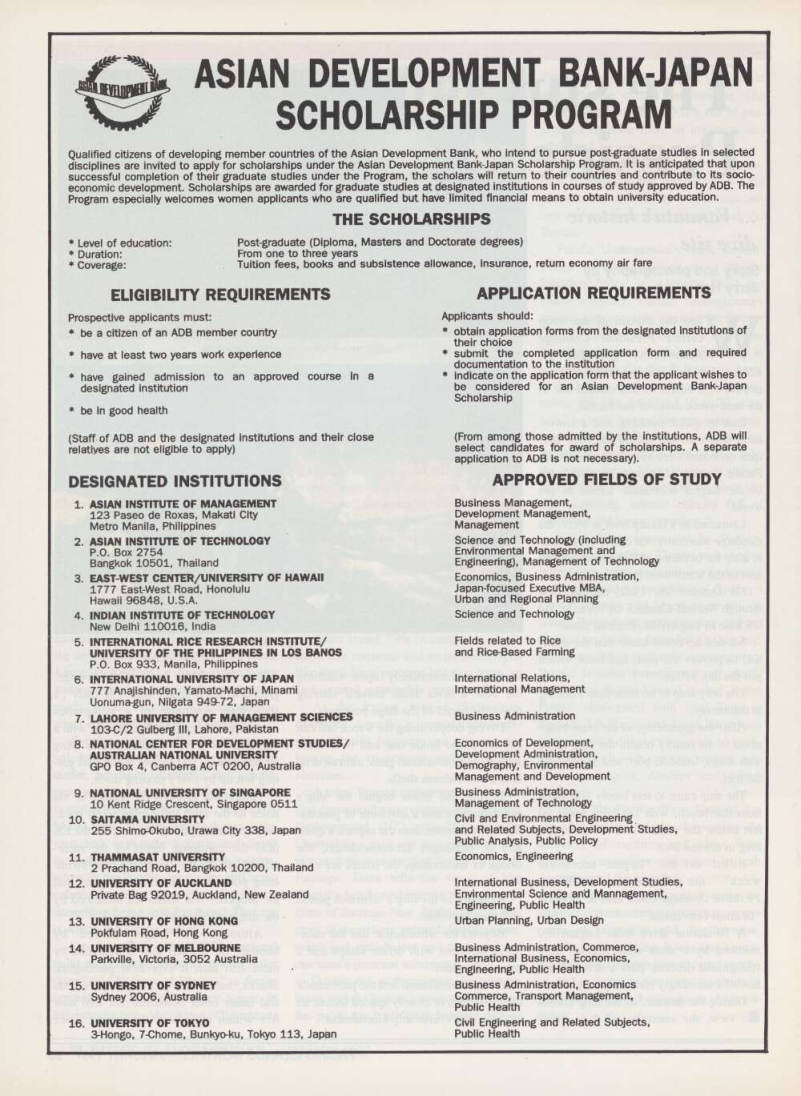
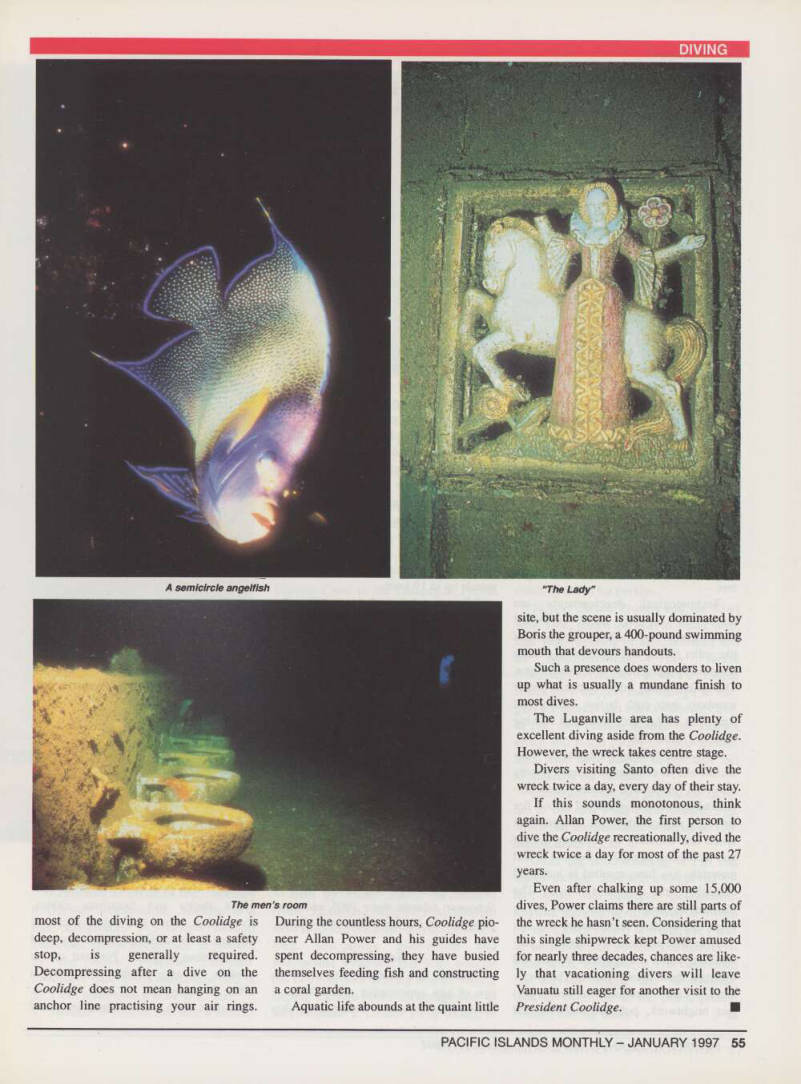
Diving
The sunken President
... Vanuatu’s historic dive site Story and photography by Jerry Hall
When the captain of the troop carrier President Coolidge
intentionally grounded his
sinking ship, he not only saved the troops and crew on board, he also created one of the best wreck dives of the Pacific.
Due to quick thinking and a conve nient shore, all but two of the 5000-plus men on board were saved, and the South Pacific country of Vanuatu became home to the largest accessible wreck in the world.
Launched as a luxury liner in 1931, the Coolidge was converted into a troop carri er after the bombing of Pearl Harbour and sent to the south-west Pacific.
On October 26, 1942, she steamed through Second Channel en route to the US base in Luganville, Espiritu Santo.
No one on board knew that the chan nel, to protect the port, had been mined just the day before.
The only ship to be sunk didn’t belong to the enemy.
After the grounding, as the crew evac uated to the nearby beach, the ship filled with water, listed to port, and slipped off the reef.
The ship came to rest barely 100 yards from the beach, with her bow some 60 feet below the surface and the stem set tling in around 240.
Billed as the “largest accessible wreck” the 654-foot, 23,000-ton President Coolidge could also be labelled “the most convenient”.
A 10-minute drive from Luganville, followed by a short walk and an easy rope-guided descent, puts a diver at the bow of a seemingly endless wreck.
During the descent, as the ship comes into view, the enormity of it is over-
whelming. Immediately upon reaching the bow a diver finds himself starring down the barrel of the large bow gun.
Diving deeper along the wreck one can explore cargo holds one and two, filled with jeeps, anti-aircraft guns, aircraft drop tanks, and 105 mm shells.
Beyond the holds begins the ship’s superstructure and a labyrinth of penetra tion opportunities. Into the captain’s quar ters or passenger accommodation, the bridge or barbershop, the routes are end less.
Evidence of the ship’s luxurious past is still plainly visible.
Beyond the wheelhouse lies the enor mous ballroom with ornate lamps and a mosaic fountain.
Aft of the ballroom and the promenade deck are rows of closely spaced toilets, an obvious post cruise ship amendment.
Past the men’s room is the lounge, graced with a fireplace and “The Lady”, a statuesque sculpture of a voluptuous woman who once posed gracefully with a unicorn, but is now condemned to lying on her side in 150 feet of water and get ting felt up by every passing diver.
Accessible through the stacks or via holes in the hull, the engine room beck ons, deep and spooky. Down past the ER (and the confining limits of the recre ational tables) the sight of a tiled swim ming pool, three- and five-inch guns, and the propeller-less shafts are enhanced by the tingle of narcosis.
Although no longer crewed by
humans, the sunken ship is inhabited by more fish than it ever held passengers.
Sharks, barracuda, jacks, groupers, eels and many other colourful reef fish now live within and about the wreck. Since
Barracuda schooling above the wreck
Feeding Boris
most of the diving on the Coolidge is deep, decompression, or at least a safety stop, is generally required, Decompressing after a dive on the Coolidge does not mean hanging on an anchor line practising your air rings.
During the countless hours, Coolidge pio neer Allan Power and his guides have spent decompressing, they have busied themselves feeding fish and constructing a coral garden.
Aquatic life abounds at the quaint little
site, but the scene is usually dominated by Boris the grouper, a 400-pound swimming mouth that devours handouts.
Such a presence does wonders to liven up what is usually a mundane finish to most dives.
The Luganville area has plenty of excellent diving aside from the Coolidge.
However, the wreck takes centre stage.
Divers visiting Santo often dive the wreck twice a day, every day of their stay.
If this sounds monotonous, think again. Allan Power, the first person to dive the Coolidge recreationally, dived the wreck twice a day for most of the past 27 years.
Even after chalking up some 15,000 dives, Power claims there are still parts of the wreck he hasn’t seen. Considering that this single shipwreck kept Power amused for nearly three decades, chances are like ly that vacationing divers will leave Vanuatu still eager for another visit to the President Coolidge. ■
A semicircle angelfish
The men’s room
“The Lady"
Advertisements & other items, p. 54 (1 item)
Asian Development Bank-Japan
SCHOLARSHIP PROGRAM
Qualified citizens of developing member countries of the Asian Development Bank, who intend to pursue post-graduate studies in selected disciplines are invited to apply for scholarships under the Asian Development Bank-Japan Scholarship Program. It is anticipated that upon successful completion of their graduate studies under the Program, the scholars will return to their countries and contribute to its socioeconomic development. Scholarships are awarded for graduate studies at designated institutions in courses of study approved by ADB. The Program especially welcomes women applicants who are qualified but have limited financial means to obtain university education. * Level of education: * Duration; * Coverage:
THE SCHOLARSHIPS
Post-graduate (Diploma, Masters and Doctorate degrees) From one to three years Tuition fees, books and subsistence allowance, insurance, return economy air fare
ELIGIBILITY REQUIREMENTS
Prospective applicants must: ♦ be a citizen of an ADB member country * have at least two years work experience * have gained admission to an approved course in a designated institution ♦ be in good health (Staff of ADB and the designated institutions and their close relatives are not eligible to apply)
DESIGNATED INSTITUTIONS
1. ASIAN INSTITUTE OF MANAGEMENT
123 Paseo de Roxas, Makati City Metro Manila, Philippines
2. ASIAN INSTITUTE OF TECHNOLOGY
P.O. Box 2754 Bangkok 10501, Thailand
3. EAST-WEST CENTER/UNIVERSITY OF HAWAII
1777 East-West Road, Honolulu Hawaii 96848, U.S.A.
4. INDIAN INSTITUTE OF TECHNOLOGY
New Delhi 110016, India
5. INTERNATIONAL RICE RESEARCH INSTITUTE/
UNIVERSITY OF THE PHILIPPINES IN LOS BANOS P.O. Box 933, Manila, Philippines
6. INTERNATIONAL UNIVERSITY OF JAPAN
777 Anajishinden, Yamato-Machi, Minami Niigata 949-72, Japan
7. LAHORE UNIVERSITY OF MANAGEMENT SCIENCES
103-C/2 Gulberg 111, Lahore, Pakistan
8. NATIONAL CENTER FOR DEVELOPMENT STUDIES/
AUSTRALIAN NATIONAL UNIVERSITY
GPO Box 4, Canberra ACT 0200, Australia
9. NATIONAL UNIVERSITY OF SINGAPORE
10 Kent Ridge Crescent, Singapore 0511
10. SAIT AM A UNIVERSITY
255 Shimo-Okubo, Urawa City 338, Japan
11. THAMMASAT UNIVERSITY
2 Prachand Road, Bangkok 10200, Thailand
12. UNIVERSITY OF AUCKLAND
Private Bag 92019, Auckland, New Zealand
13. UNIVERSITY OF HONG KONG
Pokfulam Road, Hong Kong
14. UNIVERSITY OF MELBOURNE
Parkville, Victoria, 3052 Australia
15. UNIVERSITY OF SYDNEY
Sydney 2006, Australia
16. UNIVERSITY OF TOKYO
3-Hongo, 7-Chome, Bunkyo-ku, Tokyo 113, Japan
APPLICATION REQUIREMENTS
Applicants should: * obtain application forms from the designated institutions of their choice * submit the completed application form and required documentation to the institution * indicate on the application form that the applicant wishes to be considered for an Asian Development Bank-Japan Scholarship (From among those admitted by the institutions, ADB will select candidates for award of scholarships. A separate application to ADB is not necessary).
APPROVED FIELDS OF STUDY
Business Management, Development Management, Management Science and Technology (including Environmental Management and Engineering), Management of Technology Economics, Business Administration, Japan-focused Executive MBA, Urban and Regional Planning Science and Technology Fields related to Rice and Rice-Based Farming International Relations, International Management Business Administration Economics of Development, Development Administration, Demography, Environmental Management and Development Business Administration, Management of Technology Civil and Environmental Engineering and Related Subjects, Development Studies, Public Analysis, Public Policy Economics, Engineering International Business, Development Studies, Environmental Science and Mannagement, Engineering, Public Health Urban Planning, Urban Design Business Administration, Commerce, International Business, Economics, Engineering, Public Health Business Administration, Economics Commerce, Transport Management, Public Health Civil Engineering and Related Subjects, Public Health
Megayachts in
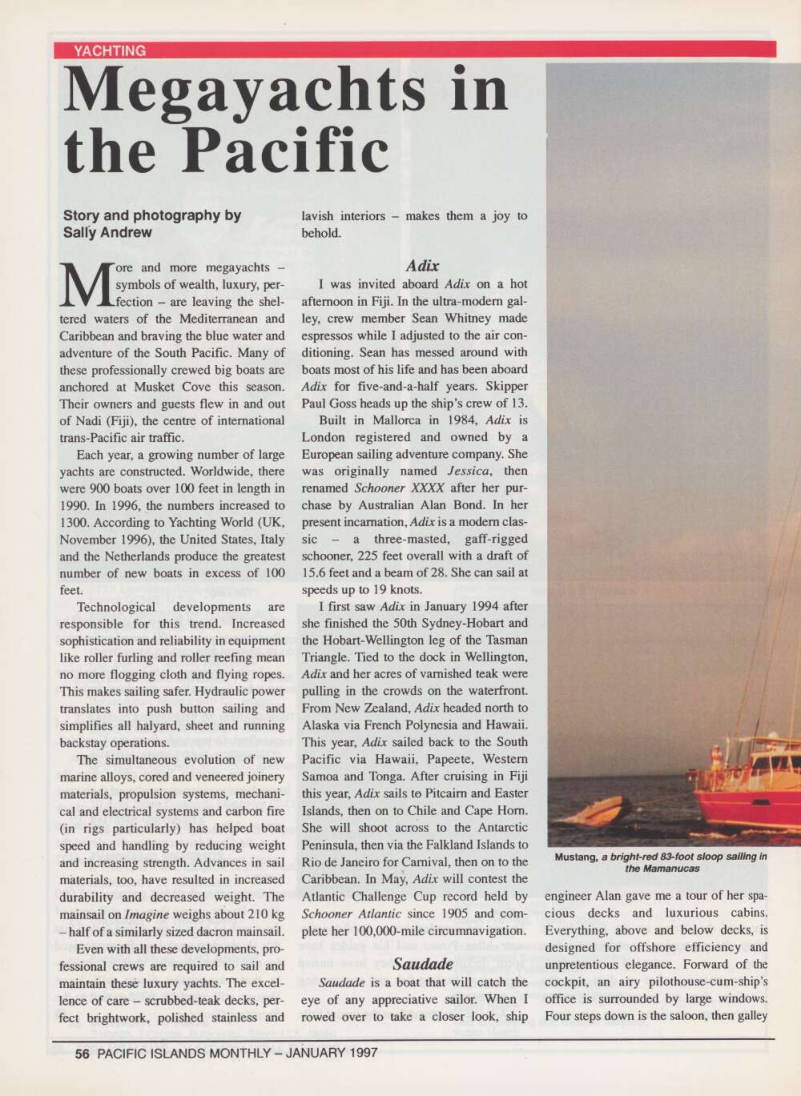
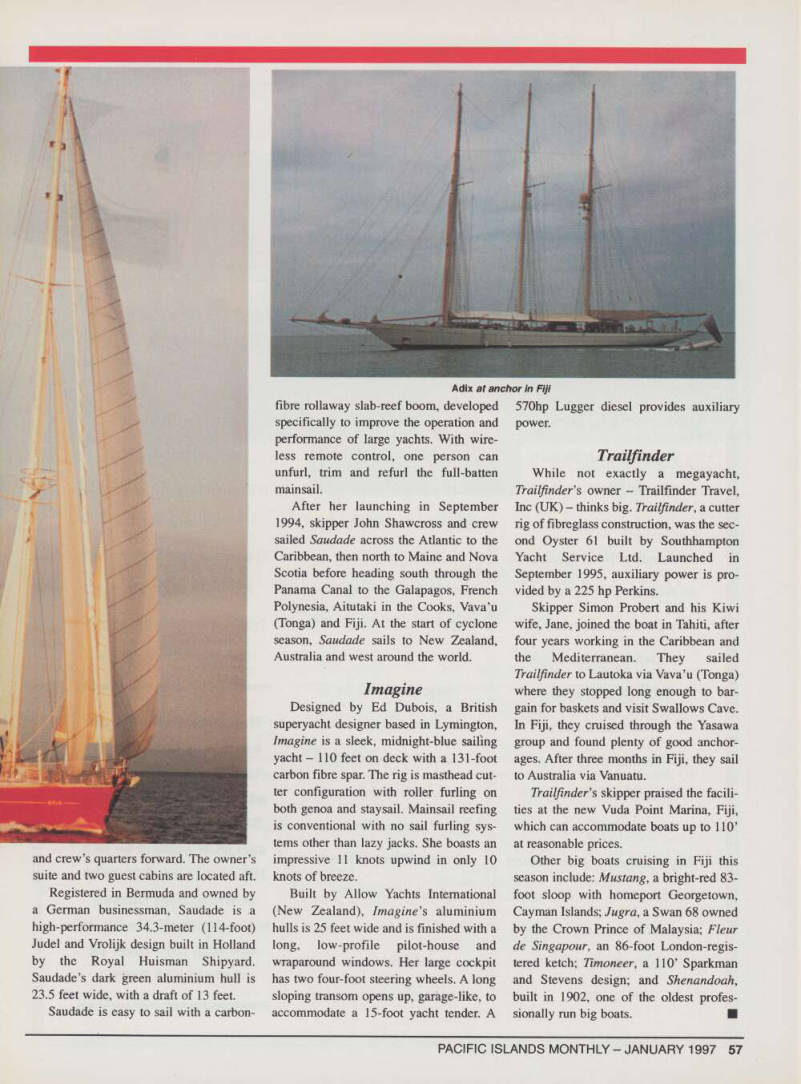
Yachting
Megayachts in the Pacific
Story and photography by
Sally Andrew
More and more megayachts symbols of wealth, luxury, per fection - are leaving the shel tered waters of the Mediterranean and Caribbean and braving the blue water and adventure of the South Pacific. Many of these professionally crewed big boats are anchored at Musket Cove this season.
Their owners and guests flew in and out of Nadi (Fiji), the centre of international trans-Pacific air traffic.
Each year, a growing number of large yachts are constructed. Worldwide, there were 900 boats over 100 feet in length in 1990. In 1996, the numbers increased to 1300. According to Yachting World (UK, November 1996), the United States, Italy and the Netherlands produce the greatest number of new boats in excess of 100 feet.
Technological developments are
responsible for this trend. Increased sophistication and reliability in equipment like roller furling and roller reefing mean no more flogging cloth and flying ropes.
This makes sailing safer. Hydraulic power translates into push button sailing and
simplifies all halyard, sheet and running
backstay operations.
The simultaneous evolution of new marine alloys, cored and veneered joinery materials, propulsion systems, mechani cal and electrical systems and carbon fire
(in rigs particularly) has helped boat
speed and handling by reducing weight
and increasing strength. Advances in sail materials, too, have resulted in increased durability and decreased weight. The mainsail on Imagine weighs about 210 kg - half of a similarly sized dacron mainsail.
Even with all these developments, pro fessional crews are required to sail and maintain these luxury yachts. The excel lence of care - scrubbed-teak decks, per fect brightwork, polished stainless and
lavish interiors - makes them a joy to behold.
Adix I was invited aboard Adix on a hot afternoon in Fiji. In the ultra-modem gal ley, crew member Sean Whitney made espressos while I adjusted to the air con ditioning. Sean has messed around with boats most of his life and has been aboard Adix for five-and-a-half years. Skipper Paul Goss heads up the ship’s crew of 13.
Built in Mallorca in 1984, Adix is London registered and owned by a European sailing adventure company. She was originally named Jessica, then renamed Schooner XXXX after her pur chase by Australian Alan Bond. In her present incarnation, Adix is a modem clas sic - a three-masted, gaff-rigged schooner, 225 feet overall with a draft of 15.6 feet and a beam of 28. She can sail at speeds up to 19 knots.
I first saw Adix in January 1994 after she finished the 50th Sydney-Hobart and the Hobart-Wellington leg of the Tasman Triangle. Tied to the dock in Wellington, Adix and her acres of varnished teak were pulling in the crowds on the waterfront.
From New Zealand, Adix headed north to Alaska via French Polynesia and Hawaii.
This year, Adix sailed back to the South Pacific via Hawaii, Papeete, Western Samoa and Tonga. After cruising in Fiji this year, Adix sails to Pitcairn and Easter Islands, then on to Chile and Cape Horn.
She will shoot across to the Antarctic Peninsula, then via the Falkland Islands to Rio de Janeiro for Carnival, then on to the Caribbean. In May, Adix will contest the
Atlantic Challenge Cup record held by
Schooner Atlantic since 1905 and com
plete her 100,000-mile circumnavigation.
Saudade
Saudade is a boat that will catch the eye of any appreciative sailor. When I rowed over to take a closer look, ship
engineer Alan gave me a tour of her spa cious decks and luxurious cabins.
Everything, above and below decks, is designed for offshore efficiency and unpretentious elegance. Forward of the cockpit, an airy pilothouse-cum-ship’s office is surrounded by large windows.
Four steps down is the saloon, then galley
Mustang, a bright-red 83-foot sloop sailing in the Mamanucas
and crew’s quarters forward. The owner’s suite and two guest cabins are located aft.
Registered in Bermuda and owned by a German businessman, Saudade is a high-performance 34.3-meter (114-foot) Judel and Vrolijk design built in Holland by the Royal Huisman Shipyard.
Saudade’s dark green aluminium hull is 23.5 feet wide, with a draft of 13 feet.
Saudade is easy to sail with a carbon-
fibre rollaway slab-reef boom, developed specifically to improve the operation and performance of large yachts. With wire less remote control, one person can unfurl, trim and refurl the full-batten mainsail.
After her launching in September 1994, skipper John Shawcross and crew sailed Saudade across the Atlantic to the Caribbean, then north to Maine and Nova Scotia before heading south through the Panama Canal to the Galapagos, French Polynesia, Aitutaki in the Cooks, Vava’u (Tonga) and Fiji. At the start of cyclone season, Saudade sails to New Zealand, Australia and west around the world.
Imagine
Designed by Ed Dubois, a British superyacht designer based in Lymington, Imagine is a sleek, midnight-blue sailing yacht - 110 feet on deck with a 131-foot carbon fibre spar. The rig is masthead cut ter configuration with roller furling on both genoa and staysail. Mainsail reefing is conventional with no sail furling sys tems other than lazy jacks. She boasts an impressive 11 knots upwind in only 10 knots of breeze.
Built by Allow Yachts International (New Zealand), Imagine' s aluminium hulls is 25 feet wide and is finished with a long, low-profile pilot-house and wraparound windows. Her large cockpit has two four-foot steering wheels. A long sloping transom opens up, garage-like, to accommodate a 15-foot yacht tender. A
570 hp Lugger diesel provides auxiliary power.
Trailfinder
While not exactly a megayacht, Trailfinder' s owner - Trailfinder Travel, Inc (UK) - thinks big. Trailfinder, a cutter rig of fibreglass construction, was the sec ond Oyster 61 built by Southhampton Yacht Service Ltd. Launched in September 1995, auxiliary power is pro vided by a 225 hp Perkins.
Skipper Simon Probert and his Kiwi wife, Jane, joined the boat in Tahiti, after four years working in the Caribbean and the Mediterranean. They sailed Trailfinder to Lautoka via Vava’u (Tonga) where they stopped long enough to bar gain for baskets and visit Swallows Cave.
In Fiji, they cruised through the Yasawa group and found plenty of good anchor ages. After three months in Fiji, they sail to Australia via Vanuatu.
Trailfinder ’s skipper praised the facili ties at the new Vuda Point Marina, Fiji, which can accommodate boats up to 110’ at reasonable prices.
Other big boats cruising in Fiji this season include; Mustang, a bright-red 83foot sloop with homeport Georgetown, Cayman Islands; Jugra, a Swan 68 owned by the Crown Prince of Malaysia; Fleur de Singapour, an 86-foot London-regis tered ketch; Timoneer, a 110’ Sparkman and Stevens design; and Shenandoah, built in 1902, one of the oldest profes sionally run big boats. ■
Adix at anchor in Fiji
Advertisements & other items, pp. 58-60 (1 item)
solve the mystery!
cO CD CO o lO P CO CO oo CO uo
Help Solve the Mystery!
Pacific Islands Monthly readers are asked to help solve one part of the mystery
surrounding the disappearance
of aviatrix Amelia Earhart in the Central Pacific in 1937.
It involves a piece of pre- World War II aviation aluminium found on
Nikumaroro by a joint
American/I-Kiribati search team. (The leading theory is that her plane landed in the island, and was later swept into the lagoon; see "One Stubborn Gal", PIM Nov, 1994.) The team leader, Richard Gillepsie, says that scientists working with the piece of aluminium (about 20 inches square) determined that it had been exposed to heat in the 300- 400-degree Fahrenheit range; that's too hot to attribute to lying in the tropical sun, and not hot enough to relate to an
airplane fire.
One possibility is that the chunk of aluminium, perhaps tom from her plane, was used next to a cooking fire to reflect heat, perhaps for baking. (Nikumaroro, now uninhabited, was populated from the late 30s to the early 605.) The question is, did I-Kiribati, during the 30s to 60s, use pieces of metal in this way in their cooking.
If you can shed light on this, please write to IWs David North at 3113 N. Kensington St, Arlington, Va; or call hint collect in the US at 1 (703) 241 1724 (calling him before noon Kiribati time); or fax him any time at 1 (703) 241 1209.
7"
Pi. m rU 3 4 - J He knew I Grand Pacific \ would look after
H his family
His bills are covered s% *si mm, V SF>, Ms children will get a good education
She trusted someone local
Grand Pacific Life
She put tier family first
What Would You Like Them To Say About You
After You’re Gone?
Ordinarily, it takes a lifetime to accumulate a fortune. Not with life insurance.
Life insurance is the only sure way to build a legacy - one that will
instantly perpetuate your good
name as a provider and sustain your family’s financial security.
Let us help you choose a plan that meets your goals. © Grand Pacific Life Insurance, Ltd.
A member of the Finance Factors Family American Samoa Mark Solofa Pacific Insurance & Finance, Inc.
Mark Solofa, GA Phone: 684-699-5796 Western Samoa Mark Solofa Pacific Insurance & Finance, Inc.
Mark Solofa, GA Phone: 685-24059 Chuuk State.
Federated States of Micronesia Pacific Basin Insurance & General Services, Inc.
Kachutosy Paulus, GA Phone: 691-330-2606 Guam Great National Insurance Underwriters, Inc.
Domie Bumagat Jr., GA Phone: 671-646-5736 Pacific Financial Corporation Eduardo Camacho, GA Phone: 671-646-1990 Takagi & Associates Pamela Cruz, GA Phone: 671-475-4373 Marshall Islands Marshalls Insurance Agency Jerry Kramer, GA Phone: 692-625-3366 Saipan Pacific Basin Insurance Underwriters, Inc.
Mary Ann Milne, GA Phone: 670-234-7861 Pacific Insurance Underwriters, Inc.
Norman Tenorio, GA Phone: 670-234-6267 Tonga Peseti Ma‘afu Insurance & Finance, Ltd.
Peseti Ma‘afu, GA Phone: 676-24-777
MITSUBISHI’S DOMINANT RECORD OF
1996 RALLY TITLES INCLUDES:
Asia-Pacific Rally Championship for Manufacturers (2nd year in a row)
World Rally Championship for Drivers
World Cup of Production Cars Most Overall Victories (5 of 9 WRC events) The Mitsubishi Lancer obviously has more than just engine power propelling it into the upper class of international rallying. It also has the technological expertise accumulated from years of winning individual events and series championships. We like to think of the Lancer as our research centre on wheels —because only technologies and systems capable of enduring the gruelling conditions of the world's rally circuits are deemed worthy for use in our production cars. Upwardly mobile? Claim the status you deserve. Drive a Lancer.
MITSUBISHI
LRNCER
Experience the Mitsubishi Way
AMERICAN SAMOA: PACIFIC MARKETING INC. P.O. Box 698, Pago Pago, Tel. 699-9140 / AUSTRALIA: MITSUBISHI MOTORS AUSTRALIA LTD. 1284 South Road, Clovelly Park, South Australia, 5042, Tel. (08)2757297 / FUI: NIVIS MOTOR & MACHINERY CO. LTD. G.P.O. Box 150, Suva, Tel. 383411 / GUAM: TRIPLE J ENTERPRISES INC. P.O. Box 6066, Tamuning, Tel. 6469126 / NEW CALEDONIA: SOCIETE D’IMPORTATION D'AUTO DU PACIFIQUE SUD S.A. P.O. Box 2548, NOUMEA, TEL. 272-562 / NEW ZEALAND: MITSUBISHI MOTORS NEW ZEALAND LTD. Private Bag. Porirua, Tel. 237-0109 / NORFOLK ISLAND: BORRYS PTY LTD. P.O. Box 169, Taylors Road, Burnt, Tel. 22114 / PAPUA NEW GUINEA: TOBA MOTORS PTY LTD. P.O. Box 503, Port Moresby / SAIPAN: SAIPAN AUTOWORLD INC.
P.O. Box 487, Tel. 234-7133 / SOLOMON ISLANDS; HARVEST PACIFIC LTD. G.P.O. Box 823, Honiara, Tel. 30407 / TAHITI: SOPADEP S.A. B.P. 1617, Papeete, Tel. 436604 / TONGA: SITANI MAPI CO,. LTD, P.O. Box 83, Nuku’Alofa, Tel. 24044 / VANUATU; SOCOMETRA VANUATU LTD. B.P. 6, Port-Vila, Tel. 2314 / WESTERN SAMOA: MOTOR DISTRIBUTORS (SAMOA) LTD. P.O. Box 576, Apia, Tel. 20957
CREATING TOGETHER
MITSUBISHI
MOTORS