Pacific


Islands
Monthly
: VANUATU SOLDIERS ARRESTED • NAURU'S NEW PRESIDENT
dfdfdfdfdfdfd
PNG's reign terror
A wounded paradise
American Samoa USS2.SO: Australia ASS.SO: Cook Islands NZS3: Fiji F 52.50 Vat ind: FS MicnSesPuSSS; Kiribati A 52,50; Nauru A 52.50; Niue NZS3: NctHolk A»: New Caledo% cpf2so: New Zealand NZ53.45 incl GST: Northern Marianas USS 3: Papua New Guinea K 2.90: Palau USS 3: Marshall Islands US$3; Solomon islands As 3: French PolyneMcpfSOO: Tonga P 3: USA USS 3: Vanuatu VT22O: Western Samoa T 5.50. These are recommended prices only.
Cover; James Ranuku
Advertisements & other items, pp. 2-4 (2 items)
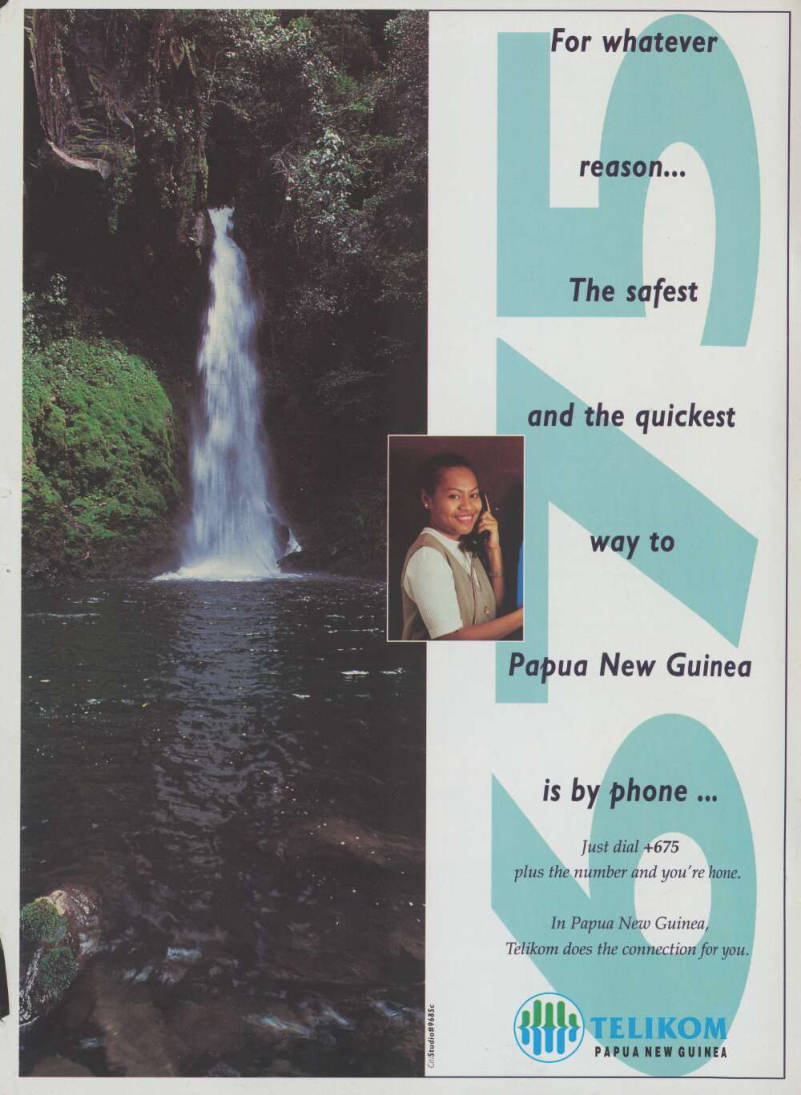
is by phone...
m For whatever reason...
The safest
and the quickest way to Papua New Guinea
is by phone...
Just dial +675 plus the number and you're hone.
In Papua New Guinea, Telikom does the connection for you.
TELIKOM
PAPUA NEW GUINEA
How SPD can help you rid a Salty Dog and share a It’s no Bullsh
|urf, taste
Russian.
f» n i
Carina
wedge of lemon. of lemon M HP niitcd
Pacific
ISLANDS
MONTHLY
Vol. 66 No. 12
THE NEWS MAGAZINE
DECEMBER 1996
stability
Inside
g* COVER: As the incidence of violent crimes increases and allegations are levelled at the Papua New Guinea Defence Force, PNG * w comes under curfew and calls are made for the enforcement of the death penalty
5: Letters 11: Recommendations of the SRC 17: Rocket launch 19: Palau’s presidential race collapses 22: US flag Islands kick around incumbents 24: Govt punishes private media 27; With mad abandon 32: Fiji’s mentally ill 39: Mine blamed for cyanide poisoning 41: Dowiyogo takes over Nauru 43: Putting justice on trial 50: Young, beautiful and with a cause 52: Wan Smolbag’s big influence 54: Feathers and Fanta 57: Halfway round the world
Sport
44; Muddied glory 46: Fatialofa hangs up his boots 48: Hopoate hits the heights
Special Report
Dawn of
stability
In a surprise retaliation on the armed forces and a bid to restore stability, police launch an early morning raid on the Vanuatu Mobile Force arresting soldiers involved in the October abduction of the coun try’s president and acting prime minister
Views
7: David Barber (NZ): Votes of confidence 8: Alfred Sasako (Forum Secretariat): 1996, a year to remember 9: Debbie Singh (The
Spc):
Cutbacks 12: Jemima Garrett (Aust): Peace on Bougainville
Feature
34: Aviation
Advertisements & other items, p. 4 (1 item)
PUBLISHER: Alan Robinson
EDITOR: Manivannan Naidu SENIOR WRITER: Bernadette Hussein
CORRESPONDENTS:
David North, Sam Vulum Ian Williams, Liz Thompson, Atama Raganivatu, Sally Andrew, Patrick Decloitre, Chris Peteru COLUMNISTS: David Barber (Wellington), Jemima Garrett (Sydney), Alfred Sasako (The Forum), Debbie Singh (South Pacific Commission).
GRAPHIC ARTIST: James Ranuku
ADVERTISING SALES
Senior Regional Sales (South Pacific) Shailendra Kumar Emmett Simpson Tel(679) 304111, 303244, Fax (679) 303809.
Sydney, Canberra: Bob Hill Media Representation, Tel (61-2) 4164245, Fax (61-2) 4165064.
Brisbane; Jane Fewings Media and Advertising Associates Tel (61-7) 3378 4522, Fax (61-7) 3878 1071.
Adelaide: Hastwell Williamsons Representatives, Tel (61-8) 3799522, Fax (61-8) 3799735.
Melbourne: Brown Orr Fletcher Burrows (Aust) Pty Ltd.
Tel(61-3) 98265188, Fax(61-3) 98265644.
Auckland: McKay & Bowman, International Media Representatives Limited, Tel (64-9) 4190561, Fax (64-9) 4192243.
Japan: Universal Media Corporation, Tokyo, Tel(3) 3266626741, Cable; UNI-MEDIA Tokyo, Fax (3) 32626742.
Pacific Islands Monthly was founded in
1930 (USPS 9522480).
A Fiji Times Limited production.
Cover prices are recommended retail only. Registered by Australia Post, Publication No. NBP1210. © Copyright Fiji Times Limited, 177 Victoria Parade, Suva, Fiji.
Tel (679) 304111, fax (679) 303809.
Pacific Islands Monthly is published monthly by Fiji Times Limited, a division of Nationwide News, 2 Holt Street, Surry Hills, Sydney, NSW 2010.
SEND ADDRESS CHANGES TO:
Pacific Islands Monthly POBox 1167 Suva, Fiji.
Typeset and printed by The Fiji Times Limited, 177 Victoria Parade, Suva, Fiji.
Conservation
Letters
Conservation and culture
Dear Sir,
While reading the October 1996 issue of PIM, I was attracted by Bernadette Hussein’s story which reported the “slaughter” of turtles as part of the feast to welcome South Pacific Forum leaders to Majuro, Marshall Islands.
The article implied that Pacific Islanders could not be trusted to protect and preserve the resources of their region, such as the turtles, because they would either destroy or eat it.
As an I-Kiribati, and therefore a Pacific Islander, I support every effort to protect and sustain the resources of the Pacific region. However, to suggest that killing several turtles (for a once-in-a lifetime feast) would deplete aquatic rep tile’s population is an overstatement.
I know from experience that the peo ple of Kiribati and the Marshall Islands do not eat turtle-meat every day. The only time turtle-meat will appear on the plate is during feasts or banquets, like the one organised for Forum leaders in Majuro. This means that turtles are rarely hunted for food. People of these small Pacific countries have lived on the islands for centuries and they know what is best for them, including the protection of their environment. They do not need experts to tell them this fact.
The article, at least for me, creates an impression that the turtles are more important than the people who live on these islands. This mentality, of putting animals, fish and other species on a par with people, is becoming prevalent among some people in the so-called advanced countries. I hope that this warped thinking never takes hold among Pacific Islanders.
I believe Pacific Islanders will always be mindful of their heritage and tradition that puts the family and community (that is, the people) first, even before the plight of the turtle, the whale or other species which radical conservationists say should be preserved and protected at all cost.
I suspect that some of the people who seem to care passionately about the turtles will do little or nothing when it comes to helping their fellow men.
I will not be surprised if, at some future date, radical conservationists complain bitterly that Kiribati fishermen are treating the lobster, the tuna and other fish species in a terrible and inhumane manner, and that the people of Kiribati should stop eat ing the fishes. This may sound far fetched, but it can happen if regional magazines like PIM carry a distorted view of what is really going on in the daily lives of people living on small islands.
Timeon loane
Honolulu Hawaii
Dear Sir,
Bernadette Hussein’s report “Food for thought” (PIM Oct, 1996) was
heartbreaking.
Sea turtles are protected by internation al law, a law ignored by the government of the Marshall Islands in the most cruel, bru tal and sadistic way.
Remarks passed in Majuro: “Well, they
are only turtles - whether they die or not, why raise so much concern? There were people in Sarajevo who were dying but no one did anything.”
' Only a mentally retarded ‘human’ could have made such idiotic remarks.
My message to the government of the Marshall Islands: the greatness of a nation and its moral progress can be judged by the way its animals are treated, sea turtles and wildlife on land included.
Inge Mathiesen
Montana
Usa
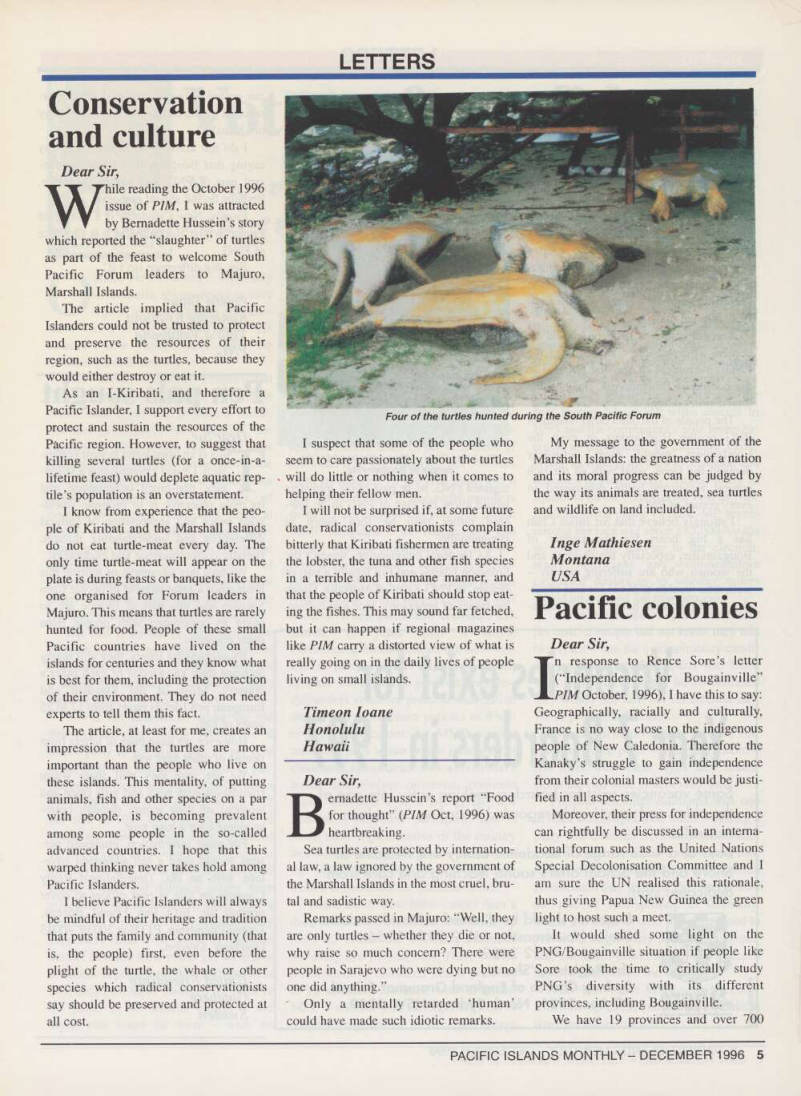
Four of the turtles hunted during the South Pacific Forum
Pacific colonies
Dear Sir,
In response to Renee Sore’s letter
(“Independence for Bougainville”
PIM October, 1996), I have this to say: Geographically, racially and culturally, France is no way close to the indigenous people of New Caledonia. Therefore the Kanaky’s struggle to gain independence from their colonial masters would be justi fied in all aspects.
Moreover, their press for independence can rightfully be discussed in an interna tional forum such as the United Nations Special Decolonisation Committee and I am sure the UN realised this rationale, thus giving Papua New Guinea the green light to host such a meet.
It would shed some light on the PNG/Bougainville situation if people like Sore took the time to critically study PNG’s diversity with its different
provinces, including Bougainville.
We have 19 provinces and over 700
languages in PNG. Despite this diversity
geographically, culturally and racially, we can truly be classed as an integral part of the sovereign state of Papua New Guinea.
The international boundaries have been marked and they should stay that way.
Sore can easily take a shot at our lead ers - past and present - from where he/she is without truly understanding the tasks
and responsibilities required to keep a
nation together given the diversities inter nally. The simple, yet painful, decision to keep Boungainville a part of PNG is first ly an internal matter.
Secondly, such a decision should be seen as a responsible one, in that if the PNG government of the day relented to the people of Bougainville, imagine the
total disintegration.
The people of the other outer islands of PNG or the Highlanders or even the Lowlanders would most definitely demand the same, what with all the rich natural resources being discovered in every comer of PNG.
I strongly believe that Sir Julius Chan has a big heart for the people of Bougainville, especially the children and the women who are suffering silently well, who wouldn’t? If not for fear of set ting a bad precedent hence a totally disin-
tegrated PNG, he or past prime ministers would allow the flag of PNG to be low ered rather than be torn down in
Bougainville.
As for legal colonisation, weren’t the Solomon Islands and Fiji legally a part of Britain, or PNG a part of Australia. Given the issues of geography, race and culture.
our colonial masters realised the impor tance of giving us our independence. Why not Kanaky?
Ido not know what he/she meant by saying that Bougainville’s being an inte gral part of PNG was highly debatable.
Perhaps he/she should elaborate.
Finally, New Caledonia is a colony of France whilst Bougainville is a province of PNG.
Big, big difference isn’t it?
Petero Tapua
Konerigo Kwaluna Vula’a Vanugana
Png
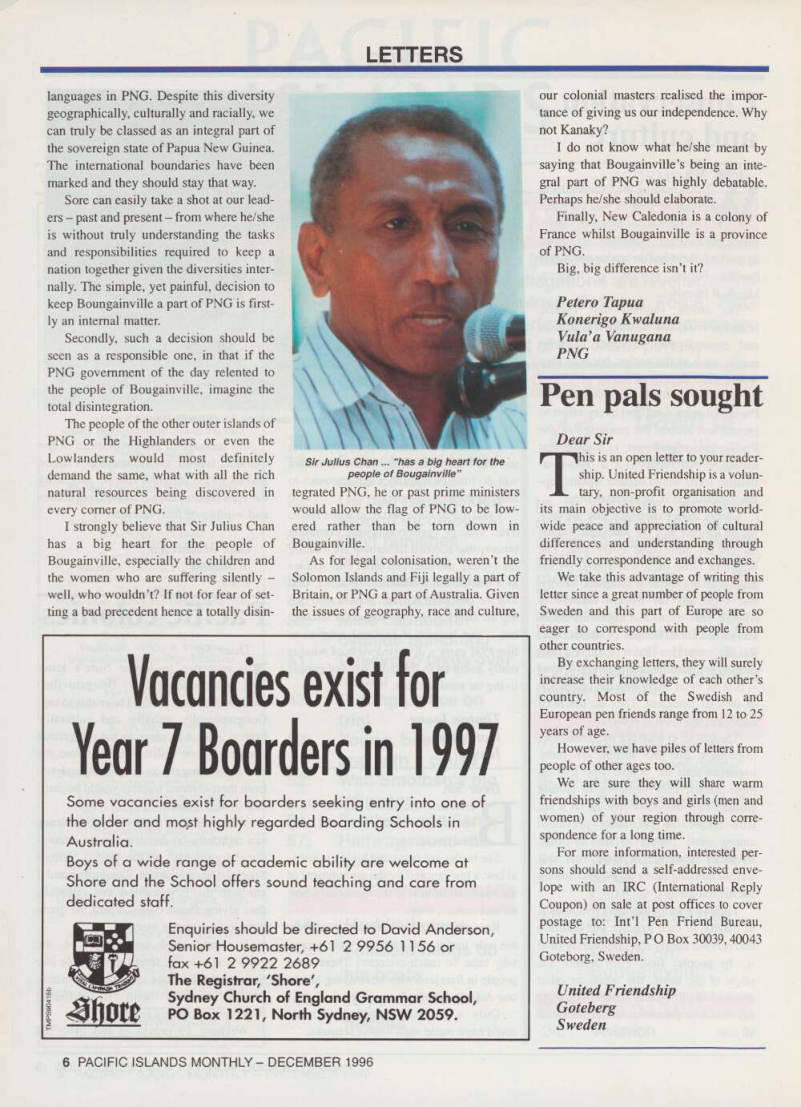
Sir Julius Chan ... “has a big heart for the people of Bougainville’’
Pen pals sought
Dear Sir This is an open letter to your reader ship. United Friendship is a volun
tary, non-profit organisation and
its main objective is to promote world wide peace and appreciation of cultural
differences and understanding through
friendly correspondence and exchanges.
We take this advantage of writing this letter since a great number of people from Sweden and this part of Europe are so eager to correspond with people from other countries.
By exchanging letters, they will surely increase their knowledge of each other’s country. Most of the Swedish and European pen friends range from 12 to 25 years of age.
However, we have piles of letters from people of other ages too.
We are sure they will share warm friendships with boys and girls (men and women) of your region through corre spondence for a long time.
For more information, interested per sons should send a self-addressed enve lope with an IRC (International Reply Coupon) on sale at post offices to cover postage to; Int’l Pen Friend Bureau, United Friendship, P O Box 30039,40043
Goteborg, Sweden.
United Friendship
Goteberg Sweden
Advertisements & other items, p. 6 (1 item)
Vacancies exist for
Year 7 Boarders in 1997
Some vacancies exist for boarders seeking entry into one of the older and mo,st highly regarded Boarding Schools in Australia.
Boys of a wide range of academic ability are welcome at Shore and the School offers sound teaching and care from dedicated staff.
SSKES
Mm Enquiries should be directed to David Anderson, Senior Housemaster, +6l 2 9956 11 56 or fax +6l 2 9922 2689 The Registrar, 'Shore 7 , Sydney Church of England Grammar School, PO Box 1221, North Sydney, NSW 2059.
Votes of confidence
Opinion
New voting system much more representative of New Zealand
Outside New Zealand - especially in Australia, always ready to have a go at its trans-Tasman cousins there was a lot of criticism about this country’s new voting system after the October general election.
The Mixed Member Proportional (MMP) system was a mess, the Aussie critics said. It did not produce a stable, obvious government. New Zealand, the country they like to call The Shaky Isles because it is earthquake prone, had made a big mistake and was now headed for political instability as well. This, of course, overlooked Australia’s political reality, with a senate where a single inde pendent can block government legislation approved by the House of Representatives, and a federal system under which the states have the power to frustrate policies developed in Canberra.
But that is by-the-by. The fact is the election outcome was remarkably close to the essential intention of MMP. It was not a defeat for democracy as some critics liked to paint it: it was a victory.
It was not democratic under the old first-past-the-post voting system for a minor party to get more than 20 per cent of the total vote and only two seats in par liament, as happened to Social Credit in 1981. Or for the NZ Alliance to get 18.2 per cent in 1993 and only two MPs. In 1984, the New Zealand Party garnered 12.25 per cent of the votes and no seats at all. In 1981 and 1993, more than 350,000 Social Credit and Alliance voters were effectively disenfranchised. More than a quarter of a million Nety Zealand Party supporters fared even worse in 1984. In neither case did their voters get the repre sentation in parliament they had sought at the ballot box. MMP changed the rules of the game so the smaller parties - and those who voted for them - were no
longer shut out of the political process.
Without proportional representation. New
Zealand’s parliament would still be domi nated by the two parties. National and Labour, that had shared power between them for the last 58 years.
Although the final result has to be ver ified at the time of writing, October’s his toric election saw the New Zealand First Party get 17 seats in the expanded 120seat parliament from 13 per cent share of the vote. The NZ Alliance got 13 MPs from its reduced 10 per cent share and a new party, ACT NZ, got eight members from 6.1 per cent of the vote. An inbuilt MMP safeguard - the requirement that parties win one electoral seat or five per cent of the total vote - worked as intend ed in preventing a rash of fringe groups with minimal public support entering par liament. When parliament convenes this month, 10 years after a Royal Commission recommended the new sys tem, no party will have an overall majori ty; none will be able to govern alone. New Zealanders voted for political moderation and an end to extremist policies of what ever political colour. An MMP govern ment will have to run on the principles of consensus, compromise and, as National’s leader Jim Bolger observed, common sense. The new system has given New Zealand a new-look parliament that is much more representative of the country as a whole. It is no longer the preserve of the white, middle-aged males who have tended to dominate the political scene.
There are 45 new MPs - more than a third of the total. There are 35 women, up from 20 in the old 99-seat parliament, including two 26-year-olds. There will be a considerably enhanced Maori presence in the debating chamber, with 15 Maori MPs, a number that for the first time is roughly proportional to their percentage
of the population.
And significantly for Pacific Islands Monthly readers, there will be three Pacific Island MPs. Labour’s Mark Gosche, a New Zealand-bom Samoan, and National’s Arthur Anae (of Samoan, Chinese and European descent) have joined Taito Phillip Field, who was the first Pacific Island MP when elected in 1993 and the community’s sole represen tative in parliament. In addition, Pansy Wong, an immigrant bom in Shanghai and educated in Hong Kong, looked likely to squeak in on the National list vote as New Zealand’s first ethnic Chinese MP, repre senting her race and about 185,000 Asians in total. In the lead-up to the election, many politicians and commentators expressed doubts as to whether voters would understand the new process.
At one stage, opinion polls showed 50 per cent of people did not know they had two votes - one for a constituency candi date and the other for a party list. There were fears voters might be so confused they would not turn out on election day.
These proved unfounded.
More than 88 per cent of enrolled vot ers went to the polls - close to a record and there were clear signs they under stood the two-vote system very well.
Political scientists estimated that one in three voters split their votes - casting a party vote different from the political alle giance of their favoured constituency can didate to try to bring about the coalition government they wanted. This was double the rate of vote-splitting in Germany, where the MMP system was developed to prevent a single party like the Nazis get ting unbridled power again and where it has been used since the war.
The voters made MMP work for them.
It is now up to the politicians to make it work for the country. ■
Wellington
David
Barber
1996, a year
to remember
...for more trade opportunities to a nudear-free Pacific
As we bid isa lei (farewell) to 1996, it is probably timely to review the events (or lack of them) in the past 12 months. There is no doubt that events in 1996 have affected all of us one way or the other either as indi viduals, communities or societies, at dif ferent levels. No doubt, these events have helped shape our focus and perceptions.
For many, 1996 has been a great year. It truly was a year to remember for a variety of reasons. Much has been achieved in the course of the 12 months from January this year. At the same time, much remains to be done. It is my sincere belief that the Pacific is where the action and the focus will be in the next century. Indeed, many quarters have acknowledged that the 21st century is, in fact, the Pacific Century.
Our resources remain largely untapped, excepting forestry in some countries, and for this reason, the international scramble is on to get a piece of our Paradise. In some sense, the race has already begun through foreign investment activities in many of our Pacific Island Countries. The question now is how the Pacific fares in the race. For this race is about creating and evenly distributing the wealth from the Pacific’s rich resources, such as fish, minerals, forestry, to all the inhabitants of the thousands of islands dotting the blue waters of the Pacific Ocean. As well, the region’s most invaluable resource - its people - remains largely unused or under utilised. The Pacific, a region covered mostly by water, is very fortunate indeed.
Our being “slow” to get on the bandwag on of development has made us (I hope) wiser. Indeed, what others might consider as “indecisiveness” on the part of policy makers in the Pacific should now be seen for what it is - a blessing in disguise. For we can leant many valuable lessons from the mistakes of others - the mistakes of
rushing for development only to find that developments also bring with them many social ills. The six million or so inhabi tants of the Pacific who make up the eth nic mix - Melanesian, Micronesian and Polynesian - share one thing in common: they adapt better and learn faster by see ing. So, waiting is a blessing in disguise.
Blessing because while others appear to be running out of resources to feed and maintain a living standard, we have hard ly begun extracting our resources. Our resources remain intact. Our fish resource is rich, many of our countries are abun dantly endowed with forestry and mineral deposits, our population is young and vibrant and our environment remains a virgin. That means we, the people of the Pacific, can command premium prices for our products and commodities if we do it together as a region and not as individu als. Indeed, our resources alone make for a region that stands on the verge of mak ing a wave - a big wave - as it approach es the tarmac of the 21st century.
Increasing demands for our commodities should work for us. Not against us. There are, of course, commodities over whose prices we have little or no control. Metal prices are a case in point. But for others, the region has an upper hand. Trade liber alisation has opened unprecedented chal lenges for the Pacific. These challenges can be turned into windows of untold opportunities to enable the region to par ticipate fully and equally on the global market. I have little doubt that the pendu lum is swinging the Pacific region’s way.
So what have all these got to do with a review of 1996? Everything. We can achieve a whole lot of things if we are willing to work together as a region. 1996 was indeed a great year. As a region, the Pacific has made great strides in the past 12 months. Efforts are continuing to
ensure the momentum of co-operation seen in 1996 is maintained or even improved on. The South Pacific Forum has been the driving force behind these efforts.
Through its unwavering stand, nuclear testing in the region has ended. The flag ship of its longstanding anti-nuclear cam paign - the South Pacific Nuclear Free Zone Treaty or the Treaty of Rarotonga has been signed by all but three of its members, along with the known nuclear powers: the United States, France, the United Kingdom, the People’s Republic of China and the former Soviet Union.
The PRC, the former Soviet Union and France have ratified the protocols to the treaty along with the majority of South Pacific Forum member countries.
A scientific team has begun work on the former test sites of Mururoa and Fangataufa gathering data which, among other things, is expected to determine the need or otherwise for long-term environ mental monitoring of the area and perhaps compensation for environmental damage.
The South Pacific Forum is represented on the independent scientific team whose investigation is being funded by the gov ernment of France. On the trade and eco nomic front, another milestone was reached when the government of Japan kindly agreed to finance the establishment of the Pacific Islands Centre in Tokyo.
Officially opened by the Chairman of the South Pacific Forum, President Amata Kabua of the Republic of the Marshall Islands, the centre opened its doors for business on October 1.
Discussions are continuing with the government of the People’s Republic of China and the European Union for similar offices to be set up in both Beijing and Brussels. Talks are also continuing with Taiwan for another office in Taipei. Once
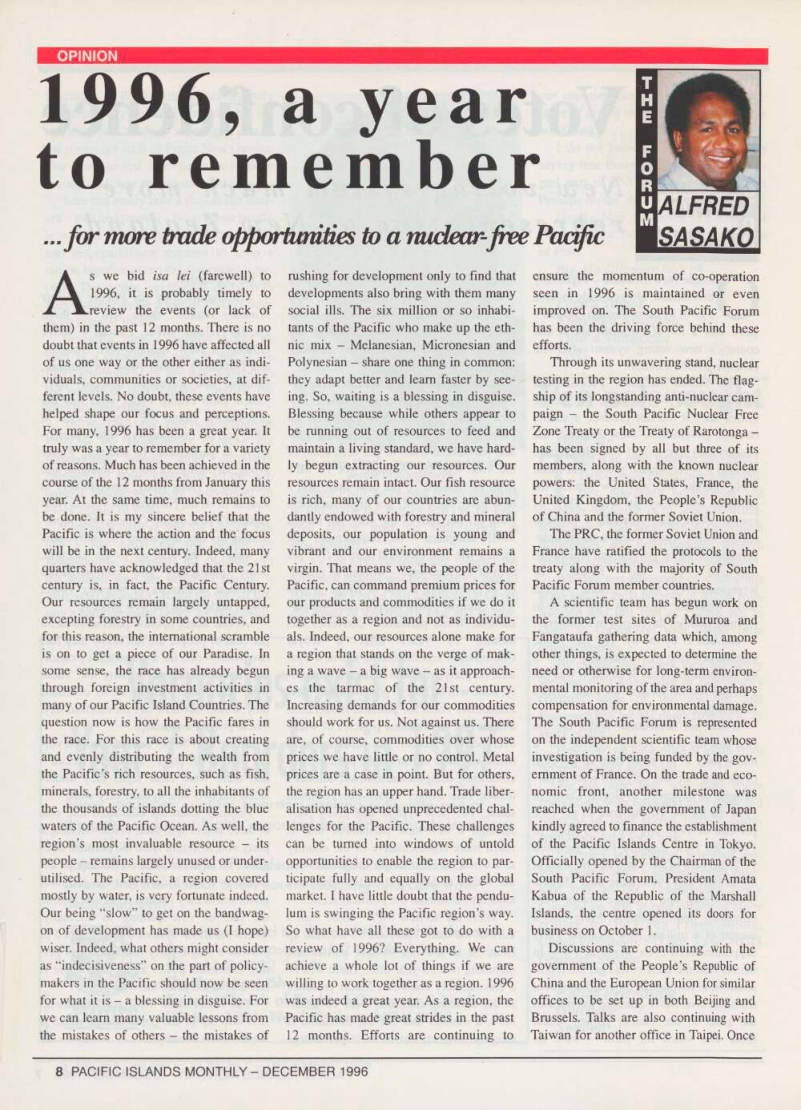
Alfred
Sasako
The Forum
established, these strategic market loca tions should be of tremendous help in exposing the region and what it has to offer in terms of tourism, and trade and investment. In Japan, the Pacific Islands Centre will be a clearing house of sorts for a variety of things. The centre will provide information on investment to potential Japanese businessmen interested in invest ing in any of the 14 Island member coun tries of the South Pacific Forum as well as information for the largely untapped tourism market in Japan. It will help seek out market outlets in the dynamic Japanese market for products from Forum Island Countries (FICs).
These efforts are expected to yield tan gible results for both sides. Many sides have indicated that the Japan-FIC market is one which has largely remained untapped. While only time will tell, it appears the opening of the Pacific Islands Centre in Tokyo has provided the missing link for developing a two-way dynamic market between Japan and its Pacific
Island neighbours. Adding Beijing,
Brussels and Taipei to the Pacific region’s trade and investment map will no doubt add new meaning and dimension to the time-forgotten lifestyle to which we have all been so accustomed. So, in a nutshell, 1996 has been a great year. Our co-opera tive approach has paid off. We now need to build on these successes. Global changes which continue to sweep the world no longer leave room for individual adventure. The world has been region alised, geographically and politically almost as well as on the trade front. It seems there is no hope for anyone trying to do it alone. It is true that we know more about the world today than ever before.
But that knowledge should make us a lot wiser in that teamwork pays handsome dividends. Those who try to do it alone always end up on the wayside. I have no doubt that the future for the Pacific region is bright. How much the region will claim and actually receive from the global eco nomic cake depends largely on our will
ingness to work together.
The future is truly here. How we live it depends on the effort we put into it at home, in our community and the regional level. Have a blessed Christmas and a prosperous 1997. ■
Debbie
Cutbacks
Recommendations come alive
Pacific Island government delegates
have now put away the relevant documents and ended their discus sions on the programmes of the South Pacific Commission (SPC) - for the next six or so months at least.
Yes, yet another meeting of the SPC’s Committee of Representatives of Governments and Administrations (CRGA) has passed and, being the end of year, so has another South Pacific Conference.
To background things and unravel any confusion one may have after reading the above paragraph - the SPC holds two CRGA meetings each year - in May and around October/November.
The second CRGA meeting is followed by the SPC conference which usually runs for the final two days following the three day CRGA.
This year’s meetings were hosted by Saipan, Commonwealth of the Northern Mariana Islands (CNMI), and those “priv ileged” enough to attend (depending on whether or not one would feel privileged to work 15 hours a day while resisting the temptation to throw themselves of Saipan’s “Suicide Cliff’) reported only praise for the logistics of the conference and the hospitality of the host country.
In fact, things were so well organised that SPC’s chief editor who felt poorly on opening day opened her hotel room door to police officers and the fire brigade at 7am when she reported her state of health to the local organising committee.
And the close attention to detail did not stop there. After gently sending the police and fire people on their way, chief editor found herself attending to yet another knock on her door.
This time it was a group of uniformed ambulance personnel who thought she
needed their services because they assumed she was having a heart attack.
Again, not so. The diligent staff member was only having a small bout of influenza - nonetheless, one can only marvel at the Saipanese attention to detail.
And so to the business at hand. This year’s annual CRGA and conference debated, among administrative and fund ing matters, the 33 recommendations fol lowing a review of the Commission con ducted by a three-member team led by Savenaca Siwatibau of the Economic and Social Commission for Asia and the Pacific’s (ESCAP) Pacific Operations Centre in Vanuatu.
SPC Director of Services Lourdes Pangelinan (now deputy Director-General following endorsement of the title change by the conference) said the conference basically endorsed through consensus most of the review’s major recommenda tions, placing reservations on only a few.
Among the recommendations were downsizing the SPC from the top through: • reducing the organisation’s three management posts to two;
• changing the Secretary-General’s
and his/her deputies’ titles to Director- General and deputy Director-Generals; • allowing the conference to appoint the Director-General based on strict selection criteria; • giving the Director-General full responsibility and authority to manage the organisation and be totally account able for any failure to meet the organi
sation’s objectives;
• staging one CRGA meeting each year with the conference taking place every two years, as opposed to its cur rent annual basis; • introducing a two-term limitation for the posts of Secretary-General and
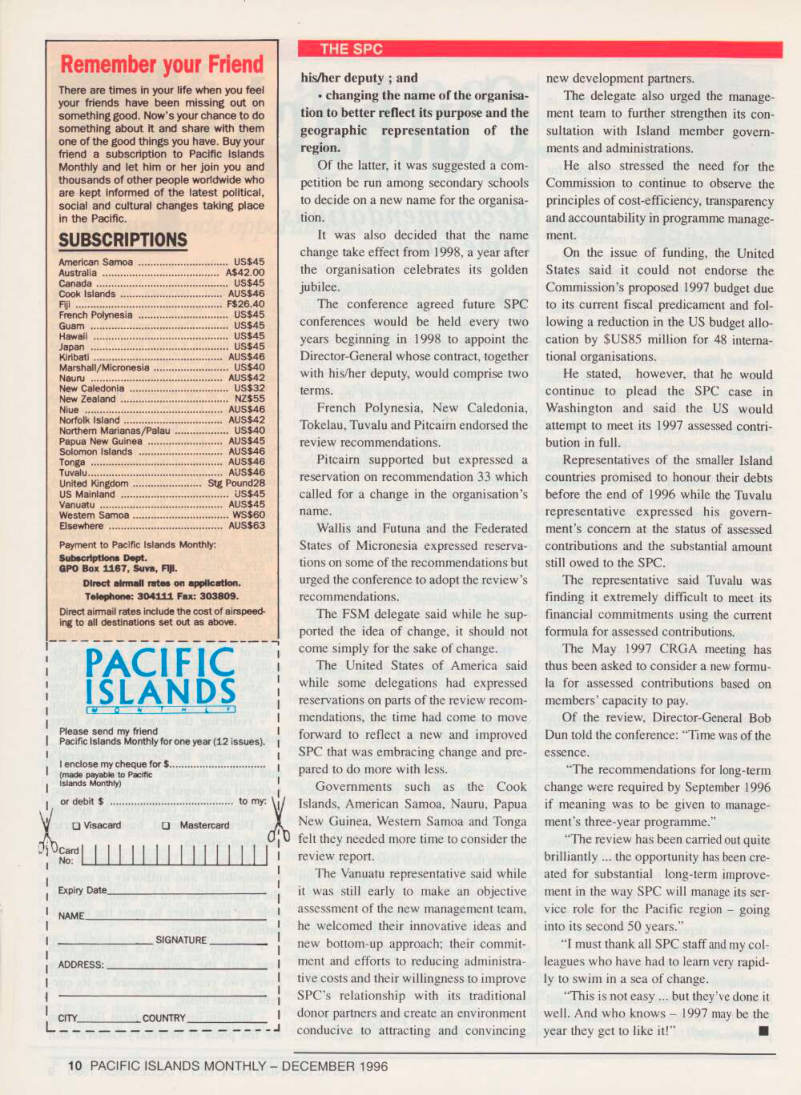
Debbie
Singh
The Spc
his/her deputy ; and • changing the name of the organisa tion to better reflect its purpose and the
geographic representation of the
region.
Of the latter, it was suggested a com petition be run among secondary schools to decide on a new name for the organisa tion.
It was also decided that the name change take effect from 1998, a year after the organisation celebrates its golden
jubilee.
The conference agreed future SPC conferences would be held every two years beginning in 1998 to appoint the Director-General whose contract, together with his/her deputy, would comprise two terms.
French Polynesia, New Caledonia, Tokelau, Tuvalu and Pitcairn endorsed the review recommendations.
Pitcairn supported but expressed a reservation on recommendation 33 which called for a change in the organisation’s name.
Wallis and Futuna and the Federated States of Micronesia expressed reserva tions on some of the recommendations but urged the conference to adopt the review’s recommendations.
The FSM delegate said while he sup ported the idea of change, it should not come simply for the sake of change.
The United States of America said while some delegations had expressed reservations on parts of the review recom mendations, the time had come to move forward to reflect a new and improved SPC that was embracing change and pre pared to do more with less.
Governments such as the Cook Islands, American Samoa, Nauru, Papua New Guinea, Western Samoa and Tonga felt they needed more time to consider the review report.
The Vanuatu representative said while it was still early to make an objective assessment of the new management team, he welcomed their innovative ideas and new bottom-up approach; their commit ment and efforts to reducing administra tive costs and their willingness to improve SPC’s relationship with its traditional donor partners and create an environment conducive to attracting and convincing
new development partners.
The delegate also urged the manage ment team to further strengthen its con sultation with Island member govern ments and administrations.
He also stressed the need for the Commission to continue to observe the
principles of cost-efficiency, transparency
and accountability in programme manage ment.
On the issue of funding, the United States said it could not endorse the Commission’s proposed 1997 budget due to its current fiscal predicament and fol lowing a reduction in the US budget allo cation by SUSBS million for 48 interna
tional organisations.
He stated, however, that he would continue to plead the SPC case in Washington and said the US would attempt to meet its 1997 assessed contri bution in full.
Representatives of the smaller Island countries promised to honour their debts before the end of 1996 while the Tuvalu representative expressed his govern ment’s concern at the status of assessed contributions and the substantial amount still owed to the SPC.
The representative said Tuvalu was finding it extremely difficult to meet its financial commitments using the current formula for assessed contributions.
The May 1997 CRGA meeting has thus been asked to consider a new formu la for assessed contributions based on members’ capacity to pay.
Of the review, Director-General Bob Dun told the conference; “Time was of the essence.
“The recommendations for long-term change were required by September 1996 if meaning was to be given to manage ment’s three-year programme.”
“The review has been carried out quite brilliantly ... the opportunity has been cre ated for substantial long-term improve ment in the way SPC will manage its ser vice role for the Pacific region - going into its second 50 years.”
“I must thank all SPC staff and my col leagues who have had to learn very rapid ly to swim in a sea of change.
“This is not easy ... but they’ve done it well. And who knows - 1997 may be the year they get to like it!” ■
Advertisements & other items, p. 10 (1 item)
Pacific
Remember your Friend
There are times in your life when you feel your friends have been missing out on something good. Now’s your chance to do something about it and share with them one of the good things you have. Buy your friend a subscription to Pacific Islands Monthly and let him or her join you and thousands of other people worldwide who are kept informed of the latest political, social and cultural changes taking place in the Pacific.
SUBSCRIPTIONS
American Samoa US$45 Australia A 542.00 Canada US$45 Cook Islands AUSS46 Fiji F 526.40 French Polynesia US$45 Guam US$45 Hawaii US$45 Japan US$45 Kiribati AUSS46 Marshall/Micronesia US$4O Nauru AUSS42 New Caledonia US$32 New Zealand NZ$55 Niue AUSS46 Norfolk Island AUSS42 Northern Marianas/Palau US$4O Papua New Guinea AUSS4S Solomon Islands AUSS46 Tonga AUSS46 Tuvalu AUSS46 United Kingdom Stg Pound2B US Mainland US$45 Vanuatu AUSS4S Western Samoa WS$6O Elsewhere AUSS63 Payment to Pacific Islands Monthly: Subscriptions Dept.
GPO Box 1167, Suva, Fiji.
Direct airmail rates on application.
Telephone: 304111 Fax: 303809.
Direct airmail rates include the cost of airspeeding to all destinations set out as above.
PACIFIC
ISLANDS
m~ 0~~ w 1 X L r Please send my friend Pacific Islands Monthly for one year (12 issues).
I enclose my cheque for $. (made payable to Pacific Islands Monthly) or debit $ to my: □ Visacard □ Mastercard -'Card No: Expiry Date
NAME
SIGNATURE
ADDRESS:
COUNTRY
J
Recommendations of the 36th South Pacific Conference
The 36th conference of the South Pacific Commission has approved recommendations to downsize the organisation. Delegates endorsed most of the recommendations from a review of the commission conducted by a three member team led by Savenaca Siwatibau of the Economic and Social Commission for Asia and the Pacific (ESCAP).
The downsizing will begin at the top with a reduction in the number of mange ment posts from three to two and the number of deputies from two to one. The secretary-general and his deputies have had their titles changed to director-gener al and deputy director-generals respec tively. The director-general will assume full responsibility and authority over the organisation within the guidelines of established policy. The conference will now appoint the director-general based on strict criteria. The director-general and deputy will serve two-year terms.
The established management commit tee will be abolished since it is no longer seen as necessary. The committee had a supervisory role over all commission matters.lt was agreed that the annual SPC conference be held every two years, and the Committee of Representatives of Governments and Administrations (CRGA) meet once instead of twice a year.
The CRGA will at its annual meetings approve administration and work pro gramme budgets, approve amendments for financial and staff regulations, con duct annual performance evaluations of the director-general and consider appli cants for the post of director-general.
The Agriculture, Community
Education Training Centre and Regional Media Centre programmes and the administration in Suva, Fiji, will be brought under one division and become a sub-regional office of the SPC operating under the provisional title of Suva
Operations.
Other resolutions included that: • The laws governing SPC operations be contained in existing staff and finan cial Regulations. If the conference wishes to change its laws, the appropriate process is to change the regulations to reflect its decision. • The secretariat shall update and
revise the commission’s current staff rules and administrative directives shall become more transparent in management responsibility and more consistent with
the proposed restructured relationship
between the conference/CRGA and the
director-general.
• The organisational structure shall have a senior management of the director general, one deputy director-general and three directors for Marine Resource
Development, Suva based-operations and
Socio-Economic Development and Health. • In its widening focus, the SPC shall be guided by general criteria to ensure that the new programmes will be in the best interest of the region, be sufficiently funded and fall within its mandate. • The SPC’s technical meetings/work shops are excellent fora for expert advice to the commission in the preparation of its programme, but they should remain advi sory units and should not be treated as standing committees. The director-gener al may convene them as and when the need arises and when financial resources allow. • The SPC should establish a specific Small Island States fund which will pro vide technical assistance, training and other services as required by SPC’s small Island members. Island member coun tries, traditional and non-traditional donors are to be invited to contribute to the corpus of the fund on a continuing basis. • Programme heads shall be given greater delegation of authority to approve expenditures based on budgetary alloca tions. This will also mean making deci sion related to travel and programme
developments and personnel matters.
• The commission shall establish clear guidelines on what contributes core fund ing. These guidelines should make the
core budget inflation-proof.
• The current formula for core contri butions should be re-examined to reflect the principle of burden sharing. In proposing alternative formulas, the con ference and management should consider special grants by SPC host governments.
Pacific Island countries’ and territories’ share based on capacity to pay, more equi table distribution among donor members
with a review of this every three years. • The current practice of ‘user-pays’ by some programmes (such as Regional Media Centre) and the sharing of some programme costs for services provided to member governments should continue. • All Island member countries and ter ritories shall be eligible for funding for participation in SPC meets, but may pay their own way if they so wish. • SPC’s approach to the preparation of its work programme should feature a con tinuous pipeline of integrated projects over a three-year period. To assure fund ing, these should reflect prioritised needs of member governments, be well integrat ed, be full costed, well packaged and meet the prescribed format requirement of donors. • For new projects which come with funds but which are not already included in the total approved work programme budget, the director-general shall have the authority to vary the programme budget within a limit of 20 per cent of the approved budget. • The secretariat shall transfer the cur rent handling of individual staff accounts from the Finance Office back to individu als. For the SPC Provident Fund, SPC staff and management shall jointly exam ine, with great caution, staff’s request for independent management and extension of long-term loans from the Provident Fund. • The SPC procurement process shall be strengthened by updating policies and administrative directives. • The mandate of the Publications Committee shall be enhanced to include monitoring the quality of the content of and decisions on publications. • The revenue-generating practice of the Interpretation and Translation Unit should be encouraged, as long as it does not adversely affect the organisation’s required needs for its services. • The SPC central library facility should be adequately resourced to proper ly serve SPC technical programme divi sions. • To better reflect its purpose and geo graphic representation, the name “South Pacific Commission” should be changed, to take effect in 1988 when the organisa tion enters its 51 st year of existence. ■
what hopes are there?

Peace on Bougainville... what hopes are there?
Just imagine for a minute if Bougainville were to be given its independence today. The Papua New Guinea Defence Force (PNGDF) would withdraw leaving a mass of conflicting groups and gun-toting young men with grudges to slog it out. In the north of the island ethnic tensions could easily erupt into violence. Elsewhere, the secessionist Bougainville Revolutionary Army (BRA) would attack members of the pro-PNG resistance, who are also well armed.
All over the island rascals who once had links with some political leadership (either pro- or anti-BRA) would exploit the many and varied animosities that have been thrown up or accentuated by this war.
Without a political settlement the thou sands of ordinary Bougainvilleans who have watched their homeland tom apart and suffered as relatives died in the con flict or of deprivation brought on by the war, would find the peace they so urgently desire more elusive than ever.
What can also be seen from this vision is just how difficult it will be to secure the peace in real life. Not only is a political settlement needed between the main actors but each community needs to heal its divi sions, draw in violent elements and stop the never-ending cycle of payback. That is why Theodore Miriung, the premier of the Bougainville Transitional Government (BTG) who was assassinated on October 12, was so important. In 1994, after Prime Minister Sir Julius Chan won office and called for a negotiated settlement to the then six-year-old war on Bougainville, Miriung emerged from behind the BRA lines with a vision of how that settlement could be achieved. A lawyer, former National Court judge and a widely respected traditional elder, Miriung want ed to place more emphasis on the role of the chiefs and to form a new moderate
political force based around a proposal for a Bougainville which would remain part of PNG but with a special status and much greater autonomy. He planned to do that by working to build the peace on a clan by-clan, village-by-village level.
Sir Julius responded with one of his most inspired decisions. He established the(BTG) which was to become the vehi cle for Miriung’s peace efforts. Miriung was ideally placed to lead the BTG. He was from the North Nasioi language group which provided most of the BRA leader ship and he commanded their respect. His legal background meant he would be taken seriously in Port Moresby and his status as a traditional elder made it possible for him to talk with chiefs from across the province. Now Miriung has gone, what are the prospects for peace?
An all-out military offensive (as is advocated by Opposition Leader Roy Yaki) has been tried on a number of occa sions most recently in Operation High Speed 2, an offensive which, like previous military offensives, was a complete fiasco for the PNGDF resulting only in casualties and ignominious defeat. Although this option remains attractive to those in Port Moresby desperate to bring a speedy con clusion to the war, it fails to take account of the terrain on Bougainville and the multi-faceted nature of the problem. Both of these elements make all-out war a solu tion which cannot work. In many ways, the activities of the PNGDF are as much part of the problem as they are solution.
The PNGDF has been heavily implicated in the murder of Miriung. Just prior to that it was the activities of the security forces drug-taking, loutish behaviour and harass ment of Bougainvillean women - which resulted in the deaths of 11 of their num ber during the massacre at Kangu Beach.
The success of that raid was caused by
members of the Bougainvillean resistance teaming up with the BRA to get their own back on the PNGDF. That raid has also left the BRA much better armed with the com mander of BRA military operations, Sam Kaona, claiming that captured mortars, bombs, weapons, explosives and mines had equipped the BRA to go on fighting for “five, six or even seven more years”.
These events, and the attack on Kaona by the PNGDF when he was returning from peace talks in Australia last December, have left Port Moresby’s standing on the island at an all-time low.
Now more than ever, a Bougainvillean initiated solution to the war is likely to be the only one which would be viable.
Ironically, it is only after Miriung’s death that many in Port Moresby have reached the conclusion that he was a genuine force for peace, a man of integrity and not a double dealer who was really working with the BRA’s interests at heart.
Miriung’s plan had been to use the BTG to draw in all but the most extreme elements around a proposal for more autonomy.
The planning and rebuilding of shat tered infrastructure would provide work for young men (either resistance or BRA) who were persuaded to lay their arms as well as getting the economy going and allowing those Bougainvilleans who are still harvesting crops to get their produce to market. To prevent those steeped in blood from continuing to cause problems after a formal settlement was agreed, Miriung proposed an as yet undefined amnesty for war crimes.
Miriung’s vision did not win full sup port in Port Moresby, Sir Julius had agreed to allow him to work on a political solu tion but did not give the BTG enough resources to be able to find useful employ ment for the young men or stop the PNGDF harassing Miriung and restricting
Jemima
Garrett
Aystralia
his movement around the island. While the BRA leaders trusted Miriung, they may not trust the new BTG.
Perhaps the best way to honour Miriung’s memory is to ensure that the pro cess he set in motion gets the support it needs to bear fruit. That may take much more time than anticipated. Miriung him self had hoped for some concrete progress by the middle of 1997 when PNG goes to the polls but he readily acknowledged a solution may take as long again as the con flict to win genuine consensus.
Without Miriung’s particular back
ground and skills the remaining members of the BTG will need more freedom to pur sue talks with all sides in the dispute and more support given without strings
attached by Port Moresby.
Obviously, the PNGDF needs to take strong action to solve its problems with indiscipline but at the same time it could look to some of the unsung heroes within its own ranks for solutions. In the wake of Sir Julius’ 1994 ceasefire with the BRA, a number of PNGDF officers on
Bougainville successfully played a support
ive role to Bougainvilleans involved in local peace and reconstruction initiatives.
For soldiers trained to fight, playing this backstage role in a complex political envi ronment is a new and difficult task but, given the example of the few, not an impos sible one. ■
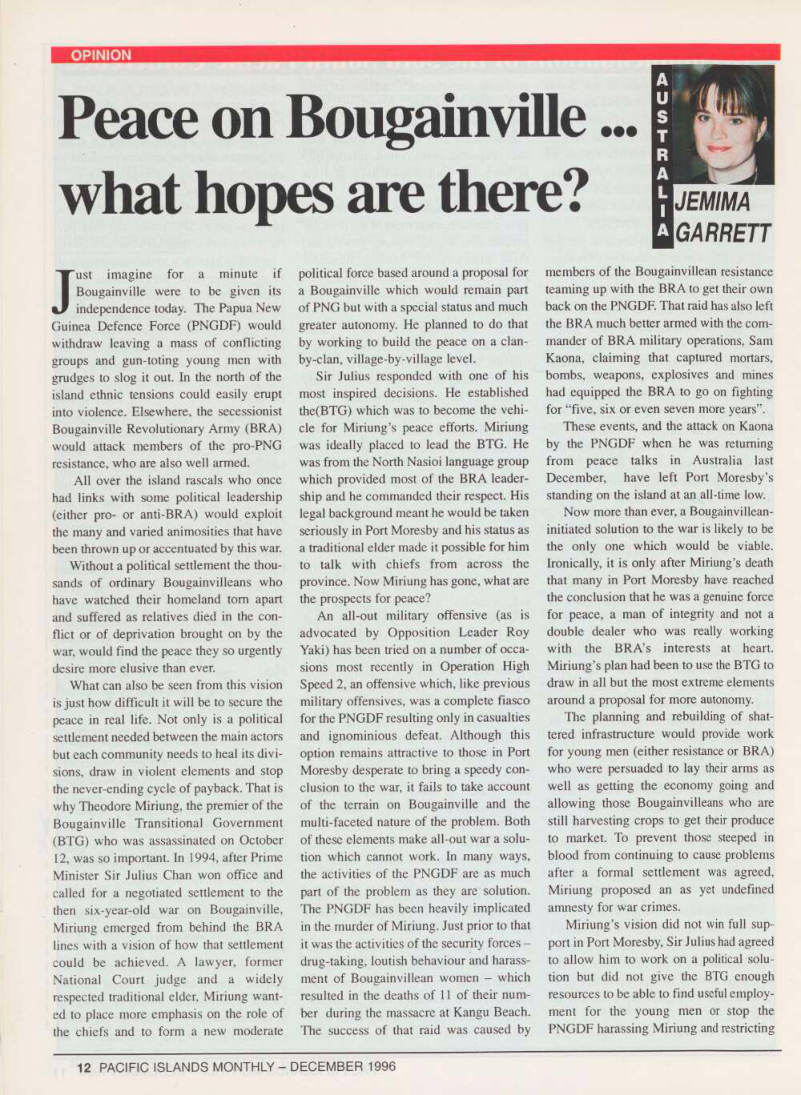
Assassinated Bougainville Premier Theodore Miriung... ideally placed to lead the BTG Picture: Sam Vulum
country
Cover Stories
Cry,
the beloved country
Papua New Guinea faces reign of bloody terror, ; tough economic times blamed
The rage of crime-related violence and terror, which Papua New Guinea has unfortunately been known for, has once again hit centre-stage following the recent spate of brutal killings-especially in the nation’s capital, Port Moresby.
The raw facts of the situation were laid bare with the slaying of four youths on October 27, the hacking to death of Kutubu businessman Henry Natto Kapi, the gunning down of a security guard, a high school student and a woman and the assassination of Bougainville Premier Theodore Miriung - all days apart.
Reports by Sam Vulum
The vicious execution of the four youths is Port Moresby’s most gruesome mass murder case in a long while.
The massacre, which occurred on Dogura beach near the city, stemmed from an alleged stabbing incident at a fundraising dance at the Gerehu suburb.
Three of the youths escaped from the killers to tell of their night of terror when their four friends were murdered. The dis membered bodies of the four were found by police after their friends raised the alarm.
About a week later, just as people were beginning to breathe a little easier, a branch of the Westpac bank in Waigani suburb was robbed.
The thieves were about to escape in a waiting vehicle when police intercept ed.
They fled and police gave chase.
More than 400 police officers were called in with helicopter back-up as a they descended on the gang in the hills I near a settlement.
They exchanged fire with the gang I and a grenade was hurled at the police I in a two-hour battle that left two of the I thieves dead and three police wounded. Two other gangsters were critically
wounded. 1
The grim reality of the situation was driven home with statistics released by Police Commissioner Bob Nenta on November 6. Police recorded 875 serious offences throughout the country and only 398 arrests in October. Of the total num ber of criminal acts committed, 370 ser tious offences occurred in the National Capital District and surrounding areas with only 152 arrests, according to the statistics.
The Highlands region recorded the second highest with 212 serious offences and 119 arrests. In the same month, there were 107 reports of vehicle thefts of which 87 were committed in Port Moresby and its surrounds.
Members of the public, including the business community, churches and politi cians, have been drawing attention to the situation but the government continued to dismiss such calls.
Prime Minister Sir Julius Chan threat-
ened to summon the editor of a daily newspaper before parliament for high lighting the impending crime problem in an editorial comment. Sir Julius again told Goroka business leaders in late October that the country’s law and order problem was no worse than that in most other countries. He said it was a matter of per
spective.
“I am sometimes cynically amused by those who recoil in self-righteous horror at what takes place here,” he said. Sir Julius said that some critics seemed to very conveniently overlook the social degradation so evident in neighbouring countries and those countries held up as examples in “civilised behaviour”.
“We do not indulge in psychotic killings of Port Arthur or Dunblane, we are not involved in the murders by parents of their own babies, poison gasses ... and we have not bombed our churches and desecrated our cemeteries,” he said.
However, the government’s position
has changed in the face of recent events.
But while the government continues to blame the crime on unemployment and urbanisation, there is another stream of thought which believes the current situa tion is a result of people’s frustrations and anger over the country’s tough economic times. Contrary to what experts are say ing, many perceive the situation today as no different from what it was in 1994, fol lowing the devaluation of the kina and its
subsequent floatation.
People are finding it extremely diffi
cult to survive in towns and cities because of the escalating cost of living.
And those hardest hit are low income earners as, apparently, their wages do not correspond with the sharp increases.
The result is that most of them, who live in squatter settlements, cannot afford to meet the needs of their house holds which average seven to eight members. These difficulties force the young to venture into illegal activities.
Some settlements have become so dangerous that even police hesitate to enter them.
There have been incidents of gun bat j ties between the police and criminals in these settlements, many of which have s become hide-outs for criminals, who are protected because the settlements bene fit from their illegal activities.
More beggars, once usually only the disabled, are seen and prostitution is becoming more prevalent. Port Moresby police on October 24 raided a suspected brothel in the East Boroko suburb of the city and arrested more than 40 men and women for alleged prostitution. Nineteen of the women, aged between 17 and 35, were later fined between K5O (SUS3S) and K2OO (SUSI4O) by a district court
after they pleaded guilty to prostitution
charges. Others pleaded not guilty while the youngest of the group, a 17-year-old, was referred to the children’s court.
Most of them told the court that they turned to prostitution because they had been unemployed, had children in schools and had no family to support them.
And in a rare but desperate cash deal, a woman, facing extreme difficulty look ing after her older children, gave away her newborn to a couple for a mere K3OO
(Sus2I2). ■
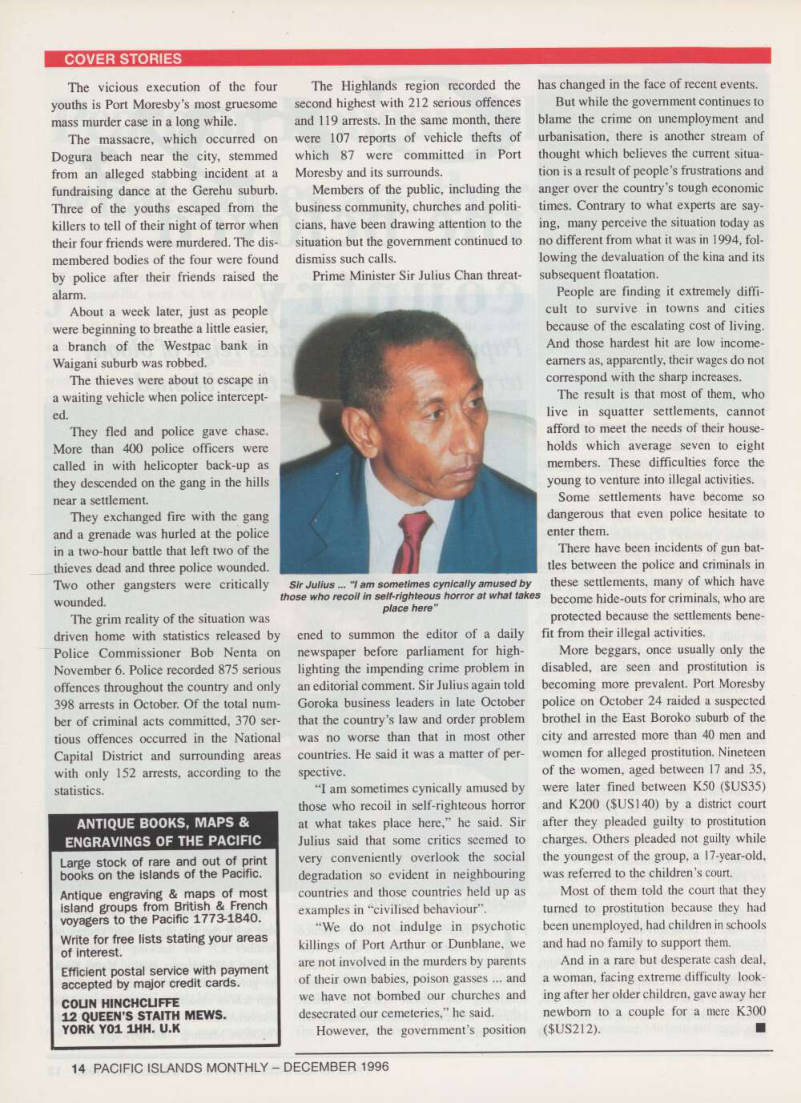
Sir Julius... "I am sometimes cynically amused by those who recoil in self-righteous horror at what takes place here”
Advertisements & other items, p. 14 (1 item)
Antique Books, Maps &
ENGRAVINGS OF THE PACIFIC
Large stock of rare and out of print books on the islands of the Pacific.
Antique engraving & maps of most island groups from British & French voyagers to the Pacific 1773-1840.
Write for free lists stating your areas of interest.
Efficient postal service with payment accepted by major credit cards.
COUN HINCHCUFFE
12 QUEEN’S STAITH MEWS.
YORK YOIIHH. U.K
Sex, drugs, armed robbery and murder
Alleged assassination plot and accusations of misconduct loom over PNGDF
The image of the
Papua New Guinea Defence Force is probably at its lowest in
years following allegations
linking a former soldier to a gang involved in the recent
Westpac bank robbery and
a subsequent shoot-out with
police in Port Moresby.
There have been allega tions that a hand grenade hurled at police by crimi nals during the two-hour pitch battle was of defence force issue.
But force’s commander, Brigadier General Jerry
Singirok, has strongly
denied any part in the inci dent.
Among the negative publicity the PNGDF is being subjected to is the alleged involvement of defence force personnel in the assassination of
Bougainville Transitional
Government Premier Theodore Miriung and the findings of an internal
investigation into the September 8 Kangu massacre.
The findings of the report provide an unfavourable assessment of the force’s chain of command and have highlighted serious disciplinary problems with many of those responsible for the men in the Bougainville operation.
While the truth behind Miriung’s mur der is yet to be known, allegations (as reported in Pacific Islands Monthly, October) implicated defence force sol diers in the killing.
The PNG government has secured the services of a retired Sri Lankan judge to head the coronial inquest into Miriung’s death. Justice Thirunavukkarasu Sutheralingam was nominated by Commonwealth Secretary-General Emeka Anyaoku.
Prime Minister Sir Julius Chan formal-
ly welcomed Justice Sutheralingam at a luncheon held in his honour at Parliament House on November 11. Kosi Latu, a Pacific Islands lawyer of Tongan-Samoan background representing the Commonwealth Secretariat, will assist Justice Sutheralingam in the inquiry.
Government’s decision not to release the full report on the Kangu massacre has only added fuel to speculation, with even soldiers in Bougainville publicly raising concern over the issue.
There has been a growing sense of suspicion that the government is trying to
hide something.
Contingent Commander of the Security Forces on Bougainville Lieutenant Colonel Tokam Kanene has urged the government to allow journalists the opportunity to accurately report what is happening.
“The investigation into the Kangu incident was conducted by a senior and experienced officer. Sadly though, what we believe is lacking is the feeling of empathy. One has to serve in the infantry battalion to find out and experience the hardships of life in the foxhole. Everybody working on Bougainville deserves a little praise,”
Col Kanene said.
The investigation has placed the blame for the massacre squarely on the shoulders of the com manding officer and troops of Delta Company.
It alleged evidence of drug abuse, intoxication through home-brews, and sexual unions with local women, which are said to have caused friction with resistance force members.
The report said the mas sacre resulted from “retal iation resulting from anger, hatred and frustra
tion” over the treatment of resistance force members.
It said many soldiers were playing vol leyball with residents at the Kangu care centre on the fateful day. Many of their weapons had been “carried” by resistance fighters who later acquired all the weapons. Soldiers trying to retaliate were gunned down by resistance men with their own weapons, the report said.
Meanwhile, three more soldiers were killed and efforts were continuing for the release of five soldiers in Buin captured during the Kangu massacre and three oth ers held hostage in the Siara area.
The first soldier, Corporal Joe Gareits, was gunned down on November 7 by the Bougainville Revolutionary Army. The two other soldiers were killed on November 11 in a rebel ambush in Arawa town. ■
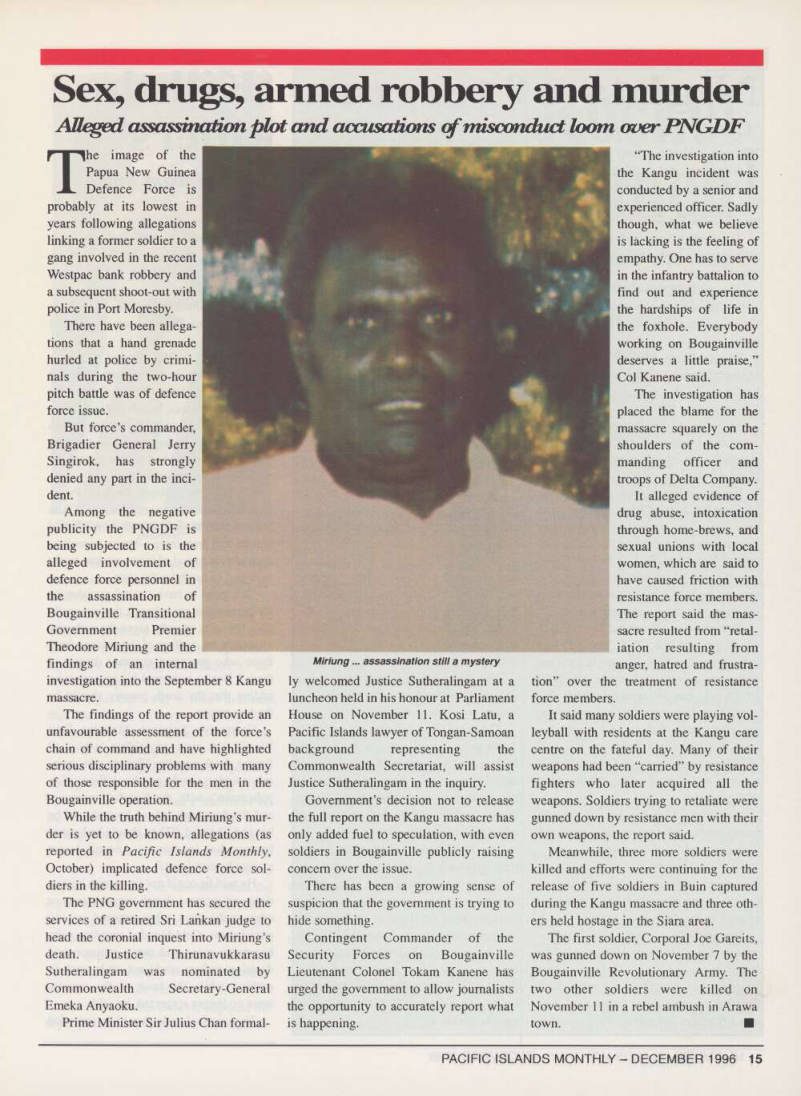
Miriung... assassination still a mystery
Nights of terror
Curfews provide respite
It was a relief for many terror-gripped town and city residents nationwide
following the government’s imposi
tion of a two-month curfew - which became effective on November 8.
The 9pm-to-spm curfew targets spe cific areas which the police consider crime infested.
The curfew, approved by a special
cabinet meeting on November 5, is part of the government’s moves to curb the rising crime.
Deputy Prime Minister and Finance Minister Chris Haiveta presented K 2 mil
lion (SUSI. 4 million) to Police
Commissioner Bob Nenta on November 7 for police to implement the curfew.
Another K 1 million ($US700,000) will be released for the operations in the
Highlands region.
While announcing the curfew, Prime Minister Sir Julius Chan said police had been compiling statistics and mapping known criminal localities in certain sub urbs of Port Moresby, Lae and Mt Hagen over the past 10 months, identifying areas topping the list for stolen vehicles, break ing-in and entering, rape and murder.
The statistics and general data, collect ed as part of the 1996 Year of Law Enforcement, were to be used in a nation wide campaign to curb crime, declaring an all-out war on criminals from this month until after the 1997 election. But the launch date had to be brought for ward, Sir Julius said, following the spate of killings in the National Capital District recently and general crime in other parts of the country.
Sir Julius said police were to get ade quate funds, manpower and equipment, including night-vision apparatus.
The government has also drawn up long-term measures which include a review of procedures relating to the issue of arms in the disciplined forces.
Immediately after Sir Julius’ announcement. Defence Minister Mathias Ijape instructed PNG Defence Force Commander Brigadier General Jerry Singirok to carry out a major stock-take of all firearms and ammunition issued to
soldiers in an effort to create a proper inventory of dangerous arms. The move was in direct response to concerns expressed by various groups that many government-issued weapons were in the hands of criminals.
Sir Julius expressed his concern over speculations that soldiers had been sup plying weapons to criminals.
“In light of these serious allegations levelled against the defence force, I have instructed the commander to take a stock take of all weapons issued to the members of the force,” Ijape said.
The government had earlier moved to amend the Firearms Act to bring the pre sent growth of illegally controlled weapons to a halt. Sir Julius said the pro posed amendments to the act would short ly be made available to parliament.
The proposed amendments seek to bring in stiff penalties for the illegal man ufacture or assistance in the manufacture of firearms.
Further, a moratorium on the issue of new firearms will be in place for three years at the discretion of the Minister for Police - no dealers’ licences will be issued, existing licences will be revoked and high-powered firearms will eventual
ly be phased out.
The move is in line with a common approach by South Pacific countries to control weapons in the region.
The issue was brought up at June’s Trobriand Island meeting of the Melanesian Spearhead Group and arose out of concern over the growing threat to the security in the region posed by the illegal import, ownership and use of weapons - especially guns.
The MSG had agreed to take a com mon approach to weapons control and sought the co-operation of other forum members, which was readily given. The seriousness of the threat is evident in the increasing use of guns in organised crime and as a means for individuals and groups to resolve grievances against each other, thereby taking the law into their own hands and adding to PNG’s problems of violent crimes. ■
killers’
' Kill the killers’
Leaders want blood
Calls for the enforcement of the contentious death penalty have been reignited in Papua New Guinea as a result of the country’s law and order problem.
Although the death penalty has been in place for years, it has been carried out only once.
In early 1995, Justice Theresa Doherty, sitting in Popondetta National Court, sentenced one Charles Ombusu to death after he was found guilty of rape and murder. However, the sentence was overridden by a Supreme Court ruling that Ombusu’s trial had not been conduct ed according to procedure.
Leading the debate. Deputy Prime Minister and Finance Minister Chris Haiveta said those guilty of premeditated murder and presenting a danger to society, even after a period of incarceration, ought to be put to death by the state.
“It’s good to have capital punishment for crimes that are heinous, that are really bad. The state must be given the authority to protect the welfare of the citizens from those who present a constant danger to them.” But he tempered his argument by adding that the death penalty should be the last option.
Corrective Services Minister Paul Wanjik was more unyielding in his call for the death penalty. “People who com mit murders such as the killing of a policeman’s wife, the Kutubu landowner and the four high school boys should be hanged,” he said. “They should be hanged because they are animals. Animals do not respect human lives.”
He said he could not agree with human rights advocates, church organisations or other politicians who opposed capital punishment. Cold-blooded murders were becoming more and more common and decision-makers could not sit by and do nothing while the laws of the country were no longer respected, he said.
The criminal code should be amended
to provide the death penalty for people convicted of armed robbery as well, the minister said.
Sir Michael Somare on November 12 took the judiciary to task over what he said was misinterpretation of legislators’ intentions, especially in relation to the
death penalty.
He urged that a way be found to ensure that the death penalty - or any law imposed by the parliament - be made
“mandatory or compulsory”.
The veteran politician was speaking during a heated debate following Prime Minister Sir Julius Chan’s statement on the curfew introduced on November 8.
Expressing concern over the killing of four young men at Dogura Beach in October, which triggered moves to impose the curfew, he said that when the legislators had introduced the death penal ty for specific offences, their intentions had been clear.
He explained their intention was that anyone who wilfully murdered another should be killed as well.
But when Justice Doherty imposed the death penalty in Popondetta, the Supreme
Court overruled the decision, he said. The legal system was too flexible, he said, adding that this was a result of “re-bom thinking” and too much missionary influ ence.
He said the judiciary was too lenient.
Sir Michael said that jailing people was not a successful deterrent to violent crime,
suggesting that prisoners actually wel
comed the free food and shelter.
“What type of justice is this?” he
asked, pointing to people mourning the
loss of loved ones.
Even the legal system supported the criminals as young police prosecutors or witnesses were often pitted against the highly trained minds and extensive legal knowledge of lawyers defending crimi nals, Sir Michael said.
He called for a review of the legal sys tem with more power given to the police.
Sinasina-Yongamugl MP Ben Okorro, who supported Sir Michael’s comments on the death penalty, also expressed con cern about some settlement dwellers who, he said, lived off loot from the robberies.
Meanwhile, one of the many meetings held in response to the recent crime situa tion called for the enforcement of the Vagrancy Act so movement of people could be monitored.
A senior police officer told the meeting that there were too many rights, with peo ple being allowed to interfere with other
people’s rights.
Superintendent Jeffery Vaki said: “We are becoming like Rwanda with too many
displaced people.
“We have so much land and resources and yet we all gather in the city. People live in a dignified manner in the villages where they have everything and yet they come here and live in a filthy environ ment.”
National Capital District Governor Bill Skate said cabinet may consider legislat ing bringing in an identification card sys tem to restrict movement into the National Capital District with the possibility of repatriating those unemployed for more than 10 years.
He suggested transport companies such as Air Niugini be the checkpoints for the ID card system by handing out forms for community leaders to sign, stating the reason for a person’s travel. ■
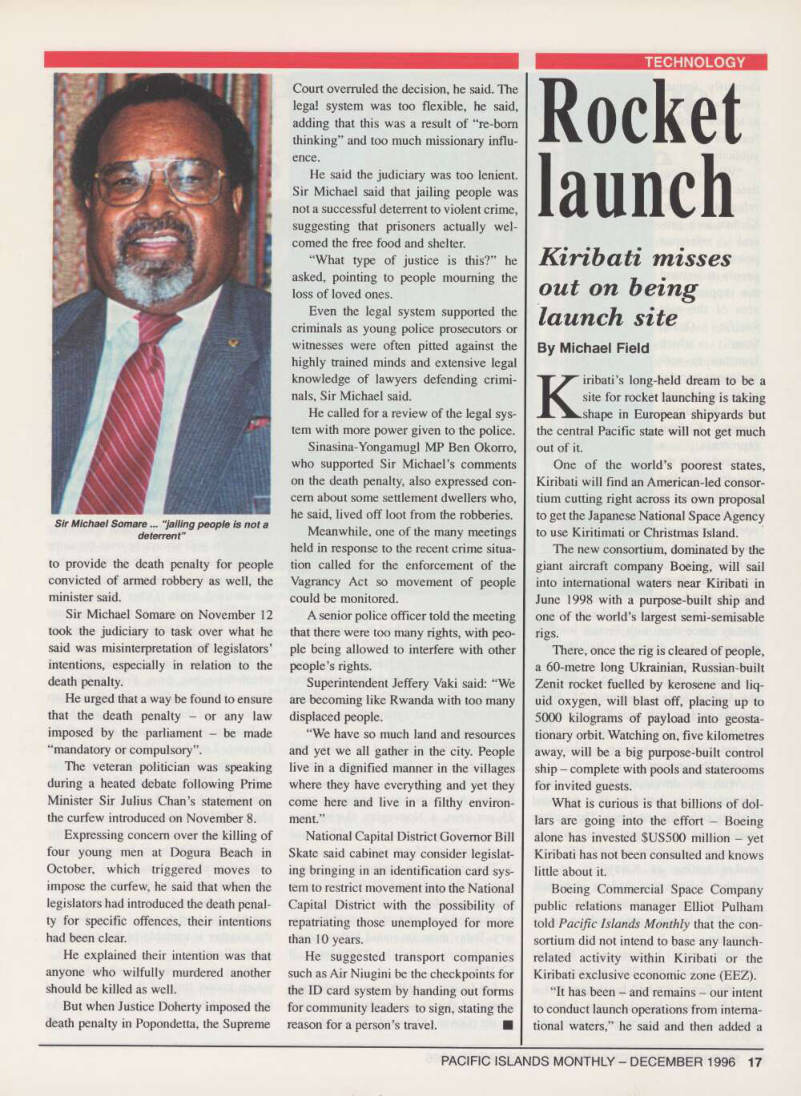
Sir Michael Somare ... “jailing people is not a deterrent”
launch

Technology
Rocket launch
Kiribati misses out on being launch site
By Michael Field
Kiribati’s long-held dream to be a site for rocket launching is taking shape in European shipyards but the central Pacific state will not get much out of it.
One of the world’s poorest states, Kiribati will find an American-led consor tium cutting right across its own proposal to get the Japanese National Space Agency to use Kiritimati or Christmas Island.
The new consortium, dominated by the giant aircraft company Boeing, will sail into international waters near Kiribati in June 1998 with a purpose-built ship and one of the world’s largest semi-semisable
rigs.
There, once the rig is cleared of people, a 60-metre long Ukrainian, Russian-built Zenit rocket fuelled by kerosene and liq uid oxygen, will blast off, placing up to 5000 kilograms of payload into geosta tionary orbit. Watching on, five kilometres away, will be a big purpose-built control ship - complete with pools and staterooms for invited guests.
What is curious is that billions of dol lars are going into the effort - Boeing alone has invested SUSSOO million - yet Kiribati has not been consulted and knows little about it.
Boeing Commercial Space Company
public relations manager Elliot Pulham told Pacific Islands Monthly that the con sortium did not intend to base any launch related activity within Kiribati or the Kiribati exclusive economic zone (EEZ).
“It has been - and remains - our intent to conduct launch operations from interna tional waters,” he said and then added a
curiously impre cise explanation as to how Kiribati features in their publicity.
“We have from time to time referred to Kiribati as a gen eral reference point in helping people understand the approximate area of the vast Pacific Ocean from which launches to geo stationary transfer orbit would take place. In relative terms, Kiribati represents a ‘somewhere in the vicinity’ familiar landfall, but in real terms we will operate from well outside the FEZ.”
Christmas got its name from James Cook in
December 1777 and has had a chequered history since then with French interests followed by disputed British and American claims.
Between 1957 and 1962 Britain and the United States conducted 25 atmo spheric nuclear tests over Kiribati, in the process blinding millions upon millions of sea birds and leaving a legacy of strange place names.
With the development of aviation, Kiritimati was slotted in as a potential
fuelling point for seaplanes. The nuclear
tests bought it a big runway but it was the US space programme and the US Army rocket testing at Kwajalein in the Marshall Islands that made it important.
Secret tracking stations were put there and in 1977 the Japanese put a tracking station there too.
With this background, Kiribati President Teburoro Tito recently told Pacific Report he had big hopes that it would become a launching site. It is also being used to resettle people from crowd-
ed Tarawa and with 48 per cent of all the available land in Kiribati, Kiritimati has a
population of 3000 people.
Sea Launch, as the Boeing-led consor tium is called, will not use Kiritimati, but will instead be on the Equator, southeast of the atoll - and apparently in interna tional waters.
The company, formed in April 1995 and operating from Long Beach, California, is 40 per cent owned by Boeing. A Russian space company owns 25 per cent, a Norwegian shipbuilding company 20 per cent and the Ukrainian space company 15 per cent.
The company is aiming to pick up a share of the estimated SUSSO billion in satellite manufacturing and launch activi ty projected through to the turn of the cen tury. Today there are round 155 commer cial satellites in orbit, by 2000 plans call for 1000.
Sea Launch’s 30,000-ton assembly and command ship is now under construction in the Govan Shipyard, Scotland. The
launch pad started life as an oil rig and is
being modified in Rosenburg Shipyards
in Norway. It will have an empty dis placement of 31,000 tons and a sub merged displacement of 46,000 tons.
Work began on the Long Beach base in August this year.
The Russian-supplied rockets will be assembled inside the command ship before being lifted onto the command
platform for remote firing.
Already Hughes Space and
Communications, which makes about half of the world’s satellites, has signed on for 10 launches with the first being the inau gural Sea Launch mission in June 1998. It is expected to spend SUSI billion in the
effort. Space Systems/Loral, another
satellite builder, has also announced an order for five launches.
Boeing says Kiribati provides the greatest benefit of earth’s rotational forces to enable maximum performance the Sea Launch rocket. Most of the satellites it will launch will be going into geostation ary orbits which ensure that a satellite’s speed matches that of the earth’s, meaning the satellite will always be over the same spot. The advantage Kiribati offers is that a rocket needs little manoeuvring to reach the desired orbit. Other launch sites involve “kick motors” to move them into the right orbit and they can fail, with very
expensive consequences.
Arianespace, the European company which launches from French Guiana, charges SUSSS million a launch and has 70 per cent of the business. Its launch site at Kourou is five degrees north of the Equator. Lockheed Martin used Atlas rockets from the Kennedy Space Centre in Florida, USA, and charged SUSSO mil lion a launch. Sea Launch says it will charge SUS4O million.
Sea Launch has an advantage in the Zenit rockets which are proven. Its only payload rival, the French built Ariane 5, has failed on its solitary launch.
Few of the land sites at the Equator are suitable for launch sites, either because the weather is unstable or the country is
politically risky.
What is not clear is what Kiribati, which knows little of it, will get out of this. Could be all they get is a fireworks show. ■
collapses... with bridge

Politics
Palau’s Presidential race collapses... with bridge
By David North
Palau’s presidential race
was shaping up as a tight, two-way contest between the well-financed incumbent, Kuniwo Nakamura, and a strong chal
lenger, Johnson Toribiong, a
well-heeled attorney who had the support not only of his politically powerful uncle, Roman Tmetuchel, but also of the Islands’ ranking tradi tional leader, High Chief Ibedul Yutaka Gibbons.
In the September primary
race, Nakamura had garnered 4641 votes to Toribiong’s 2968 and Gibbons’ 1255.
Toribiong heads the largest opposition party in the Islands - The Palau Nationalist Party. On September 26, he and Gibbons signed a pact committing Gibbons to throw his support behind the challenger in the November general election.
On paper, at least, that put Toribiong only a few hundred votes behind Nakamura.
Later that same day, Toribiong was handed an Island-wide issue that could seriously undermine his opponent: Palau’s K-B bridge - the Islands’ major commer cial artery and key to its economic devel opment plans - collapsed, killing two and injuring several others.
Nakamura’s administration, which had recently completed SUS 3.2 million in repairs to the bridge, had touted the work as a major achievement. But news reports began to point strongly at the repair work as the cause of the collapse. Nakamura’s administration had signed off on a risky fusing of the structure’s independent can tilevers to correct a sag in the middle of the span. That may have changed the dynamics of the bridge and created pres-
sures it was not designed to han dle.
The 800-foot
reinforced concrete structure, which was dedicated in 1978 and cost SUSS million to build, lost all 450 feet of over-the-water span in the collapse. It had linked the bustling capital of Koror with Babeldaob, the largest (151 sq miles) and least devel
oped of Palau’s major islands. Major
water, power, and telephone utility lines from Babeldaob to Koro were lost in the disaster. Palau’s international airport, in southern Babeldaob, was cut off from the tourism and government sectors on Koror.
Nakamura was forced to declare a State of National Emergency and call for international help from the United States,
Japan, and other Asia-Pacific nations.
“That bridge was the backbone of our economy, the water, the power, the tele vision, the transportation all rolled into one,” Toribiong said. “When that thing snapped, it broke our backbone. It will take years for us to recover.”
When Nakamura was forced to cancel the October 1 celebration of the Islands’ second anniversary of its independence, Toribiong could not resist commenting.
“When there’s no water and the power is limited and you haven’t taken a bath, abstract concepts [such as indepen dence] become meaningless,” said
Toribiong.
“One becomes very primitive. People are hauling water and things like that.
We are in no mood to celebrate our sec ond year of independence.”
Toribiong latched on to the “faulty fix” issue, lashing out at Nakamura’s administra tion for “jeopardising” the Islands’ future, and calling for the resignation of the public works officials responsible for signing-off on the repair deal.
Toribiong told Palau’s electorate that if he had been in charge of the government that committed such an act, honour would dic tate that he resign.
Unfortunately for Toribiong,
that’s where the come-from-behind sce nario abruptly ended. A few weeks after his initial attack, it came to light that Toribiong’s running mate, Kione Isechal, who had been a Nakamura appointee before joining Toribiong’s campaign, was one of the top officials who had approved of the controversial repair project.
In an unprecedented move, Toribiong announced on October 7 that he was with drawing from the race. He said his deci sion was based mainly on the primary results “which speak loud and clear”.
“President Nakamura received the vote of confidence of the majority of our peo-
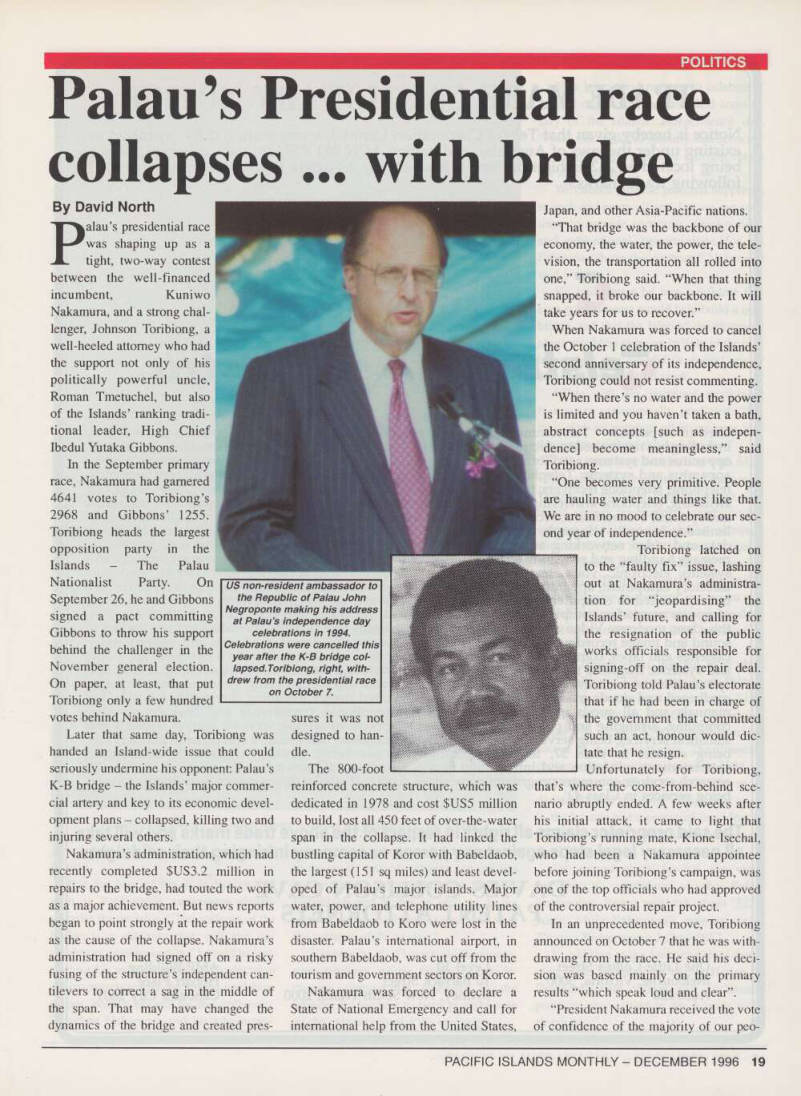
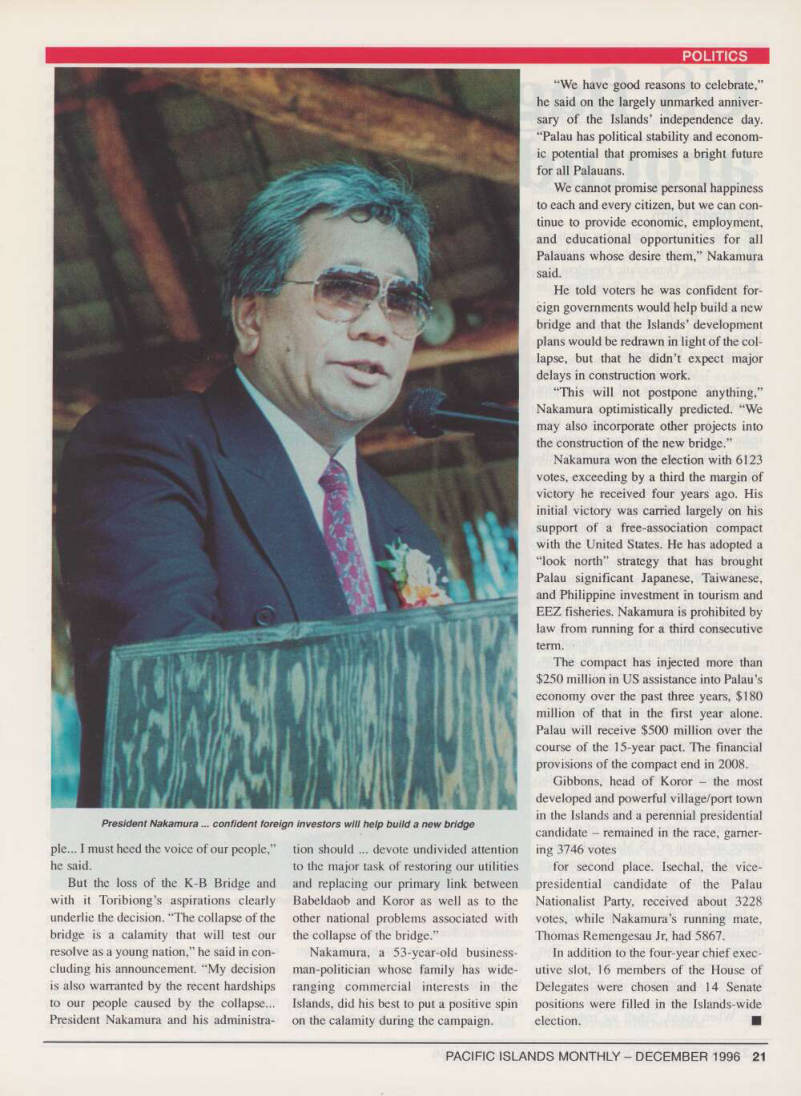
US non-resident ambassador to the Republic of Palau John Negroponte making his address at Palau’s independence day celebrations in 1994.
Celebrations were cancelled this year after the K-B bridge col lapsed.Toribiong, right, with drew from the presidential race on October 7.
pie... I must heed the voice of our people,” he said.
But the loss of the K B Bridge and
with it Toribiong’s aspirations clearly
underlie the decision. “The collapse of the bridge is a calamity that will test our resolve as a young nation,” he said in con cluding his announcement. “My decision is also warranted by the recent hardships to our people caused by the collapse...
President Nakamura and his administra
tion should ... devote undivided attention to the major task of restoring our utilities and replacing our primary link between Babeldaob and Koror as well as to the other national problems associated with the collapse of the bridge.”
Nakamura, a 53-year-old business man-politician whose family has wide ranging commercial interests in the Islands, did his best to put a positive spin on the calamity during the campaign.
“We have good reasons to celebrate,” he said on the largely unmarked anniver sary of the Islands’ independence day.
“Palau has political stability and econom ic potential that promises a bright future for all Palauans.
We cannot promise personal happiness
to each and every citizen, but we can con tinue to provide economic, employment, and educational opportunities for all Palauans whose desire them,” Nakamura said.
He told voters he was confident for eign governments would help build a new bridge and that the Islands’ development plans would be redrawn in light of the col lapse, but that he didn’t expect major delays in construction work.
“This will not postpone anything,”
Nakamura optimistically predicted. “We may also incorporate other projects into the construction of the new bridge.”
Nakamura won the election with 6123 votes, exceeding by a third the margin of victory he received four years ago. His initial victory was carried largely on his support of a free-association compact with the United States. He has adopted a “look north” strategy that has brought
Palau significant Japanese, Taiwanese,
and Philippine investment in tourism and EEZ fisheries. Nakamura is prohibited by law from running for a third consecutive term.
The compact has injected more than $250 million in US assistance into Palau’s economy over the past three years, $lBO million of that in the first year alone.
Palau will receive $5OO million over the course of the 15-year pact. The financial provisions of the compact end in 2008.
Gibbons, head of Koror - the most
developed and powerful village/port town
in the Islands and a perennial presidential candidate - remained in the race, gamer ing 3746 votes for second place. Isechal, the vice presidential candidate of the Palau Nationalist Party, received about 3228 votes, while Nakamura’s running mate, Thomas Remengesau Jr, had 5867.
In addition to the four-year chief exec utive slot, 16 members of the House of Delegates were chosen and 14 Senate positions were filled in the Islands-wide election. ■
President Nakamura ... confident foreign investors will help build a new bridge
Advertisements & other items, p. 20 (1 item)
ijelstra
TRADE MARK CAUTIONARY NOTICE
Notice is hereby given that Telstra Corporation Limited, a corporation duly organised and existing under the laws of Australia, and having ACN 051 775 556, the Corporate Secretary being located at 242 Exhibition Street, Melbourne, Australia is the sole proprietor of the following trade marks:- Used in respect of:— Telecommunications and communications equipment, apparatus and systems, including but not limited to electronic and optical telecommunications and communications equipment, apparatus and systems; satellite and earth station telecommunications and communications equipment, apparatus and systems; Telephone equipment, apparatus and systems, including but not limited to telephone; telephone receivers; telephone handsets; telephone network, telephone exchanges, telephone switching, telephone answering, telephone card vending and telephone dialling equipment, apparatus and systems; Transmission, receiving and storage equipment, apparatus and systems, includingbut not limited to facsimile, telegraph, telex, teleprinting, cable and paging equipment, apparatus and systems; data and video networking and conferencing equipment, apparatus and systems; data processing, message handling and switching equipment, apparatus and systems; digital equipment, apparatus and systems; electronic, voice, text and facsimile mail equipment, apparatus and systems; electronic directory equipment, apparatus and systems; Computer equipment, apparatus and systems, including but not limited to computer programs; computer software; computer hardware; computer terminals; computer memories; computer networking equipment, apparatus and systems; computer manuals in this class; modems; Video and audio equipment, apparatus and systems, including but not limited to sound and image recording, transmission and reproduction equipment, apparatus and systems; video cassettes and tapes; compact discs; records; digital, electric and electronic radio equipment, apparatus and systems; magnetic tapes; cinematographic, television and amusement equipment, apparatus and systems; amusement machines; All associated parts and accessories being goods in class 9, paper, cardboard and goods made from these materials; printed matter including directories, journals and manuals and all goods in class 16; advertising, promotional, consultancy and business services; compiling, arranging and publishing directories; telephone answering services; market research and statisticalservices; being services in class 35, repair installation, maintenance and construction services; being services in class 37, telecommunication services being services in class 38, amusement, entertainment, education and information services; multi-media services; being services in class 41, research services; computer programming services; retail and wholesaling services; consultancy services being services in Class 42'.
The said proprietor claims all rights in respect of the above trade marks and will take all necessary legal steps against any person or company infringing their said rights.
TELSTRA
~elstra
ijelstra
DAVIES COLLISON CAVE
PATENT ATTORNEYS
One Little Collins Street Level 10 AMP Building Melbourne, Victoria, 3000 10 Barrack Street Hobart Place Australia Sydney, New South Wales, 2000 Canberra City 2601
US flag Islands kick
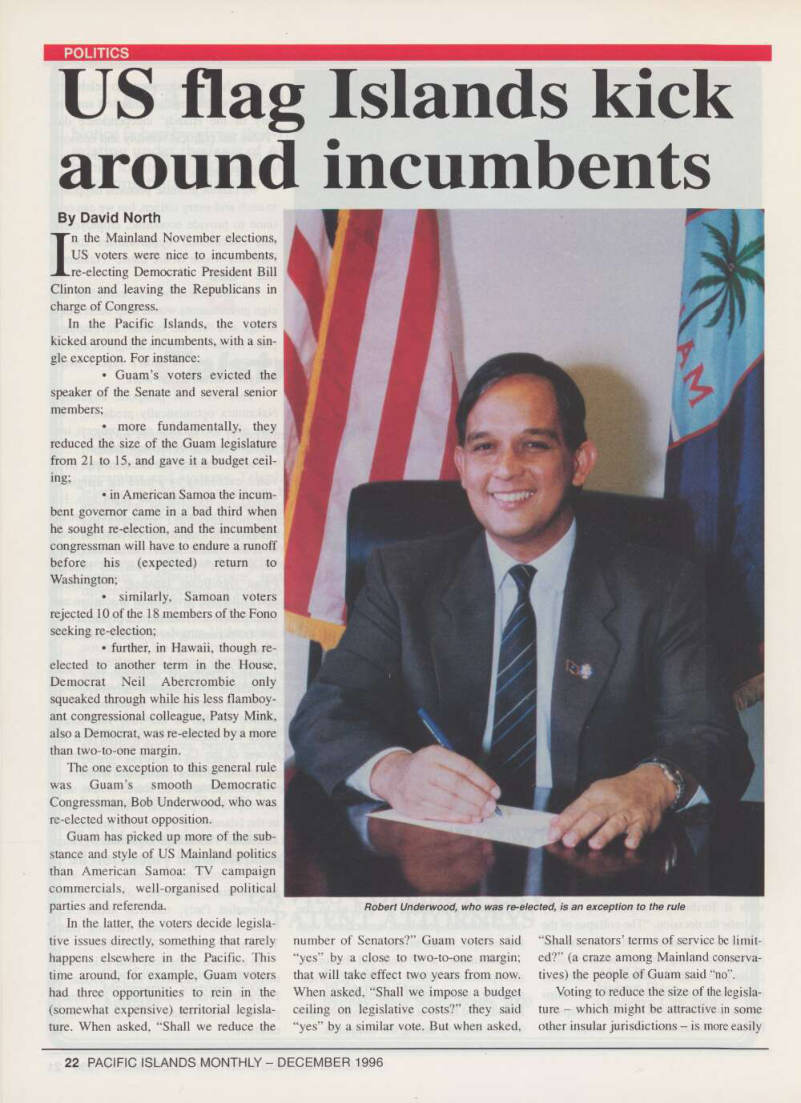
around incumbents
By David North
In the Mainland November elections, US voters were nice to incumbents, re-electing Democratic President Bill Clinton and leaving the Republicans in charge of Congress.
In the Pacific Islands, the voters kicked around the incumbents, with a sin gle exception. For instance: • Guam’s voters evicted the speaker of the Senate and several senior members; • more fundamentally, they reduced the size of the Guam legislature from 21 to 15, and gave it a budget ceil ing; • in American Samoa the incum bent governor came in a bad third when he sought re-election, and the incumbent congressman will have to endure a runoff before his (expected) return to
Washington;
• similarly, Samoan voters rejected 10 of the 18 members of the Fono
seeking re-election;
• further, in Hawaii, though re elected to another term in the House, Democrat Neil Abercrombie only squeaked through while his less flamboy
ant congressional colleague, Patsy Mink,
also a Democrat, was re-elected by a more than two-to-one margin.
The one exception to this general rule was Guam’s smooth Democratic Congressman, Bob Underwood, who was re-elected without opposition.
Guam has picked up more of the sub stance and style of US Mainland politics than American Samoa: TV campaign
commercials, well-organised political
parties and referenda.
In the latter, the voters decide legisla tive issues directly, something that rarely happens elsewhere in the Pacific. This time around, for example, Guam voters had three opportunities to rein in the (somewhat expensive) territorial legisla ture. When asked, “Shall we reduce the
number of Senators?” Guam voters said “yes” by a close to two-to-one margin; that will take effect two years from now.
When asked, “Shall we impose a budget ceiling on legislative costs?” they said “yes” by a similar vote. But when asked,
“Shall senators’ terms of service be limit ed?” (a craze among Mainland conserva tives) the people of Guam said “no”.
Voting to reduce the size of the legisla ture - which might be attractive in some other insular jurisdictions - is more easily
Robert Underwood, who was re-elected, is an exception to the rule
done in Guam than elsewhere because there are no geographic complications.
Guam’s senators run at large, all 21 of them represent all the people of the Island.
In most Pacific polities, there are single member districts, so reducing the number of legislators would usually mean that some Islands, that now have their own person in the capital, would have to share their legislator with one or more other Islands. , Guam’s voters struck out at individu als, too, not just at the institution. Usually, Guam’s legislature has a Democratic majority; now it will be Republican li lt). Don Parkinson, a rough-edged Mainlander (Haole) who had been the Democratic speaker of the legislature, was ousted. So were incumbents Ted Nelson and Hope Cristobal.
Parkinson admitted after the election that a highly publicised food fight with another Senator - chili was the weapon of choice - did not help his cause.
The Guam legislature will, however, remain an interesting mix; there will be five women in it (down from six in the last two years); this is a high portion for both the insular Pacific and the US Mainland. And there will be native Chamorros, several Haoles and people of mixed blood (for example, Chamorro and Haole, and Chamorro and Filipino).
The senators will not be as free to spend money on themselves as in the past.
Only New York and California - with about 100 times Guam’s population - pay their legislators as well as does Guam.
The voters supported a referendum that imposed a ceiling of 2.5 per cent of the total Island’s budget for legislative expenses; they should live comfortably on half that.
Guam’s Democratic Governor, Carl Guteirrez, was not up for re-election this year; his turn will come two years hence.
The governorship was, however, on the line, in American Samoa. For only the second time in memory, it was not a con flict between the two old bulls of Samoan politics, Peter Tali Coleman (a Republican) and A P Lutali, a Democrat.
The wheelchair-borne Lutali, the incumbent who suffered a stroke earlier in his term, had sought a third tour of duty anyway. Coleman, in failing health, was
not in this race, but he was represented by his nephew, Leala Peter Reid, Jr.
Lutali had a difficult term as governor, fighting constant financial problems and often bickering - publicly - with his own cabinet and other allies. One of the latter, Lutali’s hand-picked Lt Governor, Tauese Sunia, had broken with Lutali, deciding to run for governor on his own.
Samoan elections, unlike most on the Mainland and in the rest of the Pacific, require an absolute majority of the vote cast for victory. When the polls closed in November, no one had won the governor ship, with the results being:
Sunia 4559 Reid 4407 Lutali 1277 Tufele Li’a 954 Tuiki Tuiki 42
The two top candidates then faced a run-off two weeks later, on November 19, with the one with the most votes securing the job as governor. Speculation revolved around what Lutali would do next: Would he endorse Reid, the relative of his life long foe, Coleman? Would he endorse Sunia, whose decision to run for governor deeply bothered the incumbent? Or would he do nothing. Given the closeness of the initial vote, it was hard to predict who would win.
The race for delegate to the Congress also featured some old rivalries. The incumbent, seeking a fifth term, was Eni F H Faleomavaega (a Democrat); the expec tation was that his principal opponent would be Amata Coleman Radewagen, daughter of the former governor, making her second race for the Congress. But when the dust settled it was a third candi date, Gus Hannemann, a former one-term member of the Fono, who forced Faleomavaega into a run-off. The results of the first round of voting were:
Faleomavaega 5642 Hannemann 3004 Radewagen 2731
Faleomavaega thus just missed the 50 per cent threshold, and stood a good chance to win the November 19 election. (Typically, in such races, the third candi date, in this case Radewagen, endorses
one of the two remaining ones, and that is often decisive; when the leading candi date, however, as in this case, is so close
to a majority, momentum usually pulls
that candidate to victory).
The only woman to win an election in Samoa this year is a new member of the Fono, Fagamalama Fualaau; one incum bent woman in the Fono was defeated for election, and the other (the voteless dele gate from virtually people-free Swains Island) decided not to seek another term.
Meanwhile, in Hawaii, another incum bent Democrat was given a scare.
Abercrombie, one of the most liberal members of the House, and the only one I know of who routinely >vears both a bald spot and a ponytail, barely beat ex-Ross Perot ally, Orson Swindle, by a margin of less than 7000 votes out of the 187,000 cast. Swindle ran this year as a Republican, and did much better than Perot, who polled only eight per cent as an
independent candidate against President
Clinton and Republican Bon Dole.
Clinton’s re-election, coupled with the preservation of the Republican control of the two houses of Congress, probably means that there will be little change in the relations between official Washington and the Island territories - a subject which was simply not discussed in the presiden
tial election. Things will probably just
rock along as before, but with most of the Island players being a bit chastened by the voters. The exception is Guam’s Bob Underwood, who came out of the election stronger than ever, and is striving hard for a better deal for Guam vis-a-vis Washington. While his position - that Chamorros should have a special role in deciding the future of Guam - will proba bly not fly, he has made much of how badly the Mainland needs Guam to handle its international obligations.
That Guam was the closest place to base planes to bomb distant Iraq, and that Guam was (weeks later) chosen as the site to process Kurdish refugees from Iraq, was used by Underwood to stress the obli gations of the Mainland to its only territo ry on the other side of the international dateline.
Only time will tell how far he will get with this argument, but he is in a good position to make it for his Island. ■
Govt punishes private media
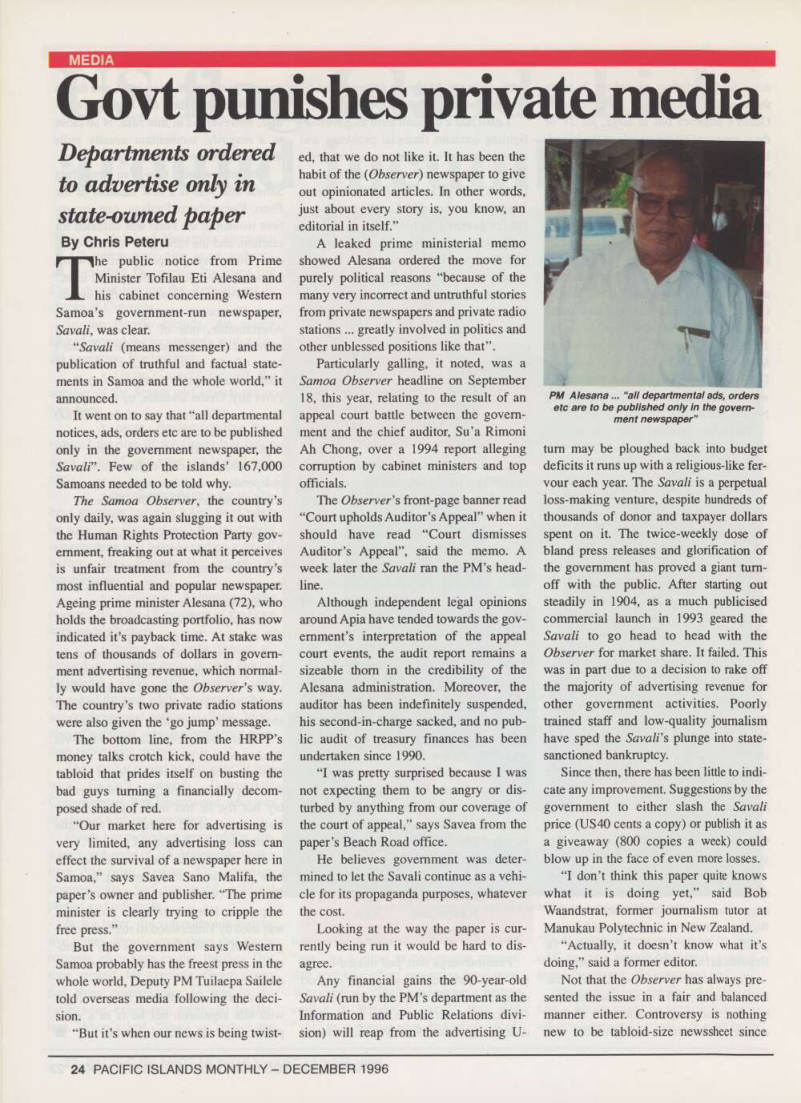
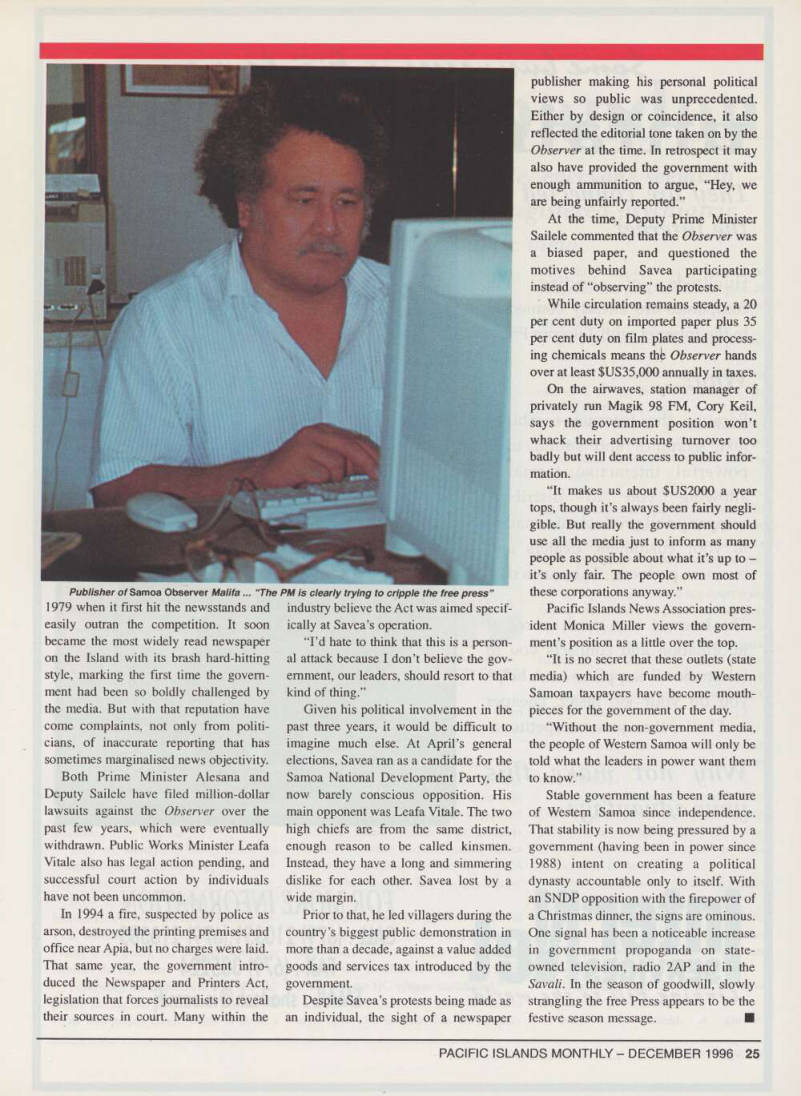
Media
Departments ordered to advertise only in state-oumed paper
By Chris Peteru
The public notice from Prime Minister Tofilau Eti Alesana and his cabinet concerning Western Samoa’s govemment-run newspaper, Savali, was clear.
“Savali (means messenger) and the publication of truthful and factual state ments in Samoa and the whole world,” it announced.
It went on to say that “all departmental notices, ads, orders etc are to be published only in the government newspaper, the Savali”. Few of the islands’ 167,000 Samoans needed to be told why.
The Samoa Observer, the country’s only daily, was again slugging it out with the Human Rights Protection Party gov ernment, freaking out at what it perceives is unfair treatment from the country’s most influential and popular newspaper.
Ageing prime minister Alesana (72), who holds the broadcasting portfolio, has now indicated it’s payback time. At stake was tens of thousands of dollars in govern ment advertising revenue, which normal ly would have gone the Observer’s way.
The country’s two private radio stations were also given the ‘go jump’ message.
The bottom line, from the HRPP’s money talks crotch kick, could have the tabloid that prides itself on busting the bad guys turning a financially decom posed shade of red.
“Our market here for advertising is very limited, any advertising loss can effect the survival of a newspaper here in Samoa,” says Savea Sano Malifa, the paper’s owner and publisher. “The prime minister is clearly trying to cripple the free press.”
But the government says Western Samoa probably has the freest press in the whole world, Deputy PM Tuilaepa Sailele told overseas media following the deci sion.
“But it’s when our news is being twist
ed, that we do not like it. It has been the habit of the ( Observer ) newspaper to give out opinionated articles. In other words, just about every story is, you know, an editorial in itself.”
A leaked prime ministerial memo showed Alesana ordered the move for purely political reasons “because of the many very incorrect and untruthful stories from private newspapers and private radio stations ... greatly involved in politics and other unblessed positions like that”.
Particularly galling, it noted, was a Samoa Observer headline on September 18, this year, relating to the result of an appeal court battle between the govern ment and the chief auditor, Su’a Rimoni Ah Chong, over a 1994 report alleging corruption by cabinet ministers and top officials.
The Observer's front-page banner read “Court upholds Auditor’s Appeal” when it should have read “Court dismisses Auditor’s Appeal”, said the memo. A week later the Savali ran the PM’s head line.
Although independent legal opinions around Apia have tended towards the gov ernment’s interpretation of the appeal court events, the audit report remains a sizeable thorn in the credibility of the Alesana administration. Moreover, the auditor has been indefinitely suspended, his second-in-charge sacked, and no pub lic audit of treasury finances has been undertaken since 1990.
“I was pretty surprised because I was not expecting them to be angry or dis turbed by anything from our coverage of the court of appeal,” says Savea from the paper’s Beach Road office.
He believes government was deter mined to let the Savali continue as a vehi cle for its propaganda purposes, whatever the cost.
Looking at the way the paper is cur rently being run it would be hard to dis agree.
Any financial gains the 90-year-old Savali (run by the PM’s department as the Information and Public Relations divi sion) will reap from the advertising U-
turn may be ploughed back into budget deficits it runs up with a religious-like fer vour each year. The Savali is a perpetual loss-making venture, despite hundreds of thousands of donor and taxpayer dollars spent on it. The twice-weekly dose of bland press releases and glorification of the government has proved a giant turn off with the public. After starting out steadily in 1904, as a much publicised commercial launch in 1993 geared the Savali to go head to head with the Observer for market share. It failed. This was in part due to a decision to rake off the majority of advertising revenue for other government activities. Poorly trained staff and low-quality journalism have sped the Savali’ s plunge into state
sanctioned bankruptcy.
Since then, there has been little to indi
cate any improvement. Suggestions by the
government to either slash the Savali price (US4O cents a copy) or publish it as a giveaway (800 copies a week) could blow up in the face of even more losses.
“I don’t think this paper quite knows what it is doing yet,” said Bob Waandstrat, former journalism tutor at Manukau Polytechnic in New Zealand.
“Actually, it doesn’t know what it’s doing,” said a former editor.
Not that the Observer has always pre sented the issue in a fair and balanced manner either. Controversy is nothing new to be tabloid-size newssheet since
PM Alesana... "all departmental ads, orders etc are to be published only in the govern ment newspaper”
1979 when it first hit the newsstands and easily outran the competition. It soon became the most widely read newspaper on the Island with its brash hard-hitting style, marking the first time the govern ment had been so boldly challenged by the media. But with that reputation have come complaints, not only from politi cians, of inaccurate reporting that has
sometimes marginalised news objectivity.
Both Prime Minister Alesana and Deputy Sailele have filed million-dollar lawsuits against the Observer over the past few years, which were eventually withdrawn. Public Works Minister Leafa Vitale also has legal action pending, and successful court action by individuals have not been uncommon.
In 1994 a fire, suspected by police as arson, destroyed the printing premises and office near Apia, but no charges were laid.
That same year, the government intro duced the Newspaper and Printers Act, legislation that forces journalists to reveal their sources in court. Many within the
industry believe the Act was aimed specif
ically at Savea’s operation.
“I’d hate to think that this is a person al attack because I don’t believe the gov ernment, our leaders, should resort to that kind of thing.”
Given his political involvement in the past three years, it would be difficult to imagine much else. At April’s general elections, Savea ran as a candidate for the Samoa National Development Party, the now barely conscious opposition. His main opponent was Leafa Vitale. The two high chiefs are from the same district, enough reason to be called kinsmen.
Instead, they have a long and simmering dislike for each other. Savea lost by a
wide margin.
Prior to that, he led villagers during the
country’s biggest public demonstration in
more than a decade, against a value added goods and services tax introduced by the government.
Despite Savea’s protests being made as an individual, the sight of a newspaper
publisher making his personal political
views so public was unprecedented.
Either by design or coincidence, it also reflected the editorial tone taken on by the Observer at the time. In retrospect it may also have provided the government with enough ammunition to argue, “Hey, we
are being unfairly reported.”
At the time, Deputy Prime Minister Sailele commented that the Observer was a biased paper, and questioned the motives behind Savea participating instead of “observing” the protests.
While circulation remains steady, a 20 per cent duty on imported paper plus 35 per cent duty on film plates and process ing chemicals means the Observer hands over at least $U535,000 annually in taxes.
On the airwaves, station manager of privately run Magik 98 FM, Cory Keil, says the government position won’t whack their advertising turnover too badly but will dent access to public infor mation.
“It makes us about SUS2OOO a year tops, though it’s always been fairly negli gible. But really the government should use all the media just to inform as many people as possible about what it’s up to it’s only fair. The people own most of
these corporations anyway.”
Pacific Islands News Association pres ident Monica Miller views the govern ment’s position as a little over the top.
“It is no secret that these outlets (state media) which are funded by Western Samoan taxpayers have become mouth pieces for the government of the day.
“Without the non-govemment media, the people of Western Samoa will only be told what the leaders in power want them to know.”
Stable government has been a feature of Western Samoa since independence.
That stability is now being pressured by a government (having been in power since 1988) intent on creating a political dynasty accountable only to itself. With an SNDP opposition with the firepower of a Christmas dinner, the signs are ominous.
One signal has been a noticeable increase in government propoganda on state owned television, radio 2AP and in the Savali. In the season of goodwill, slowly strangling the free Press appears to be the festive season message. ■
Publisher of Samoa Observer Malifa ... “The PM is clearly trying to cripple the free press”
Advertisements & other items, p. 26 (1 item)
interjUpt
unfair advantage
TTiei/ are connected to
the Internet.
Hundreds of leading Fiji companies are already connected to the Internet with Telecom Fiji.
Why?
Because the Internet combines text, graphics and sound in a powerful interactive format allowing you to distribute company and product information to your customers, dealers and business partners, 24 hours a day.
The Internet is a good source of information and connects you to international suppliers and helps you do your job faster, cheaper and better than your competitors.
Why not make this
your advantage.
World Wide Web.
SM m ■
If B I
I , TIJ J
it*
interjUpt
i SERVICES I SCI
Linking Fiji to the u/orld.
FOR MORE INFORMATION
CALL: (679) 210351,(679) 210385
FAX: (679) 305224
EMAIL; [email protected]
With mad abandon
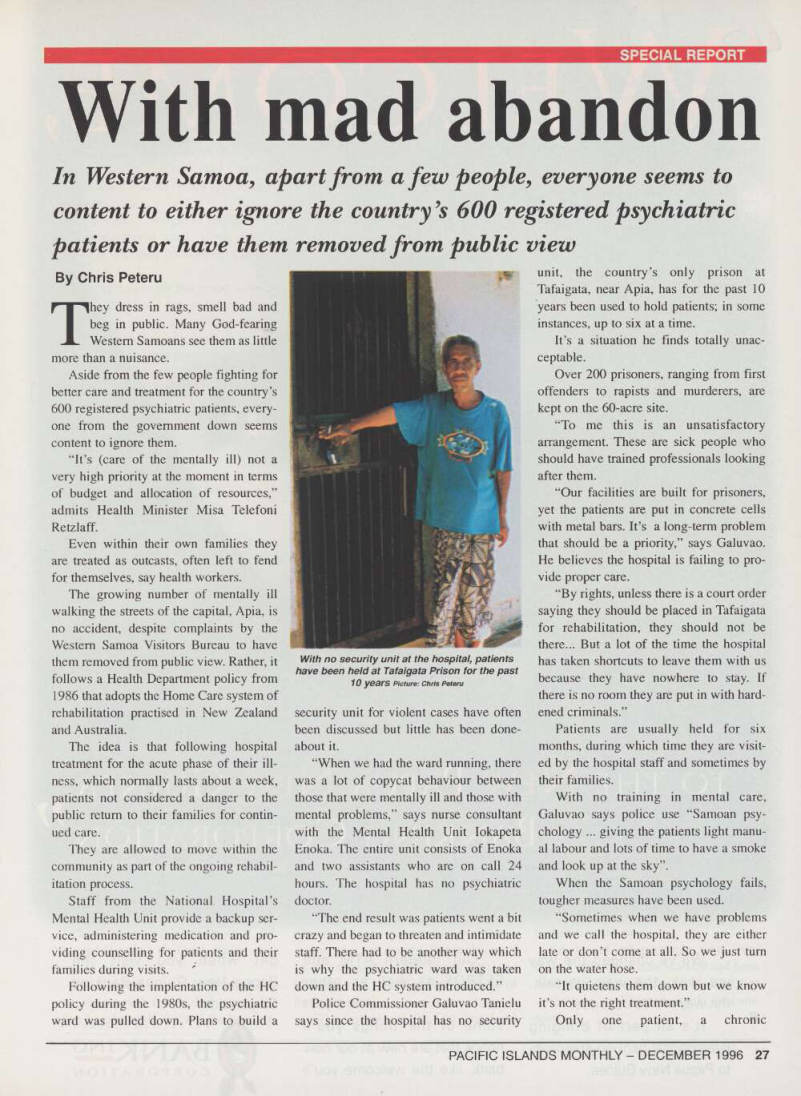

Special Report
In Western Samoa, apart from a few people, everyone seems to content to either ignore the country’s 600 registered psychiatric patients or have them removed from public view
By Chris Peteru
They dress in rags, smell bad and beg in public. Many God-fearing Western Samoans see them as little more than a nuisance.
Aside from the few people fighting for better care and treatment for the country’s 600 registered psychiatric patients, every one from the government down seems content to ignore them.
“It’s (care of the mentally ill) not a very high priority at the moment in terms of budget and allocation of resources,” admits Health Minister Misa Telefoni Retzlaff.
Even within their own families they are treated as outcasts, often left to fend for themselves, say health workers.
The growing number of mentally ill walking the streets of the capital, Apia, is
no accident, despite complaints by the
Western Samoa Visitors Bureau to have them removed from public view. Rather, it follows a Health Department policy from 1986 that adopts the Home Care system of rehabilitation practised in New Zealand and Australia.
The idea is that following hospital treatment for the acute phase of their ill ness, which normally lasts about a week, patients not considered a danger to the public return to their families for contin ued care.
They are allowed to move within the community as part of the ongoing rehabil itation process.
Staff from the National Hospital’s Mental Health Unit provide a backup ser vice, administering medication and pro viding counselling for patients and their families during visits.
Following the implentation of the HC policy during the 1980 s, the psychiatric ward was pulled down. Plans to build a
security unit for violent cases have often been discussed but little has been done about it.
“When we had the ward running, there was a lot of copycat behaviour between those that were mentally ill and those with mental problems,” says nurse consultant with the Mental Health Unit lokapeta Enoka. The entire unit consists of Enoka and two assistants who are on call 24 hours. The hospital has no psychiatric doctor.
“The end result was patients went a bit crazy and began to threaten and intimidate staff. There had to be another way which is why the psychiatric ward was taken down and the HC system introduced.”
Police Commissioner Galuvao Tanielu says since the hospital has no security
unit, the country’s only prison at Tafaigata, near Apia, has for the past 10 years been used to hold patients; in some instances, up to six at a time.
It’s a situation he finds totally unac
ceptable.
Over 200 prisoners, ranging from first offenders to rapists and murderers, are kept on the 60-acre site.
“To me this is an unsatisfactory arrangement. These are sick people who should have trained professionals looking after them.
“Our facilities are built for prisoners, yet the patients are put in concrete cells with metal bars. It’s a long-term problem that should be a priority,” says Galuvao.
He believes the hospital is failing to pro vide proper care.
“By rights, unless there is a court order saying they should be placed in Tafaigata for rehabilitation, they should not be there... But a lot of the time the hospital has taken shortcuts to leave them with us because they have nowhere to stay. If there is no room they are put in with hard ened criminals.”
Patients are usually held for six months, during which time they are visit ed by the hospital staff and sometimes by their families.
With no training in mental care, Galuvao says police use “Samoan psy chology ... giving the patients light manu al labour and lots of time to have a smoke and look up at the sky”.
When the Samoan psychology fails, tougher measures have been used.
“Sometimes when we have problems and we call the hospital, they are either late or don’t come at all. So we just turn on the water hose.
“It quietens them down but we know it’s not the right treatment.”
Only one patient, a chronic
With no security unit at the hospital, patients have been held at Tafaigata Prison for the past 10 years Picture: Chris Peteru
schizophrenic, is currently being held at
the prison. His family is keen for him to remain there indefinitely, say the police.
The commissioner agrees it is not unusual now for a Samoan family to imprison one of their own, and could be an indication that the Homecare system has shortcomings.
Usually those brought to Tafaigata are
given a six-month spell. Upon release they often find their families have reject ed them.
“Some families are too proud ... some denounce their own kin and chase them out. So they end up around town. Even though they are loving people there is a limit because they are ashamed.
“I think the remedy is for the govern ment to build a proper institute for these
patients.
“There is a lot of mental and physical abuse going on because people don’t want them around.”
Nurse consultant Enoka says patients who end up on the street fall into two main categories, substance abusers and stress psychosis cases.
“You don’t see many schizophrenics or manic depressives anymore. But the substance abusers, those on marijuana and magic mushrooms, are very dopey in the head.
“Still, they are only a threat if people perceive them as such.”
An earlier incident where a nun was stabbed to death by a manic depressive has stigmatised the mentally ill in the
public eye.
But MHU workers say that, aside from their unkept appearance, they pose little threat to anyone.
“If you talked to them you would find they are sane.
“People think that because they smash bottles on the pavement or yell in the street they are idiots,” says trainee nurse Aliilelei Matautia.
However, a facility for violent offend ers should have been built last year, says Enoka.
The medical superintendent of the National Hospital, Dr Frank Smith, con curs.
He described how in 1994 a building was constructed for violent cases but when hospital staff checked the building,
there was no padded cell.
“It was okay, but the security room was not okay.
“There was a mix up somewhere along the line (with the design). A manic depressive could have torn the place down in no time.”
Although Dr Smith supports the con cept of Home Care, he says the govern ment should be prepared to support those patients whose families are unwilling or unable to take on the responsibility.
“The controversy of allowing mental ly ill people on the street arose when we decided to follow what New Zealand is
doing.
But you know how people react to psychiatric illness - no one knows the answer, even people in New Zealand are
complaining about releasing psychiatric
patients into the community.
“We believe the family must take care of their own, but there is evidence that people are not caring for their own. What must we do?”
He saw the bigger picture as a move away from the role of the hospital as an institution for the mentally ill to putting the emphasis on community-based care.
A hostel where nursing staff could admin ister medication and provide assistance was one alternative combining profes sional care while providing patients with the environment to become self-depen dent again.
This kind of facility takes on more importance, given there are families with out the means to look after relatives with mental disorders.
In Malta, an island of similar size but twice Western Samoa’s 160,000 popula tion, patients are taken into family care for a month or so and then taken back to the institution, which functions along the lines of a hostel.
Patients are rarely seen in public but there is participation by both the commu nity and the government.
“We can take care of the medical side.
It’s the social side we have no control over. And this is a community problem.”
But why in a country that prides itself on the strength of the family unit and Christian love is there neglect for those of their own clan?
“The teaching of the Old Testament
doesn’t help - teaching that if you are bad something will happen to you. I think the church should be more compassionate and change their stance.
“ I think the teaching of Jesus is more important. You can’t change attitudes
overnight.
“The changing of attitudes takes sev eral centuries, but my feeling is they will change.
“The state has to do something. It has given money to the elderly, and should give financial assistance to these people in whatever form.”
About WS$2.5 million (SUSI.O2 mil lion) a year for monthly pensions for those over 65 years old is earmarked by the government for that purpose.
Enoka says financial pressure now plays an increasing role as a symptom of mental illness among Samoans. She pointed out that failure to contribute to the commitments of the extended family frequently left a trail of violence and despair among families, particularly those forced to live beyond their means to maintain those obligations.
Health Minister Misa says some kind of welfare support is needed.
“I think we should look very seriously at a welfare function. But what is happen ing at the moment in the hospital is very clear - they don’t have the budget or the facilities to provide welfare services.”
Staff shortage for psychiatric nurses remains a huge problem.
With 12 years’ experience behind her, Enoka says the shortage stems from a lack of interest amongst people to work in the field.
That places enormous stress on the three staff members whose numbers have not increased since 1986, the same time the Home Care system was introduced.
The HC system has been a success, says Enoka, with a steady stream of for mer patients making full recoveries.
“Many people we have looked after have gone back to work. We’ve had teachers, people in high office, gone back to their normal jobs.
“A lot of other people who were locked up here are now married and have raised families or returned to the land. But we have to work in partnership the com munity.” ■
Advertisements & other items, pp. 28-31 (1 item)
1 Banking
We've changed the way we look, the way we talk, the way we do business.
It's all part of bringing international banking standards to Papua New Guinea.
Our modern ATM and EFTPOS as well as other customer services are just some of the things you'll notice that are new at our new bank, like the welcome you'll get when you visit the Papua New Guinea Banking Corporation.
Papua New Guinea
1 BANKING
CORPORATION
® TOYOTA
Drive dignity right to the top.
Everyone who knows cars has no doubts about Land Cruiser’s ruggedness.
Yet how many know that its luxury rivals the finest high-priced cars?
Or that it’s got more room inside than many luxury sedans?
And because it’s a Toyota, Land Cruiser’s fit and finish, attention to detail, and graceful form speak of elegance a 5 well as spacious comfort.
Yet you still get tough ladder frames and suspension built to take you as far off road as you want to go.
With power from 4.5-litre petrol or 4.2-litre diesel engines.
And it’s carefully protected from rust to last longer.
So if you’re going right to the top, this dignified car is ready to take you.
LAND CRUISER
DISTRIBUTORS/DEALERS
AMERICAN SAMOA BURNS PHILP MOTORS PH 633-4281 GUAM & MICRONESIA...ATKINS KROLL, INC. PH 646-1876/9 NORFOLK ISLAND BORRY’S PTY LTD. PH 22114
SOLOMON ISLAND ELA MOTORS PH 30314
VANUATU ASCO MOTORS PH 22341
COOK ISLANDS PACIFIC MOTORS LTD. PH 20796
KIRIBATI TARAWA MOTORS PH 21090
PAPUA NEW GUINEA ELA MOTORS PH 3229400
TAHITI NIPPON AUTOMOTO PH 429819
WESTERN SAMOA ASCO MOTORS PH 20800
FIJI ASCO MOTORS PH 384888
NEW CALEDONIA S LA P. PH 275562
SAIPAN MICROL CORPORATION PH 234-5911
TONGA ASCO MOTORS PH 23500
i a ,v
LAND
CRUISER
/ r % ■■i tf* **4 .jp*.. ■=sr J3t-
Fiji’s mentally ill
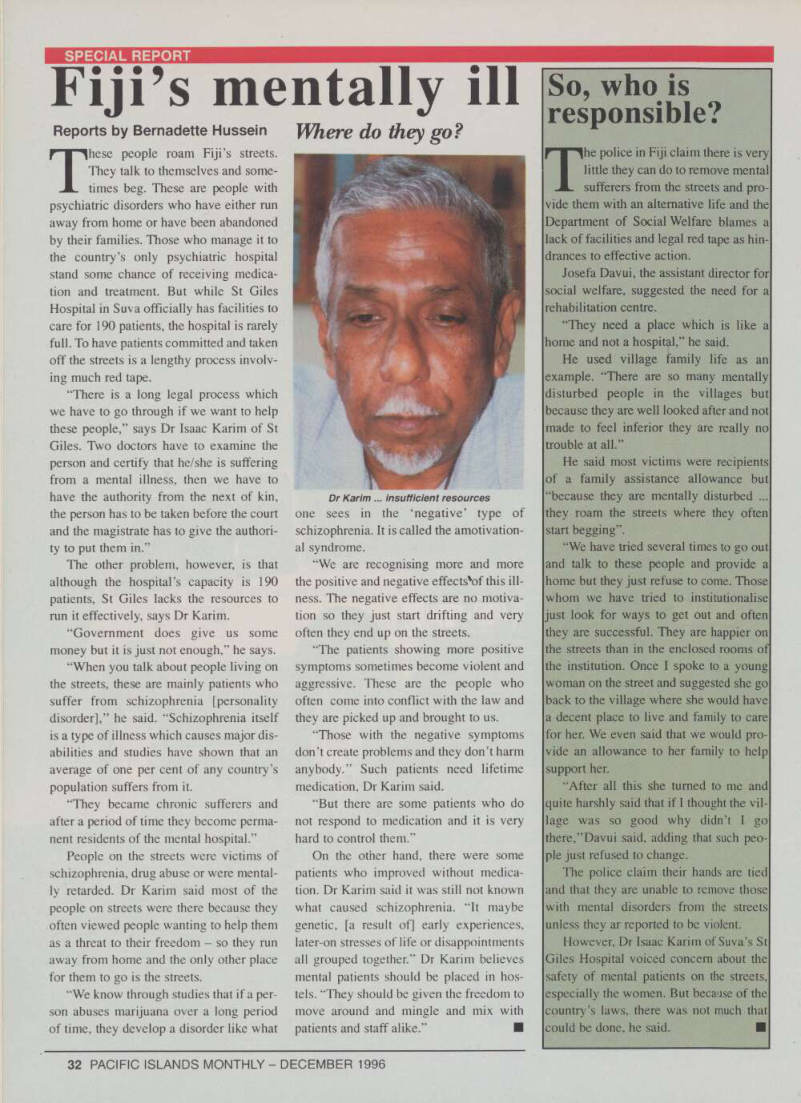
Reports by Bernadette Hussein
These people roam Fiji’s streets.
They talk to themselves and some times beg. These are people with psychiatric disorders who have either run away from home or have been abandoned by their families. Those who manage it to the country’s only psychiatric hospital stand some chance of receiving medica tion and treatment. But while St Giles Hospital in Suva officially has facilities to care for 190 patients, the hospital is rarely full. To have patients committed and taken off the streets is a lengthy process involv ing much red tape.
“There is a long legal process which we have to go through if we want to help these people,” says Dr Isaac Karim of St Giles. Two doctors have to examine the person and certify that he/she is suffering from a mental illness, then we have to have the authority from the next of kin, the person has to be taken before the court and the magistrate has to give the authori ty to put them in.”
The other problem, however, is that although the hospital’s capacity is 190 patients, St Giles lacks the resources to run it effectively, says Dr Karim.
“Government does give us some money but it is just not enough,” he says.
“When you talk about people living on the streets, these are mainly patients who
suffer from schizophrenia [personality
disorder],” he said. “Schizophrenia itself is a type of illness which causes major dis abilities and studies have shown that an average of one per cent of any country’s population suffers from it.
"They became chronic sufferers and after a period of time they become perma nent residents of the mental hospital.”
People on the streets were victims of schizophrenia, drug abuse or were mental ly retarded. Dr Karim said most of the people on streets were there because they often viewed people wanting to help them as a threat to their freedom - so they run away from home and the only other place for them to go is the streets.
“We know through studies that if a per son abuses marijuana over a long period of time, they develop a disorder like what
Where do they go?
one sees in the ‘negative’ type of schizophrenia. It is called the amotivation al syndrome.
“We are recognising more and more the positive and negative effects'of this ill ness. The negative effects are no motiva tion so they just start drifting and very often they end up on the streets.
“The patients showing more positive symptoms sometimes become violent and aggressive. These are the people who often come into conflict with the law and they are picked up and brought to us.
“Those with the negative symptoms don’t create problems and they don’t harm anybody.” Such patients need lifetime medication, Dr Karim said.
“But there are some patients who do not respond to medication and it is very hard to control them.”
On the other hand, there were some patients who improved without medica tion. Dr Karim said it was still not known what caused schizophrenia. “It maybe genetic, [a result of] early experiences, later-on stresses of life or disappointments all grouped together.” Dr Karim believes mental patients should be placed in hos tels. "They should be given the freedom to move around and mingle and mix with patients and staff alike.” ■
Dr Karim ... insufficient resources
responsible?
So, who is responsible?
The police in Fiji claim there is very little they can do to remove mental sufferers from the streets and pro vide them with an alternative life and the Department of Social Welfare blames a lack of facilities and legal red tape as hin drances to effective action.
Josefa Davui, the assistant director for social welfare, suggested the need for a rehabilitation centre.
“They need a place which is like a home and not a hospital,” he said.
He used village family life as an example. “There are so many mentally disturbed people in the villages but because they are well looked after and not made to feel inferior they are really no trouble at all.”
He said most victims were recipients of a family assistance allowance but “because they are mentally disturbed ... they roam the streets where they often
start begging”.
“We have tried several times to go out and talk to these people and provide a home but they just refuse to come. Those whom we have tried to institutionalise just look for ways to get out and often they are successful. They are happier on the streets than in the enclosed rooms of the institution. Once I spoke to a young woman on the street and suggested she go back to the village where she would have a decent place to live and family to care for her. We even said that we would pro vide an allowance to her family to help support her.
“After all this she turned to me and quite harshly said that if I thought the vil lage was so good why didn’t I go there,’’Davui said, adding that such peo ple just refused to change.
The police claim their hands are tied and that they are unable to remove those with mental disorders from the streets unless they ar reported to be violent.
However, Dr Isaac Karim of Suva’s St Giles Hospital voiced concern about the safety of mental patients on the streets, especially the women. But because of the country’s laws, there was not much that could be done, he said. ■
Advertisements & other items, p. 33 (1 item)
ivu^aWi
ATU
% Santo
STRALIA
AU . --- ■
CALEDONIA
' r ~T „ ,
ZEALAND
TORRES
BANKS / \
O
SANTO
Luganville -) «h>cliff
MALEKULA
MONQOA
p « Port Vila
EFATEI r
•WAN
i
ANIWA
TANNA A 7 >utuna
LENAKEL
«p j
ivu^aWi
Where would you find beautiful beaches, coconut palms and clear
tropical water?
Where would you find such a variety of resorts, world class
restaurants, sporting activities,
a casino and night life?
Where would you find a live volcano and ancient custom villages fresh grown market produce and some of the friendliest people ever meet?
Where? Vanuatu, that’s where.
AIR VANUATU RESERVATIONS & SALES OFFICES
Port Vila: Tel (678) 23 838, Fax (678) 23 250.
Sydney: Tel (612) 9223 8333, Fax (612) 9223 8781.
Melbourne: Tel (613) 9417 3977, Fax (613) 9417 5977.
Brisbane: Tel (617) 3221 2566, Fax (617) 3221 3967.
Auckland: Tel (649) 373 3435, Fax (649) 358 1413.
Nadi: Tel (679) 72 2521.
Noumea: Tel (687) 286 677, Fax (687) 274 050.
VANAIR INTERNAL AIR SERVICES
Port Vila: Tel (678) 22643, Fax (678) 23910, Res (678) 22753.
]huM
AIR VANUATU
MABAE 1174 IB
Service with style
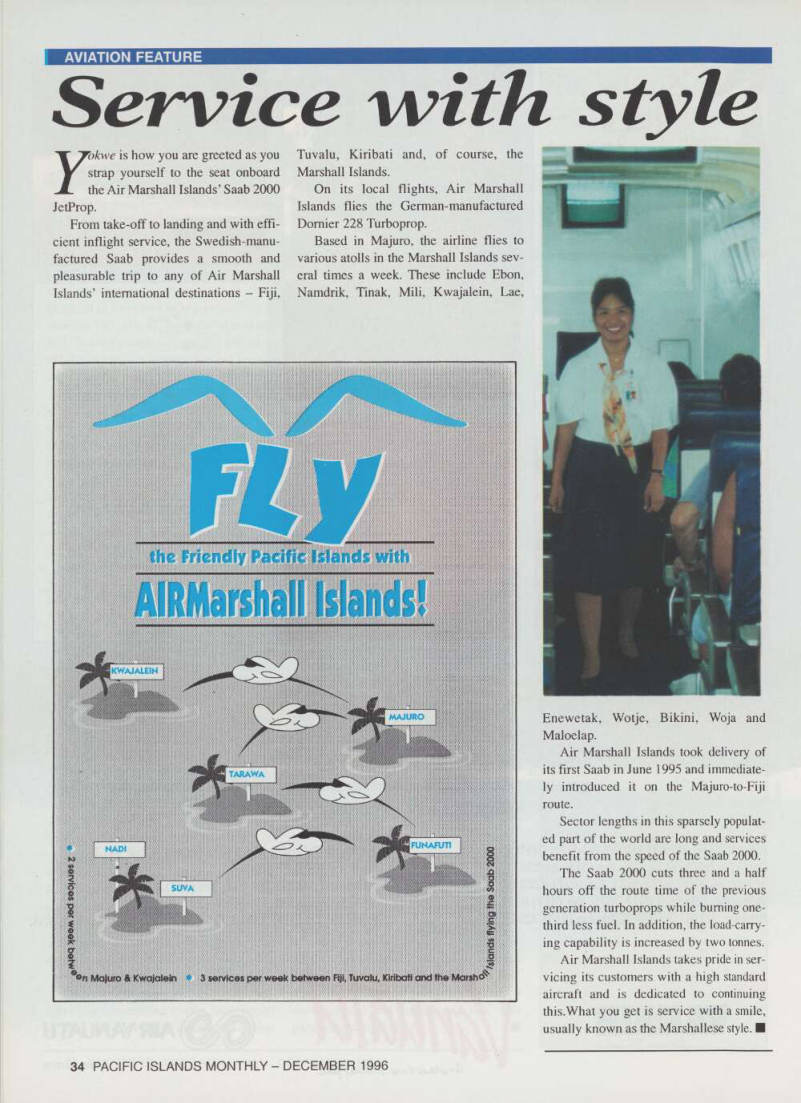
Aviation Feature
ybkwe is how you are greeted as you strap yourself to the seat onboard the Air Marshall Islands’ Saab 2000 Jet Prop.
From take-off to landing and with effi cient inflight service, the Swedish-manu factured Saab provides a smooth and pleasurable trip to any of Air Marshall Islands’ international destinations - Fiji,
Tuvalu, Kiribati and, of course, the Marshall Islands.
On its local flights. Air Marshall Islands flies the German-manufactured Domier 228 Turboprop.
Based in Majuro, the airline flies to various atolls in the Marshall Islands sev eral times a week. These include Ebon, Namdrik, Tinak, Mili, Kwajalein, Lae,
Enewetak, Wotje, Bikini, Woja and Maloelap.
Air Marshall Islands took delivery of its first Saab in June 1995 and immediate ly introduced it on the Majuro-to-Fiji route.
Sector lengths in this sparsely populat ed part of the world are long and services benefit from the speed of the Saab 2000.
The Saab 2000 cuts three and a half hours off the route time of the previous generation turboprops while burning one third less fuel. In addition, the load-carry ing capability is increased by two tonnes.
Air Marshall Islands takes pride in ser vicing its customers with a high standard aircraft and is dedicated to continuing this. What you get is service with a smile, usually known as the Marshallese style. ■
Advertisements & other items, pp. 34-35 (1 item)
AlRMarshall Islands
the Friendly Pacific Islands with
KWAJALEIN
MAJURO
TARAWA
FUNAFUTI
NADI
SUVA
2 3 s ®n Majuro & Kwajatein • 3 services per week between Fiji, Tuvalu, Kiribati and the Marsh^
y m 0 > m i N
OURS IS A BUSINESS CLASS
A CLASS OF US OWN.
Through history, the ceremonial presentation of a whale’s tooth, or tabua (pronounced tam-bua) has been the highest honour that we Fijians can bestow.
Air Pacific’s superior business class is appropriately named Tabua Class, and we welcome Tabua Class passengers with the same respect and desire to please as our ancestors did on receiving great chiefs.
In place of the whale’s tooth, we offer priority check-in and baggage handling.
Exclusive lounges. And on-board comfort, menus and bar reminiscent of First Class.
And all of this accompanied by an open natural friendliness that we Fijians simply cannot disguise.
PAIR
PACIFIC
FIJI'S INTERNATIONAL AIRLINE
SUVA • NADI • MELBOURNE • SYDNEY • BRISBANE • AUCKLAND • CHRISTCHURCH • WELLINGTON • TOKYO • OSAKA • LOS ANGELES • APIA • PORT VILA • TONGA • HONIARJ
WILSON ADDISON 07.821
Serving the Pacific
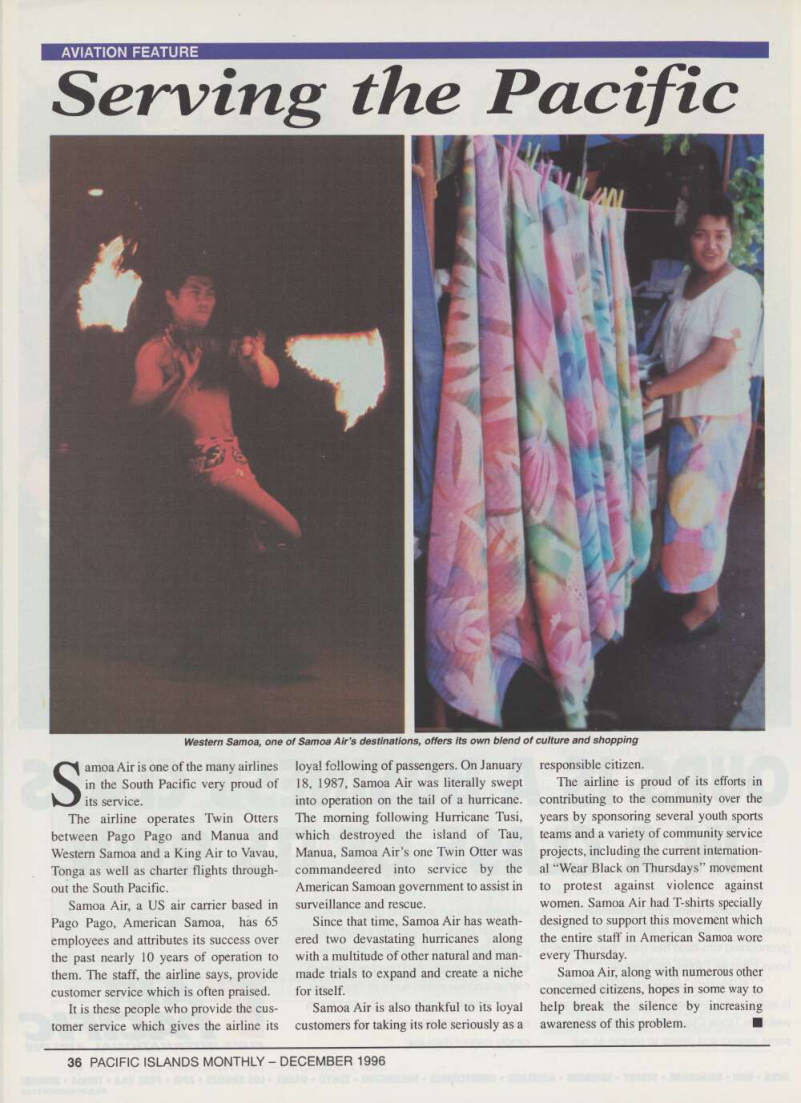
Samoa Air is one of the many airlines in the South Pacific very proud of its service.
The airline operates Twin Otters between Pago Pago and Manua and Western Samoa and a King Air to Vavau, Tonga as well as charter flights through out the South Pacific.
Samoa Air, a US air carrier based in Pago Pago, American Samoa, has 65 employees and attributes its success over the past nearly 10 years of operation to them. The staff, the airline says, provide customer service which is often praised.
It is these people who provide the cus tomer service which gives the airline its
loyal following of passengers. On January 18, 1987, Samoa Air was literally swept into operation on the tail of a hurricane.
The morning following Hurricane Tusi, which destroyed the island of Tau, Manua, Samoa Air’s one Twin Otter was commandeered into service by the American Samoan government to assist in surveillance and rescue.
Since that time, Samoa Air has weath ered two devastating hurricanes along with a multitude of other natural and man made trials to expand and create a niche for itself.
Samoa Air is also thankful to its loyal customers for taking its role seriously as a
responsible citizen.
The airline is proud of its efforts in contributing to the community over the years by sponsoring several youth sports teams and a variety of community service projects, including the current internation al “Wear Black on Thursdays” movement to protest against violence against women. Samoa Air had T-shirts specially designed to support this movement which the entire staff in American Samoa wore every Thursday.
Samoa Air, along with numerous other concerned citizens, hopes in some way to help break the silence by increasing awareness of this problem. ■
Western Samoa, one of Samoa Air’s destinations, offers its own blend of culture and shopping
Advertisements & other items, pp. 37-38 (1 item)
ssmart am
••• asiiicisss 6 ‘ ■
FOR RESEVERVAXIOMS /INFORMATION
AMERICAN SAMOA
WESTERN SAMOA
VAVAU, TONGA
PHONE: (684) 699-9106
PHONE: (685) 22321
PHONE: (676) 70644
FAX: (684) 699-9751
FAX: (685) 23851
FAX: (676) 70464
CHARTERS AVAILABLE THROUGHOUT THE SOUTH PACIFIC
THE AIR BP NETWORK
IN AUSTRALASIA
Air BP provide aviation fuel at around 150 locations throughout Australia, New Zealand and the South West Pacific.
cyanide poisoning
Mine blamed for cyanide poisoning
Environment
Reports by Sam Vulum
About 30 villagers have either died or been hospitalised and a num ber of domesticated animals, including dogs and pigs, died in Papua New Guinea’s Eastern Highlands Province from what is alleged to be the effects of cyanide and other dangerous chemicals from a decommissioned mine.
The mine, situated on Mt Victor, is located about 20 kilometres south of Kainantu town and north of the Yonki Hydro Dam.
Although cyanide was found in the streams and creeks in the mine area, it could not be established whether the deaths of some of the villagers and ani mals were the result of drinking cyanide contaminated water.
Villagers have told government authorities that cyanide was detected inthe water by scientists from the University of Technology in Lae after tests in June.
Pacific Islands Monthly confirmed this with the university’s national analysis lab oratory last month.
However, chief chemist Fred Grieshaber could not confirm the level of cyanide found for reasons of confidential ity. However, Ben Baiyo, a senior officer with the Department of Eastern Highlands, said the reports were being treated seriously. Baiyo, who had pre pared a report for the department after vis iting the site on September 26, said they were in the process of evacuating about 5000 to 6000 people from the area. He said the site was visible from as far as 100 metres away and the smell emanating from the area could cause irritation to the eyes and nasal passage.
The controversial area covers about five square kilometres of land, starting from the base of the mountain, where the tailings dam was located and extending downwards to Iruwura, Besa, Sairoa Number One, Sairoa Number Two, Omura village, the Besa spring and Tutubirora creek.
He said the villagers were aware of the
problem in 1991 and had elected to tackle it on their own without notifying the authorities. They had gone to court but their case had been thrown out.
The provincial administrator, accom
panied by the provincial police comman
der and a medical officer, visited the site in early November to assess the situation.
Meanwhile, Niugini Mining came out publicly on November 6 refuting claims that they were responsible for the deaths and suffering of more than 30 people as
reported. Company director Gavin
Thomas, speaking from United States where the company was holding its quar terly board meeting, said his company had followed all the proper procedures in decommissioning the mine in 1991.
Thomas said his company had followed strict environmental regulations and the environmental committee was involved in the decommissioning. He said an inde pendent investigation detected no sign of residual cyanide in the area.
“We are very comfortable. We are very proud. We can stand up in any court and defend ourselves,” Thomas said.
The Mt Victor mine situation is the second case in PNG where cyanide has been blamed. The first was cited in 1994 when a barge transporting Ok Tedi Mining Limited chemicals for the Ok Tedi Mine in the Western Province overturned 15 kilometres northeast of Umuda Island in the Fly River estuary. In the incident, 27,000 60-litre drums of cyanide were lost in what was reported to be the single largest loss of the world’s most dangerous poison. It was alleged that only 117 cyanide drums were salvaged. It has never been made public whether the remaining drums were reclaimed.
In the same month, a bypass valve opened for two hours releasing 1000 cubic metres of highly concentrated cyanide waste into the Ok Tedi River, a spill that OTML was silent about for two weeks until dead fish, prawns, turtles, and crocodiles started floating downstream of the mine as far as Ningerum. ■
Goroka-based freelance journalist
John Ewande, who visited die
mine site recently gave a first-hand
description of die area as he saw it While at the site, I was taken to visit Mt Victor gold mine pit number one, pit number two, Anas garden tailing dam, Besa village spring and Tutubirora creek.
Along the road to pit number one, the grass beside the drain was drying up, the dead leaves in the drain were covered with greasy liquid and there was a smell of chemicals all along the road. I was told the chemicals had been washed down from the mountain by heavy rain water.
Arriving at pit number one, I could see a reddish-brown liquid seeping out from the sides of the mountain.
The leaks formed a stream at the base of the mountain, which ran about 50 to 100 metres and dropped into a small creek.
Further on, the creek joins the main Tutubirora creek at the foot of the moun tain.
I was told that the company drilled into the side of the mountain at several spots and injected chemicals to soften the hard rock for excavation.
However, when the mine closed down the areas were left unseaeled so the chem icals were leaking out after rain water soaked into the holes.
At the Anas Garden tailing dam site, the dam is located about three kilometres down from pit number one.
The dam was covered with earth and
boggy and some plants were growing
over it.
Walking through the bull rushes, I could see thick oily stuff floating on the water. The ponds were black and the bull rushes were drying up.
Besa village is located on the mill site and it was few metres away from the tail ing dam site.
The village’s spring was about four kilometres down from pit number one and about two kilometres down from the tail
ing dam.
The villagers used the creek for drink ing water but they claimed the cyanide was leaking out from the water hole as well. ■
Advertisements & other items, p. 40 (1 item)
South Pacific Regional Environment Programme (SPREP)
Vacancies: Programme Manager Climate Change (PICCAP) Scientific/Technical Officer (PICCAP) Training Officer (COTRAIN)
Applications are invited for the above positions with the SPREP Secretariat in Apia, Western Samoa. The positions are expected to commence in the first quarter 1997.
SPREP is an intergovernmental organisation responsible for advising on and assisting with environmental issues in the South Pacific region. Some 50 staff work under the overall supervision of a Director, who is assisted by a Deputy Director and 4 Heads of Divisions.
The Pacific Islands Climate Change Programme (PICCAP) is funded by the Global Environment Facility (GEF) and administered through the United Nations Development Programme (UNDP). The PICCAP is a 3-year, $2.44m programme designed to carry out activities to enable the ten participating Pacific Island countries to meet their reporting obligations under the UN Framework Convention on Climate Change. It will address sources and sinks of greenhouse gases, mitigation options, vulnerability to climate and sea level change, and adaptation options. The Programme includes the preparation of national implementation plans and the National Communications to the Conference of the Parties of the UN Framework Convention on Climate Change (UNFCCC).
CC: TRAIN is a UNDP project funded by the Global Environmental Facility and other bilateral donors and executed by UNITAR in collaboration with the Climate Change Secretariat. It is a three year programme with a primary goal to assist participating countries to prepare their National Communication as required by Article 12 of the UNFCCC. SPREP is the CQTRAIN Regional Partner in the Pacific.
PROJECT MANAGER (PICCAP)
Duties The Project Manager (PICCAP) is responsible to the Director, through the Head of Environmental Management and Planning for the overall implementation of PICCAP. He/she will manage and supervise the PICCAP Project Team, including a Scientific/ Technical Officer and the Training Officer (CCTRAIN), within the Climate Change Programme of SPREP. As well, the Programme Manager will coordinate with the Country Teams of the ten participating Pacific Island countries, the regional consultants involved in PICCAP and the relevant planning, management and
budgeting activities.
Qualifications and Experience The applicant should possess a post-graduate University degree, preferably related to environmental planning and policy. Work experience in environment and development issues, especially in climate change, is desired. In addition, the applicant should have proven management and communication skills in managing international projects and staff. Applicants must be nationals of a United Nations or SPREP member country.
SCIENTIFIC/TECHNICAL OFFICER, (PICCAP)
Duties The Scientific/Technical officer will be a member of the PICCAP Project Team and will work under the direction of the Programme Manager. He /She will have responsibility for overseeing the scientific and technical aspects of PICCAP activities including, preparing inventories of greenhouse gas sources and sinks, identifying and evaluating mitigation options, assessing vulnerability to climate and sea level change and identifying and evaluating adaptation options.
Qualifications and experience The applicant should possess a post-graduate University degree, preferably with expertise in climate change vulnerability assessment and coastal zone management. The applicant should have at least five years work experience, preferably in the Pacific Islands or in other small island nation contexts. Proven management and communication skills are desired. Applicants must be nationals of a United Nations or SPREP member country.
TRAINING OFFICER (CC: TRAIN)
Duties The Training Officer will report directly to the Programme Manager and assist in the implementation of CC: TRAIN.
He/She will form part of the CC; TRAIN team and will be responsible for budget management, communications strategy, project management including an operational manual, training material development, scheduling and information management and administration.
Qualifications The Training officer should possess qualifications in education and training, preferably related to environmental planning and policy, at least 5 years work experience in a relevant field. He/she should have strong command of English, knowledge of other Pacific languages would be an advantage, strong computer skills, and strong administrative and communication skills. Initiative, resourcefulness and a commitment to the programme will be required along with an understanding of developing country conditions and needs and an aptitude to learn about the climate change issues and the UNFCCC.
Conditions Appointments will be at the Project Officer/Adviser Levels of SPREP's authorised salary scales for contract staff, depending on the successful applicants' qualifications and experience. The package will include annual return airfares for appointee and dependents, a housing subsidy and other benefits. SPREP remuneration may be tax-free depending upon circumstances. The appointments will be for 3 years.
Applications Applications should be accompanied by three copies of curriculum vitae containing full personal details, information on qualifications and experience for the position, previous appointments, current position and salary, names, addresses and telephone and/or fax contact numbers of three persons associated with the applicant professionally and who would be prepared to provide testimonials. An indication of how soon the applicants would be available should be indicated.
Closing date: 31 January 1997.
Applications should be addressed to: The Director Telephone: (685) 21929
SPREP Fax: (685) 20231
PO Box 240, Apia E-mail: sprep @ packtok.peg.apc.org Western Samoa Further information, including a full post description and details of remuneration and terms and conditions of appointment is available from the SPREP Administration Officer, Mrs Malama Hadley, Telephone (685) 21929, Extension 237.
Dowiygo takes over Nauru
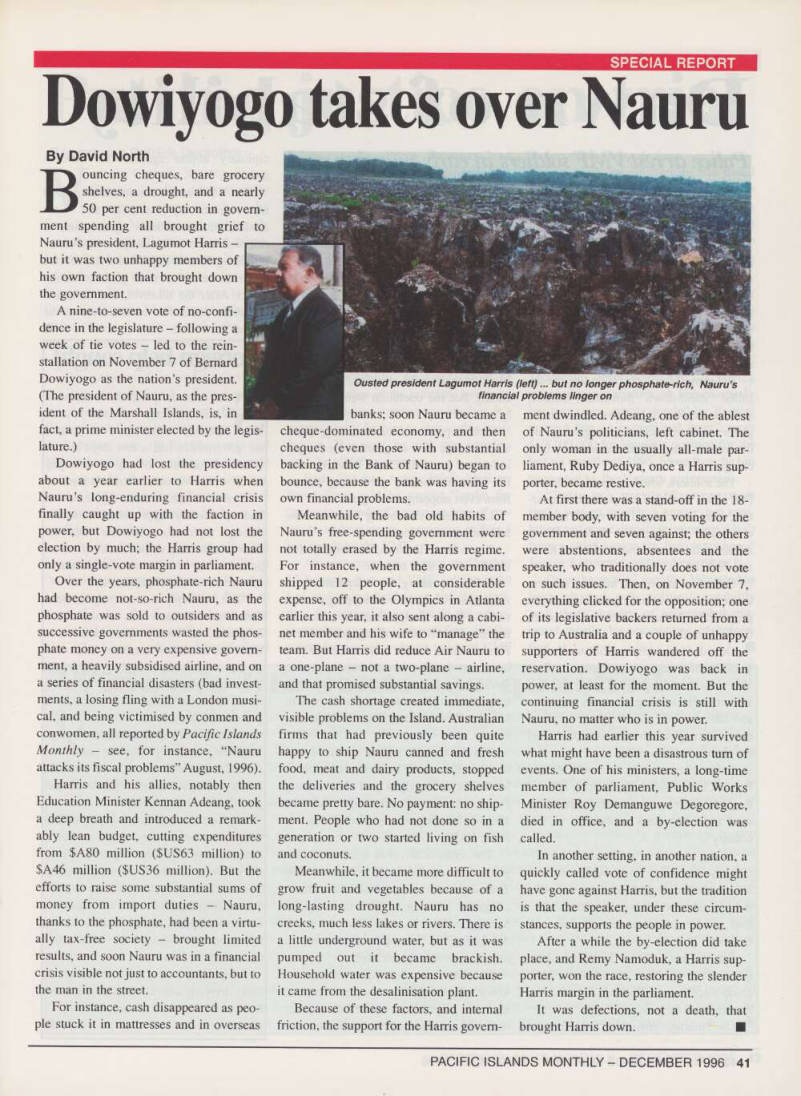
By David North
Bouncing cheques, bare grocery shelves, a drought, and a nearly 50 per cent reduction in govern ment spending all brought grief to
Nauru’s president, Lagumot Harris but it was two unhappy members of his own faction that brought down the government.
A nine-to-seven vote of no-confi dence in the legislature - following a week of tie votes - led to the rein stallation on November 7 of Bernard Dowiyogo as the nation’s president. (The president of Nauru, as the pres ident of the Marshall Islands, is, in
fact, a prime minister elected by the legis lature.) Dowiyogo had lost the presidency about a year earlier to Harris when Nauru’s long-enduring financial crisis finally caught up with the faction in power, but Dowiyogo had not lost the election by much; the Harris group had only a single-vote margin in parliament.
Over the years, phosphate-rich Nauru had become not-so-rich Nauru, as the phosphate was sold to outsiders and as successive governments wasted the phos phate money on a very expensive govern ment, a heavily subsidised airline, and on a series of financial disasters (bad invest ments, a losing fling with a London musi cal, and being victimised by conmen and
conwomen, all reported by Pacific Islands
Monthly - see, for instance, “Nauru attacks its fiscal problems” August, 1996).
Harris and his allies, notably then Education Minister Kennan Adeang, took a deep breath and introduced a remark
ably lean budget, cutting expenditures
from SABO million (SUS 63 million) to SA46 million (SUS 36 million). But the efforts to raise some substantial sums of money from import duties Nauru, thanks to the phosphate, had been a virtu ally tax-free society - brought limited results, and soon Nauru was in a financial crisis visible not just to accountants, but to the man in the street.
For instance, cash disappeared as peo ple stuck it in mattresses and in overseas
banks; soon Nauru became a
cheque-dominated economy, and then cheques (even those with substantial backing in the Bank of Nauru) began to bounce, because the bank was having its own financial problems.
Meanwhile, the bad old habits of Nauru’s free-spending government were not totally erased by the Harris regime.
For instance, when the government shipped 12 people, at considerable expense, off to the Olympics in Atlanta earlier this year, it also sent along a cabi net member and his wife to “manage” the team. But Harris did reduce Air Nauru to a one-plane - not a two-plane - airline, and that promised substantial savings.
The cash shortage created immediate, visible problems on the Island. Australian firms that had previously been quite happy to ship Nauru canned and fresh food, meat and dairy products, stopped the deliveries and the grocery shelves became pretty bare. No payment: no ship ment. People who had not done so in a generation or two started living on fish and coconuts.
Meanwhile, it became more difficult to grow fruit and vegetables because of a long-lasting drought. Nauru has no creeks, much less lakes or rivers. There is a little underground water, but as it was pumped out it became brackish.
Household water was expensive because it came from the desalinisation plant.
Because of these factors, and internal friction, the support for the Harris govem
ment dwindled. Adeang, one of the ablest of Nauru’s politicians, left cabinet. The only woman in the usually all-male par liament, Ruby Dediya, once a Harris sup porter, became restive.
At first there was a stand-off in the 18member body, with seven voting for the government and seven against; the others were abstentions, absentees and the speaker, who traditionally does not vote on such issues. Then, on November 7, everything clicked for the opposition; one of its legislative backers returned from a trip to Australia and a couple of unhappy supporters of Harris wandered off the reservation. Dowiyogo was back in power, at least for the moment. But the continuing financial crisis is still with Nauru, no matter who is in power.
Harris had earlier this year survived what might have been a disastrous turn of events. One of his ministers, a long-time member of parliament. Public Works
Minister Roy Demanguwe Degoregore,
died in office, and a by-election was called.
In another setting, in another nation, a quickly called vote of confidence might have gone against Harris, but the tradition is that the speaker, under these circum stances, supports the people in power.
After a while the by-election did take place, and Remy Namoduk, a Harris sup porter, won the race, restoring the slender Harris margin in the parliament.
It was defections, not a death, that brought Harris down. ■
Ousted president Lagumot Harris (left)... but no longer phosphate-rich, Nauru’s financial problems linger on
Dawn of stability
Vanuatu Coup
Police arrest VMF soldiers in early morning mid
Reports by Patrick Decloitre
Vanuatu’s police force on
November 12 arrested all Vanuatu Mobile Force (VMF) officers in a move to stop nearly two months of rebellion within the VMF.
However, most soldiers who had been arrested in this surprise pre-dawn opera tion were released the following day on the condition that they take an oath of
allegiance.
But some 24 officers (including the so called “stand-down” movement leaders) and one member of parliament, whom the government suspects of having stirred up the soldiers for political reasons, may face charges.
The soldiers, who had spent one day in Port Vila’s small jail and police headquar ters, were not charged but swore an offi cial oath of allegiance before Home Affairs and Justice ministers Robert Karie and Walter Lini.
One after one, over a hundred soldiers swore on the Bible and signed instruments prepared by Vanuatu’s Attorney-General, Oliver Saksak.
Outside Home Affairs Minister Karie’s small conference room, close to Port Vila’s Independence Park, the released soldiers were waiting their turn to appear and take an oath promising to “only use the powers given to maintain order and the chain of command”.
Before they went back to work, Acting Police Commissioner Peter Bong insisted they take this engagement “to make a new start and bring back confidence in this
country”.
At the time of writing, some 24 VMF officers and mutiny ring leaders were still in custody and could face charges, one of the gravest of which would be the abduc tion of the president at gunpoint on October 12.
Sato Kilman, MP for Malekula island the brother of the “stand-out” VMF group’s spokesman Samson Kilman, was also arrested by police.
On Tuesday, November 12, Vanuatu
woke up to a speech made live on nation al radio by newly appointed Justice minis ter Walter Lini, who had been given spe cial mandate by Prime Minister Serge Vohor to deal with the VMF crisis.
Lini said a special police operation to arrest “all VMF officers” had started at 4am and been completed by 5.30 am.
“They went in without any guns to the VMF compound last night. They arrested people with bare hands - all in one hour.
Most of them were sleeping,” Lini said, adding that the operation went “smooth ly”
Armed police officers wearing black woollen caps were on guard at the camp in front of the VMF Cooks Barracks - for the whole of the day preventing anyone from even stopping at the gates.
Local Television blong Vanuatu crew had their camera confiscated.
But in Port Vila town, life continued as usual with no sign of panic.
Vohor, speaking by telephone from Australia - where he was stopping over en route to Rome (Italy) where he is attend ing the United Nations-organised World Food Summit - later said in another live broadcast that the arrests were to ensure soldiers involved in last month’s abduc tion and last Thursday’s of a Australian adviser, David Schupp, would be prose cuted.
The VMF had seized, abducted and detained for several hours President Jean- Marie Leye Lenelgau and then Acting Prime Minister Barak Sope over an alleged SUS9BO,OOO in unpaid allowances to the VMF.
The soldiers involved were soon after given amnesty by the government. Last Thursday, an unarmed VMF commando
allegedly abducted, hit, interrogated
Schupp, who is in Vanuatu under Australian aid. Schupp was returned to his office several hours later.
Reacting to Schupp’s abduction, Vohor’s first secretary, Antoine Pikioune, said the government could not tolerate such actions any more and called on dis
ciplinary action against the officers involved.
The VMF, which consists of some 300 men trained by Australia and New Zealand under defence agreements, is responsible for maintaining law and order, providing disaster relief and a fire service under the authority of the police commis sioner. After the takeover, Lini said law and order duties had been shifted to the police. ■
Foreign help sought
Soon after the police force arrest of VMF officers, Vanuatu Justice Minister Walter Lini confirmed the government had a few days earlier called on Australia to help crush a pay revolt within Vanuatu’s Mobiles Forces.
Lini said the Vanuatu government
had specifically approached Australia
through diplomatic channels with the view of obtaining some “back-up” to its police forces in a plan to arrest Vanuatu Mobile Force (VMF) soldiers.
“But the reply was so vague, non committal. We knew this would take a long time, and finally we decided it was better for us to do it ourselves.”
Lini said foreign aid donors thought Vanuatu should handle the situation itself. “If we had failed, they would have
given us back-up.”
In Canberra, a spokesman for Foreign Minister Alexander Downer said that Australia had offered to send a senior figure to Vanuatu to mediate between the government and the VMF.
An apparent coincidence caused con fusion here on the day of the arrests: a French Army Puma helicopter, carrying six soldiers, landed from neighbouring New Caledonia in Port Vila at around 9am and soon after took off again to northern Espiritu Santo island, before flying back to Noumea the same after noon via Port Vila.
It was a training flight, the French said, denying any connection between the events of the day and the Puma’s presence. ■
Putting justice on trial
Justice
Reports by Patrick Decloitre
Vanuatu’s chief justice, Briton
Charles Vaudin, was officially dismissed late October by President Jean-Marie Leye Lenelgau. In accordance with a Supreme Court ruling, he left Port Vila for neighbouring Noumea a few days later and was not to return until November 26, when the case was to con tinue. On October 31, the president signed a constitutional order gazetted the next day, in which he terminated Vaudin’s appointment as a Supreme Court judge.
“The president dismissed the chief jus tice after he was found guilty of serious misconduct by a Judicial Services Commission,” government lawyer Roger de Robillard said. De Robillard was last March himself declared an undesirable
immigrant by the previous government,
headed by Maxime Carlot Korman, which was toppled on September 30 by a no confidence motion.
In early October, Vanuatu Foreign Minister Willie Jimmy declared Vaudin an “undesirable immigrant”, giving him two hours to leave on a scheduled flight to Australia, but the Supreme Court later prevented the government from deporting him. The court, with two New Zealand
judges. Justices Bruce Robertson and Douglas Dillon, and Briton Justice Faquir Muhammad, ruled that Vaudin be paid his SUS 14,000 monthly salary for October and November, and that travel and lodg ing expenses in New Caledonia be taken care of by the government.
Meanwhile, he is not to contact, direct ly or indirectly, any politician or paramil itary Vanuatu Mobile Force (VMF) mem ber and the government is to appoint a “nominee” for Vaudin’s communications purposes, de Robillard said. “In times of political instability, we can’t afford to have a member of the judiciary trying to bring politicians against one another. It’s not necessary for him to stay in this juris diction. This way, he will stop interfer ing,” he told the court.
Early October, Acting Prime Minister Barak Sope said he sacked Vaudin for “gross misconduct”, accusing him of try ing to undermine an agreement ending a pay revolt by the VMF.
An agreement was signed on October 12 between him and VMF soldiers who had seized and held Sope and the presi dent for several hours. While the agree ment gave amnesty to the soldiers, Vaudin soon after issued warrants to arrest VMF
leaders of this coup de force.
Sope said the government had based its decision on allegations contained in reports filed by a former Australian judge.
Justice Robert Kent, who resigned last year after expressing “concern over the independence of the chief justice” and the International Commission of Jurists.
Vaudin was appointed early 1992 by the Island state’s president under a British-funded contract until 1994, when London refused to continue funding this position. However, the Cultural and Technical Cooperation Agency (CTCA, a worldwide association of French-speak ing countries, mostly funded by France) granted “on an exceptional basis” some SUS 100,000 for Vaudin’s position for the last six months of 1995. Since then, he has been paid by the Vanuatu government.
“Today is a tragedy. Everyone must find a way to provide a proper, just reso lution and some dignity to someone who’s been a chief justice for five years here,”
Justice Robertson said on November 1.
Over the past 12 months, Vanuatu has been plagued with political instability with three changes of government trig gered mostly by accusations of corrup tion. ■
Widow’s life sentence quashed
Vanuatu’s court of Appeal on November 1 quashed a con
viction of premeditated murder against 30-year-old
Italian expatriate Luciana Mari Picchi, who was last year sentenced to life imprisonment by then Chief Justice Charles Vaudin in the Supreme Court.
In December last year, Vaudin found Luciana Picchi guilty of murdering her husband. Franco Picchi, a 51-year-old Italian builder, with the help of two ni-Vanuatu men, Tui George and Berry Max Jimmy, and the housegirl. Picchi had pleaded not guilty and denied having had a love affair with one of the accom plices, Tui George, or that she’d promise him one million vatu ($US850,000) to kill her husband. Tui and Berry both gave evi dence against her, but their statements didn’t always match.
Vaudin said at the time that because of this, he had “looked sep arately at each evidence” and had come the conclusion that Tui and Berry had been in earnest. “I believe what they said. I have no doubt they’re telling the truth,” he said.
But the court, which met on an ad hoc basis, with New Zealand Justices Bruce Robertson and Douglas Dillon and
Briton Justice Faquir Muhammad, contested Vaudin’s ruling.
“In his 127-page ruling, (Vaudin) failed to address the signif icant issue, that is, credibility in evidence,” Justice Robertson said. “The conviction cannot stay.”
The court said Vaudin had “disposed of evidence” brought to him when he said last year some witnesses had “exaggerated” or “had poor memory” in their testimony. “It was a case of how and why, and not only a matter of recording evidence,” Justice Robertson said. The court, in quashing the convictions against Picchi, set the matter for retrial with a direction to the prosecu tion that they should consider a nulli proscui, effectively admit ting no evidence. “Whether they do so or not is a matter for them to consider over the next few weeks,” Picchi’s lawyer, John Malcolm, said. Minutes after, the court granted bail to the Italian widow, who spent the past 18 months in Port Vila’s tiny jail.
“Whether the prosecution decides to further prosecute or not, the matter should be put before a Supreme Court judge in Vanuatu. But if they decide not to prosecute, she’ll simply be released. And that’s the end of it, totally,” Malcolm said. ■
Muddied glory
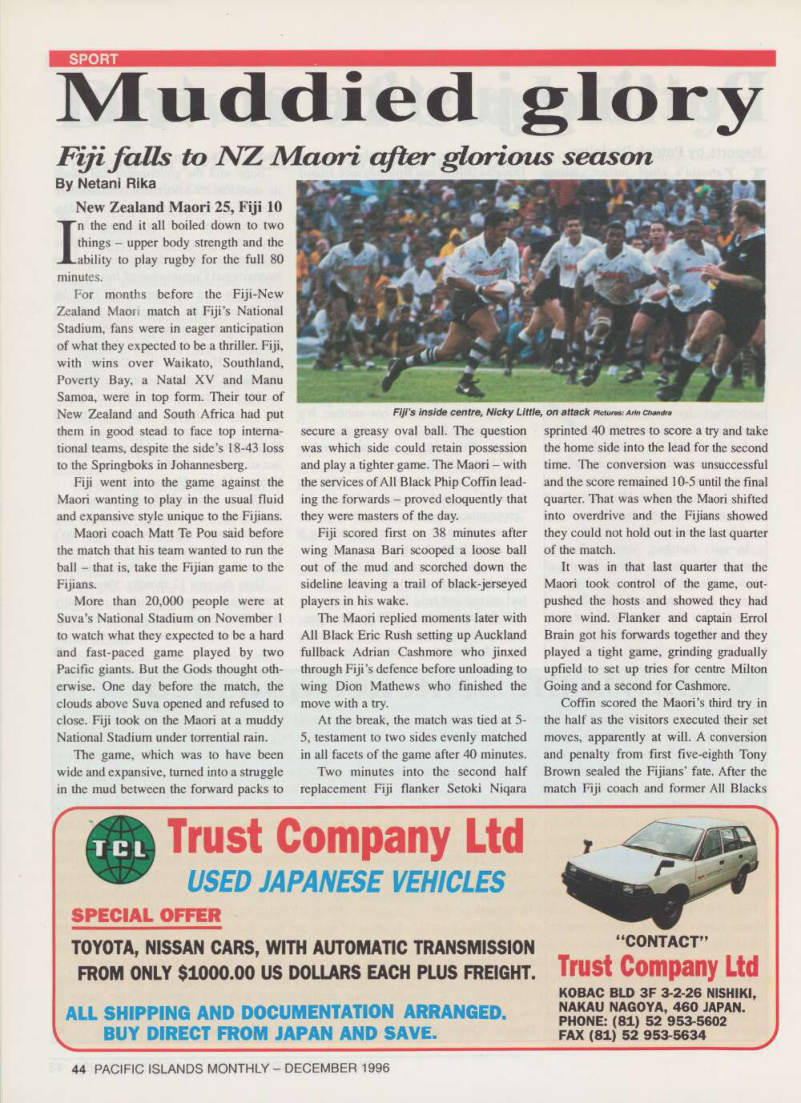
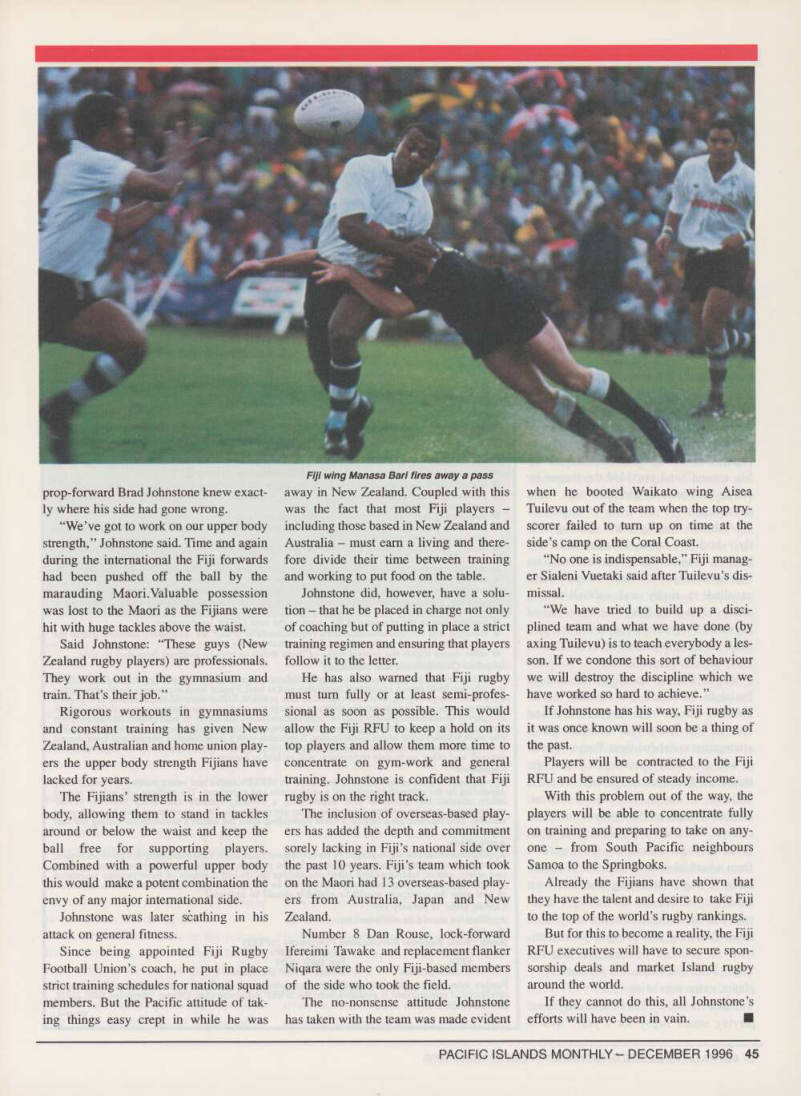
Sport
Fiji falls to NZ Maori after glorious season
By Netani Rika
New Zealand Maori 25, Fiji 10 In the end it all boiled down to two things - upper body strength and the ability to play rugby for the full 80 minutes.
For months before the Fiji-New Zealand Maori match at Fiji’s National Stadium, fans were in eager anticipation of what they expected to be a thriller. Fiji, with wins over Waikato, Southland, Poverty Bay, a Natal XV and Manu Samoa, were in top form. Their tour of New Zealand and South Africa had put them in good stead to face top interna tional teams, despite the side’s 18-43 loss to the Springboks in Johannesberg.
Fiji went into the game against the Maori wanting to play in the usual fluid and expansive style unique to the Fijians.
Maori coach Matt Te Pou said before the match that his team wanted to run the ball - that is, take the Fijian game to the Fijians.
More than 20,000 people were at Suva’s National Stadium on November 1 to watch what they expected to be a hard and fast-paced game played by two Pacific giants. But the Gods thought oth erwise. One day before the match, the clouds above Suva opened and refused to close. Fiji took on the Maori at a muddy National Stadium under torrential rain.
The game, which was to have been wide and expansive, turned into a struggle in the mud between the forward packs to
secure a greasy oval ball. The question was which side could retain possession and play a tighter game. The Maori - with the services of All Black Phip Coffin lead ing the forwards - proved eloquently that they were masters of the day.
Fiji scored first on 38 minutes after wing Manasa Bari scooped a loose ball out of the mud and scorched down the sideline leaving a trail of black-jerseyed players in his wake.
The Maori replied moments later with All Black Eric Rush setting up Auckland fullback Adrian Cashmore who jinxed
through Fiji’s defence before unloading to
wing Dion Mathews who finished the move with a try.
At the break, the match was tied at 5- 5, testament to two sides evenly matched in all facets of the game after 40 minutes.
Two minutes into the second half replacement Fiji flanker Setoki Niqara
sprinted 40 metres to score a try and take the home side into the lead for the second time. The conversion was unsuccessful and the score remained 10-5 until the final quarter. That was when the Maori shifted into overdrive and the Fijians showed they could not hold out in the last quarter of the match.
It was in that last quarter that the Maori took control of the game, out pushed the hosts and showed they had more wind. Flanker and captain Errol Brain got his forwards together and they
played a tight game, grinding gradually
upfield to set up tries for centre Milton Going and a second for Cashmore.
Coffin scored the Maori’s third try in the half as the visitors executed their set moves, apparently at will. A conversion and penalty from first five-eighth Tony Brown sealed the Fijians’ fate. After the match Fiji coach and former All Blacks
Fiji’s inside centre, Nicky Little, on attack pictures: Ann Chandra
prop-forward Brad Johnstone knew exact ly where his side had gone wrong.
“We’ve got to work on our upper body strength,” Johnstone said. Time and again during the international the Fiji forwards had been pushed off the ball by the marauding Maori. Valuable possession was lost to the Maori as the Fijians were hit with huge tackles above the waist.
Said Johnstone: “These guys (New
Zealand rugby players) are professionals.
They work out in the gymnasium and train. That’s their job.”
Rigorous workouts in gymnasiums
and constant training has given New Zealand, Australian and home union play ers the upper body strength Fijians have lacked for years.
The Fijians’ strength is in the lower body, allowing them to stand in tackles around or below the waist and keep the ball free for supporting players.
Combined with a powerful upper body this would make a potent combination the envy of any major international side.
Johnstone was later scathing in his attack on general fitness.
Since being appointed Fiji Rugby
Football Union’s coach, he put in place strict training schedules for national squad members. But the Pacific attitude of tak ing things easy crept in while he was
away in New Zealand. Coupled with this was the fact that most Fiji players including those based in New Zealand and Australia - must earn a living and there fore divide their time between training and working to put food on the table.
Johnstone did, however, have a solu tion - that he be placed in charge not only of coaching but of putting in place a strict
training regimen and ensuring that players
follow it to the letter.
He has also warned that Fiji rugby must turn fully or at least semi-profes sional as soon as possible. This would allow the Fiji RFU to keep a hold on its top players and allow them more time to concentrate on gym-work and general training. Johnstone is confident that Fiji rugby is on the right track.
The inclusion of overseas-based play ers has added the depth and commitment sorely lacking in Fiji’s national side over the past 10 years. Fiji’s team which took on the Maori had 13 overseas-based play ers from Australia, Japan and New Zealand.
Number 8 Dan Rouse, lock-forward Ifereimi Tawake and replacement flanker
Niqara were the only Fiji-based members
of the side who took the field.
The no-nonsense attitude Johnstone has taken with the team was made evident
when he booted Waikato wing Aisea Tuilevu out of the team when the top try scorer failed to turn up on time at the side’s camp on the Coral Coast.
“No one is indispensable,” Fiji manag er Sialeni Vuetaki said after Tuilevu’s dis missal.
“We have tried to build up a disci plined team and what we have done (by axing Tuilevu) is to teach everybody a les son. If we condone this sort of behaviour we will destroy the discipline which we have worked so hard to achieve.”
If Johnstone has his way, Fiji rugby as it was once known will soon be a thing of the past.
Players will be contracted to the Fiji RFU and be ensured of steady income.
With this problem out of the way, the players will be able to concentrate fully on training and preparing to take on any one - from South Pacific neighbours Samoa to the Springboks.
Already the Fijians have shown that they have the talent and desire to take Fiji to the top of the world’s rugby rankings.
But for this to become a reality, the Fiji RFU executives will have to secure spon sorship deals and market Island rugby around the world.
If they cannot do this, all Johnstone’s efforts will have been in vain. ■
Fiji wing Manasa Bari fires away a pass
Advertisements & other items, p. 44 (1 item)
Trust Company Ltd
USED JAPANESE VEHICLES
SPECIAL OFFER
TOYOTA, NISSAN CARS, WITH AUTOMATIC TRANSMISSION
FROM ONLY $lOOO.OO US DOLLARS EACH PLUS FREIGHT.
ALL SHIPPING AND DOCUMENTATION ARRANGED.
BUY DIRECT FROM JAPAN AND SAVE.
r
CONTACT’
Trust Company Ltd
KOBAC BID 3F 3-2-26 NiSHIKI,
NAKAU NAGOYA, 460 JAPAN.
PHONE: (81) 52 953-5602
FAX (81) 52 953-5634
y
Fatialofa hangs up his boots
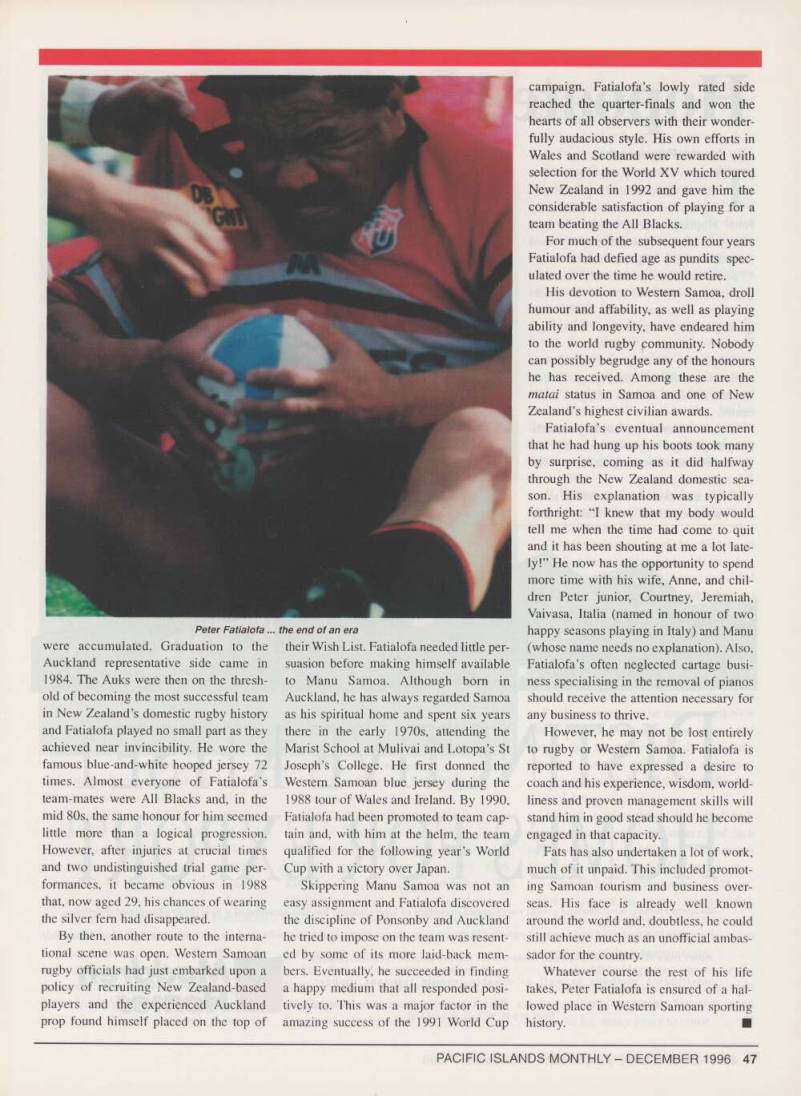
By Atama Raganivatu
Manu Samoa icon Peter Fatialofa’s recent retirement almost certainly marked the end of an era.
A true blue amateur, “Fats” epitomised the traditional spirit of Western Samoan rugby from the moment he entered the international arena in 1988. Throughout the ensuing eight years, during which 37 Test caps were won, he selflessly served his country with little thought to the sacri fices made, both in terms of finance and family life. The advent of professional rugby has all but ensured that we won’t see Fatialofa’s like again.
Fatialofa has never been heard to utter a word begrudging any cent or second of the money and time he has devoted to rugby. The game, he states, “turned my life around” and provided the means by which he could, to use his words, “turn the comer”.
Although coming from a sporting fam
ily - both his father, Momoe, and elder brother, Senio, were Western Samoan boxing champions, other brothers have excelled in rugby and softball and a cousin (Rita Fatialofa) was once one of the world’s top netball players - Peter par ticipated in no organised sport at all until just before he turned 20.
Unlike Momoe and Senio, the teenage Fatialofa preferred his fighting to be informal - in the back streets of Auckland and for the benefit of Samoan gangs attempting to subdue their Tongan rivals.
“I was the Mike Tyson of K Road (the notorious Karangahape Road). A rebel without a cause,” he now claims.
Momoe’s death in 1980 proved to be the catalyst. Momoe was highly revered with in the Samoan community, having risen from wharf labourer to member of parlia ment in Apia. Realising that his own behaviour threatened the family’s hard won esteem, Fatialofa turned away from street brawling and pledged to concen trate on a more constructive activity.
Thus, Peter Fatialofa, the serious rugby player, came into being.
Fatialofa had by this time already been playing senior rugby for a year. When
asked by friends to turn out with the strug gling Grafton club he obliged without any great enthusiasm, appeared in the loose forwards and achieved little.
After deciding to become earnest in his endeavours on the rugby pitch, he set himself goals. The first was to gain a place in the Ponsonby senior XV.
Ponsonby is New Zealand’s most success
ful club and they greatly impressed
Fatialofa when inflicting a 70-point-plus hammering upon the hapless Grafton.
It took just over 12 months for Fatialofa, now converted into a prop for ward, to win his way into the Ponies’ pre mier selection from their third grade side.
The association was to last 15 years, dur ing which time eight Auckland club titles
were accumulated. Graduation to the Auckland representative side came in 1984. The Auks were then on the thresh old of becoming the most successful team in New Zealand’s domestic rugby history and Fatialofa played no small part as they achieved near invincibility. He wore the famous blue-and-white hooped jersey 72 times. Almost everyone of Fatialofa’s team-mates were All Blacks and, in the mid 80s, the same honour for him seemed little more than a logical progression.
However, after injuries at crucial times and two undistinguished trial game per formances, it became obvious in 1988 that, now aged 29. his chances of wearing the silver fern had disappeared.
By then, another route to the interna tional scene was open. Western Samoan rugby officials had just embarked upon a policy of recruiting New Zealand-based players and the experienced Auckland prop found himself placed on the top of
their Wish List. Fatialofa needed little per suasion before making himself available to Manu Samoa. Although born in Auckland, he has always regarded Samoa as his spiritual home and spent six years there in the early 19705, attending the Marist School at Mulivai and Lotopa’s St Joseph’s College. He first donned the Western Samoan blue jersey during the 1988 tour of Wales and Ireland. By 1990, Fatialofa had been promoted to team cap tain and, with him at the helm, the team qualified for the following year’s World
Cup with a victory over Japan.
Skippering Manu Samoa was not an easy assignment and Fatialofa discovered the discipline of Ponsonby and Auckland he tried to impose on the team was resent ed by some of its more laid-back mem bers. Eventually, he succeeded in finding a happy medium that all responded posi tively to. This was a major factor in the amazing success of the 1991 World Cup
campaign. Fatialofa’s lowly rated side reached the quarter-finals and won the hearts of all observers with their wonder fully audacious style. His own efforts in Wales and Scotland were rewarded with selection for the World XV which toured New Zealand in 1992 and gave him the considerable satisfaction of playing for a team beating the All Blacks.
For much of the subsequent four years Fatialofa had defied age as pundits spec ulated over the time he would retire.
His devotion to Western Samoa, droll humour and affability, as well as playing ability and longevity, have endeared him to the world rugby pommunity. Nobody can possibly begrudge any of the honours he has received. Among these are the matai status in Samoa and one of New Zealand’s highest civilian awards.
Fatialofa’s eventual announcement that he had hung up his boots took many by surprise, coming as it did halfway through the New Zealand domestic sea son. His explanation was typically forthright: “I knew that my body would tell me when the time had come to quit and it has been shouting at me a lot late ly!” He now has the opportunity to spend more time with his wife, Anne, and chil dren Peter junior, Courtney, Jeremiah, Vaivasa, Italia (named in honour of two happy seasons playing in Italy) and Manu (whose name needs no explanation). Also, Fatialofa’s often neglected cartage busi ness specialising in the removal of pianos should receive the attention necessary for any business to thrive.
However, he may not be lost entirely to rugby or Western Samoa. Fatialofa is reported to have expressed a desire to coach and his experience, wisdom, world liness and proven management skills will stand him in good stead should he become
engaged in that capacity.
Fats has also undertaken a lot of work, much of it unpaid. This included promot ing Samoan tourism and business over seas. His face is already well known around the world and, doubtless, he could still achieve much as an unofficial ambas sador for the country.
Whatever course the rest of his life takes, Peter Fatialofa is ensured of a hal lowed place in Western Samoan sporting history. ■
Peter Fatialofa ... the end of an era
Advertisements & other items, p. 46 (1 item)
Environment Programme (SPREP)
South Pacific Regional
Vacancy; COMPUTER INFORMATION TECHNOLOGY OFFICER
Applications are invited for the position of COMPUTER INFORMATION TECHNOLOGY OFFICER with the South Pacific Regional Environment Programme (SPREP) in Apia, Western Samoa.
Post Description 1. The Computer Information Technology Officer is responsible to the Director through the Head of the Environmental Education, Information and Coordination Division fon administering the computing budget to maximise the effectiveness of computing within SPREP; purchasing suitable hardware and software within the constraints of the budget and with
management approval;
maintaining and repairing (where possible) the equipment purchased by SPREP; providing training (either personally or with external consultants) on the use of the software and applications being used within SPREP; liaising with other regional organisations as and when needed to coordinate computer standards,
purchases, etc.;
maintaining an up-to-date awareness of developments in the information technology field; advising management of possible future requirements; working with and advising staff on ways of satisfying their computing requirements; planning the implementation of new technology as it becomes available and when appropriate to SPREP's needs; participating in the planning of the move to the new SPREP headquarters; ensuring that the telecommunications requirements of SPREP are continually satisfied within the constraints imposed by the national Telecommunications carrier; and other duties within the general scope of these duties as may be assigned from time to time.
Required Qualifications and Experience
Candidates must have appropriate tertiary qualifications (preferably with post-graduate qualifications in a relevant field) from a recognised institution and at least 5 years' work experience, preferably within the Pacific islands region, in a field related to this position. Other essential requirements are: proven project management experience; the ability to manage the work of consultants; a proven ability to work as a part of an inter-disciplinary and/or multi-cultural team; the ability to meet project deadlines (often under difficult circumstances); a proven ability to prepare proposals and reports; a proven ability to live and work within Pacific island communities. Applicants with a demonstrated interest and involvement in the environmental, economic and social issues affecting the region, particularly through computer network and other up-to-date technology, will be highly regarded.
Conditions Appointment will be at the Project Officer Level of SPREP's authorised salary scales for contract staff, depending on the successful applicants' qualifications and experience. The package will include annual return airfares for appointee and dependents, a housing subsidy and other benefits. SPREP remuneration may be tax-free depending upon circumstances. The appointment will be for 3 years initially, with renewal for a further 3 years depending upon the officer s performance during the first term.
Applications Applications should be accompanied by three copies of curriculum vitae containing full personal details, information on qualifications and experience for the position, previous appointments, current position and salary, names, addresses and telephone and/or fax contact numbers of three persons associated with the applicant professionally and who would be prepared to provide testimonials. An indication of how soon the applicants would be available should be indicated.
Closing Date: 31 January 1997.
Applications should be addressed to: The Director South Pacific Regional Environment Programme (SPREP) PO Box 240 Telephone: (685) 21929
APIA Fax; (685) 20231
Western Samoa E-mail: SPREP @talofa.net Further information, including a full post description and details of remuneration and terms and conditions of appointment is available from the SPREP Administration Officer, Telephone (685) 21929, Extension 237. 125187v4
Hopoate hits the heights

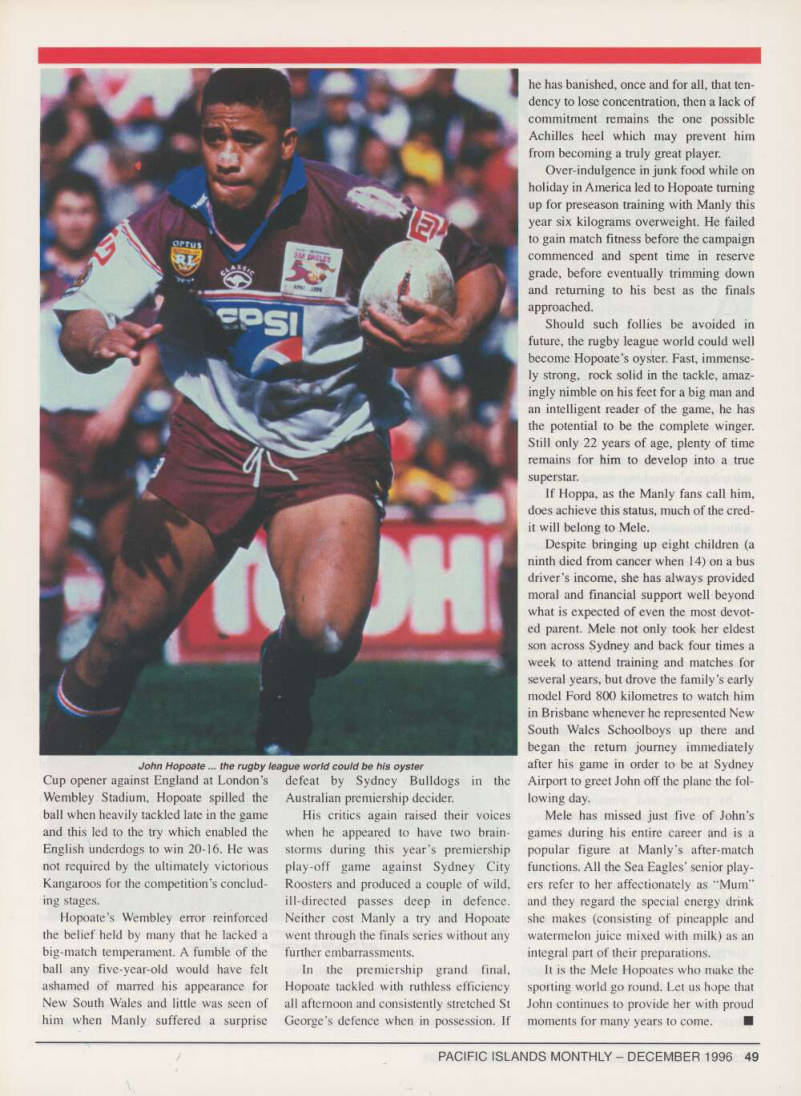
By Atama Raganivatu
Tonga’s already considerable repu tation as producer of gifted foot ballers has been consolidated by John Hopoate’s performaces for the Manly side who were recently crowned
Australian rugby league premiers.
John, or Sione as Friendly Islanders prefer to call him, was bom at Fua’amoto and spent three years there before emi grating with his parents, Viliami and Mele.
Originally, the Hopoates intended to settle at Auckland and spent several months in New Zealand’s largest urban centre.
But, as Viliami experienced great diffi culty acquiring a worthwhile job, the fam ily was forced to move again and eventu
ally settled in Sydney.
While a schoolboy, John showed talent in a variety of sports, particularly basket
ball, rugby union, athletics and rugby league. It was his exploits in rugby league which gained the greatest attention though, and 54 tries in one season marked him as a player of exceptional promise in the 13-a-side code.
Selection for New South Wales at both Under-17 and Ul9 levels extended his fame and most of Sydney’s leading clubs strove to sign him on when he became eli gible for the senior ranks. Manly offered the best terms and so Hopoate became a
“Sea Eagle”.
It surprised many when Hopoate ini tially struggled in first grade, though the reason quickly became all too obvious.
He simply lacked the dedication neces sary to reach the top during those early days and, whenever asked why so much of his time was spent in nightclubs or par tying with friends, he blithely replied, “It’s just a black thing.”
But his attitude changed when he mar ried and became a father twice over, with the universal desire to provide the best possible standard of living for his family.
The new, hungry Hopoate took the 1995 Australian domestic season by storm. His 20 tries for the campaign were topped only by Manly teammate Steve Menzies, who clocked up just one more.
New South Wales introduced him to the senior representative arena when he played for their state |of origin selection.
Named in Tonga's squad for 1995’s Centenary World Cup, it appeared that Hopoate would make his international debut in their colours. However, Australia then provoked much controversy by lur ing him away at the 11 th hour and he was wearing a green and gold jersey when the tournament got under way.
His baptism at the game’s uppermost level was an unhappy one. Playing in the
Cup opener against England at London’s
Wembley Stadium, Hopoate spilled the
ball when heavily tackled late in the game and this led to the try which enabled the English Underdogs to win 20-16. He was
not required by the ultimately victorious
Kangaroos for the competition’s conclud ing stages.
Hopoate’s Wembley error reinforced the belief held by many that he lacked a big-match temperament. A fumble of the ball any five-year-old would have felt ashamed of marred his appearance for New South Wales and little was seen of him when Manly suffered a surprise
defeat by Sydney Bulldogs in the Australian premiership decider.
His critics again raised their voices when he appeared to have two brain storms during this year’s premiership
play-off game against Sydney City
Roosters and produced a couple of wild, ill-directed passes deep in defence.
Neither cost Manly a try and Hopoate went through the finals series without any further embarrassments.
In the premiership grand final, Hopoate tackled with ruthless efficiency all afternoon and consistently stretched St George’s defence when in possession. If
he has banished, once and for all, that ten dency to lose concentration, then a lack of commitment remains the one possible Achilles heel which may prevent him
from becoming a truly great player.
Over-indulgence in junk food while on holiday in America led to Hopoate turning up for preseason training with Manly this year six kilograms overweight. He failed to gain match fitness before the campaign commenced and spent time in reserve
grade, before eventually trimming down
and returning to his best as the finals
approached.
Should such follies be avoided in future, the rugby league world could well become Hopoate’s oysler. Fast, immense ly strong, rock solid in the tackle, amaz ingly nimble on his feet for a big man and an intelligent reader of the game, he has the potential to be the complete winger.
Still only 22 years of age, plenty of time remains for him to develop into a true superstar.
If Hoppa, as the Manly fans call him, does achieve this status, much of the cred it will belong to Mele.
Despite bringing up eight children (a ninth died from cancer when 14) on a bus driver’s income, she has always provided moral and financial support well beyond what is expected of even the most devot ed parent. Mele not only took her eldest son across Sydney and back four times a week to attend training and matches for several years, but drove the family’s early model Ford 800 kilometres to watch him in Brisbane whenever he represented New South Wales Schoolboys up there and began the return journey immediately after his game in order to be at Sydney Airport to greet John off the plane the fol
lowing day.
Mele has missed just five of John’s games during his entire career and is a
popular figure at Manly’s after-match
functions. All the Sea Eagles’ senior play ers refer to her affectionately as "Mum” and they regard the special energy drink she makes (consisting of pineapple and watermelon juice mixed with milk) as an integral part of their preparations.
It is the Mele Hopoates who make the sporting world go round. Let us hope that John continues to provide her with proud moments for many years to come. ■
John Hopoate ... the rugby league world could be his oyster
Advertisements & other items, p. 48 (2 items)
Sport
Distinctive kitset
HOMES FOR EXPORT
Maddren Homes, New Zealand's most experienced exporters of kitset homes, has just announced a new range of superior dwellings.
Available in a variety of architectural styles and appointments, these homes can be reconfigured easily to suit your individual needs.
Apart from their aesthetic appeal, these homes feature proven cyclone resistant construction methods as well as durable termite resistant timbers.
CONTACT MADDREN HOMES: PO Box 244. Rumen. Auckland. New Zealand.
Phone: 64-9-412 9070. fax: 64-9-412 7251
Maddren
Homes
Young, beautiful - and
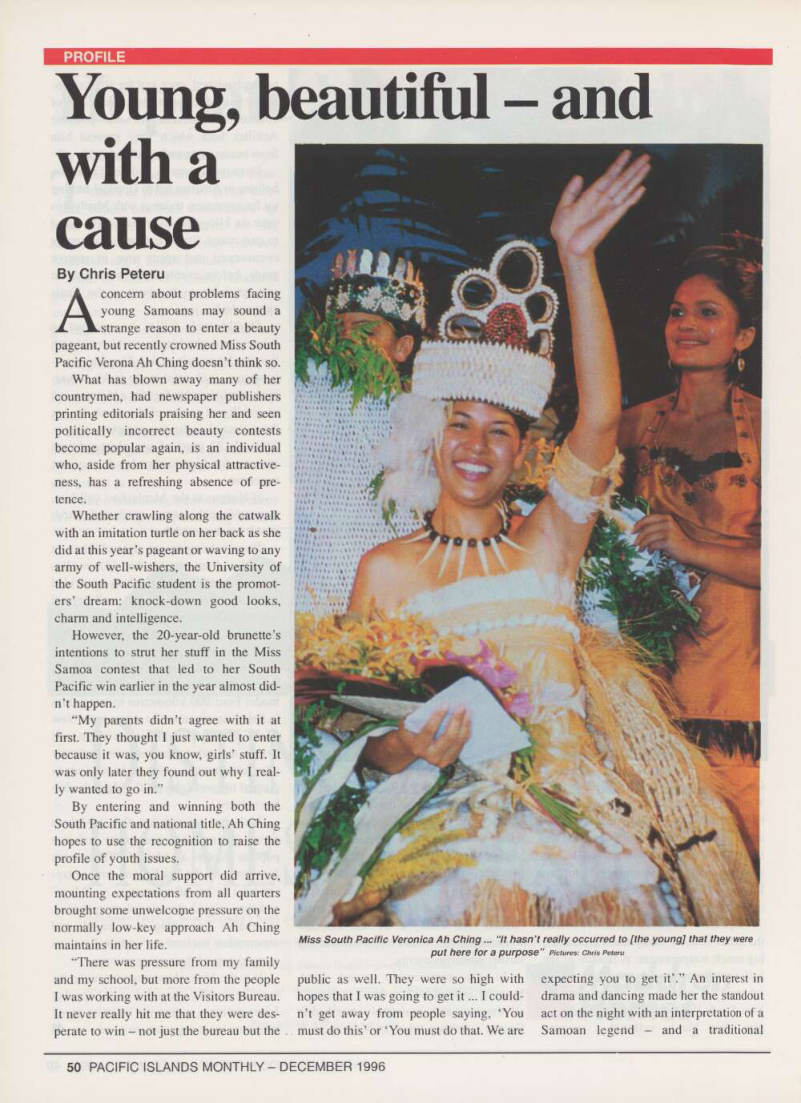
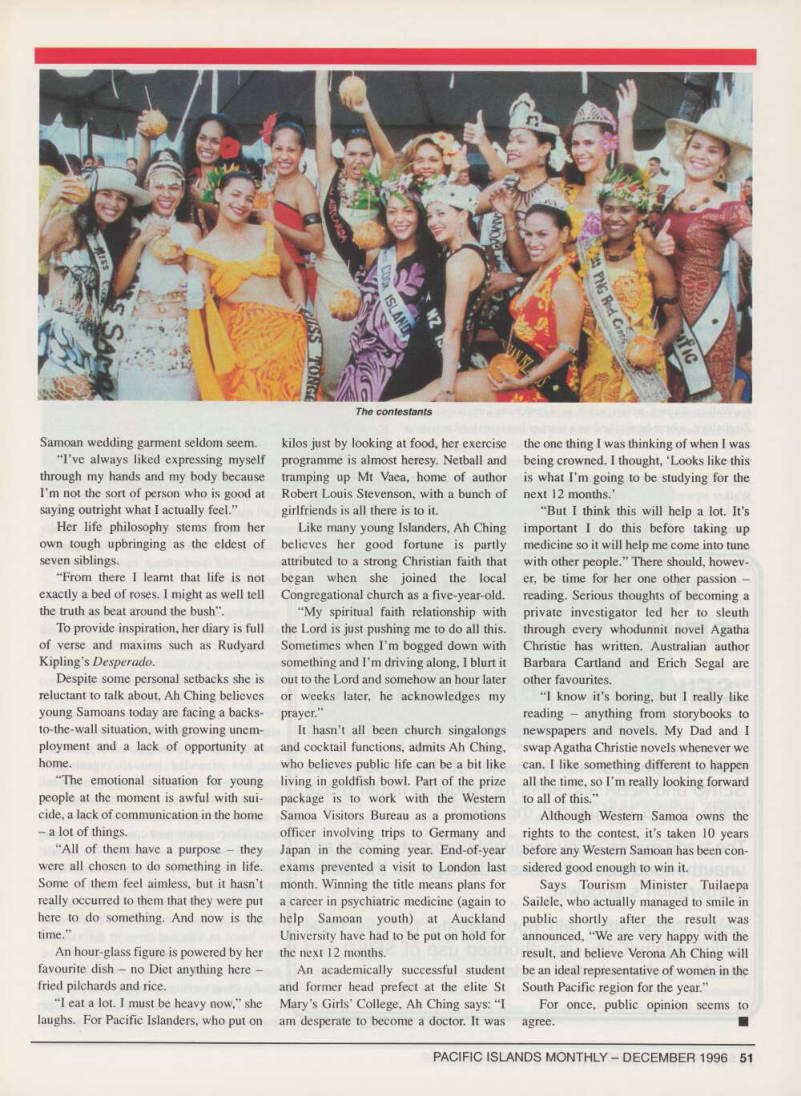
Profile
with a cause
By Chris Peteru
A concern about problems facing young Samoans may sound a strange reason to enter a beauty pageant, but recently crowned Miss South Pacific Verona Ah Ching doesn’t think so.
What has blown away many of her countrymen, had newspaper publishers printing editorials praising her and seen politically incorrect beauty contests become popular again, is an individual who, aside from her physical attractive ness, has a refreshing absence of pre tence.
Whether crawling along the catwalk with an imitation turtle on her back as she did at this year’s pageant or waving to any army of well-wishers, the University of the South Pacific student is the promot ers’ dream: knock-down good looks, charm and intelligence.
However, the 20-year-old brunette’s intentions to strut her stuff in the Miss Samoa contest that led to her South Pacific win earlier in the year almost did n’t happen.
“My parents didn’t agree with it at first. They thought I just wanted to enter because it was, you know, girls’ stuff. It was only later they found out why I real ly wanted to go in.”
By entering and winning both the South Pacific and national title, Ah Ching hopes to use the recognition to raise the
profile of youth issues.
Once the moral support did arrive, mounting expectations from all quarters brought some unwelcome pressure on the
normally low-key approach Ah Ching
maintains in her life.
“There was pressure from my family and my school, but more from the people I was working with at the Visitors Bureau.
It never really hit me that they were des perate to win - not just the bureau but the
public as well. They were so high with hopes that I was going to get it... I could n’t get away from people saying, ‘You must do this’ or ‘You must do that. We are
expecting you to get it’.” An interest in drama and dancing made her the standout act on the night with an interpretation of a Samoan legend - and a traditional
Miss South Pacific Veronica Ah Ching ... “It hasn’t really occurred to [the young] that they were put here for a purpose” Pictures: Chris Peteru
Samoan wedding garment seldom seem.
“I’ve always liked expressing myself through my hands and my body because I’m not the sort of person who is good at saying outright what I actually feel.”
Her life philosophy stems from her own tough upbringing as the eldest of
seven siblings.
“From there I leamt that life is not exactly a bed of roses. I might as well tell the truth as beat around the bush”.
To provide inspiration, her diary is full of verse and maxims such as Rudyard
Kipling’s Desperado.
Despite some personal setbacks she is reluctant to talk about. Ah Ching believes young Samoans today are facing a backs to-the-wall situation, with growing unem ployment and a lack of opportunity at home.
“The emotional situation for young people at the moment is awful with sui cide, a lack of communication in the home - a lot of things.
“All of them have a purpose - they were all chosen to do something in life.
Some of them feel aimless, but it hasn’t really occurred to them that they were put here to do something. And now is the time.”
An hour-glass figure is powered by her favourite dish - no Diet anything here fried pilchards and rice.
“I eat a lot. I must be heavy now,” she laughs. For Pacific Islanders, who put on
kilos just by looking at food, her exercise programme is almost heresy. Netball and tramping up Mt Vaea, home of author Robert Louis Stevenson, with a bunch of girlfriends is all there is to it.
Like many young Islanders, Ah Ching believes her good fortune is partly attributed to a strong Christian faith that began when she joined the local Congregational church as a five-year-old.
“My spiritual faith relationship with the Lord is just pushing me to do all this.
Sometimes when I’m bogged down with something and I’m driving along, I blurt it out to the Lord and somehow an hour later or weeks later, he acknowledges my prayer.”
It hasn’t all been church singalongs and cocktail functions, admits Ah Ching, who believes public life can be a bit like living in goldfish bowl. Part of the prize package is to work with the Western Samoa Visitors Bureau as a promotions
officer involving trips to Germany and
Japan in the coming year. End-of-year
exams prevented a visit to London last month. Winning the title means plans for a career in psychiatric medicine (again to help Samoan youth) at Auckland University have had to be put on hold for the next 12 months.
An academically successful student and former head prefect at the elite St Mary’s Girls’ College, Ah Ching says: “I am desperate to become a doctor. It was
the one thing I was thinking of when I was being crowned. I thought, ‘Looks like this is what I’m going to be studying for the next 12 months.’
“But I think this will help a lot. It’s important I do this before taking up medicine so it will help me come into tune with other people.” There should, howev er, be time for her one other passion reading. Serious thoughts of becoming a private investigator led her to sleuth through every whodunnit novel Agatha Christie has written. Australian author Barbara Cartland and Erich Segal are other favourites.
“I know it’s boring, but I really like reading - anything from storybooks to newspapers and novels. My Dad and I swap Agatha Christie novels whenever we can. I like something different to happen all the time, so I’m really looking forward to all of this.”
Although Western Samoa owns the rights to the contest, it’s taken 10 years before any Western Samoan has been con sidered good enough to win it.
Says Tourism Minister Tuilaepa
Sailele, who actually managed to smile in public shortly after the result was announced, “We are very happy with the result, and believe Verona Ah Ching will be an ideal representative of women in the South Pacific region for the year.”
For once, public opinion seems to agree. ■
The contestants
Wan Smolbag’s big influence

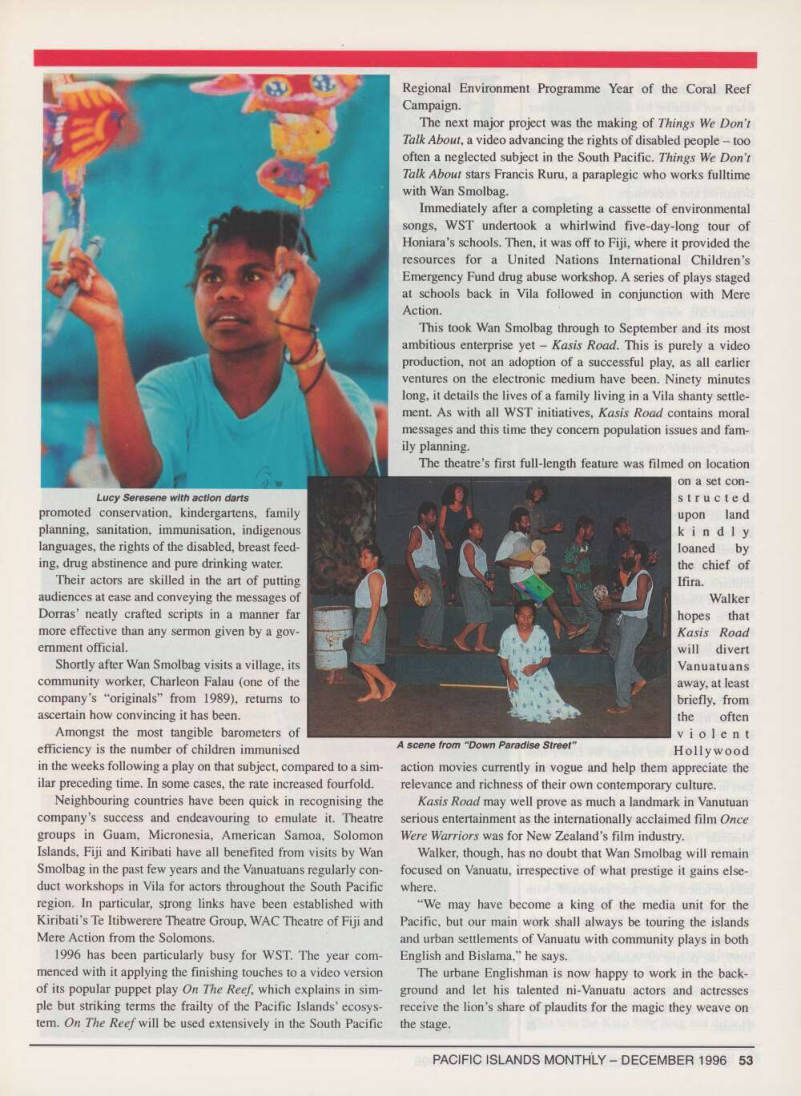
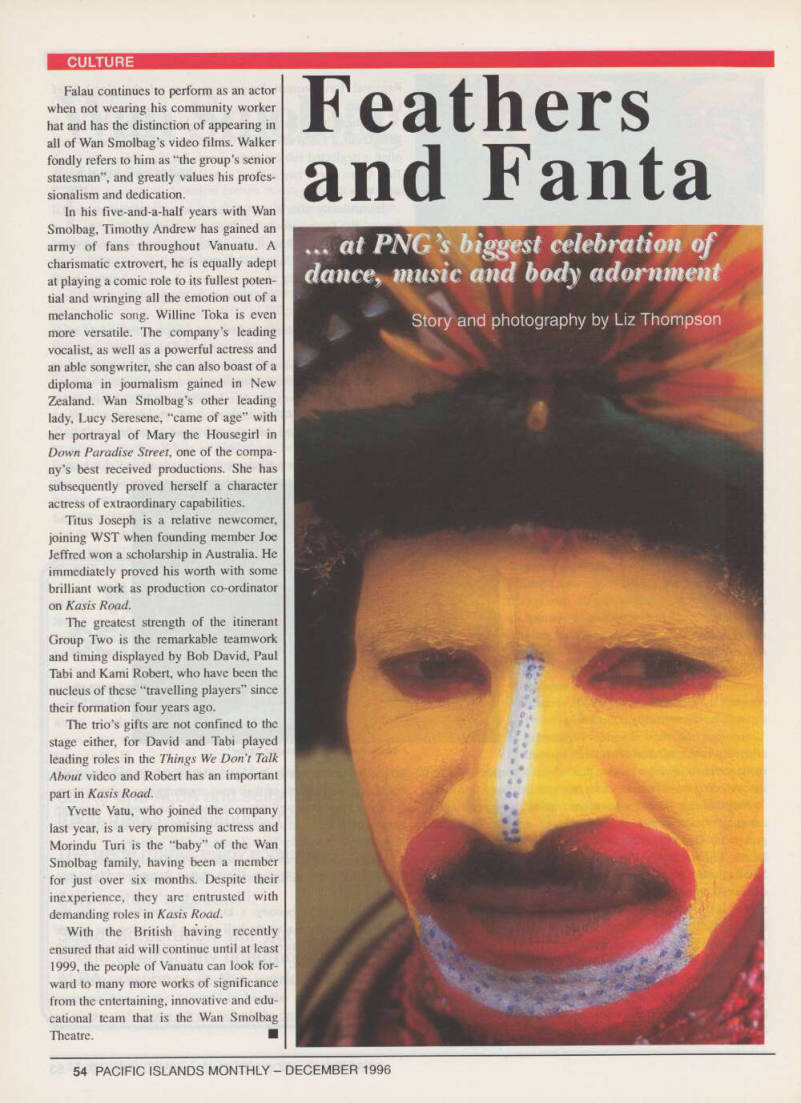
Culture
By Atama Raganivatu
The concept of theatrical groups moving from community to community and enlightening the populace on health, environmental and social issues has been embraced enthusiastically by several South Pacific countries during recent years. Vanuatu’s Wan Smolbag Theatre is at the vanguard of this movement.
Wan Smolbag’s name is a testimony to its humble begin nings. In Bisla na, the local variety of Pidgin English, it means “One Small Bag” - which was the only thing needed to carry the fledgling company’s clothes and props.
Englishman Peter Walker was the driving force behind WST’s information and, as its director today, he remains a vital factor as it continues to thrive.
Walker trained as an actor in London before moving to Zimbabwe, where he worked as a teacher but remained active in amateur dramatics. While in Zimbabwe, he met compatriot Jo Dorras, a fellow teacher who was equally enthusiastic about the atre. When Dorras gained a position at Vila’s Malapra College, Walker moved to Vanuatu with her.
After discovering that Vanuatu offered little in organised community theatre compared with southern Africa’s flourishing
scene, Walker and Dorras, along with four locally bom drama devotees, formed Wan Smolbag in 1989. Initially, they were con tent to take their plays (all written by the English pair and all set in Vila) around the main island of Efate. However, when the cen tral government’s health department, environment unit and dis aster preparation unit all recognised the group as a highly effec tive means of communicating their recommendations to locali
ties far and wide, the six-strong company found itself performing in the republic’s outer regions too.
Wan Smolbag’s reputation soon spread beyond Vanuatu and, less than a year after its formation, the Australian federal government’s community Aid Abroad
organisation provided sufficient funding for
four actors to be employed full time.
In 1993, Britain’s Overseas Development Administration assumed responsibility as WST’s chief sponsor and, because of its continuing generosity, the the atre has expanded into an organisation employing 11 professional actors, an admin istrator, a community worker, a director and a scriptwriter (Dorras fills the latter posi tion). The company now consists of two sec tions. Group One is based in Vila, while Group Two travels, almost exclusively, around the outer islands.
Wan Smolbag also works closely with five other theatre groups in Vanuatu; two based in Vila and three in the exterior regions. The Australian branch of the Save the Children Fund provides financial back ing for those serving the villages.
The subjects tackled by WST range from spouse abuse to littering. They have
Bob David, left, is the policeman and Kami Robert is the crab in the children's play “The Litter Creatures"
promoted conservation, kindergartens, family
planning, sanitation, immunisation, indigenous
languages, the rights of the disabled, breast feed ing, drug abstinence and pure drinking water.
Their actors are skilled in the art of putting audiences at ease and conveying the messages of Dorras’ neatly crafted scripts in a manner far more effective than any sermon given by a gov ernment official.
Shortly after Wan Smolbag visits a village, its community worker, Charleon Falau (one of the company’s “originals” from 1989), returns to ascertain how convincing it has been.
Amongst the most tangible barometers of efficiency is the number of children immunised
in the weeks following a play on that subject, compared to a sim ilar preceding time. In some cases, the rate increased fourfold.
Neighbouring countries have been quick in recognising the company’s success and endeavouring to emulate it. Theatre groups in Guam, Micronesia, American Samoa, Solomon Islands, Fiji and Kiribati have all benefited from visits by Wan Smolbag in the past few years and the Vanuatuans regularly con duct workshops in Vila for actors throughout the South Pacific region. In particular, strong links have been established with Kiribati’s Te Itibwerere Theatre Group, WAC Theatre of Fiji and Mere Action from the Solomons. 1996 has been particularly busy for WST. The year com menced with it applying the finishing touches to a video version of its popular puppet play On The Reef, which explains in sim ple but striking terms the frailty of the Pacific Islands’ ecosys tem. On The Reef will be used extensively in the South Pacific
Regional Environment Programme Year of the Coral Reef
Campaign.
The next major project was the making of Things We Don’t Talk About, a video advancing the rights of disabled people - too often a neglected subject in the South Pacific. Things We Don’t Talk About stars Francis Ruru, a paraplegic who works fulltime with Wan Smolbag.
Immediately after a completing a cassette of environmental songs, WST undertook a whirlwind five-day-long tour of Honiara’s schools. Then, it was off to Fiji, where it provided the resources for a United Nations International Children’s Emergency Fund drug abuse workshop. A series of plays staged at schools back in Vila followed in conjunction with Mere Action.
This took Wan Smolbag through to September and its most ambitious enterprise yet - Kasis Road. This is purely a video production, not an adoption of a successful play, as all earlier ventures on the electronic medium have been. Ninety minutes long, it details the lives of a family living in a Vila shanty settle ment. As with all WST initiatives, Kasis Road contains moral messages and this time they concern population issues and fam
ily planning.
The theatre’s first full-length feature was filmed on location
on a set con structed upon land kindly loaned by the chief of Ifira.
Walker hopes that Kasis Road will divert Vanuatuans away, at least briefly, from the often violent Hollywood
action movies currently in vogue and help them appreciate the relevance and richness of their own contemporary culture.
Kasis Road may well prove as much a landmark in Vanutuan serious entertainment as the internationally acclaimed film Once Were Warriors was for New Zealand’s film industry.
Walker, though, has no doubt that Wan Smolbag will remain focused on Vanuatu, irrespective of what prestige it gains else where.
“We may have become a king of the media unit for the Pacific, but our main work shall always be touring the islands and urban settlements of Vanuatu with community plays in both English and Bislama,” he says.
The urbane Englishman is now happy to work in the back ground and let his talented ni-Vanuatu actors and actresses receive the lion’s share of plaudits for the magic they weave on the stage.
Lucy Seresene with action darts
A scene from "Down Paradise Street"
Falau continues to perform as an actor when not wearing his community worker hat and has the distinction of appearing in all of Wan Smolbag’s video films. Walker fondly refers to him as “the group’s senior statesman”, and greatly values his profes sionalism and dedication.
In his five-and-a-half years with Wan
Smolbag, Timothy Andrew has gained an
army of fans throughout Vanuatu. A charismatic extrovert, he is equally adept at playing a comic role to its fullest poten tial and wringing all the emotion out of a melancholic song. Willine Toka is even more versatile. The company’s leading vocalist, as well as a powerful actress and an able songwriter, she can also boast of a
diploma in journalism gained in New
Zealand. Wan Smolbag’s other leading lady, Lucy Seresene, “came of age” with her portrayal of Mary the Housegirl in Down Paradise Street, one of the compa ny’s best received productions. She has subsequently proved herself a character actress of extraordinary capabilities.
Titus Joseph is a relative newcomer, joining WST when founding member Joe Jeffred won a scholarship in Australia. He immediately proved his worth with some brilliant work as production co-ordinator on Kasis Road.
The greatest strength of the itinerant Group Two is the remarkable teamwork and timing displayed by Bob David, Paul Tabi and Kami Robert, who have been the nucleus of these “travelling players” since their formation four years ago.
The trio’s gifts are not confined to the stage either, for David and Tabi played leading roles in the Things We Don’t Talk About video and Robert has an important part in Kasis Road.
Yvette Vatu, who joined the company last year, is a very promising actress and Morindu Turi is the “baby” of the Wan Smolbag family, having been a member for just over six months. Despite their inexperience, they are entrusted with demanding roles in Kasis Road.
With the British having recently ensured that aid will continue until at least 1999, the people of Vanuatu can look for ward to many more works of significance from the entertaining, innovative and edu cational team that is the Wan Smolbag Theatre. ■
Advertisements & other items, p. 52 (1 item)
Warning Notice
SEIKO CORPORATION
SEIKO and ALBA trade marks
Seiko Corporation is the owner of the trade marks SEIKO and ALBA and sells its products under those trade marks throughout the world.
The trade marks enjoy a valuable reputation and any unauthorised use will cause damage to the Seiko Corporation’s goodwill.
Seiko Corporation will not hesitate to take legal action against any unauthorised use of SEIKO and ALBA anywhere in the world.
Feathers
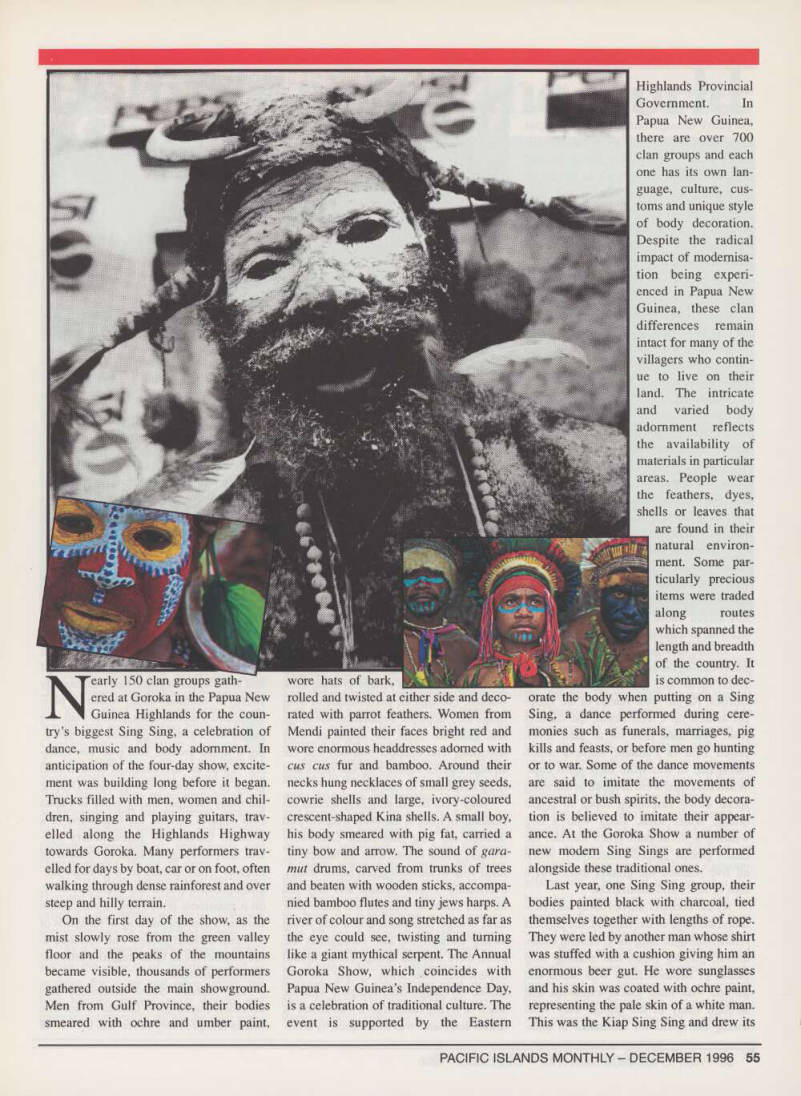
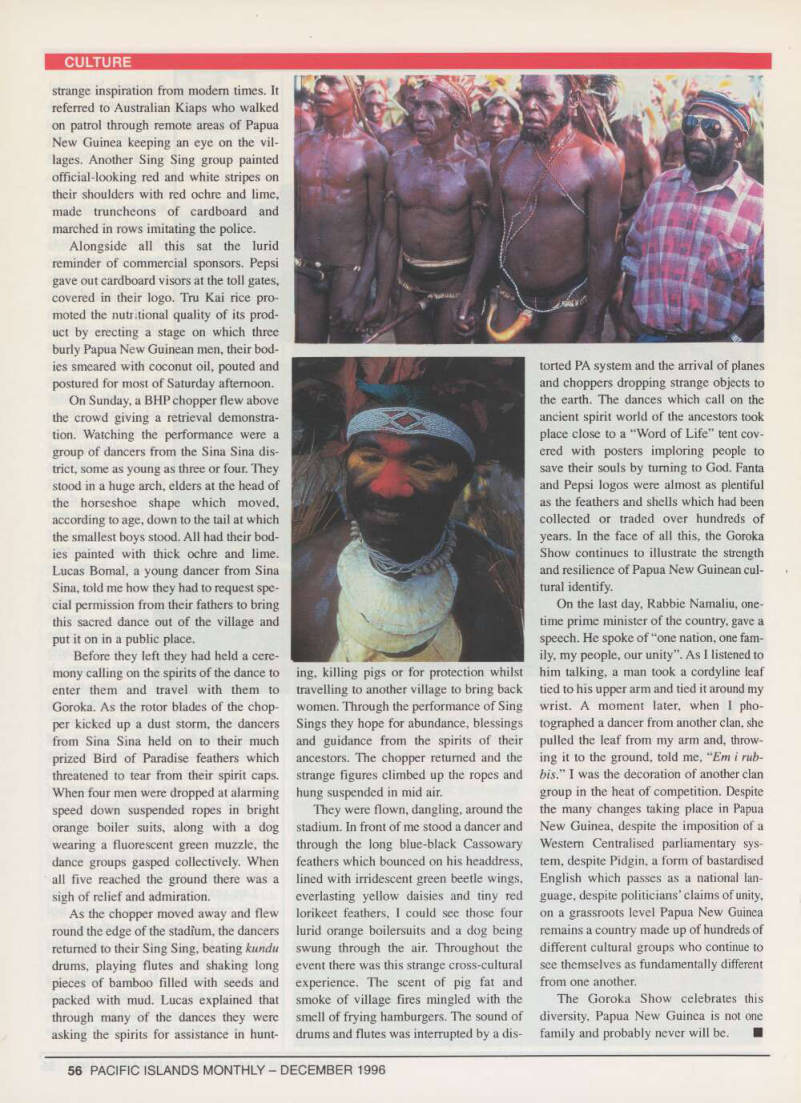
and FAnta
... at PNG’s biggest celebration of dance . music and body adornment
Story and photography by Liz Thompson
Nearly 150 clan groups gath ered at Goroka in the Papua New Guinea Highlands for the coun try’s biggest Sing Sing, a celebration of dance, music and body adornment. In anticipation of the four-day show, excite ment was building long before it began.
Trucks filled with men, women and chil
dren, singing and playing guitars, trav
elled along the Highlands Highway
towards Goroka. Many performers trav elled for days by boat, car or on foot, often walking through dense rainforest and over steep and hilly terrain.
On the first day of the show, as the mist slowly rose from the green valley floor and the peaks of the mountains became visible, thousands of performers gathered outside the main showground.
Men from Gulf Province, their bodies smeared with ochre and umber paint,
wore hats of bark,
rolled and twisted at either side and deco rated with parrot feathers. Women from Mendi painted their faces bright red and wore enormous headdresses adorned with cus cus fur and bamboo. Around their necks hung necklaces of small grey seeds, cowrie shells and large, ivory-coloured crescent-shaped Kina shells. A small boy, his body smeared with pig fat, carried a tiny bow and arrow. The sound of gara mut drums, carved from trunks of trees and beaten with wooden sticks, accompa nied bamboo flutes and tiny jews harps. A river of colour and song stretched as far as the eye could see, twisting and turning like a giant mythical serpent. The Annual Goroka Show, which coincides with Papua New Guinea’s Independence Day, is a celebration of traditional culture. The event is supported by the Eastern
Highlands Provincial Government. In Papua New Guinea, there are over 700 clan groups and each one has its own lan guage, culture, cus toms and unique style of body decoration.
Despite the radical impact of modernisa tion being experi enced in Papua New Guinea, these clan differences remain intact for many of the villagers who contin ue to live on their land. The intricate and varied body adornment reflects the availability of materials in particular areas. People wear the feathers, dyes, shells or leaves that
are found in their natural environ ment. Some par
ticularly precious
items were traded
along routes
which spanned the length and breadth of the country. It is common to dec
orate the body when putting on a Sing Sing, a dance performed during cere monies such as funerals, marriages, pig kills and feasts, or before men go hunting or to war. Some of the dance movements are said to imitate the movements of ancestral or bush spirits, the body decora tion is believed to imitate their appear ance. At the Goroka Show a number of new modem Sing Sings are performed alongside these traditional ones.
Last year, one Sing Sing group, their bodies painted black with charcoal, tied themselves together with lengths of rope.
They were led by another man whose shirt was stuffed with a cushion giving him an enormous beer gut. He wore sunglasses and his skin was coated with ochre paint, representing the pale skin of a white man.
This was the Kiap Sing Sing and drew its
strange inspiration from modem times. It referred to Australian Kiaps who walked on patrol through remote areas of Papua New Guinea keeping an eye on the vil
lages. Another Sing Sing group painted
official-looking red and white stripes on their shoulders with red ochre and lime, made truncheons of cardboard and marched in rows imitating the police.
Alongside all this sat the lurid reminder of commercial sponsors. Pepsi gave out cardboard visors at the toll gates, covered in their logo. Tru Kai rice pro moted the nutrdional quality of its prod uct by erecting a stage on which three burly Papua New Guinean men, their bod ies smeared with coconut oil, pouted and postured for most of Saturday afternoon.
On Sunday, a BHP chopper flew above the crowd giving a retrieval demonstra tion. Watching the performance were a group of dancers from the Sina Sina dis trict, some as young as three or four. They stood in a huge arch, elders at the head of the horseshoe shape which moved, according to age, down to the tail at which the smallest boys stood. All had their bod ies painted with thick ochre and lime.
Lucas Bomal, a young dancer from Sina Sina, told me how they had to request spe cial permission from their fathers to bring this sacred dance out of the village and put it on in a public place.
Before they left they had held a cere mony calling on the spirits of the dance to enter them and travel with them to Goroka. As the rotor blades of the chop per kicked up a dust storm, the dancers from Sina Sina held on to their much prized Bird of Paradise feathers which threatened to tear from their spirit caps.
When four men were dropped at alarming speed down suspended ropes in bright orange boiler suits, along with a dog wearing a fluorescent green muzzle, the dance groups gasped collectively. When all five reached the ground there was a sigh of relief and admiration.
As the chopper moved away and flew round the edge of the stadium, the dancers returned to their Sing Sing, beating kundu drums, playing flutes and shaking long pieces of bamboo filled with seeds and packed with mud. Lucas explained that through many of the dances they were asking the spirits for assistance in hunt-
ing, killing pigs or for protection whilst travelling to another village to bring back women. Through the performance of Sing
Sings they hope for abundance, blessings
and guidance from the spirits of their ancestors. The chopper returned and the strange figures climbed up the ropes and hung suspended in mid air.
They were flown, dangling, around the stadium. In front of me stood a dancer and through the long blue-black Cassowary feathers which bounced on his headdress, lined with irridescent green beetle wings,
everlasting yellow daisies and tiny red
lorikeet feathers, I could see those four lurid orange boilersuits and a dog being swung through the air. Throughout the event there was this strange cross-cultural experience. The scent of pig fat and smoke of village fires mingled with the smell of frying hamburgers. The sound of drums and flutes was interrupted by a dis
torted PA system and the arrival of planes and choppers dropping strange objects to the earth. The dances which call on the ancient spirit world of the ancestors took place close to a “Word of Life” tent cov ered with posters imploring people to save their souls by turning to God. Fanta and Pepsi logos were almost as plentiful as the feathers and shells which had been collected or traded over hundreds of years. In the face of all this, the Goroka Show continues to illustrate the strength and resilience of Papua New Guinean cul
tural identify.
On the last day, Rabbie Namaliu, one time prime minister of the country, gave a speech. He spoke of “one nation, one fam ily, my people, our unity”. As I listened to him talking, a man took a cordyline leaf tied to his upper arm and tied it around my wrist. A moment later, when I pho tographed a dancer from another clan, she pulled the leaf from my arm and, throw ing it to the ground, told me, “Em i rub his.” I was the decoration of another clan group in the heat of competition. Despite the many changes taking place in Papua New Guinea, despite the imposition of a Western Centralised parliamentary sys tem, despite Pidgin, a form of bastardised English which passes as a national lan
guage, despite politicians’ claims of unity,
on a grassroots level Papua New Guinea remains a country made up of hundreds of different cultural groups who continue to see themselves as fundamentally different from one another.
The Goroka Show celebrates this diversity, Papua New Guinea is not one family and probably never will be. ■
Halfway round the world
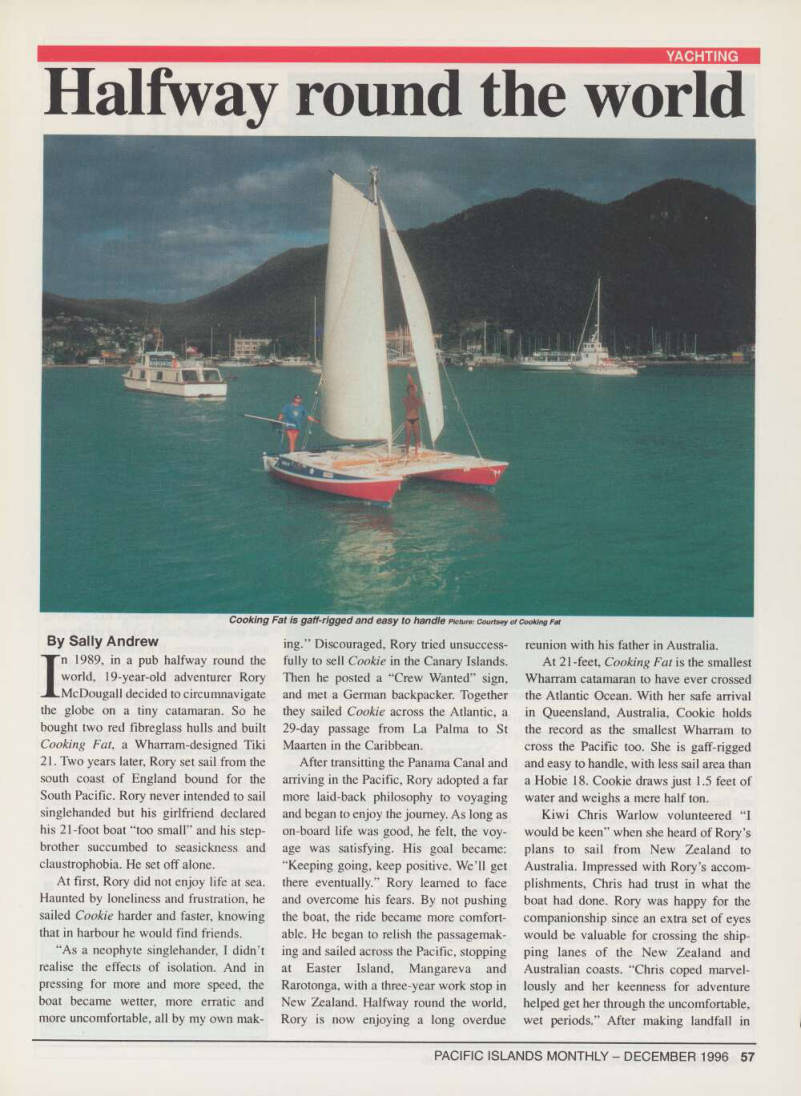
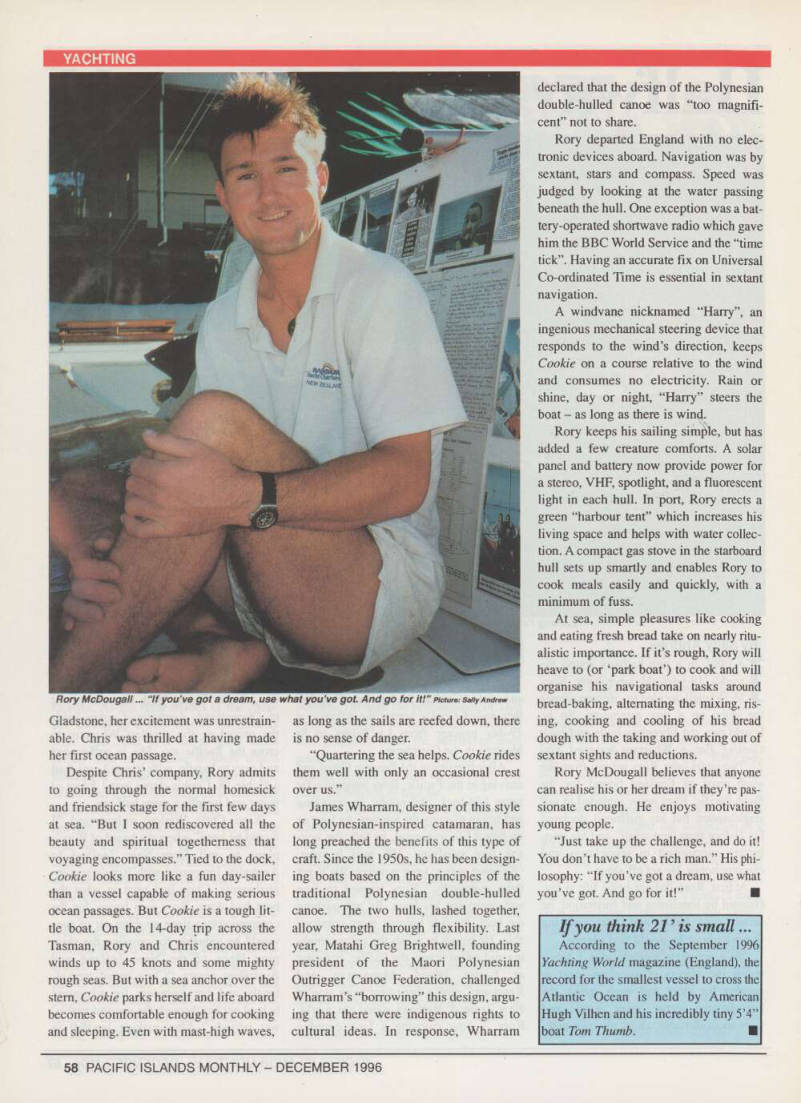
Yachting
By Sally Andrew
In 1989, in a pub halfway round the
world, 19-year-old adventurer Rory
McDougall decided to circumnavigate
the globe on a tiny catamaran. So he bought two red fibreglass hulls and built Cooking Fat, a Wharram-designed Tiki 21. Two years later, Rory set sail from the south coast of England bound for the South Pacific. Rory never intended to sail singlehanded but his girlfriend declared his 21-foot boat “too small” and his step brother succumbed to seasickness and claustrophobia. He set off alone.
At first, Rory did not enjoy life at sea.
Haunted by loneliness and frustration, he sailed Cookie harder and faster, knowing that in harbour he would find friends.
“As a neophyte singlehander, I didn’t realise the effects of isolation. And in pressing for more and more speed, the boat became wetter, more erratic and more uncomfortable, all by my own mak
ing.” Discouraged, Rory tried unsuccess
fully to sell Cookie in the Canary Islands.
Then he posted a “Crew Wanted” sign, and met a German backpacker. Together they sailed Cookie across the Atlantic, a 29-day passage from La Palma to St Maarten in the Caribbean.
After transitting the Panama Canal and arriving in the Pacific, Rory adopted a far more laid-back philosophy to voyaging and began to enjoy the journey. As long as on-board life was good, he felt, the voy age was satisfying. His goal became:
“Keeping going, keep positive. We’ll get
there eventually.” Rory learned to face and overcome his fears. By not pushing the boat, the ride became more comfort able. He began to relish the passagemak ing and sailed across the Pacific, stopping at Easter Island, Mangareva and Rarotonga, with a three-year work stop in New Zealand. Halfway round the world, Rory is now enjoying a long overdue
reunion with his father in Australia.
At 21-feet. Cooking Fat is the smallest Wharram catamaran to have ever crossed the Atlantic Ocean. With her safe arrival in Queensland, Australia, Cookie holds the record as the smallest Wharram to cross the Pacific too. She is gaff-rigged and easy to handle, with less sail area than a Hobie 18. Cookie draws just 1.5 feet of water and weighs a mere half ton.
Kiwi Chris Warlow volunteered “I would be keen” when she heard of Rory’s plans to sail from New Zealand to Australia. Impressed with Rory’s accom plishments, Chris had trust in what the boat had done. Rory was happy for the companionship since an extra set of eyes would be valuable for crossing the ship ping lanes of the New Zealand and Australian coasts. “Chris coped marvel lously and her keenness for adventure helped get her through the uncomfortable, wet periods.” After making landfall in
Cooking Fat is gaff-rigged and easy to handle Picture: Courtsey of Cooking Fat
Gladstone, her excitement was unrestrain able. Chris was thrilled at having made her first ocean passage.
Despite Chris’ company, Rory admits to going through the normal homesick and friendsick stage for the first few days at sea. “But I soon rediscovered all the
beauty and spiritual togetherness that
voyaging encompasses.” Tied to the dock, Cookie looks more like a fun day-sailer than a vessel capable of making serious ocean passages. But Cookie is a tough lit tle boat. On the 14-day trip across the Tasman, Rory and Chris encountered winds up to 45 knots and some mighty rough seas. But with a sea anchor over the stem, Cookie parks herself and life aboard becomes comfortable enough for cooking and sleeping. Even with mast-high waves,
as long as the sails are reefed down, there is no sense of danger.
“Quartering the sea helps. Cookie rides them well with only an occasional crest over us.”
James Wharram, designer of this style of Polynesian-inspired catamaran, has long preached the benefits of this type of craft. Since the 19505, he has been design ing boats based on the principles of the traditional Polynesian double-hulled canoe. The two hulls, lashed together, allow strength through flexibility. Last year, Matahi Greg Brightwell, founding president of the Maori Polynesian Outrigger Canoe Federation, challenged Wharram’s “borrowing” this design, argu ing that there were indigenous rights to cultural ideas. In response, Wharram
declared that the design of the Polynesian double-hulled canoe was “too magnifi cent” not to share.
Rory departed England with no elec
tronic devices aboard. Navigation was by sextant, stars and compass. Speed was judged by looking at the water passing beneath the hull. One exception was a bat tery-operated shortwave radio which gave him the BBC World Service and the “time tick”. Having an accurate fix on Universal Co-ordinated Time is essential in sextant
navigation.
A windvane nicknamed “Harry”, an ingenious mechanical steering device that responds to the wind’s direction, keeps Cookie on a course relative to the wind and consumes no electricity. Rain or shine, day or night, “Harry” steers the boat - as long as there is wind.
Rory keeps his sailing simple, but has added a few creature comforts. A solar panel and battery now provide power for a stereo, VHP, spotlight, and a fluorescent light in each hull. In port, Rory erects a green “harbour tent” which increases his living space and helps with water collec tion. A compact gas stove in the starboard hull sets up smartly and enables Rory to cook meals easily and quickly, with a minimum of fuss.
At sea, simple pleasures like cooking and eating fresh bread take on nearly ritu alistic importance. If it’s rough, Rory will heave to (or ‘park boat’) to cook and will organise his navigational tasks around
bread-baking, alternating the mixing, ris
ing, cooking and cooling of his bread dough with the taking and working out of sextant sights and reductions.
Rory McDougall believes that anyone can realise his or her dream if they’re pas
sionate enough. He enjoys motivating
young people.
“Just take up the challenge, and do it!
You don’t have to be a rich man.” His phi losophy: “If you’ve got a dream, use what you’ve got. And go for it!” ■
If you think 21 ’ is small...
According to the September 1996
Yachting World magazine (England), the
record for the smallest vessel to cross the Atlantic Ocean is held by American Hugh Vilhen and his incredibly tiny 5’4” boat Tom Thumb. ■
Rory McDougall... “If you’ve got a dream, use what you’ve got. And go for it!” Picture: Sally A ndrew
Advertisements & other items, pp. 59-60 (1 item)
Life Insurance is a Shell
grows
'v^^ ARy 0/^;%
r v q 2 h MAR 1997 ,•*>/ *
protects
customized
rare
portable
natural
What nature does to protect Every shell is tailored to its And shells are “portable” to the inhabitants of the ocean, environment. Each one of our their owners. With the help of Grand Pacific Life Insurance policies is customized; yours your Grand Pacific agent, does for the people of the will be perfectly suited to your policy easily keeps up Islands. you. with you.
Just as the shell grows with its Within a shell’s protection, For more information on occupant, our insurance there’s future safety and security, security much as nature grows in value as an invest- In somewhat the same way, intended, call your Grand ment in your life. Grand Pacific Life Insurance Pacific Life representative. helps protect your family’s us provide a tective financial security. she u for you.
Many shells are a rarity.
You’re respected as a rare individual because there is only one of you. ©
Grand Pacific Life Insurance, Ltd.
A member of the Finance Factors Family 1164 Bishop Street, sth Floor • Honolulu, HI 96813 • Phone: (808) 548-3333 • Fax: (808) 548-5122
THE NEW
<?/<? ho
PRIVILEGED CLASS
The Uncompromised Family Sedan
THE RLL NEW
MITSUBISHI
LRNCER
Meet the car that was born to succeed. With its progressive engineering and striking appearance, the all-new Mitsubishi Lancer advances effectively, impressively... moving ahead at every turn.
Get behind the wheel and experience the new standard in family sedans.
AMERICAN SAMOA: PACIFIC MARKETING INC. P.O. Box 698, Pago Pago, Tel. 699-9140 / AUSTRALIA: MITSUBISHI MOTORS AUSTRALIA LTD. 1284 South Road, Clovelly Park, South Australia, 5042, Tel. (08) 2757297/FIJI; NIVIS MOTOR & MACHINERY CO. LTD. G.P.O. Box 150, Suva, Tel. 383411 / GUAM: TRIPLE J ENTERPRISES INC. P.O. Box 6066, Tamuning, Tel. 6469126/NEW CALEDONIA: SOCIETE DTMPORTATION D'AUTO DU RACIFIQUE SUD S.A. P.O. Box 2548, Noumea, Tel. 281-787 / NEW ZEALAND; MITSUBISHI MOTORS NEW ZEALAND LTD. Private Bag. Porirua, Tel. 237-0109 / NORFOLK ISLAND: BORRY'S PTY LTD. P.O. Box 169, Taylors Road, Burnt, Tel. 22114 /PAPUA HEW GUINEA: TOBA MOTORS PTY LTD. P.O. Box 503, Port Moresby /SAIPAN: SAIPAN AUTOWORLD INC. P.O.
Box 487, Tel. 234-7133/SOLOMON ISLANDS: HARVEST PACIFIC LTD. G.P.O. Box 823, Tel. 30407/TAHITI: SOPADEP S.A. B.P. 1617, Papeete, Tel. 427393/TONGA: SITANI MAPI CO., LTD.
P.O. Box 83. Nukualofa, Tel. 24044/VANUATU; SOCOMETRA VANUATU LTD. B.P. 6, Port-Vila, Tel. 2314/WESTERN SAMOA; MOTOR DISTRIBUTORS (SAMOA) LTD. P.O. Box 576, Apia, Tel. 20957 A
MITSUBISHI
MOTORS
CREATING TOGETHER