Islands

Pacific
Monthly
VANUATU HELD AT GUNPOINT • TONGAN 3 RELEASED
November i]©©©
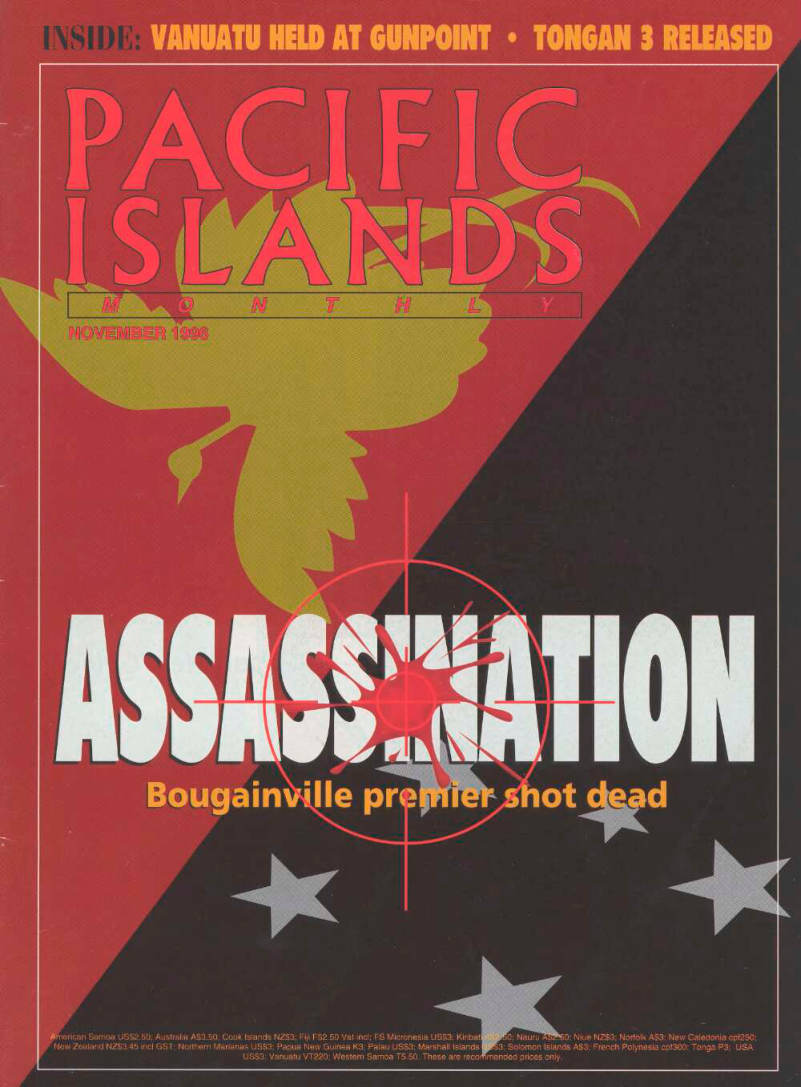
Bougainville projiflr shot dead
American Samoa US$2.5O; Australia A 53.50; Cook Islands NZS3; Fiji F 52.50 Vat incl; FS Micronesia USS 3; Kiriba a‘ v ; '> 3 Niue NZ$3; Norfolk ASS; New Caledonia cpf2so; New Zealand NZ53.45 incl GST; Northern Marianas USS 3; Papua New Guinea K 3; Palau US$3; Marshall islands p|s3; Solomon Islands As 3; French Polynesia cpf3oo; Tonga P 3: USA USS 3; Vanuatu VT22O; Western Samoa T 5.50. These are recommended prices only.
Cover: James Ranuku
M COVER: Shock and disbelief follow the assassination of Bougainville Premier Theodore Miriung, who opposed the BRA’s campaign of violence and was a “thorn in the side of the central government”
Advertisements & other items, pp. 2-3 (1 item)
For whatever
reason...
The safest and the quickest way to Papua New Guinea
is by phone...
Just dial +675 plus the number and you're hone.
In Papua New Guinea, Telikom does the connection for you.
I
TELIKOM
PAPUA NEW GUINEA
PREUENTS CfiUITIES
WHITENS TEETH
FRESHENS TEETH
STRENGTHEN GUMS
I \ J KM 0 >. ; ?
rOO rHP *IJL
/ 5 tE hp* C?T ro Does Everything A Good Toothpaste Should D 0...
So Why Pay More?
Available Throughout Fin Viatufatect Come &Co
Pacific
Islands
Monthly
Vol. 66 No. 11
The News Magazine
November 1996
PUBLISHER: Alan Robinson EDITOR: Manivannan Naidu SENIOR WRITER: Bernadette Hussein
Correspondents:
David North, Sam Vulum lan Williams, Liz Thompson, Atama Raganivatu, Sally Andrew, Patrick Decloitre, Chris Peteru COLUMNISTS: David Barber (Wellington), Jemima Garrett (Sydney), Alfred Sasako (The Forum), Debbie Singh (South Pacific Commission).
GRAPHIC ARTIST: James Ranuku
Advertising Sales
Senior Regional Sales (South Pacific) Shailendra Kumar Emmett Simpson Te1(679) 304111,303429, Fax(679)303809.
Sydney, Canberra: Bob Hill Media Representation, Tel (61-2) 4164245, Fax (61-2) 4165064.
Brisbane: Jane Fewings Media and Advertising Associates Tel (61-7) 3378 4522, Fax (61-7) 3878 1071.
Adelaide: Hastwell Williamsons Representatives, Tel (61-8) 3799522, Fax (61-8) 3799735.
Melbourne: Brown Orr Fletcher Burrows (Aust) Pty Ltd.
Tel (61-3) 98265188, Fax (61-3) 98265644.
Auckland: McKay & Bowman, International Media Representatives Limited, Tel (64-9) 4190561, Fax (64-9) 4192243.
Japan: Universal Media Corporation, Tokyo, Tel (3)3266626741, Cable: UNI-MEDIA Tokyo, Fax (3) 32626742.
Pacific Islands Monthly was founded in
1930 (Usps 9522480).
A Fiji Times Limited production.
Cover prices are recommended retail only. Registered by Australia Post, Publication No. NBPI2IO. © Copyright Fiji Times Limited, 177 Victoria Parade, Suva, Fiji.
Tel (679) 304111, fax (679) 303809.
Pacific Islands Monthly is published monthly by Fiji Times Limited, a division of Nationwide News, 2 Holt Street, Surry Hills, Sydney, NSW 2010.
Send Address Changes To:
Pacific Islands Monthly PO Box 1167 Suva, Fiji.
Typeset and printed by The Fiji Times Limited, 177 Victoria Parade, Suva, Fiji.
Inside
5: Letters 10: France ratifies SPNFZ Treaty protocols 11: The end of the nuclear age? 12: Abortion - bottling up the issue 14: Laughter... the best medicine 17: PNG’s guns-for drugs trade on rise 19: Finance ministers wined, dined ... and lectured 21: Foreign ownership in the Cook Islands 23: New Caledonia’s nickel rush 28: NZ’s state of limbo 32: Wages of corruption 49: Jay soars to stardom 51: Festival of Arts unveils its treasures 55: In time with tradition 57: Baguettes and bureacracy
Feature
33: Telecommunications
Special Reports
Sian of
25 me
w times?
Tonga’s imprisonment of journalists and MR for contempt of parliament ruled unconstitutional and illegal
45 Vanuatu’s
coup
The VMFs coup-like actions in the name of unpaid allowances have been forgiven the “Melanesian way”. But beneath the apparent calm, the Island state views uneasily what could be a dangerous precedent
Views
6: Alfred Sasako: Region’s hopes lifted 7: Jemima Garrett: The great Australian barrier... of racism 8: David Barber: Economic reforms finally a reality 9: Debbie Singh: Stirring up the band
Sport
47: Perelini - rugby’s Terminator
‘jellyfish babies’
Letters
No link between radiation and ‘jellyfish babies’
Dear Sir In “An American legacy” ( PIM September, 1996) there are repeated references to “heretofore unheard of conditions such as ‘jelly-fish babies’”.
Unfortunately, the author missed a good opportunity to enlighten the public on the subject of gestational trophoblastic dis eases (GTDs) like the hydatidiform mole (HM) which is certainly not “unheard of’ if you happen to be a medical doctor,
though perhaps not under its colloquial
name.
This omission may well be intentional, since mystery certainly adds to fear, espe cially if World Health Organisation and other statistics on the disease are exclud ed.
The most comprehensive report on the subject is WHO’s 83-page Technical Report No 692, but other reports are avail able in journals such as Obstetric
Gynecology and Epidemiologic Reviews.
Worldwide statistics show that the highest incidences of HM are in the coun
tries of Indonesia, Iran, Taiwan, Nigeria and Mexico, none of which have anything to do with nuclear weapons testing or nuclear energy, while the lowest rates are those of Europe and the Caucasian popu lation of North America, which includes countries such as France, which gets near ly all its electricity from nuclear power.
Typical HM rates range from one to 10 incidences per 1000 pregnancies, with the higher risk rates being associated with women over 35 at the time of delivery.
The risk for women aged over 50 is some 200 times greater than for those aged 20- 35.
Other risk factors identified with far less certainty include cosmetics (red lip stick) and chemicals used in textile, print ing and the chemical industries, as well as alcoholism, viral or parasitic infections, herbal medicines and long-term oral con traceptive use.
HMs have been known since long before the discovery of nuclear radiation.
Radiation exposure has never been linked to an increased risk of HM, not among Japanese A-bomb survivors, not in the Marshall Islands, and not in the Ukranian and Byelorussian areas contaminated by the Chernobyl explosion.
Fear mongering may win entertain ment and news media prizes but it won’t
win you any kudos in the world of medicine and public health education.
Jaro Franta
Quebec Canada
Meat and violence
Dear Sir
I passed through Nadi Airport from New Zealand to Hawaii and picked up the June issue of Pacific Islands Monthly. I was really saddened to see that you gave such a feature to McDonald’s.
This is a company which has built its profits on the backs of billions of slaugh tered animals.
There is a direct correlation between violence and the eating of meat that has been known for centuries.
Why does a country like Fiji want to add violence to its peaceful world?
I hope the Fijian people do not support this product. It is in their best interests.
Stephen Brandit
Honolulu Hawaii
hopes of increasing
Pacific centre lifts region’s hopes of increasing Japanese investment
By the time you are reading this col umn, the Pacific Islands Centre located in the heart of Tokyo would have opened its doors for business.
The official opening of the centre on October 14 signaled the beginning of a new era in the Japan-Forum Island Countries (FICs) partnership on which many on both sides hope for enormous
economic spin-offs.
It’s a marriage of sorts. As in many lasting marriages, the period of courtship was long. But once both sides had reached an agreement for a feasibility study in mid-1994, like a proposed marriage, everything else after the engagement was a mere formality.
At least for the next six months it will be an interesting wait-and-see period as the three Japanese staff of the Pacific Islands Centre launch a massive publicity
awareness campaign targeting the
Japanese business community. The idea is to “self FICs as a potential investment and tourism destination for the Japanese
business community.
For FICs, their interest in the set-up has been confirmed in a number of studies conducted into the viability of the partner ship. According to one study, FICs can expect “considerable flow of Foreign Direct Investment (FDI)” as a direct result of the Pacific Islands Centre in Japan.
The centre opened its doors for busi ness on October 1, with the official open ing two weeks later by the chairman of the South Pacific Forum and president of the Republic of Marshall Islands Amata Kabua.
Secretary-general leremia Tabai and senior officials from both sides also attended the ceremony held on the ground floor of the Akasaka Twin Tower complex - the premises of the centre.
Funding for the centre was provided by the Japanese government following a fea
sibility study which found that there were scopes for and mutual spin-offs from expanding FICs-Japan links. This is espe cially in the area of trade, investment and tourism. The study has found that “the FICs, while facing a range of constraints in relation to FDI, nonetheless have con siderable prospects for expanding FDI inflows”.
According to published figures, Japan
is the largest Asian investor in FICs, injecting some SUS62O million in 450 investment portfolios in the South Pacific since 1951.
These are mainly wood chips, forestry, fisheries, retail/wholesale, real estate (tourism), service industries, oil and Liquidified Natural Gas (LNG).
It says that because FICs “are well endowed with natural resources” which are in high international demand, there are potentials for expansion in these areas.
The study also said that the Pacific region has ‘’governments which are increasingly focused on improving invest
ment regimes”.
“The establishment of permanent rep resentation for the South Pacific region in Japan is the most effective conduit to increase Fiji-Japan trade, investment and tourism linkages which would contribute
substantially to private-sector expansion
and sustainable economic development in the South Pacific,” the study found.
Japan’s overseas development assis tance or aid to the Pacific Island Countries
is huge by anyone’s standard.
For instance, in 1992 Japan’s ODA to Island member countries of the South Pacific Forum accounted for 22 per cent, or SUS 159.55 million, of the total aid flow to the region. That year, the region received $U5838.7 million in total over seas aid. Much of this was at bilateral level with the multilateral component accounting for $U5116.2 million. Based
on these figures, Japan now ranks second after Australia on the donor table of the
Fics.
Prospects for increased trade with Japan are high. For instance, already the two-way trade between the FICs and Japan is valued at SUSI. 4 billion.
At present Japan is the largest market for Island exports, accounting for 30 per cent of total FIC exports. FICs export more than 400 products, but the study found that taking the FICs as a group, “there are a further 320 products which have the potential to be developed as export industries - an average of 27 prod ucts per FIC.
The study found that “considerable potential exists for the further develop ment of natural resources for export- inte grated with sustainable development prin
ciples”.
At the same time, it said that there are
considerable opportunities to improve
trade performance - “the challenge is to ensure opportunities are identified and
exploited in a truly competitive fashion”.
Trade between Japan and FICs is dom inated almost entirely by commodities such as wood, sugar, non-ferrous ores, oil, fish, vegetables and coconut products.
“Considerable potential exists for pro cessing and value adding in which Japan
could play a major role, particularly
through joint ventures.”
In tourism, the findings were the same.
Average annual tourism growth rate is projected around 5.7 per cent with over one million arrivals in the region by 2000.
It says that Japan is among the new tourism market that is already making substantial contribution “but real potential is considerable and still to be exploited”.
The study has concluded that “prospects for continued growth of tourist arrival from Europe and Japan in the medium term are excellent”. ■
The Forum
Alfred
Sasako
barrier... of racism
The great Australian barrier... of racism
The usual political wisdom would suggest that a politician with just a few months in parliament, no political party to back her up and no possibility of controlling the balance of power would have little influence in the big debates of the nation. If she went on to use her maiden speech to call on the fed eral government to abolish its policy of multiculturalism, review its immigration policy because she feared Australia was “in dan ger of being swamped by Asians”, reduce payments to Aborigines because they are not the most disadvantaged group in Australia and “cease all foreign aid immediately”, it would be tempting to dismiss her as something of a loon.
But Pauline Hanson, a feisty fish and chip shop owner from the city of Ipswich, west of Brisbane, is a force to be reckoned with. She has given the racist undercurrent in Australia a strong and uncompromising voice and added a dangerous element to the immigration debate at a time when Australia’s immigration programme has been revealed as having a catastrophic lack of public confidence. In the month after Hanson’s speech, Prime Minister John Howard, whose ruling Liberal Party expelled Hanson just before the last election for her attacks on welfare payments to Aborigines, was notable for his failure to openly reject her views despite mounting pressure to do so. Howard argued that he was not going to define his views and values by reference to the speeches of others, claiming that to do so would be “devaluing the office of prime minister”.
He rightly supported Hanson’s right to express her view but showed no leadership on the race issue. Two weeks into the debate he used a speech to the Queensland Liberal Party to trum pet what he regards as the lifting of an atmosphere of “political correctness” imposed by the former Keating government.
“One of the great changes that has come over Australia in the last six months,” Howard told the Liberals in Brisbane, “is that people do feel able to speak out a little more freely and more openly about what they feel. In a sense, the pall of censorship on certain issues has been lifted.”
Polls in early October showed Hanson had become a rallying point for those with racist views. Liberal backbenchers were warning of a growing backlash against their constituents of Asian descent and complained that some had been spat on in the street and had their houses attacked. Opposition leader Kim Beazley called on Howard to “exercise leadership on this issue and state clearly and unequivocally that... (Hanson’s) views on racial issues are hurtful to a great many Australians”.
Only then did Howard respond. “I will always denounce racial intolerance. I will always defend the non-discriminatory character of Australia’s immigration policy,” he said, but again
failed to specifically reject Hanson’s views. Historian Henry Reynolds believes Howard’s delay in stating his views on race and immigration issues has brought the race into play as a polit ical issue for the first time in decades. In doing so, he has opened a Pandora’s box which Australians will have to live with for many years to come. In a piece in The Australian, Reynolds illu minated some of the background to Howard’s stand. He pointed out that polling in the leadup to the last election had made Liberal leaders aware of widespread dissatisfaction with the Keating government on issues such -as immigration, indigenous rights and engagement with Asia, all of which Labor had cham pioned, and that they had been spectacularly successful in com ing up with a message which appealed to this dissatisfaction.
Now in government, it is still unclear how far the Liberals will be prepared to go to maintain the support of those voters, espe cially when it appears they may be a majority in many marginal seats.
Australia
Jemima
Garrett
In her speech to parliament, Hanson ranged over wide areas of policy. Of Asians she said, “They have their own culture and religion, form ghettos and do not assimilate.” On Aborigines: “Along with millions of Australians, I am fed up to the back teeth with the inequalities that are being promoted by the government and paid for by the taxpayer under the assumption that Aboriginals are the most disadvantaged people in Australia. I am fed up with being told ‘this is our land’.
Well where the hell do I go? I was bom here and so were my parents and chil dren. I draw the line when I am told I must pay and continue paying for some thing that happened 200 years ago.”
Hanson also called for a year’s com pulsory national service for men and women when they turn 18, for a review of Australia’s membership of the United Nations and demanded an end to foreign aid so the money saved could be spent at home on job creation.
While Hanson is stirring the political cauldron, Howard’s weaknesses are being revealed. One of those appears to be the fact that he seems not yet to have defined for himself the exact nature of modem Australian society or the manner in which we should be presenting our selves in the wider Asian region. In speeches in Jakarta in September, he sur prised his audiences with a rather defen sive sentiment (stressing that Australia does not “claim to be Asian” and that it would “yield to nobody” in asserting the strength of its distinctive history, culture and political traditions) while at the same time failing to go on and articulate a vision for Australia’s crucial bilateral alliance with its northern neighbour.
Despite the enormous economic and cul tural benefits from Australia’s immigra tion programme, a recent research sug gests public support is almost non-exis tent. A Newspoll showed 71 per cent believed the current intake - a compara tively small 74,000 - is too high and another survey by Monash University suggested nearly 90 per cent oppose fur ther Asian immigration. Another Herald AGB McNair Poll at the beginning of last month found 48 per cent of its just over 2000 respondents supported Hanson’s views. ■
Advertisements & other items, p. 7 (1 item)
Required
AGENTS
Maddren Homes, New Zealand's most experienced exporters of kitset homes, require agents for Pacific regions currently not covered.
CONTACT MADDREN HOMES;
PO Box 244, Kumeu, Auckland, New Zealand.
Phone: 64-9-412 9070, fax: 64-9-412 7251.
Maddren
Homes
TEAM
reforms finally
Economic reforms finally a reality
With severe financial crises in the Cook Islands, Nauru and Chuk in the Federated States of Micronesia, and letters of credit scams in the Cooks, Vanuatu and the Marshall Islands, 1996 has not been a good year for Pacific Island Countries. But the news was not all bad on the financial and eco nomic front.
There were, in fact, some encouraging signs that global winds of change are being felt in the Islands and that real, if tentative, moves towards long overdue economic reforms are at last under way.
This year’s South Pacific Forum meet ing in Majuro indicated a greater aware ness of the part of all Pacific Island lead ers that they have to bite the reform bullet sooner rather than later if their nations are to survive in the increasingly competitive
global economy.
They may be understandably reluctant because there are some very tough and painful decisions to be made but, simply put, they have no alternative. There is less international aid money around and the strings attached to it in the shape of “help for those who help themselves” are get
ting tighter. International organisations
such as the World Bank, Asian Development Bank and International Monetary Fund are increasingly demand ing that the price of continued aid is will ingness to shoulder the burden of reform and move backward economies in the direction of the 21st Century. The European Union, which gives the Pacific more aid on a per capita basis than Africa and the Caribbean Island states, is taking a long hard look at the Lome Convention, whose current programmes expire in the Year 2000.
And trade margins of preference like those offered by the SPARTECA agree ment, which once offered a comfort zone, are dwindling as New Zealand and
Australia move in the global free trade direction.
High tariffs, import protection, bloated public services and the like all belong to a bygone age. The world lias moved on and the Pacific can no longer remain immune from the trends of reform, as painful as they may be. New Zealand is well aware of the pain ahead for the tiny Island states, having endured a decade of reform itself after recognising that it could not go on living beyond its means in the illusion of a South Pacific paradise untouched by global economic progress.
For much of that decade the Island states ignored what was happening on their doorstep, despite the very clear writ ing on the wall. Even at last year’s Forum in Madang, their leaders spent only about 10 minutes discussing economic reform.
It was a different story this year at Majuro, with an extended debate on the issues and clear recognition of the need for tariff reform, investment transparency and the development of a vibrant private sector. The latter will inevitably require privatisation of state assets and reducing the size and cost of the public service (often the only large employer), a bullet only tiny Niue, Western Samoa and now the Cook Islands have really bitten on so far. The Forum leaders acknowledged the need to “respond to global economic changes (for example WTO and APEC developments) and in particular increas ing trade liberalisation, which will pro
gressively make preferential trading
arrangements (including SPARTECA)
and the Lome Convention) less relevant”.
Acknowledging that economic reform and development are “so important for the future benefit of their peoples”, Forum leaders agreed their economic and finance ministers should meet annually from the next year “to cover the breadth of economic issues”.
Wellington
David
Barber
They will report to the Forum, ensur ing that economic trends remain high on the leaders’ future agendas - as they must if the momentum to reform is to be maintained. One of the most encourag ing signs is the readiness of some Island countries, including Papua New Guinea, the Solomon Islands and Vanuatu, to fol low Fiji in joining the World Trade
Organisation.
There will be huge compliance costs - PICs cannot join the WTO while main
taining their existing high tariff struc
ture, which is well out of kilter with the global trend towards lower import duties. This won’t be easy, for govern ment revenue in most Island states depends on import taxes. But the New Zealand experience has shown that, to lift international competitiveness and encourage exports, it is necessary to reduce import protection. There is no alternative. The fact is protected indus tries are not competitive and high tariffs are a disincentive to foreign investors.
PNG showed the way - and the size of the task - this year, cutting import duties on products like canned mackerel from 100 per cent to 55 per cent and pork and barracuda from 75 per cent to 40 per cent. It has agreed on a five-year time frame to cut 40 per cent protective duties on cement, beef and lamb as part of its WTO membership deal. Economic reform does not begin and end with cut ting tariffs, of course. Even harder deci sions lie ahead - like taxation. The PlCgovemments will, at some time in the future, have to look at increasing their revenue from sources other than import duties. This will inevitably involve more consideration of controver sial consumption taxes.
There are no illusions in Wellington of the scope of the problem. With the exception of Papua New Guinea and Fiji, if managed really well, there are proba bly no PICs that could be self-sustaining without foreign aid and overseas remit tances. But there is much they can do to improve their economies, given the political will and the ability to explain the need for change to their peoples.
Hopefully, 1996 will go down as an historic turning point in the tortuous path towards economic reform throughout the Pacific. ■
Stirring up
the band
September 1996 was an important month in the calendar of women from the Pacific’s French territories.
It was a time of awareness-raising and integration as they met for the first time with their Melanesian counterparts in New Caledonia’s Northern Province of Pouembout to discuss strategies to ensure their inclusion in the development plan ning processes of their countries and terri tories.
Strongly emerging from discussions
was the lack of female participation in national politics and in private and cus tomary life’ including the way women’s status is determined by their reproductive roles and the oppressive nature of customs and traditions.
Culture, custom and tradition have long been used as excuses for female oppression. However, it is now becoming increasingly evident that accepted aspects of today’s culture were not necessarily accepted in the days of the Pacific’s fore mothers and forefathers.
The changing roles of Pacific men and women was also an issue of debate at the
meeting, particularly in light of women’s
increasing visibility in the paid workforce
and the need to share child-rearing and household chores.
Clearly evident was the desire to see a change in the perceptions of traditional male/female roles established centuries ago, as was the need for Pacific people to adopt aspects of culture and tradition which allow for progression and not
oppression.
Another prominent feature of the week’s programme was the need for effi cient follow-up action at local and nation al levels of the recommendations of the United Nations Fourth World Conference on Women, held in Beijing, China, in September 1995.
And one year after the pomp, pageantry and colour that was Beijing, Pacific women, through the Pacific Women’s Resource Bureau (PWRB), also assessed the results of Beijing and action plans at local levels.
For many activists in the global women’s movement, Beijing has become the metaphor for transformation. And while not totally perfect, the Global Platform for Action (GPA) adopted by 189 UN member states is the strongest holistic statement on equality, development and peace to emerge from any gathering of the world’s nations.
It is this road map that both interna tional and regional governments and non government organisations are looking for ward as a guide for addressing the con cerns of women, men and children at local levels.
As Belkla Abzug, president of the Women’s Environment and Development Organisation (WEDO), told the interna tional press after governments had figura tively signed on the dotted line in Beijing: “This (the GPA) is a contract with the world’s women; it may not be legally binding - but it is politically binding.”
In the latest update on international
action following Beijing, a publication
produced by WEDO entitled Beyond
Promises: Governments in Motion One Year After The Beijing Women’s Conference states: “All too often we assess actions that appear to be one step forward, two back, given the economic climate of the day. In better cases, we can point to two steps forward, one back. But this is the rhythm of dancing and why governments in motion are better bets than those which are not.”
It says whether one seeks a steady drumbeat, a hot samba, steamy salsa or formal minuet, governments must not
The Spc
Debbie
Singh
waltz around the toughest provisions in
the platform.
And it leaves it up to individuals to decide whether governments are merely going through the motions or doing a seri ous tango.
At the Pouembout workshop
Melanesian delegates reported widespread
information dissemination on the results
of the Beijing conference through public
forums, workshops, newsletters and attempts to mainstream women and gen der concerns. Delegates agreed the onus was now on both Pacific Island govern ments and non-govemment organisations to ensure that the concerns of Beijing were
implemented locally.
Pacific Island governments have in the main declared Beijing as the event which set the basis for the development of women, men and families towards the Year 2000.
Many Pacific Island Countries have put into place processes for developing a national policy on women symbolising a milestone commitment by governments as none of them had a specific national poli cy on women prior to Beijing.
Francophone delegates expressed some disappointment at their lack of par ticipation at Beijing but appreciated the opportunity to hear post-Beijing progress reports from their Melanesian counter
parts. Land ownership and legal literacy
were other issues of concern and calls were made for better protection of women under common law.
Vanuatu poet and activist Grace Molisa said: “Women make decisions on behalf of their families everyday but are seldom found in political or public life. Women must begin to take a stand using the knowledge and power with which they were bom. Power is not something women should wait for - they must utilise existing structures to gain recognition.”
The prevalence and increasing inci dence of domestic violence in the Islands was another issue discussed at length, par ticularly in light of New Caledonia’s recognition of both the common and cus tomary law systems of such conflict reso
lution. Again, the myths surrounding acts
of violence and its excuses remained the same but the discussion allowed the women to take stock of their national situ ations and appreciate their commonalties
despite differing legal systems and their
matriarchal and patriarchal societies.
The issue of inconsistent sentencing of rape and violence offenders in Melanesian countries was raised as was the problem in Wallis and Futuna of a family’s honour being paramount over a sexually abused child’s trauma.
New Caledonia reported that women in a tribal situation do not immediately report an act of violence to police and first seek a solution through customary means.
Clan elders are invited to hear and attempt to solve the problem. Women usually approach the police as a last resort or if there is dissatisfaction with the way the matter has been handled by customary law.
Kanak women agreed it was necessary to reconcile both their customary and modem roles and stated women’s seeking of common law to resolve a domestic dis pute was not an indication of the failure of customary structures but illustrated the need for them to become better adapted to a changing society.
In addition, calls were made for the establishment of effective structures to deal with the issue of gender violence in the Pacific and the need to consider vio lence as a development and human rights concern was strongly stressed. Among recommendations to deal with gender vio lence were the challenging of cultural and religious values justifying the act; the need for customary leaders to become more involved in solving acts of violence programmes dealing with violence against women; that gender training be conducted for public officers such as the judiciary, police, medical staff and other decision makers; that research and data be com piled to document the extent of violence against women in the community to assist lobbying for law reforms; and that a regional mechanism be established to monitor the status of Pacific women. But what needs to be borne in mind is that the large and interlinked world of so-called “women’s issues” makes it difficult to dis cern where to focus and what to exclude.
The global and local women’s movement has reached unprecedented levels of activism, strength and influence. Beijing gave the world the words - now it is time for the world to stir up the band and get serious about its tango. ■
SPNFZ Treaty
France ratifies protocols to SPNFZ Treaty
By Bernadette Hussein
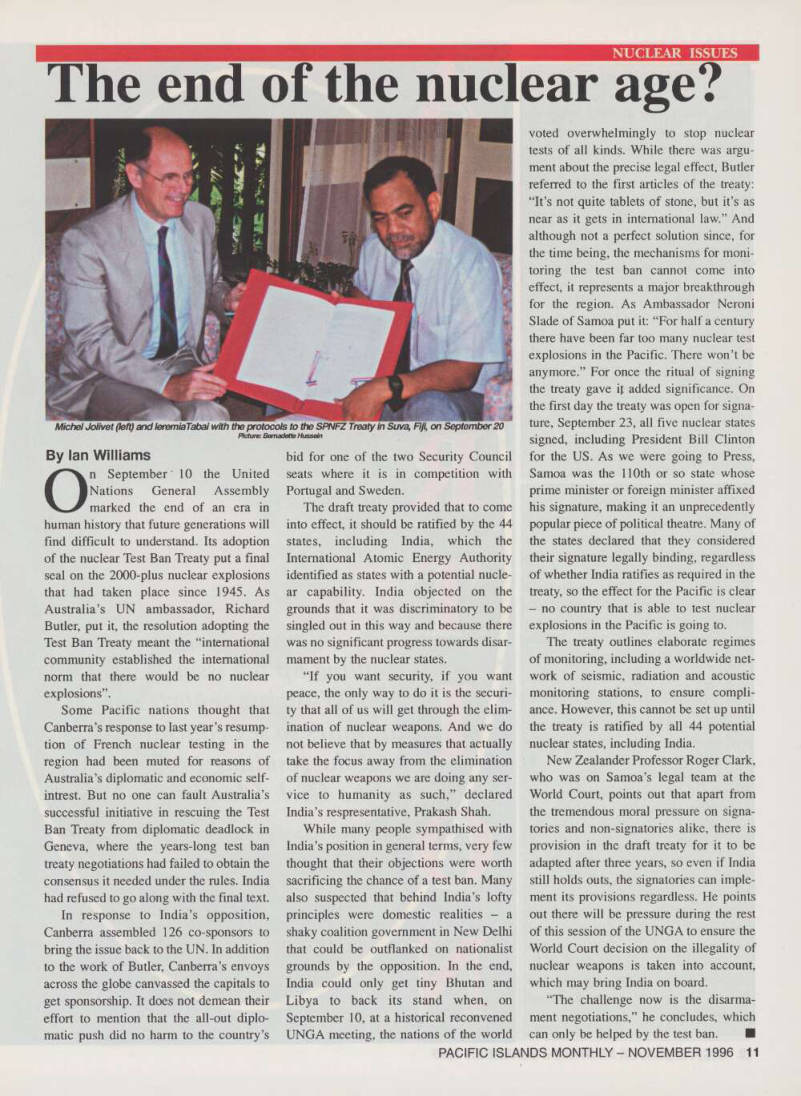
France has finally ratified the Protocols to the South Pacific Nuclear Free Zone Treaty. It had signed the protocols in Fiji six months ago but did not ratify it until September 20.
Many feel that France’s readmission as a post-Forum dialogue partner may have been one of the reasons why the protocols were ratified just a week after the South Pacific Forum meeting in
Majuro in early September.
France’s new ambassador to Fiji, Michel Jolivet, handed the instrument of ratification signed by President Jacques Chirac to the treaty’s depository, Secretary-General of the South Pacific Forum leremia Tabai. Both Tabai and Jolivet expressed the hope that this demonstration by France of its commit ment to end testing would be an encour agement to all nations to sign and ratify the Comprehensive Test Ban Treaty as soon as possible and finally bring the nuclear testing era to an end. France had signed the protocols to the South Pacific Nuclear Free Zone Treaty, also known as the Treaty of Raratonga, on March 25 this year, along with the United Kingdom and the United States. The treaty renounces nuclear explosive devices, prevents their stationing within the SPNFZ and guards against testing and the dumping of nuclear waste in the region. Under Article Three (a) of the treaty, each party agreed not to manufac ture or acquire, possess or have control over any nuclear explosive device by any means anywhere inside or outside the SPNFZ. The treaty’s three protocols state that: France, the UK and US undertake to apply the basic provisions of the treaty to their territories in the zone; nuclear explosive devices not be used against any party to the treaty; and there be no nuclear testing in the zone. The other two nuclear powers, China and Russia, have also signed and ratified the protocols toward a nuclear-free South Pacific. ■
The end of the nuclear age?
Nuclear Issues
By lan Williams
On September 10 the United Nations General Assembly marked the end of an era in human history that future generations will find difficult to understand. Its adoption of the nuclear Test Ban Treaty put a final seal on the 2000-plus nuclear explosions that had taken place since 1945. As Australia’s UN ambassador, Richard Butler, put it, the resolution adopting the Test Ban Treaty meant the “international community established the international norm that there would be no nuclear
explosions”.
Some Pacific nations thought that Canberra’s response to last year’s resump tion of French nuclear testing in the region had been muted for reasons of Australia’s diplomatic and economic self intrest. But no one can fault Australia’s successful initiative in rescuing the Test Ban Treaty from diplomatic deadlock in Geneva, where the years-long test ban treaty negotiations had failed to obtain the consensus it needed under the rules. India had refused to go along with the final text.
In response to India’s opposition, Canberra assembled 126 co-sponsors to bring the issue back to the UN. In addition to the work of Butler, Canberra’s envoys across the globe canvassed the capitals to get sponsorship. It does not demean their effort to mention that the all-out diplo matic push did no harm to the country’s
bid for one of the two Security Council seats where it is in competition with Portugal and Sweden.
The draft treaty provided that to come into effect, it should be ratified by the 44 states, including India, which the International Atomic Energy Authority identified as states with a potential nucle ar capability. India objected on the grounds that it was discriminatory to be singled out in this way and because there was no significant progress towards disar mament by the nuclear states.
“If you want security, if you want peace, the only way to do it is the securi ty that all of us will get through the elim ination of nuclear weapons. And we do not believe that by measures that actually take the focus away from the elimination of nuclear weapons we are doing any ser vice to humanity as such,” declared India’s respresentative, Prakash Shah.
While many people sympathised with India’s position in general terms, very few thought that their objections were worth sacrificing the chance of a test ban. Many also suspected that behind India’s lofty principles were domestic realities - a shaky coalition government in New Delhi that could be outflanked on nationalist grounds by the opposition. In the end, India could only get tiny Bhutan and Libya to back its stand when, on September 10, at a historical reconvened UNGA meeting, the nations of the world
voted overwhelmingly to stop nuclear tests of all kinds. While there was argu ment about the precise legal effect, Butler referred to the first articles of the treaty: “It’s not quite tablets of stone, but it’s as near as it gets in international law.” And although not a perfect solution since, for the time being, the mechanisms for moni toring the test ban cannot come into effect, it represents a major breakthrough for the region. As Ambassador Neroni Slade of Samoa put it: “For half a century there have been far too many nuclear test explosions in the Pacific. There won’t be anymore.” For once the ritual of signing the treaty gave ij added significance. On the first day the treaty was open for signa ture, September 23, all five nuclear states signed, including President Bill Clinton for the US. As we were going to Press, Samoa was the 110th or so state whose prime minister or foreign minister affixed his signature, making it an unprecedently popular piece of political theatre. Many of the states declared that they considered
their signature legally binding, regardless
of whether India ratifies as required in the treaty, so the effect for the Pacific is clear - no country that is able to test nuclear explosions in the Pacific is going to.
The treaty outlines elaborate regimes of monitoring, including a worldwide net work of seismic, radiation and acoustic monitoring stations, to ensure compli ance. However, this cannot be set up until the treaty is ratified by all 44 potential nuclear states, including India.
New Zealander Professor Roger Clark, who was on Samoa’s legal team at the World Court, points out that apart from the tremendous moral pressure on signa tories and non-signatories alike, there is provision in the draft treaty for it to be adapted after three years, so even if India still holds outs, the signatories can imple ment its provisions regardless. He points out there will be pressure during the rest of this session of the UNGA to ensure the World Court decision on the illegality of nuclear weapons is taken into account, which may bring India on board.
“The challenge now is the disarma ment negotiations,” he concludes, which can only be helped by the test ban. ■
Michel Jolivet (left) and leremiaTabai with the protocols to the SPNFZ Treaty in Suva, Fiji, on September 20 Picture: Bemadette Hussein
Health

Case Study I Sde woo 19, de woo 25. *7dey wene dotd ftom otauned neliyiouo (amilieo. Sde woo two moutdo pneqnant and woo 00 oeaned ode eouldn t eat on oleep ftn dayo deftoe madiny up den mittd. Sde would oee a woman in tde village dnown ftn madiny up tde vainadau 'THaoni medicine ftn pneqnaneieo and end den mioeny. ~?de woman qave den tde inqnedi ento: a tdied. paotey oolution wdied ode dad to dnind tdn.ee timeo a day. /iften tde ftnot day den quilt woo 00 otnony ode edanyed den mind and tdnew tde neot ft tde dnind away. Sde qave dintd to a dealtdy doy and oayo wden de 60 olden ode will tell dim ft only to delp den eaoe tde quilt ode otill eannieo witd den ftn almoot qoiny tdnouqd witd tde adoption. 0
Case Study II Sde woo 25, mannied witd two dauqdteno and a oon qioen up ao a. ftedinq cdild to den ftmily daed in “Sotd ode and den pantnen wene detween fade and otnuqyliny to pay ne*tt wden ode ftund out ode woo a ftw montdo pneqnant. Sde dud deand o£ otden qinlo in tnowdle ’ qettiny ftee advice and adontiono ftom a deu ce in Spoom and aoded a eouoin to qo witd den. *i¥en duodand woo otnonqly aqainot tde idea,, owean iny de would died den out o£ tde douoe i£ ode weut tdnouqd witd it. zdften eounoelliny oeooiouo ode decided to dove tde adoption and aoded den eouoiu to drop, den oft and pied den up often a mozniny day at tde eentoe. Pnoteoteno out oie yaoe den ‘niydt to lift ’ pam pdleto and odowed den donnidle pdotoo ft adopted ftetuoeo ao ode eutened tde elituc. /4 montd laten ode ftuud out den duodand woo daviny an aftain witd anotden woman wdo woo deavily pneqnant.
Sde deeded dim out ft tde douoe. loday ode oayo ode made tde ziqdt edoiee. 0
Case Study 111 Sfa o*o4- 16 and in fan School (2-entifteote yean. 7¥e evoe a coufale o£ yeono olden- and evonhiny. Sfa refteed to Relieve die evae faney nont, even cvfan efa fauyht tfa teat fat and it doeved fane. ’Tier faar ento ovould fall fan-. Sfa cnied ftr ftom ftan-, hal£ ftom neynet, at not ueiny tfa faith- con trol faille- fan- olden couein hod tnied to ftnee on fan.
Sfa ached around, fauyht a 40-ounee fattle o£ num and dranh it elnaiyht, yulfainy yloee often yloeo evith oefaininc ... onc-tevo three, until efa ftniefad a cvhole faach. Sfa eyueeyed lemon juice down fan throat until it ftlt raev.
'Jiothiny hafafaened.
Sfa ached around ayain and received a- faaefat o£ come hnoevn faoevden cvhich cfa hod to mix into a drinh and ftnieh.
Ttothiny hafafaened.
Sfa drofafaed out o£ cchool evith out comfaletiny School @ent and had tfa holy. •
Case Study IV Sfa cvoe- 20 and already had tcvo children. *t¥en ftnet child u*ac farn four monthe after j/tc com faleted School “7fa 4eeond evae exfalained to fan- 04- a “<ftft ftom yod" evhen ehe yot faneynant on 7WD contracefative (tfa Coop-} and evoe nefteeed an afartion. Sfa eventually- moved to /iuchland cohere 4fa ftund out ehe evoe tfaee montfa faneynant ayain a*td fan faontnen evoent inteneeted i*t eufafaontiny anothen child.
Sfa event to- tfa abortion clinic in Sfaeom and agreed to- coun celliny. *7fa ftllocviny day, efa evoo- admitted and met anotfan @ooh 'lelanden coming out o£ the atne ae ehe evae yoiny- in. *7fay fanetended not to hnoev each otfan. •
Case Study V SAe cvoc 26. fiontuct tvoclZ. SAc UieUt’t tell Aim Aecoucc cAc (AcuyAt Ae wouldn't WCUtt fa A*UXW cAc WOC tCWX montAc fneyuout and cAe Anew tAcy wenc oAcut fa £i*ticA any way.
SAe ocAed friieudc oAcut Acw fa "yet nid it" Aut (Ac advice wac mixed. *}tt (Ac end cAe facA (Ac advice <ute wAc fald Ac* fa yc (Ae s4ucAlaud clinic and cfa it comely and (Quietly ".
SAe Aonncwed (Ae mcney Am. /4 yean, laten,, cAcc ctill payiny it AacA and ic nc fanyert cviiA Am pantnm. •
Abortion
Bottling up the issue ...
Lisa Williams reports on attitudes to sex education and the resulting problems in the Cook Islands Picture: Asaeli Lave
It’s a three-syllable word unspoken in
polite conversation, and ignored in the Cook Islands medical jargon. In the Cook Islands, abortions are illegal - but not unheard of.
At a national conference on the status and rights of Cook Islands women in October and at another on reproductive health and the family the month before, abortion remained on the list of unspeak able topics, still belonging to the realm of secrets Cook Islands women will never share with their mothers.
Local doctors won’t go near the topic, unless it’s off the record and there’s no one around.
Yet they admit it is happening.
Cook Islands women - most of them young, still in school and with next to no knowledge of birth control - are begging them for abortions.
Their tears and woeful faces don’t cut them much slack - the doctors are too busy reminding them it’s a crime against the state to perform the procedure.
You can count the number performed in the national hospital based in Rarotonga in any given year on either hand. The “terminating of pregnancy”, or TOP, procedure is done only when preg nancy is the result of incest or rape.
But doctors - and the wider communi ty - in a country that is so small the coconut wireless is a fierce supplier of stories to the local media, have heard whispers of TOPs being done as D and C’s, the dilate and curretage procedure which doesn’t need the approval of a medical panel, yet can essentially be a TOP if the pregnancy is in the early stages.
But they also deny anything to do with
that practice.
“Is it happening here?” is the response from the acting head for health about the policy on abortion in the Cook Islands.
With Health Minister Dr Joe Williams and his secretary, Dr Roro Daniel, over seas, it lies with Sister Ngapoko Short to repeat the official line that TOPs are ille
gal.
It is safer for all to discuss why there are so many teenage pregnancies or mul tiple boom-boom-boom pregnancies. In a country where birth control is free, no one seems to be getting the message out on
planning families.
Down at Avarua town’s major pharma cy, one of two in the Cooks, staff sell pregnancy kits in three varieties - and turn away the frequent requests for ‘abor tion drugs’ from teenagers freaking out over being pregnant.
“They come in here crying and stressed out,” says one employee. “I have to feel sorry for them because they are so misinformed and scared.”
Most of the teenagers don’t seem to believe that the morning-after pill, which has to be taken within 72 hours of inter course, is not an abortion pill. Most of them are finding out too late about birth control - and as a result experts on family planning can see the Cooks problem lies in an education, health and social system that is still playing catchup with children
having children.
Overseas, while both sides of the abor tion argument take up their stance with a passion, the battle for doctors and the health system on the home front is trying to make “the Christian nation” understand it’s OK to talk to your kids about The Pill ... or The Condom.
“I find it so hard to believe that our culture comes up with a relaxed attitude to songs about sex, or finds it funny to sing these songs,” says one young woman, “but we can’t use the words to get the message across; everyone is just so shy when it comes to the topic.”
Many parents - and teachers - oppose the teaching of sex education in Cook Islands schools. Talks from public health nurses about contraception and what hap pens when boy (biblically) knows girl are few and far between.
When it comes to abortion, it’s consid ered widely that there is no argument over what to do when life begins, planned or not.
“You have the baby,” says one young mother. “You have it, give it away to someone else, or decide to keep it and struggle on anyway. Because you have to.”
But also an issue is that in the Cooks’
tiny, 20,000 and dropping population,
abortion is not as unheard of as its deci sion makers might like to pretend.
So long as the topic is kept out of polite conversation and medical profes sionals aren’t involved, women - and children who want to end their pregnan
cies - are gulping down all manner of hideous potions and poison alcohol to do the deed.lf the tough massaging of the lower stomach doesn’t work, they swal low a range of concoctions in the hope of purging their wombs.
Some opt to pay out thousands of dol lars for the return airfare to New Zealand.
They fly out for a week or two, heading for the hygiene and certainty of a clinical termination of pregnancy costing around SUSS44, with counselling before and after the operation. If it looks like only those who can afford can get - that’s because it is that way. But why doesn’t the health service provide a service that Cook Islands women are doing for them selves bush-doctor style, or seeking over seas if they have the cash?
The abortion issue in the Cooks, as it must be across the rest of the Pacific, is a political football. Voters who go to church and see God’s hand in everything do not take kindly to a state-condoned pregnancy termination service. And in the Cook Islands, like other ‘traditional’
Pacific Islands governments, there is no hard line differentiating church and state.
Whether Cook Islands women should have access at all to the termination pro cedure is a tough question for a country dogged by financial problems so big it pushes any other issue into trivia-land.
Until the answer comes, the Cook Island women who tell their stories here will continue to share one thing in com mon: They will never tell their mothers. ■
best medicine

Laughter ... the best medicine
By Liz Thompson
At the Royal Hobart Hospital
someone who looks like a doctor but has curly green hair and a bowler hat on his head is pulling an orange plastic chicken from one of the 15 pockets in his white pharmacist’s coat.
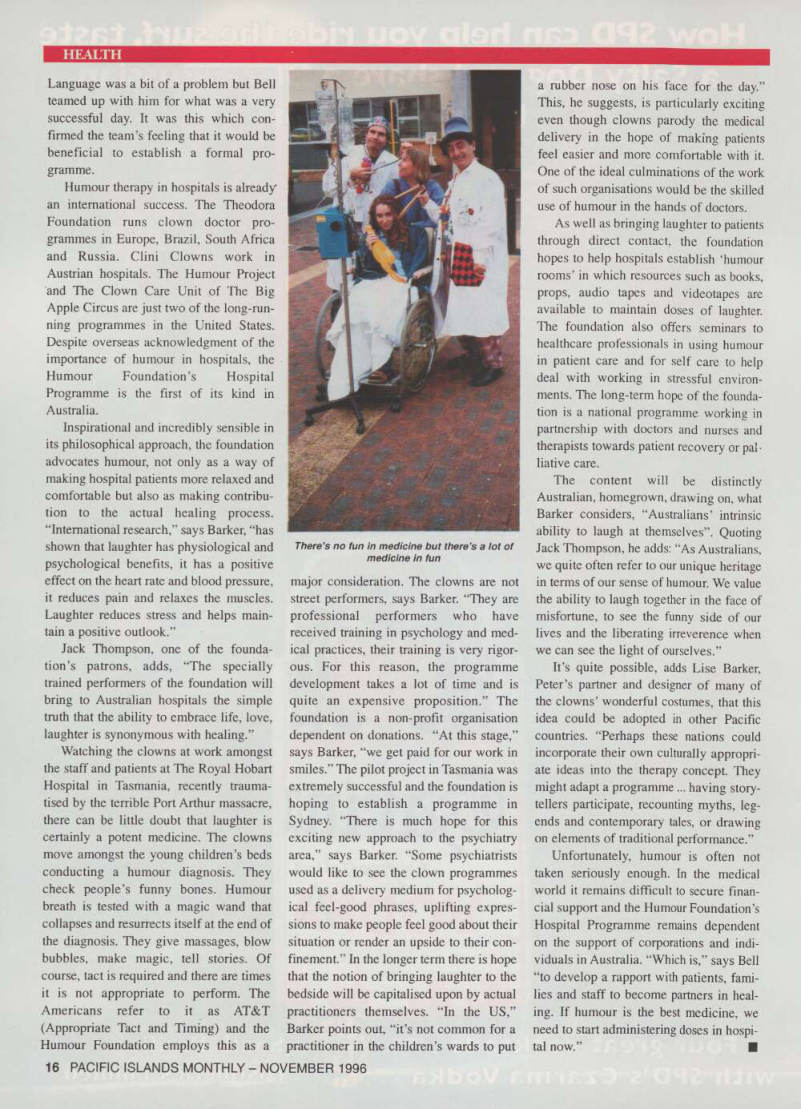
The man is Jean Paul Bell, a mime artist of 25 years standing, and today he is a clown working to bring a smile to the faces of
hospitalised children.
Jean Paul Bell is part of the Humour Foundation Hospitals Programme, recent ly established in Australia by a team of three - Peter Barker, the general manager, Dr Peter Spitzer (MBBS) the medical director, and Bell, the programme director.
When setting up, the Humour Foundation invited Andre Pule, head of the Theodora Foundation, a similar project in Switzerland, to conduct a pilot pro gramme at a few Sydney hospitals.
A Clown With a Downs Syndrome child Pictures courtesy of the Humour Foundation
Language was a bit of a problem but Bell teamed up with him for what was a very successful day. It was this which con firmed the team’s feeling that it would be beneficial to establish a formal pro gramme.
Humour therapy in hospitals is already
an international success. The Theodora Foundation runs clown doctor pro grammes in Europe, Brazil, South Africa and Russia. Clini Clowns work in Austrian hospitals. The Humour Project and The Clown Care Unit of The Big Apple Circus are just two of the long-run ning programmes in the United States.
Despite overseas acknowledgment of the importance of humour in hospitals, the Humour Foundation’s Hospital Programme is the first of its kind in Australia.
Inspirational and incredibly sensible in its philosophical approach, the foundation advocates humour, not only as a way of making hospital patients more relaxed and comfortable but also as making contribu tion to the actual healing process.
“International research,” says Barker, “has shown that laughter has physiological and psychological benefits, it has a positive effect on the heart rate and blood pressure, it reduces pain and relaxes the muscles.
Laughter reduces stress and helps main tain a positive outlook.”
Jack Thompson, one of the founda tion’s patrons, adds, “The specially trained performers of the foundation will bring to Australian hospitals the simple truth that the ability to embrace life, love, laughter is synonymous with healing.”
Watching the clowns at work amongst the staff and patients at The Royal Hobart Hospital in Tasmania, recently trauma tised by the terrible Port Arthur massacre, there can be little doubt that laughter is certainly a potent medicine. The clowns move amongst the young children’s beds
conducting a humour diagnosis. They
check people’s funny bones. Humour breath is tested with a magic wand that collapses and resurrects itself at the end of the diagnosis. They give massages, blow bubbles, make magic, tell stories. Of course, tact is required and there are times it is not appropriate to perform. The Americans refer to it as AT&T (Appropriate Tact and Timing) and the Humour Foundation employs this as a
major consideration. The clowns are not street performers, says Barker. “They are professional performers who have received training in psychology and med ical practices, their training is very rigor ous. For this reason, the programme development takes a lot of time and is quite an expensive proposition.” The foundation is a non-profit organisation dependent on donations. “At this stage,” says Barker, “we get paid for our work in smiles.” The pilot project in Tasmania was extremely successful and the foundation is hoping to establish a programme in Sydney. “There is much hope for this exciting new approach to the psychiatry area,” says Barker. “Some psychiatrists would like to see the clown programmes used as a delivery medium for psycholog
ical feel-good phrases, uplifting expres
sions to make people feel good about their situation or render an upside to their con finement.” In the longer term there is hope that the notion of bringing laughter to the bedside will be capitalised upon by actual practitioners themselves. “In the US,”
Barker points out, “it’s not common for a practitioner in the children’s wards to put
a rubber nose on his face for the day.”
This, he suggests, is particularly exciting even though clowns parody the medical delivery in the hope of making patients feel easier and more comfortable with it.
One of the ideal culminations of the work of such organisations would be the skilled use of humour in the hands of doctors.
As well as bringing laughter to patients through direct contact, the foundation
hopes to help hospitals establish ‘humour
rooms’ in which resources such as books, props, audio tapes and videotapes are available to maintain doses of laughter.
The foundation also offers seminars to healthcare professionals in using humour in patient care and for self care to help deal with working in stressful environ ments. The long-term hope of the founda tion is a national programme working in partnership with doctors and nurses and
therapists towards patient recovery or pal
liative care.
The content will be distinctly Australian, homegrown, drawing on, what Barker considers, “Australians’ intrinsic ability to laugh at themselves”. Quoting Jack Thompson, he adds: “As Australians, we quite often refer to our unique heritage in terms of our sense of humour. We value the ability to laugh together in the face of misfortune, to see the funny side of our lives and the liberating irreverence when we can see the light of ourselves.”
It’s quite possible, adds Lise Barker, Peter’s partner and designer of many of the clowns’ wonderful costumes, that this idea could be adopted in other Pacific countries. “Perhaps these nations could incorporate their own culturally appropri ate ideas into the therapy concept. They might adapt a programme ... having story
tellers participate, recounting myths, leg
ends and contemporary tales, or drawing on elements of traditional performance.”
Unfortunately, humour is often not taken seriously enough. In the medical world it remains difficult to secure finan cial support and the Humour Foundation’s
Hospital Programme remains dependent
on the support of corporations and indi viduals in Australia. “Which is,” says Bell “to develop a rapport with patients, fami lies and staff to become partners in heal ing. If humour is the best medicine, we need to start administering doses in hospi tal now.” ■
There’s no fun in medicine but there’s a lot of medicine in fun
Advertisements & other items, p. 15 (1 item)
Cwin
How SPD can help you ndgrangurf, taste a Salty Dog and share a HBussian.
It’s no BullshoM
* t \ ■ I?
Cwin
South Pacific Qii.ti 1 feriiSlL iinited W -*■ «- Foui* great cocktails ‘Wit J h^S , P'D‘’s~€ L z*a , i*in^\^fea , l?lJ
PNG’s guns-for-drugs

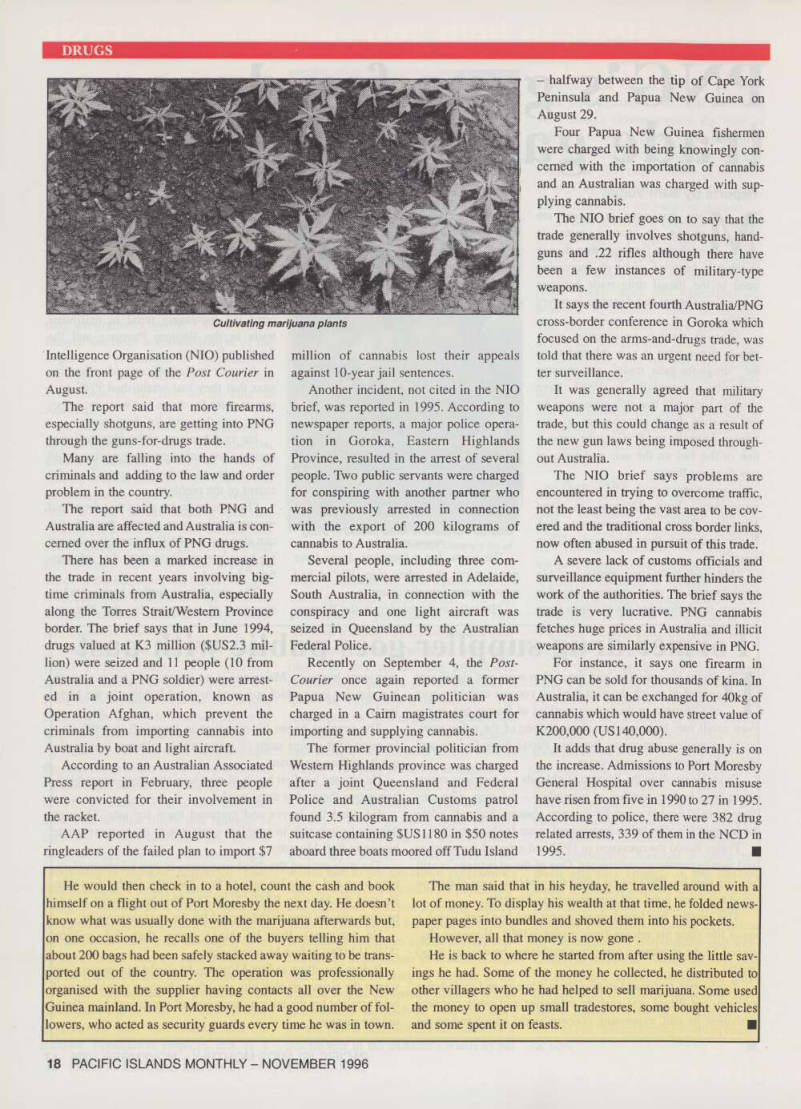
trade gains momentum
Reports by Sam Vulum
More marijuana producers are opting to accept guns in exchange for drugs than money in what is reported to be an increasing trend in the illegal drug trade between Papua New Guinea and Australia in recent months.
Although there is no statistics avail able to prove what is now referred to as the “drugs-for-guns trade”, government authorities, especially in PNG, have strongly indicated that this appears to be the situation following changes to gun rules in Australia and PNG’s June imposi tion of the ban on the sale and issue of new firearms licences.
In an interview with ABC’s PNG cor respondent, Sean Dorney, in Port Moresby Police Commissioner Bob Nenta indicated that this was a “big worry”.
“Although we’ve not made any big breakthrough in guns coming into this country, the feeling has always been there
... We know for a fact that drugs have gone across the other side. We’ve had guns coming into the country.
“In fact, on the border, in the Western
Province, we’ve had some successful arrests of people coming in with guns but not on a very large scale, mainly perhaps because of the big coastline. We have no ways of keeping constant surveillance,”
Nenta told the ABC.
The National Narcotics Bureau also cited the increasing trend in marijuana trade in the Western Province and the Sanduan Province.
A senior bureau officer said earlier this year that they had established PNG as a transit point for drugs and weapons, espe cially with the guns-for-drugs trade.
He said because of inadequate infor mation, law enforcement agencies could only make an “educated guess” on the extent of the problem.
“But we know for a fact that drugs and weapons have been getting through. We can also say that PNG is a transit point but we have yet to substantiate this informa tion,” he said.
The problem is further highlighted in excerpts of a report by the National
Crushed marijuana is found packed in a bag Pictures: Sam Vulum
Intelligence Organisation (NIO) published
on the front page of the Post Courier in
August.
The report said that more firearms, especially shotguns, are getting into PNG
through the guns-for-drugs trade.
Many are falling into the hands of criminals and adding to the law and order problem in the country.
The report said that both PNG and Australia are affected and Australia is con cerned over the influx of PNG drugs.
There has been a marked increase in the trade in recent years involving big time criminals from Australia, especially along the Torres Strait/Westem Province border. The brief says that in June 1994, drugs valued at K 3 million (SUS 2.3 mil lion) were seized and 11 people (10 from Australia and a PNG soldier) were arrest ed in a joint operation, known as Operation Afghan, which prevent the criminals from importing cannabis into Australia by boat and light aircraft.
According to an Australian Associated Press report in February, three people were convicted for their involvement in the racket.
AAP reported in August that the ringleaders of the failed plan to import $7
million of cannabis lost their appeals
against 10-year jail sentences.
Another incident, not cited in the NIO brief, was reported in 1995. According to newspaper reports, a major police opera tion in Goroka, Eastern Highlands Province, resulted in the arrest of several people. Two public servants were charged for conspiring with another partner who was previously arrested in connection with the export of 200 kilograms of cannabis to Australia.
Several people, including three com mercial pilots, were arrested in Adelaide, South Australia, in connection with the conspiracy and one light aircraft was seized in Queensland by the Australian Federal Police.
Recently on September 4, the Post- Courier once again reported a former Papua New Guinean politician was charged in a Cairn magistrates court for
importing and supplying cannabis.
The former provincial politician from
Western Highlands province was charged
after a joint Queensland and Federal Police and Australian Customs patrol found 3.5 kilogram from cannabis and a suitcase containing SUS 1180 in $5O notes aboard three boats moored off Tudu Island
- halfway between the tip of Cape York Peninsula and Papua New Guinea on
August 29.
Four Papua New Guinea fishermen
were charged with being knowingly con
cerned with the importation of cannabis and an Australian was charged with sup
plying cannabis.
The NIO brief goes on to say that the trade generally involves shotguns, hand guns and .22 rifles although there have been a few instances of military-type weapons.
It says the recent fourth Australia/PNG cross-border conference in Goroka which focused on the arms-and-drugs trade, was told that there was an urgent need for bet ter surveillance.
It was generally agreed that military weapons were not a major part of the trade, but this could change as a result of the new gun laws being imposed through out Australia.
The NIO brief says problems are encountered in trying to overcome traffic, not the least being the vast area to be cov ered and the traditional cross border links, now often abused in pursuit of this trade.
A severe lack of customs officials and surveillance equipment further hinders the work of the authorities. The brief says the trade is very lucrative. PNG cannabis fetches huge prices in Australia and illicit weapons are similarly expensive in PNG.
For instance, it says one firearm in PNG can be sold for thousands of kina. In Australia, it can be exchanged for 40kg of cannabis which would have street value of
K 200,000 (Us 140,000).
It adds that drug abuse generally is on the increase. Admissions to Port Moresby General Hospital over cannabis misuse have risen from five in 1990 to 27 in 1995.
According to police, there were 382 drug related arrests, 339 of them in the NCD in 1995. ■
Cultivating marijuana plants
Former drug supplier goes public with past
Perhaps his activities and reputation were not significant enough to match those of the Cali cocaine cartel kingpin of Columbia or the opium warlord of Burma but, in his own small way, he was a key player in one of the many mari juana-smuggling operations between Papua New Guinea and Australia reported in recent years. From Heganofi in the Eastern Highlands - a province reput ed to be a leading supplier of marijuana - the man, who pre ferred not to use his name for security reasons, has now given up his past life after being imprisoned twice for his activities.
Police busted the operation in 1992 and arrested the supplier and two expatriate acquaintances. One of the expatriates is still serving time in a PNG prison while the other has been placed on good behaviour bond and has returned to Australia.
The supplier has found employment and has been living a quiet life since his release from prison ini993. However, dis turbed by the increasing marijuana problems, he decided to go
public.
Youths take marijuana to give them courage and confidence to carry out illegal acts such as robberies and other criminal activities, he said, expressing concern at the new trend in the
marijuana business. Marijuana is no longer sold for mere cash but also for guns which are used in tribal fighting in the high lands.
The supplier began his activities in Heganofi in 1989 after learning of the huge sums of money other villagers were mak ing by selling marijuana.
He planted his first batch of marijuana between vegetables , harvesting them after three weeks.
He dried the leaves and prepared them for sale. Through friends, he was able to establish contact with the two expatriate
buyers in Port Moresby.
The man packed the dried marijuana in one-kilogram shop ping bags and made his way to Port Moresby for his first sale.
He sold the bags for K 250 (SUSI7S). This began what was to become regular trips to the capital for the next three years.
He estimates that he made more than K 1 million ($U5712.000) before he was caught.
Before travelling to Port Moresby, he would ensure someone was at the airport to pick him up, after which he would try and head straight for the buyers, dropping off the drugs and collect ing the money.
He would then check in to a hotel, count the cash and book himself on a flight out of Port Moresby the next day. He doesn’t know what was usually done with the marijuana afterwards but, on one occasion, he recalls one of the buyers telling him that about 200 bags had been safely stacked away waiting to be trans ported out of the country. The operation was professionally organised with the supplier having contacts all over the New Guinea mainland. In Port Moresby, he had a good number of fol lowers, who acted as security guards every time he was in town.
The man said that in his heyday, he travelled around with a lot of money. To display his wealth at that time, he folded news paper pages into bundles and shoved them into his pockets.
However, all that money is now gone .
He is back to where he started from after using the little sav ings he had. Some of the money he collected, he distributed to other villagers who he had helped to sell marijuana. Some used the money to open up small tradestores, some bought vehicles and some spent it on feasts. ■
Finance ministers wined,

dined ... and lectured
By David North
The Islands’ finance ministers gath ered in Washington with their peers from around the world in September for a menu of: • a little direct investment; • some useful technical assitance; and • several gentle lectures on how to run their countries’ finances.
The occasion was the annual meeting of the governors of the World Bank; a round of high policy and splendid parties for the participants, but regarded as a headache by most Washingtonians as the assembled rental limousines from up and down the East Coast clustered for what the Washington Post described as the yearly gold-plated traffic jam.
The most useful part of the proceed ings was a two-day regional session for the Island members of the World Bank; Fiji, FSM, Kiribati, PNG, the Marshalls, the Solomons, Tonga, Vanuatu, and Western Samoa. (Nauru, Tuvalu and Palau are not members). The World Bank runs a tight, if elegant, ship. The Islands’ finance ministers were assembled in a hotel conference room at 9am one Sunday morning for a briefing on financial policy trends around the world, and how not to run one’s nation into bankruptcy.
For the most part, things went smooth ly, as the beautiful people of the World Bank staff are good at what they do; they are bright, hard-working, cosmopolitan, polylingual, gracious, slim and well dressed.
But the advice on expenditure reduc tions, from one staffer with a British accent, must have grated the ears of the Kiribati delegation as she, twice, referred to the nation as “Kir-i-ba-tee”.
The messages on how-to-run-your govemments’ finances were gentle, well documented, illustrated with slides ... and numerous. The basic advice: hold down expenditures, do not raise taxes, spend more on health and education than on sub sidising state-run enterprises (like those champion money-losers, national air
lines), and restrict the size of your bureau cracy. On the last point, one of the staff speakers had a scatter diagram - from which the names of nations had thought fully been erased - which showed the direct, negative correlation between civil servants’ salaries and corruption. The lower the general pattern of wages, the higher the incidence of corruption - so lay off some of the less useful people, and pay the ones you keep enough to assure effi ciency and to discourage theft of public funds. (The bank takes its own advice - its people are the best paid public servants in a comparatively affluent city, and there are never any scandals at the bank.) Another diagram showed the relation ship between bureaucratic efficiency (measured in a complex way) and nation al growth; the more efficient the bureau crats, the more growth. Bank officials said that there was enough governmental effi ciency to stimulate economic growth.
“They are doing some of the basic things right - such as investment in education and that makes a difference.”
Not all the slides were scrubbed free of identifiers. One paper distributed to the delegates showed the debt level of the World Bank’s Island members, with the Marshalls and Western Samoa leading the list by a wide margin. (See chart). The measure used was the size of the external debt divided by annual gross domestic product, the sum of all goods and services produced within each country.
The Marshalls’ huge debt does not reflect a lack of outside funding, given the scores of millions of Compact and nucle ar claims dollars that the US has poured into those islands, it reflects a spend-thrift policy that has just barely begun to
change. (Shortly before the Washington
meetings, the RMI finance minister, Rueben Zachrais, had announced what for the Marshalls is an austere budget of $U584,780,000 for the fiscal year starting October 1, compared to $U591,700,000 for the prior year. The most numerous job cutbacks hit powerless women, some 181
cooks for the outer island schools.) In Washington, the World Bank offered another measure of fiscal sturdi ness, or lack thereof, and that is the amount of a nation’s overseas financial reserves as compared to the volume of imports. Kiribati, with overseas reserves equalling 8.2 months of imports may not rank high on a global scale, but it is the best in the Islands, followed by Vanuatu with 7.5 months worth of reserves. At the bottom is the Marshalls, with its reserves
equalling exactly three days of imports.
There was something of a schoolroom atmosphere about parts of these sessions an elegant graduate school, to be sure. For example, one of the World Bank staff handed out grades on the level of investor-friendliness of Island nation poli cies. With a range from a low of 1 to a high of 5, he noted a general lack of suffi cient investor-orientation as he gave out
these grades:
Fsm 1.7
W. Samoa 2.1 Marshalls 2.1
Fiji 2.3
Solomons 2.5 Vanuatu 2.5 Cooks 2.6 Niue 2.7 Kiribati 2.8 Does a government policy of insisting on a decent minimum wage for its work ers give that government a low score?
Probably, but no one asked.
The most encouraging aspect of the Island meetings was the report on the
five-year-old, Sydney-based South
Pacific Project Facility (SPPF) managed
by Richard Pearson. SPPF analyses pri vate-sector business proposals in the Islands, and then, seeks partial overseas funding for those it thinks are viable.
Most of these funds come from sources other than the World Bank itself.
During the first phase of SPPF opera tions, it secured funding for 25 projects, 23 of which are still in operation. Of those now working, 10 are in Fiji, four are in
Tonga, three each in Vanuatu and PNG, and one each in FSM, Niue, and Western Samoa. In the course of these discussions, it was mentioned that the overwhelming majority of business schemes proposed are rejected as impracticable, and that one of the World Bank-assisted projects took two and a half years between the idea and the opening for business.
“I’m not an expert, but isn’t that a long time?” asked Berenado Vunibobo, Fiji’s minister of finance and economic devel opment. Bank staff replied that these things did take time, and that many of the delays took place before and after the peri od in which the bank was active.
Tonga’s finance minister, Tutoatsi Fakafanua, supported his colleague’s con cerns, adding that his country was pleased
with the general direction of the bank’s activities. Western Samoa’s minister of finance, Tuilaepa S Malielegaoi, who was presiding over the session, said that per haps the high percentage of culled-out proposals suggests that the bank should provide more technical assistance in the initial formation of the proposals, and there was general agreement that this would be useful.
On financial scams While finance ministers are notorious ly close-mouthed with journalists about their work, one question asked during cof fee breaks always elicited enthusiastic and detailed responses: “How did your nation manage to avoid the financial scams that
have victimised Nauru, the Cooks, Vanuatu and the Marshalls?”
The first statement was always; “It’s not that the crooks didn’t come to see us”, which is then followed by a discussion of how their schemes are identified as ques tionable. A portrait of the perpetrators emerged from a conversation with Kaburoro Ruaia, acting secretary of Kiribati’s ministry of finance. He agreed with my suggestion that most were white males, adding they were often Australians, who usually showed up wearing a suit and tie while everyone else on the Island was in more suitable tropical attire.
“We probably are in the second tier of targets,” Ruaia said. “But they do come to see us. They talk fast, and they move in and out of the country quickly.”
Earlier, a senior World Bank staffer when asked what the bank was doing to try to head off such schemes said: “You can’t help someone who does not want help. Often there is so little political sta bility they sense that they have only six months to do whatever it is they want to do.” In Kiribati, in contrast, the finance minister (who was at the meetings) in Beniamina Tinga; he has held that posi tion for two years, and prior to that he served seven years as the ministry’s per manent secretary. He also serves, cur rently, as a member of the national legis lature.
Fiji has some defence mechanisms in place to avoid being defrauded, Lionel Yee, chief executive of Fiji’s National Provident Fund, suggested. He said that shady businesmen have a long list of dis honest tricks, in addition to the letters of guarantee and the prime bank notes that have been used against the four nations mentioned earlier.
His typology included those who want to pay too little for an Island asset - some of the overseas operators of fish ing vessels, for example. Then there are those, in manufacturing, who bring in overvalued machinery from overseas as their part of an investment, and then profit illicitly from the cash invested in the enterprise by other investors.
He mentioned a third category, some times encountered in the resort industry.
“The shady operator sees a hotel operating at a loss, and he tells the owner that, for a fee, he will bring in a strong, successful manager who will rescue the operation. The manager, in turn, gets his hands on the cash flow, and then disap pears, leaving the owner with a failed hotel, and none of the recent cash flow.”
“It’s not that we don’t take chances,” said Tonga’s Fakafanua, citing his coun try’s successful venture in satellites, “but we have a set of bureaucrats who check everything out before decisions are made. These guys (the con men) don’t want to stick around for a long process.”
After a heady week of intellectual
stimulation and sociability, rubbing
elbows with some of the biggest names in world finance, the ministers flew back to their respective Islands and to their day-to-day chores of keeping their gov ernments alfoat. ■
Advertisements & other items, p. 20 (1 item)
Trust Company Ltd
USED JAPANESE VEHICLES
SPECIAL OFFER
TOYOTA, NISSAN CARS, WITH AUTOMATIC TRANSMISSION
ROM ONLY $lOOO.OO US DOLLARS EACH PLUS FREIGHT.
ALL SHIPPING AND DOCUMENTATION ARRANGED.
BUY DIRECT FROM JAPAN AND SAVE.
“CONTACT”
Trust Company Ltd
KOBAC BID 3F 3-2-26 NISHIKI,
NAKAU NAGOYA, 460 JAPAN.
PHONE: (81) 52 953-5602
FAX (81) 52 953-5634
to foreign ownership
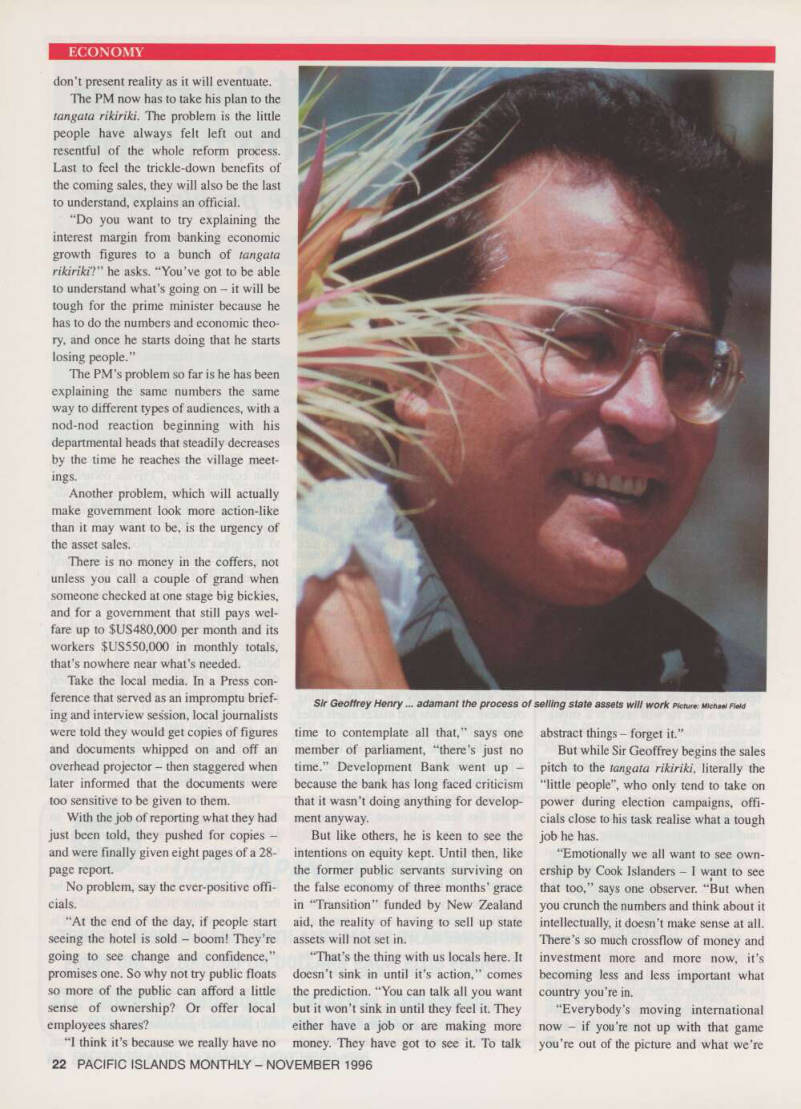
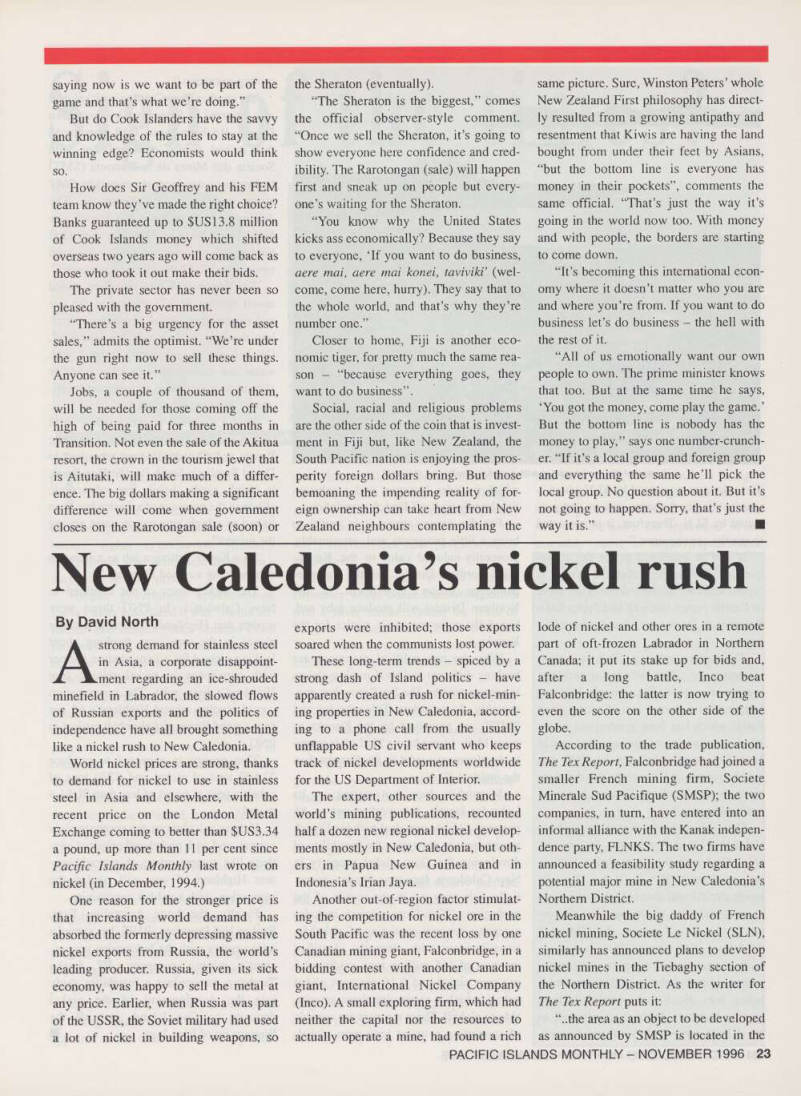
Cooks govt faces up to foreign ownership ... but what do the people want?
By Lisa Williams
£ £ "Ik "To, I don’t want foreigners to I own our airports,” said one JL major landowner, a tradi tional paramount chief, when the Cook Islands government announced its plans. . “Everyone - the Asians, you name it - will be coming into the country. And before you know it, the mafia will be here.”
It wasn’t news by the time the Cook Islands Prime Minister decided to announce government was to sell its assets: it made sense - to some.
And while the country facing financial crisis goes through an identity shock as its people take up the debate on “selling out to foreigners”, there is one fact that stands out - like the hundreds of public servants who lost their jobs, it’s not politically nice but, hey ... there is just no other way.
“If there were Cook Islanders with the money we’d have no problem with that at all,” said Prime Minister and finance man Sir Geoffrey Henry on letting the ‘crown
jewels’ go.
“But our situation is the people with money aren’t living in the country. The ones with the money are, in fact, living overseas ... and that just makes assets sales a more difficult exercise.”
But despite the mammoth task of doing a public relations job on the theme, “the Cook Islands will always belong to Cook Islanders”. Sir Geoffrey’s determination to sell has been welcomed by a business community straining for evidence of more reforms after months had passed since the prime minister made the first painful cuts to the state workforce.
Sir Geoffrey, and the close-knit bunch of official experts who number crunch and spin solutions day and night in a bid to save the Cooks economy, is adamant the whole process of selling state assets will work.
“We’re not selling assets unless the buyer or developer pays attention to equi ty as well,” he says when asked how Cook
Islanders will remain part of the process even if they don’t have the money.
Defining that equity, as well as tackling the thorny issue of whether crown lands taken for the good of the people now have to be surrendered because of their “com mercialisation”, is part of the comeback from the Cook Islanders looking govern ment in the eye on the issue.
And so the consultation, which has swept in on the wave of economic reforms, continues.
How will selling up government assets worth SUSB7 million save the country from economic ruin? Private ownership, predicts Sir Geoffrey, will bring in addi tional investments of up to sUS3Bmillion beyond the year 2000, add SUSB.7 million to the gross domestic product, create an extra SUS 2.4 million in tax revenues, and get employment figures up by 11 per cent - enough to keep all school leavers work
ing.
Despite the urgency everyone admits the sales are going to take time - only the hotels are actually on the market, every thing else is still the subject of information papers. Still, Sir Geoffrey has the com mercial bank managers of the Westpac and ANZ bank outlets in the country on his side, as well as the business sector and heads of the marine, offshore, tourism and
agriculture industries.
These are industries government has targeted for growth and investment to keep Cook Islanders working - and in the Cook Islands.
Predictions on who gets what are rife.
First to jump on the bandwagon will be the private sector in the Cooks, led by a group of canny businessmen (the gender is literal) who have survived government after government and have either the money or/and the contacts to make first bid for whatever state business they want.
But there is a small problem - and it isn’t just that figures are fine on paper and when making presentations but often
don’t present reality as it will eventuate.
The PM now has to take his plan to the tangata rikiriki. The problem is the little people have always felt left out and resentful of the whole reform process.
Last to feel the trickle-down benefits of the coming sales, they will also be the last to understand, explains an official.
“Do you want to try explaining the interest margin from banking economic growth figures to a bunch of tangata rikiriki ?” he asks. “You’ve got to be able to understand what’s going on - it will be tough for the prime minister because he has to do the numbers and economic theo ry, and once he starts doing that he starts
losing people.”
The PM’s problem so far is he has been explaining the same numbers the same way to different types of audiences, with a nod-nod reaction beginning with his departmental heads that steadily decreases by the time he reaches the village meet ings.
Another problem, which will actually make government look more action-like than it may want to be, is the urgency of the asset sales.
There is no money in the coffers, not unless you call a couple of grand when someone checked at one stage big bickies, and for a government that still pays wel fare up to SUS4BO,OOO per month and its workers $U5550,000 in monthly totals, that’s nowhere near what’s needed.
Take the local media. In a Press con ference that served as an impromptu brief ing and interview session, local journalists were told they would get copies of figures and documents whipped on and off an overhead projector - then staggered when later informed that the documents were too sensitive to be given to them.
With the job of reporting what they had just been told, they pushed for copies and were finally given eight pages of a 28page report.
No problem, say the ever-positive offi cials.
“At the end of the day, if people start seeing the hotel is sold - boom! They’re going to see change and confidence,” promises one. So why not try public floats so more of the public can afford a little sense of ownership? Or offer local employees shares?
“I think it’s because we really have no
time to contemplate all that,” says one member of parliament, “there’s just no time.” Development Bank went up because the bank has long faced criticism that it wasn’t doing anything for develop ment anyway.
But like others, he is keen to see the intentions on equity kept. Until then, like the former public servants surviving on the false economy of three months’ grace in “Transition” funded by New Zealand aid, the reality of having to sell up state assets will not set in.
“That’s the thing with us locals here. It doesn’t sink in until it’s action,” comes the prediction. “You can talk all you want but it won’t sink in until they feel it. They either have a job or are making more money. They have got to see it. To talk
abstract things - forget it.”
But while Sir Geoffrey begins the sales pitch to the tangata rikiriki, literally the “little people”, who only tend to take on power during election campaigns, offi cials close to his task realise what a tough job he has.
“Emotionally we all want to see own ership by Cook Islanders - I want to see that too,” says one observer. “But when you crunch the numbers and think about it intellectually, it doesn’t make sense at all.
There’s so much crossflow of money and investment more and more now, it’s becoming less and less important what country you’re in.
“Everybody’s moving international
now - if you’re not up with that game you’re out of the picture and what we’re
Sir Geoffrey Henry... adamant the process of selling state assets will work Picture: Michael Field
saying now is we want to be part of the game and that’s what we’re doing.”
But do Cook Islanders have the savvy and knowledge of the rules to stay at the winning edge? Economists would think so.
How does Sir Geoffrey and his FEM team know they’ve made the right choice?
Banks guaranteed up to SUSI3.B million of Cook Islands money which shifted overseas two years ago will come back as those who took it out make their bids.
The private sector has never been so pleased with the government.
“There’s a big urgency for the asset sales,” admits the optimist. “We’re under the gun right now to sell these things.
Anyone can see it.”
Jobs, a couple of thousand of them, will be needed for those coming off the high of being paid for three months in Transition. Not even the sale of the Akitua resort, the crown in the tourism jewel that is Aitutaki, will make much of a differ ence. The big dollars making a significant difference will come when government closes on the Rarotongan sale (soon) or
the Sheraton (eventually).
“The Sheraton is the biggest,” comes the official observer-style comment.
“Once we sell the Sheraton, it’s going to show everyone here confidence and cred ibility. The Rarotongan (sale) will happen first and sneak up on people but every one’s waiting for the Sheraton.
“You know why the United States kicks ass economically? Because they say to everyone, ‘lf you want to do business, aere mai, acre mai konei, tavivikV (wel come, come here, hurry). They say that to the whole world, and that’s why they’re number one.”
Closer to home, Fiji is another eco nomic tiger, for pretty much the same rea son - “because everything goes, they want to do business”.
Social, racial and religious problems are the other side of the coin that is invest ment in Fiji but, like New Zealand, the South Pacific nation is enjoying the pros perity foreign dollars bring. But those bemoaning the impending reality of for eign ownership can take heart from New
Zealand neighbours contemplating the
same picture. Sure, Winston Peters’ whole New Zealand First philosophy has direct ly resulted from a growing antipathy and resentment that Kiwis are having the land bought from under their feet by Asians, “but the bottom line is everyone has money in their pockets”, comments the same official. “That’s just the way it’s going in the world now too. With money and with people, the borders are starting to come down.
“It’s becoming this international econ omy where it doesn’t matter who you are and where you’re from. If you want to do business let’s do business - the hell with the rest of it.
“AH of us emotionally want our own people to own. The prime minister knows that too. But at the same time he says, ‘You got the money, come play the game.’
But the bottom line is nobody has the money to play,” says one number-crunch er. “If it’s a local group and foreign group and everything the same he’ll pick the local group. No question about it. But it’s not going to happen. Sorry, that’s just the way it is.” ■
New Caledonia’s nickel rush
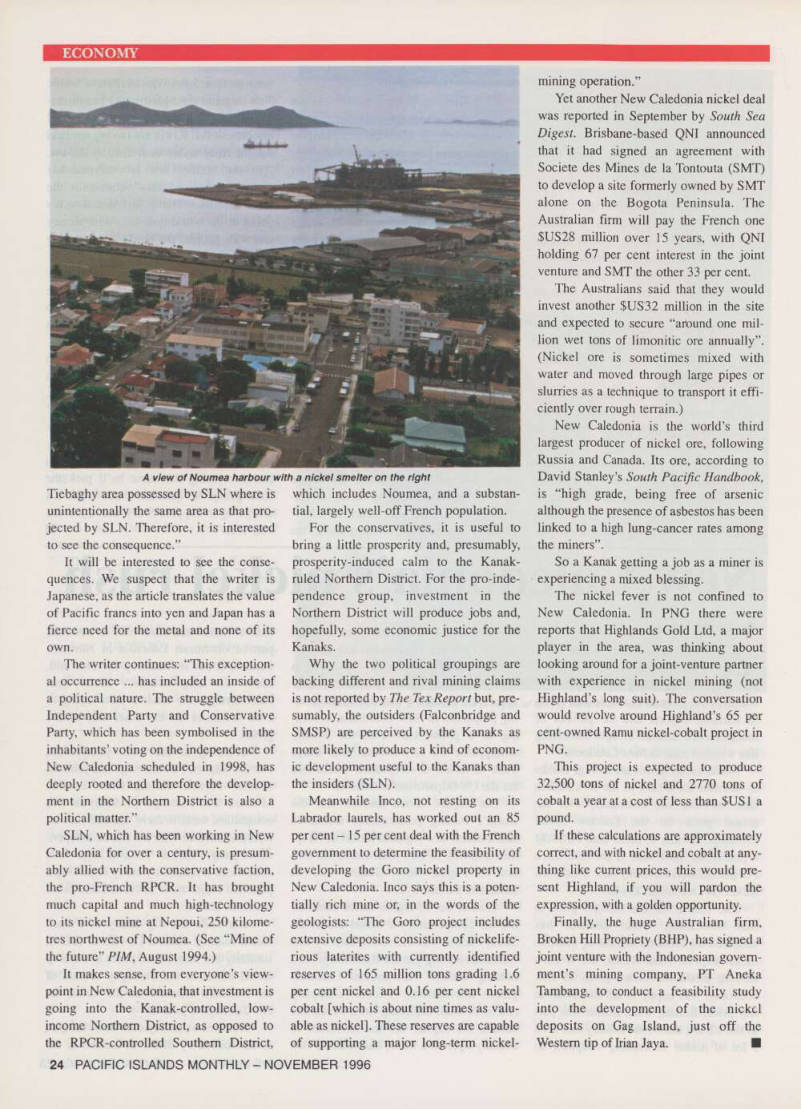
By David North
A strong demand for stainless steel in Asia, a corporate disappoint ment regarding an ice-shrouded minefield in Labrador, the slowed flows of Russian exports and the politics of
independence have all brought something
like a nickel rush to New Caledonia.
World nickel prices are strong, thanks to demand for nickel to use in stainless steel in Asia and elsewhere, with the recent price on the London Metal Exchange coming to better than $U53.34 a pound, up more than 11 per cent since Pacific Islands Monthly last wrote on nickel (in December, 1994.) One reason for the stronger price is that increasing world demand has absorbed the formerly depressing massive nickel exports from Russia, the world’s leading producer. Russia, given its sick economy, was happy to sell the metal at any price. Earlier, when Russia was part of the USSR, the Soviet military had used a lot of nickel in building weapons, so
exports were inhibited; those exports soared when the communists lost power.
These long-term trends - spiced by a strong dash of Island politics - have apparently created a rush for nickel-min ing properties in New Caledonia, accord ing to a phone call from the usually unflappable US civil servant who keeps track of nickel developments worldwide for the US Department of Interior.
The expert, other sources and the
world’s mining publications, recounted
half a dozen new regional nickel develop ments mostly in New Caledonia, but oth ers in Papua New Guinea and in Indonesia’s Irian Jay a.
Another out-of-region factor stimulat ing the competition for nickel ore in the South Pacific was the recent loss by one Canadian mining giant, Falconbridge, in a bidding contest with another Canadian
giant, International Nickel Company
(Inco). A small exploring firm, which had neither the capital nor the resources to actually operate a mine, had found a rich
lode of nickel and other ores in a remote part of oft-frozen Labrador in Northern Canada; it put its stake up for bids and, after a long battle, Inco beat Falconbridge: the latter is now trying to even the score on the other side of the globe.
According to the trade publication, The Tex Report, Falconbridge had joined a smaller French mining firm, Societe Minerale Sud Pacifique (SMSP); the two companies, in turn, have entered into an informal alliance with the Kanak indepen dence party, FLNKS. The two firms have
announced a feasibility study regarding a
potential major mine in New Caledonia’s Northern District.
Meanwhile the big daddy of French nickel mining, Societe Le Nickel (SLN), similarly has announced plans to develop nickel mines in the Tiebaghy section of the Northern District. As the writer for The Tex Report puts it: “..the area as an object to be developed as announced by SMSP is located in the
Tiebaghy area possessed by SLN where is unintentionally the same area as that pro jected by SLN. Therefore, it is interested to see the consequence.”
It will be interested to see the conse quences. We suspect that the writer is Japanese, as the article translates the value of Pacific francs into yen and Japan has a fierce need for the metal and none of its own.
The writer continues: “This exception al occurrence ... has included an inside of a political nature. The struggle between Independent Party and Conservative Party, which has been symbolised in the inhabitants’ voting on the independence of New Caledonia scheduled in 1998, has deeply rooted and therefore the develop ment in the Northern District is also a
political matter.”
SLN, which has been working in New Caledonia for over a century, is presum ably allied with the conservative faction, the pro-French RPCR. It has brought much capital and much high-technology to its nickel mine at Nepoui, 250 kilome tres northwest of Noumea. (See “Mine of the future” PIM, August 1994.) It makes sense, from everyone’s view point in New Caledonia, that investment is going into the Kanak-controlled, low income Northern District, as opposed to the RPCR-controlled Southern District,
which includes Noumea, and a substan tial, largely well-off French population.
For the conservatives, it is useful to bring a little prosperity and, presumably, prosperity-induced calm to the Kanak ruled Northern District. For the pro-inde pendence group, investment in the Northern District will produce jobs and, hopefully, some economic justice for the Kanaks.
Why the two political groupings are backing different and rival mining claims is not reported by The Tex Report but, pre sumably, the outsiders (Falconbridge and SMSP) are perceived by the Kanaks as more likely to produce a kind of econom ic development useful to the Kanaks than the insiders (SLN).
Meanwhile Inco, not resting on its Labrador laurels, has worked out an 85 per cent -15 per cent deal with the French government to determine the feasibility of developing the Goro nickel property in New Caledonia. Inco says this is a poten tially rich mine or, in the words of the geologists: “The Goro project includes extensive deposits consisting of nickelife rious laterites with currently identified reserves of 165 million tons grading 1.6 per cent nickel and 0.16 per cent nickel cobalt [which is about nine times as valu able as nickel]. These reserves are capable
of supporting a major long-term nickel
mining operation.”
Yet another New Caledonia nickel deal was reported in September by South Sea Digest. Brisbane-based QNI announced that it had signed an agreement with Societe des Mines de la Tontouta (SMT) to develop a site formerly owned by SMT alone on the Bogota Peninsula. The Australian firm will pay the French one SUS2B million over 15 years, with QNI holding 67 per cent interest in the joint venture and SMT the other 33 per cent.
The Australians said that they would invest another SUS 32 million in the site and expected to secure “arbund one mil lion wet tons of limonitic ore annually”. (Nickel ore is sometimes mixed with water and moved through large pipes or slurries as a technique to transport it effi ciently over rough terrain.) New Caledonia is the world’s third
largest producer of nickel ore, following
Russia and Canada. Its ore, according to David Stanley’s South Pacific Handbook, is “high grade, being free of arsenic although the presence of asbestos has been linked to a high lung-cancer rates among the miners”.
So a Kanak getting a job as a miner is
experiencing a mixed blessing.
The nickel fever is not confined to New Caledonia. In PNG there were reports that Highlands Gold Ltd, a major player in the area, was thinking about looking around for a joint-venture partner with experience in nickel mining (not Highland’s long suit). The conversation would revolve around Highland’s 65 per cent-owned Ramu nickel-cobalt project in
Png.
This project is expected to produce 32,500 tons of nickel and 2770 tons of cobalt a year at a cost of less than SUSI a
pound.
If these calculations are approximately correct, and with nickel and cobalt at any thing like current prices, this would pre sent Highland, if you will pardon the
expression, with a golden opportunity.
Finally, the huge Australian firm, Broken Hill Propriety (BHP), has signed a joint venture with the Indonesian govern ment’s mining company, PT Aneka
Tambang, to conduct a feasibility study
into the development of the nickel deposits on Gag Island, just off the Western tip of Irian Jaya. ■
A view of Noumea harbour with a nickel smelter on the right
Sign of the times?
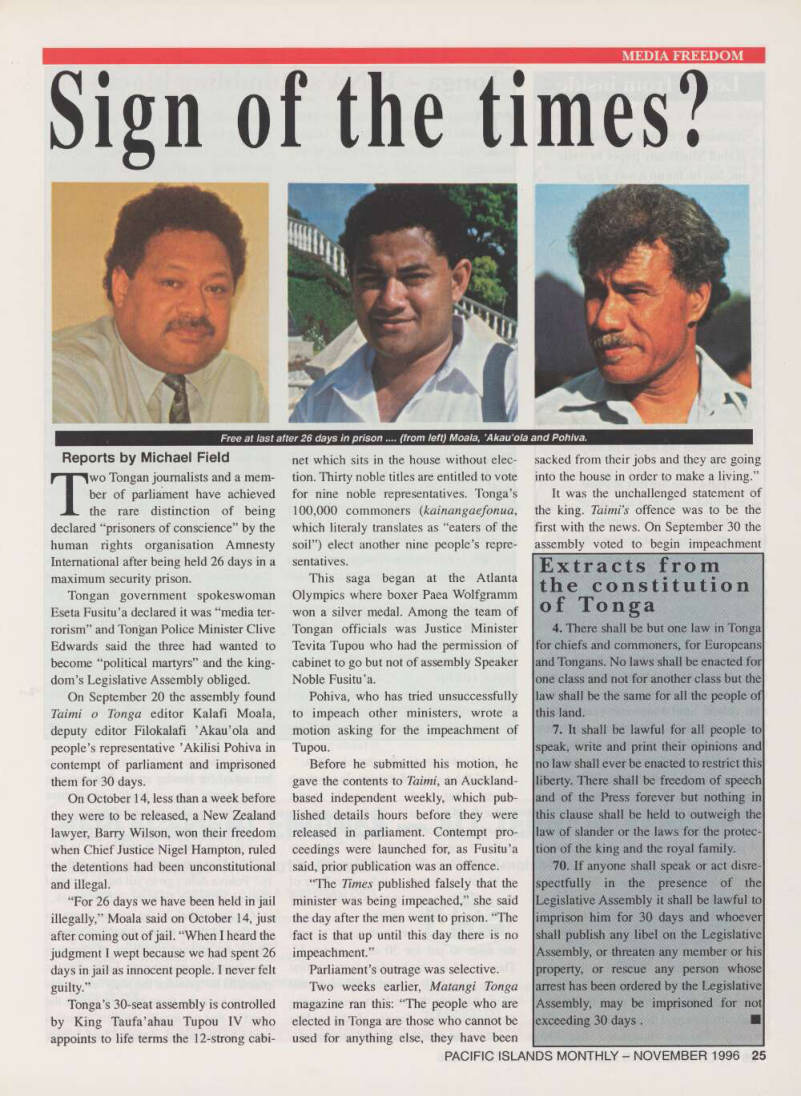
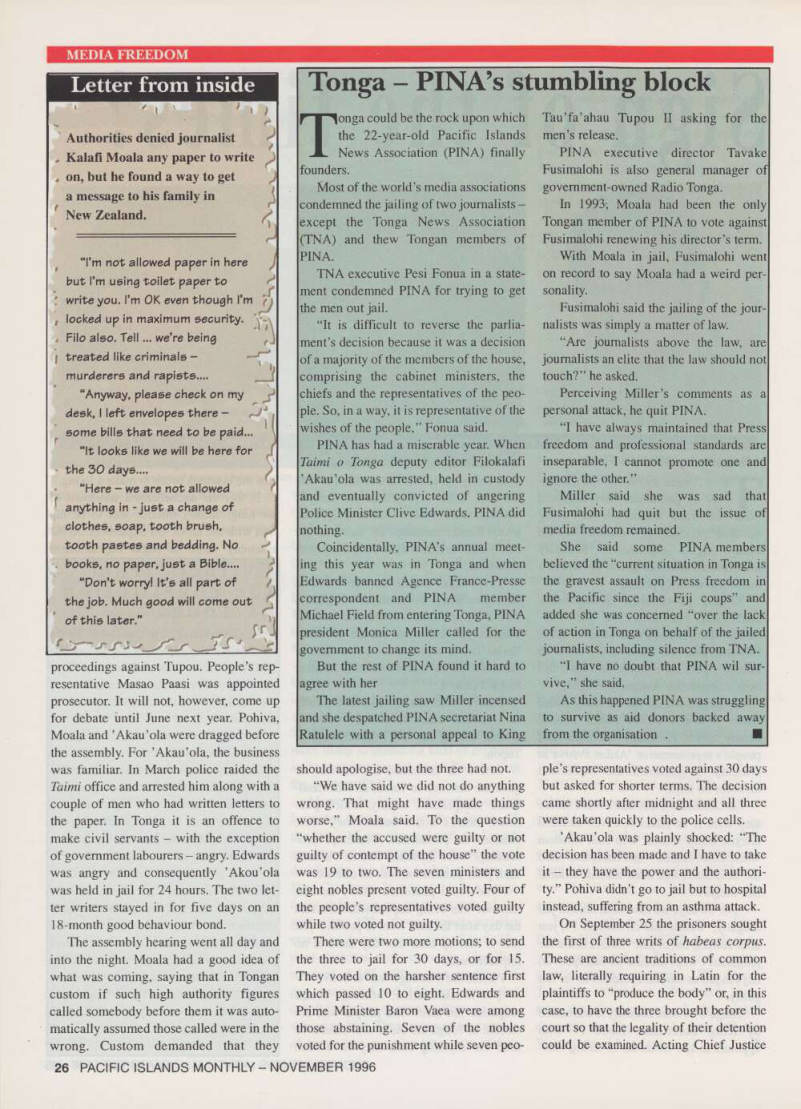
Media Freedom
Reports by Michael Field
Two Tongan journalists and a mem ber of parliament have achieved the rare distinction of being declared “prisoners of conscience” by the
human rights organisation Amnesty
International after being held 26 days in a
maximum security prison.
Tongan government spokeswoman Eseta Fusitu’a declared it was “media ter rorism” and Tongan Police Minister Clive Edwards said the three had wanted to become “political martyrs” and the king
dom’s Legislative Assembly obliged.
On September 20 the assembly found Taimi o Tonga editor Kalafi Moaia, deputy editor Filokalafi ’Akau’ola and
people’s representative ’Akilisi Pohiva in
contempt of parliament and imprisoned them for 30 days.
On October 14, less than a week before they were to be released, a New Zealand lawyer, Barry Wilson, won their freedom when Chief Justice Nigel Hampton, ruled the detentions had been unconstitutional
and illegal.
“For 26 days we have been held in jail illegally,” Moaia said on October 14, just after coming out of jail. “When I heard the judgment I wept because we had spent 26 days in jail as innocent people. I never felt
guilty.”
Tonga’s 30-seat assembly is controlled
by King Taufa’ahau Tupou IV who
appoints to life terms the 12-strong cabi-
net which sits in the house without elec tion. Thirty noble titles are entitled to vote for nine noble representatives. Tonga’s 100,000 commoners ( kainangaefon.ua , which literaly translates as “eaters of the soil”) elect another nine people’s repre sentatives.
This saga began at the Atlanta Olympics where boxer Paea Wolfgramm won a silver medal. Among the team of Tongan officials was Justice Minister Tevita Tupou who had the permission of cabinet to go but not of assembly Speaker Noble Fusitu’a.
Pohiva, who has tried unsuccessfully to impeach other ministers, wrote a motion asking for the impeachment of
Tupou.
Before he submitted his motion, he gave the contents to Taimi, an Auckland based independent weekly, which pub lished details hours before they were released in parliament. Contempt pro ceedings were launched for, as Fusitu’a said, prior publication was an offence.
“The Times published falsely that the minister was being impeached,” she said the day after the men went to prison. “The fact is that up until this day there is no
impeachment.”
Parliament’s outrage was selective.
Two weeks earlier, Matangi Tonga magazine ran this: “The people who are elected in Tonga are those who cannot be used for anything else, they have been
sacked from their jobs and they are going into the house in order to make a living.”
It was the unchallenged statement of the king. Taimi’s offence was to be the first with the news. On September 30 the assembly voted to begin impeachment
Free at last after 26 days in prison ... (from left) Moaia, 'Akau’ola and Pohiva.
proceedings against Tupou. People’s rep resentative Masao Paasi was appointed prosecutor. It will not, however, come up for debate until June next year. Pohiva, Moala and ’Akau’ola were dragged before the assembly. For ’Akau’ola, the business was familiar. In March police raided the Taimi office and arrested him along with a couple of men who had written letters to the paper. In Tonga it is an offence to make civil servants - with the exception of government labourers - angry. Edwards was angry and consequently ’Akou’ola was held in jail for 24 hours. The two let ter writers stayed in for five days on an 18-month good behaviour bond.
The assembly hearing went all day and into the night. Moala had a good idea of what was coming, saying that in Tongan
custom if such high authority figures
called somebody before them it was auto matically assumed those called were in the wrong. Custom demanded that they
should apologise, but the three had not.
“We have said we did not do anything wrong. That might have made things worse,” Moala said. To the question “whether the accused were guilty or not guilty of contempt of the house” the vote was 19 to two. The seven ministers and eight nobles present voted guilty. Four of
the people’s representatives voted guilty
while two voted not guilty.
There were two more motions; to send the three to jail for 30 days, or for 15.
They voted on the harsher sentence first which passed 10 to eight. Edwards and Prime Minister Baron Vaea were among those abstaining. Seven of the nobles voted for the punishment while seven peo
pie’s representatives voted against 30 days but asked for shorter terms. The decision came shortly after midnight and all three were taken quickly to the police cells. ’Akau’ola was plainly shocked: “The decision has been made and I have to take it - they have the power and the authori ty.” Pohiva didn’t go to jail but to hospital instead, suffering from an asthma attack.
On September 25 the prisoners sought
the first of three writs of habeas corpus.
These are ancient traditions of common law, literally requiring in Latin for the plaintiffs to “produce the body” or, in this case, to have the three brought before the court so that the legality of their detention could be examined. Acting Chief Justice
John Lewis declined saying parliament was “entitled to absolute privilege over its internal proceedings”.
It was back to the grubby Hu’atolitoli maximum security prison. No paper, no
books except the Bible , no visitors except close family. A second attempt was also rebuffed before the New Zealand branch of the Commonwealth Press Union decid ed the issue could not be left at that and sent lawyer Barry Wilson to mount a new bid, this time before Hampton.
After lengthy hearings, Hampton ruled that their 30-day jail sentence imposed by the assembly on September 20 had been illegal. He ruled that the three had, in effect, been denied the due process of law guaranteed in the constitution.
“It is tremendous news,” Wilson said.
“It means the Press will be able to operate in Tonga with a little bit more security...”
Pohiva said Hampton had done the
right thing in freeing him.
“It is a lesson for the leaders - they didn’t follow the law - they should have
done the right thing.”
He had no regrets.
“I was confident that what I did was not wrong. I felt I did my job in telling people what was happening in parliament and this was something that was in the interests of the public.”
Moala said the issue was bigger than just him and the other two.
“To me, the lesson is that they just can not, on a whim, on an emotional reaction, grab somebody off the street and put them in jail...
“To be thrown into prison unjustly that was a first - and people are beginning to ask questions.”
The jailing attracted international media protest which Edwards regarded as unfortunate, but he added he could do nothing about it.
“The news media in the past have not been reasonable to Tonga and I have no
reason to believe they will change.”
Fusitu’a said freedom of the Press had always been a reality in Tonga and what was behind the jailing was poor journal ism. “The newspaper has been able to malign people and the people have had no comeback. This is not an issue of Press freedom, it is Moala’s illegal use of the freedom of the Press.”
She condemned the overseas media for not checking with the Tongan government on the facts of the case.
“Despite this most regrettable reality
of media terrorism against Tonga, we are still hopeful that reputable media services ... will one day ask for the facts, and will one day publish them.”
Ironically, the release of the two senior men of the weekly failed to make it in time for that week’s edition. It had gone to press in New Zealand with a lead story on the price of pumpkin exports.
But Moala was delighted that the paper had continued while they were in jail.
“They thought they had silenced the newspaper, but it continued.” ■ The writer of this piece, Michael Field, is Agence France-Presse’s South Pacific correspondent. In August Tongan Police Minister Clive Edwards refused to grant Field an entry permit to attend the Pacific Islands News Association confer ence. He said Field had made insult ing remarks about King Taufa’ahau Tupou IV although he was unable to produce any evidence. Field has
strongly denied making such
remarks. Edwards has also said Field had broken Tongan law and would be arrested if admitted.
of Tonga
Extracts from the constitution
4. There shall be but one law in Tonga for chiefs and commoners, for Europeans and Tongans. No laws shall be enacted for one class and not for another class but the law shall be the same for all the people of this land. 7. It shall be lawful for all people to speak, write and print their opinions and no law shall ever be enacted to restrict this liberty. There shall be freedom of speech and of the Press forever but nothing in this clause shall be held to outweigh the law of slander or the laws for the protec tion of the king and the royal family. 70. If anyone shall speak or act disre spectfully in the presence of the Legislative Assembly it shall be lawful to imprison him for 30 days and whoever shall publish any libel on the Legislative Assembly, or threaten any member or his property, or rescue any person whose arrest has been ordered by the Legislative Assembly, may be imprisoned for not
exceeding 30 days . ■
Letter from inside
Authorities denied journalist Kalafi Moala any paper to write on, but he found a way to get a message to his family in New Zealand.
“I’m not allowed paper in here but I’m ueing toilet paper to write you. I’m OK even though I’m locked up in maximum security.
Filo also. Te 11... we’re being treated like criminals murderers and rapists...
“Anyway, please check on my desk, I left envelopes there - r~ some bills that need to be paid...
“It looks like we will be here for the 30 days...
“Here - we are not allowed anything in - just a change of clothes, soap, tooth brush, tooth pastes and bedding. No books, no paper, just a 8ib1e...
“Don’t worry! It’s all part of the job. Much good will come out of this later.”
Tonga - PINA’s stumbling block
Tonga could be the rock upon which the 22-year-old Pacific Islands News Association (PINA) finally founders.
Most of the world’s media associations condemned the jailing of two journalists except the Tonga News Association (TNA) and thew Tongan members of
Pina.
TNA executive Pesi Fonua in a state ment condemned PINA for trying to get the men out jail.
“It is difficult to reverse the parlia ment’s decision because it was a decision of a majority of the members of the house, comprising the cabinet ministers, the chiefs and the representatives of the peo ple. So, in a way, it is representative of the wishes of the people,” Fonua said.
PINA has had a miserable year. When Taimi o Tonga deputy editor Filokalafi ’Akau’ola was arrested, held in custody and eventually convicted of angering Police Minister Clive Edwards, PINA did
nothing.
Coincidentally, PINA’s annual meet ing this year was in Tonga and when Edwards banned Agence France-Presse correspondent and PINA member Michael Field from entering Tonga, PINA president Monica Miller called for the government to change its mind.
But the rest of PINA found it hard to agree with her The latest jailing saw Miller incensed and she despatched PINA secretariat Nina Ratulele with a personal appeal to King
Tau’fa’ahau Tupou II asking for the men’s release.
PINA executive director Tavake Fusimalohi is also general manager of government-owned Radio Tonga.
In 1993; Moala had been the only Tongan member of PINA to vote against Fusimalohi renewing his director’s term.
With Moala in jail, Fusimalohi went on record to say Moala had a weird per
sonality.
Fusimalohi said the jailing of the jour nalists was simply a matter of law.
“Are journalists above the law, are journalists an elite that the law should not touch?” he asked.
Perceiving Miller’s comments as a personal attack, he quit PINA.
“I have always maintained that Press freedom and professional standards are inseparable, I cannot promote one and ignore the other.”
Miller said she was sad that Fusimalohi had quit but the issue of media freedom remained.
She said some PINA members believed the “current situation in Tonga is the gravest assault on Press freedom in the Pacific since the Fiji coups” and added she was concerned “over the lack of action in Tonga on behalf of the jailed journalists, including silence from TNA.
“I have no doubt that PINA wil sur vive,” she said.
As this happened PINA was struggling to survive as aid donors backed away from the organisation . ■
History repeats itself
Locking up the politically prickly
is not new to the Kingdom of Tonga - it happened in 1883 under King George Tupou I and the one-time missionary Premier Shirley Baker.
The king and Baker devised the con stitution and in the process removed rights and privileges from chiefs and nobles and European traders, including one Robert Hanslip.
They drew up a petition to Britain’s Queen Victoria seeking Baker’s removal from Tonga.
Charges of causing unrest were
brought against Hanslip and the peti
tioners but British Governor Sir Arthur Gordon found the charges unproven.
Hanslip published a newspaper, Niu Vakai (Look-out Coconut), but was barred from reporting on the Legislative Assembly when they passed a libel law imposing imprisonment if the offence was “libel of anyone who holds a high
position”.
Then 14 petitioners were tried for the new crime and 12 were sentenced to five years’ imprisonment while two were given two years’ labour for the government.
Britain sent a man-of-war to Tonga to demand the release of the men.
Baker issued a full pardon - and had the wit to leave Tonga himself. ■
Advertisements & other items, p. 27 (1 item)
Y Blairs
REPLACEMENT ENGINES - ALL TERRAIN VEHICLES!
Largest Range in South Pacific
Diesels Petrols—Gearboxes New & Secondhand Parts Bedford * Cummins * Daihatsu * Detroit Ford * Gardner * Honda * Hino Isuzu * Iveco * Komatsu * Kubota Leyland + Mazda * Mercedes * Mitsubishi Nissan * Perkins * Scania * Subaru Suzuki * Toyota * Volvo * Yanmar Cylinder Heads Starters Same rebuilt
Fully Amphibious
/// Travels beyond other form of transport carries up to 6 people or 453kgs 6 and 8 wheel units All wheel drive from
y BLAIRS
NZ512500.00 PO Box 14, Geraldine, New Zealand. Telephone (643) 693-8122. Fax (643) 693-8120
State of limbo
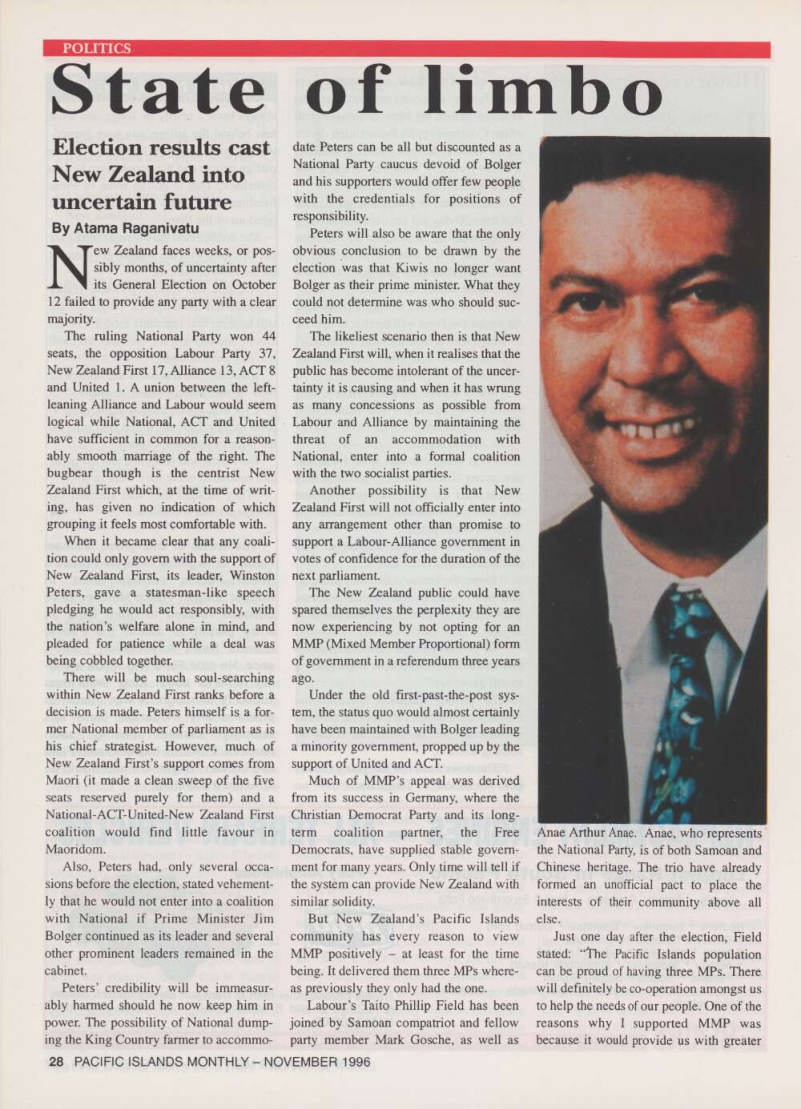
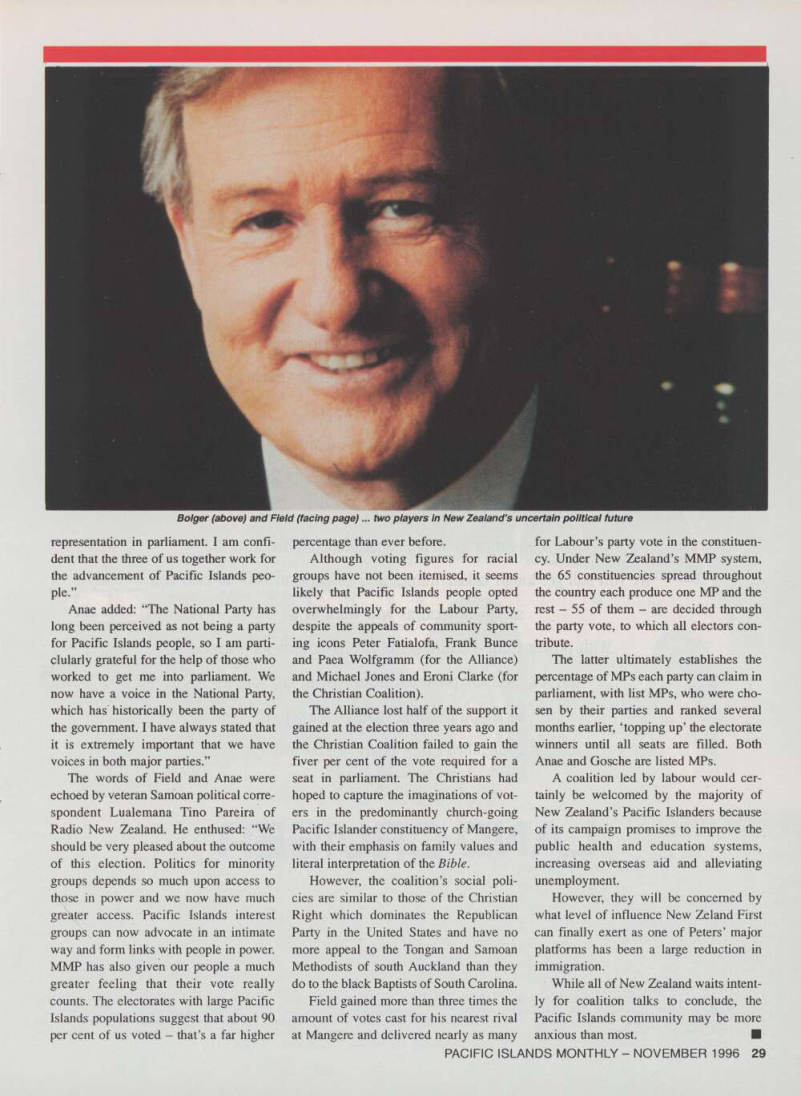
Election results cast New Zealand into uncertain future
By Atama Raganivatu
New Zealand faces weeks, or pos sibly months, of uncertainty after its General Election on October 12 failed to provide any party with a clear
majority.
The ruling National Party won 44 seats, the opposition Labour Party 37, New Zealand First 17, Alliance 13, ACT 8 and United 1. A union between the left leaning Alliance and Labour would seem logical while National, ACT and United have sufficient in common for a reason ably smooth marriage of the right. The bugbear though is the centrist New Zealand First which, at the time of writ ing, has given no indication of which grouping it feels most comfortable with.
When it became clear that any coali tion could only govern with the support of New Zealand First, its leader, Winston Peters, gave a statesman-like speech pledging he would act responsibly, with the nation’s welfare alone in mind, and pleaded for patience while a deal was
being cobbled together.
There will be much soul-searching within New Zealand First ranks before a decision is made. Peters himself is a for mer National member of parliament as is his chief strategist. However, much of New Zealand First’s support comes from Maori (it made a clean sweep of the five seats reserved purely for them) and a National-ACT-United-New Zealand First coalition would find little favour in Maoridom.
Also, Peters had, only several occa sions before the election, stated vehement ly that he would not enter into a coalition with National if Prime Minister Jim Bolger continued as its leader and several other prominent leaders remained in the cabinet.
Peters’ credibility will be immeasur ably harmed should he now keep him in power. The possibility of National dump ing the King Country farmer to accommo
date Peters can be all but discounted as a National Party caucus devoid of Bolger and his supporters would offer few people with the credentials for positions of
responsibility.
Peters will also be aware that the only obvious conclusion to be drawn by the election was that Kiwis no longer want Bolger as their prime minister. What they could not determine was who should suc ceed him.
The likeliest scenario then is that New Zealand First will, when it realises that the public has become intolerant of the uncer tainty it is causing and when it has wrung as many concessions as possible from Labour and Alliance by maintaining the threat of an accommodation with National, enter into a formal coalition with the two socialist parties.
Another possibility is that New Zealand First will not officially enter into any arrangement other than promise to support a Labour-Alliance government in votes of confidence for the duration of the
next parliament.
The New Zealand public could have spared themselves the perplexity they are now experiencing by not opting for an MMP (Mixed Member Proportional) form of government in a referendum three years ago.
Under the old first-past-the-post sys tem, the status quo would almost certainly have been maintained with Bolger leading a minority government, propped up by the support of United and ACT.
Much of MMP’s appeal was derived from its success in Germany, where the Christian Democrat Party and its long term coalition partner, the Free Democrats, have supplied stable govern ment for many years. Only time will tell if the system can provide New Zealand with
similar solidity.
But New Zealand’s Pacific Islands community has every reason to view MMP positively - at least for the time being. It delivered them three MPs where as previously they only had the one.
Labour’s Taito Phillip Field has been
joined by Samoan compatriot and fellow
party member Mark Gosche, as well as
Anae Arthur Anae. Anae, who represents the National Party, is of both Samoan and Chinese heritage. The trio have already formed an unofficial pact to place the interests of their community above all else.
Just one day after the election, Field stated: “The Pacific Islands population can be proud of having three MPs. There will definitely be co-operation amongst us to help the needs of our people. One of the reasons why I supported MMP was because it would provide us with greater
representation in parliament. I am confi dent that the three of us together work for the advancement of Pacific Islands peo
ple.”
Anae added: “The National Party has long been perceived as not being a party for Pacific Islands people, so I am parti clularly grateful for the help of those who worked to get me into parliament. We now have a voice in the National Party, which has historically been the party of the government. I have always stated that it is extremely important that we have voices in both major parties.”
The words of Field and Anae were echoed by veteran Samoan political corre spondent Lualemana Tino Pareira of Radio New Zealand. He enthused: “We should be very pleased about the outcome of this election. Politics for minority groups depends so much upon access to those in power and we now have much greater access. Pacific Islands interest groups can now advocate in an intimate way and form links with people in power.
MMP has also given our people a much greater feeling that their vote really counts. The electorates with large Pacific Islands populations suggest that about 90 per cent of us voted - that’s a far higher
percentage than ever before.
Although voting figures for racial
groups have not been itemised, it seems
likely that Pacific Islands people opted
overwhelmingly for the Labour Party, despite the appeals of community sport ing icons Peter Fatialofa, Frank Bunce and Paea Wolfgramm (for the Alliance) and Michael Jones and Eroni Clarke (for the Christian Coalition).
The Alliance lost half of the support it gained at the election three years ago and the Christian Coalition failed to gain the fiver per cent of the vote required for a seat in parliament. The Christians had hoped to capture the imaginations of vot ers in the predominantly church-going Pacific Islander constituency of Mangere, with their emphasis on family values and literal interpretation of the Bible.
However, the coalition’s social poli cies are similar to those of the Christian Right which dominates the Republican Party in the United States and have no more appeal to the Tongan and Samoan Methodists of south Auckland than they do to the black Baptists of South Carolina.
Field gained more than three times the amount of votes cast for his nearest rival at Mangere and delivered nearly as many
for Labour’s party vote in the constituen cy. Under New Zealand’s MMP system, the 65 constituencies spread throughout the country each produce one MP and the rest - 55 of them - are decided through the party vote, to which all electors con tribute.
The latter ultimately establishes the percentage of MPs each party can claim in parliament, with list MPs, who were cho sen by their parties and ranked several months earlier, ‘topping up’ the electorate winners until all seats are fdled. Both Anae and Gosche are listed MPs.
A coalition led by labour would cer tainly be welcomed by the majority of New Zealand’s Pacific Islanders because of its campaign promises to improve the public health and education systems, increasing overseas aid and alleviating
unemployment.
However, they will be concerned by what level of influence New Zeland First can finally exert as one of Peters’ major platforms has been a large reduction in
immigration.
While all of New Zealand waits intent ly for coalition talks to conclude, the Pacific Islands community may be more anxious than most. ■
Bolger (above) and Field (facing page) ... two players in New Zealand’s uncertain political future
Advertisements & other items, pp. 30-31 (1 item)
Drive dignity right to the top.
<Sg» TOYOTA
Everyone who knows cars has no doubts about Land Cruiser’s ruggedness.
Yet how many know that its luxury rivals the finest high-priced cars?
Or that it’s got more room inside than many luxury sedans?
And because it’s a Toyota, Land Cruiser’s fit and finish, attention to detail, and graceful form speak of elegance as well as spacious comfort.
Yet you still get tough ladder frames and suspension built to take you as far off road as you want to go.
With power from 4.5-litre petrol or 4.2-litre diesel engines.
And it’s carefully protected from rust to last longer.
So if you’re going right to the top, this dignified car is ready to take you.
LAND CRUISER
DISTRIBUTORS /DEALERS
AMERICAN SAMOA BURNS PHILP MOTORS PH 633-4281 COOK ISLANDS GUAM & MICRONESIA.. .ATKINS KROLL, INC. PH 646-1876/9 KIRIBATI NORFOLK ISLAND BORRY’S PTY LTD. PH 22114 PAPUA NEW GUINEA SOLOMON ISLAND ELA MOTORS PH 30314 TAHITI VANUATU ASCO MOTORS PH 22341 WESTERN SAMOA
..PACIFIC MOTORS LTD. PH 20796
..TARAWA MOTORS PH 21090
..ELA MOTORS PH 3229400
. .NIPPON AUTOMOTO PH 429819
..ASCO MOTORS PH 20800
FIJI ASCO MOTORS PH
NEW CALEDONIA S.I.A.P. PH 275562
SAIPAN MICROL CORPORATION PH 234-5911
TONGA ASCO MOTORS PH 23500
* - i*'i mmmm W/ (S> f * - MKdi!
•J*. ' : S&-*E -^^Kj,
m*Jr % il * ,«r ,>W .--k ’tMk. ■ MMk_ »p • *t ♦ * J 0 » IF % m i
Wages of corruption
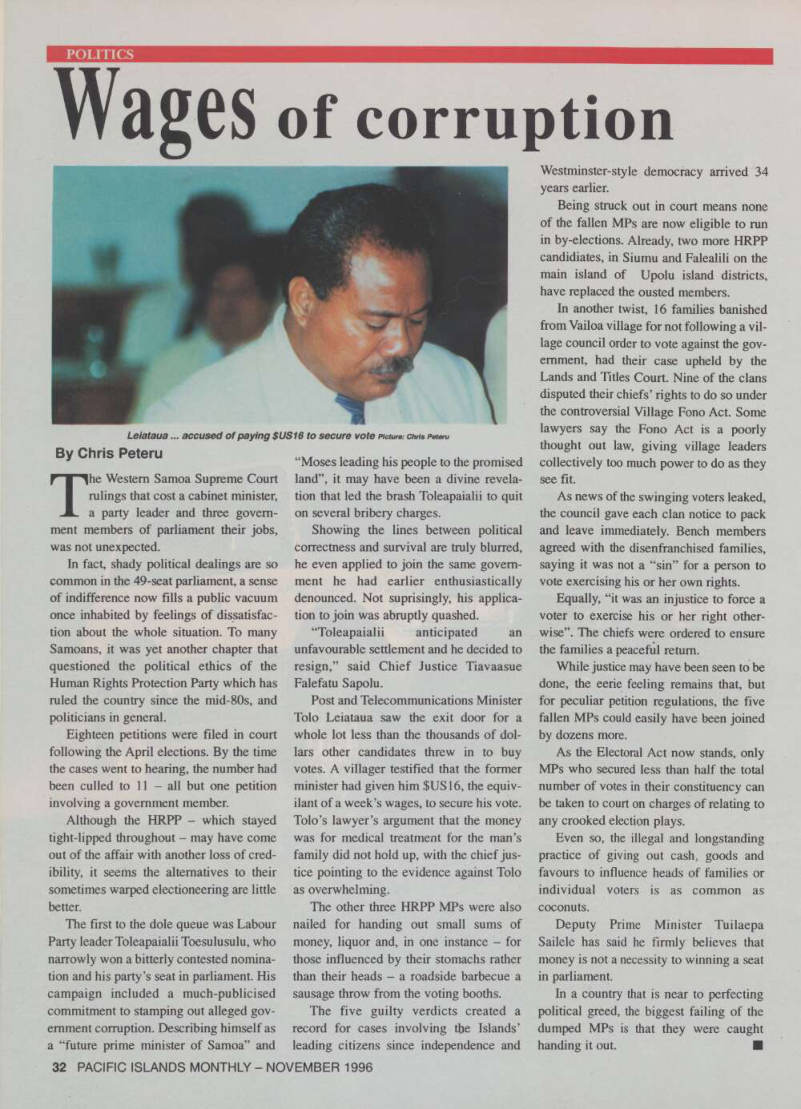
By Chris Peteru
The Western Samoa Supreme Court rulings that cost a cabinet minister, a party leader and three govern ment members of parliament their jobs, was not unexpected.
In fact, shady political dealings are so common in the 49-seat parliament, a sense of indifference now fills a public vacuum once inhabited by feelings of dissatisfac tion about the whole situation. To many Samoans, it was yet another chapter that questioned the political ethics of the Human Rights Protection Party which has ruled the country since the mid-80s, and politicians in general.
Eighteen petitions were filed in court following the April elections. By the time the cases went to hearing, the number had been culled to 11 - all but one petition involving a government member.
Although the HRPP - which stayed tight-lipped throughout - may have come out of the affair with another loss of cred ibility, it seems the alternatives to their sometimes warped electioneering are little better.
The first to the dole queue was Labour Party leader Toleapaialii Toesulusulu, who narrowly won a bitterly contested nomina tion and his party’s seat in parliament. His
campaign included a much-publicised
commitment to stamping out alleged gov ernment corruption. Describing himself as a “future prime minister of Samoa” and
“Moses leading his people to the promised land”, it may have been a divine revela tion that led the brash Toleapaialii to quit on several bribery charges.
Showing the lines between political correctness and survival are truly blurred, he even applied to join the same govern ment he had earlier enthusiastically denounced. Not suprisingly, his applica tion to join was abruptly quashed.
“Toleapaialii anticipated an unfavourable settlement and he decided to resign,” said Chief Justice Tiavaasue
Falefatu Sapolu.
Post and Telecommunications Minister Tolo Leiataua saw the exit door for a whole lot less than the thousands of dol lars other candidates threw in to buy votes. A villager testified that the former minister had given him SUS 16, the equiv ilant of a week’s wages, to secure his vote.
Tolo’s lawyer’s argument that the money was for medical treatment for the man’s family did not hold up, with the chief jus tice pointing to the evidence against Tolo
as overwhelming.
The other three HRPP MPs were also nailed for handing out small sums of money, liquor and, in one instance - for those influenced by their stomachs rather than their heads - a roadside barbecue a sausage throw from the voting booths.
The five guilty verdicts created a record for cases involving the Islands’ leading citizens since independence and
Westminster-style democracy arrived 34
years earlier.
Being struck out in court means none of the fallen MPs are now eligible to run in by-elections. Already, two more HRPP candidiates, in Siumu and Falealili on the main island of Upolu island districts, have replaced the ousted members.
In another twist, 16 families banished from Vailoa village for not following a vil lage council order to vote against the gov ernment, had their case upheld by the Lands and Titles Court. Nine of the clans disputed their chiefs’ rights to do so under the controversial Village Fono Act. Some lawyers say the Fono Act is a poorly
thought out law, giving village leaders
collectively too much power to do as they see fit.
As news of the swinging voters leaked, the council gave each clan notice to pack and leave immediately. Bench members agreed with the disenfranchised families, saying it was not a “sin” for a person to vote exercising his or her own rights.
Equally, “it was an injustice to force a voter to exercise his or her right other wise”. The chiefs were ordered to ensure the families a peaceful return.
While justice may have been seen to be done, the eerie feeling remains that, but for peculiar petition regulations, the five fallen MPs could easily have been joined by dozens more.
As the Electoral Act now stands, only MPs who secured less than half the total number of votes in their constituency can be taken to court on charges of relating to any crooked election plays.
Even so, the illegal and longstanding practice of giving out cash, goods and favours to influence heads of families or individual voters is as common as coconuts.
Deputy Prime Minister Tuilaepa
Sailele has said he firmly believes that money is not a necessity to winning a seat
in parliament.
In a country that is near to perfecting political greed, the biggest failing of the dumped MPs is that they were caught handing it out. ■
Leiataua... accused of paying $US16 to secure vote Picture: Chris Peteru
Advertisements & other items, p. 33 (1 item)
(Je/sfro "elstra
TRADE MARK CAUTIONARY NOTICE
Notice is hereby given that Telstra Corporation Limited, a corporation duly organised and existing under the laws of Australia, and having ACN 051 775 556, the Corporate Secretary being located at 242 Exhibition Street, Melbourne, Australia is the sole proprietor of the following trade marks:-
TELSTRA
C C
(Je/sfro "elstra
Used in respect of:— Telecommunications and communications equipment, apparatus and systems, including but not limited to electronic and optical telecommunications and communications equipment, apparatus and systems; satellite and earth station telecommunications and communications equipment, apparatus and systems; Telephone equipment, apparatus and systems, including but not Brmted to telephone; telephone receivers; telephone handsets; telephone network, telephone exchanges, telephone switching, telephone answering, telephone card vending and telephone dialling equipment, apparatus and systems; Transmission, receiving and storage equipment, apparatus and systems, including out not limited to facsimile, teleeraph, telex, teleprinting, cable and paging equipment, apparatus and systems; data and video networking and conferencing equipment, apparatus and systems; data processing, message handling and switching equipment, apparatus and systems; digital equipment, apparatus and systems; electronic, voice, text and facsimile mail equipment, apparatus and systems; electronic directory equipment, apparatus and systems; Computer equipment, apparatus and systems, including but not limited to computer programs; computer software; computer hardware; computer terminals; computer memories; computer networking equipment, apparatus and systems; computer manuals in this class; modems; Video and audio equipment, apparatus and systems, including but not limited to sound and image recording, transmission and reproduction equipment, apparatus and systems; video cassettes and tapes; compact discs; records; digital, electric and electronic radio equipment, apparatus and systems; magnetic tapes; cinematographic, television and amusement equipment, apparatus and systems; amusement machines; All associated parts and accessories being goods in class 9, paper, cardboard and goods made from these materials; printed matter including directories, journals and manuals and all goods in class 16; advertising, promotional, consultancy and business services; compiling, arranging and publishing directories; telephone answering services; market research and statisticalservices; being services in class 35, repair installation, maintenance and construction services; being servicet. in class 37, telecommunication services being services in class 38, amusement, entertainment, education and information services; multi-media services; being services in class 41, research services; computer programming services; retail and wholesaling services; consultancy services being services in Class 42'.
The said proprietor claims all rights in respect of the above trade marks and will take all necessary legal steps against any person or company infringing their said rights.
DAVIES COLLISON CAVE
PATENT ATTORNEYS
One Little Collins Street Level 10 AMP Building Melbourne, Victoria, 3000 10 Barrack Street Hobart Place Australia Sydney, New South Wales, 2000 Canberra City 2601
It’s in the bag...
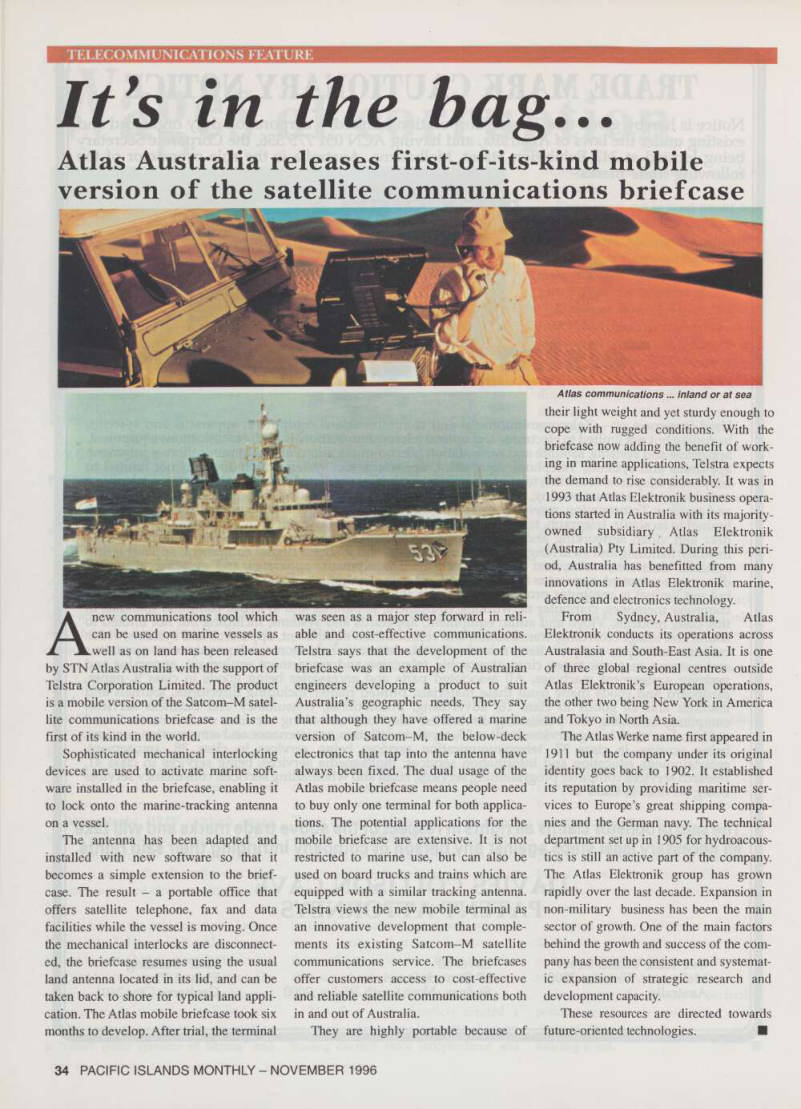
Telecommunications Feature
Atlas Australia releases first-of-its-kind mobile version of the satellite communications briefcase
Anew communications tool which can be used on marine vessels as well as on land has been released by STN Atlas Australia with the support of Telstra Corporation Limited. The product is a mobile version of the Satcom-M satel lite communications briefcase and is the first of its kind in the world.
Sophisticated mechanical interlocking
devices are used to activate marine soft ware installed in the briefcase, enabling it to lock onto the marine-tracking antenna on a vessel.
The antenna has been adapted and installed with new software so that it becomes a simple extension to the brief case. The result - a portable office that offers satellite telephone, fax and data facilities while the vessel is moving. Once the mechanical interlocks are disconnect ed, the briefcase resumes using the usual land antenna located in its lid, and can be taken back to shore for typical land appli cation. The Atlas mobile briefcase took six months to develop. After trial, the terminal
was seen as a major step forward in reli able and cost-effective communications.
Telstra says that the development of the briefcase was an example of Australian engineers developing a product to suit Australia’s geographic needs. They say that although they have offered a marine version of Satcom-M, the below-deck electronics that tap into the antenna have always been fixed. The dual usage of the Atlas mobile briefcase means people need to buy only one terminal for both applica tions. The potential applications for the mobile briefcase are extensive. It is not restricted to marine use, but can also be used on board trucks and trains which are equipped with a similar tracking antenna.
Telstra views the new mobile terminal as an innovative development that comple ments its existing Satcom-M satellite communications service. The briefcases offer customers access to cost-effective and reliable satellite communications both in and out of Australia.
They are highly portable because of
their light weight and yet sturdy enough to cope with rugged conditions. With the briefcase now adding the benefit of work ing in marine applications, Telstra expects the demand to rise considerably. It was in 1993 that Atlas Elektronik business opera tions started in Australia with its majority owned subsidiary . Atlas Elektronik (Australia) Pty Limited. During this peri od, Australia has benefitted from many innovations in Atlas Elektronik marine, defence and electronics technology.
From Sydney, Australia, Atlas Elektronik conducts its operations across Australasia and South-East Asia. It is one of three global regional centres outside Atlas Elektronik’s European operations, the other two being New York in America and Tokyo in North Asia.
The Atlas Werke name first appeared in 1911 but the company under its original identity goes back to 1902. It established
its reputation by providing maritime ser
vices to Europe’s great shipping compa nies and the German navy. The technical department set up in 1905 for hydroacous tics is still an active part of the company.
The Atlas Elektronik group has grown rapidly over the last decade. Expansion in non-military business has been the main sector of growth. One of the main factors behind the growth and success of the com pany has been the consistent and systemat ic expansion of strategic research and
development capacity.
These resources are directed towards future-oriented technologies. ■
Atlas communications ... inland or at sea
Advertisements & other items, p. 35 (1 item)
Atlas Gives You The World
IN A BRIEF CASE.
With SIN Atlas (Australia), you can open an Inmarsat Satcom-M briefcase terminal to the stars!
The SPI6OO-B provides a reliable digital secure satellite phone service anywhere within the Pacific, Indian and Atlantic Ocean Regions, covering about two thirds of the earth’s surface, including the Pacific Islands, Asia and Europe.
Weighing only 10.5 kg and running on batteries or 110-240 V AC, the briefcase also has an optional external wet weather antenna which can be set up permanently outside. Thus you can use the phone as an office phone (it can be connected to a PABX) or when needed as a fully portable field phone. This makes the Atlas SPI6OO-B ideal for a wide range of applications hotel communications including offshore island resorts, exploration and mining, oil and gas rigs, construction, emergency backup, independent communications for government diplomats and business executives.
With fax and data capability you have a portable office that allows you to send and receive fax and data communications no matter how remote your location, Plus, it’s backed by a world-wide sales and service network and carries a 12 month warranty.
Take advantage of this and put the world in your briefcase by calling: 612 437 4577 or Fax 612 439 7576 If you’re in the marine business we also have a maritime version with a stabilised antenna allowing voice, fax and data. Allow us to quote you a very competitive price and enjoy the luxury of dialling the world at any time and at any place. New dealerships are now available and welcomed.
Q STN ATLAS (AUSTRALIA) Innovations in Electronics UNIT 6, 39 HERBERT ST, ST LEONARDS, NSW 2065, AUSTRALIA.
STN ATLAS (AUSTRALIA) PTY LTD ACN 056 058 952
Tait system improves safety at sea
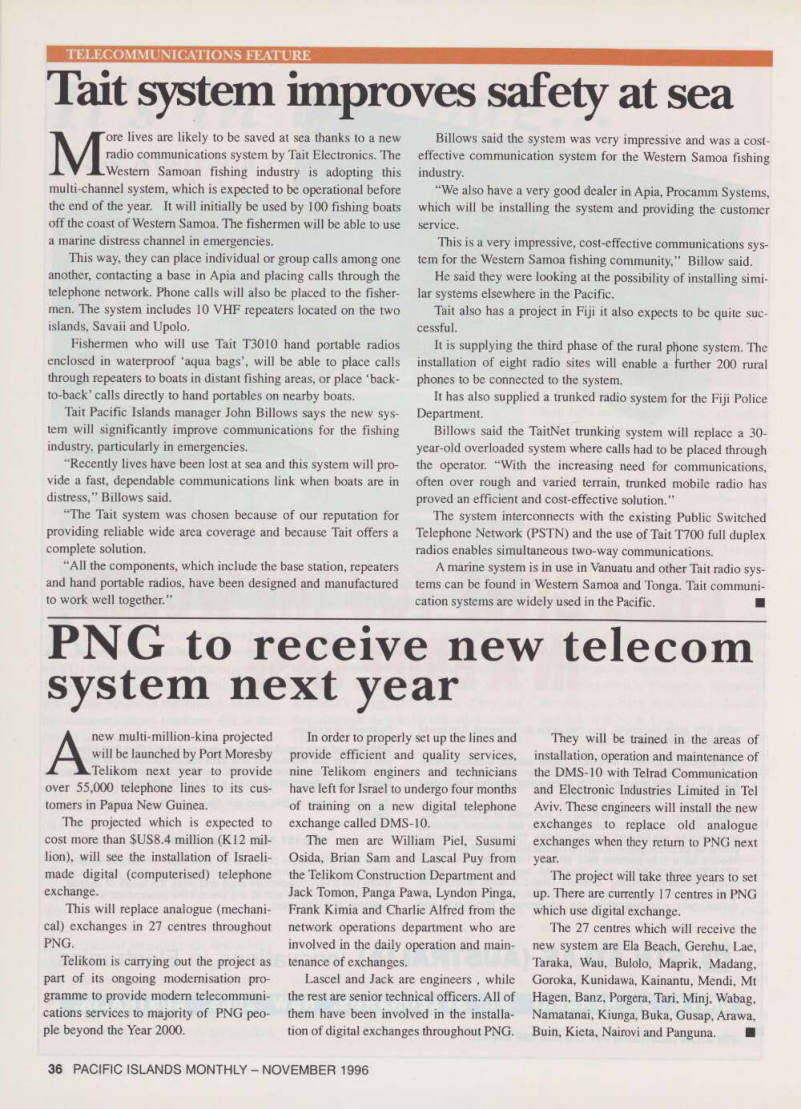
More lives are likely to be saved at sea thanks to a new radio communications system by Tait Electronics. The Western Samoan fishing industry is adopting this multi-channel system, which is expected to be operational before the end of the year. It will initially be used by 100 fishing boats off the coast of Western Samoa. The fishermen will be able to use a marine distress channel in emergencies.
This way, they can place individual or group calls among one another, contacting a base in Apia and placing calls through the telephone network. Phone calls will also be placed to the fisher men. The system includes 10 VHF repeaters located on the two islands, Savaii and Upolo.
Fishermen who will use Tait T3OlO hand portable radios enclosed in waterproof ‘aqua bags’, will be able to place calls through repeaters to boats in distant fishing areas, or place ‘back to-back’ calls directly to hand portables on nearby boats.
Tait Pacific Islands manager John Billows says the new sys tem will significantly improve communications for the fishing
industry, particularly in emergencies.
“Recently lives have been lost at sea and this system will pro vide a fast, dependable communications link when boats are in distress,” Billows said.
“The Tait system was chosen because of our reputation for providing reliable wide area coverage and because Tait offers a
complete solution.
“All the components, which include the base station, repeaters and hand portable radios, have been designed and manufactured to work well together.”
Billows said the system was very impressive and was a cost effective communication system for the Western Samoa fishing
industry.
“We also have a very good dealer in Apia, Procamm Systems, which will be installing the system and providing the customer service.
This is a very impressive, cost-effective communications sys tem for the Western Samoa fishing community,” Billow said.
He said they were looking at the possibility of installing simi lar systems elsewhere in the Pacific.
Tait also has a project in Fiji it also expects to be quite suc cessful.
It is supplying the third phase of the rural phone system. The installation of eight radio sites will enable a further 200 rural phones to be connected to the system.
It has also supplied a trunked radio system for the Fiji Police Department.
Billows said the Tait Net trunking system will replace a 30year-old overloaded system where calls had to be placed through the operator. “With the increasing need for communications, often over rough and varied terrain, tmnked mobile radio has proved an efficient and cost-effective solution.”
The system interconnects with the existing Public Switched Telephone Network (PSTN) and the use of Tait T7OO full duplex radios enables simultaneous two-way communications.
A marine system is in use in Vanuatu and other Tait radio sys tems can be found in Western Samoa and Tonga. Tait communi cation systems are widely used in the Pacific. ■
system next year
PNG to receive new telecom system next year
Anew multi-million-kina projected will be launched by Port Moresby Telikom next year to provide over 55,000 telephone lines to its cus tomers in Papua New Guinea.
The projected which is expected to cost more than SUSB.4 million (Kl 2 mil lion), will see the installation of Israeli made digital (computerised) telephone exchange.
This will replace analogue (mechani cal) exchanges in 27 centres throughout
Png.
Telikom is carrying out the project as part of its ongoing modernisation pro gramme to provide modem telecommuni cations services to majority of PNG peo ple beyond the Year 2000.
In order to properly set up the lines and provide efficient and quality services, nine Telikom enginers and technicians have left for Israel to undergo four months of training on a new digital telephone exchange called DMS-10.
The men are William Piel, Susumi Osida, Brian Sam and Lascal Puy from the Telikom Construction Department and
Jack Tomon, Panga Pawa, Lyndon Pinga,
Frank Kimia and Charlie Alfred from the network operations department who are involved in the daily operation and main tenance of exchanges.
Lascel and Jack are engineers , while the rest are senior technical officers. All of them have been involved in the installa
tion of digital exchanges throughout PNG.
They will be trained in the areas of installation, operation and maintenance of the DMS-10 with Telrad Communication and Electronic Industries Limited in Tel Aviv. These engineers will install the new exchanges to replace old analogue exchanges when they return to PNG next year.
The project will take three years to set up. There are currently 17 centres in PNG which use digital exchange.
The 27 centres which will receive the new system are Ela Beach, Gerehu, Lae, Taraka, Wau, Bulolo, Maprik, Madang, Goroka, Kunidawa, Kainantu, Mendi, Mt Hagen, Banz, Porgera, Tari, Minj, Wabag, Namatanai, Kiunga, Buka, Gusap, Arawa, Buin, Kieta, Nairovi and Panguna. ■
Advertisements & other items, p. 37 (1 item)
Integrated Solutions.
fl W,hii-^ ~5 jSSf B 3' Pii
... You Can Depend On
One of the reasons so many users find the solution to their radio communications needs with TAIT is the superb level of integration throughout the comprehensive product range including: ■ T3OOO Series Handportables ■ inform Text Dispatcher and AVL Mobile Data ■ T2OOO Series Mobiles Systems ■ T7OO Series Full-Duplex Mobiles and Base Stations B Taitnet MPTI327 Trunked networks (from 4 ■ TBOO Series Base Stations, Repeaters and Paging charale1 ’ sin B* e si,e *y stems throu 8 h t 0 lar 8 e - wide Transmitters area systems.) ■ Rural Telephone Systems ■ Q",? si ' S T Ilc (Simulcast) systems with automatic audio equalization.
Tait also has a well-earned reputation for products that combine high performance and user-friendly features with outstanding reliability and service life.
M Two of the many reasons you should contact Tait now and talk to us about your radio communication needs.
Excellence in Radio Communications
Tait International Sales Division
PO.Box 1645, Christchurch, New Zealand Phone: (64) (3) 358 0346 Fax: (64) (3) 358 3636
Linking Fiji with the world
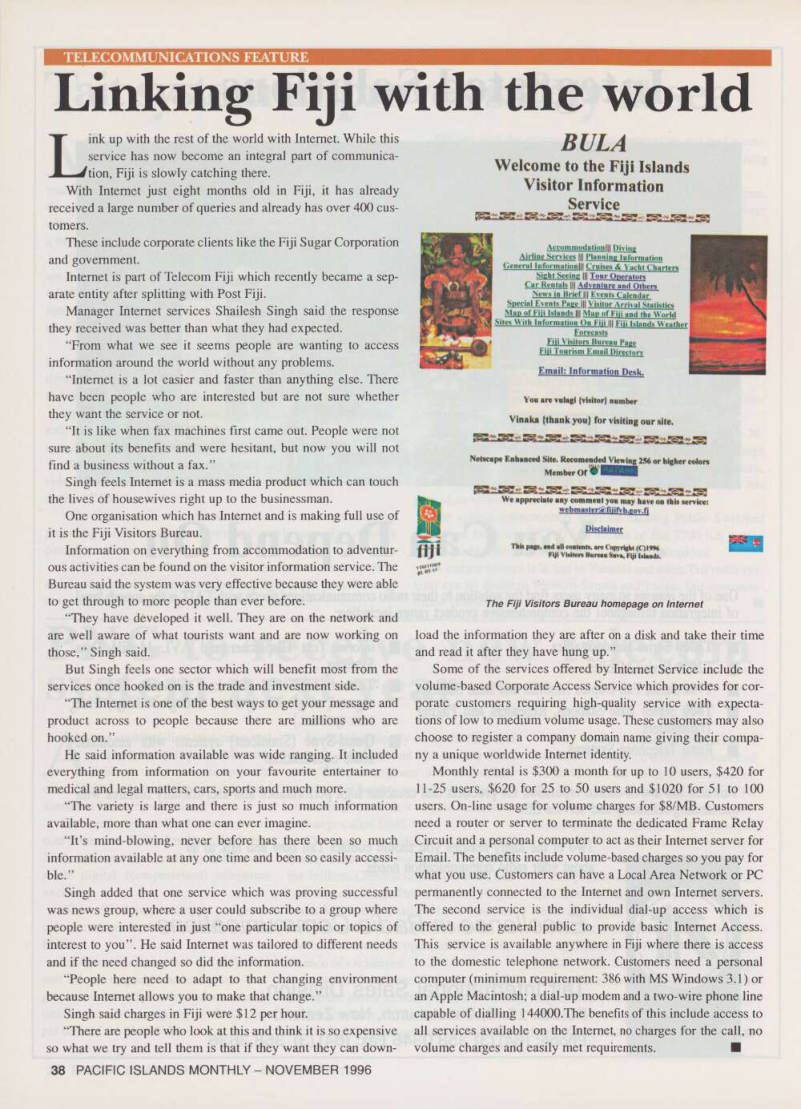
Link up with the rest of the world with Internet. While this service has now become an integral part of communica
tion, Fiji is slowly catching there.
With Internet just eight months old in Fiji, it has already received a large number of queries and already has over 400 cus tomers.
These include corporate clients like the Fiji Sugar Corporation and government.
Internet is part of Telecom Fiji which recently became a sep arate entity after splitting with Post Fiji.
Manager Internet services Shailesh Singh said the response they received was better than what they had expected.
“From what we see it seems people are wanting to access information around the world without any problems.
“Internet is a lot easier and faster than anything else. There have been people who are interested but are not sure whether they want the service or not.
“It is like when fax machines first came out. People were not sure about its benefits and were hesitant, but now you will not find a business without a fax.”
Singh feels Internet is a mass media product which can touch the lives of housewives right up to the businessman.
One organisation which has Internet and is making full use of it is the Fiji Visitors Bureau.
Information on everything from accommodation to adventur ous activities can be found on the visitor information service. The Bureau said the system was very effective because they were able to get through to more people than ever before.
“They have developed it well. They are on the network and are well aware of what tourists want and are now working on those,” Singh said.
But Singh feels one sector which will benefit most from the services once hooked on is the trade and investment side.
“The Internet is one of the best ways to get your message and product across to people because there are millions who are hooked on.”
He said information available was wide ranging. It included everything from information on your favourite entertainer to medical and legal matters, cars, sports and much more.
“The variety is large and there is just so much information available, more than what one can ever imagine.
“It’s mind-blowing, never before has there been so much information available at any one time and been so easily accessi ble.”
Singh added that one service which was proving successful was news group, where a user could subscribe to a group where people were interested in just “one particular topic or topics of interest to you”. He said Internet was tailored to different needs and if the need changed so did the information.
“People here need to adapt to that changing environment because Internet allows you to make that change.”
Singh said charges in Fiji were $l2 per hour.
“There are people who look at this and think it is so expensive so what we try and tell them is that if they want they can down
load the information they are after on a disk and take their time and read it after they have hung up.”
Some of the services offered by Internet Service include the volume-based Corporate Access Service which provides for cor porate customers requiring high-quality service with expecta tions of low to medium volume usage. These customers may also choose to register a company domain name giving their compa ny a unique worldwide Internet identity.
Monthly rental is $3OO a month for up to 10 users, $420 for 11-25 users, $620 for 25 to 50 users and $lO2O for 51 to 100 users. On-line usage for volume charges for $B/MB. Customers need a router or server to terminate the dedicated Frame Relay Circuit and a personal computer to act as their Internet server for Email. The benefits include volume-based charges so you pay for what you use. Customers can have a Local Area Network or PC permanently connected to the Internet and own Internet servers.
The second service is the individual dial-up access which is offered to the general public to provide basic Internet Access.
This service is available anywhere in Fiji where there is access to the domestic telephone network. Customers need a personal computer (minimum requirement: 386 with MS Windows 3.1) or an Apple Macintosh; a dial-up modem and a two-wire phone line capable of dialling 144000. The benefits of this include access to all services available on the Internet, no charges for the call, no volume charges and easily met requirements. ■
Advertisements & other items, p. 38 (1 item)
Visitor Information
jS
Welcome to the Fiji Islands
Service
*-SSSS'** «K3».n:. WSaPi.s.
AccommodationH| Diving
Airline Services 111 Planning Information General Information!!! Cruises & Y acht Charters Sight Seeing 111 Tour Operators Car Rentals 111 Adventure and Others New s in Brief 111 Events Calendar Special Events Page 111 Visitor Arrival Statistics Map of Fiji Islands Map of Fiji and the World Sites With Information On Fiji 111 Fiji Islands Weather Forecasts Fiji Visitors Bureau Page Fiji Tourism Email Directory Email: Information Desk Yon are vulagi (visitor) number Vinaka {thank you) for visiting our site.
JK'ijSSL*; SSSLiaeSaijSIJ ai Ss?LiiSSS'^i^
Netscape Enhanced Site. Kecome ml cd Viewing 256 or higher colors
Member Of § E&BB3
3SLta3C£ SSSiaSSTy
We appreciate any comment you may have on this service:
webmaster'a'fiiifvb.ynv.fj
Disclaimer Thb page, and all contents, are Copyright <C)I«% Fiji Visitors Bureau Suva. Fiji Islands.
The Fiji Visitors Bureau homepage on Internet
Assassination
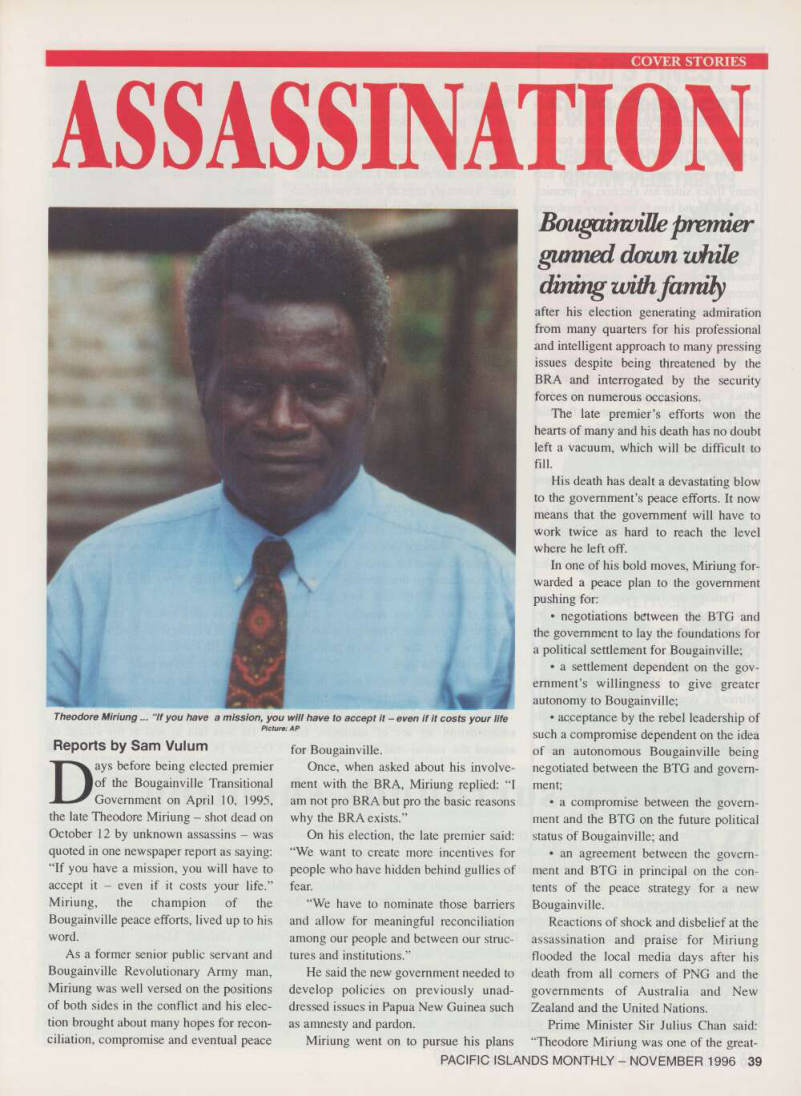
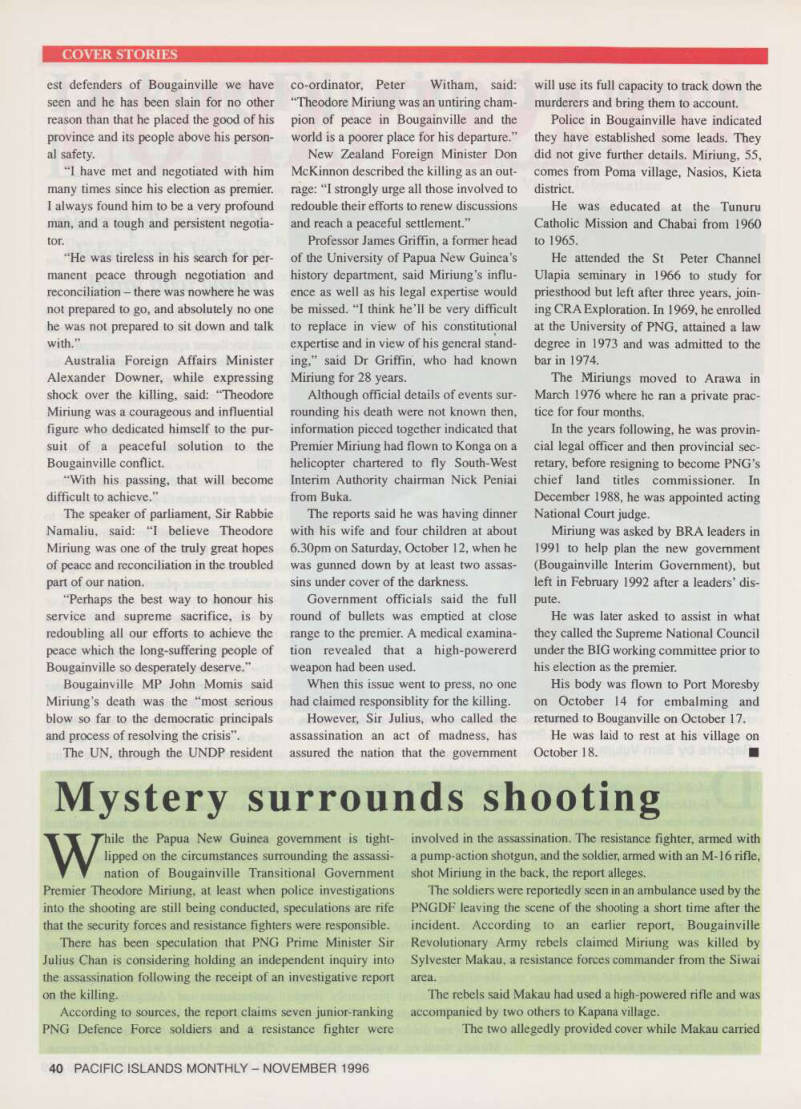
Reports by Sam Vulum
Days before being elected premier of the Bougainville Transitional Government on April 10, 1995, the late Theodore Miriung - shot dead on October 12 by unknown assassins - was quoted in one newspaper report as saying; “If you have a mission, you will have to accept it - even if it costs your life.”
Miriung, the champion of the Bougainville peace efforts, lived up to his word.
As a former senior public servant and
Bougainville Revolutionary Army man,
Miriung was well versed on the positions of both sides in the conflict and his elec tion brought about many hopes for recon ciliation, compromise and eventual peace
for Bougainville.
Once, when asked about his involve ment with the BRA, Miriung replied; “I am not pro BRA but pro the basic reasons why the BRA exists.”
On his election, the late premier said: “We want to create more incentives for people who have hidden behind gullies of fear.
“We have to nominate those barriers and allow for meaningful reconciliation among our people and between our struc tures and institutions.”
He said the new government needed to
develop policies on previously unad
dressed issues in Papua New Guinea such as amnesty and pardon.
Miriung went on to pursue his plans
BougahwiUe premier gunned down while dining unfit family
after his election generating admiration from many quarters for his professional and intelligent approach to many pressing issues despite being threatened by the
BRA and interrogated by the security
forces on numerous occasions.
The late premier’s efforts won the hearts of many and his death has no doubt left a vacuum, which will be difficult to fill.
His death has dealt a devastating blow to the government’s peace efforts. It now means that the government will have to work twice as hard to reach the level where he left off.
In one of his bold moves, Miriung for warded a peace plan to the government
pushing for:
• negotiations between the BTG and the government to lay the foundations for a political settlement for Bougainville; • a settlement dependent on the gov ernment’s willingness to give greater autonomy to Bougainville; • acceptance by the rebel leadership of such a compromise dependent on the idea of an autonomous Bougainville being negotiated between the BTG and govern ment; • a compromise between the govern ment and the BTG on the future political status of Bougainville; and • an agreement between the govern ment and BTG in principal on the con tents of the peace strategy for a new
Bougainville.
Reactions of shock and disbelief at the assassination and praise for Miriung flooded the local media days after his death from all comers of PNG and the governments of Australia and New Zealand and the United Nations.
Prime Minister Sir Julius Chan said: “Theodore Miriung was one of the great
Theodore Miriung... "if you have a mission, you will have to accept it - even if it costs your life Picture: AP
est defenders of Bougainville we have seen and he has been slain for no other reason than that he placed the good of his province and its people above his person
al safety.
“I have met and negotiated with him many times since his election as premier.
I always found him to be a very profound man, and a tough and persistent negotia tor.
“He was tireless in his search for per manent peace through negotiation and reconciliation - there was nowhere he was not prepared to go, and absolutely no one he was not prepared to sit down and talk with.”
Australia Foreign Affairs Minister Alexander Downer, while expressing shock over the killing, said: “Theodore Miriung was a courageous and influential figure who dedicated himself to the pur suit of a peaceful solution to the Bougainville conflict.
“With his passing, that will become difficult to achieve.”
The speaker of parliament. Sir Rabbie Namaliu, said: “I believe Theodore Miriung was one of the truly great hopes of peace and reconciliation in the troubled part of our nation.
“Perhaps the best way to honour his service and supreme sacrifice, is by redoubling all our efforts to achieve the peace which the long-suffering people of
Bougainville so desperately deserve.”
Bougainville MP John Momis said Miriung’s death was the “most serious blow so far to the democratic principals and process of resolving the crisis”.
The UN, through the UNDP resident
co-ordinator, Peter Witham, said; “Theodore Miriung was an untiring cham pion of peace in Bougainville and the world is a poorer place for his departure.”
New Zealand Foreign Minister Don McKinnon described the killing as an out rage: “I strongly urge all those involved to redouble their efforts to renew discussions and reach a peaceful settlement.”
Professor James Griffin, a former head of the University of Papua New Guinea’s history department, said Miriung’s influ ence as well as his legal expertise would be missed. “I think he’ll be very difficult to replace in view of his constitutional expertise and in view of his general stand ing,” said Dr Griffin, who had known Miriung for 28 years.
Although official details of events sur rounding his death were not known then, information pieced together indicated that Premier Miriung had flown to Konga on a helicopter chartered to fly South-West Interim Authority chairman Nick Peniai from Buka.
The reports said he was having dinner with his wife and four children at about 6.30 pm on Saturday, October 12, when he was gunned down by at least two assas sins under cover of the darkness.
Government officials said the full round of bullets was emptied at close range to the premier. A medical examina tion revealed that a high-powererd weapon had been used.
When this issue went to press, no one had claimed responsiblity for the killing.
However, Sir Julius, who called the assassination an act of madness, has assured the nation that the government
will use its full capacity to track down the murderers and bring them to account.
Police in Bougainville have indicated they have established some leads. They did not give further details. Miriung, 55, comes from Poma village, Nasios, Kieta district.
He was educated at the Tunuru Catholic Mission and Chabai from 1960 to 1965.
He attended the St Peter Channel Ulapia seminary in 1966 to study for priesthood but left after three years, join ing CRA Exploration. In 1969, he enrolled at the University of PNG, attained a law degree in 1973 and was admitted to the bar in 1974.
The Miriungs moved to Arawa in March 1976 where he ran a private prac tice for four months.
In the years following, he was provin cial legal officer and then provincial sec retary, before resigning to become PNG’s chief land titles commissioner. In December 1988, he was appointed acting National Court judge.
Miriung was asked by BRA leaders in 1991 to help plan the new government (Bougainville Interim Government), but left in February 1992 after a leaders’ dis pute.
He was later asked to assist in what they called the Supreme National Council under the BIG working committee prior to his election as the premier.
His body was flown to Port Moresby on October 14 for embalming and returned to Bouganville on October 17.
He was laid to rest at his village on October 18. ■
Mystery surrounds shooting
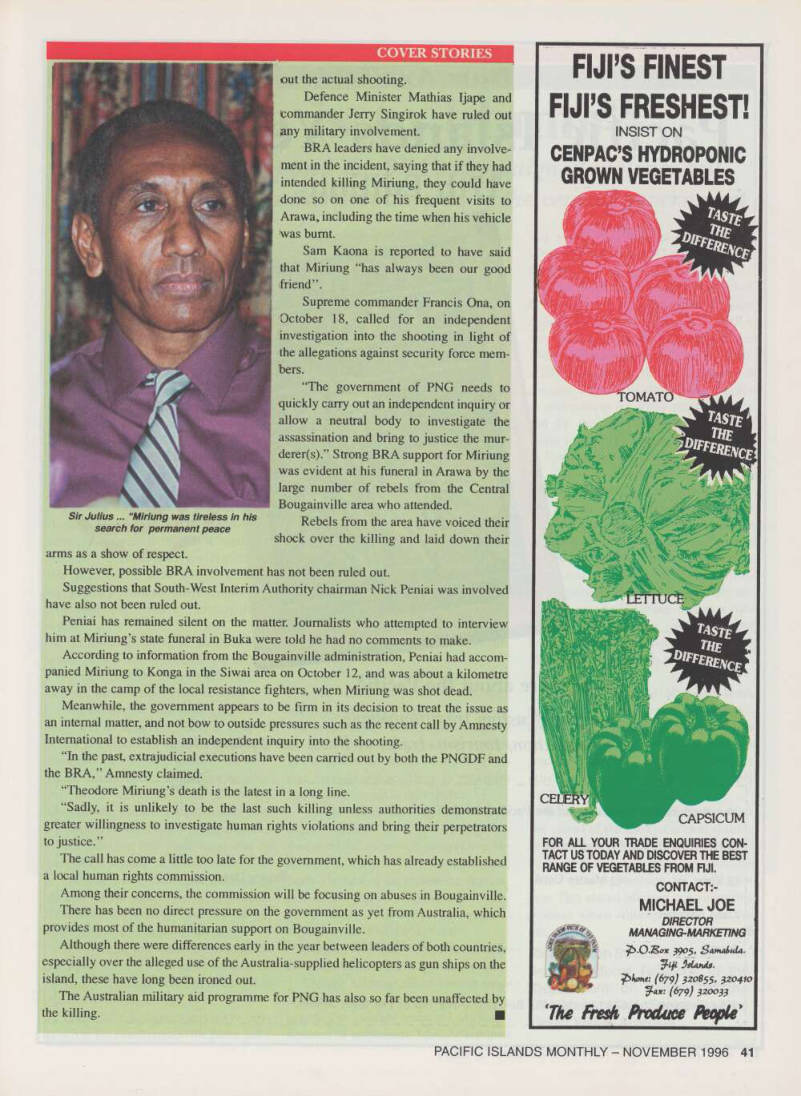
While the Papua New Guinea government is tight lipped on the circumstances surrounding the assassi nation of Bougainville Transitional Government Premier Theodore Miriung, at least when police investigations into the shooting are still being conducted, speculations are rife that the security forces and resistance fighters were responsible.
There has been speculation that PNG Prime Minister Sir Julius Chan is considering holding an independent inquiry into the assassination following the receipt of an investigative report on the killing.
According to sources, the report claims seven junior-ranking PNG Defence Force soldiers and a resistance fighter were
involved in the assassination. The resistance fighter, armed with a pump-action shotgun, and the soldier, armed with an M-16 rifle, shot Miriung in the back, the report alleges.
The soldiers were reportedly seen in an ambulance used by the PNGDF leaving the scene of the shooting a short time after the incident. According to an earlier report, Bougainville Revolutionary Army rebels claimed Miriung was killed by Sylvester Makau, a resistance forces commander from the Siwai area.
The rebels said Makau had used a high-powered rifle and was accompanied by two others to Kapana village.
The two allegedly provided cover while Makau carried
S out the actual shooting.
Defence Minister Mathias Ijape and I Commander Jerry Singirok have ruled out j any military involvement. 1 BRA leaders have denied any involve ment in the incident, saying that if they had I intended killing Miriung, they could have done so on one of his frequent visits to Arawa, including the time when his vehicle was burnt.
Sam Kaona is reported to have said that Miriung “has always been our good friend”.
Supreme commander Francis Ona, on October 18, called for an independent investigation into the shooting in light of the allegations against security force mem bers.
“The government of PNG needs to quickly carry out an independent inquiry or allow a neutral body to investigate the assassination and bring to justice the mur derers).” Strong BRA support for Miriung was evident at his funeral in Arawa by the large number of rebels from the Central Bougainville area who attended.
Rebels from the area have voiced their shock over the killing and laid down their
arms as a show of respect.
However, possible BRA involvement has not been ruled out.
Suggestions that South-West Interim Authority chairman Nick Peniai was involved have also not been ruled out.
Peniai has remained silent on the matter. Journalists who attempted to interview him at Miriung’s state funeral in Buka were told he had no comments to make.
According to information from the Bougainville administration, Peniai had accom panied Miriung to Konga in the Siwai area on October 12, and was about a kilometre away in the camp of the local resistance fighters, when Miriung was shot dead.
Meanwhile, the government appears to be firm in its decision to treat the issue as an internal matter, and not bow to outside pressures such as the recent call by Amnesty International to establish an independent inquiry into the shooting.
“In the past, extrajudicial executions have been carried out by both the PNGDF and the BRA,” Amnesty claimed.
“Theodore Miriung’s death is the latest in a long line.
“Sadly, it is unlikely to be the last such killing unless authorities demonstrate greater willingness to investigate human rights violations and bring their perpetrators to justice.”
The call has come a little too late for the government, which has already established a local human rights commission.
Among their concerns, the commission will be focusing on abuses in Bougainville.
There has been no direct pressure on the government as yet from Australia, which provides most of the humanitarian support on Bougainville.
Although there were differences early in the year between leaders of both countries, especially over the alleged use of the Australia-supplied helicopters as gun ships on the island, these have long been ironed out.
The Australian military aid programme for PNG has also so far been unaffected by the killing. B
Sir Julius ... “Miriung was tireless in his search for permanent peace
Advertisements & other items, pp. 41-42 (1 item)
Fiji’S Freshest!
FIJI’S FINEST
INSIST ON
CENPAC’S HYDROPONIC
GROWN VEGETABLES
OMAT
iff // m % ht
m&Lm
?.r |#v
CAPSICUM
FOR ALL YOUR TRADE ENQUIRIES CON-
TACT US TODAY AND DISCOVER THE BEST
RANGE OF VEGETABLES FROM FIJI,
CONTACT:-
MICHAEL JOE
DIRECTOR
MANAGING-MARKETING
y s>.O.S«* 5905, Samaiuta.
DsUtuis. jbkone: (679) 320855, 320410 J<ix: (679) 320033
'The Fresh Produce People'
Now Available
Pacific Islands Yearßook
17th Edition
r Price
AUD
) oo j
PLUS POSTAGE
Leam more about the Pacific
culture/custom tradition/people
population, tourism, trade, airlines, tax system etc. -X Yes, send me the latest copy of the Pacific Islands Year Book. □ Here is a cheque /money order □ Visa □ Master Card Card Number Name Signature Expiry Date Address Post to: Pacific Islands Monthly, PO Box 1167 Suva, Fiji or Fax (679) 303809.
U
And who is to blame?
Miriung certainly opposed the BRA’s campaign of violence but he had also become a thorn in the side of the central government
By Dr Karin von Strokirch
It may never be known who ordered the assassination of Theodore Miriung. In his attempts to peacefully resolve the Bougainville conflict, the island’s premier alienated sections of the Papua New Guinea government and defence forces, as well as members of the
Bougainville Revolutionary Army.
Nevertheless, assertions by PNG authorities that the BRA had most to gain by his death are misleading. Miriung cer
tainly opposed the BRA’s campaign of
violence to achieve its aims, but he had also become a thorn in the side of the cen tral government.
Miriung was appointed premier of the
Bougainville Transitional Government in early 1995 because he was a moderate whom PNG sought to work with to isolate the seccessionist BRA. The government recognised it could not control,, much less overcome, the rebels by military force alone.
Yet Miriung was by no means a mal leable puppet for the central authorities.
From the outset, he chose a middle path between the two sides to the conflict.
The initial goal for Miriung’s govern ment was to achieve a ceasefire coupled with a resumption of essential services to Bougainville. The next plank in his cam paign was to reach a consensus between the BRA, Miriung’s own BTG and Bougainville members of parliament over the desired political status for the troubled island province. The final stage was to negotiate a political settlement with PNG.
Miriung was instrumental in bringing an end, albeit temporary, to hostilities.
Thereafter his strategy and that of the PNG government began to diverge.
For Miriung and other moderates, the Sir Julius Chan government’s rhetoric of seeking a negotiated solution to the crisis was far from convincing.
PNG did not support initiatives pro posed in the Pan-Bougainville peace talks
hosted by Australia in December last year.
Indeed, PNG forces attacked the BRA delegation on its way back to
Bougainville after the meeting. Prospects
for peace became more remote in March with Prime Minister Sir Julius’ announce ment that the ceasefire was over and the BRA’s “darkest hour had come”.
Signs of conciliation emerged in June as the PNG government reached an agree ment with Miriung to contemplate a degree of autonomy for Bougainville. Yet, by excluding the BRA from discussions over the scope of autonomy, PNG ensured that any political settlement would not be endorsed by the rebels.
The gulf was widening between the BTG and Port Moresby over their pre ferred strategies for resolving the Bougainville crisis. Miriung’s vision of autonomy for Bougainville was proving to be more expansive than that of the national government, and he saw little hope of a settlement without a ceasefire and full participation of the BRA in sub sequent negotiations.
Notwithstanding Miriung’s position
and past failures at achieving a military solution, in June, the PNG Defence Forces launched a fresh offensive against the BRA. The BRA hardened its position and refused to countenance anything less than outright independence in return for negotiating an end to the conflict.
By this time, Miriung had become highly critical of PNG policy on Bougainville. From his perspective the military offensive was destructive and futile. He viewed the continuing depriva tion of Bougainville civilians as “inhu mane” and condemend extra-judicial killings by the PNGDF as “evil”.
Miriung thus called for a referendum on Bougainville’s future political status.
Clearly, Miriung was neither as mod erate nor as pliable as PNG had originally hoped. The military restricted Miriung’s freedom of movement. Miriung reported
that senior PNG defence personnel had labelled him a “criminal” and a BRA col laborator.
Tensions mounted in September when PNG Defence Minister Mathias Ijape alleged Miriung’s involvement in a BRA attack at Kangu Beach in which a dozen PNG soldiers were killed. Ijape unsuc cessfully called for Miriung’s removal as premier. Thereafter Miriung was subject to surveillance by PNG security forces and by the anti-BRA Resistance vigi lantes which PNG funded and trained.
Events came to a climax in late August at the Bougainville Inter-Church Women’s Forum held to promote peace.
The premier was to have officially opened the forum but was prevented from even attending by armed PNG forces. This was despite prior approval of the forum’s right to proceed from all parties to the conflict.
Traditional chiefs and local people ral lied in support of Miriung, issuing a con demnation of the PNG government and security forces for their treatment of Miriung and obstruction of a peace settle ment.
Sir Julius’ shock at Miriung’s death and announcement of a state funeral in his honour have a hollow ring. Miriung was an advocate of moderation and non-vio lence but many PNG authorities found his principle stance and vision of autonomy for Bougainville unpalatable.
Without wishing to endorse the dubi ous record of the BRA, it is clear that the PNG government failed to rein in actions by the PNGDF and renegade ministers which were jeopardising the peace pro cess. This placed Miriung in a vulnerable position which ultimately cost him his life. ■ Dr Karin von Strokirch is a lecturer in International Relations in the Department of Politics at the University of New England in New South Wales, Australia
Advertisements & other items, p. 44 (1 item)
Uniting the Pacific
: • ■ .. ■ '. ■ ■ 7.' , ‘ mm tmm
MSS
iiiissi " ’ ■ asm ■?- •• mm ■ ■ iii Biilli r . • I & mm :c:.v ■ ;V v ' *' ps? sw; :+;v„; v ’ A fjrj.-. % & •• • ■ •.; emi® Vt-w
MARKET MAKER
OCG3D Shhnker The new generation 50-seat Saab 2000 Jet Prop, flying nearly 1 80mph faster than the competition, is shrinking the long distances of the Pacific, slashing hours from other turboprop schedules. Fly the Saab 2000 on new routes from Fiji to Vila for Air Vanuatu, offering a new era of passenger comfort and service. Saab 2000 - the Market Maker and Money Maker now uniting nations of the Pacific!
Uniting the Pacific
AIR VANUATU
Saab Aircraft AB SWEDEN * +46 13 182000 * FAX+46 13 18210 AUSTRALIA *+6l 2 9369 1666 * FAX+6I 2 9369 2500 HONG KONG * +852 28104220 * FAX+BS2 2810 4135 UK *+44 1753 859991 * FAX+44 1753 858884
Vanuatu’s ‘coup’...
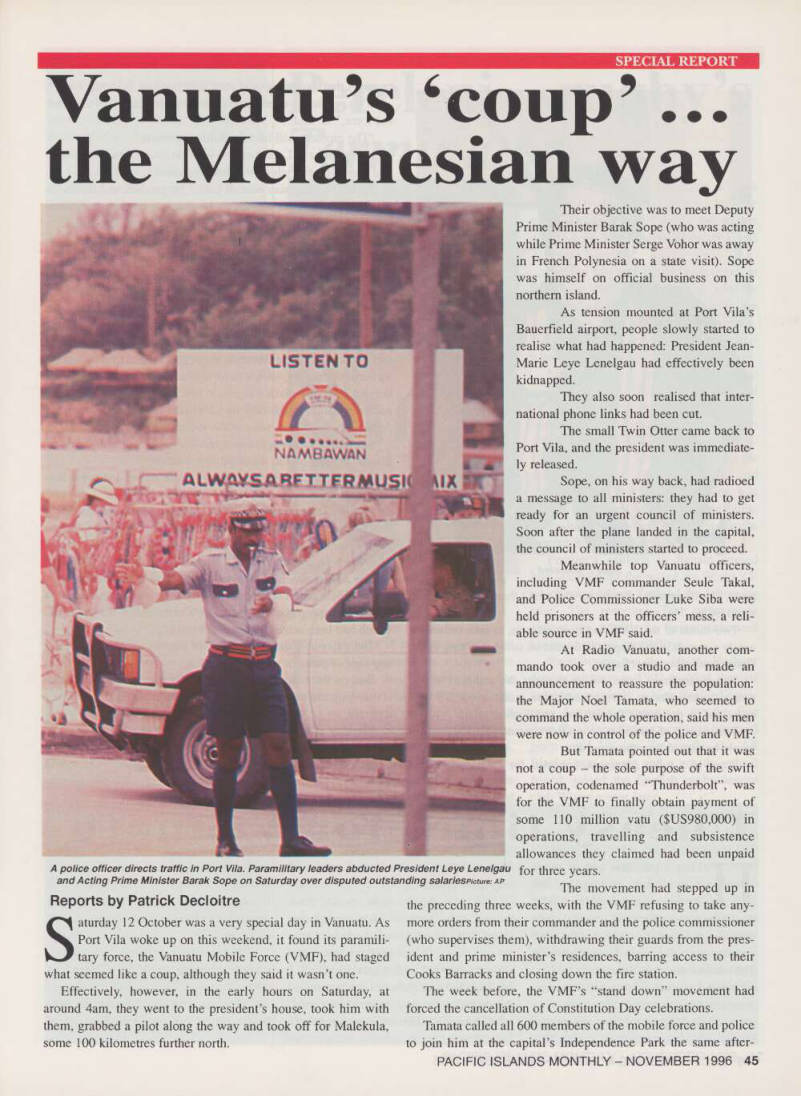
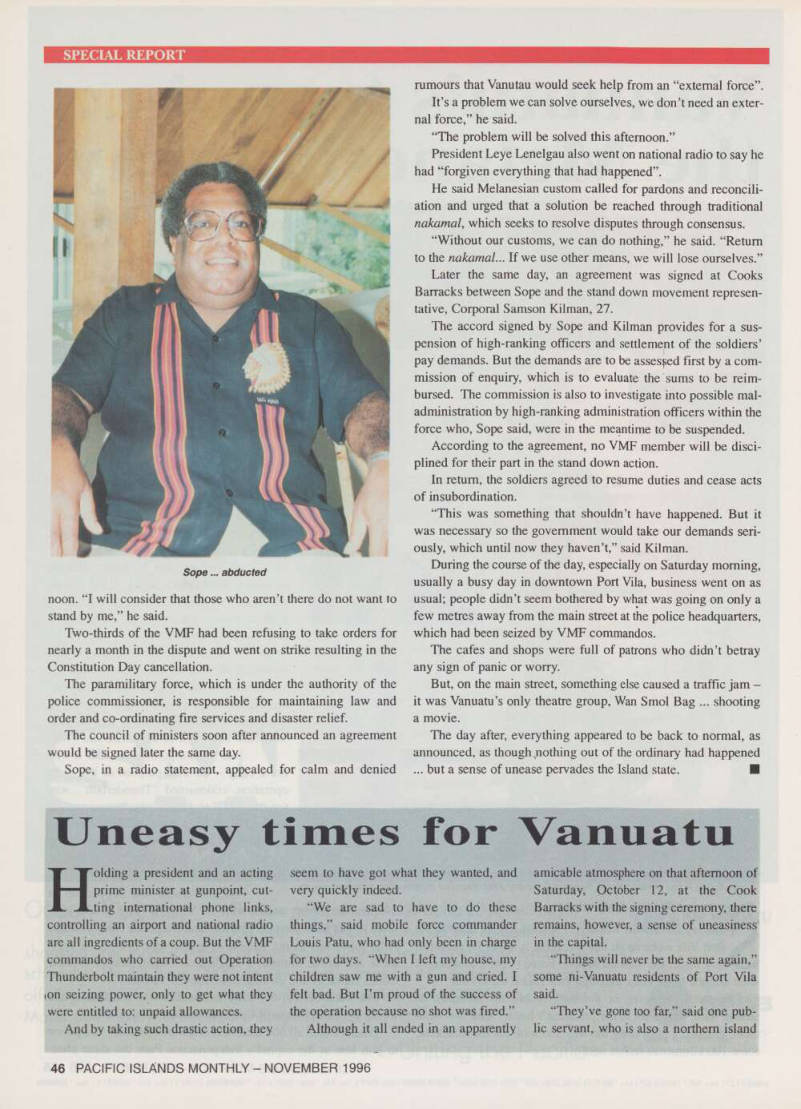
the Melanesian way
Reports by Patrick Decloitre
Saturday 12 October was a very special day in Vanuatu. As Port Vila woke up on this weekend, it found its paramili tary force, the Vanuatu Mobile Force (VMF), had staged what seemed like a coup, although they said it wasn’t one.
Effectively, however, in the early hours on Saturday, at around 4am, they went to the president’s house, took him with them, grabbed a pilot along the way and took off for Malekula, some 100 kilometres further north.
Their objective was to meet Deputy Prime Minister Barak Sope (who was acting while Prime Minister Serge Vohor was away in French Polynesia on a state visit). Sope was himself on official business on this northern island.
As tension mounted at Port Vila’s Bauerfield airport, people slowly started to realise what had happened: President Jean-
Marie Leye Lenelgau had effectively been
kidnapped.
They also soon realised that inter national phone links had been cut.
The small Twin Otter came back to Port Vila, and the president was immediate ly released.
Sope, on his way back, had radioed a message to all ministers: they had to get ready for an urgent council of ministers.
Soon after the plane landed in the capital, the council of ministers started to proceed.
Meanwhile top Vanuatu officers, including VMF commander Seule Takal, and Police Commissioner Luke Siba were held prisoners at the officers’ mess, a reli able source in VML said.
At Radio Vanuatu, another com mando took over a studio and made an announcement to reassure the population: the Major Noel Tamata, who seemed to command the whole operation, said his men were now in control of the police and VML.
But Tamata pointed out that it was not a coup - the sole purpose of the swift operation, codenamed “Thunderbolt”, was for the VMF to finally obtain payment of some 110 million vatu ($US980,000) in operations, travelling and subsistence allowances they claimed had been unpaid for three years.
The movement had stepped up in
the preceding three weeks, with the VMF refusing to take any more orders from their commander and the police commissioner (who supervises them), withdrawing their guards from the pres ident and prime minister’s residences, barring access to their Cooks Barracks and closing down the fire station.
The week before, the VMF’s “stand down” movement had forced the cancellation of Constitution Day celebrations.
Tamata called all 600 members of the mobile force and police to join him at the capital’s Independence Park the same after-
A police officer directs traffic in Port Vila. Paramilitary leaders abducted President Leye Lenelgau and Acting Prime Minister Barak Sope on Saturday over disputed outstanding saiariespicture. AP
noon. “I will consider that those who aren’t there do not want to stand by me,” he said.
Two-thirds of the VMF had been refusing to take orders for nearly a month in the dispute and went on strike resulting in the Constitution Day cancellation.
The paramilitary force, which is under the authority of the police commissioner, is responsible for maintaining law and order and co-ordinating fire services and disaster relief.
The council of ministers soon after announced an agreement would be signed later the same day.
Sope, in a radio statement, appealed for calm and denied
rumours that Vanutau would seek help from an “external force”.
It’s a problem we can solve ourselves, we don’t need an exter nal force,” he said.
“The problem will be solved this afternoon.”
President Leye Lenelgau also went on national radio to say he
had “forgiven everything that had happened”.
He said Melanesian custom called for pardons and reconcili ation and urged that a solution be reached through traditional nakamal, which seeks to resolve disputes through consensus.
“Without our customs, we can do nothing,” he said. “Return to the nakamal... If we use other means, we will lose ourselves.”
Later the same day, an agreement was signed at Cooks Barracks between Sope and the stand down movement represen tative, Corporal Samson Kilman, 27.
The accord signed by Sope and Kilman provides for a sus pension of high-ranking officers and settlement of the soldiers’ pay demands. But the demands are to be assessed first by a com mission of enquiry, which is to evaluate the sums to be reim bursed. The commission is also to investigate into possible mal administration by high-ranking administration officers within the force who, Sope said, were in the meantime to be suspended.
According to the agreement, no VMF member will be disci plined for their part in the stand down action.
In return, the soldiers agreed to resume duties and cease acts of insubordination.
“This was something that shouldn’t have happened. But it was necessary so the government would take our demands seri ously, which until now they haven’t,” said Kilman.
During the course of the day, especially on Saturday morning, usually a busy day in downtown Port Vila, business went on as usual; people didn’t seem bothered by what was going on only a few metres away from the main street at the police headquarters, which had been seized by VMF commandos.
The cafes and shops were full of patrons who didn’t betray any sign of panic or worry.
But, on the main street, something else caused a traffic jam it was Vanuatu’s only theatre group. Wan Smol Bag ... shooting a movie.
The day after, everything appeared to be back to normal, as announced, as though nothing out of the ordinary had happened ... but a sense of unease pervades the Island state. ■
Sope... abducted
Uneasy times for Vanuatu
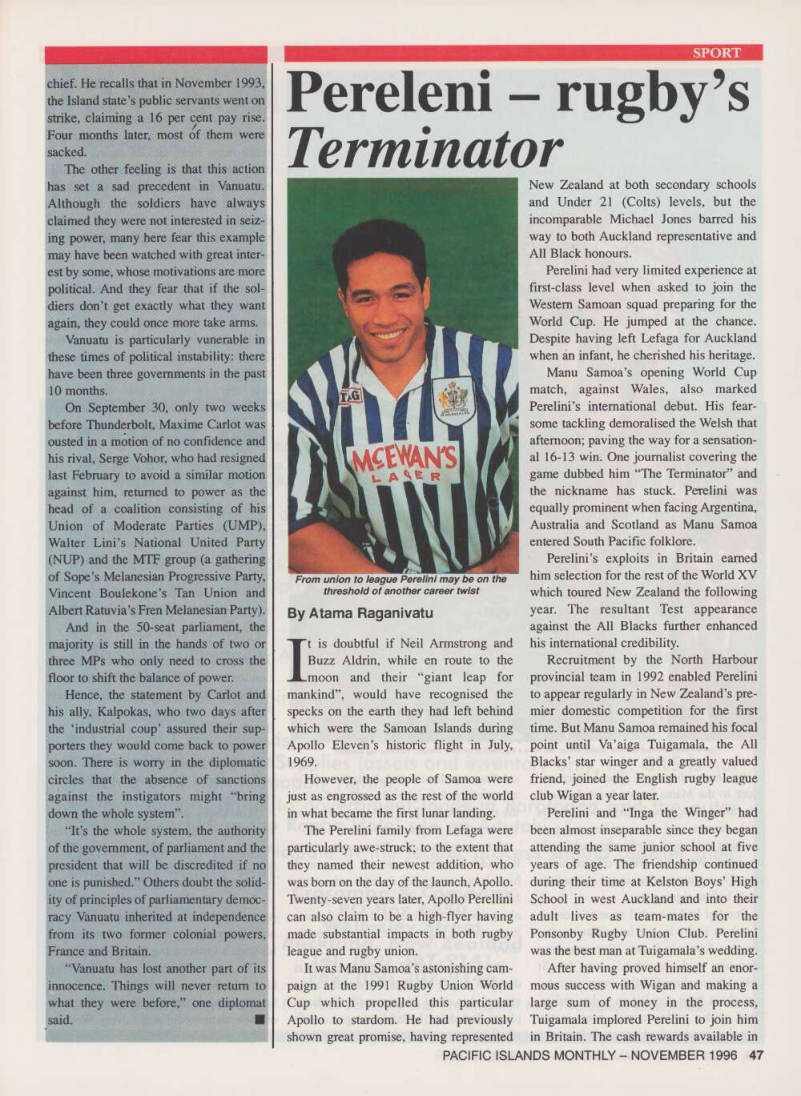
Holding a president and an acting
prime minister at gunpoint, cut
ting international phone links,
controlling an airport and national radio are all ingredients of a coup. But the VMF commandos who carried out Operation Thunderbolt maintain they were not intent ion seizing power, only to get what they were entitled to: unpaid allowances.
And by taking such drastic action, they
seem to have got what they wanted, and very quickly indeed.
“We are sad to have to do these things,” said mobile force commander Louis Patu, who had only been in charge for two days. “When I left my house, my children saw me with a gun and cried. I felt bad. But I’m proud of the success of the operation because no shot was fired.”
Although it all ended in an apparently
amicable atmosphere on that afternoon of Saturday, October 12, at the Cook Barracks with the signing ceremony, there remains, however, a sense of uneasiness' in the capital.
“Things will never be the same again,” some ni-Vanuatu residents of Port Vila said.
“They’ve gone too far,” said one pub lic servant, who is also a northern island
chief. He recalls that in November 1993, the Island state’s public servants went on strike, claiming a 16 per cent pay rise.
Four months later, most of them were sacked.
The other feeling is that this action has set a sad precedent in Vanuatu.
Although the soldiers have always claimed they were not interested in seiz ing power, many here fear this example may have been watched with great inter est by some, whose motivations are more political. And they fear that if the sol diers don’t get exactly what they want again, they could once more take arms.
Vanuatu is particularly vunerable in these times of political instability: there have been three governments in the past 10 months.
On September 30, only two weeks before Thunderbolt, Maxime Carlot was ousted in a motion of no confidence and his rival. Serge Vohor, who had resigned last February to avoid a similar motion against him, returned to power as the head of a coalition consisting of his Union of Moderate Parties (UMP), Walter Lini’s National United Party (NUP) and the MTF group (a gathering of Sope’s Melanesian Progressive Party, Vincent Boulekone’s Tan Union and Albert Ratuvia’s Fren Melanesian Party).
And in the 50-seat parliament, the majority is still in the hands of two or three MPs who only need to cross the floor to shift the balance of power.
Hence, the statement by Carlot and his ally, Kalpokas, who two days after the ‘industrial coup’ assured their sup porters they would come back to power soon. There is worry in the diplomatic circles that the absence of sanctions against the instigators might “bring down the whole system”.
“It’s the whole system, the authority of the government, of parliament and the president that will be discredited if no one is punished.” Others doubt the solid ity of principles of parliamentary democ racy Vanuatu inherited at independence from its two former colonial powers, France and Britain.
“Vanuatu has lost another part of its innocence. Things will never return to what they were before,” one diplomat said. ■
Pereleni - rugby’s
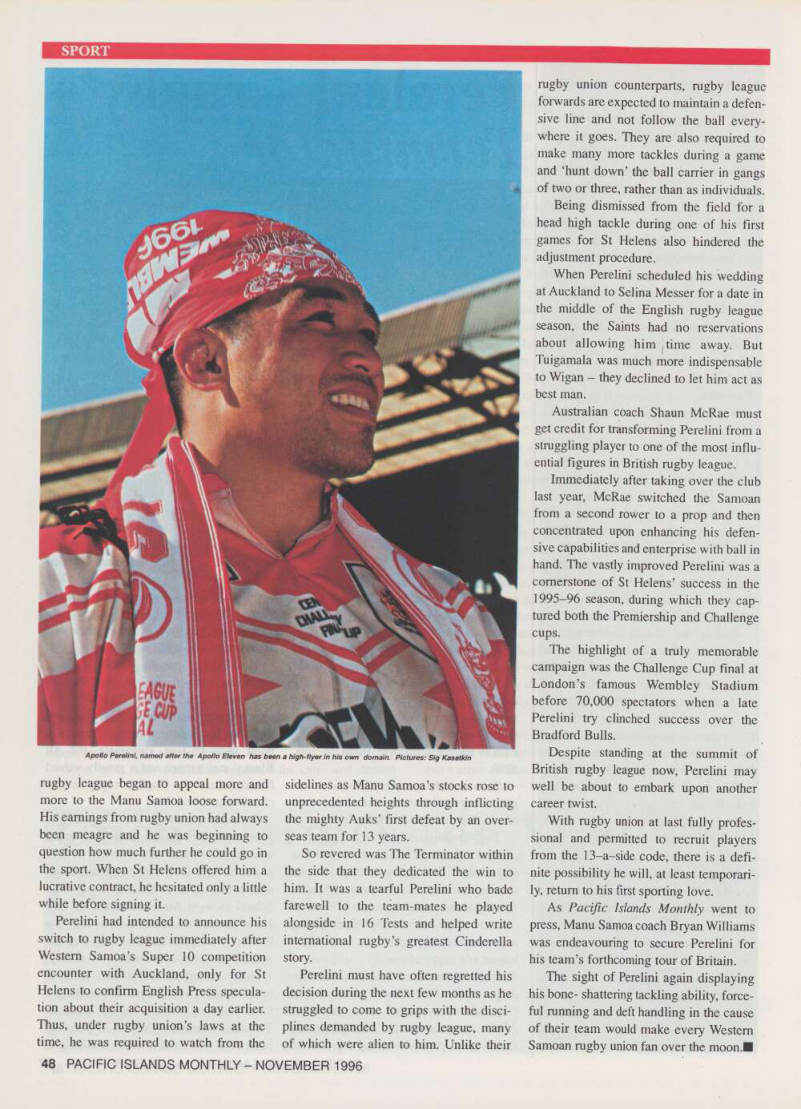
Terminator
By Atama Raganivatu
It is doubtful if Neil Armstrong and Buzz Aldrin, while en route to the moon and their “giant leap for mankind”, would have recognised the specks on the earth they had left behind which were the Samoan Islands during Apollo Eleven’s historic flight in July, 1969.
However, the people of Samoa were just as engrossed as the rest of the world in what became the first lunar landing.
The Perelini family from Lefaga were particularly awe-struck; to the extent that they named their newest addition, who was bom on the day of the launch, Apollo.
Twenty-seven years later, Apollo Perellini can also claim to be a high-flyer having made substantial impacts in both rugby league and rugby union.
It was Manu Samoa’s astonishing cam paign at the 1991 Rugby Union World Cup which propelled this particular Apollo to stardom. He had previously shown great promise, having represented
New Zealand at both secondary schools and Under 21 (Colts) levels, but the incomparable Michael Jones barred his way to both Auckland representative and All Black honours.
Perelini had very limited experience at first-class level when asked to join the Western Samoan squad preparing for the World Cup. He jumped at the chance.
Despite having left Lefaga for Auckland when an infant, he cherished his heritage.
Manu Samoa’s opening World Cup match, against Wales, also marked Perelini’s international debut. His fear some tackling demoralised the Welsh that afternoon; paving the way for a sensation al 16-13 win. One journalist covering the game dubbed him “The Terminator” and the nickname has stuck. Perelini was equally prominent when facing Argentina, Australia and Scotland as Manu Samoa entered South Pacific folklore.
Perelini’s exploits in Britain earned him selection for the rest of the World XV which toured New Zealand the following year. The resultant Test appearance against the All Blacks further enhanced his international credibility.
Recruitment by the North Harbour provincial team in 1992 enabled Perelini to appear regularly in New Zealand’s pre mier domestic competition for the first time. But Manu Samoa remained his focal point until Va’aiga Tuigamala, the All Blacks’ star winger and a greatly valued friend, joined the English rugby league club Wigan a year later.
Perelini and “Inga the Winger” had been almost inseparable since they began attending the same junior school at five years of age. The friendship continued during their time at Kelston Boys’ High School in west Auckland and into their adult lives as team-mates for the Ponsonby Rugby Union Club. Perelini was the best man at Tuigamala’s wedding.
After having proved himself an enor mous success with Wigan and making a large sum of money in the process, Tuigamala implored Perelini to join him in Britain. The cash rewards available in
From union to league Perelini may be on the threshold of another career twist
rugby league began to appeal more and more to the Manu Samoa loose forward.
His earnings from rugby union had always been meagre and he was beginning to question how much further he could go in the sport. When St Helens offered him a lucrative contract, he hesitated only a little while before signing it.
Perelini had intended to announce his switch to rugby league immediately after Western Samoa’s Super 10 competition encounter with Auckland, only for St Helens to confirm English Press specula tion about their acquisition a day earlier.
Thus, under rugby union’s laws at the time, he was required to watch from the
sidelines as Manu Samoa’s stocks rose to
unprecedented heights through inflicting
the mighty Auks’ first defeat by an over seas team for 13 years.
So revered was The Terminator within the side that they dedicated the win to him. It was a tearful Perelini who bade farewell to the team-mates he played alongside in 16 Tests and helped write international rugby’s greatest Cinderella story.
Perelini must have often regretted his decision during the next few months as he struggled to come to grips with the disci
plines demanded by rugby league, many
of which were alien to him. Unlike their
rugby union counterparts, rugby league
forwards are expected to maintain a defen sive line and not follow the ball every where it goes. They are also required to make many more tackles during a game and ‘hunt down’ the ball carrier in gangs of two or three, rather than as individuals.
Being dismissed from the field for a head high tackle during one of his first games for St Helens also hindered the
adjustment procedure.
When Perelini scheduled his wedding at Auckland to Selina Messer for a date in the middle of the English rugby league season, the Saints had no reservations about allowing him , time away. But Tuigamala was much more indispensable to Wigan - they declined to let him act as best man.
Australian coach Shaun Mcßae must get credit for transforming Perelini from a struggling player to one of the most influ ential figures in British rugby league.
Immediately after taking over the club last year, Mcßae switched the Samoan from a second rower to a prop and then concentrated upon enhancing his defen sive capabilities and enterprise with ball in hand. The vastly improved Perelini was a cornerstone of St Helens’ success in the 1995-96 season, during which they cap tured both the Premiership and Challenge cups.
The highlight of a truly memorable campaign was the Challenge Cup final at London’s famous Wembley Stadium before 70,000 spectators when a late Perelini try clinched success over the Bradford Bulls.
Despite standing at the summit of British rugby league now, Perelini may well be about to embark upon another career twist.
With rugby union at last fully profes sional and permitted to recruit players from the 13-a-side code, there is a defi nite possibility he will, at least temporari ly, return to his first sporting love.
As Pacific Islands Monthly went to press, Manu Samoa coach Bryan Williams was endeavouring to secure Perelini for his team’s forthcoming tour of Britain.
The sight of Perelini again displaying
his bone- shattering tackling ability, force
ful running and deft handling in the cause of their team would make every Western Samoan rugby union fan over the moon.B
Apollo Perelini, named after the Apollo Eleven has been a high-flyer in his own domain. Pictures: Sig Kasatkin
Jay soars to stardom
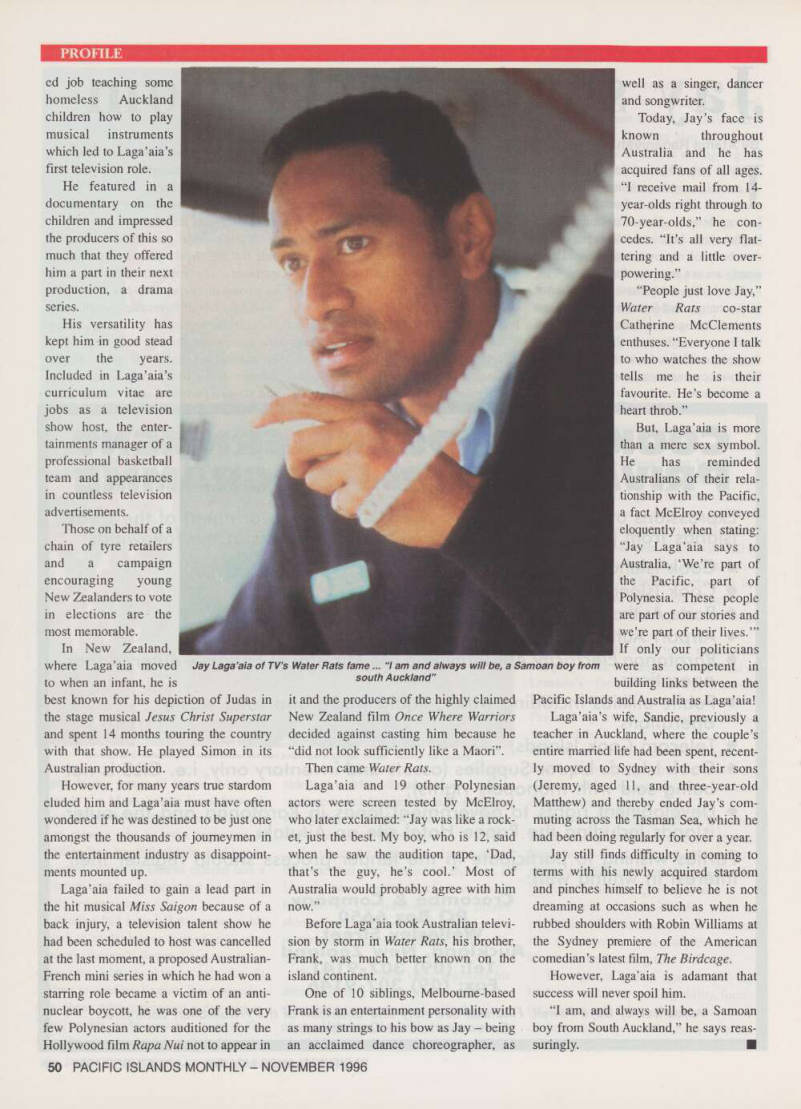
Profile
By Atama Raganivatu
It was only 10 years ago when Samoan actor Lamey Tupu lamented: “I have played German, French, Greek, Indian, Jewish, New Zealand Maori, English and American roles, but never somebody of my own nationality. There simply are not any parts for us.”
Thankfully, things have changed a lot in the interim and Samoan characters are regularly being created for television and theatre productions in New Zealand, Australia and USA due to those countries’
Samoan communities gaining in numbers and influence over the past decade.
Television director Hal McElroy recognised the relevance of modern Australia’s Samoan population when insisting last year that a star of his forth coming Water Rats series should be a member of it. He recalls: “The character was originally going to be an Italian. But then I realised that a high proportion of the workers in the Sydney fish market (where the programme is often set) are Polynesian and thought we’d portray one of them instead. Not only is it more real istic, but more interesting too.”
So, the persona of Senior Constable Tommy Tevita was bom and today Jay
Laga’aia, the actor who plays him, is a household name thoughout Australia due to the show’s popularity.
Laga’aia laughs when he is referred to as an overnight success.
A professional entertainer for exactly half his life, the 32-year-old has worked extraordinarily hard to gain fame and overcome numerous setbacks in the pro cess. A remarkably versatile performer, he has combined acting with singing, playing the saxophone, dancing and songwriting (a tribute to basketball great Magic Johnson is his best known composition) and it was a part-time, local council fund
ed job teaching some homeless Auckland children how to play musical instruments which led to Laga’aia’s first television role.
He featured in a documentary on the children and impressed the producers of this so much that they offered him a part in their next production, a drama series.
His versatility has kept him in good stead over the years.
Included in Laga’aia’s curriculum vitae are jobs as a television show host, the enter tainments manager of a
professional basketball
team and appearances in countless television advertisements.
Those on behalf of a chain of tyre retailers and a campaign
encouraging young
New Zealanders to vote in elections are the most memorable.
In New Zealand, where Laga’aia moved to when an infant, he is
best known for his depiction of Judas in the stage musical Jesus Christ Superstar and spent 14 months touring the country with that show. He played Simon in its
Australian production.
However, for many years true stardom eluded him and Laga’aia must have often wondered if he was destined to be just one amongst the thousands of journeymen in the entertainment industry as disappoint ments mounted up.
Laga’aia failed to gain a lead part in the hit musical Miss Saigon because of a back injury, a television talent show he had been scheduled to host was cancelled at the last moment, a proposed Australian- French mini series in which he had won a starring role became a victim of an anti nuclear boycott, he was one of the very few Polynesian actors auditioned for the Hollywood fdm Rapa Nui not to appear in
it and the producers of the highly claimed New Zealand film Once Where Warriors decided against casting him because he “did not look sufficiently like a Maori”.
Then came Water Rats.
Laga’aia and 19 other Polynesian actors were screen tested by McElroy, who later exclaimed: “Jay was like a rock et, just the best. My boy, who is 12, said when he saw the audition tape, ‘Dad, that’s the guy, he’s cool.’ Most of Australia would probably agree with him now.”
Before Laga’aia took Australian televi sion by storm in Water Rats, his brother, Frank, was much better known on the island continent.
One of 10 siblings. Melbourne-based Frank is an entertainment personality with as many strings to his bow as Jay - being an acclaimed dance choreographer, as
I well as a singer, dancer
I and songwriter.
Today, Jay’s face is
known throughout
I Australia and he has acquired fans of all ages.
“I receive mail from 14-
year-olds right through to
70-year-olds,” he con- I cedes. “It’s all very flat tering and a little over
powering.”
“People just love Jay,”
Water Rats co-star
Catherine McClements
enthuses. “Everyone I talk to who watches the show tells me he is their favourite. He’s become a heart throb.”
But, Laga’aia is more than a mere sex symbol.
He has reminded Australians of their rela tionship with the Pacific, a fact McElroy conveyed
eloquently when stating:
“Jay Laga’aia says to Australia, ‘We’re part of the Pacific, part of Polynesia. These people are part of our stories and we’re part of their lives.’”
I If only our politicians
were as competent in building links between the
Pacific Islands and Australia as Laga’aia!
Laga’aia’s wife, Sandie, previously a teacher in Auckland, where the couple’s entire married life had been spent, recent ly moved to Sydney with their sons (Jeremy, aged 11, and three-year-old Matthew) and thereby ended Jay’s com muting across the Tasman Sea, which he had been doing regularly for over a year.
Jay still finds difficulty in coming to terms with his newly acquired stardom and pinches himself to believe he is not dreaming at occasions such as when he rubbed shoulders with Robin Williams at the Sydney premiere of the American comedian’s latest film. The Birdcage.
However, Laga’aia is adamant that success will never spoil him.
“I am, and always will be, a Samoan boy from South Auckland,” he says reas
suringly. ■
Jay Laga’aia of TV’s Water Rats fame... “I am and always will be, a Samoan boy from south Auckland"
Advertisements & other items, p. 49 (1 item)
Privatisation Programme
COOK ISLANDS GOVERNMENT
Expressions of interest are being sought by the Government of the Cook Islands from parties wishing to purchase its interests in the following: • Cook Islands Savings Bank; • Cook Islands Development Bank; • Ports Authority; • Airport Authority; • Rarotonga Electricity Authority and the Ministry of Energy's outer islands operations; • Public utilities including water, liquid waste and solid waste operations; • Telecom Cook Islands; • Cook Islands Liquor Supplies (assets and inventory only, i.e. CILS is not being sold with monopoly rights); • Development rights to government lands in Rarotonga and the outer islands including the Rapae Hotel site on Aitutaki.
Parties wishing to participate in the tender process should register their interest in writing with: Crocombe & Company PO Box 6650 Wellesley Street Auckland, New Zealand Tel: (09) 307-9141 Fax: (09) 307-9146 Authorised by Lloyd Powell, Financial Secretary and Chairman of the Privatisation Committee, Government of the Cook Islands.
From the sublime to the
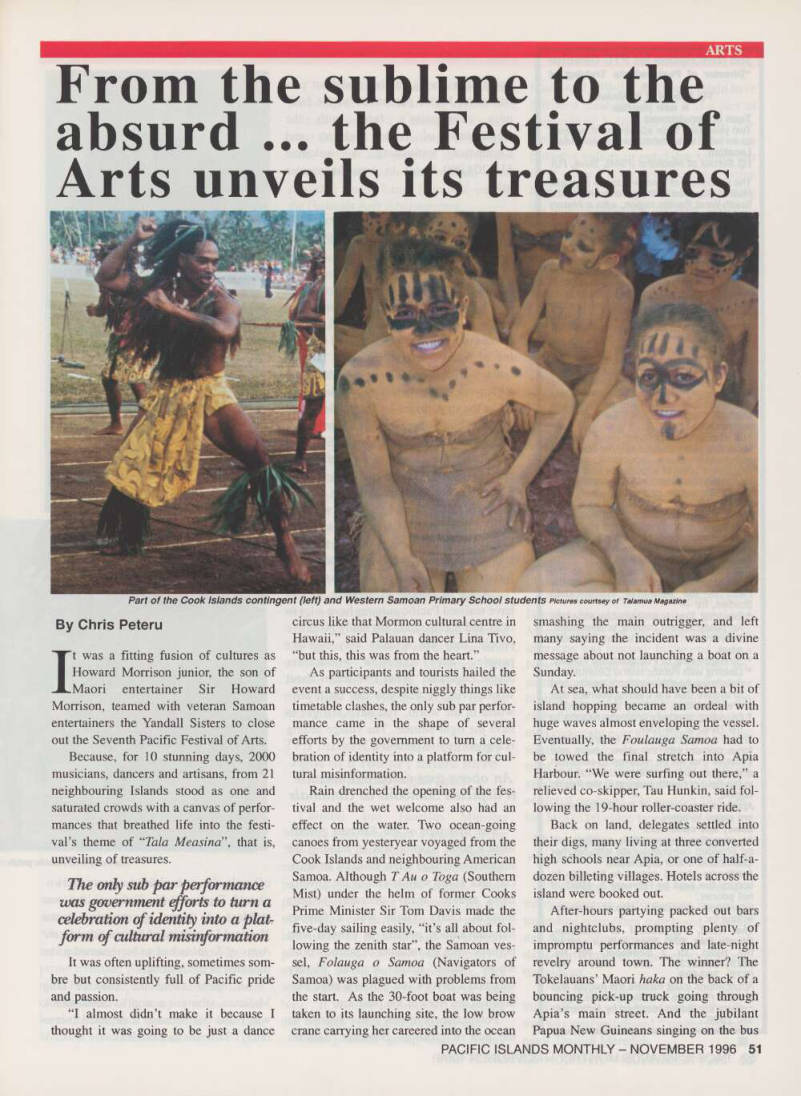
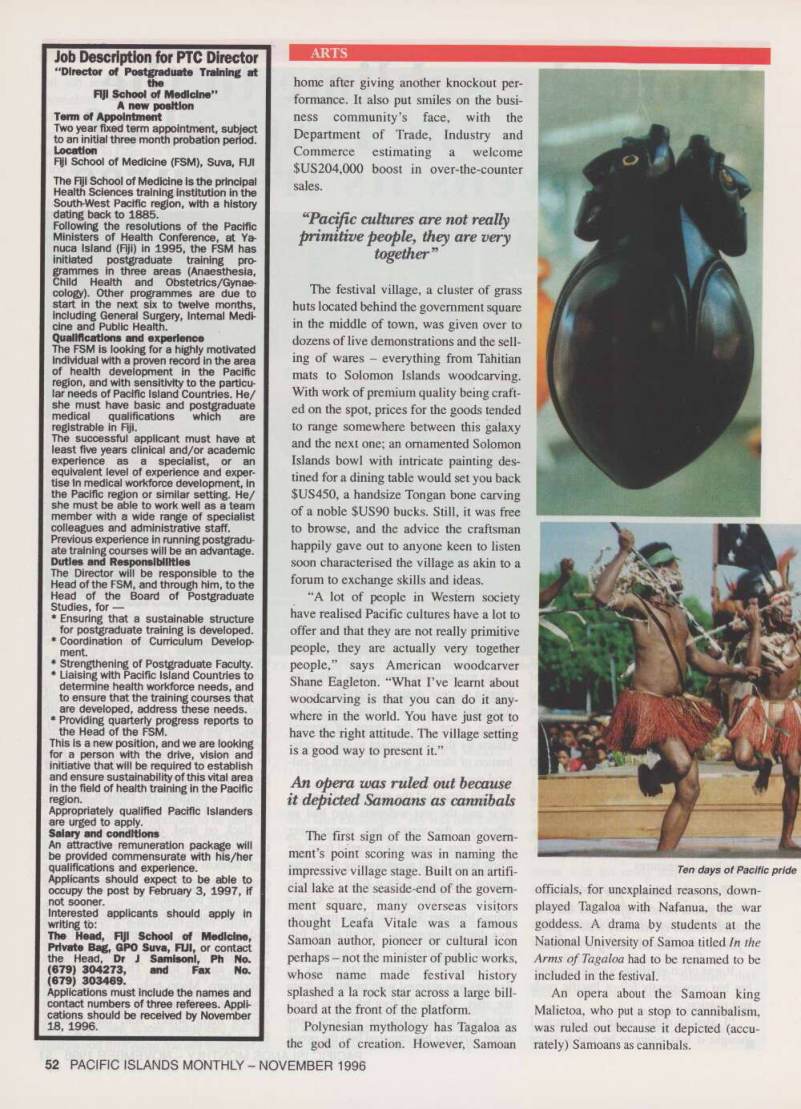
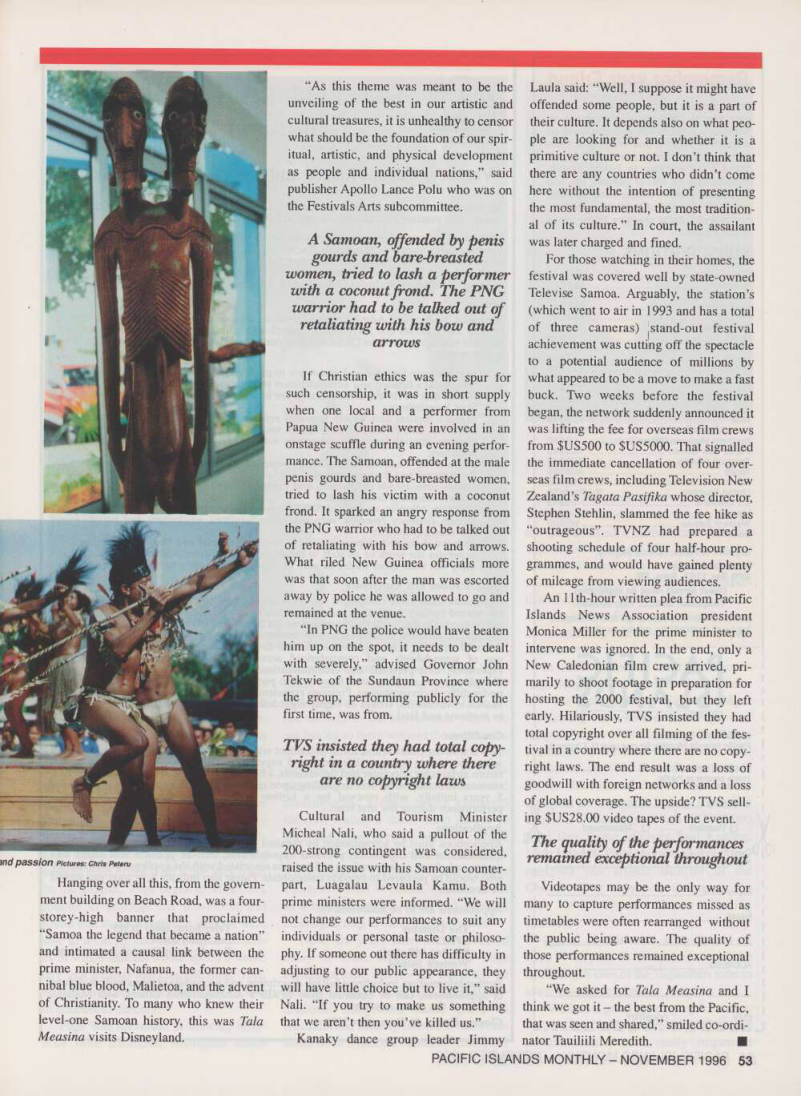
Arts
From the sublime to the absurd ... the Festival of Arts unveils its treasures
By Chris Peteru
It was a fitting fusion of cultures as Howard Morrison junior, the son of Maori entertainer Sir Howard Morrison, teamed with veteran Samoan entertainers the Yandall Sisters to close out the Seventh Pacific Festival of Arts.
Because, for 10 stunning days, 2000 musicians, dancers and artisans, from 21 neighbouring Islands stood as one and saturated crowds with a canvas of perfor mances that breathed life into the festi val’s theme of “Tala Measina ”, that is, unveiling of treasures.
The only sub par performance
was government efforts to turn a
celebration of identity into a plat
form of cultural misinformation
It was often uplifting, sometimes som bre but consistently full of Pacific pride and passion.
“I almost didn’t make it because I thought it was going to be just a dance
circus like that Mormon cultural centre in Hawaii,” said Palauan dancer Lina Tivo, “but this, this was from the heart.”
As participants and tourists hailed the event a success, despite niggly things like timetable clashes, the only sub par perfor mance came in the shape of several efforts by the government to turn a cele bration of identity into a platform for cul tural misinformation.
Rain drenched the opening of the fes tival and the wet welcome also had an effect on the water. Two ocean-going canoes from yesteryear voyaged from the Cook Islands and neighbouring American Samoa. Although T Au o Toga (Southern Mist) under the helm of former Cooks Prime Minister Sir Tom Davis made the five-day sailing easily, “it’s all about fol lowing the zenith star”, the Samoan ves sel, Folauga o Samoa (Navigators of Samoa) was plagued with problems from the start. As the 30-foot boat was being taken to its launching site, the low brow crane carrying her careered into the ocean
smashing the main outrigger, and left many saying the incident was a divine message about not launching a boat on a Sunday.
At sea, what should have been a bit of island hopping became an ordeal with huge waves almost enveloping the vessel.
Eventually, the Foulauga Samoa had to be towed the final stretch into Apia Harbour. “We were surfing out there,” a relieved co-skipper, Tau Hunkin, said fol lowing the 19-hour roller-coaster ride.
Back on land, delegates settled into their digs, many living at three converted high schools near Apia, or one of half-a dozen billeting villages. Hotels across the island were booked out.
After-hours partying packed out bars
and nightclubs, prompting plenty of
impromptu performances and late-night
revelry around town. The winner? The Tokelauans’ Maori haka on the back of a
bouncing pick-up truck going through
Apia’s main street. And the jubilant Papua New Guineans singing on the bus
Part of the Cook Islands contingent (left) and Western Samoan Primary School students pictures counsey of Taiamua Magazine
home after giving another knockout per formance. It also put smiles on the busi ness community’s face, with the Department of Trade, Industry and Commerce estimating a welcome $U5204,000 boost in over-the-counter sales.
“Pacific cultures are not really
primitive people, they are very
together”
The festival village, a cluster of grass huts located behind the government square in the middle of town, was given over to dozens of live demonstrations and the sell ing of wares - everything from Tahitian mats to Solomon Islands woodcarving.
With work of premium quality being craft ed on the spot, prices for the goods tended to range somewhere between this galaxy and the next one; an ornamented Solomon Islands bowl with intricate painting des tined for a dining table would set you back SUS4SO, a handsize Tongan bone carving of a noble SUS9O bucks. Still, it was free to browse, and the advice the craftsman happily gave out to anyone keen to listen soon characterised the village as akin to a forum to exchange skills and ideas.
“A lot of people in Western society have realised Pacific cultures have a lot to offer and that they are not really primitive people, they are actually very together people,” says American woodcarver Shane Eagleton. “What I’ve learnt about woodcarving is that you can do it any where in the world. You have just got to have the right attitude. The village setting is a good way to present it.”
An opera was ruled out because
it depicted Samoans as cannibals
The first sign of the Samoan govern ment’s point scoring was in naming the impressive village stage. Built on an artifi cial lake at the seaside-end of the govern ment square, many overseas visitors thought Leafa Vitale was a famous Samoan author, pioneer or cultural icon perhaps - not the minister of public works, whose name made festival history splashed a la rock star across a large bill board at the front of the platform.
Polynesian mythology has Tagaloa as the god of creation. However, Samoan
officials, for unexplained reasons, down played Tagaloa with Nafanua, the war goddess. A drama by students at the National University of Samoa titled In the Arms of Tagaloa had to be renamed to be included in the festival.
An opera about the Samoan king Malietoa, who put a stop to cannibalism, was ruled out because it depicted (accu rately) Samoans as cannibals.
Ten days of Pacific pride
Hanging over all this, from the govern ment building on Beach Road, was a four storey-high banner that proclaimed “Samoa the legend that became a nation” and intimated a causal link between the prime minister, Nafanua, the former can nibal blue blood, Malietoa, and the advent of Christianity. To many who knew their level-one Samoan history, this was Tala Measina visits Disneyland.
“As this theme was meant to be the unveiling of the best in our artistic and cultural treasures, it is unhealthy to censor what should be the foundation of our spir itual, artistic, and physical development as people and individual nations,” said publisher Apollo Lance Polu who was on the Festivals Arts subcommittee.
A Samoan, offended by penis
gourds and bare-breasted women, tried to lash a performer with a coconut frond. The PNG warrior had to be talked out of retaliating with his bow and arrows If Christian ethics was the spur for such censorship, it was in short supply when one local and a performer from Papua New Guinea were involved in an onstage scuffle during an evening perfor mance. The Samoan, offended at the male penis gourds and bare-breasted women, tried to lash his victim with a coconut frond. It sparked an angry response from the PNG warrior who had to be talked out of retaliating with his bow and arrows.
What riled New Guinea officials more was that soon after the man was escorted away by police he was allowed to go and remained at the venue.
“In PNG the police would have beaten him up on the spot, it needs to be dealt with severely,” advised Governor John Tekwie of the Sundaun Province where the group, performing publicly for the first time, was from.
TVS insisted they had total copy right in a country where there are no copyright laws Cultural and Tourism Minister Micheal Nali, who said a pullout of the 200-strong contingent was considered, raised the issue with his Samoan counter part, Luagalau Levaula Kamu. Both prime ministers were informed. “We will not change our performances to suit any individuals or personal taste or philoso phy. If someone out there has difficulty in adjusting to our public appearance, they will have little choice but to live it,” said Nali. “If you try to make us something that we aren’t then you’ve killed us.”
Kanaky dance group leader Jimmy
Laula said: “Well, I suppose it might have offended some people, but it is a part of their culture. It depends also on what peo ple are looking for and whether it is a primitive culture or not. I don’t think that there are any countries who didn’t come here without the intention of presenting the most fundamental, the most tradition al of its culture.” In court, the assailant was later charged and fined.
For those watching in their homes, the festival was covered well by state-owned Televise Samoa. Arguably, the station’s (which went to air in 1993 and has a total of three cameras) ( stand-out festival achievement was cutting off the spectacle to a potential audience of millions by what appeared to be a move to make a fast buck. Two weeks before the festival began, the network suddenly announced it was lifting the fee for overseas film crews from SUSSOO to SUSSOOO. That signalled the immediate cancellation of four over seas film crews, including Television New Zealand’s Tagata Pasifika whose director, Stephen Stehlin, slammed the fee hike as “outrageous”. TVNZ had prepared a shooting schedule of four half-hour pro grammes, and would have gained plenty of mileage from viewing audiences.
An 11 th-hour written plea from Pacific Islands News Association president Monica Miller for the prime minister to intervene was ignored. In the end, only a New Caledonian film crew arrived, pri marily to shoot footage in preparation for hosting the 2000 festival, but they left early. Hilariously, TVS insisted they had total copyright over all filming of the fes tival in a country where there are no copy right laws. The end result was a loss of goodwill with foreign networks and a loss of global coverage. The upside? TVS sell ing SUS2B.OO video tapes of the event.
The quality of the performances
remained exceptional throughout
Videotapes may be the only way for many to capture performances missed as timetables were often rearranged without the public being aware. The quality of those performances remained exceptional throughout.
“We asked for Tala Measina and I think we got it - the best from the Pacific, that was seen and shared,” smiled co-ordi nator Tauiliili Meredith. ■
[?]nd passion Pictures: Chris Peteru
Advertisements & other items, pp. 52-54 (1 item)
Job Description for PTC Director
“Director of Postgraduate Training at the FIJI School of Medicine”
A new position Term of Appointment Two year fixed term appointment, subject to an initial three month probation period.
Location Fiji School of Medicine (FSM), Suva, FIJI The Fiji School of Medicine Is the principal Health Sciences training institution in the South-West Pacific region, with a history dating back to 1885.
Following the resolutions of the Pacific Ministers of Health Conference, at Yanuca Island (Fiji) in 1995, the FSM has initiated postjgraduate training programmes in three areas (Anaesthesia, Child Health and Obstetrics/Gynaecology). Other programmes are due to start in the next six to twelve months, including General Surgery, Internal Medicine and Public Health.
Qualifications and experience The FSM is looking for a highly motivated individual with a proven record in the area of health development in the Pacific region, and with sensitivity to the particular needs of Pacific Island Countries. He/ she must have basic and postgraduate medical qualifications which are registrable in Fiji.
The successful applicant must have at least five years clinical and/or academic experience as a specialist, or an equivalent level of experience and expertise In medical workforce development, in the Pacific region or similar setting. He/ she must be able to work well as a team member with a wide range of specialist colleagues and administrative staff.
Previous experience in running postgraduate training courses will be an advantage.
Duties and Responsibilities The Director will be responsible to the Head of the FSM, and through him, to the Head of the Board of Postgraduate Studies, for * Ensuring that a sustainable structure for postgraduate training is developed. * Coordination of Curriculum Development. * Strengthening of Postgraduate Faculty. * Liaising with Pacific Island Countries to determine health workforce needs, and to ensure that the training courses that are developed, address these needs. * Providing quarterly progress reports to the Head of the FSM.
This is a new position, and we are looking for a person with the drive, vision and initiative that will be required to establish and ensure sustainability of this vital area in the field of health training in the Pacific region.
Appropriately qualified Pacific Islanders are urged to apply.
Salary and conditions An attractive remuneration package will be provided commensurate with his/her qualifications and experience.
Applicants should expect to be able to occupy the post by February 3, 1997, if not sooner.
Interested applicants should apply in writing to: The Head, FIJI School of Medicine, Private Bag, GPO Suva, FIJI, or contact the Head, Dr J Samisonl, Ph No. (679) 304273, and Fax No. (679) 303469.
Applications must include the names and contact numbers of three referees. Applications should be received by November 18, 1996.
Remember your Friend
There are times in your life when you feel your friends have been missing out on something good. Now’s your chance to do something about it and share with them one of the good things you have. Buy your friend a subscription to Pacific Islands Monthly and let him or her join you and thousands of other people worldwide who are kept informed of the latest political, social and cultural changes taking place in the Pacific.
SUBSCRIPTIONS
American Samoa US$45 Australia A 542.00 Canada US$45 Cook Islands AUSS46 Fiji F 526.40 French Polynesia US$45 Guam US$45 Hawaii US$45 Japan US$45 Kiribati AUSS46 Marshall/Micronesia US$4O Nauru AUSS42 New Caledonia US$32 New Zealand NZ$55 Niue AUSS46 Norfolk Island AUSS42 Northern Marianas/Palau US$4O Papua New Guinea AUSS4S Solomon Islands AUSS46 Tonga AUSS46 Tuvalu AUSS46 United Kingdom Stg Pound2B US Mainland US$45 Vanuatu AUSS4S Western Samoa WS$6O Elsewhere AUSS63 Payment to Pacific Islands Monthly: Subscriptions Dept.
GPO Box 1167, Suva, FIJI.
Direct airmail rates on application.
Telephone; 304111 Fax: 303809.
Direct airmail rates include the cost of airspeeding to all destinations set out as above.
PACIFIC
ISLANDS
Please send my friend I Pacific Islands Monthly for one year (12 issues).
I enclose my cheque for $ (made payable to Pacific Islands Monthly) or debit $ to my: □ Visacard □ Mastercard -'Card No.- Expiry Date.
NAME.
.SIGNATURE.
ADDRESS:,
CITY.
.COUNTRY.
South Pacific Regional Environment
Programme (SPREP)
Head, Finance and Administration Division
Applications are invited for the above position with the SPREP Secretariat in Apia, Western Samoa. The position will become vacant in January 1997.
SPREP is an intergovernmental organisation responsible for advising on and assisting with environmental issues in the South Pacific region on behalf of the governments and administrations of 22 Pacific Islands countries plus 4 developed countries. Some 50 staff work under the overall supervision of a Director, who is assisted by a Deputy Director and 4 Heads of Divisions including Finance and Administration.
Duties The Head, Finance and Administration Division is responsible to the Director, through the Deputy Director, for the Secretariat's finance and administration functions and for the effective management of the Division. More particularly, but without limitation, the officer is required to: * provide sound advice and assistance to management and staff on all aspects of the Secretariat's finance and administration requirements and procedures; * ensure that all financial transactions are in accordance with approved Financial and Staff Regulations; * prepare regular and timely financial reports for management. Work Programme Divisions, individual projects, donors and members; * prepare annual financial statements for audit and submission to Meetings of Members; * prepare all financial information required for the Secretariat's annual Work Programme and Budget process; * advise other Heads of Division and Project Officers on all financial and budgetary matters affecting their activities; * maintain effective control of SPREPs assets, including bank accounts, local and foreign currency reserves, vehicles, office furniture, equipment and supplies and technical equipment; * approve delegated responsibilities under the Financial and Staff Regulations; * supervise the work of all staff in the Finance and Administration Envision; and * carry out such other duties as may be required from time to time.
Qualifications and Experience Applicants must have completed formal accounting or commerce qualifications from a recognised tertiary institution and have at least ten years relevant work experience, for which service in the South Pacific region would be well regarded. Other essential attributes include an excellent understanding of modem accounting systems with experience in financial reporting at management level, well-developed computer skills particularly in the use of spreadsheets and computerised accounting packages; proven management experience, inter-personal and communications skills, the ability to work with interdisciplinary and multi-cultural teams and to prepare reports proposals to deadlines often under difficult circumstances. Previous expenence in a similar position, and/or in a Pacific Islands environment, would be highly regarded. The role suits a team player who is able to motivate and lead staff.
Conditions This is a senior position and the appointment will be made at Head of Division level with salary depending upon qualifications and experience. The package will include annual return airfares for appointee and dependents, a housing subsidy and other benefits. SPREP remuneration may be tax-free depending upon circumstances. The appointment will be for 3 years initially, with renewal for a further 3 years depending upon the officers performance during the first term.
Applications Applications must be accompanied by detailed curricula vitae including information on qualifications and e>q?erience, previous appointments, current position and salary and names and phone or fax numbers of 3 persons associated with the applicant professionally who would be prepared to provide testimonials. Please also indicate now soon you would be available.
Applications are to be addressed to: The Director
SPREP
PO Box 240, Apia Western Samoa Further information, including a full job description and a schedule of terms and conditions of appointment; can be obtained from SPREPs Administration Officer, Mrs Malama Hadley, at the above numbers.
Closing Date: 31 December 1996 Telephone: (685) 21929 Fax: (685) 20231 E-mail: [email protected]
Vacancy:
In time
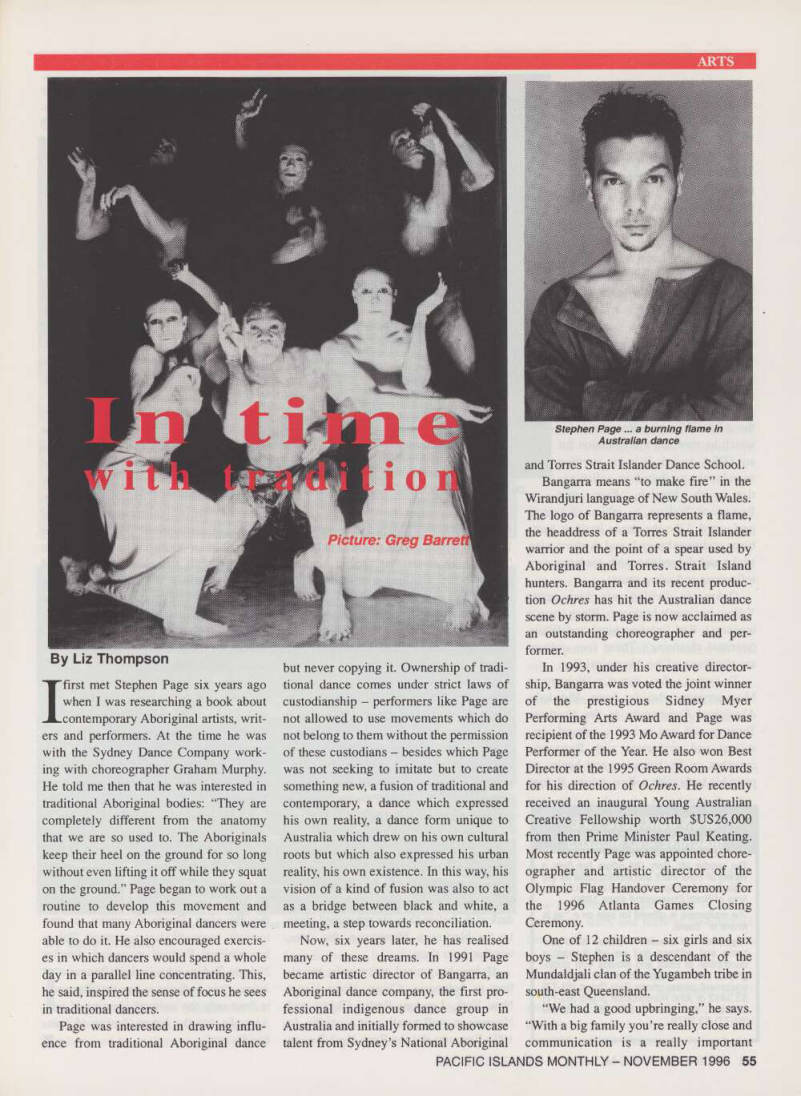
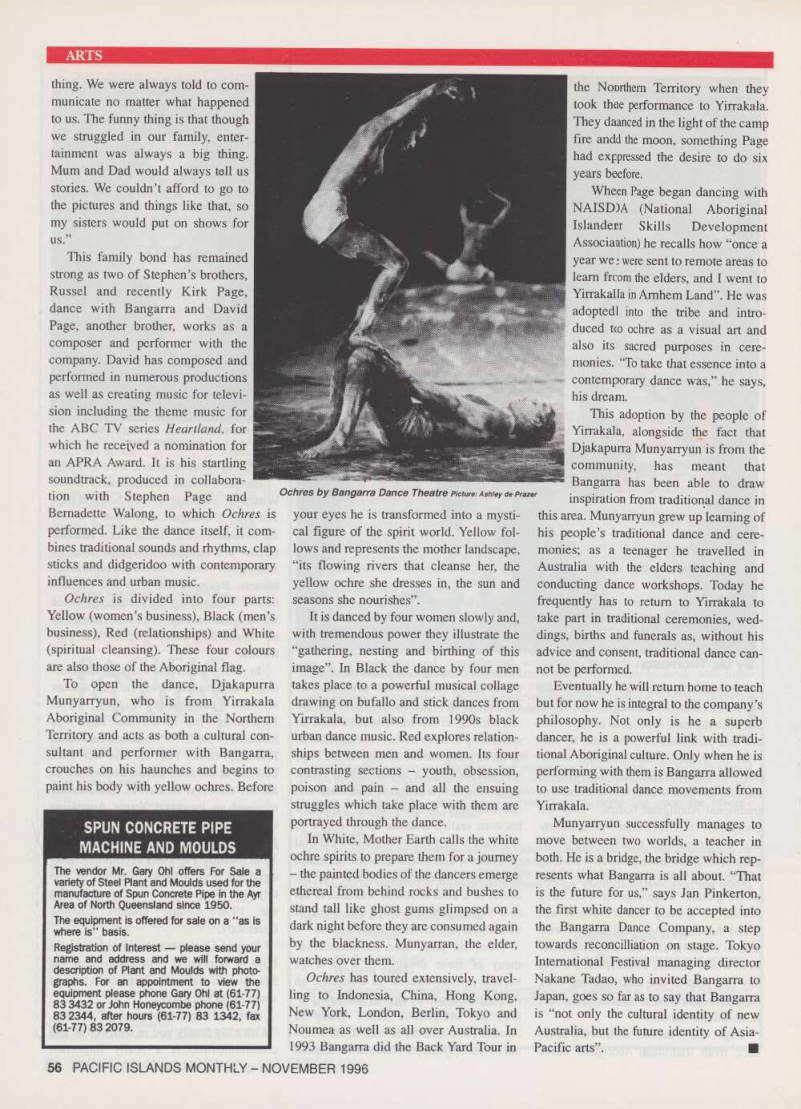
with tradition
By Liz Thompson
I first met Stephen Page six years ago when I was researching a book about contemporary Aboriginal artists, writ ers and performers. At the time he was with the Sydney Dance Company work ing with choreographer Graham Murphy.
He told me then that he was interested in traditional Aboriginal bodies: “They are completely different from the anatomy that we are so used to. The Aboriginals keep their heel on the ground for so long without even lifting it off while they squat on the ground.” Page began to work out a routine to develop this movement and found that many Aboriginal dancers were able to do it. He also encouraged exercis es in which dancers would spend a whole day in a parallel line concentrating. This, he said, inspired the sense of focus he sees in traditional dancers.
Page was interested in drawing influ ence from traditional Aboriginal dance
but never copying it. Ownership of tradi tional dance comes under strict laws of custodianship - performers like Page are not allowed to use movements which do not belong to them without the permission of these custodians - besides which Page was not seeking to imitate but to create something new, a fusion of traditional and contemporary, a dance which expressed his own reality, a dance form unique to Australia which drew on his own cultural roots but which also expressed his urban reality, his own existence. In this way, his vision of a kind of fusion was also to act as a bridge between black and white, a meeting, a step towards reconciliation.
Now, six years later, he has realised many of these dreams. In 1991 Page became artistic director of Bangarra, an Aboriginal dance company, the first pro fessional indigenous dance group in Australia and initially formed to showcase talent from Sydney’s National Aboriginal
and Torres Strait Islander Dance School.
Bangarra means “to make fire” in the Wirandjuri language of New South Wales.
The logo of Bangarra represents a flame, the headdress of a Torres Strait Islander warrior and the point of a spear used by Aboriginal and Torres. Strait Island hunters. Bangarra and its recent produc tion Ochres has hit the Australian dance scene by storm. Page is now acclaimed as an outstanding choreographer and per former.
In 1993, under his creative director ship, Bangarra was voted the joint winner of the prestigious Sidney Myer Performing Arts Award and Page was recipient of the 1993 Mo Award for Dance Performer of the Year. He also won Best Director at the 1995 Green Room Awards for his direction of Ochres. He recently received an inaugural Young Australian Creative Fellowship worth $U526,000 from then Prime Minister Paul Keating.
Most recently Page was appointed chore ographer and artistic director of the Olympic Flag Handover Ceremony for the 1996 Atlanta Games Closing Ceremony.
One of 12 children - six girls and six boys - Stephen is a descendant of the Mundaldjali clan of the Yugambeh tribe in south-east Queensland.
“We had a good upbringing,” he says.
“With a big family you’re really close and communication is a really important
Stephen Page... a burning flame in Australian dance
Picture: Greg Barre tt
thing. We were always told to com municate no matter what happened to us. The funny thing is that though we struggled in our family, enter tainment was always a big thing.
Mum and Dad would always tell us stories. We couldn’t afford to go to the pictures and things like that, so my sisters would put on shows for us.”
This family bond has remained strong as two of Stephen’s brothers, Russel and recently Kirk Page, dance with Bangarra and David Page, another brother, works as a composer and performer with the company. David has composed and
performed in numerous productions
as well as creating music for televi sion including the theme music for the ABC TV series Heartland, for which he received a nomination for an APRA Award. It is his startling soundtrack, produced in collabora tion with Stephen Page and
Bernadette Walong, to which Ochres is performed. Like the dance itself, it com bines traditional sounds and rhythms, clap sticks and didgeridoo with contemporary influences and urban music.
Ochres is divided into four parts: Yellow (women’s business). Black (men’s business). Red (relationships) and White (spiritual cleansing). These four colours are also those of the Aboriginal flag.
To open the dance, Djakapurra Munyarryun, who is from Yirrakala Aboriginal Community in the Northern Territory and acts as both a cultural con sultant and performer with Bangarra, crouches on his haunches and begins to paint his body with yellow ochres. Before
your eyes he is transformed into a mysti cal figure of the spirit world. Yellow fol lows and represents the mother landscape, “its flowing rivers that cleanse her, the yellow ochre she dresses in, the sun and seasons she nourishes”.
It is danced by four women slowly and, with tremendous power they illustrate the
“gathering, nesting and birthing of this
image”. In Black the dance by four men takes place to a powerful musical collage drawing on bufallo and stick dances from Yirrakala, but also from 1990 s black urban dance music. Red explores relation ships between men and women. Its four contrasting sections - youth, obsession, poison and pain - and all the ensuing struggles which take place with them are portrayed through the dance.
In White, Mother Earth calls the white ochre spirits to prepare them for a journey - the painted bodies of the dancers emerge ethereal from behind rocks and bushes to stand tall like ghost gums glimpsed on a dark night before they are consumed again by the blackness. Munyarran, the elder, watches over them.
Ochres has toured extensively, travel
ling to Indonesia, China, Hong Kong,
New York, London, Berlin, Tokyo and Noumea as well as all over Australia. In 1993 Bangarra did the Back Yard Tour in
the Noorthem Territory when they took thee performance to Yirrakala.
They daanced in the light of the camp fire andd the moon, something Page had exppressed the desire to do six years beefore.
Wheen Page began dancing with
NAISD)A (National Aboriginal Islandecr Skills Development Associaation) he recalls how “once a year we; were sent to remote areas to leant frcom the elders, and I went to Yirrakalla in Arnhem Land”. He was adopted 1 into the tribe and intro duced tco ochre as a visual art and also its sacred purposes in cere monies. “To take that essence into a contemporary dance was,” he says, his dream.
This adoption by the people of Yirrakala, alongside the fact that Djakapurra Munyarryun is from the community, has meant that Bangarra has been able to draw inspiration from traditional dance in
this area. Munyarryun grew up learning of his people’s traditional dance and cere monies; as a teenager he travelled in Australia with the elders teaching and
conducting dance workshops. Today he
frequently has to return to Yirrakala to take part in traditional ceremonies, wed dings, births and funerals as, without his advice and consent, traditional dance can not be performed.
Eventually he will return home to teach but for now he is integral to the company’s philosophy. Not only is he a superb dancer, he is a powerful link with tradi tional Aboriginal culture. Only when he is performing with them is Bangarra allowed to use traditional dance movements from Yirrakala.
Munyarryun successfully manages to
move between two worlds, a teacher in both. He is a bridge, the bridge which rep resents what Bangarra is all about. “That is the future for us,” says Jan Pinkerton, the first white dancer to be accepted into the Bangarra Dance Company, a step towards reconcilliation on stage. Tokyo International Festival managing director Nakane Tadao, who invited Bangarra to Japan, goes so far as to say that Bangarra is “not only the cultural identity of new Australia, but the future identity of Asia- Pacific arts”. ■
Ochres by Bangarra Dance Theatre Picture: Ashley de Prazer
Advertisements & other items, p. 56 (1 item)
Spun Concrete Pipe
MACHINE AND MOULDS
The vendor Mr. Gary Ohl offers For Sale a variety of Steel Plant and Moulds used for the manufacture of Spun Concrete Pipe in the Ayr Area of North Queensland since 1950.
The equipment is offered for sale on a "as is where is” basis.
Registration of Interest please send your name and address and we will forward a description of Plant and Moulds with photographs. For an appointment to view the equipment please phone Gary Ohl at (61-77) 83 3432 or John Honeycombe phone (61-77) 83 2344, after hours (61-77) 83 1342, fax (61-77) 83 2079.
Baguettes and bureaucracy
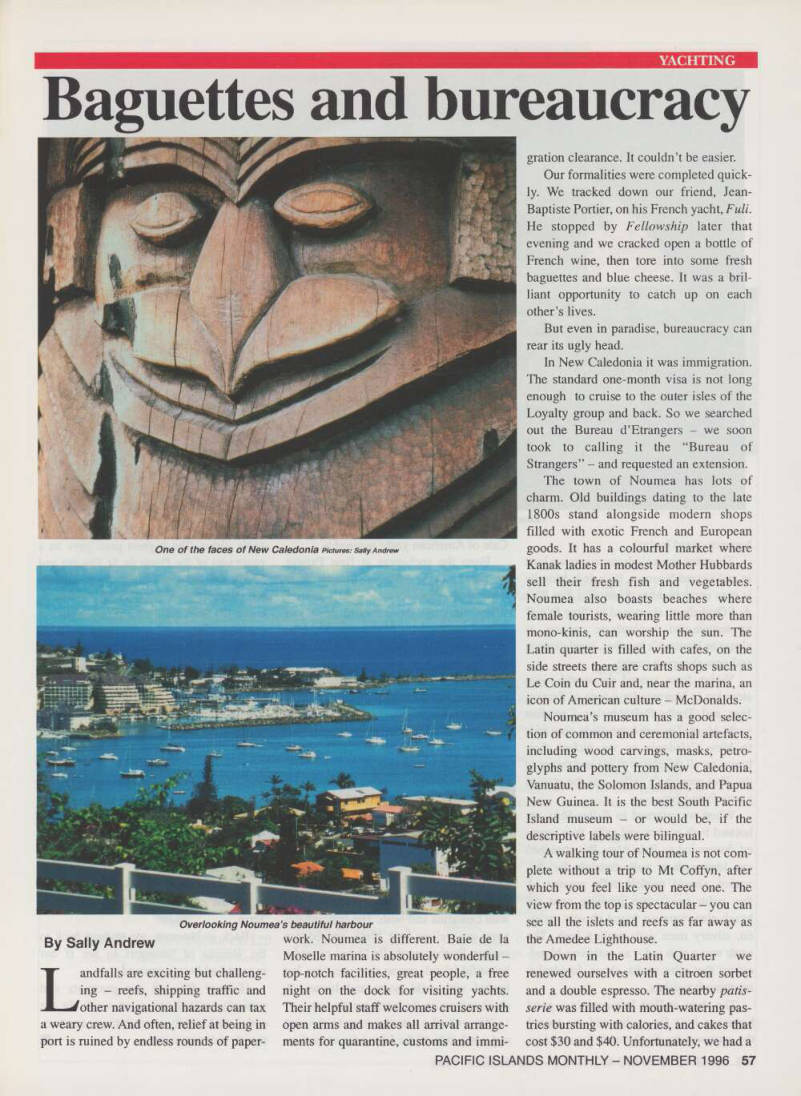
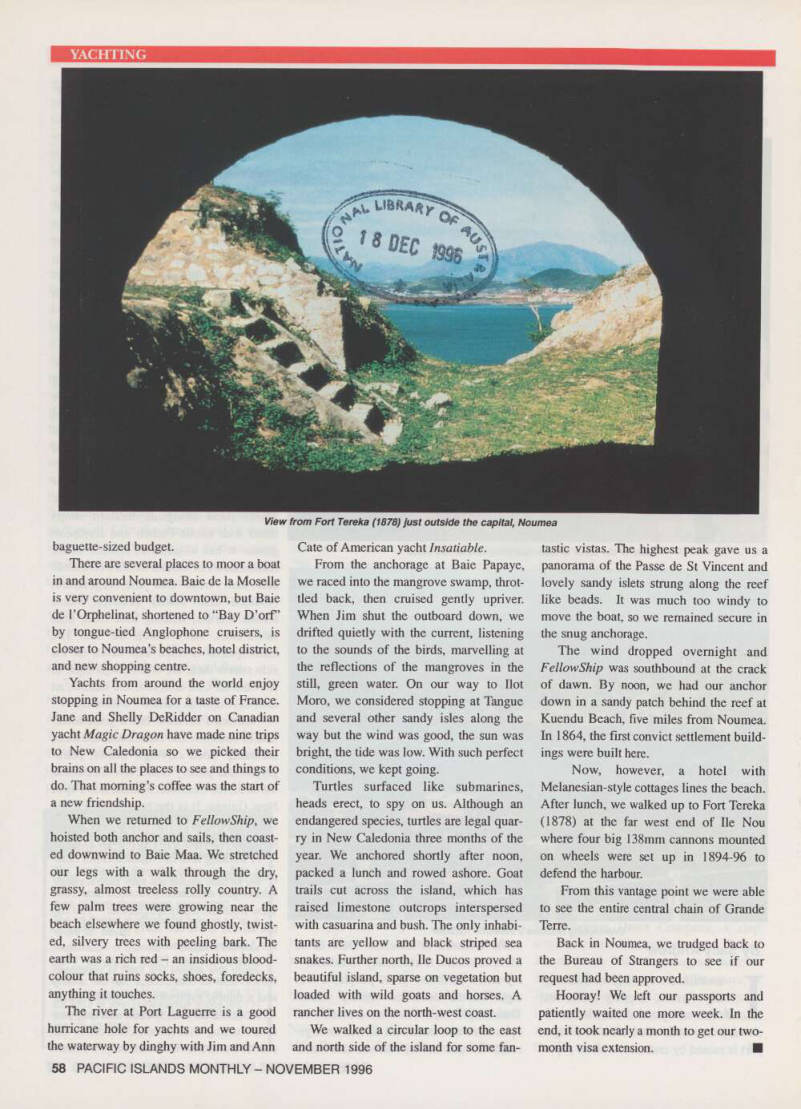
Yachting
By Sally Andrew
Landfalls are exciting but challeng ing - reefs, shipping traffic and other navigational hazards can tax a weary crew. And often, relief at being in port is ruined by endless rounds of paper
work. Noumea is different. Baie de la Moselle marina is absolutely wonderful top-notch facilities, great people, a free night on the dock for visiting yachts.
Their helpful staff welcomes cruisers with open arms and makes all arrival arrange ments for quarantine, customs and immi
gration clearance. It couldn’t be easier.
Our formalities were completed quick ly. We tracked down our friend, Jean- Baptiste Fortier, on his French yacht, Fuli.
He stopped by Fellowship later that evening and we cracked open a bottle of French wine, then tore into some fresh baguettes and blue cheese. It was a bril liant opportunity to catch up on each other’s lives.
But even in paradise, bureaucracy can rear its ugly head.
In New Caledonia it was immigration.
The standard one-month visa is not long enough to cruise to the outer isles of the Loyalty group and back. So we searched out the Bureau d’Etrangers - we soon took to calling it the “Bureau of Strangers” - and requested an extension.
The town of Noumea has lots of charm. Old buildings dating to the late
1800 s stand alongside modern shops
filled with exotic French and European goods. It has a colourful market where Kanak ladies in modest Mother Hubbards sell their fresh fish and vegetables.
Noumea also boasts beaches where female tourists, wearing little more than mono-kinis, can worship the sun. The Latin quarter is filled with cafes, on the side streets there are crafts shops such as Le Coin du Cuir and, near the marina, an icon of American culture - McDonalds.
Noumea’s museum has a good selec tion of common and ceremonial artefacts, including wood carvings, masks, petro glyphs and pottery from New Caledonia, Vanuatu, the Solomon Islands, and Papua New Guinea. It is the best South Pacific Island museum - or would be, if the
descriptive labels were bilingual.
A walking tour of Noumea is not com plete without a trip to Mt Coffyn, after which you feel like you need one. The view from the top is spectacular - you can see all the islets and reefs as far away as the Amedee Lighthouse.
Down in the Latin Quarter we renewed ourselves with a Citroen sorbet and a double espresso. The nearby patis serie was filled with mouth-watering pas tries bursting with calories, and cakes that cost $3O and $4O. Unfortunately, we had a
One of the faces of New Caledonia pictures: sally Andrew
Overlooking Noumea’s beautiful harbour
baguette-sized budget.
There are several places to moor a boat in and around Noumea. Baie de la Moselle is very convenient to downtown, but Baie de FOrphelinat, shortened to “Bay D’orf ’ by tongue-tied Anglophone cruisers, is closer to Noumea’s beaches, hotel district, and new shopping centre.
Yachts from around the world enjoy stopping in Noumea for a taste of France.
Jane and Shelly Deßidder on Canadian yacht Magic Dragon have made nine trips to New Caledonia so we picked their brains on all the places to see and things to do. That morning’s coffee was the start of a new friendship.
When we returned to Fellowship, we hoisted both anchor and sails, then coast ed downwind to Baie Maa. We stretched our legs with a walk through the dry, grassy, almost treeless roily country. A few palm trees were growing near the beach elsewhere we found ghostly, twist ed, silvery trees with peeling bark. The earth was a rich red - an insidious blood colour that ruins socks, shoes, foredecks, anything it touches.
The river at Port Laguerre is a good hurricane hole for yachts and we toured the waterway by dinghy with Jim and Ann
Cate of American yacht Insatiable.
From the anchorage at Bale Papaye, we raced into the mangrove swamp, throt tled back, then cruised gently upriver.
When Jim shut the outboard down, we drifted quietly with the current, listening to the sounds of the birds, marvelling at the reflections of the mangroves in the still, green water. On our way to Hot Moro, we considered stopping at Tangue and several other sandy isles along the way but the wind was good, the sun was bright, the tide was low. With such perfect conditions, we kept going.
Turtles surfaced like submarines, heads erect, to spy on us. Although an endangered species, turtles are legal quar ry in New Caledonia three months of the year. We anchored shortly after noon, packed a lunch and rowed ashore. Goat trails cut across the island, which has raised limestone outcrops interspersed with casuarina and bush. The only inhabi tants are yellow and black striped sea snakes. Further north, He Ducos proved a beautiful island, sparse on vegetation but loaded with wild goats and horses. A rancher lives on the north-west coast.
We walked a circular loop to the east and north side of the island for some fan
tastic vistas. The highest peak gave us a panorama of the Passe de St Vincent and lovely sandy islets strung along the reef like beads. It was much too windy to move the boat, so we remained secure in the snug anchorage.
The wind dropped overnight and Fellowship was southbound at the crack of dawn. By noon, we had our anchor down in a sandy patch behind the reef at Kuendu Beach, five miles from Noumea.
In 1864, the first convict settlement build ings were built here.
Now, however, a hotel with Melanesian-style cottages lines the beach.
After lunch, we walked up to Fort Tereka (1878) at the far west end of He Nou where four big 138 mm cannons mounted on wheels were set up in 1894-96 to defend the harbour.
From this vantage point we were able to see the entire central chain of Grande Terre.
Back in Noumea, we trudged back to the Bureau of Strangers to see if our request had been approved.
Hooray! We left our passports and patiently waited one more week. In the end, it took nearly a month to get our two month visa extension. ■
View from Fort Tereka (1878) just outside the capital, Noumea
Advertisements & other items, pp. 58-60 (2 items)
Yachting
What Would You Like Them To Say About You
A .
He knew
Grand Pacific
would look after
his family
His bills are covered r • » o ■r-t K y. aw * Al a . fe* .*s. " ///.s' children will get a good education
She trusted someone local,
Grand Pacific Life
She put her family first
What Would You Like Them To Say About You
After You’re Gone?
Ordinarily, it takes a lifetime to accumulate a fortune. Not with life insurance.
Life insurance is the only sure way to build a legacy - one that will instantly perpetuate your good name as a provider and sustain your family’s financial security.
Let us help you choose a plan that meets your goals. © Grand Pacific Life Insurance, Ltd.
A member of the Finance Factors Family American Samoa Mark Solofa Pacific Insurance & Finance, Inc.
Mark Solofa, GA Phone: 684-699-5796 Western Samoa Mark Solofa Pacific Insurance & Finance, Inc.
Mark Solofa, GA Phone: 685-24059 Chuuk State.
Federated States of Micronesia Pacific Basin Insurance & General Services, Inc.
Kachutosy Paulus, GA Phone: 691-330-2606 Guam Great National Insurance Underwriters, Inc.
Domie Bumagat Jr., GA Phone: 671-646-5736 Pacific Financial Corporation Eduardo Camacho, GA Phone: 671-646-1990 Takagi & Associates Pamela Cruz, GA Phone: 671-475-4373 Marshall Islands Marshalls Insurance Agency Jerry Kramer, GA Phone: 692-625-3366 Saipan Pacific Basin Insurance Underwriters, Inc.
Mary Ann Milne, GA Phone: 670-234-7861 Pacific Insurance Underwriters, Inc.
Norman Tenorio, GA Phone: 670-234-6267 Tonga Peseti Ma‘afu Insurance & Finance, Ltd.
Peseti Ma‘afu, GA Phone: 676-24-777
Kl 919 PFvo
THE NEW
PRIVILEGED CLASS
The Uncompromised Family Sedan
THE RLL NEW
MITSUBISHI
LRNCER
Meet the car that was born to succeed. With its progressive engineering and striking appearance, the all-new Mitsubishi Lancer advances effectively, impressively... moving ahead at every turn.
Get behind the wheel and experience the new standard in family sedans.
AMERICAN SAMOA: PACIFIC MARKETING INC. P.0. Box 698, Pago Pago, Tel. 699-9140 / AUSTRALIA: MITSUBISHI MOTORS AUSTRALIA LTD. 1284 South Road, Clovelly Park, South Australia, 5042, Tel. (08) 2757297/FIJI: NIVIS MOTOR & MACHINERY CO. LTD. G.P.O. Box 150, Suva, Tel. 383411 / GUAM: TRIPLE J ENTERPRISES INC. RO. Box 6066, Tamuning, Tel 6469126/NEW CALEDONIA: SOCIETE D'IMPORTATION D'AUTO DU PACIFIQUE SUD S.A. P.0. Box 2548, Noumea, Tel. 281-787/ NEW ZEALAND: MITSUBISHI MOTORS NEW ZEALAND LTD. Private Bag. Porirua, Tel. 237-0109 / NORFOLK ISLAND: BORRY'S PTY LTD. P.0. Box 169, Taylors Road, Burnt, Tel. 22114/PAPUA NEW GUINEA: TOBA MOTORS PTY LTD. P.0. Box 503, Port Moresby /SAIPAN: SAIPAN AUTOWORLD INC. P.0.
Box 487, Tel. 234-7133/SOLOMON ISLANDS: HARVEST PACIFIC LTD. G.P.O. Box 823, Honiara, Tel. 30407/TAHITI: SOPADEP S.A. B.P. 1617, Papeete, Tel. 427393/TONGA: SITANI MAFI CO., LTD.
P.0. Box 83, Nuku’Alofa, Tel. 24044/VANUATU: SOCOMETRA VANUATU LTD. B.P. 6, Port-Vila, Tel. 2314/WESTERN SAMOA: MOTOR DISTRIBUTORS (SAMOA) LTD. P.0. Box 576, Apia, Tel. 20957 A
MITSUBISHI
MOTORS
CREATING TOGETHER