Pacific


Island
Monthly
JJ
But is the fallout over?
American Samoa US$2.5O; Australia A 53.50; Cook Islands NZ$3; Fiji F 52.50 Vat incl; FS Micronesia US$3; Kiribati A 52.50; Nauru A 52.50; Niue NZ$3; Norfolk As 3; New Caledonia cpf2so; New Zealand NZ53.45 incl GST: Northern Marianas US$3; Papua New Guinea K 3: Palau US$3: Marshall Islands US$3; Solomon Islands As 3; French Polynesia cpf3oo; Tonga P 3; USA US$3; Vanuatu VT22O; Western Samoa T 3.25. These are recommended prices only.
Cover: James Ranuku
Advertisements & other items, pp. 2-4 (1 item)
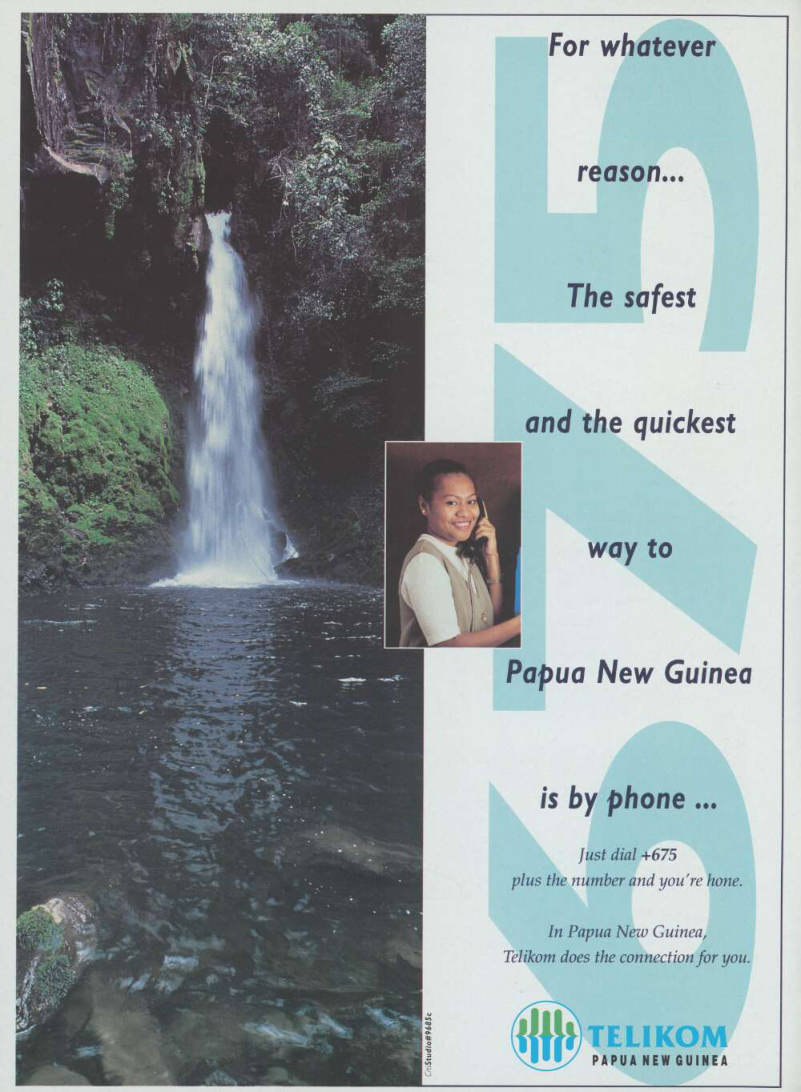
is by phone...
For whatever reason...
The safest
and the quickest way to Papua New Guinea
is by phone...
fust dial +675 plus the number and you're hone .
In Papua New Guinea, Telikom does the connection for you.
TELIKOM
PAPUA NEW GUINEA
I 1 - Save our sea tiirtjes j? *** <Kt>4 V
PHONECARD
GIFTPACKS
FROM FIJI
Telecom Fiji has released another set of Collectors Phonecards depicting the unique fauna of the Fiji Islands. Ideal as souvenirs or gifts, a limited edition of the phonecards are now available for purchase.
For more information contact Telecom Fiji’s Marketing Division on telephone 0800 300 000 or fax 305 071.
f 0 Telecom Fiji
PRIVATE MAIL BAG, SUVA, FIJI
RUBINE GROUP 10*319
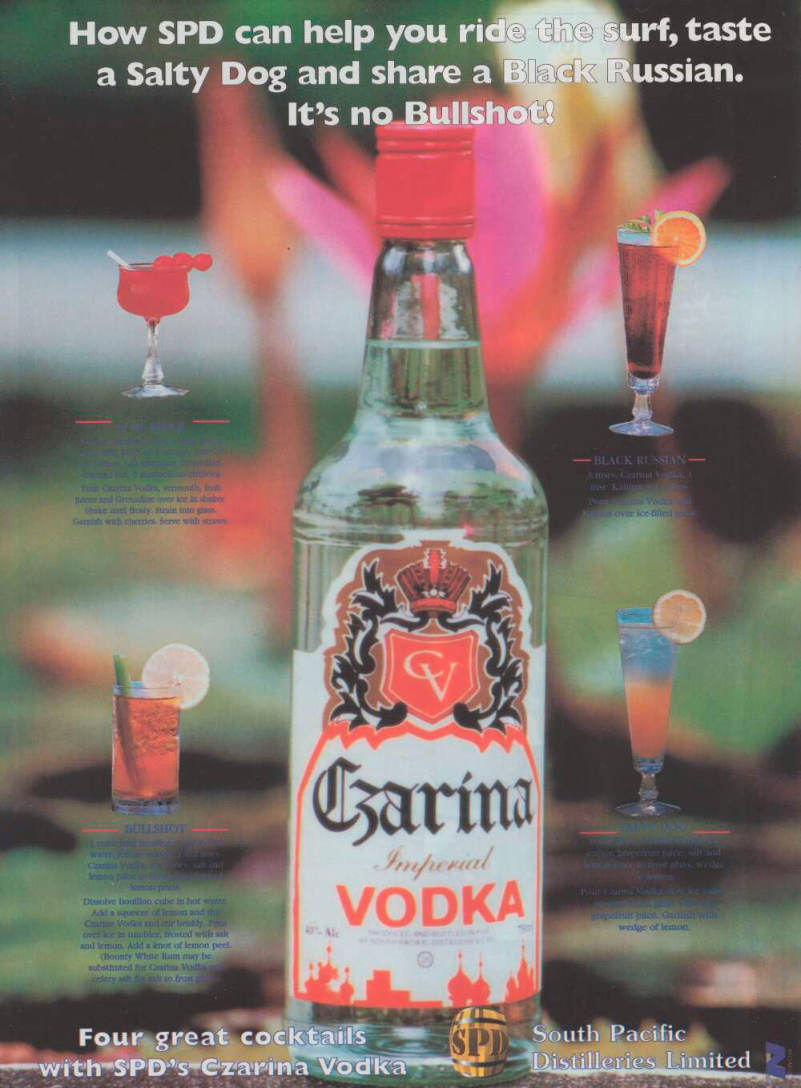
How SPD can help you rii
a Salty Dog and share a
It’s no Bullshdiß
over ice in shaker Strain into glass with straws. fi Dissolve bouillon hot slwwfiSS Sir'-’mi and lemon. Add a knot of lemon peel. (Bounty White Rum may be substituted for Czarina Vodtetafiiß u
South Pacific
Limited 1
SP
amis
Vo d'lca
Pacific
Islands
Monthl Y
Vol. 66 No. 10
The News Magazine
October 1996
PUBLISHER: Alan Robinson EDITOR: Manivannan Naidu SENIOR WRITER: Bernadette Hussein
Correspondents:
David North, Sam Vulum lan Williams, Liz Thompson, Atama Raganivatu, Sally Andrew, Patrick Decloitre, Chris Peteru COLUMNISTS: David Barber (Wellington), Jemima Garrett (Sydney), Alfred Sasako (The Forum), Debbie Singh (South Pacific Commission).
GRAPHIC ARTIST: James Ranuku
Advertising Sales
Senior Regional Sales (South Pacific) Shailendra Kumar Emmett Simpson Te1(679) 304111, 303429, Fax (679) 303809.
Sydney, Canberra: Bob Hill Media Representation, Tel (61-2) 4164245, Fax (61-2)4165064.
Brisbane: Jane Fewings Media and Advertising Associates Tel (61-7) 3378 4522, Fax (61-7) 3878 1071.
Adelaide: Hastwell Williamsons Representatives, Tel (61-8) 3799522, Fax (61-8) 3799735.
Melbourne: Brown Orr Fletcher Burrows (Aust) Pty Ltd.
Tel (61-3) 98265188, Fax (61-3) 98265644.
Auckland: McKay & Bowman, International Media Representatives Limited, Tel (64-9)4190561, Fax (64-9) 4192243.
Japan: Universal Media Corporation, Tokyo, Tel (3) 3266626741, Cable: UNI-MEDIA Tokyo, Fax (3) 32626742.
Pacific Islands Monthly was founded in
1930 (Usps 9522480).
A Fiji Times Limited production.
Cover prices are recommended retail only. Registered by Australia Post, Publication No. NBPI2IO. © Copyright Fiji Times Limited, 177 Victoria Parade, Suva, Fiji.
Tel (679) 304111, fax (679) 303809.
Pacific Islands Monthly is published month ly by Fiji Times Limited, a division of Nationwide News, 2 Holt Street, Surry Hills, Sydney, NSW 2010.
Send Address Changes To:
Pacific Islands Monthly POBox 1167 Suva, Fiji.
Typeset and printed by The Fiji Times Limited, 177 Victoria Parade, Suva, Fiji.
Inside
jwm COVER: At the 1996 South Pacific ■ f Forum France was readmitted as a post f Forum dialogue partner. Questions have I I been asked on the wisdom of the move which is perceived by some to have been taken much too soon
6: Letters 23: Pacific dealings with France raise questions 23: Islanders’ high hopes of elections 28: Palau’s political profiles 29: The uncontested politician 39: On Vanuatu’s shaky ground 42: The gay life 44: Netting the world 45: Luisa to stay on Street 47: ’Twas not always thus 49: PNG pottery 55: Haves and have nots of logging
Sport
50: Irrepressible Ropati brothers 52: The strong silent type 53: Two worlds of Karembeu
Yachting
57: Fiji Regatta Week
Special Report
On the
H A brink of
change
Nearly a decade after Fiji’s military coups the nation waits to see what effects the Constitution Review Commission will have
Views
8: Debbie Singh: To be or not to be? 10: Jemima Garrett: Pacific gets budget reprieve 11: David Barber: NZ’s new election system 12: Alfred Sasako: Welcome back, France
Feature
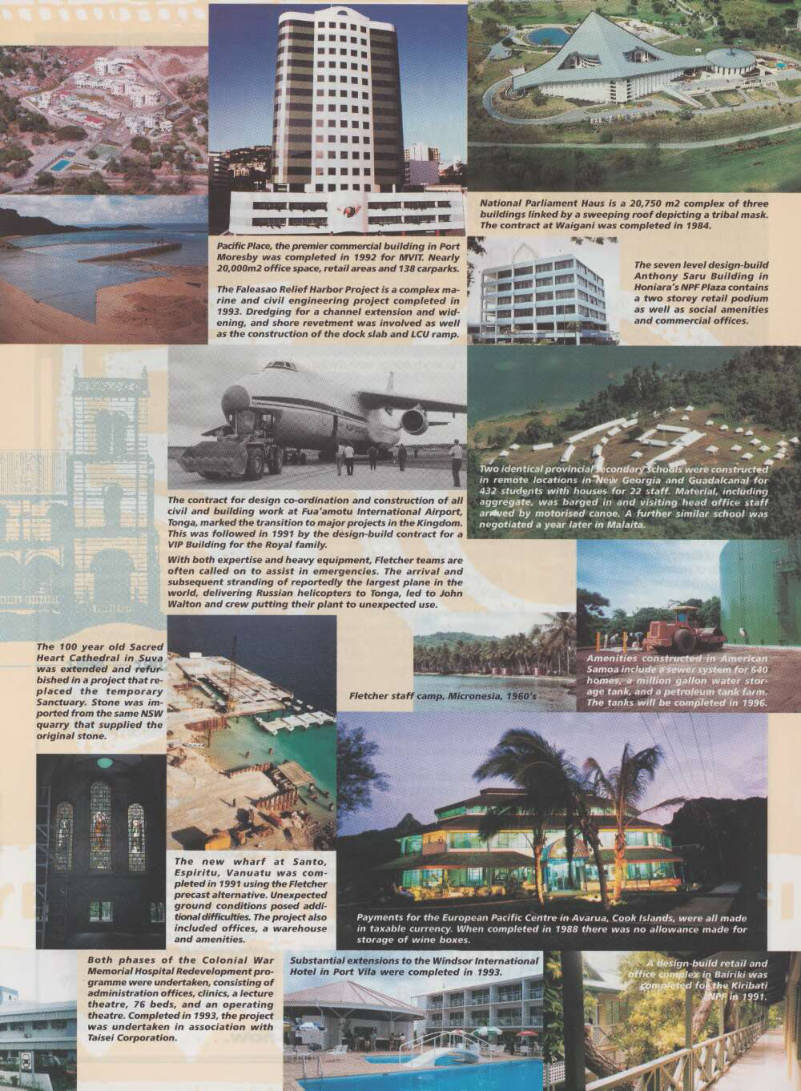
33: Construction In the Pacific
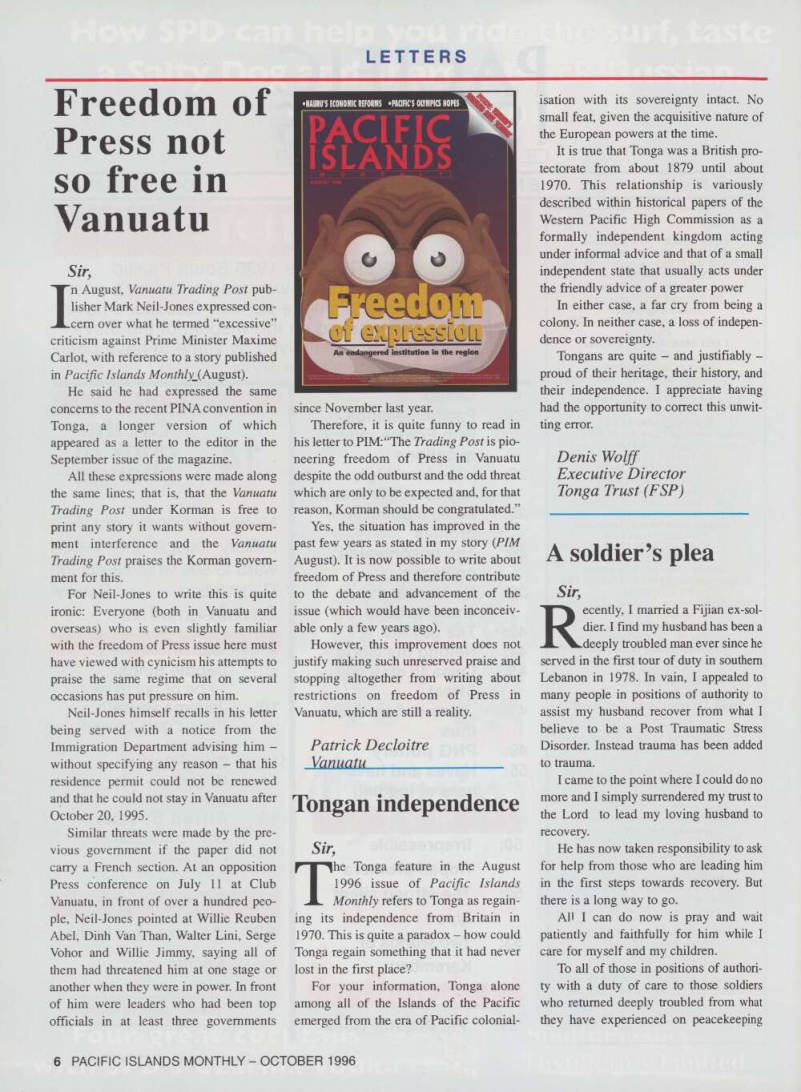
Freedom of
Letters
Freedom of Press not so free in Vanuatu
Sir,
In August, Vanuatu Trading Post pub
lisher Mark Neil-Jones expressed con cern over what he termed “excessive” criticism against Prime Minister Maxime Carlot, with reference to a story published in Pacific Islands Monthly_( August).
He said he had expressed the same concerns to the recent PINA convention in Tonga, a longer version of which appeared as a letter to the editor in the September issue of the magazine.
All these expressions were made along the same lines; that is, that the Vanuatu Trading Post under Korman is free to print any story it wants without govern ment interference and the Vanuatu Trading Post praises the Korman govern ment for this.
For Neil-Jones to write this is quite ironic: Everyone (both in Vanuatu and overseas) who is even slightly familiar with the freedom of Press issue here must have viewed with cynicism his attempts to praise the same regime that on several occasions has put pressure on him.
Neil-Jones himself recalls in his letter being served with a notice from the Immigration Department advising him without specifying any reason - that his residence permit could not be renewed and that he could not stay in Vanuatu after October 20, 1995.
Similar threats were made by the pre vious government if the paper did not carry a French section. At an opposition Press conference on July 11 at Club Vanuatu, in front of over a hundred peo ple, Neil-Jones pointed at Willie Reuben Abel, Dinh Van Than, Walter Lini, Serge Vohor and Willie Jimmy, saying all of them had threatened him at one stage or another when they were in power. In front of him were leaders who had been top officials in at least three governments
since November last year.
Therefore, it is quite funny to read in his letter to PIM:“The Trading Post is pio neering freedom of Press in Vanuatu despite the odd outburst and the odd threat which are only to be expected and, for that reason, Korman should be congratulated.”
Yes, the situation has improved in the past few years as stated in my story ( PIM August). It is now possible to write about freedom of Press and therefore contribute to the debate and advancement of the issue (which would have been inconceiv able only a few years ago).
However, this improvement does not justify making such unreserved praise and
stopping altogether from writing about
restrictions on freedom of Press in Vanuatu, which are still a reality.
Patrick Decloitre
Vanuatu
Tongan independence
Sir,
The Tonga feature in the August 1996 issue of Pacific Islands Monthly refers to Tonga as regain ing its independence from Britain in 1970. This is quite a paradox - how could Tonga regain something that it had never lost in the first place?
For your information, Tonga alone among all of the Islands of the Pacific emerged from the era of Pacific colonial
isation with its sovereignty intact. No small feat, given the acquisitive nature of the European powers at the time.
It is true that Tonga was a British pro tectorate from about 1879 until about 1970. This relationship is variously described within historical papers of the Western Pacific High Commission as a formally independent kingdom acting under informal advice and that of a small independent state that usually acts under the friendly advice of a greater power In either case, a far cry from being a colony. In neither case, a loss of indepen dence or sovereignty.
Tongans are quite - and justifiably proud of their heritage, their history, and their independence. I appreciate having had the opportunity to correct this unwit ting error.
Denis Wolff
Executive Director Tonga Trust (ESP)
A soldier’s plea
Sir,
Recently, I married a Fijian ex-sol dier. I find my husband has been a deeply troubled man ever since he served in the first tour of duty in southern Lebanon in 1978. In vain, I appealed to many people in positions of authority to assist my husband recover from what I believe to be a Post Traumatic Stress Disorder. Instead trauma has been added to trauma.
I came to the point where I could do no more and I simply surrendered my trust to the Lord to lead my loving husband to recovery.
He has now taken responsibility to ask for help from those who are leading him in the first steps towards recovery. But there is a long way to go.
All I can do now is pray and wait patiently and faithfully for him while I care for myself and my children.
To all of those in positions of authori ty with a duty of care to those soldiers who returned deeply troubled from what they have experienced on peacekeeping
duty, I plead to you in the name of the Lord through the words of Job (30: 24- 27): Surely no one lays hands on a broken man When he cries for help in his distress.
Have I not wept for those in trouble Has not my soul grieved for the poor?
Yet when I hoped for good, evil came; When I looked for light, then came darkness.
The churning inside me never stops, days of suffering confront me.
Evelyn Lawe Tulega
Canberra Australia
Independence for Bougainville
Bougainville
Sir,
I wish to register my disbelief of the statements by Papua New Guinea Prime Minister Sir Julius Chan at the June Pacific Regional Seminar of the United Nations Special Decolonisation Committee in Port Moresby.
I was dismayed at the contents of Sir Julius’ call “for an early, orderly and absolute end to colonialism in New Caledonia, with specific safeguards for the rights of indigenious Kanaks” report ed by Sam Vulum in your August publi cation.
This is not to imply that I am not for Kanaky independence but rather that its similarity to the BRA (Bougainville Revolutionary Army) fight for nation hood need not be overlooked.
Also questionable is the fact that the United Nations saw it fit for PNG to host a Pacific Regional Seminar of the United Nations Special Committee on Decolonisation. One can argue that as a sovereign state PNG is qualified to host
such meetings.
However, the fact that the Chan administration is turning a blind eye to the cries, aspirations and prayers of
indigenous Bouganivilleans for state-
hood to end PNG “colonialism and exploitation” also need to be considered.
Despite the fact that PNG is not in order, Sir Julius boosted the plight of the Kanaks to gain independence. It is this rationale of saying “give independence to FLNKS and engage PNG Defence Force on Operation Hot Pursuit against BRA” that qualifies Sir Julius to be labelled a hypocrite.
Though New Caledonia is officially and legally a colony of France, the status of Bougainville as an integral part of PNG is highly debatable.
Lest the Chan administration forget let it be stated with clarity that the FLNKS and BRA are fighting for the same cause.
Independence is the core element of the
Bougainville crisis.
To this end, I see it reasonable for the Pacific Regional Seminar of the United Nations Special Committee on Decolonisation to not only single out France but also reprimand PNG for human rights abuses and exploitation in Bougainville.
Renee Sore
Honiara Solomon Islands
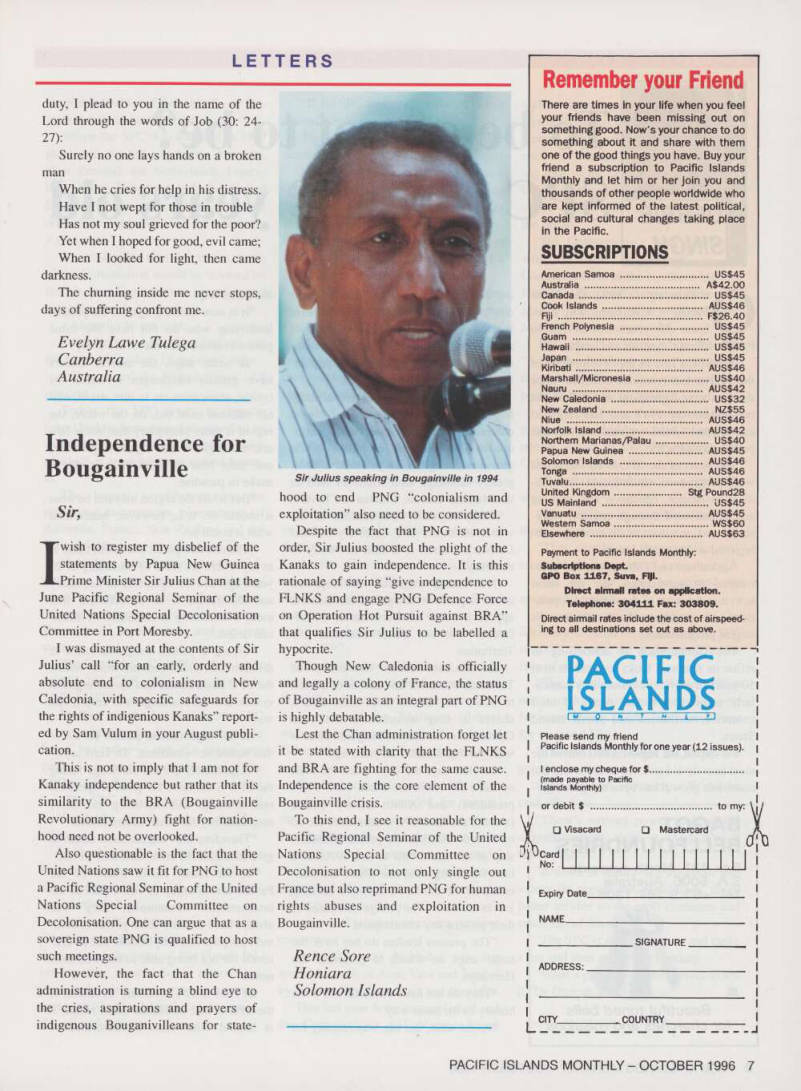
Sir Julius speaking in Bougainville in 1994
Advertisements & other items, p. 7 (1 item)
Pacific
Remember your Friend
There are times in your life when you feel your friends have been missing out on something good. Now’s your chance to do something about it and share with them one of the good things you have. Buy your friend a subscription to Pacific Islands Monthly and let him or her join you and thousands of other people worldwide who are kept informed of the latest political, social and cultural changes taking place in the Pacific.
SUBSCRIPTIONS
American Samoa US$45 Australia A$42.00 Canada US$45 Cook Islands AUS$46 Fiji F$26.40 French Polynesia US$45 Guam US$45 Hawaii US$45 Japan US$45 Kiribati AUS$46 Marshall/Micronesia US$40 Nauru AUS$42 New Caledonia US$32 New Zealand NZ$55 Niue AUS$46 Norfolk Island AUS$42 Northern Marianas/Palau US$40 Papua New Guinea AUS$45 Solomon Islands AUS$46 Tonga AUS$46 Tuvalu AUS$46 United Kingdom Stg Pound28 US Mainland US$45 Vanuatu AUS$45 Western Samoa WS$60 Elsewhere AUS$63 Payment to Pacific Islands Monthly: Subscriptions Dept.
GPO Box 1167, Suva, FIJI.
Direct airmail rates on application.
Telephone: 304111 Fax: 303809.
Direct airmail rates include the cost of airspeeding to all destinations set out as above.
PACIFIC
ISLANDS
t~5~ 0 x r h (. r Please send my friend Pacific Islands Monthly for one year (12 issues).
I enclose my cheque for $. (made payable to Pacific Islands Monthly) or debit $ to my: □ Visacard □ Mastercard JCard No: Expiry Date
1 NAME 1
I SIGNATURE I
. ADDRESS: I
1 CITY COUNTRY I
I I
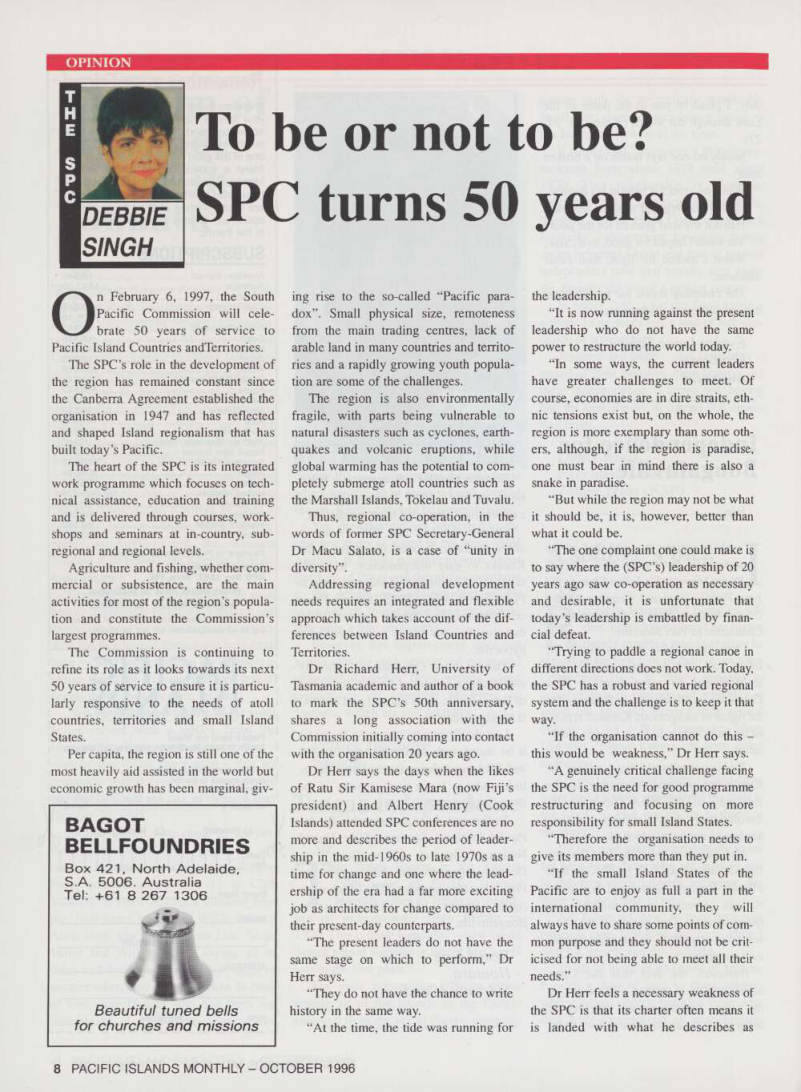
To be or not to be?
Opinion
SPC turns 50 years old
On February 6, 1997, the South Pacific Commission will cele brate 50 years of service to Pacific Island Countries and Territories.
The SPC’s role in the development of the region has remained constant since the Canberra Agreement established the organisation in 1947 and has reflected and shaped Island regionalism that has built today’s Pacific.
The heart of the SPC is its integrated work programme which focuses on tech nical assistance, education and training and is delivered through courses, work shops and seminars at in-country, sub
regional and regional levels.
Agriculture and fishing, whether com mercial or subsistence, are the main activities for most of the region’s popula tion and constitute the Commission’s largest programmes.
The Commission is continuing to refine its role as it looks towards its next 50 years of service to ensure it is particu larly responsive to the needs of atoll countries, territories and small Island States.
Per capita, the region is still one of the most heavily aid assisted in the world but economic growth has been marginal, giv
ing rise to the so-called “Pacific para dox”. Small physical size, remoteness from the main trading centres, lack of arable land in many countries and territo ries and a rapidly growing youth popula tion are some of the challenges.
The region is also environmentally fragile, with parts being vulnerable to natural disasters such as cyclones, earth quakes and volcanic eruptions, while global warming has the potential to com pletely submerge atoll countries such as the Marshall Islands, Tokelau and Tuvalu.
Thus, regional co-operation, in the words of former SPC Secretary-General Dr Macu Salato, is a case of “unity in diversity”.
Addressing regional development needs requires an integrated and flexible approach which takes account of the dif ferences between Island Countries and Territories.
Dr Richard Herr, University of Tasmania academic and author of a book to mark the SPC’s 50th anniversary, shares a long association with the Commission initially coming into contact with the organisation 20 years ago.
Dr Herr says the days when the likes of Ratu Sir Kamisese Mara (now Fiji’s
president) and Albert Henry (Cook
Islands) attended SPC conferences are no more and describes the period of leader ship in the mid-1960s to late 1970 s as a time for change and one where the lead ership of the era had a far more exciting job as architects for change compared to their present-day counterparts.
“The present leaders do not have the same stage on which to perform,” Dr Herr says.
“They do not have the chance to write history in the same way.
“At the time, the tide was running for
the leadership.
“It is now running against the present leadership who do not have the same power to restructure the world today.
“In some ways, the current leaders have greater challenges to meet. Of course, economies are in dire straits, eth nic tensions exist but, on the whole, the region is more exemplary than some oth ers, although, if the region is paradise, one must bear in mind there is also a snake in paradise.
“But while the region may not be what it should be, it is, however, better than what it could be.
“The one complaint one could make is to say where the (SPC’s) leadership of 20 years ago saw co-operation as necessary and desirable, it is unfortunate that today’s leadership is embattled by finan cial defeat.
“Trying to paddle a regional canoe in different directions does not work. Today, the SPC has a robust and varied regional system and the challenge is to keep it that way.
“If the organisation cannot do this this would be weakness,” Dr Herr says.
“A genuinely critical challenge facing
the SPC is the need for good programme restructuring and focusing on more responsibility for small Island States.
“Therefore the organisation needs to give its members more than they put in.
“If the small Island States of the Pacific are to enjoy as full a part in the
international community, they will
always have to share some points of com mon purpose and they should not be crit icised for not being able to meet all their needs.”
Dr Herr feels a necessary weakness of the SPC is that its charter often means it is landed with what he describes as
The Spc
Debbie
Singh
“unwanted babies of the region” - or pro jects that don’t have homes.
When the SPC was founded in 1947 there were six full members - Australia, New Zealand, the Netherlands, France, the United Kingdom and the United States - those metropolitan countries who were signatories to the Canberra Agreement.
It was decided then that the expenses of the Commission would be covered by the six founding member countries and would be divided as such: • Australia 30 per cent; • the Netherlands, New Zealand and the United Kingdom 15 per cent; and • France and the United States 12.5 per cent.
Today, the SPC draws its regular (core) budget from contributions of all its 26 member countries and territories, each of which is assessed on an agreed formu la.
The largest contributors are the
remaining metropolitan governments of
Australia, France, New Zealand and the United Sates.
Voluntary contributions (extra bud getary or non-core) are also provided by some member countries and territories, other governments, various aid agencies, international organisations and external sources.
The Commission’s 1996 budget totals 16,533,284 CFP units (approximately
SUSI 7 million).
Dr Herr says he does not see the SPC extra-budgetary funding as a “begging bowl” but rather as part of a global pro cess of responsibility on the part of the SPC and its donors.
“The SPC does not exist as a social welfare body - it is a catalytic organisa tion.
“I think it will survive the current belt-tightening period and will begin
sharing responsibility with other regional
organisations.”
On the SPC’s organisational review Dr Herr says he hopes the Commission does not go the way of the Forum fol lowing that organisation’s review last year and subsequent cost-saving mea sures which thereby reduced its opera tions by 40 per cent.
“If the SPC were to be reduced to this it would be disappointing.”
The Commission has changed shape considerably since 1947.
In 1943, William D Forsyth, then a research officer in the Australian External Affairs Department (and later the SPC’s first and fifth Secretary- General), in a report on the post-war Pacific, proposed the establishment of a South Seas Commission.
He envisaged a regional commission playing a similar role to the Caribbean Commission founded in 1942.
The story of the SPC’s evolution is best told through the development of its membership and that of the four sectors in its original structure: • The Commission proper; • the Research Council; • the South Pacific Conference; and • the Secretariat.
Only two of these bodies survive
today.
Temporary headquarters were set up in Sydney, Australia, after the signing of the Canberra Agreement.
At the Commission’s first formal meeting in May 1948 it was agreed a per manent headquarters needed to found and it was agreed that Noumea, New Caledonia, become the permanent site for the SPC.
The move was made almost immedi ately and without too much expense and, in 1949, a large wooden structure, face tiously named the Pentagon (former wartime headquarters of US Admiral Halsey) became the Commission’s new home.
But doubt existed about the life of the wooden buildings intended for tempo rary wartime occupation in a land where termites flourished and, despite constant renovation and maintenance, the state of the Pentagon deteriorated, maintenance costs climbed and the lack of office space to accommodate the Commission’s growing staff numbers became a pressing concern.
In 1992 it was decided a new site would be built at Anse Vata and funded by France, New Caledonia and Australia.
This has now been accomplished and the Commission’s 131 Noumea-based
staff have been moved into the new head quarters dubbed the “canoe” because its design evokes the importance of the ocean for Pacific Islanders and the curv ing roof of the conference building and library portray the hull of an upturned canoe while a reflecting pool symbolises the ocean.
The Commission’s 36th conference will be held in Saipan, in the Commonwealth of the Northern Mariana Islands in October/November and among agenda items will be a proposed name change for the Commission.
But, says Dr Herr, while the title “South Pacific Commission” may not be fully descriptive of the region it is a brand that is well recognised.
“If the SPC were a commercial enter prise, there would be a need to reassure people - sort of like the analogy that Coke is still Coke.
“Brand recognition is a valuable asset,” he said.
“The SPC has its scars but sometimes these become trophies.
“They should not, however, be cov ered with the make-up of a new name.”
And will the SPC be around for another 50 years?
According to the vision of its Secretary-General Dr Bob Dun, the SPC is about serving the region well in the face of change.
“The established role of the SPC is not something that’s going to disappear for many, many years - and maybe not for a second 50.
“Priorities may change but the need is going to be there.
“The regional approach will still be cost-effective.
“There’s nothing power seeking and aggrandisement about it. And it’s all achievable.
“It deals in reality. It’s all about ser vice to the region and, particularly, about better service to the atoll countries and small Island States.
“The SPC is going to bat on and make a ton and then go for the bowling.
“What a pity I won’t be around to see it,”Dr Dun says. ■
Advertisements & other items, p. 8 (1 item)
Bellfoundries
BAGOT
Box 421, North Adelaide, S.A. 5006. Australia Tel: +6l 8 267 1306 Beautiful tuned bells for churches and missions
reprieve
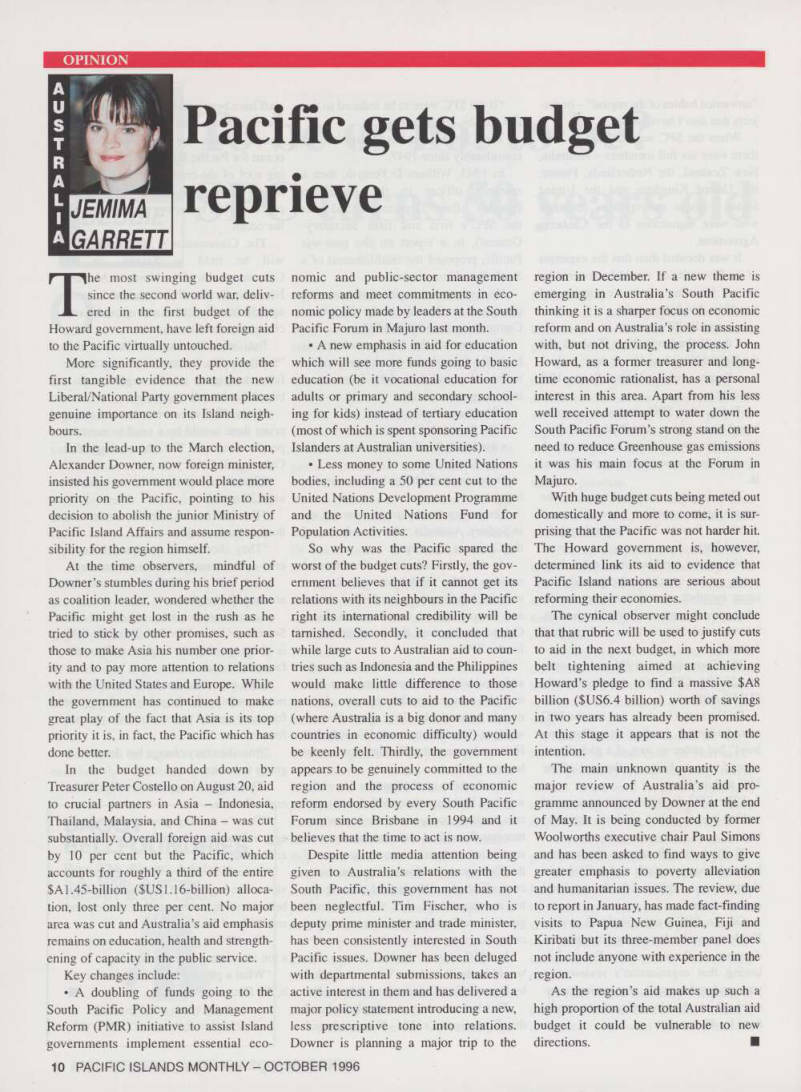
Pacific gets budget reprieve
The most swinging budget cuts since the second world war, deliv ered in the first budget of the Howard government, have left foreign aid to the Pacific virtually untouched.
More significantly, they provide the
first tangible evidence that the new Liberal/National Party government places genuine importance on its Island neigh bours.
In the lead-up to the March election, Alexander Downer, now foreign minister, insisted his government would place more priority on the Pacific, pointing to his decision to abolish the junior Ministry of Pacific Island Affairs and assume respon sibility for the region himself.
At the time observers, mindful of Downer’s stumbles during his brief period as coalition leader, wondered whether the Pacific might get lost in the rush as he tried to stick by other promises, such as those to make Asia his number one prior ity and to pay more attention to relations with the United States and Europe. While the government has continued to make great play of the fact that Asia is its top priority it is, in fact, the Pacific which has done better.
In the budget handed down by Treasurer Peter Costello on August 20, aid to crucial partners in Asia - Indonesia, Thailand, Malaysia, and China - was cut substantially. Overall foreign aid was cut by 10 per cent but the Pacific, which accounts for roughly a third of the entire $A 1.45-billion (SUS 1.16-billion) alloca tion, lost only three per cent. No major area was cut and Australia’s aid emphasis remains on education, health and strength ening of capacity in the public service.
Key changes include: • A doubling of funds going to the South Pacific Policy and Management Reform (PMR) initiative to assist Island governments implement essential eco
nomic and public-sector management reforms and meet commitments in eco nomic policy made by leaders at the South Pacific Forum in Majuro last month. • A new emphasis in aid for education which will see more funds going to basic education (be it vocational education for adults or primary and secondary school ing for kids) instead of tertiary education (most of which is spent sponsoring Pacific Islanders at Australian universities). • Less money to some United Nations bodies, including a 50 per cent cut to the United Nations Development Programme and the United Nations Fund for Population Activities.
So why was the Pacific spared the worst of the budget cuts? Firstly, the gov ernment believes that if it cannot get its relations with its neighbours in the Pacific right its international credibility will be tarnished. Secondly, it concluded that while large cuts to Australian aid to coun tries such as Indonesia and the Philippines would make little difference to those nations, overall cuts to aid to the Pacific (where Australia is a big donor and many countries in economic difficulty) would be keenly felt. Thirdly, the government appears to be genuinely committed to the region and the process of economic reform endorsed by every South Pacific Forum since Brisbane in 1994 and it believes that the time to act is now.
Despite little media attention being given to Australia’s relations with the South Pacific, this government has not been neglectful. Tim Fischer, who is deputy prime minister and trade minister, has been consistently interested in South Pacific issues. Downer has been deluged with departmental submissions, takes an active interest in them and has delivered a major policy statement introducing a new, less prescriptive tone into relations.
Downer is planning a major trip to the
region in December. If a new theme is emerging in Australia’s South Pacific thinking it is a sharper focus on economic reform and on Australia’s role in assisting with, but not driving, the process. John Howard, as a former treasurer and long time economic rationalist, has a personal interest in this area. Apart from his less well received attempt to water down the South Pacific Forum’s strong stand on the need to reduce Greenhouse gas emissions it was his main focus at the Forum in
Majuro.
With huge budget cuts being meted out domestically and more to come, it is sur prising that the Pacific was not harder hit.
The Howard government is, however, determined link its aid to evidence that Pacific Island nations are serious about reforming their economies.
The cynical observer might conclude that that rubric will be used to justify cuts to aid in the next budget, in which more belt tightening aimed at achieving Howard’s pledge to find a massive SAB billion (SUS 6.4 billion) worth of savings in two years has already been promised.
At this stage it appears that is not the intention.
The main unknown quantity is the major review of Australia’s aid pro gramme announced by Downer at the end of May. It is being conducted by former Woolworths executive chair Paul Simons and has been asked to find ways to give greater emphasis to poverty alleviation and humanitarian issues. The review, due to report in January, has made fact-finding visits to Papua New Guinea, Fiji and Kiribati but its three-member panel does not include anyone with experience in the
region.
As the region’s aid makes up such a high proportion of the total Australian aid budget it could be vulnerable to new directions. ■
Australia
Jemima
Garrett
minor parties
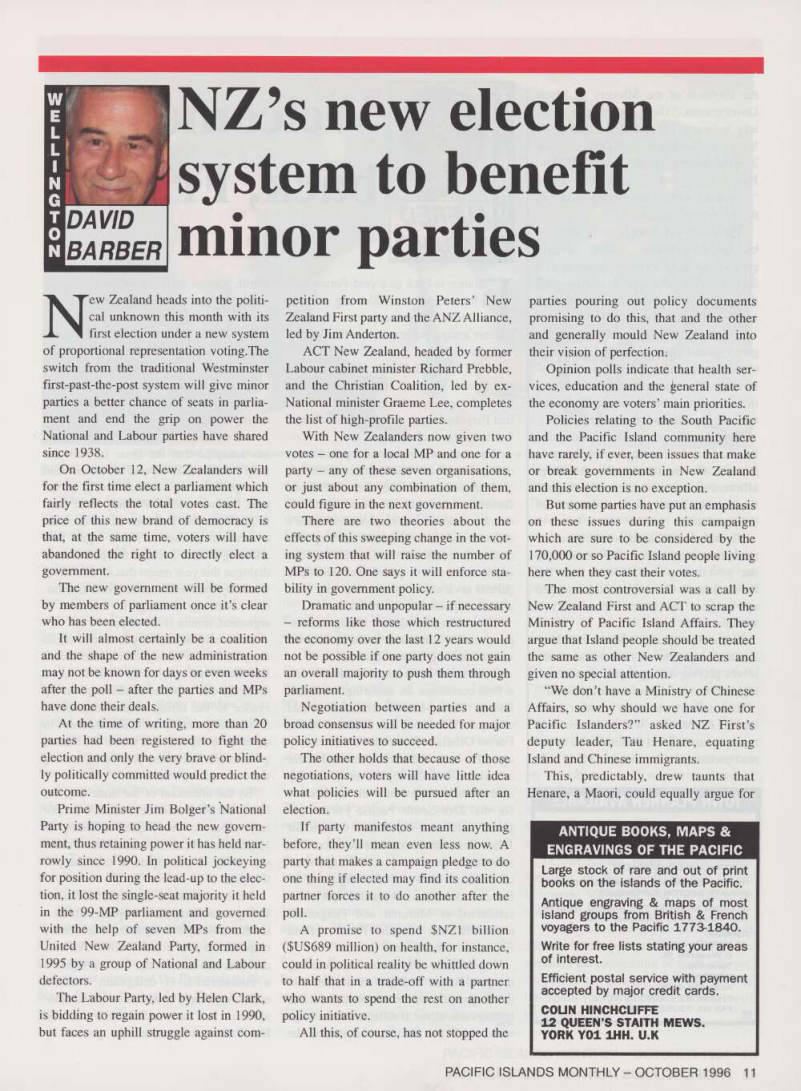
NZ’s new election system to benefit minor parties
New Zealand heads into the politi cal unknown this month with its first election under a new system
of proportional representation voting. The
switch from the traditional Westminster first-past-the-post system will give minor parties a better chance of seats in parlia ment and end the grip on power the National and Labour parties have shared since 1938.
On October 12, New Zealanders will for the first time elect a parliament which fairly reflects the total votes cast. The price of this new brand of democracy is that, at the same time, voters will have abandoned the right to directly elect a government.
The new government will be formed by members of parliament once it’s clear who has been elected.
It will almost certainly be a coalition and the shape of the new administration may not be known for days or even weeks after the poll - after the parties and MPs have done their deals.
At the time of writing, more than 20 parties had been registered to fight the election and only the very brave or blind ly politically committed would predict the outcome.
Prime Minister Jim Bolger’s National Party is hoping to head the new govern ment, thus retaining power it has held nar
rowly since 1990. In political jockeying
for position during the lead-up to the elec tion, it lost the single-seat majority it held in the 99-MP parliament and governed with the help of seven MPs from the United New Zealand Party, formed in 1995 by a group of National and Labour defectors.
The Labour Party, led by Helen Clark, is bidding to regain power it lost in 1990, but faces an uphill struggle against com
petition from Winston Peters’ New Zealand First party and the ANZ Alliance, led by Jim Anderton.
ACT New Zealand, headed by former Labour cabinet minister Richard Prebble, and the Christian Coalition, led by ex- National minister Graeme Lee, completes the list of high-profile parties.
With New Zealanders now given two votes - one for a local MP and one for a party - any of these seven organisations, or just about any combination of them, could figure in the next government.
There are two theories about the effects of this sweeping change in the vot ing system that will raise the number of MPs to 120. One says it will enforce sta
bility in government policy.
Dramatic and unpopular - if necessary - reforms like those which restructured the economy over the last 12 years would not be possible if one party does not gain an overall majority to push them through parliament.
Negotiation between parties and a broad consensus will be needed for major policy initiatives to succeed.
The other holds that because of those negotiations, voters will have little idea what policies will be pursued after an election.
If party manifestos meant anything before, they’ll mean even less now. A party that makes a campaign pledge to do one thing if elected may find its coalition partner forces it to do another after the poll.
A promise to spend SNZI billion (SUS6B9 million) on health, for instance, could in political reality be whittled down to half that in a trade-off with a partner who wants to spend the rest on another
policy initiative.
All this, of course, has not stopped the
parties pouring out policy documents
promising to do this, that and the other and generally mould New Zealand into their vision of perfection.
Opinion polls indicate that health ser vices, education and the general state of the economy are voters’ main priorities.
Policies relating to the South Pacific and the Pacific Island community here have rarely, if ever, been issues that make or break governments in New Zealand and this election is no exception.
But some parties have put an emphasis on these issues during this campaign which are sure to be considered by the 170,000 or so Pacific Island people living here when they cast their votes.
The most controversial was a call by New Zealand First and ACT to scrap the Ministry of Pacific Island Affairs. They argue that Island people should be treated the same as other New Zealanders and given no special attention.
“We don’t have a Ministry of Chinese Affairs, so why should we have one for Pacific Islanders?” asked NZ First’s deputy leader, Tau Henare, equating Island and Chinese immigrants.
This, predictably, drew taunts that Henare, a Maori, could equally argue for
Wellington
David
Barber
the abolition of the Ministry of Maori Development. “There are obvious paral lels between the problems faced by Maori and Pacific Islanders in New Zealand society,” said Labour MP Taito Phillip Field, who dubbed the calls a “calculated and inflammatory snub” to the Island community.
Pacific Island leaders were shocked by the suggestion, which seemed provocative in the extreme, ignoring as it did New Zealand’s special relation with the peoples of the Pacific and continuing responsibility for Tokelau and Nieu.
The National government - which has given special attention to the Island pop ulation’s disadvantaged state in employ ment, health, education and justice statis tics - reaffirmed its commitment to the ministry, as did the Labour Party.
And the Alliance produced a detailed Pacific Island affairs policy pledging to increase the ministry’s role and adopt affirmative action to reduce the dispari ties between Island people and the rest of the population.
It said the Alliance would give the ministry a more active role in advising the government and liaison with the Pacific Islands Council would be stepped up to give the Island community a stronger voice.
But real progress for Islanders in New Zealand depends, of course, on them selves playing a bigger part in national, regional and local government politics.
It remains to be seen whether more Pacific Island MPs will join their sole representative, Taito Phillip Field, in the next parliament after October 12. ■
Advertisements & other items, pp. 11-12 (1 item)
Antique Books, Maps &
ENGRAVINGS OF THE PACIFIC
Large stock of rare and out of print books on the islands of the Pacific.
Antique engraving & maps of most island groups from British & French voyagers to the Pacific 1773-1840.
Write for free lists stating your areas of interest.
Efficient postal service with payment accepted by major credit cards.
COUN HINCHCUFFE
12 QUEEN S STAITH MEWS.
YORK YOIIHH. U.K
TOWN PLANNER AVAILABLE
SPECIALIST IN HOUSING, URBAN AND
REGIONAL PLANNING
CURRENTLY EMPLOYED WITH THE
AUSTRALIAN GOVERNMENT.
NON-GOVERNMENT ORGANISATION AND
PRIVATE SECTOR EXPERIENCE
SEEKING WORK IN THE PACIFIC REGION
from February to November 1997.
Contact:
HARVEY WALSH
6 Waverley St.
Teneriffe
BRISBANE
Australia 4005
PHONE 61 73360 2938
FAX 61 73252 2808
back, France
Welcome back, France
France is back as a post-Forum dia logue partner, following an 11month suspension over its 1995 nuclear testing programme in the Pacific.
Welcome back!
The 27th South Pacific Forum summit in Majuro, Marshall Islands, decided to lift the suspension, having satisfied itself that Paris had made good on a number of fronts on the nuclear issue.
The decision to suspend a post-Forum dialogue partner was unprecedented. It was announced at the United Nations General Assembly in New York on October 2 last year in response to France’s defiance of an ultimatum to stop the nuclear test series or face the rist of hav ing its status as a post-Forum dialogue partner reviewed. It was taken only after all other options were exhausted.
No one argued against lifting the sus pension. But some were taken by surprise with the timing. It was so soon.
Prior to the 1996 South Pacific Forum, a firm consensus on restoring the South Pacific Forum-French connection had emerged. That stand was endorsed by the Forum Officials Committee which rightly agreed to leave the issue to the leaders for a final decision. On September 4 - the day of the Leaders’ Retreat - the spokesman for the 27th South Pacific Forum and prime minister of Papua New Guinea, Sir Julius Chan, announced the decision. The announcement came just two days short of the anniversary of the beginning of France’s controversial nuclear test series conducted at Mururoa and Fangataufa atolls in the South Pacific from September 6 last year.
It was made clear to the French during the post-Forum dialogue in Majuro that the suspension was made on the nuclear testing issue alone. It reflected the outrage with which the Pacific, and indeed the
world, viewed the resumption of nuclear tests. No one should be mistaken about the fact that the region and, indeed the world, viewed with outrage, France’s decision to resume nuclear testing last year. Hence, the suspension of its dia logue-partner status was a significant and effective part of the Pacific’s anti-nuclear testing campaign.
All that said, the South Pacific Forum has accepted that the issue is well and truly behind us. The world moves on. And it is pointless to continue living in the past. It never returns. We only learn from it. There are pros and cons on the decision to readmit France. Critics argue that allowing France back in the post-Forum dialogue this year meant that all the strong words by the Pacific leaders had amount ed to virtually nothing. In this line of argument, timing is the issue.
In their view, allowing France to rejoin the post-Forum dialogue this year meant that Paris had got away with it. Let’s focus for one moment on the response by France to the lifting of the suspension.
Swift was probably an understatement to describe the speed with which the French government machinery reacted on hearing the news on September 4.
By the afternoon of the same day, the South Pacific Forum Secretariat’s tempo rary office in the Capitol Building in Majuro had been informed that France was ready to participate in the dialogue this year.
Michel Bamier - the French Minister Delegate in Paris for European Affairs led his country’s delegation. The French response to the South Pacific Forum’s decision was interesting. Putting together a ministerial-level delegation at short notice, especially to attend an internation al Forum half the world away, is not easy.
But France reciprocated the gesture by
The Forum
Alfred
Sasako
putting together a seven-person delega tion for the 1996 post-Forum dialogue.
Why is France so keen to hold dia logue with the South Pacific Forum so soon after its suspension was lifted? After all, it is a world power, economically and
militarily.
Its readiness to resume dialogue at very short notice appears to signify the importance Paris now attaches to the South Pafcific Forum’s support and role in international affairs. And rightly so.
It is also indicative of the importance both sides view each other with. In other words, the need to work together in a global environment usually demarcated by regional interests and historical associ ations far outweighs all other considera tions, including past actions.
France’s role in the Pacific at a time when others are retreating at the speed of light is also important. It is still in com mand of situations in both New Caledonia and Tahiti Nui. Its co-operation is required in this and other areas both at multilateral and bilateral levels.
Other developments such as the announcement in Paris earlier in the year of a permanent end to its nuclear testing programme in the South Pacific and its subsequent signing of the Protocols to the South Pacific Nuclear Free Zone Treaty were also significant.
France’s co-operation in the radiologi cal study of its nuclear test sites in French Polynesia and its assistance in facilitating the recent visit to New Caledonia by the Forum Ministerial Committee were also acknowledged. Important as it is, the issue of restoring France’s status as a postpartner was by no means the only matter decided by the South Pacific Forum. Nor is it the only impor tant post-Forum dialogue partner.
The other seven members of the post- Forum dialogue - Canada, Japan, the People’s Republic of China, United Kingdom, United States of America, the European Union and South Korea - are equally important in terms of their contin uing interests and participation in the eco nomic development of the Pacific.
Japan, for instance, signed during the
27th South Pacific Forum, an agreement establishing the Pacific Islands Centre in
Tokyo, fulfilling a longstanding goal of
the South Pacific Forum to encourage trade, investment and tourism between Japan and Forum Island Countries (FICs).
Japan provides, on an annual basis, around SUS6OO,OOO for programmes administered by the Suva-based South Pacific Forum. Canada, another post- Forum dialogue partner, confirmed agree ment to provide up to SCANI4 million (SUSIO.3 million) on its Ocean Resources
Assistance Programme to the South Pacific region Over the next five years.
The main aim of the programme is to assist in the management and protection of the region’s living marine resources consistent with the priorities identified by the region under the Regional Strategy process. An Aide Memoire recording the agreement was signed in Majuro, Republic of the Marshall Islands, during
the annual post-Forum dialogue by the
Honiara-based Forum Fisheries Agency; the South Pacific Regional Environment Programme based in Apia, Western Samoa; the University of the South Pacific and South Pacific Forum Secretariat, both based in Suva.
On economic issues, the leaders agreed on a wide range of measures aimed at achieving further progress in both eco nomic reform and development, which they felt was so critical to the future ben efits of their six million island inhabitants.
In this regard, there will be regular meetings of the South Pacific Forum Economic Ministers, with the first to be held in Australia next year.
Among other things, the ministers will consider the appropriate next steps to maintain the momentum of tariff reforms.
As part of the process, the policy role of the South Pacific Forum Secretariat will be strengthened. ■
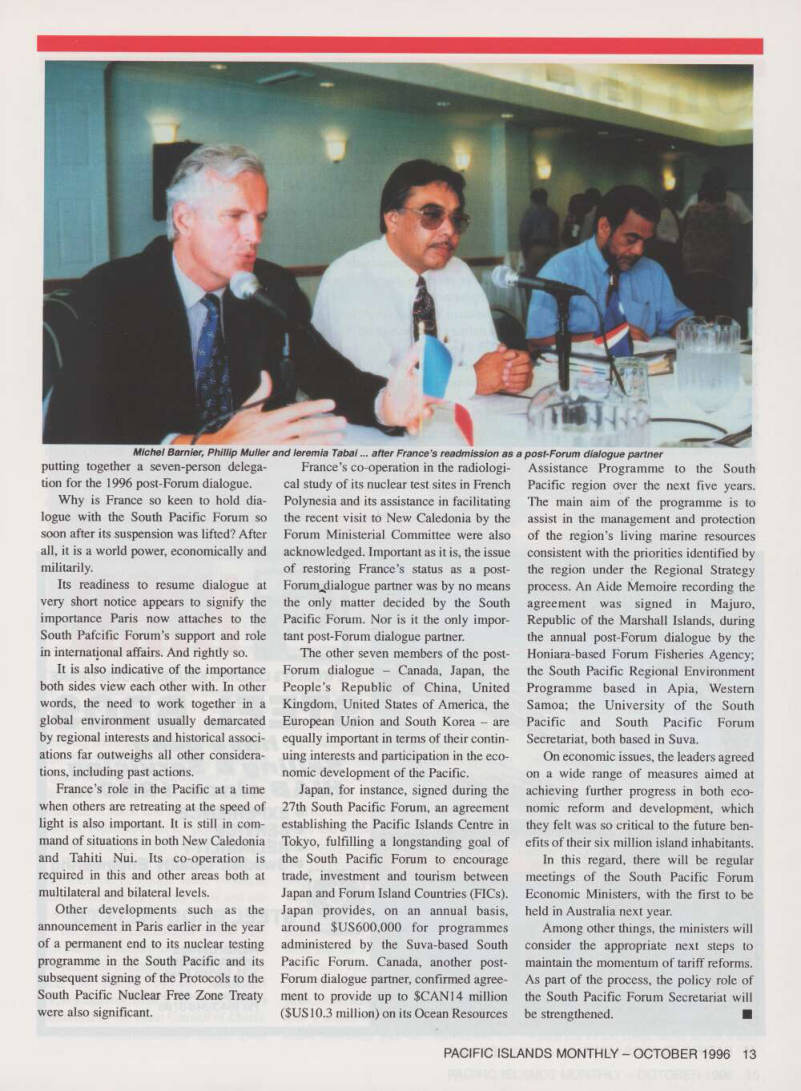
Michel Barnier, Phillip Muller and leremia Tabai...after France’s readmission as a post-Forum dialogue partner
On the brink of change

Special Report
Nearly a decade after Fiji’s military coups the nation waits with bated breath to see what effect the Constitution Review Commission’s report will have on the nation
By Yunus Rashid
On May 14, 1987, at around 10am the then Lieutenant Colonel Sitiveni Rabuka stormed into Fiji’s parliament, loaded the Fiji Labour Party/National Federation Party Indian dominated government on to the back of a waiting army truck and established a mil itary regime because, he claimed, Fijian sovereignty was under threat. This was done with the powerful M-16 automatic rifles.
Last month, on September 10, the now Prime Minister Sitiveni Rabuka tabled the 1990 Constitution Review Commission’s report in parliament, seeking the support of the nation in implementing its recom mendations in the next 10 months to end
the indigenous dream of “Fiji For Fijians” and establish the democratic rule that existed in pre-coup days. This was done with diplomacy.
The coup left Fiji’s future at the mercy of a military regime headed by Rabuka.
Within a few months of the coup, Fiji had started feeling the pinch of international trade sanctions within a few months of the coup.
In December 1987, Rabuka decided to hand over the reins to Ratu Sir Kamisese Mara - the man who had ruled Fiji for 16 years after its independence.
Fiji’s ties with the Commonwealth and its benefits were severed when it was declared a republic in September, 1987, and the 1970 Constitution was nullified by
means of a decree.
In 1990, Fiji received a constitution which was supposed to bring to reality the aspirations of the indigenous and realise the objectives of the two military coups.
Merely six years after the 1990 Constitution and having to bow to interna tional pressure, Rabuka stood as prime minister and tabled the Constitution Review Commission’s report, which would essentially see the establishment of
a truly democratic society if implemented.
The report provides a formula which would see the indigenous make economic progress at the same pace as the rest of the country and allocates parliamentary seats in a way that would make a government of national unity the most appropriate form
of government. The 1990 Constitution weighed heavily in favour of indigenous Fijians and marginalised the Indians, con demning them to an eternal life in opposi tion. The 1990 Constitution stipulated that Fijians be given 37 seats, Indians 27 seats.
General Electors five seats and Rotumans one seat. It stated that the prime minister must be Fijian and that the president be a nominee of the Great Council of Chiefs.
The commission report recommends that there be 12 Fijians seats, 10 Indian seats, two General Elector seats and one Rotuman seat.
The review commission further says that ethnicity should not be a qualification for prime ministership and that the presi dent be elected by the House of Representatives from a list of nominees submitted by the Great Council of Chiefs.
The recommendations place great
emphasis on the Bill of Rights, thus nulli
fying positive discrimination concepts
and other clauses which might allow for discrimination against any race.
Between May 14, 1987 and September 10, 1996, a lot has happened in the poli tics of Fiji.
The interim government ruled for five years and Rabuka shed his green uniform in favour of civilian clothes to enter poli tics. He became the president of the ruling Soqosoqo ni Vakavulewa ni Taukei Party, which was sponsored by the Great Council of Chiefs. The FLP/NFP coalition prime minister. Doctor Timoci Bavadra, died, and his widow, Adi Kuini Bavadra, took over. After remarrying, Adi Kuini quit the political scene for about two years, returning in 1994. The economy took a severe beating because of interna tional sanctions and the withdrawal of
business by traditional trading partners such as New Zealand and Australia.
Indian business people became peripheral in economic considerations and private investment dwindled. Overseas invest ments came mostly in the form of fly-by night operators who left after making a quick buck at the expense of local Fijian shareholders. A racist constitution cou pled with the uncertainty prevailing over the Agricultural Landlords and Tenants Act (ALTA) did not provide the right combination for an ideal investment opportunity as far as foreign investors were concerned.
Crime blossomed and unemployment thrived. Countless scandals shook the country. But the government maintained its hold.
The marriage of the FLP and NFP, which led to the coup, broke down when
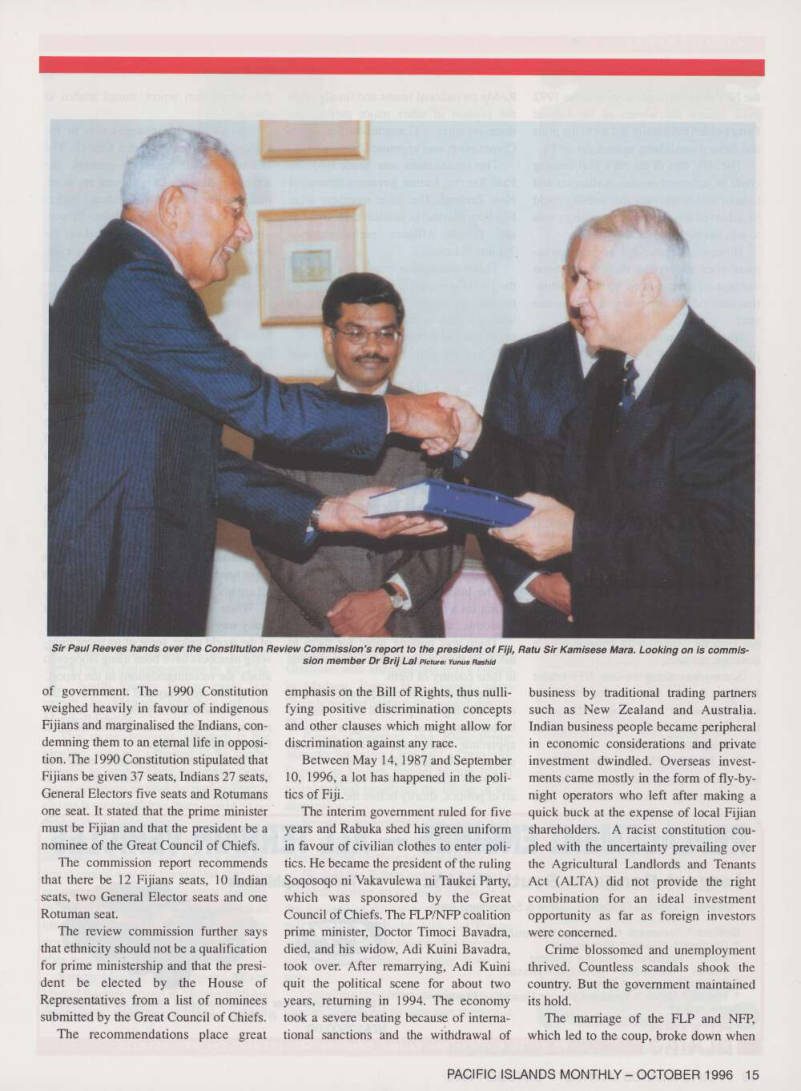
Sir Paul Reeves hands over the Constitution Review Commission’s report to the president of Fiji, Ratu Sir Kamisese Mara. Looking on is commis sion member Dr Brij Lai Picture: Yunus Rashid
the NFP decided to participate in the 1992 polls against the wishes of the Labour Party (which eventually did go to the polls and fielded candidates against the NFP).
The NFP was of the view that nothing could be achieved outside parliament and Labour was of the view that nothing could be achieved inside. Labour’s strategy was to win but boycott parliament.
However, Labour did go into parlia ment after supporting Rabuka as prime minister on the condition that the constitu tion and ALTA be reviewed within one year.
But this support did not last long as patience was not a Labour virtue nor urgency a Rabuka trait.
Eighteen months after Rabuka assumed power, a group of eight people from within the SVT ranks, headed by Josevata Kamikamica, who was aspiring to be prime minister before the general elections, voted against the budget and brought down the government.
But the SVT returned to parliament with a majority win and Rabuka continued as prime minister.
Kamikamica has lost four by-elections since.
During this time, racial biases contin ued in the form of affirmative action for Fijians and Rotumans and, to some extent, the General Voters, who became SVT’s coalition partners.
Somewhere along the line, NFP leader Jai Ram Reddy, who was never overly
optimistic about an overnight change in
the Fijian outlook towards Indians, befriended Rabuka.
This friendship became obvious early last year and continues to date. It saw more meetings between Rabuka and
Reddy on national issues and finally, with the support of other major parties, the three-member Constitution Review Commission was appointed.
The commission was headed by Sir Paul Reeves, former governor-general of New Zealand. The other members were Fiji-born Australian academic Dr Brij Lai and former Alliance parliamentarian Tomasi Vakatora.
Theirs was a clear instruction: Review the 1990 Constitution in line with interna
tionally acceptable democratic principles
while keeping in mind the sovereignty of the Fijian and Rotuman peoples.
When the commission started taking submissions, many radical Fijian groups, including the ruling SVT party, made no bones about wanting complete control.
The SVT was much in favour of the Malaysian Bhumi Putra concept ingrained in their constitution much to the annoy ance of the other races.
The Malaysian influence incited the Fiji Muslims to ask for separate seats four, to be exact.
The submissions reflected, sadly, that some people of Fiji were not ready for
political stability or equality.
The Indians, in general, were merely asking for a fair share of the political and economic cake.
There was nothing more for them to ask from their status as third-class citizens in their country of birth.
The submissions clearly reflected that despite being in a political and economic limbo, many were not willing or ready to appreciate their cultural diversity and accept a truly multiracial society.
But by some strange workings of the art of politics, shortly before the release of
the commission report, things started to
change.
One of the first changes was in the leadership of the Methodist Church. The militant former secretary-general, the Reverend Manasa Lasaro, was replaced, much to the relief of many church elders and the country, by the Rev Ilaitia Tuwere - the man who has clearly spelled out the separation of the church from the ever changing politics of the country and that the holy mission of the church cannot be paralleled with the drudgery of politics.
The second was a closer consultation between Rabuka and Reddy over the report and the resulting positive state ments made by both leaders.
The third was the reformation of the Taukei movement (an indigenous group associated with much violence during the military coups) which said it would counter any civil disobedience as a result of the release of the report.
The fourth was a warning issued by Rabuka that any attempts by radicals to derail the constitution reform process would be met with serious action.
It suddenly began to appear that things were heading back to pre-coup days. But all are not pleased with this turn of events.
While the SVT government has in many ways come to terms with the reality of the world order, some of its more right wing members have been using stooges to attack the recommendations in the report.
Fiji can only pray and hope that in the next 10 months, everybody will come to realise the nation cannot live in isolation
from the global village.
Fiji has been given another chance to be the way the world should be, and it should take it. ■
Advertisements & other items, pp. 14-16 (1 item)
Steel Bros
I / Ipß ■ >■ • ■< v*-
THE WORLD’S LEADING KNUCKLE BOOM CRANE
have bean
Sailing A Servicing
HiAB since 1960 ...
• EXPERIENCE
• SERVICE
• RELIABILITY
STEELBRO
• Swedish Quality Engineering
STEEL BROS (NZ) LTD
HEAD OFFICE
CHRISTCHURCH:
1-31 Treffers Road Sockbum Telephone (64-3) 348-8499 Fax (64-3)348-5786
REPLACEMENT ENGINES - ALL TERRAIN VEHICLES!
Largest Range in South Pacific
Diesels Petrols—Gearboxes New & Secondhand Parts Bedford * Cummins * Daihatsu * Detroit Ford * Gardner * Honda * Hino Isuzu * Iveco * Komatsu * Kubota Leyland + Mazda * Mercedes * Mitsubishi Nissan * Perkins * Scania * Subaru Suzuki * Toyota * Volvo * Yanmar Cylinder Heads Starters Same rebuilt
Fully Amphibious
/// Travels beyond other form of transport carries up to 6 people or 453kgs 6 and 8 wheel units All wheel drive from NZ512500.00 PO Box 14, Geraldine, New Zealand. Telephone (643) 693-8122. Fax (643) 693-8120
French fallout
Cover Stories
The end of the French fallout
The South Pacific Forum makes up with France after suspending it as a post-Forum dialogue partner less than a year ago
By Bernadette Hussein
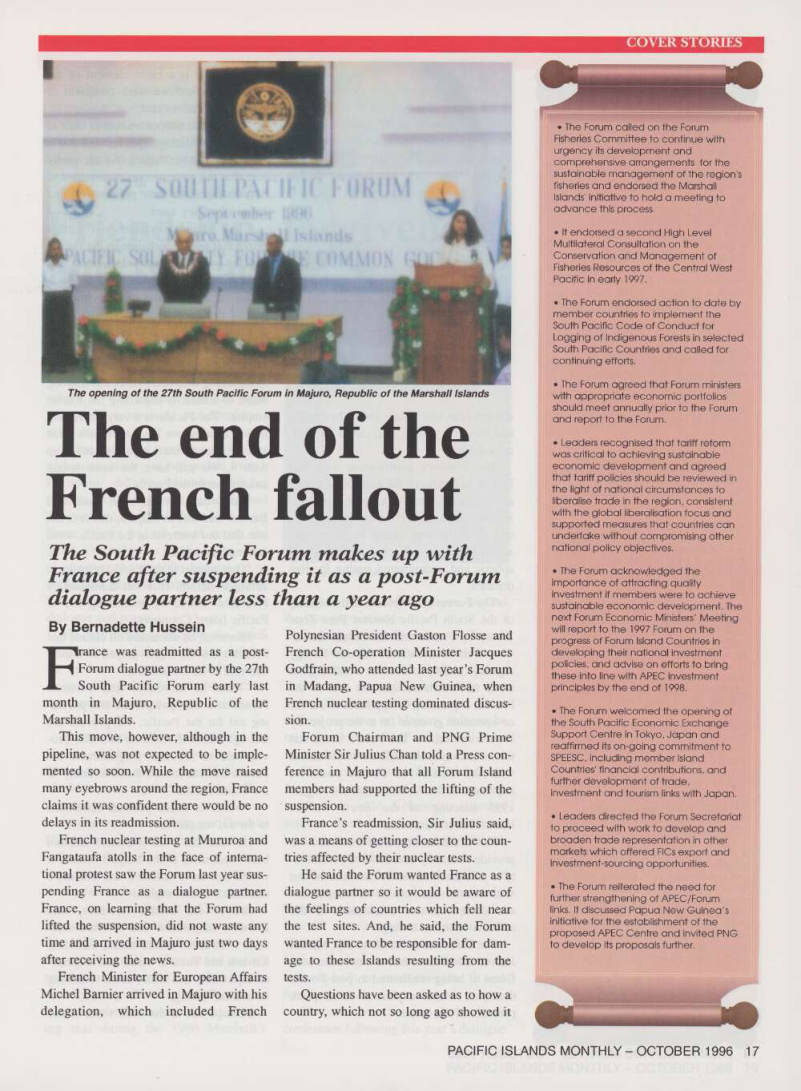
France was readmitted as a post- Forum dialogue partner by the 27th South Pacific Forum early last month in Majuro, Republic of the Marshall Islands.
This move, however, although in the pipeline, was not expected to be imple mented so soon. While the move raised many eyebrows around the region, France claims it was confident there would be no delays in its readmission.
French nuclear testing at Mururoa and Fangataufa atolls in the face of interna tional protest saw the Forum last year sus pending France as a dialogue partner.
France, on learning that the Forum had lifted the suspension, did not waste any time and arrived in Majuro just two days after receiving the news.
French Minister for European Affairs Michel Bamier arrived in Majuro with his delegation, which included French
Polynesian President Gaston Flosse and
French Co-operation Minister Jacques
Godfrain, who attended last year’s Forum in Madang, Papua New Guinea, when French nuclear testing dominated discus sion.
Forum Chairman and PNG Prime Minister Sir Julius Chan told a Press con ference in Majuro that all Forum Island members had supported the lifting of the
suspension.
France’s readmission. Sir Julius said, was a means of getting closer to the coun tries affected by their nuclear tests.
He said the Forum wanted France as a dialogue partner so it would be aware of the feelings of countries which fell near the test sites. And, he said, the Forum wanted France to be responsible for dam age to these Islands resulting from the tests.
Questions have been asked as to how a country, which not so long ago showed it
• The Forum called on the Forum Fisheries Committee to continue with urgency its development and comprehensive arrangements for the sustainable management of the region's fisheries and endorsed the Marshall Islands' initiative to hold a meeting to advance this process. • It endorsed a second High Level Multilateral Consultation on the Conservation and Management of Fisheries Resources of the Central West Pacific in early 1997. • The Forum endorsed action to date by member countries to implement the South Pacific Code of Conduct for Logging of Indigenous Forests in selected South Pacific Countries and called for continuing efforts. • The Forum agreed that Forum ministers with appropriate economic portfolios should meet annually prior to the Forum and report to the Forum. • Leaders recognised that tariff reform was critical to achieving sustainable economic development and agreed that tariff policies should be reviewed in the light of national circumstances to liberalise trade in the region, consistent with the global liberalisation focus and supported measures that countries can undertake without compromising other national policy objectives. • The Forum acknowledged the importance of attracting quality investment if members were to achieve sustainable economic development. The next Forum Economic Ministers' Meeting will report to the 1997 Forum on the progress of Forum Island Countries in developing their national investment policies, and advise on efforts to bring these into line with APEC investment principles by the end of 1998. • The Forum welcomed the opening of the South Pacific Economic Exchange Support Centre in Tokyo, Japan and reaffirmed its on-going commitment to SPEESC, including member Island Countries' financial contributions, and further development of trade, investment and tourism links with Japan. • Leaders directed the Forum Secretariat to proceed with work to develop and broaden trade representation in other markets which offered FICs export and investment-sourcing opportunities. • The Forum reiterated the need for further strengthening of APEC/Forum links. It discussed Papua New Guinea's initiative for the establishment of the proposed APEC Centre and invited PNG to develop its proposals further.
The opening of the 27th South Pacific Forum in Majuro, Republic of the Marshall Islands
• The Forum highlighted its concern that climate change had become a crucial issue and called for urgent action, particularly in view of the Second Assessment Report of the Intergovernmental Panel on Climate Change (IPCC) which stated that the balance of scientific evidence suggested a discernible human influence on the global climate, It called for negotiations on the text of a legally binding protocol to be completed in time for adoption at the Third Session of the Conference of the Parties in order to achieve significant progress towards the goal of lower greenhouse gas emissions. • The Forum called upon the United Nations Development Programme and the Global Environment Facility for the extension of the funding period for the South Pacific Biodiversity Conversation Programme (SPBCP) to provide adequate time for community-based conservation activities to build effective community management groups, • Forum members resolved to continue their support for the Regional Marine Turtle Conservation Programme and to examine further ways of working together to enhance conservation efforts. • The Forum called on member countries and development partners to recognise the Pacific region's 1997 "Year of the Coral Reef" and to encourage participation in its development and implementation. • The five-yearly ministerial meeting of SPREP (November, 1996) will consider and adopt an action plan for regional co-operation In environmental management over the next five years, • Forum leaders called on development partners to support regional efforts to address coastal protection. • The Forum agreed that shipments of plutonium and radioactive wastes through the region posed a continuing concern and that such shipments should be carried out in accordance with the highest international safety and security standards in a manner which satisfactorily addressed all possible contingencies and in consultation with Forum Countries. • The Forum noted that, despite the longstanding regional opposition to the use of the Pacific as a dumping ground for wastes and the adoption of the Waigani Convention, new proposals for creating storage sites for nuclear wastes in the region were emerging. The Forum also reiterated its opposition that Palmyra be used to develop a storage site for spent nuclear fuel and reaffirmed
did not care very much about the Pacific and how its people felt, could be wel comed back.
The Forum’s justification was that France had reduced the number of nucle ar tests from eight to six and that its per manent cessation of testing marked the end to all nuclear testing in the region, which has been subjected to both atmo
spheric and underground testing for five
decades.
The Forum also welcomed the signing of the South Pacific Nuclear Free Zone Treaty by France and the French invita tion to the International Atomic Energy Agency (lAEA) to conduct a radiological study of French nuclear test sites in the Pacific, expressing its appreciation for the co-operation given so far to the project by French authorities. The Forum noted that the invitation to the lAEA was consistent with the desires of Forum countries expressed in the declaration of the August 1995 meeting of the South Pacific Environment Ministers.
The declarataion called on France to provide access by international communi ty to all French scientific data and the test sites themselves to enable an independent and comprehensive assessment of the effects of nuclear testing.
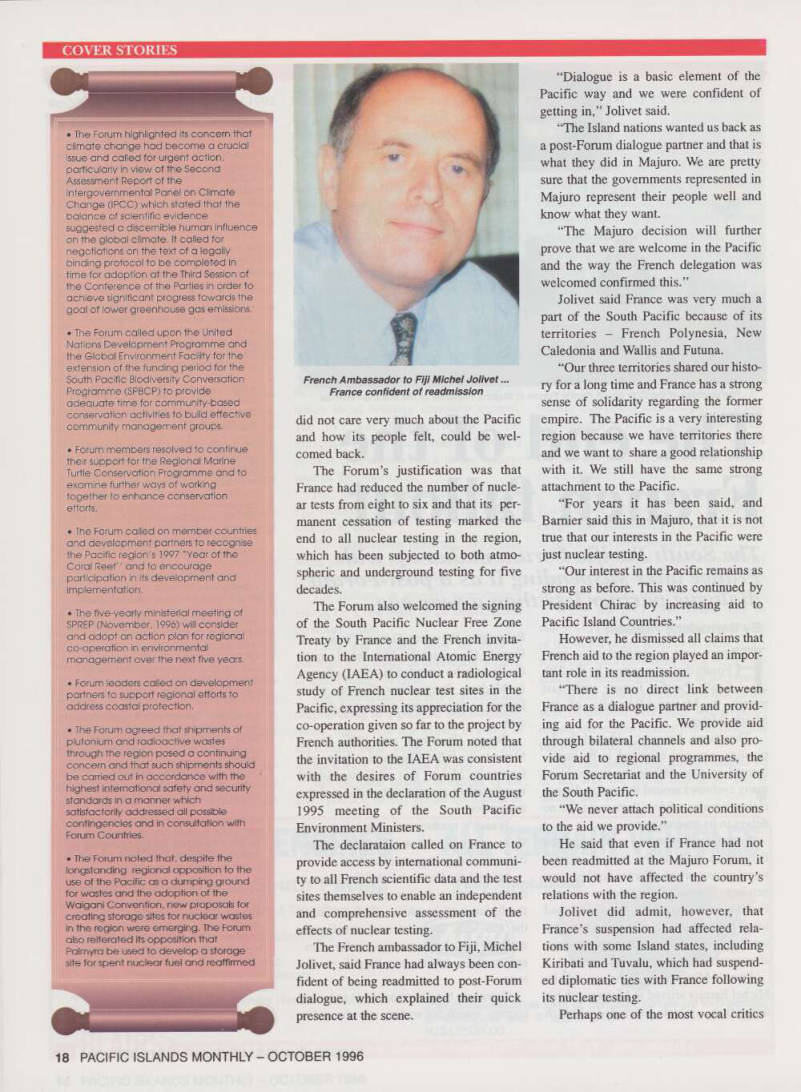
The French ambassador to Fiji, Michel Jolivet, said France had always been con fident of being readmitted to post-Forum
dialogue, which explained their quick
presence at the scene.
“Dialogue is a basic element of the Pacific way and we were confident of getting in,” Jolivet said.
“The Island nations wanted us back as a post-Forum dialogue partner and that is what they did in Majuro. We are pretty sure that the governments represented in Majuro represent their people well and know what they want.
“The Majuro decision will further prove that we are welcome in the Pacific and the way the French delegation was welcomed confirmed this.”
Jolivet said France was very much a part of the South Pacific because of its territories - French Polynesia, New Caledonia and Wallis and Futuna.
“Our three territories shared our histo ry for a long time and France has a strong sense of solidarity regarding the former empire. The Pacific is a very interesting region because we have territories there and we want to share a good relationship with it. We still have the same strong attachment to the Pacific.
“For years it has been said, and Bamier said this in Majuro, that it is not true that our interests in the Pacific were
just nuclear testing.
“Our interest in the Pacific remains as strong as before. This was continued by President Chirac by increasing aid to Pacific Island Countries.”
However, he dismissed all claims that French aid to the region played an impor tant role in its readmission.
“There is no direct link between France as a dialogue partner and provid ing aid for the Pacific. We provide aid through bilateral channels and also pro vide aid to regional programmes, the Forum Secretariat and the University of the South Pacific.
“We never attach political conditions to the aid we provide.”
He said that even if France had not been readmitted at the Majuro Forum, it would not have affected the country’s relations with the region.
Jolivet did admit, however, that France’s suspension had affected rela tions with some Island states, including Kiribati and Tuvalu, which had suspend ed diplomatic ties with France following its nuclear testing.
Perhaps one of the most vocal critics
French Ambassador to Fiji Michel Jolivet...
France confident of readmission
of France’s readmission has been the Greenpeace movement, which claims that though France’s re-entry was never in doubt, it was disappointing that the Forum did not wait at least a year before lifting
the suspension.
“Such a delay would have demonstrat
ed the Forum’s seriousness about France’s indifference to the region’s opposition to nuclear testing. While France’s nuclear testing has ended in the Pacific, the prob lems are not over. The issue of clean-up and compensation has still to be resolved,” Greenpeace said. ■
Friendship, forgiveness
and fast action
By Michael Field
Great moments in history can have modest beginnings and for Madame Suzanne Tee-vwissen, settling her children into a new Paris high school, it was marked with her pager going off, summoning her translator’s skills urgently.
What happened next was a piece of diplomatic history as top-ranked French European Affairs Minister Michel Bamier, with diplomats, officials and Teevwissen in tow, boarded a French Air Force Falcon jet and raced across the globe. The seductive Pacific, after a year of spuming the republic because of its unpleasant personal habits at Mururoa, had invited France back into bed to make dialogue and peace.
He was heading back to the South Pacific Forum dialogue session delight ed, as Bamier put it, because President Jacques Chirac had “an attachment... for the men and women of the Pacific, an area he loved”.
Strange kind of love to blow it up, but Bamier said he was turning a new page.
The rushed trip, at the personal insistence of Chirac, was a grand gesture of affec tion and love.
Sitting in the new Outrigger Hotel in Majuro, it was plain the Pacific was back in love with the French too, or perhaps their francs...
Bamier had a lot more going for him
than hapless French Cooperation
Minister Jacques Godfrain, who attended the 1995 post-Forum dialogue in Port Moresby, Papua New Guinea and saw his country tossed out. With nuclear bombs actually going off around that Forum, his was an impossible task and it was intrigu ing that during the 1996 Marshall’s
Forum he was in Mozambique, beyond the best pager’s range.
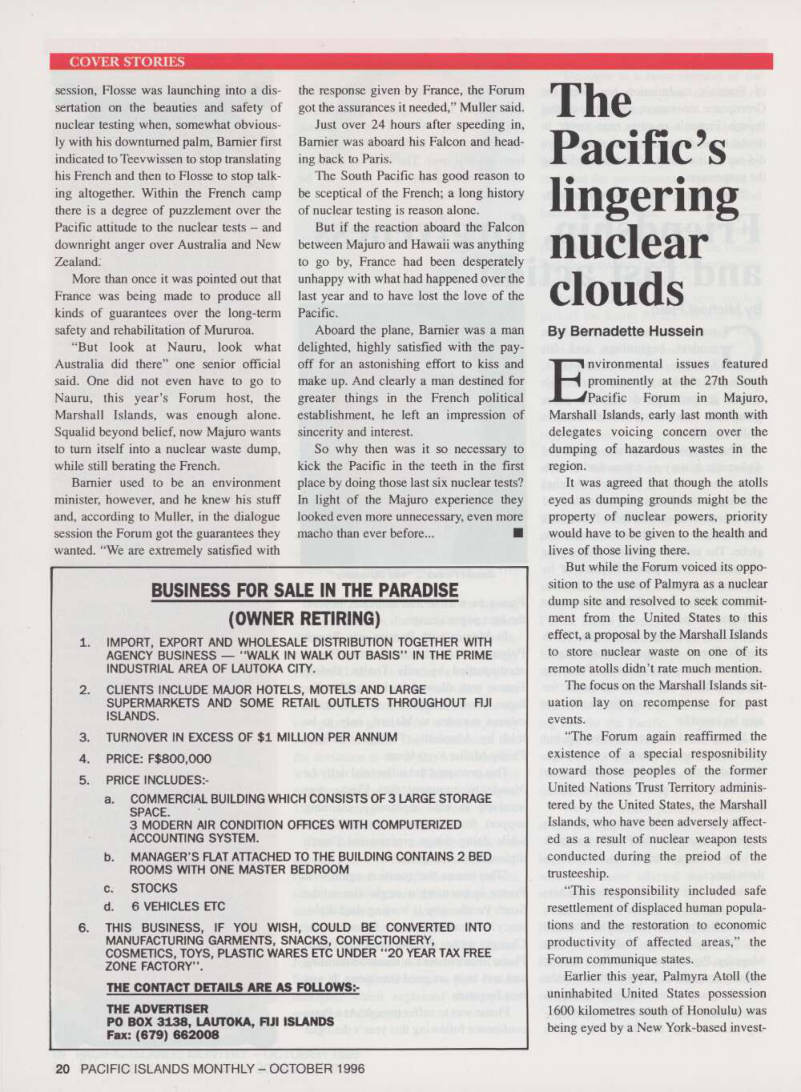
In Majuro with Bamier was French Polynesian President Gaston Flosse accompanied by wife Tonita. Before France was allowed back into the dia logue, Flosse despatched an aide and a cabinet minister to Majuro, only to be told by Marshalls Foreign Minister Phillip Muller to go home.
This prompted the influential daily Le Monde to comment that Flosse was involved in wild diplomacy, claiming support from long-time friend Chirac
while doing things professional French
diplomats would spurn.
“This raises the question again - if France is pursuing a single aim in the South Pacific why is it using dual diplo macy?” correspondent Florence de Changy wrote. Bamier said the latest Flosse incident was a misunderstanding and was built on good intentions. It was
best forgotten.
Flosse was to suffer though. At a Press conference following this year’s dialogue
the existence of a special responsibility toward the Marshallese who had been adversely affected as a result of nuclear tests conducted during the period of the United States trusteeship. • Forum leaders expressed satisfaction at the permanent cessation of French nuclear testing in the South Pacific and the signature and ratification by Vanuatu of the South Pacific Nuclear Free Zone Treaty. • Forum leaders welcomed the completion of the report on the Canberra Commission on the Elimination of Nuclear Weapons. • The Forum noted France's invitation to the International Atomic Energy Agency (lAEA) to conduct a radiological study of French nuclear testing sites in the Pacific and expressed its appreciation for the co-operation given so far to the project by the French authorities, • Leaders gave full support to the adoption of the Comprehensive Test Ban Treaty by the current session of fhe UN General Assembly and called on all other members of the international community to do likewise. • The Forum expressed concern over the continuing threats to the region from criminal activity and reiterated its commitment to the Flonlara Declaration on Law Enforcement Co-operation. • The Forum recognised the seriousness of any increased movement of weapons through the region. The Regional Security Committee has been directed to study how Forum members could work together to control this. • The Forum appreciated Malaysia's interest in the development of the region and would welcome it as a post-Forum dialogue partner. • The Forum agreed on the lifting of the suspension of France as a dialogue partner. • The Forum reaffirmed its support for continuing contact with New Caledonia as a constructive contribution towards the Matignon process. It expressed its disappointment at France's decision not to welcome Nauru's participation in the Forum s ministerial visit to New Caledonia this year. • The Forum reaffirmed its unanimous support for Australia's and Japan's candidature for the UN Security Council for the two-year term 1997-98. • The Forum has decided to hold the 28th South Pacific Forum in the Cook Islands next year.
Gaston Flosse... “wild diplomacy”
session, Flosse was launching into a dis sertation on the beauties and safety of nuclear testing when, somewhat obvious ly with his downtumed palm, Bamier first indicated to Teevwissen to stop translating his French and then to Flosse to stop talk ing altogether. Within the French camp there is a degree of puzzlement over the Pacific attitude to the nuclear tests - and downright anger over Australia and New Zealand.
More than once it was pointed out that France was being made to produce all kinds of guarantees over the long-term safety and rehabilitation of Mururoa.
“But look at Nauru, look what Australia did there” one senior official said. One did not even have to go to Nauru, this year’s Forum host, the Marshall Islands, was enough alone.
Squalid beyond belief, now Majuro wants to turn itself into a nuclear waste dump, while still berating the French.
Bamier used to be an environment minister, however, and he knew his stuff and, according to Muller, in the dialogue session the Forum got the guarantees they wanted. “We are extremely satisfied with
the response given by France, the Forum got the assurances it needed,” Muller said.
Just over 24 hours after speeding in, Bamier was aboard his Falcon and head ing back to Paris.
The South Pacific has good reason to be sceptical of the French; a long history of nuclear testing is reason alone.
But if the reaction aboard the Falcon between Majuro and Hawaii was anything to go by, France had been desperately unhappy with what had happened over the last year and to have lost the love of the Pacific.
Aboard the plane, Bamier was a man delighted, highly satisfied with the pay off for an astonishing effort to kiss and make up. And clearly a man destined for greater things in the French political establishment, he left an impression of sincerity and interest.
So why then was it so necessary to kick the Pacific in the teeth in the first place by doing those last six nuclear tests?
In light of the Majuro experience they looked even more unnecessary, even more macho than ever before... ■
lingering
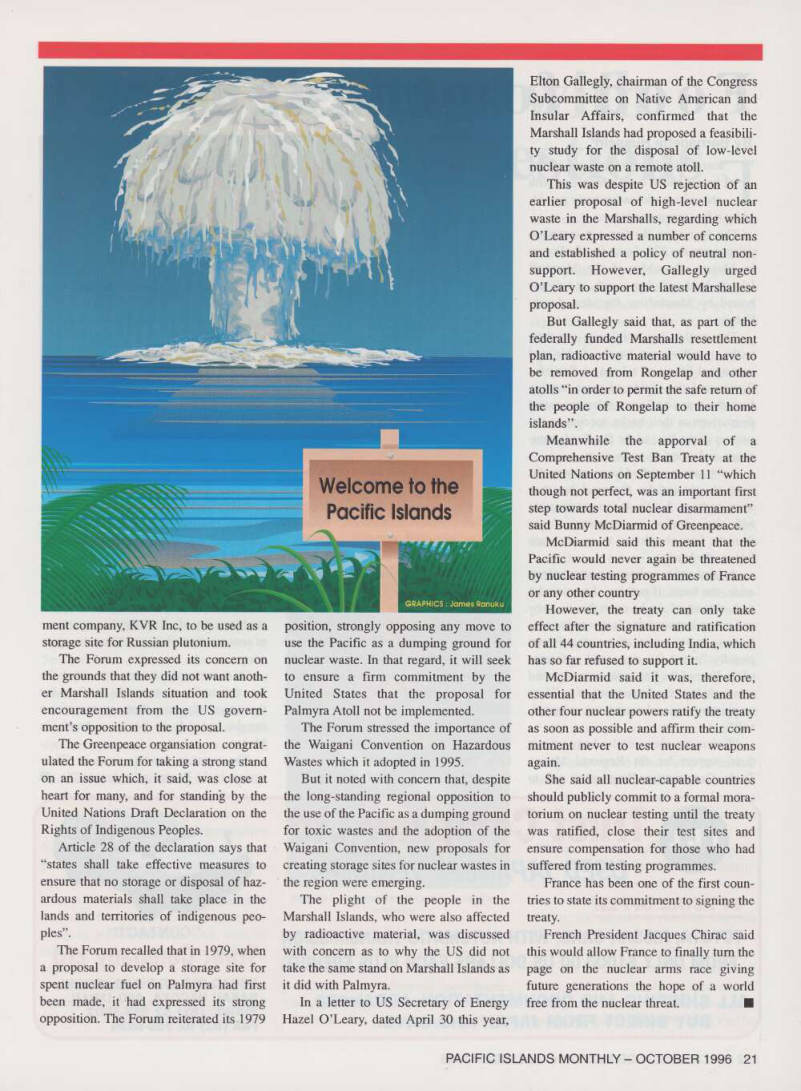
The Pacific’s lingering nuclear clouds
By Bernadette Hussein
Environmental issues featured prominently at the 27th South Pacific Forum in Majuro, Marshall Islands, early last month with delegates voicing concern over the dumping of hazardous wastes in the region.
It was agreed that though the atolls eyed as dumping grounds might be the property of nuclear powers, priority would have to be given to the health and lives of those living there.
But while the Forum voiced its oppo sition to the use of Palmyra as a nuclear dump site and resolved to seek commit ment from the United States to this effect, a proposal by the Marshall Islands to store nuclear waste on one of its remote atolls didn’t rate much mention.
The focus on the Marshall Islands sit uation lay on recompense for past events.
“The Forum again reaffirmed the existence of a special resposnibility toward those peoples of the former United Nations Trust Territory adminis tered by the United States, the Marshall Islands, who have been adversely affect ed as a result of nuclear weapon tests conducted during the preiod of the
trusteeship.
“This responsibility included safe resettlement of displaced human popula tions and the restoration to economic productivity of affected areas,” the Forum communique states.
Earlier this year, Palmyra Atoll (the uninhabited United States possession 1600 kilometres south of Honolulu) was being eyed by a New York-based invest-
ment company, KVR Inc, to be used as a storage site for Russian plutonium.
The Forum expressed its concern on the grounds that they did not want anoth er Marshall Islands situation and took encouragement from the US govern ment’s opposition to the proposal.
The Greenpeace organsiation congrat
ulated the Forum for taking a strong stand on an issue which, it said, was close at heart for many, and for standing by the United Nations Draft Declaration on the
Rights of Indigenous Peoples.
Article 28 of the declaration says that “states shall take effective measures to ensure that no storage or disposal of haz ardous materials shall take place in the lands and territories of indigenous peo ples”.
The Forum recalled that in 1979, when a proposal to develop a storage site for spent nuclear fuel on Palmyra had first been made, it had expressed its strong opposition. The Forum reiterated its 1979
position, strongly opposing any move to use the Pacific as a dumping ground for nuclear waste. In that regard, it will seek to ensure a firm commitment by the United States that the proposal for Palmyra Atoll not be implemented.
The Forum stressed the importance of the Waigani Convention on Hazardous Wastes which it adopted in 1995.
But it noted with concern that, despite
the long-standing regional opposition to
the use of the Pacific as a dumping ground for toxic wastes and the adoption of the Waigani Convention, new proposals for creating storage sites for nuclear wastes in
the region were emerging.
The plight of the people in the Marshall Islands, who were also affected by radioactive material, was discussed with concern as to why the US did not take the same stand on Marshall Islands as it did with Palmyra.
In a letter to US Secretary of Energy Hazel O’Leary, dated April 30 this year.
Elton Gallegly, chairman of the Congress Subcommittee on Native American and Insular Affairs, confirmed that the Marshall Islands had proposed a feasibili ty study for the disposal of low-level nuclear waste on a remote atoll.
This was despite US rejection of an earlier proposal of high-level nuclear waste in the Marshalls, regarding which O’Leary expressed a number of concerns and established a policy of neutral non support. However, Gallegly urged O’Leary to support the latest Marshallese
proposal.
But Gallegly said that, as part of the federally funded Marshalls resettlement plan, radioactive material would have to be removed from Rongelap and other atolls “in order to permit the safe return of the people of Rongelap to their home islands”.
Meanwhile the apporval of a Comprehensive Test Ban Treaty at the United Nations on September 11 “which though not perfect, was an important first step towards total nuclear disarmament” said Bunny McDiarmid of Greenpeace.
McDiarmid said this meant that the Pacific would never again be threatened by nuclear testing programmes of France or any other country However, the treaty can only take effect after the signature and ratification of all 44 countries, including India, which has so far refused to support it.
McDiarmid said it was, therefore, essential that the United States and the other four nuclear powers ratify the treaty as soon as possible and affirm their com mitment never to test nuclear weapons
again.
She said all nuclear-capable countries should publicly commit to a formal mora torium on nuclear testing until the treaty was ratified, close their test sites and ensure compensation for those who had suffered from testing programmes.
France has been one of the first coun tries to state its commitment to signing the treaty.
French President Jacques Chirac said this would allow France to finally turn the page on the nuclear arms race giving future generations the hope of a world free from the nuclear threat. ■
GRAPHICS: James Ranuku
Advertisements & other items, p. 20 (1 item)
(Owner Retiring)
BUSINESS FOR SALE IN THE PARADISE
IMPORT, EXPORT AND WHOLESALE DISTRIBUTION TOGETHER WITH AGENCY BUSINESS “WALK IN WALK OUT BASIS” IN THE PRIME
INDUSTRIAL AREA OF LAUTOKA CITY.
CLIENTS INCLUDE MAJOR HOTELS, MOTELS AND LARGE SUPERMARKETS AND SOME RETAIL OUTLETS THROUGHOUT FIJI
ISLANDS.
TURNOVER IN EXCESS OF $1 MILLION PER ANNUM PRICE: FsBoo,ooo
PRICE INCLUDES:-
a. COMMERCIAL BUILDING WHICH CONSISTS OF 3 LARGE STORAGE
SPACE.
3 MODERN AIR CONDITION OFFICES WITH COMPUTERIZED
ACCOUNTING SYSTEM.
b. MANAGER’S FLAT ATTACHED TO THE BUILDING CONTAINS 2 BED
ROOMS WITH ONE MASTER BEDROOM
C. STOCKS
d. 6 VEHICLES ETC
THIS BUSINESS, IF YOU WISH, COULD BE CONVERTED INTO
MANUFACTURING GARMENTS, SNACKS, CONFECTIONERY,
COSMETICS, TOYS, PLASTIC WARES ETC UNDER “20 YEAR TAX FREE
ZONE FACTORY”.
THE CONTACT DETAILS ARE AS FOLLOWS;-
THE ADVERTISER
PO BOX 3138, LAUTOKA, FIJI ISLANDS
Fax: (679) 662008
Food for thought...
By Bernadette Hussein
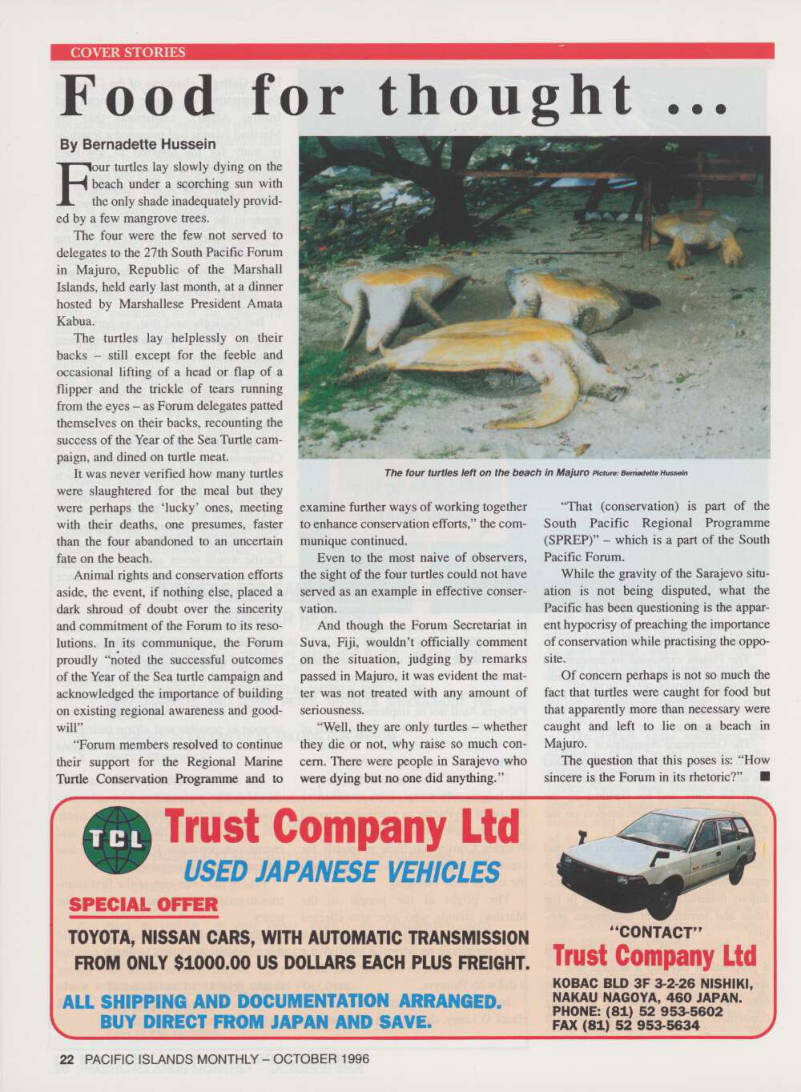
Four turtles lay slowly dying on the beach under a scorching sun with
the only shade inadequately provid
ed by a few mangrove trees.
The four were the few not served to delegates to the 27th South Pacific Forum in Majuro, Republic of the Marshall Islands, held early last month, at a dinner hosted by Marshallese President Amata Kabua.
The turtles lay helplessly on their backs - still except for the feeble and occasional lifting of a head or flap of a flipper and the trickle of tears running from the eyes - as Forum delegates patted themselves on their backs, recounting the success of the Year of the Sea Turtle cam paign, and dined on turtle meat.
It was never verified how many turtles were slaughtered for the meal but they were perhaps the ‘lucky’ ones, meeting with their deaths, one presumes, faster than the four abandoned to an uncertain fate on the beach.
Animal rights and conservation efforts aside, the event, if nothing else, placed a dark shroud of doubt over the sincerity and commitment of the Forum to its reso lutions. In its communique, the Forum proudly “noted the successful outcomes of the Year of the Sea turtle campaign and
acknowledged the importance of building
on existing regional awareness and good
will”
“Forum members resolved to continue their support for the Regional Marine Turtle Conservation Programme and to
examine further ways of working together to enhance conservation efforts,” the com
munique continued.
Even to the most naive of observers, the sight of the four turtles could not have served as an example in effective conser vation.
And though the Forum Secretariat in Suva, Fiji, wouldn’t officially comment on the situation, judging by remarks passed in Majuro, it was evident the mat ter was not treated with any amount of seriousness.
“Well, they are only turtles - whether they die or not, why raise so much con cern. There were people in Sarajevo who were dying but no one did anything.”
“That (conservation) is part of the South Pacific Regional Programme (SPREP)” - which is a part of the South Pacific Forum.
While the gravity of the Sarajevo situ ation is not being disputed, what the Pacific has been questioning is the appar
ent hypocrisy of preaching the importance
of conservation while practising the oppo site.
Of concern perhaps is not so much the fact that turtles were caught for food but that apparently more than necessary were caught and left to lie on a beach in
Majuro.
The question that this poses is: “How sincere is the Forum in its rhetoric?” ■
The four turtles left on the beach in Majuro Picture: Bernadette Hussein
Advertisements & other items, p. 22 (1 item)
<fh Trust Company Ltd
USED JAPANESE VEHICLES
SPECIAL OFFER
TOYOTA, NISSAN CARS, WITH AUTOMATIC TRANSMISSION
FROM ONLY $lOOO.OO US DOLLARS EACH PLUS FREIGHT.
ALL SHIPPING AND DOCUMENTATION ARRANGED.
BUY DIRECT FROM JAPAN AND SAVE.
r
“CONTACT”
Trust Company Ltd
KOBAC BLD 3F 3-2-26 NISHIKI,
NAKAU NAGOYA, 460 JAPAN.
PHONE: (81) 52 953-5602
FAX (81) 52 953-5634
Pacific dealings with
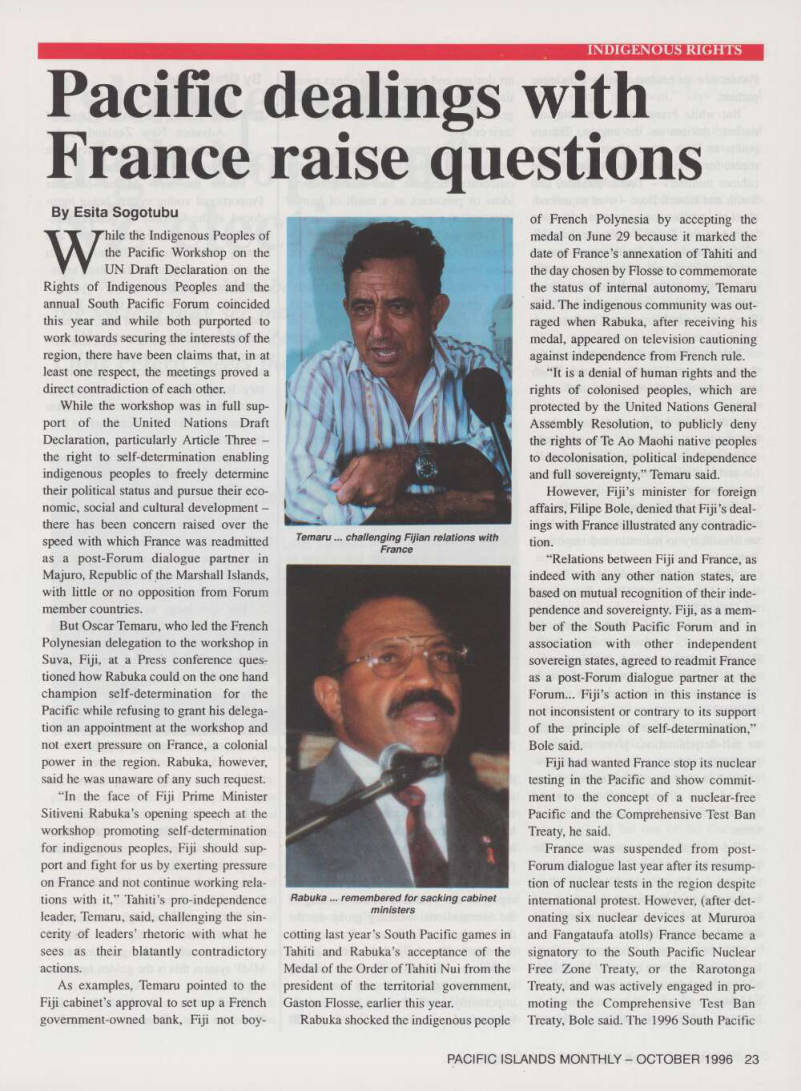
Indigenous Rights
Pacific dealings with France raise questions
By Esita Sogotubu
While the Indigenous Peoples of
the Pacific Workshop on the UN Draft Declaration on the
Rights of Indigenous Peoples and the
annual South Pacific Forum coincided this year and while both purported to work towards securing the interests of the region, there have been claims that, in at least one respect, the meetings proved a direct contradiction of each other.
While the workshop was in full sup port of the United Nations Draft Declaration, particularly Article Three the right to self-determination enabling
indigenous peoples to freely determine
their political status and pursue their eco nomic, social and cultural development there has been concern raised over the speed with which France was readmitted as a post-Forum dialogue partner in Majuro, Republic of the Marshall Islands, with little or no opposition from Forum member countries.
But Oscar Temaru, who led the French Polynesian delegation to the workshop in Suva, Fiji, at a Press conference ques tioned how Rabuka could on the one hand champion self-determination for the Pacific while refusing to grant his delega tion an appointment at the workshop and not exert pressure on France, a colonial power in the region. Rabuka, however, said he was unaware of any such request.
“In the face of Fiji Prime Minister Sitiveni Rabuka’s opening speech at the
workshop promoting self-determination
for indigenous peoples, Fiji should sup
port and fight for us by exerting pressure on France and not continue working rela tions with it,” Tahiti’s pro-independence leader, Temaru, said, challenging the sin cerity of leaders’ rhetoric with what he sees as their blatantly contradictory actions.
As examples, Temaru pointed to the Fiji cabinet’s approval to set up a French government-owned bank, Fiji not boy-
coding last year’s South Pacific games in Tahiti and Rabuka’s acceptance of the Medal of the Order of Tahiti Nui from the president of the territorial government, Gaston Flosse, earlier this year.
Rabuka shocked the indigenous people
of French Polynesia by accepting the
medal on June 29 because it marked the date of France’s annexation of Tahiti and the day chosen by Flosse to commemorate the status of internal autonomy, Temaru said. The indigenous community was out raged when Rabuka, after receiving his medal, appeared on television cautioning against independence from French rule.
“It is a denial of human rights and the rights of colonised peoples, which are protected by the United Nations General Assembly Resolution, to publicly deny the rights of Te Ao Maohi native peoples to decolonisation, political independence and full sovereignty,” Temaru said.
However, Fiji’s minister for foreign affairs, Filipe Bole, denied that Fiji’s deal ings with France illustrated any contradic tion.
“Relations between Fiji and France, as indeed with any other nation states, are based on mutual recognition of their inde pendence and sovereignty. Fiji, as a mem ber of the South Pacific Forum and in association with other independent sovereign states, agreed to readmit France as a post-Forum dialogue partner at the Forum... Fiji’s action in this instance is not inconsistent or contrary to its support of the principle of self-determination,”
Bole said.
Fiji had wanted France stop its nuclear testing in the Pacific and show commit ment to the concept of a nuclear-free Pacific and the Comprehensive Test Ban Treaty, he said.
France was suspended from post- Forum dialogue last year after its resump tion of nuclear tests in the region despite international protest. However, (after det onating six nuclear devices at Mururoa and Fangataufa atolls) France became a signatory to the South Pacific Nuclear Free Zone Treaty, or the Rarotonga Treaty, and was actively engaged in pro moting the Comprehensive Test Ban Treaty, Bole said. The 1996 South Pacific
Temaru...challenging Fijian relations with France
Rabuka ... remembered for sacking cabinet ministers
Forum saw its readmission as a dialogue partner.
But while France was detonating its nuclear devices in the region, Temaru points to Fiji’s prime minister being on record for seeking the resignation of three cabinet ministers - Taufa Vakatale, Leo Smith and Isimeli Bose - over an amend ment to a parliamentary motion criticising testing in the South Pacific on July 28, 1995. Vakatale and Smith voted against and Bose abstained from voting on the prime minister’s amendment which moved to refrain from directly naming France in its condemnation of nuclear test
ing in the region.
Rabuka called for the resignation of the three ministers. Vakatale resigned. Smith and Bose refused to resign and were sacked.
Although at the time Rabuka admitted his regret at dismissing the ministers, according to Bole Fiji was “taking a sensi ble and realistic approach towards France in this matter”.
“Fiji’s bilateral relations with France are significant and important, and which we should try to maintain and improve,”
Bole said.
Other colonial powers in the Pacific include New Zealand, Chile, Britain and the United States.
The workshop, which ended on September 6, resolved to agree with
Rabuka’s opening speech calling for the
acceptance without compromise of Article Three of the draft declaration as well as Article 31.
Article 31, in accordance with the right
to self-determination, gives indigenous
peoples the right to autonomy or self-gov ernment in matters relating to their inter nal and local affairs as well as ways and means to finance these autonomous func tions.
The workshop recommended that the paper presented on intellectual and cultur al rights by New Zealand’s Aroha Mead be adopted as a supporting document and communicated to relevant regional and
international organisations.
“We do not separate culture from intel lect nor intellect from culture,” Mead said, adding that cultural property included all tangible forms of culture and therefore heritage, such as burial objects, traditional
art designs and music and writings essen tial for one generation to pass on to future generations to ensure the continuance of their culture.
Intellectual properties related more to development rights and was seen as the outcomes, tangible and intangible, of ideas or processes as a result of human intervention.
These are a collection of legal mecha nisms (copyright, patents, trademarks, plant breeders’ rights) which accord on a first-come-first-serve basis for the exclu sive ownership rights over products, including ideas, for a defined period of time where the applicants demonstrate their intellectual contribution to that prod uct.
She emphasised the need for the pro tection of these properties because other wise every aspect of what used to be a cul tural activity will in the future become a commercial transaction including human and other genetic resources, knowledge of the properties of flora and fauna and visu al and performing arts.
The main report of the workshop will include a statement on the need for gov ernments to seek domestic law reform to adequately protect intellectual and cultur al property rights.
The workshop was in full support of articles 3 to 8,19 to 23, and 31 to 36 of the draft declaration relating to collective rights because the notion of “collectivity” was an integral component of indigenous societies as opposed to Western traditions where certain rights were fundamental to individuals as they related to one’s free dom and liberty.
It was satisfied with articles relating to the issue .of land and resources which included states taking effective “measures to ensure that no storage or disposal of hazardous materials shall take place in the lands and territories of indigenous peo
ples”.
The Fiji government will be tabling the report of the workshop at the meeting of the intersessional working group on the draft declaration in Geneva, Switzerland, this month. Hopefully, the outcome of the
workshop will not only mean having
indigenous rights in theory but, more
importantly, enable them to be realistical ly practised. ■
By Chris Peteru
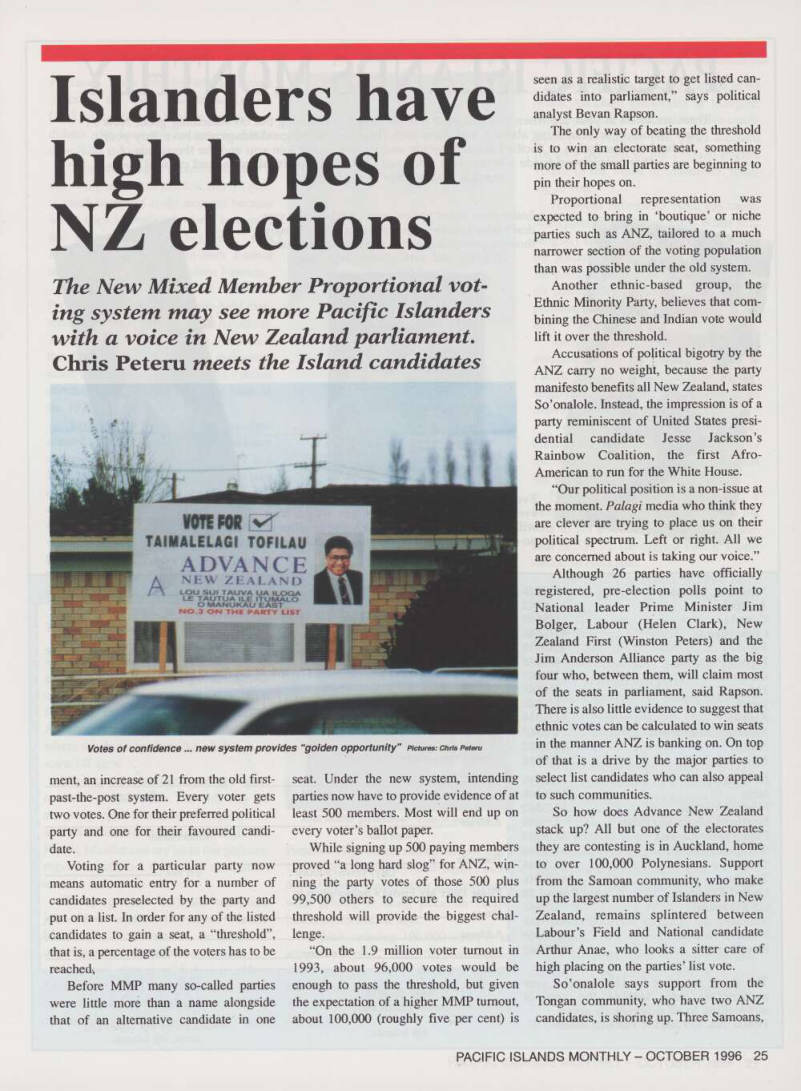
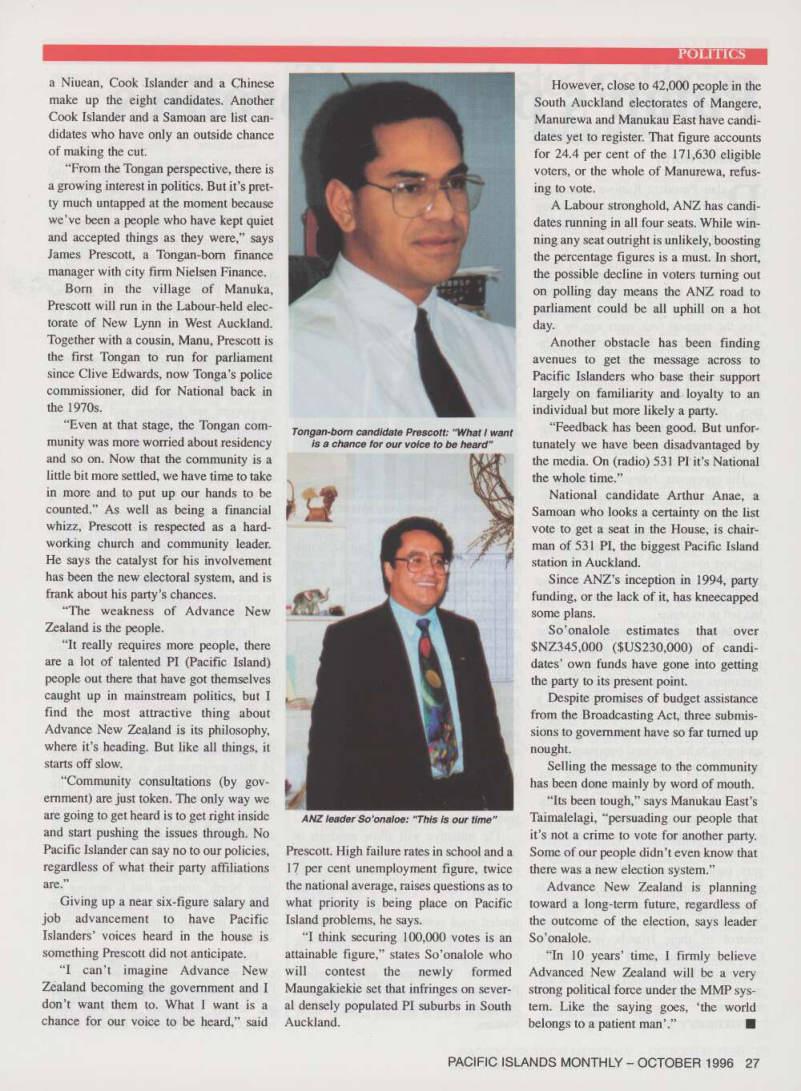
Politics
The plated pin on the lapel of Advance New Zealand leader England So’onalole’s navy blue tailored suit says it all. Attitude.
Under the new Mixed Member Proportional voting system being intro duced at the October 12 general elec tions, Advanced New Zealand, built and run by Pacific Islanders, is going all out in a bid for a bigger Pacific Island repre sentation in parliament.
“This party was set up by Pacific Islanders and, because of that, we have to take ownership of problems that our people have. So we are going to look at and implement solutions at parliamen tary level. The days of lobbying are over,” says the witty and articulate So’onalole, who gives seminars on pos itive living.
Currently, the only Pacific Islander member of parliament is Labour’s Tairo Philip Field from Otara, Auckland.
A one time mathematics tutor at Otago University, So’onalole admits Advance New Zealand’s political con victions are a lot easier to calculate than their odds of landing any of their eight candidates in parliament.
For too long, says ANZ, Pacific Islanders have been paid only lip service by National and Labour governments, the latter having enjoyed a solid tradi tion of support from migrant Polynesians since the 19205.
“This is our time. A lot of our people have been consulted at a lower level but we are not involved at the highest level of the decision-making process. And nothing was going to happen until we started a party.”
Immigration, portability of pensions, and setting up a Department of Whanau (Youth) Development are high on the party hit list of issues they are keen to push on behalf of the New Zealand’s Pacific Island community.
“But the only issue right now is to get in. Circumstances in the New Zealand political arena have changed. Under the MMP system this is the golden opportu nity.”
Briefly, this is how MMP works.
There are now 120 seats in the parlia-
Islanders have high hopes of NZ elections
The New Mixed Member Proportional vot ing system may see more Pacific Islanders with a voice in New Zealand parliament .
Chris Peteru meets the Island candidates
ment, an increase of 21 from the old first past-the-post system. Every voter gets two votes. One for their preferred political party and one for their favoured candi date.
Voting for a particular party now means automatic entry for a number of candidates preselected by the party and put on a list. In order for any of the listed candidates to gain a seat, a “threshold”, that is, a percentage of the voters has to be reached.
Before MMP many so-called parties were little more than a name alongside that of an alternative candidate in one
seat. Under the new system, intending parties now have to provide evidence of at least 500 members. Most will end up on every voter’s ballot paper.
While signing up 500 paying members proved “a long hard slog” for ANZ, win ning the party votes of those 500 plus 99,500 others to secure the required threshold will provide the biggest chal lenge.
“On the 1.9 million voter turnout in 1993, about 96,000 votes would be enough to pass the threshold, but given the expectation of a higher MMP turnout, about 100,000 (roughly five per cent) is
seen as a realistic target to get listed can didates into parliament,” says political analyst Sevan Rapson.
The only way of beating the threshold is to win an electorate seat, something more of the small parties are beginning to
pin their hopes on.
Proportional representation was
expected to bring in ‘boutique’ or niche parties such as ANZ, tailored to a much narrower section of the voting population than was possible under the old system.
Another ethnic-based group, the Ethnic Minority Party, believes that com bining the Chinese and Indian vote would lift it over the threshold.
Accusations of political bigotry by the ANZ carry no weight, because the party manifesto benefits all New Zealand, states So’onalole. Instead, the impression is of a party reminiscent of United States presi dential candidate Jesse Jackson’s Rainbow Coalition, the first Afro- American to run for the White House.
“Our political position is a non-issue at the moment. Palagi media who think they are clever are trying to place us on their political spectrum. Left or right. All we are concerned about is taking our voice.”
Although 26 parties have officially
registered, pre-election polls point to
National leader Prime Minister Jim Bolger, Labour (Helen Clark), New Zealand First (Winston Peters) and the Jim Anderson Alliance party as the big four who, between them, will claim most of the seats in parliament, said Rapson.
There is also little evidence to suggest that ethnic votes can be calculated to win seats in the manner ANZ is banking on. On top of that is a drive by the major parties to select list candidates who can also appeal to such communities.
So how does Advance New Zealand stack up? All but one of the electorates they are contesting is in Auckland, home to over 100,000 Polynesians. Support from the Samoan community, who make up the largest number of Islanders in New Zealand, remains splintered between Labour’s Field and National candidate Arthur Anae, who looks a sitter care of high placing on the parties’ list vote.
So’onalole says support from the Tongan community, who have two ANZ candidates, is shoring up. Three Samoans,
Votes of confidence...new system provides "golden opportunity” Pictures: Chris Peteru
a Niuean, Cook Islander and a Chinese make up the eight candidates. Another Cook Islander and a Samoan are list can didates who have only an outside chance of making the cut.
“From the Tongan perspective, there is a growing interest in politics. But it’s pret ty much untapped at the moment because we’ve been a people who have kept quiet and accepted things as they were,” says James Prescott, a Tongan-bom finance manager with city firm Nielsen Finance.
Bom in the village of Manuka, Prescott will run in the Labour-held elec torate of New Lynn in West Auckland.
Together with a cousin, Manu, Prescott is the first Tongan to run for parliament since Clive Edwards, now Tonga’s police commissioner, did for National back in the 19705.
“Even at that stage, the Tongan com munity was more worried about residency and so on. Now that the community is a little bit more settled, we have time to take in more and to put up our hands to be counted.” As well as being a financial whizz, Prescott is respected as a hard working church and community leader.
He says the catalyst for his involvement has been the new electoral system, and is frank about his party’s chances.
“The weakness of Advance New Zealand is the people.
“It really requires more people, there are a lot of talented PI (Pacific Island) people out there that have got themselves caught up in mainstream politics, but I find the most attractive thing about Advance New Zealand is its philosophy, where it’s heading. But like all things, it starts off slow.
“Community consultations (by gov ernment) are just token. The only way we are going to get heard is to get right inside and start pushing the issues through. No Pacific Islander can say no to our policies, regardless of what their party affiliations are.”
Giving up a near six-figure salary and job advancement to have Pacific Islanders’ voices heard in the house is something Prescott did not anticipate.
“I can’t imagine Advance New Zealand becoming the government and I don’t want them to. What I want is a chance for our voice to be heard,” said
Prescott. High failure rates in school and a 17 per cent unemployment figure, twice the national average, raises questions as to what priority is being place on Pacific Island problems, he says.
“I think securing 100,000 votes is an attainable figure,” states So’onalole who will contest the newly formed Maungakiekie set that infringes on sever al densely populated PI suburbs in South Auckland.
However, close to 42,000 people in the South Auckland electorates of Mangere, Manurewa and Manukau East have candi dates yet to register. That figure accounts for 24.4 per cent of the 171,630 eligible voters, or the whole of Manurewa, refus ing to vote.
A Labour stronghold, ANZ has candi dates running in all four seats. While win ning any seat outright is unlikely, boosting the percentage figures is a must. In short, the possible decline in voters turning out on polling day means the ANZ road to parliament could be all uphill on a hot day.
Another obstacle has been finding avenues to get the message across to Pacific Islanders who base their support largely on familiarity and loyalty to an individual but more likely a party.
“Feedback has been good. But unfor tunately we have been disadvantaged by the media. On (radio) 531 PI if s National the whole time.”
National candidate Arthur Anae, a Samoan who looks a certainty on the list vote to get a seat in the House, is chair man of 531 PI, the biggest Pacific Island station in Auckland.
Since ANZ’s inception in 1994, party funding, or the lack of it, has kneecapped
some plans.
So’onalole estimates that over $NZ345,000 ($U5230,000) of candi dates’ own funds have gone into getting the party to its present point.
Despite promises of budget assistance
from the Broadcasting Act, three submis sions to government have so far turned up nought.
Selling the message to the community has been done mainly by word of mouth.
“Its been tough,” says Manukau East’s Taimalelagi, “persuading our people that it’s not a crime to vote for another party.
Some of our people didn’t even know that there was a new election system.”
Advance New Zealand is planning toward a long-term future, regardless of the outcome of the election, says leader So’onalole.
“In 10 years’ time, I firmly believe Advanced New Zealand will be a very strong political force under the MMP sys tem. Like the saying goes, ‘the world belongs to a patient man’.” ■
Tongan-born candidate Prescott: “What I want is a chance for our voice to be heard”
ANZ leader So’onaloe: “This is our time”
Advertisements & other items, p. 26 (1 item)
Pacific Islands Monthly
There are times in your life when you feel your friends have been missing out on something good. Now's your chance to do something about it and share with them one of the good things you have. Buy your friend a subscription to Pacific Islands Monthly and let him or her join you and the thousands of other people worldwide who are kept informed of the latest political, social and cultural
changes taking place in the Pacific.
r I 4 Enter your subscription now. Make sure you don't miss a single important issue. You'll enjoy thought provoking commentiy, knowledgeable criticism and authoritative reporting.
Every month highlights the important issue, events and people that shape our world. You will also enjoy delivery to your home or office at no extra cost. Our fast fax service is available on (679) 303809.
American Samoa US$45 Australia As 42 Canada US$45 Cook Islands AUSS46 Fiji .. F 526.40 French Polynesia US$45 Guam US$45 Hawaii US$45
Japan US$45
Kiribati AUSS46 Marshall/Micronesia US$4O Nauru AUSS42 New Caledonia US$32 New Zealand NZ$55 Niue AUSS46 Norfolk Islands AUSS42 Northern Marianas/Palau .. .. US$4O Papua New Guinea AUSS4S Solomon Islands AUSS46 Tonga AUSS46 Tuvalu AUSS46 United Kingdom Stg Pound 28 US Mainland US$45 Vanuatu AUSS4S Western Samoa WS$6O Elsewhere AUSS63 The above rates are for (12 issues) 1 year subscription rates include the cost of airspeeding to all destinations above.
Phone No. 679 304111 Fax 679 303809
CUT OUT THIS COUPON
r Yes, please enter my subscription to PIM.
Payment details: I enclose my cheque for $ (made payable to PIM) or debit $. . to my; □ Bank Card □ Diner Club □ Visa □ American Express □ Master Card Card No; I I I 1 I I 1 I I I I I I I I I Expiry Date for . issues of PIM.
Please Print Clearly Mr/Mrs/Miss/Ms Initials Surname Address Postcode Street No City / T own / Suburb Please Enter My Friend's Subscription to Name.
Street Name Ph No Address.
City.
L L Country.
PhNo.
Mail To PIM Subscriptions Dept G.P.O. Box 1167, Suva.
Fiji Islands
PACIFIC
ISLANDS
CM- Q T~ "h l T 1 Published by Fiji Times Ltd Suva, Fiji Islands.
Palau’s political profiles
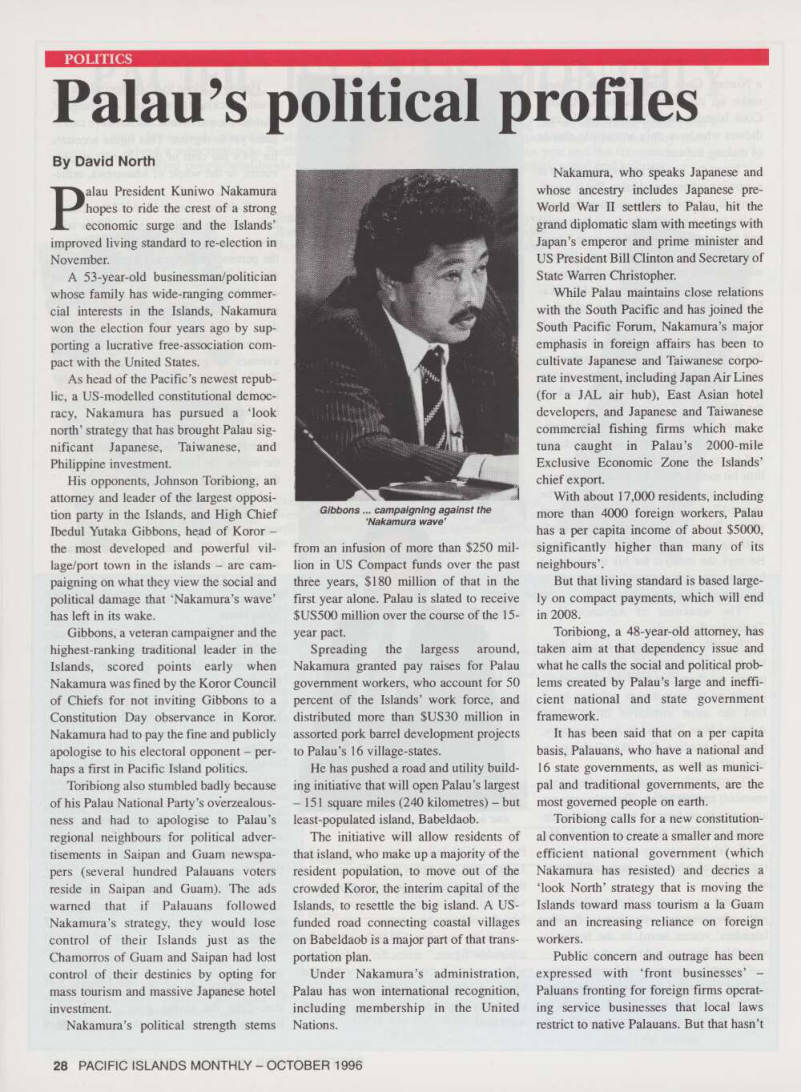
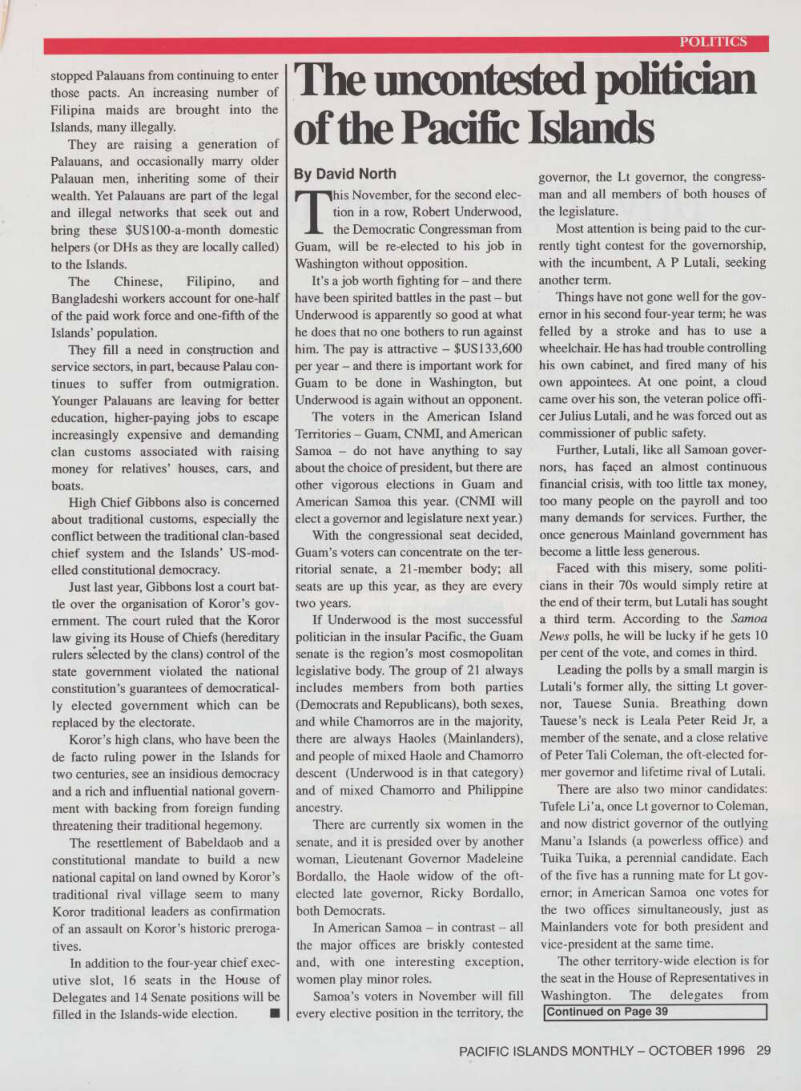
By David North
Palau President Kuniwo Nakamura hopes to ride the crest of a strong economic surge and the Islands’ improved living standard to re-election in November.
A 53-year-old businessman/politician
whose family has wide-ranging commer cial interests in the Islands, Nakamura won the election four years ago by sup porting a lucrative free-association com pact with the United States.
As head of the Pacific’s newest repub lic, a US-modelled constitutional democ racy, Nakamura has pursued a ‘look north’ strategy that has brought Palau sig nificant Japanese, Taiwanese, and Philippine investment.
His opponents, Johnson Toribiong, an attorney and leader of the largest opposi tion party in the Islands, and High Chief Ibedul Yutaka Gibbons, head of Koror the most developed and powerful vil lage/port town in the islands - are cam paigning on what they view the social and political damage that ‘Nakamura’s wave’ has left in its wake.
Gibbons, a veteran campaigner and the highest-ranking traditional leader in the Islands, scored points early when Nakamura was fined by the Koror Council of Chiefs for not inviting Gibbons to a Constitution Day observance in Koror.
Nakamura had to pay the fine and publicly apologise to his electoral opponent - per haps a first in Pacific Island politics.
Toribiong also stumbled badly because of his Palau National Party’s overzealous ness and had to apologise to Palau’s
regional neighbours for political adver
tisements in Saipan and Guam newspa pers (several hundred Palauans voters reside in Saipan and Guam). The ads warned that if Palauans followed Nakamura’s strategy, they would lose control of their Islands just as the Chamorros of Guam and Saipan had lost control of their destinies by opting for mass tourism and massive Japanese hotel investment.
Nakamura’s political strength stems
from an infusion of more than $250 mil lion in US Compact funds over the past three years, $lBO million of that in the first year alone. Palau is slated to receive SUSSOO million over the course of the 15year pact.
Spreading the largess around, Nakamura granted pay raises for Palau government workers, who account for 50 percent of the Islands’ work force, and distributed more than SUS3O million in assorted pork barrel development projects to Palau’s 16 village-states.
He has pushed a road and utility build ing initiative that will open Palau’s largest -151 square miles (240 kilometres) - but least-populated island, Babeldaob.
The initiative will allow residents of that island, who make up a majority of the resident population, to move out of the crowded Koror, the interim capital of the Islands, to resettle the big island. A US funded road connecting coastal villages on Babeldaob is a major part of that trans
portation plan.
Under Nakamura’s administration, Palau has won international recognition, including membership in the United Nations.
Nakamura, who speaks Japanese and whose ancestry includes Japanese pre- World War II settlers to Palau, hit the
grand diplomatic slam with meetings with
Japan’s emperor and prime minister and US President Bill Clinton and Secretary of State Warren Christopher.
While Palau maintains close relations with the South Pacific and has joined the South Pacific Forum, Nakamura’s major emphasis in foreign affairs has been to cultivate Japanese and Taiwanese corpo rate investment, including Japan Air Lines (for a JAL air hub). East Asian hotel developers, and Japanese and Taiwanese commercial fishing firms which make tuna caught in Palau’s 2000-mile Exclusive Economic Zone the Islands’ chief export.
With about 17,000 residents, including more than 4000 foreign workers, Palau has a per capita income of about $5OOO, significantly higher than many of its neighbours’.
But that living standard is based large ly on compact payments, which will end in 2008.
Toribiong, a 48-year-old attorney, has taken aim at that dependency issue and what he calls the social and political prob lems created by Palau’s large and ineffi cient national and state government framework.
It has been said that on a per capita basis, Palauans, who have a national and 16 state governments, as well as munici pal and traditional governments, are the most governed people on earth.
Toribiong calls for a new constitution al convention to create a smaller and more efficient national government (which Nakamura has resisted) and decries a ‘look North’ strategy that is moving the Islands toward mass tourism a la Guam and an increasing reliance on foreign workers.
Public concern and outrage has been expressed with ‘front businesses’ - Paluans fronting for foreign firms operat ing service businesses that local laws restrict to native Palauans. But that hasn’t
Gibbons...campaigning against the ‘Nakamura wave’
stopped Palauans from continuing to enter those pacts. An increasing number of Filipina maids are brought into the Islands, many illegally.
They are raising a generation of
Palauans, and occasionally marry older Palauan men, inheriting some of then wealth. Yet Palauans are part of the legal and illegal networks that seek out and bring these SUSIOO-a-month domestic helpers (or DHs as they are locally called) to the Islands.
The Chinese, Filipino, and Bangladeshi workers account for one-half of the paid work force and one-fifth of the
Islands’ population.
They fill a need in construction and service sectors, in part, because Palau con tinues to suffer from outmigration.
Younger Palauans are leaving for better education, higher-paying jobs to escape
increasingly expensive and demanding
clan customs associated with raising money for relatives’ houses, cars, and boats.
High Chief Gibbons also is concerned about traditional customs, especially the conflict between the traditional clan-based chief system and the Islands’ US-mod elled constitutional democracy.
Just last year. Gibbons lost a court bat tle over the organisation of Koror’s gov ernment. The court ruled that the Koror law giving its House of Chiefs (hereditary rulers selected by the clans) control of the state government violated the national constitution’s guarantees of democratical ly elected government which can be replaced by the electorate, Koror’s high clans, who have been the de facto ruling power in the Islands for two centuries, see an insidious democracy and a rich and influential national govern
ment with backing from foreign funding
threatening their traditional hegemony.
The resettlement of Babeldaob and a constitutional mandate to build a new national capital on land owned by Koror’s traditional rival village seem to many Koror traditional leaders as confirmation of an assault on Koror’s historic preroga tives.
In addition to the four-year chief exec utive slot, 16 seats in the House of Delegates and 14 Senate positions will be filled in the Islands-wide election. ■
of the Pacific Islands
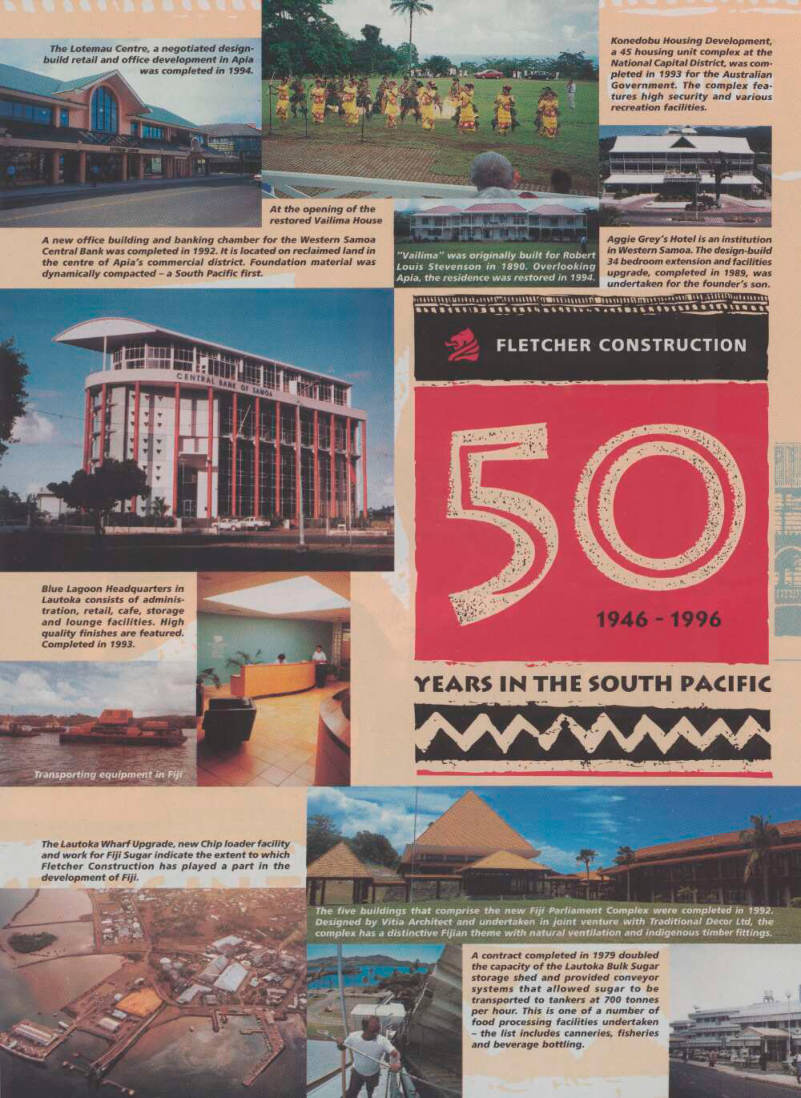
The uncontested politician of the Pacific Islands
By David North
This November, for the second elec tion in a row, Robert Underwood, the Democratic Congressman from Guam, will be re-elected to his job in
Washington without opposition.
It’s a job worth fighting for - and there have been spirited battles in the past - but Underwood is apparently so good at what he does that no one bothers to run against him. The pay is attractive - SUS 133,600 per year - and there is important work for Guam to be done in Washington, but Underwood is again without an opponent.
The voters in the American Island Territories - Guam, CNMI, and American Samoa - do not have anything to say about the choice of president, but there are other vigorous elections in Guam and American Samoa this year. (CNMI will elect a governor and legislature next year.) With the congressional seat decided, Guam’s voters can concentrate on the ter ritorial senate, a 21-member body; all seats are up this year, as they are every two years.
If Underwood is the most successful politician in the insular Pacific, the Guam senate is the region’s most cosmopolitan legislative body. The group of 21 always includes members from both parties (Democrats and Republicans), both sexes, and while Chamorros are in the majority, there are always Haoles (Mainlanders), and people of mixed Haole and Chamorro descent (Underwood is in that category) and of mixed Chamorro and Philippine ancestry.
There are currently six women in the senate, and it is presided over by another woman. Lieutenant Governor Madeleine Bordallo, the Haole widow of the oft elected late governor, Ricky Bordallo, both Democrats.
In American Samoa - in contrast - all the major offices are briskly contested and, with one interesting exception, women play minor roles.
Samoa’s voters in November will fill every elective position in the territory, the
governor, the Lt governor, the congress man and all members of both houses of
the legislature.
Most attention is being paid to the cur rently tight contest for the governorship, with the incumbent, A P Lutali, seeking another term.
Things have not gone well for the gov ernor in his second four-year term; he was felled by a stroke and has to use a wheelchair. He has had trouble controlling his own cabinet, and fired many of his own appointees. At one point, a cloud came over his son, the veteran police offi cer Julius Lutali, and he was forced out as
commissioner of public safety.
Further, Lutali, like all Samoan gover nors, has faced an almost continuous financial crisis, with too little tax money, too many people on the payroll and too many demands for services. Further, the once generous Mainland government has become a little less generous.
Faced with this misery, some politi cians in their 70s would simply retire at the end of their term, but Lutali has sought a third term. According to the Samoa News polls, he will be lucky if he gets 10 per cent of the vote, and comes in third.
Leading the polls by a small margin is Lutali’s former ally, the sitting Lt gover nor, Tauese Sunia. Breathing down Tauese’s neck is Leala Peter Reid Jr, a member of the senate, and a close relative of Peter Tali Coleman, the oft-elected for mer governor and lifetime rival of Lutali.
There are also two minor candidates: Tufele Li’a, once Lt governor to Coleman, and now district governor of the outlying Manu’a Islands (a powerless office) and Tuika Tuika, a perennial candidate. Each of the five has a running mate for Lt gov ernor; in American Samoa one votes for the two offices simultaneously, just as Mainlanders vote for both president and vice-president at the same time.
The other territory-wide election is for the seat in the House of Representatives in Washington. The delegates from
IContinued on Page 39
From Page 29
American Samoa and Guam (and from the three other jurisdictions) cannot vote on the Floor of the House but do so in cau cuses and committee meetings; their prin cipal role is to serve as advocates of their
jurisdictions.
Running are: Eni F H Faleomavaega, the incumbent Democrat, and his second time opponent, Amata Coleman
Radewagen.
Faleomavaega, a Mainland-trained lawyer, has been re-elected with growing margins since he arrived in the House in 1988. In that year, Faleomavaega suc ceeded the disgraced Fofo Sunia, who had run afoul of Mainland prosecutors follow ing a payroll scandal; that Sunia, now the Fono’s ranking staffer, is brother to guber natorial candidate Tauese, as well as to two other siblings who served for awhile in Lutali’s cabinet.
Faleomavaega sometimes appears to have better relations with Mainland lead ership types (for example, other congress man and government administrators) than he does with some of the older, tradition al leaders in the Islands. (The head of his own clan once threatened to take away
Faleomavaega’s name.)
The congressman, who has brought subsidised food (via food stamps) to the
Politics
elderly and the disabled on the Islands, is also known for his fierce opposition to nuclear testing - and was, in effect, briefly detained by French gendarmes for his protests (PIM Oct 1995).
His opponent, Amata Radewagen, is not only former Governor Coleman’s daughter (and approximately a cousin of Leala Peter Reid Jr), she is a political power in her own right, as Republican National Committeewoman from American Samoa, member of the execu
tive committee of the Republican National Committee, and Washington lob
byist for the largely independent territori
al public utilities department.
During the George Bush administra tion she worked with the newly free Central Asian nations, the “stans” in what was the Soviet Union; further, in the Islands, has led a campaign against breast cancer.
The incumbent leads Radewagen by a substantial margin in the Samoa News
polls.
Trailing in third place is Gus Hannemann, a former member of the Fono, and brother to Muffi Hannemann, a Samoan who once came close to repre senting Hawaii in the US House.
All the seats in the Fono are up this year. This body is, unlike the Guam sen
ate, non-cosmopolitan.
While a woman gets elected to the lower house once in a while, everyone is Samoan; the Upper House is elected by the chiefs ( matai , mostly males) and no woman, and no non-Samoan has even attempted to become a member. If some lawyer were to bring the House-of-Lords type voting rules into a Mainland court, saying they were unconstitutional, the lawyer would win hands-down, but no one has made the effort. ■
American Samoa’s Faleomavaega...better relations with Mainland leadership types than with traditional leaders
Advertisements & other items, pp. 30-32 (1 item)
Drive dignity right to the top.
® TOYOTA
Everyone who knows cars has no doubts about Land Cruiser’s ruggedness.
Yet how many know that its luxury rivals the finest high-priced cars?
Or that it’s got more room inside than many luxury sedans?
And because it’s a Toyota, Land Cruiser’s fit and finish, attention to detail, and graceful form speak of elegance as well as spacious comfort.
Yet you still get tough ladder frames and suspension built to take you as far off road as you want to go.
With power from 4.5-litre petrol or 4.2-litre diesel engines.
And it’s carefully protected from rust to last longer.
So if you’re going right to the top, this dignified car is ready to take you.
LAND CRUISER
DISTRIBUTORS/DEALERS
AMERICAN SAMOA BURNS PHILP MOTORS PH 633-4281 COOK ISLANDS GUAM & MICRONESIA ...ATKINS KROLL, INC. PH 646-1876/9 KIRIBATI NORFOLK ISLAND BORRY’S PTY LTD. PH 22114 PAPUA NEW GUINEA SOLOMON ISLAND EI.A MOTORS PH 30314 TAHITI VANUATU ASCO MOTORS PH 22341 WESTERN SAMOA...
. .PACIFIC MOTORS LTD. PH 20796
..TARAWA MOTORS PH 21090
..ELA MOTORS PH 3229400
.NIPPON AUTOMOTO PH 429819
.ASCO MOTORS PH 20800
FIJI ASCO MOTORS PH
NEW CALEDONIA S.I.A.P. PH 275562
SAIPAN MICROL CORPORATION PH 234-5911
TONGA ASCO MOTORS PH 23500
: mmsii * II * mi - i S» ii® /
LAND
CRUISER
IAWO CRUISER
C ! * > /r* ■ Mill I, t ■
ECS
a*: a • ■ <* - gL r 4k » «
•rwr
mm
mLm
Konedobu Housing Development, a 45 housing unit complex at the National Capital District, was completed in 1993 for the Australian Government. The complex features high security and various recreation facilities.
The Lotemau Centre, a negotiated designbuild retail and office development in Apia was completed in 1994. h m V* em *
IIIRIIW
At the opening of the restored Vailima House A new office building and banking chamber for the Western Samoa Central Bank was completed in 1992. It is located on reclaimed land in the centre of Apia's commercial district. Foundation material was dynamically compacted - a South Pacific first. lijl ip,...] r i
. .r.Nhe-'Je#- pi ’Ob f .
"Vailima" was originally built for Robert Louis Stevenson in 1890. Overlooking Apia, the residence was restored in 1994.
Aggie Grey's Hotel is an institution in Western Samoa. The design-build 34 bedroom extension and facilities upgrade, completed in 1989, was undertaken for the founder's son. ■uuum uum>u nrv i_mmv w v •'V—
FLETCHER CONSTRUCTION
ai Mill Blue Lagoon Headquarters m Lautoka consists of administration, retail, cafe, storage and lounge facilities. High quality finishes are featured.
Completed in 1993. 6 f
YEARS IN THE SOUTH PACIFIC
Transporting equipment in Fiji / The Lautoka Wharf Upgrade, new Chip loader facility and work for Fiji Sugar indicate the extent to which Fletcher Construction has played a part in the development of Fiji. m The five buildings that comprise the new Fiji Parliament Complex were completed in 1992.
Designed by Vitia Architect and undertaken in joint venture with Traditional Decor Ltd, the complex has a distinctive Fijian theme with natural ventilation and indigenous timber fittings.
A contract completed in 1979 doubled the capacity of the Lautoka Bulk Sugar storage shed and provided conveyor systems that allowed sugar to be transported to tankers at 700 tonnes per hour. This is one of a number of food processing facilities undertaken - the list includes canneries, fisheries and beverage bottling.
Fletcher’s Fijian finese
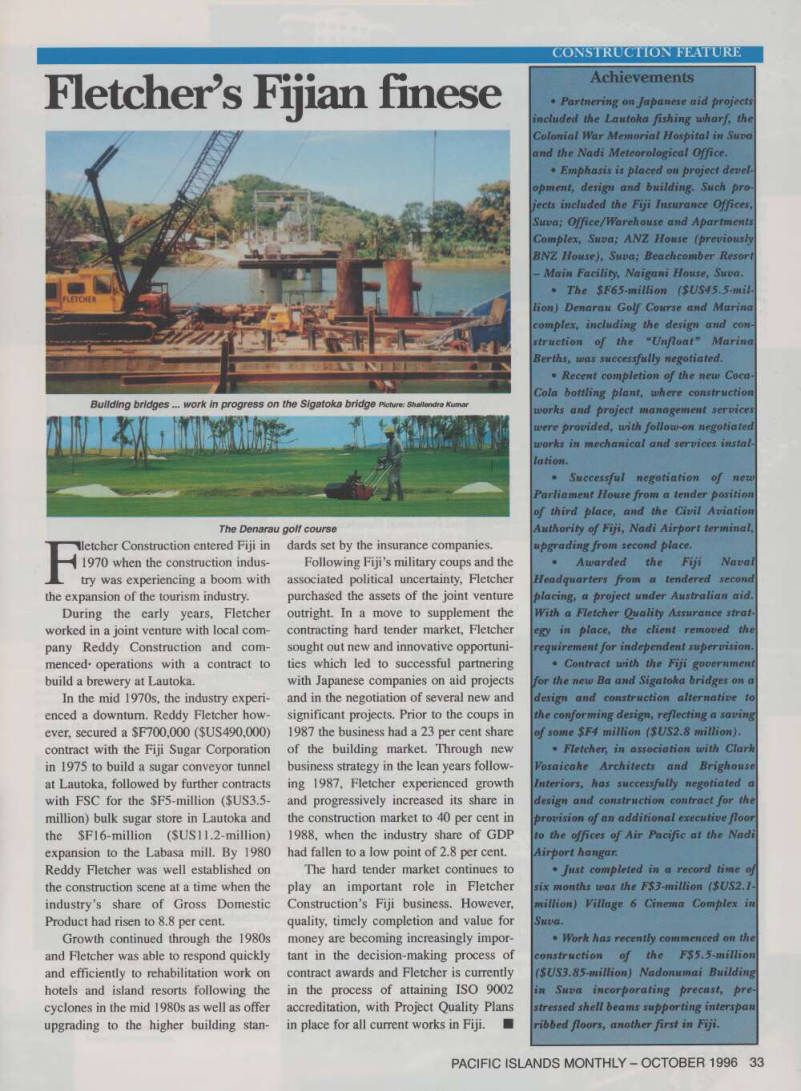
Fletcher Construction entered Fiji in 1970 when the construction indus try was experiencing a boom with the expansion of the tourism industry.
During the early years, Fletcher worked in a joint venture with local com pany Reddy Construction and com menced- operations with a contract to build a brewery at Lautoka.
In the mid 19705, the industry experi enced a downturn. Reddy Fletcher how ever, secured a $F700,000 ($U5490,000) contract with the Fiji Sugar Corporation in 1975 to build a sugar conveyor tunnel at Lautoka, followed by further contracts with FSC for the SFS-million (SUS3.S - bulk sugar store in Lautoka and the SFI6-million (SUS 11.2-million) expansion to the Labasa mill. By 1980 Reddy Fletcher was well established on the construction scene at a time when the industry’s share of Gross Domestic Product had risen to 8.8 per cent.
Growth continued through the 1980 s and Fletcher was able to respond quickly and efficiently to rehabilitation work on hotels and island resorts following the cyclones in the mid 1980 s as well as offer
upgrading to the higher building stan
dards set by the insurance companies.
Following Fiji’s military coups and the associated political uncertainty, Fletcher purchased the assets of the joint venture outright. In a move to supplement the contracting hard tender market, Fletcher sought out new and innovative opportuni ties which led to successful partnering with Japanese companies on aid projects and in the negotiation of several new and significant projects. Prior to the coups in 1987 the business had a 23 per cent share of the building market. Through new business strategy in the lean years follow ing 1987, Fletcher experienced growth and progressively increased its share in the construction market to 40 per cent in 1988, when the industry share of GDP had fallen to a low point of 2.8 per cent.
The hard tender market continues to play an important role in Fletcher Construction’s Fiji business. However, quality, timely completion and value for money are becoming increasingly impor tant in the decision-making process of contract awards and Fletcher is currently in the process of attaining ISO 9002 accreditation, with Project Quality Plans in place for all current works in Fiji. ■
Building bridges...work in progress on the Sigatoka bridge picture: shailendra Kumar
The Denarau golf course
Construction Feature
Achievements
• Partnering on Japanese aid projects
included the Lautoka fishing wharf, the Colonial War Memorial Hospital in Suva and the Nadi Meteorological Office. • Emphasis is placed on project devel opment, design and building. Such pro
jects included the Fiji Insurance Offices,
Suva; Office/Warehouse and Apartments Complex, Suva; ANZ House (previously BNZ House), Suva; Beachcomber Resort - Main Facility, Naigani House, Suva. • The SF6S-million ($U545.5-mil lion) Denarau Golf Course and Marina complex, including the design and con struction of the “ Unfloat” Marina
Berths, was successfully negotiated.
• Recent completion of the new Coca- Cola bottling plant, where construction works and project management services were provided, urith follow-on negotiated works in mechanical and services instal lation. • Successful negotiation of new Parliament House from a tender position of third place, and the Civil Aviation Authority of Fiji, Nadi Airport terminal, upgrading from second place. • Awarded the Fiji Naval Headquarters from a tendered second placing, a project under Australian aid.
With a Fletcher Quality Assurance strat egy in place, the client removed the requirement for independent supervision. • Contract with the Fiji government for the new Ba and Sigatoka bridges on a design and construction alternative to the conforming design, reflecting a saving of some SF4 million (SUS2.B million), • Fletcher, in association with Clark Vosaicake Architects and Brighouse Interiors, has successfully negotiated a design and construction contract for the
provision of an additional executive floor
to the offices of Air Pacific at the Nadi
Airport hangar.
• Just completed in a record time of six months was the Fs3-million (SUS2.I - Village 6 Cinema Complex in Suva. • Work has recently commenced on the construction of the F55.5-million (SUS3.BS-million) Nadonumai Building in Suva incorporating precast, pre stressed shell beams supporting interspan ribbed floors, another first in Fiji.
Building on Papua New Guinea
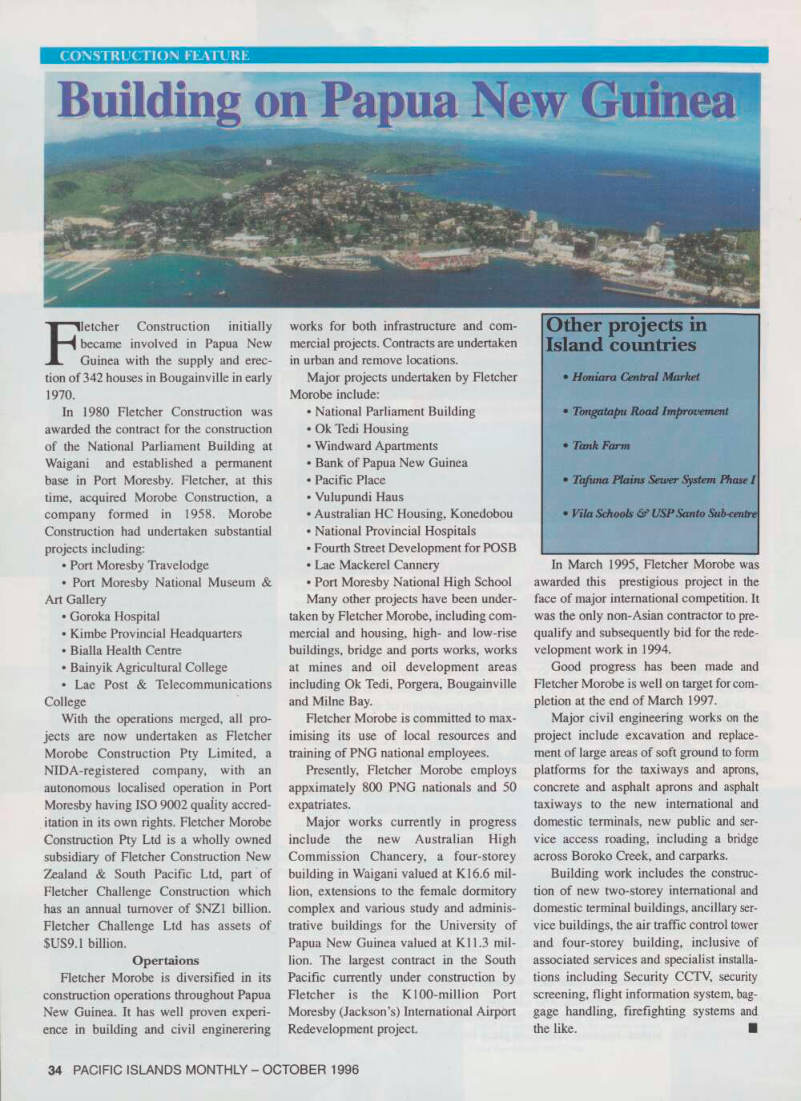
Fletcher Construction initially
became involved in Papua New Guinea with the supply and erec tion of 342 houses in Bougainville in early 1970.
In 1980 Fletcher Construction was awarded the contract for the construction of the National Parliament Building at Waigani and established a permanent base in Port Moresby. Fletcher, at this time, acquired Morobe Construction, a company formed in 1958. Morobe Construction had undertaken substantial
projects including:
• Port Moresby Travelodge • Port Moresby National Museum & Art Gallery • Goroka Hospital • Kimbe Provincial Headquarters • Bialla Health Centre
• Bainyik Agricultural College
• Lae Post & Telecommunications
College
With the operations merged, all pro jects are now undertaken as Fletcher Morobe Construction Pty Limited, a NIDA-registered company, with an autonomous localised operation in Port
Moresby having ISO 9002 quality accred
itation in its own rights. Fletcher Morobe Construction Pty Ltd is a wholly owned subsidiary of Fletcher Construction New Zealand & South Pacific Ltd, part of Fletcher Challenge Construction which has an annual turnover of SNZI billion.
Fletcher Challenge Ltd has assets of SUS9.I billion.
Opertaions
Fletcher Morobe is diversified in its
construction operations throughout Papua
New Guinea. It has well proven experi ence in building and civil enginerering
works for both infrastructure and com mercial projects. Contracts are undertaken in urban and remove locations.
Major projects undertaken by Fletcher Morobe include: • National Parliament Building • Ok Tedi Housing • Windward Apartments • Bank of Papua New Guinea • Pacific Place • Vulupundi Haus • Australian HC Housing, Konedobou • National Provincial Hospitals • Fourth Street Development for POSB • Lae Mackerel Cannery • Port Moresby National High School Many other projects have been under taken by Fletcher Morobe, including com mercial and housing, high- and low-rise buildings, bridge and ports works, works at mines and oil development areas including Ok Tedi, Porgera, Bougainville and Milne Bay.
Fletcher Morobe is committed to max imising its use of local resources and training of PNG national employees.
Presently, Fletcher Morobe employs appximately 800 PNG nationals and 50 expatriates.
Major works currently in progress include the new Australian High Commission Chancery, a four-storey building in Waigani valued at K 16.6 mil lion, extensions to the female dormitory complex and various study and adminis trative buildings for the University of Papua New Guinea valued at K 11.3 mil lion. The largest contract in the South Pacific currently under construction by Fletcher is the K 100-million Port Moresby (Jackson’s) International Airport Redevelopment project.
In March 1995, Fletcher Morobe was awarded this prestigious project in the face of major international competition. It was the only non-Asian contractor to pre qualify and subsequently bid for the rede velopment work in 1994.
Good progress has been made and Fletcher Morobe is well on target for com pletion at the end of March 1997.
Major civil engineering works on the project include excavation and replace ment of large areas of soft ground to form platforms for the taxiways and aprons, concrete and asphalt aprons and asphalt taxiways to the new international and domestic terminals, new public and ser vice access reading, including a bridge across Boroko Creek, and carparks.
Building work includes the construc tion of new two-storey international and domestic terminal buildings, ancillary ser vice buildings, the air traffic control tower and four-storey building, inclusive of associated services and specialist installa
tions including Security CCTV, security
screening, flight information system, bag gage handling, firefighting systems and the like. ■
Advertisements & other items, pp. 34-37 (2 items)
Other projects in Island countries
Island countries
• Honiara Central Market
• Tongatapu Road Improvement
• Tank Farm • Tafuna Plains Sewer System Phase I • Vila Schools & USP Santo Sub-centre
Malahang
3a" *s-
Industrial Centre
a new dawn for industry
in Papua New Guinea
Malahang Industrial Centre Lae, in the Morobe Province, is an ideal location for the ICDC’s Malahang development it is the geographic and demographic centre of Papua New Guinea.
Its accessibility to other regions by way of an efficient transport system means industry can be serviced for import and export through its port, its airport and for destinations in the Highlands and other parts of PNG, byroad.
Lae is a major manufacturing centre, so many industrial inputs can be procured locally. Morobe has the largest population of any province in PNG and can provide the majority of its own labour force. Also, the University of Technology in Lae has faculties from which graduates emerge to service most industries. r j T-- * 7 »p Standard factory buildings Industrial buildings at Malahang Industrial Centre include eight steel space frame, standard factory buildings, each divided with removable partitions into four factory units of 300m 2 each, or 1,200m 2 per factory building.
The 32 individual units are each provided with a 4.5 m high by 6m wide sliding door and a separate standard swing door. Tbe structural module conforms to the individual unit size of 15m by 20m = 300m 2 . The ridge from the floor measures 8.5 m with 6m eaves.
Partitions between adjacent units are demountable so units can be combined.
An integrated commercial community The Malahang Industrial Centre incorporates serviced factory areas, administrative services and a centre with commercial services and facilities. Land tenure is safe and largely unconstrained.
Supporting the industrial park is an administration centre which houses the Malahang Industrial Centre management office and a secretariat from which tenants can charter services at nominal rates.
A commercial centre providing postal, banking, shopping, eating and other commercial facilities, further extends the communal structure of the centre.
ICDC employs a private security firm to supplement the services of the existing law enforcement agencies. Tenants desiring extra security are welcome to do the same.
Worksheds/Nursery Units
There are six steel space frame workshed buildings at Malahang, designed particularly for small and medium-scale enterprises. 3* Wi w Each workshed is divided with removable partitions into five units of 60 m 2 each.
Buildings have single pitched roofs —3m high at the low end to 3.8 metres at the high end of the beam. Partitions between adjacent units are demountable, so units can be combined.
The 30 individual units are each provided with a 3m wide roller shutter door. Walls and roofing of the buildings are clad in corrugated zincaluminium sheeting. Roofs are insulated from sun radiation. Fresh air circulates through metal louvres at the rear and front of each building. Floor slabs of 12.5 cm steel reinforced concrete include a 3m outside loading zone.
There are three buildings per allotment with a common sealed yard for parking, loading and unloading and twin access to the ring road system.
Also serviced allotments available for individual development.
At present there is a significant number of Factory Blocks awaiting tenants. Whilst the demand for Worksheds/Nursery Units is very high. So much so that it is anticipated by early 1996 the occupancy of the Workshed/Nursery Units will be complete, leaving a few Factory Blocks to be occupied. Please note that the Malahang Industrial Centre, offers rentals below market prices.
The right move is to move now.
- <iiThe Industrial Centres Development Corporation
gtfStftSSSzi iU
m J of Papua New Guinea
MALAHANG INDUSTRIAL CENTRE
Kil.
A ‘‘ Odgk r :<*r- *&: ! Z c Papua New Guinea one of the fastest growing countries
in the region offers outstanding opportunities
for Industrial Investments.
Further Information can be obtained by contacting Papua New Guinea Consulates, or the Industrial Centres Development Corporation directly at: Malqhong IC®ntf« 8
INDUSTRIAL CENTRES DEVELOPMENT CORPORATION
P. 0. Box 1571, Boroko, NCD, Papua New Guinea.
Telephone: (675) 323 0757. Facsimile: (675) 323 1109 ICDC - YOUR STRATEGIC ADVANTAGE IN THE PACIFIC.
On the wave of industry
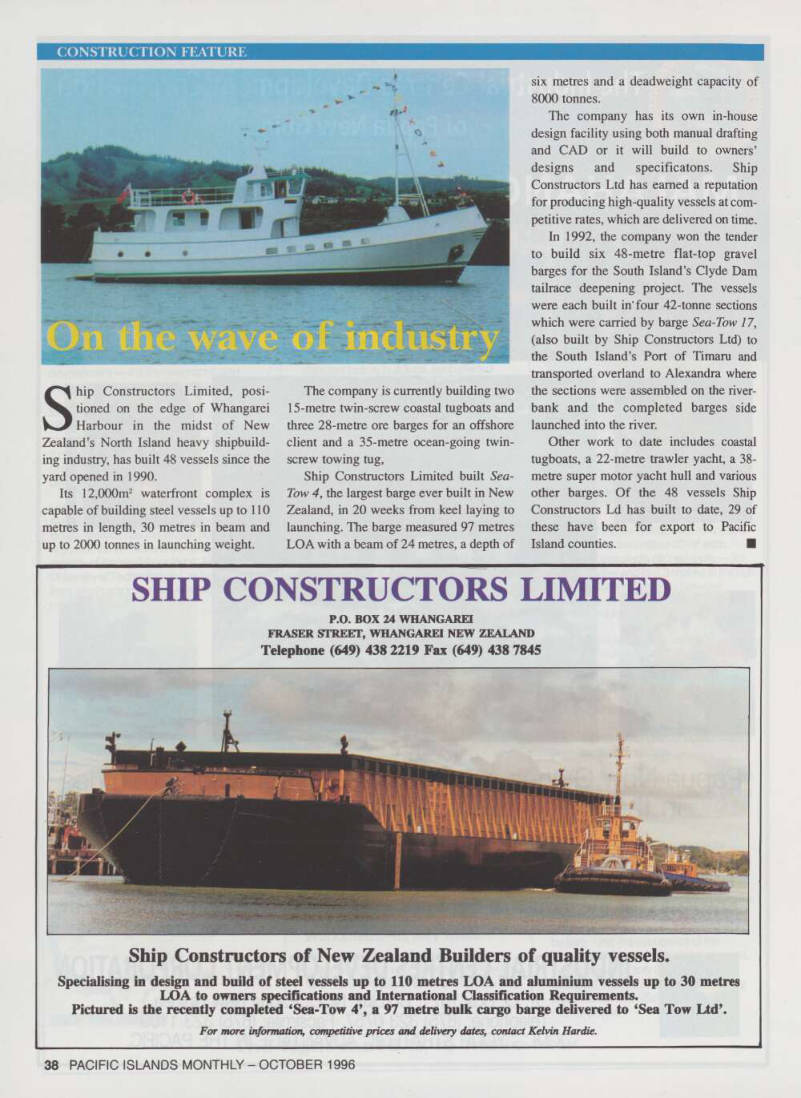
Ship Constructors Limited, posi tioned on the edge of Whangarei Harbour in the midst of New Zealand’s North Island heavy shipbuild ing industry, has built 48 vessels since the yard opened in 1990.
Its 12,000m 2 waterfront complex is capable of building steel vessels up to 110 metres in length, 30 metres in beam and up to 2000 tonnes in launching weight.
The company is currently building two 15-metre twin-screw coastal tugboats and three 28-metre ore barges for an offshore client and a 35-metre ocean-going twin screw towing tug, Ship Constructors Limited built Sea- Tow 4, the largest barge ever built in New Zealand, in 20 weeks from keel laying to launching. The barge measured 97 metres LOA with a beam of 24 metres, a depth of
six metres and a deadweight capacity of 8000 tonnes.
The company has its own in-house design facility using both manual drafting and CAD or it will build to owners’
designs and specificatons. Ship
Constructors Ltd has earned a reputation for producing high-quality vessels at com petitive rates, which are delivered on time.
In 1992, the company won the tender to build six 48-metre flat-top gravel barges for the South Island’s Clyde Dam tailrace deepening project. The vessels were each built in'four 42-tonne sections which were carried by barge Sea-Tow 17, (also built by Ship Constructors Ltd) to the South Island’s Port of Timaru and transported overland to Alexandra where the sections were assembled on the river bank and the completed barges side launched into the river.
Other work to date includes coastal tugboats, a 22-metre trawler yacht, a 38metre super motor yacht hull and various other barges. Of the 48 vessels Ship Constructors Ld has built to date, 29 of these have been for export to Pacific Island counties. ■
Advertisements & other items, p. 38 (2 items)
Construction Feature
Ship Constructors Limited
P.O. BOX 24 WHANGAREI
FRASER STREET, WHANGAREI NEW ZEALAND
Telephone (649) 438 2219 Fax (649) 438 7845 I ■f .> . .
H ii i Ship Constructors of New Zealand Builders of quality vessels.
Specialising in design and build of steel vessels up to 110 metres LOA and aluminium vessels up to 30 metres LOA to owners specifications and International Classification Requirements.
Pictured is the recently completed ‘Sea-Tow 4’, a 97 metre bulk cargo barge delivered to ‘Sea Tow Ltd’.
For more information, competitive prices and delivery dates, contact Kelvin Hardie.
On Vanuatu’s shaky grounds
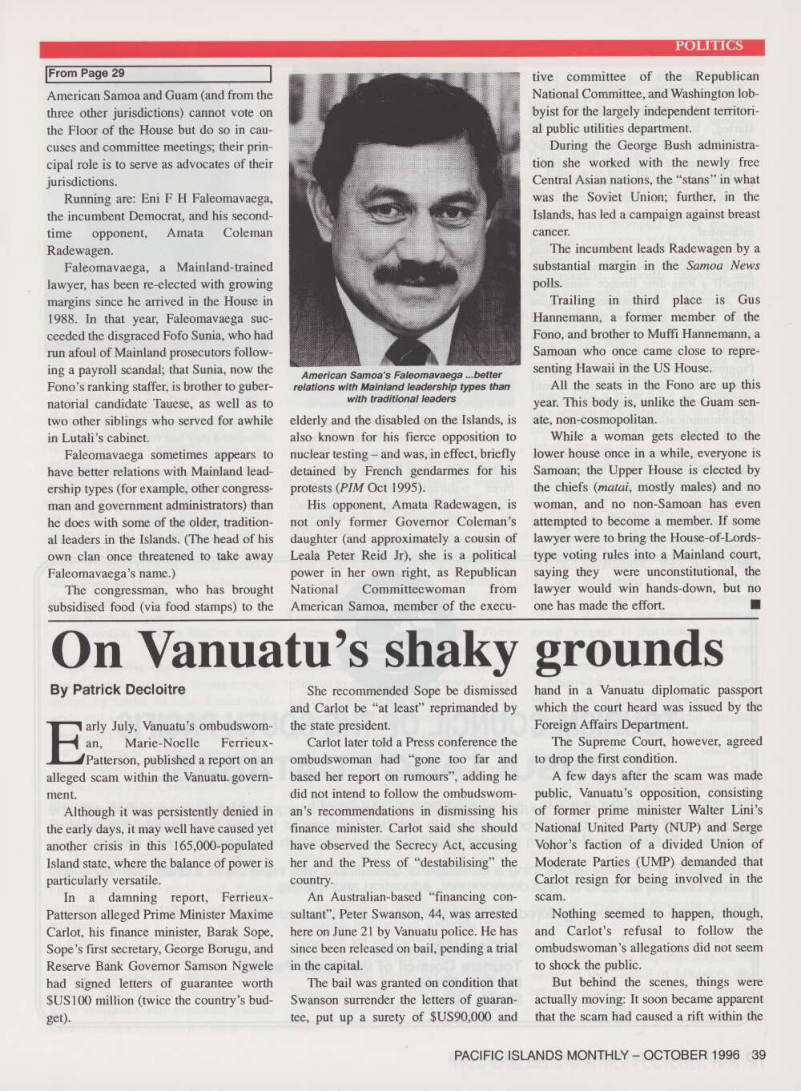
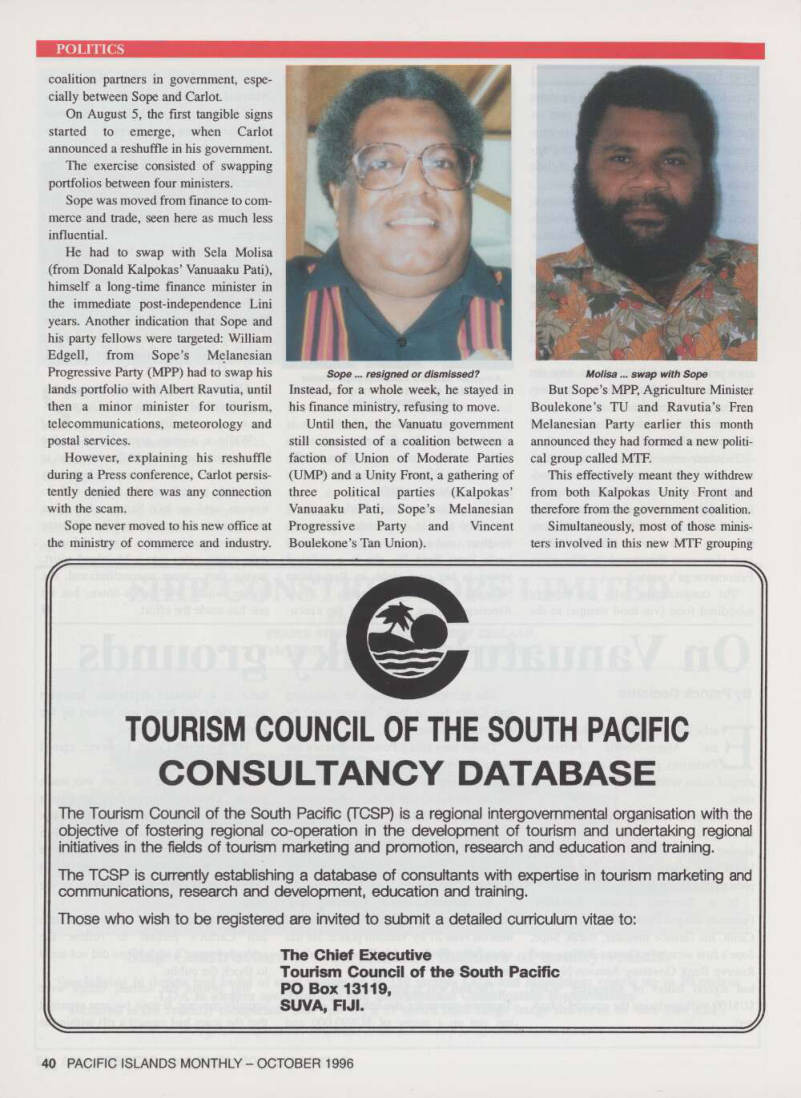
By Patrick Decloitre
Early July, Vanuatu’s ombudswom an, Marie-Noelle Ferrieux- Patterson, published a report on an alleged scam within the Vanuatu, govern ment.
Although it was persistently denied in the early days, it may well have caused yet another crisis in this 165,000-populated Island state, where the balance of power is particularly versatile.
In a damning report, Ferrieux- Patterson alleged Prime Minister Maxime Carlot, his finance minister, Barak Sope, Sope’s first secretary, George Borugu, and Reserve Bank Governor Samson Ngwele had signed letters of guarantee worth SUSIOO million (twice the country’s bud get).
She recommended Sope be dismissed and Carlot be “at least” reprimanded by the state president.
Carlot later told a Press conference the ombudswoman had “gone too far and based her report on rumours”, adding he did not intend to follow the ombudswom an’s recommendations in dismissing his finance minister. Carlot said she should have observed the Secrecy Act, accusing her and the Press of “destabilising” the country.
An Australian-based “financing con sultant”, Peter Swanson, 44, was arrested here on June 21 by Vanuatu police. He has since been released on bail, pending a trial in the capital.
The bail was granted on condition that Swanson surrender the letters of guaran tee, put up a surety of SUS9O,OOO and
hand in a Vanuatu diplomatic passport which the court heard was issued by the Foreign Affairs Department.
The Supreme Court, however, agreed to drop the first condition.
A few days after the scam was made public, Vanuatu’s opposition, consisting of former prime minister Walter Lini’s National United Party (NUP) and Serge Vohor’s faction of a divided Union of Moderate Parties (UMP) demanded that Carlot resign for being involved in the scam.
Nothing seemed to happen, though, and Carlot’s refusal to follow the ombudswoman’s allegations did not seem to shock the public.
But behind the scenes, things were actually moving: It soon became apparent that the scam had caused a rift within the
coalition partners in government, espe cially between Sope and Carlot.
On August 5, the first tangible signs started to emerge, when Carlot announced a reshuffle in his government.
The exercise consisted of swapping portfolios between four ministers.
Sope was moved from finance to com merce and trade, seen here as much less influential.
He had to swap with Sela Molisa (from Donald Kalpokas’ Vanuaaku Pati), himself a long-time finance minister in the immediate post-independence Lini years. Another indication that Sope and his party fellows were targeted: William Edgell, from Sope’s Melanesian Progressive Party (MPP) had to swap his lands portfolio with Albert Ravutia, until then a minor minister for tourism, telecommunications, meteorology and postal services.
However, explaining his reshuffle during a Press conference, Carlot persis tently denied there was any connection with the scam.
Sope never moved to his new office at the ministry of commerce and industry.
Instead, for a whole week, he stayed in his finance ministry, refusing to move.
Until then, the Vanuatu government still consisted of a coalition between a faction of Union of Moderate Parties (UMP) and a Unity Front, a gathering of three political parties (Kalpokas’
Vanuaaku Pati, Sope’s Melanesian Progressive Party and Vincent Boulekone’s Tan Union).
But Sope’s MPP, Agriculture Minister Boulekone’s TU and Ravutia’s Fren Melanesian Party earlier this month announced they had formed a new politi cal group called MTF.
This effectively meant they withdrew from both Kalpokas Unity Front and therefore from the government coalition.
Simultaneously, most of those minis ters involved in this new MTF grouping
Sope...resigned or dismissed?
Molisa...swap with Sope
(Sope, Edged, Boulekone, Ravutia) had sent resignation letters to Carlot.
This effectively meant the MTF group had joined the opposition, bringing its number to an estimated 28 (out of 50), two weeks before a scheduled third extraordinary session of parliament.
The PM soon after explained he didn’t see the letters, which he labelled “kind of resignations”, as proper resignations, and therefore did not accept them.
One week after the reshuffle, on August 12, Carlot dismissed Sope. Carlot said in a statement he had taken the step because Sope “did not accept” a recent reshuffle and had since “negotiated with the opposition to form a new govern ment”, a move Carlot labelled as “serious misconduct” and an “act of insubordina tion and disobedience”.
Sope, however, pointed out he had resigned before he received Carlot’s ter mination letter.
The day after, a motion of no confi dence was filed in parliament, but a few days later Parliament Speaker Edward Natapei said it was not valid because, according to legal advice he had received from Attorney-General Oliver Saksak, the motion should have been filed seven days before the date it was to be debated in the House (August 20).
The motion had been filed on August 13.
The following days saw an accelera tion of events: August 18, Boulekone was sacked by Carlot because, Carlot said, while still a government minister he had “negotiated with opposition to form a new government”, a move amounting to
“high treason”.
Four days later, Carlot lost two more ministers, bringing to four the number of cabinet members who had either resigned or been sacked in the previous 10 days.
The prime minister’s first secretary, Yvette Sam, said Albert Ravutia, until now minister of lands and Edged (tourism) were no longer part of the gov ernment.
Meanwhile, John Morrison, an MP from Carlot’s only remaining coalition partner, Vanuaaku Pati, was appointed on August 20 to replace Boulekone. But three ministries still remained vacant: Commerce/trade/industry, lands and
tourism.
Carlot and Kalpokas later claimed in a joint statement they still had the support of 25 MPs (out of 50 in the House), but opposition was still estimating to be 28 MPs strong.
Only days before a planned parlia ment session on Monday, August 26, ten sion was mounting in the Island state’s
capital: Opposition spokeswoman Hilda
Lini on Friday alleged six high-ranking officers within the Vanuatu Mobile Force (VMF, a 300-strong paramilitary force placed under the authority of the police) planned to stage a coup at Monday’s par liament extraordinary session.
Lini said the plan included the arrest of parliamentarians, the appointment of a caretaker prime minister and his govern ment who would take orders from a “mil
itary council”.
Although rejecting the possibility of a
coup, Vanuatu Police Commissioner Luke Siba confirmed politicians in this Island state were trying to gain support from some elements of the VMF in order to stage a coup.
“According to information obtained
by police intelligence network, some
politicians are currently trying to create
division within the police force,” he said.
“Police will always act according to Vanuatu’s constitution and laws, but it will not follow orders from my politi cian.”
Late August again, Natapei announced he had decided to “defer”
Monday’s third extraordinary session, after receiving a request from Deputy Prime Minister Kalpokas.
Later, a request from the government was accepted by Natapei for September 30.
The move prompted strong reaction from the opposition: Hilda Lini labelled Natapei’s decision as “unconstitutional, undemocratic, politically motivated and not in order with parliament procedures”.
“There is no written rule anywhere that says he can revoke summons to par liament,” she added.
On August 26, when parliament was to have met, opposition leader Willie Jimmy fded a request for an extraordi nary session on September 6, as well as a notice of motion of no confidence to be debated on that day.
Natapei rejected the request.
Meanwhile, Carlot and Kalpokas in a joint statement called on all political leaders for a “national reconciliation”.
“We welcome and invite all leaders (of opposition parties) to join the current coalition government,” they said, adding that they had signed a “solidarity agree ment” on Sunday whereby they agreed, “if there is need”, that their government group “engage in discussions with all other political groups to consider a new arrangement for the government.”
Meanwhile, Vanuatu President Jean- Marie Leye, in a speech broadcast on the national government-run Radio Vanuatu, asked all parties to solve the political cri sis before September 30, when an extraordinary session of parliament is to meet to discuss nine government bills.
The date is also significant in so far as it nears the first anniversary of the disso lution of Parliament on October 3, 1995 by Leye.
The move was taken by the Vanuatu president to end the previous legislature and pave way for last November’s gener al elections.
According to the Vanuatu constitution, the President of the Republic may, on the advice of the Council of Ministers, dis solve Parliament with no further dissolu tion for 12 months. ■
Kalpokas...calling for national reconciliation
Advertisements & other items, p. 40 (1 item)
Tourism Council Of The South Pacific
CONSULTANCY DATABASE
The Tourism Council of the South Pacific (TCSP) is a regional intergovernmental organisation with the objective of fostering regional co-operation in the development of tourism and undertaking regional initiatives in the fields of tourism marketing and promotion, research and education and training.
The TCSP is currently establishing a database of consultants with expertise in tourism marketing and communications, research and development, education and training.
Those who wish to be registered are invited to submit a detailed curriculum vitae to: The Chief Executive Tourism Council of the South Pacific PC Box 13119,
SUVA, FIJI.
surprised by attacks
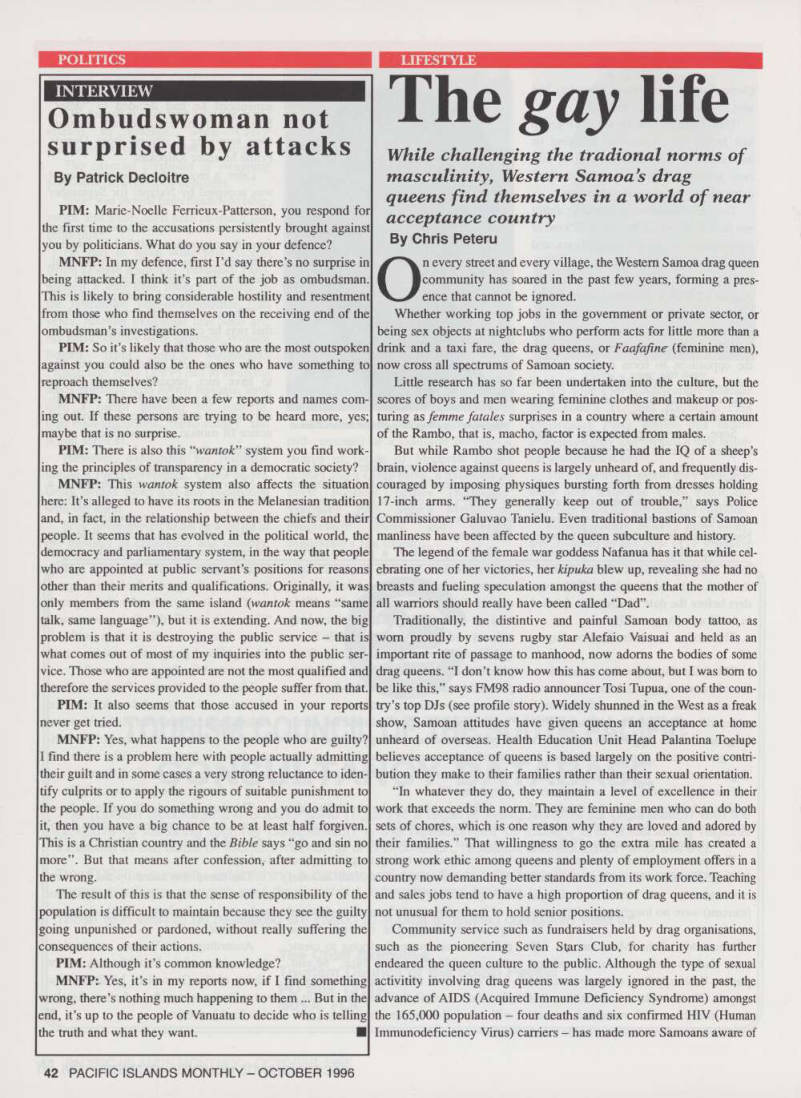
Interview
Ombudswoman not surprised by attacks
By Patrick Decloitre
PIM: Marie-Noelle Ferrieux-Patterson, you respond for the first time to the accusations persistently brought against you by politicians. What do you say in your defence?
MNFP: In my defence, first I’d say there’s no surprise in being attacked. I think it’s part of the job as ombudsman.
This is likely to bring considerable hostility and resentment from those who find themselves on the receiving end of the
ombudsman’s investigations.
PIM: So it’s likely that those who are the most outspoken against you could also be the ones who have something to
reproach themselves?
MNFP: There have been a few reports and names com ing out. If these persons are trying to be heard more, yes; maybe that is no surprise.
PIM: There is also this “ wantok ” system you find work ing the principles of transparency in a democratic society?
MNFP: This wantok system also affects the situation here: It’s alleged to have its roots in the Melanesian tradition and, in fact, in the relationship between the chiefs and then people. It seems that has evolved in the political world, the democracy and parliamentary system, in the way that people who are appointed at public servant’s positions for reasons other than their merits and qualifications. Originally, it was only members from the same island (wantok means “same talk, same language”), but it is extending. And now, the big problem is that it is destroying the public service - that is what comes out of most of my inquiries into the public ser vice. Those who are appointed are not the most qualified and therefore the services provided to the people suffer from that.
PIM: It also seems that those accused in your reports never get tried.
MNFP: Yes, what happens to the people who are guilty?
I find there is a problem here with people actually admitting their guilt and in some cases a very strong reluctance to iden tify culprits or to apply the rigours of suitable punishment to the people. If you do something wrong and you do admit to it, then you have a big chance to be at least half forgiven.
This is a Christian country and the Bible says “go and sin no more”. But that means after confession, after admitting to the wrong.
The result of this is that the sense of responsibility of the population is difficult to maintain because they see the guilty going unpunished or pardoned, without really suffering the consequences of their actions.
PIM: Although it’s common knowledge?
MNFP: Yes, it’s in my reports now, if I find something wrong, there’s nothing much happening to them ... But in the end, it’s up to the people of Vanuatu to decide who is telling the truth and what they want. ■
The gay life
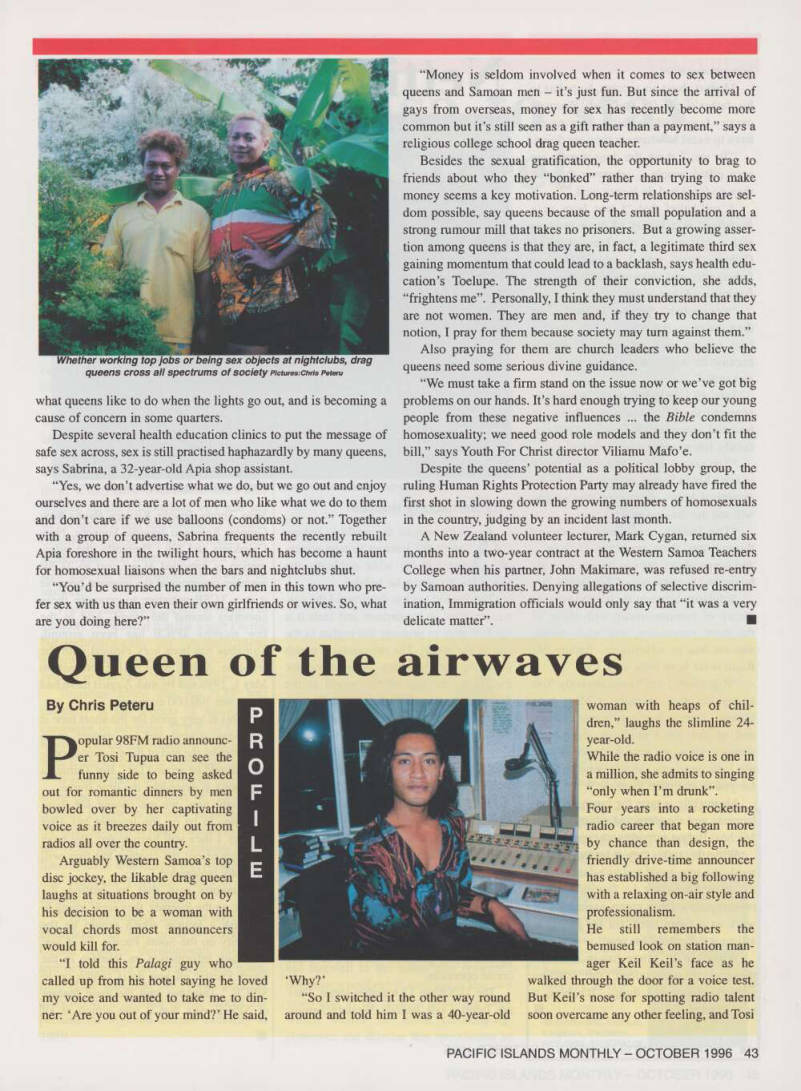
Lifestyle
While challenging the tradional norms of masculinity, Western Samoa's drag queens find themselves in a world of near acceptance country
By Chris Peteru
On every street and every village, the Western Samoa drag queen community has soared in the past few years, forming a pres ence that cannot be ignored.
Whether working top jobs in the government or private sector, or being sex objects at nightclubs who perform acts for little more than a drink and a taxi fare, the drag queens, or Faafafine (feminine men), now cross all spectrums of Samoan society.
Little research has so far been undertaken into the culture, but the scores of boys and men wearing feminine clothes and makeup or pos turing as femme fatales surprises in a country where a certain amount of the Rambo, that is, macho, factor is expected from males.
But while Rambo shot people because he had the IQ of a sheep’s brain, violence against queens is largely unheard of, and frequently dis couraged by imposing physiques bursting forth from dresses holding 17-inch arms. “They generally keep out of trouble,” says Police Commissioner Galuvao Tanielu. Even traditional bastions of Samoan manliness have been affected by the queen subculture and history.
The legend of the female war goddess Nafanua has it that while cel ebrating one of her victories, her kipuka blew up, revealing she had no breasts and fueling speculation amongst the queens that the mother of all warriors should really have been called “Dad”.
Traditionally, the distintive and painful Samoan body tattoo, as worn proudly by sevens rugby star Alefaio Vaisuai and held as an important rite of passage to manhood, now adorns the bodies of some drag queens. “I don’t know how this has come about, but I was bom to be like this,” says FM9B radio announcer Tosi Tupua, one of the coun try’s top DJs (see profile story). Widely shunned in the West as a freak show, Samoan attitudes have given queens an acceptance at home unheard of overseas. Health Education Unit Head Palantina Toelupe believes acceptance of queens is based largely on the positive contri bution they make to their families rather than their sexual orientation.
“In whatever they do, they maintain a level of excellence in their work that exceeds the norm. They are feminine men who can do both sets of chores, which is one reason why they are loved and adored by their families.” That willingness to go the extra mile has created a strong work ethic among queens and plenty of employment offers in a country now demanding better standards from its work force. Teaching and sales jobs tend to have a high proportion of drag queens, and it is not unusual for them to hold senior positions.
Community service such as fundraisers held by drag organisations, such as the pioneering Seven Stars Club, for charity has further endeared the queen culture to the public. Although the type of sexual activitity involving drag queens was largely ignored in the past, the advance of AIDS (Acquired Immune Deficiency Syndrome) amongst the 165,000 population - four deaths and six confirmed HIV (Human Immunodeficiency Virus) carriers - has made more Samoans aware of
what queens like to do when the lights go out, and is becoming a cause of concern in some quarters.
Despite several health education clinics to put the message of safe sex across, sex is still practised haphazardly by many queens, says Sabrina, a 32-year-old Apia shop assistant.
“Yes, we don’t advertise what we do, but we go out and enjoy ourselves and there are a lot of men who like what we do to them and don’t care if we use balloons (condoms) or not.” Together with a group of queens, Sabrina frequents the recently rebuilt Apia foreshore in the twilight hours, which has become a haunt for homosexual liaisons when the bars and nightclubs shut.
“You’d be surprised the number of men in this town who pre fer sex with us than even their own girlfriends or wives. So, what are you doing here?”
“Money is seldom involved when it comes to sex between queens and Samoan men - it’s just fun. But since the arrival of gays from overseas, money for sex has recently become more common but it’s still seen as a gift rather than a payment,” says a
religious college school drag queen teacher.
Besides the sexual gratification, the opportunity to brag to friends about who they “bonked” rather than trying to make money seems a key motivation. Long-term relationships are sel dom possible, say queens because of the small population and a strong rumour mill that takes no prisoners. But a growing asser tion among queens is that they are, in fact, a legitimate third sex gaining momentum that could lead to a backlash, says health edu cation’s Toelupe. The strength of their conviction, she adds, “frightens me”. Personally, I think they must understand that they are not women. They are men and, if they try to change that notion, I pray for them because society may turn against them.”
Also praying for them are church leaders who believe the queens need some serious divine guidance.
“We must take a firm stand on the issue now or we’ve got big problems on our hands. It’s hard enough trying to keep our young people from these negative influences ... the Bible condemns homosexuality; we need good role models and they don’t fit the bill,” says Youth For Christ director Viliamu Mafo’e.
Despite the queens’ potential as a political lobby group, the ruling Human Rights Protection Party may already have fired the first shot in slowing down the growing numbers of homosexuals in the country, judging by an incident last month.
A New Zealand volunteer lecturer, Mark Cygan, returned six months into a two-year contract at the Western Samoa Teachers College when his partner, John Makimare, was refused re-entry by Samoan authorities. Denying allegations of selective discrim ination, Immigration officials would only say that “it was a very delicate matter”. ■
Whether working top jobs or being sex objects at nightclubs, drag queens cross all spectrums of society pictures:Chris Peteru
Queen of the airwaves
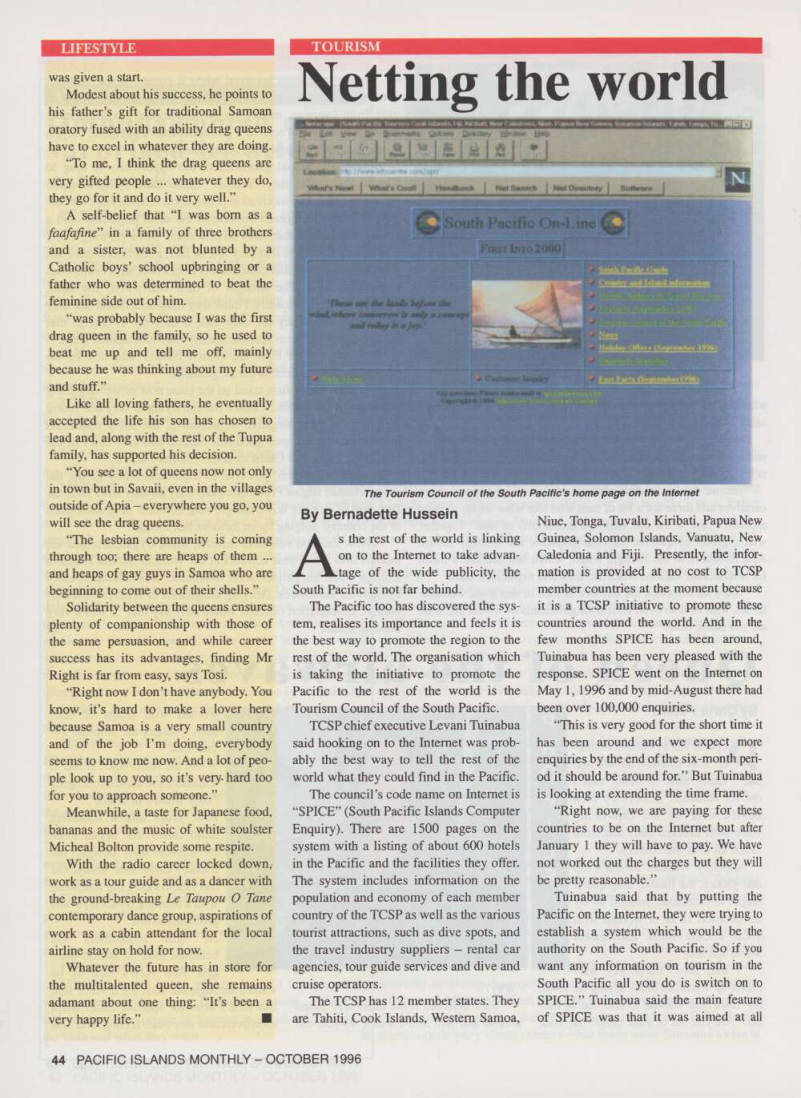
By Chris Peteru
Popular 98FM radio announc er Tosi Tupua can see the funny side to being asked out for romantic dinners by men bowled over by her captivating voice as it breezes daily out from radios all over the country.
Arguably Western Samoa’s top disc jockey, the likable drag queen laughs at situations brought on by his decision to be a woman with vocal chords most announcers would kill for.
“I told this Palagi guy who
called up from his hotel saying he loved my voice and wanted to take me to din ner: ‘Are you out of your mind?’ He said.
‘Why?’
“So I switched it the other way round around and told him I was a 40-year-old
woman with heaps of chil dren,” laughs the slimline 24year-old.
While the radio voice is one in a million, she admits to singing “only when I’m drunk”.
Four years into a rocketing radio career that began more by chance than design, the friendly drive-time announcer has established a big following with a relaxing on-air style and professionalism.
He still remembers the bemused look on station man ager Keil Keil’s face as he
walked through the door for a voice test.
But Keil’s nose for spotting radio talent soon overcame any other feeling, and Tosi
Profile
was given a start.
Modest about his success, he points to his father’s gift for traditional Samoan oratory fused with an ability drag queens have to excel in whatever they are doing.
“To me, I think the drag queens are very gifted people ... whatever they do, they go for it and do it very well.”
A self-belief that “I was bom as a faafafine ” in a family of three brothers and a sister, was not blunted by a Catholic boys’ school upbringing or a father who was determined to beat the feminine side out of him.
“was probably because I was the first drag queen in the family, so he used to beat me up and tell me off, mainly because he was thinking about my future and stuff.”
Like all loving fathers, he eventually accepted the life his son has chosen to lead and, along with the rest of the Tupua family, has supported his decision.
“You see a lot of queens now not only in town but in Savaii, even in the villages outside of Apia - everywhere you go, you will see the drag queens.
“The lesbian community is coming through too; there are heaps of them ... and heaps of gay guys in Samoa who are beginning to come out of their shells.”
Solidarity between the queens ensures plenty of companionship with those of the same persuasion, and while career success has its advantages, finding Mr Right is far from easy, says Tosi.
“Right now I don’t have anybody. You know, it’s hard to make a lover here because Samoa is a very small country and of the job I’m doing, everybody seems to know me now. And a lot of peo ple look up to you, so it’s very- hard too for you to approach someone.”
Meanwhile, a taste for Japanese food, bananas and the music of white soulster Micheal Bolton provide some respite.
With the radio career locked down, work as a tour guide and as a dancer with the ground-breaking Le Taupou O Tane contemporary dance group, aspirations of work as a cabin attendant for the local airline stay on hold for now.
Whatever the future has in store for the multitalented queen, she remains adamant about one thing: “It’s been a very happy life.” ■
Netting the world
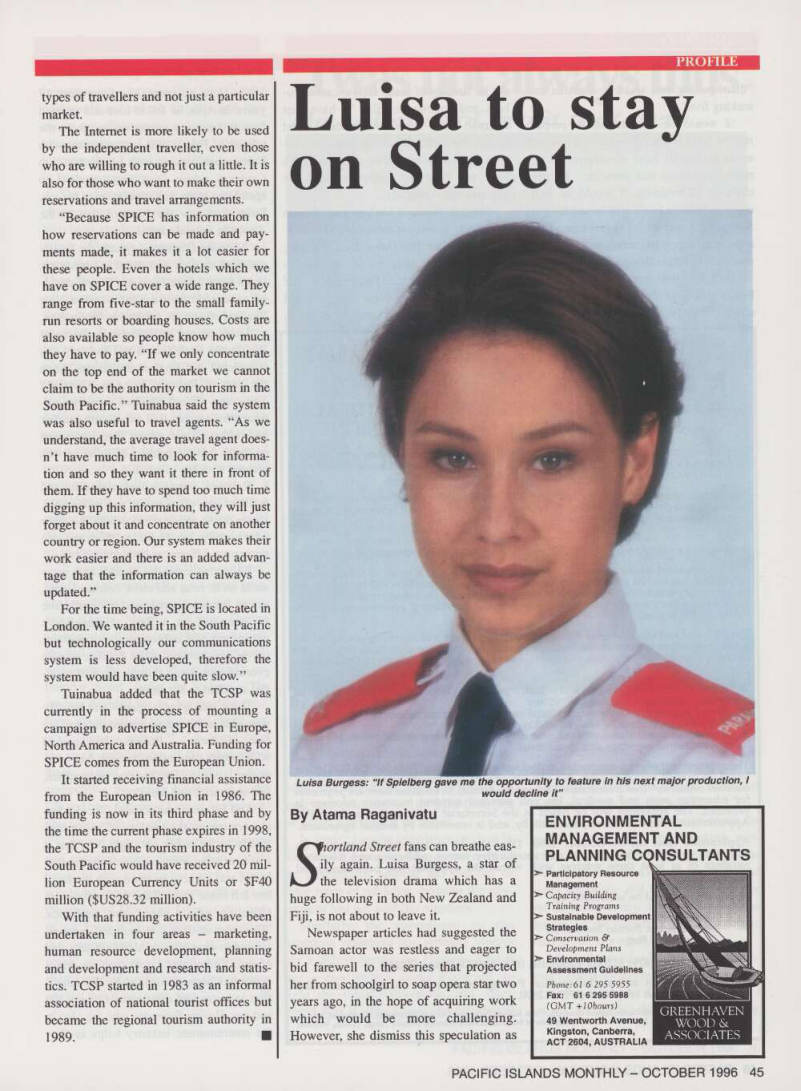
Tourism
By Bernadette Hussein
As the rest of the world is linking on to the Internet to take advan tage of the wide publicity, the South Pacific is not far behind.
The Pacific too has discovered the sys tem, realises its importance and feels it is the best way to promote the region to the rest of the world. The organisation which is taking the initiative to promote the Pacific to the rest of the world is the Tourism Council of the South Pacific.
TCSP chief executive Levani Tuinabua said hooking on to the Internet was prob ably the best way to tell the rest of the world what they could find in the Pacific.
The council’s code name on Internet is “SPICE” (South Pacific Islands Computer Enquiry). There are 1500 pages on the system with a listing of about 600 hotels in the Pacific and the facilities they offer.
The system includes information on the population and economy of each member country of the TCSP as well as the various tourist attractions, such as dive spots, and the travel industry suppliers - rental car agencies, tour guide services and dive and cruise operators.
The TCSP has 12 member states. They are Tahiti, Cook Islands, Western Samoa,
Niue, Tonga, Tuvalu, Kiribati, Papua New Guinea, Solomon Islands, Vanuatu, New Caledonia and Fiji. Presently, the infor mation is provided at no cost to TCSP member countries at the moment because it is a TCSP initiative to promote these countries around the world. And in the few months SPICE has been around, Tuinabua has been very pleased with the response. SPICE went on the Internet on May 1, 1996 and by mid-August there had been over 100,000 enquiries.
“This is very good for the short time it has been around and we expect more enquiries by the end of the six-month peri od it should be around for.” But Tuinabua is looking at extending the time frame.
“Right now, we are paying for these countries to be on the Internet but after January 1 they will have to pay. We have not worked out the charges but they will be pretty reasonable.”
Tuinabua said that by putting the Pacific on the Internet, they were trying to establish a system which would be the authority on the South Pacific. So if you want any information on tourism in the South Pacific all you do is switch on to SPICE.” Tuinabua said the main feature of SPICE was that it was aimed at all
The Tourism Council of the South Pacific’s home page on the Internet
types of travellers and not just a particular market.
The Internet is more likely to be used by the independent traveller, even those who are willing to rough it out a little. It is also for those who want to make their own reservations and travel arrangements.
“Because SPICE has information on how reservations can be made and pay ments made, it makes it a lot easier for these people. Even the hotels which we have on SPICE cover a wide range. They range from five-star to the small family run resorts or boarding houses. Costs are also available so people know how much they have to pay. “If we only concentrate on the top end of the market we cannot claim to be the authority on tourism in the South Pacific.” Tuinabua said the system was also useful to travel agents. “As we understand, the average travel agent does n’t have much time to look for informa tion and so they want it there in front of them. If they have to spend too much time digging up this information, they will just forget about it and concentrate on another country or region. Our system makes their work easier and there is an added advan tage that the information can always be
updated.”
For the time being, SPICE is located in London. We wanted it in the South Pacific but technologically our communications system is less developed, therefore the system would have been quite slow.”
Tuinabua added that the TCSP was currently in the process of mounting a campaign to advertise SPICE in Europe, North America and Australia. Funding for SPICE comes from the European Union.
It started receiving financial assistance from the European Union in 1986. The funding is now in its third phase and by the time the current phase expires in 1998, the TCSP and the tourism industry of the South Pacific would have received 20 mil lion European Currency Units or SF4O million ($U528.32 million).
With that funding activities have been undertaken in four areas - marketing, human resource development, planning and development and research and statis tics. TCSP started in 1983 as an informal association of national tourist offices but became the regional tourism authority in 1989. ■
Luisa to stay
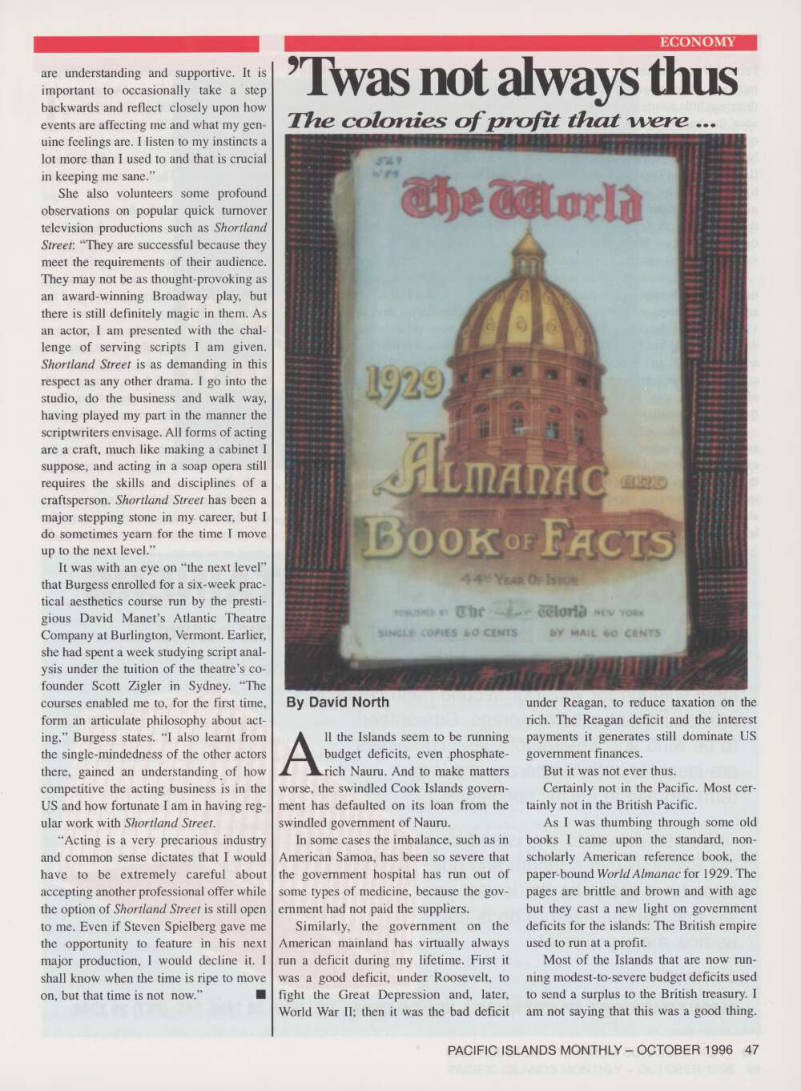
Profile
Luisa to stay on Street
By Atama Raganivatu
fiortland Street fans can breathe eas ily again. Luisa Burgess, a star of Jk-Jthe television drama which has a huge following in both New Zealand and Fiji, is not about to leave it.
Newspaper articles had suggested the Samoan actor was restless and eager to bid farewell to the series that projected her from schoolgirl to soap opera star two years ago, in the hope of acquiring work which would be more challenging.
However, she dismiss this speculation as
Luisa Burgess: "If Spielberg gave me the opportunity to feature in his next major production, I would decline it”
“them putting two and two together and
making five”.
“I would be foolish not to prepare myself for life after Shortland Street and some journalists have misinterpreted my readiness to face that situation,” Burgess explains. “Obviously, it would be ludi crous to believe I will still be working on Shortland Street in 20 years’ time. I am more than happy to remain with it for the foreseeable future though.”
That is good news for the army of Fijian Shortland Street devotees. The bad news is that she has no plans to follow in
the jet streams of many fellow cast mem bers and journey to Fiji. “I have just returned from six weeks in the United States and will be visiting family mem bers in Samoa later this year, so won’t have any time for further travel,” she explains apologetically, Burgess’ Samoan background, though not widely known, is something she obvi ously cherishes. Her father, Dick Burgess, was posted to Apia as an adviser to Western Samoa’s Department of Agriculture by the New Zealand aid organisation Voluntary Service Abroad in
1968. Here he spent 15 of the next 17 years. In Apia, he fell in love and married Feavai Amosa, a young woman from the village of Falesa. She was pregnant with Luisa when moving with her husband, to Canberra where Dick was required to spend two years as a stipulation of his job.
Luisa first saw the light of day in the Australia federal capital.
After the Canberra sojourn, the family returned to Apia and spent a further six years there before Dick and Feavai decid ed to provide their daughter with a New Zealand education, settling in Wellington.
Luisa gained an interest in drama at Wellington High School and had only just completed her final examinations when the part of Rebecca Frost in Shortland Street was offered. She had actually audi tioned for another role two months earlier and, although not getting that, impressed so much that the persona of Rebecca was created with her in mind.
Rebecca, strong-willed, righteous and resilient yet often naive and vulnerable, shares some characteristics with the actor who portrays her. However, there are also numerous differences between the two.
Rebecca certainly would not wear studs on hr nose and chew coloured gum, as are Burgess’ penchants, nor could she be imagined on a float at Auckland’s annual gay and lesbian parade or present ing prizes during a major fashion awards evening with just a skimpy piece of mate rial attached to her front.
These indulgences apart - and few 20year-olds in the entertainment industry are free of them - Burgess has gained widespread admiration through her com
posure, congeniality, energy, pragmatism,
self-assurance and lucidity.
And Burgess was certainly lucid when elaborating on the burdens of being con stantly in the public spotlight. “At first it was confusing, very confusing, particular ly as I was coming to terms with the fact I had left home and left the things that were affirming who I was,” she confesses.
“Now, my instinct is to stop and regener ate and to cope with the demands required of me. Sometimes I feel that my inno cence has been dismantled by the televi sion industry and often retreat to my flat and cry. Having flatmates who are also in the entertainment industry helps as they
are understanding and supportive. It is important to occasionally take a step backwards and reflect closely upon how events are affecting me and what my gen uine feelings are. I listen to my instincts a lot more than I used to and that is crucial in keeping me sane.”
She also volunteers some profound observations on popular quick turnover television productions such as Shortland Street : “They are successful because they meet the requirements of their audience.
They may not be as thought-provoking as
an award-winning Broadway play, but
there is still definitely magic in them. As an actor, I am presented with the chal lenge of serving scripts I am given.
Shortland Street is as demanding in this respect as any other drama. I go into the studio, do the business and walk way, having played my part in the manner the scriptwriters envisage. All forms of acting are a craft, much like making a cabinet I suppose, and acting in a soap opera still requires the skills and disciplines of a craftsperson. Shortland Street has been a major stepping stone in my career, but I do sometimes yearn for the time I move up to the next level.”
It was with an eye on “the next level” that Burgess enrolled for a six-week prac tical aesthetics course run by the presti gious David Manet’s Atlantic Theatre Company at Burlington, Vermont. Earlier, she had spent a week studying script anal ysis under the tuition of the theatre’s co founder Scott Zigler in Sydney. “The courses enabled me to, for the first time, form an articulate philosophy about act ing,” Burgess states. “I also learnt from the single-mindedness of the other actors there, gained an understanding of how competitive the acting business is in the US and how fortunate I am in having reg ular work with Shortland Street.
“Acting is a very precarious industry and common sense dictates that I would have to be extremely careful about accepting another professional offer while the option of Shortland Street is still open to me. Even if Steven Spielberg gave me the opportunity to feature in his next major production, I would decline it. I shall know when the time is ripe to move on, but that time is not now.” ■
Advertisements & other items, pp. 45-46 (1 item)
Planning Consultants
ENVIRONMENTAL
MANAGEMENT AND
>- Participatory Resource Management >• Capacity Building Training Programs >• Sustainable Development Strategies >■ Conservation & Development Plans >■ Environmental Assessment Guidelines Phone: 61 6 295 5955 Fax: 61 6 295 5988 (GMT +1 Ohours) 49 Wentworth Avenue, Kingston, Canberra,
ACT 2604, AUSTRALIA
mm
GREEN HAVEN
WOOD &
ASSOCIATES
SOUTH PACIFIC FORUM SECRETARIAT
VACANCY
INTERNATIONAL ISSUES ADVISER POLITICAL
AND INTERNATIONAL AFFAIRS DIVISION
Applications are invited from suitably qualified and experienced persons, who must be nationals of a member state of the South Pacific Forum , for the position in the Political and International Affairs Division at the Forum Secretariat.
The Forum Secretariat was established in 1972 by the South Pacific Forum to encourage economic and political cooperation between its member states, and between those states and the more industrialised countries.
During 1996 the Secretariat is being comprehensively restructured and the Division is undergoing a restructuring which will significantly expand its international liaison role.
The International Issues Adviser is a new position created as a result of the expansion of the Division and its greater international liaison role. The position will have the main responsibility within the Division for carrying out that role, including significant time in representing the Forum's interests in meetings and negotiating processes outside the South Pacific region.
The Political and International Affairs Division will liaise with extra regional countries and organisations to promote the Forum's interests in international political, security and economic issues. Key requirements for the International Issues Adviser of this Division are: • Advanced university degree and at least 7 years experience working on international relations issues. • Sound knowledge of the international concerns of Forum members • Extensive experience in analysis and report writing • Experience and demonstrated success in a representational role in intergovernmental meetings and discussions.
The appointment offers a remuneration package of around $50,170 to $64,936 Fiji Dollars based on current exchange rates. For non-Fiji citizens this should be tax-free in Forum member countries*. (See Information Package for details). In addition there are payments for education costs and medical, life and personal accident insurance coverage is provided. The appointee will be based at the Secretariat headquarters in Suva, Fiji.
Appointment will be for three years initially, and is renewable by mutual agreement.
Applications close on 31 October 1996. They should contain full information on education and career background and should give names, addresses and telephone numbers of at least three referees with whom the applicant has been associated
professionally.
Applications should be addressed to: The Secretary General South Pacific Forum Secretariat Private Mail Bag Suva, FIJI Telephone: (679) 312600: Facsimile: (679) 305573; Telex: FJ2229 Further information and an Information Package is available on request from the Personnel Officer on telephone (679) 312600. [* Member States of the South Pacific Forum: Australia, Cook Islands, Federated States of Micronesia, Fiji, Kiribati, Nauru, New Zealand, Niue, Palau, Papua New Guinea, Republic of Marshall Islands, Solomon Islands, Tonga, Tuvalu, Vanuatu and Western Samoa.]
Twas not always thus

The colonies of profit that were ...
By David North
All the Islands seem to be running
budget deficits, even phosphate
rich Nauru. And to make matters worse, the swindled Cook Islands govern ment has defaulted on its loan from the swindled government of Nauru.
In some cases the imbalance, such as in American Samoa, has been so severe that the government hospital has run out of some types of medicine, because the gov ernment had not paid the suppliers.
Similarly, the government on the American mainland has virtually always run a deficit during my lifetime. First it was a good deficit, under Roosevelt, to fight the Great Depression and, later, World War II; then it was the bad deficit
under Reagan, to reduce taxation on the rich. The Reagan deficit and the interest payments it generates still dominate US government finances.
But it was not ever thus.
Certainly not in the Pacific. Most cer tainly not in the British Pacific.
As I was thumbing through some old books I came upon the standard, non scholarly American reference book, the paper-bound World Almanac for 1929. The pages are brittle and brown and with age but they cast a new light on government deficits for the islands: The British empire used to run at a profit.
Most of the Islands that are now run ning modest-to-severe budget deficits used to send a surplus to the British treasury. I am not saying that this was a good thing.
Peoples lives were shorter, education was minimal, streets were not paved, and there was little electricity, but they did bal ance the budget. I had encountered the concept years ago when I read Agnes Newton Keith’s Land Below the Wind (Little Brown, 1939) a sensitive (for the time) memoir by an expatriate woman married to the chief forester in what was then British North Borneo. She noted that the taxes collected in that colony always
the government’s expenditures.
The World Almanac for 1929 indicates that the North Borneo experience was not an isolated phenomenon. For example, in 1926, and using the colonial names of the day: Fiji Islands had £584,515 in revenue and £535,957 in expenditures. The colony’s total debt, built up over a period of years, was only £150,000, less than three months’ worth of taxes.
Tonga Islands, or Friendly Islands, did even better; revenue was £91,696 and expenditures £68,759. Further, in that year, Tonga’s exports (copra and live stock) were running about 10 per cent ahead of its imports. Gilbert and Ellice Islands Colony (now Kiribati and Tuvalu)
showed £51,697 in income and £40,610 in outgo. The Brits were taking out much more in exports, largely phosphate, now exhausted, (£388,157), than they showed in arriving imports (£125,048).
A really big money maker for the colo nial powers was the New Hebrides (Vanuatu) which showed 1925 revenues of 1,420,000 francs versus expenditures of 853,000 francs. Perhaps the most solvent of the jurisdictions in those days was French Polynesia which, according to the World Almanac, had a balanced budget of 11,590,633 francs and a reserve of seven million francs (in the days when the franc was much more valuable than it is now).
Was France subsidising her Islands then as she does now? I could not tell from the old book, but the concept of the Islands being subsidised by the colonial powers was already alive and well. Take the conflicting regional trends in what is now P-NG. In 1926-27 the ex-German Territory of New Guinea was being run at a £35,000-a-year profit under a League of Nations mandate to Britain which was subsequently handed off to Australia.
But the Territory of Papua, long under
Aussie domination, had already begun
deficit financing. Expenditures exeeded
revenues by £56,000 a year and there was a notation of £50,000 subsidy from Australia. Did the subsidy make up most the shortfall? Or was there both a subsidy and a shortfall? The browning pages do not tell us.
Not all the Islands’ finances were as transparent as they were in the British, Australian and French territories. Guam and American Samoa were still United States naval stations, and their budgets were not discussed; nor were those of the then newly Japanese islands in Micronesia. Though the entries were mostly concerned with history, govern ment, and finance, the World Almanac writers apparently did not struggle with the concept of political correctness when they dealt with other matters. Hence this line about one of the colonies: “The peo ple being crude tribes among whom the British are carrying (on) civilising work...”
In addition to the “civilising work” the colonial authorities were also, apparently, collecting more money than they spent. ■
Advertisements & other items, p. 48 (2 items)
Economy
Second Hand Containers
WHERE AND WHEN YOU WANT THEM IN THE PACIFIC If you need a flexible and safe storage space we have the ideal solution for you. Our second hand containers provide instant secure storage. Guaranteed to be wind and waterproof these containers are ideal for both temporary and longterm storage in Pacific conditions.
We can deliver to any island in the Pacific within a month and our rates have got to be the lowest you will find. All you need to do is tell us how many you want.
CONTACT:
PASCALE MARCONNET, BP 4787 NOUMEA, NEW CALEDONIA. TEL; (687) 28 7450. FAX; (687) 26 3248
P NG's pottery
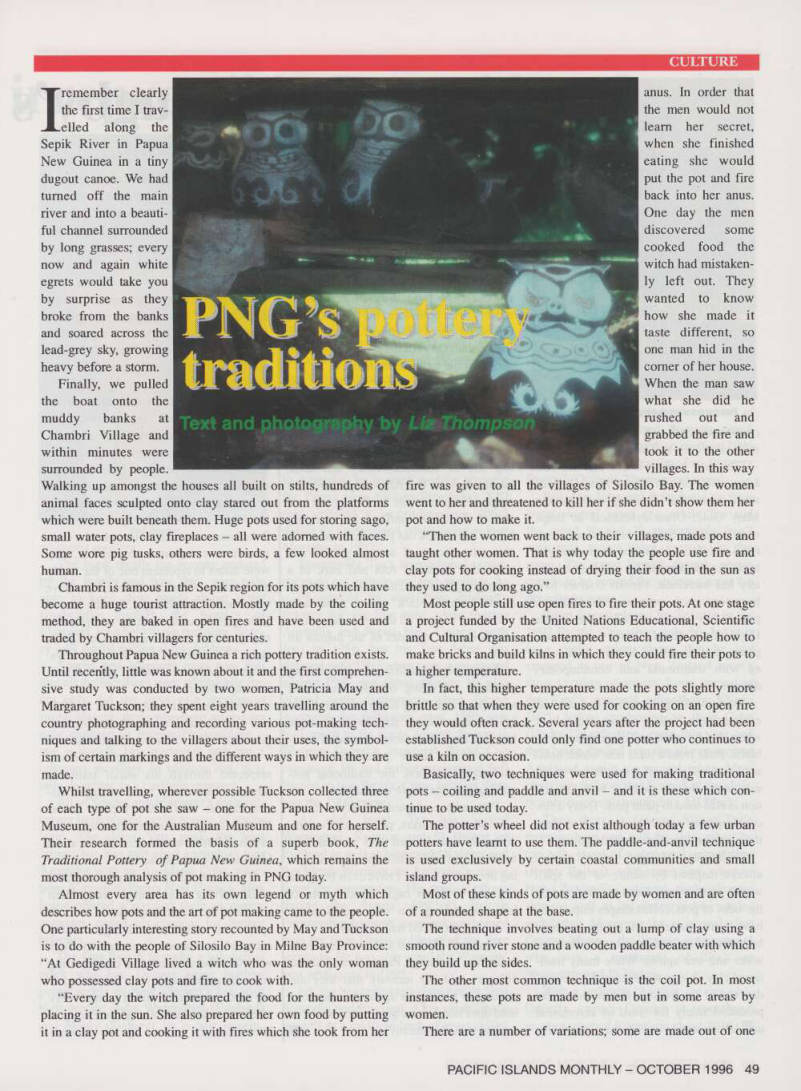
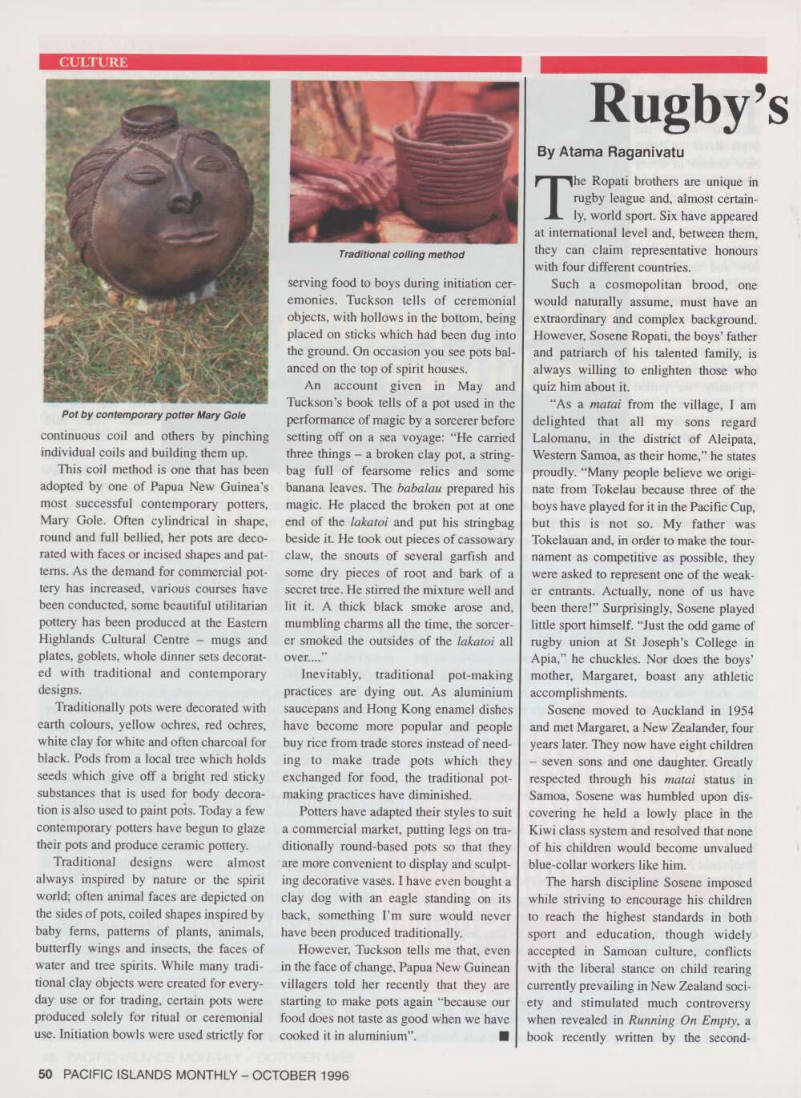
Culture
P NG's pottery traditions
I remember clearly the first time I trav elled along the Sepik River in Papua New Guinea in a tiny dugout canoe. We had turned off the main river and into a beauti ful channel surrounded by long grasses; every now and again white egrets would take you by surprise as they broke from the banks and soared across the lead-grey sky, growing heavy before a storm.
Finally, we pulled the boat onto the muddy banks at Chambri Village and within minutes were surrounded by people.
Walking up amongst the houses all built on stilts, hundreds of animal faces sculpted onto clay stared out from the platforms which were built beneath them. Huge pots used for storing sago, small water pots, clay fireplaces - all were adorned with faces.
Some wore pig tusks, others were birds, a few looked almost human.
Chambri is famous in the Sepik region for its pots which have become a huge tourist attraction. Mostly made by the coiling method, they are baked in open fires and have been used and traded by Chambri villagers for centuries.
Throughout Papua New Guinea a rich pottery tradition exists.
Until recently, little was known about it and the first comprehen sive study was conducted by two women, Patricia May and Margaret Tuckson; they spent eight years travelling around the country photographing and recording various pot-making tech niques and talking to the villagers about their uses, the symbol ism of certain markings and the different ways in which they are made.
Whilst travelling, wherever possible Tuckson collected three of each type of pot she saw - one for the Papua New Guinea Museum, one for the Australian Museum and one for herself.
Their research formed the basis of a superb book. The Traditional Pottery of Papua New Guinea, which remains the most thorough analysis of pot making in PNG today.
Almost every area has its own legend or myth which describes how pots and the art of pot making came to the people.
One particularly interesting story recounted by May and Tuckson is to do with the people of Silosilo Bay in Milne Bay Province: “At Gedigedi Village lived a witch who was the only woman who possessed clay pots and fire to cook with.
“Every day the witch prepared the food for the hunters by placing it in the sun. She also prepared her own food by putting it in a clay pot and cooking it with fires which she took from her
h
anus. In order that the men would not learn her secret, when she finished eating she would put the pot and fire back into her anus.
One day the men discovered some cooked food the witch had mistaken ly left out. They wanted to know how she made it taste different, so one man hid in the comer of her house.
When the man saw what she did he rushed out and grabbed the fire and took it to the other villages. In this way
fire was given to all the villages of Silosilo Bay. The women went to her and threatened to kill her if she didn’t show them her pot and how to make it.
“Then the women went back to their villages, made pots and taught other women. That is why today the people use fire and clay pots for cooking instead of drying their food in the sun as they used to do long ago.”
Most people still use open fires to fire their pots. At one stage a project funded by the United Nations Educational, Scientific and Cultural Organisation attempted to teach the people how to make bricks and build kilns in which they could fire their pots to a higher temperature.
In fact, this higher temperature made the pots slightly more brittle so that when they were used for cooking on an open fire they would often crack. Several years after the project had been established Tuckson could only find one potter who continues to use a kiln on occasion.
Basically, two techniques were used for making traditional pots - coiling and paddle and anvil - and it is these which con tinue to be used today.
The potter’s wheel did not exist although today a few urban potters have learnt to use them. The paddle-and-anvil technique is used exclusively by certain coastal communities and small island groups.
Most of these kinds of pots are made by women and are often of a rounded shape at the base.
The technique involves beating out a lump of clay using a smooth round river stone and a wooden paddle beater with which they build up the sides.
The other most common technique is the coil pot. In most instances, these pots are made by men but in some areas by women.
There are a number of variations; some are made out of one
continuous coil and others by pinching individual coils and building them up.
This coil method is one that has been adopted by one of Papua New Guinea’s most successful contemporary potters, Mary Gole. Often cylindrical in shape, round and full bellied, her pots are deco rated with faces or incised shapes and pat terns. As the demand for commercial pot tery has increased, various courses have been conducted, some beautiful utilitarian pottery has been produced at the Eastern Highlands Cultural Centre - mugs and plates, goblets, whole dinner sets decorat ed with traditional and contemporary designs.
Traditionally pots were decorated with earth colours, yellow ochres, red ochres, white clay for white and often charcoal for black. Pods from a local tree which holds seeds which give off a bright red sticky substances that is used for body decora tion is also used to paint pots. Today a few contemporary potters have begun to glaze their pots and produce ceramic pottery.
Traditional designs were almost always inspired by nature or the spirit world; often animal faces are depicted on the sides of pots, coiled shapes inspired by baby ferns, patterns of plants, animals, butterfly wings and insects, the faces of water and tree spirits. While many tradi tional clay objects were created for every day use or for trading, certain pots were produced solely for ritual or ceremonial use. Initiation bowls were used strictly for
serving food to boys during initiation cer emonies. Tuckson tells of ceremonial objects, with hollows in the bottom, being placed on sticks which had been dug into the ground. On occasion you see pots bal anced on the top of spirit houses.
An account given in May and Tuckson’s book tells of a pot used in the performance of magic by a sorcerer before setting off on a sea voyage: “He carried three things - a broken clay pot, a string bag full of fearsome relics and some banana leaves. The babalau prepared his magic. He placed the broken pot at one end of the lakatoi and put his stringbag beside it. He took out pieces of cassowary claw, the snouts of several garfish and some dry pieces of root and bark of a secret tree. He stirred the mixture well and lit it. A thick black smoke arose and, mumbling charms all the time, the sorcer er smoked the outsides of the lakatoi all 0ver...”
Inevitably, traditional pot-making practices are dying out. As aluminium saucepans and Hong Kong enamel dishes have become more popular and people buy rice from trade stores instead of need ing to make trade pots which they exchanged for food, the traditional pot making practices have diminished.
Potters have adapted their styles to suit a commercial market, putting legs on tra ditionally round-based pots so that they are more convenient to display and sculpt ing decorative vases. I have even bought a clay dog with an eagle standing on its back, something I’m sure would never have been produced traditionally.
However, Tuckson tells me that, even in the face of change, Papua New Guinean villagers told her recently that they are starting to make pots again “because our food does not taste as good when we have cooked it in aluminium”. ■
Pot by contemporary potter Mary Gole
Traditional coiling method
Rugby’s irrepressible Ropati brothers
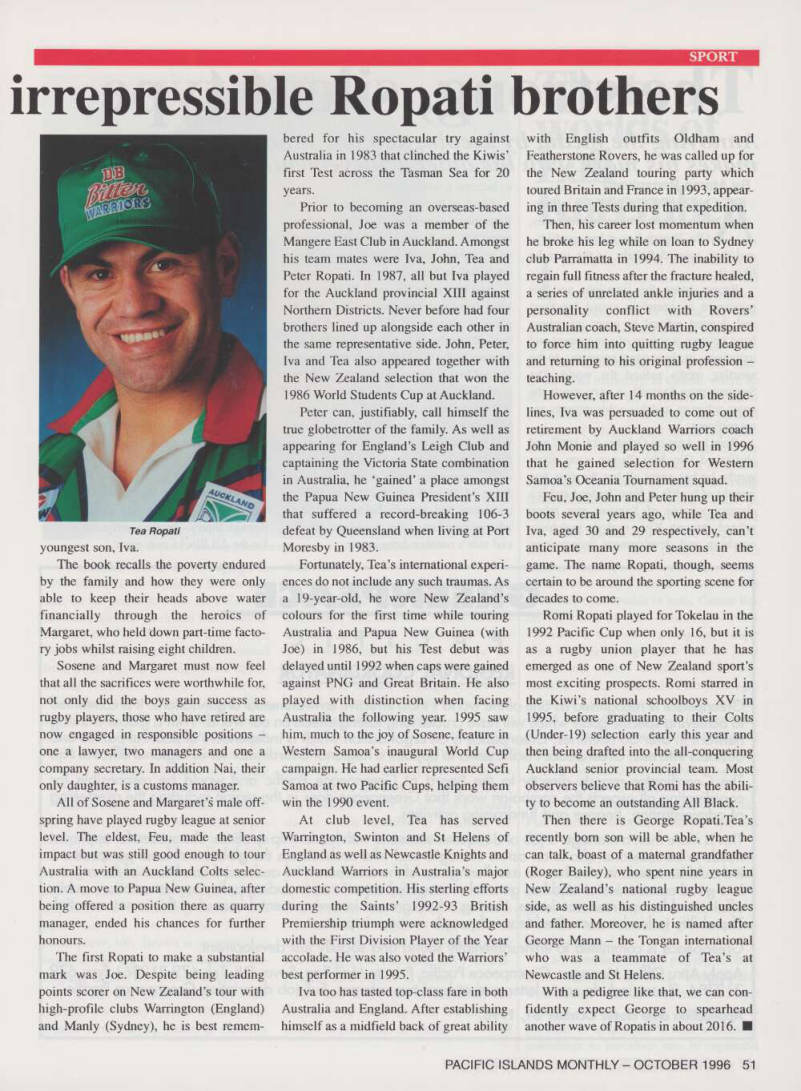
By Atama Raganivatu
The Ropati brothers are unique in rugby league and, almost certain ly, world sport. Six have appeared at international level and, between them, they can claim representative honours with four different countries.
Such a cosmopolitan brood, one would naturally assume, must have an
extraordinary and complex background.
However, Sosene Ropati, the boys’ father and patriarch of his talented family, is
always willing to enlighten those who
quiz him about it.
“As a matai from the village, I am delighted that all my sons regard Lalomanu, in the district of Aleipata, Western Samoa, as their home,” he states proudly. “Many people believe we origi nate from Tokelau because three of the boys have played for it in the Pacific Cup, but this is not so. My father was Tokelauan and, in order to make the tour nament as competitive as possible, they were asked to represent one of the weak er entrants. Actually, none of us have been there!” Surprisingly, Sosene played little sport himself. “Just the odd game of rugby union at St Joseph’s College in Apia,” he chuckles. Nor does the boys’ mother, Margaret, boast any athletic
accomplishments.
Sosene moved to Auckland in 1954 and met Margaret, a New Zealander, four years later. They now have eight children - seven sons and one daughter. Greatly respected through his matai status in Samoa, Sosene was humbled upon dis covering he held a lowly place in the Kiwi class system and resolved that none of his children would become unvalued blue-collar workers like him.
The harsh discipline Sosene imposed while striving to encourage his children to reach the highest standards in both sport and education, though widely accepted in Samoan culture, conflicts with the liberal stance on child rearing currently prevailing in New Zealand soci ety and stimulated much controversy when revealed in Running On Empty, a book recently written by the second-
Sport
youngest son, Iva.
The book recalls the poverty endured by the family and how they were only able to keep their heads above water financially through the heroics of Margaret, who held down part-time facto ry jobs whilst raising eight children.
Sosene and Margaret must now feel that all the sacrifices were worthwhile for, not only did the boys gain success as rugby players, those who have retired are now engaged in responsible positions one a lawyer, two managers and one a company secretary. In addition Nai, their only daughter, is a customs manager.
All of Sosene and Margaret’s male off spring have played rugby league at senior level. The eldest. Feu, made the least impact but was still good enough to tour Australia with an Auckland Colts selec tion. A move to Papua New Guinea, after being offered a position there as quarry manager, ended his chances for further honours.
The first Ropati to make a substantial mark was Joe. Despite being leading points scorer on New Zealand’s tour with
high-profile clubs Warrington (England)
and Manly (Sydney), he is best remem
bered for his spectacular try against Australia in 1983 that clinched the Kiwis’ first Test across the Tasman Sea for 20 years.
Prior to becoming an overseas-based professional, Joe was a member of the Mangere East Club in Auckland. Amongst his team mates were Iva, John, Tea and Peter Ropati. In 1987, all but Iva played for the Auckland provincial XIII against Northern Districts. Never before had four brothers lined up alongside each other in the same representative side. John, Peter, Iva and Tea also appeared together with the New Zealand selection that won the 1986 World Students Cup at Auckland.
Peter can, justifiably, call himself the true globetrotter of the family. As well as appearing for England’s Leigh Club and captaining the Victoria State combination in Australia, he ‘gained’ a place amongst the Papua New Guinea President’s XIII that suffered a record-breaking 106-3 defeat by Queensland when living at Port Moresby in 1983.
Fortunately, Tea’s international experi
ences do not include any such traumas. As a 19-year-old, he wore New Zealand’s colours for the first time while touring Australia and Papua New Guinea (with Joe) in 1986, but his Test debut was delayed until 1992 when caps were gained against PNG and Great Britain. He also played with distinction when facing Australia the following year. 1995 saw him, much to the joy of Sosene, feature in Western Samoa’s inaugural World Cup campaign. He had earlier represented Sefi Samoa at two Pacific Cups, helping them win the 1990 event.
At club level. Tea has served Warrington, Swinton and St Helens of England as well as Newcastle Knights and Auckland Warriors in Australia’s major domestic competition. His sterling efforts during the Saints’ 1992-93 British Premiership triumph were acknowledged with the First Division Player of the Year accolade. He was also voted the Warriors’ best performer in 1995.
Iva too has tasted top-class fare in both Australia and England. After establishing himself as a midfield back of great ability
with English outfits Oldham and Featherstone Rovers, he was called up for the New Zealand touring party which toured Britain and France in 1993, appear ing in three Tests during that expedition.
Then, his career lost momentum when he broke his leg while on loan to Sydney club Parramatta in 1994. The inability to regain full fitness after the fracture healed, a series of unrelated ankle injuries and a personality conflict with Rovers’
Australian coach, Steve Martin, conspired to force him into quitting rugby league and returning to his original profession -
teaching.
However, after 14 months on the side lines, Iva was persuaded to come out of retirement by Auckland Warriors coach John Monie and played so well in 1996 that he gained selection for Western Samoa’s Oceania Tournament squad.
Feu, Joe, John and Peter hung up their boots several years ago, while Tea and Iva, aged 30 and 29 respectively, can’t anticipate many more seasons in the game. The name Ropati, though, seems certain to be around the sporting scene for decades to come.
Romi Ropati played for Tokelau in the 1992 Pacific Cup when only 16, but it is as a rugby union player that he has emerged as one of New Zealand sport’s most exciting prospects. Romi starred in the Kiwi’s national schoolboys XV in 1995, before graduating to their Colts (Under-19) selection early this year and then being drafted into the all-conquering Auckland senior provincial team. Most observers believe that Romi has the abili ty to become an outstanding All Black.
Then there is George Ropati.Tea’s recently bom son will be able, when he can talk, boast of a maternal grandfather (Roger Bailey), who spent nine years in New Zealand’s national rugby league side, as well as his distinguished uncles and father. Moreover, he is named after George Mann - the Tongan international who was a teammate of Tea’s at Newcastle and St Helens.
With a pedigree like that, we can con fidently expect George to spearhead another wave of Ropatis in about 2016. ■
Tea Ropati
Advertisements & other items, p. 51 (1 item)
irrepressible Ropati brothers
The strong, silent type
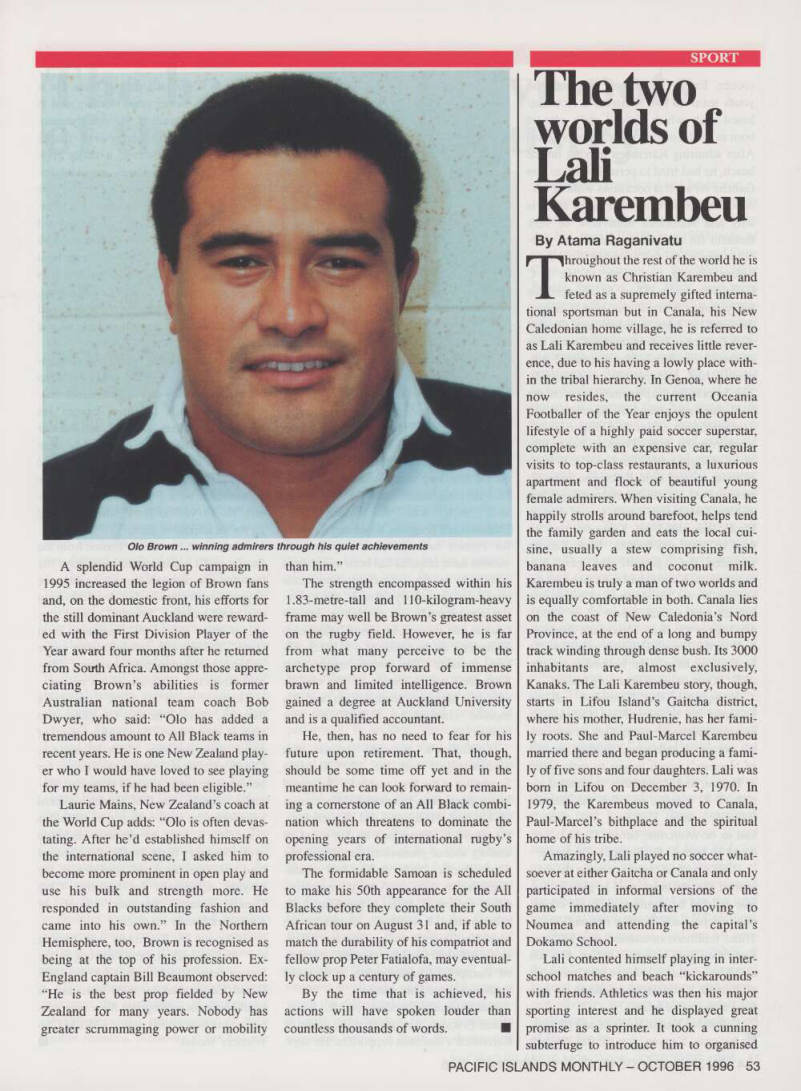
Annoying the media by keeping too low a profile, Olo Brown makes his mark with his quiet achievements
By Atama Raganivatu
Although one of the most influen tial figures in the world today, 010 Brown has a low profile and that, most definitely, is the way he likes it.
Brown hates the limelight and his reluctance in attending award functions and dogged refusal to grant interviews have become a source of amusement and irritation - in about equal measure - to the sporting media around the world. The Samoan prop forward is very much the quiet achiever and his achievements are magnificent.
Bom in Apia on October 24, 1967 and christened 010 Max Brown soon after wards, he has spent all but the first few months of his life in New Zealand and is a classic example of Samoan raw talent refined through Kiwi rugby’s matchless coaching and development programmes
to become a world beater.
Much of Brown’s life has been spent at Ponsonby, a central Auckland suburb renowned for its rugby club which boasts of producing more All Blacks than any other club in New Zealand.
And it was the “Ponies” Brown joined upon leaving school but he had already given a glimpse of his potential before then. Brown’s sterling and consistent per formances for the Mount Albert Grammar School first XV won him a call up into the New Zealand secondary schools’ team that toured Australia in 1985. Despite his comparatively tender years. Brown imme diately established himself amongst the top props in the tough Auckland senior club competition and, when All Black Steve McDowell left the city in 1989, a successor had already been groomed to take possession of the Auckland provin cial side’s number three jersey.
Brown’s initial full season of first-class rugby ended with Auckland triumphing in both New Zealand’s major domestic com petitions, the Ranfurly Shield and National Championship. His distin guished role was acknowledged by him being named amongst the country’s Five Most Promising Players. 1990 saw Brown become an All Black. On tour with the New Zealand Development team in Canada, he was flown across the Atlantic to join the world’s most prestigious rugby side, which had become depleted through injuries while touring France.
Brown had to wait until 1992 before making his Test debut and from that time he has gained admirers and plaudits in huge numbers. One of New Zealand’s Five Players of the Year in 1992, Brown has - apart from the odd game missed through injury - been an automatic choice for the All Blacks ever since.
A splendid World Cup campaign in
1995 increased the legion of Brown fans and, on the domestic front, his efforts for the still dominant Auckland were reward ed with the First Division Player of the Year award four months after he returned from South Africa. Amongst those appre ciating Brown’s abilities is former Australian national team coach Bob Dwyer, who said: “010 has added a tremendous amount to All Black teams in recent years. He is one New Zealand play er who I would have loved to see playing for my teams, if he had been eligible.”
Laurie Mains, New Zealand’s coach at the World Cup adds; “010 is often devas tating. After he’d established himself on the international scene, I asked him to become more prominent in open play and use his bulk and strength more. He responded in outstanding fashion and came into his own.” In the Northern Hemisphere, too, Brown is recognised as being at the top of his profession. Ex- England captain Bill Beaumont observed: “He is the best prop fielded by New Zealand for many years. Nobody has greater scrummaging power or mobility
than him.”
The strength encompassed within his 1.83-metre-tall and 110-kilogram-heavy frame may well be Brown’s greatest asset on the rugby field. However, he is far from what many perceive to be the archetype prop forward of immense brawn and limited intelligence. Brown gained a degree at Auckland University and is a qualified accountant.
He, then, has no need to fear for his future upon retirement. That, though, should be some time off yet and in the meantime he can look forward to remain ing a cornerstone of an All Black combi nation which threatens to dominate the opening years of international rugby’s
professional era.
The formidable Samoan is scheduled to make his 50th appearance for the All Blacks before they complete their South African tour on August 31 and, if able to match the durability of his compatriot and fellow prop Peter Fatialofa, may eventual ly clock up a century of games.
By the time that is achieved, his actions will have spoken louder than countless thousands of words. ■
Olo Brown...winning admirers through his quiet achievements
Advertisements & other items, p. 52 (1 item)
Greenpeace
PACIFIC
REGIONAL COORDINATOR
Greenpeace is recognised as one of the world's most effective environmental organisations. It is committed to achieving specific goals which will have crucial long lasting effects on our world. With a global working network in over 30 countries, Greenpeace is an organisation which is independent of political parties and business interests. Greenpeace Pacific seeks to appoint a Regional Coordinator for its regional office in Fiji.
The Coordinator reports directly to the Board of Greenpeace Pacific and would be responsible for coordinating all aspects the campaign work that Greenpeace does in the region including the overseeing of administration, finance and fundraising activities.
This is more than a manager's job and requires someone with leadership qualities. The successful applicant needs to be someone who is an astute strategist and who understands the global and local perspectives.
It should be someone who has an excellent grasp of the environmental and social conditions of the region, is a good communicator and has general managerial experience including policy implementation, public affairs and human resource issues. Having a background in environmental issues but this is not essential.
The ability to lead a committed team of people is more important.
Greenpeace is committed to environmentally sound and socially just development.
Apply Attn: Office Manager, Greenpeace Pacific, Private Mail Bag, Suva, FIJI. Tel: 679 312861 Fax: 679 312784. Please include cover letter and at least two referees. Full job description Greenpeace Pacific.
Application date closes October 31, 1996.
worlds of
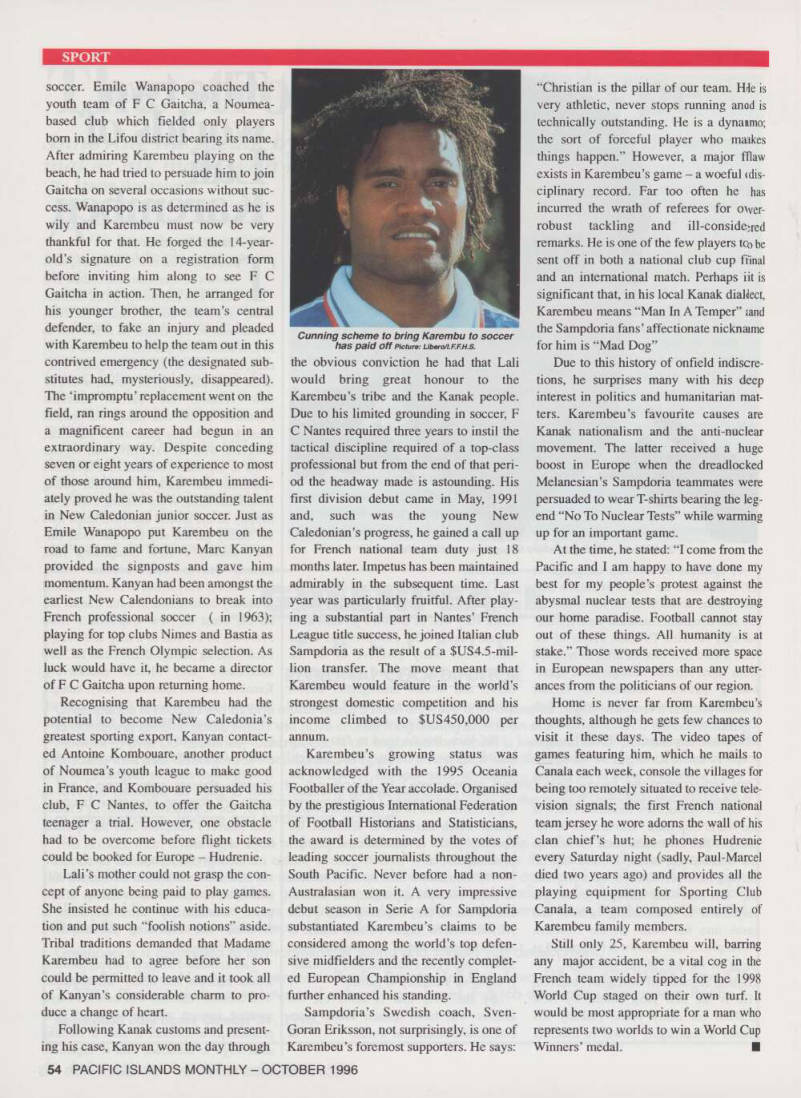
The two worlds of Lali Karembeu
By Atama Raganivatu
Throughout the rest of the world he is known as Christian Karembeu and feted as a supremely gifted interna tional sportsman but in Canala, his New Caledonian home village, he is referred to as Lali Karembeu and receives little rever ence, due to his having a lowly place with in the tribal hierarchy. In Genoa, where he now resides, the current Oceania Footballer of the Year enjoys the opulent lifestyle of a highly paid soccer superstar, complete with an expensive car, regular visits to top-class restaurants, a luxurious apartment and flock of beautiful young female admirers. When visiting Canala, he happily strolls around barefoot, helps tend the family garden and eats the local cui sine, usually a stew comprising fish, banana leaves and coconut milk.
Karembeu is truly a man of two worlds and is equally comfortable in both. Canala lies on the coast of New Caledonia’s Nord Province, at the end of a long and bumpy track winding through dense bush. Its 3000 inhabitants are, almost exclusively, Kanaks. The Lali Karembeu story, though, starts in Lifou Island’s Gaitcha district, where his mother, Hudrenie, has her fami ly roots. She and Paul-Marcel Karembeu married there and began producing a fami ly of five sons and four daughters. Lali was bom in Lifou on December 3, 1970. In 1979, the Karembeus moved to Canala, Paul-Marcel’s bithplace and the spiritual home of his tribe.
Amazingly, Lali played no soccer what soever at either Gaitcha or Canala and only participated in informal versions of the game immediately after moving to Noumea and attending the capital’s Dokamo School.
Lali contented himself playing in inter school matches and beach “kickarounds” with friends. Athletics was then his major sporting interest and he displayed great promise as a sprinter. It took a cunning subterfuge to introduce him to organised
soccer. Emile Wanapopo coached the youth team of F C Gaitcha, a Noumea based club which fielded only players bom in the Lifou district bearing its name.
After admiring Karembeu playing on the beach, he had tried to persuade him to join Gaitcha on several occasions without suc cess. Wanapopo is as determined as he is wily and Karembeu must now be very thankful for that. He forged the 14-year old’s signature on a registration form before inviting him along to see F C Gaitcha in action. Then, he arranged for his younger brother, the team’s central defender, to fake an injury and pleaded with Karembeu to help the team out in this contrived emergency (the designated sub stitutes had, mysteriously, disappeared).
The ‘impromptu’ replacement went on the field, ran rings around the opposition and a magnificent career had begun in an extraordinary way. Despite conceding seven or eight years of experience to most of those around him, Karembeu immedi ately proved he was the outstanding talent in New Caledonian junior soccer. Just as Emile Wanapopo put Karembeu on the road to fame and fortune, Marc Kanyan provided the signposts and gave him momentum. Kanyan had been amongst the earliest New Calendonians to break into French professional soccer ( in 1963); playing for top clubs Nimes and Bastia as well as the French Olympic selection. As luck would have it, he became a director of F C Gaitcha upon returning home.
Recognising that Karembeu had the potential to become New Caledonia’s greatest sporting export, Kanyan contact ed Antoine Kombouare, another product of Noumea’s youth league to make good in France, and Kombouare persuaded his club, F C Nantes, to offer the Gaitcha teenager a trial. However, one obstacle had to be overcome before flight tickets could be booked for Europe - Hudrenie.
Lali’s mother could not grasp the con cept of anyone being paid to play games.
She insisted he continue with his educa tion and put such “foolish notions” aside.
Tribal traditions demanded that Madame Karembeu had to agree before her son could be permitted to leave and it took all of Kanyan’s considerable charm to pro duce a change of heart.
Following Kanak customs and present ing his case, Kanyan won the day through
the obvious conviction he had that Lali would bring great honour to the Karembeu’s tribe and the Kanak people.
Due to his limited grounding in soccer, F C Nantes required three years to instil the tactical discipline required of a top-class professional but from the end of that peri od the headway made is astounding. His first division debut came in May, 1991 and, such was the young New Caledonian’s progress, he gained a call up for French national team duty just 18 months later. Impetus has been maintained admirably in the subsequent time. Last year was particularly fruitful. After play ing a substantial part in Nantes’ French League title success, he joined Italian club Sampdoria as the result of a SUS4.S-mil lion transfer. The move meant that Karembeu would feature in the world’s strongest domestic competition and his income climbed to $U5450,000 per annum.
Karembeu’s growing status was acknowledged with the 1995 Oceania Footballer of the Year accolade. Organised by the prestigious International Federation of Football Historians and Statisticians, the award is determined by the votes of
leading soccer journalists throughout the
South Pacific. Never before had a non- Australasian won it. A very impressive debut season in Serie A for Sampdoria substantiated Karembeu’s claims to be considered among the world’s top defen sive midfielders and the recently complet
ed European Championship in England
further enhanced his standing.
Sampdoria’s Swedish coach, Sven- Goran Eriksson, not surprisingly, is one of Karembeu’s foremost supporters. He says:
“Christian is the pillar of our team. HJe is very athletic, never stops running anod is
technically outstanding. He is a dynanmo;
the sort of forceful player who maakes
things happen.” However, a major fflaw
exists in Karembeu’s game - a woeful (dis ciplinary record. Far too often he has incurred the wrath of referees for o\ver robust tackling and ill-considered remarks. He is one of the few players tco be sent off in both a national club cup fi'inal and an international match. Perhaps iit is significant that, in his local Kanak dialdect, Karembeu means “Man In A Temper” :and the Sampdoria fans’ affectionate nickname for him is “Mad Dog”
Due to this history of onfield indiscre tions, he surprises many with his deep interest in politics and humanitarian mat ters. Karembeu’s favourite causes are Kanak nationalism and the anti-nuclear movement. The latter received a huge boost in Europe when the dreadlocked Melanesian’s Sampdoria teammates were persuaded to wear T-shirts bearing the leg end “No To Nuclear Tests” while warming up for an important game.
At the time, he stated: “I come from the Pacific and I am happy to have done my best for my people’s protest against the abysmal nuclear tests that are destroying our home paradise. Football cannot stay out of these things. All humanity is at stake.” Those words received more space in European newspapers than any utter ances from the politicians of our region.
Home is never far from Karembeu’s thoughts, although he gets few chances to visit it these days. The video tapes of games featuring him, which he mails to Canala each week, console the villages for being too remotely situated to receive tele vision signals; the first French national team jersey he wore adorns the wall of his clan chief’s hut; he phones Hudrenie every Saturday night (sadly, Paul-Marcel died two years ago) and provides all the
playing equipment for Sporting Club
Canala, a team composed entirely of Karembeu family members.
Still only 25, Karembeu will, barring any major accident, be a vital cog in the French team widely tipped for the 1998 World Cup staged on their own turf. It would be most appropriate for a man who represents two worlds to win a World Cup Winners’ medal. ■
Cunning scheme to bring Karembu to soccer has paid Off Picture: Libero/I.F.F.H.S.
of the logging industry
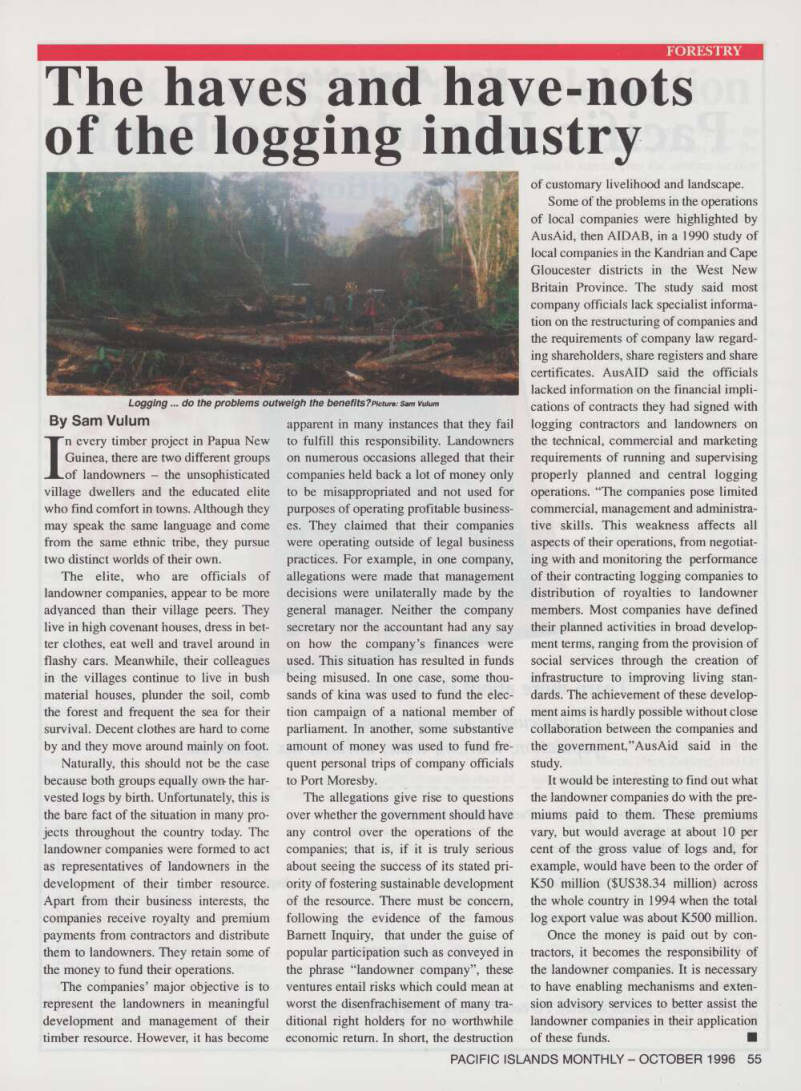
Forestry
The haves and have-nots of the logging industry
By Sam Vulum
In every timber project in Papua New Guinea, there are two different groups of landowners - the unsophisticated village dwellers and the educated elite who find comfort in towns. Although they may speak the same language and come from the same ethnic tribe, they pursue two distinct worlds of their own.
The elite, who are officials of landowner companies, appear to be more advanced than their village peers. They live in high covenant houses, dress in bet ter clothes, eat well and travel around in flashy cars. Meanwhile, their colleagues in the villages continue to live in bush material houses, plunder the soil, comb the forest and frequent the sea for their survival. Decent clothes are hard to come by and they move around mainly on foot.
Naturally, this should not be the case because both groups equally own- the har vested logs by birth. Unfortunately, this is the bare fact of the situation in many pro jects throughout the country today. The landowner companies were formed to act as representatives of landowners in the development of their timber resource.
Apart from their business interests, the
companies receive royalty and premium
payments from contractors and distribute them to landowners. They retain some of the money to fund their operations.
The companies’ major objective is to
represent the landowners in meaningful development and management of their timber resource. However, it has become
apparent in many instances that they fail to fulfdl this responsibility. Landowners on numerous occasions alleged that their companies held back a lot of money only to be misappropriated and not used for purposes of operating profitable business es. They claimed that their companies were operating outside of legal business practices. For example, in one company, allegations were made that management decisions were unilaterally made by the general manager. Neither the company secretary nor the accountant had any say on how the company’s finances were used. This situation has resulted in funds being misused. In one case, some thou sands of kina was used to fund the elec tion campaign of a national member of parliament. In another, some substantive amount of money was used to fund fre quent personal trips of company officials to Port Moresby.
The allegations give rise to questions over whether the government should have any control over the operations of the companies; that is, if it is truly serious about seeing the success of its stated pri
ority of fostering sustainable development
of the resource. There must be concern, following the evidence of the famous Barnett Inquiry, that under the guise of
popular participation such as conveyed in
the phrase “landowner company”, these ventures entail risks which could mean at worst the disenfrachisement of many tra ditional right holders for no worthwhile economic return. In short, the destruction
of customary livelihood and landscape.
Some of the problems in the operations
of local companies were highlighted by
AusAid, then AIDAB, in a 1990 study of local companies in the Kandrian and Cape Gloucester districts in the West New Britain Province. The study said most company officials lack specialist informa tion on the restructuring of companies and the requirements of company law regard ing shareholders, share registers and share certificates. AusAID said the officials lacked information on the financial impli cations of contracts they had signed with logging contractors and landowners on the technical, commercial and marketing requirements of running and supervising
properly planned and central logging
operations. “The companies pose limited commercial, management and administra tive skills. This weakness affects all aspects of their operations, from negotiat
ing with and monitoring the performance
of their contracting logging companies to distribution of royalties to landowner members. Most companies have defined their planned activities in broad develop ment terms, ranging from the provision of social services through the creation of infrastructure to improving living stan dards. The achievement of these develop ment aims is hardly possible without close collaboration between the companies and the government,’’AusAid said in the study.
It would be interesting to find out what the landowner companies do with the pre miums paid to them. These premiums vary, but would average at about 10 per cent of the gross value of logs and, for example, would have been to the order of K5O million ($U538.34 million) across the whole country in 1994 when the total log export value was about K5OO million.
Once the money is paid out by con tractors, it becomes the responsibility of the landowner companies. It is necessary to have enabling mechanisms and exten sion advisory services to better assist the landowner companies in their application of these funds. ■
Logging...do the problems outweigh the benefits? Picture: sam vulum
Advertisements & other items, p. 56 (1 item)
Pacific Islands Yearßook
Now Available
17th Edition
ft
li On
Price
AUD
oo a® I
PLUS
POSTAGE
r Learn more about the Pacific
culture!custom tradition!people
population, tourism, trade, airlines, tax system etc.
X- Yes, send me the latest copy of the Pacific Islands Year Book □ Here is a cheque/money order □ Visa □ Master Card Card Number Name Signature Address Expiry Date Post to: Pacific Islands Monthly, PO Box 1167 Suva, Fiji or Fax (679) 303809.
U
Week of sails, surf and celebration
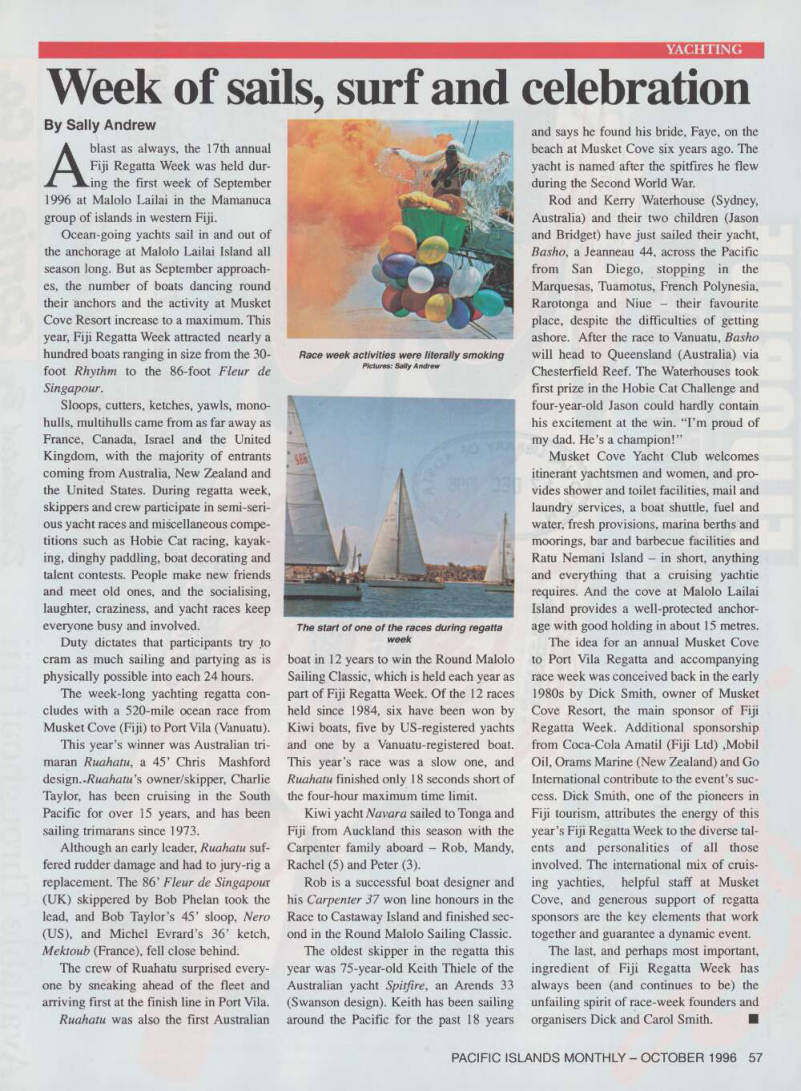
Yachting
By Sally Andrew
A blast as always, the 17th annual Fiji Regatta Week was held dur ing the first week of September 1996 at Malolo Lailai in the Mamanuca group of islands in western Fiji.
Ocean-going yachts sail in and out of the anchorage at Malolo Lailai Island all season long. But as September approach es, the number of boats dancing round their anchors and the activity at Musket Cove Resort increase to a maximum. This year, Fiji Regatta Week attracted nearly a hundred boats ranging in size from the 30foot Rhythm to the 86-foot Fleur de Singapour.
Sloops, cutters, ketches, yawls, mono hulls, multihulls came from as far away as France, Canada, Israel and the United Kingdom, with the majority of entrants coming from Australia, New Zealand and the United States. During regatta week, skippers and crew participate in semi-seri ous yacht races and miscellaneous compe titions such as Hobie Cat racing, kayak
ing, dinghy paddling, boat decorating and
talent contests. People make new friends and meet old ones, and the socialising,
laughter, craziness, and yacht races keep
everyone busy and involved.
Duty dictates that participants try to cram as much sailing and partying as is physically possible into each 24 hours.
The week-long yachting regatta con cludes with a 520-mile ocean race from Musket Cove (Fiji) to Port Vila (Vanuatu).
This year’s winner was Australian tri maran Ruahatu, a 45’ Chris Mashford
design.. Ruahatu’s owner/skipper, Charlie
Taylor, has been cruising in the South Pacific for over 15 years, and has been sailing trimarans since 1973.
Although an early leader, Ruahatu suf fered rudder damage and had to jury-rig a replacement. The 86’ Fleur de Singapour (UK) skippered by Bob Phelan took the lead, and Bob Taylor’s 45’ sloop, Nero (US), and Michel Evrard’s 36’ ketch, Mektoub (France), fell close behind; The crew of Ruahatu surprised every one by sneaking ahead of the fleet and arriving first at the finish line in Port Vila.
Ruahatu was also the first Australian
boat in 12 years to win the Round Malolo Sailing Classic, which is held each year as part of Fiji Regatta Week. Of the 12 races held since 1984, six have been won by Kiwi boats, five by US-registered yachts and one by a Vanuatu-registered boat.
This year’s race was a slow one, and Ruahatu finished only 18 seconds short of the four-hour maximum time limit.
Kiwi yacht Navara sailed to Tonga and Fiji from Auckland this season with the Carpenter family aboard - Rob, Mandy, Rachel (5) and Peter (3).
Rob is a successful boat designer and his Carpenter 37 won line honours in the Race to Castaway Island and finished sec ond in the Round Malolo Sailing Classic.
The oldest skipper in the regatta this year was 75-year-old Keith Thiele of the Australian yacht Spitfire, an Arends 33 (Swanson design). Keith has been sailing around the Pacific for the past 18 years
and says he found his bride, Faye, on the beach at Musket Cove six years ago. The yacht is named after the spitfires he flew during the Second World War.
Rod and Kerry Waterhouse (Sydney, Australia) and their two children (Jason and Bridget) have just sailed their yacht, Basho , a Jeanneau 44, across the Pacific from San Diego, stopping in the
Marquesas, Tuamotus, French Polynesia,
Rarotonga and Niue - their favourite
place, despite the difficulties of getting
ashore. After the race to Vanuatu, Basho will head to Queensland (Australia) via Chesterfield Reef. The Waterhouses took first prize in the Hobie Cat Challenge and four-year-old Jason could hardly contain his excitement at the win. “I’m proud of my dad. He’s a champion!”
Musket Cove Yacht Club welcomes itinerant yachtsmen and women, and pro vides shower and toilet facilities, mail and laundry services, a boat shuttle, fuel and water, fresh provisions, marina berths and moorings, bar and barbecue facilities and Ratu Nemani Island - in short, anything and everything that a cruising yachtie requires. And the cove at Malolo Lailai Island provides a well-protected anchor age with good holding in about 15 metres.
The idea for an annual Musket Cove to Port Vila Regatta and accompanying race week was conceived back in the early 1980 s by Dick Smith, owner of Musket Cove Resort, the main sponsor of Fiji Regatta Week. Additional sponsorship from Coca-Cola Amatil (Fiji Ltd) ,Mobil Oil, Orams Marine (New Zealand) and Go International contribute to the event’s suc cess. Dick Smith, one of the pioneers in Fiji tourism, attributes the energy of this year’s Fiji Regatta Week to the diverse tal ents and personalities of all those involved. The international mix of cruis
ing yachties, helpful staff at Musket
Cove, and generous support of regatta sponsors are the key elements that work together and guarantee a dynamic event.
The last, and perhaps most important,
ingredient of Fiji Regatta Week has
always been (and continues to be) the unfailing spirit of race-week founders and organisers Dick and Carol Smith. ■
Race week activities were literally smoking Pictures: Sally Andrew
The start of one of the races during regatta week
Advertisements & other items, pp. 58-60 (1 item)
Preuents Chuities
WHITENS TEETH
FRESHENS TEETH
STRENGTHEN GUMS
- us* mmm rf Ti f? °v
.. , f S CAY'
CWfVtr* '■> c rs( < H [NSS!tA ,H s ,itSCm* sGU c “VI CD o C7> V * • » a
TOOTHPAST^
/ ««^o a&0!l HP* bT TO Does Everything A Good Toothpaste Should D 0...
So Why Pay More?
Available Throughout Fiji g* Come A Co
life Insur
is a Shell
3 1508 00512957 7 grows
protects
customized
rare // .. ii -
porta^fe’
V ••
natural^.
.y- ,v V'* What nature does to protect the inhabitants of the ocean,
Grand Pacific Life Insurance
does for the people of the Islands.
Just as the shell grows with its occupant, our insurance grows in value as an investment in your life.
Every shell is tailored to its environment. Each one of our policies is customized; yours will be perfectly suited to you.
Within a shell’s protection, there’s future safety and security.
In somewhat the same way, Grand Pacific Life Insurance helps protect your family’s financial security.
Many shells are a rarity.
You’re respected as a rare individual because there is only one of you.
And shells are “portable” to their owners. With the help of your Grand Pacific agent, your policy easily keeps up with you.
For more information on security much as nature intended, call your Grand Pacific Life representative.
Let us provide a protective shell for you. ©
Grand Pacific Life Insurance, Ltd.
A member of the Finance Factors Family 1164 Bishop Street, sth Floor • Honolulu, HI 96813 • Phone: (808) 548-3333 • Fax: (808) 548-5122
THE NEW
PRIVILEGE
i
The Uncompromised Family Sedan
THE HLL NEW
MITSUBISHI
LRNCER
Meet the car that was bom to succeed. With its progressive engineering and striking appearance, the all-new Mitsubishi Lancer advances effectively, impressively... moving ahead at every turn.
Get behind the wheel and experience the new standard in family sedans.
AMERICAN SAMOA: PACIFIC MARKETING INC. P.O. Box 698, Pago Pago, Tel. 699-9140 / AUSTRALIA: MITSUBISHI MOTORS AUSTRALIA LTD. 1284 South Road, Clovelly Park, South Australia, 5042 Tel. (08) 2757297 /FIJI: NIVIS MOTOR & MACHINERY CO. LTD. G.P.O. Box 150, Suva, Tel. 383411 / GUAM: TRIPLE J ENTERPRISES INC. P.O. Box 6066, Tamuning, Tel. 6469126 /NEW CALEDONIA: SOCIETE DTMPORTATION D'AUTO DU PACIFIfIUE SUD S.A. P.O. Box 2548, Noumea, Tel. 281-787 / NEW ZEALAND: MITSUBISHI MOTORS NEW ZEALAND LTD. Private Bag. Porirua, Tel. 237-0109 / NORFOLK ISLAND: BORRY’S PTY LTD. P.O. Box 169, Taylors Road, Burnt, Tel. 22114 /PAPUA NEW GUINEA: TOBA MOTORS FTY LTD. P.O. Box 503, Port Moresby /SAIPAN: SAIPAN AUTOWORLD INC. P.O.
Box 487, Tel. 234-7133/ SOLOMON ISLANDS: HARVEST PACIFIC LTD. G.P.O. Box 823, Honiara, Tel. 30407/ TAHITI: SOPADEP S.A. B.P. 1617, Papeete, Tel 427393/ TONGA: SITANI MAPI CD, LTD.
P.O. Box 83, Nukualofa, Tel. 24044 /VANUATU: SOCOMETRA VANUATU LTD. B.P. 6. Port-Vila, Tel. 2314 /WESTERN SAMOA: MOTOR DISTRIBUTORS (SAMOA) LTD. P.O. Box 576, Apia, Tel. 20957 A
MITSUBISHI
MOTORS
CREATING TOGETHER