£]Q» nma n's paradise?
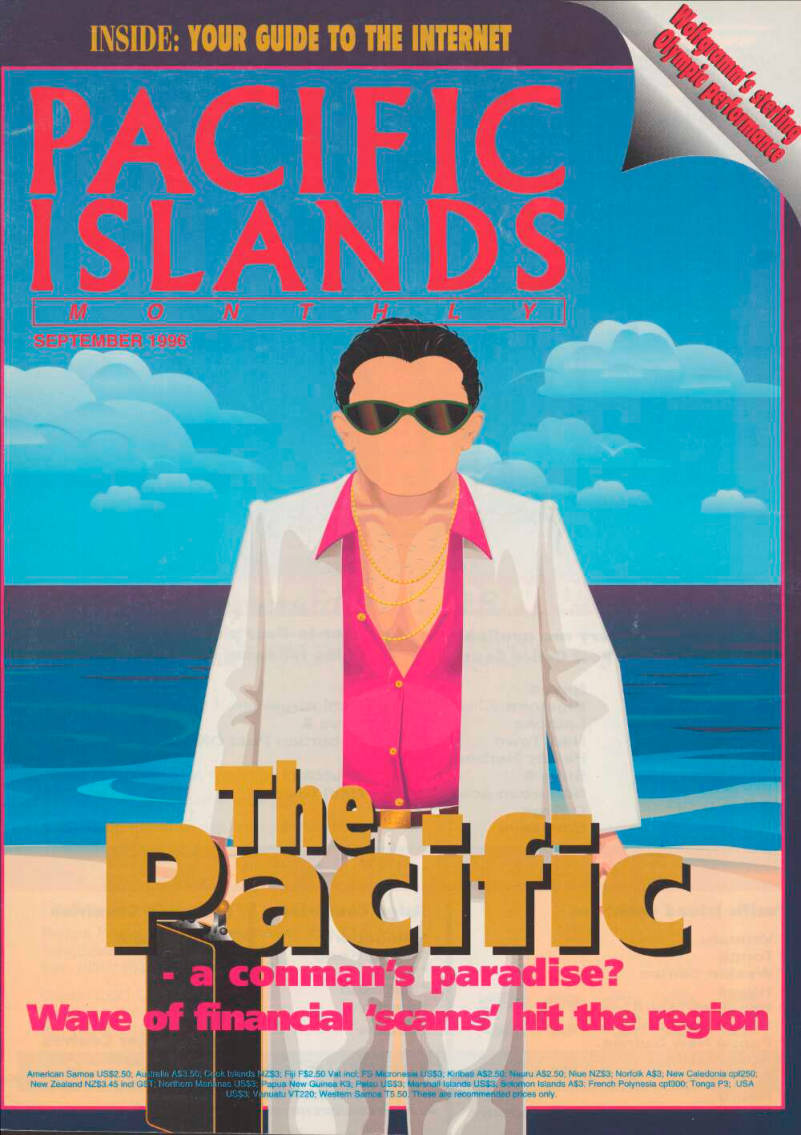
Pacific
Islands
Monthly
Inside: Your Guide To The Internet
September 1996
£]Q» nma n's paradise?
Wmre ai 'scams' Kill the region
American Samoa US$2.5O: A Fiji F 52.50 Vat incl; FS Micronesia US$3; Kiribati A 52.50; Nauru A 52.50; Niue NZ$3: Norfolk As 3: New Caledonia cpf2so; New Zealand NZ53.45 incl New Guinea K 3; Palau US$3; Marshall Islands US$3; Solomon Islands As 3; French Polynesia cpf3oo; Tonga P 3; USA BBHHHHR VT22O; Western Samoa T 5.50. These are recommended prices only.
Advertisements & other items, pp. 2-4 (1 item)
Courier Post
nnir'-|iniiii E JL Jya JBj a gyfe gtomt I
iniernavioimi \
HPS
5 IL 0 J f * \ ~ts ■ \ •!
V •** —* \m*S » *
Safe
eedy
and
ab at or s
DOMESTIC SERVICES
Deor-to-Deor delivery are available at the following EMS Post Office Centre's Door-to-Deor pick-up service are available at the following EMS Post Office Centre's Ba Labasa Nausori Rakißaki Tavua Korolevu Nadi Airport Korovou Navua Sigatoka Lautoka Nadi Town Pacific Harbour Suva & Suburban post Offices Savusavu
INTERNATIONAL SERVICES
■aw ■ ■■ ImlVieS■ ■ wlvMai cdFEBiEmW 1%1n4f Pacific Island Countries * Vanuatu * Tonga *Westen Samoa * Hawaii * Papeete (Tahiti) * Solomon Islands * Papua New Guinea * Australia * New Zealand * Nauru * Kiribati Asian Countries * Singapore * Hong Kong * Taipei * Thailand * Japan * Brunee TOLL FRENO.OBOO 307304 ■ EMS CENTRE G.P.O. SUVA
WE DELIVER EXCELLENCE FOR LESS.
European Countries
* Switzerland * Denmark * Italy * Russia * Faroe Is. * France Other Major Centres * Great Britain * USA (United States of America) * Canada * New Caledonia
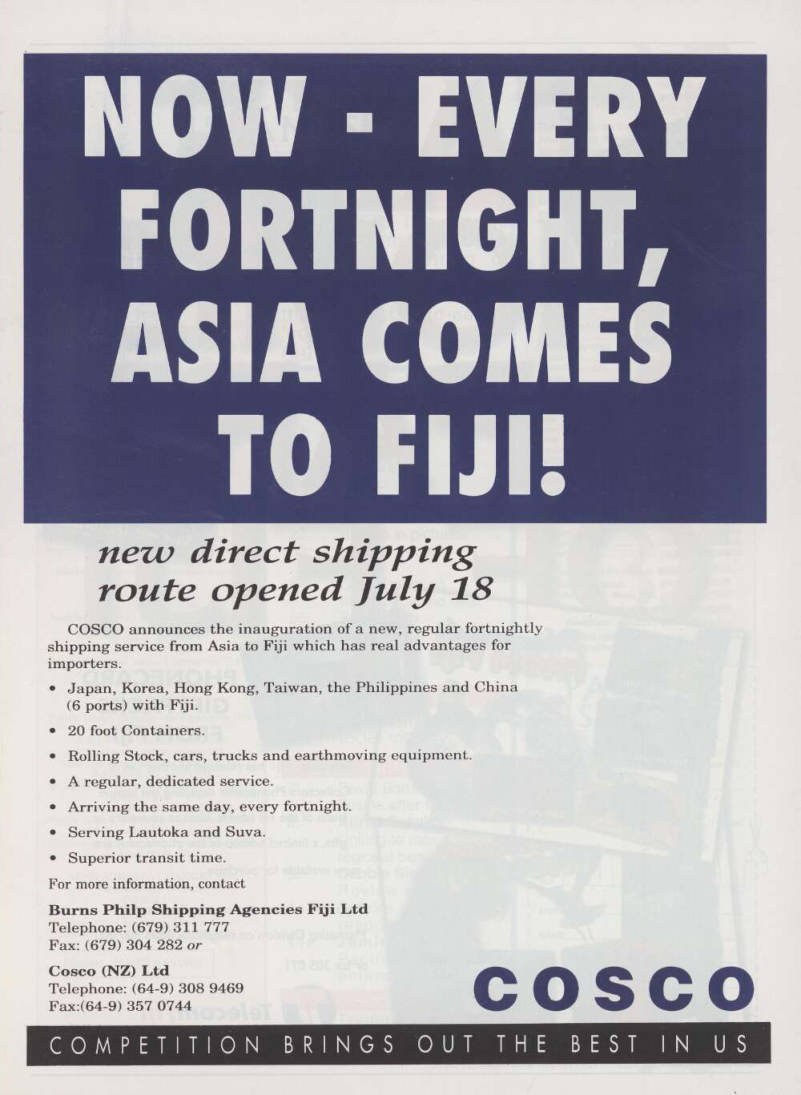
NOW • EVERY
FORTNIGHT,
ASIA COMES
TO FIJI!
nezv direct shipping
route opened July 18
COSCO announces the inauguration of a new, regular fortnightly shipping service from Asia to Fiji which has real advantages for importers. • Japan, Korea, Hong Kong, Taiwan, the Philippines and China (6 ports) with Fiji. • 20 foot Containers. • Rolling Stock, cars, trucks and earthmoving equipment. • A regular, dedicated service. • Arriving the same day, every fortnight. • Serving Lautoka and Suva. • Superior transit time.
For more information, contact Burns Philp Shipping Agencies Fiji Ltd Telephone: (679) 311 777 Fax: (679) 304 282 or
SCO
Cosco (NZ) Ltd Telephone: (64-9) 308 9469 Fax;(64-9) 357 0744 CO COMPETITION BRINGS OUT THE BEST IN US
I m\. i s 5
ISI
p ■ e. * V - / V
SJS
PHONECARD
GIFTPACKS
FROM FIJI
Telecom Fiji has released another set of Collectors Phonecards depicting the unique fauna of the Fiji Islands. Ideal as souvenirs or gifts, a limited edition of the phonecards are now available for purchase.
For more information contact Telecom Fiji’s Marketing Division on telephone 0800 300 000 or fax 305 071.
Telecom fiji
PRIVATE MAIL BAG, SUVA, FIJI
RUBINE GROUP 10*3 19
Pacific
Islands
Month Ly
Vol. 66 No. 9
The News Magazine
September 1996
PUBLISHER: Alan Robinson EDITOR: Manivannan Naidu SENIOR WRITER: Bernadette Hussein
Correspondents:
David North, Sam Vulum lan Williams, Liz Thompson, Atama Raganivatu, Sally Andrew, Patrick Decloitre, Chris Peteru COLUMNISTS: David Barber (Wellington), Jemima Garrett (Sydney), Alfred Sasako (The Forum), Debbie Singh (South Pacific Commission).
GRAPHIC ARTIST: James Ranuku
Advertising Sales
Senior Regional Sales (South Pacific) Shailendra Kumar Salendra Narayan Tel (679) 304111,303244, Fax (679) 303809.
Sydney, Canberra: Bob Hill Media Representation, Tel (61-2) 4164245, Fax (61-2) 4165064.
Brisbane: Jane Fewings Media and Advertising Associates Tel (61-7) 3378 4522, Fax (61-7) 3878 1071.
Adelaide: Hastwell Williamsons Representatives, Tel (61-8) 3799522, Fax (61- 8) 3799735.
Melbourne: Brown Orr Fletcher Burrows (Aust) Pty Ltd.
Tel (61-3) 98265188, Fax (61-3) 98265644.
Auckland: McKay & Bowman, International Media Representatives Limited, Tel (64-9)4190561, Fax (64-9) 4192243.
Japan: Universal Media Corporation, Tokyo, Tel (3) 3266626741, Cable: UNI-MEDIA Tokyo, Fax(3) 32626742.
Pacific Islands Monthly was founded in 1930
(Usps 9522480).
A Fiji Times Limited production.
Cover prices are recommended retail only. Registered by Australia Post, Publication No. NBPI2IO. © Copyright Fiji Times Limited, 177 Victoria Parade, Suva, Fiji.
Tel (679) 304111, fax (679) 303809.
Pacific Islands Monthly is published monthly by Fiji Times Limited, a division of Nationwide News, 2 Holt Street, Surry Hills, Sydney, NSW 2010.
Send Address Changes To;
Pacific Islands Monthly POBox 1167 Suva, Fiji.
Typeset and printed by The Fiji Times Limited, 177 Victoria Parade, Suva, Fiji.
Cover: James Ranuku
Inside
COVER: The Pacific seems to have been hit by a string of financial ‘seams’, posing the question: “What is it that attracts so-called ‘conmen’ to the region?”
6: Letters 15: The South Pacific Forum 17: An American legacy ... 18: Nukes in the Pacific 21: Fiji’s prison break-outs 28: Samoa in pictures 50: Internet in the Pacific 54: Cooks mum on Internet Casino deal 56: Fuemana’s Bizarre rise to fame 58: Sacrifice of adoption
Special Report
-JO The Pacific’s silver i l medal victory
Views
7: David Barber: Fusion after fission? 8: Alfred Sasako: Uniting to maximise regional benefits 9: Debbie Singh: Review process sparks mixed responses 11: Jemima Garret: Pacific fishing enters new era
Sports
55: Trying times for Manu Samoa
Advertisements & other items, p. 5 (1 item)
Pacific
Remember your Friend
There are times in your life when you feel your friends have been missing out on something good. Now’s your chance to do something about it and share with them one of the good things you have. Buy your friend a subscription to Pacific Islands Monthly and let him or her join you and thousands of other people worldwide who are kept informed of the latest political, social and cultural changes taking place in the Pacific.
SUBSCRIPTIONS
American Samoa US$45 Australia A 542.00 Canada US$45 Cook Islands AUSS46 Fiji F 526.40 French Polynesia US$45 Guam US$45 Hawaii US$45 Japan US$45 Kiribati AUSS46 Marshall/Micronesia US$4O Nauru AUSS42 New Caledonia US$32 New Zealand NZ$55 Niue AUSS46 Norfolk Island AUSS42 Northern Marianas/Palau US$4O Papua New Guinea AUSS4S Solomon Islands AUSS46 Tonga AUSS46 Tuvalu AUSS46 United Kingdom Stg Pound2B US Mainland US$45 Vanuatu AUSS4S Western Samoa WS$6O Elsewhere AUSS63 Payment to Pacific Islands Monthly: Subscriptions Dept.
GPO Box 1167, Suva, FIJI.
Direct airmail rates on application.
Telephone: 304111 Fax: 303809.
Direct airmail rates include the cost of airspeeding to all destinations set out as above.
PACIFIC
ISLANDS
CMI
Z 3 Please send my friend Pacific Islands Monthly for one year (12 issues).
I enclose my cheque for $ (made payable to Pacific Islands Monthly) or debit $ to my: □ Visacard □ Mastercard 'Card No: Expiry Date_
NAME
.SIGNATURE.
ADDRESS:.
CITY_
.COUNTRY,
Freedom of the Press
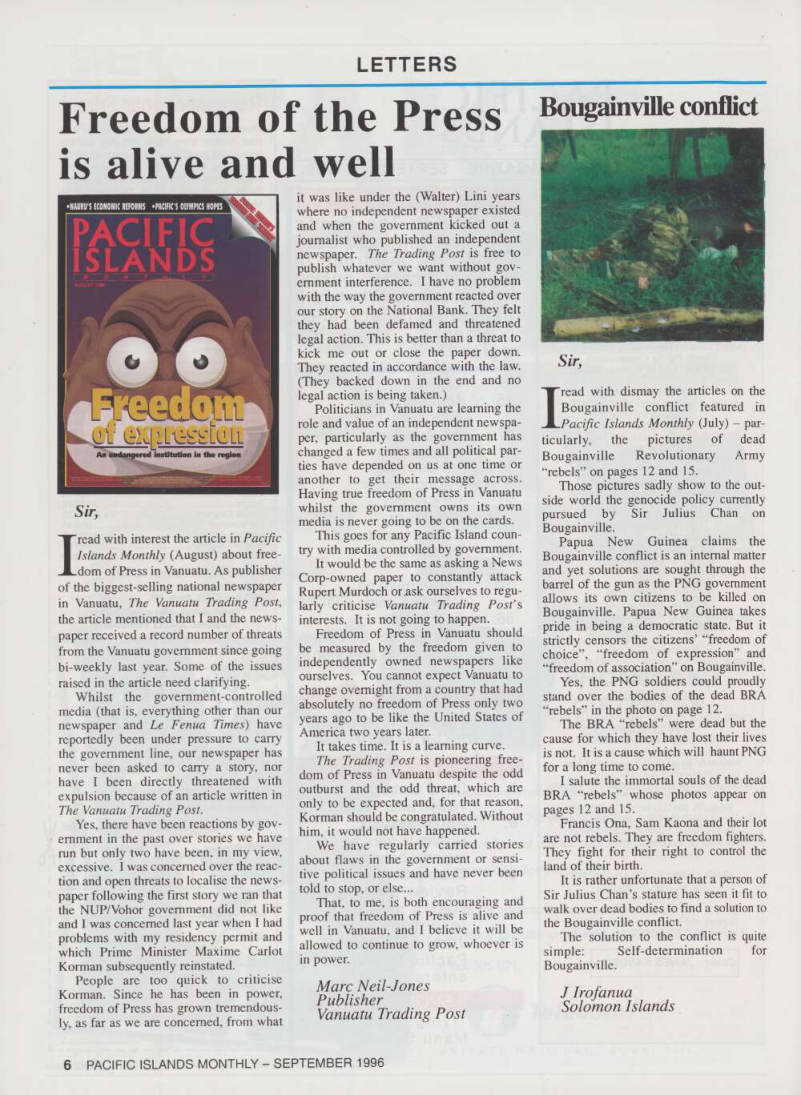
Letters
Freedom of the Press is alive and well
Sir,
I read with interest the article in Pacific Islands Monthly (August) about free dom of Press in Vanuatu. As publisher of the biggest-selling national newspaper in Vanuatu, The Vanuatu Trading Post, the article mentioned that I and the news paper received a record number of threats from the Vanuatu government since going bi-weekly last year. Some of the issues raised in the article need clarifying.
Whilst the government-controlled media (that is, everything other than our newspaper and Le Fenua Times) have reportedly been under pressure to carry the government line, our newspaper has never been asked to carry a story, nor have I been directly threatened with expulsion because of an article written in The Vanuatu Trading Post.
Yes, there have been reactions by gov ernment in the past over stories we have run but only two have been, in my view, excessive. I was concerned over the reac tion and open threats to localise the news paper following the first story we ran that the NUP/Vohor government did not like and I was concerned last year when I had problems with my residency permit and which Prime Minister Maxime Carlot Korman subsequently reinstated.
People are too quick to criticise Korman. Since he has been in power, freedom of Press has grown tremendous ly, as far as we are concerned, from what
it was like under the (Walter) Lini years where no independent newspaper existed and when the government kicked out a
journalist who published an independent
newspaper. The Trading Post is free to publish whatever we want without gov ernment interference. I have no problem with the way the government reacted over our story on the National Bank. They felt they had been defamed and threatened legal action. This is better than a threat to kick me out or close the paper down.
They reacted in accordance with the law. (They backed down in the end and no legal action is being taken.) Politicians in Vanuatu are learning the role and value of an independent newspa per, particularly as the government has changed a few times and all political par ties have depended on us at one time or another to get their message across.
Having true freedom of Press in Vanuatu whilst the government owns its own media is never going to be on the cards.
This goes for any Pacific Island coun try with media controlled by government.
It would be the same as asking a News Corp-owned paper to constantly attack Rupert Murdoch or .ask ourselves to regu larly criticise Vanuatu Trading Post’s interests. It is not going to happen.
Freedom of Press in Vanuatu should be measured by the freedom given to independently owned newspapers like ourselves. You cannot expect Vanuatu to change overnight from a country that had absolutely no freedom of Press only two years ago to be like the United States of America two years later.
It takes time. It is a learning curve.
The Trading Post is pioneering free dom of Press in Vanuatu despite the odd outburst and the odd threat, which are only to be expected and, for that reason, Korman should be congratulated. Without him, it would not have happened.
We have regularly carried stories about flaws in the government or sensi tive political issues and have never been told to stop, or else...
That, to me, is both encouraging and proof that freedom of Press is alive and well in Vanuatu, and I believe it will be allowed to continue to grow, whoever is in power.
Marc Neil-Jones
Publisher Vanuatu Trading Post
Bougainville conflict
Sir,
I read with dismay the articles on the Bougainville conflict featured in Pacific Islands Monthly (July) - par ticularly, the pictures of dead
Bougainville Revolutionary Army
“rebels” on pages 12 and 15.
Those pictures sadly show to the out side world the genocide policy currently pursued by Sir Julius Chan on
Bougainville.
Papua New Guinea claims the Bougainville conflict is an internal matter and yet solutions are sought through the barrel of the gun as the PNG government allows its own citizens to be killed on Bougainville. Papua New Guinea takes pride in being a democratic state. But it strictly censors the citizens’ “freedom of choice”, “freedom of expression” and “freedom of association” on Bougainville.
Yes, the PNG soldiers could proudly stand over the bodies of the dead BRA “rebels” in the photo on page 12.
The BRA “rebels” were dead but the cause for which they have lost their lives is not. It is a cause which will haunt PNG for a long time to come.
I salute the immortal souls of the dead BRA “rebels” whose photos appear on pages 12 and 15.
Francis Ona, Sam Kaona and their lot are not rebels. They are freedom fighters.
They fight for their right to control the land of their birth.
It is rather unfortunate that a person of Sir Julius Chan’s stature has seen it fit to walk over dead bodies to find a solution to the Bougainville conflict.
The solution to the conflict is quite simple: Self-determination for
Bougainville.
J Irofanua
Solomon Islands
Wellington
Opinion
Fusion after fission? ... France wants to be friends again
The nuclear powers have always taken New Zealand and South Pacific opposition to their wretched weapons of destruction very personally.
The United States persistently deemed David Lange’s anti-nuclear policy anti-American despite clear evidence that it had widespread pub lic support, as was proved by the fact that an undeniably pro-American National Party eventually embraced it. The French, for their part, saw last year’s outbreak of condemnation of resumed testing at Mururoa as evi dence that New Zealand, Australia and the peoples of the Pacific wanted France to quit the region.
This was never true and even those who favour independence for French Polynesia and New Caledonia in the conviction that all indigenous peoples have a right to choose their own destiny, accepted that a precipitate withdrawal by France would be a disaster for everyone in the region.
With the Mururoa site now closed for good, France has embarked on the task of repairing the damage President Jacques Chirac’s summary resumption of testing last year did to its standing in the Pacific.
It will not be easy, as the French must have realised, when they ended the 1992 moratorium of Chirac’s predecessor, Francois Mitterrand.
In those three years, France had pre sented a new face to the Pacific. It changed its entire philosophy towards the
region. Suspicion was replaced with
entente cordiale, self-imposed isolation with co-operation - and the entire South Pacific climate was the better for it.
As France opened up its territories politically and economically to their neighbours, the diplomatic and economic environments improved to their best con dition in a decade. All that goodwill was lost overnight with the decision to resume testing. The reaction was swift, genuine, deep and widespread.
It came not just from New Zealand and Australia, which had spearheaded opposi tion to the previous resumption in 1973.
The South Pacific Forum, which had warned in 1994 that a new round of tests
would be a “major setback to the current positive trend in relations between France and the region”, suspended its annual dia logue with Paris.
That it was not willing to kiss and make-up overnight was apparent from the Forum’s reluctance to restore the dialogue immediately following the end of testing.
At the time of writing, the Forum has still not approved France’s attendance at this month’s summit in Majuro.
France wants to be there, the French ambassador to Wellington, Jacques Le Blanc, told me, so that it can “hear at first hand what the Pacific Island countries expect from us”. France, he said, was anxious to discuss what it could do to improve the delivery of aid to the region.
In other words, France, which is already the fourth biggest Pacific donor after New Zealand, Australia and Japan, wants to be
a good neighbour again.
It is not entirely an altruistic aim. The French, like all European countries, are keenly eyeing the dynamism of the entire Asia-Pacific region and want to be a part of it in the 21st century.
The balance of economical power has moved away from the Atlantic axis that dominated after the Second World War and is now very much focused on the Pacific Rim.
It is not just a matter of looking after its territories in the Pacific and striving to keep them under the influence of Paris.
They have to form their own trade and investment links with their neighbours
while France expands its econom ic ties with the broader region.
To this end, Le Blanc revealed that France will send a high-powered trade and investment mission to New Zealand early next year. It was hoped, he said, it would mark
formally the complete resumption
of friendly relations following the end of nuclear testing.
The mission, which will include chief executives of France’s major companies, banks and financial institutions, is being personally backed by Chirac, who has urged French companies to make expan sion of trade and investment in the Asia-Pacific region a priority.
About 50 French companies have
established operations in New Zealand to date, compared with 250 in Australia, which indicates there is plenty of room for expansion.
Ironically, in view of last year’s talk of boycotts of French products in retaliation for nuclear testing, France actually lifted its exports to New Zealand to a record level. France also posted a trade surplus with New Zealand for the first time.
Although the export figures were skewed by Air New Zealand’s one-off purchase of seven new French aircraft for a domestic subsidiary, sales of other goods were 10 per cent up on 1994. This probably reflected the buoyant New Zealand economy more than anything else.
While encouraging more French com mercial participation in the region, Paris is also keen to see New Zealand compa nies invest in French Polynesia and New Caledonia to expand its integration with regional economies.
The figures show there is still some way to go. In the first quarter of 1996, New Caledonia shipped more than a third of its exports to France while buying 56 per cent of its imports from France and the rest of the European Union.
New Zealand accounted for only 6.5 per cent of imports into New Caledonia, its nearest neighbour, while distant mar kets such as Japan, the United States, Korea and Taiwan remain bigger cus tomers. ■
Wellington
David
Barber
The Forum
Uniting to maximise regional benefits
As you are reading this column, leaders of the South Pacific Forum will have begun their annual summit in Majuro, the capital of the republic of the Marshall Islands.
The 27th South Pacific Forum is being held there from September 3 to 5 against a background of a host of regional issues - issues which could work for or against us.
Some of these are issues which could help our resolve to stand together and be counted as a region, united in the cause of pursuing social and economic develop ment for the well-being of the Island
region’s six million people.
I have no doubt whatsoever that the presidents and prime ministers for the 16 Member States of the South Pacific Forum are mindful of this. It is perhaps with this in mind that the host, President Amata Kabua, in consultation with his colleagues, has decided on the theme for this year’s summit.
“Pacific Solidarity for the Common Good?” is the theme that underscores the view that the more the solidarity in the region is strengthened and expanded, the more its societies will progress in pros
perity.
At the same time, Kabua said that cer tain aspects of regional solidarity may not be perceived by some countries as neces
sarily productive, especially where
national interests might be compromised.
By posing the theme as a question, it allows for a wide and diverse exchange of views. There will also be four sub themes, with four of the Member States having written a paper on each of them; • Inter-dependence and Building Strategic Alliances among South Pacific Forum Countries and Between South Pacific Forum and Non-Forum Countries; • Overcoming obstacles to Greater Regional Interdependence and Co-opera tion; • Maximising Returns on Natural Resources Through Pacific Solidarity; and • Maximising Human Resources Towards Economic Growth.
The paper of the first sub-theme will attempt to identify strategies for enhanc
ing alliances with countries outside the region. The paper on the second sub theme will attempt to identify obstacles to greater regional or sub-regional co-opera tion.
The paper on the third sub-theme will try to identify strategies to ensure that nat ural resources common to all in the region are managed in such a way as to max imise the benefits to the region as a whole. The fourth paper is expected to
identify key areas for training personnel
in support of government economic poli cies in the Islands.
Kabua of the Marshall Islands said that the main theme “Pacific Solidarity for the Common Good?” recognises the interna tional, regional and sub-regional connota tions of the issues it addresses, including the vulnerability of the region to unfair exploitation of its vital resources.
Not least, he said, it aims to align itself with and build on discussion at previous meetings of the South Pacific Forum.
As well, the theme for this year’s Forum will enable leaders to review progress on their decisions of last year, in particular, the plan of action to secure development beyond 2000.
The plan of action set out a number of
economic policy directions, including
reform measures at national level and trade, investment and other aspects of regional economic relations.
A number of actions have been taken on these issues since the Leaders’ Summit in Madang, Papua New Guinea, last year, including the South Pacific Forum Finance Ministers’ meeting which was held in Port Moresby last December.
At the meeting in Majuro this month leaders will be considering ways to add
further political impetus to this on-going
process.
The Majuro South Pacific Forum is the third in a row to have a theme as a feature of discussion. The trend began in 1994 when the South Pacific Forum Leaders adopted changes in procedures to enable them to focus their annual discussions on some particular areas of concern.
Discussions at the Majuro Forum are expected to cover other issues as well.
The South Pacific Forum is now a well-established institution in the region.
respected and accepted regionally and
beyond.
As that recognition grows beyond the 29 million square kilometres of its juris diction, more will be required of it as the Pacific aligns itself with other jurisdic tions dictated by the global environment and the ever-continuing changes.
Such an environment, no doubt, pre sents boundless opportunities for those brave enough to take risks in making decisions in the tough times ahead.
For instance, the inception of the World Trade Organisation (WTO) has changed many things, including the rule of play in so far as business, in particular international trading, is concerned.
It means that Island countries, which
once enjoyed duty-free access through
preferential arrangements, will no longer be able to do so. Instead, they will be required to compete in the international market in the same way as those who have been doing business in that environ ment for ages.
Perhaps the obvious disadvantage is that the privilege of having a fixed price for our commodities will no longer be there.
We will therefore have to work very
hard to produce world-standard-quality
goods and be able to meet the demands dictated by the world environment. So, there is a lot of work ahead of us as a region.
Of course, nothing is impossible for those who are determined to work harder and be rewarded for their effort. The Pacific people have survived on their sheer hard work for centuries and there is no doubt that, given the opportunity and the right political impetus, they will do it again. So the outcome of the leaders’ dis cussion will be eagerly awaited. For it is here that perhaps the chart for the Pacific voyage into the 21st century and beyond will be plotted.
Let’s do it the Pacific way - recognis ing but accommodating our differences, but at the same time moving together to achieve for the region what we cannot do
single-handedly.
For, united we stand, divided we fall.
Let us do what our children cannot do for themselves as yet. ■
The Forum
Alfred
Sasako
Advertisements & other items, pp. 9-10 (2 items)
Thr Spc
Review process sparks mixed reactions
The South Pacific Commission is
undergoing a major organisational
review designed in narrow terms to make the Commission more effective.
The three-member team reviewing the SPC consists of Savenaca Siwatibau, head of the ESCAP (Economic and Social Commission for Asia and the Pacific) Pacific Operations Centre in Vanuatu; Bruce Davis, deputy director-general of AusAID and former deputy secretary general of the Forum Secretariat; and Makarita Baaro, secretary for foreign affairs of the government of Kiribati.
At the SPC itself, staff reactions to the review have been varied and range from scepticism of its effectiveness to ques tioning the level of action or inaction of its recommendations. One staff member pointed out: “Three years ago we were all asked to provide detailed accounts of our work - we did this and never heard about
it again!”
Perhaps a more composite view would be to look at the situation in a broader context in that all organisations, including the SPC, exist in a political market of players such as donors, governments, non-govemment organisations, commu nity groups and their leaders, and are influenced by both internal and external factors. In this light, it is somewhat easier to see the comment of another staff mem ber who said: “This review is no different from the numerous others that have gone on before ... and has been instituted at the behest of management responding to strong signals from the metropolitan pow ers of the SPC - Australia, New Zealand, France, the United Kingdom and the United States.”
The feeling arising from this statement is no one has asked what will become of savings to be realised after the review?
Ideally, they would normally be ploughed into programmes but this has also been viewed by some staff with a degree of scepticism in that they believe the savings realised by the team could actually work against the SPC, forcing donors to reduce their much-needed contributions to the organisation’s extremely tight core bud get.
Another worry is that possible cuts, if too deep, could become totally ineffec
five, causing the organisation to lose its grassroots role and be forced to ascribe to one outside its traditional competencies.
But the team’s latest findings point to major streamlining of the organisation through a reduction in the number of the SPC’s top managers and greater integra tion between programmes such as women, population and health.
The third worry, in the words of one member, is that in peering at the sick patient the three specialist surgeons may forget the big picture the patient has had to work within. The feeling among some insiders is that the review should also spotlight donors - “none of who have met the United Nations target of 0.7 per cent of Gross National Product that should go to developing countries as aid”.
“Australia, the biggest donor to the Pacific, manages to reach only 0.3 per cent of GNP... Compared to 10 years ago, there is a lot of cynicism now about the role of aid... Foreign aid is on the verge of
losing its humanitarian gloss. A growing
share of aid is now ‘tied aid’ which is linked to procurement of goods and ser vices in the donor country. In Papua New Guinea, cynics refer to Australia’s annual SA32O-million (SUS2SO-million) alloca tion as ‘Boomerang aid’ - most of it allegedly goes back to Australia in some form or another,” the insider says.
“When Australia withdrew $A2.2 mil lion (SUSI. 7 million) a year in forestry aid to the Solomon Islands in January 1996 to protest against the government’s failure to curb unsustainable logging practices, Prime Minister Solomon Mamaloni dismissed the loss as negligi ble as, he said, much of it was consumed by Australian staff. The notion of ‘Boomerang aid’ was confirmed when
AusAID director-general Trevor Kanaley
said almost 90 cents in every dollar was spent on Australian goods and services.”
This same view is held of France with feeling that United States budget cuts will not see it beefing up aid to the Pacific anytime soon. But all is not gloom and doom with one individual saying: “The SPC was all but finished when the new S- G arrived. Rather than battling each cri sis as it comes, (Dr Bob) Dun’s offered a comprehensive three-year plan to revamp
the Commission, of which the review is a
crucial part.”
The SPC reviewers are also re-exam ining assessed contributions to the organ isation’s core budget, in light of declining aid levels to the Islands and present eco nomic realities. The formula will be based on members’ capacity to pay and levels of contributions by metropolitan states.
Currently, Australia, New Zealand, France and the US contribute 92 per cent towards the organisation’s core budget, with eight per cent to be met by small Island States.
A few staff are concerned about Siwatibau’s role as chair of the review team saying as head of a UN regional development organisation also competing for scarce funds, a conflict of interests exists. But the staff cannot complain of not being “cushioned” for possible changes as the new management team continues to hold regular briefings on the review team’s progress. There are staff who are pleased with the exercise and echo management’s sentiments of a need for “positive change”.
One person said; “This year, there are cars still parked outside the Commission after 4pm... Staff are willing to put in extra hours and morale continues to rise.”
But, again, this sentiment is balanced by fears that the review team may take the knife-wielding approach of the Forum, with one member saying: “Newcomers find Noumea difficult to adjust t 0... If the review’s findings are viewed negatively by the staff, an exodus of the more highly qualified could result ... making the SPC a haven for second-grade professionals.
The best advice to give the team is: ‘Stick to the basics.’”
And in sticking to the basics insiders suggest improving transparency in areas needing it; improving programme inte gration, particularly in getting pro grammes such as fisheries and agriculture to mainstream cross-cutting social themes such as gender, poverty alleviation, popu lation and sustainable development; tight ening budget procedures and ensuring these are linked to countries; and obtain ing a reaffirmation from all parties that, at nearly 50, the dinosaur of the Pacific is not extinct yet. ■
THR SPC
DEBBIE
SINGH
Pacific International, Inc.
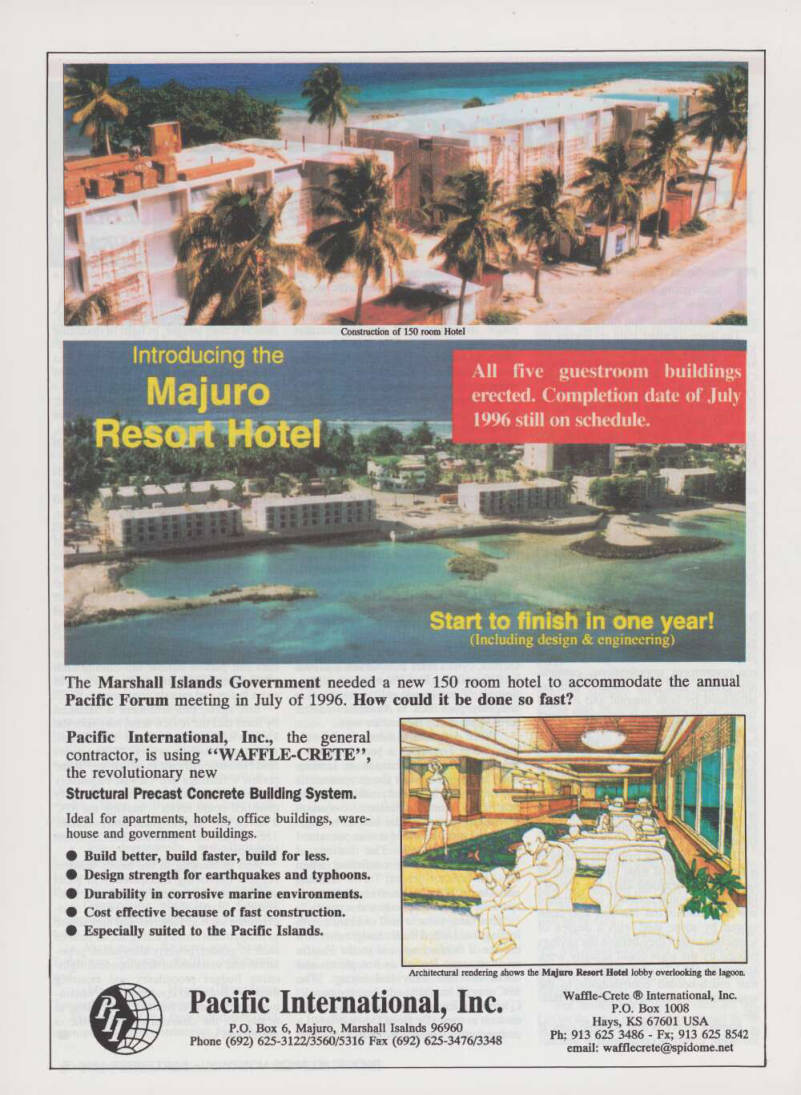
I r w * A/i % * f \ i * Construction of 150 room Hotel The Marshall Islands Government needed a new 150 room hotel to accommodate the annual Pacific Forum meeting in July of 1996. How could it be done so fast?
Pacific International, Inc., the general
contractor, is using “WAFFLE-CRETE”,
the revolutionary new Structural Precast Concrete Building System.
Ideal for apartments, hotels, office buildings, warehouse and government buildings. Build better, build faster, build for less. Design strength for earthquakes and typhoons. Durability in corrosive marine environments. Cost effective because of fast construction. Especially suited to the Pacific Islands.
Architectural rendering shows the Mqjuro Resort Hotel lobby overlooking the lagoon.
A
Pacific International, Inc.
P.O. Box 6, Majuro, Marshall Isalnds 96960 Phone (692) 625-3122/3560/5316 Fax (692) 625-3476/3348 Waffle-Crete ® International, Inc.
P.O. Box 1008 Hays, KS 67601 USA Ph: 913 625 3486 - Fx; 913 625 8542 email: [email protected]
Australia
Pacific fishing enters new era
Anew era is dawning on Pacific fishing - an era of tougher com petition and more sophisticated responses from Island nations.
In the past decade and a half, the Pacific has notched up substantial inter national victories, such as the lucrative multilateral tuna treaty with the US (which stopped American poaching) and the banning of destructive driftnet fishing.
While the region’s efforts to protect its fish stocks were generally successful, its attempts to establish local industries were not, and the region has struggled to get fair financial returns from the resources.
Now, as we approach the Year 2000, world fish stocks are in crisis. In resource after resource, stocks have been depleted and then crashed, so much so that the rep utable International Union for the Conservation of Nature (lUCN) now lists 80 per cent of the world’s fish species as either vulnerable, endangered or critical.
Fishing is a major industry in most coastal nations but, as stocks diminish, rather than scale back fishing effort, fleets have simply gone further afield.
Governments have subsidised unprof itable boats instead of accepting the polit
ically unpalatable option of job losses
and, in the process, created huge over capacity. Interest in fishing the Pacific has grown steadily. The Taiwanese and Koreans followed the Japanese and Americans into the region so that now fully half of the world’s tuna is caught here. Recently, Phillipine boats, unable to catch enough fish in their own waters, began moving in.
Compared to the rest of the world, the Pacific has looked after its offshore fish eries well. Stocks of skipjack and yel lowfin tuna are healthy and while bigeye and albacore are listed as vulnerable, it is likely that has as much to do with lack of data as with the state of the fishery.
Until now, Pacific Island nations have managed the stocks themselves and fiercely defended their right to so.
However, because tuna cover vast dis tances and can easily be caught outside the 200-mile Exclusive Economic Zones of the region, such a management plan may not be effective in the long term, especially as fishing pressure increases.
One of the elements of the new era in the region’s approach to fishing is a recent UN agreement known as the “Implementing Agreement on Straddling Fish Stocks and Highly Migratory Fish Stocks”. Under that agreement, the states of the region and the Distant Water Fishing Nations must come together to come up with a management and conser vation plan for Pacific fish stocks.
At this month’s South Pacific Forum in Majuro, regional heads of government will consider a proposal to call an initial meeting of interested parties.
Key Island players see these negotia tions as “absolutely fundamental” to the future of Pacific fish stocks. There will be highly complex negotiations and risk that the intransigent Distant Water Fishing Nations like Taiwan and Korea might overwhelm the small nations’ legitimate claims. Even apparently simple issues, such as who to invite to the talks, could have major repercussions.. For instance, should, notoriously anti-conservationist countries like Indonesia be invited?
Would such an invitation simply invite more non-compliant vessels into the region or would it prevent poaching by locking the newcomers into an effective management process? The Island nations have a number of factors working in their favour. They are practised and effective at working together as a region on these sorts of issues, their management of their fish stocks, including their reporting and monitoring mechanisms, and their research effort, give them some much needed moral high ground and they have a growing body of highly effective diplo mats, such as Fiji’s Satya Nandan, who played such an outstanding role in United Nations Law of the Sea negotiations.
At the same time as these negotiations are going to protect the resource, debate is hotting up over how Pacific states can get more money out of the fishing industry.
For many nations fish is their best eco nomic resource, and yet in an industry worth SUSI.I billion the region reaped just $6O million in royalties and licence fees and few jobs.
A system of auctioning licences to the Distant Water Fishing Nations has been
suggested by Canberra-based academics
Professor Ron Duncan and Colin Hunt.
Hunt, who is working on a World Bank project to come up with ways of improving Pacific Island fisheries rev enue, believes the auction system would help prevent Distant Water Fishing Nations forcing down royalty rates by threatening to move their operations to another country’s waters and give them an incentive to report illeigal fishing.
During the 1980 s, most attempts to set up local fishing industries were govern ment backed and foundered because of poor management or because boats they bought were old, expensive to run and suffered serious problems such as poor refrigeration systems. There is now a growing realisation that the only enter prises with any longevity are private con cerns. Fiji is home to a number of very successful local companies. Robbie Stone’s Stone Fish Company has been operating since the late 70s. It employs 25 locals on his pole-and-line vessel and more at a small factory. Stone has contin ued to turn a good profit despite static tuna prices and rising costs by increasing the skill and therefore the productivity of his operation. On a larger scale, Graham Southwick’s Fiji Fish has produced hun dreds of jobs and exports of around $3O million a year by selling in the high priced Japanese sashimi market. Because of the differing conditions and species of fish, Stone and Southwick’s success is not directly repicable. What is repicable is the utilisation of the experienced people in
the region to identify specific opportuni
ties and turn them into a genuinely
indigenous industry which provides jobs
and other valuable multiplier effects.
The Honiara-based Forum Fisheries Agency is working on a new set of coun
try-specific development plans which
take account of the fact that each coun try’s opportunities are very different.
Another new initiative (known as the FSM Arrangement) aims to encourage
meaningful joint ventures by awarding
preferential access to foreign boats or companies based on how many points they score against five criteria which add value to the local industry. The criteria include the extent of local equity, the flag the vessel carries, the number of nationals employed, the extent of local provision ing and onshore investment. ■
Australia
Jemima
Garrett
Wolfgramm - doing the Pacific proud
Special Report
By Atama Raganivatu
Up to the 1996 Olympic Games’ 12th day of competition, the world’s greatest sporting festival appeared destined to be a huge disap pointment for Pacific Island nations.
One after the other, our athletes had suffered defeat. Most were expected and some were gallant but the manner in which many who travelled to Atlanata with great expectations failed to do them
selves justice was highly disconcerting.
It seemed that the region lagged as far behind the rest of the world as ever and anyone would be forgiven if believing that the gold of an Olympic medal remained just as remote then as when our athletes first competed 40 years earlier.
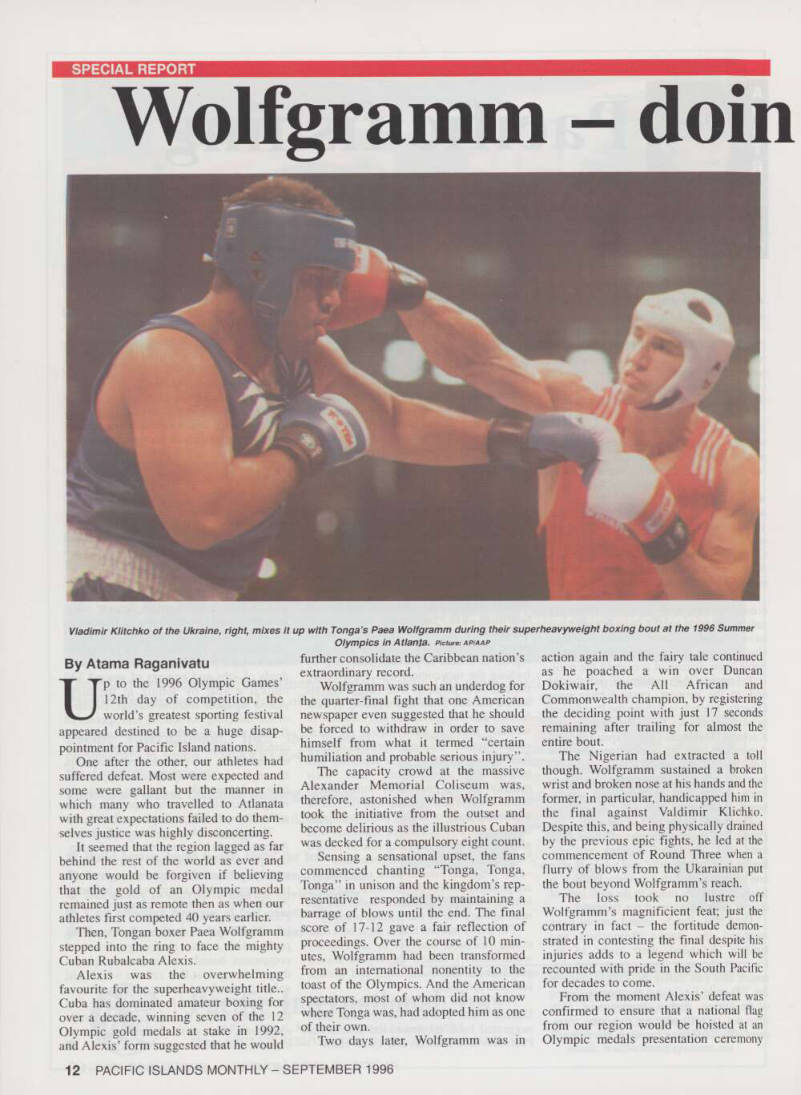
Then, Tongan boxer Paea Wolfgramm stepped into the ring to face the mighty Cuban Rubalcaba Alexis.
Alexis was the overwhelming favourite for the superheavyweight title..
Cuba has dominated amateur boxing for over a decade, winning seven of the 12 Olympic gold medals at stake in 1992, and Alexis’ form suggested that he would
further consolidate the Caribbean nation’s extraordinary record.
Wolfgramm was such an underdog for the quarter-final fight that one American newspaper even suggested that he should be forced to withdraw in order to save himself from what it termed “certain humiliation and probable serious injury”.
The capacity crowd at the massive Alexander Memorial Coliseum was, therefore, astonished when Wolfgramm took the initiative from the outset and become delirious as the illustrious Cuban was decked for a compulsory eight count.
Sensing a sensational upset, the fans
commenced chanting “Tonga, Tonga,
Tonga” in unison and the kingdom’s rep resentative responded by maintaining a barrage of blows until the end. The final score of 17-12 gave a fair reflection of proceedings. Over the course of 10 min utes, Wolfgramm had been transformed from an international nonentity to the toast of the Olympics. And the American spectators, most of whom did not know where Tonga was, had adopted him as one of their own.
Two days later, Wolfgramm was in
action again and the fairy tale continued as he poached a win over Duncan Dokiwair, the All African and Commonwealth champion, by registering the deciding point with just 17 seconds remaining after trailing for almost the entire bout.
The Nigerian had extracted a toll though. Wolfgramm sustained a broken wrist and broken nose at his hands and the former, in particular, handicapped him in the final against Valdimir Klichko.
Despite this, and being physically drained
by the previous epic fights, he led at the commencement of Round Three when a flurry of blows from the Ukarainian put the bout beyond Wolfgramm’s reach.
The loss took no lustre off Wolfgramm’s magnificient feat; just the contrary in fact - the fortitude demon strated in contesting the final despite his injuries adds to a legend which will be recounted with pride in the South Pacific for decades to come.
From the moment Alexis’ defeat was confirmed to ensure that a national flag from our region would be hoisted at an
Olympic medals presentation ceremony
Vladimir Klitchko of the Ukraine, right, mixes it up with Tonga’s Paea Wolfgramm during their superheavyweight boxing bout at the 1996 Summer Olympics in Atlanta. Picture: ap/aap
for the first time, his place in local folk lore had been guaranteed.
Utungake, in Vava’u, can claim the honour of producing the Pacific Islands’ latest hero as Wolfgramm spent the initial four years of his life there.
In 1974, he was taken with his parents, Bernard and Fatafehi, to New Zealand and the family settled at Manukau, a south Auckland surburb. Like most New Zealand-based Tongans, Paea spent much of his youth playing rugby union. Despite always having an interest in boxing and idolising Muhammed Ali, he did not actu ally lace up a pair of boxing gloves until he was 20 years old and then only as part of a training programme devised to help him overcome a rugby injury.
Quickly realising he was far more effective between the ropes than between the touchlines, Wolfgramm joined the Otara Amateur Boxing Club, where he came under the wing of fellow Tongan Tupou Fulilangi.
Fulilangi had been a professionbal based in the United States and could boast having fought the great George Foreman before retiring to pass on his extensive knowledge as a coach. He has been Wolgramm’s guiding light throughout his career and provided invaluable advice from the comer during the Atlanta adven ture.
Unfortunately, New Zealand possesses few boxers in the superheavyweight divi sion, which caters for fighters weighing over 91 kilograms. And even fewer of these are prepared to face a Tongan man who stands 1.93 metres tall and tips the
scales at 150 kg.
Thus, several Kiwi national champi onships had been won with minimal diffi culty when Tonga’s boxing officials began to enquire about his availability for
international competitions. Wolfgramm
feared he would face a dilemma because, although regarding himself a Tongan, he recognised that New Zealand’s training facilities were responsible for his devel opment and it might lay claim to his loy alties.
The 1993 South Pacific Mini Games presented Wolfgramm, wearing the red vest of Tonga, with his first intemationbal honour. He then prepared himself for an approach by New Zealand as the follow ing years Commonwealth games neared.
New Zealand’s selection policy for Commonwealth and Olympic games is notoriously fickle and when the Kiwis decided they would not consider Wolfgramm a member of their squad to
travel to Victoria, his allegiance was determined once and for all. In the British Columbian city Wolfgramm won a bronze medal (Dokiwair claimed the gold) and, when returning home, decided to post pone his law studies at Auckland University and concentrate on the pursuit of an Olympic medal. Since then, he has been a ‘house husband’, looking after his three children while not training or com peting and depending on his wife, Vanessa, to be the breadwinner. The time the familty spent in a hotel outside Atlanta during the Olympics was the longest period they had been together for almost a year.
Gold medals at both the South Pacific games and Oceania Championships in 1995 established Wolfgramm as the
region’s best.
His older brother, Tevita, a welter weight, was presented with lesser medals in these events to underline the fact that their cousin, Vai Sikehema, a prominent American football player, was not the clan’s only talented sportsman.
In the Oceania Championships at Nukualofa’s Atele Stadium, Paea delighted his Tongan fans by knocking Western Samoan Pete Falamoe out of the ring just 84 seconds info their final.
Among those witnessing Falamoe’s destruction was Kevin Barry, a former Olympic silver medallist who had been sent to Tonga to spot talent for American trainer Lou Duva.
Barry invited Wolfgram to spend two weeks with Duva’s Main Event organisa tion in New York where Samoan heavy weight hope David Tua is based among many other talented fighters.
He learnt much about ringcraft during his brief stint at Main Event but was dis appointed when Duva failed to arrange some bouts for him. Wolfgram arrived in Atlanta having featured in just 22 match es.
The four months prior to the Olympics had been spent training in Phoenix, Arizona. That inexperience only occa sionally became evident at the Alexander Memorial Coliseum but, should he join the professional ranks, a great deal more polishing of technique, better condition ing and the development of a killer instinct will be required if he is to become a real force.
Duva is reported to have already offered the affable Tongan a contract but Wolfgramm refuses to make commit ments to him or any other manager until after enjoying a long, well-deserved rest.
During this holiday, he will visit Tonga where a momentous welcome can be
guaranteed.
A modest, immensely likable man with deep religious convictions (he is a Mormon), a high regard for sportsman ship and a keen sense of humour, Wolfgramm won the hearts of all in Atlanta through his conduct in and out of the ring. If gold medals were awarded for demeanour, the Tongan would have returned home with a pocketful.
Wolfgramm’s efforts stood head and shoulders above those of all other Pacific Island competitors and cannot hide the reality that an unconmfortably high num ber of them fared poorly.
Australia is the obvious source of help if our sports officials genuinely aspire to improvement. Only four other countries gained more medals than the Aussies’ 41 and due largely to the federal govern ment-funded Institute of Sport, the Commonwealth’s athletes revel in train ing facilities and coaching expertise among the best in the world. Should Australia include entrance to the institute for our elite sportspeople in an aid pack age, we can anticipate a much better all round performance in Sydney four years hence.
The New Zealand record was flattered by the achievements of swimming star Danyon Loader and the success of its equestrian team. In total, the Kiwis acquired just six medals.
The meticulous preparations enjoyed
by the Australians is far more appealing than the comparatively disorganised sys tem New Zealand endures - even if the Kiwis do from time to time bring to light talent such as Loader and Wolfgramm.
However, no government in our region has the resources to build anything akin to the Australian Institute of Sport and only
the federal government’s generosity
would give Pacific Island athletes avenue to the very best groundwork for future Olympics.
Loader, along with Irish swimmer Michelle Smith, South African marathon runner Josia Thugwane, American sprint er Michael Johnson, and Canada’s 100metres world-record breaker Donovan Bailey will be remembered by the rest of the world as the outstanding achievers of Atlanta 96.
For our region, though, this particular Olympiad belongs to Paea Wolfgramm the man who proved to every Pacific Island athlete that Olympic fame is not an imoossible dream. ■
Advertisements & other items, pp. 13-14 (2 items)
g the Pacific proud
13
PACIFIC ISLANDS MONTHLY - SEPTEMBER 1996
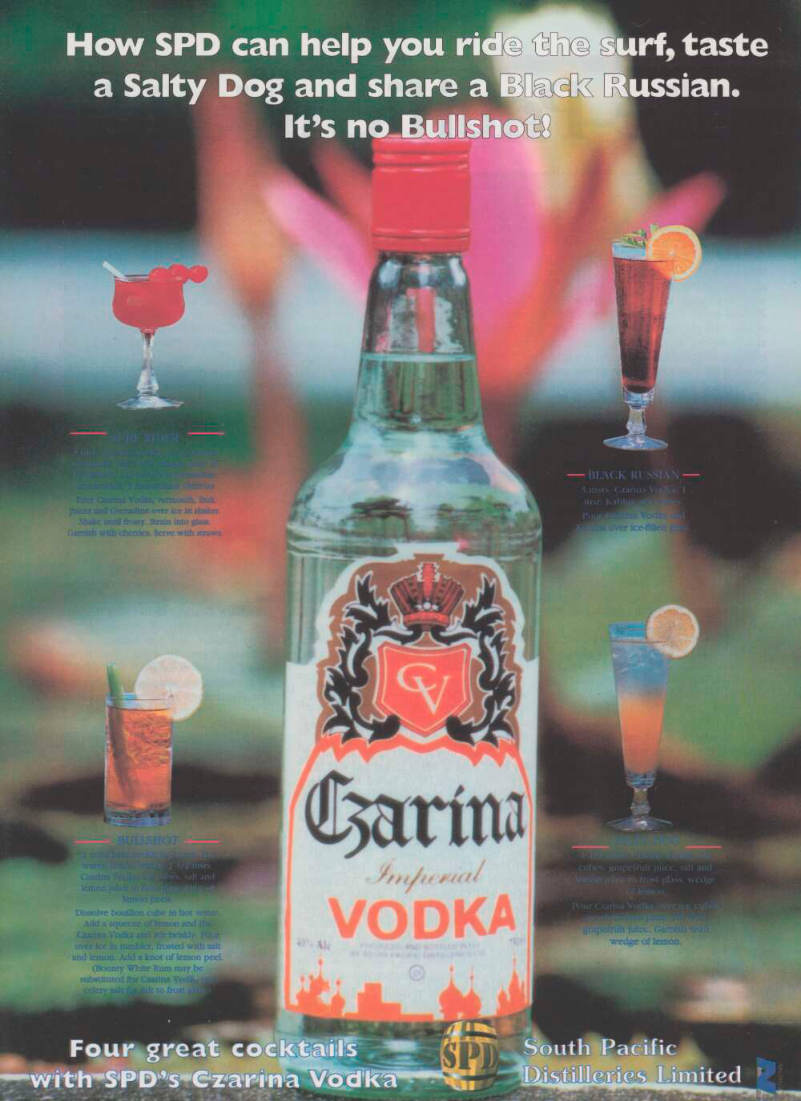
a Salty Dog and share a |
How SPD can help vou ridpMurf. taste a Salty Dog and share a
It’s
no
JJISVT
V*r I) . - >; r A \ I ill;;;: U 5» i a» South Pacific -X- i Limited Four great
with'SPD-’s-ezarina^odkS
take priority in Majuro
The South Pacific Forum
Trade and economy to take priority in Majuro
Reports by Bernadette Hussein
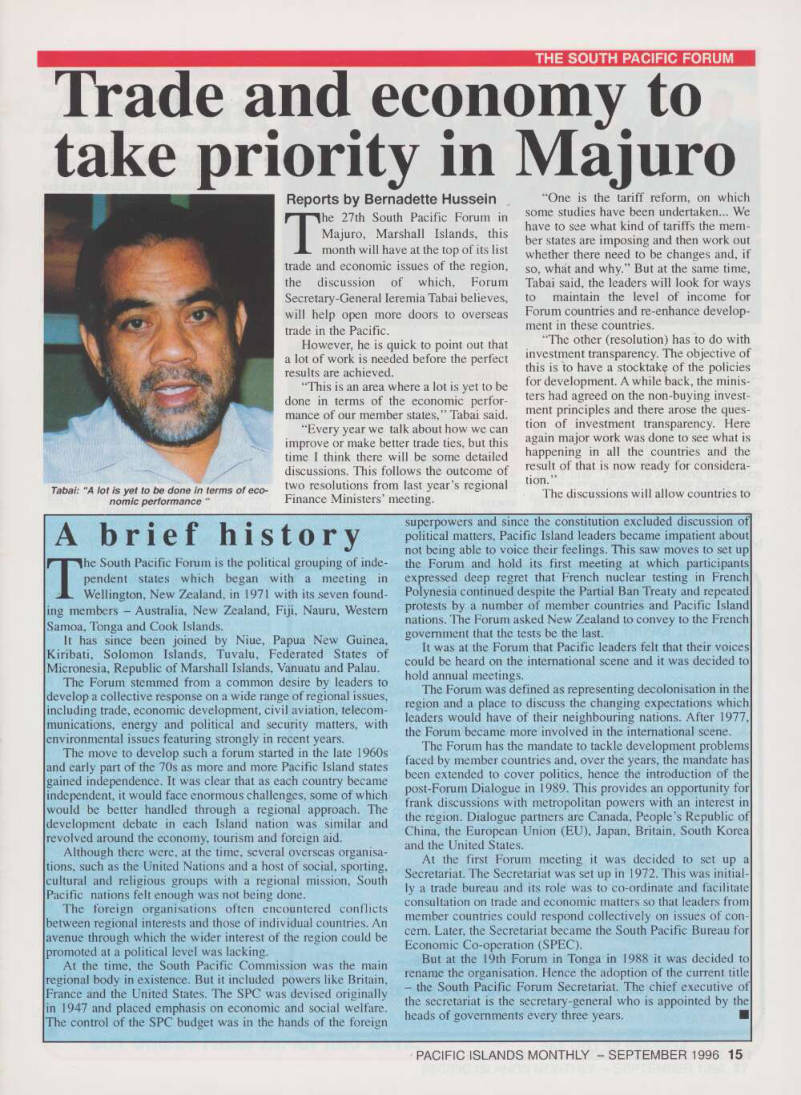
The 27th South Pacific Forum in Majuro, Marshall Islands, this month will have at the top of its list trade and economic issues of the region, the discussion of which. Forum Secretary-General leremia Tabai believes, will help open more doors to overseas trade in the Pacific.
However, he is quick to point out that a lot of work is needed before the perfect results are achieved.
“This is an area where a lot is yet to be done in terms of the economic perfor mance of our member states,” Tabai said.
“Every year we talk about how we can improve or make better trade ties, but this time I think there will be some detailed discussions. This follows the outcome of two resolutions from last year’s regional Finance Ministers’ meeting.
“One is the tariff reform, on which some studies have been undertaken... We have to see what kind of tariffs the mem ber states are imposing and then work out whether there need to be changes and, if so, what and why.” But at the same time, Tabai said, the leaders will look for ways to maintain the level of income for Forum countries and re-enhance develop ment in these countries.
“The other (resolution) has to do with investment transparency. The objective of this is to have a of the policies for development. A while back, the minis ters had agreed on the non-buying invest ment principles and there arose the ques tion of investment transparency. Here again major work was done to see what is happening in all the countries and the result of that is now ready for considera tion.”
The discussions will allow countries to
Tabai: “A lot is yet to be done in terms of eco nomic performance “
see for themselves what is happening in this area and what the Forum, as a whole, can do for them, as well as enable them to get into investment-transparent policies with the objective of making them attrac tive to overseas investors, he said.
“It is important that the leaders of Forum countries realise the importance of outside traders and the promotion of their goods and products overseas,” said Tabai, emphasising relations with Asia.
“In October, we will open our office in Tokyo.
“These offices are very important because they are our links to countries we
have not have had much to do with in the past.”
The Forum is now targeting the Chinese market. “We have had talks with the people concerned and things look pos itive. The relationship between ASEAN (Association of South-East Asian Nations) and the region is very significant.
“We go to these nations and show what we have to offer and how they can benefit from trade with us, and vice-versa,” Tabai asserts.
“Japan is a very important source of tourism - which is very important for most Island states. And so, we hope that the
opening of the office in Japan will encour age the flow of tourists to this part of the world.
The Majuro meeting will also address the recent economic crisis in the Cook Islands and the clear warning signals it has sent to other Island nations.
“What happened in the Cook Islands is for them to sort out but I think the bigger issue is how the other countries can protect themselves,” Tabai said.
“This situation, which a number of the countries are in now, was acknowledged in the Finance Ministers’ meeting in Port
Moresby.
“They discussed a series of reform pro grammes and encouraged the countries to undertake them. These were particularly in areas of public service and development of the private sector.
“In the Cook Islands it was a very small population with a very large government.
“I think a large number of Island nations are heading in the same direction and, if they want to avoid what happened in the Cook Islands, they will have to cut down the size of the public service. This is a major area they have been asked to look into but that cannot be done without look ing at the other side - promotion of the pri vate sector, an area which is going to fea ture in the course of discussion.”
The region’s resources and the environ ment are also expected to be major topics of discussion.
“On fisheries, the issues there are: First, the question of how the region can secure the maximum resource; and sec ond, ensure the resource is exploited in a similar manner.
“On forestry, at the last Forum, our leaders endorsed the South Pacific Code of Logging and this time I think it will be a question of what has been happening at national levels since the endorsement of the code.”
One environmental issue which Tabai feels will generate a lot of interest, because of its importance to regional countries, is the protection of coastlines, the erosion and deterioration of which is
becoming a serious problem, particularly
on very small atolls where its effects are felt more acutely.
“Before its appearing on the agenda of the forthcoming Forum, nobody was able to find a way to address (the issue) and now that they have the chance, they will make the most of it.
“There will also be nuclear issues to discuss, especially after the Treaty of Rarotonga was signed by the nuclear pow ers early this year.”
As the Island countries gather in Majuro to put to discussion issues affect ing the region as a whole, it is hoped last ing solutions are found, giving meaning to this year’s theme - Pacific Solidarity for the Common Good. ■
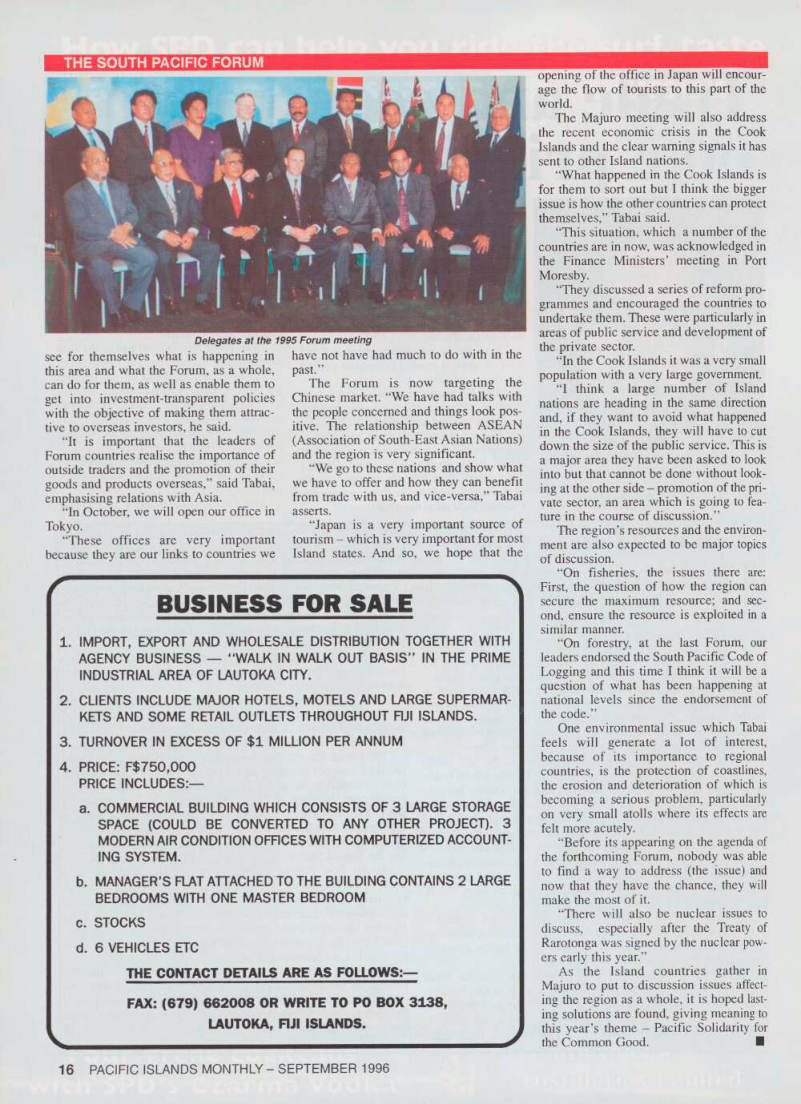
Delegates at the 1995 Forum meeting
A brief history
The South Pacific Forum is the political grouping of inde pendent states which began with a meeting in Wellington, New Zealand, in 1971 with its .seven found ing members - Australia, New Zealand, Fiji, Nauru, Western Samoa, Tonga and Cook Islands.
It has since been joined by Niue, Papua New Guinea, Kiribati, Solomon Islands, Tuvalu, Federated States of Micronesia, Republic of Marshall Islands, Vanuatu and Palau.
The Forum stemmed from a common desire by leaders to develop a collective response on a wide range of regional issues, including trade, economic development, civil aviation, telecom munications, energy and political and security matters, with environmental issues featuring strongly in recent years.
The move to develop such a forum started in the late 1960 s and early part of the 70s as more and more Pacific Island states gained independence. It was clear that as each country became independent, it would face enormous challenges, some of which would be better handled through a regional approach. The development debate in each Island nation was similar and revolved around the economy, tourism and foreign aid.
Although there were, at the time, several overseas organisa tions, such as the United Nations and a host of social, sporting, cultural and religious groups with a regional mission. South Pacific nations felt enough was not being done.
The foreign organisations often encountered conflicts between regional interests and those of individual countries. An avenue through which the wider interest of the region could be promoted at a political level was lacking.
At the time, the South Pacific Commission was the main regional body in existence. But it included powers like Britain, France and the United States. The SPC was devised originally in 1947 and placed emphasis on economic and social welfare.
The control of the SPC budget was in the hands of the foreign
superpowers and since the constitution excluded discussion of political matters. Pacific Island leaders became impatient about not being able to voice their feelings. This saw moves to set up the Forum and hold its first meeting at which participants expressed deep regret that French nuclear testing in French Polynesia continued despite the Partial Ban Treaty and repeated protests by a number of member countries and Pacific Island nations. The Forum asked New Zealand to convey to the French government that the tests be the last.
It was at the Forum that Pacific leaders felt that their voices could be heard on the international scene and it was decided to hold annual meetings.
The Forum was defined as representing decolonisation in the region and a place to discuss the changing expectations which leaders would have of their neighbouring nations. After 1977, the Forum became more involved in the international scene.
The Forum has the mandate to tackle development problems faced by member countries and, over the years, the mandate has been extended to cover politics, hence the introduction of the post-Forum Dialogue in 1989. This provides an opportunity for frank discussions with metropolitan powers with an interest in the region. Dialogue partners are Canada, People’s Republic of China, the European Union (EU), Japan, Britain, South Korea and the United States.
At the first Forum meeting it was decided to set up a Secretariat. The Secretariat was set up in 1972. This was initial ly a trade bureau and its role was to co-ordinate and facilitate consultation on trade and economic matters so that leaders from member countries could respond collectively on issues of con cern. Later, the Secretariat became the South Pacific Bureau for Economic Co-operation (SPEC).
But at the 19th Forum in Tonga in 1988 it was decided to rename the organisation. Hence the adoption of the current title - the South Pacific Forum Secretariat. The chief executive of the secretariat is the secretary-general who is appointed by the heads of governments every three years. ■
Advertisements & other items, p. 16 (2 items)
16
THE SOUTH PACIFIC FORUM
PACIFIC ISLANDS MONTHLY - SEPTEMBER 1996
Business For Sale
1. IMPORT, EXPORT AND WHOLESALE DISTRIBUTION TOGETHER WITH AGENCY BUSINESS “WALK IN WALK OUT BASIS” IN THE PRIME
INDUSTRIAL AREA OF LAUTOKA CITY.
2. CLIENTS INCLUDE MAJOR HOTELS, MOTELS AND LARGE SUPERMAR- KETS AND SOME RETAIL OUTLETS THROUGHOUT FIJI ISLANDS. 3. TURNOVER IN EXCESS OF $1 MILLION PER ANNUM
4. PRICE: F 5750,000
PRICE INCLUDES:—
a. COMMERCIAL BUILDING WHICH CONSISTS OF 3 LARGE STORAGE SPACE (COULD BE CONVERTED TO ANY OTHER PROJECT). 3 MODERN AIR CONDITION OFFICES WITH COMPUTERIZED ACCOUNT-
ING SYSTEM.
b. MANAGER’S FLAT ATTACHED TO THE BUILDING CONTAINS 2 LARGE
BEDROOMS WITH ONE MASTER BEDROOM
c. STOCKS
d. 6 VEHICLES ETC
THE CONTACT DETAILS ARE AS FOLLOWS:—
FAX: (679) 662008 OR WRITE TO PO BOX 3138,
LAUTOKA, FIJI ISLANDS.
An American legacy ...scores nuclear victory
On June 18, the Marshall Islands lost a daughter to the effects of nuclear testing in the South Pacific. But Darlene Keju-Johns on’s spirit lives on and her fight for justice continues
By Bernadette Hussein
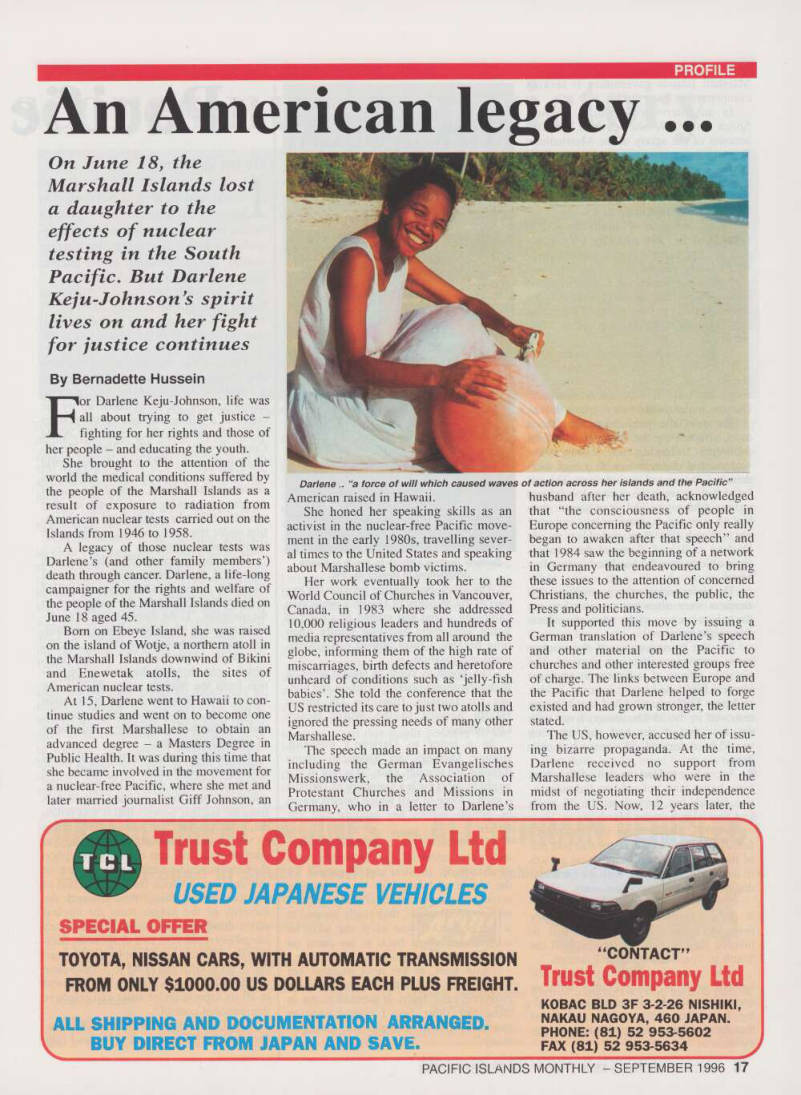
For Darlene Keju-Johnson, life was all about trying to get justice fighting for her rights and those of her people - and educating the youth.
She brought to the attention of the world the medical conditions suffered by the people of the Marshall Islands as a result of exposure to radiation from American nuclear tests carried out on the Islands from 1946 to 1958.
A legacy of those nuclear tests was Darlene’s (and other family members’) death through cancer. Darlene, a life-long campaigner for the rights and welfare of the people of the Marshall Islands died on June 18 aged 45.
Bom on Ebeye Island, she was raised on the island of Wotje, a northern atoll in the Marshall Islands downwind of Bikini and Enewetak atolls, the sites of American nuclear tests.
At 15, Darlene went to Hawaii to con tinue studies and went on to become one of the first Marshallese to obtain an advanced degree - a Masters Degree in Public Health. It was during this time that she became involved in the movement for a nuclear-free Pacific, where she met and later married journalist Giff Johnson, an
American raised in Hawaii.
She honed her speaking skills as an activist in the nuclear-free Pacific move ment in the early 1980 s, travelling sever al times to the United States and speaking about Marshallese bomb victims.
Her work eventually took her to the World Council of Churches in Vancouver, Canada, in 1983 where she addressed 10,000 religious leaders and hundreds of media representatives from all around the globe, informing them of the high rate of miscarriages, birth defects and heretofore unheard of conditions such as ‘jelly-fish babies’. She told the conference that the US restricted its care to just two atolls and ignored the pressing needs of many other Marshallese.
The speech made an impact on many including the German Evangelisches Missionswerk, the Association of Protestant Churches and Missions in Germany, who in a letter to Darlene’s
husband after her death, acknowledged that “the consciousness of people in Europe concerning the Pacific only really began to awaken after that speech” and that 1984 saw the beginning of a network in Germany that endeavoured to bring these issues to the attention of concerned Christians, the churches, the public, the Press and politicians.
It supported this move by issuing a German translation of Darlene’s speech and other material on the Pacific to churches and other interested groups free of charge. The links between Europe and the Pacific that Darlene helped to forge existed and had grown stronger, the letter stated.
The US, however, accused her of issu ing bizarre propaganda. At the time, Darlene received no support from Marshallese leaders who were in the midst of negotiating their independence from the US. Now, 12 years later, the
Darlene.. “a force of will which caused waves of action across her islands and the Pacific”
Marshall Islands government is seeking compensation from the US.
In an interview in Pacific Women Speak in 1987, she gave a detailed account of the agony of the Marshallese.
Before the testing started, the people of Bikini Atoll had not been told that they would never see their home again. She told the magazine the people of Bikini had been relocated three times.
Today, Bikini is off-limits for 30,000 years. And, in 1984, when the US explod ed a hydrogen bomb, codenamed BRAVO, the people were never informed - they just experienced a sudden white fallout, with the southern area 'of the
islands turning yellow, bouts of vomitting
and children suffering skin bums while out at play.
“The United States knew that the wind was blowing towards the islands where people lived, but they went ahead and tested anyway. It was not a mistake,”
Darlene maintained.
She told the publication that those most affected by the increase in health problems following the testing were women and children - with a high inci dence of cancer and birth defects. The jel lyfish babies were the most colourful and ugliest things you had ever seen - they had no eyes, heads, arms, or legs and were not shaped like human babies at all, Darlene explained. Some of these babies were able to breathe but lived only a few hours.
The deformities were so extreme that mothers were often not permitted to see the babies because of the traumatic effects this might have.
But the consequences of the nuclear tests were more than just physical. The possible effects of radiation on pregnant women frightened many into not having children. Darlene, who had two tumours removed in the 1980 s, always lived with the fear that if she had children they would be deformed. She never had chil dren.
According to Darlene, jelly-fish babies were being born not only on the radioac tive islands but throughout the 35 atolls and five islands in the Marshall.
In 1984, she became the director of family planning in a country that had one of the highest rates of population growth in the world at the time, with the birth rate dropping over the next five years.
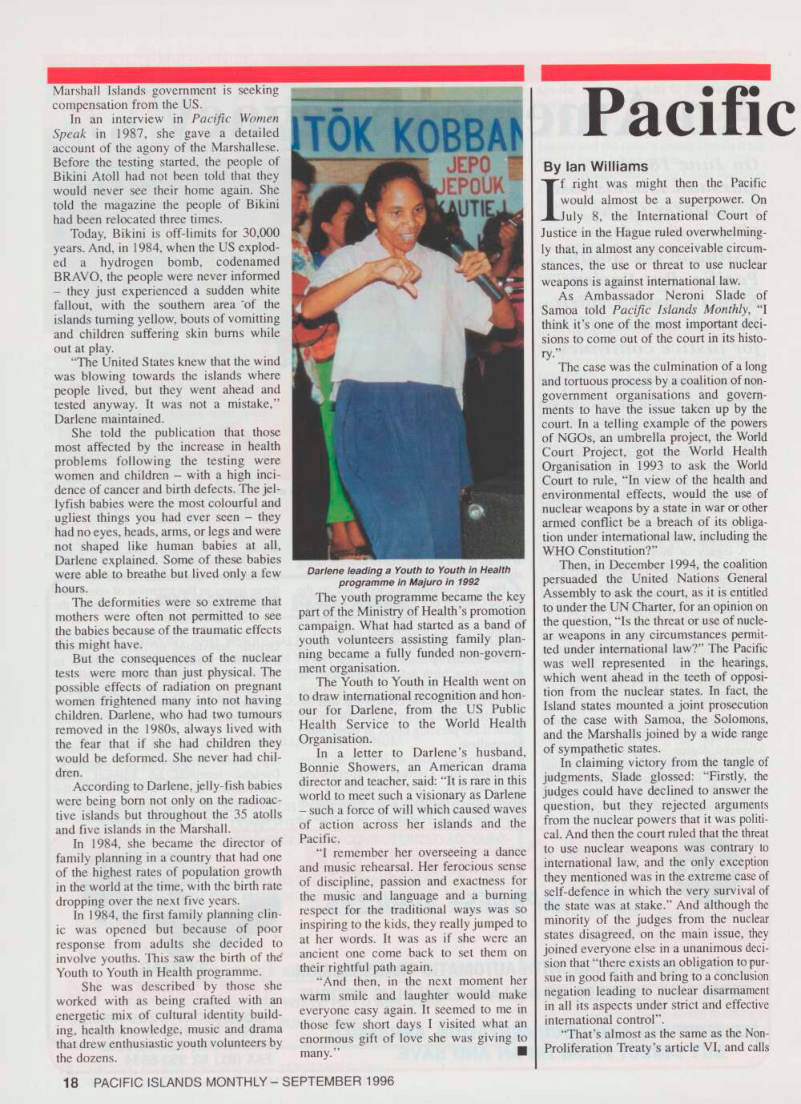
In 1984, the first family planning clin ic was opened but because of poor response from adults she decided to involve youths. This saw the birth of the Youth to Youth in Health programme.
She was described by those she worked with as being crafted with an energetic mix of cultural identity build ing, health knowledge, music and drama that drew enthusiastic youth volunteers by the dozens.
The youth programme became the key part of the Ministry of Health’s promotion campaign. What had started as a band of youth volunteers assisting family plan ning became a fully funded non-govern
ment organisation.
The Youth to Youth in Health went on to draw international recognition and hon our for Darlene, from the US Public Health Service to the World Health
Organisation.
In a letter to Darlene’s husband, Bonnie Showers, an American drama director and teacher, said: “It is rare in this world to meet such a visionary as Darlene - such a force of will which caused waves of action across her islands and the Pacific.
“I remember her overseeing a dance and music rehearsal. Her ferocious sense of discipline, passion and exactness for the music and language and a burning respect for the traditional ways was so inspiring to the kids, they really jumped to at her words. It was as if she were an ancient one come back to set them on
their rightful path again.
“And then, in the next moment her warm smile and laughter would make everyone easy again. It seemed to me in those few short days I visited what an enormous gift of love she was giving to many.” ■
Darlene leading a Youth to Youth in Health programme in Majuro in 1992
Advertisements & other items, p. 17 (1 item)
Trust Company Ltd
USED JAPANESE VEHICLES
SPECIAL OFFER
TOYOTA, NISSAN CARS, WITH AUTOMATIC TRANSMISSION
FROM ONLY $lOOO.OO US DOLLARS EACH PLUS FREIGHT.
CONTACT”
Trust Company Ltd
ALL SHIPPING AND DOCUMENTATION ARRANGED.
BUY DIRECT FROM JAPAN AND SAVE.
KOBAC BLD 3F 3-2-26 NISHIKI,
NAKAU NAGOYA, 460 JAPAN.
PHONE: (81) 52 953-5602
FAX (81) 52 953-5634
Pacific
By lan Williams
If right was might then the Pacific would almost be a superpower. On July 8, the International Court of Justice in the Hague ruled overwhelming ly that, in almost any conceivable circum stances, the use or threat to use nuclear weapons is against international law.
As Ambassador Neroni Slade of Samoa told Pacific Islands Monthly, “I think it’s one of the most important deci sions to come out of the court in its histo ry-”
The case was the culmination of a long and tortuous process by a coalition of non government organisations and govern ments to have the issue taken up by the court. In a telling example of the powers of NGOs, an umbrella project, the World Court Project, got the World Health Organisation in 1993 to ask the World Court to rule, “In view of the health and environmental effects, would the use of nuclear weapons by a state in war or other armed conflict be a breach of its obliga tion under international law, including the WHO Constitution?”
Then, in December 1994, the coalition persuaded the United Nations General Assembly to ask the court, as it is entitled to under the UN Charter, for an opinion on the question, “Is the threat or use of nucle ar weapons in any circumstances permit ted under international law?” The Pacific was well represented in the hearings, which went ahead in the teeth of opposi tion from the nuclear states. In fact, the Island states mounted a joint prosecution of the case with Samoa, the Solomons, and the Marshalls joined by a wide range of sympathetic states.
In claiming victory from the tangle of judgments, Slade glossed: “Firstly, the judges could have declined to answer the
question, but they rejected arguments
from the nuclear powers that it was politi cal. And then the court ruled that the threat to use nuclear weapons was contrary to international law, and the only exception they mentioned was in the extreme case of self-defence in which the very survival of the state was at stake.” And although the minority of the judges from the nuclear states disagreed, on the main issue, they joined everyone else in a unanimous deci sion that “there exists an obligation to pur sue in good faith and bring to a conclusion negation leading to nuclear disarmament in all its aspects under strict and effective international control”.
“That’s almost as the same as the Non- Proliferation Treaty’s article VI, and calls
for disarmament in all its aspects,” com ments Slade. “By our count, 10 out of 14 judges were in favour of a finding of gen eral illegality. We in SOPAC had taken an absolutist position, and we got three of the judges to back us.
The other seven went a long way towards us,” he assessed.
On the face of it, the decision was not so clear cut since the 15-judge panel split at least three ways. To begin with, 11 out of 13 judges said that the WHO was going beyond its powers by asking for an opin ion on legality. However, they had no such scruples about accepting a reference from the UN General Assembly, and then took the opportunity to make legal music for Pacific ears.
Although 11 judges said that International Law made no references to nukes in themselves, they went on unani mously to say that any use of them would have to be compatible with existing laws
of warfare - presumably including prohi
bitions against targeting civilians, harming neutrals and so on. The Pacific, which has suffered more than any other region from
“collateral damage” from testing, obvious ly has a strong interest in this aspect.
From this premise, three judges said that nuclear weapons were illegal under all circumstances, while seven more thought that they were “generally” illegal but that they were unsure whether this could be said in “an extreme circumstance of self defence, in which the very survival of a state would be at risk”.
Professor Roger Clark of Rutgers University, who has been in the Hague on behalf of Samoa, suggested that what they were making allowances for was extreme circumstances. “It is almost impossible to think of a real or hypothetical case where you could make this work legally.”
He guessed - wildly, as he admitted that if a crazed dictator was about to use some pernicious and awesome form of germ warfare and the only feasible means of preventing him or her would be a nucle ar strike, then this might possibly fit the bill.
Almost as interesting was the correla tion of the judges’ origins with their opin ions. The judges from Russia, Britain and
France, all nuclear powers, were joined by the Japanese judge in opposing their col leagues. Indeed, amazingly. Judge Oda from Japan, the only country to have suf fered a nuclear attack was the hardest against the court accepting the case at all,
even though the Foreign Ministry in
Tokyo immediately protested the
Hiroshima bomb in 1945 as against the Hague conventions.
However, this is a court with no cops.
What effect does the decision have?
Politically, it is a significant moral victory for anti-nuclear campaigners and a signif icant snub to the major powers who usual ly gloss their own actions against weaker countries in the language of legality but have proven much less eager to see it applied to themselves.
An optimistic Slade says: “It lays the ground for a good future effort to get on with the disarmament talks. So this does point the way to a conclusion to nuclear testings, or to nuclear disarmament.”
But there is a lot more work yet before right really becomes might. ■
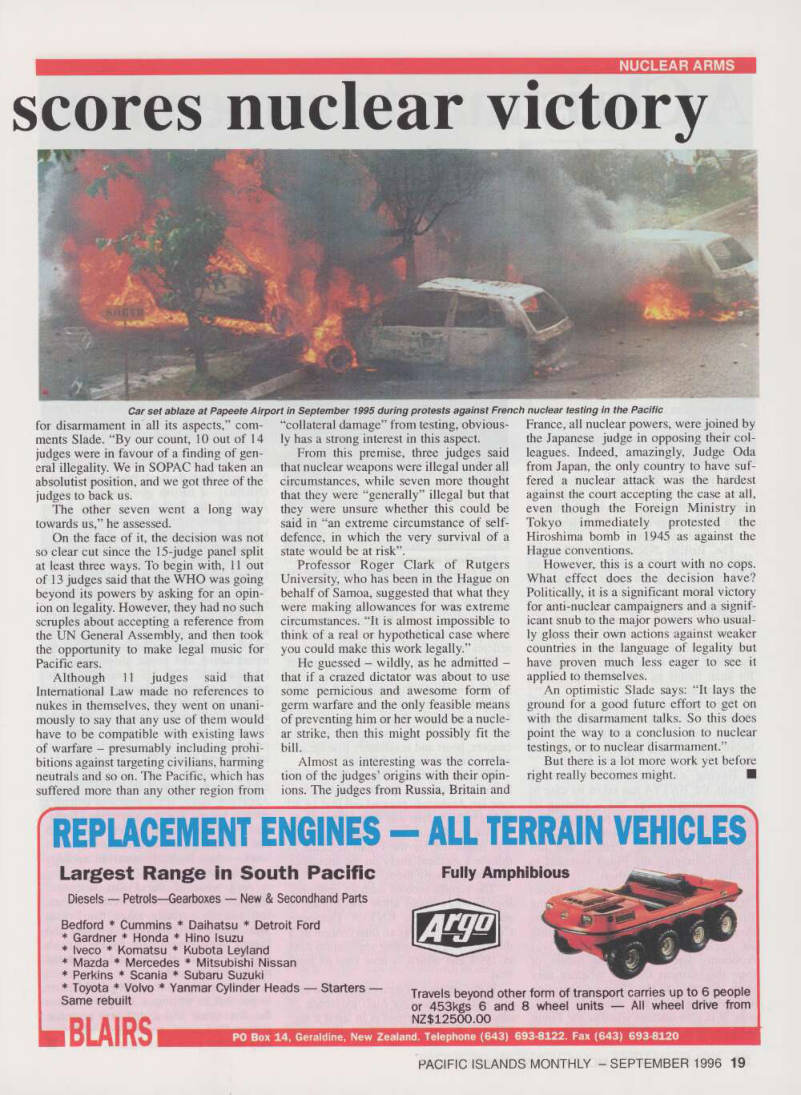
Car set ablaze at Papeete Airport in September 1995 during protests against French nuclear testing in the Pacific
Advertisements & other items, p. 19 (2 items)
scores nuclear victory
19
PACIFIC ISLANDS MONTHLY - SEPTEMBER 1996
NUCLEAR ARMS
L Blairs
REPLACEMENT ENGINES - ALL TERRAIN VEHICLES!
Largest Range in South Pacific
Diesels Petrols—Gearboxes New & Secondhand Parts Bedford * Cummins * Daihatsu * Detroit Ford * Gardner * Honda * Hino isuzu * Iveco * Komatsu * Kubota Leyland * Mazda * Mercedes * Mitsubishi Nissan * Perkins * Scania * Subaru Suzuki * Toyota * Volvo * Yanmar Cylinder Heads Starters Same rebuilt
Fully Amphibious
/// asp** Travels beyond other form of transport carries up to 6 people or 453kgs 6 and 8 wheel units All wheel drive from
L BLAIRS
NZ512500.00 PO Box 14, Geraldine, New Zealand. Telephone (643) 693-8122. Fax (643) 693-8120
A Christmas to remember
Forty years after they were exposed to radiation from British nuclear testing on Christmas Island\ the former soldiers are demanding compensation
By Mere Momoivalu
Nuclear tests have always been an issue close to the hearts of the people of the South Pacific. Its horrific and tragic effects on the people of the Marshall Islands and the recent con troversial testing in Tahiti have left its scars on the region and have been reason enough for continuing concern.
For Fiji, which has often been in the frontline of the campaign against tests in the region, the issue was brought home recently when British military veterans claimed that Fijian soldiers who served alongside them on Christmas Island about 40 years ago may have, like them, been exposed to nuclear radiation. British vet erans who served on Christmas Island suffered from radiogenic illnesses, leuki maeas related to radiation exposure, can cers, genetic defects among their chil dren, stillbirths among wives of veterans and a whole range of health problems as a result of the exposure.
The British Nuclear Test Veterans Association (BNTVA) has, on behalf of the veterans, waged a series of legal bat tles to obtain pension, compensation and damages from the British government.
BNTVA’s efforts were unsuccessful because it did not have access to military medical records which showed that their members were treated after detonations for such things as radiation bums, diar rhoea and nausea.
The veterans also tried to sue the British government in a case they brought against their defence minister. It failed because of a lack of documentation of the levels of radiation on Christmas Island.
Having exhausted all avenues in Britain, the BNTVA has taken its case to an international arena and is pinning its hope on three cases it has pending before the European Commission of Human Rights in Strasbourg, France, and has been encouraging the Fijian veterans to
similarly seek compensation.
Fijian soldiers were among about 20,000 troops who served under the British on Christmas Island where the then colonial administration was testing its nuclear weapons. Very little was reportedly known about the nature of their engagement there - whether they were allocated to the clean-up operation and whether they had adequate protec tion. It is also unclear whether the Fijian soldiers were even aware of the dangers
they had placed themselves in.
The claim by the British veterans has been documented by them in a series of articles in the association’s journal.
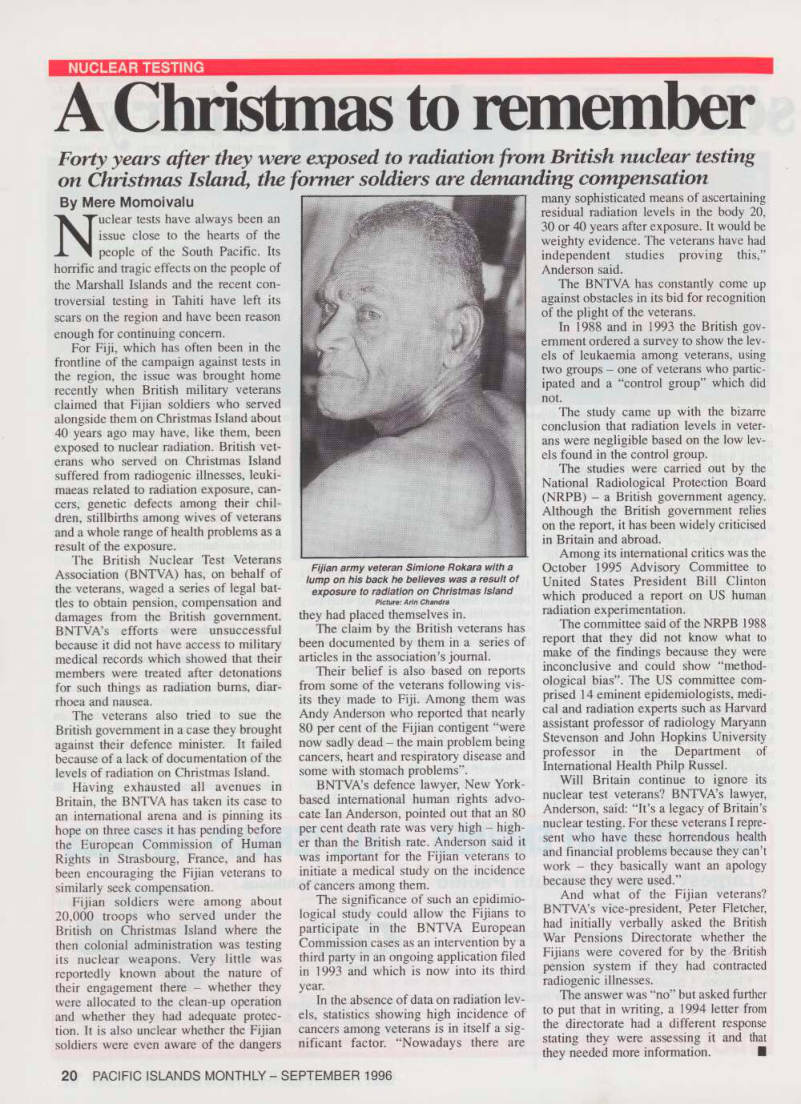
Their belief is also based on reports from some of the veterans following vis its they made to Fiji. Among them was Andy Anderson who reported that nearly 80 per cent of the Fijian contigent “were now sadly dead - the main problem being cancers, heart and respiratory disease and some with stomach problems”.
BNTVA’s defence lawyer, New York based international human rights advo cate lan Anderson, pointed out that an 80 per cent death rate was very high - high er than the British rate. Anderson said it was important for the Fijian veterans to initiate a medical study on the incidence of cancers among them.
The significance of such an epidimio logical study could allow the Fijians to participate in the BNTVA European Commission cases as an intervention by a third party in an ongoing application fded in 1993 and which is now into its third year.
In the absence of data on radiation lev els, statistics showing high incidence of cancers among veterans is in itself a sig nificant factor. “Nowadays there are
many sophisticated means of ascertaining residual radiation levels in the body 20, 30 or 40 years after exposure. It would be weighty evidence. The veterans have had
independent studies proving this,”
Anderson said.
The BNTVA has constantly come up against obstacles in its bid for recognition of the plight of the veterans.
In 1988 and in 1993 the British gov ernment ordered a survey to show the lev els of leukaemia among veterans, using two groups - one of veterans who partic ipated and a “control group” which did not.
The study came up with the bizarre conclusion that radiation levels in veter ans were negligible based on the low lev els found in the control group.
The studies were carried out by the National Radiological Protection Board (NRPB) - a British government agency.
Although the British government relies on the report, it has been widely criticised in Britain and abroad.
Among its international critics was the October 1995 Advisory Committee to United States President Bill Clinton which produced a report on US human
radiation experimentation.
The committee said of the NRPB 1988 report that they did not know what to make of the findings because they were inconclusive and could show “method ological bias”. The US committee com prised 14 eminent epidemiologists, medi cal and radiation experts such as Harvard
assistant professor of radiology Maryann
Stevenson and John Hopkins University professor in the Department of International Health Philp Russel.
Will Britain continue to ignore its nuclear test veterans? BNTVA’s lawyer, Anderson, said: “It’s a legacy of Britain’s nuclear testing. For these veterans I repre sent who have these horrendous health and financial problems because they can’t work - they basically want an apology because they were used.”
And what of the Fijian veterans?
BNTVA’s vice-president, Peter Fletcher, had initially verbally asked the British War Pensions Directorate whether the Fijians were covered for by the. British pension system if they had contracted
radiogenic illnesses.
The answer was “no” but asked further to put that in writing, a 1994 letter from the directorate had a different response stating they were assessing it and that they needed more information. ■
Fijian army veteran Simione Rokara with a lump on his back he believes was a result of exposure to radiation on Christmas Island Picture: Arin Chandra
Bareak-Out
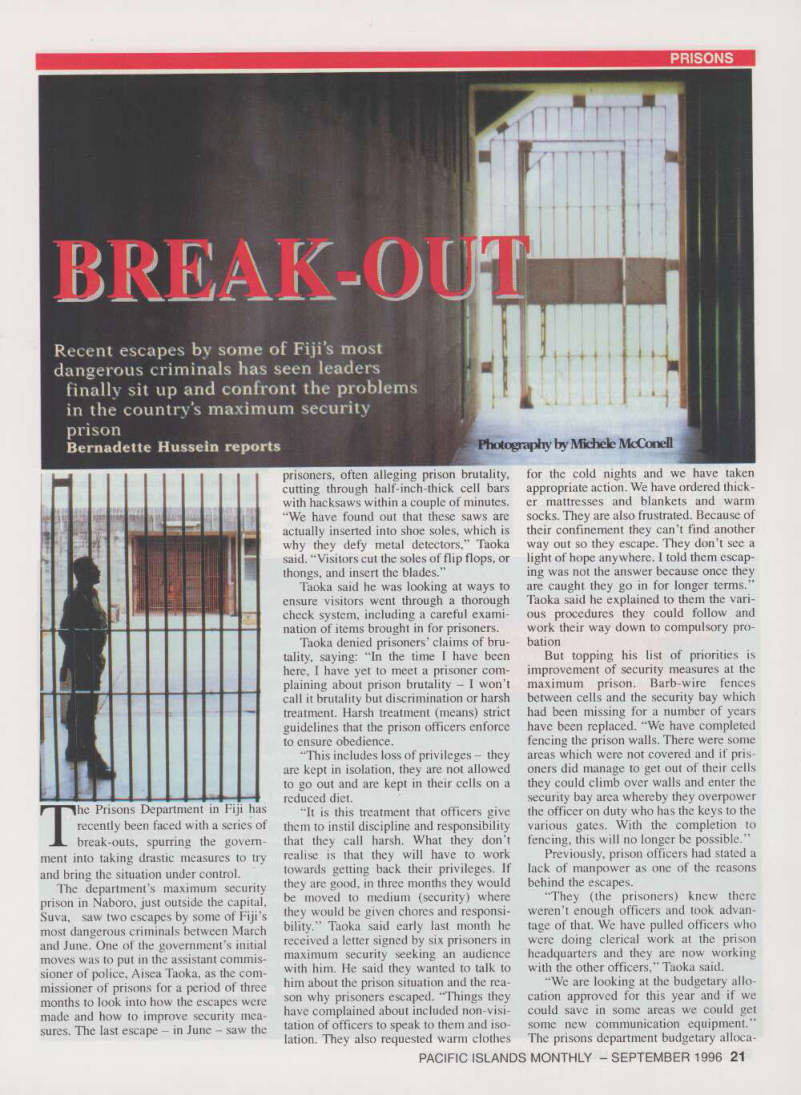
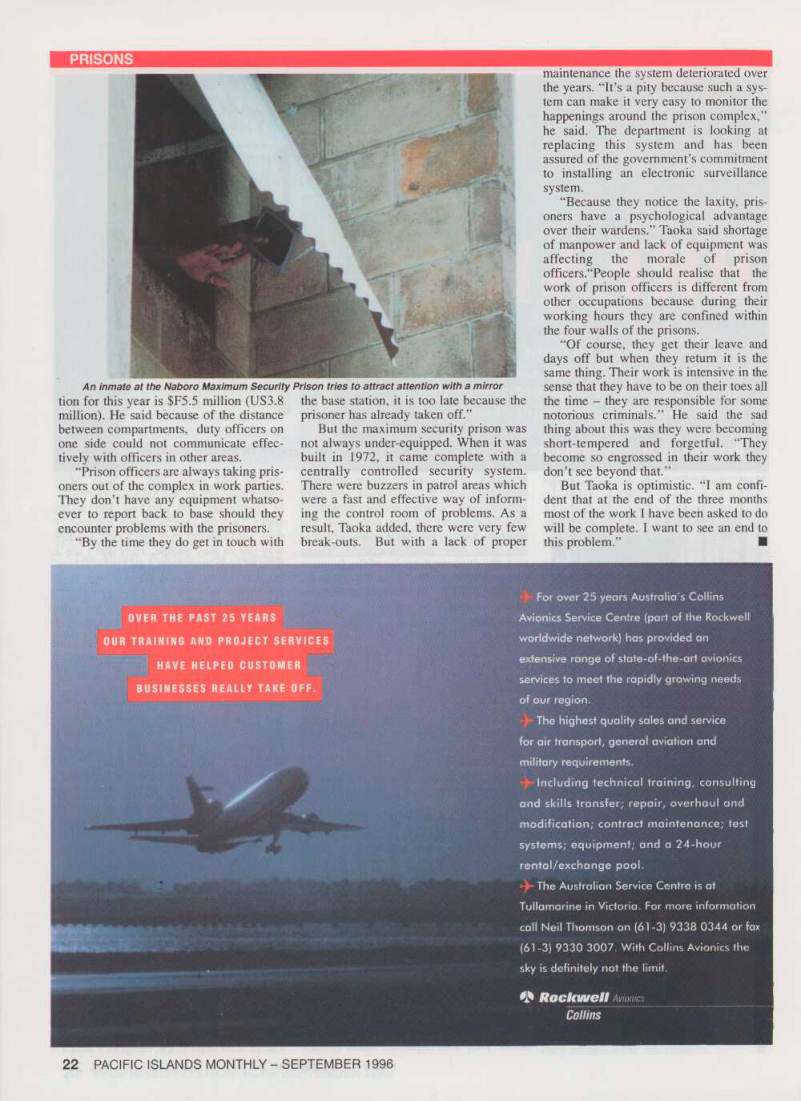
The Prisons Department in Fiji has recently been faced with a series of break-outs, spurring the govern ment into taking drastic measures to try and bring the situation under control.
The department’s maximum security prison in Naboro, just outside the capital, Suva, saw two escapes by some of Fiji’s most dangerous criminals between March and June. One of the government’s initial moves was to put in the assistant commis sioner of police, Aisea Taoka, as the com missioner of prisons for a period of three months to look into how the escapes were made and how to improve security mea sures. The last escape - in June - saw the
prisoners, often alleging prison brutality, cutting through half-inch-thick cell bars with hacksaws within a couple of minutes.
“We have found out that these saws are actually inserted into shoe soles, which is why they defy metal detectors,” Taoka said. “Visitors cut the soles of flip flops, or thongs, and insert the blades.”
Taoka said he was looking at ways to ensure visitors went through a thorough check system, including a careful exami nation of items brought in for prisoners.
Taoka denied prisoners’ claims of bru tality, saying: “In the time I have been here, I have yet to meet a prisoner com plaining about prison brutality - I won’t call it brutality but discrimination or harsh treatment. Harsh treatment (means) strict guidelines that the prison officers enforce to ensure obedience.
“This includes loss of privileges - they are kept in isolation, they are not allowed to go out and are kept in their cells on a reduced diet.
“It is this treatment that officers give them to instil discipline and responsibility that they call harsh. What they don’t realise is that they will have to work towards getting back their privileges. If they are good, in three months they would be moved to medium (security) where they would be given chores and responsi bility.” Taoka said early last month he received a letter signed by six prisoners in maximum security seeking an audience with him. He said they wanted to talk to him about the prison situation and the rea son why prisoners escaped. “Things they have complained about included non-visi tation of officers to speak to them and iso lation. They also requested warm clothes
for the cold nights and we have taken appropriate action. We have ordered thick er mattresses and blankets and warm socks. They are also frustrated. Because of their confinement they can’t find another way out so they escape. They don’t see a light of hope anywhere. I told them escap ing was not the answer because once they are caught they go in for longer terms.”
Taoka said he explained to them the vari ous procedures they could follow and work their way down to compulsory pro bation But topping his list of priorities is improvement of security measures at the maximum prison. Barb-wire fences between cells and the security bay which had been missing for a number of years have been replaced. “We have completed fencing the prison walls. There were some areas which were not covered and if pris oners did manage to get out of their cells they could climb over walls and enter the security bay area whereby they overpower the officer on duty who has the keys to the various gates. With the completion to fencing, this will no longer be possible.”
Previously, prison officers had stated a lack of manpower as one of the reasons behind the escapes.
“They (the prisoners) knew there weren’t enough officers and took advan tage of that. We have pulled officers who were doing clerical work at the prison headquarters and they are now working with the other officers,” Taoka said.
“We are looking at the budgetary allo cation approved for this year and if we could save in some areas we could get some new communication equipment.”
The prisons department budgetary alloca-
Recent escapes by some of Fiji's most dangerous criminals has seen leaders finally sit up and confront the problems in the country's maximum security prison Bernadette Hussein reports
Photography by Michele McConell
tion for this year is $F5.5 million (US3.B million). He said because of the distance between compartments, duty officers on one side could not communicate effec tively with officers in other areas.
“Prison officers are always taking pris
oners out of the complex in work parties.
They don’t have any equipment whatso ever to report back to base should they encounter problems with the prisoners.
“By the time they do get in touch with
the base station, it is too late because the prisoner has already taken off.”
But the maximum security prison was not always under-equipped. When it was built in 1972, it came complete with a centrally controlled security system.
There were buzzers in patrol areas which were a fast and effective way of inform ing the control room of problems. As a result, Taoka added, there were very few break-outs. But with a lack of proper
maintenance the system deteriorated over the years. “It’s a pity because such a sys tem can make it very easy to monitor the
happenings around the prison complex,”
he said. The department is looking at replacing this system and has been assured of the government’s commitment to installing an electronic surveillance system.
“Because they notice the laxity, pris oners have a psychological advantage over their wardens.” Taoka said shortage of manpower and lack of equipment was affecting the morale of prison officers.“ People should realise that the work of prison officers is different from other occupations because during their working hours they are confined within the four walls of the prisons.
“Of course, they get their leave and days off but when they return it is the same thing. Their work is intensive in the sense that they have to be on their toes all the time - they are responsible for some notorious criminals.” He said the sad thing about this was they were becoming
short-tempered and forgetful. “They
become so engrossed in their work they don’t see beyond that.”
But Taoka is optimistic. “I am confi dent that at the end of the three months most of the work I have been asked to do will be complete. I want to see an end to this problem.” ■
An inmate at the Naboro Maximum Security Prison tries to attract attention with a mirror
Advertisements & other items, pp. 21-22 (3 items)
Prisons
Prisons
Over The Past 25 Years
OUR TRAINING AND PROJECT SERVICES
HAVE HELPED CUSTOMER
BUSINESSES REALLY TAKE OFF.
For over 25 years Australia's Collins Avionics Service Centre (part of the Rockwell worldwide network) has provided an extensive range of state-of-the-art avionics services to meet the rapidly growing needs of our region.
The highest quality sales and service for air transport, general aviation and military requirements.
Including technical training, consulting and skills transfer; repair, overhaul and modification; contract maintenance; test systems; equipment; and a 24-hour rental/exchange pool.
The Australian Service Centre is at Tuilamarine in Victoria. For more information call Neil Thomson on (61 -3) 9338 0344 or fax (61-3) 9330 3007. With Collins Avionics the sky is definitely not the limit. *l* Rockwell Avionics Collins
Wave of financial ‘seams’
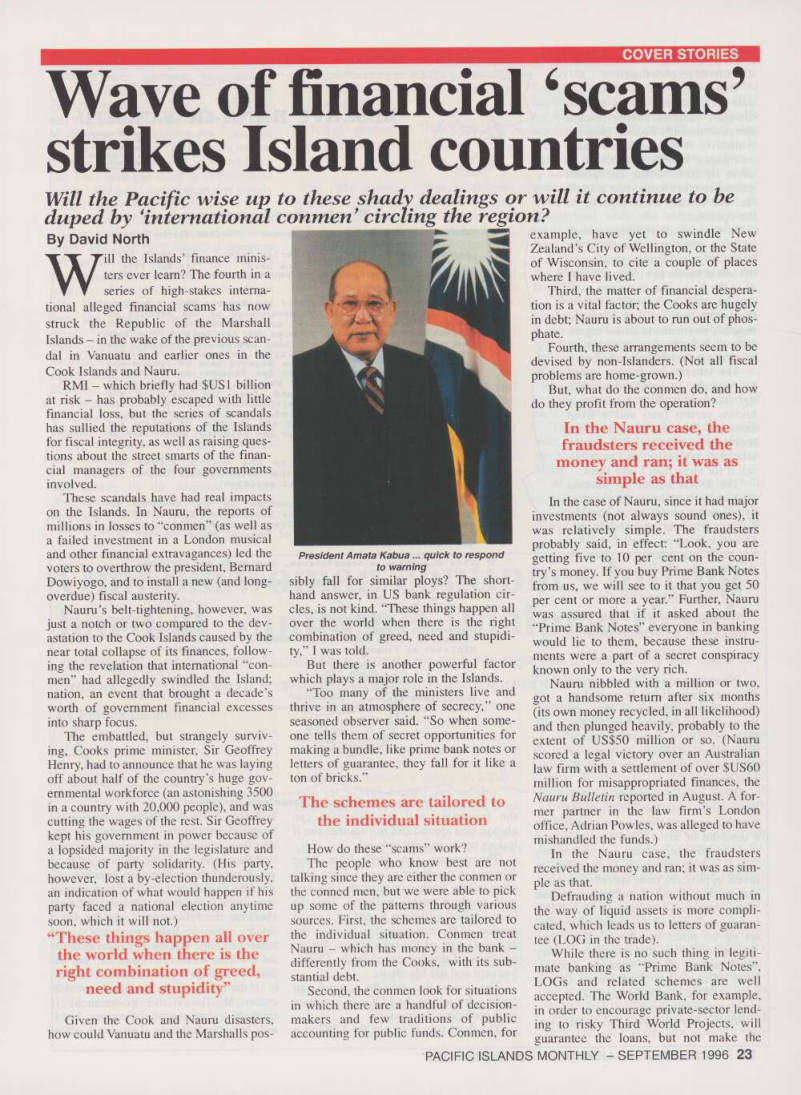
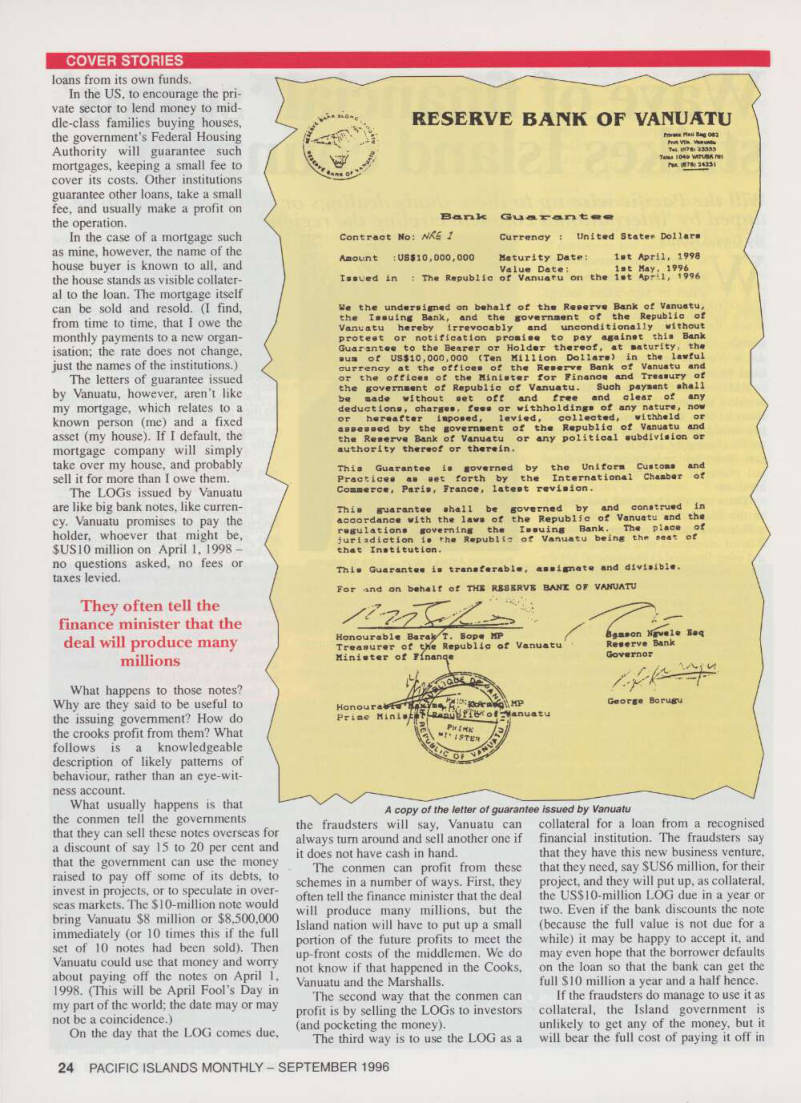
Cover Stories
Wave of financial ‘seams’ strikes Island countries
Will the Pacific wise up to these shady dealings or will it continue to he duped by ‘international conmen’ circling the region?
By David North
Will the Islands’ finance minis ters ever learn? The fourth in a series of high-stakes interna tional alleged financial scams has now struck the Republic of the Marshall Islands - in the wake of the previous scan dal in Vanuatu and earlier ones in the Cook Islands and Nauru.
RMI - which briefly had SUSI billion at risk - has probably escaped with little financial loss, but the series of scandals has sullied the reputations of the Islands for fiscal integrity, as well as raising ques tions about the street smarts of the finan cial managers of the four governments involved.
These scandals have had real impacts on the Islands. In Naum, the reports of millions in losses to “conmen” (as well as a failed investment in a London musical and other financial extravagances) led the voters to overthrow the president, Bernard Dowiyogo, and to install a new (and long overdue) fiscal austerity.
Naum’s belt-tightening, however, was just a notch or two compared to the dev astation to the Cook Islands caused by the near total collapse of its finances, follow ing the revelation that international “con men” had allegedly swindled the Island; nation, an event that brought a decade’s worth of government financial excesses into sharp focus.
The embattled, but strangely surviv ing, Cooks prime minister. Sir Geoffrey Henry, had to announce that he was laying off about half of the country’s huge gov ernmental workforce (an astonishing 3500 in a country with 20,000 people), and was cutting the wages of the rest. Sir Geoffrey kept his government in power because of a lopsided majority in the legislature and because of party solidarity. (His party, however, lost a by-election thunderously, an indication of what would happen if his party faced a national election anytime soon, which it will not.) “These things happen all over the world when there is the
right combination of greed,
need and stupidity”
Given the Cook and Nauru disasters, how could Vanuatu and the Marshalls pos-
sibly fall for similar ploys? The short hand answer, in US bank regulation cir cles, is not kind. “These things happen all over the world when there is the right combination of greed, need and stupidi ty,” I was told.
But there is another powerful factor which plays a major role in the Islands.
“Too many of the ministers live and thrive in an atmosphere of secrecy,” one seasoned observer said. “So when some one tells them of secret opportunities for making a bundle, like prime bank notes or letters of guarantee, they fall for it like a ton of bricks.”
The schemes are tailored to the individual situation How do these “scams” work?
The people who know best are not talking since they are either the conmen or the conned men, but we were able to pick up some of the patterns through various sources. First, the schemes are tailored to the individual situation. Conmen treat Nauru - which has money in the bank differently from the Cooks, with its sub stantial debt.
Second, the conmen look for situations in which there are a handful of decision makers and few traditions of public accounting for public funds. Conmen, for
example, have yet to swindle New Zealand’s City of Wellington, or the State of Wisconsin, to cite a couple of places where I have lived.
Third, the matter of financial despera tion is a vital factor; the Cooks are hugely in debt; Nauru is about to run out of phos phate.
Fourth, these arrangements seem to be devised by non-islanders. (Not all fiscal problems are home-grown.) But, what do the conmen do, and how do they profit from the operation?
In the Nauru case, the fraudsters received the money and ran; it was as simple as that In the case of Nauru, since it had major investments (not always sound ones), it was relatively simple. The fraudsters probably said, in effect: “Look, you are getting five to 10 per cent on the coun try’s money. If you buy Prime Bank Notes from us, we will see to it that you get 50 per cent or more a year.” Further, Nauru was assured that if it asked about the “Prime Bank Notes” everyone in banking would lie to them, because these instru ments were a part of a secret conspiracy known only to the very rich.
Nauru nibbled with a million or two, got a handsome return after six months (its own money recycled, in all likelihood) and then plunged heavily, probably to the extent of US$5O million or so. (Naum scored a legal victory over an Australian law firm with a settlement of over SUS6O million for misappropriated finances, the Nauru Bulletin reported in August. A for mer partner in the law firm’s London office, Adrian Powles, was alleged to have mishandled the funds.) In the Nauru case, the fraudsters received the money and ran; it was as sim ple as that.
Defrauding a nation without much in the way of liquid assets is more compli cated, which leads us to letters of guaran tee (LOG in the trade).
While there is no such thing in legiti mate banking as “Prime Bank Notes”, LOGs and related schemes are well accepted. The World Bank, for example, in order to encourage private-sector lend ing to risky Third World Projects, will guarantee the loans, but not make the
President Amata Kabua ... quick to respond to warning
loans from its own funds.
In the US, to encourage the pri vate sector to lend money to mid dle-class families buying houses, the government’s Federal Housing Authority will guarantee such mortgages, keeping a small fee to cover its costs. Other institutions guarantee other loans, take a small fee, and usually make a profit on
the operation.
In the case of a mortgage such as mine, however, the name of the house buyer is known to all, and the house stands as visible collater al to the loan. The mortgage itself can be sold and resold. (I find, from time to time, that I owe the monthly payments to a new organ isation; the rate does not change, just the names of the institutions.) The letters of guarantee issued by Vanuatu, however, aren’t like my mortgage, which relates to a known person (me) and a fixed asset (my house). If I default, the mortgage company will simply take over my house, and probably sell it for more than I owe them.
The LOGs issued by Vanuatu are like big bank notes, like curren cy. Vanuatu promises to pay the holder, whoever that might be, SUSIO million on April 1, 1998 no questions asked, no fees or taxes levied.
They often tell the finance minister that the deal will produce many millions What happens to those notes?
Why are they said to be useful to the issuing government? How do the crooks profit from them? What follows is a knowledgeable description of likely patterns of behaviour, rather than an eye-wit ness account.
What usually happens is that
the conmen tell the governments that they can sell these notes overseas for a discount of say 15 to 20 per cent and that the government can use the money raised to pay off some of its debts, to invest in projects, or to speculate in over seas markets. The $ 10-million note would bring Vanuatu $8 million or $8,500,000 immediately (or 10 times this if the full set of 10 notes had been sold). Then Vanuatu could use that money and worry about paying off the notes on April 1, 1998. (This will be April Fool’s Day in my part of the world; the date may or may not be a coincidence.) On the day that the LOG comes due,
the fraudsters will say, Vanuatu can always turn around and sell another one if it does not have cash in hand.
The conmen can profit from these schemes in a number of ways. First, they often tell the finance minister that the deal will produce many millions, but the Island nation will have to put up a small portion of the future profits to meet the up-front costs of the middlemen. We do not know if that happened in the Cooks, Vanuatu and the Marshalls.
The second way that the conmen can profit is by selling the LOGs to investors (and pocketing the money).
The third way is to use the LOG as a
collateral for a loan from a recognised financial institution. The fraudsters say that they have this new business venture, that they need, say SUS 6 million, for their project, and they will put up, as collateral, the US$lO-million LOG due in a year or two. Even if the bank discounts the note (because the full value is not due for a while) it may be happy to accept it, and may even hope that the borrower defaults on the loan so that the bank can get the full $lO million a year and a half hence.
If the fraudsters do manage to use it as collateral, the Island government is unlikely to get any of the money, but it will bear the full cost of paying it off in
A copy of the letter of guarantee issued by Vanuatu
1998. Another approach, suggested to Pacific Islands Monthly by one of the overseas banking regulators, would be that the fraudsters would tell the ministers of finance: “Sign these notes - no one will ever try to collect them. What we can do is to sell the notes to investors for a fee. They will use them as collateral on loans - and your government can simply pocket the fee. Everybody wins!”
These are the motives of the Island governments and the conmen, but why would the individual financial manager risk his career in such a setting? The US bank regulators wonder if another factor might be at work - maybe the fraudsters offer kickbacks to the officials (perhaps from the country’s own up-front pay ment). They say that this happens some times in some places but have no idea as to whether this happened in any of the Island nations. They make no accusa tions, but they do ask the question.
The reactions of the two governments - Vanuatu and the Marshalls - to the exposure of these frauds were quite dif ferent, but neither government volun teered information about it.
In the case of the Marshalls, the story was broken by the Marshall Islands Journal in its July 12 issue; the paper had received, it said, “by mysterious hand” a copy of the letter from US Treasury offi
cial John Shockey to RMl’s ambassador to the US, Banny deßrum, warning him about the fraud.
Borogu defends the Vanuatu government’s action as “not a scam”
As PIM reported (“Borugu defends ministry action” August, 1996) the first secretary of Vanuatu’s Ministry of Finance, George Borugu, defends his government’s action as “not a scam”.
Despite Borugu’s defence of the prac tice in the interview earlier in July, on July 26 the Reserve Bank of Vanuatu issued a Press release revoking the bank guarantees, saying that they were worth less (but not discussing why they had been issued in the first place or why they were being dishonoured).
In contrast, once the leadership of the Marshalls government realised what had happened, they quickly issued an order killing the LOGs without denial or blus ter. We gather, third hand, that RMI President Amata Kabua and the US Treasury’s Shockey know each other, and Kabua was quick to respond to his warn ing. This account should not be read as a story that involved only the conmen.
Island governments, and the United States.
Giving a helping hand to exposing the frauds were Barclay’s Bank in London, Scotland Yard (which seized the LOGs for Vanuatu) and the Bank of England’s ace fraud fighter, Richard Chalmers, who spent a considerable amount of time in Vanuatu, helping straighten out matters.
London played another key role as the setting for the conmen. Vanuatu’s finance minister journeyed to London and to Switzerland while the offer was being made to his government and its reserve bank. Similarly, an American observer said this in answer to the question “Did the Marshalls lose any money on this fraud?”
“Well, in addition to getting a black eye for foolishness, the Marshalls paid for a trip by half a dozen of its officials to London.” He went on to say that the orig inals of the LOGs had been recovered, but in this case, as with the one in Vanuatu, “who knows whether or not genuine looking copies were floating around in banking circles”.
The Marshalls probably got away with little damage, but the next government or the next finance minister may not be so lucky.
My bet, sadly, is that PIM readers will encounter at least one other story of inter national fraud perpetrated on the Islands within the next two years. We’ll see. ■
Ombudswoman continues hitting


hard at Vanuatu’s ‘malpractices’
In the wake of Ferrieux-Patterson s damning reports against officials on the Island nation, the government seems poised to cut hack the ombudswonum’s powers
By Patrick Decloitre
After releasing a damning report early July on an alleged scam of letters of guarantee, Vanuatu’s ombudswoman Marie-Noelle Ferrieux- Patterson, released at the end of the same month another report accusing the main province, Shefa, of misappropriation of funds.
She accused Vanuatu’s main province president of misappropriating over 8 mil lion vatu (SUS7I,OOO) in high salaries, advances and allowances.
In a hard-hitting report made public on July 25, Ferrieux-Patterson alleges funds were misappropriated by Shefa Province President Charlie Kalmet, who she finds in breach of the leadership code and the Decentralisation Act. The Act, passed in 1994, merged the 11 former local govern ment councils, created in 1980 at Vanuatu’s independence, into six
provinces. Elections were held for the new provincia i councils, which started operating end of 1994.
Ferreiuex-Patterson claimed that throughout the 1995 financial year Kalmet got himself a salary of 200,000 (JUSIBOO dollars) per month, “13 raK SpeC ' f ' ed m the “p or {he year? de has a fr e ady
allegedly misappropriated a further
amount 0 f i ,550,000 vatu (SUS 13,300) as at Aprd j 2, 1995,” she adds.
“It appears that (Kalmet) continues to treat t h e shefa p ro vince budget as his own private bank.”
Commenting on the findings of her in quiry, fr, e ombudswoman saicT it was a - sad and s h ame ful catalogue of greed and arro g ance for which no possible justification has emerged ”.
Although admitting he had received a confidential copy of "the report, Kalmet said he had not yet reC eived the public
version. “I’m not in a position to answer questions at the moment,” he said.
The ombudswoman recommends that police resume an inquiry into misappro priation they had started last year but which, strangely, never reached the public prosecutor, and that the Shefa Provincial Y Earlier in July, Ferrieux-Patterson made public a report recommending the dismissal of Finance Minister Barak Sope for taking part, along with Prime Minister Carlot, in an alleged financial scam involving the issuing of 10 letters of guar antee worth SUS 100 million.
Oliver Saksak, Vanuatu’s attorney general, had responded to the report by saying: “Everyone has to respect the law.
Under the constitution, the ombudswom an can release a report but she also has to observe provisions of secrecy.”
Because the report contained classified documents on a politically sensitive mat
ter that could have undesirable effects on the safety of the country, it should not have been made public.
“I think my reports achieve their main aim by becoming public. I think it’s the first time here that some reports are writ ten for the public to know what is hap pening - and written objectively. So, I think that aim has been achieved greater awareness of what has been going on. As far as actions required, we’re fol lowing that closely because the constitu tion requires the prime minister to answer us within a reasonable time.
“But, in the end, if nothing is done, basically, it stays with the people.
“They are aware of what their leaders have done and are doing and, in the end, it’s up to them to elect them again or not.
That’s what our office is here for,”
Ferrieux Patterson said.
“It’s a grassroots office and it’s up to the people to decide. We leave that to them.
“They (the people) don’t take to the streets but there’s no real reason to do this. But we hear from them - our office is in direct contact with the people and we hear a lot of support.”
As a supreme court case into the let ters of guarantee goes on here, Carlot on August 5 deprived Sope of his finance portfolio, making him a commerce and trade minister instead. ■
Advertisements & other items, p. 26 (1 item)
Telecom Fiji
A NEW ERA AT
Telecom Fiji's mission is to provide quality products and services in the communications and information industries.
We will anticipate and fulfil our customers' needs at affordable prices, now and in the future, through a constant search for new services, products, ideas and innovative approaches both within Fiji and globally.
Telecom Fiji's customers and their customers are the reason for Telecom Fiji's existence.
Telecom Fiji will understand and meet its customers' communications and information needs with products which are affordable, timely and convenient.
Telecom Fiji's employees are the source of its success.
We will treat each other with respect and encourage innovation and team work. Staff will have authority and accountability in their jobs; excellence in performance will be sought and rewarded.
Telecom Fiji's technology will - cost effectively - meet current and future demands of our customers.
Telecom Fiji's corporate success will be measured by sustained growth in corporate value.
Telecom Fiji's responsibility is to maximise value while recognising our role in the community.
Teleco
Bringing the Future to Fiji Today
longer a priority, ombudswoman told
Leadership Code draft legislation no longer a priority, ombudswoman told
By Patrick Decloitre
Vanuatu’s ombudswoman, Marie-Noelle Ferrieux-Patterson, said she had been notified by Prime Minister Maxime Carlot Korman a Leadership Code draft legislation was “no longer a priority”. But this would not restrict her powers of informing the public, she added.
Ferrieux-Patterson said she had received on August 2 a letter from Carlot indi cating a shift in his apparent support of her office.
“He has now declared he no longer sees the legislation of a Leadership Code as a priority and declares the government will now review the effectiveness of the Ombudsman Act (passed last year in parliament),” she says.
Speaking at a Press conference in Port Vila on August 8, Carlot told the media he’s considering reviewing the Ombudsman Act because it currently conflicts with the Secrecy Act. “The government will not be able to work if the ombudsman’s yard and the government’s yard are not clearly defined,” Carlot told the Press on August 8. “We sometimes feel the ombudsman’s office - by its questions] its letters, its threats - prevents the government from working.”
Ferrieux-Patterson said a PNG delegation, including PNG Chief Ombudsman Joe Waugla, was in Port Vila to meet Carlot and present a draft legislation on setting up a leadership tribunal to enforce it.
“Despite numerous requests, the PM failed to grant them even the shortest inter view and waited till two days after their departure before notifying (me) of his inten tion to reverse his policy,” she said.
Under a co-operation agreement signed by Carlot and Papua New Guinea Prime Minister Sir Julius Chan in 1994, PNG has been providing assistance to Vanuatu for the establishment of its ombudsman’s office, set up in July 1994.
“Even if the draft legislation on a Leadership Code is no longer a priority, I still have the power to inform the public,” Ferrieux-Patterson maintained. ■
Advertisements & other items, p. 27 (1 item)
Second Hand Containers
WHERE AND WHEN YOU WANT THEM IN THE PACIFIC If you need a flexible and safe storage space we have the ideal solution for you. Our second hand containers provide instant secure storage. Guaranteed to be wind and waterproof these containers are ideal for both temporary and longterm storage in Pacific conditions.
We can deliver to any island in the Pacific within a month and our rates have got to be the lowest you will find. All you need to do is tell us how many you want.
CONTACT:
PASCALS MARCONNET, BP 4757 NOUMEA, NEW CALEDONIA. TEL (687) 28 7450. FAX: (687) 26 3248
Samoa through
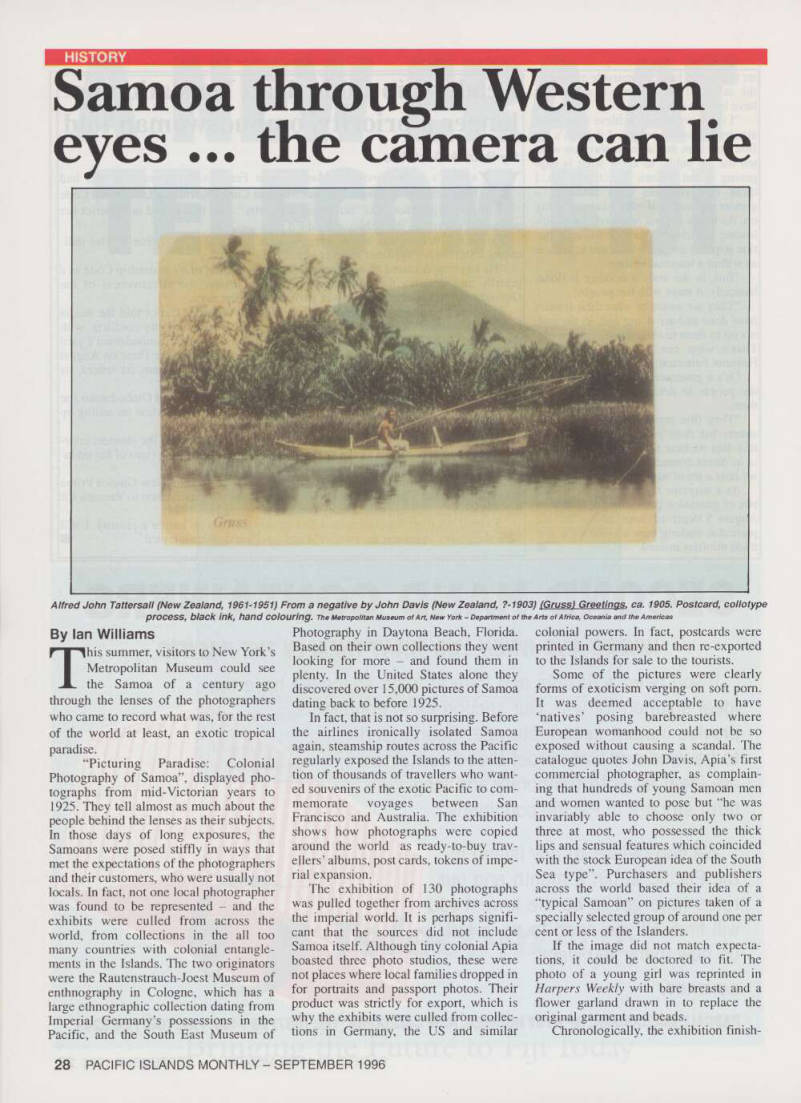
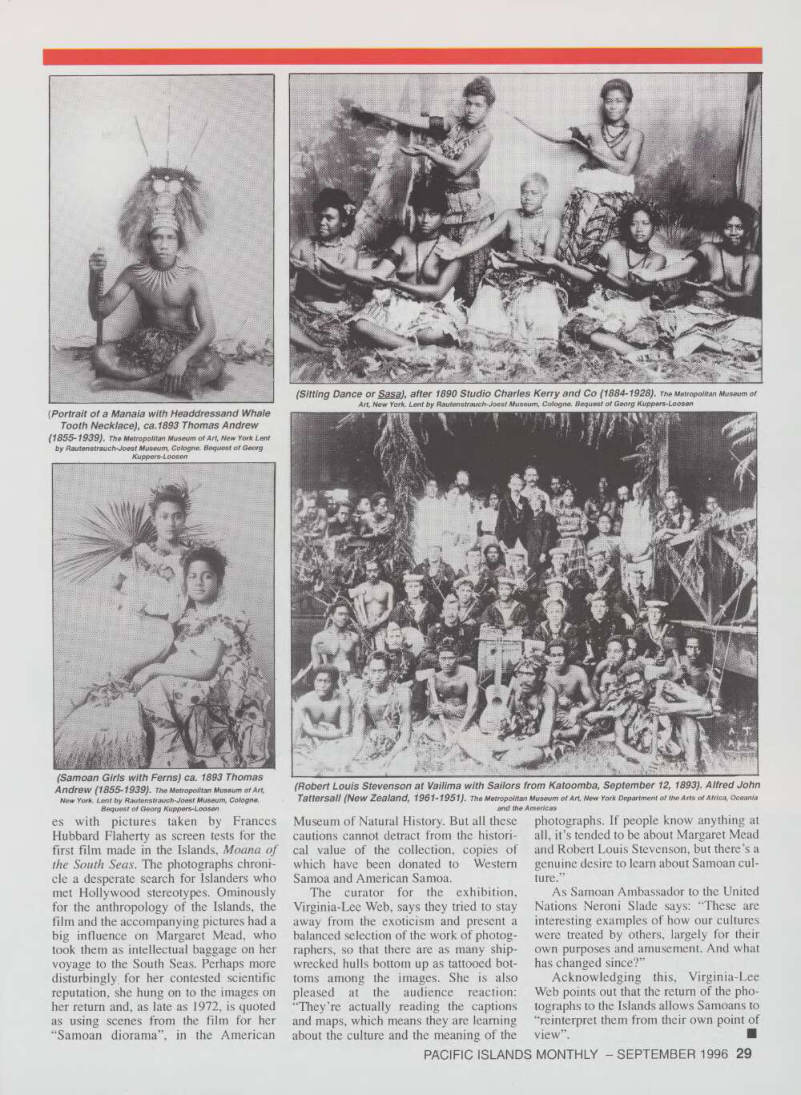
History
Samoa through eyes ... the camera can lie
By lan Williams
This summer, visitors to New York’s Metropolitan Museum could see the Samoa of a century ago through the lenses of the photographers who came to record what was, for the rest of the world at least, an exotic tropical
paradise.
“Picturing Paradise: Colonial Photography of Samoa”, displayed pho tographs from mid-Victorian years to 1925. They tell almost as much about the people behind the lenses as their subjects.
In those days of long exposures, the Samoans were posed stiffly in ways that met the expectations of the photographers and their customers, who were usually not locals. In fact, not one local photographer was found to be represented - and the exhibits were culled from across the world, from collections in the all too many countries with colonial entangle ments in the Islands. The two originators were the Rautenstrauch-Joest Museum of enthnography in Cologne, which has a large ethnographic collection dating from Imperial Germany’s possessions in the Pacific, and the South East Museum of
Photography in Daytona Beach, Florida.
Based on their own collections they went looking for more - and found them in plenty. In the United States alone they discovered over 15,000 pictures of Samoa dating back to before 1925.
In fact, that is not so surprising. Before the airlines ironically isolated Samoa again, steamship routes across the Pacific regularly exposed the Islands to the atten tion of thousands of travellers who want ed souvenirs of the exotic Pacific to com memorate voyages between San Francisco and Australia. The exhibition shows how photographs were copied around the world as ready-to-buy trav ellers’ albums, post cards, tokens of impe
rial expansion.
The exhibition of 130 photographs was pulled together from archives across the imperial world. It is perhaps signifi cant that the sources did not include Samoa itself. Although tiny colonial Apia boasted three photo studios, these were not places where local families dropped in for portraits and passport photos. Their product was strictly for export, which is why the exhibits were culled from collec tions in Germany, the US and similar
colonial powers. In fact, postcards were printed in Germany and then re-exported to the Islands for sale to the tourists.
Some of the pictures were clearly forms of exoticism verging on soft pom.
It was deemed acceptable to have ‘natives’ posing barebreasted where European womanhood could not be so exposed without causing a scandal. The catalogue quotes John Davis, Apia’s first
commercial photographer, as complain
ing that hundreds of young Samoan men and women wanted to pose but “he was invariably able to choose only two or three at most, who possessed the thick lips and sensual features which coincided with the stock European idea of the South Sea type”. Purchasers and publishers across the world based their idea of a “typical Samoan” on pictures taken of a specially selected group of around one per cent or less of the Islanders.
If the image did not match expecta tions, it could be doctored to fit. The photo of a young girl was reprinted in Harpers Weekly with bare breasts and a flower garland drawn in to replace the original garment and beads.
Chronologically, the exhibition finish-
Alfred John Tattersall (New Zealand, 1961-1951) From a negative by John Davis (New Zealand, 7-1903) (Grass) Greetings, ca. 1905. Postcard, collotype process, black ink, hand colouring. The Metropolitan Museum of Art, New York - Department of the Arts of Africa, Oceania and the Americas
es with pictures taken by Frances Hubbard Flaherty as screen tests for the first film made in the Islands, Moana of the South Seas. The photographs chroni cle a desperate search for Islanders who met Hollywood stereotypes. Ominously for the anthropology of the Islands, the film and the accompanying pictures had a big influence on Margaret Mead, who took them as intellectual baggage on her voyage to the South Seas. Perhaps more disturbingly for her contested scientific reputation, she hung on to the images on her return and, as late as 1972, is quoted as using scenes from the film for her “Samoan diorama”, in the American
Museum of Natural History. But all these cautions cannot detract from the histori cal value of the collection, copies of which have been donated to Western Samoa and American Samoa.
The curator for the exhibition, Virginia-Lee Web, says they tried to stay away from the exoticism and present a balanced selection of the work of photog raphers, so that there are as many ship wrecked hulls bottom up as tattooed bot toms among the images. She is also pleased at the audience reaction: “They’re actually reading the captions and maps, which means they are learning about the culture and the meaning of the
photographs. If people know anything at all, it’s tended to be about Margaret Mead and Robert Louis Stevenson, but there’s a genuine desire to learn about Samoan cul ture.”
As Samoan Ambassador to the United Nations Neroni Slade says: “These are interesting examples of how our cultures were treated by others, largely for their own purposes and amusement. And what has changed since?”
Acknowledging this, Virginia-Lee
Web points out that the return of the pho tographs to the Islands allows Samoans to “reinterpret them from their own point of view”. M
(Portrait of a Manaia with Headdressand Whale Tooth Necklace), ca. 1893 Thomas Andrew (1855-1939). The Metropolitan Museum of Art, New York Lent by Rautenstrauch-Joest Museum, Cologne. Bequest of Georg Kuppers-Loosen
(Samoan Girls with Ferns) ca. 1893 Thomas Andrew (1855-1939). The Metropolitan Museum of Art, New York. Lent by RaUtenstrauch-Joest Museum, Cologne.
Bequest of Georg Kuppers-Loosen
(Sitting Dance or Sasa). after 1890 Studio Charles Kerry and Co (1884-1928). The Metropolitan Museum of Art, New York. Lent by Rautenstrauch-Joest Museum, Cologne. Bequest of Georg Kuppers-Loosen
(Robert Louis Stevenson at Vailima with Sailors from Katoomba, September 12, 1893). Alfred John Tattersall (New Zealand, 1961-1951). The Metropolitan Museum of Art, New York Department of the Arts of Africa, Oceania and the Americas
Advertisements & other items, pp. 30-32 (1 item)
Drive dignity right to the top.
<3g) TOYOTA
Everyone who knows cars has no doubts about Land Cruiser’s ruggedness.
Yet how many know that its luxury rivals the finest high-priced cars?
Or that it’s got more room inside than many luxury sedans?
And because it’s a Toyota, Land Cruiser’s fit and finish, attention to detail, and graceful form speak of elegance as well as spacious comfort.
Yet you still get tough ladder frames and suspension built to take you as far off road as you want to go.
With power from 4.5-litre petrol or 4.2-litre diesel engines.
And it’s carefully protected from rust to last longer.
So if you’re going right to the top, this dignified car is ready to take you.
LAND CRUISER
DISTRIBUTORS/DEALERS
AMERICAN SAMOA BURNS PHILP MOTORS PH 633-4281 COOK ISLANDS GUAM & MICRONESIA...ATKINS KROLL, INC. PH 646-1876/9 KIRIBATI NORFOLK ISLAND BORRY’S PTY LTD. PH 22114 PAPUA NEW GUINEA SOLOMON ISLAND ELA MOTORS PH 30314 TAHITI VANUATU ASCO MOTORS PH 22341 WESTERN SAMOA
..PACIFIC MOTORS LTD. PH 20796
..TARAWA MOTORS PH 21090
..ELA MOTORS PH 3229400
..NIPPON AUTOMOTO PH 429819
..ASCO MOTORS PH 20800
FIJI ASCO MOTORS PH 384888
NEW CALEDONIA S.I.A.P. PH 275562
SAIPAN MICROL CORPORATION PH 234-5911
TONGA ASCO MOTORS PH 23500
, fM T:k';V ;
'M... ... ; ,'.:-BSiS: : ■:-..■■■
iH^H iiiiilfclii 1 S 1 :\1 a iJ!
The Beer
o. c
Paradise
Pi : :■ r. ffl.
A N s) Si C / v / ■■■'. • a :' r * M ■
South Pacific Export Lager
Ml
a nation
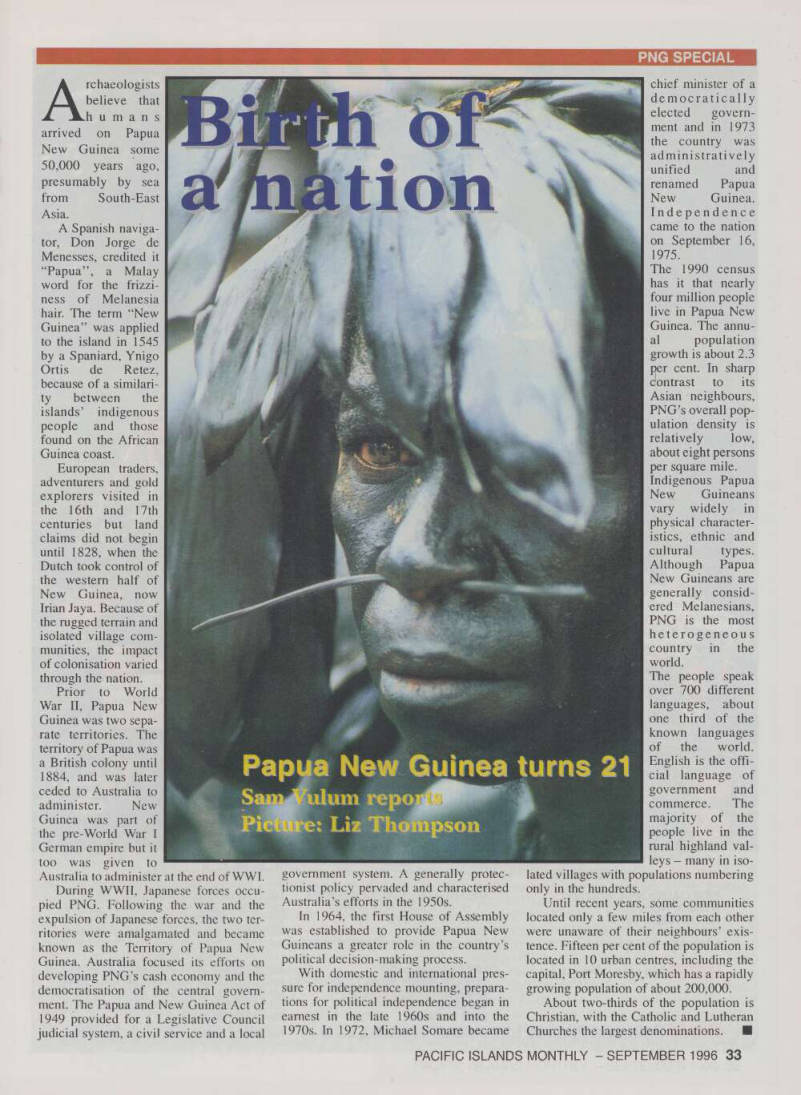
Png Special
Birth of a nation
Archaeologists
believe that humans arrived on Papua New Guinea some 50,000 years ago, presumably by sea from South-East Asia.
A Spanish naviga tor, Don Jorge de Menesses, credited it “Papua”, a Malay word for the frizzi ness of Melanesia hair. The term “New Guinea” was applied to the island in 1545 by a Spaniard, Ynigo Ortis de Retez, because of a similari ty between the
islands’ indigenous
people and those found on the African Guinea coast.
European traders,
adventurers and gold explorers visited in the 16th and 17th centuries but land claims did not begin until 1828, when the Dutch took control of the western half of New Guinea, now Irian Jaya. Because of the rugged terrain and isolated village com munities, the impact of colonisation varied through the nation.
Prior to World War 11, Papua New Guinea was two sepa rate territories. The territory of Papua was a British colony until 1884, and was later ceded to Australia to administer. New Guinea was part of the pre-World War I German empire but it too was given to
Australia to administer at the end of WWI.
During WWII, Japanese forces occu pied PNG. Following the war and the expulsion of Japanese forces, the two ter ritories were amalgamated and became known as the Territory of Papua New Guinea. Australia focused its efforts on developing PNG’s cash economy and the democratisation of the central govern ment. The Papua and New Guinea Act of 1949 provided for a Legislative Council judicial system, a civil service and a local
government system. A generally protec tionist policy pervaded and characterised Australia’s efforts in the 19505.
In ! 964, the first House of Assembly was established to provide Papua New Guineans a greater role in the country’s political decision-making process.
With domestic and international pres sure f° r independence mounting, prepara dons for political independence began in earnest in the late 1960 s and into the 19705. In 1972, Michael Somare became
chief minister of a
democratically
elected govern ment and in 1973 the country was administratively unified and
renamed Papua
New Guinea.
Independence came to the nation on September 16, 1975.
The 1990 census has it that nearly four million people live in Papua New Guinea. The annu al population growth is about 2.3 per cent. In sharp contrast to its
Asian neighbours,
PNG’s overall pop ulation density is relatively low, about eight persons per square mile.
Indigenous Papua New Guineans vary widely in
physical character
istics, ethnic and cultural types.
Although Papua New Guineans are generally consid ered Melanesians, PNG is the most heterogeneous country in the world.
The people speak over 700 different languages, about one third of the
known languages
of the world.
English is the offi cial language of government and commerce. The majority of the people live in the rural highland val leys - many in iso
lated villages with populations numbering only in the hundreds, Until recent years, some communities located only a few miles from each other were unaware of their neighbours’ exis tence. Fifteen per cent of the population is located in 10 urban centres, including the capital. Port Moresby, which has a rapidly growing population of about 200,000.
About two-thirds of the population is Christian, with the Catholic and Lutheran Churches the largest denominations. ■
Papua New Guinea turns 21 sam Vulum repots
Pictyre: Liz Thompson
Advertisements & other items, p. 34 (1 item)
llinill Niugini Pty. Ltd.
i Mr- ¥ ¥ r
SSEOB
i-K mmm ■-A A jsf SeIS^ES SRgr&ao: a; itf’jmX trus ir, 73p * reflgsgg jKg ■ A‘.•■=>•/
STIHL :
»-as
STIHL
A 3m -X “
STIHL,
-•-, r®» n i 4 1 ?\
ci, i
Distributors
NEW CALEDONIA: Noumea
TONGA; Nukualofa
FIJI ISLANDS: Suva
COOK ISLAND: Rarotonga VANUATU; Port Vila
MESSAGERIES CALEDONIENNES
O. H. AUTO-SERVICE REPAIR
CARPENTERS MBF
BECO LIMITED
ROY GALLIMORE & ASSOCIATES
Tel: (687) 273 803 Fax; (687) 281 127 Tel: (676) 21 770 Fax: (676) 24 699 Tel: (679) 312 055 Fax: (679) 301 872 Tel: (682) 21 525 Fax; (682) 21 505 Tel: (678) 22 612 Fax: (687) 23 992
llinill Niugini Pty. Ltd.
LAE Aircorps Road Tel: (675) 472 2884 Fax; (675) 472 3447 PORT MORESBY Morea Tobo Road Tel: (675) 325 5766 Fax: (675) 323 2084 RABAUL Malaguna Road Tel: (675) 982 1489 Fax: (675) 982 1489 VANIMO Tel; (675) 857 1435 Fax: (675) 857 1435
LIHIR ISLAND Tel; (675) 986 4073
yiISUI Solomon Islands Ltd. HONIARA Ranandi Industrial Estate Tel: (677) 30 171 Fax:(677) 30 464
From past to future...
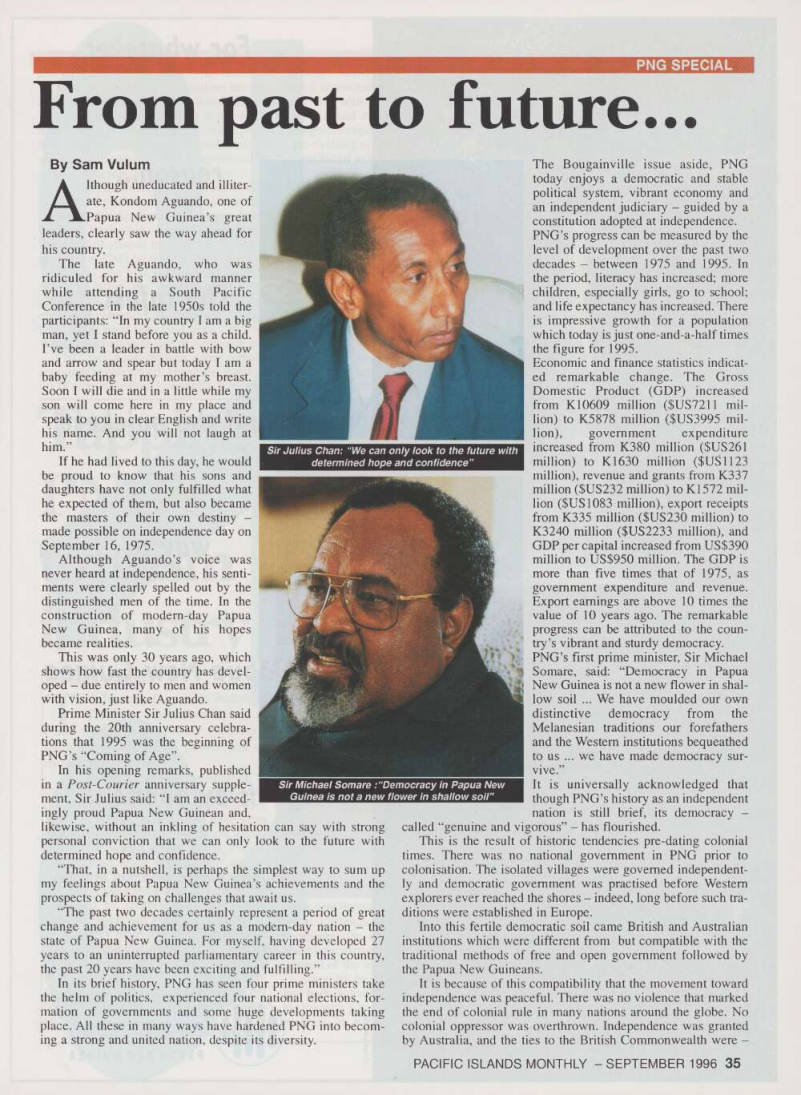
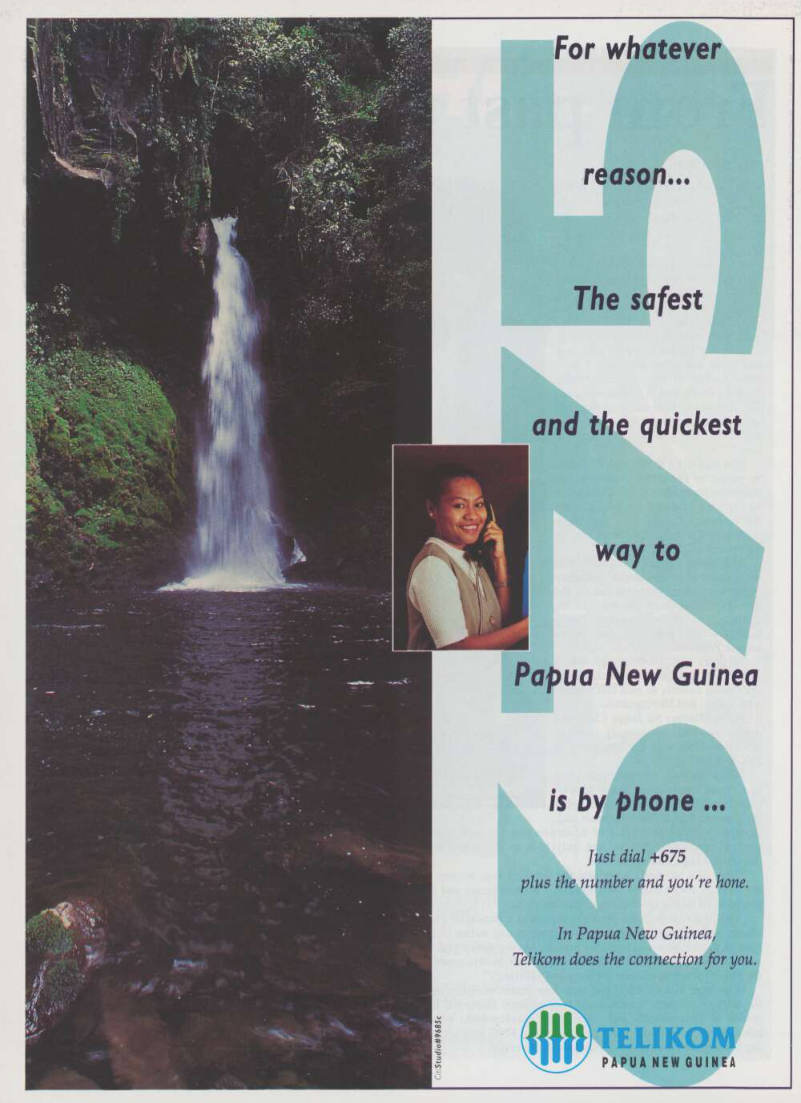
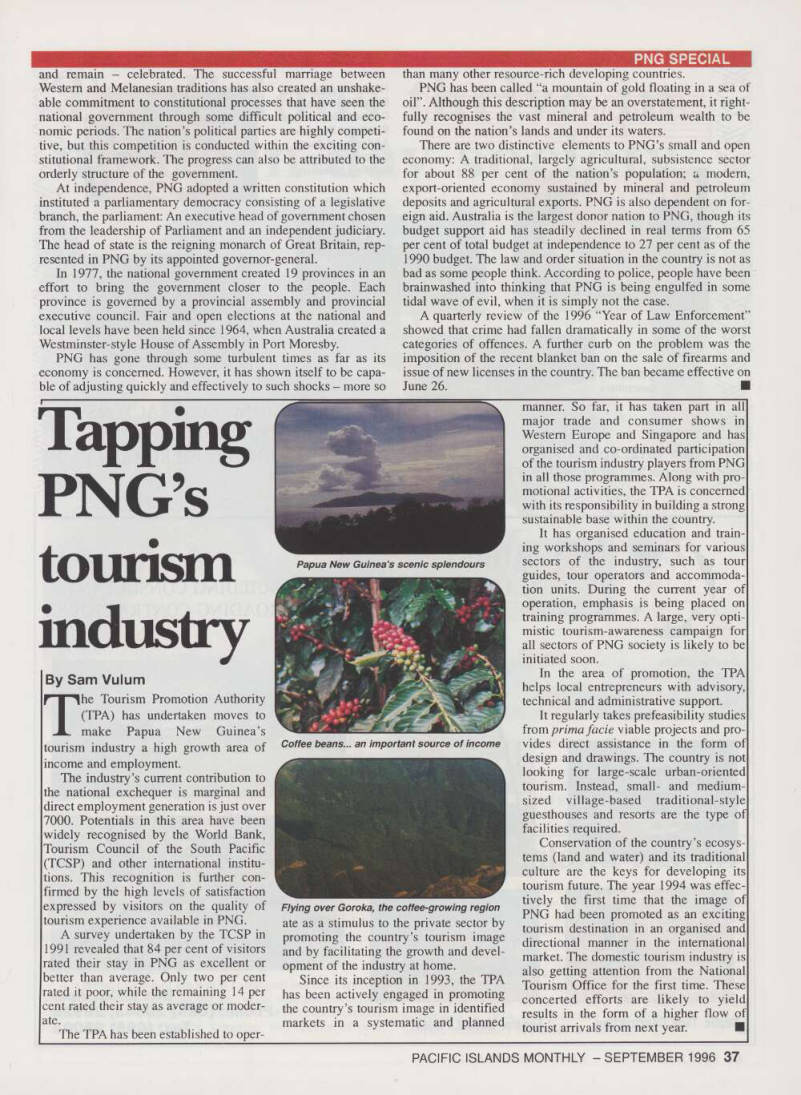
By Sam Vulum
Although uneducated and illiter ate, Kondom Aguando, one of Papua New Guinea’s great leaders, clearly saw the way ahead for his country.
The late Aguando, who was ridiculed for his awkward manner while attending a South Pacific Conference in the late 1950 s told the participants: “In my country I am a big man, yet I stand before you as a child.
I’ve been a leader in battle with bow and arrow and spear but today I am a baby feeding at my mother’s breast.
Soon I will die and in a little while my son will come here in my place and speak to you in clear English and write his name. And you will not laugh at him.”
If he had lived to this day, he would be proud to know that his sons and daughters have not only fulfilled what he expected of them, but also became the masters of their own destiny made possible on independence day on September 16, 1975.
Although Aguando’s voice was never heard at independence, his senti ments were clearly spelled out by the distinguished men of the time. In the construction of modern-day Papua New Guinea, many of his hopes became realities.
This was only 30 years ago, which shows how fast the country has devel oped - due entirely to men and women with vision, just like Aguando.
Prime Minister Sir Julius Chan said during the 20th anniversary celebra tions that 1995 was the beginning of PNG’s “Coming of Age”.
In his opening remarks, published in a Post-Courier anniversary supple ment, Sir Julius said: “I am an exceed ingly proud Papua New Guinean and,
likewise, without an inkling of hesitation can say with strong personal conviction that we can only look to the future with determined hope and confidence.
“That, in a nutshell, is perhaps the simplest way to sum up my feelings about Papua New Guinea’s achievements and the prospects of taking on challenges that await us.
“The past two decades certainly represent a period of great change and achievement for us as a modem-day nation - the state of Papua New Guinea. For myself, having developed 27 years to an uninterrupted parliamentary career in this country, the past 20 years have been exciting and fulfilling.”
In its brief history, PNG has seen four prime ministers take the helm of politics, experienced four national elections, for mation of governments and some huge developments taking place. All these in many ways have hardened PNG into becom ing a strong and united nation, despite its diversity.
The Bougainville issue aside, PNG today enjoys a democratic and stable political system, vibrant economy and an independent judiciary - guided by a
constitution adopted at independence.
PNG’s progress can be measured by the level of development over the past two decades - between 1975 and 1995. In the period, literacy has increased; more children, especially girls, go to school; and life expectancy has increased. There
is impressive growth for a population
which today is just one-and-a-half times the figure for 1995.
Economic and finance statistics indicat ed remarkable change. The Gross Domestic Product (GDP) increased from K 10609 million (SUS72II mil lion) to K 5878 million ($U53995 mil lion), government expenditure increased from K3BO million (SUS26I million) to K 1630 million (SUSII23 million), revenue and grants from K 337 million (SUS 232 million) to K 1572 mil lion (SUSIOB3 million), export receipts from K 335 million (SUS23O million) to K 3240 million ($U52233 million), and GDP per capital increased from US$39O million to US$95O million. The GDP is more than five times that of 1975, as government expenditure and revenue.
Export earnings are above 10 times the value of 10 years ago. The remarkable progress can be attributed to the coun
try’s vibrant and sturdy democracy.
PNG’s first prime minister. Sir Michael Somare, said: “Democracy in Papua New Guinea is not a new flower in shal low soil ... We have moulded our own distinctive democracy from the Melanesian traditions our forefathers and the Western institutions bequeathed to us ... we have made democracy sur vive.”
It is universally acknowledged that
though PNG’s history as an independent
nation is still brief, its democracy -
called “genuine and vigorous” - has flourished.
This is the result of historic tendencies pre-dating colonial times. There was no national government in PNG prior to colonisation. The isolated villages were governed independent ly and democratic government was practised before Western explorers ever reached the shores - indeed, long before such tra ditions were established in Europe.
Into this fertile democratic soil came British and Australian institutions which were different from but compatible with the traditional methods of free and open government followed by the Papua New Guineans.
It is because of this compatibility that the movement toward independence was peaceful. There was no violence that marked the end of colonial rule in many nations around the globe. No colonial oppressor was overthrown. Independence was granted by Australia, and the ties to the British Commonwealth were -
Sir Julius Chan: “We can only look to the future with determined hope and confidence"
Sir Michael Somare:“Democracy in Papua New Guinea is not a new flower in shallow soil”
and remain - celebrated. The successful marriage between Western and Melanesian traditions has also created an unshake able commitment to constitutional processes that have seen the national government through some difficult political and eco nomic periods. The nation’s political parties are highly competi tive, but this competition is conducted within the exciting con stitutional framework. The progress can also be attributed to the orderly structure of the government.
At independence, PNG adopted a written constitution which instituted a parliamentary democracy consisting of a legislative branch, the parliament: An executive head of government chosen from the leadership of Parliament and an independent judiciary.
The head of state is the reigning monarch of Great Britain, rep resented in PNG by its appointed governor-general.
In 1977, the national government created 19 provinces in an effort to bring the government closer to the people. Each province is governed by a provincial assembly and provincial executive council. Fair and open elections at the national and local levels have been held since 1964, when Australia created a Westminster-style House of Assembly in Port Moresby.
PNG has gone through some turbulent times as far as its economy is concerned. However, it has shown itself to be capa ble of adjusting quickly and effectively to such shocks - more so
than many other resource-rich developing countries.
PNG has been called “a mountain of gold floating in a sea of oil”. Although this description may be an overstatement, it right fully recognises the vast mineral and petroleum wealth to be found on the nation’s lands and under its waters.
There are two distinctive elements to PNG’s small and open economy: A traditional, largely agricultural, subsistence sector for about 88 per cent of the nation’s population; a modem, export-oriented economy sustained by mineral and petroleum deposits and agricultural exports. PNG is also dependent on for eign aid. Australia is the largest donor nation to PNG, though its budget support aid has steadily declined in real terms from 65 per cent of total budget at independence to 27 per cent as of the 1990 budget. The law and order situation in the country is not as bad as some people think. According to police, people have been brainwashed into thinking that PNG is being engulfed in some tidal wave of evil, when it is simply not the case.
A quarterly review of the 1996 “Year of Law Enforcement” showed that crime had fallen dramatically in some of the worst categories of offences. A further curb on the problem was the imposition of the recent blanket ban on the sale of firearms and issue of new licenses in the country. The ban became effective on June 26. ■
Advertisements & other items, p. 36 (1 item)
CitiStudio#96BSc
For whatever ason...
The safest and the quickest way to Papua New Guinea is by phone ... fust dial +675 plus the number and you're hone.
In Papua New Guinea, Telikom does the connection for you.
TELIKOM
PAPUA NEW GUINEA
industry
Tapping
Png’S
tourism industry
By Sam Vulum
The Tourism Promotion Authority (TPA) has undertaken moves to make Papua New Guinea’s tourism industry a high growth area of income and employment.
The industry’s current contribution to the national exchequer is marginal and direct employment generation is just over 7000. Potentials in this area have been
widely recognised by the World Bank,
Tourism Council of the South Pacific (TCSP) and other international institu tions. This recognition is further con firmed by the high levels of satisfaction expressed by visitors on the quality of tourism experience available in PNG.
A survey undertaken by the TCSP in 1991 revealed that 84 per cent of visitors rated their stay in PNG as excellent or better than average. Only two per cent rated it poor, while the remaining 14 per cent rated their stay as average or moder ate.
The TPA has been established to oper-
ate as a stimulus to the private sector by
promoting the country’s tourism image
and by facilitating the growth and devel opment of the industry at home.
Since its inception in 1993, the TPA has been actively engaged in promoting the country’s tourism image in identified markets in a systematic and planned
manner. So far, it has taken part in all major trade and consumer shows in Western Europe and Singapore and has organised and co-ordinated participation of the tourism industry players from PNG in all those programmes. Along with pro motional activities, the TPA is concerned with its responsibility in building a strong sustainable base within the country.
It has organised education and train ing workshops and seminars for various sectors of the industry, such as tour guides, tour operators and accommoda tion units. During the current year of operation, emphasis is being placed on training programmes. A large, very opti mistic tourism-awareness campaign for all sectors of PNG society is likely to be initiated soon.
In the area of promotion, the TPA helps local entrepreneurs with advisory, technical and administrative support.
It regularly takes prefeasibility studies from prima facie viable projects and pro vides direct assistance in the form of design and drawings. The country is not looking for large-scale urban-oriented tourism. Instead, small- and medium sized village-based traditional-style guesthouses and resorts are the type of facilities required.
Conservation of the country’s ecosys tems (land and water) and its traditional culture are the keys for developing its tourism future. The year 1994 was effec tively the first time that the image of PNG had been promoted as an exciting tourism destination in an organised and directional manner in the international market. The domestic tourism industry is also getting attention from the National Tourism Office for the first time. These concerted efforts are likely to yield results in the form of a higher flow of tourist arrivals from next year. ■
Papua New Guinea’s scenic splendours
Coffee beans... an important source of income
Flying over Goroka, the coffee-growing region
Advertisements & other items, p. 38 (1 item)
BluefpiW
===Lumbe
UMBER A HARDWARE
yj Hardware Merchants Plumbing Supplies Cement Distributors Electrical Supplies Agricultural Tools Carpentry Tools Roofing Materials m/m Building Supplies Sawmillers Saleufi Box 1612, Apia Phone 25236 or 25237 Fax 21629 m.
☆ LOGGING CONTRACTORS
☆ SAWMILLERS
☆ HARDWARE MERCHANTS
A
4E Ahliki
Construction
☆ BUILDING CONSULTANTS
☆ ROADING CONTRACTORS
Design & Build Commercial Buildings Homes Renovations Structural Steel Work gaaph •*« ■»*!
“"••Mi Hill % L* s» m IS V .— — IK - .«* «* V, Mi Septic Tank Construction
Fugalei Market Project
Box 1612, Apia
Phone: (685) 20643, 26925
Fax: (685) 25003
modern-day society
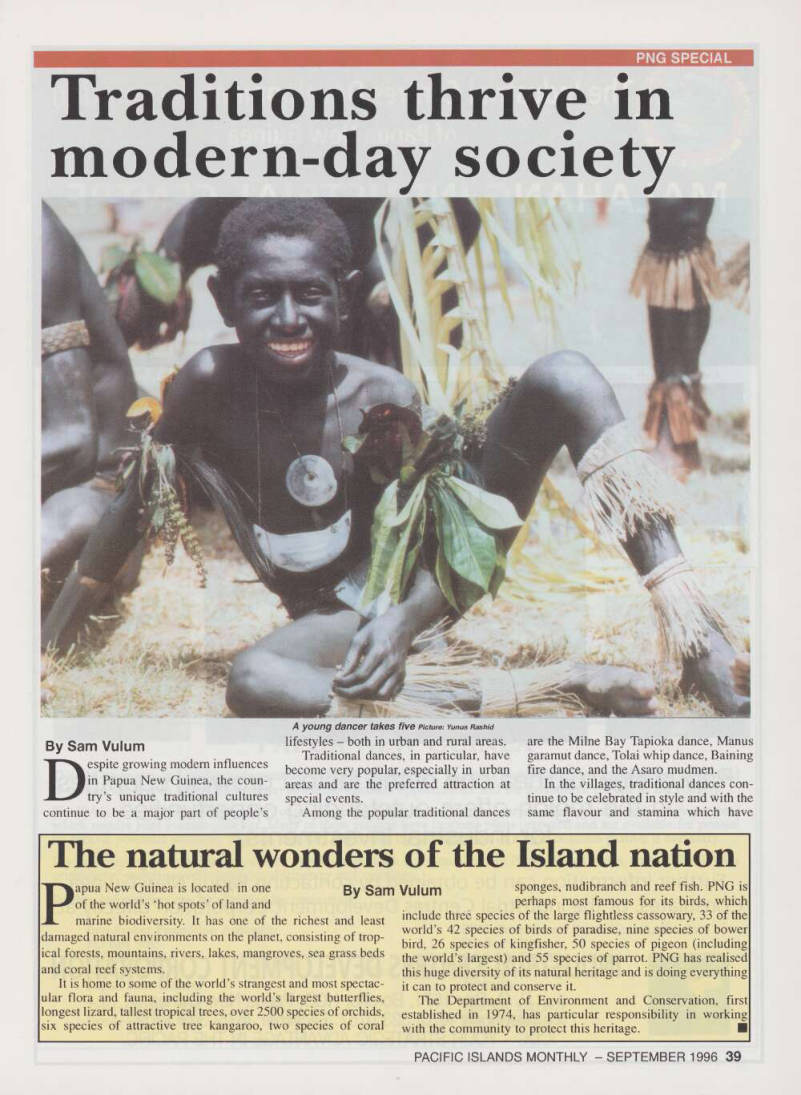

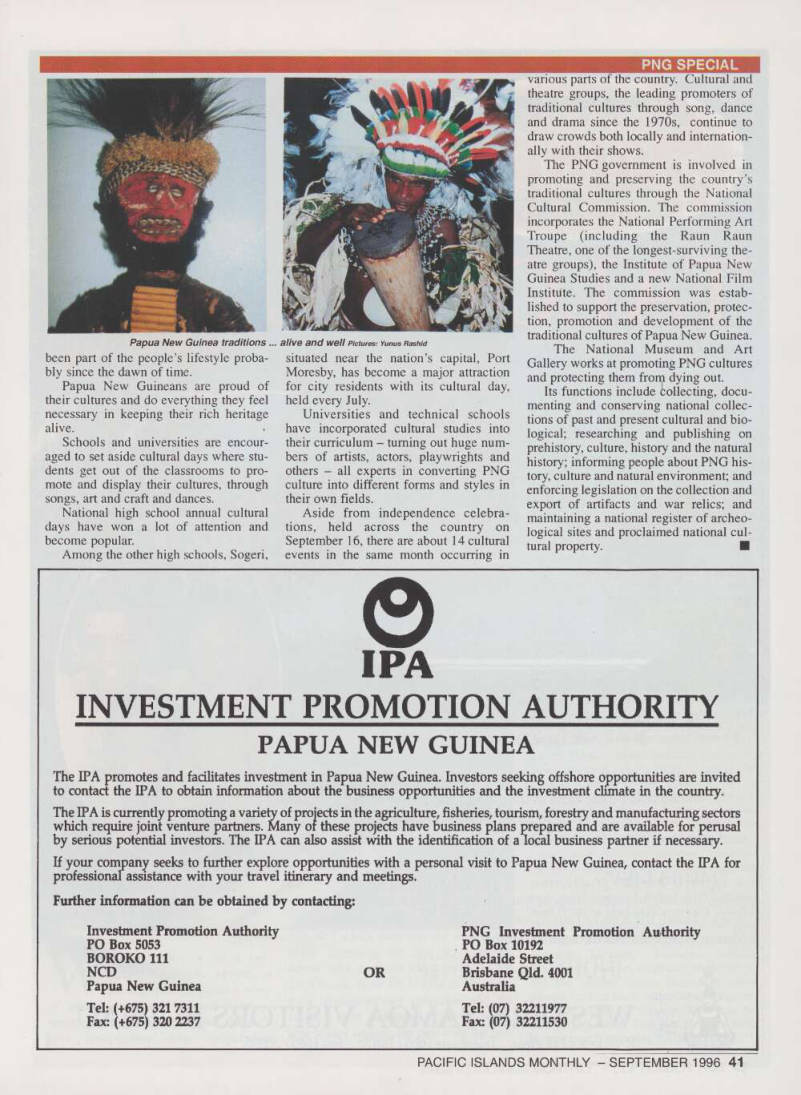
Traditions thrive in modern-day society
By Sam Vulum
Despite growing modem influences in Papua New Guinea, the coun try’s unique traditional cultures continue to be a major part of people’s
lifestyles - both in urban and rural areas.
Traditional dances, in particular, have become very popular, especially in urban areas and are the preferred attraction at special events.
Among the popular traditional dances
are the Milne Bay Tapioka dance, Manus garamut dance, Tolai whip dance, Baining fire dance, and the Asaro mudmen.
In the villages, traditional dances con tinue to be celebrated in style and with the same flavour and stamina which have
A young dancer takes five Picture: Yunus Rashid
been part of the people’s lifestyle proba bly since the dawn of time.
Papua New Guineans are proud of their cultures and do everything they feel necessary in keeping their rich heritage alive.
Schools and universities are encour aged to set aside cultural days where stu dents get out of the classrooms to pro mote and display their cultures, through songs, art and craft and dances.
National high school annual cultural days have won a lot of attention and become popular.
Among the other high schools, Sogeri,
situated near the nation’s capital. Port Moresby, has become a major attraction for city residents with its cultural day, held every July.
Universities and technical schools have incorporated cultural studies into their curriculum - turning out huge num bers of artists, actors, playwrights and others - all experts in converting PNG culture into different forms and styles in their own fields.
Aside from independence celebra tions, held across the country on September 16, there are about 14 cultural events in the same month occurring in
various parts of the country. Cultural and theatre groups, the leading promoters of traditional cultures through song, dance and drama since the 19705, continue to draw crowds both locally and internation ally with their shows.
The PNG government is involved in promoting and preserving the country’s traditional cultures through the National Cultural Commission. The commission incorporates the National Performing Art Troupe (including the Raun Raun Theatre, one of the longest-surviving the atre groups), the Institute of Papua New Guinea Studies and a new National Film Institute. The commission was estab lished to support the preservation, protec tion, promotion and development of the traditional cultures of Papua New Guinea.
The National Museum and Art Gallery works at promoting PNG cultures and protecting them from dying out.
Its functions include collecting, docu menting and conserving national collec tions of past and present cultural and bio logical; researching and publishing on prehistory, culture, history and the natural history; informing people about PNG his tory, culture and natural environment; and enforcing legislation on the collection and export of artifacts and war relics; and maintaining a national register of archeo logical sites and proclaimed national cul tural property. ■
Papua New Guinea traditions ... alive and well Pictures: Yunus Rashid
The natural wonders of the Island nation
Papua New Guinea is located in one of the world’s ‘hot spots’ of land and
.X. marine biodiversity. It has one of the richest and least damaged natural environments on the planet, consisting of trop ical forests, mountains, rivers, lakes, mangroves, sea grass beds and coral reef systems.
It is home to some of the world’s strangest and most spectac ular flora and fauna, including the world’s largest butterflies, longest lizard, tallest tropical trees, over 2500 species of orchids, six species of attractive tree kangaroo, two species of coral
By Sam Vulum
sponges, nudibranch and reef fish. PNG is perhaps most famous for its birds, which
include three species of the large flightless cassowary, 33 of the world’s 42 species of birds of paradise, nine species of bower bird, 26 species of kingfisher, 50 species of pigeon (including the world’s largest) and 55 species of parrot. PNG has realised this huge diversity of its natural heritage and is doing everything it can to protect and conserve it.
The Department of Environment and Conservation, first established in 1974, has particular responsibility in working with the community to protect this heritage. ■
Advertisements & other items, pp. 40-42 (1 item)
Malahang Industrial Centre
The Industrial Centres Development Corporation
of Papua New Guinea
/> - v - «| ('uriiM ■' mSM t, -V-v S: RK - 2 v . fed V Papua New Guinea one of the fastest growing countries
in the region offers outstanding opportunities
for Industrial Investments.
Further Information can be obtained by contacting Papua New Guinea Consulates, or the Industrial Centres Development Corporation directly at: Lae City
INDUSTRIAL CENTRES DEVELOPMENT CORPORATION
P. 0. Box 1571, Boroko, NCD, Papua New Guinea.
Telephone: (675) 323 0757. Facsimile: (675) 323 1109 ICDC - YOUR STRATEGIC ADVANTAGE IN THE PACIFIC.
IPA
INVESTMENT PROMOTION AUTHORITY
PAPUA NEW GUINEA
The IPA promotes and facilitates investment in Papua New Guinea. Investors seeking offshore opportunities are invited to contact the IPA to obtain information about the business opportunities and the investment climate in the country.
The IPA is currently promoting a variety of projects in the agriculture, fisheries, tourism, forestry and manufacturing sectors which require joint venture partners. Many or these projects have business plans prepared and are available for perusal by serious potential investors. The IPA can also assist with the identification of a local business partner if necessary.
If your company seeks to further explore opportunities with a personal visit to Papua New Guinea, contact the IPA for professional assistance with your travel itinerary and meetings.
Further information can be obtained by contacting: Investment Promotion Authority PO Box 5053
BOROKO 111
NCD OR
Papua New Guinea Tel: (+675) 321 7311 Fax: (+675) 320 2237 PNG Investment Promotion Authority PO Box 10192 Adelaide Street Brisbane Qld. 4001 Australia Tel: (07) 32211977 Fax: (07) 32211530
Mimami The Heart of Polynesia Astern Samoa. South Pacific islands of t and fascination. Fragrant bk Fringed by tall palms, white sane W I T f Fringed by tall palms, white sand Feacbe,> regain unspoiled and uncrowded. The tourquoise waters jM |^osns under a warm sun.. This is the home of a proud ngppfe who and Eure rich in age-old tracliprSns and ceremonies, Id. A pedple who, it has been said, ’dn the entire South Seas. ty The gentle people here; where you can drench yourself in cool waterfalls cascading from the peaks of green clad mountains; such as Mount Vaea, where Robert Louis Stevenson lies peacefully.
“TALOFA LAVA”
Say the friendly people here, in the villagTs aha towns as 3 explore our islands to find the secluded sandy beaches and watch the surf ever breaking on the reefs beyond.
“TALOFA LAVA”
Say the helpful people here, as you check-in to the legendary Aggie Grey’s Hotel, the Kitano Tusitala, or one .of the many fine accommodation establishments throughout Samoa. W.
WESTERN SAMOA VISITORS BUREAU
P. O. Box 2272 Apia. Telephone (685) 20878, Fax (685) 20886
On the road to success
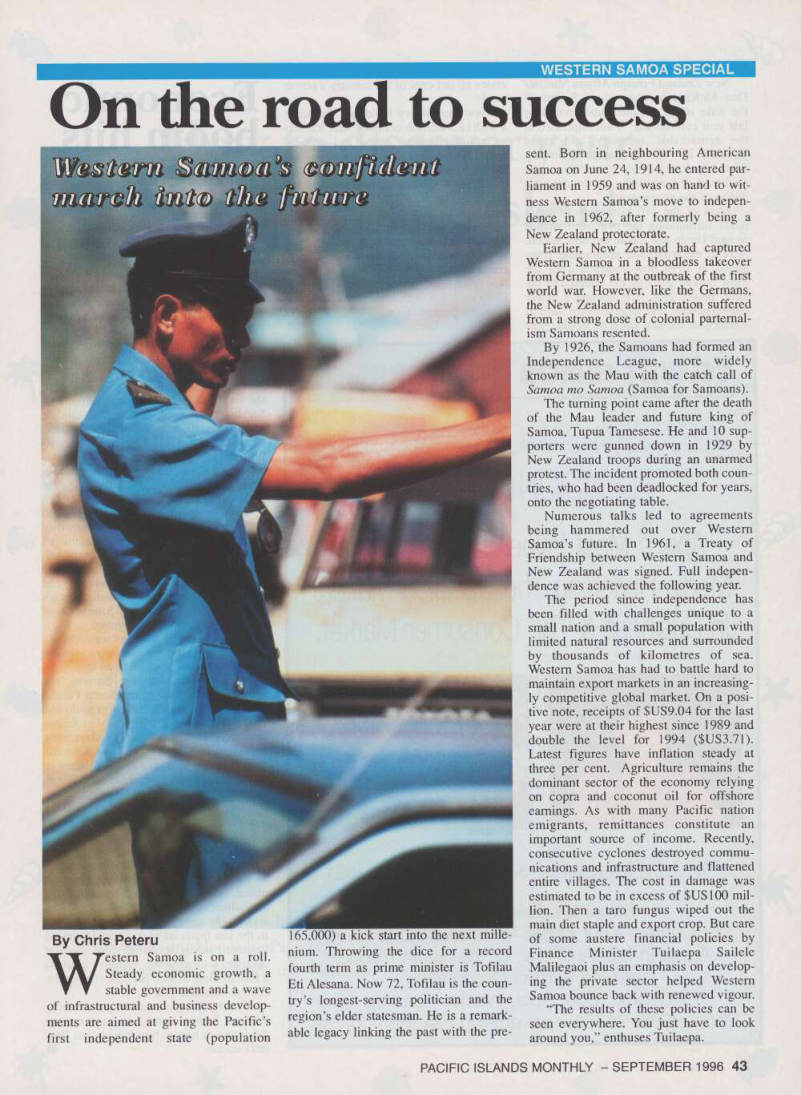

Western Samoa Special
By Chris Peteru
Western Samoa is on a roll.
Steady economic growth, a
stable government and a wave of infrastructural and business develop ments are aimed at giving the Pacific’s
first independent state (population
165,000) a kick start into the next mille nium. Throwing the dice for a record fourth term as prime minister is Tofilau Eti Alesana. Now 72, Tofilau is the coun try’s longest-serving politician and the region’s elder statesman. He is a remark able legacy linking the past with the pre
sent. Born in neighbouring American Samoa on June 24, 1914, he entered par liament in 1959 and was on hand to wit ness Western Samoa’s move to indepen dence in 1962, after formerly being a New Zealand protectorate.
Earlier, New Zealand had captured Western Samoa in a bloodless takeover from Germany at the outbreak of the first world war. However, like the Germans, the New Zealand administration suffered from a strong dose of colonial partemal ism Samoans resented.
By 1926, the Samoans had formed an
Independence League, more widely
known as the Mau with the catch call of Samoa mo Samoa (Samoa for Samoans).
The turning point came after the death of the Mau leader and future king of Samoa, Tupua Tamesese. He and 10 sup porters were gunned down in 1929 by New Zealand troops during an unarmed protest. The incident promoted both coun tries, who had been deadlocked for years, onto the negotiating table.
Numerous talks led to agreements being hammered out over Western Samoa’s future. In 1961, a Treaty of Friendship between Western Samoa and New Zealand was signed. Full indepen dence was achieved the following year.
The period since independence has been filled with challenges unique to a small nation and a small population with limited natural resources and surrounded by thousands of kilometres of sea.
Western Samoa has had to battle hard to maintain export markets in an increasing ly competitive global market. On a posi tive note, receipts of SUS9.O4 for the last year were at their highest since 1989 and double the level for 1994 (SUS3.7I).
Latest figures have inflation steady at three per cent. Agriculture remains the dominant sector of the economy relying on copra and coconut oil for offshore earnings. As with many Pacific nation emigrants, remittances constitute an important source of income. Recently,
consecutive cyclones destroyed commu
nications and infrastructure and flattened entire villages. The cost in damage was estimated to be in excess of SUSIOO mil lion. Then a taro fungus wiped out the main diet staple and export crop. But care of some austere financial policies by Finance Minister Tuilaepa Sailele
Malilegaoi plus an emphasis on develop
ing the private sector helped Western
Samoa bounce back with renewed vigour.
“The results of these policies can be seen everywhere. You just have to look around you,” enthuses Tuilaepa.
Wesrern Samoa's confident march into the future
New Zealand Foreign Affairs Minister Don McKinnon, who visited Samoa in the wake of the cyclones, upon returning last year commented; “I am impressed at the remarkable recovery and rapid progress in Western Samoa following those cyclones. It’s a credit to the resilience of her people and the determi nation of the government...”
Most of the 110 kilometres of main roads surrounding the two main islands around Upolu and Savaii are now sealed.
A rural electrification programme com pleted in 1995 now connects even the most remote parts of the country to the
main power grid. The country’s newly
commissioned and largest hydro dam at Afulilo, on the east coast of Upolu, gen
erates 60 per cent of the country’s power needs.
New multistorey buildings, including a SUS 12.5-million complex that features a Samoan meeting house and concen trates all government departments, has gone up on the seaward side of the capi tal, Apia, a symbol of progress and the emerging cosmopolitan character of a once dusty and tired-looking town.
A new SUSI4.4-million campus for the National University of Samoa, built with the assistance of the Japanese gov ernment, is due for completion in August next year. The campus will house up to 8000 students, with state-of-the art elec tronic equipment, a gymnasium and teaching facilities. ■
Economic
boom hits nation
By Chris Peteru
Businesses of all kinds are emerg ing on a scale not seen before in the Island state’s short history.
Manufacturers Association president Eddie Wilson, who has established a booming chocolate business, says the entrepreneurial climate speaks volumes for the concept of unity and diversity.
“Things in the country are looking better - it won’t happen overnight but we’ve got to get it together,”
The government was trying to pave the way with private-sector development.
Stable government, a beautiful climate and a large labour pool were other pluses, he said. The arrival of big name interna tional franchises, including McDonalds and Pepsi Cola, have provided employ ment and a healthy competitive edge for local businesses.
In concert with a government drive to boost tourism, a string of top-quality hotels have sprung up in locations all around the country. Dozens of coastal vil lages have built postcard-like beach fale (huts) for visitors to enjoy. Marketing and promotions manager at Western Samoa’s Visitors Bureau Alise Stunnenberg believes they are on to a winner.
“We have more finances now. People and the government are now saying ‘tourism is viable and we need it’.
“Visitors call Western Samoa ‘the diferent destination’ of the South Pacific because of the variety of things to do and see. But it’s people who really make our culture.” A major first-up advertising campaign in New Zealand and Australia to pull in fun seekers has contributed to an eight per cent increase in visitors (30,415) for the first half of the year.
Another first is the opening of an over seas tourist office in the Polynesian heart land, Auckland, New Zealand.
The government has promised to maintain the present course of private sector growth. The sell-off of the post office, Bank of Western Samoa and the agriculture store in the past 15 months signals the seriousness of that intention.
In the last financial year, Gross Domestic Product rose by seven per cent. Natural
disasters withstanding, Treasury predicts
a further three to four per cent rise for the current financial year.
Clearly, the one overriding concern as Western Samoa fast tracks its way into the future, is how to beat Fiji at Apia Park next season. ■
Advertisements & other items, pp. 44-45 (2 items)
Apia’s Most Influential Advertising
teieyise jnmon corporatior
WESTERN SAMOA’S NATIONAL
TELEVISION NETWORK
Apia’s Most Influential Advertising
Media Reaching The Decision Makers
In Business & The Consumer Market.
Great Beaches & Entertainment!
Direct Enquiries Welcome or Contact Your Local Accredited Advertising Agent in NZ, Australia, or the South Pacific Televise Samoa Corporation, PO Box 1868, Apia, Western Samoa Phone (685) 21735 - advertising Fax (685) 24789
How to discover your
Sm S*
.. .. n, •T'.t « -‘iJiOi-H,.
I F£%fe^ «. •'» '; - % a.*- .rr- • t * ■ VP „ * .**, ** » 44 > '//• *H 4*£, - A 1 ■ w:> t w 9 f 4 ■ '*. :^ 4 <JJj-jv -> -n»,v , rim
How to discover your
own Treasure Island.
¥ K*
JHII
Robert Louis Stevenson Explore the magic Robert Louis Stevenson discovered more than 100 years ago. Visit his historic and beautifully restored home Vailima in Apia, capital of Western Samoa.
Come and discover the land of his-
tory, myths and legends. Fly to
Western Samoa with Polynesian Airlines. Enjoy a tradition of hospitality on any of our flights around the Pacific.
Polynesian Airlines links Western
Samoa with Honolulu, Pago Pago, Fiji,
Tonga, New Zealand and Australia.
For more information, contact
Polynesian Airlines.
New Zealand: Australia: Western Samoa: Fax:
Tonga:
Fiji
Nadi: Suva: American Samoa; 0800 800 993 1800 633 737 (685) 21 261 (685) 20 023 (676) 21 565 (679) 723 189 (679) 313 666 (684) 699 9126
Polynesian Airlines
ChristensenDobbs 768
j j !j 'Mff ■
T \ II 4f
v .- *) w t «) 5*
fwfA
if v m ,r .
I‘ W ■ T I ■ /' 5 ,’ r '<f 1 I ■ .#i(i V * J ¥> hi A .w* f i' fir, i *T >• »' 1J «* 'P t'■ .j! m\ ■nx thj,fh ,'JP j >•*, * «r .# * ■;>: f i.
WPS
TO'i '/ : (■* T Hfi /* ' ■ V' ‘A //' ,#■ /! r/JW" >«#• J . £ ✓
The Pacific’s grand
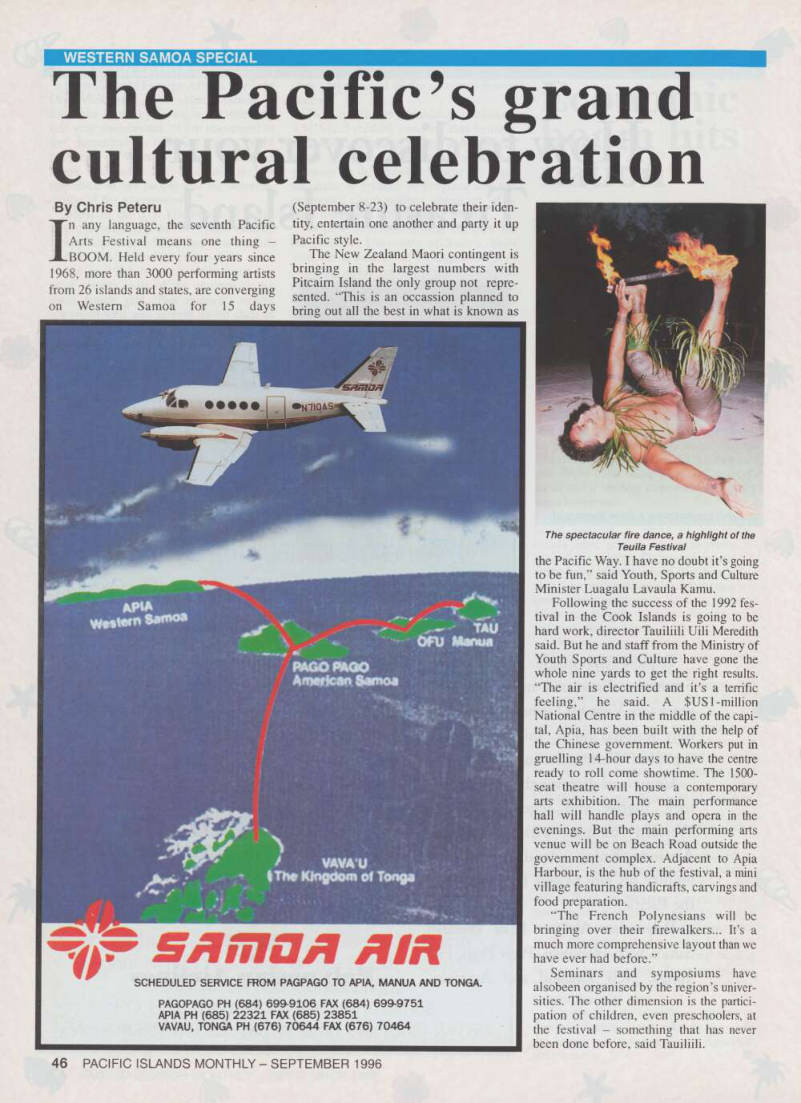
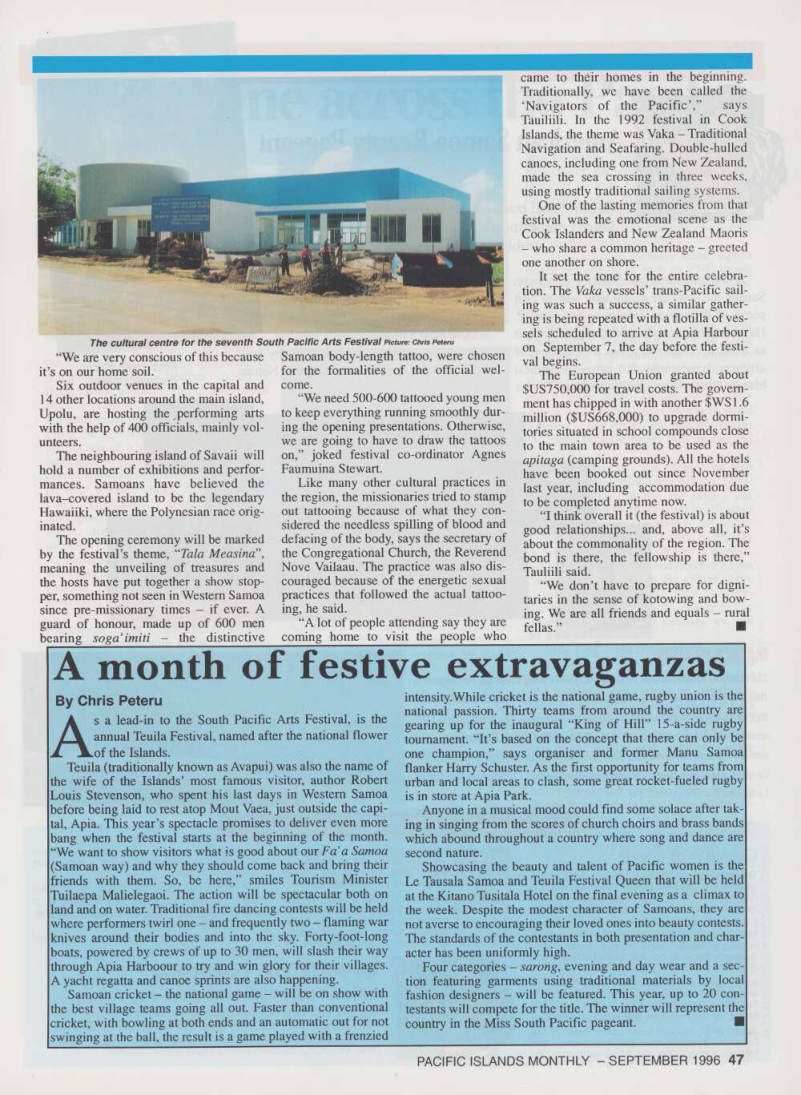
cultural celebration
By Chris Peteru
In any language, the seventh Pacific Arts Festival means one thing - BOOM. Held every four years since 1968, more than 3000 performing artists from 26 islands and states, are converging on Western Samoa for 15 days
(September 8-23) to celebrate their iden tity, entertain one another and party it up Pacific style.
The New Zealand Maori contingent is bringing ™ the largest numbers with Pitcairn Island the only group not repre . , I(TU . . Jb . r , K „ sented. This is an occassion planned to bring out all the best in what is known as
the Pacific Way. I have no doubt it’s going to be fun,” said Youth, Sports and Culture Minister Luagalu Lavaula Kamu.
Following the success of the 1992 fes tival in the Cook Islands is going to be hard work, director Tauiliili Uili Meredith said. But he and staff from the Ministry of Youth Sports and Culture have gone the whole nine yards to get the right results.
“The air is electrified and it’s a terrific feeling,” he said. A SUSI-million National Centre in the middle of the capi tal, Apia, has been built with the help of the Chinese government. Workers put in gruelling 14-hour days to have the centre ready to roll come showtime. The 1500seat theatre will house a contemporary arts exhibition. The main performance hall will handle plays and opera in the evenings. But the main performing arts venue will be on Beach Road outside the government complex. Adjacent to Apia Harbour, is the hub of the festival, a mini
village featuring handicrafts, carvings and
food preparation.
“The French Polynesians will be bringing over their firewalkers... It’s a much more comprehensive layout than we have ever had before.”
Seminars and symposiums have alsobeen organised by the region’s univer sities. The other dimension is the partici pation of children, even preschoolers, at the festival - something that has never been done before, said Tauiliili.
The spectacular fire dance, a highlight of the Teuila Festival
“We are very conscious of this because it’s on our home soil.
Six outdoor venues in the capital and 14 other locations around the main island,
Upolu, are hosting the performing arts
with the help of 400 officials, mainly vol unteers.
The neighbouring island of Savaii will hold a number of exhibitions and perfor mances. Samoans have believed the lava-covered island to be the legendary Hawaiiki, where the Polynesian race orig inated.
The opening ceremony will be marked by the festival’s theme, “Tala Measina”, meaning the unveiling of treasures and the hosts have put together a show stop per, something not seen in Western Samoa since pre-missionary times - if ever. A guard of honour, made up of 600 men bearing soga’imiti - the distinctive
Samoan body-length tattoo, were chosen for the formalities of the official wel come.
“We need 500-600 tattooed young men
to keep everything running smoothly dur
ing the opening presentations. Otherwise, we are going to have to draw the tattoos on,” joked festival co-ordinator Agnes Faumuina Stewart.
Like many other cultural practices in the region, the missionaries tried to stamp out tattooing because of what they con sidered the needless spilling of blood and defacing of the body, says the secretary of the Congregational Church, the Reverend Nove Vailaau. The practice was also dis couraged because of the energetic sexual practices that followed the actual tattoo ing, he said.
“A lot of people attending say they are coming home to visit the people who
came to their homes in the beginning.
Traditionally, we have been called the ‘Navigators of the Pacific’,” says Tauiliili. In the 1992 festival in Cook Islands, the theme was Vaka - Traditional
Navigation and Seafaring. Double-hulled
canoes, including one from New Zealand, made the sea crossing in three weeks, using mostly traditional sailing systems.
One of the lasting memories from that festival was the emotional scene as the Cook Islanders and New Zealand Maoris - who share a common heritage - greeted one another on shore.
It set the tone for the entire celebra tion. The Vaka vessels’ trans-Pacific sail ing was such a success, a similar gather ing is being repeated with a flotilla of ves sels scheduled to arrive at Apia Harbour
on September 7, the day before the festi
val begins.
The European Union granted about $U5750,000 for travel costs. The govern ment has chipped in with another SWSI.6 million ($U5668,000) to upgrade dormi tories situated in school compounds close to the main town area to be used as the apitaga (camping grounds). All the hotels have been booked out since November last year, including accommodation due to be completed anytime now.
“I think overall it (the festival) is about good relationships... and, above all, it’s about the commonality of the region. The bond is there, the fellowship is there,”
Tauliili said.
“We don’t have to prepare for digni taries in the sense of kotowing and bow ing. We are all friends and equals - rural fellas.” ■
The cultural centre for the seventh South Pacific Arts Festival picture: Chris Peteru
Advertisements & other items, p. 46 (1 item)
’ samaa am
APiA
Samoa 'T ' moo moo Amatteim Samoa
TAU
OTU Manna jPSIa r 'Q
> VAVAU
ITha Kingdom of Tonga A /
’ samaa am
SCHEDULED SERVICE FROM PAGPAGO TO APIA, MANUA AND TONGA.
PAGOPAGO PH (684) 699-9106 FAX (684) 699-9751 APIA PH (685) 22321 FAX (685) 23851 VAVAU, TONGA PH (676) 70644 FAX (676) 70464
A month of festive extravaganzas
By Chris Peteru
As a lead-in to the South Pacific Arts Festival, is the annual Teuila Festival, named after the national flower of the Islands.
Teuila (traditionally known as Avapui) was also the name of the wife of the Islands’ most famous visitor, author Robert Louis Stevenson, who spent his last days in Western Samoa before being laid to rest atop Mout Vaea, just outside the capi tal, Apia. This year’s spectacle promises to deliver even more bang when the festival starts at the beginning of the month.
“We want to show visitors what is good about our Fa’a Samoa (Samoan way) and why they should come back and bring their friends with them. So, be here,” smiles Tourism Minister Tuilaepa Malielegaoi. The action will be spectacular both on land and on water. Traditional fire dancing contests will be held where performers twirl one - and frequently two - flaming war knives around their bodies and into the sky. Forty-foot-long boats, powered by crews of up to 30 men, will slash their way through Apia Harboour to try and win glory for their villages.
A yacht regatta and canoe sprints are also happening.
Samoan cricket - the national game - will be on show with the best village teams going all out. Faster than conventional cricket, with bowling at both ends and an automatic out for not swinging at the ball, the result is a game played with a frenzied
intensity. While cricket is the national game, rugby union is the national passion. Thirty teams from around the country are gearing up for the inaugural “King of Hill” 15-a-side rugby tournament. “It’s based on the concept that there can only be one champion,” says organiser and former Manu Samoa flanker Harry Schuster. As the first opportunity for teams from urban and local areas to clash, some great rocket-fueled rugby is in store at Apia Park.
Anyone in a musical mood could find some solace after tak ing in singing from the scores of church choirs and brass bands which abound throughout a country where song and dance are second nature.
Showcasing the beauty and talent of Pacific women is the Le Tausala Samoa and Teuila Festival Queen that will be held at the Kitano Tusitala Hotel on the final evening as a climax to the week. Despite the modest character of Samoans, they are not averse to encouraging their loved ones into beauty contests.
The standards of the contestants in both presentation and char acter has been uniformly high.
Four categories - sarong, evening and day wear and a sec tion featuring garments using traditional materials by local fashion designers - will be featured. This year, up to 20 con testants will compete for the title. The winner will represent the country in the Miss South Pacific pageant. ■
Advertisements & other items, p. 48 (1 item)
American Samoa Beauty Pageant
AMERICAN SAMOA GOVERNMENT OFFICE OF TOURISM
Cultural and traditional handicraft displays, song & dance competitions, sports activities, education and public awareness programs. £ r Aside from the scenic beauty of American Samoa, the first time visitor may want to visit some of the major Tourist sights. Jean P.
Haydon Museum, which was originally built as a naval commissary, has a collection of artifacts, handicrafts and items of cultural history. Scenic spots like Blunts Point, Fagasa
Pass, Afono Pass, Vaitogi Village (home
of the shark and turtle legend), are some recommendati ons.
American Samoa is a sports paradise.
From fishing and snorkelling to rugby and cricket or enjoy the Tropical Rainforest Nature Trail.
Miss South Pacific Rochelle Tuitele
7th /Hiss 'pacific 'Beauty pageant
"page 'page
:: I V vs;
MANU’A ISLANDS
The American Samoa National Park is a reality since being authorized by Congress in 1988 and is the 50th State National Park of the United States. The park is a wild scenic, high island rain forest in the South Pacific and is in three units. The largest portion 5,000 acres is located on Ta’u Island, part of the Manu’a Island Group. The remaining 4,000 acres are found on Tutuila and Ofu, Manu’a. A spectacular rainforest in the South Pacific.
For more information contact National Park Superintendent Chris Stein or Park Ranger Leota Ainu’u at 684 6337082. Fax : 684 633 7085.
MANUA ISLAND
Calendar of events
17-18 April The Annual Rag Day Celebration featuring up to 54 man crew long boat (Fautasi) races between four villages in Pago Pago Harbor; singing and dancing competitions and cricket championship games between Eastern and Western Districts. 6-12 May Celebration of National Tourism Week, with festivities highlighting the contribution of the industry to the economy of American Samoa. Activities include Tourism Appreciation Day, Recognition of Hospitality Industry Employee of the Year, and Visitor's Appreciation Day.
August Annual Miss American Samoa Beauty Pageant. The winner will be American Samoa's contestant in the Miss South Pacific Beauty Pageant in September, American Samoa is the home of the first, seventh and ninth Miss South Pacific.
October 14-17: The Fourth Annual Moso'oi Tourism Festival Celebration, showcasing young men and women in their traditional Samoan singing and dancing performances. The
VISITOR INFORMATION
Moso'oi Festival includes outrigger canoe racing, Kirikiti (Cricket games) the Miss Moso'oi Beauty Pageant, and everyone's favourite, a Fautasi long boat race between members of the strongest crew from four villages.
August 12-26, 1997: American Samoa is hosting the Mini South Pacific Athletic Games. A complete new stadium with full track and field facilities has been built in Tafuna for the occasion. The Honorable Governor A.P. Lutali recently appointed Mr Gus Hannemann, Chairman Marketing and Promotions of the South Pacific Mini Games with assistance and support from the Marketing Division of the American Samoa Office of Tourism.
For information about the South Pacific Mini Games, please contact Mr. Gus Hannemann at P.O. Box 1147, Pago Pago, American Samoa 96799, or call: 11(684)633-1091 or 633-5027 Fax: 11(684)633-1094; 633-5037 or our email address: [email protected]
OFFICE OF TOURISM
SINIRAT.LUTU FUlMAoNo,Director.
PO. Box 1147 Pago Pago, American Samoa 96799 Tel: (684) 633 1091/1092/1093 Telex: 770 500. Fax: (684) 633 1094 E-Mail; [email protected]
Web Page:http://members.gnn.com/samoa/welcome/html
A songline across the Pacific
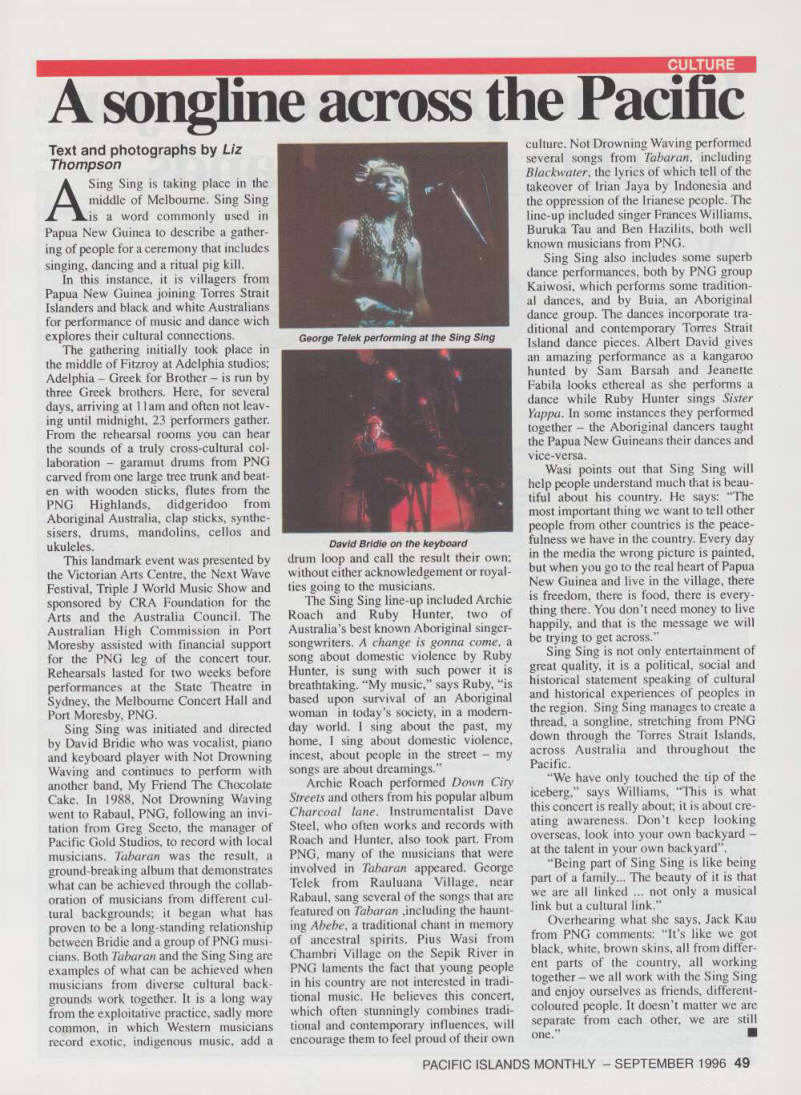
Text and photographs by Liz
Thompson
A Sing Sing is taking place in the middle of Melbourne. Sing Sing is a word commonly used in Papua New Guinea to describe a gather ing of people for a ceremony that includes singing, dancing and a ritual pig kill.
In this instance, it is villagers from Papua New Guinea joining Torres Strait Islanders and black and white Australians for performance of music and dance wich explores their cultural connections.
The gathering initially took place in the middle of Fitzroy at Adelphia studios; Adelphia - Greek for Brother - is run by three Greek brothers. Here, for several days, arriving at 1 lam and often not leav ing until midnight, 23 performers gather.
From the rehearsal rooms you can hear the sounds of a truly cross-cultural col laboration - garamut drums from PNG carved from one large tree trunk and beat en with wooden sticks, flutes from the PNG Highlands, didgeridoo from Aboriginal Australia, clap sticks, synthe sisers, drums, mandolins, cellos and ukuleles.
This landmark event was presented by the Victorian Arts Centre, the Next Wave Festival, Triple J World Music Show and sponsored by CRA Foundation for the Arts and the Australia Council. The Australian High Commission in Port Moresby assisted with financial support for the PNG leg of the concert tour.
Rehearsals lasted for two weeks before performances at the State Theatre in Sydney, the Melbourne Concert Hall and Port Moresby, PNG.
Sing Sing was initiated and directed by David Bridie who was vocalist, piano and keyboard player with Not Drowning Waving and continues to perform with another band. My Friend The Chocolate Cake. In 1988, Not Drowning Waving went to Rabaul, PNG, following an invi tation from Greg Seeto, the manager of Pacific Gold Studios, to record with local musicians. Tabaran was the result, a ground-breaking album that demonstrates what can be achieved through the collab oration of musicians from different cul tural backgrounds; it began what has proven to be a long-standing relationship between Bridie and a group of PNG musi cians. Both Tabaran and the Sing Sing are examples of what can be achieved when musicians from diverse cultural back grounds work together. It is a long way from the exploitative practice, sadly more common, in which Western musicians record exotic, indigenous music, add a
drum loop and call the result their own; without either acknowledgement or royal ties going to the musicians.
The Sing Sing line-up included Archie
Roach and Ruby Hunter, two of Australia’s best known Aboriginal singer songwriters. A change is gonna come, a song about domestic violence by Ruby Hunter, is sung with such power it is breathtaking. “My music,” says Ruby, “is based upon survival of an Aboriginal woman in today’s society, in a modern day world. I sing about the past, my home, I sing about domestic violence, incest, about people in the street - my songs are about dreamings.”
Archie Roach performed Down City Streets and others from his popular album Charcoal lane. Instrumentalist Dave Steel, who often works and records with Roach and Hunter, also took part. From PNG, many of the musicians that were involved in Taharan appeared. George Telek from Rauluana Village, near Rabaul, sang several of the songs that are featured on Taharan .including the haunt ing Abebe, a traditional chant in memory of ancestral spirits. Pius Wasi from Chambri Village on the Sepik River in PNG laments the fact that young people in his country are not interested in tradi tional music. He believes this concert, which often stunningly combines tradi tional and contemporary influences, will encourage them to feel proud of their own
culture. Not Drowning Waving performed several songs from Tabaran, including Blackwater, the lyrics of which tell of the takeover of Irian Jaya by Indonesia and the oppression of the Irianese people. The line-up included singer Frances Williams, Buruka Tau and Ben Hazilits, both well known musicians from PNG.
Sing Sing also includes some superb dance performances, both by PNG group Kaiwosi, which performs some tradition al dances, and by Buia, an Aboriginal dance group. The dances incorporate tra ditional and contemporary Torres Strait Island dance pieces. Albert David gives an amazing performance as a kangaroo hunted by Sam Barsah and Jeanette Fabila looks ethereal as she performs a dance while Ruby Hunter sings Sister Yappa. In some instances they performed together - the Aboriginal dancers taught the Papua New Guineans their dances and vice-versa.
Wasi points out that Sing Sing will help people understand much that is beau tiful about his country. He says: “The most important thing we want to tell other people from other countries is the peace fulness we have in the country. Every day in the media the wrong picture is painted, but when you go to the real heart of Papua New Guinea and live in the village, there is freedom, there is food, there is every thing there. You don’t need money to live happily, and that is the message we will be trying to get across.”
Sing Sing is not only entertainment of great quality, it is a political, social and historical statement speaking of cultural and historical experiences of peoples in the region. Sing Sing manages to create a thread, a songline, stretching from PNG down through the Torres Strait Islands, across Australia and throughout the Pacific.
“We have only touched the tip of the iceberg,” says Williams, “This is what this concert is really about; it is about cre ating awareness. Don’t keep looking overseas, look into your own backyard at the talent in your own backyard”.
“Being part of Sing Sing is like being part of a family... The beauty of it is that we are all linked ... not only a musical link but a cultural link.”
Overhearing what she says, Jack Kau from PNG comments; “It’s like we got black, white, brown skins, all from differ ent parts of the country, all working together - we all work with the Sing Sing and enjoy ourselves as friends, different coloured people. It doesn’t matter we are separate from each other, we are still one.” ■
George Telek performing at the Sing Sing
David Bridie on the keyboard
Internet promises major
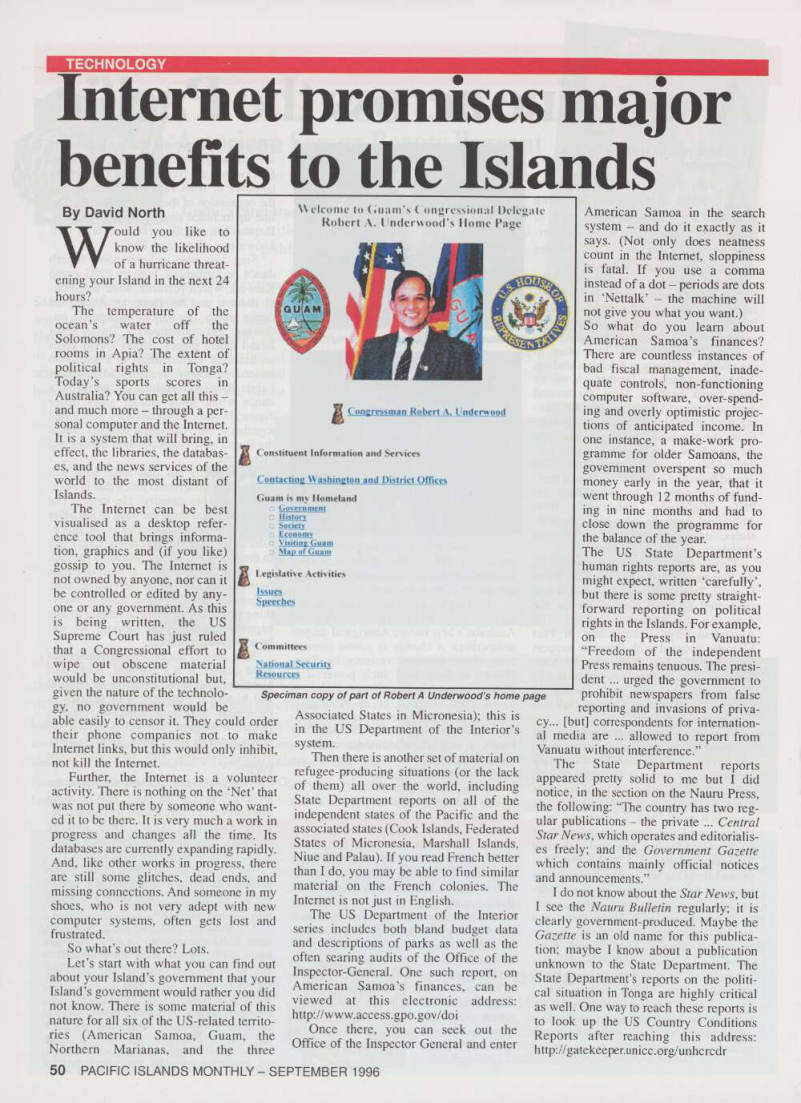
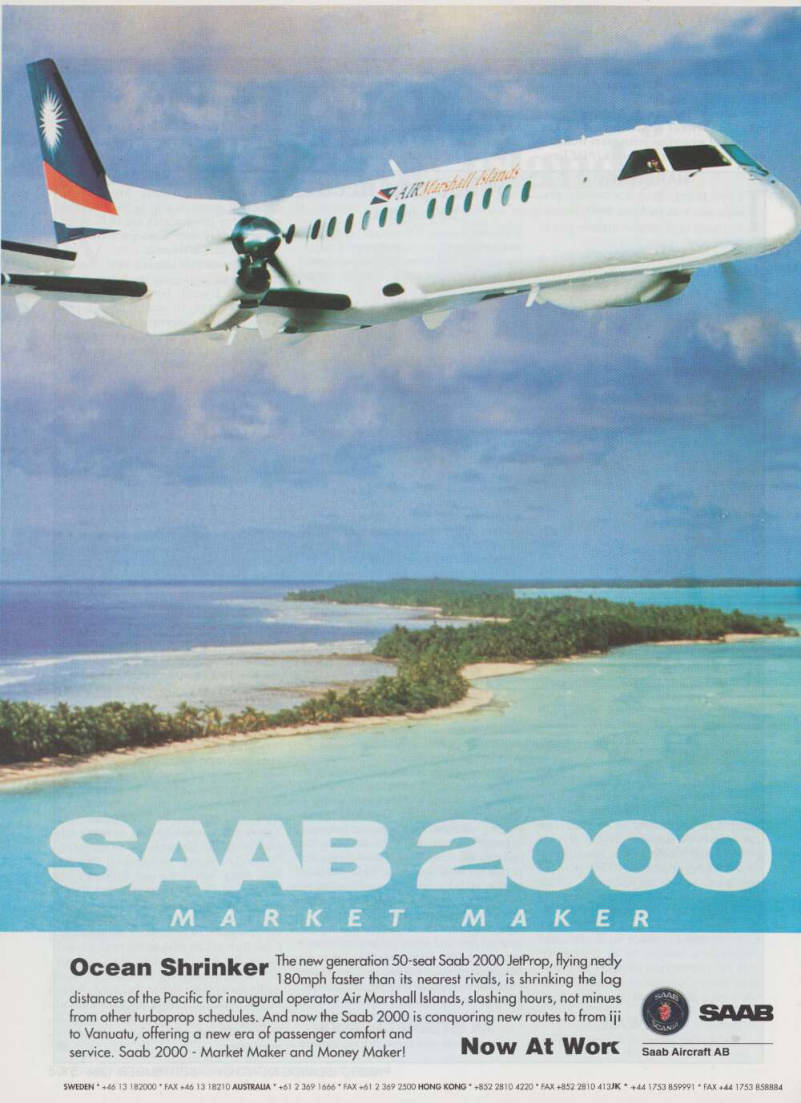
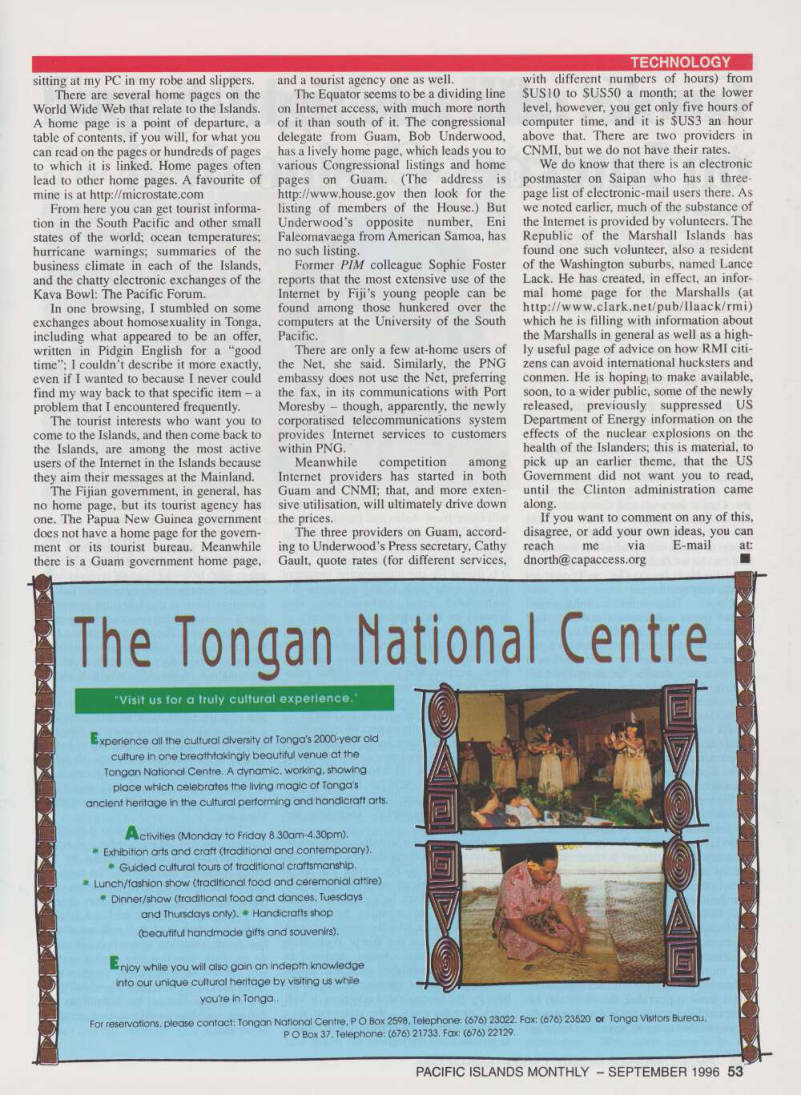
benefits to the Islands
By David North
Would you like to know the likelihood of a hurricane threat ening your Island in the next 24 hours?
The temperature of the ocean’s water off the Solomons? The cost of hotel rooms in Apia? The extent of political rights in Tonga?
Today’s sports scores in Australia? You can get all this and much more - through a per sonal computer and the Internet.
It is a system that will bring, in effect, the libraries, the databas es, and the news services of the world to the most distant of Islands.
The Internet can be best visualised as a desktop refer ence tool that brings informa tion, graphics and (if you like) gossip to you. The Internet is not owned by anyone, nor can it be controlled or edited by any one or any government. As this is being written, the US Supreme Court has just ruled that a Congressional effort to wipe out obscene material would be unconstitutional but, given the nature of the technolo gy, no government would be
able easily to censor it. They could order their phone companies not to make Internet links, but this would only inhibit, not kill the Internet.
Further, the Internet is a volunteer activity. There is nothing on the ‘Net’ that was not put there by someone who want ed it to be there. It is very much a work in progress and changes all the time. Its databases are currently expanding rapidly.
And, like other works in progress, there are still some glitches, dead ends, and missing connections. And someone in my shoes, who is not very adept with new computer systems, often gets lost and frustrated.
So what’s out there? Lots.
Let’s start with what you can find out about your Island’s government that your Island’s government would rather you did not know. There is some material of this nature for all six of the US-related territo ries (American Samoa, Guam, the Northern Marianas, and the three
Associated States in Micronesia); this is in the US Department of the Interior’s system.
Then there is another set of material on refugee-producing situations (or the lack of them) all over the world, including State Department reports on all of the independent states of the Pacific and the associated states (Cook Islands, Federated States of Micronesia, Marshall Islands, Niue and Palau). If you read French better than I do, you may be able to find similar material on the French colonies. The Internet is not just in English.
The US Department of the Interior series includes both bland budget data and descriptions of parks as well as the often searing audits of the Office of the Inspector-General. One such report, on American Samoa’s finances, can be viewed at this electronic address:
http://www.access.gpo.gov/doi
Once there, you can seek out the Office of the Inspector General and enter
American Samoa in the search system - and do it exactly as it says. (Not only does neatness count in the Internet, sloppiness is fatal. If you use a comma instead of a dot - periods are dots in ‘Nettalk’ - the machine will not give you what you want.) So what do you learn about American Samoa’s finances?
There are countless instances of bad fiscal management, inade quate controls, non-functioning computer software, over-spend
ing and overly optimistic projec
tions of anticipated income. In one instance, a make-work pro gramme for older Samoans, the government overspent so much money early in the year, that it went through 12 months of fund ing in nine months and had to close down the programme for the balance of the year.
The US State Department’s human rights reports are, as you
might expect, written ‘carefully’,
but there is some pretty straight
forward reporting on political
rights in the Islands. For example, on the Press in Vanuatu: “Freedom of the independent Press remains tenuous. The presi dent ... urged the government to prohibit newspapers from false reporting and invasions of priva
cy... [but] correspondents for internation al media are ... allowed to report from Vanuatu without interference.”
The State Department reports appeared pretty solid to me but I did notice, in the section on the Nauru Press, the following: “The country has two reg ular publications - the private ... Central Star News, which operates and editorialis es freely; and the Government Gazette which contains mainly official notices and announcements.”
I do not know about the Star News, but I see the Nauru Bulletin regularly; it is clearly government-produced. Maybe the Gazette is an old name for this publica tion; maybe I know about a publication unknown to the State Department. The State Department’s reports on the politi cal situation in Tonga are highly critical as well. One way to reach these reports is to look up the US Country Conditions Reports after reaching this address:
http://gatekeeper.unicc.org/unhcrcdr
Speciman copy of part of Robert A Underwood’s home page
In my own work for Pacific Islands Monthly, I have started using the Internet.
For example, I wanted to look at the writ ings of the Nobel prize winner who was accused of molesting youngsters from the islands, Dr. Daniel Gajdusek {PIM June,
P 32). Before I drove off to the National Library of Medicine some 15 miles away, I checked with the computerised file of holdings at the library and found dozens of his listings; then I drove there.
For the July issue, I wanted to read
pending Congressional legislation on America’s Palmyra Atoll, a proposed dump for atomic waste. I dialled a database at the US Capitol, found a search device, plugged in the name of the Island, and soon was reading the bill; all while
sitting at my PC in my robe and slippers.
There are several home pages on the World Wide Web that relate to the Islands.
A home page is a point of departure, a table of contents, if you will, for what you can read on the pages or hundreds of pages to which it is linked. Home pages often lead to other home pages. A favourite of mine is at http://microstate.com From here you can get tourist informa tion in the South Pacific and other small states of the world; ocean temperatures; hurricane warnings; summaries of the business climate in each of the Islands, and the chatty electronic exchanges of the Kava Bowl: The Pacific Forum.
In one browsing, I stumbled on some exchanges about homosexuality in Tonga, including what appeared to be an offer, written in Pidgin English for a “good time”; I couldn’t describe it more exactly, even if I wanted to because I never could find my way back to that specific item - a problem that I encountered frequently.
The tourist interests who want you to come to the Islands, and then come back to the Islands, are among the most active users of the Internet in the Islands because they aim their messages at the Mainland.
The Fijian government, in general, has no home page, but its tourist agency has one. The Papua New Guinea government does not have a home page for the govern ment or its tourist bureau. Meanwhile there is a Guam government home page,
and a tourist agency one as well.
The Equator seems to be a dividing line on Internet access, with much more north of it than south of it. The congressional delegate from Guam, Bob Underwood, has a lively home page, which leads you to various Congressional listings and home pages on Guam. (The address is http://www.house.gov then look for the listing of members of the House.) But Underwood’s opposite number, Eni Faleomavaega from American Samoa, has no such listing.
Former PIM colleague Sophie Foster reports that the most extensive use of the Internet by Fiji’s young people can be found among those hunkered over the computers at the University of the South Pacific.
There are only a few at-home users of the Net, she said. Similarly, the PNG embassy does not use the Net, preferring the fax, in its communications with Port
Moresby - though, apparently, the newly
corporatised telecommunications system provides Internet services to customers within PNG.
Meanwhile competition among Internet providers has started in both Guam and CNMI; that, and more exten sive utilisation, will ultimately drive down
the prices.
The three providers on Guam, accord ing to Underwood’s Press secretary, Cathy Gault, quote rates (for different services,
with different numbers of hours) from SUSIO to SUSSO a month; at the lower level, however, you get only five hours of computer time, and it is SUS 3 an hour above that. There are two providers in CNMI, but we do not have their rates.
We do know that there is an electronic postmaster on Saipan who has a three page list of electronic-mail users there. As we noted earlier, much of the substance of the Internet is provided by volunteers. The Republic of the Marshall Islands has found one such volunteer, also a resident of the Washington suburbs, named Lance Lack. He has created, in effect, an infor mal home page for the Marshalls (at
http://www.clark.net/pub/llaack/rmi)
which he is filling with information about the Marshalls in general as well as a high ly useful page of advice on how RMI citi zens can avoid international hucksters and conmen. He is hoping) to make available, soon, to a wider public, some of the newly
released, previously suppressed US
Department of Energy information on the effects of the nuclear explosions on the health of the Islanders; this is material, to pick up an earlier theme, that the US Government did not want you to read, until the Clinton administration came along.
If you want to comment on any of this, disagree, or add your own ideas, you can reach me via E-mail at: [email protected] ■
What you need
Hardware
If you already have a computer, per haps one with an Intel 80386 proces sor, don’t rush out and upgrade, just to go on the Net.
If, however, you’re about to buy a computer, buy one with the fastest pro cessor you can afford. You’ll also need plenty of random access memory, or RAM, which is where your computer keeps information that you’re currently using. Eight megabytes (a measure of memory) is probably minimum.
Windows or DOS? If you use a Macintosh computer, this isn’t a question you have to address. IBM and clone users, however, are faced with this issue.
Depending on your Internet provider, you may not have a choice. You may be required to use Windows (the graphic “operating environment” that sits on top of DOS, the operating system that runs IBM PCs and clones), or alternatively your provider may not give you the advantage of the wonderful graphics on the Net even if you do use windows.
Before you make any changes to your computing environment find out what your provider requires or can handle.
You’ll need a modem. The modem (contraction of modulator/demodulator, which describes what has to happen to computer signals to send them over phone wires) is attached to - or inside your computer and plugged into a normal telephone line. If the phone line nearest your computer already has a phone in it, you may be able to use a little gadget that plugs into the jack and allows you to place two phone plugs into it. While actively using the modem, you cannot receive or make phone calls. If you’re buying your first modem, again go for speed, but with one warning: Your modem can’t receive and transmit any faster than the modem at the other end can receive or transmit. If your service
provider can handle modem speeds only
up to 14.4 bps (that’s 14,400 bits per sec ond, a measure of the speed with which the modem handles computer-generated data), there’s no point in getting a modem that’s faster than that. All modems, how ever, can adjust to lower speeds. Because sometimes a modem is not compatible with the rest of your hardware and soft ware, be sure you can return one that does not work with your system.
Software
You’ll need communications software
By Ruth Blau
to run the modem. (“Software” is the gen eral term for instructions that tell comput ers what to do.) Some modems and most Internet packages come with the appro
priate software.
Internet Providers
Worldwide, there are many. Internet providers. The question becomes - who serves my Island? To find out, ask friends who have computers or check at a com puter store. Computer Science depart ments at a university or college may have some information, and your local phone book may provide some phone listings.
One type of service which has grown up in the US Mainland and may be avail able either now or in the near future in some Islands goes under the general name of “community freenets”. They are a very low-cost way of getting onto the Internet and are government and/or foun dation sponsored. But it may not be graphic and may have limited reach.
It is important to find a provider with a modem dialup that is a local phone call.
If, in addition to monthly fees and extra online time fees, you must pay long-dis tance telephone rates you will soon find yourself running up huge phone bills.
Whats On The Net
All Internet services provide you with electronic mail (E-mail). Using E-mail, you can exchange correspondence with anyone whose E-mail address you have.
You send a ‘letter’ and it arrives in the E mail box of the recipient within minutes at most - within seconds if all the con nections are smooth. Perhaps the second most desired aspect of the Net is access to the World Wide Web. The Web can be roughly defined as a graphic interface between the user and the mass of data out there in the Net world. Home pages are part of the Web. To use the Web, you need what is called a “web browser”, software that allows you to view home pages whose address you know or search by topic for other home pages. Among the best known and most widely used web browsers is the Netscape. This, or some other browser, may come packaged with your communications or online software provided by your Internet service.
An Internet Session
Let me walk you through a typical Net
session at my computer. I turn on the computer and the modem. My computer comes up automatically in DOS because most of my programmes are DOS based.
However, my Net connection requires Windows, so I activate it.
My service provider is a local comput er club, which gives me the Internet soft ware that I need, but it’s in bits and pieces. I have to use different pro grammes to do different things. The first task is to connect to the host computer.
For this, I use a dialling programme.
When I am connected, I ‘minimise’ (a Windows term meaning reduce the pro gramme while it’s still running back into its tiny icon form) the dialler and open Eudora, my E-mail programme. After I give my password, Eudora downloads all my mail to my computer. I can at that point disconnect from the host and read my mail. Generally, I stay connected because I have a generous allotment of online time each day (five hours per day included in my SUSI3-per-month fee).
Perhaps a correspondent has requested
a copy of a list I am currently maintaining for an Internet weavers and spinners group I participate in. I minimise Eudora and open the small word-processing pro gramme that comes with Windows. I copy the list to the clipboard, restore Eudora to a full window, and paste the list to an E-mail message. With a click of the “Send” button, it’s on its way to the per son who requested it.
When I have finished reading my mail, I want to do some research into an eye condition (macula degeneration) that
is rapidly pushing my 88-year-old father
into sightlessness. I close Eudora and open Netscape, where I select one of the search engines available, say Yahoo. (A “search engine” allows you specify to your web browser what to look for.) I type in “macula degeneration”, and Yahoo sets to work finding as many ref erences on the Net as it can to my topic.
When it’s through searching, it tells me how many ‘hits’ I got and displays a list of the first 10, in the order that it thinks are relevant to what I asked for. I can read the articles online, download them to my computer, or print them immediately.
I can then ask to look at the next 10, and so on. By this time, more than an hour will have passed and I am starting to feel guilty about other things that need doing.
I close Netscape, restore the dialler to full screen and tell it to log off the host. It hangs up the modem, and I go about my other tasks. ■
Advertisements & other items, pp. 52-53 (1 item)
.
m m x -ra S ’S«3 Amp*h QhrinlfPr The new g enera^on 50-seat Saab 2000 Jet Prop, flying necly 180 mph faster than its nearest rivals, is shrinking the log distances of the Pacific for inaugural operator Air Marshall Islands, slashing hours, not minuss from other turboprop schedules. And now the Saab 2000 is conquering new routes to from iji to Vanuatu, offering a new era of passenger comfort and service. Saab 2000 - Market Maker and Money Maker! NOW At WOITC Saab Aircraft AB SWEDEN * +46 13 182000 ' FAX+46 13 18210 AUSTRALIA * +6l 2 369 1666 * FAX+6I 2 369 2500 HONG KONG * +852 2810 4220 * FAX+BS2 2810 413JK * +44 1753 859991 * FAX+44 1753 858884
The Tongan national Centre
Visit us for a truly cultural experience. 1 ' Experience all the cultural diversity of Tonga's 2000-year old culture in one breathtakingly beautiful venue at the Tongan National Centre. A dynamic, working, showing place which celebrates the living magic of Tonga's ancient heritage in the cultural performing and handicraft arts.
Activities (Monday to Friday 8.30am-4.30pm). * Exhibition arts and craft (traditional and contemporary). * Guided cultural tours of traditional craftsmanship. * Lunch/fashion show (traditional food and ceremonial attire) * Dinner/show (traditional food and dances, Tuesdays and Thursdays only). * Handicrafts shop (beautiful handmade gifts and souvenirs).
Enjoy while you will also gain an indepth knowledge into our unique cultural heritage by visiting us while you're in Tonga..
For reservations, please contact: Tongan National Centre, P O Box 2598, Telephone: (676) 23022. Fax: (676) 23520 or Tonga Visitors Bureau, P O Box 37, Telephone; (676) 21733. Fax: (676) 22129. ■L
Cooks officials tight-lipped
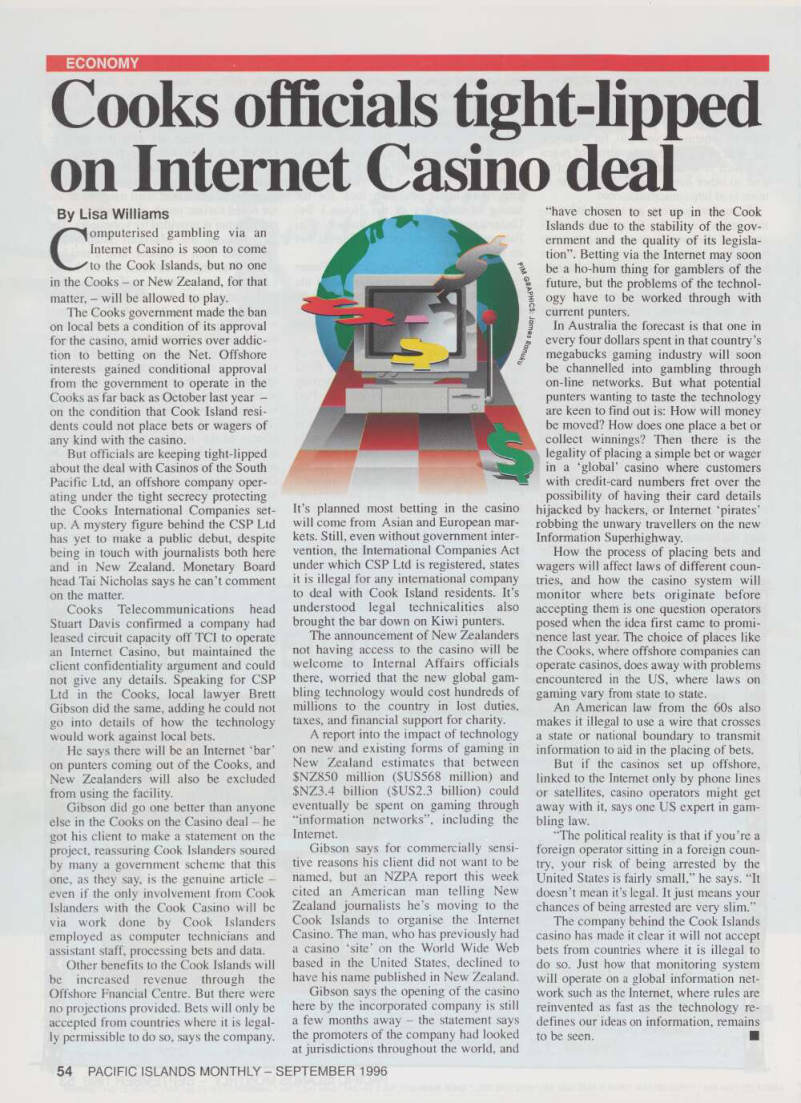
Economy
Cooks officials tight-lipped on Internet Casino deal
By Lisa Williams
Computerised gambling via an
Internet Casino is soon to come to the Cook Islands, but no one in the Cooks - or New Zealand, for that matter, - will be allowed to play.
The Cooks government made the ban on local bets a condition of its approval for the casino, amid worries over addic tion to betting on the Net. Offshore interests gained conditional approval from the government to operate in the Cooks as far back as October last year on the condition that Cook Island resi dents could not place bets or wagers of any kind with the casino.
But officials are keeping tight-lipped about the deal with Casinos of the South Pacific Ltd, an offshore company oper ating under the tight secrecy protecting the Cooks International Companies set up. A mystery figure behind the CSP Ltd has yet to make a public debut, despite being in touch with journalists both here and in New Zealand. Monetary Board head Tai Nicholas says he can’t comment on the matter.
Cooks Telecommunications head Stuart Davis confirmed a company had leased circuit capacity off TCI to operate an Internet Casino, but maintained the client confidentiality argument and could not give any details. Speaking for CSP Ltd in the Cooks, local lawyer Brett Gibson did the same, adding he could not go into details of how the technology would work against local bets.
He says there will be an Internet ‘bar’ on punters coming out of the Cooks, and New Zealanders will also be excluded from using the facility.
Gibson did go one better than anyone else in the Cooks on the Casino deal - he got his client to make a statement on the project, reassuring Cook Islanders soured by many a government scheme that this one, as they say, is the genuine article even if the only involvement from Cook Islanders with the Cook Casino will be via work done by Cook Islanders employed as computer technicians and assistant staff, processing bets and data.
Other benefits to the Cook Islands will be increased revenue through the Offshore Fnancial Centre. But there were no projections provided. Bets will only be accepted from countries where it is legal ly permissible to do so, says the company.
It’s planned most betting in the casino will come from Asian and European mar kets. Still, even without government inter vention, the International Companies Act under which CSP Ltd is registered, states it is illegal for any international company to deal with Cook Island residents. It’s understood legal technicalities also brought the bar down on Kiwi punters.
The announcement of New Zealanders not having access to the casino will be welcome to Internal Affairs officials there, worried that the new global gam bling technology would cost hundreds of millions to the country in lost duties, taxes, and financial support for charity.
A report into the impact of technology on new and existing forms of gaming in New Zealand estimates that between SNZBSO million (SUSS6B million) and SNZ3.4 billion (SUS 2.3 billion) could eventually be spent on gaming through “information networks”, including the Internet.
Gibson says for commercially sensi tive reasons his client did not want to be named, but an NZPA report this week cited an American man telling New Zealand journalists he’s moving to the Cook Islands to organise the Internet Casino. The man, who has previously had a casino ‘site’ on the World Wide Web based in the United States, declined to have his name published in New Zealand.
Gibson says the opening of the casino here by the incorporated company is still a few months away - the statement says the promoters of the company had looked at jurisdictions throughout the world, and
“have chosen to set up in the Cook Islands due to the stability of the gov ernment and the quality of its legisla tion”. Betting via the Internet may soon be a ho-hum thing for gamblers of the future, but the problems of the technol ogy have to be worked through with current punters.
In Australia the forecast is that one in every four dollars spent in that country’s megabucks gaming industry will soon be channelled into gambling through on-line networks. But what potential punters wanting to taste the technology are keen to find out is: How will money be moved? How does one place a bet or collect winnings? Then there is the legality of placing a simple bet or wager in a ‘global’ casino where customers with credit-card numbers fret over the possibility of having their card details
hijacked by hackers, or Internet ‘pirates’ robbing the unwary travellers on the new
Information Superhighway.
How the process of placing bets and wagers will affect laws of different coun tries, and how the casino system will monitor where bets originate before accepting them is one question operators posed when the idea first came to promi nence last year. The choice of places like the Cooks, where offshore companies can operate casinos, does away with problems encountered in the US, where laws on gaming vary from state to state.
An American law from the 60s also makes it illegal to use a wire that crosses a state or national boundary to transmit information to aid in the placing of bets.
But if the casinos set up offshore, linked to the Internet only by phone lines or satellites, casino operators might get away with it, says one US expert in gam
bling law.
“The political reality is that if you’re a foreign operator sitting in a foreign coun try, your risk of being arrested by the United States is fairly small,” he says. “It doesn’t mean it’s legal. It just means your chances of being arrested are very slim.”
The company behind the Cook Islands casino has made it clear it will not accept bets from countries where it is illegal to do so. Just how that monitoring system will operate on a global information net work such as the Internet, where rules are reinvented as fast as the technology re defines our ideas on information, remains to be seen. ■
Trying times for Manu Samoa
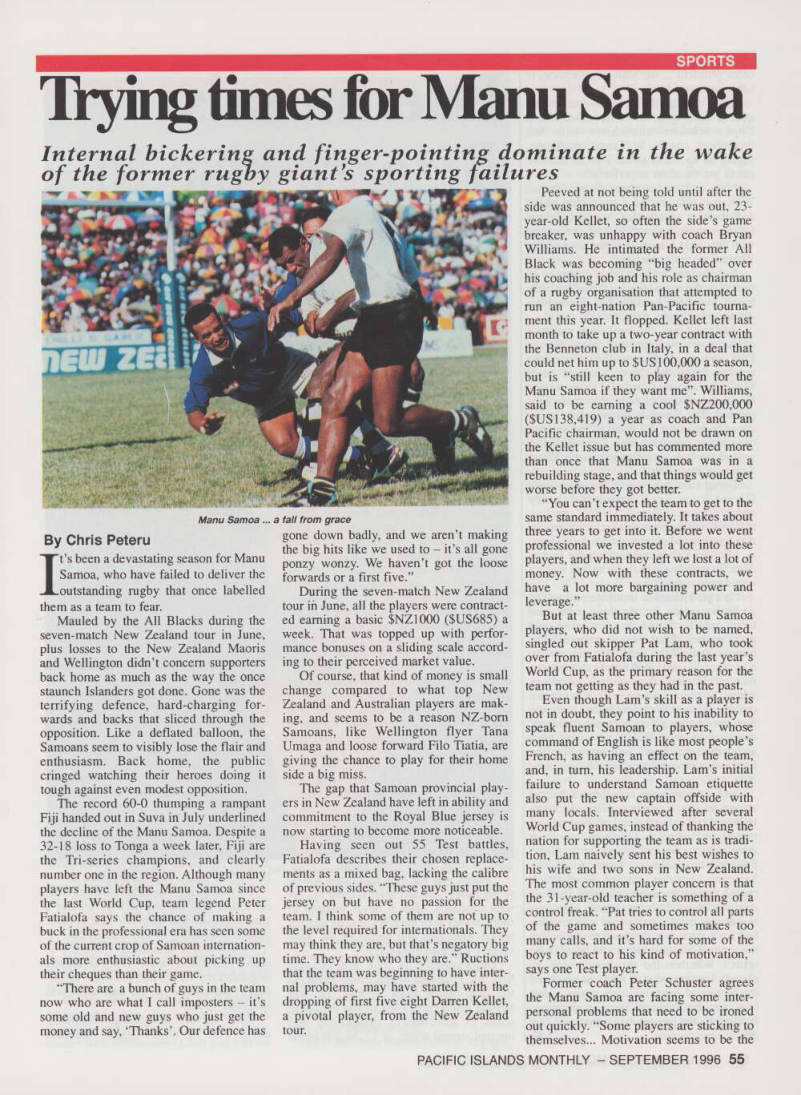
Internal bickering and finger-pointing dominate in the wake of the former rugby giant’s sporting failures
By Chris Peteru
It’s been a devastating season for Manu Samoa, who have failed to deliver the outstanding rugby that once labelled them as a team to fear.
Mauled by the All Blacks during the seven-match New Zealand tour in June, plus losses to the New Zealand Maoris and Wellington didn’t concern supporters back home as much as the way the once staunch Islanders got done. Gone was the
terrifying defence, hard-charging for
wards and backs that sliced through the opposition. Like a deflated balloon, the Samoans seem to visibly lose the flair and enthusiasm. Back home, the public cringed watching their heroes doing it
tough against even modest opposition.
The record 60-0 thumping a rampant Fiji handed out in Suva in July underlined the decline of the Manu Samoa. Despite a 32-18 loss to Tonga a week later, Fiji are the Tri-series champions, and clearly number one in the region. Although many players have left the Manu Samoa since the last World Cup, team legend Peter Fatialofa says the chance of making a buck in the professional era has seen some of the current crop of Samoan internation als more enthusiastic about picking up their cheques than their game.
“There are a bunch of guys in the team now who are what I call imposters - it’s some old and new guys who just get the money and say, ‘Thanks’. Our defence has
gone down badly, and we aren’t making the big hits like we used to - it’s all gone ponzy wonzy. We haven’t got the loose forwards or a first five.”
During the seven-match New Zealand tour in June, all the players were contract ed earning a basic SNZIOOO (SUS6BS) a week. That was topped up with perfor mance bonuses on a sliding scale accord ing to their perceived market value.
Of course, that kind of money is small change compared to what top New Zealand and Australian players are mak ing, and seems to be a reason NZ-bom Samoans, like Wellington flyer Tana Umaga and loose forward Filo Tiatia, are giving the chance to play for their home side a big miss.
The gap that Samoan provincial play ers in New Zealand have left in ability and commitment to the Royal Blue jersey is now starting to become more noticeable.
Having seen out 55 Test battles, Fatialofa describes their chosen replace ments as a mixed bag, lacking the calibre of previous sides. “These guys just put the jersey on but have no passion for the team. I think some of them are not up to the level required for internationals. They may think they are, but that’s negatory big time. They know who they are.” Ructions that the team was beginning to have inter nal problems, may have started with the dropping of first five eight Darren Kellet, a pivotal player, from the New Zealand tour.
Peeved at not being told until after the side was announced that he was out, 23year-old Kellet, so often the side’s game breaker, was unhappy with coach Bryan Williams. He intimated the former All Black was becoming “big headed” over his coaching job and his role as chairman of a rugby organisation that attempted to run an eight-nation Pan-Pacific tourna ment this year. It flopped. Kellet left last month to take up a two-year contract with the Benneton club in Italy, in a deal that could net him up to SUS 100,000 a season, but is “still keen to play again for the Manu Samoa if they want me”. Williams, said to be earning a cool SNZ2OO,OOO (SUS 138,419) a year as coach and Pan Pacific chairman, would not be drawn on the Kellet issue but has commented more than once that Manu Samoa was in a rebuilding stage, and that things would get worse before they got better.
“You can’t expect the team to get to the same standard immediately. It takes about three years to get into it. Before we went professional we invested a lot into these players, and when they left we lost a lot of money. Now with these contracts, we have a lot more bargaining power and leverage.”
But at least three other Manu Samoa players, who did not wish to be named, singled out skipper Pat Lam, who took over from Fatialofa during the last year’s World Cup, as the primary reason for the team not getting as they had in the past.
Even though Lam’s skill as a player is not in doubt, they point to his inability to speak fluent Samoan to players, whose command of English is like most people’s French, as having an effect on the team, and, in turn, his leadership. Lam’s initial failure to understand Samoan etiquette also put the new captain offside with many locals. Interviewed after several World Cup games, instead of thanking the nation for supporting the team as is tradi tion, Lam naively sent his best wishes to his wife and two sons in New Zealand.
The most common player concern is that the 31-year-old teacher is something of a control freak. “Pat tries to control all parts of the game and sometimes makes too many calls, and it’s hard for some of the boys to react to his kind of motivation,” says one Test player.
Former coach Peter Schuster agrees the Manu Samoa are facing some inter personal problems that need to be ironed out quickly. “Some players are sticking to themselves... Motivation seems to be the
Manu Samoa ... a fall from grace
other problem ... the team togetherness is not what it used to be.”
After taking the side to successive quarter-final spots at consecutive World Cups, Schuster empathises with the incumbent coach, Williams’, problems, saying he too “had to eat a lot of humble pie to get the team to perform”.
“It’s a fair comment from (Bryan Williams) that this is a rebuilding phase and there is plenty that has to be done before we can be confident of competing with Fiji next season, and the start of the
World Cup preliminaries.”
Despite the roller-coaster fortunes of the team, the main sponsor, New Zealand based merchant bankers Fay Richwhite, say they are happy with the side so far. ■ Andrew Gaze, the marketing manager of the team’s corporate arm, Manu Samoa Ltd, says that despite the indiferrent results from the New Zealand tour, Michael Fay was satisfied. “From a pub lic-relations point of view, they were very pleased. The Samoan side received more coverage than the All Blacks. The amount of positive publicity Fay Richwhite has gained through its association with Manu Samoa is incredible.”
Going into this year’s Tri-series with Fiji and Tonga, Fay Richwhite had already spent more than SNZI million ($U5692,000) on players’ salaries, equip ment, travel and accomodation, said Gaze.
Michael Fay is not looking for imme diate financial returns, he is seeing it as an investment, said Gaze.
“It’s pretty hard to motivate yourself to go for a roadrun, but the thing is they are being paid for it and they are being paid good money. They have a responsibility both on and off the field.” On top of that, a sponsorship deal with sports shoe manu facturer Reebok that started in March when Mizuno (shoes) and Canterbury (sports apparel) contracts ended, sees the Samoans being given a larger monetary contribution than Wales, who also play under the same brand, and more than the England team get from their boot sponsor Nike.
As Western Samoa concludes a demor alising season, a nearly confirmed tour to Italy and Ireland at the end of the year and more home games next season may have supporters again collapsing with three- Panadol headaches - more so if the Samoans continue playing heart-attack rugby, that is, moments of good football mixed with total chaos. A new logo fea turing a tattooed warrior icon with a rugby ball for a torso was designed to symbolise the tiny country’s strength and pride in its team. Whether the new generation of players has got what it takes to continue the legacy of hard, exciting rugby and a love for the game is the big question.
Judging by the present crisis, that could be a long time coming. ■
Bizarre rise to
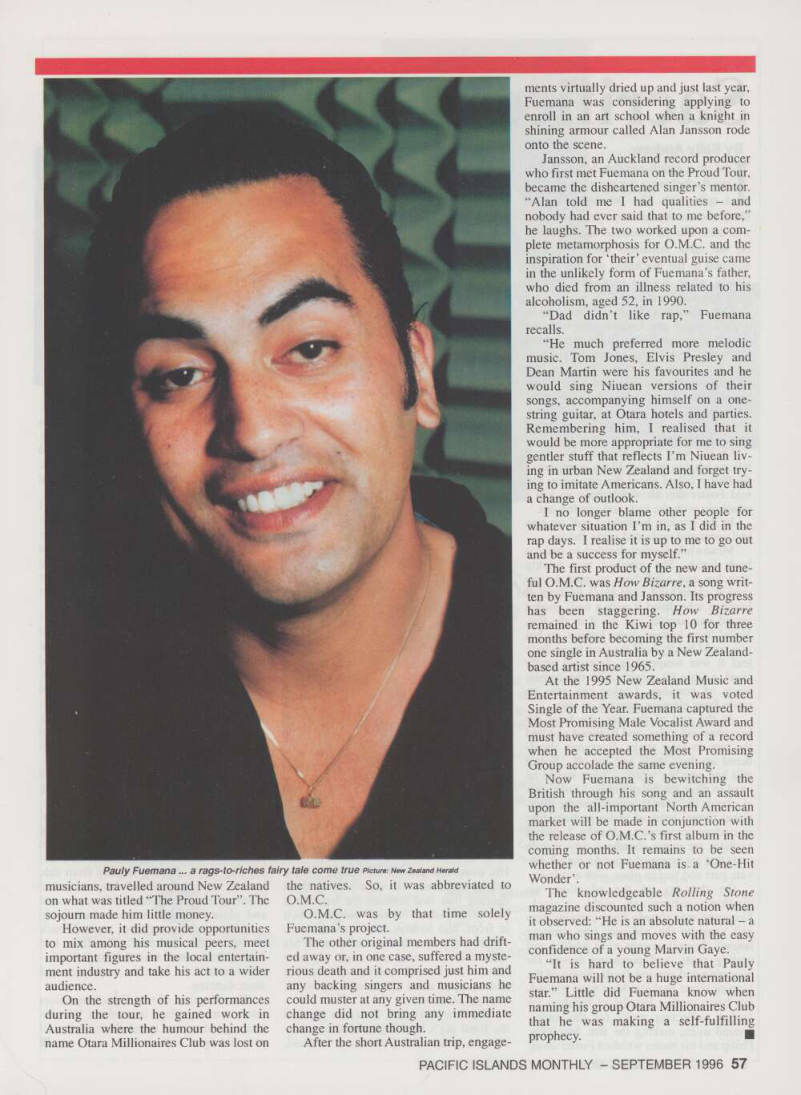
Fuemana’s Bizarre rise to fame and glory
By Atama Raganivatu
The South Pacific has produced a long stream of very talented pop singers, none of whom gained great fame beyond our region.
However, the long-awaited interna tional breakthrough may occur soon through the vocal talents of Pauly Fuemana.
The gifted singer has already topped
the charts in both New Zealand and Australia under the name of O.M.C.
through the exasperatingly hauting tune
How Bizarre. As Pacific Islands Monthly went to press, it was the eighth most pop ular song in Britain and there are legiti mate hopes for similar success in North America, where Australasia’s catchiest ditty is to be released later this year.
If Fuemana does become a celebrity throughout the pop world, he will be a rags-to-riches story of classical propor tions. He readily admits that most of his life has been unhappy and wasteful.
Bom in 1969, four years after his Niuean father, Takiula Tuapassi, had jumped a copra boat in Auckland and three months before his Maori mother ran off to Australia, Fuemana was raised by his grandmother until aged 11. He then joined Takiula’s dysfunctional family in the notoriously grim south Auckland sub urb of Otara.
Speaking only Niuean into his mid teens and suffering from a lisp, his schooldays were spent at the back of the class learning little.
Believing academic qualifications to be beyond him and having little interest in sport, Fuemana devoted many years to gangs, crime, drugs - and music.
“Music was the only legitimate activi ty my family had any involvement in,” he now concedes. “But it never brought in more money than burglary or drug dealing which were part and parcel of the gang scene I was then engaged in.”
Unfortunately, it took considerable time for Fuemana to recognise music as the best option open to him. He had already settled into a life of law breaking, stints in government institutions and unemployment when, at 17, he left home
voluntarily for the first time and moved to Australia.
Across the Tasman Sea, Fuemana con tinued his lifestyle until a chance meeting with a former gang member who owned a vehicle sales resulted in him becoming a reputable car salesmari.
Sadly, this taste of mainstream Australia lasted just two years before he fell back into the drug scene, lost his job and went back to Auckland.
Upon returning, Fuemana found that his elder brother, Phil, and sister, Christine, had formed a pop group enabling them to make both a name for themselves and an honest income.
Without any great enthusiasm, Fuemana assembled some other musi cians from within his neighbourhood and set up the Otara Millionaires Club. The title was a whimsical one - Otara has no millionaires. And they styled themselves upon Black American rap groups such as Public Enemy.
Fuemana and his friends tried to repro duce the anger of Los Angeles ghetto dwellers.
“We were sick of being called ‘dumb coconuts’,” he recollects.
“We continually asked why we were poor and seemingly trapped in Otara. We wanted to kick the establishment through our music.”
Otara Millionaires Club acquired a cult following around south Auckland but few devotees elsewhere. Their capacity for attracting gangs did not endear them to concert promoters.
In 1992, ‘The Millionaires’ were invit ed to just four ‘gigs’ and the last of these ended prematurely when the audience erupted into an all-out brawl which mem bers of the group became involved in.
At this stage, Fuemana concluded he no longer had the stomach to remain a gang associate and spent one year at Bible college attempting to sort himself out.
“I am not a practising Christian as such,” he reflects today. “But I succeeded in getting my values and priorities identi fied at the college, so the time there was invaluble to me.”
After leaving the college, Fuemana, along with 39 other south Auckland
musicians, travelled around New Zealand on what was titled “The Proud Tour”. The sojourn made him little money.
However, it did provide opportunities to mix among his musical peers, meet important figures in the local entertain ment industry and take his act to a wider audience.
On the strength of his performances during the tour, he gained work in Australia where the humour behind the name Otara Millionaires Club was lost on
the natives. So, it was abbreviated to
O.M.C.
O.M.C. was by that time solely Fuemana’s project.
The other original members had drift ed away or, in one case, suffered a myste rious death and it comprised just him and any backing singers and musicians he could muster at any given time. The name change did not bring any immediate change in fortune though.
After the short Australian trip, engage
ments virtually dried up and just last year, Fuemana was considering applying to enroll in an art school when a knight in shining armour called Alan Jansson rode onto the scene.
Jansson, an Auckland record producer who first met Fuemana on the Proud Tour, became the disheartened singer’s mentor.
“Alan told me I had qualities - and nobody had ever said that to me before,” he laughs. The two worked upon a com plete metamorphosis for O.M.C. and the inspiration for ‘their’ eventual guise came in the unlikely form of Fuemana’s father, who died from an illness related to his alcoholism, aged 52, in 1990.
“Dad didn’t like rap,” Fuemana recalls.
“He much preferred more melodic music. Tom Jones, Elvis Presley and Dean Martin were his favourites and he would sing Niuean versions of their songs, accompanying himself on a one string guitar, at Otara hotels and parties.
Remembering him, I realised that it would be more appropriate for me to sing gentler stuff that reflects I’m Niuean liv ing in urban New Zealand and forget try ing to imitate Americans. Also, I have had a change of outlook.
I no longer blame other people for whatever situation I’m in, as I did in the rap days. I realise it is up to me to go out and be a success for myself.”
The first product of the new and tune ful O.M.C. was How Bizarre, a song writ ten by Fuemana and Jansson. Its progress has been staggering. How Bizarre remained in the Kiwi top 10 for three months before becoming the first number one single in Australia by a New Zealand based artist since 1965.
At the 1995 New Zealand Music and Entertainment awards, it was voted Single of the Year. Fuemana captured the Most Promising Male Vocalist Award and must have created something of a record when he accepted the Most Promising Group accolade the same evening.
Now Fuemana is bewitching the British through his song and an assault upon the all-important North American market will be made in conjunction with the release of O.M.C.’s first album in the coming months. It remains to be seen whether or not Fuemana is. a ‘One-Hit Wonder’.
The knowledgeable Rolling Stone magazine discounted such a notion when it observed: “He is an absolute natural - a man who sings and moves with the easy confidence of a young Marvin Gaye.
“It is hard to believe that Pauly Fuemana will not be a huge international star.” Little did Fuemana know when naming his group Otara Millionaires Club that he was making a self-fulfilling prophecy. ■
Pauly Fuemana... a rags-to-riches fairy tale come true Picture: New Zealand Herald
Sacrifice of adoption
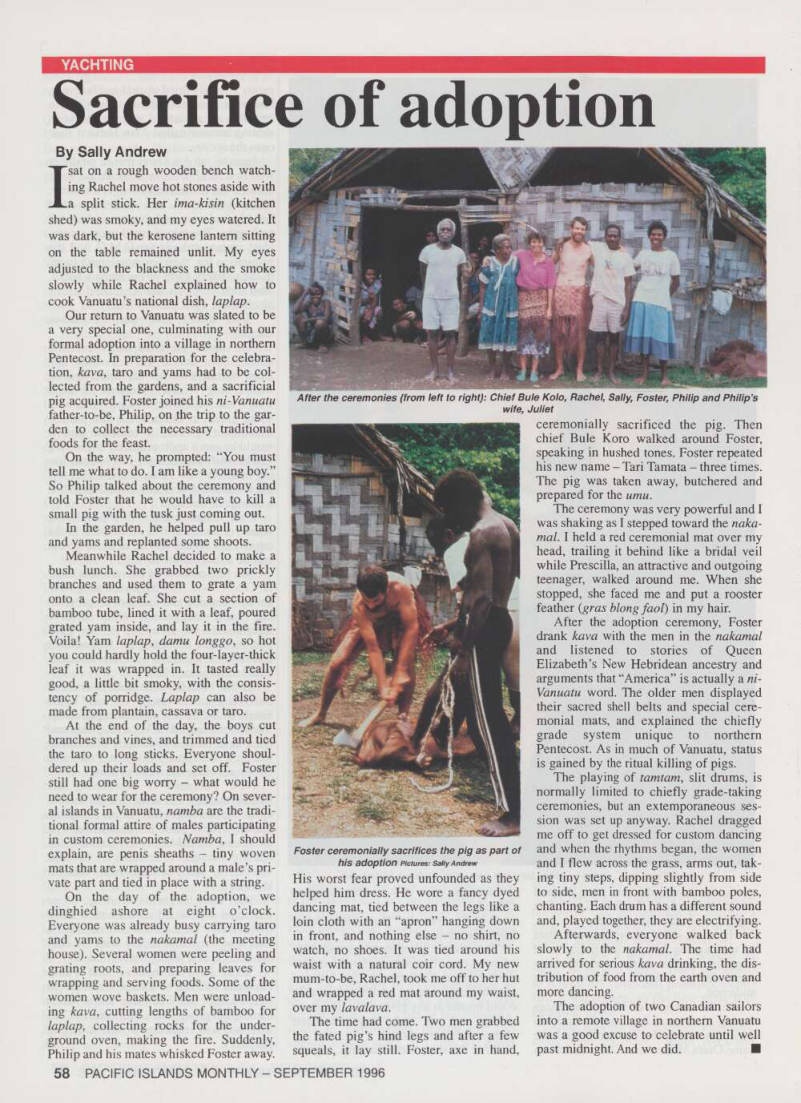
By Sally Andrew
I sat on a rough wooden bench watch ing Rachel move hot stones aside with a split stick. Her ima-kisin (kitchen shed) was smoky, and my eyes watered. It was dark, but the kerosene lantern sitting on the table remained unlit. My eyes adjusted to the blackness and the smoke slowly while Rachel explained how to cook Vanuatu’s national dish, laplap.
Our return to Vanuatu was slated to be a very special one, culminating with our formal adoption into a village in northern Pentecost. In preparation for the celebra tion, kava, taro and yams had to be col lected from the gardens, and a sacrificial pig acquired. Foster joined his ni-Vanuatu father-to-be, Philip, on the trip to the gar den to collect the necessary traditional foods for the feast.
On the way, he prompted; “You must tell me what to do. I am like a young boy.”
So Philip talked about the ceremony and told Foster that he would have to kill a small pig with the tusk just coming out.
In the garden, he helped pull up taro and yams and replanted some shoots.
Meanwhile Rachel decided to make a bush lunch. She grabbed two prickly branches and used them to grate a yam onto a clean leaf. She cut a section of bamboo tube, lined it with a leaf, poured grated yam inside, and lay it in the fire.
Voila! Yam laplap, damu longgo, so hot you could hardly hold the four-layer-thick leaf it was wrapped in. It tasted really good, a little bit smoky, with the consis tency of porridge. Laplap can also be made from plantain, cassava or taro.
At the end of the day, the boys cut branches and vines, and trimmed and tied the taro to long sticks. Everyone shoul dered up their loads and set off. Foster still had one big worry - what would he need to wear for the ceremony? On sever al islands in Vanuatu, namha are the tradi tional formal attire of males participating in custom ceremonies. Namba, I should explain, are penis sheaths - tiny woven mats that are wrapped around a male’s pri vate part and tied in place with a string.
On the day of the adoption, we dinghied ashore at eight o’clock.
Everyone was already busy carrying taro and yams to the nakamal (the meeting house). Several women were peeling and grating roots, and preparing leaves for wrapping and serving foods. Some of the women wove baskets. Men were unload ing kava, cutting lengths of bamboo for laplap, collecting rocks for the under ground oven, making the fire. Suddenly, Philip and his mates whisked Foster away.
His worst fear proved unfounded as they helped him dress. He wore a fancy dyed dancing mat, tied between the legs like a loin cloth with an “apron” hanging down in front, and nothing else - no shirt, no watch, no shoes. It was tied around his waist with a natural coir cord. My new mum-to-be, Rachel, took me off to her hut and wrapped a red mat around my waist, over my lavalava.
The time had come. Two men grabbed the fated pig’s hind legs and after a few squeals, it lay still. Foster, axe in hand,
ceremonially sacrificed the pig. Then chief Buie Koro walked around Foster, speaking in hushed tones. Foster repeated his new name - Tari Tamata - three times.
The pig was taken away, butchered and prepared for the umu.
The ceremony was very powerful and I was shaking as I stepped toward the naka mal. I held a red ceremonial mat over my head, trailing it behind like a bridal veil while Prescilla, an attractive and outgoing teenager, walked around me. When she stopped, she faced me and put a rooster feather ( gras blong faol ) in my hair.
After the adoption ceremony, Foster drank kava with the men in the nakamal and listened to stories of Queen Elizabeth’s New Hebridean ancestry and arguments that “America” is actually a ni- Vanuatu word. The older men displayed their sacred shell belts and special cere monial mats, and explained the chiefly grade system unique to northern Pentecost. As in much of Vanuatu, status is gained by the ritual killing of pigs.
The playing of tamtam, slit drums, is
normally limited to chiefly grade-taking
ceremonies, but an extemporaneous ses sion was set up anyway. Rachel dragged me off to get dressed for custom dancing and when the rhythms began, the women and I flew across the grass, arms out, tak ing tiny steps, dipping slightly from side to side, men in front with bamboo poles, chanting. Each drum has a different sound and, played together, they are electrifying.
Afterwards, everyone walked back slowly to the nakamal. The time had arrived for serious kava drinking, the dis tribution of food from the earth oven and more dancing.
The adoption of two Canadian sailors into a remote village in northern Vanuatu was a good excuse to celebrate until well past midnight. And we did. ■
After the ceremonies (from left to right): Chief Buie Kolo, Rachel, Sally, Foster, Philip and Philip’s wife, Juliet
Foster ceremonially sacrifices the pig as part of his adoption Pictures: Sally Andrew
Advertisements & other items, pp. 59-60 (1 item)
What Would You Like Them To Say About You
c He knew Grand Pacific would look after
his family
His bills are covered ' - m If M m Ir ///5 children will get a good education
She trusted someone local,
Grand Pacific Life
She put her family first
What Would You Like Them To Say About You
After You’re Gone?
Ordinarily, it takes a lifetime to accumulate a fortune. Not with life insurance.
Life insurance is the only sure way to build a legacy - one that will instantly perpetuate your good name as a provider and sustain your family’s financial security.
Let us help you choose a plan that meets your goals. © Grand Pacific Life Insurance, Ltd.
A member of the Finance Factors Family American Samoa Mark Solofa Pacific Insurance & Finance, Inc.
Mark Solofa, GA Phone: 684-699-5796 Western Samoa Mark Solofa Pacific Insurance & Finance, Inc.
Mark Solofa, GA Phone: 685-24059 Chuuk State.
Federated States of Micronesia Pacific Basin Insurance & General Services, Inc.
Kachutosy Paulus, GA Phone: 691-330-2606 Guam Great National Insurance Underwriters, Inc.
Domie Bumagat Jr., GA Phone: 671-646-5736 Pacific Financial Corporation Eduardo Camacho, GA Phone: 671-646-1990 Takagi & Associates Pamela Cruz, GA Phone: 671-475-4373 Marshall Islands Marshalls Insurance Agency Jerry Kramer, GA Phone: 692-625-3366 Saipan Pacific Basin Insurance Underwriters, Inc.
Mary Ann Milne, GA Phone; 670-234-7861 Pacific Insurance Underwriters, Inc.
Norman Tenorio, GA Phone: 670-234-6267 Tonga Peseti Ma‘afu Insurance & Finance, Ltd.
Peseti Ma'afu, GA Phone: 676-24-777
THE NEW
PAc
PRIVILEG
r €
The Uncompromised Family Sedan
THE RLL NEW
MITSUBISHI
LRNCE
Meet the car that was born to succeed. With progressive engineering and striking appearance, the all-new Mitsubishi Lancer advances effectively, impressively... moving ahead at every turn.
Get behind the wheel and experience the new standard in family sedans.
A' V Ip) V- A its :v G AMERICAN SAMOA: PACIFIC MARKETING INC. P.O. Box 698, Pago Pago, Tel. 699-9140 / AUSTRALIA; MITSUBISHI MOTORS AUSTRALIA LTD. 1284 South Road Clovelly Park South Australia 5042 Tel. (08) 2757297 / FUI: NIVIS MOTOR & MACHINERY CO. LTD. G.P.O. Box 150, Suva, Tel. 383411 / GUAM: TRIPLE J ENTERPRISES INC. P.O. Box 6066, Tamuning, Tel. 6469126/NEW CALEDONIA: SOCIETE DTMPORTATION D'AUTD DU RACIFipUE SUD S.A. P.O. Box 2548, Noumea, Tel. 281-787 / NEW ZEALAND: MITSUBISHI MOTORS NEW ZEALAND LTD. Private Bag. Porirua Tel 237-0109 / NORFOLK ISLAND: BORRY'S PFY LTD. P.O. Box 169, Taylors Road, Burnt, Tel. 22114/PAPUA NEW GUINEA; TDBA MOTORS PTY LTD. P.O. Box 503, Port Moresby/ SAIPAN: SAIPAN AUTOWORLD INC. P.O.
Box 487, Tel. 234-7133/SOLOMON ISLANDS; HARVEST PACIFIC LTD. G.P.O. Box 823, Honiara, Tel. 30407/TAHITI: SOPADEP S.A. B.P. 1617, Papeete, Tel. 427393/TONGA; SITANI MAPI CO LTD P.O. Box 83, Nuku'AloTa, Tel. 24044 / VANUATU: SOCOMETRA VANUATU LTD. B.P. 8 Port-Vila, Tel. 2314/WESTERN SAMOA; MOTOR DISTRIBUTORS (SAMOA) LTD. P.O. Box 576, Apia, Tel. 20957 A
MITSUBISHI
MOTORS
CREATING TOGETHER