Advertisements & other items, pp. 1-3 (2 items)
ui : &U ilA=££LeLi
PACIFIC
ISLANDS
MONTHLY
•NAURU'S ECONOMIC REFORMS
•PACIFIC'S OLYMPICS HOPES
rb
ui : &U ilA=££LeLi An endangered institution in the region
■ll—lllll .
American Samoa USS2.SO: Australia A 53.50; Cook Islands N2S3; Fiji F 52.50 Vat mcl; FS Micronesia US$3; Kiribati A 52.50; Nauru A 52.50; Niue NZ$3; Norfolk As 3; New Caledonia cpf2so: New Zealand NZ53.45 incl GST: Northern Marianas USS 3; Papua New Guinea K 3: Palau US$3; Marshall Islands US$3; Solomon Islands ASS; French Polynesia cpf3oo; Tonga P 3; USA USS 3; Vanuatu VT22O; Western Samoa T 3.25, These are recommended prices only.
Cover: JAMES RANUKU
free POST
business reply POST
pQSj.
B£Pi £ ussn|§§
BUSINESS REPLY POST
w £osr EASY WAYS to encourage customers to respond to your mailing! which Service to select For business paid self-a your cust reply POST, you are to supply reply ddressed envelope or card to enable mer to respond easily.
For free Post, you are not required to supply any pre-printed response device. Customers simply use their own envelopes and quote your free Post number.
BENEFITS
m Pay postage for only the customers who respond. ■ No minimum quantity required. This means any business large or small can take advantage of business reply POST and FEE Post.
WSm Jk Faster replies and orders.
N Improved cash flows by encouraging faster payments. Flexible payment options by cash, cheque or credits.
For more information contact our sales executive at Postal Marketing Department at Post Fiji on phone: 302022/307596, fax: 306088.
Pacific
Islands
Monthly
Vol. 66 No. 8
The News Magazine
August 1996
PUBLISHER: Alan Robinson EDITOR: Manivannan Naidu SENIOR WRITER: Bernadette Hussein
Correspondents:
David North, Sam Vulum lan Williams, Liz Thompson, Atama Raganivatu, Sally Andrew, Patrick Decloitre, Chris Peteru COLUMNISTS: David Barber (Wellington), Jemima Garrett (Sydney), Alfred Sasako (The Forum).
GRAPHIC ARTIST: James Ranuku
Advertising Sales
Senior Regional Sales (South Pacific) Salendra Narayan Te1(679) 304111, 303429, Fax(679) 303809.
Sydney, Canberra: Bob Hill Media Representation, Tel (61-2) 4164245, Fax (61-2)4165064.
Brisbane: Jane Fewings Media and Advertising Associates Tel (61-7) 3378 4522, Fax (61-7) 3878 1071.
Adelaide: Hastwell Williamsons Representatives, Tel (61-8) 3799522, Fax (61-8) 3799735.
Melbourne: Brown Orr Fletcher Burrows (Aust) Pty Ltd.
Tel (61-3) 98265188, Fax (61-3) 98265644.
Auckland: McKay & Bowman, International Media Representatives Limited, Tel (64-9) 4190561, Fax (64-9) 4192243.
Japan: Universal Media Corporation, Tokyo, Tel (3) 3266626741, Cable: UNI-MEDIA Tokyo, Fax (3) 32626742.
Pacific Islands Monthly was founded in 1930
(Usps 9522480).
A Fiji Times Limited production.
Cover prices are recommended retail only. Registered by Australia Post, Publication No. NBPI2IO. © Copyright Fiji Times Limited, 177 Victoria Parade, Suva, Fiji.
Tel (679) 304111, fax (679) 303809.
Pacific Islands Monthly is published monthly by Fiji Times Limited, a division of Nationwide News, 2 Holt Street, Surry Hills, Sydney, NSW 2010.
Send Address Changes To:
Pacific Islands Monthly PO Box 1167 Suva, Fiji.
Typeset and printed by The Fiji Times Limited, 177 Victoria Parade, Suva, Fiji.
Inside
COVER: Freedom of expression is perceived to be under growing threat with South Pacific Island govern ments calling for responsible journalism, cultural sen sitivity and stability of the nation. Our reports look at recent events in the region and government justifica tions for them.
6: Letters 12: Cohens - free at last 24: A lesson for the Pacific 26: Nauru attacks its fiscal problems 27: Cooks Transition hits home 29: Pacific nearly loses out at Habitat II 32: France singled out at seminar 33: Leaders tackle
employment issues
54: Book review -
Stael Blong
Vanuatu 55: Protecting our wetlands
Sports
46: Atlanta Olympics 50: Where to now for
Pacific rugby?
52: Gatecrashers prove a point
Yachting
57: The land of Ta-Har
Special Report
Vanuatu’s multi-million dollar bank “scam”
Ombudswoman calls for dis ciplinary action against the prime minister, finance minis ter and governor of the Reserve Bank
Views
7: Jemima Garrett; The most neglected tragedy of our time 8: Alfred Sasako: The search for ACR ED ties after 2000 10: Debbie Singh: An exercise in transparency 11: David Barber: Tokelau to stand alone
Features
35: Focus on Solomon Islands 40: Focus on Tonga
Advertisements & other items, p. 4 (1 item)
Local Knowledge.
1.
' i ac m •J swipss rn ! : 4 r? irK: pwasari
EVER UNDERESTIMATE THE VALUE OF
LOCAL KNOWLEDGE.
PUA NEW GUINEA BANKING CORPORATION
THE NATION'S LEADING COMMERCIAL BANK
Head Office; Comer Douglas & Musgrove Streets, Port Moresby. PO Box 78 Port Moresby, NCD, Papua New Guinea. Telephone (675) 321 1999 Facsimile (675) 321 1954
A cultural myth
Editorial
Much is made of cultural sensitiv ity and the need to respect local traditions in the Pacific, a region so often referred to as Paradise for its white sandy beaches, clear blue waters and tropical sunshine.
However, for culture’s sake, let us stretch the analogy a little further and consider our leaders as God and the peo ple as the first human beings in the Garden of Eden, Adam and Eve. For being the devil’s advocates that they are, let us cast the region’s media organisa tions as Satan.
God, in his omnipotence, has banned Adam and Eve from partaking of fruit from the Tree of Knowledge, for reasons of cultural sensitivity, national stability and protection from nation-destroying
negativism.
Satan, on the other hand, has full use of his capacity for thought and question ing and is determined to prove to Adam and Eve that ignorance is not bliss.
God, therefore, looks on Satan as a subversive element with no regard or respect for the culture and traditions of the Garden of Eden.
Ratu Jo Nacola, Fiji’s new information minister, can appropriately be cast as the
messenger of God, the Archangel Gabriel. However, he has done the unex pected and admitted that God uses the excuse of “cultural sensitivity” to skirt issues sensitive to Him.
What is it that makes our God so sen sitive to criticism, making Him stamp His feet and threaten censorship and exile from Eden (or deportation, as the case may be) each time the public seeks accountability and answers? It is fair that
governments promote responsible jour
nalism and expect accurate reporting of events. But it is not fair to expect journal ists to stop asking questions and demand
ing answers.
Our leaders seem to have forgotten that their purpose is to serve their coun tries and their people.
As the Archangel has prophesied, the next millenium will be an era of commu nications and information.
So, let’s hope God comes to His sens es and leads this Paradise into the next century as an adult, responsible for and aware of the consequences of His actions, and not as a spoilt, tantrum-throwing child.
And as for cultural sensitivity, well, most of our cultures are as borrowed as the above legend. ■
PIM writers win awards
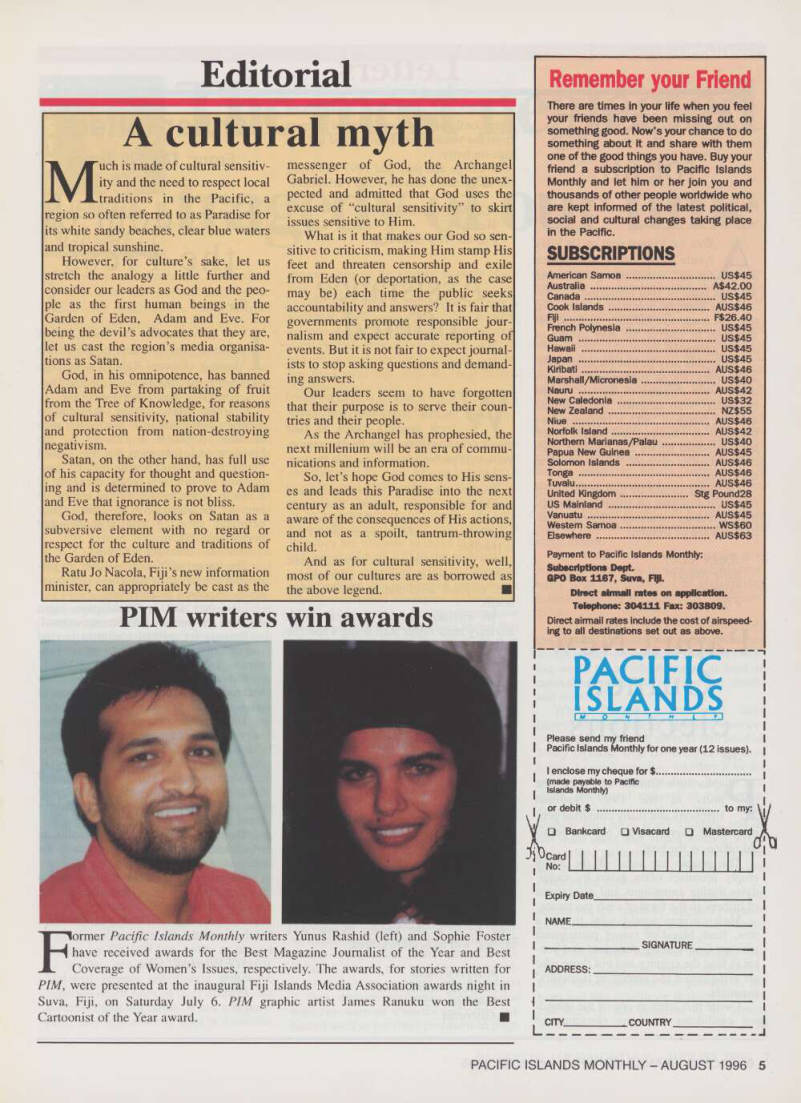
Former Pacific Islands Monthly writers Yunus Rashid (left) and Sophie Foster have received awards for the Best Magazine Journalist of the Year and Best Coverage of Women’s Issues, respectively. The awards, for stories written for PIM, were presented at the inaugural Fiji Islands Media Association awards night in Suva, Fiji, on Saturday July 6. PIM graphic artist James Ranuku won the Best Cartoonist of the Year award. ■
Advertisements & other items, p. 5 (1 item)
Pacific
Remember your Friend
There are times in your life when you feel your friends have been missing out on something good. Now’s your chance to do something about it and share with them one of the good things you have. Buy your friend a subscription to Pacific Islands Monthly and let him or her join you and thousands of other people worldwide who are kept informed of the latest political, social and cultural changes taking place in the Pacific.
SUBSCRIPTIONS
American Samoa US$45 Australia A 542.00 Canada US$45 Cook Islands AUSS46 Fiji F 526.40 French Polynesia US$45 Guam US$45 Hawaii US$45 Japan US$45 Kiribati AUSS46 Marshall/Micronesia US$4O Nauru AUSS42 New Caledonia US$32 New Zealand NZ$55 Niue AUSS46 Norfolk Island AUSS42 Northern Marianas/Palau US$4O Papua New Guinea AUSS4S Solomon Islands AUSS46 Tonga AUSS46 Tuvalu AUSS46 United Kingdom Stg Pound2B US Mainland US$45 Vanuatu AUSS4S Western Samoa WS$6O Elsewhere AUSS63 Payment to Pacific Islands Monthly: Subscriptions Dept.
GPO Box 1167, Suva, FIJI.
Direct airmail rates on application.
Telephone: 304111 Fax: 303809.
Direct airmail rates include the cost of airspeeding to all destinations set out as above.
PACIFIC
ISLANDS
IMONT H L r 1
Please send my friend Pacific Islands Monthly for one year (12 issues).
I enclose my cheque for $ (made payable to Pacific Islands Monthly) or debit $ to my: □ Bankcard □ Visacard □ Mastercard 'Card No: Expiry Date.
NAME
ADDRESS:
. SIGNATURE.
CITY_
.COUNTRY.
-J
And justice
Letters
And justice for all
Sir Allow me to comment on Dr Vijay Naidu’s letter titled “And justice for all”, which was published in the June issue of your magazine.
In his letter, he points to the failure of political leaders in fulfilling their leader ship role as one of the root causes of crime (paragraph 5).
While this may be true for some polit ical parties, whose leaders are remnants of the rogue elements of the 1987 coups or leaders who deserted their people after the coups of 1987, it certainly does not apply to other political parties which have provided strong and decisive lead ership in times of need. They continue to do so today.
Dr Naidu should try and get his facts right as it will give his letter the credibil ity that it deserves and to justify his posi tion as a senior lecturer.
John Sami
Rifle Range Lautoka Fiji
Papua New
Guinea elections
Sir
Papua New Guinea will go to the polls in the 1997 National Elections and many colourful peo ple will be contesting the highest politi cal office on the land.
The people are tired of the many
empty promises often given by candi
dates during campaigns and allegations
of bribery in the form of cash payments.
Most citizens would want to see a new, fresh blood of young participants who are God-fearing, dedicated and hon est to lead the country and not those who are self-centred and greedy on taxpayers’ expenses.
I write this letter as one of the intend ing candidates from my electorate of
Yangoru-Saussia in the East Sepik, PNG.
I am confident and have a lot of support from the youth, church group and the vil lage majority.
We hope and pray that 1997 will bring the best leaders into the PNG Parliament.
John Kriosaki
Wewak Papua New Guinea
Assistance
offered
Sir
We are a retired couple prepared to offer assistance with short term projects (three to four months) in countries in the Pacific region.
We would prefer this to be outside the hur ricane season.
We are financially self-sufficient and would require no salary. Assistance towards air fares and in finding suitable accomodation would be appreciated if this
is possible.
We have experience in several Pacific cultures as tourists, but have attempted to live at local level not at Western-style hotels.
We envisage helping projects on an advisory basis rather than doing a specific job. We would like to pass on our experi ence and expertise to local people where this would be useful both during and after our involvement.
Our previous careers equipped us with
the following qualifications:
Husband (aged 73) - welfare adminis tration and personnel management; good at general handyman work and a hobby
gardener.
Wife (aged 54) - primary teaching;
librarianship (has set up two libraries on computer systems); since retirement has
gained qualification in Teaching English
as a Second Language.
We are active members of our local church, and can furnish both personal and professional references. Any government, organisation or community that is interest ed in contacting us in regard to our offer may do so at the address below. All
replies will be acknowledged.
Margery Nash
12 Hazelwood Road Boronia 3155 Australia
Freedom of
Other letters From: The Fiji Times Freedom of the Press
Sir
It is commendable that both dailies published the full text of the Prime Minister (Sitiveni Rabuka’s) keynote address for the World Press Freedom Day.
Let’s take a look at what was said.
Granted that certain information deserves protection from disclosure, such as state secrets, if it was not for the Freedom of Information Act, the United States government would still be sup pressing the full facts behind the (John F) Kennedy assassination, atomic testing on humans, the after-effects of Agent Orange defoliant spraying and myriad other
unpalatable secrets.
Who was breaking the rules?
The format of “Question Time” in par liament appears stilted and not extempora neous responses to the issues.
Like they say in Washington, “spin doctors” are specialists in damage control.
Respect for cultural traditions is vital and sets Fiji apart from many other coun tries.
But to cite governments such as
Malaysia and Singapore as paradigms of
progressive societies is questionable.
The operative concept there is confor mity to a homogeneous state image.
Corporal punishment and capital sentenc
ing are bulwarks to the statue quo.
What has emerged as the real mirror of the people’s view is right here in this sec tion of the newspaper, not the ministry Press release.
Thank God for the Fiji Constitution which endows individual freedoms on the citizens of Fiji.
We are cognizant of the reasonable restraints on exercising those liberties for, as once stated by a US Supreme Court Justice, your right to swing your fist stops at the tip of the other person’s nose.
Steve Hallcy.
Suva Fiji
tragedy of our time
Opinion
The most neglected tragedy of our time
Each year in the Pacific, hundreds of women die in childbirth. Unlike other health killers, this one takes women in their prime - in their teens, 20s and 30s.
The tragedy for the family concerned is immense, especially for children who will have to grow up without a mother and for the woman’s husband who will have to shoulder the burden of parenthood alone.
For the woman concerned, death, whether it be from haemorrhage, infection, obstructed labour or other causes, is often an excruciating and drawn-out affair.
Many of these deaths are preventable yet there has been little public debate on this terrible toll or on measures that could be taken to reduce it.
The United Nations Children’s Fund (UNICEF) is hoping to be the catalyst which changes that. It has made maternal mortality the focus of its 1996 edition of its Progress of Nations report. New esti mates produced by UNICEF show that worldwide, 600,000 women die each year giving birth, almost 20 per cent more than
previously thought.
More sobering is the fact that for every woman who dies, approximately 30 more “incur injuries, infections and disabilities which are usually untreated and unspoken of, and which are often humiliating and
painful, debilitating and lifelong”.
According to UNICEF, the toll of injury and disability from pregnancy related causes is “arguably the most neglected health problem in the world”.
The Pacific makes its contribution to these figures. Papua New Guinea has by far the highest maternal death rate. There, 930 women die for every 100,000 live births - the third-highest rate in the entire Asia-Pacific region, exceeded only in Nepal and Bhutan.
In other Island nations, the death rate is also too high. In Solomon Islands, official figures put the maternal death rate at 549 deaths per 100,000 live births or around 77 women per year. Vanuatu, Kiribati, Marshall Islands and Tuvalu also have maternal death rates of over 100 per one hundred thousand births. When one com pares that with a rate of nine in Australia,
the enormity of the tragedy is more obvi ous.
The only area in the region in which maternal death rates come close to what women might expect from their govern ments is Polynesia. Cook Islands, with its hitherto generously funded health system, has the lowest rate with 46. Next comes Western Samoa with 50.
Fiji has 68 and Tonga between 70 and 80 per 100,000 births. Behind these fig ures are complex causes.
According to UNICEF, the facts that women are having many children close together, that they are having babies both younger and older, that in some areas women are forced - whether by necessity or by unsympathetic husbands - to work hard right up until they go into labour and that they are not able to make it to a clin ic soon enough all add to the problem.
In many countries with fast-growing urban centres, the number of pregnancies among unmarried teenagers is booming.
Married or otherwise, young women have always had babies but statistics reveal that when they do so before the age of 20, they double their chances of dying in child birth.
In Melanesia, malaria is a particular danger to pregnant women.
It reduces a woman’s haemoglobin, causing anaemia which weakens her abil ity to withstand or recover from haemor
rhages.
In other places, the increasingly poor diet of junk food, tinned fish and rice is also contributing to the number of women
who develop pregnancy-related diabetes
and hypertension.
Despite these myriad of causes, there is one predictor above all others which gives a good idea of a woman’s risk of maternal death, and that is access to a clinic with trained staff during pregnancy, at the time of birth and afterwards.
Many of the problems which kill can be minimised if women go for check-ups during pregnancy. For malaria, for instance, women can be given prophylax is while they are pregnant and iron tablets if they develop anaemia. Simple urine tests can warn of diabetes and other risk factors such as previous problems in preg
nancy or an unusual presentation of the baby can be assessed and the woman referred to a better equipped health centre
before problems develop.
At the time of birth, a clinic (or even well-trained traditional birth attendants or low-level health workers) can offer antibi otics, which drastically reduce the risk of infection, and administer drugs which reduce another big killer - haemorrhage.
Five percent of all women having babies will require Caesarean birth - the only area in which measures to reduce maternal mortality will cost the health budget relatively dearly, particularly if transport is required from remote areas.
Still, the benefits in terms of better sur vival and fewer disabilities for children as well as mothers has got to compensate to some extent.
One of the most fruitful areas for gov ernments seeking to reduce maternal mor tality is in the provision of high-quality family planning services to all who need them.
According to UNICEF, “meeting only the existing demand for family planning would reduce pregnancies in the develop ing world by a fifth, bringing at least an equivalent reduction in maternal deaths
and injuries”.
While Pacific governments have improved their family planning services over the past decade, more is still needed.
Many of those who currently do no have access to contraception, whether it be for reasons of remoteness from health ser vices, traditional cultural or embarrass ment, are those most at risk - older women who have many children and do not want more and young women would
gain added protection against the increas
ing incidence of sexually transmitted dis eases in the region.
Better access to family planning will .reduce the toll taken by repeated pregnan cies close together and reduce the number of dangerous illegal abortions.
Dealing with maternal mortality will
require breaking the silence surrounding
many taboo subjects but perhaps it has been just this reluctance in the past which has allowed this problem to go almost unremarked. ■
Australia
Jemina
Garrett
ACP-EU ties after

The search for ACP-EU ties after Year 2000
Welcome to Apia, Western
Samoa, the host for the six
monthly meeting of the
Council of Ministers from 70 African, Caribbean and Pacific (ACP) states and the joint sessions of the ACP-European Union Council of Ministers.
A member of the South Pacific Forum, Western Samoa is only the second of the eight ACP Pacific states that has hosted the event since the ACP-EU marriage was sealed in a convention signed at Lome, the capital of the African nation of Togo in 1975. Fiji was the first in the region to host the meeting.
The Apia meeting was particularly sig
nificant. It put in train a process which, one day, will give birth to a new ACP-EU relationship. It is an important relation
ship.
There is little doubt this relationship will continue beyond the Year 2000 when all financial arrangements under the Lome Convention terminate.
But important as it may seem, every one at the Apia meeting had acknowl edged that the ACP-EU arrangements under Lome is a relationship in transition.
The European Union has made it clear that while there is still a need to maintain ties with the ACP member states, any new arrangement will not necessary take the form of Lome. So what can the Pacific
expect?
At this stage, no one really knows.
Indeed, that is the crux of the question being hotly debated in the three world regions - Africa, the Caribbean and the Pacific.
Important as it is, whatever form this new relationship takes will, no doubt, be dictated by globalised economic events over which ACP countries have very little control.
For us in the Pacific, the work has begun. The, South Pacific Forum Secretariat is developing a series of policy papers to help the eight Pacific states of the ACP Group in their search for a frame work for this new relationship.
The eight - Fiji. Kiribati. Papua New Guinea, Solomon Islands, Tonga, Tuvalu, Vanuatu and Western Samoa - are also
members of the South Pacific Forum.
The Secretariat’s Economic Development Division will produce the five policy papers. These will cover a number of areas such as: • The impact of Lome Assistance on the budget of the Individual Pacific ACP states; • an analysis of the conse quences of declining trade preferences in both the tree crop and the tuna-canning sector; • the effect of the Lome Commodity Protocols; and • an analysis of the impact of possible changes to the Stabcx regime and alternative aid modalities.
These arc being put together in the hope that it will give the EU a clear over view of the economic importance Pacific members of the ACP Group attach to their
EU relationship.
Senior ministers from Fiji, Kiribati.
Papua New Guinea, Solomon Islands, Tonga, Tuvalu, Vanuatu and Western Samoa who attended the Apia meeting had expressed deep concern that any decision to terminate Lome without a successor would adversely affect the region eco
nomically.
“It is important to raise public aware ness within the region as to the devastat ing impact, economically, if a broad-based
successor to Lome is not agreed on,” according to the record of their special
meeting in Apia.
“Given the importance of this issue, the 27th South Pacific Forum to be held in the Marshall Islands should also be made aware of developments...”
In the crusade to find a successor to Lome, the ministers have thrown their support behind a decision made in Mauritius last year that an ACP Leaders Summit be held next year to discuss a new relationship between the 15 member states of the European Union and the 70 African, Caribbean and Pacific states.
The Apia meeting has endorsed an offer by the African country of Gabon to host the summit cither in August or September next year.
The idea is that since the ACP-EU rela tionship is so crucial, the ACP countries want to continue it along the Lome line.
Hence, the proposed ACP Leaders Summit to discuss it at the highest politi cal level.
For its part, the European Union will release in October a Green Paper, which is expected to outline its position on ACP
EU post-Lome relationships.
What is the Lome Convention?
Lome is the capital of the African nation of Togo. In 1975 a convention was signed there - hence the Lome
The Forum
Alfred
Sasako
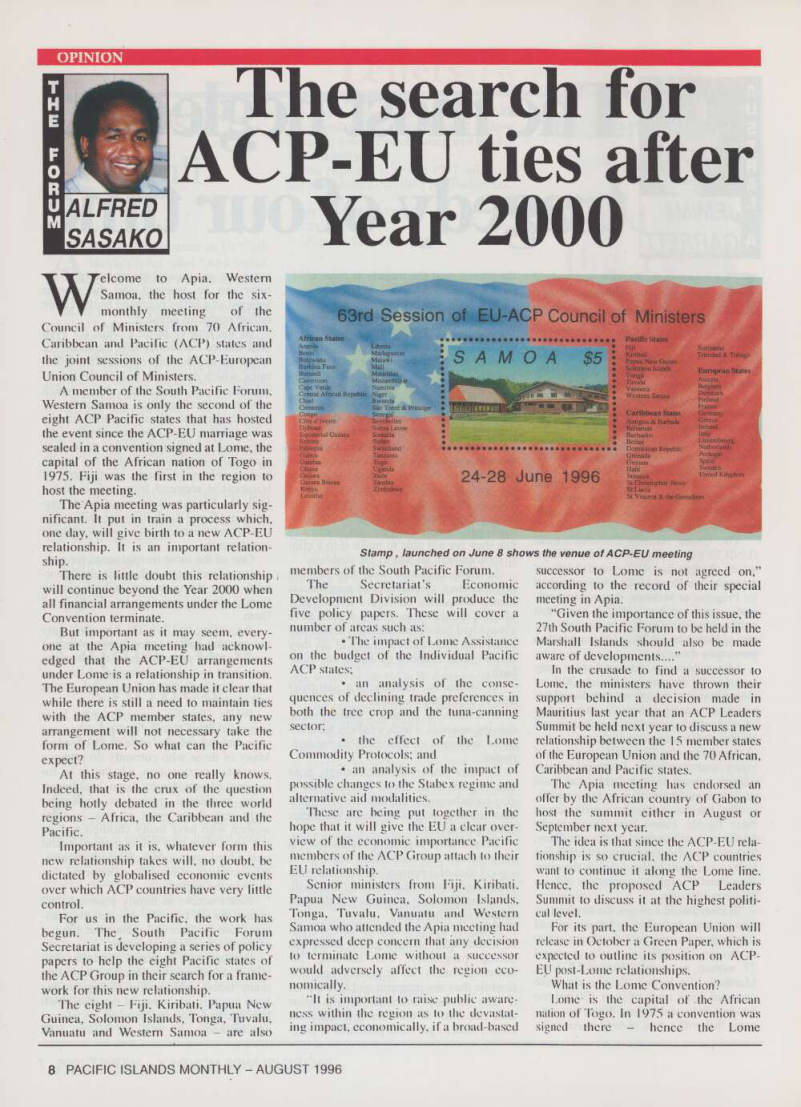
Stamp, launched on June 8 shows the venue of ACP-EU meeting
Convention - which guides the develop ment relationships between the ACP and the European Union.
In the 21 years since, the 70 ACP coun tries have benefited enormously from the substantial financial assistance provided under Lome. With a population of 500 million people and growing, the ACP countries are concerned that any decision to terminate Lome without a successor will deal a heavy blow to their economies.
Speaker after speaker in the joint ACP Council of Ministers meeting had acknowledged that ACP members must now face the new economic realities of
today.
“We live in an increasing globalised economy where reciprocity is the order of the day. It is the nature of that (new) rela tionship that we must identify,” one Caribbean official said.
Others said there was a need for the ACP to remain as a group.
“We should seek a mechanism for the solidarity of the ACP Group to ensure the efficient implementation of EU-funded programmes,” one other speaker said.
Still others have argued that the col lapse of the export commodity prices which account for up to 90 per cent of some ACP members’ overall export earn ings have worked against them. This has resulted in a combined SUS2O-billion debt for the ACP group. Some coyntries now
spend SUSIO billion a year in interest repayment alone. They argue that such debt, caused by events beyond their con trol, should be written off.
The ACP group lauded reports that the World Bank and the International Monetary Fund (IMF) have hatched a SUS7.7-billion debt-alleviation plan for the world’s poorest nations.
“The plan is in respect of an amount between SUSS.6 billion and SUS 7.7 bil lion. Among the beneficiaries of this debt alleviation plan are 17 countries which are members of the ACP group,” the co-pres ident of the ACP Council of Ministers, S K Syamujaye, said.
But other speakers are less convinced.
They argue that the challenge facing the ACP group is to create an internal climate conducive to attracting foreign invest ment.
“We cannot talk about trade expansion and industrialisation without foreign investment. I think how we attract foreign investment is the challenge that we must address,” a Pacific official concurred.
What do Pacific ACP members get out of the Lome arrangement?
The short answer is that we have bene fited substantially, both financially and in kind, over the past 20 or so years.
For instance, the eight Pacific ACP states receive up to four per cent of total EU funding to ACP countries.
Statistically, it is the highest per capita aid allocation in the world.
Under the second financial protocols of Lome IV - the funding arrangement which takes us to 2000 - the eight Pacific ACP States can expect up to SFI7O mil lion (SUSII9) over the next five years.
This is part of a SF2S-billion (SUS 17.5-billion) funding package to be made available to the ACP countries under the second financial Protocols of Lome IV.
For ACP members, the unexpected delay in ratifying the instrument has been
frustrating.
It means that these much-needed funds will not be released until such time as two thirds or 48 of the 70 ACP members have done so.
Solomon Islands is the only Pacific ACP country that his ratified along with six other ACP members while Denmark is the only member of the 15-strong European Union that has ratified the instrument.
The joint ACP-EU Council of Ministers is scheduled to meet again in Luxembourg in November.
This will certainly discuss the EU posi tio, as outlined in their Green Paper, regarding the future of the ACP-EU selec tion beyond the present Lome Convention which comes to an end five years from now. ■
Advertisements & other items, p. 9 (1 item)
Second Hand Containers
WHERE AND WHEN YOU WANT THEM IN THE PACIFIC If you need a flexible and safe storage space we have the ideal solution for you. Our second hand containers provide instant secure storage. Guaranteed to be wind and waterproof these containers are ideal for both temporary and longterm storage in Pacific conditions.
We can deliver to any island in the Pacific within a month and our rates have got to be the lowest you will find. All you need to do is tell us how many you want.
CONTACT:
PASCALE MARCONNET, BP 4757 NOUMEA, NEW CALEDONIA. TEL (687) 28 7450. FAX: (687) 26 3248
transparency
An exercise in transparency
The South Pacific Commission
(SPC) is undergoing a major exer
cise in what could best be termed “an exercise in transparency”, designed to ensure accountability, particularly in the face of tough competition for the region’s dwindling financial and other resources.
The commission first accepted donor funding to expand its fisheries programme in the 19705. It soon became hooked on the idea of enhancing its services to the Islands through competition for some of the bounteous extra-budgetary project funding floating around during the 1980 s.
But transition from the conservative use of guaranteed membership funds was not easy. Coupled with this, there was also
competition for extra-budgetary funds:
The changing nature of donor priorities; the discipline of accountability; and prob lems in negotiations with donors to con tend with.
Over the years, a lack of communica tion and financial accountability among many organisation has had aid donors per plexed and, in some instances, has shown the SPC to be an organisation which believed donors should simply give it money and then have the sensitivity not to be too pushy.
All this came to a head in the 1990 s when exasperated donors confronted a protective SPC - but to no avail.
This prompted Australia and New Zealand to field candidates for the job of secretary-general last year - the first time metropolitan countries had done so in 25 years.
The gesture demonstrated their com mitment to the long-term future of the organisation and signalled the need for operational change. And change, it seems, has since become the operative word of the commission’s new management team.
Variations have been made in the organi sation’s management style following the
appointment of new secretary-general
(Australia’s Dr Bob Dun) and his two deputies (Solomon Islands’ Dr Jimmie Rodgers and Guam’s Lourdes
Pangelinian).
This executive team has taken on a
more personal approach to running the commission and operational changes are
definitely having an impact.
With fierce competition for extra-bud getary funds from metropolitan states and a rapidly decreasing core budget, the SPC is diligently trying to make the best use of its current funds while watching various mouseholes for the proverbial “pot of gold”.
Dr Dun, in keeping with his initial pri
ority towards enhancing SPC’s reputation
with donors, made initial contacts with the big five in the Pacific - Australia, New Zealand, the European Union, the United
Nations Development Programme and
France.
Valuable contacts with the United Kingdom, who recently withdrew its membership of the commission, the United States and Japan have also been made.
“If we fix the problem of a lack of financial reporting, donor confidence will bounce back. We can’t serve the Islands well if the donors don’t trust us with their money ... more of their money,” Dr Dun says.
The US Congress, in a recent resolu tion, emphasised the importance of con tinued US membership in regional South Pacific organisations. While the resolu tion in itself lacks the force of law, it is a way for Congress to express its views on foreign policy and domestic issues and, if nothing else, makes for encouraging read
ing.
The resolution notes the need to con tinue to support efforts of regional coun tries in their quest for sustainable devel opment and recognises the role and finan cial contribution of the US to assist the SPC in achieving the gradual self-suffi ciency of its member countries.
And in keeping with the ideology of operational changes and cost-paring, the commission has begun various cutbacks
in executive expenditure, including
restricting travel to essential commit ments and the abolishment of travelling teams.
Electricity costs have been nearly halved with the SPC headquarters in
Noumea no longer being lit up like a bat
tleship at night.
Dr Dun insists, however, that these
savings are “just peanuts” and emphasises
the need for a major lift in efficiency in light of over-committed administrative and service costs.
The commission is also undergoing a major review, conducted by an indepen dent three-member team led by Savenaca Siwatibau of ESCAP’s Pacific Operations Centre.
The review team’s recommendations are currently being drawn up and will be tabled at the SPC’s conference in Saipan in October following consultation with member countries and territories.
So far, the team’s initial findings are encouraging and point to substantial cost
saving through restructuring of the com
mission’s present top-heavy framework.
The team was scheduled to meet in Suva in mid-July. But, following a study of the commission’s Noumea headquar ters, the team suggested a re-examination of the relationship between the conference and the SPC executive team with the lat ter adopting a stronger managerial-style role and the former maintaining its policy control.
The team also felt the secretary-gener al should be held responsible for all actions and decisions affecting the com mission. It stated that, as chief executive, he be judged on the organisation’s perfor mance and, if found wanting, dismissed.
While it is still early days to discuss programmes, it seems certain the review team will recommend a special pro gramme for the region’s small Island states.
And on the eve of this grand old lady’s 50th anniversary of .existence, Dr Dun sums it up when he says: “We’re in the game of co-operation and service in the Pacific ... and we’re going to be here for the next 50 better and brighter years.” ■ Debbie Singh, former editor of Pacific Islands Monthly, is the Information Officer with the South Pacific Commission’s Pacific Women’s Resource Bureau
The Spc
Debbie
Singh
stand alone
Tokelau to stand alone
Slowly and quietly, one of the Pacific’s most remote peoples are preparing to take their place in the world community of nations.
For at least 1000 years, they have lived on three tiny atolls, nearly 500 kilometres from their nearest neighbour, largely unaf fected by events in the outside world.
Today, in the colourful language of an Act recently passed by the New Zealand parliament, Tokelau has expressed a wish “to paddle its canoe to the greatest extent
possible”.
The three dispersed atoll communities have agreed, in the words of the Act, “to come together and become stronger, on the basis of their shared language and cul ture, as one family and nation”.
This means Tokelau, legally a part of New Zealand for the past 70 years, is now firmly embarked on a course that will remove it from the United Nations’ list of 17 remaining non-self-goveming territo ries. There is no pressure from New Zealand to shed its last colonial responsi bility. And the Tokelauans have come to their decision perhaps reluctantly and only after considerable thought.
They told three UN missions which visited in the 10 years up to 1986 they were quite happy with the status quo. But two years ago, they advised the fourth mission that they now felt ready to assume more self-reliance.
They confirmed that an act of self determination and a constitution were “under active consideration”.
Their strong preference, they said, was for internal self-government in free asso ciation with New Zealand - the same sta tus Niue and Cook Islands have.
Since then. New Zealand and Tokelau have worked to bring this about. It has not been easy.
Even by Pacific standards, Tokelau is tiny and remote.
Its 1600 people live in three autonomous villages on islets within atolls separated by vast expanses of sea.
No atoll is more than 200 metres wide or higher than five metres above sea level.
Each has a distinctive tradition and the
challenge is to create a form of central government to administer services, such as health, education, communications, that the individual villages cannot manage - not to mention handling external aid funds for development projects and rev enues from Tokelau’s 200-mile exclusive economic zone.
The problem is that while Tokelau is a cultural entity, with a shared language and customs, it has never been a political one.
Each village council (elderly male-domi nated) has been all powerful - the nearest translation for “law” in the Tokelauan lan guage, for instance, is “custom of the elders”.
This meant, as former New Zealand Prime Minister David Lange told parlia ment, that when he visited Tokelau the maximum penalty for murder was a fine
Of Snz2Oo (Susi 36).
The challenge then is to produce a political system suitable for modem times and capable of dealing with the outside world while still honouring local customs and traditions.
It is not made easier by the fact that Tokelau has been one of the world’s least governed colonies so it has no experience of modem systems of government to adapt.
Since Britain transferred control to New Zealand in 1926, it has been gov erned from Wellington at arm’s length no New Zealand administrator has ever lived there, for instance.
With no pattern of colonial administra tion or institutions to follow, the examples of transition to self-government used in the other former New Zealand colonies - Western Samoa, Cook Islands and Niue cannot be followed.
For Tokelau, a home-grown solution, in harmony with local culture and tradi tions, has to be found.
At the same time, it must be a system acceptable to the United Nations to ensure international recognition of the fledgling nation.
A start was made in the 1960 s when the Tokelau public service was established to deliver enhanced education, health and other services and the General Fono began
working as a national policy-making
body.
The public service, initially based in Apia, was subsequently brought home and in 1994, the New Zealand administrator’s executive powers were delegated to the General Fono and the Council of Faipule (equivalent of a cabinet) when the Fono is
not sitting.
The three Faipule, the elected leaders of each atoll, also assumed the functions of ministers of a national government.
They rotate leadership as Ulu-O- Tokelau, effectively taking the capital or base of government with them - a system that acknowledges equality of the atolls.
The Tokelau Amendment Bill now passed by the New Zealand parliament gives the General Fono power, for the first time, to pass laws - the essential right of a
self-governing nation.
The next stage, at a still unspecified date, will be a referendum to choose the new nation’s political status, or most like ly to confirm self-government in free association with New Zealand.
Although Tokelau has resisted the temptation of air links and the tourists they would bring, it is not exactly starting from scratch in its relations with the rest of the world.
About 5000 Tokelauans live in New Zealand and one estimate says up to 90 per cent of those who remain at home have been overseas.
A SNZ3-million (SUS2.OS-million) satellite telecommunications system is being put in place to link the atolls and international services.
What the future holds for the Pacific’s newest independent Island state remains to be seen.
But it is, as Lange told parliament: “A wonderful country ... a remarkable place, and its people are quite formidable... It is a country that will develop its own ratio nale”. And as far as the Tokelauans are concerned, they are looking forward to the future.
They welcomed the move to give them independence, in the words of the Bill, “as a fresh breeze to fill the sails of Tokelau’s canoe...” ■
Wellington
David
Barber
Cohens - free at last
Focus
But what does the future hold for New Zealand’s mother and son who made world headlines when convicted on drug charges in Malaysia?
Will release from prison be able to give them a true taste of freedom?
By Atama Raganivatu
Asad and sordid episode ended on June 29 when New Zealanders Lorraine and Aaron Cohen were released from a Malaysian prison, 11 years after being convicted on drugs
charges.
The story really began in 1960 and the time Lorraine gained a liking for heroin.
By 1966, her intake had become so high that when she gave birth to Aaron that year he was addicted.
For the next 19 years, heroin ruled the Cohens’ lives or, to be more precise, the pursuit of sufficient money to enable them
to indulge in their habit did. Between 1960 and 1982, Lorraine clocked up 38 convictions for prostitution, theft and drug offences.
Aaron, too, became a familiar figure in the law courts and was on bail when the two were arrested at Penang Airport in 1985 and charged with trafficking heroin.
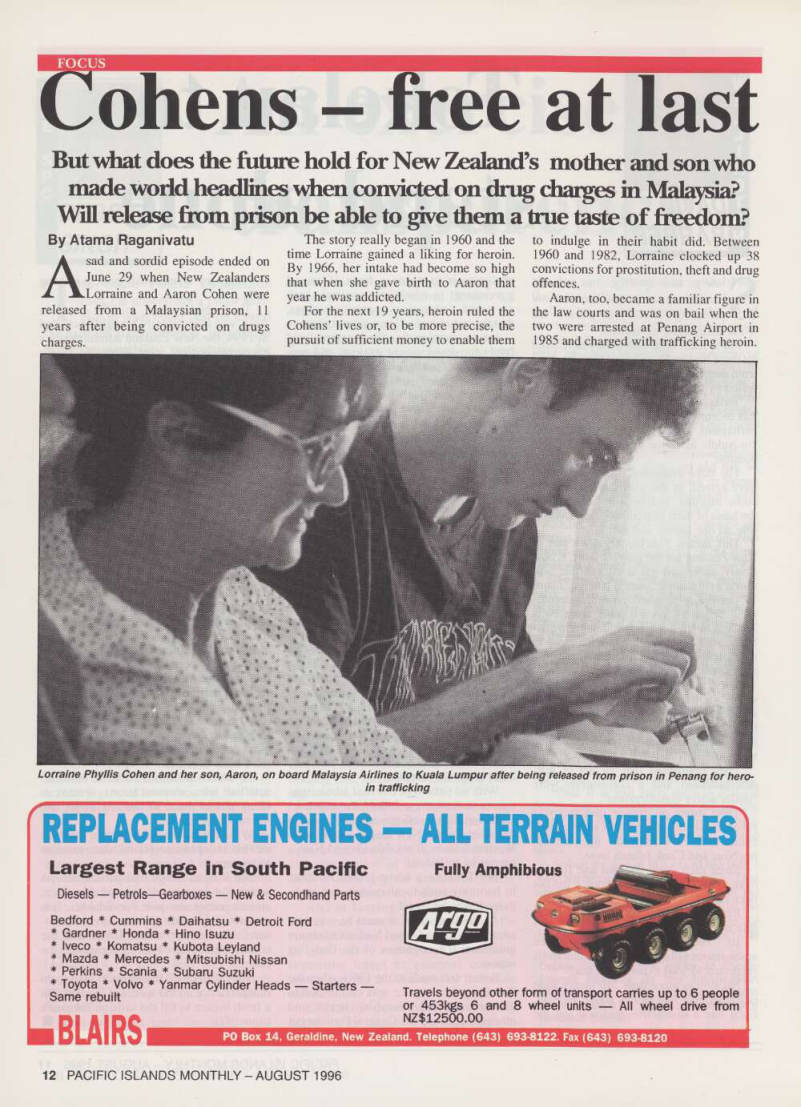
Lorraine Phyllis Cohen and her son, Aaron, on board Malaysia Airlines to Kuala Lumpur after being released from prison in Penang for hero in trafficking
Thirty months were required for the Cohens to come to trial. Both pleaded not guilty: Lorraine to trafficking in 140 grams of heroin and Aaron to trafficking in 34 grams of the same substance. Their cases always appeared feeble and Lorraine was sentenced to death and her son to life imprisonment plus six strokes of the ratan cane.
Despite Malaysia having originally
introduced severe penalties for drug offences largely at the behest of Western “consumer nations” like New Zealand, a campaign commenced in the Cohens’ home country to reduce their punish ments.
An unlikely supporter was John Banks,
an influential right-wing politician
renowned for his law and order crusades who had once been a neighbour of Lorraine and Aaron.
Although not making an official protest over the sentences, the New Zealand government let its concerns be
known through diplomatic channels.
The Malaysian authorities have, under
standably, displayed cynicism towards
Westerners who tolerate, and even encour ag, Asian drug smugglers being hung but protest vehemently when their equally guilty compatriots face this ultimate indignity. Since Kuala Lumpur introduced the death sentence for narcotics traffick ing in 1975, approximately 230 offenders have been executed. Among them were
Australians, Britons and Germans.
Malaysia’s government, then, would not have been swayed solely by the noises coming from New Zealand. However, their good relations with Wellington almost certainly contributed to Lorraine’s sentence being commuted to life impris onment two years after an appeal was
lodged.
The endeavours of the Cohen’s ener
getic lawyer, Karpal Singh, in persuading
the appeals court that the heroin she was carrying in Penang had been intended for her personal use and not for financial gain
probably had equal weight in influencing
the decision. Tlte fear of bad publicity
engendered through executing a woman
would also have helped her. Aaron’s appeal was dismissed though and, in December, 1991, he received six ratan strokes.
A greater trauma befell Lorraine dur ing 1992 when she was diagnosed with cancer and, in November of that year, her left breast had to be removed. Lorraine’s health problems formed the basis of
Karpal Singh’s annual applications for a
pardon.
Thirteen years is the normal jail term those sentenced to “life” have to endure in Malaysia. And the Cohens can perhaps consider themselves lucky their releases came 11 '/ 2 years after being first detained at Penang.
New Zealand Prime Minsiter Jim Bolger had “raised the matter” when meeting his Malaysian counterpart. Dr Mahathir, three months earlier. Such is the secrecy surrounding all aspects of interna tional diplomacy, one can only speculate upon how significant that get-together was in the Cohens gaining liberty.
Conjecture over the Cohens’ future would be equally inconclusive.
Singh claims both are now free of drug addiction, yet Lorraine recently admitted she “occasionally feels a pang for heroin” and friends of Aaron believe “he still has a problem”. Media reports that Aaron is booked into an Auckland detoxication centre supports this pessimism. Drugs, apparently, are readily available in
Malaysian prisons.
An exclusive story deal with a women’s magazine will earn the Cohens at least SUS 13,000 and the book they intend to write may well yield consider ably more. Even so, the long-term prospects for Lorraine and Aaron, who are now 53 and 29 respectively, appear most uncertain.
First of all, they have to adjust to life beyond the prison walls. Once this has been achieved, the Cohens will discover the New Zealand of today is different from the New Zealand of 1985 and legiti mate work opportunities for ex-criminals are rarer than ever before. Lorraine’s age
also handicaps her in the job market.
The fact most of their friends and acquaintances are criminals augurs badly for them too.
It will not be easy for the Cohens to become part of the New Zealand social mainstream they have rejected in the past, if they wish to embrace it now, as both insist.
The Cohens will find the media spot light irksome and intrusive as they endure affronts like Press headlines proclaiming Aaron contracted AIDS (Acquired Immune Deficiency Syndrome) in Malaysia (which he denies). They will hope that members of their very extended family can offer temporary shelter from the public’s gaze.
Lorraine’s four children have four dif ferent fathers. Alas, Aaron’s is not on hand to help. Denny Cohen, a professional musician and long-time junkie, died in Bangkok two years ago.
Although Lorraine and Aaron are sure to relish their liberty from prison, they may never be able to savour true freedom.
The Cohens saga may yet have an unhappy ending. ■
As Pacific Islands Monthly went to press, Woman’s Day magazine published its exclusive interview with Lorraine Cohen. Among the snippets includ ed in the feature were: • Lorraine’s current attempt to give up using heroin is the 17th of her life; • Lorraine claims she was denied access to drugs in Penang Prison, but Aaron received a con stant supply. Apparently, warders in the men’s section are more cor rupt than their female counter parts; • Lorraine had a miscar riage shortly after being arrested in Malaysia and flushed the baby down the drain without informing prison authorities; • Aaron learned Malay in prison and is now fluent in the lan guage - a fact which should consid erably enhance his employment prospects; • Lorraine was diagnosed as having cancer six months after alerting prison medical officers to the lump in her breast which proved to be malignant.
The Cohens are said to be resid ing in Auckland’s North Shore dis trict. To date, they have succeeded in maintaining a low profile. ■
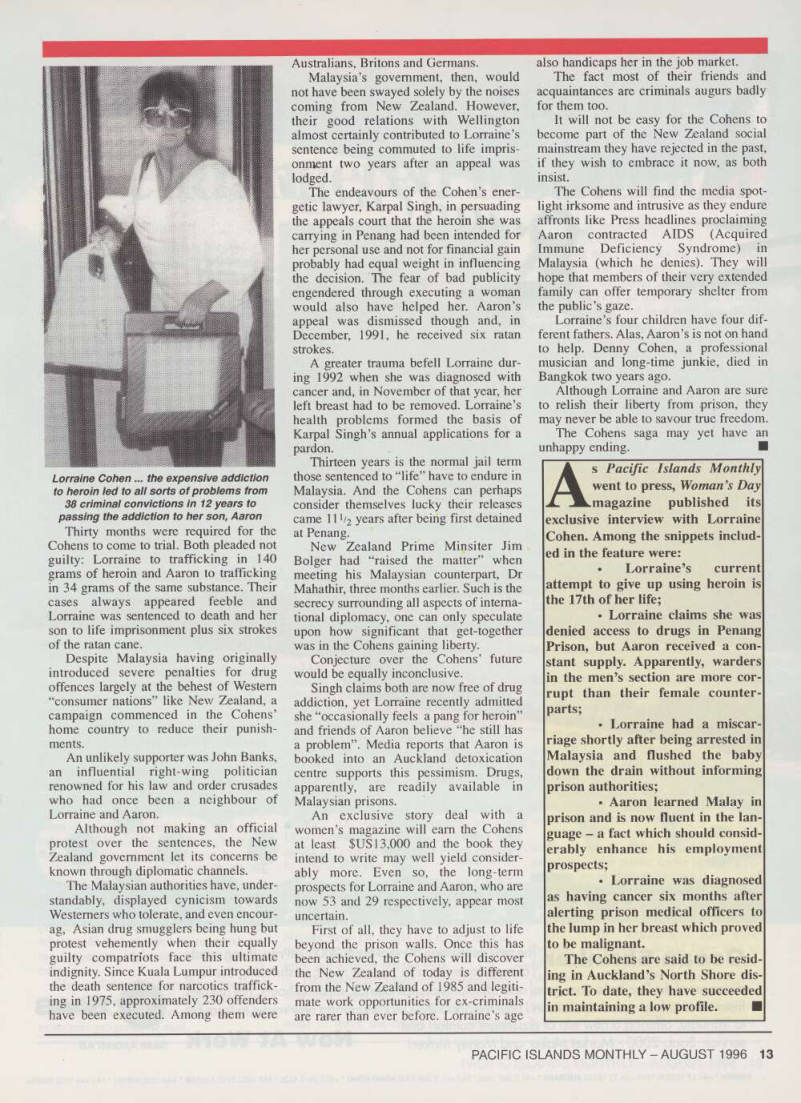
Lorraine Cohen...the expensive addiction to heroin led to all sorts of problems from 38 criminal convictions in 12 years to passing the addiction to her son, Aaron
Advertisements & other items, pp. 12-14 (1 item)
Replacement Engines - All Terrain Vehicles!
Largest Range in South Pacific
Diesels Petrols—Gearboxes New & Secondhand Parts Bedford * Cummins * Daihatsu * Detroit Ford * Gardner * Honda * Hino Isuzu * Iveco * Komatsu * Kubota Leyland * Mazda * Mercedes * Mitsubishi Nissan * Perkins * Scania * Subaru Suzuki * Toyota * Volvo * Yanmar Cylinder Heads Starters Same rebuilt
BLAIRS
Fully Amphibious
Travels beyond other form of transport carries up to 6 people or 453kgs 6 and 8 wheel units All wheel drive from NZ512500.00 PO Box 14, Geraldine, New Zealand. Telephone (643) 693-8122. Fax (643) 693-8120
Map: m
iI f I
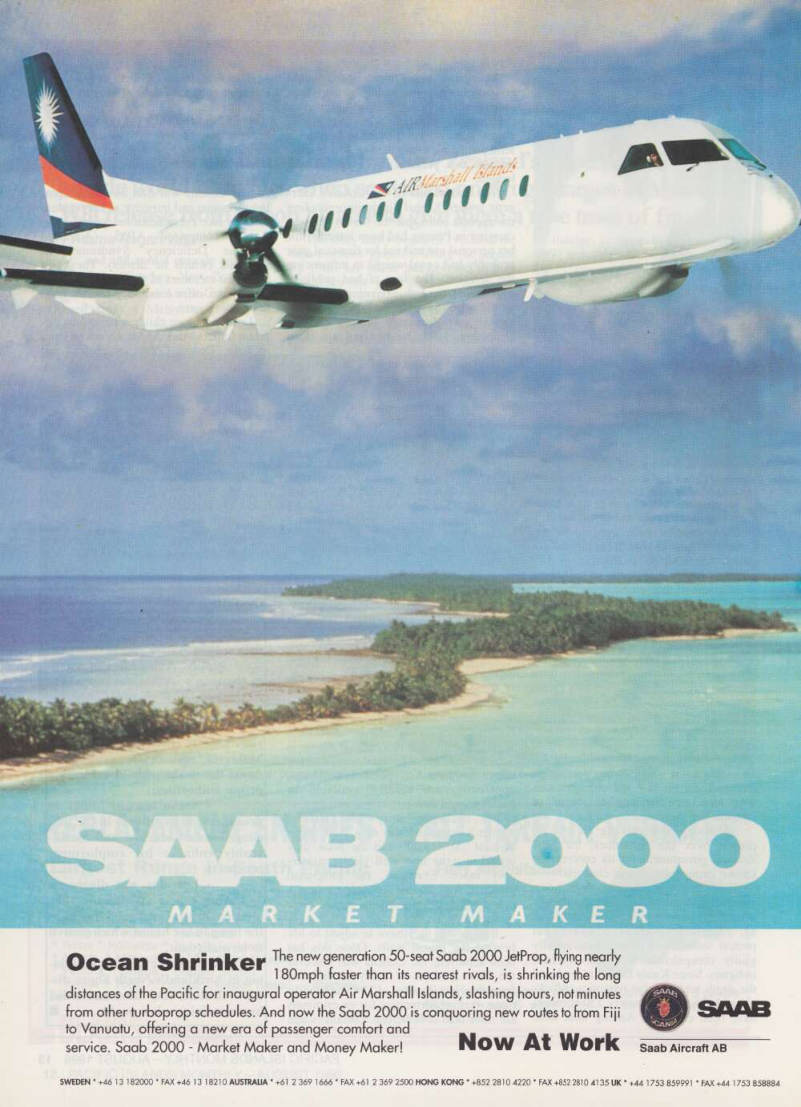
<,!••• "' ;5 ■ ■ m m .. ■■' '■■' - A rpan ShfinkPP The new g eneration 50-seat Saab 2000 Jet Prop, flying nearly 180 mph faster than its nearest rivals, is shrinking the long distances of the Pacific for inaugural operator Air Marshall Islands, slashing hours, not minutes from other turboprop schedules. And now the Saab 2000 is conquering new routes to from Fiji to Vanuatu, offering a new era of passenger comfort and service. Saab 2000 - Market Maker and Money Maker! IMOW AX WOTK Saab Aircraft AB SWEDEN * +46 13 182000 * FAX +46 13 18210 AUSTRALIA * +6l 2 369 1666 * FAX +6l 2 369 2500 HONG KONG * +852 2810 4220 * FAX +852 2810 4135 UK * +44 1753 859991 * FAX +44 1753 858884
Freedom of expression -
Cover Stories
Freedom of expression an endangered institution
By Bernadette Hussein
Freedom of expression is becoming a
more and more fragile and endan gered institution in the Pacific, with constant threats to control the media by the powers that be, justified by claims that such action would guard against cultural insensitivity and breaches of confidential ity and violation of privacy.
Media reports revealing facts which are negative or unfavourable are criticised for being culturally insensitive or threat ening the security of a country.
And if the media organisation happens to be foreign owned, it is accused of not understanding local cultures and tradi tions.
There have been numerous incidents in Fiji, the reporting of which have seen the government cry foul and accuse the media of being culturally insensitive and work ing against the interests of the nation.
But it is not only the media which comes under pressure for speaking out.
In July 1995, three government minis ters gave up their cabinet posts over an amendment moved by the prime minister.
Leo Smith and Taufa Vakatale, the then ministers for infrastructure and education, respectively, voted against the amendment on an opposition motion condemning French nuclear testing. The third, then minister for information Isimeli Bose, had abstained.
The amnedment was defeated and the next day saw Prime Minister Sitiveni Rabuka requesting the resignation of the three ministers. Vakatale resigned. Smith and Bose refused to resign and were sacked.
“If we are to be effective as a govern ment, it is critically important to have a cabinet that is solidly together as a team,”
Rabuka was reported as saying at the time.
In his speech on May 6, Media Freedom Day, the prime minister told journalists that the government was look
ing into introducing confidentiality and
privacy laws imposing restrictions on what could and couldn’t be reported, cit
ing Singapore, Malaysia and Thailand as
examples.
The media in these countries accepted as essential checks and balances desigend for national security, social cohesion and economic progress, he said.
“We must not be slaves to definitions of Press freedom and democracy propa gated by the Western world,” he said.
Doctor Tupeni Baba, however, places a somewhat different slant, on the govern ment’s motives to find it necessary to try and control media freedom by Doctor
Tupeni Baba.
“The degree of sensitivity of the gov ernment is closely associated with its sense of insecurity. The more it becomes insecure, the greater is its sensitivity to media treatment that exposes its inadequa cies as in financial dealings of its senior members or the financial affairs of the nation generally,” Dr Baba said in Media Aware, a newsletter published by Fiji Media Watch.
In his piece, titled “Culture and the media”. Dr Baba, a lecturer at the University of the South Pacific, urges the media to “expose apsects of Fijian culture to critical analysis”.
This, he said, would lead to greater understanding of the culture and its rela tion to modem Fijians.
As Fiji’s information minister, Ratu Jo Nacola, says, the media is a mirror held up before the community. It should reflect the truth and nothing but the truth.
The newly appointed information min ister has supported what the media is doing in Fiji and has urged the govern ment to leave the media alone. He has
asked for a responsible media free from government control.
“I think there are times the government makes a valid statement and there are times when the government uses it (cul tural sensitivity) as an excuse for some thing that should not have been brought to public attention,” Ratu Jo said.
But he has called on journalists to appreciate the rights of certain individuals or groups to do what they want and value.
For example, Ratu Jo said, although the people could be critical of the actions of chiefs, the criticism could not be voiced
in public.
“I’m a Fijian and sensitive to culture and I will never write anything against tra dition,” he said.
However, Ratu Jo feels that for a coun try to move ahead, it is very important to have freedom of Press and expression.
A country which worked to suppress this could never be democratic, he stressed.
The most recent example of govern ment control over freedom of expression in Fiji was the attempted ban on The Fiji Times columnist Doctor Ronald Gatty.
The government described Dr Gatty’s columns as “racist” and branded the writ
er “irresponsible”.
However, this government response to the column sparked outrage and protest from the public and opposition parties.
The ban was lifted within a week and Dr Gatty was given leave to continue writing - but on the condition that he be “sensi tive”. Dr Gatty claims, however, that the government is still to clarify what it means by “sensitive”.
About six years ago, the Fiji govern ment planned to bring newspapers under annual registration control.
This move was widely criticised and it was only after media organisations and members of the public spoke up that gov ernment decided to go against it.
The law requires newspapers to regis ter their publications at the start of busi
ness only.
But if the amendment had gone through, newspapers would have had to apply to register anew every year with the Administrator-General’s Office. The Fiji government’s reason for the move was that the new laws were aimed at instilling a sense of responsibility in the newspa
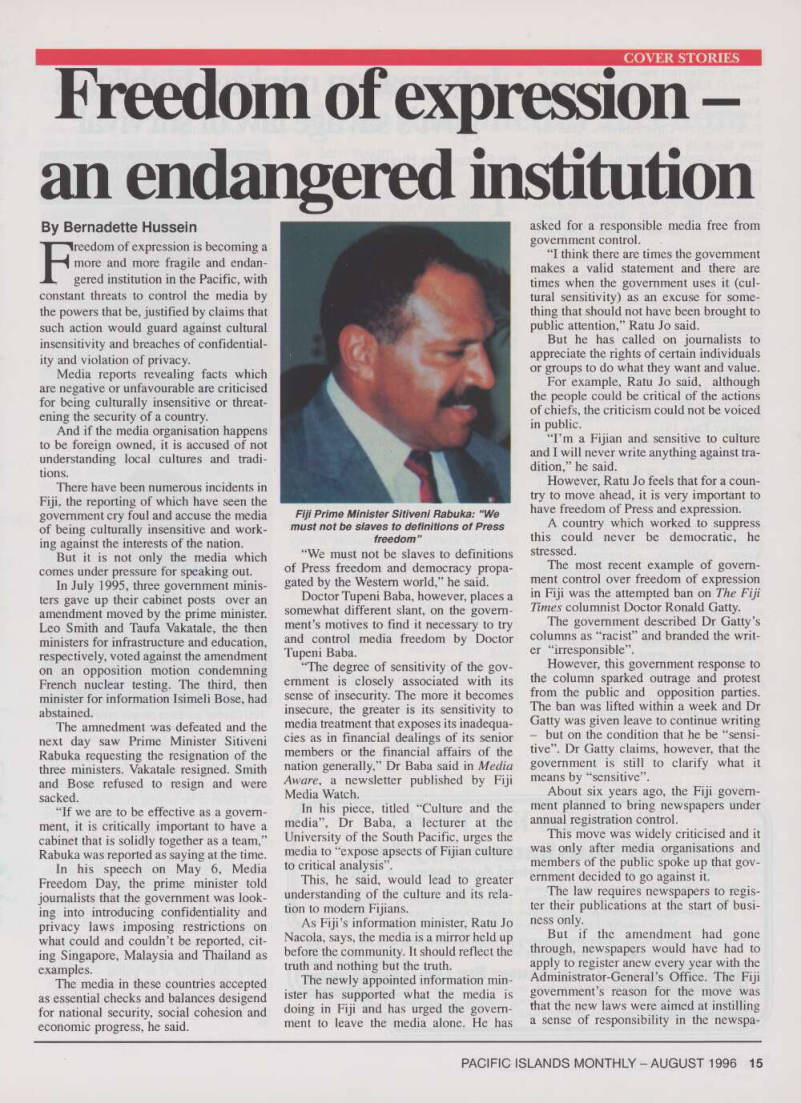
Fiji Prime Minister Sitiveni Rabuka: “We must not be slaves to definitions of Press freedom”
pers. In Tonga last year assistant editor of Timei O Tonga newspaper Filo Akau’ola was arrested and convicted for printing a letter to the editor judged defammatory of Police Minister Clive Edwards. Akau’ola was given an 18-month suspended sen tence. An appeal is pending. The Pacific branch of the International Journalists Federation said the arrest was the latest in a series of repressive moves against jour nalists in Fiji, Tonga, Western Samoa, Papua New Guinea and the Solomon Islands.
In Vanuatu, the government has tight ened control of its own media, which includes the radio, television and the Vanuatu Weekly newspaper.
Journalists working within the gov ernment media arm of Vanuatu Broadcasting and Television Corporation are reportedly having to submit all media releases from the opposition party and breakaway Serge Vohor-led faction of the UMP to the prime minister’s first secre tary, Yvette Sam, prior to being publi cised(see Page 19).
In Papua New Guinea, the Constitution Review Commission (CRC) has reviewed the media industry in an attempt to make it more responsible and accountable for its actions. As in Fiji, PNG media laws were compared with those of Asian countries. Commission chairman Ben Micah visited China, Hong Kong, Malaysia, Singapore and Indonesia to look at media laws there. On his return, he informed the governor-gen eral that PNG did not need media control nor an Internal Security Act.
However, he said, the media had to know where to draw the line between what should and should not be reported, taking care not to highlight unfair criti cism (see Page 17).
People need to know what is happen ing and it is the work of the media to pro vide that information for them.
As Ratu Jo said, the media, like a mir ror, should be allowed to portray things as they are. ■
Information minister highlights
‘govt’s savage law of survival’
By Bernadette Hussein
The next century will be one for information and freedom of expres
sion, says Fiji’s newly appointed
Information Minister, Ratu Jo Nacola.
And governments around the region will have to work with media organisa tions to make this successful, he said.
The Fiji government, Ratu Jo agreed, could not take criticism and did want to be made accountable for wrongdoings. This, he said, was a reflection of the “savage law of survival”.
“Everyone wants to watch out for themselves. People have to protect them selves, so why not the government?”
Ratu Jo agreed that the government often used the excuse that topics were “culturally insensitive” when it was faced with issues it didn’t want to talk about or felt should not be brought to public atten tion.
Governments should lead by example if they want the media to play by the rules, he said.
By this he means governments should be fair in disclosing information, if they expect the media to report fairly.
“Governments must be open to criti cism and should look at the fairest way of
solving problems.
“There must be a rule for the game and everyone, including governments, should observe this because things cannot be one sided.
“All governments should support the media because of the important role they play in keeping the country informed. The media are like a mirror held up to the com munity, showing them the true picture of whatever is happening.”
But while Ratu Jo seemed to support media freedom, he criticised the media for
rt
“thriving on negative issues”.
“Apart from the negative things, like corruption and crime, there are so many
good things happening. But the media
don’t seem to be paying much attention to them. Compared to all the negative aspects, these good things receive very lit tle coverage.
“I am not saying (the media) has failed in any respect - only that they should also address the good things in life.”
According to the government, cultural sensitivity includes respect for chiefs and Fijian traditions, the minister said.
“The tradition is such that no matter what happens and who it concerns, you cannot talk about it in public - you can talk about it privately, but not in public.
“You cannot question people involved.
That is just tradition.”
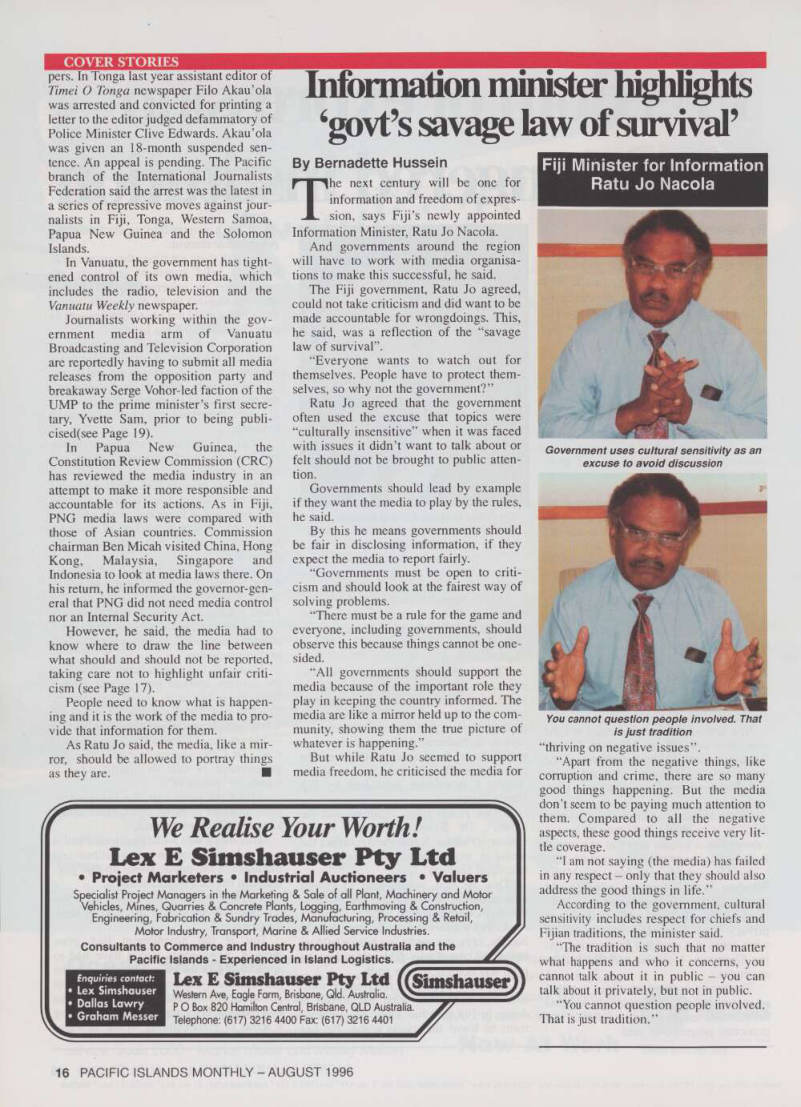
Government uses cultural sensitivity as an excuse to avoid discussion
You cannot question people involved. That is just tradition
This was why government tried to ban Fiji columnist Dr Ronald Gatty from writing, he said.
“His columns portrayed his lack of understanding for the Fijian culture. He used disrespectable words and accused (Fijians) of being what they are.”
But Ratu Jo said he personally enjoyed the column.
“At one level it is good reading and entertaining but at the same time, on another level, after the enjoyment there is another awareness that whatever is writ ten is about the person reading it.
“From that point on, this person takes on the identity of part of the whole Fijian community. They feel that Dr Gatty has no respect for the Fijian community.”
Ratu Jo said many people were offended because they did not see the light-hearted tone of the column. All they saw were the “harsh” words he used.
But continuing to ban the column would have been a futile exercise, Ratu Jo said. So, government allowed Dr Gatty to carry on. “The debate could go on so government decided him to let him con tinue - but with the sensitivity clause.”
The minister has called on the media to be culturally sensitive.
“The demand is on the media to have a firm grasp of the cultures where they work.”
He said this included other Pacific Island countries which were in situations similar to Fiji’s.
But while Ratu Jo asked media in Fiji to be more responsible, he was totally against imposing media laws. He said he would prefer to see more dialogue between governments and the media to work out a solution.
To prepare the region for the next cen tury, governments should allocate resources so there are highly qualified people ready to take on the next milleni um.
And the only way he can see this hap pening is through government support of the media and freedom of speech and
expression.
“A country without a free media has no democracy.
“The government needs to support the independence of the media, not get in its away and disallow freedom of speech.
“There should be something which will guide the media - not tell them what to do and what not to.”
Ratu Jo feels the demand on journal ists is far greater now than it was some years ago.
“This profession will be very instru mental in bringing Fiji into the main stream - whether we talk of global cul ture, technology or communication.
“After all, the pen is mightier than the sword.” ■
Advertisements & other items, p. 16 (1 item)
We Realise Your Worth!
Lex E Slmshauser Pty Ltd
• Project Marketers • Industrial Auctioneers • Valuers Specialist Project Managers in the Marketing & Sale of all Plant, Machinery and Motor Vehicles, Mines, Quarries & Concrete Plants, Logging, Earthmoving & Construction, Engineering, Fabrication & Sundry Trades, Manufacturing, Processing & Retail, Motor Industry, Transport, Marine & Allied Service Industries. Jy Consultants to Commerce and Industry throughout Australia and the Jy Pacific Islands - Experienced in Island Logistics.
' Lex E Slmshauser Pty Ltd (fi Western Ave, Eagle Farm, Brisbane, Qld. Australia.
Enquiries contact; • Lex Slmshauser • Dallas Lawry • Graham Messer P 0 Box 820 Hamilton Central, Brisbane, QLD Australia.
Telephone: (617) 3216 4400 Fax: (617) 3216 4401 7
Constitution review

threatens media freedom
By Sam Vulum
PAPUA New Guineans’ “democratic and constitutional right” to freedom of expression and publication, and freedom of the media and information has once again been threatened.
The threat is the subject of a submis
sion currently being prepared by a
Constitutional Review Commission (CRC) for presentation to the National Executive Council (NEC) and parliament.
The move was the result of an under taking by the government in 1995, under the CRC, to review the media industry in an attempt to make it more “responsible and accountable” for its actions. The CRC, which is also responsible for other major constitutional reforms, including provincial and local-level government changes, has been directed by cabinet and Governor General Sir Wiwa Korowi to enquire into media accountability and report back to both the NEC and parlia ment.
The government’s proposal attracted
widespread criticism, especially from the local media, churches and non-govern ment organisations. Local media organisa tions, realising the dangers of such pro posals, decided to lead other concerned parties to show their disapproval to the government by sponsoring a one-week media seminar in Port Moresby. Speakers from a wide variety of professions and within PNG, the Pacific and even Australia, including a representative from the CRC, were invited to present papers on various issues concerning different aspects of the media and other related
rights issues.
Concerns raised at the seminar were brought to the attention of the govern ment, resulting in the establishment of a media accountability committee, compris ing some commissioners of the CRC, media representatives and other resource people. The committee compiled a report which is now before the CRC for review.
The report was accepted en masse in June, subject to further review by the commis sion, its consultants and senior secretariat staff. The recommendations of the com mittee are that: • Existing laws on the media are suffi cient and the government should not pro pose, or get parliament to enact, any new
restrictive legislation;
• an independent media commission be established; • the Defamation Act, censorship laws, and all other laws on the media be
reviewed and amended to conform with current trends and practices; and • parliament enact a Freedom of Information Act to allow access to gov ernment decisions, actions and omissions, consistent with Section 15 of the constitu tion which provides for the right to free dom of access to public information.
The committee said it considered free dom of expression and publication, free dom of the media and the right to freedom of information as conerstones of PNG’s democracy which had to be protected and observed at all times, subject only to qual ifications provided for by the constitution or other laws. It had decided that for the media to flourish, the industry must not be further restricted or regulated by state.
Instead, the media must account for its actions and omissions to the public and
itself through self-regulatory mechanisms,
including the journalists’ code of ethics, to be strictly enforced independently by the Media Council or together with other
acceptable bodies.
Commenting on the recommendations, CRC chairman, Ben Michah said the rec ommendations would form the basis of a submission to the NEC and parliament to overhaul PNG’s information and commu nication regime, including the mass media, leading up to the Year 2000 and beyond.
“Information and communications is going to be the industry of the future and the committee’s recommendations will form the basis of the CRC’s submission to cabinet and parliament,” he said.
Micah said the media committee had taken a “middle road” and he and his com missioners would work to strengthen the media. 820 ut the final decision, the chairman stressed, rested with the NEC. The CRC’s deputy chairman, Vincent Auali, said that when the governor-general announced the committee’s terms of reference in October, many people had expressed con cern about the government trying to muz zle the media. But the recommendations were proof that the people wanted to keep a free but responsible media. Micah earli er in the year told reporters: “If you do your work properly, I don’t think the gov ernment has the right to interfere with your work. “We need freedom of expres sion in this country, but this freedom must be taken with responsibility.”
In a lead-up to the formation of the media accountability committee, Micah went on a tour of four Asian countries in February 1996 to learn from their experi
weeks visiting China, Hong Kong, Malaysia, Singapore and Indonesia. On his return, Micah said PNG did not need media control nor an Internal Security Act.
The chairman said he had learnt from those countries that “their number one objective is to allow for open government
although there was a boundary beyond
which ‘unfair criticism’ was not allowed”.
That boundary, he said, was where the good image of the nation stood to be tar nished and related to reporting of matters such as riots or ethnic antagonism that threatened the stability of the country.
Micah said there was lack of investiga tive reporting in PNG, compared with the countries he visited. He said during the visit they covered relevant issues, which related to internal security, political stabil ity and continuity and transparency of government. Micah said these were the things which had enabled those countries to establish strong viable economies.
Prime Minister Sir Julius Chan said publishers, editors and journalist were free to publish anything, buy they must be
responsible for any misreporting.
“They topple governments, swing
votes, and destroy a person,” he said. “I support freedom of the Press, but the pro prietors and journalists must be account able.”
Sir Julius was also critical of foreign media ownership in the country. He emphasised that while the government recognised freedom of the Press, it was time to look at the operations of the PNG media, which he said was dominated by foreign media interests.
He said the government was concerned that as a sovereign nation, PNG and its national issues and events should not be influenced by foreigners through their control of the local media.
The current move is the fourth of any such attempts by successive governments to control the media in PNG. A former communications minister, Gabriel Ramol, whipped up dust when he announced a proposal to control the media in 1987. He told parliament he would seek to license all media organisations and set up a uni form code of fairness and standards of conduct.
It was probably the biggest threat ever to be taken against the media in the coun try and attracted widespread criticism, even from politicians. The media was forced to go overboard with its publicity against the move, highlighting wide-rang ing impacts the proposal would have on the media industry and PNG in general.
Newspaper organisations, especially,
reacted strongly against the proposal.
Among other criticisms, the then-general manager of Post-Courier, Don Kennedy, said it was a scheme unknown - and in
many cases constitutionally prohibited in other democratic countries.
The general manager of another daily, the now defunct Niugini Nius, Russell Wilkes, said; “To my knowledge this type of licensing, as far as newspapers are con cerned, does not exist in other parts of the world.” The move fell through when there was a change of government. However, in 1987, another former communications minister, Brown Sinamoi, proposed to localise the ownership of the national newspapers, the Post Courier and the then Niugini Nius.
This move was also dropped. Then again in 1993, another minister, the late Martin Thompson, announced plans to introduce a communications policy. To avoid attracting any repeated uproar over the policy, the minister invited those con cerned, including media, church and non government representatives to be involved in the drawing up of the policy.
It covered wide-ranging aspects of com munications in general, including the mass media. The policy, which received government approval, now appears invalid under the current moves.
There were other individual cases recorded in recent years. Among others, were the PNG National Censorship Board’s banning of Channel 9’s 60 Minutes programme on EM TV in 1993 and Sir Julius’ prevention of the airing of Roger Hau’ofa Kalang FM’s talk-back show programme in 1995.
However, the most recent case involved the Papua New Guinea govern ment’s refusal to grant Tongan human rights activist Lopeti Senituli a visa to attend a three-day United Nation’s semi nar in Port Moresby in June. Senituli, who is the director of the Nuclear Free and Independent Pacific Movement Secretariat, was invited by the United Nations Decolonisation Committee to present a paper at the non-self-goveming territories meeting in the Pacific (See Page 32). According to Senituli, he was informed in writing on June 3 by the UN Department of Political Affairs that the PNG government had agreed to grant all the seminar participants entry visa on arrival in Port Moresby. However, on June 6, he was informed by the counsellor at the PNG Embassy in Suva, Ponabe Yuwa, that he would not be granted a visa to enter PNG.
He said in a statement: “I cannot deny that the PNG government may have rea sons to be angry with me and my organi sation because we have been critical of their policies and actions.”
However, Mr Senituli said the criti cisms were balanced, unbiased and made with the support of “our partner organisa tions in PNG and certainly do not warrant my banishment from PNG shore”. ■
Advertisements & other items, p. 18 (1 item)
@ Telecomfiji
A NEW ERA AT
TELECOM FIJI
Telecom Fiji's mission is to provide quality products and services in the communications and information industries.
We will anticipate and fulfil our customers' needs at affordable prices, now and in the future, through a constant search for new services, products, ideas and innovative approaches both within Fiji and globally.
Telecom Fiji's customers and their customers are the reason for Telecom Fiji's existence.
Telecom Fiji will understand and meet its customers' communications and information needs with products which are affordable, timely and convenient.
Telecom Fiji's employees are the source of its success.
We will treat each other with respect and encourage innovation and team work. Staff will have authority and accountability in their jobs; excellence in performance will be sought and rewarded.
Telecom Fiji's technology will - cost effectively - meet current and future demands of our customers.
Telecom Fiji's corporate success will be measured by sustained growth in corporate value.
Telecom Fiji's responsibility is to maximise value while recognising our role in the community.
@ Telecomfiji
Bringing the Future to Fiji Today
exercise
Freedom of the Press-a difficult exercise
By Patrick Decloitre
In 1994, Vanuatu (along with Tonga and Fiji) was rated “partly free” in a survey published by Freedom House, a New York-based research organisation, which classified 10 other countries of the region as “free”.
But since it came to power last December 1991, the Vanuatu government led by Maxime Carlot has on regular occasions indicated it promoted freedom of expression and freedom of Press. There have been attempts, indeed, but also some
disappointed hopes.
Newcomer on the Vanuatu media scene this year is the young. French-fund ed TV blong Vanuatu, which runs four hours of programmes daily - alternatively in English and French.
From their newly built studios, adja cent to Radio Vanuatu, they have their new anchormen and new stars of the screen.
Their bulletins, 15 minutes every sec ond day, still mainly consist of foreign news and footage. But they also carry Vanuatu news - in brief so far, with some footage now and then.
If they really start touching local news, they may experience some kind of pres sure.
Their colleagues, the Government controlled Radio Vanuatu and Vanuatu Weekly newspaper, know the feeling.
Radio Vanuatu, which broadcasts in AM, has an FM sister, Nambawan FM 98, which solely broadcasts in the capital, Port Vila, and the other town, Luganville (Santo Island), mostly music and small news bulletins picked up from overseas radios and Radio Vanuatu.
In the printed Press, the rest of the non government local media spectrum consists mainly of the Trading Post newspaper and another weekly newcomer, Le Fenua Times, published in Bislama (the local
pidgin) only.
On a more regional basis, in 1993, the Pacific News Service agency, Pacnews, moved from Solomon Islands to Vanuatu, where it centralises stories from member media organisations in the region to put out a news bulletin of Pacific news twice daily.
Other foreign media agencies are rep resented in the capital through correspon
dents. There have been in the past some bans on specific matters which couldn’t be mentioned on the national radio and week ly. Two years ago, when the UMP-NUP coalition split, it was not allowed to carry Press releases from the NUP “Lini fac tion”. It was recommended to talk about the “Regenvanu faction”.
But this was a long time ago.
Earlier this year, with a constitutional crisis involving two factions of the ruling Union of Moderate Parties (UMP) - more personally PM Maxime Carlot and quick ly deposed former PM and UMP president Serge Vohor - in a fight for leadership both in parliament and at party level, the pressure came down again on govern ment-controlled media.
The old argument came back: The pub lic must not be “misled” or “confused”.
Hence, the need for a clear, legible and simple message, possibly not too conflict
ing and preferably favouring the stronger
version, usually the one holding the reins of power. So much for the weaker or the
opposition.
Between November last year and February, the government of Vanuatu changed three times.
Each time, when it was not happy about the news carried by the local and sometimes foreign Press, it exerted pres sure.
For the Trading Post, which has gone
bi-weekly since last year, the number of threats is now a record in Vanuatu: • Last year, its publisher, Briton Mark Neil-Jones, was close to being deported under a Carlot-Regenvanu gov ernment; • last January, under the Vohor/Lini partnership for reporting the
post-election sacking of public servants
for political reasons; and • under a new Carlot-Kalpokas government for reporting on the National Bank of Vanuatu.
Neil-Jones once said he was “sur prised” at the accusations made against him by the Vanuatu government.
“As publisher and investor in Vanuatu, I am concerned about receiving constant threats every time a story is printed that people in power do not like,” he said, adding on another occasion that he was walking through a “political minefield”.
The past 12 months saw a news ban on the judicial row between British Chief Justice Charles Vaudin d’lmecourt and Australian Justice Robert Kent.
In June last year, the government media could no longer report any news related to the French nuclear tests in the Pacific.
Recently again, while TV was recruit ing for journalists to present, an applicant the TV management wanted to select was vetoed by the PM’s office.
No reason was given, except political affiliation.
The accusations are various but con stant: They can be “irresponsible report ing” (assorted with reminders of earlier threats such as deportation or the “locali sation programme”); “damaging the the country’s image”; “misleading the pub lic”; or “abusing the privilege of freedom of expression”.
A popular item on the threat list is the cancellation of business licences, much prized by finance ministers, who are responsible for issuing (and therefore revoking) them.
Donald Kalpokas, when he was oppo sition leader, once expressed concern that then Finance Minister Willie Jimmy had threatened to use his licensing powers against a newspaper.
“It’s time the government acts like a grown-up and accepts criticism from them media,” Kalpokas said in parliament.
When overseas media carry news not favourable to Vanuatu, they often get blamed for their “outrageous attack” (Kent case) or the much-used “interfer ence in Vanuatu’s internal affairs” (most politically sensitive news).
Because Radio Vanuatu relays every morning news bulletins from Radio Australia and Radio New Zealand International, it is sometimes only through these channels that Vanuatu people have
access to some news regarding Vanuatu.
Even the president, Jean-Marie Leye, has spoken on the issue. Last year, he asked parliament to “control newspapers which talk about people’s private lives or carry untrue stories”.
The official speech, however, is that the Carlot government has contributed a lot to improve freedom of Press since it came to power in December 1991.
And in all party platforms, during the last general elections campaign, no party forgot to mention their commitment to freedom of Press.
Laws have been passed to turn the pre vious government-owned “media ser vices” into the Vanuatu Broadcasting and Television Corporation (VBTC) under an Act passed in 1992.
Theoretically, opposition and govern ment alike have access to government-run media.
In practice, the discriminating factor is the degree of sensitivity of the news. The more it hurts, the more likely it won’t get through to the official media.
And when it does, local journalists know what it means if they haven’t asked first.
They usually get reminded of who pays them. Although VBTC was created in' 1992, it still relies heavily on the govern ment, which pays all the salaries and
expenses. This implies a de facto control on the national govern ment-run radio and weekly. Officially, this is not control. The prime minister’s first secretary, Yvette Sam, has said in the past: “Journalists in the region call this government control on media, but I don’t agree.
“The government simply wants to make sure that its views are carried in any story which talks about government mat ters.
“This is not control. We think all jour nalists should do this. This is their respon sibility to check they have both sides of the story.
“Unfortunately, some of them don’t do this of their own initiative, so what we’re doing is to remind them of their responsi bility. That’s all we ask.”
Practically, on a day-to-day basis, she is informed of the radio’s headlines to see if any news concerns the government.
“If there is news about us, then we make sure our view is carried too.
“That’s what some journalists see as control. But sometimes I get the impres sion that some journalists here are printing or airing news which is rumour and has not been checked.”
She said the procedure applied to all
local journalists.
“The government wants freedom of Press, but at the same time, it has to ensure
that our journalists do their job properly.
You can’t change things overnight. As long as we don’t have really well-trained journalists, we’ll have to do this.
“We are responsible for liberalisation of the Press, but we also have to be responsible for the impact this can have,”
Sam told Pacific Islands Monthly.
In July, when the Ombudswoman made a report public, revealing the issue of letters of guarantee worth some SUSIOO million and signed by PM Carlot, Finance Minister Barak Sope, Reserve Bank governor Samson Ngwele and
Sope’s first secretary, George Borugu,
Carlot accused the Press ( and the ombudswoman) of “destabilising” the government (See Page 23).
To make a “balanced” story ( a princi ple often reminded), it wouldn’t be fair not to mention that the principle known in the past as “green letters” (deportation orders for foreigners, including journalists) real ly seems to be a thing of the past, and that although there is still much room for improvement, the situation seems to have improved in Vanuatu. There are now more newspapers than ever since independence.
And even if freedom of Press is not yet at its peak, there is at least debate over the issue. Even writing such a story about Vanuatu from Vanuatu would have been quite incredible only a few years ago. ■
Advertisements & other items, p. 20 (1 item)
Steel Bros
f I ir / wr.
THE WORLD’S LEADING KNUCKLE BOOM CRANE
havo boon
Soiling A Sorvicing
HlAB since 1930...
• EXPERIENCE
• SERVICE
• RELIABILITY
STEELBRO
• Swedish Quality Engineering
STEEL BROS (NZ) LTD
HEAD OFFICE
CHRISTCHURCH:
1-31 Treffers Road Sockbum Telephone (64-3) 348-8499 Fax (64-3)348-5786
with defamation lawsuit
Vanuatu government threatens newspaper with defamation lawsuit
All issues, when they become sensitive, do not mix well with freedom of Press with banking and money matters a particularly significant example. Patrick Decloitre looks at what happens when it hurts.
Early in June, the Vanuatu govern ment said that the government owned national bank (NBV) would sue for defamation the bi-weekly Trading Post newspaper for carrying a story on NBV’s financial situation.
In a strongly worded Press statement, Finance Minister Barak Sope, who called
“irresponsible, unfounded, unprofessional
and inaccurate” a front-page story pub lished in the Trading Post, said NBV “will commence legal action for defamation against (the paper), its editor and its own ers”.
The incriminating story, which referred to the recent dismissal of NBV’s loans manager, Hendry Nin, and recollec tion legal officer, Kevin Mael, says gov ernment’s lack of cash injections had placed NBV in a “financially poor situa tion”.
A source within NBV said the dis missals were admitted to by the manage ment, but not the information about the financial situation as reported by the newspaper.
“We’re concerned it’s going to take away the depositors’ and customer’s con fidence from our bank,” the official said.
He indicated that the Vanuatu govern ment, which owns 100 percent of NBV’s shares, planned to shortly increase the
200-million-vatu (SUS 1.8-million) capital
of the bank.
Sope, however, said the government doesn’t subsidise the bank which, in his view, is “not in trouble” and is “not head ing the same way as the National Bank of Fiji”, as the paper had written. Sope alleged that the paper didn’t seek to con tact NBV’s senior management to seek their comments on the issue.
In a brief statement. Trading Post pub
lisher Briton Mark Neil-Jones, although he didn’t wish to comment on the issue at this stage, maintained a journalist did com tact NBV senior management.
“Vanuatu cannot afford such unprofes sional journalism which can only have negative impact in the development of this country and perhaps severely damage its local businesses,” Sope went on in the statement. Sources from other private commercial banks here confirm it is gen erally acknowledged that NBV, which was created in December 1991, lacked liquidity for some time, because a number of loans totalled larger sums than the
bank’s liquidity.
An NBV official source confirmed staff members borrowed large sums from the bank at preferential interest rates, “usually nine per cent instead of the 12 percent for normal clients, but not-zero interest loans”. ■
Championing freedom of expression?
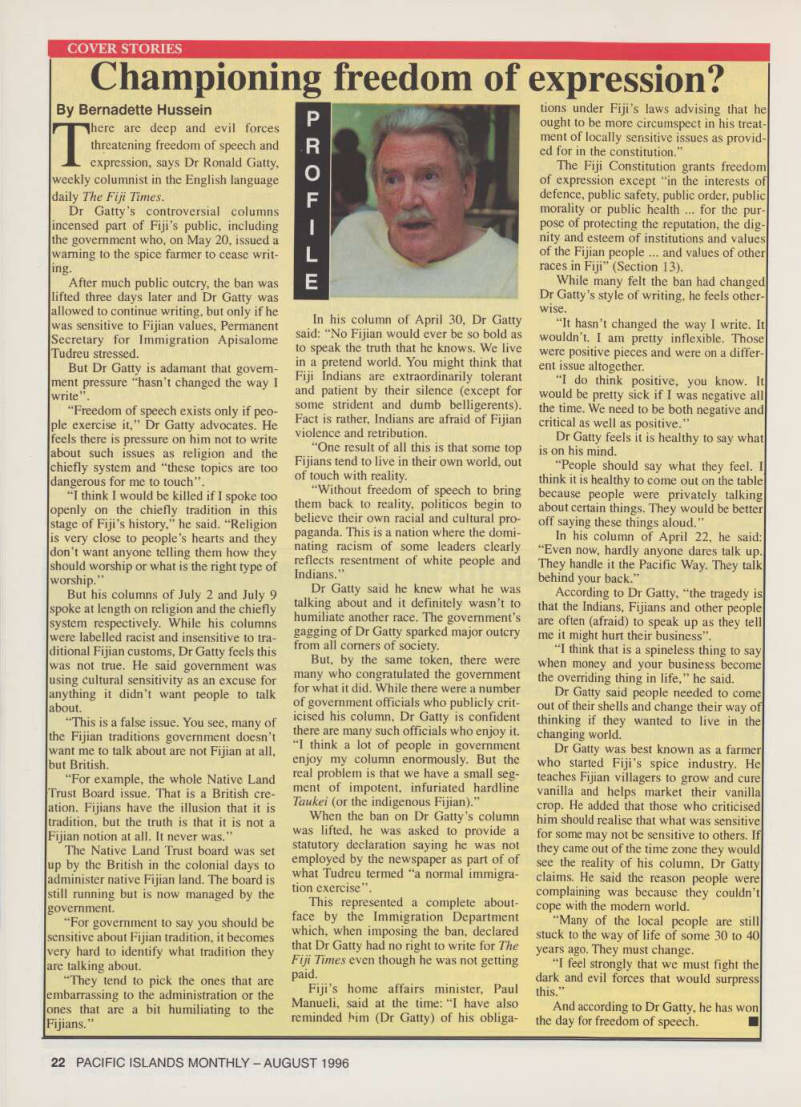
By Bernadette Hussein
There are deep and evil forces threatening freedom of speech and expression, says Dr Ronald Gatty, weekly columnist in the English language daily The Fiji Times.
Dr Gatty’s controversial columns incensed part of Fiji’s public, including the government who, on May 20, issued a warning to the spice farmer to cease writ
ing.
After much public outcry, the ban was lifted three days later and Dr Gatty was allowed to continue writing, but only if he was sensitive to Fijian values. Permanent Secretary for Immigration Apisalome Tudreu stressed.
But Dr Gatty is adamant that govern ment pressure “hasn’t changed the way I write”.
“Freedom of speech exists only if peo ple exercise it,” Dr Gatty advocates. He feels there is pressure on him not to write about such issues as religion and the chiefly system and “these topics are too dangerous for me to touch”.
“I think I would be killed if I spoke too openly on the chiefly tradition in this stage of Fiji’s history,” he said. “Religion is very close to people’s hearts and they don’t want anyone telling them how they should worship or what is the right type of
worship.”
But his columns of July 2 and July 9 spoke at length on religion and the chiefly system respectively. While his columns were labelled racist and insensitive to tra ditional Fijian customs. Dr Gatty feels this was not true. He said government was using Cultural sensitivity as an excuse for anything it didn’t want people to talk about.
“This is a false issue. You see, many of the Fijian traditions government doesn’t want me to talk about are not Fijian at all, but British.
“For example, the whole Native Land Trust Board issue. That is a British cre ation. Fijians have the illusion that it is tradition, but the truth is that it is not a Fijian notion at all. It never was.”
The Native Land Trust board was set up by the British in the colonial days to administer native Fijian land. The board is still running but is now managed by the government.
“For government to say you should be sensitive about Fijian tradition, it becomes very hard to identify what tradition they are talking about.
“They tend to pick the ones that are embarrassing to the administration or the ones that are a bit humiliating to the
Fijians.”
In his column of April 30, Dr Gatty said: “No Fijian would ever be so bold as to speak the truth that he knows. We live in a pretend world. You might think that Fiji Indians are extraordinarily tolerant and patient by their silence (except for some strident and dumb belligerents).
Fact is rather, Indians are afraid of Fijian violence and retribution.
“One result of all this is that some top Fijians tend to live in their own world, out of touch with reality.
“Without freedom of speech to bring them back to reality, politicos begin to believe their own racial and cultural pro paganda. This is a nation where the domi nating racism of some leaders clearly reflects resentment of white people and Indians.”
Dr Gatty said he knew what he was talking about and it definitely wasn’t to humiliate another race. The government’s gagging of Dr Gatty sparked major outcry from all comers of society.
But, by the same token, there were many who congratulated the government for what it did. While there were a number of government officials who publicly crit icised his column, Dr Gatty is confident there are many such officials who enjoy it.
“I think a lot of people in government enjoy my column enormously. But the real problem is that we have a small seg ment of impotent, infuriated hardline Taukei (or the indigenous Fijian).”
When the ban on Dr Gatty’s column was lifted, he was asked to provide a statutory declaration saying he was not employed by the newspaper as part of of what Tudreu termed “a normal immigra tion exercise”.
This represented a complete about face by the Immigration Department which, when imposing the ban, declared that Dr Gatty had no right to write for The Fiji Times even though he was not getting
paid.
Fiji’s home affairs minister, Paul Manueli, said at the time: “I have also reminded him (Dr Gatty) of his obliga
tions under Fiji’s laws advising that he ought to be more circumspect in his treat ment of locally sensitive issues as provid ed for in the constitution.”
The Fiji Constitution grants freedom of expression except “in the interests of defence, public safety, public order, public morality or public health ... for the pur pose of protecting the reputation, the dig nity and esteem of institutions and values of the Fijian people ... and values of other races in Fiji” (Section 13).
While many felt the ban had changed Dr Gatty’s style of writing, he feels other wise.
“It hasn’t changed the way I write. It wouldn’t. I am pretty inflexible. Those were positive pieces and were on a differ ent issue altogether.
“I do think positive, you know. It would be pretty sick if I was negative all the time. We need to be both negative and critical as well as positive.”
Dr Gatty feels it is healthy to say what is on his mind.
“People should say what they feel. I think it is healthy to come out on the table because people were privately talking about certain things. They would be better off saying these things aloud.”
In his column of April 22, he said: “Even now, hardly anyone dares talk up.
They handle it the Pacific Way. They talk behind your back.”
According to Dr Gatty, “the tragedy is that the Indians, Fijians and other people are often (afraid) to speak up as they tell me it might hurt their business”.
“I think that is a spineless thing to say when money and your business become the overriding thing in life,” he said.
Dr Gatty said people needed to come out of their shells and change their way of thinking if they wanted to live in the
changing world.
Dr Gatty was best known as a farmer who started Fiji’s spice industry. Fie teaches Fijian villagers to grow and cure vanilla and helps market their vanilla crop. He added that those who criticised him should realise that what was sensitive for some may not be sensitive to others. If they came out of the time zone they would see the reality of his column. Dr Gatty claims. He said the reason people were complaining was because they couldn’t cope with the modem world.
“Many of the local people are still stuck to the way of life of some 30 to 40 years ago. They must change.
“I feel strongly that we must fight the dark and evil forces that would surpress this.”
And according to Dr Gatty, he has won the day for freedom of speech. ■
Profile
‘Scam’ nearly costs
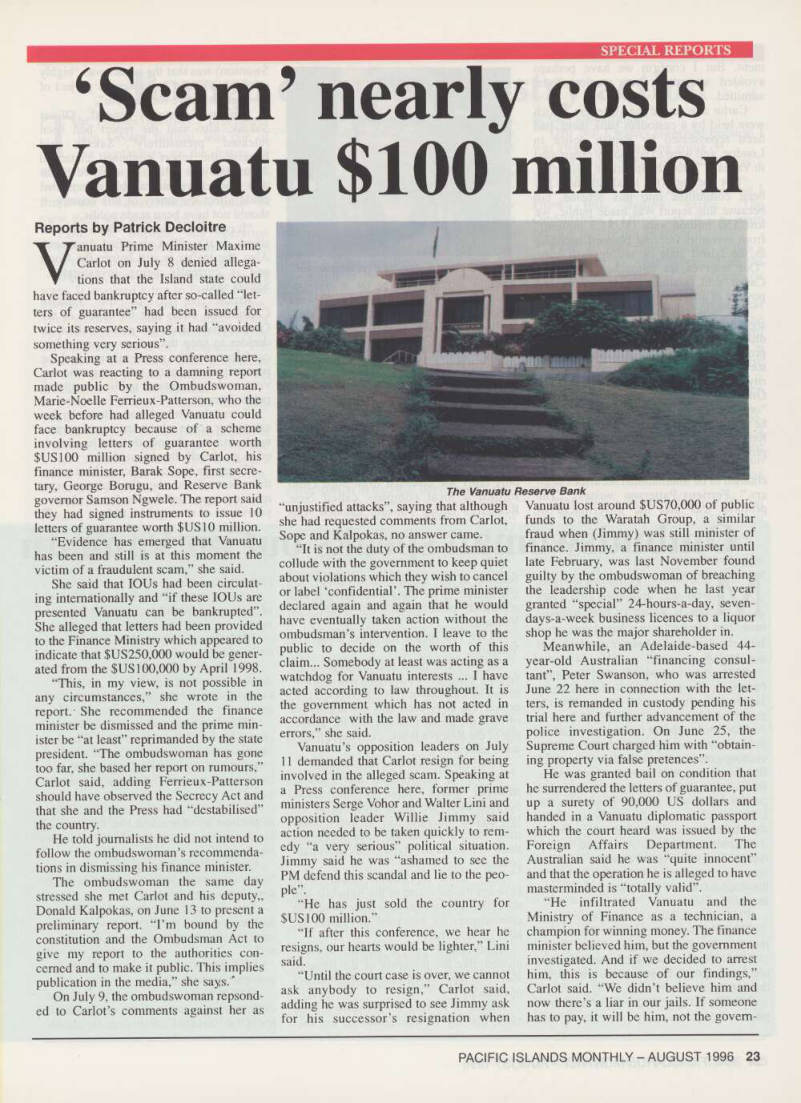
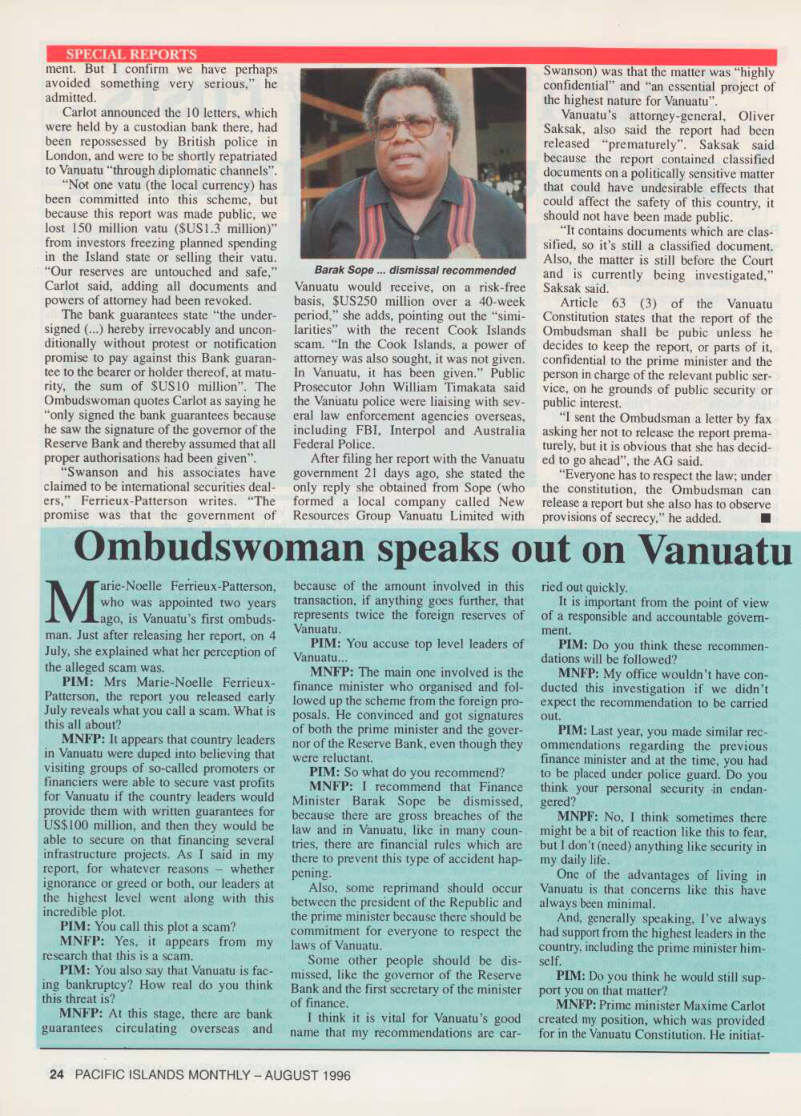
Special Reports
‘Scam’ nearly costs Vanuatu $100 million
Reports by Patrick Decloitre
Vanuatu Prime Minister Maxime Carlot on July 8 denied allega tions that the Island state could have faced bankruptcy after so-called “let ters of guarantee” had been issued for twice its reserves, saying it had “avoided something very serious”.
Speaking at a Press conference here, Carlot was reacting to a damning report made public by the Ombudswoman, Marie-Noelle Ferrieux-Patterson, who the week before had alleged Vanuatu could face bankruptcy because of a scheme involving letters of guarantee worth SUSIOO million signed by Carlot, his finance minister, Barak Sope, first secre tary, George Borugu, and Reserve Bank governor Samson Ngwele. The report said they had signed instruments to issue 10 letters of guarantee worth SUSIO million.
“Evidence has emerged that Vanuatu has been and still is at this moment the victim of a fraudulent scam,” she said.
She said that IOUs had been circulat ing internationally and “if these IOUs are presented Vanuatu can be bankrupted”.
She alleged that letters had been provided to the Finance Ministry which appeared to indicate that $U5250,000 would be gener ated from the SUS 100,000 by April 1998.
“This, in my view, is not possible in any circumstances,” she wrote in the report. She recommended the finance minister be dismissed and the prime min ister be “at least” reprimanded by the state president. “The ombudswoman has gone too far, she based her report on rumours,”
Carlot said, adding Ferrieux-Patterson should have observed the Secrecy Act and that she and the Press had “destabilised” the country.
He told journalists he did not intend to follow the ombudswoman’s recommenda tions in dismissing his finance minister.
The ombudswoman the same day stressed she met Carlot and his deputy,, Donald Kalpokas, on June 13 to present a preliminary report. “Fm bound by the constitution and the Ombudsman Act to give my report to the authorities con cerned and to make it public. This implies publication in the media,” she says. * On July 9, the ombudswoman repsond ed to Carlot’s comments against her as
“unjustified attacks”, saying that although
she had requested comments from Carlot, Sope and Kalpokas, no answer came.
“It is not the duty of the ombudsman to collude with the government to keep quiet about violations which they wish to cancel or label ‘confidential’. The prime minister declared again and again that he would have eventually taken action without the ombudsman’s intervention. I leave to the public to decide on the worth of this claim... Somebody at least was acting as a watchdog for Vanuatu interests ... I have acted according to law throughout. It is the government which has not acted in accordance with the law and made grave errors,” she said.
Vanuatu’s opposition leaders on July 11 demanded that Carlot resign for being involved in the alleged scam. Speaking at a Press conference here, former prime ministers Serge Vohor and Walter Lini and opposition leader Willie Jimmy said action needed to be taken quickly to rem edy “a very serious” political situation.
Jimmy said he was “ashamed to see the PM defend this scandal and lie to the peo
ple”.
“He has just sold the country for SUSIOO million.”
“If after this conference, we hear he resigns, our hearts would be lighter,” Lini said.
“Until the court case is over, we cannot ask anybody to resign,” Carlot said, adding he was surprised to see Jimmy ask for his successor’s resignation when
Vanuatu lost around SUS7O,OOO of public funds to the Waratah Group, a similar fraud when (Jimmy) was still minister of finance. Jimmy, a finance minister until late February, was last November found
guilty by the ombudswoman of breaching
the leadership code when he last year
granted “special” 24-hours-a-day, seven
days-a-week business licences to a liquor shop he was the major shareholder in.
Meanwhile, an Adelaide-based 44year-old Australian “financing consul tant”, Peter Swanson, who was arrested June 22 here in connection with the let ters, is remanded in custody pending his trial here and further advancement of the police investigation. On June 25, the Supreme Court charged him with “obtain ing property via false pretences”.
He was granted bail on condition that he surrendered the letters of guarantee, put up a surety of 90,000 US dollars and handed in a Vanuatu diplomatic passport which the court heard was issued by the Foreign Affairs Department. The Australian said he was “quite innocent” and that the operation he is alleged to have masterminded is “totally valid”.
“He infiltrated Vanuatu and the Ministry of Finance as a technician, a champion for winning money. The finance minister believed him, but the government investigated. And if we decided to arrest him, this is because of our findings,”
Carlot said. “We didn’t believe him and now there’s a liar in our jails. If someone has to pay, it will be him, not the govem
The Vanuatu Reserve Bank
ment. But I confirm we have perhaps avoided something very serious,” he admitted.
Carlot announced the 10 letters, which were held by a custodian bank there, had been repossessed by British police in London, and were to be shortly repatriated to Vanuatu “through diplomatic channels”.
“Not one vatu (the local currency) has been committed into this scheme, but because this report was made public, we lost 150 million vatu (SUSI. 3 million)”
from investors freezing planned spending
in the Island state or selling their vatu.
“Our reserves are untouched and safe,”
Carlot said, adding all documents and powers of attorney had been revoked.
The bank guarantees state “the under
signed (...) hereby irrevocably and uncon
ditionally without protest or notification promise to pay against this Bank guaran tee to the bearer or holder thereof, at matu rity, the sum of SUSIO million”. The Ombudswoman quotes Carlot as saying he “only signed the bank guarantees because he saw the signature of the governor of the Reserve Bank and thereby assumed that all proper authorisations had been given”.
“Swanson and his associates have claimed to be international securities deal ers,” Ferrieux-Patterson writes. “The promise was that the government of
Vanuatu would receive, on a risk-free basis, SUS2SO million over a 40-week period,” she adds, pointing out the “simi larities” with the recent Cook Islands scam. “In the Cook Islands, a power of attorney was also sought, it was not given.
In Vanuatu, it has been given.” Public Prosecutor John William Timakata said the Vanuatu police were liaising with sev eral law enforcement agencies overseas, including FBI, Interpol and Australia Federal Police.
After filing her report with the Vanuatu government 21 days ago, she stated the only reply she obtained from Sope (who formed a local company called New Resources Group Vanuatu Limited with
Swanson) was that the matter was “highly confidential” and “an essential project of the highest nature for Vanuatu”.
Vanuatu’s attorney-general, Oliver Saksak, also said the report had been released “prematurely”. Saksak said because the report contained classified documents on a politically sensitive matter that could have undesirable effects that could affect the safety of this country, it should not have been made public.
“It contains documents which are clas sified, so it’s still a classified document.
Also, the matter is still before the Court
and is currently being investigated,”
Saksak said.
Article 63 (3) of the Vanuatu Constitution states that the report of the Ombudsman shall be pubic unless he decides to keep the report, or parts of it, confidential to the prime minister and the person in charge of the relevant public ser vice, on he grounds of public security or
public interest.
“I sent the Ombudsman a letter by fax asking her not to release the report prema turely, but it is obvious that she has decid ed to go ahead”, the AG said.
“Everyone has to respect the law; under the constitution, the Ombudsman can release a report but she also has to observe provisions of secrecy,” he added. ■
Barak Sope...dismissal recommended
Marie-Noelle Ferrieux-Patterson,
Ombudswoman speaks out on Vanuatu
who was appointed two years ago, is Vanuatu’s first ombudsman. Just after releasing her report, on 4 t i u , . , , f. . r July he explained what her perception of the mifl. ed^ Cam xY aS; xt n r- PIM: Mrs Mane-Noelle Ferneux- Patterson, the report you released early July reveals what you call a scam. What is thls 1 i^ I *T^ ou T t ; . , MNFP: It appears that country leaders in Vanuatu were duped into believing that visiting groups of so-called promoters or financiers were able to secure vast profits for Vanuatu if the country leaders would I nn th£ n- WUh Tl. ten § uarantees f ° r L SSIOO million, and then they would be able to secure on that financing several infrastructure projects. As I said in my report, for whatever reasons - whether ignorance or greed or both our leaders at the highest level went along with this mC p e iM. le v Plot ' .i n 9 xJ^J 0U J a thlS P 0t a sca . m - .m , I 68 ’ • U aPPCarS fr ° m my research that this is a scam.
PIM: You also say that Vanuatu is facmg bankruptcy? How real do you think thK Ux^D. IS L . . .
MNFP. At this stage, there are bank guarantees circulating overseas and
because of the amount involved in this transaction, if anything goes further, that represents twice the foreign reserves of v , , , , , PIM: You accuse top level leaders of Vanuatu...
MNFP: The main one involved is the finance minister who organised and followed up the scheme from the foreign proposals. He convinced and got signatures of both the P rime minister and the governor of the Reserve Bank, even though they were reluctant.
PIM: So what do you recommend?
MNFP: I recommend that Finance Minister Barak Sope be dismissed, because there are gross breaches of the j aw and j n y anua tu, like in many countries, there are financial rules which are there to prevent this type of accident hap-
pening-
Also, some reprimand should occur between the president of the Republic and the prime minister because there should be commitment for everyone to respect the laws of Vanuatu - Some other people should be dismissed, like the governor of the Reserve Bank and the first secretary of the minister of finance.
I think it is vital for Vanuatu’s good name that my recommendations are car-
ried out quickly.
It is important from the point of view of a responsible and accountable gdvem- PIM: Do you think these recommen dations will be followed?
MNFP: My office wouldn’t have con ducted this investigation if we didn’t expect the recommendation to be carried out.
PIM: Last year, you made similar rec ommendations regarding the previous finance minister and at the time, you had to be placed under police guard. Do you think your personal security -in endan gered?
MNPF: No, I think sometimes there might be a bit of reaction like this to fear, but I don’t (need) anything like security in my daily life one of the advantages of living in Vanuatu is that concerns like this have always been minimal.
And, generally speaking. I’ve always had support from the highest leaders in the country, including the prime minister him self.
PIM: Do you think he would still sup port you on that matter?
MNFP: Prime minister Maxime Carlot created my position, which was provided for in the Vanuatu Constitution. He initiat
ed the creation of the ombudsman and I think he will respect the constitution.
PIM; What help did you get from financial experts in your investigation?
MNFP: First, my own background is banking at the highest level. I was also chief executive of a trust company for some time, so my background is very much in my field.
But to confirm what the suspicions were, we have used experts in the finan cial field here, in Australia, in the United States, and we even hired international solicitors in the States who have checked our suspicions and have confirmed that they were correct.
PIM: An Australian citizen is still in jail in Port Vila in connection with this scam. Has your report helped arrest him or lead to his arrest?
MNFP: Yes, there is a relation. But the public prosecutor is also investigating the matter, and I’d rather not say anything that could prejudice their own investiga tion.
PIM: Will this matter go further in the
Supreme Court?
MNFP: I believe, yes, this matter will go before the court and will be probably be exposed further. But that’s the respon sibility of the public prosecution and the court. ■
Borogu defends ministry action
The Finance Ministry’s first secre tary, George Borugu, was one of the signatories to the letters of guarantee. On July 6, he explained what his impression of the whole operation was.
From the Finance Ministry’s point of view, there was nothing wrong.
PIM: Mr Borugu, this operation involving signing letters of guarantee was not a scam, to your understanding?
GB: No, this programme was not a scam. It involved a trip to Europe by our Ministry of Finance and Peter Swanson.
They went to London and Zurich, where they met reputable banks which were to be the custodians for these documents. The governor of the Reserve Bank declined to go with them for reasons similar to the accusations of the ombudsman.
PIM: What sort of banks did they meet?
GB: Barclays, Loyds, Deutschebank in London and in Zurich Credit Suisse and Swiss Corporation Bank. Now, if it was a scam, it would not involve genuine rep utable banks like this.
PIM: What was the idea on the Finance Ministry’s side?
GB: The idea originally was that we put the proposal together and if the Council of Ministers says OK, we do it. If not, we withdraw it. So we put together a 80-90-page report for the Council of Ministers’ consideration. Then the council of ministers decided we should withdraw from the programme. This is what has been done and the Ministry (of Finance) finds it difficult to accommodate. We haven’t done anything wrong yet. We were still at the stage of preparing the report. If we had gone right to the end of the programme and ended up with nega tive results, the Ombudsman’s Office then could have accused us. But we’re still at the initial stage of the programme. How can you say this is a scam when you’re only at the first month?
PIM: You were expected to gain some SUS2SO million in a few weeks by issuing letters of guarantee worth SUSIOO mil lion. What was this money for?
GB: This was the total of the cost of
several development projects put together.
At present, we want to increase private participation in national development pro grammes at the planning and implementa tion level. This was to finance a project of generation of geothermal energy on the north of Efate (Vanuatu’s main island).
This project, as early as 1982, was identi fied in the national plan objectives and it is believed it could generate about 10 times the quantity of energy produced by the electricity company here.
Currently, the price of electricity is so high it’s become a prohibiting factor to development. One of the other projects was a cement factory in the same area.
PIM: But how did you understand this scheme was supposed to work?
GB: It’s a use of guarantees. According to our advice, this is a normal business between banks. It’s not something new.
The idea was that the trading would gen erate profit and the profit would be used by government through a company.
Money would then be used by this compa ny, New Resources Group Vanuatu Limited, which was formed here, to fund
government projects.
PIM: Is it like a loan?
GB: It’s not a loan. We did not sign a guarantee for a loan. It’s an instrument the trading banks in London are going to use to trade. So, it’s a guarantee for invest ment rather than a guarantee to loan money. The guarantees were going to be held by custodian banks and the profit would be used to finance development projects identified by the government.
PIM; Were you not surprised that it could be so easy to make so much money
in such a small time?
GB: No, I wasn’t surprised because I was aware of that trading going on.
PIM: So you had no doubt it was a
legal operation?
GB: I don’t say it’s a scam because I know this trading exists. The Ombudsman’s Office say it’s a scam because they’re not aware of it.
PIM: To your understanding, is this a similar thing to what happened in the Cook islands? What was the advice you received on this type of operation?
GB: I don’t know much about what happened in the Cooks. All I know is the Cook Islands have been mentioned. But all the advice we have received were in favour of the programme and they were not saying it’s a scam.
PIM: Did you seek advice from experts and specialists?
GB: Yes, we received advice from spe cialists internally and overseas, including a law firm in Australia. They all said we could do this. I know it exists. I had no doubt we would succeed in generating the profits.
PIM: Didn’t you think because of what had happened in the Cook Islands, you had to be extra careful?
GB: No, I never envisaged this possi bility. We were at a preparation stage. The advice from the PM’s office was that we should follow the steps.
PIM: And this Australian ‘financing consultant’, Peter Swanson - how did you first hear of him?
GB: We’ve known him over the last four years. He’s a financier. Before we asked him to be involved, we asked him to submit his CV and backgrounds of all peo ple who were going to be involved.
They’re all people who exist in Australia not fictious people - and genuine banks in London. Peter Swanson is a member of
several reputable banking organisations.
PIM: The ombudsman report alleges he’s been declared bankrupt more than once. This didn’t affect the good image you have of him?
GB: No, we heard he had entered about 10 different businesses and only two companies were bankrupt. But who in this world is not bankrupt?
PIM: He was also was given a Vanuatu diplomatic passport although he’s not a Vanuatu citizen.
GB: That was from the beginning (of this government) when the government asked him to deal with this. To show some commitment, that was issued to allow him to travel on behalf of the government overseas. It was after the government was formed. ■
fiscal problems
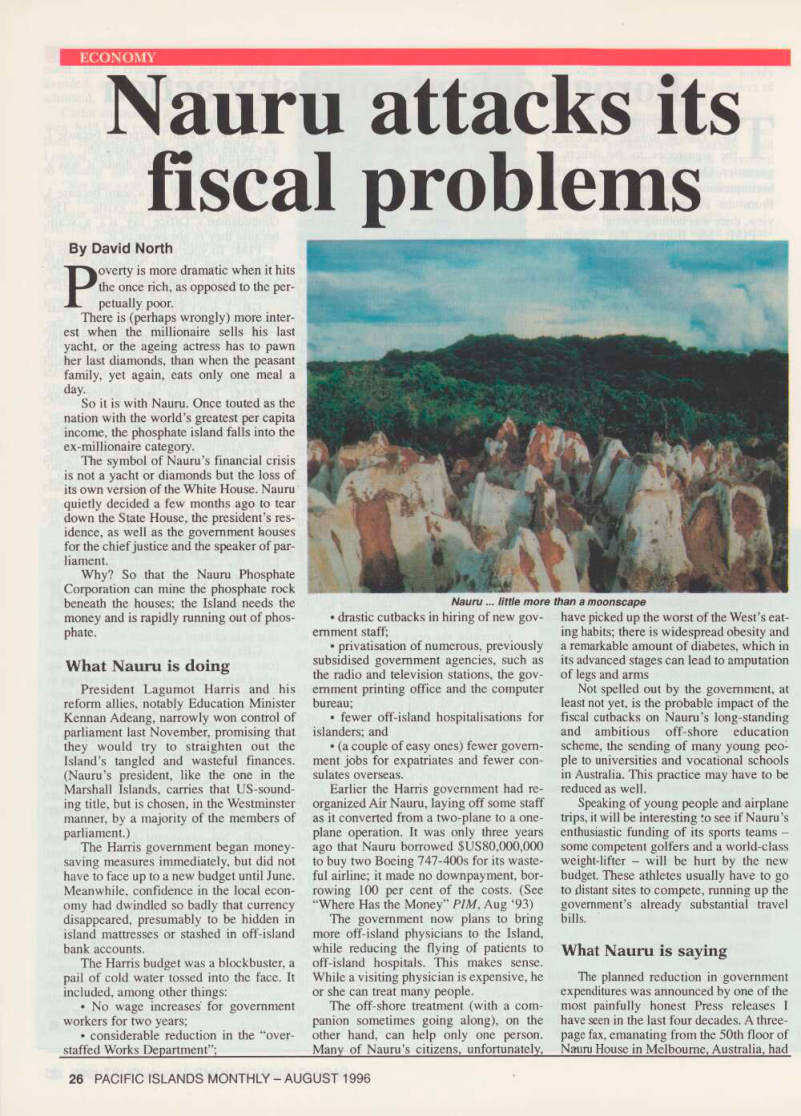
Economy
Nauru attacks its fiscal problems
By David North
Poverty is more dramatic when it hits the once rich, as opposed to the per
petually poor.
There is (perhaps wrongly) more inter est when the millionaire sells his last yacht, or the ageing actress has to pawn her last diamonds, than when the peasant family, yet again, eats only one meal a day.
So it is with Nauru. Once touted as the nation with the world’s greatest per capita income, the phosphate island falls into the ex-millionaire category.
The symbol of Nauru’s financial crisis is not a yacht or diamonds but the loss of its own version of the White House. Nauru quietly decided a few months ago to tear down the State House, the president’s res idence, as well as the government houses for the chief justice and the speaker of par liament.
Why? So that the Nauru Phosphate Corporation can mine the phosphate rock beneath the houses; the Island needs the money and is rapidly running out of phos
phate.
What Nauru is doing
President Lagumot Harris and his reform allies, notably Education Minister Kennan Adeang, narrowly won control of parliament last November, promising that they would try to straighten out the Island’s tangled and wasteful finances. (Nauru’s president, like the one in the Marshall Islands, carries that US-sound ing title, but is chosen, in the Westminster manner, by a majority of the members of
parliament.)
The Harris government began money saving measures immediately, but did not have to face up to a new budget until June.
Meanwhile, confidence in the local econ omy had dwindled so badly that currency disappeared, presumably to be hidden in island mattresses or stashed in off-island bank accounts.
The Harris budget was a blockbuster, a pail of cold water tossed into the face. It included, among other things; • No wage increases' for government workers for two years; • considerable reduction in the “over staffed Works Department”;
• drastic cutbacks in hiring of new gov ernment staff; • privatisation of numerous, previously subsidised government agencies, such as the radio and television stations, the gov ernment printing office and the computer bureau; • fewer off-island hospitalisations for islanders; and • (a couple of easy ones) fewer govern ment jobs for expatriates and fewer con sulates overseas.
Earlier the Harris government had re organized Air Nauru, laying off some staff as it converted from a two-plane to a one plane operation. It was only three years ago that Nauru borrowed SUSBO,OOO,OOO to buy two Boeing 747-400 s for its waste ful airline; it made no downpayment, bor rowing 100 per cent of the costs. (See “Where Has the Money” PIM, Aug ‘93) The government now plans to bring more off-island physicians to the Island, while reducing the flying of patients to off-island hospitals. This makes sense.
While a visiting physician is expensive, he or she can treat many people.
The off-shore treatment (with a com
panion sometimes going along), on the
other hand, can help only one person.
Many of Nauru’s citizens, unfortunately.
have picked up the worst of the West’s eat ing habits; there is widespread obesity and a remarkable amount of diabetes, which in its advanced stages can lead to amputation of legs and arms Not spelled out by the government, at least not yet, is the probable impact of the fiscal cutbacks on Nauru’s long-standing and ambitious off-shore education scheme, the sending of many young peo l pie to universities and vocational schools in Australia. This practice may have to be reduced as well.
Speaking of young people and airplane
trips, it will be interesting to see if Nauru’s enthusiastic funding of its sports teams some competent golfers and a world-class weight-lifter - will be hurt by the new budget. These athletes usually have to go to distant sites to compete, running up the
government’s already substantial travel
bills.
What Nauru is saying
The planned reduction in government expenditures was announced by one of the most painfully honest Press releases I have seen in the last four decades. A three page fax, emanating from the 50th floor of Nauru House in Melbourne, Australia, had
Nauru ... little more than a moonscape
this to say about the island government: “... greatly overstaffed public service with high salary bills and little funding for maintenance of buildings and equipment.
The departments lacked clear objectives and performance criteria.
“When the Harris government came to power, it found substantial unsecured loans with the Bank of Nauru both public and private. There was a critical cash-flow crisis on the island. Much of the country’s investment had been collateralised to meet government debt...”
What Nauru is not saying Meanwhile, honest as the Press release was, it barely scratched the surface of the financial problems of Naum.
For example, it mentioned these reforms: “Visitors to pay user-charge fees for medical services” implying that medi cal services, in the past, have been free for off-islanders who became sick on the island. It spoke of “amalgation of hospi tals on the island”.
Naum, for reasons not clear to me, an island with 8000 inhabitants in a compact area, had two hospitals.
The Press release said that were to be “significant increases in import duty for alcohol, tobacco and second-hand cars”.
When American television viewers last saw the Island described on television, CBS-TV commentator Morey Safer was seen waving a cocktail glass and saying that “Naum has the cheapest liquor in the world”.
It is not that Naum produces the hard stuff efficiently. (Nauru produces nothing but phosphate.) What happens is that the stuff is imported, and then barely taxed.
Further, Nauru may be the only place in the world where there is no income tax and no sales tax.
The government, in short, can mend its balance sheet by cutting waste and bloat, and by imposing a few taxes. None of this, of course, is very popular among the vot ers.
In addition to the fast-disappeared phosphate that once created the Island’s prosperity, Naum has three other major
financial problems:
1. Although the figures sound horrify
ing, the least of Naum’s problems has been that outsiders, ranging from accoun tants in Melbourne to international con men, have stolen money from the Island’s inept financial managers in the past. Three years ago Nauru lost SUS 10-20,000,000 to conmen selling “Prime Bank Notes”, in a swindle something like the one that hit the Cooks recently.
2. A continuing, more significant prob
lem has been foolish investments of the phosphate moneys, that were supposed to
guarantee prosperity for Nauruans even after the last of the phosphate was sold.
Nauru’s leaders, traditionally, distrusted stocks and bonds so they bought real estate, such as hotels and the tower in Melbourne. Some, such as the holdings in Honolulu, turned out well, others were disasters.
They then turned to the Tokyo stock market, just as it started to collapse, and lost a bundle there. And, about three years ago, Nauru decided to mount a musical
comedy in London, which just happened
to be the property of Duke Minks, a fast talking financial adviser to then Nauru
Government. Nauru dropped SUS 3 mil
lion on the musicals which dealt with the relation between the painter Leonardo Da Vinci and his most famous model, the Mona Lisa.
Kelly Emiu, then secretary of the cabi net, and the chief “Leonardo” enthusiast, kept his job after the musical bombed but is not on the payroll of the Harris govern ment. 3. The most serious of Nauru’s finan cial problems, as the new government readily admits, is waste.
The government spends enormous sums on overseas travel; all of its food and water have to be imported; there are too many politicians and civil servants on the payroll - with a compact island of 8000 people, Nauru had indulged in the luxury of two governmental structures, the national government and a municipal one, each with its own elected leaders, execu tive staff and hangers-on.
Meanwhile, though most of the island is a moonscape, ravaged by the surface mining for phosphate, Nauruans have not been doing the physical work needed to restore the landscape to its earlier condi tion when it was called Pleasant Island.
In recent decades, Nauru could have used some of its wasted money to pump sand and dirt from the bottom of the sur rounding ocean onto its desolate shore, but that did not happen. Nor did Nauru use the presumably empty holds of the arriving phosphate ships to bring in top soil from Australia.
The new government promises that rehabilitation of the Island remains a pri ority but, if done at all, it will probably be done by off-island contractors using off island technologies and off-island work ers.
The significant news, however, is that Nauru has finally made an effort to face the grim fiscal reality it has dodged for years.
Maybe, just maybe, the Harris govern
ment can avoid bankruptcy and the need to evacuate the Island, on the grounds that there is neither an Island left, nor any money remaining to support human life on it. ■
Advertisements & other items, pp. 27-29 (1 item)
in the
Transition hits home in the Cooks
By Lisa Williams
The T-word that’s been joked about openly, but dreaded in private by thousands of public servants final ly hit the Cook Islands cabinet as it met and discussed its 1996/97 budget early last month. Transition services, the sub ject of the special meeting held in Suva, Fiji, in June, is being funded by a special New Zealand government package of more than SNZB million (SUSS.S mil lion) most of it from their annual bud get support programme to the Cooks.
And if the sting of the public service paycuts by up to 65 per cent wasn’t enough warning to bring home the reality of the recession to Cook Islanders, Transition will serve as the final notice that, after three months, those on the spe cial “family bridging support” paycheck will be on their own.
The $6O-million-plus budget last year may have done it’s last legs in June towards paying the public servants already on 35 per cent of their former pay, but an estimated SNZ4O-million ($U527.4-million) current budget has finally hit home the message to leaders criticised for being slow to implement the hard-hitting reforms designed to put the Cooks back on the track: No more jobs for the boys.
Early in July, workers across the Cooks received the standard memo from the Public Service Commissioner. In line with the FEM “transparency” reforms on open government, their jobs were being declared “acting” and positions in each department were being advertised. They could apply and would either end up winning a job in the new public service, or spending three months on pay in “tran sition” readying themselves for being off the government payroll.
The letter hit home to many the fact that there would be no more “uncles, cousins, or campaign managers” to pro tect their jobs even if departmental heads are political appointments - and, disappointingly enough, most of them are. The new FEM laws on financial man agement are going to whip both ministers and their favourites into shape. The gov ernment has dropped from 44 offices to
26 leaving 15 ministries and 11 depart ments being pruned back even more. “If they want to pay workers under them what they are worth, then they can’t afford to
have hangers-on and ‘surplus’ positions at
all,” says one officer close to the haggling
over budgets in June/July.
At village level, though, the signs of acceptance of the Transition reality are not looking good. In one household the day the ‘memos’ were given out, the oldest public servant could not believe the news.
His son was bitter at a government that had ruined the country, and another daughter, a clerical worker, was pondering over travel to New Zealand if she could not get work locally. All were public ser vants and their attitudes mirror what is happening generally.
While the Transition concept is being sold as a positive move for workers to “take control” of their lives, for many it means losing the job around which their identity and social network revolved.
Departmental heads began giving out
letters to all their employees and advertis ing the drastically cut positions. They will now run on even tighter budgets than they’ve had in the past. But for almost 2000 public servants who are on the move to “Transition” and training for the private sector, the “denial phase” will influence just how positively they view their new environment. Early in the piece, while fighting for public servants to be given enough notice of job cuts, Public Service Association president Gill Vaiimene was one of several officials struck by the lack of interest in the coming Transition.
“Everyone’s wearing these rose-tinted
glasses and thinking ‘it’s someone else’s job that will cut, not mine’,” she said.
“They are in what I call a denial phase, where they are not accepting that job loss es are going to happen.” And that was only the attitude from workers based on Rarotonga, where many have been close to the news of and felt the urgency for reforms. On a briefing trip to the Outer Islands, where officials had to tell hun dreds of public servants of the impending loss of their jobs, they were shocked by the “everything will be taken care of by my member in parliament” attitude. There was outright refusal to believe what they were being told, says one official, who adds Outer Islanders may only believe what they are being told once they hear the prime minister break the news to them on radio. But anyone who has lived long enough in the Cooks knows it is the sys tem itself which is partly to blame for many public servants being so out of touch. The same voters who did not bat an eyelid at the exposes of the Letters of Guarantee scam, the Winebox, and high spending by former officials of the Sheraton Hotel project have long con-
doned a public service system open to nepotism, favouritism and political inter ference regardless of which govern ment was in power. And the government’s slow shuffle towards finally tabling its current budget has been reflected in the move to a ministry which is by its very nature meant to soften the blow of losing a
government job.
At a time when jobs in private business are being met with a flood of applicants, only four people applied for the eight jobs advertised in the Transition services.
Transition secretary Nga Pierre says the problem lies with people thinking they won’t be in transition and can still hang on to their public service jobs. He says while applications have formally closed the ser vice still wants to hear from people who want the jobs, either full time or as a two month contract. With Transition is NZODA consultant Diane Buchan, whose job is to help the Transition committee set up the Transition structure and process and ensure the funding is in place, but the lack of response to the Transition ads have made the set-up difficult, says Pierre.
“We suspect the reason is that people still don’t believe that they are not going to have a job. And so why should they apply for a job outside the public service?”
TTie four who responded came from around 80 application forms that were picked up. The pitiful response has made Pierre put out the feelers for contract workers just to get the service up and operating. “And they can hold the fort
until people realise they actually don’t
have a job, then we would readvertise and
hopefully get people into those positions.”
The Transition committee is trying to get through to people that the coming cuts have nothing to do with skills or a lack thereof, but that there’s just no money to fund the jobs they hold. They are con vinced there will be many highly skilled and motivated people who will lose their jobs in the down-sizing and be available for a position in the Transition Service.
Despite the slow response, Pierre is hopeful that the office can get the motivat ed team it needs, whether from the private sector or from the public service. From the
sounds of it, though, it is the transition in the mind that is needed most from those losing their jobs. Buchan says resilience, resources and mental attitude “make an incredible difference to the recovery of a
community, where you’ve got really good
leaders who are innovative and enthusias tic and can stop people getting bogged down in misery”. She says finding people with vision to lead the way out of the cri sis doesn’t necessarily mean looking to politicians for all the answers, but grass roots village people and those doing their bit in the private sector.
And even those who want to collect their pay and use it to start up in New Zealand will find that difficult there will be no lump-sum payments given to the Transition 2000, because the three month period is seen as essential time for the “reality to sink in, so they can think about their future options”, says one offi cial.
The equivalent of their salaries or wages will be paid into their accounts with the only difference that deductions for power, loans, insurance and the phone bills will have to be made by the person concerned. That news has had the three local banks, already worried by the rising number of defaults on loans, anticipating
more problems. They are clamouring for
lists of names once Transition staff are on the payroll, so they can contact loan clients before they skip the country.
“Loan defaults have been consider able,” says ANZ general manager Chris Lancaster of the trend since he took over the helm earlier this year.
“Many borrowers are exiting the coun try without facing up to their obligations, which is very disappointing.”
He warned that clients running out on their loans were compounding the prob lem, because many of them were flying to Australia or New Zealand countries where they can be blacklisted with credit listing organisations. They are also mak ing it harder for those who stay behind to lend, warns Lancaster of tighter lending criteria to come if the problem continues.
Still, Transition head Nga Pierre and many others in the government are hoping
Natural resources, warm climate and tourist potential should be enough to kick-start people into focusing on their talents
that most Cook Islanders will “stay here and help our country recover”. A slow drift of workers with skills, initiative and drive has been noticed leaving the country even as they are also the ones needed to get the economy back on its feet.
Transition advisers, in the meantime, are
actively campaigning for people to think
of where they will be in a year’s time.
With training for job skills, one of the most important briefs of the temporary office, they say the easiest ones to train will be those who have an idea of what they want to do with themselves. It might be a little too much to tell public sector employees in transition they live in a land of opportunities, but that’s exactly what they will hear for their three-month stint on full pay.
Sure, things are going to be hard, but you know there’s more hope here than a lot of places I’ve worked in,” says Buchan. Lots of natural resources, a warm climate, and huge tourist potential com bined with the services provided by Transition should be enough to kick-start people into getting organised and focus ing on their talents, she'says.
And those with vision will be eligible for a special revolving fund coming from the Transition millions for small business assistance even, as one expert says, if it will take 18 months before many get ready to take on whatever they want to do...if they haven’t taken on the key exit Cook Islanders have as a way out of the country’s recession NZ passports offering a second chance in either New Zealand or Australia.
There is one worry on the minds of politicians which could well come true if the results of the July by-election for the Nikao-Panama electorate vacated by for mer MP Vincent Ingram is anything to go by.
The Cook Islands Party candidate, a businesswoman with a hard-hitting anti government stance, still came home with a surprising defeat, and had to blame vot ers’ anger at the government party she
represented.
As for the winning candidate, a strong community leader with family ties, to many of her voters the win was a double first: “Aunty” Ngamau Munokoa became the only woman in the Cook Islands par liament, and she is the first candidate to win a seat under the Demo-Alliance oppo sition party banner.
The government caucus took their party’s landslide defeat at the Nikao polls as a warning for the general elections two years away. “The message to government is loud and clear, the message to caucus is loud and clear, and the message to our political party is loud and clear,” said one senior minister, “we’ve got a lot of work to do.” ■
Abandoned, the

Region
Abandoned, the Pacific almost loses out
By Kaiinga Seneviratne
The South Pacific has given leader ship to Small Island Developing States (SIDS) at previous United Nations global conferences such as the Rio Earth summit in 1992 and the Cairo Population Summit in 1994, but at Habitat II in Instanbul they kept a very low profile almost until the last day of the two-week
meeting.
The South Pacific delegations in Istanbul were small and led mainly by senior public servants or their ambas sadors to the United Nations based in New York. While the Caribbean island nations, led by Jamaica, and co-ordinated by their regional inter-governmental agency, CARICOM, were leading the fight against an attempt by the United States and European Community to delete all references to SIDS from the draft Global Plan of Action (GPA), the Pacific
kept mute.
When questioned about it, one Pacific delegate told Pacific Islands Monthly that South Pacific nations were not even talk ing to each other to co-ordinate a regional strategy against the US and EU push because of a lack of co-ordination by the South Pacific Forum, whose secretariat had not sent a single official to Istanbul.
Many other officials delegates and South
Pacific non-govemmental organisation
(NGO) delegates to Habitat II felt that the Forum had abandoned them at Istanbul.
The conference gave NGOs unprece dented access to the official UN confer ence sessions. But, here too, top Pacific NGOs such as the Pacific Islands Association of NGOs (PIANGO) - which addressed the Cairo summit as the repre sentative of Southern (Third World) NGOs - and the Suva-based Pacific Concerns Resource Centre were missing.
Thus, at the parrallel NGO Forum, the Pacific made hardly a sound. It was not until June 12 (two days before the end of the meeting) that Forum member dele gates had their first meeting here. That, too, had been organised by a group of Pacific NGO delegates at Istanbul.
During the last two days of negotia tions on the GPA, the South Pacific was thus able to have some say, game ring the support of the Group of 77 (developing countries) to foil attempts by the US and France to delete Clause 126 from the draft of the GPA, which reinforced the “pol luter pays” principle with respect to con-
lamination by nuclear testing. The para graph in question concerns the safe reset tlement of populations and restoration of economic activity in areas affected by radioactive contamination as a conse quence of the development and testing of nuclear weapons.
At Istanbul, Solomon Islands moved to amend Clause 126, introduced by Marshall Islands at the third Prep Com in New York, to broaden its scope to beyond the effects of US testing in the Marshalls and encompass other areas. The move immediately met with French resistance.
“France thought that we were picking them out and they objected to it,” Rex Horoi, permanent representative of Solomon Islands to the United Nations, told IPS. Solomon Islands highlighted commitments already in the document on rehabilitation and reconstruction follow ing armed conflict and human-made dis
asters. Japan supported the text, along
with the G 77.
Horoi was disappointed by the lack of co-ordination among Pacific countries at Istanbul - even on an issue of direct con cern to them. “It’s rather sad that we did n’t have the co-ordination of the Forum ... when the Habitat agenda covers all that the Forum stands for,” he observed, adding that the secretariat had cited lack of funds for its inability to send someone to Istanbul. Earlier in the conference, when the GPA negotiating committees were debating whether to delete clauses
recognising SIDS’ vulnerability to global
warming, it was the Caribbeans who car
ried the battle to the West (who were worried about committing any financial assistance to anyone here).
“In this last important conference of the UN this decade, that should be speak ing about human settlements all over the world, we are finding SIDS are not given special recognition, especially since in many instances, there’s been emphasis on larger cities,” Easton Douglas, minis ter for the environment and housing of Jamaica told PIM.
“We see this as a conference on human settlements, as well as on cities,”
Byron Blake, assistant secretary-general of CARICOM, told PIM. He was disap pointed that his organisation and the Forum were not able to co-ordinate the input of the SIDS.
Horoi said most Pacific delegations lacked manpower to cover all of the committees and plenary sessions and had to depend on the G 77 to be their mouth piece. Wesley Aruga, the alternative head of the Papua New Guinea delegation, also admitted that the Pacific had not prepared well for Habitat 11.
As PNG holds the current chairman ship of the Forum, one Pacific delegate told PIM that it was the duty of that country’s delegation to call a meeting of Forum member states at Istanbul.
Aruga admitted that Pacific delegates were working independently but said his delegation had done what it could at Istanbul, adding that they had encoun tered funding problems internally to get a delegation in the first place. Aruga com plained that when the Forum Heads of State meeting was held in PNG last year, preparations for Habitat II were not included in the agenda.
He observed that even the regional report launched here by the Bangkok based Economic and Social Commission for Asia and the Pacific (ESCAP), a regional agency of the United Nations, was titled “Living in Asian Cities”.
He had suggested a follow-up report to be titled perhaps “Living in the Pacific Islands”. Jens Overgaard, chief of the ESCAP-UN Centre for Human Settlements joint section on Human Settlements, told PIM they planned to commission another report on the state of the cities in the Asia-Pacific region which would include cities in the South Pacific.
Meanwhile, Aruga hopes that the Istanbul experience will make the South Pacific leaders realise the importance of regional co-ordination, so the region’s voice will not be drowned out in future.
We hope after Habitat, when we get back home, we can bring together the Pacific Island nations and work out a strategy to deal with the issues raised at the Habitat meeting here,” he said. ■
Advertisements & other items, pp. 30-31 (1 item)
Drive dignity right to the top.
TOYOTA
Everyone who knows cars has no doubts about Land Cruiser’s ruggedness.
Yet how many know that its luxury rivals the finest high-priced cars?
Or that it’s got more room inside than many luxury sedans?
And because it’s a Toyota, Land Cruiser’s fit and finish, attention to detail, and graceful form speak of elegance as well as spacious comfort.
Yet you still get tough ladder frames and suspension built to take you as far off road as you want to go.
With power from 4.5-litre petrol or 4.2-litre diesel engines.
And it’s carefully protected from rust to last longer.
So if you’re going right to the top, this dignified car is ready to take you.
LAND CRUISER
DISTRIBUT'D RS/DEALERS
AMERICAN SAMOA BURNS PHILP MOTORS PH 633-4281 COOK ISLANDS PACIFIC MOTORS LTD. PH 20796 FIJI ASCO MOTORS PH 384888 GUAM & MICRONESIA...ATKINS KROLL, INC. PH 646-1876/9 KIRIBATI TARAWA MOTORS PH 21090 NEW CALEDONIA S.I.A.P. PH 275562 NORFOLK ISLAND BORRY’S PTY LTD. PH 22114 PAPUA NEW GUINEA ELA MOTORS PH 3229400 SAIPAN MICROL CORPORATION PH 234-5911 SOLOMON ISLAND ELA MOTORS PH 30314 TAHITI NIPPON AUTOMOTO PH 429819 TONGA ASCO MOTORS PH 23500 VANUATU ASCO MOTORS PH 22341 WESTERN SAMOA ASCO MOTORS PH 20800
ll® IHi Ji & 1
LAND
CRUISER
A V t » , « 5 .,., v - ' .. -aaail ? ? * • , INr -*. . "' "’*■ ■*arfe - - € *«* *1 JL-JShk- ’* ef^^,"* llfe, i * % j* z
decolonisation seminar
France singled out at decolonisation seminar
By Sam Vulum
The facilitation process for the 1998 New Caledonian Kanaks’ referen dum received further boost in June at the Pacific Regional Seminar of the UN Special Decolonisation Committee in Port Moresby, Papua New Guinea.
The plight of the Kanaks, which was
extensively discussed during the
Melanesian Spearhead Group (MSG)
meeting in the Trobiand Islands in the Milne Bay province earlier in the month, received special mention from PNG Prime Minister Sir Julius Chan during the United Nations seminar.
Sir Julius called for an early, orderly and absolute end to colonialism in New Caledonia, with specific safeguards for the rights of indigenous Kanaks. At the MSG summit Sir Julius, who is chairman of both the MSG and South Pacific Forum said; “Papua New Guinea’s concern for New Caledonia does not rise from any hostility or disregard for France. It is the product of our desire to put the colonial period behind us and develop relations on the basis of mutual benefit and regard.”
He said both the Forum and the MSG believed that following the decision to stop nuclear testing in the Pacific, France be readmitted as a post-Forum dialogue partner. However, he said member nations of the Forum and MSG were disappointed in the breakdown of recent talks between French authorities and the pro-indepen dence group in New Caledonia, FLNKS.
New Caledonia is one of 17 non-self goveming territories around the world.
Four of these, including New Caledonia, are located in the South Pacific. The oth ers are Wallis and Futuna, Tokelau and Pitcairn. The seminar was aimed at assess ing situations in the non-self-goveming territories, focusing on the status of their political evolution towards self-determi nation by the Year 2000. This is in the line with the General Assembly Resolution 1514. The resolution consists of a declara tion proclaiming, among other things, that the subjection of peoples to alien subjuga tion, domination and exploitation consti tute a denial of fundamental human rights is contrary to the Charter of the UN that all peoples have the right to self-determi nation. PNG’s permanent representative to the UN and chairman of the committee, Utula Samana said the committee was asked to seek suitable ways for the speedy recovery and total application of the dec laration to all territories yet to achieve the
objective of the declaration and submit to the General Assembly a report with rec ommendations on all territories to which the declaration applies. The decolonisa tion seminar, which is the sixth of its kind, has entered its final stage under General Assembly resolution 43/47 of 1988.
The resolution, titled International Decade for the Eradication of Colonialism, declared the period 1990 to 2000 as the decade for the eradication of colonialism and requested the UN Secretary-General to submit a plan of action aimed at ushering into the 21st Century, a world free of colonialism.
Samana said that seminars such as this provided an effective mechanism to inter act with representatives of the non-self goveming territories as well as experts in the fields of decolonisations. He expressed the committee’s satisfaction at the constitutional development being taken in Tokelau.
“On behalf of the committee, I should like to record our thanks to New Zealand, the administering power, for assisting the people of Tokelau in exercising their right to self-determination,” the chairman said.
On New Caledonia, Samana said that although the committee was happy with the Matignon Accord and the framework towards some form of self-determination, there were some critical factors, such as immigration, causing an imbalance of the population (made up of Melanesians and French settlers or Caldoches) and how that would affect the outcome of the plebiscite or referendum planned for 1998. FLNKS Independence party presi dent Rock Wamyton expressed similar concern over increased migration of French nationals into the country.
Meanwhile, spokesman for the United States mission to the UN James Rubin said, “We think such a meeting is a junket for bureaucrats at the expense of services for the people.” The committee expected five of its members as well as representa tives of non-govemment organisations and several UN staff to attend at an esti mated cost of US$l5O,OOO. He hoped the “ridiculousness of having such a meeting on a subect which people increasingly realise is obsolete would increase the chances of being able to kill this commit tee altogether”. He said US Ambassador Madeleine Albright was particularly upset by the decision to go ahead with the sem inar at a time when she was asking a fru gal US Congress for hundreds of dollars to pay UN dues. ■
employment opportunities
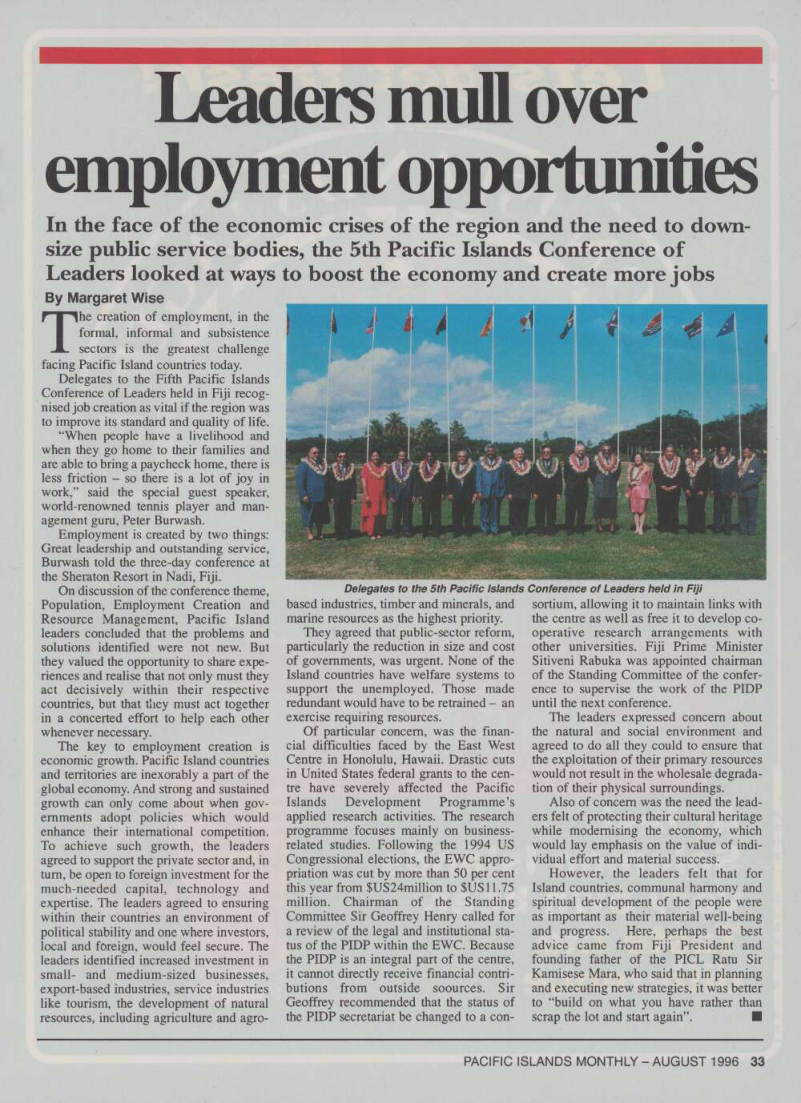
Leaders mull over employment opportunities
In the face of the economic crises of the region and the need to down size public service bodies, the sth Pacific Islands Conference of Leaders looked at ways to boost the economy and create more jobs
By Margaret Wise
The creation of employment, in the formal, informal and subsistence sectors is the greatest challenge facing Pacific Island countries today.
Delegates to the Fifth Pacific Islands Conference of Leaders held in Fiji recog nised job creation as vital if the region was to improve its standard and quality of life.
“When people have a livelihood and when they go home to their families and are able to bring a paycheck home, there is less friction - so there is a lot of joy in work,” said the special guest speaker, world-renowned tennis player and man agement guru, Peter Burwash.
Employment is created by two things: Great leadership and outstanding service, Burwash told the three-day conference at the Sheraton Resort in Nadi, Fiji.
On discussion of the conference theme,
Population, Employment Creation and
Resource Management, Pacific Island leaders concluded that the problems and solutions identified were not new. But they valued the opportunity to share expe riences and realise that not only must they act decisively within their respective countries, but that they must act together in a concerted effort to help each other whenever necessary.
The key to employment creation is economic growth. Pacific Island countries and territories are inexorably a part of the global economy. And strong and sustained growth can only come about when gov ernments adopt policies which would enhance their international competition.
To achieve such growth, the leaders agreed to support the private sector and, in turn, be open to foreign investment for the
much-needed capital, technology and
expertise. The leaders agreed to ensuring
within their countries an environment of political stability and one where investors, local and foreign, would feel secure. The leaders identified increased investment in small- and medium-sized businesses, export-based industries, service industries like tourism, the development of natural resources, including agriculture and agro-
based industries, timber and minerals, and marine resources as the highest priority.
They agreed that public-sector reform, particularly the reduction in size and cost of governments, was urgent. None of the Island countries have welfare systems to support the unemployed. Those made redundant would have to be retrained - an exercise requiring resources.
Of particular concern, was the finan cial difficulties faced by the East West Centre in Honolulu, Hawaii. Drastic cuts in United States federal grants to the cen tre have severely affected the Pacific Islands Development Programme’s applied research activities. The research programme focuses mainly on business related studies. Following the 1994 US Congressional elections, the EWC appro priation was cut by more than 50 per cent this year from sUS24million to $U511.75 million. Chairman of the Standing Committee Sir Geoffrey Henry called for a review of the legal and institutional sta tus of the PIDP within the EWC. Because the PIDP is an integral part of the centre, it cannot directly receive financial contri butions from outside soources. Sir Geoffrey recommended that the status of the PIDP secretariat be changed to a con
sortium, allowing it to maintain links with the centre as well as free it to develop co operative research arrangements with other universities. Fiji Prime Minister Sitiveni Rabuka was appointed chairman of the Standing Committee of the confer ence to supervise the work of the PIDP until the next conference.
The leaders expressed concern about the natural and social environment and agreed to do all they could to ensure that the exploitation of their primary resources would not result in the wholesale degrada tion of their physical surroundings.
Also of concern was the need the lead ers felt of protecting their cultural heritage while modernising the economy, which would lay emphasis on the value of indi vidual effort and material success.
However, the leaders felt that for Island countries, communal harmony and
spiritual development of the people were
as important as their material well-being and progress. Here, perhaps the best advice came from Fiji President and founding father of the PICL Ratu Sir Kamisese Mara, who said that in planning and executing new strategies, it was better to “build on what you have rather than scrap the lot and start again”. ■
Delegates to the sth Pacific Islands Conference of Leaders held in Fiji
Advertisements & other items, p. 34 (1 item)
tcjvANQ-r
olßr
Sol Brew
At last:
Solomon Islands
very own beer.
Taste the
difference
Solomon Breweries Ltd., PO Box 848, Honiara, Solomon Islands Telephone: (677) 30 257. Telefax: (677) 30 852 Sol Brew
I HkiWfKUb ITO/HOM aBA
IM AM*
to independent
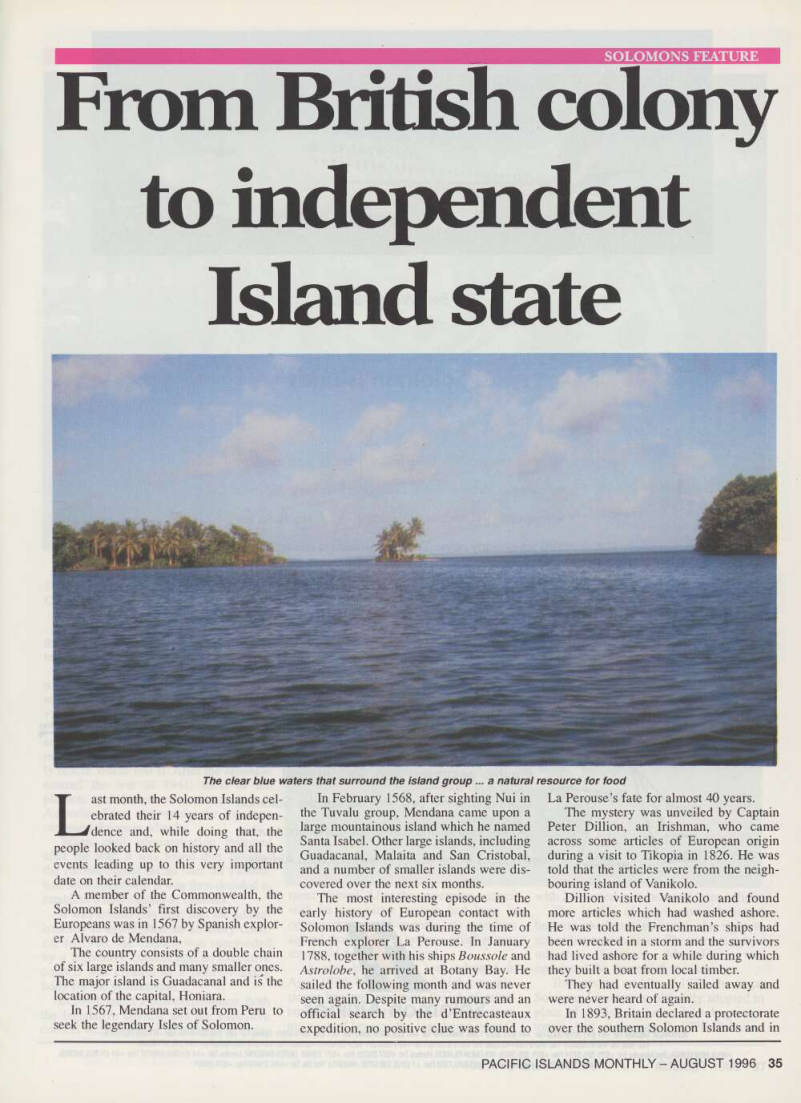
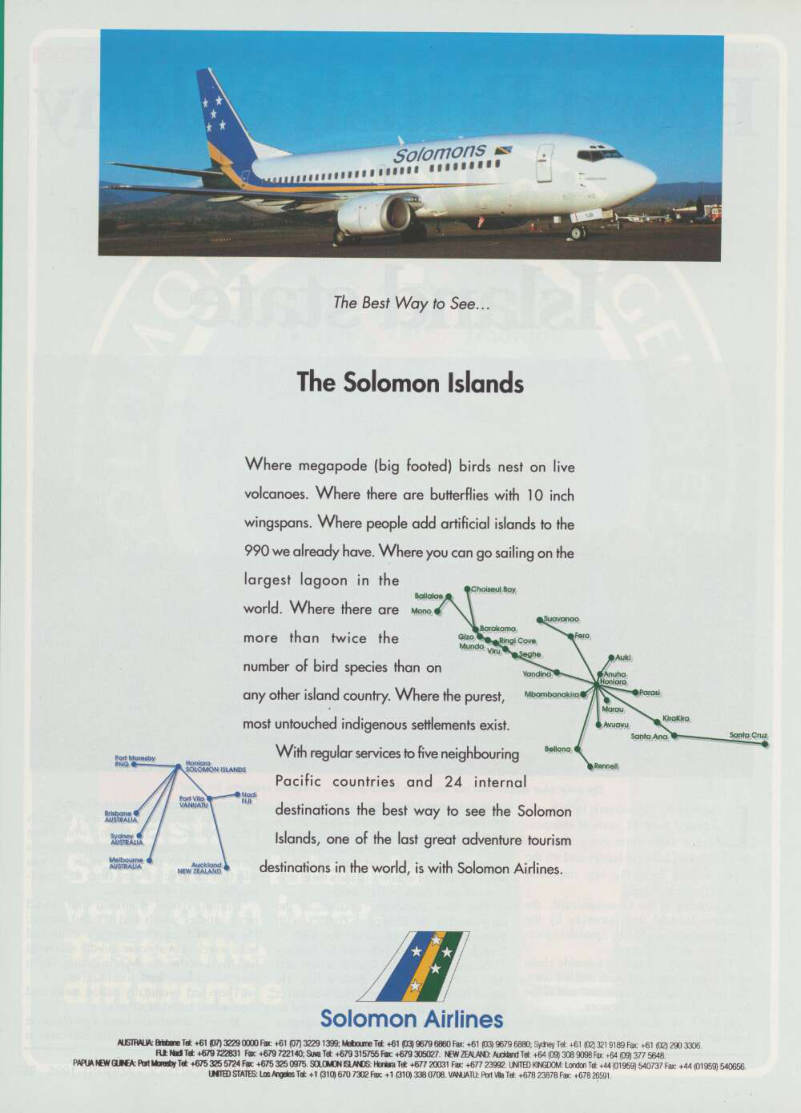
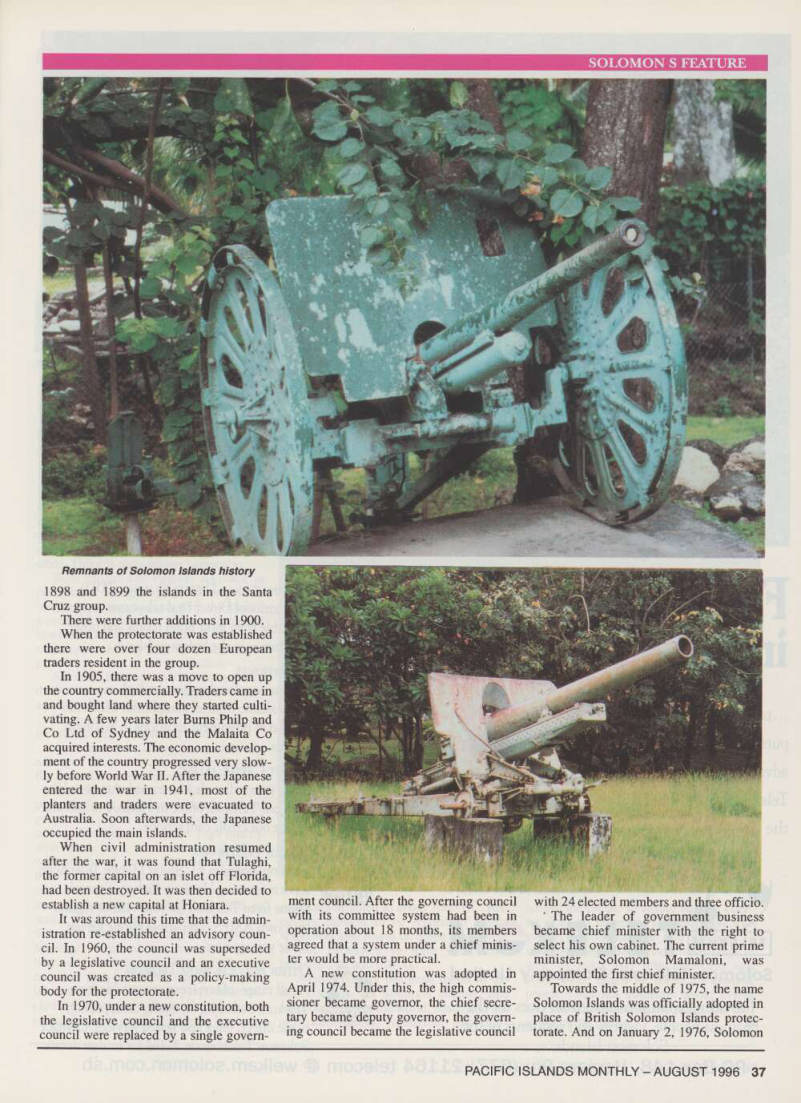
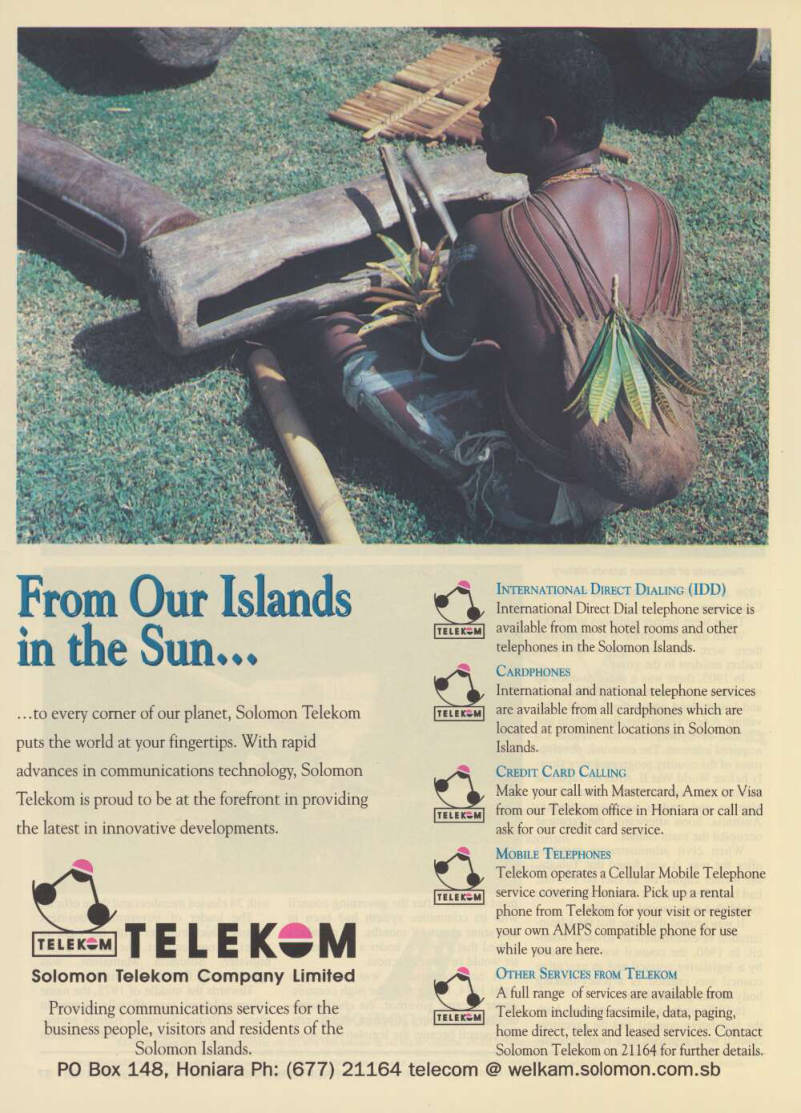
Solomons Feature
From British colony to independent Island state
Last month, the Solomon Islands cel ebrated their 14 years of indepen dence and, while doing that, the people looked back on history and all the events leading up to this very important date on their calendar.
A member of the Commonwealth, the Solomon Islands’ first discovery by the Europeans was in 1567 by Spanish explor er Alvaro de Mendana, The country consists of a double chain of six large islands and many smaller ones.
The major island is Guadacanal and is" the location of the capital, Honiara.
In 1567, Mendana set out from Peru to seek the legendary Isles of Solomon.
In February 1568, after sighting Nui in the Tuvalu group, Mendana came upon a l ar S e mountainous island which he named Santa Isabel. Other large islands, including „ , . i A c r - k f Guadacanal, Malaita and San Cristobal, anc a num b er G f smaller islands were discovered over the next six months.
The m ost interesting episode in the
early history of European contact with
Solomon Islands was during the time of French explorer La Perouse. In January 1788, together with his ships Boussole and Astrolobe, he arrived at Botany Bay. He sailed the following month and was never seen a g a i n- Despite many rumours and an official search by the d’Entrecasteaux expedition, no positive clue was found to
La Perouse’s fate for almost 40 years.
The mystery was unveiled by Captain Peter Dillion, an Irishman, who came across some articles of European origin . • . .. . u during a visit to Tikopia m 1826. He was told that the articles were from the neigh bouring island of Vanikolo.
Dillion visited Vanikolo and found more articles which had washed ashore.
He was told the Frenchman’s ships had been wrecked in a storm and the survivors had lived ashore for a while during which they built a boat from local timber.
They had eventually sailed away and were never heard of again.
In 1893, Britain declared a protectorate over the southern Solomon Islands and in
The clear blue waters that surround the island group...a natural resource for food
1898 and 1899 the islands in the Santa Cruz group.
There were further additions in 1900.
When the protectorate was established there were over four dozen European traders resident in the group.
In 1905, there was a move to open up the country commercially. Traders came in and bought land where they started culti vating. A few years later Bums Philp and Co Ltd of Sydney and the Malaita Co acquired interests. The economic develop ment of the country progressed very slow ly before World War 11. After the Japanese entered the war in 1941, most of the planters and traders were evacuated to Australia. Soon afterwards, the Japanese occupied the main islands.
When civil administration resumed after the war, it was found that Tulaghi, the former capital on an islet off Florida, had been destroyed. It was then decided to establish a new capital at Honiara.
It was around this time that the admin istration re-established an advisory coun cil. In 1960, the council was superseded by a legislative council and an executive council was created as a policy-making body for the protectorate.
In 1970, under a new constitution, both the legislative council and the executive council were replaced by a single govem-
ment council. After the governing council with its committee system had been in operation about 18 months, its members agreed that a system under a chief minis ter would be more practical.
A new constitution was adopted in April 1974. Under this, the high commis sioner became governor, the chief secre tary became deputy governor, the govern ing council became the legislative council
with 24 elected members and three officio.
' The leader of government business became chief minister with the right to select his own cabinet. The current prime minister, Solomon Mamaloni, was appointed the first chief minister.
Towards the middle of 1975, the name Solomon Islands was officially adopted in place of British Solomon Islands protec torate. And on January 2, 1976, Solomon
Remnants of Solomon Islands history
Islands became an internally self-govern
ing state. Independence followed on July
7, 1978. Since independence politics has been generally stable although there have been frequent changes in prime minister
ship.
The official language on the islands is
English although the effective language is
Pidgin. In addition, about 87 different ver nacular forms of speech are used, with people living in villages only a few miles apart frequently unable to understand each other. There is no common vernacular.
Both Pidgin and English are used in
parliament. Religion plays an important
role in most communities with the church a central focus in most villages. Extended families, tradition and custom dictate a major part of daily life. Christians com prise 95 per cent of the population.
Solomon Islanders love sports and take their soccer, basketball, rugby, tennis and
athletics quite seriously.
The primary production for the country includes copra and alluvial gold.
Activities like fishing and swimming are more necessities than choice; the first for food, the second for cleanliness.
Traditional canoes can still be seen, particularly in the outer islands, where people are proud of their production and sailing. Craft work is also of high quality with much work done with wood inlaid with mother-of-pearl. Although there has been a decline in tourism over the past few years, the country has great potential to attract adventure travellers interested in scuba diving and in wilderness areas.
Solomon Islands has many of the natural resources required for successful eco tourism. Archaeological research has revealed that Solomon Islands has been inhabited for at least 3000 years. Material excavated on Santa Ana, Guadanacanal and on Gawa in the Reef Islands has been
radiocarbon-dated to about 1000 BC. Red pottery thought to be related to Lapita ware, was also found on Santa Ana where it was estimated to have been used between 140 and 670 AD.
Similar pottery has been found in the Reef Islands. As Solomon Islands, like other countries of the world, heads into the next millennium, Mamaloni has chal
lenged the people to ensure that the coun try does so in peace, harmony and with greater confidence. He said the past 12 months brought many mixed blessings as well as trials and tribulations.He said while these might be taken for granted, people must not complain about events and issues threatening the peace and har mony of the nation. ■
Mamaloni...ushering the Solomons into the next millenium with peace and harmony
A scenic view of Guadacanal
Advertisements & other items, pp. 36-40 (1 item)
The Solomon Islands
The Best Way to See. ..
Where megapode (big footed) birds nest on live volcanoes. Where there are butterflies with 10 inch wingspans. Where people add artificial islands to the 990 we already have. Where you can go sailing on the
largest lagoon in the
Bgllataei
world. Where there QT6 Mono (
f Ghoiseul Bay Port Moresby
PNG#
Port Vila I
VANUATU
Brisbane
AUSTRALIA
Sydney •
AUSTRALIA
Melbourne u . . ,
AUSIRALIA m&W
more than twice the
number of bird species than on
any other island country. Where the purest, MbambOTOkira
most untouched indigenous settlements exist.
With regular services to five neighbouring BoHona
Pacific countries and 24 internal
destinations the best way to see the Solomon Islands, one of the last great adventure tourism destinations in the world, is with Solomon Airlines.
Suavanao akoma Fera Gizo • Munda ngi Cove Viru / •Am Auki Yandina Anuha Honiara Parasi Marau ) Avuavu Kira Kira Santa Ana Santa Cruz Renreil
Solomon Airlines
AUSTRALIA; Brisbane Tel: +6l (07) 3229 0000 Fax: +6l (07) 3229 1 399: Mefcoume Tel: +6l (03) 9679 6860 Fax: +6l (03) 9679 6880; Sydney Tel: +6l (02) 321 9189 Fax: +6l (02) 290 3306 RJ; Nad Tet +679 722831 Fax: +679 722140; Suva Tel: +679 315755 Fax: +679 305027. NEW ZEALAND: Auckland Tel: +64 (09) 308 9098 Fax: +64 (09) 377 5648.
PAPUA NEW GLtCA; Port Morafcy Tet +675 325 5724 Fax: +675 325 0975. SOLOMON ISLANDS: Honiara Tel: +677 20031 Fax: +677 23992. UNITED KINGDOM; London Tel: +44 (01959) 540737 Fax- +44 (01959) 540656 UMTED STATES: Los Angeles Tel: +1 (310) 670 7302 Fax: +1 (310) 338 0708. VANUATU: Port Vila Tel: +678 23878 Fax: +678 26591
1 ? wSK A •>.. **Ba * ; is SS ?*ll m *S % *#* f* iStm < .*• 8 ,T'-. -c r*i • --* i N: ry $ '■ S*r ’,l Ws
From Our Islands
in the Sun...
.. .to every comer of our planet, Solomon Telekom puts the world at your fingertips. With rapid advances in communications technology, Solomon Telekom is proud to be at the forefront in providing the latest in innovative developments.
A
TELEKwM
TELEK
A |teleKwM| A
TELEKwM
A |teieKwM| A
TELEKwM
International Direct Dialing (IDD) International Direct Dial telephone service is available from most hotel rooms and other telephones in the Solomon Islands.
Cardphones International and national telephone services are available from all cardphones which are located at prominent locations in Solomon Islands.
Credit Card Calling Make your call with Mastercard, Amex or Visa from our Telekom office in Honiara or call and ask for our credit card service.
Mobile Telephones Telekom operates a Cellular Mobile Telephone service covering Honiara. Pick up a rental phone from Telekom for your visit or register your own AMPS compatible phone for use while you are here.
Solomon Telekom Company Limited Providing communications services for the business people, visitors and residents of the Solomon Islands.
A IteleKwMl Other Services from Telekom A full range of services are available from Telekom including facsimile, data, paging, home direct, telex and leased services. Contact Solomon Telekom on 21164 for further details.
PO Box 148, Honiara Ph: (677) 21164 telecom @ welkam.solomon.com.sb
Snternational
DATELINE HOTEL
■■ ■aa On the waterfront only ten minutes walk from the centre of Nukualofa awaits Tonga's
leading hotel.
Seventy six air conditioned rooms with all amenities, delicious international and local cuisine, floor shows, private guest lounge, open air-terrace, swimming pool , variety shop business centre and duty free shopping make the International Dateline Hotel the perfect retreat for complete relaxation.
When in the Kingdom of Tonga stay at the
DATELINE HOTEL.
OTE
General Manager - Simota Po'uliva'ati P.O. Box 89, Nuku'alofa, Kingdom of Tonga.
Tel: (676) 23411. Fax: (676) 23410.
Telex: 66223 DATELINE T 8
Tonga Feature
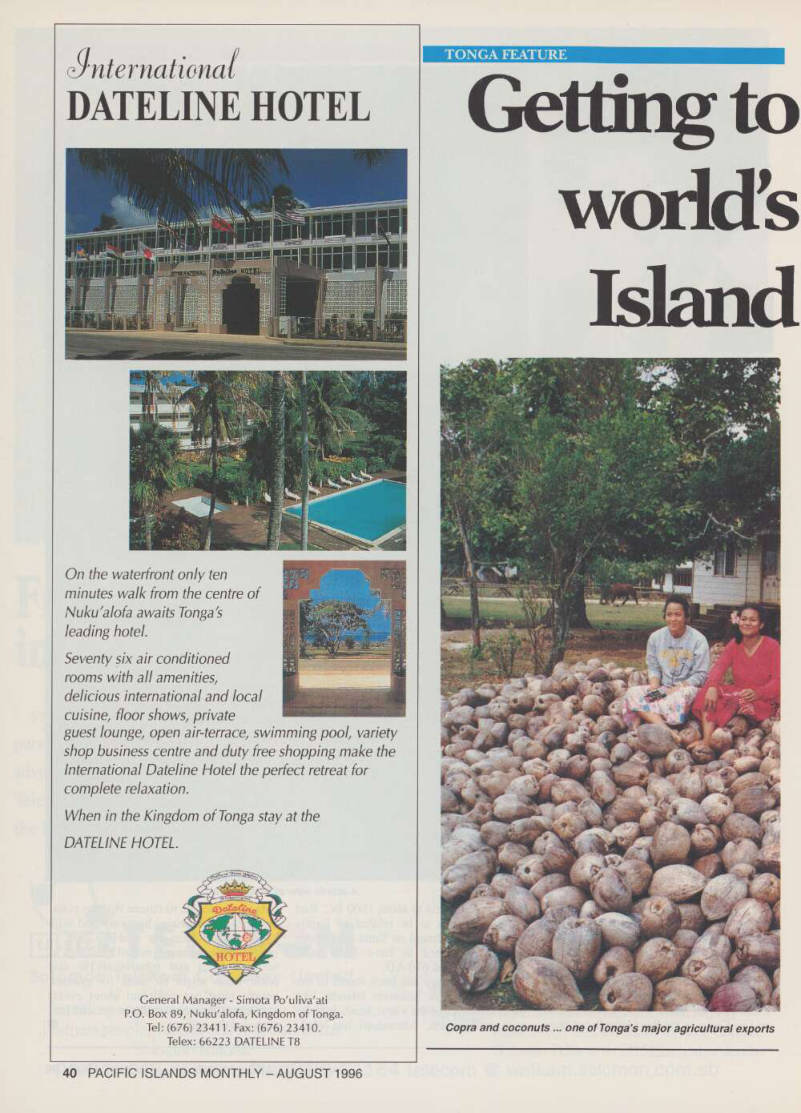

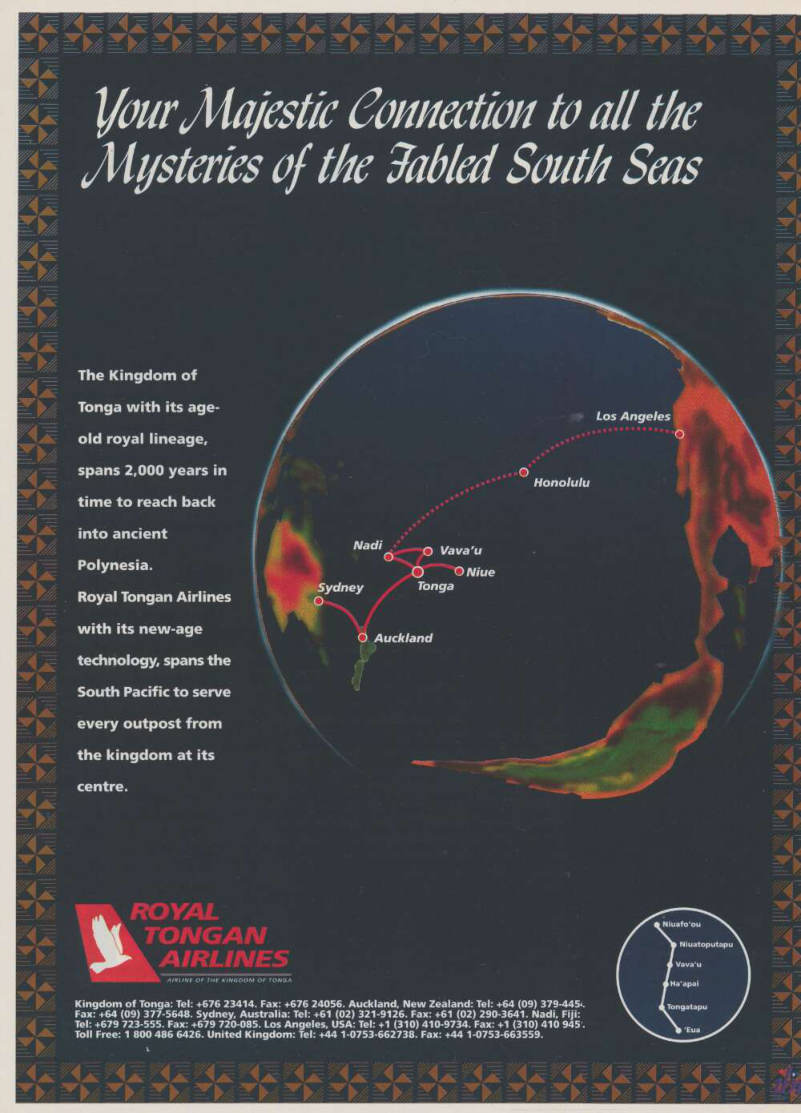
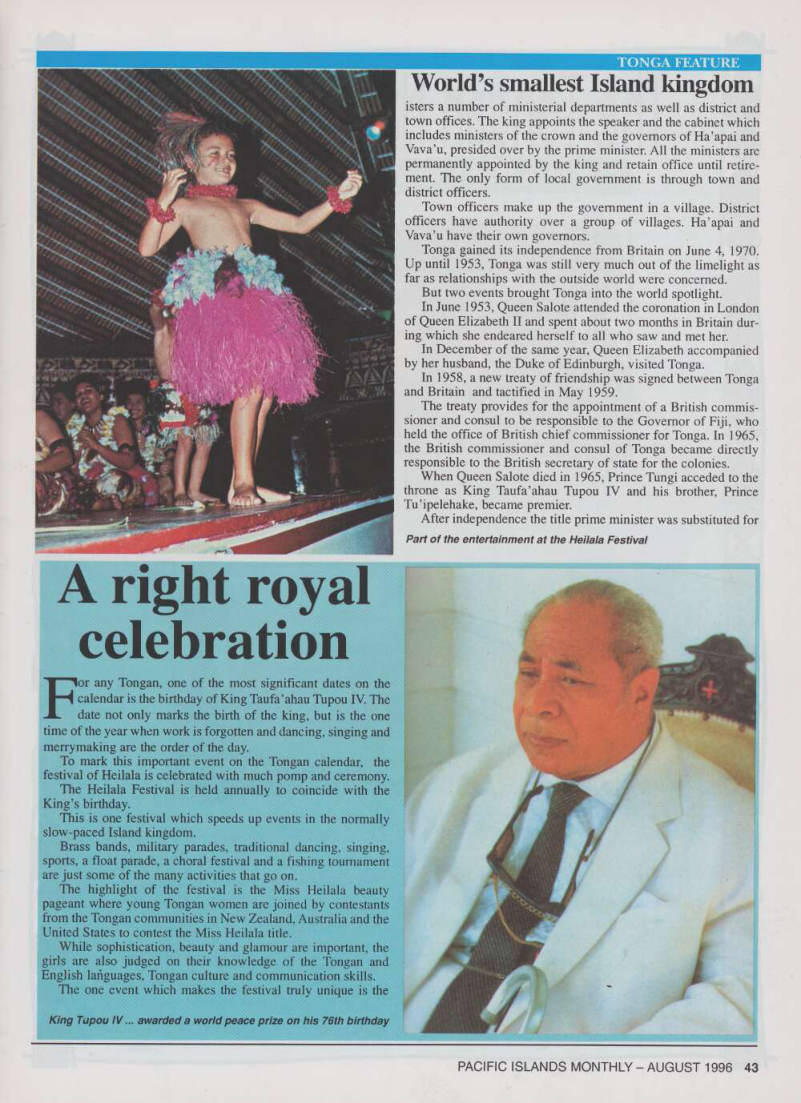
Getting to know the world's smallest Island kingdom
Copra and coconuts...one of Tonga’s major agricultural exports
THE Kingdom of Tonga, the world’s smallest kingdom, con sists of 150 islands of which only 36 are permanently inhab ited. The largest is Tongatapu which is distinctively flat, its highest point being only a few metres at a low hillock near the royal palace. The capital is Nuku’alofa which is on the island of Tongatapu.
The other islands are the Ha’apai Group, Vava’u Group, Niuas, Niuatoputapu, Tafahi, Niuafo’ou and Falcon Island.
The first European discovery of Tonga was by members of the Dutch expedition of Schouten and Le Maire. They came upon the northern Tafahi and Niuatoputapu in 1616 when crossing the Pacific to the West Indies.
In 1643, their countryman, Abel Janszoon Tasman, approached the archipelago from the south.
He sailed with the ships Heemskerck and Zeehaan. He sighted the southernmost island, Ata, before coming upon ‘Eua and Tongatapu, which he named Middleburgh and Amsterdam respec
tively.
He spent three days at Tongatapu, and a week at Nomuka to the northward, taking in provisions. Nomuka was named Rotterdam.
In 1767, Captain Samuel Wallis, the first European to come across Tahiti, came upon the two northern islands as seen by Schouten and Le Maire.
Unaware of their prior discovery, he gave the name Boscawen to Tafahi and Keppel to Niuatoputapu - names they bore on European charts for the next century or so.
In October 1773, Captain James Cook made the first of the three visits to Tonga.
In the following June, Cook returned to Tonga. His third visit was in 1777. It was during this visit he named Lifuka(Ha’apai) group the
Friendly Islands.
Captain Alessandro Malaspina was the last European explorer to visit Tonga before the arrival of the first permanent European set tlers.
Tonga is the only island in the South Pacific which, even after 26 years of independence, has a monarch as the head of state. Although Tonga is a constitutional monarchy on the British model, the king, in fact, exercises wide influence. The government consists of the king, the privy council, cabinet and the legislative assembly and the judi
ciary.
The constitution was handed down by King Tupou I on November 4, 1857. The king voluntarily limited his own powers after emancipating his people from the semi-serfdom which they had lived in for centuries.
The members of the legislative assembly are the speaker, mem bers of the cabinet, nine nobles elected by the 33 nobles of Tonga and nine representatives of the people elected by the universal adult suffrage. The prime minister is the head of government and admin-
isters a number of ministerial departments as well as district and town offices. The king appoints the speaker and the cabinet which includes ministers of the crown and the governors of Ha’apai and Vava’u, presided over by the prime minister. All the ministers are permanently appointed by the king and retain office until retire ment. The only form of local government is through town and district officers.
Town officers make up the government in a village. District officers have authority over a group of villages. Ha’apai and Vava’u have their own governors.
Tonga gained its independence from Britain on June 4, 1970.
Up until 1953, Tonga was still very much out of the limelight as far as relationships with the outside world were concerned.
But two events brought Tonga into the world spotlight.
In June 1953, Queen Salote attended the coronation in London of Queen Elizabeth II and spent about two months in Britain dur ing which she endeared herself to all who saw and met her.
In December of the same year. Queen Elizabeth accompanied by her husband, the Duke of Edinburgh, visited Tonga.
In 1958, a new treaty of friendship was signed between Tonga and Britain and tactified in May 1959.
The treaty provides for the appointment of a British commis sioner and consul to be responsible to the Governor of Fiji, who held the office of British chief commissioner for Tonga. In 1965, the British commissioner and consul of Tonga became directly responsible to the British secretary of state for the colonies.
When Queen Salote died in 1965, Prince Tungi acceded to the throne as King Taufa’ahau Tupou IV and his brother, Prince Tu’ipelehake, became premier.
After independence the title prime minister was substituted for
Part of the entertainment at the Heilala Festival
premier. Also after independence Britain
appointed a high commissioner to Tonga
and Tonga joined the Commonwealth and appointed a high commissioner in London.
Recent archaeological research has revealed that the Tongan archipelago was inhabited at least 3000 years ago.
The Tongans of those days were mak ers of elaborately decorated Capita pot tery, like that found in Fiji, but a few cen turies later they were only making plain ware. Only a small amount of pottery was in use when the first European explorers arrived.
The Tongans are Polynesians and the Tongan language is part of the widely scattered language family known as Austronesian or Malayo-Polynesian.
It was reduced to written form by the Wesleyan missionaries of the early 19th Century. The first book in the Tongan lan guage was printed on April 14, 1831.
Tongans actively maintain many of their traditional customs in their daily lives.
The wearing of the ta’ovala and kiekie, fine mats and fancy waist decora tions, which show respect for authority is perhaps the most observed custom. The fancy kiekie is often worn by young women over their jeans, an interesting sign of cultural transition.
There is a pyramid of social hierarchy, with the royal family at the pinnacle, fol lowed by 33 nobles. The rest of Tongan society form the base.
Agriculture, fisheries and forestry are
the leading productive sectors. Products which Tonga exports are coconut oil, des iccated coconut, bananas, vanilla beans and root crops.
Tourism is a major contributor to the economy and attractions include game fishing and sailing around the islands of Vava’u.
Tonga has one weekly newspaper, the Tonga Chronicle, which is published every Thursday in Tongan and English. It is government owned and covers items of local and international interest.
There is also an independent Tongan language paper, Ko’e’ Kele’a, a bimonth ly Matangi Tonga and a monthly maga
zine called Tonga Today.
Currency used is pa’anga (banknotes) and seniti (cents). ■
Advertisements & other items, pp. 41-42 (2 items)
41
PACIFIC ISLANDS MONTHLY - AUGUST 1996
know the smallest kingdom
Think about
how nice it would be to grab hold of a cold, refreshing, premium all malt beer thats full of taste...
CvAA^/vl men go out and grab a Royal!
ROYAL BEER COMPANY LTD, NUKG ALOFA, THE KINGDOM OF TONGA.
Royal Beer Company Ltd.
Tel: +676 22155,21157. Fax: +676 21552 Private Bag 20, Nukualofa, The Kingdom of Tonga
]/our Majestic Connection to all the
Mysteries of the MM South Seas
The Kingdom of Tonga with its ageold royal lineage, spans 2,000 years in time to reach back into ancient Polynesia.
Royal Tongan Airlines with its new-age technology, spans the South Pacific to serve every outpost from the kingdom at its centre.
Los Angeles o k Honolulu Nad ' q O Vava'u O ONiue Sydney Tonga O O Auckland ,8# at *
ROYAL
TONGAN
k AIRLINES
■ THE KINGDOM OF TONGA
Kingdom of Tonga: Tel: +676 23414. Fax: +676 24056. Auckland, New Zealand: Tel: +64 (09) 379-445<.
Fax: +64 (09) 377-5648. Sydney, Australia: Tel: +6l (02) 321-9126. Fax: +6l (02) 290-3641. Nadi, Fiji: Tel: +679 723-555. Fax: +679 720-085. Los Angeles, USA: Tel: +1 (310) 410-9734. Fax: +1 (310) 410 945 .
Toll Free: 1 800 486 6426. United Kingdom: Tel: +44 1-0753-662738. Fax: +44 1-0753-663559.
A right royal
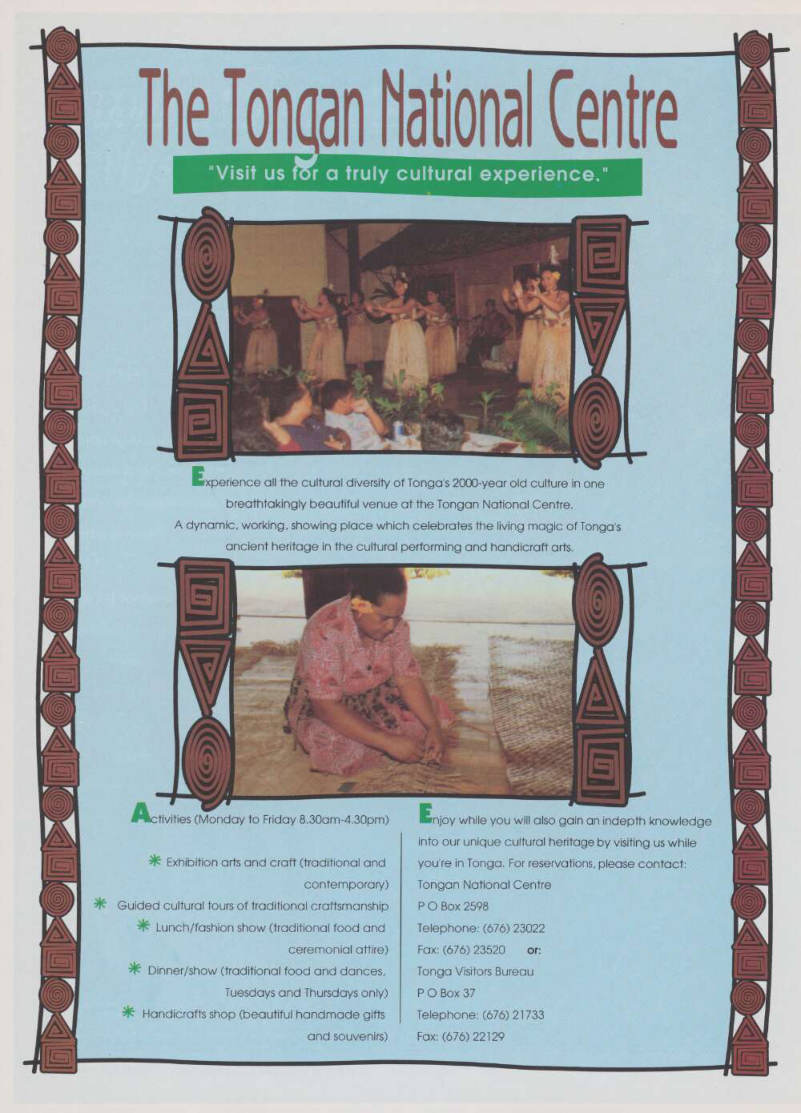
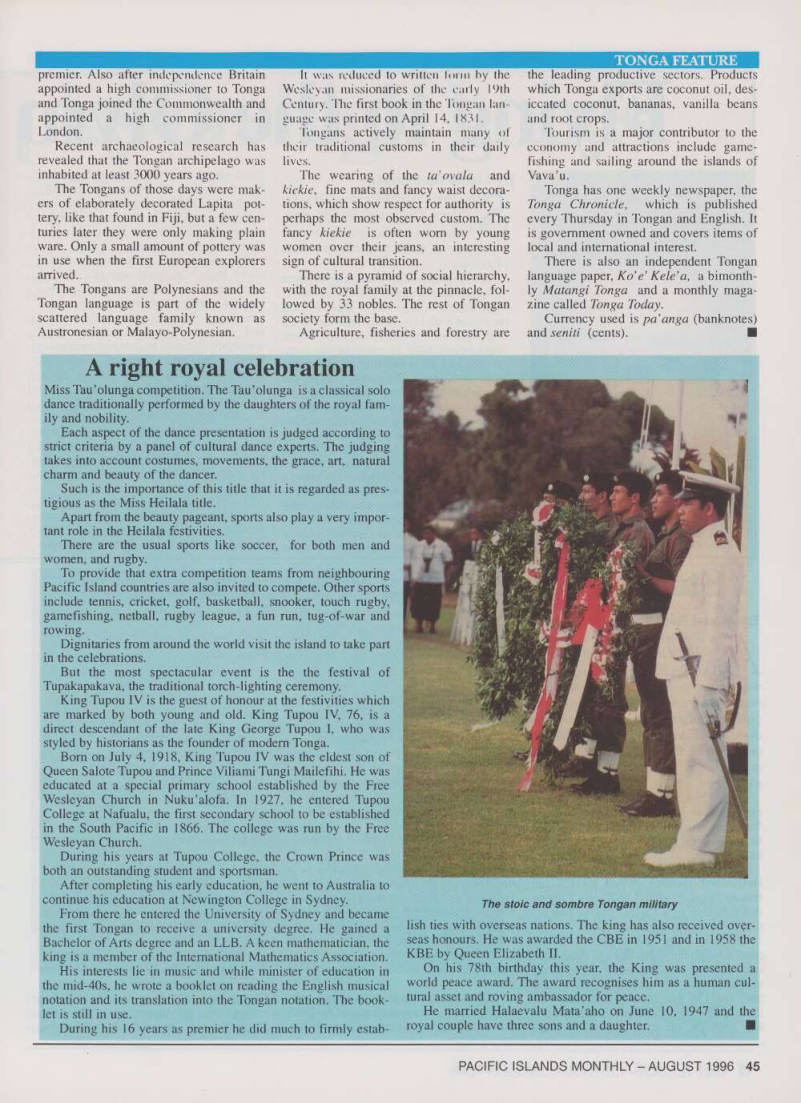
celebration
For any Tongan, one of the most significant dates on the calendar is the birthday of King Taufa’ahau Tupou IV. The date not only marks the birth of the king, but is the one time of the year when work is forgotten and dancing, singing and merrymaking are the order of the day.
To mark this important event on the Tongan calendar, the festival of Heilala is celebrated with much pomp and ceremony.
The Heilala Festival is held annually to coincide with the King’s birthday.
This is one festival which speeds up events in the normally slow-paced Island kingdom.
Brass bands, military parades, traditional dancing, singing, sports, a float parade, a choral festival and a fishing tournament are just some of the many activities that go on.
The highlight of the festival is the Miss Heilala beauty pageant where young Tongan women are joined by contestants from the Tongan communities in New Zealand, Australia and the United States to contest the Miss Heilala title.
While sophistication, beauty and glamour are important, the girls are also judged on their knowledge of the Tongan and English languages, Tongan culture and communication skills.
The one event which makes the festival truly unique is the
King Tupou IV...awarded a world peace prize on his 76th birthday
Miss Tau’olunga competition. The Tau’olunga is a classical solo dance traditionally performed by the daughters of the royal fam
ily and nobility.
Each aspect of the dance presentation is judged according to strict criteria by a panel of cultural dance experts. The judging takes into account costumes, movements, the grace, art, natural charm and beauty of the dancer.
Such is the importance of this title that it is regarded as pres tigious as the Miss Heilala title.
Apart from the beauty pageant, sports also play a very impor tant role in the Heilala festivities.
There are the usual sports like soccer, for both men and women, and rugby.
To provide that extra competition teams from neighbouring Pacific Island countries are also invited to compete. Other sports include tennis, cricket, golf, basketball, snooker, touch rugby, gamefishing, netball, rugby league, a fun run, tug-of-war and rowing.
Dignitaries from around the world visit the island to take part in the celebrations.
But the most spectacular event is the the festival of Tupakapakava, the traditional torch-lighting ceremony.
King Tupou IV is the guest of honour at the festivities which are marked by both young and old. King Tupou IV, 76, is a direct descendant of the late King George Tupou I, who was styled by historians as the founder of modem Tonga.
Bom on July 4, 1918, King Tupou IV was the eldest son of Queen Salote Tupou and Prince Viliami Tungi Mailefihi. He was educated at a special primary school established by the Free Wesleyan Church in Nuku’alofa. In 1927, he entered Tupou College at Nafualu, the first secondary school to be established in the South Pacific in 1866. The college was run by the Free
Wesleyan Church.
During his years at Tupou College, the Crown Prince was both an outstanding student and sportsman.
After completing his early education, he went to Australia to continue his education at Newington College in Sydney.
From there he entered the University of Sydney and became the first Tongan to receive a university degree. He gained a Bachelor of Arts degree and an LLB. A keen mathematician, the king is a member of the International Mathematics Association.
His interests lie in music and while minister of education in the mid-40s, he wrote a booklet on reading the English musical notation and its translation into the Tongan notation. The book let is still in use.
During his 16 years as premier he did much to firmly estab-
lish ties with overseas nations. The king has also received over seas honours. He was awarded the CBE in 1951 and in 1958 the KBE by Queen Elizabeth 11.
On his 78th birthday this year, the King was presented a world peace award. The award recognises him as a human cul tural asset and roving ambassador for peace.
He married Halaevalu Mata’aho on June 10, 1947 and the royal couple have three sons and a daughter. ■
The stoic and sombre Tongan military
Advertisements & other items, pp. 43-45 (3 items)
World’s smallest Island kingdom
43
TONGA FEATURE
PACIFIC ISLANDS MONTHLY - AUGUST 1996
World’s smallest Island kingdom
The lowan National Centre
r a truly cultural experience."
ixperience all the cultural diversity of Tonga's 2000-year old culture in one breathtakingly beautiful venue at the Tongan National Centre.
A dynamic, working, showing place which celebrates the living magic of Tonga's ancient heritage in the cultural performing and handicraft arts. ■^s :tivities (Monday to Friday 8.30am-4.30pm) * Exhibition arts and craft (traditional and contemporary) Guided cultural tours of traditional craftsmanship Lunch/fashion show (traditional food and ceremonial attire) Dinner/show (traditional food and dances, Tuesdays and Thursdays only) * Handicrafts shop (beautiful handmade gifts and souvenirs) njoy while you will also gain an indepth knowledge into our unique cultural heritage by visiting us while you're in Tonga. For reservations, please contact: Tongan National Centre P O Box 2598 Telephone: (676) 23022 Fax: (676) 23520 or: Tonga Visitors Bureau P O Box 37 Telephone: (676) 21733 Fax: (676) 22129
A right royal celebration
45
TONGA FEATURE
PACIFIC ISLANDS MONTHLY - AUGUST 1996
A right royal celebration
Flying to the Olympics on high hopes
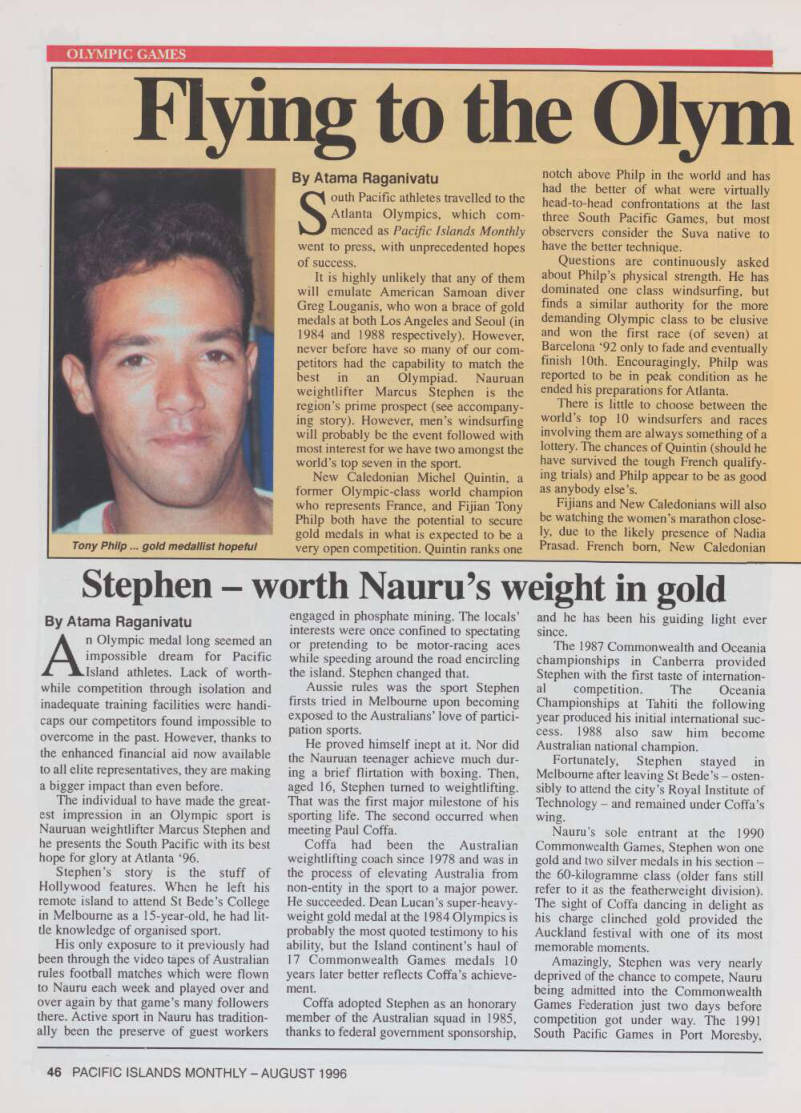
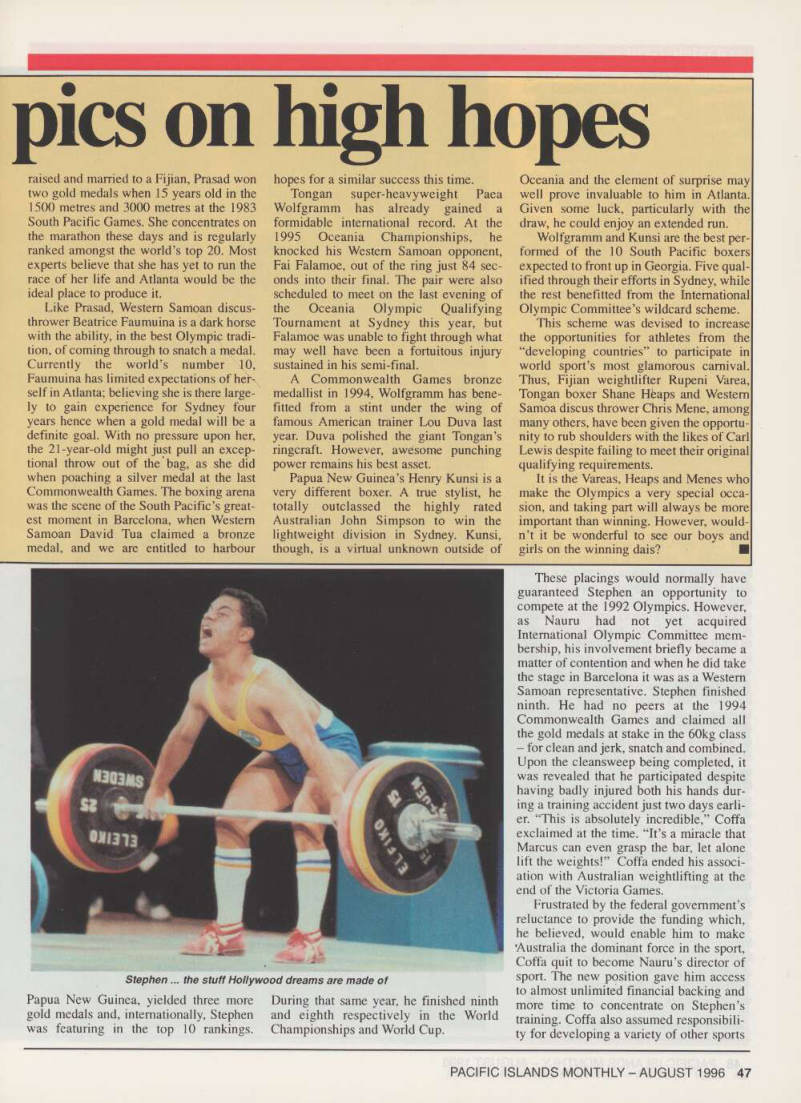
Olympic Games
By Atama Raganivatu
S, i t-x *r* i * ... , outh Pacific athletes travelled to the Atlanta Olympics, which com menced as Pacific Islands Monthly went to press, with unprecedented hopes of success.
It is highly unlikely that any of them will emulate American Samoan diver Greg Louganis, who won a brace of gold medals at both Los Angeles and Seoul (in 1984 and 1988 respectively). However, never before have so many of our com petitors had the capability to match the best in an Olympiad. Nauruan weightlifter Marcus Stephen is the region’s prime prospect (see accompany ing story). However, men’s windsurfing will probably be the event followed with most interest for we have two amongst the world’s top seven in the sport.
New Caledonian Michel Quintin, a
former Olympic-class world champion
who represents France, and Fijian Tony Philp both have the potential to secure gold medals in what is expected to be a very open competition. Quintin ranks one
notch above Philp in the world and has had the better of what were virtually head . to . head confrontations at the last three South Pacific Games, but most observers consider the Suva native to have the better technique, Questions are continuously asked about Philp’s physical strength. He has dominated one class windsurfing, but finds a similar authority for the more demanding Olympic class to be elusive ar *d won the first race (of seven) at Barcelona ‘92 only to fade and eventually finish 10th. Encouragingly, Philp was reported to be in peak condition as he ended his preparations for Atlanta, There is little to choose between the world’s top 10 windsurfers and races involving them are always something of a lottery. The chances of Quintin (should he have survived the tough French qualify big trials) and Philp appear to be as good as anybody else’s.
Fijians and New Caledonians will also be watching the women’s marathon close due t 0 the likely presence of Nadia Prasad. French bom, New Caledonian
Tony Philp...gold medallist hopeful
raised and married to a Fijian, Prasad won two gold medals when 15 years old in the 1500 metres and 3000 metres at the 1983 South Pacific Games. She concentrates on the marathon these days and is regularly ranked amongst the world’s top 20. Most experts believe that she has yet to run the race of her life and Atlanta would be the ideal place to produce it.
Like Prasad, Western Samoan discusthrower Beatrice Faumuina is a dark horse with the ability, in the best Olympic tradition, of coming through to snatch a medal.
Currently the world’s number 10, Faumuina has limited expectations of heN self in Atlanta; believing she is there largely to gain experience for Sydney four years hence when a gold medal will be a definite goal. With no pressure upon her, the 21-year-old might just pull an exceptional throw out of the bag, as she did when poaching a silver medal at the last Commonwealth Games. The boxing arena was the scene of the South Pacific’s greatest moment in Barcelona, when Western Samoan David Tua claimed a bronze medal, and we are entitled to harbour
hopes for a similar success this time, Tongan super-heavyweight Paea Wolfgramm has already gained a formidable international record. At the 1995 Oceania Championships, he knocked his Western Samoan opponent, Fai Falamoe, out of the ring just 84 sec onds into their final. The pair were also scheduled to meet on the last evening of
the Oceania Olympic Qualifying
Tournament at Sydney this year, but Falamoe was unable to fight through what may well have been a fortuitous injury sustained in his semi-final.
A Commonwealth Games bronze medallist in 1994, Wolfgramm has bene fitted from a stint under the wing of famous American trainer Lou Duva last year. Duva polished the giant Tongan’s ringcraft. However, awesome punching power remains his best asset, Papua New Guinea’s Henry Kunsi is a very different boxer. A true stylist, he totally outclassed the highly rated Australian John Simpson to win the lightweight division in Sydney. Kunsi, though, is a virtual unknown outside of
Oceania and the element of surprise may well prove invaluable to him in Atlanta.
Given some luck, particularly with the draw, he could enjoy an extended run.
Wolfgramm and Kunsi are the best per formed of the 10 South Pacific boxers expected to front up in Georgia. Five qual ified through their efforts in Sydney, while the rest benefitted from the International Olympic Committee’s wildcard scheme.
This scheme was devised to increase the opportunities for athletes from the “developing countries” to participate in world sport’s most glamorous carnival.
Thus, Fijian weightlifter Rupeni Varea, Tongan boxer Shane Hbaps and Western Samoa discus thrower Chris Mene, among many others, have been given the opportu nity to rub shoulders with the likes of Carl Lewis despite failing to meet their original
qualifying requirements.
It is the Vareas, Heaps and Menes who make the Olympics a very special occa sion, and taking part will always be more important than winning. However, would n’t it be wonderful to see our boys and girls on the winning dais? ■
Stephen-worth Nauru’s weight in gold
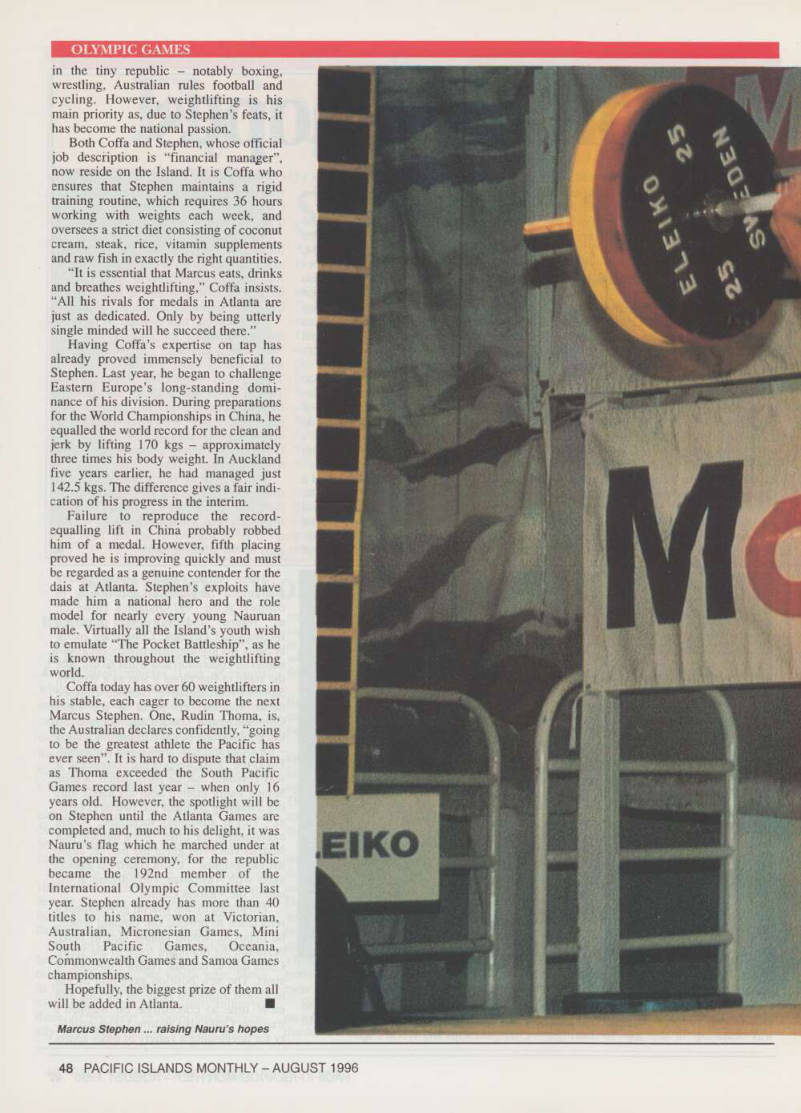
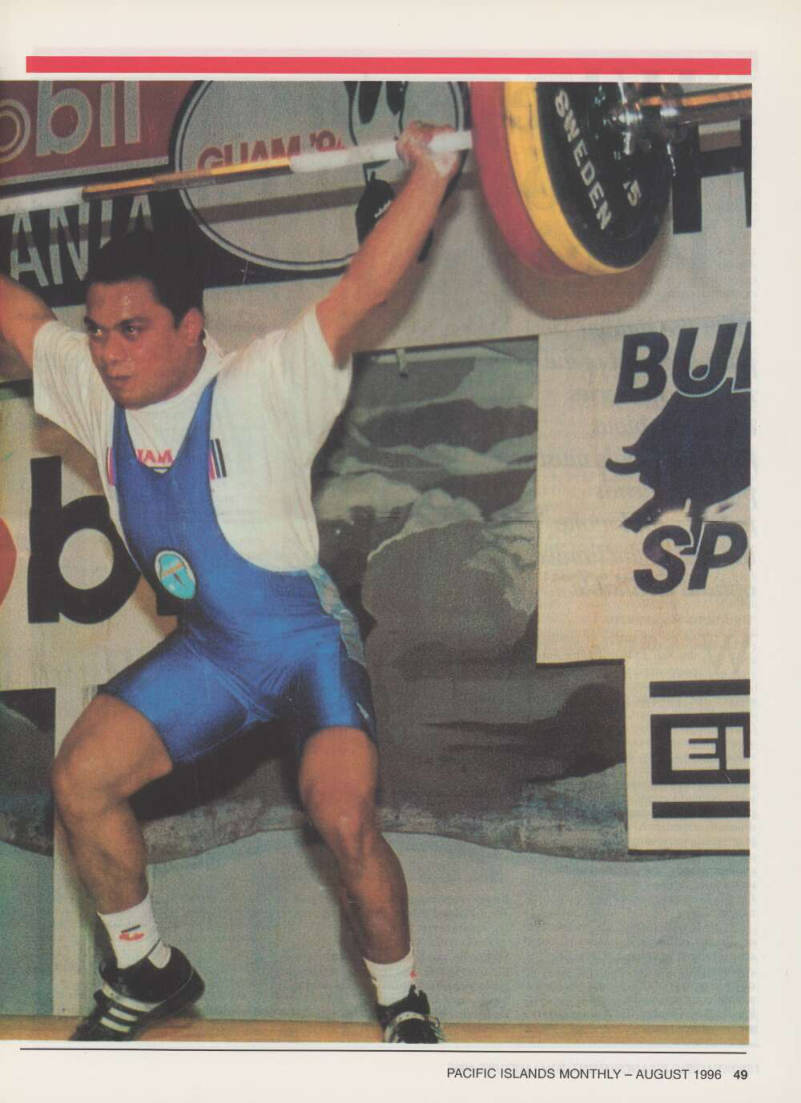
By Atama Raganivatu
A n Olympic medal long seemed an impossible dream for Pacific X athletes. Lack of worth while competition through isolation and inadequate training facilities were handi caps our competitors found impossible to overcome in the past. However, thanks to . ... .. .. the enhanced financial aid now available to all elite representatives, they are making a bigger impact than even before.
The individual to have made the great est impression in an Olympic sport is Nauruan weightlifter Marcus Stephen and he presents the South Pacific with its best hope for glory at Atlanta ‘96.
Stephen’s story is the stuff of Hollywood features. When he left his remote island to attend St Bede’s College in Melbourne as a 15-year-old, he had lit tie knowledge of organised sport.
His only exposure to it previously had been through the video tapes of Australian rules football matches which were flown to Nauru each week and played over and over again by that game’s many followers there. Active sport in Nauru has tradition ally been the preserve of guest workers
engaged in phosphate mining. The locals’ interests were once confined to spectating or pretending to be motor-racing aces while speeding around the road encircling the island. Stephen changed that.
Aussie rules was the sport Stephen firsts tried in Melbourne upon becoming ex P ose d to the Australians love of partici- P s P°rts.
He proved himself inept at it. Nor did the Nauruan teenager achieve much during a brief flirtation with boxing. Then, aged 16, Stephen turned to weightlifting, That was the first major milestone of his sporting life. The second occurred when meeting Paul Coffa.
Coffa had been the Australian weightlifting coach since 1978 and was in the process of elevating Australia from non-entity in the sport to a major power, He succeeded. Dean Lucan’s super-heavyweight gold medal at the 1984 Olympics is probably the most quoted testimony to his ability, but the Island continent’s haul of 17 Commonwealth Games medals 10 years later better reflects Coffa’s achievement.
Coffa adopted Stephen as an honorary member of the Australian squad in 1985, thanks to federal government sponsorship,
and he has been his guiding light ever since.
The 1987 Commonwealth and Oceania championships in Canberra provided Stephen with the first taste of intemation al competition. The Oceania Championships at Tahiti the following year produced his initial international suc ('ess - 1988 , als ° saw bim become Australian national champion.
Fortunately, Stephen stayed in Melbourne after leaving St Bede’s - osten sibly to attend the city’s Royal Institute of Technology - and remained under Coffa’s wing.
Nauru’s sole entrant at the 1990 Commonwealth Games, Stephen won one gold and two silver medals in his section the 60-kilogramme class (older fans still refer to it as the featherweight division), The sight of Coffa dancing in delight as his charge clinched provided the Auckland festival with one of its most memorable moments, Amazingly, Stephen was very nearly deprived of the chance to compete, Nauru being admitted into the Commonwealth Games Federation just two days before competition got under way. The 1991 South Pacific Games in Port Moresby.
Papua New Guinea, yielded three more gold medals and, internationally, Stephen was featuring in the top 10 rankings.
During that same year, he finished ninth and eighth respectively in the World Championships and World Cup.
These placings would normally have guaranteed Stephen an opportunity to compete at the 1992 Olympics. However, as Nauru had not yet acquired International Olympic Committee mem bership, his involvement briefly became a matter of contention and when he did take the stage in Barcelona it was as a Western Samoan representative. Stephen finished ninth. He had no peers at the 1994 Commonwealth Games and claimed all the gold medals at stake in the 60kg class - for clean and jerk, snatch and combined.
Upon the cleansweep being completed, it
was revealed that he participated despite having badly injured both his hands dur ing a training accident just two days earli er. “This is absolutely incredible,” Coffa exclaimed at the time. “It’s a miracle that Marcus can even grasp the bar, let alone lift the weights!” Coffa ended his associ ation with Australian weightlifting at the end of the Victoria Games.
Frustrated by the federal government’s reluctance to provide the funding which, he believed, would enable him to make 'Australia the dominant force in the sport, Coffa quit to become Nauru’s director of sport. The new position gave him access to almost unlimited financial backing and more time to concentrate on Stephen’s training. Coffa also assumed responsibili ty for developing a variety of other sports
Stephen ... the stuff Hollywood dreams are made of
in the tiny republic - notably boxing, wrestling, Australian rules football and cycling. However, weightlifting is his main priority as, due to Stephen’s feats, it has become the national passion.
Both Coffa and Stephen, whose official
job description is “financial manager”,
now reside on the Island. It is Coffa who ensures that Stephen maintains a rigid training routine, which requires 36 hours working with weights each week, and oversees a strict diet consisting of coconut cream, steak, rice, vitamin supplements and raw fish in exactly the right quantities.
“It is essential that Marcus eats, drinks and breathes weightlifting,” Coffa insists.
“All his rivals for medals in Atlanta are just as dedicated. Only by being utterly single minded will he succeed there.”
Having Coffa’s expertise on tap has
already proved immensely beneficial to
Stephen. Last year, he began to challenge
Eastern Europe’s long-standing domi
nance of his division. During preparations for the World Championships in China, he equalled the world record for the clean and jerk by lifting 170 kgs - approximately three times his body weight. In Auckland five years earlier, he had managed just 142.5 kgs. The difference gives a fair indi cation of his progress in the interim.
Failure to reproduce the record equalling lift in China probably robbed him of a medal. However, fifth placing proved he is improving quickly and must be regarded as a genuine contender for the dais at Atlanta. Stephen’s exploits have made him a national hero and the role model for nearly every young Nauruan male. Virtually all the Island’s youth wish to emulate “The Pocket Battleship”, as he is known throughout the weightlifting world.
Coffa today has over 60 weightlifters in his stable, each eager to become the next Marcus Stephen. One, Rudin Thoma, is, the Australian declares confidently, “going to be the greatest athlete the Pacific has ever seen”. It is hard to dispute that claim as Thoma exceeded the South Pacific Games record last year - when only 16 years old. However, the spotlight will be on Stephen until the Atlanta Games are completed and, much to his delight, it was Nauru’s flag which he marched under at the opening ceremony, for the republic became the 192nd member of the International Olympic Committee last year. Stephen already has more than 40 titles to his name, won at Victorian, Australian, Micronesian Games, Mini South Pacific Games, Oceania, Commonwealth Games and Samoa Games
championships.
Hopefully, the biggest prize of them all will be added in Atlanta. ■
Marcus Stephen...raising Nauru’s hopes
Advertisements & other items, p. 47 (1 item)
pics on high hopes
47
PACIFIC ISLANDS MONTHLY - AUGUST 1996
Pacific rugby?
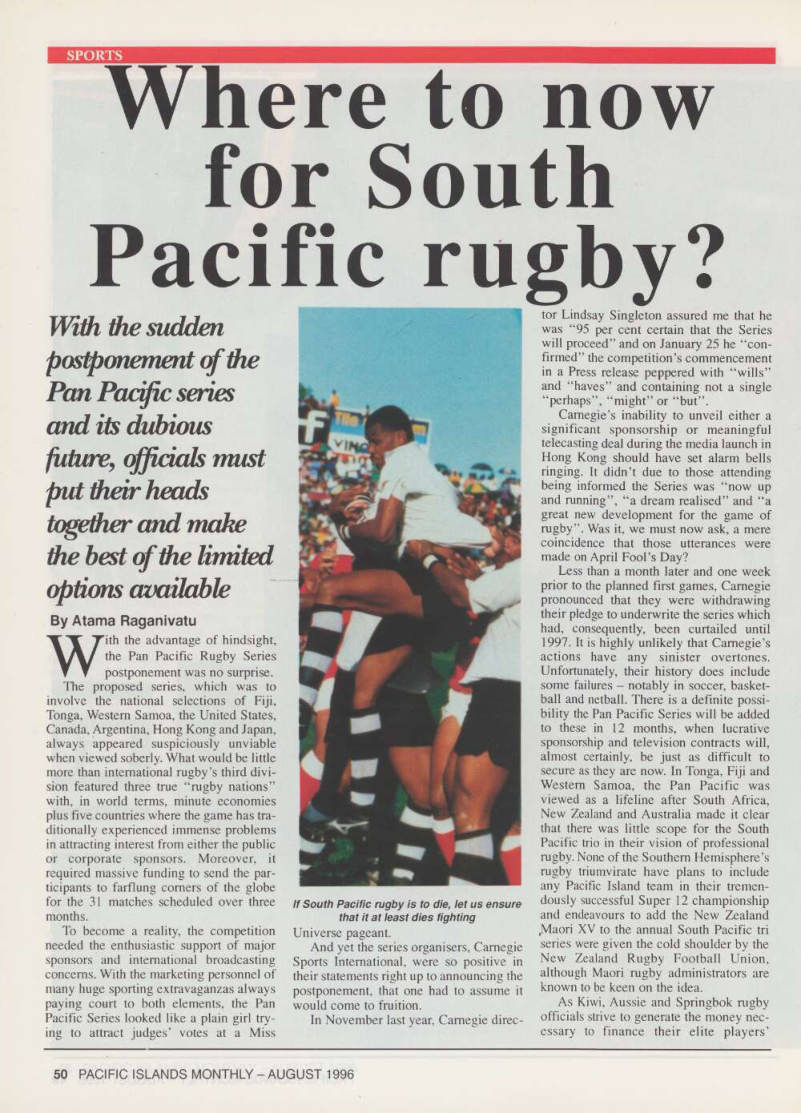
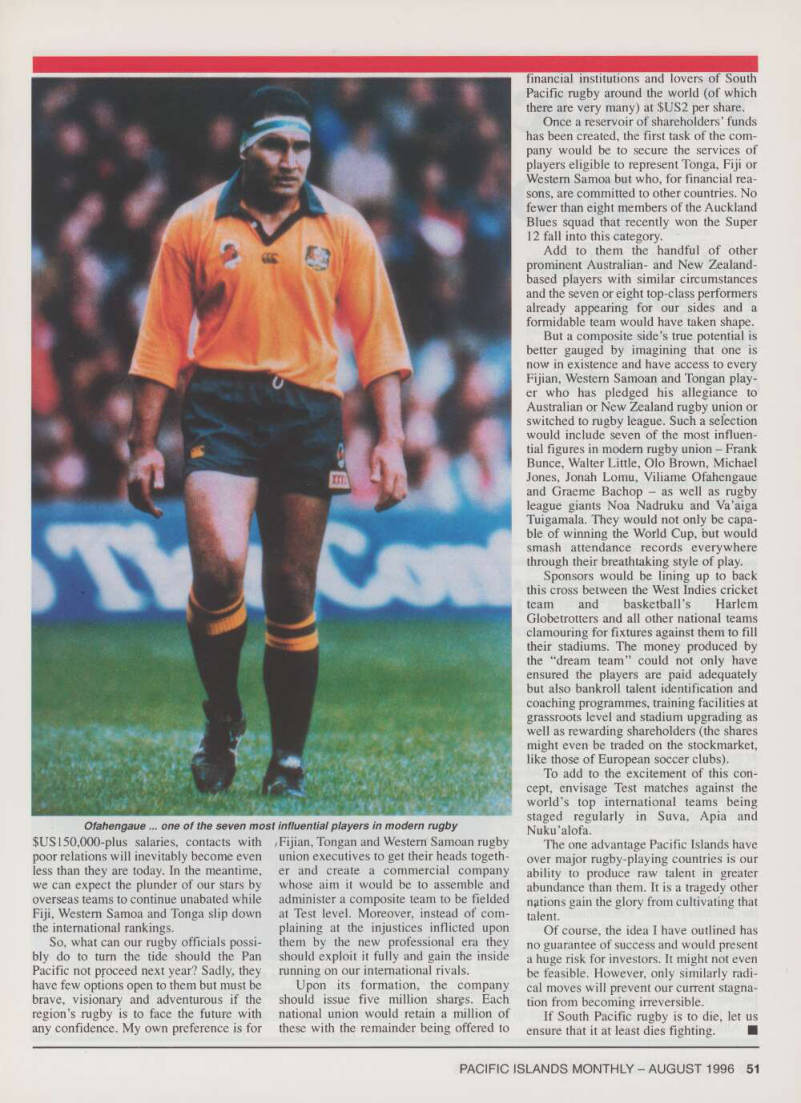
Sports
Where to now for South Pacific rugby?
With the sudden postponement of the Pan Pacific series and its dubious future, officials must put their heads together and make die best of the limited
options available
By Atama Raganivatu
With the advantage of hindsight, the Pan Pacific Rugby Series postponement was no surprise.
The proposed series, which was to involve the national selections of Fiji, Tonga, Western Samoa, the United States, Canada, Argentina, Hong Kong and Japan, always appeared suspiciously unviable when viewed soberly. What would be little more than international rugby’s third divi sion featured three true “rugby nations” with, in world terms, minute economies plus five countries where the game has tra
ditionally experienced immense problems
in attracting interest from either the public or corporate sponsors. Moreover, it required massive funding to send the par ticipants to farflung comers of the globe for the 31 matches scheduled over three months.
To become a reality, the competition needed the enthusiastic support of major sponsors and international broadcasting concerns. With the marketing personnel of many huge sporting extravaganzas always paying court to both elements, the Pan Pacific Series looked like a plain girl try ing to attract judges’ votes at a Miss
Universe pageant.
And yet the series organisers, Carnegie Sports International, were sO positive in their statements right up to announcing the postponement, that one had to assume it would come to fruition.
In November last year, Carnegie direc
tor Lindsay Singleton assured me that he was “95 per cent certain that the Series will proceed” and on January 25 he “con firmed” the competition’s commencement in a Press release peppered with “wills” and “haves” and containing not a single “perhaps”, “might” or “but”.
Carnegie’s inability to unveil either a
significant sponsorship or meaningful
telecasting deal during the media launch in Hong Kong should have set alarm bells ringing. It didn’t due to those attending being informed the Series was “now up and running”, “a dream realised” and “a great new development for the game of rugby”. Was it, we must now ask, a mere coincidence that those utterances were made on April Fool’s Day?
Less than a month later and one week prior to the planned first games, Carnegie pronounced that they were withdrawing their pledge to underwrite the series which had, consequently, been curtailed until 1997. It is highly unlikely that Carnegie’s actions have any sinister overtones.
Unfortunately, their history does include some failures - notably in soccer, basket ball and netball. There is a definite possi bility the Pan Pacific Series will be added to these in 12 months, when lucrative sponsorship and television contracts will, almost certainly, be just as difficult to secure as they are now. In Tonga, Fiji and Western Samoa, the Pan Pacific was viewed as a lifeline after South Africa, New Zealand and Australia made it clear that there was little scope for the South Pacific trio in their vision of professional rugby. None of the Southern Hemisphere’s rugby triumvirate have plans to include any Pacific Island team in their tremen
dously successful Super 12 championship
and endeavours to add the New Zealand .Maori XV to the annual South Pacific tri series were given the cold shoulder by the New Zealand Rugby Football Union, although Maori rugby administrators are known to be keen on the idea.
As Kiwi, Aussie and Springbok rugby officials strive to generate the money nec essary to finance their elite players’
If South Pacific rugby is to die, let us ensure that it at least dies fighting
SUS 150,000-plus salaries, contacts with poor relations will inevitably become even less than they are today. In the meantime, we can expect the plunder of our stars by overseas teams to continue unabated while Fiji, Western Samoa and Tonga slip down the international rankings.
So, what can our rugby officials possi bly do to turn the tide should the Pan Pacific not proceed next year? Sadly, they have few options open to them but must be brave, visionary and adventurous if the region’s rugby is to face the future with any confidence. My own preference is for
/Fijian, Tongan and Western Samoan rugby union executives to get their heads togeth er and create a commercial company whose aim it would be to assemble and administer a composite team to be fielded at Test level. Moreover, instead of com plaining at the injustices inflicted upon them by the new professional era they should exploit it fully and gain the inside running on our international rivals.
Upon its formation, the company should issue five million shares. Each national union would retain a million of these with the remainder being offered to
financial institutions and lovers of South Pacific rugby around the world (of which there are very many) at SUS 2 per share.
Once a reservoir of shareholders’ funds has been created, the first task of the com pany would be to secure the services of players eligible to represent Tonga, Fiji or Western Samoa but who, for financial rea sons, are committed to other countries. No fewer than eight members of the Auckland Blues squad that recently won the Super 12 fall into this category.
Add to them the handful of other prominent Australian- and New Zealand based players with similar circumstances and the seven or eight top-class performers already appearing for our sides and a formidable team would have taken shape.
But a composite side’s true potential is better gauged by imagining that one is now in existence and have access to every Fijian, Western Samoan and Tongan play er who has pledged his allegiance to Australian or New Zealand rugby union or switched to rugby league. Such a selection would include seven of the most influen tial figures in modem rugby union - Frank Bunce, Walter Little, 010 Brown, Michael Jones, Jonah Lomu, Viliame Ofahengaue and Graeme Bachop - as well as rugby
league giants Noa Nadruku and Va’aiga
Tuigamala. They would not only be capa ble of winning the World Cup, but would smash attendance records everywhere through their breathtaking style of play.
Sponsors would be lining up to back this cross between the West Indies cricket team and basketball’s Harlem Globetrotters and all other national teams clamouring for fixtures against them to fill their stadiums. The money produced by the “dream team” could not only have ensured the players are paid adequately but also bankroll talent identification and coaching programmes, training facilities at grassroots level and stadium upgrading as well as rewarding shareholders (the shares might even be traded on the stockmarket, like those of European soccer clubs).
To add to the excitement of this con cept, envisage Test matches against the world’s top international teams being staged regularly in Suva, Apia and Nuku’alofa.
The one advantage Pacific Islands have over major rugby-playing countries is our ability to produce raw talent in greater abundance than them. It is a tragedy other nations gain the glory from cultivating that talent.
Of course, the idea I have outlined has no guarantee of success and would present a huge risk for investors. It might not even be feasible. However, only similarly radi cal moves will prevent our current stagna tion from becoming irreversible.
If South Pacific rugby is to die, let us ensure that it at least dies fighting. ■
Ofahengaue...one of the seven most influential players in modern rugby
Pacific gatecrashers
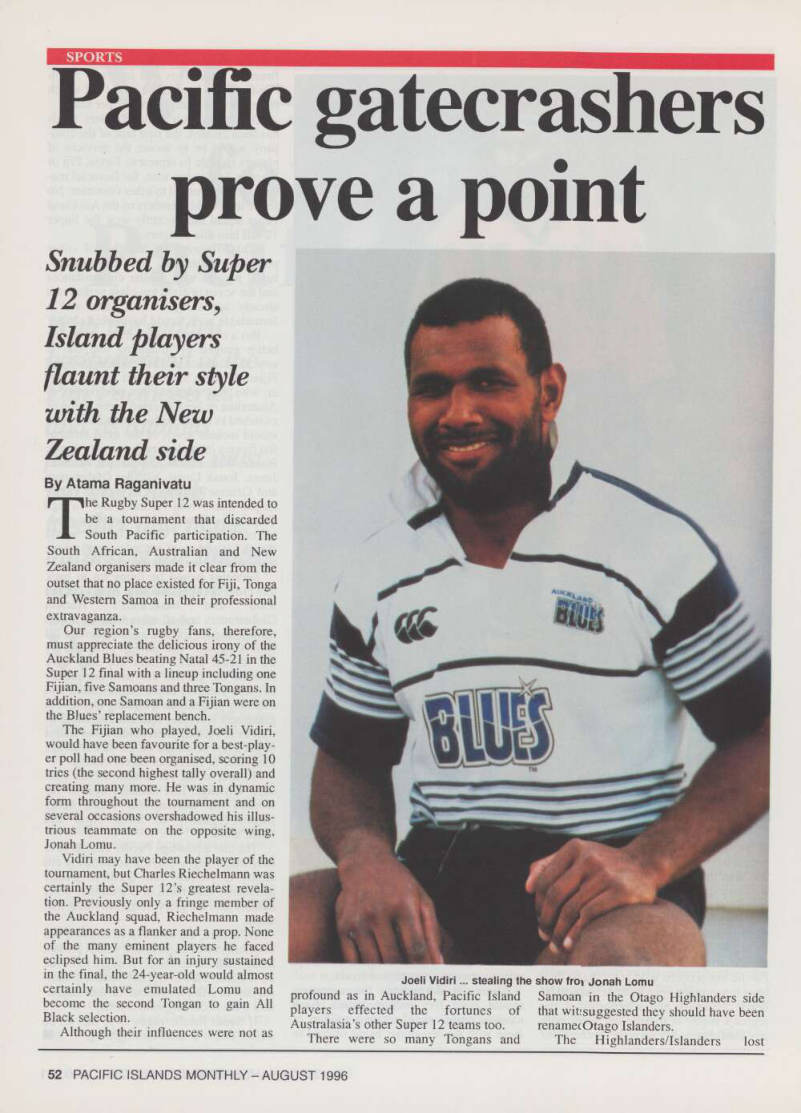
prove a point
Snubbed by Super 12 organisers, Island players flaunt their style with the New Zealand side
By Atama Raganivatu
The Rugby Super 12 was intended to be a tournament that discarded South Pacific participation. The South African, Australian and New Zealand organisers made it clear from the outset that no place existed for Fiji, Tonga and Western Samoa in their professional extravaganza.
Our region’s rugby fans, therefore, must appreciate the delicious irony of the Auckland Blues beating Natal 45-21 in the Super 12 final with a lineup including one Fijian, five Samoans and three Tongans. In addition, one Samoan and a Fijian were on the Blues’ replacement bench.
The Fijian who played, Joeli Vidiri, would have been favourite for a best-play er poll had one been organised, scoring 10 tries (the second highest tally overall) and creating many more. He was in dynamic form throughout the tournament and on several occasions overshadowed his illus trious teammate on the opposite wing, Jonah Lomu.
Vidiri may have been the player of the tournament, but Charles Riechelmann was certainly the Super 12’s greatest revela tion. Previously only a fringe member of the Auckland squad, Riechelmann made appearances as a flanker and a prop. None of the many eminent players he faced eclipsed him. But for an injury sustained in the final, the 24-year-old would almost certainly have emulated Lomu and become the second Tongan to gain All Black selection.
Although their influences were not as
profound as in Auckland, Pacific Island players effected the fortunes of Australasia’s other Super 12 teams too.
There were so many Tongans and
Samoan in the Otago Highlanders side that widsuggested they should have been renamecOtago Islanders.
The Highlanders/Islanders lost
Joeli Vidiri...stealing the show fro[?] Jonah Lomu
momentum after a wonderful start and failed to qualify for the semi-finals. Even so, they provided the Super 12 with many thrilling moments and, in Brian Lima and Kupu Vanisi, two of its most exciting per sonalities.
Lima, despite being only 24, had already played over 50 games for Western Samoa and appeared in two World Cups at the beginning of the season.
However, questions remained unan swered about his ability to compete amongst rugby’s elite. He dispelled those doubts in the Super 12 and must today be acknowledged as a winger of the highest calibre.
In contrast to Lima, Kupus Vanisi had played but a handful of first-class matches before 1996. The dreadlocked Tongan is a familiar and respected figure throughout Southern Hemisphere rugby now though and, if able to add a little more determina tion to his game, should reach the very top.
Like Otago, Wellington Hurricanes
experienced a patchy Super 12 campaign.
Samoans Alex Telea and Alama leremia were amongst their better performers.
Waikato Chiefs proved equally erratic.
An injury to Fijian maestro Walter Little did not help their cause, even if his mid field partner, 34-year-old Niuean Frank Bunce, continues to defy time.
Fiji’s national team captain Joeli
Veitayaki enhanced a steadily growing
reputation while on chief’s duty and, typi cal of a prop, seems to be approaching his peak at 29.
Canterbury Crusaders struggled off the field because of an administration woeful
ly ill-prepared for professionalism and on
the field due to a lack of playing depth.
Had Fijians Phillipe Rayasi and Tabai
Matson and Manu Samoa captain Pat Lam been free from the injuries which rendered their inputs negligible, the Crusaders would have fared better. Nevertheless, Tongan fullback Pita Alatini gave them much-needed bite after being drafted.
Across the Tasman Sea, Queensland Reds introduced several Pacific Island players but none could establish himself in the team.
Magnificent Fijian Manasa Bari
arrived in Brisbane too late to make his presence felt, but is expected to be a key man for the Bananabenders next year.
Fitful form cost New South Wales a place in the semi-finals as Fijian Sam Domoni and the Tongan pair of Daniel Manu and Viliame Ofahengaue all flitted in and out of the side.
Manu did sufficient to retain his Australian Test jersey but many fear that
Ofahengaue’s distinguished international
career is now over.
Australian Capital Territory were the
Super 12’s surprise packets.
The universal choice for wooden spoonists before the competition com menced, they very nearly snatched a semi final spot.
Nobody contributed more to their suc
cess than Tongan World Cup player
Ipolito Fenukitau. I have no doubt that Fenukitau will now be proclaimed one of the world’s best loose forwards if he rep
resented higher profile selections.
The Super 12 certainly confirmed the abundance of talent produced by the South Pacific.
But it seems likely that the tournament will continue to provide us with only reflected glory. There are no plans to include Western Samoa, Fiji and Tonga in the foreseeable future ((despite the organis ers-’ excuses for their exclusion being banal).
To add salt to the wound. Super 12 officials were reported to be regarding Victoria - an Australian state where rugby union has meagre support - as a likelier participant than any teams from our region should the competition expand.
It appears that we are expected to remain content with crumbs from the rich men’s table and be placated by the exploits of our boys in the colours of Australian and New Zealand teams. ■
Advertisements & other items, p. 53 (1 item)
* Pacific Islands’ Indigenous
INAUGURAL MEETINGS OF
Tourism Operators Association and
* National Australian Aboriginal
Tourism Operators Association.
These will take place in Sydney on 9th and 10th of December, 1996 at Oxford Koala Hotel.
They are initiatives to assist existing operators and other native persons seeking to operate tours, hotels, lodges, craft entertainment and other businesses serving the national, local and overseas visitors and tourists.
Preliminary objectives of the Associations are to: Assist native peoples throughout Australia and the Pacific Islands to operate, set up, finance, and promote tourism businesses owned, operated and run by local indigenous peoples and to control numbers of visitors in respect of conserving their environment, culture, crafts, traditional music and entertainment, Sovereignty, economic sustainability, childrens education, languages and villages.
At the same time there will be a seminar, private meeting rooms, and space provided each year for present operators to learn, promote or discuss their business to the Sydney public, Australian tourism industry, inbound and outbound wholesalers, overseas visitors in Sydney, financiers or potential joint venture partners.
3RD PACIFIC INDIGENOUS
BUSINESS LEADERS CONFERENCE
AND CONSULTANTS & PRODUCT SUPPLIERS EXPO.
These will take place in Sydney on 11th to 13th of December, 1996 at Oxford Koala Hotel.
The Conference will include Keynote Speakers experienced in the following industries and issues. Tourism, hotel design, bio diversity, internet, economic sustainability, business plans, financing, joint ventures, patents protection, mining, cultural and environmental conservation, cultural centre development, gaming and ecotourism.
The objectives of the Conference are to: * continue the rationales developed at the Ist Pacific and Aboriginal Ecotourism Design Conference of 1994 and the 2nd Pacific Islands and Aboriginal Business Success Models Conference of 1995. * Assist Pacific Governments foster and develop more native owned businesses which retain increased foreign exchange earnings and conserve traditional culture, values, environment and language. Of the 200 hotels in Fiji, none are 100% owned by native Fijians. •’ further promote the value and importance of the model Vatukarasa Village Reconstruction and Culture Hotel project located on Fiji’s Coral Coast to the Fiji Government. * provide facilities in Sydney each year for private financing or joint venture presentations and networking. * provide an exhibition area where consultants and suppliers can present their goods and services to delegates and Pacific Business leaders each year.
Anyone interested in the outcome, attending, speaking, exhibiting or participating in anyway at either the Tourism Operators Association inaugural meetings or Indigenous Business Leaders Conference should write to Marc Aussie-Stone, Director, Sydney based ongoing Conference Secretariat, FAX 612 319 6334 PHONE 61 2 319 4803 write P 0 BOX 185, Strawberry Hills, Australia, 2012.
PLEASE SEND NAME AND ADDRESS OF ANY ONE WHO SHOULD BE SENT A FREE COPY OF THE CONFERENCE BROCHURE.
A political dissection
Literature
By Nicolas Rothwell
One splendid Monday morning,
during a recent stay in Port Vila, I was sipping coffee in an elegant patisserie, reading the local Press and con templating the chaos of Vanuatu’s politics, when a metallic-grey Hyundai drew up outside. Into the patisserie came Walter Lini, father of Vanuatu’s independence.
He was relaxed; he smiled. Escorted by his wife, he sat down beside one of the country’s best-known business entrepreneurs. The sound of their laughter filled the cafe for the next half-hour.
Just how, I wondered, did Vanuatu get from the glorious optimism of its first post-independence days, in 1980, to the confusions and instabilities of 1996? How did Father Lini evolve from his starring role as Vanuatu’s first prime minister and an international symbol of good leader ship, to his cameo part in this February’s upheaval, when, as outgoing minister of justice. Father Lini tried to replace the key figures in the nation’s legal system?
Some of the answers to these questions lie in the pages of an extraordinary new book, Melanesian Politics - Stael Blong Vanuatu, a collective volume edited by Howard Van Trease and produced under the auspices of the Macmillan Brown Centre for Pacific Studies and the University of the South Pacific’s Institute for Pacific Studies. Let it be said at once: This book is a masterpiece of political analysis, one of the key works of post colonial Pacific history, and by far the most valuable volume yet to appear on modem Vanuatu. Its relentless, almost obsessional devotion to detail, its attention both to regional and to national issues, its dissecting of traditional custom structures and factional fights within the established parties combine to make it a crucial work of reference. Among the authors are almost all the political leaders of the coun try, and they write with often startling can dour of their aims and their behaviour.
The ostensible subject of the book is the 1991 national election. This was the first vote in Vanuatu’s history that resulted in no single party gaining a clear majority, and hence it proved the cusp point in the transition from' stable government by the long-dominant Vanua’aku Pati (VP) to the present system of shifting coalition rule.
The true focus of the book, though, is far more inclusive: The origins of the country’s political system, the efforts of
the French colonial authorities to cement in place a significant francophone ni- Vanuatu population, the uproar in the run up to independence - all these are well covered by Van Trease in his introduction.
The gloomy background to the 1991 electoral campaign is briefly given - the severe stroke -suffered by Father Lini in 1987 and his partial recovery; the leader ship challenge by Barak Sope and the bit ter split in the VP’s ranks. The election’s ambiguous outcome serves, of course, as a pointer to the current, mid-90s pattern of Vanuatu politics. But the most valuable section of Melanesian Politics - Stael Blong Vanuatu is a detailed, chapter-by chapter breakdown of voting trends and allegiances over time in the individual islands of the archipelago. Each of these is written by a ni-Vanuatu expert, and the level of detail included is such as to trans form an outsider’s appreciation of region al politics. Piece by piece, the individual segments cohere into a ground-level histo ry of Vanuatu’s development since inde pendence, with local pressures and influ ences, especially those of rival religious
organisations, given their true signifi
cance. Intriguing snippets of island infor mation are conveyed in authoritiative fashion, bringing to vivid life voting pat terns that have long seemed bizarre when viewed from the distant comfort of a Port
Vila tally-room.
Howard Van Trease’s cautious conclu sion seems more than justified. The 1991 election, he says, “can be described as the return to a more Melanesian style of poli tics in Vanuatu in which the extreme diversity of the population - 105 different languages in a population of just over 150,000 dispersed over a multitude of islands - and significance of local person
alities re-emerged to replace the artificial
dominance of a single political party”.
In this light, the subsequent five years, with their delirious power struggles, feuds and reversals of alliances, now seem like business as usual: Vanuatu is no longer “beyond pandemonium”. Indeed, for close to a decade the pattern has been one of tur moil and instability.
As one reads the historical record anal ysed in Melanesian Politics - Stael Blong Vanuatu and considers the events of the year to date, it remains unclear just how this pattern could be broken. In the first days of May, conspirational attempts to create a new government were well under way, while furious petitions were being presented to the chief justice in a bid to overturn the results of the recent election of the prime minister. At least the mem bers of the present government are famil iar with all this infighting: No fewer than six of the ministers in the current coalition are contributors to Howard Van Trease’s volume. I stayed in my seat in the Port Vila patisserie, and watched as Walter Lini laughed and joked with his new friends.
The scorching essay by Grace Mera Molisa in Melanesian Politics - Stael Blong Vanuatu lay open on the table before me: “The Vanua’aku Pati was too strong for any opposition party to threaten its position and the only way its unity and solidarity could be undermined would have to come from within. That is, in fact, what occurred. Insidiously, gradually, irre versibly, fatally, the VP self-destructed at the core of its leadership.”
Father Lini got to his feet as I was read ing, and made his way outside. There are, of course, many sides to each story in Vanuatu politics and, sadly. Father Lini’s own views and those of his supporters are absent from this book - perhaps because they would have found it too painful to recollect the decay of the old VP, that bea con of radical Pacific politics. Despite this notable absence, however, I was glad to have Howard Van Trease’s masterful vol ume tucked under my arms as I went out that morning into the unchanged, uncer tain streets of Port Vila. ■
Melanesian Politics - Stael Blong Vanuatu: Edited by Howard Van Trease; published 1995 by the Macmillan Brown Centre for Pacific Studies, University of Canterbury, New Zealand (Price: NZSNZ49.SO); and by the Institute of Pacific Studiies, University of the South Pacific, PO Box 1168, Suva (Price: SUS 39, or SUS 49 for airmail. French edition also available from USP.
Protecting our wetlands
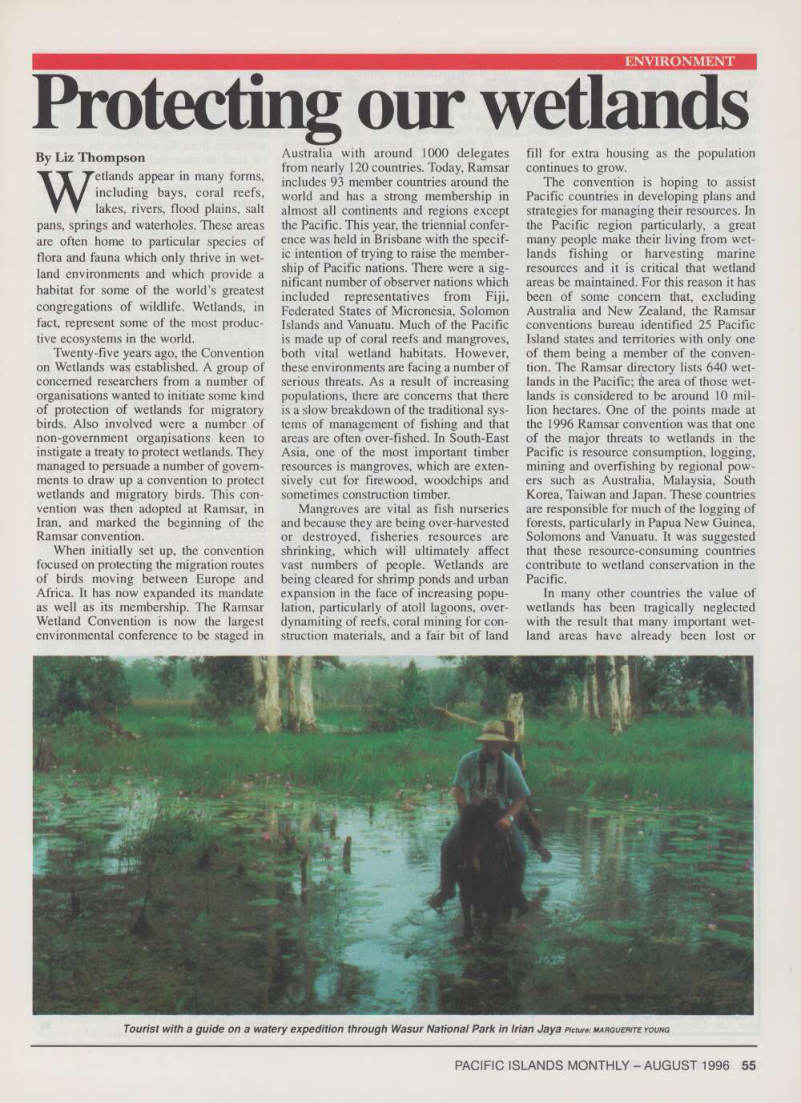
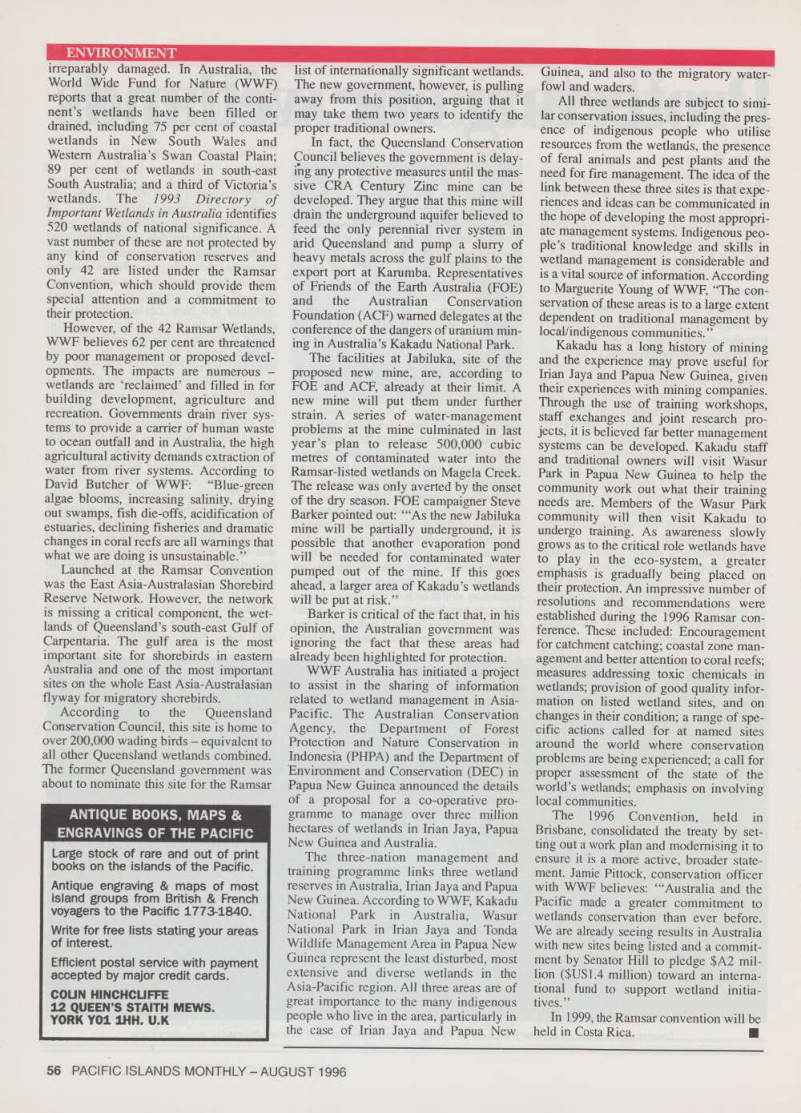
Environment
By Liz Thompson
Wetlands appear in many forms,
including bays, coral reefs,
lakes, rivers, flood plains, salt pans, springs and waterholes. These areas are often home to particular species of flora and fauna which only thrive in wet land environments and which provide a habitat for some of the world’s greatest congregations of wildlife. Wetlands, in fact, represent some of the most produc tive ecosystems in the world.
Twenty-five years ago, the Convention on Wetlands was established. A group of concerned researchers from a number of organisations wanted to initiate some kind of protection of wetlands for migratory birds. Also involved were a number of non-government organisations keen to instigate a treaty to protect wetlands. They managed to persuade a number of govern ments to draw up a convention to protect wetlands and migratory birds. This con vention was then adopted at Ramsar, in Iran, and marked the beginning of the Ramsar convention.
When initially set up, the convention focused on protecting the migration routes of birds moving between Europe and Africa. It has now expanded its mandate as well as its membership. The Ramsar Wetland Convention is now the largest environmental conference to be staged in
Australia with around 1000 delegates from nearly 120 countries. Today, Ramsar includes 93 member countries around the world and has a strong membership in almost all continents and regions except the Pacific. This year, the triennial confer ence was held in Brisbane with the specif ic intention of trying to raise the member ship of Pacific nations. There were a sig nificant number of observer nations which
included representatives from Fiji,
Federated States of Micronesia, Solomon Islands and Vanuatu. Much of the Pacific is made up of coral reefs and mangroves, both vital wetland habitats. However, these environments are facing a number of serious threats. As a result of increasing populations, there are concerns that there is a slow breakdown of the traditional sys tems of management of fishing and that areas are often over-fished. In South-East Asia, one of the most important timber resources is mangroves, which are exten sively cut for firewood, woodchips and sometimes construction timber.
Mangroves are vital as fish nurseries and because they are being over-harvested or destroyed, fisheries resources are shrinking, which will ultimately affect vast numbers of people. Wetlands are being cleared for shrimp ponds and urban expansion in the face of increasing popu lation, particularly of atoll lagoons, over dynamiting of reefs, coral mining for con struction materials, and a fair bit of land
fill for extra housing as the population continues to grow.
The convention is hoping to assist Pacific countries in developing plans and strategies for managing their resources. In the Pacific region particularly, a great many people make their living from wet lands fishing or harvesting marine resources and it is critical that wetland areas be maintained. For this reason it has been of some concern that, excluding Australia and New Zealand, the Ramsar conventions bureau identified 25 Pacific Island states and territories with only one of them being a member of the conven tion. The Ramsar directory lists 640 wet lands in the Pacific; the area of those wet lands is considered to be around 10 mil lion hectares. One of the points made at the 1996 Ramsar convention was that one of the major threats to wetlands in the Pacific is resource consumption, logging, mining and overfishing by regional pow ers such as Australia, Malaysia, South Korea, Taiwan and Japan. These countries are responsible for much of the logging of forests, particularly in Papua New Guinea, Solomons and Vanuatu. It was suggested that these resource-consuming countries contribute to wetland conservation in the Pacific.
In many other countries the value of wetlands has been tragically neglected with the result that many important wet land areas have already been lost or
Tourist with a guide on a watery expedition through Wasur National Park in Irian Jaya Picture: MARGUERITE YOUNG
irreparably damaged. In Australia, the World Wide Fund for Nature (WWF) reports that a great number of the conti nent’s wetlands have been filled or drained, including 75 per cent of coastal wetlands in New South Wales and Western Australia’s Swan Coastal Plain; 89 per cent of wetlands in south-east South Australia; and a third of Victoria’s wetlands. The 1993 Directory of Important Wetlands in Australia identifies 520 wetlands of national significance. A vast number of these are not protected by any kind of conservation reserves and only 42 are listed under the Ramsar Convention, which should provide them special attention and a commitment to
their protection.
However, of the 42 Ramsar Wetlands, WWF believes 62 per cent are threatened by poor management or proposed devel opments. The impacts are numerous wetlands are ‘reclaimed’ and fdled in for
building development, agriculture and
recreation. Governments drain river sys tems to provide a carrier of human waste to ocean outfall and in Australia, the high agricultural activity demands extraction of water from river systems. According to David Butcher of WWF: “Blue-green
algae blooms, increasing salinity, drying
out swamps, fish die-offs, acidification of estuaries, declining fisheries and dramatic changes in coral reefs are all warnings that what we are doing is unsustainable.”
Launched at the Ramsar Convention was the East Asia-Australasian Shorebird Reserve Network. However, the network is missing a critical component, the wet lands of Queensland’s south-east Gulf of Carpentaria. The gulf area is the most important site for shorebirds in eastern Australia and one of the most important sites on the whole East Asia-Australasian fly way for migratory shorebirds.
According to the Queensland Conservation Council, this site is home to over 200,000 wading birds - equivalent to all other Queensland wetlands combined.
The former Queensland government was about to nominate this site for the Ramsar
list of internationally significant wetlands.
The new government, however, is pulling away from this position, arguing that it may take them two years to identify the proper traditional owners.
In fact, the Queensland Conservation Council believes the government is delay ing any protective measures until the mas sive CRA Century Zinc mine can be developed. They argue that this mine will drain the underground aquifer believed to feed the only perennial river system in arid Queensland and pump a slurry of heavy metals across the gulf plains to the export port at Karumba. Representatives of Friends of the Earth Australia (FOE) and the Australian Conservation Foundation (ACF) warned delegates at the conference of the dangers of uranium min ing in Australia’s Kakadu National Park.
The facilities at Jabiluka, site of the proposed new mine, are, according to FOE and ACF, already at their limit. A new mine will put them under further strain. A series of water-management problems at the mine culminated in last year’s plan to release 500,000 cubic metres of contaminated water into the Ramsar-listed wetlands on Magela Creek.
The release was only averted by the onset of the dry season. FOE campaigner Steve Barker pointed out: “‘As the new Jabiluka mine will be partially underground, it is possible that another evaporation pond will be needed for contaminated water pumped out of the mine. If this goes ahead, a larger area of Kakadu’s wetlands will be put at risk.”
Barker is critical of the fact that, in his opinion, the Australian government was ignoring the fact that these areas had already been highlighted for protection.
WWF Australia has initiated a project to assist in the sharing of information related to wetland management in Asia- Pacific. The Australian Conservation Agency, the Department of Forest Protection and Nature Conservation in Indonesia (PHPA) and the Department of Environment and Conservation (DEC) in Papua New Guinea announced the details of a proposal for a co-operative pro gramme to manage over three million hectares of wetlands in Irian Jaya, Papua New Guinea and Australia.
The three-nation management and training programme links three wetland reserves in Australia, Irian Jaya and Papua New Guinea. According to WWF, Kakadu National Park in Australia, Wasur National Park in Irian Jaya and Tonda Wildlife Management Area in Papua New Guinea represent the least disturbed, most extensive and diverse wetlands in the Asia-Pacific region. All three areas are of great importance to the many indigenous people who live in the area, particularly in the case of Irian Jaya and Papua New
Guinea, and also to the migratory water fowl and waders.
All three wetlands are subject to simi lar conservation issues, including the pres ence of indigenous people who utilise resources from the wetlands, the presence of feral animals and pest plants and the need for fire management. The idea of the link between these three sites is that expe riences and ideas can be communicated in the hope of developing the most appropri ate management systems. Indigenous peo ple’s traditional knowledge and skills in wetland management is considerable and is a vital source of information. According to Marguerite Young of WWF, “The con servation of these areas is to a large extent dependent on traditional management by local/indigenous communities.”
Kakadu has a long history of mining and the experience may prove useful for Irian Jaya and Papua New Guinea, given their experiences with mining companies.
Through the use of training workshops, staff exchanges and joint research pro jects, it is believed far better management systems can be developed. Kakadu staff and traditional owners will visit Wasur Park in Papua New Guinea to help the community work out what their training needs are. Members of the Wasur Park community will then visit Kakadu to undergo training. As awareness slowly grows as to the critical role wetlands have to play in the eco-system, a greater emphasis is gradually being placed on their protection. An impressive number of resolutions and recommendations were established during the 1996 Ramsar con ference. These included: Encouragement for catchment catching; coastal zone man agement and better attention to coral reefs; measures addressing toxic chemicals in wetlands; provision of good quality infor mation on listed wetland sites, and on changes in their condition; a range of spe cific actions called for at named sites around the world where conservation problems are being experienced; a call for proper assessment of the state of the world’s wetlands; emphasis on involving local communities.
The 1996 Convention, held in Brisbane, consolidated the treaty by set ting out a work plan and modernising it to ensure it is a more active, broader state ment. Jamie Pittock, conservation officer with WWF believes; ‘“Australia and the Pacific made a greater commitment to wetlands conservation than ever before.
We are already seeing results in Australia with new sites being listed and a commit ment by Senator Hill to pledge SA2 mil lion (SUSI. 4 million) toward an interna tional fund to support wetland initia tives.”
In 1999, the Ramsar convention will be held in Costa Rica. ■
Advertisements & other items, p. 56 (1 item)
Antique Books, Maps &
ENGRAVINGS OF THE PACIFIC
Large stock of rare and out of print books on the islands of the Pacific.
Antique engraving & maps of most island groups from British & French voyagers to the Pacific 1773-1840.
Write for free lists stating your areas of interest.
Efficient postal service with payment accepted by major credit cards.
COUN HINCHCUFFE
12 QUEEN’S STAITH MEWS.
YORK YOIIHH. U.K
The land of Ta-Har
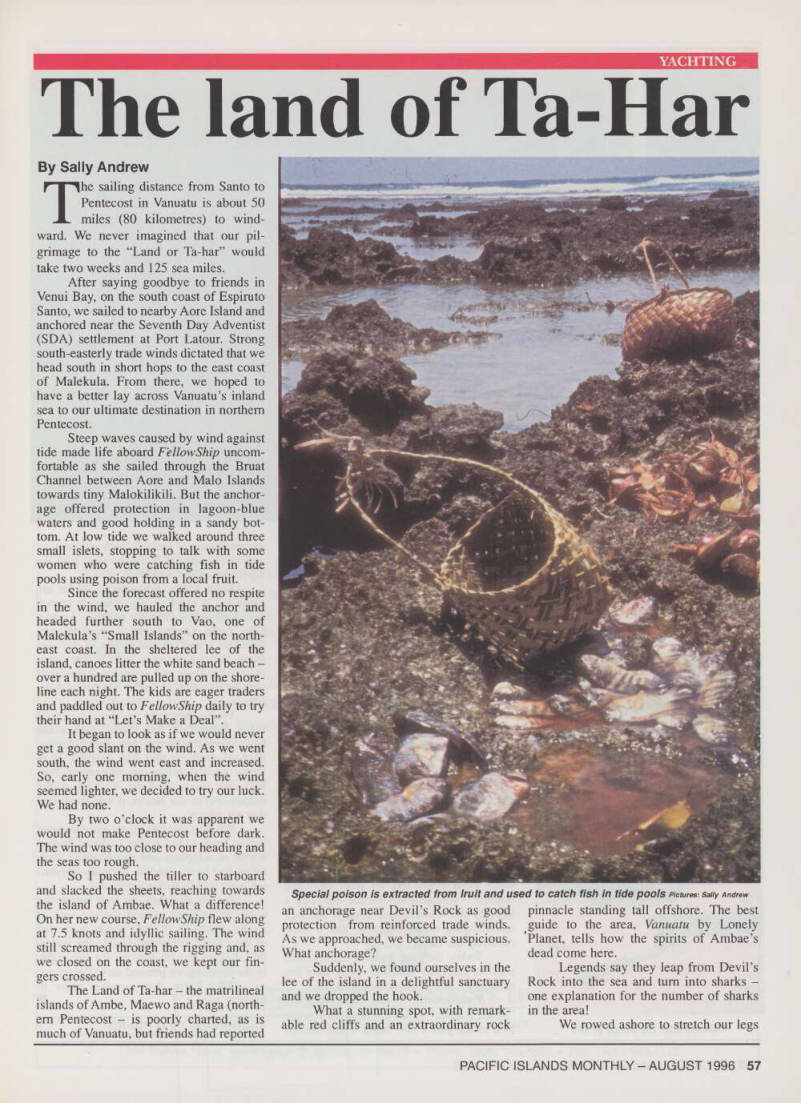
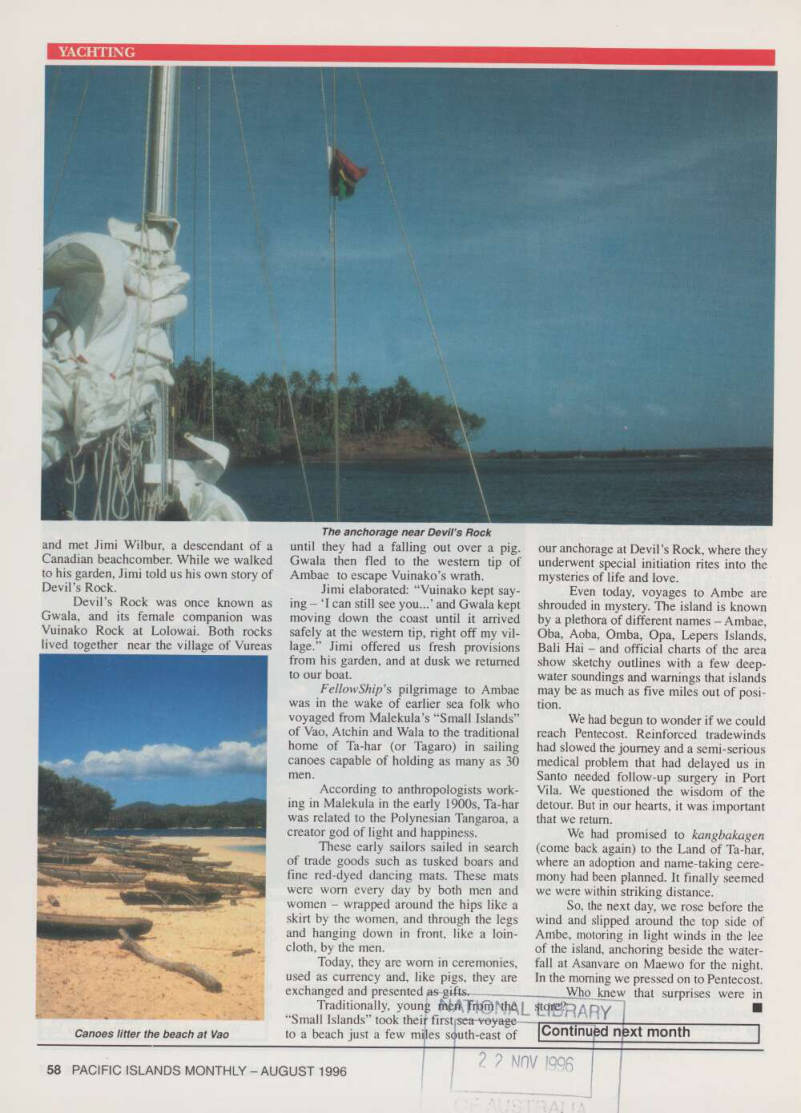
Yachting
By Sally Andrew
The sailing distance from Santo to Pentecost in Vanuatu is about 50 miles (80 kilometres) to wind ward. We never imagined that our pil grimage to the “Land or Ta-har” would take two weeks and 125 sea miles.
After saying goodbye to friends in Venui Bay, on the south coast of Espiruto Santo, we sailed to nearby Aore Island and anchored near the Seventh Day Adventist (SDA) settlement at Port Latour. Strong south-easterly trade winds dictated that we head south in short hops to the east coast of Malekula. From there, we hoped to have a better lay across Vanuatu’s inland sea to our ultimate destination in northern Pentecost.
Steep waves caused by wind against tide made life aboard Fellowship uncom fortable as she sailed through the Bruat Channel between Aore and Malo Islands towards tiny Malokilikili. But the anchor age offered protection in lagoon-blue waters and good holding in a sandy bot tom. At low tide we walked around three small islets, stopping to talk with some women who were catching fish in tide pools using poison from a local fruit.
Since the forecast offered no respite in the wind, we hauled the anchor and headed further south to Vao, one of Malekula’s “Small Islands” on the north east coast. In the sheltered lee of the island, canoes litter the white sand beach over a hundred are pulled up on the shore line each night. The kids are eager traders and paddled out to Fellowship daily to try their hand at “Let’s Make a Deal”.
It began to look as if we would never get a good slant on the wind. As we went south, the wind went east and increased.
So, early one morning, when the wind seemed lighter, we decided to try our luck.
We had none.
By two o’clock it was apparent we would not make Pentecost before dark.
The wind was too close to our heading and the seas too rough.
So I pushed the tiller to starboard and slacked the sheets, reaching towards the island of Ambae. What a difference!
On her new course. Fellowship flew along at 7.5 knots and idyllic sailing. The wind still screamed through the rigging and, as we closed on the coast, we kept our fin gers crossed.
The Land of Ta-har - the matrilineal islands of Ambe, Maewo and Raga (north ern Pentecost - is poorly charted, as is much of Vanuatu, but friends had reported
an anchorage near Devil’s Rock as good protection from reinforced trade winds.
As we approached, we became suspicious.
What anchorage?
Suddenly, we found ourselves in the lee of the island in a delightful sanctuary and we dropped the hook.
What a stunning spot, with remark able red cliffs and an extraordinary rock
pinnacle standing tall offshore. The best guide to the area, Vanuatu by Lonely 'Planet, tells how the spirits of Ambae’s dead come here.
Legends say they leap from Devil’s
Rock into the sea and turn into sharks one explanation for the number of sharks in the area!
We rowed ashore to stretch our legs
Special poison is extracted from Iruit and used to catch fish in tide pools Pictures: sally Andrew
and met Jimi Wilbur, a descendant of a Canadian beachcomber. While we walked to his garden, Jimi told us his own story of Devil’s Rock.
Devil’s Rock was once known as Gwala, and its female companion was Vuinako Rock at Lolowai. Both rocks lived together near the village of Vureas
until they had a falling out over a pig.
Gwala then fled to the western tip of Ambae to escape Vuinako’s wrath.
Jimi elaborated: “Vuinako kept say ing - T can still see you...’ and Gwala kept moving down the coast until it arrived safely at the western tip, right off my vil lage.” Jimi offered us fresh provisions from his garden, and at dusk we returned to our boat.
Fellowship 1 s pilgrimage to Ambae was in the wake of earlier sea folk who voyaged from Malekula’s “Small Islands” of Vao, Atchin and Wala to the traditional home of Ta-har (or Tagaro) in sailing canoes capable of holding as many as 30 men.
According to anthropologists work ing in Malekula in the early 1900 s, Ta-har was related to the Polynesian Tangaroa, a
creator god of light and happiness.
These early sailors sailed in search of trade goods such as tusked boars and fine red-dyed dancing mats. These mats were worn every day by both men and women - wrapped around the hips like a skirt by the women, and through the legs and hanging down in front, like a loin cloth, by the men.
Today, they are worn in ceremonies, used as currency and, like pigs, they are exchanged and presented as gifts.
Traditionally, young
“Small Islands” took their firstjsea-voyage to a beach just a few miles south-east of
our anchorage at Devil’s Rock, where they underwent special initiation rites into the mysteries of life and love.
Even today, voyages to Ambe are shrouded in mystery. The island is known by a plethora of different names - Ambae, Oba, Aoba, Omba, Opa, Lepers Islands, Bali Hai - and official charts of the area show sketchy outlines with a few deep water soundings and warnings that islands may be as much as five miles out of posi tion.
We had begun to wonder if we could reach Pentecost. Reinforced tradewinds had slowed the journey and a semi-serious medical problem that had delayed us in Santo needed follow-up surgery in Port Vila. We questioned the wisdom of the detour. But in our hearts, it was important that we return.
We had promised to kangbakagen (come back again) to the Land of Ta-har, where an adoption and name-taking cere mony had been planned. It finally seemed we were within striking distance.
So, the next day, we rose before the wind and slipped around the top side of Ambe, motoring in light winds in the lee of the island, anchoring beside the water fall at Asanvare on Maewo for the night.
In the morning we pressed on to Pentecost.
Who knew that surprises were in
[Continued next month"
Canoes litter the beach at Vao
The anchorage near Devil's Rock
Advertisements & other items, pp. 59-60 (1 item)
life Insur
e grows
protects
customized
a Shell
rare
portable
natural
What nature does to protect Every shell is tailored to its And shells are “portable” to the inhabitants of the ocean, environment. Each one of our their owners. With the help of Grand Pacific Life Insurance policies is customized; yours your Grand Pacific agent, does for the people of the will be perfectly suited to your policy easily keeps up Islands. you. with you.
Just as the shell grows with its Within a shell’s protection, For more information on occupant, our insurance there’s future safety and security, security much as nature grows in value as an invest- In somewhat the same way, intended, call your Grand ment in your life. Grand Pacific Life Insurance Pacific Life representative. helps protect your family’s us provide a protective financial security. shell for you.
Many shells are a rarity.
You’re respected as a rare individual because there is only one of you. ©
Grand Pacific Life Insurance, Ltd.
A member of the Finance Factors Family 1164 Bishop Street, sth Floor • Honolulu, HI 96813 • Phone: (808) 548-3333 • Fax: (808) 548-5122
<// f />/}Cs
THEHEW
PSIVIIiCF OASS
. mmmmm mm
The Uncompromised Family Sedan
THE RLL NEW
MITSUBISHI
LRNCER
Meet the car that was bom to succeed. With its progressive engineering and striking appearance, the all-new Mitsubishi Lancer advances effectively, impressively... moving ahead at every turn.
Get behind the wheel and experience the new standard in family sedans.
AMERICAN SAMOA: PACIFIC MARKETING INC. P.O. Box 698, Pago Pago, Tel. 699-9140 / AUSTRALIA: MITSUBISHI MOTORS AUSTRALIA LTD. 1284 South Road, Clovelly Park, South Australia, 5042, Tel. (08) 2757297/FLU; NIVIS MOTOR & MACHINERY CO. LTD. G.P.O. Box 150, Suva, Tel. 383411 / GUAM: TRIPLE J ENTERPRISES INC. P.O. Box 6066, Tamuning, Tel. 6469126/NEW CALEDONIA: SOCIETE D'IMPORTATION D'AUTO DU RACIFIQUE SUD S.A. P.O. Box 2548, Noumea, Tel. 281-787 / NEW ZEALAND: MITSUBISHI MOTORS NEW ZEALAND LTD. Private Bag. Porirua, Tel. 237-0109 / NORFOLK ISLAND: BORRY’S FTY LTD. P.O. Box 169, Taylors Road, Burnt, Tel. 22114/PAPUA NEW GUINEA: TOBA MOTORS PTY LTD. P.O. Box 503, Port Moresby/ SAIPAN: SAIPAN AUTOWORLD INC. P.O.
Box 487, Tel. 234-7133/SOLOMON ISLANDS: HARVEST PACIFIC LTD. G.P.O. Box 823, Honiara, Tel. 30407/TAHITI; SOPADEP S.A. B.P. 1617, Papeete, Tel. 427393/TONGA: SITANI MAPI CO., LTD.
P.O. Box 83, Nukualofa, Tel. 24044/VANUATU: SOCOMETRA VANUATU LTD. B.P. 6, Port-Vila, Tel. 2314/WESTERH SAMOA: MOTOR DISTRIBUTORS (SAMOA) LTD. P.O. Box 576, Apia, Tel. 20957 A
MITSUBISHI
MOTORS
CREATING TOGETHER