Advertisements & other items, pp. 1-3 (3 items)
BMB BP® Bnß I Jbn H**
PACI FIC
ISLANDS
MONTHLY
NUCLEAR DUMP SITES EYED BOUGAINVILLE CRISIS: SPECIAL REPORTS
t
BMB BP® Bnß I Jbn H**
I MR IHLI
American Samoa US$2.5O; Australia A 53.50; Cook Islands NZ$3; Fiji F 52.50 Vat incl; FS Micronesia US$3; Kiribati A 52.50: Nauru A 52,50; Niue NZ$3; Norfolk As 3; New Caledonia cpf2 New Zealand NZ53.45 incl GST; Northern Marianas US$3; Papua New Guinea K 3; Palau US$3; Marshall Islands US$3; Solomon Islands As 3: French Polynesia cpf3oo; Tonga P 3; US US$3; Vanuatu VT22O; Western Samoa T 3.25. These are recommended prices only.
why you should make us your
We have one good reason
pai
r m We have the answers to ALL your
business communication needs
We have the solutions No matter what your business communication needs are, we have a solution for you. We offer a wide range of intergrated communication systems designed for home offices, small businesses, corporations and multi-national organisations. do we have solutions but also a nation-wide maintenance and support network to back up our customers.
Call us now!
Talk to us today for all your business communication needs.
We want to he your partners!
Service At Fiji Posts and Telecommunications Ltd not only
Telecom
Call us toll free 0800 300 000 SUVA : TEL2IO 222 FAX: 305 071 LAUTOKA : TEL: 661114 FAX; 663 567 LABASA : TEL: 811800 FAX: 812 766
GEORGE RUBINE 10*239
Pacific
ISLANDS
MONTHLY
Vol. 66 No. 7
THE NEWS MAGAZINE
JULY 1996
Inside
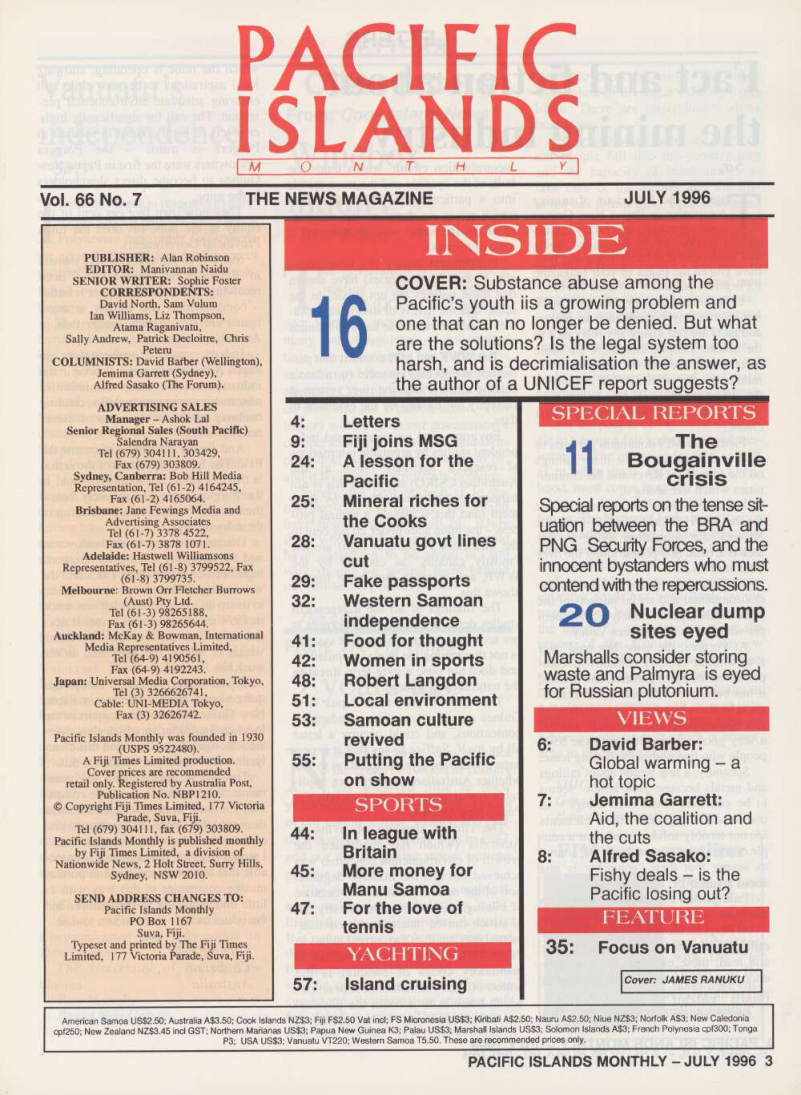
COVER: Substance abuse among the |/ a Pacific’s youth iis a growing problem and 11% one that can no longer be denied. But what I are the solutions? Is the legal system too harsh, and is decrimialisation the answer, as the author of a UNICEF report suggests?
4: Letters 9: Fiji joins MSG 24: A lesson for the Pacific 25: Mineral riches for the Cooks 28: Vanuatu govt lines cut 29: Fake passports 32: Western Samoan independence 41: Food for thought 42: Women in sports 48: Robert Langdon 51: Local environment 53: Samoan culture revived 55: Putting the Pacific on show
Sports
44: In league with Britain 45: More money for Manu Samoa 47: For the love of tennis
Yachting
57: Island cruising
Special Reports
4 4 The
Bougainville
crisis Special reports on the tense sit uation between the BRA and PNG Security Forces, and the innocent bystanders who must contend with the repercussions.
20 Nuc,ear dump
sites eyed
Marshalls consider storing waste and Palmyra is eyed for Russian plutonium.
Views
6: David Barber: Global warming - a hot topic 7: Jemima Garrett: Aid, the coalition and the cuts 8: Alfred Sasako: Fishy deals - is the Pacific losing out?
Feature
35: Focus on Vanuatu
Cover: James Ranuku
American Samoa US$2.5O; Australia A 53.50; Cook Islands NZ$3; Fiji F 52.50 Vat incl; FS Micronesia US$3; Kiribati A 52.50; Nauru A 52.50; Niue NZ$3; Norfolk As 3; New Caledonia cpf2so; New Zealand NZ53.45 incl GST; Northern Marianas US$3; Papua New Guinea K 3; Palau US$3; Marshall Islands US$3; Solomon Islands As 3; French Polynesia cpf3oo; Tonga P 3; USA US$3; Vanuatu VT22O; Western Samoa T 5.50. These are recommended prices only.
Advertisements & other items, p. 3 (1 item)
PUBLISHER: Alan Robinson
EDITOR: Manivannan Naidu SENIOR WRITER: Sophie Foster
CORRESPONDENTS:
David North, Sam Vulum Ian Williams, Liz Thompson, Atama Raganivatu, Sally Andrew, Patrick Decloitre, Chris Peteru COLUMNISTS: David Barber (Wellington), Jemima Garrett (Sydney), Alfred Sasako (The Forum).
ADVERTISING SALES
Manager - Ashok Lai Senior Regional Sales (South Pacific) Salendra Narayan Tel (679)304111,303429, Fax(679) 303809.
Sydney, Canberra: Bob Hill Media Representation, Tel (61-2) 4164245, Fax (61-2) 4165064.
Brisbane: Jane Fewings Media and Advertising Associates Tel (61-7) 3378 4522, Fax (61-7) 3878 1071.
Adelaide: Hastwell Williamsons Representatives, Tel (61-8) 3799522, Fax (61-8) 3799735.
Melbourne: Brown Orr Fletcher Burrows (Aust) Pty Ltd.
Tel (61-3) 98265188, Fax (61-3) 98265644.
Auckland: McKay & Bowman, International Media Representatives Limited, Tel (64-9)4190561, Fax (64-9) 4192243.
Japan: Universal Media Corporation, Tokyo, Tel (3) 3266626741, Cable: UNI-MEDIA Tokyo, Fax (3) 32626742.
Pacific Islands Monthly was founded in 1930
(USPS 9522480).
A Fiji Times Limited production.
Cover prices are recommended retail only. Registered by Australia Post, Publication No. NBP1210. © Copyright Fiji Times Limited, 177 Victoria Parade, Suva, Fiji.
Tel (679) 304111, fax (679) 303809.
Pacific Islands Monthly is published monthly by Fiji Times Limited, a division of Nationwide News, 2 Holt Street, Surry Hills, Sydney, NSW 2010.
SEND ADDRESS CHANGES TO:
Pacific Islands Monthly PO Box 1167 Suva, Fiji.
Typeset and printed by The Fiji Times Limited, 177 Victoria Parade, Suva, Fiji.
the mining industry
Letters
Fact and fiction about the mining industry
Sir,
Tales of the behaviour of mining companies in Papua New Guinea have reached legendary status among sections of the Australian media and environmental movement, and now have graced the pages of your magazine (“Porgera’s pollution”, March 1996).
Unfortunately, the mythology is start ing to lose any resemblance to reality, and facts are fast losing any relevance to the debate. Despite this, there are some facts which need to be straightened in relation to the article. A full critique of the claims made would take pages, but I will confine myself to the more obvious errors.
Firstly, the MPI document purports to discuss the impact of the mine tailings on the Strickland River and the commu nities which live along it.
According to the research carried out for the WWF (World Wildlife Fund for Nature), the population living in this area is around 800 people along the over 400 km of river.
The document is not a report on the environmental and social impacts of the mine on the approximately 15,000 peo ple who live in the Porgera Valley.
At Porgera, the mine has paid over K4O million (SUS3I million) in com pensation for bush, gardens, and houses; it has built over 500 permanent-materi als relocation houses; it has constructed schools, aid posts and a hospital; and has a very good relationship with the 5500 people who live within the mining lease.
Secondly, a few words about tailings and metals because your article seems to be confused about such things - in one breath it says that “these elements are not terribly soluble” and then a cou ple of lines later quotes the WWF source as saying that their “solubility is just about assured”.
Tailings are the leftover ground-up ore from which the gold is extracted.
At Porgera, the ore body has traces of other metals, such as mercury, arsenic and lead; these elements are not ‘pro duced’ by treatment. Cyanide is added as part of the process.
Tailings at Porgera are put through a
‘neutralisation circuit’ which binds the bulk of the cyanide and the trace metals into a particulate (or insoluble) form which poses no threat to the environ ment (in the same way as mercury is used in fillings).
Independent testing (by internation ally regarded laboratories) have shown that these tailings are not ‘toxic’ in the sense that the levels of dissolved (solu ble) metals do not cause harm to humans or fish.
The WWF and MPI concern that par ticulate metals may dissolve (turn into a soluble form) within the river system is certainly not backed by the evidence to date.
Environmental monitoring and inde pendent studies by reputable internation al research agencies (such as the Australian CSIRO) show that this is not happening. The areas affected by sedi ment (and this is largely a natural pro cess - the mine adds under 20 per cent to the Strickland’s sediment load) are not “mostly gardens” as claimed by the WWF, and research they have funded shows this.
The findings of all the independent studies done to date are that Porgera is not seriously damaging the river system, is not threatening the human population, and does not pose a long-term threat to the natural environment.
The notion of miners in Papua New Guinea meeting Australian standards is contentious, and could occupy a letter all by itself. Suffice to say that it is per haps a more appropriate question to ask whether Australian standards are appli cable (environmentally and socially) in Papua New Guinea.
The current standard of living in Australia (which has facilitated the growth of environmental concerns) was achieved through the massive degrada tion of the natural environment because of mining, pastoralism and forestry, all of which caused much greater environ mental damage than the current mines in Papua New Guinea. An alternative to mandatory codes of conduct is the notion of “environmental best practice” which takes in to account the physical and socio-economic environment in
which the mine iis operating, allowing local aspirations to be met while still ensuring adequate environmental pro tection. The call for significantly high er levels of local control in relation to Porgera is ironic - the Porgera landowners were the first in Papua New Guinea to become direct shareholders in the mine.
They now own five per cent of the equity in the mine (as does the Enga
Provincial Government).
Since 1989 mineral-resource owners in Papua New Guinea have been receiving “substantially higher returns” compensation and royalty arrange ments are significantly higher than in Australia, for example.
Indeed, many commentators in Papua New Guinea, not just those in the industry, believe these communities now receive too many benefits, creating enclaves of ‘haves’ in a sea of ‘have nots’.
And finally the law suit against the PJV. The focus of concern of the action is the loss of access to alluvial gold in the Porgera river (immediately below the mine) as a result of the covering of these by tailings.
Discussions between the landowners and the company relating to this issue have been on-going since 1989, and the writ is largely an attempt by one group to usurp an agreement which was made in 1994 in relation to the issue. It does not relate to the Lower Strickland, which is where the MPI and WWF work has focused.
In summary, mining companies quite simply cannot operate in Papua New Guinea without the support of the local communities in which they oper ate - Bougainville illustrated this clear ly, and the industry now reflects this.
The article finishes with the state ment: “It is untenable that large compa nies continue to behave with the same disregard for local environments and communities they have shown to date.”
I would suggest, rather, that it is unten able that the media continue to portray mining companies in this way with as little understanding of the realities and the issues as they have shown to date.
Glenn Banks
Canberra Australia
independence
Vanuatu’s independence
Sir,
I write this letter in response to com ments by Right Wing French Polynesian newspaper La Depeche vis-a-vis Father Walter Lini’s recent visit to Tahiti which was widely pub lished by regional media organisa tions.
The paper comments: “The French territory has nothing to win by becom ing independent and everything to lose” ( The Independent No 48, April 19,1996).
And, as if from no where, contends Vanuatu remains one of the poorest countries in the world, branding it an
“impoverished nation”.
I do not want to raise the question of such superficial remarks by a French newspaper located some hun dred thousand miles from Vanuatu and having hawk’s eyes to be able to deter mine the social well-being of a sovereign nation.
As far as I know, there are no beg gars - no, not one of them on the streets of Port Vila.
Besides, the remarks were in total breach of Article Two and parts of Article One of the United Nations Universal Declaration of Human Rights which I will not bother to quote for them since they were party to its formulation.
My only point is that if La Depeche can hold such a perception about France’s former colonies, does that mean New Caledonia is an “impover ished” colony so France continue to superciliously rule there?
Notice that I call New Caledonia a colony because it certainly does not ride geographically on the same plate tectonic with France - or does it?
Kiery Manassah
South Pacific Centre for Communication and Information in Development The University of Papua New Guinea Port Moresby Papua New Guinea
inquiry
Other letters From: Cook Island News Winebox
Dear Editor ,
The government is calling for a leading Australia Queen’s Council (QC) to assist with our own Winebox inquiry. This will cost many tens of thousands of dollars at a time when the country can’t afford it ask the public servants. There is already a Commission of Inquiry going on now into the Winebox affair. This inquiry will be (with our government’s co-operation) more complete and thor ough than ours could ever hope to be, and it will cost us absolutely nothing.
Surely, the best opinion is to co operate with this inquiry. We should have nothing to be afraid of. Only those who have broken the law should have something to be afraid of, and why should we protect them behind our self-serving secrecy laws?
Don Carlaw.
9 years ago
From: The Fiji Times 9 years ago
Sir , Nine years have gone by since the coups of 1987. The country has achieved little in these years which it can be proud of. The lot of our common men, women and chil dren is much worse today than in 1987, and our ills are getting worse with the passage of time.
The global community is a multicul tural, multiracial, mutireligious, multi linguistic one, and cherishes diversity.
It is not prepared to tolerate racism and discrimination as was rigidly preached by the coup-makers. In this day and age, no country can expect to practise systematic discrimination and not suf fer global sanctions. The economy is stagnant with few investments.
Unemployment is rising. The long term future of the sugar industry looks bleak. There are uncertainties about land leases.
Crime is rising, more and more of our people fall into the poverty trap and the capacity of communities to take care of the elderly and the dis abled has diminished. I am convinced that these problems will get worse unless we bring non-communal solu tions to bear upon them. The interests that the different communities have in common far outweigh what some may perceive to be their separate interests.
We all want economic development and a prosperous Fiji which enjoys a respectable place in the modem world.
The truth about Fiji is that we are highly interdependent and that each community can progress only through co-operation with others.
All the people of Fiji have an inter est in having a fair and efficient admin istration. The initiative for this, as well as in other areas affecting our liveli hood, must come from the state.
Let us look with optimism to the future. The National Federation Party’s only platform in the last two. elections was to bring about meaningful changes to the constitution.
I am glad to note that much con structive work has been done by the party and its leader in this respect, and the nation is anxiously awaiting the report of the Constitution Review Commission. I hope that as time pass es, more and more people will see the truth of our assertion that our future as a multiracial country will depend very much on whether we are able to achieve a constitution which is accept able to the people of Fiji.
Shiu Charan
General Secretary National Federation Party
Advertisements & other items, p. 5 (1 item)
PIM gets new editor
PIM has a new editor. He is Manivannan Naidu, a for mer sub-editor with The Fiji Times. He takes over edi torship from
Debbie Singh.
Global warming
Opinion
Global warming - a hot topic
The inevitable discussion on global warming at this year’s South Pacific Forum meeting will be a singularly appropriate topic, given that the host is the Marshall Islands.
If the worst scenario predictions of cli matologists are correct, about 80 per cent of the Forum venue on Majuro Atoll will be inundated as sea levels rise because of climate change over the next century.
This prospect, if nothing else, should focus the attention of Forum leaders on the subject. But the question is: Will it happen?
Is the world - and particularly the low lying Pacific Island states - facing a crisis of almost unimaginable dimension or is all the furore over the warming of the planet much ado about nothing?
Two recent visitors to New Zealand highlighted the debate - a debate that has divided the world’s scientific community and put governments (especially New Zealand and Australia, which have a spe cial responsibility to the Pacific Island nations) in a quandary. One supported the view of the majority of scientists that the earth has entered a period of climatic instability likely to cause “widespread economic, social and environmental dislo cation over the next century”.
Proponents like Greenpeace’s Bill Hare say this can only be avoided by urgent action to'limit emissions of green house gases - carbon dioxide (CO 2 ) pro duced by burning fossil fuels like coal and using petrol in cars.
The minority sceptics, like American Patrick Michaels who admits he gets 20 per cent of his research funding from the coal industry, say the problem is “at most, a minor nuisance compared with the ben efits of our technological world”.
Greenpeace brought Hare, the organi sation’s international climate policy direc tor based in Amsterdam, to Wellington to lobby the New Zealand government for stronger measures to reduce C0 2 emis sions. The Business Roundtable, New Zealand’s powerful corporate lobby group, brought Michaels, research profes sor of environmental sciences at the University of Virginia, here to stimulate debate by putting the opposing view.
The clash of opinions was given added piquancy by the release of a United Nations report declaring that 1995 was the hottest year on record.
The global mean surface temperature over land and sea was the highest since records were first kept in 1861, it said.
The average temperature was 0.4 degrees Celsius above the 1961-90 aver age - and that in a year without the so called El Nino weather pattern which had kept temperatures over the Pacific higher than normal in recent years.
This was grist to Hare’s mill, apparent ly confirming predictions made by the UN’s Inter-govemmental Panel on Climate Change (IPCC) that the globe was warming up at a pace beyond the lim its of ecosystems to adapt. But Michaels was unfazed.
He said the planet had warmed about 0.5 degrees Cin the past 120 years, but at least half of this occurred before the greenhouse effect of carbon dioxide emis sions. It was, he said, a natural phe nomenon due to the fact that the sun is a slightly variable star. The increase in tem perature that could be attributed to the greenhouse effect was minor, Michaels insisted, was much less than the original IPCC forecast in 1990 and even the majority of scientists were downgrading their estimates of global warming.
While Hare said governmental action to reduce emissions immediately was essential, Michaels said the problem was not serious enough to “immolate” economies with “impressively expensive” measures to reduce C0 2 . It would be, Michaels said, economic suicide both for the developed and developing world. The cost was simply not warranted.
Now the fact is, the international com munity has recognised there is a problem of global warming and the associated threat of sea-level rise and the Pacific Island nations, along with countries in the Carribean, are rightly very concerned.
More than 150 countries, including New Zealand, have signed a Framework Convention on Climate Change, which was adopted at the 1992 Earth Summit in Rio. This requires them to cut emissions by the turn of the century to 1990 levels.
In 1994, the New Zealand government said its net emissions by the Year 2000 would, in fact, be more than 50 per cent lower than in 1990.
Recent calculations, however, have shown that far from coming down, New Zealand’s CO2 emissions are actually increasing - and at a furious rate.
The Ministry of Energy now says the country’s net emissions are projected to rise 73 per cent between 1990 and 2000, the second highest rate of growths in the
Oecd.
When gross emissions, which take into account changes in forests (which absorb CO2) and other factors, are projected, we do little better. With a forecast rise of 22 per cent, New Zealand is behind only Finland and Portugal.
“New Zealand has hardly done a thing,” said Hare. “There has been virtu ally no action at the commercial level to slow down emissions. The Pacific Island countries will be putting on strong pres sure at the Forum.” The government, not wishing to wreck the economic recovery with high-cost measures, has relied on voluntary agreements with industry to bring down the emissions.
They are clearly not working and Energy Minister Doug Kidd has warned that a carbon tax on industry will be intro duced next year if there is no improve ment.
“If, in order to meet our international obligations, it becomes necessary to put in place more stringent measures, there will be an economic cost,” he said.
Greenpeace says the tax should come sooner rather than later and should be combined with strict emission standards on motor vehicles, which account for 40 per cent of all C0 2 in the air. Michaels said the tax was not necessary and indus try should be able to keep that money to improve energy efficiency and develop technology.
The Pacific Island countries, he said, should look to that technology to adapt to a situation that will not be anywhere near as bad as some predict.
That is, says Greenpeace, a simplistic view that will not take the heat out of this years’s Forum debate. ■
Wellington
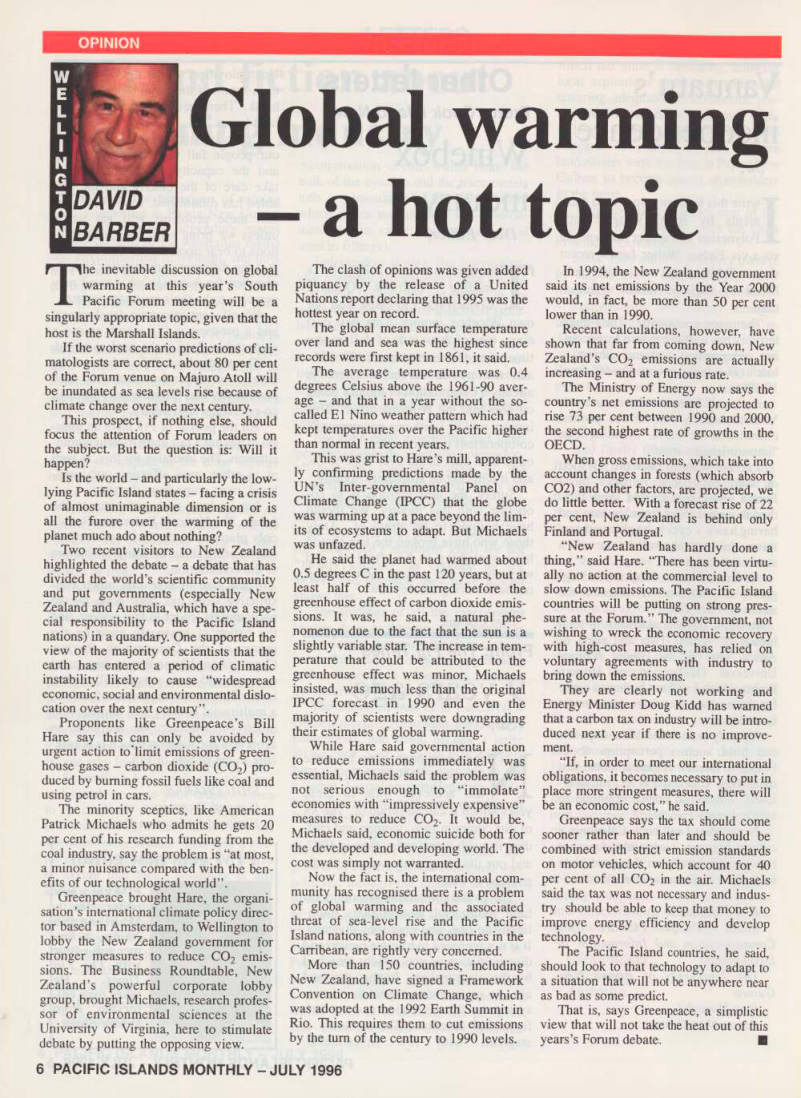
David
Barber
Aid, the coalition
and the cuts
The Howard government’s bid to find a staggering SAB billion (SUSS.6 billion) worth of savings from the federal budget over the next two years has everyone on tenterhooks.
University fees are likely to rise dra matically, a host of government pro grammes are going to lose their fundings and tens of thousands of public service jobs are going to go, in what will be the
biggest bureaucratic down-sizing since
the second world war.
The details of the cuts are a closely guarded secret and will remain so until the budget is brought down on August 20.
What is clear, however, is that no area will be immune, and that includes Australia’s aid to the South Pacific.
Foreign Minister Alexander Downer is already sending a tougher message to the South Pacific.
At a meeting of Australia’s top diplo mats called to help prepare a major state ment on relations with the region. Downer made it clear that, while he recognises the Pacific Island countries vary in their scale and resource endowments, he wants to see a stronger culture of entrepreneurship.
“I am convinced,” he told the diplo mats, “that there is much yet to be done in the region to scale down and refocus the
public sector, develop the private sector,
and attract reputable foreign investors.”
The carriage of many of the changes will rest with the new parliamentary sec retary for foreign affairs, 35-year-old Andrew Thomson.
He has been given a major role in Australia’s SAI.S-billion (SUS 1.05-bil lion) aid programme, a third of which goes to Papua New Guinea and the Pacific Islands.
Thomson says much of the “culture of entrepreneurship” referred to by the Foreign Minister, is simply “better macro economic policy and better fiscal recti tude”.
“That is exactly what we are undergo ing here in Australia with our new gov ernment with our difficulties with this budget deficit and the reductions in spending we have to make.”
The Howard government is setting limits. In particular, Thomson says.
Australia “can’t be seen constantly as the lender of last resort because that just encourages profligacy”.
“What we are doing to ourselves is very tough and, likewise, we expect the same sort of fiscal rectitude from our
neighbours.”
Despite the tough talk, and Thomson acknowledges the Howard government is likely to be tougher on the region than its predecessor, the news for the Pacific may not be as bad as for other regions.
The first cut to the aid budget was the scrapping of the SAI24 million (SUSB7.3 million) a year DIFF (Development Import Finance Facility) scheme, a soft loan scheme for infrastructure projects.
The Pacific lost virtually nothing.
Said Thomson: “I think what we have been doing in the Pacific is not just valu able, it is vital. We have an absolute and immediate national interest in seeing that our Pacific Island neighbours are kept economically viable and that we do what we can to improve the most basic services there - the health and education services.”
Thomson says the Howard govern ment will “keep doing in the Pacific what we have been doing up till now but put a bit more focus on it”. As evidence of the government’s commitments to the region, he says he has decided to make his first official trip to Papua New Guinea and the Pacific. “The other places - Asia, Indochina and Africa - will come much later because I recognise and Mr Downer recognises that this is our first priority,
this region.”
Rumour suggests that cuts to AusAID (the Australian government aid agency) and its programmes in the August budget could be in the vicinity of SAIOO million (SUS7O million). If Thompson’s trip to the region goes ahead as planned late this month that will give Island leaders a chance to get in a last bit of lobbying before the decisions are announced.
Those outside Papua New Guinea may need to. The government’s commitment to maintain its aid to Papua New Guinea and an angry reaction from the countries already affected by the end of the DIFF scheme has severely reduced the areas on offer for big cuts. Andrew Thomson, a former investment banker and business
man who has spent most of his working life in Asia, is new to the South Pacific but he is tackling issues in the region with energy and enthusiasm.
He believes the South Pacific is vital to Australia’s national security, not in the old Cold War sense of the “Russian threat” but in shared threats such as those posed by organised crime, agricultural pests which can wipe out valuable export crops and health issues such as HIV/AIDS. This security link is enough that, when pressed, Thomson says that as decisions are being made as to what to cut he would like to see the Pacific treated “a little bit more specially than the rest of the aid budget”.
Another complicating factor for those keen to know the future shape of Australia’s aid programme is the major review of aid announced by Downer at the end of May.
The review, which will be headed by Paul Simons, a former executive chairman of Woolworths and national director of UNICEF (United Nations Children’s Emergency Fund) in Australia, is the first since the 1984 Jackson Report and will not make its recommendation until January. Simons has been given a wide brief and asked, in particular, to look at ways to give greater emphasis in Australia’s aid programme to poverty alleviation and humanitarian issues.
With the axing of the DIFF scheme, it is clear that anything seen as “welfare for business” is not acceptable to the Howard government and it is likely that payments to some United Nations agencies might also be scaled back as soon as August.
Andrew Thomson, who had been in parliament just a year when he was ele vated to the post of parliamentary secre tary, is being careful not to pre-empt either the review or the budget. His initial brashness is being tempered by a genuine willingness to listen and understand other
people’s viewpoints.
In the Pacific,Thomson will be a frank talker but he says he, and the Howard government, want to have an approach “that will never be seen as paternalistic or
too domineering”.
“We always regard quiet diplomacy as more efficacious than the public strident diplomacy.” ■
Australia
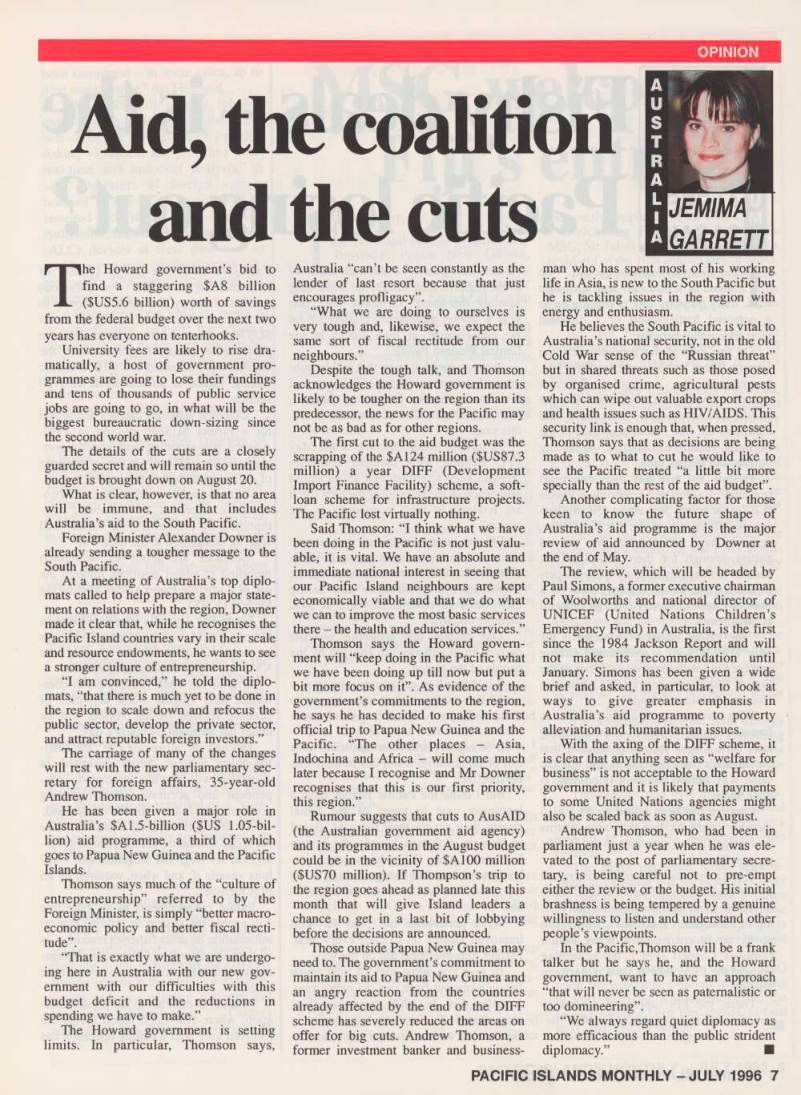
Jemima
Garbett
Pacific losing out?
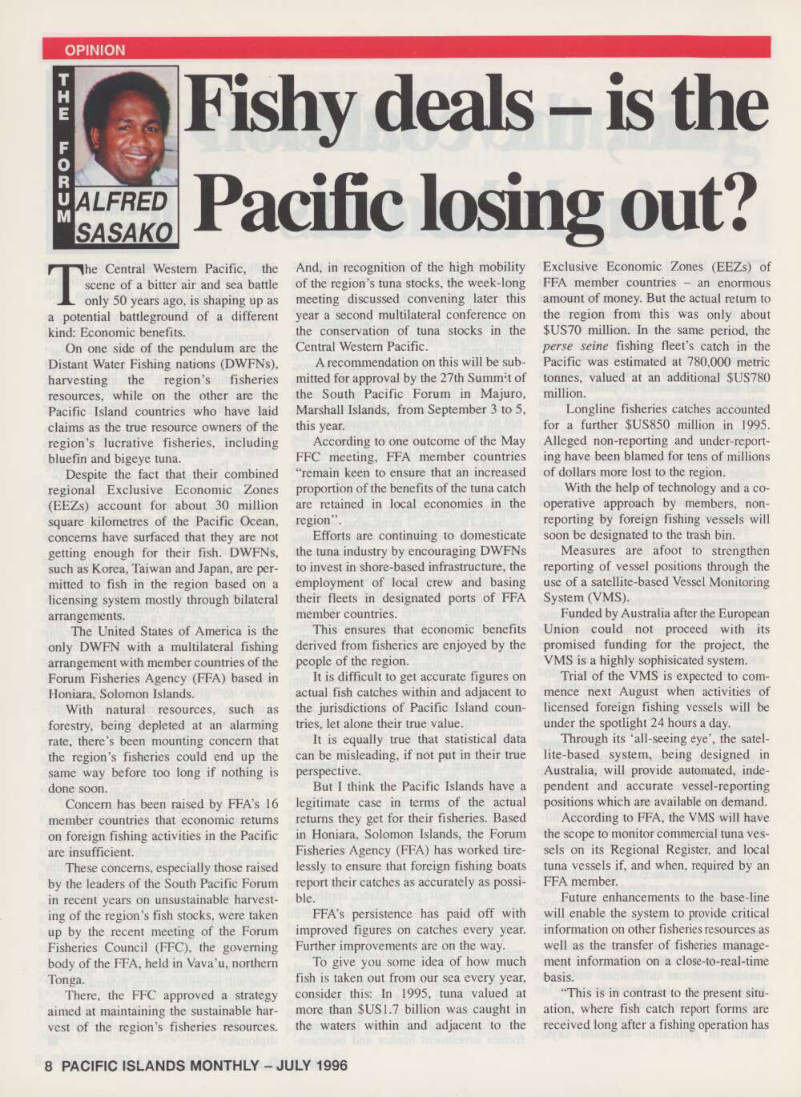
Fishy deals - is the Pacific losing out?
The Central Western Pacific, the scene of a bitter air and sea battle only 50 years ago, is shaping up as a potential battleground of a different kind: Economic benefits.
On one side of the pendulum are the Distant Water Fishing nations (DWFNs), harvesting the region’s fisheries resources, while on the other are the Pacific Island countries who have laid claims as the true resource owners of the region’s lucrative fisheries, including bluefm and bigeye tuna.
Despite the fact that their combined regional Exclusive Economic Zones (EEZs) account for about 30 million square kilometres of the Pacific Ocean, concerns have surfaced that they are not getting enough for their fish. DWFNs, such as Korea, Taiwan and Japan, are per mitted to fish in the region based on a
licensing system mostly through bilateral
arrangements.
The United States of America is the only DWFN with a multilateral fishing arrangement with member countries of the Forum Fisheries Agency (FFA) based in Honiara, Solomon Islands.
With natural resources, such as
forestry, being depleted at an alarming
rate, there’s been mounting concern that the region’s fisheries could end up the same way before too long if nothing is done soon.
Concern has been raised by FFA’s 16 member countries that economic returns on foreign fishing activities in the Pacific are insufficient.
These concerns, especially those raised by the leaders of the South Pacific Forum in recent years on unsustainable harvest ing of the region’s fish stocks, were taken up by the recent meeting of the Forum Fisheries Council (FFC), the governing body of the FFA, held in Vava’u, northern Tonga.
There, the FFC approved a strategy aimed at maintaining the sustainable har vest of the region’s fisheries resources.
And, in recognition of the high mobility of the region’s tuna stocks, the week-long meeting discussed convening later this year a second multilateral conference on the conservation of tuna stocks in the Central Western Pacific.
A recommendation on this will be sub mitted for approval by the 27th Sumrmt of the South Pacific Forum in Majuro, Marshall Islands, from September 3 to 5, this year.
According to one outcome of the May FFC meeting, FFA member countries “remain keen to ensure that an increased proportion of the benefits of the tuna catch are retained in local economies in the
region”.
Efforts are continuing to domesticate the tuna industry by encouraging DWFNs to invest in shore-based infrastructure, the employment of local crew and basing their fleets in designated ports of FFA member countries.
This ensures that economic benefits derived from fisheries are enjoyed by the
people of the region.
It is difficult to get accurate figures on actual fish catches within and adjacent to the jurisdictions of Pacific Island coun tries, let alone their true value.
It is equally true that statistical data can be misleading, if not put in their true
perspective.
But I think the Pacific Islands have a legitimate case in terms of the actual returns they get for their fisheries. Based in Honiara, Solomon Islands, the Forum Fisheries Agency (FFA) has worked tire lessly to ensure that foreign fishing boats report their catches as accurately as possi ble.
FFA’s persistence has paid off with improved figures on catches every year.
Further improvements are on the way.
To give you some idea of how much fish is taken out from our sea every year, consider this: In 1995, tuna valued at more than SUSI. 7 billion was caught in the waters within and adjacent to the
Exclusive Economic Zones (EEZs) of FFA member countries - an enormous amount of money. But the actual return to the region from this was only about SUS7O million. In the same period, the perse seine fishing fleet’s catch in the Pacific was estimated at 780,000 metric tonnes, valued at an additional SUS7BO million.
Longline fisheries catches accounted for a further SUSBSO million in 1995.
Alleged non-reporting and under-report
ing have been blamed for tens of millions of dollars more lost to the region.
With the help of technology and a co
operative approach by members, non
reporting by foreign fishing vessels will
soon be designated to the trash bin.
Measures are afoot to strengthen reporting of vessel positions through the use of a satellite-based Vessel Monitoring System (VMS).
Funded by Australia after the European Union could not proceed with its promised funding for the project, the VMS is a highly sophisicated system.
Trial of the VMS is expected to com mence next August when activities of licensed foreign fishing vessels will be under the spotlight 24 hours a day.
Through its ‘all-seeing eye’, the satel lite-based system, being designed in Australia, will provide automated, inde pendent and accurate vessel-reporting positions which are available on demand.
According to FFA, the VMS will have the scope to monitor commercial tuna ves sels on its Regional Register, and local tuna vessels if, and when, required by an FFA member.
Future enhancements to the base-line will enable the system to provide critical information on other fisheries resources as well as the transfer of fisheries manage ment information on a close-to-real-time basis.
“This is in contrast to the present situ ation, where fish catch report forms are received long after a fishing operation has
The Forum
Alfred
Sasako
been completed - in some cases, up to nine months after,” the FFA said.
“The VMS will support enhance
monitoring by assisting with the detec
tion of illegal fishing and/or potential
fishing violations, and providing near real-time and historical analysis,” it said. Operators of foreign vessels licensed to fish in the region will be
required to install FFA-approved
Automatic Location Communication (ALC) devices at their own cost to enable a two-way communication sys tem with FFA headquarters and for emergency uses.
Advantages of the VMS are many. It is cost-effective, supports the region’s
compliance and monitoring programme
and enables effective air-sea surveil lance patrols to be co-ordinated with
fishing patterns.
In emergencies, it reduces search time.
The VMS will allow targeting of selected vessels by patrol boats and surveillance flights in the event of a fishing violation, the FFA said.
Although resistance to the regional VMS is expected from some quarters, operators of commercial tuna fleets operating in the Central Western Pacific have been kept fully informed about developments.
This is done through regular exchange of information during VMS Technical Consultations, such as the first one which took place in 1991.
Australia’s two-year funding for the project will include a comprehensive training package. Other costs, includ ing communications, will require FFA members to provide cost-recovery mechanisms.
These are aimed at reducing the net overall costs on FFA members.
Comprehensive as it is, the VMS pro ject should not be regarded as a “cure all” for compliance problems being
experienced nationally and regionally in
the Central Western Pacific, the FFA has warned.
It is part and parcel of on-going innovative approaches to tackle the compliance problems, it said.
FFA’s hope is that its members’ active participation in the project in tracking down movements of DWFNs fishing vessels in their EEZs will signif icantly enhance existing national and regional Monitoring, Control and Surveillance (MCS) measures. ■
Fiji’s entry
Region
MSG welcomes Fiji’s entry
By Sam Vulum
The Trobriand Islands in Milne Bay Province, Papua New Guinea, renowned for their hospitality towards visitors were no better venue for the 10th Melanesian Spearhead Group (MSG) meeting, held from June 7 to 8.
The islands will long be remembered for not only hosting the 10th MSG anniversary celebrations but the admis-, sion of Fiji as a full member of the group.
Fiji’s acceptance of full membership status, after being an observer over the past three years, was a major highlight of
the meeting.
Fiji’s inclusion brings MSG member ship to five. The other members are PNG, Solomon Islands, Vanuatu and the Kanak Socialist National Liberation (FLANKS) who represent the indigenous Kanaks of New Caledonia.
Locals performed a special ceremony on behalf of other MSG countries, with the blessing from host and Trobriand Islands paramount chief Daniel Pulayasi.
First, Vanuatu Prime Minister Maxime Carlot Korman was given a spear to thrust into the ground.
Then Fiji Prime Minister Sitiveni Rabuka was called on to dislodge the spear and officially hand it over to PNG Prime Minister Sir Julius Chan as chair man of the group meeting. Fiji was pre sented with special gifts by the locals,
comprising a full-grown pig, yams and
betel nuts.
“With great humility and great joy, I bring the sovereign democratic country of Fiji to the Melanesian Spearhead Group,”
Rabuka said at the conclusion of his inau
gural speech.
The declaration of membership included a commitment to work either “collectively or individually” with other MSG member states.
Rabuka said Fiji shared the principles of close co-operation and unity upon which the MSG was founded and joined the group “with fullness of heart and total dedication”.
He said Fiji’s joining of the group would strengthen the resolve of unity, enlarge technical and economic co-opera tion and have a significant impact on regional and international issues.
Rabuka said he was deeply moved with Fiji’s admission on PNG soil under
the positive approach of Sir Julius.
Welcoming Fiji’s accession to the MSG, Sir Julius said he regarded that as a highlight of the 10th anniversary of MSG.
“Fiji, as the first Melanesian democra cy, will bring the wealth and depth of its experience to our meeting,” Sir Julius said.
He said Fiji’s decision was clear recognition of the constructive role MSG members had played in the region’s affairs.
Among other major issues discussed, the meeting has endorsed three important new initiatives to be pursued collectively by its members.
These include the establishment of a regional stock exchange, development of regional mechanisms for a common approach to weapons control in Melanesia, and implementation of the Melanesian Beyond 2000 strategy.
Vanuatu put forward the proposal for regional stock exchange and PNG initiat ed the Melanesian Beyond 2000 strategy for MSG’s second decade.
PNG also played a leading role in the initiative to form arms control within Melanesia and the region as a whole.
The leaders directed that this matter be discussed further at the June 18-20 meet ing of senior officials of Forum countries on regional security co-operation in Fiji as well as the Majuro pre-Forum senior
officials’ meeting.
The Melanesian Beyond 2000 strategy commits the group to continue consulting and working closely together to, among other things, maintain and strengthen co operation for mutual benefit.
The summit also welcomed an invita tion by Solomon Islands to its national trade and cultural show in July 1996 as a lead-up to the 1998 Melanesian Arts Festival.
The MSG has made some achieve ment in carrying out its objectives over the past 10 years. Among others, in terms of trade, MSG members have seen the expansion of their tradeable products from three to more than 140 over the past three years.
This was revealed by senior MSG trade and economic officials in a meeting in Port Moresby, a weekend before the Losuia meeting. Fiji has agreed to host next year’s MSG summit. ■
Advertisements & other items, p. 10 (1 item)
Pacific Islands Yearßook
Now Available
17th Edition
Price
AUD
M oo
PLUS POSTAGE
tOlflQfl Leam more about the Pacific
culture/custom tradition!people
population, tourism, trade, airlines, tax system etc.
Yes, send me the latest copy of the Pacific Islands Year Book □ Here is a cheque/money order □ Visa □ Master Card Expiry Date Card Number Name Signature Address , Post to: Pacific Islands Monthly, PO Box 1167 Suva, Fiji or Fax (679) 303809.
I J
Bougainville crisis
Special Reports
Summit focuses on Bougainville crisis
By Sam Vulum
Recent revelations of gun-running
operations by the Bougainville
Revolutionary Army (BRA) between Solomon Islands and Bougainville are believed to have added further strain to the already fragile rela tions between Papua New Guinea and the Solomon Islands.
Although PNG Prime Minister Sir Julius Chan denied any real conflict between the two countries in a joint con ference after the Melanesian Spearhead Group meeting in Trobriand islands, gov ernment officials have indicated other wise, especially when the operations were allowed to occur with the knowledge of Solomon Islands field forces and immi gration officials. The revelations came to light after the capture of a right-hand man of the BRA operations commander Ishmael Toroama, Thomas Pinau, recent ly- In an interview with the local media, Pina, who was Toroama’s boat operator, said that he and other operators made reg ular runs to the Solomon Islands to bring back medicine, guns and ammunition for the BRA, assisted by the Solomon Island field forces and immigration officials at a border checkpoint on Choiseul Island, about 50 kilometres northeast of Buin on Bougainville. He said in his last trip before his capture by PNG Security Forces, he brought back a Russian sub machine gun which he identified as an SK-47. He said the BRA bought most of their guns, especially shotguns and .22 rifles, from the local Solomon Islands
people.
Sir Julius was asked as chairman of the MSG whether or not the continuing conflict between the two countries would affect the solidarity of the MSG, especial
ly through strained relations.
The PNG prime minister said during a Press conference that the spill-over of the crisis was no threat to the solidarity of the MSG. He said discussions were ongoing and open. However, officials said the rev-
elations of gun-running through Solomon Islands added strain to relations between the two countries and that PNG would have to be firmer in insisting Solomon Islands either outlaw the BRA operating there or co-operate with the PNG Security Forces in cracking down on illegal opera tions.
The official said the blame was now obviously going to be put on Solomon Islands when talks on border security are conducted. South Pacific’s key Melanesian leaders have called for PNG and Solomon Islands to sort out their squabbles over border incursions.
The leaders, who attended the MSG summit, urged PNG and the Solomons to address the rift in bilateral relations with greater urgency and commitment in a joint communique issued at the end of the summit. The Solomon Islands has lodged formal complaints with its neighbour after PNG trooops reportedly fired upon settle ments in the Solomons in search of BRA members. PNG has long complained that the Solomon government has not done enough to stop BRA forces slipping
across the narrow sea channel which divides Bougainville from the Solomons, or to stop the BRA using the Solomons as a staging post for importing weapons and
supplies.
“On Bougianville, the leaders ... urged PNG and Solomon Islands to address the spill-over effects of the crisis on their bilateral relations with greater urgency and commitment,” the MSG leaders said.
“Specifically, they encouraged the two countries to conclude their proposed Basic Border Agreement at the earliest possible opportunity. The leaders also encouraged Solomon Islands and PNG to conclude a joint declaration reaffirming their two countries’ sovereignty over their demarcated territories, including a decla ration that Bougainville is an integral part of PNG.”
The declaration was signed by Sir Julius and Solomon Islands Foreign Minister Danny Philip as well as Fiji Prime Minister Sitiveni Rabuka, FLANKS representative Richard Kaloi, and Vanuatu Prime Minister Maxime Carlot Korman.
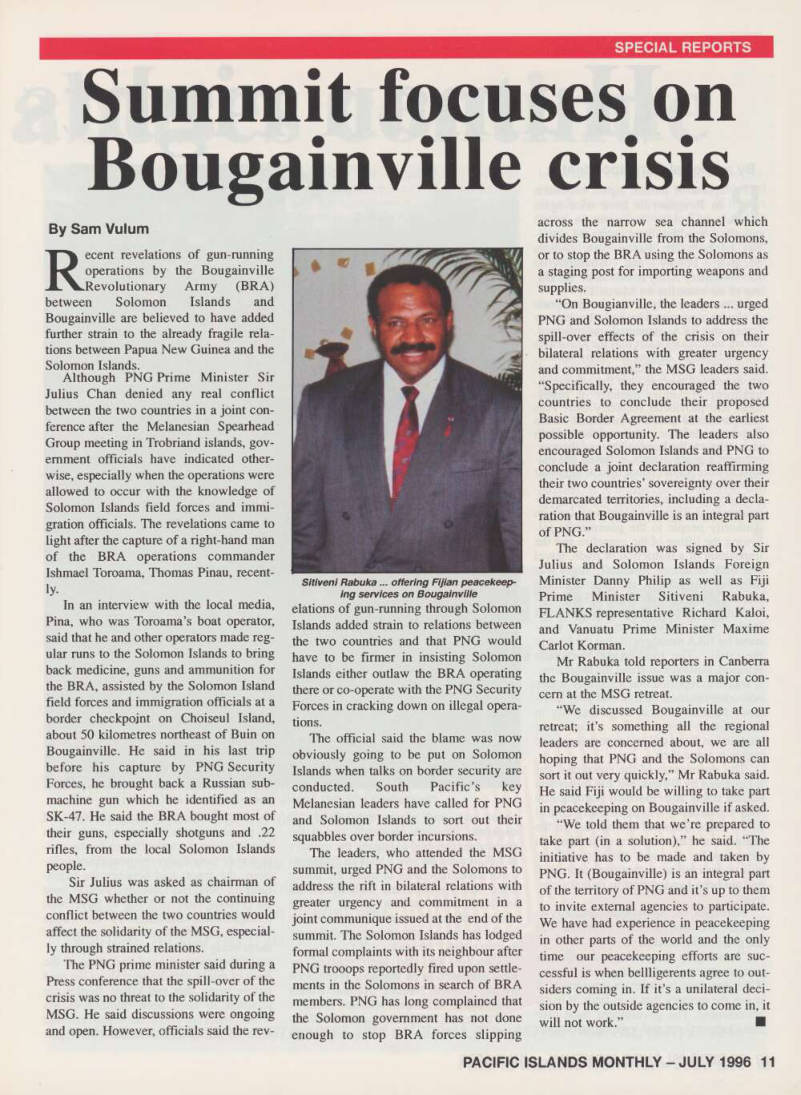
Mr Rabuka told reporters in Canberra the Bougainville issue was a major con cern at the MSG retreat.
“We discussed Bougainville at our retreat; it’s something all the regional leaders are concerned about, we are all hoping that PNG and the Solomons can sort it out very quickly,” Mr Rabuka said.
He said Fiji would be willing to take part in peacekeeping on Bougainville if asked.
“We told them that we’re prepared to take part (in a solution),” he said. “The initiative has to be made and taken by PNG. It (Bougainville) is an integral part of the territory of PNG and it’s up to them to invite external agencies to participate.
We have had experience in peacekeeping in other parts of the world and the only time our peacekeeping efforts are suc cessful is when bellligerents agree to out siders coming in. If it’s a unilateral deci sion by the outside agencies to come in, it will not work.” ■
Sitiveni Rabuka ... offering Fijian peacekeep ing services on Bougainville
Human rights

By a Special Correspondent
Reports of human rights violations on Bougainville have once again been hot in the news in recent months - resulting from increased activi ties of both the Papua New Guinea
Security Forces and Bougainville
Revolutionary Army rebels since the lift ing of the ceasefire on March 23.
Although details of the many reports of abuses, committed by both the security forces and BRA, remained unconfirmed, strong indications exist that the violations are continuing. Among the many reports, recently, on May 7, Bougainvillean lead ers expressed outrage over the alleged ill treatment of former member of parlia ment and provincial secretary Sam Tulo and provincial peace co-ordinator James Togel by defence force soldiers. Both men, who are the key facilitors of the gov ernment’s peace efforts, suffered phsyco logical effects after being held at gunpoint by soldiers.
Tulo was detained for reporting ill treatment of Buka and Northwest Interim Authority people to the government fol lowing the lifting of the ceasefire and the imposition of a restriction of trade, travel and bulk orders of foodstuff. Togel was held for planning a trip the Solomon Islands to see Bishop Gregory Singkai of the Catholic Church. Tulo and other Buka leaders were subjected to similar treat ment by BRA members during the heat of the crisis. The two leaders were later released, however, at about the same time.
It was also reported that a security forces non-commssioned officer and four resis tance fighters were in BRA captivity in Oria, South Bougainville. They were captured in late April and reported to be in captivity since then.
The seriousness of the situations was
highlighted by Wewak MP and outspoken
human rights layer Bernard Narokobi on May 8. Narokobi was particularly critical of the involvement of the military in the detention and interrogation of civilians on Bougainville. He said; “Bougainville is still under civilian authorities’ control. It has not been handed over to military con trol.”
Narokobi, the appropriate authority to oversee the Bougainville situation, was the police commissioner.
“It is highly dangerous and definitely
unconstitutional to be acting in de facto as if the province is under an emergency. It is not the military that is at fault, it is the government. The government must give clear instructions and guiding principles
about how and where the military is engaged,” he said. Narokobi said if the government wished to engage the military in full, it must declare a state of emergen cy or make new laws to make the police force, defence force and the correctional services work as one force. “In the absence of that, I must warn that we are bordering on a very serious violation of human rights,” he said.
Concern has also been sparked by what appeared to be stunning revelations by the United Nations Human Rights Commission in a report released in May.
The report, by special rapporteur Waly N’diaye, who visited Bougainville in
October 1995, highlighted gross disregard of people’s rights, mainly by the Papua New Guinea Security Forces in the exe cution of their duties. Among other viola tions, the report said between the begin ning of 1991 and October 1995, at least 64 persons were believed to have been
extrajudicially executed by the Papua
New Guinea Defence Force, some of them being beaten or cut with knives.
“Other victims have been tied to the back of trucks and dragged along the road before being shot and killed. Bodies are reported to have been dumped at sea while others are said to have been covered with rubber tyres and burnt,” the report
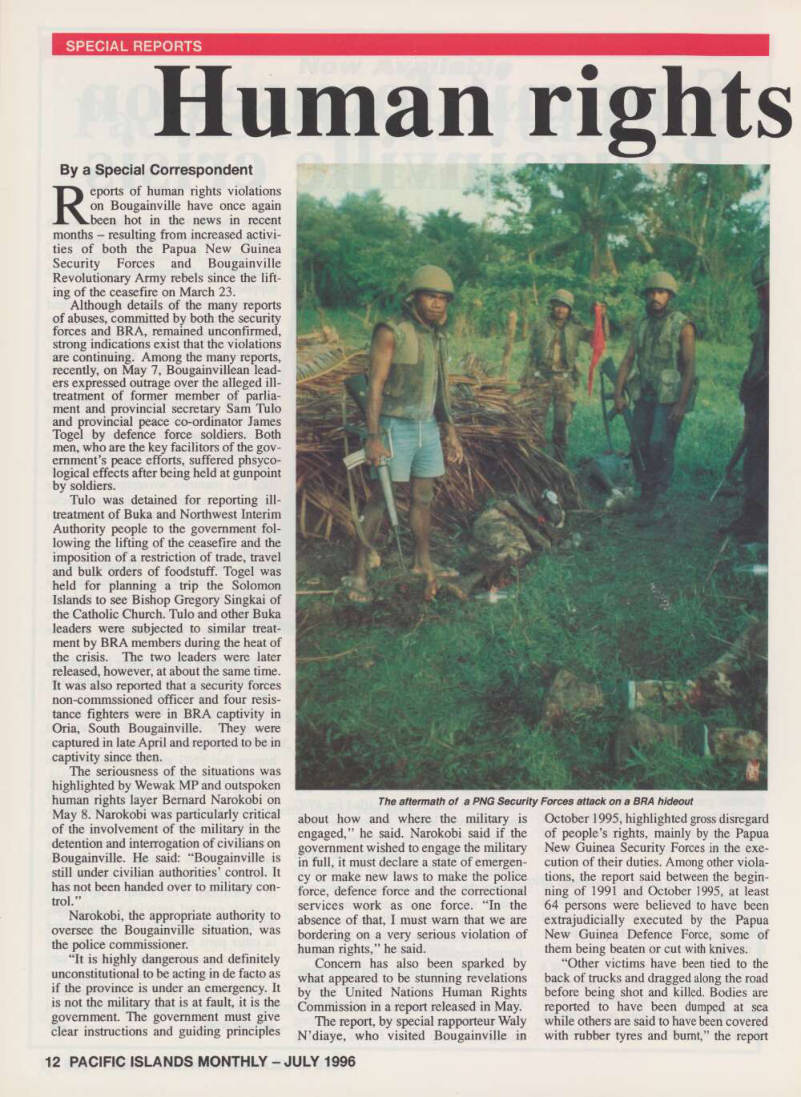
The aftermath of a PNG Security Forces attack on a BRA hideout
said. It said people killed extrajudicially included “members or suspected mem bers of the BRA”.
“Individuals attempting to cross over to Solomon Islands, including unarmed civilians, have also been the victims of extrajudicial executions by the PNGDF,” the report said.
Allegations were made that some peo ple in care centres did not have freedom of movement and were subject to torture, harassment and ill-treatment by those in charge of care centres, security forces and rebels who attacked the centres and killed persons living in them.
Apart from the UN allegations, what remains unarguably true is that while some factual information can be estab lished about the number of security forces injured or killed in action on Bougainville, the same cannot be said for the BRA casualties. Although the allega tions may appear serious, they may not in fact be so if reports about Prime Minister Sir Julius Chan’s comments on PNG’s international image following a UN human rights session in March carry any
truth. The PM described as “positive” discussion between a PNG delegation and UN representatives during the 52nd ses sion of the Human Rights Commission in Geneva, Switzerland. The comments draw into question the position of the UN Human Rights Commission over the seri ousness of the allegations in its report.
Sir Julius said the response was posi tive towards PNG’s record in upholding human rights, and on the peace process embarked on Bougainville. “It is now becoming more evident to the interna tional community that our peace efforts on Bougainville were deliberately sabo taged by a new few criminal elements
hell-bent on destroying a lasting peaceful
resolution for their own self-centred greed,” he said.
He said the voice of the so-called BRA sympathisers, posing as non-govemment organisations, was fading readily as indicative of the lack of willingness by the members of the commission to enter tain rhetoric and hypocrisy on the Bougainville situation. “To put the record straight, when the 52nd session opened in
late March, Bougainville was a non-con troversial issue on an already bloated agenda focusing on violations of human rights around the world. The world is tired of finger-pointing. What they demand are unbaised reports on efforts undertaken by governments and by the global community as a whole. On Bougainville, as we have stated numerous times, the chronology of extensive peace initiatives was reflected accordingly as
transparent, participatory and genuine,”
Sir Julius was reported as saying.
He also announced government’s decision to establish a National Human Rights Commission. He said this was a major step towards institutionalisation of its efforts in promoting and protecting the rights of people.
Among other areas of concern, the alleged rights violations on Bougainville are likely to be the key focus for the com mission. It is hoped the commission will help put the record straight as to who is telling the truth about the abuses on the island. ■
Advertisements & other items, pp. 12-13 (3 items)
Special Reports
abuses continue
Second Hand Containers
WHERE AND WHEN YOU WANT THEM IN THE PACIFIC If you need a flexible and safe storage space we have the ideal solution for you. Our second hand containers provide instant secure storage. Guaranteed to be wind and waterproof these containers are ideal for both temporary and longterm storage in Pacific conditions.
We can deliver to any island in the Pacific within a month and our rates have got to be the lowest you will find. All you need to do is tell us how many you want.
CONTACT:
PASCALS MARCONNET, BP 4757 NOUMEA, NEW CALEDONIA. TEL: (687) 28 7450. FAX: (687) 26 3248
Island of terror
By Michael Field
From a bunker on the edge of a pic ture-postcard beach. Police Constable Alfred Gafui peers over the top of his light machine gun looking for the occasional scuds of rain which flit across the calm waters of ‘The Slot” - New Georgia Sound in the Solomon Islands.
“They come in the rain, some people think it is magic,” he says.
Fifty kilometres and a night later, rain passes over another village to be followed by the ominous sound of an outboard engine. Automatic weapons open up send ing tracer across the bay, chasing off the
mysterious intruders.
The Pacific’s running sore, Bougainville, dominates the area and now, in a piece of pure terror, Papua New Guinea is using a shadowy group to reach out across the border to cower Solomon Islanders.
It is little reported; PNG does not allow journalists onto Bougainville and the Solomon Islands discourages visits to the Shortland and Choiseul islands. Once there, local officials harass any stranger.
The area is familiar with war. The signs of the sacrifices paid by Allied and
“They come in the rain, some people think it's
magic”
Japanese soldiers are everywhere.
Bizarrely on the Shortlands, Japan’s last ing legacy is hundreds of concrete slabs, with footprints on them, and a hole in the middle - squat toilets.
Bougainville, home to around 168,000 people, was PNG’s single greatest source of wealth until 1989, thanks to the Panguna copper mine. Discontented with their share of the wealth, the Bougainville Revolutionary Army (BRA) called for independence. In the initial battles, BRA
was armed with relics from World War 11.
Their initial victories were rewarded with the modem firepower of the PNG Defence Forces (PNGDF) and both sides have fought themselves into a cruel stale mate.
The assessment on the Solomons side of the border is that PNG has reasserted control over a large part of Bougainville, except the central part of the island and much of the interior where BRA continues the struggle. PNG has created an interim
authority whose shadowy military arm is
known as Spear.
In the early part of the conflict, BRA was supplied from the Shortlands, ethni cally related to Bougainville, but now their access appears limited to Choiseul while civilian Bougainvilleans make the dangerous run across the Bougainville
Strait seeking medical help.
All atttempts to broker peace have failed and a ceasefire earlier this year was only honoured in the breach and by March, PNG Prime Minister Sir Julius Chan reopened the conflict.
Spear uses high-powered motor boats to raid the northern Solomons, seizing high frequency (HF) radios and supplies while driving the region’s people inland.
Solomon Airlines flies into tiny Balalai Island, dominated by its airstrip that runs from end to end. No one lives there and dense jungle edges the runway. As the plane touches down, a patrol led by Constable Leslie Ofu of the Royal Solomon Islands Police Field Force (PFF) melts into the undergrowth, peering out for an attack from Spear.
The weather station at the strip is a pile of ash, and the pilot and his other passen gers are anxious to get out quickly. The airline agent is too frightened to meet the plane. Spear got his radio a couple of weeks ago, he says, so transport to the main island is aboard a small aluminium
police patrol boat.
It’s like something out of a Vietnam war movie but the men are sharply
focused on the present, scanning the bay for Spear attacks, or those rain squalls.
Visitors to the Shortlands are taken to widow Sylvester Gali who lives on Faisi Island, a 48-ha piece of pure paradise with a rambling old guesthouse. Before
No one believes it was BRA - most of them were not
Bougainvilleans
Spear’s activity this year two German shortwave buffs broadcast from the house for a couple of weeks. It gives her hope for a tourism future. But then, in May, three government officials trying to assess the situation were kidnapped.
They were bundled across the water way to the local agent for the National Bank of the Solomon Islands.
There they were made to lie on the ground while the bank was robbed of its HF radio and its small amount of beer.
The money was untouched. One of the hostages, Robert Sisilio, sgid he was asleep in a guesthouse when people woke him up.
“I thought they were people who knew me well so I got up just to find out that they were dark men holding guns pointing at me and a torch direct onto my face,” he said.
One of the armed men told Sisilio, “You die today, we will kill you.”
Another of the hostages, government lawyer Prime Afeau, said he asked the men who they were and one replied: “We are BRA. We are cross with your govern ment for collaborating with the PNG gov ernment against us who are fighting for our land.” Gali said no one believes it was BRA - most of them were not Bougainvilleans. “There is fear here, oh yes. The people, they sleep in the bush,”
Gali says. “I am very frightened too.
“The government doesn’t have enough men here to protect us ... We saw the Spear canoe running past the point the other night. The police told us to leave but we just hid under our beds.”
There are about 1000 people on the Shortlands and most nights they leave their coastal homes and head into the bush to sleep. Their properties are guarded by the 50 police and PFF men and women who have built bunkers around each set tlement.
There is a strict 6pm-to-6am curfew any motor boat out after that brings down
tracer fire. People are fleeing. The prima ry school and health clinic have closed and government officials have left.
The bank is closed and imported food is running out. Disease, especially malar ia, is surging back into the anarchy Spear creates. Shortlands Immigration officer Billy Guporo is among those who fled back to Honiara.
“Spear say they want to kill me, pay back,” Guporo said. “I don’t know what payback is for - maybe they think we help BRA, but we don’t.”
He has a .22 rifle to shoot birds but intstead uses it nightly with police in the bunkers at Korovou.
“Around here people feel their lives are insecure, in danger. Most people are very fearful. Gardening, fishing - they don’t do those things any more. And they stay quiet during the day.” BRA no longer comes to the Shortlands, although Guporo says they were different from Spear.
“The BRA are a disciplined force.
When they come into Solomons waters they don’t carry their weapons, they respect our sovereignty.”
Before the current trouble started, Guporo processed visiting yachts but they have stopped coming. Bougainvilleans still arrive.
Last month a canoe arrived with two wounded children - one a girl who had had a bullet in her stomach for two weeks, another a boy with a wounded leg.
“Spear say they want
to kill me, payback”
“The people with them told us the Spear came to their village and shot at all the civilians.”
Peter Komasa cuts copra in more nor mal times but he has seen Spear go past his home. “There were seven men in the canoe; they were wearing bullet-proof
jackets.
They were armed with heavy weapons, machine guns, bomb launchers.” Komasa was convinced the men were PNG men,
not Bougainvilleans.
Former Governor-General Sir George Lepping, who comes from the Shortlands, told the Solomon Star people were scared to move around in their own villages or visit nearby ones.
“There is no peace, no free movement, no commercial activity and villagers can not go out fishing and now live in the bush,” he said. “The result of this is that there are no water facilities and good san itation in the bush camps, which could result in epidemics of diseases.”
Adding to the tension, big earthquakes
routinely roll through. The guardian angel
is the Australian-built Solomons patrol
boat, Auki, not much bigger than the PTIO9 a young John F Kennedy piloted around the waters 50 years ago.
“When we moor off a village the peo ple come out and tell us they will have a good night’s sleep,” an Auki officer, who asked not to be identified, said.
Only the night before, the Auki had managed to pick up on radar the outboard motor on the fibreglass Spear boat. They gave chase and although the Auki can do 25 knots, it seldom manages it in an area rich in navigation hazards.
Their charts have indentified Mamalohu, Turatao and Rantan islands, between Bougainville and the sea border, as the Spear bases. The Auki officer said they had seen Spear people on Turatao mixing with PNG navy men.
Prime Minister Solomon Mamaloni has been largely silent on the border problems and in Honiara, 520 kilometres to the southeast, there is an air of tired indiffer ence.
But a Spear man has defected and told the government the eight stolen HF radios are now at the Arawa PNGDF base on Bougainville and at Turatao.
“It was further revealed that these radios are being used by the Spear group to penetrate the daily frequencies of Solomon Airlines, Western Province, Choiseul and Telekom,” Mamaloni said in a statement. The navy officer claimed the PNG strategy now appears to be to carry the war across the border and down BRA’s perceived supply line in the Solomons,
thus the radio seizures in order to listen to
regional movements.
When Solomon Airlines fails to return to Balalai Island, the only alternative is a gruelling 75-kilometre trip across the Bougainville Strait in the small police patrol boat to Taro Island at the top end of the Solomons at Choiseul.
Halfway across, the Taro patrol comes out to meet the Shortlands patrol and pas sengers are swapped. Neither boat has life-jackets or radio - but there is plenty of firepower.
Last month. Taro, a sweet little village complete with a soccer pitch on the edge of a stunning lagoon, was evacuated by the authorities. Intelligence warned a Spear raid was imminent. It came and two HF radios were taken.
Now the people have returned, but it’s the same as on the Shortlands - curfews and tension. It is incredibly black and the rain rolls in from the sea and then clears.
Suddenly the village as one is awake in an instant as, first, a single appalling loud shot rings out followed by the steady rhythm of automatic-weapons fire. In the moments between shots, the distant sound of an outboard motor can be heard.
Tracer fire grasps out to it but the moment passes, the mystery deepens.
Next morning, two passengers waiting for the irregular plane connection sit on the beach at the end of the runway - and are promptly dragged over to the police.
“Sitting on the beach is forbidden here, it is very suspicious,” a Taro elder says. ■
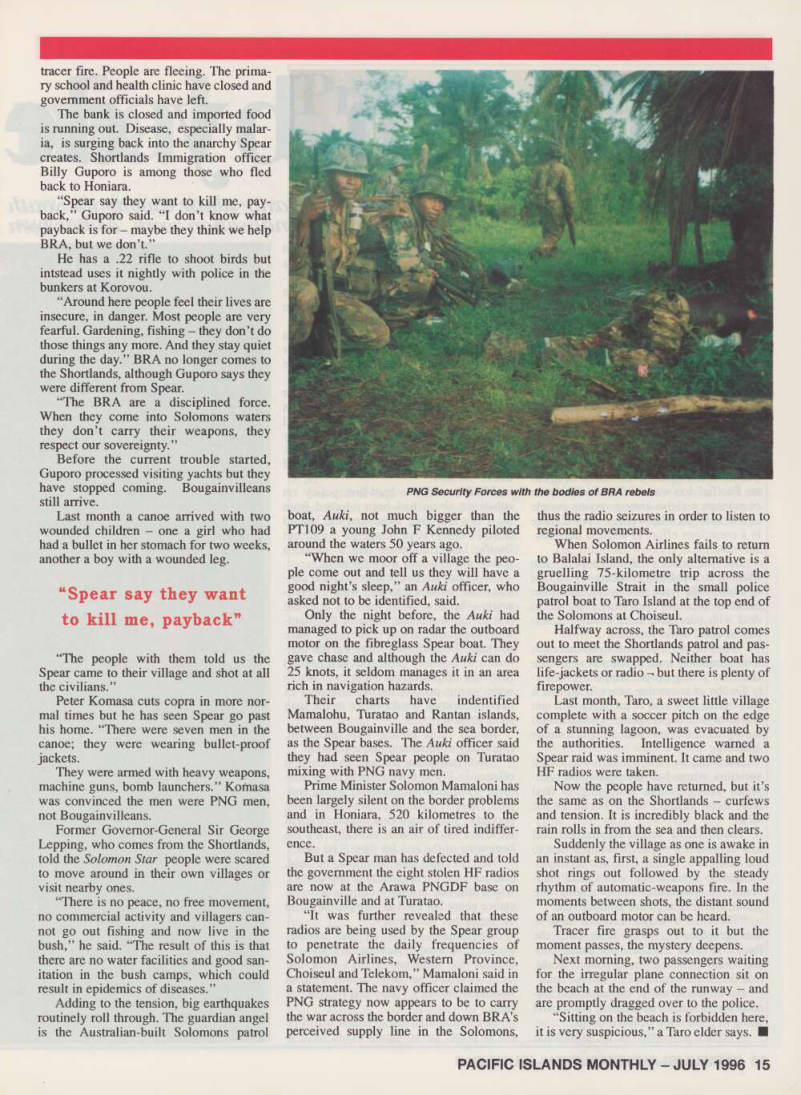
PNG Security Forces with the bodies of BRA rebels
Advertisements & other items, p. 14 (1 item)
Two Bedroom, New Beach Cottage.
RESORT/BASIC SHOPPING NEARBY $350 WEEKLY, $B5O MONTHLY.
WRITE: NATUVU, BUCA BAY, VANUALEVU, RJI. PHONE: 880370. 375 ACRES, ALMOST KILOMETRE OCEANFRONT. $650,000. TERMS. BEAUTIFUL COCONUT
GROVES, BEACHES, REEFS, ADJACENT RESORT/SHOPPING.
WRITE: NATUVU, BUCA BAY, VANUALEVU, RJI. PHONE: (679) 880370.
Death by denial


Cover Stories
Reports by Sophie Foster
The problem of substance abuse among our youth is a fact. And if the only available soultion is prison, then with half the Pacific population under the age of 25, it is likely a large number of the region’s future leaders will have criminal records next to their names.
There is a dearth of proper facilities, such as counselling, to deal with sub stance abuse in Pacific Island countries, and the issue, which could grow to tragic proportions, seems largely swept under the carpet perhaps in the hope that it will die a natural death.
A report prepared for the United Nations International Children’s Fund and titled “Youth, Alcohol and Other Drugs in the Pacific” has warned that the incidence of substance abuse among young people is bound to get a lot worse - even if there is a conscious effort to address the prob lem now.
But the author of the report, Jim Mielke, stressed that making no attempt to address the issue now would mean the situation becomes even more difficult to deal with later, and more costly for tax payers and Pacific societies.
“The bottom line seems to be that even with continued work to address substance
abuse by young people happening steadi
ly for the next coming years, it will be a slow process - and it probably will get worse before it gets better,” Mielke said during an interview with Pacific Islands
Monthly.
But what is the solution for Island societies, where half the population com
prises young people struggling to deal
with social changes in the Pacific of the 90’s?
The UNICEF report emphasised that new approaches - specific and relevant to the Islands - would have to be imple mented to combat the widespread inci dence of substance abuse among the youth, and loss of future productivity.
“There is a major concern here demographically, more than half the Pacific is under 25. These are young-peo ple countries, it’s a young-people world, half the world is under 25,” Mielke said.
He controversially suggests decrimi nalising first-time substance abuse and
being in possession of illicit drugs.
A certain proportion of the population
Ignoring substance abuse among they oat) But mill decriminalisation work , as has beer
in any given country would experiment with drugs and be prone to substance abuse, Mielke said. But with the criminal isation of drugs the only option, there would be more and more young people in
prisons.
“It’s going to happen in any population
and that proportion is getting bigger
because there are just more young people around,” he said.
“There needs to be a system where there are alternatives to prison, such as counselling, community service or social service. Because, if they go to prison, they find it hard to go back to school and pick up from where they started going off track,” he said.
Mielke said the hard-line policy on substance abuse had been adopted from the UN’s anti-drug status and the United States’ conservative stance on drugs, but Pacific Island countries had to create a policy which would work for them.
“We need to look at it in the local con text - see what works and what’s appro priate - because we’re learning from the rest of the world that some of this hard line approach doesn’t seem to have worked,” he said. And if the Pacific con tinued to instantly prosecute and convict first-time offenders, the majority of whom were young people, the development of island countries would suffer in the long term, he said.
Mielke said policy was important, especially in education and legislation.
“With marijuana, for example, the first offence in Fiji is three months’ imprison ment - and these are basically young peo ple. There’s something like 400 young people in prison for a first offence; a lot of these are students and, basically, it’s the beginning of the end for them,” he said.
New Zealand and Australia, he said, had adopted harm-reduction approaches, which did not instantly criminalise sub stance abuse but tried to help people avoid the harm that went with it.
Programmes such as the needle exchange scheme to prevent the sharing of needles for intravenous (IV) drug use were designed to help reduce Human Immunodeficiency Virus (HIV) risk, he said.
But before alternative action could be put in place, governments would have to
won’t make it go away, suggested?
Pre-trial diversion
In an effort to reduce the number of
young people in prisons, Fiji’s police,
prosecutors and law reformers are exploring the possibility of setting up a pre-trial diversion system similar to one in New Zealand. Fiji’s director of public prosecutions (DPP), Nazhat Shameem, said the system meant keeping “people out of the court system who really should n’t be there”.
“We’re talking about giving young offenders a second chance but, at the same time, it should never be seen as a soft option because it gives the police powers to deal with it in a way similar to the court system. The offender is con fronted by the victim, makes reparation, and is made to work for the victim, express remorse and confront members of his community - shaming him into feel ing remorse,” she said. But Shameem said while in principle the idea was a good one, if it could not be carried out properly, it was better not to implement it at all.
Pre-trial diversion involved providing alternatives to prosecuting young people, such as community services and coun selling, Florence Fenton of the Fiji Law Reform Commission said. An informal working committee had been set up with the police, the DPP’s office and represen tatives of the Law Reform Commission to discuss the issue, she said. According to the DPP, prosecution guidelines for both the police and the public prosecutors already provide an informal system for
pre-trial diversion.
In the DPP’s annual report for 1993- 94, Shameem set out prosecution guide lines which included a section on juve niles. “Special considerations apply to the prosecution of persons under the age of 17 years. Prosecution action against chil dren should be used sparingly and, in making a decision whether to prosecute, particular consideration should be given to available alternatives to prosecution, such as a caution or reprimand,” she said.
But Shameem was concerned that apart from this, there was no other alter native to not prosecuting. “If we do decide not to prosecute, what is going to happen to the offender? Is he going to receive counselling? Is he going to get some kind of caution or reprimand so there is a record of the number of chances the person has been given by prosecu tors?” she asked. Shameem said because there were no formal records of cautions
given, the police faced similar problems.
Fiji’s assistant commissioner of police (crime), Aisea Taoka, agrees. He said the
Police Juvenile Bureau, which was dis banded in the mid-80s, had provided a system for handling young offenders without giving them criminal records.
Taoka said the bureau was shut down when it was questioned whether the police had the constitutional power to administrate such a body.
He said the suggestion for a formal system of pre-trial diversion stemmed from concern for the number of young people with criminal records and the need to give them a second chance at becoming
law-abiding citizens.
But before such a system could be introduced, the justice system had to be sure that pre-trial diversion was an accountable alternative - open to some
degree of scrutiny and supervision,
Shameem said. She said it was important that the structure did not simply replace another bureaucracy like the courts and that strict policies and guidelines be fol lowed “Basically, what we want is unifor mity of approach to the problem of juve nile offenders so that everyone with the power to prosecute or divert young peo ple knows exactly what the criteria are,” she said.
The informal working committee had identified the need for adequate resources to run alternative approaches to prosecu tion, trained counsellors, and establish ment of guidelines for crimes which could be diverted, Fenton said.
“There’s nothing worse than a new system which sounds good on paper but we know we don’t have the resources to run well,” Shameem agrees. “If you don’t have people who are properly trained in counselling, a lot of problems could arise.
More damage can be done by counsellors who really have no idea what they are doing. And then what will the guidelines be? Are we going to have rapes diverted?
Are we going to have corruption divert ed? Will there be more pressure on the victim to reconcile?” Fenton said it was clear that later this year, the Social Welfare Department would have to become involved in the discussions. She said counselling, community services and family conferencing should be considered part of the Social Welfare Department.
But Shameem argued that for the scheme to go ahead, the Social Welfare Department would need a greater portion of the national budget because it was already overcommitted. It is clear that with continuing government discussion and commitment to the plight of young offenders, pre-trial diversion could soon be a reality for Fiji. ■
accept that a problem with young people and substance abuse existed, Mielke stressed “It’s like a lot of things going on in the Pacific - environmental problems and
AIDS (Acquired Immune Deficiency
Syndrome). It almost has to be in your
backyard before people start to change,”
he said. The warning bells were sounding already, Mielke warned, and adopting a see-no-evil stance would not help the region, its people or its future.
“Nothing’s going to suddenly come in from the outside and give the magical cure - it’s going to have to happen from with in,” he said.
Awareness, talking about issues such as substance abuse, accepting that prob lems existed and trying to reduce them or, at worst, keep them from getting out of control, needed to be addressed from within Pacific countries and communities, Mielke said. The UN report said that in order for such action to be effective, it was necessary to understand the social and cultural systems within which sub stance abuse takes place.
“It has been argued that many of the problems facing youth in the Pacific stem from the breakdown of traditional family and community systems, from urbanisa tion and the advent of nuclear families, the weakening of the power of traditional leaders, the loss of influence of the
church, poor socialisation techniques or the too easy flow of alcohol. All stem from changes induced by colonialism and the capitalist economy,” the report said.
With urbanisation and more money oriented societies, the traditional security of the extended family with full-time homemakers (usually the women) is rapidly being depleted. Two-income fami lies are common, as are one-parent fami lies with increasing divorce rates in the region.
“Growing up in a world so profoundly different from that of their parents, youth are expressing frustration and a sense of alienation as they struggle to develop a sense of self-worth and direction in their lives,” the report said.
Traditional communal obligations to family and community conflict with a new set of expectations which value individual success and Western-style education as a means of finding a job and making a liv ing in urban centres, it continued.
The report highlighted the importance of proper role models for the youth.
“If parents and other role models are exhibiting unhealthy behaviour, it’s often the reason to just do the same - whether it’s smoking, alcohol, risky sex, violence, drug abuse,” the report said.
Mielke said individual counselling in schools played an important role in reduc ing the pressures of a breakdown in com
munication at home or with (Other adults.
“There’s definitely a need to help peo ple who want to quit smoking, alcohol or drugs with counselling and other pro grammes,” he said.
“And such programmes can no longer be considered a luxury by Pacific govern ments. The concern is that we will see in the population more addiction to alcohol as there is now with smoking, and also with marijuana. It is absolutely essential that there are services to cater for that,” he said. But he added that while clinical ser vices and counselling were necessary, there also had to be awareness in the soci ety against starting on the habit - as pre vention is, after all, the best cure.
“At this point, the Pacific has to focus on awareness of the issues and shaking up the place at the community level to get the attention of the policy makers,” Mielke said.
He said even if policy makers refused to acknowledge that a problem existed, pressure from the community and individ uals was an important tool for change.
A concerted effort by government, vol unteers, parents, the donor community and young people themselves would go a long way towards ensuring that the Pacific’s future is, if not free from sub stance abuse, at the very least a safe envi ronment in which to make informed choices. ■
Advertisements & other items, p. 18 (1 item)
When You Can Service
OVER 500 COLLINS AVIONICS ITEMS
IN ONE PLACE,
YOU’RE OFF TO A FLYING START.
//, m - For over 25 years Australia's Collins Avionics Service Centre (part of the Rockwell worldwide network) has provided an extensive range of state-of-the-art avionics services to meet the rapidly growing needs of our region.
The highest quality sales and service for air transport, general aviation and military requirements.
Including repair, overhaul and modification; contract maintenance; technical training, consulting and skills transfertest systems; equipment; and a 24-hour rental/exchange pool.
The Australian Service Centre is at Tullamarine in Victoria. For more information call Neil Thomson on (61-3) 9338 0344 or fax (61-3) 9330 3007. With Collins Avionics the sky is definitely not the limit. 41* Rockwell Avionics Collins
The young and the reckless
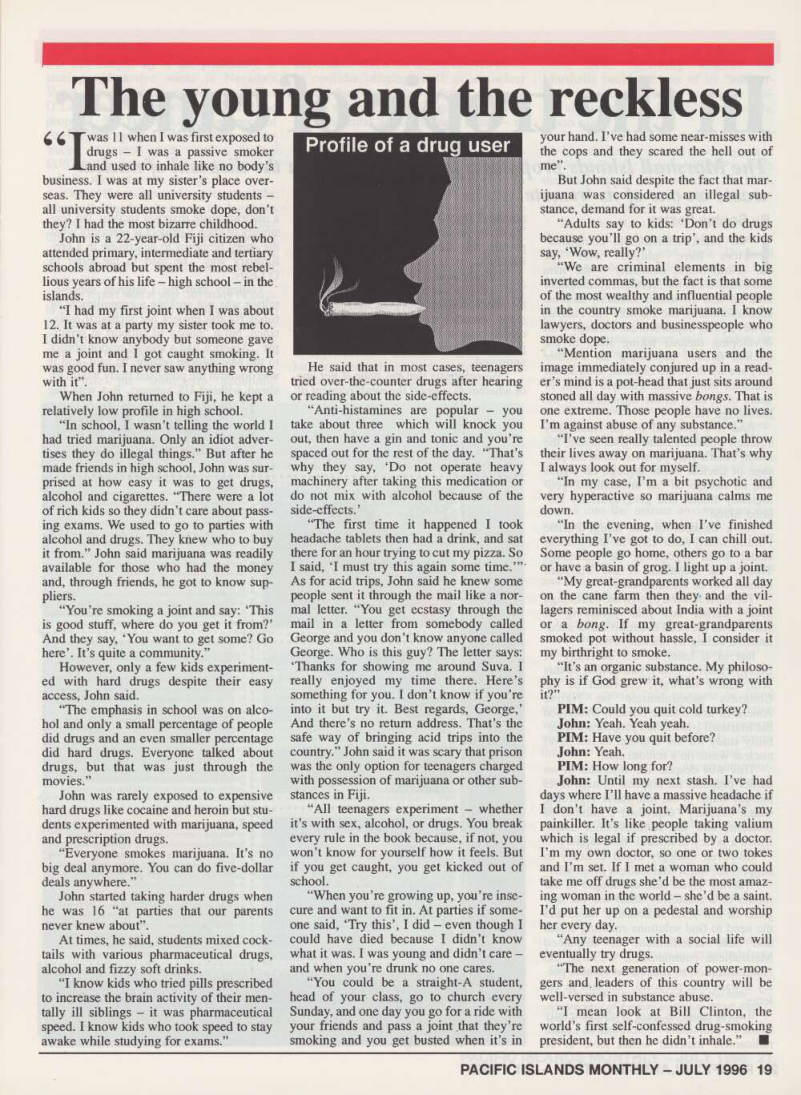
£ £ X was * when I was first exposed to I drugs - I was a passive smoker Aand used to inhale like no body’s business. I was at my sister’s place over seas. They were all university students all university students smoke dope, don’t they? I had the most bizarre childhood.
John is a 22-year-old Fiji citizen who attended primary, intermediate and tertiary schools abroad but spent the most rebel lious years of his life - high school - in the islands.
“I had my first joint when I was about 12. It was at a party my sister took me to.
I didn’t know anybody but someone gave me a joint and I got caught smoking. It was good fun. I never saw anything wrong with it”.
When John returned to Fiji, he kept a
relatively low profile in high school.
“In school, I wasn’t telling the world I had tried marijuana. Only an idiot adver tises they do illegal things.” But after he made friends in high school, John was sur prised at how easy it was to get drugs, alcohol and cigarettes. “There were a lot of rich kids so they didn’t care about pass ing exams. We used to go to parties with alcohol and drugs. They knew who to buy it from.” John said marijuana was readily available for those who had the money and, through friends, he got to know sup
pliers.
“You’re smoking a joint and say: ‘This is good stuff, where do you get it from?’
And they say, ‘You want to get some? Go here’. It’s quite a community.”
However, only a few kids experiment ed with hard drugs despite their easy access, John said.
“The emphasis in school was on alco hol and only a small percentage of people did drugs and an even smaller percentage did hard drugs. Everyone talked about drugs, but that was just through the movies.”
John was rarely exposed to expensive
hard drugs like cocaine and heroin but stu
dents experimented with marijuana, speed
and prescription drugs.
“Everyone smokes marijuana. It’s no big deal anymore. You can do five-dollar deals anywhere.”
John started taking harder drugs when he was 16 “at parties that our parents never knew about”.
At times, he said, students mixed cock tails with various pharmaceutical drugs, alcohol and fizzy soft drinks.
“I know kids who tried pills prescribed to increase the brain activity of their men tally ill siblings - it was pharmaceutical speed. I know kids who took speed to stay awake while studying for exams.”
He said that in most cases, teenagers tried over-the-counter drugs after hearing or reading about the side-effects.
“Anti-histamines are popular - you take about three which will knock you out, then have a gin and tonic and you’re spaced out for the rest of the day. “That’s why they say, ‘Do not operate heavy machinery after taking this medication or do not mix with alcohol because of the side-effects.’
“The first time it happened I took headache tablets then had a drink, and sat there for an hour trying to cut my pizza. So I said, T must try this again some time.’”
As for acid trips, John said he knew some people sent it through the mail like a nor mal letter. “You get ecstasy through the mail in a letter from somebody called George and you don’t know anyone called George. Who is this guy? The letter says: ‘Thanks for showing me around Suva. I really enjoyed my time there. Here’s something for you. I don’t know if you’re into it but try it. Best regards, George,’
And there’s no return address. That’s the safe way of bringing acid trips into the country.” John said it was scary that prison was the only option for teenagers charged with possession of marijuana or other sub stances in Fiji.
“All teenagers experiment - whether it’s with sex, alcohol, or drugs. You break every rule in the book because, if not, you won’t know for yourself how it feels. But if you get caught, you get kicked out of school.
“When you’re growing up, you’re inse cure and want to fit in. At parties if some one said, ‘Try this’, I did - even though I could have died because I didn’t know what it was. I was young and didn’t care and when you’re drunk no one cares.
“You could be a straight-A student, head of your class, go to church every Sunday, and one day you go for a ride with your friends and pass a joint that they’re smoking and you get busted when it’s in
your hand. I’ve had some near-misses with the cops and they scared the hell out of me”.
But John said despite the fact that mar ijuana was considered an illegal sub stance, demand for it was great.
“Adults say to kids: ‘Don’t do drugs because you’ll go on a trip’, and the kids say, ‘Wow, really?’
“We are criminal elements in big inverted commas, but the fact is that some of the most wealthy and influential people in the country smoke marijuana. I know lawyers, doctors and businesspeople who
smoke dope.
“Mention marijuana users and the image immediately conjured up in a read er’s mind is a pot-head that just sits around stoned all day with massive bongs. That is one extreme. Those people have no lives.
I’m against abuse of any substance.”
“I’ve seen really talented people throw their lives away on marijuana. That’s why I always look out for myself.
“In my case. I’m a bit psychotic and very hyperactive so marijuana calms me down.
“In the evening, when I’ve finished everything I’ve got to do, I can chill out.
Some people go home, others go to a bar or have a basin of grog. I light up a joint.
“My great-grandparents worked all day on the cane farm then they- and the vil lagers reminisced about India with a joint or a bong. If my great-grandparents smoked pot without hassle, I consider it my birthright to smoke.
“It’s an organic substance. My philoso phy is if God grew it, what’s wrong with it?”
PIM: Could you quit cold turkey?
John: Yeah. Yeah yeah.
PIM: Have you quit before?
John: Yeah.
PIM: How long for?
John: Until my next stash. I’ve had days where I’ll have a massive headache if I don’t have a joint, Marijuana’s my
painkiller. It’s like people taking valium
which is legal if prescribed by a doctor.
I’m my own doctor, so one or two tokes and I’m set. If I met a woman who could take me off drugs she’d be the most amaz ing woman in the world - she’d be a saint.
I’d put her up on a pedestal and worship her every day.
“Any teenager with a social life will
eventually try drugs.
“The next generation of power-mon gers and leaders of this country will be well-versed in substance abuse.
“I mean look at Bill Clinton, the world’s first self-confessed drug-smoking president, but then he didn’t inhale.” ■
Profile of a drug user
In the tropic of cancer
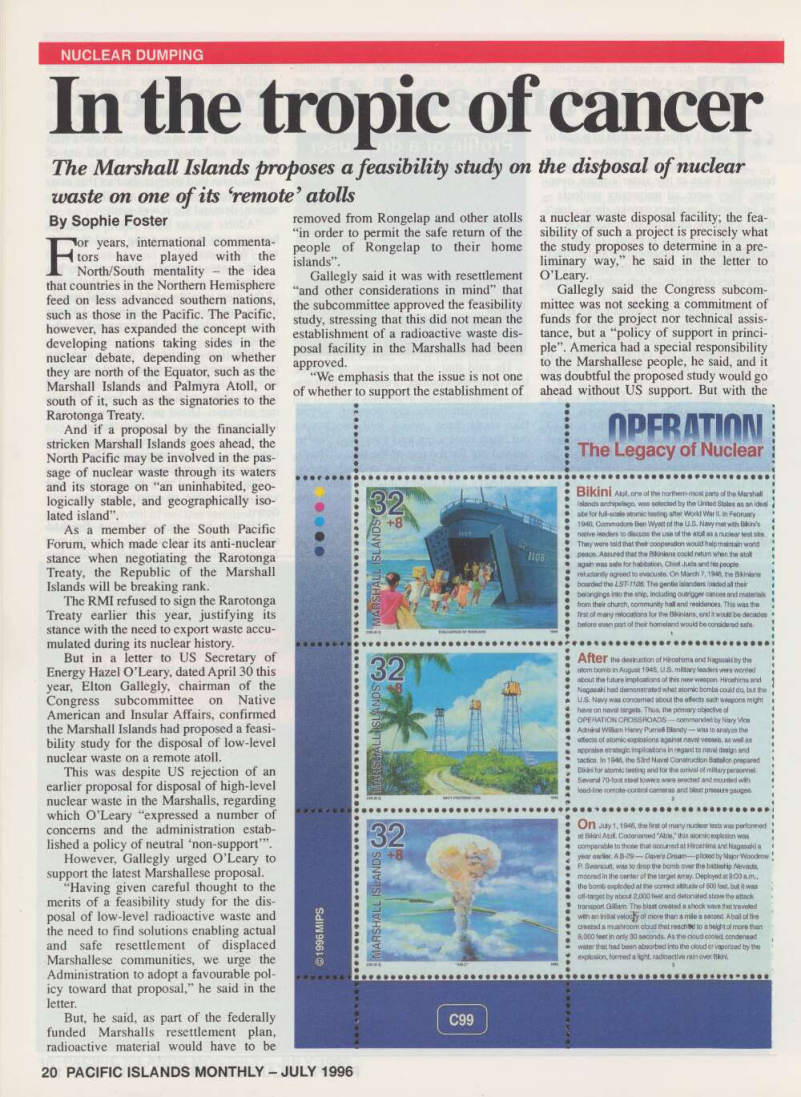
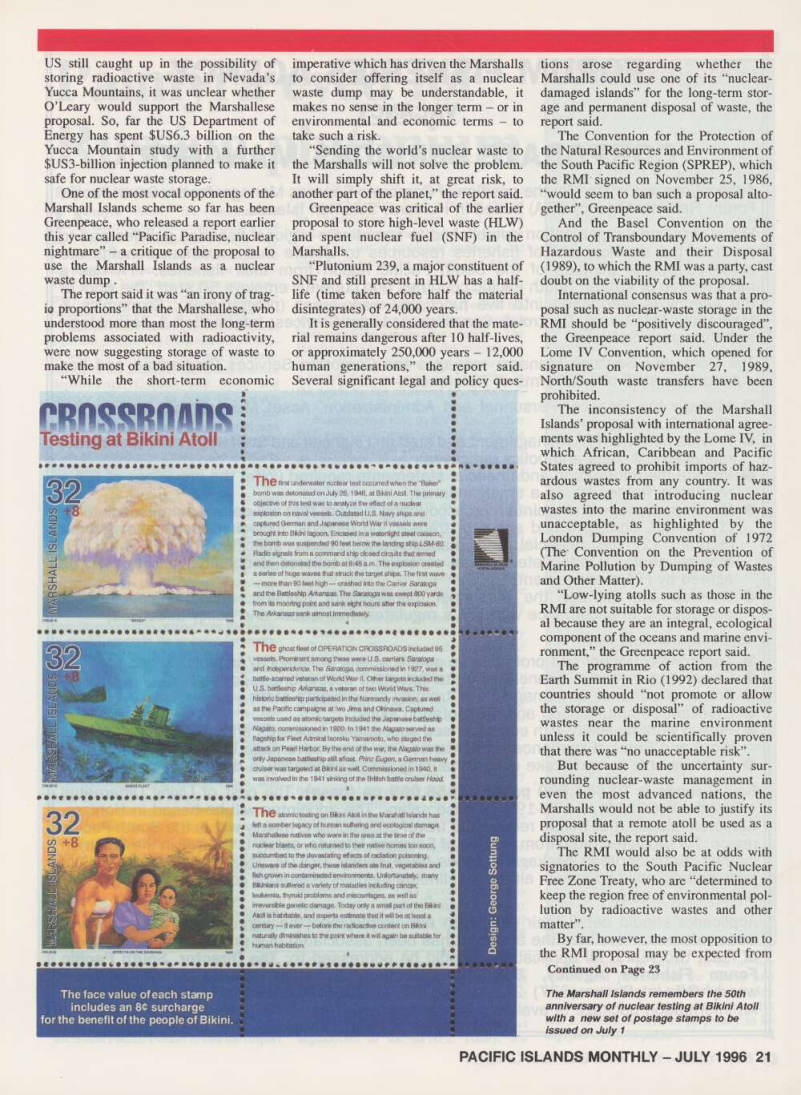

The Marshall Islands proposes a feasibility study on the disposal of nuclear waste on one of its 6 remote 9 atolls
By Sophie Foster
For years, international commenta tors have played with the North/South mentality - the idea that countries in the Northern Hemisphere feed on less advanced southern nations, such as those in the Pacific. The Pacific, however, has expanded the concept with developing nations taking sides in the nuclear debate, depending on whether they are north of the Equator, such as the Marshall Islands and Palmyra Atoll, or south of it, such as the signatories to the Rarotonga Treaty.
And if a proposal by the financially stricken Marshall Islands goes ahead, the North Pacific may be involved in the pas sage of nuclear waste through its waters and its storage on “an uninhabited, geo logically stable, and geographically iso lated island”.
As a member of the South Pacific Forum, which made clear its anti-nuclear stance when negotiating the Rarotonga Treaty, the Republic of the Marshall Islands will be breaking rank.
The RMI refused to sign the Rarotonga Treaty earlier this year, justifying its stance with the need to export waste accu mulated during its nuclear history.
But in a letter to US Secretary of Energy Hazel O’Leary, dated April 30 this year, Elton Gallegly, chairman of the Congress subcommittee on Native American and Insular Affairs, confirmed the Marshall Islands had proposed a feasi bility study for the disposal of low-level nuclear waste on a remote atoll.
This was despite US rejection of an
earlier proposal for disposal of high-level
nuclear waste in the Marshalls, regarding which O’Leary “expressed a number of concerns and the administration estab lished a policy of neutral ‘non-support’”.
However, Gallegly urged O’Leary to
support the latest Marshallese proposal.
“Having given careful thought to the merits of a feasibility study for the dis posal of low-level radioactive waste and the need to find solutions enabling actual and safe resettlement of displaced Marshallese communities, we urge the Administration to adopt a favourable pol icy toward that proposal,” he said in the letter.
But, he said, as part of the federally funded Marshalls resettlement plan, radioactive material would have to be
removed from Rongelap and other atolls “in order to permit the safe return of the people of Rongelap to their home islands”.
Gallegly said it was with resettlement “and other considerations in mind” that the subcommittee approved the feasibility study, stressing that this did not mean the establishment of a radioactive waste dis posal facility in the Marshalls had been
approved.
“We emphasis that the issue is not one of whether to support the establishment of
a nuclear waste disposal facility; the fea sibility of such a project is precisely what the study proposes to determine in a pre liminary way,” he said in the letter to O’Leary.
Gallegly said the Congress subcom mittee was not seeking a commitment of funds for the project nor technical assis tance, but a “policy of support in princi ple”. America had a special responsibility to the Marshallese people, he said, and it was doubtful the proposed study would go ahead without US support. But with the
US still caught up in the possibility of storing radioactive waste in Nevada’s Yucca Mountains, it was unclear whether O’Leary would support the Marshallese proposal. So, far the US Department of Energy has spent SUS 6.3 billion on the Yucca Mountain study with a further SUS3-billion injection planned to make it safe for nuclear waste storage.
One of the most vocal opponents of the Marshall Islands scheme so far has been Greenpeace, who released a report earlier this year called “Pacific Paradise, nuclear nightmare” - a critique of the proposal to use the Marshall Islands as a nuclear waste dump .
The report said it was “an irony of trag io proportions” that the Marshallese, who understood more than most the long-term
problems associated with radioactivity,
were now suggesting storage of waste to make the most of a bad situation.
“While the short-term economic
imperative which has driven the Marshalls to consider offering itself as a nuclear waste dump may be understandable, it makes no sense in the longer term - or in environmental and economic terms - to take such a risk.
“Sending the world’s nuclear waste to the Marshalls will not solve the problem.
It will simply shift it, at great risk, to another part of the planet,” the report said.
Greenpeace was critical of the earlier proposal to store high-level waste (HLW) and spent nuclear fuel (SNF) in the Marshalls.
“Plutonium 239, a major constituent of SNF and still present in HLW has a half life (time taken before half the material disintegrates) of 24,000 years.
It is generally considered that the mate rial remains dangerous after 10 half-lives, or approximately 250,000 years - 12,000 human generations,” the report said.
Several significant legal and policy ques
tions arose regarding whether the Marshalls could use one of its “nuclear damaged islands” for the long-term stor age and permanent disposal of waste, the report said.
The Convention for the Protection of the Natural Resources and Environment of the South Pacific Region (SPREP), which the RMI signed on November 25, 1986, “would seem to ban such a proposal alto
gether”, Greenpeace said.
And the Basel Convention on the Control of Transboundary Movements of Hazardous Waste and their Disposal (1989), to which the RMI was a party, cast doubt on the viability of the proposal.
International consensus was that a pro posal such as nuclear-waste storage in the RMI should be “positively discouraged”, the Greenpeace report said. Under the Lome IV Convention, which opened for signature on November 27, 1989, North/South waste transfers have been
prohibited.
The inconsistency of the Marshall Islands’ proposal with international agree ments was highlighted by the Lome IV, in which African, Caribbean and Pacific States agreed to prohibit imports of haz ardous wastes from any country. It was also agreed that introducing nuclear wastes into the marine environment was unacceptable, as highlighted by the London Dumping Convention of 1972 (The Convention on the Prevention of Marine Pollution by Dumping of Wastes and Other Matter).
“Low-lying atolls such as those in the RMI are not suitable for storage or dispos al because they are an integral, ecological component of the oceans and marine envi ronment,” the Greenpeace report said.
The programme of action from the Earth Summit in Rio (1992) declared that countries should “not promote or allow the storage or disposal” of radioactive wastes near the marine environment unless it could be scientifically proven that there was “no unacceptable risk”.
But because of the uncertainty sur rounding nuclear-waste management in even the most advanced nations, the Marshalls would not be able to justify its proposal that a remote atoll be used as a disposal site, the report said.
The RMI would also be at odds with signatories to the South Pacific Nuclear Free Zone Treaty, who are “determined to keep the region free of environmental pol lution by radioactive wastes and other matter”.
By far, however, the most opposition to the RMI proposal may be expected from
Continued on Page 23
The Marshall Islands remembers the 50th anniversary of nuclear testing at Bikini Atoll with a new set of postage stamps to be issued on July 1
From Page 21
the Waigani Convention, which was being actively negotiated by members of the South Pacific Forum to ban the import
of hazardous waste into the region.
If the Marshall Islands goes ahead with its nuclear-waste dump proposal, it will be outnumbered, outlawed and out cast by Forum Island countries who, as signatories to the SPNFZ Treaty, are
legally bound “to ensure, so far as lies within their power, that the bounty and beauty of the land and sea in their region shall remain the heritage of their peoples and their descendants in perpetuity to be enjoyed by all in peace”. ■
Advertisements & other items, p. 22 (1 item)
Forum Fisheries Agency
VACANCY
CORPORATE SERVICES MANAGER
Applications are invited for the position of Corporate Services Manager for the South Pacific Forum Fisheries Agency (FFA) based in Honiara, Solomon Islands.
FFA is a regional organisation established to co-ordinate regional fisheries policies and to promote the development of fisheries resources to ensure that maximum benefits are achieved by the peoples of the South Pacific region from their fisheries. FFA has a membership of sixteen South Pacific countries and currently employs 50 staff. The work of the Agency is partitioned into five functional work areas (programmes): Economics & Marketing: Monitoring, Control & Surveillance; Legal Services; Information & Technology; and Corporate Services.
The Corporate Services Manager manages the Corporate Services Programme and has subordinate staff of 15. Terms of Reference: — • Manage the Finance, Personnel and Administration, Asset Management and Capital Works Sub-Programmes; • Provide advice to FFA management and staff on Financial and Staff Regulatory provisions, management rules and policy directives; • Provide the information and financial statements required under the provisions of FFA’s regulatory framework, in a timely manner; • Develop, manage and maintain an accounting system that will deliver outputs including: (1) prompt, complete and accurate transaction records, including asset management records; (2) the financial and management reports specified by FFC and FFA management; (3) adequate internal controls; (4) tailored donor financial reports, as agreed by FFA management; • Develop and manage the personnel management function, including appointment procedures, in accordance with FFA’s regulatory framework and policy directives; Applicants should have: • Appropriate tertiary and professional qualifications in Finance/Administration; • Proven Experience in financial and management accounting reporting; • Proven experience in managing and training subordinate staff; • Excellent communication and presentation skills; • Proven working ability with computerised accounting packages and applications such as Word and Excel; (Experience with Finance One is an advantage but not necessary); • Must be able to undertake occasional duty travel especially in the Pacific region; Salary range Is U 5547,590 pa to U 5558,069 pa (base). The cost of Living Differential Adjustment (COLDA) is 17%-19% of base salary. The appointee will be based in Honiara, Solomon Islands, but will be required to travel occasionally, mainly within the South Pacific region. For those recruited from outside of Solomon Islands, salary is tax-free in the Solomon Islands. Remuneration package includes base salary, COLDA, location allowance (5% of base salary), child education allowance, limited medical insurance covers, recreation leave, and superannuation.
Applicants should detail their education and employment background with particulars of three referees with whom the applicant has been associated in a professional capacity for at least two years. All applications should be addressed to: The Director, South Pacific Forum Fisheries Agency, Box 629, Honiara, Solomon Islands Email address: [email protected]; Phone: (677) 21124; Fax: (677) 23995. CLOSING DATE IS 15 JULY 1996.
An information package is available for posting upon request.
Russian plutonium
Palmyra eyed for Russian plutonium
Reports by David North
Palmyra Atoll, the uninhabited United States possession 1000 miles (1600 kilometres) south of Honolulu, could become the storage site for plutonium from Russia, if the propos al of a New York-based investment com pany, KVR Inc, meets with a favourable response from the US government.
The proposed developer, Alex Copson,
a British citizen, has broached the propos al with US officials, including represen tatives of the Defence, State, and Interior departments. Copson told State and Interior officials at an April 19 meeting that his firm has been negotiating with the major landowners of Palmyra Atoll and discussing the proposal with Russian offi cials. According to Copson, the Russians are interested because they do not have adequate facilities for the secure storage of this material which is used to fuel nuclear power plants and make weapons.
Copson said he had discussed the propos al with US Defence Department officials because the plan calls for the US Navy to provide security for the storage site. The proposed financial operations of the stor age facility have not been disclosed but a formal company proposal, due this sum mer, is expected to outline how the facili ty would generate the revenue for opera tions and, presumably, profit.
US officials have expressed concern about the black market sale of plutonium from former Soviet republics, since the breakup of the former Soviet Union. The major concern is that the plutonium, which is essential in the manufacture of atomic bombs, would find its way to nations that support international terror ism, including North Korea, Libya, and Iran. The world is in danger of atomic ter rorism, Copson says, and the kinds of ani mus that led to the Tokyo subway gas attack and the explosion in New York’s World Trade Centre could easily lead given a little plutonium and technical know-how in the wrong hands - to mass killings in any of the world’s cities.
The way to avoid this needless loss of life, he says, is to recycle spent nuclear fuel (raw material of atomic bombs) in a
joint US-Russian facility. Currently, there
is no such facility. Such a facility should be “equidistant between the US and Russia” and Palmyra is high but not at the top of his list of candidate locations. He would not name his number one candi date.
“This speck of territory [Palmyra] that
has never done anything for anyone in the world [should] be dedicated to to saving humanity from needless destruction... The Pacific Islands owe it to the veterans of World War 11, who saved the islands from a terrible fate” to make a contribution to the world by not objecting to the propos al, Copson said.
Palmyra was sold to KVR Inc earlier this year at a price said to be in the SUS36-50-million range. Since none of the principals in the deal have talked to the Press, it is possible that the transaction is still under way. Palmyra has been - or had been - the property of the Fullard- Leo family of Hawaii since 1922.
The tropical atoll, of about 50 small islands situated on a horseshoe-shaped coral reef, is about 400 miles (640 kilo metres) north of the Equator. The total land area is under two square miles (three square kilometres). The highest of the islands is about six feet above sea level.
During the 19405, the US Navy (which, in effect, seized them from the Fullard-Leos for the duration) stationed thousands of men on the islands, built a 6000-foot (1800-metre) airstrip, and widened and deepend the lagoon. The dredged material was used to join three of the major islands and build a causeway across other islands. The US Air Force used the land-based airstrip until 1961.
Except for short-term travellers by boat and a caretaker or two, the island has been people-free since the war. The US government has not expressed an opinion on the proposal.
The South Pacific Nuclear Free Zone Treaty, which the US finally agreed to last year, does not include Palmyra in its zone.
However, the US government has opposed other proposals to store nuclear waste on radiated isalnds in the Marshall Islands. ■
A brief history
Palmyra may be remembered by some primarily for the notoriety it gained in the 1980 s as the site of a gruesome double murder. Buck Duane Walker was convicted in 1981 for the murder of Mr and Mrs Malcolm Graham on the atoll. Walker and his girlfriend, Stephanie Steams, were on Palmyra in the summer of 1974 when the Grahams arrived on their luxury sailboat, the Sea Wind.
Walker and Stems arrived in Honolulu on the Sea Wind in October, 1974, claming no knowledge of the Graham’s whereabouts.
Steams was later acquitted in a high ly publicised trial in which she was defended by the well-known American attorney Vincent Bugliosi (who had gained fame for his prosecution of the Manson Family). Bugliosi later chroni cled the Palmyra case in And the Sea Will Tell , which became a US made-for-TV movie. Mrs Graham’s remains were found on Palmyra in 1981, but Mr Graham’s body was never recovered.
Palmyra became a US territory by way of its annexation to the Hawaiian Kingdom under Kamehameha IV. The Hawaiian monarch commissioned Captain Zenas Bent and Johnson B Wilkinson in 1862 to take possession of Palmyra to increase “the trade and com merce of [the] kingdom as well as offer ing protection to the interests of its sub ject”.
Bent deposited a declaration in a boL tie buried at the foot of a pole wrapped in the Hawaiian flag, planted some crops, and built a house and a curing shed for the preparation of beche de mer.
When the Republic of Hawaii was annexed to the United States in 1898, Palmyra was included.
On February 21, 1912, the US Navy cruiser West Virginia, under the com mand of Rear Admiral WHH Southerland, formally took possession of Palmyra in the name of the US. When Hawaii became a state in 1959, the Hawaii Statehood Act excluded Palmyra from the state’s territory and jurisdiction, vesting all executive and legislative authority for the civil administration of Palmyra in the Secretary of the Interior.
Palmyra received its name from a Captain Sawle, who christened it after his vessel, which stopped there on November 7, 1802. ■
Pacific
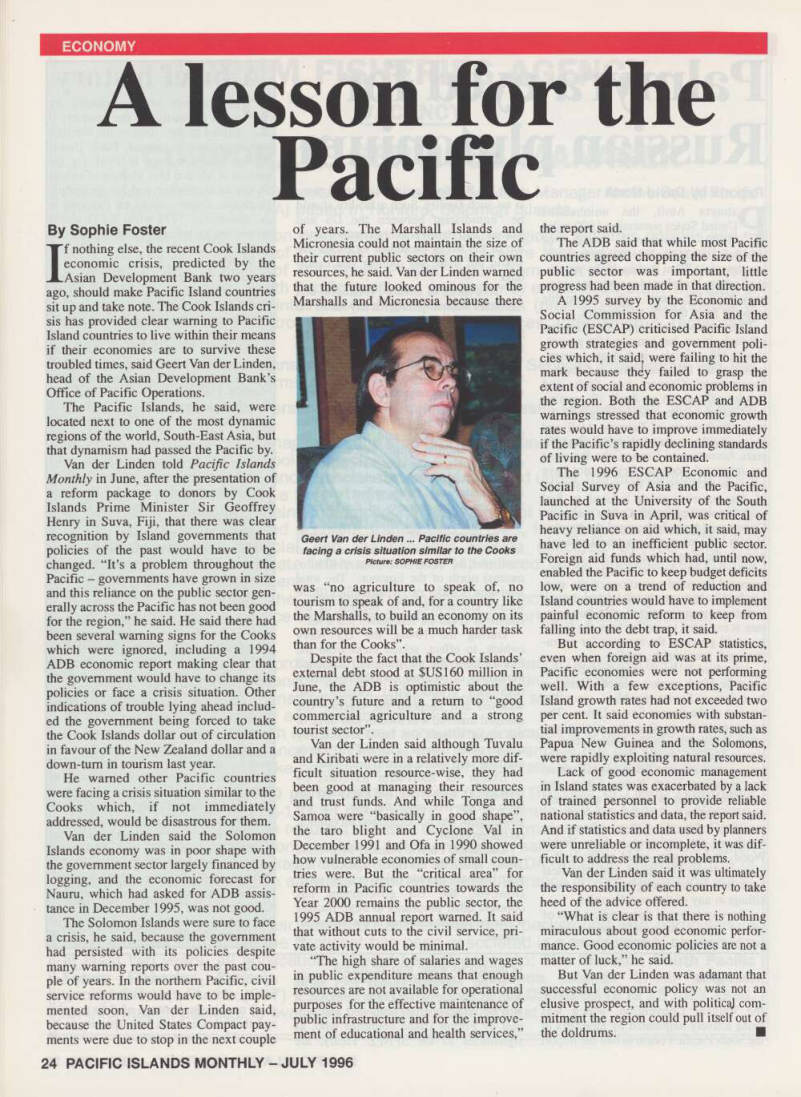
Economy
A lesson for the Pacific
By Sophie Foster
If nothing else, the recent Cook Islands economic crisis, predicted by the Asian Development Bank two years ago, should make Pacific Island countries sit up and take note. The Cook Islands cri sis has provided clear warning to Pacific Island countries to live within their means if their economies are to survive these troubled times, said Geert Van der Linden, head of the Asian Development Bank’s Office of Pacific Operations.
The Pacific Islands, he said, were located next to one of the most dynamic regions of the world, South-East Asia, but that dynamism had passed the Pacific by.
Van der Linden told Pacific Islands Monthly in June, after the presentation of a reform package to donors by Cook Islands Prime Minister Sir Geoffrey Henry in Suva, Fiji, that there was clear recognition by Island governments that policies of the past would have to be changed. “It’s a problem throughout the Pacific - governments have grown in size and this reliance on the public sector gen erally across the Pacific has not been good for the region,” he said. He said there had been several warning signs for the Cooks which were ignored, including a 1994 ADB economic report making clear that the government would have to change its policies or face a crisis situation. Other indications of trouble lying ahead includ ed the government being forced to take the Cook Islands dollar out of circulation in favour of the New Zealand dollar and a down-tum in tourism last year.
He warned other Pacific countries were facing a crisis situation similar to the Cooks which, if not immediately addressed, would be disastrous for them.
Van der Linden said the Solomon Islands economy was in poor shape with the government sector largely financed by logging, and the economic forecast for Nauru, which had asked for ADB assis tance in December 1995, was not good.
The Solomon Islands were sure to face a crisis, he said, because the government had persisted with its policies despite many warning reports over the past cou ple of years. In the northern Pacific, civil service reforms would have to be imple mented soon, Van der Linden said, because the United States Compact pay ments were due to stop in the next couple
of years. The Marshall Islands and Micronesia could not maintain the size of their current public sectors on their own resources, he said. Van der Linden warned that the future looked ominous for the Marshalls and Micronesia because there
was “no agriculture to speak of, no tourism to speak of and, for a country like the Marshalls, to build an economy on its own resources will be a much harder task than for the Cooks”.
Despite the fact that the Cook Islands’ external debt stood at SUSI6O million in June, the ADB is optimistic about the country’s future and a return to “good commercial agriculture and a strong tourist sector”.
Van der Linden said although Tuvalu and Kiribati were in a relatively more dif ficult situation resource-wise, they had been good at managing their resources and trust funds. And while Tonga and
Samoa were “basically in good shape”,
the taro blight and Cyclone Val in December 1991 and Ofa in 1990 showed how vulnerable economies of small coun tries were. But the “critical area” for reform in Pacific countries towards the Year 2000 remains the public sector, the 1995 ADB annual report warned. It said that without cuts to the civil service, pri vate activity would be minimal.
“The high share of salaries and wages
in public expenditure means that enough
resources are not available for operational purposes for the effective maintenance of public infrastructure and for the improve ment of educational and health services,”
the report said.
The ADB said that while most Pacific countries agreed chopping the size of the public sector was important, little progress had been made in that direction.
A 1995 survey by the Economic and Social Commission for Asia and the Pacific (ESCAP) criticised Pacific Island
growth strategies and government poli
cies which, it said, were failing to hit the mark because they failed to grasp the extent of social and economic problems in the region. Both the ESCAP and ADB warnings stressed that economic growth rates would have to improve immediately if the Pacific’s rapidly declining standards of living were to be contained.
The 1996 ESCAP Economic and Social Survey of Asia and the Pacific, launched at the University of the South Pacific in Suva in April, was critical of heavy reliance on aid which, it said, may have led to an inefficient public sector.
Foreign aid funds which had, until now, enabled the Pacific to keep budget deficits low, were on a trend of reduction and Island countries would have to implement painful economic reform to keep from falling into the debt trap, it said.
But according to ESCAP statistics, even when foreign aid was at its prime.
Pacific economies were not performing well. With a few exceptions, Pacific Island growth rates had not exceeded two per cent. It said economies with substan tial improvements in growth rates, such as Papua New Guinea and the Solomons, were rapidly exploiting natural resources.
Lack of good economic management in Island states was exacerbated by a lack of trained personnel to provide reliable national statistics and data, the report said.
And if statistics and data used by planners were unreliable or incomplete, it was dif ficult to address the real problems.
Van der Linden said it was ultimately the responsibility of each country to take heed of the advice offered.
“What is clear is that there is nothing miraculous about good economic perfor mance. Good economic policies are not a matter of luck,” he said.
But Van der Linden was adamant that successful economic policy was not an elusive prospect, and with politicaj com mitment the region could pull itself out of the doldrums. ■
Geert Van der Linden ... Pacific countries are facing a crisis situation similar to the Cooks Picture: SOPHIE FOSTER
... theoretically

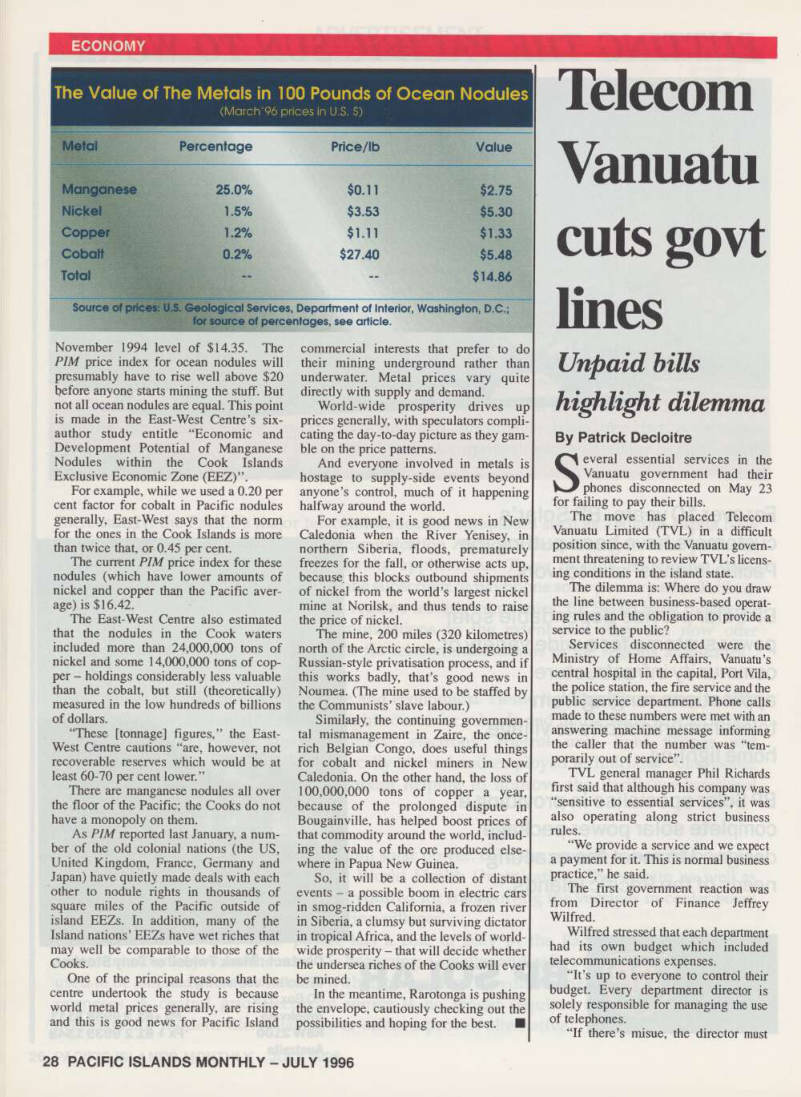
Trillions in mineral riches for the Cooks ... theoretically
By David North
The Cooks may be having a financial crisis, and the local currency is not worth much but - theoretically, at least - the Cooks have in their Exclusive Economic Zone (EEZ) two trillion dollars worth of cobalt. That’s right, $U52,000,000,000,000 worth of the min eral! \ We derive that figure from two impec cable, if somewhat academic, sources.
The East-West Centre, in Honolulu, has estimated that there are 32,541,000 tons of cobalt in the Cooks waters; the US Bureau of Mines quotes the current (dry land) cobalt price at $60,400 a ton; and $60,400 x 32,541,000 $2,017,542,000,000. (Neither of these august institutions were venturesome enough to print the multiplication shown here.) There are several enormous caveats, however.
Problem one: The cobalt is imbedded in manganese nodules that are scattered all over the Cooks’ extensive EEZ, that is, the waters within 200 miles (320 kilome tres) of one or more of the Cook Islands.
Problem two: The East-West Centre says it will cost SUSI.2S billion or so to establish a high-tech system to vacuum the ocean floor for the nodules and to buy the ships to take them to an expensive facility (not yet built) where the nodules would be pulverised and processed.
Problem three: According to the US Bureau of Mines, the world uses about 20-30,000 tons of cobalt every year, and even if only one third of the Cooks’ sup ply could be recovered, that would keep the whole world supplied (at current usage rates) for more than 300 years. In the meantime, the arrival of massiye amounts of cobalt on the market would, of course, depress prices sharply.
For a feet-firmly-planted-on-the ground (maybe feet-in-the-water), highly sensible view of all of this we turned to Cook Islands official Taylor A Pryor. He’s the aide to the prime minister in charge of special projects, one of which is a low
tech, low-investment approach to the manganese nodules.
Pryor dismisses the ultra-long-range view of the East-Centre and its focus on space-era technologies (the enormous ships with their two-mile-long vacuum cleaner hoses sweeping the bottom of the ocean) which so often dominates discus sion of the nodules.
Pryor’s project is a pre-feasibility study of an alternative, small-is-beautiful approach to the underseas wealth. The Cooks have enlisted the support of Bechtel, the mighty, San Francisco-based engineering firm which managed the Chunnel from Britain to France, and the innovative new Hong Kong Airport.
Bechtel, using some of its funds and some US government money, has started to study the utility of mining the nodules in Cook waters.
The concept Bechtel and Pryor are checking out is a modest one: Let’s think about old freighters trawling for nodules using currently available electronic sens ing equipment to scout for the nodules.
The capital costs are not enormous.
One can buy a slightly used, 390-foot long trawler for $2.5 million.
Such a vessel could collect from 800 to 1600 tons of nodules a day (estimates vary); the trawler would then transfer its catch to a much larger ore carrier with a capacity of up to 40,000 tons, with the larger vessel making the trip to Australia or South America or wherever the pro cessing plant is to be built.
According to Pryor, one can rent such an ore carrier for $BOOO a day; expensive, yes, but no capital is involved.
Pryor sums up the Cooks’ position as follows: “I am not writing to convince you and Pacific Islands Monthly readers of the viability of this task. Who knows until the study and possible subsequent trials have been completed? ... CIGOV and Bechtel are taking the most obvious next step. Should that result in positive recommendations, CIGOV will seek grants for the next obvious steps. This cautious task will continue until there is
an insurmountable obstacle or we reach that magic point when investor confi dence is warranted.”
The Cooks are not alone in these
thoughts.
Even if one discounts some of the box car numbers mentioned earlier, island leaders throughout the Pacific are paying attention to those fist-sized rocks that lie half a mile to four miles under the surface of the ocean. With overseas aid shrinking, with revenue from tuna plateauing, and with large-scale tourism a distant glimmer for all but Hawaii, Guam and Saipan, the nodules do offer an attractive - albeit per haps long-term - prospect.
Often called manganese nodules (for that substance is the major element) the real value of this resource is found in the cobalt and nickel components.
Useful quantities of copper are also present in these rocks which draw the minerals in question from the surrounding sea water.
Nickel, which is mined in New Caledonia, is used in stainless steel; cobalt, which makes extremely tough cut ting tools and blue pigment, is also mined in New Caledonia, but comes primarily from Russia, Zaire and Canada.
Both metals are used in electrical bat teries, and if non-polluting electric auto mobiles catch on, the world market for both of these commodities will soar.
But it will take a sustained increase in the price of both commodities before any one invests in undersea mining.
To illustrate the economics, the accompanying box (Page 28) shows how much of the four metals are found in the average Pacific nodule, the world price per pound in November, 1995 for the commodity, and the potential value of the metals within a typical 100 pounds of nodules.
The box shows the June 1996 value, for 100 lbs at $14.86; this is a sharp increase from the value of 100 lbs of nod ules in November, 1993, when it was $9.33, and a lesser increase from the
Continued on Page 28
November 1994 level of $14.35. The PIM price index for ocean nodules will presumably have to rise well above $2O before anyone starts mining the stuff. But not all ocean nodules are equal. This point is made in the East-West Centre’s six author study entitle “Economic and
Development Potential of Manganese
Nodules within the Cook Islands Exclusive Economic Zone (EEZ)”.
For example, while we used a 0.20 per cent factor for cobalt in Pacific nodules generally. East-West says that the norm for the ones in the Cook Islands is more than twice that, or 0.45 per cent.
The current PIM price index for these nodules (which have lower amounts of nickel and copper than the Pacific aver age) is $16.42.
The East-West Centre also estimated that the nodules in the Cook waters included more than 24,000,000 tons of nickel and some 14,000,000 tons of cop per - holdings considerably less valuable than the cobalt, but still (theoretically) measured in the low hundreds of billions of dollars.
“These [tonnage] figures,” the East- West Centre cautions “are, however, not recoverable reserves which would be at least 60-70 per cent lower.”
There are manganese nodules all over the floor of the Pacific; the Cooks do not have a monopoly on them.
As PIM reported last January, a num ber of the old colonial nations (the US, United Kingdom, France, Germany and Japan) have quietly made deals with each other to nodule rights in thousands of square miles of the Pacific outside of island EEZs. In addition, many of the Island nations’ EEZs have wet riches that may well be comparable to those of the Cooks.
One of the principal reasons that the centre undertook the study is because world metal prices generally, are rising and this is good news for Pacific Island
commercial interests that prefer to do their mining underground rather than underwater. Metal prices vary quite directly with supply and demand.
World-wide prosperity drives up prices generally, with speculators compli cating the day-to-day picture as they gam ble on the price patterns.
And everyone involved in metals is hostage to supply-side events beyond anyone’s control, much of it happening halfway around the world.
For example, it is good news in New Caledonia when the River Yenisey, in northern Siberia, floods, prematurely freezes for the fall, or otherwise acts up, because this blocks outbound shipments of nickel from the world’s largest nickel mine at Norilsk, and thus tends to raise the price of nickel.
The mine, 200 miles (320 kilometres) north of the Arctic circle, is undergoing a Russian-style privatisation process, and if this works badly, that’s good news in Noumea. (The mine used to be staffed by the Communists’ slave labour.) Similarly, the continuing governmen tal mismanagement in Zaire, the once rich Belgian Congo, does useful things for cobalt and nickel miners in New Caledonia. On the other hand, the loss of 100,000,000 tons of copper a year, because of the prolonged dispute in Bougainville, has helped boost prices of that commodity around the world, includ ing the value of the ore produced else where in Papua New Guinea.
So, it will be a collection of distant events - a possible boom in electric cars in smog-ridden California, a frozen river in Siberia, a clumsy but surviving dictator in tropical Africa, and the levels of world wide prosperity - that will decide whether the undersea riches of the Cooks will ever be mined.
In the meantime, Rarotonga is pushing the envelope, cautiously checking out the possibilities and hoping for the best. ■
The Value of The Metals in 100 Pounds of Ocean Nodules (March'96 prices in U.S. $) Metal Percentage Price/lb Value Manganese 25.0% $0.11 $2.75 Nickel 1.5% $3.53 $5.30 Copper 1.2% $1.11 $1.33 Cobalt 0.2% $27.40 $5.48 Total -- -- $14.86 Source of prices: U.S. Geological Services, Department of Interior, Washington, D.C.; for source of percentages, see article.
Advertisements & other items, pp. 26-27 (1 item)
Solar Power in the Pacific
ADVERTISEMENT
For centuries man has dreamed of harnessing the power of the sun. Inexhaustible and infinitely renewable, the sun offers a sustainable and non-polluting source of energy. Free from embargo, solar power is available to all, wherever the Pacific Islands' sun shines.
Many technologies have been developed to harness natures energy sources, the simplest and the most elegant is solar photovoltaics turning the power of the sun into electricity. Based on solid state physics, photovoltaic cells convert sunlight directly into electricity. There are no moving parts. The technology is simple, dependable and can be used on any scale from milliwatts to megawatts. Above all, the technology is environmentally friendly, silent and emission free.
Solar power is neither a scientific curiosity, nor a far off dream. It is here in the Pacific Islands, already generating power on an economic and sustainable basis bringing a dramatic improvement to the quality of island life. From telecommunications to village lighting, solar power is playing an important role.
Increasingly, the Pacific's major telecommunication companies such as Telikom Papua New Guinea and the Cook Island's Telecommunication Authority are turning to solar power as the most practical technology for remote applications. These include microwave links, satellite earth stations and the final phone subscriber or payphone solar power packs. Telikom PNG in collaboration with one of the regions leading companies, BP Solar, have pioneered the use of solar power in telecommunications to the extent that they can now offer comprehensive training in solar power for telecommunications to the regions authorities.
Solar power for village lighting is safe and economical. Home lighting kits, costing as little as US$5OO, provide a quality modem light source for schools and households. The kit which includes a solar panel, storage battery, electronic control unit, light fittings and interconnecting cables is installed by locally trained and employed technicians. Solar power can also bring electricity to the classroom helping to improve the Pacific's educational facilities.
Medical services are also benefitting from solar power. BP Solar provide a complete vaccine refrigeration system approved by the World Health Organisation. The system as well as strong vaccines can make ice which is required for transporting the vaccines in cooler boxes
during inoculation programs for outlying villages.
There is no doubt that solar power has a role to play in the Pacific. Through modem communications systems the world is becoming a smaller and safer place. Communities that used to be isolated can now interact with urban regions for educational, medical and business purposes. A central grid electricity source is no longer required to provide the power necessary for modem life. Solar power offers a proven alternative.
PUTTING THE PACIFIC SUN TO WORK
VA <aS -rv--. -1 A,itA vi l a# For over 10 years, BP Solar’s customers have been putting the Pacific Islands’ sun to work.
BP Solar provide dependable solar power systems for a wide variety of community infrastructure applications ranging from telecommunications to village home lighting.
BP Solar specialise in providing a complete solar power package designed to meet the exacting needs of the Pacific Islands.
BP SOLAR
A Contact: Mark Twidell or Tony Stocken BP Solar Australia Pty Ltd.
PO Box 519 Brookvale Ph +612 9938 5111
NSW 2100 Fx + 612 99391548
Australia
cuts govt
Telecom Vanuatu cuts govt lines
Unpaid hills highlight dilemma
By Patrick Declolitre
Several essential services in the Vanuatu government had their phones disconnected on May 23 for failing to pay their bills.
The move has placed Telecom Vanuatu Limited (TVL) in a difficult position since, with the Vanuatu govern ment threatening to review TVL’s licens ing conditions in the island state.
The dilemma is: Where do you draw the line between business-based operat ing rules and the obligation to provide a service to the public?
Services disconnected were the Ministry of Home Affairs, Vanuatu’s central hospital in the capital. Port Vila, the police station, the fire service and the public service department. Phone calls made to these numbers were met with an answering machine message informing the caller that the number was “tem porarily out of service”.
TVL general manager Phil Richards first said that although his company was “sensitive to essential services”, it was also operating along strict business rules.
“We provide a service and we expect a payment for it. This is normal business practice,” he said.
The first government reaction was from Director of Finance Jeffrey Wilfred.
Wilfred stressed that each department had its own budget which included telecommunications expenses.
“It’s up to everyone to control their budget. Every department director is solely responsible for managing the use of telephones.
“If there’s misue, the director must
bear responsibility for that,” he said.
Wilfred added that he understood TVL’s position, saying: “TVL is a business. The fact that the government has a share in it doesn’t make any difference.”
TVL, a local private company in charge of domestic and international telecommunications, is a joint venture in which the Vanuatu government, France Cables et Radio and British Cable and Wireless each hold one-third of the shares.
There were similar disconnections of telephone services to government depart ments at the end of last year by TVL, The action saw the respective depart ments promptly settling their outstanding telephone bills.
A day after the cuts this year, on May 24, in an apparent display of considera tion, TVL reconnected essential lines, but strictly on a incoming basis; they were able to receive calls but were unable to dial out.
The situation seemed to ease when, one week later, the Finance Ministry’s second secretary, Pakoa Kaltonga, issued a strongly worded Press statement in the absence of Finance Minister Barak Sope who was at the time on an overseas tour.
Richards was also out of the country at the time, attending the Melanesian Spearhead Group summit in Papua New Guinea. In the government-run Vanuatu Weekly and on the national Radio Vanuatu, Kaltonga expressed concern over what he termed TVL’s “irresponsible act”.
The weekly quoted Kaltonga as saying the government “considers the act” of disconnecting “the lines of some of the very essential services, such as health, without consulting the government”, as “outrageous and disrespectful”.
Kaltonga added the government had decided to take “tough action” against (TVL) by reviewing their agreement and “seriously considering granting another telecommunications company licence to operate in Vanuatu to provide competi tion, as it considers the current telephone charges very expensive”.
“The government has granted (TVL) the licence to operate in Vanuatu and will not let the company dictate and run its operations,” Kaltonga added.
In a brief communique, TVL pointed out that phone lines of “several govern ment ministries and departments” were disconnected on May 23, but this fol lowed “approval from the Ministry of Telecommunications”.
Referring to Kaltonga’s comments, TVL adds the comments were “not approved for release by either the Prime Minister’s Office or the Ministry of Telecommunications, and are not a true reflection of government policy”. ■
Advertisements & other items, p. 28 (1 item)
Economy
Buying fake
passports
By David North
You too can buy a passport from Eastern Samoa or from the New Hebrides. It will be part of the “most authentic looking identity package available”, and will cost you SUS 399 or £249. You can get a matching driver’s licence too.
You might point out that there has been no Eastern Samoa’ and that for approximately 100 yeas it has been American Samoa, and that Vanuatu took the place of New Hebrides more than a dozen years ago. Why would you want to pay good money for a passport from a
non-existent country?
The British firm that sells these “cam ouflage passports” says that it might save your life in a terrorist situation; your plane has been hijacked, the theory goes, and the gunmen are intent to kill or at least harm all Americans, Brits, Australians, whatever. But you pull out your passport from the New Hebrides, for example, and they ignore you as they give a hard time to others who carry US or UK documents. That’s the pitch. It assumes that the terrorists will not only believe the camouflage passports, they will not search you for other, more genuine travel documents. I found out about this when I opened my mail recently, and (always a sucker to open envelopes from overseas) found a slick brochure with such phrases as: “Looks exactly like the real thing”; “Can you afford not to have a
Camouflage Passport?”; “The cheapest
life insurance you can buy!” You get to choose your name, address and country of passport. (They suggest that you do not use a US address). Other ‘nations’ avail able include Rhodesia, Burma, Zanzibar and Netherlands East Indies - all ex- European colonies which have long since secured new names. “It is,” the brochure explains, “unlikely that a terrorist knows that the name of your country has changed.” The sellers of these documents claim that they have been useful to some
(unnamed) individuals.
“During the Gulf War, several oil field engineers were able to exit Kuwait on camouflage passports we sent them. By appearing to come from some innocuous country not involved with the war, the
Iraqi aggressors let them pass freely. A few who were not so prudent found them selves strapped to oil tanks and commu nication towers. Not so lucky!”
It struck me some people might buy these documents for different purposes than fooling hijackers. I raised that issue with both a senior American intelligence officer and with the purveyors of the doc uments. “It is not illegal to manufacture, buy or sell these ‘fantasy passports’,” the intelligence officer told me. “But it is ille gal to use them at a border crossing or at a bank. Such documents have been around for a while, but the use of Eastern Samoa and the New Hebrides for these purposes is news to me.” As to penalties for their misuse: “Probably the worst that could happen to you is that you would be turned away by the inspector at the air port and forced to fly back to where you started.”
On stationery with a wonderfully British address - Forestside House, Rowlands Castle, Hants, PO9 6EE, England, UK - Richard Cawte of Scope International replied to my question as to how they know that crooks and criminals are not using their products: “To answer your question about possible checks made on clients, we have no way of veri fying all potential customer details, and this would probably be contradictory for a privacy-oriented company. We do, how ever, warn all people that these items are strictly for novelty use 0n1y... With regard to the proportion of our clients who opted for Eastern Samoa and New Hebrides, these are both ‘countries’ having been available for a few weeks. So, the take-up is obviously much smaller than for other countries - as yet!” He also sent along a few media clips on these documents. In one, the US News and World Report wrote: “‘But we don’t encourage people to use false certificates,’ says a State Department official. ‘lt sets a bad prece dent.’” But the rival Time wrote; “Their rival in the passport business, the State Department, professes no objection to US citizens holding the bogus papers - as long as they present their genuine pass ports when they enter or leave the coun
try.”
Internal consistency is often hard to find in large organisations. ■
Advertisements & other items, pp. 30-32 (1 item)
Drive dignity right to the top.
® TOYOTA
Everyone who knows cars has no doubts about Land Cruiser’s ruggedness.
Yet how many know that its luxury rivals the finest high-priced cars?
Or that it’s got more room inside than many luxury sedans?
And because it’s a Toyota, Land Cruiser’s fit and finish, attention to detail, and graceful form speak of elegance as well as spacious comfort.
Yet you still get tough ladder frames and suspension built to take you as far off road as you want to go.
With power from 4.5-litre petrol or 4.2-litre diesel engines.
And it’s carefully protected from rust to last longer.
So if you’re going right to the top, this dignified car is ready to take you.
LAND CRUISER
DISTRIBUTORS /DEALERS
AMERICAN SAMOA BURNS PHILP MOTORS PH 633-4281 COOK ISLANDS GUAM & MICRONESIA...ATKINS KROLL, INC. PH 646-1876/9 KIRIBATI NORFOLK ISLAND BORRY’S PTY LTD. PH 22114 PAPUA NEW GUINEA SOLOMON ISLAND ELA MOTORS PH 30314 TAHITI VANUATU ASCO MOTORS PH 22341 WESTERN SAMOA...
..PACIFIC MOTORS LTD. PH 20796
..TARAWA MOTORS PH 21090
..ELA MOTORS PH 3229400
.NIPPON AUTOMOTO PH 429819
.ASCO MOTORS PH 20800
FIJI ASCO MOTORS PH
NEW CALEDONIA S.I.A.P. PH 275562
SAIPAN MICROL CORPORATION PH 234-5911
TONGA ASCO MOTORS PH 23500
Sill i ■ list 1: : Wm lIS ii ii ■1 a
LAND
CRUISER
lA*O CROSSES ~,
t [ *r Sr ■P t * % % W*
Remember your Friend
There are times in your life when you feel your friends have been missing out on something good. Now’s your chance to do something about it and share with them one of the good things you have. Buy your friend a subscription to Pacific Islands Monthly and let him or her join you and thousands of other people worldwide who are kept informed of the latest political, social and cultural changes taking place in the Pacific.
SUBSCRIPTIONS
American Samoa US$45 Australia A 542.00 Canada US$45 Cook Islands AUSS46 Fiji F 526.40 French Polynesia US$45 Guam US$45 Hawaii US$45 Japan US$45 Kiribati AUSS46 Marshall/Micronesia US$4O Nauru AUSS42 New Caledonia US$32 New Zealand NZ$55 Niue AUSS46 Norfolk Island AUSS42 Northern Marianas/Palau US$4O Papua New Guinea AUSS4S Solomon Islands AUSS46 Tonga AUSS46 Tuvalu AUSS46 United Kingdom ... Stg Pound2B US Mainland US$45 Vanuatu AUSS4S Western Samoa WS$6O Elsewhere AUSS63 Payment to Pacific Islands Monthly: Subscriptions Dept.
GPO Box 1167, Suva, FIJI.
Direct airmail rates on application.
Telephone: 304111 Fax: 303809.
Direct airmail rates include the cost of airspeeding to all destinations set out as above.
PACIFIC
ISLANDS
X) Please send my friend I Pacific Islands Monthly for one year (12 issues).
I enclose my cheque for $. (made payable to Pacific Islands Monthly) or debit $ to my; □ Bankcard □ Visacard □ Mastercard JCard No: Expiry Date.
NAME
. SIGNATURE.
ADDRESS:
CITY_
.COUNTRY.
I
Remembering
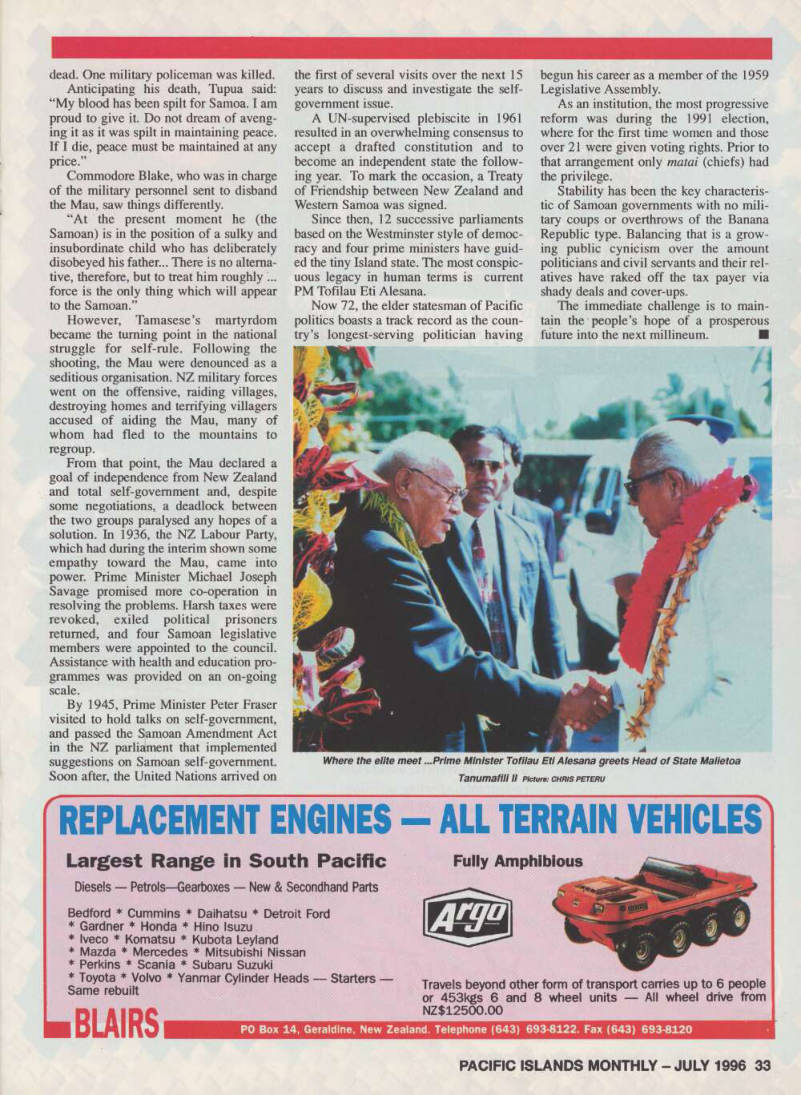
Western Samoan Independence
Remembering the fight for freedom
By Chris Peteru
Independence celebrations are defi nitely not what they used to be in Western Samoa, and last month’s 34th birthday proved no exception. Once the most eagerly awaited event on the social events calander - with floats, long boat races a genuine festive atmosphere, and a feeling of national pride - it now resem bles a day-long sit-down concert for VIPs
and politicians to enjoy.
“This year’s programme was a bit lim ited,” said Telecommunications Minister Tolofuaivalelei Falemoe Leiataua. “We plan to have some special things for next year. We want to bring back some of the features which used to make our Independence Day special.”
Many complain that September’s week-long Teuila Tourism Festival that began in 1993 has wiped a lot of the glamour from Samoa’s flag day. Judging by the spectacle, that appears to be the case.
While the celebrations were met with the kind of enthusiasm reserved for a flat tyre on a rainy morning, the events that made Western Samoa the Pacific’s first independent state in 1962 are far more interesting. It began at the outbreak of World War I. Britain asked New Zealand to seize what was then German Samoa a European colony since 1900 following the signing of the Treaty of Berlin between the Germans, Britain and the United States.
So in August 1914, an expeditionary force of 1400 soldiers landed in the capi tal, Apia. In a bloodless takeover the New Zealanders assumed control - making Samoa the first enemy territory to be cap tured by the Allied forces.
A military government under Colonel Robert Logan (who soon became gover nor) was installed, and it was there that problems began in earnest. As with the Germans, the Samoans and part-
Europeans became increasingly frustrated
with what they viewed as colonial arro gance and paternalism by the New Zealanders.
In 1918, the steamer Talune arrived from Auckland and docked at Matautu wharf. On board was an influenza epe demic but despite prior knowledge of the condition, the New Zealand authorities failed to order any quarantine measures.
Eventually, one in five Samoans (popula tion 38,000) died. Strangely, Governor Logan refused offers of medical assis tance from neighbouring American Samoa to the point of breaking off radio transmission and ordered a temporary hospital set up by volunteers in Apia shut down. Although quarantine measures had been imposed when the Talune docked in
Fiji, Logan consistently denied any
responsibility for the influenza epidemic spreading to the islands.
Attempts to improve health facilities following the debacle were carried out, but by 1926 the poor impression Samoans and part-Europeans held of Logan and successive New Zealand administrators, led to the formation of the O le Mau (Samoan League) a national lobby group.
Led by Tupua Tamasese Lealofi, Tuimaleali’ifano Si’u, and Taisi O F Nelson, the Mau took the motto of Samoa mo Samoa (Samoa for Samoans), and an action plan of non-co-operation with the New Zealand administration.
The main cause of the defiance was an ordinance that allowed officials wide ranging power over village chiefs. This included the authority to remove their titles and banish them to all parts of the
empire. Following that policy between
1921-26, 53 chiefs were shipped out of Western Samoa. Simply put, the ordi nance was designed to destabilise the cor nerstone of the Samoan culture by a regu lated system of cultural genocide and racism. Four years of peaceful resistance were shattered on Christmas Day, 1929, when an unarmed demonstration through Apia was fired on by government troops.
Tupua Tamasese and 10 others were shot
dead. One military policeman was killed.
Anticipating his death, Tupua said: “My blood has been spilt for Samoa. I am proud to give it. Do not dream of aveng ing it as it was spilt in maintaining peace.
If I die, peace must be maintained at any price.”
Commodore Blake, who was in charge of the military personnel sent to disband the Mau, saw things differently.
“At the present moment he (the Samoan) is in the position of a sulky and insubordinate child who has deliberately disobeyed his father... There is no alterna tive, therefore, but to treat him roughly ... force is the only thing which will appear to the Samoan.”
However, Tamasese’s martyrdom became the turning point in the national struggle for self-rule. Following the shooting, the Mau were denounced as a seditious organisation. NZ military forces went on the offensive, raiding villages, destroying homes and terrifying villagers accused of aiding the Mau, many of whom had fled to the mountains to regroup.
From that point, the Mau declared a goal of independence from New Zealand and total self-government and, despite some negotiations, a deadlock between the two groups paralysed any hopes of a solution. In 1936, the NZ Labour Party, which had during the interim shown some empathy toward the Mau, came into power. Prime Minister Michael Joseph Savage promised more co-operation in resolving the problems. Harsh taxes were revoked, exiled political prisoners returned, and four Samoan legislative members were appointed to the council.
Assistance with health and education pro grammes was provided on an on-going scale.
By 1945, Prime Minister Peter Fraser visited to hold talks on self-government, and passed the Samoan Amendment Act in the NZ parliament that implemented suggestions on Samoan self-government.
Soon after, the United Nations arrived on
the first of several visits over the next 15 years to discuss and investigate the self government issue.
A UN-supervised plebiscite in 1961 resulted in an overwhelming consensus to accept a drafted constitution and to become an independent state the follow ing year. To mark the occasion, a Treaty of Friendship between New Zealand and Western Samoa was signed.
Since then, 12 successive parliaments based on the Westminster style of democ racy and four prime ministers have guid ed the tiny Island state. The most conspic uous legacy in human terms is current PM Tofilau Eti Alesana.
Now 72, the elder statesman of Pacific politics boasts a track record as the coun try’s longest-serving politician having
begun his career as a member of the 1959
Legislative Assembly.
As an institution, the most progressive reform was during the 1991 election, where for the first time women and those over 21 were given voting rights. Prior to that arrangement only matai (chiefs) had
the privilege.
Stability has been the key characteris tic of Samoan governments with no mili tary coups or overthrows of the Banana Republic type. Balancing that is a grow ing public cynicism over the amount politicians and civil servants and their rel atives have raked off the tax payer via shady deals and cover-ups.
The immediate challenge is to main tain the people’s hope of a prosperous future into the next millineum. ■
Where the elite meet ...Prime Minister Tofilau Eti Alesana greets Head of State Malietoa Tanumafili II picture: CHRIS PETERU
Advertisements & other items, pp. 33-34 (1 item)
L Blairs
REPLACEMENT ENGINES - ALL TERRAIN VEHICLES!
Largest Range in South Pacific
Diesels Petrols—Gearboxes New & Secondhand Parts Bedford * Cummins * Daihatsu * Detroit Ford * Gardner ♦ Honda * Hino Isuzu * Iveco * Komatsu * Kubota Leyland * Mazda * Mercedes * Mitsubishi Nissan * Perkins * Scania * Subaru Suzuki * Toyota * Volvo * Yanmar Cylinder Heads Starters Same rebuilt
Fully Amphibious
777 Travels beyond other form of transport carries up to 6 people or 453kgs 6 and 8 wheel units All wheel drive from
L BLAIRS
NZ512500.00 PO Box 14, Geraldine, New Zealand. Telephone (643) 693-8122. Fax (643) 693-8120
/ 4 v'- * ms * ■ '! m \ ,(■ *'> ' S
; VANUATU
V Santo
iRALIA
I cy>rt Vila I
S VlLflanna"' • N * a^iW
jZ?V—
oumca {jjtC ' y -■—
&s®ai
Li
|CALEDONIA
1 ✓ / *.
Auckland v
U) htM c~*
cCwA yvKorg ,*.
Where would yoiTfmd beautiful
beaches, coconut palms and clear
tropical water? ~*m*L
Where would you find such
a variety of resorts, world class
restaurants, sporting activities,
a casino and night life?
wf^d^^Rmcfttlive
vTJfRmo and ancient custom villages
fresh grown market produce
and some of the friendliest people
you’ll ever meet?
Where?
Vanuatu, that’s where.
AIR VANUATU RESERVATIONS AND SALES OFFICES:
PORT VILA
Tel: (678) 23838 Fax: (678) 23250.
SANTO
Tel: (678) 36429.
SYDNEY
Tel: (612) 223 8333 or (0800) 80 3330 Fax: (612) 223 8781.
BRISBANE
Tel: (B 12) 3221 2566 Fax: (612) 3221 3967.
MELBOURNE
Tel: (613) 9417 3977 Fax: (613) 9417 5977.
AUCKLAND
Tel: (649) 373 3435 Fax: (649) 358 1413.
NOUMEA
Tel: (678) 28 66 77 Fax: (678) 27 40 50
NADI
Tel: (679) 722521
SUVA
Tel: (679) 314666
NATIONAL TOURISM OFFICE
OF VANUATU
PORT VILA
Tel: (678) 22685 Fax: (678) 23889. r
THE NATIONAL TOURISM
OFFICE OF VANUATU
AIR VANUATU
fahaititr fxMj,.
M AB 4 E 10160
s\ A \ / \
Heading back
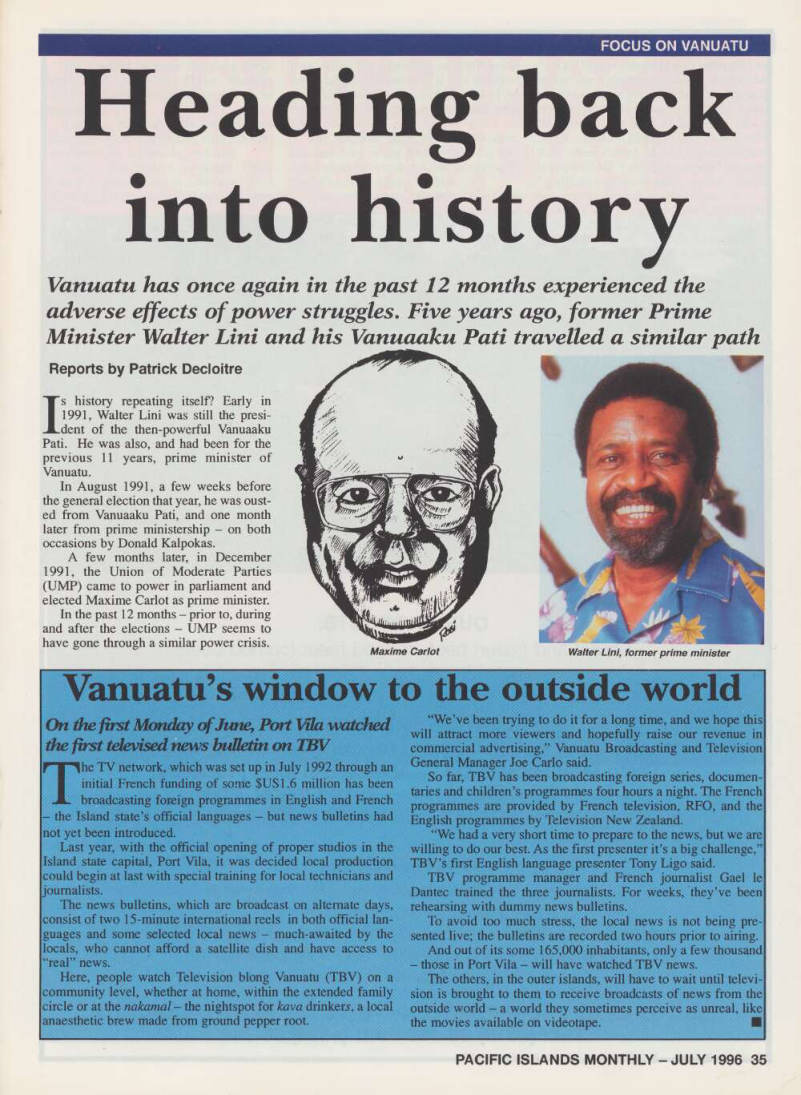

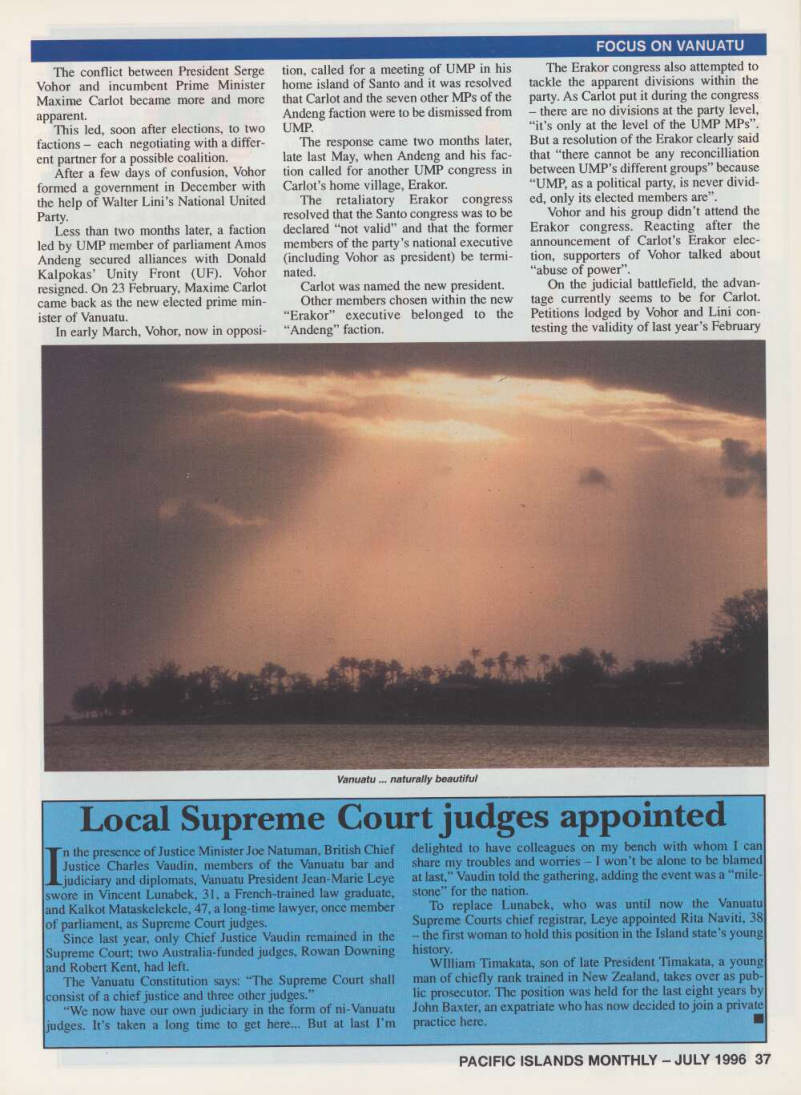

Focus On Vanuatu
Heading back into history
Vanuatu has once again in the past 12 months experienced the adverse effects of power struggles . Five years ago, former Prime Minister Walter Lini and his Vanuaaku Pati travelled a similar path
Reports by Patrick Decloitre
Is history repeating itself? Early in
1991, Walter Lini was still the presi dent of the then-powerful Vanuaaku Pati. He was also, and had been for the previous 11 years, prime minister of Vanuatu.
In August 1991, a few weeks before the general election that year, he was oust ed from Vanuaaku Pati, and one month later from prime ministership - on both occasions by Donald Kalpokas.
A few months later, in December 1991, the Union of Moderate Parties (UMP) came to power in parliament and elected Maxime Carlot as prime minister.
In the past 12 months - prior to, during and after the elections - UMP seems to have gone through a similar power crisis.
Maxime Carlot
Walter Lini, former prime minister
The conflict between President Serge Vohor and incumbent Prime Minister Maxirae Carlot became more and more apparent.
This led, soon after elections, to two factions - each negotiating with a differ ent partner for a possible coalition.
After a few days of confusion, Vohor formed a government in December with the help of Walter Lini’s National United Party.
Less than two months later, a faction led by UMP member of parliament Amos Andeng secured alliances with Donald Kalpokas’ Unity Front (UF). Vohor resigned. On 23 February, Maxime Carlot came back as the new elected prime min ister of Vanuatu.
In early March, Vohor, now in opposi
tion, called for a meeting of UMP in his home island of Santo and it was resolved that Carlot and the seven other MPs of the Andeng faction were to be dismissed from
Ump.
The response came two months later. late last May, when Andeng and his fac tion called for another UMP congress in Carlot’s home village, Erakor.
The retaliatory Erakor congress resolved that the Santo congress was to be declared “not valid” and that the former members of the party’s national executive (including Vohor as president) be termi nated.
Carlot was named the new president.
Other members chosen within the new “Erakor” executive belonged to the “Andeng” faction.
The Erakor congress also attempted to tackle the apparent divisions within the party. As Carlot put it during the congress - there are no divisions at the party level, “it’s only at the level of the UMP MPs”.
But a resolution of the Erakor clearly said that there cannot be any reconcilliation between UMP s different groups because “UMP, as a political party, is never divid ed, only its elected members are”.
Vohor and his group didn t attend the Erakor congress. Reacting after the announcement of Carlot’s Erakor elec tion, of Vohor talked about “abuse of power .
On the judicial battlefield, the advan tage currently seems to be for Carlot.
Petitions lodged by Vohor and Lini con testing the validity of last year s February
Vanuatu... naturally beautiful
23 parliamentary sitting seem to have been dismissed by Vanuatu’s Supreme Court.
More recently, before the Erakor congress, the Vohor side asked the court to rule whether the Erakor congress was
valid or not. But they finally withdrew their case because, upon request from the Andeng side, it was to be heard after the congress had taken place. The Supreme Court has to decide which faction of the UMP has the right to use the name, UMP,
its colours, logo and emblem.
The matter was first heard on June 12 by the newly appointed Justice Vincent Lunabek and should be heard again on July 22. ■
A leap of faith... a young land diver is about to make the plunge with the support of a carefully measured liana vine around his ankle
Vanuatu’s window to the outside world
On the first Monday of June, Port Vila watched the first televised news bulletin on TBV The TV network, which was set up in July 1992 through an initial French funding of some SUS 1.6 million has been broadcasting foreign programmes in English and French - the Island state’s official languages - but news bulletins had not yet been introduced.
Last year, with the official opening of proper studios in the Island state capital. Port Vila, it was decided local production could begin at last with special training for local technicians and journalists.
The news bulletins, which are broadcast on alternate days, consist of two 15-minute international reels in both official lan guages and some selected local news - much-awaited by the locals, who cannot afford a satellite dish and have access to “real” news.
Here, people watch Television blong Vanuatu (TBV) on a community level, whether at home, within the extended family circle or at the nakamal - the nightspot for kava drinkers, a local anaesthetic brew made from ground pepper root.
“We’ve been trying to do it for a long time, and we hope this will attract more viewers and hopefully raise our revenue in commercial advertising,” Vanuatu Broadcasting and Television General Manager Joe Carlo said.
So far, TBV has been broadcasting foreign series, documen taries and children’s programmes four hours a night. The French programmes are provided by French television, RFO, and the English programmes by Television New Zealand.
“We had a very short time to prepare to the news, but we are willing to do our best. As the first presenter it’s a big challenge,”
TBV’s first English language presenter Tony Ligo said.
TBV programme manager and French journalist Gael le Dan tec trained the three journalists. For weeks, they’ve been rehearsing with dummy news bulletins.
To avoid too much stress, the local news is not being pre sented live; the bulletins are recorded two hours prior to airing.
And out of its some 165,000 inhabitants, only a few thousand - those in Port Vila - will have watched TBV news.
The others, in the outer islands, will have to wait until televi sion is brought to them to receive broadcasts of news from the outside world - a world they sometimes perceive as unreal, like the movies available on videotape. ■
Advertisements & other items, p. 36 (1 item)
m
=- - , " .. ai j- ■ 3: ft' iiaii A HM
OUR PRODUCTS:
Chilled and frozen beef, canned meat (corned beef), meat bone meal, tallow oil.
RELATIVE ENTERPRISES:
Nitchiku (Vanuatu) Ltd. Cattle Ranching and Copra Plantation Santo Meat Packers Ltd Abattoir and Meat Processing Santo Meat Export Ltd. Export mainly Japan South Pacific Meat Supplies Ltd Wholesale
COMMERCIAL:
Nature Gold brand beef is healthy eating with the flavour of the South Pacific.
Nature Gold brand oeef; really lean meat, produced from beef cattle raised on healthy and safe pastures on Santo Island, Vanuatu.
SANTO MEAT PACKERS LTD., PO BOX 195, SANTO, VANUATU
TEL: (+678) 36-139 FAX: (+678) 36-746
Local Supreme Court judges appointed
In the presence of Justice Minister Joe Natuman, British Chief Justice Charles Vaudin, members of the Vanuatu bar and judiciary and diplomats, Vanuatu President Jean-Marie Leye swore in Vincent Lunabek, 31, a French-trained law graduate, and Kalkot Mataskelekele, 47, a long-time lawyer, once member of parliament, as Supreme Court judges.
Since last year, only Chief Justice Vaudin remained in the Supreme Court; two Australia-funded judges. Rowan Downing and Robert Kent, had left.
The Vanuatu Constitution says; “The Supreme Court shall consist of a chief justice and three other judges.”
“We now have our own judiciary in the form of ni-Vanuatu judges. It’s taken a long time to get here... But at last I’m
delighted to have colleagues on my bench with whom I can share my troubles and worries - I won’t be alone to be blamed at last,” Vaudin told the gathering, adding the event was a “mile stone” for the nation.
To replace Lunabek, who was until now the Vanuatu Supreme Courts chief registrar, Leye appointed Rita Naviti, 38 - the first woman to hold this position in the Island state’s young history.
William Timakata, son of late President Timakata, a young man of chiefly rank trained in New Zealand, takes over as pub lic prosecutor. The position was held for the last eight years by John Baxter, an expatriate who has now decided to join a private practice here. *
Advertisements & other items, p. 38 (1 item)
•n
'O fjjk
TELECOM VANUATU LTD
the national link ikfg; t
TELECOM VANUATU LTD
the international link
TELECOM VANUATU LTD
proud to be at the service of the people of Vanuatu,
wish a happy anniversary
* ■ i# to the Republic. ♦» mini Hi nmi 1 1 f 11, n I,
The return of cultural treasures
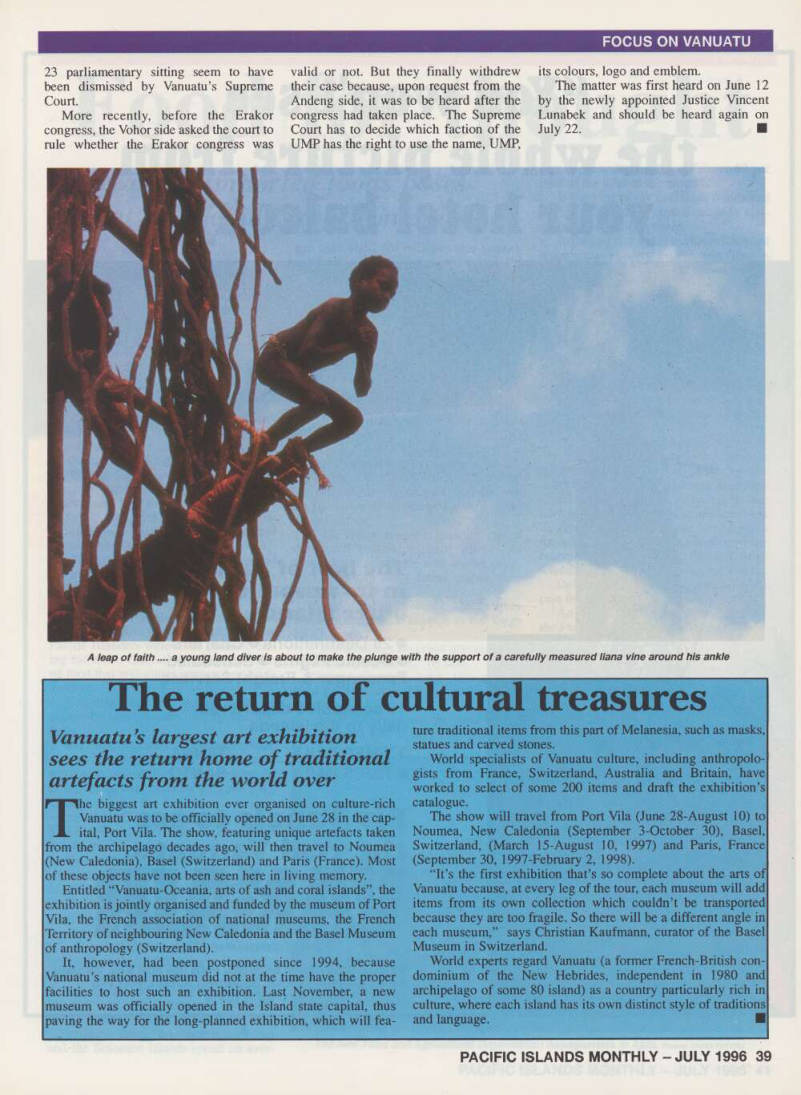
Vanuatu's largest art exhibition sees the return home of traditional artefacts from the world over
The biggest art exhibition ever organised on culture-rich Vanuatu was to be officially opened on June 28 in the cap ital, Port Vila. The show, featuring unique artefacts taken from the archipelago decades ago, will then travel to Noumea (New Caledonia), Basel (Switzerland) and Paris (France). Most of these objects have not been seen here in living memory.
Entitled “Vanuatu-Oceania, arts of ash and coral islands”, the exhibition is jointly organised and funded by the museum of Port Vila, the French association of national museums, the French Territory of neighbouring New Caledonia and the Basel Museum of anthropology (Switzerland).
It, however, had been postponed since 1994, because Vanuatu’s national museum did not at the time have the proper facilities to host such an exhibition. Last November, a new museum was officially opened in the Island state capital, thus paving the way for the long-planned exhibition, which will fea
ture traditional items from this part of Melanesia, such as masks, statues and carved stones.
World specialists of Vanuatu culture, including anthropolo gists from France, Switzerland, Australia and Britain, have worked to select of some 200 items and draft the exhibition’s catalogue.
The show will travel from Port Vila (June 28-August 10) to Noumea, New Caledonia (September 3-October 30), Basel, Switzerland, (March 15-August 10, 1997) and Paris, France (September 30, 1997-February 2, 1998).
“It’s the first exhibition that’s so complete about the arts of Vanuatu because, at every leg of the tour, each museum will add items from its own collection which couldn’t be transported because they are too fragile. So there will be a different angle in each museum,” says Christian Kaufmann, curator of the Basel Museum in Switzerland.
World experts regard Vanuatu (a former French-British con dominium of the New Hebrides, independent in 1980 and archipelago of some 80 island) as a country particularly rich in culture, where each island has its own distinct style of traditions and language. ■
Advertisements & other items, p. 40 (1 item)
your hotel balcony”
“You won't see
the whole picture from
SR, m n U Mfc * UtMkj : <wL SI The pest of Vanuatu lies In its unspoilt outer islands. • 29 Destinations# Charters • Scenic Flights • Scheduled Passenger & Freight Services 10 scheduled departures daily to the islands
3 TIMES DAILY
4 TIMES DAILY
TANNA
SANTO
3? \
Fly Vanair to see
the real Vanuatu.
‘•m (e a ttfut Vanuatu Internal Air Services: PMB 069 Port Vila, Vanuatu Administration Offices: Bauerfield Airport, Port Vila Tel: (678) 22643 Fax: (678) 23910
Food for thought
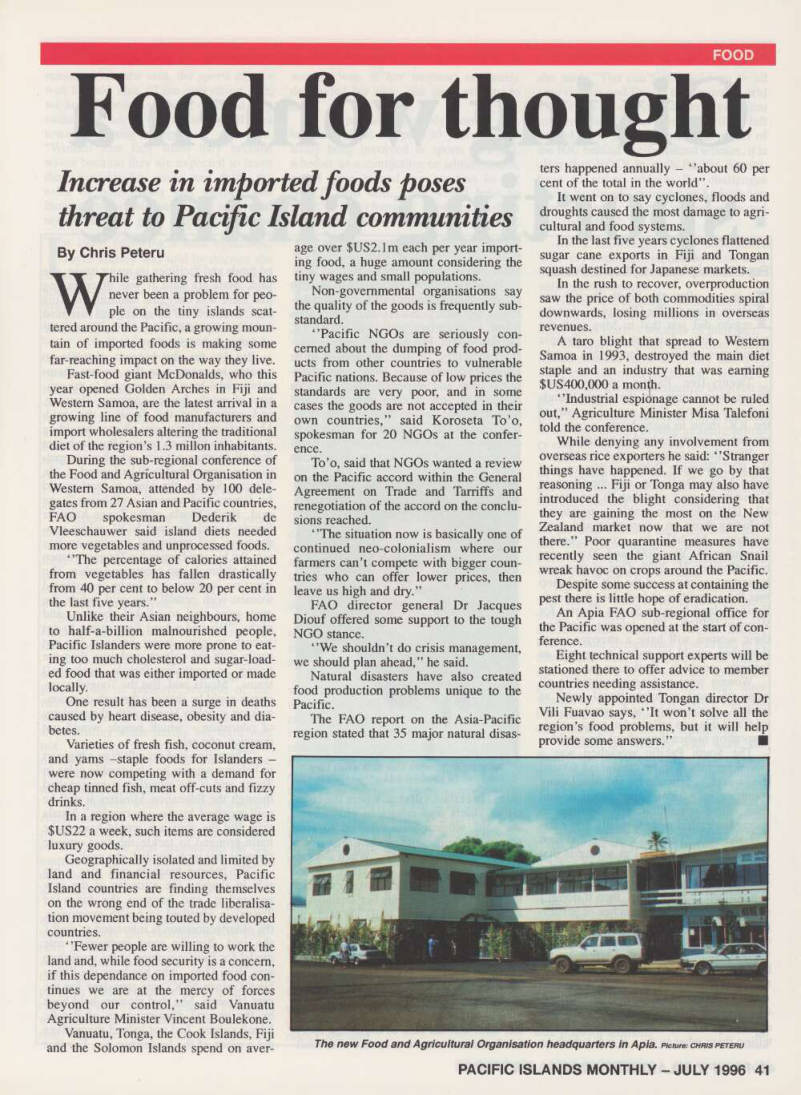
Food
Increase in imported foods poses threat to Pacific Island communities
By Chris Peteru
While gathering fresh food has never been a problem for peo ple on the tiny islands scat tered around the Pacific, a growing moun tain of imported foods is making some far-reaching impact on the way they live.
Fast-food giant McDonalds, who this year opened Golden Arches in Fiji and Western Samoa, are the latest arrival in a growing line of food manufacturers and import wholesalers altering the traditional diet of the region’s 1.3 millon inhabitants.
During the sub-regional conference of the Food and Agricultural Organisation in Western Samoa, attended by 100 dele gates from 27 Asian and Pacific countries, FAO spokesman Dederik de Vleeschauwer said island diets needed more vegetables and unprocessed foods. ‘’The percentage of calories attained from vegetables has fallen drastically from 40 per cent to below 20 per cent in the last five years.”
Unlike their Asian neighbours, home to half-a-billion malnourished people, Pacific Islanders were more prone to eat ing too much cholesterol and sugar-load ed food that was either imported or made locally.
One result has been a surge in deaths caused by heart disease, obesity and dia betes.
Varieties of fresh fish, coconut cream, and yams -staple foods for Islanders were now competing with a demand for cheap tinned fish, meat off-cuts and fizzy drinks.
In a region where the average wage is SUS 22 a week, such items are considered
luxury goods.
Geographically isolated and limited by land and financial resources. Pacific Island countries are finding themselves on the wrong end of the trade liberalisa
tion movement being touted by developed
countries. ‘’Fewer people are willing to work the land and, while food security is a concern, if this dependance on imported food con tinues we are at the mercy of forces beyond our control,” said Vanuatu Agriculture Minister Vincent Boulekone.
Vanuatu, Tonga, the Cook Islands, Fiji and the Solomon Islands spend on aver
age over SUS2.Im each per year import ing food, a huge amount considering the tiny wages and small populations.
Non-govemmental organisations say
the quality of the goods is frequently sub standard. ‘’Pacific NGOs are seriously con cerned about the dumping of food prod ucts from other countries to vulnerable Pacific nations. Because of low prices the standards are very poor, and in some cases the goods are not accepted in their own countries,” said Koroseta To’o, spokesman for 20 NGOs at the confer ence.
To’o, said that NGOs wanted a review on the Pacific accord within the General Agreement on Trade and Taniffs and renegotiation of the accord on the conclu sions reached. ‘ ’The situation now is basically one of continued neo-colonialism where our farmers can’t compete with bigger coun tries who can offer lower prices, then leave us high and dry.”
FAO director general Dr Jacques Diouf offered some support to the tough NGO stance. ‘’We shouldn’t do crisis management, we should plan ahead,” he said.
Natural disasters have also created food production problems unique to the Pacific.
The FAO report on the Asia-Pacific region stated that 35 major natural disas
ters happened annually - ‘’about 60 per cent of the total in the world”.
It went on to say cyclones, floods and droughts caused the most damage to agri cultural and food systems.
In the last five years cyclones flattened sugar cane exports in Fiji and Tongan squash destined for Japanese markets.
In the rush to recover, overproduction saw the price of both commodities spiral downwards, losing millions in overseas revenues.
A taro blight that spread to Western Samoa in 1993, destroyed the main diet staple and an industry that was earning SUS4OO,OOO a monljh. ‘ ’lndustrial espionage cannot be ruled out,” Agriculture Minister Misa Talefoni told the conference.
While denying any involvement from overseas rice exporters he said: ‘’Stranger things have happened. If we go by that reasoning ... Fiji or Tonga may also have introduced the blight considering that they are gaining the most on the New Zealand market now that we are not there.” Poor quarantine measures have recently seen the giant African Snail wreak havoc on crops around the Pacific.
Despite some success at containing the pest there is little hope of eradication.
An Apia FAO sub-regional office for the Pacific was opened at the start of con ference.
Eight technical support experts will be stationed there to offer advice to member countries needing assistance.
Newly appointed Tongan director Dr
Vili Fuavao says, ‘Tt won’t solve all the region’s food problems, but it will help provide some answers.” ■
The new Food and Agricultural Organisation headquarters in Apia. picture: CHRIS PETERU
sporting chance
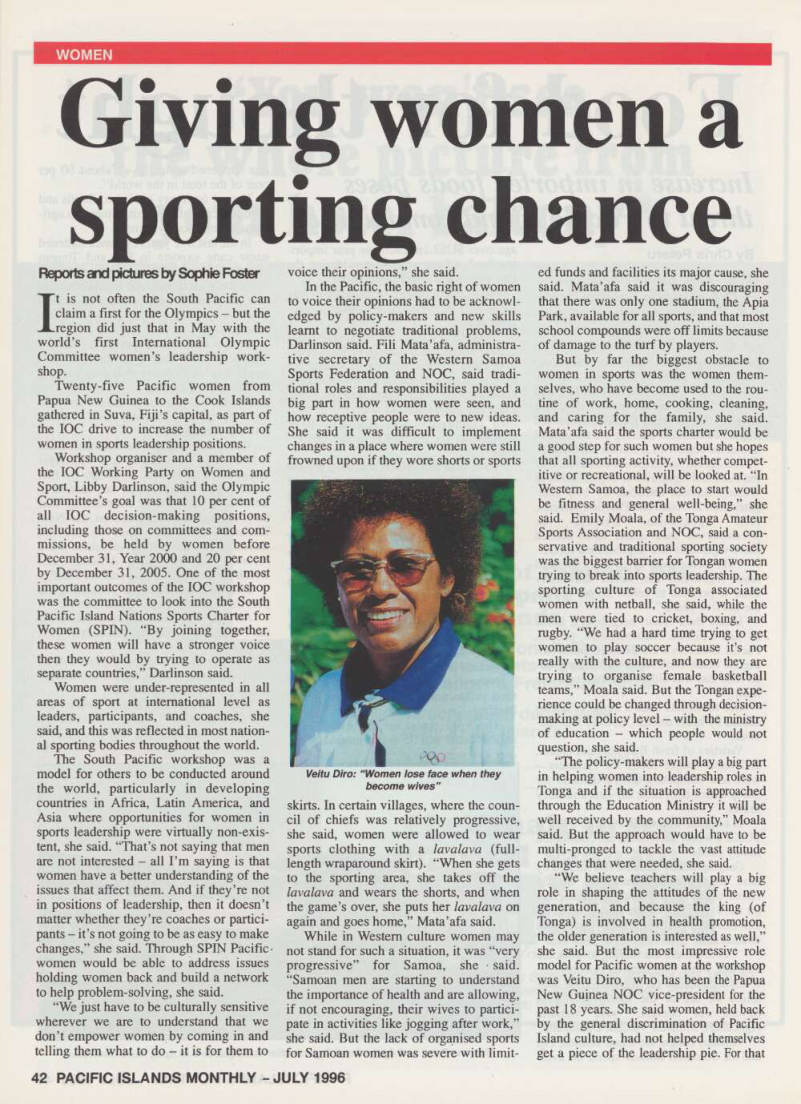
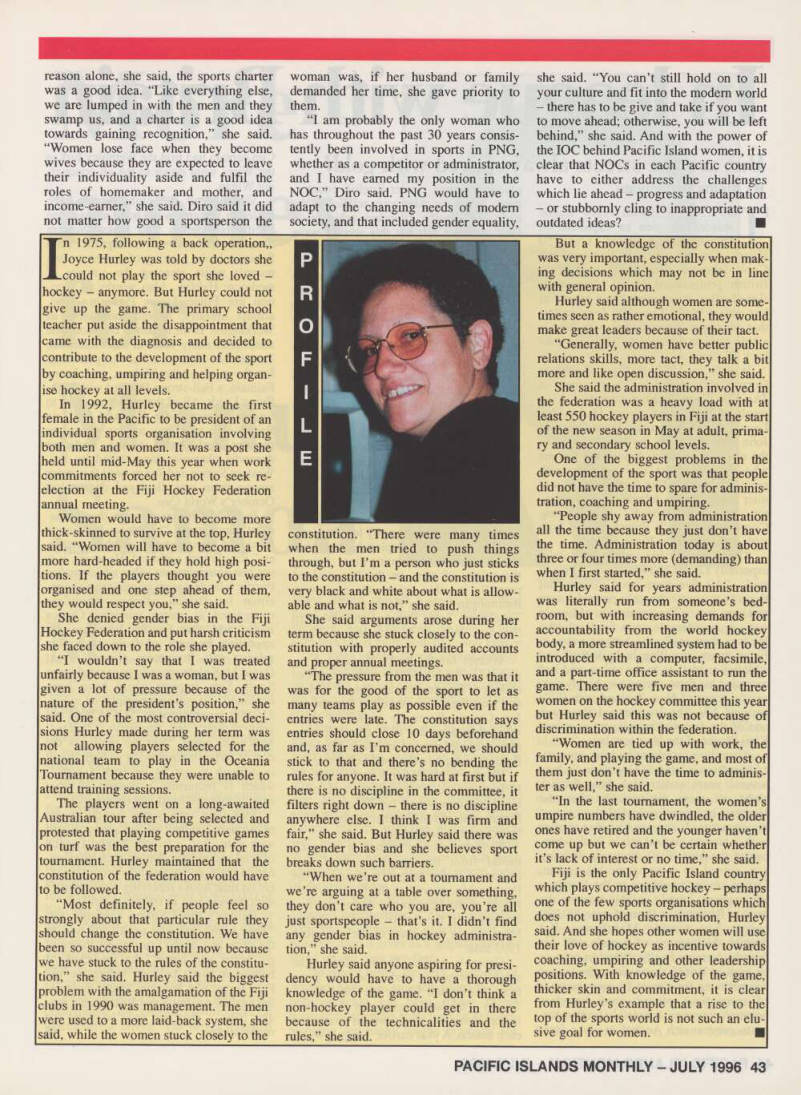
Women
Giving women a sporting chance
Reports and pictures by Sophie Foster
It is not often the South Pacific can claim a first for the Olympics - but the region did just that in May with the world’s first International Olympic Committee women’s leadership work shop.
Twenty-five Pacific women from Papua New Guinea to the Cook Islands gathered in Suva, Fiji’s capital, as part of the lOC drive to increase the number of women in sports leadership positions.
Workshop organiser and a member of the lOC Working Party on Women and Sport, Libby Darlinson, said the Olympic Committee’s goal was that 10 per cent of all lOC decision-making positions, including those on committees and com missions, be held by women before December 31, Year 2000 and 20 per cent by December 31, 2005. One of the most important outcomes of the lOC workshop was the committee to look into the South Pacific Island Nations Sports Charter for Women (SPIN). “By joining together, these women will have a stronger voice then they would by trying to operate as separate countries,” Darlinson said.
Women were under-represented in all areas of sport at international level as leaders, participants, and coaches, she said, and this was reflected in most nation al sporting bodies throughout the world.
The South Pacific workshop was a model for others to be conducted around the world, particularly in developing countries in Africa, Latin America, and Asia where opportunities for women in sports leadership were virtually non-exis tent, she said. “That’s not saying that men are not interested - all I’m saying is that women have a better understanding of the issues that affect them. And if they’re not in positions of leadership, then it doesn’t matter whether they’re coaches or partici pants - it’s not going to be as easy to make changes,” she said. Through SPIN Pacific women would be able to address issues holding women back and build a network to help problem-solving, she said.
“We just have to be culturally sensitive wherever we are to understand that we don’t empower women by coming in and telling them what to do - it is for them to
voice their opinions,” she said.
In the Pacific, the basic right of women to voice their opinions had to be acknowl edged by policy-makers and new skills learnt to negotiate traditional problems, Darlinson said. Fili Mata’afa, administra tive secretary of the Western Samoa Sports Federation and NOC, said tradi tional roles and responsibilities played a big part in how women were seen, and how receptive people were to new ideas.
She said it was difficult to implement changes in a place where women were still frowned upon if they wore shorts or sports
skirts. In certain villages, where the coun cil of chiefs was relatively progressive, she said, women were allowed to wear sports clothing with a lavalava (full length wraparound skirt). “When she gets to the sporting area, she takes off the lavalava and wears the shorts, and when the game’s over, she puts her lavalava on again and goes home,” Mata’afa said.
While in Western culture women may not stand for such a situation, it was “very progressive” for Samoa, she ■ said.
“Samoan men are starting to understand the importance of health and are allowing, if not encouraging, their wives to partici pate in activities like jogging after work,” she said. But the lack of organised sports for Samoan women was severe with limit
ed funds and facilities its major cause, she said. Mata’afa said it was discouraging that there was only one stadium, the Apia Park, available for all sports, and that most school compounds were off limits because of damage to the turf by players.
But by far the biggest obstacle to women in sports was the women them selves, who have become used to the rou tine of work, home, cooking, cleaning, and caring for the family, she said.
Mata’afa said the sports charter would be a good step for such women but she hopes that all sporting activity, whether compet itive or recreational, will be looked at. “In Western Samoa, the place to start would be fitness and general well-being,” she said. Emily Moala, of the Tonga Amateur Sports Association and NOC, said a con servative and traditional sporting society was the biggest barrier for Tongan women trying to break into sports leadership. The sporting culture of Tonga associated women with netball, she said, while the men were tied to cricket, boxing, and rugby. “We had a hard time trying to get women to play soccer because it’s not really with the culture, and now they are trying to organise female basketball teams,” Moala said. But the Tongan expe rience could be changed through decision making at policy level - with the ministry of education - which people would not question, she said.
“The policy-makers will play a big part in helping women into leadership roles in Tonga and if the situation is approached through the Education Ministry it will be well received by the community,” Moala said. But the approach would have to be multi-pronged to tackle the vast attitude changes that were needed, she said.
“We believe teachers will play a big role in shaping the attitudes of the new
generation, and because the king (of
Tonga) is involved in health promotion, the older generation is interested as well,” she said. But the most impressive role model for Pacific women at the workshop was Veitu Diro, who has been the Papua New Guinea NOC vice-president for the past 18 years. She said women, held back by the general discrimination of Pacific Island culture, had not helped themselves get a piece of the leadership pie. For that
Veitu Diro: “Women lose face when they become wives”
reason alone, she said, the sports charter was a good idea. “Like everything else, we are lumped in with the men and they swamp us, and a charter is a good idea towards gaining recognition,” she said, “Women lose face when they become wives because they are expected to leave their individuality aside and fulfil the roles of homemaker and mother, and income-earner,” she said. Diro said it did not matter how good a sportsperson the
woman was, if her husband or family demanded her time, she gave priority to them.
“I am probably the only woman who has throughout the past 30 years consistently been involved in sports in PNG, whether as a competitor or administrator, and I have earned my position in the NOC,” Diro said. PNG would have to adapt to the changing needs of modem
society, and that included gender equality,
she said. “You can’t still hold on to all your culture and fit into the modem world - there has to be give and take if you want to move ahead; otherwise, you will be left behind,” she said. And with the power of the lOC behind Pacific Island women, it is clear that NOCs in each Pacific country have to either address the challenges which lie ahead - progress and adaptation - or stubbornly cling to inappropriate and outdated ideas? ■
In 1975, following a back operation,, Joyce Hurley was told by doctors she could not play the sport she loved hockey - anymore. But Hurley could not give up the game. The primary school teacher put aside the disappointment that came with the diagnosis and decided to contribute to the development of the sport
by coaching, umpiring and helping organ
ise hockey at all levels.
In 1992, Hurley became the first female in the Pacific to be president of an
individual sports organisation involving
both men and women. It was a post she held until mid-May this year when work commitments forced her not to seek re election at the Fiji Hockey Federation
annual meeting.
Women would have to become more thick-skinned to survive at the top. Hurley said. “Women will have to become a bit more hard-headed if they hold high posi tions. If the players thought you were organised and one step ahead of them, they would respect you,” she said.
She denied gender bias in the Fiji Hockey Federation and put harsh criticism she faced down to the role she played.
“I wouldn’t say that I was treated unfairly because I was a woman, but I was given a lot of pressure because of the nature of the president’s position,” she said. One of the most controversial deci sions Hurley made during her term was not allowing players selected for the national team to play in the Oceania Tournament because they were unable to attend training sessions.
The players went on a long-awaited Australian tour after being selected and
protested that playing competitive games
on turf was the best preparation for the tournament. Hurley maintained that the constitution of the federation would have to be followed.
“Most definitely, if people feel so
strongly about that particular rule they
should change the constitution. We have been so successful up until now because we have stuck to the rules of the constitu tion,” she said. Hurley said the biggest problem with the amalgamation of the Fiji clubs in 1990 was management. The men were used to a more laid-back system, she said, while the women stuck closely to the
constitution. “There were many times when the men tried to push things through, but I’m a person who just sticks to the constitution - and the constitution is very black and white about what is allow able and what is not,” she said.
She said arguments arose during her term because she stuck closely to the con stitution with properly audited accounts and proper annual meetings.
“The pressure from the men was that it was for the good of the sport to let as many teams play as possible even if the entries were late. The constitution says entries should close 10 days beforehand and, as far as I’m concerned, we should stick to that and there’s no bending the rules for anyone. It was hard at first but if there is no discipline in the committee, it filters right down - there is no discipline anywhere else. I think I was firm and fair,” she said. But Hurley said there was no gender bias and she believes sport breaks down such barriers.
“When we’re out at a tournament and we’re arguing at a table over something, they don’t care who you are, you’re all just sportspeople - that’s it. I didn’t find any gender bias in hockey administra tion,” she said.
Hurley said anyone aspiring for presi
dency would have to have a thorough knowledge of the game. “I don’t think a non-hockey player could get in there because of the technicalities and the rules,” she said.
But a knowledge of the constitution was very important, especially when mak ing decisions which may not be in line
with general opinion.
Hurley said although women are some times seen as rather emotional, they would make great leaders because of their tact.
“Generally, women have better public relations skills, more tact, they talk a bit more and like open discussion,” she said.
She said the administration involved in the federation was a heavy load with at least 550 hockey players in Fiji at the start of the new season in May at adult, prima ry and secondary school levels.
One of the biggest problems in the development of the sport was that people did not have the time to spare for adminis
tration, coaching and umpiring.
“People shy away from administration all the time because they just don’t have the time. Administration today is about three or four times more (demanding) than when I first started,” she said.
Hurley said for years administration was literally run from someone’s bed room, but with increasing demands for accountability from the world hockey body, a more streamlined system had to be introduced with a computer, facsimile, and a part-time office assistant to run the game. There were five men and three women on the hockey committee this year but Hurley said this was not because of discrimination within the federation.
“Women are tied up with work, the family, and playing the game, and most of them just don’t have the time to adminis ter as well,” she said.
“In the last tournament, the women’s umpire numbers have dwindled, the older ones have retired and the younger haven’t come up but we can’t be certain whether it’s lack of interest or no time,” she said.
Fiji is the only Pacific Island country
which plays competitive hockey - perhaps
one of the few sports organisations which does not uphold discrimination, Hurley said. And she hopes other women will use their love of hockey as incentive towards
coaching, umpiring and other leadership
positions. With knowledge of the game, thicker skin and commitment, it is clear from Hurley’s example that a rise to the top of the sports world is not such an elu sive goal for women. ■
Profile
In league with Britain
Sports
But are the streets always paved with gold?
By Atama Raganivatu
The 1995-96 British rugby league
season has seen an explosion of Pacific Island talent. Over 50 Fijians, Tongans, Western Samoans and Cook Islanders are now attached to British professional clubs. Many were signed after showcasing their talents at last year’s World Cup. But few realise that our region’s association with the 13a-side code in its country of origin goes back 35 years.
It was in 1961 that the Rochdale Hornets club placed an advertisement in The Fiji Times seeking recruits. As a result of that insert, Orissi Dawai, Joe Levula, Laitia Ravouvou, Voate Driu and John Ravitale made the long journey to the north of England. Among the legions who remember the five pioneers with great affection is Ray French. Now pre mier rugby league television commenta tor of the British Broadcasting Corporation (BBC), French played both with and against the Fijian quintet.
“They made a big impact in Britain, especially Levula and Ravouvou,” French said. “All five were good players, but those two were extremely powerful men and very fast.” The acquisition of Levula was a considerable coup for Rochdale.
He was then easily the biggest name in Fijian sport; excelling in basketball and athletics as well as rugby union, and had extended his fame during two highly suc cessful tours of New Zealand with Fiji’s national XV. The long-legged flyer was one of the few visiting players to gain a Kiwi Player of the Year accolade.
Australia’s immigration laws prevent ed him from joining St George in Sydney several years earlier and three English clubs, all more distinguished than the Hornets, had previously failed to secure his signature. It appeared he was content with a modest clerical job in Nadi when, out of the blue, Fiji’s favourite sporting son agreed to accompany his cousin, Dawai, on an adventure to the Northern Hemisphere. Levula quickly became the toast of Rochdale, a town of over 200,000 people just outside Manchester. But despite the success of Levula and his friends, no more Pacific Islanders were to be seen in British domestic rugby league competitions for almost 20 years because of restrictions placed upon transfers
between countries; ostensibly implement
ed to prevent rich Australian clubs from
plundering their poorer English counter parts. When the rules were relaxed in the early 80s, Pacific Islanders again made their presence felt but this second wave consisted of players with established cre dentials in New Zealand. The first to gain major honours was Western Samoan James Leuluai. Hull won both of British rugby league’s top prizes - the Challenge Cup and Championship - during his stint with them. Fred Ah Koi arrived at Hull three years after Leuluai, and played in rugby league’s greatest annual occasion the Challenge Cup final. In the 1985 event. Ah Koi and Leuluai appeared for the Hull side, which lost an epic encounter to Wigan 28-24.
Another Samoan, Mark Elia, was unluckier two years later. He scored a try and had another controversially disal lowed as his St Helens side lost by a sin gle point to Halifax at Wembley. 1987 saw Wigan commence the most pro longed and comprehensive period of domination in British rugby league histo ry. They won the championship that year and in seven of the ensuing nine. Among the galaxy of stars on the Roversiders’ payroll in this glorious era were Rarotongan brothers Kevin and Tony Iro, Tokelauan Sam Panapa and Western Samoans Va’aiga Tuigamala and Shem Tatupu.
Widnes briefly broke Wigan’s stran glehold in the late 1980 s with a team that included Tongan cousins Emosi Koloto and Kurt Sorensen, as well as Rarotongan Joe Grima. Sorensen captained them when they won the 1989 Championship and later defeated Australia’s Canberra Raiders to capture the world club title.
Playing with Wigan’s arch rivals, St Helens proved a frustrating and often humbling experience for Tokelauan Tea Ropati, one of four brothers to be fielded
by prominent British clubs.
Nevertheless, he gained a winner’s medal from the country’s third-most
important rugby league tournament, the
Premiership, as well as the First Division Player of the Year award during his five seasons with the Saints. Tongan George Mann was a teammate in the victorious 1993 side.
George’s cousin, Duane Mann, pos sesses a winner’s medal too. His came
from Warrington lifting the 1991 Regal
Trophy - the least prestigious of the four
major domestic competitions contested
each season. A year earlier, Tonga’s World
Cup captain had trod the Wembley turf as the Wires went down to the all-conquer
ing Wigan.
Virtually all the clubs which have trailed in Wigan’s wake boast at least one Pacific Islander in their ranks. Western Samoan national team captain John Schuster broke a string of points scoring records while wearing the colours of mediocre Halifax. Also worthy of men tion are Fijian James Pickering who, almost literally, moved mountains as Workington Town regained Division One status after many years in the wilderness; Tongan Lee Hansen, a stalwart performer for the now lowly Widnes, and Esene Faimalo, a bull-strong forward with high flying Leeds. All of these players came to England from New Zealand and no British club made any serious attempt to procure performers in the fledgling
domestic championships staged by Fiji,
Western Samoa and Tonga until the cream among them was displayed during last October’s World Cup.
Pacific Island teams were the tourna ment’s revelations. “I can’t say how much I enjoyed commentating on their match es,” Ray French enthused. However, it is not just entertainment value which makes Pacific Islanders such an attractive propo sition for British coaches. They are recognised as match winners. Cynics might add that Pacific Islanders are appealing because of their often low salaries too. Prominent players’ agent David McKnight recently suggested some South Seas imports could have been exploited. “If you are unemployed in Fiji, £lO,OOO (approximately SUS 15,000) per year seems an attractive figure,”
McKnight noted. “But the reality is the cost of living in England is so high that it is difficult to get by on such a sum which is frequently a quarter of what equally talented local players receive.”
McKnight, then, warns that the streets of northern England are not always paved with gold. But, a British Rugby League official assured me that no such discrimi nation exists and most clubs provide play ers on their books receiving small salaries with outside jobs to bolster incomes.”
Halifax’s Steve Simms confirms this.
“Their home countries are all still new to the game and, as the years go by, they will get better and better,” he predicted. “I believe it won’t be long before we see Fiji, Tonga and Western Samoa compet ing against Australia and Britain on a reg ular basis. That can only be good for
rugby league.” ■
money
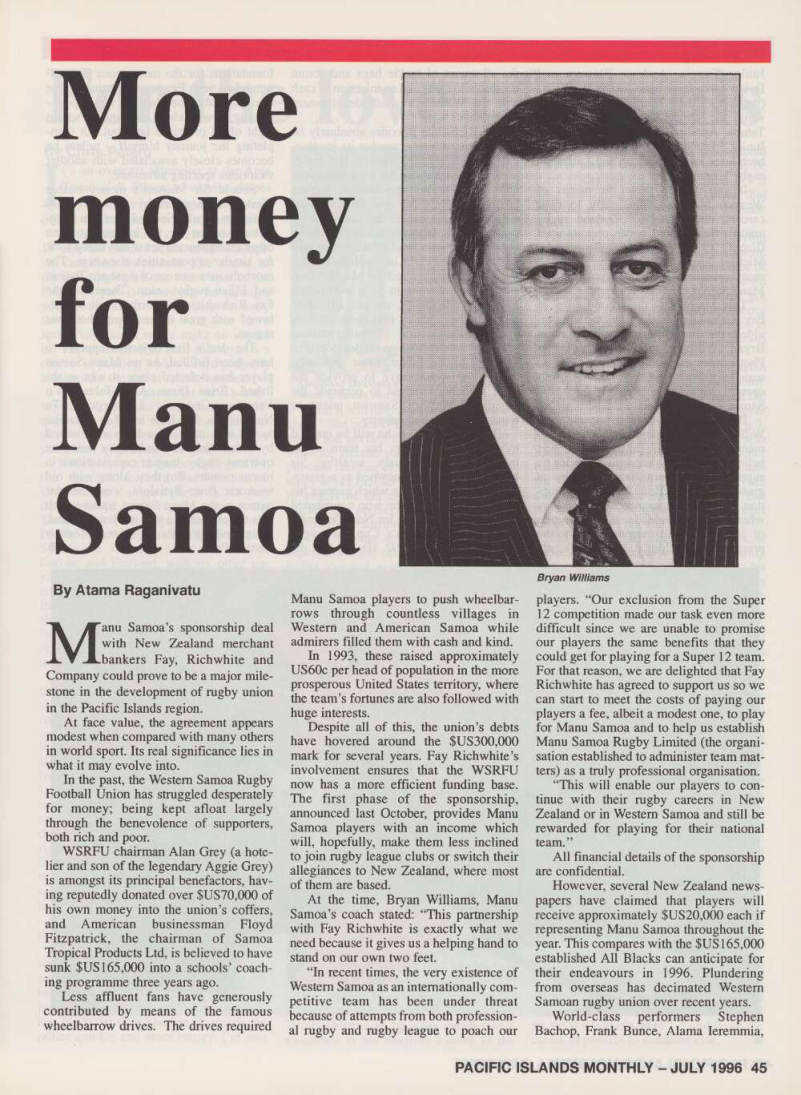
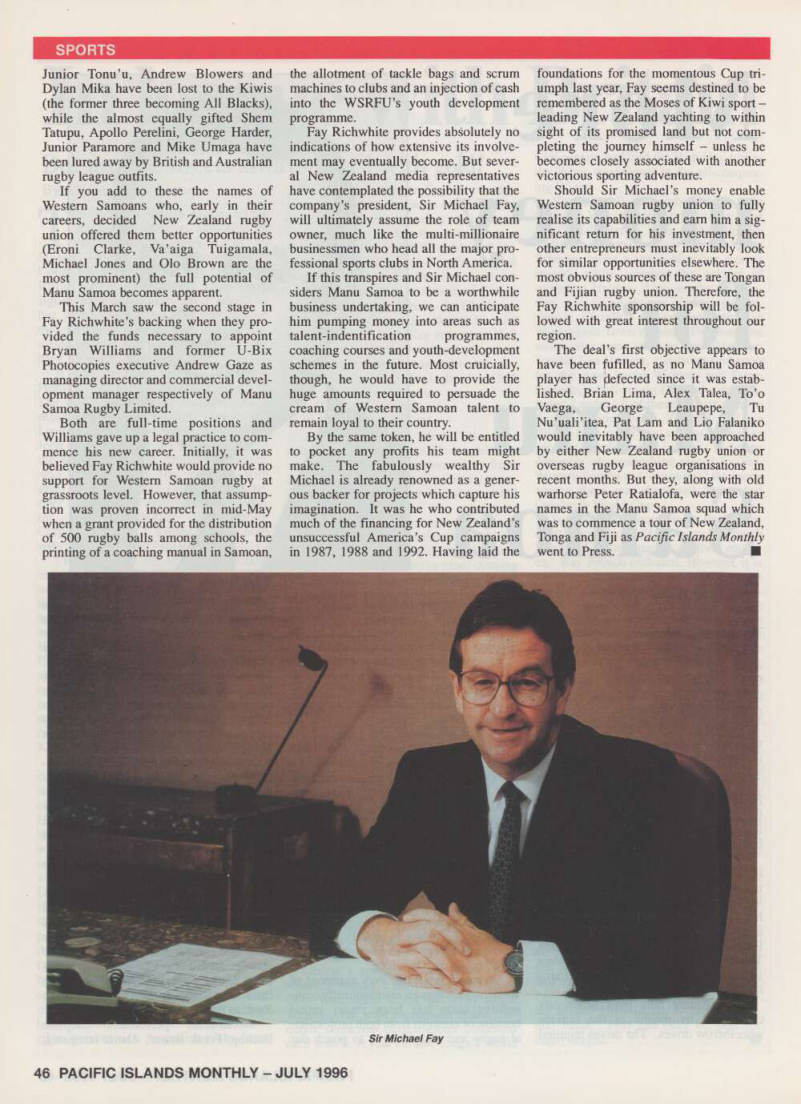
More money for Manu Samoa
By Atama Raganivatu
Manu Samoa’s sponsorship deal with New Zealand merchant bankers Fay, Richwhite and Company could prove to be a major mile stone in the development of rugby union in the Pacific Islands region.
At face value, the agreement appears modest when compared with many others in world sport. Its real significance lies in what it may evolve into.
In the past, the Western Samoa Rugby Football Union has struggled desperately for money; being kept afloat largely through the benevolence of supporters, both rich and poor.
WSRFU chairman Alan Grey (a hote lier and son of the legendary Aggie Grey) is amongst its principal benefactors, hav ing reputedly donated over SUS7O,OOO of his own money into the union’s coffers, and American businessman Floyd Fitzpatrick, the chairman of Samoa Tropical Products Ltd, is believed to have sunk SUS 165,000 into a schools’ coach ing programme three years ago.
Less affluent fans have generously contributed by means of the famous wheelbarrow drives. The drives required
Manu Samoa players to push wheelbar rows through countless villages in Western and American Samoa while admirers filled them with cash and kind.
In 1993, these raised approximately US6Oc per head of population in the more prosperous United States territory, where the team’s fortunes are also followed with huge interests.
Despite all of this, the union’s debts have hovered around the SUS3OO,OOO mark for several years. Fay Richwhite’s involvement ensures that the WSRFU now has a more efficient funding base.
The first phase of the sponsorship, announced last October, provides Manu Samoa players with an income which will, hopefully, make them less inclined to join rugby league clubs or switch their allegiances to New Zealand, where most of them are based.
At the time, Bryan Williams, Manu Samoa’s coach stated: “This partnership with Fay Richwhite is exactly what we need because it gives us a helping hand to stand on our own two feet.
“In recent times, the very existence of Western Samoa as an internationally com petitive team has been under threat because of attempts from both profession al rugby and rugby league to poach our
players. “Our exclusion from the Super 12 competition made our task even more difficult since we are unable to promise our players the same benefits that they could get for playing for a Super 12 team.
For that reason, we are delighted that Fay Richwhite has agreed to support us so we can start to meet the costs of paying our players a fee, albeit a modest one, to play for Manu Samoa and to help us establish Manu Samoa Rugby Limited (the organi sation established to administer team mat ters) as a truly professional organisation.
“This will enable our players to con tinue with their rugby careers in New Zealand or in Western Samoa and still be rewarded for playing for their national team.”
All financial details of the sponsorship are confidential.
However, several New Zealand news papers have claimed that players will receive approximately SUS2O,OOO each if representing Manu Samoa throughout the year. This compares with the SUS 165,000 established All Blacks can anticipate for their endeavours in 1996. Plundering from overseas has decimated Western Samoan rugby union over recent years.
World-class performers Stephen Bachop, Frank Bunce, Alama leremmia.
Bryan Williams
Junior Tonu’u, Andrew Blowers and Dylan Mika have been lost to the Kiwis (the former three becoming All Blacks), while the almost equally gifted Shem
Tatupu, Apollo Perelini, George Harder,
Junior Paramore and Mike Umaga have been lured away by British and Australian
rugby league outfits.
If you add to these the names of Western Samoans who, early in their careers, decided New Zealand rugby union offered them better opportunities (Eroni Clarke, Va’aiga Tuigamala, Michael Jones and 010 Brown are the most prominent) the full potential of Manu Samoa becomes apparent.
This March saw the second stage in Fay Richwhite’s backing when they pro vided the funds necessary to appoint Bryan Williams and former U-Bix Photocopies executive Andrew Gaze as managing director and commercial devel opment manager respectively of Manu Samoa Rugby Limited.
Both are full-time positions and Williams gave up a legal practice to com mence his new career. Initially, it was believed Fay Richwhite would provide no support for Western Samoan rugby at grassroots level. However, that assump tion was proven incorrect in mid-May when a grant provided for the distribution of 500 rugby balls among schools, the printing of a coaching manual in Samoan,
the allotment of tackle bags and scrum machines to clubs and an injection of cash into the WSRFU’s youth development programme.
Fay Richwhite provides absolutely no
indications of how extensive its involve ment may eventually become. But sever al New Zealand media representatives have contemplated the possibility that the
company’s president. Sir Michael Fay,
will ultimately assume the role of team owner, much like the multi-millionaire businessmen who head all the major pro fessional sports clubs in North America.
If this transpires and Sir Michael con siders Manu Samoa to be a worthwhile business undertaking, we can anticipate him pumping money into areas such as talent-indentification programmes,
coaching courses and youth-development
schemes in the future. Most cruicially, though, he would have to provide the huge amounts required to persuade the cream of Western Samoan talent to remain loyal to their country.
By the same token, he will be entitled to pocket any profits his team might make. The fabulously wealthy Sir Michael is already renowned as a gener ous backer for projects which capture his imagination. It was he who contributed much of the financing for New Zealand’s unsuccessful America’s Cup campaigns in 1987, 1988 and 1992. Having laid the
foundations for the momentous Cup tri umph last year. Fay seems destined to be remembered as the Moses of Kiwi sport leading New Zealand yachting to within sight of its promised land but not com pleting the journey himself - unless he becomes closely associated with another victorious sporting adventure.
Should Sir Michael’s money enable Western Samoan rugby union to fully realise its capabilities and earn him a sig nificant return for his investment, then other entrepreneurs must inevitably look for similar opportunities elsewhere. The most obvious sources of these are Tongan and Fijian rugby union. Therefore, the Fay Richwhite sponsorship will be fol lowed with great interest throughout our
region.
The deal’s first objective appears to have been fufilled, as no Manu Samoa player has (defected since it was estab lished. Brian Lima, Alex Talea, To’o Vaega, George Leaupepe, Tu Nu’uali’itea, Pat Lam and Lio Falaniko would inevitably have been approached by either New Zealand rugby union or overseas rugby league organisations in recent months. But they, along with old warhorse Peter Ratialofa, were the star names in the Manu Samoa squad which was to commence a tour of New Zealand, Tonga and Fiji as Pacific Islands Monthly went to Press. ■
Sir Michael Fay
Advertisements & other items, p. 46 (1 item)
Sports
For the love of tennis
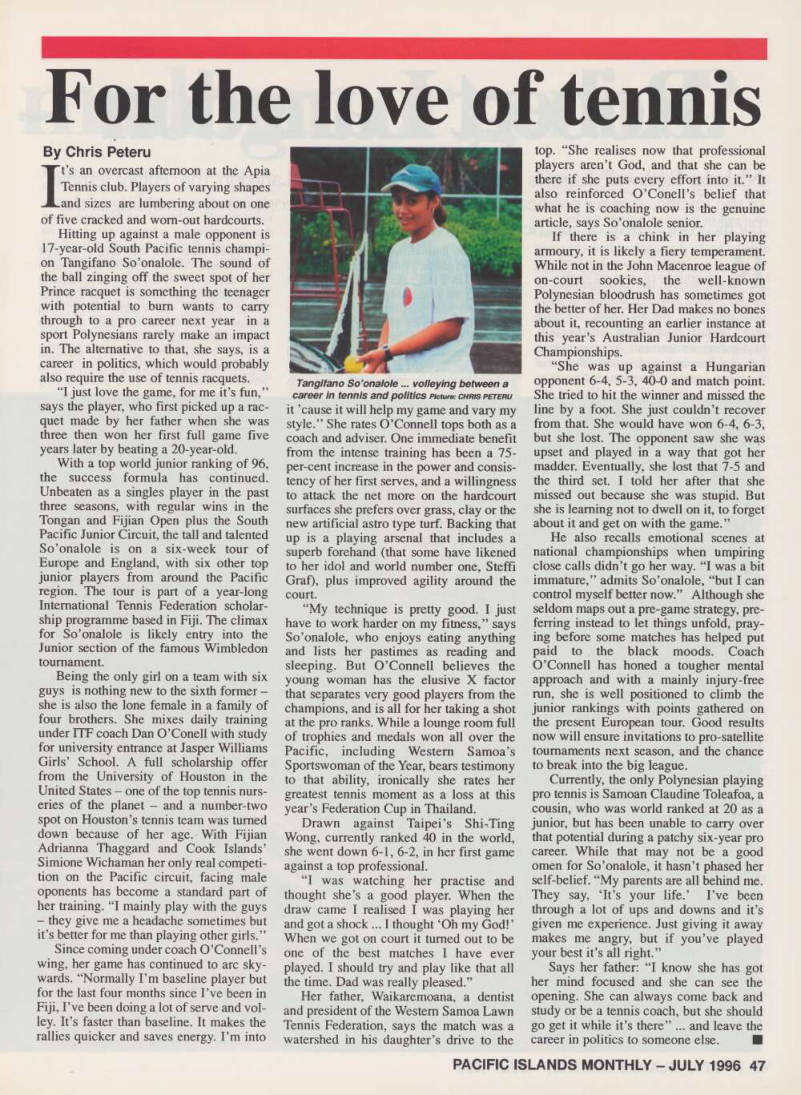
By Chris Peteru
It’s an overcast afternoon at the Apia Tennis club. Players of varying shapes and sizes are lumbering about on one of five cracked and wom-out hardcourts.
Hitting up against a male opponent is 17-year-old South Pacific tennis champi on Tangifano So’onalole. The sound of the ball zinging off the sweet spot of her Prince racquet is something the teenager with potential to bum wants to carry through to a pro career next year in a sport Polynesians rarely make an impact in. The alternative to that, she says, is a career in politics, which would probably also require the use of tennis racquets.
“I just love the game, for me it’s fun,” says the player, who first picked up a rac quet made by her father when she was three then won her first full game five
years later by beating a 20-year-old.
With a top world junior ranking of 96, the success formula has continued.
Unbeaten as a singles player in the past three seasons, with regular wins in the Tongan and Fijian Open plus the South Pacific Junior Circuit, the tall and talented So’onalole is on a six-week tour of Europe and England, with six other top junior players from around the Pacific region. The tour is part of a year-long International Tennis Federation scholar ship programme based in Fiji. The climax for So’onalole is likely entry into the Junior section of the famous Wimbledon tournament.
Being the only girl on a team with six guys is nothing new to the sixth former she is also the lone female in a family of four brothers. She mixes daily training under TTF coach Dan O’Conell with study for university entrance at Jasper Williams Girls’ School. A full scholarship offer from the University of Houston in the United States - one of the top tennis nurs eries of the planet - and a number-two spot on Houston’s tennis team was turned down because of her age. With Fijian Adrianna Thaggard and Cook Islands’
Simione Wichaman her only real competi tion on the Pacific circuit, facing male oponents has become a standard part of her training. “I mainly play with the guys - they give me a headache sometimes but it’s better for me than playing other girls.”
Since coming under coach O’Connell’s wing, her game has continued to arc sky wards. “Normally I’m baseline player but for the last four months since I’ve been in Fiji, I’ve been doing a lot of serve and vol ley. It’s faster than baseline. It makes the rallies quicker and saves energy. I’m into
it ’cause it will help my game and vary my style.” She rates O’Connell tops both as a coach and adviser. One immediate benefit from the intense training has been a 75per-cent increase in the power and consis tency of her first serves, and a willingness to attack the net more on the hardcourt surfaces she prefers over grass, clay or the new artificial astro type turf. Backing that up is a playing arsenal that includes a superb forehand (that some have likened to her idol and world number one, Steffi
Graf), plus improved agility around the
court.
“My technique is pretty good. I just have to work harder on my fitness,” says So’onalole, who enjoys eating anything and lists her pastimes as reading and sleeping. But O’Connell believes the young woman has the elusive X factor that separates very good players from the champions, and is all for her taking a shot at the pro ranks. While a lounge room full of trophies and medals won all over the Pacific, including Western Samoa’s Sportswoman of the Year, bears testimony to that ability, ironically she rates her greatest tennis moment as a loss at this year’s Federation Cup in Thailand.
Drawn against Taipei’s Shi-Ting
Wong, currently ranked 40 in the world, she went down 6-1, 6-2, in her first game
against a top professional.
“I was watching her practise and thought she’s a good player. When the draw came I realised I was playing her and got a shock ... I thought ‘Oh my God! ’
When we got on court it turned out to be one of the best matches I have ever played. I should try and play like that all the time. Dad was really pleased.”
Her father, Waikaremoana, a dentist and president of the Western Samoa Lawn Tennis Federation, says the match was a watershed in his daughter’s drive to the
top. “She realises now that professional players aren’t God, and that she can be there if she puts every effort into it.” It also reinforced O’Conell’s belief that what he is coaching now is the genuine article, says So’onalole senior.
If there is a chink in her playing armoury, it is likely a fiery temperament.
While not in the John Macenroe league of on-court sookies, the well-known Polynesian bloodrush has sometimes got the better of her. Her Dad makes no bones about it, recounting an earlier instance at this year’s Australian Junior Hardcourt
Championships.
“She was up against a Hungarian opponent 6-4, 5-3, 40-0 and match point.
She tried to hit the winner and missed the line by a foot. She just couldn’t recover from that. She would have won 6-4, 6-3, but she lost. The opponent saw she was upset and played in a way that got her madder. Eventually, she lost that 7-5 and the third set. I told her after that she missed out because she was stupid. But she is learning not to dwell on it, to forget about it and get on with the game.”
He also recalls emotional scenes at national championships when umpiring close calls didn’t go her way. “I was a bit immature,” admits So’onalole, “but I can control myself better now.” Although she seldom maps out a pre-game strategy, pre ferring instead to let things unfold, pray ing before some matches has helped put paid to the black moods. Coach O’Connell has honed a tougher mental approach and with a mainly injury-free run, she is well positioned to climb the junior rankings with points gathered on the present European tour. Good results now will ensure invitations to pro-satellite tournaments next season, and the chance to break into the big league.
Currently, the only Polynesian playing
pro tennis is Samoan Claudine Toleafoa, a cousin, who was world ranked at 20 as a junior, but has been unable to carry over that potential during a patchy six-year pro career. While that may not be a good omen for So’onalole, it hasn’t phased her self-belief. “My parents are all behind me.
They say, ‘lt’s your life.’ I’ve been through a lot of ups and downs and it’s given me experience. Just giving it away makes me angry, but if you’ve played your best it’s all right.”
Says her father: “I know she has got her mind focused and she can see the opening. She can always come back and study or be a tennis coach, but she should go get it while it’s there” ... and leave the career in politics to someone else. ■
Tangifano So’onalole ... volleying between a career in tennis and politics picture: CHRIS PETERU
Robert Langtlon - madman or genius?
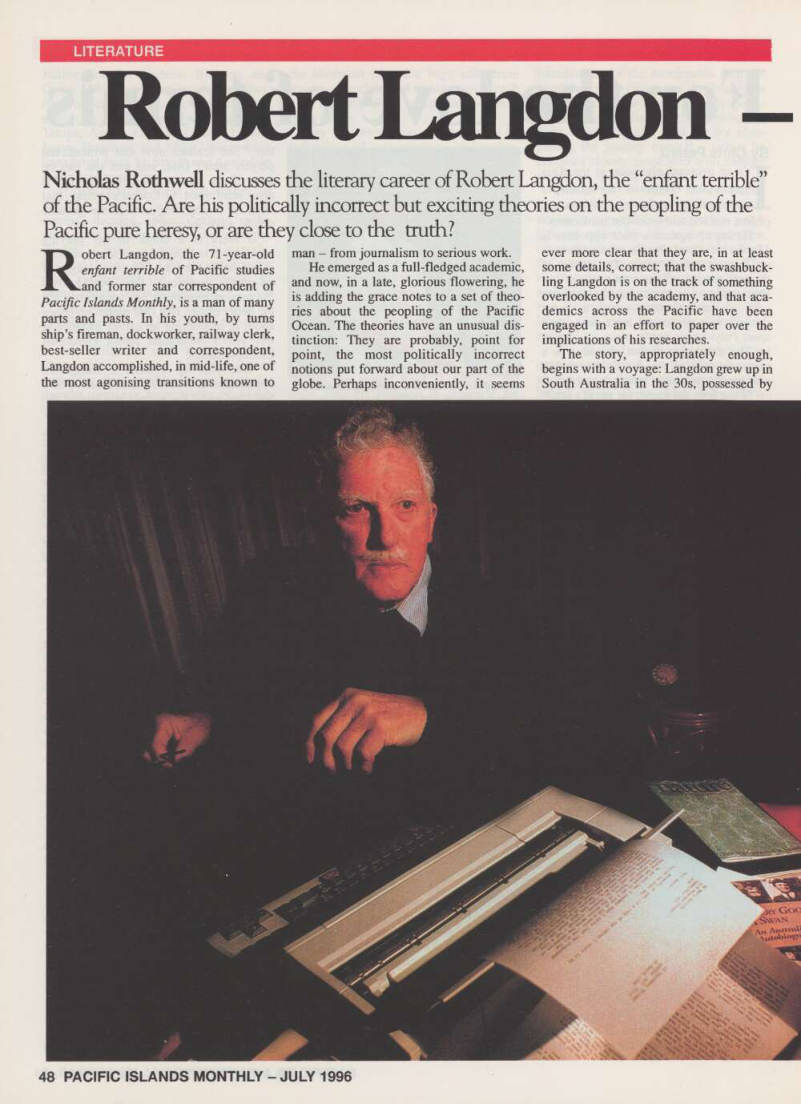
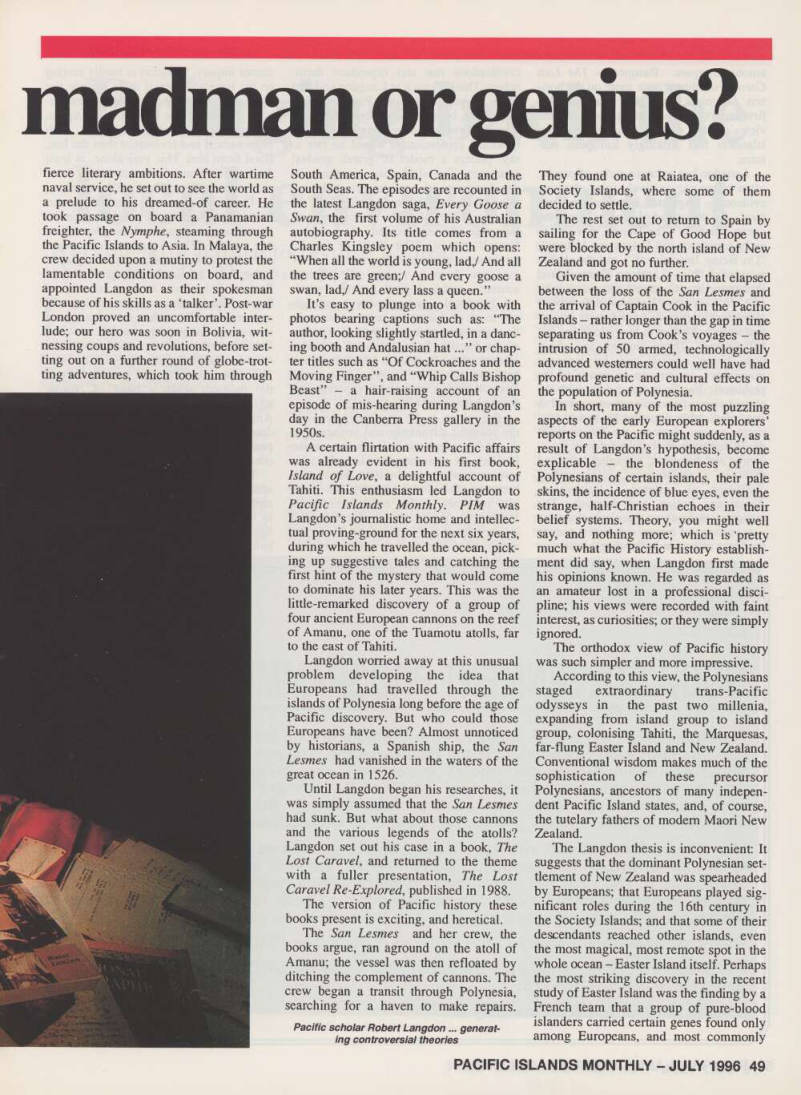
Literature
Nicholas Rothwell discusses the literary career of Robert Langdon, the “enfant terrible” of the Pacific. Are his politically incorrect but exciting theories on the peopling of the Pacific pure heresy, or are they close to the truth?
Robert Langdon, the 71-year-old enfant terrible of Pacific studies and former star correspondent of Pacific Islands Monthly, is a man of many parts and pasts. In his youth, by turns ship’s fireman, dockworker, railway clerk, best-seller writer and correspondent, Langdon accomplished, in mid-life, one of the most agonising transitions known to
man - from journalism to serious work.
He emerged as a full-fledged academic, and now, in a late, glorious flowering, he is adding the grace notes to a set of theo ries about the peopling of the Pacific Ocean. The theories have an unusual dis tinction: They are probably, point for point, the most politically incorrect notions put forward about our part of the globe. Perhaps inconveniently, it seems
ever more clear that they are, in at least some details, correct; that the swashbuck ling Langdon is on the track of something overlooked by the academy, and that aca demics across the Pacific have been engaged in an effort to paper over the implications of his researches.
The story, appropriately enough,
begins with a voyage: Langdon grew up in South Australia in the 30s, possessed by
fierce literary ambitions. After wartime naval service, he set out to see the world as a prelude to his dreamed-of career. He took passage on board a Panamanian freighter, the Nymphe, steaming through the Pacific Islands to Asia. In Malaya, the crew decided upon a mutiny to protest the lamentable conditions on board, and appointed Langdon as their spokesman because of his skills as a ‘talker’. Post-war London proved an uncomfortable inter lude; our hero was soon in Bolivia, wit nessing coups and revolutions, before set ting out on a further round of globe-trot ting adventures, which took him through
South America, Spain, Canada and the South Seas. The episodes are recounted in the latest Langdon saga, Every Goose a Swan, the first volume of his Australian autobiography. Its title comes from a Charles Kingsley poem which opens: “When all the world is young, lad,/ And all the trees are green;/ And every goose a swan, lad,/ And every lass a queen.”
It’s easy to plunge into a book with photos bearing captions such as: “The author, looking slightly startled, in a danc ing booth and Andalusian hat...” or chap ter titles such as “Of Cockroaches and the Moving Finger”, and “Whip Calls Bishop Beast” - a hair-raising account of an episode of mis-hearing during Langdon’s day in the Canberra Press gallery in the 19505.
A certain flirtation with Pacific affairs was already evident in his first book.
Island of Love, a delightful account of Tahiti. This enthusiasm led Langdon to Pacific Islands Monthly. PIM was Langdon’s journalistic home and intellec tual proving-ground for the next six years, during which he travelled the ocean, pick ing up suggestive tales and catching the first hint of the mystery that would come to dominate his later years. This was the little-remarked discovery of a group of four ancient European cannons on the reef of Amanu, one of the Tuamotu atolls, far to the east of Tahiti.
Langdon worried away at this unusual problem developing the idea that Europeans had travelled through the islands of Polynesia long before the age of Pacific discovery. But who could those Europeans have been? Almost unnoticed by historians, a Spanish ship, the San Lesmes had vanished in the waters of the great ocean in 1526.
Until Langdon began his researches, it was simply assumed that the San Lesmes had sunk. But what about those cannons and the various legends of the atolls?
Langdon set out his case in a book, The Lost Caravel, and returned to the theme with a fuller presentation. The Lost Caravel Re-Explored, published in 1988.
The version of Pacific history these books present is exciting, and heretical.
The San Lesmes and her crew, the books argue, ran aground on the atoll of Amanu; the vessel was then refloated by ditching the complement of cannons. The crew began a transit through Polynesia, searching for a haven to make repairs.
They found one at Raiatea, one of the Society Islands, where some of them decided to settle.
The rest set out to return to Spain by sailing for the Cape of Good Hope but were blocked by the north island of New Zealand and got no further.
Given the amount of time that elapsed between the loss of the San Lesmes and the arrival of Captain Cook in the Pacific Islands - rather longer than the gap in time separating us from Cook’s voyages - the intrusion of 50 armed, technologically advanced westerners could well have had profound genetic and cultural effects on the population of Polynesia.
In short, many of the most puzzling aspects of the early European explorers’ reports on the Pacific might suddenly, as a result of Langdon’s hypothesis, become explicable - the blondeness of the Polynesians of certain islands, their pale skins, the incidence of blue eyes, even the strange, half-Christian echoes in their belief systems. Theory, you might well say, and nothing more; which is pretty much what the Pacific History establish ment did say, when Langdon first made his opinions known. He was regarded as an amateur lost in a professional disci pline; his views were recorded with faint interest, as curiosities; or they were simply ignored.
The orthodox view of Pacific history was such simpler and more impressive.
According to this view, the Polynesians staged extraordinary trans-Pacific odysseys in the past two millenia, expanding from island group to island group, colonising Tahiti, the Marquesas, far-flung Easter Island and New Zealand.
Conventional wisdom makes much of the sophistication of these precursor Polynesians, ancestors of many indepen dent Pacific Island states, and, of course, the tutelary fathers of modem Maori New Zealand.
The Langdon thesis is inconvenient: It suggests that the dominant Polynesian set tlement of New Zealand was spearheaded by Europeans; that Europeans played sig nificant roles during the 16th century in the Society Islands; and that some of their descendants reached other islands, even the most magical, most remote spot in the whole ocean - Easter Island itself. Perhaps the most striking discovery in the recent study of Easter Island was the finding by a French team that a group of pure-blood islanders carried certain genes found only among Europeans, and most commonly
Pacific scholar Robert Langdon... generat ing controversial theories
among Basques. Basques? - The Lost Caravel shimmers once more on the hori zon. Argument has swirled ever since this first report, which seems to bear out the views of early explorers that some Easter Islanders had strikingly European fea tures.
Langdon has written a series of papers, often rather provocatively titled, drawing evidence - linguistic, botanical and cul tural - for the spread of peoples across the ocean. There is “The banana as a key to early American and Polynesian history”, “On Being Impertinent”, and the darkly wonderful “New Light on Easter Island
Prehistory in a Censored Spanish Report
of 1770” - a paper Langdon defiantly (if
immodestly) regards as the most impor
tant to be published in his field in the last half-century. These studies, and those now being carried out by younger researchers, conjure up an image of the prehistoric Pacific quite at odds with the classic view of a virgin ocean, crossed in one, predictable direction by stately out rigger canoes. Instead, the waves posi tively seethe with busy explorers, cast aways and colonists, voyaging here and there in a promiscuous, intermingling confusion of cultures - Polynesian, American, Indian and Spanish. The intriguing thing about this clash of visions - or versions of history - is that it goes to the heart of our understanding of the way
civilisations rise and reproduce them selves. Thinkers such as Langdon and that other romantic of the Pacific, Thor Heyerdahl, believe small, heroic bands of men can produce astonishing effects. The historical profession, it would be fair to say, prefers a model of grand, gradual processes: The slow dissemination and
development of indigenous cultures,
rather than the “lightning-bolt effect” of new blood from afar. The matter seems on the verge of being decided. As Langdon himself puts it, “The Walls of Jericho might soon come tumbling down.” New evidence from a variety of different sources - archaeological, genetic, botani cal, historical - is beginning to emerge, and much of it seems to paint a more sub tle, variegated picture of the colonisation of the Pacific. Soon, a new Cambridge History of the Pacific, to which Langdon has contributed, will appear. In a sense, this will mark a triumph of respectability, for the buccaneer-tumed-scholar.
But where is the continuity between the youthful adventurer and voyager and the independent-minded scholar of the Pacific? As one considers Langdon, his intense curiosity and will to discover, it becomes plain his biography has fitted him perfectly for his most recent role: Inquisitive, far-travelled, educated. But by experience and learning, he knows the terrain he writes of. “ A virtuoso of per
sistent inquiry, Langdon is hardly resting
on his laurels - even if these include the distinction of being the only Australian born knight of the Kingdom of Spain.
Ideas for new books and papers, each more radical and revisionist than the last, flood from him. This year alone, at least three minor bombshells are due to deto nate in the pages of Pacific scholarship.
The distinctly establishment
Polynesian Society is publishing in its
journal a typical piece of Langdon detec tive work, “The Soapberry”, a paper claiming South American Indians played a significant role in the early prehistory of Eastern Polynesia. A new account of Easter Island’s rongo-rongo writing will appear; as will another examination of long-range voyaging in the ancient Pacific. And there’s a new book to be done for the 50th anniversary of the Kon Tiki expedition of course, looking back to the moment when a band of Nordic adventurers sailed westward from South America, just as a young Australian, dreaming of glory, was taking eastward passage on a rickety old steamer at the other end of the great ocean.
Nor should we forget the promised second volume of the Langdon autobiog raphy, in which our hero finds fulfilment in the archives, lost with his dreams of Spanish explorers, setting sail upon an unknown Pacific wave. ■
Advertisements & other items, pp. 49-50 (2 items)
madman or genius?
Good Government Programme Manager
OA
The British Aid Programme seeks to recruit a person who will manage a fund aimed at promoting Good Government in the Pacific Region. The postholder will be based in Suva, Fiji. Main duties will involve developing, managing and co-ordinating a programme of activities agreed under the Good Government theme, including areas such as Promoting Access to Justice, Administering the Law, Mobilising and Strengthening Civil Society and Human Resource Development.
The successful applicant will have experience/qualifications in one or more of the following: law and development, public sector reform, politics or institutional development. The post will involve liaison with Pacific Governments, NGOs and aid donors. Applicants must be willing to travel within the Pacific region, and further afield.
Assistance with relocation will be offered to the successful candidate, if required.
The post will attract a salary in the range of F 535,000 to F 540,000.
Full details can be obtained from the Pacific Aid Management Office, Private Mail Bag, Suva, Fiji. Fax: (679) 301218.
Closing date for applications: July 26.
local environment
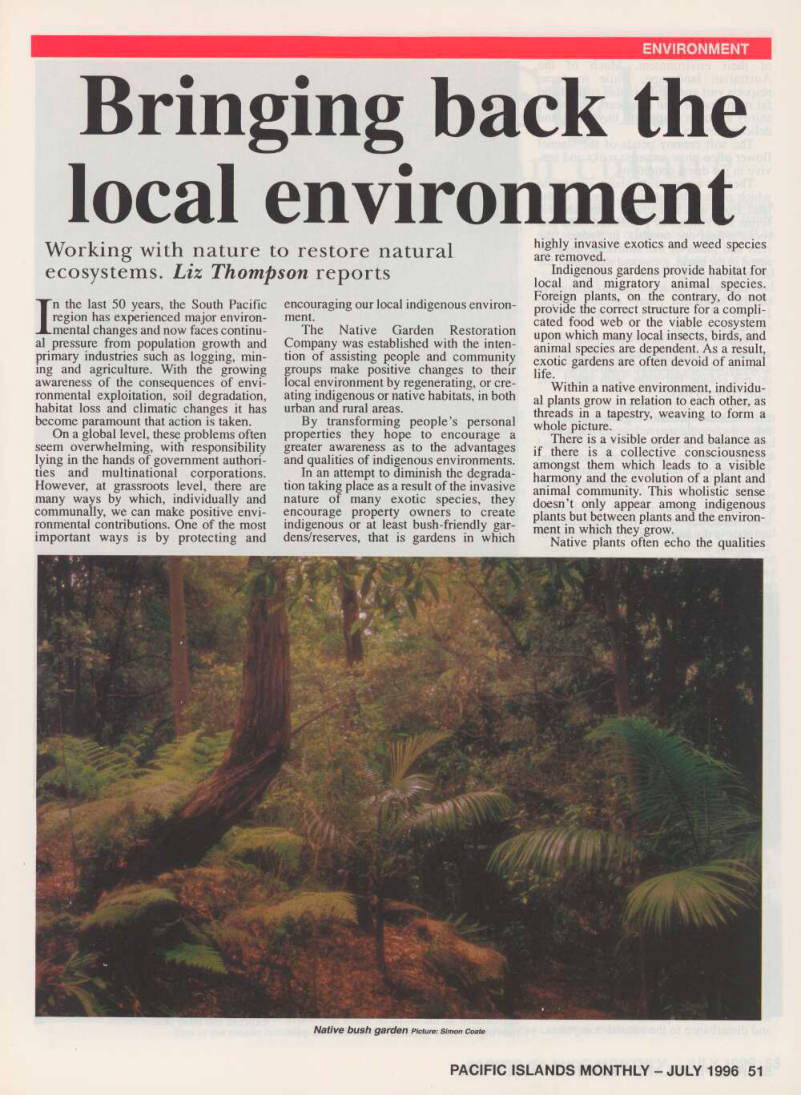
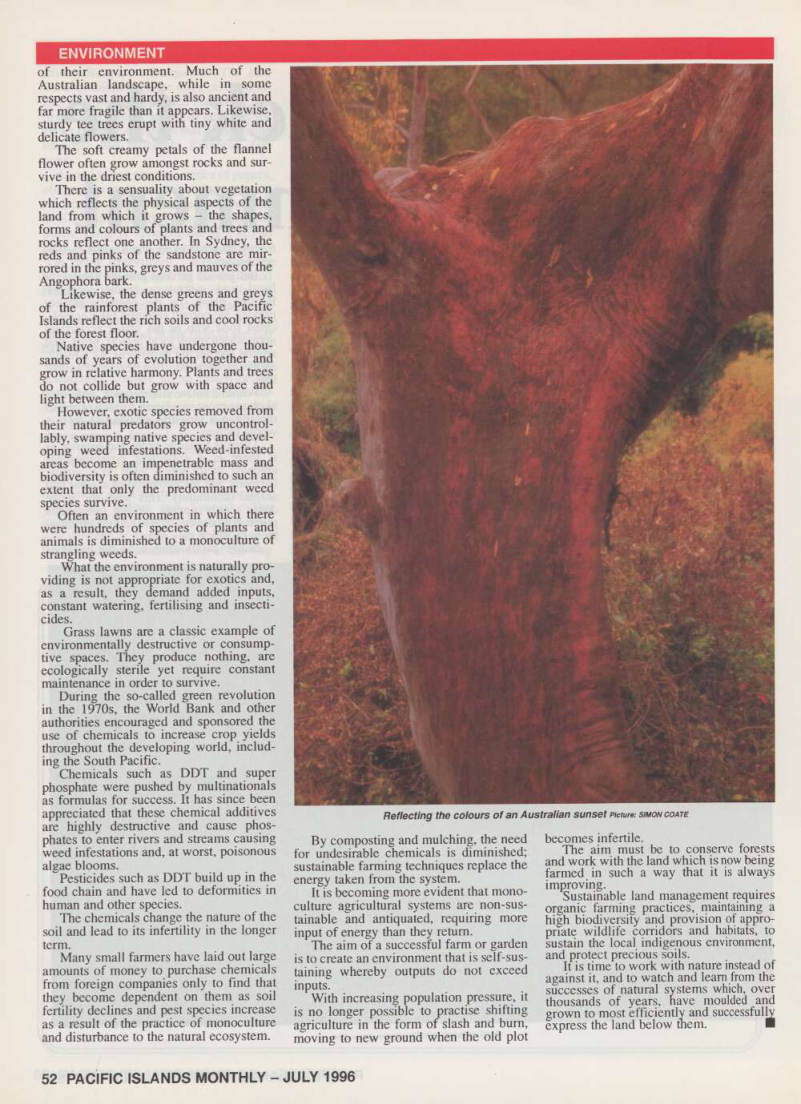
Environment
Bringing back the local environment
Working with nature to restore natural ecosystems. Liz Thompson reports
I. . ... n the last 50 years, the South Pacific region has experienced major environmental changes and now faces contmuai pressure from population growth and primary industries such as logging, mmmg and agriculture. With the growing awareness of the consequences of environmental exploitation, soil degradation, habitat loss and climatic changes it has become paramount that action is taken.
On a global level, these problems often seem overwhelming, with responsibility lying in the hands of government authorities and multinational corporations.
However, at grassroots level there are many ways by which, individually and communally, we can make positive environmental contributions. One of the most important ways is by protecting and
, encouraging our local indigenous environ
ment- .
The Native Garden Restoration Company was established with the mten tion of assisting people and community groups make positive changes to their local environment by regenerating, or ere ating indigenous or native habitats, in both urban and rural areas.
By transforming people s personal properties they hope to encourage a greater awareness as to the advantages and qualities of indigenous environments.
In an attempt to diminish the degrada tion taking place as a result of the invasive nature of many exotic species, they encourage property owners to create indigenous or at least bush-friendly gar dens/reserves, that is gardens in which
highly invasive exotics and weed species are removed.
Indigenous gardens provide habitat for
local and migratory animal species.
Foreign plants, on the contrary, do not provide the correct structure for a compli cated food web or the viable ecosystem upon which many local insects, birds, and animal species are dependent. As a result, exotic gardens are often devoid of animal life.
Within a native environment, individu al plants grow in relation to each other, as threads in a tapestry, weaving to form a
whole picture.
There is a visible order and balance as if there is a collective consciousness amongst them which leads to a visible harmony and the evolution of a plant and animal community. This wholistic sense doesn’t only appear among indigenous plants but between plants and the environ ment in which they grow.
Native plants often echo the qualities
Native bush garden Picture: Simon Coate
of their environment. Much of the Australian landscape, while in some respects vast and hardy, is also ancient and far more fragile than it appears. Likewise, sturdy tee trees erupt with tiny white and delicate flowers.
The soft creamy petals of the flannel flower often grow amongst rocks and sur vive in the driest conditions.
There is a sensuality about vegetation which reflects the physical aspects of the land from which it grows - the shapes, forms and colours of plants and trees and rocks reflect one another. In Sydney, the reds and pinks of the sandstone are mir rored in the pinks, greys and mauves of the
Angophora bark.
Likewise, the dense greens and greys of the rainforest plants of the Pacific Islands reflect the rich soils and cool rocks of the forest floor.
Native species have undergone thou sands of years of evolution together and grow in relative harmony. Plants and trees do not collide but grow with space and light between them.
However, exotic species removed from their natural predators grow uncontrol lably, swamping native species and devel oping weed infestations. Weed-infested areas become an impenetrable mass and biodiversity is often diminished to such an extent that only the predominant weed
species survive.
Often an environment in which there were hundreds of species of plants and animals is diminished to a monoculture of
strangling weeds.
What the environment is naturally pro viding is not appropriate for exotics and, as a result, they demand added inputs, constant watering, fertilising and insecti cides.
Grass lawns are a classic example of environmentally destructive or consump tive spaces. They produce nothing, are ecologically sterile yet require constant maintenance in order to survive.
During the so-called green revolution in the 19705, the World Bank and other authorities encouraged and sponsored the use of chemicals to increase crop yields throughout the developing world, includ ing the South Pacific.
Chemicals such as DDT and super
phosphate were pushed by multinationals
as formulas for success. It has since been appreciated that these chemical additives are highly destructive and cause phos phates to enter rivers and streams causing weed infestations and, at worst, poisonous
algae blooms.
Pesticides such as DDT build up in the food chain and have led to deformities in human and other species.
The chemicals change the nature of the soil and lead to its infertility in the longer term.
Many small farmers have laid out large amounts of money to purchase chemicals from foreign companies only to find that they become dependent on them as soil fertility declines and pest species increase as a result of the practice of monoculture and disturbance to the natural ecosystem.
By composting and mulching, the need for undesirable chemicals is diminished; sustainable farming techniques replace the energy taken from the system.
It is becoming more evident that mono culture agricultural systems are non-sus tainable and antiquated, requiring more input of energy than they return.
The aim of a successful farm or garden is to create an environment that is self-sus taining whereby outputs do not exceed inputs.
With increasing population pressure, it is no longer possible to practise shifting agriculture in the form of slash and bum, moving to new ground when the old plot
becomes infertile.
The aim must be to conserve forests and work with the land which is now being farmed in such a way that it is always improving.
Sustainable land management requires organic farming practices, maintaining a high biodiversity and provision of appro priate wildlife corridors and habitats, to sustain the local indigenous environment, and protect precious soils.
It is time to work with nature instead of against it, and to watch and learn from the successes of natural systems which, over thousands of years, nave moulded and grown to most efficiently and successfully express the land below them. I
Reflecting the colours of an Australian sunset picture: SIMON COATE
Eye-Land Style
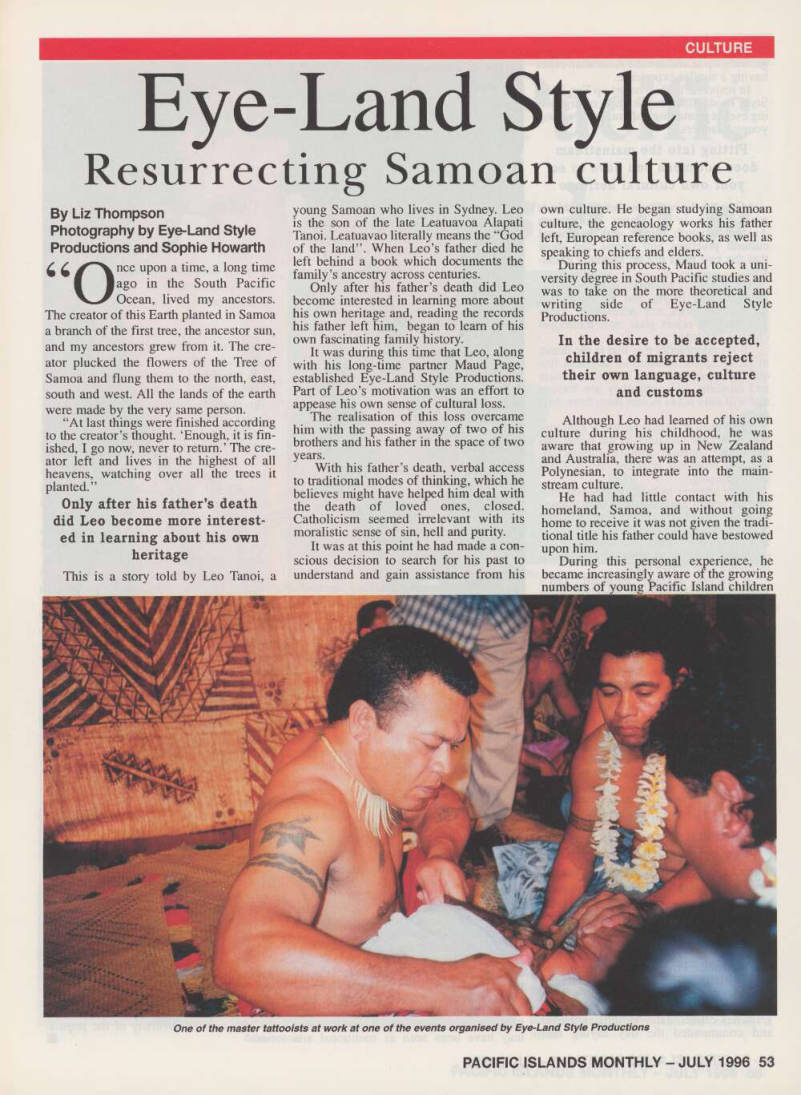
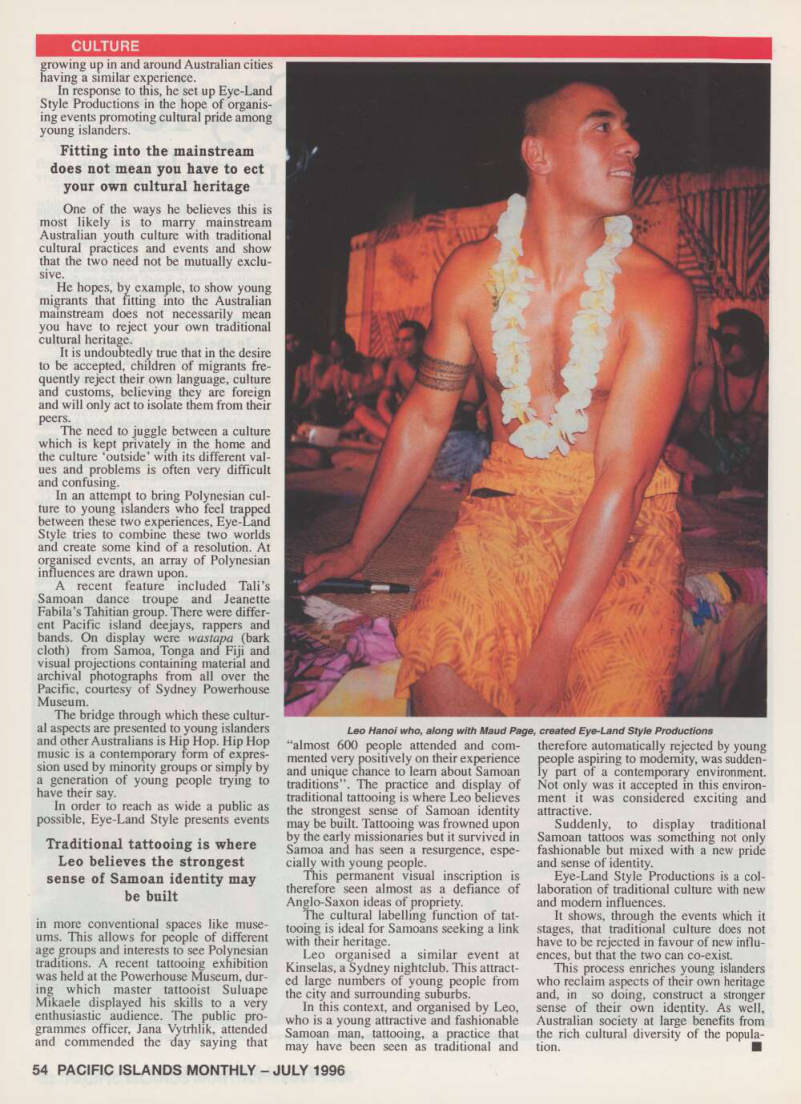
Culture
Eye-Land Style Resurrecting Samoan culture
By Liz Thompson
Dhntnnwnhu Cwo_i onri Hnotograpny py tye-Lano oiyie Productions and Sophie Howarth / / nee upon a time, a long time Qago in .he South Pacific Ocean, lived my ancestors, The creator of this Earth planted in Samoa a branch of the first tree, the ancestor sun, and tnv anrestors <rrew from it The ere and my ancestors grew trom it. Ihe ere ator plucked the flowers of the Tree of Samoa and flung them to the north, east, south and west. All the lands of the earth were made bv the verv same nerson “At last things were finished according to the creator’s thought. ‘Enough, it is fin ished, I go now, never to return.’ The ere ator left and lives in the highest of all heavens, watching over all the trees it lanted ”
Only after his father s death did Leo become more interest ed in learning about his own . entage This is a story told by Leo Tanoi, a
young Samoan who lives in Sydney. Leo is tbe son of tbe i ate Leatuavoa Alapati Tanoi. Leatuavao literally means the “God of the land”. When Leo’s father died he J, eft bebmd a book which documents the Leo become interested in learning more about his own heritage and, reading the records b * s be S an t 0 eam °f b i § OWn fascinatin S famil Y history. j t was dunn g t hj s time that Leo, along w j t h his long-time partner Maud Page, established Eye-Land Style Productions.
Part °f Leo’s motivation was an effort to appease his own sense of cultural loss. , . The realisation of this loss overcame bim Wlth *\P a J sl " g awa £ ° f tW ° °/ t hIS brothers and his father m the space of two year , s A-, u . • f , , W . ltb hls . fath f r s access to traditional modes of thinking, which he believes might have helped him deal with the death of loved ones, closed, Catholicism seemed irrelevant with its moralistic sense of sin, hell and purity.
It was at this point he had made a con scious decision to search for his past to understand and gain assistance from his
own culture. He began studying Samoan culture, the geneaology works his father i e ft, European reference books, as well as speaking to chiefs and elders.
During this process, Maud took a uni writing side of Eye-Land Style Productions, , In the desire to be accepted, mio-ran+c rAiArt
children of migrants reject
their own language, culture and customs Although Leo had learned of his own culture during his childhood, he was aware that growing up in New Zealand and Australia, there was an attempt, as a Polynesian, to integrate into the mam stream culture He had had little contact with his homeland, Samoa, and without going home to receive it was not given the tradi tional title his father could have bestowed upon him.
During this personal experience, he
became increasingly aware of the growing numbers of young Pacific Island children
One of the master tattooists at work at one of the events organised by Eye-Land Style Productions
growing up in and around Australian cities
having a similar experience.
In response to this, he set up Eye-Land Style Productions in the hope of organis
ing events promoting cultural pride among
young islanders.
Fitting into the mainstream does not mean you have to ect your own cultural heritage One of the ways he believes this is most likely is to marry mainstream Australian youth culture with traditional cultural practices and events and show that the two need not be mutually exclu sive.
He hopes, by example, to show young migrants that fitting into the Australian mainstream does not necessarily mean you have to reject your own traditional
cultural heritage.
It is undoubtedly true that in the desire to be accepted, children of migrants fre
quently reject their own language, culture
and customs, believing they are foreign
and will only act to isolate them from their peers.
The need to juggle between a culture which is kept privately in the home and the culture ‘outside’ with its different val ues and problems is often very difficult
and confusing.
In an attempt to bring Polynesian cul ture to young islanders who feel trapped between these two experiences, Eye-Land Style tries to combine these two worlds and create some kind of a resolution. At organised events, an array of Polynesian influences are drawn upon.
A recent feature included Tali’s Samoan dance troupe and Jeanette Fabila’s Tahitian group. There were differ ent Pacific island deejays, rappers and bands. On display were wastapa (bark cloth) from Samoa, Tonga and Fiji and visual projections containing material and archival photographs from all over the Pacific, courtesy of Sydney Powerhouse Museum.
The bridge through which these cultur al aspects are presented to young islanders and other Australians is Hip Hop. Hip Hop music is a contemporary form of expres sion used by minority groups or simply by a generation of young people trying to have their say.
In order to reach as wide a public as
possible, Eye-Land Style presents events
Traditional tattooing is where Leo believes the strongest sense of Samoan identity may be built in more conventional spaces like muse ums. This allows for people of different age groups and interests to see Polynesian traditions. A recent tattooing exhibition was held at the Powerhouse Museum, dur ing which master tattooist Suluape Mikaele displayed his skills to a very enthusiastic audience. The public pro grammes officer, Jana Vytrhlik, attended and commended the day saying that
“almost 600 people attended and com mented very positively on their experience and unique chance to leam about Samoan traditions”. The practice and display of traditional tattooing is where Leo believes the strongest sense of Samoan identity may be built. Tattooing was frowned upon by the early missionaries but it survived in Samoa and has seen a resurgence, espe cially with young people.
This permanent visual inscription is therefore seen almost as a defiance of
Anglo-Saxon ideas of propriety.
The cultural labelling function of tat tooing is ideal for Samoans seeking a link with their heritage.
Leo organised a similar event at Kinselas, a Sydney nightclub. This attract ed large numbers of young people from the city and surrounding suburbs.
In this context, and organised by Leo, who is a young attractive and fashionable Samoan man, tattooing, a practice that may have been seen as traditional and
therefore automatically rejected by young
people aspiring to modernity, was sudden ly part of a contemporary environment.
Not only was it accepted in this environ ment it was considered exciting and attractive.
Suddenly, to display traditional
Samoan tattoos was something not only fashionable but mixed with a new pride and sense of identity.
Eye-Land Style Productions is a col laboration of traditional culture with new and modem influences.
It shows, through the events which it stages, that traditional culture does not have to be rejected in favour of new influ ences, but that the two can co-exist.
This process enriches young islanders who reclaim aspects of their own heritage and, in so doing, construct a stronger sense of their own identity. As well, Australian society at large benefits from the rich cultural diversity of the popula tion. ■
Leo Hanoi who, along with Maud Page, created Eye-Land Style Productions
Putting the Pacific
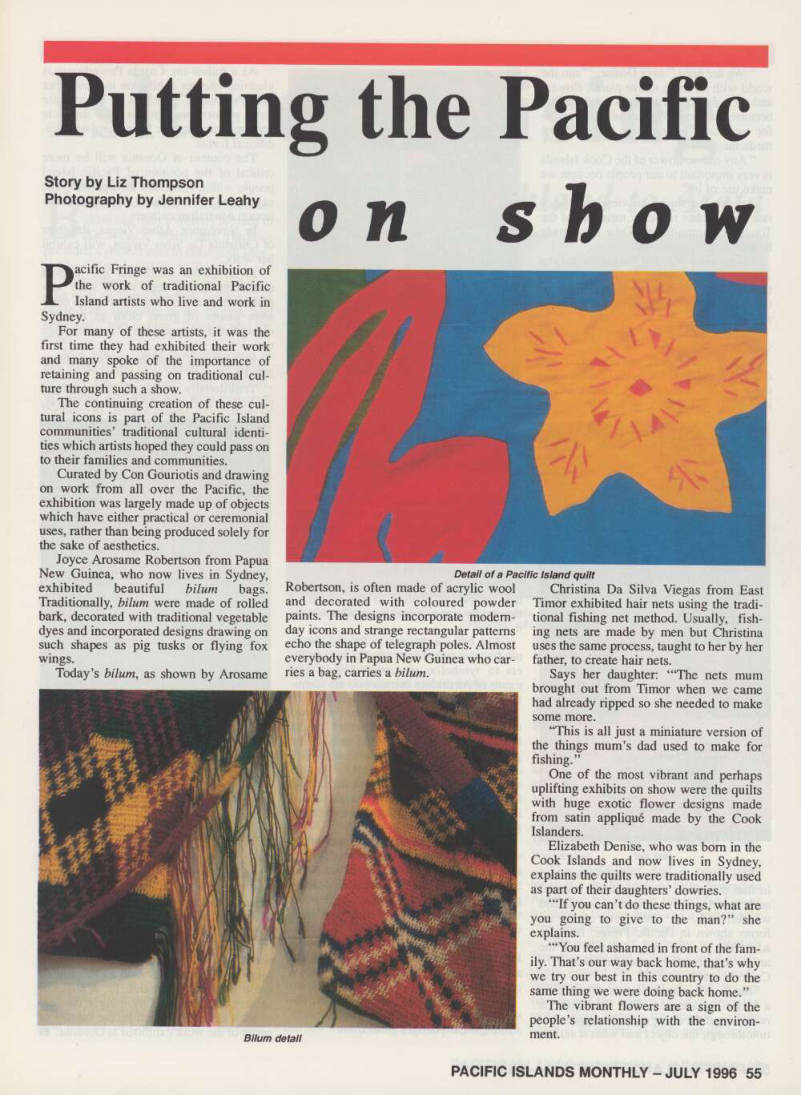
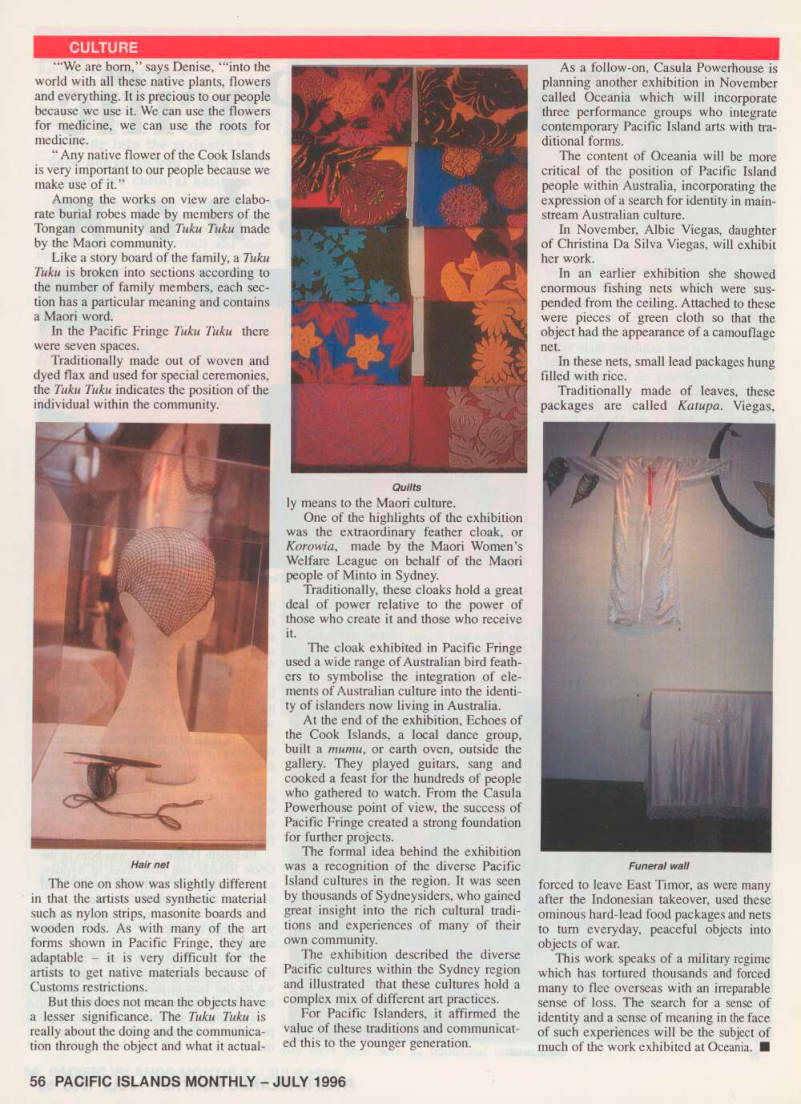
on show
Story by Liz Thompson Photography by Jennifer Leahy
Pacific Fringe was an exhibition of the work of traditional Pacific Island artists who live and work in Sydney.
For many of these artists, it was the first time they had exhibited their work and many spoke of the importance of retaining and passing on traditional cul ture through such a show.
The continuing creation of these cul tural icons is part of the Pacific Island communities’ traditional cultural identi ties which artists hoped they could pass on to their families and communities.
Curated by Con Gouriotis and drawing on work from all over the Pacific, the exhibition was largely made up of objects which have either practical or ceremonial uses, rather than being produced solely for the sake of aesthetics.
Joyce Arosame Robertson from Papua New Guinea, who now lives in Sydney, exhibited beautiful bilum bags.
Traditionally, bilum were made of rolled bark, decorated with traditional vegetable dyes and incorporated designs drawing on such shapes as pig tusks or flying fox wings.
Today’s bilum, as shown by Arosame
Robertson, is often made of acrylic wool and decorated with coloured powder paints. The designs incorporate modern day icons and strange rectangular patterns echo the shape of telegraph poles. Almost everybody in Papua New Guinea who car ries a bag, carries a bilum.
Christina Da Silva Viegas from East Timor exhibited hair nets using the tradi tional fishing net method. Usually, fish ing nets are made by men but Christina uses the same process, taught to her by her father, to create hair nets.
Says her daughter: ‘“The nets mum brought out from Timor when we came had already ripped so she needed to make some more.
“This is all just a miniature version of the things mum’s dad used to make for
fishing.”
One of the most vibrant and perhaps uplifting exhibits on show were the quilts with huge exotic flower designs made from satin applique made by the Cook Islanders.
Elizabeth Denise, who was bom in the Cook Islands and now lives in Sydney, explains the quilts were traditionally used as part of their daughters’ dowries. ‘“lf you can’t do these things, what are you going to give to the man?” she explains. ‘“You feel ashamed in front of the fam ily. That’s our way back home, that’s why we try our best in this country to do the same thing we were doing back home.”
The vibrant flowers are a sign of the people’s relationship with the environ ment.
Bilum detail
Detail of a Pacific Island quilt
‘“We are bom,” says Denise, ‘“into the world with all these native plants, flowers and everything. It is precious to our people because we use it. We can use the flowers for medicine, we can use the roots for medicine.
“ Any native flower of the Cook Islands is very important to our people because we make use of it.”
Among the works on view are elabo rate burial robes made by members of the Tongan community and Tuku Tuku made
by the Maori community.
Like a story board of the family, a Tuku Tuku is broken into sections according to the number of family members, each sec tion has a particular meaning and contains a Maori word.
In the Pacific Fringe Tuku Tuku there were seven spaces.
Traditionally made out of woven and dyed flax and used for special ceremonies, the Tuku Tuku indicates the position of the individual within the community.
The one on show was slightly different in that the artists used synthetic material such as nylon strips, masonite boards and wooden rods. As with many of the art forms shown in Pacific Fringe, they are adaptable - it is very difficult for the artists to get native materials because of Customs restrictions.
But this does not mean the objects have a lesser significance. The Tuku Tuku is really about the doing and the communica tion through the object and what it actual-
ly means to the Maori culture.
One of the highlights of the exhibition was the extraordinary feather cloak, or Korowia, made by the Maori Women’s Welfare League on behalf of the Maori people of Minto in Sydney.
Traditionally, these cloaks hold a great deal of power relative to the power of those who create it and those who receive it.
The cloak exhibited in Pacific Fringe used a wide range of Australian bird feath ers to symbolise the integration of ele ments of Australian culture into the identi ty of islanders now living in Australia.
At the end of the exhibition. Echoes of the Cook Islands, a local dance group, built a mumu, or earth oven, outside the gallery. They played guitars, sang and cooked a feast for the hundreds of people who gathered to watch. From the Casula Powerhouse point of view, the success of Pacific Fringe created a strong foundation for further projects.
The formal idea behind the exhibition was a recognition of the diverse Pacific Island cultures in the region. It was seen by thousands of Sydneysiders, who gained great insight into the rich cultural tradi tions and experiences of many of their
own community.
The exhibition described the diverse Pacific cultures within the Sydney region and illustrated that these cultures hold a complex mix of different art practices.
For Pacific Islanders, it affirmed the value of these traditions and communicat ed this to the younger generation.
As a follow-on, Casula Powerhouse is planning another exhibition in November called Oceania which will incorporate three performance groups who integrate contemporary Pacific Island arts with tra ditional forms.
The content of Oceania will be more critical of the position of Pacific Island people within Australia, incorporating the expression of a search for identity in main stream Australian culture.
In November, Albie Viegas, daughter of Christina Da Silva Viegas, will exhibit her work.
In an earlier exhibition she showed enormous fishing nets which were sus pended from the ceiling. Attached to these were pieces of green cloth so that the object had the appearance of a camouflage net.
In these nets, small lead packages hung filled with rice.
Traditionally made of leaves, these packages are called Katupa. Viegas,
forced to leave East Timor, as were many after the Indonesian takeover, used these ominous hard-lead food packages and nets to turn everyday, peaceful objects into objects of war.
This work speaks of a military regime which has tortured thousands and forced many to flee overseas with an irreparable sense of loss. The search for a sense of identity and a sense of meaning in the face of such experiences will be the subject of much of the work exhibited at Oceania. ■
Hair net
Quilts
Funeral wall
Island cruising
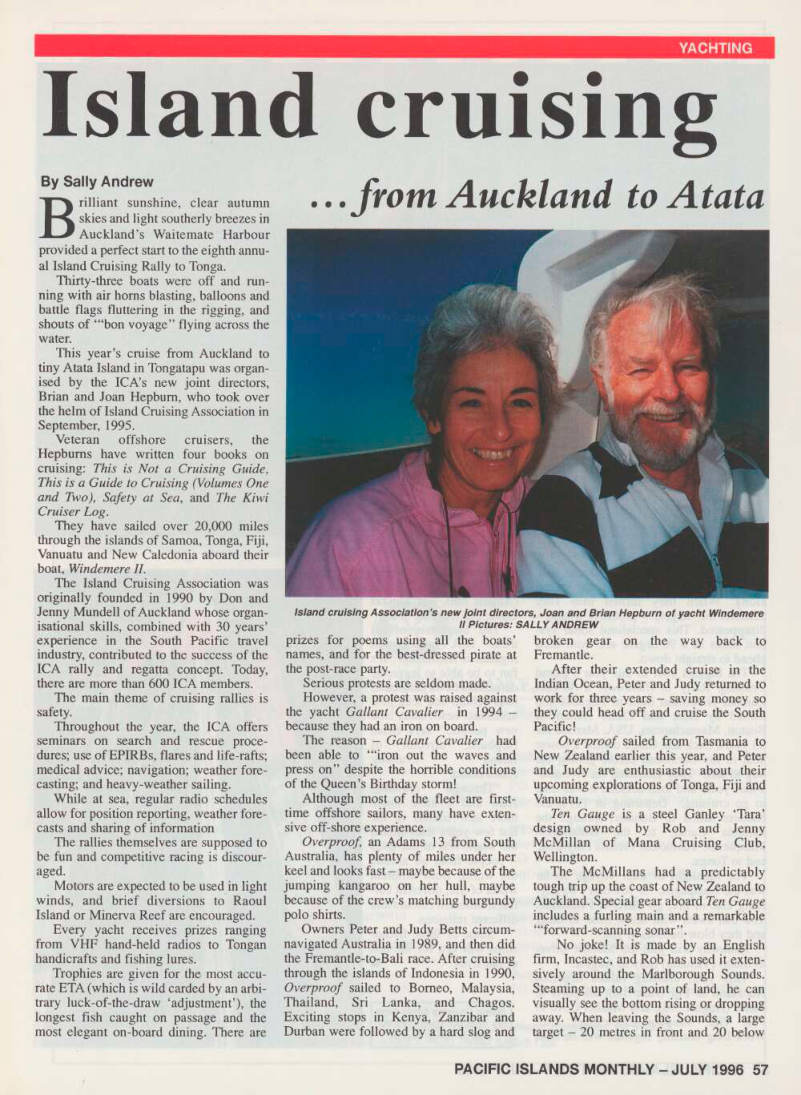
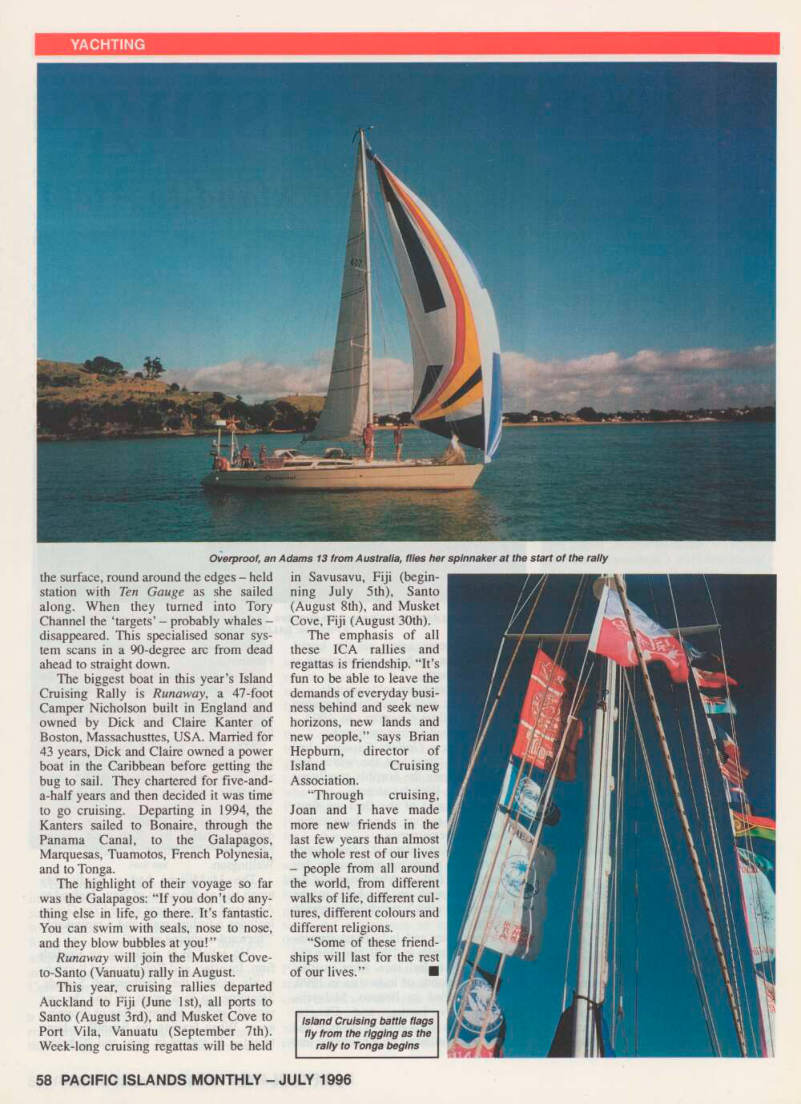
Yachting
... from Auckland to Atata
By Sally Andrew
Brilliant sunshine, clear autumn skies and light southerly breezes in Auckland’s Waitemate Harbour provided a perfect start to the eighth annu al Island Cruising Rally to Tonga.
Thirty-three boats were off and run ning with air horns blasting, balloons and battle flags fluttering in the rigging, and shouts of “‘bon voyage” flying across the water.
This year’s cruise from Auckland to tiny Atata Island in Tongatapu was organ ised by the ICA’s new joint directors, Brian and Joan Hepburn, who took over the helm of Island Cruising Association in September, 1995.
Veteran offshore cruisers, the Hepburns have written four books on cruising: This is Not a Cruising Guide, This is a Guide to Cruising (Volumes One and Two), Safety at Sea, and The Kiwi Cruiser Log.
They have sailed over 20,000 miles through the islands of Samoa, Tonga, Fiji, Vanuatu and New Caledonia aboard their boat, Windemere 11.
The Island Cruising Association was originally founded in 1990 by Don and Jenny Mundell of Auckland whose organ isational skills, combined with 30 years’ experience in the South Pacific travel industry, contributed to the success of the ICA rally and regatta concept. Today, there are more than 600 ICA members.
The main theme of cruising rallies is safety.
Throughout the year, the ICA offers seminars on search and rescue proce dures; use of EPIRBs, flares and life-rafts; medical advice; navigation; weather fore casting; and heavy-weather sailing.
While at sea, regular radio schedules allow for position reporting, weather fore casts and sharing of information The rallies themselves are supposed to be fun and competitive racing is discour aged.
Motors are expected to be used in light winds, and brief diversions to Raoul Island or Minerva Reef are encouraged.
Every yacht receives prizes ranging from VHF hand-held radios to Tongan handicrafts and fishing lures.
Trophies are given for the most accu rate ETA (which is wild carded by an arbi trary luck-of-the-draw ‘adjustment’), the longest fish caught on passage and the most elegant on-board dining. There are
prizes for poems using all the boats’ names, and for the best-dressed pirate at the post-race party.
Serious protests are seldom made.
However, a protest was raised against the yacht Gallant Cavalier in 1994 because they had an iron on board.
The reason - Gallant Cavalier had been able to “‘iron out the waves and press on” despite the horrible conditions of the Queen’s Birthday storm!
Although most of the fleet are first time offshore sailors, many have exten sive off-shore experience.
Overproof an Adams 13 from South Australia, has plenty of miles under her keel and looks fast - maybe because of the jumping kangaroo on her hull, maybe because of the crew’s matching burgundy polo shirts.
Owners Peter and Judy Betts circum navigated Australia in 1989, and then did the Fremantle-to-Bali race. After cruising through the islands of Indonesia in 1990, Overproof sailed to Borneo, Malaysia, Thailand, Sri Lanka, and Chagos.
Exciting stops in Kenya, Zanzibar and Durban were followed by a hard slog and
broken gear on the way back to Fremantle.
After their extended cruise in the Indian Ocean, Peter and Judy returned to work for three years - saving money so they could head off and cruise the South Pacific!
Overproof sailed from Tasmania to New Zealand earlier this year, and Peter and Judy are enthusiastic about their
upcoming explorations of Tonga, Fiji and
Vanuatu.
Ten Gauge is a steel Ganley ‘Tara’ design owned by Rob and Jenny McMillan of Mana Cruising Club,
Wellington.
The McMillans had a predictably tough trip up the coast of New Zealand to Auckland. Special gear aboard Ten Gauge includes a furling main and a remarkable
‘“forward-scanning sonar”.
No joke! It is made by an English firm, Incastec, and Rob has used it exten sively around the Marlborough Sounds.
Steaming up to a point of land, he can visually see the bottom rising or dropping away. When leaving the Sounds, a large target - 20 metres in front and 20 below
Island cruising Association’s new joint directors, Joan and Brian Hepburn of yacht Windemere II Pictures: SALLY ANDREW
the surface, round around the edges - held station with Ten Gauge as she sailed along. When they turned into Tory Channel the ‘targets’ - probably whales disappeared. This specialised sonar sys tem scans in a 90-degree arc from dead ahead to straight down.
The biggest boat in this year’s Island Cruising Rally is Runaway, a 47-foot Camper Nicholson built in England and owned by Dick and Claire Kanter of Boston, Massachusttes, USA. Married for 43 years, Dick and Claire owned a power boat in the Caribbean before getting the bug to sail. They chartered for five-and a-half years and then decided it was time to go cruising. Departing in 1994, the Ranters sailed to Bonaire, through the Panama Canal, to the Galapagos, Marquesas, Tuamotos, French Polynesia, and to Tonga.
The highlight of their voyage so far was the Galapagos: “If you don’t do any thing else in life, go there. It’s fantastic.
You can swim with seals, nose to nose, and they blow bubbles at you!”
Runaway will join the Musket Cove to-Santo (Vanuatu) rally in August.
This year, cruising rallies departed Auckland to Fiji (June Ist), all ports to Santo (August 3rd), and Musket Cove to Port Vila, Vanuatu (September 7th).
Week-long cruising regattas will be held
in Savusavu, Fiji (begin ning July sth), Santo (August Bth), and Musket Cove, Fiji (August 30th).
The emphasis of all these ICA rallies and regattas is friendship. “It’s fun to be able to leave the demands of everyday busi ness behind and seek new horizons, new lands and new people,” says Brian Hepburn, director of Island Cruising Association.
“Through cruising, Joan and I have made more new friends in the last few years than almost the whole rest of our lives - people from all around the world, from different walks of life, different cul tures, different colours and different religions.
“Some of these friend ships will last for the rest of our lives.” ■
Overproof, an Adams 13 from Australia, flies her spinnaker at the start of the rally
Island Cruising battle flags fly from the rigging as the rally to Tonga begins
Advertisements & other items, pp. 58-60 (2 items)
Yachting
I A Lifetime Of Services
10 15 20 25 30 35 40 45 50 55 60
20 I 30 40 Grand Pacific Life Insurance offers you a lifetime of safe, secure products at very competitive rates. • Choose from a full range of products such as
• Super Ordinary Life
• Super Universal • Non-Participating Whole Life • 10-Year Level Term • Flexible Premium Annuities • Group Life Insurance
• IRAs
• Graded Premium Whole Life A We've been dedicated to providing fast, personalized service for more than 35 years through local ownership and management. (Inuv] Pacific Life Insurance, Ud.
That's why Grand Pacific Life is your Family for life ...throughout the Pacific. 40 45 10 15 20 25 30 35 40 45 50 55 60 45
Grand Pacific Life Insurance, Ltd.
A member of the Finance Factors Family
FEDERATED STATES
OF MICRONESIA
Actouka Executive Insurance Underwriters P.O. Box 55, Kolonia, Pohnpei, Federated States of Micronesia 96941 Pacific Basin Insurance & General Services, Inc P.O. Box 494, Chuuk State, Federated States of Micronesia 96942
TONGA
Peseti Ma ‘afu Ins. & Finance, Ltd.
Private Bag 2, Taumoepeau Bldg.
Nukualofa, Tonga
GUAM
Great National Insurance Underwriters, Inc.
P.O. Box GA, Agana, Guam 96910 Pacific Financial Corporation P.O. Box AT, Agana, Guam 96910 Takagi & Associates, Inc.
GCIC Bldg., Suite 100 414 W. Soledad Ave.
Agana, Guam 96910
MARSHALL ISLANDS
Marshalls Insurance Agency P.O. Box 113, Majuro, Marshall Islands 96960
AMERICAN SAMOA
Mark Solofa Pacific Insurance & Finance, Inc.
P.O. Box 3149 Pago Pago, American Samoa 96799
WESTERN SAMOA
Mark Solofa Pacific Insurance & Finance, Inc.
P.O. Box 3149 Pago Pago, American Samoa 96799
NORTHERN MARIANAS
Pacific Basin Insurance Underwriters, Inc.
P.O. Box 710 Saipan, Mariana Islands 96950 Pacifica Insurance Underwriters, Inc.
P.O. Box 168, Saipan, Mariana Islands 96950 Grand Pacific Life Insurance, Ltd. *1164 Bishop Street, sth Floor, Honolulu, HI 96813 Phone: (808) 548-3363 • FAX: (808) 548-5122
THE NEW
PRIVILEGED CLASS
The Uncompromised Family Sedan
THE RLL NEW
MITSUBISHI
LRNCER
Meet the car that was born to succeed. With its progressive engineering and striking appearance, the all-new Mitsubishi Lancer advances effectively, impressively... moving ahead at every turn.
Get behind the wheel and experience the new standard in family sedans.
AMERICAN SAMOA: PACIFIC MARKETING INC. P.O. Box 698, Pago Pago, Tel. 699-9140 / AUSTRALIA: MITSUBISHI MOTORS AUSTRALIA LTD. 1284 South Road, Clovelly Parte, South Australia, 5042, Tel. (08) 2757297 / FUI: NIVIS MOTOR & MACHINERY CO. LTD. G.P.O. Box 150, Suva, Tel. 383411 /GUAM; TRIPLE J ENTERPRISES INC, P.O. Box 6066, Tamuning, Tel. 6469126/NEW CALEDONIA: SOCIETE D’IMPOFTATION D'AUTO DU PACIFIQUE SUD S.A. P.O. Box 2548, Noumea, Tel. 281-787 / NEW ZEALAND: MITSUBISHI MOTORS NEW ZEALAND LTD. Private Bag. Porirua, Tel. 237-0109 / NORFOLK ISLAND; BORRY S PTY LTD P.O. Box 169, Taylors Road, Burnt, Tel. 22114/PAPUA NEW GUINEA: TOBA MOTORS PTY LTD. P.O. Box 503, Port Moresby/ SAIPAN: SAIPAN AUTOWORLD INC. P.O.
Box 487, Tel. 234-7133/SOLOMON ISLANDS: HARVEST PACIFIC LTD. G.P.O. Box 823, Honiara, Tel. 30407/TAHITI: SOPADEP S.A. B.P. 1617, Papeete, Tel. 427393/TONGA; SITANI MAFI CD, LTD.
P.O. Box 83, Nukualofa, Tel. 24044/VANUATU: SOCOMETRA VANUATU LTD. B.P. 6, Potl-Vila, Tel. 2314/WESTERN SAMOA: MOTOR DISTRIBUTORS (SAMOA) LTD. P.D Box 576, Apia, Tel. 20957 ■4 U
hkho
a O F
X
MITSUBISHI
MOTORS
CREATING TOGETHER