Pacific




Islands
Monthly
CARNAGE IN QANA • FIJI'S BIG MAC ATTACK
■June-1996
Behind The
Iron Curtain
COVER: What do Fiji’s ex-prisoners have to look forward to after they have M served their time? Does society subject them to doing time again once on the w outside? And dare they hope for reform on the inside?
Cover by: JAMES RANUKU
Advertisements & other items, pp. 2-4 (1 item)
Telikom
Papua New Guinea -IP J r Mr immm r? n £
i^ ll him in.
1 mniiiiiiimiiiitm
: h ; I :J -I* 13 si ► f rnnm t »»» m ™ i- !*=» tl j Telikom has set the pace in providing state-of-the-art telecommunications links within PNG and to anywhere around the world as we enter the 21st Century. For all your telecommunications needs, write to us at this address: Assistant General Manager Telikom Marketing Department P.O. Box 291 Waigani, Papua New Guinea Tel: 675 300 5564 Fax; 675 300 5540
TELIKOM
Mow we'te teaiUf, talkincj,!
COURIER POST
JL MBAWtoyfe JMi, I H Mfc
merncmonai & uo
* ab
Safe
and
at t
eedy
s or
DOMESTIC SERVICES
Door-to-Door delivery are available at the following EMS Post Office Centre's Ba Labasa Nausori Rakißaki Tavua Korolevu Nadi Airport Korovou Navua Sigatoka Lautoka Nadi Town Pacific Harbour Suva & Suburban post Offices Savusavu Door-to-Door pick-up service are available at the following EMS Post Office Centre's Ba Nadi Airport Suva & Suburban Post Offices Lautoka Nadi Town 674341 722045 210304 665161 700001
INTERNATIONAL SERVICES
Pacific Island Countries * Vanuatu *Tonga *Westen Samoa * Hawaii * Papeete (Tahiti) * Solomon Islands * Papua New Guinea * Australia * New Zealand * Nauru Kiribati New Caledonia Asian Countries * Singapore * Hong Kong * Taipei * Thailand * Japan * Brunee
TOLL FREN0.0800307304-EMSCENTREG.P.O. SUVA
WE DELIVER EXCELLENCE FOR LESS.
European Countries
* Switzerland * Denmark * Italy * Russia * Faroe Is. * France Other Major Centres * Great Britain * USA (United States of America) * Canada
LOW COST PRE-FABRICATED TIMBER HOMES!!
FROM AS LOW AS $4,500.00 TO $F14,235.00
EX-FACTORY, SUVA
m m a il ■I
FOR FURTHER DETAILS, CONTACT:
CHARLES KAMEA
PHONE: (679) 307-777
FAX: (679) 307-700
MOBILE: (679) 995-750
FALEKAU SOUTH PACIFIC
P O BOX 1122
SUVA, FIJI.
Pacific
Islands
Monthly
Vol. 66 No. 6
The News Magazine
June 1996
PUBLISHER: Alan Robinson EDITOR: Debbie Singh SENIOR WRITER: Sophie Foster
Correspondents:
David North, Sam Vulum lan Williams, Liz Thompson, Atama Raganivatu, Sally Andrew, Patrick Decloitre, Chris Peteru COLUMNISTS: David Barber (Wellington), Jemima Garrett (Sydney), Alfred Sasako (The Forum).
Advertising Sales
Manager - Ashok Lai Regional Sales (South Pacific) Shailendra Kumar Tel (679)304111,303429, Fax (679)303809.
Sydney, Canberra: Bob Hill Media Representation, Tel (61-2) 4164245, Fax (61-2) 4165064.
Brisbane: Jane Fewings Media and Advertising Associates Tel (61-7) 378 4522, Fax (61-7) 878 1071.
Adelaide: Hastwell Williamsons Representatives, Tel (61-8) 3799522, Fax (61-8) 3799735.
Melbourne: Brown Orr Fletcher Burrows (Aust) Pty Ltd.
Tel (61-3) 8265188, Fax (61-3) 8265644.
Auckland: McKay & Bowman, International Media Representatives Limited, Tel (64-9)4190561, Fax (64-9) 4192243.
Japan: Universal Media Corporation, Tokyo, Tel(3) 3266626741, Cable: UNI-MEDIA Tokyo, Fax(3)32626742.
Pacific Islands Monthly was founded in 1930
(Usps 9522480).
A Fiji Times Limited production.
Cover prices are recommended retail only. Registered by Australia Post, Publication No. NBPI2IO. © Copyright Fiji Times Limited, 177 Victoria Parade, Suva, Fiji.
Tel (679) 304111, fax (679) 303809.
Pacific Islands Monthly is published monthly by Fiji Times Limited, a division of Nationwide News, 2 Holt Street, Surry Hills, Sydney, NSW 2010.
Send Address Changes To:
Pacific Islands Monthly POBox 1167 Suva, Fiji.
Typeset and printed by The Fiji Times Limited, 177 Victoria Parade, Suva, Fiji.
Inside
7: Letters 8: Diverse dancing 20: Burger king or multi-national Goliath? 26: Breaking the silence 32: Nobel laureate in islands sex scandal 34: Rabaul, after the fury 50: Cook Islands women await their moment 51: Celebrating a famous son 52: A balancing act
Sports
54: At the end of the trail
Yachting
57: No barrier to adventure
Special Report
1 Tears,
/L pain,
* death
A special report looks at the Israeli shelling of a United Nations base in Qana, Southern Lebanon, in April. The incident wounded four Fijians and killed 135 people.
Views
9: David Barber: Stirring a hornet’s nest 22: Jemima Garrett: Australia’s awful Greenhouse record 24: Alfred Sasako: A new-look Secretariat
American Samoa US$2 50' Australia A 53.50; Cook Islands NZ$3; Fiji F 52.50 Vat incl; FS Micronesia US$3; Kiribati A 52.50; Nauru A 52.50; Niue NZ$3; Norfolk As 3; New Caledonia cpf2so- New Zealand NZ53.45 incl GST; Northern Marianas US$3; Papua New Guinea K 3; Palau US$3; Marshall Islands US$3; Solomon Islands As 3; French Polynesia cpf3oo; Tonga P 3; USA US$3; Vanuatu VT22O; Western Samoa T 5.50. These are recommended prices only.
Advertisements & other items, p. 6 (1 item)
Pacific Islands Yearßook
Now Available
17th Edition
/ Price
AUD
00
PLUS
POSTAGE
r Leam more about the Pacific
culture!custom tradition!people
population, tourism, trade, airlines, tax system etc.
X Yes, send me the latest copy of the Pacific Islands Year Book. □ Here is a cheque /money order □ Visa □ Master Card Card Number Name Signature Expiry Date Address Post to: Pacific Islands Monthly, PO Box 1167 Suva, Fiji or Fax (679) 303809.
L
And justice

Letters
And justice for all
Madam ,
There is widespread concern at the increasing number of violent crimes and what appears to be crime sprees by escaped prisoners. Given the very considerable sense of insecurity and anxiety felt in the community, it is understandable that the Police Force and Prison Services are under great pressure to bring the situation under control by
apprehending criminals and effectively
incarcerating them.
There have been calls for more funds for the Police Department to enhance their capacity to combat crime. There have even been calls to arm our police by some who fail to realise that it would only be a matter of time before criminals acquire guns if they were to become more widely available.
There are those amongst us who are saying “serves them right” when being informed that escaped prisoners have been severely beaten up. Some police and prison officers vent their frustration on re
captured prisoners, especially those who
repeatedly break out of jail.
Police brutality and the brutalisation of prisoners will not solve our crime prob lem. Indeed, it is likely to contribute to an escalation of violent crimes. Violence begets violence. No civilised society that is humane and caring and wishes to remain so can tolerate police brutality.
Those officers who beat-up suspects and prison escapees are breaking the law and must be brought to justice.
While adequately resourcing our police, prison wardens and law courts must be a priority, it is just as important to deal with the root causes of crime in our community. These include the break down of families, loss of parental and community control over adolescents and older teenagers, ineffectual schooling,
unemployment and alienation of young people and the failure of community and political leaders in fulfilling their leader
ship roles.
Sadly, street and property crimes are largely committed by ethnic-Fijians, whereas those who receive stolen goods are predominantly Indo-Fijians.
Ironically, security services and pawn shops have become growth industries!
The market for stolen goods in a situa tion of high unemployment contributes to criminal activities. Those who receive stolen goods should be dealt with severe ly by the courts.
All of us, especially Fijian leaders, must face up to the responsibility of searching for effective and long-term solutions to the problems of ethnic Fijian youth. No amount of lip-service about the significance of the family will solve these problems. Effective measures including tax rebates and government funding need to be taken to strengthen family as well as
community-support organisations.
Our youth do not get wealthy on what they steal or rob. The question is, how do we nurture their enthusiasm and creativity and help them identify career opportuni ties so that they eschew crime?
Dr Vijay Naidu
Suva Fiji
Quality counts
Madam, The January issue of PIM was so poor that I thought maybe I should
give up my longtime subscription.
But then the February issue was so full of meat I enjoyed every bit of it.
Please keep this up. Many of your sub scribers all over the world count on PIM to know what is happening in the Pacific.
Electa Johnson
Hadley Massachusetts
Usa
Other letters
From: Cook Islands News
Dear Editor The following is the world accord ing to a certain Lloyd Powell.
Lloyd stated ( Cook Islands News on 15/4/96) that “I don’t think there is anything we’ve done that matches any thing of the sorts that went down in New Zealand in the 1980’s”.
Then Lloyd says: “The Cooks do not have two years, not even two months.
Unless Sir Geoffrey Henry announces drastic cuts there will not be enough money to pay the civil service in May.” {The Sydney Morning Herald of 6/4/96).
Go Lloyd, New Zealand cleaned up their mess over a decade ago but the Cooks have only two months before they hit rock bottom. You had better go back to the drawing board and rethink your New Zealand and Cook Islands analogy.
When Lloyd first came to the Cook Islands he said he was determined that politicians keep to the politicking and respect separation from those administer ing their policies. That’s good advice Lloyd, why don’t you follow it someday and quit trying to play both sides against the fence?
Concerned Member Of
The Private Sector
Cook Islands
dancing
Culture
Diverse dancing
By Liz Thompson
Sent to pick up a group of young men and women who were taking part in the National Cultural Councils Dance Workshop, the driver was told to look for head-dresses, drums and musical instruments. In a large group they moved through the doors of the arrivals lounge obviously excited at arriv ing in Port Moresby, the capital of Papua New Guinea and laden with all of the above. For some it was their first time in a plane or away from their local village environment. Piling into the back of a pick-up truck they headed towards Waigani, to the small build ing which would be their home, practice and performance space for the next two months.
Built around two small courtyards, the warren of rooms in which these students lived were alive with activity. There were costumes being sewn, enormous masks being constructed, food being prepared, make-up being applied. Outside, beneath a large shade the performers practised every day, most of the day in the often intense heat of the tropical climate.
The workshop had drawn together dancers aged between 16- 23 years from small regional theatres or youth groups all over Papua New Guinea. Some were picked for their obvious talents, others simply for their enthusiasm. Instructors were selected from
the country’s two major national theatre groups, Raun Raun Theatre and the National Theatre Company. Chairperson and instructor for the dance workshop is John Doa who has performed for years with the Raun Raun Theatre Group and travelled over seas on various occasions as part of cultural tours. These individ uals worked with the assistance of village consultants who knew the students and the traditional dances. The content covered in the programme included traditional dances from Manus, Balimo, Trobriand Islands and Tolai as well as a series of contemporary dance performances. As well as working on dance, the students were taught music, traditional and contemporary songs and cos
tume making.
Each of the participants and village consultants came with their own songs and dances from their respective provinces. It was the first time a group of young people had been brought together from such diverse locations with the objective of producing a pub lic dance performance. The idea was that in addition to polishing up their performances of dances, the students already knew the styles and stories behind them might be slightly altered or devel oped. On some occasions this involved drawing on modem dance techniques which were incorporated into the traditional perfor mances or simply discussion of ideas which led to various adap tations.
A major factor in the creative process was the influence per formers from different areas had on one another. For the first time many young students saw their contemporaries performing dances and stories they had never seen before. It was a perfect opportuni ty for cross cultural exchange. These new influences led to col laborative dance sequences which drew inspiration from a diverse range of regional influences.
As well as culminating in a series of final performances, it meant that a large number of until now unknown, but talented, young dancers were located and brought together. The hope is that they can now become involved in major productions put on by the National Performing Arts Troupe and travel both within Papua New Guinea and overseas. ■
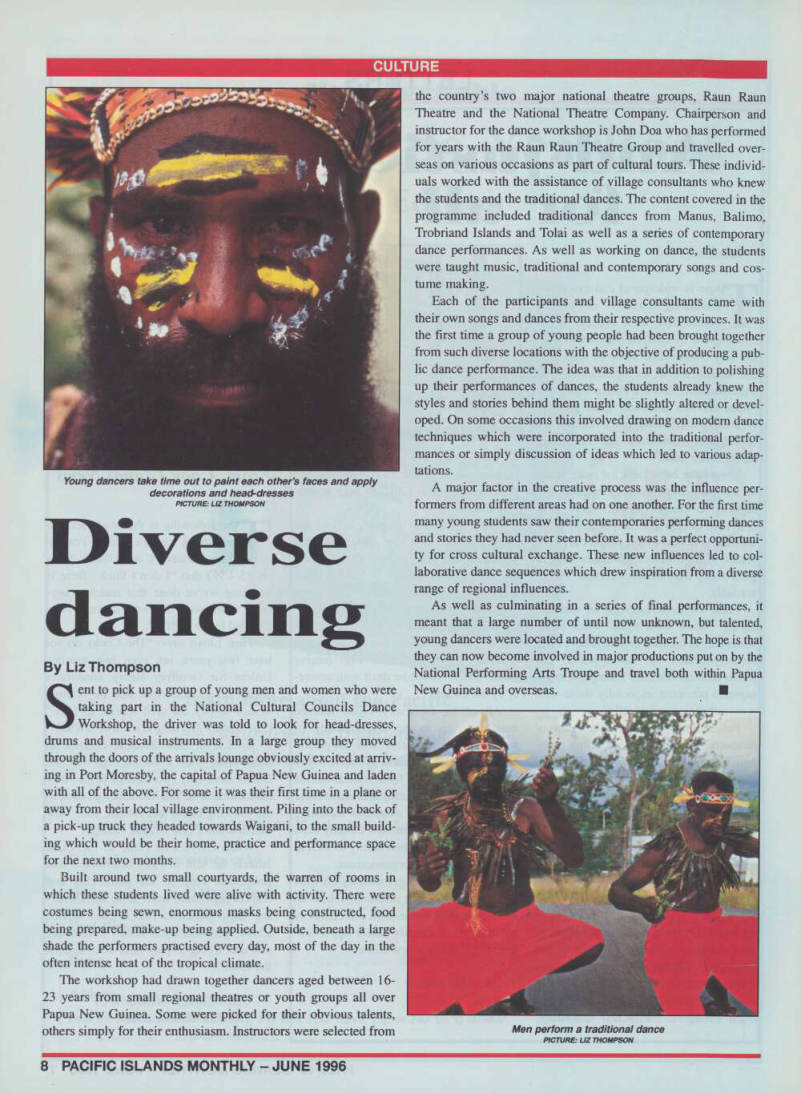
Young dancers take time out to paint each other’s faces and apply decorations and head-dresses
Picture: Liz Thompson
Men perform a traditional dance
Picture: Liz Thompson
Stirring
Opinion
Stirring a hornet’s nest
Given that New Zealand is a multi-cultural nation devel oped by immigrants since the Maori first arrived, it is inevitable that immigration and race relations are two issues seldom far removed from the headlines.
That has been never more true than this year as the country pre pares for its first general election under a new system of propor
tional representational voting.
The election will be keenly fought by more than 20 parties all hoping the new system - specifically designed to give minority groups a better chance of representation in parliament - will offer them a say in the running of the country.
That means the parties are all earnestly seeking campaign issues that will be potential vote winners.
New Zealand First, led by former National Party Minister of Maori Affairs Winston Peters believes it has found one in the ris ing level of immigration. And early opinion polls, which saw the party’s and Peter’s personal popularity soaring around the coun try, seemed to indicate it was on the right track.
In the process it stirred a hornet’s nest, for it is impossible in this multi-cultural country to divorce debate on immigration from charges of racism. Combine the two and you have a ready-made election issue filled with fire and fury that whatever it does for votes will do nothing for the cause of harmonious relations.
What set it all off was the revelation that a post-war record of nearly 55,000 migrants were granted permanent residency last year and 60 per cent of them were from Asia - more than half of those from Taiwan, China and Hong Kong.
Dubbing this wrong when 160,000 New Zealanders were unemployed, Peters launched a campaign of speeches on the theme; “Whose country is it anyway?” The government had no mandate to approve a mass influx of foreigners, he said, and immigration should be “cut to the bone” - a maximum of 10,000 highly-skilled newcomers a year.
He didn’t single out Asians for criticism, but chose the Auckland suburb or Howick - dubbed “Chowick” by locals because of the influx of Chinese in recent years - for his main attack. His policy is not xenophobic or racist, he insisted, but responsible and reflected the name of his party. That was not the way many people saw it, especially Prime Minister Jim Bolger (a long-time antagonist, who fired Peters from his cabinet five years ago prompting his eventual resignation from the National Party and the formation of New Zealand First).
“The last thing this country can afford is the development of xenophobia or racism,” the prime minister said. “ The group most
at risk if that was to become a virulent political disease is the Maoris themselves.”
But Peters had clearly touched a chord with many voters.
Opinion polls had already showed that more than half of New Zealanders believed there were too many Asian migrants in the country.
Coincidentally or not - and probably not - Peters anti-immi gration campaign was followed by a dramatic rise of his party’s
popularity in the polls.
Translated into votes at an election, the polls would give New Zealand First up to 26 MPs in the new 120-seat parliament and, with neither National nor Labour likely to be able to form a gov ernment on its own account, make Peters the coalition king maker.
One poll also made Peters the country’s most popular politi cian, toppling Bolger as preferred prime minister 25 per cent to 18 per cent - a situation not guaranteed to improve the worsening relationship between the pair.
But like most multi-racial countries around the world, issues of race are extremely sensitive.
Given the environment, it was probably only a matter of time before these sensitivities manifested themselves - and they did in most unpleasant ways.
Chinese community leaders reported a rash of harassment inci dents, vilification and “go back home” taunts around the country, even to people who had been bom in New Zealand and whose families had been there for years.
Worse, there was a spate of attacks on Somali refugee families, with objects thrown at their homes, dogs set on them and even attacks on their children.
If there were people who thought these incidents had nothing to do with the immigration debate, the recently-appointed Race Relations Conciliator, Rajen Prasad, was not among them.
Race relations had nose-dived, he said, adding that while New Zealanders had every right to a “robust” debate on immigration and population policy, so far it had been an emotional one that had raised tensions among groups which had lived side by side for years.
“The effects have been catastrophic for some minority popula tions.”
At the time of writing. Pacific Island migrants had escaped attacks of the kind inflicted on Asians and Africans. But as stated earlier, the cause of harmonious race relations in this country, has not advanced one jot. •
Wellington
David
Barber
On the inside
Cover Stories
Dare Fiji’s prisoners hope for reform?
SOPHIE FOSTER reports
What does a recently-released prisoner have to look forward to? The answer for many ex prisoners is bleak. All they have now is a society which refuses to acknowledge their existence and discriminates against them at almost every turn.
And with the police department’s cur rent limited resources, many would be happy to lock criminals up, throw away the key and forget about them.
But is society justified in adopting such
a stance?
In Fiji, a rehabilitation programme for current and ex-prisoners is virtually non existent. The “official” reason being a lack of funds.
But could the situation be better described as a lack of commitment to facil itate changes necessary to make ex-prison ers law-abiding members of the communi ty?
Judging by the number of repeat offenders and rampant discriminatory
policies which encourage a cycle of crime, it is clear a safety net for those who fall by the wayside is non-existent.
It is also clear the justice system in Fiji, which covers the police, courts and pris ons, has failed to address the ever-increas ing crime rate and over-populated prisons.
Fiji’s Crime Prevention and Control Seminar in March highlighted income inequalities, unemployment and poverty as being at the root of the problem.
The seminar recommended changes to
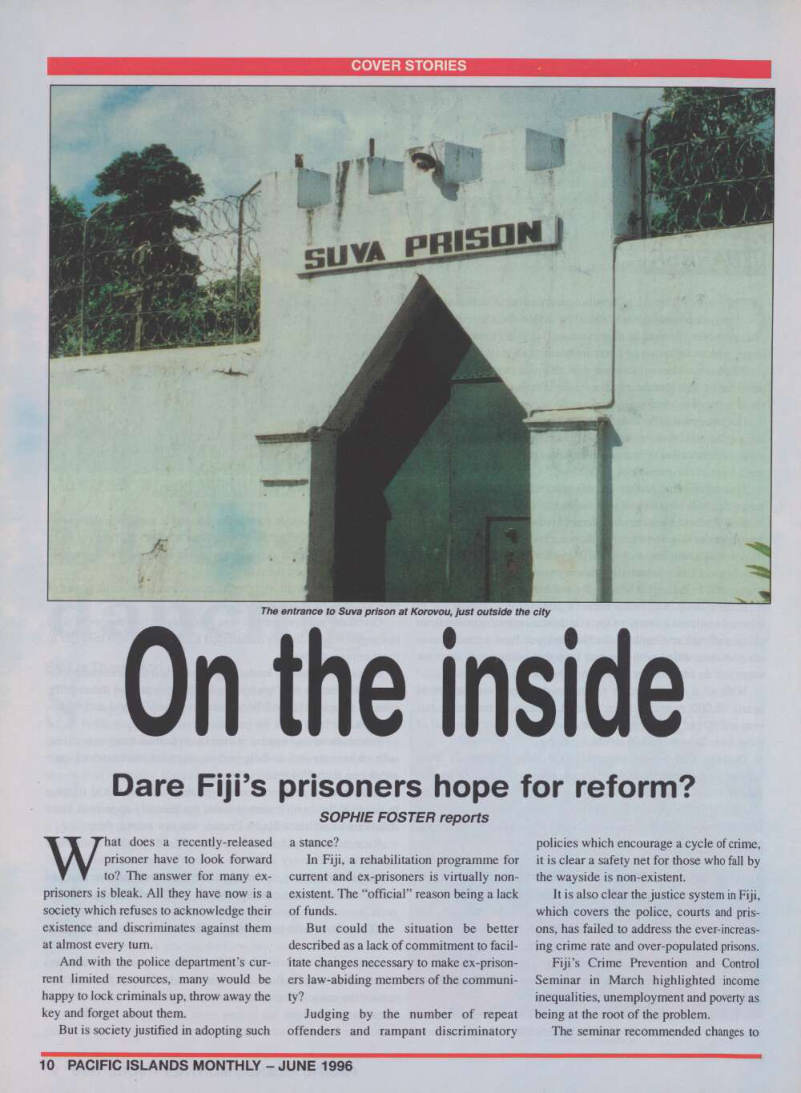
The entrance to Suva prison at Korovou, just outside the city
national planning policies, education and legislation to curb crime rates.
But while national workshops on crime prevention may provide excellent forums for dialogue amongst all parties involved, without commitment, follow-up action and implementation, such gatherings could become a waste of time and effort.
Police, magistrates, prison officials, ex prisoners, and unemployed youth, all agree on one thing - changes are needed immediately if attempts to halt the surging crime rate are to be effective.
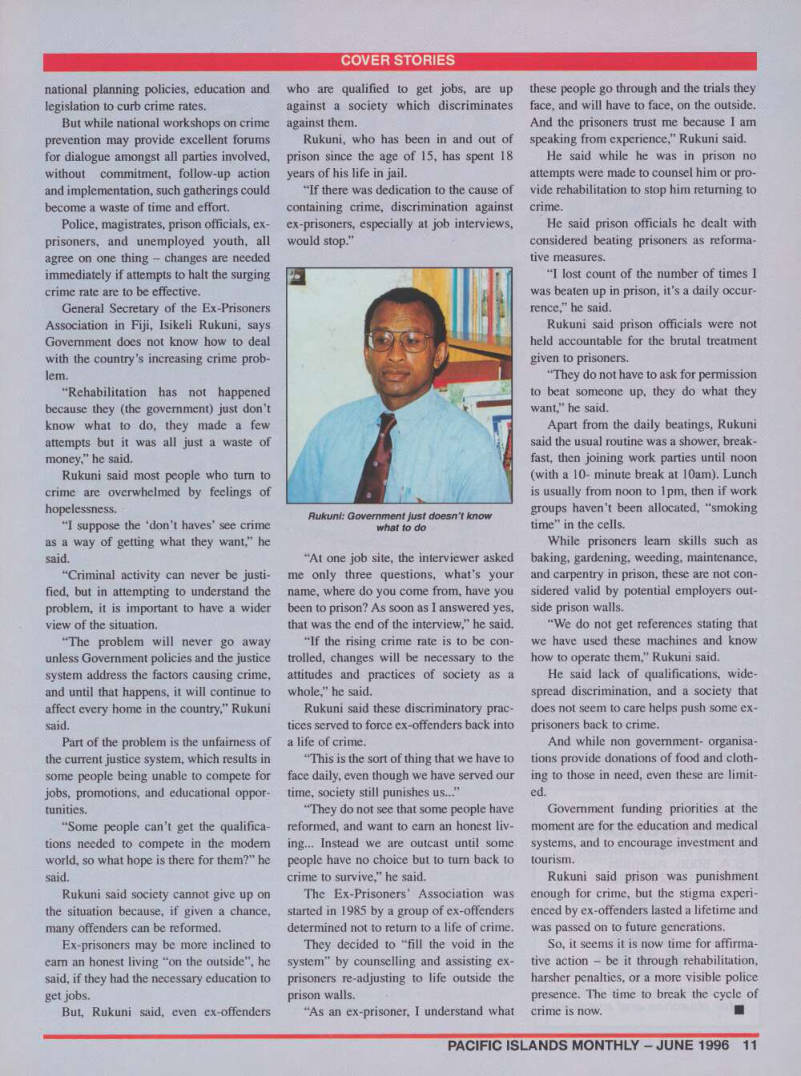
General Secretary of the Ex-Prisoners Association in Fiji, Isikeli Rukuni, says Government does not know how to deal with the country’s increasing crime prob lem.
“Rehabilitation has not happened because they (the government) just don’t know what to do, they made a few attempts but it was all just a waste of money,” he said.
Rukuni said most people who turn to crime are overwhelmed by feelings of hopelessness.
“I suppose the ‘don’t haves’ see crime as a way of getting what they want,” he said.
“Criminal activity can never be justi fied, but in attempting to understand the problem, it is important to have a wider view of the situation.
“The problem will never go away unless Government policies and the justice system address the factors causing crime, and until that happens, it will continue to affect every home in the country,” Rukuni said.
Part of the problem is the unfairness of the current justice system, which results in some people being unable to compete for jobs, promotions, and educational oppor tunities.
“Some people can’t get the qualifica tions needed to compete in the modem world, so what hope is there for them?” he said.
Rukuni said society cannot give up on the situation because, if given a chance, many offenders can be reformed.
Ex-prisoners may be more inclined to earn an honest living “on the outside”, he said, if they had the necessary education to get jobs.
But, Rukuni said, even ex-offenders
who are qualified to get jobs, are up against a society which discriminates against them.
Rukuni, who has been in and out of prison since the age of 15, has spent 18 years of his life in jail.
“If there was dedication to the cause of containing crime, discrimination against ex-prisoners, especially at job interviews, would stop.”
“At one job site, the interviewer asked me only three questions, what’s your name, where do you come from, have you been to prison? As soon as I answered yes, that was the end of the interview,” he said.
“If the rising crime rate is to be con trolled, changes will be necessary to the attitudes and practices of society as a whole,” he said.
Rukuni said these discriminatory prac tices served to force ex-offenders back into a life of crime.
“This is the sort of thing that we have to face daily, even though we have served our time, society still punishes u 5...”
“They do not see that some people have reformed, and want to earn an honest liv ing... Instead we are outcast until some people have no choice but to turn back to crime to survive,” he said.
The Ex-Prisoners’ Association was started in 1985 by a group of ex-offenders determined not to return to a life of crime.
They decided to “fill the void in the system” by counselling and assisting ex prisoners re-adjusting to life outside the
prison walls.
“As an ex-prisoner, I understand what
these people go through and the trials they face, and will have to face, on the outside.
And the prisoners trust me because I am speaking from experience,” Rukuni said.
He said while he was in prison no attempts were made to counsel him or pro vide rehabilitation to stop him returning to crime.
He said prison officials he dealt with considered beating prisoners as reforma tive measures.
“I lost count of the number of times I was beaten up in prison, it’s a daily occur rence,” he said.
Rukuni said prison officials were not held accountable for the brutal treatment
given to prisoners.
“They do not have to ask for permission to beat someone up, they do what they want,” he said.
Apart from the daily beatings, Rukuni
said the usual routine was a shower, break fast, then joining work parties until noon (with a 10- minute break at 10am). Lunch is usually from noon to 1 pm, then if work groups haven’t been allocated, “smoking time” in the cells.
While prisoners learn skills such as
baking, gardening, weeding, maintenance,
and carpentry in prison, these are not con
sidered valid by potential employers out
side prison walls.
“We do not get references stating that we have used these machines and know how to operate them,” Rukuni said.
He said lack of qualifications, wide spread discrimination, and a society that does not seem to care helps push some ex prisoners back to crime.
And while non government- organisa tions provide donations of food and cloth ing to those in need, even these are limit ed.
Government funding priorities at the moment are for the education and medical systems, and to encourage investment and tourism.
Rukuni said prison was punishment enough for crime, but the stigma experi enced by ex-offenders lasted a lifetime and was passed on to future generations.
So, it seems it is now time for affirma tive action - be it through rehabilitation, harsher penalties, or a more visible police presence. The time to break the cycle of crime is now. ■
Rukuni: Government Just doesn’t know what to do
A crisis
situation
By Sophie Foster
A Senate Select Committee report into the Fiji Police Force has called for a national emergency to be declared to stem the Force’s rapid dete rioration.
And in the face of the country’s rising crime rate, it has said the police depart ment should be given “urgent priority” over others of the civil service.
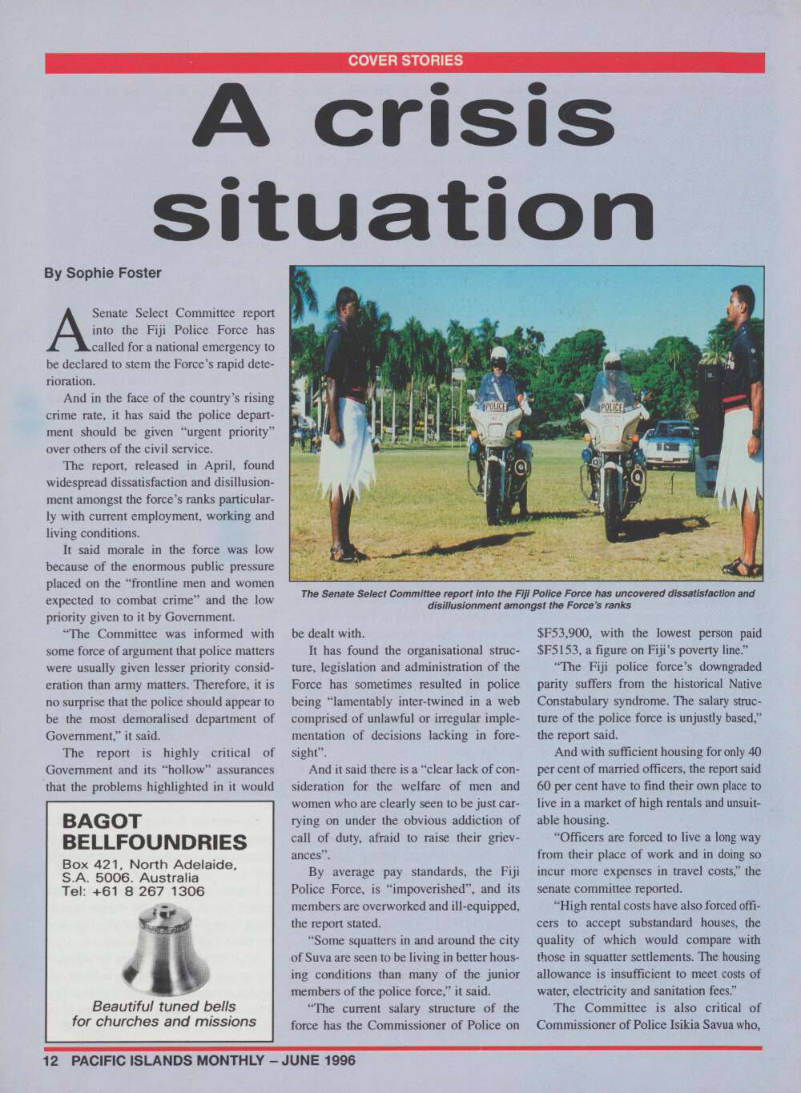
The report, released in April, found widespread dissatisfaction and disillusion ment amongst the force’s ranks particular ly with current employment, working and living conditions.
It said morale in the force was low because of the enormous public pressure placed on the “frontline men and women expected to combat crime” and the low priority given to it by Government.
“The Committee was informed with some force of argument that police matters were usually given lesser priority consid eration than army matters. Therefore, it is no surprise that the police should appear to be the most demoralised department of Government,” it said.
The report is highly critical of Government and its “hollow” assurances that the problems highlighted in it would
be dealt with.
It has found the organisational struc ture, legislation and administration of the Force has sometimes resulted in police being “lamentably inter-twined in a web comprised of unlawful or irregular imple mentation of decisions lacking in fore
sight”.
And it said there is a “clear lack of con sideration for the welfare of men and women who are clearly seen to be just car rying on under the obvious addiction of call of duty, afraid to raise their griev ances”.
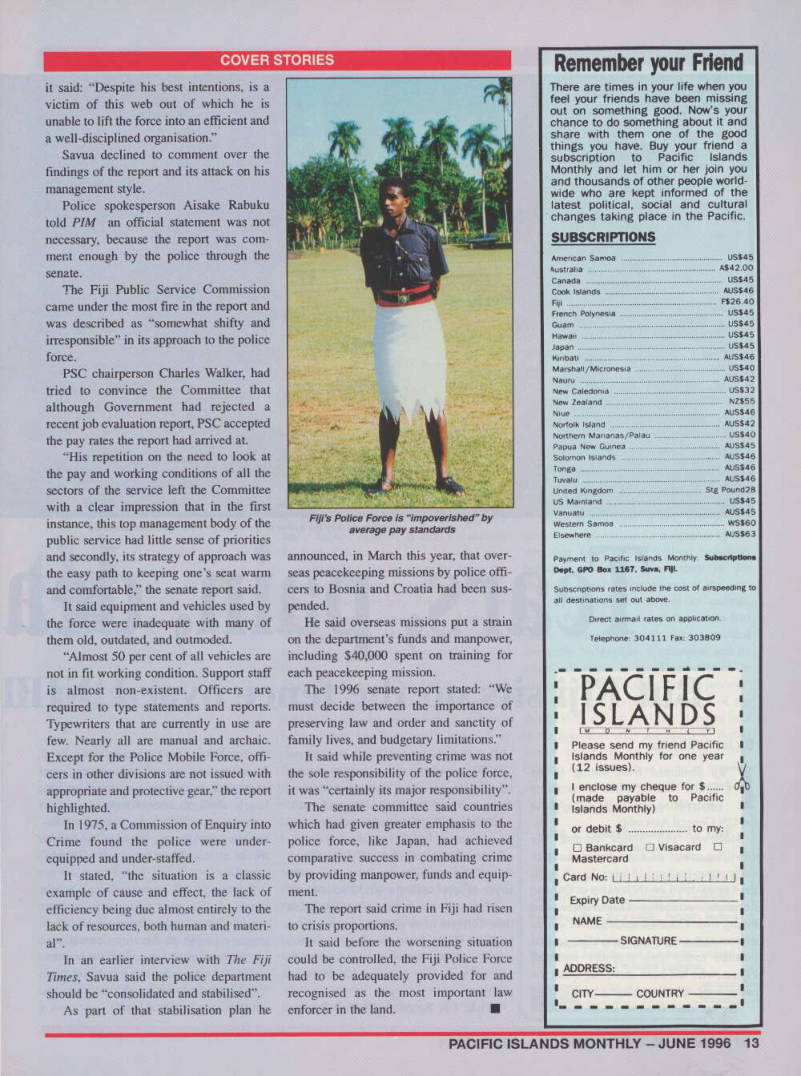
By average pay standards, the Fiji Police Force, is “impoverished”, and its members are overworked and ill-equipped, the report stated.
“Some squatters in and around the city of Suva are seen to be living in better hous ing conditions than many of the junior members of the police force,” it said.
“The current salary structure of the force has the Commissioner of Police on
$F53,900, with the lowest person paid $F5153, a figure on Fiji’s poverty line.”
“The Fiji police force’s downgraded parity suffers from the historical Native Constabulary syndrome. The salary struc ture of the police force is unjustly based,” the report said.
And with sufficient housing for only 40 per cent of married officers, the report said 60 per cent have to find their own place to live in a market of high rentals and unsuit able housing.
“Officers are forced to live a long way from their place of work and in doing so incur more expenses in travel costs,” the senate committee reported.
“High rental costs have also forced offi cers to accept substandard houses, the quality of which would compare with those in squatter settlements. The housing allowance is insufficient to meet costs of water, electricity and sanitation fees.”
The Committee is also critical of Commissioner of Police Isikia Savua who.
The Senate Select Committee report into the Fiji Police Force has uncovered dissatisfaction and disillusionment amongst the Force’s ranks
it said: “Despite his best intentions, is a victim of this web out of which he is unable to lift the force into an efficient and a well-disciplined organisation.”
Savua declined to comment over the findings of the report and its attack on his management style.
Police spokesperson Aisake Rabuku told PIM an official statement was not necessary, because the report was com ment enough by the police through the senate.
The Fiji Public Service Commission came under the most fire in the report and was described as “somewhat shifty and irresponsible” in its approach to the police force.
PSC chairperson Charles Walker, had tried to convince the Committee that although Government had rejected a recent job evaluation report, PSC accepted the pay rates the report had arrived at.
“His repetition on the need to look at the pay and working conditions of all the sectors of the service left the Committee with a clear impression that in the first instance, this top management body of the public service had little sense of priorities and secondly, its strategy of approach was the easy path to keeping one’s seat warm and comfortable,” the senate report said.
It said equipment and vehicles used by the force were inadequate with many of them old, outdated, and outmoded.
“Almost 50 per cent of all vehicles are not in fit working condition. Support staff is almost non-existent. Officers are required to type statements and reports.
Typewriters that are currently in use are few. Nearly all are manual and archaic.
Except for the Police Mobile Force, offi cers in other divisions are not issued with appropriate and protective gear,” the report highlighted.
In 1975, a Commission of Enquiry into Crime found the police were under equipped and under-staffed.
It stated, “the situation is a classic example of cause and effect, the lack of efficiency being due almost entirely to the lack of resources, both human and materi al”.
In an earlier interview with The Fiji Times, Savua said the police department should be “consolidated and stabilised”.
As part of that stabilisation plan he
announced, in March this year, that over seas peacekeeping missions by police offi cers to Bosnia and Croatia had been sus pended.
He said overseas missions put a strain on the department’s funds and manpower, including $40,000 spent on training for each peacekeeping mission.
The 1996 senate report stated: “We must decide between the importance of preserving law and order and sanctity of family lives, and budgetary limitations.”
It said while preventing crime was not the sole responsibility of the police force, it was “certainly its major responsibility”.
The senate committee said countries which had given greater emphasis to the police force, like Japan, had achieved comparative success in combating crime by providing manpower, funds and equip ment.
The report said crime in Fiji had risen to crisis proportions.
It said before the worsening situation could be controlled, the Fiji Police Force had to be adequately provided for and recognised as the most important law enforcer in the land. ■
Fiji’s Police Force is “impoverished” by average pay standards
Advertisements & other items, pp. 12-13 (2 items)
Cover Stories
Bellfoundries
BAGOT
Box 421, North Adelaide, S.A. 5006. Australia Tel: +6l 8 267 1306 v Beautiful tuned bells for churches and missions
Remember your Friend
There are times in your life when you
feel your friends have been missing
out on something good. Now’s your chance to do something about it and share with them one of the good things you have. Buy your friend a
subscription to Pacific Islands
Monthly and let him or her join you
and thousands of other people world-
wide who are kept informed of the latest political, social and cultural
changes taking place in the Pacific.
SUBSCRIPTIONS
American Samoa Australia Canada Cook Islands Fiji French Polynesia Guam Hawaii Japan Kiribati Marshall/Micronesia Nauru New Caledonia New Zealand Niue Norfolk Island Northern Mananas/Palau Papua New Guinea Solomon Islands Tonga Tuvalu United Kingdom US Mainland Vanuatu Western Samoa Elsewhere Payment to Pacific Islands Monthly: Subscription* Dept, GPO Box 1167, Suva, FIJI.
Subscriptions rates include the cost of airspeeding to all destinations set out above.
Direct airmail rates on application.
Telephone: 304111 Fax: 303809
f PACfFIC
■ ISLANDS
lluo* ’ H I rl I Please send my friend Pacific l Islands Monthly for one year
(12 issues).
I I enclose my cheque for $
(made payable to Pacific
1 Islands Monthly) or debit $ to my: I □ Bankcard □ Visacard □ Mastercard I ( Card No: i i ! i ! i I ! j j : i ! 1 i I 1 Expiry Date I
NAME
I SIGNATURE
I
, ADDRESS;
CITY COUNTRY
V
cCb
USS4S
A542.00
USS4S
AUSS46
F526.40
USS4S
USS4S
USS4S
USS4S
AUSS46
USS4O
AUSS42
USS32
NZSSS
AUSS46
AUSS42
USS4O
AUSS4S
AUSS46
AUSS46
AUSS46
Stg Pound2B
USS4S
AUSS4S
WSS6O
AUSS63
Tears, pain, death
Special Report
Tears, pain, death But Fiji sits on the fence over UNIFL attack
By lan Williams
Fiji abstained from voting at the United Nations when a resolution condemning Israel was discussed at the UN General Assembly.
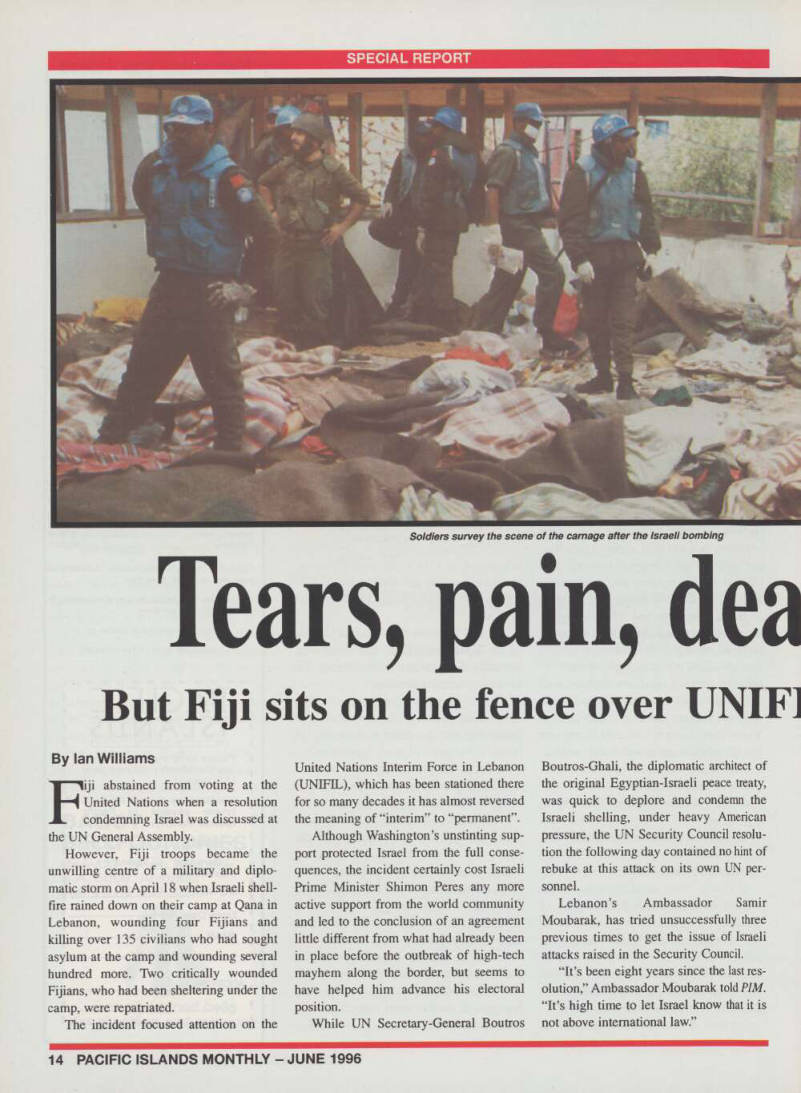
However, Fiji troops became the unwilling centre of a military and diplo matic storm on April 18 when Israeli shell fire rained down on their camp at Qana in Lebanon, wounding four Fijians and killing over 135 civilians who had sought asylum at the camp and wounding several hundred more. Two critically wounded Fijians, who had been sheltering under the camp, were repatriated.
The incident focused attention on the
United Nations Interim Force in Lebanon (UNIFIL), which has been stationed there for so many decades it has almost reversed the meaning of “interim” to “permanent”.
Although Washington’s unstinting sup port protected Israel from the full conse quences, the incident certainly cost Israeli Prime Minister Shimon Peres any more active support from the world community and led to the conclusion of an agreement little different from what had already been in place before the outbreak of high-tech mayhem along the border, but seems to have helped him advance his electoral position.
While UN Secretary-General Boutros
Boutros-Ghali, the diplomatic architect of the original Egyptian-Israeli peace treaty, was quick to deplore and condemn the Israeli shelling, under heavy American pressure, the UN Security Council resolu tion the following day contained no hint of rebuke at this attack on its own UN per sonnel.
Lebanon’s Ambassador Samir Moubarak, has tried unsuccessfully three previous times to get the issue of Israeli attacks raised in the Security Council.
“It’s been eight years since the last res olution,” Ambassador Moubarak told PIM.
“It’s high time to let Israel know that it is not above international law.”
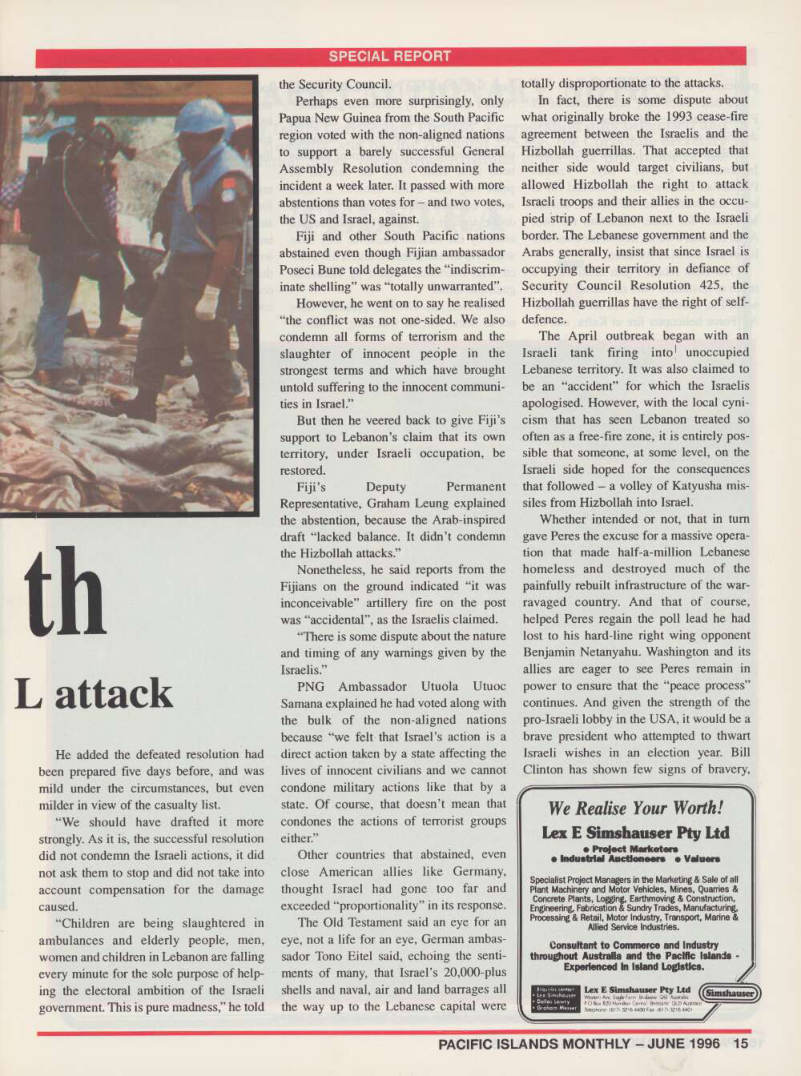
Soldiers survey the scene of the carnage after the Israeli bombing
He added the defeated resolution had been prepared five days before, and was mild under the circumstances, but even milder in view of the casualty list.
“We should have drafted it more strongly. As it is, the successful resolution did not condemn the Israeli actions, it did not ask them to stop and did not take into account compensation for the damage caused.
“Children are being slaughtered in ambulances and elderly people, men, women and children in Lebanon are falling every minute for the sole purpose of help ing the electoral ambition of the Israeli government. This is pure madness,” he told
the Security Council.
Perhaps even more surprisingly, only Papua New Guinea from the South Pacific region voted with the non-aligned nations to support a barely successful General
Assembly Resolution condemning the
incident a week later. It passed with more abstentions than votes for - and two votes, the US and Israel, against.
Fiji and other South Pacific nations abstained even though Fijian ambassador Poseci Bune told delegates the “indiscrim inate shelling” was “totally unwarranted”.
However, he went on to say he realised “the conflict was not one-sided. We also condemn all forms of terrorism and the slaughter of innocent people in the strongest terms and which have brought untold suffering to the innocent communi ties in Israel.”
But then he veered back to give Fiji’s support to Lebanon’s claim that its own territory, under Israeli occupation, be restored.
Fiji’s Deputy Permanent
Representative, Graham Leung explained
the abstention, because the Arab-inspired draft “lacked balance. It didn’t condemn the Hizbollah attacks.”
Nonetheless, he said reports from the Fijians on the ground indicated “it was inconceivable” artillery fire on the post was “accidental”, as the Israelis claimed.
“There is some dispute about the nature and timing of any warnings given by the Israelis.”
PNG Ambassador Utuola Utuoc Samana explained he had voted along with the bulk of the non-aligned nations because “we felt that Israel’s action is a direct action taken by a state affecting the lives of innocent civilians and we cannot condone military actions like that by a state. Of course, that doesn’t mean that condones the actions of terrorist groups either.”
Other countries that abstained, even close American allies like Germany, thought Israel had gone too far and exceeded “proportionality” in its response.
The Old Testament said an eye for an eye, not a life for an eye, German ambas sador Tono Eitel said, echoing the senti ments of many, that Israel’s 20,000-plus shells and naval, air and land barrages all the way up to the Lebanese capital were
totally disproportionate to the attacks.
In fact, there is some dispute about what originally broke the 1993 cease-fire agreement between the Israelis and the Hizbollah guerrillas. That accepted that neither side would target civilians, but allowed Hizbollah the right to attack Israeli troops and their allies in the occu pied strip of Lebanon next to the Israeli border. The Lebanese government and the Arabs generally, insist that since Israel is occupying their territory in defiance of Security Council Resolution 425, the Hizbollah guerrillas have the right of self defence.
The April outbreak began with an Israeli tank firing into unoccupied Lebanese territory. It was also claimed to be an “accident” for which the Israelis apologised. However, with the local cyni cism that has seen Lebanon treated so often as a free-fire zone, it is entirely pos sible that someone, at some level, on the Israeli side hoped for the consequences that followed - a volley of Katyusha mis siles from Hizbollah into Israel.
Whether intended or not, that in turn gave Peres the excuse for a massive opera tion that made half-a-million Lebanese homeless and destroyed much of the painfully rebuilt infrastructure of the war ravaged country. And that of course, helped Peres regain the poll lead he had lost to his hard-line right wing opponent Benjamin Netanyahu. Washington and its allies are eager to see Peres remain in power to ensure that the “peace process” continues. And given the strength of the pro-Israeli lobby in the USA, it would be a brave president who attempted to thwart Israeli wishes in an election year. Bill Clinton has shown few signs of bravery.
particularly on the Middle East.
To date, there have been a total of 29 Fijian fatalities; of these, 20 were described as being “in action”.
Mikael Lindvall, UNIFIL’s Press and Information Officer says various Palestinian factions can be blamed for at least six deaths, the Lebanese National Movement for three, Hizbollah for two, Amal for one, a Sunni faction for three and Israel and the SLA for three.
“The most recent Fijian fatalities as a result of hostilities were on March 3, 1992 when Pte. Sorovakatini was hit by Israeli Air Force helicopter fire at Kafra, and on
June 3-5,1994 when Ptes. Volaukitoga and Netzler were shot by Hizbollah gunmen.”
Of course, to the Lebanese civilians, and the embattled UN troops, including the 680-strong Fijian detachment that has been there since 1978, the benefits of peace may look a little dubious. It raises some question about what UNIFIL is doing, since it has regularly been brushed aside by the Israelis whenever they have wanted to invade Lebanon and is not treat ed with overmuch respect by Hizbollah guerrillas either.
However, the UNIFIL presence does act as some sort of watchdog to ensure
locally agreed rules are applied, and the troops have played a large part in helping local villagers cope with life in a battle zone, repairing roads and bridges as fast as the Israelis destroy them.
The Fijian Government says that it is not reconsidering the provision of troops for UNIFIL. In effect, the UN pays a con siderable proportion of Suva’s defence budget while the battalion there does good work. Unfortunately for the Lebanese, there is no immediate end in sight to the conflict that keeps the Fijians in their country. ■
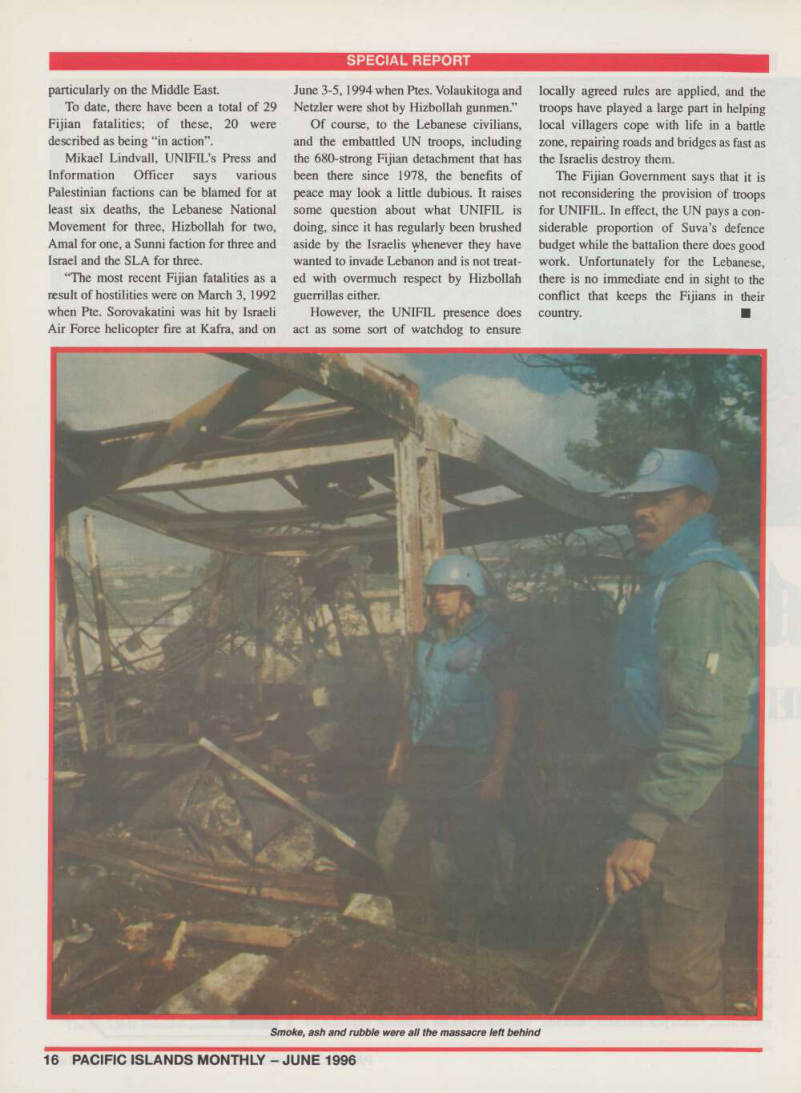
Smoke, ash and rubble were all the massacre left behind
Advertisements & other items, pp. 15-17 (2 items)
L attack
15
SPECIAL REPORT
PACIFIC ISLANDS MONTHLY - JUNE 1996
th L attack
We Realise Your Worth!
Lex E Simshauser Pty Ltd
• Project Marketers e Industrial Auctioneers e Valuers Specialist Project Managers in the Marketing & Sale of all Plant Machinery and Motor Vehicles, Mines, Quarries & Concrete Plants, Logging, Earthmoving & Construction, Engineering, Fabrication & Sundry Trades, Manufacturing, Processing & Retail, Motor Industry, Transport, Marine & Allied Service Industries.
Consultant to Commerce and Industry throughout Australia and the Pacific Islands - Experienced In Island Logistics. if Lex Simshauser Dallas Lawry Graham Messer Lex E Simshauser Pty Ltd Western Ave Eagle Farm Brisbane Old Australia P O Box 820 Hamilton Central Brisbane OLD Australia —-jt Telephone (617 i 3216 4400 Fax (617 i 3216 4401 Jv d z Simshauser)
TRADE MARK CAUTIONARY NOTICE
Notice is hereby given that Telstra Corporation Limited, a corporation duly organised and existing under the laws of Australia, and having ACN 051 775 556, the Corporate Secretary being located at 242 Exhibition Street, Melbourne, Australia is the sole proprietor of the following trade marks:-
TELSTRA
c c
~elstra %£elstra
Used in respect of:— Telecommunications and communications equipment, apparatus and systems, including but not limited to electronic and optical telecommunications and communications equipment, apparatus and systems; satellite and earth station telecommunications and communications equipment, apparatus and systems; Telephone equipment, apparatus and systems, including but not limited to telephone; telephone receivers; telephone handsets; telephone network, telephone exchanges, telephone switching, telephone answering, telephone card vending and telephone dialling equipment, apparatus and systems; Transmission, receiving and storage equipment, apparatus and systems, including but not limited to facsimile, telegraph, telex, teleprinting, cable and paging equipment, apparatus and systems; data and video networking and conferencing equipment, apparatus and systems; data processing, message handling and switching equipment, apparatus and systems; digital equipment, apparatus and systems; electronic, voice, text and facsimile mail equipment, apparatus and systems; electronic directory equipment, apparatus and systems; Computer equipment, apparatus and systems, including but not limited to computer programs; computer software; computer hardware; computer terminals; computer memories; computer networking equipment, apparatus and systems; computer manuals in this class; modems; Video and audio equipment, apparatus and systems, including but not limited to sound and image recording, transmission and reproduction equipment, apparatus and systems; video cassettes and tapes; compact discs; records; digital, electric and electronic radio equipment, apparatus and systems; magnetic tapes; cinematographic, television and amusement equipment, apparatus and systems; amusement machines; All associated parts and accessories being goods in class 9, paper, cardboard and goods made from these materials; printed matter including directories, journals and manuals and afl goods in class 16; advertising, promotional, consultancy and business services; compiling, arranging and publishing directories; telephone answering services; market research and statisticafservices; being services in dass 35, repair installation, maintenance and construction services; being services in class 37, telecommunication services being services in class 38, amusement, entertainment, education and information services; multi-media services; being services in class 41, research services; computer programming services; retail and wholesaling services; consultancy services being services in Class 42'.
The said proprietor claims all rights in respect of the above trade marks and will take all necessary legal steps against any person or company infringing their said rights.
DAVIES COLLISON CAVE
PATENT ATTORNEYS
One Little Collins Street Melbourne, Victoria, 3000 Australia Level 10 10 Barrack Street Sydney, New South Wales, 2000 AMP Building Hobart Place Canberra City 2601
cross-fire
Caught in the cross-fire
By Sophie Foster
When the green army vehicle pulled up outside her Valelevu home, on the outskirts of Fiji’s capital, the first thought which crossed Adi Susu’s mind was that her husband had been killed in battle.
With tension mounting after the morn ing’s unconfirmed reports of the death of two Fiji soldiers following the April 18 Israeli bombing of their the UN base at Qana in southern Lebanon, the sight of the solemn army officer made Adi Susu weep for the father of her one-year-old baby.
The last time she had seen him was in June 1995, when he left Fiji with his bat talion for peacekeeping duties in the Middle East.
Adi Susu found it hard to believe the officer who reassured her that Lance Corporal George Bakoso was not dead but in a stable condition in a Lebanese hos pital. Bakoso was wounded in the legs and chest during the Israeli attack.
The 27-minute attack on the UN base in Qana, which killed over 90 civilians and injured thousands of Lebanese, sparked world-wide condemnation of Israel.
Seven Fijißatt buildings were
destroyed during the bombardment, seven
were partly damaged, communication
lines severed and nine vehicles destroyed.
The Israeli attack was in response to Hizbollah guerrillas firing into northern Israel from a site a few metres from the UN base.
Both the UN in New York and the Israelis confirmed that shots were fired from outside the UN base in Qana minutes before the Israelis launched their attack.
For most army wives, a stray bullet could mean the loss of the only revenue earner in the family.
“I am a housewife, and my son is not even one yet. If my husband died, I don’t
know what I would do,” Adi Susu said.
She said she was not aware of any schemes for widows and orphans of sol diers killed while on UN peacekeeping duties.
But Fiji Military Forces spokesperson Colonel Savenaca Draunidalo told PIM that moves were under way to include ser vicemen and women in the Workers Compensation Act to cover injury, or death during overseas operations.
He said this was yet to be passed by parliament.
Currently, there are three other schemes in place, Draunidalo said, to help families of soldiers killed in action, including a
pension under the 1986 Pension Amendment Act.
The amount paid out as pension varied according to the rank of the deceased sol dier and number of dependants, he said.
The FMF has also initiated an insur ance scheme, brokered by private firm Blue Shield Insurance, which offered a minimum compulsory cover upon the death of a soldier. The cover could be increased by soldiers at will, Draunidalo said.
He said because soldiers were also members of the Fiji National Provident Fund they qualified for the FNPF Death Benefit.
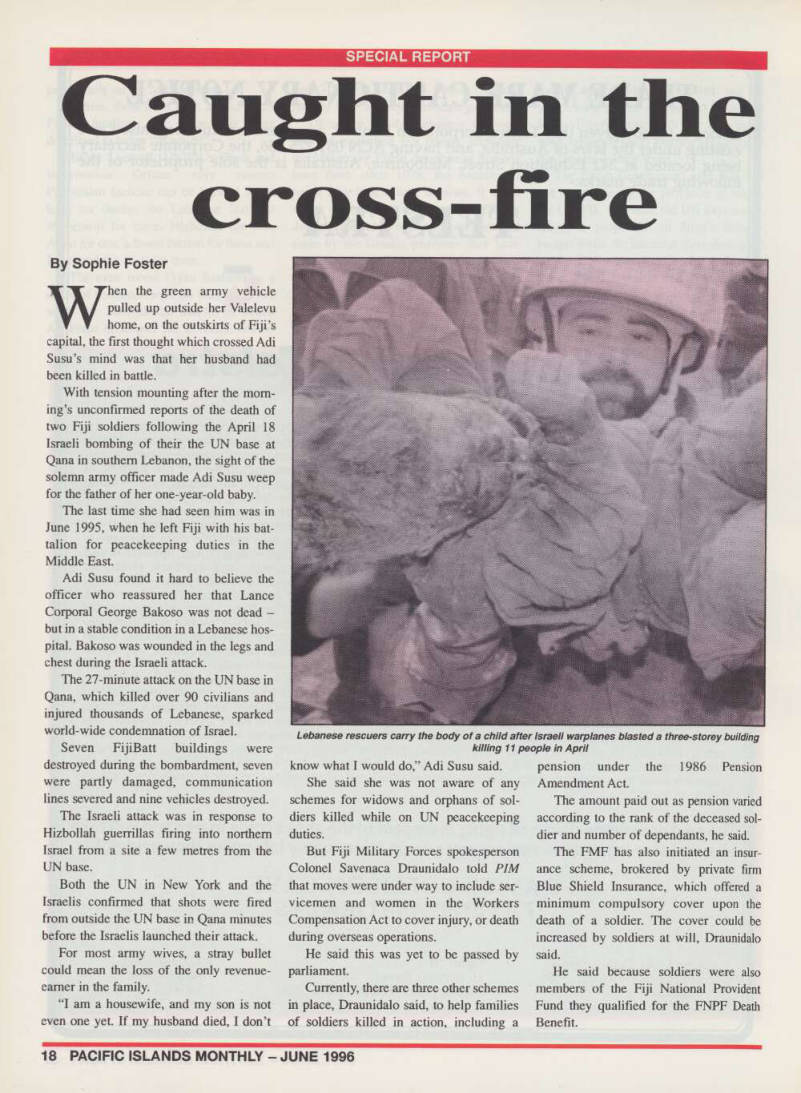
Lebanese rescuers carry the body of a child after Israeli warplanes blasted a three-storey building killing 11 people in April
“The majority of FMF members also hold personal insurance cover with the var ious insurance companies in the country,” he said.
Israel’s assault on the UN Interim Force peacekeeping base in Lebanon, which injured four Fiji soldiers, also affected hundreds of wives, girlfriends, children, family and friends.
However, Draunidalo said the morale of soldiers in Lebanon was high and despite the incident was boosted by mes sages of encouragement from organisa tions and individuals in Fiji.
“After the initial shock of the incident had worn off, the battalion recovered remarkably well over a short period of time,” he said.
Draunidalo confirmed replacements were being sent for the two Fiji soldiers who were being repatriated after the attack on Qana.
“It is apparent that, considering the time it will take for the two officers to recover from their injuries, it is in the interest of the battalion that replacements be sent to continue the work in the posi tions previously held by the wounded offi cers,” he said.
But the replacements will have a short stay in Lebanon with the airlift of the bat talion planned for June when the 179 men are due to arrive back in Fiji.
Fiji’s Prime Minister Sitiveni Rabuka, concerned for the safety of the Fiji battal ion, cut short a two-week overseas trip after the Israeli massacre occurred.
“The uncertainties that will now follow (retaliation) will put at grave risk the lives of the Fijian soldiers in their peacekeeping role as non-combatants,” he said in a state ment.
“They will be caught in the crossfire of hostilities founded on deep-seated and
long-standing grievances.”
He condemned the Israeli attack and called for an immediate cease-fire and the restoration of peace.
As former Commander of the Fijißatt in Lebanon, Rabuka was disturbed by tele vision scenes of the carnage at Qana which he said reminded him of the harsh realities of peacekeeping in Lebanon.
“Any Fijian soldier who has served in Lebanon, would feel deep emotion when viewing pictures of the unnecessary loss of
lives in Qana,” he said.
“Over the years, the Fijian soldiers have developed close and personal ties with the Lebanese people in the area and know their children by name. We extend our deepest sympathy to the families who
are suffering.”
Rabuka said reconsideration of Fiji’s involvement in UNIFIL was an ongoing issue.
But he said he was “resigned to the fact that the Fiji commitment (to UNIFIL) is not only a national commitment but an international commitment that the whole world should accept”.
Fijian Foreign Affairs Minister Filipe
Bole condemned Israel’s bombing of Lebanese civilians and UN peacekeepers.
He said Fiji was sending a formal note to Israel, through its permanent UN mis sion in New York, seeking assurances that UN positions would not be targeted in future.
Bole said the shelling of the Fijißatt UN base was cause for concern and it was distressing so many civilian lives had been lost.
FMF confirmed Fijißatt had provided refuge on humanitarian grounds to 800 Lebanese civilians escaping the Israeli bombardment.
In the week before the shelling of Qana, the FMF had anticipated the Israeli/Lebanese situation was improving, with talks being set up between the two
parties.
On Sunday April 14, army Colonel Jeremaia Waqanisau said Fiji troops in Lebanon “were not in any danger” from
the barrage of Israeli bombings.
At the time, he said, the bomb warnings by Israel were precautions made only to villagers in Lebanon.
But the same evening a Fiji soldier was injured after a confrontation with a group of armed men attempting to fire rockets into northern Israel.
Within the week, Fiji troops had faced a barrage of 28 shells from Israel, which devastated their UNIFIL camp.
Ten days after Israeli artillery wounded four members of the Fijian UN contingent in Lebanon, Fiji Home Affairs Minister Paul Manueli met with Israeli army chief Amnon Shahak in April during a private visit.
On May 1, Canberra-based Israeli ambassador to Fiji, Shmuel Moyal, visited Suva to hand-deliver a letter to Rabuka from Israeli Prime Minister Shimon Peres.
In the letter, Peres expressed “deep regrets on the tragic incident on April 18” and offered “good wishes” for the recovery of the four Fiji soldiers injured in the Israeli attack.
He said Israel would “make every diplomatic effort” to put an end to the hos tilities in Lebanon and ensure the safety of UN peacekeepers would not be compro mised.
Peres said the Israelis had “high
regard” for the Fijian peacekeepers and
saluted their past activities and missions, including those who had lost their lives in the line of duty since 1978.
“It is for these reasons,” he said, “that the most unfortunate results of the attack on Qana are even more regrettable.” ■
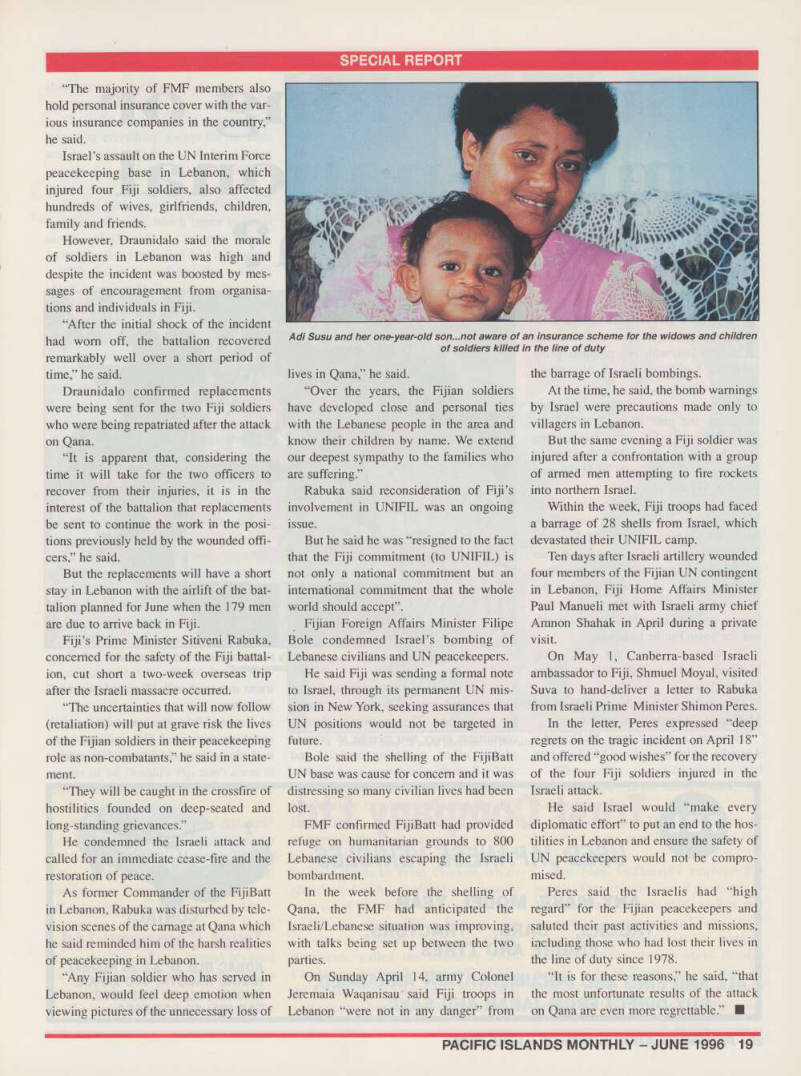
Adi Susu and her one-year-old son...not aware of an insurance scheme for the widows and children of soldiers killed in the line of duty
Burger king or

Business
Burger king or multi-national Goliath?
By Matthew Segal
Imagine the famous McDonald’s gold en arches in five or six locations
around Fiji, with Fiji products being
used for locally-produced Big Macs, shakes and sundaes.
These are the dreams of Marc McElrath, the man who introduced the McDonald’s era to Fiji with a gala opening at the hamburger chain’s first restaurant in Nadi, on the western side of Fiji’s main island of Viti Levu.
But it seems that for the time being, McElrath’s dreams are a long way off, as nearly all products used by McDonald’s
Fiji operation are imported and questions
are still being raised about the economic viability of the chain and whether the introduction of the world’s most famous burgers and fries are a blessing or a health risk for South Pacific Islanders.
“I think it’s great for Fiji,” said McElrath, 23, whose father is a prominent
Fiji developer.
“Everywhere else in the world there’s a McDonald’s. Finally there’s one here.”
However, it wasn’t easy. McDonald’s Australia, which approached McElrath two
years ago with an eye toward expanding to Fiji, provided minimal financial assistance for the venture. The corporation flies in consultants every two months to provide advice, offers marketing material and
trains managers at its “Burger University” in Sydney.
The rest of the investment for the Nadi outlet, an estimated SF3 million, came exclusively from McElrath. His mother
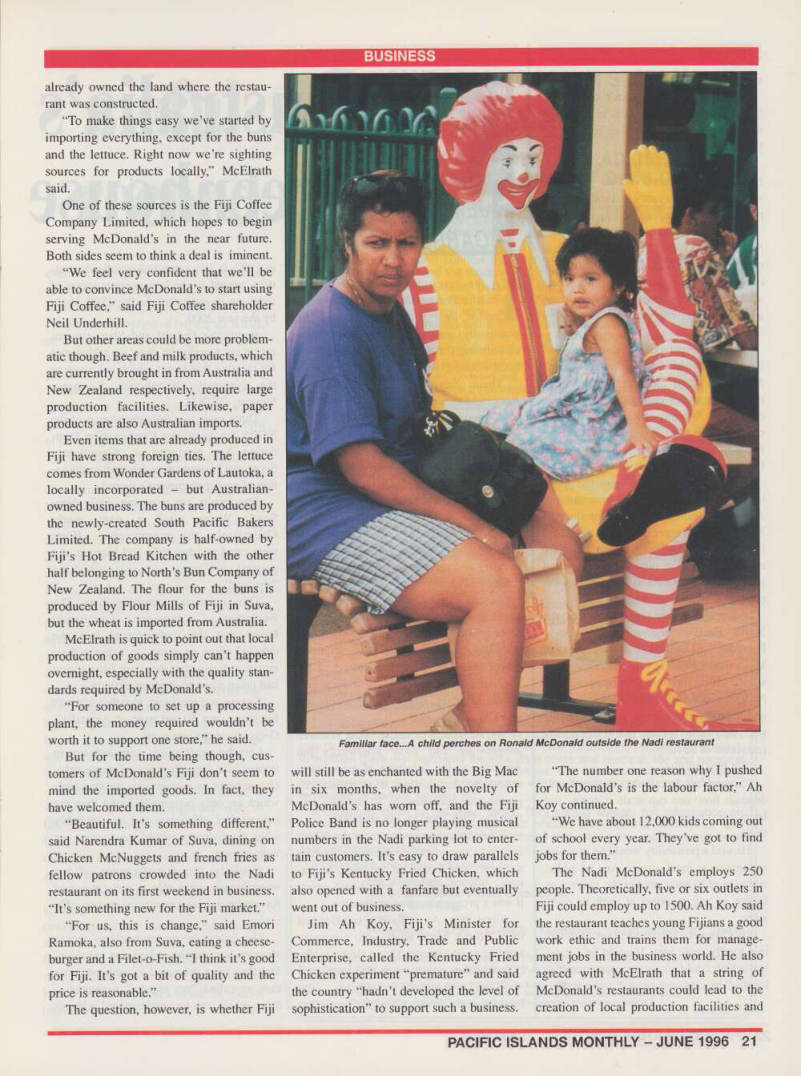
Customers tuck into burgers at Fiji’s new McDonald's restaurant in Nadi
Pictures: Corrie Greene
already owned the land where the restau rant was constructed.
“To make things easy we’ve started by importing everything, except for the buns and the lettuce. Right now we’re sighting sources for products locally,” McElrath said.
One of these sources is the Fiji Coffee
Company Limited, which hopes to begin
serving McDonald’s in the near future.
Both sides seem to think a deal is iminent.
“We feel very confident that we’ll be able to convince McDonald’s to start using Fiji Coffee,” said Fiji Coffee shareholder Neil Underhill.
But other areas could be more problem atic though. Beef and milk products, which are currently brought in from Australia and
New Zealand respectively, require large
production facilities. Likewise, paper products are also Australian imports.
Even items that are already produced in Fiji have strong foreign ties. The lettuce comes from Wonder Gardens of Lautoka, a locally incorporated - but Australian owned business. The buns are produced by the newly-created South Pacific Bakers Limited. The company is half-owned by Fiji’s Hot Bread Kitchen with the other half belonging to North’s Bun Company of New Zealand. The flour for the buns is produced by Flour Mills of Fiji in Suva, but the wheat is imported from Australia.
McElrath is quick to point out that local
production of goods simply can’t happen
overnight, especially with the quality stan
dards required by McDonald’s.
“For someone to set up a processing plant, the money required wouldn’t be worth it to support one store,” he said.
But for the time being though, cus tomers of McDonald’s Fiji don’t seem to mind the imported goods. In fact, they have welcomed them.
“Beautiful. It’s something different,” said Narendra Kumar of Suva, dining on Chicken McNuggets and french fries as fellow patrons crowded into the Nadi restaurant on its first weekend in business.
“It’s something new for the Fiji market.”
“For us, this is change,” said Emori Ramoka, also from Suva, eating a cheese burger and a Filet-o-Fish. “I think it’s good for Fiji. It’s got a bit of quality and the price is reasonable.”
The question, however, is whether Fiji
will still be as enchanted with the Big Mac in six months, when the novelty of McDonald’s has worn off, and the Fiji Police Band is no longer playing musical numbers in the Nadi parking lot to enter tain customers. It’s easy to draw parallels to Fiji’s Kentucky Fried Chicken, which also opened with a fanfare but eventually went out of business.
Jim Ah Koy, Fiji’s Minister for Commerce, Industry, Trade and Public Enterprise, called the Kentucky Fried Chicken experiment “premature” and said the country “hadn’t developed the level of sophistication” to support such a business.
“The number one reason why I pushed for McDonald’s is the labour factor,” Ah
Koy continued.
“We have about 12,000 kids coming out of school every year. They’ve got to find jobs for them.”
The Nadi McDonald’s employs 250 people. Theoretically, five or six outlets in Fiji could employ up to 1500. Ah Koy said the restaurant teaches young Fijians a good work ethic and trains them for manage ment jobs in the business world. He also agreed with McElrath that a string of McDonald’s restaurants could lead to the creation of local production facilities and
Familiar face...A child perches on Ronald McDonald outside the Nadi restaurant
more jobs.
Still, the minister wasn’t sure of the chain’s chances for success in a country which has grown up with an entirely dif ferent style of cuisine.
“A great question mark on that one, because for generations our fast food would always be a curry and rod, which is nutritious and inexpensive,” he said.
However, a spokesperson for the National Food and Nutrition Committee concurred: “It (McDonald’s) is of con cern, when you can get cheaper, more nutritious food. Why are you paying twice as much when you can pay 50 cents or $1?”
The spokesperson said direct compar isons between roti parcels and McDonald’s fast food were still prema ture, because not enough data had been collected. A study which will closely examine the nutritional value of both foods is expected to be done in the near future.
McDonald’s Fiji restaurant has made special dietary adjustments to accommo date local residents. They’ve introduced a Me Vegetable Burger, largely targeted for Fiji’s Hindu population which does not eat beef. And meat products are prepared in accordance with Halal standards for the country’s Muslim community.
Adaptation, said University of the South Pacific Economist Dr David Forsythe, will be the key to the success of McDonald’s Fiji. He said the corporation started off on the right foot by opening in Nadi, a town with more foreign tourists and a large professional work force. He said the same factors could support a restaurant in Suva.
But beyond this?
“I wouldn’t be all that optimistic. It depends how you can scale it down, and keep the character in place,” Forsythe said.
He said a possibility would be to set-up restaurants at local resorts. And he added it was hard to truly predict the success or failure of any business at such an early stage.
“It’s always a mistake to look at things in a totally static way. It could be a cata lyst which could encourage people to buy locally,” he said. ■
Advertisements & other items, p. 20 (1 item)
Trust Company Ltd
USED JAPANESE VEHICLES
ANY MAKE, MODEL, YEAR
* TRUCKS, * CARS, * TRACTORS,
* ENGINE AND TYRES
ALL SHIPPING AND DOCUMENTATION ARRANGED.
BUY DIRECT FROM JAPAN AND SAVE.
r
“CONTACT”
Trust Company Ltd
KOBAC BLD 3F 3-2-26 NISHIKI,
NAKAU NAGOYA, 460 JAPAN.
PHONE: (81) 52 953-5602
FAX (81) 52 953-5634
Australia’s
Greenhouse
In the seven years since the South Pacific Forum Heads of Government issued their first warning about the
potentially disastrous implications of glob
al warming for the region, scientists have been working overtime.
Their research confirms the leaders were right to worry.
If predicted sea-level rises associated with global warming eventuate, as many as five island states could become uninhabit able before the next century is over and others will suffer badly from fiercer cyclones and other extreme weather condi tions.
Global warming is caused by “Greenhouse Gases”; gases put out by industry and agriculture which trap heat in the earth’s atmosphere.
Australia puts out more Greenhouse gases per head of population than any other country in the world.
When fears about the implications of global warming were first raised at the Kiribati Forum in 1989, Australia’s then Prime Minister Bob Hawke responded
quickly.
He announced a region-wide research programme and soon afterwards put Australia at the forefront of greenhouse action by committing it to reduce its greenhouse emissions to 20 per cent less than the 1988 level by the year 2005.
While this was nowhere near the 60 per cent reduction of carbon dioxide emissions scientists said would be necessary to sta bilise concentrations of greenhouse gases, it was a progressive step at the time.
Since then, Australia has transformed itself from a world leader into a country wanting to be exempted from targets wide ly regarded as only a weak first step.
When Australia signed the International Climate Change Convention
in 1992, it, like other industrialised coun tries, agreed to the less onerous target of reducing its emissions to the 1990 levels by the year 2000.
Australia’s Federal and State govern ments got together to draw up a blueprint for meeting that target which is known as the National Greenhouse Response
Strategy (NGRS).
Three years into implementation of the NGRS the Australian Conservation foun dation has produced a “Greenhouse Scorecard” based on a detailed examina tion of each government’s record.
The results are worrying. Only New South Wales rated a pass mark.
Collectively, the governments’ efforts were rated as “dreadful” and Victoria, the poorest performer, was described as “abysmal”.
This is not mere sensationalism. The Australian Conservation Foundation found that the governments had the detailed plans necessary to achieve their emission targets but that very little action had taken place to implement them.
Energy and transport together account for more than 50 per cent of Australia’s Greenhouse gas emissions.
Lengthy negotiations with industry to improve the fuel efficiency of motor vehi cles secured an agreement to standards which are only marginally better than the current fuel efficiency and are probably what the industry would have come up with anyway.
Similarly, the manufacturers of hot water heaters were able to resist pressure for major improvements in energy effi
ciency.
The failure by governments to secure changes is surprising when one considers that they have promised to seek no more than so-called “no regrets” measures those which can be implemented with no
Australia
Jemima
Garrett
overall cost. One electricity distribution company. Energy Australia, has announced a market trial which will give consumers the option of buying all, a half, or a quarter of their energy from clean sources which do not release damaging gases.
The scheme will penalise Victoria’s dirty brown coal stations which at the moment sell almost SFI2O million worth of power to New South Wales each year.
Even with measures of this sort, it is clear Australia will fall short of its Greenhouse targets. Estimates suggest the NGRS will reduce emission levels from 14 per cent over the 1990 levels (which they would have been had no measures been implemented) to seven per cent above target. If new steps announced in March 1995 in the Federal government’s Greenhouse 21C package are put into place, emissions are likely to be reduced to three per cent over the 1990 levels.
Rather than pursue “no regrets” mea sures more vigorously, the Federal gov ernment has embarked on an internation al strategy which relies on special plead ing to explain its failure to meet emission targets and opposes moves to add a proto col to the Climate Convention which would make the targets binding.
That will place it on a collision course with its Pacific Island neighbours who, in line with advice from the prestigious United Nations Inter-govemmental Panel on Climate Change, are advocating much stricter and binding emission targets.
Australia, with its large distances,
growing population, heavy reliance on
coal-fired power stations and energy intensive industries, will find it more dif ficult than other industrialised nations to meet Greenhouse targets. That does not justify its being so quick to ask for special treatment. ■
Advertisements & other items, p. 23 (2 items)
awful
23
OPINION
PACIFIC ISLANDS MONTHLY - JUNE 1996
awful record
Vacancy
SOUTH PACIFIC FORUM SECRETARIAT
REGIONAL COORDINATION ADVISER,
ECONOMIC DEVELOPMENT DIVISION
Applications are invited from suitably qualified and experienced persons, who must be nationals of a member state of the South Pacific Forum*, for the position of Regional Coordination Adviser, Economic Development Division.
The Forum Secretariat was established in 1972 by the South Pacific Forum to encourage economic and political cooperation between its member states, and between those states and the more industrialised countries.
The Economic Development Division’s key role is to facilitate sustainable development and increase self reliance in Forum Island Countries through policy analysis, advice and coordination, and the provision of specialised economic assistance. The Division also has a key role in the coordination of regional donor assistance, and the process of priority setting at the regional level among Forum Island Countries and other regional organisations.
The Secretariat is being substantially restructured from 1996 with the result that the Economic Development Division will be retitled “Development and Economic Policy Division” and will have a three section structure. From this time on, the RCA is likely to have up to four subordinate staff and a considerable policy coordination role.
The Regional Coordination Adviser will assist the Director of the Division in the coordination of regional issues, including regional priority setting, as well as the provision of secretariat service for South Pacific Organisations Coordinating Committee. The Adviser will also have an oversight role of coordinating regional policy initiatives within and among different sectors and work with the Director in providing high-level advice. The RCA will work closely with other regional organisations and agencies and may be required to travel extensively within the region.
Key requirements of the position are: relevant experience in development policy issues of the Pacific Island Countries, including economic (monetised and semi-subsistence) and social sectors; an ability to quickly grasp and analyse key regional development issues and write clear policy papers; ability to supervise a small team of professional staff; an advanced degree in a development related field with at least 5 years relevant work experience; sound analytical skills and an ability to think laterally; good oral and written communication skills in English particularly in writing and explaining policy analysis: good interpersonal skills; A flexible approach and willingness to assist with a variety of other tasks within the Division are also essential.
This appointment offers a remuneration package, of between around $63,000 and $77,000 Fiji dollars (based on current exchange rates). For non-Fiji citizens this may be tax-free in Forum member countries* (See Information Package for details).
In addition there are payments for education costs and medical, life and personal accident insurance coverage. The appointee will be based at the Secretariat headquarters in Suva, Fiji. Appointment will be for three years initially, and is renewable by mutual agreement.
Applications close on 14 June 1996. They should contain full information on education and career backgrounds and should give names, addresses and telephone numbers of at least three referees with whom the applicant has been associated professionally.
Applications should be addressed to: — The Secretary General The South Pacific Forum Secretariat Private Mail Bag Suva, FIJI Telephone: (679) 312-600; Facsimile: (679) 305-573; Telex: FJ2229 Further information and an Information Package is available on request from the Personnel Officer on telephone (679) 312-600 Extn. 334.
I* Member States of the South Pacific Forum; Australia, Cook Islands, Federated States of Micronesia, Fiji, Kiribati, Nauru, New Zealand, Niue, Palau, Papua New Guinea, Republic of Marshall Islands, Solomon Islands, Tonga, Tuvalu, Vanuatu and Western Samoa.] 101350V4 >
A new-look

Secretariat
By January 1997, a new structure is expected to be in place for the Suva-based South Pacific Forum Secretariat. Proposed changes will be many and include cutting down on the size of the organisation with fewer divisions and renaming of others to reflect their new roles.
The changes are part of an overall structure recommended in a review under taken last year by international consul tants. Key recommendations were endorsed by the South Pacific Forum at its 1995 Summit in Madang, Papua New Guinea, giving the Secretariat a clear man
date to proceed with its plans.
Pivotal in the key recommendations is a mandate to “strengthen” the Secretariat’s policy advisory role. What it means is that the Secretariat will concentrate on enhanc ing regional co-ordination and review through such mechanisms as the South
Pacific Organisations Co-ordinating
Committee (SPOCC) as well as assisting island member states to develop their own capacity for economic and sectoral policy
development, implementation and evalua
tion.
A progressive report detailing the pro posed changes embodied in the new struc ture was submitted to member countries in
April this year.
The new-look Forum Secretariat will have only four divisions, as opposed to nine at present.
Under the changes, the surviving divi sions - Economic Development, Legal & Political, Trade & Investment, Administration & Finance - are to be renamed to reflect their new and expanded roles.
The Economic Development Division will become a larger “Development and Economic Policy Division”; the Legal and Political Division will become a larger “Political and International Affairs Division”; the Trade and Investment
The Forum
Alfred
Sasako
Division will expand to address import management and trade policy issues and the Administration and Finance Divisions will be combined into a new Corporate Services Division. Regional programmes such as Civil Aviation, Maritime, Energy and Telecommunications will no longer be administered by the South Pacific Forum Secretariat.
Instead, the South Pacific Forum Secretariat has proposed the transfer of the ongoing regional programmes in the mar itime and communications sectors to the South Pacific Commission (SPC) and ongoing energy programmes be in part set-up independently (the EU-funded Pacific Regional Energy Programme) and in part transferred to SOPAC.
The broad thrust of the restructure is expected, among other things, to strength en the Secretariat’s roles in: ■ serving the South Pacific Forum as its secretariat; ■ providing high quality advice and research on regional matters affecting sus tainable development, trade and invest ment; ■ stimulating co-operation in regional development through co-ordination of the Regional Strategy and provision of a sec retariat for the South Pacific Organisations Co-ordinating Committee (SPOCC); ■ representing the views and interests of the South Pacific Forum international ly; and ■ rationalising management and cor porate services functions.
In view of these developments, the Secretariat’s capacity in development pol icy, regional co-ordination, trade and investment policy and facilitation, servic ing of the annual South Pacific Forum and related activities is expected to be substan tially enhanced.
Proposed core activities for each of the new divisions have also been defined. For instance, the core business for the new Development and Economic Policy Division from next year will be to contin ue to provide advice to member countries on economic and development policy mat ters.
“These issues will be of a regional or sub-regional character or be of particular value to member countries with limited in house policy advising resources,” a
spokesperson said.
With up to 10 professional positions, the division will also focus on national capacity-building in these areas as well as play a leading role in strengthening mem ber countries’ relationship with donors
“through capacity building in priority set
ting and by regional programming through
the Regional Strategy”.
Currently, the Trade and Investment Division is broadly responsible for provid ing advice to member countries on trade, investment and industry development jointly with the South Pacific Trade Commission (SPTC) offices in Sydney, Australia, and Auckland, New Zealand.
These services will be expanded to Tokyo with the establishment of the South
Pacific Economic Exchange Support
Centre (SPEESC) next October, funded by the government of Japan. Benefits of sim ilar offices in Beijing, Taiwan and Europe are being assessed.
To strengthen the Secretariat’s capacity
in providing high-level policy advice in
trade and business development policy, the division is expected to have 10 profession
al positions.
The private sector in member countries will benefit from better co-ordination and integration of SPTC and SPEESC activi ties with those of the division’s.
The core role of the new Political & International Affairs Division will be in assisting the South Pacific Forum responding to and influencing internation
al developments.
A staff of up to six professional posi tions will include the Information and Publications because of the external focus of most of this work.
It is hoped that the additional staff will allow the South Pacific Forum Secretariat to extend its role in helping member coun tries follow and respond to any interna tional events and, where possible, to influ ence those events to the advantage of member countries.
One other important change that will come about as a result of the restructuring is that from 1997 there will only be one
Deputy Secretary-General.
As well, Administration and Finance Divisions will be merged to form a single Corporate Services Division. ■
Advertisements & other items, pp. 24-25 (1 item)
The Quality Of Our
AVIONICS MAINTENANCE SERVICE
IS INSTRUMENTAL
TO YOUR SUCCESS.
For over 25 years Australia's Collins Avionics Service Centre (part of the Rockwell worldwide network) has provided an extensive range of state-of-the-art avionics services to meet the rapidly growing needs of our region.
The highest quality sales and service for air transport, general aviation and
military requirements.
Including contract maintenance; repair, overhaul and modification; technical training, consulting and skills transfer; test systems; equipment; and a 24-hour
rental/exchange pool.
The Australian Service Centre is at Tullamarine in Victoria. For more information call Neil Thomson on (61-3) 9338 0344 or fax (61-3) 9330 3007. With Collins Avionics the sky is definitely not the limit. *l* Rockwell Avionics Collins
la Industries.
Mis again
and again
and again.
First it was * Exporter of the Year in 1993. Then * Exporter of the Year in 1994. And then the crowning glory of Prime Minister's Exporter of the Year 1995.
Many preach quality, but we deliver it. The only ISO 9002 certified manufacturers of quality wire products using wire imported exclusively from BMP Australia and Pacific Steel, New Zealand. * Building and Industry Category m LI
BM INDUSTRIES LTD
P.O. Box 707, Ba, Fiji Phone (679) 674966, Fax (679) 676700
Breaking the
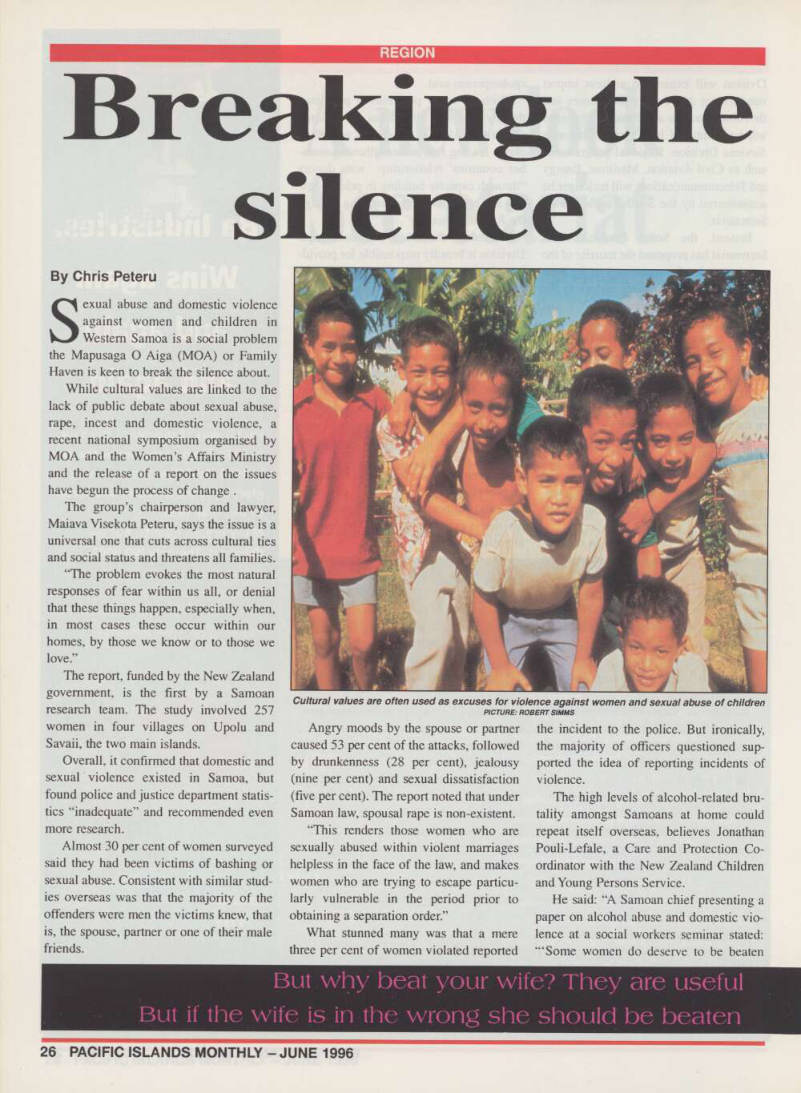
Region
Breaking the silence
By Chris Peteru
Sexual abuse and domestic violence against women and children in Western Samoa is a social problem the Mapusaga O Aiga (MOA) or Family Haven is keen to break the silence about.
While cultural values are linked to the lack of public debate about sexual abuse, rape, incest and domestic violence, a recent national symposium organised by MOA and the Women’s Affairs Ministry and the release of a report on the issues have begun the process of change .
The group’s chairperson and lawyer, Maiava Visekota Peteru, says the issue is a universal one that cuts across cultural ties and social status and threatens all families.
“The problem evokes the most natural responses of fear within us all, or denial
that these things happen, especially when,
in most cases these occur within our homes, by those we know or to those we love.”
The report, funded by the New Zealand government, is the first by a Samoan research team. The study involved 257 women in four villages on Upolu and Savaii, the two main islands.
Overall, it confirmed that domestic and sexual violence existed in Samoa, but
found police and justice department statis
tics “inadequate” and recommended even more research.
Almost 30 per cent of women surveyed said they had been victims of bashing or sexual abuse. Consistent with similar stud ies overseas was that the majority of the offenders were men the victims knew, that is, the spouse, partner or one of their male friends.
Angry moods by the spouse or partner caused 53 per cent of the attacks, followed by drunkenness (28 per cent), jealousy (nine per cent) and sexual dissatisfaction (five per cent). The report noted that under Samoan law, spousal rape is non-existent.
“This renders those women who are sexually abused within violent marriages helpless in the face of the law, and makes women who are trying to escape particu larly vulnerable in the period prior to obtaining a separation order.”
What stunned many was that a mere three per cent of women violated reported
the incident to the police. But ironically, the majority of officers questioned sup ported the idea of reporting incidents of violence.
The high levels of alcohol-related bru tality amongst Samoans at home could repeat itself overseas, believes Jonathan Pouli-Lefale, a Care and Protection Co ordinator with the New Zealand Children and Young Persons Service.
He said: “A Samoan chief presenting a paper on alcohol abuse and domestic vio lence at a social workers seminar stated: “‘Some women do deserve to be beaten
But why beat your wife? They are useful But if the wife is in the wrong she should be beaten
Cultural values are often used as excuses for violence against women and sexual abuse of children
Picture: Robert Simms
up, because they keep on nagging every time the husband has a few drinks. The husband works hard during the day, and he is entitled to have a few beers after work.”” Most abuse cases could be pinned down to three main causes; poor socio economic conditions, a lack of communi cation skills and “the neglect of women fulfilling the wife role, resulting in deser tion”.
As a result, abuse by men in those situ ations was unconditional and brutal.
He described how: ■ In February, an eight-year-old was referred to him when she ran away from home because she was frightened of her father. She said he came into her room and molested her and her three sisters every night. The father insists they are his prop erty and he can do whatever he likes; ■ An affluent middle-aged woman sought help from a husband who treated her like a “boarder”, put limits on who she could visit, and where she went. She was not allowed to leave him for any reason; ■ A 28-year-old woman returned home late one evening while awaiting final examination results. Flushed with her suc cess (which meant a salary increase) she was taken aback by her husband’s disbe lieving attitude. She was kicked in the stomach (she was six weeks pregnant) and was punched with a closed fist in the right eye, resulting in blurred vision and long
term discolouring.
Shamima Ali, co-ordinator of the Fiji Women’s Crisis Centre, said it was crucial to dispel myths and biases that suggested violent behaviour against women was all
right.
Some of the more common excuses was that violence against women was the woman’s fault, that women provoke vio lence by the way they dress or by going out at night, and that men have full rights over the bodies of their wives.
She described the inadequacy of restraining orders, the use of a woman’s sexual history as a mitigating circum stance in rape cases, and that rape within a marriage was not seen as a crime, which is also the case in Western Samoa.
Local Department of Justice records between 1990-1995 point to an average of nearly 50 sex crimes each year, but less than half of the charges laid lead to con victions.
In some instances, charges were with drawn after an ifoga (a traditional apolo gy according to Samoan custom) was per formed by the family of the perpetrator to the victim’s family.
Interestingly, Police Commissioner Galuvao Tanielu says a lack of parental care was the main cause of abuse against children.
“It is important that the family unit is strong to contain instances of sex abuse and domestic violence.
“We were prepared to take some stick from people at the symposium saying the whole deal was a non-issue, but as it hap pened, instead of it being swept under the carpet, the findings were accepted and it’s been a major step to bringing violence against women and children out in the open.”
More people were now using the facil ity for counselling and advice.
Establishing networks with govern ment and non-govemment organisations to share resources and discuss strategies have been other pluses, she said.
Plans are at hand to work on recom mendations from the meeting, involving counselling in schools, lobbying for hard
er-hitting legislation and raising the level
of public education to make changes to deal with violence and abuse.
While the first steps have been taken, MOA is aware that being agents for change is an on-going struggle.
When research for the report began last year, The Samoa Observer newspaper ran a survey on whether domestic violence was a problem.
“No, it is not really a problem,” replied Lotoalii Sa, a high chief from Fagaloa.
“But why beat your wife? They are useful for doing the chores. But if the wife is in the wrong she should be beaten and if she is in the wrong again, she should be kicked out of the house.” ■
g
Advertisements & other items, p. 27 (1 item)
and again.
Ba Industries
Mbs again
and again
and again.
First it was * Exporter of the Year in 1993. Then * Exporter of the Year in 1994. And then the crowning glory of Prime Minister's Exporter of the Year 1995.
Many preach quality, but we deliver it. The only ISO 9002 certified manufacturers of quality wire products using wire imported exclusively from BMP Australia and Pacific Steel, New Zealand. * Building and Industry Category m m / ' ' .
P.O. Box 707, Ba, Fiji Phone (679) 674966, Fax (679) 676700 AdDesign
Simple

TO SET UP: The “ WAFFLE-CRETE ”® mold body and sides are an integral unit. Basic mold bodies are formed from large sheets of heavy, durable plastic. Dome portions of these bodies are reinforced and insulated with dense foam insulation. Sides of the plastic body are made of rigid, integral, heavy-duty, extruded aluminum side rails (see photo #1). Mold sides secure in the casting position by simply closing the mold at the corners. Corner closure is made by tightening an attached, non-fouling coil bolt (one per corner - see photo #2).
During casting, molds simply set on any flat, rigid, level surface. They are light-weight and may be readily moved on and off the casting bed or from job-site to job-site.
Molds can be used either in-plant or on-site, de pending on individual needs.
“WAFFLE-CRETE"- panel designs call for straightfor ward, mild-steel reinforcing that is easy to place and secure in the mold (see ‘WAFFLE-CRETE”® Design Information book for typicals.) SIMPLE TO POUR; Concrete is placed directly in molds by ready-mix truck or other types of concrete placing equipment. A specially designed vibrating screed (see photo #3) strikes off and consolidates concrete in one pass.
A wide variety of appealing surface finishes can be readily accomplished. Blockouts for windows, doors, or other openings, and bulkheads for making partial panels are simple to install and secure. Blockouts and bulkheads may be nailed to the domes without damage to the molds.
Nail holes are self-filling and do not cause significant blemishes on panels or shorten mold life.
SIMPLE TO CURE: Tough, insulated plastic and aluminum curing covers protect the panel surface; trap the heat generated by the hydration of the cement: and also trap the moisture that is present during the curing process (see photo #4). Trapped heat accelerates the curing process and panels cure overnight without exter nal heat. Trapped moisture reduces surface shrinkage cracks. Each of your molds can be available for use every day.
SIMPLE TO STRIP; Mold sides flex away from panel edges as corner bolts are loosened. Panel is lifted with a lifting device specially designed for panel demolding (see photo 5) or panel can be lifted with cable slings and embedded lifting anchors. Panel is lifted 8-inches to 12inches above casting bed and mold is stripped from panel by applying downward pressure on mold sides. As mold releases, it settles back down on the casting bed ready for quick cleanup and setup (see photo #6).
SIMPLE TO CLEAN; Smooth, tough plastic mold body resists concrete buildup. Use of recommended form release agents promotes easy stripping and cleaning.
SIMPLE TO STACK AND SHIP; Standard 8-foot wide panels store and ship flat and are easy to load and haul on standard flatbed trailers eliminating the need for expensive and cumbersome vertical panel racks (see photo #7).
#2 - Mold Corner
#4 - Insulated
Curing Cover
#6 - Easy Demolding
#1 - “Waffle-Crete”® Mold
#3 - Pouring Is Simple
#5 - Lifting Device
#7 - Panels Store, Ship Flat
Advertisements & other items, pp. 29-31 (1 item)
Majuro
' osom ■a • e *p C Construction of 150 room Hotel
Introducing the
Resort Hotel
AH five guestroom buildings
erected. Completion date of July
1996 still on schedule.
Mmm ßar ■.<eatefe * |f|H| - ..jWWgWffI*' 1 *' -> '”B| ■ k **««r s W'
Start to finish in one year!
(Including design & engineering)
The Marshall Islands Government needed a new 150 room hotel to accommodate the annual Pacific Forum meeting in July of 1996. How could it be done so fast?
Pacific International, Inc., the general
contractor, is using ‘ ‘WAFFLE-CRETE’ ’, the revolutionary new Structural Precast Concrete Building System.
Ideal for apartments, hotels, office buildings, warehouse and government buildings. f Build better, build faster, build for less, f Design strength for earthquakes and typhoons, t Durability in corrosive marine environments. Cost effective because of fast construction. • Especially suited to the Pacific Islands.
Architectural rendering shows the Miyuro Resort Hotel lobby overlooking the lagoon. n
Pacific International, Inc.
P.O. Box 6, Majuro, Marshall Isalnds 96960 Phone (692) 625-3122/3560/5316 Fax (692) 625-3476/3348 Waffle-Crete ® International, Inc.
P.O. Box 1008 Hays, KS 67601 USA Ph; 913 625 3486 - Fx; 913 625 8542 email: [email protected]
® TOYOTA
Drive dignity right to the top.
Everyone who knows cars has no doubts about Land Cruiser’s ruggedness.
Yet how many know that its luxury rivals the finest high-priced cars?
Or that it’s got more room inside than many luxury sedans?
And because it’s a Toyota, Land Cruiser’s fit and finish, attention to detail, and graceful form speak of elegance as well as spacious comfort.
Yet you still get tough ladder frames and suspension built to take you as far off road as you want to go.
With power from 4.5-litre petrol or 4.2-litre diesel engines.
And it’s carefully protected from rust to last longer.
So if you’re going right to the top, this dignified car is ready to take you.
LAND CRUISER
DISTRIBUTORS /DEALERS
AMERICAN SAMOA BURNS PHILP MOTORS PH 633-4281 COOK ISLANDS GUAM & MICRONESIA ...ATKINS KROLL, INC. PH 646-1876/9 KIRIBATI NORFOLK ISLAND BORRY’S PTY LTD. PH 22114 PAPUA NEW GUINEA SOLOMON ISLAND ELA MOTORS PH 30314 TAHITI VANUATU ASCO MOTORS PH 22341 WESTERN SAMOA
..PACIFIC MOTORS LTD. PH 20796
TARAWA MOTORS PH 21090
.ELA MOTORS PH 3229400
.NIPPON AUTOMOTO PH 429819
.ASCO MOTORS PH 20800
FIJI ASCO MOTORS PH 384888
NEW CALEDONIA S.I.A.P. PH 275562
SAIPAN MICROL CORPORATION PH 234-591
TONGA ASCO MOTORS PH 23500
Pill '
' : r WWO
■/>v; - ■ ’V
’ 1 ifa I
mm :.m ■z
£ 2lfc
S 5 di
LAND
CRUISER
ml n / 1 I v
ftti
islands sex scandal
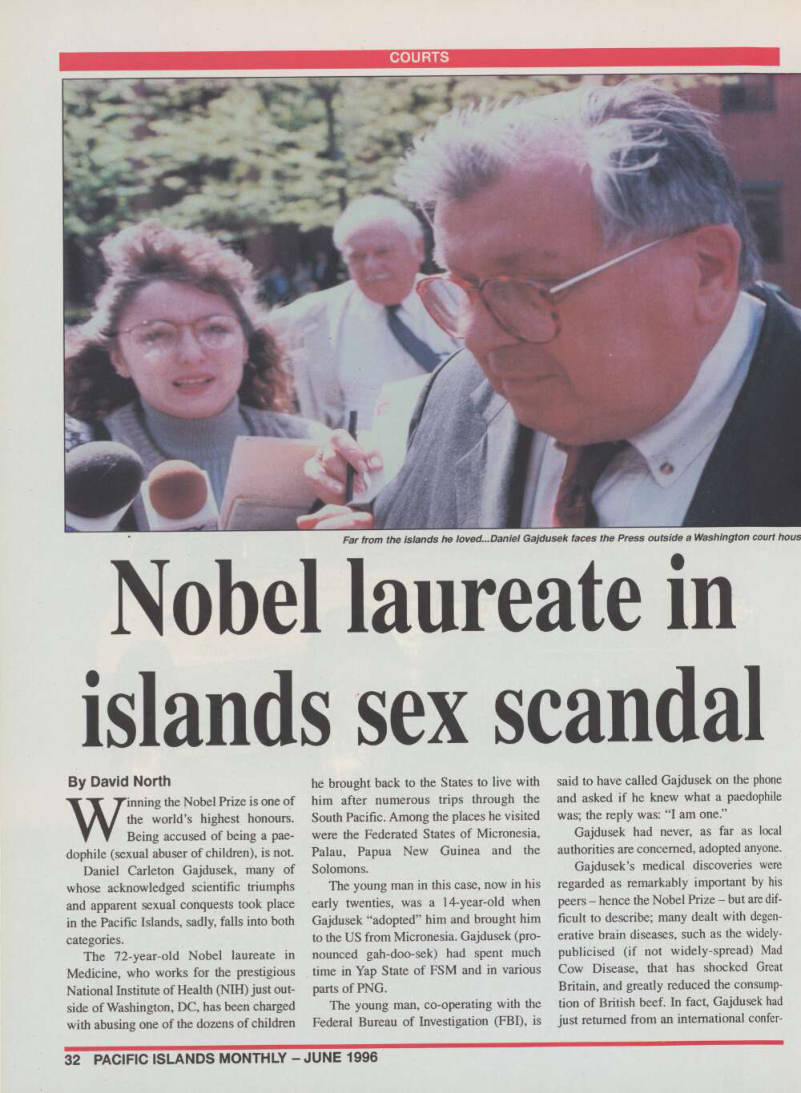
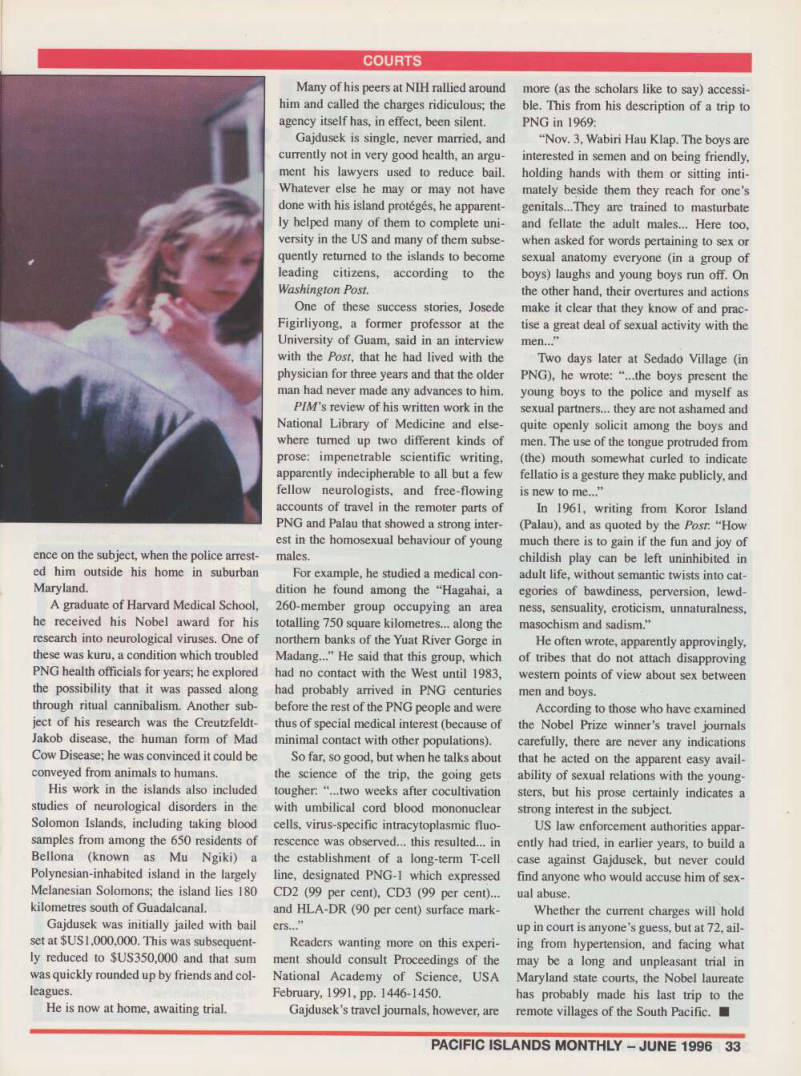
Courts
Nobel laureate in islands sex scandal
By David North
Winning the Nobel Prize is one of the world’s highest honours.
Being accused of being a pae dophile (sexual abuser of children), is not.
Daniel Carleton Gajdusek, many of whose acknowledged scientific triumphs and apparent sexual conquests took place in the Pacific Islands, sadly, falls into both categories.
The 72-year-old Nobel laureate in Medicine, who works for the prestigious National Institute of Health (NIH) just out side of Washington, DC, has been charged with abusing one of the dozens of children
he brought back to the States to live with him after numerous trips through the South Pacific. Among the places he visited were the Federated States of Micronesia, Palau, Papua New Guinea and the Solomons.
The young man in this case, now in his early twenties, was a 14-year-old when Gajdusek “adopted” him and brought him to the US from Micronesia. Gajdusek (pronounced gah-doo-sek) had spent much time in Yap State of FSM and in various parts of PNG.
The young man, co-operating with the Federal Bureau of Investigation (FBI), is
said to have called Gajdusek on the phone and asked if he knew what a paedophile was; the reply was: “I am one.”
Gajdusek had never, as far as local authorities are concerned, adopted anyone.
Gajdusek’s medical discoveries were regarded as remarkably important by his peers hence the Nobel Prize but are dif ficult to describe, many dealt with degen erative brain diseases, such as the widely publicised (if not widely-spread) Mad Cow Disease, that has shocked Great Britain, and greatly reduced the consump tion of British beef. In fact, Gajdusek had just returned from an international confer
Far from the islands he loved...Daniel Gajdusek faces the Press outside a Washington court hous
ence on the subject, when the police arrest ed him outside his home in suburban Maryland.
A graduate of Harvard Medical School, he received his Nobel award for his research into neurological viruses. One of these was kuru, a condition which troubled PNG health officials for years; he explored the possibility that it was passed along through ritual cannibalism. Another sub ject of his research was the Creutzfeldt- Jakob disease, the human form of Mad Cow Disease; he was convinced it could be conveyed from animals to humans.
His work in the islands also included studies of neurological disorders in the Solomon Islands, including taking blood samples from among the 650 residents of Bellona (known as Mu Ngiki) a Polynesian-inhabited island in the largely Melanesian Solomons; the island lies 180 kilometres south of Guadalcanal.
Gajdusek was initially jailed with bail set at SUS 1,000,000. This was subsequent ly reduced to $U5350,000 and that sum was quickly rounded up by friends and col leagues.
He is now at home, awaiting trial.
Many of his peers at NIH rallied around him and called the charges ridiculous; the agency itself has, in effect, been silent.
Gajdusek is single, never married, and currently not in very good health, an argu ment his lawyers used to reduce bail.
Whatever else he may or may not have done with his island proteges, he apparent ly helped many of them to complete uni versity in the US and many of them subse quently returned to the islands to become leading citizens, according to the Washington Post.
One of these success stories, Josede Figirliyong, a former professor at the University of Guam, said in an interview with the Post, that he had lived with the physician for three years and that the older man had never made any advances to him.
PlM' s review of his written work in the National Library of Medicine and else where turned up two different kinds of prose: impenetrable scientific writing, apparently indecipherable to all but a few fellow neurologists, and free-flowing accounts of travel in the remoter parts of PNG and Palau that showed a strong inter est in the homosexual behaviour of young males.
For example, he studied a medical con dition he found among the “Hagahai, a 260-member group occupying an area totalling 750 square kilometres... along the northern banks of the Yuat River Gorge in Madang...” He said that this group, which had no contact with the West until 1983, had probably arrived in PNG centuries before the rest of the PNG people and were thus of special medical interest (because of minimal contact with other populations).
So far, so good, but when he talks about the science of the trip, the going gets tougher: “...two weeks after cocultivation with umbilical cord blood mononuclear cells, virus-specific intracytoplasmic fluo rescence was observed... this resulted... in the establishment of a long-term T-cell line, designated PNG-1 which expressed CD2 (99 per cent), CD3 (99 per cent)... and HLA-DR (90 per cent) surface mark ers...”
Readers wanting more on this experi ment should consult Proceedings of the National Academy of Science, USA February, 1991, pp. 1446-1450.
Gajdusek’s travel journals, however, are
more (as the scholars like to say) accessi ble. This from his description of a trip to PNG in 1969: “Nov. 3, Wabiri Hau Klap. The boys are interested in semen and on being friendly, holding hands with them or sitting inti mately beside them they reach for one’s genitals... They are trained to masturbate and fellate the adult males... Here too, when asked for words pertaining to sex or sexual anatomy everyone (in a group of boys) laughs and young boys run off. On the other hand, their overtures and actions make it clear that they know of and prac tise a great deal of sexual activity with the men...”
Two days later at Sedado Village (in PNG), he wrote: “...the boys present the young boys to the police and myself as sexual partners... they are not ashamed and quite openly solicit among the boys and men. The use of the tongue protruded from (the) mouth somewhat curled to indicate fellatio is a gesture they make publicly, and is new to me...”
In 1961, writing from Koror Island (Palau), and as quoted by the Post : “How much there is to gain if the fun and joy of childish play can be left uninhibited in adult life, without semantic twists into cat egories of bawdiness, perversion, lewd ness, sensuality, eroticism, unnaturalness, masochism and sadism.”
He often wrote, apparently approvingly, of tribes that do not attach disapproving western points of view about sex between men and boys.
According to those who have examined the Nobel Prize winner’s travel journals carefully, there are never any indications that he acted on the apparent easy avail ability of sexual relations with the young sters, but his prose certainly indicates a strong interest in the subject.
US law enforcement authorities appar ently had tried, in earlier years, to build a case against Gajdusek, but never could find anyone who would accuse him of sex ual abuse.
Whether the current charges will hold up in court is anyone’s guess, but at 72, ail ing from hypertension, and facing what may be a long and unpleasant trial in Maryland state courts, the Nobel laureate has probably made his last trip to the remote villages of the South Pacific. ■
Rabaul,
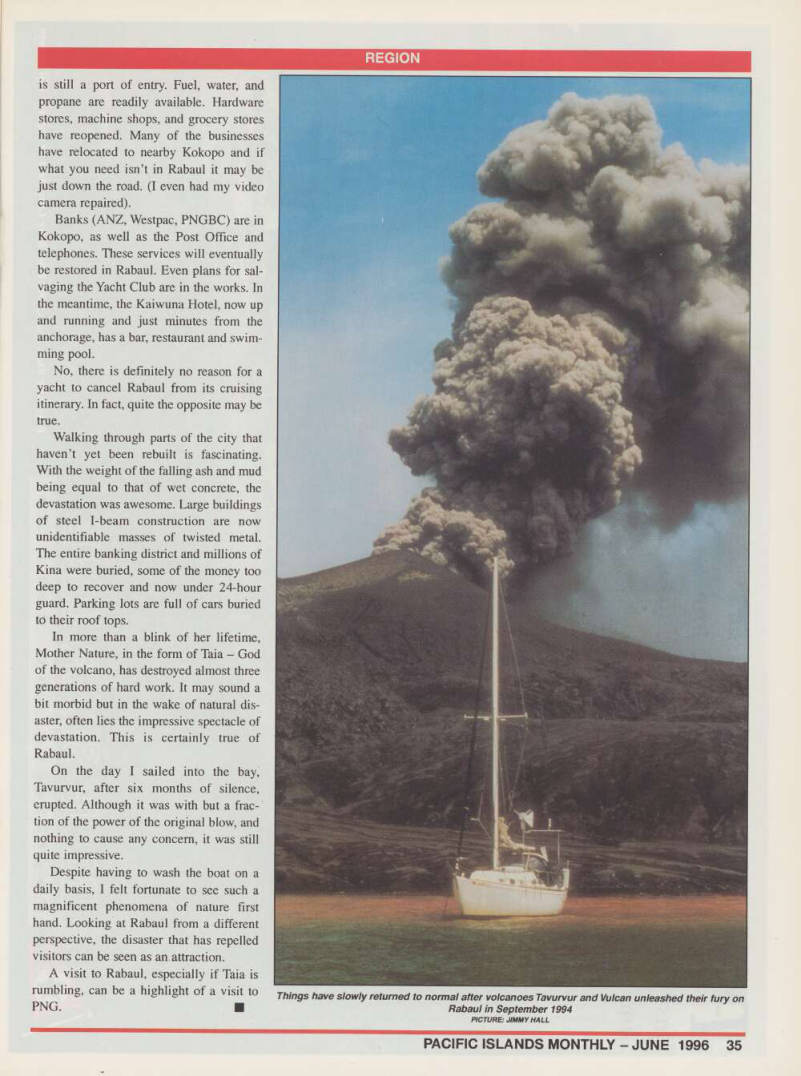
after the fury
By Jimmy Hall
Rabaul, once a popular port amongst cruisers to Papua New Guinea, suf fered a setback in September 1994, when a volcanic emption buried the city under two metres of ash, dirt, mud and stone. Located at the eastern end of New Britain Island, Rabaul has been called one of the most picturesque harbours of the world, and is no stranger to volcanic activ
ity.
Just after sunrise on September 19, the two volcanoes, Tavurvur and Vulcan, erupted. It was a catastrophic disaster for the citizens of Rabaul, most of whom lost everything they couldn’t carry with them
during the hurried evacuation. But the eruption was also just another subterranean belch in an area with a long and eruptive history.
Situated on what geologists call the Bismarck Microplate, New Britain is one of the least stable places on the planet, experiencing thousands of earthquakes a year. The locals have a saying that an erup tion will happen once every lifetime. And volcanologists agree this recent eruption won’t be the last.
The harbour of Rabaul sits in a deep volcanic bay formed during a 536 AD eruption that spewed so much debris into the atmosphere it darkened the sky over
Europe.
And the violence never stopped.
In 1937, Vulcan erupted killing 500 people. With such a past and a prediction for more of the same, one wonders if relo cating isn’t a better plan than rebuilding.
However, with such an ideal harbour and many buildings and piers that survived the eruption, they say there is no option but to carry on. And if an eruption happens every 50 years, well, Rabaul is so nice it’s just something that must be endured.
Although it may be a while before Rabaul attracts the tourists it once did, there is no reason for cruisers to avoid the port. The anchorage was not affected and it
is still a port of entry. Fuel, water, and propane are readily available. Hardware stores, machine shops, and grocery stores have reopened. Many of the businesses have relocated to nearby Kokopo and if what you need isn’t in Rabaul it may be just down the road. (I even had my video
camera repaired).
Banks (ANZ, Westpac, PNGBC) are in Kokopo, as well as the Post Office and telephones. These services will eventually be restored in Rabaul. Even plans for sal vaging the Yacht Club are in the works. In the meantime, the Kaiwuna Hotel, now up and running and just minutes from the anchorage, has a bar, restaurant and swim
ming pool.
No, there is definitely no reason for a yacht to cancel Rabaul from its cruising itinerary. In fact, quite the opposite may be true.
Walking through parts of the city that haven’t yet been rebuilt is fascinating.
With the weight of the falling ash and mud being equal to that of wet concrete, the devastation was awesome. Large buildings of steel I-beam construction are now unidentifiable masses of twisted metal.
The entire banking district and millions of Kina were buried, some of the money too deep to recover and now under 24-hour guard. Parking lots are full of cars buried to their roof tops.
In more than a blink of her lifetime, Mother Nature, in the form of Taia - God of the volcano, has destroyed almost three generations of hard work. It may sound a bit morbid but in the wake of natural dis aster, often lies the impressive spectacle of devastation. This is certainly true of Rabaul.
On the day I sailed into the bay, Tavurvur, after six months of silence, erupted. Although it was with but a frac tion of the power of the original blow, and nothing to cause any concern, it was still
quite impressive.
Despite having to wash the boat on a daily basis, I felt fortunate to see such a magnificent phenomena of nature first hand. Looking at Rabaul from a different perspective, the disaster that has repelled visitors can be seen as an attraction.
A visit to Rabaul, especially if Taia is rumbling, can be a highlight of a visit to
Png. ■
Things have slowly returned to normal after volcanoes Tavurvur and Vulcan unleashed their fury on Rabaul in September 1994
Picture: Jimmy Hall
Advertisements & other items, pp. 34-36 (2 items)
Region
Hirb
I / s •a ..mm 1 V
THE WORLD’S LEADING KNUCKLE BOOM CRANE
STEEL BROS
havo boon
Soiling & Servicing
HIAB sinco 1930 ...
• EXPERIENCE
• SERVICE
• RELIABILITY
• Swedish Quality Engineering
STEEL BROS (NZ) LTD
STEELBRO
HEAD OFFICE
CHRISTCHURCH:
1-31 Treffers Road Sockbum Telephone (64-3) 34&5499 Fax (64-3)348-5786 i
Proudly serving the Pacific Islands since the 1920’5, Blue Star Line continues to provide fast reliable frequent services to Fiji, New Caledonia and Tahiti
ahead of the rest
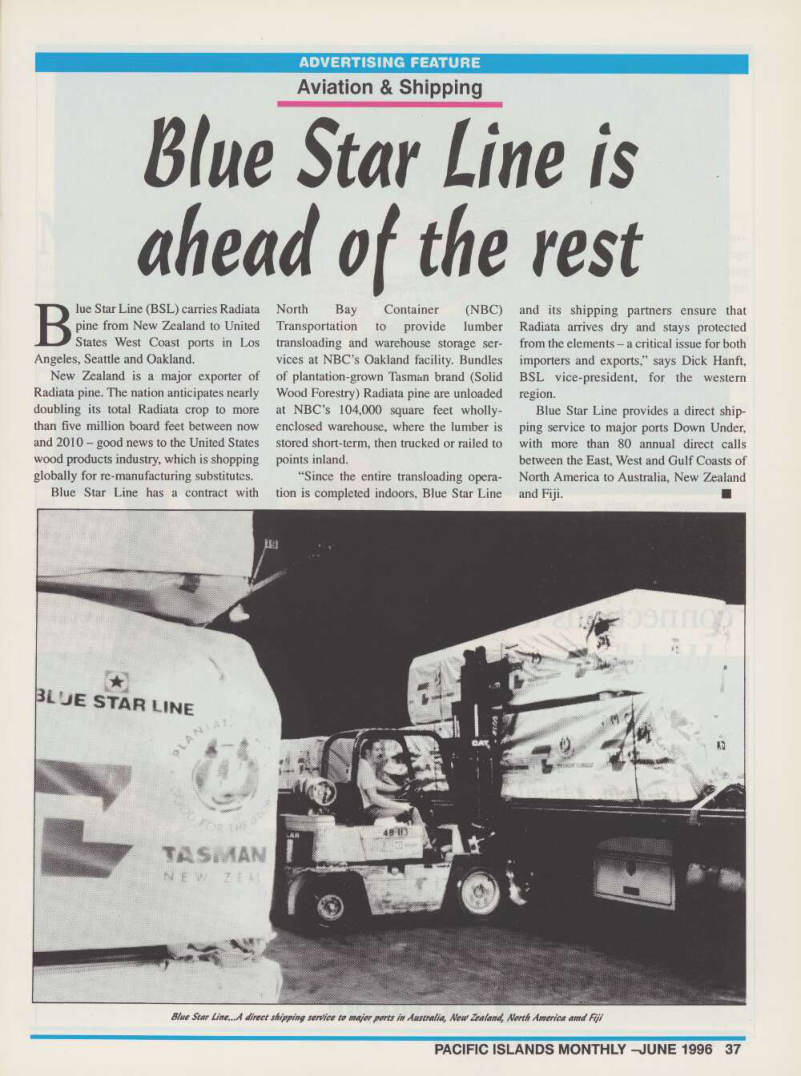
Advertising Feature
Aviation & Shipping Blue Star Line is ahead of the rest
Blue Star Line (BSL) carries Radiata pine from New Zealand to United States West Coast ports in Los Angeles, Seattle and Oakland.
New Zealand is a major exporter of Radiata pine. The nation anticipates nearly doubling its total Radiata crop to more than five million board feet between now and 2010 - good news to the United States wood products industry, which is shopping globally for re-manufacturing substitutes.
Blue Star Line has a contract with
North Bay Container (NBC) Transportation to provide lumber transloading and warehouse storage ser vices at NBC’s Oakland facility. Bundles of plantation-grown Tasman brand (Solid Wood Forestry) Radiata pine are unloaded at NBC’s 104,000 square feet wholly enclosed warehouse, where the lumber is stored short-term, then trucked or railed to
points inland.
“Since the entire transloading opera tion is completed indoors, Blue Star Line
and its shipping partners ensure that Radiata arrives dry and stays protected from the elements - a critical issue for both importers and exports,” says Dick Hanft, BSL vice-president, for the western region.
Blue Star Line provides a direct ship ping service to major ports Down Under, with more than 80 annual direct calls between the East, West and Gulf Coasts of North America to Australia, New Zealand and Fiji. ■
Blue Star Line...A direct shipping service to major ports in Australia, Aleut Zealand, North America amd Fiji
Advertisements & other items, p. 38 (1 item)
The best
■'=B*4 i M x-r- -*2 If X am
NEW G
Sing
PAPUA NEW GUINEA
till
ura apo Moresby Brisbane tr. r jb -a \ ■* --.s: .'■A ' W.
The best
connections to the
World's Greatest
Adventure...
Papua New Guinea
Land of Adventure and Excitement
Finding some of the world's greatest diving, fishing, trekking, rafting and cultural adventures is as easy as connecting with Air Niugini's regular services from Singapore, Hong Kong, Manila, Honiara, Jayapura, Cairns, Brisbane or Sydney, to Papua New Guinea.
Aside from having the best international connections, Air Niugini offers the largest network of regular services throughout Papua New Guinea.
Start packing more adventure into your holidays. Call Air Niugini or your nearest Travel Agent now.
Air Niugini
Craft Works 3322 d.
Riding on a wave
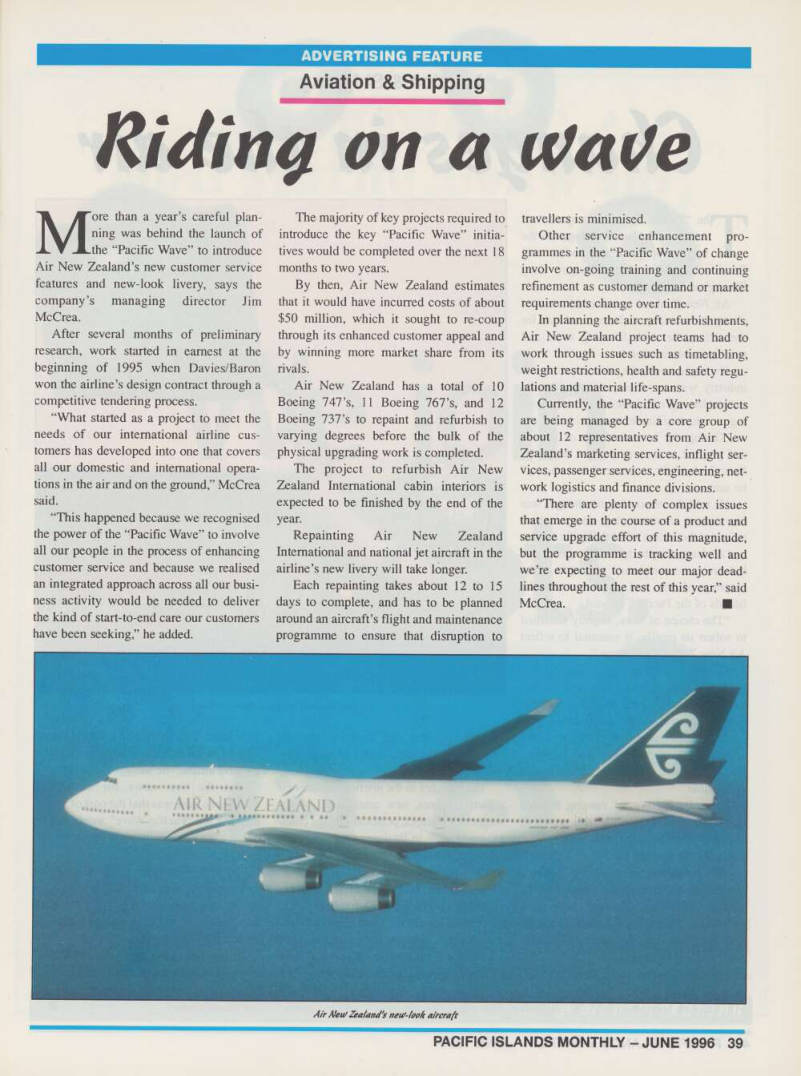
More than a year’s careful plan ning was behind the launch of the “Pacific Wave” to introduce Air New Zealand’s new customer service features and new-look livery, says the
company’s managing director Jim
McCrea.
After several months of preliminary research, work started in earnest at the beginning of 1995 when Davies/Baron won the airline’s design contract through a
competitive tendering process.
“What started as a project to meet the needs of our international airline cus tomers has developed into one that covers all our domestic and international opera tions in the air and on the ground,” McCrea said.
“This happened because we recognised the power of the “Pacific Wave” to involve all our people in the process of enhancing customer service and because we realised an integrated approach across all our busi ness activity would be needed to deliver the kind of start-to-end care our customers have been seeking,” he added.
The majority of key projects required to introduce the key “Pacific Wave” initia tives would be completed over the next 18 months to two years.
By then, Air New Zealand estimates that it would have incurred costs of about $5O million, which it sought to re-coup through its enhanced customer appeal and by winning more market share from its rivals.
Air New Zealand has a total of 10 Boeing 747’5, 11 Boeing 767’5, and 12 Boeing 737’s to repaint and refurbish to varying degrees before the bulk of the physical upgrading work is completed.
The project to refurbish Air New Zealand International cabin interiors is expected to be finished by the end of the year.
Repainting Air New Zealand International and national jet aircraft in the airline’s new livery will take longer.
Each repainting takes about 12 to 15 days to complete, and has to be planned around an aircraft’s flight and maintenance programme to ensure that disruption to
travellers is minimised.
Other service enhancement pro grammes in the “Pacific Wave” of change involve on-going training and continuing refinement as customer demand or market requirements change over time.
In planning the aircraft refurbishments.
Air New Zealand project teams had to work through issues such as timetabling, weight restrictions, health and safety regu lations and material life-spans.
Currently, the “Pacific Wave” projects are being managed by a core group of about 12 representatives from Air New Zealand’s marketing services, inflight ser vices, passenger services, engineering, net work logistics and finance divisions.
“There are plenty of complex issues that emerge in the course of a product and service upgrade effort of this magnitude, but the programme is tracking well and we’re expecting to meet our major dead lines throughout the rest of this year,” said McCrea. ■
Air New Zealand’s new-look aircraft
Advertisements & other items, p. 39 (1 item)
39
ADVERTISING FEATURE
PACIFIC ISLANDS MONTHLY - JUNE 1996
Aviation & Shipping
Changes in the air
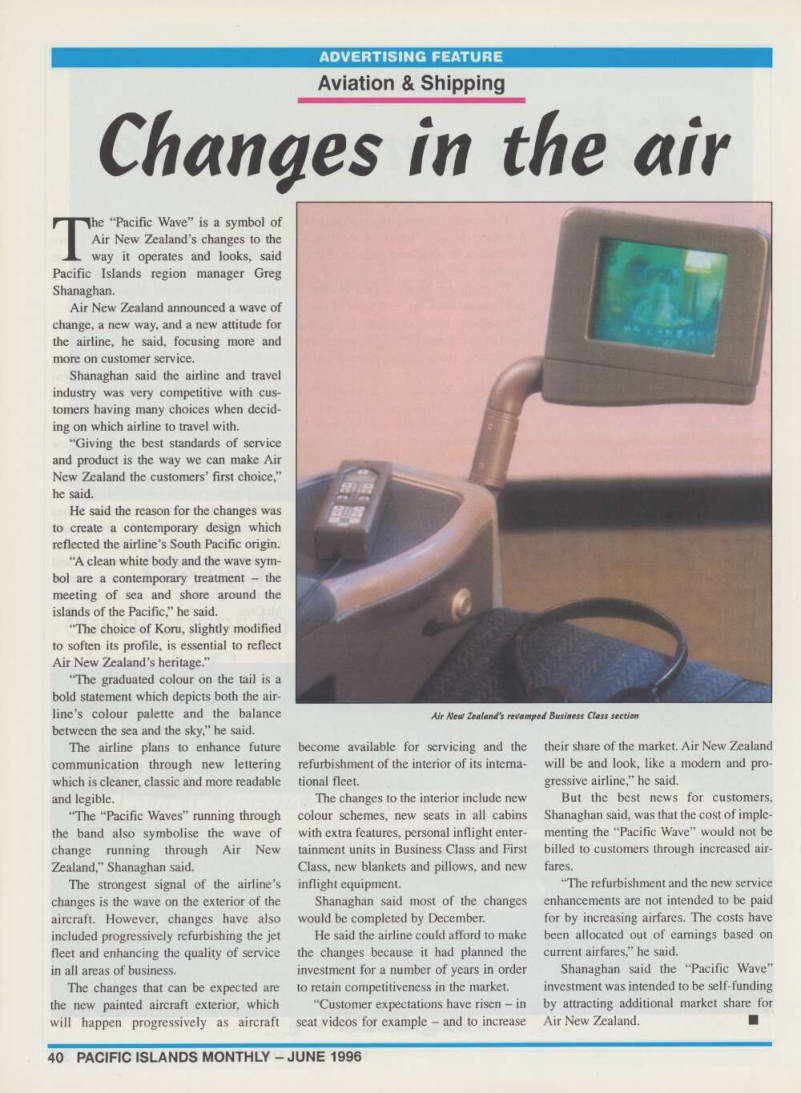
The “Pacific Wave” is a symbol of Air New Zealand’s changes to the way it operates and looks, said Pacific Islands region manager Greg Shanaghan.
Air New Zealand announced a wave of change, a new way, and a new attitude for the airline, he said, focusing more and more on customer service.
Shanaghan said the airline and travel industry was very competitive with cus tomers having many choices when decid ing on which airline to travel with.
“Giving the best standards of service and product is the way we can make Air New Zealand the customers’ first choice,” he said.
He said the reason for the changes was to create a contemporary design which reflected the airline’s South Pacific origin.
“A clean white body and the wave sym bol are a contemporary treatment - the meeting of sea and shore around the islands of the Pacific,” he said.
“The choice of Korn, slightly modified to soften its profile, is essential to reflect Air New Zealand’s heritage.”
“The graduated colour on the tail is a bold statement which depicts both the air line’s colour palette and the balance between the sea and the sky,” he said.
The airline plans to enhance future communication through new lettering which is cleaner, classic and more readable and legible.
“The “Pacific Waves” running through the band also symbolise the wave of change running through Air New Zealand,” Shanaghan said.
The strongest signal of the airline’s changes is the wave on the exterior of the aircraft. However, changes have also included progressively refurbishing the jet fleet and enhancing the quality of service in all areas of business.
The changes that can be expected are the new painted aircraft exterior, which will happen progressively as aircraft
become available for servicing and the refurbishment of the interior of its interna tional fleet.
The changes to the interior include new colour schemes, new seats in all cabins with extra features, personal inflight enter tainment units in Business Class and First Class, new blankets and pillows, and new
inflight equipment.
Shanaghan said most of the changes would be completed by December.
He said the airline could afford to make the changes because it had planned the investment for a number of years in order to retain competitiveness in the market.
“Customer expectations have risen - in seat videos for example - and to increase
their share of the market. Air New Zealand will be and look, like a modem and pro gressive airline,” he said.
But the best news for customers, Shanaghan said, was that the cost of imple menting the “Pacific Wave” would not be billed to customers through increased air fares.
“The refurbishment and the new service enhancements are not intended to be paid for by increasing airfares. The costs have been allocated out of earnings based on current airfares,” he said.
Shanaghan said the “Pacific Wave” investment was intended to be self-funding by attracting additional market share for Air New Zealand. ■
Air New Zealand's revamped Business Class section
Advertisements & other items, pp. 40-42 (2 items)
Aviation & Shipping
40
ADVERTISING FEATURE
PACIFIC ISLANDS MONTHLY - JUNE 1996
We join
the dots.
*» r> % I Air New Zealand is the airline linking the Pacific islands to New Zealand, Australia, North America, Asia, the U.K. and Europe. Our modern fleet of 7475, 767 s and 737 s now fly to Tonga, Fiji, New Caledonia, Norfolk Island, Tahiti, Western Samoa, the Cook Islands and Hawaii as well. Air New Zealand. No-one knows the South Pacific-and serves it-like we do. air new zeaiano © Air New Zealand Limited 1994.
SAATCHI INT 0459
“You won't see
the whole picture from
your hotel balcony”
■ : ■ ~r .
Mi m m '■ < m KS< ■w
The best of Vanuatu lies
in its unspoilt
outer islands.
V • v • 29 Destinations# Charters • Scenic Flights • Scheduled
Passenger & Freight Services
10 scheduled departures daily to the islands
TANNA
SANTO
3 TIMES DAILY
4 TIMES DAILY
Fly Vanair to see
the real Vanuatu.
A lefa nebirm Vanuatu Internal Air Services: PMB 069 Port Vila, Vanuatu Administration Offices: Bauerfield Airport, Port Vila Tel: (678) 22643 Fax: (678) 23910
New comfort for Air New Zealand
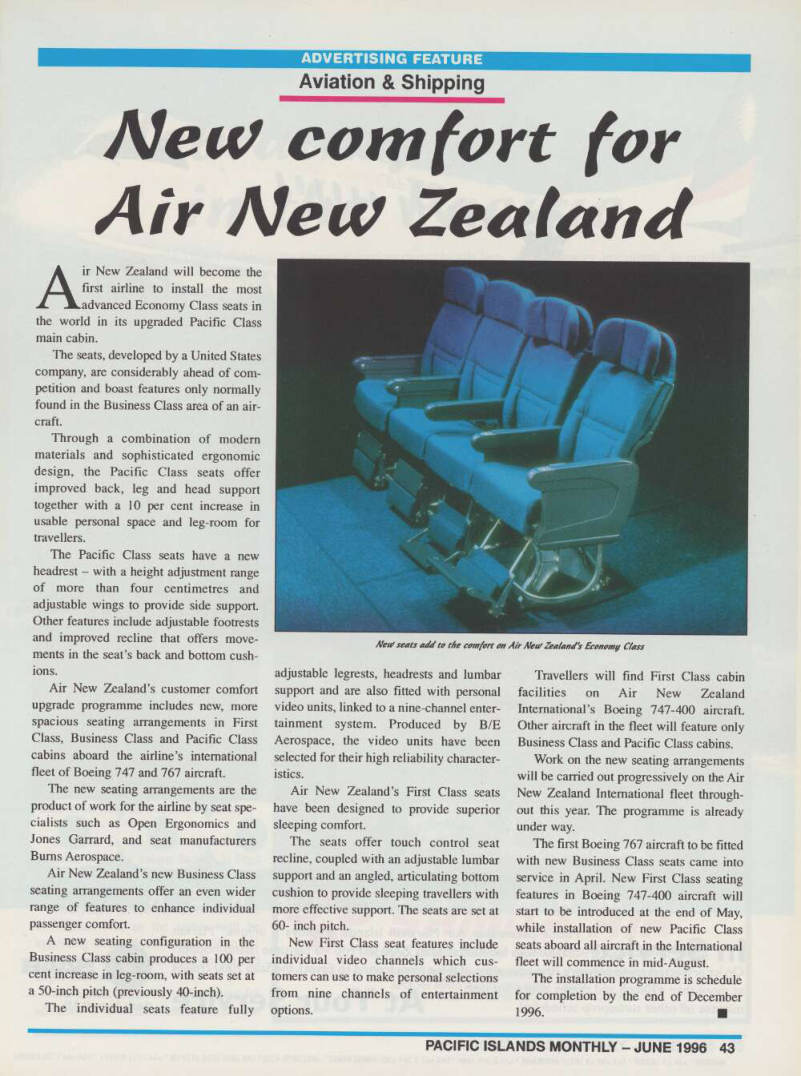
Air New Zealand
Air New Zealand will become the first airline to install the most advanced Economy Class seats in the world in its upgraded Pacific Class main cabin.
The seats, developed by a United States company, are considerably ahead of com petition and boast features only normally found in the Business Class area of an air craft.
Through a combination of modem materials and sophisticated ergonomic design, the Pacific Class seats offer improved back, leg and head support together with a 10 per cent increase in usable personal space and leg-room for travellers.
The Pacific Class seats have a new headrest - with a height adjustment range of more than four centimetres and
adjustable wings to provide side support.
Other features include adjustable footrests and improved recline that offers move ments in the seat’s back and bottom cush ions.
Air New Zealand’s customer comfort upgrade programme includes new, more spacious seating arrangements in First Class, Business Class and Pacific Class cabins aboard the airline’s international fleet of Boeing 747 and 767 aircraft.
The new seating arrangements are the product of work for the airline by seat spe cialists such as Open Ergonomics and Jones Garrard, and seat manufacturers
Bums Aerospace.
Air New Zealand’s new Business Class seating arrangements offer an even wider range of features to enhance individual passenger comfort.
A new seating configuration in the Business Class cabin produces a 100 per cent increase in leg-room, with seats set at
a 50-inch pitch (previously 40-inch).
The individual seats feature fully
adjustable legrests, headrests and lumbar support and are also fitted with personal video units, linked to a nine-channel enter tainment system. Produced by B/E Aerospace, the video units have been selected for their high reliability character istics.
Air New Zealand’s First Class seats have been designed to provide superior sleeping comfort.
The seats offer touch control seat recline, coupled with an adjustable lumbar support and an angled, articulating bottom cushion to provide sleeping travellers with more effective support. The seats are set at 60- inch pitch.
New First Class seat features include individual video channels which cus tomers can use to make personal selections from nine channels of entertainment options.
Travellers will find First Class cabin facilities on Air New Zealand International’s Boeing 747-400 aircraft.
Other aircraft in the fleet will feature only Business Class and Pacific Class cabins.
Work on the new seating arrangements will be carried out progressively on the Air New Zealand International fleet through out this year. The programme is already under way.
The first Boeing 767 aircraft to be fitted with new Business Class seats came into service in April. New First Class seating features in Boeing 747-400 aircraft will start to be introduced at the end of May, while installation of new Pacific Class seats aboard all aircraft in the International fleet will commence in mid-August.
The installation programme is schedule for completion by the end of December 1996. ■
New seats add to the comfort on Air New Zealand’s Economy Class
Advertisements & other items, pp. 43-44 (2 items)
43
ADVERTISING FEATURE
PACIFIC ISLANDS MONTHLY - JUNE 1996
Aviation & Shipping
Pacific pacemaker, Air Marshall Islands, employs a unique Market
In Service Maker"role for its fast Saab 2000 Jet Prop - a big-time island-hopper!
On its projected route network (the equivalent of flying from Iceland to Egypt), the Saab 2000 cruises at more than 420 mph and shaves hours, not just » • minutes off other turboprop schedules! I Saab Aircraft AB SWEDEN * +46 13 182000 * FAX +46 13 18210 AUSTRALIA * +6l 2 369 1666 • FAX +6l 2 369 2500 HONG KONG * +852 2810 4220 * FAX +852 2810 4135 UK * +44 1753 859991 * FAX +44 175:858884
Celebrating 10 years
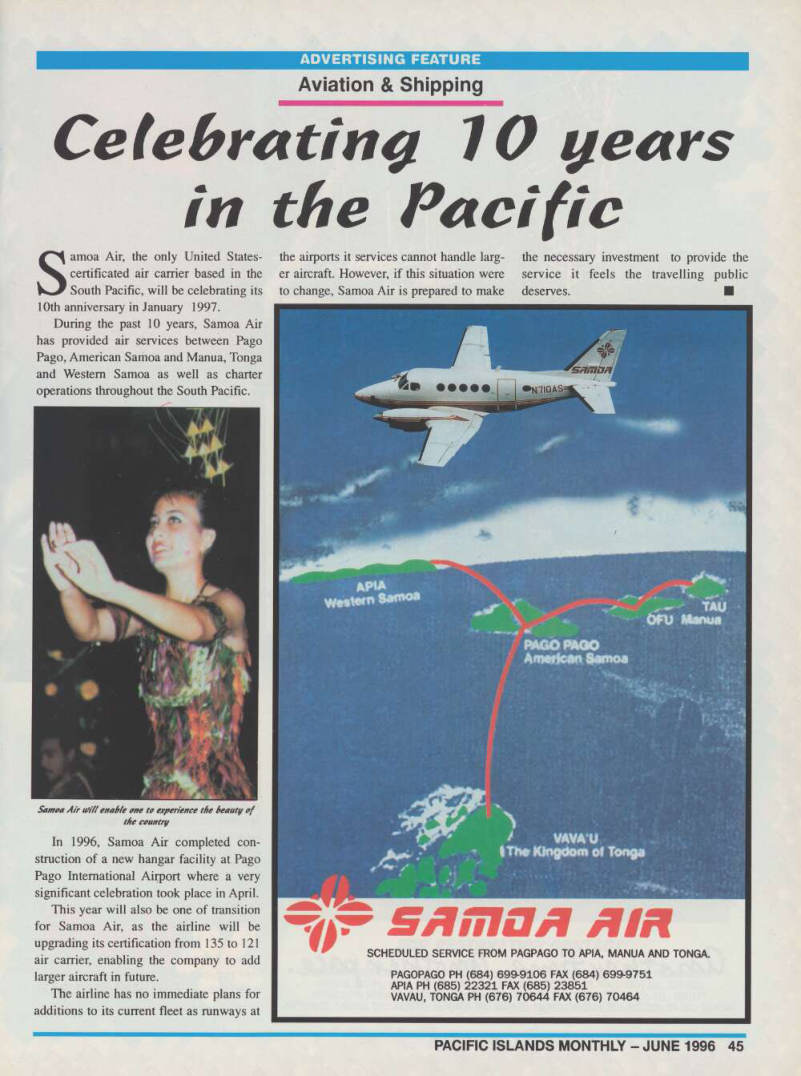
in the Pacific
Samoa Air, the only United States certificated air carrier based in the South Pacific, will be celebrating its 10th anniversary in January 1997.
During the past 10 years, Samoa Air has provided air services between Pago Pago, American Samoa and Manua, Tonga and Western Samoa as well as charter operations throughout the South Pacific.
In 1996, Samoa Air completed con struction of a new hangar facility at Pago Pago International Airport where a very significant celebration took place in April.
This year will also be one of transition for Samoa Air, as the airline will be upgrading its certification from 135 to 121 air carrier, enabling the company to add larger aircraft in future.
The airline has no immediate plans for additions to its current fleet as runways at
the airports it services cannot handle larger aircraft. However, if this situation were to change, Samoa Air is prepared to make
the necessary investment to provide the service it feels the travelling public deserves. ■
Samoa Air will enable one to experience the beauty of the country
Advertisements & other items, pp. 45-46 (2 items)
Aviation & Shipping
45
ADVERTISING FEATURE
PACIFIC ISLANDS MONTHLY - JUNE 1996
Aviation & Shipping
*sa mast am
mam l \ -f*
VAVAU
ITho Kingdom of Tonga A- ,
*sa mast am
SCHEDULED SERVICE FROM PAGPAGO TO APIA, MANUA AND TONGA.
PAGOPAGO PH (684) 699-9106 FAX (684) 699-9751 APIA PH (685) 22321 FAX (685) 23851 VAVAU, TONGA PH (676) 70644 FAX (676) 70464
\rn £
VANUATU
*►{ I Port Vila Nadi / \»: ""Vi ' - -VL Fii
AUSTRALIA
iin /
CALEDONIA
NEW
009*1 Sydney Melbourne Auckland ' L NEW ZEALAND V
lo htM- <Tvi
V* f***
m -fwU cCwA Ev\(?r^«..
Where would you find white powder beaches overhung with coconut palms, reaching down to tropical blue water?
Where would you find diving in coral seas so clear and warm?
Where would you find top class resorts featuring world class cuisine, sporting activities, shows, casino and
night clubs?
Where would you find a live volcano and ancient custom villages, fresh grown market produce and some of the friendliest people you’ll ever meet?
Where?
Vanuatu, that’s where.
An untouched paradise on earth.
. iXmatHtr wHjl.
Air Vanuatu Reservations & Sales Offices: Port Vila (678) 23 848, Santo (678) 36 429, Sydney (612) 223 8333, Melbourne (613) 417 3977, Brisbane (617) 221 2566, Auckland (649) 373 3435, Nadi (679) 72 2521, Suva (679) 314 666, Apia (685) 212 61, Noumea (687) 286 677, Los Angeles (310) 670 7302, Paris (331) 40 53 82 25, Spain (34) 72 27 02 62, Denmark (45) 33 11 02 02, Germany (49) 60231028, Italy (39) 2 551 80528, Hong Kong (852) 336 6916.
The Untouched Paradise
AIR VANUATU
MBE 8759
inaugural Voyage
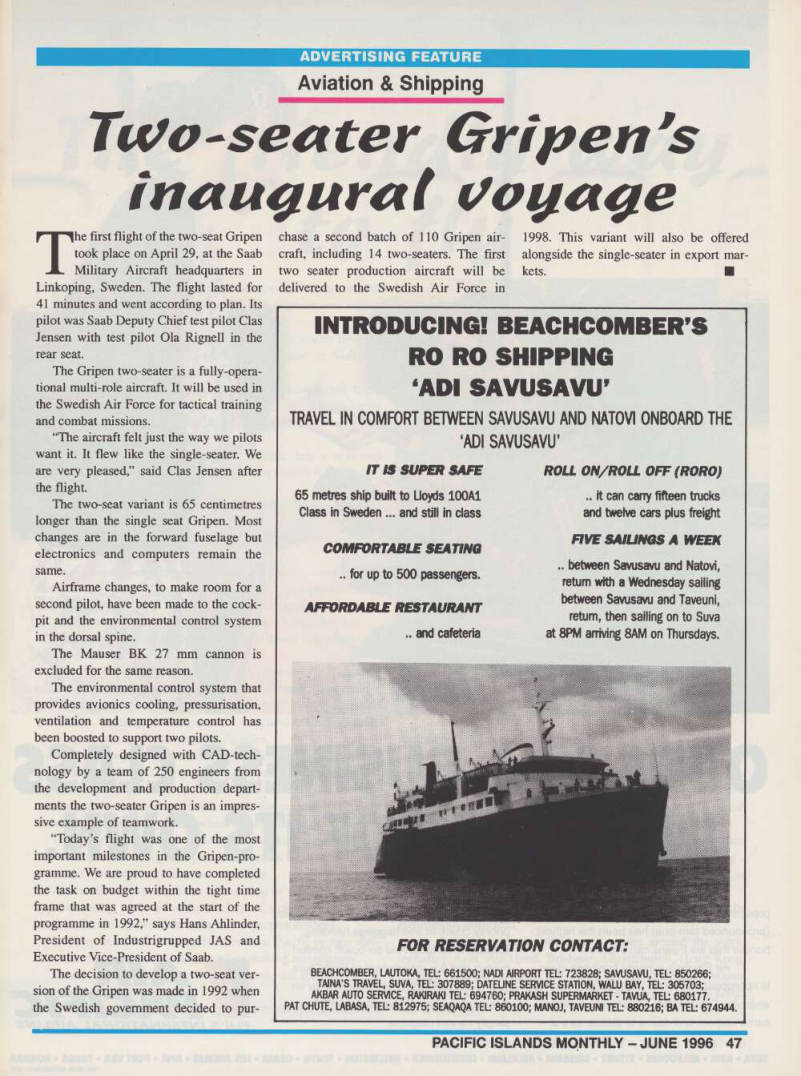
Two-seater Gripen’s inaugural Voyage
The first flight of the two-seat Gripen took place on April 29, at the Saab Military Aircraft headquarters in Linkoping, Sweden. The flight lasted for 41 minutes and went according to plan. Its pilot was Saab Deputy Chief test pilot Clas Jensen with test pilot Ola Rignell in the rear seat.
The Gripen two-seater is a fully-opera tional multi-role aircraft. It will be used in the Swedish Air Force for tactical training and combat missions.
“The aircraft felt just the way we pilots want it. It flew like the single-seater. We are very pleased,” said Clas Jensen after the flight.
The two-seat variant is 65 centimetres longer than the single seat Gripen. Most changes are in the forward fuselage but electronics and computers remain the same.
Airframe changes, to make room for a second pilot, have been made to the cock pit and the environmental control system in the dorsal spine.
The Mauser BK 27 mm cannon is excluded for the same reason.
The environmental control system that provides avionics cooling, pressurisation, ventilation and temperature control has been boosted to support two pilots.
Completely designed with CAD-tech nology by a team of 250 engineers from the development and production depart ments the two-seater Gripen is an impres sive example of teamwork.
“Today’s flight was one of the most important milestones in the Gripen-pro gramme. We are proud to have completed the task on budget within the tight time frame that was agreed at the start of the programme in 1992,” says Hans Ahlinder, President of Industrigrupped JAS and Executive Vice-President of Saab.
The decision to develop a two-seat ver sion of the Gripen was made in 1992 when the Swedish government decided to pur
chase a second batch of 110 Gripen air craft, including 14 two-seaters. The first two seater production aircraft will be delivered to the Swedish Air Force in
1998. This variant will also be offered alongside the single-seater in export mar kets. ■
Advertisements & other items, pp. 47-48 (2 items)
Aviation & Shipping
47
ADVERTISING FEATURE
PACIFIC ISLANDS MONTHLY - JUNE 1996
Aviation & Shipping
Introducing! Beachcomber’S
RO RO SHIPPING
4 ADI SAVUSAVU’
TRAVEL IN COMFORT BETWEEN SAVUSAVU AND NATOVI ONBOARD THE
‘ADI SAVUSAVU’
IT IS SUPER SAFE
65 metres ship built to Lloyds 100A1 Class in Sweden ... and still in class
COMFORTABLE SEATING
.. for up to 500 passengers.
AFFORDABLE RESTAURANT
.. and cafeteria
ROLL ON/ROLL OFF (RORO)
.. It can carry fifteen trucks and twelve cars plus freight
FIVE SAILINGS A WEEK
.. between Savusavu and Natovl, return with a Wednesday sailing between Savusavu and Taveuni, return, then sailing on to Suva at BPM arriving SAM on Thursdays. * I ■■liiiii
FOR RESERVATION CONTACT:
BEACHCOMBER, LAUTOKA, TEL 661500; NADI AIRPORT TEL 723828; SAVUSAVU, TEL 850266; TAINA'S TRAVEL, SUVA, TEL: 307889; DATELINE SERVICE STATION, WALU BAY, TEL 305703; AKBAR AUTO SERVICE, RAKIRAKI TEL 694760; PRAKASH SUPERMARKET - TAVUA, TEL 680177.
PAT CHUTE, LABASA, TEL 812975; SEAQAQA TEL 860100; MANOJ, TAVEUNI TEL 880216; BA TEL 674944.
% ' L ■me wm y .:
OURS IS A BUSINESS CLASS
A CLASS OF ITS OWN.
Through history, the ceremonial presentation of a whale’s tooth, or tabua (pronounced tam-bua) has been the highest honour that we Fijians can bestow.
Air Pacific’s superior business class is appropriately named Tabua Class, and we welcome Tabua Class passengers with the same respect and desire to please as our ancestors did on receiving great chiefs.
In place of the whale’s tooth, we offer priority check-in and baggage handling.
Exclusive lounges. And on-board comfort, menus and bar reminiscent of First Class.
And all of this accompanied by an open natural friendliness that we Fijians simply cannot disguise.
PAIR
PACIFI
FIJI’S INTERNATIONAL AIRLINE
SUVA • NADI • MELBOURNE • SYDNEY • BRISBANE • AUCKLAND • CHRISTCHURCH • WELLINGTON • TOKYO • OSAKA • LOS ANGELES • APIA • PORT VILA • TONGA • HONIARA
WILSON ADDISON 07.820
The friendly way
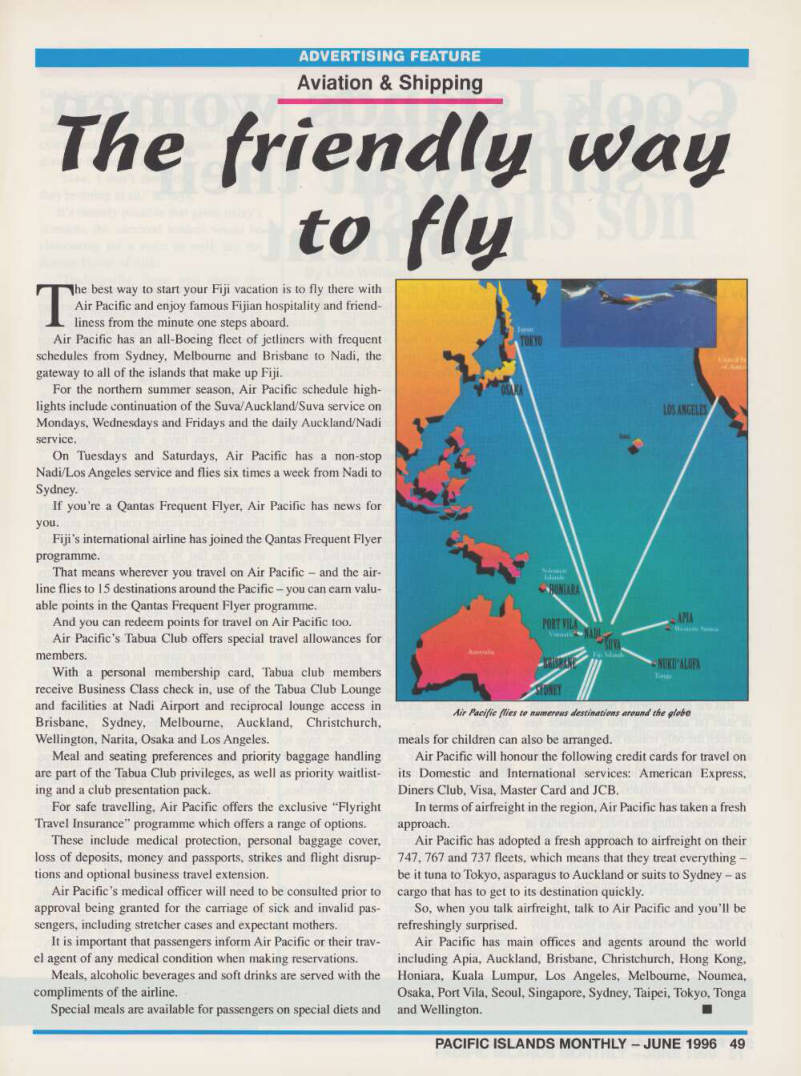
to fly
The best way to start your Fiji vacation is to fly there with Air Pacific and enjoy famous Fijian hospitality and friend liness from the minute one steps aboard.
Air Pacific has an all-Boeing fleet of jetliners with frequent schedules from Sydney, Melbourne and Brisbane to Nadi, the gateway to all of the islands that make up Fiji.
For the northern summer season. Air Pacific schedule high lights include continuation of the Suva/Auckland/Suva service on Mondays, Wednesdays and Fridays and the daily Auckland/Nadi service.
On Tuesdays and Saturdays, Air Pacific has a non-stop Nadi/Los Angeles service and flies six times a week from Nadi to
Sydney.
If you’re a Qantas Frequent Flyer, Air Pacific has news for you.
Fiji’s international airline has joined the Qantas Frequent Flyer programme.
That means wherever you travel on Air Pacific - and the air line flies to 15 destinations around the Pacific - you can earn valu able points in the Qantas Frequent Flyer programme.
And you can redeem points for travel on Air Pacific too.
Air Pacific’s Tabua Club offers special travel allowances for members.
With a personal membership card, Tabua club members receive Business Class check in, use of the Tabua Club Lounge and facilities at Nadi Airport and reciprocal lounge access in Brisbane, Sydney, Melbourne, Auckland, Christchurch, Wellington, Narita, Osaka and Los Angeles.
Meal and seating preferences and priority baggage handling are part of the Tabua Club privileges, as well as priority waitlist
ing and a club presentation pack.
For safe travelling. Air Pacific offers the exclusive “Flyright Travel Insurance” programme which offers a range of options.
These include medical protection, personal baggage cover, loss of deposits, money and passports, strikes and flight disrup tions and optional business travel extension.
Air Pacific’s medical officer will need to be consulted prior to approval being granted for the carriage of sick and invalid pas sengers, including stretcher cases and expectant mothers.
It is important that passengers inform Air Pacific or their trav el agent of any medical condition when making reservations.
Meals, alcoholic beverages and soft drinks are served with the compliments of the airline.
Special meals are available for passengers on special diets and
meals for children can also be arranged.
Air Pacific will honour the following credit cards for travel on its Domestic and International services: American Express, Diners Club, Visa, Master Card and JCB.
In terms of airfreight in the region. Air Pacific has taken a fresh approach.
Air Pacific has adopted a fresh approach to airfreight on their 747, 767 and 737 fleets, which means that they treat everything be it tuna to Tokyo, asparagus to Auckland or suits to Sydney - as cargo that has to get to its destination quickly.
So, when you talk airfreight, talk to Air Pacific and you’ll be
refreshingly surprised.
Air Pacific has main offices and agents around the world including Apia, Auckland, Brisbane, Christchurch, Hong Kong, Honiara, Kuala Lumpur, Los Angeles, Melbourne, Noumea, Osaka, Port Vila, Seoul, Singapore, Sydney, Taipei, Tokyo, Tonga and Wellington. ■
Air Pacific flies to numerous destinations around the globe
Advertisements & other items, p. 49 (1 item)
Aviation & Shipping
49
ADVERTISING FEATURE
PACIFIC ISLANDS MONTHLY - JUNE 1996
Aviation & Shipping
still await their
Region
Cook Islands women still await their moment
By Lisa Williams
When the former secretary to the Cook Islands cabinet passed away in April, the idea of a woman taking on the job for the first time was raised and adopted.
“The only trouble some of our minis ters would have had was minding their lan guage,” says one government official.
“And a woman around would be a good
thing.”
There has only ever been one woman MP in the whole of the country’s 30 years of self-government and she only lasted three months. Of all the official Secretaries to Ministries, only one is a woman, and the ministry is the Internal Affairs portfolio which handles so-called “women’s” and “welfare” issues.
Like a pyramid, the lower one goes through the ranks, the more women one finds. And like any other country, the Cook Islands is another example of the gender inequalities that exist in the workplace.
But the government’s begin-from-with
in start on addressing that imbalance has not been the only reason behind appointing a woman to take minutes and sit in on the crucial, highly-confidential discussions facing the nine ministers.
Government, managed and run by men with women filling the lower level ranks of typists, clerks and office-hands is anxious to look politically-correct to voters increasingly disenchanted with their lead ers as the country’s economic crisis peaks.
And grassroots Cook Islanders, normal ly a placid lot who have seen years of gov ernment mismanagement swept under the carpet, are not the only ones joining the
ground swell of discontent as pay-packets dwindle and jobs are harder to find.
Traditional leaders have been awaiting their moment to have a say from their tra ditional, marginalised position as onlook ers and token guests at official functions; now they want to have a voice, and they want that voice to be heard.
House of Ariki president and a para mount chief in her own right, Pa Te Ariki Upokotini has been amongst the ranks of women leading the uproar over the coun try’s current economic situation.
She has pushed the view, both in public to the international media and within the country to her mataiapo, or tribal elders, that the current government has led its peo ple to the economic brink.
“It has proven that it’s not capable of leading us under its current structure,” she says. “Government should have spoken to us of problems long before now.”
She says its time for government to develop the House of Ariki to the stage where traditional leaders can be a signifi cant influence, “and have a say on issues of
the day”.
“Times have changed now, we have to stand up and speak our minds,” she says of the dictum that traditional leaders stick to traditional matters and, like the churches,
keep out of politics.
“We are landowners - we’ve given lots of land to government for schools, church es and Crown use... I think it’s time for them to give us a say.”
And with most of the upper ranks of Ariki being women - all chiefs on Rarotonga are women and most of the outer islands chiefs are also women - Pa Ariki is not opposed to seeing a gender
balance brought to bear in parliament.
“With male MP’s, their priorities are machines for agriculture and expanding airports ,” she muses. “Women have been
changing nappies, feeding kids,, keeping
them from getting sick, and raising them as educated adults.”
“Without women in politics to talk on those issues, men and women in the House of Ariki can have a direct influence on that.”
And even as Pa fights for a say in gov ernment, another prominent ariki and major landowner, Tinomana Ariki Ruta Hosking is threatening court legal action if lands given to the Crown for educational use in the last 30 years are sold off under government plans to privatise its assets within the next three years.
So what has the prime minister and his colleagues to say to the irate arikil Very little - and not just because they have had more pressing matters to deal with.
Legally, the government doesn’t have to give its traditional leaders a say. In fact, when the House of Ariki was first set-up by government in the 1970’5, it was the former Pa, mother of the current Pa Ariki, who opposed the notion that the state was to set-up a body according her a recogni tion she had been bom with.
At the time though, the village elders and their ariki were being consulted on a regular basis by their members in parlia ment - so much that debate was often halt ed because members waited to refer the matter being discussed back to their peo
ple!
“I’ve been around long enough to see the whole process of government start up,” says one local resident. “And a common
The Gook Islands is another example of the gender inequalities that
block to anything in the house was mem bers standing and saying, T can’t say any thing now because I have to go back to my chiefs and see what they think’ - that’s gone by the board now”.
“Now, I don’t think they know what they’re doing at all,” he says.
It’s entirely possible that given today’s
scenario, the ancestral leaders would be clamouring for a voice as well, say the current House of Ariki.
“Traditionally, those who abuse the trust of the people are thrown out of the tribe and treated as outcasts, regardless of their status in society - be they ariki or otherwise,” Pa told a public protest rally over the 65 per cent paycuts for govern ment employees. “We want government to show the trust that we placed in them in 1994 (the last elections) was not in vain.”
Pa Ariki’s point on traditional leaders and elected leaders working together may well be the only way for women to inch
into decision-making.
The only Cook Islands woman to be a cabinet minister was Fanaura Kingstone, who for a short-lived time as the Overseas MP was a part of the 1983 government ousted when the country went to the polls twice in one year.
Now at the South Pacific Commission as the Women’s Development Adviser, Kingstone had bittersweet memories of her few months in cabinet, recalling to one reporter that it was definitely a “boys’ club” where she was rarely asked for her opinion and had to deal with condescend ing attitudes to women.
For Pa Ariki and other traditional chiefs from the Tinomana, Karika, Kainuku and Makea lines - all of them women, the time for the elected leaders to listen to those bom to title and land may well be while government is at its most vulnerable.
And even while she’s been personally attacked in the street for her views, Pa Ariki says wanting a say has nothing to do with being hungry for power or taking on the country’s troubled leader.
“I feel for my people,” she shrugs.
“And that’s the bottom line.” ■
exist in the workplace
Celebrating a famous son
famous son
By Lisa Williams
This year, a little-known society named after an author buried in a tiny comer of a Rarotonga ceme tery almost 50 years ago, gathers in the Cook Islands to celebrate the centennial of his birth.
Robert Dean Frisbie, the Tusitala (story-teller) of the Cooks, is remem bered more by readers outside the Cook Islands than by the people he wrote about. The centennial is timely, given that the 1990’s have given the Cook Islands and most developing nations in the region, a generation of young islanders preferring piupiu (computer games) to writing.
Those who don’t see his books given prominence in local libraries are missing out on the warmth and unique insight Frisbie passed on through his work - as well as his contributions through being a keen observer of island life and culture and a serious student of island history, traditional canoe building, fishing and
celestial navigation.
Robert Dean Frisbie was just 28 when he first sighted Pukapuka in 1924.
The remote atolls were known as the “Danger Islands” and whites visiting the people there were few and far between.
In his own words, as he drifted to shore he saw; “Islets dozing in the morn ing sunlight, with only two or three lan guid columns of smoke rising above the trees to tell of the life ashore - I thought of my long search in the Pacific for an island where I could be law to myself and beyond the reach of even the faintest echo of the noisy clamour of civilisa tion”, and promptly made up his mind that this was to be his last stop.
It was through the writings of the
Ohio-bom Calvary officer-tumed-jour
nalist that a fascination was bom within
readers worldwide for a tiny knoll in the South Seas.
In the 1920’5, Pukapuka came to symbolise the Cook Islands for readers still travelling through travelogues and written accounts of the exotic Pacific Ocean. From his shopkeepers perch and later as a husband to a Pukapukan woman who gave him five children, Frisbie breathed a rare warm insight into the characters he wrote of as he kept a record of a style of life which only lives on in memory.
As well as being a fan of Robert Louis Stevenson, who was already an established writer out of his Vailima estate in Western Samoa, Frisbie had his own reasons for living out a compulsion to seek fortune in the South Seas.
He was suffering from Tuberculosis and his doctor advised a complete change of climate. First stop on his South Seas journey was Tahiti where he lived for four years before heading on to the Cooks where he was to commit the rest of his life and work.
Anecdotes of life in the islands run through all his prolific articles, short sto ries and novels - as well as a collabora tion with daughter Florence (Johnny) on her first book when she was 13.
Now based in Ngatangiia, within viewing distance of the area where her father raised his family after his wife died in 1939, Johnny remembers with gratitude her bicultural childhood.
She remembers a father who soaked up Pukapukan lore from its island elders and managed to “be right in there learn
ing everything he could without trying
to be a native and looking silly - he leamt because he had to survive there as the Pukapukans did, and he leamt to value it”, she says. ■
A balancing
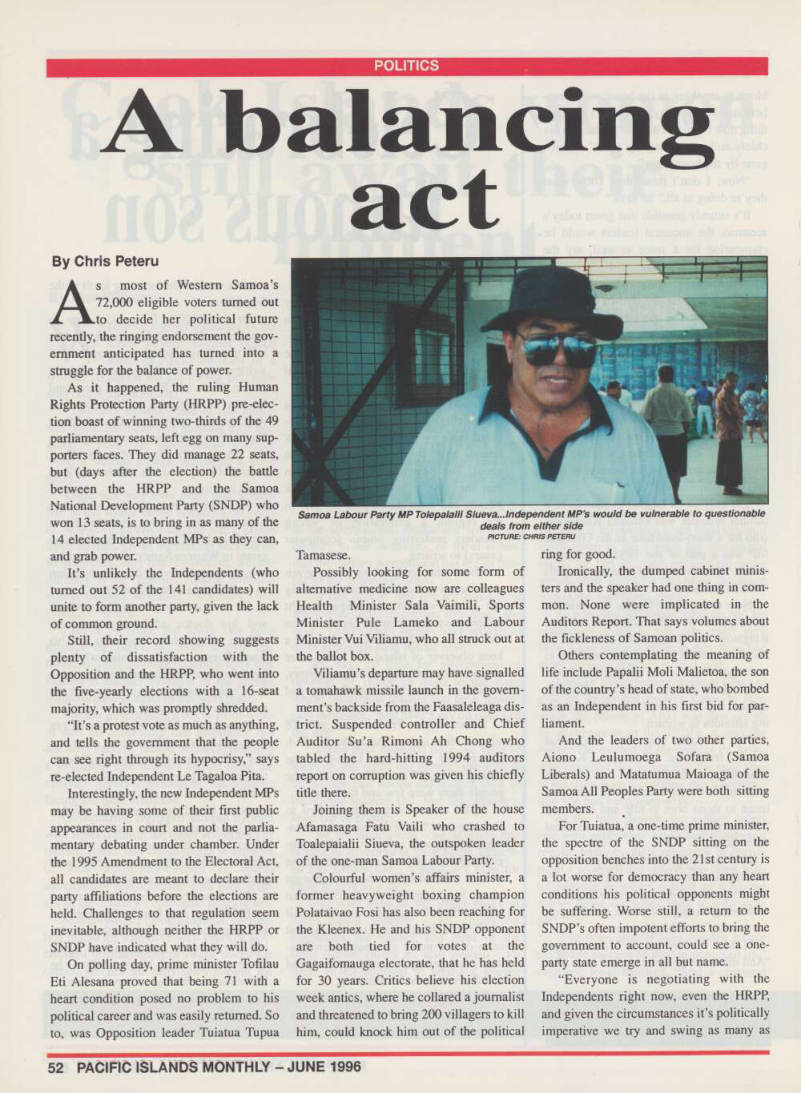
Politics
A balancing act
By Chris Peteru
As most of Western Samoa’s 72,000 eligible voters turned out to decide her political future recently, the ringing endorsement the gov ernment anticipated has turned into a struggle for the balance of power.
As it happened, the ruling Human Rights Protection Party (HRPP) pre-elec tion boast of winning two-thirds of the 49 parliamentary seats, left egg on many sup porters faces. They did manage 22 seats, but (days after the election) the battle between the HRPP and the Samoa National Development Party (SNDP) who won 13 seats, is to bring in as many of the 14 elected Independent MPs as they can, and grab power.
It’s unlikely the Independents (who turned out 52 of the 141 candidates) will unite to form another party, given the lack of common ground.
Still, their record showing suggests plenty of dissatisfaction with the Opposition and the HRPP, who went into the five-yearly elections with a 16-seat majority, which was promptly shredded.
“It’s a protest vote as much as anything, and tells the government that the people can see right through its hypocrisy,” says re-elected Independent Le Tagaloa Pita.
Interestingly, the new Independent MPs may be having some of their first public appearances in court and not the parlia mentary debating under chamber. Under the 1995 Amendment to the Electoral Act, all candidates are meant to declare their party affiliations before the elections are held. Challenges to that regulation seem inevitable, although neither the HRPP or SNDP have indicated what they will do.
On polling day, prime minister Tofilau Eti Alesana proved that being 71 with a heart condition posed no problem to his political career and was easily returned. So to, was Opposition leader Tuiatua Tupua
Tamasese.
Possibly looking for some form of alternative medicine now are colleagues Health Minister Sala Vaimili, Sports Minister Pule Lameko and Labour Minister Vui Viliamu, who all struck out at the ballot box.
Viliamu’s departure may have signalled a tomahawk missile launch in the govern ment’s backside from the Faasaleleaga dis trict. Suspended controller and Chief Auditor Su’a Rimoni Ah Chong who tabled the hard-hitting 1994 auditors report on corruption was given his chiefly title there.
Joining them is Speaker of the house Afamasaga Fatu Vaili who crashed to Toalepaialii Siueva, the outspoken leader of the one-man Samoa Labour Party.
Colourful women’s affairs minister, a former heavyweight boxing champion Polataivao Fosi has also been reaching for the Kleenex. He and his SNDP opponent are both tied for votes at the Gagaifomauga electorate, that he has held for 30 years. Critics believe his election week antics, where he collared a journalist and threatened to bring 200 villagers to kill him, could knock him out of the political
ring for good.
Ironically, the dumped cabinet minis ters and the speaker had one thing in com mon. None were implicated in the Auditors Report. That says volumes about the fickleness of Samoan politics.
Others contemplating the meaning of life include Papalii Moli Malietoa, the son of the country’s head of state, who bombed as an Independent in his first bid for par liament.
And the leaders of two other parties, Aiono Leulumoega Sofara (Samoa Liberals) and Matatumua Maioaga of the Samoa All Peoples Party were both sitting members.
For Tuiatua, a one-time prime minister, the spectre of the SNDP sitting on the opposition benches into the 21st century is a lot worse for democracy than any heart conditions his political opponents might be suffering. Worse still, a return to the SNDP’s often impotent efforts to bring the government to account, could see a one party state emerge in all but name.
“Everyone is negotiating with the Independents right now, even the HRPP, and given the circumstances it’s politically imperative we try and swing as many as
Samoa Labour Party MP Tolepaialii Siueva...lndependent MP’s would be vulnerable to questionable deals from either side
Picture: Chris Peteru
possible our way,” he said.
Sweet talk may not be enough, but sweeteners for political party support could prove more of an incentive than principles. With no legal limit on how much a candidate can spend to be elected, millions of tala have been handed over during the campaign to haul in the votes.
So, the chances of a pay back or the promise of political favours could prove too strong for some.
Samoa Labour Party MP Toalepaialii Siueva says Independent MPs would be vulnerable to questionable deals from either side.
“Most of them are broke now, and may take money for that reason. I mean plenty of people in Samoan politics have free loaded before and plenty more are going to try and help themselves this time.”
Realistically, the odds of the SNDP
currying enough favour to swing
Independents over to form a government are slim.
In an election night speech Tofilau said he expected the support of at least four Independents, who had earlier wanted to be HRPP candidates, but selections had already been made. He expects the HRPP to be returned with 27 seats, seven shy of the pre-election caucus.
Although favoured to come back for a second consecutive term as government, the HRPP caucus have pulled the wagons around and set-up camp at their headquar ters near Apia, and have refused to talk to the media.
Like the Boy Scouts, the HRPP camps have become something of a tradition. In 1991, the campers stayed out for three weeks, as final results came through and
initial strategies talked over.
Speculation is the main camp fire sin galong, will be whether to elect a new prime minister given Tofilaus’ poor condi tion. Having returned from overseas treat ment only 12 days before the election, Tofilau has kept public appearances to a minimum, and looked tired and frail.
If he does step down, the HRPP could easily splinter as the internal rift between wannabe leaders finance minister Tuilaepa Sailele, and agriculture minister Misa Telefoni continues to widen. The large number of egos in the HRPP is well known, and could create more friction. ■
Enter the dragon
When the new parliament recon venes shortly, it will mark the arrival of the smallest party in the country, lead by an MP whose reputa tion as a political dragon slayer is hardly exaggerated.
Dismissed by the government as one of the political loony tunes around the place, Samoa Labour Party (SLP) leader and sole MP Toalepaialii Siueva has blasted his way back into national politics and revived a career many wished would come to an end.
His return, after bumping off the speak er of the house by 44 votes to get there, is typical of a man who has frequently taken on government and won.
“I got back in because people want a change, because there is so much corrup tion and abuse of power. People are fed-up with non-accountability in government.
You are a trustee to the people. Not a guy
filling his own pockets for his own use.
Samoans had woken up to it. Too many MPs have become instant millionaires,” says the man who sees himself as an “up and-coming prime minister”.
In 1994, the former cabinet minister launched the SLR Almost immediately police made inquiries over allegations Toalepaialii had stated a military coup similar to Fiji’s in 1987, was the best way to oust the Tofilau government. No charges were laid.
The same year, he was one of two lead ers of a traditional coalition of chiefs charged with treason after organising mass demonstrations and a petition over a goods and services tax, that finance minister Tuilaepa Sailele described to overseas tele vision as “garbage”.
But in a humiliating government back down, the case was thrown out of court with the presiding judge pointedly stating that “my courtroom will not be used as a political forum”.
An aggressive debating style, coupled with some fierce convictions on the rights of the less fortunate, will ensure plenty of tough talking is on the way.
A platform based on ensuring the basic needs of the common man is the basis of Toalepaialii and the Labour philosophy.
“We are about making sure everyone has a good water supply, food, health and safe environment, plus responsible devel opment of natural resources.”
His first five-year term since the early 1980’s should provide plenty of opportuni ty to encourage those ideas. Away from politics, Toalepaialii and his wife run the popular Satupuala beach resort outside of Apia. ■
Advertisements & other items, p. 53 (1 item)
Y Blairs
REPLACEMENT ENGINES - ALL TERRAIN VEHICLES'!
Largest Range in South Pacific
Diesels Petrols—Gearboxes New & Secondhand Parts Bedford * Cummins * Daihatsu * Detroit Ford * Gardner * Honda * Hino Isuzu * Iveco * Komatsu * Kubota Leyland * Mazda * Mercedes * Mitsubishi Nissan * Perkins * Scania * Subaru Suzuki * Toyota * Volvo * Yanmar Cylinder Heads Starters Same rebuilt
Fully Amphibious
Travels beyond other form of transport carries up to 6 people or 453kgs 6 and 8 wheel units All wheel drive from
y BLAIRS
NZ512500.00 PO Box 14, Geraldine, New Zealand. Telephone (643) 693-8122. Fax (643) 693-8120
of the trail
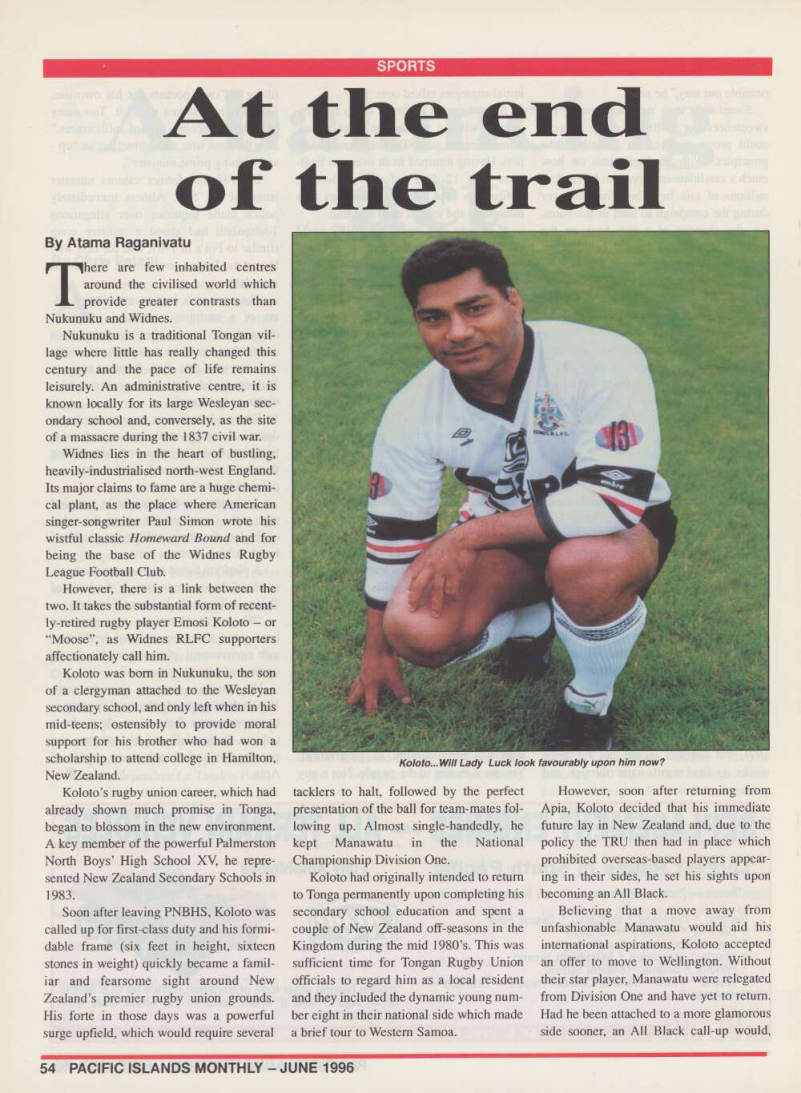

Sports
At the end of the trail
By Atama Raganivatu
There are few inhabited centres around the civilised world which provide greater contrasts than Nukunuku and Widnes.
Nukunuku is a traditional Tongan vil lage where little has really changed this century and the pace of life remains leisurely. An administrative centre, it is known locally for its large Wesleyan sec ondary school and, conversely, as the site of a massacre during the 1837 civil war.
Widnes lies in the heart of bustling, heavily-industrialised north-west England.
Its major claims to fame are a huge chemi cal plant, as the place where American singer-songwriter Paul Simon wrote his wistful classic Homeward Bound and for being the base of the Widnes Rugby League Football Club.
However, there is a link between the two. It takes the substantial form of recent ly-retired rugby player Emosi Koloto - or “Moose”, as Widnes RLFC supporters affectionately call him.
Koloto was bom in Nukunuku, the son of a clergyman attached to the Wesleyan secondary school, and only left when in his mid-teens; ostensibly to provide moral support for his brother who had won a scholarship to attend college in Hamilton, New Zealand.
Koloto’s rugby union career, which had already shown much promise in Tonga, began to blossom in the new environment.
A key member of the powerful Palmerston North Boys’ High School XV, he repre sented New Zealand Secondary Schools in 1983.
Soon after leaving PNBHS, Koloto was called up for first-class duty and his formi dable frame (six feet in height, sixteen stones in weight) quickly became a famil iar and fearsome sight around New
Zealand’s premier rugby union grounds.
His forte in those days was a powerful surge upfield, which would require several
tacklers to halt, followed by the perfect presentation of the ball for team-mates fol lowing up. Almost single-handedly, he kept Manawatu in the National Championship Division One.
Koloto had originally intended to return to Tonga permanently upon completing his secondary school education and spent a couple of New Zealand off-seasons in the Kingdom during the mid 1980’s. This was sufficient time for Tongan Rugby Union officials to regard him as a local resident and they included the dynamic young num ber eight in their national side which made a brief tour to Western Samoa.
However, soon after returning from Apia, Koloto decided that his immediate future lay in New Zealand and, due to the policy the TRU then had in place which
prohibited overseas-based players appear
ing in their sides, he set his sights upon becoming an All Black.
Believing that a move away from unfashionable Manawatu would aid his international aspirations, Koloto accepted an offer to move to Wellington. Without their star player, Manawatu were relegated from Division One and have yet to return.
Had he been attached to a more glamorous side sooner, an All Black call-up would,
Koloto...Will Lady Luck look favourably upon him now?
surely, have been a certainty and, alas, circumstances did not permit him suffi cient time to force his way into rugby union’s most famous line-up whilst serv ing Wellington. - An appearance for the capital city’s representative side against the touring Welsh national team in 1988 changed Koloto’s life. He demolished the helpless Welshmen that afternoon and amongst those awestruck by his performance was Widnes coach Doug Laughton, who watched the game on television in Britain and then booked a plane flight to New Zealand.
Koloto’s sole source of income then came from doing maintenance work in clubrooms. When Laughton waved Widnes’ chequebook under his nose, he found himself facing a dilemma.
Bitterly disappointed when failing to win a berth in New Zealand’s World Cup winning side the previous year, Koloto had been informed off-the-record by an All Black selector that he was on course to gain a place in their next touring party as understudy to the legendary Wayne “Buck” Shelford. But, Widnes’ proposi tion was simply too good to reject and the opportunity to become the first Tongan All Black had to be spumed. Six years later, that honour went to Jonah Lomu.
Koloto has never had any real reason to regret his move. He instantly became a firm favourite amongst Widnes fans and, almost as rapidly, earned respect through out British rugby league circles - to whom he was a complete unknown until landing amongst them. With him in their ranks, “The Chernies” won a string of honours, including two British Premierships, two Charity Shields and one Lancashire Cup.
All of these were captured before Koloto gained a place in the New Zealand national side. It amazed many that the Kiwi selectors were so tardy in drafting him. He was certainly keen enough in chasing caps and spent two British close seasons Down Under, playing for the Wainuiomata club of Wellington, press ing his claim. The second of these stints, in 1991, bore fruit.
He eventually wore the black jersey of his adopted country on five occasions.
The most memorable of these was a
record-breaking 24-8 win over world champions Australia in Melbourne.
Tragically, a recurring neck injury pre
vented Koloto from gaining any subse quent honours on either domestic or inter national fronts. It had already kept him out of Widnes’ 1989 World Cup
Championship winning combination and,
four years later, destroyed his only chance to appear in British rugby league’s annual
showpiece, the Challenge Cup final at
Wembly. Less than 12 months after mak ing a hard-earned Kiwi debut, he was regarded as too fragile for further appear ances.
In 1993, Widnes’ club doctor advised him to quit the game. However, he battled on for another two seasons. Being classi fied as insufficiently fit to be even consid ered for Tonga’s World Cup campaign last year proved to be the final straw that per suaded him to hang up his boots. Denial of opportunities to reward his devoted admir ers in Nukunuku with some sterling dis plays while wearing the Kingdom’s red jersey was a bitter disappointment.
Realisation that the people back in
Nukunuku were eagerly keeping abreast of his exploits was always a motivating factor for Koloto.
“My home village is never far from my mind whenever I prepare for a game,” he once said.
“I am aware all those there have fol lowed my career closely from its outset and am very conscious I am representing them, as well as myself.”
But, the warm-hearted Widnes towns folk, who long ago adopted “Moose” as one of their own, will miss Koloto just as much as the NukunuKuans.
Amongst Koloto’s legion of fans is cur rent English national team coach Phil Larder, who succeeded Laughton as Widnes coach in 1992. He paid the follow ing tribute recently; “Emosi was more than just a rugby league player, he was a magi cian. He had uncanny vision - he would angle towards the comer flag and then pop a real precision pass inside without look ing and you’d wonder: ‘How on earth could he have done that? I don’t know of another forward, in league or union, who had his handling skills. He had fingertip
control of the ball and could almost make it talk.’”
Laughton, however, preferred to
remember Koloto’s versatility. “Emosi had clever hands,” he agreed. “But, there was also an extraordinary balance and the abil ity to produce both brilliant side-steps and excellent dummies.”
With just a little more luck, Koloto would now be acknowledged far and wide as one of the truly greats in either rugby league or rugby union; possibly both. Yet, it seems likely he will only be truly revered in Nukunuku and Widnes. Koloto, though, can have few regrets as he looks back over his career.
His concern is now the future. For sev eral years, he expressed a desire to coach rugby league in Tonga. But, having recent ly married a Widnes girl and nearing the completion of a university degree in finance, Koloto has several other options to consider.
Whatever lies ahead of Emosi Koloto, let us hope that Dame Fortune is a little more sympathetic to him in this than she was during his rugby career. ■
Advertisements & other items, pp. 55-56 (1 item)
Forum Fisheries Agency
VACANCY
SENIOR PROJECT ANALYST
The Forum Fisheries Agency is a regional organisation established to co-ordinate regional fisheries policies and to promote the development of fisheries resources to ensure that maximum benefits are achieved by the peoples of the South Pacific region from their fisheries. FFA has a membership of sixteen South Pacific countries and currently employs 50 staff. The work of the Agency is partitioned into five functional work areas (programmes): Economics & Marketing; Monitoring, Control & Surveillance; Legal Services; Information & Technology; and Corporate Services.
Applications are invited for the position of Senior Projects Analyst for the South Pacific Forum Fisheries Agency (FFA) based in Honiara, Solomon Islands. The successful applicant will be responsible to the Director through the Information and Technology Manager.
The Senior Projects Analyst is an established post under the Information and Technology Programme. FFA seeks an innovative and motivated person with a strong technical background in information technology who will contribute effectively to the work of a small technical team tasked with providing technology solutions to support the sustainable management of fisheries resources in the region. This person will be required to: — 1. Liaise with and provide advice to FFA member countries in respect of the formulation of information system procedures, practices and solutions, with the aim of improving user and work productivity; 2. Develop, maintain and support the integrated systems that form FFA's corporate data resource facility. The corporate data resource facility includes technology solutions to manage the operations of initiatives such as the FSM Arrangement for Regional Fisheries Access, Regional Register of Foreign Fishing Vessels, Regional Observer Programme and others; 3. Identify the training requirements of various business users at FFA and its member countries, and develop appropriate training programmes to produce and deliver the relevant matenal; 4. Prepare project documentation for various information technology projects and maintain updated manuals and, technical references for delivered systems; 5. Contribute to in-house research into relevant information technology developments that may support the business requirements of FFA's work
Erogrammes; and
Undertake other duties as directed.
Essential Qualifications: — • Tertiary qualification in Computer Science and/or Information Technology; Proven ability in data management; • Proven experience in project management; and Proven experience in tne provision and support of information technology
training activities.
Desirable Qualities: — • Experience and interest in data modelling; • Experience with ORACLE /UNIX technology; • Experience with event model programming such as MS Access and Visual Basic; • Experience with Netware, Microsoft Windows NT, Windows 95 and Wmdows software; • Familiarity with Internet and electronic mail services; and • Familiarity with modem data communications, modems and their support.
Salaty range is U 5536,399 to U 5547,112 pa (base). The appointee will be based in Honiara, Solomon Islands, but will be required to travel occasionally, mainly within the South Pacific region. For those recruited from outside of Solomon Islands, salary is tax-free in the Solomon Islands. Remuneration package includes base salary, location allowance, housing allowance, child education allowance, limited medical insurance covers, recreation leave and superannuation.
Applicants should detail their education and employment background with particulars of three referees with whom the applicant has been associated in a professional capacity for at least two years. All applications should be addressed to: The Director, South Pacific Forum Fisheries Agency, Box 629, Honiara, Solomon Islands. Email address: [email protected] Phone: (677) 21124; Fax: (677) 23995. CLOSING DATE IS 31 MAY 1996. An information package is available by postage upon request.
SECOND HAND CONTAINERS
WHERE AND WHEN YOU WANT THEM IN THE PACIFIC If you need a flexible and safe storage space we have the ideal solution for you. Our second hand containers provide instant secure storage. Guaranteed to be wind and waterproof these containers are ideal for both temporary and longterm storage in Pacific conditions.
We can deliver to any island in the Pacific within a month and our rates have got to be the lowest you will find. All you need to do is tell us how many you want.
CONTACT:
PASCALE MARCONNET, BP 4757 NOUMEA, NEW CALEDONIA. TEL: (687) 28 7450. FAX: (687) 26 3248
No barrier
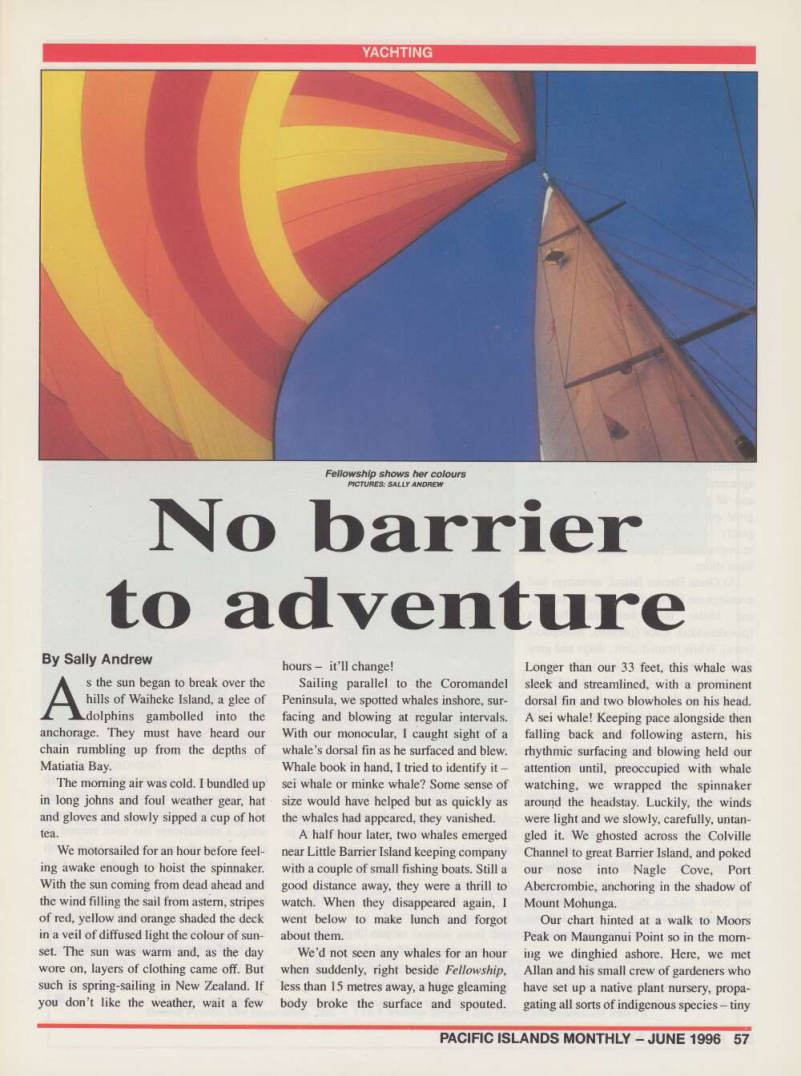
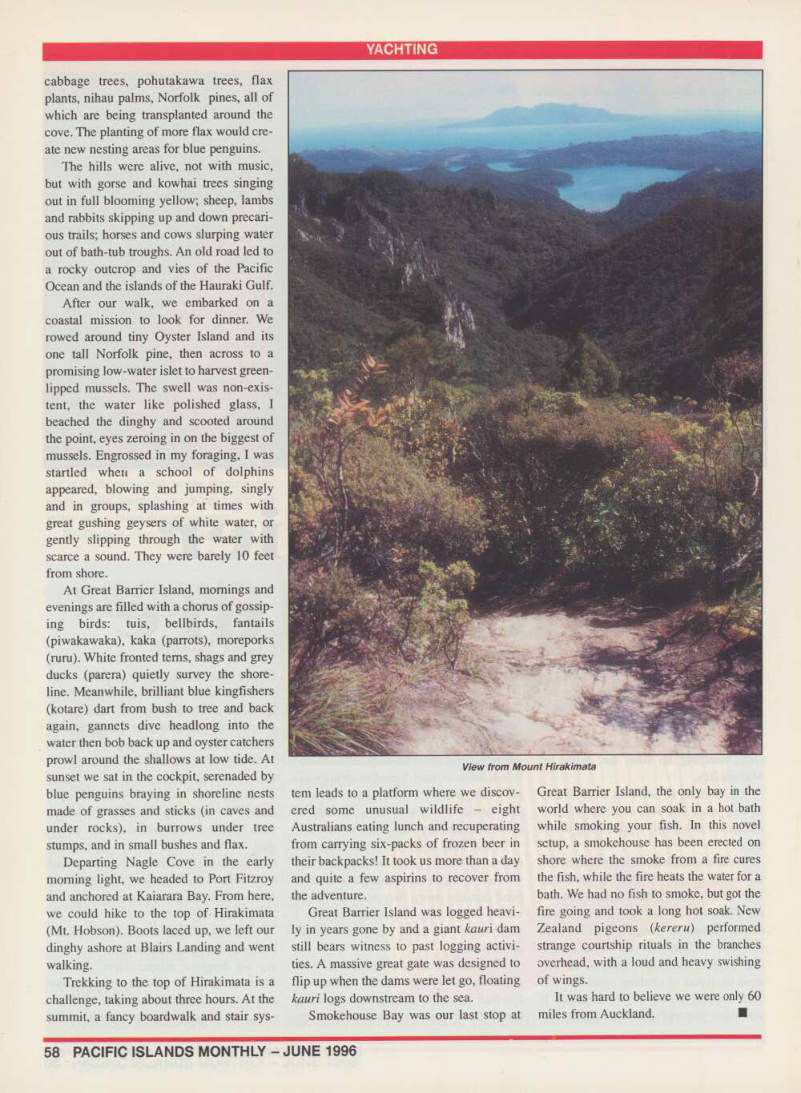
Yachting
No barrier to adventure
By Sally Andrew
As the sun began to break over the hills of Waiheke Island, a glee of dolphins gambolled into the anchorage. They must have heard our chain rumbling up from the depths of Matiatia Bay.
The morning air was cold. I bundled up in long Johns and foul weather gear, hat and gloves and slowly sipped a cup of hot tea.
We motorsailed for an hour before feel ing awake enough to hoist the spinnaker.
With the sun coming from dead ahead and the wind filling the sail from astern, stripes of red, yellow and orange shaded the deck in a veil of diffused light the colour of sun set. The sun was warm and, as the day wore on, layers of clothing came off. But such is spring-sailing in New Zealand. If you don’t like the weather, wait a few
hours - it’ll change!
Sailing parallel to the Coromandel Peninsula, we spotted whales inshore, sur
facing and blowing at regular intervals.
With our monocular, I caught sight of a whale’s dorsal fin as he surfaced and blew.
Whale book in hand, I tried to identify it sei whale or minke whale? Some sense of size would have helped but as quickly as the whales had appeared, they vanished.
A half hour later, two whales emerged near Little Barrier Island keeping company with a couple of small fishing boats. Still a good distance away, they were a thrill to
watch. When they disappeared again, I
went below to make lunch and forgot about them.
We’d not seen any whales for an hour when suddenly, right beside Fellowship, less than 15 metres away, a huge gleaming body broke the surface and spouted.
Longer than our 33 feet, this whale was sleek and streamlined, with a prominent dorsal fin and two blowholes on his head.
A sei whale! Keeping pace alongside then falling back and following astern, his rhythmic surfacing and blowing held our attention until, preoccupied with whale
watching, we wrapped the spinnaker
around the headstay. Luckily, the winds were light and we slowly, carefully, untan gled it. We ghosted across the Colville Channel to great Barrier Island, and poked our nose into Nagle Cove, Port Abercrombie, anchoring in the shadow of
Mount Mohunga.
Our chart hinted at a walk to Moors Peak on Maunganui Point so in the morn ing we dinghied ashore. Here, we met Allan and his small crew of gardeners who have set up a native plant nursery, propa gating all sorts of indigenous species - tiny
Fellowship shows her colours
Pictures: Sally Andrew
cabbage trees, pohutakawa trees, flax plants, nihau palms, Norfolk pines, all of which are being transplanted around the cove. The planting of more flax would cre ate new nesting areas for blue penguins.
The hills were alive, not with music, but with gorse and kowhai trees singing out in full blooming yellow; sheep, lambs and rabbits skipping up and down precari ous trails; horses and cows slurping water out of bath-tub troughs. An old road led to a rocky outcrop and vies of the Pacific Ocean and the islands of the Hauraki Gulf.
After our walk, we embarked on a coastal mission to look for dinner. We rowed around tiny Oyster Island and its one tall Norfolk pine, then across to a promising low-water islet to harvest green lipped mussels. The swell was non-exis tent, the water like polished glass, I beached the dinghy and scooted around the point, eyes zeroing in on the biggest of mussels. Engrossed in my foraging, I was startled when a school of dolphins
appeared, blowing and jumping, singly
and in groups, splashing at times with great gushing geysers of white water, or
gently slipping through the water with
scarce a sound. They were barely 10 feet from shore.
At Great Barrier Island, mornings and evenings are filled with a chorus of gossip ing birds: tuis, bellbirds, fantails
(piwakawaka), kaka (parrots), moreporks
(ruru). White fronted terns, shags and grey ducks (parera) quietly survey the shore line. Meanwhile, brilliant blue kingfishers (kotare) dart from bush to tree and back again, gannets dive headlong into the water then bob back up and oyster catchers prowl around the shallows at low tide. At sunset we sat in the cockpit, serenaded by blue penguins braying in shoreline nests made of grasses and sticks (in caves and under rocks), in burrows under tree stumps, and in small bushes and flax.
Departing Nagle Cove in the early
morning light, we headed to Port Fitzroy and anchored at Kaiarara Bay. From here, we could hike to the top of Hirakimata (Mt. Hobson). Boots laced up, we left our dinghy ashore at Blairs Landing and went
walking.
Trekking to the top of Hirakimata is a challenge, taking about three hours. At the summit, a fancy boardwalk and stair sys-
tern leads to a platform where we discov ered some unusual wildlife - eight Australians eating lunch and recuperating from carrying six-packs of frozen beer in their backpacks! It took us more than a day and quite a few aspirins to recover from the adventure.
Great Barrier Island was logged heavi ly in years gone by and a giant kauri dam still bears witness to past logging activi ties. A massive great gate was designed to flip up when the dams were let go, floating kauri logs downstream to the sea.
Smokehouse Bay was our last stop at
Great Barrier Island, the only bay in the world where you can soak in a hot bath while smoking your fish. In this novel setup, a smokehouse has been erected on shore where the smoke from a fire cures the fish, while the fire heats the water for a bath. We had no fish to smoke, but got the fire going and took a long hot soak. New Zealand pigeons ( kereru ) performed strange courtship rituals in the branches overhead, with a loud and heavy swishing
of wings.
It was hard to believe we were only 60 miles from Auckland. I
View from Mount Hirakimata
Advertisements & other items, pp. 59-60 (1 item)
Grand Pacific Life Insurance, Ltd.
0 10 15 20 25 30 35 40 45 50 55 60 ©
A member of the Finance Factors Family
FEDERATED STATES
OF MICRONESIA
Actouka Executive Insurance Underwriters P.O. Box 55, Kolonia, Pohnpei, Federated States of Micronesia 96941 Pacific Basin Insurance & General Services, Inc P.O. Box 494, Chuuk State, Federated States of Micronesia 96942
TONGA
Peseti Ma'afu Ins. & Finance, Ltd.
Private Bag 2, Taumoepeau Bldg.
Nukualofa, Tonga
GUAM
Great National Insurance Underwriters, Inc.
P.O. Box GA, Agana, Guam 96910
AMERICAN SAMOA
Mark Solofa Pacific Insurance & Finance, Inc.
P.O. Box 3149 Pago Pago, American Samoa 96799 Pacific Financial Corporation P.O. Box AT, Agana, Guam 96910 Takagi & Associates, Inc.
GCIC Bldg., Suite 100 414 W. Soledad Ave.
Agana, Guam 96910
MARSHALL ISLANDS
Marshalls Insurance Agency P.O. Box 113, Majuro, Marshall Islands 96960
WESTERN SAMOA
Mark Solofa Pacific Insurance & Finance, Inc.
P.O. Box 3149 Pago Pago, American Samoa 96799
NORTHERN MARIANAS
Pacific Basin Insurance Underwriters, Inc.
P.O. Box 710 Saipan, Mariana Islands 96950 Pacifica Insurance Underwriters, Inc.
P.O. Box 168, Saipan, Mariana Islands 96950 Grand Pacific Life Insurance, Ltd. *1164 Bishop Street, sth Floor, Honolulu, HI 96813 Phone: (808) 548-3363 • FAX: (808) 548-5122
THE NEW
PRIVILEGED CLASS
I \ o»
\ 1 OCT
Sedan -
The Uncompromised F:
THE RLL NEW
MITSUBISHI
LRNCER
Meet the car that was bom to succeed. With its progressive engineering and striking appearance, the all-new Mitsubishi Lancer advances effectively, impressively... moving ahead at every turn.
Get behind the wheel and experience the new standard in family sedans.
AMERICAN SAMOA: PACIFIC MARKETING INC. RO. Ben 698, Pago Pago, Tel. 699-9140/AUSTRALIA: MITSUBISHI MOTORS AUSTRALIA LTD. 1284 South Road, Clovelly Parte, South Australia. 5042, Tel. (08) 2757297/FUI: NWS MOTOR & MACHINERY CO. LTD. G.PO. Box 150 Suva, Tel. 383411 / GUAM; TRIPLE J ENTERPRISES INC RO. Box 6066 Tamuning, Tel. 6469126/NEW CALEDONIA: SOCIETE DTMPORTADON D'AUTO DU PACUTQUE SUD S A RO Box 2540 Noumea. Tel. 281-787/ NEW ZEALAND: MITSUBISHI MOTORS NEW ZEALAND LTD. Private Bag. Rorirua, Tel. 237-0109 / NORFOLK ISLAND: BORRY'S PTY LTD RO. Box 169, Taylors Road. Burnt, Tel. 22114/PAPUA NEW GUINEA; TOBA MOTORS PTY LTD. RO. Box 503. Port Moresby /SAIPAN: SAIPAN AUTOWORLD INC RO.
Box 487, Tel. 234-7133/SOLOMON ISLANDS; HARVEST PACIFIC LTD. G.PO. Box 823, Honiara, Tel. 30407/TAHITI: SOPADEP S.A. OR 1617, Papeete. Tel. 427393/lONGA: SITANI MAPI CO., LTD.
RO. Box 83, NukuTUofc, Tel. 24044 /VANUATU: SOCOMETRA VANUATU LTD. B.R 6 Port-Vila, Tel. 2314/WESTERN SAMOA; MOTOR DISTRIBUTORS (SAMOA) LTD. RO. Box 578, Apia. Tel. 20957 A
MITSUBISHI
MOTORS
CREATING TOGETHER