Pacific
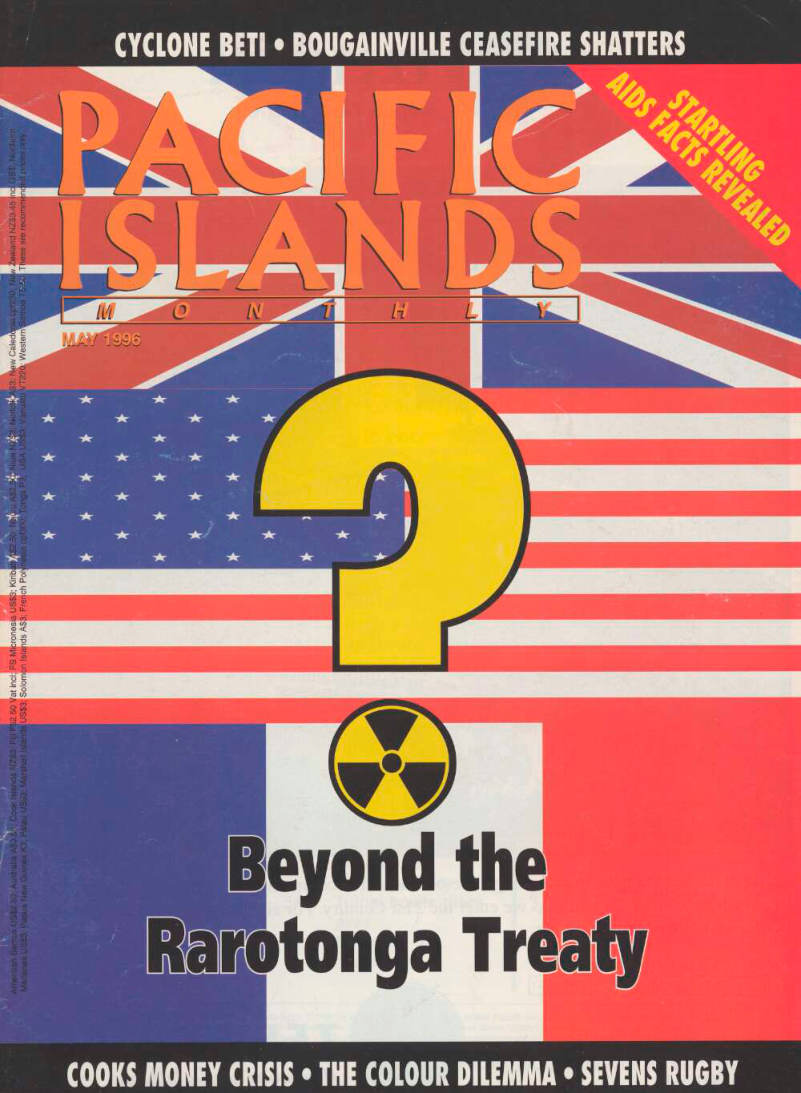

Islands
Monthly
Cyclone Beti • Bougainville Ceasefire Shatters
Marianas US$3; Papua New Guinea K3; Palau US$3; Marshall Islands US$3; Solomon Islai ids AS 3; French Polynesia cpf300; Tonga P3; USA US$3; Vanuatu VT220, Western Samoa T5.50. 1 hese are recommended prices only.
Ma.V
I Beyond the Bptonqa Treat!
COOKS MONEY CRISIS • THE COLOUR DILEMMA • SEVENS RUGBY
Cover by: JAMES RANUKU
Advertisements & other items, p. 2 (1 item)
Telikom
Papua New Guinea : '.Haa* mm mmm * 1 I >{ Sim > ■ '— : «• “ V llllllllllllliiiuiiin; l ['~m i I|u I • 7 * 1 ! MR ■
: II ; i -i:
r -I :.* J * • ; ttsx-' l-s] ■i li itiiifi ii 'I Hi) F It Telikom has set the pace in providing state-of-the-art telecommunications links within PNG and to anywhere around the world as we enter the 21st Century. For all your telecommunications needs, write to us at this address: Assistant General Manager Telikom Marketing Department P.O. Box 291 Waigani, Papua New Guinea Tel: 675 300 5564 Fax: 675 300 5540 I
TELIKOM
/\/(ua wete nacJUhj, talking!
Pacific
Islands
Monthly
Vol. 66 No. 5
The News Magazine
May 1996
PUBLISHER: Alan Robinson EDITOR: Debbie Singh SENIOR WRITER: Sophie Foster
Correspondents:
David North, Sam Vulum Ian Williams, Liz Thompson, Atama Raganivatu, Sally Andrew, Patrick Decloitre, Chris Peteru COLUMNISTS: David Barber (Wellington), Jemima Garrett (Sydney), Alfred Sasako (The Forum).
Advertising Sales
Manager - Ashok Lai Regional Sales (South Pacific) Shailendra Kumar Tel (679) 304111,303429, Fax(679)303809.
Sydney, Canberra: Bob Hill Media Representation, Tel (61-2) 4164245, Fax (61-2) 4165064.
Brisbane: Jane Fewings Media and Advertising Associates Tel (61-7) 378 4522, Fax (61-7) 878 1071.
Adelaide: Hastwell Williamsons Representatives, Tel (61-8) 3799522, Fax (61-8) 3799735.
Melbourne: Brown Orr Fletcher Burrows (Aust) Pty Ltd.
Tel (61-3) 8265188, Fax (61-3) 8265644.
Auckland: McKay & Bowman, International Media Representatives Limited, Tel (64-9) 4190561, Fax (64-9) 4192243.
Japan: Universal Media Corporation, Tokyo, Tel(3) 3266626741, Cable: UNI-MEDIA Tokyo, Fax(3)32626742.
Pacific Islands Monthly was founded in 1930
(Usps 9522480).
A Fiji Times Limited production.
Cover prices are recommended retail only. Registered by Australia Post, Publication No. NBP1210. © Copyright Fiji Times Limited, 177 Victoria Parade, Suva, Fiji.
Tel (679) 304111, fax (679) 303809.
Pacific Islands Monthly is published monthly by Fiji Times Limited, a division of Nationwide News, 2 Holt Street, Surry Hills, Sydney, NSW 2010.
Send Address Changes To:
Pacific Islands Monthly PO Box 1167 Suva, Fiji.
Typeset and printed by The Fiji Times Limited, 177 Victoria Parade, Suva, Fiji.
American Samoa US$2.5O; Australia A 53.50; Cook Islands NZ$3; Fiji F 52.50 Vat incl; FS Micronesia US$3; Kiribati A 52.50; Nauru A 52.50; Niue NZ$3; Norfolk As 3; New Caledonia cpf2so; New Zealand NZ53.45 incl GST; Northern Marianas US$3; Papua New Guinea K 3; Palau US$3; Marshall Islands US$3; Solomon Islands As 3; French Polynesia cpf3oo; Tonga P 3; USA US$3; Vanuatu VT22O; Western Samoa T 5.50. These are recommended prices only.
Inside
COVER: The governments of France, the 6 United States and the United Kingdom signed the protocols to the Rarotonga Treaty in Suva in March. But what does this mean for the Pacific? And is the region on its way to becoming nuclear free at last?
4: Letters 12: Creative giant 14: Pacific off the map at Bangkok forum 16: Cease-fire broken 29: Beti’s trail of uncertainty 32: Carlot’s comeback 34: Skin deep 37: May day for the Cooks money crisis 39; Nandan does Fiji proud 46: The ups and downs of the cruise business 49: Book review 50: All Black magic 52: Fiji notches narrow victory 54: Tuinei bowls them over 57: Spirits of the ancestors
Special Report
h Q The
island
silence
The United Nations reveals startling facts on the spread of HIV and AIDS in the region
Views
10: Jemima Garrett: France and the future of testing 28: Alfred Sasako: Majuro prepares for the region’s top guns 41: David Barber: Wake up, Cook Islands
regime

Letters
Global green regime
Madam,
I am utterly frustrated, yet worried over the deception a lot of sincere Pacific Island environmentalists have wholly commit ted themselves to.
It has to do with the “environmental movement”, the theme of which has become the password of governments, conferences and the like in the Pacific over the last decade.
But the end game is more about power and control than envi ronmental protection and conservation.
There are genuine ecological problems today challenging humankind’s intelligence, wisdom, and resourcefulness. Very few can deny this fact.
Unfortunately, after much reading and observation, I have arrived at a daring realisation that much of the “apocalyptic doom” being portrayed and preached today about our world envi ronment has far more to do with increasing and centralising gov ernment control over humankind than with protecting humans and nature from environmentally harmful practices.
Does this not sound logical? I strongly believe it does. It’s con nected with what a lot of people are aware of as the One World Government; One World Economy; the New World Money System; the New World Religion; the New World Order! A one world system controlled and dominated by a certain religio-polit ical hierarchy via its powerful tool - the United Nations.
After the collapse of the Soviet Union there no longer remained a “common enemy” which would ensure continued support and high recognition of the UN. Therefore, an “alterna tive enemy” had to be identified as replacement at the top as the “No. 1 international security concern”. In search of this so-called “enemy”, the environment was identified as the best candidate.
Issues like global warming, ozone depletion, deforestation and over-population, branded as "the four horsemen of a looming 21 st century apocalypse” were launched into the world scene.
The Rio Summit did produce some accomplishments, one of which was Agenda 21, the 800-page blueprint for governmental action addressing everything from forests to deserts, oceans, rivers, women’s rights, and health care, which will be around to haunt, harass, and increasingly trouble us in the years ahead.
Interestingly, Capacity 21, the influence of which has already penetrated the entire Pacific region, its governments and its peo ple, within a space of only a year, rose from Agenda 21 .
To conclude, the present religio-political-environmental end game is beyond the control of the grassroots of this world system.
Sad to say, it is very obvious SPREP is only being used as a
tool to impose the demands of the UN on people the UN wishes to financially and politically control. Local environmentalists, however sincere as they may be about the environment, are only being toyed with as puppets.
In closing, I wish to kindly suggest a two points change of direction: ■ SPREP to scrap the Capacity 21 project and utilise funds now drained in this project into pre-existing local environmental organisations to upgrade and enhance their support of local and
privately protected resources;
■ SPREP to utilise project officers currently employed in Capacity 21 as more meaningful resource-management personnel in handicapped environmental organisations established in their
respective countries.
When will the current environmental rat-race come to a halt?
Disgusted Environmentalist
Port Vila Vanuatu
Kava
culture
Madam, I was amused to read in your article on kava (PIM March) that after a number of years’ scrutiny the various responsi ble bodies in Australia still don’t know how to treat this mild Pacific (geographic as well as literal context) drink.
Over the past decade, kava has been the subject of numerous regional researches, reports and symposiums, and in the process has attracted more than its fair
share of journalistic opinion advocating its
virtues on the plus side; to being the bane of social order with some Australian abo riginal societies on the minus.
With kava, one has to apply the old principle of “when in Rome, do as the Romans do”. Visitors to the Pacific who choose to sample kava are advised to do so with proper regard to customary etiquette and any negative reaction is usually only attributed to its bitter taste. However, I have yet to come across a complaint from a visitor to Vanuatu with kava as the cen tre of contention.
So, I would like to propose a fresh approach for those continuing the search for an answer to the mystery of kava.
Along the principles of training pro grammes, researchers should spend some time in the islands studying the subject and consulting the experts - the farmers, dealers, shippers and probably most of all, the consumers.
A detailed study of the kava culture from their perspective will provide a much better understanding of how to control its abuse outside of its traditional environ
ment, thereby facilitating a more positive
and meaningful approach towards its trade.
Avoid the advisors as what they know probably came from a report!
Meto Nganga
Port Vila Vanuatu
Rights of
Other letters
Rights of the child
From: The Fiji Times
I quote from the Education Gazette, 1995 (page 21): “In June 1993, the Fiji government ratified the United Nations Convention on the Rights of the Child. Subsequently, Government estab lished the Children’s Coordinating Committee (the CCC) in 1993 to look into ways in which Fiji could incorporate pro visions of the Convention into our laws
and practices.”
A delegation was to have gone to Geneva in February 1996 to present Fiji’s report to an International Conference on the Rights of the Child.
Hopefully, the delegation has diligent ly included in its report that a man (who initially pleaded guilty to the charge but later changed his plea) can rape an eight
year-old girl plucked from her sleeping
bed in the middle of the night, and be tried for indecent assault (facing a maximum sentence of five years in jail). Maybe the child has changed her statement. Why would she? What does an eight-year-old know about penetration or sex or rape any
way?
It will, no doubt, take several years for her to understand why she was assaulted, and she may never recover from the trau
matic experience.
The rapist, if convicted, faces a few years in jail.
While there he can join a union demanding his rights as a prisoner, with the Attorney-General and Commissioner of Police negotiating on behalf of the Government.
The subscription, of course, is paid by the taxpayers, including the victims.
What has happened to the rights of the child (if there were any)?
Ravin Pillay
Nadi, Fiji
Advertisements & other items, p. 5 (1 item)
"Pacffic
Remember your Friend
There are times in your life when you feel your friends have been missing out on something good. Now’s your chance to do something about it and share with them one of the good things you have. Buy your friend a subscription to Pacific Islands Monthly and let him or her join you and thousands of other people worldwide who are kept informed of the latest political, social and cultural
changes taking place in the Pacific.
SUBSCRIPTIONS
American Samoa US$45 Australia A 542.00 Canada US$45 Cook Islands AUSS46 Fiji F 526.40 French Polynesia US$45 Guam US$45 Hawaii US$45 Japan US$45 Kiribati AUSS46 Marshall/Micronesia US$4O Nauru AUSS42 New Caledonia US$32 New Zealand NZ$55 Niue AUSS46 Norfolk Island AUSS42 Northern Mananas/Palau US$4O Papua New Guinea AUSS4S Solomon Islands AUSS46 Tonga AUSS46 Tuvalu AUSS46 United Kingdom Stg Pound2B US Mainland US$45 Vanuatu AUSS4S Western Samoa WS$6O Elsewhere AUSS63 Payment to Pacific Islands Monthly: Subscription* Dept. GPO Box 1167, Suva, FIJI.
Subscriptions rates include the cost of airspeeding to all destinations set out above.
Direct airmail rates on application.
Telephone: 304111 Fax: 303809
"PACfFiC
ISLANDS
f~M O H T H L V~ I Please send my friend Pacific Islands Monthly for one year
(12 issues).
I enclose my cheque for $ (made payable to Pacific
Islands Monthly)
or debit $ to my: □ Bankcard □ Visacard □ Mastercard Card No: i i I i M ! 1 i i : . ! 1 Expiry Date
NAME
SIGNATURE
ADDRESS;
CITY COUNTRY
An epic mom
Cover Story
The governments of France, the United States and the United Kingdom signed the protocols to the South Pacific Nuclear Free Zone Treaty or Rarotonga Treaty, in March. But a Comprehensive Test Ban Treaty is still being negotiated by the world’s superpowers.
What does the Suva signing mean in light of the CTBT and how comprehensive will the CTBT be? Will it cover right of passage?
And will it ban the manufacture of nuclear arsenal via physical and computer-simulated means?
By Sophie Foster
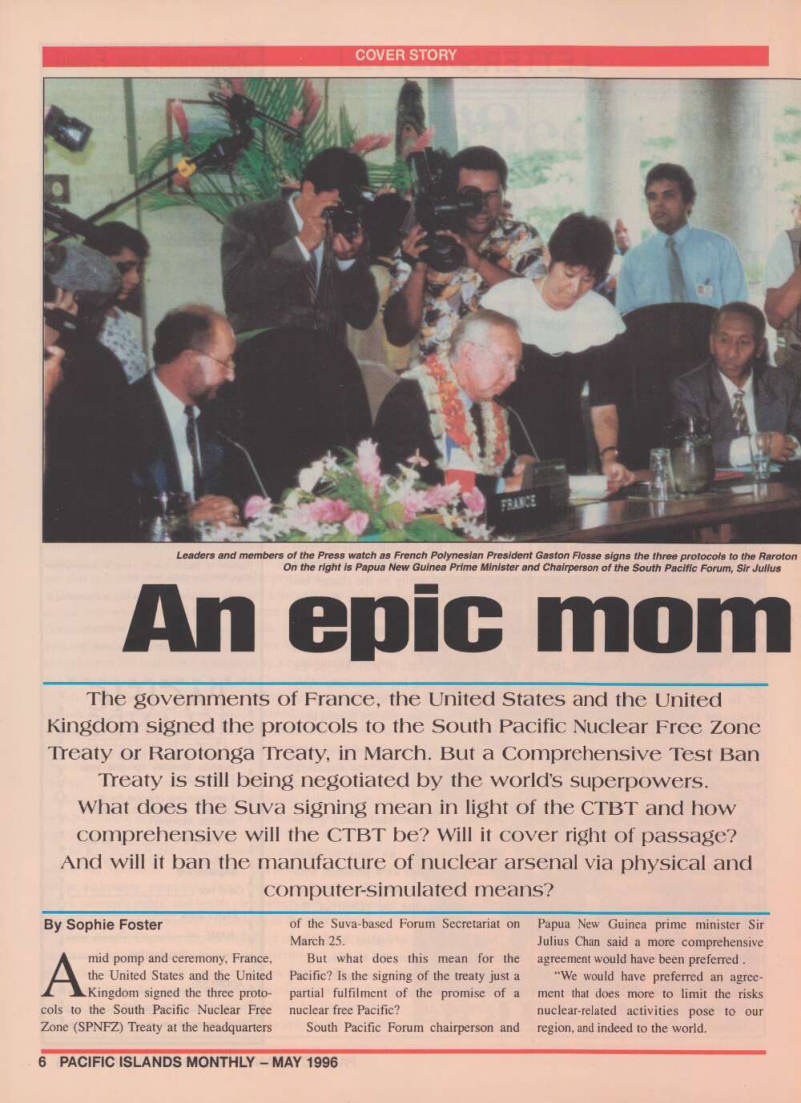
Amid pomp and ceremony, France, the United States and the United Kingdom signed the three proto cols to the South Pacific Nuclear Free Zone (SPNFZ) Treaty at the headquarters
of the Suva-based Forum Secretariat on March 25.
But what does this mean for the Pacific? Is the signing of the treaty just a partial fulfilment of the promise of a nuclear free Pacific?
South Pacific Forum chairperson and
Papua New Guinea prime minister Sir Julius Chan said a more comprehensive agreement would have been preferred .
“We would have preferred an agree ment that does more to limit the risks nuclear-related activities pose to our region, and indeed to the world.
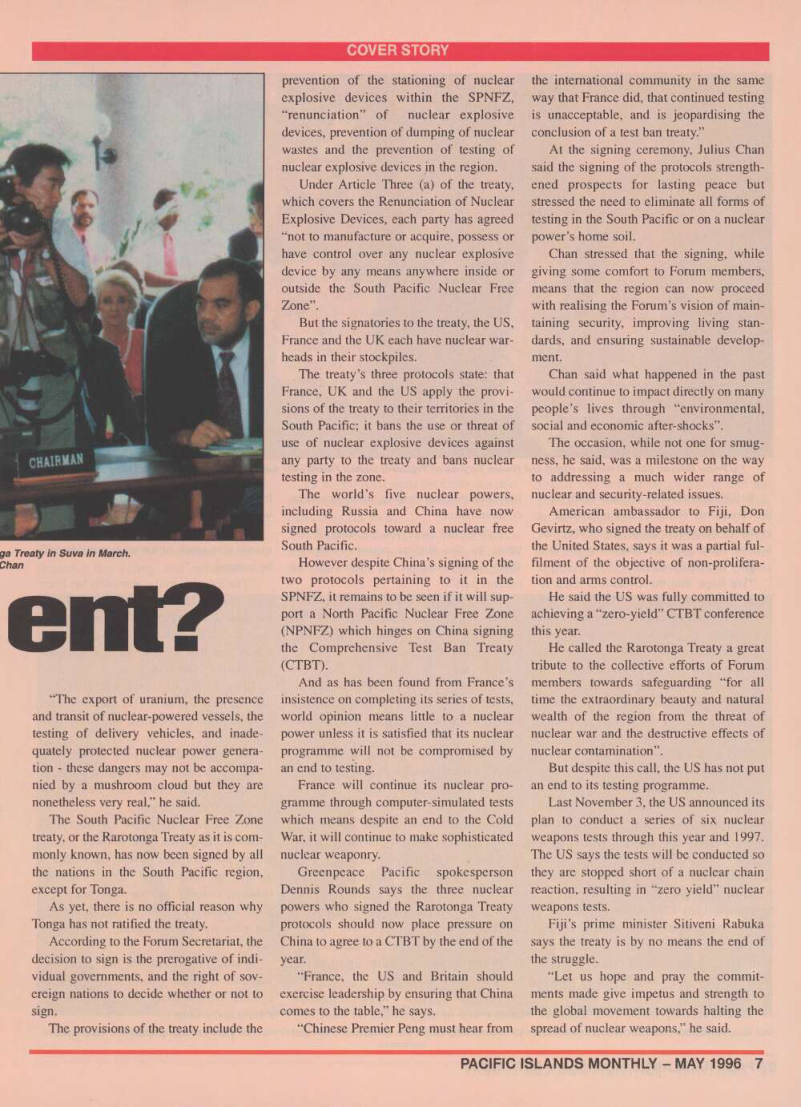
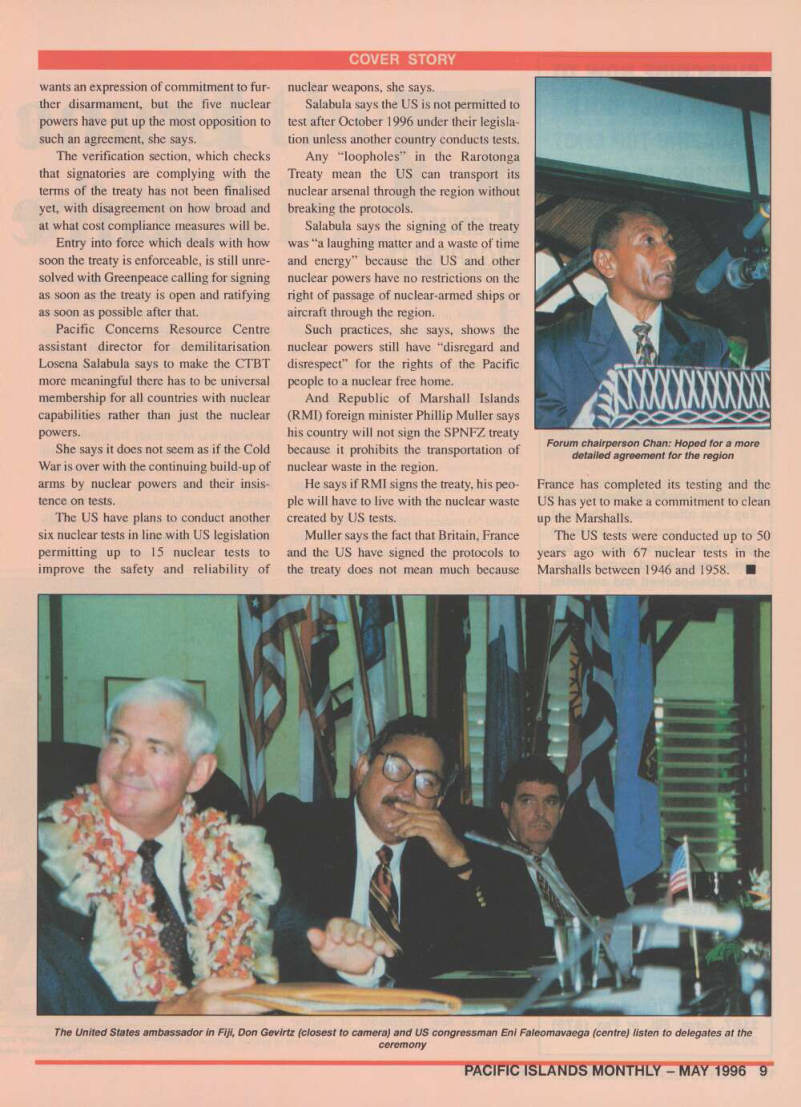
Leaders and members of the Press watch as French Polynesian President Gaston Flosse signs the three protocols to the Raroton On the right is Papua New Guinea Prime Minister and Chairperson of the South Pacific Forum, Sir Julius
“The export of uranium, the presence and transit of nuclear-powered vessels, the testing of delivery vehicles, and inade quately protected nuclear power genera tion - these dangers may not be accompa nied by a mushroom cloud but they are nonetheless very real,” he said.
The South Pacific Nuclear Free Zone treaty, or the Rarotonga Treaty as it is com monly known, has now been signed by all the nations in the South Pacific region, except for Tonga.
As yet, there is no official reason why Tonga has not ratified the treaty.
According to the Forum Secretariat, the decision to sign is the prerogative of indi vidual governments, and the right of sov ereign nations to decide whether or not to
sign.
The provisions of the treaty include the
prevention of the stationing of nuclear explosive devices within the SPNFZ, “renunciation” of nuclear explosive devices, prevention of dumping of nuclear wastes and the prevention of testing of nuclear explosive devices in the region.
Under Article Three (a) of the treaty, which covers the Renunciation of Nuclear Explosive Devices, each party has agreed “not to manufacture or acquire, possess or have control over any nuclear explosive device by any means anywhere inside or outside the South Pacific Nuclear Free Zone”.
But the signatories to the treaty, the US, France and the UK each have nuclear war heads in their stockpiles.
The treaty’s three protocols state: that France, UK and the US apply the provi sions of the treaty to their territories in the South Pacific; it bans the use or threat of use of nuclear explosive devices against any party to the treaty and bans nuclear testing in the zone.
The world’s five nuclear powers, including Russia and China have now signed protocols toward a nuclear free South Pacific.
However despite China’s signing of the two protocols pertaining to it in the SPNFZ, it remains to be seen if it will sup port a North Pacific Nuclear Free Zone (NPNFZ) which hinges on China signing the Comprehensive Test Ban Treaty
(Ctbt).
And as has been found from France’s insistence on completing its series of tests, world opinion means little to a nuclear power unless it is satisfied that its nuclear programme will not be compromised by an end to testing.
France will continue its nuclear pro gramme through computer-simulated tests which means despite an end to the Cold War, it will continue to make sophisticated nuclear weaponry.
Greenpeace Pacific spokesperson
Dennis Rounds says the three nuclear powers who signed the Rarotonga Treaty protocols should now place pressure on China to agree to a CTBT by the end of the year.
“France, the US and Britain should exercise leadership by ensuring that China comes to the table,” he says.
“Chinese Premier Peng must hear from
the international community in the same way that France did, that continued testing is unacceptable, and is jeopardising the conclusion of a test ban treaty.”
At the signing ceremony, Julius Chan said the signing of the protocols strength ened prospects for lasting peace but stressed the need to eliminate all forms of testing in the South Pacific or on a nuclear power’s home soil.
Chan stressed that the signing, while giving some comfort to Forum members, means that the region can now proceed with realising the Forum’s vision of main taining security, improving living stan dards, and ensuring sustainable develop ment.
Chan said what happened in the past would continue to impact directly on many
people’s lives through “environmental,
social and economic after-shocks”.
The occasion, while not one for smug ness, he said, was a milestone on the way to addressing a much wider range of nuclear and security-related issues.
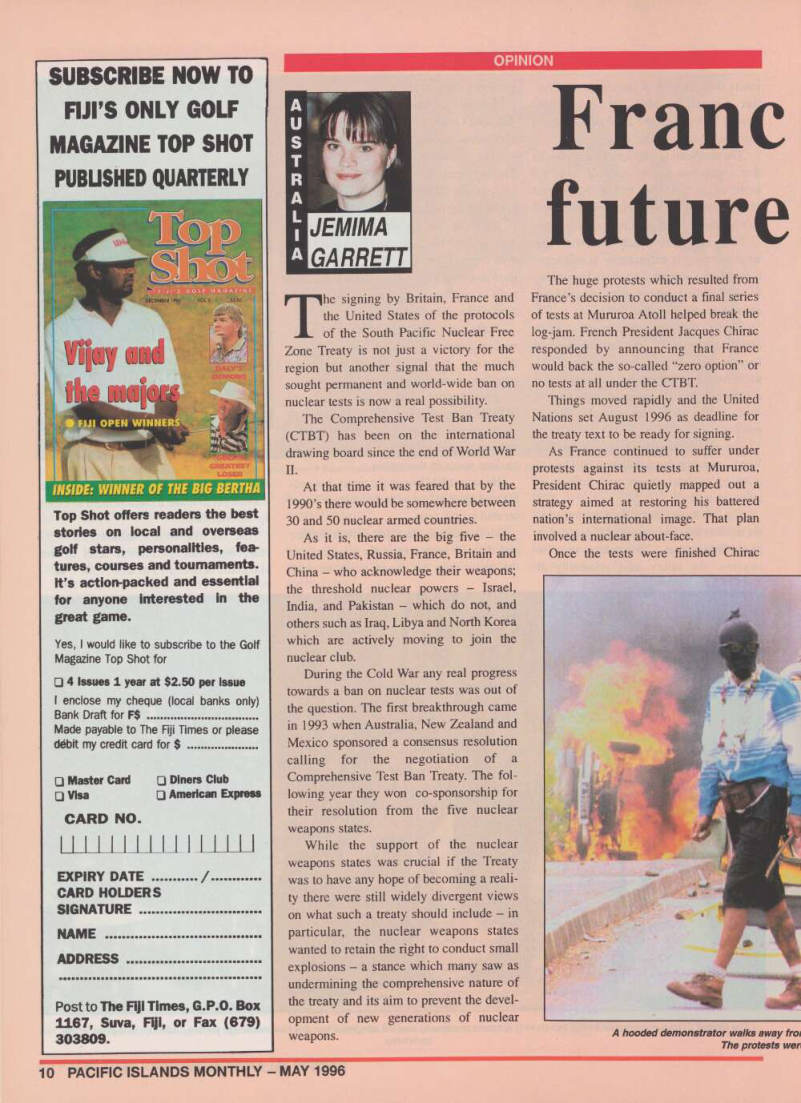
American ambassador to Fiji, Don Gevirtz, who signed the treaty on behalf of the United States, says it was a partial ful filment of the objective of non-prolifera tion and arms control.
He said the US was fully committed to achieving a “zero-yield” CTBT conference this year.
He called the Rarotonga Treaty a great tribute to the collective efforts of Forum members towards safeguarding “for all time the extraordinary beauty and natural wealth of the region from the threat of nuclear war and the destructive effects of nuclear contamination”.
But despite this call, the US has not put an end to its testing programme.
Last November 3, the US announced its plan to conduct a series of six nuclear weapons tests through this year and 1997.
The US says the tests will be conducted so they are stopped short of a nuclear chain reaction, resulting in “zero yield” nuclear weapons tests.
Fiji’s prime minister Sitiveni Rabuka says the treaty is by no means the end of the struggle.
“Let us hope and pray the commit ments made give impetus and strength to the global movement towards halting the spread of nuclear weapons,” he said.
ga Treaty in Suva in March.
Chan
British ambassador Michael Peart says the Treaty of Rarotonga demonstrates a group of countries, acting in unison, can achieve more than is possible for any one country to achieve alone.
“We hope that the endeavour used to bring about this Treaty can also be applied in a wider context, since security is not just a matter of treaties and promises.
Economic development and free, open and just societies are also fundamental to regional security and stability,” he said.
French Polynesian president Gaston Flosse said it was the first time in history that the South Pacific had been given “careful consideration at the highest level of responsibility” in France.
Flosse denied Mururoa was dangerous and said, “ I myself have made frequent visits to Mururoa at least a dozen or so times, the last being in September (1995).
I have swum in the lagoon, I have eaten fish out of there, I have drunk the coconut water and despite my advancing age, I have not felt any after-effects of this”.
The comment has come under fire from Greenpeace Pacific’s Bunny McDiarmid, who says, “even state-of-the-art nuclear weapons storage facilities - which Mururoa isn’t - will eventually leak”.
“One lesson we should have leamt in our nuclear history is that wherever there
has been nuclear testing there has been contamination.”
McDiarmid says the signing of the treaty by the nuclear powers “certainly shuts tightly one of the doors of our
nuclear past”.
And although questions have been raised about the enforcement of the Rarotonga Treaty, McDiarmid says it does carry weight internationally.
She says as part of the Non Proliferation Treaty, the nuclear powers had committed support to the development of nuclear free zones as a key disarmament effort.
According to annex four of the treaty, which outlines the Complaints Procedure, the best that the South Pacific Forum can do if any of the signatories breaches its obligations is “call a meeting”.
But action against the party in breach of its obligations is not outlined.
It is also unclear whether the Forum would have the power to impose penalties on any government, especially signatories to the protocols.
The heavy dependence on nuclear pow ers to uphold their word and signatures on treaties is made very clear.
McDiarmid says it is apparent from the latest round of negotiations for the CTBT in the Conference on Disarmament that
there is still a long way to go especially with disagreement on a “zero yield” treaty.
A zero yield means all nuclear tests no matter how small or for what purpose will be banned.
“The international community has been promised a CTBT for 25 years and that is the key disarmament challenge for this year. If it is not achieved this year there is a real fear that we will have missed the opportunity,” she says.
Some of the key areas where there is disagreement for the CTBT are the scope, its preamble, verification, and entry into force.
The biggest obstacle for a CTBT at the moment, McDiarmid says, is the scope of the treaty, with China and Russia not agreeing to a “zero yield”.
“If nuclear explosions for so called “peaceful purposes” are allowed - this would leave a major flaw in the treaty. It would be impossible to distinguish between peaceful nuclear explosions and those conducted for improving or design ing new nuclear weapons,” McDiarmid says.
“Furthermore, whether for “peaceful” purposes or military purposes, the impact on the environment and disarmament efforts is the same.”
As part of the preamble, Greenpeace
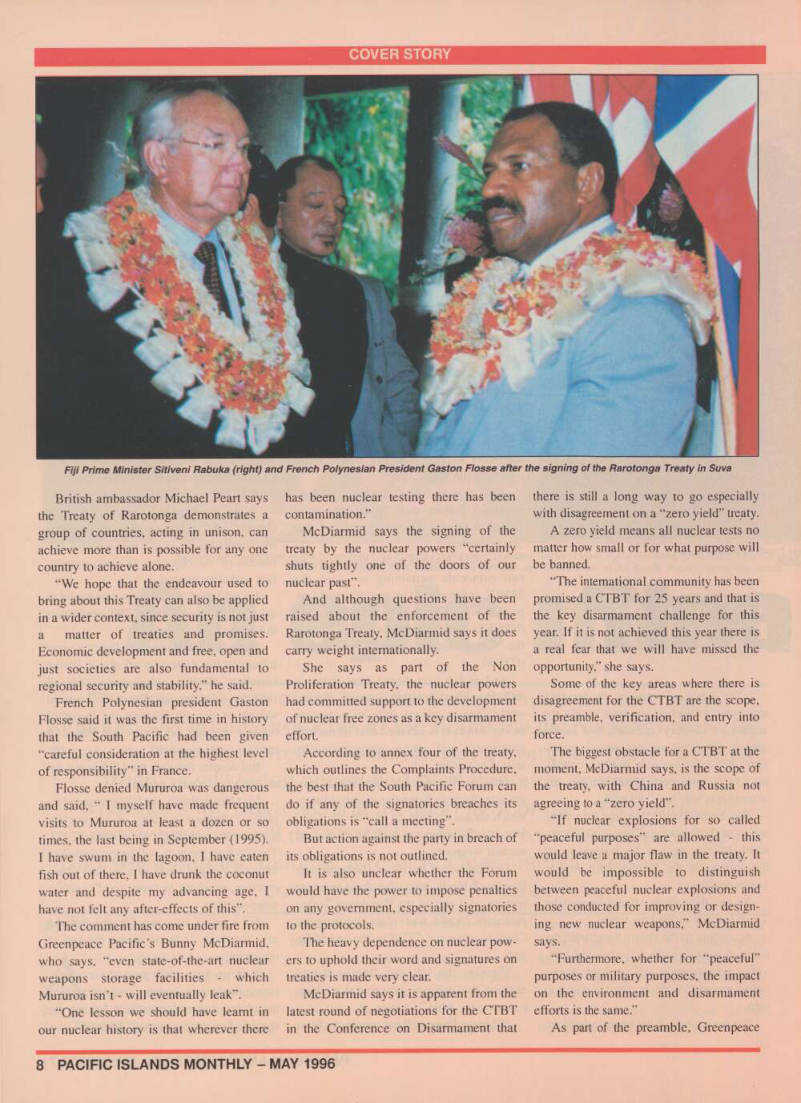
Fiji Prime Minister Sitiveni Rabuka (right) and French Polynesian President Gaston Flosse after the signing of the Rarotonga Treaty in Suva
wants an expression of commitment to fur ther disarmament, but the five nuclear powers have put up the most opposition to such an agreement, she says.
The verification section, which checks that signatories are complying with the terms of the treaty has not been finalised yet, with disagreement on how broad and at what cost compliance measures will be.
Entry into force which deals with how soon the treaty is enforceable, is still unre solved with Greenpeace calling for signing as soon as the treaty is open and ratifying as soon as possible after that.
Pacific Concerns Resource Centre assistant director for demilitarisation Losena Salabula says to make the CTBT more meaningful there has to be universal membership for all countries with nuclear capabilities rather than just the nuclear powers.
She says it does not seem as if the Cold War is over with the continuing build-up of arms by nuclear powers and their insis tence on tests.
The US have plans to conduct another six nuclear tests in line with US legislation permitting up to 15 nuclear tests to
improve the safety and reliability of
nuclear weapons, she says.
Salabula says the US is not permitted to test after October 1996 under their legisla tion unless another country conducts tests.
Any “loopholes” in the Rarotonga Treaty mean the US can transport its nuclear arsenal through the region without
breaking the protocols.
Salabula says the signing of the treaty was “a laughing matter and a waste of time and energy” because the US and other nuclear powers have no restrictions on the right of passage of nuclear-armed ships or aircraft through the region.
Such practices, she says, shows the nuclear powers still have “disregard and disrespect” for the rights of the Pacific people to a nuclear free home.
And Republic of Marshall Islands (RMI) foreign minister Phillip Muller says his country will not sign the SPNFZ treaty because it prohibits the transportation of nuclear waste in the region.
He says if RMI signs the treaty, his peo ple will have to live with the nuclear waste created by US tests.
Muller says the fact that Britain, France and the US have signed the protocols to the treaty does not mean much because
France has completed its testing and the US has yet to make a commitment to clean up the Marshalls.
The US tests were conducted up to 50 years ago with 67 nuclear tests in the Marshalls between 1946 and 1958. ■
Forum chairperson Chan: Hoped for a more detailed agreement for the region
The United States ambassador in Fiji, Don Gevirtz (closest to camera) and US congressman Eni Faleomavaega (centre) listen to delegates at the ceremony
future
Opinion
Franc future
The signing by Britain, France and
the United States of the protocols of the South Pacific Nuclear Free Zone Treaty is not just a victory for the region but another signal that the much sought permanent and world-wide ban on nuclear tests is now a real possibility.
The Comprehensive Test Ban Treaty (CTBT) has been on the international drawing board since the end of World War 11.
At that time it was feared that by the 1990’s there would be somewhere between 30 and 50 nuclear armed countries.
As it is, there are the big five - the United States, Russia, France, Britain and China - who acknowledge their weapons; the threshold nuclear powers - Israel, India, and Pakistan - which do not, and others such as Iraq, Libya and North Korea which are actively moving to join the nuclear club.
During the Cold War any real progress towards a ban on nuclear tests was out of the question. The first breakthrough came in 1993 when Australia, New Zealand and Mexico sponsored a consensus resolution calling for the negotiation of a Comprehensive Test Ban Treaty. The fol lowing year they won co-sponsorship for their resolution from the five nuclear weapons states.
While the support of the nuclear weapons states was crucial if the Treaty was to have any hope of becoming a reali ty there were still widely divergent views on what such a treaty should include - in particular, the nuclear weapons states wanted to retain the right to conduct small explosions - a stance which many saw as undermining the comprehensive nature of the treaty and its aim to prevent the devel opment of new generations of nuclear weapons.
The huge protests which resulted from France’s decision to conduct a final series of tests at Mururoa Atoll helped break the log-jam. French President Jacques Chirac responded by announcing that France would back the so-called “zero option” or no tests at all under the CTBT.
Things moved rapidly and the United Nations set August 1996 as deadline for the treaty text to be ready for signing.
As France continued to suffer under protests against its tests at Mururoa, President Chirac quietly mapped out a strategy aimed at restoring his battered nation’s international image. That plan involved a nuclear about-face.
Once the tests were finished Chirac
Australia
Jemima
Garrett
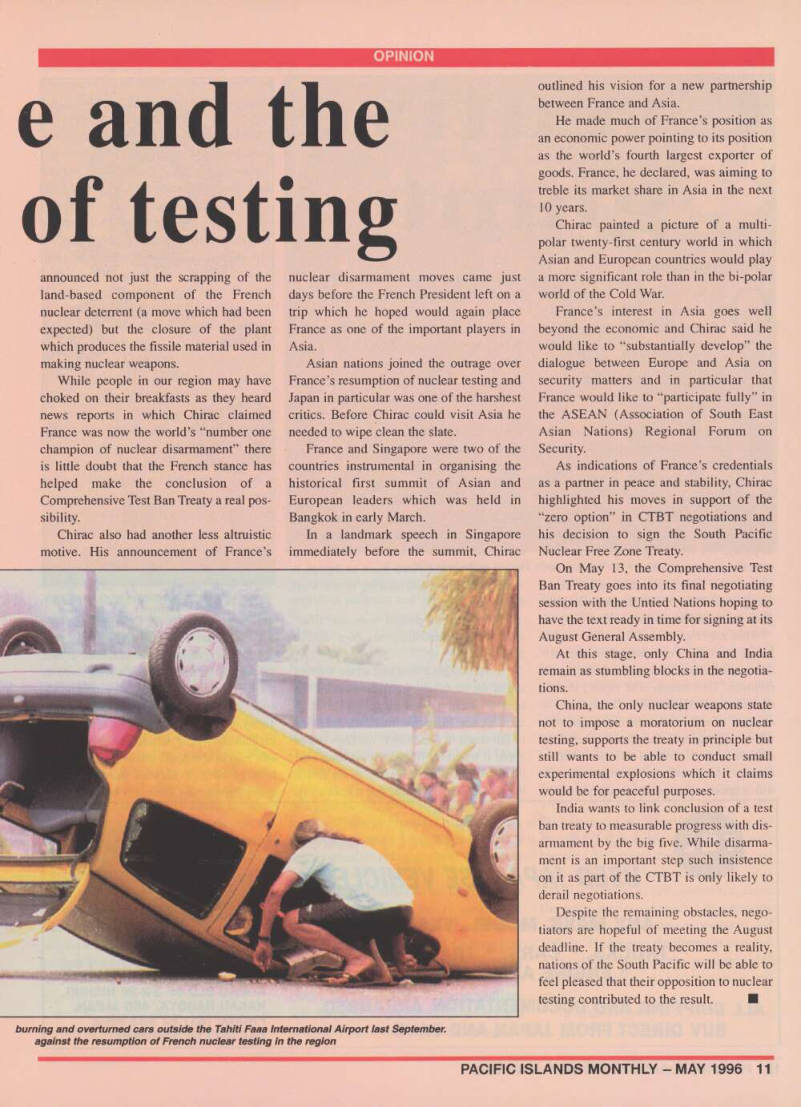
A hooded demonstrator walks away fro[?] The protests wer
announced not just the scrapping of the land-based component of the French nuclear deterrent (a move which had been expected) but the closure of the plant which produces the fissile material used in making nuclear weapons.
While people in our region may have choked on their breakfasts as they heard news reports in which Chirac claimed France was now the world’s “number one champion of nuclear disarmament” there is little doubt that the French stance has helped make the conclusion of a Comprehensive Test Ban Treaty a real pos
sibility.
Chirac also had another less altruistic motive. His announcement of France’s
nuclear disarmament moves came just days before the French President left on a trip which he hoped would again place France as one of the important players in Asia.
Asian nations joined the outrage over France’s resumption of nuclear testing and Japan in particular was one of the harshest critics. Before Chirac could visit Asia he needed to wipe clean the slate.
France and Singapore were two of the countries instrumental in organising the historical first summit of Asian and European leaders which was held in
Bangkok in early March.
In a landmark speech in Singapore immediately before the summit, Chirac
outlined his vision for a new partnership between France and Asia.
He made much of France’s position as an economic power pointing to its position as the world’s fourth largest exporter of goods. France, he declared, was aiming to treble its market share in Asia in the next 10 years.
Chirac painted a picture of a multi polar twenty-first century world in which Asian and European countries would play a more significant role than in the bi-polar world of the Cold War.
France’s interest in Asia goes well beyond the economic and Chirac said he would like to “substantially develop” the dialogue between Europe and Asia on security matters and in particular that France would like to “participate fully” in the ASEAN (Association of South East Asian Nations) Regional Forum on
Security.
As indications of France’s credentials as a partner in peace and stability, Chirac highlighted his moves in support of the “zero option” in CTBT negotiations and his decision to sign the South Pacific Nuclear Free Zone Treaty.
On May 13, the Comprehensive Test Ban Treaty goes into its final negotiating session with the Untied Nations hoping to have the text ready in time for signing at its August General Assembly.
At this stage, only China and India remain as stumbling blocks in the negotia tions.
China, the only nuclear weapons state not to impose a moratorium on nuclear testing, supports the treaty in principle but still wants to be able to conduct small experimental explosions which it claims would be for peaceful purposes.
India wants to link conclusion of a test ban treaty to measurable progress with dis armament by the big five. While disarma ment is an important step such insistence on it as part of the CTBT is only likely to
derail negotiations.
Despite the remaining obstacles, nego tiators are hopeful of meeting the August deadline. If the treaty becomes a reality, nations of the South Pacific will be able to feel pleased that their opposition to nuclear testing contributed to the result. ■
burning and overturned cars outside the Tahiti Faaa International Airport last September, against the resumption of French nuclear testing in the region
Advertisements & other items, pp. 10-11 (2 items)
Pubushed Quarterly
SUBSCRIBE NOW TO
FIJI’S ONLY GOLF
MAGAZINE TOP SHOT
PUBUSHED QUARTERLY
•111 ss 0 ¥ - lk-i
■JSSiL 1 ’
111
lil:
INSIDE: WINNER OF THE BIG BERTHA
Top Shot offers readers the best stories on local and overseas golf stars, personalities, features, courses and tournaments, ft’s action-packed and essential for anyone interested in the great game.
Yes, I would like to subscribe to the Golf Magazine Top Shot for □ 4 issues 1 year at $2.50 per Issue I enclose my cheque (local banks only) Bank Draft for F$ Made payable to The Fiji Times or please debit my credit card for $ □ Master Card □ Diners Club □ Visa □ American Express
CARD NO.
11111111 I I I I I I LI
EXPIRY DATE /
CARD HOLDERS
SIGNATURE
NAME
ADDRESS
Post to The Fiji Times, 6.P.0. Box 1167, Suva, FIJI, or Fax (679) 303809.
of testing
11
OPINION
PACIFIC ISLANDS MONTHLY - MAY 1996
e and the of testing
giant

The Arts
Creative giant
By Liz Thompson
Outside the Islander Travelodge in Port Moresby, Matias Kuage sits talking with friends. Stretched out in front of the hotel’s entrance are his paintings, some on canvas, some on paper.
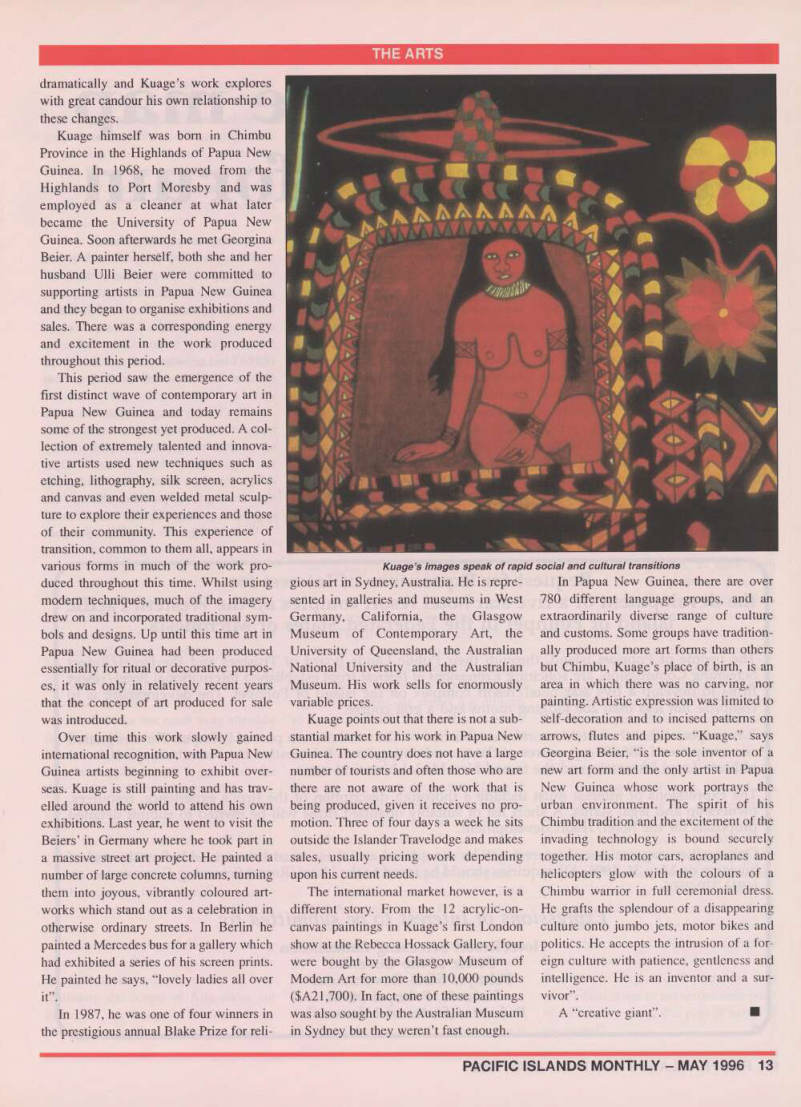
All held down with tiny pebbles as the breeze occasionally threatens to carry them away. The paintings are powerful for the loud and vibrant use of colour and the unique style that has now come so clearly to characterise Kuage’s work. Pictures of helicopters fdled with faces. Faces with bones through their noses and traditional headresses, faces that merge with the plane so it becomes difficult to tell where one stops and the other begins. A strange and evocative juxtaposition of traditional dress, tribal characters and modem tech nology. You know these paintings are bom
of an extraordinary experience.
This experience is a theme to which Kuage over the years has often returned and around which much of his work revolves. This strange and rapid meeting of traditional Papua New Guinea and a modem world. Often painting people, whose appearance and dress make clear references to traditional lifestyle, within modem machinery, he produces images which speak of the rapid social and cultur
al transitions which have taken place in Papua New Guinea over the last few decades.
Kuage was bom in the highlands of Papua New Guinea. In the 1930’5, the Leahy brothers, a group of gold prospec tors flew into the highlands in a small air craft. The people amongst whom they landed had no contact with the outside world, had no real knowledge of its exis tence, this was, as a later film using the Leahy brothers footage was later called, “First Contact”. The Leahy brothers flew one young man to the ocean, a thing of which he had absolutely no conception, the film shows him tasting salt water with amazement. They filmed the local people trying to feed the plane grass as though it were a giant bird and looking to see what sex it was.
“A helicopter passed over me first,” says Kuage, describing his own similar experience.
“I went to get a bow and arrow. I sat on top of the mountain, I wanted to shoot this bird...” Later he observed the white “mas tas”: “A new place was made for the plane to fall down in Kundiawa. We boys talked about it together. We said something like: man, look at all the mastas going inside this thing. They go inside and it goes away.
When they are outside it stays.”
The ruggedness of the mountain terrain meant that most communities had lived in relative isolation with little or no knowl edge of what lay beyond their valley.
Today, a major highway runs through the
highlands, where businesses, plantations
and major hotels are all well established.
In a number of decades the lives of so many Papua New Guineans have changed
Kuage’s paintings are born of an extraordinary existence
Pictures: Liz Thompson
dramatically and Kuage’s work explores with great candour his own relationship to
these changes.
Kuage himself was bom in Chimbu Province in the Highlands of Papua New Guinea. In 1968, he moved from the Highlands to Port Moresby and was employed as a cleaner at what later became the University of Papua New Guinea. Soon afterwards he met Georgina Beier. A painter herself, both she and her husband Ulli Beier were committed to supporting artists in Papua New Guinea and they began to organise exhibitions and sales. There was a corresponding energy and excitement in the work produced throughout this period.
This period saw the emergence of the first distinct wave of contemporary art in Papua New Guinea and today remains some of the strongest yet produced. A col lection of extremely talented and innova tive artists used new techniques such as
etching, lithography, silk screen, acrylics
and canvas and even welded metal sculp ture to explore their experiences and those of their community. This experience of transition, common to them all, appears in various forms in much of the work pro duced throughout this time. Whilst using modem techniques, much of the imagery drew on and incorporated traditional sym bols and designs. Up until this time art in Papua New Guinea had been produced essentially for ritual or decorative purpos es, it was only in relatively recent years that the concept of art produced for sale was introduced.
Over time this work slowly gained international recognition, with Papua New Guinea artists beginning to exhibit over seas. Kuage is still painting and has trav elled around the world to attend his own exhibitions. Last year, he went to visit the Beiers’ in Germany where he took part in a massive street art project. He painted a number of large concrete columns, turning them into joyous, vibrantly coloured art works which stand out as a celebration in otherwise ordinary streets. In Berlin he painted a Mercedes bus for a gallery which had exhibited a series of his screen prints.
He painted he says, “lovely ladies all over it”.
In 1987, he was one of four winners in the prestigious annual Blake Prize for reli-
gious art in Sydney, Australia. He is repre sented in galleries and museums in West Germany, California, the Glasgow Museum of Contemporary Art, the University of Queensland, the Australian National University and the Australian Museum. His work sells for enormously
variable prices.
Kuage points out that there is not a sub stantial market for his work in Papua New Guinea. The country does not have a large number of tourists and often those who are there are not aware of the work that is being produced, given it receives no pro motion. Three of four days a week he sits outside the Islander Travelodge and makes sales, usually pricing work depending upon his current needs.
The international market however, is a different story. From the 12 acrylic-on canvas paintings in Kuage’s first London show at the Rebecca Hossack Gallery, four were bought by the Glasgow Museum of Modem Art for more than 10,000 pounds ($A21,700). In fact, one of these paintings was also sought by the Australian Museum in Sydney but they weren’t fast enough.
In Papua New Guinea, there are over 780 different language groups, and an extraordinarily diverse range of culture and customs. Some groups have tradition ally produced more art forms than others but Chimbu, Kuage’s place of birth, is an area in which there was no carving, nor painting. Artistic expression was limited to self-decoration and to incised patterns on arrows, flutes and pipes. “Kuage,” says Georgina Beier, “is the sole inventor of a new art form and the only artist in Papua New Guinea whose work portrays the urban environment. The spirit of his Chimbu tradition and the excitement of the invading technology is bound securely together. His motor cars, aeroplanes and helicopters glow with the colours of a Chimbu warrior in full ceremonial dress.
He grafts the splendour of a disappearing culture onto jumbo jets, motor bikes and politics. He accepts the intrusion of a for eign culture with patience, gentleness and intelligence. He is an inventor and a sur vivor”.
A “creative giant”. ■
Kuage’s images speak of rapid social and cultural transitions
Advertisements & other items, p. 12 (1 item)
Trust Company Ltd
USED JAPANESE VEHICLES
ANY MAKE, MODEL, YEAR
* TRUCKS, * CARS, * TRACTORS,
* ENGINE AND TYRES
ALL SHIPPING AND DOCUMENTATION ARRANGED.
BUY DIRECT FROM JAPAN AND SAVE.
r
CONTACT'
Trust Company Ltd
KOBAC BID 3F 3-2-26 NISHIKI,
NAKAU NAGOYA, 460 JAPAN.
PHONE: (81) 52 953-5602
FAX (81) 52 953-5634
Pacific off the map
Region
Pacific off the map at Bangkok forum
By Kalinga Seneviratne
There was lively debate on the multi tude of problems faced by the rapidly growing cities of Asia at the second Asia-Pacific Urban Forum in
Bangkok from March 11-15. Organised by
the Economic and Social Commission for Asia and the Pacific (ESCAP) and the “Asia-Pacific 2000” project of the United Nations Development Programme (UNDP), this meeting was built as part of the region’s preparatory process for HABI TAT II - the major United Nations Conference on Human Settlements to be held in Istanbul, Turkey, in June.
The Forum was attended by over 100 delegates from Asian and Pacific countries.
but many South Pacific delegates com plained that their countries had been left out of the document presented to the meet ing for debate. The document titled “Living in Asian Cities” generated a lot of interesting discussion on the problems cre ated within Asia’s mega-cities with the increasing marginalisation of the poor, development of mafia networks and the breakdown of law and order.
“I understand this is a regional forum which includes countries from Asia, the South Pacific, Australia and New Zealand.
I’m of the opinion the title of this docu ment, “Living in Asian cities” is a bit mis leading. It needs to encompass all these other countries,” complained Dr Sababu Kaitilla from Papua New Guinea, during
the opening session of the Forum.
Talking to PIM later, he said he had read through all four chapters of the docu ment and no Pacific Island country was mentioned by name. “The word Pacific is missing in the whole document,” added Kaitilla, a senior lecturer at the University of PNG in Lae, who was representing the National Committee for Urban Shelter in
Png.
“PNG cities are much smaller at the moment but that doesn’t exclude them selves from the problems experienced by the mega-cities of Asia,” he said. “Right now, some of the cities in PNG are already experiencing those problems although not in great magnitude like the Asian cities”.
While the growth of urban infrastruc
ture in PNG is very small compared to cities in Asia, Dr Kaitilla argues there is nevertheless growing problems of urban gangs because of the economic disparities in growing urban settlements. Since the Pacific Islands, like most Asian countries, have no formal security structure, they may have a lot to leam from each other to tackle these problems.
Peni Gavidi, deputy permanent secre tary of the Ministry of Local Government and Environment also felt strongly about the exclusion of the South Pacific from the conference discussion document.” It appears that the Pacific is here by name only,” he told PIM.
“We feel we’re just being used to get the name of the Pacific. ESCAP is Asia-
Pacific, creating an impression that it’s serving a large area. In fact, it is just concentrating on Asia”.
Gavidi also argues that many Asian and Pacific Island countries have common prob lems but the scale of the prob lems are different. “In Fiji people are moving into urban areas. We have to address the allocation of resources. That is the common allocation of
land, question of raising finances or main tenance of infrastructure. The scale of the problem is different,” he observed, adding: “The scale of the problem we face in Suva is more manageable than in Bangkok, Manila or Bombay”.
Gavidi thinks that much more attention is given to the problems of Asia’s cities in Forums like this because there is a feeling that the populations are bigger, thus the scale of the problem is larger and the solu tions are urgent. “There’s a variety to the scale of the problem we’ve never heard of in the Pacific. For example, child labour, girls trafficking. We don’t face that in Fiji” he said, but added these are lessons which will be important for the Pacific to leam to avoid similar occurrences in their own countries.
“Quite clearly the developments taking place in Asia will have their impact on the Pacific. I think it’s important that we keep reminding the people of Asia about our existence” said Margaret Shields, a coun cillor of the Wellington Regional Council
and New Zealand’s sole representative to the Forum.
While the Pacific is unlikely to have for a very long time the type of urban prob lems faced by Asia, she argues that to meet the needs of these Asian urban popula tions, more demands will be placed on the resources of the Pacific Island countries.
“If we don’t use the resources of the Pacific wisely, we are going to become victims of the development taking place in Asia” said Shields. She points out that these pressures are already showing up in areas like logging, fishing, tourism and migration in the Pacific.
Jens Overgaard, the chief of the Bangkok-based ESCAP section for Human Settlements told PIM they had not
The title of the document “Living in Asian Cities” is misleading.
The document does not cover problems being experienced in the region and fails to mention the Pacific by name.
tried to marginalise the South Pacific at the Forum. The discussion document focused on the cities of Asia because it had a cer tain purpose and concept to provoke debate on the urgent problems facing the region’s big cities. He argues it is difficult to cover all 47 ESCAP member countries in a document like this, which is why it was called “Living in Asian Cities”.
“I don’t think the size matters so much.
It’s a question of whether with the kinds of
problems expressed, there is a possibility
to leam from each other in a Forum like this. The whole question of land, access to land, to land ownership are ones experi enced throughout the region” he argues.
But Kaitilla pointed out, that in PNG one of the major reasons for the problem of “rascals” (urban gangs) is the fear of eviction from their urban dwellings. Thus, here, PNG may have a lesson to learn from fellow island nation Sri Lanka’s "Million Houses Programme" where low-income families in urban areas were given govern ment housing and Non Governmental
Organisations like “Sevanatha” provided
information and organisational support for communities to build and maintain their dwellings. Representatives from both these projects attended the Bangkok Forum.
On the other hand, as Gavidi points out,
Fiji’s system of delegation of responsibili
ty and power to municipalities at local level may have many lessons for Asia’s smaller cities, given that ways of empow ering local authorities was one of the major topics of discussion at the Forum.
There were many local government repre sentatives from the region present to share their experiences.
With the Habitat 111 conference in Istanbul duped the “Cities Summit” many
Pacific delegates were wondering whether they would have a role to play, especially if they were to be repre sented through the Asia-Pacific caucus.
Shields thinks if the Pacific looks at the con ference as a learning process, to learn from the problems faced by high population urban
centres and use that knowledge to avoid these things happening in their smaller countries, will be a useful experience. But Gavidi feels the South Pacific should make a more concerted effort to work with other small island states in the Caribbean and elsewhere to place their own unique issues dealing with urban development on the agenda at Istanbul.
Overgaard said many Pacific countries have expressed interest in Istanbul but complained they have not received suffi cient information about the process taking place. He argues it has a lot to do with the travel costs involved in attending the preparatory conferences which have taken place in Nairobi and New York. “The pro fessionals who have now been left with the task have not taken part in those discus sions” he observed. “When it comes to Istanbul your representative have to be there (and) maybe work together with other island states to put across their point of view, when the global plan of action is
negotiated”. ■
Advertisements & other items, pp. 14-16 (1 item)
Request for Expressions of Interest for
the development of a five star hotel resort complex on the Western Pacific island of Pohnpei in the Federated States of Micronesia The people of Pohnpei Island, through their Public Lands Board of Trustees and the Hotel/Resort Screening Commission, are soliciting Expressions of Interest from established international hotel/resort firms to develop a five star hotel/resort complex on the island of Pohnpei. The development is to comprise not less than 200 lodging rooms and a golf course.
It is proposed that the hotel/resort be established on the southeastern part of Pohnpei. The designated site comprises 1,286,395 sq. metres of flat to undulating land. It is nestled between the tropical forest of Nana Laud Mountain and the famed Nan Madol historical mins.
The expressions of interest must include a thorough description of the firm's experience, resources, ownership and legal status. A short list of suitably qualified firms will be invited to submit detailed proposals for the hotel/resort development.
Only written expressions of interest will be considered and these must be received before the end of business on May 31, 1996. All enquiries should be faxed to the Hotel/Resort Screening Commission on (691) 320 2505.
Expressions of Interest to be submitted to: Hotel/Resort Screening Commission Office of the Governor Pohnpei State Government Kolonia, Pohnpei 96941 Federated States of Micronesia
South Pacific Regional
Environment Programme (SPREP)
Vacancy Director
The position of Director of the South Pacific Regional Environment Programme (SPREP) will become vacant in late 1996. Nominations are invited for suitably qualified and experienced candidates to be considered for appointment by the Ninth SPREP Meeting which is expected to be held in September 19%.
SPREP was established by twenty-two Pacific islands countries and territories and four developed countries to promote cooperation in the South Pacific region and to provide assistance in order to protect its environment and to ensure sustainable development for present and future generations.
It achieves these purposes through an Action Plan which sets the organisation's strategies and objectives and which, inter alia, requires it to: 9 coordinate regional activities addressing the environment; 9 monitor and assess the state of the environment in the region including the impacts of human activities on the ecosystems of the region and encourage development undertaken to be directed towards maintaining or enhancing environmental qualities; 9 promote and develop programmes, including research programmes, to protect the atmosphere and terrestrial, freshwater, coastal and marine ecosystems and species, while ensuring ecologically sustainable utilisation of resources; 9 reduce, through prevention and management, atmospheric, land-based, freshwater and marine
pollution;
9 strengthen national and regional capabilities and institutional arrangements 9 increase and improve training, educational and public awareness activities; and 9 promote integrated legal, planning and management mechanisms.
The Agreement Establishing SPREP, which entered into force on 30 August 1995, provides, inter alia, that the Director of SPREP shall be the head of the Secretariat and shall be responsible to the SPREP Meeting for the administration and management of SPREP. The Secretariat, based in Apia, Western Samoa, has some 53 staff including programme officers recruited from member countries supported by administrative staff recruited in Western Samoa. It is funded by core contributions from member countries and by project funding from a range of donors. Total funding in 1994 was USD6 million.
The Directorship of SPREP is a senior regional position, carrying diplomatic status and calling for proven qualities of diplomacy, vision, leadership and management skills. Applicants must show a demonstrated interest in the environment of the South Pacific region with at least ten years' substantial experience in a comparable field and the ability to lead a multi-disciplinary team of professional staff. High-level experience in dealing with regional and extra-regional governments and institutions and in negotiating with development partners is essential. Relevant tertiary qualifications
are required, preferably at post-graduate level
The position carries a remuneration package designed to encourage appropriate candidates and includes a tax-free salary (for non-nationals or non-citizens of Western Samoa), and housing, medical education and other benefits where eligible. Appointment will be for three years in the first instance with the possibility of a further three years. Maximum duration of appointment is six years.
Candidates must be nominated by, and be nationals of, a SPREP member government or administration.* Nominations should include curricula vitae giving full personal details, information on qualifications and experience for the position, previous appointments, current position and salary, names, addresses and telephone and/or fax contact numbers of three persons associated with the applicant professionally and who would be prepared to provide testimonials.
Nominations should be addressed to: The Chairperson Eighth SPREP Meeting SPREP Secretariat PO Box 240 Apia Western Samoa Fax (685) 20231 Further information, including a full post description and further details of remuneration and terms and conditions of appointment, is available from SPREP on request by contacting the Deputy Director, Mr Don Stewart, at: P.O. Box 240 Teh (685) 21929 Apia Fax (685) 20231 Western Samoa E-mail SPREP @pactok.peg.apc.org Closing date 14 June 19%. * Having ratified the SPREP Agreement, the following governments and administrations are considered members for this purpose: (Australia, Cook Islands, Federated States of Micronesia, Fiji Kiribati Nauru, New Zealand, Niue, Papua New Guinea, Solomon Islands, Tokelau, Tonga, Tuvalu, and Western Samoa). Other governments and administrations will become eligible to nominate candidates on completion of ratification of the Agreement. 104935v2
Cease-fire
broken
By Sam Vulum
The recent brutal attacks and killings of 10 Papua New Guinea security force members by the Bougainville Revolutionary Army (BRA) has left the PNG government with little choice but to take a hard-line approach against those responsible, particularly after almost two years of consistent peace efforts turned fruitless.
The deaths, from an upsurge in BRA activities since January 1996, resulted in the lifting of an 18-month cease-fire in a special National Executive Council (NEC) meeting on March 23.
Announcing the government decision, Prime Minister Sir Julius Chan said: “The legal effect of lifting the cease-fire is that the Defence Force will now be once again operating under the full powers and responsibilities imposed upon it by consti tution call-out of December 23, 1988.
Chan said the government had been honest, sincere and genuine in its commit ment to implement every condition of seven agreements but the BRA “has not matched us”.
He said; “It’s time to face the truth that continued talking is not working”.
“For the past 18 months, the govern ment has left no stone unturned, travelled down every path and tried every legal means at its disposal to resolve the con flict.”
“I am convinced that we have exhaust ed all human tolerance. Every time an agreement of any sort was reached, the rebels reneged, defaulted and continued killing and destroying. There is not one shed of proof...that the rebels are sincere.”
Chan said the government would “fund the security forces up to the maximum capacity the country can afford” on top of the K 36 million provided under the 1996 budget, to end the slaughter of innocent
people and bring back peace and normalcy to the province.
Cabinet has also instructed that the security forces get better equipment and that BRA elements inside and outside PNG be dealt with.
The announcement was generally accepted by many in Papua New Guinea.
However, the UN Secretary General Boutros Boutros-Ghali has called on all parties in the conflict to exercise maximum restraint and to return to the negotiating table to find a lasting and peaceful settle ment.
“The secretary-general remains ready
to assist in facilitating a resumption of the peace process,” his spokesperson said in a statement.
Australia’s new Foreign Minister Alexander Downer also urged both the security forces and the BRA to show restraint.
“The Australian government does not believe that there can be a military solu tion,” Downer said.
He said Canberra would like to see the peace process revived, and said the securi ty situation was preventing delivery of Australian aid to help restore the
Bougainville economy.
The Catholic Bishops of PNG and the Solomon Islands also want the BRA to give up their attacks and for the Security Forces to show restraint in the face of
provocation.
However, developments since the lift
ing of the cease-fire have indicated that the government is not pulling back.
Sources on Bougainville have indicated that specific targets have been identified and security forces are moving into other parts of Bougainville.
Meanwhile, Bougainville Revolutionary Army (BRA) field com mander Ishmael Toroama has denied claims that he was seriously wounded and was trying to cross into the Solomon Islands to get medical treatment.
In a radio interview with Sydney-based journalist Max Watt on March 30, Toroama said: “Do not make nonsense. I am not dead.”
Prime Minister Chan ! on March 28 claimed the BRA commander was serious ly wounded and was planning to cross into the Solomon Islands for medical treatment.
A BRA and Bougainville interim gov ernment spokesperson also told AAP that Toroama has relayed the message: “I am not wounded. I am not dead and I am not planning to come to the Solomons for medical treatment.”
The spokesperson also gave details of what he described as massacres by PNG defence forces of Bougainville islanders in the week following the breaking of the cease-fire.
He said at Luaguo two young civilians were killed and nine were wounded by PNG troops.
Another massacre took place at Mapisi, Kunua, where several people had been murdered and wounded by troops, he said.
David Sisuto, Bougainville interim government minister for land and environ ment said “future peace meetings will have to take place in Bougainville under control of United Nations peace keeping forces.
“We cannot trust the PNG defence force any more.”
Meanwhile, Chan has sought more “constructive action” from the Solomon Islands towards the resolution of the Bougainville crisis.
Responding to Solomon Islands Prime Minister Solomon Mamaloni’s letter to him dated March 25, Sir Julius said while PNG appreciated the Solomon Island’s support towards a peaceful resolution of the Bougainville problem, more needed to be done to demonstrate Honiara’s “real and genuine willingness” to assist. ■
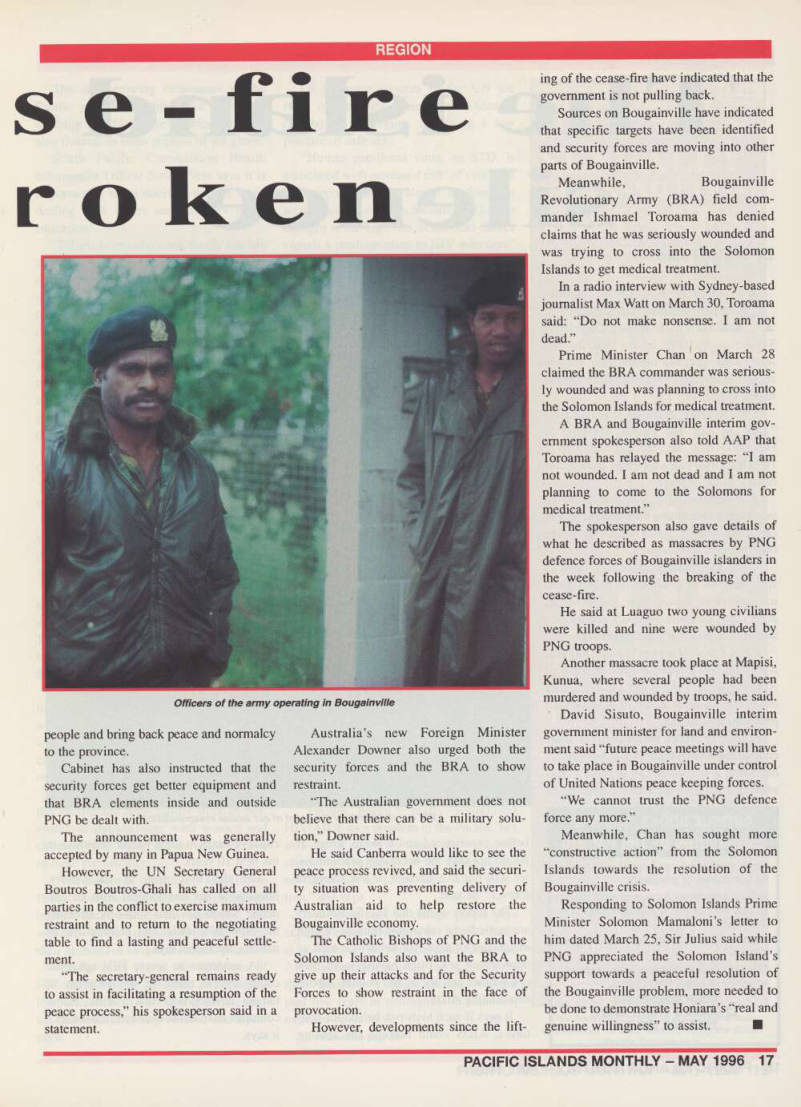
Officers of the army operating in Bougainville
Advertisements & other items, p. 17 (1 item)
s e - f i r e
17
REGION
PACIFIC ISLANDS MONTHLY-MAY 1996
s e - f i r e rok e n
The island

Special Report
The island silence
By Sophie Foster
A comprehensive United Nations
report detailing the incidence of
Acquired Immune Deficiency
Syndrome (AIDS) in the Pacific has warned the spread of the epidemic is more serious than current statistics have led the region to believe.
The recently released report called “Time To Act: The Pacific Response to HIV and AIDS” says there could be up to 100 unreported cases for every known case of HIV in the region.
And because AIDS can take up to 10 years before becoming fully-blown, people can unknowingly infect others including their partners and children.
“That the number of known cases is still quite low in most Pacific island coun tries therefore means little. Furthermore, even small numbers in small populations add up to a problem,” the report says.
Fiji’s Prime Minister Sitiveni Rabuka, who launched “Time to Act” in Suva in April, says AIDS is not just a threat to life, but to the whole make-up of development prospects of a nation.
“The HIV/AIDS epidemic, is a clear enough signal that there is a storm gather ing force; a storm that can become a dev astating hurricane such as we have never
before experienced and a storm which, if we do not take the necessary precautions, we will not live through or live to regret forever,” he said.
The report warns that Pacific Islanders are particularly vulnerable because of high incidences of high-risk behaviour such as unprotected sex, often having more than one partner and social and cultural taboos surrounding AIDS.
It says if such high-risk behaviour con tinues, AIDS could become the leading
cause of death in some Pacific countries in the next 10 years.
For the first time in its history, humankind has had to deal with an epi demic which has had spin-offs affecting the economic, social and political life of nations, the report says.
“A moderate to severe HIV epidemic could reverse much of the progress in human development that Pacific Island countries have made over recent decades,” it says.
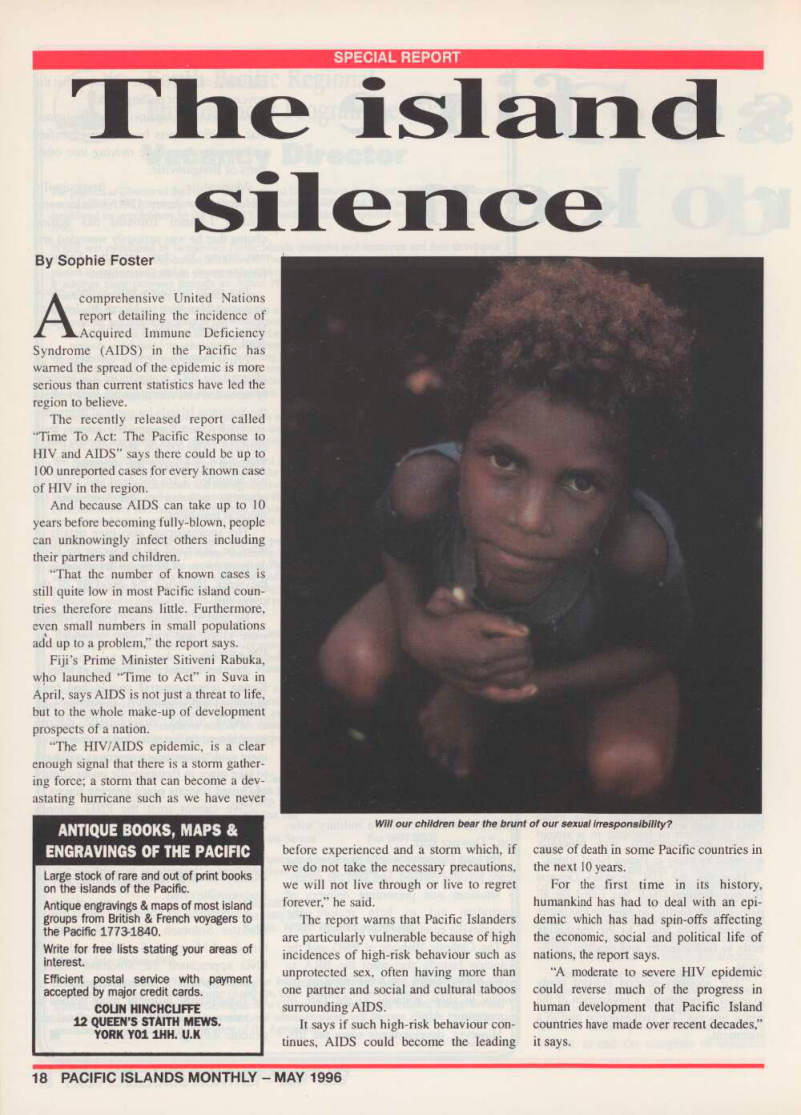
Will our children bear the brunt of our sexual irresponsibility?
The slow-growing economies of the Pacific provide conditions of economic hardship in which have enabled AIDS to also flourish in other regions of the globe.
South Pacific Commission Health Information Officer Steven Vete says it is important to target decision-makers when dealing with issues such as HIV/AIDS education.
“Efforts to introduce sex/family life/life skills education in schools; to make con doms readily available; to discuss sex and
sexuality issues more openly; to recognise
the linkages between poverty, inequality in relationships, ignorance, discrimination, abuse of human rights and the spread of HIV and STDs have all been blocked by those decision-makers who hide behind reasons such as ‘it is against our reli gion/culture/tradition to talk about such things’,” he says.
But to quote a South Pacific Commission AIDS education pamphlet: “HIV/AIDS does not respect tradition, cul ture or religion”.
The UN report says the attitudes of youth, the low status of women and promiscuous male behaviour affects the spread of AIDS.
Of particular interest to the UN study, is the impact of AIDS on women who, it says, shoulder the burden of the epidemic.
They are less able to control its spread because their lives are often controlled by their social and cultural circumstances.
In the Pacific, social and cultural taboos mean some youth are misinformed or lack access to safe sex information; the opin ions of most women are not given consid eration, and sexual promiscuity amongst males is often rampant.
The report says the spread of AIDS in the Pacific has been mostly through het erosexual transmission, with women and children often being the innocent victims of male promiscuity.
“The pattern of infection in at least two Pacific countries indicates a concentration in high-status men on the one hand, and women with only one sexual partner (often their husband or long-term sexual partner).
“In the early phase, the epidemic of HIV/AIDS may be described as a epidem ic of affluence for men, and of double sex ual standards affecting women,” the report says.
Of immense concern to the UN are rates of Sexually Transmitted Diseases (STDs) in the region, signifying a low practice of safe sex.
“Human papilloma vims, an STD, is associated with increased risk of cancer of the cervix, which is almost epidemic in some Pacific countries including Fiji. The concern is the high rate of cervical cancer signals a predisposition to HIV infection,” the report says.
Many Pacific Island countries have high STD rates relative to Australia and New Zealand, including Fiji, PNG and the Marshall Islands, but there is concern gov ernment statistics show only a fraction of the total cases because many cases are untreated or treated by private doctors who are not required to report them.
Most Pacific women do not have a choice in terms of use of safe sex methods, with the decision often being made by their spouses.
High rates of domestic violence in the
region signify women are still unequal
partners in relationships.
The report says such cultural and social inequalities will need to be addressed if there is to be any significant progress made in the fight against the spread of HIV/AIDS in the region.
UNICEF social mobilisation officer, and one of the co-ordinators of the report, Heidi Larson says its idea was conjured up about three years ago, but it was only in the past year-and-a-half that most of its collation and compiling was done.
The main problem those working on the report encountered was the attitude towards HIV/AIDS which manifested itself in a lack of data and facilities, Larson says.
“People haven’t really recognised
HIV/AIDS as a problem in the Pacific, but in a lot of countries where the epidemic starts, the symptoms of the epidemic do not show for up to 10 years after infec tion,” she says.
It is never easy to change public per ceptions especially when the issue at stake is something as personal and taboo as AIDS and sexual activity, but Larson says there has been a major change over the past five years in willingness to acknowl
edge the epidemic.
(Continued on page 20)
Ard while there is still a long way to go, sie says people at all levels are acknowledging the need for information
On Hiv/Aids.
Bit the report says religious/cultural taboo; will not always be a barrier to the dissenination of accurate information on
Hiv/Aids.
“Pacific people are not much different from others and amongst their peers and people they feel comfortable with, there are no constraints on talking about sex,” it says. And if existing social networks are incorporated into an AIDS education plan, the chances of reaching a greater number of people would increase.
Larson says the UN has highlighted the need for a more positive attitude towards HIV/AIDS, but action to contain the epidemic remains in the hands of Pacific people.
“It can no longer be perceived as a problem for the ministry of health, all sectors of the population will have to take action whether it be the private sector in educating their employees, families and schools educating children, or the gov ernment in facilitating change,” she says.
HIV/AIDS is affecting the Pacific now. From the report, it is clear the only choice available is to address the epidem ic and its ramifications at all levels before it escalates to uncontrollable proportions in the region. ■
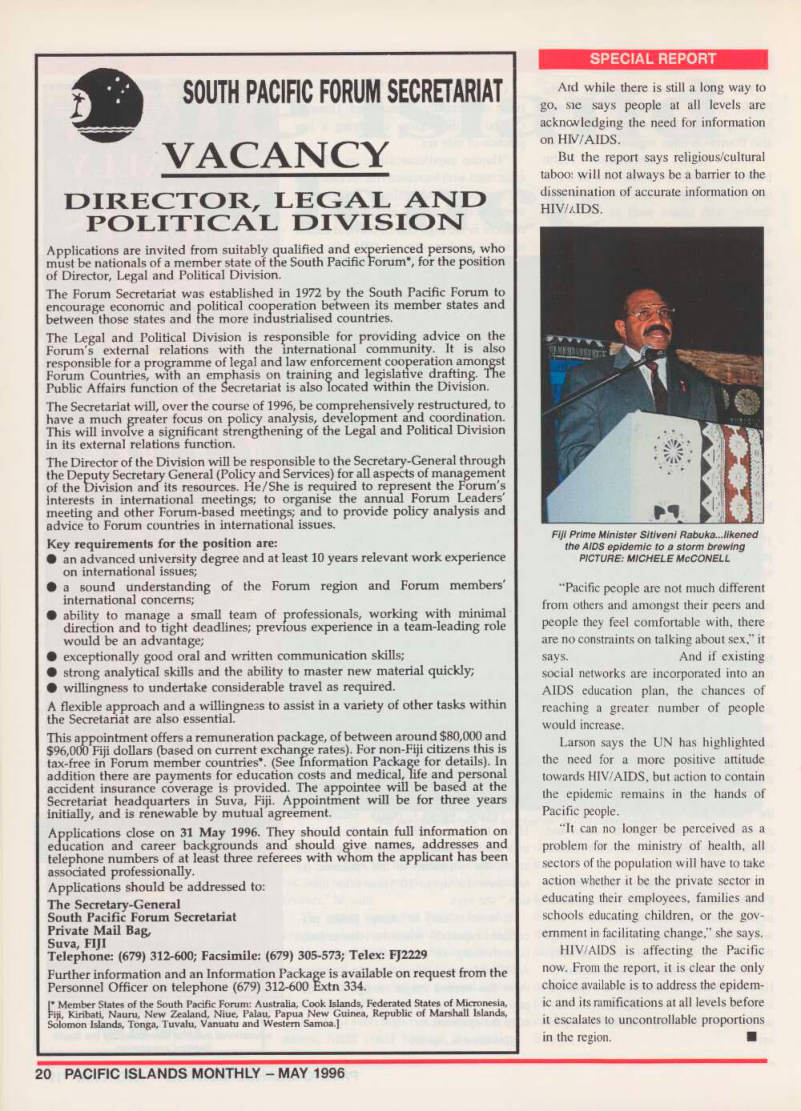
Fiji Prime Minister Sitiveni Rabuka...likened the AIDS epidemic to a storm brewing
Picture: Michele Mcconell
Advertisements & other items, pp. 18-20 (1 item)
Antique Books, Maps &
ENGRAVINGS OF THE PACIFIC
Large stock of rare and out of print books on the islands of the Pacific.
Antique engravings & maps of most island groups from British & French voyagers to the Pacific 1773-1840.
Write for free lists stating your areas of interest.
Efficient postal service with payment accepted by major credit cards.
COUN HINCHCUFFE
12 QUEEN'S STAITH MEWS.
YORK YOIIHH. U.K
SEXUALLY
TRANSMITTED
DISEASES
AIDS
has no
CURE
$
STDs
if left untreated can cause;
INFERTILITY
PHYSICAL
or MENTAL
DISEASE
And can seriously harm and even kill the unborn baby m m. m iau M mm -- 1 ■/ ■- ■ ■■ "■ ■" ■ ""
This bookmark is part of AIDS awareness educational material distributed by the South Pacific Commission
SOUTH PACIFIC FORUM SECRETARIAT
VACANCY
DIRECTOR, LEGAL AND
POLITICAL DIVISION
Applications are invited from suitably qualified and experienced persons, who must be nationals of a member state of the South Pacific Forum*, for the position of Director, Legal and Political Division.
The Forum Secretariat was established in 1972 by the South Pacific Forum to encourage economic and political cooperation between its member states and between those states and the more industrialised countries.
The Legal and Political Division is responsible for providing advice on the Forum's external relations with the international community. It is also responsible for a programme of legal and law enforcement cooperation amongst Forum Countries, with an emohasis on training and legislative drafting. The Public Affairs function of the secretariat is also located within the Division.
The Secretariat will, over the course of 1996, be comprehensively restructured, to have a much greater focus on policy analysis, development and coordination.
This will involve a significant strengthening of the Legal and Political Division in its external relations function.
The Director of the Division will be responsible to the Secretary-General through the Deputy Secretary General (Policy and Services) for all aspects of management of the Division and its resources. He/She is required to represent the Forum's interests in international meetings; to organise the annual Forum Leaders' meeting and other Forum-based meetings; and to provide policy analysis and advice to Forum countries in international issues.
Key requirements for the position are: • an advanced university degree and at least 10 years relevant work experience on international issues; • a sound Understanding of the Forum region and Forum members' international concerns; • ability to manage a small team of professionals, working with minimal direction and to tight deadlines; previous experience in a team-leading role would be an advantage; • exceptionally good oral and written communication skills; • strong analytical skills and the ability to master new material quickly; • willingness to undertake considerable travel as required.
A flexible approach and a willingness to assist in a variety of other tasks within the Secretariat are also essential.
This appointment offers a remuneration package, of between around $BO,OOO and $96,000 Fiji dollars (based on current excnange rates). For non-Fiji citizens this is tax-free in Forum member countries*. (See Information Package for details). In addition there are payments for education costs and medical, life and personal accident insurance coverage is provided. The appointee will be based at the Secretariat headquarters in Suva, Fiji. Appointment will be for three years initially, and is renewable by mutual agreement.
Applications close on 31 May 1996. They should contain full information on education and career backgrounds and should give names, addresses and telephone numbers of at least three referees with whom the applicant has been
associated professionally.
Applications should be addressed to:
The Secretary-General
South Pacific Forum Secretariat Private Mail Bag, Suva, FIJI Telephone: (679) 312-600; Facsimile: (679) 305-573; Telex: FJ2229 Further information and an Information Package is available on request from the Personnel Officer on telephone (679) 312-600 Extn 334. [• Member States of the South Pacific Forum; Australia, Cook Islands, Federated States of Micronesia, Fiji, Kiribati, Nauru, New Zealand, Niue, Palau, Papua New Guinea, Republic of Marshall Islands, Solomon Islands, Tonga, Tuvalu, Vanuatu and Western Samoa.]
Shotover Jet’s thrilling
Advertising Feature
Fiji & New Zealand Trade
Shotover Jet’s thrilling experience
Shotover Jet Fiji can best be described as Fiji’s most thrilling boat ride.
The experience starts when you climb aboard a “Big Red”: you will feel your heart race and your adrenaline surge as the driver eases from the berth and skims across the water in search of the narrow arms of the Nadi River in the Western side
of Fiji.
The Shotover Jet drivestyle is world famous, and the spectacular Hamilton turn (where the boat spins through 360 degrees in its own length) is the driver’s trademark.
As you blast along the narrow man grove-lined green corridor during your 30minute ride, “Big Red” is drawing in as lit tle as 10 centimetres of water. This allows the driver to get maximum performance out of the custom built boat.
Drivers also have an intimate knowl edge of the history and culture of the area, making a Shotover Jet ride more than a
thrilling experience.
The jetboat is a New Zealand invention, and is designed to operate in as little as 10 centimetres of water. The narrow tidal trib utaries on the Nadi river provide all the right ingredients for classic shallow water jetboating.
All Shotover Jet drivers are profession-
als trained by the company including locals Dennis Robinson and Colin Marriott. To ensure safety, each driver has a minimum of 120 hours behind the wheel of a “big Red” before they carry their first
passenger.
Weather permitting, Shotover Jet Fiji operates 365 days of the year.
In its first 24 months of operation in Nadi, Shotover Jet Fiji has delighted more
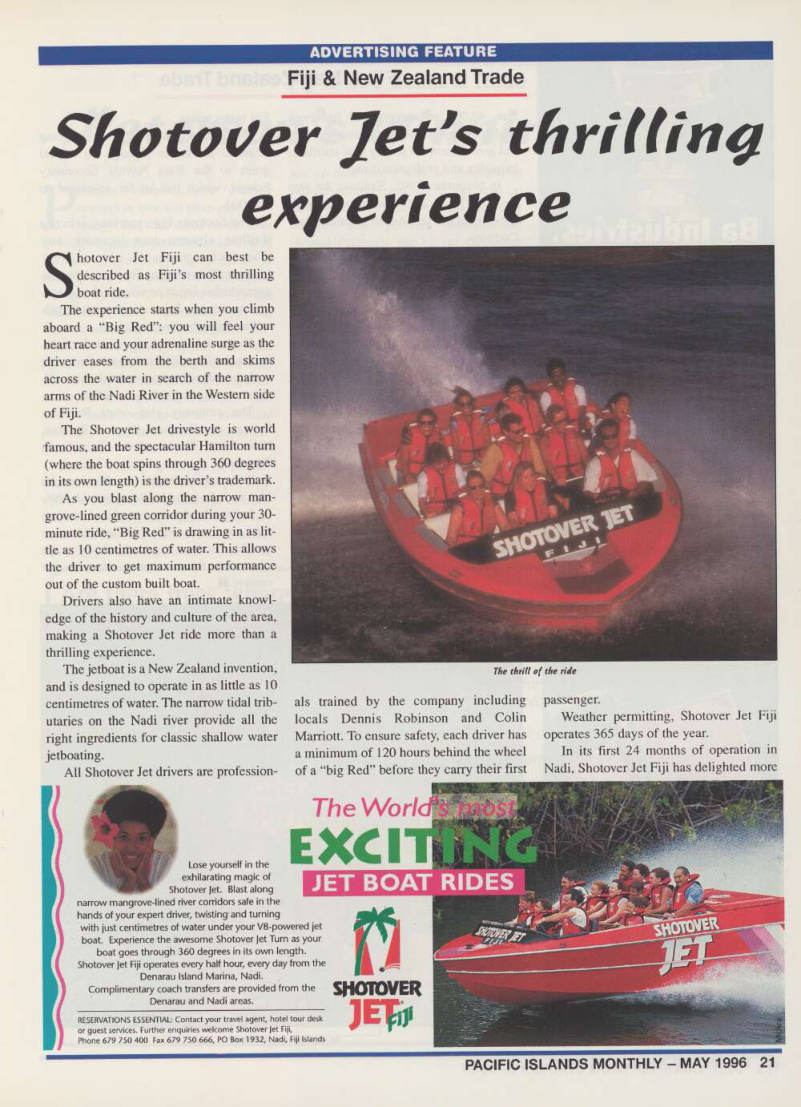
The thrill of the ritle
than 40,000 passengers and has been
applauded by the local tourism industry
and government for setting new standards in quality and professionalism.
In November 1995, Shotover Jet won the Fiji Trade and Investment Board’s Exporter of the Year Award in the Services
Category.
Its environmentally-friendly attitude is reflected in Shotover Jet’s use of Liquid Petroleum Gas (LPG) for fuel to protect the waters of the Nadi River.
The safety aspect is extended to life jackets, which are mandatory and supplied by Shotover Jet.
While carrying cameras are welcome during the ride, Shotover Jet subsidiary company Smile Click, take photographs which are available as soon as passengers disembark.
The medium to long-term success of Shotover Jet is based on the on-going development of a harmonious working relationship with the local community.
Apart from the employment created, Shotover Jet Fiji sponsors local sporting events and charity fund-raisers like the annual Heaven to Heaven Triathlon and
Fiji rugby teams.
The company also provides on-going financial assistance through an annual grant to the Ratu Navula Secondary School, which has so far amounted to $40,000.
The Shotover Fiji experience injects a thrilling element into incentive pro grammes for tourism.
As well as catering for casual passen gers whether locals or visitors, the compa ny operates two boats simultaneously pro
viding group hosting capacity.
Shotover Jet is a publiply listed compa ny on the New Zealand Stock Exchange with an objective to establish five off shore operations by the year 2000.
The company also owns Rainbow Springs and Rainbow Farm in Rotorua, Huka Jet in Taupo and the Christchurch
Trammary.
Plans are underway for Shotover Jet Mexico to be up and running by mid-1996.
Judging by the success of its first over seas venture in Fiji, “the world’s most exciting jet boat ride” should be a hit wherever the company decides to venture. ■
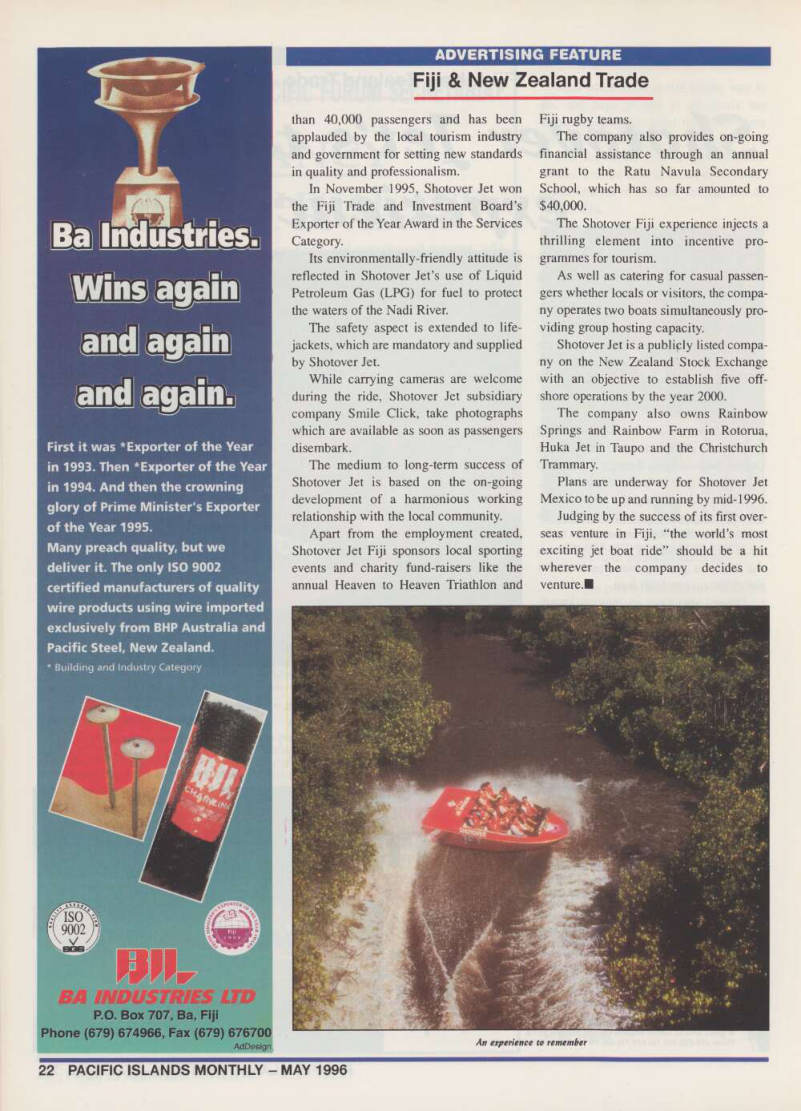
An experience to remember
Advertisements & other items, pp. 21-22 (2 items)
Exci
Lose yourself in the
The Worl
exhilarating magic of Shotover Jet. Blast along narrow mangrove-lined river corridors safe in the hands of your expert driver, twisting and turning with just centimetres of water under your VB-powered jet boat. Experience the awesome Shotover Jet Turn as your boat goes through 360 degrees in its own length.
Shotover Jet Fiji operates every half hour, every day from the Denarau Island Marina, Nadi.
Complimentary coach transfers are provided from the Denarau and Nadi areas.
RESERVATIONS ESSENTIAL: Contact your travel agent, hotel tour desk or guest services. Further enquiries welcome Shotover Jet Fiji, Phone 679 750 400 Fax 679 750 666, PO Box 1932, Nadi, Fiji Islands
SHOTOVER
JEf
3
Bat Industries.
Wins again
and again
and again.
First it was * Exporter of the Year in 1993. Then * Exporter of the Year in 1994. And then the crowning glory of Prime Minister's Exporter of the Year 1995.
Many preach quality, but we deliver it. The only ISO 9002 certified manufacturers of quality wire products using wire imported exclusively from BHP Australia and Pacific Steel, New Zealand. * Building and Industry Category 5 V
BA INDUSTRIES LTD
P.O. Box 707, Ba, Fiji Phone (679) 674966, Fax (679) 676700
22
Fiji & New Zealand Trade
ADVERTISING FEATURE
PACIFIC ISLANDS MONTHLY - MAY 1996
Peterson’s Winning mitts

Peterson sawmills, the leading sawmill in new and innovative tech nology, laid their cards on the table by competing in the New Zealand National
Portable Sawmilling Competition in
Rotorua late last year. The competition was run by the NZ Portable Sawmillers Association, and sponsored by the Forestry education Centre. The great “saw down” was designed to get all the major portable sawmills together (both imported and local) to test their advertised capabili ties in real-live operating situations. Each mill’s “team” was given an individual time-keeper and strict instructions to fol low.
Besides coming up trumps in produc tion (around 1.5 cubic metres per hour with two men), accuracy (average of 1 mil limetre variance), and quality (the only mill made almost entirely of stainless steel and alloy), Petersons revealed a surprise
ace up their sleeve with an unbelievable official recovery rate of 82 per cent on medium to large logs! This result not only beat all other portable sawmills, but showed Petersons cut 7.2 per cent more timber from the same size log as the top bandsaw mill. Accuracy was also a major score, as Peterson’s worst possible cut var ied just two millimetres from the desired size, while the top bandsaw mill showed variations of up to five millimetres. Even more incredible was the fact that these proven results were all achieved simulta neously within the same test run.
These results clearly set new standards for portable and conventional mills world wide, showing many older-style sawmills as obsolete. With the increased recovery, accuracy, output, and lower running and capital costs, these new mills will not only boost profits, but can quickly pay for the entire cost of replacement. This gives the opportunity for individuals, businesses,
and governments alike to re-think their
business plans and policies when looking
for new milling equipment, or replacing
older machinery.
Peterson Sawmills were originally designed by a Fiji citizen while many years ago, but have yet to re-enter that market commercially. This is due to the
Fiji Government’s policies showing a pref
erence for bandsaw mills, and a stand against circular bladed sawmills. Petersons have been exporting for fiye years now and have achieved astounding success in coun tries as diverse as Russia, Chile, Zambia, Tanzania, Papua New Guinea, the Solomons, Vanuatu, New Caledonia.
Australia, USA, England, Switzerland, South Africa and Canada. In all these remote areas, Peterson Sawmills have stood up to conditions and lack of exper tise extremely well. ■
Advertisements & other items, pp. 23-24 (2 items)
23
ADVERTISING FEATURE
PACIFIC ISLANDS MONTHLY - MAY 1996
Fiji & New Zealand Trade
Here's the answer!
Are there trees where you live? Do you need timber or housing?
No matter where you live or how remote your village, we have a portable sawmill designed & built for tropical conditions to suit your needs; lowest price circular sawmill at Silverdale Trial ’Highest recovery 82% at FEC Competition ’Best consistant accuracy over all mills trialled ’Output 4-6 cubic metres per day sawn timber ’Cuts logs to I.Bm diameter, almost any length ’No log loading; handcarried, ute, punt, bullocks ’Tools/safety kit/blades included from NZ$l2,OOO Contact us for an agent in your area!
Suitable for
Village Schemes
or
Group Ventures
m m *4%
PETERSON
PORTABLE SAWING SYSTEMS LTD
Design and Manufacture P 0 Box 98 152 View Rd, ROTORUA, New Zealand
We can help
bring the markets
of the world
right to your door.
If you've been in business for any length of time, you know that half the battle is knowing the right people. But when you live on an island, making such contacts can be pretty difficult, not to mention
expensive.
That's where the South Pacific Trade Commission comes in. Our primary purpose in life is helping business people in the Pacific Islands become more successful. Not only can we introduce you to
key importers, agents or
retailers around the world. we can also put you in contact with potential investors.
We can help you with
packaging designs that will
appeal to new markets. We can arrange training in business and technical skills for your employees.
And we can assist exporters attend New Zealand and Australian trade fairs and exhibitions.
So if you need some help
making the right contacts,
just contact us. After all, you've nothing to lose and the rest of the world to
gain.
'ft
SOUTH PACIFIC TRADE COMMISSION
50 Park Street, Sydney 2000. Telephone (612) 283 5933 Facsimile (612) 283 5948 48 Emily Place, Auckland NZ. Telephone (649) 3020465 Facsimile (649) 3776642
Pacific

important to NZ, says Linton
Fiji and other South Pacific Island countries are increasingly seen as major markets for New Zealand goods and services says Suva-based New Zealand Trade Commissioner, Paul Linton.
New Zealand’s second biggest market for NZ garlic is Fiji, he says, where it is sold during the local garlic off-season in the first half of the year.
Linton says since the turn of the cen tury, New Zealand has had an interna tional reputation for being one of the pre mier primary producers in the world.
The meat processing industry is New Zealand’s largest export earner. About a decade and-a-half ago, only 20 per cent of sheepmeat was further processed -in New Zealand for export. Today, this applies to over 60 per cent of exported sheepmeat.
Nearly all beef leaves New Zealand as boneless beef or beef cuts. But addition al opportunities exist to further process more meat in New Zealand before
exporting premium products to the major
world meat markets.
Linton says Fiji would be able to gain by adding value to its meat products through adopting the technological advances which New Zealand possesses.
The New Zealand meat processing industry supplies about 50 per cent of the
world’s internationally traded sheepmeat
and about five per cent of the beef.
Further local processing of these meats prior to their export will be a feature of the industry in the 1990’5.
Fiji currently imports premium NZ meat for its hotel industry, says Linton.
Linton says it is anticipated that trade between Fiji and New Zealand will be consolidated this year, venturing into improving current areas of trade rather than moving into new product markets.R
Advertisements & other items, p. 24 (1 item)
Advertising Feature
Fiji & New Zealand Trade
fores ahead


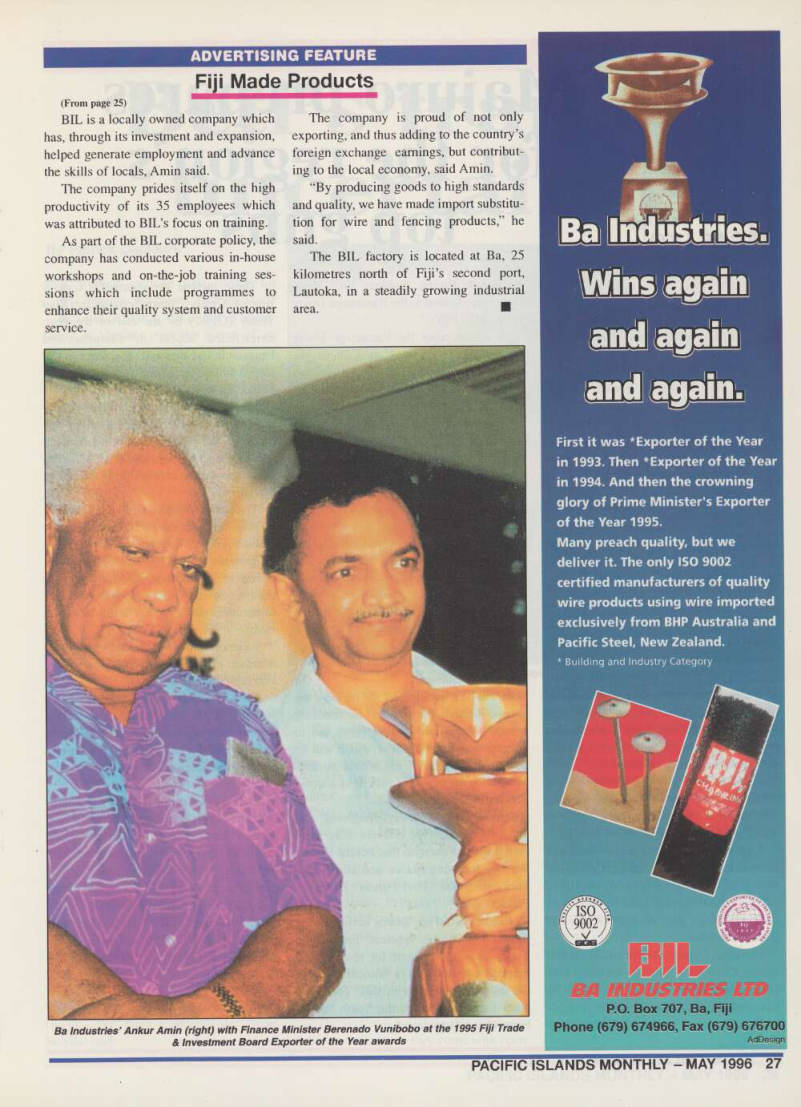
Ba Industries fores ahead
In November 1995, after two consecu tive years of winning Fiji’s Exporter of the Year Awards in the Building and Industrial Section, Ba Industries Limited was awarded the Prime Minister’s overall exporter of the year prize.
Ba Industries Limited (BIL) - which
manufactures nails, barbed wire, chain link
fencing, rivets, panel pins
and other construction products - was formed in 1974 in response to the acute shortage of build ing materials after Hurricane Bebe in 1972.
The company, which now exports half of its products, was the brain child of Ba politician and businessman Vinod Patel, who is a co-director with his brothers, Arvin Patel and Umakant Patel.
Patel is best known for his chain of hardware shops Vinod Patel and
Company, Tile Kingdom and Light City,
and as former mayor of Ba. He is current ly a National Federation Party representa tive in Fiji’s Parliament.
After grabbing a sizeable share of the domestic market, BIL started exporting to fully utilise its capacity.
“We have selected and trained locals
from Ba to produce high-quality goods
which can compare with overseas manu facturers,” said BIL general manager Ankur Amin.
He said the company was judged over all winner because of its export excel lence, rapid export sales growth and its
Trained to cats produce high quality goods
recent ISO 9000 certification, giving it recognition for producing international quality merchandise.
Export to New Zealand, which began in 1980, had flourished by the 1991/92 period. BIL now exports to other Pacific Islands while still maintaining its New
Zealand market share.
“In the last few years BIL
has been rapidly increasing
its export markets. At the moment, 50 per cent of total products are exported and this figure is likely to go up in the coming year,”
Amin said.
Although BIL is eligible for special tariffs under the South Pacific Regional Trade and Economic Co
operation Agreement
(SPARTECA) programme,
Amin said they were not
dependent on it.
“We are confident that with our high ‘qualitivity’ - quality and productivity we will be able to establish a good name for Fiji-made goods in developed coun tries,” he said.
The company’s policy is to continually seek improved product excellence and new markets.
Prompt customer service, competitive prices and ready availability of goods have resulted in the BIL reputation for reliabil ity.
Amin said all raw materials for manu facturing were procured from ISO 9000certified mills in Australia and New Zealand.
(Continued on page 27)
BIL is a locally owned company which has, through its investment and expansion, helped generate employment and advance the skills of locals, Amin said.
The company prides itself on the high productivity of its 35 employees which was attributed to BlL’s focus on training.
As part of the BIL corporate policy, the company has conducted various in-house workshops and on-the-job training ses sions which include programmes to enhance their quality system and customer service.
The company is proud of not only exporting, and thus adding to the country’s foreign exchange earnings, but contribut ing to the local economy, said Amin.
“By producing goods to high standards
and quality, we have made import substitu tion for wire and fencing products,” he said.
The BIL factory is located at Ba, 25 kilometres north of Fiji’s second port, Lautoka, in a steadily growing industrial area.
Ba Industries’ Ankur Amin (right) with Finance Minister Serenade Vunibobo at the 1995 Fiji Trade & Investment Board Exporter of the Year awards
Advertisements & other items, p. 25 (2 items)
25
ADVERTISING FEATURE
PACIFIC ISLANDS MONTHLY - MAY 1996
Fiji Made Products
Mbs again
Ba Industries
and again
and again.
First it was * Exporter of the Year in 1993. Then * Exporter of the Year in 1994, And then the crowning glory of Prime Minister's Exporter of the Year 1995.
Many preach quality, but we deliver it. The only ISO 9002 certified manufacturers of quality wire products using wire imported exclusively from BHP Australia and Pacific Steel, New Zealand. * Building and Industry Category m
BA INDUSTRIES LTD
P.O. Box 707, Ba, Fiji Phone (679) 674966, Fax (679) 676700
substitute for quality
Fiji Chemicals make no substitute for quality
Through the production of interna tional-standard products like those made by Fiji Chemicals, Fiji’s rep
utation as a manufacturer of quality hotel industry, dairy factories and farms, brew eries, soft drink factories, abattoirs, com
mercial laundries and food processing fac tory items, is growing.
Fiji chemicals was established in 1973 to import sanitisers, degreasers, disinfec tants, deodorisers and detergents.
In 1978, the company started producing these products under licence from Ecolab, an American company based in Saint Paul, Minnesota.
Ecolab supplied formulas for the clean ing products to Fiji Chemicals Limited, and the raw materials were then imported and blended into finished goods.
This ensures that the quality of the product remains the same no matter which part of the globe the cleaning agents are
produced in.
Quality control of all products is ensured by the Fiji Chemicals laboratory with samples retained for the Ecolab International Quality Control Audit.
Fiji Chemicals Limited manufactures over 120 products from over 200 different types of imported raw materials.
Because the local demand for Fiji made cleaning products is huge, the com pany will focus on consolidating its inter ests in Fiji before expanding into overseas markets.
A recent development is the company’s move into the manufacture of household dish-washing machine powder, under the trade name Dishklenz, which is distributed through local supermarket chain Joe’s Farm and Apteds.
Fiji Chemicals also manufacture, under the brand name Ritze, products like hair shampoo, hair conditioner, liquid deter
gent and laundry powder.
The Ecolab Research and Development section constantly updates its product lines and passes them on to licensees like Fiji Chemicals.
This ensures the availability of an
updated selection of quality products for
the benefit of consumers. ■
Advertisements & other items, pp. 26-27 (3 items)
26
ADVERTISING FEATURE
Fiji Made Products
PACIFIC ISLANDS MONTHLY - MAY 1996
©Fiji Chemicals Limited
Manufacturers under licence to ECOLAB. In Manufacturers under licence to ECOLAB. Inc Manufacturers of chemicals for:
CONSUMER PRODUCTS
Shampoo &
Conditioner
Brewery
Dairy Hotel
Laundry Washing
Powder & Liquid Fabric Softners Abattoirs
Fish Industry
Commercial Launders
Detergents
Disinfectants
ALSO MANUFACTURERS
PHONE OR VISIT US AT
FIJI GAS BLDG, WALU BAY, SUVA
FAX: 302546
PHONE: SUVA 304188
HEAD OFFICE, WATERFRONT ROAD, VEITARI, LAUTOKA
P.O. BOX 397. PHONE: 665 582/663129 FAX; 664614
Ba Industries.
Wins again
and again
and! again.
First it was * Exporter of the Year in 1993. Then * Exporter of the Year in 1994. And then the crowning glory of Prime Minister’s Exporter of the Year 1995.
Many preach quality, but we deliver it. The only ISO 9002 certified manufacturers of quality wire products using wire imported exclusively from BHP Australia and Pacific Steel, New Zealand. * Building and Industry Category Cf f ilaiii 14/ » iik. •nTnili
27
PACIFIC ISLANDS MONTHLY - MAY 1996
(From page 25)
Fiji Made Products
ADVERTISING FEATURE
Majuro prepares
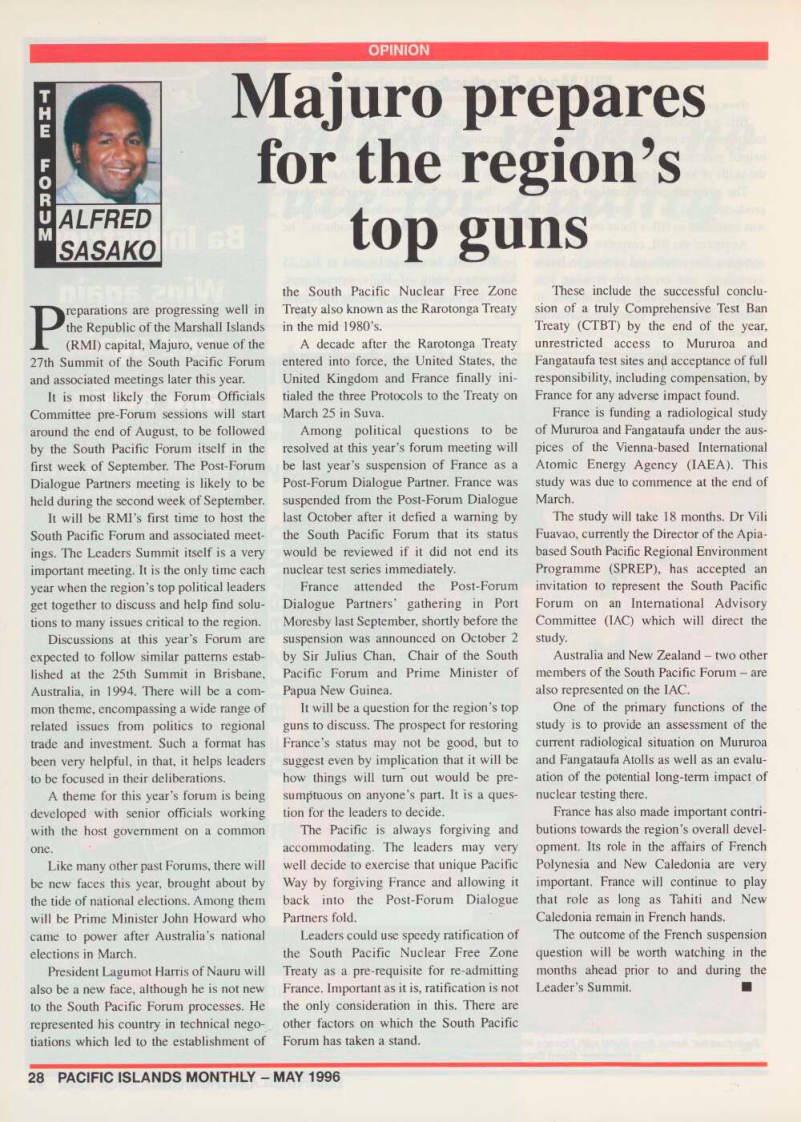
Opinion
Majuro prepares for the region’s top guns
Preparations are progressing well in the Republic of the Marshall Islands (RMI) capital, Majuro, venue of the 27th Summit of the South Pacific Forum and associated meetings later this year.
It is most likely the Forum Officials Committee pre-Forum sessions will start around the end of August, to be followed by the South Pacific Forum itself in the first week of September. The Post-Forum Dialogue Partners meeting is likely to be held during the second week of September.
It will be RMTs first time to host the South Pacific Forum and associated meet ings. The Leaders Summit itself is a very important meeting. It is the only time each year when the region’s top political leaders get together to discuss and help find solu tions to many issues critical to the region.
Discussions at this year’s Forum are expected to follow similar patterns estab lished at the 25th Summit in Brisbane, Australia, in 1994. There will be a com mon theme, encompassing a wide range of related issues from politics to regional trade and investment. Such a format has been very helpful, in that, it helps leaders to be focused in their deliberations.
A theme for this year’s forum is being developed with senior officials working with the host government on a common one.
Like many other past Forums, there will be new faces this year, brought about by the tide of national elections. Among them will be Prime Minister John Howard who came to power after Australia’s national elections in March.
President Lagumot Harris of Nauru will also be a new face, although he is not new to the South Pacific Forum processes. He represented his country in technical nego tiations which led to the establishment of
the South Pacific Nuclear Free Zone Treaty also known as the Rarotonga Treaty in the mid 1980’s.
A decade after the Rarotonga Treaty entered into force, the United States, the United Kingdom and France finally ini tialed the three Protocols to the Treaty on March 25 in Suva.
Among political questions to be resolved at this year’s forum meeting will be last year’s suspension of France as a Post-Forum Dialogue Partner. France was suspended from the Post-Forum Dialogue last October after it defied a warning by the South Pacific Forum that its status would be reviewed if it did not end its nuclear test series immediately.
France attended the Post-Forum Dialogue Partners’ gathering in Port Moresby last September, shortly before the suspension was announced on October 2 by Sir Julius Chan, Chair of the South Pacific Forum and Prime Minister of Papua New Guinea.
It will be a question for the region’s top guns to discuss. The prospect for restoring France’s status may not be good, but to suggest even by implication that it will be how things will turn out would be pre sumptuous on anyone’s part. It is a ques tion for the leaders to decide.
The Pacific is always forgiving and accommodating. The leaders may very well decide to exercise that unique Pacific Way by forgiving France and allowing it back into the Post-Forum Dialogue Partners fold.
Leaders could use speedy ratification of the South Pacific Nuclear Free Zone Treaty as a pre-requisite for re-admitting France. Important as it is, ratification is not the only consideration in this. There are other factors on which the South Pacific Forum has taken a stand.
These include the successful conclu sion of a truly Comprehensive Test Ban Treaty (CTBT) by the end of the year, unrestricted access to Mururoa and Fangataufa test sites acceptance of full
responsibility, including compensation, by
France for any adverse impact found.
France is funding a radiological study of Mururoa and Fangataufa under the aus pices of the Vienna-based International Atomic Energy Agency (lAEA). This study was due to commence at the end of March.
The study will take 18 months. Dr Vili Fuavao, currently the Director of the Apia based South Pacific Regional Environment Programme (SPREP), has accepted an invitation to represent the South Pacific Forum on an International Advisory Committee (lAC) which will direct the study.
Australia and New Zealand - two other members of the South Pacific Forum - are also represented on the lAC.
One of the primary functions of the study is to provide an assessment of the current radiological situation on Mururoa and Fangataufa Atolls as well as an evalu ation of the potential long-term impact of nuclear testing there.
France has also made important contri butions towards the region’s overall devel opment. Its role in the affairs of French Polynesia and New Caledonia are very important. France will continue to play that role as long as Tahiti and New Caledonia remain in French hands.
The outcome of the French suspension question will be worth watching in the months ahead prior to and during the Leader’s Summit. ■
The Forum
Alfred
Sasako
uncertainty
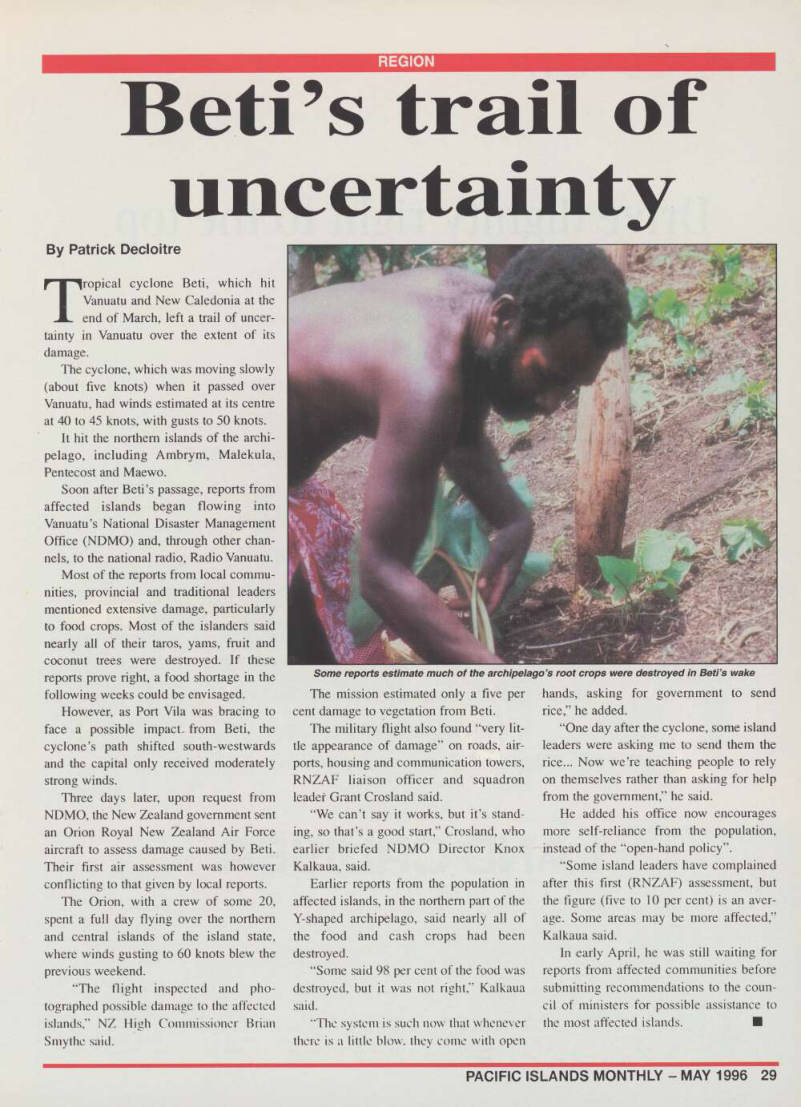
Region
Beti’s trail of uncertainty
By Patrick Decloitre
Tropical cyclone Beti, which hit Vanuatu and New Caledonia at the end of March, left a trail of uncer tainty in Vanuatu over the extent of its
damage.
The cyclone, which was moving slowly (about five knots) when it passed over Vanuatu, had winds estimated at its centre at 40 to 45 knots, with gusts to 50 knots.
It hit the northern islands of the archi pelago, including Ambrym, Malekula, Pentecost and Maewo.
Soon after Bed’s passage, reports from affected islands began flowing into Vanuatu’s National Disaster Management Office (NDMO) and, through other chan nels, to the national radio, Radio Vanuatu.
Most of the reports from local commu nities, provincial and traditional leaders mentioned extensive damage, particularly to food crops. Most of the islanders said nearly all of their taros, yams, fruit and coconut trees were destroyed. If these reports prove right, a food shortage in the following weeks could be envisaged.
However, as Port Vila was bracing to face a possible impact- from Beti, the cyclone’s path shifted south-westwards and the capital only received moderately strong winds.
Three days later, upon request from NDMO, the New Zealand government sent an Orion Royal New Zealand Air Force aircraft to assess damage caused by Beti.
Their first air assessment was however conflicting to that given by local reports.
The Orion, with a crew of some 20, spent a full day flying over the northern and central islands of the island state, where winds gusting to 60 knots blew the
previous weekend.
“The flight inspected and pho tographed possible damage to the affected islands,” NZ High Commissioner Brian
Smythe said.
The mission estimated only a five per cent damage to vegetation from Beti.
The military flight also found “very lit tle appearance of damage” on roads, air ports, housing and communication towers, RNZAF liaison officer and squadron leader Grant Crosland said.
“We can’t say it works, but it’s stand ing, so that’s a good start,” Crosland, who earlier briefed NDMO Director Knox Kalkaua, said.
Earlier reports from the population in affected islands, in the northern part of the Y-shaped archipelago, said nearly all of the food and cash crops had been destroyed.
“Some said 98 per cent of the food was destroyed, but it was not right," Kalkaua said.
"The system is such now that whenever there is a little blow, they come with open
hands, asking for government to send rice,” he added.
“One day after the cyclone, some island leaders were asking me to send them the rice... Now we’re teaching people to rely on themselves rather than asking for help from the government,” he said.
He added his office now encourages more self-reliance from the population, instead of the “open-hand policy”.
“Some island leaders have complained after this first (RNZAF) assessment, but the figure (five to 10 per cent) is an aver age. Some areas may be more affected,”
Kalkaua said.
In early April, he was still waiting for reports from affected communities before submitting recommendations to the coun cil of ministers for possible assistance to the most affected islands. ■
Some reports estimate much of the archipelago’s root crops were destroyed in Bed’s wake
Advertisements & other items, pp. 30-31 (1 item)
Drive dignity right to the top.
<sg) TOYOTA
Everyone who knows cars has no doubts about Land Cruiser’s ruggedness.
Yet how many know that its luxury rivals the finest high-priced cars?
Or that it’s got more room inside than many luxury sedans?
And because it’s a Toyota, Land Cruiser’s fit and finish, attention to detail, and graceful form speak of elegance as well as spacious comfort.
Yet you still get tough ladder frames and suspension built to take you as far off road as you want to go.
With power from 4.5-litre petrol or 4.2-litre diesel engines.
And it’s carefully protected from rust to last longer.
So if you’re going right to the top, this dignified car is ready to take you.
LAND CRUISER
DISTRIBUTORS /DEALERS
AMERICAN SAMOA BURNS PHILP MOTORS
GUAM & MICRONESIA...ATKINS KROLL, INC.
NORFOLK ISLAND BORRY’S PTY LTD.
SOLOMON ISLAND ELA MOTORS
VANUATU ASCO MOTORS
, , •c: m v ■ ' i V t
LAND
CRUISER
LA<m CRUISER
V m m * * * I -3r »■« ■. itr
Carlot’s
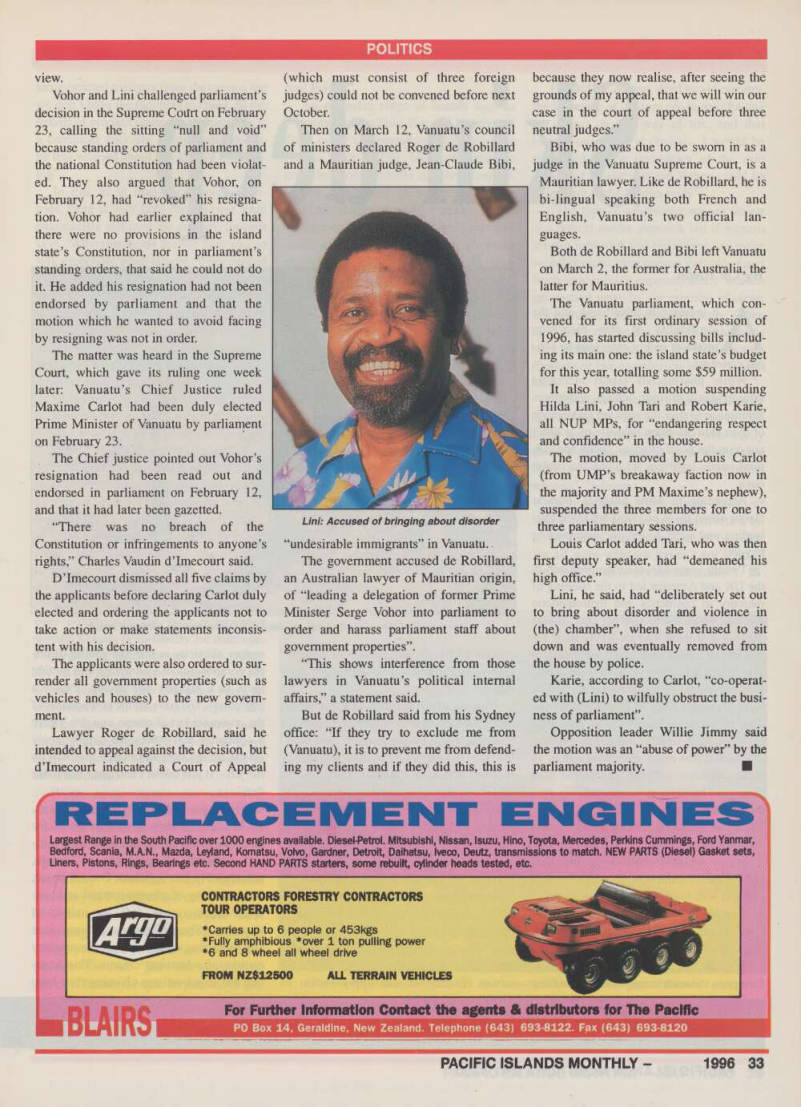
Politics
Carlot’s comeback
The struggle for power in Vanuatu has turned again in favour of Maxime Carlot, who on February 23 returned as Prime Minister to replace his rival Serge Vohor.
Vohor, who had resigned a fortnight before, had been PM for less than two months.
By Patrick Decloitre
In a stormy parliamentary session on February 23, Carlot was elected Prime Minister by a majority consisting of a group of eight dissident members of par liament from the Union of Moderate Parties (UMP, of which Vohor is President) led by MP Amos Andeng, and Donald
Kalpoka’s Unity Front.
A few minutes before the vote took place, the 11 MPs faithful to Vohor’s UMP and Walter Lini’s National United Party left the chamber, saying they could no longer participate because there was “too much confusion”.
On February 8, Prime Minister Serge Vohor, who was elected on December 21, resigned to avoid facing a motion of no confidence due to have been debated the
same day.
The motion was filed by an alliance of
opposition Donald Kalpoka’s Unity Front
and eight dissident MPs from Vohor’s own UMP, but was withdrawn on February 12 after Vohor’s resignation. After last November’s general elections, UF, which won 22 seats, was at the time excluded from power.
On February 23, Vanuatu’s second
extraordinary parliamentary session began
in a confusing manner: the first deputy speaker John Tari (NUP), had attempted to sit in the Speaker’s chair. The Vohor-Lini
alliance argued that it was he who, in the absence of a speaker, should head the debates until a new speaker was elected.
On the morning of February 23, police were deployed in numbers rarely seen in Vanuatu. Prior to the debates beginning, they invited John Tari to leave the speak er’s chair, which he eventually did.
The Kalpokas-Andeng group, citing
parliament’s standing orders, said it was the most senior MP’s role to preside over the debates pending a new speaker’s elec tion. In this case, the most senior MP was
Amos Andeng.
A few days before, parliament speaker Maxime Carlot had announced his resig nation, a move seen here as clearly indi cating he was paving the way for a come back.
Later, Vanuatu’s only woman MP, Hilda Lini (NUP), Walter Lini’s sister, was removed from the house by police, by order of Amos Andeng, who was presiding over the sitting.
After refusing to sit down at the injunc tions of Andeng, Hilda Lini, who had questioned the fact that he should preside to the election of a new speaker, was dragged out of the house by police.
Three of them were injured in the
process,. as they dragged the screaming
Hilda Lini out of the chamber. One police man ended up with a ball point pen stuck on his upper lip.
A new speaker of parliament, Edward Natapei (from Donald Kalpokas Unity Front), was later elected by the 31 remain ing MPs.
Minutes after, Maxime Carlot, the only candidate brought forward by the MPs attending, was unanimously elected Prime Minister of Vanuatu by 30 votes (the speaker does not vote).
He then announced the composition of his government, naming Kalpokas as his deputy and minister of education.
Carlot, a personal friend of French President Jacques Chirac, was Vanuatu’s Prime Minister from 1991 until last December. During his term he was seen as the key element of normalisation of rela tions with France, a major aid donor to Vanuatu.
Amid opposition to last year’s French nuclear testing campaign, he was the most moderate voice in the Pacific, calling the French decision a “sovereign” one.
His return at the head of the island state’s government marks a persona! victo ry in an internal UMP power struggle against his rival Serge Vohor, who only remained PM from last December 21 to February 8, 1996.
“The former Prime Minister tries to continue to talk and mislead people (on national radio). We’ll see that it stops,”
Carlot told national radio hours after his election in a nation-wide broadcast inter
view.
Vohor and Lini challenged parliament’s decision in the Supreme Court on February 23, calling the sitting “null and void” because standing orders of parliament and the national Constitution had been violat ed. They also argued that Vohor, on February 12, had “revoked” his resigna tion. Vohor had earlier explained that there were no provisions in the island state’s Constitution, nor in parliament’s standing orders, that said he could not do it. He added his resignation had not been endorsed by parliament and that the motion which he wanted to avoid facing by resigning was not in order.
The matter was heard in the Supreme Court, which gave its ruling one week later: Vanuatu’s Chief Justice ruled Maxime Carlot had been duly elected Prime Minister of Vanuatu by parliament on February 23.
The Chief justice pointed out Vohor’s resignation had been read out and endorsed in parliament on February 12, and that it had later been gazetted.
“There was no breach of the Constitution or infringements to anyone’s rights,” Charles Vaudin d’lmecourt said.
DTmecourt dismissed all five claims by the applicants before declaring Carlot duly elected and ordering the applicants not to take action or make statements inconsis tent with his decision.
The applicants were also ordered to sur render all government properties (such as vehicles and houses) to the new govern ment.
Lawyer Roger de Robillard, said he intended to appeal against the decision, but d’lmecourt indicated a Court of Appeal
(which must consist of three foreign judges) could not be convened before next October.
Then on March 12, Vanuatu’s council of ministers declared Roger de Robillard and a Mauritian judge, Jean-Claude Bibi,
“undesirable immigrants” in Vanuatu.
The government accused de Robillard, an Australian lawyer of Mauritian origin, of “leading a delegation of former Prime Minister Serge Vohor into parliament to order and harass parliament staff about government properties”.
“This shows interference from those lawyers in Vanuatu’s political internal affairs,” a statement said.
But de Robillard said from his Sydney office: “If they try to exclude me from (Vanuatu), it is to prevent me from defend ing my clients and if they did this, this is
because they now realise, after seeing the grounds of my appeal, that we will win our case in the court of appeal before three
neutral judges.”
Bibi, who was due to be sworn in as a judge in the Vanuatu Supreme Court, is a Mauritian lawyer. Like de Robillard, he is bi-lingual speaking both French and English, Vanuatu’s two official lan guages.
Both de Robillard and Bibi left Vanuatu on March 2, the former for Australia, the latter for Mauritius.
The Vanuatu parliament, which con vened for its first ordinary session of 1996, has started discussing bills includ ing its main one: the island state’s budget for this year, totalling some $59 million.
It also passed a motion suspending Hilda Lini, John Tari and Robert Karie, all NUP MPs, for “endangering respect and confidence” in the house.
The motion, moved by Louis Carlot (from UMP’s breakaway faction now in the majority and PM Maxime’s nephew), suspended the three members for one to three parliamentary sessions.
Louis Carlot added Tari, who was then first deputy speaker, had “demeaned his high office.”
Lini, he said, had “deliberately set out to bring about disorder and violence in (the) chamber”, when she refused to sit down and was eventually removed from
the house by police.
Karie, according to Carlot, “co-operat ed with (Lini) to wilfully obstruct the busi ness of parliament”.
Opposition leader Willie Jimmy said the motion was an “abuse of power” by the
parliament majority. ■
Lini: Accused of bringing about disorder
Advertisements & other items, p. 33 (1 item)
Replacement Engine 3
Largest Range in the South Pacific over 1000 engines available. Diesel-Petrol. Mitsubishi, Nissan, Isuzu, Hino, Toyota, Mercedes, Perkins Cummings, Ford Yanmar, Bedford, Scania, M.A.N., Mazda, Leyland, Komatsu, Volvo, Gardner, Detroit, Daihatsu, Iveco, Deutz, transmissions to match. NEW PARTS (Diesel) Gasket sets, Liners, Pistons, Rings, Bearings etc. Second HAND PARTS starters, some rebuilt, cylinder heads tested, etc. ///
CONTRACTORS FORESTRY CONTRACTORS
TOUR OPERATORS
♦Carries up to 6 people or 453kgs ♦Fully amphibious ♦over 1 ton pulling power ♦6 and 8 wheel all wheel drive
FROM NZ$l25OO
ALL TERRAIN VEHICLES
For Further Information Contact the agents & distributors for The Pacific PO Box 14, Geraldine, New Zealand. Telephone (643) 693-8122. Fax (643) 693-8120
Skin deep
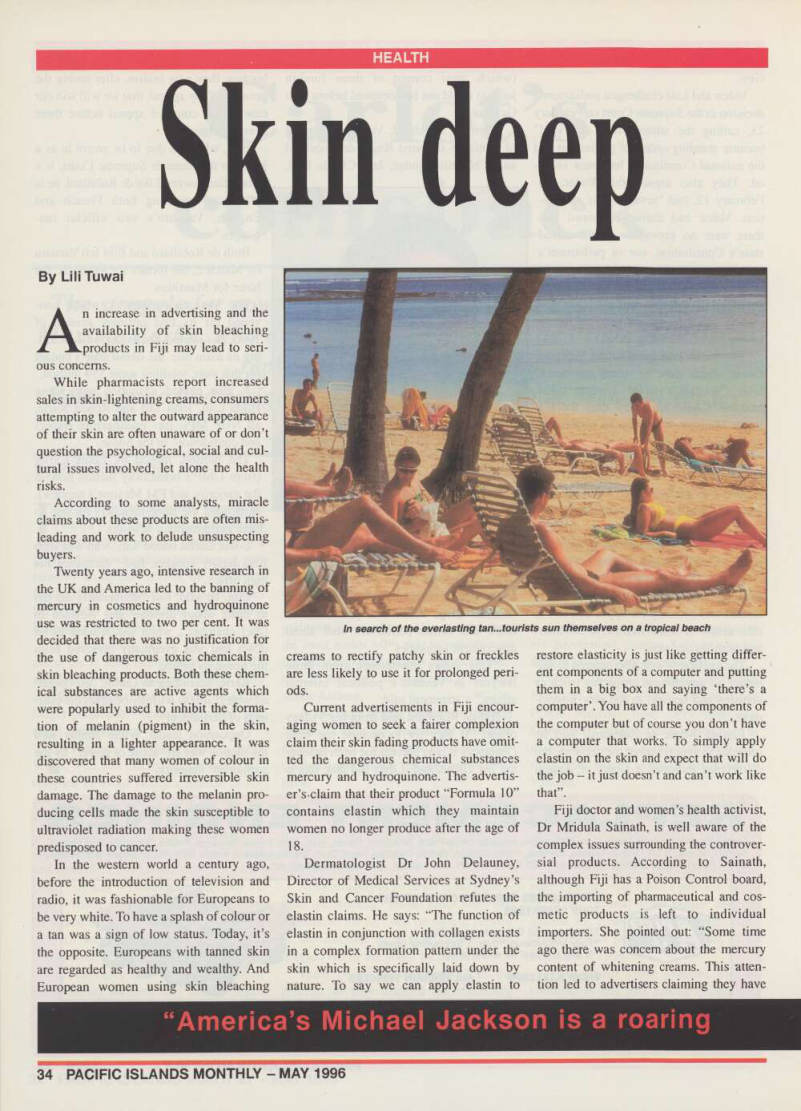
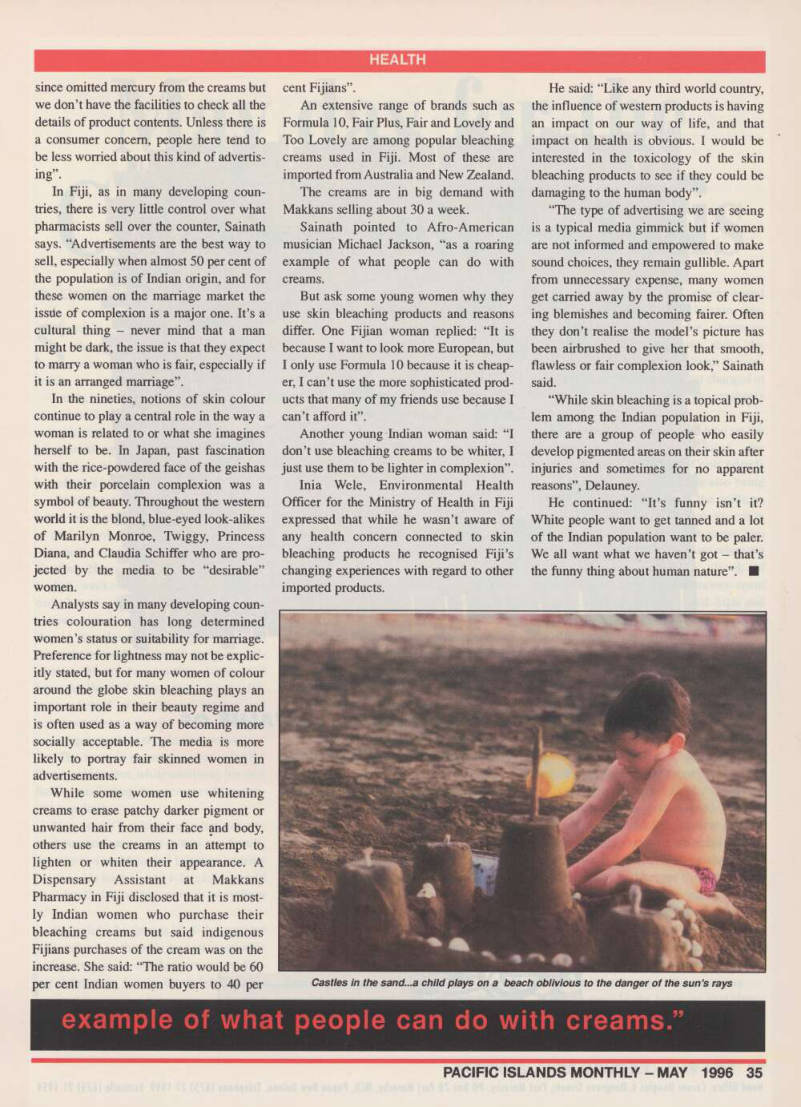
Health
By UN Tuwai
An increase in advertising and the
availability of skin bleaching
products in Fiji may lead to seri ous concerns.
While pharmacists report increased sales in skin-lightening creams, consumers attempting to alter the outward appearance of their skin are often unaware of or don’t question the psychological, social and cul tural issues involved, let alone the health risks.
According to some analysts, miracle claims about these products are often mis leading and work to delude unsuspecting
buyers.
Twenty years ago, intensive research in the UK and America led to the banning of mercury in cosmetics and hydroquinone use was restricted to two per cent. It was decided that there was no justification for the use of dangerous toxic chemicals in skin bleaching products. Both these chem ical substances are active agents which were popularly used to inhibit the forma tion of melanin (pigment) in the skin, resulting in a lighter appearance. It was discovered that many women of colour in these countries suffered irreversible skin damage. The damage to the melanin pro ducing cells made the skin susceptible to ultraviolet radiation making these women predisposed to cancer.
In the western world a century ago, before the introduction of television and radio, it was fashionable for Europeans to be very white. To have a splash of colour or a tan was a sign of low status. Today, it’s the opposite. Europeans with tanned skin are regarded as healthy and wealthy. And European women using skin bleaching
creams to rectify patchy skin or freckles are less likely to use it for prolonged peri ods.
Current advertisements in Fiji encour aging women to seek a fairer complexion claim their skin fading products have omit ted the dangerous chemical substances mercury and hydroquinone. The advertis er’s claim that their product “Formula 10” contains elastin which they maintain women no longer produce after the age of 18.
Dermatologist Dr John Delauney, Director of Medical Services at Sydney’s Skin and Cancer Foundation refutes the elastin claims. He says; “The function of elastin in conjunction with collagen exists in a complex formation pattern under the skin which is specifically laid down by nature. To say we can apply elastin to
restore elasticity is just like getting differ ent components of a computer and putting them in a big box and saying ‘there’s a computer’. You have all the components of the computer but of course you don’t have a computer that works. To simply apply elastin on the skin and expect that will do the job - it just doesn’t and can’t work like that”.
Fiji doctor and women’s health activist.
Dr Mridula Sainath, is well aware of the complex issues surrounding the controver sial products. According to Sainath, although Fiji has a Poison Control board, the importing of pharmaceutical and cos metic products is left to individual importers. She pointed out: “Some time ago there was concern about the mercury content of whitening creams. This atten tion led to advertisers claiming they have
“America’s Michael Jackson is a roaring
In search of the everlasting tan...tourists sun themselves on a tropical beach
since omitted mercury from the creams but we don’t have the facilities to check all the details of product contents. Unless there is a consumer concern, people here tend to be less worried about this kind of advertis
ing”.
In Fiji, as in many developing coun tries, there is very little control over what pharmacists sell over the counter, Sainath says. “Advertisements are the best way to sell, especially when almost 50 per cent of the population is of Indian origin, and for these women on the marriage market the issue of complexion is a major one. It’s a cultural thing - never mind that a man might be dark, the issue is that they expect to marry a woman who is fair, especially if it is an arranged marriage”.
In the nineties, notions of skin colour continue to play a central role in the way a woman is related to or what she imagines herself to be. In Japan, past fascination with the rice-powdered face of the geishas with their porcelain complexion was a symbol of beauty. Throughout the western world it is the blond, blue-eyed look-alikes of Marilyn Monroe, Twiggy, Princess Diana, and Claudia Schiffer who are pro jected by the media to be “desirable” women.
Analysts say in many developing coun tries colouration has long determined women’s status or suitability for marriage.
Preference for lightness may not be explic itly stated, but for many women of colour around the globe skin bleaching plays an important role in their beauty regime and is often used as a way of becoming more socially acceptable. The media is more likely to portray fair skinned women in advertisements.
While some women use whitening creams to erase patchy darker pigment or unwanted hair from their face and body, others use the creams in an attempt to lighten or whiten their appearance. A Dispensary Assistant at Makkans Pharmacy in Fiji disclosed that it is most ly Indian women who purchase their bleaching creams but said indigenous Fijians purchases of the cream was on the increase. She said: “The ratio would be 60 per cent Indian women buyers to 40 per
cent Fijians”.
An extensive range of brands such as Formula 10, Fair Plus, Fair and Lovely and Too Lovely are among popular bleaching creams used in Fiji. Most of these are imported from Australia and New Zealand.
The creams are in big demand with Makkans selling about 30 a week.
Sainath pointed to Afro-American musician Michael Jackson, “as a roaring example of what people can do with creams.
But ask some young women why they use skin bleaching products and reasons differ. One Fijian woman replied: “It is because I want to look more European, but I only use Formula 10 because it is cheap er, I can’t use the more sophisticated prod ucts that many of my friends use because I can’t afford it”.
Another young Indian woman said: “I don’t use bleaching creams to be whiter, I just use them to be lighter in complexion”.
Inia Wele, Environmental Health Officer for the Ministry of Health in Fiji expressed that while he wasn’t aware of any health concern connected to skin bleaching products he recognised Fiji’s changing experiences with regard to other imported products.
He said; “Like any third world country, the influence of western products is having an impact on our way of life, and that impact on health is obvious. I would be interested in the toxicology of the skin bleaching products to see if they could be damaging to the human body”.
“The type of advertising we are seeing is a typical media gimmick but if women are not informed and empowered to make
sound choices, they remain gullible. Apart
from unnecessary expense, many women get carried away by the promise of clear ing blemishes and becoming fairer. Often they don’t realise the model’s picture has been airbrushed to give her that smooth, flawless or fair complexion look,” Sainath said.
“While skin bleaching is a topical prob lem among the Indian population in Fiji, there are a group of people who easily develop pigmented areas on their skin after injuries and sometimes for no apparent reasons”, Delauney.
He continued: “It’s funny isn’t it?
White people want to get tanned and a lot of the Indian population want to be paler.
We all want what we haven’t got - that’s the funny thing about human nature”. ■
example of what people can do with creams.”
Castles in the sand...a child plays on a beach oblivious to the danger of the sun’s rays
Advertisements & other items, p. 36 (1 item)
Savi Pbcoo9I
• : > j * ry- ' nr r i w ■ ■J y r~ i * :ll« eggww I ■/ i
Never underestimate the value of
LOCAL KNOWLEDGE.
PAPUA NEW GUINEA BANKING CORPORATION
THE NATION'S LEADING COMMERCIAL BANK
Head Office: Corner Douglas & Musgrave Streets, Port Moresby. PO Box 78 Port Moresby, NCD, Papua New Guinea. Telephone (675) 21 1999 Facsimile (675) 21 1954
SAVI PBCOO9I
May day for the
Region
May day for the Cooks money crisis
By Lisa Williams
Scratch every politician in the Cook Islands and a would-be teacher, planter, lawyer or doctor is under neath.
Lately, considering the way the politi cians have been running the country, those secondary careers may yet get a chance as government appoints a committee to look at the issue of trimming back on the num ber of seats in parliament.
Amongst those hanging on despite
some strong public sentiment that it’s time to go is Cook Islands prime minister and its most charismatic leader yet. Sir
Geoffrey Henry.
Just weeks after an internal coup in early March where 12 MP’s from his own cabinet signed a letter agreeing that he should step down, (the coup broke up in the wake of media attention and party sol idarity), Henry had another strong call from the Head of State, who penned a let ter on behalf of traditional leaders and non-govemment groups in the country saying government should step down.
“The issue is economics, not politics,”
Henry said to that, while admitting his own family was feeling the pressure of his wan
ing popularity.
“It’s not as if this exercise has not cre ated personal pressures within our family, but this is a problem that happened during my time (as leader), and I decided it would be a dereliction of duty to walk away from it.”
But while he insists that the country will make it to the next budget, economic and private sector soothsayers are predict ing d-day soon for the Cook Islands gov ernment.
For the last few months of the last year, depending on whether you ask politicians
or businesses, government has been paying its 3000-plus public servants on money coming in through Turnover taxes and Customs revenues.
Come mid-May, the money coming in apparently isn’t going to be enough to meet the money being spent - but with Treasury officials nervous at any mention of figures being released to the media it’s difficult to pinpoint just how much gov ernment will fall short when it comes to
putting pay into pockets.
And while cabinet pledged a new atti tude on releasing facts to business and a union-type body without muscle which represents the interests of government employees continues to lead the push for more accountability and more action, now.
The Cook Islands Public debt was SNZ23 million when Henry took on the reins of leader and finance minister after his government came into power in 1989 one and a half political terms later, the country is in the midst of its worst eco nomic crisis as Asian Development Bank and New Zealand experts fly in to get an exact hit on how much the country owes in 1996 - more than $l6O million in overseas debt of a package put at SNZIB6 million in total.
That figure was gauged after govern ment guesswork and a New Zealand expert was especially flown in to do the job years of financial fiddling had ignored.
Much of that comes from the SNZII3 million and rising Sheraton debt - a deal for a five-star luxury hotel to boost the country’s number one industry - tourism.
It was an ill-fated deal, one which the pre vious government entered into and Sir Geoffrey’s regime hooked on to sign and seal the fate of generations of Cook Islands taxpayers.
The Sheraton loan was, and still is, the
very exclusive baby of the Canberra-based High Commissioner Vincent Ingram, sim ply because nobody else between Rarotonga and Rome knows about the complex nature of the drawdowns, the cur rency changes, and the constant changes in the banks, people and governments involved.
But it’s not just the botched loan on the former Sheraton (now called the Vaimaanga Hotel) that has Cook Islands taxpayers up in arms - calls are also being made for the accounting of the millions that were drawn down through an entity called ECIL - an entity that came into prominence in the 1994 elections when the Alliance party published a “Book of Shame” showing receipts of money spent by ECIL officers as they lived high and spent large across Europe tying up deals for the hotels furniture, trimmings and linen.
The ECIL spending is dwarfed by fur ther revelations which Henry’s govern ment has been slow to make public - part ly because they didn’t realise just where the money was coming from while order ing an overworked and under-pressure finance crew to find the money.
Still, the same Public Service Association (PSA) that warned govern ment two years ago of the current crisis is already planning how the shortfall will be coped with. One source says there’s no way the union will accept the scenario of workers turning up at the banks to pull money out and being told there’s nothing there. What’s hoped for if the worst hap pens is that the money that is in the kitty will be divided up by all workers - and top to bottom, everyone gets the same pay.
It’s far more likely, however, that Henry is still crossing his fingers for a historical ly benevolent New Zealand to come to the
rescue.
Despite the lack of co-operation on the Winebox deals and international embar rassment over the Letters of Guarantee scam, Wellington has said it cannot desert an island nation in so much trouble. With more Cook Islanders in New Zealand than in the home islands and many more leav ing as the economic situation worsens, it’s likely the Cooks will want to make a final push for sovereignty and take out their own passports. Under a constitutional arrangement with NZ and much to the cha grin of those who agree with Winston Peters, the decision to give up their New Zealand citizenship has to be made by Cook Islanders.
As Finance Minister and leader Sir Geoffrey Henry has floundered since pub licly admitting the fact of the current crisis did not really hit home until he returned from a PIDP conference in Hawaii in February. Losing the plot has not endeared Henry to his people, his political oppo nents, and especially his cabinet and their party supporters.
But even more scary for private busi ness are signs that Henry had no intention of moving as fast as he should have - pub lic consultation as far back as February threw up suggestions to start attacking the Cook Islands predicted budget shortfall of $7 million come the 1996/97 budget at the end of next month.
None of the suggestions were specifi cally agreed to, and only glossed over in general or ignored altogether, in a critical “State of the Nation” speech delivered by Henry in mid-March.
While the speech fell short, it did set up committees on trimming back expenditure in the hope that government can present a balanced S6O million budget come June.
But while business leaders and govern ment workers stamp their feet in frustra tion, government refuses to make cuts on
“unnecessary” expenditure which would
also give it some measure of public sup port, and show that like the people who are now having to accept the consequences of their gross mismanagement, the directors are suffering too. ■
Henry’s fall
from favour
By Ljsa Williams
Like two other knights of the Commonwealth who have led the Cook Islands before him. Prime Minister Sir Geoffrey Henry is finding the fall from political and public favour a
noisy one.
For Henry’s uncle Albert, the fall from grace came close on the heels of the court ruling that he used public monies to fund the fly-in voters of the 1978 elections. Sir Thomas Davies had even less time to cope with the shock of being biffed from par liament - he suffered a vote of no-confi dence from fellow parliamentarians in 1987.
For Henry, the warnings are in the air.
Calls for him and his government to step down are common as he and his cabinet, halfway through a second term in office, admit things are a whole lot worse than
they look.
With revelations that Treasury has jbeen dipping into money held in trust by government to the tune of a current liabil ity of more than $lO million, and no way for it to come up with redundancy pack ages for those it needs to send home, some who have retired as per the 60-year age limit are beginning to grumble that they have yet to commence Superannuation payments.
In its first major move, the 15 per cent paycut to government employees in March exploded into a wave of public reaction which had Henry’s own political caucus up in arms at the lack of consulta tion, and saw 12 members of his cabi net/assistant ministers signing a letter agreeing the resignations of Henry and his three most senior ministers should be dis cussed.
But while party secretary and Works Minister Tom Marsters led the charge and coped with most of the ensuing flak, he later denied there had been any talk of a coup, saying the media, both local and
international, had gotten it all wrong.
The fact of the signed letter seemed to be ignored, but it also serves as a reminder to Henry that even in his cabi net, he has to watch his back.
What he does have going for him is the fact that the other Cook Islander who seems to have the political nous to oppose him as a leader is Norman George - and he is far short of holding a majority in the house. Even overseas leaders in the region observing the crisis have to agree that Henry is head and shoulders above the rest of his political collegues, even if that power has perhaps allowed him more space to get the country into the mess it is currently in.
But in his own ranks, Henry is living on borrowed time because of the huge mess.
“It’s only the unity of the party that is keeping cabinet together,” says one minis ter, “I think we had a chance and lost it, and there’s just no one left to inspire our confidence as a leader to take us out of this.”
That kind of comment, even made in private to a reporter, would have been unheard of in 1989 when Henry’s govern ment swept into power. With the next elections in 1999 deciding who takes the Cooks into the next millennium, newly elected opposition leader Norman George is firmly set on what he wants and exact ly who he wants to be. The bad times that drove his cabinet out in 1989, looks ready to pave his way back in, if he can con vince voters seeking fresh direction that he won’t serve more of the same old mould.
And with the ruling party’s general
meeting coming up next month, it’s unlikely that supporters disenchanted with lower pay-packets, fewer jobs, and the new move away from “jobs for the
boys” thinking are going to enthusiasti
cally vote in the leader who can’t make the pain go away. ■
Nandan does Fiji
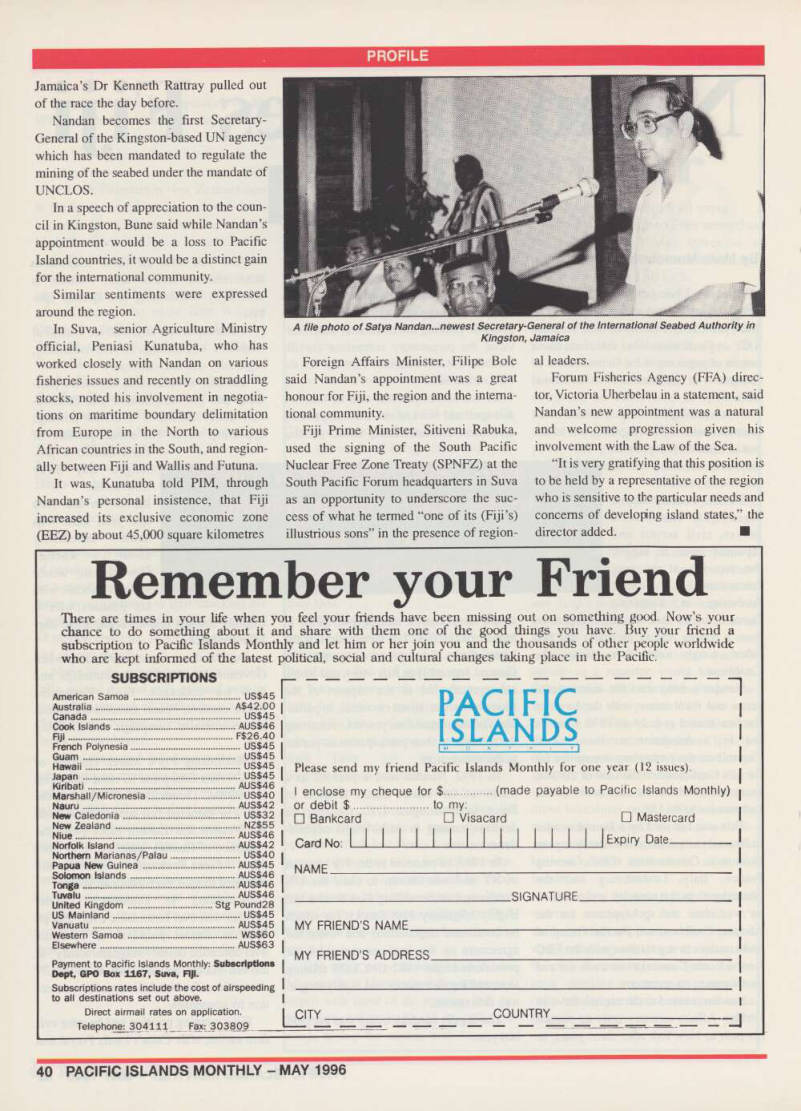
Profile
Nandan does Fiji proud
By Mere Momoivalu
Satya Nandan, the Special
Representative at Fiji’s Mission to the United Nations in New York has a CV or Curriculum Vitae that reads like a couple of pages out of the Guiness Book of Records - in the context of international affairs.
It is a distinguished track record of an internationalist who is arguably one of the
world’s foremost experts on the, treaties and laws on the sea and its resources.
Nandan recently capped
his 30-year career as a lawyer, civil servant and diplomat when he bagged the top job at the new International Seabed
Authority in Kingston,
Jamaica, in the face of stiff competition from a former African president and two other tough contenders from the Caribbean.
Nandan’s foray into the international scene and involvement with the Laws of the Sea started as early as 1970 when he led Fiji’s delegation to the Seabed Committee, the preparatory committee for the UN Conference on the Law of the Sea, as then Fiji counsellor and later special ambassador to the UN.
This was followed by a European stint in Brussels as ambassador to the European Economic Communities (EEC), serving France, Italy, Luxembourg and the Netherlands in that capacity, and at which he was chair and spokesperson for the African, Caribbean and Pacific Group of ambassadors in negotiations with the EEC for the Lome Convention on trade aid and
development co-operation.
Nandan returned to the capital, Suva as Foreign Affairs secretary only to retrace his path to New York after three years, to
greater recognition as Under-Secretary- General (USG) for Ocean Affairs and the Law of the Sea, and Special Representative of the Secretary-General for the Law of the Sea, also heading the secretariat which ser viced the preparatory committee for the ISA and the International Tribunal for the Law of the Sea.
It was at this juncture that he initiated dialogue and worked out the compromise agreement on outstanding issues relating
Nandan’s appointment is a loss to the Pacific but a definite gain for the international community
to the deep seabed mining provisions in Part 11 of the 1982 UN Convention on the Law of the Sea, adopted by the UN General Assembly in July 1994, and which subsequently led to the support of the treaty by industrialised countries, in partic ular the main maritime powers, removing the obstacle to their participation as parties to the convention.
In 1992, Nandan took a year off as a fellow at the United States Institute of Peace in Washington D.C. focusing on decision-making in multi-lateral negotia tions.
In 1993, he returned to the Fiji Mission in NY and was chosen to chair the UN Conference on Straddling Fish Stocks and Highly Migratory Fish Stocks, for which he conducted negotiations and wrote the agreement on the implementation of the provisions of the 1982 UNCLOS relating to straddling fish stocks and highly migra tory fish stocks.
The legally binding treaty was adopted last year.
And yet, with all these impressive achievements behind him, Nandan is amazingly unassuming and quietly spo ken.
There are few, if any, who are critical of Nandan’s outstanding service nationally, regionally and internationally.
The only obvious issue has been a post- Coup and pro-indigenous Fijian observa tion about Nandan’s overseas postings appearing to be (in some quarters of
Government) a pro longed stay away from home.
Earlier in the race last year, there was some uncertainty about whether Government would support Nandan, with his contract with it
expiring late last year attracting some neg ative feedback.
But Nandan’s chances firmed-up when Government gave him its blessings and with his colleague, Fiji’s Permanent Representative, Poseci Bune, went all-out on an intensive campaign and lobbying trail.
Maximising Fiji’s March chairing of the UN Asia Group and its close links with the SOPAC (South Pacific) Group at the UN, Fiji garnered full support from both the Western and Eastern blocs (with the exception of Russia), snatched votes from a few African Francophone countries and managed to split the Caribbean votes.
According to ambassador Bune, Nandan won over formidable rival, Joseph Warioba, former president of Tanzania, who conceded defeat “magnanimously” at the last-minute making way, in usual UN convention, for Nandan’s unanimous elec tion by consensus.
Fiji’s winning position had become evi dent earlier, after Cuba’s Louis Preval and
Jamaica’s Dr Kenneth Rattray pulled out of the race the day before.
Nandan becomes the first Secretary- General of the Kingston-based UN agency which has been mandated to regulate the mining of the seabed under the mandate of
Unclos.
In a speech of appreciation to the coun cil in Kingston, Bune said while Nandan’s appointment would be a loss to Pacific Island countries, it would be a distinct gain for the international community.
Similar sentiments were expressed around the region.
In Suva, senior Agriculture Ministry official, Peniasi Kunatuba, who has worked closely with Nandan on various fisheries issues and recently on straddling stocks, noted his involvement in negotia tions on maritime boundary delimitation from Europe in the North to various African countries in the South, and region ally between Fiji and Wallis and Futuna.
It was, Kunatuba told PIM, through Nandan’s personal insistence, that Fiji increased its exclusive economic zone (EEZ) by about 45,000 square kilometres
Foreign Affairs Minister, Filipe Bole said Nandan’s appointment was a great honour for Fiji, the region and the interna
tional community.
Fiji Prime Minister, Sitiveni Rabuka, used the signing of the South Pacific Nuclear Free Zone Treaty (SPNFZ) at the South Pacific Forum headquarters in Suva as an opportunity to underscore the suc cess of what he termed “one of its (Fiji’s) illustrious sons” in the presence of region
al leaders.
Forum Fisheries Agency (FFA) direc tor, Victoria Uherbelau in a statement, said Nandan’s new appointment was a natural and welcome progression given his involvement with the Law of the Sea.
“It is very gratifying that this position is to be held by a representative of the region who is sensitive to the particular needs and concerns of developing island states,” the director added. ■
A file photo of Satya Nandan...newest Secretary-General of the International Seabed Authority in Kingston, Jamaica
Advertisements & other items, p. 40 (1 item)
Remember your Friend
There are times in your life when you feel your friends have been missing out on something good. Now’s your chance to do something about it and share with them one of the good things you have. Buy your friend a subscription to Pacific Islands Monthly and let him or her join you and the thousands of other people worldwide who are kept informed of the latest political, social and cultural changes taking place in the Pacific.
SUBSCRIPTIONS
American Samoa US$45 Australia A 542.00 Canada US$45 Cook Islands AUSS46 Fiji F 526.40 French Polynesia US$45 Guam US$45 Hawaii US$45 Japan US$45 Kiribati AUSS46 Marshall/Micronesia US$4O Nauru AUSS42 New Caledonia US$32 New Zealand NZ$55 Niue AUSS46 Norfolk Island AUSS42 Northern Marianas/Palau US$4O Papua New Guinea AUSS4S Solomon Islands AUSS46 Tonga AUSS46 Tuvalu AUSS46 United Kingdom Stg Pound2B US Mainland US$45 Vanuatu AUSS4S Western Samoa WS$6O Elsewhere AUSS63 Payment to Pacific Islands Monthly: Subscriptions Dept, GPO Box 1167, Suva, Fiji.
Subscriptions rates include the cost of airspeeding to all destinations set out above.
Direct airmail rates on application.
Telephone: 304111 Fax: 303809 r
PACIFIC
ISLANDS
1 Please send my friend Pacific Islands Monthly for one year (12 issues).
I I enclose my cheque for $ (made payable to Pacific Islands Monthly) or debit $ to my: I □ Bankcard □ Visacard □ Mastercard Card No;
NAME
MY FRIEND'S NAME.
MY FRIEND’S ADDRESS.
Expiry Date.
.SIGNATURE.
CITY COUNTRY
Cook Islands
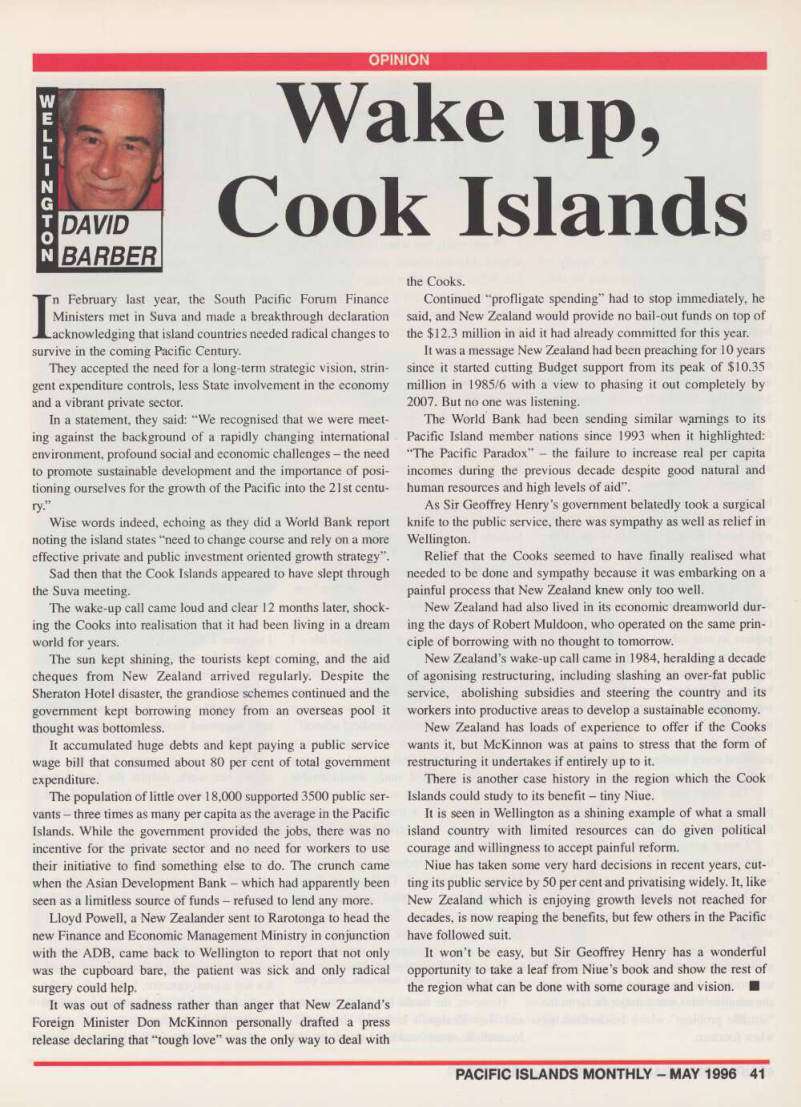
Opinion
Wake up, Cook Islands
In February last year, the South Pacific Forum Finance Ministers met in Suva and made a breakthrough declaration acknowledging that island countries needed radical changes to survive in the coming Pacific Century.
They accepted the need for a long-term strategic vision, strin gent expenditure controls, less State involvement in the economy and a vibrant private sector.
In a statement, they said: “We recognised that we were meet ing against the background of a rapidly changing international environment, profound social and economic challenges - the need to promote sustainable development and the importance of posi tioning ourselves for the growth of the Pacific into the 21st centu ry”
Wise words indeed, echoing as they did a World Bank report noting the island states “need to change course and rely on a more effective private and public investment oriented growth strategy”.
Sad then that the Cook Islands appeared to have slept through the Suva meeting.
The wake-up call came loud and clear 12 months later, shock ing the Cooks into realisation that it had been living in a dream world for years.
The sun kept shining, the tourists kept coming, and the aid cheques from New Zealand arrived regularly. Despite the Sheraton Hotel disaster, the grandiose schemes continued and the government kept borrowing money from an overseas pool it thought was bottomless.
It accumulated huge debts and kept paying a public service wage bill that consumed about 80 per cent of total government
expenditure.
The population of little over 18,000 supported 3500 public ser vants - three times as many per capita as the average in the Pacific Islands. While the government provided the jobs, there was no incentive for the private sector and no need for workers to use their initiative to find something else to do. The crunch came when the Asian Development Bank - which had apparently been seen as a limitless source of funds - refused to lend any more.
Lloyd Powell, a New Zealander sent to Rarotonga to head the new Finance and Economic Management Ministry in conjunction with the ADB, came back to Wellington to report that not only was the cupboard bare, the patient was sick and only radical surgery could help.
It was out of sadness rather than anger that New Zealand’s Foreign Minister Don McKinnon personally drafted a press release declaring that “tough love” was the only way to deal with
the Cooks.
Continued “profligate spending” had to stop immediately, he said, and New Zealand would provide no bail-out funds on top of the $12.3 million in aid it had already committed for this year.
It was a message New Zealand had been preaching for 10 years since it started cutting Budget support from its peak of $10.35 million in 1985/6 with a view to phasing it out completely by 2007. But no one was listening.
The World Bank had been sending similar warnings to its Pacific Island member nations since 1993 when it highlighted: “The Pacific Paradox” - the failure to increase real per capita incomes during the previous decade despite good natural and human resources and high levels of aid”.
As Sir Geoffrey Henry’s government belatedly took a surgical knife to the public service, there was sympathy as well as relief in
Wellington.
Relief that the Cooks seemed to have finally realised what needed to be done and sympathy because it was embarking on a painful process that New Zealand knew only too well.
New Zealand had also lived in its economic dreamworld dur ing the days of Robert Muldoon, who operated on the same prin ciple of borrowing with no thought to tomorrow.
New Zealand’s wake-up call came in 1984, heralding a decade of agonising restructuring, including slashing an over-fat public service, abolishing subsidies and steering the country and its workers into productive areas to develop a sustainable economy.
New Zealand has loads of experience to offer if the Cooks wants it, but McKinnon was at pains to stress that the form of restructuring it undertakes if entirely up to it.
There is another case history in the region which the Cook Islands could study to its benefit - tiny Niue.
It is seen in Wellington as a shining example of what a small island country with limited resources can do given political courage and willingness to accept painful reform.
Niue has taken some very hard decisions in recent years, cut ting its public service by 50 per cent and privatising widely. It, like New Zealand which is enjoying growth levels not reached for decades, is now reaping the benefits, but few others in the Pacific have followed suit.
It won’t be easy, but Sir Geoffrey Henry has a wonderful opportunity to take a leaf from Niue’s book and show the rest of the region what can be done with some courage and vision. ■
Wellington
David
Barber
A star is born
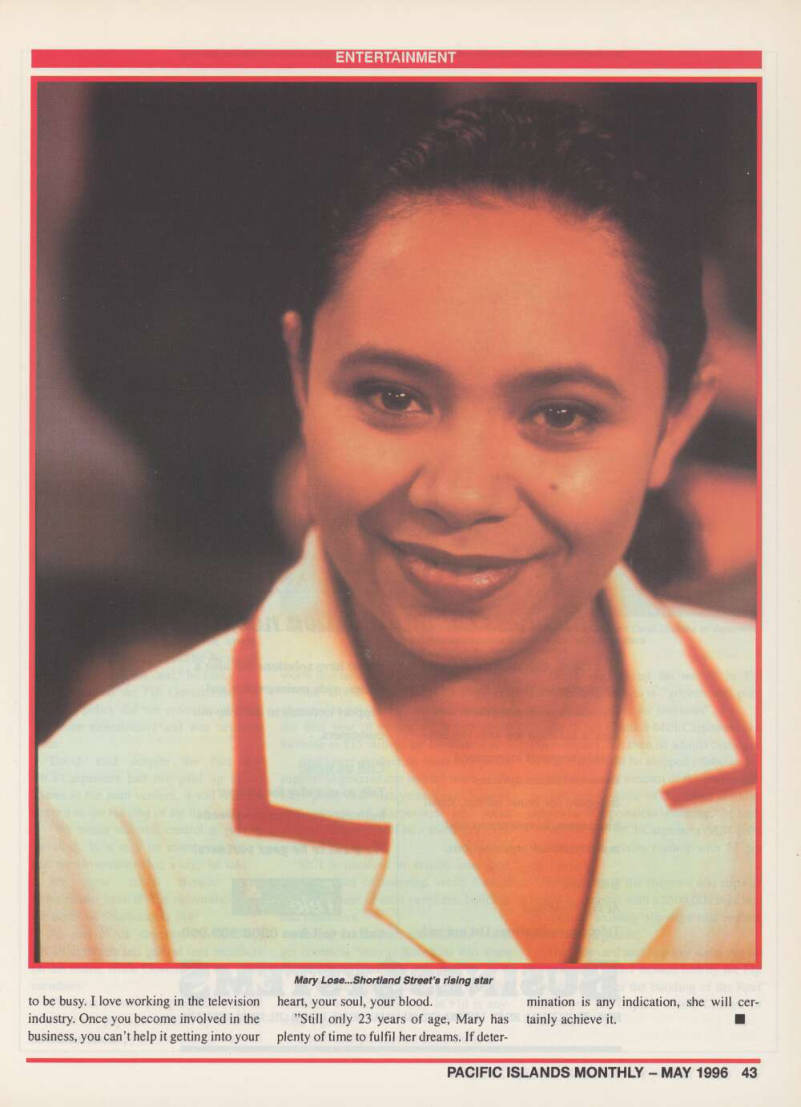
By Atama Raganivatu
Being a member of a family of achievers can sometimes be diffi cult, as Mary Lose freely testifies.
Lose is now a highly-esteemed actor, having gained countless fans around the world due to her portrayal of Samoan nurse Ana Fa’asolo in the internationally acclaimed television drama “Shortland Street”. But she readily recalls how, only a few years ago, her resentment of the suc cess attained by elder brothers Willie, Joseph and Richard almost turned her into
a “no-hoper”.
Joseph is a prominent journalist in their home town, Auckland, and Richard is security head for the celebrated English rock band ÜB4O, but it was Willie, a key member of Tonga’s 1995 rugby World Cup team, who particularly exasperated her.
“I hated him when we were younger,” she recalls nowadays with a laugh. “Willie (who is five years her senior) was head prefect at our school and captain of the New Zealand Secondary Schools XV, while I was struggling academically and believing I had no special talents of my own. I developed something of an inferior
ity complex.”
Being the youngest of a family which included seven brothers and one sister did n’t help her self-esteem either.
“The boys used to be mean to me; pulling my hair, teasing and making me do the household chores,” Lose chortles.
“I must admit though, I often used to burst into tears just to get them into trouble with our parents. As the youngest, I felt I deserved special attention and that is prob ably how I originally developed my acting
ability.”
Today, Lose today looks back at what most would dismiss as merely a classic sis ter-brother relationship light-heartedly, but she admits that it was a major factor in the “attitude problem” which be-devilled her when fourteen.
“I was really bad when in fourth form at school. My attendance record was dread ful. When I did bother to turn up, I would be very disrespectful to the teachers and make no attempt to leam things I thought had no relevance to my life when I left,”
Lose concedes.
“Eventually, my parents became so incensed that I was sent to my elder broth ers who live in Surfer’s Paradise, Australia, with the idea they would make me realise I was frittering my life away. Surfer’s Paradise is a beautiful place, yet, despite this and the lovely weather there, I just spent the entire time indoors; sulking and watching television.
“However, while watching television, I became fascinated by current affairs pro
grammes, especially those presented by
(Australian) Jana Wendt and (American) Oprah Winfrey. Neither were, at that time, known in New Zealand and they totally captivated me. Suddenly, I had role models and knew exactly what I wanted in life - I yearned to be a television journalist. Prior to then, my only ambition had been to become a doctor. This disappeared as soon as I leamt seven years of training were required to pass through medical school!”
Thus, Lose had a career goal when returning to New Zealand and, realising how only dedicated study would enable her to achieve it, she amazed her parents and teachers with a transformed outlook.
She became head girl before leaving school!
Lose then studied journalism at Manukau Technical College in South Auckland and attended a film school before gaining her first jobs in New Zealand television. She was a reporter for several news programmes, including the high profile “What Now?”, “Infocus” and
“Get Together”.
However, the media is a fickle business and New Zealand’s is fickler than most.
Journalistic work suddenly dried-up and
Lose was considering quitting to seek a “regular job” when her agent suggested she should contemplate acting and audi tion for “Shortland Street”.
Devotees of the soap opera may recall Lose’s first role was as a truculent single mother, Dayna Paxie, who claimed ambu lance driver Sam Aleni (played by Samoan heart throb Rene Naufahui) to be the father of her child. Trivia addicts will probably already know that Sam’s on-screen wife, T P, was played by a cousin of Lose’s, Elizabeth Skeen.
A year later, Lose returned to the show depicting Ana, who is constantly rebelling against her stem upbringing. It is a role she can identify with.
“I can certainly relate to Ana, although she is Samoan and lam Tongan,” Lose acknowledges. “I too was brought up in a strict religious environment and sometimes felt my family tried to smother me. Being the youngest, I basically had eight fathers.
I suppose I did rebel, but now I realise my parents did a wonderful job in raising us as they did. We learnt to love ourselves and be able to express our feelings. I some times shudder when I think what might have happened to me without the support and influence of my family.”
Lose makes no secret of the fact she adores her work, despite the long hours required to learn lines, rehearse and film.
She has just one reservation about “Shortland Street”.
“I have retained my love for journal ism,” she reveals. “Jana Wendt remains an idol and I still desperately want to front a prestigious current affairs programme like she does. My one worry is that people will come to remember me solely from “Shortland Street” and I won’t be consid ered for presenting positions as a result.
It’s not a great concern, but it lurks in the back of my mind. I also have aspirations to one day become a director.
“I love working under pressure. I love
to be busy. I love working in the television industry. Once you become involved in the business, you can’t help it getting into your
heart, your soul, your blood. ’’Still only 23 years of age, Mary has plenty of time to fulfil her dreams. If deter
mination is any indication, she will cer tainly achieve it. ■
Mary Lose...Shortland Street’s rising star
Advertisements & other items, p. 44 (1 item)
Shmes System;
We have one gocd reason
tiy yt lould make us youir
partn
We have the answers to ALL your
business communication needs
We have the solutions No matter what your business communication needs are, we have a solution for you. We offer a wide range of intergrated communication systems designed for home offices, small businesses, corporations and multi-national organisations. do we have solutions but also a nation-wide maintenance and support network to back up our customers.
Call us now!
Talk to us today for all your business communication needs.
We want to Be your partners !
Service At Fiji Posts and Telecommunications Ltd not only
S Rest A
Telecom
Call us toll free 0800 300 000
SHMES SYSTEM;
SUVA: TEL2IO 222 FAX: 305 071 LAUTOKA: TEL: 661114 FAX: 663 567 LABASA: TEL: 811800 FAX: 812 766
GEORGE RUBINE 10*239
A done deal
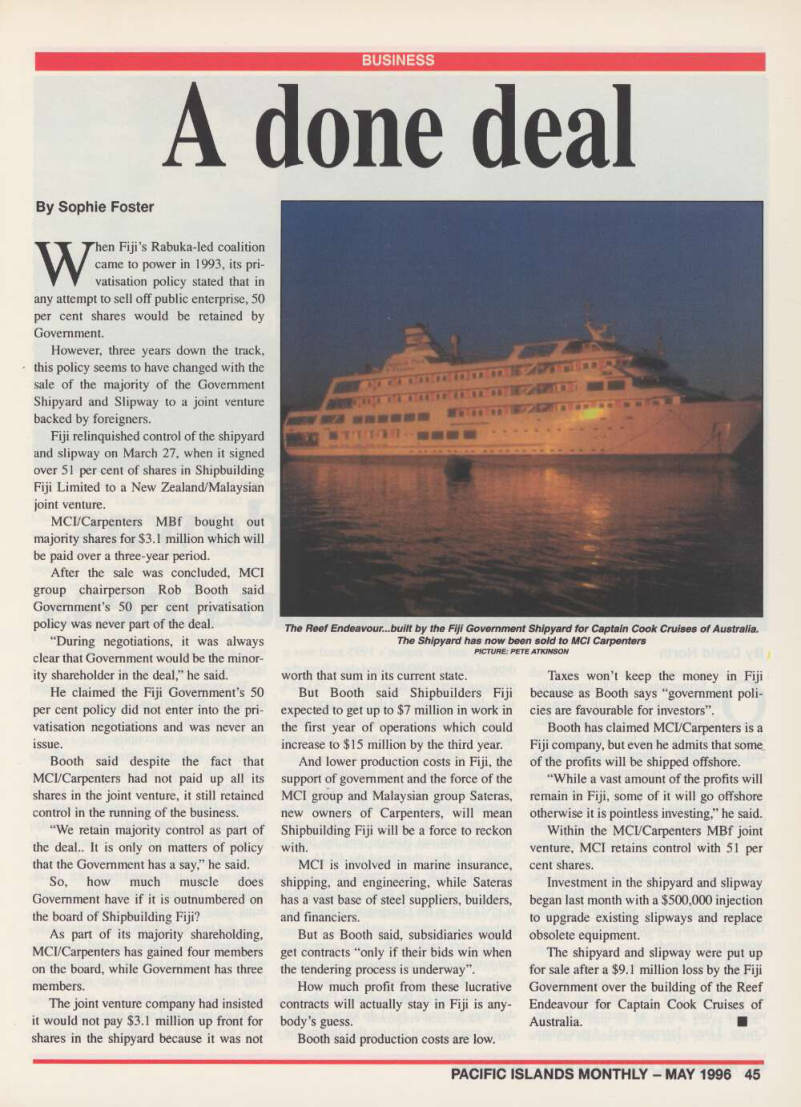
Business
By Sophie Foster
When Fiji’s Rabuka-led coalition came to power in 1993, its pri vatisation policy stated that in any attempt to sell off public enterprise, 50 per cent shares would be retained by Government.
However, three years down the track, this policy seems to have changed with the sale of the majority of the Government Shipyard and Slipway to a joint venture
backed by foreigners.
Fiji relinquished control of the shipyard
and slipway on March 27, when it signed over 51 per cent of shares in Shipbuilding Fiji Limited to a New Zealand/Malaysian
joint venture.
MCI/Carpenters MBf bought out
majority shares for $3.1 million which will be paid over a three-year period.
After the sale was concluded, MCI group chairperson Rob Booth said Government’s 50 per cent privatisation policy was never part of the deal.
“During negotiations, it was always clear that Government would be the minor ity shareholder in the deal,” he said.
He claimed the Fiji Government’s 50 per cent policy did not enter into the pri vatisation negotiations and was never an issue.
Booth said despite the fact that MCI/Carpenters had not paid up all its shares in the joint venture, it still retained control in the running of the business.
“We retain majority control as part of the deal.. It is only on matters of policy that the Government has a say,” he said.
So, how much muscle does Government have if it is outnumbered on the board of Shipbuilding Fiji?
As part of its majority shareholding, MCI/Carpenters has gained four members on the board, while Government has three members.
The joint venture company had insisted it would not pay $3.1 million up front for shares in the shipyard because it was not
worth that sum in its current state.
But Booth said Shipbuilders Fiji expected to get up to $7 million in work in the first year of operations which could increase to $l5 million by the third year.
And lower production costs in Fiji, the support of government and the force of the MCI group and Malaysian group Sateras, new owners of Carpenters, will mean Shipbuilding Fiji will be a force to reckon with.
MCI is involved in marine insurance, shipping, and engineering, while Sateras has a vast base of steel suppliers, builders, and financiers.
But as Booth said, subsidiaries would get contracts “only if their bids win when the tendering process is underway”.
How much profit from these lucrative contracts will actually stay in Fiji is any body’s guess.
Booth said production costs are low.
Taxes won’t keep the money in Fiji because as Booth says “government poli cies are favourable for investors”.
Booth has claimed MCI/Carpenters is a Fiji company, but even he admits that some, of the profits will be shipped offshore.
“While a vast amount of the profits will remain in Fiji, some of it will go offshore otherwise it is pointless investing,” he said.
Within the MCI/Carpenters MBf joint venture, MCI retains control with 51 per cent shares.
Investment in the shipyard and slipway began last month with a $500,000 injection to upgrade existing slipways and replace obsolete equipment.
The shipyard and slipway were put up for sale after a $9.1 million loss by the Fiji Government over the building of the Reef Endeavour for Captain Cook Cruises of Australia. ■
The Reef Endeavour...built by the Fiji Government Shipyard for Captain Cook Cruises of Australia.
The Shipyard has now been sold to MCI Carpenters
Picture: Pete Atkinson
of the cruise business
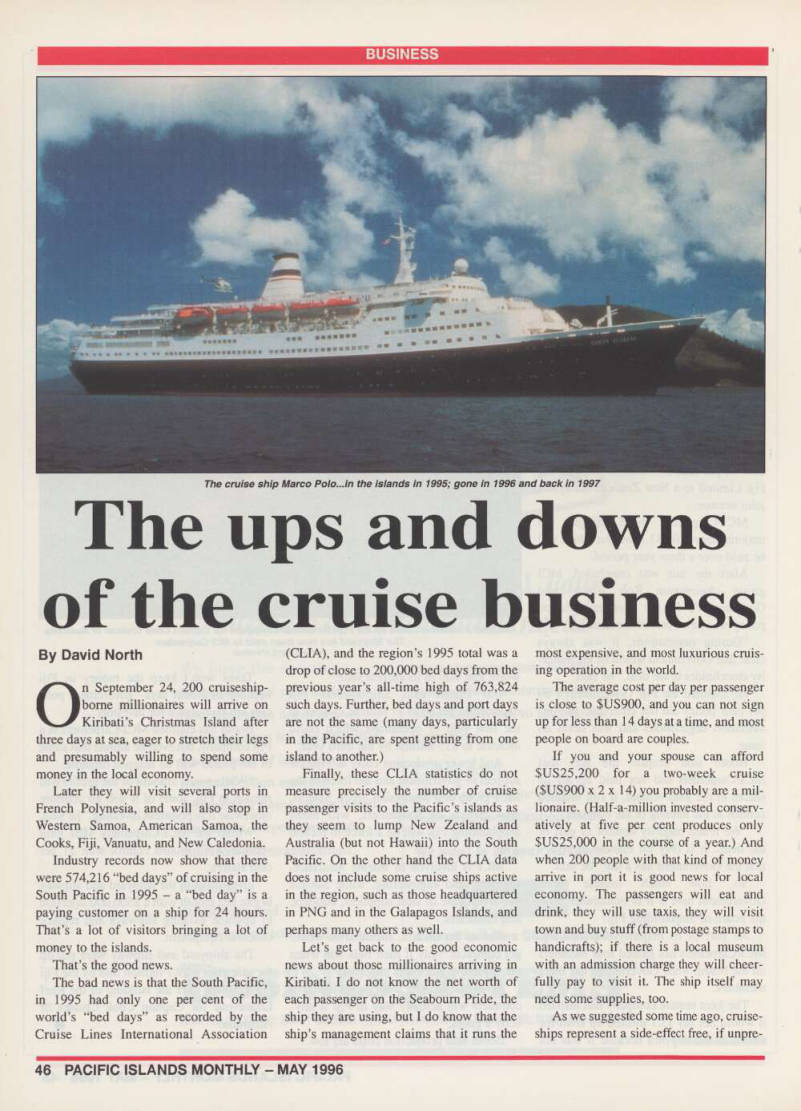
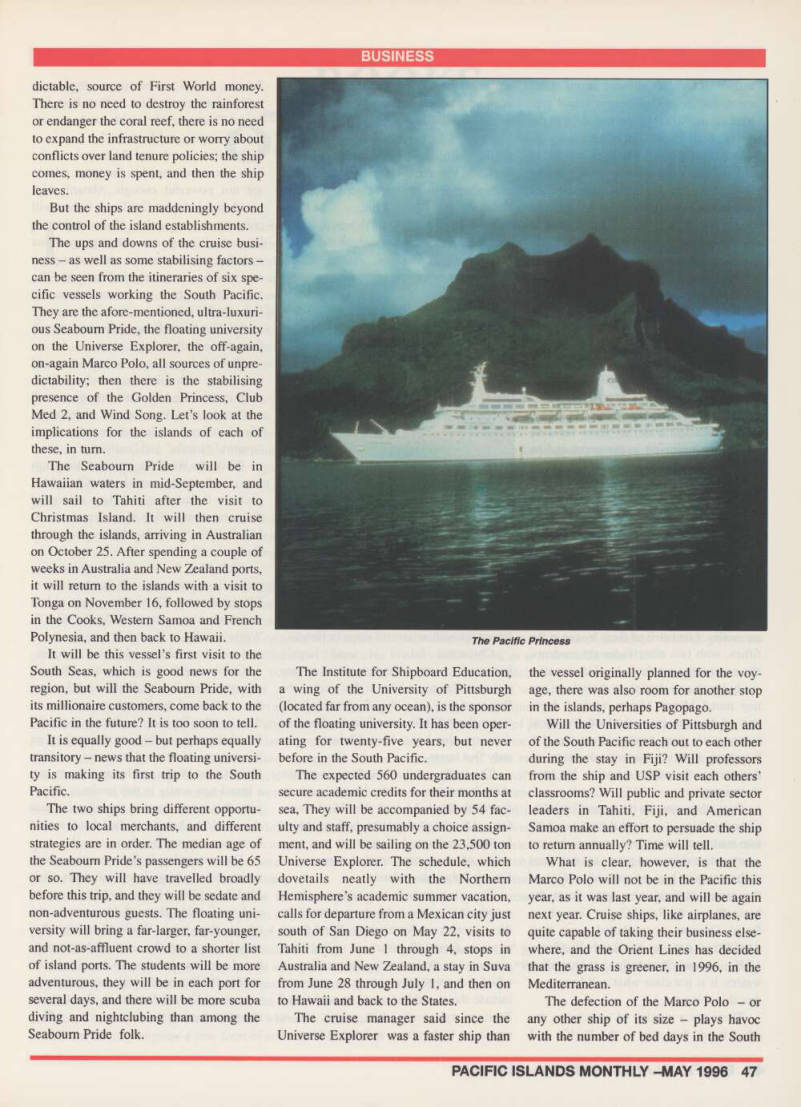
The ups and downs of the cruise business
By David North
(CLlA), and the region’s 1995 total was a drop of close to 200,000 bed days from the previous year’s all-time high of 763,824 such days. Further, bed days and port days are not the same (many days, particularly in the Pacific, are spent getting from one island to another.) Finally, these CLIA statistics do not measure precisely the number of cruise passenger visits to the Pacific’s islands as they seem to lump New Zealand and Australia (but not Hawaii) into the South Pacific. On the other hand the CLIA data does not include some cruise ships active in the region, such as those headquartered in PNG and in the Galapagos Islands, and perhaps many others as well.
Let’s get back to the good economic news about those millionaires arriving in Kiribati. I do not know the net worth of each passenger on the Seaboum Pride, the ship they are using, but I do know that the ship’s management claims that it runs the
On September 24, 200 cruiseship bome millionaires will arrive on Kiribati’s Christmas Island after three days at sea, eager to stretch their legs
and presumably willing to spend some
money in the local economy.
Later they will visit several ports in French Polynesia, and will also stop in Western Samoa, American Samoa, the Cooks, Fiji, Vanuatu, and New Caledonia.
Industry records now show that there were 574,216 “bed days” of cruising in the South Pacific in 1995 - a “bed day” is a paying customer on a ship for 24 hours.
That’s a lot of visitors bringing a lot of money to the islands.
That’s the good news.
The bad news is that the South Pacific, in 1995 had only one per cent of the world’s “bed days” as recorded by the Cruise Lines International Association
most expensive, and most luxurious cruis ing operation in the world.
The average cost per day per passenger is close to SUS9OO, and you can not sign up for less than 14 days at a time, and most people on board are couples.
If you and your spouse can afford $U525,200 for a two-week cruise (SUS9OO x 2 x 14) you probably are a mil lionaire. (Half-a-million invested conserv atively at five per cent produces only $U525,000 in the course of a year.) And when 200 people with that kind of money arrive in port it is good news for local economy. The passengers will eat and drink, they will use taxis, they will visit town and buy stuff (from postage stamps to handicrafts); if there is a local museum with an admission charge they will cheer fully pay to visit it. The ship itself may need some supplies, too.
As we suggested some time ago, cruise ships represent a side-effect free, if unpre
The cruise ship Marco Polo...in the islands in 1995; gone in 1996 and back in 1997
dictable, source of First World money.
There is no need to destroy the rainforest or endanger the coral reef, there is no need to expand the infrastructure or worry about conflicts over land tenure policies; the ship comes, money is spent, and then the ship leaves.
But the ships are maddeningly beyond the control of the island establishments.
The ups and downs of the cruise busi ness - as well as some stabilising factors can be seen from the itineraries of six spe cific vessels working the South Pacific.
They are the afore-mentioned, ultra-luxuri ous Seaboum Pride, the floating university on the Universe Explorer, the off-again, on-again Marco Polo, all sources of unpre dictability; then there is the stabilising presence of the Golden Princess, Club Med 2, and Wind Song. Let’s look at the implications for the islands of each of these, in turn.
The Seabourn Pride will be in Hawaiian waters in mid-September, and will sail to Tahiti after the visit to Christmas Island. It will then cruise through the islands, arriving in Australian on October 25. After spending a couple of weeks in Australia and New Zealand ports, it will return to the islands with a visit to Tonga on November 16, followed by stops in the Cooks, Western Samoa and French Polynesia, and then back to Hawaii.
It will be this vessel’s first visit to the South Seas, which is good news for the region, but will the Seaboum Pride, with its millionaire customers, come back to the Pacific in the future? It is too soon to tell.
It is equally good - but perhaps equally transitory - news that the floating universi ty is making its first trip to the South Pacific.
The two ships bring different opportu nities to local merchants, and different strategies are in order. The median age of the Seaboum Pride’s passengers will be 65 or so. They will have travelled broadly before this trip, and they will be sedate and non-adventurous guests. The floating uni
versity will bring a far-larger, far-younger,
and not-as-affluent crowd to a shorter list of island ports. The students will be more adventurous, they will be in each port for several days, and there will be more scuba diving and nightclubing than among the Seaboum Pride folk.
The Institute for Shipboard Education, a wing of the University of Pittsburgh (located far from any ocean), is the sponsor of the floating university. It has been oper ating for twenty-five years, but never before in the South Pacific.
The expected 560 undergraduates can secure academic credits for their months at sea. They will be accompanied by 54 fac ulty and staff, presumably a choice assign ment, and will be sailing on the 23,500 ton Universe Explorer. The schedule, which dovetails neatly with the Northern Hemisphere’s academic summer vacation, calls for departure from a Mexican city just south of San Diego on May 22, visits to Tahiti from June 1 through 4, stops in Australia and New Zealand, a stay in Suva from June 28 through July 1, and then on to Hawaii and back to the States.
The cruise manager said since the Universe Explorer was a faster ship than
the vessel originally planned for the voy age, there was also room for another stop in the islands, perhaps Pagopago.
Will the Universities of Pittsburgh and of the South Pacific reach out to each other during the stay in Fiji? Will professors from the ship and USP visit each others’ classrooms? Will public and private sector leaders in Tahiti, Fiji, and American Samoa make an effort to persuade the ship to return annually? Time will tell.
What is clear, however, is that the Marco Polo will not be in the Pacific this year, as it was last year, and will be again next year. Cruise ships, like airplanes, are quite capable of taking their business else where, and the Orient Lines has decided that the grass is greener, in 1996, in the Mediterranean.
The defection of the Marco Polo - or any other ship of its size - plays havoc with the number of bed days in the South
The Pacific Princess
Pacific. CLIA data showed in the 1995 season that the 800-passenger vessel pro vided about 80,000 of the bed days in the region, about 15 per cent of the total.
One cruise ship manager talked of some of the difficulties with scheduling cruise ships into the Pacific islands. First he touched on the obvious - that the islands are distant from major centres of population, and that once the ship is in the region, it often has to travel several days between ports.
Then he spoke a little about the charac teristics and interests of the cruisers.
“They are older, they have money, and most of them live in warm climates in the US, like Florida and California; mean while, most port days in the islands are beach days - and time in the sun on the beaches is not all that interesting to them.”
His message was that there must be something intriguing in the ports, and he was enthusiastic about Napier, a city on the North Island of New Zealand.
“In the thirties the entire town was wiped out by an earthquake or a volcano or something (it was an earthquake) and they had to rebuild it from scratch. It has the highest percentage of art deco buildings of any place in the world. Now there’s some thing to see in Napier...”
The mention of Napier stirred sleeping memories. I had arrived there by car in the fifties, with two other Fulbright students.
We missed the art deco, but I do recall a seedy hotel, and driving in the rain in our tiny rental Morris Minor; while I drove one of the others read aloud the local newspaper’s long report about the US Supreme Court’s historic decision to desegregate the public schools... but back to cruising.
One other note on the unpredictability of cruise ships: it is a cut-throat, competi tive business; often there seem to be too many cruise ships, and prices are cut; lines go bankrupt or buy out each other. One of the recent victims, now gone from the business, was the Royal Cruise Line whose Royal Odyssey contributed more than 44,000 bed days to the South Pacific in 1995; it worked mostly in Australian waters. It is not clear what will happen to this ship this year.
There are a number of vessels, on the other hand, that stay in the Pacific and
cruise primarily in the islands; they bring economic benefits to the islands that can be counted on, year after year.
Perhaps the largest of these operations
is the Princess Line, which in 1995 deployed three 600-800 passenger vessels into the South Pacific, the Golden Princess, the Island Princess and the Pacific Princess. The three of them chalked up about one-third of the year’s bed days in the region.
“if you can afford $25,200 for a two week cruise, you probably are a
millionaire.”
For example, the Pacific Princess was scheduled in January and February of this year to make three 11-day cruises, two from Tahiti to Hawaii, and one the other way around. These trips included port days in Moorea, Bora Bora, and Christmas Island, as well as several stops in Hawaii.
Christmas Island is used largely because it is one of the few places to stop between Hawaii and Tahiti; but neither the Princess line nor the Seabourn Pride linger there. While most Princess line port days are nine hours long, Christmas gets only five hours.
The really stabilising influences are the ships home-based in the islands, such as the Club Med 2 and the Wind Song.
Owned by the rival system, both are based in Tahiti, and spend most of the year on a series of short trips to the same set of French Polynesian islands.
There is a perhaps inevitable emphasis on romance in the publicity generated by these operations. For example, Wind Song,
an up-to-date, 148-passenger sailing ship,
promoted a Valentine’s Day cruise in which “couples may choose to renew or initiate their wedding vows in traditional Tahitian style with white pareas, native music, a high priest and the giving of
Tahitian names and bilessings... the mayor will perform ceremomies on Bora Bora in a quaint Tahitian churclh with locals provid ing the singing and fainfare...”
But if the locals amd the mayor and the high priest mentionedl in the press release
are not powerful emough...Aboard ship,
noted psychologist D)r. Tracy Cabot will conduct her popular ‘Discoveries in Romance’ sessions... the programme includes a questionnaiire and a computer analysis for recommended actions. The press release goes om to emphasise that Cabot holds a Ph.D.
At least Wind Sonjg provides a break from those endless beach days.
Club Med’s publiciist writes in terms of swimming with dolphiins, horseback rides, deep-sea fishing (all e>xtra charge) as well as “troops of skilled dlancers, singers and “fire handlers” while avoiding the words “quaint,” “locals,” and “native.”
While the Wind Song’s week-long out ing is all on the vessel, the Club Med package includes several days at one of their resorts as well as some time at sea. It has facilities at both Moorea and Bora Bora.
Club Med 2 is a five-masted sailing vessel (with power as well) that holds up to 386 passengers. Only three years old, it was built at a cost of SUS 125,000,000.
While usually in French Polynesia, it has also sailed to and around New Caledonia.
Continuing the French theme it lists its country of registry as Wallis and Futuna, the smallest of the French possessions in the South Pacific. I knew that the
Marshalls register ships (concentrating on
the largest of the oil tankers) as does Vanuatu, but Wallis and Futuna was, to me, a brand-new entity in this business. I sup pose that is yet another way that a cruise ship could be helpful to the islands would be to pay registry fees there as well.
The bottom line is that no matter where registered, or how described, both Club Med 2 and Wind Song do bring a steady and predictable flow of business to the islands they serve. While there are other vessels pursuing this sort of home-port based cruising elsewhere in the islands, the insular Pacific needs still more of them, year-around work-horses in the tourist attraction business. ■
Books
Oceanic Art
Review by Nicholas Rothwell
This startling and sophisticated re-examination of Pacific art in all its diversity promises to redefine the field. Nicholas Thomas, a scholar of Marquesan culture and history, is, according to his publishers, currently researching contemporary art and the politics of identity in New Zealand - and it shows.
Out of the window, in this landmark volume, the latest in the world’s most popular series of art handbooks, go the old certain ties of oceanic art connoiseurship: Pacific artists are presented as our contemporaries, refining, adapting, reinventing their work for the last years of the century.
“My sense of the dynamism of Pacific art owes a great deal to contact with artists and communities in the Marquesas, Fiji and Aotearoa (New Zealand),” declares the author.
This, then, is not a stroll past the musty display cases of European ethnography collections, but a guided tour of today’s Pacific, together with a survey of the uses of art in societies strug gling with drastic change.
Thomas presents the art of the ocean not as a particularly love ly category of the “primitive”, but as a system of strategies adopt ed by different cultures for focusing power and “embodying” themselves.
He looks at the transformations of established cultural forms: thus, in Papua New Guinea, the bilum, or string bag, and in parts of Vanuatu the woven basket have been converted into modem symbols of identity. In several Polynesian cultures, tapa, or bark cloth, has become a channel for new self-definition. Thomas even presents the revival of tattooing among young New Zealand Maoris as a valid form of artistic enterprise.
Several preconceptions about oceanic art are exploded; among them the notion that the region’s primitive artists were uninterest ed in narrative: Thomas points to Austral Islands ancestor statues, the bamboo carvings of New Caledonia, and the textiles of the Carolines, before arguing from the example of the impressive ‘storyboards’ of Belau that contact with western culture has not been a cause of inexorable cultural decline: “The interest and importance of neo-traditional work is conse quently now more widely appreciated by curators and the tribal art market,” he remarks, “even if disproportionate value is still placed upon work that appears to predate contact.”
The author’s sympathies, then, are plain. He does reprint pic tures of several acknowledged masterpieces of primitive art, and provides detailed and subtle explanations of the ritual place and significance of ‘art-works’ in traditional Pacific societies.
But his concluding chapter is an up-beat survey of contempo rary trends, which performs, at least, the service of showing the diversity of production in countries such as Papua New Guinea and New Zealand - both of them societies where the (re)creation of national identity requires a new form of communal definition.
How successful, then, is this manifesto?
“Oceanic Art” contains extraordinary passages describing a new understanding of the way that art functioned in several Pacific societies. One feels, instinctually, that “this is how it real ly was” - feels close to comprehending the way these cultures once operated, with all their glamour, brutality and variance.
Oceanic art, for Thomas, could be an affair of the body, the dance, the pig-killing ceremonies.
These indigenous traditions continue, and evolve, but in many cases they are “secret and sacred”, and “still relate uneasily to Christianity and commercialisation.” The splendour of art-works, in places such as the Sepik, or the Solomons, was originally linked to the need for societies to define and differentiate them selves: in the Sepik, for instance, variation went so far that “vir tually no generalisation about Sepik art can be sustained”.
But this art, for Thomas, was not actually doing the same thing as western art: even fighting could, in some sense, be art, as it was with the Asmat of West Papua, or in parts of the Solomons, where a “defiant, highly aestheticised terrorism” centred on martial works, such as elaborate shields, that Western collectors now admire.
What, then, was Pacific art, and what will it become? In one intriguing passage, Thomas argues that some art forms were not looked at as things of beauty: they “were rather used to effect cer tain accomplishments: to parade a particular form of power, to overwhelm others, or to overwhelm oneself.”
This brief affordable, well-illustrated and suggestive book contains a wealth of wonders. It is unlikely to be read by anyone with complete equanimity.
A different kind of pleasure in Pacific art is provided by a lav ish work of reference just launched in Sydney. Also titled “Oceanic Art,” this two-volume work contains photographs of some 800 ‘traditional’” Pacific masks, ornaments and statues, many hidden in the reserve collections of Western museums. It is the result of a lengthy compilation effort by anthropologist and antique dealer, Anthony Meyer. Critics welcoming its Australian publication justly described the work, which is full of beautiful images of beautiful objects, as in some sense “a work of art”.
It certainly carries an appropriate price-tag: distributed in Australia by Sandstone Books for the publishers, Konemann, it retails for $A 150. ■ (“Oceanic Art” by Nicholas Thomas, publisher: Thames and Hudson, series “World of Art”. (price in UK pounds sterling 6.95)
magic
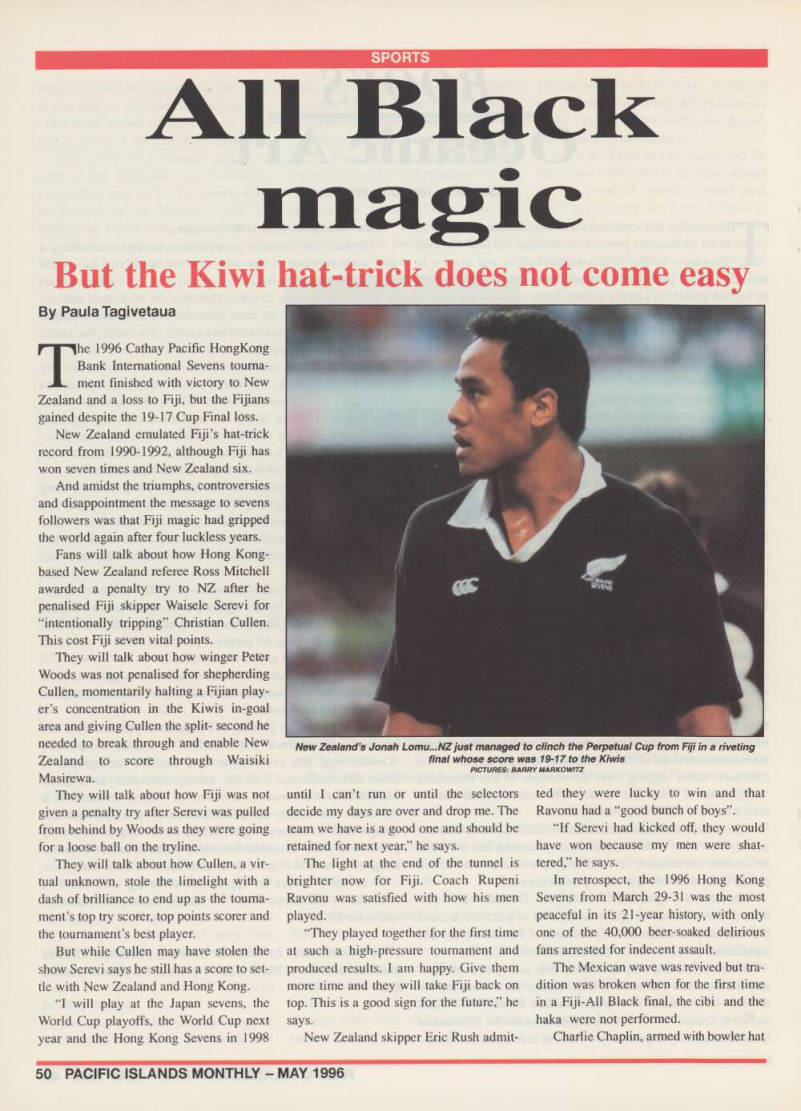
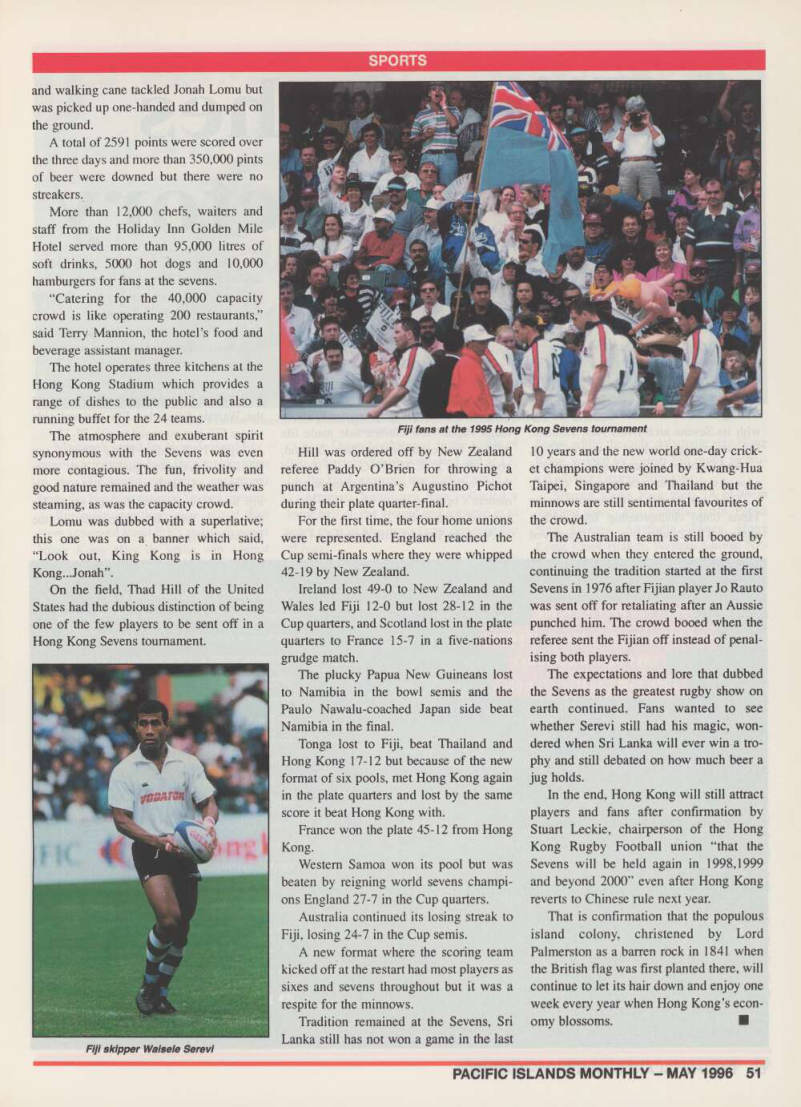
Sports
All Black magic
But the Kiwi hat-trick does not come easy
By Paula Tagivetaua
The 1996 Cathay Pacific Hong Kong
Bank International Sevens tourna ment finished with victory to New Zealand and a loss to Fiji, but the Fijians gained despite the 19-17 Cup Final loss.
New Zealand emulated Fiji’s hat-trick record from 1990-1992, although Fiji has won seven times and New Zealand six.
And amidst the triumphs, controversies and disappointment the message to sevens followers was that Fiji magic had gripped the world again after four luckless years.
Fans will talk about how Hong Kong based New Zealand referee Ross Mitchell awarded a penalty try to NZ after he
penalised Fiji skipper Waisele Serevi for
“intentionally tripping” Christian Cullen.
This cost Fiji seven vital points.
They will talk about how winger Peter Woods was not penalised for shepherding
Cullen, momentarily halting a Fijian play
er’s concentration in the Kiwis in-goal area and giving Cullen the split- second he needed to break through and enable New Zealand to score through Waisiki Masirewa.
They will talk about how Fiji was not given a penalty try after Serevi was pulled from behind by Woods as they were going for a loose ball on the tryline.
They will talk about how Cullen, a vir tual unknown, stole the limelight with a dash of brilliance to end up as the tourna ment’s top try scorer, top points scorer and the tournament’s best player.
But while Cullen may have stolen the show Serevi says he still has a score to set tle with New Zealand and Hong Kong.
“I will play at the Japan sevens, the World Cup playoffs, the World Cup next year and the Hong Kong Sevens in 1998
until I can’t run or until the selectors decide my days are over and drop me. The team we have is a good one and should be retained for next year,” he says.
The light at the end of the tunnel is
brighter now for Fiji. Coach Rupeni
Ravonu was satisfied with how his men
played.
“They played together for the first time at such a high-pressure tournament and produced results. I am happy. Give them more time and they will take Fiji back on top. This is a good sign for the future,” he says.
New Zealand skipper Eric Rush admit
ted they were lucky to win and that Ravonu had a “good bunch of boys”.
“If Serevi had kicked off, they would have won because my men were shat tered,” he says.
In retrospect, the 1996 Hong Kong Sevens from March 29-31 was the most peaceful in its 21-year history, with only one of the 40,000 beer-soaked delirious fans arrested for indecent assault.
The Mexican wave was revived but tra dition was broken when for the first time in a Fiji-All Black final, the cibi and the haka were not performed.
Charlie Chaplin, armed with bowler hat
New Zealand’s Jonah Lomu...NZ just managed to clinch the Perpetual Cup from Fiji in a riveting final whose score was 19-17 to the Kiwis
Pictures: Barry Markowitz
and walking cane tackled Jonah Lomu but was picked up one-handed and dumped on
the ground.
A total of 2591 points were scored over the three days and more than 350,000 pints of beer were downed but there were no streakers.
More than 12,000 chefs, waiters and staff from the Holiday Inn Golden Mile Hotel served more than 95,000 litres of soft drinks, 5000 hot dogs and 10,000 hamburgers for fans at the sevens.
“Catering for the 40,000 capacity crowd is like operating 200 restaurants,” said Terry Mannion, the hotel’s food and beverage assistant manager.
The hotel operates three kitchens at the
Hong Kong Stadium which provides a
range of dishes to the public and also a running buffet for the 24 teams.
The atmosphere and exuberant spirit synonymous with the Sevens was even more contagious. The fun, frivolity and good nature remained and the weather was steaming, as was the capacity crowd.
Lomu was dubbed with a superlative; this one was on a banner which said, “Look out. King Kong is in Hong
Kong... Jonah”.
On the field, Thad Hill of the United States had the dubious distinction of being one of the few players to be sent off in a
Hong Kong Sevens tournament.
Hill was ordered off by New Zealand referee Paddy O’Brien for throwing a punch at Argentina’s Augustino Pichot during their plate quarter-final.
For the first time, the four home unions were represented. England reached the Cup semi-finals where they were whipped 42-19 by New Zealand.
Ireland lost 49-0 to New Zealand and Wales led Fiji 12-0 but lost 28-12 in the Cup quarters, and Scotland lost in the plate quarters to France 15-7 in a five-nations grudge match.
The plucky Papua New Guineans lost to Namibia in the bowl semis and the Paulo Nawalu-coached Japan side beat Namibia in the final.
Tonga lost to Fiji, beat Thailand and Hong Kong 17-12 but because of the new format of six pools, met Hong Kong again in the plate quarters and lost by the same score it beat Hong Kong with.
France won the plate 45-12 from Hong Kong.
Western Samoa won its pool but was beaten by reigning world sevens champi ons England 27-7 in the Cup quarters.
Australia continued its losing streak to Fiji, losing 24-7 in the Cup semis.
A new format where the scoring team kicked off at the restart had most players as sixes and sevens throughout but it was a respite for the minnows.
Tradition remained at the Sevens, Sri Lanka still has not won a game in the last
10 years and the new world one-day crick et champions were joined by Kwang-Hua Taipei, Singapore and Thailand but the minnows are still sentimental favourites of the crowd.
The Australian team is still booed by the crowd when they entered the ground, continuing the tradition started at the first Sevens in 1976 after Fijian player Jo Rauto was sent off for retaliating after an Aussie punched him. The crowd booed when the referee sent the Fijian off instead of penal ising both players.
The expectations and lore that dubbed the Sevens as the greatest rugby show on earth continued. Fans wanted to see whether Serevi still had his magic, won dered when Sri Lanka will ever win a tro phy and still debated on how much beer a jug holds.
In the end, Hong Kong will still attract players and fans after confirmation by Stuart Leckie, chairperson of the Hong Kong Rugby Football union “that the Sevens will be held again in 1998,1999 and beyond 2000” even after Hong Kong reverts to Chinese rule next year.
That is confirmation that the populous island colony, christened by Lord Palmerston as a barren rock in 1841 when the British flag was first planted there, will continue to let its hair down and enjoy one week every year when Hong Kong’s econ omy blossoms. ■
Fiji skipper Waisele Serevi
Fiji fans at the 1995 Hong Kong Sevens tournament
Fiji notches
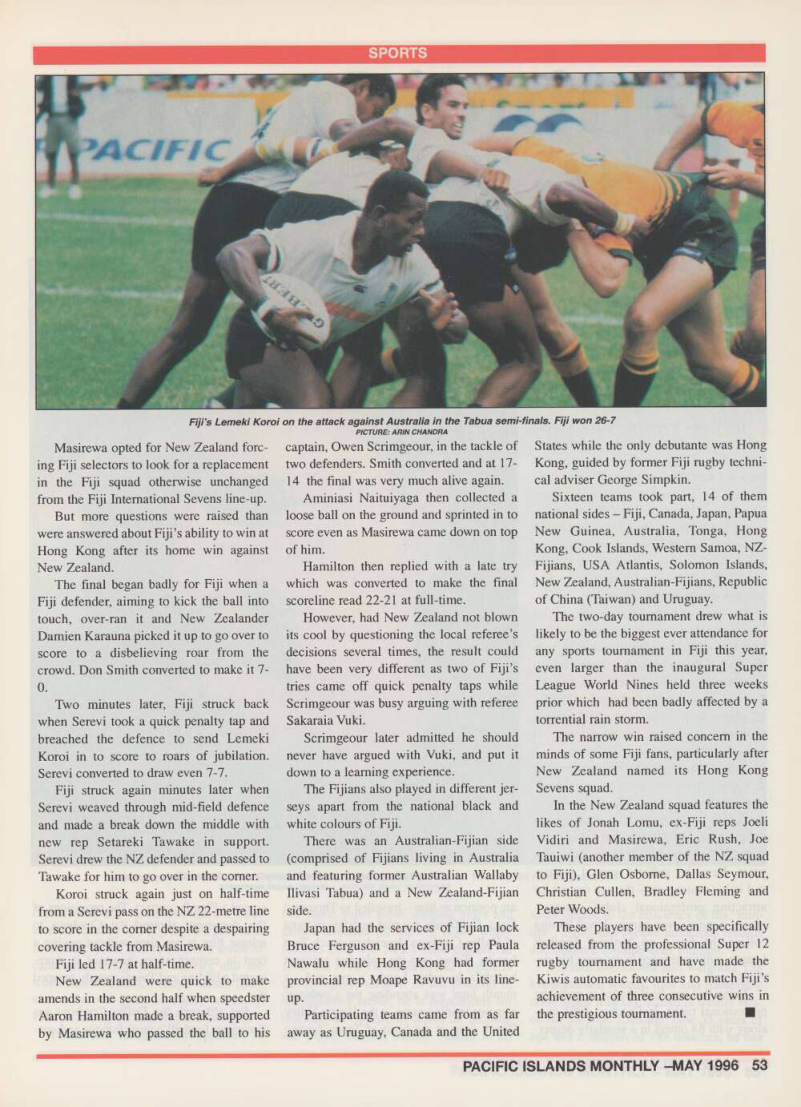
narrow victory
By Andrew Kacimaiwai
Bright sunshine, large crowds and
improved performances from
Pacific Island teams combined to make the fourth Fiji International Sevens tournament in Suva in mid-March a mem orable event.
The tournament received a fairytale ending in the main final when Fiji met up with its Sevens arch-rivals New Zealand.
Fiji just managed to hold on to win 22-21.
And for other regional teams, there was a lot of satisfaction to be savoured as well.
The Cook Islands tasted success in the Tanoa (cup) championship final with a narrow 15-12 win over an improved
Solomon Islands side in the final.
In their opening game, the Solomons side shocked their more fancied Western Samoan opponents with a display of copy book Samoan-like tackling before suc cumbing 26-5 to them.
The defence was a strong trademark of the Solomon Islanders, not quite equalled by their attacking abilities.
In the main (Tabua) quarter-finals, a tough Papua New Guinea side made life difficult for beaten finalists New Zealand, going down 27-5. The PNG seven showed they would not be a walkover in the tour nament’s opening game when they lost to eventual winners Fiji 26-0.
A young Tongan team drew 14-14 with
Australia in pool play and went on to defeat Western Samoa 12-7 in the Tabua quarter-finals before making New Zealand work hard for their 21-7 win.
The Tongans were a crowd favourite with their courtesy, bowing to the crowd before each of their games.
The tournament final was a classic, a New Zealand development side up against the Waisale Serevi-led Fiji national side where Fiji just managed to win 22-21.
Fiji’s 1995 Hong Kong Sevens rep
Waisiki Masirewa played for New Zealand, and was later named in both the Fiji and New Zealand Sevens squad for this year’s three-day tournament in the
British colony.
Masirewa opted for New Zealand forc ing Fiji selectors to look for a replacement in the Fiji squad otherwise unchanged from the Fiji International Sevens line-up.
But more questions were raised than were answered about Fiji’s ability to win at Hong Kong after its home win against New Zealand.
The final began badly for Fiji when a Fiji defender, aiming to kick the ball into touch, over-ran it and New Zealander Damien Karauna picked it up to go over to score to a disbelieving roar from the crowd. Don Smith converted to make it 7- 0.
Two minutes later, Fiji struck back when Serevi took a quick penalty tap and breached the defence to send Lemeki Koroi in to score to roars of jubilation.
Serevi converted to draw even 7-7.
Fiji struck again minutes later when Serevi weaved through mid-field defence and made a break down the middle with new rep Setareki Tawake in support.
Serevi drew the NZ defender and passed to Tawake for him to go over in the comer.
Koroi struck again just on half-time from a Serevi pass on the NZ 22-metre line to score in the comer despite a despairing covering tackle from Masirewa.
Fiji led 17-7 at half-time.
New Zealand were quick to make amends in the second half when speedster Aaron Hamilton made a break, supported by Masirewa who passed the ball to his
captain, Owen Scrimgeour, in the tackle of two defenders. Smith converted and at 17- 14 the final was very much alive again.
Aminiasi Naituiyaga then collected a loose ball on the ground and sprinted in to score even as Masirewa came down on top of him.
Hamilton then replied with a late try which was converted to make the final scoreline read 22-21 at full-time.
However, had New Zealand not blown its cool by questioning the local referee’s decisions several times, the result could have been very different as two of Fiji’s tries came off quick penalty taps while Scrimgeour was busy arguing with referee Sakaraia Vuki.
Scrimgeour later admitted he should never have argued with Vuki, and put it down to a learning experience.
The Fijians also played in different jer seys apart from the national black and white colours of Fiji.
There was an Australian-Fijian side (comprised of Fijians living in Australia and featuring former Australian Wallaby Ilivasi Tabua) and a New Zealand-Fijian side.
Japan had the services of Fijian lock Bruce Ferguson and ex-Fiji rep Paula Nawalu while Hong Kong had former provincial rep Moape Ravuvu in its line up.
Participating teams came from as far away as Uruguay, Canada and the United
States while the only debutante was Hong Kong, guided by former Fiji rugby techni cal adviser George Simpkin.
Sixteen teams took part, 14 of them national sides - Fiji, Canada, Japan, Papua New Guinea, Australia, Tonga, Hong Kong, Cook Islands, Western Samoa, NZ- Fijians, USA Atlantis, Solomon Islands, New Zealand, Australian-Fijians, Republic of China (Taiwan) and Uruguay.
The two-day tournament drew what is likely to be the biggest ever attendance for any sports tournament in Fiji this year, even larger than the inaugural Super League World Nines held three weeks prior which had been badly affected by a torrential rain storm.
The narrow win raised concern in the minds of some Fiji fans, particularly after New Zealand named its Hong Kong Sevens squad.
In the New Zealand squad features the likes of Jonah Lomu, ex-Fiji reps Joeli Vidiri and Masirewa, Eric Rush, Joe Tauiwi (another member of the NZ squad to Fiji), Glen Osborne, Dallas Seymour, Christian Cullen, Bradley Fleming and Peter Woods.
These players have been specifically released from the professional Super 12 rugby tournament and have made the Kiwis automatic favourites to match Fiji’s achievement of three consecutive wins in the prestigious tournament. ■
Fiji’s Lemeki Koroi on the attack against Australia in the Tabua semi-finals. Fiji won 26-7
Picture: Arin Chandra
Advertisements & other items, p. 52 (1 item)
Over The Past 25 Years
OUR TRAINING AND PROJECT SERVICES
HAVE HELPED CUSTOMER
BUSINESSES REALLY TAKE OFF.
For over 25 years Australia's Collins Avionics Service Centre (part of the Rockwell worldwide network) has provided an extensive range of state-of-the-art avionics services to meet the rapidly growing needs of our region.
The highest quality sales and service for air transport, general aviation and military requirements.
Including technical training, consulting and skills transfer; repair, overhaul and modification; contract maintenance; test systems; equipment; and a 24-hour rental/exchange pool.
The Australian Service Centre is at Tuilamarine in Victoria. For more information call Neil Thomson on (61 -3) 9338 0344 or fax (61 -3) 9330 3007. With Collins Avionics the sky is definitely not the limit. *l* Rockwell Avionics Collins
Tuinei bowls
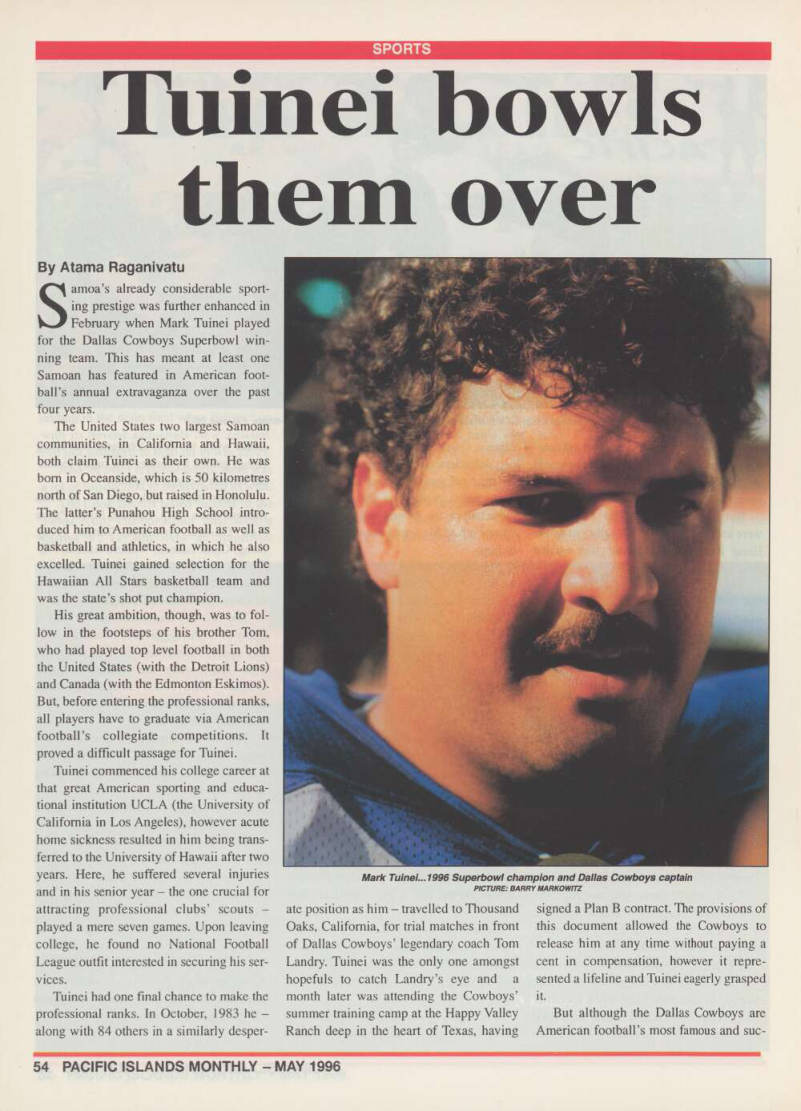
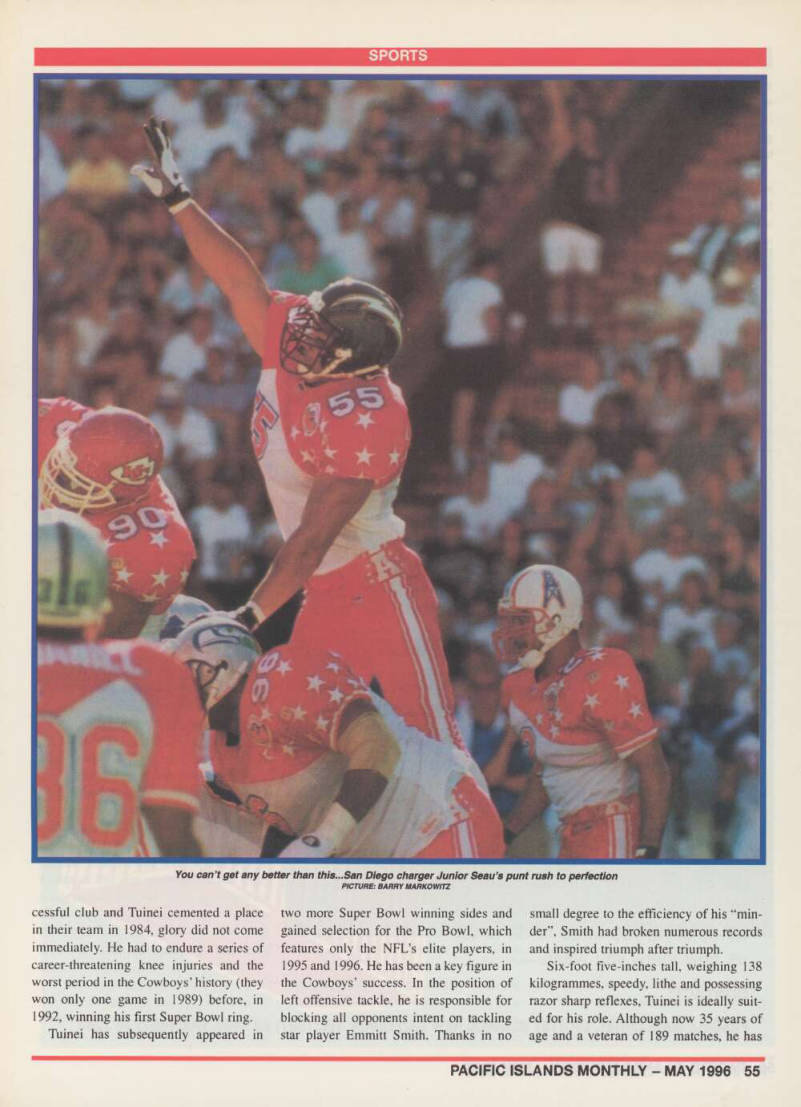

them over
By Atama Raganivatu
Samoa’s already considerable sport
ing prestige was further enhanced in February when Mark Tuinei played for the Dallas Cowboys Superbowl win ning team. This has meant at least one Samoan has featured in American foot ball’s annual extravaganza over the past four years.
The United States two largest Samoan communities, in California and Hawaii, both claim Tuinei as their own. He was bom in Oceanside, which is 50 kilometres north of San Diego, but raised in Honolulu.
The latter’s Punahou High School intro duced him to American football as well as basketball and athletics, in which he also excelled. Tuinei gained selection for the Hawaiian All Stars basketball team and was the state’s shot put champion.
His great ambition, though, was to fol low in the footsteps of his brother Tom, who had played top level football in both the United States (with the Detroit Lions) and Canada (with the Edmonton Eskimos).
But, before entering the professional ranks, all players have to graduate via American football’s collegiate competitions. It proved a difficult passage for Tuinei.
Tuinei commenced his college career at that great American sporting and educa tional institution UCLA (the University of California in Los Angeles), however acute home sickness resulted in him being trans ferred to the University of Hawaii after two years. Here, he suffered several injuries and in his senior year - the one crucial for attracting professional clubs’ scouts played a mere seven games. Upon leaving college, he found no National Football League outfit interested in securing his ser vices.
Tuinei had one final chance to make the professional ranks. In October, 1983 he along with 84 others in a similarly desper-
ate position as him - travelled to Thousand Oaks, California, for trial matches in front of Dallas Cowboys’ legendary coach Tom Landry. Tuinei was the only one amongst hopefuls to catch Landry’s eye and a month later was attending the Cowboys’ summer training camp at the Happy Valley Ranch deep in the heart of Texas, having
signed a Plan B contract. The provisions of this document allowed the Cowboys to release him at any time without paying a cent in compensation, however it repre sented a lifeline and Tuinei eagerly grasped it.
But although the Dallas Cowboys are American football’s most famous and suc-
Mark Tuinei...1996 Superbowl champion and Dallas Cowboys captain
Picture: Barry Markowitz
cessful club and Tuinei cemented a place in their team in 1984, glory did not come immediately. He had to endure a series of career-threatening knee injuries and the worst period in the Cowboys’ history (they won only one game in 1989) before, in 1992, winning his first Super Bowl ring.
Tuinei has subsequently appeared in
two more Super Bowl winning sides and gained selection for the Pro Bowl, which features only the NFL’s elite players, in 1995 and 1996. He has been a key figure in the Cowboys’ success. In the position of left offensive tackle, he is responsible for blocking all opponents intent on tackling star player Emmitt Smith. Thanks in no
small degree to the efficiency of his “min der”, Smith had broken numerous records and inspired triumph after triumph.
Six-foot five-inches tall, weighing 138 kilogrammes, speedy, lithe and possessing razor sharp reflexes, Tuinei is ideally suit ed for his role. Although now 35 years of age and a veteran of 189 matches, he has
You can’t get any better than this... San Diego charger Junior Seau’s punt rush to perfection
Picture: Barry Markowitz
yet to indicate any thoughts of retirement and on the evidence of the 1985 campaign (in which he was ever-present), several good seasons could still remain ahead of him.
The Samoan has overcome back spasms, a groin injury, dehydration and further knee problems in recent times while proving himself amongst the NFL’s most resilient performers.
Off the field, Tuinei and his wife Ponolani live in Carrolltown, a pleasant suburb just outside Dallas, with their two dogs. Ponolani too, is of Samoan extrac tion and both derive much satisfaction from the fact that Mark has been adopted as a role model by many younger members of their community.
“I get a little annoyed when people assume I am Hawaiian because my full name, Mark Pulemau Tuinei (pronounced Too-Ee-Nay) sounds Hawaiian to them,” he once stated.
“I am Samoan and take great pride from that fact.”
Amongst Tuinei’s most treasured mem ories is being named with two other
Samoans, Jesse Sapolu and Junior Seau, for the 1995 Pro Bowl game in Honolulu.
He had only one regret - that his cousin Dan Saleaumua of the Kansas City Chiefs did not win selection.
Sapolu, a good friend, also possesses three Super Bowl rings. Tuinei’s remaining ambition is to gain a fourth and become Samoa’s most honoured grid iron player.H
An elated Junior Seau after a hard-hitting tackle
Picture: Barry Markowitz
Advertisements & other items, p. 56 (1 item)
Second Hand Containers
WHERE AND WHEN YOU WANT THEM IN THE PACIFIC If you need a flexible and safe storage space we have the ideal solution for you. Our second hand containers provide instant secure storage. Guaranteed to be wind and waterproof these containers are ideal for both temporary and longterm storage in Pacific conditions.
We can deliver to any island in the Pacific within a month and our rates have got to be the lowest you will find. All you need to do is tell us how many you want.
CONTACT:
PASCALE MARCONNET, BP 4757 NOUMEA, NEW CALEDONIA. TEL: (687) 28 7450. FAX: (687) 26 3248
Spirits of the
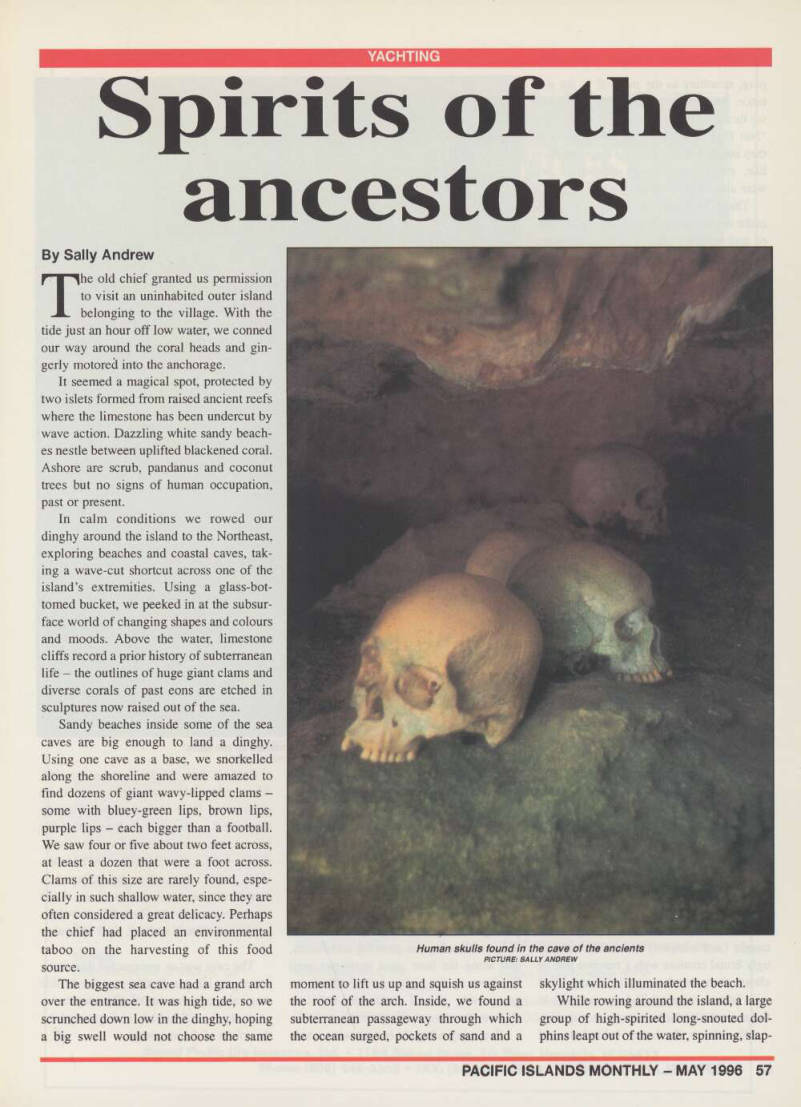
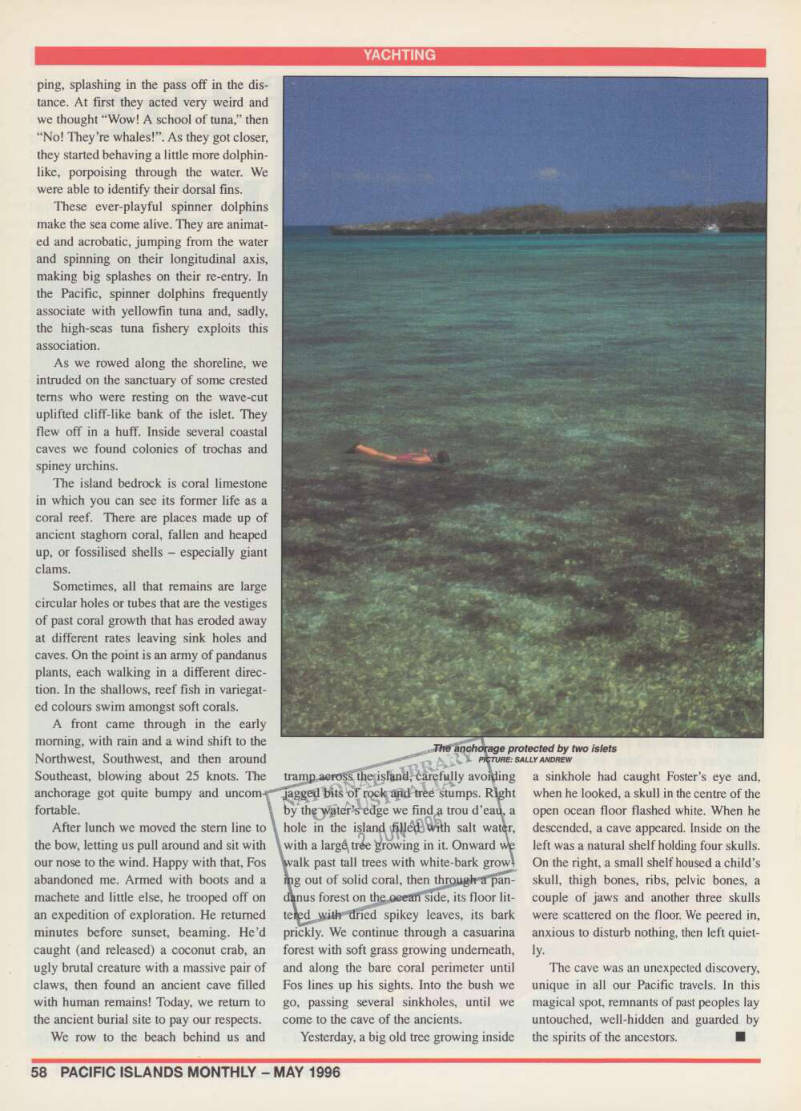
Yachting
Spirits of the ancestors
By Sally Andrew
The old chief granted us permission to visit an uninhabited outer island belonging to the village. With the tide just an hour off low water, we conned our way around the coral heads and gin gerly motored into the anchorage.
It seemed a magical spot, protected by two islets formed from raised ancient reefs where the limestone has been undercut by wave action. Dazzling white sandy beach es nestle between uplifted blackened coral.
Ashore are scrub, pandanus and coconut trees but no signs of human occupation, past or present.
In calm conditions we rowed our dinghy around the island to the Northeast, exploring beaches and coastal caves, tak ing a wave-cut shortcut across one of the island’s extremities. Using a glass-bot tomed bucket, we peeked in at the subsur face world of changing shapes and colours and moods. Above the water, limestone cliffs record a prior history of subterranean life - the outlines of huge giant clams and diverse corals of past eons are etched in sculptures now raised out of the sea.
Sandy beaches inside some of the sea caves are big enough to land a dinghy.
Using one cave as a base, we snorkelled along the shoreline and were amazed to find dozens of giant wavy-lipped clams -
some with bluey-green lips, brown lips,
purple lips - each bigger than a football.
We saw four or five about two feet across, at least a dozen that were a foot across.
Clams of this size are rarely found, espe cially in such shallow water, since they are often considered a great delicacy. Perhaps the chief had placed an environmental taboo on the harvesting of this food source.
The biggest sea cave had a grand arch over the entrance. It was high tide, so we scrunched down low in the dinghy, hoping a big swell would not choose the same
moment to lift us up and squish us against the roof of the arch. Inside, we found a subterranean passageway through which the ocean surged, pockets of sand and a
skylight which illuminated the beach, While rowing around the island, a large group of high-spirited long-snouted dol phins leapt out of the water, spinning, slap
Human skulls found in the cave of the ancients
Picture: Sally Andrew
ping, splashing in the pass off in the dis tance. At first they acted very weird and we thought “Wow! A school of tuna,” then “No! They’re whales!”. As they got closer, they started behaving a little more dolphin like, porpoising through the water. We were able to identify their dorsal fins.
These ever-playful spinner dolphins
make the sea come alive. They are animat ed and acrobatic, jumping from the water and spinning on their longitudinal axis, making big splashes on their re-entry. In
the Pacific, spinner dolphins frequently
associate with yellowfin tuna and, sadly,
the high-seas tuna fishery exploits this
association.
As we rowed along the shoreline, we intruded on the sanctuary of some crested terns who were resting on the wave-cut uplifted cliff-like bank of the islet. They flew off in a huff. Inside several coastal caves we found colonies of trochas and
spiney urchins.
The island bedrock is coral limestone in which you can see its former life as a coral reef. There are places made up of ancient staghorn coral, fallen and heaped up, or fossilised shells - especially giant clams.
Sometimes, all that remains are large circular holes or tubes that are the vestiges of past coral growth that has eroded away at different rates leaving sink holes and caves. On the point is an army of pandanus plants, each walking in a different direc tion. In the shallows, reef fish in variegat ed colours swim amongst soft corals.
A front came through in the early morning, with rain and a wind shift to the Northwest, Southwest, and then around Southeast, blowing about 25 knots. The anchorage got quite bumpy and uncom fortable.
After lunch we moved the stem line to the bow, letting us pull around and sit with our nose to the wind. Happy with that, Fos abandoned me. Armed with boots and a machete and little else, he trooped off on an expedition of exploration. He returned minutes before sunset, beaming. He’d caught (and released) a coconut crab, an ugly brutal creature with a massive pair of claws, then found an ancient cave filled with human remains! Today, we return to the ancient burial site to pay our respects.
We row to the beach behind us and
tramp across the island, carefully avoiding jagged bits-of rock and tree stumps. Right by the we find a trou d’eau, a hole in the island* salt water, with a larg&tr^egrowing in it. Onward we walk past tall trees with white-bark grow\ ipg out of solid coral, then through a pan dknus forest on the oceaffside, its floor lit telpd with dried spikey leaves, its bark prickly. We continue through a casuarina forest with soft grass growing underneath, and along the bare coral perimeter until Fos lines up his sights. Into the bush we go, passing several sinkholes, until we come to the cave of the ancients.
Yesterday, a big old tree growing inside
a sinkhole had caught Foster’s eye and, when he looked, a skull in the centre of the open ocean floor flashed white. When he descended, a cave appeared. Inside on the left was a natural shelf holding four skulls.
On the right, a small shelf housed a child’s skull, thigh bones, ribs, pelvic bones, a couple of jaws and another three skulls were scattered on the floor. We peered in, anxious to disturb nothing, then left quiet ly- The cave was an unexpected discovery, unique in all our Pacific travels. In this magical spot, remnants of past peoples lay untouched, well-hidden and guarded by the spirits of the ancestors. ■
The anchorage protected by two islets
Picture: Sally Andrew
Advertisements & other items, pp. 59-60 (1 item)
I A Lifetime Of Services
10 15 20 25 30 35 40 45 50 55 60
20 30 35 40 45 Grand Pacific Life Insurance offers you a lifetime of safe, secure products at very competitive rates. • * Choose from a full range of products such as
• Super Ordinary Life
• Super Universal • Non-Participating Whole Life • 10-Year Level Term • Flexible Premium Annuities • Group Life Insurance
• IRAs
• Graded Premium Whole Life J % We've been dedicated to providing fast, personalized service for more than 35 years
through local ownership and management. ***l
That's why Grand Pacific Life is your Family for Life ••• throughout the Pacific . - ■ fg*" •• „ lv '• .«*-■ ' ■ : - ' 20 30 40 45 10 15 20 25 30 35 40 45 50 55 60 ©
Grand Pacific Life Insurance, Ltd.
A member of the Finance Factors Family
FEDERATED STATES
OF MICRONESIA
Actouka Executive Insurance Underwriters P.O. Box 55, Kolonia, Pohnpei, Federated States of Micronesia 96941 Pacific Basin Insurance & General Services, Inc P.O. Box 494, Chuuk State, Federated States of Micronesia 96942
TONGA
Peseti Ma'afu Ins. & Finance, Ltd.
Private Bag 2, Taumoepeau Bldg.
Nukualofa, Tonga
GUAM
Great National Insurance Underwriters, Inc.
P.O. Box GA, Agana, Guam 96910
AMERICAN SAMOA
Mark Solofa Pacific Insurance & Finance, Inc.
P.O. Box 3149 Pago Pago, American Samoa 96799 Pacific Financial Corporation P.O. Box AT, Agana, Guam 96910 Takagi & Associates, Inc.
GCIC Bldg., Suite 100 414 W. Soledad Ave.
Agana, Guam 96910
MARSHALL ISLANDS
Marshalls Insurance Agency P.O. Box 113, Majuro, Marshall Islands 96960
WESTERN SAMOA
Mark Solofa Pacific Insurance & Finance, Inc.
P.O. Box 3149 Pago Pago, American Samoa 96799
NORTHERN MARIANAS
Pacific Basin Insurance Underwriters, Inc.
P.O, Box 710 Saipan, Mariana Islands 96950 Pacifica Insurance Underwriters, Inc.
P.O. Box 168, Saipan, Mariana Islands 96950 Grand Pacific Life Insurance, Ltd. *1164 Bishop Street, sth Floor, Honolulu, HI 96813 Phone: (808) 548-3363 • FAX: (808) 548-5122
THE NEW
f / 9
PRIVILEGED CLASS
The Uncompromised Family Sedan
the nu_ NEW
MITSUBISHI
LRNCER
Meet the car that was bom to succeed. With its progressive engineering and striking appearance, the all-new Mitsubishi Lancer advances effectively, impressively... moving ahead at every turn.
Get behind the wheel and experience the new standard in family sedans.
AMERICAN SAMOA: PACIFIC MARKETING INC. P.O. Box 698, Pago Pago, Tel. 699-9140 / AUSTRALIA: MITSUBISHI MOTORS AUSTRALIA LTD. 1284 South Road, Clovelly Park, South Australia, 5042, Tel. (08) 2757297 / FUI: NIVIS MOTOR & MACHINERY CO. LTD. G.P.O. Box 150, Suva, Tel. 383411 / GUAM: TRIPLE J ENTERPRISES INC. P.O. Box 6066, Tamuning, Tel. 6469126 /NEW CALEDONIA: SOCIETE DTMPORTATION D'AUTO DU PACIFIQUE SUD S.A. P.O. Box 2548, Noumea, Tel. 281-787 / NEW ZEALAND: MITSUBISHI MOTORS NEW ZEALAND LTD. Private Bag. Porirua, Tel. 237-0109 / NORFOLK ISLAND: BORRY'S PTY LTD. P.O. Box 169,Taylors Road, Burnt, Tel. 22114 /PAPUA NEW GUINEA: TOBA MOTORS FTY LTD. P.O. Box 503, Port Moresby /SAIPAN: SAIPAN AUTOWORLD INC. P.O.
Box 487, Tel. 234-7133/SOLOMON ISLANDS: HARVEST PACIFIC LTD. G.P.O. Box 823, Honiara, Tel. 30407/ TAHITI: SOPADEP S.A. B.P. 1617, Papeete, Tel. 427393/TONGA: SITANI MAFI CO., LTD.
P.O. Box 83, Nuku'Alofa, Tel. 24044/VANUATU: SOCOMETRA VANUATU LTD. B.P. 6. Port-Vila, Tel. 2314/WESTERN SAMOA: MOTOR DISTRIBUTORS (SAMOA) LTD. P.O. Box 576, Apia, Tel. 20957 A
MITSUBISHI
MOTORS
CREATING TOGETHER