Pacific


Islands
Monthly
INSIDE: AUSTRALIA'S NEW GOVT • IRIAN JAVA ♦ TRIBAL ART MUSEUM
5* .fc VVT**
■lt Ml ™ WWB ■■ HB Hi VU mb HP*'
Ccm kill
American Samoa US$2,5O: Australia A 53.50; Cook Islands NZ$3; Fiji F 52,50 Vat incl; FS Micronesia US$3: Kiribati A 52,50; Nauru A 52.50; Niue NZ$3: Norfolk As 3; New Caledonia cpf2so; New Zealand NZ53.45 incl GST; Northern Marianas US$3; Papua New Guinea K 3: Palau US$3; Marshall Islands US$3; Solomon Islands As 3; French Polynesia cpf3oo; Tonga P 3; USA US$3; Vanuatu VT22O: Western Samoa T 3.25. These are recommended prices only.
SUSTAINABLE DEVELOPMENT ’ FIDEL'S CUBA • NORPLANT • SUPER LEAGUE
Cover by JAMES RANUKU
Advertisements & other items, pp. 2-4 (1 item)
Telikom
Papua New Guinea
IiMM
WM
SfBSS
, * » *"**' ***■ d : I . 4 VI m m u i m
v nniiiiiiiiiiiiiimn
u. * : "i; ~>/.»* n ? ■'%&% * :: h m.
I mmm’ utoiU t»' »• »* {I »•*»•* '**’
H , Telikom has set the pace in providing state-of-the-art telecommunications links within PNG and to anywhere around the world as we enter the 21st Century. For all your telecommunications needs, write to us at this address: Assistant General Manager
Telikom Marketing Department
P.O. Box 291
Waigani, Papua New Guinea
Tel: 675 300 5564 Fax: 675 300 5540
TELIKOM
Hem we'te teaily icU/zUuj,!
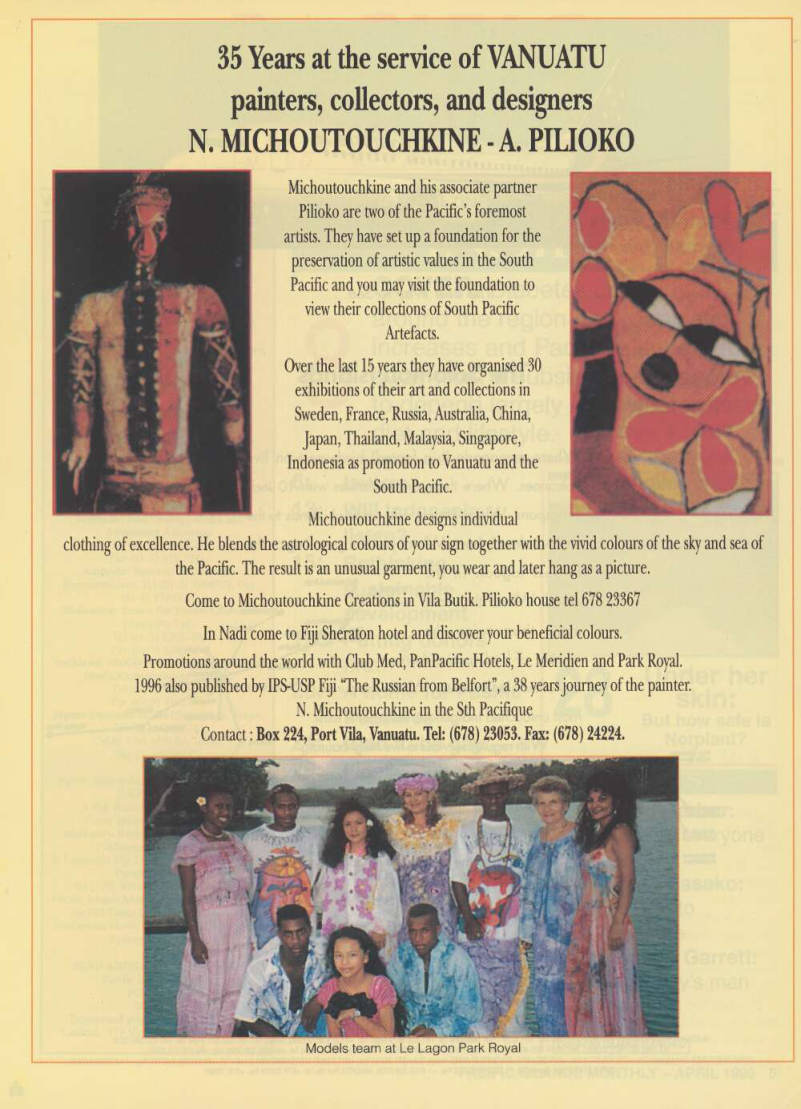
35 Years at the service of VANUATU
painters, collectors, and designers
N. MICHOUTOUCHKINE - A. PILIOKO
Michoutouchkine and his associate partner Pilioko are two of the Pacific’s foremost artists. They have set up a foundation for the preservation of artistic values in the South Pacific and you may visit the foundation to view their collections of South Pacific Artefacts.
Over the last 15 years they have organised 30 exhibitions of their art and collections in Sweden, France, Russia, Australia, China,
Japan, Thailand, Malaysia, Singapore,
Indonesia as promotion to Vanuatu and the South Pacific.
Michoutouchkine designs individual clothing of excellence. He blends the astrological colours of your sign together with the vivid colours of the sky and sea of the Pacific. The result is an unusual garment, you wear and later hang as a picture.
Come to Michoutouchkine Creations in Vila Butik. Pilioko house tel 678 23367 In Nadi come to Fiji Sheraton hotel and discover your beneficial colours.
Promotions around the world with Club Med, Pan Pacific Hotels, Le Meridien and Park Royal. 1996 also published by IPS-USP Fiji “The Russian from Belfort”, a 38 years journey of the painter.
N. Michoutouchkine in the Sth Pacifique Contact: Box 224, Port Vila, Vanuatu. Tel: (678) 23053. Fax: (678) 24224. mm-- S M ss Ih Models team at Le Lagon Park Royal
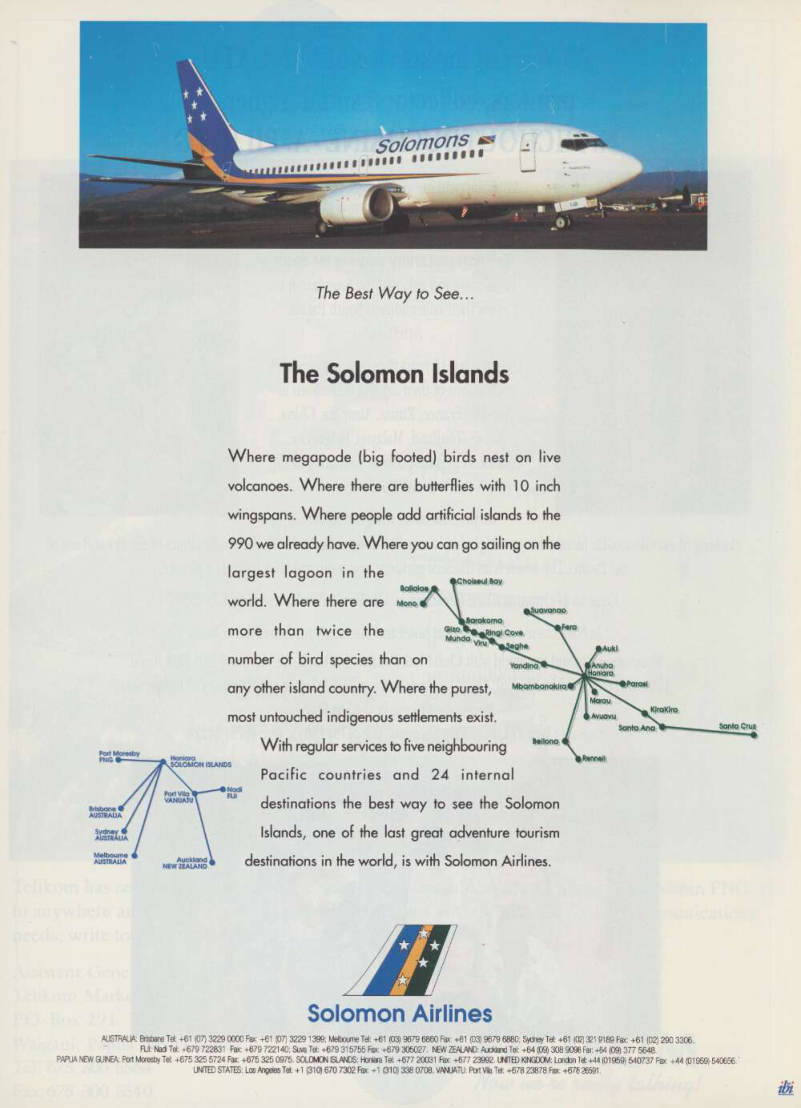
The Best Way to See...
The Solomon Islands
Port Moresby
PNG
Port Vital
VANUATU
Brisbane
AUSTRALIA
Syanev •
AUSTRALIA
Where megapode (big footed) birds nest on live volcanoes. Where there are butterflies with 10 inch wingspans. Where people add artificial islands to the 990 we already have. Where you can go sailing on the
largest lagoon in the
Bollata#
world. Where there are Mono
more than twice the
number of bird species than on
any other island country. Where the purest, Mbambo,^,a
most untouched indigenous settlements exist.
With regular services to five neighbouring B *" ona
Pacific countries and 24 internal
destinations the best way to see the Solomon Islands, one of the last great adventure tourism destinations in the world, is with Solomon Airlines.
I Bay avanao mßarakoma P«ra Viru Z Auki Anuho lonlara Vondlna Potasi Marau ► Avuovu Santa Ana Santa Cfut Rsnneli M
Solomon Airlines
AUSTRALIA: Brisbane Tel: +6l (07) 3229 0000 Fax: +6l (07) 32291399; Melbourne Tel: +6l (03) 9679 6860 Fax: +6l (03) 9679 6880; Sydney Tel: +6l (02) 321 9189 Fax: +6l (02) 290 3306.
FUI: Nadi Tel: +679 722831 Fax: +679 722140; Suva Tel: +679 315755 Fax: +679 305027, NEW ZEALAND: Auckland Tel: +64 (09) 308 9098 Fax: +64 (09) 377 5648, PAPUA NEW GUINEA: Port Moresby Tel: +675 325 5724 Fax: +675 325 0975. SOLOMON ISLANDS: Honiara Tel: +677 20031 Fax: +677 23992, UNITED KINGDOM: London Tel: +44 (01959) 540737 Fax: +44 (01959) 540656, UNITED STATES: Los Angeles Tel: +1 (310) 670 7302 Fax: +1 (310) 338 0708. VANUATU: Port Vila Tel; +678 23878 Fax: +678 26591.
Pacific
Islands
Monthl Y
Vol. 66 No. 4
The News Magazine
April 1996
PUBLISHER: Brian O’Flaherty EDITOR: Debbie Singh SENIOR WRITER: Sophie Foster
Correspondents:
David North, Sam Vulum lan Williams, Liz Thompson, Atama Raganivatu, Wally Hiambohn, Patrick Decloitre, and Chris Peteru COLUMNISTS: David Barber (Wellington), Futa Helu (Tonga), Jemima Garrett (Sydney), Alfred Sasako (The Forum).
Advertising Sales
Regional Sales - South Pacific Ashok Lai, Shailendra Kumar Tel (679) 304111, 303429, Fax (679)303809.
Sydney, Canberra: Bob Hill Media Representation, Tel (61-2) 4164245, Fax (61-2) 4165064.
Brisbane: Jane Fewings Media and Advertising Associates Tel (61-7) 378 4522, Fax (61-7) 878 1071.
Adelaide: Hastwell Williamsons Representatives, Tel (61-8) 3799522, Fax (61-8) 3799735.
Melbourne: Brown Orr Fletcher Burrows (Aust) Pty Ltd.
Tel (61-3) 8265188, Fax (61-3) 8265644.
Auckland: McKay & Bowman, International Media Representatives Limited,- Tel (64-9) 4190561, Fax (64-9) 4192243.
Japan: Universal Media Corporation, Tokyo, Tel (3) 3266626741, Cable: UNI-MEDIA Tokyo, Fax (3) 32626742.
Pacific Islands Monthly was founded 1930
(Usps 9522480).
A Fiji Times Limited production.
Cover prices are recommended retail only. Registered by Australia Post, Publication No. NBPI2IO. © Copyright Fiji Times Limited, 177 Victoria Parade, Suva, Fiji.
Tel (679) 304111, fax (679) 303809.
Pacific Islands Monthly is published monthly by Fiji Times Limited, a division of Nationwide News, 2 Holt Street, Surry Hills, Sydney, NSW 2010.
Send Address Changes To:
Pacific Islands Monthly POBox 1167 Suva, Fiji.
Typeset and printed by The Fiji Times Limited, 177 Victoria Parade, Suva, Fiji.
Inside
COVER: Diabetes climbs high 8 around the region as urbanisation increases and Pacific islanders turn away from a subsistence economy to depend largely on a westernised diet and lifestyle.
6: Letters 13: Will Indonesia listen? 15: Rethinking sustainable development 19: Putting donors first 20: A home for Pacific treasures 24: Glad to be gay 26: Fidel’s Cuba: Island on the brink 42: A decade of change 46: Micronesia’s prospering trust funds 52: Super League fights for survival 57: Yachting
AO Under her
XQ skin:
But how safe is Norplant?
Views
7: David Barber: Keeping everyone happy 22: Alfred Sasako: Reason to celebrate 48: Jemima Garrett: Yesterday’s man no more
Dust to dust
Madam, Deep in the heart of the Awful er Eiffel Tower, the plot to blow up the Rainbow Warrior was being hatched.
The genius in charge of this whole affair was especially chosen for his finesse and methodical planning.
The honour of France was at stake and the General Directorate of External Security (DGSE) had a special task to perform.
After the completion of this assign ment premier Jacques Chirac felt that France’s prestige in the South Pacific had reached an all-time high.
“The Pacific nations must now realise that France’s greatness rests upon the fact that she will go to any lengths in order to impress upon New Zealand and other South Pacific nations the benevolent nature and regal disposi tion of her cause.”
A politician, even an influential one, should not have too many illusions.
Everything returns to dust - Francois Mitterrand, former French President.
Martin Leo
Otahuhu Auckland
Vii
La Justice
For the record
Madam, The article Yunus Rashid wrote (February PIM) from an interview with me needs some corrections. 1. You mentioned that coral is the main export of the Marshall Islands. Do you mean copra? 2. A serious error - you mentioned that “the major shareholder (of the hotel) is a prominent entrepreneur named Jerry Kramer who has other business interests in which some Marshallese have shares.”
It is true that Jerry Kramer is a promi nent entrepreneur, but I did not say that he is a major shareholder in the hotel. He is
the major contractor. Government owns the hotel, and as far as I know, the RMI government has plans to privatise it in the future. 3. You mentioned that the minimum wage is $2.00 in the private sector and $4.50 for government workers. It is true that the minimum wage is $2.00 and that is for both private and government workers.
However, most of the government workers are getting at least $4.50 an hour; well over the minimum wage.
Grant Labaun
Manager! owner G & L Enterprises Majuro Marshall Islands
Other letters
From the Norfolk Islander Not wishing to be seen as one with a ‘personal interest’, I have sat for two years now, awaiting some real action on the agri culture front by our elected ‘leaders’.
There has been some talk but the only real action was a proposal to increase imports even further.
Regardless of the treasurer’s calculator which has the tourist dollar somehow fly ing around the island innumerable times, the argument is valid that if you produce something on the island the majority of the funds will be retained here. You import a product then the majority of the sale price will go off-shore and I don’t mean Philip Island!
Agriculture provides an ideal opportu nity to really recycle the local dollar, but then the island’s budget does not reflect the potential return of this sector.
The forestry budget is quite incredible compared to agriculture (including stock).
Seems the greenies have really hijacked the debate (and bread).
It is the government’s role to initiate policies which assist to smooth out the hollows, not just take the cream off the top.
Ronnobbs
Norfolk Island
Apology
In the February 1996 edition of Pacific Islands Monthly, an article entitled “Woman gets life for hus band’s murder” suggested that the Chief Justice of Vanuatu, Hon.
Charles Vaudin d’lmecourt, lacked objectivity when presiding over the Picchi case.
The publication of these com ments was inappropriate. PIM unre servedly apologises to Chief Justice dTmecourt for any embarrassment or inconvenience these comments may have caused him.
Keeping
Opinion
Keeping everyone happy
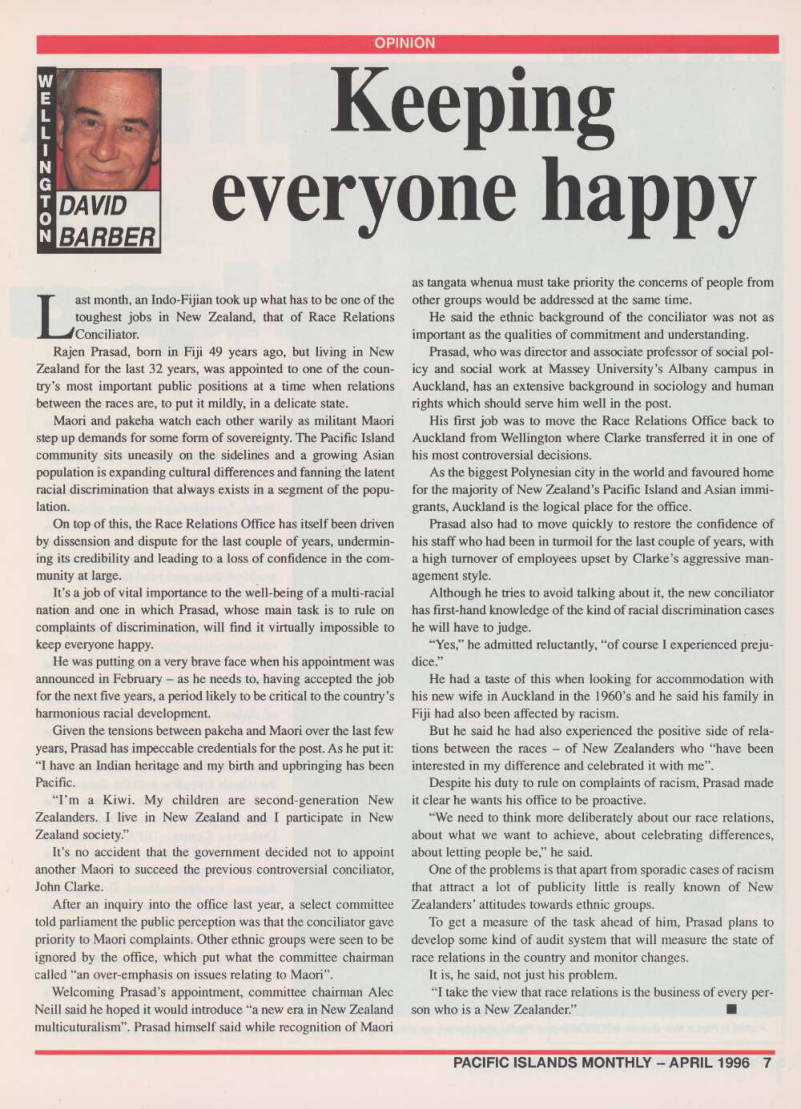
Last month, an Indo-Fijian took up what has to be one of the toughest jobs in New Zealand, that of Race Relations Conciliator.
Rajen Prasad, bom in Fiji 49 years ago, but living in New Zealand for the last 32 years, was appointed to one of the coun try’s most important public positions at a time when relations between the races are, to put it mildly, in a delicate state.
Maori and pakeha watch each other warily as militant Maori step up demands for some form of sovereignty. The Pacific Island community sits uneasily on the sidelines and a growing Asian population is expanding cultural differences and fanning the latent racial discrimination that always exists in a segment of the popu lation.
On top of this, the Race Relations Office has itself been driven by dissension and dispute for the last couple of years, undermin ing its credibility and leading to a loss of confidence in the com
munity at large.
It’s a job of vital importance to the well-being of a multi-racial nation and one in which Prasad, whose main task is to rule on complaints of discrimination, will find it virtually impossible to keep everyone happy.
He was putting on a very brave face when his appointment was announced in February - as he needs to, having accepted the job for the next five years, a period likely to be critical to the country’s harmonious racial development.
Given the tensions between pakeha and Maori over the last few years, Prasad has impeccable credentials for the post. As he put it: “I have an Indian heritage and my birth and upbringing has been Pacific.
“I’m a Kiwi. My children are second-generation New Zealanders. I live in New Zealand and I participate in New
Zealand society.”
It’s no accident that the government decided not to appoint another Maori to succeed the previous controversial conciliator, lohn Clarke.
After an inquiry into the office last year, a select committee told parliament the public perception was that the conciliator gave priority to Maori complaints. Other ethnic groups were seen to be ignored by the office, which put what the committee chairman called “an over-emphasis on issues relating to Maori”.
Welcoming Prasad’s appointment, committee chairman Alec Neill said he hoped it would introduce “a new era in New Zealand multicuturalism”. Prasad himself said while recognition of Maori
as tangata whenua must take priority the concerns of people from other groups would be addressed at the same time.
He said the ethnic background of the conciliator was not as important as the qualities of commitment and understanding.
Prasad, who was director and associate professor of social pol icy and social work at Massey University’s Albany campus in Auckland, has an extensive background in sociology and human rights which should serve him well in the post.
His first job was to move the Race Relations Office back to Auckland from Wellington where Clarke transferred it in one of his most controversial decisions.
As the biggest Polynesian city in the world and favoured home for the majority of New Zealand’s Pacific Island and Asian immi grants, Auckland is the logical place for the office.
Prasad also had to move quickly to restore the confidence of his staff who had been in turmoil for the last couple of years, with a high turnover of employees upset by Clarke’s aggressive man
agement style.
Although he tries to avoid talking about it, the new conciliator has first-hand knowledge of the kind of racial discrimination cases he will have to judge.
“Yes,” he admitted reluctantly, “of course I experienced preju dice.”
He had a taste of this when looking for accommodation with his new wife in Auckland in the 1960’s and he said his family in Fiji had also been affected by racism.
But he said he had also experienced the positive side of rela tions between the races - of New Zealanders who “have been interested in my difference and celebrated it with me”.
Despite his duty to rule on complaints of racism, Prasad made it clear he wants his office to be proactive.
“We need to think more deliberately about our race relations, about what we want to achieve, about celebrating differences, about letting people be,” he said.
One of the problems is that apart from sporadic cases of racism that attract a lot of publicity little is really known of New Zealanders’ attitudes towards ethnic groups.
To get a measure of the task ahead of him, Prasad plans to develop some kind of audit system that will measure the state of race relations in the country and monitor changes.
It is, he said, not just his problem.
“I take the view that race relations is the business of every per son who is a New Zealander.” ■
Wellington
David
Barber
A killer
Cover Stories
A killer in paradise
By Lili Truwai
Thirtty years ago, diabetes was a rela tively unknown medical condition to tthe islander populations through out the S*outh Pacific. Today, the region rates the hughest diabetes prevalence in the world. Am alarming incidence of diabetes with all its various life-threatening compli cations imcluding blindness and amputa tions, comtinues to inform the medical world of tthe urgent need to develop ways of addresssing the problem. Increased mor tality and morbidity associated with the disease is having devastating social and economic consequences in countries which can ill afford the burden. The World Health Organisation and the International Diabetes Federation describe the statistics of diabetes in the Pacific as “epidemic like in magnitude”. Tonga, New Caledonia, Western Samoa, Papua New Guinea, Kiribati and Fiji are just some of the islands grappling with the disease.
Australia’s two leading centres in the field, the Royal Prince Alfred Hospital Diabetes Centre (RPAH) and the International Diabetes Institute with a funding commitment from Australian Agency for International Development (AUSaid) have combined to devise meth ods to tackle the growing diabetes epidem ic. Working with medical staff from the islands, the joint forces are currently work ing on strategies to cany out primary and secondary intervention measures. Fiji’s assistant director of the ministry of health, Vilikesa Rabukawaqa, was amongst sever
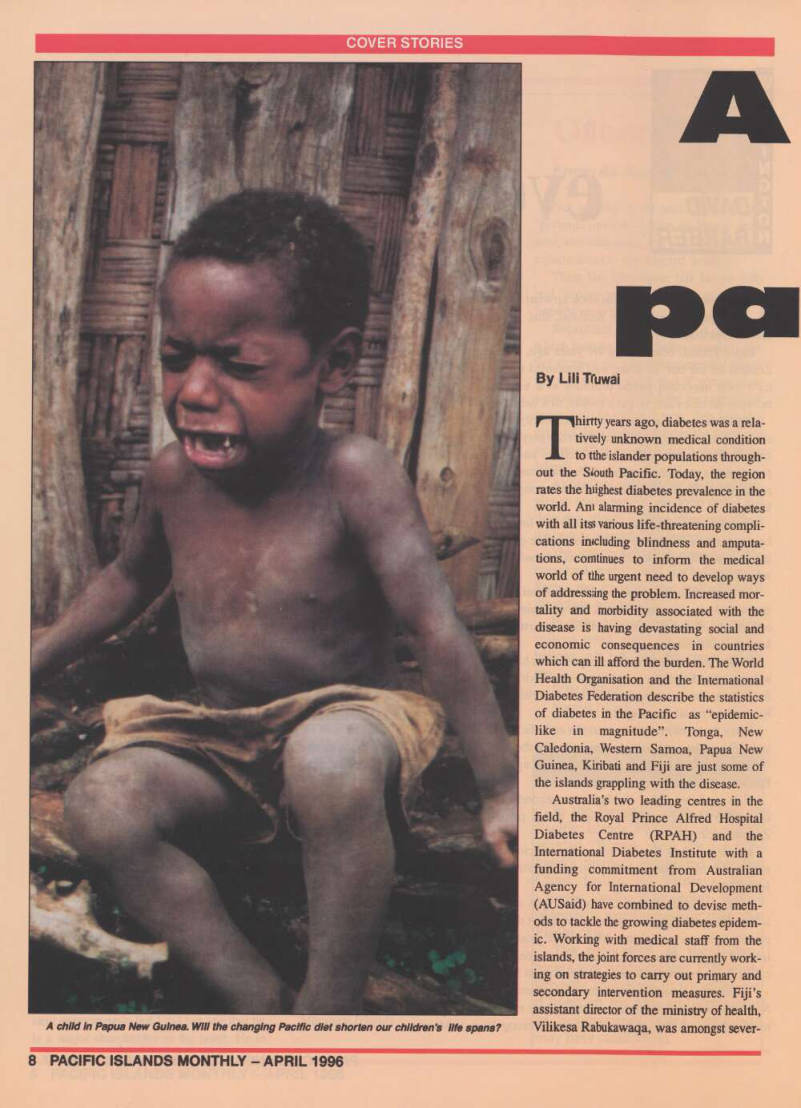
A child In Papua New Guinea. Will the changing Pacific diet shorten our children’s life spans?
al doctors from the Pacific region who met at the RPAH to discuss project develop ments. For almost a decade the Diabetes Centre in Sydney has been working very closely with the diabetes programme in Suva. AUSaid funding will ensure and enable Australia to continue to be support ive through resource provision and collab oration to combat the disease.
“We are at the stage now where the complications or secondary stage of dia betes is very prevalent and taking up a lot of hospital beds which is very expensive.
The situation is self perpetuating. Initially, the population is unaware of the combina tion of early warning signs indicating dia betes - so the diabetic with the foot prob lem or eye problem seeks help very late, usually at the stage where it is difficult to save their eyesight or limb,” says Dr Rabukawaqa.
Currently 10-15 per cent of pregnan cies in the Pacific region are complicated by gestational diabetes. In Fiji alone, over 400 amputations are performed annually for diabetes foot sepsis, at least 50 per cent of which could be prevented by simple education in preventative foot care. The incidence of diabetes amongst the Fijian and Indian population is almost identical but the incidence of Fijians suffering com plications and having limbs removed or becoming blind is about 10 times higher than within the Indian population.
There are a number of important fac tors that contribute to indigenous Fijians experiencing greater complications with the disease. Many Fijians still seek advice
from their traditional healers whose mas sage techniques and natural remedies are often not effective with diabetes. There is a prevailing feeling of mistrust toward the medical profession because of the number of foot amputations which have been per formed over the last 10 years.
“We have found that the population with diabetes has developed the mentality that if you go to the hospital with a foot problem they will take your foot off. It’s got to the stage where this has become a vicious cycle, so we are trying to go in again with secondary intervention and say - these are the signs and if you don’t seek early treatment you might end up with an amputation,” said Dr Rabukawaqa.
As the Pacific increasingly becomes part of the global environment through trade, tourism and economic development, traditional diets and lifestyles are being replaced by westernised food and dietary patterns and less exercise. The traditional hunter-gatherer existence is no longer pos sible for the majority of the population who live in urban centres. The change is a major factor to the development of non insulin dependent diabetes (NIDDM) becoming a major health problem for Fiji and its neighbours.
Traditional foods contain the nutrition al values necessary for the well being of the island populations, while the Western and imported foods being consumed hold less nutrition but are more affordable and readily available. There is also a certain social kudos associated with purchasing westernised foods. “You are supposed to
be ‘someone’ if you are seen to buy these foods or offer them to families and friends during their visits to your home. Families in the islands will offer you tinned fish,
corned beef and rice, rather than the plentiful fresh fish or local greens.
People generally look down on local foods as being inferior to imported foods”, explains George Borugu, a Household Food Security Officer for the South Pacific Commission based in New Caledonia.
Lack of trained medical personnel poses another difficulty for Pacific Island nations. While there is a con scious move by governments to encour age young people to engage in medical studies, too often students leave their islands to attend universities in New Zealand, Australia and the USA and do not return home to practice. Enticed by the West’s higher economic and materi al gains a “brain drain” continues to hin der South Pacific progress.
The islands have long suffered from a
shortage of doctors, nurses and technical personnel. Currently in Fiji an estimated 50 retired doctors have been re-employed while approximately 100 non indigenous
health professionals spread throughout the Fiji Islands make up the bulk of the medical staff, and still medical positions remain vacant. Constant rotation of shifts
and locations in an attempt to balance the shortage often means that staff do not get the opportunity to specialise. As well, patients are not given an opportunity to
build familiar and trusting relationships with medical staff which could ultimately work to allay much of the public suspicion regarding modem medicine.
Interviewed in Sydney for this article, Dr Rabukawaqa identified the priorities that Fiji’s Non-communicable Disease Taskforce intend to focus on in their work on Primary Prevention. The strate gy is to tackle the epidemic as three major issues - diet and nutrition, exer cise, and tobacco. Fiji, as with many of the Pacific Islands, has no tobacco legis lation or restrictions. Aggressive market ing of tobacco by western tobacco com panies into these island nations is increasing the number of tobacco users.
“We hope to have tobacco legislation which will bring about reduction in advertising and some sort of ban on chil dren under the age of 18 being able to buy cigarettes. We need to create an awareness that tobacco is bad. Studies have shown that tobacco causes vascular problems and diabetes causes vascular
restrictions - so if people are diabetic and they smoke, the chances of vascular restriction or stroke are going to be that much higher”. ■
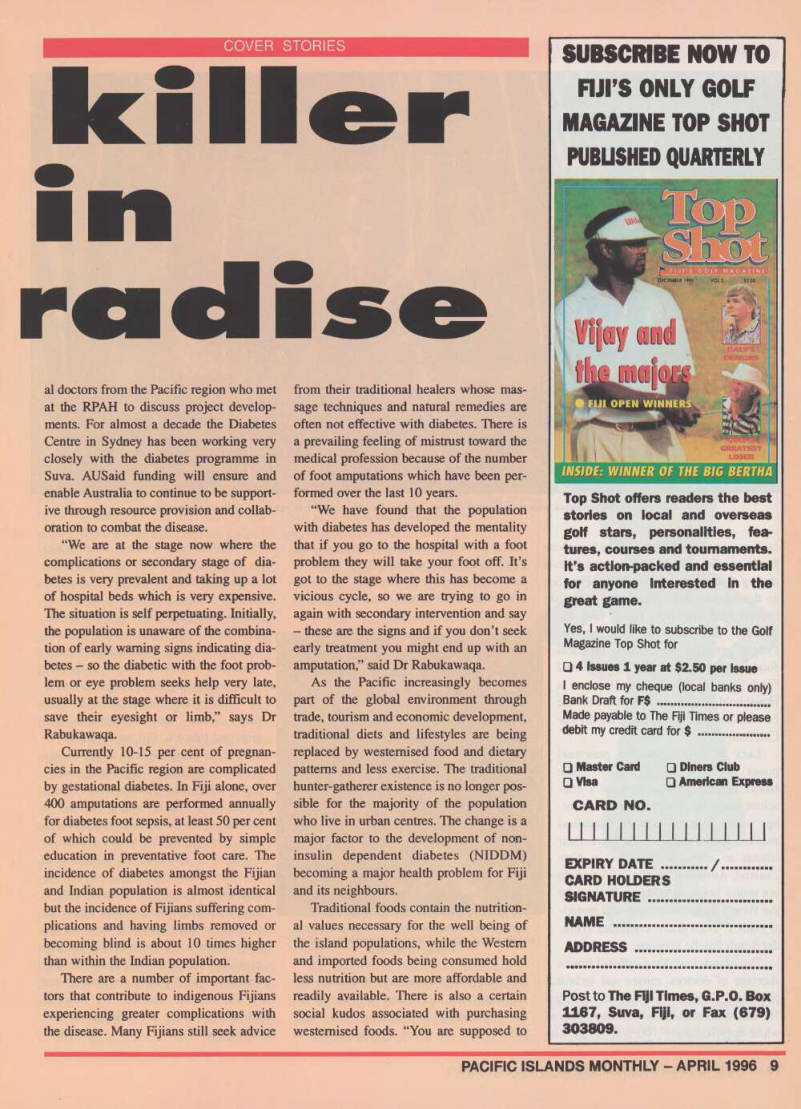
A decreasing dependence on a subsistence lifestyle has led Pacific islanders to eat more high-fat canned food.
Picture: Uz Thompson
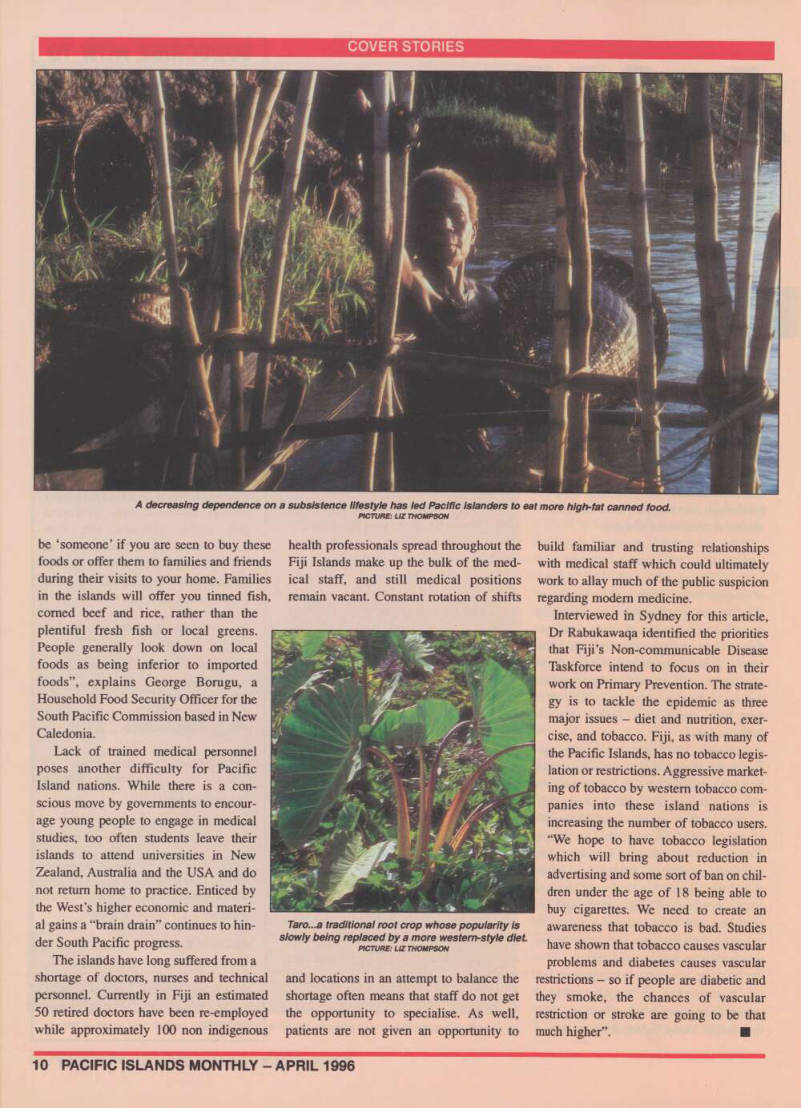
Taro...a traditional root crop whose popularity is slowly being replaced by a more western-style diet.
Picture: Liz Thompson
Advertisements & other items, p. 9 (2 items)
killer
9
COVER STORIES
PACIFIC ISLANDS MONTHLY - APRIL 1996
killer in
Vijay and
SUBSCRIBE NOW TO
FIJI’S ONLY GOLF
MAGAZINE TOP SHOT
PUBLISHED QUARTERLY
mam H 0
Vijay and
r r , I ■ mmmmr.
INSIDE: WINNER OF THE BIG BERTHA
Top Shot offers readers the best stories on local and overseas golf stars, personalities, features, courses and tournaments, it’s action-packed and essential for anyone interested in the great game.
Yes, I would like to subscribe to the Golf Magazine Top Shot for □ 4 Issues 1 year at $2.50 per issue I enclose my cheque (local banks only) Bank Draft for F$ Made payable to The Fiji Times or please debit my credit card for $ Q Master Card Q Diners Club Q Visa □ American Express
CARD NO.
11l I I I I I LLtHUJ
EXPIRY DATE /
CARD HOLDERS
SIGNATURE
NAME
ADDRESS
Post to The Fiji Times, G.P.O. Box 1167, Suva, Fiji, or Fax (679) 303809.
Lifestyle

to die for
By Sophie Foster
Fiji is among the top 10 countries of the world with the highest incidence of diabetes. And over the past decade, there has been an alarming increase in the number of indigenous Fijians developing the condition.
This has been cause for concern among Fiji’s medical professionals who attribute the increase to a high dependence on processed food and a sedentary lifestyle.
According to Fiji’s National Diabetes Centre, the number of Fijians with dia betes increased 25-fold over the 15-year period from 1965 to 1980, and the figure is still rising.
In 1965, 0.6 per cent of indigenous Fijians were diabetic, but by 1980 the fig ure shot up to 15.8 per cent.
Centre head, Dr Margaret Cornelius says indigenous populations have been known to have the highest rates of diabetes in the world.
This is because of the movement away from traditional hunting, farming, and fishing lifestyles.
The Pima Indians in Arizona have the highest rates of diabetes in the world, where half the adult population is diabetic, and the island of Naum follows a close second, where one in three adults suffers from the condition.
Cornelius says the fact that indigenous people are not adapting well to lifestyle changes is cause for concern.
And while the increase should be more noticeable amongst Fiji’s urban indige nous who live away from the farming life, the worrying trend is that Fijians in vil lages, with usually healthy subsistence lifestyles, are also developing high sugar levels.
Taking away the genetic risk involved in developing diabetes, the condition is
caused or influenced by lifestyle changes such as a shift from traditional healthy diets and active living.
Diabetes is a condition where there is too much sugar in the blood, which occurs when there is not enough insulin to break it down into energy. The build-up of sugar is linked to increased consumption levels of high-calorie, low-fibre diets common in the modem-day Fijian household.
Cornelius says use of imported and processed foods such as tinned meat, bis cuits and soft drinks is widespread throughout Fiji and other Pacific Islands.
She says because of the convenience and prestige attached to such items, they are now even available in villages.
Where once people fished and farmed, they now turn to can-openers for their daily meals.
“Pacific people tend to have big appetites, and this would not be a problem if they were still eating locally grown food, but if processed foods are the mainstay of their diets, the direct result will be obesity, diabetes and a host of other complica tions,” she says.
Cornelius says a change in attitudes is necessary if diabetes is to be controlled in Fiji.
On a personal level, there needs to an understanding of the dangers of a diet based on processed food, dependence on alcohol and cigarettes, high stress levels and lack of exercise, she says.
But in a modem society, where people are finding it harder to make ends meet, Cornelius says it is not surprising that cheaper, less nutritional foods are being bought.
She says if local foods are available at a cheaper rate, along with a vigorous educa tion campaign, reverting to traditional foods and healthy diets is possible.
(Continued on page 12)
This Is A
Healthy
Weight
This poster is part of an ongoing awareness campaign by the Fiji National Diabetes Centre to educate the public on the dangers of an unhealthy diet and fat-filled lifestyle
However, Government would have to take responsibili ty for such action, providing incentives for local agricultural projects and increasing duties on less nutritionally-sound products like high-fat lamb flaps.
Cornelius says one in eight adults in Fiji has diabetes, with the same number being placed in the high-risk category for the condition.
She says many people are diabetics but are frightened to have the condition confirmed by medical professionals.
“People in Fiji are very frightened of knowing they are diabetic because they have heard horror stories like if they go to the doctor, their limbs will be amputated.
“But they have to realise that if they do not attempt to control the disease they will die prema turely and suffer in the end,” she says.
Diabetes can remain unde tected for years because the symptoms such as passing lots of urine, feeling very thirsty, feeling weak and tired, and los ing weight are not usually linked to a diabetic condition.
But Cornelius says it is impor tant that diabetes is detected early, so that it can be con trolled.
“People have lived comfortably with diabetes for 50 years with some form of control over it, so it is possible to live a normal and healthy life,” she says.
But, any degree of control whether it be a more active life, or better eating habits, is better than none at all, she says.
If the condition is ignored, many complications can occur, including irreversible damage to the heart, nerves, kidneys, legs and eyes.
In Fiji’s Colonial War Memorial Hospital, 80 per cent of all amputations are diabetes-relat ed.
Seven per cent of all visually impaired people in the country are diabetic. One in four people admitted to Suva’s Coronary Unit for heart attacks have dia betes.
Diabetes has also surpassed hypertension as the second biggest cause of kidney failure.
Cornelius says the responsibili ty for controlling diabetes is placed on the individual who can prevent complications from occurring through a better
understanding of the condition.
Sixteen years ago, 10 per cent of Fiji’s population, or about 20,000 people had diabetes. Today, the figure is estimated at 30,000, with a projection for 48,000 dia betics by the year 2000, according to national statistics.
If Fijians and other Pacific islanders continue to live fast and unhealthy lifestyles, the condition will soon exceed epidemic proportions in the region.
And if diabetes is passed on genetically through people in whom it could have been prevented, there will be a terrible cost for the next generation to pay.
It is a tragedy that such a picture of rampant diabetes is envisioned for indige nous people, who, by adopting another culture’s lifestyle and habits, are killing themselves. ■
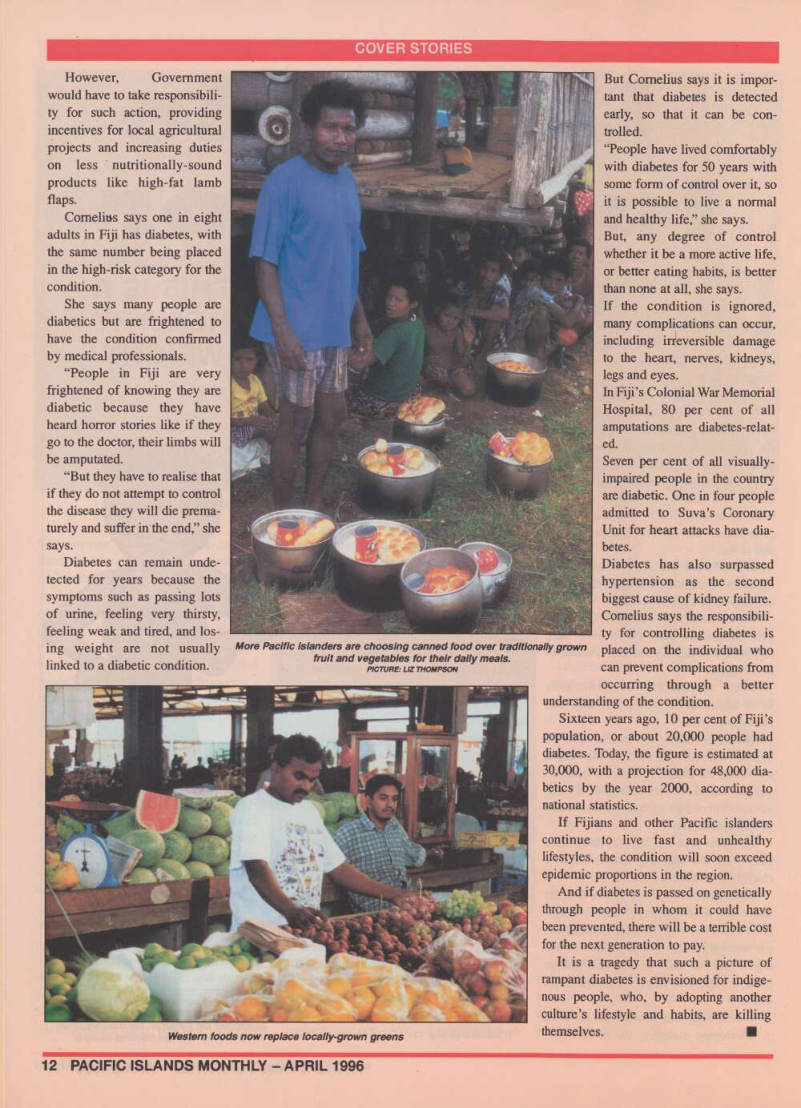
Western foods now replace locally-grown greens
More Pacific islanders are choosing canned food over traditionally grown fruit and vegetables for their daily meals.
Picture: Liz Thompson
Will Indonesia
Region
Will Indonesia listen?
By a Special Correspondent
In the late 70’s and early 80’s, the Indonesian government repeatedly told the world that the Organisasi Papua Merdeka (OPM) or Free West Papua Movement was a spent force.
Given time, it would fizzle out, or so reasoned Jakarta.
Indonesia’s assessment is based on the fact that the resistance movement has no military training and is poorly equipped. It con cludes that there is little hope for anyone surviving the thick, mos quito-infested jungles of what was western New Guinea.
But 20 years on, the Jakarta government has been proven embarrassingly wrong time and time again. Not only has the OPM appeared to have survived, much to the surprise and indig
nation of the Jakarta govern ment, but it has begun to attract international atten tion to the plight of Irian Jaya through its activities, spanning more than three decades. Its “bush” war activities against Indonesian rule in their homeland has intensified.
In recent months, hostage-taking now appears to be number one on OPM’s
political agenda. Foreign
nationals have been hot
favourites. According to the OPM, the more foreign nationals are taken hostage, the better the international exposure for the organ isation fighting on behalf of some one million Melanesian people in Irian Jaya.
For instance, in January this year, the OPM kidnapped 26 civil ians. They included two Britons, two Dutch and one German. The rest were Indonesian nationals. While others have been released unharmed, negotiations were continuing for the release of the remaining 12 including two British, two Dutch and a German.
According to reports filtering through from the capital, Jayapura, a report by the Catholic bishop of Jayapura provided the catalyst for the latest hostage crisis.
In his report, released last July, Bishop Munninghoff, was said to have uncovered widespread human rights abuses and atrocities committed by the Indonesian army against the local West Papua people. There were instances of people mysteriously disappearing almost on a daily basis.
A large number of local people were and are dying from mys terious diseases, especially in 300-kilometre stretch of swamp for-
The bishop’s report was said to have uncovered widespread human rights abuses and atrocities committed by the Indonesian army against the people of West Papua.
est around a huge gold and copper mine operated by Freeport - a United States firm.
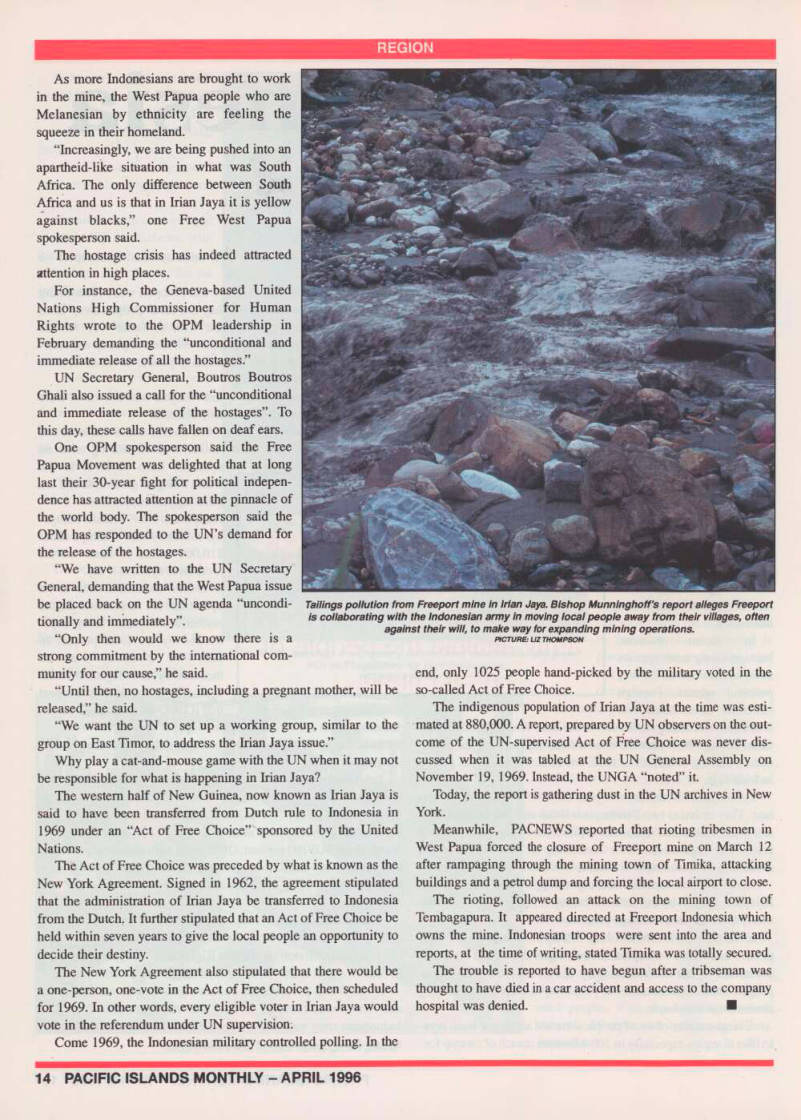
The clergyman’s report alleged that Freeport was collaborating with the Indonesian army moving the local people away from their villages, often against their will, to make way for die expanding mining operations. Those who tried to put up any resis tance were rounded up by the military police, never to be seen again, according to the report.
There was no compensation and villagers who did move, were left to fend for themselves and their children.
The mine is situated at about 4000 metres above sea-level and is located about 90 km from Timika, a small mining town on
southern Irian Jaya. It is the world’s largest gold mine and the third biggest copper mine.
Freeport, a New Orleans compa ny, estimates that it dumps about 110,000 tonnes of waste into the local river systems a day.
It denies chemicals used in its operations are responsible for the
mysterious illnesses being expe
rienced by the local people. In fact, the company was so incensed by the allegations made against it in the Bishop’s report that it took out a full page adver
tisement in the New York Times newspaper recently.
In it, the multi-billion dollar concern dubbed the clergyman’s allegations as lies.
Published reports have stated that Washington has hit out at the company. The United States Overseas Private Investment Corporation (OPIC) - a political risk insurance agency - last November withdrew the mine’s five-year old insurance cover worth about SUSIOO million. OPIC cited environmental problems associated with “acid mine drainage, toxic metals and the mis management of solid and hazardous wastes at the mine site” for its action.
Bishop Munninghoff’s report also struck a chord in another quarter. It prompted the Indonesian government to set up a National Commission on Human Rights to investigate allegations of human rights abuses in Irian Jaya - Indonesia’s 26th province.
It has found evidence of human rights abuses and atrocities and has recommended action for those responsible. The Indonesian army was said to have identified those responsible, but to this day, it has not dealt with them.
As more Indonesians are brought to work in the mine, the West Papua people who are Melanesian by ethnicity are feeling the squeeze in their homeland.
“Increasingly, we are being pushed into an apartheid-like situation in what was South Africa. The only difference between South Africa and us is that in Irian Jaya it is yellow against blacks,” one Free West Papua spokesperson said.
The hostage crisis has indeed attracted attention in high places.
For instance, the Geneva-based United Nations High Commissioner for Human Rights wrote to the OPM leadership in February demanding the “unconditional and immediate release of all the hostages.”
UN Secretary General, Boutros Boutros Ghali also issued a call for the “unconditional and immediate release of the hostages”. To this day, these calls have fallen on deaf ears.
One OPM spokesperson said the Free Papua Movement was delighted that at long last their 30-year fight for political indepen dence has attracted attention at the pinnacle of the world body. The spokesperson said the OPM has responded to the UN’s demand for the release of the hostages.
“We have written to the UN Secretary General, demanding that the West Papua issue be placed back on the UN agenda “uncondi tionally and immediately”.
“Only then would we know there is a strong commitment by the international com munity for our cause,” he said.
“Until then, no hostages, including a pregnant mother, will be released,” he said.
“We want the UN to set up a working group, similar to the group on East Timor, to address the Irian Jaya issue.”
Why play a cat-and-mouse game with the UN when it may not be responsible for what is happening in Irian Jaya?
The western half of New Guinea, now known as Irian Jaya is said to have been transferred from Dutch rule to Indonesia in 1969 under an “Act of Free Choice” sponsored by the United Nations.
The Act of Free Choice was preceded by what is known as the New York Agreement. Signed in 1962, the agreement stipulated that the administration of Irian Jaya be transferred to Indonesia from the Dutch. It further stipulated that an Act of Free Choice be held within seven years to give the local people an opportunity to decide their destiny.
The New York Agreement also stipulated that there would be a one-person, one-vote in the Act of Free Choice, then scheduled for 1969. In other words, every eligible voter in Irian Jaya would vote in the referendum under UN supervision: Come 1969, the Indonesian military controlled polling. In the
end, only 1025 people hand-picked by the military voted in the so-called Act of Free Choice.
The indigenous population of Irian Jaya at the time was esti mated at 880,000. A report, prepared by UN observers on the out come of the UN-supervised Act of Free Choice was never dis cussed when it was tabled at the UN General Assembly on November 19, 1969. Instead, the UNGA “noted” it.
Today, the report is gathering dust in the UN archives in New York.
Meanwhile, PACNEWS reported that rioting tribesmen in West Papua forced the closure of Freeport mine on March 12 after rampaging through the mining town of Timika, attacking buildings and a petrol dump and forcing the local airport to close.
The rioting, followed an attack on the mining town of Tembagapura. It appeared directed at Freeport Indonesia which owns the mine. Indonesian troops were sent into the area and reports, at the time of writing, stated Timika was totally secured.
The trouble is reported to have begun after a tribseman was thought to have died in a car accident and access to the company hospital was denied. ■
Tailings pollution from Freeport mine in Irian Jaya. Bishop Munninghoff’s report alleges Freeport is collaborating with the Indonesian army in moving local people away from their villages, often against their will, to make way for expanding mining operations.
Picture: Liz Thompson
Rethinking sustainable
Environment
Rethinking sustainable development
By Sophie Foster
The idea of sustainable development is one which has been thrown about a lot over the past five years.
Many global conferences have centred around this theme and the hope that this, and many other objectives will be achieved by the year 2000.
But what is sustainable development?
Is it truly something that can be achieved or is it merely an elusive dream?
More importantly, is it just another piece of United Nations jargon which has not been de-my stifled?
Overpopulation, deforestation, extinc tion of species, poverty.
These are some of the warning signs that humans are at a critical point in their relationship with the environment.
The warnings have meant tragic conse quences in some areas of the globe.
United Nations Development Programme Administrator James Speth defines it as the world screaming back at us.
“It is screaming back in hunger, in pain, across the wastelands, and dead waters.
Only the purposefully deaf have not heard it”, he says.
In the Pacific, with its fragile ecosys tems, high population pressure and vast array of political, economic and social conditions, development problems are
gaining prominence.
The Global Conference on the Sustainable Development of Small Island Developing States, held in Barbados in 1994, defines sustainable development as “development that meets present needs without jeopardising the welfare of future generations”.
Peter Hunnam, of the Suva-based World Wide Fund for Nature in the South Pacific, says: “What we need to stress overall in the Pacific is development that is not just eco nomic or ecological, but a combination of all these factors - environmental, econom ic and social”.
UN Human Development Reports con
sistently define the basic objective of development as enlarging people’s choic es.
Essentially, it means providing equal opportunities for all, at a sustainable level, and empowering people to gain from development processes.
But no matter what definition is used, it is clear that to achieve sustainable devel opment, the human element can never be ignored.
And follow-up action by governments and legislators must be consistent to fully implement policies and international con ference resolutions at national level.
Evidence of the sway of international opinion towards a more environmentally friendly development ethos is apparent judging by the response to the 1992 Earth Summit in Rio de Janeiro.
Together, industrialised and developing nations, government and non-govemment representatives called for a change in atti tudes and practices.
At the Earth Summit, a special confer ence was called in recognition of the unique problems facing small island states.
As a result, representatives of 100 island countries met to discuss the topic at the Global Conference for the Sustainable Development of Small Island States in Barbados in 1994.
Considerable attention was placed on issues such as climate change and sea level rise, biodiversity, land use, coastal and marine resources, and tourism develop ment.
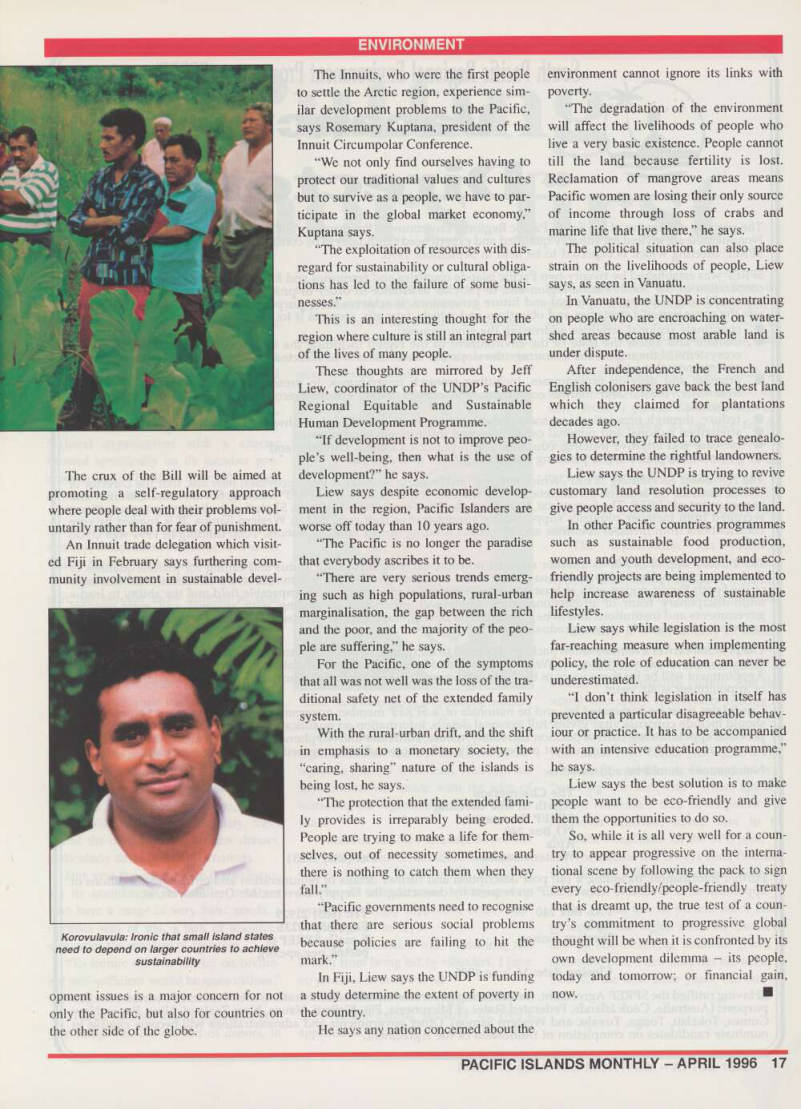
But South Pacific Action Committee for Human Ecology and Environment (SPACHEE) coordinator Isoa Korovulavula says while the Barbados report highlighted the general problems facing island states, it ignored issues which were of highest priority to certain countries.
“Nuclear testing and the right to self determination as part of the sustainable development package is not part of the report because the issues were too politi cally sensitive,” he says.
For a report to receive UN recognition, both developing and industrialised coun tries must agree on its complete text.
“This is despite the fact the report is supposed to be about island states high lighting their pressing concerns,”
Korovulavula says.
“It has been almost two years since the conference, but few island countries have made progress towards the sustainable state idealised in Barbados.
“Pursuing sustainable development to make countries self-reliant and self-deter mining is difficult if the island countries do not have funds to set up institutions and legislation to facilitate the change.
“It is ironic that in order for small island states to become sustainable, they have to depend on industrialised countries to finance their sustainability,”
Korovulavula says.
And this won’t be possible until there is international recognition of serious devel opmental concerns in the Pacific.
Korovulavula says population prob lems in the Pacific tend to be downplayed on the international scene.
“The attitude is like you’ve got to be kidding, look at our populations and you think you’ve got problems in the Pacific.”
Korovulavula says the onus is on Pacific Islanders to take charge of their own destinies.
“The challenge facing governments is to re-evaluate their priorities to see if they are helping the people they profess to serve,” he says.
In line with the outcomes of the Barbados conference, the Fiji government
is currently drafting legislation for a
Sustainable Development Bill.
The Bill is being developed to fulfdl Fiji’s obligations under the Rio and Barbados agreements, and to provide an integrated approach to environmental law making, says Fiji environment ministry
consultant George Deßomilly.
Deßomilly, who is drafting the bill for Government, says there are currently 60
different pieces of legislation dealing with
environmental or health issues which are dealt with by 15 ministries.
This problem is a common feature
throughout the region.
“There is a lot of concern that existing legislation is very sectoral causing tremen dous problems when you’re trying to look at sustainable development because the laws have been developed on a piece-meal or ad-hoc basis,” he says.
A wide consultation process has been used throughout Fiji to determine major concerns of individuals, industry and gov ernment.
Deßomilly says requirements under the bill will be phased in to help people adapt to the new legislation.
“The enforcement and implementation of the bill is a major concern for us, so we’re trying to make sure we’re not plac ing unrealistic targets or expectations which may not be achieved,” he says.
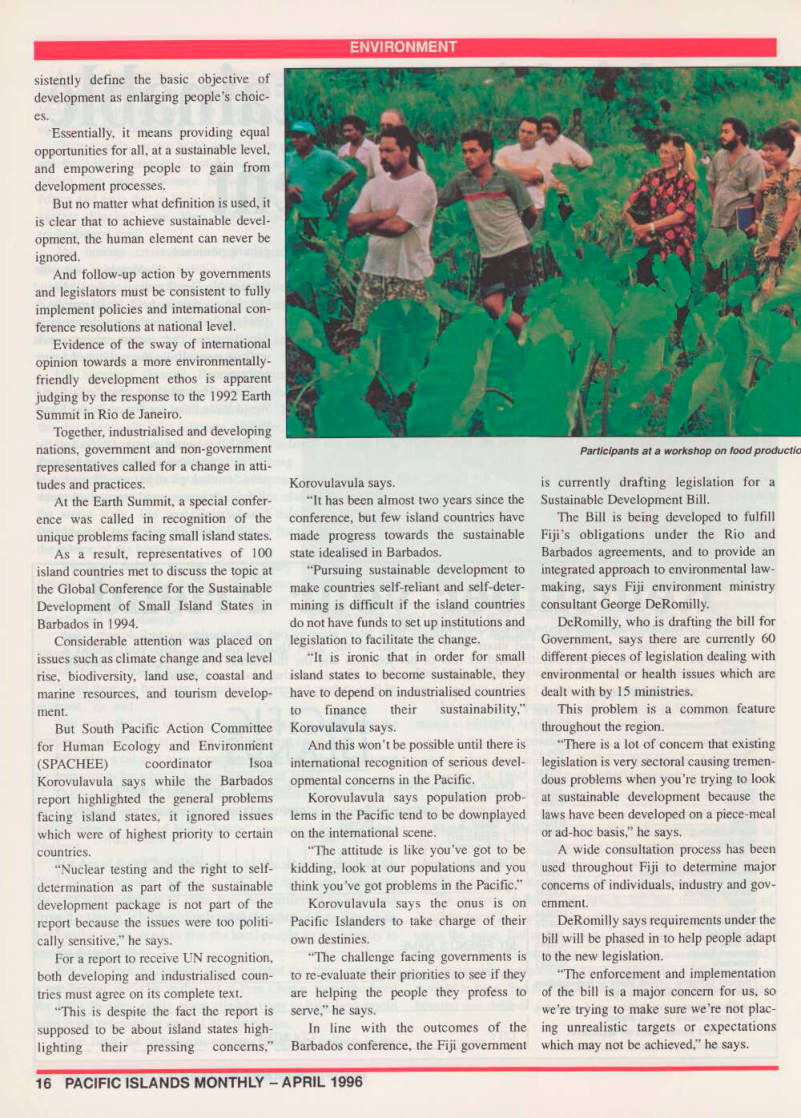
Participants at a workshop on food productio
opment issues is a major concern for not only the Pacific, but also for countries on the other side of the globe.
The Innuits, who were the first people to settle the Arctic region, experience sim ilar development problems to the Pacific, says Rosemary Kuptana, president of the Innuit Circumpolar Conference.
“We not only find ourselves having to protect our traditional values and cultures but to survive as a people, we have to par
ticipate in the global market economy,”
Kuptana says.
“The exploitation of resources with dis regard for sustainability or cultural obliga tions has led to the failure of some busi nesses.”
This is an interesting thought for the region where culture is still an integral part of the lives of many people.
These thoughts are mirrored by Jeff Liew, coordinator of the UNDP’s Pacific
Regional Equitable and Sustainable
Human Development Programme.
“If development is not to improve peo ple’s well-being, then what is the use of development?” he says.
Liew says despite economic develop ment in the region. Pacific Islanders are worse off today than 10 years ago.
“The Pacific is no longer the paradise that everybody ascribes it to be.
“There are very serious trends emerg
ing such as high populations, rural-urban
marginalisation, the gap between the rich and the poor, and the majority of the peo ple are suffering,” he says.
For the Pacific, one of the symptoms that all was not well was the loss of the tra ditional safety net of the extended family system.
With the rural-urban drift, and the shift in emphasis to a monetary society, the “caring, sharing” nature of the islands is being lost, he says.
“The protection that the extended fami
ly provides is irreparably being eroded.
People are trying to make a life for them selves, out of necessity sometimes, and there is nothing to catch them when they fall.”
“Pacific governments need to recognise that there are serious social problems because policies are failing to hit the mark.”
In Fiji, Liew says the UNDP is funding a study determine the extent of poverty in the country.
He says any nation concerned about the
environment cannot ignore its links with poverty.
“The degradation of the environment will affect the livelihoods of people who live a very basic existence. People cannot till the land because fertility is lost.
Reclamation of mangrove areas means Pacific women are losing their only source of income through loss of crabs and marine life that live there,” he says.
The political situation can also place strain on the livelihoods of people, Liew says, as seen in Vanuatu.
In Vanuatu, the UNDP is concentrating on people who are encroaching on water shed areas because most arable land is
under dispute.
After independence, the French and English colonisers gave back the best land which they claimed for plantations decades ago.
However, they failed to trace genealo gies to determine the rightful landowners.
Liew says the UNDP is trying to revive customary land resolution processes to give people access and security to the land.
In other Pacific countries programmes such as sustainable food production, women and youth development, and eco friendly projects are being implemented to help increase awareness of sustainable
lifestyles.
Liew says while legislation is the most
far-reaching measure when implementing
policy, the role of education can never be underestimated.
“I don’t think legislation in itself has
prevented a particular disagreeable behav
iour or practice. It has to be accompanied with an intensive education programme,” he says.
Liew says the best solution is to make people want to be eco-friendly and give them the opportunities to do so.
So, while it is all very well for a coun try to appear progressive on the interna tional scene by following the pack to sign every eco-friendly/people-friendly treaty that is dreamt up, the true test of a coun
try’s commitment to progressive global
thought will be when it is confronted by its own development dilemma - its people, today and tomorrow; or financial gain, now.
The crux of the Bill will be aimed at
promoting a self-regulatory approach
where people deal with their problems vol untarily rather than for fear of punishment.
An Innuit trade delegation which visit ed Fiji in February says furthering com munity involvement in sustainable devel-
Korovulavula: Ironic that small island states need to depend on larger countries to achieve sustainability
Advertisements & other items, pp. 15-18 (1 item)
Remember your Friend
There are times in your life when you feel your fhends have been missing out on something good. Now’s your chance to do something about it and share with them one of the good things you have. Buy your friend a subscription to Pacific Islands Monthly and let him or her join you and the thousands of other people worldwide who are kept informed of the latest political, social and cultural changes taking place in the Pacific.
SUBSCRIPTIONS
American Samoa US$45 Australia A 542.00 Canada US$45 Cook Islands AUSS46 Fiji F 526.40 French Polynesia US$45 Guam US$45 Hawaii US$45 Japan US$45 Kiribati AUSS46 Marshall/Micronesia US$4O Nauru AUSS42 New Caledonia US$32 New Zealand NZ$55 Niue AUSS46 Norfolk Island AUSS42 Northern Marianas/Palau US$4O Papua New Guinea AUSS4S Solomon Islands AUSS46 Tonga AUSS46 Tuvalu AUSS46 United Kingdom Stg Pound2B US Mainland US$45 Vanuatu AUSS4S Western Samoa WS$6O Elsewhere AUSS63 Payment to Pacific Islands Monthly: Subscriptions Dept, GPO Box 1167, Suva, Fiji.
Subscriptions rates include the cost of airspeeding to all destinations set out above.
Direct airmail rates on application.
Telephone; 304111 Fax; 303809
PACIFIC
ISLANDS
Lr I Please send my friend Pacific Islands Monthly for one year (12 issues).
I enclose my cheque for $ (made payable to Pacific Islands Monthly) or debit $ to my: □ Bankcard □ Visacard □ Mastercard Card No: I I I I I I I I I I I I I I I I Expiry Date
NAME
SIGNATURE
MY FRIEND’S NAME,
MY FRIEND'S ADDRESS
CITY
COUNTRY
• 1
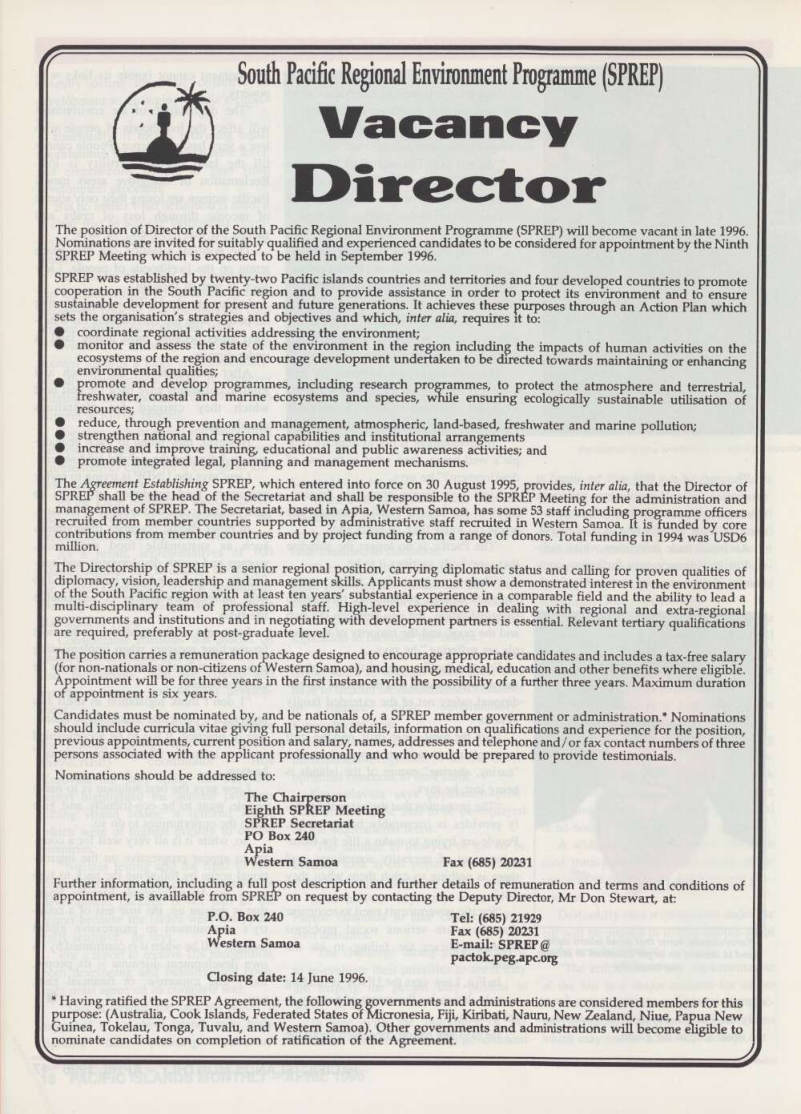
South Pacific Regional Environment Programme (SPREP)
Vacancy
The position of Director of the South Pacific Regional Environment Programme (SPREP) will become vacant in late 1996.
Nominations are invited for suitably qualified and experienced candidates to be considered for appointment by the Ninth SPREP Meeting which is expected to be held in September 1996.
SPREP was established by twenty-two Pacific islands countries and territories and four developed countries to promote cooperation in the South Pacific region and to provide assistance in order to protect its environment and to ensure sustainable development for present and future generations. It achieves these purposes through an Action Plan which sets the organisation's strategies and objectives and which, inter alia, requires it to: • coordinate regional activities addressing the environment; • monitor and assess the state of the environment in the region including the impacts of human activities on the ecosystems of the region and encourage development undertaken to be directed towards maintaining or enhancing environmental qualities; • promote and develop programmes, including research programmes, to protect the atmosphere and terrestrial, freshwater, coastal and marine ecosystems and species, while ensuring ecologically sustainable utilisation of resources; • reduce, through prevention and management, atmospheric, land-based, freshwater and marine pollution; • strengthen national and regional capabilities and institutional arrangements • increase and improve training, educational and public awareness activities; and • promote integrated legal, planning and management mechanisms.
The Agreement Establishing SPREP, which entered into force on 30 August 1995, provides, inter alia, that the Director of SPREP shall be the head of the Secretariat and shall be responsible to the SPREP Meeting for the administration and management of SPREP. The Secretariat, based in Apia, Western Samoa, has some 53 staff including programme officers recruited from member countries supported by administrative staff recruited in Western Samoa. It is funded by core contributions from member countries and by project funding from a range of donors. Total funding in 1994 was USD6 million.
The Directorship of SPREP is a senior regional position, carrying diplomatic status and calling for proven qualities of diplomacy, vision, leadership and management sldlls. Applicants must show a demonstrated interest in the environment of the South Pacific region with at least ten years' substantial experience in a comparable field and the ability to lead a multi-disciplinary team of professional staff. High-level experience in dealing with regional and extra-regional governments and institutions and in negotiating with development partners is essential. Relevant tertiary qualifications are required, preferably at post-graduate level.
The position carries a remuneration package designed to encourage appropriate candidates and includes a tax-free salary (for non-nationals or non-citizens of Western Samoa), and housing, medical, education and other benefits where eligible.
Appointment will be for three years in the first instance with the possibility of a further three years. Maximum duration of appointment is six years.
Candidates must be nominated by, and be nationals of, a SPREP member government or administration.* Nominations should include curricula vitae giving full personal details, information on qualifications and experience for the position, previous appointments, current position and salary, names, addresses and telephone and/or fax contact numbers of three persons associated with the applicant professionally and who would be prepared to provide testimonials.
Nominations should be addressed to:
The Chaiiperson
Eighth SPREP Meeting SPREP Secretariat PO Box 240 Apia Western Samoa Fax (685) 20231 Further information, including a full post description and further details of remuneration and terms and conditions of appointment, is availlable from SPREP on request by contacting the Deputy Director, Mr Don Stewart, at: P.O. Box 240 Tel: (685) 21929 Apia Fax (685) 20231 Western Samoa E-mail: SPREP @
pactok.peg.apc.oig
Closing date: 14 June 1996. • Having ratified the SPREP Agreement, the following governments and administrations are considered members for this purpose: (Australia, Cook Islands, Federated States of Micronesia, Fiji, Kiribati, Nauru, New Zealand, Niue, Papua New Guinea, Tokelau, Tonga, Tuvalu, and Western Samoa). Other governments and administrations will become eligible to nominate candidates on completion of ratification of the Agreement.
Putting
Region
Putting donors first
By Debbie Singh
The next three years will see the South Pacific Commission focus ing on cultivating support from its present donors rather than looking toward new membership.
The SPC, as a Pacific leader in training, research and development is the only regional organisation with a charter focused specifically on its member gov ernments in the Pacific’s three sub-regions of Melanesia, Micronesia and Polynesia.
The countries range in size from Pitcairn Island with its population of 50, to wealthy, independent countries such as the United States, Australia and New Zealand.
Regionally, the question of donor sup port has become more difficult as both governments and non government organi sations compete for scarce resources.
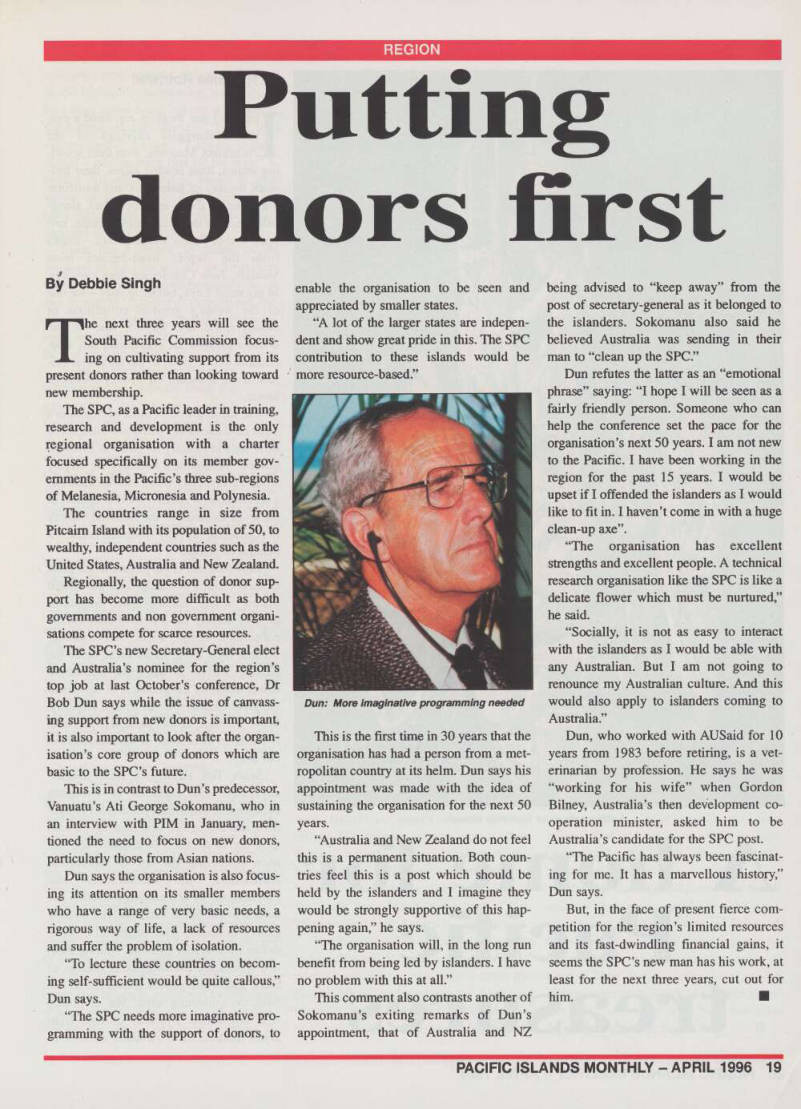
The SPC’s new Secretary-General elect and Australia’s nominee for the region’s top job at last October’s conference. Dr Bob Dun says while the issue of canvass ing support from new donors is important, it is also important to look after the organ isation’s core group of donors which are basic to the SPC’s future.
This is in contrast to Dun’s predecessor, Vanuatu’s Ati George Sokomanu, who in an interview with PIM in January, men tioned the need to focus on new donors, particularly those from Asian nations.
Dun says the organisation is also focus ing its attention on its smaller members who have a range of very basic needs, a rigorous way of life, a lack of resources and suffer the problem of isolation.
“To lecture these countries on becom ing self-sufficient would be quite callous,”
Dun says.
“The SPC needs more imaginative pro gramming with the support of donors, to
enable the organisation to be seen and appreciated by smaller states.
“A lot of the larger states are indepen dent and show great pride in this. The SPC contribution to these islands would be more resource-based.”
This is the first time in 30 years that the organisation has had a person from a met ropolitan country at its helm. Dun says his appointment was made with the idea of sustaining the organisation for the next 50 years.
“Australia and New Zealand do not feel this is a permanent situation. Both coun tries feel this is a post which should be held by the islanders and I imagine they would be strongly supportive of this hap
pening again,” he says.
“The organisation will, in the long run benefit from being led by islanders. I have no problem with this at all.”
This comment also contrasts another of Sokomanu’s exiting remarks of Dun’s appointment, that of Australia and NZ
being advised to “keep away” from the post of secretary-general as it belonged to the islanders. Sokomanu also said he believed Australia was sending in their man to “clean up the SPC.”
Dun refutes the latter as an “emotional phrase” saying: “I hope I will be seen as a fairly friendly person. Someone who can help the conference set the pace for the organisation’s next 50 years. I am not new to the Pacific. I have been working in the region for the past 15 years. I would be upset if I offended the islanders as I would like to fit in. I haven’t come in with a huge clean-up axe”.
“The organisation has excellent strengths and excellent people. A technical research organisation like the SPC is like a delicate flower which must be nurtured,” he said.
“Socially, it is not as easy to interact with the islanders as I would be able with any Australian. But I am not going to renounce my Australian culture. And this would also apply to islanders coming to Australia.”
Dun, who worked with AUSaid for 10 years from 1983 before retiring, is a vet erinarian by profession. He says he was “working for his wife” when Gordon Bilney, Australia’s then development co operation minister, asked him to be Australia’s candidate for the SPC post.
“The Pacific has always been fascinat ing for me. It has a marvellous history,”
Dun says.
But, in the face of present fierce com petition for the region’s limited resources and its fast-dwindling financial gains, it seems the SPC’s new man has his work, at least for the next three years, cut out for him. ■
Dun: More imaginative programming needed
Pacific
The Arts
A home for Pacific treasures
By Nicholas Rothwell
I can still see them in my mind’s eye, the Malanggari carvings of the Australian Museum, with their scowl ing smiles, their beaded glares, their fret work overlay of buttresses that transform into jumping fishes and birds. And, along side them, in the glass display cases, row upon row of Pacific masterpieces - masks from the Sepik, head-dresses from Vanuatu, New Caledonian door carvings.
In my mind’s eye, but there only - for one of the world’s greatest collections of ethnographic art, indeed, one of the world’s greatest art collections full stop, remains out of view, in the curatorial cel lars of the museum on Sydney’s College Street.
The same is true of most of Australia’s other collections of Pacific art: miracles of New Ireland statuary languish in Brisbane unseen. Melbourne’s holdings are largely stowed away. Only trusty old Adelaide has a serviceable, if rather Victorian exhibit of the art of Oceania. In the National Gallery in Canberra, a baby roomlet houses a handful of pieces.
How different is the picture in the great cultural centres of Europe and the United States, where Ethnographic Museums proudly display the jewels of their Pacific collections. Berlin, Paris, St Petersburg, Vienna, New York; in all these cities the passing tourist is beguiled, entranced, struck dumb by the grandeur of the arts of the great Ocean. A considerable disparity.
Why? Perhaps, at this particular juncture, it is time to meet some of the characters in our story.
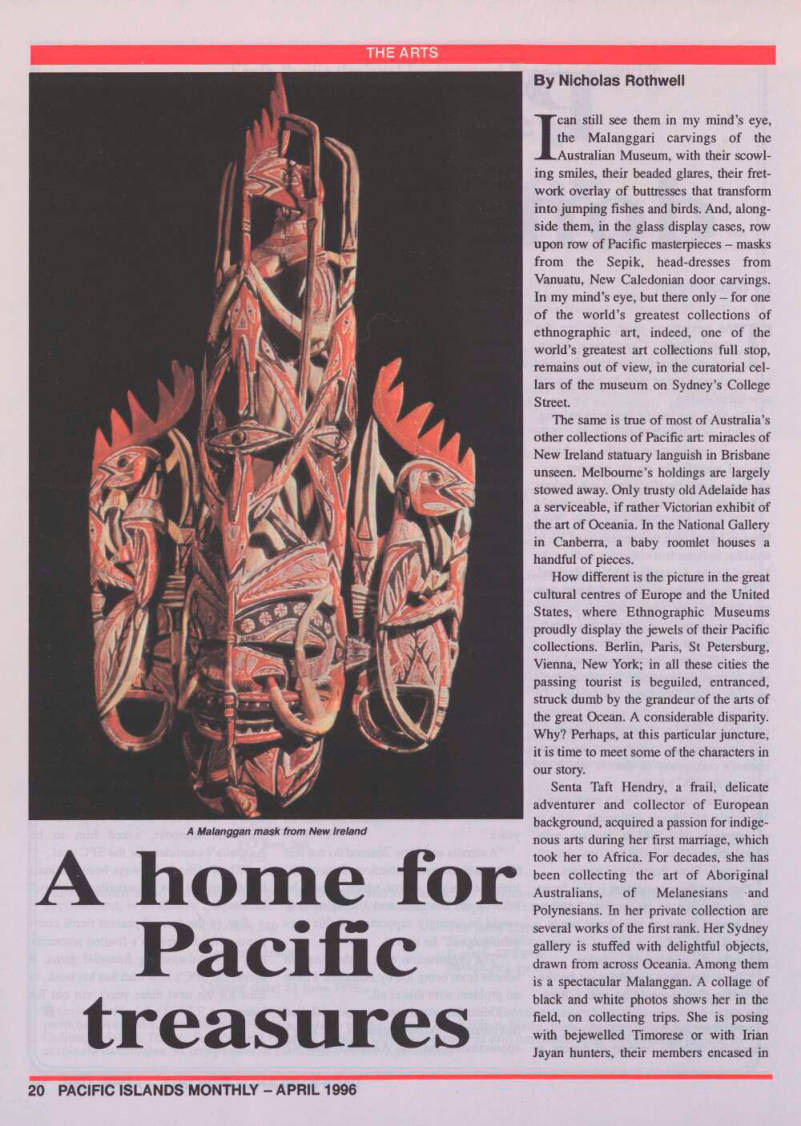
Senta Taft Hendry, a frail, delicate adventurer and collector of European background, acquired a passion for indige nous arts during her first marriage, which took her to Africa. For decades, she has been collecting the art of Aboriginal Australians, of Melanesians and Polynesians. In her private collection are several works of the first rank. Her Sydney gallery is stuffed with delightful objects, drawn from across Oceania. Among them is a spectacular Malanggan. A collage of black and white photos shows her in the field, on collecting trips. She is posing with bejewelled Timorese or with Irian Jayan hunters, their members encased in
A Malanggan mask from New Ireland
enormous penis sheaths. On one occasion, in the highlands, Senta’s leg was pierced by a stray arrow-head, but she still collects the barbed, elegant shafts: “They’re like visiting cards,” she says: “Each one is indi vidual - human bone tips by the way.” A stuffed crocodile, ‘Mitzi,’ hangs in one alcove of her gallery. Bisi poles, Sepik hook figures and Ambrym sit-drums lean propped against the walls.
Senta has a dream: to create, or be involved in the creation of, an Australian i museum of tribal art, bringing together all the treasures dispersed throughout the country. Like many of her fellow-connois seurs of tribal art, she is appalled by the lack of such an institution.
Senta is attempting to drum up support for her scheme from the government bureaucracy, which has itself been lost for some years in the Keating-era project for a new national museum, to be located in
Canberra, with a dedicated Aboriginal wing. But Senta, like several other collec tors, prefers a rather different scheme: a world-class ethnographic museum in Australia; one that would bring together a representative selection of our scattered Pacific treasures under a single roof. She considers that the traditional Aboriginal art could fit into such an institution, and mod em Aboriginal works should remain the preserve of galleries. Others involved in the push for a new tribal arts museum would prefer only Pacific objects to he included; they regard Australia’s Aboriginal art as a separate category, and are aware of the political sensitivities sur rounding the various blueprints for a new national museum in Canberra.
The inspiration for Senta’s idea of a Pacific museum comes from one of the world’s most astonishing collections; the ethnographic museum in Mexico City’s Chapultepec Park, where all the cultures of the pre-Columbian era have been brought together.
So strong is her commitment to her dream that she is prepared to donate her entire house-full of works, and her library of Pacific ethnographic books, to the new museum. Her ideal space would be a large, capacious structure, sufficient to hold gen erous galleries, each with videos explain ing the life-patterns of specific cultures. In
the grounds, dance groups from the Pacific islands could give regular performances.
Where might one find such a building?
Well, Government House, now vacant, would be ideal.
Senta Taft Hendry is not alone in her dreams. Australian lovers of Pacific art are legion, and they are concerned. Last October, a group of them banded together in Sydney, and established an Oceanic Art Society. One of their principal concerns was, of course, the lack of Pacific art on public display.
The Australian Museum, probably the most internationally renowned of our museums, carries the dual responsibility of
“There’s not enough Pacific art on view.”
showing natural history and anthropologi cal collections. But, no matter how you dress things up, it is the Australian Museum’s policies that are being called in question by the very formation of the Oceanic Art Society. Last month, the Society, which had been told ‘sotto voce’ by Museum sources that it would be lucky to attract more than 25 backers, had a membership of 125 individuals, including artists, collectors and academics from sev eral states and from overseas. In essence, they want a new museum devoted to Oceania.
Their perspective is that Pacific art is the sublime pinnacle of tribal art and that it has been critically important in the history of western modernism - Henry Moore, for instance, was inspired by the Malanggan figures, Picasso looked long and hard at New Hebridean masks. Andre Breton owned Uli statues, among many other Pacific pieces. Where modernist art begins, there, with uncanny regularity, lurks a Pacific art exposition or a visit to the South Seas. Much of the best of this tribal art work is in Australia - and unseen.
The Society held a function last month to launch a lavish, and landmark publica tion: ‘Oceanic Art,’ a two-volume affair, by French-bom anthropologist Anthony Meyer. It brings together 800 illustrations of striking works, 40 per cent of which are
in Australia, mostly in museum deposito ries. A 100-piece loan exhibition from the Australian Museum is currently being pre pared, for dispatch, it is hoped, to the New York Metropolitan Museum - still the world’s top venue for art speculators - and will then travel through the United States.
It remains unsure whether it will receive an Australian showing.
“Of course it’s true! There’s not enough Pacific art on view!” In the director’s office of the Australian Museum, Des Griffin is typically forthright.
In Griffin’s time at the helm, there have been three major exhibitions at the Australian Museum of Pacific region art: one Maori, one from the Abelam
culture area of Papua New Guinea, and, above all, the spectacular pan- Melanesian survey, ‘Pieces of Paradise.’
“If you look at the reception given to them, it’s fair to say” - and he
does say - “that Australians have a lot of difficulty in understanding Asian and Pacific cultures. You see, ‘Pieces of Paradise’ was absolutely stunning, but not a lot of people came.”
It is Griffin’s impression that people don’t relate strongly to Pacific material, and do tend to think of it as ‘primitive’.
Partly because of this, he regards the push for a separate Pacific cultures museum as ‘nuts’. His chief reason, though, is that he believes stripping out the various elements from a museum removes the responsibility that museum has to represent, in rotating shows, the diversity of its collections, and of the population it serves.
Griffin is literally squeezed for space. A director must find a way to balance priori ties: and the Australian Museum is cur rently readying an Aboriginal art display which will be, quite simply, the most important of its kind in the world. In these circumstances the Pacific, however lovely, comes down the list.
And the Malanggan figures? The Sepik masks with drooping eyes? The wild, over modelled skulls from Vanuatu? What of them, as they wait, in their resting-places, unknown, like so many unsung spells of magic? They survive, of course, in the imaginations of those who have seen them.
But there are many who have not seen them, and cannot be beguiled. ■
celebrate
Opinion
Reason to celebrate
The Pacific peoples and those who stood with them against French nuclear testing in the South Pacific over the past three decades should be proud of a job well done.
France announced on January 29, a “definitive” end to its controversial nuclear testing programme at Mururoa and Fangataufa Atolls.
In consultation with the Americans and the British, Paris announced immediately afterward it was ready to sign the Protocols to the South Pacific Nuclear Free Zone Treaty (SPNFZ), also known as the Rarotonga Treaty.
The Americans and British also con firmed a commitment, announced earlier, that they would jointly sign with the French.
All three major nuclear powers were due to sign the relevant Protocols (1,2 and 3) at a ceremony to be held at the South Pacific Fomm Secretariat headquarters in Suva at a date being finalised.
The signing is historic. It marks a mile stone in almost three decades of a vigorous and an untiring campaign spearheaded by the South Pacific Fomm against nuclear weapons development and, in particular.
the use of the Pacific for testing its weapons of mass destruction.
The anti-nuclear campaign is as old as the South Pacific Forum itself. It was first discussed by the South Pacific Forum’s seven founding members - Australia, the Cook Islands, Fiji, Naum, New Zealand, Tonga and Western Samoa - at their inau gural meeting held in Wellington on August 5-7, 1971.
A communique issued after the meet ing condemned the then prevailing French atmospheric tests at Mururoa and called on Paris to cease the practice immediately.
France did not.
However, support by other nuclear weapons states forced Paris to switch to underground testing that year. The issue has since “graced” the agenda of every subsequent summit of the South Pacific Forum. The anti-nuclear campaign by the South Pacific Forum included letters by successive Fomm Chairs to the major nuclear weapons states such as France, the People’s Republic of China, the former Soviet Union, the United Kingdom and the United States of America, urging them to sign and ratify the South Pacific Nuclear Free Zone Treaty.
In 1992, the South Pacific Fomm was
relieved when France announced a unilat eral moratorium on its nuclear testing pro gramme in the South Pacific.
But the announcement was short-lived.
About three years on, Gaulist President Jacques Chirac reversed the decision, announcing that France would resume testing in a bid to perfect its nuclear arse nal.
Chirac’s announcement to resume nuclear testing in the South Pacific ignited anger and storms of protests worldwide.
Anti-nuclear rallies and rock concerts were organised to drum up support against French testing in the South Pacific. It was a people’s campaign that touched every one far and wide. The world had never been so united in one cause.
Despite the growing international opposition, the French nuclear test went ahead. The first blast was detonated on Mururoa on September 6, as leaders of the 16-member South Pacific Forum were on their way to Madang, on Papua New Guinea’s northern coast, for their annual summit.
In response, the South Pacific Forum issued a warning that if France did not stop the nuclear test series immediately, its sta tus as a Post-Forum Dialogue Parmer
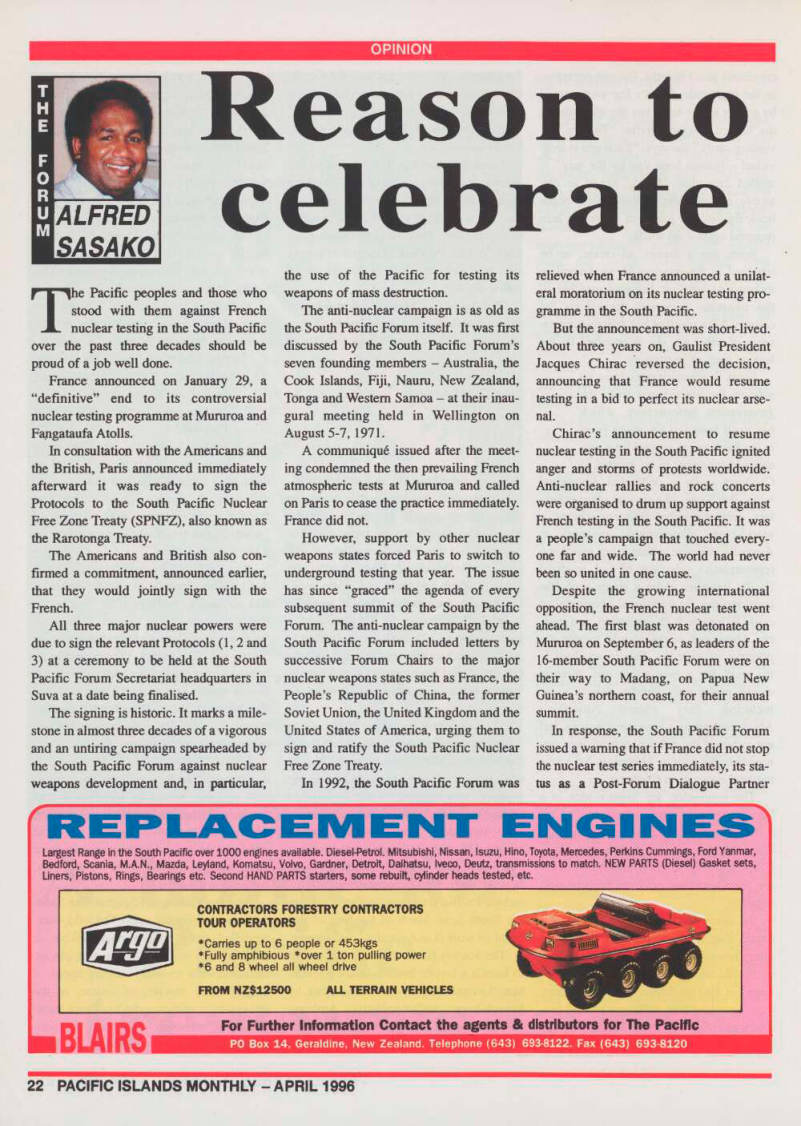
The Forum
Alfred
Sasako
would be reviewed.
France took the warning lightly and on October 2, set off another blast. It was the last straw on the camel’s back. The Chair of South Pacific Forum and Prime Minister of Papua New Guinea, Sir Julius Chan announced to a packed United Nations General Assembly (UNGA) gath ering in New York that France’s status as Post-Forum Dialogue Partner was sus pended forthwith.
In the meantime, the anti-nuclear cam paign continued, including a flotilla head ed by the environmental movement Greenpeace that sailed to Mururoa in a desperate attempt to block further tests.
International condemnation flowed freely, prompting the UNGA to vote against nuclear testing and urging immediate ces sation.
On January 29, this year, President Chirac announced that his government was calling off the nuclear test series several months early, describing the sixth and final blast as “a definitive” end to its nuclear testing programme.
While this was good news, irreparable damage may have been done to the coral structure of Mururoa and Fangataufa and to the environment. This is now the subject of a radiological study by a team of inter national scientists.
Australia and New Zealand will partic ipate in the study, along with Dr Vili Fuavao, Director of the South Pacific Regional Environment Programme (SPREP) who will represent the South Pacific Forum on an International Advisory Committee (lAC). The lAC will advise on the terms of reference for the study to be supervised by the Vienna based International Atomic Energy Agency (lAEA).
The immediate task, it seems, for all like-minded people, is to ensure the study results in instituting a thorough and exten sive clean-up programme for both Mururoa and Fangataufa with a long-term monitoring of the environment there.
With all the differences behind us, it is our hope that the signing of the Protocol to the SPNFZ gives birth to a new era, an era for mutual respect and understanding.
Pacific nations cannot defend them selves in the event of an armed attack, nuclear or otherwise. Their protection is
provided for in international nuclear treaties.
In this case, the Pacific’s hope to live peacefully in a nuclear-free environment is embodied in the South Pacific Nuclear Free Zone Treaty (SPNFZ) which the peo ple’s Republic of China and the former Soviet Union have signed and ratified.
Adding the signatures of France, the United Kingdom and the United States of America to the SPNFZ Treaty Protocols is a huge achievement. It fulfils a long-term objective of the South Pacific Forum. We trust that France, Britain and the United States will honour the letter of the three Protocols, which are very specific.
For instance, under Protocol 1, signato ries (the nuclear weapon states) undertake not to manufacture, station and test within territories within the zone; Signatories (nuclear weapon states) of Protocol 2 undertake not to use or threaten to use any nuclear device against Parties or any territory within the zone, and under Protocol 3 signatories (nuclear weapon states) undertake not to conduct nuclear tests anywhere in the zone.
The signing will give the Rarotonga Treaty the international recognition it deserves and will illustrate a fine example of what we want the world to be. Once the signing is behind us, world attention and energy should and must focus on the cur
rent CTBT negotiations to ensure a truly comprehensive treaty is concluded later this year.
South East Asia must have seen the value of the SPNFZ Treaty, in that, it too has established its own nuclear free zone.
Ten countries signed that treaty last December and the French President in a recent visit to Thailand pledged French support for it.
Our success in achieving a nuclear-free zone in the Pacific has been the result of a collective effort at the political, non-gov ernmental and grassroots levels. To those who stood with us in opposing nuclear testing in the region, we can only say, thank you.
But our task is not over yet. We want a truly Comprehensive Test Ban Treaty (CTBT) concluded by the end of this year, or earlier. No effort should be spared until we achieve a true CTBT as we did in the
campaign against French nuclear testing in
the Pacific.
For now, though, perhaps January 29 should be declared a Pacific Day to be
observed as public holiday throughout the
region. We can tell the next generation that January 29 is the day the South Pacific Forum realised its long-term objective of an end to nuclear testing in the South Pacific. ■
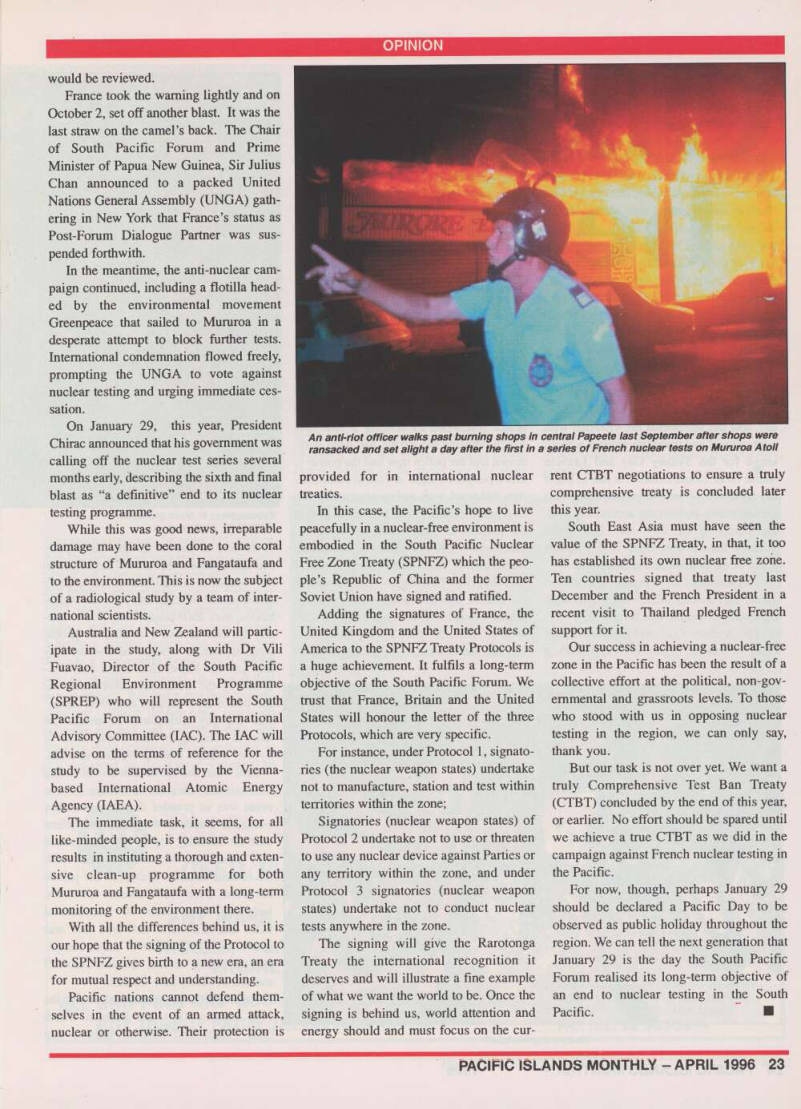
An anti-riot officer walks past burning shops in central Papeete last September after shops were ransacked and set alight a day after the first in a series of French nuclear tests on Mururoa Atoll
Advertisements & other items, pp. 22-23 (2 items)
■Blairs
Largest Range in the South Pacific over 1000 engines available. Diesel-Petrol. Mitsubishi, Nissan, Isuzu, Hino, Toyota, Mercedes, Perkins Cummings, Ford Yanmar, Bedford, Scania, M.A.N., Mazda, Leyland, Komatsu, Volvo, Gardner, Detroit, Daihatsu, Iveco, Deutz, transmissions to match. NEW PARTS (Diesel) Gasket sets, Liners, Pistons, Rings, Bearings etc. Second HAND PARTS starters, some rebuilt, cylinder heads tested, etc.
II
CONTRACTORS FORESTRY CONTRACTORS
TOUR OPERATORS
♦Carries up to 6 people or 453kgs ♦Fully amphibious ♦over 1 ton pulling power ♦6 and 8 wheel all wheel drive
FROM NZ$l25OO ALL TERRAIN VEHICLES
■BLAIRS
For Further Information Contact the agents & distributors for The Pacific PO Box 14. Geraldine, New Zealand. Telephone (643) 693-8122. Fax (643) 693-8120
23
OPINION
PACIFIO ISLANDS MONTHLY - APRIL 1996
be gay
Event
Glad to be gay
By Liz Thompson
For a week in March, Oxford Street in Sydney is unusually crowded.
The cafe’s and bars are all full, all day, and the pavements are crowded with international and interstate visitors who all arrive for the Sydney Gay and Lesbian Mardi Gras. Hours before it is due to begin the hundreds of people participating start getting ready, converging around the start ing points in the city. As one walks through the crowds there is a palpable sense of excitement and anticipation.
Preparations for the event began almost a year ago and the March night was what thousands of people had waited for.
The Sydney Gay and Lesbian Mardi Gras officially began in 1978 with a
protest march by gay rights activists. The protesters stood outside a police station and began to shout “Stop police attacks on gays, women and blacks.” Although the organisers had been granted a permit, the police responded by reading a statement which declared the permit had been with drawn and the police now had the power to arrest people on sight. A violent confronta tion followed with police repeatedly hit ting many of those who had taken part in the parade, 53 people were arrested and later another 100 who protested against the initial arrests. At this time, homosexuality was illegal in New South Wales although lesbianism was not. Somewhat ironically, this key event was the beginning of what was to become the Sydney Gay and Lesbian Mardi Gras, now the biggest event
of its kind in the world. The dance party that takes place afterwards is the largest in the Southern Hemisphere. In today’s event, parade officials use over 120 walkie talkies, over 2000 barriers are used to con tain the crowds and over 500,000 people come to watch. Today, the Sydney Gay and Lesbian Mardi Gras is not only con doned by the Australian government, but the police now support and work along side the gay community to ensure the smooth running of the event. One of Sydney’s major roads is closed overnight.
Last year, the Australian Broadcasting Commission-televised coverage of the event was so popular that this year they wanted to broadcast the parade live, prime time on Saturday night. The only reason they didn’t was because it clashed with the federal election. This year, the parade attracted over 350 media members, including crews from 40 international radio and television networks and was sponsored by a number of major compa nies including Telstra, Qantas, Smirnoff and the South Sydney Council.
An impact study conducted during the 1993 Sydney Gay and Lesbian Mardi Gras Parade and Festival showed that
Modern day Medusa?
Extravaganza In black and white.
PICTURES: Liz Thompson
Tasmania. In this year’s parade there were 166 floats or organised groups. Many of them were simply good fun, men with huge hats made of tennis balls, a woman dressed as a giant carrot, others on stilts, dressed as butterflies and fairies with magic wands. Men in black leather, dykes on bikes, body paint, hugely ornate cos tumes of glitter, gold, flowers and feathers.
Others carried messages which read “Everyone’s Business”, a group of Aboriginal gay and lesbian men and women carried an Aboriginal flag. The haunting “Remembrance Entry” was a 25metre long red ribbon carried by about 50 people whilst others carried red flares, remembering the many people who have died from HIV/AIDS. As the red ribbon moved up Oxford Street, light buildings were dimmed and music stopped. Parents and friends of lesbians and gays walked, one middle-aged woman wearing a small backpack held her young gay sons hands as they walked up the street together, their
pride said something about what the whole parade symbolises. It is a superbly organ ised and brilliantly orchestrated night, with the parade ending at the Horden pavilion, the location for an all night dance party for members of the gay and lesbian communi ty and their friends. Every year the party is sold out months before the event. This year 19,000 people danced until dawn. A limit ed number of media passes were handed out for the parade as the Sydney Gay and Lesbian Mardi Gras Committee were emphatic the event not become a parade for the media but continue to be a parade for the community.
It seems somewhat ironic that the protest march designed to'fight for the equal rights of gay and lesbian men and women who had been legally ostracised from the rest of society, has now evolved into a mardi gras which brings the Sydney community together to celebrate and share in a spectacle of life, colour, humour and goodwill. ■
international visitors brought $15 million into the Australian national economy that would not otherwise have come here, and that related expenditure, during February 1993, injected $38 million into the South Sydney and City of Sydney council areas.
Initially a protest march, the parade has become a community event which, whilst not as overtly political as the initial demonstration, still has a message to com municate. Whilst things have improved radically for gay and lesbian people, the struggle does continue. Homosexuality is still outlawed by the state government in
The lady in red
Advertisements & other items, p. 25 (2 items)
25
EVENT
PACIFIC ISLANDS
Trust Company Ltd
USED JAPANESE VEHICLES
ANY MAKE, MODEL, YEAR
* TRUCKS, * CARS, * TRACTORS,
* ENGINE AND TYRES
ALL SHIPPING AND DOCUMENTATION ARRANGED,
BUY DIRECT FROM JAPAN AND SAVE.
r
CONTACT”
Trust Company Ltd
KOBAC BLD 3F 3-2-26 NISHIKI,
NAKAU NAGOYA, 460 JAPAN.
PHONE: (81) 52 953-5602
FAX (81) 52 953-5634
Fidel’s Cuba:
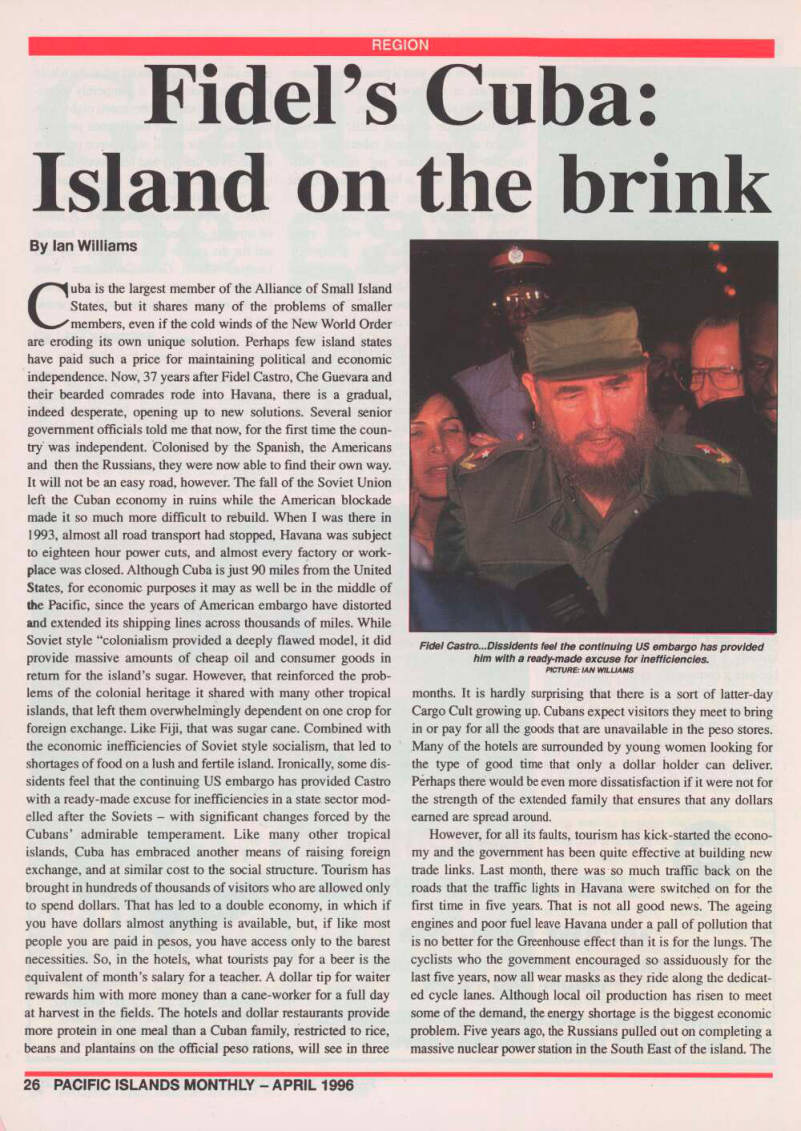
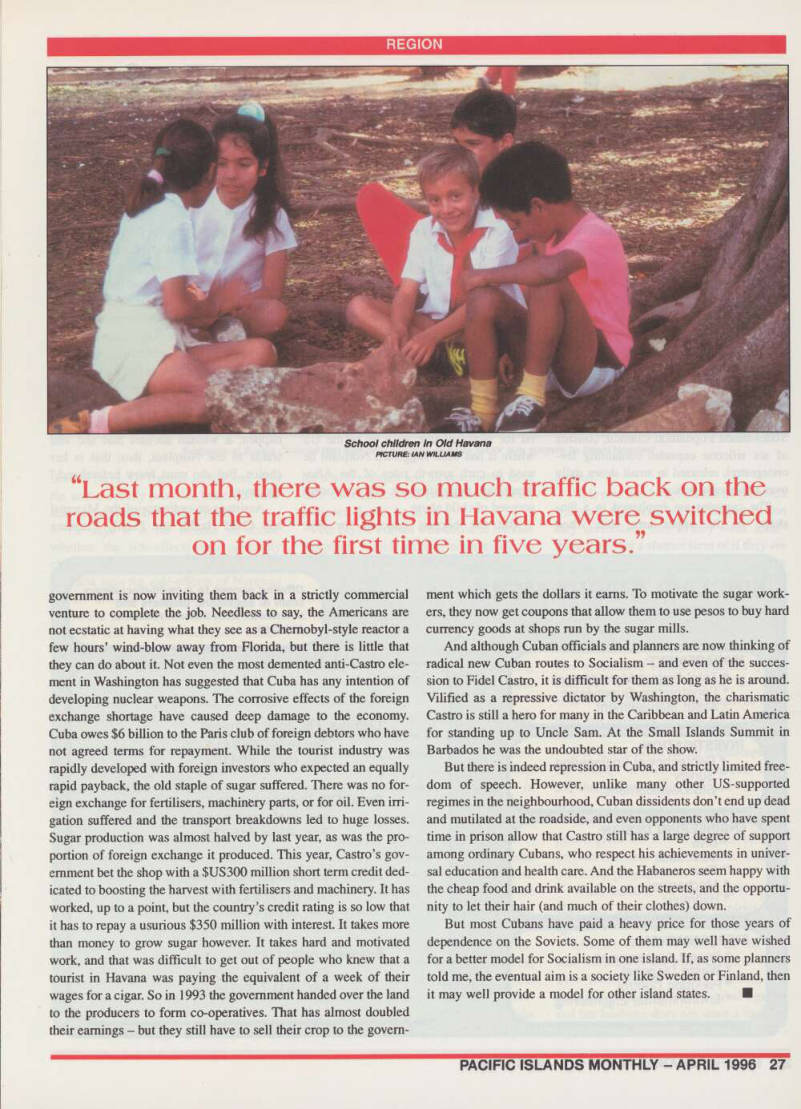
Region
Fidel’s Cuba: Island on the brink
By lan Williams
Cuba is the largest member of the Alliance of Small Island States, but it shares many of the problems of smaller members, even if the cold winds of the New World Order are eroding its own unique solution. Perhaps few island states have paid such a price for maintaining political and economic independence. Now, 37 years after Fidel Castro, Che Guevara and their bearded comrades rode into Havana, there is a gradual, indeed desperate, opening up to new solutions. Several senior government officials told me that now, for the first time the coun try was independent. Colonised by the Spanish, the Americans and then the Russians, they were now able to find their own way.
It will not be an easy road, however. The fall of the Soviet Union left the Cuban economy in ruins while the American blockade made it so much more difficult to rebuild. When I was there in 1993, almost all road transport had stopped, Havana was subject to eighteen hour power cuts, and almost every factory or work place was closed. Although Cuba is just 90 miles from the United States, for economic purposes it may as well be in the middle of the Pacific, since the years of American embargo have distorted and extended its shipping lines across thousands of miles. While Soviet style “colonialism provided a deeply flawed model, it did provide massive amounts of cheap oil and consumer goods in return for the island’s sugar. However; that reinforced the prob lems of the colonial heritage it shared with many other tropical islands, that left them overwhelmingly dependent on one crop for foreign exchange. Like Fiji, that was sugar cane. Combined with the economic inefficiencies of Soviet style socialism, that led to shortages of food on a lush and fertile island. Ironically, some dis sidents feel that the continuing US embargo has provided Castro with a ready-made excuse for inefficiencies in a state sector mod elled after the Soviets - with significant changes forced by the Cubans’ admirable temperament. Like many other tropical islands, Cuba has embraced another means of raising foreign exchange, and at similar cost to the social structure. Tourism has brought in hundreds of thousands of visitors who are allowed only to spend dollars. That has led to a double economy, in which if you have dollars almost anything is available, but, if like most people you are paid in pesos, you have access only to the barest necessities. So, in the hotels, what tourists pay for a beer is the equivalent of month’s salary for a teacher. A dollar tip for waiter rewards him with more money than a cane-worker for a full day at harvest in the fields. The hotels and dollar restaurants provide more protein in one meal than a Cuban family, restricted to rice, beans and plantains on the official peso rations, will see in three
months. It is hardly surprising that there is a sort of latter-day Cargo Cult growing up. Cubans expect visitors they meet to bring in or pay for all the goods that are unavailable in the peso stores.
Many of the hotels are surrounded by young women looking for the type of good time that only a dollar holder can deliver.
Perhaps there would be even more dissatisfaction if it were not for the strength of the extended family that ensures that any dollars earned are spread around.
However, for all its faults, tourism has kick-started the econo my and the government has been quite effective at building new trade links. Last month, there was so much traffic back on the roads that the traffic lights in Havana were switched on for the first time in five years. That is not all good news. The ageing engines and poor fuel leave Havana under a pall of pollution that is no better for the Greenhouse effect than it is for the lungs. The cyclists who the government encouraged so assiduously for the last five years, now all wear masks as they ride along the dedicat ed cycle lanes. Although local oil production has risen to meet some of the demand, the energy shortage is the biggest economic problem. Five years ago, the Russians pulled out on completing a massive nuclear power station in the South East of the island. The
Fidel Castro...Dissidents feel the continuing US embargo has provided him with a ready-made excuse for inefficiencies.
Picture: [?]An Williams
“Last month, there was so much traffic back on the roads that the traffic lights in Havana were switched on for the first time in five years.”
government is now inviting them back in a strictly commercial venture to complete the job. Needless to say, the Americans are not ecstatic at having what they see as a Chemobyl-style reactor a few hours’ wind-blow away from Florida, but there is little that they can do about it. Not even the most demented anti-Castro ele ment in Washington has suggested that Cuba has any intention of developing nuclear weapons. The corrosive effects of the foreign exchange shortage have caused deep damage to the economy.
Cuba owes $6 billion to the Paris club of foreign debtors who have not agreed terms for repayment. While the tourist industry was rapidly developed with foreign investors who expected an equally rapid payback, the old staple of sugar suffered. There was no for eign exchange for fertilisers, machinery parts, or for oil. Even irri gation suffered and the transport breakdowns led to huge losses.
Sugar production was almost halved by last year, as was the pro portion of foreign exchange it produced. This year, Castro’s gov ernment bet the shop with a SUS3OO million short term credit ded icated to boosting the harvest with fertilisers and machinery. It has worked, up to a point, but the country’s credit rating is so low that it has to repay a usurious $350 million with interest. It takes more than money to grow sugar however. It takes hard and motivated work, and that was difficult to get out of people who knew that a tourist in Havana was paying the equivalent of a week of their wages for a cigar. So in 1993 the government handed over the land to the producers to form co-operatives. That has almost doubled their earnings - but they still have to sell their crop to the govem
merit which gets the dollars it earns. To motivate the sugar work ers, they now get coupons that allow them to use pesos to buy hard currency goods at shops run by the sugar mills.
And although Cuban officials and planners are now thinking of radical new Cuban routes to Socialism - and even of the succes sion to Fidel Castro, it is difficult for them as long as he is around.
Vilified as a repressive dictator by Washington, the charismatic Castro is still a hero for many in the Caribbean and Latin America for standing up to Uncle Sam. At the Small Islands Summit in Barbados he was the undoubted star of the show.
But there is indeed repression in Cuba, and strictly limited free dom of speech. However, unlike many other US-supported regimes in the neighbourhood, Cuban dissidents don’t end up dead and mutilated at the roadside, and even opponents who have spent time in prison allow that Castro still has a large degree of support among ordinary Cubans, who respect his achievements in univer sal education and health care. And the Habaneros seem happy with the cheap food and drink available on the streets, and the opportu nity to let their hair (and much of their clothes) down.
But most Cubans have paid a heavy price for those years of dependence on the Soviets. Some of them may well have wished for a better model for Socialism in one island. If, as some planners told me, the eventual aim is a society like Sweden or Finland, then it may well provide a model for other island states. ■
School children in Old Havana
Picture: Ian Williams
Under her skin
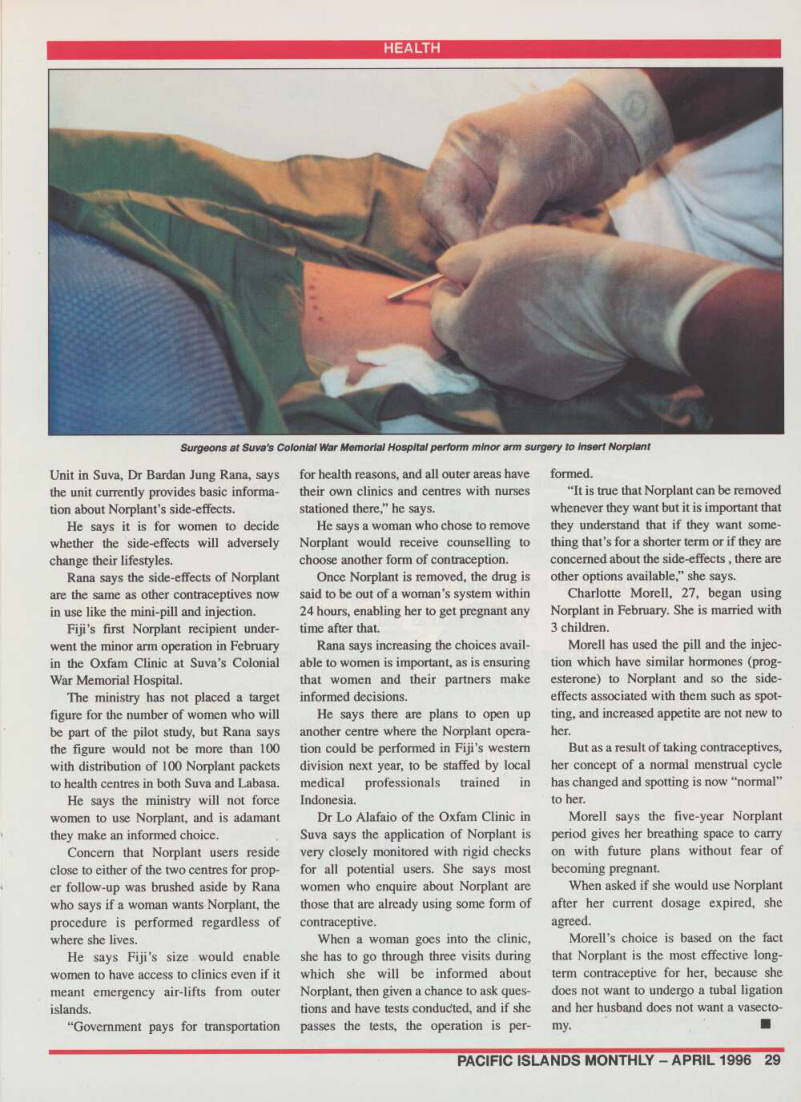
Health
By Sophie Foster
The introduction of a foreign idea is usually treated with scepticism and suspicion. And when it comes to the reproductive health of a nation, the issue becomes even more personal.
Pacific women, confronted with a vari ety of introduced and traditional ideas, seem to be increasingly at a loss over what will work best to their advantage.
In Fiji, this has become more clouded with the introduction of the controversial contraceptive Norplant.
Norplant, developed by the United States-based Population Council, consists of six silicone capsules containing lev onorgestrel, released in small doses daily over a five-year period.
The capsules are implanted in a fan shape in the upper arm, and when
removed, the recipient is said to be as like ly to get pregnant as a woman who has never used Norplant.
But Fiji medical practitioner and human rights activist, Dr Mridula Sainath is not convinced. She says although Norplant has been accepted in 26 coun tries throughout the globe, there are still major concerns over its application in var ious countries and its side-effects.
She says if Norplant is so effective, why has it not been accepted so readily in industrialised countries?
There is also concern that certain seg ments of the population have been target ed for Norplant use, such as in the US where it has been suggested Norplant be used to curb growth rates of the Afro- American population or for a woman accused of child abuse.
But the biggest concern for Fiji,
Sainath says, is the need for proper coun selling and follow-up if Norplant is to be successful.
Fiji’s limited training facilities and lack of medical professionals, is cause for con cern for such a long-term project, she says.
Sainath says the side-effects such as depression, unpredictable bleeding pat terns or spotting between periods, headaches, nervousness, nausea, acne, weight gain, breast tenderness, excessive facial hair growth or loss and loss of libido need to be seriously considered before Norplant is accepted.
“If, knowing that all these things could happen, a woman decides that she still wants to use Norplant, then that is her choice. But she must know beforehand,” she says.
Assistant co-ordinator of the Maternal and Child Health and Family Planning
Unit in Suva, Dr Bardan Jung Rana, says the unit currently provides basic informa tion about Norplant’s side-effects.
He says it is for women to decide whether the side-effects will adversely
change their lifestyles.
Rana says the side-effects of Norplant are the same as other contraceptives now in use like the mini-pill and injection.
Fiji’s first Norplant recipient under
went the minor arm operation in February in the Oxfam Clinic at Suva’s Colonial War Memorial Hospital.
The ministry has not placed a target figure for the number of women who will be part of the pilot study, but Rana says the figure would not be more than 100 with distribution of 100 Norplant packets to health centres in both Suva and Labasa.
He says the ministry will not force women to use Norplant, and is adamant they make an informed choice.
Concern that Norplant users reside close to either of the two centres for prop er follow-up was brushed aside by Rana who says if a woman wants Norplant, the
procedure is performed regardless of
where she lives.
He says Fiji’s size would enable women to have access to clinics even if it meant emergency air-lifts from outer islands.
“Government pays for transportation
for health reasons, and all outer areas have their own clinics and centres with nurses stationed there,” he says.
He says a woman who chose to remove Norplant would receive counselling to choose another form of contraception.
Once Norplant is removed, the drug is said to be out of a woman’s system within 24 hours, enabling her to get pregnant any time after that.
Rana says increasing the choices avail able to women is important, as is ensuring that women and their partners make informed decisions.
He says there are plans to open up another centre where the Norplant opera tion could be performed in Fiji’s western division next year, to be staffed by local medical professionals trained in Indonesia.
Dr Lo Alafaio of the Oxfam Clinic in Suva says the application of Norplant is very closely monitored with rigid checks for all potential users. She says most women who enquire about Norplant are those that are already using some form of contraceptive.
When a woman goes into the clinic, she has to go through three visits during which she will be informed about Norplant, then given a chance to ask ques tions and have tests conducted, and if she passes the tests, the operation is per
formed.
“It is true that Norplant can be removed whenever they want but it is important that they understand that if they want some thing that’s for a shorter term or if they are concerned about the side-effects, there are other options available,” she says.
Charlotte Morell, 27, began using Norplant in February. She is married with 3 children.
Morell has used the pill and the injec tion which have similar hormones (prog esterone) to Norplant and so the side effects associated with them such as spot ting, and increased appetite are not new to her.
But as a result of taking contraceptives, her concept of a normal menstrual cycle has changed and spotting is now “normal” to her.
Morell says the five-year Norplant period gives her breathing space to carry on with future plans without fear of becoming pregnant.
When asked if she would use Norplant after her current dosage expired, she agreed.
Morell’s choice is based on the fact that Norplant is the most effective long term contraceptive for her, because she does not want to undergo a tubal ligation and her husband does not want a vasecto my. ■
Surgeons at Suva’s Colonial War Memorial Hospital perform minor arm surgery to insert Norplant
Advertisements & other items, pp. 28-31 (1 item)
Sinclair Knight Merz
" MANAGEMENT:
* Total Project Management * Construction Supervision * Asset Management
investigatFonP
* Geotechnical Engineering * Survey * GIS Development
ENGINEERINGDESIGN:
* Civil * Structural * Electrical * Mechanical * Hydraulic
r ENVIRONMENTAL:
* Impact Assessment * Waste Disposal * Pollution Control * Environmental Engineering \ Offering access to a multi-disciplinary team of engineers, planners and scientists, with a track record of success.
Lautoka, Fiji: John Campbell Tel: (679) 662411 Fax (679) 664107 Suva, FIJI: Terence Erasito Tel: (679) 315209 Fax (679) 315270 Papua New Guinea: Mich Hewitt Tel: (675) 212155 Fax (675) 214660 Brisbane: Peter Cooper Tel: (61) 7-38350222 Fax (61)7-38326335
® TOYOTA
Drive dignity right to the top.
Everyone who knows cars ha s no doubts about Land Cruiser’s ruggedness.
Yet how many know that its luxury rivals the finest high-priced cars?
Or that it’s got more room inside than many luxury sedans?
And because it’s a Toyota, Land Cruiser’s fit and finish, attention to detail, and graceful form speak of elegance as well as spacious comfort.
Yet you still get tough ladder frames and suspension built to take you as far off road as you want to go.
With power from 4.5-litre petrol or 4.2-litre diesel engines.
And it’s carefully protected from rust to last longer.
So if you’re going right to the top, this dignified car is ready to take you.
LAND CRUISER
DISTRIBUTORS /DEALERS
AMERICAN SAMOA BURNS PHILP MOTORS PH 633-4281 GUAM & MICRONESIA.. .ATKINS KROLL, INC, PH 646-1876/9 NORFOLK ISLAND BORRY’S PTY LTD. PH 22114
SOLOMON ISLAND ELA MOTORS PH 30314
VANUATU ASCO MOTORS PH 22341
COOK ISLANDS PACIFIC MOTORS LTD. PH 20796
KIRIBATI TARAWA MOTORS PH 21090
PAPUA NEW GUINEA ELA MOTORS PH 3229400
TAHITI NIPPON AUTOMOTO PH 429819
WESTERN SAMOA ASCO MOTORS PH 20800
FIJI ASCO MOTORS PH 384888
NEW CALEDONIA S.I.A.P. PH 275562
SAIPAN MICROL CORPORATION PH 234-5911
TONGA ASCO MOTORS PH 23500
S3* ... .. -Sid 1 S D 31 <r*> P'Xi Hr??, 3»
LAND
CRUISER
U«D CRUISES .
f ! kfti //fz •W ' i
toi
_**. jl* - •■■ s : 3»r^K sr
platform
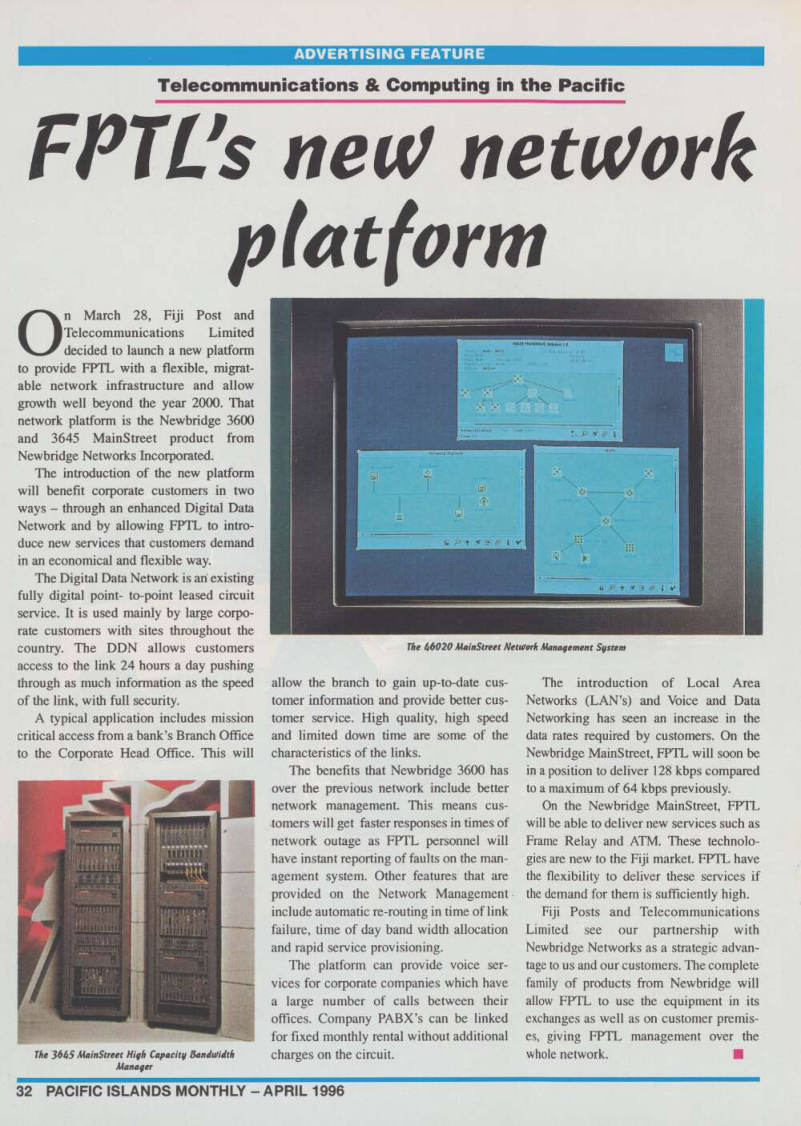
Advertising Feature
Telecommunications & Computing in the Pacific
FPTL’s new network platform
On March 28, Fiji Post and Telecommunications Limited decided to launch a new platform to provide FPTL with a flexible, migrat able network infrastructure and allow growth well beyond the year 2000. That network platform is the Newbridge 3600 and 3645 Main Street product from Newbridge Networks Incorporated.
The introduction of the new platform will benefit corporate customers in two ways - through an enhanced Digital Data Network and by allowing FPTL to intro duce new services that customers demand in an economical and flexible way.
The Digital Data Network is an existing fully digital point- to-point leased circuit service. It is used mainly by large corpo rate customers with sites throughout the country. The DDN allows customers access to the link 24 hours a day pushing through as much information as the speed of the link, with full security.
A typical application includes mission critical access from a bank’s Branch Office to the Corporate Head Office. This will
allow the branch to gain up-to-date cus tomer information and provide better cus tomer service. High quality, high speed and limited down time are some of the characteristics of the links.
The benefits that Newbridge 3600 has over the previous network include better network management. This means cus tomers will get faster responses in times of network outage as FPTL personnel will have instant reporting of faults on the man agement system. Other features that are provided on the Network Management include automatic re-routing in time of link failure, time of day band width allocation and rapid service provisioning.
The platform can provide voice ser vices for corporate companies which have a large number of calls between their offices. Company PABX’s can be linked for fixed monthly rental without additional charges on the circuit.
The introduction of Local Area Networks (LAN’s) and Voice and Data Networking has seen an increase in the data rates required by customers. On the Newbridge Main Street, FPTL will soon be in a position to deliver 128 kbps compared to a maximum of 64 kbps previously.
On the Newbridge Main Street, FPTL will be able to deliver new services such as Frame Relay and ATM. These technolo gies are new to the Fiji market. FPTL have the flexibility to deliver these services if the demand for them is sufficiently high.
Fiji Posts and Telecommunications Limited see our partnership with Newbridge Networks as a strategic advan tage to us and our customers. The complete
family of products from Newbridge will
allow FPTL to use the equipment in its exchanges as well as on customer premis es, giving FPTL management over the whole network. ■
The 3645 Main Street High Capacity Bandwidth Manager
The 46020 Main Street NetWork Management System
Advertisements & other items, p. 33 (1 item)
«as»
At Digital Data Services, we believe good communications means good business.
So much so that we have invested in the latest in Digital Transmission Technology in our endeavour to provide our customers with efficient and reliable data communications links and systems.
This means that we can now provide you with total WAN/LAN
Networking Solutions.
We have the widest range of WAN products and can tailor a data communications solutions to suit your needs.
Digital Data Services offer you cost effective national and international communications.
Further more, our support team ensure quicker response times to your network problems.
MILESTONES OF DIGITAL DATA
SERVICES
■ Digital Data Network (Northern ■ Telecom PDMX) ■ Public X. 25 Data Network 5421
(Fiji Net)
■ Burns Philip Toyota DCX Network ■ National Bank of Fiji X. 25 Network ■ FNPF Router-based Internetwork X : w Tel: 210591, 210551 or Fax; 305224. — — i V
in digital radio

A new generation in digital radio
Telecommunications have become an integral part of society in the Pacific Islands. The ability to freely communicate with close neighbours and the rest of the world is an important build ing block of the island economy.
The Pacific Islands present a unique set of challenges to service providers. Rugged inland terrain, communities separated by sea and a relatively small population, make the provision of even basic telecommuni cations services difficult and costly.
Private organisations wishing to provide to their own networks face similar barriers.
To date, most available technologies have poorly addressed the Pacific Island environment. Copper cable and fibre optic technologies are often inappropriate for interconnecting islands and are too costly for rugged inland terrain. Multiple access radio systems typically require a sizeable number of users, mains power and have limited range. They are not well suited to heavy usage by individual subscribers or payphones which tie up common system resources. Satellite communications are low capacity and very expensive, suiting only the most remote users. Digital microwave radio systems overcame most of these problems but so far, most systems have required external equipment to form a complete network, often from different manufacturers.
Marine-Air Systems (MAS) have a long history in the Pacific Islands, provid ing Peacesat and aeronautical communica tions systems to many countries. MAS have recognised the needs of Pacific Island nations by introducing a range of digital microwave radios ideally suited to cus tomer access networks and cellular or PMR network linking. Both the DXR 200 and the new DXR 100 are designed and manufactured in New Zealand.
MAS have DXR 200 systems installed in Fiji, Papua New Guinea, Vanuatu and the Solomon Islands, in addition to more than 30 countries worldwide. A common time-zone and close proximity make a New Zealand supplier particularly attrac tive to Pacific Island customers.
“Most available technologies haVe poorly addressed the Pacific. n
Dxr 200
The DXR 200 was originally designed to serve clusters of subscribers in rural net works. Experience with installation world wide has also proven the DXR 200 to be popular for cellular and PMR network linking. Private network operators like the ability to build a complete network using only DXR 200 equipment.
Pairs of DXR 200 terminals are used to form line-of-sight radio links. These links are easily interconnected to form a wide area network which can connect commu nities separated by sea. Digital technology ensures quality does not suffer through multiple-hop transmission.
DXR 200 is offered in 4, 10, 30 and 60 channel versions, which permits matching
of capacity with available radio spectrum.
Optional ADPCM doubles the capacity of each version without increasing occupied bandwidth.
DXR 200 terminals accept optional end-user interface modules which permit connection of standard 2-wire telephones, payphones, 4-wire E&M devices and digi tal equipment through V.l 1, V. 35, V. 24 and ISDN interfaces.
DXR terminals also provide 2Mbps G.703/4 ports for interconnecting DXR terminals or connecting directly to digital switching equipment. At each radio site, DXR 200 terminals connect together using the G.703/4 interface, and individual 64kbps channels can be dropped and inserted onto the radio link or to local end user interfaces.
An internal cross connect switch pro vides the drop and insert function and is the heart of the DXR’s integrated network capability. Individual 64kbps channels can be freely connected between the 2Mbps interface, the radio link and local inter faces under software control. The permuta tions are many and control is rapid and flexible. A comprehensive network man agement system based on the SNMP pro tocol, permits system managers to remote ly monitor and configure any terminal on the network.
The DXR 200 is set apart from the other microwave products by its spectrum efficiency, frequencies of operation and its integrated network capability. The DXR 200 has rugged modular design and uses advanced manufacturing techniques for reliability at a reasonable cost. A wide operating temperature range allows the DXR 200 to keep working under harsh cli matic conditions.
(Continued on page 36)
Dxr 100
The recently released DXR 100 pro vides point to point linking at a low cost per line. The DXR 100 is primarily designed for cellular and PMR network linking. Digital interfaces are provided for connecting to other equipment and a point to j point digital radio link connects between radio base sites.
An optional integral cross connect switch allows channels to be dropped and inserted to specified base sites.
DXR 100 provides a particularly com pact and rugged package which can be relied upon for continuous operation. A DXR 200 compatible network manage ment option allows network operation to be closely monitored from a central loca tion.
Microwave
MAS represents Digital Microwave Corporation (DMC) in the Pacific Islands.
DMC is a world leader in medium to high capacity digital microwave systems which particularly suit cellular infrastructure development and microwave backbones.
DMC offers bands from two to 38GHz and capacities from Nx64kbps to 34Mbps.
The new Spectrum II series follows DMC’s tradition of innovation. Like the DXR series, Spectrum II incorporates for ward error correction, order wire and fre quency synthesis. All functions are con trolled via a laptop PC. A “split-mount” construction eliminates the need to install and maintain wave-guides and reduces installation time significantly. All DMC products use the DMC network manage ment system.
Full support and installation services are provided by MAS in the Pacific.
MAS will be exhibiting at ATUG ‘96 in Melbourne, from April 30- May 2. If you are attending, you will be able to see DXR and DMC digital microwave equipment and receive detailed information on appli cations and operation. ■
Advertisements & other items, pp. 34-35 (2 items)
34
ADVERTISING FEATURE
Telecommunications & Computing in the Pacific
PACIFIC ISLANDS MONTHLY - APRIL 1996
city netwoi
I
HI fIrHFPH S^KtIP
«ii|p||lil |1 ii W ii lil il |li ■yp Wm. g M HaM iiii Hr .
' .' ■: : ' 1 o •
st effective s
city netwoi
—NEW-
320kbps & 2x2Mbps
200 SERIES
For further information please contact:
• MAS Telecommunications PO Box 30-248, Lower liutt, Wellington, New Zealand. tm a h Telephone: +64-4-569 2170 W Fax: +64-4-566 1247 ™ * ** Internet E-mail: [email protected]
KEY SYSTEM FEATURES
320 kbps, 1 CHANNEL 70 1 kbps. 10 CHANNEL
2 Mbps, 3 0 CHANNEL
2x2 Mbps, 60 CHANNEL
FULLY DIGITAL, Nx64kbps
BUILT-IN MULTIPLEX WITH DROP AND INSERT
BUILT-IN DIGITAL CROSS CONNECT
400, 600, 800, 900 MHz, 1.5 (ETSI), 2.2
AND 2.4GHz BANDS
SYNTHESIZED AND SPECTRUM EFFICIENT
32 kbps ADPCM EXPANSION OPTION
LINE INTERFACE MODULE OPTIONS
DUAL 2Mbps, El PRIMARY RATE INTERFACE
BUILT-IN DIAGNOSTICS AND ALARMS
INTEGRATED NETWORK MANAGEMENT
SIMPLE TO INSTALL AND MAINTAIN
CCIR, CCITT AND ETSI STANDARDS
■■ wm m
Infill
excellence
Tait Electronics dedicated to excellence in radio communications
Since its formation in 1969, Tail Electronics has succeeded in estab lishing a reputation for producing world class radio equipment Through a high level of investment in both research and development and manufacturing technology, Tait has developed radio communication solutions.
The range of Tait products extends from stylish mobile and hand portable radios through to wide area trunked net works that integrate voice, data, and multi-access rural telephone services.
Tait has a well-earned reputation for products that combine outstanding relia bility and service life with high perfor mance and easy to use features.
Accreditation to ISO 9001 is a reflection of Tail’s commitment to quality and con tinuous improvement.
The T2OOO mobile range, which replaces the popular T5OO product, is one of the finest and most user-friendly mobile radios of its type available in the world today, with a versatility that is quite unique.
Capable of transmitting both voice and data, the T2OOO range can be used for such applications as fleet management, public safety and data despatching.
The stylish T3OOO series offers a range of high technology, hand portable radios, designed for efficient communication in all work environments. Unique to the T3OOO product is handset operation which allows the radio to be used like a telephone handset, giving greater privacy and improved clarity in noisy environ
ments.
Latest developments include a soon to be launched T3OOO Series II range of products, which will offer additional fea tures and greater ease of operation.
Of particular interest to the Pacific Island region, the upgraded model has been designed to meet the 1P54 standard for sealing. The radio’s case is sealed to prevent the ingress of dust and moisture in adverse environments.
The mobile data range is among the most recently released products. The integration of data into an existing mobile voice despatch system introduces signifi cant benefits over conventional commu nication techniques. A data message can convey the same amount of information in a shorter time than the equivalent voice transmission. It provides a clear state ment of requirements and is less likely to be misinterpreted than a spoken message, and is less likely to be forgotten. A sys tem can be built up from separate mod ules, including status messaging, vehicle tracking, job tracking and electronic funds transfer.
Steve Mander, Group Sales and Marketing Manager, says, “Commitment to market-based research and design is fundamental to the company’s ongoing success. It means the feedback from users of our products worldwide is heard right at the beginning of the new product development process. We pride ourselves on being small enough to listen, yet large enough to rely on”. ■
Advertisements & other items, pp. 36-37 (2 items)
36
ADVERTISING FEATURE
Telecommunications & Computing in the Pacific
PACIFIC ISLANDS MONTHLY - APRIL 1996
Integrated Solutions ...
pT*.
It wr< n ■
... You Can Depend On
One of the reasons so many users find the solution to their radio communications needs with TAIT is the superb level of integration throughout the comprehensive product range including: ■ T3OOO Series Handportables ■ T2OOO Series Mobiles ■ T7OO Series Full-Duplex Mobiles and Base Stations ■ TBOO Series Base Stations, Repeaters and Paging Transmitters ■ Rural Telephone Systems ■ inform Text Dispatcher and AVL Mobile Data Systems ■ Taitnet MPTI327 Trunked networks (from 4 channel, single site systems through to large, wide area systems.) ■ Quasi-Sync (Simulcast) systems with automatic audio equalization.
Tait also has a well-earned reputation for products that combine high performance and user-friendly features with outstanding reliability and service life. m Two of the many reasons you should contact Tait now and talk to us about your radio communication needs.
Excellence in Radio Communications
Tait International Sales Division PO.Box 1645, Christchurch, New Zealand Phone: (64) (3) 358 0346 Fax: (64) (3) 358 3636
The way ahead

Established in 1980, KRONE Australia continues to benefit from KRONE’S decades of experience in designing and manufacturing communica tions technology, and with access to a world-wide pool of expertise spread throughout the KRONE group of sub sidiaries the organisation continues to maintain its position as an international leader in its field.
Ideally placed to take advantage of the company’s most valuable asset, its people, KRONE Australia has evolved during the last 15 years into the ideal environment for creative innovation, resulting in high per formance communications products that meet and exceed international specifica tions.
From its earliest years, KRONE has encouraged the development of local
expertise in communications technology.
It now takes pride in a technical team whose ability and dedication is responsible for the development of internationally recognised, leading edge technology.
Technology designed to meet our cus tomers’ needs and exceed our users’ expec tations.
KRONE structured cabling system solutions are at the forefront of interna tional communications technology, with locally designed and manufactured prod uct ranges such as HIGHBAND and HIGHWAY leading the world in data transmission performance.
To our customers this established track record provides a secure investment and added security for the future of their IT cabling investment. For KRONE, it means together we have established a partnership
based on a commitment to continual achievement in our every field of opera tion.
KRONE’S Australasian headquarters are located at Berkeley Vale, near Sydney, and the company has established offices in Brisbane, Melbourne, Canberra, Sydney, Perth and Adelaide, with New Zealand offices in Auckland, Wellington and Christchurch, to support our commitment to provide responsive, high quality service to our customers.
Now, over 450 million connections later, KRONE is strategically placed to develop the next generation of exciting communications products. Already exceeding the highest International Standards for today’s network require ments, KRONE will continue to lead “the way ahead.” ®
Advertisements & other items, pp. 38-40 (2 items)
38
ADVERTISING FEATURE
Telecommunications & Computing in the Pacific
PACIFIC ISLANDS MONTHLY - APRIL 1996
*Pvsi&
KRONE - the Way Ahead in Structured Cabling Solutions KRONE System Plus is a total structured cabling solution fully capable of handling todays most demanding network applications and those of the future.
KRONE System Plus family of products indude: ■ patch panels ■ patch cords ■ surfacemount outlets ■ flushmount outlets These products provide you with the flexibility to customise a structured cabling solution to best suit your telephone and data needs.
KRONE
Network Hub or Computer Controller Patch Cord
PABX
Distributed in Fiji by:
*Pvsi&
Telecom
We have one good reason
why you should make us your
partn
1 We have the answers to ALL your
business communication needs
We have the solutions No matter what your business communication needs are, we have a solution for you. We offer a wide range of intergrated communication systems designed for home offices, small businesses, corporations and multi-national organisations. do we have solutions but also a nation-wide maintenance and support network to back up our customers.
Cali us now!
Talk to us today for all your business communication needs.
We want to be your partners!
Service At Fiji Posts and Telecommunications Ltd not only Z. , &
Telecom
Call us toll free 0800 300 000
ESiJi&M Si
SUVA : TEL2IO 222 FAX: 305 071 LAUTOKA : TEL: 661114 FAX: 663 567 LABASA : TEL 811800 FAX: 812 766
GEORGE RUBINE 10*239
TELIKOM
Papua New Guinea m ■ —r 3 mw iWq g;;/ f;.. i#s 4 P-'-m* . :luuiu lj , u _. j » i milllllliliiiiiiiint; I :i '; i . g..
KA 0 • ~1 -I' s: a. l-«J D m --- B , r relikom has set the pace in providing state-of-the-art telecommunications links within PNG and o anywhere around the world as we enter the 21st Century. For all your telecommunications aeeds, write to us at this address: \ssistant General Manager relikom Marketing Department P.O. Box 291 iVaigani, Papua New Guinea Pel: 675 300 5564 Fax: 675 300 5540 I
TELIKOM
J\!cm we'n& naaiUf, talbUuf!
mobile
PTC PNG goes mobile
The Post and Telecommunications Corporation (PTC) in Papua New Guinea was to introduce a perma nent cellular mobile telephone service using the AMPS technology to Port Moresby and Lae in February 1996. Its Board of Directors originally considered digital GSM technology. However, after considering the time constraints and costs, it instead recommended AMPS. Another factor the board considered was the cheap er costs of AMPS handsets. A 100 per cent wholly owned subsidiary of PTC Telikom; Pacific Mobile will operate the service as a separate business unit.
Stanilite Electronics, a Perth based Australian company, won the contract to supply and install seven cellswitches in Port Moresby and two cellswitches in Lae, PNG’s second largest city.
Apart from producing cellswitches, Stanilite produces military communica tions equipment, cellular systems and trunked mobile radio systems. It has sup plied the AMPS cellswitch technology to Australia, Guam, American Samoa, Nauru, Vanuatu, Solomons and the Marshall Islands.
A 100 per cent wholly owned Telikom company, Pacific Mobile will operate the service that is expected to cost approxi mately SUS 3 million. Conservative esti mates indicate that 2000 customers will sign on during the first year of service.
However, initial enquiries from poten tial customers as a result of pre-launch publicity campaigns has indicated that more customers will queue up for a hand set come the launching date. Inquiries from potential customers such as company executives, and entrepreneurs have indicat ed that there could be more users than originally envisaged.
PNG began proposals for a joint ven
ture cellular telephone service four years ago. Twenty expressions of interest were received and were shortlisted to five, and then two. These were Cable & Wireless and Telecom New Zealand International.
By February 1992, only one proposal had been received from Cable & Wireless. This was found to be insufficient to make a rec ommendation to the Board.
Three of the companies that were on the original shortlist were contacted again in May 1992 and were asked to submit detailed proposals within a month.
Two of these companies, Detecon of Germany, because they could not meet the deadline, and Telecom Australia International, because they were doubtful of the joint venture. Only one detailed pro posal was received from Telecom New Zealand. Both Telecom New Zealand and Cable & Wireless recommended the AMPS cellular system.
In September 1992, the proposal to have a joint venture had changed from the notion of providing wide ranging services to that of providing a low cost, low risk venture contained within PTC. Feasibility studies were carried out to ascertain the viability of operating a cellular mobile telephone system without a joint venture partner, initially in Port Moresby alone. At that time the original design was based on a five-cell AMPS system at cost of supply ing and installing and commissioning the system ranged from KBOO,OOO to K 3 mil lion ($BOO,OOO to $3 million).
In June 1993, Telecom New Zealand was contracted to design a cellular mobile telephone system for Port Moresby, Lae and Mount Hagen on a turnkey basis, pro duce tender specifications and assist with evaluation of the tender bids. Telecom New Zealand also carried out a market sur vey during the year.
Calls for tenders were advertised in August 1993 and attracted 18 companies.
Tenderers were asked to bid for the supply and installation of either AMPS or GSM cellular systems, bids were received from Ericsson, who offered both GSM and AMPS, Alcatel who offered GSM only.
Motorola who offered AMPS only, and Stanilite who also offered AMPS only.
Costs of the AMPS systems offered were 40 per cent less than those of the GSM sys tems. Evaluation of the bids were made by Telecom New Zealand who recommended that PTC select AMPS as the cellular tech nology.
Mid-1995, PTC held several discus sions with Stanilite Electronics of Sydney who had developed a ‘distributed intelli gence’ AMPS cellular system. This type of system is cheaper and more flexible than a conventionally switched cellular system. It offers the operator entering the cellular market minimal start up costs with a sys tem that can be expanded to meet future demands. A Stanilite Cellswitch was obtained and tested, and proved success ful. It was purchased and was primarily used for providing telephone services to Hanuabada, Elevala, and Tatana villages on the outskirts of Port Moresby. These villages have demand for telephone ser vices, but cannot be connected by conven tional means because it is difficult and expensive.
The Rabaul volcanic eruption in September last year saw the installation of a cellswitch terminal at Kokopo within five days of the eruption to provide emergency telephone services. This system has since been transferred to Tunnel Hill above Rabaul to provide telephone services to commercial customers in Rabaul.
Advertisements & other items, p. 41 (1 item)
41
ADVERTISING FEATURE
PACIFIC ISLANDS MONTHLY - APRIL 1996
Telecommunications & Computing in the Pacific
change
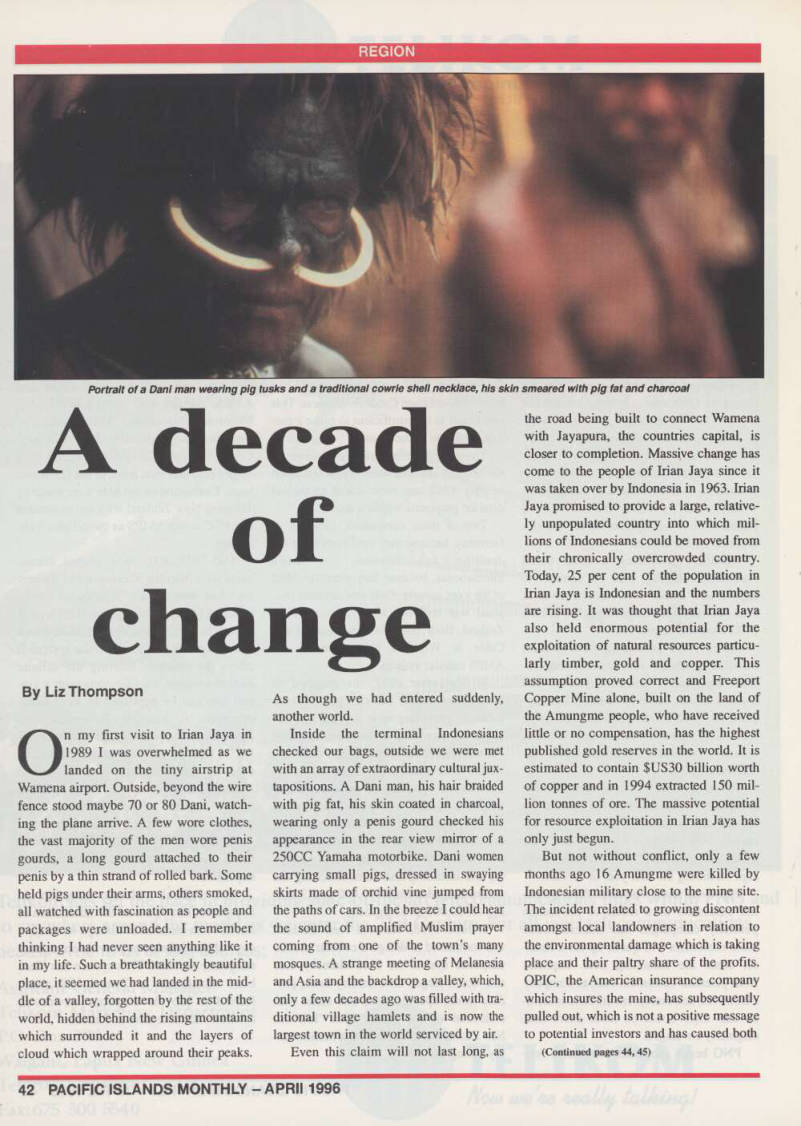

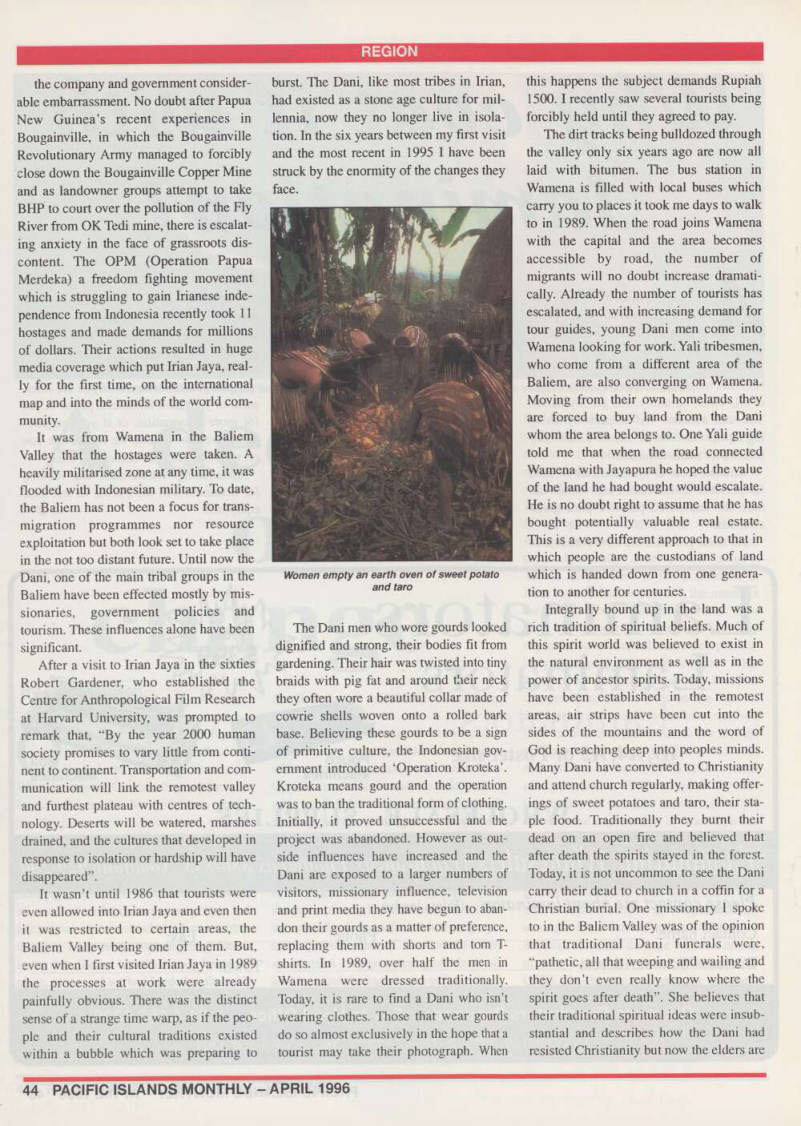

A decade of change
By Liz Thompson
the road being built to connect Wamena with Jayapura, the countries capital, is closer to completion. Massive change has come to the people of Irian Jaya since it was taken over by Indonesia in 1963. Irian Jaya promised to provide a large, relative ly unpopulated country into which mil lions of Indonesians could be moved from their chronically overcrowded country.
Today, 25 per cent of the population in Irian Jaya is Indonesian and the numbers are rising. It was thought that Irian Jaya also held enormous potential for the exploitation of natural resources particu larly timber, gold and copper. This assumption proved correct and Freeport Copper Mine alone, built on the land of the Amungme people, who have received little or no compensation, has the highest published gold reserves in the world. It is estimated to contain SUS3O billion worth of copper and in 1994 extracted 150 mil lion tonnes of ore. The massive potential for resource exploitation in Irian Jaya has only just begun.
But not without conflict, only a few months ago 16 Amungme were killed by Indonesian military close to the mine site.
The incident related to growing discontent amongst local landowners in relation to the environmental damage which is taking place and their paltry share of the profits.
OPIC, the American insurance company which insures the mine, has subsequently pulled out, which is not a positive message to potential investors and has caused both
As though we had entered suddenly, another world.
Inside the terminal Indonesians checked our bags, outside we were met with an array of extraordinary cultural jux tapositions. A Dani man, his hair braided with pig fat, his skin coated in charcoal, wearing only a penis gourd checked his appearance in the rear view mirror of a 250 CC Yamaha motorbike. Dani women
carrying small pigs, dressed in swaying
skirts made of orchid vine jumped from the paths of cars. In the breeze I could hear the sound of amplified Muslim prayer coming from one of the town’s many mosques. A strange meeting of Melanesia and Asia and the backdrop a valley, which, only a few decades ago was filled with tra ditional village hamlets and is now the largest town in the world serviced by air.
Even this claim will not last long, as
On my first visit to Irian Jaya in 1989 I was overwhelmed as we landed on the tiny airstrip at Wamena airport. Outside, beyond the wire fence stood maybe 70 or 80 Dani, watch ing the plane arrive. A few wore clothes, the vast majority of the men wore penis gourds, a long gourd attached to their penis by a thin strand of rolled bark. Some held pigs under their arms, others smoked, all watched with fascination as people and packages were unloaded. I remember thinking I had never seen anything like it in my life. Such a breathtakingly beautiful place, it seemed we had landed in the mid dle of a valley, forgotten by the rest of the world, hidden behind the rising mountains which surrounded it and the layers of cloud which wrapped around their peaks.
(Continued pages 44,45)
Portrait of a Dani man wearing pig tusks and a traditional cowrie shell necklace, his skin smeared with pig fat and charcoal
the company and government consider able embarrassment. No doubt after Papua New Guinea’s recent experiences in Bougainville, in which the Bougainville Revolutionary Army managed to forcibly close down the Bougainville Copper Mine and as landowner groups attempt to take BHP to court over the pollution of the Fly River from OK Tedi mine, there is escalat ing anxiety in the face of grassroots dis content. The OPM (Operation Papua Merdeka) a freedom fighting movement which is struggling to gain Irianese inde pendence from Indonesia recently took 11 hostages and made demands for millions of dollars. Their actions resulted in huge media coverage which put Irian Jaya, real ly for the first time, on the international map and into the minds of the world com munity.
It was from Wamena in the Baliem Valley that the hostages were taken. A heavily militarised zone at any time, it was flooded with Indonesian military. To date, the Baliem has not been a focus for trans migration programmes nor resource exploitation but both look set to take place in the not too distant future. Until now the Dani, one of the main tribal groups in the Baliem have been effected mostly by mis sionaries, government policies and tourism. These influences alone have been
significant.
After a visit to Irian Jaya in the sixties Robert Gardener, who established the Centre for Anthropological Film Research at Harvard University, was prompted to remark that, “By the year 2000 human society promises to vary little from conti nent to continent. Transportation and com munication will link the remotest valley and furthest plateau with centres of tech nology. Deserts will be watered, marshes drained, and the cultures that developed in response to isolation or hardship will have
disappeared”.
It wasn’t until 1986 that tourists were even allowed into Irian Jaya and even then it was restricted to certain areas, the Baliem Valley being one of them. But, even when I first visited Irian Jaya in 1989 the processes at work were already painfully obvious. There was the distinct sense of a strange time warp, as if the peo ple and their cultural traditions existed within a bubble which was preparing to
burst. The Dani, like most tribes in Irian, had existed as a stone age culture for mil lennia, now they no longer live in isola tion. In the six years between my first visit and the most recent in 1995 I have been struck by the enormity of the changes they face.
The Dani men who wore gourds looked dignified and strong, their bodies fit from gardening. Their hair was twisted into tiny braids with pig fat and around their neck they often wore a beautiful collar made of cowrie shells woven onto a rolled bark base. Believing these gourds to be a sign of primitive culture, the Indonesian gov ernment introduced ‘Operation Kroteka’.
Kroteka means gourd and the operation was to ban the traditional form of clothing.
Initially, it proved unsuccessful and the project was abandoned. However as out side influences have increased and the Dani are exposed to a larger numbers of visitors, missionary influence, television and print media they have begun to aban don their gourds as a matter of preference, replacing them with shorts and tom T shirts. In 1989, over half the men in Wamena were dressed traditionally.
Today, it is rare to find a Dani who isn’t wearing clothes. Those that wear gourds do so almost exclusively in the hope that a tourist may take their photograph. When
this happens the subject demands Rupiah
1500.1 recently saw several tourists being forcibly held until they agreed to pay.
The dirt tracks being bulldozed through the valley only six years ago are now all laid with bitumen. The bus station in Wamena is fdled with local buses which carry you to places it took me days to walk to in 1989. When the road joins Wamena with the capital and the area becomes accessible by road, the number of migrants will no doubt increase dramati cally. Already the number of tourists has escalated, and with increasing demand for tour guides, young Dani men come into Wamena looking for work. Yali tribesmen, who come from a different area of the Baliem, are also converging on Wamena.
Moving from their own homelands they are forced to buy land from the Dani whom the area belongs to. One Yali guide told me that when the road connected Wamena with Jayapura he hoped the value of the land he had bought would escalate.
He is no doubt right to assume that he has bought potentially valuable real estate.
This is a very different approach to that in which people are the custodians of land which is handed down from one genera tion to another for centuries.
Integrally bound up in the land was a rich tradition of spiritual beliefs. Much of this spirit world was believed to exist in the natural environment as well as in the power of ancestor spirits. Today, missions have been established in the remotest areas, air strips have been cut into the sides of the mountains and the word of God is reaching deep into peoples minds.
Many Dani have converted to Christianity and attend church regularly, making offer ings of sweet potatoes and taro, their sta ple food. Traditionally they burnt their dead on an open fire and believed that after death the spirits stayed in the forest.
Today, it is not uncommon to see the Dani carry their dead to church in a coffin for a Christian burial. One missionary I spoke to in the Baliem Valley was of the opinion that traditional Dani funerals were, “pathetic, all that weeping and wailing and they don’t even really know where the spirit goes after death’’. She believes that their traditional spiritual ideas were insub stantial and describes how the Dani had resisted Christianity but now the elders are
Women empty an earth oven of sweet potato and taro
dying, the younger generation are convert ing more readily. They are she believes, “rejecting the fetishistic objects” that had previously been worshipped and in her opinion the Dani have “come a long, long
way”.
The church has preached for an end to ritualised warfare which was an integral aspect of Dani culture and was often con ducted to appease the ancestral spirits. It was far from the war experience we know of today. It began in the morning and ended at dusk which both sides retiring behind their own line and hurling abuse at one another, often with a great deal of laughter. The weapons were bows and arrows and the emphasis tactics not death, it was rare that people were killed. If they were injured a special person was called in to sing their soul, thought of as ‘the seeds of singing’ back into place, as it may have been dislodged. Ritualised warfare has all but disappeared. Large watchtowers used to stand just outside most village hamlets and provided a vantage point for warriors to check on approaching enemies. In 1989 most of these watchtowers had fallen into
a state of disrepair. In 1995, I returned to Elegeima Village where I had previously stayed and the watchtower was now sup porting the washing line.
One tour company which takes groups trekking through the valley has the slogan, ‘Baliem Valley, the place where time stands still’ painted on the side of it’s many tour buses. No doubt it is an enticing advertising tool but the reality is far from it’s claim. Time is not standing still in the Baliem valley, the culture and traditions of the people are changing at an alarming rate. What is remarkable not only in the experience of the Irianese but many remote indigenous groups is the speed with which, in the 20th century, their lives have changed. As Robert Gardener sug gests technology has linked “the remotest valley and furthest plateau with centres of technology”. With it has brought a mass of new influences. Stone-age cultures like the Dani’s have moved in only a few decades
through experiences which spanned cen
turies in the West. Middle-aged Dani who grew up deeply entrenched in traditional animistic beliefs, ritual warfare and had no
knowledge of a world outside their own valley, now go to church every Sunday, have a job and mingle with international tourists whose addresses they collect in precious books in the hope of one day vis iting their countries.
As the Irianese struggle to come to grips with the changes they harbour mixed feelings. Some welcome development, the young Dani guides who wear Walkmans and jeans and lust after things modem, others continue to reject the Indonesian administration and all its trappings. As the Baliem Valley and the Dani become sub ject to the impact of transmigration pro grammes and the relocation of Indonesians on their land and to resource exploitation, their lives and culture will be even more deeply affected. There is no doubt that resistance, particularly in the form of the OPM will be maintained and, despite the organisations lack of funding and internal communications network, this organisa tion which struggles for independence, is a powerful symbol of a state of mind which is not easily silenced and will not disap pear. ■
lamination?
Why coat it with lamination?
MW very good question, but once you have seen, touched or felt paper W P or posters covered with lamina tion, you will see why.
Ordinary paper once laminated becomes tough (non-rippable), impervious to oil, water, humidity, and grubby hands.
You can enhance the colours by using high-gloss laminate or ensure a soft silky finish with matte laminate.
Another form of laminate can be used for personal identification tags which can have the authorised person’s photograph included.
All these products are now available in
Fiji from Laminating Wholesalers Fiji
branch, which has recently opened to give local users fast delivery and good quality products at better prices. Laminating Wholesalers have been supplying a num ber of Fiji users from New Zealand over the years, but with their local manager, Mr Tom Pickering, supply is just hours away by CDP Courier and free delivery any where in Viti Levu.
Laminating Wholesalers manufacture and distribute only high quality equipment and plastic laminate. Their directors are not just merchants but qualified mechani cal and electrical engineers, states Wayne McEwen, Director of Marketing. “We
thoroughly test any new models before they go on sale, it is very important to have high quality reliable machines for our cus tomers. Our quality is higher but our prices are often lower because we keep our over heads down and are efficient”.
Seeing is believing, so if you are inter ested in your own laminator, phone or fax for more information, or if your require ments are low volume we can advise you on where to get your laminating done.
Laminating Wholesalers are looking
for distributors in the Pacific to sell their
equipment. ■
Advertisements & other items, pp. 43-45 (1 item)
Laminators
ID, A 4, A 3 or Poster size From $399 I® Roll Machines Pouch Machines
WHOLESALE SUPPLIES
CUTlifUltiUfJ ( J / (Fiji Branch) Phone/Fax 356-533 Vodafone 929-200 Please contact me about laminators (Print clearly) Contact name: Phone: Fax: Business/School Address Town: Overseas Distributors Required: Fax to Head Office - - 64-4-568 3306 38 Victoria St Petone New Zealand Tel -- 64-4-568 3304
STEEL BROS (NZ) LTD
PO BOX 11-077 CHRISTCHURCH, NEW ZEALAND
PHONE 64-3 348-8499 FAX 64-3 348-5786
STEELBRO SIDELIFTER: Rated Capacity of SWL up to 30 Tonne. All models can load and unload themselves from ground level, rail wagon or another trailer as well as stack and unstack tall containers two high. Moveable lifting models for handling 10’, 20’, 40’, & 45’, ISO Containers i
ECUADORIAN UK
STEELBRO SIDELIFTERS
FORESTRY LOADERS
LOGGING TRAILERS
[c§HIRB CRANES
JOHNSTON ROAD SWEEPERS
CUSTOM DESIGN SERVICE
prospering
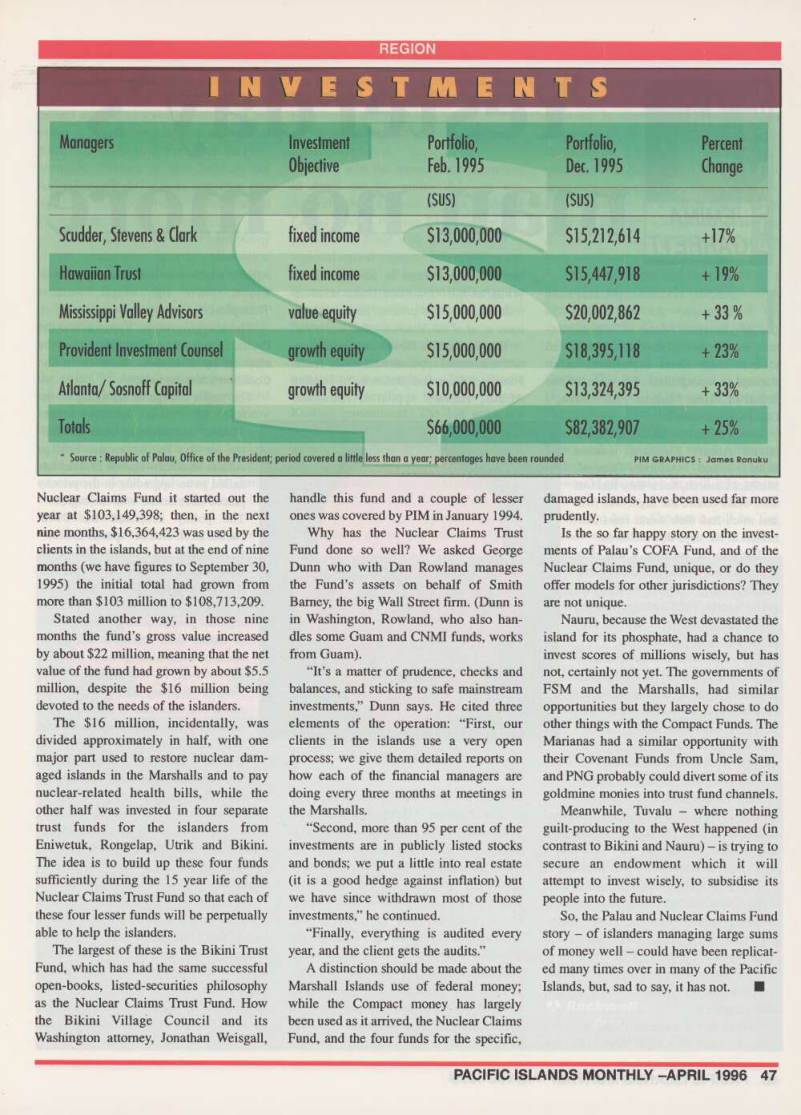
Micronesia' s prospering trust funds
By David North
Tired of reading about island gov ernments going broke? Then turn your attention to the financial situ ation of two Micronesian trust funds, with a total value of about $U5200,000,000 and growing.
They are the Marshall Islands Nuclear Claims Fund and Palau’s Compact Trust Fund.
Neither of these funds get taken by conmen (unlike Nauru and the Cooks).
They avoid risky real estate deals that sometimes work, and often do not (prob lems again faced by both Nauru and the Cooks). There is no threat of bankruptcy despite the infusion of many millions of US dollars (as there is in the FSM State of Chuuk, the former Truk).
Further, there are no scandals; none of the money is invested in pet schemes of island politicians, none of it goes to money-losing national airlines - problems of many island nations - and absolutely none of it is invested in show business.
Nauru’s well-publicised losses from a multi-million dollar bet on the London musical “Leonardo” helped defeat the government last year.
Finally, there are no secrets. Anyone interested can secure all the investment results, and can find out who is doing what with the public funds involved.
Palau apparently learned something from the negative experiences of other island states. In particular, it noticed what happened to the large chunks of US money that went to the Marshalls and FSM following the signing of the Compact of Free Association with
Washington.
FSM and the Marshalls have largely
used their Compact funds, which are stretched out over 15 years, to expand the size and generosity of their governments.
Much money has been wasted, and there is little invested to assure the future prosper ity of these islands. And with the annual payments moving down this year (as the tenth anniversary of sovereignty approaches) FSM and the Marshalls are facing tough financial times.
u ...None of the money is invested in pet schemes of island politicians...
Palau asked, and the US agreed, to “front-load” the funding process, giving the island nation much of the money immediately so that it could be invested.
This was done and Palau promptly created a five-member board for the Compact of Free Association (COFA) Trust Fund. It retained the Honolulu office of Merrill Lynch, the Wall Street powerhouse, to assist the COFA board in the management of the $66,000,000 placed in the Trust Fund.
The system is chock-full of checks and balances; Merrill Lynch neither holds the money - that is done by custodian banks nor does it make investment decisions that is done by five money managers selected by the COFA board and Merrill Lynch.
The fund managers, in term, can only invest Palau’s funds in publicly-listed stocks and bonds, and thus avoid both real estate ventures, and investments in island specific ventures. And every one of the
players is audited regularly.
In the first not-quite full year of Palau’s investment operations, its $66 million grew to more than $B2 million. This was an almost 25 per cent increase. Some of the increase was in the forms of dividends and interest payments, but most resulted from the rising value of the securities - it was a good year to be investing in American financial markets.
“Although Palau cannot expect to con sistently earn that return, this has been a propitious beginning, and over the next 15 years the country hopes to realise an aver age annual return of 12-15 per cent,”
Margaret Mary King, Economic Adviser
to President Kuniwo Nakamura, told PIM.
Palau has chosen five financial man agers, all US firms, to handle different aspects of its investments. Two work with fixed-income investments (that is, bonds); as expected, their rate of return was less than that of the three other managers who focused on equity investments (that is, stocks). The gains of each of the five man agers are shown in the table.
In addition to the COFA fund, described above. Palau has more than $lO4 million in other (US-granted) funds invested in a similar way. These funds, which are drawn down to meet various governmental expenses, must be invested in shorter term financial instruments than the COFA fund, and, for that reason, earn less; it was about nine per cent last year.
Meanwhile, a much older Micronesian trust fund continues to benefit from its stocks and bonds. In the case of the
I Nvestments
Nuclear Claims Fund it started out the year at $103,149,398; then, in the next nine months, $16,364,423 was used by the clients in the islands, but at the end of nine months (we have figures to September 30, 1995) the initial total had grown from more than $lO3 million to $108,713,209.
Stated another way, in those nine months the fund’s gross value increased by about $22 million, meaning that the net value of the fund had grown by about $5.5 million, despite the $l6 million being devoted to the needs of the islanders.
The $l6 million, incidentally, was divided approximately in half, with one major part used to restore nuclear dam aged islands in the Marshalls and to pay nuclear-related health bills, while the other half was invested in four separate trust funds for the islanders from Eniwetuk, Rongelap, Utrik and Bikini.
The idea is to build up these four funds sufficiently during the 15 year life of the Nuclear Claims Trust Fund so that each of these four lesser funds will be perpetually able to help the islanders.
The largest of these is the Bikini Trust Fund, which has had the same successful
open-books, listed-securities philosophy
as the Nuclear Claims Trust Fund. How the Bikini Village Council and its
Washington attorney, Jonathan Weisgall,
handle this fund and a couple of lesser ones was covered by PIM in January 1994.
Why has the Nuclear Claims Trust Fund done so well? We asked George Dunn who with Dan Rowland manages the Fund’s assets on behalf of Smith Barney, the big Wall Street firm. (Dunn is in Washington, Rowland, who also han dles some Guam and CNMI funds, works from Guam).
“It’s a matter of prudence, checks and balances, and sticking to safe mainstream investments,” Dunn says. He cited three elements of the operation: “First, our clients in the islands use a very open process; we give them detailed reports on how each of the financial managers are doing every three months at meetings in the Marshalls.
“Second, more than 95 per cent of the investments are in publicly listed stocks and bonds; we put a little into real estate (it is a good hedge against inflation) but we have since withdrawn most of those investments,” he continued.
“Finally, everything is audited every year, and the client gets the audits.”
A distinction should be made about the Marshall Islands use of federal money; while the Compact money has largely been used as it arrived, the Nuclear Claims Fund, and the four funds for the specific,
damaged islands, have been used far more prudently.
Is the so far happy story on the invest ments of Palau’s COFA Fund, and of the Nuclear Claims Fund, unique, or do they offer models for other jurisdictions? They are not unique.
Nauru, because the West devastated the island for its phosphate, had a chance to invest scores of millions wisely, but has not, certainly not yet. The governments of FSM and the Marshalls, had similar opportunities but they largely chose to do other things with the Compact Funds. The Marianas had a similar opportunity with their Covenant Funds from Uncle Sam, and PNG probably could divert some of its goldmine monies into trust fund channels.
Meanwhile, Tuvalu - where nothing guilt-producing to the West happened (in contrast to Bikini and Naum) - is trying to secure an endowment which it will attempt to invest wisely, to subsidise its people into the future.
So, the Palau and Nuclear Claims Fund story - of islanders managing large sums of money well - could have been replicat ed many times over in many of the Pacific Islands, but, sad to say, it has not. ■
Managers Investment Portfolio, Portfolio, Percent Objective Feb. 1995 Dec. 1995 Change
(Sus)
(Sus)
Scudder, Stevens & Clark fixed income $13,000,000 $15,212,614 +17% Hawaiian Trust fixed income $13,000,000 $15,447,918 + 19% Mississippi Valley Advisors value equity $15,000,000 $20,002,862 + 33% Provident Investment Counsel growth equity 1 $15,000,000 $18,395,118 + 23% Atlanta/ Sosnoff Capital growth equity $10,000,000 $13,324,395 + 33% Totals $66,000,000 $82,382,907 + 25% * Source : Republic of Palau, Office of the President; period covered a little less than a year; percentages have been rounded pim graphics ; James Ranuku
Yesterday’s
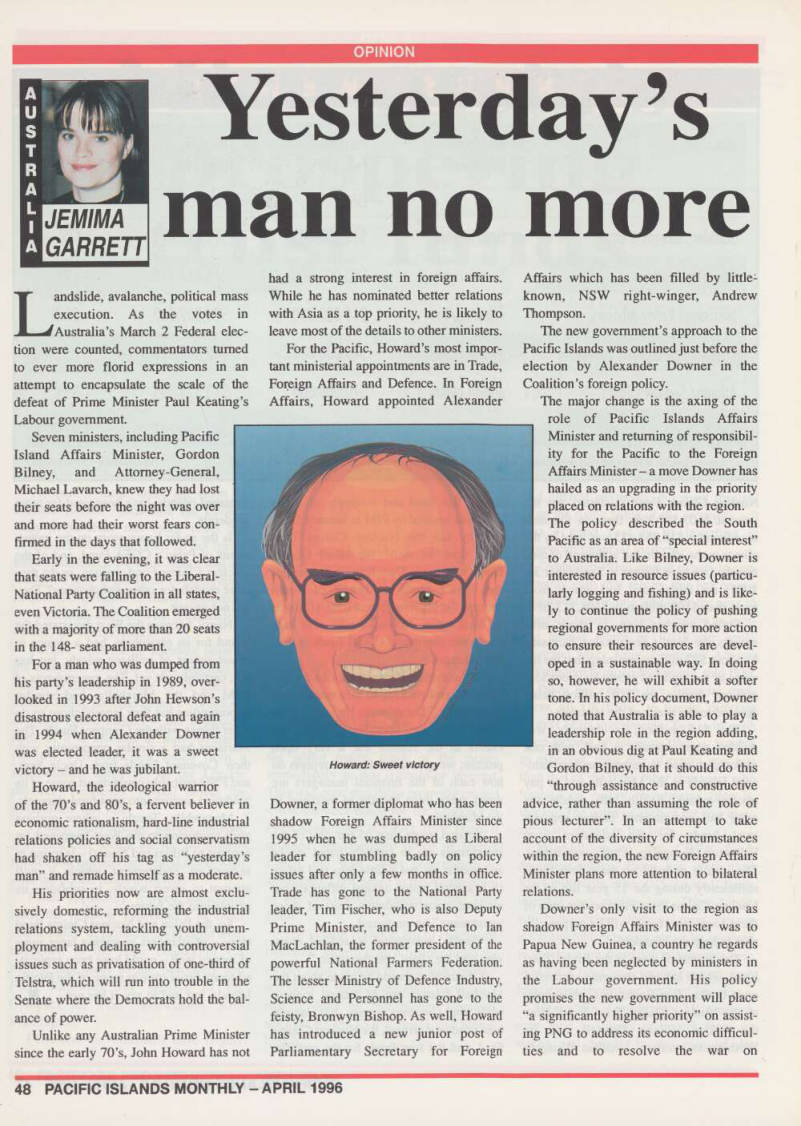
Opinion
Yesterday’s man no more
Landslide, avalanche, political mass execution. As the votes in Australia’s March 2 Federal elec tion were counted, commentators turned to ever more florid expressions in an attempt to encapsulate the scale of the defeat of Prime Minister Paul Keating’s
Labour government.
Seven ministers, including Pacific Island Affairs Minister, Gordon Bilney, and Attorney-General, Michael Lavarch, knew they had lost their seats before the night was over and more had their worst fears con firmed in the days that followed.
Early in the evening, it was clear that seats were falling to the Liberal- National Party Coalition in all states, even Victoria. The Coalition emerged with a majority of more than 20 seats in the 148- seat parliament.
For a man who was dumped from his party’s leadership in 1989, over looked in 1993 after John Hewson’s disastrous electoral defeat and again in 1994 when Alexander Downer was elected leader, it was a sweet victory - and he was jubilant.
Howard, the ideological warrior
of the 70’s and 80’s, a fervent believer in economic rationalism, hard-line industrial relations policies and social conservatism had shaken off his tag as “yesterday’s man” and remade himself as a moderate.
His priorities now are almost exclu sively domestic, reforming the industrial relations system, tackling youth unem ployment and dealing with controversial issues such as privatisation of one-third of Telstra, which will run into trouble in the Senate where the Democrats hold the bal ance of power.
Unlike any Australian Prime Minister since the early 70’s, John Howard has not
had a strong interest in foreign affairs.
While he has nominated better relations with Asia as a top priority, he is likely to leave most of the details to other ministers.
For the Pacific, Howard’s most impor tant ministerial appointments are in Trade, Foreign Affairs and Defence. In Foreign Affairs, Howard appointed Alexander
Downer, a former diplomat who has been shadow Foreign Affairs Minister since 1995 when he was dumped as Liberal leader for stumbling badly on policy issues after only a few months in office.
Trade has gone to the National Party leader, Tim Fischer, who is also Deputy Prime Minister, and Defence to lan MacLachlan, the former president of the powerful National Farmers Federation.
The lesser Ministry of Defence Industry, Science and Personnel has gone to the feisty, Bronwyn Bishop. As well, Howard has introduced a new junior post of Parliamentary Secretary for Foreign
Affairs which has been filled by little 1 known, NSW right-winger, Andrew Thompson.
The new government’s approach to the Pacific Islands was outlined just before the election by Alexander Downer in the Coalition’s foreign policy.
The major change is the axing of the
role of Pacific Islands Affairs Minister and returning of responsibil ity for the Pacific to the Foreign Affairs Minister - a move Downer has hailed as an upgrading in the priority placed on relations with the region.
The policy described the South Pacific as an area of “special interest” to Australia. Like Bilney, Downer is interested in resource issues (particu larly logging and fishing) and is like ly to continue the policy of pushing regional governments for more action to ensure their resources are devel oped in a sustainable way. In doing so, however, he will exhibit a softer tone. In his policy document, Downer noted that Australia is able to play a
leadership role in the region adding,
in an obvious dig at Paul Keating and Gordon Bilney, that it should do this “through assistance and constructive
advice, rather than assuming the role of pious lecturer”. In an attempt to take account of the diversity of circumstances within the region, the new Foreign Affairs Minister plans more attention to bilateral relations.
Downer’s only visit to the region as shadow Foreign Affairs Minister was to Papua New Guinea, a country he regards as having been neglected by ministers in the Labour government. His policy promises the new government will place “a significantly higher priority” on assist ing PNG to address its economic difficul ties and to resolve the war on
Australia
Jemima
Garrett
Howard: Sweet victory
Bougainville. Downer will continue the change in Australia’s aid delivery from budget support to specific project aid but plans to review current plans to ensure Australian aid helps to strengthen the PNG economy. Downer is also keen to see Australian aid play a more important role in the Bougainville Restoration Programme.
The focus of the Coalition’s aid policy is on grassroots poverty alleviation through sustainable economic develop ment and Downer has foreshadowed a major review of Australia’s aid effective ness which will assess whether these goals are being met.
In the Pacific Islands, the policy says the object of Australian aid must be to encourage “increasing self-sufficiency and economic prosperity”. In order to achieve that the Coalition government plans to: ♦Focus on community level develop ment rather than provision of large infra structure projects which may be better completed on the basis of private or public sector financing; ♦Continue to assist with surveillance of
the island states fishing zones and create opportunities for sharing more technical information and facilities; ♦look at more aid co-ordination to the region with Japan.
Trade with the region was not covered in detail but the policy did note that Australia has a trade surplus with the Pacific Islands of over $B5O million and promises to assist with the expansion of regional export capacity by reviewing the South Pacific Regional Trade and Economic Agreement (SPARTECA) “to examine options for improving the free flow of trade and investment”.
While there will be changes of empha sis, in most respects, the Howard govern ment’s stance towards the South Pacific seems fairly similar to that of the former Keating government. The big unknown factor is whether Alexander Downer will get time to focus real attention on the region.
The Coalition has nominated closer engagement with Asia as its highest prior ity but across the region media coverage of the Howard victory has made it obvious
that the Coalition has a lot of work to do to win the same respect that Paul Cheating achieved. In many quarters, the Coalition is perceived as Anglophile and more focused on Europe. Howard’s 1988 remarks about Asian immigration have not been forgotten and Alexander Downer is not well-known. In a region where warm relations between leaders are crucial to diplomatic success Downer is starting a long way back.
At home Downer also has problems, in an unusual step, John Howard has saddled him with an arrangement in which his
department, the Department of Foreign
Affairs and Trade, reports to two minis ters, himself and Trade minister, Tim Fischer. This has the potential to become an administrative nightmare. Downer and Fischer come from different political par ties and have differences over crucial issues such as the pace at which protection for local industries should be wound back.
Downer’s office says he will take prece dence in decision-making within the department but in Cabinet it will be Tim Fischer who has seniority. ■
Advertisements & other items, p. 49 (1 item)
I
WHEN YOU CAN SERVICE
OVER 500 COLLINS AVIONICS ITEMS
IN ONE PLACE
niwo 11 chiv * , y\
YOU’RE OFF TO A FLYING START.
I M For over 25 years Australia's Collins Avionics Service Centre (part of the Rockwell worldwide network) has provided an extensive range of state-of-the-art avionics services to meet the rapidly growing needs of our region.
The highest quality sales and service for air transport, general aviation and military requirements.
Including repair, overhaul and modification; contract maintenance; technical training, consulting and skills transfertest systems; equipment; and a 24-hour rental/exchange pool.
The Australian Service Centre is at Tullamarine in Victoria. For more information call Neil Thomson on (61 -3) 9338 0344 or fax (61-3) 9330 3007. With Collins Avionics the sky is definitely not the limit. *l* Rockwell Avionics Collins
Development’s
alternative approach
By Liz Thompson
There are an ever-increasing number of Non Government Organisations operating around the world. These organisations are independent of govern ment funding and generally concerned with environmental and humanitarian issues. In Papua New Guinea, many of the NGO groups concentrate on minimising resource exploitation by large multi national companies which rarely bring a profit to local landowners. Most NGO’s are concerned with finding ways to com municate ideas to grassroots communities in order to better equip them to handle new experiences. Villagers tell stories of
being approached by logging and mining
companies with persuasive offers of money and facilities which often never appear. NGO’s are trying to guard against
this problem using theatre and running
workshops in remote areas, designed to raise awareness and equip people to better deal with the new influences. NGO groups have been major proponents of alternative economic sources to logging, encouraging non-timber forest product industries. Vincent Manukayasi, who is the national co-ordinator for the Papua New Guinea Trust, an NGO, would go even fur ther. He argues that any form of develop ment is counter-productive and the real answer is to encourage greater pride in traditional culture and values. Manukayasi argues that Papua New Guineans, “have been brought up to believe that what they can buy in the shops from outside is better than what they themselves can produce.
Fresh fish caught in the sea is not as good as canned fish imported from Japan.”
Manukayasi points to what he calls a ‘cargo mentality’ as the problem, “if it comes from outside by plane or boat it has more value than if it is handpicked and taken across to the next building and packed, then it has no value at all. This is the whole development scenario here, peo ple have been led to believe that what we have ourselves has no value at all. We are told that we should adopt the western eco nomic systems, we should adopt their political, social and religious systems because our system has no value. For so long, people have been told this over and over again that, to a certain extent, they do not want to talk about what we can do our selves, but that somebody else does it and we can get it from them. This is the cargo cult”.
Manukayasi believes people should be given information which encourages them to take pride in their own traditions, so that the emphasis is no longer and for him the question is not “How should development take place?” but, “Should it take place at all”? The continuous pressure to develop is, in his opinion, the wrong approach.
Instead, he advocates a return to tradition al values. The problem with Papua New Guinea society now he reflects, is “you either have money and you are somebody or you have no money and everybody looks down on you. That was not the way things used to be. Before, everything we wanted we did ourselves, we harvested ourselves, we ate and cooked ourselves.
Now people ask, “Why should I eat fish if I can eat something that has been pro duced in Japan,” people equate Japan with a rich country which has a lot of money, so they think if I eat Japanese tinned fish I
will get some of their j wealth, I will be somebody. We go overboard to sell our logs and resources so that we can get money and buy canned fish and rice imported from other countries”. The main problem he insists, is the education sys tem. According to Manukayasi, as soon as a child goes to school they leam to speak English and are taught in English, “the stories they read are about people in towns who eat meat pies and drink coca-cola go to cinemas and drive cars. Imagine this, a child way up in the mountains who has never seen a car and reads about all this.”
Throughout the whole education process Manukayasi argues that a child is not only learning to read and write but intrinsically learning about white western culture and western development values. There is no doubt that many of these claims are rele vant though the argument Manukayasi presents is considered inappropriate by a number of other NGO organisations who reject his views as romantic and failing to address the real issues. Brian Brant, a lawyer at the Individual Community Rights Advocacy Forum (ICRAF), also an NGO, does not believe this “return to tra dition” approach is a realistic option.
ICRAF have in the last few years been responsible for helping landowners estab lish better deals in logging and mining operations and have been involved in the struggle by OK Tedi land owners to take BHP to court. He argues that the desire to create what he calls “encapsulated soci eties” which are culturally independent is problematic. Brant believes that given the choice the majority of Papua New Guineans want development and that a return to traditional ways of living is sim
ply not realistic. Recently, working with communities in the Hunstein Ranges in an attempt to stop a large scale logging venhire the people reportedly told him, “We want change, we want to send our children to vocational schools and high schools, we need money and either you give us some alternative or we will bring in the loggers.” Brant argues that development is inevitable but must be done in a sustainable manner, controlled and managed by the landowners themselves. He encourages the idea of non timber forest products and small scale logging using work about sawmills, small saw mills which can be carried into the forest and used to cut selected trees. In the Hunstein the people themselves asked for crow bars and shovels and sieves he tells me, “ so
landowners complain that NGO’s suggest things like butterfly farming but don’t help set them up adequately and the community are left unsure how to manage the project.
They say that in the face of these problems logging often seems easier and faster.
Nikhil Sacran, who is a resource econ omist working for the United Nations Development Project in Papua New Guinea insists that the vast majority of Papua New Guineans are keen to develop.
He is critical of the attempt to establish alternative sources of income, stating, “We found that there is a lot of talk about alter natives but a lot of it is just hype and fails to look at the markets or structural imped iments. We have looked at many of the alternatives and thought many unrealistic.
The idea that there would be a market in
water, health services, schools for their children. “It is very hard”, says Bruce Jeffries, project manager of Bio-Diversity Conservation and Resource Management Project, “ to find people who are not touched by the cash economy and that is the reality of what we are dealing with”.
There are many people working towards the goal of sustainable develop ment, not only in Papua New Guinea but around the world. In Papua New Guinea the amount of discussion amongst NGO’s about establishing sustainable develop ment ventures has not been equalled with projects that are up and running. The prob lems which have hindered the establishing of small business ventures are many, some of the most significant being poor infra structure, inadequate transportation facili-
Papua New Guineans have been brought up to believe that what they can buy in the shops is better than what they can produce. Fresh fish caught in the sea is not as good as canned fish imported from Japan.”
that they could go gold panning because they believe they have gold in their rivers.
They have asked for more work about sawmills because they think they need five to produce the money they require to pay their school fees and operate their out boards.” Brant does not believe it is possi ble to create a sustainable selective logging industry in Papua New Guinea because he argues the government does not have the ability to regulate it and landowners are getting only a fraction of the profits in return. Instead, he advocates the develop ment of alternative industries such as galup nut collection, cassowary and crocodile farming and eco-tourism. The idea of pro moting alternative industries to large scale logging and mining are probably the most common approach of NGO’s in Papua New Guinea. However, these ideas have been discussed for many years. The main reason for this is that many remote com munities suffer from a very poor trans portation infrastructure and in most places it is only possible to fly goods out. This makes the process extremely expensive and often financially enviable. Internal management has also been a problem.
eco-tourism for example, the reality is there is a very, very small number of tourists in Papua New Guinea. Another problem is that markets are easily saturat ed, Papua New Guinea exports Kina 300,000 worth of insects annually but the market is becoming saturated and most insect farming agencies are diversifying into live pupae. Promoters of alternative business development do not have a hard nosed business approach to alternatives only an enormous wish list.” Sacran blames the problem on people failing to look at the market when trying to establish new, sustainable industries. He blames promoters of alternative industries for the poor record so far, arguing they have focused too much on the supply side and not researched the market place adequate ly. There is no doubt that large scale log ging as it has been conducted in Papua New Guinea cannot be sustained, however many NGO organisations have talked long and hard about economic alternatives.
And despite Manukayasi’s view, the reality does appear to be that the majority of Papua New Guineans want development to take place. They want roads, clean
ties, communications and management training. Loan facilities have not been made available, nor educational pro grammes which train people to set up and manage small businesses. The only sug gestion made by the government has been the Land Registration Act, where land owners can register their land and take out a loan against it.
At the moment NGO’s are fighting a hard and uphill battle against the might of multi-nationals and the desires of commu nities who feel they are missing out on development and want to make money quickly. As logging and mining continue on a grand scale in Papua New Guinea, landowners continue to reap few of the profits and the desperate need for alterna tives doesn’t go away. There is little doubt things need to happen faster and more effectively. Most importantly transporta tion facilities need to be improved and NGO’s need to be better funded in order to carry through with training projects which are essential if villagers are to set up, man age and maintain alternative, small scale industries. ■
Fighting for
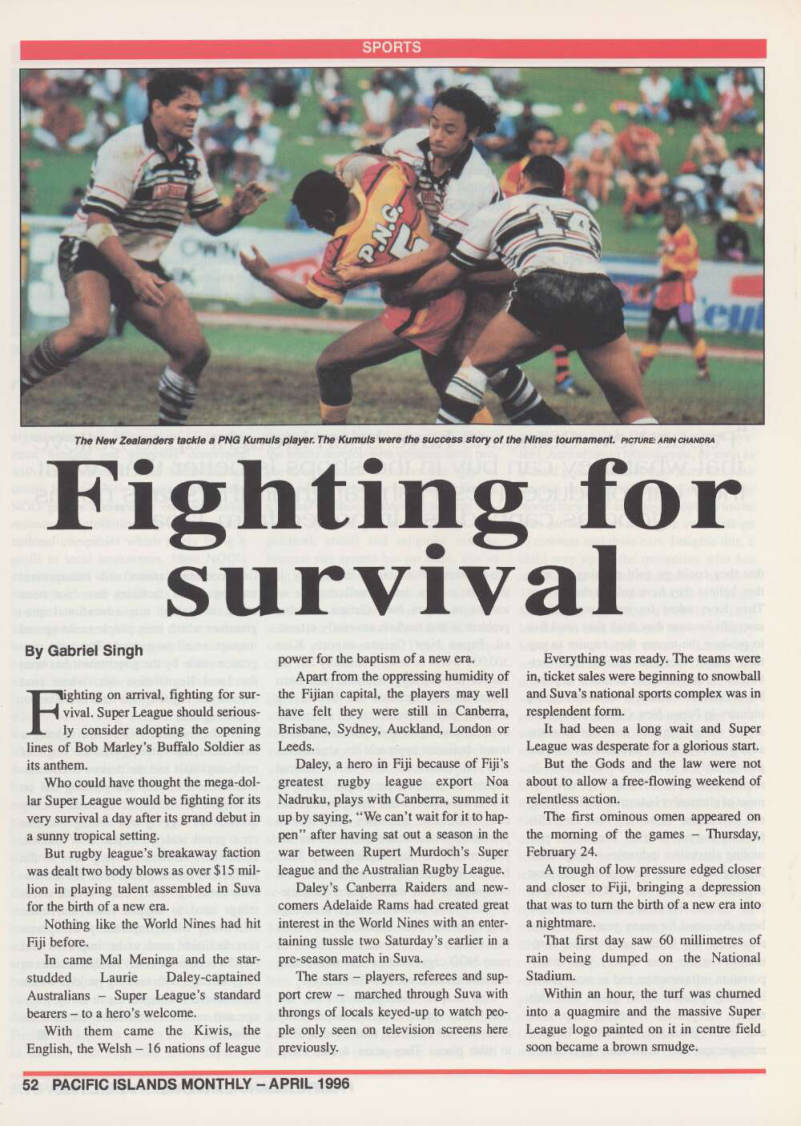
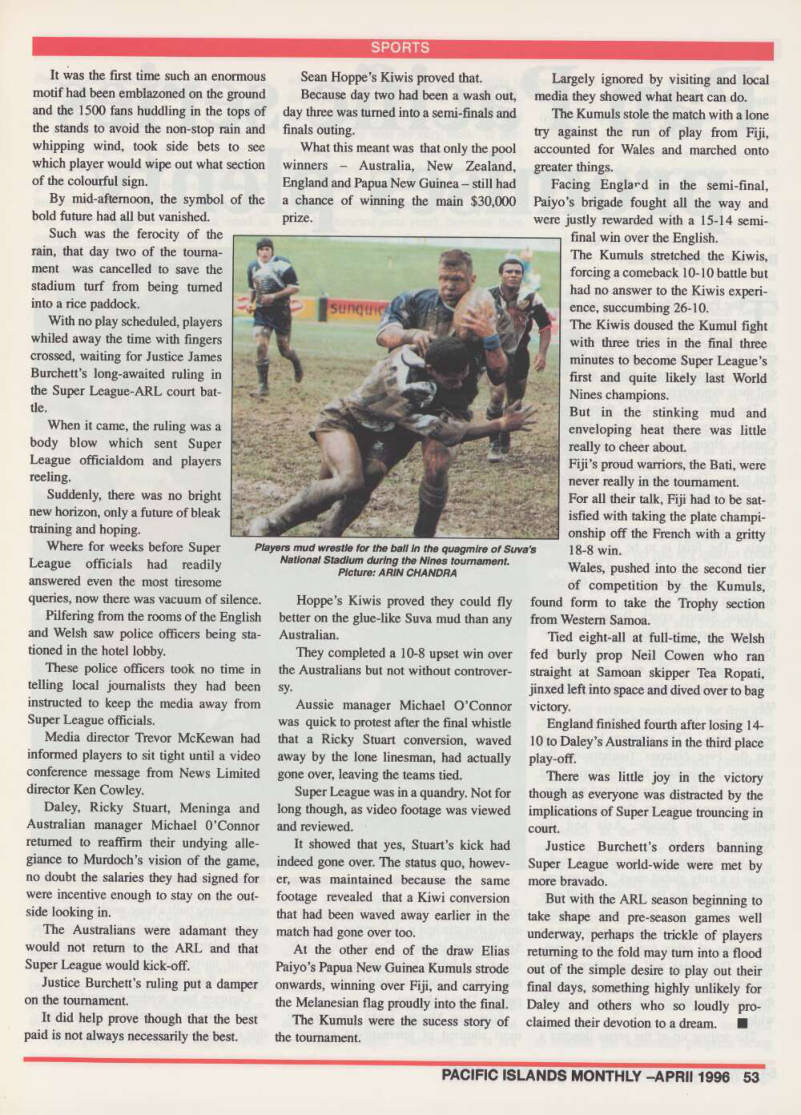
Sports
Fighting for survival
By Gabriel Singh
Fighting on arrival, fighting for sur vival. Super League should serious ly consider adopting the opening lines of Bob Marley’s Buffalo Soldier as its anthem.
Who could have thought the mega-dol lar Super League would be fighting for its very survival a day after its grand debut in a sunny tropical setting.
But rugby league’s breakaway faction was dealt two body blows as over $ 15 mil lion in playing talent assembled in Suva for the birth of a new era.
Nothing like the World Nines had hit Fiji before.
In came Mai Meninga and the star studded Laurie Daley-captained Australians - Super League’s standard bearers - to a hero’s welcome.
With them came the Kiwis, the English, the Welsh - 16 nations of league
power for the baptism of a new era.
Apart from the oppressing humidity of the Fijian capital, the players may well have felt they were still in Canberra, Brisbane, Sydney, Auckland, London or Leeds.
Daley, a hero in Fiji because of Fiji’s greatest rugby league export Noa Nadruku, plays with Canberra, summed it up by saying, “We can’t wait for it to hap pen” after having sat out a season in the war between Rupert Murdoch’s Super league and the Australian Rugby League.
Daley’s Canberra Raiders and new comers Adelaide Rams had created great interest in the World Nines with an enter taining tussle two Saturday’s earlier in a pre-season match in Suva.
The stars - players, referees and sup port crew - marched through Suva with throngs of locals keyed-up to watch peo ple only seen on television screens here previously.
Everything was ready. The teams were in, ticket sales were beginning to snowball and Suva’s national sports complex was in resplendent form.
It had been a long wait and Super League was desperate for a glorious start.
But the Gods and the law were not about to allow a free-flowing weekend of relentless action.
The first ominous omen appeared on the morning of the games - Thursday, February 24.
A trough of low pressure edged closer and closer to Fiji, bringing a depression that was to turn the birth of a new era into a nightmare.
That first day saw 60 millimetres of rain being dumped on the National Stadium.
Within an hour, the turf was churned into a quagmire and the massive Super League logo painted on it in centre field soon became a brown smudge.
The New Zealanders tackle a PNG Kumuls player. The Kumuls were the success story of the Nines tournament, pICTRE: ARIN CHANDRA
It was the first time such an enormous motif had been emblazoned on the ground and the 1500 fans huddling in the tops of the stands to avoid the non-stop rain and whipping wind, took side bets to see which player would wipe out what section of the colourful sign.
By mid-afternoon, the symbol of the bold future had all but vanished.
Such was the ferocity of the rain, that day two of the tourna ment was cancelled to save the stadium turf from being turned into a rice paddock.
With no play scheduled, players whiled away the time with fingers crossed, waiting for Justice James Burchett’s long-awaited ruling in the Super League-ARL court bat tle.
When it came, the ruling was a body blow which sent Super League officialdom and players reeling.
Suddenly, there was no bright new horizon, only a future of bleak training and hoping.
Where for weeks before Super League officials had readily answered even the most tiresome
queries, now there was vacuum of silence.
Pilfering from the rooms of the English and Welsh saw police officers being stationed in the hotel lobby.
These police officers took no time in telling local journalists they had been instructed to keep the media away from Super League officials.
Media director Trevor McKewan had informed players to sit tight until a video conference message from News Limited director Ken Cowley.
Daley, Ricky Stuart, Meninga and Australian manager Michael O’Connor returned to reaffirm their undying allegiance to Murdoch’s vision of the game, no doubt the salaries they had signed for were incentive enough to stay on the outside looking in.
The Australians were adamant they would not return to the ARL and that Super League would kick-off, Justice Burchett’s ruling put a damper on the tournament.
It did help prove though that the best paid is not always necessarily the best.
Sean Hoppe’s Kiwis proved that.
Because day two had been a wash out, day three was turned into a semi-finals and finals outing.
What this meant was that only the pool winners - Australia, New Zealand, England and Papua New Guinea - still had a chance of winning the main $30,000 prize.
Hoppe’s Kiwis proved they could fly better on the glue-like Suva mud than any Australian.
They completed a 10-8 upset win over the Australians but not without controver sy.
Aussie manager Michael O’Connor was quick to protest after the final whistle that a Ricky Stuart conversion, waved away by the lone linesman, had actually gone over, leaving the teams tied.
Super League was in a quandry. Not for long though, as video footage was viewed and reviewed.
It showed that yes, Stuart’s kick had indeed gone over. The status quo, howev er, was maintained because the same footage revealed that a Kiwi conversion that had been waved away earlier in the match had gone over too.
At the other end of the draw Elias Paiyo’s Papua New Guinea Kumuls strode onwards, winning over Fiji, and carrying the Melanesian flag proudly into the final.
The Kumuls were the sucess story of the tournament.
Largely ignored by visiting and local media they showed what heart can do.
The Kumuls stole the match with a lone try against the run of play from Fiji, accounted for Wales and marched onto greater things.
Facing England in the semi-final, Paiyo’s brigade fought all the way and were justly rewarded with a 15-14 semi
final win over the English.
The Kumuls stretched the Kiwis, forcing a comeback 10-10 battle but had no answer to the Kiwis experi ence, succumbing 26-10.
The Kiwis doused the Kumul fight with three tries in the final three minutes to become Super League’s first and quite likely last World Nines champions.
But in the stinking mud and enveloping heat there was little really to cheer about.
Fiji’s proud warriors, the Bati, were never really in the tournament.
For all their talk, Fiji had to be sat isfied with taking the plate champi onship off the French with a gritty 18-8 win.
Wales, pushed into the second tier of competition by the Kumuls,
found form to take the Trophy section from Western Samoa.
Tied eight-all at full-time, the Welsh fed burly prop Neil Cowen who ran straight at Samoan skipper Tea Ropati, jinxed left into space and dived over to bag victory.
England finished fourth after losing 14- 10 to Daley’s Australians in the third place play-off.
There was little joy in the victory though as everyone was distracted by the implications of Super League trouncing in court.
Justice Burchett’s orders banning Super League world-wide were met by more bravado.
But with the ARL season beginning to take shape and pre-season games well underway, perhaps the trickle of players returning to the fold may turn into a flood out of the simple desire to play out their final days, something highly unlikely for Daley and others who so loudly pro claimed their devotion to a dream. ■
Players mud wrestle for the ball In the quagmire of Suva's National Stadium during the Nines tournament.
Picture: ARIN CHANDRA
promises plenty
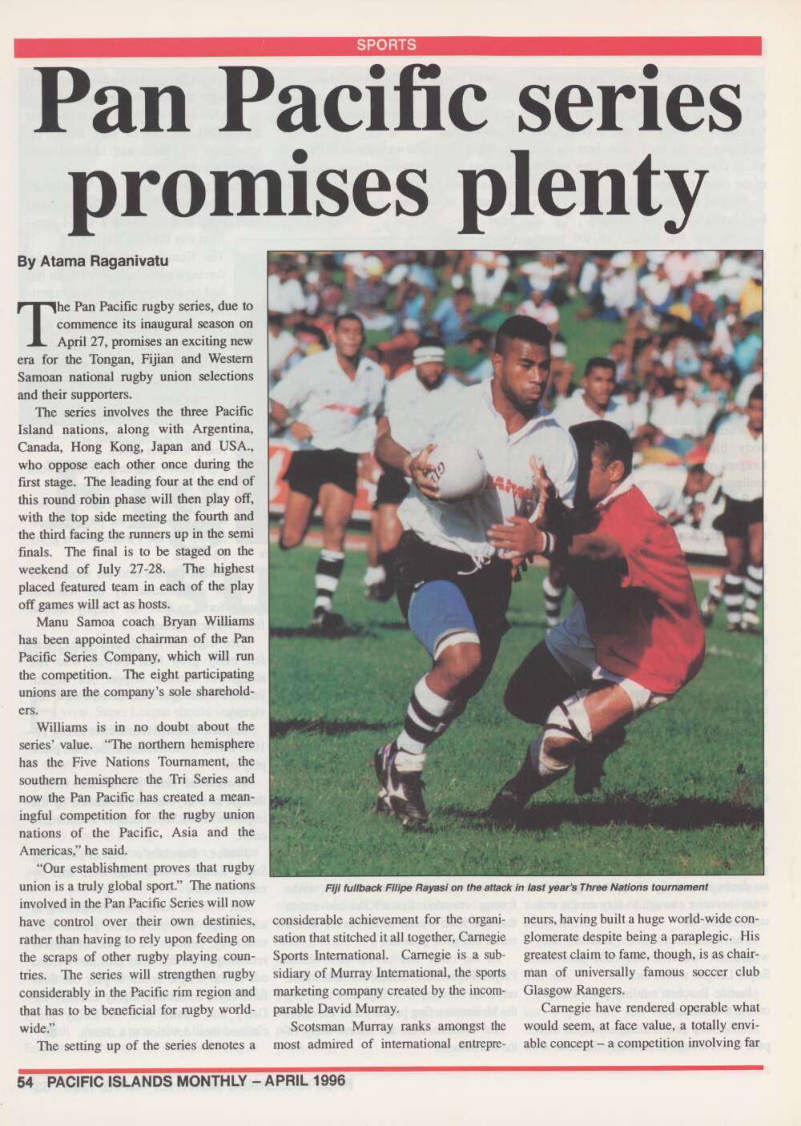
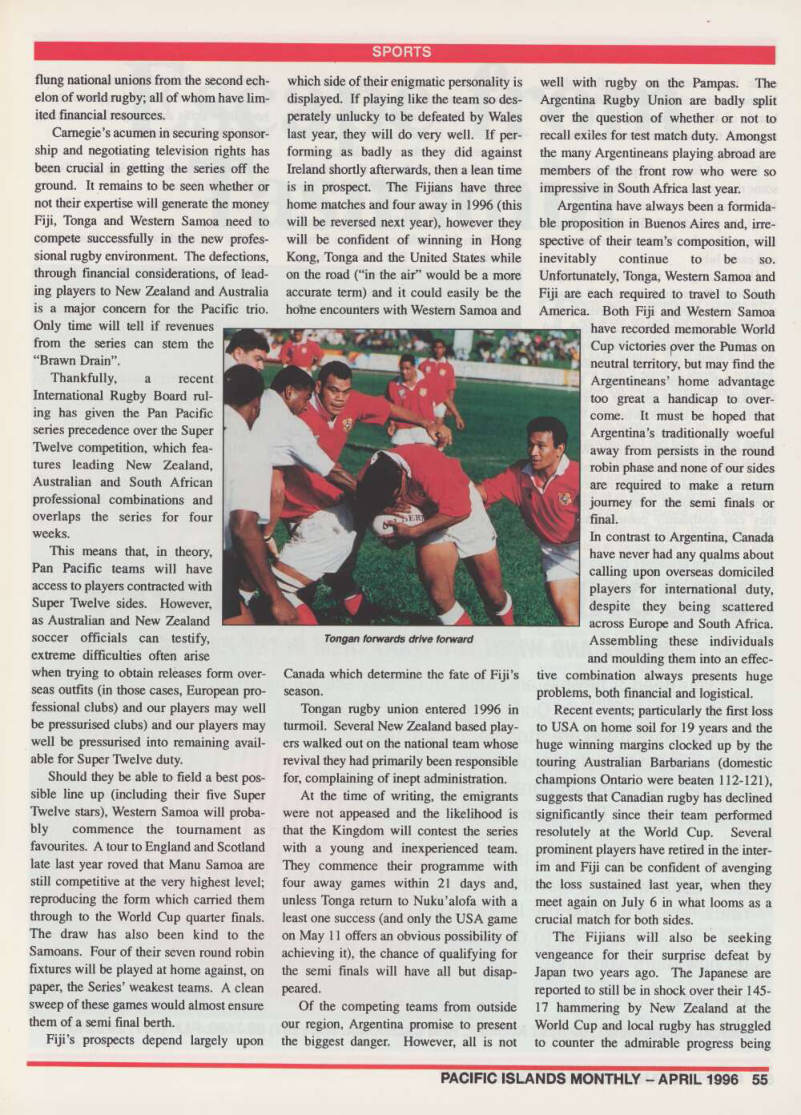

Pan Pacific series promises plenty
By Atama Raganivatu
The Pan Pacific rugby series, due to commence its inaugural season on April 27, promises an exciting new era for the Tongan, Fijian and Western Samoan national rugby union selections and their supporters.
The series involves the three Pacific Island nations, along with Argentina, Canada, Hong Kong, Japan and USA., who oppose each other once during the first stage. The leading four at the end of this round robin phase will then play off, with the top side meeting the fourth and the third facing the runners up in the semi finals. The final is to be staged on the weekend of July 27-28. The highest placed featured team in each of the play off games will act as hosts.
Manu Samoa coach Bryan Williams has been appointed chairman of the Pan Pacific Series Company, which will run the competition. The eight participating unions are the company’s sole sharehold ers.
Williams is in no doubt about the series’ value. “The northern hemisphere has the Five Nations Tournament, the southern hemisphere the Tri Series and now the Pan Pacific has created a mean ingful competition for the rugby union nations of the Pacific, Asia and the Americas,” he said.
“Our establishment proves that rugby union is a truly global sport.” The nations involved in the Pan Pacific Series will now have control over their own destinies, rather than having to rely upon feeding on the scraps of other rugby playing coun tries. The series will strengthen rugby considerably in the Pacific rim region and that has to be beneficial for rugby world wide.”
The setting up of the series denotes a
considerable achievement for the organi sation that stitched it all together, Carnegie Sports International. Carnegie is a sub sidiary of Murray International, the sports marketing company created by the incom parable David Murray.
Scotsman Murray ranks amongst the most admired of international entrepre
neurs, having built a huge world-wide con glomerate despite being a paraplegic. His greatest claim to fame, though, is as chair man of universally famous soccer club Glasgow Rangers.
Carnegie have rendered operable what would seem, at face value, a totally envi able concept - a competition involving far
Fiji fullback Filipe Rayasi on the attack in last year’s Three Nations tournament
flung national unions from the second ech elon of world rugby; all of whom have lim ited financial resources.
Carnegie’s acumen in securing sponsor ship and negotiating television rights has been crucial in getting the series off the ground. It remains to be seen whether or not their expertise will generate the money Fiji, Tonga and Western Samoa need to compete successfully in the new profes sional rugby environment. The defections, through financial considerations, of lead ing players to New Zealand and Australia is a major concern for the Pacific trio.
Only time will tell if revenues from the series can stem the “Brawn Drain”.
Thankfully, a recent International Rugby Board rul ing has given the Pan Pacific series precedence over the Super Twelve competition, which fea tures leading New Zealand, Australian and South African professional combinations and overlaps the series for four weeks.
This means that, in theory, Pan Pacific teams will have access to players contracted with Super Twelve sides. However, as Australian and New Zealand soccer officials can testify, extreme difficulties often arise
when trying to obtain releases form over seas outfits (in those cases, European pro fessional clubs) and our players may well be pressurised clubs) and our players may well be pressurised into remaining avail able for Super Twelve duty.
Should they be able to field a best pos sible line up (including their five Super Twelve stars), Western Samoa will proba bly commence the tournament as favourites. A tour to England and Scotland late last year roved that Manu Samoa are still competitive at the very highest level; reproducing the form which carried them through to the World Cup quarter finals.
The draw has also been kind to the Samoans. Four of their seven round robin fixtures will be played at home against, on paper, the Series’ weakest teams. A clean sweep of these games would almost ensure them of a semi final berth.
Fiji’s prospects depend largely upon
which side of their enigmatic personality is displayed. If playing like the team so des perately unlucky to be defeated by Wales last year, they will do very well. If per forming as badly as they did against Ireland shortly afterwards, then a lean time is in prospect. The Fijians have three home matches and four away in 1996 (this will be reversed next year), however they will be confident of winning in Hong Kong, Tonga and the United States while on the road (“in the air” would be a more accurate term) and it could easily be the holne encounters with Western Samoa and
Canada which determine the fate of Fiji’s season.
Tongan rugby union entered 1996 in turmoil. Several New Zealand based play ers walked out on the national team whose revival they had primarily been responsible for, complaining of inept administration.
At the time of writing, the emigrants were not appeased and the likelihood is that the Kingdom will contest the series with a young and inexperienced team.
They commence their programme with four away games within 21 days and, unless Tonga return to Nuku’alofa with a least one success (and only the USA game on May 11 offers an obvious possibility of achieving it), the chance of qualifying for the semi finals will have all but disap peared.
Of the competing teams from outside our region, Argentina promise to present the biggest danger. However, all is not
well with rugby on the Pampas. The Argentina Rugby Union are badly split over the question of whether or not to recall exiles for test match duty. Amongst the many Argentineans playing abroad are members of the front row who were so impressive in South Africa last year.
Argentina have always been a formida ble proposition in Buenos Aires and, irre spective of their team’s composition, will inevitably continue to be so.
Unfortunately, Tonga, Western Samoa and Fiji are each required to travel to South America. Both Fiji and Western Samoa
have recorded memorable World Cup victories pver the Pumas on neutral territory, but may find the Argentineans’ home advantage too great a handicap to over come. It must be hoped that Argentina’s traditionally woeful away from persists in the round robin phase and none of our sides are required to make a return journey for the semi finals or final.
In contrast to Argentina, Canada have never had any qualms about calling upon overseas domiciled players for international duty, despite they being scattered across Europe and South Africa.
Assembling these individuals and moulding them into an effec
tive combination always presents huge problems, both financial and logistical.
Recent events; particularly the first loss to USA on home soil for 19 years and the huge winning margins clocked up by the touring Australian Barbarians (domestic champions Ontario were beaten 112-121), suggests that Canadian rugby has declined significantly since their team performed resolutely at the World Cup. Several prominent players have retired in the inter im and Fiji can be confident of avenging the loss sustained last year, when they meet again on July 6 in what looms as a crucial match for both sides.
The Fijians will also be seeking vengeance for their surprise defeat by Japan two years ago. The Japanese are reported to still be in shock over their 145- 17 hammering by New Zealand at the World Cup and local rugby has struggled to counter the admirable progress being
Tongan forwards drive forward
made by soccer there. A flourishing Japanese national team is essential for the health of their domestic game and, one suspects, the Pan Pacific series’ financial well being.
Even so, Japan will probably require some time to recover from the Massacre of Bloemfontein and maximum points should be gained by the Pacific’s represen tatives when the Asians tour in late June aiyl early July.
Hong Kong are ranked behind Japan (and South Korea) in Asia and will do well to avid bottom place on the Series ladder.
Their side consists solely of British and Australian expatriates, who achieved little in their home countries, and they are coached by New Zealander George Simpkin. Simpkin’s greatest moment in coaching came in 1980 when his Waikato team defeated Auckland 7-3 in an epic Ranfurly Shield battle. Bryan Williams and Brad Johnston, now the mentors of Western Samoa and Fiji respectively, played for Auckland. Now, 16 years later, they can confidently contemplate intro ducing professionalism.
With the exception of the win over Canada, results for them in recent years have been disappointing. Both Tonga and Fiji visit the Eagles early in their cam paigns and losses there would be momen tous setbacks for the Pacific islanders’ aspirations. Lack of international expo sure has always been the USA’s greatest dilemma and they will be a major benefi ciary from the regular competitive fixtures provided by the Pan Pacific series.
However, several seasons may be required before that benefit becomes apparent.
Predicting the results of a tournament over a month before it commences is always a thankless (and, possibly, stupid) undertaking, yet even at this juncture both Western Samoa and Fiji can be forgiven if being reasonably optimistic about appear ing in the semi finals while Tonga will probably have to be content that the series offers them an invaluable opportunity to effect their rebuilding programme.
What can be forecast with much greater certainty is that Pacific rugby fans can look forward to the finest feast of competitive rugby they have ever experi
enced and our local players have been granted an unprecedented opportunity to hone their skills and gauge their standing in the international area.
Series fixtures involving Fiji, Tonga & Western Samoa: April 27: Argentina vs Tonga; USA vs Fiji; May 4: Canada vs Tonga; Hong Kong vs Fiji; May 11: USA vs Tonga; Fiji vs Western Samoa; May 18: Western Samoa vs Tonga; June 8: Argentina vs Fiji June 15: Western Samoa vs Hong Kong; June 22: Western Samoa vs USA; Fiji vs Japan; Tonga vs Hong Kong June 29: Western Samoa vs Japan; Tonga vs Fiji; July 6; Argentina vs Western Samoa; Fiji vs Canada; Tonga vs Japan; July 13: Canada vs Western Samoa (Home teams named first in all instances). ■
Advertisements & other items, p. 56 (1 item)
Second Hand Containers
WHERE AND WHEN YOU WANT THEM IN THE PACIFIC If you need a flexible and safe storage space we have the ideal solution for you. Our second hand containers provide instant secure storage. Guaranteed to be wind and waterproof these containers are ideal for both temporary and longterm storage in Pacific conditions.
We can deliver to any island in the Pacific within a month and our rates have got to be the lowest you will find. All you need to do is tell us how many you want.
CONTACT:
PASCALS MARCONNET, BP 4757 NOUMEA, NEW CALEDONIA. TEL: (687) 28 7450. FAX: (687) 26 3248
Escape from Tasmania
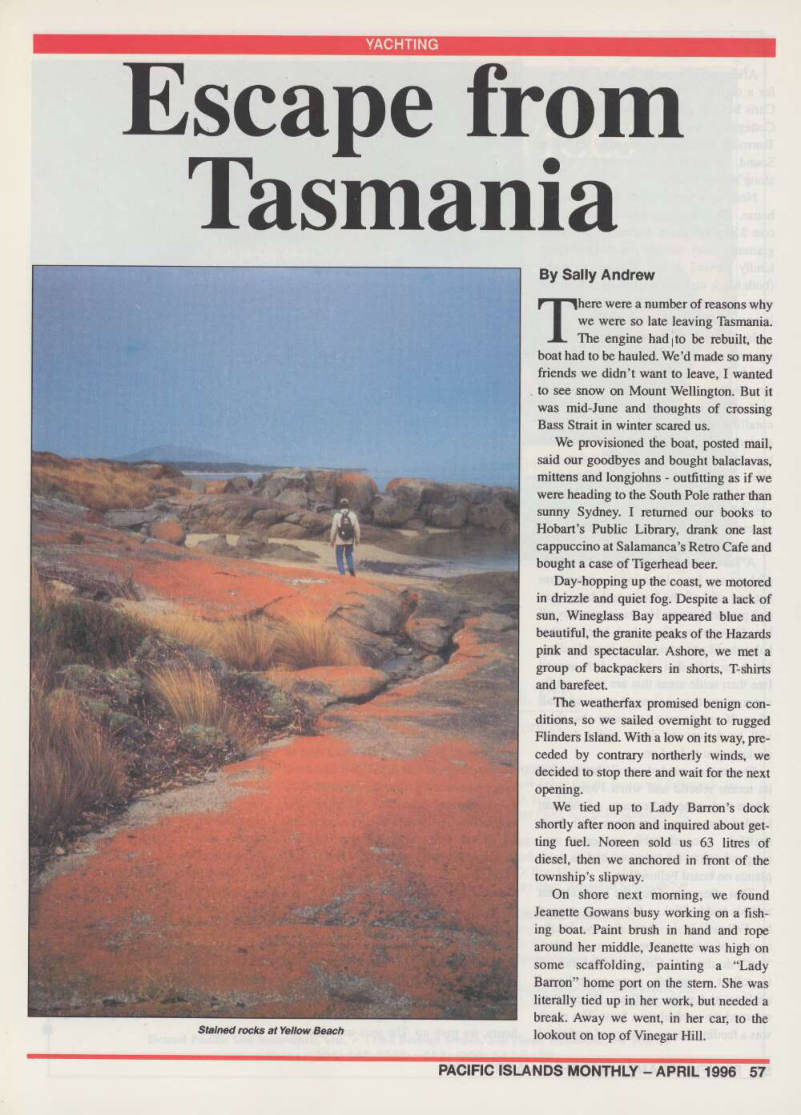
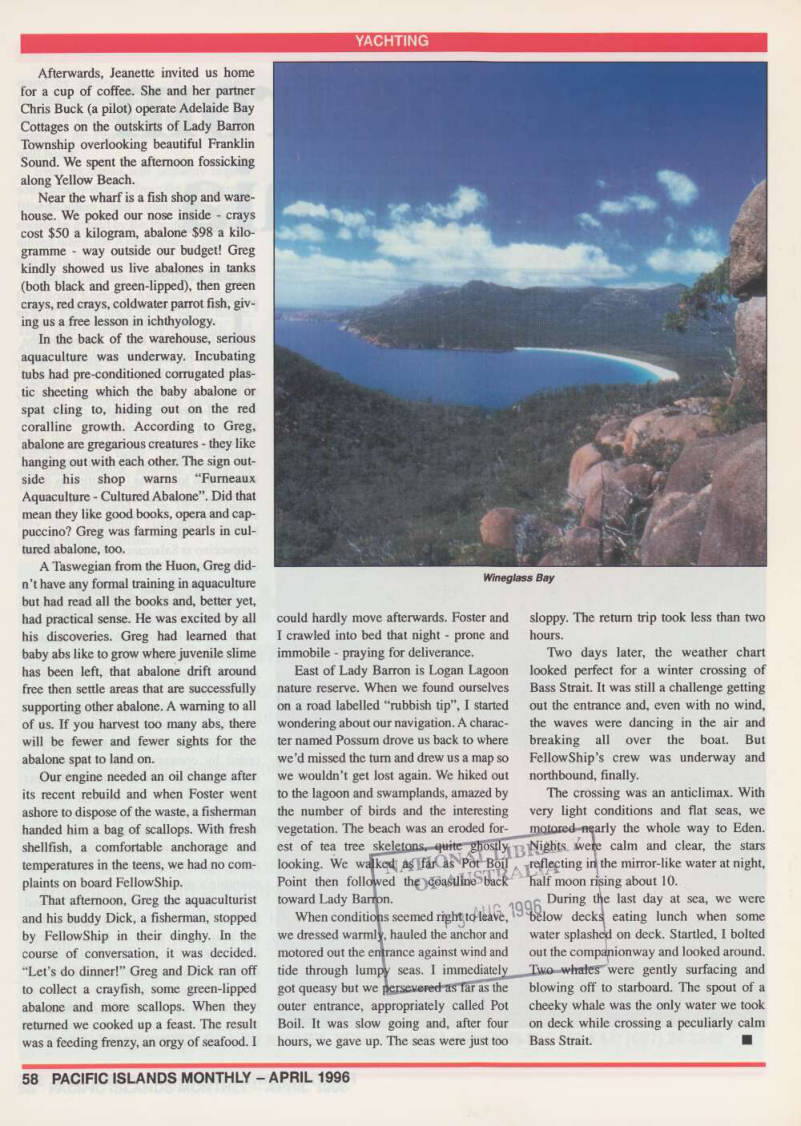
Tasmania
By Sally Andrew
There were a number of reasons why we were so late leaving Tasmania.
The engine had |to be rebuilt, the boat had to be hauled. We’d made so many friends we didn’t want to leave, I wanted to see snow on Mount Wellington. But it was mid-June and thoughts of crossing Bass Strait in winter scared us.
We provisioned the boat, posted mail, said our goodbyes and bought balaclavas, mittens and longjohns - outfitting as if we were heading to the South Pole rather than sunny Sydney. I returned our books to Hobart’s Public Library, drank one last cappuccino at Salamanca’s Retro Cafe and bought a case of Tigerhead beer.
Day-hopping up the coast, we motored in drizzle and quiet fog. Despite a lack of sun. Wineglass Bay appeared blue and beautiful, the granite peaks of the Hazards pink and spectacular. Ashore, we met a group of backpackers in shorts, T-shirts and barefeet.
The weatherfax promised benign con ditions, so we sailed overnight to rugged Flinders Island. With a low on its way, pre ceded by contrary northerly winds, we decided to stop there and wait for the next opening.
We tied up to Lady Barron’s dock shortly after noon and inquired about get ting fuel. Noreen sold us 63 litres of diesel, then we anchored in front of the township’s slipway.
On shore next morning, we found Jeanette Gowans busy working on a fish ing boat. Paint brush in hand and rope around her middle, Jeanette was high on some scaffolding, painting a “Lady Barron” home port on the stem. She was literally tied up in her work, but needed a break. Away we went, in her car, to the lookout on top of Vinegar Hill.
Stained rocks at Yellow Beach
Afterwards, Jeanette invited us home for a cup of coffee. She and her partner Chris Buck (a pilot) operate Adelaide Bay Cottages on the outskirts of Lady Barron Township overlooking beautiful Franklin Sound. We spent the afternoon fossicking along Yellow Beach.
Near the wharf is a fish shop and ware house. We poked our nose inside - crays cost $5O a kilogram, abalone $9B a kilo gramme - way outside our budget! Greg kindly showed us live abalones in tanks (both black and green-lipped), then green crays, red crays, coldwater parrot fish, giv ing us a free lesson in ichthyology.
In the back of the warehouse, serious aquaculture was underway. Incubating tubs had pre-conditioned corrugated plas tic sheeting which the baby abalone or spat cling to, hiding out on the red coralline growth. According to Greg, abalone are gregarious creatures - they like hanging out with each other. The sign out side his shop warns “Fumeaux Aquaculture - Cultured Abalone”. Did that mean they like good books, opera and cap puccino? Greg was farming pearls in cul tured abalone, too.
A Taswegian from the Huon, Greg did n’t have any formal training in aquaculture but had read all the books and, better yet, had practical sense. He was excited by all his discoveries. Greg had learned that baby abs like to grow where juvenile slime has been left, that abalone drift around free then settle areas that are successfully supporting other abalone. A warning to all of us. If you harvest too many abs, there will be fewer and fewer sights for the abalone spat to land on.
Our engine needed an oil change after its recent rebuild and when Foster went ashore to dispose of the waste, a fisherman handed him a bag of scallops. With fresh shellfish, a comfortable anchorage and temperatures in the teens, we had no com plaints on board Fellowship.
That afternoon, Greg the aquaculturist and his buddy Dick, a fisherman, stopped by Fellowship in their dinghy. In the course of conversation, it was decided.
“Let’s do dinner!” Greg and Dick ran off to collect a crayfish, some green-lipped abalone and more scallops. When they returned we cooked up a feast. The result was a feeding frenzy, an orgy of seafood. I
could hardly move afterwards. Foster and I crawled into bed that night - prone and immobile - praying for deliverance.
East of Lady Barron is Logan Lagoon nature reserve. When we found ourselves on a road labelled “rubbish tip”, I started wondering about our navigation. A charac ter named Possum drove us back to where we’d missed the turn and drew us a map so we wouldn’t get lost again. We hiked out to the lagoon and swamplands, amazed by the number of birds and the interesting vegetation. The beach was an eroded for est of tea tree skeletons, quite looking. We walke^ Point then followed tho^o^ldin'e" J back toward Lady Barron. /■ if; 1 When conditions seemed right tcf leave, we dressed warmly, hauled the anchor and motored out the entrance against wind and tide through lumpy seas. I immediately got queasy but we persevered as far as the outer entrance, appropriately called Pot Boil. It was slow going and, after four hours, we gave up. The seas were just too
sloppy. The return trip took less than two hours.
Two days later, the weather chart looked perfect for a winter crossing of Bass Strait. It was still a challenge getting out the entrance and, even with no wind, the waves were dancing in the air and breaking all over the boat. But Fellowship’s crew was underway and northbound, finally.
The crossing was an anticlimax. With very light conditions and flat seas, we mQ|OEed»fl©arly the whole way to Eden.
Nights. ive|e calm and clear, the stars reflecting in the mirror-like water at night, naif moon rising about 10.
During the last day at sea, we were o&low decks[ eating lunch when some water splashed on deck. Startled, I bolted out the compapionway and looked around.
Two whales were gently surfacing and blowing off to starboard. The spout of a cheeky whale was the only water we took on deck while crossing a peculiarly calm Bass Strait. ■
Wineglass Bay
Advertisements & other items, pp. 59-60 (1 item)
Grand Pacific Life Insurance, Ltd.
10 15 20 25 30 35 40 45 50 55 60 Grand Pacific Life Insurance offers you a lifetime of safe, secure products at very competitive rates. 25 Choose from a full range of products such as
• Super Ordinary Life
• Super Universal • Non-Participating Whole Life • 10-Year Level Term • Flexible Premium Annuities • Group Life Insurance
• IRAs
• Graded Premium Whole Life We've been dedicated to providing fast, personalized service for more than 35 years through local ownership and management.
End Pacific life Insurance, Ltd 10 15 20 25 30 35 40 45 50 55 60
Grand Pacific Life Insurance, Ltd.
A member of the Finance Factors Family
FEDERATED STATES
OF MICRONESIA
Actouka Executive Insurance Underwriters P.O. Box 55, Kolonia, Pohnpei, Federated States of Micronesia 96941 Pacific Basin Insurance & General Services, Inc P.O. Box 494, Chuuk State, Federated States of Micronesia 96942
TONGA
Peseti Ma'afu Ins. & Finance, Ltd.
Private Bag 2, Taumoepeau Bldg.
Nukualofa, Tonga
GUAM
Great National Insurance Underwriters, Inc.
P.O. Box GA, Agana, Guam 96910
AMERICAN SAMOA
Mark Solofa Pacific Insurance & Finance, Inc.
P.O. Box 3149 Pago Pago, American Samoa 96799 Pacific Financial Corporation P.O. Box AT, Agana, Guam 96910 Takagi & Associates, Inc.
GCIC Bldg., Suite 100 414 W. Soledad Ave.
Agana, Guam 96910
MARSHALL ISLANDS
Marshalls Insurance Agency P.O. Box 113, Majuro, Marshall Islands 96960
WESTERN SAMOA
Mark Solofa Pacific Insurance & Finance, Inc.
P.O. Box 3149 Pago Pago, American Samoa 96799
NORTHERN MARIANAS
Pacific Basin Insurance Underwriters, Inc.
P.O. Box 710 Saipan, Mariana Islands 96950 Pacifica Insurance Underwriters, Inc.
P.O. Box 168, Saipan, Mariana Islands 96950 Grand Pacific Life Insurance, Ltd. • 1164 Bishop Street, sth Floor, Honolulu, HI 96813 Phone: (808) 548-3363 • FAX: (808) 548-5122
THE NEW
PRIVILEGE* OASS
■fe £
The Uncompromised Family Sedan
THE RLL NEW
MITSUBISHI
LRNCER
Meet the car that was bom to succeed. With its progressive engineering and striking appearance, the all-new Mitsubishi Lancer advances effectively, impressively... moving ahead at every turn.
Get behind the wheel and experience the new standard in family sedans.
AMERICAN SAMOA: PACIFIC MARKETING INC. P.O. Box 698, Pago Pago, Tel. 699-9140/ AUSTRALIA; MITSUBISHI MOTORS AUSTRALIA LTD. 1284 South Road, Clovelly Pari<, South Australia, 5042, Tel. (08) 2757297 / FUI; NIVIS MOTOR & MACHINERY CO. LTD. G.P.O. Box 150, Suva, Tel. 383411 / GUAM: TRIPLE J ENTERPRISES INC. P.O. Box 6066, Tamuning, Tel. 6469126/NEW CALEDONIA: SOCIETE OTMPORTATION 0 AUTO DU PACIFIQUE SUD S.A. P.O. Box 2548, Noumea, Tel. 281-787 / NEW ZEALAND: MITSUBISHI MOTORS NEW ZEALAND LTD. Private Bag. Porirua, Tel. 237-0109 / NORFOLK ISLAND: BORRY'S PTY LTD. P.O. Box 169, Taylors Road, Burnt, Tel. 22114/PAPUA NEW GUINEA: TOBA MOTORS FTY LTD. P.O. Box 503, Port Moresby /SAIPAN: SAIPAN AUTOWORLD INC. P.O.
Box 487, Tel. 234-7133/SOLOMON ISLANDS: HARVEST PACIFIC LTD. G.P.O. Box 823, Honiara. Tel. 30407/TAHITI: SOPADEP S.A. B.P. 1617, Papeete, Tel. 427393/TONGA: SITANI MAPI CD, LTD.
P.O. Box 83, NukuAlofa, Tel. 24044/VANUATU: SOCOMETRA VANUATU LTD. B.P. 6, Port-Vila,.Tel. 2314/WESTERN SAMOA: MOTOR DISTRIBUTORS (SAMOA) LTD. P.O. Box 576, Apia, Tel. 20957 A
MITSUBISHI
MOTORS
CREATING TOGETHER