Pacific
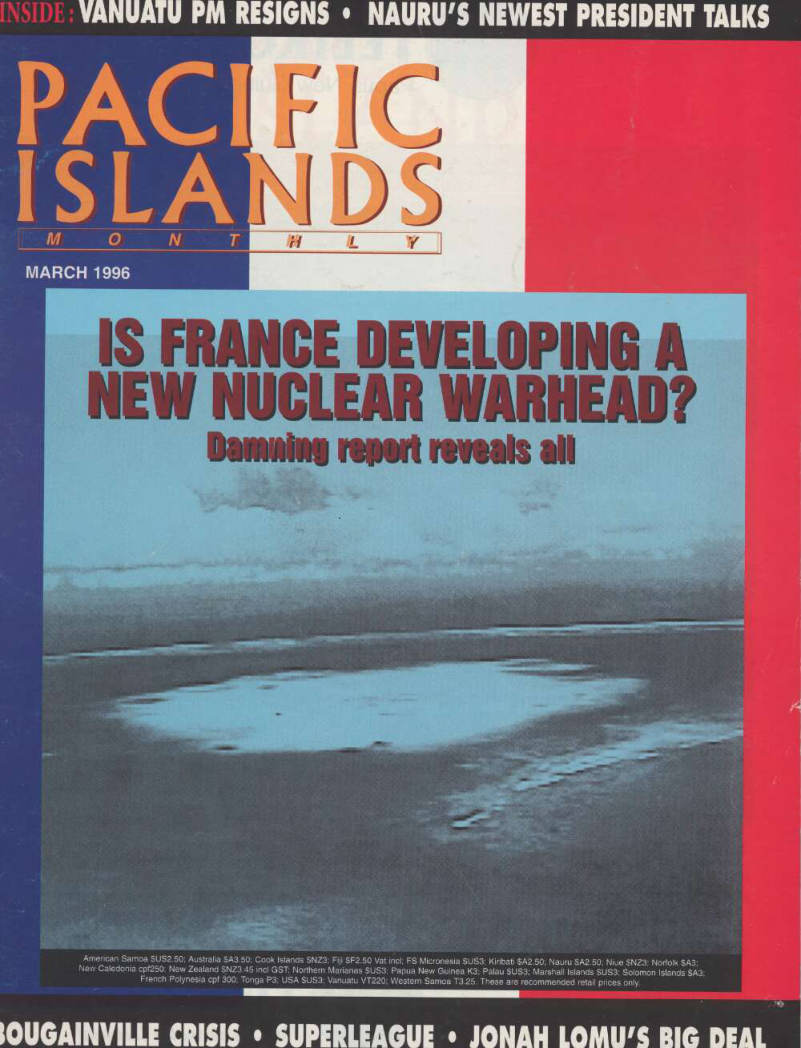

Islands
Monthly
INSIDE: VANUATU PM RESIGNS NAURU'S NEWEST PRESIDENT TALKS
March 1996
Is France Developing A
New Nuclear Warhead?
Dwwaißi rmwt irwrls mi
American Samoa SUS2.SO: Australia 5A3.50: Cook Islands SNZ3: Fiji 5F2.50 Vat incl; FS Micronesia SUSS: Kiribati 5A2.50; Nauru 5A2.50: Niue SNZ3: Norfolk SA3; New Caledonia cpf2so: New Zealand 5NZ3.45 incl GST; Northern Marianas SUS 3; Papua New Guinea K 3; Palau SUS 3; Marshall Islands SUSS; Solomon Islands SA3; French Polynesia cpf 300; Tonga P 3; USA SUS 3; Vanuatu VT22O; Western Samoa T 3.25. These are recommended retail prices only.
BOUGAINVILLE CRISIS • SUPERLEAGUE • JONAH LOMU'S BIG DEAL
Carer By: Graphic Systems
Advertisements & other items, p. 2 (1 item)
Telikom
Papua New Guinea
, m * i ( . --T mj r -«. v£i;V '"■JUft 11 : «pa A m J * I:> ■' : j ts .;i - i nntnumiimmm ’ L :i * -J : ii ife N :: ; 3 : -*3 i %-i t** ss 0
iSSSS*!
s» '■.
Telikom has set the pace in providing state-of-the-art telecommunications links within PNG and to anywhere around the world as we enter the 21st Century. For all your telecommunications needs, write to us at this address: Assistant General Manager Telikom Marketing Department P.O. Box 291
Waigani, Papua New Guinea
Tel: 675 300 5564 Fax: 675 300 5540
TELIKOM
Houj we'te neaUif, taikUvcj,!
Pacific
Islands
Monthly
Vol. 66 No. 3
The News Magazine
March 1996
PUBLISHER: Brian O’Flaherty EDITOR: Debbie Singh SENIOR WRITER: Sophie Foster
Correspondents:
David North, Sam Vulum Ian Williams, Liz Thompson, Atama Raganivatu, Wally Hiambohn, Patrick Decloitre, and Chris Peteru COLUMNISTS: David Barber
(Wellington), Futa Helu (Tonga),
Jemima Garrett (Sydney), Alfred Sasako (The Forum).
Advertising Sales:
Manager - Ashok Lai Regional Sales - South Pacific Shailendra Kumar Tel(679) 304111, 303429, Fax (679) 303809.
Sydney, Canberra: Bob Hill Media Representation, Tel (61-2) 4164245, Fax (61-2) 4165064.
Brisbane: Jane Fewings Media and Advertising Associates Tel (61-7) 378 4522, Fax (61-7) 878 1071.
Adelaide: Hastwell Williamsons Representatives, Tel (61-8) 3799522, Fax (61-8) 3799735.
Melbourne: Brown Orr Fletcher Burrows (Aust) Pty Ltd.
Tel (61-3) 8265188, Fax (61-3) 8265644.
Auckland: McKay & Bowman, International Media Representatives Limited, Tel (64-9) 4190561, Fax (64-9) 4192243.
Japan: Universal Media Corporation, Tokyo, Tel (3) 3266626741, Cable: UNI-MEDIA Tokyo, Fax (3) 32626742.
Pacific Islands Monthly was founded in
1930 (Usps 9522480).
A Fiji Times Limited production.
Cover prices are recommended retail only. Registered by Australia Post, Publication No. NBP1210. © Copyright Fiji Times Limited, 177 Victoria Parade, Suva, Fiji.
Tel (679) 304111. Fax (679) 303809.
Pacific Islands Monthly is published monthly by Fiji Times Limited, a division of Nationwide News, 2 Holt Street, Surry Hills, Sydney, NSW 2010.
Send Address Changes To:
Pacific Islands Monthly, PO Box 1167, Suva, Fiji.
Typeset and printed by The Fiji Times Limited, 177 Victoria Parade, Suva, Fiji.
Inside
6 COVER: Why did France conduct its latest spate of nuclear tests in the face of international opposi tion? A damning report tells why.
4: Letters 10: The price of French arrogance 13: Kava's growing concern 14: Will Forbes make a difference? 20: Shipping saga extraordinaire 23: Back to square one 25: Survival day 28: Stepping into the boy's club 32: Rebirth of a nation 42: Security tight on
Bougainville
44: Porgera's pollu tion 56: A trip back in time
Sports
48: Raiders almost rammed 50: Annihilation in Adelaide 52: The year of the Lam 54: Jonah Lomu's
big deal
Views
Alfred Sasako: Window of opportunity David Barber: A different kind of apartheid
Letters
Truth
Madam, The truth is as rare as a Stradivarius.
Illusions abound and are various - politi cal hijinks, offensive explosions peculiar letters and abstract notions.
Crazy behaviour between “us and them” (that’s indeed where all troubles stem!) No matter the reason for its display, the ego it seems must have its own way.
As politicians strut with excuses lame, humanity suffers the warmongers game.
In the nightmare - men, women and children scream, but money and power the plutocrats dream.
In their reign of madness they divide and rule. But at heart they are indeed a fool - for in seeing all as “others” - they murder their very own brothers!
Martin Leo
Otahuhu New Zealand.
Rugby union
Madam, I am one of your regular readers.
Recently in your issue, Vol. 65 No. 12, lad year you gave excellent coverage in sport about the involvement of Pacific Islmders particularly Samoans, Tongans anl Fijians in New Zealand Rugby Union.
What really interests me the most, is one of the team-mates, a Samoan by the nane of Danny Kaleopa. The surname somds like my great-grandfather’s name, Kaeoba, who has descendants in Samoa.
I, herefore, believe that I am related to hin, and would very much like to corre spcnd with him. I would be very grateful if you could provide me with his address ant where I could contact him. n case we are not related, then I would reqiest any contact with the descendants of lareoba (an I-Kiribati crew) in Samoa.
Roreti Eritai
Cgv/Ebs
? O Box 265 likenibeu "arawa
Liribati
Friends
Madam, I am building great hopes on this letter to you and I hope this request will be suc cessful.
I hope to find, through your publica tion, penfriends among the population of the Pacific islands.
My name is Serge Romagnan, I am a 35-year-old French man. I was bom on October 9, 1959, in Nice, which is situat ed in the South-east of France, along the Mediterranean sea, near the borders of Italy and the principality of Monaco.
I am working as legal adviser for the
Health Ministry.
My hobbies and interests are varied, I
like collecting postcards, stamps, phone
cards, coins and banknotes. I also like reading, music, films, sports, travelling, films, corresponding and languages. I am member of Greenpeace France and for this reason too I feel very interested in having friends in the Pacific islands.
Besides French and English, I can write in Spanish, Italian and Russian.
I would like to know about all the countries in the Pacific and will do my best to help others have a better knowl edge of the real France, not the one of Chirac.
Serge Romagnan
Residence Les Tulipes 94 Avenue Raol Dufy 06200 Nice France
Advertisements & other items, p. 4 (1 item)
Forum Fisheries Agency
VACANCY
NETWORK ADMINISTRATOR
Applications are invited for the position of Network Administrator for the South Pacific Forum Fisheries Agency (FFA) based in Honiara, Solomon Islands.
FFA is a regional organisation established to co-ordinate regional fisheries policies and to promote the development of fisheries resources to ensure that maximum benefits are achieved by the peoples of the South Pacific region from their fisheries. FFA has a membership of sixteen South Pacific countries and currently employs 50 staff. The work of the Agency is partitioned into five functional work areas (programmes): Economics & Marketing; Monitoring, Control & Surveillance; Legal Services; Information & Technology; and Corporate Services.
The Network Administrator comes under the Information & Technology Programme. Terms of Reference:- Maintain the operational integrity of the FFA head quarters's Local Area Network (LAN) and stand alone PC based work stations, including the installation of operating systems software and applications software; Responsible for the maintenance and support of FFA net's (FFA wide area network) electronic mail services. This includes Internet and MS Mail post offices both at FFA headquarters, and in island member countries; Responsible for all system administration under the supervision from the Senior Analyst Programmer. This involves maintaining proper backups for network file servers and UNIX hosts, systems documentation, and providing status reports on major computing equipment; Responsible for the proper operations of FFA Information & Technology Maintenance Agreements and Contracts, and develop good working relations with the Maintenance Contract Administration and Support personnel; Assist with the installation of satellite communication network equipment, and the training of satellite terminal operators in FFA member countries; Provide appropriate response to requests for assistance from FFA staff in relation to the operation of the LAN, stand alone work stations and satellite based communications equipment; Undertake other duties as directed; Applicants should have: Appropriate tertiary qualifications in Computer Science and/or Data Communications; Experience in UNIX and Windows operating systems, network and Internet; An ability to work as part of a small inter-disciplinary team and to
Supervise staff;
An ability to work without detailed direction and meet deadlines under difficult circumstances; Salary range is U 5526,258 pa to U 5537,450 pa (base). The appointee will be based in Honiara, Solomon Islands, but will be required to travel occasionally, mainly within the South Pacific region. For those recruited from outside of Solomon Islands, salary is tax-free in the Solomon Islands. Remuneration package includes base salary, location allowance, housing allowance, child education allowance, limited medical insurance covers, recreation leave, and superannuation.
Applicants should detail their education and employment background with particulars of three referees with whom the applicant has been associated in a professional capacity for at least two years. All applications should be addressed to: The Director, South Pacific Forum Fisheries Agency, Box 629, Honiara, Solomon Islands. Email address; [email protected]; Phone: (677) 21124; Fax: (677) 23995. CLOSING DATE IS 31 MARCH 1996.
An information package is available upon request which will be posted.
Other letters
From The Fiji Times , Suva
Norplant concerns
With surprise I have read the positive reception by Fijian clinics of the contra ception Norplant.
I am not an expert on contraceptives but I know about the heated debates and the strong opposition by many European woman’s health organisations regarding Norplant. The side-effects experienced by women seem to be serious.
Moreover, some women have experi enced that it is not easy at all to get the
capsules removed. One woman under went six attempts and after that was told that one of the six 34mm capsules will remain in her arm indefinitely.
In the UK 30 women have formed the Norplant Action Group to sue the distrib utors of the drug. Another negative con notation with Norplant stems from the enthusiasm with which it is used by sup pressive regimes as forced birth control.
In some countries, Norplant capsules are implanted in women belonging to an unwanted minority, without the approval of the woman concerned.
The Indonesian authorities have stated that Norplant is an ideal contraceptive for the women in West Papua (Irian Jaya) because they are branded as too primitive to understand and use other methods of birth control.
I hope that the ones responsible for the introduction of Norplant in Fiji are well aware of the problems associated with the drug and that their decision is based on
serious and objective contemplation.
Evelien Van Den Broek
Lami Fiji
Sea turtles
1995 marked the passing of an impor tant year, the Year of the Sea Turtle.
We have leamt what a great creature of the land and sea it is. For us, they may appear old and wise, slow but sure. But just how sure is its future?
In a year from now, are Fijians going to remember there was a moratorium on the taking or killing of sea turtles? Are those who inhabit these shores going to say no to the unnecessary slaughter of this now endangered species?
Under present legislation, taking or killing of sea turtles is prohibited during November to February. At the end of this sea turtles will again be vulnerable and
killing will be permitted.
The Fijian law needs to be reviewed to impose a ban to protect turtles from anni hilation.
Julie Sutherland
Lami Suva
Advertisements & other items, p. 5 (1 item)
Vuny mid
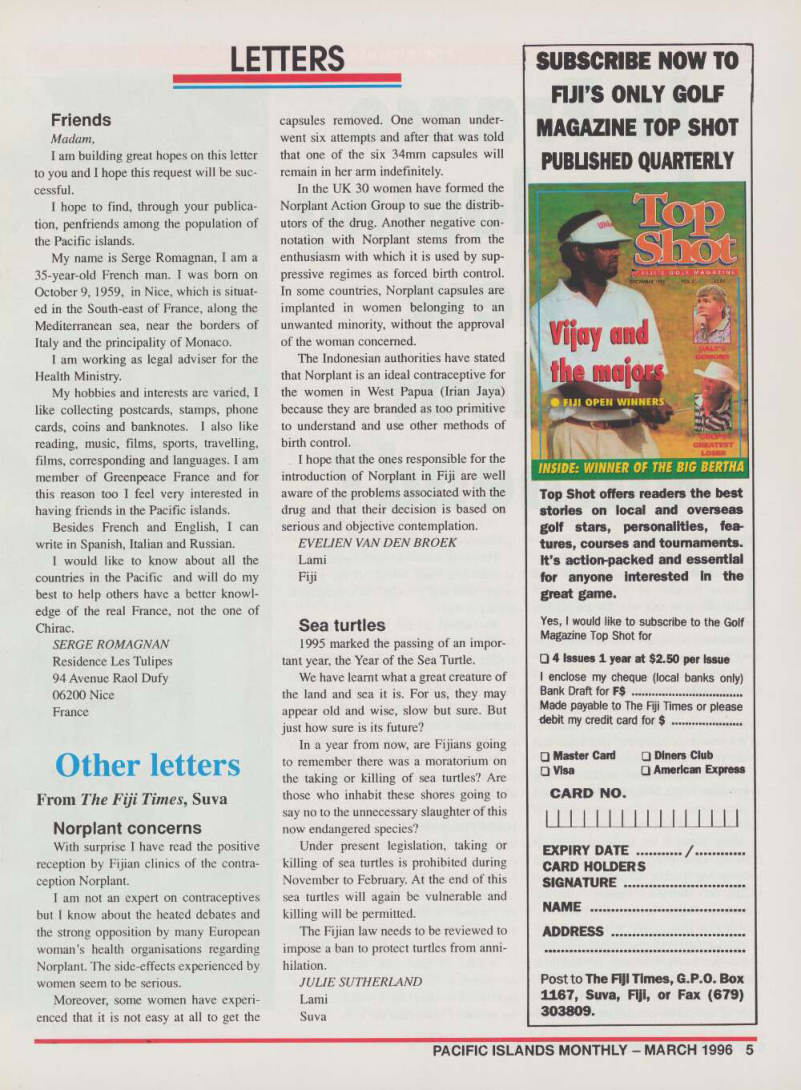
SUBSCRIBE NOW TO
FIJI'S ONLY GOLF
MAGAZINE TOP SHOT
PUBLISHED QUARTERLY
tm 1 f&X
SSI
Vuny mid
U»SER
INSIDE: WINNER OF THE BIG BERTHA
Top Shot offers readers the best stories on local and overseas golf stars, personalities, features, courses and tournaments, it’s action-packed and essential for anyone interested in the great game.
Yes, I would like to subscribe to the Golf Magazine Top Shot for □ 4 Issues 1 year at $2.50 per Issue I enclose my cheque (local banks only) Bank Draft for F$ Made payable to The Fiji Times or please debit my credit card for $ □ Master Card □ Diners Club □ Visa □ American Express
CARD NO.
11111111 I I I I LIU
EXPIRY DATE /
CARD HOLDERS
SIGNATURE
NAME
ADDRESS
Post to The Fiji Times, G.P.O. Box 1167, Suva, Fiji, or Fax (679) 303809.
developing
Cover Stories
Is France
a new nuclear warhead?
By Alfred Sasako
In January France ended more than three decades of using the South Pacific as a test site for its nuclear weapons programme. It seems it has now gathered the necessary data to enable it to switch to computer simulation.
At least, that’s the pretext France has used to conduct the tests.
But no one, except the French, will ever know the truth behind the necessity of the tests when computer simulation can easily perform such a role.
Paris’ comprehensive nuclear testing programme began in the mid 1960’s when it abandoned a similar programme in Africa.
Since 1966, it has been carrying out both its atmospheric and underground tests at the Pacific Experiment Centre (CEP) at Mururoa, France’s idyllic, windswept outpost in the South Pacific.
The first atmospheric test with a yield of 200 kilotons was conducted on a barge inside the tranquil waters of Mururoa lagoon on July 2, 1966. The second, with a similar yield, was detonated by an air craft at an unknown altitude, about 85
kilometres east of Mururoa.
However, following severe internation al criticism, Paris called off the atmos pheric tests and switched to underground testing in 1971.
By January 29 this year, when France finally announced the end of its nuclear testing programme, it had detonated more than 180 devices on both Mururoa and Fangataufa Atolls.
Of these, 41 were atmospheric tests undertaken within a eight-year period up to 1974. At least 11 of these blasts had an average yield of 1000 kilotons, according to figures released by the French Defence Ministry last July.
By comparison, the yield (force) of the bombs France used in the Pacific are six times more powerful than those dropped on the Japanese cities of Hiroshima and Nagasaki some 50 years ago.
Paris continues to insist its nuclear test programme is intended to perfect its nuclear system for its submarine fleet and to ensure the condition of its stockpiles are in a state of readiness and accuracy.
According to the French, this cannot be ascertained by computer simulation, hence the necessity to conduct the tests.
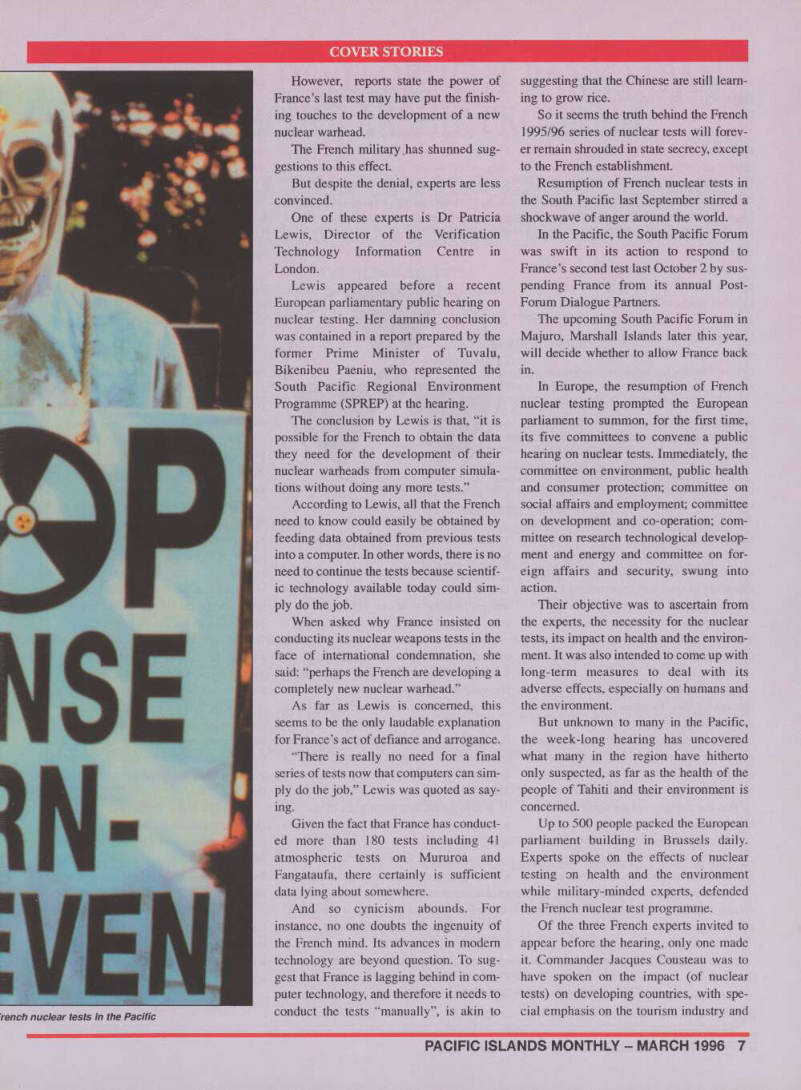
Death in disguise...protesting against
However, reports state the power of France’s last test may have put the finish ing touches to the development of a new nuclear warhead.
The French military shunned sug gestions to this effect.
But despite the denial, experts are less convinced.
One of these experts is Dr Patricia Lewis, Director of the Verification Technology Information Centre in London.
Lewis appeared before a recent
European parliamentary public hearing on
nuclear testing. Her damning conclusion was contained in a report prepared by the former Prime Minister of Tuvalu, Bikenibeu Paeniu, who represented the South Pacific Regional Environment Programme (SPREP) at the hearing.
The conclusion by Lewis is that, “it is possible for the French to obtain the data they need for the development of their nuclear warheads from computer simula tions without doing any more tests.”
According to Lewis, all that the French need to know could easily be obtained by feeding data obtained from previous tests into a computer. In other words, there is no need to continue the tests because scientif ic technology available today could sim
ply do the job.
When asked why France insisted on conducting its nuclear weapons tests in the face of international condemnation, she said: “perhaps the French are developing a completely new nuclear warhead.”
As far as Lewis is concerned, this seems to be the only laudable explanation for France’s act of defiance and arrogance.
“There is really no need for a final series of tests now that computers can sim ply do the job,” Lewis was quoted as say
ing.
Given the fact that France has conduct ed more than 180 tests including 41 atmospheric tests on Mururoa and Fangataufa, there certainly is sufficient data lying about somewhere.
And so cynicism abounds. For instance, no one doubts the ingenuity of the French mind. Its advances in modem
technology are beyond question. To sug
gest that France is lagging behind in com puter technology, and therefore it needs to conduct the tests “manually”, is akin to
suggesting that the Chinese are still learn ing to grow rice.
So it seems the truth behind the French 1995/96 series of nuclear tests will forev er remain shrouded in state secrecy, except to the French establishment.
Resumption of French nuclear tests in the South Pacific last September stirred a shockwave of anger around the world.
In the Pacific, the South Pacific Forum was swift in its action to respond to France’s second test last October 2 by sus pending France from its annual Post- Forum Dialogue Partners.
The upcoming South Pacific Forum in Majuro, Marshall Islands later this year, will decide whether to allow France back in.
In Europe, the resumption of French
nuclear testing prompted the European
parliament to summon, for the first time, its five committees to convene a public hearing on nuclear tests. Immediately, the committee on environment, public health and consumer protection; committee on social affairs and employment; committee on development and co-operation; com mittee on research technological develop ment and energy and committee on for eign affairs and security, swung into action.
Their objective was to ascertain from the experts, the necessity for the nuclear tests, its impact on health and the environ ment. It was also intended to come up with long-term measures to deal with its adverse effects, especially on humans and the environment.
But unknown to many in the Pacific, the week-long hearing has uncovered what many in the region have hitherto only suspected, as far as the health of the people of Tahiti and their environment is concerned.
Up to 500 people packed the European
parliament building in Brussels daily.
Experts spoke on the effects of nuclear testing on health and the environment while military-minded experts, defended the French nuclear test programme.
Of the three French experts invited to appear before the hearing, only one made it. Commander Jacques Cousteau was to have spoken on the impact (of nuclear tests) on developing countries, with spe cial emphasis on the tourism industry and
[?]rench nuclear tests in the Pacific
Alain Barthoux, Director of Testing in Paris, was to have been a co-speaker (with Lewis) on real tests versus simulations.
Pierre Lellouche, a former member of the French National Assembly and former staff of the French Institute for International Relations in Paris was the only Frenchman who appeared before the hearing. He vigorously defended the French government’s decision to conduct the tests.
His cohort, who spoke in favour of the French nuclear testing programme, was a Colonel Andrew Duncan, a retired mem ber of the International Institute for Strategic Studies in London.
He argued the tests were necessary to enable France to “explicitly arrive at an accurate and reliable nuclear warhead.”
Because of the rising anti-nuclear cru sade in Europe, the European parliament also authorised two missions to visit both Paris and Tahiti prior to the hearing.
Janssen, a spokesperson for the second European Commission fact-finding mis sion which visited French Polynesia and Paris in September, was the first to appear before the hearing.
He told the hearing the mission was refused permission to look at the results of a number of tests and experiments both in Paris and Tahiti.
The mission was also refused access to a range of data and information relating to the series of nuclear tests. The reason was military secrecy.
Members of the mission were “rushed through” other facilities that they were able to see, according to him.
Janssen concluded his mission’s find ings were not complete “due to lack of full co-operation from the French authorities both in Paris and Tahiti.”
But the findings of an earlier mission to Tahiti were an eye-opener.
The July mission was sent to investi gate the health status of the local popula tion and the impact on the environment and to determine any correlation with French nuclear testing in nearby Mururoa
and Fanagataufa.
On health, the mission found: • a serious lack of information on pub lic health; • no epidemiological data on the local population of French Polynesia since the
start of nuclear testing; • the last epidemiology study on the local population was conducted in 1965; • no cancer register had been kept by France since the start of nuclear testing, only when health was transferred to the territorial government was one started; • the mission was refused information on the number of cases of cancer of the thyroid gland;
• the people of Tahiti want close sur veillance of exposure of the local popula tion to radiation; • ciguatera (fish poisoning) has increased dramatically since the start of nuclear testing - about 5000 cases per year, indirectly linked to nuclear testing; • there is evidence of social disorder caused by immigration to Papeete, the main island of Tahiti, from the atolls, resulting in high unemployment rates.
Overall, the mission found it difficult to conclude that nuclear testing in French Polynesia was harmless and strongly rec ommended a “long-term surveillance of the health status of the local population of Tahiti.”
It also found that the impact of nuclear testing on the environment is equally dam aging.
According to its report, “even if the testing is stopped tomorrow, there is the need to monitor the test sites in order to determine volcanic and tidal wave activi ties and such monitoring should be carried out on a long-term basis.”
It said the United States and the United Kingdom shifted their tests away from atolls because they found the structural integrity of the atolls are not safe for
uiderground testing.
The mission also stated that since the stirt of nuclear testing on Mururoa, land sides and compaction have occurred sub stintially causing 50 per cent of the atoll to shk.
It said the volcanic stability of the atoll hts been greatly disturbed with 78 per cent bcreholes dug under the subterrain of Miruroa. This could cause overlap of the fisures caused by the blasts.
“Mururoa Atoll is now more fragile thn ever and very unstable. This could crate a massive tsunami (tidal wave) sbuld the landslide continue,” mission fond.
“There is strong possibility that radoactive isotopes could leak into the su rounding ocean due to the overlap of fisures from the boreholes, and contami nae the food chain.”
Other experts who appeared before the heiring spoke of the lack of data on the hedth status of French Polynesians who art working on the test sites.
They agreed with the conclusion by the World Health Organisation (WHO) that it is mpossible to say that nuclear testing is hamless to human health.
Former Prime Minister Paeniu who alsD spoke at the hearing, made particular reference to the effects of nuclear testing ontourism in the South Pacific.
But a Vanuatu travel agency reported hadng to cancel 20,000 bookings for Taliti immediately after the rioting in Papeete last September.
In Fiji, where tourism is the number one foreign exchange earner, there was widespread concern when tourist arrivals from Japan reportedly fell by 30 per cent because of fear of radiation fallouts from the French nuclear tests.
To allay these fears, the Fiji Visitors Bureau mounted a special promotional drive in Japan last October, in a bid to assure travel agents and tour wholesalers that Fiji is relatively safe from nuclear fall outs.
Whether real or imagined, tourists’ fears appear to confirm what many island leaders dread; sooner or later, the islanders
will begin paying heavily for France’s
arrogance. B
Advertisements & other items, p. 9 (1 item)
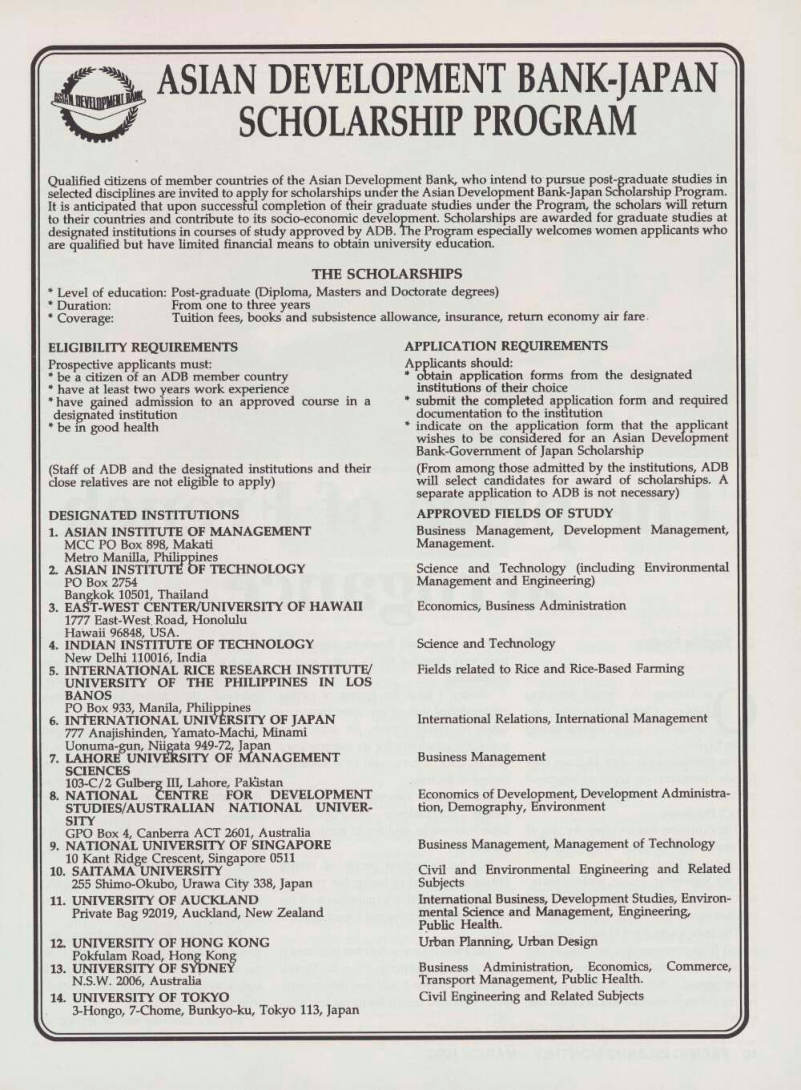
Asian Development Bank-Japan
SCHOLARSHIP PROGRAM
Qualified citizens of member countries of the Asian Development Bank, who intend to pursue post-graduate studies in selected disciplines are invited to apply for scholarships under the Asian Development Bank-Japan Scholarship Program.
It is anticipated that upon successful completion of their graduate studies under the Program, the scholars will return to their countries and contribute to its socio-economic development. Scholarships are awarded for graduate studies at designated institutions in courses of study approved by ADB. The Program especially welcomes women applicants who are qualified but have limited financial means to obtain university education.
THE SCHOLARSHIPS
* Level of education: Post-graduate (Diploma, Masters and Doctorate degrees) * Duration: From one to three years * Coverage: Tuition fees, books and subsistence allowance, insurance, return economy air fare
ELIGIBILITY REQUIREMENTS
Prospective applicants must:
* be a citizen of an ADB member country * have at least two years work experience * have gained admission to an approved course in a
designated institution
* be in good health (Staff of ADB and the designated institutions and their close relatives are not eligible to apply)
DESIGNATED INSTITUTIONS
1. ASIAN INSTITUTE OF MANAGEMENT
MCC PO Box 898, Makati Metro Manilla, Philippines
2. ASIAN INSTITUTE OF TECHNOLOGY
PO Rnv 77R4 Bangkok 10501, Thailand
3. EAST-WEST CENTER/UNIVERSITY OF HAWAII
1777 East-West Road, Honolulu Hawaii 96848, USA.
4. INDIAN INSTITUTE OF TECHNOLOGY
New Delhi 110016, India
5. INTERNATIONAL RICE RESEARCH INSTITUTE/
UNIVERSITY OF THE PHILIPPINES IN LOS
BANOS
PO Box 933, Manila, Philippines
6. INTERNATIONAL UNIVERSITY OF JAPAN
777 Anajishinden, Yamato-Machi, Minami Uonuma-gun, Niigata 949-72, Japan
7. LAHORE UNIVERSITY OF MANAGEMENT
SCIENCES
103-C/2 Gulberg HI, Lahore, Pakistan
8. NATIONAL CENTRE FOR DEVELOPMENT
STUDIES/AUSTRALIAN NATIONAL UNIVER-
SITY
GPO Box 4, Canberra ACT 2601, Australia
9. NATIONAL UNIVERSITY OF SINGAPORE
10 Kant Ridge Crescent, Singapore 0511
10. SAITAMA UNIVERSITY
255 Shimo-Okubo, Urawa City 338, Japan
11. UNIVERSITY OF AUCKLAND
Private Bag 92019, Auckland, New Zealand
12. UNIVERSITY OF HONG KONG
Pokfulam Road, Hong Kong
13. UNIVERSITY OF SYDNEY
N.S.W. 2006, Australia
14. UNIVERSITY OF TOKYO
3-Hongo, 7-Chome, Bunkyo-ku, Tokyo 113, Japan
APPLICATION REQUIREMENTS
Applicants should:
* obtain application forms from the designated institutions of their choice * submit the completed application form and required documentation to the institution * indicate on the application form that the applicant wishes to be considered for an Asian Development
Bank-Government of Japan Scholarship
(From among those admitted by the institutions, ADB will select candidates for award of scholarships. A separate application to ADB is not necessary)
APPROVED FIELDS OF STUDY
Business Management, Development Management, Management.
Science and Technology (including Environmental Management and Engineering) Economics, Business Administration Science and Technology Fields related to Rice and Rice-Based Farming International Relations, International Management Business Management Economics of Development, Development Administration, Demography, Environment Business Management, Management of Technology Civil and Environmental Engineering and Related
Subjects
International Business, Development Studies, Environmental Science and Management, Engineering, Public Health.
Urban Planning, Urban Design Business Administration, Economics, Commerce, Transport Management, Public Health.
Civil Engineering and Related Subjects
The price of French
arrogance
By Sophie Foster
On January 29, French president Jacques Chirac announced the “definitive” end to nuclear testing in the Pacific.
The announcement came 48 hours after France detonated its sixth underground nuclear device on Fangataufa Atoll in French Polynesia.
The explosion was six times the size of the atom bomb dropped on Hiroshima in Japan during World War 11.
Last September, France broke a mora torium on testing and indicated it would conduct up to eight blasts in the Pacific.
The tests sparked world-wide condem nation from governments, individuals and organisations including the United Nations which passed a resolution last December calling for an immediate end to all nuclear testing.
France persisted however, saying the tests were essential for its future nuclear programme.
“Today, I have the feeling of having accomplished one of my most important duties by giving France, for decades to come, the capability for its independence and security,” Chirac said in announcing an end to the tests.
But while the tests may have served to secure “independence” for France, the same may not be said for its territories in the Pacific.
For the indigenous people of French Polynesia, the end of testing has renewed their hopes for self-determination with the release of the Mururoa and Fangataufa test sites.
The French government has indicated it will close its military sites in French Polynesia because it will now rely on com puter simulated results for its nuclear arse nal.
Forty-eight hours after Chirac stated the end of nuclear testing, the French National Assembly voted on legislation to increase the autonomy of French Polynesia.
The legislation outlines economic, social and cultural independence for the territory giving local authorities control over travel and communication links and the authority to regulate mining and sea rights.
It also states the local language will be given official status, along with French, after 153 years of colonisation.
But despite this, the legislation fails to highlight political independence for the territory.
The local pro-independence party stance has held that local autonomy within the territory was a “trap” to diffuse the self-determination questions emerging with the 1996 elections.
The day after the end of testing was
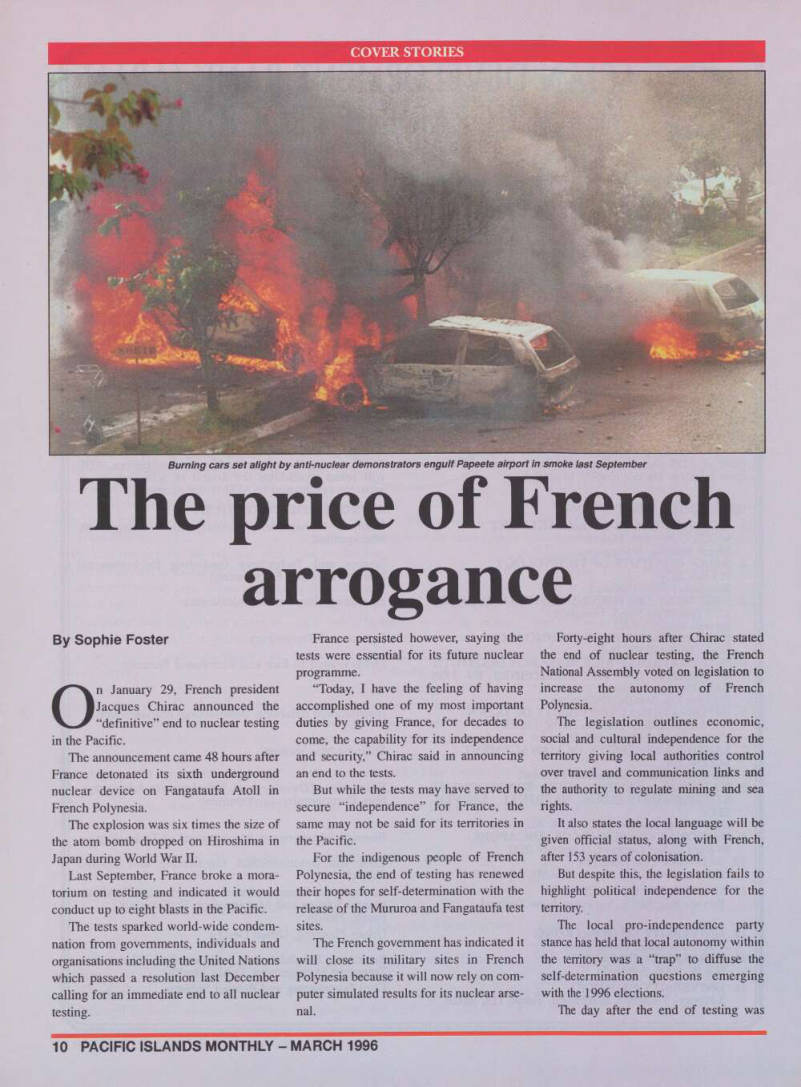
Burning cars set alight by anti-nuclear demonstrators engulf Papeete airport in smoke last September
declared, president of the territorial gov ernment in French Polynesia and “politi cal ally of explosions”, Gaston Flosse said Chirac pledged to return Mururoa and Fangataufa to French Polynesian control “in the state in which they started”.
Flosse said Chirac had agreed to a compensation package of SUS2OO million a year for the next 10 years for French
Polynesia.
The settlement has been described as
compensation for “economic problems”
resulting from the end of the nuclear tests.
Leader of the Liberation Front of Polynesia (Tavini Huiraatira), Oscar Temaru says the compensation package is minuscule compared to the benefits France gained from French Polynesia.
“It is peanuts compared to the 30 years of damage and humiliation brought upon my people. France has become the third largest nuclear power because of our islands,” he says.
Temaru states it is a crime that his peo ple are now “faced with the largest nuclear waste dump” in the world.
“It is a living time bomb,” he says.
Pacific Concerns Resource Centre assistant director for demilitarisation, Losena Salabula, agrees no monetary value could be placed on the damage done to the atolls and the life that exists there.
“Millions of dollars will never pay for the damage done to the atolls and the radioactivity will outlast over 400 genera tions of the people in the area,” she said.
Salabula refutes Chirac’s claim the tests have been an “assurance of peace” for France and its territories, saying, “what the test has left behind leaves no peace for the people of the Pacific”.
“How can a person suffering from can cer have peace? Chirac has not been to the territories and he has not seen the suffer ing for himself’, she said.
But she said if France was to allocate compensation to the people of French Polynesia, it should ensure the victims, and not bureaucrats, were the recipients of the money.
Using the Marshall Islands as an exam ple, Salabula says victims tend to get caught up in the red tape surrounding compensation and end up with very little funds in their pockets.
“Direct descendants of the Bikini
Islanders and Rongelapis get SUSBO every three months as part of the US multi-mil lion dollar compensation deal,” she said.
The rest of the money is used on the Marshall Islands Nuclear Claims Tribunal, lawyers to fight claims and doctors to ver ify them.
“I hope it will not be the same with France”, she said.
Salabula hopes the French will set up a tribunal for victims of testing.
The French, she said, can not argue there was no one to claim compensation for re-location because the atolls were uninhabited when tests began.
“About 1000 people on Tureia Island close to the test sites had to be uprooted in 1968 because of radioactive fallout,” she said.
These people and the French Polynesians in general were, and will always be, denied access to land that is part of their cultural heritage”.
Salabula says the French were able to manipulate the Tahitians into “passively” accepting the tests when it would not have been condoned in metropolitan France.
French Polynesia also suited France’s interests because of the remoteness of the area.
The dangers facing French Polynesians, who rely on a rich marine life
for income and food, have increased with confirmation by France of radioactive leaks from the atolls.
Its force commander in French
Polynesia, vice-admiral Philippe Euverte,
said the Mururoa and Fangataufa installa tions would be dismantled and the atolls “cleaned”, but his office later refuted claims of contaminated zones existing in the area.
In the days leading up to the last test, the controversy came to a head when French officials reluctantly admitted to detection of the leakage of radioactive iodine 131 after one of its South Pacific tests.
Greenpeace Disarmament Coordinator Josh Handler said such reports raised con cerns over what other information the French may have withheld, and the envi ronmental aftermath of global nuclear tests.
Bunny McDiarmid of Greenpeace Pacific said there was a definite possibili ty that the leakage is greater than what has been reported.
It is not the first time the French have admitted to leakages on Mururoa, she says, with several scientific missions reporting radio nuclides (radioactive parti cles) in lagoon sediments, water and
plankton samples.
Research results from the Centre for Peace Studies at Auckland University and Aqueous Geochemistry Research indicate serious radioactive leakage is likely to be already occurring at Mururoa and Fangataufa atolls and will continue into the next century.
Auckland University’s new theoretical model, using research experience from US nuclear waste disposal and NZ geothermal activity, has produced data to predict seri ous leakages of longer-term radio nuclides from the atolls.
“The total amount of underground
radioactivity that could potentially leak by
this process is approximately 50 times larger than the total radioactivity from the Hiroshima and Nagasaki nuclear explo sions,” a report on the model said.
McDiarmid agrees the French public would never have allowed testing to take place in France because of the potential
dangers.
She adds testing in Algeria had to be
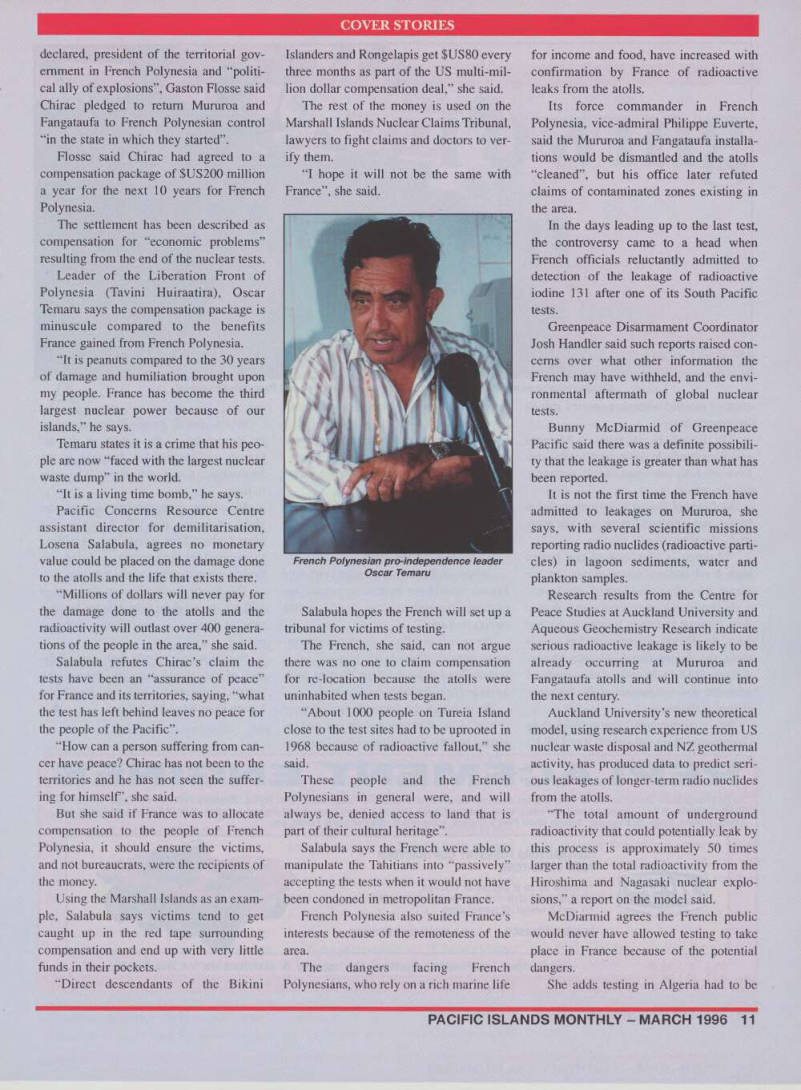
French Polynesian pro-independence leader Oscar Temaru
stopped in 1965 after that country gained
its independence.
The French began tests on Mururoa and Fangataufa in 1966, and to this day have not fully disclosed details surround ing the area.
McDiarmid says it is important that a “truly independent” team of scientists study the area.
“Mururoa is now one of the largest high level nuclear waste dumps on the planet. It is like a time bomb,” she says.
In response to pressure for an indepen dent team of scientists to survey the test sites, the French government has autho rised the International Atomic Energy Agency (IAEA) to carry out a study of Mururoa and Fangataufa atolls for after effects of the blasts.
But environmental groups including Greenpeace have disputed the IAEA’s
appointment because France used its earli er studies to back its claim of non-effect.
For now, French Polynesian opposition and church leaders are more concerned that France stick to its word that the tests are over.
Chirac says France will sign the South Pacific Nuclear Free Zone Treaty and the Comprehensive Test Ban Treaty banning all nuclear tests in 1996.
However, Temaru is sceptical and says France “would not hesitate to resume her nuclear experimentation should world events turn sour”.
He says it is difficult to trust a govern ment whose “word of honour” was responsible for the Rainbow Warrior inci dents in New Zealand and Noumea.
Temaru says the “struggle for indepen dence” will continue despite an end to testing and the beginning of local autono
my.
When, and if, French Polynesia gains its independence, the option to sue the French government for damages in the International Court of Justice will be open to them.
Meantime, governments around the globe including the US, Australia and New Zealand have stated they are willing to reconsider blackmarks placed on France when the tests began last year.
The South Pacific Forum also says it will ask its members to review the suspen sion of France as post-Forum dialogue partner.
But there is no doubt that, even if the rest of the world forgives France, the French Polynesians will not forget the legacy France has left behind. ■
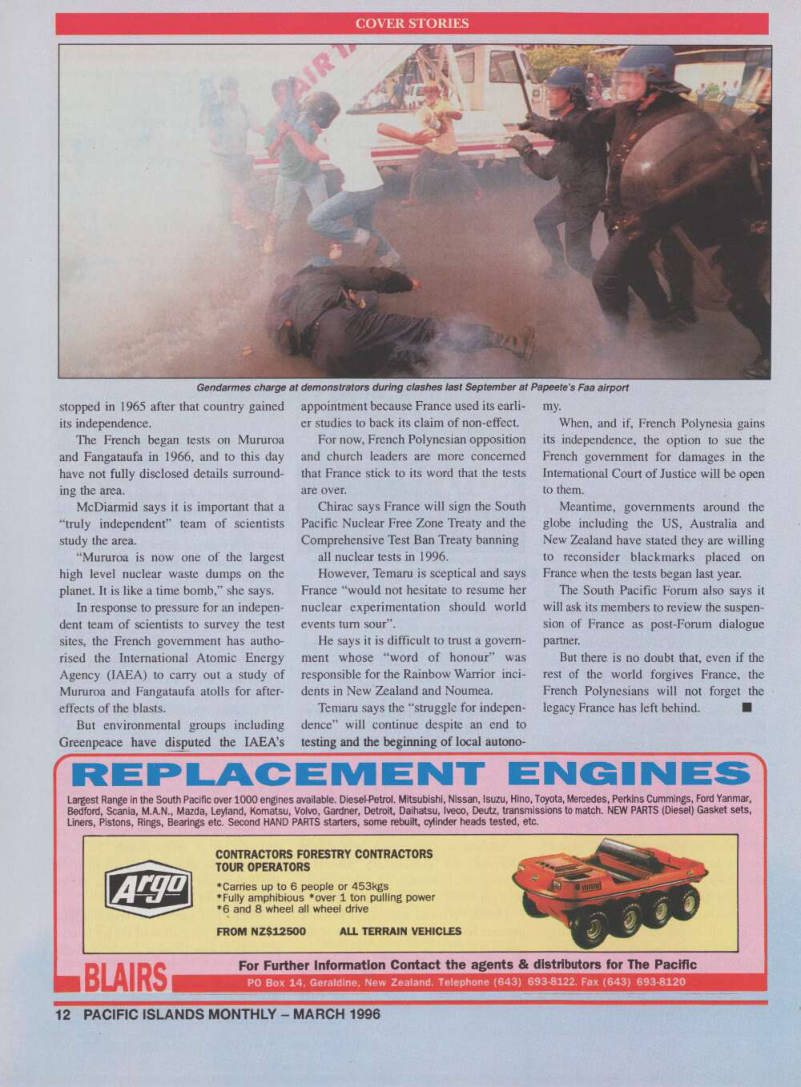
Gendarmes charge at demonstrators during clashes last September at Papeete’s Faa airport
Advertisements & other items, p. 12 (1 item)
Blairs
r Largest Range in the South Pacific over 1000 engines available. Diesel-Petrol. Mitsubishi, Nissan, Isuzu, Hino, Toyota, Mercedes, Perkins Cummings, Ford Yanmar, Bedford, Scania, M.A.N., Mazda, Leyland, Komatsu, Volvo, Gardner, Detroit, Daihatsu, Iveco, Deutz, transmissions to match. NEW PARTS (Diesel) Gasket sets, Liners, Pistons, Rings, Bearings etc. Second HAND PARTS starters, some rebuilt, cylinder heads tested, etc.
CONTRACTORS FORESTRY CONTRACTORS
TOUR OPERATORS
♦Carries up to 6 people or 453kgs ♦Fully amphibious ♦over 1 ton pulling power ♦6 and 8 wheel all wheel drive
FROM NZ$l25OO
ALL TERRAIN VEHICLES
BLAIRS
For Further Information Contact the agents & distributors for The Pacific PO Box 14, Geraldine, New Zealand. Telephone (643) 693-8122. Fax (643) 693-8120
Kava’s growing
Business
Kava’s growing concern
Australia considers import ban
By Martin Tiffany
A decision on the import ban of kava entering Australia in com
mercial quantities was expected
to be made in February.
It is one which will be eagerly-awaited
by regional kava exporters, especially
Fiji, who are by far its leading exporters to Australia.
Australia slapped on the kava ban mid way through last year, pending an investi gation into its sale.
The current federal government review came about following an application by the Northern Territory government for kava to be sold legally in the Australian state.
Excessive concern has been expressed about the huge consumption of kava in some Aboriginal communities, which has resulted in social breakdowns similar to that cause by alcohol abuse.
The Australian government has reviewed the ban since its imposition last year. Currently Australian authorities have proposed a national Kava Management Strategy that requires Australian kava importers to be licensed. All imports will be on a restricted basis through Australian Customs.
There is also a requirement that all importers, wholesalers, retailers and dis tributors of kava must sign and abide by the Kava Code of Management.
This code includes provisions that sig natories agree not to promote the use of kava, advertise it or sell it to minors.
A new Standard in the Foods Standard Code will include the requirements for mandatory labelling of kava, with state ments such as: “Use in Moderation”;
“May Cause Drowsiness” and “Sale of Kava in Australia is subject to the national Kava Code of Management”.
Another requirement for packaging
directions is to state that kava can only be sold as a whole food and not added to other foods.
There will also be the option for the states/territories to have more restrictive legislation in place to address public health concerns in their particular jurisdic tions. There will also be a follow-up by state/territory health departments for edu cation and monitoring where kava abuse is a problem.
At present the only kava allowed into Australia is a 10-kilogramme limit per person for personal use.
Regional countries that export kava to Australia are Fiji, Tonga, Vanuatu and Western Samoa. The total figure forkava exported to Australia last year was SFI.6
million (sUSl.lm.)
Fiji is by far the leading exporter of kava to Australia, exporting 74,556 kilo grammes totalling $F606,538 ($U5418,268) in 1994.
Australia is also Fiji’s second-largest kava market, after Germany, so Fiji is nat urally anxious for a decision to be reached soon.
Fiji sent a representative to a national work-shop in Darwin on August 3-4 last year, to form the basis of the government’s regulative response to the kava trade.
Two options came out of the workshop.
One was for a prohibition to be placed on all kava imports to Australia and that kava only be allowed in for use in cultural events.
The other option was for unrestricted
imports of kava to be allowed in, and for local and state authorities to be responsi ble for regulating ijs use.
The proposed National Kava Management Strategy suggests the second option is preferred, and people in the industry expect the import licensing option to be adopted.
Last year, the South Pacific Trade Commission in Sydney, in conjunction with the Forum Secretariat, made repre sentations to the Australian government to lift the kava ban.
The substance has been under scrutiny by various bodies in Australia for a num ber of years. With some not quite sure of how to treat it.
Australia’s National Health and Medical Research Council previously dis couraged the use of kava because of its psychoactive properties and it was listed as an S 4 poison (to be available only on prescription) in 1990.
In 1993, kava was reclassified from a drug to a food product but listed as “not to be sold’.
Dr Andrew Theophanous, parliamen tary secretary to the Australian Prime Minister, said at the Darwin meeting last year that the federal government would consider outlawing kava, which was threatening to become a serious problem among indigenous communities.
Meanwhile, across the Tasman, unre stricted imports from regional countries into New Zealand have seen the export of kava steadily grow.
Pacific countries also have a lucrative kava export market in Europe, where it is used for pharmaceutical purposes. ■
a difference?

Politics
Will Forbes make a difference?
By David North
The next president of the United States may be a man who owns an island in Fiji.
The fast-rising presidential candidate is multimillionaire Steve Forbes, 48, a New York publisher and a conservative seeking Republican nomination.
The island is seven-square-mile Laucala just off Taveuni, Fiji’s fourth largest island. Laucala is some 200 miles north and east of the capital Suva, and has a private airstrip of its own. It was the favourite private resort of Forbes’ late father, senator Malcolm Forbes, once the most colourful of America’s rich publish ers. The senator is buried on Laucala.
But with the exception of one very unfriendly piece in the Washington Post, Laucala has not been mentioned in the younger Forbes campaign. The version of his media biography faxed to PIM did not mention it, nor did his campaign, as requested, come up with any material on the island.
The Post article covered the history of the island in a few lines, mentioning, in passing, King Cakobau as a “brilliant can nibal.” The thrust of the article was to compare the candidate’s island to a highly
popular American television comedy
series of a few years back, Gilligan’s Island . Post writer said Forbes’ role on his real-life island was like that of the stuffy, demanding millionaire of the tele vision show.
Politically, Steve Forbes was unknown six months ago. Then he decided to enter American politics at the top, as did Ross Perot four years ago, by running for presi dent. Like Perot he has a strong ego, and a willingness to spend millions of his own dollars on the campaign.
And like Perot, his millions got him the public’s attention; people started to listen
to his somewhat simplistic message. At this writing, he was giving the Republican front-runner for the nomination, Senate leader Bob Dole of Kansas, a tight race for the lead in the early primaries in lowa and
New Hampshire.
it help the region to have this Pacific landowner in the White
House?**
Forbes has three things going for him: He is a genuine outsider, with no
Washington ties.
Since he is spending his own money, a major loophole in US election laws allows him to outspend his opponents who must rely on contributions and matching grants from the government.
He advocates a popular (if potentially damaging) policy, the flat income tax.
The US income tax, because it tries to be fair, is a nightmare of complexities.
Richer people pay at higher rates than poor ones, generally, but many deductions make the picture more complex, and the task of filling out the income tax forms is time-consuming and a test of mental agili ty most people do not welcome. (The rich usually hire others to complete these forms for them.) According to Forbes’ critics, the flat tax would cut taxes sharply for the rich (including the candidate in question) and would, at the rates suggested by Forbes, lead to the same situation America had
during the Reagan years, when the White House backed lower taxes of the rich, and got them, along with a rapidly growing deficit. Some calculate that Forbes’ 17 per cent rate would increase the national deficit by S2OO billion a year.
But despite his populist stance on taxes, his ready money, and polling num bers that place him second to Dole in many states, and first in Arizona, Forbes may be shunned by the Republicans for several reasons.
First, he, alone among the major candi dates for president, has refused to release his own past income tax returns. This is a mainland ritual, so far unknown in the island, in which major candidates release photocopies of the past income taxes - to show they have nothing to hide, financial iy- Forbes has also been hurt by his wood en personality. Further, his total lack of public sector experience turns off many leaders of local Republican organisations who have spent years working up to be a mayor, a sheriff or a state legislator.
Had young Forbes followed in his daddy’s footsteps in local government, he would not have this final disadvantage.
I knew his father - we both ran for the
New Jersey state legislature, in adjoining
counties, in 1951. But the older Forbes, after beating the local political machine, made it into the State senate as a Republican while my Democratic race for
the Assembly ended differently.
The state senator had earlier been elect ed to the village council in the New Jersey suburbs after knocking on virtually every door in the community. After arriving in the state senate he made two vigorous, but unsuccessful, races for the New Jersey
governorship.
In later years, Malcolm Forbes would become known as the nation’s most dash ing millionaire, with his motorcycles, his
hot air balloons, a fabulous, celebrity studded, multi-day party in Morocco, and his dates with actress Elizabeth Taylor. After his death an alleged homo sexual lover materialised.
Laucala’s indigenous population was
pretty much wiped out during tribal wars
in pre-British Fiji. Nearly empty and
beautiful, it had been owned for years by Morris Hedstrom, the Australian firm.
Senator Forbes bought it in 1972 for $ 1,000,000 and then proceeded to spend five times that much on creating a resort for his family, and his vision of a model community for its Fijian residents, who worked at the resort and who produced copra.
Towards the end of his life, the sena tor started sharing the island with a few paying guests. They were picked up by a Forbes private plane at Nadi, and then housed in their own private cottages, with a chef coming around each evening to fix dinner.
But will it help the region to have this South Pacific landowner in the White House? I doubt it.
On the positive side, it would assure the region that the president had some sense of the geography of the South Pacific, famously missing in many American politicians.
But the negatives with Forbes are overwhelming. He apparently has not been to Fiji since his father’s death.
His lower-the-taxes-for-the-rich stand suggests he is less interested in an active government than most candidates, and it is only activist governments that reach out to distant parts of the globe, like the insular Pacific.
More narrowly, his close relations with US corporate interests would sug gest no change in the current sugar importation policy, favoured by those interests, which virtually bars both Fiji and PNG from shipping sugar to the US.
As further indication of his lack of interest in the region, we tried to get his campaign press office to respond to the Post’s use of the term “brilliant canni bal” in the previously mentioned column
Nothing happened.
Maybe the Forbes campaign, anyway, still thinks in terms of the cannibal islands. ■
Advertisements & other items, p. 15 (2 items)
Politics
We can help
m EES
wtti w ** m \-.v g|(k "i a ft ¥• J? -
bring the markets
of the world
right to your door.
If you’ve been in business for any length of time, you know that half the battle is knowing the right people. But when you live on an island, making such contacts can be pretty difficult, not to mention expensive.
That’s where the South Pacific Trade Commission comes in. Our primary purpose in life is helping business people in the Pacific Islands become more successful.
Not only can we introduce you to key importers, agents or retailers around the world, we can also put you in contact with potential investors.
And we can assist exporters attend Australian trade fairs and exhibitions.
To give you an idea. In recent months we helped Western Samoa Breweries find an Australian agent to promote and distribute Vailima beer. We helped Teikabuti Fishing Co. redesign their tuna jerky packaging to conform to Australian standards. We arranged for the enrollment of five trainees in technical training courses in NSW and Qld. And we paid for six South Pacific companies to attend Fine Food Fair‘94 in Melbourne.
So if you need some help making the right contacts, just contact us. After all, you’ve nothing to lose and the rest of the world to gain.
We can help you with packaging designs that will appeal to new markets.
We can arrange training in business and technical skills for your employees. ft
SOUTH RACIFIC TRADE COMMISSION
Level 30, 133 Castlereagh Street, Sydney 2000. Telephone (612) 283 5933 • Facsimile (612) 283 5948 Adventors 1731 A
opportunity
Opinion
Window of opportunity
The government of Japan has approved more than $U5250,000 towards establishing a South Pacific Forum office in Tokyo.
Together with its annual SUS7OO,OOO grant to regional programmes adminis tered by the South Pacific Forum Secretariat, the SPEESC funding has made Japan the number one non-Forum donor to the Suva-based Secretariat.
The office, to be formally known as the South Pacific Economic Exchange Support Centre (SPEESC), will be a “clearing house” for growing business activities between Japan and members of the Forum, in particular Forum Island
Tokyo’s decision, formally conveyed
to the Secretary-General of the South Pacific Forum, Hon. leremia Tabai, in late December came as a nice surprise for member countries.
Over the years, member governments, through the annual visit to Japan by the chair of the Forum and other channels, raised with successive Japanese govern ments possible assistance for setting-up the office.
As there was no progress on the long
standing proposal, a suggestion was made
recently that a feasibility study be under taken to determine the project’s viability.
These were to no avail.
Last April, however, there was a change of heart. Tokyo had informed the Secretary- General in a letter that Japan had agreed to help fund and take part in a
joint feasibility study.
Until then, even the idea of a feasibili ty study was not entertained. This was due largely to costs which, in Tokyo, are almost prohibitive. Because of this, it was argued, the benefit from such an office may not justify the cost.
Full credit must go to the former presi dent of Nauru, Hon. Bernard Dowiyogo, who during his time as Chair of the Forum in 1993/94 convinced the Japanese gov ernment to agree on the feasibility study.
Equal credit goes to the government of Japan for its decision to provide funding for the SPEESC office. It is a decision which must be seen as further proof of the co-operative relations between Japan and the Fomm.
For many member governments, the momentum has never been faster. In the space of five months (April-August 1995) the study was completed by the Forum’s Trade and Investment Division and sub mitted by the Oceania Division of Japan’s ministry of foreign affairs to the ministry of finance (MOF) in Tokyo for funding in 1996.
Four months later came the good news that Japan had agreed to provide 25 mil lion yen (about $U5250,000) for the set ting-up and running of the office for six months beginning in October this year. A new funding proposal will then be submit ted to the government of Japan for 1997.
The funding approval seems to have brought with it a new spirit of optimism and enthusiasm on both sides. The speed with which SPEESC evolved from a mere concept (at the time of the feasibility study) to reality also appears to suggest
The Forum
Countries (FICs).
Alfred
Sasako
that there is scope for an additional market for island products.
Tokyo appears to have satisfied itself that SPEESC has a role to play in boosting the warm and cooperative relations between Japan and the region. The approval also seems to be a vote of confi dence in the potential for the expansion of the existing market.
Some may wonder why an office in Japan is necessary, especially in the capi tal where it seems the sky is the limit, when it comes to the cost of office space rental. Why, critics may ask, is such an office necessary, especially when the trend world-wide is to cut costs?
Well, there are always three sides to a story - the version of the one who tells it; the version of the person about whom the story is told and the true version.
Whatever critics may say, everyone realises that one of the established princi ples of doing business is that you onlyget out what you put in. In other words, if you do not invest, you do not expect any return.
FlC’s leaders know there is a market in Japan. They know the potential for expan sion is also there. They do not have the money, but they have the time, so they invested in time in pursuing the SPEESC
office proposal.
They are convinced that an on-the ground presence through the establish ment of a SPEESC office in one of the world’s biggest and most complex markets is essential to promote and strengthen existing trade, tourism and investment links.
Their conviction is one of the reasons why they persevered in the face of initial setback to the idea. The leaders realised that, like everything else, it takes two to tango. In this case, they recognise the importance that an input by the Japanese government, monetary or otherwise, can make.
Apart from Australia and New Zealand, Japan’s proximity and its status as a Pacific Rim country are important consid erations.
According to the World Almanac, there are about 124 million people living in Japan today. Of this, about 17 per cent are between the ages of zero and 14 years, while 60 per cent of the population
account for the 15-60 year old age brack etin 1991, Japan’s Gross Domestic Product (GDP) was estimated at SUS 2.3 trillion. Its international foreign reserves (minus gold) were estimated at SUS 73 bil lion in March 1993. Gold was estimated at 24.23 million oz.
Japan’s per capita GDP in 1991 was
SUSI9,IOO, suggesting a powerful buying
power.
But perhaps more relevant to the region are figures on trade between Japan and some FICs, namely Papua New Guinea, Western Samoa, Vanuatu, Fiji, Solomon Islands, Tonga, Kiribati, Nauru, Tuvalu, the Republic of the Marshall Islands, Federated States of Micronesia and Palau.
Although the level of trade has fallen between Japan and some individual FICs, generally the total value is on the increase.
For instance, the value of Japanese imports of FICs products rose from SUS9OO million in 1993 to well over SUSI billion (SUS 1,055,190) in 1994.
On the other hand, Japanese exports to FICs fell by almost SUSI 39 million in the
same period.
On a country-by-country basis, some
FICs have recorded stunning increases in terms of the value of their imports to Japan, according to official Japanese fig ures.
Take, for example, Papua New Guinea, RMI and Fiji, to cite a few. In 1993, PNG’s exports to Japan (mainly copper concen trate and timber) were valued at about SUS 673 million.
By the end of 1994, this had gone up to $U5748.43 million. On the other hand, Japan’s exports to PNG actually took a dive from about SUSIBB million in 1993 to about SUSI 79 million in 1994.
A similar pattern emerged in the trade between Japan and the Marshall Islands in the same period. From a mere $U5864,000 in 1993, RMI exports to Japan grew to $U524.26 million over the next 12 months.
Fiji’s exports to Japan also grew hand somely in the 1993/94 period. In 1993, Fiji exported products valued at around $U533.52 million. By 1994, total exports to Japan had exceeded SUSS9 million.
Japanese exports to Solomon Islands, Tonga, Western Samoa, Kiribati and Palau also grew markedly in the same period.B
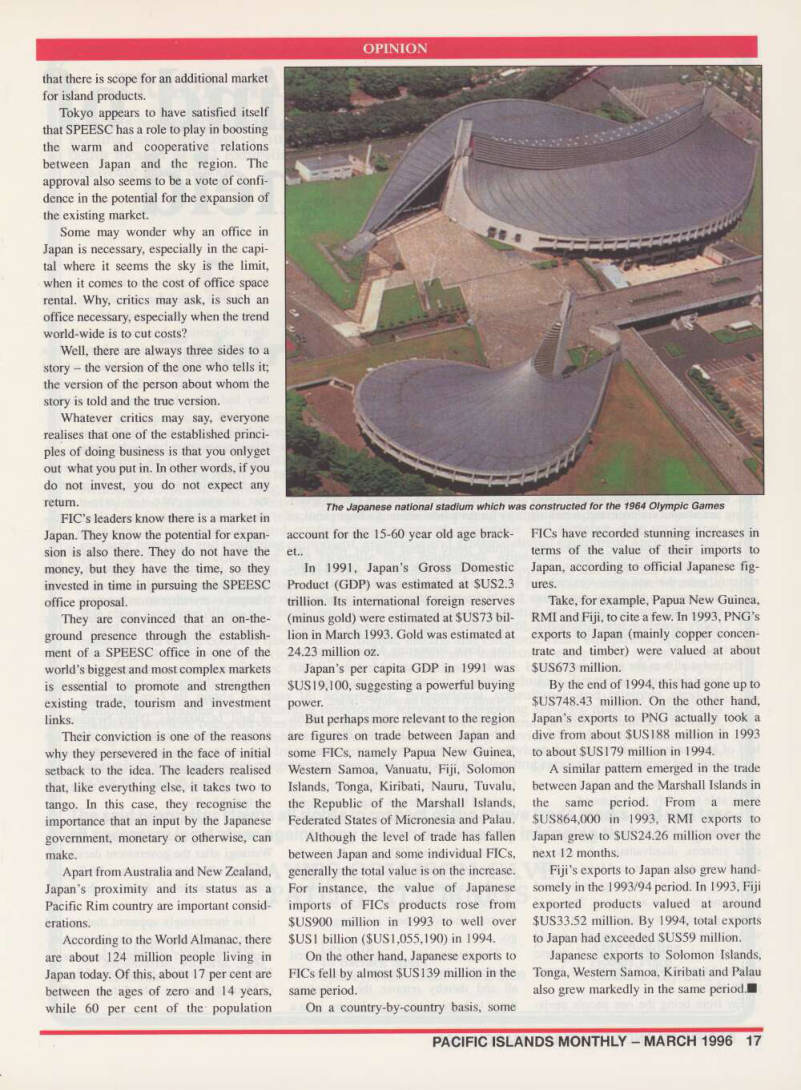
The Japanese national stadium which was constructed for the 1964 Olympic Games
apartheid
A new kind of apartheid
It could not be said that 1995 was a good one for race relations in New Zealand, marked as it was by a spate of Maori land occupations, including the bit terly contested 79-day sit-in at Moutoa Gardens in Wanganui.
Militant Maori groups, increasingly angry with lack of progress on their land and compensation claims, tried to take the law into their own hands.
Protesters indulged in a range of actions, including trying to chop down the landmark pine on Auckland’s One Tree Hill, decapitating European statues, advo cating arson and violence and wrecking the annual Waitangi Day celebrations.
Pakeha patience with the radicals, who launched a new campaign for Maori sov ereignty, wore thin and there was mount ing resentment at what many Europeans saw as the government’s readiness to bend over backwards to accommodate Maori concerns.
Behind it all was the government’s so called fiscal envelope - a $1 billion com pensation package to settle all Maori claims under the Treaty of Waitangi and wipe the slate clean on a century-and-a half of grievances. Maori throughout the country rejected the proposal as a series of angry hui and pakeha despaired of ever being able to satisfy their demands.
In the aftermath, some Europeans argued that they were becoming second class citizens, disadvantaged because of special privileges given to Maori, both in terms of Treaty of Waitangi issues and social and economic assistance. They said Maori protesters consistently got away with illegal acts for which pakeha would be jailed and warned a system of reverse
apartheid was slowly, if unwittingly, being
put in place.
Far from being the one people envis
aged by Lieutenant-Governor William Hobson when he signed the treaty on Queen Victoria’s behalf at Waitangi in 1840, brown and white New Zealanders seemed in grave danger of drifting even further apart.
The one bright spot in the year was the settlement of the Tainui tribe’s 131-year old land grievance against the Crown, the most significant Treaty of Waitangi agree ment yet.
Under the deal, the Tainui people of the Waikato received a $l7O million settle ment package and a formal Crown apolo gy for the confiscation of a large chunk of their land last century. The Tainui gave up further treaty claims and the whole pact was enshrined in legislation signed by the Queen when she visited New Zealand.
The test for Maori-pakeha relations in 1996 is whether that exercise can be repeated with other tribes, thereby whit tling down simmering Maori resentment and bringing the racial harmony all New Zealanders - whatever their attitude towards the fiscal envelope - want.
There are some encouraging signs, with Ngai Tahu, Bay of Plenty and Taranaki tribes indicating a readiness to move into serious negotiations with the Crown. Another 30 tribal groups are reported to be at various stages of negotia tion on their claims with the Treaty Settlements Office.
But with about 500 claims before the Waitangi Tribunal, which has reported on less than a tenth of them so far, and Maori
generally still giving the fiscal envelope
the cold shoulder, there is a long way to go- The government, which has announced its intention to settle the issue once and for all and thereby remove the continuing threat to harmonious race relations, is to a
large degree working on its own.
When it called for submissions on its proposals last year, many Maori made their objections known. But when it sought Maori participation in drawing up a report on the submissions, Maori refused en bloc to take part in the process, saying they had never been properly invited or consulted.
This echoed Maori claims that consul tation on the fiscal envelope, with its $1 billion cap which the government insists is non-negotiable, was totally inadequate that it was a take-it-or-leave-it offer slapped on the table without due discus sion on what Maori actually wanted.
What Maori actually wants is difficult for the government to define - mainly because Maori are so divided, on this, and it seems every other issue.
Many claims have not reached the stage of negotiation with the Crown because the tribes and their hapu (sub tribes) cannot agree among themselves. In some cases, for instance, there may be half a dozen different claimants to one parcel of land. In Taranaki, Treaty Negotiations Minister Doug Graham says, there are eight tribes claiming rights on the moun tain (Mount Taranaki) and within each one six to eight hapu, some seeking to negoti
ate individually.
There was a lot of sparring over how to celebrate this year’s Waitangi Day at Waitangi after the government decided to move its official ceremonies to Wellington following last year’s fiasco at the treaty house.
It is increasingly apparent that an end to inter-tribal bickering is the first require ment if 1996 is to see further progress on New Zealand putting more than 150 years of Maori grievances behind it.. ■
Wellington
David
Barber
Advertisements & other items, p. 19 (1 item)
ijelstra ijslstra
TRADE MARK CAUTIONARY NOTICE
Notice is hereby given that Telstra Corporation Limited, a corporation duly organised and existing under the laws of Australia, and having ACN 051 775 556, the Corporate Secretary being located at 242 Exhibition Street, Melbourne, Australia is the sole proprietor of the following trade marks:-
TELSTRA
ijelstra ijslstra
Used in respect of:— Telecommunications and communications equipment, apparatus and systems, including but not limited to electronic and optical telecommunications and communications equipment, apparatus and systems; satellite and earth station telecommunications and communications equipment, apparatus and systems; Telephone equipment, apparatus and systems, including but not limited to telephone; telephone receivers; telephone handsets; telephone network, telephone exchanges, telephone switching, telephone answering, telephone card vending and telephone dialling equipment, apparatus and systems; Transmission, receiving and storage equipment, apparatus and systems, including but not limited to facsimile, telegraph, telex, teleprinting, cable and paging equipment, apparatus and systems; data and video networking and conferencing equipment, apparatus and systems; data processing, message handling and switching equipment, apparatus and systems; digital equipment, apparatus and systems; electronic, voice, text and facsimile mail equipment, apparatus and systems; electronic directory equipment, apparatus and systems; Computer equipment, apparatus and systems, including but not limited to computer programs; computer software; computer hardware; computer terminals; computer memories; computer networking equipment, apparatus and systems; computer manuals in this class; modems; Video and audio equipment, apparatus and systems, including but not limited to sound and image recording, transmission and reproduction equipment, apparatus and systems; video cassettes and tapes; compact discs; records; digital, electric and electronic radio equipment, apparatus and systems; magnetic tapes; cinematographic, television and amusement equipment, apparatus and systems; amusement machines; All associated parts and accessories being goods in class 9, paper, cardboard and goods made from these materials; printed matter including directories, journals and manuals and afi goods in class 16; advertising, promotional, consultancy and business services; compiling, arranging and publishing directories; telephone answering services; market research and statisticafservices; being services in class 35, repair installation, maintenance and construction services; being services in class 37, telecommunication services being services in class 38, amusement, entertainment, education and information services; multi-media services; being services in class 41, research services; computer programming services; retail and wholesaling services; consultancy services being services in Class 42'.
The said proprietor claims all rights in respect of the above trade marks and will take all necessary legal steps against any person or company infringing their said rights.
DAVIES COLLISON CAVE
PATENT ATTORNEYS
One Little Collins Street Level 10 AMP Building Melbourne, Victoria, 3000 10 Barrack Street Hobart Place Australia Sydney, New South Wales, 2000 Canberra City 2601
Shipping saga
Shipping
Shipping saga extraordinaire
By Sophie Foster
The year was 1989, the place - Suva.
The Fiji Government had just won a $F9.5 million (SUS6.6m) con tract to build the largest and most sophis ticated vessel its shipyard had ever
attempted.
It was a brilliant strategy to upgrade the Government Shipyard from state-work horse to internationally recognised boat builder. But it went horribly wrong.
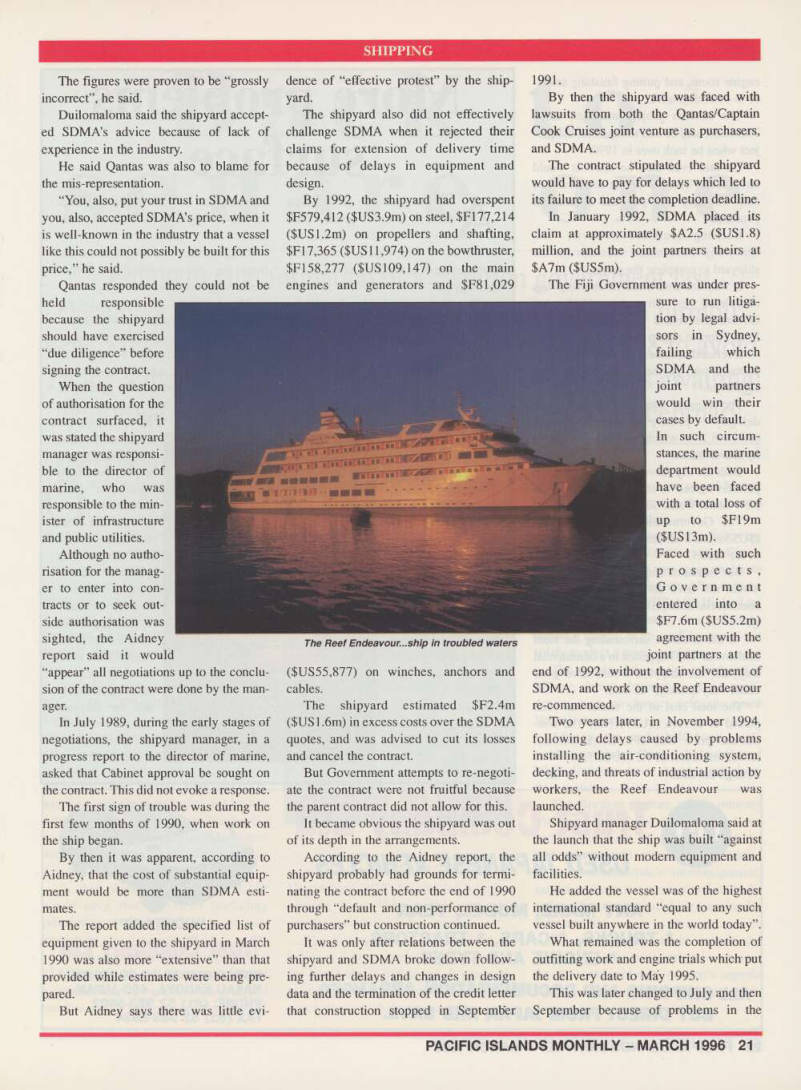
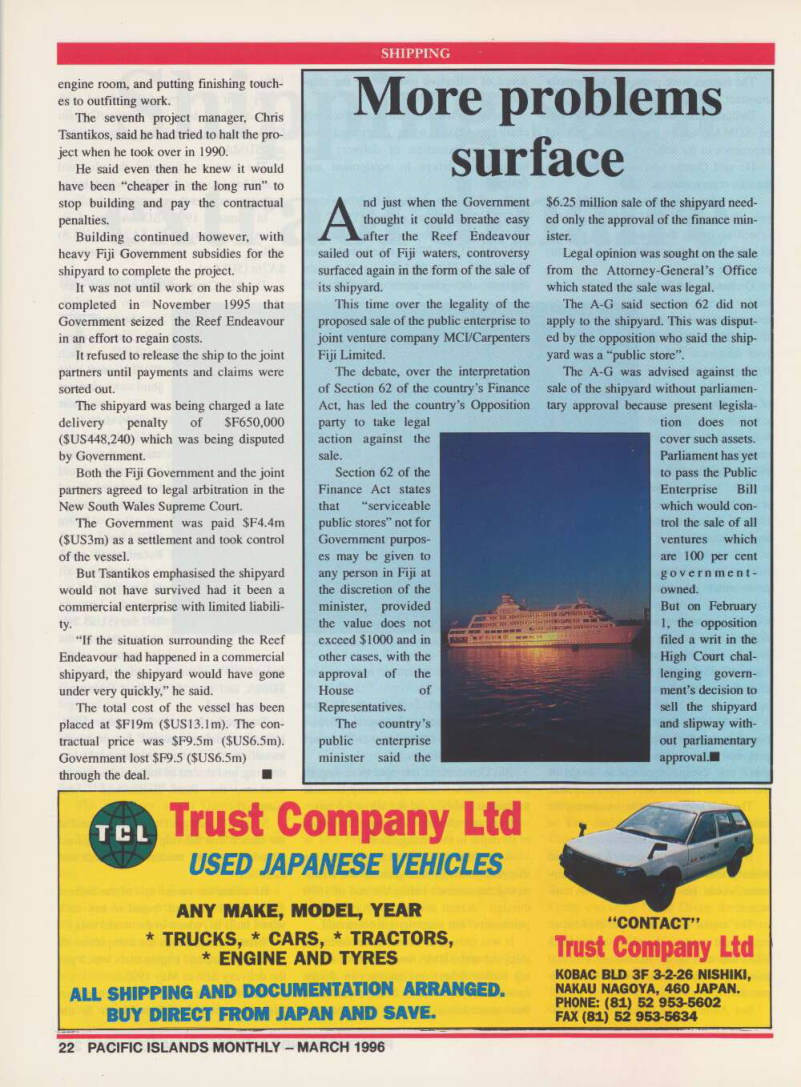
And six years and seven project man agers later, as the Reef Endeavour finally sailed over the horizon and out of Suva Bay in January, Government is still reeling from the impact of the losses it incurred through the deal.
The shipyard management, which has changed since 1989, protested last year that they were misled by their Australian counterparts when they entered into the deal.
But it has also been revealed Government signed the contract against legal advice.
The contract, between the Government
Shipyard and Sydney-based Ship Design
and Management stated a 73-metre vessel would be constructed in Fiji for
$A7,712,640 (Suss.6M)
The purchaser was a Qantas/Captain Cook Cruises joint venture.
The deal was finalised after seven months of negotiations between the par ties.
But a report by Fiji accountant and sen ator Don Aidney, who was commissioned by Government in January 1992 to study the deal, states shipyard representatives were not adequately prepared during
negotiations.
The report found the shipyard arrived at cost estimates and a building schedule
on inadequate design data and equipment
specifications.
“In doing so, it was persuaded to accept cost estimates and material quanti ties submitted by the purchasers,” it said.
The shipyard informed Aidney that during negotiations, it placed preliminary cost estimates at $Fl5m (SUS 10.3 m), but then lowered the price after accepting costs quoted by SDMA.
On July 31, 1989, the shipyard advised SDMA it had revised its price to $A8,125,868 (SUS6.Im) excluding cer
tain equipment.
But the figure was rejected by SDMA who said: “Construction and fitting out budget for this ship is $A7.4m (SUSS.6m).
Our estimates indicate that this budget is realistic”.
In August 1989, there were further price revisions by both parties, which resulted in the shipyard accepting $A7.3m (SUSS.Sm) as the contract figure.
But it was not until the next month, that the shipyard received preliminary draw ings of the Reef Endeavour and in October, inspected a similar ship, the Lady Hawkesbury, in Australia.
Two days before the contract was signed in Sydney on December 22, 1989, the shipyard received a hand-written revised estimate from SDMA containing their own cost figures placing the estimate at $A7.7m (SUSS.6m).
Aidney’s report says the shipyard could not have been able to verify cost figures in the 48 hours before the contract was
signed.
The resulting contract gave the ship yard little room to move.
“A contract was then entered into, which was strongly biased towards the purchasers, which contained no provisions for variances in material and equipment
costs (including those items based on the purchaser’s estimates) and which gave lit tle protection to the shipyard in the event of default,” the Aidney report states.
Legally, Government is said to have entered into the agreement on an uneven
footing.
Indeed, the shipyard was advised by the Solicitor-General’s Office in 1989 that certain clauses would have to be reviewed.
According to the Aidney report, “sev eral undesirable features” of the contract were pointed out to the shipyard but these issues were not dealt with by SDMA.
Flaws in the contract that were high lighted included the disadvantages of New South Wales law (where the contract was drawn up), and the provisions for delay which were dependent on labour stan dards.
Government sources have confirmed protests against the contract were made repeatedly until they were “blue in the face,” but these warnings were not heeded.
But although the Solicitor-General’s office objected to some of the clauses, one of their representatives was a signatory to the 1989 contract signed in Sydney.
The director of marine, who had trav elled to Australia to visit the Lady Hawkesbury, was the other Fiji
Government signatory.
The director stepped-in for the then Government minister who had cancelled his visit to Sydney.
Last May, the shipyard’s new manager, Ratu Mosese Duilomaloma, told Qantas Group executive Geoff Dixon there was
“something fundamentally amiss” about
the contract.
He said it was based on misrepresenta tion because SDMA had provided mis leading figures on which the contract was based.
The figures were proven to be “grossly incorrect”, he said.
Duilomaloma said the shipyard accept ed SDMA’s advice because of lack of experience in the industry.
He said Qantas was also to blame for
the mis-representation.
“You, also, put your trust in SDMA and you, also, accepted SDMA’s price, when it is well-known in the industry that a vessel like this could not possibly be built for this price,” he said.
Qantas responded they could not be
held responsible i because the shipyard should have exercised “due diligence” before signing the contract.
When the question of authorisation for the contract surfaced, it was stated the shipyard manager was responsi ble to the director of marine, who was responsible to the min ister of infrastructure and public utilities.
Although no autho risation for the manag er to enter into con tracts or to seek out side authorisation was sighted, the Aidney report said it would
“appear” all negotiations up to the conclu sion of the contract were done by the man ager.
In July 1989, during the early stages of negotiations, the shipyard manager, in a progress report to the director of marine, asked that Cabinet approval be sought on the contract. This did not evoke a response.
The first sign of trouble was during the first few months of 1990, when work on the ship began.
By then it was apparent, according to Aidney, that the cost of substantial equip ment would be more than SDMA esti mates.
The report added the specified list of equipment given to the shipyard in March 1990 was also more “extensive” than that provided while estimates were being pre
pared.
But Aidney says there was little evi
dence of “effective protest” by the ship yard.
The shipyard also did not effectively challenge SDMA when it rejected their claims for extension of delivery time because of delays in equipment and design.
By 1992, the shipyard had overspent $F579,412 (SUS3.9m) on steel, $F177,214 (SUSI.2m) on propellers and shafting, $F17,365 ($U511,974) on the bowthruster, $F158,277 ($U5109,147) on the main engines and generators and $F81,029
($U555,877) on winches, anchors and cables.
The shipyard estimated $F2.4m (SUS 1.6 m) in excess costs over the SDMA quotes, and was advised to cut its losses and cancel the contract.
But Government attempts to re-negoti ate the contract were not fruitful because the parent contract did not allow for this.
It became obvious the shipyard was out of its depth in the arrangements.
According to the Aidney report, the shipyard probably had grounds for termi nating the contract before the end of 1990 through “default and non-performance of purchasers” but construction continued.
It was only after relations between the shipyard and SDMA broke down follow ing further delays and changes in design data and the termination of the credit letter that construction stopped in September
1991.
By then the shipyard was faced with lawsuits from both the Qantas/Captain Cook Cruises joint venture as purchasers, and SDMA.
The contract stipulated the shipyard would have to pay for delays which led to its failure to meet the completion deadline.
In January 1992, SDMA placed its claim at approximately $A2.5 (SUSI.B) million, and the joint partners theirs at
$A7M (Sussm).
The Fiji Government was under pres
sure to run litiga tion by legal advi sors in Sydney,
failing which
SDMA and the
joint partners
would win their cases by default.
In such circum stances, the marine department would have been faced with a total loss of up to $Fl9m
(Susi3M).
Faced with such prospects.
Government entered into a
$F7.6M (Suss.2M)
agreement with the
joint partners at the end of 1992, without the involvement of SDMA, and work on the Reef Endeavour re-commenced.
Two years later, in November 1994,
following delays caused by problems
installing the air-conditioning system, decking, and threats of industrial action by workers, the Reef Endeavour was launched.
Shipyard manager Duilomaloma said at the launch that the ship was built “against all odds” without modem equipment and facilities.
He added the vessel was of the highest international standard “equal to any such vessel built anywhere in the world today”.
What remained was the completion of outfitting work and engine trials which put the delivery date to May 1995.
This was later changed to July and then September because of problems in the
The Reef Endeavour...ship in troubled waters
engine room, and putting finishing touch es to outfitting work.
The seventh project manager, Chris Tsantikos, said he had tried to halt the pro ject when he took over in 1990.
He said even then he knew it would have been “cheaper in the long run” to stop building and pay the contractual
penalties.
Building continued however, with heavy Fiji Government subsidies for the shipyard to complete the project.
It was not until work on the ship was completed in November 1995 that Government seized the Reef Endeavour in an effort to regain costs.
It refused to release the ship to the joint partners until payments and claims were sorted out.
The shipyard was being charged a late delivery penalty of $F650,000 ($U5448,240) which was being disputed by Government.
Both the Fiji Government and the joint partners agreed to legal arbitration in the New South Wales Supreme Court.
The Government was paid $F4.4m (SUS3m) as a settlement and took control of the vessel.
But Tsantikos emphasised the shipyard would not have survived had it been a commercial enterprise with limited liabili ty.
“If the situation surrounding the Reef Endeavour had happened in a commercial shipyard, the shipyard would have gone under very quickly,” he said.
The total cost of the vessel has been placed at $Fl9m (SUS 13.1 m). The con tractual price was $F9.5m (SUS6.Sm).
Government lost $F9.5 (SUS6.Sm) through the deal. ■
More problems
surface
And just when the Government thought it could breathe easy after the Reef Endeavour sailed out of Fiji waters, controversy surfaced again in the form of the sale of
its shipyard.
This time over the legality of the proposed sale of the public enterprise to
joint venture company MCI/Carpenters
Fiji Limited.
The debate, over the interpretation of Section 62 of the country’s Finance Act, has led the country’s Opposition
party to take legal action against the sale.
Section 62 of the Finance Act states that “serviceable public stores” not for Government purpos es may be given to any person in Fiji at the discretion of the
minister, provided
the value does not exceed $lOOO and in other cases, with the approval of the House of
Representatives.
The country’s
public enterprise
minister said the
$6.25 million sale of the shipyard need ed only the approval of the finance min ister.
Legal opinion was sought on the sale from the Attorney-General’s Office which stated the sale was legal.
The A-G said section 62 did not apply to the shipyard. This was disput ed by the opposition who said the ship yard was a “public store”.
The A-G was advised against the sale of the shipyard without parliamen tary approval because present legisla
tion does not cover such assets.
Parliament has yet to pass the Public
Enterprise Bill
which would con trol the sale of all ventures which are 100 per cent government owned.
But on February 1, the opposition filed a writ in the High Court chal
lenging govern
ment’s decision to sell the shipyard and slipway with
out parliamentary
approval. ■
Advertisements & other items, p. 22 (1 item)
Trust Company Ltd
m
USED JAPANESE VEHICLES
ANY MAKE, MODEL, YEAR
* TRUCKS, * CARS, * TRACTORS,
* ENGINE AND TYRES
ALL SHIPPING AND DOCUMENTATION ARRANGED.
BUY DIRECT FROM JAPAN AND SAVE.
“CONTACT”
Trust Company Ltd
KOBAC BID 3F 3-2-26 NISHiKI,
NAKAU NAGOYA, 460 JAPAN.
PHONE: (81) 52 953-5602
FAX (81) 52 953-5634
Back to
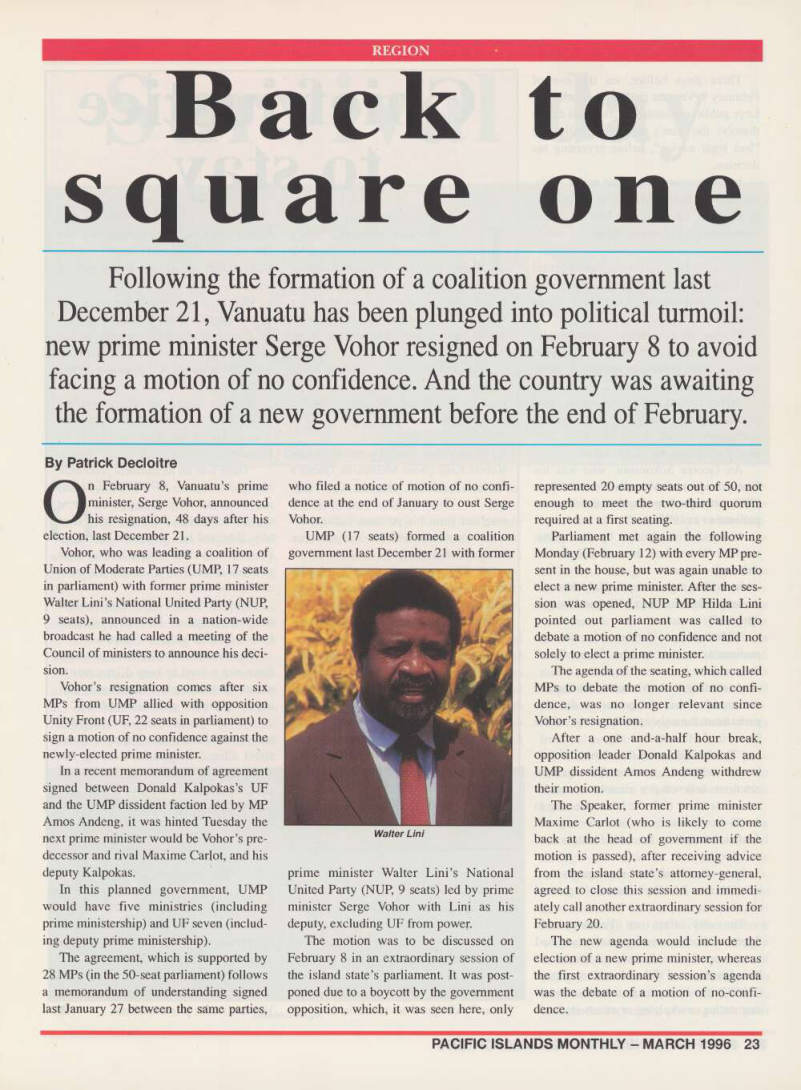
Region
Back to square one
Following the formation of a coalition government last December 21, Vanuatu has been plunged into political turmoil: new prime minister Serge Vohor resigned on February 8 to avoid facing a motion of no confidence. And the country was awaiting the formation of a new government before the end of February.
By Patrick Decloitre
On February 8, Vanuatu’s prime minister, Serge Vohor, announced his resignation, 48 days after his election, last December 21.
Vohor, who was leading a coalition of Union of Moderate Parties (UMP, 17 seats in parliament) with former prime minister Walter Lini’s National United Party (NUP, 9 seats), announced in a nation-wide broadcast he had called a meeting of the Council of ministers to announce his deci sion.
Vohor’s resignation comes after six MPs from UMP allied with opposition Unity Front (UF, 22 seats in parliament) to sign a motion of no confidence against the newly-elected prime minister.
In a recent memorandum of agreement signed between Donald Kalpokas’s UF and the UMP dissident faction led by MP Amos Andeng, it was hinted Tuesday the next prime minister would be Vohor’s pre decessor and rival Maxime Carlot, and his deputy Kalpokas.
In this planned government, UMP would have five ministries (including prime ministership) and UF seven (includ ing deputy prime ministership).
The agreement, which is supported by 28 MPs (in the 50-seat parliament) follows a memorandum of understanding signed last January 27 between the same parties.
who filed a notice of motion of no confi dence at the end of January to oust Serge Vohor.
UMP (17 seats) formed a coalition government last December 21 with former
prime minister Walter Lini’s National United Party (NUP, 9 seats) led by prime minister Serge Vohor with Lini as his deputy, excluding UF from power.
The motion was to be discussed on February 8 in an extraordinary session of the island state’s parliament. It was post poned due to a boycott by the government opposition, which, it was seen here, only
represented 20 empty seats out of 50, not enough to meet the two-third quorum required at a first seating.
Parliament met again the following Monday (February 12) with every MP pre sent in the house, but was again unable to elect a new prime minister. After the ses sion was opened, NUP MP Hilda Lini pointed out parliament was called to debate a motion of no confidence and not solely to elect a prime minister.
The agenda of the seating, which called MPs to debate the motion of no confi dence, was no longer relevant since
Vohor’s resignation.
After a one and-a-half hour break, opposition leader Donald Kalpokas and UMP dissident Amos Andeng withdrew their motion.
The Speaker, former prime minister Maxime Carlot (who is likely to come back at the head of government if the motion is passed), after receiving advice from the island state’s attorney-general, agreed to close this session and immedi ately call another extraordinary session for
February 20.
The new agenda would include the election of a new prime minister, whereas the first extraordinary session’s agenda was the debate of a motion of no-confi dence.
Walter Lini
Three days before, on the eve of February 9, Vanuatu president, Jean-Marie Leye publicly admitted he tried that day to dissolve the state’s parliament following “bad legal advice”, before reversing his decision.
In an interview broadcast nation-wide, the Head of State said his first intention to dissolve the 50-seat house was a “misun derstanding”, following “requests” made to him.
“Now, after receiving good legal
advice, I know that as a president, I cannot dissolve parliament,” Leye told Radio Vanuatu.
“I want the population to remain calm and not to take the law into their own hands. Let the politicians solve their polit ical problems in parliament,” he added.
“What I’m saying, I’m saying as Head of State, I won’t change my mind again. I don’t want to fall down like what hap pened to Sokomanu,” Leye asked.
Ati George Sokomanu, who was the first president of Vanuatu from 1980 to 1988, attempted to dissolve the Vanuatu parliament in 1988.
Charged with sedition by then prime minister Walter Lini, he was jailed, then demised.
In a joint communique, Kalpokas and
Andeng asked for Leye’s “immediate res ignation”.
“Otherwise, we’ll take action through parliament to remove him from office,”
they said.
According to the Vanuatu constitution, the president has the power to dissolve parliament, but only upon the advice of the Council of Ministers.
“There shall be no dissolution of par liament within 12 months of the general elections following a dissolution under subarticle (2) or (3)”, the latter referring to a self-dissolution by the house or a presi dential dissolution, the island state’s con stitution says.
Leye dissolved the former parliament last October 3, before Vanuatu’s general elections.
The day after, on February 10, Supreme Court, stressing parliament had not been dissolved, ordered Vanuatu’s Broadcasting and Television Corporation (VBTC) that “no statement shall be broad cast stating or implying or otherwise lead
ing people to believe that parliament has been dissolved” and that “any person breaching this order shall be arrested forthwith and brought before the court to show cause why they should not be com mitted to prison for contempt of court”.
Since the end of January, police have set up special operation (code named “Nasara”) designed to maintain law and
order. The exercise involves 24-hour patrols in the capital and police and Vanuatu Mobile Force officers being post ed at strategic points of Port Vila, includ ing Parliament, Radio Vanuatu, the prime minister’s office and State House.
Meanwhile, all political parties have resumed lobbying and negotiating to elect Vanuatu’s next prime minister. ■
Chief justice
to stay
In early February, Vanuatu’s Justice minister, former prime minister Walter Lini, in a surprise move, renewed Chief Justice Charles Vaudin d’lmecourt’s contract in spite of earlier threats Lini made that the British judge would have to leave the country at the end of March.
Lini, and then prime minister Serge Vohor approved another two-year con tract for the judge, who arrived on the island state four years ago under a British-funded contract.
In May last year, Australian justice Robert Kent (from Melbourne Queen’s Council-Australia), who had been work ing in Vanuatu since early 1994, resigned from his position because he was “concerned over the independence of the chief justice”.
At the same time, opposition leader Donald Kalpokas’s Vanuaaku Pati (VP) and Lini’s National United Party (NUP), called for d’lmecourt’s “immediate res
ignation”.
In 1994, after London refused to fur ther fund his position, he remained Vanuatu’s chief justice, but his present contract, which expires next June, has since been paid by the Vanuatu govern ment with help from overseas donors.
Since last year, the Vanuatu govern ment has received funds for this position from Technical and Cultural Co-opera tion Agency, a worldwide association of French-speaking countries, mainly
financed by France and Canada, to cover “on an exceptional basis” some SUS 100,000 for the remaining half of last year.
Vanuatu’s government has since last year requested about SUS2OO,OOO from the European Union for the chief justice in 1996, but until no\lv, no reply has been made by Brussels, the Planning Office earlier said.
It is not known yet where overseas aid to fund d’lmecourt’s new contract will come from, Lini admitted in
February.
“There was no recruitment procedure engaged to replace M. dTmecourt when we came in this government so it seemed as though we could only keep him. If he had left, we would have been left without a chief justice. During these two years, we’ll try to recruit someone else”, Lini said.
Prime minister Serge Vohor stressed the importance of having a bilingual
French-English judge in Vanuatu.
The Justice ministry here has said there was a need to keep dTmecourt to ensure “everything is done properly dur
ing this period of political instability”.
A crucial forthcoming case related to complaints fded in the Supreme Court
about alleged irregularities during last
November’s general elections and affecting some 40 MPs (out of 50), also needs to be dealt with by the British
judge. ■
Survival day
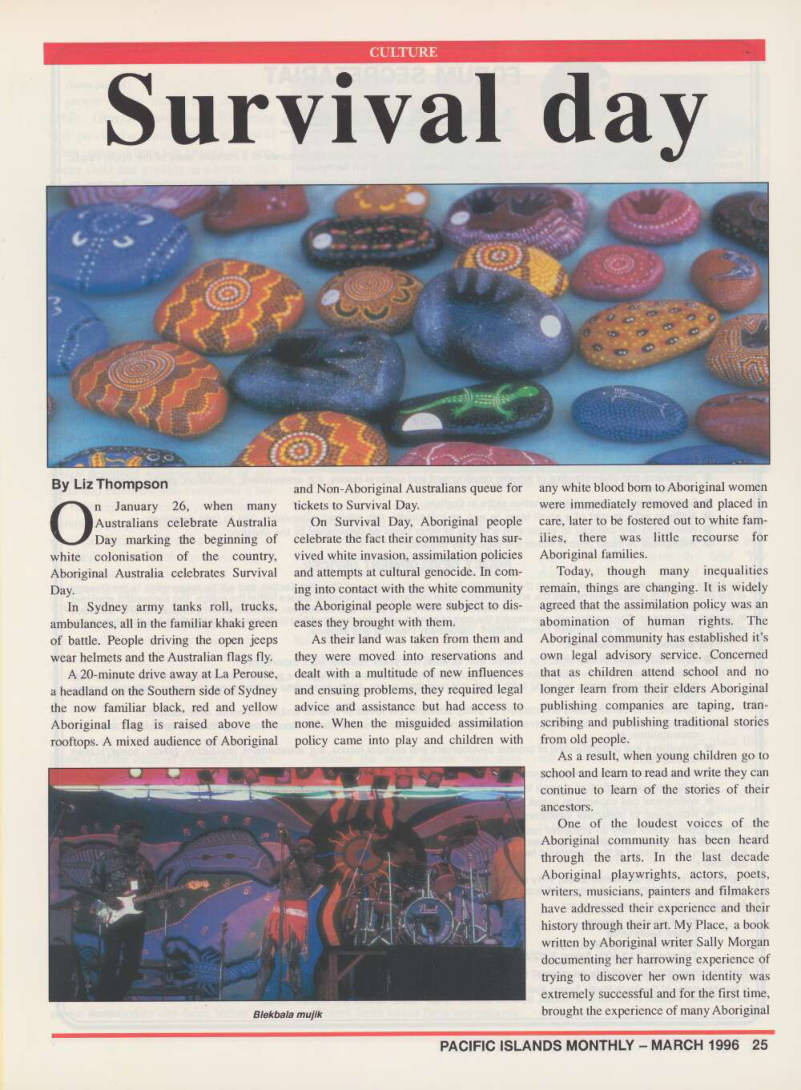
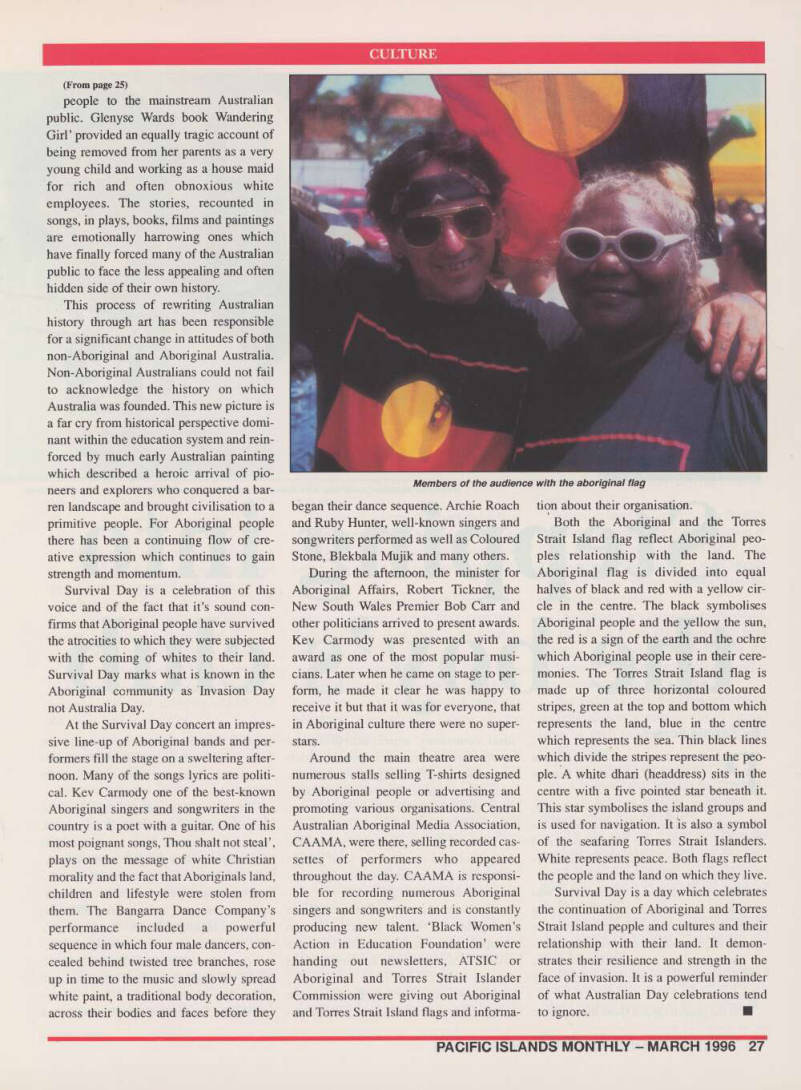
Culture
By Liz Thompson
and Non-Aboriginal Australians queue for tickets to Survival Day.
On Survival Day, Aboriginal people celebrate the fact their community has sur vived white invasion, assimilation policies and attempts at cultural genocide. In com ing into contact with the white community the Aboriginal people were subject to dis eases they brought with them.
As their land was taken from them and they were moved into reservations and dealt with a multitude of new influences and ensuing problems, they required legal advice and assistance but had access to none. When the misguided assimilation policy came into play and children with
any white blood bom to Aboriginal women were immediately removed and placed in care, later to be fostered out to white fam ilies, there was little recourse for
Aboriginal families.
Today, though many inequalities
remain, things are changing. It is widely agreed that the assimilation policy was an abomination of human rights. The Aboriginal community has established it’s own legal advisory service. Concerned that as children attend school and no longer learn from their elders Aboriginal publishing companies are taping, tram scribing and publishing traditional stories from old people.
As a result, when young children go to school and leam to read and write they can continue to leam of the stories of their ancestors.
One of the loudest voices of the Aboriginal community has been heard through the arts. In the last decade
Aboriginal playwrights, actors, poets,
writers, musicians, painters and fdmakers have addressed their experience and their history through their art. My Place, a book
written by Aboriginal writer Sally Morgan
documenting her harrowing experience of
trying to discover her own identity was extremely successful and for the first time, brought the experience of many Aboriginal
On January 26, when many Australians celebrate Australia Day marking the beginning of white colonisation of the country, Aboriginal Australia celebrates Survival Day.
In Sydney army tanks roll, trucks, ambulances, all in the familiar khaki green of battle. People driving the open jeeps wear helmets and the Australian flags fly.
A 20-minute drive away at La Perouse, a headland on the Southern side of Sydney the now familiar black, red and yellow Aboriginal flag is raised above the rooftops. A mixed audience of Aboriginal
Blekbala mujik
people to the mainstream Australian
public. Glenyse Wards book Wandering
Girl’ provided an equally tragic account of being removed from her parents as a very young child and working as a house maid for rich and often obnoxious white employees. The stories, recounted in songs, in plays, books, films and paintings are emotionally harrowing ones which have finally forced many of the Australian public to face the less appealing and often hidden side of their own history.
This process of rewriting Australian history through art has been responsible for a significant change in attitudes of both
non-Aboriginal and Aboriginal Australia.
Non-Aboriginal Australians could not fail to acknowledge the history on which Australia was founded. This new picture is a far cry from historical perspective domi nant within the education system and rein
forced by much early Australian painting
which described a heroic arrival of pio neers and explorers who conquered a bar ren landscape and brought civilisation to a primitive people. For Aboriginal people there has been a continuing flow of cre ative expression which continues to gain strength and momentum.
Survival Day is a celebration of this voice and of the fact that it’s sound con firms that Aboriginal people have survived the atrocities to which they were subjected with the coming of whites to their land.
Survival Day marks what is known in the Aboriginal community as Invasion Day not Australia Day.
At the Survival Day concert an impres sive line-up of Aboriginal bands and per formers fill the stage on a sweltering after noon. Many of the songs lyrics are politi cal. Kev Carmody one of the best-known Aboriginal singers and songwriters in the country is a poet with a guitar. One of his most poignant songs, Thou shall not steal’, plays on the message of white Christian morality and the fact that Aboriginals land, children and lifestyle were stolen from them. The Bangarra Dance Company’s
performance included a powerful
sequence in which four male dancers, con cealed behind twisted tree branches, rose up in time to the music and slowly spread white paint, a traditional body decoration, across their bodies and faces before they
began their dance sequence. Archie Roach and Ruby Hunter, well-known singers and songwriters performed as well as Coloured Stone, Blekbala Mujik and many others.
During the afternoon, the minister for Aboriginal Affairs, Robert Tickner, the New South Wales Premier Bob Carr and other politicians arrived to present awards.
Kev Carmody was presented with an award as one of the most popular musi cians. Later when he came on stage to per form, he made it clear he was happy to receive it but that it was for everyone, that in Aboriginal culture there were no super stars.
Around the main theatre area were numerous stalls selling T-shirts designed
by Aboriginal people or advertising and
promoting various organisations. Central Australian Aboriginal Media Association, CAAMA, were there, selling recorded cas settes of performers who appeared throughout the day. CAAMA is responsi ble for recording numerous Aboriginal
singers and songwriters and is constantly
producing new talent. ‘Black Women’s Action in Education Foundation’ were handing out newsletters, ATSIC or Aboriginal and Torres Strait Islander Commission were giving out Aboriginal and Torres Strait Island flags and informa
tion about their organisation.
Both the Aboriginal and the Torres Strait Island flag reflect Aboriginal peo ples relationship with the land. The
Aboriginal flag is divided into equal
halves of black and red with a yellow cir cle in the centre. The black symbolises Aboriginal people and the yellow the sun, the red is a sign of the earth and the ochre which Aboriginal people use in their cere monies. The Torres Strait Island flag is made up of three horizontal coloured stripes, green at the top and bottom which represents the land, blue in the centre which represents the sea. Thin black lines which divide the stripes represent the peo ple. A white dhari (headdress) sits in the centre with a five pointed star beneath it.
This star symbolises the island groups and is used for navigation. It is also a symbol of the seafaring Torres Strait Islanders.
White represents peace. Both flags reflect the people and the land on which they live.
Survival Day is a day which celebrates the continuation of Aboriginal and Torres Strait Island pepple and cultures and their relationship with their land. It demon strates their resilience and strength in the face of invasion. It is a powerful reminder of what Australian Day celebrations tend to ignore. ■
Members of the audience with the aboriginal flag
Advertisements & other items, pp. 26-27 (2 items)
W Vacancies
FORUM SECRETARIAT
Applications are invited from suitably qualified and experienced persons, who must be nationals of a member state of the South Pacific Forum*, for two positions in the Economic Development Division at the Forum Secretariat.
The Forum Secretariat was established in 1972 by the South Pacific Forum to encourage economic and political cooperation between its member states, and between those states and the more industrialised countries. Under the control of the Secretary General, the Secretariat has undertaken activities in a number of areas: economic development, legal and political, civil aviation, energy, maritime, telecommunications and trade. These programmes have been funded by member contributions and a range of aid donor countries and organisations including Australia, New Zealand, Japan, France, EC, Canada, UNDP and, recently, Taiwan and Korea.
The Secretariat will, over the course of 1996, be comprehensively restructured in order to move from its current dual focus upon regional policy issues and the delivery of technical services, to a much greater focus on policy analysis, development and coordination. To begin to effect this change, the current Economic Development Division requires two new staff members to work in the Economic Policy and Development Planning, and the Development Cooperation Sections of what will become the new restructured Division.
DEVELOPMENT COOPERATION OFFICER
The Development Cooperation Officer will work in the Development Cooperation Section and be responsible to the Director of the Division.
The officer will assume day-to-day responsibility for the operations of the Forum Secretariat Fellowship Scheme; the Smaller Island States Development Fund; the Kanak Fellowship Scheme; and the Short Term Technical Assistance Scheme. The position will also require ongoing participation in other activities relevant to the implementation of the Division’s Annual Work Programme, particularly with regard to the Secretariat role in regional donor coordination. (I) Desirable characteristics: • Advanced degree in economics or a related field e.g. political, science, development studies, sociology, anthropology, human geography, with no less than 3-5 years relevant work experience: • A sound working knowledge of the economies of Pacific Island Countries, with an understanding of issues within both the monetised and semi subsistence sectors; • Familiarity with donor government and agency procedures; • Sound analytical skills and an ability to think laterally in order to provide advice to member countries in the development of project proposals; • Awareness and understanding of broader development and sectoral issues, e.g. environment, population, gender, social/human development; • Good oral and written communication skills in English; • Ability to work as part of a small team as well as individually, with minimal supervision, and to tight deadlines; • Willingness and capacity to assist with a variety of other tasks as determined by the Division; • Willingness to travel (mainly within the region) as required.
POUCY DEVELOPMENT OFFICER
The Policy Development Officer will work in the Economic Policy and Development Planning Section and will be responsible to the Director of the Division. This position will require the ability to focus upon contemporary economic issues within the region. The successful applicant will need to be able to translate sound economic analysis into clear policy papers for discussion/consideration by officials and/or Ministers in a variety of contexts. The position will also require the person to work with other regional and multilateral organisations in capacity building projects in Forum member government bureaucracies, particularly Planning and Finance. (li) Desirable characteristics: • Advanced degree in economics or finance with at least five years relevant work experience; • Ability to carry out economic analysis of current development issues in the region, e.g. structural reform. Particular emphasis on macro-economic issues, including both fiscal and monetary policy. Ability to analyse and interpret economic statistics, explain trends, etc; • Experience in development and delivery of policy advice in the areas of finance and/or economic development; • Technical capabilities in development planning and the ability to transfer these capabilities, e.g. through workshops, in-country consultations, etc; • Awareness and understanding of broader development and sectoral issues, e.g. environment, population, gender, social/human development: • Good oral and written communication skills in English; • Ability to work as part of a small team as well as individually, with minimal supervision, and to tight deadlines; • Willingness and capacity to assist with a variety of other tasks as determined by the Division; • Willingness to undertake significant travel both within the region and internationally as required.
"These appointments carry an attractive remuneration package. For non-Fiji citizens this is tax-free and includes housing and education allowance.” Other benefits include payments in lieu of superannuation, and medical life and personal accident insurance coverage.
Appointees will be based at the Secretariat headquarters in Suva. Appointments will be for three years initially, and are renewable by mutual agreement.
Applications close on 29 March 1996. They should contain full information on education and career backgrounds and should give names, addresses and telephone numbers of at least three referees with whom the applicant has been associated professionally.
Applications should be addressed to: The Secretary General Forum Secretariat Private Mail Bag, Suva, FIJI.
Telephone 312-600; Telex: FJ2229; Fax: 305-573.
Further Information Is available on request from the Personnel Officer, on 312-600 Extension 334. * Member states of the South Pacific Forum: Australia, Cook Islands, Federated States of Micronesia, Fiji, Kiribati, Nauru, New Zealand, Niue, Papua New Guinea, Palau, Republic of the Marshall Islands, Solomon Islands, Tonga, Tuvalu, Vanuatu and Western Samoa. 131617v3 J
27
CULTURE
PACIFIC ISLANDS MONTHLY - MARCH 1996
(From page 25)
Stepping into
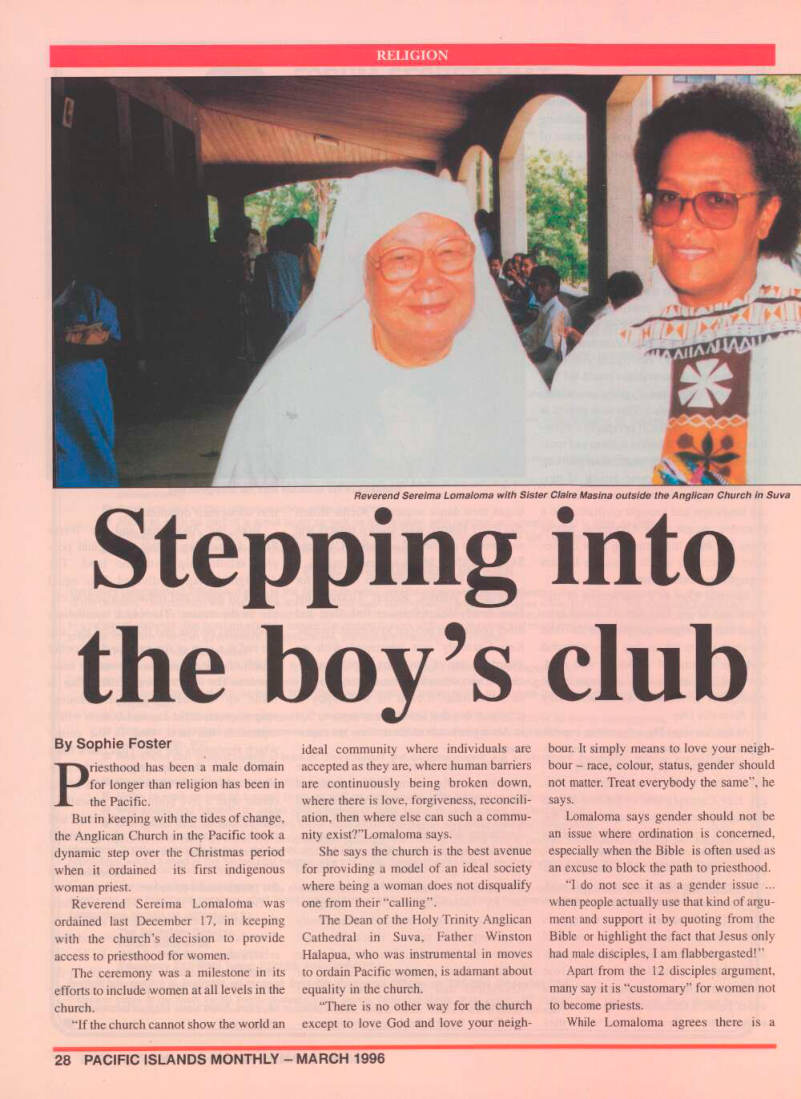
the boy’s club
By Sophie Foster
ideal community where individuals are accepted as they are, where human barriers are continuously being broken down, where there is love, forgiveness, reconcili ation, then where else can such a commu nity exist?”Lomaloma says.
She says the church is the best avenue for providing a model of an ideal society where being a woman does not disqualify one from their “calling”.
The Dean of the Holy Trinity Anglican Cathedral in Suva, Father Winston Halapua, who was instrumental in moves to ordain Pacific women, is adamant about equality in the church.
“There is no other way for the church except to love God and love your neigh-
Priesthood has been a male domain for longer than religion has been in the Pacific.
But in keeping with the tides of change, the Anglican Church in the Pacific took a dynamic step over the Christmas period when it ordained its first indigenous
woman priest.
Reverend Sereima Lomalofna was ordained last December 17, in keeping with the church’s decision to provide access to priesthood for women.
The ceremony was a milestone in its efforts to include women at all levels in the church.
“If the church cannot show the world an
hour. It simply means to love your neigh bour - race, colour, status, gender should not matter. Treat everybody the same”, he says.
Lomaloma says gender should not be an issue where ordination is concerned, especially when the Bible is often used as an excuse to block the path to priesthood.
“I do not see it as a gender issue ... when people actually use that kind of argu ment and support it by quoting from the Bible or highlight the fact that Jesus only had male disciples, I am flabbergasted!”
Apart from the 12 disciples argument, many say it is “customary” for women not to become priests.
While Lomaloma agrees there is a
Reverend Sereima Lomaloma with Sister Claire Masina outside the Anglican Church in Suva
“heavy predominance” of males in the ministry, she insists it is not just a male domain.
“But I also recognise that there are some people who have reservations or who do not support women’s ordination.”
Indeed more than a decade ago, such free expression of female equality in the church would have been unheard of.
The drive towards including women at all levels in the Anglican Church resulted from a recognition of the importance of women’s roles and changing attitudes of the clergy and community.
But it was not until 15 years ago that the church accepted that women could fol low “God’s calling”.
It was then the Diocese of Polynesia, which includes Fiji, Tonga and Samoa, made the decision to allow women to be ordained.
Halapua, who was a part of that monu mental debate, says a lot of the criticism of women’s ordination stems from a power
struggle.
“It has to do with power and domi nance. Some people think that by being a man they have extra power.
“The church needs to open up and dis mantle boundaries that have (been) built over the years because of historical beliefs
of other countries.”
According to the Centre for Women’s Global Leadership, there is no value in protecting parts of culture and religion that serve to keep women in subordinate posi tions.
Women have a right to help change those parts of religion or culture that are in direct conflict with their human rights, the Centre says.
“Women...should be able to challenge regressive practices within their own tradi tions as well as protest human rights abus es without feeling that they are denying their entire culture or religion,” it says.
Halapua agrees saying cultural prac tices that discriminate against a certain part of the population should be removed.
“Biblically, God made us to be partners, as in culture. And if there are cultural val ues that are irrelevant, they should be destroyed. We shouldn’t harp on cultures that reduce another human being,” he said.
“That is the problem with the church today. They highlight bits that serve their own interests.”
The use of cultural practices to prevent women from exercising their rights as individuals is universal, but Lomaloma says it is a pity it has permeated into reli
gion.
“There are indeed cultural barriers that exist that prevent women from exercising their ministries. And this is the greatest tragedy of all.”
Since the introduction of female ordi nation, only three women, including Lomaloma, have progressed towards becoming part of the clergy of the Anglican Church.
Part of the problem, Lomaloma says, is women are not aware of their right to join the priesthood of the Anglican Church.
“At one of the meetings I attended, one of the women there said she did not know that the ordination of women had been
approved.
“She also said that if she had known then perhaps other women may have come forward earlier.”
The lack of a support network for women wanting to be ordained, says Halapua, can be attributed to the priorities
of priests in charge of parishes.
“There are a lot of things going on in the church here (in the Anglican Church)
and outside and some of them depend very much on the leadership of the priest-in charge because what they like seems to be put forward and encouraged. There are some things like women’s ordination which perhaps are not their priorities.”
Priests play a major role, says Lomaloma, in encouraging and supporting women who feel they have a calling.
“Unfortunately in some parishes, the clergy themselves will need to be emanci pated”, she says.
Halapua admits the Anglican Church is divided on the issue of female ordination, purely because different branches of the church make their own decisions.
He says the church in Melanesia does not condone female ordination.
Although Fiji could be considered Melanesian, its progressive views are a result of its inclusion in the Diocese of Polynesia, whose missionaries came from Australia.
But by far history’s biggest opponent to female ordination has been the Catholic Church.
Indeed, when the question of ordination first arose in the Anglican Communion in 1975, Pope Paul VI reminded the Archbishop of Canterbury of the Catholic Church’s firm stance against females entering the priesthood.
The church’s reasons include the exam ple that Jesus chose his 12 apostles from amongst men and its teaching that the exclusion of women from the priesthood is in accordance with “God’s plan”.
But Halapua says the ideology against the ordination of women overlooks the real issue of the Christian ministry as being God’s calling.
“If women coming in enriches the min istry, a ministry that belongs to somebody else - it belongs to God - we have to acknowledge it in the church.
“It’s like a house where you open the windows and suddenly you see the light come inside and you feel warm. And you think why haven’t we opened the windows in all those years.”
Perhaps the best way forward Halapua says, would be to lead by example and -pray for change.
But for now, Lomaloma is providing a much-needed role model for other Pacific Island women wanting to be ordained.B
Advertisements & other items, pp. 30-31 (1 item)
Drive dignity right to the top.
® TOYOTA
Everyone who knows cars has no doubts about Land Cruiser’s ruggedness.
Yet how many know that its luxury rivals the finest high-priced cars?
Or that it’s got more room inside than many luxury sedans?
And because it’s a Toyota, Land Cruiser’s fit and finish, attention to detail, and graceful form speak of elegance as well as spacious comfort.
Yet you still get tough ladder frames and suspension built to take you as far off road as you want to go.
With power from 4.5-litre petrol or 4.2-litre diesel engines.
And it’s carefully protected from rust to last longer.
So if you’re going right to the top, this dignified car is ready to take you.
LAND CRUISER
DISTRIBUTORS /DEALERS
AMERICAN SAMOA BURNS PHILP MOTORS PH 633-4281 COOK ISLANDS GUAM & MICRONESIA ...ATKINS KROLL, INC. PH 646-1876/9 KIRIBATI NORFOLK ISLAND BORRY’S PTY LTD. PH 22114 PAPUA NEW GUINEA SOLOMON ISLAND ELA MOTORS PH 30314 TAHITI VANUATU ASCO MOTORS PH 22341 WESTERN SAMOA..,.
.PACIFIC MOTORS LTD. PH 20796
. TARAWA MOTORS PH 21090
.ELA MOTORS PH 3229400
.NIPPON AUTOMOTO PH 429819
.ASCO MOTORS PH 20800
FIJI ASCO MOTORS PH 384888
NEW CALEDONIA S.I.A.P. PH 275562
SAIPAN MICROL CORPORATION PH 234-5911
TONGA ASCO MOTORS PH 23500
: ■Bl j |fl|l|| ,->v 1111 l «*l - \ .. ( c V
LAND
CRUISER
LAWOMSBI
* /Jk x rf. V -
SaS
*V w » T* /- 5*3 . ’
«t f '■‘Sfcgji -
■» . » . :3f-'~- ... «•
a nation
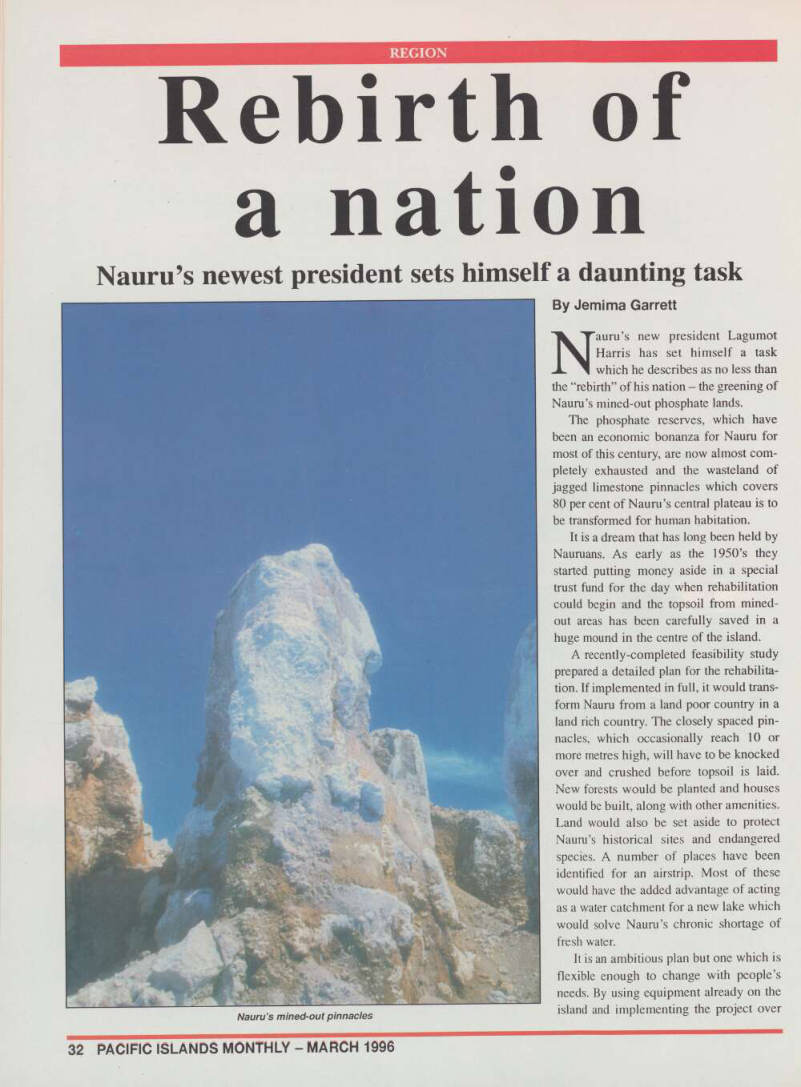
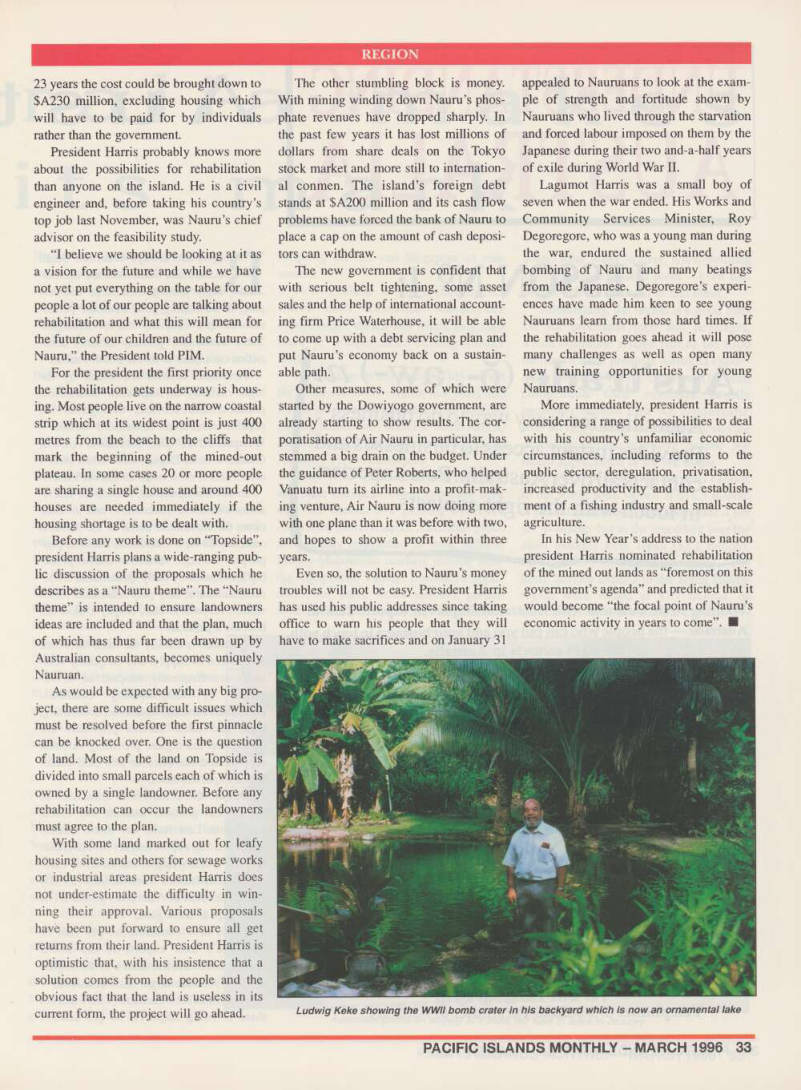
Rebirth of a nation
Nauru’s newest president sets himself a daunting task
By Jemima Garrett
Nauru’s new president Lagumot
Harris has set himself a task which he describes as no less than the “rebirth” of his nation - the greening of Nauru’s mined-out phosphate lands.
The phosphate reserves, which have been an economic bonanza for Nauru for most of this century, are now almost com pletely exhausted and the wasteland of jagged limestone pinnacles which covers 80 per cent of Nauru’s central plateau is to be transformed for human habitation.
It is a dream that has long been held by Nauruans. As early as the 1950’s they started putting money aside in a special trust fund for the day when rehabilitation could begin and the topsoil from mined out areas has been carefully saved in a huge mound in the centre of the island.
A recently-completed feasibility study
prepared a detailed plan for the rehabilita tion. If implemented in full, it would trans form Nauru from a land poor country in a land rich country. The closely spaced pin nacles, which occasionally reach 10 or more metres high, will have to be knocked over and crushed before topsoil is laid.
New forests would be planted and houses would be built, along with other amenities.
Land would also be set aside to protect Nauru’s historical sites and endangered species. A number of places have been identified for an airstrip. Most of these would have the added advantage of acting as a water catchment for a new lake which would solve Nauru’s chronic shortage of fresh water.
It is an ambitious plan but one which is flexible enough to change with people’s needs. By using equipment already on the island and implementing the project over
Nauru’s mined-out pinnacles
23 years the cost could be brought down to SA23O million, excluding housing which will have to be paid for by individuals rather than the government.
President Harris probably knows more about the possibilities for rehabilitation than anyone on the island. He is a civil
engineer and, before taking his country’s
top job last November, was Nauru’s chief advisor on the feasibility study.
“I believe we should be looking at it as a vision for the future and while we have not yet put everything on the table for our people a lot of our people are talking about rehabilitation and what this will mean for the future of our children and the future of Nauru,” the President told PIM.
For the president the first priority once the rehabilitation gets underway is hous ing. Most people live on the narrow coastal strip which at its widest point is just 400 metres from the beach to the cliffs that mark the beginning of the mined-out plateau. In some cases 20 or more people are sharing a single house and around 400 houses are needed immediately if the housing shortage is to be dealt with.
Before any work is done on “Topside”,
president Harris plans a wide-ranging pub
lic discussion of the proposals which he describes as a “Nauru theme”. The “Nauru theme” is intended to ensure landowners ideas are included and that the plan, much of which has thus far been drawn up by Australian consultants, becomes uniquely Nauruan.
As would be expected with any big pro ject, there are some difficult issues which must be resolved before the first pinnacle can be knocked over. One is the question of land. Most of the land on Topside is divided into small parcels each of which is owned by a single landowner. Before any rehabilitation can occur the landowners must agree to the plan.
With some land marked out for leafy housing sites and others for sewage works or industrial areas president Harris does not under-estimate the difficulty in win
ning their approval. Various proposals
have been put forward to ensure all get returns from their land. President Harris is optimistic that, with his insistence that a solution comes from the people and the obvious fact that the land is useless in its current form, the project will go ahead.
The other stumbling block is money.
With mining winding down Nauru’s phos
phate revenues have dropped sharply. In
the past few years it has lost millions of dollars from share deals on the Tokyo stock market and more still to internation al conmen. The island’s foreign debt stands at SA2OO million and its cash flow problems have forced the bank of Nauru to place a cap on the amount of cash deposi tors can withdraw.
The new government is confident that with serious belt tightening, some asset sales and the help of international account ing firm Price Waterhouse, it will be able to come up with a debt servicing plan and put Nauru’s economy back on a sustain
able path.
Other measures, some of which were started by the Dowiyogo government, are already starting to show results. The cor poratisation of Air Nauru in particular, has stemmed a big drain on the budget. Under the guidance of Peter Roberts, who helped Vanuatu turn its airline into a profit-mak ing venture, Air Nauru is now doing more with one plane than it was before with two, and hopes to show a profit within three years.
Even so, the solution to Nauru’s money troubles will not be easy. President Harris has used his public addresses since taking office to warn his people that they will have to make sacrifices and on January 31
appealed to Nauruans to look at the exam ple of strength and fortitude shown by Nauruans who lived through the starvation and forced labour imposed on them by the Japanese during their two and-a-half years of exile during World War 11.
Lagumot Harris was a small boy of seven when the war ended. His Works and Community Services Minister, Roy Degoregore, who was a young man during the war, endured the sustained allied bombing of Nauru and many beatings
from the Japanese. Degoregore’s experi
ences have made him keen to see young Nauruans learn from those hard times. If the rehabilitation goes ahead it will pose many challenges as well as open many new training opportunities for young Nauruans.
More immediately, president Harris is considering a range of possibilities to deal with his country’s unfamiliar economic circumstances, including reforms to the
public sector, deregulation, privatisation,
increased productivity and the establish ment of a fishing industry and small-scale agriculture.
In his New Year’s address to the nation president Harris nominated rehabilitation of the mined out lands as “foremost on this government’s agenda” and predicted that it would become “the focal point of Nauru’s economic activity in years to come”. ■
Ludwig Keke showing the WWII bomb crater in his backyard which is now an ornamental lake
Australia makes
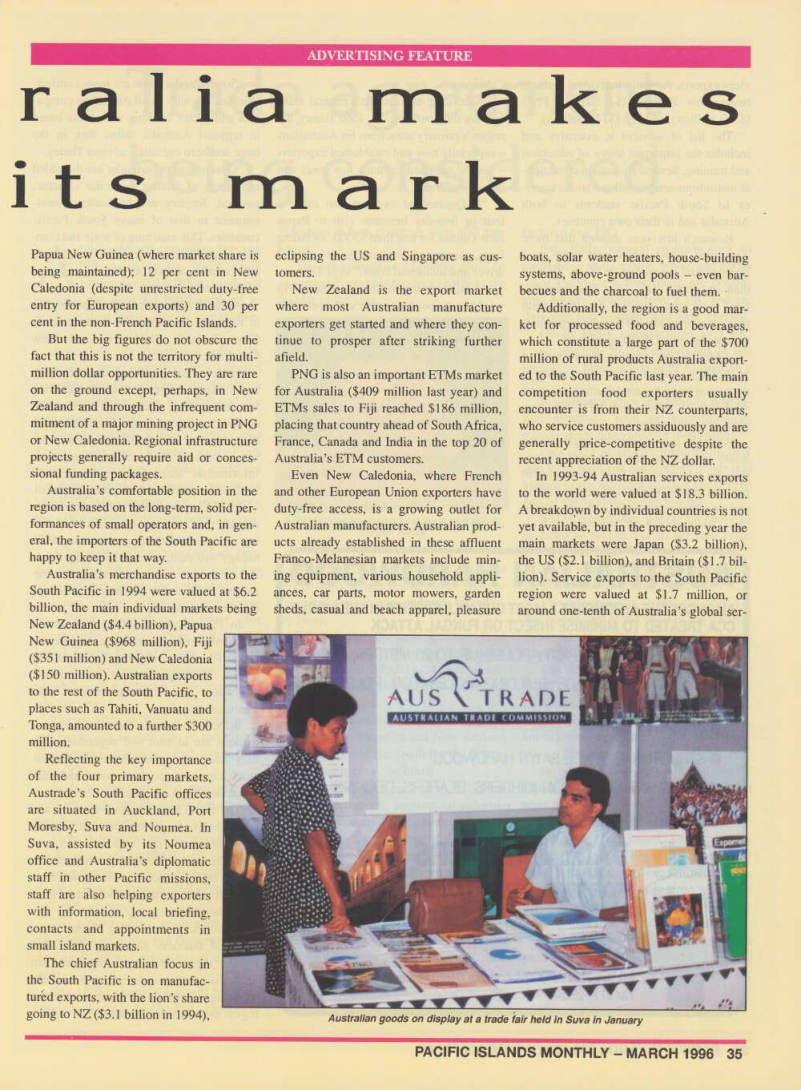

Advertising Feature
Australia makes its mark
Big is not always beautiful. Small Australian businesses are increas ingly joining their large counter parts in translating good domestic perfor mances into offshore market strategies.
These businesses’ primary offshore desti nation continues to be the South Pacific.
First-time visitors are struck by the high visibility of Australian institutions, products and services throughout the region. Australian household names - Westpac, ANZ, QBE Insurance, Amotts, Golden Circle, Edgell, BHP and Foster’s are all there, most often as market leaders.
In several countries, Australian televi sion channels are accessible and in some cases the Australian dollar is the national currency. In New Caledonia, the local peo ple play a unique version of cricket proba bly introduced by early Queensland cattle men; in Nauru, they play Australian Rules while everywhere else, Rugby Union has become a passion.
Australia is usually the main influence and source of supply, and its quality stan dards are frequently adopted as bench marks by neighbouring countries.
Australian banking, insurance, accounting,
legal and other service providers are throughout the region, providing valuable support and facilities to new and estab lished exporters alike.
Despite the come-hither attractions of the present glamour markets like China and South East Asia, the South Pacific remains a big export market for Australia.
It is the world’s largest consumer of elab orately transformed manufactures (ETMs) and 25 per cent of Australia’s global ETM exports go to the region.
ETMs now constitute 60 per cent of Australia’s total exports to the South Pacific while market shares in the region in 1994-95 were larger than elsewhere - 22 per cent in New Zealand (where market share is rising slightly); 50 per cent in
Papua New Guinea (where market share is being maintained); 12 per cent in New
Caledonia (despite unrestricted duty-free
entry for European exports) and 30 per cent in the non-French Pacific Islands.
But the big figures do not obscure the fact that this is not the territory for multi million dollar opportunities. They are rare on the ground except, perhaps, in New Zealand and through the infrequent com mitment of a major mining project in PNG or New Caledonia. Regional infrastructure
projects generally require aid or conces
sional funding packages.
Australia’s comfortable position in the region is based on the long-term, solid per formances of small operators and, in gen eral, the importers of the South Pacific are happy to keep it that way.
Australia’s merchandise exports to the South Pacific in 1994 were valued at $6.2 billion, the main individual markets being
New Zealand ($4.4 billion), Papua New Guinea ($968 million), Fiji ($351 million) and New Caledonia ($l5O million). Australian exports to the rest of the South Pacific, to places such as Tahiti, Vanuatu and Tonga, amounted to a further $3OO million.
Reflecting the key importance of the four primary markets, Austrade’s South Pacific offices are situated in Auckland, Port Moresby, Suva and Noumea. In Suva, assisted by its Noumea office and Australia’s diplomatic staff in other Pacific missions, staff are also helping exporters with information, local briefing, contacts and appointments in small island markets.
The chief Australian focus in the South Pacific is on manufac tured exports, with the lion’s share going to NZ ($3.1 billion in 1994),
eclipsing the US and Singapore as cus tomers.
New Zealand is the export market where most Australian manufacture exporters get started and where they con tinue to prosper after striking further afield.
PNG is also an important ETMs market for Australia ($409 million last year) and ETMs sales to Fiji reached $lB6 million, placing that country ahead of South Africa, France, Canada and India in the top 20 of Australia’s ETM customers.
Even New Caledonia, where French and other European Union exporters have duty-free access, is a growing outlet for Australian manufacturers. Australian prod ucts already established in these affluent Franco-Melanesian markets include min ing equipment, various household appli ances, car parts, motor mowers, garden sheds, casual and beach apparel, pleasure
boats, solar water heaters, house-building systems, above-ground pools - even bar becues and the charcoal to fuel them.
Additionally, the region is a good mar ket for processed food and beverages, which constitute a large part of the $7OO million of rural products Australia export ed to the South Pacific last year. The main
competition food exporters usually
encounter is from their NZ counterparts, who service customers assiduously and are
generally price-competitive despite the
recent appreciation of the NZ dollar.
In 1993-94 Australian services exports to the world were valued at $18.3 billion.
A breakdown by individual countries is not yet available, but in the preceding year the main markets were Japan ($3.2 billion), the US ($2.1 billion), and Britain ($1.7 bil lion). Service exports to the South Pacific region were valued at $1.7 million, or around one-tenth of Australia’s global ser-
Australian goods on display at a trade fair held in Suva in January
vices exports, the main individual markets being New Zealand ($1 billion), PNG ($303 million), and Fiji ($145 million).
The list of services is extensive and includes the important sector of education and training. Several Australian education al institutions are providing various cours es to South Pacific students in both Australia and in their own countries.
Research last year showed that more Australian services exporters begin their international marketing in New Zealand than anywhere else - just like manufac tures exporters. Having cut their teeth there, they then expand into the larger mar kets of the main OECD economies.
Added to the merchandise exports of $6.2 billion, Australia’s services exports to the region bring the total Australian export market to $8 billion with ETMs and ser
vices predominating.
Australia is an important supplier to the South Pacific. Its share of total imports into the region varies from more than 50 per cent in PNG to about 35 per cent in Fiji and neighbouring islands, 22 per cent in New Zealand and 12 per cent in New
Caledonia.
According to Austrade’s general man ager for the South Pacific, John Tinney, the region’s primary attractions for Australians - especially new and established exporters - can be summed up thus: low costs and user-friendliness.
“A Queensland exporter can make a four or five-day business visit to Papua New Guinea for less than $3OOO, including fares, accommodation, meals, hire car and driver and incidental costs,” says Tinney.
“A business trip to New Zealand or Fiji would cost about the same and somewhat more for New Caledonia, where costs are higher. But these costs pale into insignifi cance when you line them up against a week in Japan or the American west coast.”
Tinney says language and business practices are familiar (it helps to have some French in New Caledonia, but many exporters succeed there without it) and transport and communication links are generally easy and efficient. Time zones are similar to eastern Australia and PNG is on the same time as Queensland.
“South Pacific firms are more comfort able dealing with small Australian compa nies and prefer working with firms based in regional Australia rather than in the large southern capitals,” advises Tinney.
“Queensland in particular has the added advantage of having a similar climatic, pastoral, forestry and horticultural envi ronment to that of many South Pacific countries. This matching of scale and com mon experience can facilitate small-scale joint ventures as well as the simple export of goods and services.”
Austrade says the present opportunities in the main South Pacific markets are in New Zealand, PNG, Fiji and New Caledonia.
In New Zealand, the areas most attrac tive to exporters are wastewater processing technology and equipment, agricultural
equipment, fishing boats, ferries, pleasure
boats apparel and fashion-lifestyle prod ucts, processed foods, railway equipment, information technology, software and medical, scientific and hospital equipment. , In PNG, potential areas for investiga tion are road projects, education and train ing services, health services, mining tech nology and equipment, building materials and equipment, food and beverages, infor mation technology, software, boats and telecommunications.
In Fiji, exporters should look at the fields of consumer products, engineering products, automotive items, food and bev erages, building materials, construction, education and training services and telecommunications.
In New Caledonia, the most attractive markets are in fruit and vegetables, gro cery lines, agriculture horticulture, live stock, construction, meat, boats, and min ing systems and equipment.
The South Pacific is user-friendly, and cost-effective for all exporters, particularly for potential and new exporters. Yet, sur prisingly, companies tend to overlook this market on their doorstep and opt for more difficult markets further afield in a bid to boost their business, says.
“Australia ,is the leading economy and favoured business partner in the South Pacific region and it is important that Australian exporters comprehend this, take advantage of it and develop trade with the region even further,” he says. ■
Advertisements & other items, pp. 34-36 (2 items)
Australia
UNDERSTANDING
LESSON N° 1;
Aus’trade (o-, aw-) n.
Australian for ‘easy way to do business .
Provides instant access to businesses and
contacts all over Australia. Puts importers
in touch with the right contacts.
Wanting to do business with Australia? Import or export? Talk to Austrade the people who can put you and your business in touch with the right contacts in Australia.
Austrade can supply details of suppliers and provide access to a huge range of the highest quality goods and services.
Austrade. We can give you the information and support you need on Australia in one neat package.
Pick up the phone now and ring the Australian Trade Commission team on 382825 or fax 382805
ausTtrade
AUSTRALIAN TRADE COMMISSION
Australian Embassy, 37 Princes Road, Tamavua, Suva, Fiji PO Box 1252, Suva Fiji Telephone: 679-382825 Facsimile: 679-382805
AUSTRALIAN HARDWOOD
AMONGST THE STRONGEST & MOST DURABLE SPECIES IN THE WORLD CCA TREATED TO MINIMISE INSECT OR FUNGAL ATTACK • HARDWOOD ELECTRICITY POLES (UP TO 23 METRES) • STRUCTURAL GRADE BUILDING POLES FOR POLE FRAME
CONSTRUCTION
t WHARF PILES
• STRUCTURAL GRADE SAWN HARDWOOD
• BRIDGE CONSTRUCTION (GIRDERS, BEARERS, DECKING)
• RAILWAY SLEEPERS
X
ID&M
DALE & MEYERS
DALE & MEYERS PTY LTD
'FOR THE STRENGTH OF HARDWOOD'
Timber, Landscape, Fencing & Treatment Specialists, Electricity & House Poles Queensland Quality Assurance Certificate It 475: ACN 063 142 129.
PO Box 33, TIARO, Qld Australia Q 4650 Phone 6171292477 Fax 6171292506
ralia makes
35
ADVERTISING FEATURE
PACIFIC ISLANDS MONTHLY - MARCH 1996
ralia makes its mark
being considered
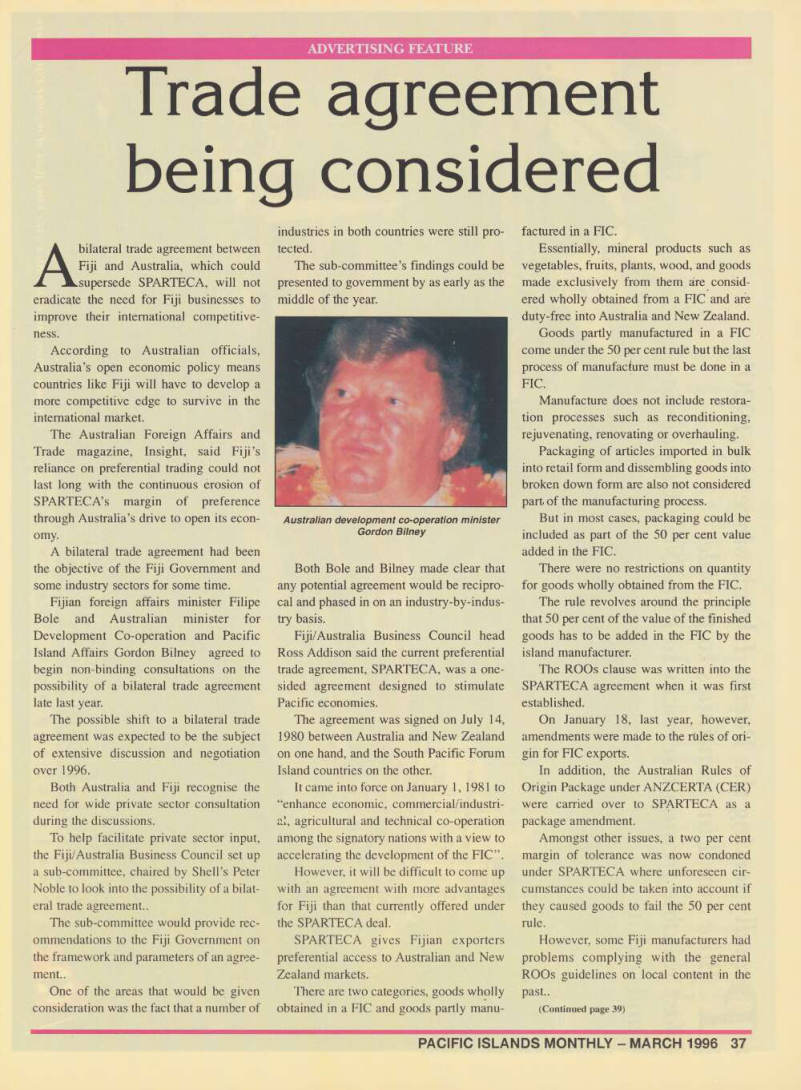
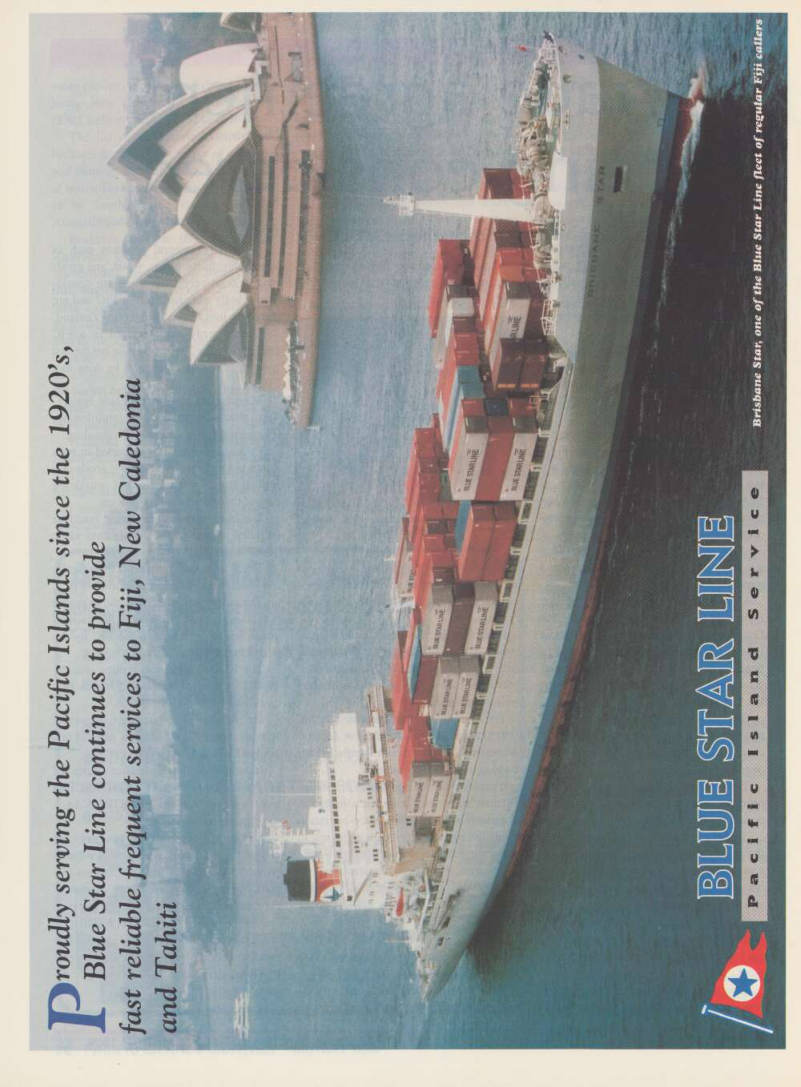
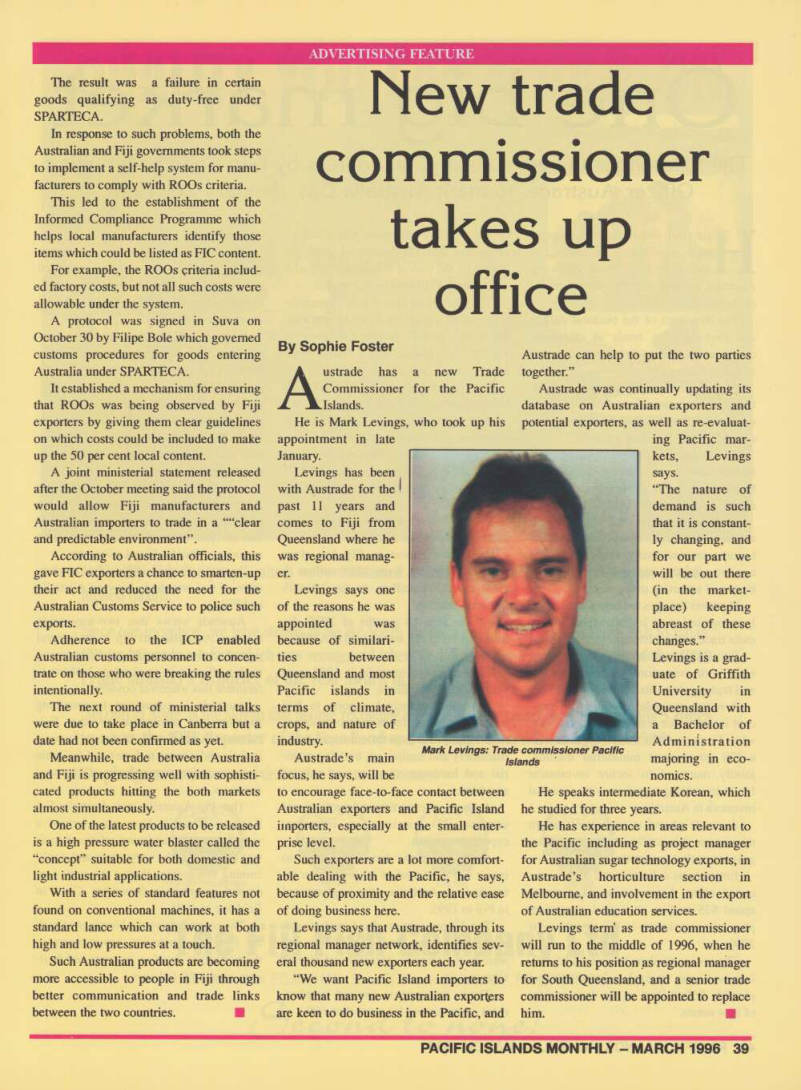
Trade agreement being considered
A bilateral trade agreement between Fiji and Australia, which could supersede SPARTECA, will not eradicate the need for Fiji businesses to
improve their international competitive
ness.
According to Australian officials, Australia’s open economic policy means countries like Fiji will have to develop a more competitive edge to survive in the international market.
The Australian Foreign Affairs and Trade magazine. Insight, said Fiji’s reliance on preferential trading could not last long with the continuous erosion of
SPARTECA’s margin of preference
through Australia’s drive to open its econ omy.
A bilateral trade agreement had been the objective of the Fiji Government and some industry sectors for some time.
Fijian foreign affairs minister Filipe Bole and Australian minister for
Development Co-operation and Pacific
Island Affairs Gordon Bilney agreed to begin non-binding consultations on the possibility of a bilateral trade agreement late last year.
The possible shift to a bilateral trade agreement was expected to be the subject of extensive discussion and negotiation over 1996.
Both Australia and Fiji recognise the need for wide private sector consultation during the discussions.
To help facilitate private sector input,
the Fiji/Australia Business Council set up a sub-committee, chaired by Shell’s Peter Noble to look into the possibility of a bilat eral trade agreement..
The sub-committee would provide rec ommendations to the Fiji Government on the framework and parameters of an agree ment..
One of the areas that would be given consideration was the fact that a number of
industries in both countries were still pro tected.
The sub-committee’s findings could be presented to government by as early as the middle of the year.
Both Bole and Bilney made clear that any potential agreement would be recipro cal and phased in on an industry-by-indus try basis.
Fiji/Australia Business Council head Ross Addison said the current preferential trade agreement, SPARTECA, was a one sided agreement designed to stimulate Pacific economies.
The agreement was signed on July 14, 1980 between Australia and New Zealand on one hand, and the South Pacific Forum Island countries on the other.
It came into force on January 1, 1981 to “enhance economic, commercial/industri al, agricultural and technical co-operation among the signatory nations with a view to accelerating the development of the FIC”.
However, it will be difficult to come up with an agreement with more advantages for Fiji than that currently offered under the SPARTECA deal.
SPARTECA gives Fijian exporters
preferential access to Australian and New Zealand markets.
There are two categories, goods wholly obtained in a FIC and goods partly manu
factured in a FIC.
Essentially, mineral products such as vegetables, fruits, plants, wood, and goods made exclusively from them are consid ered wholly obtained from a FIC and are duty-free into Australia and New Zealand.
Goods partly manufactured in a FIC come under the 50 per cent rule but the last process of manufacture must be done in a
Fic.
Manufacture does not include restora tion processes such as reconditioning,
rejuvenating, renovating or overhauling.
Packaging of articles imported in bulk into retail form and dissembling goods into broken down form are also not considered part of the manufacturing process.
But in most cases, packaging could be included as part of the 50 per cent value added in the FIC.
There were no restrictions on quantity for goods wholly obtained from the FIC.
The rule revolves around the principle that 50 per cent of the value of the finished goods has to be added in the FIC by the island manufacturer.
The ROOs clause was written into the SPARTECA agreement when it was first established.
On January 18, last year, however, amendments were made to the rules of ori gin for FIC exports.
In addition, the Australian Rules of Origin Package under ANZCERTA (CER) were carried over to SPARTECA as a
package amendment.
Amongst other issues, a two per cent margin of tolerance was now condoned under SPARTECA where unforeseen cir cumstances could be taken into account if they caused goods to fail the 50 per cent rule.
However, some Fiji manufacturers had
problems complying with the general
ROOs guidelines on local content in the past..
(Continued page 39)
Australian development co-operation minister Gordon Bilney
The result was a failure in certain
goods qualifying as duty-free under
Sparteca.
In response to such problems, both the Australian and Fiji governments took steps to implement a self-help system for manu facturers to comply with ROOs criteria.
This led to the establishment of the
Informed Compliance Programme which
helps local manufacturers identify those items which could be listed as FIC content.
For example, the ROOs criteria includ ed factory costs, but not all such costs were allowable under the system.
A protocol was signed in Suva on October 30 by Filipe Bole which governed customs procedures for goods entering Australia under SPARTECA.
It established a mechanism for ensuring that ROOs was being observed by Fiji
exporters by giving them clear guidelines
on which costs could be included to make up the 50 per cent local content.
A joint ministerial statement released after the October meeting said the protocol would allow Fiji manufacturers and Australian importers to trade in a ““clear and predictable environment”.
According to Australian officials, this gave FIC exporters a chance to smarten-up their act and reduced the need for the Australian Customs Service to police such exports.
Adherence to the ICP enabled Australian customs personnel to concen trate on those who were breaking the rules
intentionally.
The next round of ministerial talks were due to take place in Canberra but a date had not been confirmed as yet.
Meanwhile, trade between Australia and Fiji is progressing well with sophisti cated products hitting the both markets
almost simultaneously.
One of the latest products to be released is a high pressure water blaster called the “concept” suitable for both domestic and light industrial applications.
With a series of standard features not found on conventional machines, it has a standard lance which can work at both high and low pressures at a touch.
Such Australian products are becoming more accessible to people in Fiji through better communication and trade links between the two countries. ■
Advertisements & other items, p. 38 (1 item)
Proudly serving the Pacific Islands since the 1920’s,
Blue Star Line continues to provide fast reliable frequent services to Fiji, New Caledonia and Tahiti
New trade
commissioner takes up office
By Sophie Foster
Austrade has a new Trade Commissioner for the Pacific Islands.
He is Mark Levings, who took up his appointment in late
January.
Levings has been with Austrade for the past 11 years and comes to Fiji from Queensland where he was regional manag er.
Levings says one of the reasons he was
appointed was
because of similari ties between Queensland and most Pacific islands in terms of climate, crops, and nature of
industry.
Austrade’s main focus, he says, will be
to encourage face-to-face contact between Australian exporters and Pacific Island importers, especially at the small enter prise level.
Such exporters are a lot more comfort able dealing with the Pacific, he says, because of proximity and the relative ease of doing business here.
Levings says that Austrade, through its regional manager network, identifies sev eral thousand new exporters each year.
“We want Pacific Island importers to know that many new Australian exporters are keen to do business in the Pacific, and
Austrade can help to put the two parties together.”
Austrade was continually updating its database on Australian exporters and potential exporters, as well as re-evaluat ing Pacific mar
kets, Levings says.
“The nature of demand is such that it is constant ly changing, and for our part we will be out there (in the market place) keeping abreast of these changes.”
Levings is a grad uate of Griffith University in Queensland with a Bachelor of Administration majoring in eco nomics.
He speaks intermediate Korean, which he studied for three years.
He has experience in areas relevant to the Pacific including as project manager for Australian sugar technology exports, in Austrade’s horticulture section in Melbourne, and involvement in the export of Australian education services.
Levings term' as trade commissioner will run to the middle of 1996, when he returns to his position as regional manager for South Queensland, and a senior trade commissioner will be appointed to replace him. ■
Mark Levings: Trade commissioner Pacific Islands
One big market
The following is the edited text of an address by Deo Chand, Marketing Officer, Austrade, to mark Australia Day, January 26, 1996.
Historical and traditional linkages have significantly contributed to the growth of trade between Australia and Fiji and the other countries of the South Pacific.
The dynamics of the business culture and ever-changing needs of customers continues to exhaust conventional means of doing business.
As trade barriers give way to deregula tion and communications links between markets improve, the world is more than ever becoming “one big market”.
The responsibility of developing trade and economy in many South Pacific coun tries is now being passed from govern ments to the business community.
To be able to survive in this one big market, business operators have to become internationally competitive and have to take the initiative in developing trade and attracting investment.
Business linkages are being increasing ly recognised as an important tool to pro mote trade and investment.
Successful business linkages can prove equally, or even more, successful as for mal trade agreements.
A recent example of putting the con cept into practice was in August last year when Emperor Gold Mines, together with a Fiji government ministerial mission, jointly managed to secure investment funds by talking together with potential investors in Australia.
Austrade played an important part in the mission thus confirming the Australian
government’s commitment to Fiji.
Emperor, as a direct result of this con certed effort, have announced plans to spend $35 million on capital expansion, plus two new mines in Fiji, by the year 2000.
The company plans to invest $4.5 mil lion each year on exploration works and possibly $5O million on the development of new mines.
the company anticipates that it will be producing 200,000 ounces of gold per annum by the turn of the century, amount ing to some $llO million per annum.
The South Pacific continues to remain a big export market for Australia; the mar ket is the world’s largest consumer of Australia’s Elaborately Transformed Manufactures (or ETMs).
It constitutes 60 per cent of Australia’s total exports to the South Pacific.
Australia views the South Pacific as an important and valuable market.
Australia’s trade collectively with the South Pacific market for the 1994/95 financial year was worth approximately $A6.5 billion.
Amongst the region, Australia sees Fiji as a valuable export market.
Australia’s export to Fiji has risen steadily each year, from $229 million in 1990 to A 5377 million in the 1994/95 financial year. (In the first 10 months of 1995, the total exports to Fiji was valued at A 5336.5 million).
Fiji’s export to Australia in 1994 were valued at SFI74 million.
Australia’s principal exports to Fiji include processed foods, telecommunica
tions equipment, petroleum products,
machinery and equipment, building mate
rial and hardware supplies, and textiles and fabrics.
A range of expertise and professional services also constitute an important export component.
Australian firms have continued to invest in Fiji; a total of 19 projects origi nating from Australia were implemented in Fiji in 1995.
The 19 projects involved total invest ment worth more than $l6 million and were in the tourism, garment and service sectors.
These investments created employ ment opportunities for more than 600
people.
The willingness by Australian compa nies to invest in Fiji and the continued growth of Australian exports clearly demonstrates the commitment to Fiji by
Australian companies.
Austrade will continue to act as a cata lyst for business and trade promotion between the two countries to enhance the growth of trade.
The commitment and willingness to satisfy a range of South Pacific customers needs demonstrates the degree of serious ness and importance that Australian sup pliers place in the market.
Australia is undoubtedly recognised as a reputable source of a comprehensive range of internationally competitive goods and services at the door step by a large majority of Pacific Island customers.
Australia is committed to the develop ment of two-way trade between Australia
and Fiji.
Austrade views that two-way trade between Australia and Fiji is an integral part of continued friendly relationship and to this effect it is on constant lookout to facilitate this wherever possible.
Austrade is committed to providing support and assistance to the Fiji- Australia/Australia-Fiji Business Councils in their endeavours to foster and facilitate trade and commerce between the two countries.
The Fiji-Australia and Australia-Fiji
Business Councils have now formed a very mature and enduring relationship as was evident in the very open and forth coming discussions during the very suc cessful meeting in Sanctuary Cove in Brisbane in 1995.
The councils have the blessings of both the Fiji and Australian governments in their efforts to develop, promote and facil itate successful linkages. ■
Advertisements & other items, pp. 40-41 (2 items)
Advertising Feature
(An Count On
♦ ♦ * i ■ • inij
ALITY YOU
V f. f i \ *> - .» \ \ \ L -uJf «L tL2^5 IW' ■■■ a* - ■ At The Fiji Fish Company Limited, we’re committed to making sure that the Fish we export is of the
highest quality.
Since our inception, we have striven to be the South Pacific’s Premier exporter of Fresh Fish to Japan, USA and Canada - A fact which was recognised when we became the First recipients of the FTIB Prime Minister’s Exporter of the year Award in 1993. ‘Second to None’ is the slogan that people recognise us by, and we’re quitely proud of winning 3 times in a row the FTIB Exporter of the Year Food and Beverage award from 1993 to 1995.
We pledge commitment and dedication to our customers.
9UJ gLM M-Jt M-JS gU-j 143
ww w w
FTIB 1993 Prime Ministers FTIB 1993 FTIB 1994 FTIB 1995 Exporter of the Year Award Food & Beverage Export Award Food & Beverage Export Award Food & Beverage Export Award
The Fiji Fish Company Ltd
Queens Rd, Lami. P.0.80x 14720, Suva, Fiji. Phone: (679) 361077. Fax; (679) 362049.
"to-
on Bougainville
Region
Security tight on Bougainville
By Sam Vulum
Security forces on Bougainville will continue to maintain security in care centres and along the Papua New Guinea/Solomon Islands border despite the recent upsurge in activities by the Bougainville Revolutionary Army.
PNG Defence Force chief of staff Colonel Jack Tuat said military operations on Bougainville were under the control of the national government and any change of strategies would be based on government decision.
In an interview with PIM, Tuat said: “In general we are aware of the location of the BRA. Their main strongholds are the Panguna and Kongara areas. However, the direction of the government is not to go on the offensive. Our deployment is to main
tain security.”
He said the security forces were aware of BRA presence near Arawa and they were only monitoring their movement.
However, if the BRA were closing in on Arawa and the situation became serious, the government would have to rethink its
strategies.
The chief of staff also said that apart from the BRA activities, there was ade quate supply of food, fuel and ammunition for a military strength of between 500 to 600 men and about 100 policemen on Bougainville. Their operations were sup ported by a fleet of vehicles, mainly army land rovers and two Iroquios helicopters.
He said allowances for the security forces were also being paid. Tuat reiterated earli er comments that recent BRA activities, which left two soldiers dead and civilians injured in January, were an attempt to sab otage the government’s peace efforts.
In the first killing incident, an army lieutenant was killed by rebel elements in the Haisi area of the Siwai district when
the rebels entered the Haisi Catholic Mission care-centre on the pretext of talk ing peace. Reports from the area said the rebels then ordered the civilians to move before shooting the soldier.
In the second incident, the BRA way laid a soldier who was walking with mem bers of the civilian group to a funeral at Matukori village in the Siwai area and killed him.
Tuat said: “We believe that BRA is pushing its ultimate goal and that is more than self-determination. It is stepping-up its activities in an attempt to win back the hearts of many Bougainvilleans who want
ed peace.”
He also said the recent BRA activities were in direct retaliation to the attack by security forces on BRA leaders, adding: “What we knew was that they were to trav el by helicopter to Bougainville.”
He said despite the BRA activities, restoration of services and other peace efforts were continuing. He also denied reports that security forces were stopping immunisation and relief workers from
entering Bougainville.
Tuat also said plans were under way for officials from the Australian High Commission in Port Moresby to visit Bougainville to see the restoration pro gramme and talk to the premier, chiefs and
people.
He said the Engineering Battalion would assist in sealing Buka airport and will probably work on the roads around the island.
The Arawa town hospital, headed by PNGDF’s Dr Gideon Kendino was also operating well with medical supplies com ing from both the PNGDF and the health
department.
Meanwhile, prior to the planned March/April all-Bougainville leaders
deliberations, Bougainville transitional
government premier Theodore Miriung
said there would be two technical meetings and the first will be held as soon as a venue was agreed on.
He said the BTG generally supported the national government’s position that the venue be in Bougainville or anywhere in PNG. However, if BRA leaders have other plans on the venue these will have to be approved by the national government.
Any prospects for an immediate peace meeting were unlikely with the burning down of the luxury home of Honiara-based rebel spokesperson Martin Miriori on
February 2.
Miriori, who is the secretary of the so called Bougainville interim government, the political wing of BRA, escaped the blaze with his family and relatives.
While the cause of the fire was not
known, BIG Sydney-based representative
Mike Foster has created doubts on the staging of the talks. Foster claimed arson was involved. He asked for a guarantee if they entered PNG for talks as suggested by prime minister Sir Julius Chan.
He said the blaze happened within hours of them receiving a letter stating Chan’s stance that BIG officials come to PNG for two preparatory meetings before the scheduled March/April meeting of all
Bougainvilleans.
Chan said: “There are rebels fighting against rebels, I can’t speak for them.”
In other developments, the Honiara District Court has cleared BRA sympathis er Rosemary Gillespie and her daughter Kirrallee Anie Gillespie of charges of ille gally entering the Solomon Islands.
In Port Moresby, prime minister Chan said there was nothing the government could do because it had been a matter for the Honiara court to decide on. ■
Advertisements & other items, p. 43 (1 item)
Regional Forestry Project
0
gte)
in collaboration with the
South Pacific Forestry Development Programme
Office 29 Pender St., Suva, Fiji Postal Address PO Box 14041, Suva Telephone (679) 305 983/300432 Fax 679) 315 446/305 212 Advertisement Vacancies The Pacific German Regional Forestry Project (PRFP) started in October 1994 and is a Project of the German Technical Cooperation Agency (GTZ). Through consistent target group orientation, innovative approaches and strategies, GTZ counts as one of the leading development agencies in the world. The PRFP aims to strengthen partner countries' capabilities to sustainably manage their resources.
The PRFP is based in Suva, Fiji. We are looking for 3 additional staff to assist in the fields of
* Indigenous Forest Management
* Agroforestry
* Environment Education Forester (1): Main responsibilities: * introduction of indigenous forest management instruments in selected countries * assistance in adaption, further development and improvement of indigenous forest management tools * training of field officers, landowners and other selected field staff * assistance in developing an inventory network * assistance in developing training programmes and training/awareness materials
Agroforester (1): Main responsibilities:
* developing agroforestry strategies for selected countries * assistance in the execution of tne strategy * assistance in conducting farm surveys and gender analyses * assistance in developing training programmes and training/awareness materials Public Relation person (1): Main responsibilities: * assistance in developing awareness strategies for different target groups in different countries * assistance in the execution of the awareness programme * assistance in collecting, adapting, developing, testing and implementing of training and awareness materials * coordinating/Raising with different organisations
Required Skills/Personality
University degree in
forestry
agriculture
public relation and/or educational with environmental education experience * Three to five years of professional experience in the above mentioned fields or related areas * Ability to work with people in a team spirit, flexible, independent, reliable and mature * Strong creativity, communication and presentation skills * Proven management skills and an ability to handle projects simultaneously
* Fluency in English
We offer an attractive remuneration and benefit scheme and the opportunity for career development in a growing and changing environment. Applications (including Cv, photo and current salary) should reach: Teamleader, Regional Forestry Project, PO Box 14041, Suva, Fiji, no later than 20 March 1996.
pollution
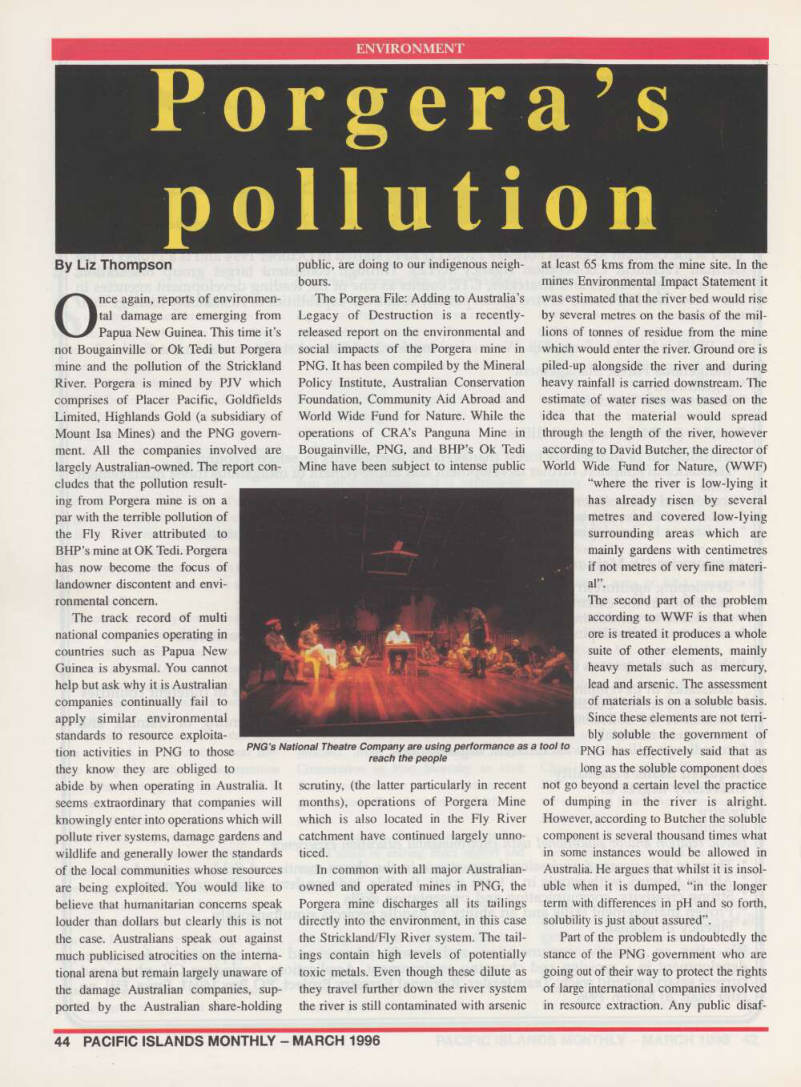
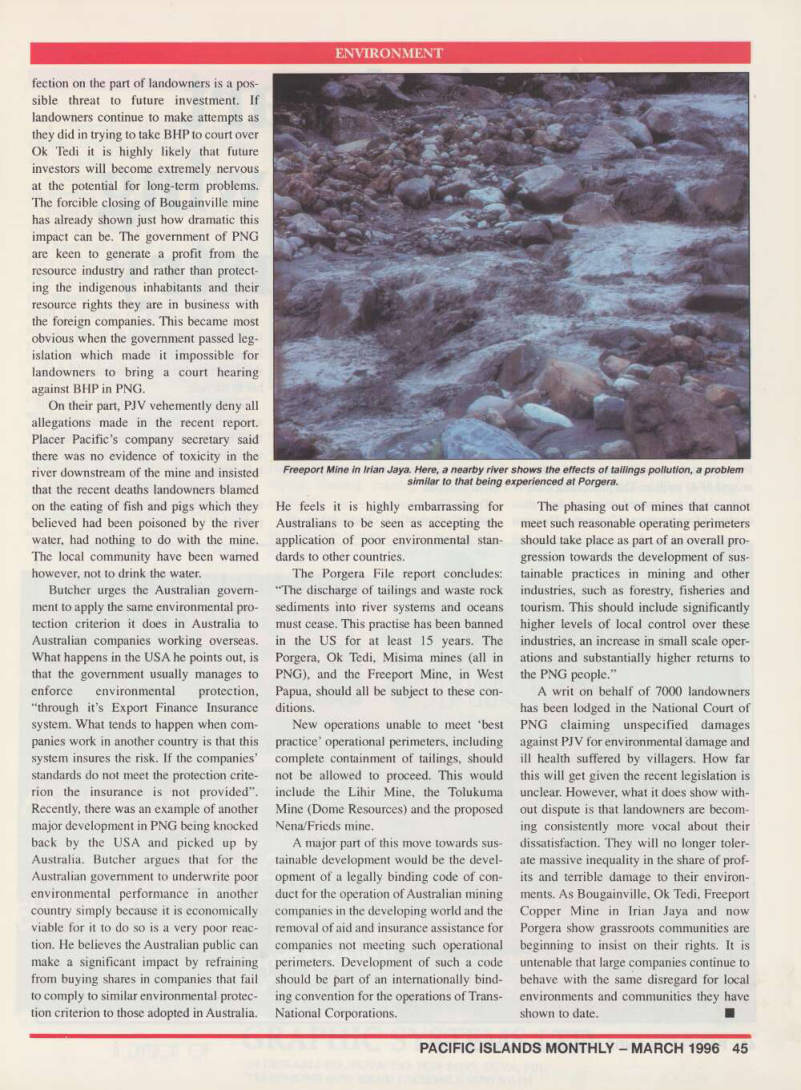
Environment
Forgera's pollution
By Liz Thompson
Once again, reports of environmen tal damage are emerging from Papua New Guinea. This time it’s not Bougainville or Ok Tedi but Porgera mine and the pollution of the Strickland River. Porgera is mined by PJV which comprises of Placer Pacific, Goldfields Limited, Highlands Gold (a subsidiary of Mount Isa Mines) and the PNG govern ment. All the companies involved are largely Australian-owned. The report con
eludes that the pollution result ing from Porgera mine is on a par with the terrible pollution of the Fly River attributed to BHP’s mine at OK Tedi. Porgera has now become the focus of landowner discontent and envi ronmental concern.
The track record of multi
national companies operating in
countries such as Papua New Guinea is abysmal. You cannot help but ask why it is Australian
companies continually fail to
apply similar environmental standards to resource exploita tion activities in PNG to those they know they are obliged to
abide by when operating in Australia. It seems extraordinary that companies will knowingly enter into operations which will
pollute river systems, damage gardens and
wildlife and generally lower the standards of the local communities whose resources are being exploited. You would like to believe that humanitarian concerns speak louder than dollars but clearly this is not the case. Australians speak out against much publicised atrocities on the interna tional arena but remain largely unaware of the damage Australian companies, sup
ported by the Australian share-holding
public, are doing to our indigenous neigh bours.
The Porgera File: Adding to Australia’s Legacy of Destruction is a recently released report on the environmental and social impacts of the Porgera mine in PNG. It has been compiled by the Mineral Policy Institute, Australian Conservation Foundation, Community Aid Abroad and World Wide Fund for Nature. While the operations of CRA’s Panguna Mine in Bougainville, PNG, and BHP’s Ok Tedi Mine have been subject to intense public
scrutiny, (the latter particularly in recent months), operations of Porgera Mine which is also located in the Fly River catchment have continued largely unno ticed.
In common with all major Australian owned and operated mines in PNG, the Porgera mine discharges all its tailings directly into the environment, in this case the Strickland/Fly River system. The tail ings contain high levels of potentially toxic metals. Even though these dilute as they travel further down the river system the river is still contaminated with arsenic
at least 65 kms from the mine site. In the mines Environmental Impact Statement it was estimated that the river bed would rise by several metres on the basis of the mil lions of tonnes of residue from the mine which would enter the river. Ground ore is
piled-up alongside the river and during
heavy rainfall is carried downstream. The estimate of water rises was based on the idea that the material would spread through the length of the river, however according to David Butcher, the director of World Wide Fund for Nature, (WWF)
“where the river is low-lying it has already risen by several metres and covered low-lying surrounding areas which are
mainly gardens with centimetres
if not metres of very fine materi al”.
The second part of the problem according to WWF is that when ore is treated it produces a whole suite of other elements, mainly heavy metals such as mercury, lead and arsenic. The assessment of materials is on a soluble basis.
Since these elements are not terri bly soluble the government of PNG has effectively said that as long as the soluble component does
not go beyond a certain level the practice of dumping in the river is alright.
However, according to Butcher the soluble component is several thousand times what in some instances would be allowed in Australia. He argues that whilst it is insol uble when it is dumped, “in the longer term with differences in pH and so forth, solubility is just about assured”.
Part of the problem is undoubtedly the stance of the PNG government who are going out of their way to protect the rights of large international companies involved in resource extraction. Any public disaf
PNG’s National Theatre Company are using performance as a tool to reach the people
fection on the part of landowners is a pos sible threat to future investment. If landowners continue to make attempts as they did in trying to take BHP to court over Ok Tedi it is highly likely that future investors will become extremely nervous at the potential for long-term problems.
The forcible closing of Bougainville mine has already shown just how dramatic this impact can be. The government of PNG are keen to generate a profit from the resource industry and rather than protect ing the indigenous inhabitants and their resource rights they are in business with the foreign companies. This became most obvious when the government passed leg islation which made it impossible for landowners to bring a court hearing against BHP in PNG.
On their part, PJV vehemently deny all allegations made in the recent report.
Placer Pacific’s company secretary said there was no evidence of toxicity in the river downstream of the mine and insisted that the recent deaths landowners blamed on the eating of fish and pigs which they believed had been poisoned by the river water, had nothing to do with the mine.
The local community have been warned however, not to drink the water.
Butcher urges the Australian govern ment to apply the same environmental pro tection criterion it does in Australia to
Australian companies working overseas.
What happens in the USA he points out, is that the government usually manages to enforce environmental protection, “through it’s Export Finance Insurance system. What tends to happen when com panies work in another country is that this system insures the risk. If the companies’ standards do not meet the protection crite rion the insurance is not provided”.
Recently, there was an example of another major development in PNG being knocked back by the USA and picked up by Australia. Butcher argues that for the Australian government to underwrite poor environmental performance in another country simply because it is economically viable for it to do so is a very poor reac tion. He believes the Australian public can
make a significant impact by refraining
from buying shares in companies that fail to comply to similar environmental protec tion criterion to those adopted in Australia.
He feels it is highly embarrassing for Australians to be seen as accepting the application of poor environmental stan dards to other countries.
The Porgera File report concludes; “The discharge of tailings and waste rock sediments into river systems and oceans must cease. This practise has been banned in the US for at least 15 years. The Porgera, Ok Tedi, Misima mines (all in PNG), and the Freeport Mine, in West Papua, should all be subject to these con ditions.
New operations unable to meet ‘best
practice’ operational perimeters, including
complete containment of tailings, should not be allowed to proceed. This would include the Lihir Mine, the Tolukuma Mine (Dome Resources) and the proposed Nena/Frieds mine.
A major part of this move towards sus tainable development would be the devel opment of a legally binding code of con duct for the operation of Australian mining companies in the developing world and the removal of aid and insurance assistance for
companies not meeting such operational
perimeters. Development of such a code should be part of an internationally bind ing convention for the operations of Trans- National Corporations.
The phasing out of mines that cannot meet such reasonable operating perimeters should take place as part of an overall pro gression towards the development of sus tainable practices in mining and other industries, such as forestry, fisheries and tourism. This should include significantly higher levels of local control over these industries, an increase in small scale oper ations and substantially higher returns to the PNG people.”
A writ on behalf of 7000 landowners has been lodged in the National Court of
PNG claiming unspecified damages
against PJV for environmental damage and ill health suffered by villagers. How far this will get given the recent legislation is unclear. However, what it does show with out dispute is that landowners are becom ing consistently more vocal about their dissatisfaction. They will no longer toler ate massive inequality in the share of prof its and terrible damage to their environ ments. As Bougainville, Ok Tedi, Freeport Copper Mine in Irian Jaya and now Porgera show grassroots communities are beginning to insist on their rights. It is untenable that large companies continue to behave with the same disregard for local environments and communities they have shown to date. ■
Freeport Mine in Irian Jaya. Here, a nearby river shows the effects of tailings pollution, a problem similar to that being experienced at Porgera.
timber industry
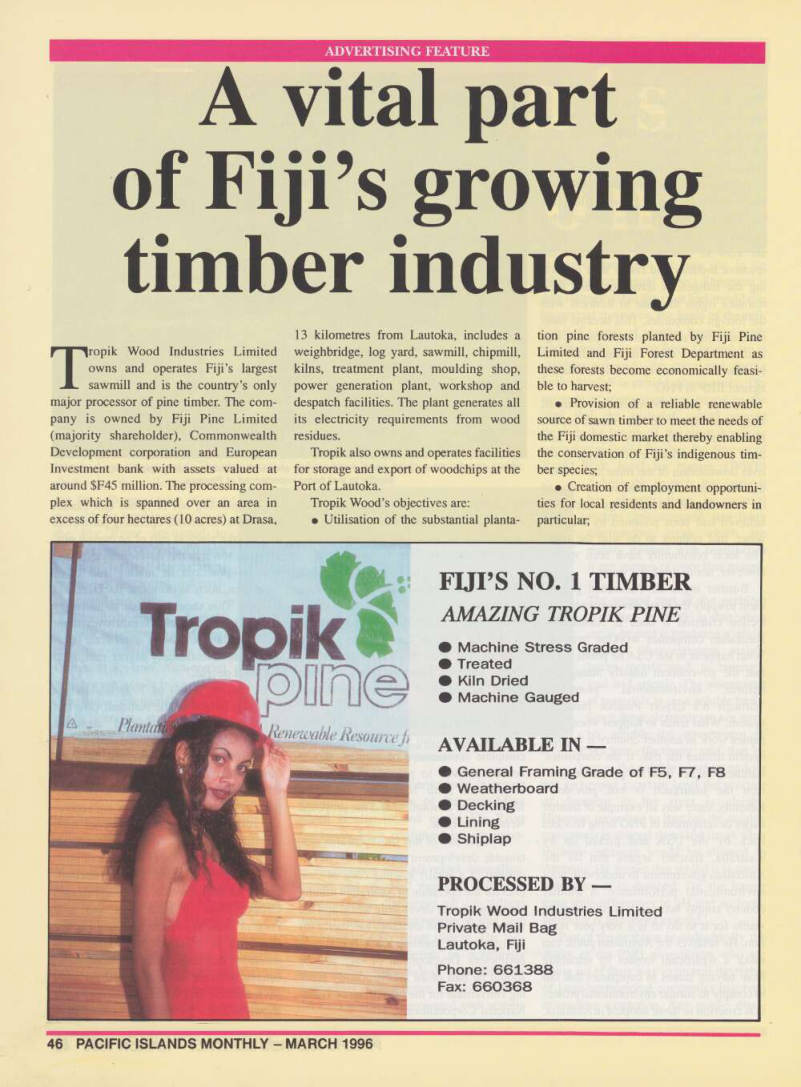
Advertising Feature
A vital part of Fiji’s growing timber industry
Tropik Wood Industries Limited owns and operates Fiji’s largest sawmill and is the country’s only major processor of pine timber. The com pany is owned by Fiji Pine Limited (majority shareholder). Commonwealth
Development corporation and European
Investment bank with assets valued at around SF4S million. The processing com plex which is spanned over an area in excess of four hectares (10 acres) at Drasa,
13 kilometres from Lautoka, includes a weighbridge, log yard, sawmill, chipmill, kilns, treatment plant, moulding shop, power generation plant, workshop and despatch facilities. The plant generates all its electricity requirements from wood residues.
Tropik also owns and operates facilities for storage and export of woodchips at the Port of Lautoka.
Tropik Wood’s objectives are: • Utilisation of the substantial planta
tion pine forests planted by Fiji Pine Limited and Fiji Forest Department as these forests become economically feasi ble to harvest; • Provision of a reliable renewable source of sawn timber to meet the needs of the Fiji domestic market thereby enabling the conservation of Fiji’s indigenous tim ber species; • Creation of employment opportuni ties for local residents and landowners in particular;
• Generation of foreign exchange earnings from the export of sawn timber and woodchips; • Generation of a worthwhile return to the investors in the project.
Tropik logging operations which pro vide the raw resource for the sawmill, har vest more logs than the sum of the rest of Fiji’s timber industry. The majority of the total log supply of some 390,000 tonnes per annum is of Pinus caribaea with a small proportion of Pinus elliottii. The trees are grown on land leased by Fiji Pine Limited or on private woodlots.
In a technically demanding and highly competitive industry, the Tropik facilities consist of a substantial element of modem technology, machinery and equipment.
The company employs quality people in varying jobs with differing experience and background, all of whom are essential to the successful operation of the company.
Ongoing development of employees is ensured with the attendance of FNTC, FIT and other educational courses.
Tropik Wood Industries has always
encouraged participation of local landown ers in all its activities. Many employment opportunities have been created from director and staff levels to sawmill hands and chainsaw operators.
Tropik’s logging operations harvest more logs than the sum of Fiji’s timber industry.
The company employs 380 people directly and in the vicinity of an additional 400 (approximate) on contract basis. Work performed on contract includes logging, cartage, cleaning, catering shipping and roadworks.
To assist local landowners become established in business, Tropik has provid ed comprehensive training and has
financed the supply of equipment on a lease basis to landowner logging contrac tors. With advice and assistance from Tropik and Fiji Pine Limited staff, there are positive signs these small companies will develop into profitable and efficient enterprises.
Tropik Wood has established an excel lent reputation as a supplier of high quali ty woodchips to Japan.
A wide range of high quality sawn tim ber has been successfully marketed in Fiji and elsewhere in the Pacific, particularly in Australia. The grades manufactured include house framing, material treated for outdoor use, boards, profiles and furniture clears.
Posts and poleq are also produced, treated to various levels and marketed throughout Fiji and the Pacific.
Tropik, for the foreseeable future has introduced concepts enabling the company to grow. Sales emphasis will be on contin ually finding new markets to sell products, increasing the volume of domestic sales and capitalising on the quality image established in the export market. ■
Advertisements & other items, pp. 46-47 (2 items)
Tropik «
o & . I lanti
jmewable Resource Ji
FIJI’S NO. 1 TIMBER
AMAZING TROPIK PINE
• Machine Stress Graded • Treated • Kiln Dried • Machine Gauged
AVAILABLE IN
• General Framing Grade of F 5, F 7, F 8 • Weatherboard • Decking • Lining • Shiplap
PROCESSED BY
Tropik Wood Industries Limited Private Mail Bag Lautoka, Fiji Phone: 661388 Fax: 660368
* & j IY * *•
CUT-OUT
I fi Division of
GRAPHIC SYSTEMS LTD
18 DISRAELI RD., SUVA. RO. BOX 16149, SUVA, FIJI.
TELEPHONE (679) 306100 FACSIMILE (679) 306111
Advertising Feature
Raiders almost
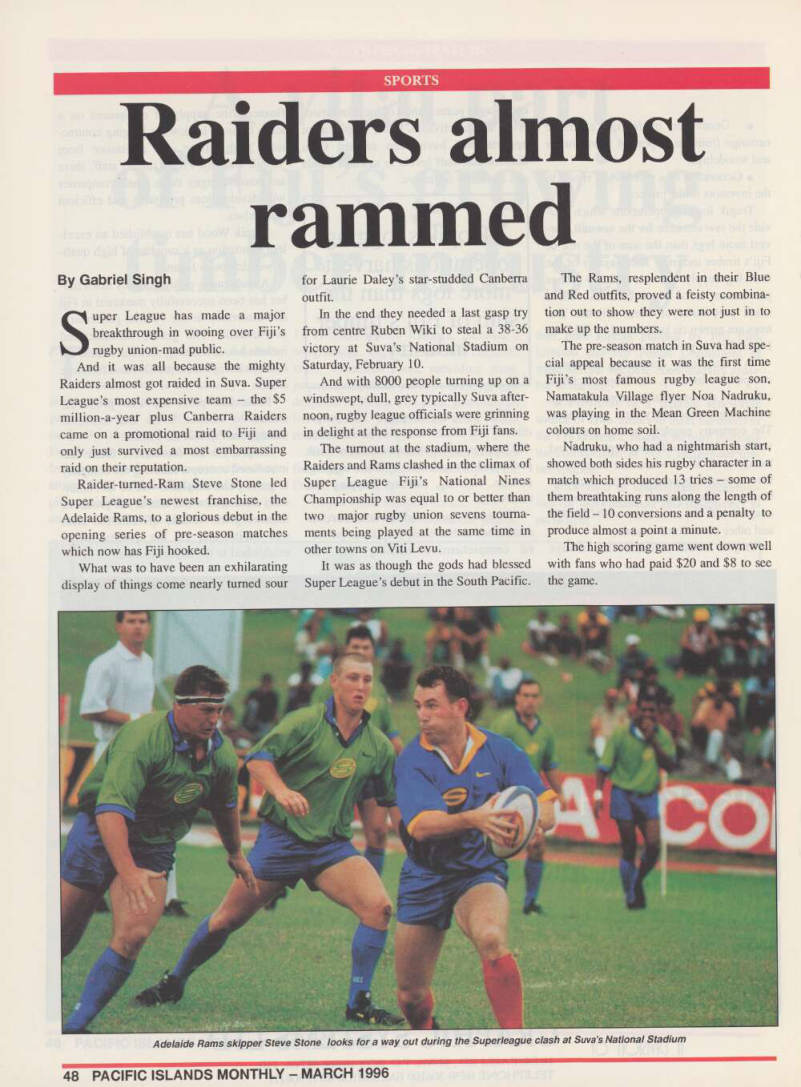
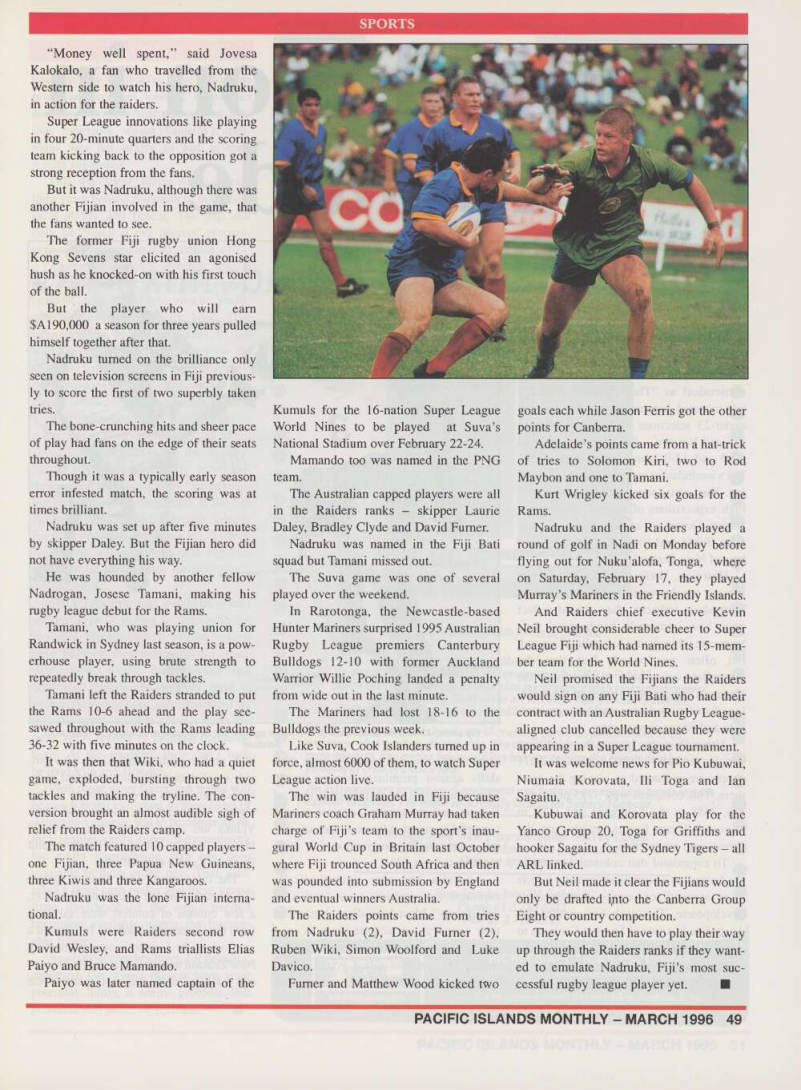
Sports
Raiders almost rammed
By Gabriel Singh
Super League has made a major breakthrough in wooing over Fiji’s rugby union-mad public.
And it was all because the mighty Raiders almost got raided in Suva. Super League’s most expensive team - the $5 million-a-year plus Canberra Raiders came on a promotional raid to Fiji and only just survived a most embarrassing raid on their reputation.
Raider-tumed-Ram Steve Stone led Super League’s newest franchise, the Adelaide Rams, to a glorious debut in the opening series of pre-season matches which now has Fiji hooked.
What was to have been an exhilarating display of things come nearly turned sour
for Laurie Daley’s star-studded Canberra outfit.
In the end they needed a last gasp try from centre Ruben Wiki to steal a 38-36 victory at Suva’s National Stadium on Saturday, February 10.
And with 8000 people turning up on a windswept, dull, grey typically Suva after noon, rugby league officials were grinning in delight at the response from Fiji fans.
The turnout at the stadium, where the Raiders and Rams clashed in the climax of Super League Fiji’s National Nines Championship was equal to or better than two major rugby union sevens tourna ments being played at the same time in other towns on Viti Levu.
It was as though the gods had blessed Super League’s debut in the South Pacific.
The Rams, resplendent in their Blue and Red outfits, proved a feisty combina tion out to show they were not just in to make up the numbers.
The pre-season match in Suva had spe cial appeal because it was the first time Fiji’s most famous rugby league son, Namatakula Village flyer Noa Nadruku, was playing in the Mean Green Machine colours on home soil.
Nadruku, who had a nightmarish start, showed both sides his rugby character in a match which produced 13 tries - some of them breathtaking runs along the length of the field - 10 conversions and a penalty to produce almost a point a minute.
The high scoring game went down well with fans who had paid $2O and $8 to see the game.
Adelaide Rams skipper Steve Stone looks for a way out during the Superleague clash at Suva's National Stadium
“Money well spent,” said Jovesa Kalokalo, a fan who travelled from the Western side to watch his hero, Nadruku, in action for the raiders.
Super League innovations like playing in four 20-minute quarters and the scoring team kicking back to the opposition got a strong reception from the fans.
But it was Nadruku, although there was another Fijian involved in the game, that the fans wanted to see.
The former Fiji rugby union Hong
Kong Sevens star elicited an agonised hush as he knocked-on with his first touch of the ball.
But the player who will earn $A 190,000 a season for three years pulled himself together after that.
Nadruku turned on the brilliance only seen on television screens in Fiji previous ly to score the first of two superbly taken tries.
The bone-crunching hits and sheer pace of play had fans on the edge of their seats throughout.
Though it was a typically early season error infested match, the scoring was at times brilliant.
Nadruku was set up after five minutes by skipper Daley. But the Fijian hero did not have everything his way.
He was hounded by another fellow Nadrogan, Josese Tamani, making his rugby league debut for the Rams.
Tamani, who was playing union for Randwick in Sydney last season, is a pow erhouse player, using brute strength to
repeatedly break through tackles.
Tamani left the Raiders stranded to put the Rams 10-6 ahead and the play see sawed throughout with the Rams leading 36-32 with five minutes on the clock.
It was then that Wiki, who had a quiet game, exploded, bursting through two tackles and making the tryline. The con version brought an almost audible sigh of relief from the Raiders camp.
The match featured 10 capped players one Fijian, three Papua New Guineans, three Kiwis and three Kangaroos.
Nadruku was the lone Fijian interna tional.
Kumuls were Raiders second row David Wesley, and Rams triallists Elias Paiyo and Bruce Mamando.
Paiyo was later named captain of the
Kumuls for the 16-nation Super League World Nines to be played at Suva’s National Stadium over February 22-24.
Mamando too was named in the PNG team.
The Australian capped players were all in the Raiders ranks - skipper Laurie Daley, Bradley Clyde and David Fumer.
Nadruku was named in the Fiji Bati squad but Tamani missed out.
The Suva game was one of several played over the weekend.
In Rarotonga, the Newcastle-based Hunter Mariners surprised 1995 Australian
Rugby League premiers Canterbury
Bulldogs 12-10 with former Auckland Warrior Willie Poching landed a penalty from wide out in the last minute.
The Mariners had lost 18-16 to the
Bulldogs the previous week.
Like Suva, Cook Islanders turned up in force, almost 6000 of them, to watch Super League action live.
The win was lauded in Fiji because Mariners coach Graham Murray had taken charge of Fiji’s team to the sport’s inau gural World Cup in Britain last October where Fiji trounced South Africa and then
was pounded into submission by England
and eventual winners Australia.
The Raiders points came from tries from Nadruku (2), David Furner (2), Ruben Wiki, Simon Woolford and Luke Davico.
Fumer and Matthew Wood kicked two
goals each while Jason Ferris got the other points for Canberra.
Adelaide’s points came from a hat-trick of tries to Solomon Kiri, two to Rod Maybon and one to Tamani.
Kurt Wrigley kicked six goals for the Rams.
Nadruku and the Raiders played a round of golf in Nadi on Monday before flying out for Nuku’alofa, Tonga, where on Saturday, February 17, they played Murray’s Mariners in the Friendly Islands.
And Raiders chief executive Kevin Neil brought considerable cheer to Super League Fiji which had named its 15-mem ber team for the World Nines.
Neil promised the Fijians the Raiders would sign on any Fiji Bati who had their contract with an Australian Rugby League aligned club cancelled because they were appearing in a Super League tournament.
It was welcome news for Pio Kubuwai, Niumaia Korovata, Hi Toga and lan Sagaitu.
Kubuwai and Korovata play for the Yanco Group 20, Toga for Griffiths and hooker Sagaitu for the Sydney Tigers - all ARL linked.
But Neil made it clear the Fijians would only be drafted i,nto the Canberra Group
Eight or country competition.
They would then have to play their way up through the Raiders ranks if they want ed to emulate Nadruku, Fiji’s most suc cessful rugby league player yet. ■
Adelaide
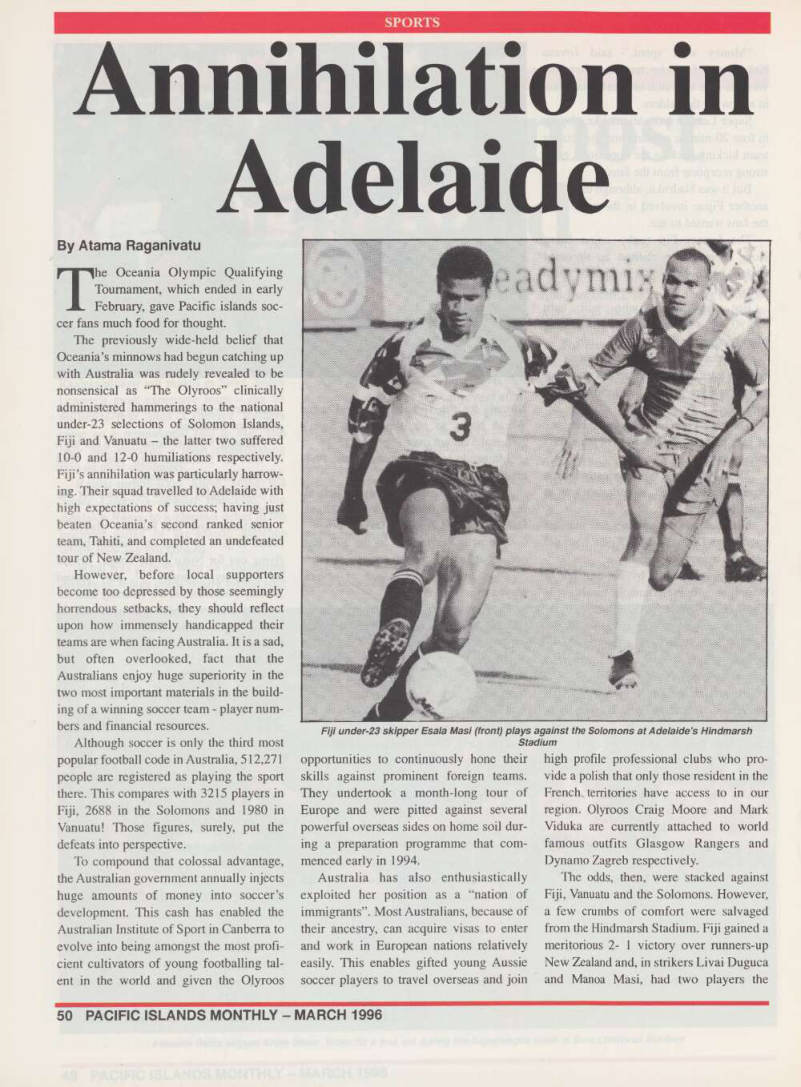
Annihilation in Adelaide
By Atama Raganivatu
The Oceania Olympic Qualifying
Tournament, which ended in early February, gave Pacific islands soc cer fans much food for thought.
The previously wide-held belief that Oceania’s minnows had begun catching up with Australia was rudely revealed to be nonsensical as “The Olyroos” clinically administered hammerings to the national under-23 selections of Solomon Islands, Fiji and Vanuatu - the latter two suffered 10-0 and 12-0 humiliations respectively.
Fiji’s annihilation was particularly harrow ing. Their squad travelled to Adelaide with high expectations of success; having just beaten Oceania’s second ranked senior team, Tahiti, and completed an undefeated tour of New Zealand.
However, before local supporters
become too depressed by those seemingly
horrendous setbacks, they should reflect upon how immensely handicapped their teams are when facing Australia. It is a sad, but often overlooked, fact that the Australians enjoy huge superiority in the two most important materials in the build ing of a winning soccer team - player num bers and financial resources.
Although soccer is only the third most popular football code in Australia, 512,271 people are registered as playing the sport there. This compares with 3215 players in Fiji, 2688 in the Solomons and 1980 in Vanuatu! Those figures, surely, put the defeats into perspective.
To compound that colossal advantage, the Australian government annually injects huge amounts of money into soccer’s development. This cash has enabled the Australian Institute of Sport in Canberra to evolve into being amongst the most profi cient cultivators of young footballing tal ent in the world and given the Olyroos
opportunities to continuously hone their skills against prominent foreign teams.
They undertook a month-long tour of Europe and were pitted against several powerful overseas sides on home soil dur ing a preparation programme that com menced early in 1994.
Australia has also enthusiastically exploited her position as a “nation of immigrants”. Most Australians, because of their ancestry, can acquire visas to enter and work in European nations relatively easily. This enables gifted young Aussie soccer players to travel overseas and join
high profile professional clubs who pro vide a polish that only those resident in the French, territories have access to in our region. Olyroos Craig Moore and Mark Viduka are currently attached to world famous outfits Glasgow Rangers and Dynamo Zagreb respectively.
The odds, then, were stacked against Fiji, Vanuatu and the Solomons. Flowever, a few crumbs of comfort were salvaged from the Hindmarsh Stadium. Fiji gained a meritorious 2- 1 victory over runners-up New Zealand and, in strikers Livai Duguca and Manoa Masi, had two players the
Fiji under-23 skipper Esala Masi (front) plays against the Solomons at Adelaide’s Hindmarsh Stadium
equal to any on display. The Solomons produced excellent football in patches and gave even the Australians some anx ious moments, whilst Vanuatu’s tech nique was not nearly as bad as their results suggested.
Still, the “local” teams were, overall, light years behind Australia in both tech nical ability and fitness. The gap will only be closed if our players’ prepara tions are improved at least tenfold.
Australian soccer’s archilles heel is the often woeful ineptitude of its admin istrators and it is they who give the small er island nations cause for hope. That incompetence became apparent to the world when a player not listed on the Olyroos’ team sheet was fielded against the Solomons and the original 4-0 win turned into a 2-0 loss as a consequence.
Everybody connected with Australian soccer has at least one horror story to tell about Soccer Australia, as the Sydney based administrative body now call themselves. Their everyday “housekeep ing” is notoriously haphazard. If the Fiji Football Association, Solomon Islands Football Federation and Vanuatu Football Federation can get their acts together they will, at least in one respect, gain a distinct edge.
The F FA’s first goal should be to take serious steps in getting to grips with the abysmal disciplinary problems which have blighted their selections for many years now, whilst the Vanuatu and Solomons federations urgently need to widen their domestic infrastructures so that the many capable players from the outer areas feature in national combina tions. At the moment, they don’t look beyond Vila and Honiara.
With those steps taken, our teams will be much better equipped to meet sides of Australia’s calibre. But to be competitive, they require vastly superior groundwork for major tournaments than has been available to them in the past. That, alas, takes a large cash outlay and there seems little likelihood of the sums needed becoming available within the foresee able future.
As visiting coaches have, for decades, observed, our young players have great potential. Sadly, it seems probable that potential will never be realised. ■
Advertisements & other items, p. 51 (2 items)
Sports
Magistic
AUSTRALIA
FOR SALE
PRESTIGIOUS 80 FT LUXURY
MOTOR YACHT
MAGISTIC
it in Owners ill health forces urgent sale ♦ Built and equipped in 1992 regardless of cost.
Designed by Lock Crowther and constructed in GRP to D.N.V. specifications. Effortless 20 knot plus performance with amazing economy.
Also rigged for sailing. State of the art KA-ME-WAiet drivers provide shallow draft operation with incredible manoeuvrability. ’ quarters, low engine hours and has been professionally maintained by i permanent crew of 2 since new.
An extraordinary inventory of equipment and features are available together with a colour brochure. The vessel is currently located on Sydney Harbour. 70ft high speed luxury express cruiser built by Lloyds Ships in Survey. 30 knots plus performance.
Price on application.
Enquiries to: John W. Leftwich Phone: 61 2 789 6211 Fax: 61 2 718 2243
MARINE DIVISION
PICKLES AUCTIONS Pty. Limited Members of the Auctioneers & Valuers Association of Australia (Inc.) A.C.N. 003 417 650 54 Kingsgrove Road, Belmore NSW, Australia 2192 Tel: 61 2 789 6211 Fax: 61 2 718 2243
The year of
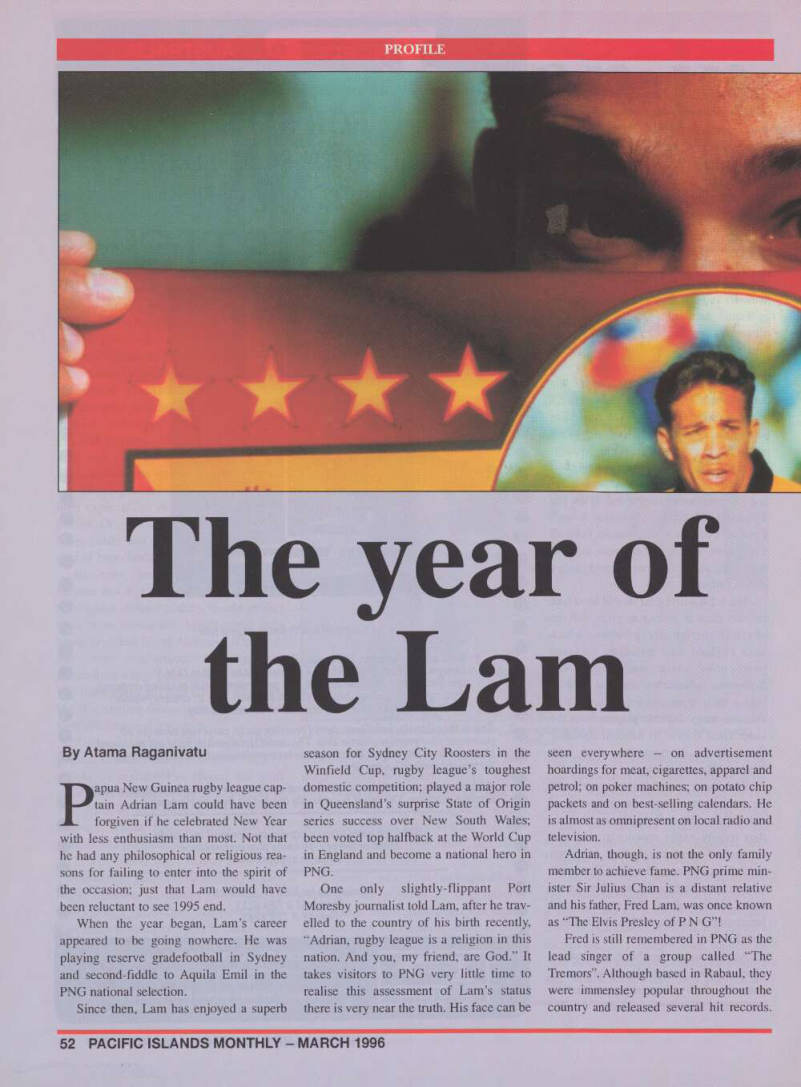
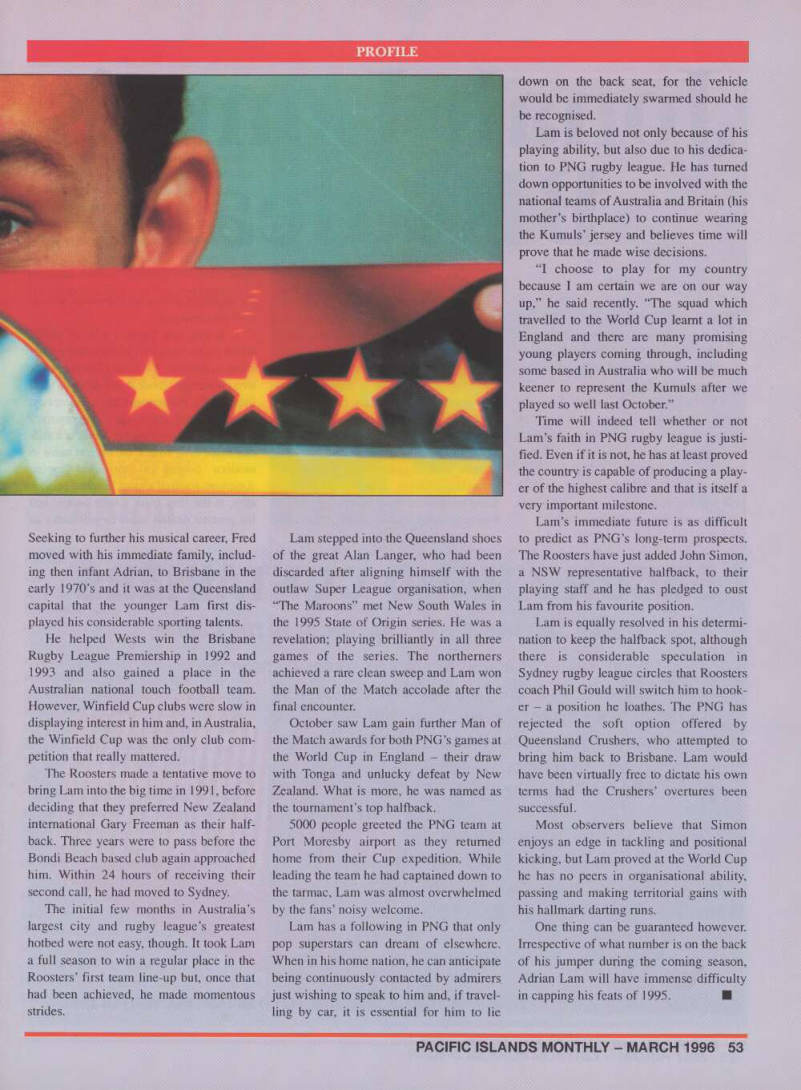
Profile
The year of the Lam
By Atama Raganivatu
season for Sydney City Roosters in the Winfield Cup, rugby league’s toughest domestic competition; played a major role in Queensland’s surprise State of Origin series success over New South Wales; been voted top halfback at the World Cup in England and become a national hero in
Png.
One only slightly-flippant Port Moresby journalist told Lam, after he trav elled to the country of his birth recently, “Adrian, rugby league is a religion in this nation. And you, my friend, are God.” It takes visitors to PNG very little time to realise this assessment of Lam’s status there is very near the truth. His face can be
seen everywhere - on advertisement
hoardings for meat, cigarettes, apparel and
petrol; on poker machines; on potato chip packets and on best-selling calendars. He is almost as omnipresent on local radio and television.
Adrian, though, is not the only family member to achieve fame. PNG prime min ister Sir Julius Chan is a distant relative and his father, Fred Lam, was once known as “The Elvis Presley of P N G”!
Fred is still remembered in PNG as the lead singer of a group called “The Tremors”. Although based in Rabaul, they
were immensley popular throughout the
country and released several hit records.
Papua New Guinea rugby league cap
tain Adrian Lam could have been forgiven if he celebrated New Year with less enthusiasm than most. Not that he had any philosophical or religious rea sons for failing to enter into the spirit of the occasion; just that Lam would have been reluctant to see 1995 end.
When the year began, Lam’s career appeared to be going nowhere. He was
playing reserve gradefootball in Sydney
and second-fiddle to Aquila Emil in the PNG national selection.
Since then, Lam has enjoyed a superb
Seeking to further his musical career, Fred moved with his immediate family, includ ing then infant Adrian, to Brisbane in the early 1970’s and it was at the Queensland capital that the younger Lam first dis played his considerable sporting talents.
He helped Wests win the Brisbane Rugby League Premiership in 1992 and 1993 and also gained a place in the Australian national touch football team.
However, Winfield Cup clubs were slow in displaying interest in him and, in Australia, the Winfield Cup was the only club com
petition that really mattered.
The Roosters made a tentative move to bring Lam into the big time in 1991, before deciding that they preferred New Zealand international Gary Freeman as their half back. Three years were to pass before the Bondi Beach based club again approached him. Within 24 hours of receiving their second call, he had moved to Sydney.
The initial few months in Australia’s largest city and rugby league’s greatest hotbed were not easy, though. It took Lam a full season to win a regular place in the Roosters’ first team line-up but, once that had been achieved, he made momentous strides.
Lam stepped into the Queensland shoes of the great Alan Langer, who had been discarded after aligning himself with the
outlaw Super League organisation, when
“The Maroons” met New South Wales in the 1995 State of Origin series. He was a revelation; playing brilliantly in all three games of the series. The northerners achieved a rare clean sweep and Lam won the Man of the Match accolade after the final encounter.
October saw Lam gain further Man of the Match awards for both PNG’s games at the World Cup in England - their draw with Tonga and unlucky defeat by New Zealand. What is more, he was named as the tournament’s top halfback. 5000 people greeted the PNG team at
Port Moresby airport as they returned
home from their Cup expedition. While leading the team he had captained down to the tarmac, Lam was almost overwhelmed by the fans’ noisy welcome.
Lam has a following in PNG that only pop superstars can dream of elsewhere.
When in his home nation, he can anticipate
being continuously contacted by admirers
just wishing to speak to him and, if travel ling by car, it is essential for him to lie
down on the back seat, for the vehicle would be immediately swarmed should he
be recognised.
Lam is beloved not only because of his playing ability, but also due to his dedica tion to PNG rugby league. He has turned down opportunities to be involved with the national teams of Australia and Britain (his mother’s birthplace) to continue wearing the Kumuls’ jersey and believes time will prove that he made wise decisions.
“I choose to play for my country because I am certain we are on our way up,” he said recently. “The squad which travelled to the World Cup learnt a lot in England and there are many promising
young players coming through, including
some based in Australia who will be much keener to represent the Kumuls after we played so well last October.”
Time will indeed tell whether or not Lam’s faith in PNG rugby league is justi fied. Even if it is not, he has at least proved the country is capable of producing a play er of the highest calibre and that is itself a very important milestone.
Lam’s immediate future is as difficult to predict as PNG’s long-term prospects.
The Roosters have just added John Simon, a NSW representative halfback, to their playing staff and he has pledged to oust Lam from his favourite position.
Lam is equally resolved in his determi nation to keep the halfback spot, although there is considerable speculation in
Sydney rugby league circles that Roosters
coach Phil Gould will switch him to hook er - a position he loathes. The PNG has
rejected the soft option offered by
Queensland Crushers, who attempted to bring him back to Brisbane. Lam would have been virtually free to dictate his own terms had the Crushers’ overtures been successful.
Most observers believe that Simon enjoys an edge in tackling and positional kicking, but Lam proved at the World Cup he has no peers in organisational ability,
passing and making territorial gains with
his hallmark darting runs.
One thing can be guaranteed however.
Irrespective of what number is on the back of his jumper during the coming season, Adrian Lam will have immense difficulty in capping his feats of 1995. ■
Jonah Lomu’s

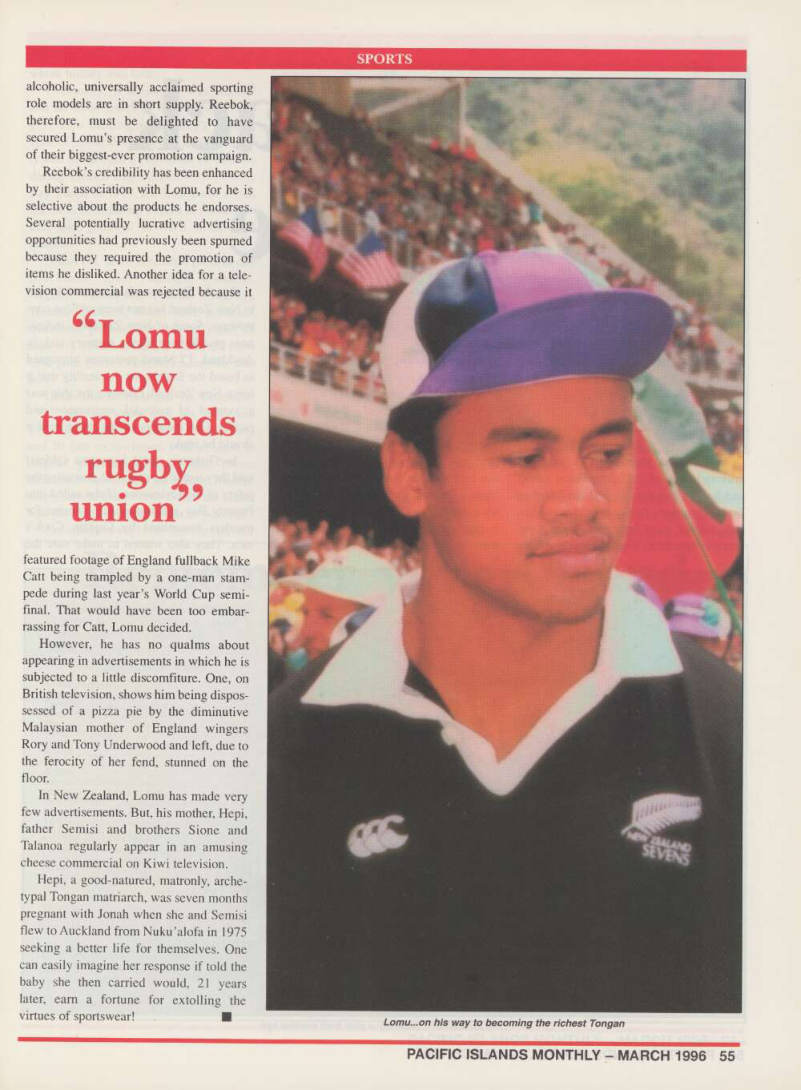
Sports
Jonah Lomu’s BIG deal
By Atama Raganivatu
Jonah Lomu, already the world’s most famous Tongan, is well on the way to also becoming the richest, following a deal he has just signed with British sports wear manufacturer Reebok.
The full details of Lomu’s four-year contract with the company have not been disclosed, however, he is believed to have been guaranteed several million US dol lars for spearheading a high-powered
international marketing campaign which
will involve him appearing in television commercials throughout the world.
The deal represents a major coup for Reebok, as it endeavours to gain an edge over arch rivals Nike, Adidas, and Puma in the Asian and North American markets.
Lomu now transcends rugby union.
Although the sport has a very small fol lowing in the United States, he was named amongst the top 10 sports performers of 1995 by that country’s leading news mag azine, Time. In Asia, participation in rugby extends little beyond South Korean and Japanese college students and Hong Kong’s expatriate community, yet clips of him rampaging through would-be tacklers
are regularly shown on television sets all over the continent.
It is not only Lomu’s athletic ability which makes him such an attractive propo sition to Reebok. A devout Christian, he is shy, charmingly modest and affable. Most
importantly, his personal life is exemplary.
At a time when the contemporary world’s best known soccer player is a self confessed drug addict; the biggest name in modern boxing a convicted rapist; American football’s most lionised person ality, at the very least, a wife beater; and the greatest natural talent in golf today an
alcoholic, universally acclaimed sporting role models are in short supply. Reebok, therefore, must be delighted to have secured Lomu’s presence at the vanguard of their biggest-ever promotion campaign.
Reebok’s credibility has been enhanced by their association with Lomu, for he is selective about the products he endorses.
Several potentially lucrative advertising opportunities had previously been spumed because they required the promotion of items he disliked. Another idea for a tele vision commercial was rejected because it
66 Lomu now transcends
rugby
union 9
featured footage of England fullback Mike Catt being trampled by a one-man stam pede during last year’s World Cup semi final. That would have been too embar rassing for Catt, Lomu decided.
However, he has no qualms about appearing in advertisements in which he is subjected to a little discomfiture. One, on British television, shows him being dispos sessed of a pizza pie by the diminutive Malaysian mother of England wingers Rory and Tony Underwood and left, due to the ferocity of her fend, stunned on the floor.
In New Zealand, Lomu has made very few advertisements. But, his mother, Hepi, father Semisi and brothers Sione and Talanoa regularly appear in an amusing cheese commercial on Kiwi television.
Hepi, a good-natured, matronly, arche typal Tongan matriarch, was seven months pregnant with Jonah when she and Semisi flew to Auckland from Nukualofa in 1975 seeking a better life for themselves. One can easily imagine her response if told the baby she then carried would, 21 years later, earn a fortune for extolling the virtues of sportswear! ■
Lomu...on his way to becoming the richest Tongan
Advertisements & other items, p. 54 (1 item)
Second Hand Containers
WHERE AND WHEN YOU WANT THEM IN THE PACIFIC If you need a flexible and safe storage space we have the ideal solution for you. Our second hand containers provide instant secure storage. Guaranteed to be wind and waterproof these containers are ideal for both temporary and longterm storage in Pacific conditions.
We can deliver to any island in the Pacific within a month and our rates have got to be the lowest you will find. All you need to do is tell us how many you want.
CONTACT:
PASCALE MARCONNET, BP 4757 NOUMEA, NEW CALEDONIA. TEL: (687) 28 7450. FAX; (687) 26 3248
A trip back
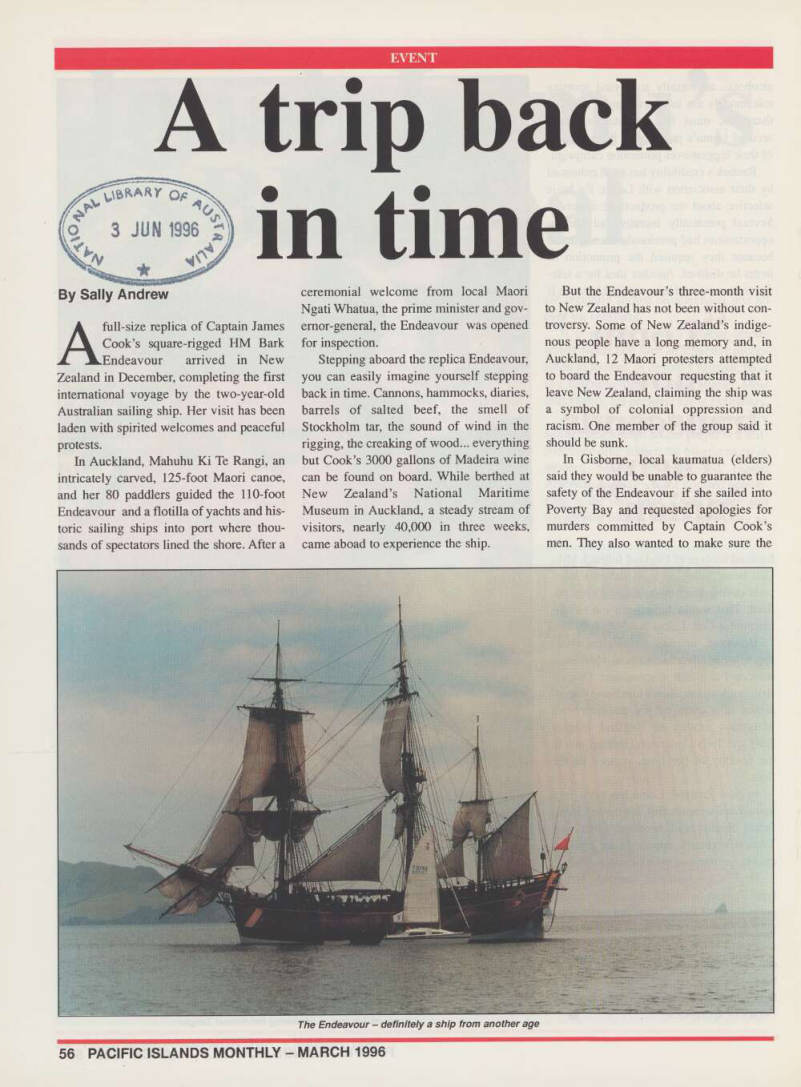
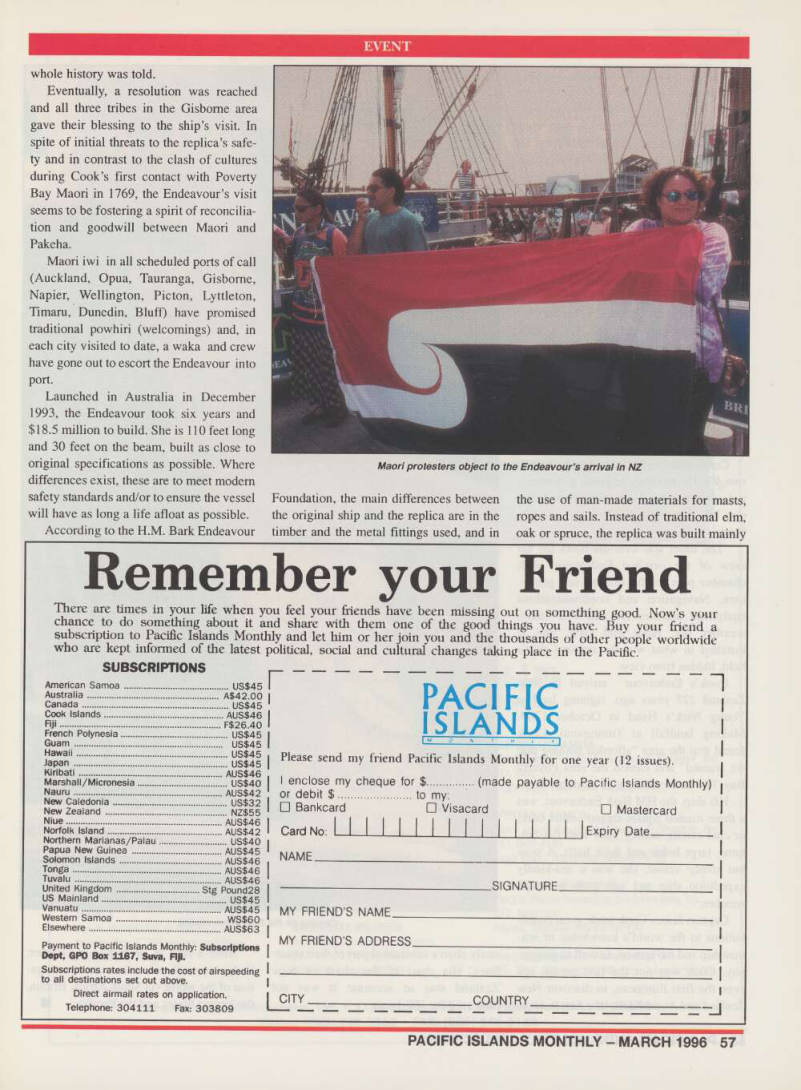
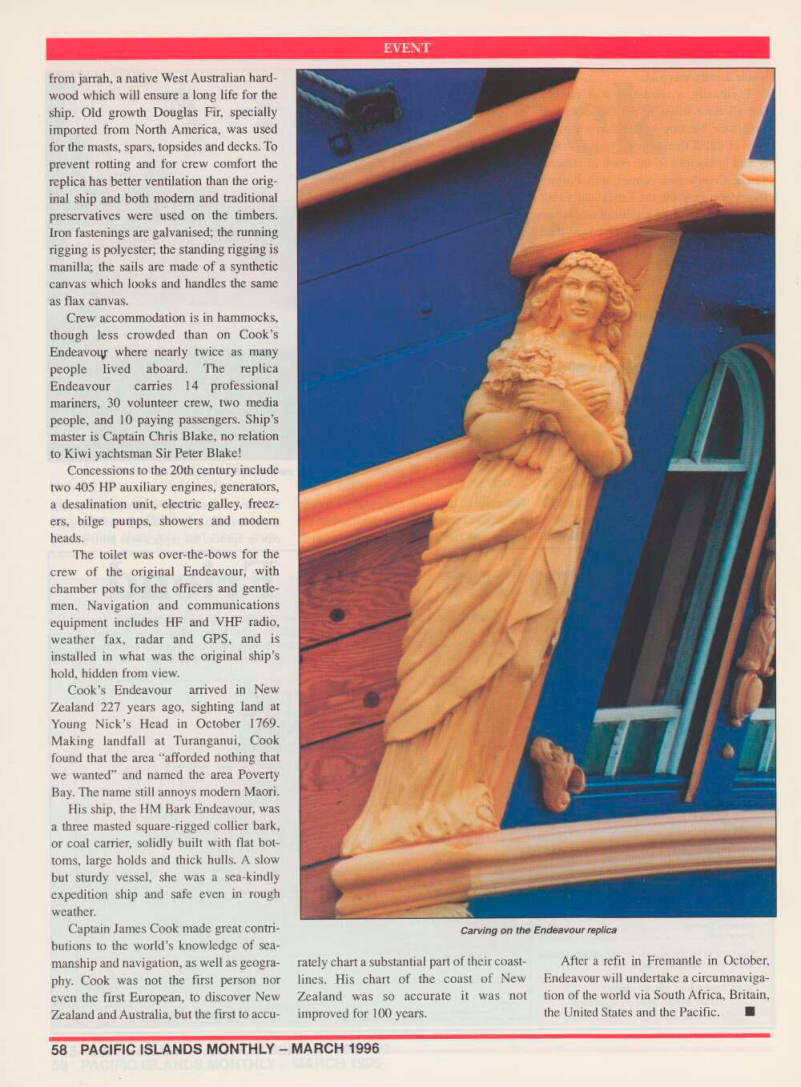
Event
A trip back in time
By Sally Andrew
A full-size replica of Captain James Cook’s square-rigged HM Bark Endeavour arrived in New Zealand in December, completing the first international voyage by the two-year-old Australian sailing ship. Her visit has been laden with spirited welcomes and peaceful protests.
In Auckland, Mahuhu Ki Te Rangi, an intricately carved, 125-foot Maori canoe, and her 80 paddlers guided the 110-foot Endeavour and a flotilla of yachts and his toric sailing ships into port where thou sands of spectators lined the shore. After a
ceremonial welcome from local Maori Ngati Whatua, the prime minister and gov ernor-general, the Endeavour was opened
for inspection.
Stepping aboard the replica Endeavour,
you can easily imagine yourself stepping
back in time. Cannons, hammocks, diaries, barrels of salted beef, the smell of Stockholm tar, the sound of wind in the rigging, the creaking of w00d... everything but Cook’s 3000 gallons of Madeira wine can be found on board. While berthed at New Zealand’s National Maritime Museum in Auckland, a steady stream of visitors, nearly 40,000 in three weeks, came aboad to experience the ship.
But the Endeavour’s three-month visit to New Zealand has not been without con troversy. Some of New Zealand’s indige nous people have a long memory and, in Auckland, 12 Maori protesters attempted to board the Endeavour requesting that it leave New Zealand, claiming the ship was a symbol of colonial oppression and racism. One member of the group said it should be sunk.
In Gisborne, local kaumatua (elders) said they would be unable to guarantee the safety of the Endeavour if she sailed into
Poverty Bay and requested apologies for
murders committed by Captain Cook’s men. They also wanted to make sure the
The Endeavour - definitely a ship from another age
whole history was told.
Eventually, a resolution was reached and all three tribes in the Gisborne area gave their blessing to the ship’s visit. In spite of initial threats to the replica’s safe ty and in contrast to the clash of cultures during Cook’s first contact with Poverty Bay Maori in 1769, the Endeavour’s visit seems to be fostering a spirit of reconcilia tion and goodwill between Maori and Pakeha.
Maori iwi in all scheduled ports of call (Auckland, Opua, Tauranga, Gisborne,
Napier, Wellington, Picton, Lyttleton,
Timaru, Dunedin, Bluff) have promised traditional powhiri (welcomings) and, in each city visited to date, a waka and crew have gone out to escort the Endeavour into port.
Launched in Australia in December 1993, the Endeavour took six years and $18.5 million to build. She is 110 feet long and 30 feet on the beam, built as close to original specifications as possible. Where differences exist, these are to meet modem safety standards and/or to ensure the vessel will have as long a life afloat as possible.
According to the H.M. Bark Endeavour
Foundation, the main differences between the original ship and the replica are in the timber and the metal fittings used, and in
the use of man-made materials for masts, ropes and sails. Instead of traditional elm, oak or spruce, the replica was built mainly
Maori protesters object to the Endeavour’s arrival in NZ
from jarrah, a native West Australian hard wood which will ensure a long life for the
ship. Old growth Douglas Fir, specially
imported from North America, was used for the masts, spars, topsides and decks. To prevent rotting and for crew comfort the replica has better ventilation than the orig inal ship and both modem and traditional preservatives were used on the timbers.
Iron fastenings are galvanised; the running rigging is polyester; the standing rigging is manilla; the sails are made of a synthetic canvas which looks and handles the same as flax canvas.
Crew accommodation is in hammocks, though less crowded than on Cook’s Endeavoiy where nearly twice as many people lived aboard. The replica Endeavour carries 14 professional mariners, 30 volunteer crew, two media people, and 10 paying passengers. Ship’s master is Captain Chris Blake, no relation to Kiwi yachtsman Sir Peter Blake!
Concessions to the 20th century include two 405 HP auxiliary engines, generators, a desalination unit, electric galley, freez ers, bilge pumps, showers and modem heads.
The toilet was over-the-bows for the crew of the original Endeavour, with chamber pots for the officers and gentle men. Navigation and communications equipment includes HE and VHP radio, weather fax, radar and GPS, and is installed in what was the original ship’s hold, hidden from view.
Cook’s Endeavour arrived in New Zealand 227 years ago, sighting land at Young Nick’s Head in October 1769.
Making landfall at Turanganui, Cook found that the area “afforded nothing that we wanted” and named the area Poverty Bay. The name still annoys modem Maori.
His ship, the HM Bark Endeavour, was a three masted square-rigged collier bark, or coal carrier, solidly built with flat bot toms, large holds and thick hulls. A slow but sturdy vessel, she was a sea-kindly expedition ship and safe even in rough weather.
Captain James Cook made great contri butions to the world’s knowledge of sea manship and navigation, as well as geogra phy. Cook was not the first person nor even the first European, to discover New Zealand and Australia, but the first to accu-
rately chart a substantial part of their coastlines. His chart of the coast of New Zealand was so accurate it was not improved for 100 years.
After a refit in Fremantle in October, Endeavour will undertake a circumnaviga tion of the world via South Africa, Britain, the United States and the Pacific. ■
Carving on the Endeavour replica
Advertisements & other items, pp. 57-60 (1 item)
Remember your Friend
Tlxere are times in your life when you feel your friends have been missing out on something good. Now’s your chance to do something about it and share with them one of the good things you have. Buy your friend a subscription to Pacific Islands Monthly and let him or her join you and the thousands of other people worldwide who are kept informed of the latest political, social and cultural changes taking place in the Pacific.
SUBSCRIPTIONS
American Samoa US$45 Australia A 542.00 Canada US$45 Cook Islands AUSS46 Fiji F 526.40 French Polynesia US$45 Guam US$45 Hawaii US$45 Japan US$45 Kiribati AUSS46 Marshall/Micronesia US$4O Nauru AUSS42 New Caledonia US$32 New Zealand NZ$55 Niue AUSS46 Norfolk Island AUSS42 Northern Marianas/Palau US$4O Papua New Guinea AUSS4S Solomon Islands AUSS46 Tonga AUSS46 Tuvalu AUSS46 United Kingdom Stg Pound2B US Mainland US$45 Vanuatu AUSS4S Western Samoa WS$6O Elsewhere AUSS63 Subscriptions rates include the cost of airspeeding to all destinations set out above.
Direct airmail rates on application.
Telephone: 304111 Fax: 303809 r Payment to Pacific Islands Monthly: Subscriptions Dept, GPO Box 1167, Suva, FIJI.
PACIFIC
ISLANDS
n Please send my friend Pacific Islands Monthly for one year (12 issues).
I enclose my cheque for $ (made payable to Pacific Islands Monthly) . or debit $ to 1 □ Bankcard my: □ Visacard Card No; □ Mastercard
Expiry Date
NAME.
.SIGNATURE.
MY FRIEND'S NAME.
MY FRIEND'S ADDRESS.
L£l
CITY
.COUNTRY
JO 15 20 25 30 35 40 45 50 55 60 * ‘ nr.ific Life Insurance, lAd Grand V
mmmf
»s 8f• I b m « iek'.'i* 3 1508 00524961 5
Grand Pacific Life Insurance, Ltd.
A member of the Finance Factors Family .J
FEDERATED STATES
OF MICRONESIA
Actouka Executive Insurance Underwriters P.O. Box 55, Kolonia, Pohnpei, Federated States of Micronesia 96941 Pacific Basin Insurance & General Services, Inc P.O. Box 494, Chuuk State, Federated States of Micronesia 96942
TONGA
Peseti Ma ‘afu Ins. & Finance, Ltd.
Private Bag 2, Taumoepeau Bldg.
Nukualofa, Tonga
GUAM
Great National Insurance Underwriters, Inc.
P.O. Box GA, Agana, Guam 96910
AMERICAN SAMOA
Mark Solofa Pacific Insurance & Finance, Inc.
P.O. Box 3149 Pago Pago, American Samoa 96799 Pacific Financial Corporation P.O. Box AT, Agana, Guam 96910 Takagi & Associates, Inc.
GCIC Bldg., Suite 100 414 W. Soledad Ave.
Agana, Guam 96910
MARSHALL ISLANDS
Marshalls Insurance Agency P.O. Box 113, Majuro, Marshall Islands 96960
WESTERN SAMOA
Mark Solofa Pacific Insurance & Finance, Inc.
P.O. Box 3149 Pago Pago, American Samoa 96799
NORTHERN MARIANAS
Pacific Basin Insurance Underwriters, Inc.
P.O. Box 710 Saipan, Mariana Islands 96950 Pacifica Insurance Underwriters, Inc.
P.O. Box 168, Saipan, Mariana Islands 96950 Grand Pacific life Insurance, Ltd. • 1164 Bishop Street, sth Floor, Honolulu, HI 96813 Phone: (808) 548-3363 • FAX: (808) 548-5122
ReuFVTio
EL\JC C
<SE)
THE NEW
?RC~
PRIVILEGED CLASS
The Uncompromised Family Sedan
THE RLL NEW
MITSUBISHI
LRNCER
Meet the car that was born to succeed. With its progressive engineering and striking appearance, the all-new Mitsubishi Lancer advances effectively, impressively... moving ahead at every turn.
Get behind the wheel and experience the new standard in family sedans.
AMERICAN SAMOA: PACIFIC MARKETING INC. P.O. Box 698, Pago Pago, Tel. 699-9140 / AUSTRALIA: MITSUBISHI MOTORS AUSTRALIA LTD. 1284 South Road, Clovelly Park, South Australia, 5042, Tel (08) 2757297 /FUI: NIVIS MOTOR & MACHINERY CO. LTD. G.P.O. Box 150, Suva, Tel. 383411 / GUAM: TRIPLE J ENTERPRISES INC. P.O. Box 6066, Tamuning, Tel. 6469126 /NEW CALEDONIA: SOCIETE D’IMPORTATION D'AUTO DU PACIFIQUE SUD S.A. P.O. Box 2548, Noumea. Tel. 281-787 / NEW ZEALAND: MITSUBISHI MOTORS NEW ZEALAND LTD. Private Bag. Porima, Tel. 237-0109 / NORFOLK ISLAND: BORRY'S PTY LTD. P.O. Box 169,'Taylors Road, Burnt, Tel. 22114 /PAPUA NEW GUINEA: TOBA MOTORS PTY LTD. P.O. Box 503, Port Moresby /SAIPAN: SAIPAN AUTOWORLD INC. P.O.
Box 487, Tel 234-7133/ SOLOMON ISLANDS: HARVEST PACIFIC LTD. G.P.O. Box 823, Honiara, Tel. 30407/ TAHITI: SOPADEP S.A. B.P. 1617, Papeete, Tel. 427393/ TONGA: SITANI MAFI CO., LTD.
P.O. Box 83, Nuku'Alofa, Tel. 24044/ VANUATU: SOCOMETRA VANUATU LTD. B.P. 6, Port-Vila, Tel. 2314 /WESTERN SAMOA: MOTOR DISTRIBUTORS (SAMOA) LTD. P.O. Box 576, Apia, Tel. 20957
MITSUBISHI
MOTORS
CREATING TOGETHER