Pacific

Islands
Monthly
February 1996
Lightingeire
With Fire
But hofllr committed is PNG's govt to combatting the cfljfttrti’y'a worsening crime situation?
American Samoa USS2.SO: Australia A 53.50; Cook islands NZ$3: Fiji F 52.50 Vat inch FS Micronesia US$3; Kiribati A 52.50; Nauru A 52.50; Niue NZ$3: Norfolk As 3: New Caledonia cpf2so' New Zealand NZ53.45 incl GST: Northern Marianas US$3; Papua New Guinea K 3: Palau US$3; Marshall islands US$3; Solomon Islands As 3; French Polynesia cpf3oo: Tonga P 3: USA . US$3; Vanuatu VT22G: Western Samoa T'3.25. These are recommended prices only.
6 COVER: PNG’s national govern ment is pouring money into fighting the country’s worsening crime situa tion. But is this the answer?
Advertisements & other items, p. 2 (1 item)
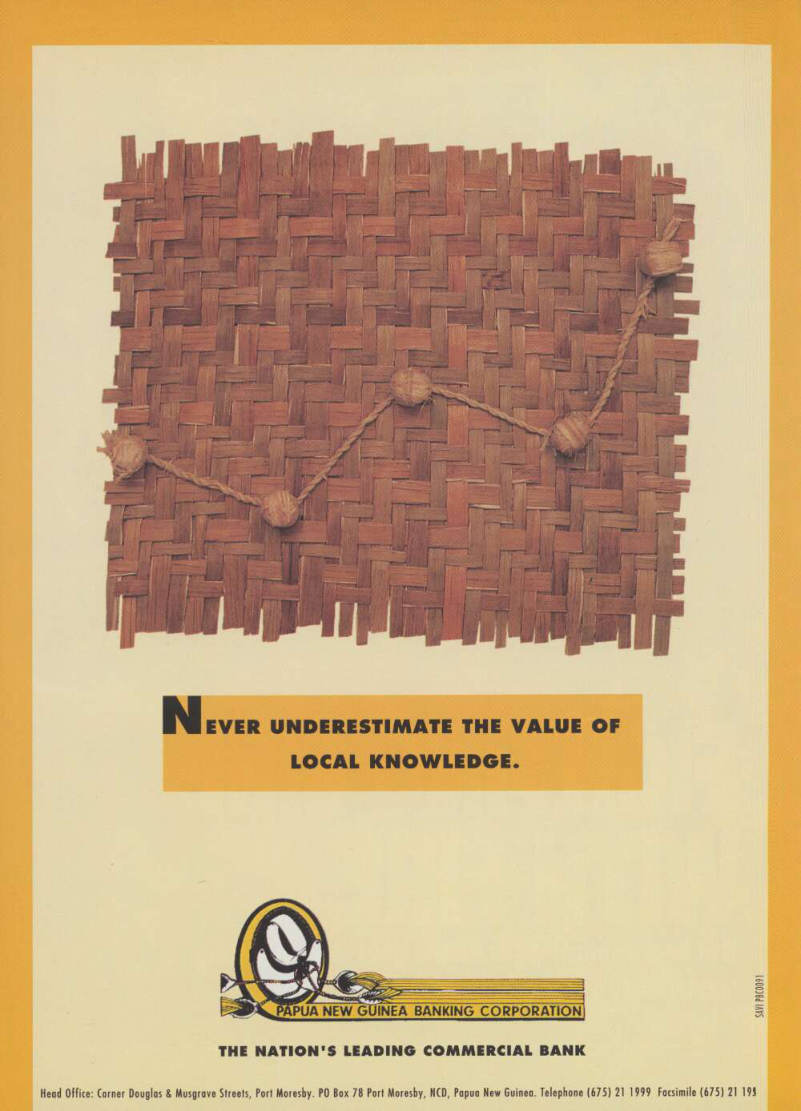
Local Knowledge.
...i I ■ —3 I * Jvr r-1 : r — i l - I *** 4 m - * :- 1 f I H ! j ' I Hi
Never underestimate the value of
V
UA NEW GUINEA BANKING CORPORATION
THE NATION'S LEADING COMMERCIAL BANK
Heod Office: Corner Douglas & Musgrave Streets, Port Moresby. PO Box 78 Port Moresby, NCD, Papua New Guinea. Telephone (675) 21 1999 Facsimile (675) 21 19J
Pacific
Islands
Monthly
Vol. 66 No. 2
The News Magazine
February 1996
PUBLISHER: Brian O’Flaherty EDITOR: Debbie Singh SENIOR WRITER: Sophie Foster
Correspondents:
David North, Sam Vulum lan Williams, Liz Thompson, Atama Raganivatu, Wally Hiambohn, Patrick Decloitre, and Chris Peteru COLUMNISTS: David Barber (Wellington), Futa Helu (Tonga), Jemima Garrett (Sydney), Alfred Sasako (The Forum).
Advertising Sales
Regional Sales - South Pacific Ashok Lai, Shailendra Kumar Tel (679) 304111, 303429, Fax (679) 303809.
Sydney, Canberra: Bob Hill Media Representation, Tel (61-2) 4164245, Fax (61-2) 4165064.
Brisbane: Jane Fewings Media and Advertising Associates Tel (61-7) 378 4522, Fax (61-7) 878 1071.
Adelaide: Hastwell Williamsons Representatives, Tel (61-8) 3799522, Fax (61-8) 3799735.
Melbourne: Brown Orr Fletcher Burrows (Aust) Pty Ltd.
Tel (61-3) 8265188, Fax (61-3) 8265644.
Auckland: McKay & Bowman, International Media Representatives Limited, Tel (64-9) 4190561, Fax (64-9) 4192243.
Japan: Universal Media Corporation, Tokyo, Tel (3) 3266626741, Cable: UNI-MEDIA Tokvo, Fax (3) 32626742.
Pacific Islands Monthly was founded 1930
(Usps 9522480).
A Fiji Times Limited production.
Cover prices are recommended retail only. Registered by Australia Post, Publication No. NBPI2IO. © Copyright Fiji Times Limited, 177 Victoria Parade, Suva, Fiji.
Tel (679) 304111, fax (679) 303809.
Pacific Islands Monthly is published monthly by Fiji Times Limited, a division of Nationwide News, 2 Holt Street, Surry Hills, Sydney, NSW 2010.
Send Address Changes To:
Pacific Islands Monthly, PO Box 1167, Suva, Fiji.
Typeset and printed by The Fiji Times Limited, 177 Victoria Parade, Suva, Fiji.
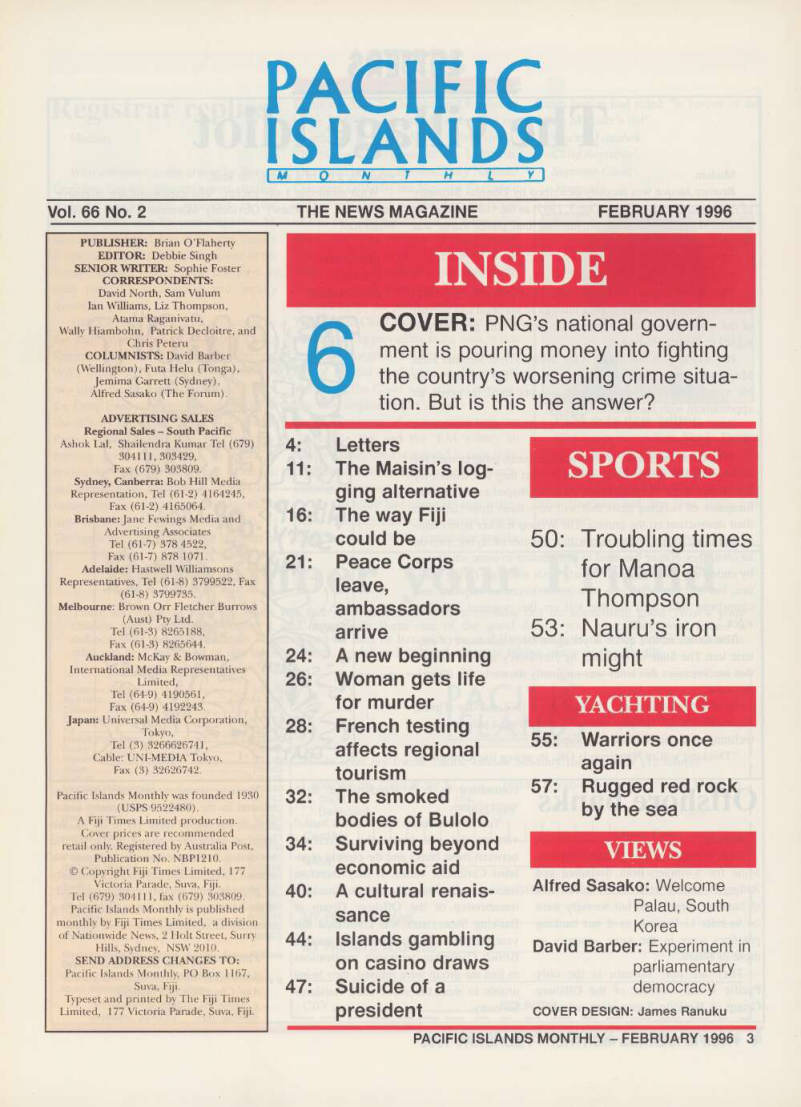
Inside
4: Letters 11: The Maisin’s log ging alternative 16: The way Fiji could be 21: Peace Corps leave, ambassadors arrive 24: A new beginning 26: Woman gets life for murder 28: French testing affects regional tourism 32: The smoked bodies of Bulolo 34: Surviving beyond economic aid 40: A cultural renais sance 44: Islands gambling on casino draws 47: Suicide of a president
Sports
50: Troubling times for Manoa Thompson 53: Nauru’s iron might
Yachting
55: Warriors once again 57: Rugged red rock by the sea
Views
Alfred Sasako: Welcome Palau, South Korea David Barber: Experiment in parliamentary democracy COVER DESIGN; James Ranuku
The village idiot
Letters
Madam, Brother Jacque was recently described by Douglas Moroney of Auckland (Sunday Times, Dec 3,1995) as the village idiot. He quoted Marshall McLuhan on the fact that planet Earth was becoming like a "Global Village”.
“So who is our village idiot?
Take a bow, Monsieur Chirac!”
The case of Brother Jacque is indeed a strange one, common sense seems incapable of getting through to his brain and the rest of the world cannot seem to penetrate his stubborn perversity in regard to Nuclear testing.
His only ally on this matter is the British Prime Minister John Major who, having to wear glasses, obviously has difficulty with his vision and is so short-sighted and one-eyed he needs an
appointment with his optician urgently!
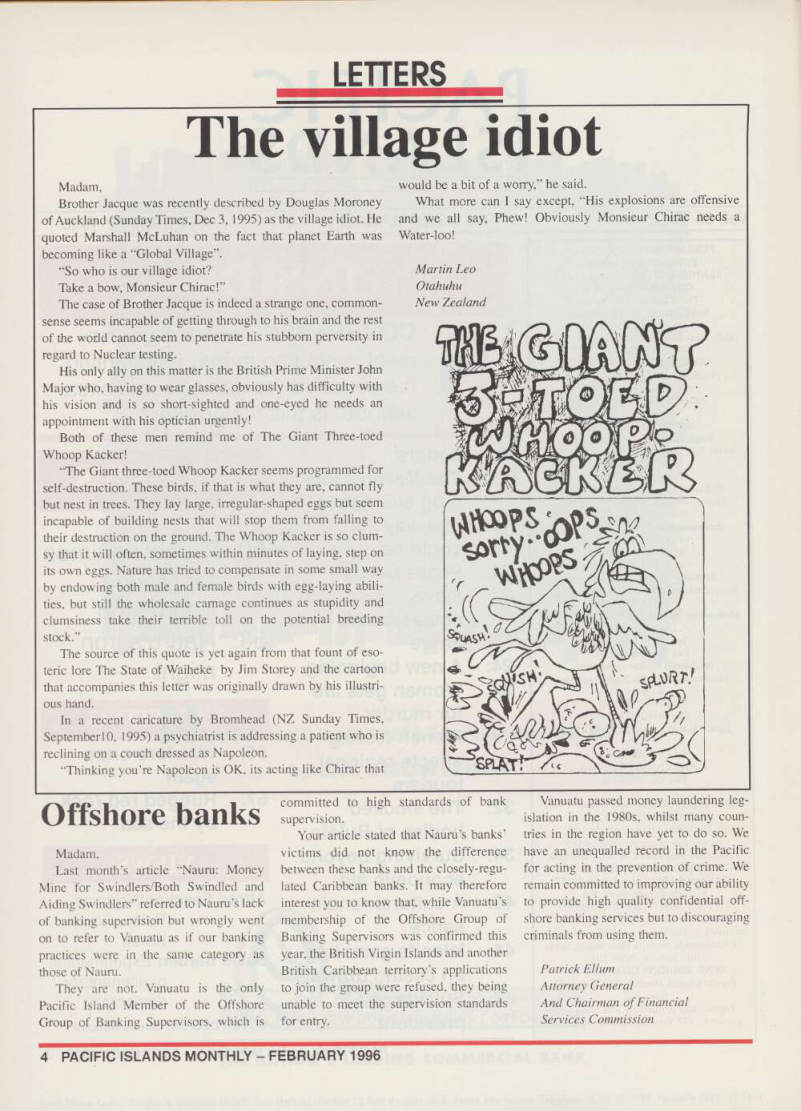
Both of these men remind me of The Giant Three-toed
Whoop Kacker!
"The Giant three-toed Whoop Kacker seems programmed for self-destruction. These birds, if that is what they are, cannot fly but nest in trees. They lay large, irregular-shaped eggs but seem incapable of building nests that will stop them from falling to their destruction on the ground. The Whoop Kacker is so clum sy that it will often, sometimes within minutes of laying, step on its own eggs. Nature has tried to compensate in some small way by endowing both male and female birds with egg-laying abili ties, but still the wholesale carnage continues as stupidity and clumsiness take their terrible toll on the potential breeding stock.”
The source of this quote is yet again from that fount of eso teric lore The State of Waiheke by Jim Storey and the cartoon that accompanies this letter was originally drawn by his illustri ous hand.
In a recent caricature by Bromhead (NZ Sunday Times, September 10, 1995) a psychiatrist is addressing a patient who is reclining on a couch dressed as Napoleon.
"Thinking you’re Napoleon is OK, its acting like Chirac that
would be a bit of a worry,” he said.
What more can I say except, "His explosions are offensive and we all say, Phew! Obviously Monsieur Chirac needs a Water-loo!
Martin Leo
Otahuhu New Zealand
Offshore banks
Madam, Last month’s article "Nauru: Money Mine for Swindlers/Both Swindled and Aiding Swindlers” referred to Nauru’s lack
of banking supervision but wrongly went
on to refer to Vanuatu as if our banking practices were in the same category as those of Nauru.
They are not. Vanuatu is the only Pacific Island Member of the Offshore Group of Banking Supervisors, which is
committed to high standards of bank supervision.
Your article stated that Nauru’s banks’ victims did not know the difference between these banks and the closely-regu lated Caribbean banks. It may therefore interest you to know that, while Vanuatu’s membership of the Offshore Group of Banking Supervisors was confirmed this year, the British Virgin Islands and another British Caribbean territory’s applications to join the group were refused, they being unable to meet the supervision standards for entry.
Vanuatu passed money laundering leg islation in the 1980 s, whilst many coun tries in the region have yet to do so. We have an unequalled record in the Pacific for acting in the prevention of crime. We remain committed to improving our ability to provide high quality confidential off shore banking services but to discouraging criminals from using them.
Patrick Ellum
Attorney General And Chairman of Financial Services Commission
Registrar replies
Madam, With reference to the article by Patrick Decloitre headed ‘Vanuatu’s post-election trade-horsing’ which appeared in the January 1996 issue for your magazine, he says: “It was Chief Justice Charles Vaudin d’lmecourt who had to rule in favour of the Prime Minister’s list”. That statement is both factually misleading and legally incorrect.
The Supreme Court was petitioned by the then Prime Minister, Maxime Carlot Korman and the Minister of Finance, Willy Jimmy in order to establish which of two lists, (the then Prime Minister’s list or the Party Executive list) should prevail as the official list of the Union of Moderate Party’s official candidates at the then forth coming general elections. In order to decide the issue, the Court had to look at and consider the constitution of the UMP.
Indeed the Court had not two, but three lists to consider and adjudicate upon. 1) The applicants’ list (P.M.’s and Minister of
Finance’s list); 2) The National Executive of the UMP list (commonly and mistaken ly referred to as Mr Vohor’s list) and 3) The National Congress of the UMP list.
There had been an Extraordinary National Congress called by the National Executive of the Party, which was held on the island of Epi between the 17 and 22 September 1995. The main purpose of that meeting was to establish, at the highest level of the Party, a list of candidates for the then forth coming general elections. That list was ignored by all the parties before the court.
The learned Chief Justice ruled that, in the circumstances prevailing at the time, it was the Party Congress that could establish the list of official candidates at the general elections. The Court was able to reconsti tute that original ‘Epi Congress list’ from an amalgamation of names from both the ‘Executive list’ and the ‘P.M.’s list’, all names having been registered in time to be considered as candidates at the then forth coming elections.
Mr Decloitre had access to that judge ment. I fail therefore, to understand how he could have come to the conclusion that the
Chief Justice had ruled “in favour of the Prime Minister’s list”.
Vincent Lunabek
Chief Registrar Supreme Court Vanuatu
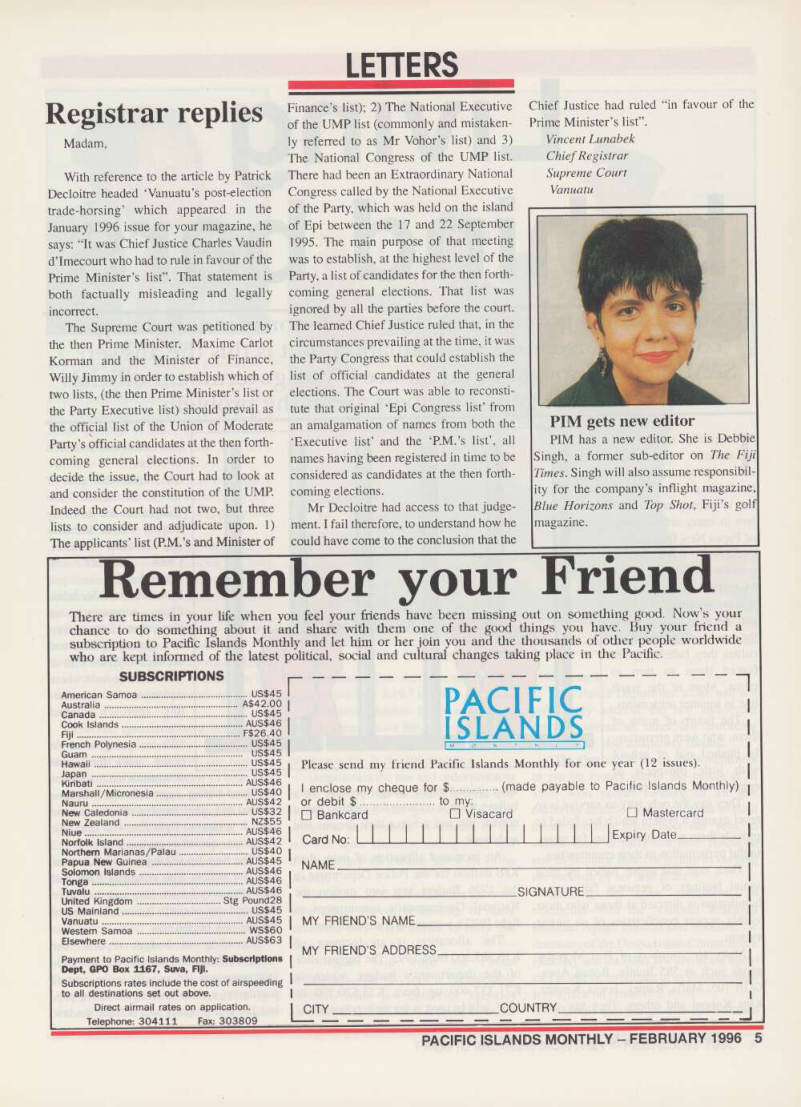
PIM gets new editor
PIM has a new editor. She is Debbie Singh, a former sub-editor on The Fiji Times. Singh will also assume responsibil ity for the company’s inflight magazine.
Blue Horizons and Top Shot, Fiji’s golf magazine.
Advertisements & other items, p. 5 (1 item)
Remember your Friend
There are times in your life when you feel your friends have been missing out on something good. Now’s your chance to do something about it and share with them one of the good tilings you have. Buy your friend a subscription to Pacific Islands Monthly and let him or her join you and the thousands of other people worldwide who are kept informed of the latest political, social and cultural changes taking place in the Pacific.
SUBSCRIPTIONS
American Samoa US$45 Australia A 542.00 Canada US$45 Cook Islands AUSS46 Fiji F 526.40 French Polynesia US$45 Guam US$45 Hawaii US$45 Japan US$45 Kiribati AUSS46 Marshall/Micronesia US$4O Nauru AUSS42 New Caledonia US$32 New Zealand NZ$55 Niue AUSS46 Norfolk Island AUSS42 Northern Marianas/Palau US$4O Papua New Guinea AUSS4S Solomon Islands AUSS46 Tonga AUSS46 Tuvalu AUSS46 United Kingdom Stg Pound2B US Mainland US$45 Vanuatu AUSS4S Western Samoa WS$6O Elsewhere AUSS63 Payment to Pacific Islands Monthly: Subscriptions Dept, GPO Box 1167, Suva, FIJI.
Subscriptions rates include the cost of airspeeding to all destinations set out above.
Direct airmail rates on application.
Telephone: 304111 Fax: 303809
PACIFIC
SLANDS
"I Please send my friend Pacific Islands Monthly for one year (12 issues). 1 enclose my cheque for $ (made payable to Pacific Islands Monthly) or debit $ to my: □ Bankcard □ Visacard D Mastercard Card No: LI I_l._l._L I I 1 I I I JJ JJ Ex P ir V Date
NAME
SIGNATURE
MY FRIEND’S NAME
MY FRIEND’S ADDRESS
CITY
COUNTRY
Living

Cover Story
Living behind bars
PNG’s national government is pouring money into fighting the country’s worsening crime situation. But is this the answer?
SAM VULUM speaks to the police force, government officials and PNG gang members about the problem.
Inequality and poverty, among other social problems, appear to be the leading root causes of the worsening crime prob lem in many urban centres of Papua New Guinea.
Several street youths interviewed in Port
Moresby have highlighted
that the widening inequality
gap between the rich and the poor, coupled with diffi culties they face daily, has forced them to turn to crime. Most of the youth live in squatter settlements.
The future of many of them, who were premature ly pushed out of school with little prospects of employment, is very bleak.
They say the only way to survive is to rebel against a system which has failed to provide them with opportunities for mean ingful participation in their communities.
Their rage and anger, fueled by their initial feelings of personal failure and humiliation is directed at those who most visibly appear beneficiaries of an unjust system.
Many are members of Port Moresby gangs such as 585 Itninin, Bomai Apex, GGB 105, Mafia, Raipex, Jawas, Kovera, Kips Koboni and others. They say they
prevention and detention of crime.
The funds were part of the K 1.92 billion 1996 Budget handed down by Deputy Prime Minister and Finance Minister, Chris Haiveta on November 22.
Prime Minister, Sir Julius Chan announced on November 17 the nation al government had declared 1996 the Year of Law Enforcement where it plans to take a hard-hit ting approach toward crime.
“We are going to tackle crime with the same determination, vigour
have joined these gangs because they believe there is no hope for them to lead a normal life and achieve their dreams and ambitions.
An increased allocation of more than KB6 million for the Police Department in the 1996 Budget sets into motion the National Government’s commitment to fight PNG’s worsening crime situation.
The allocation is an increase of K 16,385,200 from 1995. The biggest slice of the department’s budget, which is K 71,337,400 up from K 53,570,700 in 1995, will be used in the main police job of
and hard-hitting approach that we have tackled any other number of issues in the past. It is time to fight fire with fire,” Sir Julius was quoted as saying.
“The time for talking is over. It is now time for action. The criminals have had their own way for too long and they have strangled our country. It must be stopped and the task begins now.”
According to budget reports, the increased funds aim to ensure police pro vide protection and security to the general population against lawless elements, pro tect life and property and enforce the law
in an impartial and objective manner.
While commenting on the allocation, Police Commissioner, Henry Tokam said the increase had enabled them to be in a better position to enact the 1996 Action Plan to complement the Prime Minister’s vision.
“The additional allocation will ensure that the extensive Action Plans being pre pared for the constabulary will come into effect on January 1, 1996.
“When these interlocking strategies on general and community policing are fully implemented, we will see a dramatic decrease in crime through increased police presence and more active patrolling in public places and consultation with the
community throughout the nation.
“I am happy with the allocation given to us, it is less than what we asked for, but more than we expected to receive,” Tokam said.
However, questions have been raised on whether increasing the Police Department’s fund would do any better in preventing the situation when all other law enforcing agencies funds remain static or have decreased from 1995 allocations.
These agencies include the Correctional Institution Services, Judiciary Service, Ombudsman Commission and the
National Intelligence Organisation.
While the 1996 budget boosted the appropriation of the Police Department by more than KB6 million. Correctional Institution Services will receive K 25.2 million, down from K 29.5 million in 1995.
There is no change to the National
Intelligence Organisation allocation, the
Ombudsman Commission’s allocation
remains static while the Judiciary Service will receive only K 19.7 million.
Opposition shadow Finance Minister, Masket langalo said they commended the government for making law and order one of its priorities in the 1996 Budget. langalo said the law and order problem in the country had escalated beyond safe limits, however, the government’s han dling and performance in relation to the law and order situation during 1995 and the budgetary allocations left a lot to be desired.
He said in 1995 law enforcing agencies were totally starved of funding. In many instances, they were unable to carry out their basic routine duties. langalo said while the Police Department had received a considerable increase, other law enforcing agencies have had their allocation reduced from the
1995 Budget.
“The Police Department alone will not sufficiently address the law and order problem unless all other law enforcing agencies are also adequately funded.
“The Opposition wants the government to put its money where the mouth is in 1996 with proper funding of all law enforcing agencies and to continue to fund these agencies throughout the year to enable them to carry out their functions and to produce positive results in curbing the problem of law and order.
Sharing the same sentiments, a researcher with the National Research Institute, Agogo Mawuli said boosting the functions of the Ombudsman Commission, judiciary and the other law enforcing agen cies might be important in any comprehen sive attack on crime.
Mawuli said the government’s stance
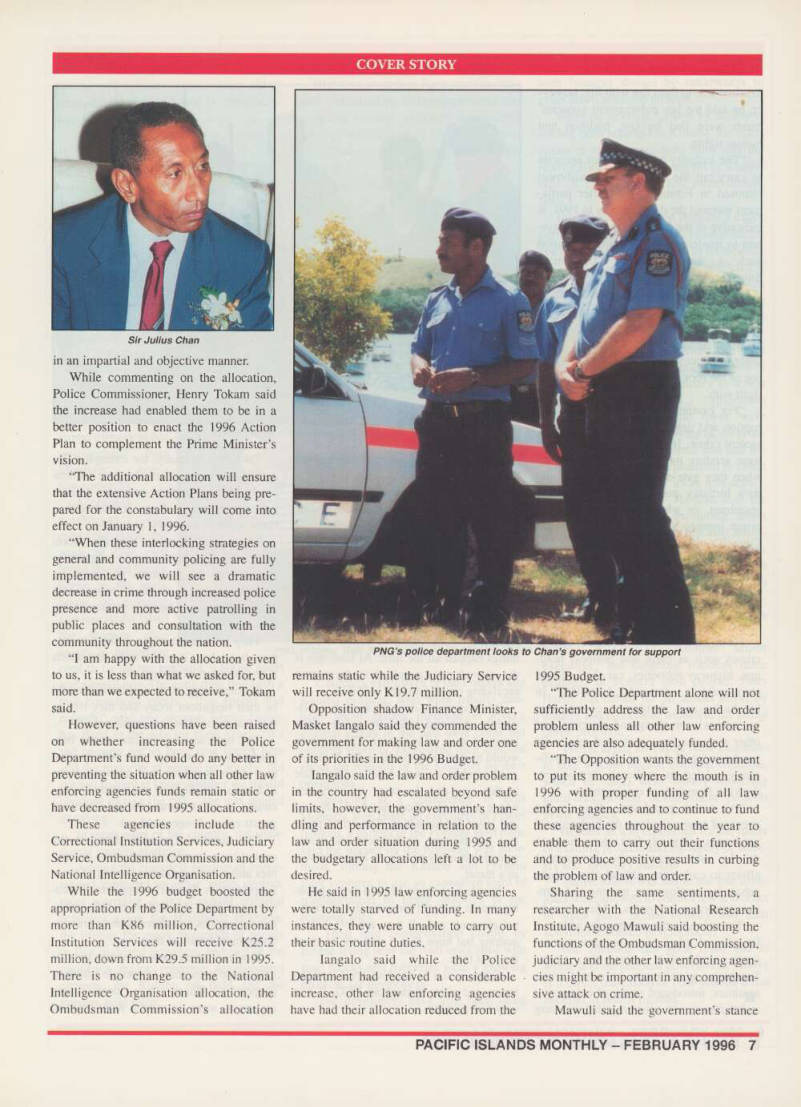
Sir Julius Chan
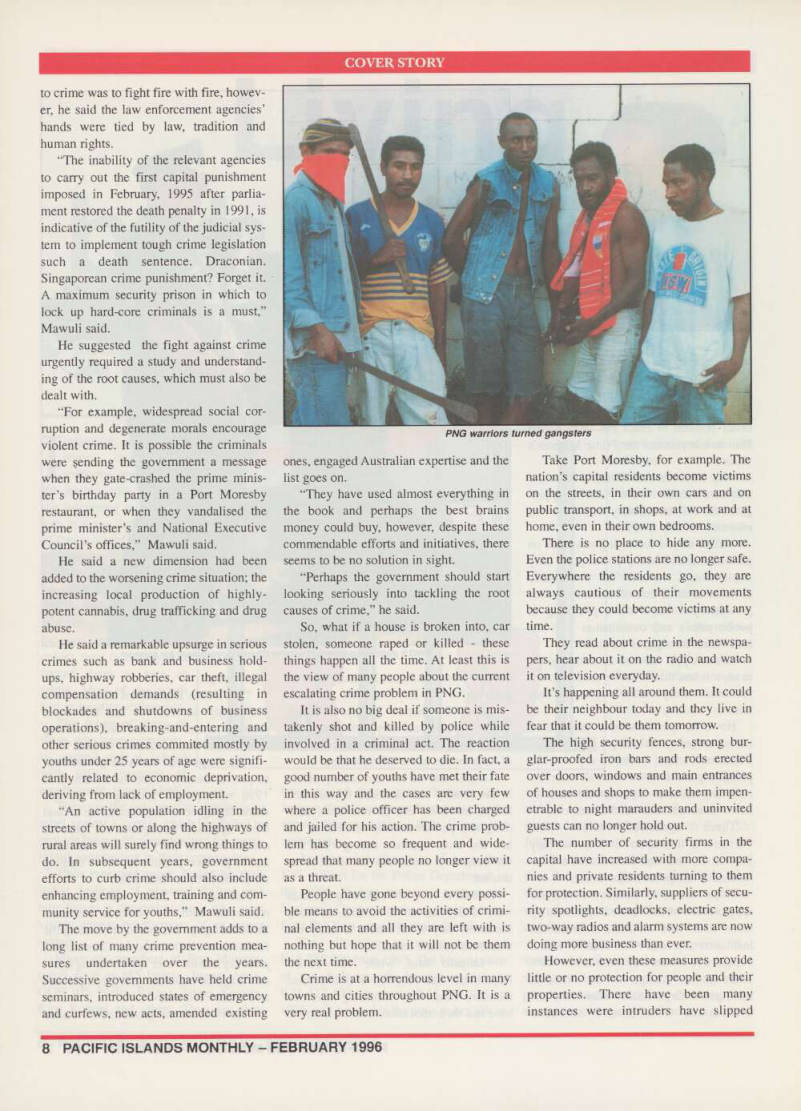
PNG’s police department looks to Chan’s government for support
to crime was to fight fire with fire, howev er, he said the law enforcement agencies’ hands were tied by law, tradition and human rights.
“The inability of the relevant agencies to carry out the first capital punishment imposed in February, 1995 after parlia ment restored the death penalty in 1991, is indicative of the futility of the judicial sys
tem to implement tough crime legislation
such a death sentence. Draconian.
Singaporean crime punishment? Forget it.
A maximum security prison in which to lock up hard-core criminals is a must,”
Mawuli said.
He suggested the fight against crime urgently required a study and understand ing of the root causes, which must also be dealt with.
“For example, widespread social cor ruption and degenerate morals encourage violent crime. It is possible the criminals were pending the government a message when they gate-crashed the prime minis ter’s birthday party in a Port Moresby restaurant, or when they vandalised the prime minister’s and National Executive Council’s offices,” Mawuli said.
He said a new dimension had been added to the worsening crime situation; the increasing local production of highly potent cannabis, drug trafficking and drug abuse.
He said a remarkable upsurge in serious crimes such as bank and business hold ups, highway robberies, car theft, illegal compensation demands (resulting in blockades and shutdowns of business operations), breaking-and-entering and other serious crimes commited mostly by youths under 25 years of age were signifi cantly related to economic deprivation, deriving from lack of employment.
“An active population idling in the streets of towns or along the highways of rural areas will surely find wrong things to do. In subsequent years, government efforts to curb crime should also include enhancing employment, training and com munity service for youths,” Mawuli said.
The move by the government adds to a long list of many crime prevention mea sures undertaken over the years.
Successive governments have held crime seminars, introduced states of emergency and curfews, new acts, amended existing
ones, engaged Australian expertise and the list goes on.
“They have used almost everything in the book and perhaps the best brains money could buy, however, despite these commendable efforts and initiatives, there seems to be no solution in sight.
“Perhaps the government should start looking seriously into tackling the root causes of crime,” he said.
So, what if a house is broken into, car stolen, someone raped or killed - these things happen all the time. At least this is the view of many people about the current escalating crime problem in PNG.
It is also no big deal if someone is mis takenly shot and killed by police while involved in a criminal act. The reaction would be that he deserved to die. In fact, a good number of youths have met their fate in this way and the cases are very few where a police officer has been charged and jailed for his action. The crime prob lem has become so frequent and wide spread that many people no longer view it as a threat.
People have gone beyond every possi
ble means to avoid the activities of crimi nal elements and all they are left with is nothing but hope that it will not be them the next time.
Crime is at a horrendous level in many towns and cities throughout PNG. It is a very real problem.
Take Port Moresby, for example. The nation’s capital residents become victims on the streets, in their own cars and on public transport, in shops, at work and at home, even in their own bedrooms.
There is no place to hide any more.
Even the police stations are no longer safe.
Everywhere the residents go, they are always cautious of their movements because they could become victims at any time.
They read about crime in the newspa pers, hear about it on the radio and watch it on television everyday.
It’s happening all around them. It could be their neighbour today and they live in fear that it could be them tomorrow.
The high security fences, strong bur glar-proofed iron bars and rods erected over doors, windows and main entrances of houses and shops to make them impen etrable to night marauders and uninvited guests can no longer hold out.
The number of security firms in the capital have increased with more compa nies and private residents turning to them
for protection. Similarly, suppliers of secu
rity spotlights, deadlocks, electric gates, two-way radios and alarm systems are now doing more business than ever.
However, even these measures provide little or no protection for people and their properties. There have been many instances were intruders have slipped
PNG warriors turned gangsters
passed and security guards been either
seriously injured or killed in encounters with criminals.
In one such recent incident, a gang of 11 armed men entered a normally quiet suburban restaurant after shooting to death a security guard at the gate. However, the gang was met with a dramatic shootout with an expatriate, resulting in the deaths of three of its members. The man then fled to Australia and still remains there.
The situation is such that many expatriate workers living in the city are questioning their future in the country.
This follows the alleged rape of an
expatriate church
worker during an armed robbery at her well-secured Port Moresby home November 23.
According to neighbours who raised the alarm, the gang of five men broke into the family home in the early hours of morning and repeatedly raped the women after using a telephone
cord to tie up her husband, a house guest and a small boy. The gang then fled with a few household goods. “I’ve almost had enough,” said one woman whose family has lived in the city for eight years. “It’s sad because we’ve been very happy here and the majority of people are lovely; but it’s just so hard to know whether we should continue to take the risk,” she was quoted
as saying.
In other parts of the country, the situa
tion is equally alarming.
Among the countless number of crime related problems in other urban centres, most worrying is the constant criminal
activities along the Highlands Highway,
the lifeline for many thousands of people in five highland provinces and two of the
country’s major resource development
projects, the Kutubu oil field and the Porgera gold mine.
Highway motorists have continuously been victimised by criminal elements and in recent months, villagers have added scope to the situation by blocking parts of the highway in protest over compensation demands.
In late November, villagers chasing K 2.5 million compensation shut down parts of the highway to push their demands over land taken up by road and other improvements.
Company executives of the Porgera and Kutubu projects, who were usually cau tious about getting involved in PNG’s internal affairs in the past have come out
publicly recently, expressing their concern
about the impacts of the situation on their
operations.
Speaking at a conference in Port Moresby, Ron Hiatt, an executive of Placer Niugini, a partner in the Porgera gold mine said the impact on the highway was enor mous, forcing the Kutubu and Porgera joint ventures to use an expansive form of
transportation to bring supplies to the
resource sites.
Hiatt said compensation claims by people living near the road associated with road blocks and robberies were a growing
problem for developers.
The developers have also been faced
with frequent threats by landowners to close down resource projects.
While no physical damage by landown
ers has been reported in Kutubu, the oper ations of the Progera gold mine and the nearby Hides Gas have been hit by a sabo tage of power pylons and other disrup tions.
Jim Jensen of Chevron Niugini, a major partner in the Kutubu project said resource companies would continue to experience
these problems if the government did not change its attitude towards the landowners.
Jensen said PNG was an expensive country to invest
in exploration
and these were some of the prob lems that had the potential to chase away investors.
He also said the escalating urban crime also affect ed the day-to-day operations of the
companies which
had their head quarters in towns.
Another senior
executive, the outgoing resident mine manager of Porgera gold project, Peter Harris has called for an all-out effort by leaders and citizens to minimise the rising
crime problem.
Harris urged all Papua New Guineans to take a stand against criminal elements, which he said, were slowly hindering multi-million-kina development projects in the country.
He said he was concerned for the future of existing projects and the safety of work ers and ordinary citizens.
Harris said it was sad to see that crim inals were allowed to control law and order in some parts of the country and their activities hindered development.
The situation has gone from bad to worse and the national government’s move is a direct indication of how serious it has become in recent months. ■
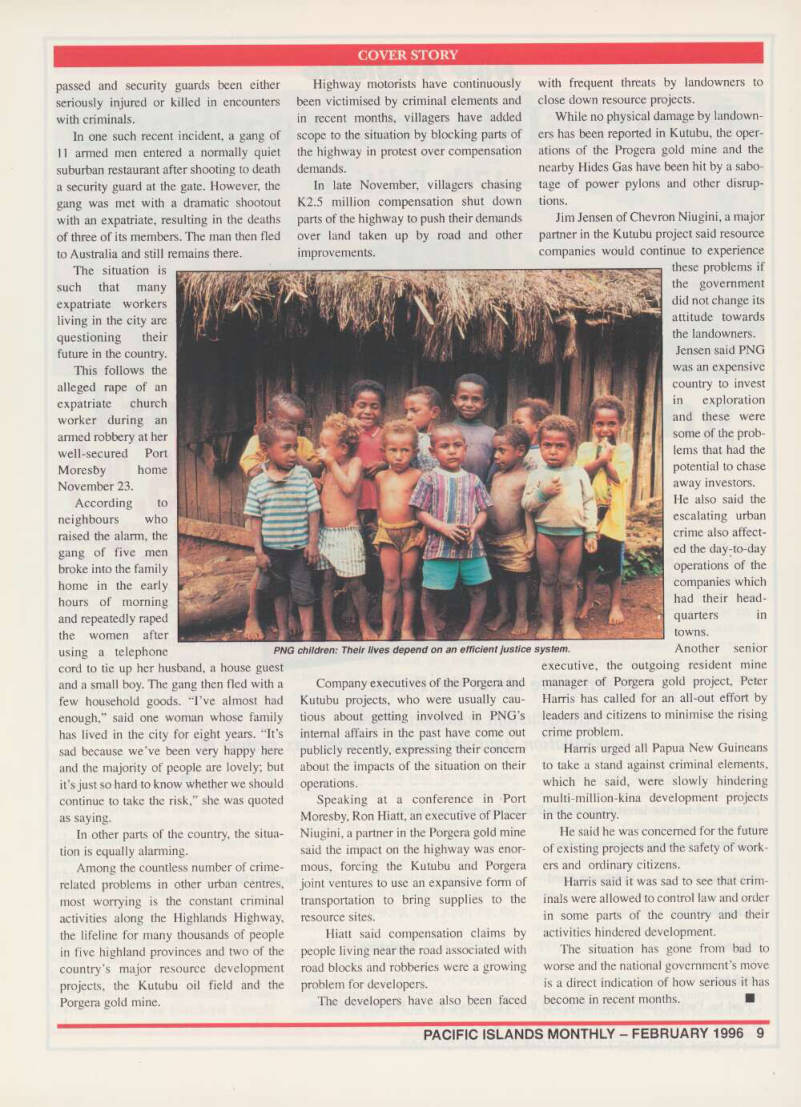
PNG children: Their lives depend on an efficient justice system.
Advertisements & other items, p. 10 (1 item)
Pacific Islands Yearßook
Now Available
17th Edition
Price
AUD
oo - *
PLUS
POSTAGE
m B Leam more about the Pacific
culture/custom tradition!people
population , tourism , airlines , to system etc. i 1 i Yes, send me the latest copy of the Pacific Islands Year Book I I □ Here is a cheque/money order i 1 □ Visa □ Master Card Expiry Date I I Card Number I Name Signature 1 I Address I [ Post to: Pacific Islands Monthly, PO Box 1167 Suva, Fiji or Fax (679) 303809. j 1 J
The Maisin’s logging
Industry
The Maisin’s logging alternative
By Liz Thompson
For some time now there has been attention given to the resource exploitation industries which are at work in Papua New Guinea. Bougainville obviously attracted a great deal of atten tion as land owners efforts resulted in the closing of the copper mine. Now, BHP have been in the media as the extent of the pollution, caused by the lack of a tailings dam for it’s mine at OK Tedi has horrified many people. Images of the river’s dark waters in which fish float dead and stories from the villagers of the environmental impact the mine has had on their lives have caused great concern. Now, the landown ers are threatening to take BHP to court.
These two dramatic events display a marked change in attitude amongst local landowners who are no longer prepared to tolerate environmental degradation and inequitable distribution of profits made from resources taken from their land.
Certain landowner groups are now attempting to find economic alternatives to
mining or large-scale logging. There have
been efforts made in various parts of Papua New Guinea to do this already. In the Hunstein Ranges, the East Sepik Council
of Women along with WWF have attempt ed to set up eco-tourism and the production of a variety of non-timber forest products.
A new and very exciting project along similar lines is currently being set up amongst the Maisin community on the north eastern coast of the island. Between 2500 and 3000 Maisin live here on the edge of the rainforest. The forest is a source of much of their daily needs and home to many ancestral spirits. Over the past 15 years they have been approached by forestry officials and representatives of foreign logging interests to consider sell ing the rights to this land. Initially, some members of the community expressed interest. However, as awareness has increased as to the long-term effects of logging, soil erosion and land degradation, the Maisin have become more interested in developing an alternative to logging. And they have looked toward their traditional custom of producing Tapa cloth for the answer.
A declaration made at a meeting at Uiaku village in July 1994 stated that the
Maisin people; “firmly and unanimously
stand opposed to destructive large-scale industrial logging, and to agricultural
activity that entails the clearing of large areas of forest, in any part of the lands, tra ditionally held by the Maisin people”. It also declared that the Maisin people “seek to work amongst ourselves, with the peo ples whose land adjoins our own, and with the government and other parties to set up Incorporated Land Groups and establish property rights and territorial boundaries for the purpose of creating a legally man dated conservation area, such as a Conservation Area, Wildlife Management Area, National Park, or World Heritage Site, comprising and protecting in perper tutity the entirety of the Maisin lands and sea. Sylvester Moi, who is chairman of the Maisin Tapa group says, “I have witnessed the destruction of the land and social dis turbance of my home. We want to protect our environment and the place we inherit ed from our ancestors. We want to enjoy it now and for generations to come.”
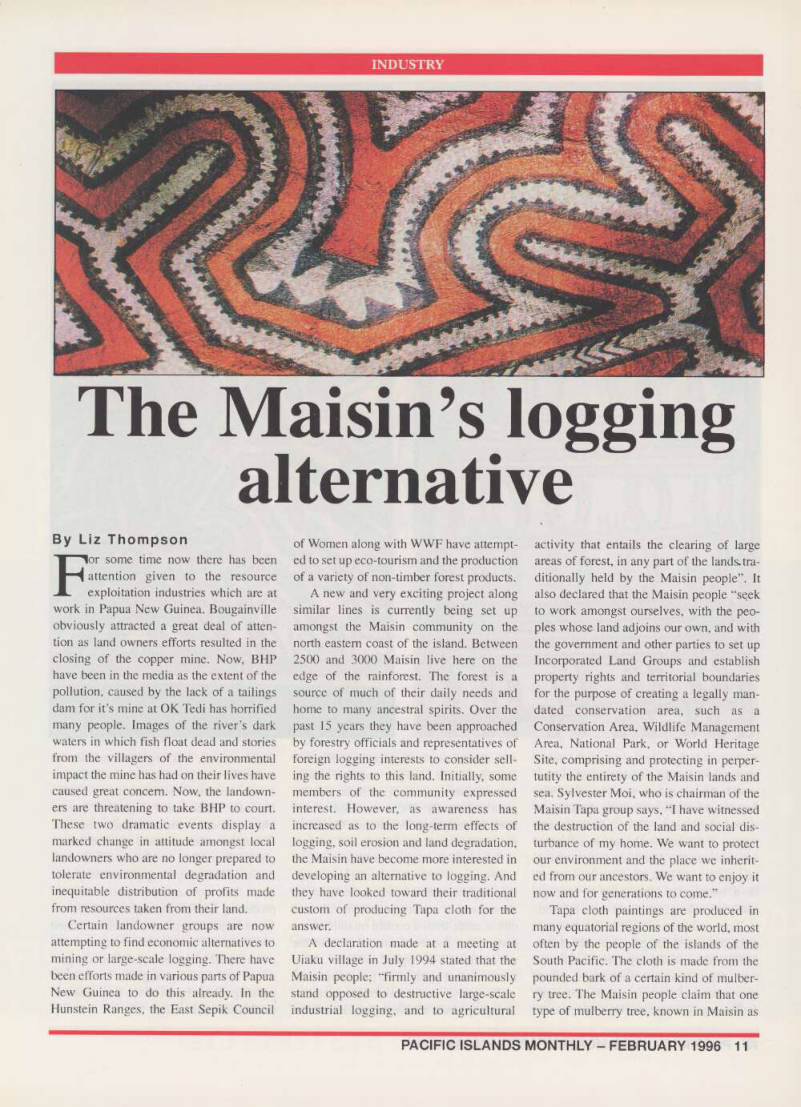
Tapa cloth paintings are produced in
many equatorial regions of the world, most often by the people of the islands of the South Pacific. The cloth is made from the pounded bark of a certain kind of mulber ry tree. The Maisin people claim that one type of mulberry tree, known in Maisin as
wuwusi, which makes some of the finest tapa, grows best in the soils found in their area. In Maisin culture tapa cloth paintings function primarily as clothing, bedding, as sacred clan designs used in healing cere monies and other rituals, and as a form of art and wealth. When used as clothing, tapa cloth is divided into two types, embo bi, a rectangular form worn by women, and koefi, a long, thin form worn by men.
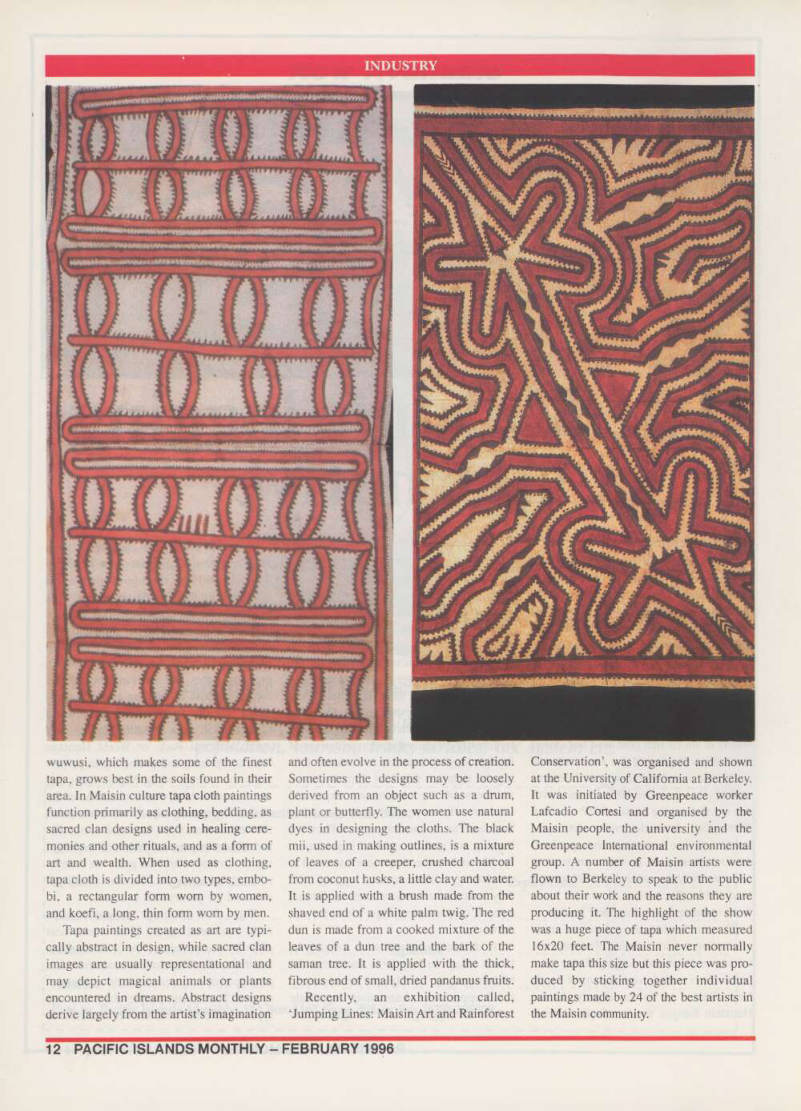
Tapa paintings created as art are typi cally abstract in design, while sacred clan
images are usually representational and
may depict magical animals or plants encountered in dreams. Abstract designs derive largely from the artist’s imagination
and often evolve in the process of creation.
Sometimes the designs may be loosely derived from an object such as a drum, plant or butterfly. The women use natural dyes in designing the cloths. The black mii, used in making outlines, is a mixture of leaves of a creeper, crushed charcoal from coconut husks, a little clay and water.
It is applied with a brush made from the shaved end of a white palm twig. The red dun is made from a cooked mixture of the leaves of a dun tree and the bark of the saman tree. It is applied with the thick, fibrous end of small, dried pandanus fruits.
Recently, an exhibition called, ‘Jumping Lines: Maisin Art and Rainforest
Conservation’, was organised and shown at the University of California at Berkeley.
It was initiated by Greenpeace worker Lafcadio Cortesi and organised by the Maisin people, the university and the Greenpeace International environmental group. A number of Maisin artists were flown to Berkeley to speak to the public about their work and the reasons they are producing it. The highlight of the show was a huge piece of tapa which measured 16x20 feet. The Maisin never normally make tapa this size but this piece was pro duced by sticking together individual paintings made by 24 of the best artists in the Maisin community.
Greenpeace International have become involved in trying to assist the Maisin in marketing their Tapa. Cortesi, who visited the Maisin in 1994 is trying to facilitate communication between the newly set-up Maisin Tapa Business Group and various importers or wholesalers in the US. He is also trying to help the Maisin organise a programme of business training and plan ning and help initiate fundraising. It is intended that as the Maisin’s relationships with importers become more stable and their ability to manage exports increases, this overseeing role will no longer be nec essary.
There have been other ideas similar to this one initiated in other communities in Papua New Guinea. What normally leads to their demise is a lack of organisation; difficulty is securing connections with wholesalers or importers and a poor trans portation infrastructure. These are the hur
dies all small business ventures seem to face. However, with this kind of manage ment assistance it is possible that this pro ject may be more successful.
As far as Cortesi is concerned it is hoped that Maisin Tapa Enterprise will not only be attractive to wholesalers and importers but to interior design shows, museum shows, corporate collections, on line marketing, commissions, environmen tal catalogues and product developers such as designers or clothing manufacturers. It is felt that there is a limited market for raw tapa cloth but if the product can be adapt ed to provide a wider range of products its success is more likely.
Maisin Tapa Enterprises and Greenpeace Pacific believe the tapa will appeal to people who are interested in pur chasing the item itself but in addition to this is the appeal of supporting a commu nities attempt to exist economically in a
way that is culturally and environmentally sustainable. An important selling point will be the exchange of value between the buyer, who is gaining a beautiful cloth and at the same time contributing to the preser vation of one million acres of primary tropical rainforest. It is felt that the cultur al and environmental context of the tapa should be used as a key selling point.
Information about the Maisin people and their decision to reject logging and seek alternative sources of development as well as information on how tapa is made should be provided with the product itself. The information will explain how the purchase of a painting goes towards community pro jects and conservations.
It is hoped that the process will provide a model for other indigenous communities in the Asia-Pacific area who are also searching for ways to blend sustainability and economic self-sufficiency. ■
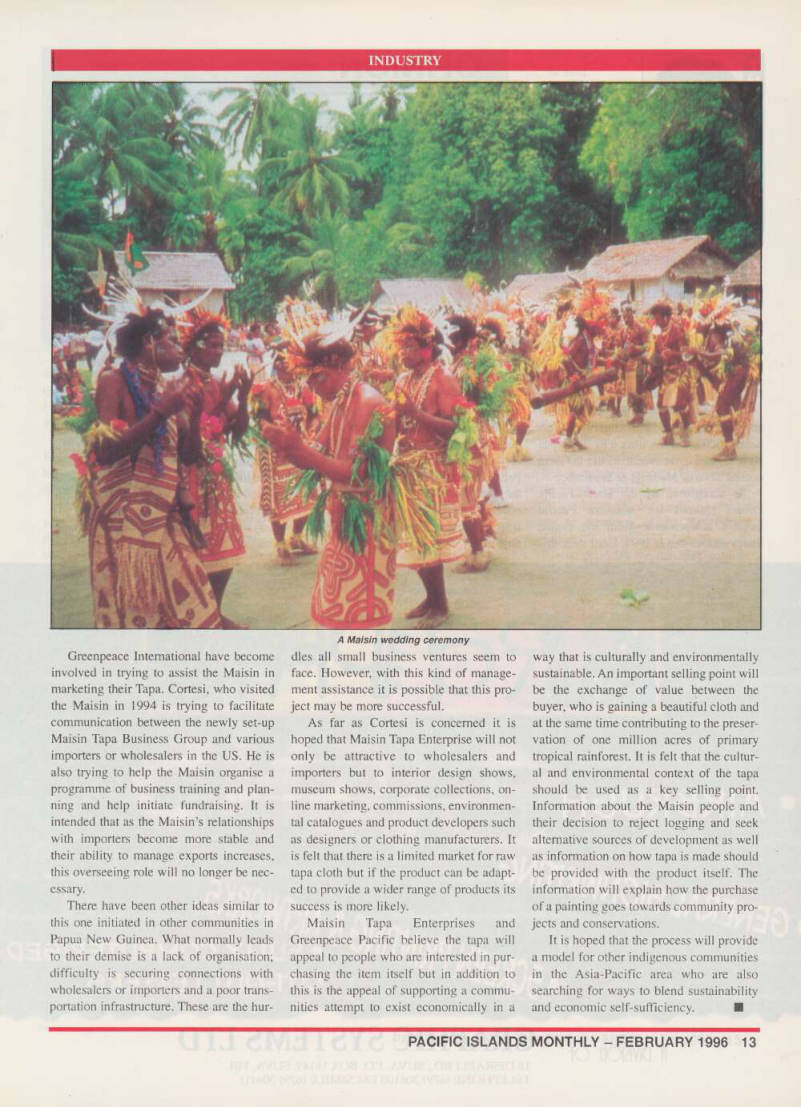
A Maisin wedding ceremony
Welcome Palau,
Opinion
Welcome Palau, South Korea
This year, the South Pacific Forum welcomes into its fold and process es two new additions, the northern Pacific Republic of Palau and South Korea.
Palau’s membership has taken the organisation’s total membership to 16, while Korea becomes the eighth Post- Forum Dialogue Partner.
Palau’s membership was accepted by acclamation at the 26th Summit of the South Pacific Forum, hosted by the Papua New Guinea government in the northern coastal town of Madang, in September.
Its acceptance by the South Pacific Forum follows the northern Pacific nation’s independence from the United States on October 1, 1994. Until then, this
nation of 15,000 people was a Trust Territory of the United States.
What is the significance of Palau’s
membership?
For outsiders, it probably does not mean much. For the South Pacific Forum it means that, as an organisation, it has an added voice at international fora.
It also means Palau can fully partici pate in the range of regional programmes administered by the South Pacific Forum Secretariat.
Palau’s membership of the South Pacific Forum brings back memories of the 1960’s and 1970’s wh'f many island countries were on an irreversible course with political independence as their des
tiny.
From 1970 on, those countries which were yet to secure their political indepen dence never looked back. Within that decade alone, six countries gained full independence. It started with Fiji in 1970, Papua New Guinea followed in 1975, Solomon Islands and Tuvalu in 1978, Kiribati in 1979 and Vanuatu in 1980. A great decade for the region.
In fact, I can remember quite vividly what seemed an endless shuttle diplomacy in the late 1960’s through the early 1970’s between London and island countries as emerging island leaders negotiated terms of political independence with the British government.
It was not easy, but they made it. Thank goodness there was no bloodshed. And so
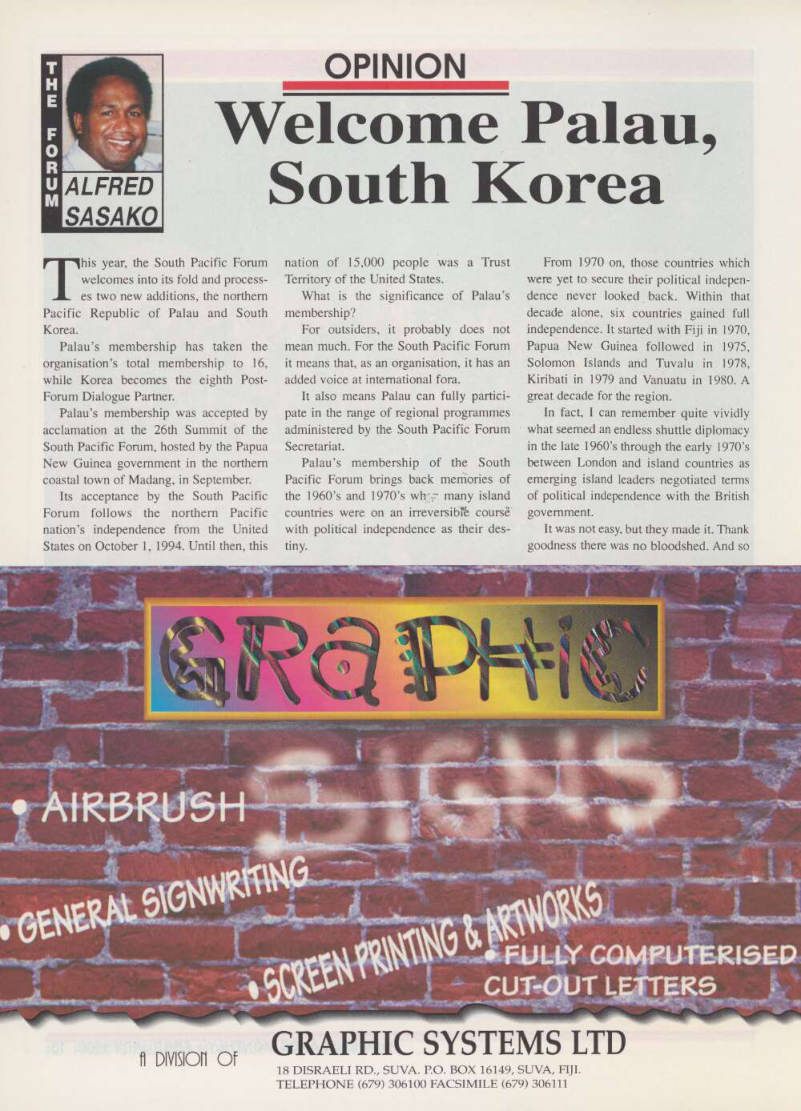
The Forum
Alfred
Sasako
the independence of Palau and its subse quent membership of the South Pacific Forum is one of jubilation for leaders of the Forum.
The president of Palau, His Excellency Kuiwo Nakamura, expressed it well when he spoke in response to his country’s admission last September.
He said: “It is an honour and pleasure to at last become a full-fledged member of the South Pacific Forum. Palau’s admis sion to this distinguished Forum is like coming home after a long absence from
one’s family.”
And what a growing family the South Pacific Forum is. From only seven found ing members (Australia, the Cook Islands, Fiji, Nauru, New Zealand, Tonga and Western Samoa) in 1971, it has seen a huge growth in membership in the last two decades.
True, there have been instances of squabbling here and there over the years, but what is a family without these?
In welcoming Palau, the chairperson of the South Pacific Forum and Prime Minister of Papua New Guinea, Sir Julius Chan, said that as a new member, Palau would bring new inspiration and new thinking on regional issues.
In response, President Nakamura told Forum leaders that until now, his country’s
participation in international organisations
with other members of the Pacific had been limited for historical reasons.
But now it is eager to work closely with fellow Forum members “to preserve our marine environment and resources, pro mote regional economic co-operation and
plan for the challenges we will face together in the coming century.”
President Nakamura said there was a need to build bridges between South Pacific Forum member nations and the rest of the world.
“For too long, the Pacific ocean, which defines us as an organisation, has also been a barrier separating our island nations and the rest of the world.
“As we move forward into the next millennia, we must build strong bridges between our nations which will serve our mutual interests (in) ... three areas tourism, aviation and communications.”
The Pacific as a region is beautiful.
And beauty and tranquility are a tourist’s dream. In his view, member countries of the Forum should work together to pro mote tourism on a regional basis, instead of competing against each other.
“By enhancing our regional appeal on a worldwide basis rather than competing with each other, all of our nations will ben efit,” he said.
In aviation, the president told his col leagues that Palau was currently negotiat ing with major Japanese and Taiwanese air carriers for regular direct flights to Palau from Japan and Taiwan.
“We would be willing to include other neighbouring nations in such discussions
to develop multiple-stop flights,” he said.
President Nakamura also spoke of the need to develop and share the cost of
regional communications, especially the
cost of undersea fibre optic cables and satellites.
“Because such projects are expensive,
it makes sense to work together regionally he said.
With this in mind, Palau, he said, had signed a Memorandum of Understanding (MOU) with international communication companies in Indonesia, Malaysia, Brunei and the Phillipines “to study the feasibility of a regional undersea fibre optic cable which can serve all our nations.”
His country is also exploring the possi
bility of jointly developing satellites in
both the Indian and Pacific Oceans specif
ically designed to suit regional communi
cation needs.
Also new to the Forum this year is South Korea - one of the economic giants of Asia.
South Korea became a Post-Forum Dialogue Partner la ! st September when it took part for the first time in the minister ial talks after the Madang Forum.
Established in 1989, the Post-Forum Dialogue provides a face-to-face discus sion at ministerial level on issues raised by the leaders of the Forum.
It is a two-way process. For members of the Forum it provides an opportunity to convey important decisions on major issues to members of the Post-Forum
Dialogue.
It also provides the dialogue partners with an opportunity to raise with Forum members any matters they so wish.
Although new to the Post-Forum Dialogue, to the region South Korea is not a newcomer by any means.
It has invested in many industries in many Forum Island Countries including Fiji and Papua New Guinea. In Fiji for example, South Korea’s investment was said to be valued at around Fs33 million.
In PNG, the value of South Korea’s investment in logging, fisheries and other industries is said to be even higher.
In return, South Korean products such as its famous Hyundai cars, Samsung tele vision sets, video recorders and other elec tronic gear are common in Forum Island Countries.
Its membership as a Post-Forum Dialogue Partner, no doubt, has opened up new opportunities for both sides in the areas of trade, tourism and investment.
Fiji, for instance, has already tapped into its tourism industry market with the recent introduction of Korean Airlines four flights a week through Nadi.
No doubt, others will follow suit. ■
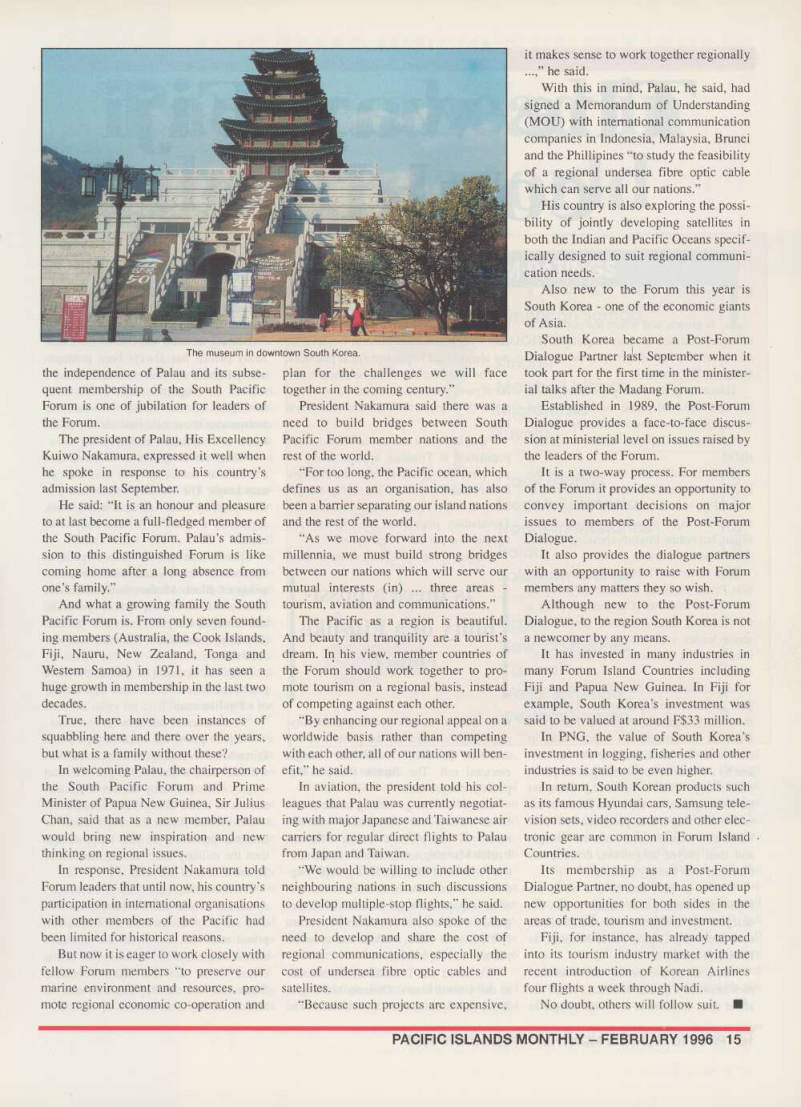
The museum in downtown South Korea.
Advertisements & other items, p. 14 (1 item)
Graphic Systems Ltd
18 DISRAELI RD., SUVA. RO. BOX 16149, SUVA, FIJI.
TELEPHONE (679) 306100 FACSIMILE (679) 306111
The way Fiji
Politics
The way Fiji could be
By David North
There is a tropical island nation, a former British colony, where sugar is grown, and where the population of about a million is almost equally divid ed between two ethnic groups, one of them being the East Indians.
Historically, the other population group has controlled the prime ministership, but for the first time an Indian has won the job.
Sounds like Fiji just before the coup,
right?
Well, in this case, the sea is not the Pacific, it is the Caribbean; and the nation is not Fiji, it is Trinidad and Tobago. And the other major population group is not Fijian, but rather, English-speaking Blacks, descendants of African slaves.
The victor in Trinidad, and new coali tion Prime Minister is Basdeo Panday of the United National Congress (UNC); a
62-year-old, British-trained lawyer and
union leader who had served as foreign minister in a previous coalition govern ment.
His coalition has the narrowest of mar gins in the 36-seat parliament. UNC and
the rival (indigenous-dominated) People’s
National Movement each won 17 seats in the November elections. The tie was bro ken by a two-seat, largely indigenous party, once a major force in Trinidad politics, but now strong only on the lesser island in the nation of Tobago. That party, led by A N R Robinson, won the two seats on Tobago,
and then played kingmaker, creating the
coalition with Panday’s faction.
It is as if there had been a tie in the Fijian parliament which was broken by the delegate from Rotuma; with the Rotuman then becoming Deputy Prime Minister, as Robinson has done.
There are differences as well as similar ities between Fiji and Trinidad. There are about three-quarters of a million people in
Fiji, and about one and a quarter million in Trinidad. Trinidad, with both oil and asphalt deposits, has twice the per capita income of Fiji, but three times its external debt - suggesting that mineral wealth does not always lead to prudent fiscal practices.
The calm that followed the ethnic trans fer of power in Trinidad reflected two other major differences between that nation and
Fiji.
First, there is a substantial mixed blood population in Trinidad, approximately 14 per cent; this tends to blur the African- Indian division. (There is nothing compa rable in Fiji.) About one percent of the Trinidadian population is Chinese and another one per cent is European.
Second, there is a totally different elec
“Is there a possi bility of a Fiji-like coup?”
toral system. Instead of using ethnically segregated electorates, the pattern in Fiji and New Zealand, Trinidad has a single electoral roll. The British first-past-the post system prevails.
One of the things leading to the recent UNC victory was unhapiness with the record of the previous Prime Minister, Patrick Manning, and another was the rela tive turnouts of the two ethnic groups - sig nificant when there is a common roll, but of no importance when the seats are segre gated. In the last election about 60 per cent of the Blacks voted, while it was about 80 per cent for the Indians.
We asked the Trinidadian ambassador to the United States, Corinne McKnight, about the dynamics of the election. The
ambassador, an appointee of the last gov
ernment, said; “The really important thing
is that a largely Black party decided to sup port Panday, that’s the big story.”
Bearing in mind the role of the Fijian Army (which has always been predomi nantly Fijian), and the somewhat different role of the Yugoslav Army (historically dominated by the Serbs) we asked the ambassador about the ethnic identity of the leader of Trinidad’s small army.
“Well, our Brigadier is Carl Alfonso, and he’s all mixed up” she said with an easy laugh. The mix she was referring to was the army leader’s ethnic background, apparently a blend of African and Indian blood.
Trinidad has had its share of political violence in recent years. For example, a group of Black Muslim fundamentalists, killed a number of people a few years ago and besieged the parliament and the then (Black) prime minister. The army later res cued them.
With this in mind, as well as the Suva precedent, we asked: “Is there a possibility
of a Fiji-like coup?”
“Not a chance” said she.
As if to prove the ambassador’s point, Prime Minister Panday, at the time this was written, was in a London Hospital for heart surgery. This is exactly the set of circum stances in which Third World coups occur - the elected leader is off in Paris or London, preferably in the hospital, and then the military takes action. But not in Trinidad, at least not now.
Other sources support the ambassador’s optimism; maybe this was simply the first of a series of alternations of Trinidadian prime ministers, from African to Indian and back again, just as control of the White House moves back and forth between the Democrats and the Republicans, with no hint of military intervention. ■
Pacific ahead in
the free world
By David North
There is more political freedom in the insular Pacific than anywhere else in the world, except in Western Europe, according to a recent Think Tank report.
Most Pacific island jurisdictions were rated in the highest category of “free” in the annual survey conducted by New York’s Freedom House. Governments were given ratings ranging from 1 (the most free) down to 7, (the least free) in this system.
But Tonga, PNG and Fiji were excep tions; all were judged to be “partly free” in the survey.
Tonga’s score was 4, PNG’s 3.0, and Fiji drew a 3.5. The worst scores in the general area went to two of PNG’s neigh bors, Indonesian-ruled Irian Jaya and East Timor, both at 7. 1 The Freedom House system, which uses scholars and journalists to keep track of the general level of freedom around the
world, provides in the larger jurisdictions
two sets of scores, one for political rights, and the other for civil liberties. It uses the same one-to-seven set of measures.
Tonga, with its royalty and a legislature dominated by a hereditary aristocracy, got a score of 5 for political rights, and 3 for civil liberties, for an average of 4.
Fiji’s 3.5 rating was based on a 4 for political rights and a 3 for civil liberties; (prior to the coup Fiji’s ratings were more favourable).
PNG’s 3.0 resulted from a relatively high 2.0 for political rights, and a much lower 4.0 for civil liberties.
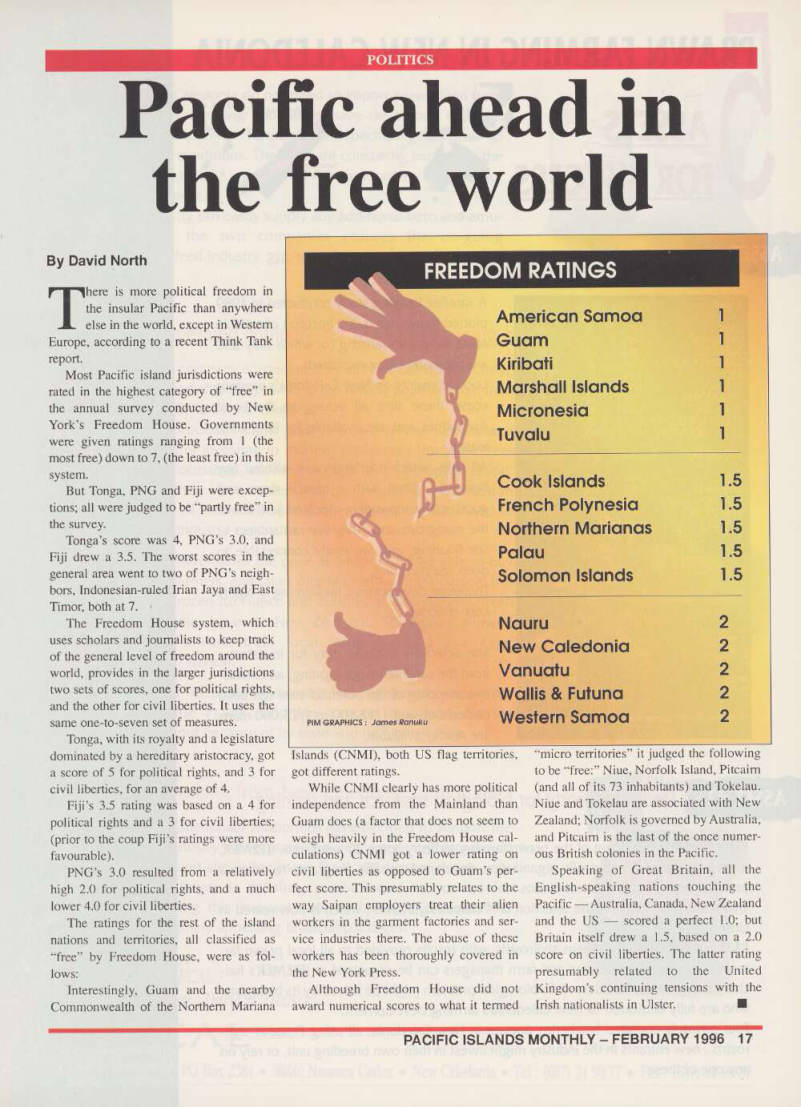
The ratings for the rest of the island nations and territories, all classified as “free” by Freedom House, were as fol lows: Interestingly, Guam and the nearby Commonwealth of the Northern Mariana
Islands (CNMI), both US flag territories, got different ratings.
While CNMI clearly has more political independence from the Mainland than Guam does (a factor that does not seem to weigh heavily in the Freedom House cal culations) CNMI got a lower rating on civil liberties as opposed to Guam’s per fect score. This presumably relates to the way Saipan employers treat their alien workers in the garment factories and ser vice industries there. The abuse of these workers has been thoroughly covered in the New York Press.
Although Freedom House did not award numerical scores to what it termed
“micro territories” it judged the following to be “free:” Niue, Norfolk Island, Pitcairn (and all of its 73 inhabitants) and Tokelau.
Niue and Tokelau are associated with New Zealand; Norfolk is governed by Australia, and Pitcairn is the last of the once numer ous British colonies in the Pacific.
Speaking of Great Britain, all the
English-speaking nations touching the
Pacific —Australia, Canada, New Zealand and the US scored a perfect 1.0; but Britain itself drew a 1.5, based on a 2.0 score on civil liberties. The latter rating presumably related to the United Kingdom’s continuing tensions with the Irish nationalists in Ulster. ■
Freedom Ratings
American Samoa 1 Guam 1 Kiribati 1 Marshall Islands 1 Micronesia 1 Tuvalu 1
Cook Islands 1.5 French Polynesia 1.5 Northern Marianas 1.5 Palau 1.5 Solomon Islands 1.5
Nauru 2 New Caledonia 2 Vanuatu 2 Wallis & Futuna 2 Western Samoa 2
PIM GRAPHICS : James Ranuku
Advertisements & other items, pp. 18-19 (1 item)
For Success
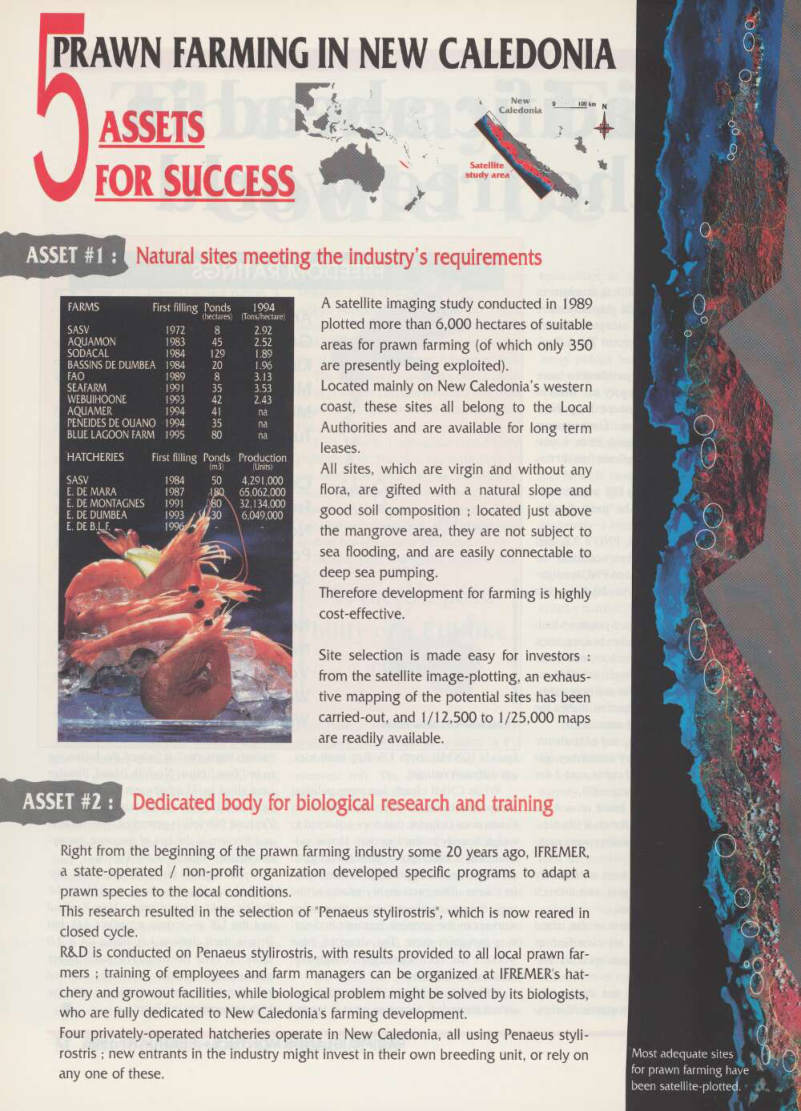
PRAWN FARMING IN NEW CALEDONIA
I ;
ASSETS
FOR SUCCESS
v- New Caledonia 0 100 km Satellite study area
Natural sites meeting the industry’s requirements
. * ' '1 m hi . , r i • ’>. : * A satellite imaging study conducted in 1989 plotted more than 6,000 hectares of suitable areas for prawn farming (of which only 350 are presently being exploited).
Located mainly on New Caledonia’s western coast, these sites all belong to the Local Authorities and are available for long term leases.
All sites, which are virgin and without any flora, are gifted with a natural slope and good soil composition ; located just above the mangrove area, they are not subject to sea flooding, and are easily connectable to deep sea pumping.
Therefore development for farming is highly cost-effective.
Site selection is made easy for investors : from the satellite image-plotting, an exhaustive mapping of the potential sites has been carried-out, and l/12,500 to 1/25,000 maps are readily available.
Dedicated body for biological research and training Right from the beginning of the prawn farming industry some 20 years ago, IFREMER, a state-operated / non-profit organization developed specific programs to adapt a prawn species to the local conditions.
This research resulted in the selection of "Penaeus stylirostris", which is now reared in closed cycle. is conducted on Penaeus stylirostris, with results provided to all local prawn farmers ; training of employees and farm managers can be organized at IFREMERs hatchery and growout facilities, while biological problem might be solved by its biologists, who are fully dedicated to New Caledonia's farming development.
Four privately-operated hatcheries operate in New Caledonia, all using Penaeus stylirostris ; new entrants in the industry might invest in their own breeding unit, or rely on any one of these.
State-of-the-art prawn feed industry
Farmers in New Caledonia do not need to import prawn feed from abroad : two local milling companies have developed efficient, reliable and competitive formulations, specifically adapted to New Caledonian conditions. The mills are constantly backed by the University of Texas (USA) and the INVEE corporation (Belgium) for quality improvement.
Production capacity can easily supply any additional farm and emulation between the two companies ensures the on-going efficiency of the feed industry.
CVO *
oUP' MID
boui 0* ■3.51 i * □ j
MOULIN OS sr- VINCENT
La TANIOA
L,MErJTS POUR ANHUO
oiDs net 30 no w
Co-operated
company for prawn processing and shipment
SOPAC, a private company co-operated by all New Caledonian farms, aims to process and ship the prawns at the lowest possible cost, then passing the benefit to its shareholders.
Because SOPAC processes all the prawns grown in New Caledonia, it has been capable of investing in modern equipment (for brine freezing and other processing), allowing exports to the European Union, Japan and other very demanding markets. Production capacity reaches 10 tons / day, and further expansion is planned to cope whith local industry expansion.
SOPAC regularly determines the price at which it will be able to buy the prawns from farmers, and takes care of local and international trading either bulk frozen (to France and Europe) or air freighted (fresh prawns to Australia, japan or New Zealand). '95 figures allowed SOPAC to buy prawns from local farms for US$ 8.2 / kg (1 US$ - 5 French Francs). > * *** New Caledonia's Penaeus stylirostris is registered under the trademark "Paradise Prawn", and has a good reputation on the market, standing out because of its taste and its high quality.
Full backing from New Caledonia Authorities
French and New Caledonian Authorities have decided to support the prawn farming industry while providing very important grants and financing means, and alleviating many fiscal and custom duties.
The investment climate is definitely pro-business, and companies considering entering this buoyant industry in New Caledonia will benefit from extremely appealing financial packages. u- <C§3 Your contact at ADECAL: International Projects: David H. Delisle a rvr a i
I V L
15, rue Guynemer • PO Box 2384 • 98846 Noumea Cedex • New Caledonia • Tel paradise prawns
I feiiP
: (687) 24 90 77 • Fax: (687) 24 90 87
Experiment in
Opinion
Experiment in parliamentary democracy
This is an historic election year in New Zealand and about 20-odd
political parties are beginning to
woo voter support in the hope of winning a say in the next government.
Historic because after 140 years of
Westminster-style, first-past-the post elec
tions, this country will have its first poll with a new voting system called Mixed Member Proportional (MMP).
The system, used in Germany since the end of World War 11, will increase the number of MPs from 99 to at least 120 and is supposed to be fairer, in that, it will give minor parties more chance of getting rep resentatives elected to Parliament.
It will end the monopoly on power the National and Labour parties have enjoyed for nearly six decades and almost certainly produce a new era of coalition govern ments. With no one party likely to have enough MPs to govern single-handed, minority communities and interests should have an influential voice in Parliament for the first time in two generations.
That at least is the theory. Whether it turns out that way when New Zealand’s new experiment in parliamentary democ racy is actually underway remains to be seen. No section of New Zealand society has more at stake in this new political envi ronment than the Pacific island communi ty, which has had a lone voice in Parliament in the form of opposition Labour MP Taito Phillip Field - and he only for the past two years.
The 170,000-plus, according to the lat est 1991 census. Pacific island people liv ing here have been sadly under-represent ed in Parliament, given they account for about five per cent of the population.
As a predominantly young community - half of them are under 20 - and as one of the fastest-growing in the country, they need more MPs of their own and they need more representatives willing to argue for
their interests.
For they remain the most under-privi leged and disadvantaged section of New Zealand society. Their current unemploy ment rate stays around the 17 per cent mark, the highest of the country’s three major ethnic groups, and nearly half the community’s teenagers are jobless.
The median income of the total Pacific island population is less than half the pake ha average and they figure disproportion ately badly in other economic, health and social welfare indicators.
Because they are largely unskilled and tend to work mainly in the manufacturing sector, they have found it more difficult than most other New Zealanders to recov er from the dramatic effects of the coun try’s post-1984 economic restructuring.
The National Party government, which naturally wants to regain power (or a major share of it), will campaign this year on the strength of an economic recovery.
The indicators are undeniable. After 15 years of growth up to 1990 averaging 1.5 per cent a year, well down on the Western world’s average, New Zealand is now on the rise.
Inflation, which plagued the country throughout the 1970’s and 1980’s, has been pegged below the government’s two per cent annual target.
The economy is into its fourth year of growth, having expanded by five to six per cent in each of the past two years. This was clearly not sustainable and it has slowed to a predicted 2.3 per cent for the year ending next month.
But analysts have predicted a rise to more than three per cent next year and nearly five per cent in 1998 - all good news for the National Party government.
Much of this increase will be attributed to election sweetener income tax cuts announced by Finance Minister Bill Birch just before Christmas. Birch is in the envi
able position of having sizeable and grow ing budget surpluses to start getting rid of in an election year.
Actual details will not be revealed until this month, but he has made it clear it will not be a one-off cut, holding out the prospect of a number of reductions in tax rates over the next few years.
“New Zealanders pay too much tax,”
Birch says. And we all say “Hear, hear” to that.
The question is: How will all this help the Pacific island community?
Birch says his cuts will be aimed at lower to middle income earners, which should assist the majority of the islands workers in that category.
But they won’t do anything for the nearly one-in-five Pacific islanders who don’t have a job and therefore have no income to pay tax on.
The minister replies that reducing taxes will improve economic growth, create more jobs and make it more attractive for people to move from welfare to work.
This last point is critical, for the 1991 census showed that more than half Pacific island male adults and two-thirds of the women were receiving some form of income support from the government.
Commentators here say unemployment and poverty have now become structural features of New Zealand life. In no section of the population is that more true than in the Pacific island community.
That is why it is imperative the islands
people take advantage of the political
changes to get a bigger say in Parliament.
But they will have to do it themselves.
It is unlikely others will wage their cam paign for them.
And at this stage, there is little sign of Pacific island candidates rushing to stand for Parliament.
This year, as never before, their future in this country is in their hands. ■
Wellington
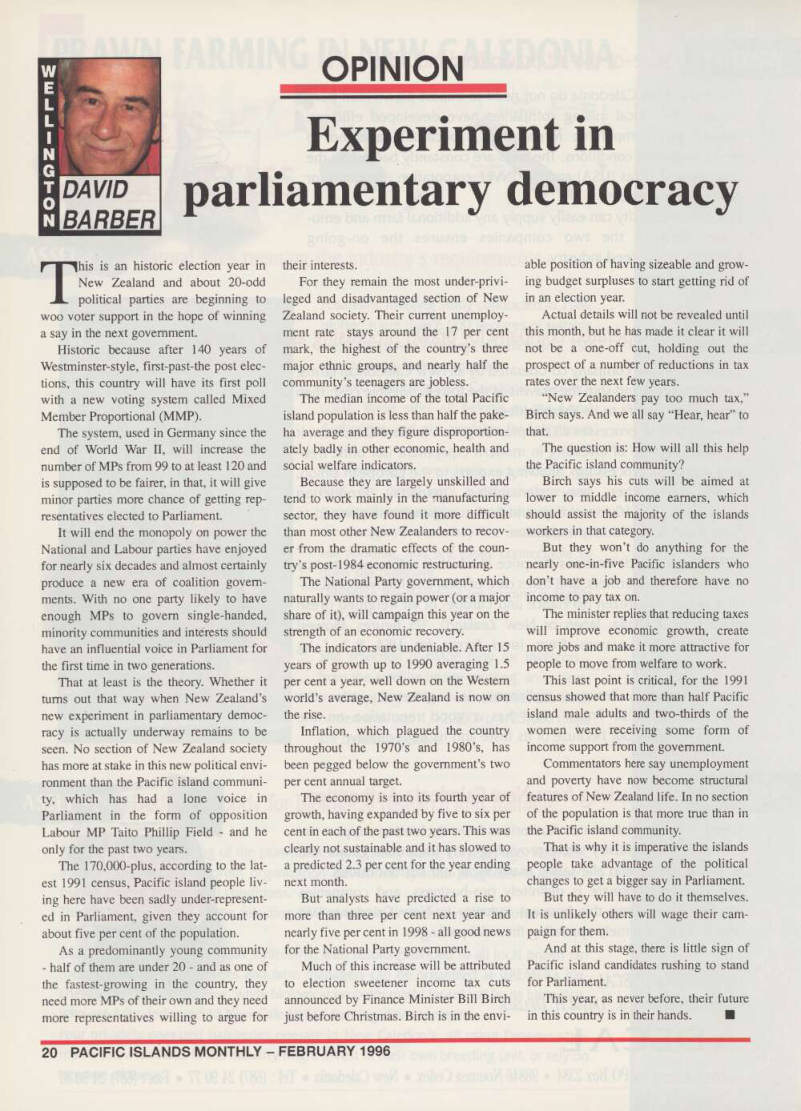
David
Barber
Peace Corps leave,
Region
Peace Corps leave, ambassadors arrive
By David North
The American Peace Corps will leave the Marshalls shortly, and Fiji and Tuvalu early in 1998, but, in the meantime, the US has replenished its supply of ambassadors to the Pacific islands.
Beset by budget cutbacks, the Peace Corps has decided to close down its popu lar operations in the three island nations, while keeping other projects going in nine other Pacific locations.
As widely reported, the Republican Congress and the Clinton administration disagree on the importance of anything smacking of social work, domestic as well as international; the congress abhors it, and the administration does little to defend it. So, congress decided to cut back the
already hard-pressed Peace Corps by five
percent which, when accounting for infla tion, means a real reduction of about 8 per cent.
The Peace Corps, then, through an internal process whose outlines are fuzzy, decided to drop a number of countries around the world, including the three in the Pacific.
The new Peace Corps director, Mark Gearan (formerly a White House commu nications executive), would like to keep as many Peace Corps Volunteers in the field as possible, and to keep them in as many countries as possible, a Peace Corps spokesperson told us. Then he added, "but if there is a choice between reducing the number of volunteers in the field, and the number of countries served, we have to reduce the number of places served.”
This is a strange posture for the US to take. It’s as if the ultimate goal of the Peace Corps is to provide an uplifting, useful overseas experience for as many Americans as possible (which it does), rather than seeking to create as many
friends for the US as possible among the nations of the world.
But if the Peace Corps want to max imise the number of volunteers overseas, it
clearly is more costly to run a large num ber of small operations, rather than fewer,
larger ones.
With that in mind, the decisions on
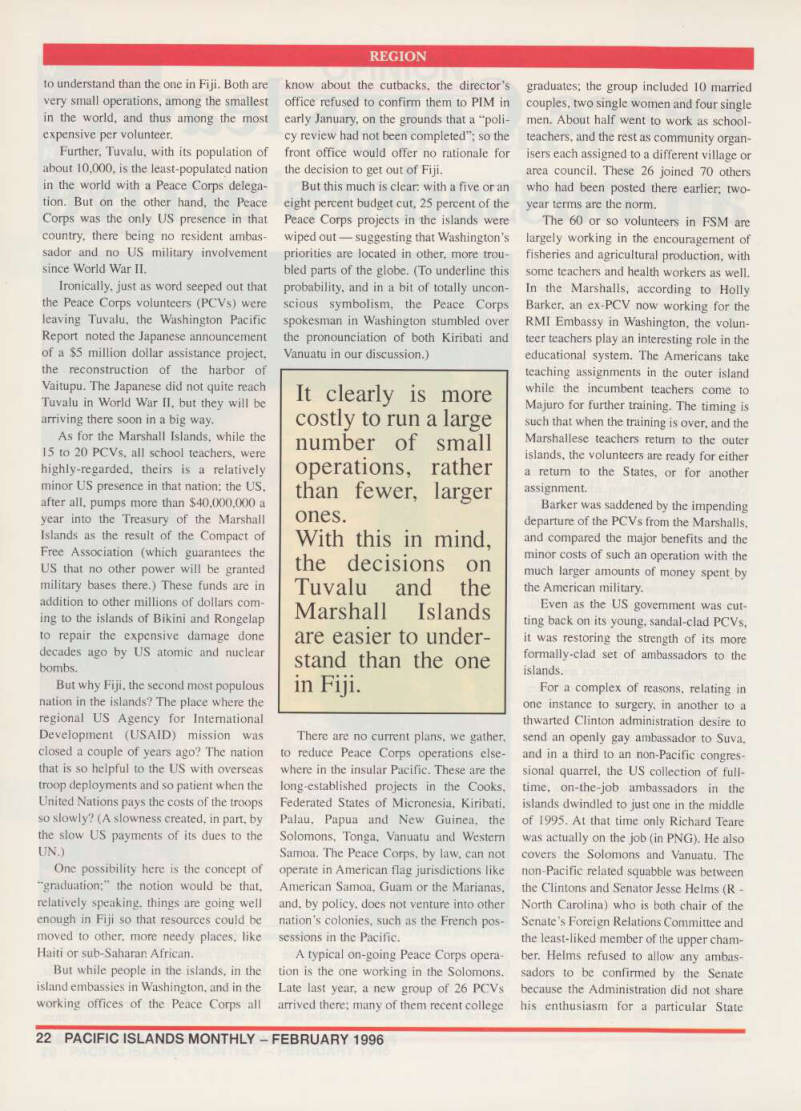
Joan Plaisted: US ambassador to the Marshall Islands
to understand than the one in Fiji. Both are very small operations, among the smallest in the world, and thus among the most expensive per volunteer.
Further, Tuvalu, with its population of about 10,000, is the least-populated nation in the world with a Peace Corps delega tion. But on the other hand, the Peace Corps was the only US presence in that country, there being no resident ambas sador and no US military involvement since World War 11.
Ironically, just as word seeped out that the Peace Corps volunteers (PCVs) were leaving Tuvalu, the Washington Pacific Report noted the Japanese announcement of a $5 million dollar assistance project, the reconstruction of the harbor of Vaitupu. The Japanese did not quite reach Tuvalu in World War 11, but they will be arriving there soon in a big way.
As for the Marshall Islands, while the 15 to 20 PCVs, all school teachers, were highly-regarded, theirs is a relatively minor US presence in that nation; the US, after all, pumps more than $40,000,000 a year into the Treasury of the Marshall Islands as the result of the Compact of Free Association (which guarantees the US that no other power will be granted military bases there.) These funds are in addition to other millions of dollars com ing to the islands of Bikini and Rongelap to repair the expensive damage done decades ago by US atomic and nuclear bombs.
But why Fiji, the second most populous nation in the islands? The place where the regional US Agency for International Development (USAID) mission was closed a couple of years ago? The nation that is so helpful to the US with overseas troop deployments and so patient when the United Nations pays the costs of the troops so slowly? (A slowness created, in part, by the slow US payments of its dues to the UN.) One possibility here is the concept of "graduation;” the notion would be that, relatively speaking, things are going well enough in Fiji so that resources could be moved to other, more needy places, like Haiti or sub-Saharan African.
But while people in the islands, in the island embassies in Washington, and in the working offices of the Peace Corps all
know about the cutbacks, the director’s office refused to confirm them to PIM in early January, on the grounds that a “poli cy review had not been completed”; so the front office would offer no rationale for the decision to get out of Fiji.
But this much is clear: with a five or an eight percent budget cut, 25 percent of the Peace Corps projects in the islands were
wiped out suggesting that Washington’s
priorities are located in other, more trou bled parts of the globe. (To underline this probability, and in a bit of totally uncon scious symbolism, the Peace Corps spokesman in Washington stumbled over the pronounciation of both Kiribati and Vanuatu in our discussion.)
It clearly is more costly to run a large number of small
operations, rather
than fewer, larger ones.
With this in mind, the decisions on Tuvalu and the Marshall Islands are easier to under stand than the one in Fiji.
There are no current plans, we gather, to reduce Peace Corps operations else where in the insular Pacific. These are the long-established projects in the Cooks, Federated States of Micronesia, Kiribati, Palau, Papua and New Guinea, the Solomons, Tonga, Vanuatu and Western Samoa. The Peace Corps, by law, can not operate in American flag jurisdictions like American Samoa, Guam or the Marianas, and, by policy, does not venture into other nation’s colonies, such as the French pos sessions in the Pacific.
A typical on-going Peace Corps opera tion is the one working in the Solomons.
Late last year, a new group of 26 PCVs arrived there; many of them recent college
graduates; the group included 10 married couples, two single women and four single men. About half went to work as school teachers, and the rest as community organ isers each assigned to a different village or area council. These 26 joined 70 others who had been posted there earlier; two year terms are the norm.
The 60 or so volunteers in FSM are largely working in the encouragement of fisheries and agricultural production, with some teachers and health workers as well.
In the Marshalls, according to Holly Barker, an ex-PCV now working for the RMI Embassy in Washington, the volun teer teachers play an ihteresting role in the educational system. The Americans take teaching assignments in the outer island while the incumbent teachers come to Majuro for further training. The timing is such that when the training is over, and the Marshallese teachers return to the outer islands, the volunteers are ready for either a return to the States, or for another assignment.
Barker was saddened by the impending departure of the PC Vs from the Marshalls, and compared the major benefits and the minor costs of such an operation with the much larger amounts of money spent by the American military.
Even as the US government was cut ting back on its young, sandal-clad PCVs, it was restoring the strength of its more formally-clad set of ambassadors to the islands.
For a complex of reasons, relating in one instance to surgery, in another to a thwarted Clinton administration desire to send an openly gay ambassador to Suva, and in a third to an non-Pacific congres sional quarrel, the US collection of full time, on-the-job ambassadors in the islands dwindled to just one in the middle of 1995. At that time only Richard Teare was actually on the job (in PNG). He also covers the Solomons and Vanuatu. The non-Pacific related squabble was between the Clintons and Senator Jesse Helms (R - North Carolina) who is both chair of the Senate’s Foreign Relations Committee and the least-liked member of the upper cham ber. Helms refused to allow any ambas sadors to be confirmed by the Senate because the Administration did not share his enthusiasm for a particular State
Department reorganization plan.
Eventually, a compromise was worked out, and that cleared the way for California millionaire and political activist, Don Gevirtz, and his wife, Marilyn, to come to Suva.
Gevirtz’s nomination was freed by Helms, as was that of career diplomat Joan M. Plaisted. Gevirtz also covers Nauru, Tonga, and Tuvalu while Plaisted does both the Marshalls and Kiribati.
Plaisted leaves a highly-charged job in Washington, as Director of the Office of Thailand and Burmese Affairs, to replace
the long-departed, and retiring David Hobbs in Majuro. (The State Department faces a quandary in Burma should it deal with the
military dictatorship so
that it can curb the drug trade in the Golden Triangle? Or should it give a cold shoulder to
one of the worst dictatorships in the world?) Speaking of cold, the new ambassador to the Marshalls grew up in frosty Minnesota. Her career has taken her to Hong Kong, to Taiwan, and to Morocco, where she was Charge d’Affaires. She has also held a series of senior posts in inter national trade; the latter work will be valu able in the Marshalls which is seeking valiantly to increase its exports. She speaks five languages in addition to English (but not Marshallese, not yet.) Meanwhile, elsewhere in the Pacific, smbassador March Fong Eu, a ranking California politician, was back at work in FSM following her eye surgery. And the third of the Associated States, Palau, was about to receive its first U.S. ambassador.
John Negroponte, who is expected to serve in Koror, will spend most of his time in Manilla, where he has been the U.S. ambassador for some time. He is a highly regarded career ambassador who once held the coveted embassy in Mexico City - a task almost always saved for political appointees. The announcement of his appointment to Palau was expected to be made shortly after the first of the year.
Negroponte speaks Spanish, vital in
Mexico City, useful in Manilla, but of aca
demic interest only in Palau, although, it, too, is a former Spanish colony. While most Americans can not name the US ambassador to Manila, much less the one assigned to Palau, Negroponte gained a measure of fame in late 1995.
More than 20 years earlier he had been recognized by former Secretary of State Henry Kissinger as a comer in the Department, and was taken to the Paris Peace Talks that ended the Vietnam War.
Negroponte’s role in those negotiations was brought to the viewing public’s atten tion last year in a made-for-television
Should it give a cold shoulder to one of the worst
dictatorships in
the world?
movie called “Nixon and Kissinger.” At one point in the widely-seen film the
actor playing
Kissinger turned to another actor and said, “And what do you think about that,
Negroponte?”
Among the posts
held by the real-life Negroponte between the Paris peace talks and the ambassador ship to the Phillipines was that of Assistant Secretary of State for Oceans and International Environmental and Scientific Affairs useful background for those vis its to Koror.
Meanwhile, in a maneuver in the best Jesse Helms tradition, Palau is denying itself the services of an ambassador to the US. President Kuniwo Nakamura has appointed Masamaru Tmodrang, an educa tor, to the post. The foreign affairs com mittee of the upper house of Palau’s legis lature, the OEK, has both voted against the nomination, and refused the President’s request that the nomination be taken up on the floor of the upper house.
This standoff has existed for months.
Tmodrang, best known for his work on a dictionary of the Palauan language, has had no prior involvement in Palauan poli tics. Some of the legislators apparently feel that the new nation should send a more prominent person to Washington, and there the matter rests.
And to complete the set of US ambas sadors in the Pacific, we need to mention another circuit-rider, Josiah Beeman. assigned to New Zealand and to Western Samoa as well. ■
Advertisements & other items, p. 23 (1 item)
Yiray
SUBSCRIBE NOW TO
FIJI'S ONLY GOLF
MAGAZINE TOP SHOT
PUBLISHED QUARTERLY
|H
S irctf
voi a
Yiray
oavts
DEMONS
LiUll
w
rOKWTCGT
LOSER
INSIDE: WINNER OF THE BIG BERTHA
Top Shot offers readers the best stories on local and overseas golf stars, personalities, features, courses and tournaments, it’s action-packed and essential for anyone interested in the great game.
Yes, I would like to subscribe to the Golf Magazine Top Shot for □ 4 Issues 1 year at $2.50 per issue I enclose my cheque (local banks only) Bank Draft for F$ Made payable to The Fiji Times or please debit my credit card for $ □ Master Card □ Diners Club □ Visa □ American Express
CARD NO.
LLLI I I I I LU I I I I I
EXPIRY DATE /
CARD HOLDERS
SIGNATURE
NAME
ADDRESS
Post to The FIJI Times, G.P.O. Box 1167, Suva, FUI, or Fax (679) 303809.
A new beginning
Culture
By Liz Thompson
Hundreds of people were converg ing on Kiriwina, an island amongst the Trobriand Islands in Papua New Guinea, to attend the Sagali for Chief Nalabutau. The sagali is a tradi tional Trobriand Island ceremony which takes place several months after the death of a member of the community. It is a time of, what the Trobriand islanders call, Lisaladabu, which literally means the ‘releasing of emotional energy’. In this case it is the emotional energy which sur rounds death and mourning. The sagali marks the end of the old and beginning of the new.
Trobriand island culture is matrilineal and land is passed from mother to daugh ter. During the sagali it is women who are
responsible for releasing the community
from mourning and sadness. The basic
principle of the sagali is exchange.
Exchange is something which underlies much of Trobriand island culture. In the instance of the sagali it is a repayment by the women of Chief Nalabutau’s family, to
all those who have mourned, who have brought food for the Chief’s widows and even more simply, for those with whom Nalabutau has had connections and rela tionships. In the process of repayement, Nalabutau’s spirit is released from all earthly obligations. His spirit is free to leave and travel to Tuma, the traditional place of the dead, a small island off the coast of Kiriwina.
The main form of payment during the sagali is doba, women’s traditional wealth.
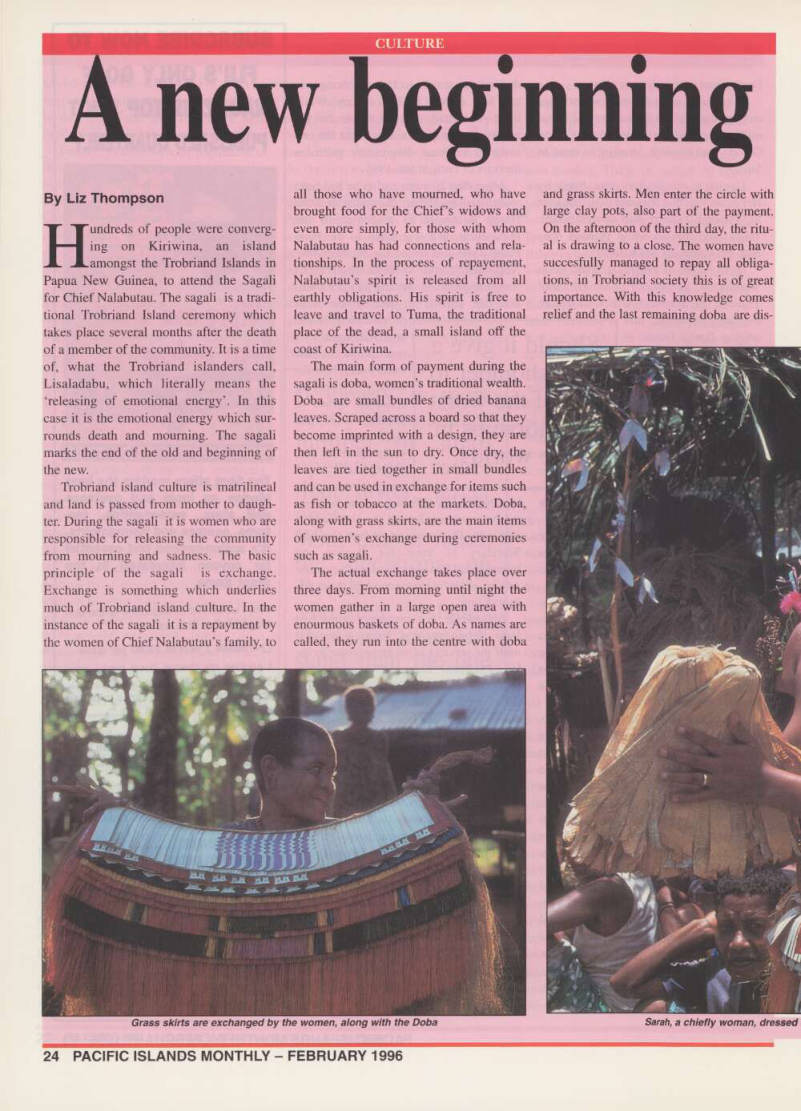
Doha are small bundles of dried banana leaves. Scraped across a board so that they become imprinted with a design, they are then left in the sun to dry. Once dry, the leaves are tied together in small bundles and can be used in exchange for items such as fish or tobacco at the markets. Doba, along with grass skirts, are the main items of women’s exchange during ceremonies such as sagali.
The actual exchange takes place over three days. From morning until night the women gather in a large open area with enourmous baskets of doba. As names are called, they run into the centre with doba
and grass skirts. Men enter the circle with large clay pots, also part of the payment.
On the afternoon of the third day, the ritu al is drawing to a close. The women have succesfully managed to repay all obliga tions, in Trobriand society this is of great importance. With this knowledge comes relief and the last remaining doba are dis-
Grass skirts are exchanged by the women, along with the Doba
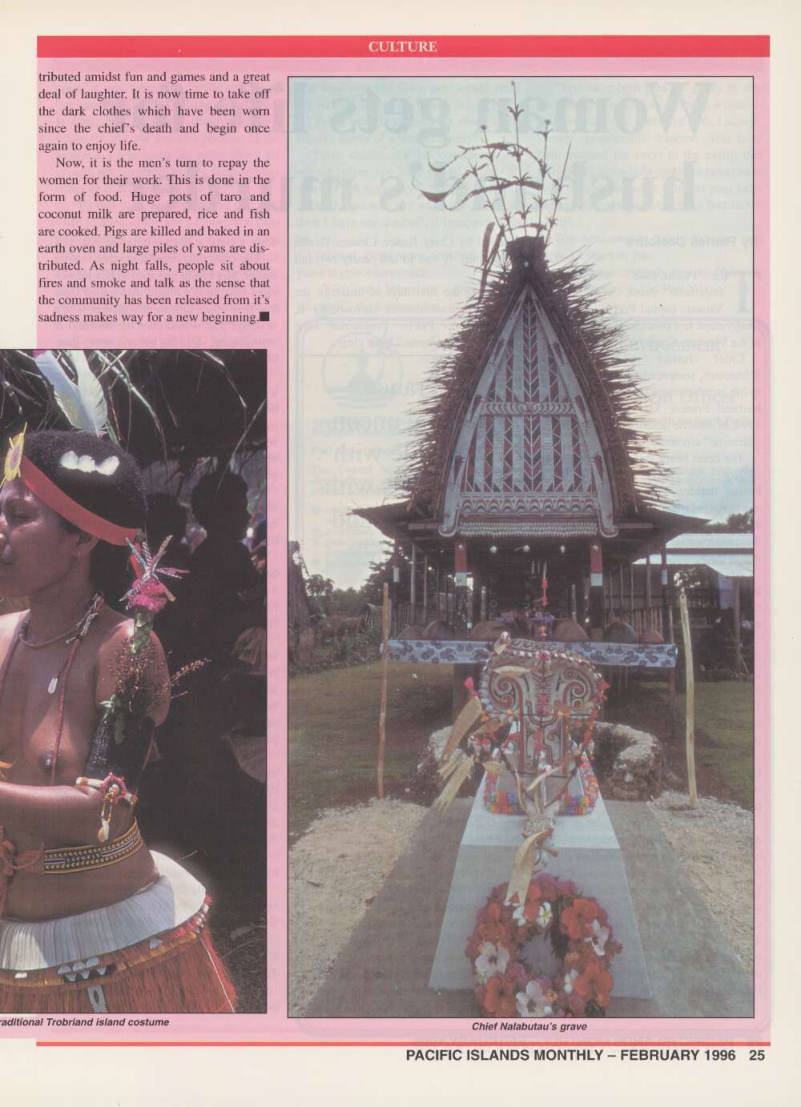
Sarah, a chiefly woman, dressed
tributed amidst fun and games and a great deal of laughter. It is now time to take off the dark clothes which have been worn since the chief’s death and begin once
again to enjoy life.
Now, it is the men’s turn to repay the women for their work. This is done in the form of food. Huge pots of taro and coconut milk are prepared, rice and fish are cooked. Pigs are killed and baked in an earth oven and large piles of yams are dis tributed. As night falls, people sit about fires and smoke and talk as the sense that the community has been released from it’s sadness makes way for a new beginning.*
[?]aditional Trobriand island costume
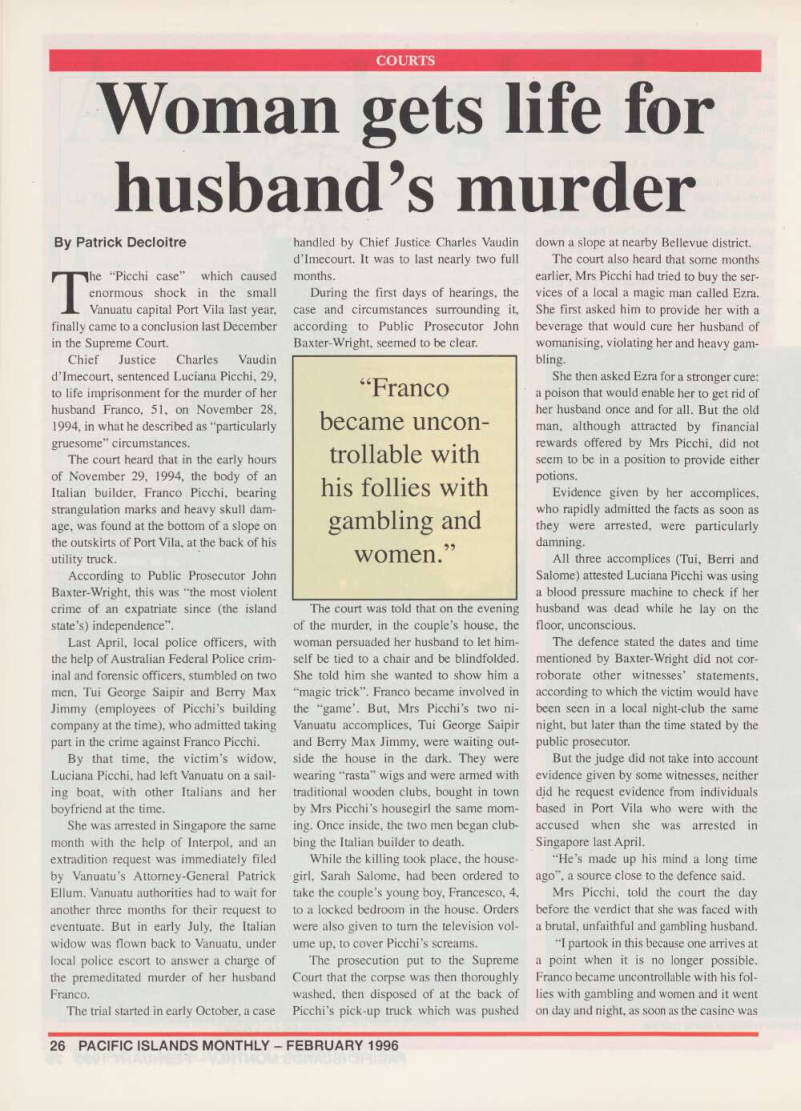
Chief Nalabutau’s grave
Woman gets life for husband’s murder
husband’s murder
By Patrick Decloitre
The “Picchi case” which caused enormous shock in the small Vanuatu capital Port Vila last year, finally came to a conclusion last December in the Supreme Court.
Chief Justice Charles Vaudin d’lmecourt, sentenced Luciana Picchi, 29, to life imprisonment for the murder of her husband Franco, 51, on November 28, 1994, in what he described as “particularly
gruesome” circumstances.
The court heard that in the early hours of November 29, 1994, the body of an Italian builder, Franco Picchi, bearing strangulation marks and heavy skull dam age, was found at the bottom of a slope on the outskirts of Port Vila, at the back of his
utility truck.
According to Public Prosecutor John Baxter-Wright, this was “the most violent crime of an expatriate since (the island
state’s) independence”.
Last April, local police officers, with the help of Australian Federal Police crim inal and forensic officers, stumbled on two men, Tui George Saipir and Berry Max Jimmy (employees of Picchi’s building company at the time), who admitted taking part in the crime against Franco Picchi.
By that time, the victim’s widow, Luciana Picchi, had left Vanuatu on a sail ing boat, with other Italians and her boyfriend at the time.
She was arrested in Singapore the same month with the help of Interpol, and an extradition request was immediately filed by Vanuatu’s Attorney-General Patrick Ellum. Vanuatu authorities had to wait for another three months for their request to eventuate. But in early July, the Italian widow was flown back to Vanuatu, under local police escort to answer a charge of the premeditated murder of her husband Franco.
The trial started in early October, a case
handled by Chief Justice Charles Vaudin d’lmecourt. It was to last nearly two full months.
During the first days of hearings, the case and circumstances surrounding it, according to Public Prosecutor John Baxter-Wright, seemed to be clear.
“Franco became uncon trollable with his follies with gambling and women.”
The court was told that on the evening of the murder, in the couple’s house, the woman persuaded her husband to let him self be tied to a chair and be blindfolded.
She told him she wanted to show him a “magic trick”. Franco became involved in the “game’. But, Mrs Picchi’s two ni- Vanuatu accomplices, Tui George Saipir and Berry Max Jimmy, were waiting out side the house in the dark. They were wearing “rasta” wigs and were armed with traditional wooden clubs, bought in town by Mrs Picchi’s housegirl the same morn ing. Once inside, the two men began club bing the Italian builder to death.
While the killing took place, the house girl, Sarah Salome, had been ordered to take the couple’s young boy, Francesco, 4, to a locked bedroom in the house. Orders were also given to turn the television vol ume up, to cover Picchi’s screams.
The prosecution put to the Supreme Court that the corpse was then thoroughly washed, then disposed of at the back of Picchi’s pick-up truck which was pushed
down a slope at nearby Bellevue district.
The court also heard that some months earlier, Mrs Picchi had tried to buy the ser vices of a local a magic man called Ezra.
She first asked him to provide her with a beverage that would cure her husband of womanising, violating her and heavy gam
bling.
She then asked Ezra for a stronger cure: a poison that would enable her to get rid of her husband once and for all. But the old man, although attracted by financial rewards offered by Mrs Picchi, did not seem to be in a position to provide either potions.
Evidence given by her accomplices,
who rapidly admitted the facts as soon as they were arrested, were particularly
damning.
All three accomplices (Tui, Berri and Salome) attested Luciana Picchi was using a blood pressure machine to check if her husband was dead while he lay on the floor, unconscious.
The defence stated the dates and time mentioned by Baxter-Wright did not cor roborate other witnesses’ statements, according to which the victim would have been seen in a local night-club the same night, but later than the time stated by the
public prosecutor.
But the judge did not take into account evidence given by some witnesses, neither did he request evidence from individuals based in Port Vila who were with the accused when she was arrested in
Singapore last April.
“He’s made up his mind a long time ago”, a source close to the defence said.
Mrs Picchi, told the court the day before the verdict that she was faced with a brutal, unfaithful and gambling husband.
"I partook in this because one arrives at a point when it is no longer possible.
Franco became uncontrollable with his fol lies with gambling and women and it went on day and night, as soon as the casino was
open he was there. My family and I had lent money to Franco during my last visit to Italy, and because I could not see a future for my son and also because of the violence, I was being hit every day. I let myself get involved in this fantasy after listening to all the accounts.
“By that time, I could not live like this, I had to think of my son’s future. You can not gamble away one million vatu (USD8800) an evening. I remember saying Franco was having a crisis at gambling. He had lost a lot of money and thought I was bringing him bad luck. He went out at 8.30 pm and said “if I lose. I’ll kill you”.
It was in the light of his previous behaviour that I took him seriously. It was similar to a previous threat made in Italy: “If I lose, it will be your problem when I come back”. And when he came back he burnt me then (with cigarettes).”
But the judge’s verdict did not find any mitigating circumstances. And dTmecourt ruled the woman had premeditated the murder. He said she had seduced Tui, then promised she would marry him if he helped her get rid of her husband, and she offered a million vatu to Berri for taking part in the murder. DTmecourt, however, found the three accomplices had been influenced by Luciana Picchi.
“I have no doubt at all that Tui, Berri and Sarah were just ordinary, good and kind ni-Vanuatu people, who got them selves involved in your evil plan to kill your husband because of you. If you had not influenced Tui and Sarah and through Tui, Berri, in the way that you did, the would probably never have got involved in any sort of crime at all. It was your evil influence over them that led those three into this terrible murder. I have no doubt that left to your own devices, you would kill again if it suited you. You are manipu lative in excess. You have caused great dis tress around you. You have destroyed not only your husband’s life, but that of at least three others who fell under you spell. Your learned counsel urged the court to consid er a finite sentence in your case and I will, at least to some extent. You are fortunate indeed that there is not a mandatory death sentence for this kind of killing in Vanuatu”, dTmecourt told Mrs Picchi on the day of the verdict.
To the defence lawyer who pointed out
that four-year old Francesco would need his mother, dTmecourt said “he is better off being brought up by your sister in the relative safety of a normal family”.
“You should not be considered for release before you have served at least 30 years, when hopefully you will be too old to be able to take any other life and even then I have my doubts”, dTmecourt went on.
Tui and Berri were sentenced to 20 years imprisonment each.
“With good behaviour a third will be taken off’, the judge added.
“You have both pleaded guilty to this dreadful crime. This is, in itself, a consid erable mitigation. You have both, I accept, shown considerable remorse. You have both assisted the court to the extent that Luciana Picchi would probably never have been brought to justice without your help.
She would have probably been free to kill
again”.
The housemaid, Sarah Salome, will serve 12 years in jail.
All four are currently serving their sen tence in the tiny jail of Port Vila. ■
Advertisements & other items, pp. 26-27 (2 items)
Courts
Programme (SPREP)
South Pacific Regional Environment
Vacancy: Coastal Management Officer
Applications are invited for the position of Coastal Management Officer with the South Pacific Regional Environment Programme (SPREP) in Apia, Western Samoa.
Post Description
The Coastal Management Officer assists member countries and territories with the development and implementation of appropriate coastal management programmes and related activities. He or she is responsible for assisting the strengthening of national capabilities in formulating and implementing coastal management and planning programmes through training activities workshops and projects; coordmating coastal management and planning activities within the region; coordination associated activities including coastal resource surveys and management plan
development; and
implementing the Coastal Management and Planning aspects of the SPREP Action Plan.
Required Qualifications and Experience
Candidates must have appropriate tertiary qualifications (preferably with post-graduate qualifications in an integrated coastal management related field) from a recognised institution and at least 5 years' work experience, preferably within the Pacific Islands region, in a field related to this position. Other essential requirements are: proven project management experience; the anility to manage the work of consultants; a proven ability to work as a part of a inter-disciplinary and/or multi-cultural team; the ability to meet project deadlines (often under difficult circumstances); a proven ability to prepare proposals and reports; a proven ability to live and work within Pacific island communities. Applicants with a demonstrated interest and involvement in the environmental, economic and social issues affecting the region, particularly as they relate to coastal management, will be highly regarded.
Appointment
Appointment will be at either Project Officer or Adviser Level of SPREFs authorised salary scales for contract staff, depending on the successful applicant's qualifications and experience.
SPREP remuneration is tax free in Western Samoa for non-residents and for people who are not citizens of Western Samoa.
The initial term is three years, renewable for a further three years depending on availability of funds and standard of the officer's performance during the first term.
Applications
Applications should be accompanied by three copies of curriculum vitae containing full personal details, information on qualifications and experience for the position, previous appointments, current position and salary, names, addresses and telephone and/or fax contact numbers of three persons associated witth the applicant professionally and who would be prepared to provide testimonials. An indication or now soon the applicant would be available should be indicated.
Closing Date: 28 February, 1996.
Applications should be addressed to: The Director South Pacific Regional Environment Programme (SPREP) PO Box 240 Tel: (685) 21929 Apia Fax: (685) 20231 Western Samoa E-mail SPREP @pactok,peg.apc.org Further information, including a full post description and details of remuneration and terms and conditions of appointment is available from SPREP on request by contacting Ms Dorothy Kamu, Telephone (685) 21929 Ext 203.
regional tourism
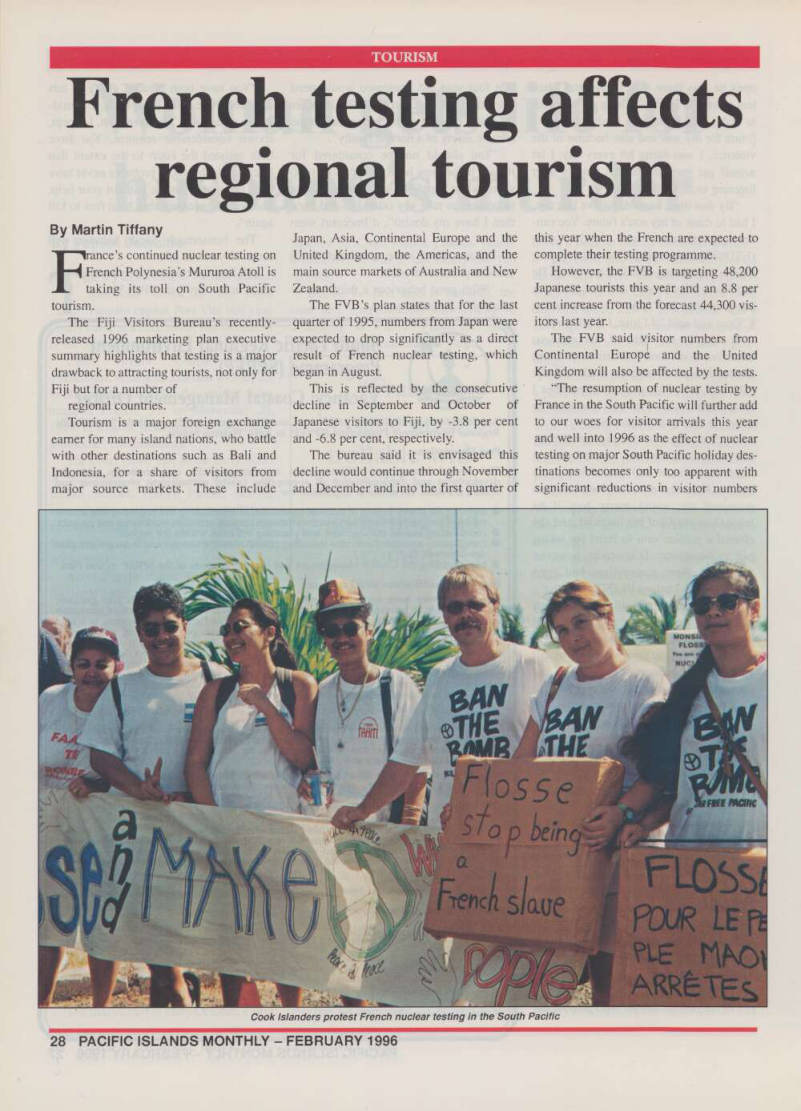
Tourism
French testing affects regional tourism
By Martin Tiffany
France’s continued nuclear testing on French Polynesia’s Mururoa Atoll is taking its toll on South Pacific tourism.
The Fiji Visitors Bureau’s recently released 1996 marketing plan executive summary highlights that testing is a major drawback to attracting tourists, not only for Fiji but for a number of
regional countries.
Tourism is a major foreign exchange
earner for many island nations, who battle with other destinations such as Bali and Indonesia, for a share of visitors from major source markets. These include
Japan, Asia, Continental Europe and the United Kingdom, the Americas, and the main source markets of Australia and New Zealand.
The FVB’s plan states that for the last quarter of 1995, numbers from Japan were expected to drop significantly as a direct result of French nuclear testing, which began in August.
This is reflected by the consecutive decline in September and October of Japanese visitors to Fiji, by -3.8 per cent and -6.8 per cent, respectively.
The bureau said it is envisaged this decline would continue through November and December and into the first quarter of
this year when the French are expected to
complete their testing programme.
However, the FVB is targeting 48,200 Japanese tourists this year and an 8.8 per cent increase from the forecast 44,300 vis itors last year.
The FVB said visitor numbers from Continental Europe and the United Kingdom will also be affected by the tests.
“The resumption of nuclear testing by
France in the South Pacific will further add to our woes for visitor arrivals this year and well into 1996 as the effect of nuclear testing on major South Pacific holiday des tinations becomes only too apparent with significant reductions in visitor numbers
Cook Islanders protest French nuclear testing in the South Pacific
that have been forecasted and evident in the latest arrival statistics of European travellers to Fiji,” said the bureau in its report.
The testing has affected German visitor arrivals to Fiji which dropped by over 27 per cent for September alone. Given Germany’s dominance of the make-up of the total European visitors to Fiji with a 50 per cent share, this has a direct effect on the total visitor numbers to Fiji from Continental Europe.
To this regard, the FVB have had to re forecast their expected target visitor arrivals from the previous figure of 31,800, to 30,500 to better reflect the effects of nuclear testing in the South Pacific.
The FVB said the Asian market will also be affected by the Mururoa testing.
It said there seemed little doubt the French testing had affected most of Fiji’s origin markets to some extent.
"The question is, where are the French testing nuclear devices? Answer, in the South Pacific. Where is Fiji? In the South Pacific’,” said the FVB.
The bureau also highlighted political instability, increasing crime rate and prices as hurdles to attracting tourists.
The FVB says Fiji is an expensive des tination when compared to competitors such as Bali, Guam, Saipan and Hawaii.
Also highlighted is the lack of appro
priate accommodation standards, especial
ly during peak travel periods. This is espe cially true in the upmarket, five-star range which is favoured by the Asian traveller.
The FVB said tourism’s full potential however, would only be achieved after additional accommodation of an interna tional standard, in the 200-400 room cate gory in the key demand areas is built.
FVB’s room constraints report identi fied an additional 2600 rooms were required by the year 2000 to meet the demand existing in Fiji’s major source markets. ‘‘The lack of suitable accommodation in the key areas of Denarau, Coral Coast and the Mamanuca Islands is already con straining our growth in the peak months and will continue to prevent us from max imising the full potential in our source markets until more accommodation is built. ‘‘The FVB is also supportive of a grad
ing system for hotels and resorts to be introduced as soon as practicable.”
But despite the problems, the FVB is pre dicting a record number of 339,000 visitors this year, compared to the 317,600 forecast for 1995.
It is estimated that this year’s arrivals will generate $493.7 million in foreign exchange earnings gross receipts. This excludes Air Pacific’s earnings and day visiting cruise ship passengers. If these were to be taken into account, tourism’s
foreign exchange earnings would be in
excess of half-a-billion dollars, said the
Fvb.
This reinforces tourism as being Fiji’s biggest foreign exchange earner and with growth that is forecast for tourism in the Pacific region, it has the greatest potential of any industry in Fiji and is expected to play an increasingly important role as the mainstay of the Fijian economy.
In 1994, tourism’s foreign exchange earnings at $419.6 million were over SIOO more than sugar, $278 million more than garments and S3OO million more than the remaining top export revenue earners.
South Korea is predicted to be the boom market this year, with visitors jump ing from less than 2800 in 1994, to a target of 10,400 this year.
The jump is expected following the introduction four weekly flights in late September. Korean Airlines operates three of these weekly Seoul/Nadi/Auckland ser vices while Air New Zealand operates the fourth.
For the five weeks to December 3, these four services averaged 232 passengers per week from Seoul. The FVB said it would work with the two airlines in developing the Korean market, especially the longer staying potential market segments of hon eymooners, divers, golfers and rugby play ers.
The bureau said in order for Fiji to max imise tourism, more direct air services would be required either as destination ter minators or more likely as through services to other larger destinations such as New Zealand and Australia.
The FVB says it will continue to work closely with Air New Zealand in advertis ing and promotions in all markets the air line services to Fiji.
They also say Qantas have assured
them of their increased commitment to Fiji, adding more seats under a new arrangement with Air Pacific.
This year, the FVB will concentrate on the following marketing priorities: ♦ Halt the decline in the Australian market; ♦ Improve market share in the New Zealand market; ♦ Target increased growth from North America and Japan; ♦ Maintain market share from Europe; ♦ Develop the future potential of South-east Asian markets, especially Taiwan and South Korea; ♦ Strengthen servicing of the UK and Continental Europe Inarkets.
To help attract tourists, the Fiji govern ment has added an additional $1 million to the FVB marketing grant. This brings the government’s commitment this year to the FVB to $6,626,000 of which $4,500,000 is allocated to marketing and $2,126,000 to operations.
In addition, the FVB have highlighted a number of major strengths to attract tourists. These include: ♦ Its location in relation to Australia and New Zealand - a short haul destination which can provide an exotic and overseas experience; ♦ An extensive range of accommoda tion and resort facilities and activities which will appeal to special niches; ♦ The unique Fijian culture and its friendly people; ♦ An unspoilt environment in so far as its native resources, rainforests are con cerned; ♦ English being the official language; ♦ Established tourist facilities and infrastructure; ♦ Climate.
In addition, the FVB has highlighted the following weaknesses: Limited air services and accommo dation during peak periods; ♦ Fiji’s perception as a mature market; ♦ Perception that Fiji is an old people’s destination; ♦ Limited shopping facilities; ♦ Perception that Fiji is just a beach destination; ♦ Lack of competition on air routes; ♦ Lack of development in so far as attractions are concerned. ■
Advertisements & other items, pp. 30-31 (1 item)
Drive dignity right to the top.
® TOYOTA
Everyone who knows cars has no doubts about Land Cruiser’s ruggedness.
Yet how many know that its luxury rivals the finest high-priced cars?
Or that it’s got more room inside than many luxury sedans?
And because it’s a Toyota, Land Cruiser’s fit and finish, attention to detail, and graceful form speak of elegance as well as spacious comfort.
Yet you still get tough ladder frames and suspension built to take you as far off road as you want to go.
With power from 4.5-litre petrol or 4.2-litre diesel engines.
And it’s carefully protected from rust to last longer.
So if you’re going right to the top, this dignified car is ready to take you.
LAND CRUISER
DISTRIBUTORS/DEALERS •
AMERICAN SAMOA BURNS PHILP MOTORS PH 633-4281 COOK ISLANDS GUAM & MICRONESIA.. .ATKINS KROLL, INC. PH 646-1876/9 KIRIBATI NORFOLK ISLAND BORRY’S PTY LTD. PH 22114 PAPUA NEW GUINEA SOLOMON ISLAND ELA MOTORS PH 30314 TAHITI VANUATU ASCO MOTORS PH 22341 WESTERN SAMOA...
.PACIFIC MOTORS LTD. PH 20796
.TARAWA MOTORS PH 21090
.ELA MOTORS PH 3229400
.NIPPON AUTOMOTO PH 429819
.ASCO MOTORS PH 20800
FIJI ASCO MOTORS PH :
NEW CALEDONIA S.I.A.P. PH 275562
SAIPAN MICROL CORPORATION PH 234-5911
TONGA ASCO MOTORS PH 23500
ilea ***818!
laisi
in
jiill
ISII
Ml
Hill
Hi tf'MR ,
Esjausiii
‘N f M
Of
LAND
UUBCBWSEfi
f !
CRUISER
■ " ’’ : ■ - WS ...
The smoked
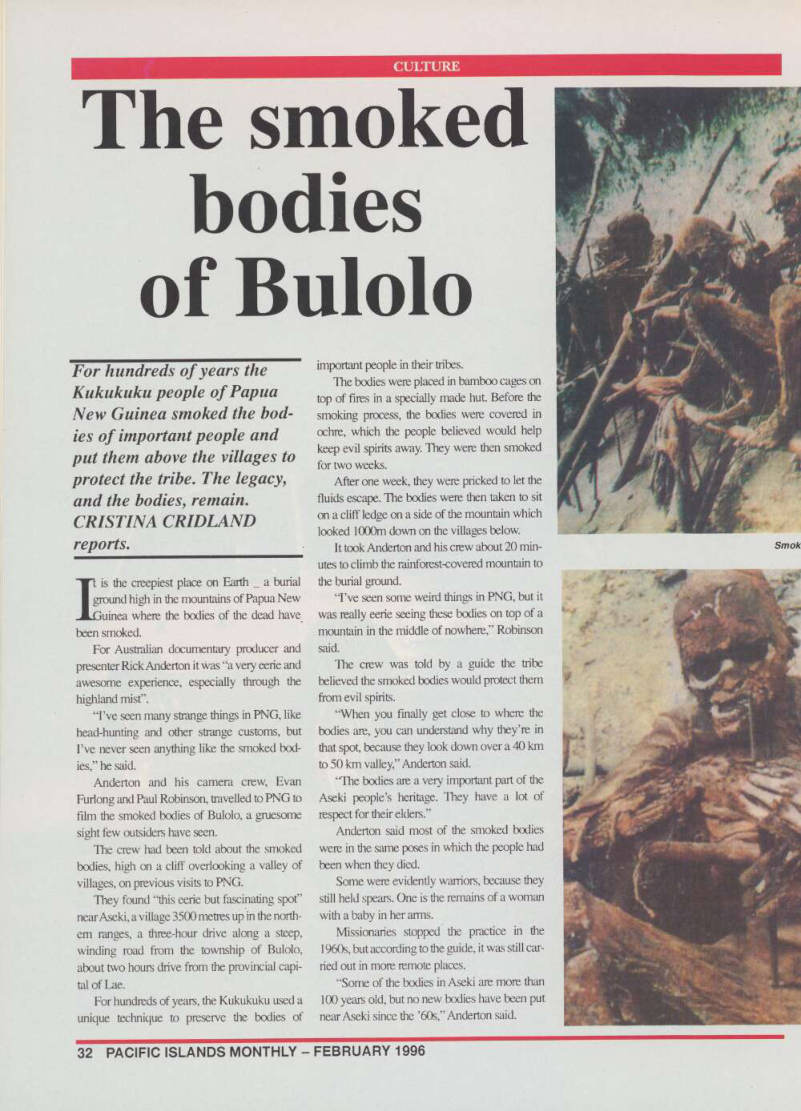
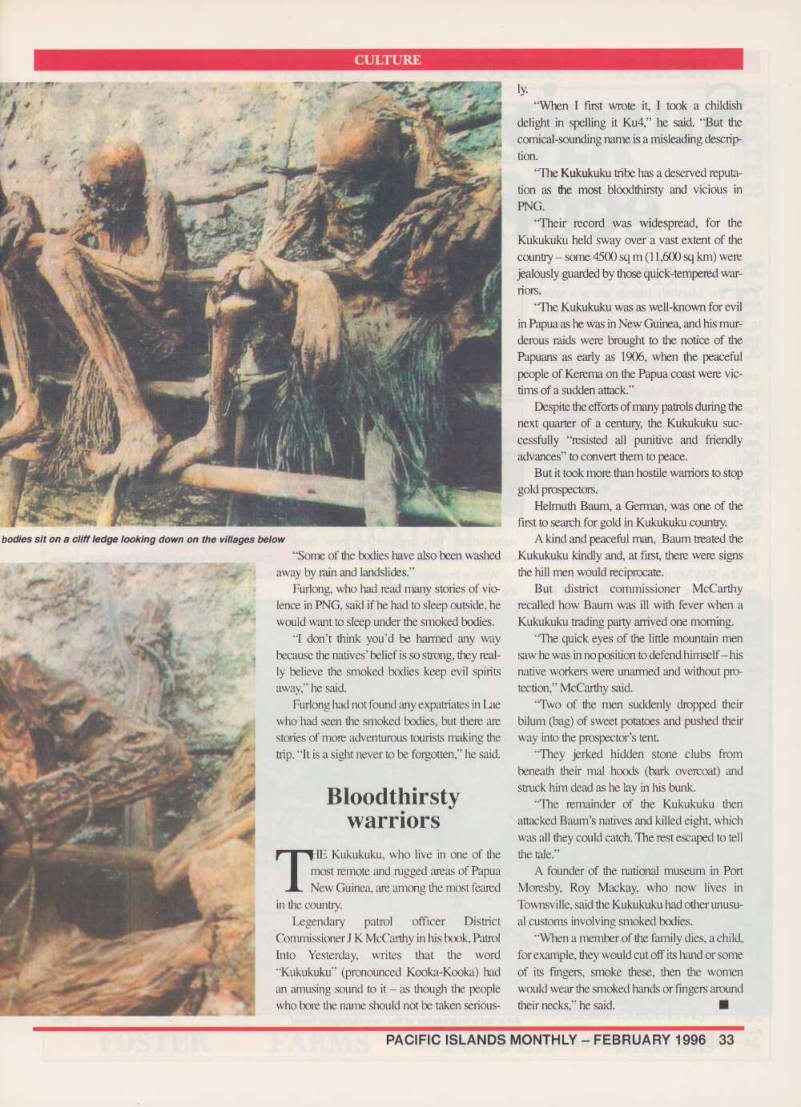
Culture
The smoked bodies of Bulolo
For hundreds of years the Kukukuku people of Papua New Guinea smoked the bod ies of important people and put them above the villages to protect the tribe. The legacy, and the bodies, remain.
Cristina Cridland
reports.
It is the creepiest place on Earth a burial ground high in the mountains of Papua New Guinea where the bodies of the dead have been smoked.
For Australian documentary producer and presenter Rick Anderton it was “a very eerie and awesome experience, especially through the
highland mist”.
“I’ve seen many strange things in PNG, like head-hunting and other strange customs, but I’ve never seen anything like the smoked bod ies,” he said.
Anderton and his camera crew, Evan Furlong and Paul Robinson, travelled to PNG to film the smoked bodies of Bulolo, a gruesome sight few outsiders have seen.
The crew had been told about the smoked bodies, high on a cliff overlooking a valley of villages, on previous visits to PNG.
They found “this eerie but fascinating spot” near Aseki, a village 3500 metres up in the north ern ranges, a three-hour drive along a steep, winding road from the township of Bulolo, about two hours drive from the provincial capi tal of Lae.
For hundreds of years, the Kukukuku used a unique technique to preserve the bodies of
important people in their tribes.
The bodies were placed in bamboo cages on top of fires in a specially made hut. Before the smoking process, the bodies were covered in ochre, which the people believed would help keep evil spirits away. They were then smoked for two weeks.
After one week, they were pricked to let the fluids escape. The bodies were then taken to sit on a cliff ledge on a side of the mountain which looked 1000 m down on the villages below.
It took Anderton and his crew about 20 min utes to climb the rainforest-covered mountain to the burial ground.
“I’ve seen some weird things in PNG, but it was really eerie seeing these bodies on top of a mountain in the middle of nowhere,” Robinson said.
The crew was told by a guide the tribe believed the smoked bodies would protect them from evil spirits.
"When you finally get close to where the bodies are, you can understand why they’re in that spot, because they look down over a 40 km to 50 km valley,” Anderton said.
"The bodies are a very important part of the Aseki people’s heritage. They have a lot of respect for their elders.”
Anderton said most of the smoked bodies were in the same poses in which the people had been when they died.
Some were evidently warriors, because they still held spears. One is the remains of a woman with a baby in her arms.
Missionaries stopped the practice in the 19605, but according to the guide, it was still car ried out in more remote places.
"Some of the bodies in Aseki are more than 100 years old, but no new bodies have been put near Aseki since the ’6os,” Anderton said.
Smok
“Some of the bodies have also been washed away by rain and landslides.”
Furlong, who had read many stories of vio lence in PNG, said if he had to sleep outside, he would want to sleep under the smoked bodies.
"I don’t think you’d be harmed any way because the natives’ belief is so strong, they real ly believe the smoked bodies keep evil spirits away,” he said.
Furlong had not found any expatriates in Lae who had seen the smoked bodies, but there are stories of more adventurous tourists making the trip. “It is a sight never to be forgotten,” he said.
bodies sit on a cliff ledge looking down on the villages below
Bloodthirsty
warriors
THE Kukukuku, who live in one of the most remote and rugged areas of Papua New Guinea, are among the most feared in the country.
Legendary patrol officer District
Commissioner J K McCarthy in his book. Patrol Into Yesterday, writes that the word "Kukukuku” (pronounced Kooka-Kooka) had an amusing sound to it - as though the people who bore the name should not be taken serious
iy- “When I first wrote it, I took a childish delight in spelling it Ku 4,” he said. “But the
comical-sounding name is a misleading descrip
tion.
'The Kukukuku tribe has a deserved reputa tion as the most bloodthirsty and vicious in
Png.
“Their record was widespread, for the Kukukuku held sway over a vast extent of the country - some 4500 sq m (11,600 sq km) were
jealously guarded by those quick-tempered war
riors.
“The Kukukuku was as well-known for evil in Papua as he was in New Guinea, and his mur derous raids were brought to the notice of the Papuans as early as 1906, when the peaceful people of Keiema on the Papua coast were vic tims of a sudden attack.”
Despite the efforts of many patrols during the next quarter of a century, the Kukukuku suc
cessfully “resisted all punitive and friendly
advances” to convert them to peace.
But it took more than hostile warriors to stop gold prospectors.
Helmuth Baum, a German, was one of the first to search for gold in Kukukuku country.
A kind and peaceful man, Baum treated the Kukukuku kindly and, at first, there were signs the hill men would reciprocate.
But district commissioner McCarthy recalled how Baum was ill with fever when a Kukukuku trading party arrived one morning.
'The quick eyes of the little mountain men saw he was in no position to defend himself - his native workers were unarmed and without pro tection,” McCarthy said. ‘Two of the men suddenly dropped their bilum (bag) of sweet potatoes and pushed their way into the prospector’s tent.
"They jerked hidden stone clubs from beneath their mal hoods (bark overcoat) and struck him dead as he lay in his bunk.
"The remainder of the Kukukuku then attacked Baum’s natives and killed eight, which was all they could catch. The rest escaped to tell the tale.”
A founder of the national museum in Port Moresby, Roy Mackay, who now lives in Townsville, said the Kukukuku had other unusu al customs involving smoked bodies.
"When a member of the family dies, a child, for example, they would cut off its hand or some of its fingers, smoke these, then the women would wear the smoked hands or fingers around their necks,” he said. ■
Surviving beyond
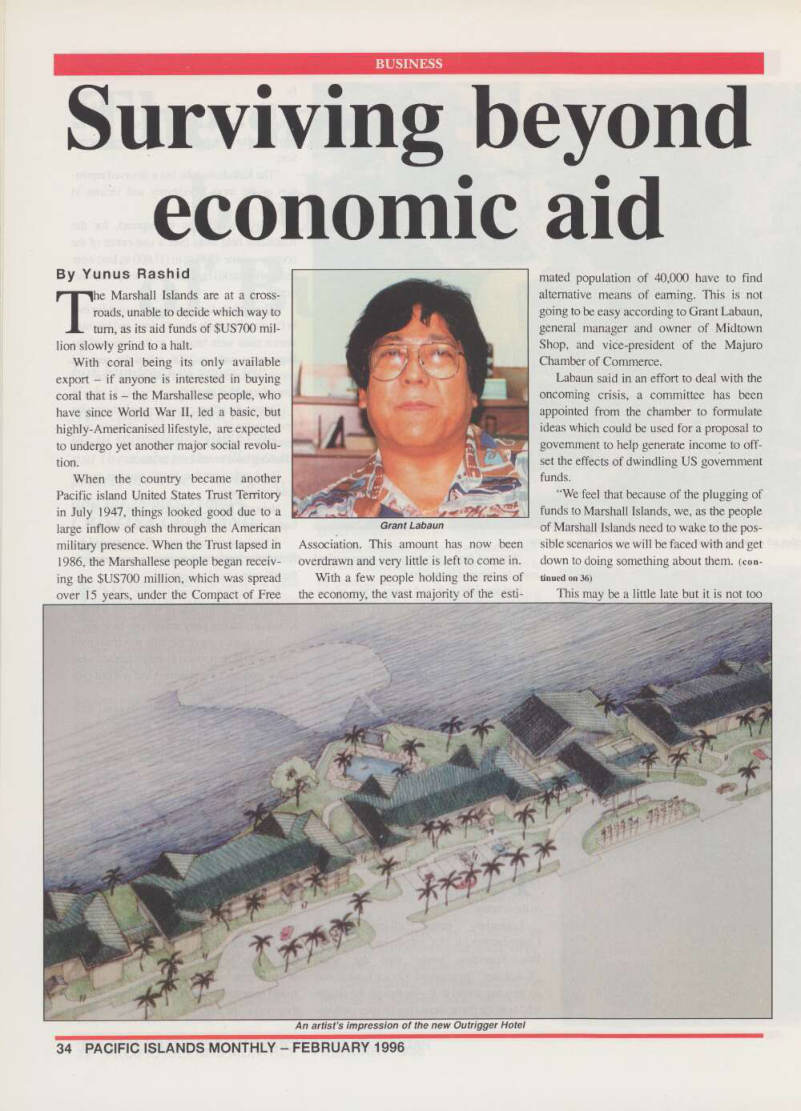

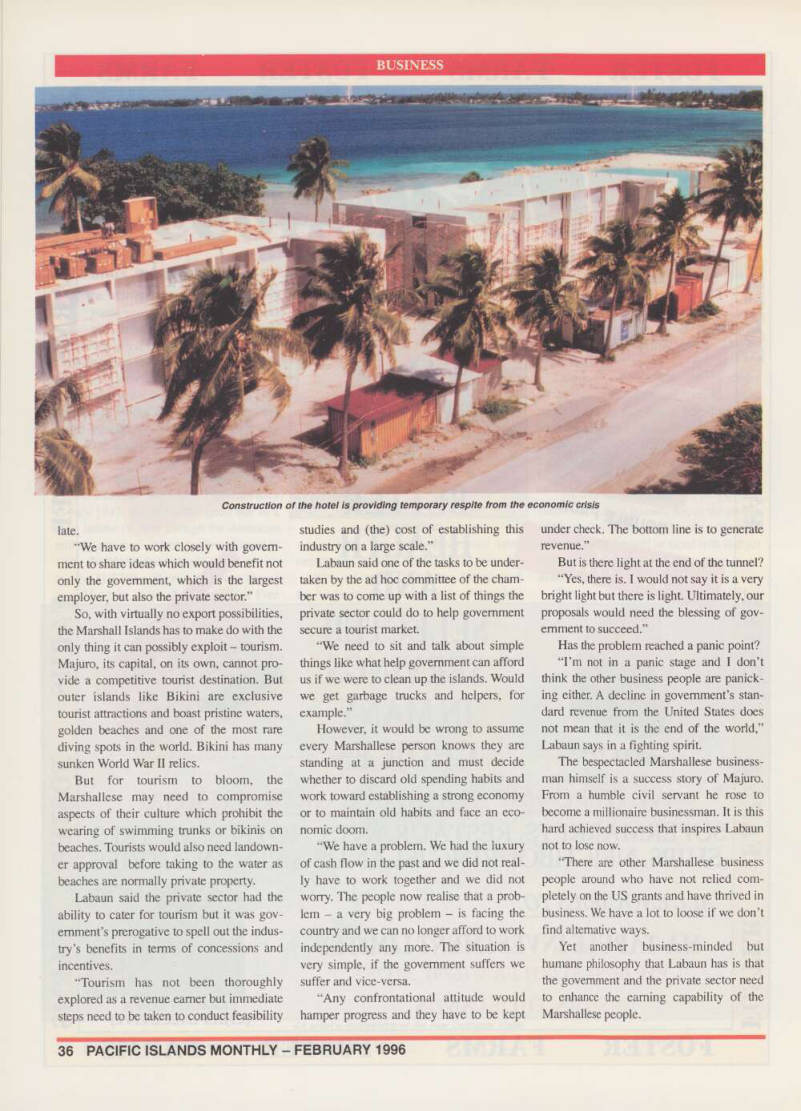
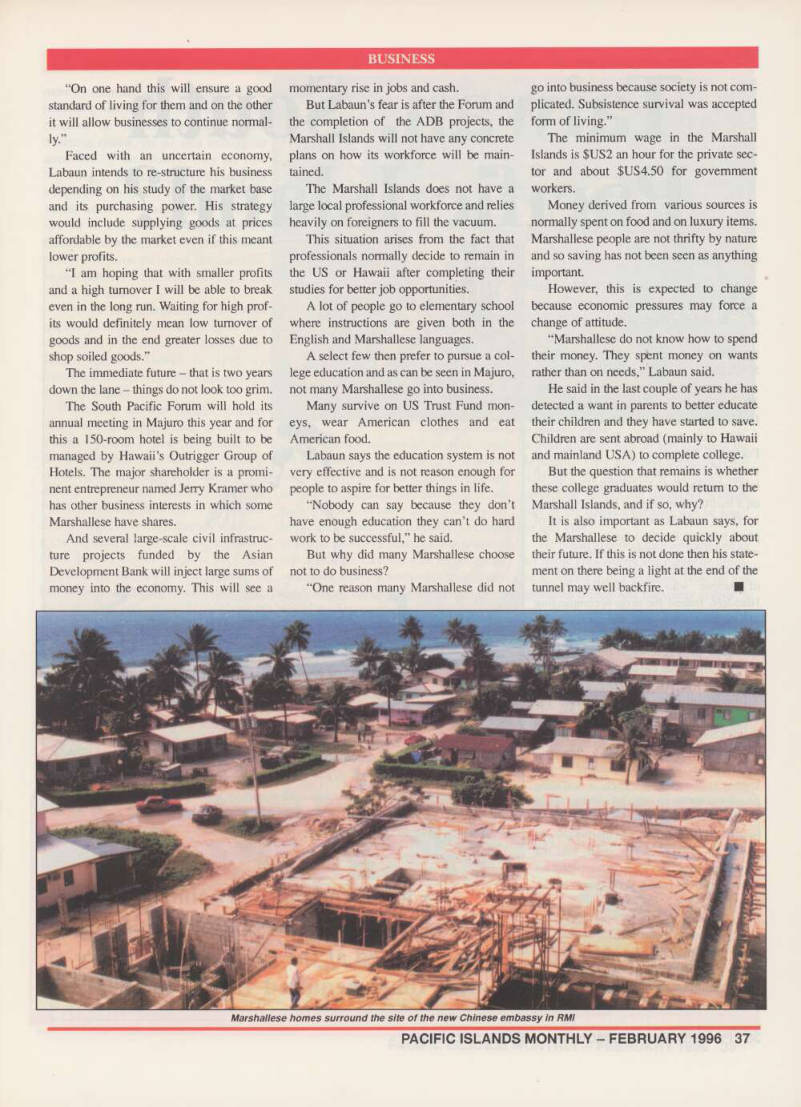
Business
Surviving beyond economic aid
By Yunus Rashid
The Marshall Islands are at a cross roads, unable to decide which way to turn, as its aid funds of SUS7OO mil lion slowly grind to a halt.
With coral being its only available export - if anyone is interested in buying coral that is - the Marshallese people, who have since World War 11, led a basic, but highly-Americanised lifestyle, are expected to undergo yet another major social revolu tion.
When the country became another Pacific island United States Trust Territory in July 1947, things looked good due to a large inflow of cash through the American military presence. When the Trust lapsed in 1986, the Marshallese people began receiv ing the SUS7OO million, which was spread over 15 years, under the Compact of Free
Association. This amount has now been overdrawn and very little is left to come in.
With a few people holding the reins of the economy, the vast majority of the esti
mated population of 40,000 have to find alternative means of earning. This is not going to be easy according to Grant Labaun, general manager and owner of Midtown
Shop, and vice-president of the Majuro
Chamber of Commerce.
Labaun said in an effort to deal with the oncoming crisis, a committee has been appointed from the chamber to formulate ideas which could be used for a proposal to government to help generate income to off set the effects of dwindling US government funds.
“We feel that because of the plugging of funds to Marshall Islands, we, as the people of Marshall Islands need to wake to the pos sible scenarios we will be faced with and get down to doing something about them, (con tinued on 36) This may be a little late but it is not too
GrantLabaun
An artist’s impression of the new Outrigger Hotel
late.
“We have to work closely with govern ment to share ideas which would benefit not only the government, which is the largest employer, but also the private sector.”
So, with virtually no export possibilities, the Marshall Islands has to make do with the only thing it can possibly exploit - tourism.
Majuro, its capital, on its own, cannot pro vide a competitive tourist destination. But outer islands like Bikini are exclusive tourist attractions and boast pristine waters, golden beaches and one of the most rare diving spots in the world. Bikini has many sunken World War II relics.
But for tourism to bloom, the Marshallese may need to compromise aspects of their culture which prohibit the wearing of swimming trunks or bikinis on beaches. Tourists would also need landown er approval before taking to the water as beaches are normally private property.
Labaun said the private sector had the ability to cater for tourism but it was gov ernment’s prerogative to spell out the indus try’s benefits in terms of concessions and incentives.
“Tourism has not been thoroughly explored as a revenue earner but immediate steps need to be taken to conduct feasibility
studies and (the) cost of establishing this industry on a large scale.”
Labaun said one of the tasks to be under taken by the ad hoc committee of the cham ber was to come up with a list of things the private sector could do to help government secure a tourist market.
“We need to sit and talk about simple things like what help government can afford us if we were to clean up the islands. Would we get garbage trucks and helpers, for
example.”
However, it would be wrong to assume every Marshallese person knows they are standing at a junction and must decide whether to discard old spending habits and work toward establishing a strong economy or to maintain old habits and face an eco nomic doom.
“We have a problem. We had the luxury of cash flow in the past and we did not real ly have to work together and we did not worry. The people now realise that a prob lem - a very big problem - is facing the country and we can no longer afford to work independently any more. The situation is very simple, if the government suffers we suffer and vice-versa.
“Any confrontational attitude would hamper progress and they have to be kept
under check. The bottom line is to generate revenue.”
But is there light at the end of the tunnel?
“Yes, there is. I would not say it is a very bright light but there is light. Ultimately, our proposals would need the blessing of gov ernment to succeed.”
Has the problem reached a panic point?
“I’m not in a panic stage and I don’t think the other business people are panick ing either. A decline in government’s stan dard revenue from the United States does not mean that it is the end of the world,”
Labaun says in a fighting spirit.
The bespectacled Marshallese business man himself is a success story of Majuro.
From a humble civil servant he rose to become a millionaire businessman. It is this hard achieved success that inspires Labaun not to lose now.
“There are other Marshallese business people around who have not relied com pletely on the US grants and have thrived in business. We have a lot to loose if we don’t find alternative ways.
Yet another business-minded but humane philosophy that Labaun has is that the government and the private sector need to enhance the earning capability of the
Marshallese people.
Construction of the hotel is providing temporary respite from the economic crisis
“On one hand this will ensure a good standard of living for them and on the other it will allow businesses to continue normal ly-”
Faced with an uncertain economy, Labaun intends to re-structure his business depending on his study of the market base and its purchasing power. His strategy
would include supplying goods at prices
affordable by the market even if this meant
lower profits.
“I am hoping that with smaller profits and a high turnover I will be able to break even in the long run. Waiting for high prof its would definitely mean low turnover of goods and in the end greater losses due to
shop soiled goods.”
The immediate future - that is two years down the lane - things do not look too grim.
The South Pacific Forum will hold its annual meeting in Majuro this year and for this a 150-room hotel is being built to be
managed by Hawaii’s Outrigger Group of
Hotels. The major shareholder is a promi nent entrepreneur named Jerry Kramer who has other business interests in which some Marshallese have shares.
And several large-scale civil infrastruc ture projects funded by the Asian Development Bank will inject large sums of money into the economy. This will see a
momentary rise in jobs and cash.
But Labaun’s fear is after the Forum and the completion of the ADB projects, the Marshall Islands will not have any concrete plans on how its workforce will be main tained.
The Marshall Islands does not have a large local professional workforce and relies heavily on foreigners to fill the vacuum.
This situation arises from the fact that professionals normally decide to remain in the US or Hawaii after completing their studies for better job opportunities.
A lot of people go to elementary school where instructions are given both in the
English and Marshallese languages.
A select few then prefer to pursue a col lege education and as can be seen in Majuro, not many Marshallese go into business.
Many survive on US Trust Fund mon eys, wear American clothes and eat American food.
Labaun says the education system is not very effective and is not reason enough for people to aspire for better things in life.
“Nobody can say because they don’t have enough education they can’t do hard work to be successful,” he said.
But why did many Marshallese choose not to do business?
“One reason many Marshallese did not
go into business because society is not com plicated. Subsistence survival was accepted form of living.”
The minimum wage in the Marshall Islands is SUS 2 an hour for the private sec tor and about SUS4.SO for government workers.
Money derived from various sources is normally spent on food and on luxury items.
Marshallese people are not thrifty by nature and so saving has not been seen as anything
important.
However, this is expected to change because economic pressures may force a change of attitude.
“Marshallese do not know how to spend their money. They spent money on wants rather than on needs,” Labaun said.
He said in the last couple of years he has detected a want in parents to better educate their children and they have started to save.
Children are sent abroad (mainly to Hawaii and mainland USA) to complete college.
But the question that remains is whether these college graduates would return to the Marshall Islands, and if so, why?
It is also important as Labaun says, for the Marshallese to decide quickly about their future. If this is not done then his state ment on there being a light at the end of the tunnel may well backfire. ■
Marshallese homes surround the site of the new Chinese embassy in RMI
Advertisements & other items, p. 35 (1 item)
Farms
FOSTER
FOSTER
FARMS
co 8 PS <3 fa co s PS < fa fa H co O fa r 0* PS
oooev^
PS W H 05 O Pm % 2&
OSIER
FARMS
Always natural. Always fresk.
FOR BEST
VALUE,
QUALITY
AND
p** BETTER
HEALTH
AND
SELECTED
SERVINGS
IN MANY
—*** CHOICES
WE WELCOME STANDING ORDERS FROM
SUPERMARKETS, RESTAURANTS, HOTELS, MOTELS,
SHIPS, NEIGHBOURING ISLANDS AND COUNTRIES
ALL ENQUIRIES TO:
MA-TAPULE INVESTMENT LIMITED
PH: (679) 312831 FAX: (679) 303757
SUVA, FIJI ISLANDS
& r*v
SSSS
EREMASIROVA
(CHIEF EXECUTIVE)
*1 o co H B 50 *1 50 s co B o Vi H B 50 B > 50 £ 05 B O CO H B 50 B > 50
FOSTER
FARMS
FOSTER
FARMS
Taiwan, South
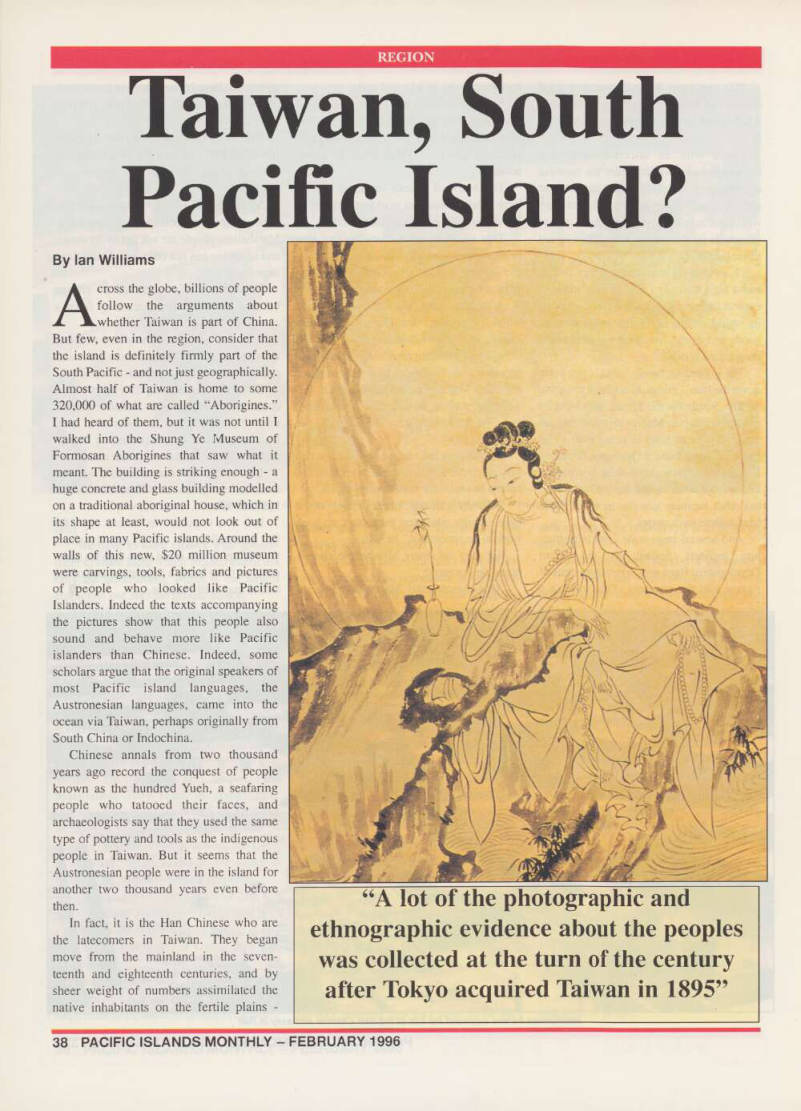
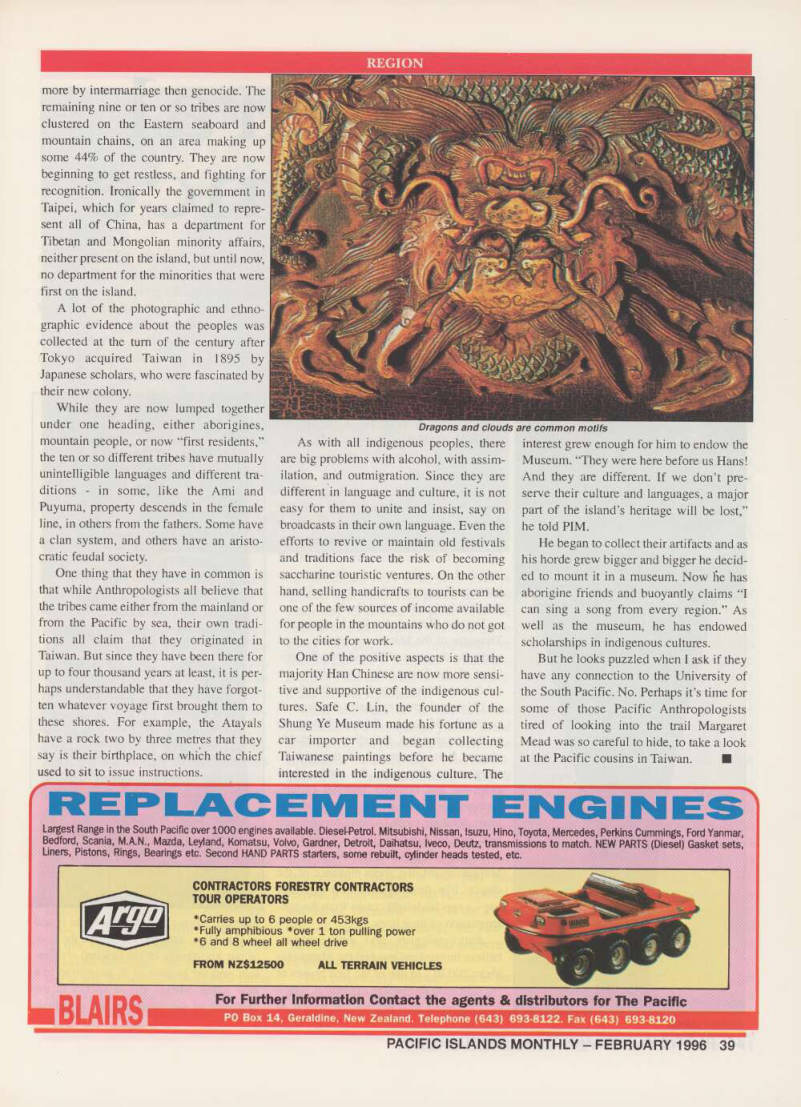
Region
Taiwan, South Pacific Island?
By lan Williams
Across the globe, billions of people
follow the arguments about whether Taiwan is part of China.
But few, even in the region, consider that the island is definitely firmly part of the South Pacific - and not just geographically.
Almost half of Taiwan is home to some 320,000 of what are called “Aborigines.”
I had heard of them, but it was not until I walked into the Shung Ye Museum of Formosan Aborigines that saw what it meant. The building is striking enough - a huge concrete and glass building modelled on a traditional aboriginal house, which in its shape at least, would not look out of place in many Pacific islands. Around the walls of this new, S2O million museum were carvings, tools, fabrics and pictures of people who looked like Pacific Islanders. Indeed the texts accompanying the pictures show that this people also sound and behave more like Pacific islanders than Chinese. Indeed, some scholars argue that the original speakers of most Pacific island languages, the Austronesian languages, came into the ocean via Taiwan, perhaps originally from South China or Indochina.
Chinese annals from two thousand years ago record the conquest of people known as the hundred Yueh, a seafaring people who tatooed their faces, and archaeologists say that they used the same type of pottery and tools as the indigenous people in Taiwan. But it seems that the Austronesian people were in the island for another two thousand years even before then.
In fact, it is the Han Chinese who are the latecomers in Taiwan. They began move from the mainland in the seven teenth and eighteenth centuries, and by sheer weight of numbers assimilated the native inhabitants on the fertile plains -
“A lot of the photographic and ethnographic evidence about the peoples was collected at the turn of the century after Tokyo acquired Taiwan in 1895”
more by intermarriage then genocide. The remaining nine or ten or so tribes are now clustered on the Eastern seaboard and mountain chains, on an area making up some 44% of the country. They are now beginning to get restless, and fighting for recognition. Ironically the government in Taipei, which for years claimed to repre sent all of China, has a department for Tibetan and Mongolian minority affairs, neither present on the island, but until now, no department for the minorities that were first on the island.
A lot of the photographic and ethno graphic evidence about the peoples was collected at the turn of the century after Tokyo acquired Taiwan in 1895 by Japanese scholars, who were fascinated by their new colony.
While they are now lumped together under one heading, either aborigines, mountain people, or now “first residents,” the ten or so different tribes have mutually unintelligible languages and different tra ditions - in some, like the Ami and Puyuma, property descends in the female line, in others from the fathers. Some have a clan system, and others have an aristo cratic feudal society.
One thing that they have in common is that while Anthropologists all believe that the tribes came either from the mainland or from the Pacific by sea, their own tradi tions all claim that they originated in Taiwan. But since they have been there for up to four thousand years at least, it is per haps understandable that they have forgot ten whatever voyage first brought them to these shores. For example, the Atayals have a rock two by three metres that they say is their birthplace, on which the chief used to sit to issue instructions.
As with all indigenous peoples, there are big problems with alcohol, with assimilation, and outmigration. Since they are different in language and culture, it is not easy for them to unite and insist, say on broadcasts in their own language. Even the efforts to revive or maintain old festivals and traditions face the risk of becoming saccharine touristic ventures. On the other hand, selling handicrafts to tourists can be one of the few sources of income available for people in the mountains who do not got to the cities for work.
One of the positive aspects is that the majority Han Chinese are now more sensitive and supportive of the indigenous cultures. Safe C. Lin, the founder of the Shung Ye Museum made his fortune as a car importer and began collecting Taiwanese paintings before he became interested in the indigenous culture. The
interest grew enough for him to endow the Museum. “They were here before us Hans!
And they are different. If we don’t pre serve their culture and languages, a major part of the island’s heritage will be lost,” he told PIM.
He began to collect their artifacts and as his horde grew bigger and bigger he decid ed to mount it in a museum. Now lie has aborigine friends and buoyantly claims “I can sing a song from every region.” As well as the museum, he has endowed
scholarships in indigenous cultures.
But he looks puzzled when I ask if they have any connection to the University of the South Pacific. No. Perhaps it’s time for some of those Pacific Anthropologists tired of looking into the trail Margaret Mead was so careful to hide, to take a look at the Pacific cousins in Taiwan. ■
Dragons and clouds are common motifs
Advertisements & other items, p. 39 (1 item)
■Blairs
REPLACEMENT ENGINES
Largest Range in the South Pacific over 1000 engines available. Diesel-Petrol. Mitsubishi, Nissan, Isuzu, Hino, Toyota, Mercedes, Perkins Cummings, Ford Yanmar, Bedford, Scania, M.A.N., Mazda, Leyland, Komatsu, Volvo, Gardner, Detroit, Daihatsu, Iveco, Deutz, transmissions to match. NEW PARTS (Diesel) Gasket sets, Liners, Pistons, Rings, Bearings etc. Second HAND PARTS starters, some rebuilt, cylinder heads tested, etc.
CONTRACTORS FORESTRY CONTRACTORS
TOUR OPERATORS
♦Carries up to 6 people or 453kgs ♦Fully amphibious ♦over 1 ton pulling power ♦6 and 8 wheel all wheel drive
FROM NZ$l25OO ALL TERRAIN VEHICLES
■BLAIRS
For Further Information Contact the agents & distributors for The Pacific PO Box 14, Geraldine, New Zealand. Telephone (643) 693-8122. Fax (643) 693-8120
A cultural
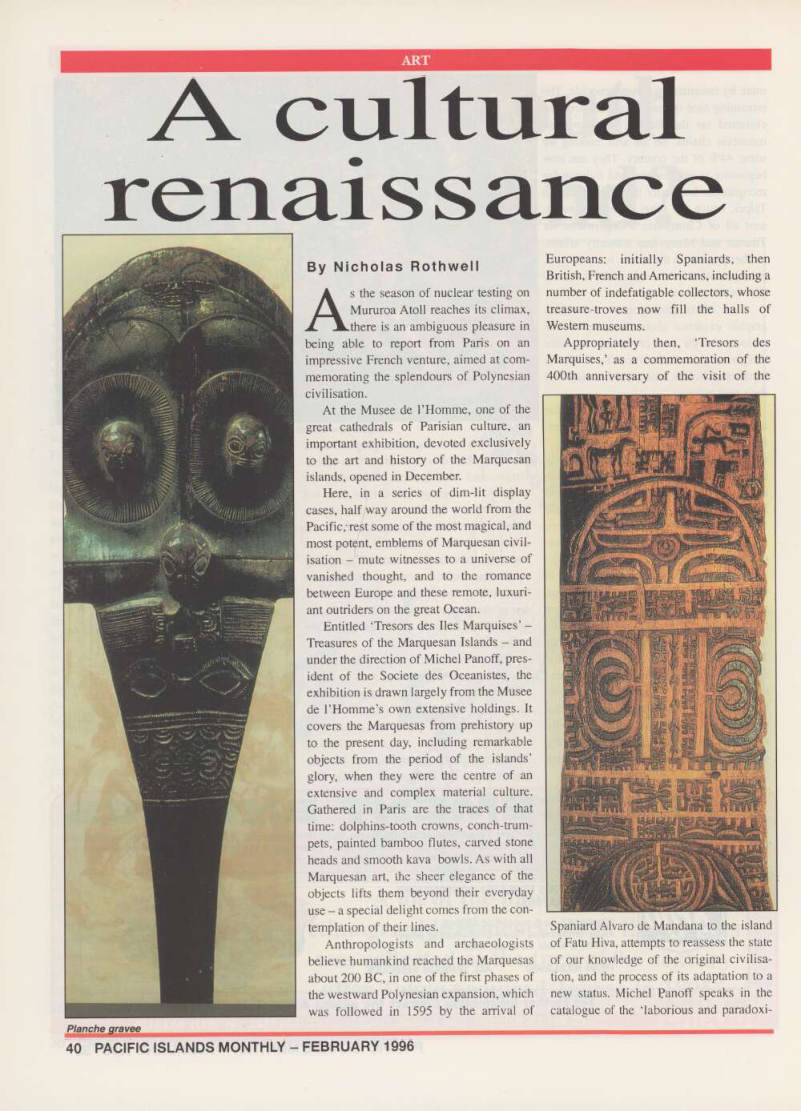
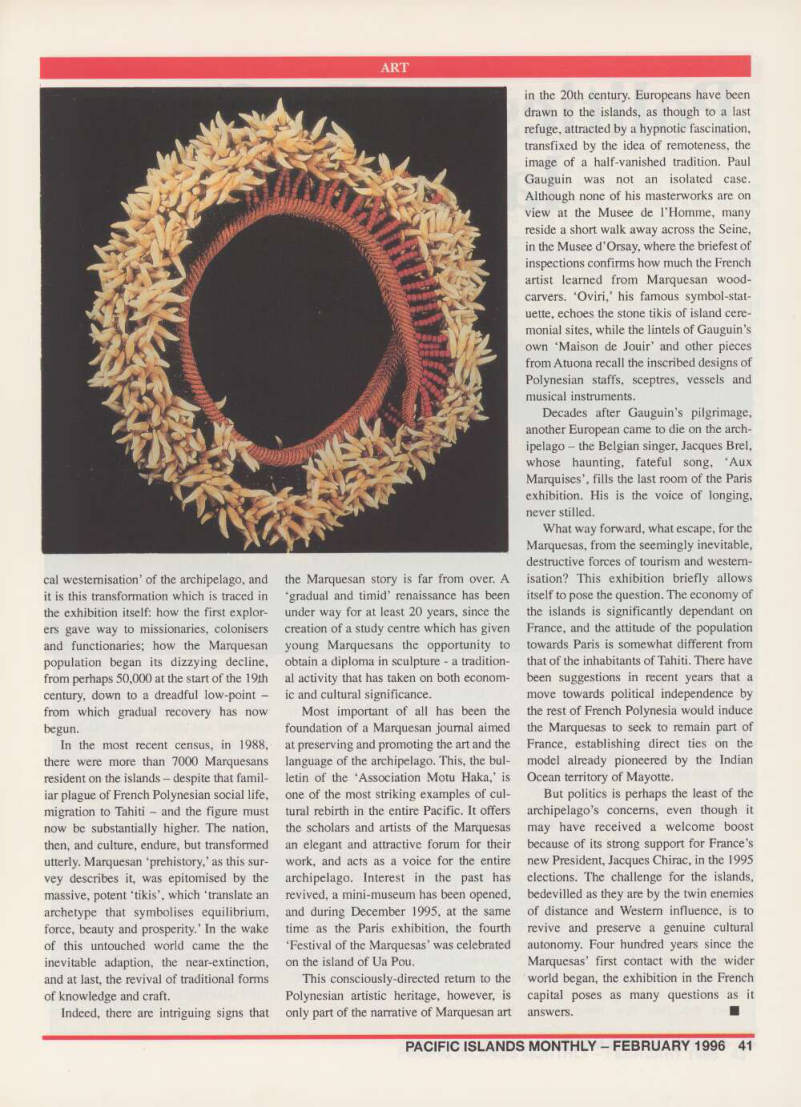
Art
A cultural renaissance
By Nicholas Rothwell
As the season of nuclear testing on Mururoa Atoll reaches its climax, there is an ambiguous pleasure in being able to report from Paris on an impressive French venture, aimed at com
memorating the splendours of Polynesian
civilisation.
At the Musee de I’Homme, one of the great cathedrals of Parisian culture, an important exhibition, devoted exclusively to the art and history of the Marquesan islands, opened in December.
Here, in a series of dim-lit display cases, half way around the world from the Pacific,'rest some of the most magical, and most potent, emblems of Marquesan civil isation - mute witnesses to a universe of vanished thought, and to the romance between Europe and these remote, luxuri ant outriders on the great Ocean.
Entitled ‘Tresors des lies Marquises’ - Treasures of the Marquesan Islands - and under the direction of Michel Panoff, pres ident of the Societe des Oceanistes, the exhibition is drawn largely from the Musee de I’Homme’s own extensive holdings. It covers the Marquesas from prehistory up to the present day, including remarkable objects from the period of the islands’ glory, when they were the centre of an extensive and complex material culture.
Gathered in Paris are the traces of that time: dolphins-tooth crowns, conch-trum pets, painted bamboo flutes, carved stone heads and smooth kava bowls. As with all Marquesan art, the sheer elegance of the objects lifts them beyond their everyday use - a special delight comes from the con templation of their lines.
Anthropologists and archaeologists
believe humankind reached the Marquesas about 200 BC, in one of the first phases of the westward Polynesian expansion, which was followed in 1595 by the arrival of
Europeans: initially Spaniards, then British, French and Americans, including a number of indefatigable collectors, whose treasure-troves now fill the halls of Western museums.
Appropriately then, ‘Tresors des Marquises,’ as a commemoration of the 400th anniversary of the visit of the
Spaniard Alvaro de Mandana to the island of Fatu Hiva, attempts to reassess the state of our knowledge of the original civilisa tion, and the process of its adaptation to a new status. Michel Panoff speaks in the catalogue of the ‘laborious and paradoxi-
Planche gravee
cal westernisation’ of the archipelago, and it is this transformation which is traced in the exhibition itself: how the first explor ers gave way to missionaries, colonisers and functionaries; how the Marquesan population began its dizzying decline, from perhaps 50,000 at the start of the 19th century, down to a dreadful low-point from which gradual recovery has now begun.
In the most recent census, in 1988, there were more than 7000 Marquesans resident on the islands - despite that famil iar plague of French Polynesian social life, migration to Tahiti - and the figure must now be substantially higher. The nation, then, and culture, endure, but transformed utterly. Marquesan ‘prehistory,’ as this sur vey describes it, was epitomised by the massive, potent ‘tikis’, which ‘translate an archetype that symbolises equilibrium, force, beauty and prosperity.’ In the wake of this untouched world came the the inevitable adaption, the near-extinction, and at last, the revival of traditional forms of knowledge and craft.
Indeed, there are intriguing signs that
the Marquesan story is far from over. A ‘gradual and timid’ renaissance has been under way for at least 20 years, since the creation of a study centre which has given young Marquesans the opportunity to obtain a diploma in sculpture - a tradition al activity that has taken on both econom ic and cultural significance.
Most important of all has been the foundation of a Marquesan journal aimed at preserving and promoting the art and the language of the archipelago. This, the bul letin of the ‘Association Motu Haka,’ is one of the most striking examples of cul tural rebirth in the entire Pacific. It offers the scholars and artists of the Marquesas an elegant and attractive forum for their work, and acts as a voice for the entire archipelago. Interest in the past has revived, a mini-museum has been opened, and during December 1995, at the same time as the Paris exhibition, the fourth ‘Festival of the Marquesas’ was celebrated on the island of Ua Pou.
This consciously-directed return to the Polynesian artistic heritage, however, is only part of the narrative of Marquesan art
in the 20th century. Europeans have been drawn to the islands, as though to a last refuge, attracted by a hypnotic fascination, transfixed by the idea of remoteness, the image of a half-vanished tradition. Paul Gauguin was not an isolated case.
Although none of his masterworks are on view at the Musee de I’Homme, many reside a short walk away across the Seine, in the Musee d’Orsay, where the briefest of inspections confirms how much the French artist learned from Marquesan wood carvers. ‘Oviri,’ his famous symbol-stat uette, echoes the stone tikis of island cere monial sites, while the lintels of Gauguin’s own ‘Maison de Jouir’ and other pieces from Atuona recall the inscribed designs of Polynesian staffs, sceptres, vessels and musical instruments.
Decades after Gauguin’s pilgrimage,
another European came to die on the arch ipelago - the Belgian singer, Jacques Brel, whose haunting, fateful song, ‘Aux Marquises’, fills the last room of the Paris exhibition. His is the voice of longing, never stilled.
What way forward, what escape, for the Marquesas, from the seemingly inevitable, destructive forces of tourism and western isation? This exhibition briefly allows itself to pose the question. The economy of the islands is significantly dependant on France, and the attitude of the population towards Paris is somewhat different from that of the inhabitants of Tahiti. There have been suggestions in recent years that a move towards political independence by the rest of French Polynesia would induce the Marquesas to seek to remain part of France, establishing direct ties on the model already pioneered by the Indian Ocean territory of Mayotte.
But politics is perhaps the least of the archipelago’s concerns, even though it may have received a welcome boost because of its strong support for France’s new President, Jacques Chirac, in the 1995 elections. The challenge for the islands, bedevilled as they are by the twin enemies of distance and Western influence, is to revive and preserve a genuine cultural autonomy. Four hundred years since the Marquesas’ first contact with the wider world began, the exhibition in the French capital poses as many questions as it answers. ■
Politics stalls Guam
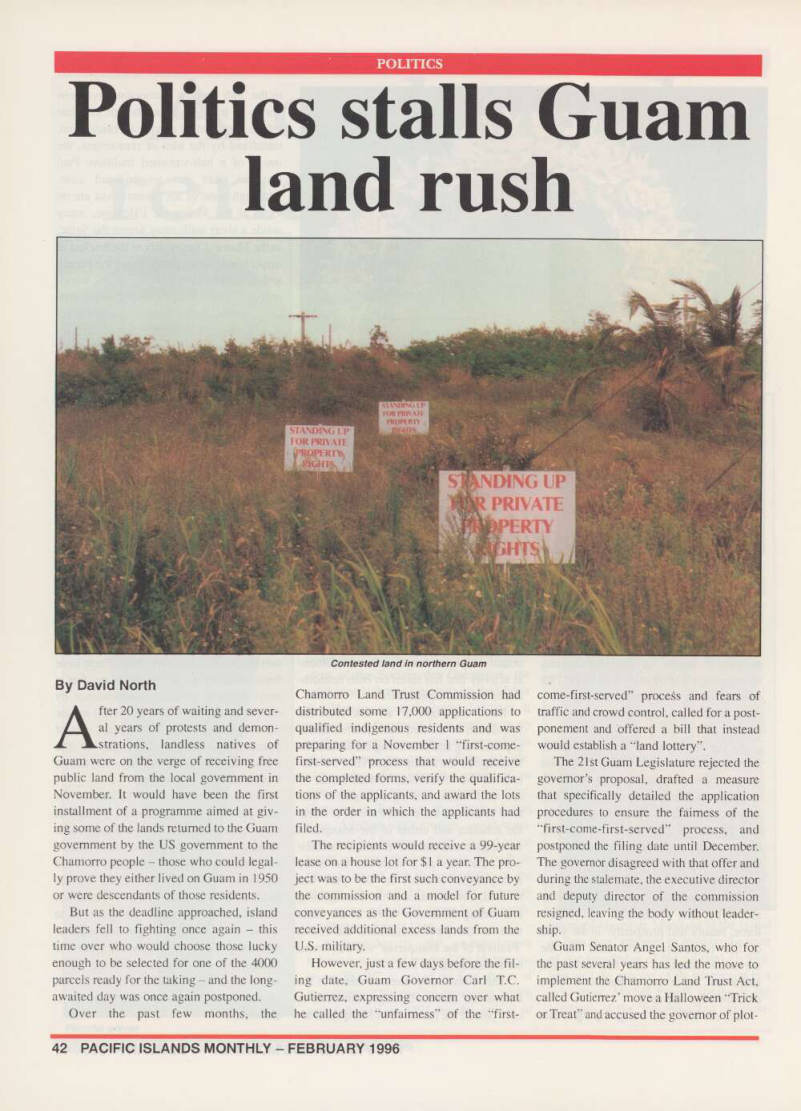
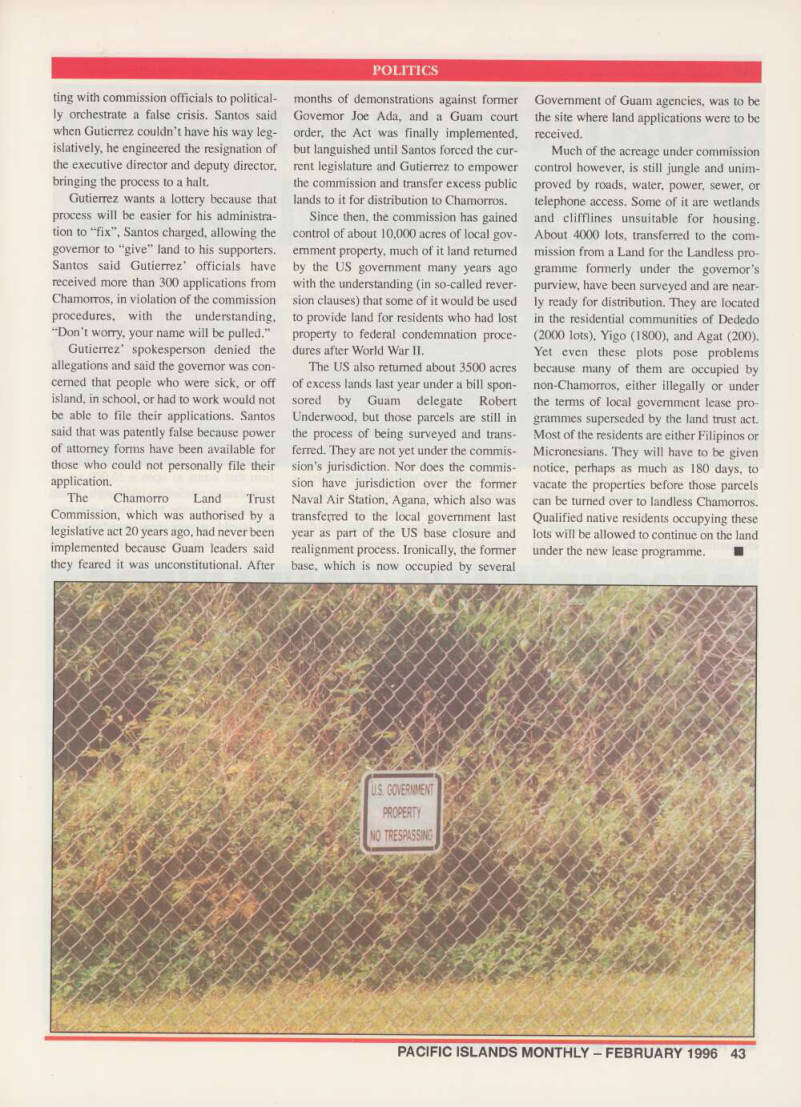
Politics
Politics stalls Guam land rush
By David North
After 20 years of waiting and sever al years of protests and demon strations, landless natives of Guam were on the verge of receiving free public land from the local government in November. It would have been the first installment of a programme aimed at giv ing some of the lands returned to the Guam government by the US government to the Chamorro people - those who could legal ly prove they either lived on Guam in 1950 or were descendants of those residents.
But as the deadline approached, island leaders fell to fighting once again - this time over who would choose those lucky enough to be selected for one of the 4000 parcels ready for the taking - and the long awaited day was once again postponed.
Over the past few months, the
Chamorro Land Trust Commission had distributed some 17,000 applications to qualified indigenous residents and was preparing for a November 1 “first-come first-served” process that would receive
the completed forms, verify the qualifica
tions of the applicants, and award the lots in the order in which the applicants had filed.
The recipients would receive a 99-year lease on a house lot for $1 a year. The pro ject was to be the first such conveyance by the commission and a model for future conveyances as the Government of Guam received additional excess lands from the U.S. military.
However, just a few days before the fil ing date, Guam Governor Carl T.C.
Gutierrez, expressing concern over what he called the “unfairness” of the “first
come-first-served” process and fears of traffic and crowd control, called for a post ponement and offered a bill that instead would establish a "land lottery”.
The 21st Guam Legislature rejected the governor’s proposal, drafted a measure that specifically detailed the application procedures to ensure the fairness of the “first-come-first-served” process, and postponed the filing date until December.
The governor disagreed with that offer and during the stalemate, the executive director and deputy director of the commission
resigned, leaving the body without leader
ship.
Guam Senator Angel Santos, who for the past several years has led the move to implement the Chamorro Land Trust Act, called Gutierrez’ move a Halloween "Trick or Treat” and accused the governor of plot
Contested land in northern Guam
ting with commission officials to politically orchestrate a false crisis. Santos said when Gutierrez couldn’t have his way legislatively, he engineered the resignation of the executive director and deputy director, bringing the process to a halt.
Gutierrez wants a lottery because that process will be easier for his administration to “fix”, Santos charged, allowing the govemor to “give” land to his supporters, Santos said Gutierrez’ officials have received more than 300 applications from Chamorros, in violation of the commission procedures, with the understanding, “Don’t worry, your name will be pulled.”
Gutierrez’ spokesperson denied the allegations and said the governor was concemed that people who were sick, or off island, in school, or had to work would not be able to file their applications. Santos said that was patently false because power of attorney forms have been available for those who could not personally file their application.
The Chamorro Land Trust Commission, which was authorised by a legislative act 20 years ago, had never been implemented because Guam leaders said they feared it was unconstitutional. After
months of demonstrations against former Governor Joe Ada, and a Guam court order, the Act was finally implemented, but languished until Santos forced the current legislature and Gutierrez to empower the commission and transfer excess public lands to it for distribution to Chamorros.
Since then, the commission has gained control of about 10,000 acres of local govemment property, much of it land returned by the US government many years ago with the understanding (in so-called reversion clauses) that some of it would be used to provide land for residents who had lost property to federal condemnation procedures after World War 11.
The US also returned about 3500 acres of excess lands last year under a bill sponsored by Guam delegate Robert Underwood, but those parcels are still in the process of being surveyed and transferred. They are not yet under the commission’s jurisdiction. Nor does the commission have jurisdiction over the former Naval Air Station, Agana, which also was transferred to the local government last year as part of the US base closure and realignment process. Ironically, the former base, which is now occupied by several
Government of Guam agencies, was to be the site where land applications were to be received.
Much of the acreage under commission control however, is still jungle and unim proved by roads, water, power, sewer, or telephone access. Some of it are wetlands and clifflines unsuitable for housing, About 4000 lots, transferred to the com mission from a Land for the Landless pro gramme formerly under the governor’s purview, have been surveyed and are near ly ready for distribution. They are located in the residential communities of Dededo (2000 lots), Yigo (1800), and Agat (200).
Yet even these plots pose problems because many of them are occupied by non-Chamorros, either illegally or under the terms of local government lease pro grammes superseded by the land trust act.
Most of the residents are either Filipinos or Micronesians. They will have to be given notice, perhaps as much as 180 days, to vacate the properties before those parcels can be turned over to landless Chamorros.
Qualified native residents occupying these lots will be allowed to continue on the land under the new lease programme. ■
Advertisements & other items, p. 43 (1 item)
Politics
Islands gambling

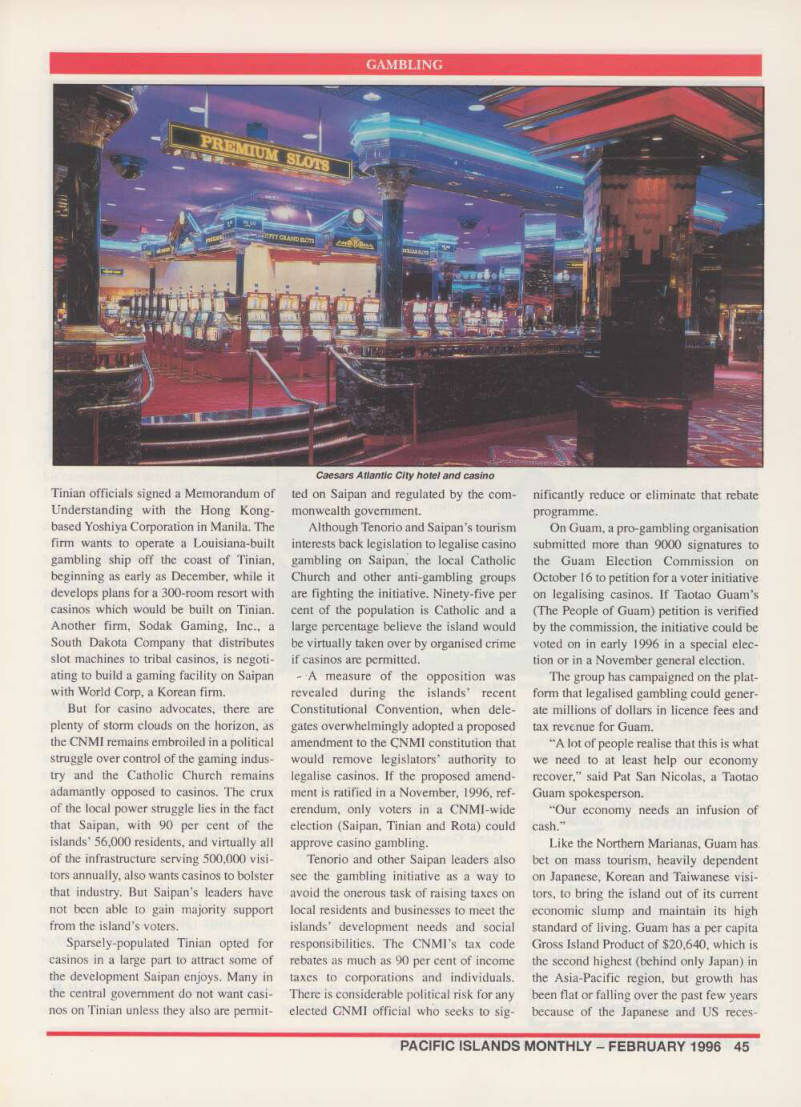
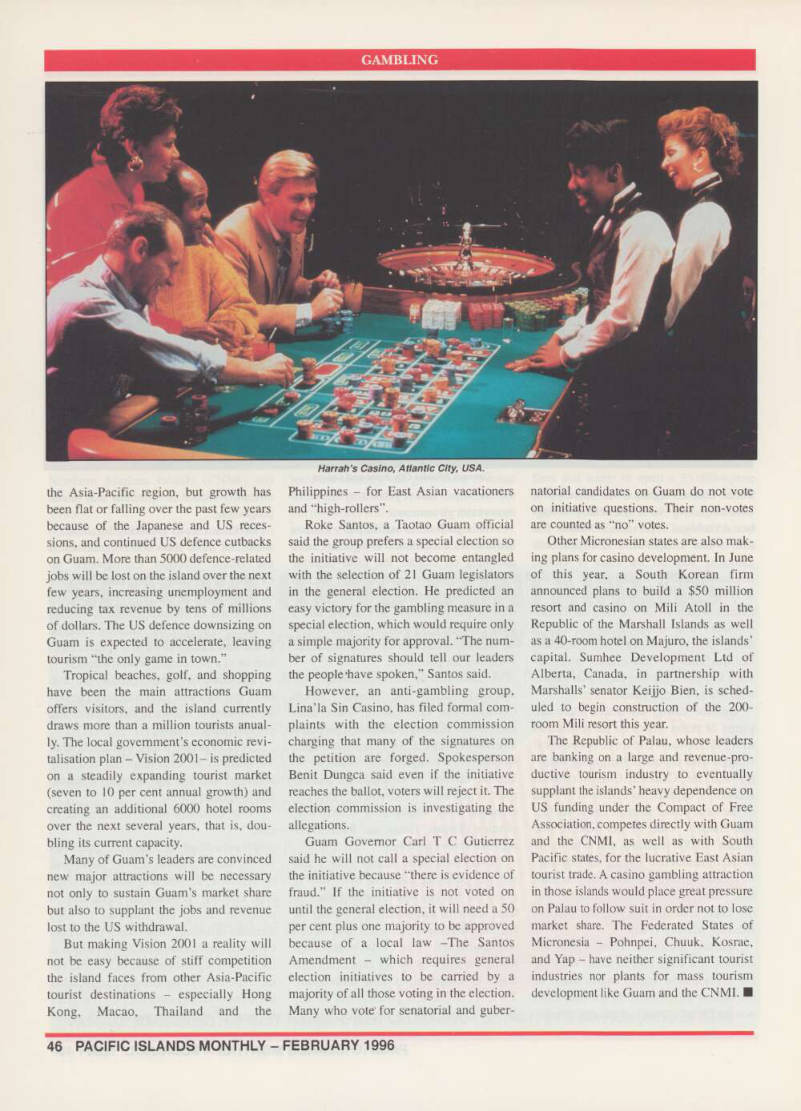
Gambling
Islands gambling on casino draws
By David North
Tropical sunsets and palm-fringed
beaches may soon be replaced by the silhouettes of gambling ships anchored offshore and the glow of coastal strip neon lights as the major tourist attractions of US-affiliated Pacific islands.
Beset by sagging economies, mounting competition for East Asian tourists, and declining US government economic assis tance, voters in the Commonwealth of the Northern Mariana Islands (CNMI) and Guam face casino gambling initiatives in 1996.
The referendums pose a difficult choice for the islanders, many of whom
want the jobs and revenue that a gaming industry would create, but fear the adverse social and political effects. These include the drug and commercial sex trades which cater to the industry and the influence of organised crime syndicates, which so far have been unsuccessful in setting-up casi no gaming operations in the islands.
The CNMI was the first US territory in the region to legalise casino gambling and many of its current leaders see a gaming industry as the key to expanding the touVism industry and generating revenue to replace the $2OO million in economic aid the island will lose over the next seven years to US budget cuts. One US firm, Lone Star Casino Corporation, has already
set up a $3O million facility on Tinian.
Although Lone Star is embroiled in a dis pute with Northern Marianas governor Froilan Tenorio, its successful operation, following other firmS|’ failed attempts at
establishing gaming operations on Tinian,
has spurred Japanese and US gaming groups to move quickly to consolidate the beachhead.
Governor Tenorio is negotiating with a Japanese firm that wants to bring a $35 million casino ship to the islands and a US firm that wants to open a 35,000-square foot casino on Saipan. Although Tinian legalised casinos in 1989, the Saipan casi no would require new legislation and voter approval. In October, Tenorio and
Tinian officials signed a Memorandum of
Understanding with the Hong Kong
based Yoshiya Corporation in Manila. The firm wants to operate a Louisiana-built gambling ship off the coast of Tinian, beginning as early as December, while it develops plans for a 300-room resort with casinos which would be built on Tinian.
Another firm, Sodak Gaming, Inc., a South Dakota Company that distributes slot machines to tribal casinos, is negoti ating to build a gaming facility on Saipan with World Corp, a Korean firm.
But for casino advocates, there are plenty of storm clouds on the horizon, as the CNMI remains embroiled in a political struggle over control of the gaming indus try and the Catholic Church remains adamantly opposed to casinos. The crux of the local power struggle lies in the fact that Saipan, with 90 per cent of the islands’ 56,000 residents, and virtually all of the infrastructure serving 500,000 visi tors annually, also wants casinos to bolster that industry. But Saipan’s leaders have not been able to gain majority support from the island’s voters.
Sparsely-populated Tinian opted for casinos in a large part to attract some of
the development Saipan enjoys. Many in
the central government do not want casi nos on Tinian unless they also are permit
ted on Saipan and regulated by the com monwealth government.
Although Tenorio and Saipan’s tourism interests back legislation to legalise casino gambling on Saipan, the local Catholic Church and other anti-gambling groups are fighting the initiative. Ninety-five per cent of the population is Catholic and a large percentage believe the island would be virtually taken over by organised crime if casinos are permitted. - A measure of the opposition was revealed during the islands’ recent Constitutional Convention, when dele gates overwhelmingly adopted a proposed amendment to the GNMI constitution that would remove legislators’ authority to legalise casinos. If the proposed amend ment is ratified in a November, 1996, ref erendum, only voters in a CNMI-wide election (Saipan, Tinian and Rota) could approve casino gambling.
Tenorio and other Saipan leaders also see the gambling initiative as a way to avoid the onerous task of raising taxes on local residents and businesses to meet the islands’ development needs and social responsibilities. The CNMI’s tax code rebates as much as 90 per cent of income taxes to corporations and individuals.
There is considerable political risk for any elected GNMI official who seeks to sig
nificantly reduce or eliminate that rebate programme.
On Guam, a pro-gambling organisation submitted more than 9000 signatures to the Guam Election Commission on October 16 to petition for a voter initiative on legalising casinos. If Taotao Guam’s (The People of Guam) petition is verified by the commission, the initiative could be voted on in early 1996 in a special elec tion or in a November general election.
The group has campaigned on the plat form that legalised gambling could gener ate millions of dollars in licence fees and tax revenue for Guam.
“A lot of people realise that this is what we need to at least help our economy recover,” said Pat San Nicolas, a Taotao Guam spokesperson.
“Our economy needs an infusion of cash.”
Like the Northern Marianas, Guam has bet on mass tourism, heavily dependent on Japanese, Korean and Taiwanese visi tors, to bring the island out of its current economic slump and maintain its high standard of living. Guam has a per capita Gross Island Product of $20,640, which is the second highest (behind only Japan) in the Asia-Pacific region, but growth has been flat or falling over the past few years because of the Japanese and US reces-
Caesars Atlantic City hotel and casino
the Asia-Pacific region, but growth has been flat or falling over the past few years because of the Japanese and US reces sions, and continued US defence cutbacks on Guam. More than 5000 defence-related jobs will be lost on the island over the next few years, increasing unemployment and reducing tax revenue by tens of millions of dollars. The US defence downsizing on Guam is expected to accelerate, leaving tourism "the only game in town.”
Tropical beaches, golf, and shopping have been the main attractions Guam offers visitors, and the island currently draws more than a million tourists anual ly. The local government’s economic revi talisation plan - Vision 2001- is predicted on a steadily expanding tourist market (seven to 10 per cent annual growth) and creating an additional 6000 hotel rooms over the next several years, that is, dou bling its current capacity.
Many of Guam’s leaders are convinced new major attractions will be necessary not only to sustain Guam’s market share but also to supplant the jobs and revenue lost to the US withdrawal.
But making Vision 2001 a reality will not be easy because of stiff competition the island faces from other Asia-Pacific tourist destinations - especially Hong Kong, Macao, Thailand and the
Philippines - for East Asian vacationers
and "high-rollers”.
Roke Santos, a Taotao Guam official said the group prefers a special election so the initiative will not become entangled with the selection of 21 Guam legislators in the general election. He predicted an easy victory for the gambling measure in a special election, which would require only a simple majority for approval. "The num ber of signatures should tell our leaders the people'have spoken,” Santos said.
However, an anti-gambling group, Lina’la Sin Casino, has filed formal com plaints with the election commission charging that many of the signatures on the petition are forged. Spokesperson Benit Dungca said even if the initiative reaches the ballot, voters will reject it. The election commission is investigating the
allegations.
Guam Governor Carl T C Gutierrez said he will not call a special election on the initiative because "there is evidence of fraud.” If the initiative is not voted on until the general election, it will need a 50 per cent plus one majority to be approved because of a local law -The Santos Amendment - which requires general election initiatives to be carried by a majority of all those voting in the election.
Many who vote for senatorial and guber
natorial candidates on Guam do not vote on initiative questions. Their non-votes are counted as "no” votes.
Other Micronesian states are also mak ing plans for casino development. In June of this year, a South Korean firm announced plans to build a SSO million resort and casino on Mili Atoll in the Republic of the Marshall Islands as well as a 40-room hotel on Majuro, the islands’ capital. Sumhee Development Ltd of Alberta, Canada, in partnership with Marshalls’ senator Keijjo Bien, is sched uled to begin construction of the 200room Mili resort this year.
The Republic of Palau, whose leaders are banking on a large and revenue-pro ductive tourism industry to eventually supplant the islands’ heavy dependence on US funding under the Compact of Free Association, competes directly with Guam and the CNMI, as well as with South Pacific states, for the lucrative East Asian tourist trade. A casino gambling attraction in those islands would place great pressure on Palau to follow suit in order not to lose market share. The Federated States of Micronesia - Pohnpei, Chuuk, Kosrae, and Yap - have neither significant tourist industries nor plants for mass tourism development like Guam and the CNMI. ■
Harrah’s Casino, Atlantic City, USA.
Advertisements & other items, p. 44 (1 item)
Second Hand Containers
WHERE AND WHEN YOU WANT THEM IN THE PACIFIC If you need a flexible and safe storage space we have the ideal solution for you. Our second hand containers provide instant secure storage. Guaranteed to be wind and waterproof these containers are ideal for both temporary and longterm storage in Pacific conditions.
We can deliver to any island in the Pacific within a month and our rates have got to be the lowest you will find. All you need to do is tell us how many you want.
CONTACT:
PASCALE MARCONNET, BP 4757 NOUMEA, NEW CALEDONIA. TEL: (687) 28 7450. FAX: (687) 26 3248
president
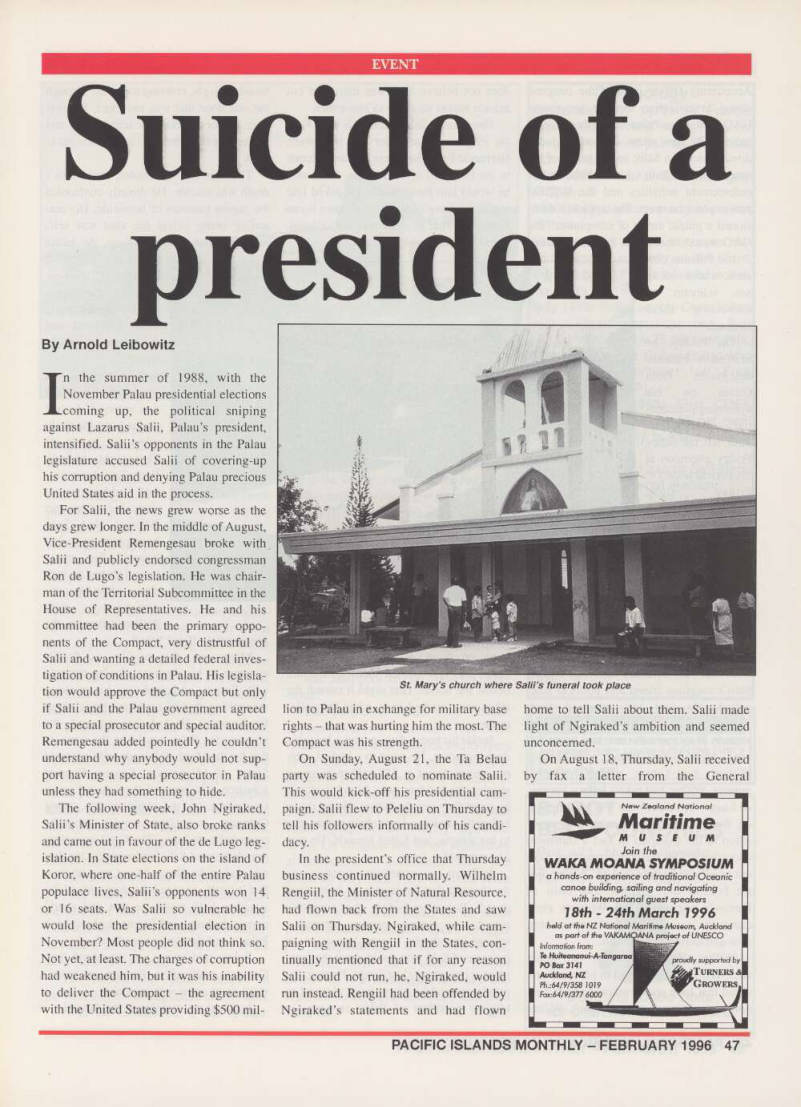
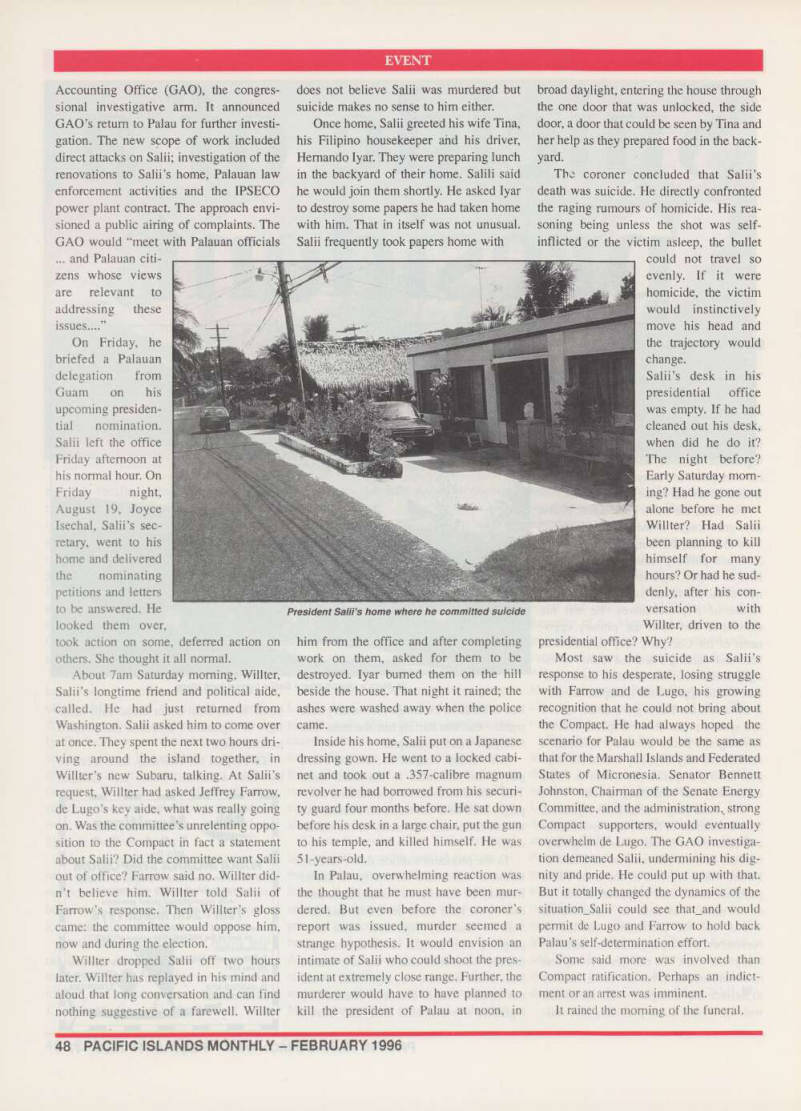
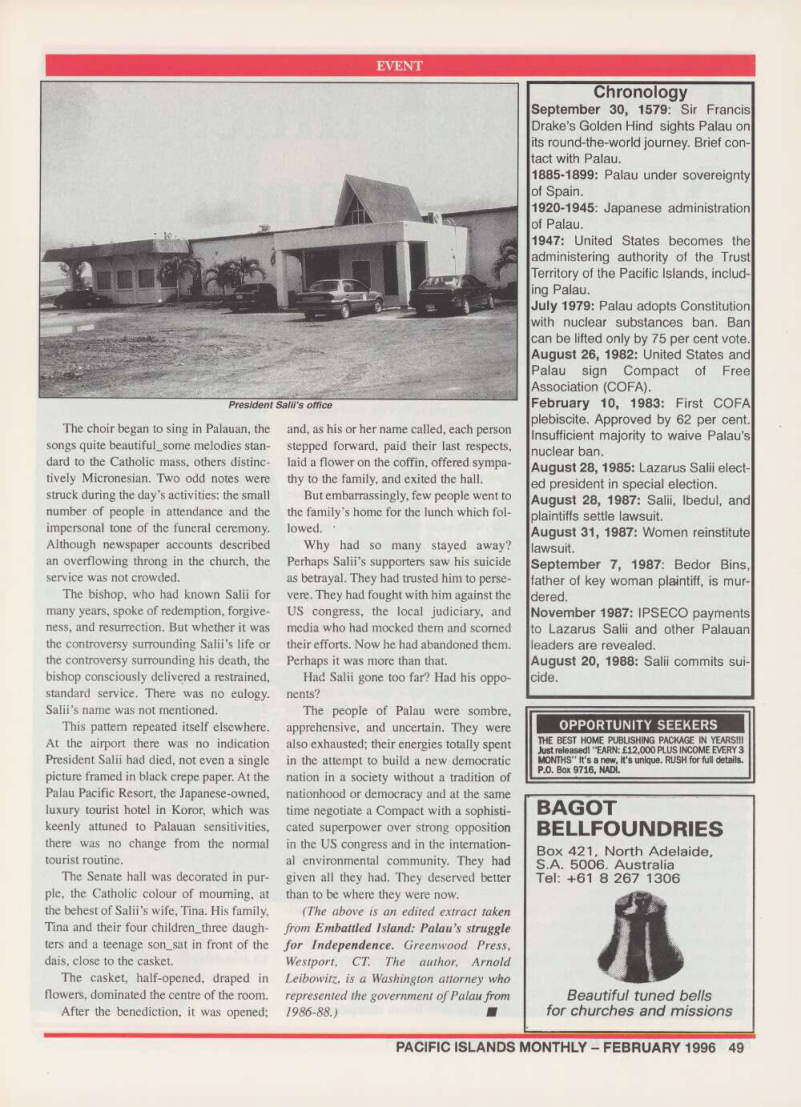
Event
Suicide of a president
By Arnold Leibowitz
In the summer of 1988, with the November Palau presidential elections
coming up, the political sniping
against Lazarus Salii, Palau’s president, intensified. Salii’s opponents in the Palau legislature accused Salii of covering-up his corruption and denying Palau precious United States aid in the process.
For Salii, the news grew worse as the days grew longer. In the middle of August, Vice-President Remengesau broke with Salii and publicly endorsed congressman Ron de Lugo’s legislation. He was chair man of the Territorial Subcommittee in the House of Representatives. He and his committee had been the primary oppo nents of the Compact, very distrustful of Salii and wanting a detailed federal inves tigation of conditions in Palau. His legisla tion would approve the Compact but only if Salii and the Palau government agreed to a special prosecutor and special auditor.
Remengesau added pointedly he couldn’t understand why anybody would not sup port having a special prosecutor in Palau unless they had something to hide.
The following week, John Ngiraked, Salii’s Minister of State, also broke ranks and came out in favour of the de Lugo leg islation. In State elections on the island of Koror, where one-half of the entire Palau populace lives, Salii’s opponents won 14 or 16 seats. Was Salii so vulnerable he would lose the presidential election in November? Most people did not think so.
Not yet, at least. The charges of corruption had weakened him, but it was his inability to deliver the Compact - the agreement with the United States providing $5OO mil-
lion to Palau in exchange for military base rights - that was hurting him the most. The
Compact was his strength.
On Sunday, August 21, the Ta Belau party was scheduled to nominate Salii.
This would kick-off his presidential cam paign. Salii flew to Peleliu on Thursday to tell his followers informally of his candi
dacy.
In the president’s office that Thursday business continued normally. Wilhelm Rengiil, the Minister of Natural Resource, had flown back from the States and saw Salii on Thursday. Ngiraked, while cam paigning with Rengiil in the States, con tinually mentioned that if for any reason Salii could not run, he, Ngiraked, would run instead. Rengiil had been offended by Ngiraked’s statements and had flown
home to tell Salii about them. Salii made light of Ngiraked’s ambition and seemed unconcerned.
On August 18, Thursday, Salii received by fax a letter from the General
St. Mary’s church where Salii’s funeral took place
Accounting Office (GAO), the congres sional investigative arm. It announced GAO’s return to Palau for further investi gation. The new scope of work included direct attacks on Salii; investigation of the renovations to Salii’s home, Palauan law enforcement activities and the IPSECO power plant contract. The approach envi sioned a public airing of complaints. The GAO would "meet with Palauan officials
... and Palauan citi zens whose views are relevant to addressing these issues...”
On Friday, he briefed a Palauan delegation from Guam on his
upcoming presiden
tial nomination.
Salii left the office Friday afternoon at his normal hour. On
Friday night,
August 19, Joyce Isechal, Salii’s sec retary, went to his home and delivered the nominating petitions and letters to be answered. He looked them over.
took action on some, deferred action on others. She thought it all normal.
About 7am Saturday morning, Willter, Salii’s longtime friend and political aide, called. He had just returned from Washington. Salii asked him to come over at once. They spent the next two hours dri ving around the island together, in Winter’s new Subaru, talking. At Salii’s request, Willter had asked Jeffrey Farrow, de Lugo’s key aide, what was really going on. Was the committee’s unrelenting oppo sition to the Compact in fact a statement about Salii? Did the committee want Salii out of office? Farrow said no. Willter did n’t believe him. Willter told Salii of Farrow’s response. Then Winter’s gloss came: the committee would oppose him, now and during the election.
Willter dropped Salii off two hours later. Willter has replayed in his mind and aloud that long conversation and can find nothing suggestive of a farewell. Willter
does not believe Salii was murdered but suicide makes no sense to him either.
Once home, Salii greeted his wife Tina, his Filipino housekeeper and his driver, Hernando lyar. They were preparing lunch in the backyard of their home. Salili said he would join them shortly. He asked lyar to destroy some papers he had taken home with him. That in itself was not unusual.
Salii frequently took papers home with
him from the office and after completing work on them, asked for them to be destroyed. lyar burned them on the hill beside the house. That night it rained; the ashes were washed away when the police came.
Inside his home, Salii put on a Japanese dressing gown. He went to a locked cabi net and took out a .357-calibre magnum revolver he had borrowed from his securi ty guard four months before. He sat down before his desk in a large chair, put the gun to his temple, and killed himself. He was
51-years-old.
In Palau, overwhelming reaction was the thought that he must have been mur dered. But even before the coroner’s report was issued, murder seemed a strange hypothesis. It would envision an intimate of Salii who could shoot the pres ident at extremely close range. Further, the murderer would have to have planned to kill the president of Palau at noon, in
broad daylight, entering the house through the one door that was unlocked, the side door, a door that could be seen by Tina and her help as they prepared food in the back yard.
The coroner concluded that Salii’s death was suicide. He directly confronted the raging rumours of homicide. His rea soning being unless the shot was self inflicted or the victim asleep, the bullet
could not travel so evenly. If it were homicide, the victim would instinctively move his head and the trajectory would
change.
Salii’s desk in his
presidential office
was empty. If he had cleaned out his desk, when did he do it?
The night before?
Early Saturday morn ing? Had he gone out alone before he met Willter? Had Salii been planning to kill himself for many hours? Or had he sud denly, after his con versation with Willter, driven to the
presidential office? Why?
Most saw the suicide as Salii’s response to his desperate, losing struggle with Farrow and de Lugo, his growing recognition that he could not bring about the Compact. He had always hoped the scenario for Palau would be the same as that for the Marshall Islands and Federated States of Micronesia. Senator Bennett Johnston, Chairman of the Senate Energy Committee, and the administration, strong Compact supporters, would eventually overwhelm de Lugo. The GAO investiga tion demeaned Salii, undermining his dig nity and pride. He could put up with that.
But it totally changed the dynamics of the situation_Salii could see that_and would permit de Lugo and Farrow to hold back Palau’s self-determination effort.
Some said more was involved than Compact ratification. Perhaps an indict ment or an arrest was imminent.
It rained the morning of the funeral.
President Salii’s home where he committed suicide
The choir began to sing in Palauan, the songs quite beautiful_some melodies stan dard to the Catholic mass, others distinc tively Micronesian. Two odd notes were struck during the day’s activities: the small number of people in attendance and the impersonal tone of the funeral ceremony.
Although newspaper accounts described an overflowing throng in the church, the service was not crowded.
The bishop, who had known Salii for many years, spoke of redemption, forgive ness, and resurrection. But whether it was the controversy surrounding Salii’s life or the controversy surrounding his death, the bishop consciously delivered a restrained, standard service. There was no eulogy.
Salii’s name was not mentioned.
This pattern repeated itself elsewhere.
At the airport there was no indication President Salii had died, not even a single picture framed in black crepe paper. At the Palau Pacific Resort, the Japanese-owned, luxury tourist hotel in Koror, which was keenly attuned to Palauan sensitivities, there was no change from the normal tourist routine.
The Senate hall was decorated in pur ple, the Catholic colour of mourning, at the behest of Salii’s wife, Tina. His family, Tina and their four children_three daugh ters and a teenage son_sat in front of the dais, close to the casket.
The casket, half-opened, draped in flowers, dominated the centre of the room.
After the benediction, it was opened;
and, as his or her name called, each person stepped forward, paid their last respects, laid a flower on the coffin, offered sympa thy to the family, and exited the hall.
But embarrassingly, few people went to the family’s home for the lunch which fol lowed. ' Why had so many stayed away?
Perhaps Salii’s supporters saw his suicide as betrayal. They had trusted him to perse vere. They had fought with him against the US congress, the local judiciary, and media who had mocked them and scorned their efforts. Now he had abandoned them.
Perhaps it was more than that.
Had Salii gone too far? Had his oppo nents?
The people of Palau were sombre, apprehensive, and uncertain. They were also exhausted; their energies totally spent in the attempt to build a new democratic nation in a society without a tradition of nationhood or democracy and at the same time negotiate a Compact with a sophisti cated superpower over strong opposition in the US congress and in the internation al environmental community. They had given all they had. They deserved better than to be where they were now. (The above is an edited extract taken from Embattled Island: Palau’s struggle for Independence. Greenwood Press, Westport, CT. The author, Arnold Leibowitz, is a Washington attorney who
represented the government of Palau from
1986-88.) m
President Salii’s office
Advertisements & other items, pp. 47-49 (1 item)
Maritime
New Zealand National
MUSEUM
Join the
WAKA MO AN A SYMPOSIUM
a hands-on experience of traditional Oceanic canoe building, sailing and navigating with International guest speakers 7 Bth - 24th March 7 996 held at the NZ National Maritime Museum, Auckland as part of the VAKAMQANA project of UNESCO Information from: Te Huiteananui-A-Tongoroo PO Box 3141 Auckland, NZ Ph.:64/9/358 1019 Fax:64/9/377 6000 proudly supported by Turners & Growers,
Chronology
September 30, 1579: Sir Francis Drake’s Golden Hind sights Palau on its round-the-world journey. Brief contact with Palau. 1885-1899: Palau under sovereignty of Spain. 1920-1945: Japanese administration of Palau. 1947: United States becomes the administering authority of the Trust Territory of the Pacific Islands, including Palau.
July 1979: Palau adopts Constitution with nuclear substances ban. Ban can be lifted only by 75 per cent vote.
August 26, 1982: United States and Palau sign Compact of Free Association (COFA).
February 10, 1983: First COFA plebiscite. Approved by 62 per cent.
Insufficient majority to waive Palau’s nuclear ban.
August 28,1985: Lazarus Salii elected president in special election.
August 28, 1987: Salii, Ibedul, and plaintiffs settle lawsuit.
August 31, 1987: Women reinstitute lawsuit.
September 7, 1987: Bedor Bins, father of key woman plaintiff, is murdered.
November 1987: IPSECO payments to Lazarus Salii and other Palauan leaders are revealed.
August 20, 1988: Salii commits suicide.
OPPORTUNITY SEEKERS
THE BEST HOME PUBLISHING PACKAGE IN YEARSIII Just released! "EARN: £12,000 PLUS INCOME EVERY 3 MONTHS” It’s a new, it's unique. RUSH for full details.
P.O. Box 9716, NADI.
BAGOT
BELLFOUNDRIES
Box 421, North Adelaide, S.A. 5006. Australia Tel; +6l 8 267 1306 Beautiful tuned bells for churches and missions
Manoa Thompson

Sports
Troubling times for Manoa Thompson
By Atama Raganivatu
These are troubling times for Fijian
rugby league player Manoa
Thompson.
Thompson recently jointed his fourth club within three years and, once hailed as an exceptional young prospect, he is now a 27 year old with limited time left to fulfil his early potential. Irrespective of whether or not he succeeds in this, Thompson is at least assured of a unique place in Fiji’s sporting
history.
Although Noa Nadruku is often accredit ed with being the first Fijian to make a major impact in Australian rugby league, that hon our actually belongs to Thompson. At the time Nadruku made his Winfield Cup debut in 1993, Thompson had already gained con siderable acclaim as a vital member of the outstanding South Sydney team which won the 1989 under 21 premiership and could boast two years first grade experience.
Unlike Nadruku, Thompson left for Fiji at an early age and was raised in Sydney. But in common with the great Canberra Raiders winger, he displayed immense ability as a
junior rugby union player and represented
the Sydney Schoolboys XV.
Rugby league, though, was always Thompson’s first love and, in 1987, he joined the famous South Sydney club. South Sydney are, historically, Australia’s most successful outfit with 20 first grade premier ships to their credit. However, the last of these occurred in 1971 and since then, due primarily to ongoing financial problems, the “Rabbitohs” have spent most of their time amongst the also cans.
That appeared likely to change in the early 19905. With Thompson a pivotal figure through his strong, elusive running and
deep, accucate positional kicking, South
Sydney gave every indication of being on the verge of a long overdue revival. It was not to be. In 1993 their form plummeted as
the edge went off Thompson’s play.
The turning point for South Sydney - and Thompson - can be pinpointed to the day the Rabbitohs’ management decided against releasing him to play in Fiji’s first ever inter national, versus Papua New Guinea at Port Moresby. Resentful of his treatment, Thompson demanded a transfer and merely went through the motions until Western Suburbs signed him for the 1994 season.
Sadly, Thompson’s career did not regain
momentum with the “Magpies”. A serious knee injury sidelined him for several months and, when he did return to duty, he made lit tle impression in a mediocre side.
Thompson could be forgiven if he was not fully committed to Western Suburbs’ cause during his final months with the Campbelltown club, for he had already agreed to become an Auckland Warriors recruit in 1995.
Auckland were newcomers to the Winfield Cup and its first participants from outside Australia. As one of the few Warriors with extensive Cup experience, Thompson was expected to be a key performer through out their debut season. Instead, it proved to be a campaign of bitter disappointments for him.
He made just seven first grade appear ances last year, five of those after coming onto the field as a replacement, before being relegated to the Auckland reserve combina tion. Despite some sterling displays for the Warriors’ second string lineup that gained a place in the reserve grade finals, club offi cials decided Thompson was superfluous to requirements after they acquired All Black Marc Ellis in November.
A mere few days after Auckland discard ed him, Thompson was snapped up by Warrington, who had been observing his sit uation closely, despite being located on the opposite side of the world. The "Wires” are one of England’s premier clubs. Three times they have been British champions and on
five occasions the celebrated Rugby League Challenge Cup has been placed in their tro phy cabinet. Few teams are better qualified to give him a career lifeline and route back to the international arena.
Thompson’s moderate performances
with the Warriors and'lingering doubts over the durability of his knee robbed him of the chance to represent Fiji at the 1995 World Cup. However, he retains international aspi rations while realising that opportunities for a call up to Bati colours are running out.
“My career is at the crossroads,” he
acknowledged after joining Warrington. “I
really want to play first grade and interna tional football. I’ve got about four seasons left in me and I am keen to finish on a top note. Reserve grade gave me little satisfac tion and I want to play in the top team from the first game to the last.”
The affable Thompson will be 28 on I,lth June. He is 190 cm. tall and weighs 98kgs. an ideal physique for a utility back like him.
He has been fielded at fullback and on the wing, although the centre’s role remains his
preference.
All rugby league fans will wish Thompson well as he attempts to resurrect his career; particularly those in Fiji.
Thompson has been frustrated over his inability to contribute more to Fijian rugby league during its formative years. But, there are legitimate reasons to believe that he may yet play a meaningful role in Bati’s quest for international credibility.
Thompson’s initial outings in the English first division have been most encouraging and with the Super League organisation - to which both Warrington and the Fijian Rugby League are attached - keen to promote the game in the Pacific islands, him being based in the northern hemisphere will not hamper his availability for Bati.
And it is still too early to write off Manoa
Thompson as Fijian rugby league’s “nearly
man”. ■
Advertisements & other items, p. 52 (1 item)
Scholarship Program
ASIAN DEVELOPMENT BANK-JAPAN
Qualified citizens of member countries of the Asian Development Bank, who intend to pursue post-graduate studies in selected disciplines are invited to apply for scholarships under the Asian Development Bank-Japan Scholarship Program.
It is anticipated that upon successful completion of their graduate studies under the Program, the scholars will return to their countries and contribute to its socio-economic development. Scholarships are awarded for graduate studies at designated institutions in courses of study approved by ADB. The Program especially welcomes women applicants who are qualified but have limited financial means to obtain university education.
THE SCHOLARSHIPS
* Level of education: Post-graduate (Diploma, Masters and Doctorate degrees) * Duration: From one to three years * Coverage: Tuition fees, books and subsistence allowance, insurance, return economy air fare
ELIGIBILITY REQUIREMENTS
Prospective applicants must: * be a citizen of an ADB member country * have at least two years work experience * have gained admission to an approved course in a
designated institution
* be in good health (Staff of ADB and the designated institutions and their close relatives are not eligible to apply)
DESIGNATED INSTITUTIONS
1. ASIAN INSTITUTE OF MANAGEMENT
MCC PO Box 898, Makati Metro Manilla, Philippines
2. ASIAN INSTITUTE OF TECHNOLOGY
PO Rnv 7754 Bangkok 10501, Thailand
3. EAST-WEST CENTER/UNIVERSITY OF HAWAII
1777 East-West, Road, Honolulu Hawaii 96848, USA.
4. INDIAN INSTITUTE OF TECHNOLOGY
New Delhi 110016, India
5. INTERNATIONAL RICE RESEARCH INSTITUTE/
UNIVERSITY OF THE PHILIPPINES IN LOS
BANOS
PO Box 933, Manila, Philippines
6. INTERNATIONAL UNIVERSITY OF JAPAN
777 Anajishinden, Yamato-Machi, Minami Uonuma-gun, Niigata 949-72, Japan
7. LAHORE UNIVERSITY OF MANAGEMENT
SCIENCES
103-C/2 Gulberg HI, Lahore, Pakistan
8. NATIONAL CENTRE FOR DEVELOPMENT
STUDIES/AUSTRALIAN NATIONAL UNIVER-
SITY
GPO Box 4, Canberra ACT 2601, Australia
9. NATIONAL UNIVERSITY OF SINGAPORE
10 Kant Ridge Crescent, Singapore 0511
10. SAIT AM A UNIVERSITY
255 Shimo-Okubo, Urawa City 338, Japan
11. UNIVERSITY OF AUCKLAND
Private Bag 92019, Auckland, New Zealand
12. UNIVERSITY OF HONG KONG
Pokfulam Road, Hong Kong
13. UNIVERSITY OF SYDNEY
N.S.W. 2006, Australia
14. UNIVERSITY OF TOKYO
3-Hongo, 7-Chome, Bunkyo-ku, Tokyo 113, Japan
APPLICATION REQUIREMENTS
Applicants should:
* ootain application forms from the designated institutions of their choice * submit the completed application form and required documentation to the institution * indicate on the application form that the applicant wishes to be considered for an Asian Development
Bank-Government of Japan Scholarship
(From among those admitted by the institutions, ADB will select candidates for award of scholarships. A separate application to ADB is not necessary)
APPROVED FIELDS OF STUDY
Business Management, Development Management, Management.
Science and Technology (including Environmental Management and Engineering) Economics, Business Administration Science and Technology Fields related to Rice and Rice-Based Farming International Relations, International Management Business Management Economics of Development, Development Administration, Demography, Environment Business Management, Management of Technology Civil and Environmental Engineering and Related
Subjects
International Business, Development Studies, Environmental Science and Management, Engineering, Public Health.
Urban Planning, Urban Design Business Administration, Economics, Commerce, Transport Management, Public Health.
Civil Engineering and Related Subjects 138564v3
Nauru’s iron might
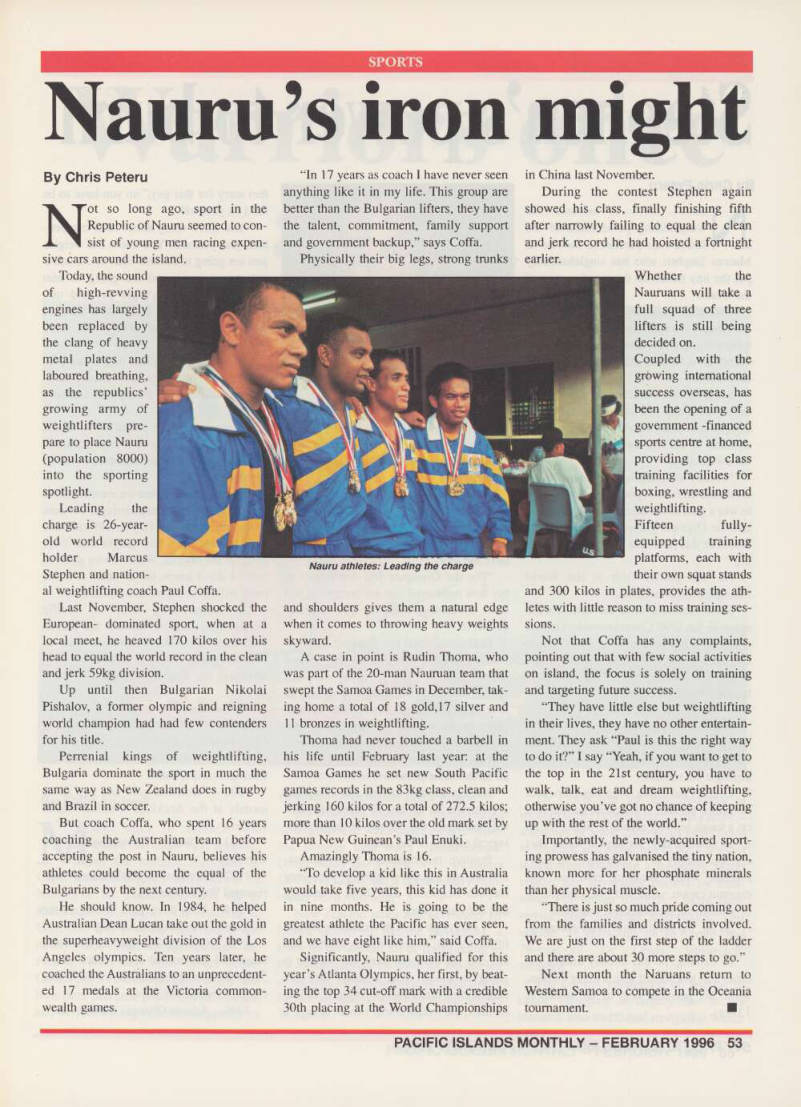
By Chris Peteru
Not so long ago, sport in the Republic of Naum seemed to con sist of young men racing expen sive cars around the island.
Today, the sound of high-revving engines has largely been replaced by the clang of heavy metal plates and laboured breathing, as the republics’ growing army of weightlifters pre pare to place Nauru (population 8000) into the sporting spotlight.
Leading the charge is 26-year old world record holder Marcus Stephen and nation
al weightlifting coach Paul Coffa.
Last November, Stephen shocked the European- dominated sport, when at a local meet, he heaved 170 kilos over his head to equal the world record in the clean
and jerk 59kg division.
Up until then Bulgarian Nikolai Pishalov, a former Olympic and reigning world champion had had few contenders for his title.
Perrenial kings of weightlifting,
Bulgaria dominate the sport in much the same way as New Zealand does in rugby and Brazil in soccer.
But coach Coffa, who spent 16 years coaching the Australian team before accepting the post in Nauru, believes his athletes could become the equal of the Bulgarians by the next century.
He should know. In 1984, he helped Australian Dean Lucan take out the gold in the superheavyweight division of the Los Angeles Olympics. Ten years later, he coached the Australians to an unprecedent ed 17 medals at the Victoria common wealth games.
“In 17 years as coach I have never seen anything like it in my life. This group are better than the Bulgarian lifters, they have the talent, commitment, family support and government backup,” says Coffa.
Physically their big legs, strong trunks
and shoulders gives them a natural edge when it comes to throwing heavy weights skyward.
A case in point is Rudin Thoma, who was part of the 20-man Nauruan team that swept the Samoa Games in December, tak ing home a total of 18 gold, 17 silver and 11 bronzes in weightlifting.
Thoma had never touched a barbell in his life until February last year: at the Samoa Games he set new South Pacific games records in the 83kg class, clean and jerking 160 kilos for a total of 272.5 kilos; more than 10 kilos over the old mark set by Papua New Guinean’s Paul Enuki.
Amazingly Thoma is 16.
“To develop a kid like this in Australia would take five years, this kid has done it in nine months. He is going to be the greatest athlete the Pacific has ever seen, and we have eight like him,” said Coffa.
Significantly, Nauru qualified for this year’s Atlanta Olympics, her first, by beat ing the top 34 cut-off mark with a credible 30th placing at the World Championships
in China last November.
During the contest Stephen again
showed his class, finally finishing fifth after narrowly failing to equal the clean and jerk record he had hoisted a fortnight earlier.
Whether the Nauruans will take a full squad of three lifters is still being decided on.
Coupled with the growing international success overseas, has been the opening of a government -financed sports centre at home, providing top class training facilities for boxing, wrestling and weightlifting.
Fifteen fully equipped training platforms, each with their own squat stands
and 300 kilos in plates, provides the ath letes with little reason to miss training ses sions.
Not that Coffa has any complaints, pointing out that with few social activities on island, the focus is solely on training and targeting future success.
“They have little else but weightlifting in their lives, they have no other entertain ment. They ask “Paul is this the right way to do it?” I say “Yeah, if you want to get to the top in the 21st century, you have to walk, talk, eat and dream weightlifting, otherwise you’ve got no chance of keeping up with the rest of the world.”
Importantly, the newly-acquired sport ing prowess has galvanised the tiny nation, known more for her phosphate minerals than her physical muscle.
“There is just so much pride coming out from the families and districts involved.
We are just on the first step of the ladder and there are about 30 more steps to go.”
Next month the Naruans return to Western Samoa to compete in the Oceania tournament. ■
Nauru athletes: Leading the charge
Stephen’s power to burn
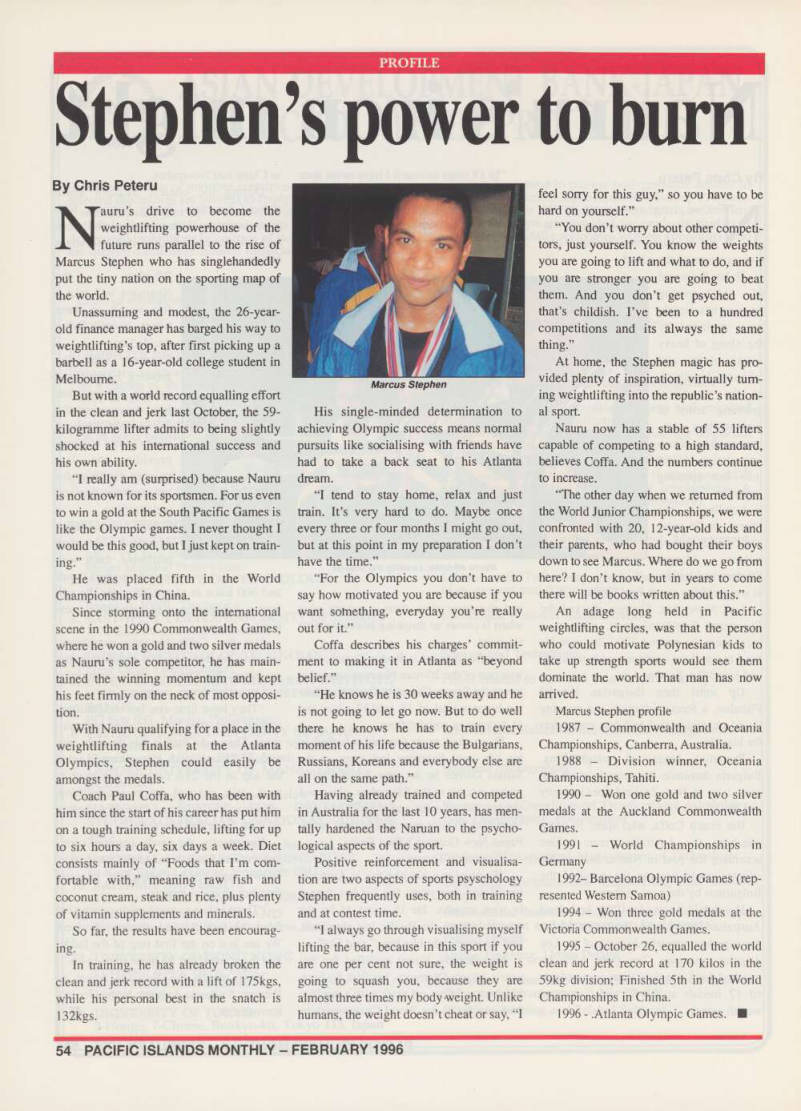
Profile
By Chris Peteru
Nauru’s drive to become the weightlifting powerhouse of the future runs parallel to the rise of Marcus Stephen who has singlehandedly put the tiny nation on the sporting map of the world.
Unassuming and modest, the 26-year old finance manager has barged his way to weightlifting’s top, after first picking up a barbell as a 16-year-old college student in Melbourne.
But with a world record equalling effort in the clean and jerk last October, the 59kilogramme lifter admits to being slightly shocked at his international success and his own ability.
“I really am (surprised) because Nauru is not known for its sportsmen. For us even to win a gold at the South Pacific Games is like the Olympic games. I never thought I would be this good, but I just kept on train ing.”
He was placed fifth in the World Championships in China.
Since storming onto the international scene in the 1990 Commonwealth Games, where he won a gold and two silver medals as Nauru’s sole competitor, he has main tained the winning momentum and kept his feet firmly on the neck of most opposi tion.
With Nauru qualifying for a place in the weightlifting finals at the Atlanta Olympics, Stephen could easily be amongst the medals.
Coach Paul Coffa, who has been with him since the start of his career has put him on a tough training schedule, lifting for up to six hours a day, six days a week. Diet consists mainly of “Foods that I’m com fortable with,” meaning raw fish and coconut cream, steak and rice, plus plenty of vitamin supplements and minerals.
So far, the results have been encourag
ing.
In training, he has already broken the clean and jerk record with a lift of 175kgs, while his personal best in the snatch is 132kgs.
His single-minded determination to achieving Olympic success means normal pursuits like socialising with friends have had to take a back seat to his Atlanta dream.
“I tend to stay home, relax and just train. It’s very hard to do. Maybe once every three or four months I might go out, but at this point in my preparation I don’t have the time.”
“For the Olympics you don’t have to say how motivated you are because if you
want something, everyday you’re really
out for it.”
Coffa describes his charges’ commit ment to making it in Atlanta as “beyond belief.”
“He knows he is 30 weeks away and he is not going to let go now. But to do well there he knows he has to train every moment of his life because the Bulgarians, Russians, Koreans and everybody else are all on the same path.”
Having already trained and competed
in Australia for the last 10 years, has men tally hardened the Naruan to the psycho logical aspects of the sport.
Positive reinforcement and visualisa tion are two aspects of sports psyschology
Stephen frequently uses, both in training
and at contest time.
“I always go through visualising myself
lifting the bar, because in this sport if you are one per cent not sure, the weight is going to squash you, because they are almost three times my body weight. Unlike humans, the weight doesn’t cheat or say, “I
feel sorry for this guy,” so you have to be hard on yourself.”
“You don’t worry about other competi tors, just yourself. You know the weights you are going to lift and what to do, and if you are stronger you are going to beat them. And you don’t get psyched out, that’s childish. I’ve been to a hundred competitions and its always the same thing.”
At home, the Stephen magic has pro
vided plenty of inspiration, virtually turn
ing weightlifting into the republic’s nation al sport.
Naum now has a stable of 55 lifters capable of competing to a high standard, believes Coffa. And the numbers continue to increase.
“The other day when we returned from the World Junior Championships, we were confronted with 20, 12-year-old kids and their parents, who had bought their boys down to see Marcus. Where do we go from here? I don’t know, but in years to come there will be books written about this.”
An adage long held in Pacific weightlifting circles, was that the person who could motivate Polynesian kids to take up strength sports would see them dominate the world. That man has now arrived.
Marcus Stephen profile 1987 - Commonwealth and Oceania Championships, Canberra, Australia. 1988 - Division winner, Oceania
Championships, Tahiti.
1990 - Won one gold and two silver medals at the Auckland Commonwealth Games. 1991 - World Championships in Germany 1992- Barcelona Olympic Games (rep resented Western Samoa) 1994 - Won three gold medals at the Victoria Commonwealth Games. 1995 - October 26, equalled the world clean and jerk record at 170 kilos in the 59kg division; Finished sth in the World Championships in China. 1996 - .Atlanta Olympic Games. ■
Marcus Stephen
again
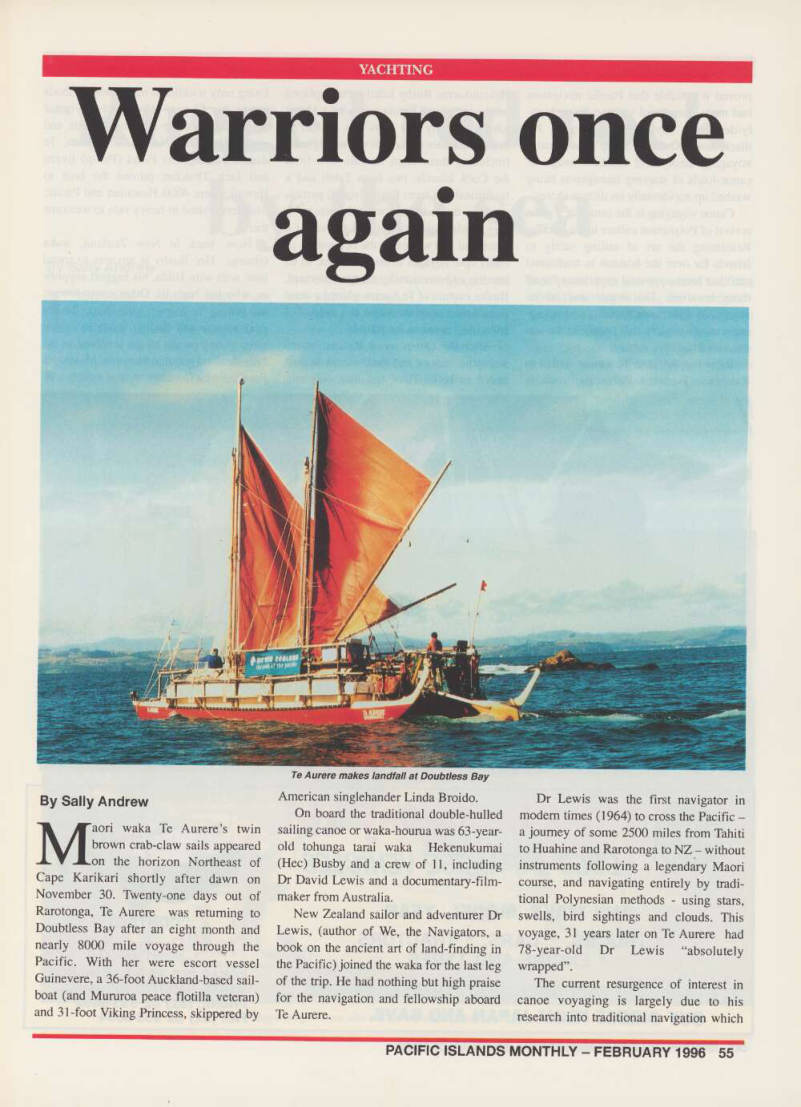
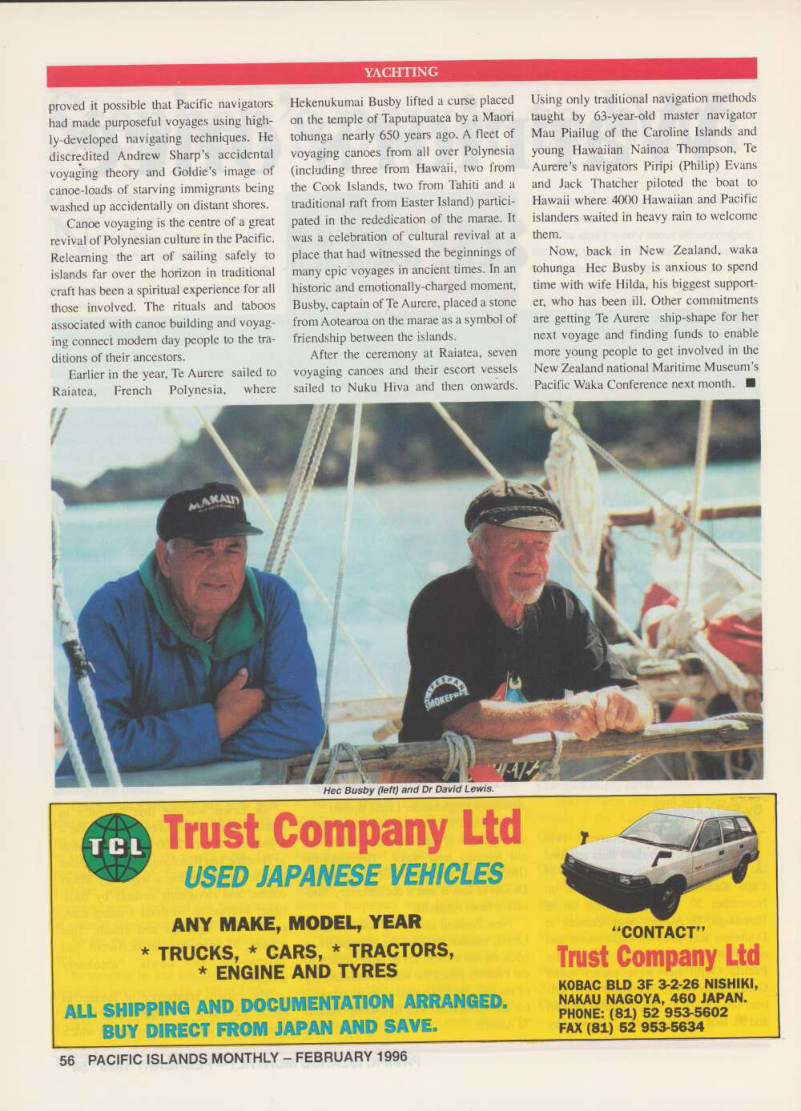
Yachting
Warriors once again
By Sally Andrew
Maori waka Te Aurere’s twin brown crab-claw sails appeared on the horizon Northeast of Cape Karikari shortly after dawn on November 30. Twenty-one days out of Rarotonga, Te Aurere was returning to Doubtless Bay after an eight month and nearly 8000 mile voyage through the Pacific. With her were escort vessel Guinevere, a 36-foot Auckland-based sail boat (and Mururoa peace flotilla veteran) and 31 -foot Viking Princess, skippered by
American singlehander Linda Broido.
On board the traditional double-hulled sailing canoe or waka-hourua was 63-yearold tohunga tarai waka Hekenukumai (Hec) Busby and a crew of 11, including Dr David Lewis and a documentary-filmmaker from Australia.
New Zealand sailor and adventurer Dr Lewis, (author of We, the Navigators, a book on the ancient art of land-finding in the Pacific) joined the waka for the last leg of the trip. He had nothing but high praise for the navigation and fellowship aboard Te Aurere.
Dr Lewis was the first navigator in modem times (1964) to cross the Pacific a journey of some 2500 miles from Tahiti to Huahine and Rarotonga to NZ - without instruments following a legendary Maori course, and navigating entirely by tradi tional Polynesian methods - using stars, swells, bird sightings and clouds. This voyage, 31 years later on Te Aurere had 78-year-old Dr Lewis “absolutely wrapped”.
The current resurgence of interest in canoe voyaging is largely due to his research into traditional navigation which
Te Aurere makes landfall at Doubtless Bay
proved it possible that Pacific navigators had made purposeful voyages using high-
ly-developed navigating techniques. He
discredited Andrew Sharp’s accidental voyaging theory and Goldie’s image of canoe-loads of starving immigrants being washed up accidentally on distant shores.
Canoe voyaging is the centre of a great revival of Polynesian culture in the Pacific, Relearning the art of sailing safely to islands far over the horizon in traditional craft has been a spiritual experience for all those involved. The rituals and taboos associated with canoe building and voyaging connect modem day people to the traditions of their ancestors.
Earlier in the year, Te Aurere sailed to Raiatea, French Polynesia, where
Hekenukumai Busby lifted a curse placed on the temple of Taputapuatea by a Maori tohunga nearly 650 years ago. A fleet of voyaging canoes from all over Polynesia (including three from Hawaii, two from the Cook Islands, two from Tahiti and a traditional raft from Easter Island) participated in the rededication of the marae. It was a celebration of cultural revival at a place that had witnessed the beginnings of many epic voyages in ancient times. In an historic and emotionally-charged moment, Busby, captain of TeAurere, placed a stone from Aotearoa on the marae as a symbol of friendship between the islands.
After the ceremony at Raiatea, seven voyaging canoes and their escort vessels sailed to Nuku Hiva and then onwards.
Using only traditional navigation methods taught by 63-year-old master navigator Mau Piailug of the Caroline Islands and young Hawaiian Nainoa Thompson, Te Aurere’s navigators Piripi (Philip) Evans and Jack Thatcher piloted the boat to Hawaii where 4000 Hawaiian and Pacific islanders waited in heavy rain to welcome them.
Now, back in New Zealand, waka tohunga Hec Busby is anxious to spend time with wife Hilda, his biggest support er, who has been ill. Other commitments are getting Te Aurere ship-shape for her next voyage and finding funds to enable more young people to get involved m the New Zealand national Maritime Museum’s Pacific Waka Conference next month. ■
Hec Busby (left) and Dr David Lewis.
Advertisements & other items, p. 56 (2 items)
Yachting
Trust Company Ltd
USED JAPANESE VEHICLES
ANY MAKE, MODEL, YEAR
* TRUCKS, * CARS, * TRACTORS,
* ENGINE AND TYRES
ALL SHIPPING AND DOCUMENTATION ARRANGED.
BUY DIRECT FROM JAPAN AND SAVE.
r
“CONTACT”
Trust Company Ltd
KOBAC BLD 3F 3-2-26 NISHIKI,
NAKAU NAGOYA, 460 JAPAN.
PHONE: (81) 52 953-5602
FAX (81) 52 953-5634
Rugged red rock
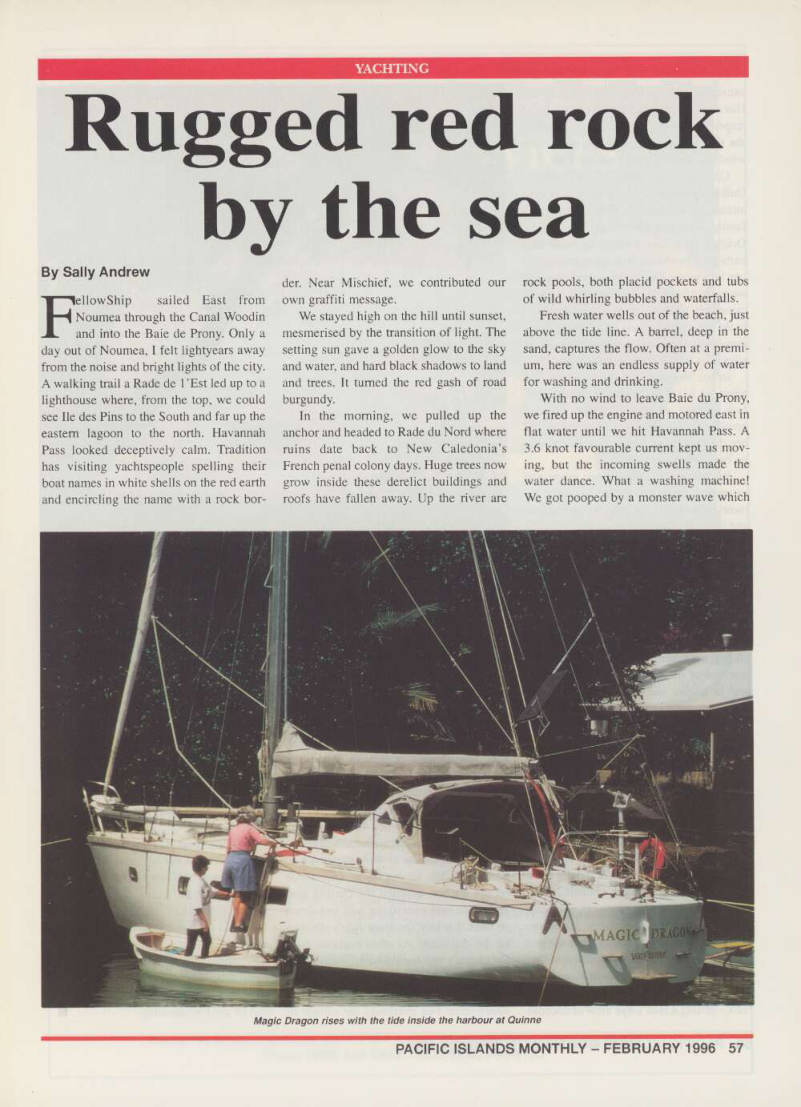
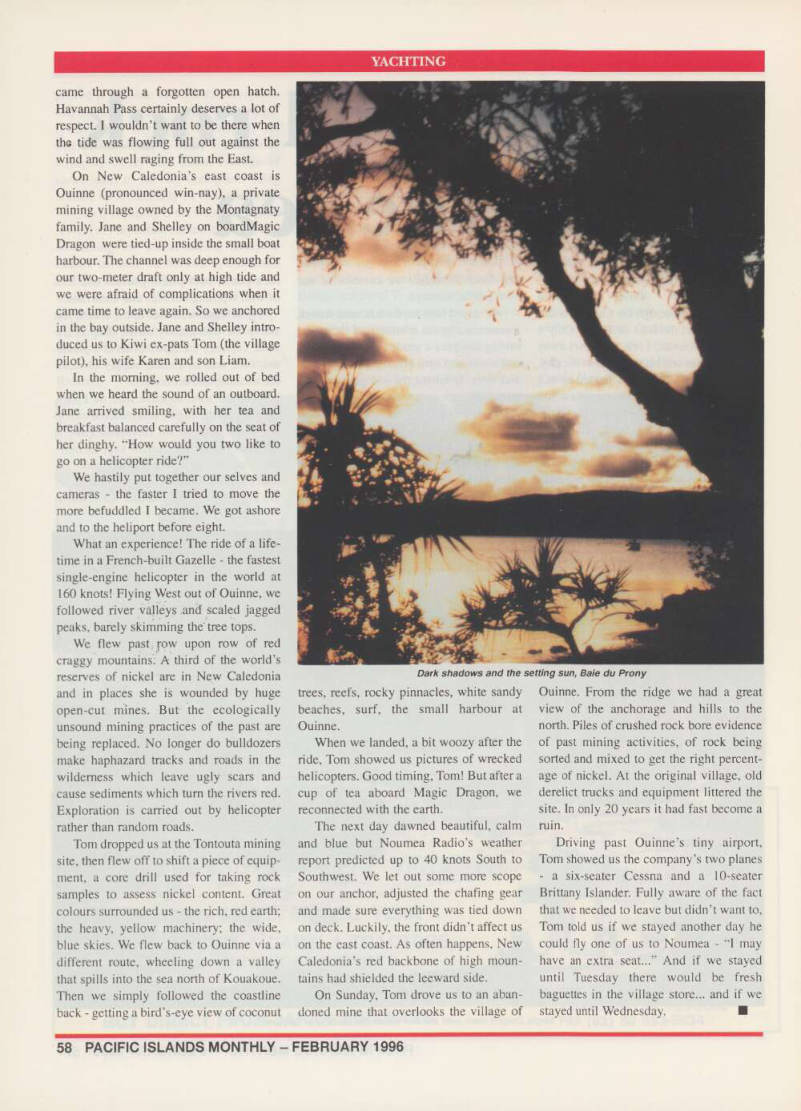
by the sea
By Sally Andrew
Fellowship sailed East from Noumea through the Canal Woodin and into the Baie de Prony. Only a day out of Noumea, I felt lightyears away from the noise and bright lights of the city.
A walking trail a Rade de 1 ’Est led up to a lighthouse where, from the top, we could see He des Pins to the South and far up the eastern lagoon to the north. Havannah Pass looked deceptively calm. Tradition has visiting yachtspeople spelling their boat names in white shells on the red earth and encircling the name with a rock bor
der. Near Mischief, we contributed our own graffiti message.
We stayed high on the hill until sunset, mesmerised by the transition of light. The setting sun gave a golden glow to the sky and water, and hard black shadows to land and trees. It turned the red gash of road burgundy.
In the morning, we pulled up the anchor and headed to Rade du Nord where ruins date back to New Caledonia’s French penal colony days. Huge trees now grow inside these derelict buildings and roofs have fallen away. Up the river are
rock pools, both placid pockets and tubs of wild whirling bubbles and waterfalls.
Fresh water wells out of the beach, just above the tide line. A barrel, deep in the sand, captures the flow. Often at a premi um, here was an endless supply of water for washing and drinking.
With no wind to leave Baie du Prony, we fired up the engine and motored east in flat water until we hit Havannah Pass. A 3.6 knot favourable current kept us mov ing, but the incoming swells made the water dance. What a washing machine!
We got pooped by a monster wave which
Magic Dragon rises with the tide Inside the harbour at Quinne
came through a forgotten open hatch.
Flavannah Pass certainly deserves a lot of respect. I wouldn’t want to be there when the tide was flowing full out against the wind and swell raging from the East.
On New Caledonia’s east coast is
Ouinne (pronounced win-nay), a private
mining village owned by the Montagnaty
family. Jane and Shelley on board Magic Dragon were tied-up inside the small boat harbour. The channel was deep enough for our two-meter draft only at high tide and we were afraid of complications when it came time to leave again. So we anchored in the bay outside. Jane and Shelley intro duced us to Kiwi ex-pats Tom (the village pilot), his wife Karen and son Liam.
In the morning, we rolled out of bed when we heard the sound of an outboard.
Jane arrived smiling, with her tea and breakfast balanced carefully on the seat of her dinghy. “How would you two like to go on a helicopter ride?”
We hastily put together our selves and cameras - the faster I tried to move the more befuddled I became. We got ashore and to the heliport before eight.
What an experience! The ride of a life time in a French-built Gazelle - the fastest single-engine helicopter in the world at 160 knots! Flying West out of Ouinne, we followed river valleys and scaled jagged peaks, barely skimming the tree tops.
We flew past ; row upon row of red craggy mountains. A third of the world’s reserves of nickel are in New Caledonia and in places she is wounded by huge open-cut mines. But the ecologically unsound mining practices of the past are
being replaced. No longer do bulldozers
make haphazard tracks and roads in the wilderness which leave ugly scars and cause sediments which turn the rivers red.
Exploration is carried out by helicopter rather than random roads.
Tom dropped us at the Tontouta mining site, then flew off to shift a piece of equip ment, a core drill used for taking rock samples to assess nickel content. Great colours surrounded us - the rich, red earth;
the heavy, yellow machinery; the wide,
blue skies. We flew back to Ouinne via a different route, wheeling down a valley that spills into the sea north of Kouakoue.
Then we simply followed the coastline back - getting a bird’s-eye view of coconut
trees, reefs, rocky pinnacles, white sandy beaches, surf, the small harbour at Ouinne.
When we landed, a bit woozy after the ride, Tom showed us pictures of wrecked helicopters. Good timing, Tom! But after a cup of tea aboard Magic Dragon, we reconnected with the earth.
The next day dawned beautiful, calm and blue but Noumea Radio’s weather report predicted up to 40 knots South to Southwest. We let out some more scope on our anchor, adjusted the chafing gear and made sure everything was tied down on deck. Luckily, the front didn’t affect us on the east coast. As often happens. New Caledonia’s red backbone of high moun tains had shielded the leeward side.
On Sunday, Tom drove us to an aban doned mine that overlooks the village of
Ouinne. From the ridge we had a great view of the anchorage and hills to the north. Piles of crushed rock bore evidence of past mining activities, of rock being sorted and mixed to get the right percent age of nickel. At the original village, old derelict trucks and equipment littered the site. In only 20 years it had fast become a ruin.
Driving past Ouinne’s tiny airport, Tom showed us the company’s two planes - a six-seater Cessna and a 10-seater Brittany Islander. Fully aware of the fact that we needed to leave but didn’t want to, Tom told us if we stayed another day he could fly one of us to Noumea - "I may have an extra seat...” And if we stayed until Tuesday there would be fresh baguettes in the village store... and if we stayed until Wednesday. ■
Dark shadows and the setting sun, Baie du Prony
Advertisements & other items, pp. 59-60 (1 item)
Grand Pacific Life Insurance, Ltd
15 20 25 30 35 40 45 50 55 60 3 1508 00524962 3
A member of the Finance Factors Family V \bra ry Of o *
JUN
o 1996 30 ★
FEDERATED STATES
OF MICRONESIA
Actouka Executive Insurance Underwriters P.O. Box 55, Kolonia, Pohnpei, Federated States of Micronesia 96941 Pacific Basin Insurance & General Services, Inc P.O. Box 494, Chuuk State, Federated States of Micronesia 96942
TONGA
Peseti Ma ‘afu Ins. & Finance, Ltd.
Private Bag 2, Taumoepeau Bldg.
Nukualofa, Tonga
GUAM
Great National Insurance Underwriters, Inc.
P.O. Box GA, Agana, Guam 96910
AMERICAN SAMOA
Mark Solofa Pacific Insurance & Finance, Inc.
P.O. Box 3149 Pago Pago, American Samoa 96799 Pacific Financial Corporation P.O. Box AT, Agana, Guam 96910 Takagi & Associates, Inc.
GCIC Bldg., Suite 100 414 W. Soledad Ave.
Agana, Guam 96910
MARSHALL ISLANDS
Marshalls Insurance Agency P.O. Box 113, Majuro, Marshall Islands 96960
WESTERN SAMOA
Mark Solofa Pacific Insurance & Finance, Inc.
P.O. Box 3149 Pago Pago, American Samoa 96799
NORTHERN MARIANAS
Pacific Basin Insurance Underwriters, Inc.
P.O. Box 710 Saipan, Mariana Islands 96950 Pacifica Insurance Underwriters, Inc.
P.O. Box 168, Saipan, Mariana Islands 96950 Grand Pacific Life Insurance, Ltd. • 1164 Bishop Street, sth Floor, Honolulu, HI 96813 Phone: (808) 548-3363 • FAX: (808) 548-5122
HELVES’
Pag
Nl_ * ■ ■■« kX M, o%iy Sa «*« : I
Mitsubishi Lancer
Asia-Pacific
Rally
Rd. 6 Thailand
Champion!
Rd.l Indonesia Rd. 2 New Zealand Rd. 3 Malaysia Rd. 4 Australia Rd.s Hong Kong-Beijing Mitsubishi Lancer has met Asia’s greatest driving challenges, from monsoons and rain forests to ice and night stages, and triumphed—again.
In addition to three Asia-Pacific Rally Championships in the last eight years, this year’s Lancer swept all three titles: the Manufacturer’s Title, Group A (Touring Car) Driver’s Title and Group N (Production Car) Driver’s Title.
Lancer’s stellar results prove that our engineering has what it takes to win.
And our cars give you all the performance and reliability advantages of our winning experience.
MITSUBISHI LRNCER
What Drives You.
AMERICAN SAMOA- PACIFIC MARKETING INC. P.O. Box 698, Pago Pago, Tel. 699-9140/ AUSTRALIA: MITSUBISHI MOTORS AUSTRALIA LTD. 1284 South Road, Clovelly Park, South Australia, 5042, Tel. (08) 2757297/FIJI: NIVIS MOTOR & MACHINERY CO. LTD. G.P.O. Box 150, Suva, Tel. 383411 / GUAM; TRIPLE J ENTERPRISES INC. P.O. Box 6066, Tamuning, Tel. 6469126/NEW CALEDONIA: SOCIETE DTMPORTATION D'AUTO DU PACIFIQUE SUD S.A. P.O. Box 2548, Noumea, Tel. 281-787 / NEW ZEALAND: MITSUBISHI MOTORS NEW ZEALAND LTD. Private Bag. Porima, Tel. 237-0109 / NORFOLK ISLAND: SORRY'S PTY LTD. P.O. Box 169, Taylors Road, Burnt, Tel. 22114/PAPUA NEW GUINEA; TOBA MOTORS PTY LTD. P.O. Box 503, Port Moresby/ SAIPAN: SAIPAN AUTDWORLD INC. P.O.
Box 487, Tel. 234-7133/SOLOMON ISLANDS: HARVEST PACIFIC LTD. G.P.O. Box 823, Honiara, Tel. 30407/TAHITI: SOPADEP S.A. B.P. 1617, Papeete, Tel. 427393/TONGA: SITANI MAPI CO., LTD P.O. Box 83, Nukualofa, Tel. 24044 /VANUATU: SOCOMETRA VANUATU LTD. B.P. 6, Port-Vila, Tel. 2314/WESTERN SAMOA: MOTOR DISTRIBUTORS (SAMOA) LTD. P.O, Box 576, Apia, Tel. 20957 A
MITSUBISHI
MOTORS
CREATING TOGETHER