Advertisements & other items, pp. 1-3 (3 items)
Pacific
ISLANDS
MONTHLY
rtb
.gfayaia?’; ’f*’ ,- j{ / j£s;»*j f-Ar-.-?!
I Him Id 001
r J Tr| l\
■J J JJ 1
rm Solomon Islands ■> I
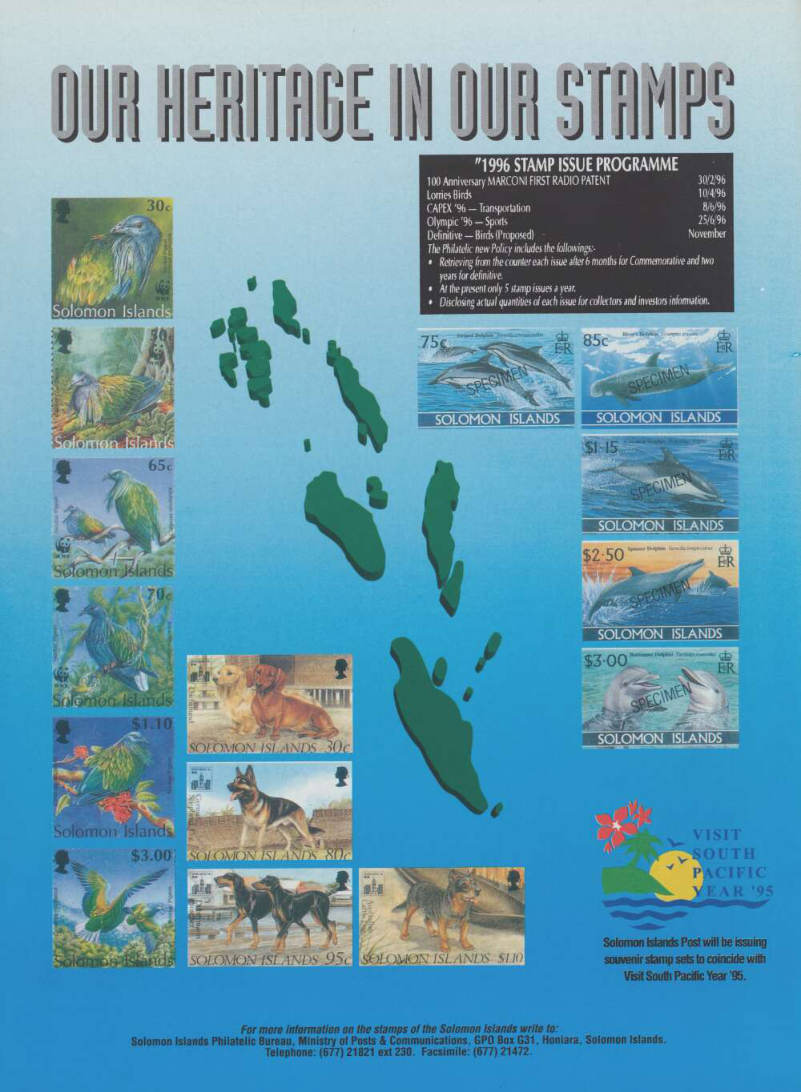
"1996 STAMP ISSUE PROGRAMME
MO Anniversary MARCONI FIRST RADIO PATENT 30/2/96 Lorries Birds 10/4/96 CAPEX '96 Transportation 8/6/96 Olympic '96 Sports 25/6/96 Definitive Birds (Proposed) November The Philatelic new Policy includes the followings:- • Retrieving from the counter each issue after 6 months for Commemorative and two years for definitive. • At the present only 5 stamp issues a year. • Disclosing actual quantities of each issue for collectors and investors information.
SOLOMON ISLANDS
Cfc Si ■
Sotomonisiands
£ « Spinner IMphm s* enrlla lonfuosuui
* Z ' SU E"R
/ » u la
me iH
SOLOMON ISLANDS
v E'R m t V in *1 ' *
SOLOMON ISLANDS
SOLOMON ISLANDS 30c
*‘d ® i € , Sf )/ C )\Tf W /S7 ,I ND S’ tfTV «lfi 95 a™
SOLOMON ISLANDS 95SshLOMON ISLANDS SLID
Solomon Islands Post will be issuing souvenir stamp sets to coincide with Visit South Pacific Year ’95.
For more information on the stamps of the Solomon Islands write to: Solomon islands Philatelic Bureau, Ministry of Posts & Communications, GPO Box G3l, Honiara, Solomon Islands.
Telephone: (677) 21821 ext 230. Facsimile: (677) 21472.
Pacific
ISLANDS
MONTHLY
Vol. 66 No. 1
THE NEWS MAGAZINE
JANUARY 1996
Inside
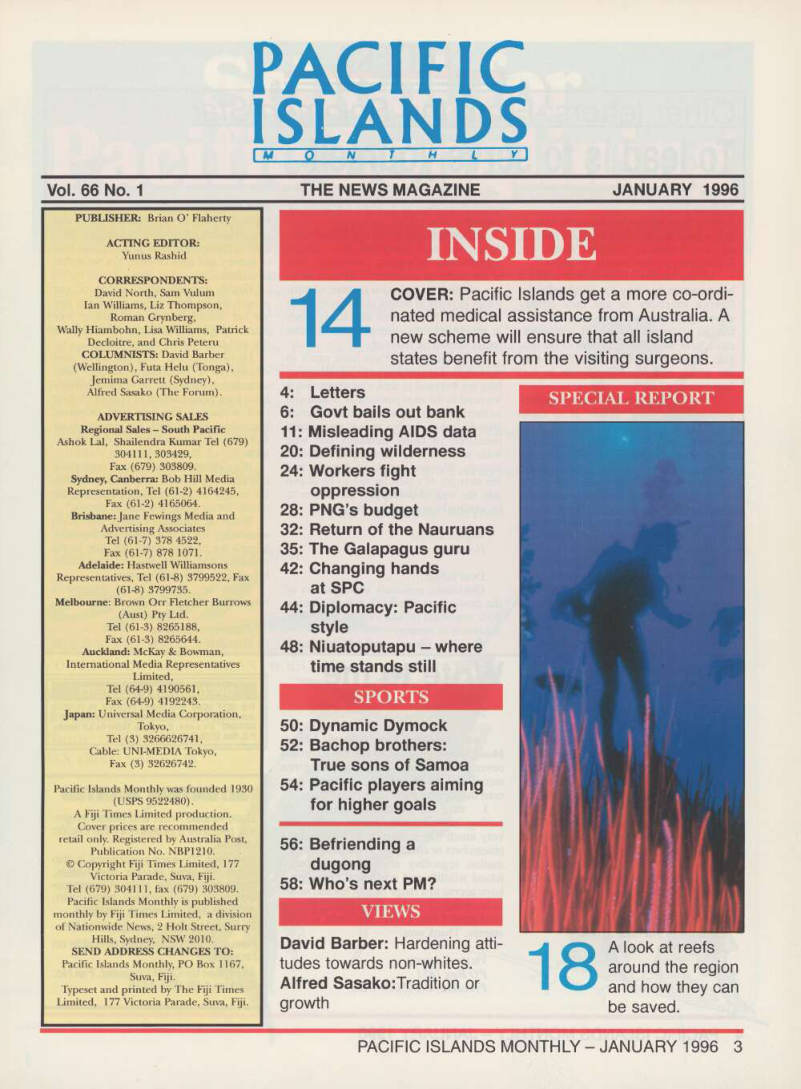
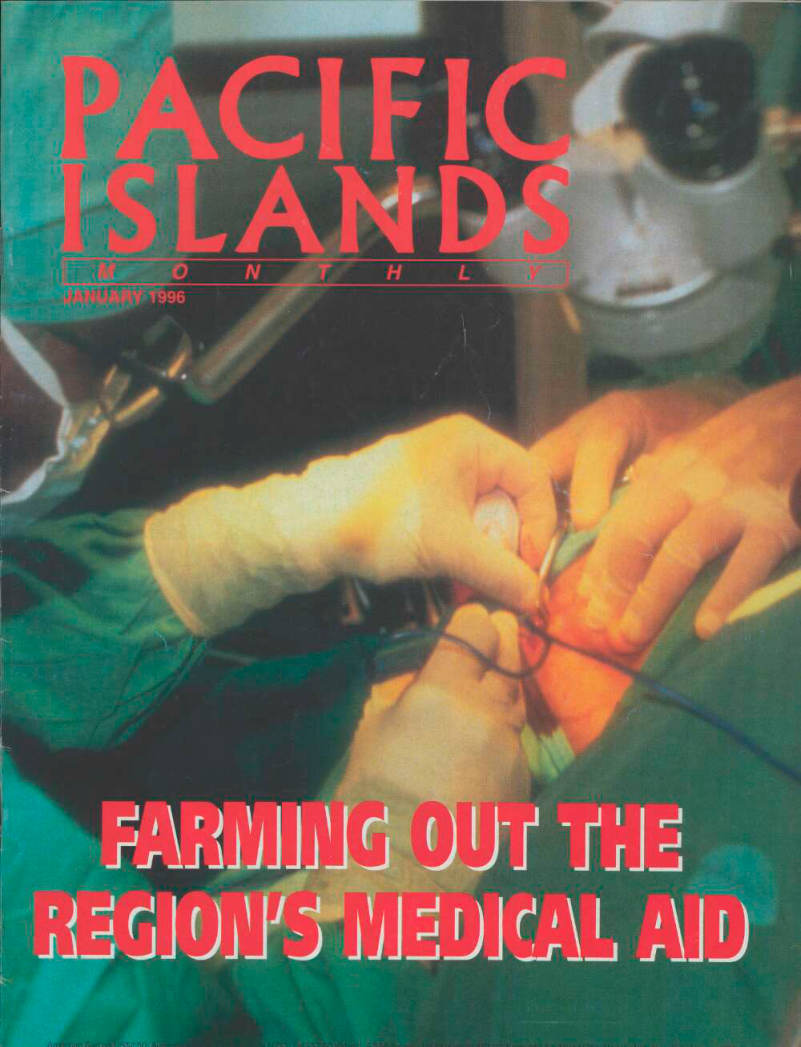
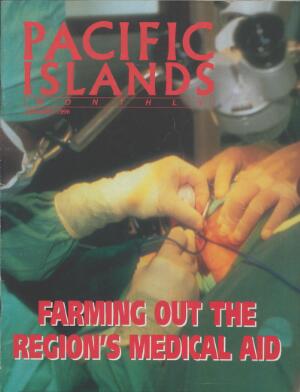
Jk COVER: Pacific Islands get a more co-ordi- I nated medical assistance from Australia. A I new scheme will ensure that all island states benefit from the visiting surgeons.
4: Letters 6: Govt bails out bank 11: Misleading AIDS data 20: Defining wilderness 24: Workers fight oppression 28: PNG’s budget 32: Return of the Nauruans 35: The Galapagus guru 42: Changing hands atSPC 44: Diplomacy: Pacific style 48: Niuatoputapu - where time stands still
Sports
50: Dynamic Dymock 52: Bachop brothers: True sons of Samoa 54: Pacific players aiming for higher goals
56: Befriending a
dugong
58: Who’s next PM?
Views
David Barber: Hardening atti tudes towards non-whites.
Alfred Sasako:Tradition or growth
Special Report
A look at reefs around the region * and how they can be saved.
Advertisements & other items, p. 3 (1 item)
PUBLISHER: Brian O’ Flaherty
ACTING EDITOR:
Yunus Rashid
CORRESPONDENTS:
David North, Sam Vulum Ian Williams, Liz Thompson, Roman Grynberg, Wally Hiambohn, Lisa Williams, Patrick Decloitre, and Chris Peteru COLUMNISTS: David Barber (Wellington), Futa Helu (Tonga), Jemima Garrett (Sydney), Alfred Sasako (The Forum).
ADVERTISING SALES
Regional Sales - South Pacific Ashok Lai, Shailendra Kumar Tel (679) 304111, 303429, Fax (679) 303809.
Sydney, Canberra: Bob Hill Media Representation, Tel (61-2) 4164245, Fax (61-2) 4165064.
Brisbane: Jane Fewings Media and Advertising Associates Tel (61-7) 378 4522, Fax (61-7) 878 1071.
Adelaide: Hastwell Williamsons Representatives, Tel (61-8) 3799522, Fax (61-8) 3799735.
Melbourne: Brown Orr Fletcher Burrows (Aust) Pty Ltd.
Tel (61-3) 8265188, Fax (61-3) 8265644.
Auckland: McKay & Bowman, International Media Representatives Limited, Tel (64-9) 4190561, Fax (64-9) 4192243.
Japan: Universal Media Corporation, Tokyo, Tel (3) 3266626741, Cable: UNI-MEDIA Tokyo, Fax (3) 32626742.
Pacific Islands Monthly was founded 1930
(USPS 9522480).
A Fiji Times Limited production.
Cover prices are recommended retail only. Registered by Australia Post, Publication No. NBP1210. © Copyright Fiji Times Limited, 177 Victoria Parade, Suva, Fiji.
Tel (679) 304111, fax (679) 303809.
Pacific Islands Monthly is published monthly by Fiji Times Limited, a division of Nationwide News, 2 Holt Street, Surry Hills, Sydney, NSW 2010.
SEND ADDRESS CHANGES TO:
Pacific Islands Monthly, PO Box 1167, Suva, Fiji.
Typeset and printed by The Fiji Times Limited, 177 Victoria Parade, Suva, Fiji.
To lead is to serve yourself
Letters
Other letters: From the Solomon Star To lead is to serve yourself
Dear Editor, Why is it that every time we read in the newspapers of a new business starting up in Solomon Islands there are Politicians or other leaders involved?
Are our national leaders such brilliant businessmen that they are sought after by foreign investors or are they simply allowing themselves to be used by those foreign investors? Many of our politi cians have their first exposure to the out side world on overseas trips. There they are wined and dined and made to feel
important.
They are easy targets for unscrupulous people whose only motive is to make money and who have no interest, other than financial, in this country. Instead of promoting the national interest, our politicians are only serving themselves making a nonsense of our national motto.
It seems to be common nowadays when governments look for overseas funding not to go to recognised sources, but to seek assistance from more dubious institutions and individuals.
The reason for this is that internation ally recognised and respected lenders do not give kick-backs. So once again self interest is put before national interest. It is now time for all of us to say what king of leaders we want. Members of cabinet should not be allowed to have business
interests as there is so often a conflict of interest.
Cabinet ministers should be concen trating on their jobs and not running
supermarkets or logging companies. Part
of the problem is caused by prime minis ters creating an excessive number of min istries in order to secure slim majorities in parliament. As has been said many times in recent months, the number of min istries should be reduced.
Many ministers do not have much to do and so it is perhaps not surprising that they are tempted to look elsewhere. What we need in the next parliament is men and women who genuinely put the Solomon Islands first and who are not necessarily interested in being ministers but who want to serve their constituents and their country. We need people of integrity and the strength of character not to be drawn into the web of corruption that seems to be getting larger year by year.
Wilfred James
Honiara.
Dear Editor, Obviously, politicals and ministers of the crown here taken free ride in abusing their respectful offices long enough while we watch in silence.
The last seven years of our nation
have been marred with allegations of cor ruption, abuse of the high office of the land, leaders depriving people of their land to foreigners for an insignificant sum of money and cans of beer. Yet we watch in silence.
Health and education needs of our people are far from being met. Each day we are tossed further and further way from any glimpse of a hopeful future for our children. Yet we remain silent.
Obviously, our leaders have lost visions of a meaningful future. They seem to have eyes but do not see. Visions have long been burned in pursuit-of their own welfare - like free trips overseas, becoming consultants for commissions and other privileges from foreign compa nies.
Why should a few men of deplorable characters be given a free hand to destroy the image, the resources and future of our nation for us while we wait in silence?
Wake up Solomon Islands. Let us do something for God to save our Solomon Islands we have to speak out, join hands together and fight against corruption, injustice in all possible ways.
Wake up. Our children deserve a respectable future. A future of hope.
Patterson Toenunu
Honiara.
Peace please
Sir, PEACE has come to stay! World lead ers have announced that PEACE IN OUR TIME is a fact that must be faced. The sci entists of all countries were unable to iso late the PEACE germ (the hypothetical cause of the eruption).
In spite of the combined efforts of sci ence and ideology PEACE has not been able to be eradicated.
Citizens of Earth are beginning to realise that PEACE is something they must learn to live with.
Martin Leo
Embassy of The Star System SIRIUS, New Zealand.
Write to me
Sir, I am a regular reader of Pacific Islands Monthly and am glad to see the excellent coverage that your magazine has given recently to issues of environmental con cern throughout the Pacific.
I am a Masters student of ecology/resource management and would very much like to correspond with island researchers or educators to exchange infor mation regarding environmental issues, island wildlife and ecological concerns. I have access to a range of articles and mate rials which I could share with anyone interested. I also collect and trade wildlife stamps. Thank you.
Victor Cassetta
PO Box 1851 Freedom, CA 95019 USA.
Advertisements & other items, pp. 4-5 (1 item)
Situation Wanted
OPPORTUNITY SEEKERS
THE BEST HOME PUBUSHING PACKAGE IN YEARSIII Just released! "EARN: £12,000 PLUS INCOME EVERY 3 MONTHS” It’s a new, it's unique. RUSH for full details.
P.O. Box 9716, NADI.
SITUATION WANTED
Experienced hotel and resort engineer requires a position in the Pacific Islands.
Has over 20 years experience in the Pacific in large resorts and hotels, and has particular skills in construction, staff management, plant maintenance and sewerage systems.
Spouse also has managerial skills.
Resume and references available on request.
All replies to; Chief Engineer, Fax No: Auckland (9) 820 4425.
c c c
HONOLULU • FEBRUARY 19-23,1996
Ocean Producers International, a leader in Pacific Longlining, presents PACIFIC LONGLINING, a 3-day course about tuna longlining on February 19-23, in Honolulu. The course, with an emphasis on monofilament gear, is designed for experienced fishermen, fishing masters and training personnel desiring to know more about longline techniques. The course will be in English with no translation. Price including ground transportation, 7 nights hotel accommodations (single occupancy) and course manuals is $1,895.00 USD. Course is limited to 24 persons.
Fax or phone for details and a course outline.
Basic Longline Techniques Vessel Design and Layout Electronics for Longlining Basic Hydraulics System Installation Procedures Gear Design and Construction Actual Setting and Hauling
OCEAN PRODUCERS INTERNATIONAL, INC
A DIVISION OF PACIFIC OCEAN PRODUCERS
at Sea Shoreside Infrastructure Fish Handling The Honolulu Auction 965-B North Nimitz Highway Honolulu, Hawaii 96817 Phone: (808) 337-2903
FAX (808) 536-3223
Govt bails out national Bank

Economy
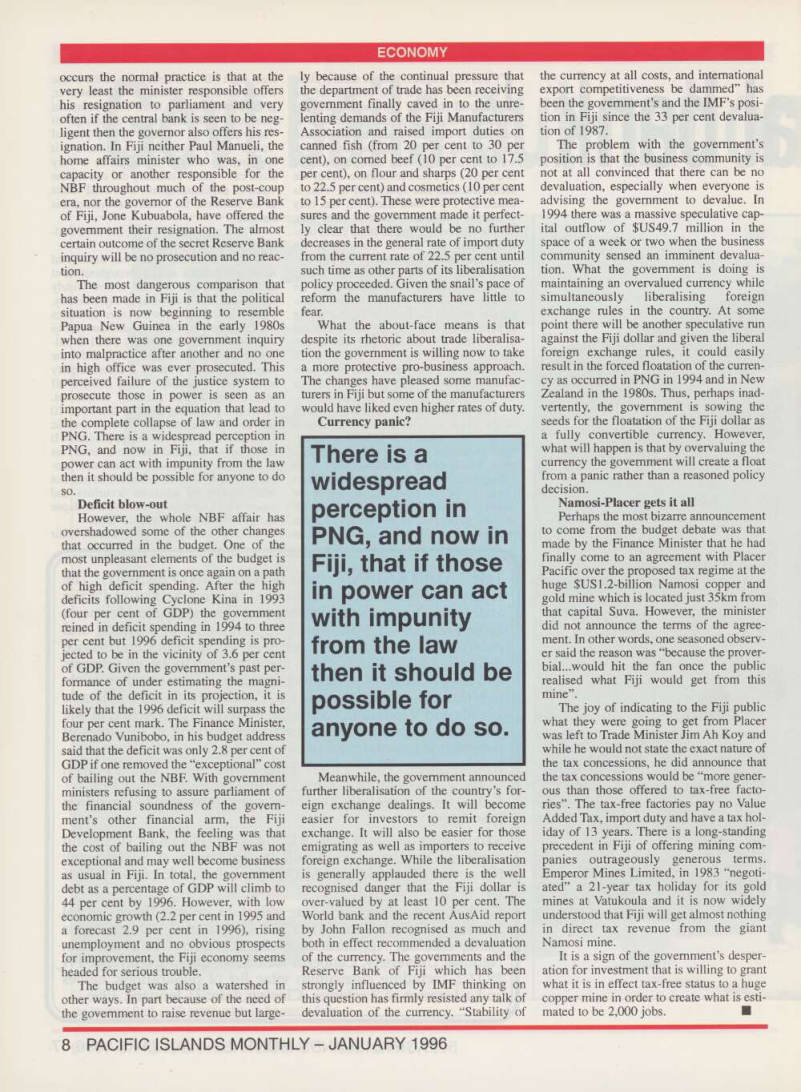
The National Bank of Fiji headquarters in the capital Suva.
It was Fiji’s ugliest budget session since before the coups. The collapse of the National Bank of Fiji and the ensuing financial obligation of the government to recapitalise the technically bankrupt bank by injecting SUSIS million sent shock waves through a public that had endured two weeks of Press revelations about the seedy finances and operations of what is touted as “Fiji’s Own Bank”. It was only when the politicians made it clear that, having supervised, and in some cases benefited from the present situation at the NBF, they were now asking the Fiji taxpayer to pay the bill, that the public finally got the message. To add insult to injury the information minister, Etuate Tavai, threatened to muzzle the Press in Fiji for daring to demand a public inquiry into the affairs of the NBF. The analogy that was so frequently heard in Suva was that the NBF saga was like the thief who robs your house, asks you to pay the bill for dinner and then gags you when you complain.
The vote to approve die budget was in doubt when, early in the session. Labour Party leader Mahendra Chaudhry threatened to invoke standing orders of parliament which would forbid members from voting on a bill in which they had a direct financial interest. Since the leaking of the secret Aidney-Dickson report into the NBF and the publishing of the names of those who have doubtful debts with the bank, at
least eight MP’s on both sides of the house would have been unable to vote. However, given that most were from the government side and with the ruling Soqosoqo ni Vakavulewa ni Taukei (SVT)/General Voters Party coalition in disarray it appeared as though it would be a very close call. When Chaudhry did ask for the votes of parliamentarians with NBF debts to be nullified, the speaker dismissed his motion.
With a majority of 36-30, the 1996 bud get was passed by parliament.
The NBF affair, which has dominated news and politics in Fiji throughout most of the second half of 1995, is now widely recognised as a watershed in Fiji’s history, Painful comparisons with other countries are frequently made. It is said that in Fiji when the nation’s bank loses SUSI 42 mil lion in loans the matter is swept under the carpet and dealt with by a secret inquiry with those responsible being shunted off into a sedate and pleasant retirement.
However, a banking disaster that costs 10 per cent of the nation’s Gross Domestic Product (GDP) does not disappear easily. It is not only a financial loss but a moral loss to Fiji. The government had allowed peo pie to obtain millions in loans that had not been backed by adequate securities and assets which ultimately lead to the collapse the government’s commercial bank, In other countries when such an affair
occurs the normal practice is that at the very least the minister responsible offers his resignation to parliament and very often if the central bank is seen to be neg ligent then the governor also offers his res ignation. In Fiji neither Paul Manueli, the home affairs minister who was, in one capacity or another responsible for the NBF throughout much of the post-coup era, nor the governor of the Reserve Bank of Fiji, Jone Kubuabola, have offered the government their resignation. The almost certain outcome of the secret Reserve Bank inquiry will be no prosecution and no reac tion.
The most dangerous comparison that has been made in Fiji is that the political situation is now beginning to resemble Papua New Guinea in the early 1980 s when there was one government inquiry into malpractice after another and no one in high office was ever prosecuted. This perceived failure of the justice system to prosecute those in power is seen as an important part in the equation that lead to the complete collapse of law and order in PNG. There is a widespread perception in PNG, and now in Fiji, that if those in power can act with impunity from the law then it should be possible for anyone to do so.
Deficit blow-out However, the whole NBF affair has overshadowed some of the other changes that occurred in the budget. One of the most unpleasant elements of the budget is that the government is once again on a path of high deficit spending. After the high deficits following Cyclone Kina in 1993 (four per cent of GDP) the government reined in deficit spending in 1994 to three per cent but 1996 deficit spending is pro jected to be in the vicinity of 3.6 per cent of GDP. Given the government’s past per formance of under estimating the magni tude of the deficit in its projection, it is likely that the 1996 deficit will surpass the four per cent mark. The Finance Minister, Berenado Vunibobo, in his budget address said that the deficit was only 2.8 per cent of GDP if one removed the “exceptional” cost of bailing out the NBF. With government ministers refusing to assure parliament of the financial soundness of the govern ment’s other financial arm, the Fiji Development Bank, the feeling was that the cost of bailing out the NBF was not exceptional and may well become business as usual in Fiji. In total, the government debt as a percentage of GDP will climb to 44 per cent by 1996. However, with low economic growth (2.2 per cent in 1995 and a forecast 2.9 per cent in 1996), rising unemployment and no obvious prospects for improvement, the Fiji economy seems headed for serious trouble.
The budget was also a watershed in other ways. In part because of the need of the government to raise revenue but large
ly because of the continual pressure that the department of trade has been receiving government finally caved in to the unre lenting demands of the Fiji Manufacturers Association and raised import duties on canned fish (from 20 per cent to 30 per cent), on corned beef (10 per cent to 17.5 per cent), on flour and sharps (20 per cent to 22.5 per cent) and cosmetics (10 per cent to 15 per cent). These were protective mea sures and the government made it perfect ly clear that there would be no further decreases in the general rate of import duty from the current rate of 22.5 per cent until such time as other parts of its liberalisation policy proceeded. Given the snail’s pace of reform the manufacturers have little to fear.
What the about-face means is that despite its rhetoric about trade liberalisa tion the government is willing now to take
a more protective pro-business approach.
The changes have pleased some manufac turers in Fiji but some of the manufacturers would have liked even higher rates of duty.
Currency panic?
There is a widespread perception in PNG, and now in Fiji, that if those in power can act
with impunity
from the law then it should be
possible for
anyone to do so.
Meanwhile, the government announced further liberalisation of the country’s for eign exchange dealings. It will become easier for investors to remit foreign exchange. It will also be easier for those emigrating as well as importers to receive foreign exchange. While the liberalisation is generally applauded there is the well recognised danger that the Fiji dollar is over-valued by at least 10 per cent. The World bank and the recent AusAid report by John Fallon recognised as much and both in effect recommended a devaluation of the currency. The governments and the Reserve Bank of Fiji which has been strongly influenced by IMF thinking on this question has firmly resisted any talk of devaluation of the currency. “Stability of
the currency at all costs, and international export competitiveness be dammed” has been the government’s and the IMF’s posi tion in Fiji since the 33 per cent devalua tion of 1987.
The problem with the government’s position is that the business community is not at all convinced that there can be no devaluation, especially when everyone is advising the government to devalue. In 1994 there was a massive speculative cap ital outflow of $U549.7 million in the space of a week or two when the business community sensed an imminent devalua tion. What the government is doing is maintaining an overvalued currency while
simultaneously liberalising foreign
exchange rules in the country. At some point there will be another speculative run against the Fiji dollar and given the liberal foreign exchange rules, it could easily result in the forced floatation of the curren cy as occurred in PNG in 1994 and in New Zealand in the 1980 s. Thus, perhaps inad vertently, the government is sowing the seeds for the floatation of the Fiji dollar as a fully convertible currency. However, what will happen is that by overvaluing the currency the government will create a float from a panic rather than a reasoned policy decision.
Namosi-Placer gets it all Perhaps the most bizarre announcement to come from the budget debate was that made by the Finance Minister that he had finally come to an agreement with Placer Pacific over the proposed tax regime at the huge SUS 1.2-billion Namosi copper and gold mine which is located just 35km from that capital Suva. However, the minister did not announce the terms of the agree ment. In other words, one seasoned observ er said the reason was “because the prover bial... would hit the fan once the public realised what Fiji would get from this mine”.
The joy of indicating to the Fiji public what they were going to get from Placer was left to Trade Minister Jim Ah Koy and while he would not state the exact nature of the tax concessions, he did announce that the tax concessions would be “more gener ous than those offered to tax-free facto ries”. The tax-free factories pay no Value Added Tax, import duty and have a tax hol iday of 13 years. There is a long-standing precedent in Fiji of offering mining com panies outrageously generous terms.
Emperor Mines Limited, in 1983 “negoti ated” a 21-year tax holiday for its gold mines at Vatukoula and it is now widely understood that Fiji will get almost nothing in direct tax revenue from the giant Namosi mine.
It is a sign of the government’s desper ation for investment that is willing to grant what it is in effect tax-free status to a huge copper mine in order to create what is esti mated to be 2,000 jobs. ■
Advertisements & other items, pp. 7-9 (2 items)
al bank
7
rtj
PACIFIC ISLANDS MONTHLY - JANUARY 1996
al bank
The Australian National University, The
Institute of Advanced Studies, The Research School of Pacific and Asian Studies, State, Society and Governance in Melanesia Project wishes to make three appointments to research and publish on state and society relations, public policy and service delivery, national and ethnic identities, separatist movements and the problems of public and domestic violence as they relate to Melanesia generally and to Fiji, Papua New Guinea, Solomon Islands and Vanuatu m particular. Preference in selection of one position will be given to a researcher working in the areas of politics and international relations.
Appointment: Postdoctoral Fellow two years initially with possible extension to maxinmm three years; Research Fellow/ Fellow three years initially with possible extension to maximum five years.
Salary: Postdoctoral Fellow $32,914 $40,087 pa (A successful applicant holding a PhD will be appointed at $37,345 pa); Research Fellow A542,198-$50,11l pa; Fellow A551,692-A559606 pa.
Further particulars, including selection criteria, from School Secretary, RSPAS: Fax: (61-6) 249 4836; e-mail; schlsec. rspas @anu; edu; au. Applications to the Secretary. The Australian National University, Canberra ACT 0200. quoting reference PA 29.11.2, including curriculum vitae list of publications, names and addresses of 3 referees. Closing date: 31 January, 1996.
FOSTER
FARMS
FOSTER
FARMS
c fl 8 04 < fa 8 fa 04 fa H cc o fa
Jfarms
Always natural. Always fresh.
04 <
PACK
fa oO S 5 fa H cc O fa pack
FOR BEST
VALUE,
QUALITY
AND
BETTER
HEALTH
AND
SELECTED
SERVINGS
IN MANY
CHOICES
& & ssas S-C V
WE WELCOME STANDING ORDERS FROM
SUPERMARKETS, RESTAURANTS, HOTELS, MOTELS,
SHIPS, NEIGHBOURING ISLANDS AND COUNTRIES
ALL ENQUIRIES TO:
MA-TAPULE INVESTMENT LIMITED
PH: (679) 312831 FAX: (679) 303757
SUVA, FIJI ISLANDS
EREMASIROVA
(CHIEF EXECUTIVE)
o xn H W 50 *5 > 50 8 05 >*l o XU H H 50 *1 > 50 £ CZ3 *3 O OS H H 50 *3 50
FOSTER
FARMS
FOSTER FARMS
PNG’s new defence chief
The Region
By Sam Vulum
Papua New Guinea has once again changed its defence force - the sec ond under the Sir Julius Chan gov ernment in less than two years.
The government sacked a veteran and the commander of the 1981 Kumul Force which quelled the Santo rebellion in Vanuatu, Tony Huai, and replaced him with one of the force’s youngest colonels, Jerry Singirok.
Col Singirok was chosen ahead of senior colonels, many of them veterans, including Lima Dataona, David Joshua, Joe Bau Maras, Leo Nuia, David Takendu and Kerry Frank.
He takes over at a time when the force is reeling from continuous lack of govern ment funding, deteriorating discipline and lack of effective leadership because of political manipulation and changes in the office of the commander and the secretary.
However, when announcing the appointment. Prime Minister Sir Julius said: “It has become necessary for an up and-coming young officer to inherit the important task of rebuilding the force at this crucial point in time, when the govern ment is desirous of reaffirming and reassessing Papua New Guinea’s sover eignty and effectively police its territorial boarders.”
Col Singirok is not likely to have an easy time, especially as far as support from his veteran colleagues is concerned.
A day after his appointment was offi cially announced by the prime minister, it was reported that a group of colonels, dis gruntled that Cabinet had ignored them,were secretly meeting in Port
Moresby.
It was reported that some veteran colonels were meeting with other senior collegues to dispute Col Singirok’s appointment on the basis of his age and lack of seniority.
Col Singirok was promoted from the rank of major last November and it took 12 months for him to be appointed to the top post.
The problems in the force were high
lighted by former Defence Force Secretary
Rupa Mullina during a high-evel seminar early this year.
Mullina, who has since been appointed Finance Secretary said the force was strug gling to survive in a period of economic and fiscal constraints imposed by the gov ernment’s Structural Adjustment pro-
gramme.
He said lack of government’s adequate and predictable funding over the years has crippled any meaningful efforts towards any forward planning.
Mullina said: “Defence planning has a very long lead time and short sudden changes will only result in disaster. One of the factors that eroded the force’s financial management is the continuation of subsi dies in areas like utilities and messing costs.”
He said the funding of the force over the years has indicated that successive govern ments have not paid much attention to pro viding the force with the capabilities that it needed to counter the various threat scenar ios that the country is faced with today.
“It is not possible to plan and train an effective and efficient defence force with the rate of decline in the level of funding and more so the enormous uncertainty caused by the ad hoc allocation in the year
ly national budget.
“It follows, therefore, that our planes and ships cannot operate and huge assets of the force are allowed to deteriorate.
“The allocation of SUS 3.2 million in 1995 for capital expenditures does not do justice to an asset portfolio composing of nineaircraft, 13 maritime vessels, 163 transports, buildings and support facilities
at our various bases,” Mr Mullina said.
However, despite the problems, the appointment signals some future hope of peace on Bougainville.
Col Singirok, who was director of defence intelligence when appointed com mander had a brief stint as commanding officer on Bougainville.
He proved highly popular with the troops on Bougainville but was withdrawn to headquarters after he sustained gunshot wounds.
His popularity became evident through the reaction of Bougainvilleans and sol diers when they received news of the appointment. It was reported that they
greeted his appointment with jubilation.
The report said many had sung and danced when they heard the news.
Also on the positive side. Prime Minister Sir Julius said he would be increasing funding for the defence force as part of the 1996 Budget.
He also denied suggestions that other more senior officers might work to obstruct Col Singirok’s work. “They’ve been sworn to duty and I expect 100 per cent support...
Singirok has shown to be a very capable leader.”
Of Madang and East Sepik parentage, Col Singirok, 38, is married to journalist Wendy Moka of Central Province. B
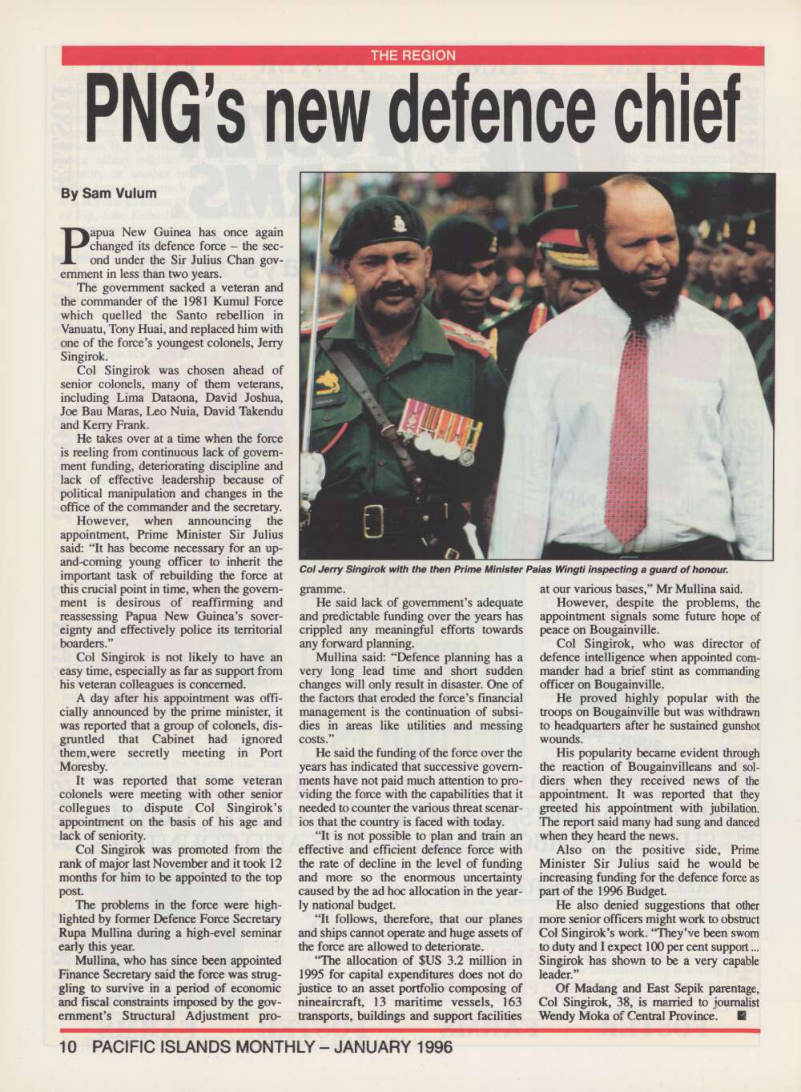
Col Jerry Singirok with the then Prime Minister Paias Wingti inspecting a guard of honour.
Misleading AIDS data
Aids
By Steven Vete, South Pacific Commission
Pacific Island countries have been sup plying data on AIDS cases to the South Pacific Commission. However, there is a problem - an acute problem to be exact - we must all be extremely careful in how we interpret these figures. It is difficult to estimate the actual numbers in the Pacific. In other parts of the world, esti mates of the actual numbers of AIDS and HIV-positive cases have ranged from 30 to 100 times the number of officially reported cases.
There are many difficulties in compiling accurate figures of AIDS/HIV and STD (sexually transmitted disease) cases in the Pacific Islands. These include: Deficiencies of the reporting systems within each coun try; private medical practitioners not report ing cases because of confidentiality and social sensitivities; and access to travel opportunities which enable Pacific Islanders to get tested and sometimes, treat ed for sexually transmitted diseases in other countries.
Although some Pacific Islands may be ‘officially’ free of the deadly infection, there is no room for complacency. Some governments fear that disclosure of the number of AIDS/HIV cases might discour
age tourism (an important growth industry
for many Pacific Islands). Others do not report their AIDS/HIV cases because these are already included in the statistics of the metropolitan countries to which their citi zens have ready access. It must be remem bered that Australia, New Zealand, France and the United States - all countries with many cases of AIDS/HIV - have large Pacific Island communities, many of whom travel back to their mother countries quite regularly.
The incidence of STD in the Pacific Islands must also be taken into account when considering how AIDS and HIV infection may affect the Pacific. While the number of HIV and AIDS cases may be rel atively low, in some island countrie, the STD rate has reached epidemic proportions, and in others it is on the increase. Why is this important? Because it clearly demon strates that the behaviour which transmits STDs such as gonorrhoea, syphilis, chlamy dia, and HIV infection - unprotected sexual intercourse with an infected partner - is occurring with great frequency in the Pacific, and second, because people who suffer from STDs are at greater risk of becoming infected with HIV if they are exposed to this virus.
Reluctance to talk about sex because of traditional or religious barriers means that
many Pacific Islanders may not have learned about STDs, including AIDS. Many people do not know that a person can be infected with an STD and not have any symptoms, or be infected with HIV and appear perfectly healthy for up to 10 years or more before showing any signs of AIDS.
In the meantime that person can unknow ingly infect others.
We cannot afford to believe that because of the seemingly small number of reported
AIDS cases, the Pacific remains “safe” from AIDS. HIV infection is here, and will continue to spread. We need to overcome our reluctance to discuss the sexual trans mission of STDs in an open and honest way. To do less is nothing short of negli gence, especially for future generations.
On average, according to data available from 14 island nations, there are 20 HIV cases per country. ■
Advertisements & other items, p. 11 (1 item)
John Saxon Bryant
J. Britton Management Services Pty. Ltd. trading as
AND ASSOCIATES
SHIPBROKERS — Listing Vessels of all Classes HEAD OFFICE: Box 767, Lakes Entrance, 3909, VICTORIA PHONE: (051) 551351 FAX: (051) 55 3004 MOBILE: 018 124 816 AUSTRALIA. m mm mm m m m m ■; m
iiiii
4 24:9m X 9:4m X 2m Passenger catamaran. Sleeps 40 pass plus 10 crew. All state rooms have en-suites. Powered with twin 300 hp Hino's .2 Hino aux's drive gen sets. 3 radios, 2 radar, GPS & Plotter, sounder, PA system, intercon, 3 TV's & Video, Mob phone. All life saving gear, fully equipped galley. 2 tender vessels.
All diving gear, 15 sets of bottles plus compressor. Further details on applic Price: s2:Bm AUD. Finance available to approved purchaser.
COASTAL CARGO BOAT.
36m X 7:75m X 2:75m. Cummins main plus 2 aux's drive gen sets. Deck machinery is Cummins drives cargo winch & fire pumps. All electronics, Good gallery with accom for 12. Vessel fitted with sails Ketch rigged. Large hold. Will carry 205 ton of blue metal. Classed Lloyds. DOT Aust survey. Price $385,000 AUD. Can carry Passengers.
John Saxon Bryant. Australia.
Hardening attitudes
View
Hardening attitudes towards non-whites
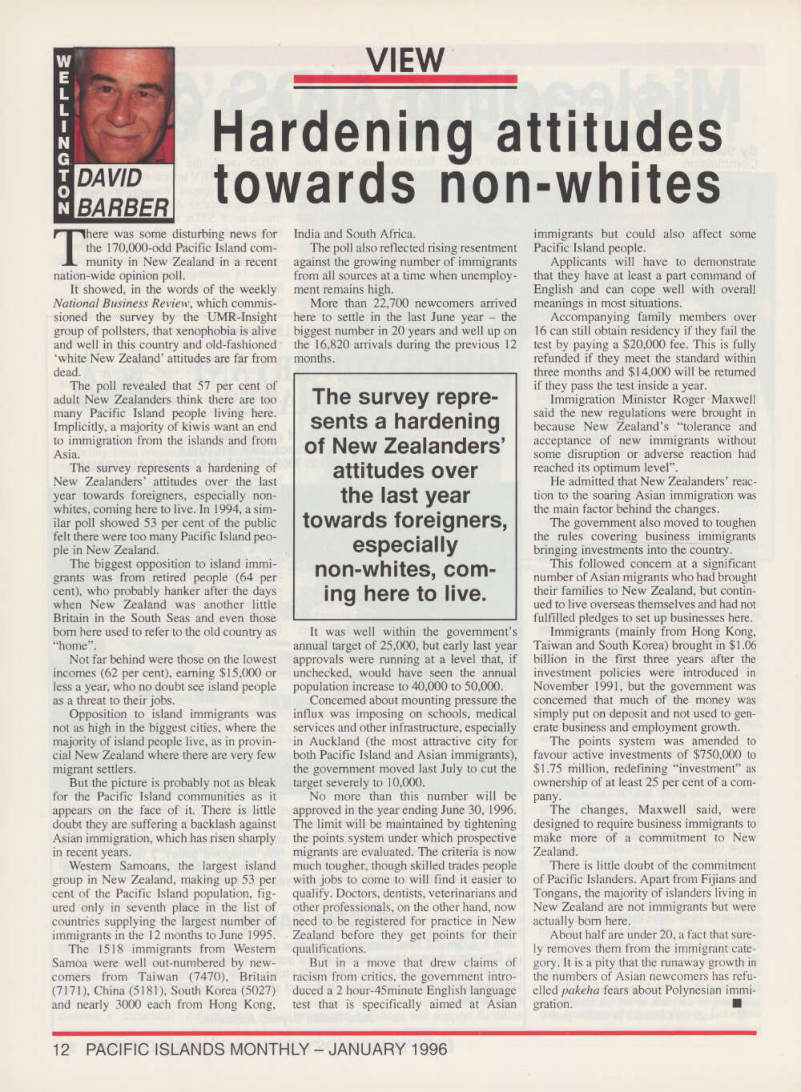
There was some disturbing news for the 170,000-odd Pacific Island com munity in New Zealand in a recent nation-wide opinion poll.
It showed, in the words of the weekly National Business Review, which commis sioned the survey by the UMR-Insight group of pollsters, that xenophobia is alive and well in this country and old-fashioned ‘white New Zealand’ attitudes are far from dead.
The poll revealed that 57 per cent of adult New Zealanders think there are too many Pacific Island people living here.
Implicitly, a majority of kiwis want an end to immigration from the islands and from Asia.
The survey represents a hardening of New Zealanders’ attitudes over the last year towards foreigners, especially non whites, coming here to live. In 1994, a sim ilar poll showed 53 per cent of the public felt there were too many Pacific Island peo ple in New Zealand.
The biggest opposition to island immi grants was from retired people (64 per cent), who probably hanker after the days when New Zealand was another little Britain in the South Seas and even those bom here used to refer to the old country as “home”.
Not far behind were those on the lowest incomes (62 per cent), earning $15,000 or less a year, who no doubt see island people as a threat to their jobs.
Opposition to island immigrants was not as high in the biggest cities, where the majority of island people live, as in provin cial New Zealand where there are very few migrant settlers.
But the picture is probably not as bleak for the Pacific Island communities as it appears on the face of it. There is little doubt they are suffering a backlash against Asian immigration, which has risen sharply in recent years.
Western Samoans, the largest island group in New Zealand, making up 53 per cent of the Pacific Island population, fig ured only in seventh place in the list of countries supplying the largest number of immigrants in the 12 months to June 1995.
The 1518 immigrants from Western Samoa were well out-numbered by new comers from Taiwan (7470), Britain (7171), China (5181), South Korea (5027) and nearly 3000 each from Hong Kong,
India and South Africa.
The poll also reflected rising resentment against the growing number of immigrants from all sources at a time when unemploy ment remains high.
More than 22,700 newcomers arrived here to settle in the last June year - the biggest number in 20 years and well up on the 16,820 arrivals during the previous 12 months.
The survey repre sents a hardening of New Zealanders’ attitudes over the last year towards foreigners, especially non-whites, com ing here to live.
It was well within the government’s annual target of 25,000, but early last year approvals were running at a level that, if unchecked, would have seen the annual population increase to 40,000 to 50,000.
Concerned about mounting pressure the influx was imposing on schools, medical services and other infrastructure, especially in Auckland (the most attractive city for both Pacific Island and Asian immigrants), the government moved last July to cut the target severely to 10,000.
No more than this number will be approved in the year ending June 30, 1996.
The limit will be maintained by tightening the points system under which prospective migrants are evaluated. The criteria is now much tougher, though skilled trades people with jobs to come to will find it easier to qualify. Doctors, dentists, veterinarians and other professionals, on the other hand, now need to be registered for practice in New Zealand before they get points for their qualifications.
But in a move that drew claims of racism from critics, the government intro duced a 2 hour-45minute English language test that is specifically aimed at Asian
immigrants but could also affect some Pacific Island people.
Applicants will have to demonstrate that they have at least a part command of English and can cope well with overall meanings in most situations.
Accompanying family members over 16 can still obtain residency if they fail the test by paying a $20,000 fee. This is fully refunded if they meet the standard within three months and $14,000 will be returned if they pass the test inside a year.
Immigration Minister Roger Maxwell said the new regulations were brought in because New Zealand’s “tolerance and acceptance of new immigrants without some disruption or adverse reaction had reached its optimum level”.
He admitted that New Zealanders’ reac tion to the soaring Asian immigration was the main factor behind the changes.
The government also moved to toughen the rules covering business immigrants bringing investments into the country.
This followed concern at a significant number of Asian migrants who had brought their families to New Zealand, but contin ued to live overseas themselves and had not fulfilled pledges to set up businesses here.
Immigrants (mainly from Hong Kong, Taiwan and South Korea) brought in $1.06 billion in the first three years after the investment policies were introduced in November 1991, but the government was concerned that much of the money was simply put on deposit and not used to gen erate business and employment growth.
The points system was amended to favour active investments of $750,000 to $1.75 million, redefining “investment” as ownership of at least 25 per cent of a com pany.
The changes. Maxwell said, were
designed to require business immigrants to
make more of a commitment to New Zealand.
There is little doubt of the commitment of Pacific Islanders. Apart from Fijians and Tongans, the majority of islanders living in New Zealand are not immigrants but were actually bom here.
About half are under 20, a fact that sure ly removes them from the immigrant cate gory. It is a pity that the runaway growth in the numbers of Asian newcomers has refu elled pakeha fears about Polynesian immi
gration. ■
Wellington
David
Barber
Advertisements & other items, p. 13 (1 item)
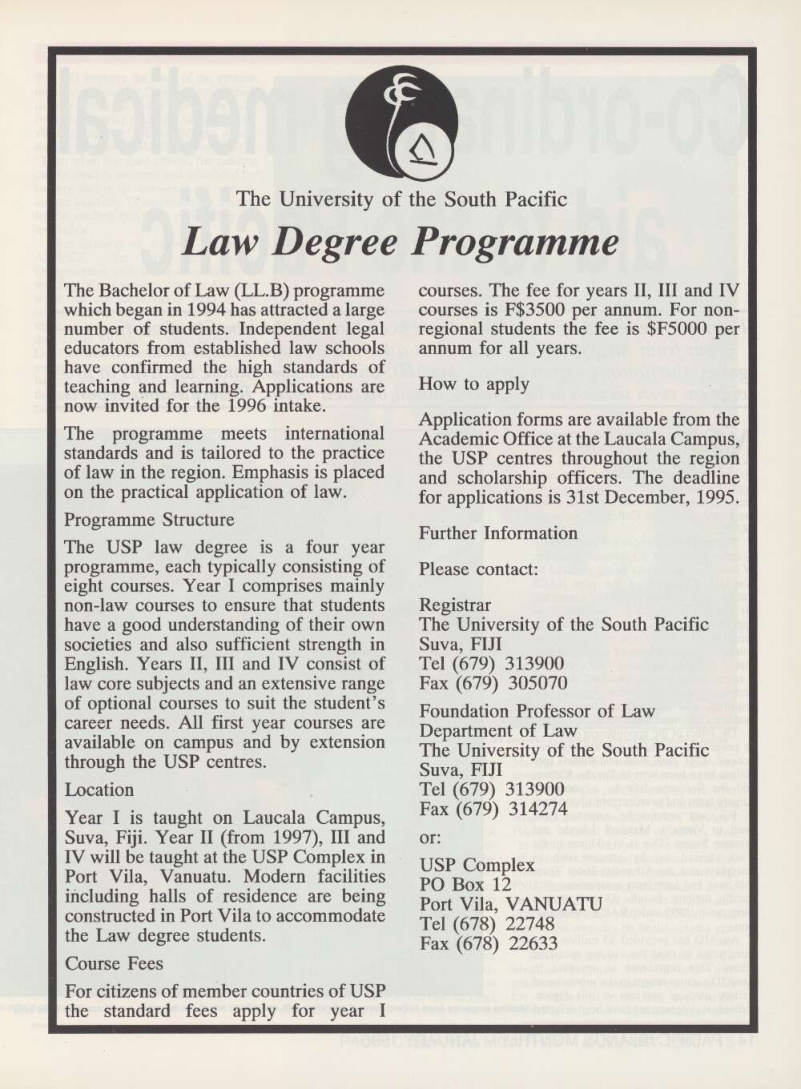
Law Degree Programme
The University of the South Pacific
The Bachelor of Law (LL.B) programme which began in 1994 has attracted a large number of students. Independent legal educators from established law schools have confirmed the high standards of teaching and learning. Applications are now invited for the 1996 intake.
The programme meets international standards and is tailored to the practice of law in the region. Emphasis is placed on the practical application of law.
Programme Structure The USP law degree is a four year programme, each typically consisting of eight courses. Year I comprises mainly non-law courses to ensure that students have a good understanding of their own societies and also sufficient strength in English. Years 11, 111 and IV consist of law core subjects and an extensive range of optional courses to suit the student’s career needs. All first year courses are available on campus and by extension through the USP centres.
Location Year I is taught on Laucala Campus, Suva, Fiji. Year II (from 1997), 111 and IV will be taught at the USP Complex in Port Vila, Vanuatu. Modem facilities including halls of residence are being constmcted in Port Vila to accommodate the Law degree students.
Course Fees For citizens of member countries of USP the standard fees apply for year I courses. The fee for years 11, 111 and IV courses is F 53500 per annum. For nonregional students the fee is SFSOOO per annum for all years.
How to apply Application forms are available from the Academic Office at the Laucala Campus, the USP centres throughout the region and scholarship officers. The deadline for applications is 31st December, 1995.
Further Information Please contact: Registrar The University of the South Pacific Suva, FIJI Tel (679) 313900 Fax (679) 305070 Foundation Professor of Law Department of Law The University of the South Pacific Suva, FIJI Tel (679) 313900 Fax (679) 314274 or: USP Complex PO Box 12 Port Vila, VANUATU Tel (678) 22748 Fax (678) 22633
Co-ordinating medical
Cover Story
Co-ordinating medical aid to the Pacific
For many years Pacific islanders have been reaping the benefits of visiting sur geons from Australia. To ensure that a lot more people benefit from the sur geons, the funding organisation, AusAID, will now co-ordinate the trips to pro vide an even service to the islands based on their needs. Robert Simms reports.
Medical specialist teams sponsored by the Australian aid organisation AusAID, a common sight in hos pitals throughout the Pacific, now must apply for their project funding to a govern ment-appointed co-ordination unit within the Royal Australian College of Surgeons
(Racs).
The move to farm out this responsibili ty came because of the increasing number of funding applications being received by AusAID. Chairman of the new RACS Pacific Islands Projects (PIP) committee Dr David Theile said this change of approach will give islanders a broader range of services. “These will not depend solely on the enthusiasm of individual doc tors in Australia,” he said. “We conducted a needs analysis and consulted the local people to determine what services are required, and now have planned pro grammes that meet these needs.”
The effect of the appointment of RACS as projects co-ordinator has already been noticed. ENT (ear, nose and throat) spe cialists have been sent to Tuvalu, Kiribati and the Solomon Islands, a paediatric surgery team and neurosurgeons have been to Fiji, and orthopaedic surgeons have been to Vanuatu, Marshall Islands and Western Samoa. This is in addition to the work carried out by groups such as Interplast and the Adventist Heart Team that have had long-term associations with Pacific nations. In all, 33 programmes were run in 1995 under RACS’ co-ordina tion.
AusAID has provided $3 million over three years to fund the visiting specialist teams. This represents an increase in AusAlD’s commitment to the provision of tertiary medical services in this region.
Individual programmes have been selected
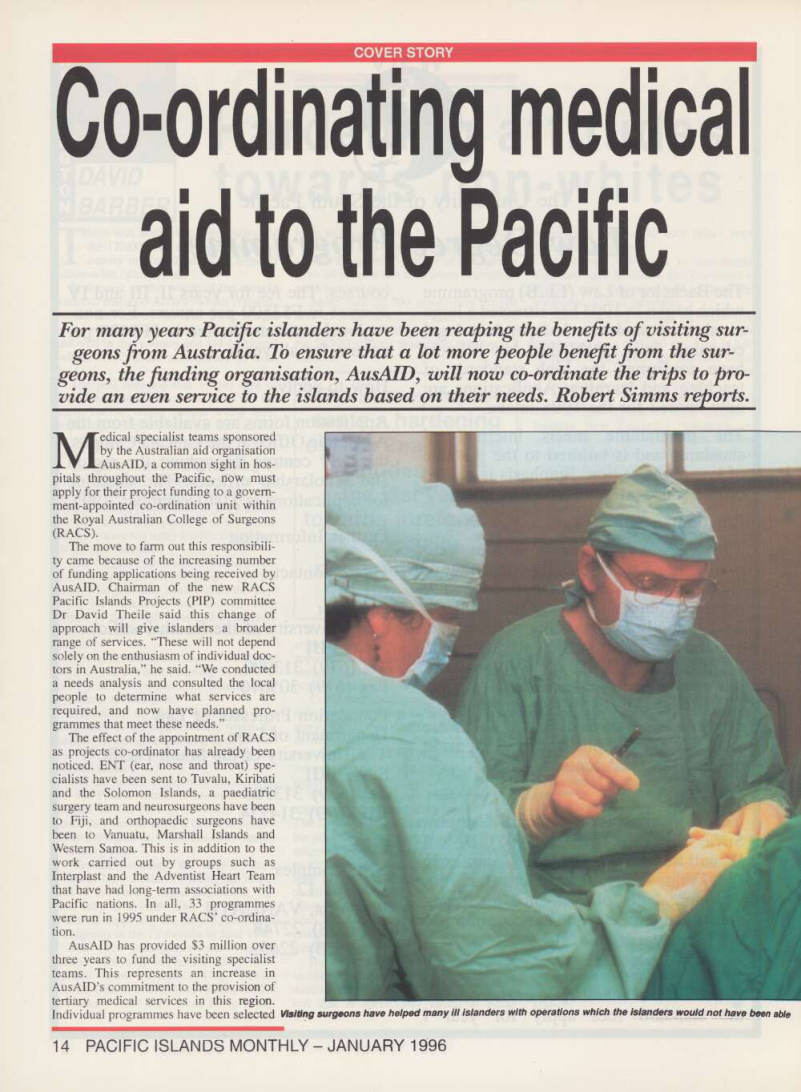
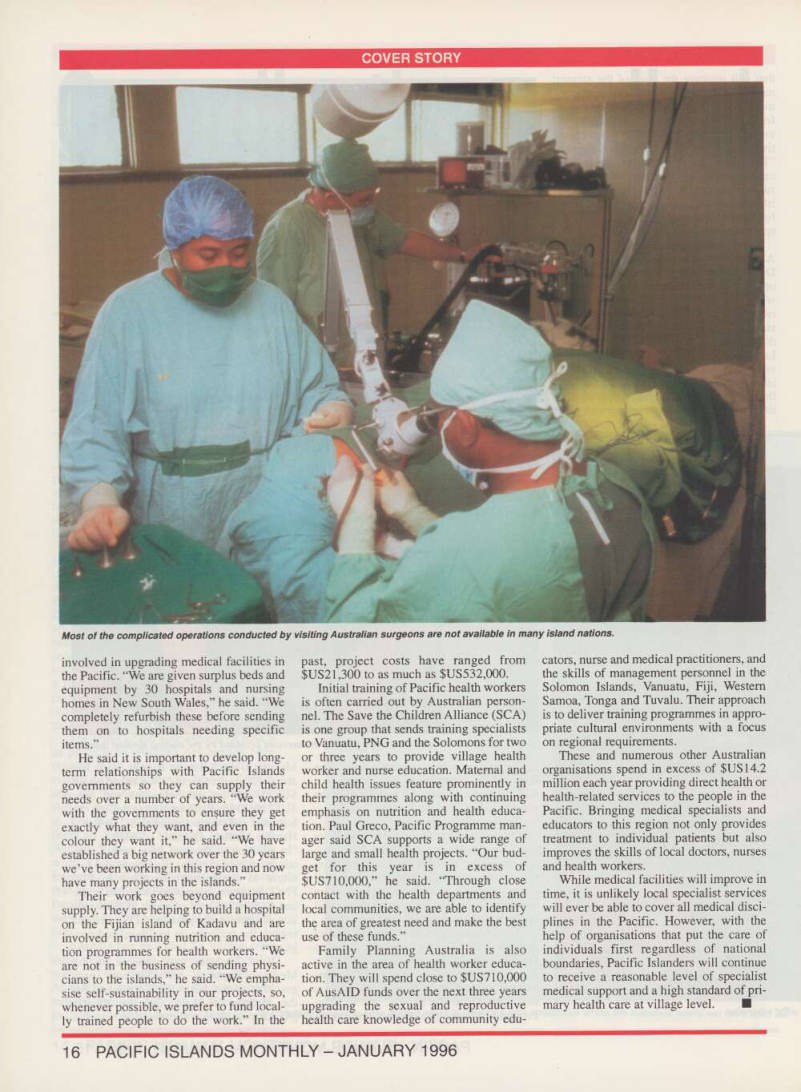
Visiting surgeons have helped many ill islanders with operations which the islanders would not have been able
that will improve the lives of the greatest number of patients. “Local doctors know months before the teams arrive to look out for patients who could be helped by the visiting surgeons,” Marion Wright, execu tive secretary of the RAGS committee said.
“Then when the team arrives, the patients can be quickly assessed and scheduled for surgery during the twoweeks the special ists are available.” Patients are not charged for the medical treatment provided by the specialists.
One casualty of the new system is ASPECT, the eye-care group.
Disagreement over the reimbursement of ongoing private practice costs in Australia while the ophthalmologists were in the islands has lead to the demise of this out standing organisation. “Our philosophies didn’t meet,” ASPECT’S executive officer, Len Slater, said. “The new system relies on volunteers, most of whom will go to the islands just once, whereas ASPECT used the same doctors each year to provide con tinuity of service. From our point of view.
the new approach is unsustainable.” The RACS-PIP committee has formed a replacement eye-care unit to take over the role of ASPECT in the Pacific.
Non-specialist groups Organisations not funded by AusAID or providing health services other than med ical specialist services are unaffected by the shift in project co-ordination. They will either continue to receive support from individuals and private groups or will apply directly to AusAID for assistance.
The Adventist Development Relief Agency (ADRA), for example, raises a large proportion of its funds through public appeals in Australia. AusAID also con tributes to its work. The agency maintain two hospitals in the Pacific, one in Enga Province of Papua New Guinea and one on
Malaita in the Solomon Islands. Each has about 120-bed capacity. ‘‘We spend about $U5355,000 in the Solomons and over SUS7IO,OOO in PNG each year staffing the hospitals and conducting clinics,” Dr Percy Harold, Medical Director of ADRA said.
"In addition to this, we have sent 7 con tainer loads of medical equipment and fur niture to government hospitals in Fiji, PNG, Solomon Islands and Vanuatu in the last 4 years.” A total of about SUS 2.4 mil lion is spent each year by ADRA in this region, the majority on health-related pro
jects.
David Vosseler, co-ordinator of the Medical Supplies and Services pro grammes of the Australian Foundation for the Peoples of Asia and the Pacific (AFAP), said his organisation is also
o afford otherwise
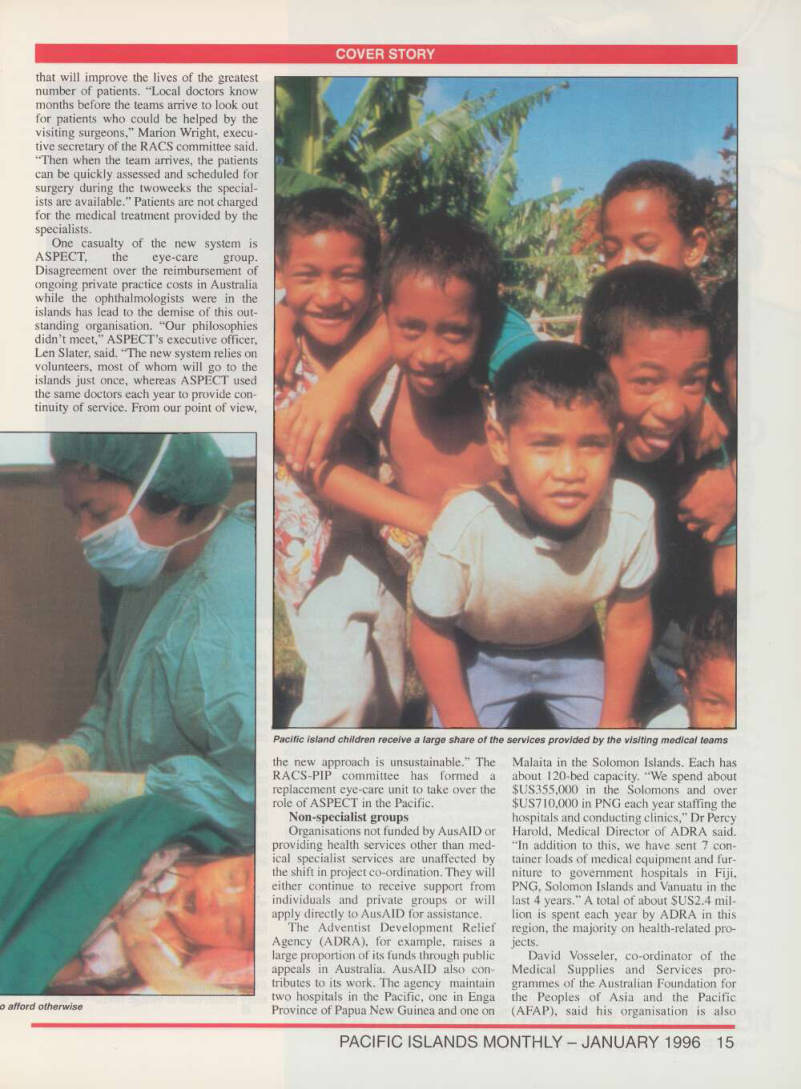
Pacific island children receive a large share of the services provided by the visiting medical teams
involved in upgrading medical facilities in the Pacific. “We are given surplus beds and equipment by 30 hospitals and nursing homes in New South Wales,” he said. “We completely refurbish these before sending them on to hospitals needing specific items.”
He said it is important to develop long term relationships with Pacific Islands governments so they can supply their needs over a number of years. “We work with the governments to ensure they get exactly what they want, and even in the colour they want it,” he said. “We have established a big network over the 30 years we’ve been working in this region and now have many projects in the islands.”
Their work goes beyond equipment supply. They are helping to build a hospital on the Fijian island of Kadavu and are involved in running nutrition and educa tion programmes for health workers. “We are not in the business of sending physi cians to the islands,” he said. “We empha sise self-sustainability in our projects, so, whenever possible, we prefer to fund local ly trained people to do the work.” In the
past, project costs have ranged from $U521,300 to as much as $U5532,000.
Initial training of Pacific health workers is often carried out by Australian personnel. The Save the Children Alliance (SCA) is one group that sends training specialists to Vanuatu, PNG and the Solomons for two or three years to provide village health worker and nurse education. Maternal and child health issues feature prominently in their programmes along with continuing emphasis on nutrition and health education. Paul Greco, Pacific Programme manager said SCA supports a wide range of large and small health projects. “Our budget for this year is in excess of $U5710,000,” he said. "Through close contact with the health departments and local communities, we are able to identify the area of greatest need and make the best use of these funds.”
Family Planning Australia is also active in the area of health worker education. They will spend close to SUS7IO,OOO of AusAID funds over the next three years upgrading the sexual and reproductive health care knowledge of community edu
cators, nurse and medical practitioners, and the skills of management personnel in the Solomon Islands, Vanuatu, Fiji, Western Samoa, Tonga and Tuvalu. Their approach is to deliver training programmes in appro priate cultural environments with a focus
on regional requirements.
These and numerous other Australian organisations spend in excess of SUSI 4.2 million each year providing direct health or health-related services to the people in the Pacific. Bringing medical specialists and educators to this region not only provides treatment to individual patients but also improves the skills of local doctors, nurses and health workers.
While medical facilities will improve in time, it is unlikely local specialist services will ever be able to cover all medical disci plines in the Pacific. However, with the help of organisations that put the care of individuals first regardless of national boundaries. Pacific Islanders will continue to receive a reasonable level of specialist medical support and a high standard of pri mary health care at village level. H
Most of the complicated operations conducted by visiting Australian surgeons are not available in many island nations.
Advertisements & other items, p. 17 (2 items)
Png’S
AIDS
AIDS
scare
The growth of HIV infections in Papua New Guinea has been occur
ring against a background of gov
ernment complacency and widespread
ignorance about how AIDS was transmit ted, the Australasian Society for HIV Medicine has been told.
Dr Geeta Isaac-Toua, of PNG’s Department of Health STD/AIDS unit, said high-risk sexual behaviour, which included group sex and traditional
polygamy, was putting the population at
risk.
A recent survey of 14 provincial high schools found that 98 per cent of the stu dents had heard of AIDS but 34 per cent thought it was spread by mosquitoes.
Thirty per cent of the students with an average age of just over 16 years said they were sexually active.
Dr Isaac-Toua said PNG, with a popu lation of four million, had its first infection in 1987 but had seen a rapid increase in infection in the past two years, recording 335 cases to September 30 last year.
Of those, 249 were in the capital, Port Moresby, followed by the second largest
city, Lae, and highland provinces.
“Papua New Guinea has been called paradise but it will be questionable in future if AIDS gets a hold as it has in so many developing countries,” Dr Isaac- Toua said.
“The government thinks AIDS is not a problem.”
Programmes to combat the disease were sporadic and unco-ordinated, involv ing a plethora of non-govemment aid
agencies.
The majority of new HIV cases were in the age bracket 20 to 29 years and mainly women.”
Researchers had noted several risky practices such as polygamy and group sex, which involved sailors and truck drivers having sex with one woman “in order to
save money”.
High rates of sexually transmitted dis eases were exacerbated by a reluctance to seek treatment because of the stigma attached to having such diseases, she said.
people who can help
✓ / / ' /, fi ;■v/\ ■ v
We know
island businessmen
If you’re starting a new business or expanding an existing one, we can help.
Whether you’re looking for potential investors, want to make appropriate contacts or just need some good advice, get in touch with us at the South Pacific Trade Commission.
It’s all free of charge.
To help us do the best job for you, we’ll need to know something about yourself, your organisation and your plans.
Just send us the information indicated below.
Your name.
Position.
Company name.
Address.
Phone and Fax.
Company and/or
grow.
personal background. • Type of business or venture. • Projected market (domestic or international). • Results of any feasibility study. • Current status of project. • Type of assistance you seek (capital, management skills, joint venture partner, other). • Approximate value of project. • Your contribution. • Financial institutions or other organisations already approached. • Any other details that you consider relevant to your project.
Once you send us this information, we’ll take it from there.
SOUTH PACIFIC TRADE COMMISSION
50 Park Street, Sydney 2000. Telephone (612) 283 5933 Facsimile (612) 283 5948
Protecting local
Environment
Protecting local reef environments
By Liz Thompson
Reefs are probably the oldest eco system on the planet - up to 450 million years old. Coral organisms
are responsible for creating the largest
structures made by life on earth. As well as providing scuba divers with a rich world to explore, coral reefs function as a natural breakwater, protecting the land and coastal settlements from the ocean and providing natural harbours. Awareness is increasing as to the potential for a huge range of med icines for which reef animals and plants may be a source.
However, according to a report pro duced by Greenpeace, a shocking 75 per cent of the world’s reefs are dead or dying.
This tragic figure is the result of a variety of problems. These include the steady pop ulation growth and the development of a global trade in marine products.
International markets trading in marine products tend to focus on one species, which rapidly depletes the source and slowly erodes traditional fishing systems.
The use of dynamite by local fishing com munities is leaving large quantities of coral and marine life dead. Other forms of resource exploitation such as large-scale logging are also a problem. The long-term effects of logging, that is, land degradation and soil erosion, result in severe run off and siltation. Over long periods, this can have devastating effects on the marine ecology as the top soil washes into the oceans.
One of the richest marine areas in the world is found in Papua New Guinea. This region is part of what marine biologists call the centre of diversity. It is the region with the highest diversity of coral, fishes and marine invertebrates. One of the most beautiful areas of reef in Papua New Guinea is, undoubtedly, to be found at Kimbe Bay, the location of Walindi Diving Resort. Diving here over a number of days and on a variety of different reefs, one is struck by the truly incredible beauty of this underwater world. Bright purple and yel low, Royal Dottyback fish swim, almost luminous, emerging from blue-tipped staghorn corals. Ragged finned Firefish drift beneath overhangs, Gorgonian fans of lacy coral stretch across the reef top, the Clown Triggerfish with large white spots on the lower part of their bodies and their yellow lips glide across the top of cham-
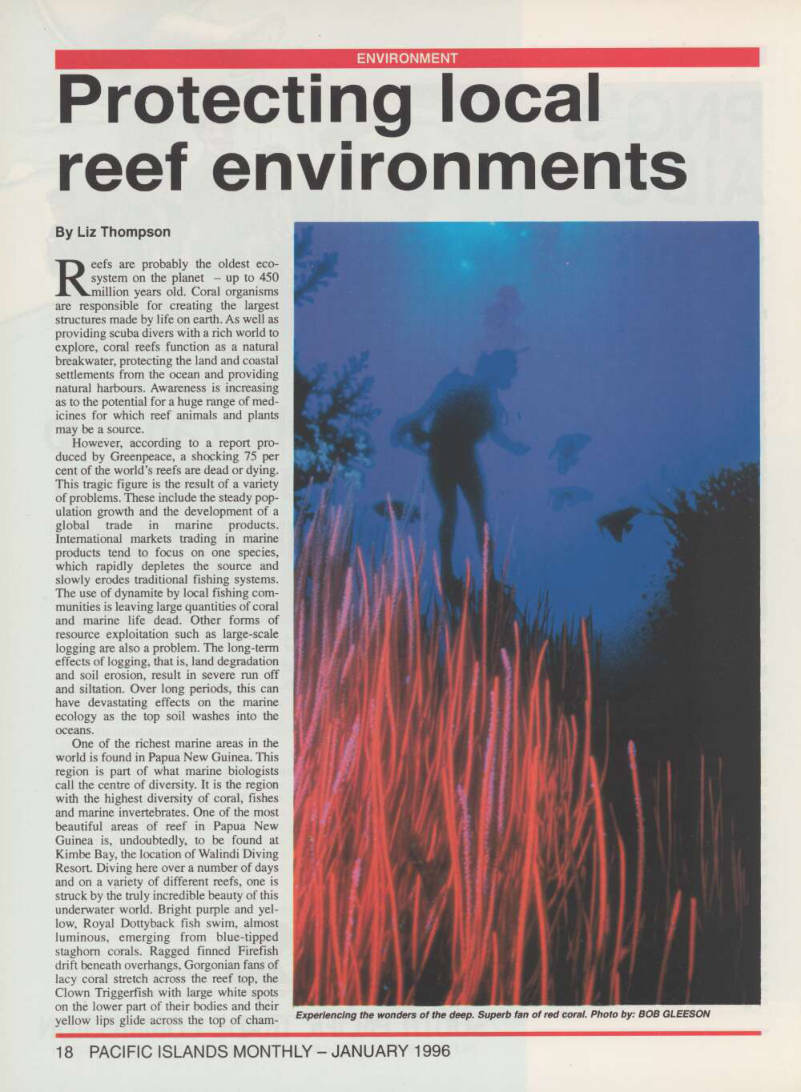
Experiencing the wonders of the deep. Superb fan of red coral. Photo by: BOB GLEESON
pagne-coloured anemones. The extrava ganza goes on. Whichever of the numerous dive sites you descend into, it is always an extraordinary experience, abounding with colour and life.
The Nature Conservancy recently con ducted a survey of the diversity and marine resources around Walindi Diving Resort and the Kimbe Bay region and the results were remarkable.
World experts on coral and fishes were astonished at the diversity in this one small area. Over 320 species of coral were found on the reefs of Walindi - this is more than half of all the coral species in the world in this one bay. International experts on the survey considered that the reefs were amongst the most diverse they had ever seen. Over 700 species of fish were record ed during the survey and this number is expected to increase dramatically as more research is done. The total number of species may exceed 1000.
In the long term, Max and Cecily Benjamin, the owners of Walindi Diving Resort, are attempting to have the area reg istered as a marine park. This would mean
no commercial fishing, no spear fishing, no shell collecting, no aquarium collect ing, no dynamite fishing. Whilst a marine park would not involve stopping tradition al fishing rights it would attempt to raise community awareness as to the issue of marine protection.
In the meantime, however, Walindi Diving Resort has been closely involved in the establishment of a Nature Centre which is home for the Islands Regional Environmental Programme. The project is largely funded by the European Union and the land has been made available by the resort. Research facilities will be open for use by individual scientists and organisa tions, for research towards: Fish and coral identification in order to develop a more extensive data base; reef monitoring; envi ronmental conservation; and marine and terrestrial biology. % The Islands Region Environmental Programme will pursue efforts in eco forestry and eco-tourism and environmen tal awareness and education. The centre itself is being established with these basic philosophies in mind. The timber being
used to build the centre is all produced by the local villagers themselves as part of the training programme on community-based small-scale sawmilling. The timber has been cut with chainsaw mills under super vision and then dressed with relatively
simple equipment. Sago roofing is being
prepared on site and a sago treatment area has been made which will be used for the life of the building programme.
If conservation is to take place on a meaningful level it is obviously necessary to raise the awareness of the local popula tion as well as visitors. There will be a par ticular focus on developing environmen tally sensitive means for generating an income to benefit the local economy. This, it is hoped, will discourage, or render unnecessary the more destructive income generating practice of unsustainable resource exploitation such as large scale logging. The approach to environmental protection and conservation at Walindi is a thorough and wholistic one, attempting to address the issue from a number of rele vant and equally important angles. ■
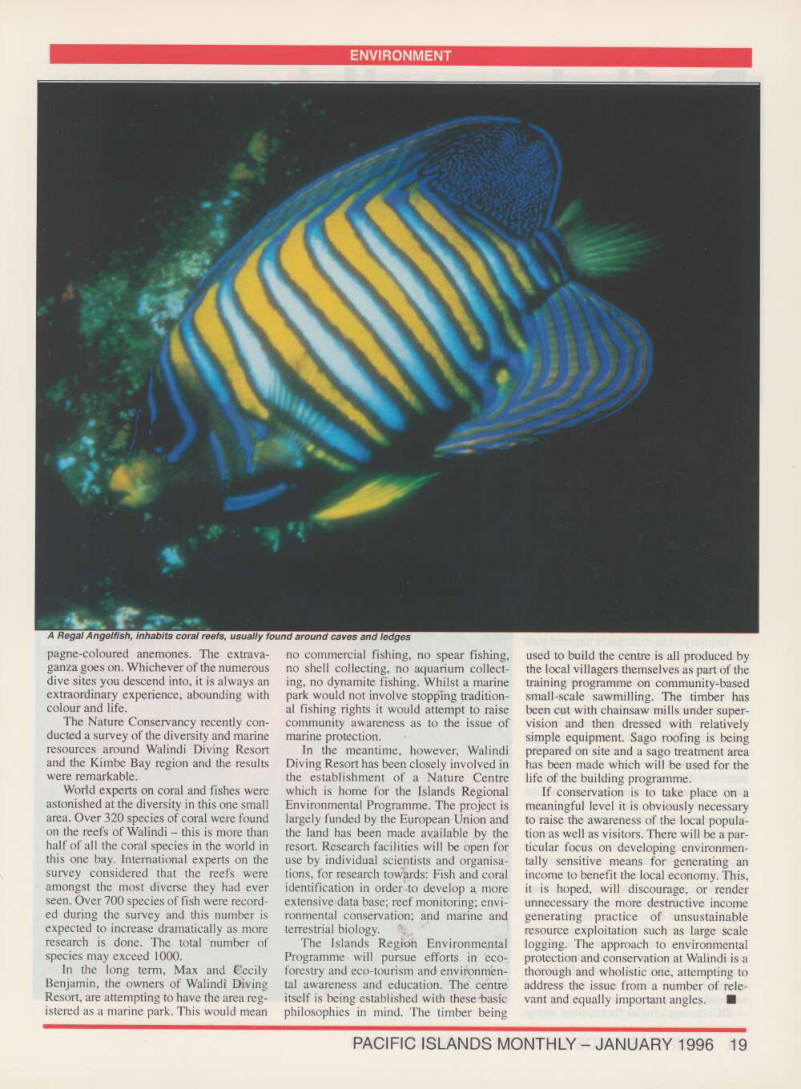
A Regal Angelfish, inhabits coral reefs, usually found around caves and ledges
Defining wilderness
By Liz Thomson
With increasing resource exploita
tion taking place in Papua New Guinea it seems ever more appropriate to establish a system of conser vation areas. However, in the west conser vation has often been associated with the idea of wilderness, an area which must be
protected from human activity. The people
of Papua New Guinea and many other Asia Pacific countries have always had a utili tarian relationship with their natural envi ronment. This relationship has to be accommodated if any sort of workable, long-term conservation system is to be established. Here Paul Chatterton talks about the approach of World Wildlife Fund.
PIM: The Australian administration in Papua New Guinea established a series of national parks before independence in 1975. These were never really very effec
tive. Why?
PC: A series of parks was set up over the decades up until 1975, very much importing the Australian concept of nation al parks and just superimposing it onto Papua New Guinea. This process failed to recognise that local people manage their own land and that there are very different cultural traditions in relation to land in Papua New Guinea.
To give you an example, a national park was set up in the highlands behind Lae.
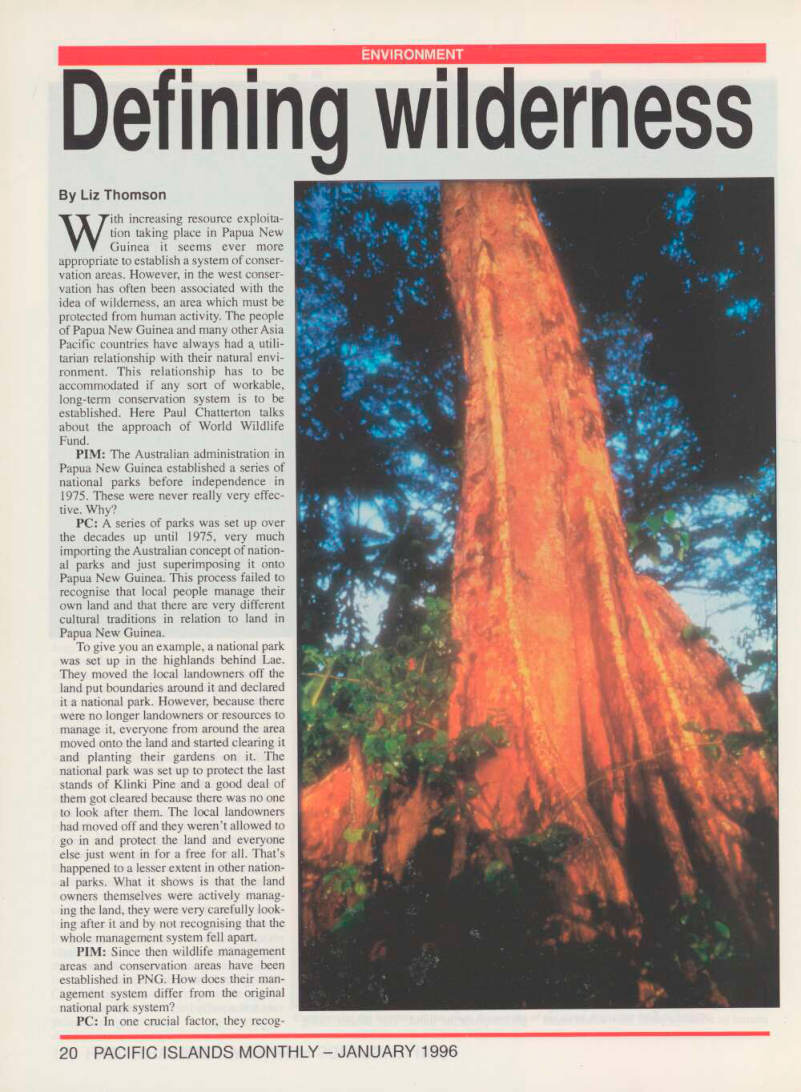
They moved the local landowners off the land put boundaries around it and declared it a national park. However, because there were no longer landowners or resources to manage it, everyone from around the area moved onto the land and started clearing it and planting their gardens on it. The national park was set up to protect the last stands of Klinki Pine and a good deal of them got cleared because there was no one to look after them. The local landowners had moved off and they weren’t allowed to go in and protect the land and everyone else just went in for a free for all. That’s happened to a lesser extent in other nation al parks. What it shows is that the land owners themselves were actively manag ing the land, they were very carefully look ing after it and by not recognising that the whole management system fell apart.
PIM: Since then wildlife management areas and conservation areas have been established in PNG. How does their man agement system differ from the original
national park system?
PC: In one crucial factor, they recog-
nise local landowners and local land man agement systems in looking after land.
Today a community which wants to put its land into a conservation area, informs the government. They mark the boundaries of the conservation area. Communities set down the rules that they want, they set up a committee from their own people to look after it. Then the government rubber stamps that. So it’s very much turning the thing on its head. Throwing the responsi bility back on to the community, recognis ing that they’re already the managers and ideally giving them the resources to devel op the conservation area. Unfortunately, that doesn’t happen very often. There are many areas set up like this which have been running for 20 years now without any government intervention.
PIM: Can you talk a little about what you have discovered in your research about the nature of the relationship most Melanesian communities have with their land?
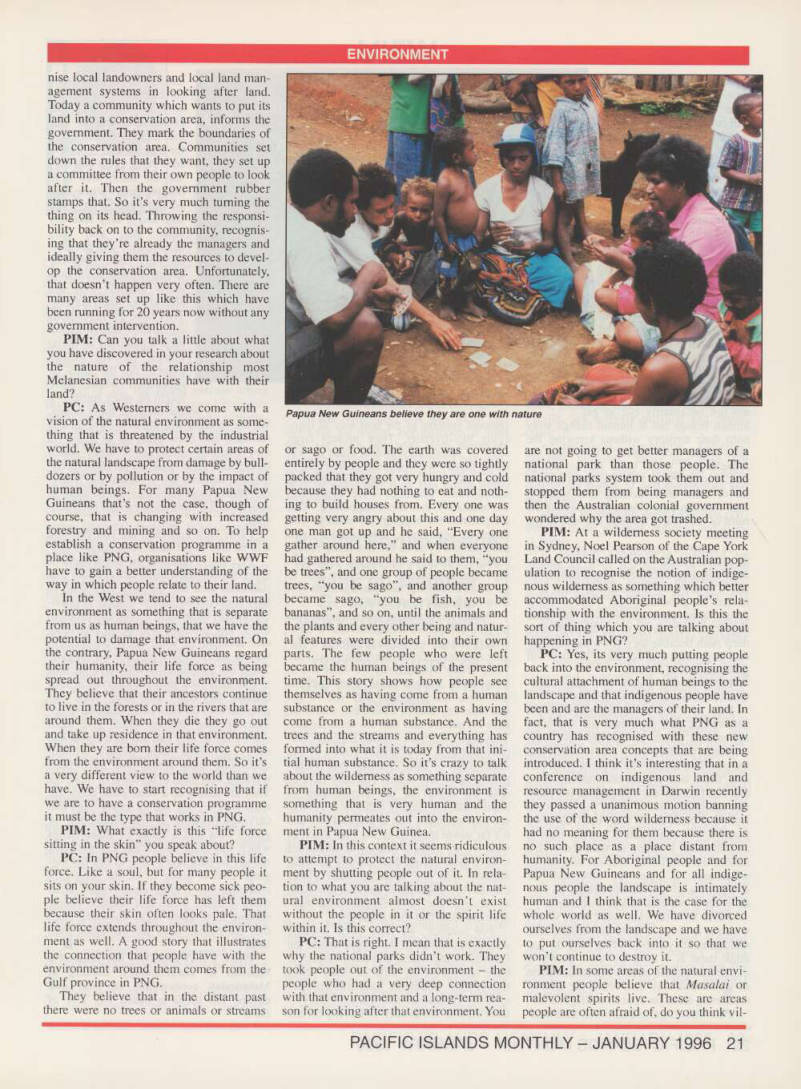
PC: As Westerners we come with a vision of the natural environment as some thing that is threatened by the industrial world. We have to protect certain areas of the natural landscape from damage by bull dozers or by pollution or by the impact of human beings. For many Papua New Guineans that’s not the case, though of course, that is changing with increased forestry and mining and so on. To help establish a conservation programme in a place like PNG, organisations like WWF have to gain a better understanding of the way in which people relate to their land.
In the West we tend to see the natural environment as something that is separate from us as human beings, that we have the potential to damage that environment. On the contrary, Papua New Guineans regard their humanity, their life force as being spread out throughout the environment.
They believe that their ancestors continue to live in the forests or in the rivers that are around them. When they die they go out and take up residence in that environment.
When they are bom their life force comes from the environment around them. So it’s a very different view to the world than we have. We have to start recognising that if we are to have a conservation programme it must be the type that works in PNG.
PIM: What exactly is this “life force sitting in the skin” you speak about?
PC: In PNG people believe in this life force. Like a soul, but for many people it sits on your skin. If they become sick peo ple believe their life force has left them because their skin often looks pale. That life force extends throughout the environ ment as well. A good story that illustrates the connection that people have with the environment around them comes from the Gulf province in PNG.
They believe that in the distant past there were no trees or animals or streams
or sago or food. The earth was covered entirely by people and they were so tightly packed that they got very hungry and cold because they had nothing to eat and noth ing to build houses from. Every one was getting very angry about this and one day one man got up and he said, “Every one gather around here,” and when everyone had gathered around he said to them, “you be trees”, and one group of people became trees, “you be sago”, and another group became sago, “you be fish, you be bananas”, and so on, until the animals and the plants and every other being and natur al features were divided into their own parts. The few people who were left became the human beings of the present time. This story shows how people see themselves as having come from a human substance or the environment as having come from a human substance. And the trees and the streams and everything has formed into what it is today from that ini tial human substance. So it’s crazy to talk about the wilderness as something separate from human beings, the environment is something that is very human and the humanity permeates out into the environ ment in Papua New Guinea.
PIM: In this context it seems ridiculous to attempt to protect the natural environ ment by shutting people out of it. In rela tion to what you are talking about the nat ural environment almost doesn’t exist without the people in it or the spirit life within it. Is this correct?
PC: That is right. I mean that is exactly why the national parks didn’t work. They took people out of the environment - the people who had a very deep connection with that environment and a long-term rea son for looking after that environment. You
are not going to get better managers of a national park than those people. The national parks system took them out and stopped them from being managers and then the Australian colonial government wondered why the area got trashed.
PIM: At a wilderness society meeting in Sydney, Noel Pearson of the Cape York Land Council called on the Australian pop ulation to recognise the notion of indige nous wilderness as something which better accommodated Aboriginal people’s rela tionship with the environment. Is this the sort of thing which you are talking about happening in PNG?
PC: Yes, its very much putting people back into the environment, recognising the cultural attachment of human beings to the landscape and that indigenous people have been and are the managers of their land. In fact, that is very much what PNG as a country has recognised with these new conservation area concepts that are being introduced. I think it’s interesting that in a conference on indigenous land and resource management in Darwin recently
they passed a unanimous motion banning
the use of the word wilderness because it had no meaning for them because there is no such place as a place distant from humanity. For Aboriginal people and for Papua New Guineans and for all indige
nous people the landscape is intimately
human and I think that is the case for the whole world as well. We have divorced ourselves from the landscape and we have to put ourselves back into it so that we won’t continue to destroy it.
PIM: In some areas of the natural envi ronment people believe that Masalai or malevolent spirits live. These are areas people are often afraid of, do you think vil
Papua New Guineans believe they are one with nature
lagers might encourage log ging in these areas in the hope the malevolent spirits will be destroyed?
PC: Well yes, one of the things that comes up time and time again in PNG is that this connection with the environment is not uniform, it’s not “we the indigenous people are intimately con nected with all of our land”.
There are parts of the envi ronment that people are dead afraid of. There are places where the forest spirits live ,where people won’t go in; there are places way out in the bush that are considered dark, places of danger, places of disease. People have this term, Masalai - spirits of the deep bush that are antagonis tic to human beings. They
are not necessarily out to get human beings but if human beings stray onto their territory without knowing the rules which those spirits live by then the Masalai will make those human beings sick. And so, Papua New Guineans spend a lot of time understanding and teaching their children these rules and respecting the rules of movement through the land of the Masalai.
In terms of logging and so on in many instances people won’t want to tamper with that area because it is too dangerous and it is also too important to them as a source of goodness. But I have come across some communities who are quite happy for bulldozers to go through their deep bush because they know the bulldoz er will get sick and not them, so they will give permission for this.
PIM: Is this notion of “deep bush” almost like a notion of wilderness?
PC: In a lot of communities people believe that their pigs, their taro and other agricultural plants or animals have their origins in the deep bush. Not so much that the plants or animals have come from that area, that a wild pig has been domesticated and has become the village pig, it’s more that the spirit essence of the pig has come from that place in the deep bush. So it’s a paradox, you could almost say that there is a wilderness concept in that sense. It’s almost like medieval, biblical concept of wilderness, a place of otherness, of strangeness, of non-human beings, so very different to our concepts of wilderness.
PIM: So with your work with WWF, which is to set up a more appropriate land management system in PNG, why do you think there is a need for this? Surely if
indigenous people largely reject the notion
of wilderness they also reject the idea of separating areas for special management.
PC: We recognise traditional land man-
agement systems as the best way of man aging bio-diversity. They protect large areas of forest, they protect areas of wet lands. Ideally we would not be working in places like PNG if indigenous resource
management practices were organised.
Unfortunately, that is not happening. With the pressure for logging, for mining, with intensive agriculture, communities’ own management systems are not being recog nised. Our hope is that through establish ing conservation areas we can help them to get those traditional land management sys tems recognised in national law.
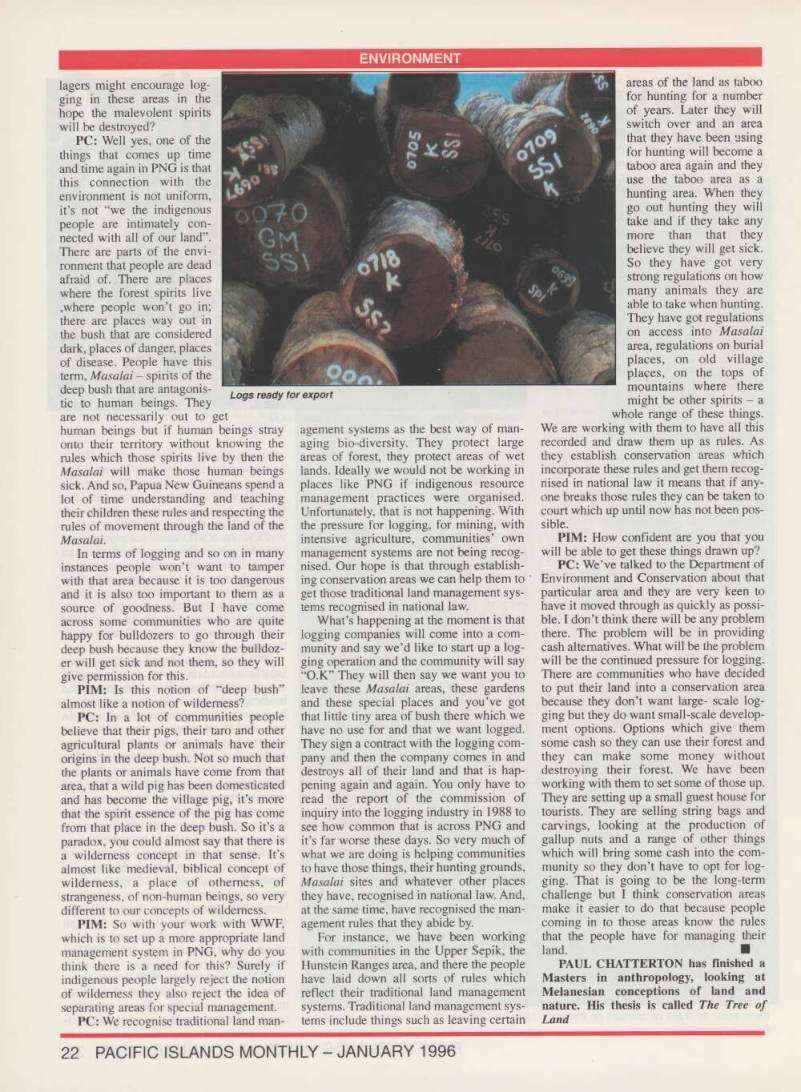
What’s happening at the moment is that logging companies will come into a com munity and say we’d like to start up a log ging operation and the community will say “O.K” They will then say we want you to leave these Masalai areas, these gardens and these special places and you’ve got that little tiny area of bush there which we have no use for and that we want logged.
They sign a contract with the logging com pany and then the company comes in and destroys all of their land and that is hap pening again and again. You only have to read the report of the commission of inquiry into the logging industry in 1988 to see how common that is across PNG and it’s far worse these days. So very much of what we are doing is helping communities to have those things, their hunting grounds, Masalai sites and whatever other places they have, recognised in national law. And, at the same time, have recognised the man agement rules that they abide by.
For instance, we have been working with communities in the Upper Sepik, the Hunstein Ranges area, and there the people have laid down all sorts of rules which reflect their traditional land management systems. Traditional land management sys tems include things such as leaving certain
areas of the land as taboo for hunting for a number of years. Later they will switch over and an area that they have been using for hunting will become a taboo area again and they use the taboo area as a hunting area. When they go out hunting they will take and if they take any more than that they believe they will get sick.
So they have got very strong regulations on how many animals they are able to take when hunting.
They have got regulations on access into Masalai area, regulations on burial places, on old village places, on the tops of mountains where there might be other spirits - a
whole range of these things, We are working with them to have all this recorded and draw them up as rules. As they establish conservation areas which incorporate these rules and get them recog nised in national law it means that if any one breaks those rules they can be taken to court which up until now has not been pos sible.
PIM: How confident are you that you will be able to get these things drawn up?
PC: We’ve talked to the Department of Environment and Conservation about that particular area and they are very keen to have it moved through as quickly as possi ble. I don’t think there will be any problem there. The problem will be in providing cash alternatives. What will be the problem will be the continued pressure for logging, There are communities who have decided to put their land into a conservation area because they don’t want large- scale log ging but they do want small-scale develop
ment options. Options which give them
some cash so they can use their forest and they can make some money without destroying their forest. We have been working with them to set some of those up.
They are setting up a small guest house for tourists. They are selling string bags and
carvings, looking at the production of
gallup nuts and a range of other things which will bring some cash into the com munity so they don’t have to opt for log ging. That is going to be the long-term challenge but I think conservation areas make it easier to do that because people coming in to those areas know the rules that the people have for managing their land. U PAUL CHATTERTON has finished a Masters in anthropology, looking at Melanesian conceptions of land and nature. His thesis is called The Tree of Land
Logs ready for export
growth?
View
Tradition or growth?
As the time clock ticks away, the Pacific region stands on the cross road of what might be termed the Pacific Industrialisation Era. International markets are opening up and more markets are on the way as traditionally protection ist strongholds give way to market forces.
The Pacific’s 27 million population stands to gain in many areas, if we play our cards right. True, we do not have many cards, but we do have them.
First of all, the island nations which occupy some 29 million square kilometres of the Pacific Ocean are endowed with nat ural resources - fisheries, minerals and forestry to name a few.
Fisheries is perhaps at the top end of the region’s bargaining power. Through multilateral arrangements, the region’s members of the Forum Fisheries Agency in Honiara are continuing to receive hand some financial benefits from countries fishing in members’ exclusive economic zones (EEZ).
Talks are continuing with other Distant Water Fishing Nations (DWFN) for more multilateral arrangements.
Sugar export, tourism and sustained forestry harvesting also play significant roles as foreign exchange earners for a number of countries in the region.
In some instances, these “commodi ties” earn enough foreign exchange annu ally to go around. Mineral resources also bring huge amounts of hard currency to fill national coffers.
In a way, the region has never been placed in a challenging situation. At the same time, the region can turn these chal lenges into windows of opportunities for the next decade, even perhaps the next millennium.
I believe that as the region gazes into the uncharted waters of market liberalisa tion, it is faced with two choices - capture the opportunity(ies) and reap the benefits, or squander it and all of us are in for a great shock.
With the great market liberalisation in progress, the region will face some hard realities. For example, traditional markets which offer concessions and other attrac tive “protection” on a govemment-to-gov emment arrangement will soon be opened up.
There will now be a level playing field for everyone and, hopefully, the same rules
- in Asia, the Pacific, the Americas and Europe. Markets which were traditionally open only to the region will suddenly be opened to everyone else.
Greater liberalisation in the internation al marketplace will also usher in many other factors such as quality standard and other internationally accepted require ments on export.
For the consumer this is good news.
The consumer’s purchasing power will be boosted by the confidence in the quality of the consumer item he or she is buying.
At the same time, this may mean bad news for the region. For instance, if until now we have not been very particular about the standard and quality of our prod ucts, we will have to catch up. We have to bear in mind that time lost could mean money lost.
Pacific Forum Vision is an acronym which calls on Member Governments to work together, with in resources, for the common good of the region and their peoples.
The fact that island countries produce almost the same or similar commodities is a factor that could work for or against us.
Whether we like it or not, the time has come to move together as a region as we set out into the next millennium.
Leaders of the South Pacific Forum who held their 26th summit in Madang, Papua New Guinea, must have been aware of the dilemma facing the region that they coined a “Vision” for enhancing regional co-operation for the next 25 years.
As far they are concerned, the South Pacific Forum is the paramount regional
inter-governmental organisation, strategi
cally placed to ensure this Vision materi alises. For the Leaders, the South Pacific Forum Vision is an acronym which calls on Member Governments to work togeth er, within resources, for the common good
of the region and their peoples. Here is their Vision for the next quarter century. • Forum members co-operate on the basis of equality, friendship and mutual respect - with due regard for what each can afford - in efforts to maintain security, improve living standards and ensure sus tainable development throughout the
region;
• opportunities for co-operation with other governments, non-govemmental organisations and international organisa tions, including other bodies in the Asia- Pacific, are actively pursued and devel oped; • resources, including fisheries, forestry, minerals, water and land, are developed with proper regard for conser vation, the legacy of past generations and the future; • unity in securing shared interests con tributes to the national, regional and glob al good; • material progress is matched by improvement in the quality of people’s lives, including human development, equality between women and men, and protection of children; • vulnerability to the effects of natural disasters, environmental damage and other threats will be overcome; • indigenous and other values, tradi tions and customs of the region are respected and promoted through cultural, sporting and other exchanges; • self-determination will be exercised in the remaining dependent territories, and unwelcome activities by external powers, including nuclear testing, will cease; • international economic co-operation through trade, investment and other exchanges, strengthens subsistence and commercial agriculture, industrial devel opment and competition, leading to growth - with equity, broadly-based partic ipation and capacity-building for self reliance; • openness, accountability and other principles of good government are embod ied in the practices, policies and plans of regional institutions; and • national, sub-regional and regional efforts to achieve the Forum’s Vision receive the support they require from the Forum Secretariat and other regional organisations. ■
The Fourm
Alfred
Sasako
Workers fight
Discrimination
Workers fight oppression
By David North
The often-abused foreign workers in Micronesia are fighting back and, with some help from distant capitals, are actually winning a few battles.
The principal battleground is the Commonwealth of the Northern Marianas Islands (CNMI) which has more foreign workers than permanent residents, but there are also skirmishes in Palau and FSM (Federated States of Micronesia) as well.
The distant capitals include Washington, Manila and, strangely, Singapore.
The winners include farm hands, maids, waitresses, hotel workers, and school teachers, usually from the Philippines.
Some of the losers are powerful members of the islands’ establishments.
All too often island employers have treated the foreign workers as second-class human beings and, all too often, in the past, the workers felt powerless to do anything about it.
The losers When Roberto Clemente, a Filipino farm hand, got cuffed around by his Chamorro boss’s brother - a member of the CNMI House of Representatives, no less the expectation might have been that Clemente would simply accept the beating.
But he did not. He brought charges.
To the great surprise of the legislator, territorial congressman Benjamin A Sablan, the CNMI courts spent two days hearing the case and then convicted him of both assault and battery and disturbing the peace. Sablan had made the mistake of slugging the farm worker in a public place a government office - with witnesses who were willing to testify tog what they saw. A physician, who examined the farm worker immediately afterwards, testified that Clemente indeed had taken a blow to the jaw. Sablan’s defence consisted mainly of bringing in other ranking politicians to be character witnesses.
After his conviction, Sablan told the Press that he was innocent, and was a “sac rificial lamb”. Sentence had not been passed at this writing, but a jail term would appear to be unlikely.
Sablan is not the only powerful CNMI figure to get in to highly public trouble for
Filipino women like this flower girl in Manilla face abuse at the hands of their masters.
mistreating foreign workers. A partial list of such persons includes: • Mayor Joseph S Inos of Rota, has been charged with rape and assault by sev eral Filipinos, according to the Hawaii Filipino Chronicle but all have fled the island (they say out of fear for their lives) and no trial is expected. • Former CNMI immigration official Santiago B Cepeda, brother of the head of CNMI’s Customs Enforcement, has been sent to jail for a year for extorting money from three Philippine citizens in return for allowing them to enter CNMI illegally. He also has been ordered to repay the money he took illegally from the foreign workers. • Territorial Congressman Vicente .
Attao, minority leader of the CNMI House of Representatives, has been hauled into US District Court by the US Department of Labour on civil charges of failing to pay security guards in his employ more than
Sus3Oo,Ooo.
• A one-time local police chief, Antonio A. Reyes, faces similar labour standards charges from the same agency, but for twice as much money.
The winners If some of the big guys are in trouble, does it mean that all the foreign workers are now paid adequately and treated fairly?
Hardly, but more and more such workers are having their day in court and, like Sablan’s and Cepeda’s victims, winning their cases. Two more examples: • Nineteen Filipino workers tried to start a union at the luxurious Hafadai Beach Hotel on Saipan; they were fired.
The workers went to the (federal) National Labour Relations Board (NLRB) which in turn secured a court order telling the hotel to hire them back. US District Court Judge Alex Munson dismissed the hotel’s (frankly remarkable) argument that the NLRB had sway only over resident work ers, not non-resident ones. • A little further up the economic scale is the case of the underpaid Filipino school teachers. Years back, under the Bush Administration, the US Department of Justice sued the CNMI schools on the grounds that they were paying the Filipino teachers less than Caucasian and Chamorro ones. Under the pressure of the suit the schools agreed to pay the aggriev ed teachers $U52,250,000 in back pay. An initial payment was made, and then the schools dragged their feet. Recently, the US District Court ordered the schools to pay in full.
The issues While many of the items cited above deal with wages and salaries, other and perhaps more important issues are also at stake, such as race and citizenship. In fact, to a Mainlander the situation in Saipan now sounds very much like the situation in the Old American South 30 years ago.
In those days the Whites had all the
economic and political power, and the Blacks had virtually none. Until the civil rights laws of the 1960 s the Blacks’ pos session of citizenship was useless because few of them, in fact, were permitted to vote.
In Saipan, if anything, it is worse. The apparently oppressed population (the for eign workers) are barred by law from even applying for CNMI citizenship and they face a language barrier if they seek to assert their rights - while the American Blacks at least grew up speaking the English language, and could assert their citizenship rights if they moved out of the region.
Given this imbalance in power in CNMI, and apparently no strong local tra dition of treating strangers as equals, the foreign workers (as these court decisions suggest) have trouble getting equitable treatment. In the worst case scenarios, which keep getting into the local media, there are cases of forced prostitution, of rape, of being locked up after work hours, of living behind barbed wire fences, and of working (according to one security guard) a 36-hour shift. These are not just squab bles about wages.
What forces are at play?
One reason why the victims win some times is because conditions are so grim that once a case reaches anything like a fair tri bunal no other verdict is possible. But there are other forces at work - some of which are at play elsewhere in the insular Pacific, and some of which are pertinent only in CNMI. The list, an odd one, includes: • The hanging of a Filipino maid in
Singapore;
• The remarkable change in the posture of the Philippines Government, spurred in part by the hanging, regarding its overseas workers; • the role of CNMI’s tempestuous but often reform-minded governor, Froilan Tenorio (D). • the quiet but generally progressive posture of the Clinton Administration; • the staunch, continuing work of the US. court system; and • the assertive day-to-day coverage of all this by the highly competitive Press in the Marianas.
Singapore has just about the most vin dictive view of crime and punishment this side of the Sudan (where they whack off the hands of thieves). It was Singapore that caned an American teenager for vandalis ing some cars (he certainly had some pun ishment coming to him, but Singapore spun it out, apparently to make its point to the world.) Similarly, Singapore did not take it lightly when an uppity Filipino maid killed her employer in what might have been judged a case of manslaughter, not murder, in another jurisdiction. They hanged her.
When this hit the Manila Press, coupled as it was by many, many stories about the abuse of Filipino maids throughout the Gulf States (rapes, imprisonment by employers, non-payment of wages, etc), the government was pressed to do some thing, or more precisely, “to do something to protect our women overseas”.
It was in this setting that Manila started paying attention to the stories of physical and economic abuse coming out of CNMI.
And Manila acted; the government has stopped the departure of Filipinos as guest
Despite their capabilities, Filipino workers were paid less than their co-workers.
workers (but not the men) to CNMI unless they hold a professional position (such as teacher or nurse.) For similar reasons, Manila has banned the movement of Filipino maids to Palau and there are stories in the Press that it is threatening FSM over its treatment of con struction workers. The Philippines has another weapon to use against FSM - it could deny FSM citizens visas to come to the Philippines for medical treatment; this weapon has not, apparently, been used yet.
Manila’s actions got the attention of CNMI’s governor, Tenorio, a reformer who told me a year or so ago that the scandal plagued garment industry had better clean up its act, or he would not mind seeing it leave the islands. Tenorio’s predecessor, on the other hand, was a solid ally of the gar ment industry, despite its bad Press.
Tenorio has played an interesting role.
He wants, desperately, to keep the island’s power over immigration (something that Guam, for example, lacks). In an effort to do so he made a deal with Washington to divert federal funds coming to the islands for construction projects to technical assis tance funds for better immigration and labour law enforcement.
Yet the governor is a complicated man.
He has struggled to clean up an often cor rupt bureaucracy that has, historically, turned a blind eye to the abuse of workers.
While he wants to make life better for for eign workers he resents anything - such as
the Republic of Philippines’ decision on non-professional workers - that he regards as an interference in his sphere of influ ence.
Meanwhile, the Clinton administration is paying attention to the subject at the assistant secretary level, and has taken steps to help Tenorio’s reformist positions.
There are now (thanks to Tenorio’s offer to recycle federal funds to law enforcement in CNMI) a couple of full-time wage-hour investigators on island, as there had been only visitors in the past. That’s progress. (And I suppose that’s faint praise as well.) The Clinton administration has nothing to do, however, with the behaviour of the US District Court in Saipan. In the United States judges sit for life and, Afex Munson, the local judge, was not appointed to his job by the Clintons. (Lifetime judgeships tend to free American judges of political considerations and worries about re appointment - in contrast, the Republic of the Marshalls, for example, appoints its judges for two-year terms.) In a sense, Munson is playing the role of the federal judges who upheld the civil rights laws in the American South. Such judges, often uncomfortably, sit and weigh cases on their merits, without any built-in bias as to which ethnic group is right, and without an undue deference to the econom ic powers that be. When foreign workers come before judges, such as Munson, they have a fighting chance. They do not always
win - Munson ruled against a Filipino nurse recently who claimed that her salary was set SUS6OOO a year below that of her Caucasian and Chamorro peers - but they do get to be heard.
Perhaps the most potentially replicable part of the Saipan story is the role of the local Press. In addition to Guam’s Mainland-owned Pacific Daily News, which circulates in the nearby Marianas, there are several scrappy local CNMI papers, all covering the latest foreign worker scandal, and none censored (direct ly or indirectly) by the CNMI government.
Interestingly, some of these local jour nalists are also Filipinos, which gives them the ability to talk with the foreign workers in their native tongue. There has been a Filipino presence in the Marianas for cen turies - after all, the Spanish ruled this part of the world from Manila for close to 300 years. Under the Spanish the Filipinos often worked in goyemmental and small business roles throughout Micronesia.
The Chinese have no such history in the islands, and their temporary workers remain at the very bottom of the ladder.
Further, while Manila has taken up the cudgels on behalf of its own people, Beijing has not; one consequence could be that exploitative employers may switch to Chinese workers in the future. They are, for example, the dominant ethnic group in Saipan’s garment factories. ■
Advertisements & other items, pp. 26-27 (2 items)
Discrimination
Over The Past 25 Years
OUR TRAINING AND PROJECT SERVICES
HAVE HELPED CUSTOMER
BUSINESSES REALLY TAKE OFF.
For over 25 years Australia's Collins Avionics Service Centre (part of the Rockwell worldwide network) has provided an extensive range of state-of-the-art avionics services to meet the rapidly growing needs of our region.
The highest quality sales and service for air transport, general aviation and military requirements.
Including technical training, consulting and skills transfer; repair, overhaul and modification; contract maintenance; test systems; equipment; and a 24-hour rental/exchange pool. *)■ The Australian Service Centre is at Tullamarine in Victoria. For more information call Neil Thomson on (61-3) 9338 0344 or fax (61 -3) 9330 3007. With Collins Avionics the sky is definitely not the limit.
Rockwell Avionics Collins
TRADE MARK CAUTIONARY NOTICE
Notice is hereby given that Telstra Corporation Limited, a corporation duly organised and existing under the laws of Australia, and having ACN 051 775 556, the Corporate Secretary being located at 242 Exhibition Street, Melbourne, Australia is the sole proprietor of the following trade marks:- Used in respect of:— Telecommunications and communications equipment, apparatus and systems, including but not limited to electronic and optical telecommunications and communications eqmpment, apparatus and systems; satellite and earth station telecommunications and communications equipment, apparatus and systems; Telephone equipment, apparatus and systems, including but not limited to telephone; telephone receivers; telephone handsets; telephone network, telephone exchanges, telephone switching, telephone answering, telephone card vending and telephone dialling equipment, apparatus and systems; Transmission, receiving and storage equipment, apparatus and systems, including hut not limited to facsimile, telegraph, telex, teleprinting, cable and paging equipment, apparatus and systems; data and video networking and conferencing equipment, apparatus and systems; data processing, message handling and switching equipment, apparatus and systems; digital equipment, apparatus and systems; electronic, voice, text and facsimile mail equipment, apparatus and systems; electronic directory equipment, apparatus and systems; Computer equipment, apparatus and systems, including but not limited to computer programs; computer software; computer hardware; computer terminals; computer memories; computer networking equipment, apparatus and systems; computer manuals in this class; modems; Video and audio equipment, apparatus and systems, including but not limited to sound and image recording, transmission and reproduction equipment, apparatus and systems; video cassettes and tapes; compact discs; records; digital, electric and electronic radio equipment, apparatus and systems; magnetic tapes; cinematographic, television and amusement equipment, apparatus and systems; amusement machines; All associated parts and accessories being goods in class 9, paper, cardboard and goods made from these materials; printed matter including directories, journals and manuals and all goods in class 16; advertising, promotional, consultancy and business services; compiling, arranging and publishing directories; telephone answering services; market research and statisticalservices; being services in class 35, repair installation, maintenance and construction services; being services in class 37, telecommunication services being services in class 38, amusement, entertainment, education and information services; multi-media services; being services in class 41, research services; computer programming services; retail and wholesaling services; consultancy services being services in Class 42'.
The said proprietor claims all rights in respect of the above trade marks and will take all necessary legal steps against any person or company infringing their said rights.
TELSTRA
ijelstra
elstra
DAVIES COLLISON CAVE
PATENT ATTORNEYS
One Little Collins Street Level 10 AMP Building Melbourne, Victoria, 3000 10 Barrack Street Hobart Place Australia Sydney, New South Wales, 2000 Canberra City 2601
PNG’s billion-dollar budget
By Ruth Waram
The Papua New Guinea government’s SUS 1.36-billion 1996 budget hand ed down in November has been received by various sections of the com munity with mixed feelings.
Handing down the budget. Deputy Prime Minister and Minister for Finance Chris Haiveta said it was “a budget for the rural people and the low income earners” with the greatest losers being “me and my cabinet colleagues”.
The budget is divided between a recur rent budget of SUS 1075.1 million and a development budget of $U5291.1 million.
After deduction of principal repayments on debt, the government has budgeted total expenditure and net lending to grow at 7.4 per cent in relation to the revised 1995 out come.
Haiveta said the first challenge for expenditure has been to incorporate all the provincial reforms, which if implemented in 1996 would have provided additional marginal costs to the government of
around SUSI 42 million.
He said the second challenge for the government is to fulfil commitments to significantly increase the size of the Public Investment Programme (PIP) which has been set at $U5291.1 million for 1996 compared to about SUSI 42 million this year.
He said the SUS47.B (one per cent of GDP) budget deficit will be financed by negative $U525.4 million from domestic sources and $U573.3 million from external sources.
The government is targeting the gross international reserves to grow to at least SUS3OO million or about 3.7 months of non-mining import cover by the end of 1996. Current levels are around SUS2I3 million.
Haiveta said wage increases for public servants in 1996 will not go beyond the current four per cent but the Public Employees Association is still negotiating with the government for further increases.
Negotiations were continuing when the budget was handed down.
He said the major preoccupation with the 1995 budget handed down in March this year was to address the instability that was in existence when the Sir Julius/Haiveta government took office in August 1994.
Haiveta said the major problems his government inherited were typified by a sharp decline in PNG’s international reserves and a currency level that could no long be sustained.
He said much of 1994 and the early part of 1995 was taken up with the task of putting the economy back on a sound foot ing.
This, he said, involved a package of tough but necessary policy measures, including the devaluation and the subse quent floatation of the kina, tightening of monetary policy, improving the mix of budget financing by successfully negotiat ing international loans from multilateral and bilateral sources, and maintaining a tight public sector wages policy throughout 1995.
Some of the highlights of the budget are the injection of an additional SUSI 42 mil lion to the provincial budgets, the abolish ing of the controversial MPs slush fund the Electoral Development Fund (EDF) and the minor transport sectoral fund, the introduction of revenue-saving measures on indirect taxes and the lifting of the tax free threshold from SUS2I3O to SUS2B4O.
This change will free a significant number of low income earners from income tax while all other tax payers on higher wage levels will receive a flat SUS7I per annum tax saving.
Allocations for national departments were also reduced substantially and depart mental heads were told in no uncertain terms to work within what was given to them.
The government is intent on pursuing its plan of laying off about 4500 public ser vants in 1995 and a further 2500 in 1996.
Haiveta said these public servants have been identified in close consultation with
the respective departmental heads.
But the opposition has threatened to block the passage of the budget and has warned the government to be prepared for a supplementary budget unless the contro versial EDF and minor transport sectoral fund was reinstated with improved
accountability procedures.
Other amendments proposed by the opposition for inclusion before they could support the budget are: The transfer of key
functions from the national government to the provinces to be deferred until the capacity was built in the provinces to accept the extra responsibilities, and for all essential services, including health, educa tion and maintenance of major roads to be
adequately funded.
Presenting the opposition’s reply to the budget on November 29, opposition finance spokesman Masket langalio said the 1996 budget was “taking us (Papua New Guinea) back to hell” with excessive
spending plans.
“The budget is too confusing. It is too whimsical and it puts the entire future of our country in the hands of an untried sys tem of (provincial and local-level) govern ment too quickly,” he said.
“Most importantly, this budget will take us back to the starting point of excessive spending and put us through hell again.
“No member (of parliament) in his right mind would dare support such a budget that threatens to have us and our children re-live the terrible (financial crisis) years of 1994 and 1995 all over again. There is too much at stake,” langalio said.
He said the opposition was strongly opposed to exposing the PNG economy to the vicissitudes of the global economy directed by World Bank and the International Monetary Fund.
“While we believe in a free market economy, we caution against unplanned moves en masse into the mainstream of the global marketplace.
“The PNG economy is too small and its business houses too young and inexperi enced to stand up to the kind of vicious, cut-throat world of international market competition.
“We would opt for a planned, timely transition over a number of years,” langalio told the PNG parliament in his reply to the government’s budget.
Under reformed provincial and local level government system adopted this year, regional MPs were made governors of the provinces while the former premiers were made deputy governors.
Instead of the MPs slush funds, the gov ernment then introduced a Rural Action Programme with the blessing of the World Bank.
Haiveta said the increased allocation to the provinces reflected the'government’s push to indirectly prune the public service and shift more resources to the provinces.
The government also announced major changes to boost its trade liberalisation exercise to fulfil its Asia Pacific Economic Corporation (APEC) membership begin ning with a three-year tariff reduction exer cise on most goods. This is also in line with its anticipated full membership to the World Trade Organisation later this year.
Haiveta said the tariff reductions being implemented by the government will more or less be matched by increased indirect
tax collections and will remain a central plank for the government’s reform pro gramme.
The government has forecast a 1.8 per cent growth in 1996 compared to a nega tive growth of 4.8 per cent this year.
Haiveta said the anticipated growth is mainly related to the strong pick-up in the non-mining sector and construction activi ties related to the start-up of the Lihir Gold project in the New Ireland province.
The government has also forecast the inflation rate to drop to six per cent next year from the 15 per cent projected for this year. It expects the inflation rate to drop to four per cent by the second half of next year.
Regular economic commentator and executive director of the Institute of National Affairs John Millet has said the budget is premised on macroeconomic sta bilisation having been achieved and the need for the economy now to go forward.
Public sector reform is one key in creating a higher growth economy.
Millet said this reform requires a re allocation of government employment from national and provincial headquarters to districts. This is unfamiliar territory for them.
He says the success of the 1996 budget strategy depends on how line agency chiefs respond to the added responsibility.
Millet said the budget was handed down in an economic environment with many unhappy features. Consumers have been experiencing rising prices as a result of the devaluation of the kina.
The government suffered an economic crisis last year and had to seek financial assistance from the World Bank, the International Monetary Fund, the Export Import Bank of Japan and the Reserve Bank of Australia.
The World Bank’s liaison office in Port Moresby said this week the bank was still reviewing the budget and would reveal its position before the end of the year.
The Australian government is also understood to be reviewing the budget carefully and may comment on it during the annual PNG-Australian ministerial forum to be held in Kavieng, New Ireland province from December 8 to 10.
The PNG Chamber of Mines and Petroleum has welcomed the budget say ing generally, it was good for their indus try.
While welcoming the budget, the PNG Chamber of Commerce and Industry said the forgotten people were the “small entre preneurs” who depended on support from the government and this may be affected by the cut in the allocations to the Department of Commerce and Industry.
The PNG Fishing Industry Association said the main beneficiaries from the budget will be the foreign fleets operating in the country.
Meanwhile, many government depart ments, statutory bodies and institutions have criticised government over their bud get allocations.
Chief Ombudsman Simon Pentanu said the Commission’s SUSII36O allocation was “a total disappointment” as they had submitted an estimate of SUS7.BI million
based on leadership position’s created by
the government’s restructure programme.
Leadership positions created under the new reform have increased four or five times.
“I hope this was not a deliberate ploy to stifle our work because we play a very nec essary role in society. The $11811360 may seem much to many people but for an organisation which has been under-funded over the last three years, that is not much,”
Pentanu said.
The Councils of the University of Papua New Guinea (UPNG) and University of Technology (Unitech) will be meeting in Port Moresby next week to decide on what measures to take in light of the massive cuts in their budgets.
UPNG was allocated SUSI 7.6 million compared to $U525.4 million in 1995 while Unitech was allocated SUSI 6.7 mil lion compared to SUSI7.S million in 1995.
Salaries alone consume about SUSI 4.9 million of the Unitech budget.
It is understood some of the options being considered by the two universities are to close next year or they may decide not to enrol new intakes for the 1996 acad emic year, and 1995 first year students may not be accepted to continue second year studies in 1996.
Features of the 1996 PNG budget include: • SUS47.B-million deficit maintaining the “one per cent of GDP” principle; • greater emphasis on primary and sec ondary education; • larger commitments to infrastructure; • focus on primary health care; and • maintaining the government’s com mitment to fight crime in 1996 with mas sive allocations to the police and corrective institutions; • no increase in personal salary or wage tax rates; • PNG resident general mining compa ny tax reduced from 35 per cent to 25 per cent; • changes to log export tax rates and • transfer of shares listed on the yet to be established PNG Stock Exchange which are effected through a PNG registered bro ker are to be exempted from PNG stamp duty.
The power to access buildings and seize books and records has been clarified and access by the Internal Revenue Commission will now be subject to prior return approval by the minister for Finance. ■
Advertisements & other items, pp. 28-31 (1 item)
Fishing Vessel
&ceanamics PTY LTD
ACN No. 009 064 046
FOR SALE
ALUMINIUM HSHING VESSEL 15.3 metres long, hard chine design. Engine GM BV-71 Detroit Twin/ disc g/box, 15 knts. 4 cu/metre freezer capacity. 4 berth accom. This vessel would be an ideal diving vessel.
Price Aslloooo.oo Contact OCEANAMICS Tel: 61-89-843876 Fax; 61-89-844962
TWO PATROL VESSELS
Two identical aluminium Ex-Custom patrol vessels. Loa. 13.97, Beam 4.75 m Height (O.A) 4.2 m Draft 1.5 m Twin Cummins eng. 30Kva g/set Berths 5 Galley mess A/con.
Excellent condition. P.O.A.
Contact OQEANAMICSTeI 61-89-843876 Fax 61-89-844962 9. 77J a a □ OB
<Sg) TOYOTA
Drive dignity right to the top.
Everyone who knows cars ha s no doubts about Land Cruiser’s ruggedness.
Yet how many know that its luxury rivals the finest high-priced cars?
Or that it’s got more room inside than many luxury sedans?
And because it’s a Toyota, Land Cruiser’s fit and finish, attention to detail, and graceful form speak of elegance as well as spacious comfort.
Yet you still get tough ladder frames and suspension built to take you as far off road as you want to go.
With power from 4.5-litre petrol or 4.2-litre diesel engines.
And it’s carefully protected from rust to last longer.
So if you’re going right to the top, this dignified car is ready to take you.
LAND CRUISER
DISTRIBUTORS /DEALERS
AMERICAN SAMOA BURNS PHILP MOTORS PH 633-4281 COOK ISLANDS GUAM & MICRONESIA...ATKINS KROLL, INC. PH 646-1876/9 KIRIBATI NORFOLK ISLAND BORRY’S PTY LTD. PH 22114 PAPUA NEW GUINEA SOLOMON ISLAND ELA MOTORS PH 30314 TAHITI VANUATU ASCO MOTORS PH 22341 WESTERN SAMOA...
.PACIFIC MOTORS LTD. PH 20796
.TARAWA MOTORS PH 21090
.ELA MOTORS PH 3229400
.NIPPON AUTOMOTO PH 429819
.ASCO MOTORS PH 20800
FIJI ASCO MOTORS PH
NEW CALEDONIA S.I.A.P. PH 275562
SAIPAN MICROL CORPORATION PH 234-5911
TONGA ASCO MOTORS PH 23500
w I 1 1 -.1 I ; 1 V *
Return of the Nauruans
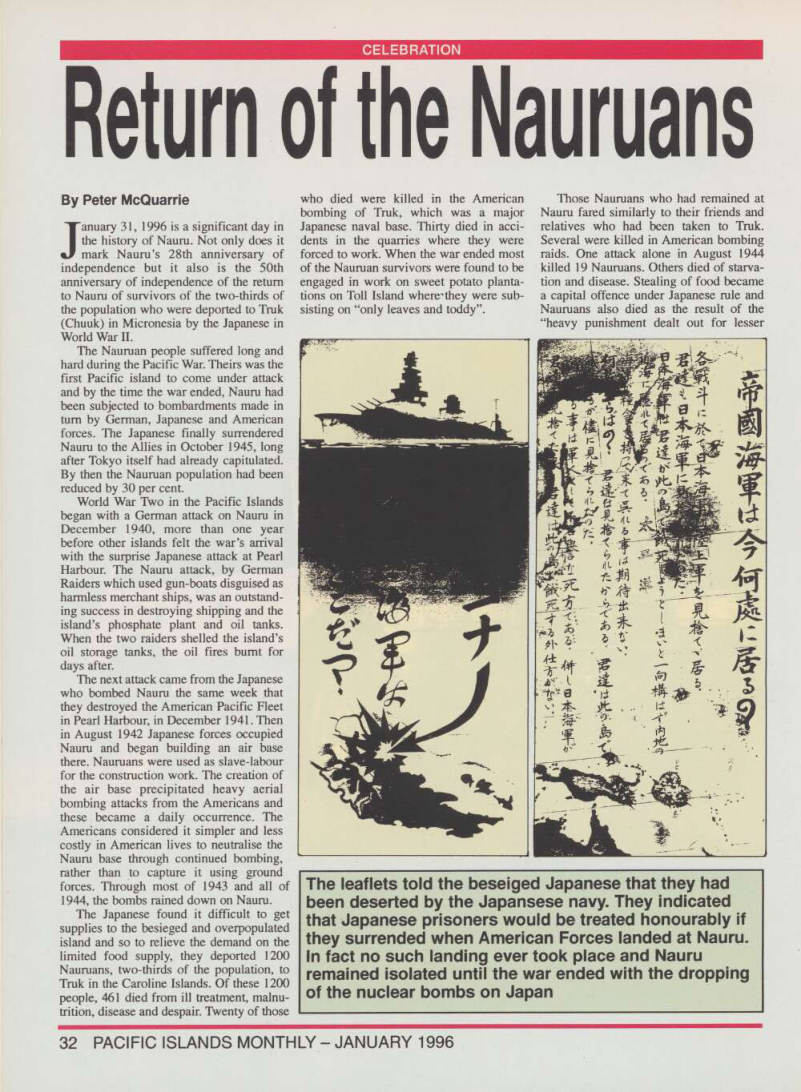
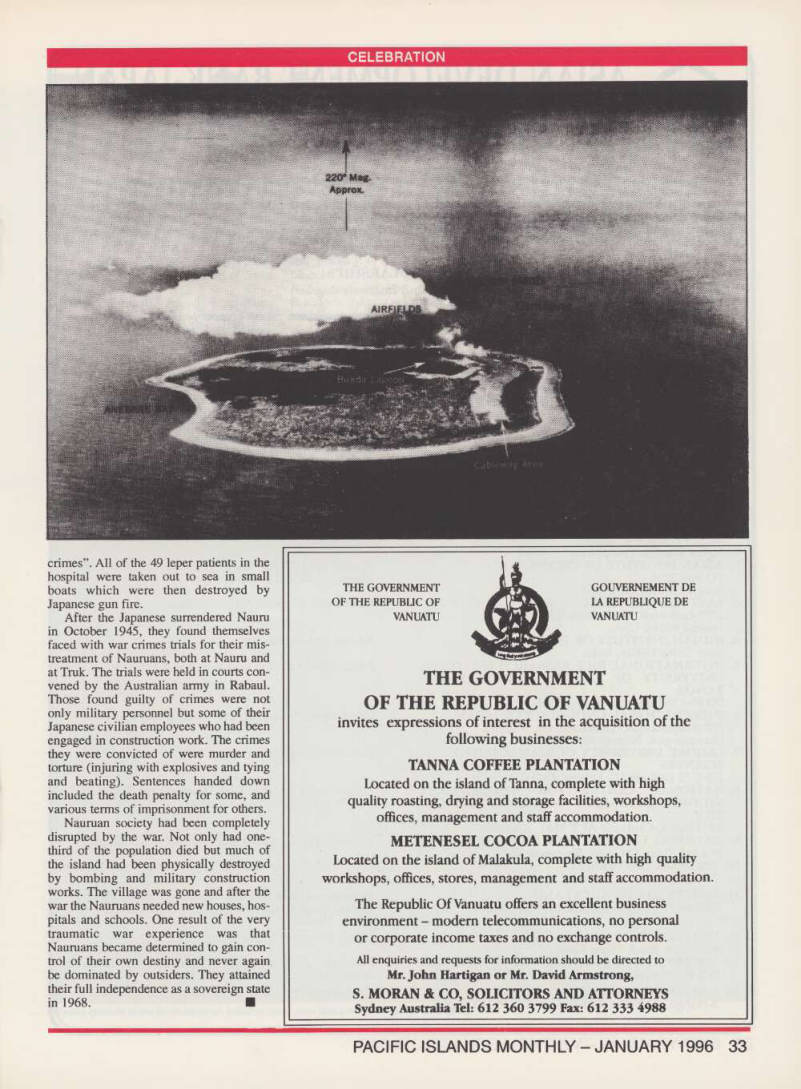
Celebration
By Peter McQuarrie
January 31,1996 is a significant day in the history of Nauru. Not only does it mark Nauru’s 28th anniversary of independence but it also is the 50th anniversary of independence of the return to Nauru of survivors of the two-thirds of the population who were deported to Truk (Chuuk) in Micronesia by the Japanese in World War 11.
The Nauruan people suffered long and hard during the Pacific War. Theirs was the first Pacific island to come under attack and by the time the war ended, Nauru had been subjected to bombardments made in turn by German, Japanese and American forces. The Japanese finally surrendered Nauru to the Allies in October 1945, long after Tokyo itself had already capitulated.
By then the Nauruan population had been reduced by 30 per cent.
World War Two in the Pacific Islands began with a German attack on Nauru in December 1940, more than one year before other islands felt the war’s arrival with the surprise Japanese attack at Pearl Harbour. The Nauru attack, by German Raiders which used gun-boats disguised as harmless merchant ships, was an outstand ing success in destroying shipping and the island’s phosphate plant and oil tanks.
When the two raiders shelled the island’s oil storage tanks, the oil fires burnt for
days after.
The next attack came from the Japanese who bombed Nauru the same week that they destroyed the American Pacific Fleet in Pearl Harbour, in December 1941. Then in August 1942 Japanese forces occupied Nauru and began building an air base there. Nauruans were used as slave-labour for the construction work. The creation of the air base precipitated heavy aerial bombing attacks from the Americans and these became a daily occurrence. The Americans considered it simpler and less costly in American lives to neutralise the Nauru base through continued bombing, rather than to capture it using ground forces. Through most of 1943 and all of 1944, the bombs rained down on Nauru.
The Japanese found it difficult to get supplies to the besieged and overpopulated island and so to relieve the demand on the limited food supply, they deported 1200 Nauruans, two-thirds of the population, to Truk in the Caroline Islands. Of these 1200 people, 461 died from ill treatment, malnu trition, disease and despair. Twenty of those
who died were killed in the American bombing of Truk, which was a major Japanese naval base. Thirty died in acci dents in the quarries where they were forced to work. When the war ended most of the Nauruan survivors were found to be engaged in work on sweet potato planta tions on Toll Island where’they were sub sisting on “only leaves and toddy”.
Those Nauruans who had remained at Nauru fared similarly to their friends and relatives who had been taken to Truk.
Several were killed in American bombing raids. One attack alone in August 1944 killed 19 Nauruans. Others died of starva tion and disease. Stealing of food became a capital offence under Japanese rule and Nauruans also died as the result of the “heavy punishment dealt out for lesser
The leaflets told the beseiged Japanese that they had been deserted by the Japansese navy. They indicated that Japanese prisoners would be treated honourably if they surrended when American Forces landed at Nauru.
In fact no such landing ever took place and Nauru remained isolated until the war ended with the dropping of the nuclear bombs on Japan
crimes”. All of the 49 leper patients in the hospital were taken out to sea in small boats which were then destroyed by Japanese gun fire.
After the Japanese surrendered Naum in October 1945, they found themselves faced with war crimes trials for their mis treatment of Nauruans, both at Naum and at Tmk. The trials were held in courts con vened by the Australian army in Rabaul.
Those found guilty of crimes were not only military personnel but some of their Japanese civilian employees who had been engaged in constmction work. The crimes they were convicted of were murder and torture (injuring with explosives and tying and beating). Sentences handed down included the death penalty for some, and various terms of imprisonment for others.
Nauman society had been completely dismpted by the war. Not only had one third of the population died but much of the island had been physically destroyed by bombing and military constmction works. The village was gone and after the war the Naumans needed new houses, hos pitals and schools. One result of the very traumatic war experience was that Naumans became determined to gain con trol of their own destiny and never again be dominated by outsiders. They attained their full independence as a sovereign state in 1968. ■
Advertisements & other items, pp. 33-34 (1 item)
Gouvernement De
LA REPUBLIQUE DE
VANUATU
THE GOVERNMENT
OF THE REPUBLIC OF VANUATU
invites expressions of interest in the acquisition of the
following businesses:
TANNA COFFEE PLANTATION
Located on the island of Tanna, complete with high quality roasting, drying and storage facilities, workshops, offices, management and staff accommodation.
METENESEL COCOA PLANTATION
Located on the island of Malakula, complete with high quality workshops, offices, stores, management and staff accommodation.
The Republic Of Vanuatu offers an excellent business environment - modern telecommunications, no personal or corporate income taxes and no exchange controls.
All enquiries and requests for information should be directed to Mr. John Hartigan or Mr. David Armstrong, S. MORAN & CO, SOLICITORS AND ATTORNEYS Sydney Australia Tel: 612 360 3799 Fax: 612 333 4988
THE GOVERNMENT
OF THE REPUBLIC OF
VANUATU
ASIAN DEVELOPMENT BANK-JAPAN
SCHOLARSHIP PROGRAM
Qualified citizens of member countries of the Asian Development Bank, who intend to pursue post-graduate studies in selected disciplines are invited to apply for scholarships under the Asian Development Bank-Japan Scholarship Program.
It is anticipated that upon successful completion of their graduate studies under the Program, the scholars will return to their countries and contribute to its socio-economic development. Scholarships are awarded for graduate studies at designated institutions in courses of study approved by ADB. The Program especially welcomes women applicants who are qualified but have limited financial means to obtain university education.
THE SCHOLARSHIPS
* Level of education: Post-graduate (Diploma, Masters and Doctorate degrees) * Duration: From one to three years * Coverage: Tuition fees, books and subsistence allowance, insurance, return economy air fare
ELIGIBILITY REQUIREMENTS
Prospective applicants must: * be a citizen of an ADB member country * have at least two years work experience * have gained admission to an approved course in a
designated institution
* be in good health (Staff of ADB and the designated institutions and their close relatives are not eligible to apply)
DESIGNATED INSTITUTIONS
1. ASIAN INSTITUTE OF MANAGEMENT
MCC PO Box 898, Makati Metro Manilla, Philippines
2. ASIAN INSTITUTE OF TECHNOLOGY
PO Box 2754 Bangkok 10501, Thailand
3. EAST-WEST CENTER/UNIVERSITY OF HAWAII
1777 East-West Road, Honolulu Hawaii 96848, USA.
4. INDIAN INSTITUTE OF TECHNOLOGY
New Delhi 110016, India
5. INTERNATIONAL RICE RESEARCH INSTITUTE/
UNIVERSITY OF THE PHILIPPINES IN LOS
BANOS
PO Box 933, Manila, Philippines
6. INTERNATIONAL UNIVERSITY OF JAPAN
777 Anajishinden, Yamato-Machi, Minami Uonuma-gun, Niigata 949-72, Japan
7. LAHORE UNIVERSITY OF MANAGEMENT
SCIENCES
103-C/2 Gulberg HI, Lahore, Pakistan
8. NATIONAL CENTRE FOR DEVELOPMENT
STUDIES/AU STRALIAN NATIONAL UNIVER-
SITY
GPO Box 4, Canberra ACT 2601, Australia
9. NATIONAL UNIVERSITY OF SINGAPORE
10 Kant Ridge Crescent, Singapore 0511
10. SAITAMA UNIVERSITY
255 Shimo-Okubo, Urawa City 338, Japan
11. UNIVERSITY OF AUCKLAND
Private Bag 92019, Auckland, New Zealand
12. UNIVERSITY OF HONG KONG
Pokfulam Road, Hong Kong
13. UNIVERSITY OF SYDNEY
N.S.W. 2006, Australia
14. UNIVERSITY OF TOKYO
3-Hongo, 7-Chome, Bunkyo-ku, Tokyo 113, Japan
APPLICATION REQUIREMENTS
Applicants should:
* obtain application forms from the designated institutions of their choice * submit the completed application form and required documentation to the institution * indicate on the application form that the applicant wishes to be considered for an Asian Development Bank-Government of Japan Scholarship (From among those admitted by the institutions, ADB will select candidates for award of scholarships. A separate application to ADB is not necessary)
APPROVED FIELDS OF STUDY
Business Management, Development Management, Management.
Science and Technology (including Environmental Management and Engineering) Economics, Business Administration Science and Technology Fields related to Rice and Rice-Based Farming International Relations, International Management Business Management Economics of Development, Development Administration, Demography, Environment Business Management, Management of Technology Civil and Environmental Engineering and Related
Subjects
International Business, Development Studies, Environmental Science and Management, Engineering, Public Health.
Urban Planning, Urban Design
Business Administration, Economics, Commerce,
Transport Management, Public Health.
Civil Engineering and Related Subjects
The Galapagos guru
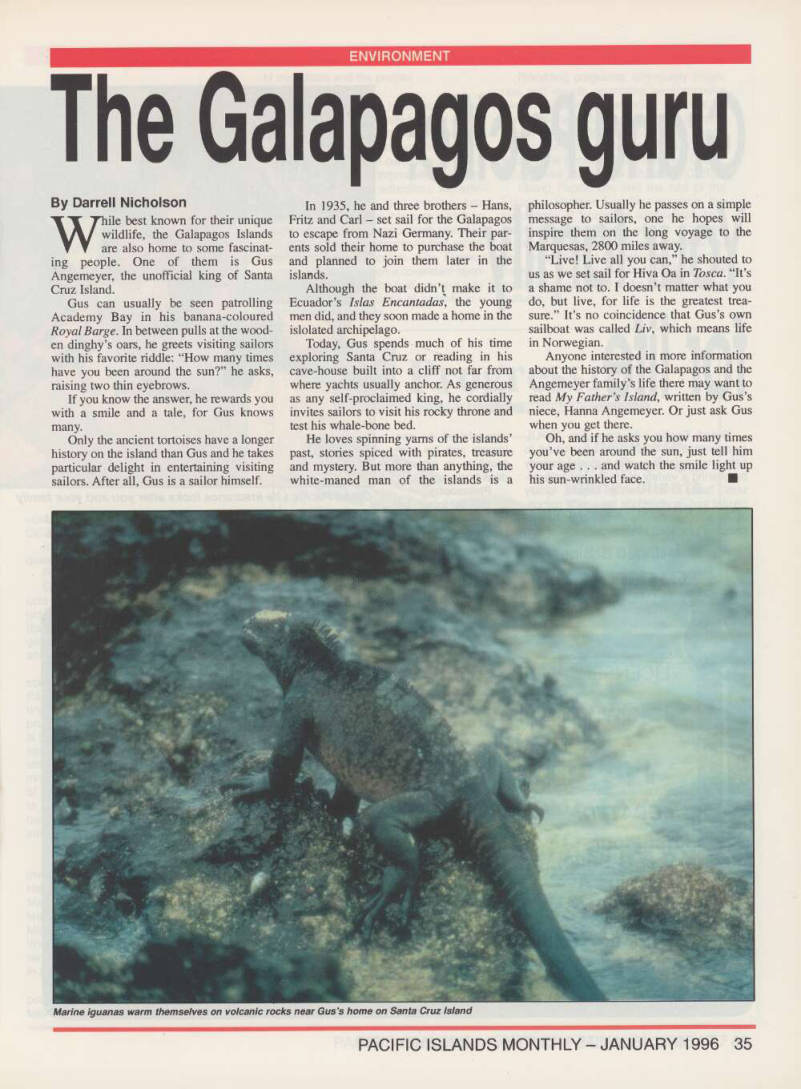
By Darrell Nicholson
While best known for their unique wildlife, the Galapagos Islands are also home to some fascinat ing people. One of them is Gus Angemeyer, the unofficial king of Santa Cmz Island.
Gus can usually be seen patrolling Academy Bay in his banana-coloured Royal Barge. In between pulls at the wood en dinghy’s oars, he greets visiting sailors with his favorite riddle: “How many times have you been around the sun?” he asks, raising two thin eyebrows.
If you know the answer, he rewards you with a smile and a tale, for Gus knows many.
Only the ancient tortoises have a longer history on the island than Gus and he takes particular delight in entertaining visiting sailors. After all, Gus is a sailor himself.
In 1935, he and three brothers - Hans, Fritz and Carl - set sail for the Galapagos to escape from Nazi Germany. Their par ents sold their home to purchase the boat and planned to join them later in the islands.
Although the boat didn’t make it to Ecuador’s Islas Encantadas, the young men did, and they soon made a home in the
islolated archipelago.
Today, Gus spends much of his time exploring Santa Cruz or reading in his cave-house built into a cliff not far from where yachts usually anchor. As generous as any self-proclaimed king, he cordially invites sailors to visit his rocky throne and test his whale-bone bed.
He loves spinning yams of the islands’ past, stories spiced with pirates, treasure and mystery. But more than anything, the white-maned man of the islands is a
philosopher. Usually he passes on a simple message to sailors, one he hopes will inspire them on the long voyage to the Marquesas, 2800 miles away.
“Live! Live all you can,” he shouted to us as we set sail for Hiva Oa in Tosca. “It’s a shame not to. I doesn’t matter what you do, but live, for life is the greatest trea sure.” It’s no coincidence that Gus’s own sailboat was called Liv, which means life in Norwegian.
Anyone interested in more information about the history of the Galapagos and the Angemeyer family’s life there may want to read My Father’s Island, written by Gus’s niece, Hanna Angemeyer. Or just ask Gus when you get there.
Oh, and if he asks you how many times you’ve been around the sun, just tell him your age . . . and watch the smile light up his sun-wrinkled face. ■
Marine iguanas warm themselves on volcanic rocks near Gus’s home on Santa Cruz Island
Your family

Supplement
Grand Pacific: Your family for life
Grand Pacific Life Insurance (GPU), incorporated in 1957, was established to help provide families with financial security by offering a variety of life insurance prod ucts. Today it is Hawaii’s largest, locally owned and operated life insurance compa ny. Its success can be attributed to: Its phi losophy; products; strategic expansion and
commitment to cus tomers and the com munities in which it does business.
Philosophy GPU’s focus has
always been on personalised service and products that meet customers’ changing
needs. “We recognise that every plan and application must be as individual as the
Grand Pacific Life Insurance looks after you and your family
customers we serve,” says President and CEO Wadsworth Yee.
It is GPU’s philosophy to listen, ask questions and make no assumptions.
Products GPLI offers a full complement of prod ucts including individual life insurance, group and credit life insurance, long-term disability insurance, decreasing term mort gage insurance and a comprehensive annuity programme.
While other insurance companies try to compete with securities institutions, Grand Pacific has remained conservative, prefer ring to stick to traditional life insurance products. “As a result, our financial position is stronger in meeting adverse claims,” Yee says. Caution, however, does not mean stagnation. “We will enter into different innovative products but not at the expense of giving away the shop. We’re not looking to be the biggest. We just want to do the best job we can for our customers,” Yee says.
Market The company provides insurance and investment services throughout the state of Hawaii, and in Guam, the Northern Marianas, the Marianas, the Marshall Islands, the Federated States of Micronesia, Palau, American Samoa, Western Samoa and Tonga. GPLI is cur rently looking to expand its services further in the Pacific region.
The company’s growth and service sup ported by its recruitment of local represen tatives, individuals that know the intricacies
of the culture and the people.
Commitment “We have been able to remain competi tive and successful by truly being a part of the communities in which we do business,” says Yee. “Living and working in the islands, we make them our home.”
GPLI reinvests in communities in many ways. GPLI supports education, the envi ronment and health and welfare pro grammes. Beneficiaries have ranged from programs that promote and teach apprecia tion of the arts, to programmes that recog nise outstanding .educators. The Finance Factors Family has been a consistent spon sor of programmes which that promote edu-' cation and the importance of parents in a child’s learning process.
Recycling programs, community clean ups and events promoting environmental awareness are long-standing priorities of the companies. Just as important are pro grams that address social and health needs: Aloha United Way, American Cancer Society, the Foodbank, the March of Dimes, Drug Abuse Resistance Education (DARE).
Grand Pacific Life and the rest of the Finance Factors Family recognise the importance of “corporate citizenship”. As a result, they are active in various chambers of commerce and business associations, and are dedicated sponsors of and partici pants in programmes that celebrate the contributions of many of the islands nations’ cultures. ■
Advertisements & other items, pp. 36-37 (1 item)
Iffo©Oeimit I Iuldaiili Siifwi
LICENSED INSURANCE BROKERS
For all Your Insurance Needs
LOCATED:
Ist Floor V & G Building Hibiscus Ave.
P.O. Box 261 Honiara Solomon Islands.
Telephone: (677) 24304 (677) 24305 Facsimile: (677) 25034
AFTER HOURS:
Contact Regional Manager (677) 30833
Progressive
■ ■ % i ' * i Wm *»w»» WStsm mm *» -?***s*. **»**■ afe#w» \ Insurance Cover for.
These are only 3 of our many clients.
They all have ONE thing in common!
WE'VE GOT
THEM FULLY
COVERED
s I .e« SIH * P e* s
**»OMESTIC /
* PROFESSIONAL
CLAIMS SERVICE
WF OFFER
» » Li HIGHLY
COMPETITIVE
RATES
FEEL SECURE IN THE KNOWLEDGE THAT WE HAVE YOUR BEST INTERESTS COVERED.
OUR STAFF ARE QUALIFIED LOCALS WHO FULLY UNDERSTAND YOUR NEEDS.
Level 2, Lotemau Center, Convent St, Apia. PHONE: 26-11Q/26-111. FAX: 26-112
Vanuatu’s post-election

Election
Vanuatu’s post-election trade-horsing
By Patrick Decloitre
All parties started campaigning for general elections quite late this year, before the vote took place on November 30. The people had to elect their MPs in their respective constituen cies, to fill a new 50- seat chamber for the next four years. And for the second time in Vanuatu’s history, the next government has been formed by a coalition of parties.
The three main parties of Vanuatu’s political spectrum, Serge Vohor’s outgoing ruling Union of Moderate Parties (UMP), Donald Kalpokas’s opposition Unity Front (UF), a platform consisting of Kalpokas’s Vanuaaku Pati (VP), Barak Sope’s Melanesian Progressive Party (MPP) and Vincent Boulekone’s Tan Union (TU) and former Prime Minister Walter Lini’s National United Party (NUP), had started campaigning quite late this year.
Some new parties also emerged, like
the Vanuatu Labour Party, which fielded candidates, most of them well-known union leaders who took part in the 1994 general strike here, or the Vanuatu Women in Politics, who made their first appear ance on the political scene under their own label (Hilda Lini remains the only woman MP in the Vanuatu parliament).
More significantly, a so-called Independent Front, created a couple of months before elections, was one of the first tangible signs of a malaise within rul ing of Moderate Parties; tension was ris ing, the struggle for power was near. IF leader Patrick Crowby, a former UMP offi cial, dismissed from UMP earlier this year.
During the campaign, his main argument was to promote young leaders, whom, he stressed, were more capable, qualified and educated than the old guard of UMP pres ident Serge Vohor who labelled some UMP politicians holding high positions in government and parliament as -“out of
date” and “asleep”.
Another sign of UMP’s internal ten sions was the Supreme Court case about UMP’s official list of candidates: hours before closing date for candidates, two dif ferent lists were given to the Electoral Office. One came from UMP’s national executive committee, the other directly from Prime minister Maxime Carlot and his Finance minister Willie Jimmy.
One of the lists (the executive’s) favoured more young candidates, the other (Carlot’s) was more conservative and pre sented again most of the outgoing govern ment ministers in their respective con stituencies. The most controversial candi date was Port Vila mayor Alick Noel, who, as a popular character in his own town, directly threatened Carlot and Jimmy. It was Chief Justice Charles Vaudin d’lmecourt who had to rule in favour of the Prime Minister’s list. Young candidates backed by UMP’s executive, were finally
banned from using names, banners, emblems, slogans of UMP. They could, however, run as independents, which they eventually did. This was the first clash, an indirect one, between Carlot and Vohor.
In the lead-up to election day, the ten sion, especially in the island state’s capital, mounted. But, as usual, on November 30, voting took place calmly, in a solemn atmosphere. Under a burning sun, some 105,000 voters queued up in front of polling stations around the island state to choose between some 171 candidates.
Instructions had been given by the elec toral office to authorise presiding polling station officers to extend, if necessary, opening hours to enable everyone to cast their vote.
In fact, in two polling stations of Port Vila, voting went on until one and six o’clock into the morning of the following day. Nearly a round-the-clock vote. But, despite the effort, Port Vila (where incum bent Prime Minister Maxime Carlot and Finance Minister Willie Jimmy contested their seats again) was the only constituen cy where the turnout was relatively low, with only 51 per cent as opposed to an average 75 per cent turnout in every other constituency.
Electoral Commission Chairman Masing Lauru later explained the late vot ing was the result of a decision made in those polling stations where the number of registered voters was particularly high.
Lauru said it was recommended another polling station be created to speed up the voting process, but nothing was done about it by authorities. As the result of an insufficient number of ballot boxes and booths, people had to wait hours outside in the burning sun, and later under the moon
light.
“You can’t send a voter back home.
Otherwise, we were taking the risk they would not come back the next day. That’s why we decided to keep the stations open throughout the night”, Lauru explained.
Many parties later complained about irregularities on election day; some said voters who had a valid card were told at the polling station they were not on the electoral roll, allegations were made about electors voting twice: once in person, once by proxy. Others alleged campaigning went on even after the closing date, 24 hours before election day.
During campaigning, not surprisingly,
everyone claimed they would each get enough seats in parliament to have a sim ple majority and form a government with out anyone else’s help. But things turned
out quite differently.
Lini’s NUP, for instance, claimed throughout the campaign it was sure to win the elections: it only got nine seats in the 50-seat house (as opposed to eight in the former 46-seat chamber).
Kalpoka’s Unity Front, according to
official results here, got the highest num ber with 20 seats. UMP only got 17 seats, a lesser figure than the 20 seats they had in the previous, smaller house. Some angry UMP officials saw this as the result of internal quarrels within the party, which, by putting too many candidates in the same constituencies, split votes.
Two independent candidates were elected (a first in Vanuatu’s young history), and the two remaining seats went to two small parties, Nagriamel (1) and Fren Melanesian Party (1).
But the battle was particularly fierce after election day. With no one party hav ing enough seats to form a government, this was time for negotiations.
Within UMP, two teams started to negotiate separately, one led by Vohor, who announced a coalition agreement with Kalpokas on December 4 and 8. Vohor, claiming the support of some three other
UMP newly-elected parliament members,
had signed a memorandum of agreement portfolios out of 13, including the deputy prime ministership. On December 3, Vohor declared war to Carlot, saying the incumbent Prime Minister was no longer a member of UMP because he had negotiat ed on his own.
Carlot, with Jimmy, favoured a pact with Lini’s NUP: he and Jimmy signed a memorandum of understanding with for mer Prime Minister Walter Lini’s National united Party (NUP), to form a government in which UMP would get seven portfolios out of 11, including Prime ministership.
Earlier the same week, a so-called UMP “special council” convened by Carlot and his finance minister Willie Jimmy (also UMP treasurer) resolved to suspend Vohor as UMP president and to cancel the agreement signed with UF.
Vohor did not attend the meeting. One week before the first meeting of the new parliament, on December 18, UMP’s national council finally agreed to favour Carlot’s choice: Lini’s NUP, but without Carlot and to cancel Vohor’s preferred partner, Kalpokas. The superior interest of the party had been saved. “War, and all this, is now buried”, Vohor said, adding all former suspension decisions against him had been cancelled.
The island state’s next newly-elected parliament was to hold the first meeting of its four-year legislature next December 18, when members of the house were to elect a Prime Minister, who in turn, was to announce the composition of his govern ment.
Lini’s NUP was finally the referee in this post-elections game: it ended up with a choice of options between former ruling UMP and Kalpokas’s UF.
Whatever the choice will be, Walter Lini is likely to become Vanuatu’s deputy Prime Minister. ■
Advertisements & other items, pp. 38-40 (1 item)
Steel Bros (Nz) Ltd
PO BOX 11-077 CHRISTCHURCH, NEW ZEALAND
PHONE 64-3 348-8499 FAX 64-3 348-5786
STEELBRO SIDELIFTER: Rated Capacity of SWL up to 30 Tonne. All models can load and unload themselves from ground level, rail wagon or another trailer as well as stack and unstack tall containers two high. Moveable lifting models for handling 10’, 20’, 40’, & 45’, ISO Containers
ECUADORIAN USE
STEELBRO SIDELIFTERS
FORESTRY LOADERS
LOGGING TRAILERS
CRANES
JOHNSTON ROAD SWEEPERS
CUSTOM DESIGN SERVICE
value is part of
the service.
At Ba Industries we're committed to reliable service, in every sense of the word.
We've realised that customer service begins with providing fence & wire products of reliable quality, and it doesn't stop there.
To sight few evidences of our commitment to excellence. • Exporter of the Year Award (B&l) winner 1993 & 1994.
• Only locally owned
wire/fence product manufacturer to be ISO 9002 certified in 1995. •The winner of the Prime Minister's Award 1995 ISo\} 9002
PPL
1995
BA INDUSTRIES LTD
R O. BOX 707, BA FIJI.
PHONE: 674966 FAX: 676700
AdDesit
Remember your Friend
There are times in your life when you feel your friends have been missing out on something good. Now’s your chance to do something about it and share with them one of the good things you have. Buy your friend a subscription to Pacific Islands Monthly and let him or her join you and thousands of other people worldwide who are kept informed of the latest political, social and cultural
changes taking place in the Pacific.
SUBSCRIPTIONS
American Samoa US$45 Australia A 542.00 Canada US$45 Cook Islands AUSS46 Fiji F 526.40 French Polynesia US$45 Guam US$45 Hawaii US$45 Japan US$45 Kiribati AUSS46 Marshall/Micronesia US$4O Nauru AUSS42 New Caledonia US$32 New Zealand NZ$55 Niue AUSS46 Norfolk Island AUSS42 Northern Mananas/Palau US$4O Papua New Guinea AUSS4S Solomon Islands AUSS46 Tonga AUSS46 Tuvalu AUSS46 United Kingdom Stg Pound2B US Mainland US$45 Vanuatu AUSS4S Western Samoa WS$6O Elsewhere AUSS63 Payment to Pacific Islands Monthly: Subscription* Dept, GPO Box 11.67, Suva, FIJI.
Subscriptions rates include the cost of airspeeding to all destinations set out above.
Direct airmail rates on application.
Telephone: 304111 Fax: 303809
PACIFIC
ISLANDS
Please send my friend Pacific Islands Monthly for one year (12 issues).
I enclose my cheque for $ (made payable to Pacific
Islands Monthly)
or debit $ to my: □ Bankcard Mastercard V
cCb
□ Visacard □ Card No: i i ! i I ! ! 1 i ' : i ! 1 i I Expiry Date
NAME
■SIGNATURE-
ADDRESS:
CITY-
COUNTRY
top award
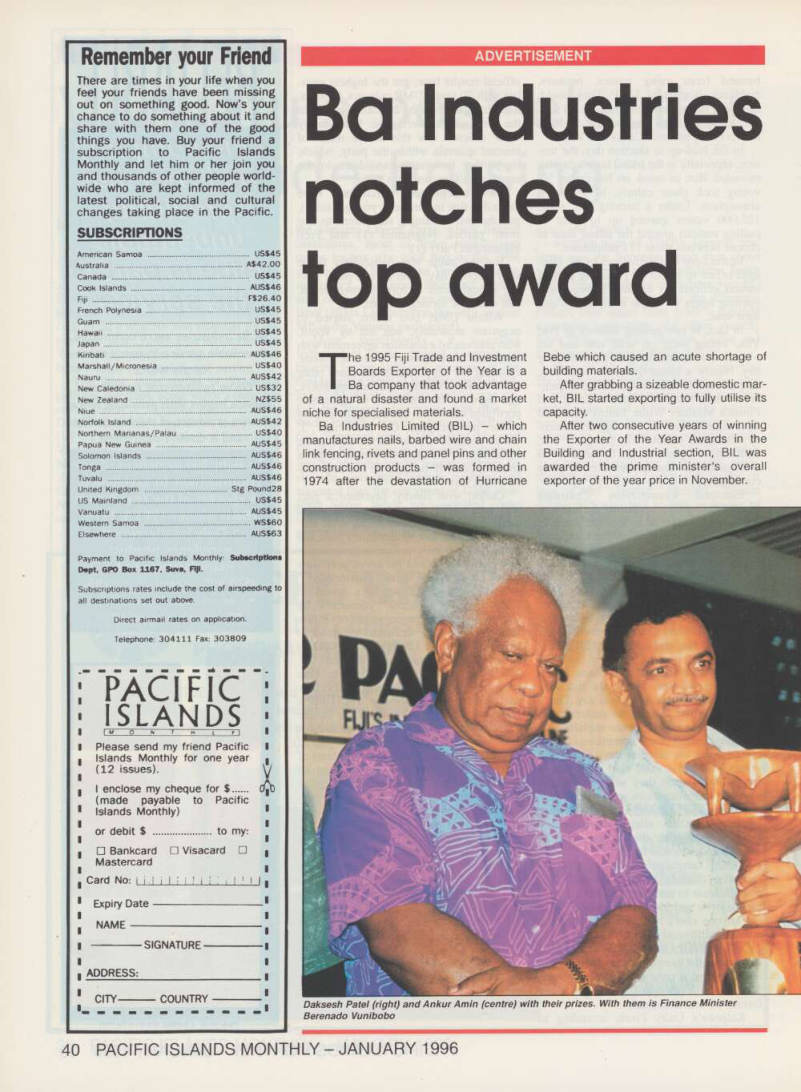
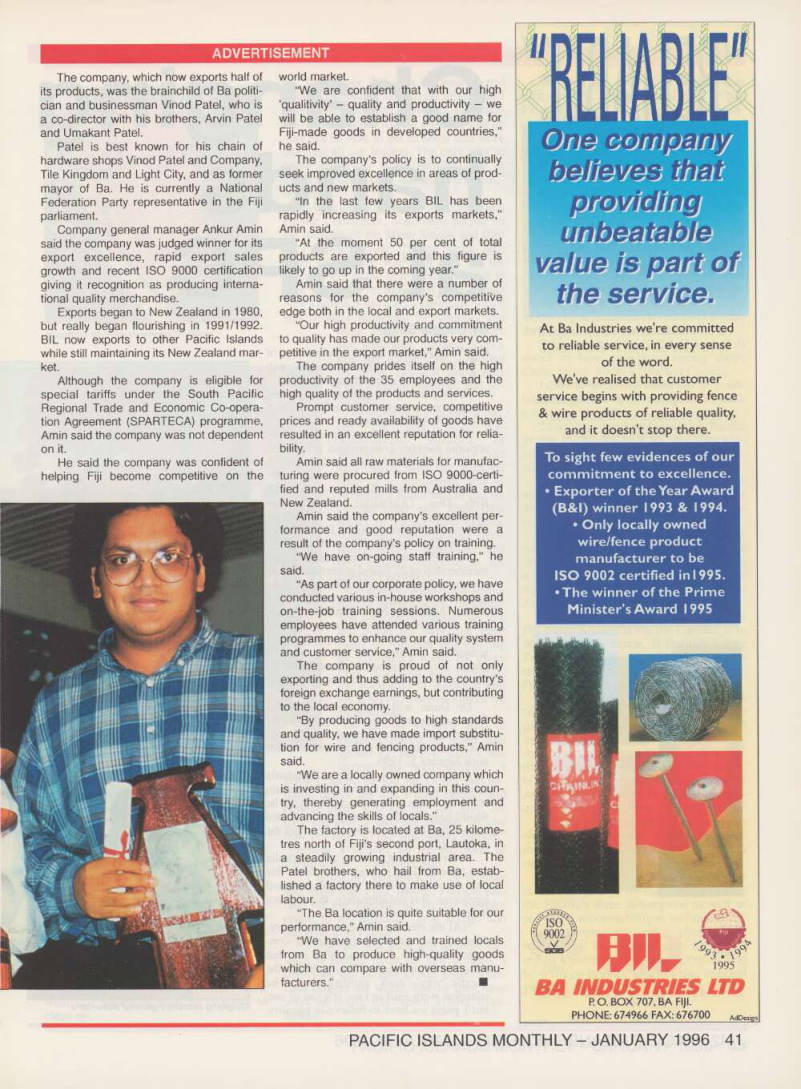
Advertisement
Ba Industries notches top award
The 1995 Fiji Trade and Investment Boards Exporter of the Year is a Ba company that took advantage of a natural disaster and found a market niche for specialised materials.
Ba Industries Limited (BIL) - which manufactures nails, barbed wire and chain link fencing, rivets and panel pins and other construction products - was formed in 1974 after the devastation of Hurricane
Bebe which caused an acute shortage of building materials.
After grabbing a sizeable domestic mar ket, BIL started exporting to fully utilise its capacity.
After two consecutive years of winning the Exporter of the Year Awards in the Building and Industrial section, BIL was awarded the prime minister’s overall exporter of the year price in November.
Daksesh Patel (right) and Ankur Amin (centre) with their prizes. With them is Finance Minister Berenado Vunibobo
The company, which now exports half of its products, was the brainchild of Ba politi cian and businessman Vinod Patel, who is a co-director with his brothers, Arvin Patel and Umakant Patel.
Patel is best known for his chain of hardware shops Vinod Patel and Company, Tile Kingdom and Light City, and as former mayor of Ba. He is currently a National Federation Party representative in the Fiji parliament.
Company general manager Ankur Amin said the company was judged winner for its export excellence, rapid export sales growth and recent ISO 9000 certification giving it recognition as producing interna tional quality merchandise.
Exports began to New Zealand in 1980, but really began flourishing in 1991/1992.
BIL now exports to other Pacific Islands while still maintaining its New Zealand mar ket.
Although the company is eligible for special tariffs under the South Pacific Regional Trade and Economic Co-opera tion Agreement (SPARTECA) programme, Amin said the company was not dependent on it.
He said the company was confident of helping Fiji become competitive on the
world market.
“We are confident that with our high ‘qualitivity’ - quality and productivity - we will be able to establish a good name for Fiji-made goods in developed countries,” he said.
The company’s policy is to continually seek improved excellence in areas of prod ucts and new markets.
“In the last few years BIL has been rapidly increasing its exports markets,”
Amin said.
“At the moment 50 per cent of total products are exported and this figure is likely to go up in the coming year.”
Amin said that there were a number of reasons for the company’s competitive edge both in the local and export markets.
“Our high productivity and commitment to quality has made our products very com petitive in the export market,” Amin said.
The company prides itself on the high productivity of the 35 employees and the high quality of the products and services.
Prompt customer service, competitive prices and ready availability of goods have resulted in an excellent reputation for relia bility.
Amin said all raw materials for manufac turing were procured from ISO 9000-certi fied and reputed mills from Australia and New Zealand.
Amin said the company’s excellent per formance and good reputation were a result of the company’s policy on training.
“We have on-going staff training,” he said.
“As part of our corporate policy, we have conducted various in-house workshops and on-the-job training sessions. Numerous employees have attended various training programmes to enhance our quality system and customer service,” Amin said.
The company is proud of not only exporting and thus adding to the country’s foreign exchange earnings, but contributing to the local economy.
“By producing goods to high standards and quality, we have made import substitu tion for wire and fencing products,” Amin said.
“We are a locally owned company which is investing in and expanding in this coun try, thereby generating employment and advancing the skills of locals.”
The factory is located at Ba, 25 kilome tres north of Fiji’s second port, Lautoka, in a steadily growing industrial area. The Patel brothers, who hail from Ba, estab lished a factory there to make use of local labour.
“The Ba location is quite suitable for our performance,” Amin said.
“We have selected and trained locals from Ba to produce high-quality goods which can compare with overseas manu facturers.” ■
Advertisements & other items, pp. 41-42 (1 item)
value is part of
the service.
At Ba Industries we're committed to reliable service, in every sense of the word.
We've realised that customer service begins with providing fence & wire products of reliable quality, and it doesn't stop there.
To sight few evidences of our commitment to excellence. • Exporter of the Year Award (B&l) winner 1993 & 1994. • Only locally owned
wire/fence product
manufacturer to be ISO 9002 certified in 1995. •The winner of the Prime Minister's Award 1995
ISO\
9002 mK 1995
BA INDUSTRIES LTD
R O. BOX 707, BA FIJI.
PHONE; 674966 FAX: 676700
AdDesit
value is part of
the service.
At Ba Industries we're committed to reliable service, in every sense of the word.
We've realised that customer service begins with providing fence & wire products of reliable quality, and it doesn't stop there.
To sight few evidences of our commitment to excellence. • Exporter of the Year Award (B&l) winner 1993 & 1994. • Only locally owned
wire/fence product
manufacturer to be ISO 9002 certified in 1995. •The winner of the Prime Minister's Award 1995 i 1 m
YISO',
9002 1995
BA INDUSTRIES LTD
R O. BOX 707, BA FIJI.
PHONE: 674966 FAX: 676700 AdDei!gl
Changing
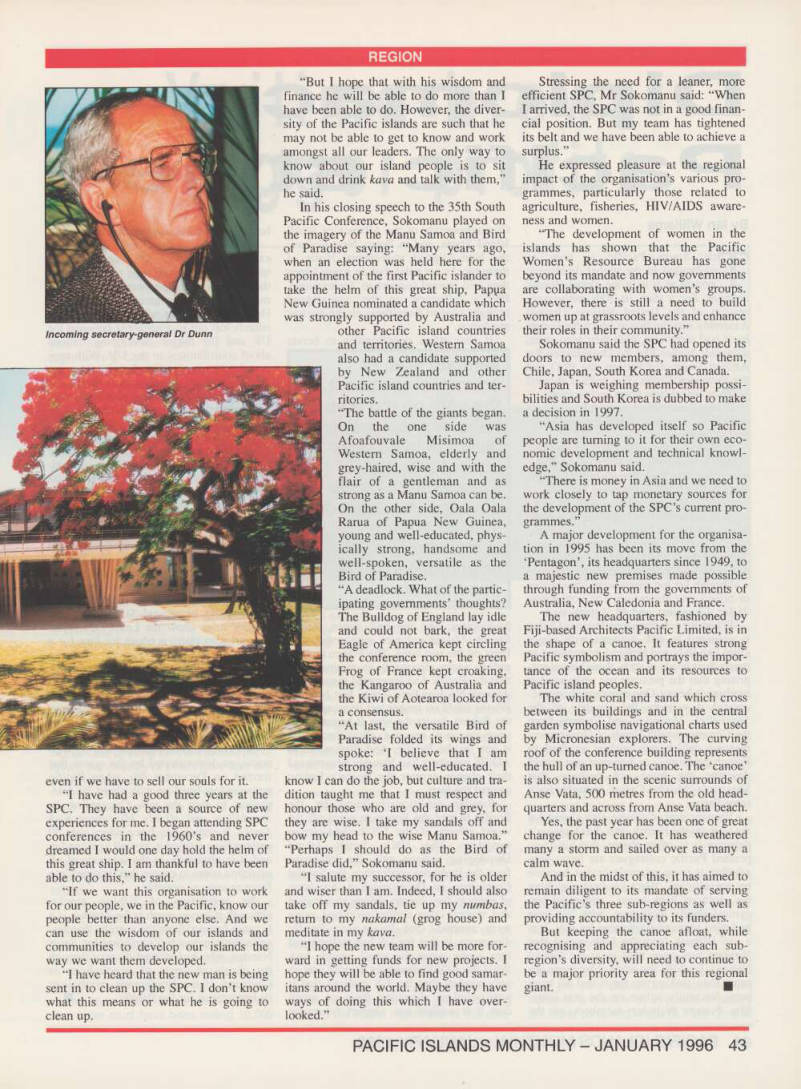
Region
Changing hands at SPC
By Debbie Singh
THE Noumea-based headquarters of the South Pacific Commission will experience many changes in 1996.
Among them, the guidance of a new management team to steer the Commission over the next three years.
The new team was appointed by regional member governments at the 35th South Pacific Conference in Noumea in October.
It comprises new Secretary-General Dr Bob Dun (Australia), Director of Programmes Dr Jimmie Rodgers (Solomon Islands) and Director of Services Lourdes Pangelinian (Guam).
The SPC currently has a sub-regional membership of 22 Island governments and territories from Melanesia, Micronesia and Polynesia. The governments of the United States, Australia, New Zealand, France and the recently-withdrawn United Kingdom constitute the organisation’s remaining members and are its funding giants. Australia presently contributes 33 per cent of the SPC’s total organisational budget.
Dr Dunn will take up the post of Secretary-General on January 6, 1996.
Outgoing Secretary-General Ati George Sokomanu (Vanuatu) will remain in office until January 5, 1996.
At an interview in New Caledonia recently, a somewhat cynical Sokomanu reflected on his term at the SPC, saying he would have liked to have been re-elected for another three years but did not get the support of his government.
“I have pushed hard to tell Australia and New Zealand to keep away from this post as it belongs to the island nations and territories. But unfortunately, this has not happened,” Sokomanu said.
“(At the election of the new Secretary- General) we witnessed the spirit of con sensus in action. I was sorry to see that what we believe in as ‘doing things the Pacific way’, took another turn. The islanders were split in two, it’s sad to see, but I guess we have to believe in equality,
South Pacific Commission headquarters
Outgoing secretary-general Sokomanu
even if we have to sell our souls for it.
“I have had a good three years at the SPC. They have been a source of new experiences for me. I began attending SPC conferences in the 1960’s and never dreamed I would one day hold the helm of this great ship. I am thankful to have been able to do this,” he said.
“If we want this organisation to work for our people, we in the Pacific, know our people better than anyone else. And we can use the wisdom of our islands and communities to develop our islands the way we want them developed.
“I have heard that the new man is being sent in to clean up the SPC. I don’t know what this means or what he is going to clean up.
“But I hope that with his wisdom and finance he will be able to do more than I have been able to do. However, the diver sity of the Pacific islands are such that he may not be able to get to know and work amongst all our leaders. The only way to know about our island people is to sit down and drink kava and talk with them,” he said.
In his closing speech to the 35th South Pacific Conference, Sokomanu played on the imagery of the Manu Samoa and Bird of Paradise saying: “Many years ago, when an election was held here for the appointment of the first Pacific islander to take the helm of this great ship, Papua New Guinea nominated a candidate which was strongly supported by Australia and other Pacific island countries and territories. Western Samoa
also had a candidate supported by New Zealand and other Pacific island countries and ter ritories.
“The battle of the giants began.
On the one side was Afoafouvale Misimoa of Western Samoa, elderly and grey-haired, wise and with the flair of a gentleman and as strong as a Manu Samoa can be.
On the other side, Oala Oala Rarua of Papua New Guinea, young and well-educated, phys ically strong, handsome and well-spoken, versatile as the Bird of Paradise.
“A deadlock. What of the partic ipating governments’ thoughts?
The Bulldog of England lay idle and could not bark, the great Eagle of America kept circling the conference room, the green Frog of France kept croaking, the Kangaroo of Australia and the Kiwi of Aotearoa looked for a consensus.
“At last, the versatile Bird of Paradise folded its wings and spoke: ‘I believe that I am strong and well-educated. I
know I can do the job, but culture and tra dition taught me that I must respect and honour those who are old and grey, for they are wise. I take my sandals off and bow my head to the wise Manu Samoa.”
“Perhaps I should do as the Bird of Paradise did,” Sokomanu said.
“I salute my successor, for he is older and wiser than I am. Indeed, I should also take off my sandals, tie up my numbas, return to my nakamal (grog house) and meditate in my kava.
“I hope the new team will be more for ward in getting funds for new projects. I hope they will be able to find good Samar itans around the world. Maybe they have ways of doing this which I have over looked.”
Stressing the need for a leaner, more efficient SPC, Mr Sokomanu said: “When I arrived, the SPC was not in a good finan cial position. But my team has tightened its belt and we have been able to achieve a
surplus.”
He expressed pleasure at the regional impact of the organisation’s various pro grammes, particularly those related to agriculture, fisheries, HIV/AIDS aware ness and women.
“The development of women in the islands has shown that the Pacific Women’s Resource Bureau has gone beyond its mandate and now governments are collaborating with women’s groups.
However, there is still a need to build women up at grassroots levels and enhance their roles in their community.”
Sokomanu said the SPC had opened its doors to new members, among them, Chile, Japan, South Korea and Canada.
Japan is weighing membership possi bilities and South Korea is dubbed to make a decision in 1997.
“Asia has developed itself so Pacific people are turning to it for their own eco nomic development and technical knowl edge,” Sokomanu said.
“There is money in Asia and we need to work closely to tap monetary sources for the development of the SPC’s current pro grammes.”
A major development for the organisa tion in 1995 has been its move from the ‘Pentagon’, its headquarters since 1949, to a majestic new premises made possible through funding from the governments of Australia, New Caledonia and France.
The new headquarters, fashioned by Fiji-based Architects Pacific Limited, is in the shape of a canoe. It features strong Pacific symbolism and portrays the impor tance of the ocean and its resources to Pacific island peoples.
The white coral and sand which cross between its buildings and in the central garden symbolise navigational charts used by Micronesian explorers. The curving roof of the conference building represents the hull of an up-tumed canoe. The ‘canoe’ is also situated in the scenic surrounds of Anse Vata, 500 metres from the old head quarters and across from Anse Vata beach.
Yes, the past year has been one of great change for the canoe. It has weathered many a storm and sailed over as many a calm wave.
And in the midst of this, it has aimed to remain diligent to its mandate of serving the Pacific’s three sub-regions as well as providing accountability to its funders.
But keeping the canoe afloat, while recognising and appreciating each sub region’s diversity, will need to continue to be a major priority area for this regional giant. ■
Incoming secretary-general Dr Dunn
Diplomacy:
Pacific style
By lan Williams
Thej South Pacific is now as embroiled in the global diplomatic system as it is in the global climate changes. For a start, its 50th anniversary session of the United Nations General Assembly was the first at which the Forum itself had observers, with their won seats, alongside bodies like the Organisation for African Unity, the Vatican, the PLO and the European Union. The session showed as never before how votes and positions on one subject can affect support from others countries on issues that Forum countries feel strongly about.
It also showed quite conclusively why French is no longer the language of diplo macy, but has been transformed into the tongue of threats and bluster. The nuclear issue has had Paris pulling out all the stops to blunt the world-wide upsurge of opposi tion to the tests at Mururoa. Even so, a res olution in the GA’s Fourth Committee con : demning the tests was passed comfortably, with very few countries voting with France - although far too many were browbeaten or bribed into abstention. The voting was 95 for, 12 against, and 45 abstentions.
When French President Jacques Chirac is prepared to risk ruptures with major allies like Italy and Holland, by refusing to meets their heads of state, then it is not sur prising that the pressure put upon weaker brethren is heavy. One can gauge how suc cessful it was by the absence of the Seychelles, Mauritius and Vanuatu from the Commonwealth Heads of Government meeting, which was widely ascribed to French pressure - or however one would describe the huge aid package that Vanuatu’s Maxim-Carlot brought back from Paris.
Vanuatu was of course also absent for the vote on the French tests, but Vanuatu’s delegate is so often absent, that his exas perated Pacific colleagues are never sure whether it is on principle or just because he doesn’t care. “He’s too busy watching the elections back home,” suggested one cynical Pacific colleague, who last year had tried to make allowances for him. It is a sad fallback from the high regard that Vanuatu was once held in at the United Nations. Luckily, the other delegations are more than making up for it and all have been forcefully active on the test issue.
The Forum includes members of the
Commonwealth, of the Alliance of Small Island States, and in Papua New Guinea, the Non-Aligned movement. None of these blocks are solid, but on many issues they will reward support so, for example, PNG’s influence on the non-aligned brought support from them on the nuclear resolution.
It also offers opportunities to berate
Vanuatu was, of course, also absent for the vote on the French tests, but Vanuatu’s delegate is so often absent that his exasperated Pacific colleagues are never sure whether it is on principle or just because he doesn’t care
backsliders, like the half dozen former French African colonies who voted with Paris on the test issue. The Forum ambas sadors wrote afterwards to remind them that the Pacific had supported them on an African Nuclear Free Zone. Just because France could no longer test its weapons in the Sahara desert the way it began to 30 years ago, is no reason to allow them to do it now in the Pacific. And they wrote to AOSIS members like Vanuatu who missed their chance express the region’s feeling against the tests.
Similar coalition building by the Pacific helped the Forum to ward off the worst effects of the US budget-cutting rampage. The UN’s Small Island Developing nations unit, the follow-up from the Barbados conference, the Special Committee on Decolonisation, provision of support for climate change monitoring and several other similar proposed axing were averted. One factor, say Pacific diplomats, is that the US has realised just how many votes the small islands had.
What the AOSIS members wanted was so very modest that the US realised that it was pointless alienating them on small cuts if it wanted any support for major
budget reductions on other items.
In the case of the climate change, for example, while the US supported the treaty, the cuts would have meant that for the time being, there would be no one monitoring governments’ compliance.
However, it is not all rosy. The small islands lost out in a squabble between the US and the bigger developing nations about contributions to the UN. With sup port from countries like Britain, there are proposals which would increase the contri butions of countries like China and India, while slightly reducing those of the US, to take into account the shifts in economic growth since decades ago when the when the proportions were calculated. At the moment, the scale ranges from a maxi mum of 25 per cent of the UN’s regular total cost paid by the US (when Congress allows!) and a minimum of 0.1 per cent paid by most small and least developed nations. The new proposal would cut that proportion to 0.01 per cent which would mean that the smaller islands, like Tuvalu, Kiribati and Tonga, for whom the present SUS 100,000 is a major obstacle, would be able to consider joining. The new mini mum would be around SUS 10,000, and present rules allow the Least Developed Countries to claim a return air fare for a delegate.
However, India, China and other coun tries who would have to pay more have in the meantime managed to stall the decision for another year, so it will be little longer before the Forum has a major accession of new blood.
All votes and delegations will be wel come, as demonstrated by the queue that formed on December 4th, when Pacific ambassadors lined up with about 30 dele gations to sign the new Convention on Straddling and Highly Migratory Fish Stocks. It comes into force when over 30 nations have ratified it, as well as signed it, and it is obviously in the interests of all maritime states to ensure that it comes into force as soon as possible.
Its regulation of fishing stocks, although it leaves much to be desired, is a big step forward from the anarchy that pre vailed before, and Fiji’s ambassador, Satya Nandan, who had steered its way through the shoals of years of negotiations as Chairman of the Conference, symbolises its importance for the Pacific. ■
bigger profits
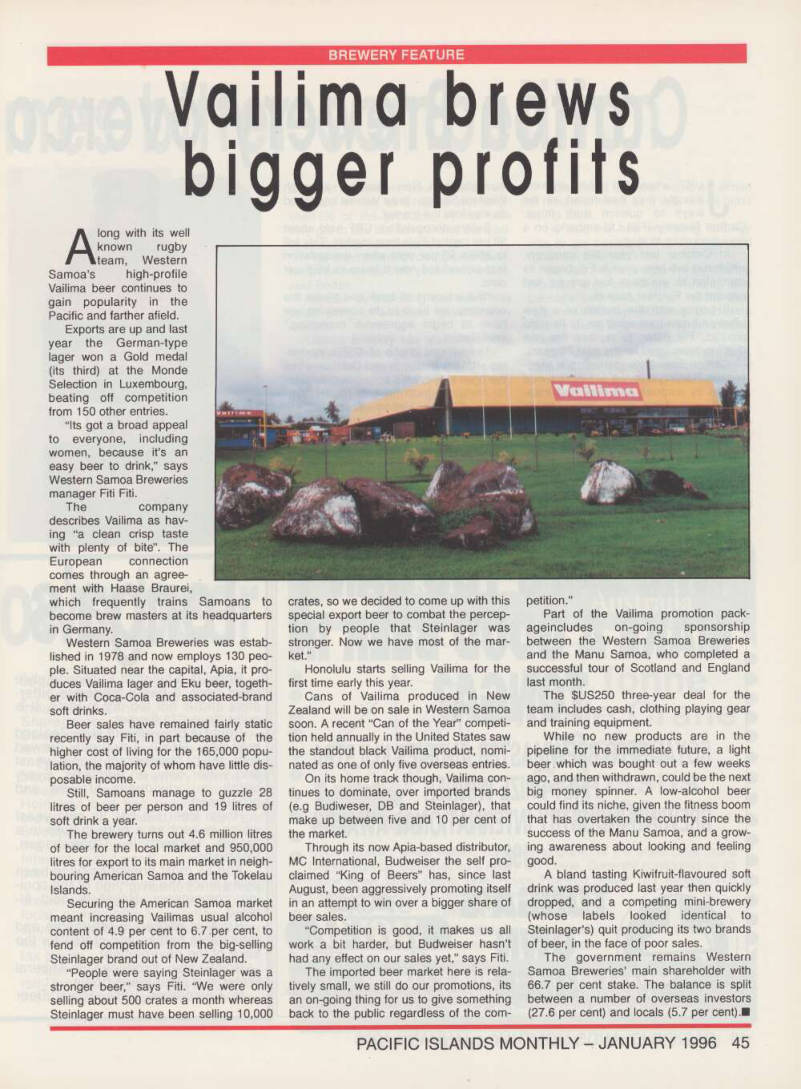
Brewery Feature
Vailima brews bigger profits
Along with its well known rugby team, Western Samoa’s high-profile Vailima beer continues to gain popularity in the Pacific and farther afield.
Exports are up and last year the German-type lager won a Gold medal (its third) at the Monde Selection in Luxembourg, beating off competition from 150 other entries.
“Its got a broad appeal to everyone, including women, because it’s an easy beer to drink,” says Western Samoa Breweries manager Fiti Fiti.
The company describes Vailima as hav ing “a clean crisp taste with plenty of bite”. The European connection comes through an agree ment with Haase Braurel
which frequently trains Samoans to become brew masters at its headquarters in Germany.
Western Samoa Breweries was estab lished in 1978 and now employs 130 peo ple. Situated near the capital, Apia, it pro duces Vailima lager and Eku beer, togeth er with Coca-Cola and associated-brand soft drinks.
Beer sales have remained fairly static recently say Fiti, in part because of the higher cost of living for the 165,000 popu lation, the majority of whom have little dis posable income.
Still, Samoans manage to guzzle 28 litres of beer per person and 19 litres of soft drink a year.
The brewery turns out 4.6 million litres of beer for the local market and 950,000 litres for export to its main market in neigh bouring American Samoa and the Tokelau Islands.
Securing the American Samoa market meant increasing Vailimas usual alcohol content of 4.9 per cent to 6.7,per cent, to fend off competition from the big-selling Steinlager brand out of New Zealand.
“People were saying Steinlager was a stronger beer,” says Fiti. “We were only selling about 500 crates a month whereas Steinlager must have been selling 10,000
crates, so we decided to come up with this special export beer to combat the percep tion by people that Steinlager was stronger. Now we have most of the mar ket.”
Honolulu starts selling Vailima for the first time early this year.
Cans of Vailima produced in New Zealand will be on sale in Western Samoa soon. A recent “Can of the Year” competi tion held annually in the United States saw the standout black Vailima product, nomi nated as one of only five overseas entries.
On its home track though, Vailima con tinues to dominate, over imported brands (e.g Budiweser, DB and Steinlager), that make up between five and 10 per cent of the market.
Through its now Apia-based distributor, MC International, Budweiser the self pro claimed “King of Beers” has, since last August, been aggressively promoting itself in an attempt to win over a bigger share of beer sales.
“Competition is good, it makes us all work a bit harder, but Budweiser hasn’t had any effect on our sales yet,” says Fiti.
The imported beer market here is rela tively small, we still do our promotions, its an on-going thing for us to give something back to the public regardless of the com
petition.”
Part of the Vailima promotion pack ageincludes on-going sponsorship between the Western Samoa Breweries and the Manu Samoa, who completed a successful tour of Scotland and England last month.
The SUS2SO three-year deal for the team includes cash, clothing playing gear and training equipment.
While no new products are in the pipeline for the immediate future, a light beer , which was bought out a few weeks ago, and then withdrawn, could be the next big money spinner. A low-alcohol beer could find its niche, given the fitness boom that has overtaken the country since the success of the Manu Samoa, and a grow ing awareness about looking and feeling
good.
A bland tasting Kiwifruit-flavoured soft drink was produced last year then quickly dropped, and a competing mini-brewery (whose labels looked identical to Steinlager’s) quit producing its two brands of beer, in the face of poor sales.
The government remains Western Samoa Breweries’ main shareholder with 66.7 per cent stake. The balance is split between a number of overseas investors (27.6 per cent) and locals (5.7 per cent).H
Carlton Brewery overco

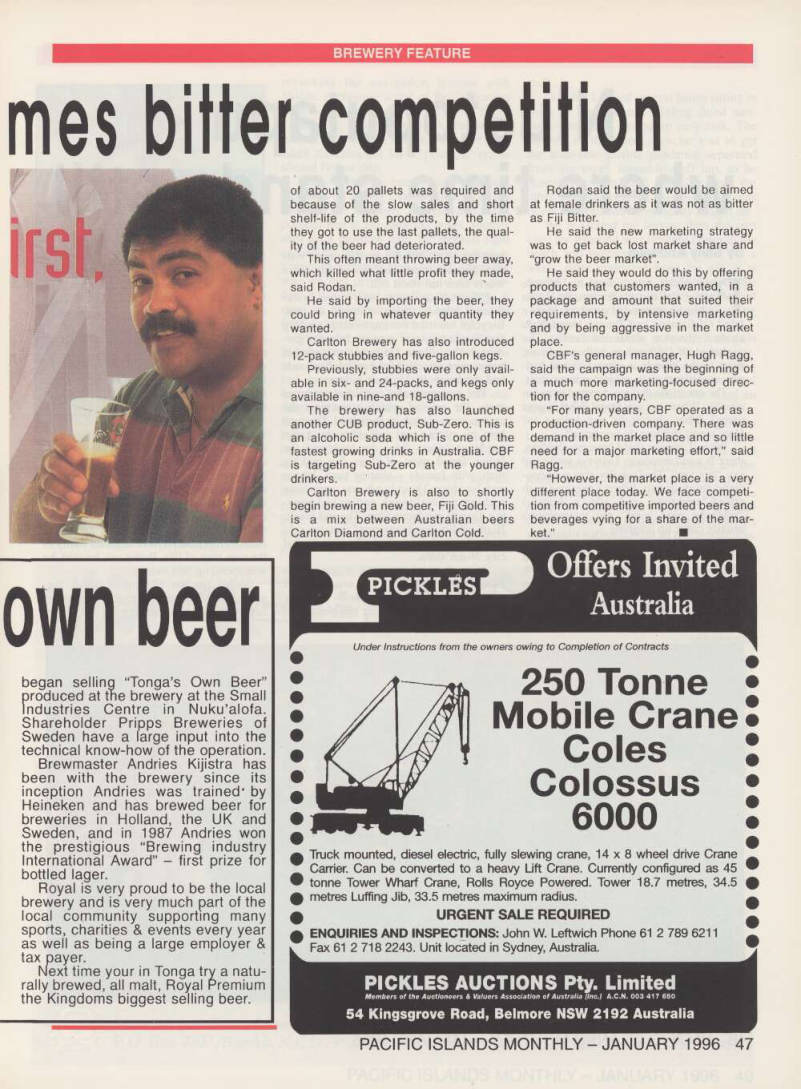
JUST when Fiji beer drinkers thought they had found all the ways to quench their thirst, Carlton Brewery (Fiji) Ltd embarks on a new marketing strategy.
In October last year the company, which has two breweries in Fiji, began its campaign to win back lost ground and expand the Fiji beer market.
It began with the launch of a new label and new packaging for its flagship product, Fiji Bitter, to replace the one that has been used for the past 20 years.
Carlton Brewery’s marketing manag er, Joe Rodan, said the old design had served its purpose and they had intro duced something more appealing to counter competition and expand a shrinking beer market.
Rodan said over the past four years, the beer market had shrunk by about 15 per cent, mainly as the result of a slow ing economy.
He said since deregulation was intro duced CBF had lost some its market share to overseas beers, mainly from
Australia and New Zealand, although Western Samoan brew Vailima has found its way into the market.
Before deregulation, CBF held about 98 per cent of Fiji’s beer market. This fell to about 92 per cent when deregulation first arrived but now it is up to 96.5 per cent.
“But we can’t sit back and blame the economy, we have to do something, we have to begin aggressive marketing,” said Rodan.
The second phase of CBF’s market ing strategy began in mid-October when the brewery became principal distributor for many products from its parent com pany, Carlton United Breweries, in Australia.
Products Carlton Brewery will import are: Fosters; Victoria Bitter; Carlton Cold; Fosters Lite Ice; Carlton Light; and Sheath Stout.
Last August, CBF ceased producing Fiji Light and Fiji Stout because demand for the two products was not big enough.
Rodan said a minimum production run
of about 20 pallets was required and because of the slow sales and short shelf-life of the products, by the time they got to use the last pallets, the qual ity of the beer had deteriorated.
This often meant throwing beer away, which killed what little profit they made, said Rodan.
He said by importing the beer, they could bring in whatever quantity they wanted.
Carlton Brewery has also introduced 12-pack stubbies and five-gallon kegs.
Previously, stubbies were only avail able in six- and 24-packs, and kegs only available in nine-and 18-gallons.
The brewery has also launched another CUB product, Sub-Zero. This is an alcoholic soda which is one of the fastest growing drinks in Australia. CBF is targeting Sub-Zero at the younger drinkers.
Carlton Brewery is also to shortly begin brewing a new beer, Fiji Gold. This is a mix between Australian beers Carlton Diamond and Carlton Cold.
Rodan said the beer would be aimed at female drinkers as it was not as bitter as Fiji Bitter.
He said the new marketing strategy was to get back lost market share and “grow the beer market”.
He said they would do this by offering products that customers wanted, in a package and amount that suited their requirements, by intensive marketing and by being aggressive in the market place.
CBF’s general manager, Hugh Ragg, said the campaign was the beginning of a much more marketing-focused direc tion for the company.
“For many years, CBF operated as a production-driven company. There was demand in the market place and so little need for a major marketing effort,” said Ragg.
“However, the market place is a very different place today. We face competi tion from competitive imported beers and beverages vying for a share of the mar ket.” ■
Tonga's
Royal is a full malt European style lager beer. It has a moderate bitter ness and is not too dry in taste. It is quite “fruity” in flavour.
Royal is brewed with New Zealand malt only. Royal is naturally brewed with malt, sticklebract hops, yeast and water only, no additives. Every batch is individually brewed and processed.
Royal Beer Co has its own yeast which is kept as a pure culture in a “yeast library” in Copenhagen, Denmark.
And as most breweries have been doing since the invention of the cool ing compressor, Royal is cold fil tered.
Royal is packed in returnable and refundable bottles and crates for the sake of the environment.
Royal also produces a Mineral Water in a clear glass bottle.
In September 1987, Royal Beer
began selling “Tonga’s Own Beer” produced at the brewery at the Small Industries Centre in Nuku’alofa.
Shareholder Pripps Breweries of Sweden have a large input into the technical know-how of the operation.
Brewmaster Andries Kijistra has been with the brewery since its inception Andries was trained' by Heineken and has brewed beer for breweries in Holland, the UK and Sweden, and in 1987 Andries won the prestigious “Brewing industry International Award” - first prize for bottled lager.
Royal is very proud to be the local brewery and is very much part of the local community supporting many sports, charities & events every year as well as being a large employer & tax payer.
Next time your in Tonga try a natu rally brewed, all malt, Royal Premium the Kingdoms biggest selling beer.
Advertisements & other items, pp. 46-47 (3 items)
Who Says You Cant
MAKE A GOOD USER IN
TONGA!
ROYAL BEER BREWMASTER ANDRIES KIJLSTRA
FIRST PRIZE WINNER
BREWING INDUSTRY INTERNATIONAL AWARDS
1987
TONGA'S
OWN
BEER
BREWING INDUSTRY
INTERNATIONAL AWARDS
1387 im
own beer
47
BREWERY FEATURE
PACIFIC ISLANDS MONTHLY - JANUARY 1996
own beer
mes bitter competition
Mobile Crane
PICKLES
Offers Invited
Australia
Under Instructions from the owners owing to Completion of Contracts
250 Tonne
Mobile Crane
Coles
Colossus
6000 a Truck mounted, diesel electric, fully slewing crane, 14x8 wheel drive Crane Carrier. Can be converted to a heavy Lift Crane. Currently configured as 45 w tonne Tower Wharf Crane, Rolls Royce Powered. Tower 18.7 metres, 34.5 0 metres Luffing Jib, 33.5 metres maximum radius.
• URGENT SALE REQUIRED
9 ENQUIRIES AND INSPECTIONS: John W. Leftwich Phone 61 2 789 6211 k Fax 61 2 718 2243. Unit located in Sydney, Australia.
PICKLES AUCTIONS Pty. Limited
Members of the Auctioneers & Valuers Association of Australia fine.) A.C.N. 003 417 650 54 Kingsgrove Road, Belmore NSW 2192 Australia
Niuatoputapu -
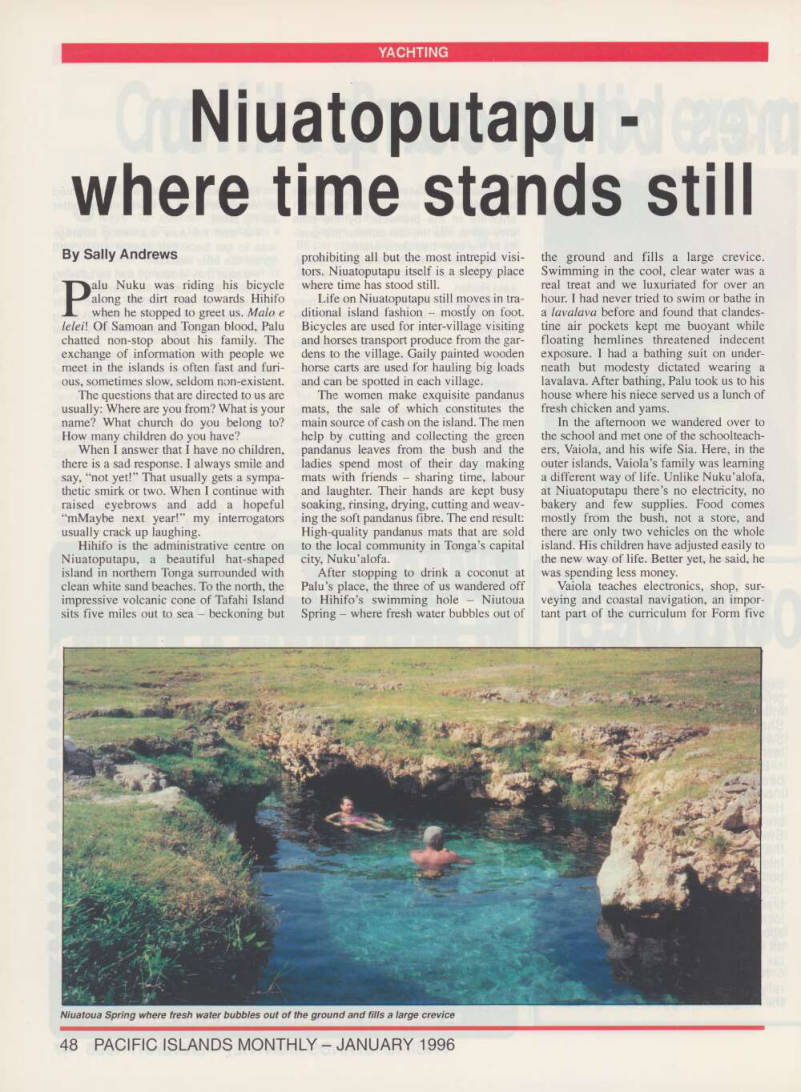
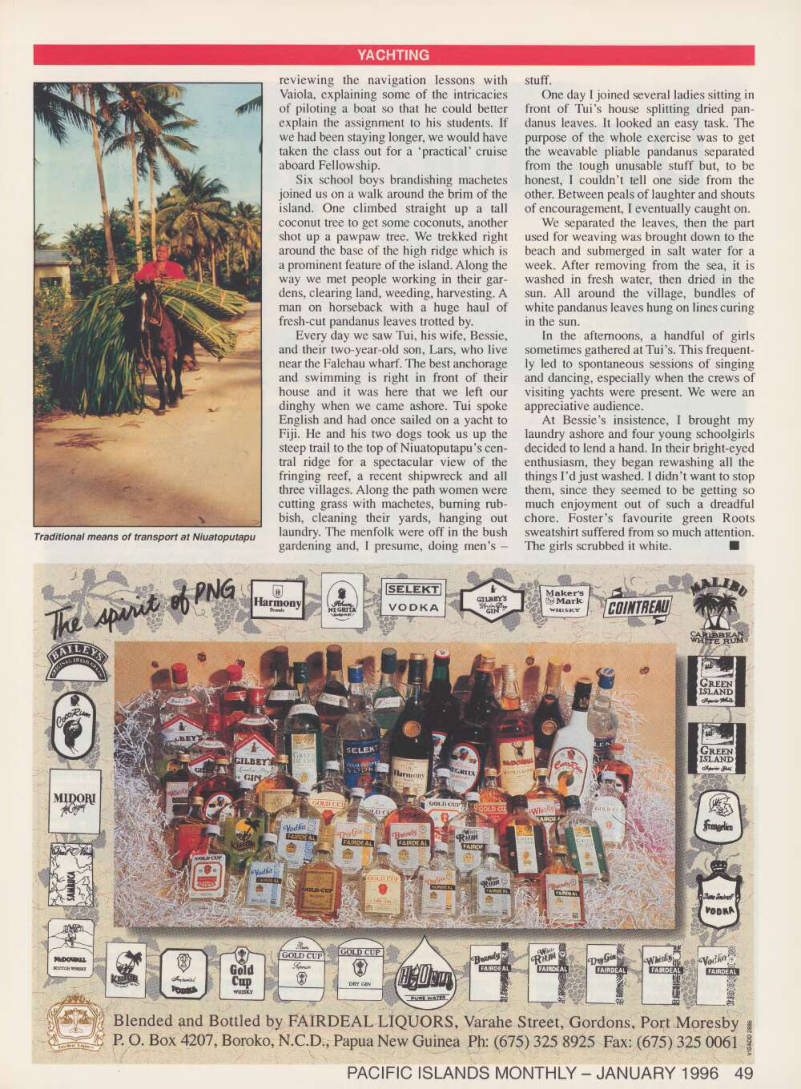
Yachting
Niuatoputapu where time stands still
By Sally Andrews
Palu Nuku was riding his bicycle along the dirt road towards Hihifo when he stopped to greet us. Malo e lelei\ Of Samoan and Tongan blood, Palu chatted non-stop about his family. The exchange of information with people we meet in the islands is often fast and furi ous, sometimes slow, seldom non-existent.
The questions that are directed to us are usually: Where are you from? What is your name? What church do you belong to?
How many children do you have?
When I answer that I have no children, there is a sad response. I always smile and say, “not yet!” That usually gets a sympa thetic smirk or two. When I continue with raised eyebrows and add a hopeful
“mMaybe next year!” my interrogators
usually crack up laughing.
Hihifo is the administrative centre on Niuatoputapu, a beautiful hat-shaped island in northern Tonga surrounded with clean white sand beaches. To the north, the impressive volcanic cone of Tafahi Island sits five miles out to sea - beckoning but
prohibiting all but the most intrepid visi tors. Niuatoputapu itself is a sleepy place where time has stood still.
Life on Niuatoputapu still moves in tra ditional island fashion - mostly on foot.
Bicycles are used for inter-village visiting
and horses transport produce from the gar dens to the village. Gaily painted wooden horse carts are used for hauling big loads and can be spotted in each village.
The women make exquisite pandanus mats, the sale of which constitutes the main source of cash on the island. The men help by cutting and collecting the green pandanus leaves from the bush and the ladies spend most of their day making mats with friends - sharing time, labour and laughter. Their hands are kept busy
soaking, rinsing, drying, cutting and weav
ing the soft pandanus fibre. The end result: High-quality pandanus mats that are sold to the local community in Tonga’s capital city, Nuku’alofa.
After stopping to drink a coconut at Palu’s place, the three of us wandered off to Hihifo’s swimming hole - Niutoua Spring - where fresh water bubbles out of
the ground and fills a large crevice.
Swimming in the cool, clear water was a real treat and we luxuriated for over an hour. I had never tried to swim or bathe in a lavalava before and found that clandes tine air pockets kept me buoyant while floating hemlines threatened indecent exposure. I had a bathing suit on under neath but modesty dictated wearing a lavalava. After bathing, Palu took us to his house where his niece served us a lunch of fresh chicken and yams.
In the afternoon we wandered over to the school and met one of the schoolteach ers, Vaiola, and his wife Sia. Here, in the outer islands, Vaiola’s family was learning a different way of life. Unlike Nuku’alofa, at Niuatoputapu there’s no electricity, no bakery and few supplies. Food comes mostly from the bush, not a store, and there are only two vehicles on the whole island. His children have adjusted easily to the new way of life. Better yet, he said, he was spending less money.
Vaiola teaches electronics, shop, sur veying and coastal navigation, an impor tant part of the curriculum for Form five
Niuatoua Spring where fresh water bubbles out of the ground and fills a large crevice
reviewing the navigation lessons with Vaiola, explaining some of the intricacies of piloting a boat so that he could better explain the assignment to his students. If we had been staying longer, we would have taken the class out for a ‘practical’ cruise
aboard Fellowship.
Six school boys brandishing machetes joined us on a walk around the brim of the island. One climbed straight up a tall coconut tree to get some coconuts, another shot up a pawpaw tree. We trekked right around the base of the high ridge which is a prominent feature of the island. Along the way we met people working in their gar dens, clearing land, weeding, harvesting. A man on horseback with a huge haul of fresh-cut pandanus leaves trotted by.
Every day we saw Tui, his wife, Bessie, and their two-year-old son, Lars, who live near the Falehau wharf. The best anchorage and swimming is right in front of their house and it was here that we left our dinghy when we came ashore. Tui spoke English and had once sailed on a yacht to Fiji. He and his two dogs took us up the steep trail to the top of Niuatoputapu’s cen tral ridge for a spectacular view of the fringing reef, a recent shipwreck and all three villages. Along the path women were cutting grass with machetes, burning rub bish, cleaning their yards, hanging out laundry. The menfolk were off in the bush gardening and, I presume, doing men’s -
stuff.
One day I joined several ladies sitting in front of Tui’s house splitting dried pan danus leaves. It looked an easy task. The purpose of the whole exercise was to get the weavable pliable pandanus separated from the tough unusable stuff but, to be honest, I couldn’t tell one side from the other. Between peals of laughter and shouts of encouragement, I eventually caught on.
We separated the leaves, then the part used for weaving was brought down to the beach and submerged in salt water for a week. After removing from the sea, it is washed in fresh water, then dried in the sun. All around the village, bundles of white pandanus leaves hung on lines curing in the sun.
In the afternoons, a handful of girls sometimes gathered at Tui’s. This frequent ly led to spontaneous sessions of singing and dancing, especially when the crews of visiting yachts were present. We were an
appreciative audience.
At Bessie’s insistence, I brought my laundry ashore and four young schoolgirls decided to lend a hand. In their bright-eyed enthusiasm, they began rewashing all the things I’d just washed. I didn’t want to stop them, since they seemed to be getting so much enjoyment out of such a dreadful chore. Foster’s favourite green Roots sweatshirt suffered from so much attention.
The girls scrubbed it white. ■
Traditional means of transport at Niuatoputapu
Advertisements & other items, p. 49 (1 item)
Clip
ISELEKT
GILBEV'S
£ Maker’s I , ©Mark ' r r^ onv I
VODKA
WHISK.Y
GIN
If v-:. bbean “rum WH f* Green island LB£ I rtitom IW Sv* * sa >; 4 '. *: A.'* apt##
MIDO
GOLD CtTP
> ■ v ?. u 4 £ ■V >■ ■■ ••y |s| *oo** ; i; : • * *
GOLD CUP
GOLD CUP
G$0 X y itl atfhiw <Mo<Wr: ™f
McDOUHU.
SCOTCH WHISKr
qw Gold
Clip
if |*Sf Blended and Bottled by FAIRDEAL LIQUORS, Varahe Street, Gordons, Port Moresby P. O. Box 4207, Boroko, N.C.D., Papua New Guinea Ph: (675) 325 8925 Fax: (675) 325 0061
Dynamic Dymock

Rugby
By Atama Raganivatu
Tongan rugby league player Jim
Dymock has just completed a year during which he won more honours than most sportsmen receive in a lifetime.
Dymock’s extraordinary 12 months
commenced in October last year, when he travelled to Fiji and inspired Tonga to a first-ever Pacific Cup success. His eligibil ity to represent the kingdom comes through a Tongan-bom mother. “I am hon oured to be selected,” he said at the time, “Because it means a lot to my mum.”
He certainly didn’t let his mother down.
Dymock played magnificently throughout
the two-week tournament and was particu larly influential in the final, when Fiji were hammered 34-11.
Prior to his Tongan call up, Dymock admitted he knew little about the Friendly Islands. But now, he would make an ideal spokesman for their tourist board. “Good Samaritan Beach is the closest thing to par adise on earth,” he enthused after a recent visit arranged by local rugby league offi cials. “The sunsets, the beach scenery and the tranquillity there are incredible.”
Dymock’s appreciation of Good
Samaritan Beach is understandable, for it presents a total contrast to the grim urban areas of Sydney where he spent his child hood years.
“I was bom in Paddington, but raised in Woolloomooloo - known to many people in Sydney as Struggle Street ,” Dymock says with a grin that is almost permanent.
It was in his birthplace suburb that Dymock gained the first taste of rugby league. He played for Paddington Colts as an infant before joining Zetland in Woolloomooloo. Zetland is a nursery of the famous South Sydney club and he graduated to the “Rabbitohs” youth team in 1989.
However, South Sydney subsequently
released him and it was with rivals Western Suburbs that Dymock made his debut in
the world’s toughest senior rugby league
championship, the Winfield Cup, in 1991.
The Magpies did not get the best out of Dymock. Used as little more than a batter ing ram by coach Warren Ryan, he missed half of the 1992 season with a knee injury and was then transferred to Canterbury - Bankstown (now known as the Sydney
Bulldogs).
Under the Bulldogs’ coach, Chris Anderson, all of Dymock’s many talents were cultivated. Today, he is respected for his adroit ball skills and uncanny ‘reading’ of a game, as well as the admirable brav ery, remarkable strength and exceptional work rate which had become evident at Western Suburbs. The Tongan is a classic example of a player who thrived on being
given greater responsibility.
Dymock’s first significant accolade
came during his first season as a Bulldog, when named in the Sydney City Origin representative side for their annual fixture with New South Wales Country Origin.
Nineteen-ninety-four saw him retain his place amongst the City selection and also play a major role in the Bulldogs’ surge through to that year’s Winfield Cup grand final. But, they then suffered a heavy defeat at the hands of Canberra Raiders.
Like nearly all his team-mates, Dymock did not do himself justice during Australian rugby league’s annual showpiece.
Dymock quickly overcame the one weighty disappointment of his career to spearhead Tonga’s triumph in Suva - an experience which ensured that he would be in good heart when the momentous 1995
campaign commenced.
Yet, the season could so easily have been a disastrous one for the Bulldogs. For much of the term, rugby league’s internal politics threatened to destroy their prospects.
Early in the year, the club announced they had aligned themselves with the
breakaway Super League organisation but
four of their leading players - including Dymock - then declared themselves loyal to the established Australian Rugby
League.
Internal bickering led to several dread
ful performances and the Bulldogs only
staggered into the end of season play-offs as the sixth-ranked team. However, during the finals series, Dymock and his team mates forgot all personal differences to come into their own and hot favourites Manly were downed 17-4 in a grand final performance which wiped away all memo ries of the nightmare inflicted by Canberra 12 months earlier. The huge part played by Dymock in the triumph was acknowledged when he was presented with the Man of the
Match award, the much-coveted Clive Churchill medal.
After placing the Winfield Cup win ners’ and Churchill medals in his trophy cabinet, Dymock was left with just one more assignment for 1995 - the Centenary World Cup.
Having been named captain of the Tongan side several months before, he was
eagerly anticipating wearing the
Kingdom’s red jersey in Britain. Instead, he found himself donning the green and gold of Australia after an eleventh-hour recruitment for the world champions’ 25strong travelling party.
Australia’s belated ‘poaching’ of Dymock will long remain a contentious matter. Under current international rules, the Australians do have first call upon his services. However, he was not included in their provisional squad of over 40 players and had been omitted from both the Sydney City and New South Wales repre sentative selections for 1995.
The Tongans were dismayed at the turn of events. Dymock had been the key figure in all Mate Ma Tonga’s World Cup plans from the moment they decided to enter the competition and their aggravation was
fully justified.
Dymock, though, recognised that he
had been presented with an opportunity for further glory and grabbed it.
After a disappointing start (his error led to one of the tries by which England beat Australia in the opening game), Dymock improved as the tournament progressed and was a pivotal factor in the Kangaroos overcoming their English hosts in the final at London’s historic Wembley Stadium.
And so, Tonga had its second world champion in a mainstream international sport (the first, rugby union player Viliame Ofahengaue, also achieved his success while representing Australia). The circum stances in which he was drafted into the Kangaroos side may vex Tongans and reflected glory is never totally satisfactory.
However, Dymock deserves all the prizes to have come his way and the Kingdom can take pride that yet another of their rugby-playing sons has proven himself a supreme talent.
Hopefully, that talent will serve Tonga again sometime in the future. ■
Breaking away from clucthes which try to keep him down - Dymock.
Advertisements & other items, p. 51 (2 items)
Rugby
Trust Company Ltd
USED JAPANESE VEHICLES
ANY MAKE, MODEL, YEAR
* TRUCKS, * CARS, * TRACTORS,
* ENGINE AND TYRES
ALL SHIPPING AND DOCUMENTATION ARRANGED.
BUY DIRECT FROM JAPAN AND SAVE.
r
“CONTACT”
Trust Company Ltd
KOBAC BID 3F 3-2-26 NISHIKI,
NAKAU NAGOYA, 460 JAPAN.
PHONE: (81) 52 953-5602
FAX (81) 52 953-5634
Bachop brothers:
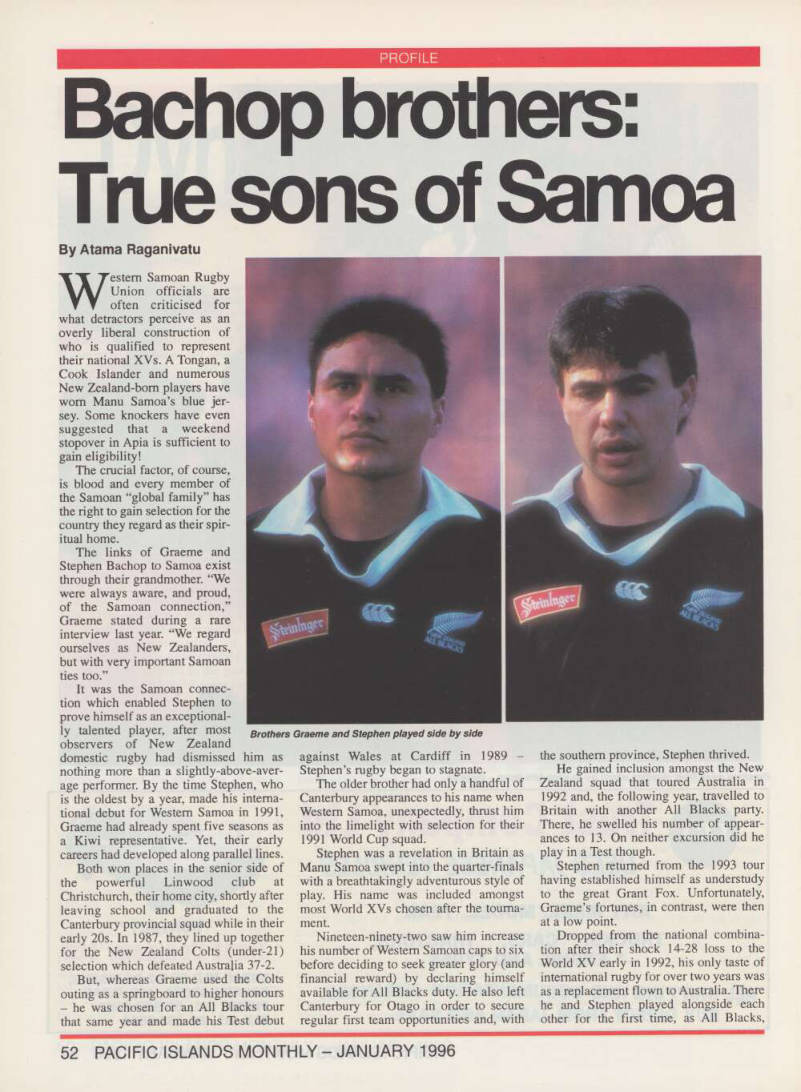
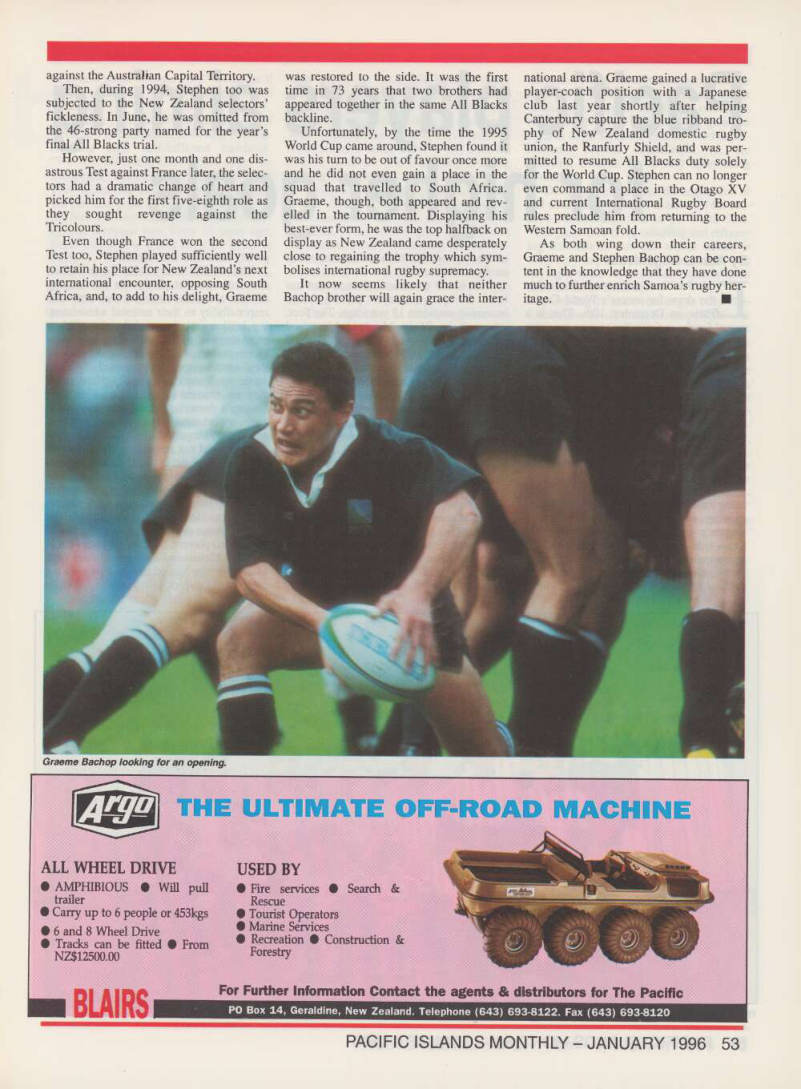
Profile
Bachop brothers: True sons of Samoa
By Atama Raganivatu
Western Samoan Rugby Union officials are often criticised for what detractors perceive as an overly liberal construction of who is qualified to represent their national XVs. A Tongan, a Cook Islander and numerous New Zealand-born players have worn Manu Samoa’s blue jer sey. Some knockers have even suggested that a weekend stopover in Apia is sufficient to
gain eligibility!
The crucial factor, of course, is blood and every member of the Samoan “global family” has the right to gain selection for the country they regard as their spir itual home.
The links of Graeme and Stephen Bachop to Samoa exist
through their grandmother. “We
were always aware, and proud, of the Samoan connection,”
Graeme stated during a rare interview last year. “We regard ourselves as New Zealanders, but with very important Samoan ties too.”
It was the Samoan connec tion which enabled Stephen to prove himself as an exceptional ly talented player, after most observers of New Zealand
domestic rugby had dismissed him as nothing more than a slightly-above-average performer. By the time Stephen, who is the oldest by a year, made his international debut for Western Samoa in 1991, Graeme had already spent five seasons as a Kiwi representative. Yet, their early careers had developed along parallel lines.
Both won places in the senior side of the powerful Lin wood club at Christchurch, their home city, shortly after leaving school and graduated to the
Canterbury provincial squad while in their
early 20s. In 1987, they lined up together for the New Zealand Colts (under-21) selection which defeated Australia 37-2.
But, whereas Graeme used the Colts outing as a springboard to higher honours - he was chosen for an All Blacks tour that same year and made his Test debut
against Wales at Cardiff in 1989 - Stephen’s rugby began to stagnate.
The older brother had only a handful of Canterbury appearances to his name when Western Samoa, unexpectedly, thrust him into the limelight with selection for their 1991 World Cup squad.
Stephen was a revelation in Britain as Manu Samoa swept into the quarter-finals with a breath takingly adventurous style of play. His name was included amongst most World XVs chosen after the toumament.
Nineteen-ninety-two saw him increase his number of Western Samoan caps to six before deciding to seek greater glory (and financial reward) by declaring himself available for All Blacks duty. He also left Canterbury for Otago in order to secure regular first team opportunities and, with
the southern province, Stephen thrived, He gained inclusion amongst the New Zealand squad that toured Australia in 1992 and, the following year, travelled to Britain with another All Blacks party.
There, he swelled his number of appear ances to 13. On neither excursion did he play in a Test though.
Stephen returned from the 1993 tour having established himself as understudy to the great Grant Fox. Unfortunately, Graeme’s fortunes, in contrast, were then at a low point.
Dropped from the national combina tion after their shock 14-28 loss to the World XV early in 1992, his only taste of international rugby for over two years was as a replacement flown to Australia. There he and Stephen played alongside each other for the first time, as All Blacks,
Brothers Graeme and Stephen played side by side
against the Australian Capital Territory.
Then, during 1994, Stephen too was subjected to the New Zealand selectors’ fickleness. In June, he was omitted from the 46-strong party named for the year’s final All Blacks trial.
However, just one month and one dis astrous Test against France later, the selec tors had a dramatic change of heart and picked him for the first five-eighth role as they sought revenge against the Tricolours.
Even though France won the second
Test too, Stephen played sufficiently well
to retain his place for New Zealand’s next international encounter, opposing South Africa, and, to add to his delight, Graeme
was restored to the side. It was the first time in 73 years that two brothers had appeared together in the same All Blacks backline.
Unfortunately, by the time the 1995 World Cup came around, Stephen found it was his turn to be out of favour once more and he did not even gain a place in the squad that travelled to South Africa.
Graeme, though, both appeared and rev elled in the tournament. Displaying his best-ever form, he was the top halfback on display as New Zealand came desperately close to regaining the trophy which sym bolises international rugby supremacy.
It now seems likely that neither Bachop brother will again grace the inter
national arena. Graeme gained a lucrative player-coach position with a Japanese club last year shortly after helping Canterbury capture the blue ribband tro phy of New Zealand domestic rugby union, the Ranfurly Shield, and was per mitted to resume All Blacks duty solely for the World Cup. Stephen can no longer even command a place in the Otago XV and current International Rugby Board rules preclude him from returning to the Western Samoan fold.
As both wing down their careers, Graeme and Stephen Bachop can be con tent in the knowledge that they have done much to further enrich Samoa’s rugby her itage. ■
Graeme Bachop looking for an opening.
Advertisements & other items, p. 53 (1 item)
■ Blairs
THE ultimate off-road machine
ALL WHEEL DRIVE
• AMPHIBIOUS • Will pull trailer • Cany up to 6 people or 453kgs • 6 and 8 Wheel Drive • Tracks can be fitted From NZ512500.00
USED BY
• Fire services Search & Rescue • Tourist Operators • Marine Services • Recreation • Construction & Forestry
■ BLAIRS
For Further Information Contact the agents & distributors for The Pacific PO Box 14, Geraldine, New Zealand. Telephone (643) 693-8122. Fax (643) 693-8120
for higher goals
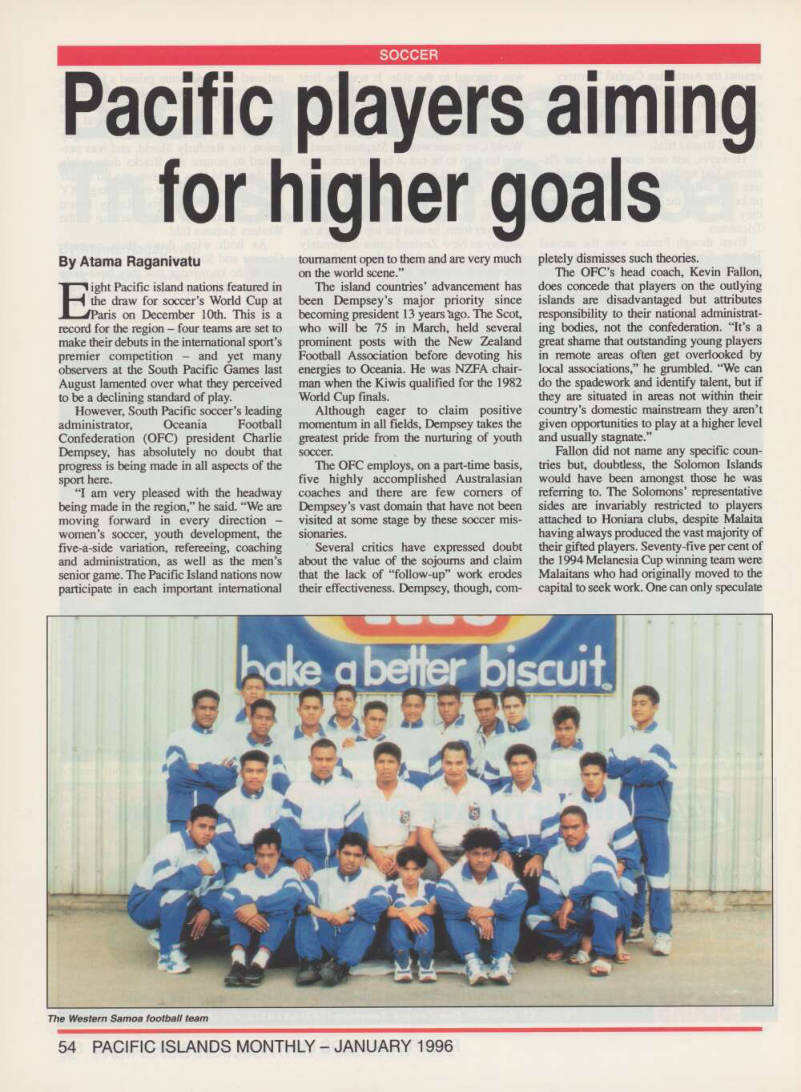

Soccer
Pacific players aiming for higher goals
By Atama Raganivatu
Eight Pacific island nations featured in the draw for soccer’s World Cup at Paris on December 10th. This is a record for the region - four teams are set to make their debuts in the international sport’s premier competition - and yet many observers at the South Pacific Games last August lamented over what they perceived to be a declining standard of play.
However, South Pacific soccer’s leading administrator, Oceania Football Confederation (OFC) president Charlie Dempsey, has absolutely no doubt that progress is being made in all aspects of the sport here.
“I am very pleased with the headway being made in the region,” he said. “We are moving forward in every direction women’s soccer, youth development, the five-a-side variation, refereeing, coaching and administration, as well as the men’s senior game. The Pacific Island nations now participate in each important international
tournament open to them and are very much on the world scene.”
The island countries’ advancement has
been Dempsey’s major priority since
becoming president 13 years hgo. The Scot, who will be 75 in March, held several prominent posts with the New Zealand Football Association before devoting his energies to Oceania. He was NZFA chairman when the Kiwis qualified for the 1982 World Cup finals.
Although eager to claim positive momentum in all fields, Dempsey takes the greatest pride from the nurturing of youth soccer.
The OFC employs, on a part-time basis, five highly accomplished Australasian coaches and there are few comers of Dempsey’s vast domain that have not been visited at some stage by these soccer missionaries.
Several critics have expressed doubt about the value of the sojourns and claim that the lack of “follow-up” work erodes their effectiveness. Dempsey, though, com-
pletely dismisses such theories.
The OFC’s head coach, Kevin Fallon, does concede that players on the outlying islands are disadvantaged but attributes responsibility to their national administrat ing bodies, not the confederation. “It’s a great shame that outstanding young players in remote areas often get overlooked by local associations,” he grumbled. “We can do the spadework and identify talent, but if they are situated in areas not within their country’s domestic mainstream they aren’t given opportunities to play at a higher level and usually stagnate.”
Fallon did not name any specific coun tries but, doubtless, the Solomon Islands would have been amongst those he was referring to. The Solomons’ representative sides are invariably restricted to players attached to Honiara clubs, despite Malaita having always produced the vast majority of their gifted players. Seventy-five per cent of the 1994 Melanesia Cup winning team were Malaitans who had originally moved to the capital to seek work. One can only speculate
The Western Samoa football team
as to how much stronger “Sol” would be if they were to fiftld Malaitan-based Malaitans.
Dempsey claims the Solomons as one of Oceania’s greatest success stories, notwith standing their self-inflicted handicap.
“We’ve made tremendous strides there,” he trumpeted. “Australia only beat them in the 1994 World Cup through a last-minute goal.
We can also point to Tahiti recently defeat ing New Zealand and Fiji being competitive against everyone now. Only 10 years ago, those teams were losing by eight goals or more.”
The improvements of Tahiti, Solomon Islands and Fiji are undeniable. However, any gain by the smaller nations is less evi dent.
Although soccer in the Cook Islands is looked upon as little more than a means for rugby players to retain fitness between sea sons, just over 100 participate in the sport there and they were annihilated 16-0 by the Solomons at the South Pacific Games, the Cooks will feature at the World Cup draw amongst traditional international giants like Germany - who have five million active footballers to choose from.
OFC secretary Josephine King (Dempsey’s daughter) acknowledges that the Cooks risked ridicule by entering the World Cup: “I, personally, originally had doubts about their participation. My belief was that the Cooks would be wiser to spend
their money on youth development rather than a costly and possibly demoralising Cup campaign. However, we are all now happy that this venture will not be at the expense of other important areas. And, FIFA (interna tional soccer’s ruling body) is very keen for it to be involved. It is something of a flag
waving exercise.”
Dempsey too eagerly promoted the Cooks’ cause. “The entire Rarotongan soc cer community are very, very keen,” he enthused. “They receive great support from the national lottery and already have a five a-side arena better than anything in Australia or New Zealand. Moreover, they are fully entitled to be in the World Cup and feel part of the FIFA family.”
The credibility of Dempsey and his organisation depends very much upon the progress achieved by the likes of Tonga, Western Samoa and Cook Islands and it is they who benefit most from the funds FIFA allocates to Oceania.
The Scot has been responsible for dis tributing a wide variety of items to Pacific Island associations, ranging from footballs to fax machines. Apart from the improved results achieved by Tahitian, Solomon Island and Fijian national selections, the best evidence this philanthropy is bearing fruit comes in the form of players registered in the region. Their number almost doubled over the past 10 years.
FIFA is certainly satisfied with
Oceania’s endeavours. It is probable that the smallest of the world’s six regional soccer confederations (with only o.7per cent of its registered players) will, in July, gain the right to sit on all of the Zurich-based organ isation’s official committees. At the moment, Oceania has to rely upon being invited.
Dempsey believes that the acquisition of full confederation status is essential for soc cer’s continued growth in the South Seas.
“The place on FIFA’s coaching and referee ing committees that this would ensure is very, very important to us,” he stated. “Not having a voice on those has certainly been detrimental to Oceania.
“Gaining the same standing as other con federations would make us more effective in all spheres, ensure FIFA are made aware of our local problems, and considerably lift Oceania’s profile. I have approached Pele on several occasions to visit the Pacific Island nations - that would give soccer a tremendous boost - but, mainly because we aren’t fully on the map yet, he has had to decline. Attracting the soccer world’s great est personalities for promotional purposes, as well as leading international coaches, would certainly be easier if we were at the top table in Zurich. It is far from a foregone conclusion, but I believe that full confeder ation status will be achieved.”
The time to order welcoming banners for Pele may not be far away. ■
Advertisements & other items, p. 55 (1 item)
Second Hand Containers
WHERE AND WHEN YOU WANT THEM IN THE PACIFIC If you need a flexible and safe storage space we have the ideal solution for you. Our second hand containers provide instant secure storage. Guaranteed to be wind and waterproof these containers are ideal for both temporary and longterm storage in Pacific conditions.
We can deliver to any island in the Pacific within a month and our rates have got to be the lowest you will find. All you need to do is tell us how many you want.
CONTACT:
PASCALE MARCONNET, BP 4757 NOUMEA, NEW CALEDONIA. TEL: (687) 28 7450. FAX: (687) 26 3248
Befriending a dugong
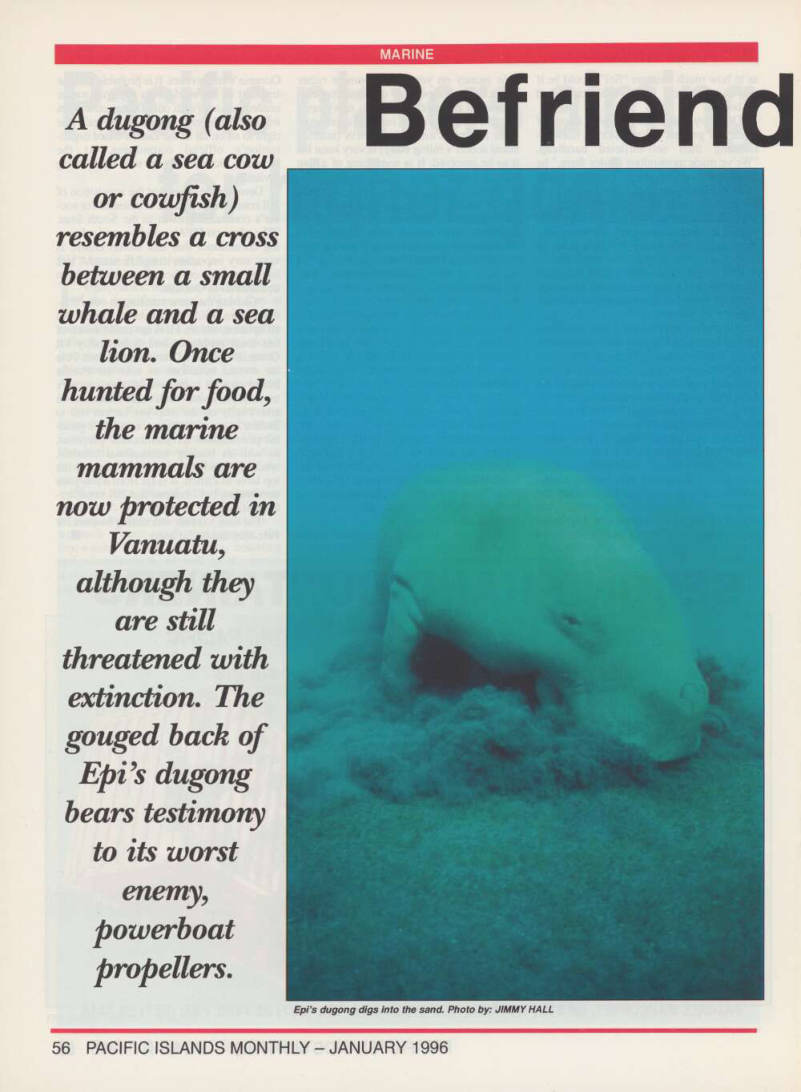
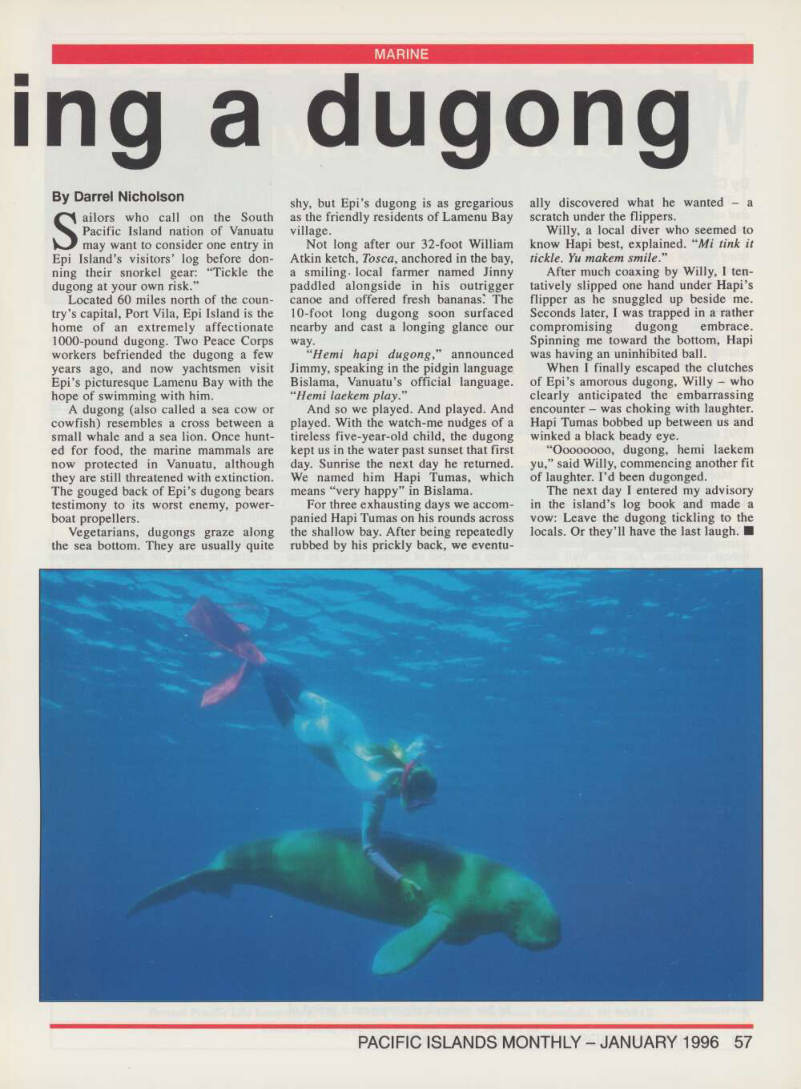
Marine
A dugong (also called a sea cow
or cowfish)
resembles a cross between a small whale and a sea lion. Once
hunted for food,
the marine mammals are now protected in Vanuatu,
although they
are still threatened with extinction. The
gouged hack of
EpVs dugong
hears testimony
to its worst enemy,
powerboat
propellers.
Epi’s dugong digs into the sand. Photo by: JIMMY HALL
By Darrel Nicholson
Sailors who call on the South Pacific Island nation of Vanuatu may want to consider one entry in Epi Island’s visitors’ log before don ning their snorkel gear: “Tickle the dugong at your own risk.”
Located 60 miles north of the coun try’s capital. Port Vila, Epi Island is the home of an extremely affectionate 1000-pound dugong. Two Peace Corps workers befriended the dugong a few years ago, and now yachtsmen visit Epi’s picturesque Lamenu Bay with the hope of swimming with him.
A dugong (also called a sea cow or cowfish) resembles a cross between a small whale and a sea lion. Once hunt ed for food, the marine mammals are now protected in Vanuatu, although they are still threatened with extinction.
The gouged back of Epi’s dugong bears testimony to its worst enemy, power
boat propellers.
Vegetarians, dugongs graze along the sea bottom. They are usually quite
shy, but Epi’s dugong is as gregarious as the friendly residents of Lamenu Bay village.
Not long after our 32-foot William Atkin ketch, Tosca, anchored in the bay, a smiling, local farmer named Jinny paddled alongside in his outrigger canoe and offered fresh bananas' The 10-foot long dugong soon surfaced nearby and cast a longing glance our way.
“Hemi hapi dugong ,” announced
Jimmy, speaking in the pidgin language
Bislama, Vanuatu’s official language, “Hemi laekem play.”
And so we played. And played. And played. With the watch-me nudges of a tireless five-year-old child, the dugong kept us in the water past sunset that first day. Sunrise the next day he returned, We named him Hapi Tumas, which means “very happy” in Bislama.
For three exhausting days we accompanied Hapi Tumas on his rounds across the shallow bay. After being repeatedly rubbed by his prickly back, we eventu
ally discovered what he wanted - a scratch under the flippers.
Willy, a local diver who seemed to know Hapi best, explained. “Mi tink it tickle. Yu makem smile.”
After much coaxing by Willy, I ten
tatively slipped one hand under Hapi’s
flipper as he snuggled up beside me.
Seconds later, I was trapped in a rather compromising dugong embrace.
Spinning me toward the bottom, Hapi was having an uninhibited ball, When I finally escaped the clutches of Epi’s amorous dugong, Willy - who clearly anticipated the embarrassing encounter - was choking with laughter, Hapi Tumas bobbed up between us and winked a black beady eye.
“00000000, dugong, hemi laekem yu,” said Willy, commencing another fit of laughter. I’d been dugonged.
The next day I entered my advisory in the island’s log book and made a vow: Leave the dugong tickling to the locals. Or they’ll have the last laugh. ■
Advertisements & other items, p. 57 (1 item)
ing a dugong
57
MARINE
PACIFIC ISLANDS MONTHLY - JANUARY 1996
ing a dugong
Who’s next PM?
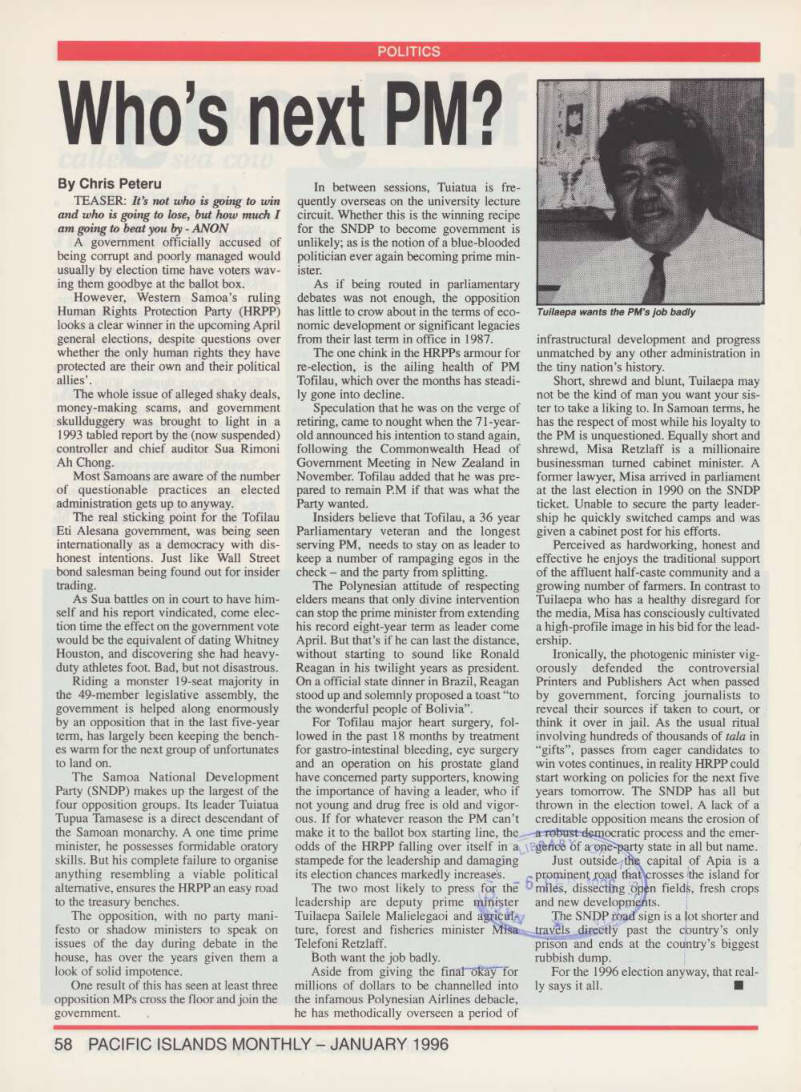
Politics
By Chris Peteru
TEASER: It’s not who is going to win and who is going to lose, but how much I am going to beat you by - ANON A government officially accused of being corrupt and poorly managed would usually by election time have voters wav ing them goodbye at the ballot box.
However, Western Samoa’s ruling Human Rights Protection Party (HRPP) looks a clear winner in the upcoming April general elections, despite questions over whether the only human rights they have protected are their own and their political allies’.
The whole issue of alleged shaky deals, money-making scams, and government skullduggery was brought to light in a 1993 tabled report by the (now suspended) controller and chief auditor Sua Rimoni Ah Chong.
Most Samoans are aware of the number of questionable practices an elected administration gets up to anyway.
The real sticking point for die Tofilau Eti Alesana government, was being seen internationally as a democracy with dis honest intentions. Just like Wall Street bond salesman being found out for insider trading.
As Sua battles on in court to have him self and his report vindicated, come elec tion time the effect on the government vote would be the equivalent of dating Whitney Houston, and discovering she had heavy duty athletes foot. Bad, but not disastrous.
Riding a monster 19-seat majority in the 49-member legislative assembly, the
government is helped along enormously
by an opposition that in the last five-year term, has largely been keeping the bench es warm for the next group of unfortunates to land on.
The Samoa National Development Party (SNDP) makes up the largest of the four opposition groups. Its leader Tuiatua Tupua Tamasese is a direct descendant of the Samoan monarchy. A one time prime minister, he possesses formidable oratory skills. But his complete failure to organise anything resembling a viable political alternative, ensures the HRPP an easy road to the treasury benches.
The opposition, with no party mani festo or shadow ministers to speak on issues of the day during debate in the house, has over the years given them a look of solid impotence.
One result of this has seen at least three opposition MPs cross the floor and join the government.
In between sessions, Tuiatua is fre quently overseas on the university lecture circuit. Whether this is the winning recipe for the SNDP to become government is unlikely; as is the notion of a blue-blooded politician ever again becoming prime min ister.
As if being routed in parliamentary debates was not enough, the opposition has little to crow about in the terms of eco nomic development or significant legacies from their last term in office in 1987.
The one chink in the HRPPs armour for re-election, is the ailing health of PM Tofllau, which over the months has steadi ly gone into decline.
Speculation that he was on the verge of retiring, came to nought when the 71 -year old announced his intention to stand again, following the Commonwealth Head of Government Meeting in New Zealand in November. Tofilau added that he was pre pared to remain P.M if that was what the Party wanted.
Insiders believe that Tofilau, a 36 year Parliamentary veteran and the longest serving PM, needs to stay on as leader to keep a number of rampaging egos in the check - and the party from splitting.
The Polynesian attitude of respecting elders means that only divine intervention can stop the prime minister from extending his record eight-year term as leader come April. But that’s if he can last the distance, without starting to sound like Ronald Reagan in his twilight years as president.
On a official state dinner in Brazil, Reagan stood up and solemnly proposed a toast “to the wonderful people of Bolivia”.
For Tofilau major heart surgery, fol lowed in the past 18 months by treatment for gastro-intestinal bleeding, eye surgery and an operation on his prostate gland have concerned party supporters, knowing the importance of having a leader, who if not young and drug free is old and vigor ous. If for whatever reason the PM can’t make it to the ballot box starting line, the odds of the HRPP falling over itself in a
stampede for the leadership and damaging
its election chances markedly increases.
The two most likely to press for the leadership are deputy prime minister Tuilaepa Sailele Malielegaoi and agricul ture, forest and fisheries minister Misa Telefoni Retzlaff.
Both want the job badly.
Aside from giving the finat'"okayTor millions of dollars to be channelled into the infamous Polynesian Airlines debacle, he has methodically overseen a period of
infrastructural development and progress unmatched by any other administration in the tiny nation’s history.
Short, shrewd and blunt, Tuilaepa may not be the kind of man you want your sis ter to take a liking to. In Samoan terms, he has the respect of most while his loyalty to the PM is unquestioned. Equally short and shrewd, Misa Retzlaff is a millionaire businessman turned cabinet minister. A former lawyer, Misa arrived in parliament at the last election in 1990 on the SNDP ticket. Unable to secure the party leader ship he quickly switched camps and was given a cabinet post for his efforts.
Perceived as hardworking, honest and effective he enjoys the traditional support of the affluent half-caste community and a growing number of farmers. In contrast to Tuilaepa who has a healthy disregard for the media, Misa has consciously cultivated a high-profile image in his bid for the lead ership.
Ironically, the photogenic minister vig orously defended the controversial Printers and Publishers Act when passed by government, forcing journalists to reveal their sources if taken to court, or think it over in jail. As the usual ritual involving hundreds of thousands of tala in “gifts”, passes from eager candidates to win votes continues, in reality HRPP could start working on policies for the next five years tomorrow. The SNDP has all but thrown in the election towel. A lack of a creditable opposition means the erosion of a robust process and the emer gencc )5f a'ppe-party state in all but name.
Just capital of Apia is a , prominent joad that crosses island for miles, dissectiiig bpfen fieldjs, fresh crops and new developpiqhts.
The SNDP road sign is a lot shorter and travels directly past the country’s only prison and ends at the country’s biggest rubbish dump.
For the 1996 election anyway, that real ly says it all. ■
Tuitaepa wants the PM’s job badly
Advertisements & other items, pp. 59-60 (1 item)
Grand Pacific Life Insurance, Ltd.
0 10 15 20 25 30 35 40 45 50 55 60 ©
A member of the Finance Factors Family
FEDERATED STATES
OF MICRONESIA
Actouka Executive Insurance Underwriters P.O. Box 55, Kolonia, Pohnpei, Federated States of Micronesia 96941 Pacific Basin Insurance & General Services, Inc P.O. Box 494, Chuuk State, Federated States of Micronesia 96942
TONGA
Peseti Ma ‘afu Ins. & Finance, Ltd.
Private Bag 2, Taumoepeau Bldg.
Nukualofa, Tonga
GUAM
Great National Insurance Underwriters, Inc.
P.O. Box GA, Agana, Guam 96910
AMERICAN SAMOA
Mark Solofa Pacific Insurance & Finance, Inc.
P.O. Box 3149 Pago Pago, American Samoa 96799 Pacific Financial Corporation P.O. Box AT, Agana, Guam 96910 Takagi & Associates, Inc.
GCIC Bldg., Suite 100 414 W. Soledad Ave.
Agana, Guam 96910
MARSHALL ISLANDS
Marshalls Insurance Agency P.O. Box 113, Majuro, Marshall Islands 96960
WESTERN SAMOA
Mark Solofa Pacific Insurance & Finance, Inc.
P.O. Box 3149 Pago Pago, American Samoa 96799
NORTHERN MARIANAS
Pacific Basin Insurance Underwriters, Inc.
P.O. Box 710 Saipan, Mariana Islands 96950 Pacifica Insurance Underwriters, Inc.
P.O. Box 168, Saipan, Mariana Islands 96950 Grand Pacific Life Insurance, Ltd. • 1164 Bishop Street, sth Floor, Honolulu, HI 96813 Phone: (808) 548-3363 • FAX: (808) 548-5122
Bom to run.
S The Mitsubishi Lancer: A family sedan that’s practically builtto perform.
Lancer leaves the rest of its class in the dust.
Yes, it is a family sedan. Comfortable and practical.
But exciting, too, because Mitsubishi hasn’t forgotten what truly drives you: the pure pleasure of total
driving performance.
Its ground-hugging chassis holds comers tight. A self-aligning multi-link suspension adjusts to the road no matter what the driving conditions. And the aggressive, fuel-efficient 16-valve SOHC engine makes Lancer eager and responsive in the passing lane.
All of this performance comes from one very simple idea—our total approach to engineering.
We believe that unless each aspect of a car is fully integrated into the overall design, the result will never exceed the sum of the parts. The difference is self-evident. Behind the wheel.
And on the road.
It is this philosophy that makes every Mitsubishi such a reassuring and rewarding driving experience Whether it’s our top-end Mitsubishi Sigma, technologically sophisticated Galant, all-weather 3000 GT sports car, or offroad 4WD Pajero... they’re all driven by the power of positive thinking.
So take the wheel of a Lancer, the family sedan that performs like
a thoroughbred.
MITSUBISHI LRNCER
What Drives You.
AMERICAN SAMOA: PACIFIC MARKETING INC. P.O. Box 698, Pago Pago, Tel. 699-9140 / AUSTRALIA: MITSUBISHI MOTORS AUSTRALIA LTD. 1284 South Road, Clovelly Park, South Australia, 5042 Tel. (08) 2757297 / FUI: NIVIS MOTOR & MACHINERY CO. LTD. G.P.O. Box 150 Suva, Tel. 383411 / GUAM; TRIPLE J ENTERPRISES INC. P.O. Box 6066, Tamuning, Tel. 6469126 / NEW CALEDONIA: SOCIETE DTMPORTATION D’AUTD DU PACIFIQUE SUD aA. F.O. Box 438, Noumea, Tel. 272-562 / NEW ZEALAND: MITSUBISHI MOTORS NEW ZEALAND LTD. Private Bag. Porirua, Tel. 237-0109 / NORFOLK ISLAND: BORRY'S PTY LTD. P.O. Box 169, Taylors Road, Burnt, Tel. 2114 / PAPUA NEW GUINEA: TOBA MOTORS FTY LTD. P.O. Box 503, Port Moresby, Tel. 217-874 / SAIPAN: SAIPAN AUTOWORLD INC. P.O. Box 487, Tel. 234-7133 / SOLOMON ISLANDS; HARVEST PACIFIC LTD. G.P.O. Box 888, Honiara, Tel. 30407/ TAHITI: SOPADEP S.A. B.P. 1617, Papeete, Tel. 427393 / TONGA: SITANI MAPI CO., LTD. P.O. Box 83, Nuku'Alofa, Tel. 24044 / VANUATU: SOCOMETRA VANUATU LTD. BP. 8 Port-Vila, Tel. 2314 / WESTERN SAMOA: MOTOR DISTRIBUTORS (SAMOA) LTD. P.O. Box 578 Apia, Tel. 20957 A
MITSUBISHI
MOTORS
CREATING TOGETHER