Pacific
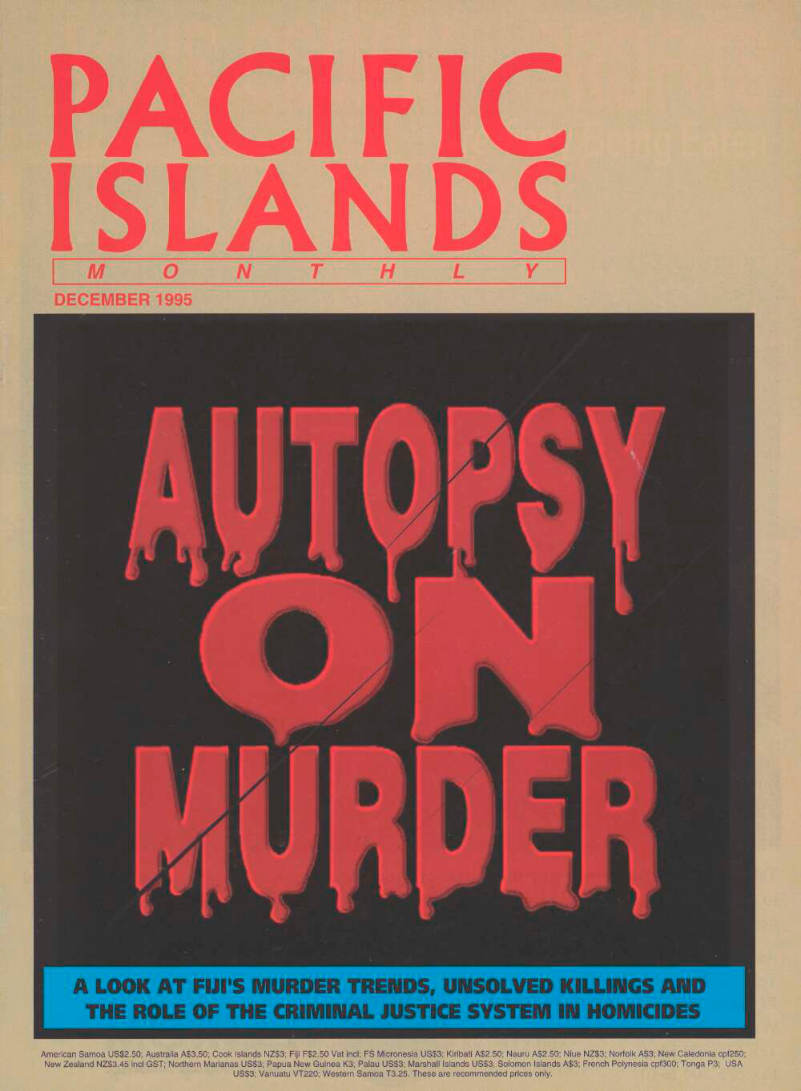
Islands
Monthly
December 1995
American Samoa US$2.5O; Australia A 53.50; Cook Islands NZ$3; Fiji F 52.50 Vat incl; FS Micronesia US$3; Kiribati A 52.50; Nauru A 52.50; Niue NZ$3; Norfolk As 3; New Caledonia cpf2so; New Zealand NZ53.45 incl GST; Northern Marianas US$3; Papua New Guinea K 3; Palau US$3; Marshall Islands US$3; Solomon Islands As 3; French Polynesia cpf3oo; Tonga P 3; USA US$3; Vanuatu VT22O; Western Samoa T 3.25, These are recommended prices only.
Advertisements & other items, pp. 2-4 (1 item)
Telikom
Papua New Guinea ■*? mm r w,w % ’Wgf, '•j-tkim ill i
K2PB
fi -11 Si y »r r . ■] " f h»
»Tnrnpmnnp: g rn»- 3 i§»
ii ; 3 -»i
la* ‘ -O ... . 1 1 j
I [fiiimmriimtam
‘nw b L a Telikom has set the pace in providing state-of-the-art telecommunications links within PNG and to anywhere around the world as we enter the 21st Century. For all your telecommunications needs, write to us at this address: Assistant General Manager Telikom Marketing Department P.O. Box 291 Waigani, Papua New Guinea Tel: 675 300 5564 Fax:67s 300 5540
TELIKOM
l/acu wete nedUf, tcdkUvj,!
•I t >1 ■
"W " ..“SH
m mms #ss ( 0 \ i i *1 / m Get connected with VodaGroup and you could be saving upto 70% on telephone calls.
VodaGroup is a 3 digit short numbering “wireless extension” when calling vodafone to vodafone within your company.
At only 11 cents per minute you could be saving a big chunk at the end of the month.
And with Vodaßill, Vodafones’ itemised billing will keep track of your calls and flag any abuse.
Call Vodafone today and find a new way of reducing operational costs.
For enquiries please call toll free phone 0800 214 214 or the nearest Vodafone office ■#,
igital
SUVA : Phone : 312 000, Fax : 312 007.
LAUTOKA : Phone : 668 000, Fax : 668 007.
Invest in
New Caledonia
Authorities in France and New Caledonia recently formed ADECAL : The Economic Development Bureau of New Caledonia.
Member of the "Invest in France Network", ADECAL advises foreign investors and entrepreneurs on doing business in New Caledonia, from tourism to industry.
Our free of charge services include: - Identification of opportunities and strategic alliances, - Liaison with government and local economic actors, - Assistance in financial negotiations and business plan preparation, - Advice on regulatory environment and bridging cultures.
Your contacts at ADECAL: Tourism and Domestic Business Development: Yann Pitollet International Projects: David H. Delisle 15, rue Guynemer •PO Box 2384 98846 Noumea Cedex • New Caledonia • Tel I
Pacific
Islands
Monthly
Vol. 65 No 12
The News Magazine
December 1995
PUBLISHER: Brian O’ Flaherty
Acting Editor:
Yunus Rashid
Correspondents:
David North, Ed Rampell, lan Williams, Liz Thompson, Roman Grynberg, Wally Hiambohn, Lisa Williams, Patrick Decloitre, Barry Markowitz.
COLUMNISTS: David Barber (Wellington), Futa Helu (Tonga), Jemima Garrett (Sydney), Alfred Sasako (The Forum).
Advertising Sales
Regional Sales - South Pacific Ashok Lai, Shailendra Kumar Tel (679) 304111, 303429, Fax (679) 303809.
Sydney, Canberra: Bob Hill Media Representation, Tel (61-2) 4164245, Fax (61-2) 4165064.
Brisbane: Jane Fewings Media and Advertising Associates Tel (61-7) 378 4522, Fax (61-7) 878 1071.
Adelaide: Hastwell Williamsons Representatives, Tel (61-8) 3799522, Fax (61-8) 3799735.
Melbourne: Brown Orr Fletcher Burrows (Aust) Pty Ltd.
Tel (61-3) 8265188, Fax (61-3) 8265644.
Auckland: McKay & Bowman, International Media Representatives Limited, Tel (64-9) 4190561, Fax (64-9) 4192243.
Japan: Universal Media Coiporation, Tokyo, Tel (3) 3266626741, Cable: UNI-MEDIA Tokyo, Fax (3) 32626742.
Pacific Islands Monthly was founded 1930
(Usps 9522480).
A Fiji Times Limited production.
Cover prices are recommended retail only. Registered by Australia Post, Publication No. NBPI2IO. © Copyright Fiji Times Limited, 177 Victoria Parade, Suva, Fiji.
Tel (679) 304111, fax (679) 303809.
Pacific Islands Monthly is published monthly by Fiji Times Limited, a division of Nationwide News, 2 Holt Street, Surry Hills, Sydney, NSW 2010.
Send Address Changes To:
Pacific Islands Monthly, PO Box 1167, Suva, Fiji.
Typeset and printed by The Fiji Times Limited, 177 Victoria Parade, Suva, Fiji.
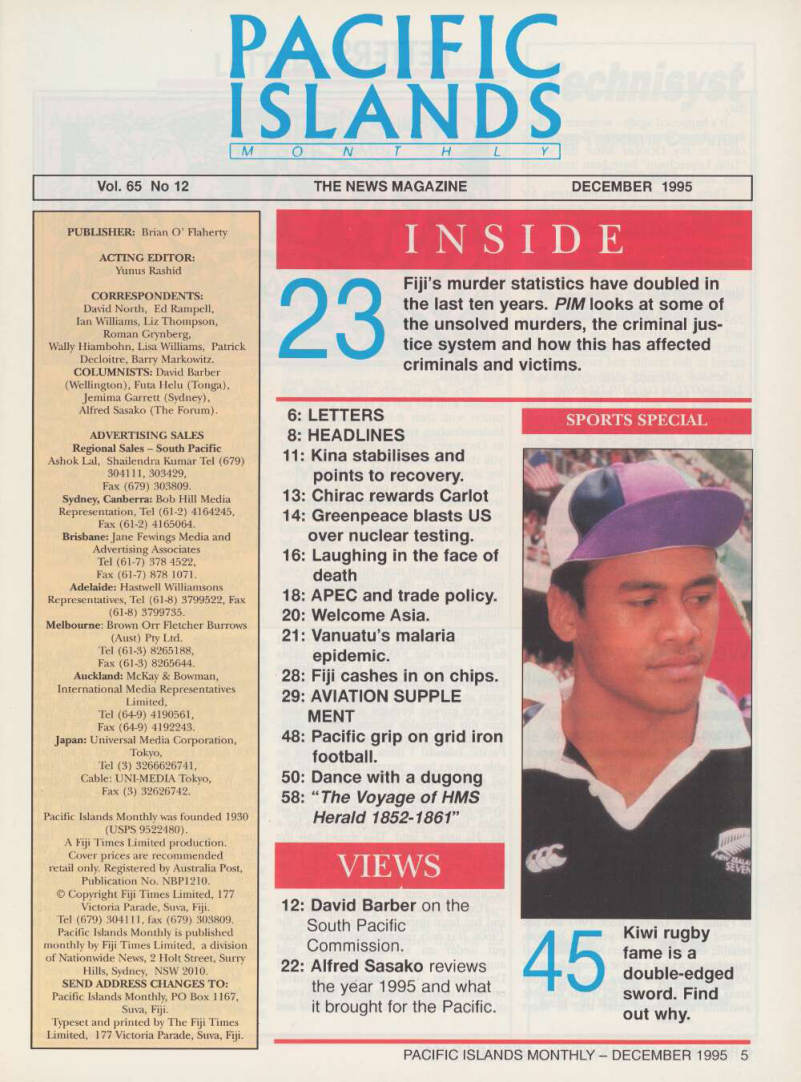
Inside
k i Fiji’s murder statistics have doubled in the last ten years. PIM looks at some of the unsolved murders, the criminal jus tice system and how this has affected criminals and victims.
6: Letters
8: Headlines
11: Kina stabilises and points to recovery. 13: Chirac rewards Carlot 14: Greenpeace blasts US over nuclear testing. 16: Laughing in the face of death 18: APEC and trade policy. 20: Welcome Asia. 21: Vanuatu’s malaria epidemic. 28: Fiji cashes in on chips.
29: Aviation Supple
Ment
48: Pacific grip on grid iron football. 50: Dance with a dugong 58: “ The Voyage of HMS Herald 1852-1861”
Views
12: David Barber on the South Pacific Commission. 22: Alfred Sasako reviews the year 1995 and what it brought for the Pacific.
Sports Special
Kiwi rugby fame is a H ~kJ doubie - ed 9 ed sword. Find out why.
Letters
Sir, It’s happened again - someone is play ing tricks on your typesetter! Somehow or other in my October letter the words “Irish Leprechaun” have been transposed into “naughty fairy”.
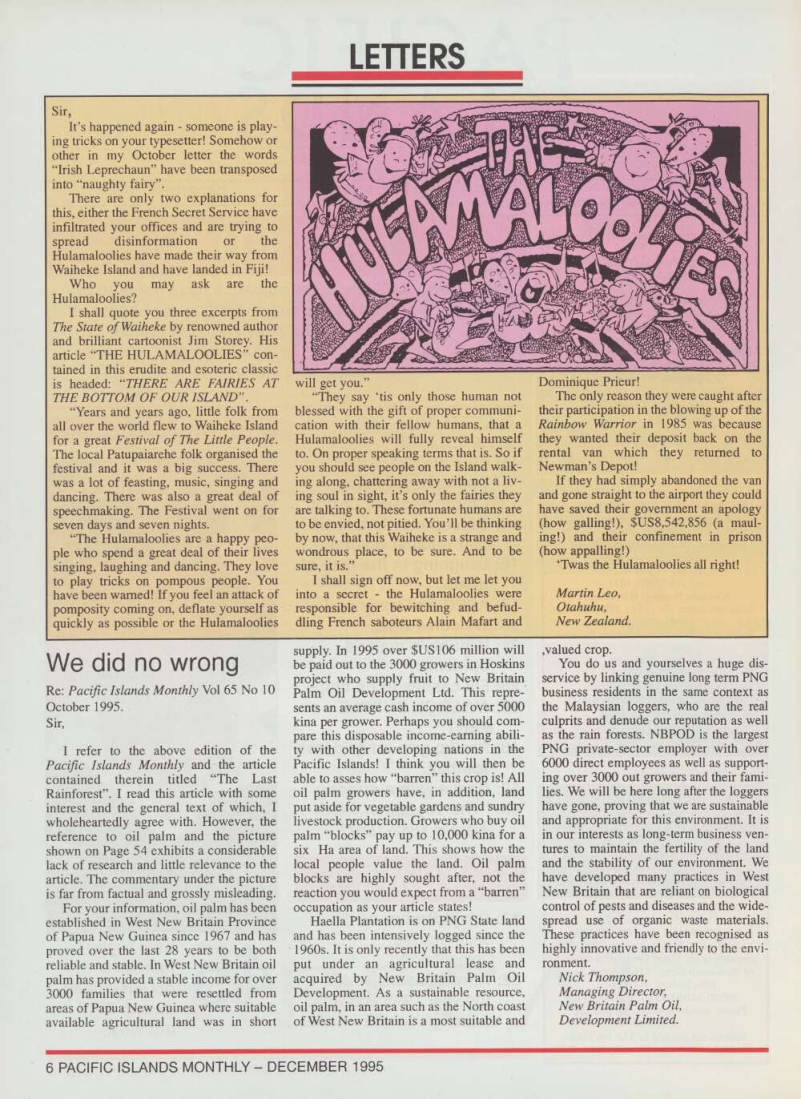
There are only two explanations for this, either the French Secret Service have infiltrated your offices and are trying to spread disinformation or the Hulamaloolies have made their way from Waiheke Island and have landed in Fiji!
Who you may ask are the Hulamaloolies?
I shall quote you three excerpts from The State of Waiheke by renowned author and brilliant cartoonist Jim Storey. His article “THE HULAMALOOLIES” con tained in this erudite and esoteric classic is headed: “ THERE ARE FAIRIES AT
The Bottom Of Our Island”.
“Years and years ago, little folk from all over the world flew to Waiheke Island for a great Festival of The Little People.
The local Patupaiarehe folk organised the festival and it was a big success. There was a lot of feasting, music, singing and dancing. There was also a great deal of speechmaking. The Festival went on for seven days and seven nights.
“The Hulamaloolies are a happy peo ple who spend a great deal of their lives
singing, laughing and dancing. They love
to play tricks on pompous people. You have been warned! If you feel an attack of
pomposity coming on, deflate yourself as
quickly as possible or the Hulamaloolies
will get you.”
“They say ‘tis only those human not blessed with the gift of proper communi cation with their fellow humans, that a Hulamaloolies will fully reveal himself to. On proper speaking terms that is. So if you should see people on the Island walk ing along, chattering away with not a liv ing soul in sight, it’s only the fairies they are talking to. These fortunate humans are to be envied, not pitied. You’ll be thinking by now, that this Waiheke is a strange and wondrous place, to be sure. And to be sure, it is.”
I shall sign off now, but let me let you into a secret - the Hulamaloolies were responsible for bewitching and befud dling French saboteurs Alain Mafart and
Dominique Prieur!
The only reason they were caught after their participation in the blowing up of the Rainbow Warrior in 1985 was because they wanted their deposit back on the rental van which they returned to Newman’s Depot!
If they had simply abandoned the van and gone straight to the airport they could have saved their government an apology (how galling!), $U58,542,856 (a maul ing!) and their confinement in prison (how appalling!) ‘Twas the Hulamaloolies all right!
Martin Leo
Otahuhu, New Zealand.
We did no wrong
Re: Pacific Islands Monthly Vol 65 No 10 October 1995.
Sir, I refer to the above edition of the Pacific Islands Monthly and the article contained therein titled “The Last Rainforest”. I read this article with some interest and the general text of which, I wholeheartedly agree with. However, the reference to oil palm and the picture shown on Page 54 exhibits a considerable lack of research and little relevance to the article. The commentary under the picture is far from factual and grossly misleading.
For your information, oil palm has been established in West New Britain Province of Papua New Guinea since 1967 and has proved over the last 28 years to be both reliable and stable. In West New Britain oil palm has provided a stable income for over 3000 families that were resettled from areas of Papua New Guinea where suitable available agricultural land was in short
supply. In 1995 over SUSIO6 million will be paid out to the 3000 growers in Hoskins project who supply fruit to New Britain Palm Oil Development Ltd. This repre sents an average cash income of over 5000 kina per grower. Perhaps you should com pare this disposable income-earning abili ty with other developing nations in the Pacific Islands! I think you will then be able to asses how “barren” this crop is! All oil palm growers have, in addition, land put aside for vegetable gardens and sundry livestock production. Growers who buy oil palm “blocks” pay up to 10,000 kina for a six Ha area of land. This shows how the local people value the land. Oil palm blocks are highly sought after, not the reaction you would expect from a “barren” occupation as your article states!
Haella Plantation is on PNG State land and has been intensively logged since the 19605. It is only recently that this has been put under an agricultural lease and acquired by New Britain Palm Oil Development. As a sustainable resource, oil palm, in an area such as the North coast of West New Britain is a most suitable and
,valued crop.
You do us and yourselves a huge dis service by linking genuine long term PNG business residents in the same context as the Malaysian loggers, who are the real culprits and denude our reputation as well as the rain forests. NBPOD is the largest PNG private-sector employer with over 6000 direct employees as well as support ing over 3000 out growers and their fami lies. We will be here long after the loggers have gone, proving that we are sustainable and appropriate for this environment. It is in our interests as long-term business ven tures to maintain the fertility of the land and the stability of our environment. We have developed many practices in West New Britain that are reliant on biological control of pests and diseases and the wide spread use of organic waste materials.
These practices have been recognised as highly innovative and friendly to the envi ronment.
Nick Thompson
Managing Director, New Britain Palm Oil, Development Limited.
Opening up a can

Attack on proposed media laws: From Cook Island News.
of worms?
Dear Sir, It amazes me that in the middle of a financial crisis, when some government departments cannot afford to buy pens and writing pads, the government is busy setting up a new entity, the Media Standards Council. (Is this to be another case of jobs for the boys who get to sit on the council, and jobs for the girls who get the secre
tarial position?
Which ministry is going to have its
operating budget plundered this time to
supply furniture, computers, printers and stationery for the new council?) And what will the new council have to do? Probably just make life a hell for that one particular publication which has been a thorn in government’s side over the past year. How else can this particular instance of fiscal madness by govern ment be explained?
Nevertheless, I wonder if government, in its haste to rush this bill through par liament, has stopped to consider the implications? It could be opening up a real can of worms.
I am curious as to what standards will apply? Will we see TVNZ news barred from our screens because it broadcasts news, that may damage our off-shore industry, of air scenes of savagery from Bosnia and Rwanda that may be too vio lent for us to see? In recent months, 60 Minutes has aired programmes on sub jects like homosexuality, white racism in New Zealand, and the Samoan woman who disciplined kids in school with her fists. Will that programme be removed from our TV screens because it affects
someone’s sensitivity?
If an overseas newspaper like the New Zealand Herald covers news which can’t be covered by the local media because of a council decision, can you imagine the result? We won’t be able to buy the New Zealand Herald and other such publica tions from our local bookstore because no book seller can afford to keep on importing and stocking newspapers that have to pass censorship before they can be sold.
What is also to stop the council from imposing standards on the media that are
commercially damaging? For instance, on the basis that 90 per cent of the popu lation are Polynesians, might not the council require 90 per cent of local news papers to appear in Cook Islands Maori?
Or if 90 per cent of Cook Islanders have church affiliations, might not the council reach the conclusion that 90 per cent of the music we hear over radio should be
gospel?
The government needs to do a lot of explaining and reassuring if they expect this bill to have the public support. With only a minimum of public consultation to date, the chances of getting that at the moment are just zero, I should think.
‘Full of Worms’
[Name & address withheld]
Media bill
sickens
Dear Sir, I am sickened by government’s pro posed Media Standards Bill. As a letter writer to your newspaper, I will not accept the power of political appointees to determine my expressions according to their own interpretations of “fairness”, “privacy”, and “good taste”.
To empower a stacked council to pre side over complaints, and then impose penalties, opens the door to victimisation and media censorship. I, and many other letter writers, will never be able to express freely our opinions for fear of a
legislated threat.
This sick attempt to clamp down on the news media shows that government regrets giving up newspaper control by dumping Cook Islands News back in 1989. In the context of steadily receiving the sharp end of the criticism stick from Cl Press and Cl News, the government obviously wants to regain that lost con trol in any way that it can.
If the bill does go ahead, that big yel low banana stuck to the roof of the BC ought to be removed and permanently attached to our national flag for the whole world to see.
‘ Somebody’
[Name & address withheld]
Advertisements & other items, p. 7 (1 item)
Technisyst
Need Training in Computer
Software?
We conduct training throughout Australia and the Pacific Microsoft Lotus Word Perfect We take pride In the High Quality of the Services we provide for our Clients
TRAINING
★ Customised Courses ★ 90 Days Free Post Course Support ★ Competitive Pricing ★ Free Training Needs Analysis ★ Preparation of Macros and Templates
OTHER SERVICES
Technisyst provides services in all aspects of Information Technology. Whatever your needs we can assist ★ Software Development ★ Project Management ★ Recruitment ★ Software Development ★ Software and Hardware supply and installation Our current client base includes Government and Private sector organisations from the Solomon Islands, Papua New Guinea, Kiribati and Vanuatu.
Technisyst has Quality Assurance Certification In A 53901 and A 53563, and Is a member of the Standards Association of Australia For further Information: Contact: Head Office Ann Bishop Level 8, Santos House Pi: Int-617 3229 3150 216 Adelaide Street Fax: bit—6l7 3229 3702 Brisbane QM 4000
SPREP faces huge deficit
Headlines
The current cash flow problem for the South Pacific Regional Environment Programme, or SPREP, is caused by some member countries not paying their outstanding contributions to the organisation - some as far back as 1991.
With an annual core budget of SUSSOO,OOO, it was still awaiting around SUS4OO,OOO from its members.
Dr Wren Green from New Zealand noted that SPREP was the “region’s newest and ‘shiniest’ organisation, with a high profile both internationally and in this region. Yet it is difficult to assure donors of member countries’commitment (to the organisation) if their contributions are not fully paid”. Dr Green chaired a committee that looked at this growing
problem.
There was much debate over the way contributions are currently paid. With 26 member countries, SPREP is the only
inter-govemmental regional organisation
in the Pacific with voluntary contribu tions from its members for its “core” - the funding it needs to run without any spe cial projects. An alternative method for collecting member contributions is when they are “assessed”, or compulsory.
Some delegations stated that voluntary contributions were the best way for their government to pay these funds - others disagreed, stating assessed contributions were best.
After further negotiations in the com ing year, a decision is expected at the next SPREP Meeting. This will be a ministeri al-level meeting that will review SPREP’s Action Plan, which steers the organisa tion’s work programme, and other major policy decisions.
Around eighty delegates from SPREP’s 26 member countries, as well as other regional and international agencies and non-government organisations, attended the three-day Eighth SPREP
Meeting in Apia, Western Samoa. This gathering is the region’s major annual meeting dealing with environmental problems of the Pacific islands.
Observers were also able to give state ments to the meeting. These included the news that SPREP will host the South Pacific Forestry Project, according to Dr Hari Dewan, the Food and Agriculture Organisation (FAO) representatives based in Apia. This project is currently based in Suva and is funded by the United Nations Development Programme and FAO.
A local non-government organisation, O Le Siosiomaga Society, presented a strong statement to the meeting condemn ing France’s continued nuclear testing in French Polynesia and calling for an immediate halt. They presented the decla ration on behalf of a number of other non government organisations in Western Samoa. The meeting ended on 13 October.
USIS in Suva closes
The US Embassy announced in October that the US Information Service (USIS) will end programmes from its Suva office effective November 1, 1995, because of US Government budget reductions this fiscal year. USIS Suva serviced Fiji, Tonga, Tuvalu, Nauru and the French South Pacific territories.
USIS activities in Suva and around the world are being curtailed as a result of
efforts in Washington to reduce deficit spending and make progress toward a balanced budget. Many other US Government agencies and programmes, foreign and domestic, are facing cutbacks. USIS Port Moresby is not affected by this announcement. To minimise inconvenience, participants in ongoing USIS educational and cultural exchanges will be authorised to complete their programmes, but no new
applications will be considered.
USIS Suva staff members have been advised of the closure. They are covered by the embassy’s standard redundancy
plan.
The closure affects USIS programmes only. Other offices at the embassy remain in operation and will continue to maintain close US relations with Fiji and other South Pacific nations.
Money laundering worry in the Pacific
South Pacific countries have been warned that if they delay taking effective
action against money laundering, they run the risk of being accused of opening the door to organised crime.
The warning was delivered by Fiji Solicitor-General Isikeli Mataitoga in Suva last month when opening a regional workshop to help island countries ratify and implement the United Nations Convention on Illicit Trafficking in Narcotic Drugs.
Mataitoga said some countries in the South Pacific think there is a conflict between effective money-laundering mea sures and development.
He said they even argue that money laundering measures will hamper invest ments and slow down the development of their financial sector, putting them at a
competitive disadvantage against their
potential rivals.
But the Fiji solicitor-general said the Commonwealth Secretariat had done a recent analysis which showed that these arguments were false.
He said honest investors do not want to put their money in economies propped up
by dirty money.
Mataitoga said criminal money is short term and mobile, and its presence gives financial and regulatory authorities a bad name. He said all this makes action against money launderers even more important.
Mataitoga said effective action against money launderers will make it easier for South Pacific countries to attract money from long-term investors with a genuine interest in the wellbeing of regional economies
Advertisements & other items, p. 8 (1 item)
Pacific Legal Services
' INTERNATIONAL & SOUTH "
MICHAEL BULA SOLICITORS
International Lawyers
are pleased to receive instructions relating to Australian and South Pacific property, succession and commercial matters. • Full corporate, representative and registered office facilities available for South Pacific clients • French spoken certified legal translations • Legal agents throughout the South Pacific and Europe "PRINCES Hill Gallery", 213 Canning Street
CARLTON MELBOURNE
VICTORIA 3053 AUSTRALIA
Telephone +613 9 3478333 FAX: + 613 9 3471741
MBS
War on diabetes
Headlines
The Australian aid programme and Australia’s two leading diabetes research centres have combined to
help tackle the growing diabetes epidem
ic in the Pacific.
A $A793,000 ($U5601,285) project,
announced on October 29 in Fiji by Australian Minister for Development Co operation Gordon Bilney aims to reduce the impact of diabetes and other lifestyle related diseases, which together account for much of the disability and mortality in nations of the Pacific.
“Thirty years ago diabetes was almost unknown in the Pacific, now the region has some of the highest diabetes preva lence in the world. The increased mortali ty and morbidity associated with the dis ease has devastating social and economic consequences in countries which can ill afford the burden.
“Recent studies show the frequency of diabetes in men in rural Western Samoa has increased eight-fold in 13 years.
Estimates are that the number of people with diabetes in the Pacific Islands will double in the next 15 years,” Mr Bilney said.
The project, focusing on Fiji, Western
Samoa and Kiribati, will train health pro fessionals in identification, prevention and management of diabetes and lifestyle -related diseases. It will also train com munity workers, teachers and others with close links to the community on ways members of the general population can improve their own health and prevent
lifestyle-related diseases.
“Increases in diabetes are largely due to unhealthy lifestyle,” said Professor Paul Zimmet, director of the International Diabetes Institute, which together with the Royal Prince Alfred Hospital Diabetes Centre will implement the project.
“The people of the Pacific are adopt
ing a Western-style diet and exercising
less. Among other things, we will be encouraging people to incorporate tradi tional foods and activity patterns into their modem lifestyles,” said Professor Zimmet.
Specific health promotion activities will be designed to screen and manage diabetes in pregnancy and prevent and manage diabetic foot disease.
Currently 10-15 per cent of pregnan
cies in the Pacific region are associated with gestational diabetes and in Fiji alone, over 400 foot amputations are performed annually for diabetes foot sepsis, 50 per cent of which could be prevented by sim ple education in preventative foot care.
Gordon Bilney.
Cocker for tourism post
The Tourism Council of the South Pacific recently appointed Christopher Cocker as Manager - Marketing and Communications. Formerly Tourism Marketing Officer with the Tonga Visitors Bureau, Cocker holds a Bachelor of
Business (Hospitality) Degree from
Queensland University.
Cocker, 31, brings extensive experi ence to his current position and was previ ously the Educational and Training Officer and Public Relations Officer with the Tonga Visitors Bureau.
He has worked as tourism marketing officer for the past five years.
The TCSP’s chief executive, Levani Tuinabua, welcomed the appointment, saying that Cocker would further enhance the work of TCSP with his wide and varied experience in the tourism industry.
“The position has been vacant for over a year now and we have every confidence in Chris to take over the demanding responsibility of the marketing division,”
Tuinabua said.
“Chris has already undertaken an edu cational visit of most of our member coun tries and has met with all our national
tourism office representatives and talked to them about their marketing strategies.
During these visits he also had a look at the numerous tourism products we sell to consumers in our targeted markets.”
Cocker said it was a great challenge to work at the TCSP which has played an instrumental part in promoting the South Pacific at major international trade shows.
The TCSP, he said, played an integral part in promoting the South Pacific at major international trade shows.
“I firmly believe that the South Pacific should be promoted as a multi-destination al product and not individually,” Cocker said. We have much to offer in that each island is unique in landscape, culture and history which enhances our joint promo tional efforts”.
Aussie aid
Australia will provide an extra $BOO,OOO to Western Samoa for policy and management reform, the Minister for
Development Cooperation, Gorden Bilney
said.
“The funds are from a specific $4.6million allocation in this year’s aid budget to support reform efforts in the South
Pacific region.”
Bilney said Australia is keen to encour age good resource management in the South Pacific, in both the public and pri vate sectors.
“Western Samoa has developed a solid framework for public-sector reform and institutional strengthening as well as tak ing steps to ensure that private-sector development is appropriate and sustain able.
“This is despite the major economic problems caused be two cyclones and an outbreak of taro leaf-blight.”
Bilney said the additional funds will help the Western Samoan government con tinue its process of institutional reform.
Advertisements & other items, pp. 9-10 (1 item)
Opportunity Seekers
THE BEST HOME PUBLISHING PACKAGE IN
YEARSIII Just releasedl "EARN: £12,000 PLUS INCOME EVERY 3 MONTHSI” It's new, it’s unique.
RUSH for full details. P.O. BOX 9716, NADI.
EZI BUILD EZI BUILD EZI BUILD EZI BUILD
EZI BUILD
EZI BUILD
EZI BUILD
L lie m \ r: ■■
LOW COST
TRANSPORTABLE KIT HOMES
CYCLONE CERTIFIED
Tropiki' Tropfle TropflU TropiWti 1 • ’T.: M
IKHI
KIT HOMES • TRUSSES • WALL FRAMES
NORTHERN PROJECTS FALWOOD LTD
FOR FURTHER INFORMATION
CONTACT:—
P.O. BOX 36
SUVA
PH: 394 029
FAX: 394 160
EZI BUILD
EZI BUILD
EZI BUILD
EZI BUILD EZI BUILD EZI BUILD EZI BUILD
points to recovery
Finance
Kina stabilises and points to recovery
There are signs Papua New Guinea’s
much-maligned economy is finally
turning the comer; indeed, if you are to accept the government’s recent verbal offerings, a bright future is just upon the country.
However, now is perhaps the most cru cial time in the nation’s struggle to throw off the economic shackles of the recent past - the wrong move now could undo a lot of the hard work which has occurred in the past year.
At the launch of a new umbrella busi ness organisation last month. Prime Minister Sir Julius Chan spoke optimisti cally about the future and declared the PNG economy had turned the comer.
“When my government came to power in August last year, we inherited an econo my in trouble. We had to act fast and deci sively. We opened the books and found we had no foreign reserves and a mountain of debt,” Sir Julius told members of the Business Council of PNG.
“Today, we have greatly reduced that debt and have foreign reserves in excess of K 330 million ($U5217,957), or four months’ import cover. That is the highest level in five years.”
Indeed, Sir Julius had some evidence to support his statements.
A foreign currency reserves crisis has been averted with the government’s accep tance of a multi-point World Bank reform schedule. That agreement saw the World Bank and other donor agencies and nations kicking in millions of kina in cash which immediately eased the burden on the cen tral bank, the Bank of Papua New Guinea.
Further, the kina, now a floating cur rency with its rate determined by market forces, has stabilised at around U 575.5 cents and A$ 1.
Major infrastructure projects, both
commercial and public, have either com menced or are about to, including the giant Lihir gold mine in new Ireland province, the Jacksons (Port Moresby) airport rede velopment and the Gobe and SE Gobe oil development, which should be under way next year. This is set to drive the country into a new growth phase, driven by build ing and construction which should pass the baton onto the resource sector around 1997 or 1998.
The balance of payments also recov ered from a blowout in the first quarter of the year - a deficit of K7O million - to a much more comfortable K4O million sur-
plus in the June quarter.
Further, by all accounts, fiscal spending is well under control, with budget surplus es recorded in the first six months of 1995, although that had much to do with the deferral of spending on Public Investment Programmes which were set to be funded in the second half of the year.
A major concern though is inflation and restrictive interest rates which have been encouraged by the central bank to keep a rein on spending and similarly protect the newly floated local currency.
The Consumer Price Index for the year to June grew 14.9 per cent, largely on the back of the depreciated currency, which was first pegged lower in September 1994 and was subsequently floated a month later. The effect of the float was an effec tive 30 per cent depreciation in the kina’s value, impacting on all imported goods.
The full extent of the kina’s deprecia tion on inflation should be known next month when the September quaiter results are known, offering a clearer picture of a full year’s effect of the falling currency. A result of at least 18 per cent would be expected, with 20 per cent annual growth in prices not out of the question.
However, it will take at least two fur ther quarters to determine whether non kina related inflation has been kept in check - the scorebook won’t be closed until at least June next year.
The business community will also be looking for some respite from the past 12 months, which have seen interest rates soar and put immense pressure on their
ability to raise new capital.
At the same function. Sir Julius spoke of turning the corner. Business Council president and BHP (PNG)
general manager Kipling
Uiari said there was an urgent need to get interest rates down.
“It has tightened economic activity too hard. Medium to small businesses - the most vigorous parts of any econo my - are marking time,”
Uiari said.
“Investment (within PNG) has fallen off, business peo ple have become averse to risk. This must be reversed.”
For his part, Sir Julius agreed
and hoped the improving
economy would allow interest rates to be eased by the end of the year. But with sug gestions of a growing economy, it will have to be done carefully so as not to over stimulate the economy tumbling back to where it was twelve months ago. If the government can get it right, they can set PNG on the path to strength and stability.
Certainly those at the World bank have been pleased with what they have seen so far this year under Sir Julius and his finance minister, Chris Haiveta. The bank’s director for the East Asia and Pacific region, Marianne Haug, told The Australian newspaper last month that sub stantial progress was evident.
“We feel that a first step has been made, that there is an increasing commitment among the economic team to serve people better,” she told the newspaper.
“The (Singapore meeting in September
to discuss PNG’s progress in meeting the World Bank’s conditions for its multi-mil lion-kina economic recovery plan) recog nised that the implementation of the pro gramme is a daunting and testing task but the first step has been to recognise the problem; namely, that the deterioration of basic services cannot continue, that the government has to make appropriate allo cations, in this budget and the next, monies have to be set aside to now seriously take steps at implementation.”
The economic horse has been tamed somewhat, but the gate remains partially open a slap in the wrong place could send it bolting again. ■
Sir Julius Chan promises a good economic future.
God save the
View
God save the South Pacific Commission
It is a great pity that New Zealand and Australia could not resolve their differ ences over the selection of a new sec retary-general for the South Pacific Commission before it went to a vote.
It defied the normal consensus proce dure preferred in the Pacific, embarrassed a number of island states who did not want to have to choose between the rival candidates and created the impression of a division that the SPC, which has enough problems on its plate, did not need.
The division is not necessarily real.
New Zealand had given a guarantee that the Australian candidate, retired diplomat Bob Dun, would have its full support if he succeeded.
But it was tough campaign and there is every sign that the Australians, who are the SPC’s biggest donor, used some heavy tactics to overcome initial majority sup port for New Zealand’s Tia Barrett.
No doubt, some promises were made which will now have to be delivered upon.
Both countries thought they had the best candidate. Australia because Dun, who is 65, has had a lot of experience as former head of the overseas aid organisa tion now known as AusAid.
New Zealand because Barrett, its High Commissioner to the Solomon Islands, is a much younger man who knows the Pacific exceptionally well and has the added advantage of speaking French.
More importantly, he is a Maori and, as such, would have been an ideal compro mise if the SPC’s quarter-century tradition that the post be held by a Pacific Islander was to be breached.
It is clear that most of the SPC’s 22 island states thought neither outgoing sec
retary-general Ati George Sokomanu,
who sought re-election without the sup port of his Vanuatu Government, nor Fiji’s Jioji Kotobalavu was the man for the job.
They were out of the running before the two-day annual meeting in Noumea
opened.
But it was unedifying to see New Zealand and Australia facing off in a very non-Pacific way at a time the SPC needs all the unity it can muster to survive as the region’s premier aid and technical assis
tance organisation.
There is no doubt the body needs a
shake-up. Both New Zealand and Australia have long been concerned about its efficiency, budget-handling and leader ship.
Britain is virtually pulling out next year. The United States is ambivalent about continued membership. Approaches to other countries, like Japan, Germany, Canada, South Korea and Chile, to join and boost contributions to the SPC’s work programmes have been met with less than rabid enthusiasm.
Dun has nothing less than a major task on his hands to find new sources of finance, install strict financial manage ment and restore the organisation’s credi bility. * * * Meanwhile, back in New Zealand the government is having another go at doing something about the plight of unemployed Pacific Islands people.
Although there has been a downward trend in Pacific Islands unemployment in recent years, it remains unacceptably high at 17 per cent about four times the rate for pakeha and the highest of New Zealand’s three major ethnic groups.
Maori are nearly as badly off, but Pacific Islands people have the highest rate of long-term unemployment and, equally worrying, the highest rate of youths jobless.
The latest programme, dubbed Vaka Ou (New Canoe), is part of a new govern ment strategy embodying recommenda tions of an Employment Task Force and a multi-party group on unemployment.
Overall, the government is doubling the SNZ2SO million (SUSIS2 million) it
had previously announced for special employment measures over the next three years.
Vaka Ou, which the government calls a fresh approach to the Pacific Island com munities’ problem, will get only $6.2 mil lion of this or about two per cent of the
new spending.
But Pacific Island Affairs Minister Don McKinnon points out the islands’ jobless will get the benefit of spending on the 30 new initiatives designed to tackle the nation’s overall unemployment prob lem.
He estimates, for instance, that they will get an additional $5.7 million of the total amount budgeted over three years for two programmes called Job Action and Youth Action because of their concentra tion in the ranks of the long-term and
youth unemployed.
Whether it works remains to be seen, and Taito Phillip Field, the only Pacific Island member of parliament, for one says it does not go far enough.
But the government has to be given
credit for adopting the multi-party group’s
recommendation of a specific strategy to tackle the unique problems of the island communities.
Keys to the strategy are new initiatives to get at-risk youth, aged 15-18, who have a tendency to drop out of school and can not get jobs, and men, over 35, into the workforce.
The Ministry of Pacific Island Affairs’ operations division will be charged with tracking down the teenagers and making sure they go back to school or undertake job training under the Youth Action pro gramme.
Older Pacific Islands men are less like ly to have work qualifications and more likely to have language difficulties than European or Maori job seekers.
With this in mind, a new programme of seminars will be introduced next year, designed to give them information and advice on how to find work or training.
But these depend on the willingness of the youngsters and their elders to be helped. As always, in the long run it is up to the Pacific Island community itself to decide whether it wants to improve its lot in its adopted homeland.
Wellington
David
Barber
Chirac rewards Carlot
The Region
By Patrick Decloitre In Paris
A three-day visit in France last October was the occasion for Vanuatu Prime Minister Maxime Carlot to be rewarded by his “long-time friend”, French President Jacques Chirac for his moderate position on the nuclear tests issue. Just over one month before a general elections, Carlot was decorated with one of the highest French distinctions : Grand Officer in the order of the Legion d’Honneur. The French-speaking island state also received further aid from Paris.
The schedule was particularly tight, but rewarding for the Vanuatu delegation, which met three ministers of the French government (Herve de Charette, Foreign Affairs; Jacques Godfrain, Cooperation; and Jean-Jacques de Perreti, overseas terri tories), Prime minister Alain Juppe and President Jacques Chirac.
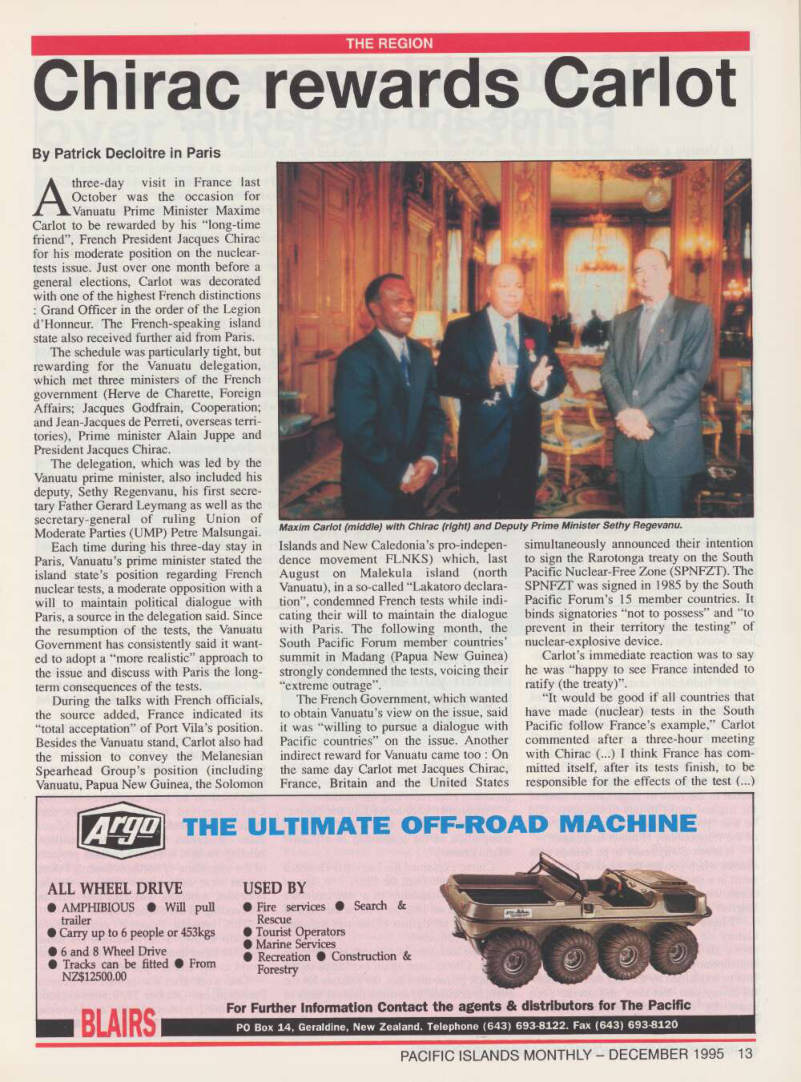
The delegation, which was led by the Vanuatu prime minister, also included his deputy, Sethy Regenvanu, his first secre tary Father Gerard Leymang as well as the secretary-general of ruling Union of Moderate Parties (UMP) Petre Malsungai.
Each time during his three-day stay in Paris, Vanuatu’s prime minister stated the island state’s position regarding French nuclear tests, a moderate opposition with a will to maintain political dialogue with Paris, a source in the delegation said. Since the resumption of the tests, the Vanuatu Government has consistently said it want ed to adopt a “more realistic” approach to the issue and discuss with Paris the long term consequences of the tests.
During the talks with French officials, the source added, France indicated its “total acceptation” of Port Vila’s position.
Besides the Vanuatu stand, Carlot also had the mission to convey the Melanesian
Spearhead Group’s position (including
Vanuatu, Papua New Guinea, the Solomon
Islands and New Caledonia’s pro-indepen dence movement FLNKS) which, last August on Malekula island (north Vanuatu), in a so-called “Lakatoro declara tion”, condemned French tests while indi cating their will to maintain the dialogue with Paris. The following month, the South Pacific Forum member countries’ summit in Madang (Papua New Guinea) strongly condemned the tests, voicing their
“extreme outrage”.
The French Government, which wanted to obtain Vanuatu’s view on the issue, said it was “willing to pursue a dialogue with Pacific countries” on the issue. Another indirect reward for Vanuatu came too ; On the same day Carlot met Jacques Chirac, France, Britain and the United States
simultaneously announced their intention to sign the Rarotonga treaty on the South Pacific Nuclear-Free Zone (SPNFZT). The SPNFZT was signed in 1985 by the South Pacific Forum’s 15 member countries. It binds signatories “not to possess” and “to prevent in their territory the testing” of
nuclear-explosive device.
Carlot’s immediate reaction was to say he was “happy to see France intended to
ratify (the treaty)”.
“It would be good if all countries that have made (nuclear) tests in the South Pacific follow France’s example,” Carlot commented after a three-hour meeting with Chirac (...) I think France has com mitted itself, after its tests finish, to be responsible for the effects of the test (...)
Maxim Carlot (middle) with Chirac (right) and Deputy Prime Minister Sethy Regevanu.
“if there are leaks, pollution, France will help South Pacific countries to help wash out radioactivity,”, he told media in Paris.
“This visit, which was placed under the sign of friendship, comes in a context of easing tensions with South Pacific states, after the announcement by France, Britain and the United States of their intention to sign the Rarotonga treaty”, a source in the French Elysee Palace (State House) said.
Carlot, in a short speech after he received the prestigious Legion d’Honneur medal in the rank of High Officer (one of the highest ranks in this distinction), said he was “proud” to assert himself as a “man of the francophony (French language)”.
“It is not always easy to be friends with France when you are the head of a govern ment in a small country in the middle of an ocean where all independent countries are
English speaking,” Carlot said.
“I have respect and admiration for the history of the Anglo-Saxon world, but above all I am proud to be a man of the
francophony. My friendship for France can
first be explained by the fact that I’m faith ful to my past, but also, and maybe even more, by my conviction that France’s uniqueness must assert itself without shy
“It is not always easy to be friends with France when you are the head of a government in a small country.”
ness, because it contributes to the welfare of all mankind”, Carlot told the French president after receiving his medal.
Apparently very moved by the distinc tion, Carlot said he saw it as “a sign of recognition of the leadership in a Pacific
Island country”.
Chirac explained the Legion d’Honneur was “a gesture from the heart”, “a sign of esteem and friendship to a statesman we respect and we like, as well as the sign of our will to strengthen closer ties between our two countries”.
As he had done last month in a letter to Carlot, Chirac once again explained to the Vanuatu prime minister the reasons for the French decision to resume nuclear tests in the Pacific.
“The Vanuatu prime minister told
(Chirac) he understood his position,” a spokesman in the Elysee said.
Chirac said has was happy of Vanuatu’s “moderation” on the nuclear issue, adding he regretted a similar stand had not been adopted by other South Pacific Island countries.
The French president also confirmed France’s commitment to support the island state’s development.
On his last official visit to France before general elections (which were scheduled to be held on November 30), Carlot received further assurances that Paris would increase its aid to the island state: Requests for a SUS2.4-million funding (within a SUS 16-million project) of the upgrading of northern Santo’s Pekoa airport were welcomed by France. On the occasion, Australia will also take part in the funding of the Santo project.
This brought France’s assistance to Vanuatu to over SUSIO million for some 165,000 inhabitants, Paris’s highest in the world to any country per head.
One week after Carlot met the French President, on October 27, France explod ed its third nuclear bomb on Mururoa Atoll. ■
Advertisements & other items, p. 13 (1 item)
Blairs
THE ULTIMATE OFF-ROAD MACHINE
ALL WHEEL DRIVE
• AMPHIBIOUS • Will pull trailer • Carry up to 6 people or 453kgs • 6 and 8 Wheel Drive • Tracks can be fitted From NZ512500.00
USED BY
Fire services • Search & Rescue • Tourist Operators • Marine Services Recreation Construction & Forestry ••site
BLAIRS
For Further Information Contact the agents & distributors for The Pacific PO Box 14, Geraldine, New Zealand. Telephone (643) 693-8122. Fax (643) 693-8120
Vanuatu, a mediator between
France and the Pacific?
Is Vanuatu a mediator to maintain dialogue between France and Pacific Island countries on the nuclear issue?
The Vanuatu prime minister, in an interview on the steps on the Elysee Palace (French State House) after talks and lunch with President Chirac, announced further French aid to Pacific Island states.
PIM: Mr Carlot, on the nuclear issue, do you see yourself as a mediator between the other Pacific island countries and France?
Maxime Carlot: I’m willing to be a mediator when the oppor tunity comes up, but I’m also the prime minister of Vanuatu. You know there is a solidarity between Pacific countries, and, in fact, all countries in the world, regarding environment. For the sur vival of the human race, it is important that we preserve this envi ronment. We’re very happy and satisfied to see that France has committed itself on this issue for the people of the South Pacific.
PIM; Practically, what are these commitments?
Carlot: Practically, France has committed itself that after the tests, it will be responsible for the effects, the consequences. If there are leaks, pollution, France will take part; it will help South Pacific countries to wash out radioactivity (...) France is a big country. When it says it commits itself, I believe it.
P.I.M: Did you talk a lot on the nuclear issue with President Chirac?
Carlot: We have discussed the nuclear issue not only in the Pacific, but also in the world - in France, in Russia, there is nuclear too.
PIM: You have been awarded the prestigious Legion d’Honneur, in order of Grand Officer. What does it mean to you?
Carlot: You know, the president of the French Republic is a long-time politician and a long-time friend. I have come to con gratulate him as the elected president of the French Republic, it pleases me to see that a friend has been elected. I was very moved
and shocked by this distinction (I received). I carry it with pride for the Republic of Vanuatu as something not coming from a friend, but from the French president. I see it as a recognition ot the leadership of a South Pacific country.
PIM: In terms of French language, how do you see Vanuatu’s role in the region?
Carlot: The French president knows Vanuatu is a bilingual country, it uses French and English languages officially and equally. We have inherited the French language, its culture; it has become our property. (...) I am French-speaking, but I am also bilingual. My task is to promote these two languages as the stan dard.
PIM: Does France have a part to play in the Pacific region?
Carlot: I think France has been playing an important part in the Pacific for a long time. I’m very pleased to hear France say, through M Chirac, that developed countries have an obligation towards developing countries. I think all developed countries have a duty, a responsibility to take part in the growth of devel oping countries, of which Vanuatu and Pacific Island countries are part.
PIM: French President Jacques Chirac and Prime Minister Alain Juppe both told you they intended to increase French aid to Vanuatu. Practically, what does it mean?
Carlot: Practically, it means 1996 : France will increase its aid to Pacific countries, including Vanuatu. It’s good news for Vanuatu, and it’s also good news for all South Pacific indepen dent countries.
PIM: Do you have a figure?
Carlot: No, you’re asking for a detail I cannot provide as yet.
All I know is that France will increase its aid. It’s now up to Pacific countries to be aware of this and to plan in order to work with France. ■
Greenpeace blasts US
Nuclear Testing
Greenpeace blasts US over nuclear testing
Greenpeace has condemned as reck less and irresponsible a United States of America announcement that six underground tests involving nuclear materials will take place at its Nevada nuclear test site in 1996 and 1997.
The first test, “REBOUND”, is sched uled for June 18, 1996, according to the.
US Department of Energy.
The tests will most likely be so-called
“hydro-nuclear” tests, involving explo
sions of high explosives and nuclear mate rials such as plutonium. Such tests are claimed to have no nuclear yield, as no nuclear chain reaction is initiated, but, in fact, can produce a small fission yield; they are called “zero yield” only if their nuclear yield does not exceed their high explosive yield.
“This test will do more than rebound, it will be a disaster for international hopes for a comprehensive test ban treaty,”
Greenpeace Stephanie Mills said.
“Following on from France’s decision to resume nuclear testing, the US announce ment could be a death knell for the test ban talks reaching conclusion early next year.”
The Department of Energy argues that the tests are necessary to keep ageing nuclear weapons safe and to ensure the Nevada test site is ready to return to full underground tests at any time.
“The only safe nuclear weapon is a dis mantled one,” Stephanie Mills said.
“Greenpeace wants to see a Comprehensive Test Ban Treaty close nuclear test sites forever, not leave a trail of loopholes for the nuclear weapon states to continue to proliferate new nuclear weapons indefinitely.”
Hydro-nuclear tests could prove attrac tive to states wanting to develop secret nuclear weapons programmes, according to nuclear scientists, because they could provide confidence in otherwise untested weapons.
“A test ban treaty that allows hydro nuclear tests will not effectively stop nuclear proliferation and will permit the existing nuclear arsenals. The behaviour of the US, France and China on the testing issue has betrayed the trust of non-nuclear nations and undermined the Non- Proliferation Treaty,” Mills said. President Clinton must rein in the Department of Energy now, and pledge his commitment to a truly zero test ban treaty.”
Mills said the New Zealand Government must call in the US ambas sador, Josiah Beenan, to protest in the strongest possible terms and call for the
tests to be cancelled.
Meanwhile, Cook Islands Prime
Minister Sir Geoffrey Henry has again
called for an immediate cessation of all nuclear testing, the Cook Islands News reported Monday.
The call comes after France on October 28 carried out its third nuclear test in the latest series, a blast of less than 60-kilo tonnes, at Mururoa Atoll.
Sir Geoffrey had, prior to the third test, repeated his call for the immediate cessa tion of all nuclear testing, particularly France’s current testing programme in the South Pacific.
He said while he welcomed the deci sion by France, the United States and the United Kingdom to sign the protocols to the South Pacific Nuclear Free Zone Treaty, the decision should be no excuse for continuing testing at Mururoa and
Fangataufa.
Sir Geoffrey said this would run counter to global efforts and commitments to move expeditiously towards total nuclear disarmament.
And the general secretary of Solomon Islands National Union of Workers, SINUW, David Tuhanuku, has condemned the British Government for supporting French nuclear testing in the South Pacific.
Tuhanuku says British Prime Minister John Major publicly announced his gov ernment’s support for France’s nuclear tests knowing that South Pacific countries were opposed to the tests.
Speaking from the Australian city of Newcastle, Tuhanuku said he was sur prised that in 1995, Britain, France and Germany still possessed colonial, greedy, ambitious and arrogant attitudes.
He said these countries’ attitudes destroyed the ideals of human respect, dig nity, rights and democracy, and was a hypocrisy on their part.
Tuhanuku has been holding discus sions in Newcastle with the managing director of Sofrana Unilines from Wellington and Australian union officials on SINUW’s plan to boycott handling of vessels of the French shipping company.*
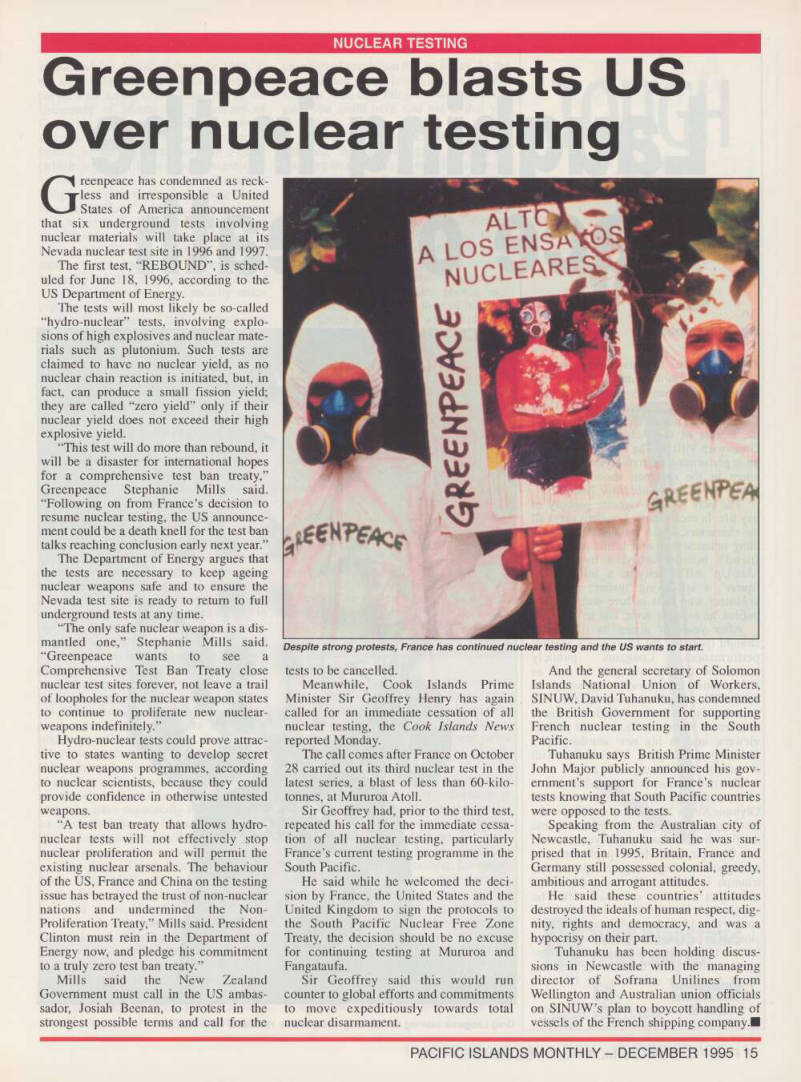
Despite strong protests, France has continued nuclear testing and the US wants to start.
face of death
Profile
Laughing in the face of death
By Ed Rampell
The most famous living Pacific Islander in the world is starring in a hit Off-Broadway play in New York
City. Olympic gold-medalist Greg
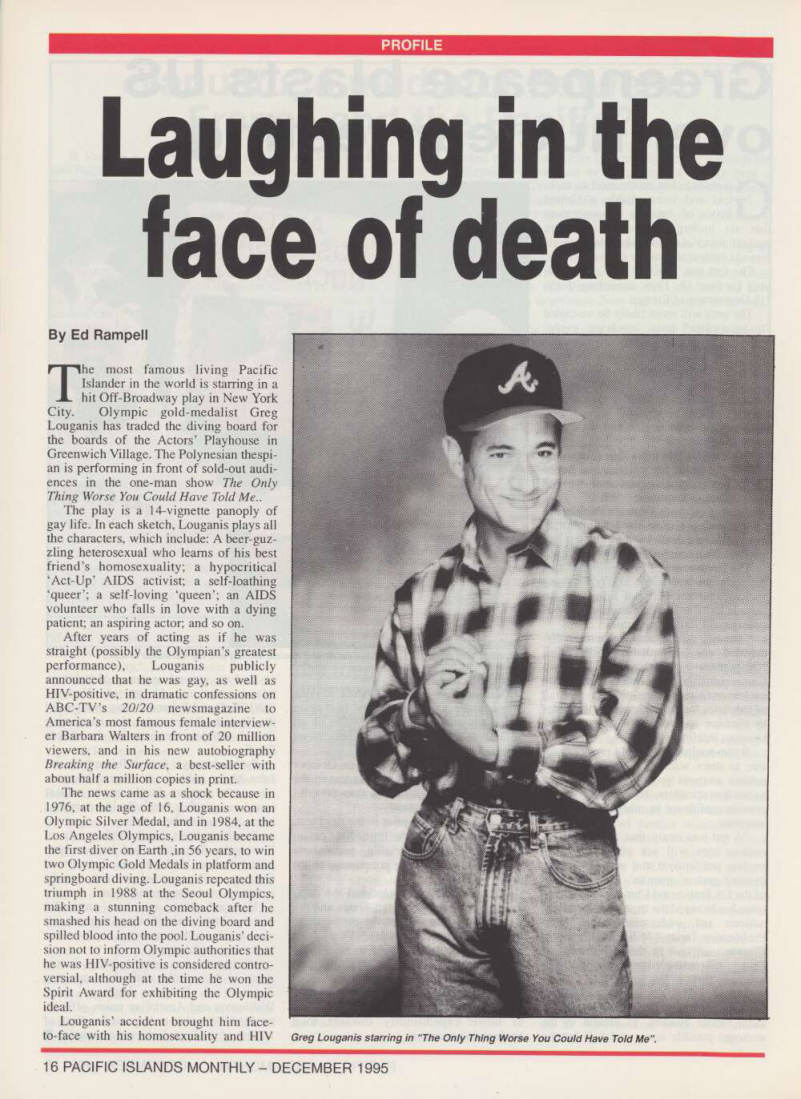
Louganis has traded the diving board for the boards of the Actors’ Playhouse in Greenwich Village. The Polynesian thespi an is performing in front of sold-out audi ences in the one-man show The Only Thing Worse You Could Have Told Me..
The play is a 14-vignette panoply of gay life. In each sketch, Louganis plays all the characters, which include: A beer-guz zling heterosexual who leams of his best
friend’s homosexuality; a hypocritical
‘Act-Up’ AIDS activist; a self-loathing ‘queer’; a self-loving ‘queen’; an AIDS volunteer who falls in love with a dying patient; an aspiring actor; and so on.
After years of acting as if he was
straight (possibly the Olympian’s greatest
performance), Louganis publicly
announced that he was gay, as well as HIV-positive, in dramatic confessions on ABC-TV’s 20120 newsmagazine to America’s most famous female interview er Barbara Walters in front of 20 million viewers, and in his new autobiography Breaking the Surface, a best-seller with about half a million copies in print.
The news came as a shock because in 1976, at the age of 16, Louganis won an Olympic Silver Medal, and in 1984, at the
Los Angeles Olympics, Louganis became
the first diver on Earth ,in 56 years, to win two Olympic Gold Medals in platform and
springboard diving. Louganis repeated this
triumph in 1988 at the Seoul Olympics, making a stunning comeback after he smashed his head on the diving board and spilled blood into the pool. Louganis’ deci sion not to inform Olympic authorities that he was HIV-positive is considered contro versial, although at the time he won the
Spirit Award for exhibiting the Olympic
ideal.
Louganis’ accident brought him face to-face with his homosexuality and HIV
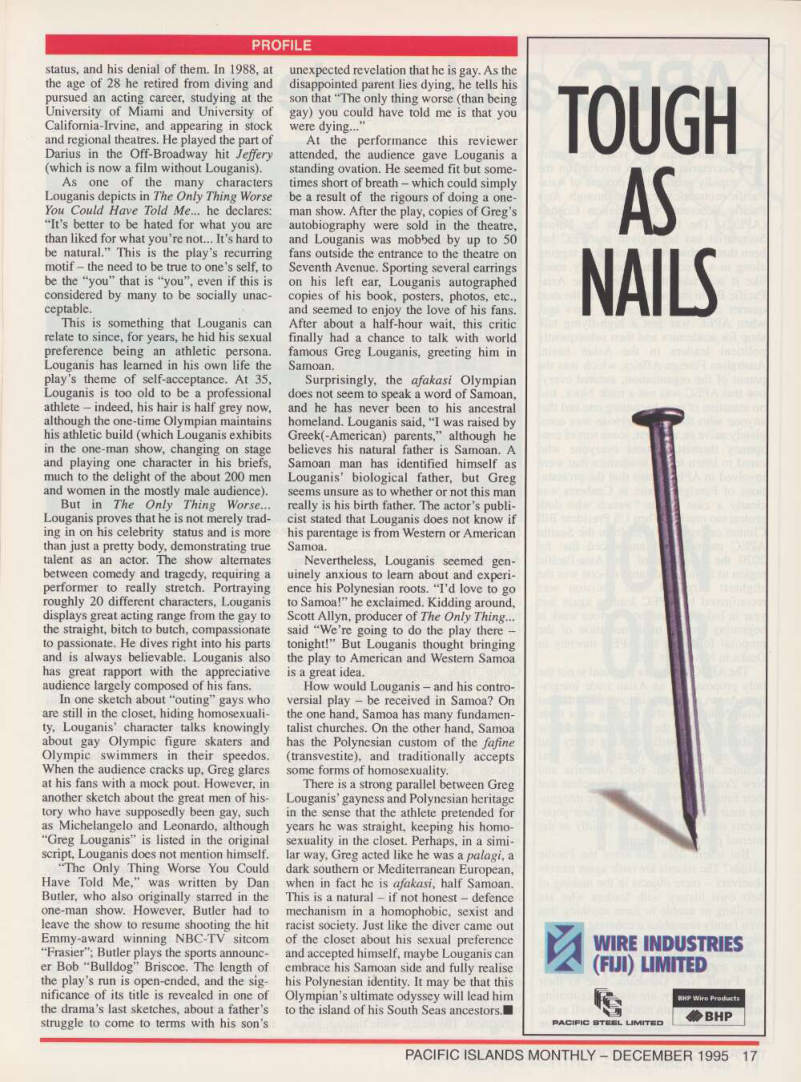
Greg Louganis starring in "The Only Thing Worse You Could Have Told Me”.
status, and his denial of them. In 1988, at the age of 28 he retired from diving and pursued an acting career, studying at the University of Miami and University of Califomia-Irvine, and appearing in stock and regional theatres. He played the part of Darius in the Off-Broadway hit Jeffery (which is now a film without Louganis).
As one of the many characters Louganis depicts in The Only Thing Worse You Could Have Told Me... he declares: “It’s better to be hated for what you are than liked for what you’re not... It’s hard to be natural.” This is the play’s recurring motif - the need to be true to one’s self, to be the “you” that is “you”, even if this is considered by many to be socially unac
ceptable.
This is something that Louganis can relate to since, for years, he hid his sexual preference being an athletic persona.
Louganis has learned in his own life the play’s theme of self-acceptance. At 35, Louganis is too old to be a professional athlete - indeed, his hair is half grey now, although the one-time Olympian maintains his athletic build (which Louganis exhibits in the one-man show, changing on stage and playing one character in his briefs, much to the delight of the about 200 men and women in the mostly male audience).
But in The Only Thing Worse...
Louganis proves that he is not merely trad ing in on his celebrity status and is more than just a pretty body, demonstrating true talent as an actor. The show alternates between comedy and tragedy, requiring a performer to really stretch. Portraying roughly 20 different characters, Louganis displays great acting range from the gay to the straight, bitch to butch, compassionate to passionate. He dives right into his parts and is always believable. Louganis also has great rapport with the appreciative audience largely composed of his fans.
In one sketch about “outing” gays who are still in the closet, hiding homosexuali ty, Louganis’ character talks knowingly about gay Olympic figure skaters and Olympic swimmers in their speedos.
When the audience cracks up, Greg glares at his fans with a mock pout. However, in another sketch about the great men of his tory who have supposedly been gay, such as Michelangelo and Leonardo, although “Greg Louganis” is listed in the original script, Louganis does not mention himself.
“The Only Thing Worse You Could Have Told Me,” was written by Dan Butler, who also originally starred in the one-man show. However, Butler had to leave the show to resume shooting the hit
Emmy-award winning NBC-TV sitcom
“Frasier”; Butler plays the sports announc er Bob “Bulldog” Briscoe. The length of the play’s run is open-ended, and the sig nificance of its title is revealed in one of the drama’s last sketches, about a father’s struggle to come to terms with his son’s
unexpected revelation that he is gay. As the disappointed parent lies dying, he tells his son that “The only thing worse (than being gay) you could have told me is that you
were dying...”
At the performance this reviewer attended, the audience gave Louganis a standing ovation. He seemed fit but some times short of breath - which could simply be a result of the rigours of doing a one man show. After the play, copies of Greg’s autobiography were sold in the theatre, and Louganis was mobbed by up to 50 fans outside the entrance to the theatre on Seventh Avenue. Sporting several earrings on his left ear, Louganis autographed copies of his book, posters, photos, etc., and seemed to enjoy the love of his fans.
After about a half-hour wait, this critic finally had a chance to talk with world
famous Greg Louganis, greeting him in
Samoan.
Surprisingly, the afakasi Olympian
does not seem to speak a word of Samoan, and he has never been to his ancestral homeland. Louganis said, “I was raised by
Greek(-American) parents,” although he
believes his natural father is Samoan. A Samoan man has identified himself as
Louganis’ biological father, but Greg
seems unsure as to whether or not this man really is his birth father. The actor’s publi cist stated that Louganis does not know if his parentage is from Western or American Samoa.
Nevertheless, Louganis seemed gen uinely anxious to leam about and experi ence his Polynesian roots. “I’d love to go to Samoa!” he exclaimed. Kidding around, Scott Allyn, producer of The Only Thing... said “We’re going to do the play there tonight!” But Louganis thought bringing the play to American and Western Samoa is a great idea.
How would Louganis - and his contro versial play - be received in Samoa? On the one hand, Samoa has many fundamen talist churches. On the other hand, Samoa has the Polynesian custom of the fafine (transvestite), and traditionally accepts some forms of homosexuality.
There is a strong parallel between Greg Louganis’ gayness and Polynesian heritage in the sense that the athlete pretended for years he was straight, keeping his homo sexuality in the closet. Perhaps, in a simi lar way, Greg acted like he was a palagi, a dark southern or Mediterranean European, when in fact he is afakasi, half Samoan.
This is a natural - if not honest - defence mechanism in a homophobic, sexist and racist society. Just like the diver came out of the closet about his sexual preference and accepted himself, maybe Louganis can embrace his Samoan side and fully realise his Polynesian identity. It may be that this Olympian’s ultimate odyssey will lead him to the island of his South Seas ancestors.®
Advertisements & other items, p. 17 (1 item)
Tough
AS
NAILS
a
WIRE INDUSTRIES
(FUI) LIMITED
PACIFIC STEEL LIMITED
BHP Wire Products
APEC and trade policy

Business
For more than five years the Forum Secretariat has been involved in the rapidly accelerating process of Asia- Pacific economic integration through Asia Pacific Economic Co-operation Council (APEC). The function that the Forum Secretariat has been given in APEC has been that of observer - a notetaker, tagging along in a process that looks very much like it will take the whole of the Asia- Pacific Basin into a trade block in the next quarter century. Six or seven years ago, when APEC was just a high-flying talk shop for academics and then subsequently political leaders in the Asian basin, Australian Foreign Affairs, which was the parent of the organisation, assured every one that APEC was not a trade block, had no intention of ever becoming one and that anyone who thought otherwise was com pletely naive or, at worst, some sort of con spiracy theorist. Almost everyone who cared to listen to the academics that were involved in APEC heard that the protesta tions of Foreign Affairs in Canberra was clearly a case of the “wench who doth protest too much”. When US President Bill Clinton emerged in 1993 from the Seattle APEC meeting and announced that by 2020 the countries of the Asia-Pacific region to form a trade area no-one was the slightest surprised. The decision was reconfirmed by APEC leaders again last year in Indonesia and now serious work is beginning on the implementation of the
proposal following the APEC meeting in
Osaka in November 1995.
The APEC trade area proposal is not the only proposal for an Asian trade integra tion. Asean, the Association of South East Asian Nations, is also moving on a trade area by 2005 and the Australians and New Zealanders are busily moving to try and enter an extended Asean block that includes them both. Both Australia and New Zealand have made it quite clear that their future lies with Asia and are integrat ing their economies as well as their popu lations with that of Asia as rapidly as the internal policies will permit.
But where does this leave the Pacific Islands? The islands are once again merely observers - mere objects in the making of their own history with leaders who are unwilling or unable to form anything that even faintly resembles a coherent and con sistent trade policy position. The islands, especially in terms of their trade policy, are by no means a homogeneous collection.
The Papua New Guineans, true to their ‘look North’ policy, are also concentrating on Asia as their main markets as well as the main source of capital for their future
development. PNG, for whatever else can be said, is an aggressive members of international trade fora and participates as the only Pacific Island member of APEC. It has also joined the World Trade Organisation as well as being one of the most active proponents of regional trade agreements like the Melanesian Spearhead Group Trade Agreement. The Solomon Islands and Vanuatu have also pursued bilateral and multilateral trade liberalisation with their neighbours. The Solomon Islands is now the third of the Pacific Island countries to have joined the World Trade Organisation and Vanuatu is in the process of negotiating a much-delayed bilateral trade agreement with Fiji.
The most successful example so far of trade liberalisation is the Melanesian
Spearhead Group Trade Agreement, signed
in 1993. When the negotiations for this trade agreement began in the early part of the decade it looked like the only trade that would occur in Melanesia would be bullets between the Solomon Island and PNG across the straits separating the western province of the Solomon Islands and Bougainville. However, despite what was the most inhospitable political climate for trade treaty negotiations the three MSG partners, reflecting in part an unusual willingness to co-operate despite the political turmoil, signed a limited three-commodity agreement. The treaty, while limited, was a
tribute to the on-going ability of the MSG states to co-operate and to see their eco nomic interests. Under the terms of the MSG agreement, PNG, Solomon Islands and Vanuatu agreed to allow tea from PNG, Solomon Island canned tuna and Vanuatu beef into their markets duty free.
For Vanuatu, this was almost meaningless as, in PNG, its main target market, their margin of preference was almost nothing.
In the wake of the agreement what did develop was a trade in beef between Solomon Islands and Vanuatu where
Vanuatu enjoyed a significant margin of
trade preference over Australian beef.
Many observers felt that the MSG trade agreement would become just another meaningless international trade agreement that so many Pacific Island countries sign.
Pacific leaders love signing agreements and, if you talk to legal draftsmen, they will tell you their vaults are full of agree ments that were a waste of good treaty paper because no-one even remembers they were signed. Much to everyone’s shock, this year, the MSG heads of govern ment agreement extended the new trade agreement to over 140 tariff lines. For the first time it looks like the MSG leaders may actually be serious about trade liberal isation rather than just offering token ges tures. In part though, the broadening of coverage of the agreement is a result of the fact that very little trade developed as a
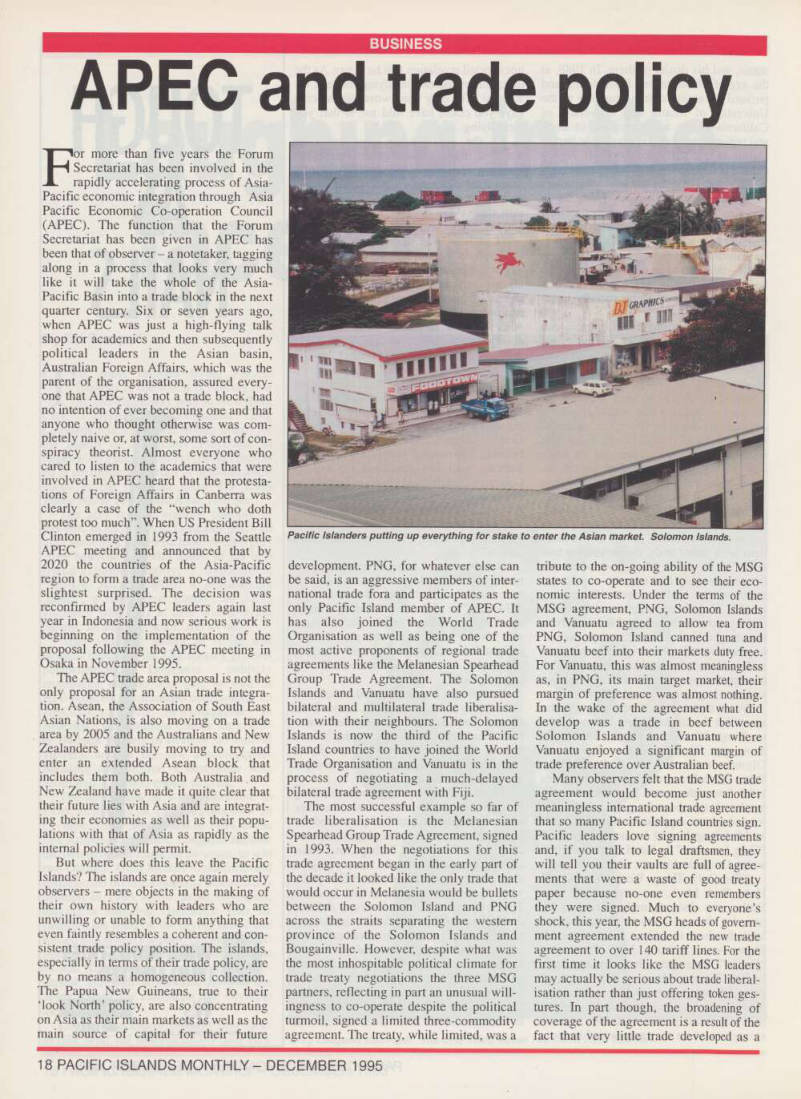
Pacific Islanders putting up everything for stake to enter the Asian market. Solomon Islands.
result of the initial trade agreement - espe cially with PNG. The problem with trade agreements is that the only time they bene fit anyone is when prices decrease because trade is occurring between a more efficient country and a less efficient one. But, if the less efficient country is producing the good that is being imported then the workers and their employers will be hurt as a result of the trade agreement. For the moment there has been no pain and there is still no evi dence that the MSG leaders or any other Pacific Island leaders are willing to allow consumers to benefit from cheaper imports at the expense of local production, despite all the treaties and pious pronouncements about regionalism and trade liberalisation.
But the MSG is not the only group that is moving to liberalise trade. PNG and Fiji have signed a very limited agreement with a small number of commodities, including coffee. Fiji, despite numerous invitations to join the MSG, declined. The reason is that despite what appears to many outsiders as a superficial physical similarity between Fijians and Melanesians, culturally Fijians are Polynesians. More importantly, the tra ditional power centre of Fiji, the Lau Group of islands, and Bau Island are all Polynesian and the ruling elite, while hav ing economic interests in Melanesia, sees its traditional cultural roots in Polynesia.
The Fiji position has been to attempt to negotiate bilateral trade agreements with its trading partners. Unlike so may other policies in the region, Fiji’s policy bilater alism has grown from a conscious policy decision of the Fiji Government. The poli cy has resulted in a number of treaties but each is of very limited economic value. Fiji must be applauded for leading the way in trade liberalisation, however, the bilateral approach has numerous difficulties. While Fiji wants biletral trade agreements with Australia, New Zealand and each of the many Pacific states it has little capacity to negotiate and monitor them. As a result, there are agreements with Tonga, that have recently been signed, agreements with Vanuatu, that are still pending, and there has been a long standing trade agreement with Tuvalu on artifacts. Fiji has just announced its intention to negotiate a sep arate treaty with Australia. It will be inter esting to see what Fiji can possibly obtain in such negotiations over and above the free trade access it already has into the Australian market. But the very limited trade agreements that Fiji is negotiating with its island neighbors will only be ben efits to Fiji and will only be of any real use once there are wider free trade agreements.
Wide-ranging treaties are difficult and their
negotiation is very time consuming, requir
ing large amounts of skilled manpower on both sides.
The tokenism of limited two and three commodity trade agreements, while result ing in some political mileage is of little
economic use and is probably illegal under WTO (GATT) rules. As both Fiji and PNG are WTO members they will have to notify GATT that they have signed a limited pref erence trade agreement. GATT only accepts these agreements if it is clear that they are intermediate stages on the way to more general trade agreements. It will sim ply not be possible for Fiji to negotiate these types of agreements and keep them on the books for long without negotiating the much tougher free trade agreements.
All this hedging against real free trade begs a much bigger question regarding the future of the Pacific Island states in APEC and in its relations with its bigger Asian and Pacific trading partners. The negotia tions on trade liberalisation within the Pacific Islands region have begun but they are not yet at the stage where they are seri ous. Most observers do not feel that, at least for the foreseeable future, the island leaders will be serious because of the domestic considerations.
However, the big question that trade policy makers in the islands are not con fronting is what will the islands will do as Asean and APEC move to become free trade areas, especially as Australia and New Zealand join. Can we afford to stay out? Almost certainly not because we will be excluded from the huge boom in trade that will almost certainly occur. In order to join in we will have to liberalise as well and the liberalisation of trade and lowering of trade barriers that will be needed in order to participate is much more pain and adjustment than the island states are cur rently willing to accept.
The islands must adjust to a freer trad ing environment and the best way is to begin with ourselves. Whenever anyone raises the question of Pacific Island trade areas the cynics always respond that we cannot sell coconuts to each other. (In fact, we actually do). Trade liberalisation, even in the islands, will create opportunities that no-one can foresee but these will only come when we create unified markets. We are too small to survive in the long term as micro units that we inherited from our colonial masters. The long term is quickly arriving and our growth rates are dropping along with our prospects for the future.
Once again, trade liberalisation and region alism are beckoning as a preparatory stage before the much bigger adjustment we must make in twenty five years to free trade with the rest of Asia. If our leaders are unwilling to make what are minor eco nomic adjustments to accommodate freer trade with other islands how are we to respond to the far greater challenges loom ing as a result of Asia-Pacific integration?
It is time for history to create leaders with vision for a future and if history does not create these leaders then we should be hon est and tell our children that their best hope is to emigrate. ■
Advertisements & other items, p. 19 (1 item)
Join
OUR
FENCING
TEAM
WIRE INDUSTRIES
(FIJI) LIMITED
BHP Wire Products
PACIFIC BTEEL LIMITED
Welcome Asia
Business
By Martin Tiffany
THE SOUTH Pacific’s multi million dollar trade with South-East Asia is set to be boosted by the establish ment of three trade offices in Asia.
There are plans for the first to be setup in Tokyo next year.
In July, a feasibility study on the set-up of the office was completed by the Forum Secretariat with help from the Japanese Government.
Peter Osborne, the Forum’s Trade and Investment division director, said they are waiting for the Japanese to indicate if they are able to fund the project.
The push for the establishment of a Tokyo trade office is the beginning of an aggressive trade focus on Asia by Forum Island countries, said Osborne.
He said the Forum also has plans to setup similar offices in China and Taiwan, while South Korea is also being looked at.
A lot will depend on the ability to get fund ing for the offices.
A South Pacific trade and investment mission visited China last year and, Osborne said, from this the potential for a trade office was seen.
Discussion have already been held with the Chinese Government and a concept proposal has been put forward to them.
Osborne, who recently returned from discussions with the Chinese Ministry of Foreign Affairs in Beijing, said in the next six months they would prepared a detailed study for the establishment of the office.
“At the moment, we are looking at options, it could be a one-person operation or a full-blown trade office,” said Osborne.
Next year, he said, they would look at developing a similar concept in Taipei (Taiwan). Osborne said they were eyeing a two-to-three-year time-frame to establish the Taiwan and China offices.
The rationale for starting the offices is to identify opportunities in the Asian mar ket and capture these opportunities.
Osborne said to do this they needed a ded icated presence in Asia.
At its September meeting in Madang, the South Pacific Forum supported the concept of the trade offices.
Osborne said the South Pacific had to make moves to take advantage of the opportunities that were developing with Asia’s dynamic growth.
But he stressed the need for urgency
because of competition from other places like Latin America.
If the South Pacific is able to get a small percentage of the Asian growth, Osborne said it would be significant for the region.
The planned offices are to promote regional trade, investment and tourism.
Similar offices are already operating in Auckland and Sydney.
Osborne said they work both ways as they allow exporters from Asia to go through them to get to the regional islands, making it much easief for exporters as they only had to deal with one office.
The bigger countries in the Pacific, such as Fiji and Papua New Guinea, would be the best placed to take advantage of the offices because of those countries’ diverse range of export goods. They have also made inroads into the Asian markets via trade and the tourism market.
PNG has already adopted a “Look North” policy, which is aimed at directing more trade attention towards Asia.
Fiji already has flights to Tokyo and Osaka, in Japan, and is looking at code sharing with Korean Air, which operates a Seoul/Auckland flight via Nadi.
Once the offices are established, Osborne said it would encourage better air and sea links with Asia.
Osborne said initially the smaller countries would only be able to use the offices to promote things such as their tourism potential. But in time, he said, he hoped the fact that the offices were in the various countries would encourage some of the smaller countries to find a way to take advantage of their presence.
He said niche markets would be the way to go for the smaller countries and he hoped the offices would help identify nich es for the various countries.
Tonga, for example, has, over the last few years, established a fairly lucrative squash pumpkin market in Japan.
Fiji already has an established market for fish in Japan and has started growing asparagus for off-season supply to Japan.
Seafood is an area the South Pacific countries could quite easily get into because of the abundance of seafood in the Pacific and the demand in Asia.
Osborne said the offices would be able to help identify niche markets and guide regional countries on what areas to devel op.
Asian countries already doing trade with the South Pacific include China, Taiwan, Hong Kong, Japan, Korea, Malaysia, Singapore and Thailand. ■
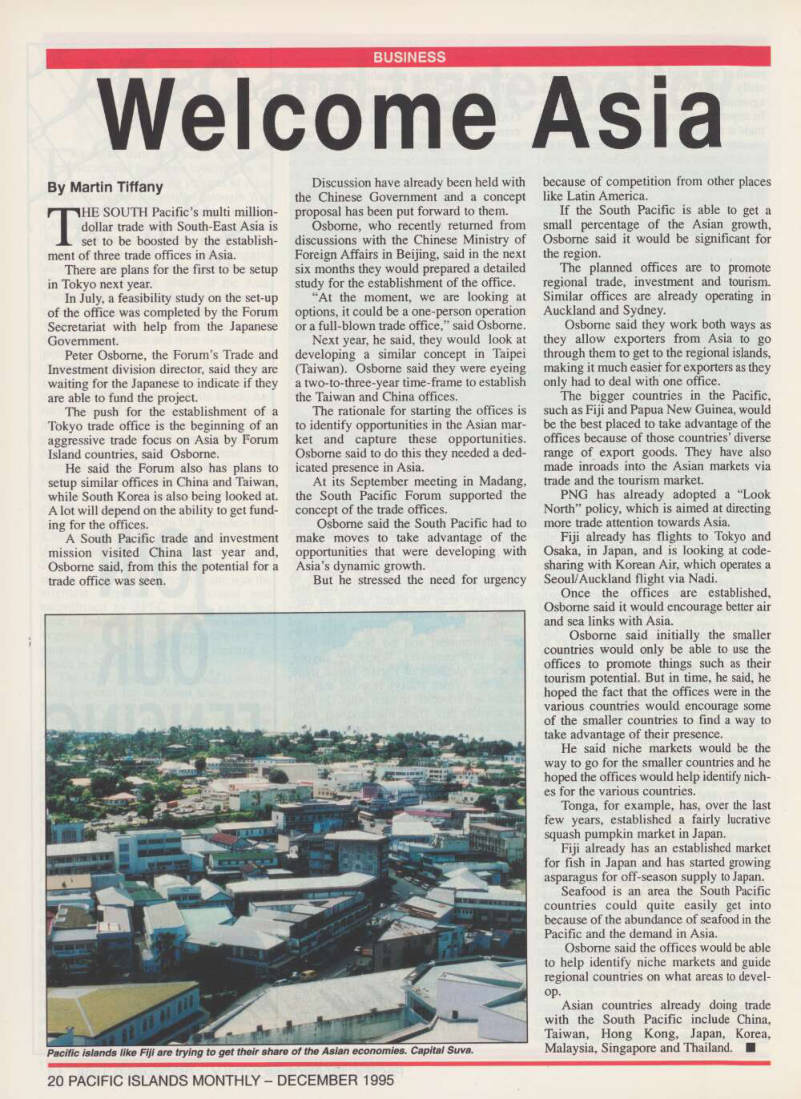
Pacific islands like Fiji are trying to get their share of the Asian economies. Capital Suva.
epidemic
Health
Vanuatu’s malaria epidemic
Vanuatu’s Rotary Club malaria con trol campaign started in 1991 upon request of the state’s Ministry of Health, after other methods formerly used on the island state, including fogging, had
proved unsuccessful. Chloroquine also
progressively became less effective
through the 1980 s and chloroquine-resis
tant malaria is now found in many coun tries of the region, including Vanuatu.
Between 1987 and 1990, malaria in Vanuatu meant the following: The most common reason for admission to hospital, the cause of ten per cent of all out patients’ visits in clinics and hospitals, the major cause of death in children under five and pregnant women, and the third most common cause of death for people of all ages, Vanuatu Rotary says in a sub mission report to Rotary International last
April.
“One in every 100 people in Vanuatu was admitted to hospital each year with malaria; it is the third most common dis ease in outpatients with over 10 percent of all outpatients being treated, the third most common cause of death (all ages), accounting for over seven per cent of all deaths, and a major cause of deaths in children, causing 15 per cent of all deaths in the 0-4 age group,” the report says.
The disease is a serious one here: With the Solomon Islands, Vanuatu is the most affected country in the South-West Pacific.
Since 1991 over SUSSO,OOO have been injected into the project by World Health Since 1991, over SUSSOO,OOO has been injected into the project by World Health Organisation, UNICEF, and the Australian and Japanese governments, mainly to import the bed nets and provide insecticide.
The Vanuatu campaign consists of a free distribution of mosquito bed nets
throughout the Y-shaped archipelago’s 80
islands at a village level, and, more recently, in boarding schools. There, teams from the health department also teach villages how to maintain their bed
nets’ efficiency by regularly re-impreg
nating them with permethin, a much more efficient insecticide than DDT.
This year, Vanuatu’s Rotary Club wants to convince Rotary International to adopt the idea on an international scale.
“We want them to run this programme on an international scale, just they did
with the Polio Plus campaign. That is our hope,” says John Smith, a rotarian who was involved in the project from the start five years ago.
In the documentary produced to pro mote the idea, narrator Malcolm Ferguson says in the 20 minute presentation, that 10,500 people worldwide had contracted malaria and 73 people had died from the disease.
Malaria parasites are estimated to cur rently affect some 270 million people annually, with up to two million of those dying from the disease. It is ranked in the top five causes of death by disease in the world, a Rotary report explains.
The germ (there are five species; plas modium, falcuiparum, vivax, oval and malaria) is transmitted to humans by mos quitoes biting mostly between sunset and sunrise.
The only mosquito than can transmit malaria is the anopheles. Only the female mosquito bites: She requires blood protein before she can lay her eggs, mostly at
night. The anopheles mosquito makes no
noise: It doesn’t hum or hover as do most mosquitoes. After choosing her human target, the female anopheles mosquito pierces the skin. Then two blades, bearing very fine teeth, will lacerate the skin like a microscopic saw. When a small vein is found, it is pierced and a flexible tube is inserted. During the process, the mosqui to introduces saliva to the wound. This saliva acts as an anaesthetic, so the bite is not felt.
It is through this saliva that the plas modium parasite enters the human body.
After the germ is injected into the human bloodstream (by a mosquito bite), the par asite develops in the red blood cells, until they burst. Without enough blood cells to carry oxygen through the body, the victim becomes anaemic and can die from rental failure or convulsions.
It usually first takes the form of aches, fever and vomiting, later anaemia and in the most severe cases, cerebral malaria. A child infected with a virulent strain can die within hours of the first symptoms as ravaged blood cells clog capillaries and deprive the brain of oxygen. Milder cases are characterised by drenching sweats and shaking chills followed by months or even years of anaemia and periodic fevers.
Pregnant women and children under five are the main victims. ■
Advertisements & other items, p. 21 (1 item)
Know
WHO
Wire Industries (Fiji) Limited. The only manufacturers in Fiji using wire and steel products imported exclusively from BHR Australia and Pacific Steel, New Zealand.
Since manufacturing commenced in 1962 we have never been tempted by cheaper prices for our raw materials, believing Quality and Consistency should always remain Paramount Wire Industries (Fiji) Limited take pride in being a wholly owned indigenous Fijian company, dedicated to supplying through our many Hardware Retailers, Only Top Quality products to the people of Fiji and the Pacific. 8
WIRE INDUSTRIES
(FIJI) LIMITED
Suva Phone: (679) 361415 Fax: (679) 361506 Nadi Phone: (679) 702280 Fax: (679) 702260 P 0 Box 628, Nadi, Fiji Islands.
BHP Wire Products
PACIFIC STEEL LIMITEO
Goodbye 1995
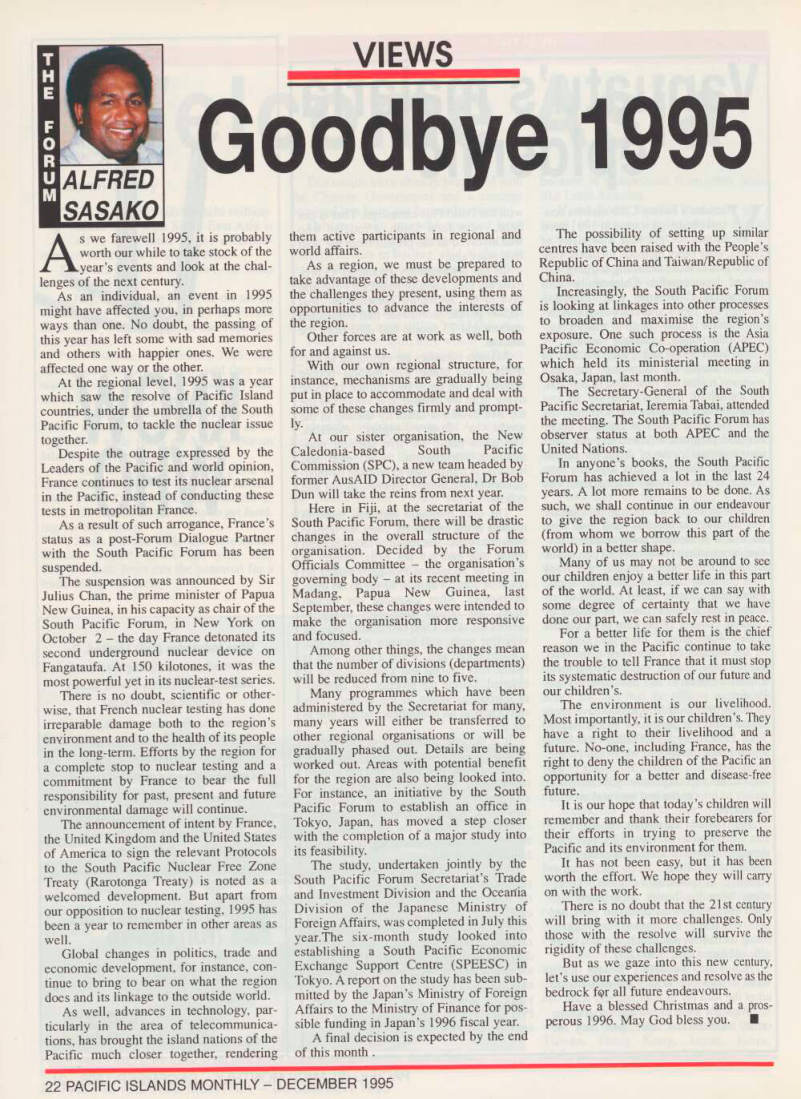
Views
As we farewell 1995, it is probably worth our while to take stock of the year’s events and look at the chal lenges of the next century.
As an individual, an event in 1995 might have affected you, in perhaps more ways than one. No doubt, the passing of this year has left some with sad memories and others with happier ones. We were affected one way or the other.
At the regional level, 1995 was a year which saw the resolve of Pacific Island countries, under the umbrella of the South Pacific Forum, to tackle the nuclear issue
together.
Despite the outrage expressed by the Leaders of the Pacific and world opinion, France continues to test its nuclear arsenal in the Pacific, instead of conducting these tests in metropolitan France.
As a result of such arrogance, France’s status as a post-Forum Dialogue Partner with the South Pacific Forum has been
suspended.
The suspension was announced by Sir Julius Chan, the prime minister of Papua New Guinea, in his capacity as chair of the South Pacific Forum, in New York on October 2 - the day France detonated its second underground nuclear device on Fangataufa. At 150 kilotones, it was the most powerful yet in its nuclear-test series.
There is no doubt, scientific or other wise, that French nuclear testing has done irreparable damage both to the region’s environment and to the health of its people in the long-term. Efforts by the region for a complete stop to nuclear testing and a commitment by France to bear the full responsibility for past, present and future environmental damage will continue.
The announcement of intent by France, the United Kingdom and the United States of America to sign the relevant Protocols to the South Pacific Nuclear Free Zone Treaty (Rarotonga Treaty) is noted as a welcomed development. But apart from our opposition to nuclear testing, 1995 has been a year to remember in other areas as well.
Global changes in politics, trade and economic development, for instance, con tinue to bring to bear on what the region does and its linkage to the outside world.
As well, advances in technology, par ticularly in the area of telecommunica tions, has brought the island nations of the Pacific much closer together, rendering
them active participants in regional and world affairs.
As a region, we must be prepared to take advantage of these developments and the challenges they present, using them as opportunities to advance the interests of the region.
Other forces are at work as well, both for and against us.
With our own regional structure, for instance, mechanisms are gradually being put in place to accommodate and deal with some of these changes firmly and prompt ly- At our sister organisation, the New Caledonia-based South Pacific Commission (SPC), a new team headed by former AusAID Director General, Dr Bob Dun will take the reins from next year.
Here in Fiji, at the secretariat of the South Pacific Forum, there will be drastic changes in the overall structure of the organisation. Decided by the Forum Officials Committee - the organisation’s governing body at its recent meeting in Madang, Papua New Guinea, last September, these changes were intended to make the organisation more responsive and focused.
Among other things, the changes mean that the number of divisions (departments) will be reduced from nine to five.
Many programmes which have been administered by the Secretariat for many, many years will either be transferred to other regional organisations or will be gradually phased out. Details are being worked out. Areas with potential benefit for the region are also being looked into.
For instance, an initiative by the South Pacific Forum to establish an office in Tokyo, Japan, has moved a step closer with the completion of a major study into its feasibility.
The study, undertaken jointly by the South Pacific Forum Secretariat’s Trade and Investment Division and the Oceania Division of the Japanese Ministry of Foreign Affairs, was completed in July this year. The six-month study looked into establishing a South Pacific Economic Exchange Support Centre (SPEESC) in Tokyo. A report on the study has been sub mitted by the Japan’s Ministry of Foreign Affairs to the Ministry of Finance for pos sible funding in Japan’s 1996 fiscal year.
A final decision is expected by the end of this month .
The possibility of setting up similar centres have been raised with the People’s Republic of China and Taiwan/Republic of China.
Increasingly, the South Pacific Forum is looking at linkages into other processes to broaden and maximise the region’s exposure. One such process is the Asia Pacific Economic Co-operation (APEC) which held its ministerial meeting in Osaka, Japan, last month.
The Secretary-General of the South Pacific Secretariat, leremia Tabai, attended the meeting. The South Pacific Forum has observer status at both APEC and the United Nations.
In anyone’s books, the South Pacific Forum has achieved a lot in the last 24 years. A lot more remains to be done. As such, we shall continue in our endeavour to give the region back to our children (from whom we borrow this part of the world) in a better shape.
Many of us may not be around to see our children enjoy a better life in this part of the world. At least, if we can say with some degree of certainty that we have done our part, we can safely rest in peace.
For a better life for them is the chief reason we in the Pacific continue to take the trouble to tell France that it must stop its systematic destruction of our future and our children’s.
The environment is our livelihood.
Most importantly, it is our children’s. They have a right to their livelihood and a future. No-one, including France, has the right to deny the children of the Pacific an opportunity for a better and disease-free future.
It is our hope that today’s children will remember and thank their forebearers for their efforts in trying to preserve the Pacific and its environment for them.
It has not been easy, but it has been worth the effort. We hope they will carry on with the work.
There is no doubt that the 21st century will bring with it more challenges. Only those with the resolve will survive the rigidity of these challenges.
But as we gaze into this new century, let’s use our experiences and resolve as the bedrock for all future endeavours.
Have a blessed Christmas and a pros perous 1996. May God bless you. ■
The Forum
Alfred
Sasako
Murder!
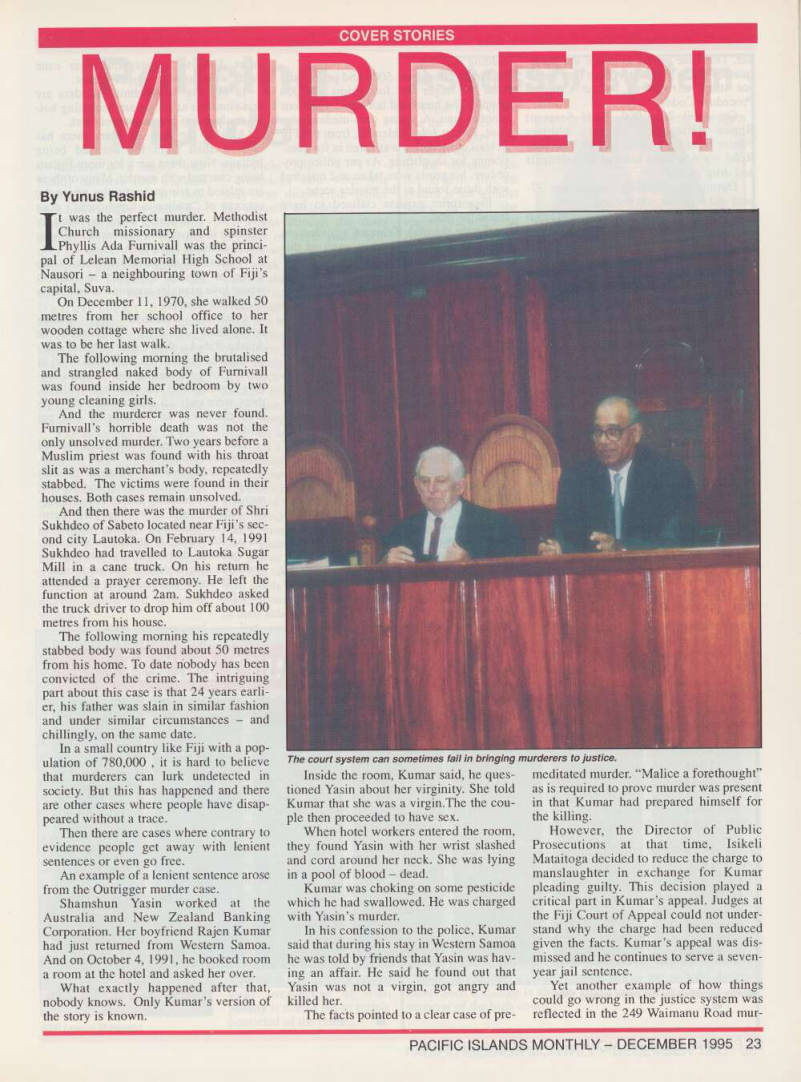
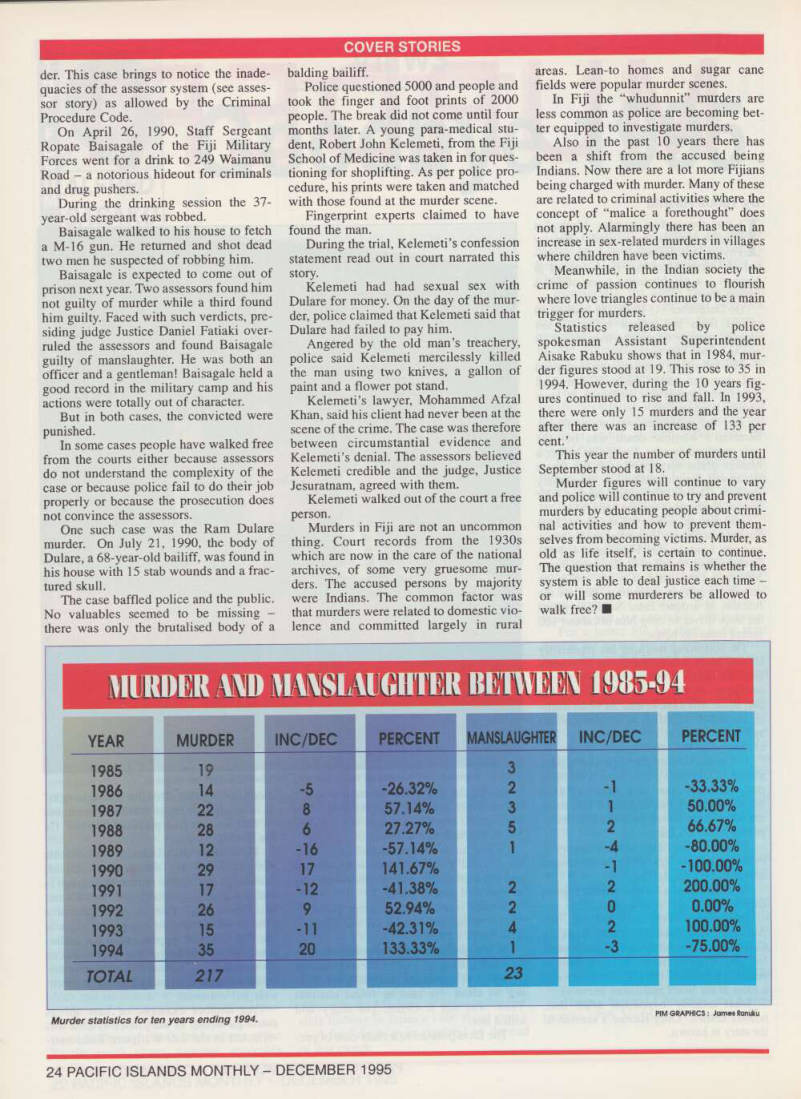
Cover Stories
By Yunus Rashid
It was the perfect murder. Methodist
Church missionary and spinster
Phyllis Ada Fumivall was the princi pal of Lelean Memorial High School at Nausori - a neighbouring town of Fiji’s capital, Suva.
On December 11, 1970, she walked 50 metres from her school office to her wooden cottage where she lived alone. It was to be her last walk.
The following morning the brutalised and strangled naked body of Fumivall was found inside her bedroom by two young cleaning girls.
And the murderer was never found.
Fumivall’s horrible death was not the only unsolved murder. Two years before a Muslim priest was found with his throat slit as was a merchant’s body, repeatedly stabbed. The victims were found in their houses. Both cases remain unsolved.
And then there was the murder of Shri Sukhdeo of Sabeto located near Fiji’s sec ond city Lautoka. On February 14, 1991 Sukhdeo had travelled to Lautoka Sugar Mill in a cane truck. On his return he attended a prayer ceremony. He left the function at around 2am. Sukhdeo asked the truck driver to drop him off about 100 metres from his house.
The following morning his repeatedly stabbed body was found about 50 metres from his home. To date nobody has been convicted of the crime. The intriguing part about this case is that 24 years earli er, his father was slain in similar fashion and under similar circumstances - and chillingly, on the same date.
In a small country like Fiji with a pop ulation of 780,000 , it is hard to believe that murderers can lurk undetected in society. But this has happened and there are other cases where people have disap peared without a trace.
Then there are cases where contrary to evidence people get away with lenient sentences or even go free.
An example of a lenient sentence arose from the Outrigger murder case.
Shamshun Yasin worked at the Australia and New Zealand Banking Corporation. Her boyfriend Rajen Kumar had just returned from Western Samoa.
And on October 4, 1991, he booked room a room at the hotel and asked her over.
What exactly happened after that, nobody knows. Only Kumar’s version of the story is known.
Inside the room, Kumar said, he ques tioned Yasin about her virginity. She told Kumar that she was a virgin. The the cou ple then proceeded to have sex.
When hotel workers entered the room, they found Yasin with her wrist slashed and cord around her neck. She was lying in a pool of blood - dead.
Kumar was choking on some pesticide which he had swallowed. He was charged with Yasin’s murder.
In his confession to the police, Kumar said that during his stay in Western Samoa he was told by friends that Yasin was hav ing an affair. He said he found out that Yasin was not a virgin, got angry and killed her.
The facts pointed to a clear case of pre
meditated murder. “Malice a forethought” as is required to prove murder was present in that Kumar had prepared himself for
the killing.
However, the Director of Public Prosecutions at that time, Isikeli Mataitoga decided to reduce the charge to manslaughter in exchange for Kumar
pleading guilty. This decision played a
critical part in Kumar’s appeal. Judges at the Fiji Court of Appeal could not under stand why the charge had been reduced given the facts. Kumar’s appeal was dis missed and he continues to serve a seven year jail sentence.
Yet another example of how things could go wrong in the justice system was reflected in the 249 Waimanu Road mur
The court system can sometimes fail in bringing murderers to justice.
der. This case brings to notice the inade quacies of the assessor system (see asses sor story) as allowed by the Criminal Procedure Code.
On April 26, 1990, Staff Sergeant
Ropate Baisagale of the Fiji Military
Forces went for a drink to 249 Waimanu Road - a notorious hideout for criminals
and drug pushers.
During the drinking session the 37year-old sergeant was robbed.
Baisagale walked to his house to fetch a M-16 gun. He returned and shot dead two men he suspected of robbing him.
Baisagale is expected to come out of prison next year. Two assessors found him not guilty of murder while a third found him guilty. Faced with such verdicts, pre siding judge Justice Daniel Fatiaki over ruled the assessors and found Baisagale guilty of manslaughter. He was both an officer and a gentleman! Baisagale held a good record in the military camp and his actions were totally out of character.
But in both cases, the convicted were
punished.
In some cases people have walked free from the courts either because assessors do not understand the complexity of the case or because police fail to do their job properly or because the prosecution does not convince the assessors.
One such case was the Ram Dulare murder. On July 21, 1990, the body of Dulare, a 68-year-old bailiff, was found in his house with 15 stab wounds and a frac tured skull.
The case baffled police and the public.
No valuables seemed to be missing there was only the brutalised body of a
balding bailiff.
Police questioned 5000 and people and took the finger and foot prints of 2000 people. The break did not come until four months later. A young para-medical stu dent, Robert John Kelemeti, from the Fiji School of Medicine was taken in for ques tioning for shoplifting. As per police pro cedure, his prints were taken and matched with those found at the murder scene.
Fingerprint experts claimed to have found the man.
During the trial, Kelemeti’s confession statement read out in court narrated this story.
Kelemeti had had sexual sex with Dulare for money. On the day of the mur der, police claimed that Kelemeti said that Dulare had failed to pay him.
Angered by the old man’s treachery, police said Kelemeti mercilessly killed the man using two knives, a gallon of paint and a flower pot stand.
Kelemeti’s lawyer, Mohammed Afzal Khan, said his client had never been at the scene of the crime. The case was therefore between circumstantial evidence and Kelemeti’s denial. The assessors believed Kelemeti credible and the judge. Justice Jesuratnam, agreed with them.
Kelemeti walked out of the court a free person.
Murders in Fiji are not an uncommon thing. Court records from the 1930 s which are now in the care of the national archives, of some very gruesome mur ders. The accused persons by majority were Indians. The common factor was that murders were related to domestic vio lence and committed largely in rural
areas. Lean-to homes and sugar cane fields were popular murder scenes.
In Fiji the “whudunnit” murders are less common as police are becoming bet ter equipped to investigate murders.
Also in the past 10 years there has been a shift from the accused being Indians. Now there are a lot more Fijians being charged with murder. Many of these are related to criminal activities where the concept of “malice a forethought” does not apply. Alarmingly there has been an increase in sex-related murders in villages where children have been victims.
Meanwhile, in the Indian society the crime of passion continues to flourish where love triangles continue to be a main trigger for murders.
Statistics released by police
spokesman Assistant Superintendent
Aisake Rabuku shows that in 1984, mur der figures stood at 19. This rose to 35 in 1994. However, during the 10 years fig ures continued to rise and fall. In 1993, there were only 15 murders and the year after there was an increase of 133 per cent.’
This year the number of murders until September stood at 18.
Murder figures will continue to vary and police will continue to try and prevent
murders by educating people about crimi
nal activities and how to prevent them selves from becoming victims. Murder, as old as life itself, is certain to continue.
The question that remains is whether the system is able to deal justice each time or will some murderers be allowed to walk free? ■
PIM GRAPHICS: James Ranuku
Murder statistics for ten years ending 1994.
Murder Ud Manslaughter Between 1983-94
Year
Murder
Inc/Dec
Percent
Manslaughter
Inc/Dec
Percent
1985 19 3 1986 14 -5 -26.32% 2 -1 -33.33% 1987 22 8 57.14% 3 1 50.00% 1988 28 6 27.27% 5 2 66.67% 1989 12 -16 -57.14% 1 -4 -80.00% 1990 29 17 141.67% -1 -100.00% 1991 17 -12 -41.38% 2 2 200.00% 1992 26 9 52.94% 2 0 0.00% 1993 15 ■11 -42.31% 4 2 100.00% 1994 35 20 133.33% 1 -3 -75.00%
Total
217 23
Policing
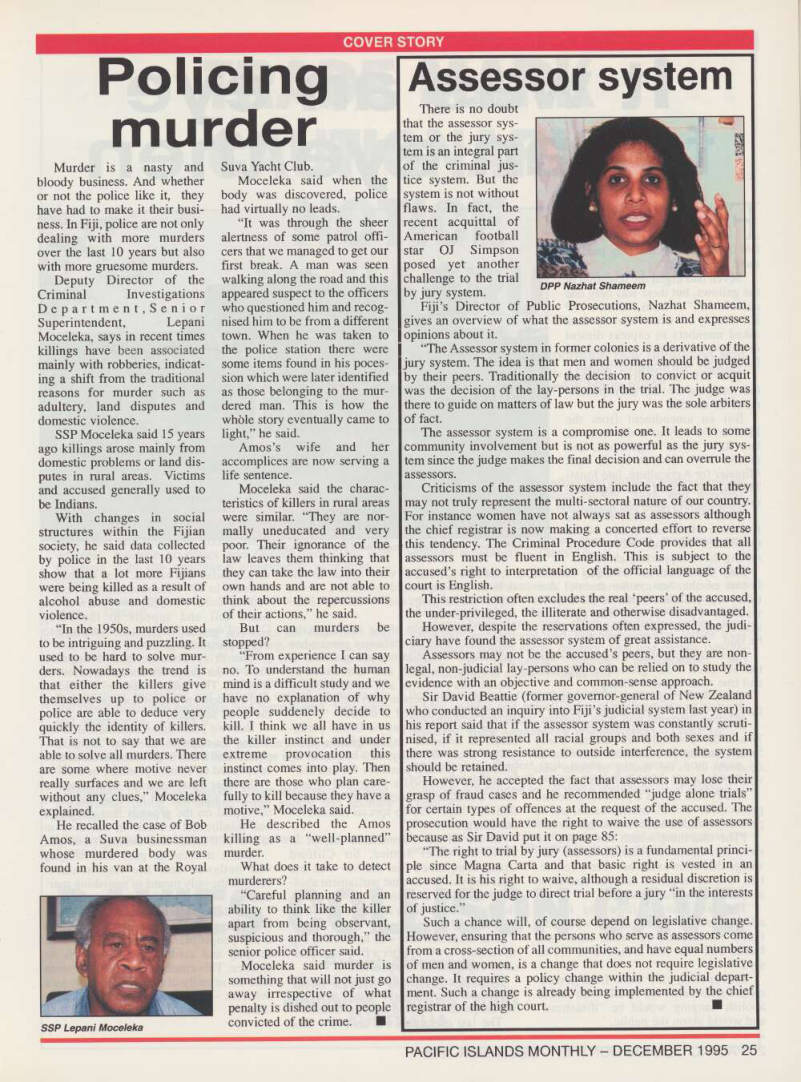
Cover Story
Policing murder
Murder is a nasty and bloody business. And whether or not the police like it, they have had to make it their busi ness. In Fiji, police are not only dealing with more murders over the last 10 years but also with more gruesome murders.
Deputy Director of the
Criminal Investigations
Department,Senior
Superintendent, Lepani
Moceleka, says in recent times killings have been associated mainly with robberies, indicat ing a shift from the traditional reasons for murder such as adultery, land disputes and domestic violence.
SSP Moceleka said 15 years ago killings arose mainly from domestic problems or land dis putes in rural areas. Victims and accused generally used to be Indians.
With changes in social structures within the Fijian society, he said data collected by police in the last 10 years show that a lot more Fijians were being killed as a result of alcohol abuse and domestic violence.
“In the 19505, murders used to be intriguing and puzzling. It used to be hard to solve mur ders. Nowadays the trend is that either the killers give themselves up to police or police are able to deduce very quickly the identity of killers.
That is not to say that we are able to solve all murders. There are some where motive never really surfaces and we are left without any clues,” Moceleka
explained.
He recalled the case of Bob Amos, a Suva businessman whose murdered body was found in his van at the Royal
Suva Yacht Club.
Moceleka said when the
body was discovered, police
had virtually no leads.
“It was through the sheer alertness of some patrol offi cers that we managed to get our first break. A man was seen walking along the road and this appeared suspect to the officers who questioned him and recog nised him to be from a different town. When he was taken to the police station there were some items found in his poces sion which were later identified as those belonging to the mur dered man. This is how the whole story eventually came to light,” he said.
Amos’s wife and her accomplices are now serving a life sentence.
Moceleka said the charac teristics of killers in rural areas were similar. “They are nor mally uneducated and very poor. Their ignorance of the law leaves them thinking that they can take the law into their own hands and are not able to think about the repercussions of their actions,” he said.
But can murders be
stopped?
“From experience I can say no. To understand the human mind is a difficult study and we have no explanation of why people suddenely decide to kill. I think we all have in us the killer instinct and under extreme provocation this instinct comes into play. Then there are those who plan care fully to kill because they have a motive,” Moceleka said.
He described the Amos
killing as a “well-planned”
murder.
What does it take to detect murderers?
“Careful planning and an ability to think like the killer apart from being observant,
suspicious and thorough,” the
senior police officer said.
Moceleka said murder is something that will not just go away irrespective of what penalty is dished out to people convicted of the crime. ■
SSP Lepani Moceleka
Assessor system
There is no doubt that the assessor sys tem or the jury sys tem is an integral part of the criminal jus tice system. But the system is not without flaws. In fact, the recent acquittal of American football star OJ Simpson posed yet another challenge to the trial by jury system.
Fiji’s Director of Public Prosecutions, Nazhat Shameem, gives an overview of what the assessor system is and expresses opinions about it.
“The Assessor system in former colonies is a derivative of the jury system. The idea is that men and women should be judged by their peers. Traditionally the decision to convict or acquit was the decision of the lay-persons in the trial. The judge was there to guide on matters of law but the jury was the sole arbiters of fact.
The assessor system is a compromise one. It leads to some community involvement but is not as powerful as the jury sys tem since the judge makes the final decision and can overrule the assessors.
Criticisms of the assessor system include the fact that they may not truly represent the multi-sectoral nature of our country.
For instance women have not always sat as assessors although the chief registrar is now making a concerted effort to reverse this tendency. The Criminal Procedure Code provides that all assessors must be fluent in English. This is subject to the accused’s right to interpretation of the official language of the court is English.
This restriction often excludes the real ‘peers’ of the accused, the under-privileged, the illiterate and otherwise disadvantaged.
However, despite the reservations often expressed, the judi ciary have found the assessor system of great assistance.
Assessors may not be the accused’s peers, but they are non legal, non-judicial lay-persons who can be relied on to study the evidence with an objective and common-sense approach.
Sir David Beattie (former governor-general of New Zealand who conducted an inquiry into Fiji’s judicial system last year) in his report said that if the assessor system was constantly scruti nised, if it represented all racial groups and both sexes and if there was strong resistance to outside interference, the system should be retained.
However, he accepted the fact that assessors may lose their grasp of fraud cases and he recommended “judge alone trials” for certain types of offences at the request of the accused. The prosecution would have the right to waive the use of assessors because as Sir David put it on page 85: “The right to trial by jury (assessors) is a fundamental princi ple since Magna Carta and that basic right is vested in an accused. It is his right to waive, although a residual discretion is reserved for the judge to direct trial before a jury “in the interests
of justice.”
Such a chance will, of course depend on legislative change.
However, ensuring that the persons who serve as assessors come from a cross-section of all communities, and have equal numbers of men and women, is a change that does not require legislative change. It requires a policy change within the judicial depart ment. Such a change is already being implemented by the chief registrar of the high court. U
DPP Nazhat Shameem
It was an eye
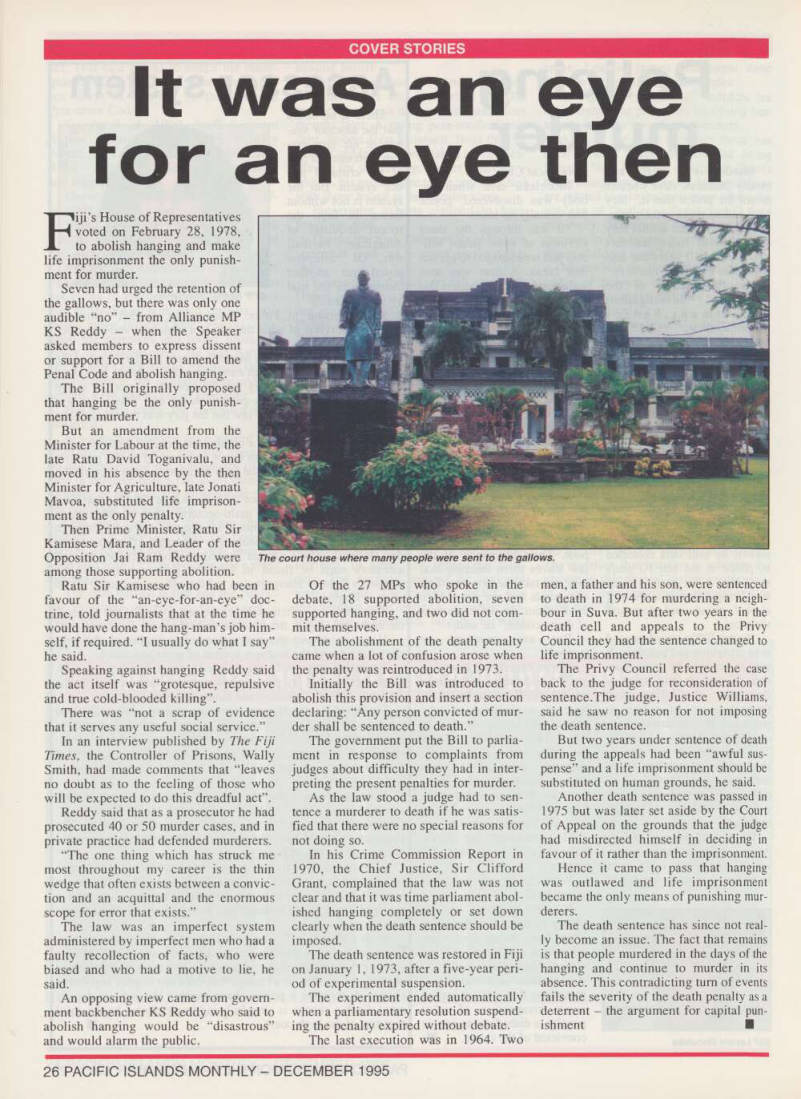
Cover Stories
It was an eye for an eye then
Fiji’s House of Representatives
voted on February 28, 1978, to abolish hanging and make life imprisonment the only punish ment for murder.
Seven had urged the retention of the gallows, but there was only one audible “no” - from Alliance MP KS Reddy - when the Speaker asked members to express dissent or support for a Bill to amend the Penal Code and abolish hanging.
The Bill originally proposed
that hanging be the only punish ment for murder.
But an amendment from the Minister for Labour at the time, the late Ratu David Toganivalu, and moved in his absence by the then Minister for Agriculture, late Jonati Mavoa, substituted life imprison ment as the only penalty.
Then Prime Minister, Ratu Sir Kamisese Mara, and Leader of the Opposition Jai Ram Reddy were among those supporting abolition.
Ratu Sir Kamisese who had been in favour of the “an-eye-for-an-eye” doc trine, told journalists that at the time he would have done the hang-man’s job him self, if required. “I usually do what I say” he said.
Speaking against hanging Reddy said the act itself was “grotesque, repulsive and true cold-blooded killing”.
There was “not a scrap of evidence that it serves any useful social service.”
In an interview published by The Fiji Times, the Controller of Prisons, Wally Smith, had made comments that “leaves no doubt as to the feeling of those who will be expected to do this dreadful act”.
Reddy said that as a prosecutor he had prosecuted 40 or 50 murder cases, and in private practice had defended murderers.
“The one thing which has struck me most throughout my career is the thin wedge that often exists between a convic tion and an acquittal and the enormous scope for error that exists.”
The law was an imperfect system administered by imperfect men who had a faulty recollection of facts, who were biased and who had a motive to lie, he said.
An opposing view came from govern ment backbencher KS Reddy who said to abolish hanging would be “disastrous” and would alarm the public.
Of the 27 MPs who spoke in the debate, 18 supported abolition, seven supported hanging, and two did not com mit themselves.
The abolishment of the death penalty came when a lot of confusion arose when the penalty was reintroduced in 1973.
Initially the Bill was introduced to abolish this provision and insert a section declaring: “Any person convicted of mur der shall be sentenced to death.”
The government put the Bill to parlia ment in response to complaints from judges about difficulty they had in inter preting the present penalties for murder.
As the law stood a judge had to sen tence a murderer to death if he was satis fied that there were no special reasons for not doing so.
In his Crime Commission Report in 1970, the Chief Justice, Sir Clifford Grant, complained that the law was not clear and that it was time parliament abol ished hanging completely or set down clearly when the death sentence should be
imposed.
The death sentence was restored in Fiji on January 1, 1973, after a five-year peri od of experimental suspension.
The experiment ended automatically
when a parliamentary resolution suspend
ing the penalty expired without debate.
The last execution was in 1964. Two
men, a father and his son, were sentenced to death in 1974 for murdering a neigh bour in Suva. But after two years in the death cell and appeals to the Privy Council they had the sentence changed to
life imprisonment.
The Privy Council referred the case back to the judge for reconsideration of sentence. The judge, Justice Williams, said he saw no reason for not imposing the death sentence.
But two years under sentence of death during the appeals had been “awful sus pense” and a life imprisonment should be substituted on human grounds, he said.
Another death sentence was passed in 1975 but was later set aside by the Court of Appeal on the grounds that the judge had misdirected himself in deciding in favour of it rather than the imprisonment.
Hence it came to pass that hanging was outlawed and life imprisonment became the only means of punishing mur derers.
The death sentence has since not real ly become an issue. The fact that remains is that people murdered in the days of the hanging and continue to murder in its absence. This contradicting turn of events fails the severity of the death penalty as a deterrent - the argument for capital pun ishment ■
The court house where many people were sent to the gallows.
Advertisements & other items, p. 27 (1 item)
Cautionary
TRADE MARK
NOTICE
IN NAURU
Notice is hereby given that Matsushita Electric Industrial Co. Ltd., a corporation duly organised and existing under the laws of Japan, of 1006, Oaza Kadoma, Kadoma-shi, Osaka Prefecture, Japan, Manufacturers, is the sole proprietor in Nauru and elsewhere of the following trade mark.
Panasonic
used in respect of:— Catalyst, oxidation catalyst, catalyst for exhaust gas purification, plastic molding materials, ceramic materials, rodent repeller, toner, developer for copier, absorbent — Class 1.
Machines and machine tools; motors (except for land vehicles): machine couplings and belting (except for land vehicles); large size agricultural implements; incubators — Class 7.
Hand tools and instruments; cutlery, forks and spoons; side arms — Class 8.
Scientific, nautical, surveying and electrical apparatus and instruments (including wireless), weighing, measuring, signalling, checking (supervision), life-saving and teaching apparatus and instruments; coin or counter-freed apparatus; talking machines: cash registers; calculating machines; fireextinguishing apparatus, but excluding optical, photographic and cinematographic apparatus and instruments, their parts and accessories — Class 9.
Surgical, medical, dental and veterinary instruments and apparatus (inluding artificial limbs, eyes and teeth) — Class 10.
Installations for lighting, heating, steam generating, cooking, refrigerating, drying, ventilating, water supply and sanitary purposes — Class II.
Vehicles; apparatus for locomotion by land, air or water — Class 12.
Precious metals and their alloys and goods in precious metals or coated therewith (except cutlery, forks and spoons); jewellery, precious stones, horological and other chronometric instruments — Class 14.
Musical Instruments (other than talking machines and wireless apparatus) — Class 15.
Paper, cardboard articles of paper or of cardboard (not included in other classes); printed matter, newspapers and periodicals, books; book-binding material; stationery, adhesive materials (stationery): artists’ materials; paint brushes; typewriters and office requisites (other than furniture): instructional and teaching material (other than apparatus): playing cards; printers’ type and cliches (stereotype), but excluding optical, photographic and cinematographic paper — Class 16.
Building materials, natural and artificial stone, cement, lime, mortar, plaster and gravel; pipes of earthenware or cement; road-making materials; asphalt, pitch and bitumen; portable buildings: stone monuments; chimney pots — Class 19.
Furniture, mirrors, picture frames; articles (not included in other classes) of wood, cork, reeds, cane, wicker, horn, bone, ivory, whalebone, shell, amber, mother-of-pearl, meerschaum, celluloid, substitutes for all these materials, or of plastics — Class 20.
The said proprietor claims all rights in respect of the above trade mark and will take all necessary legal steps against any person or company infringing their said rights.
DAVIES COLLISON CAVE
Patent Attorneys
One Little Collins Street
Melbourne, Victoria, 3000
AUSTRALIA.
Fiji cashes in on chips
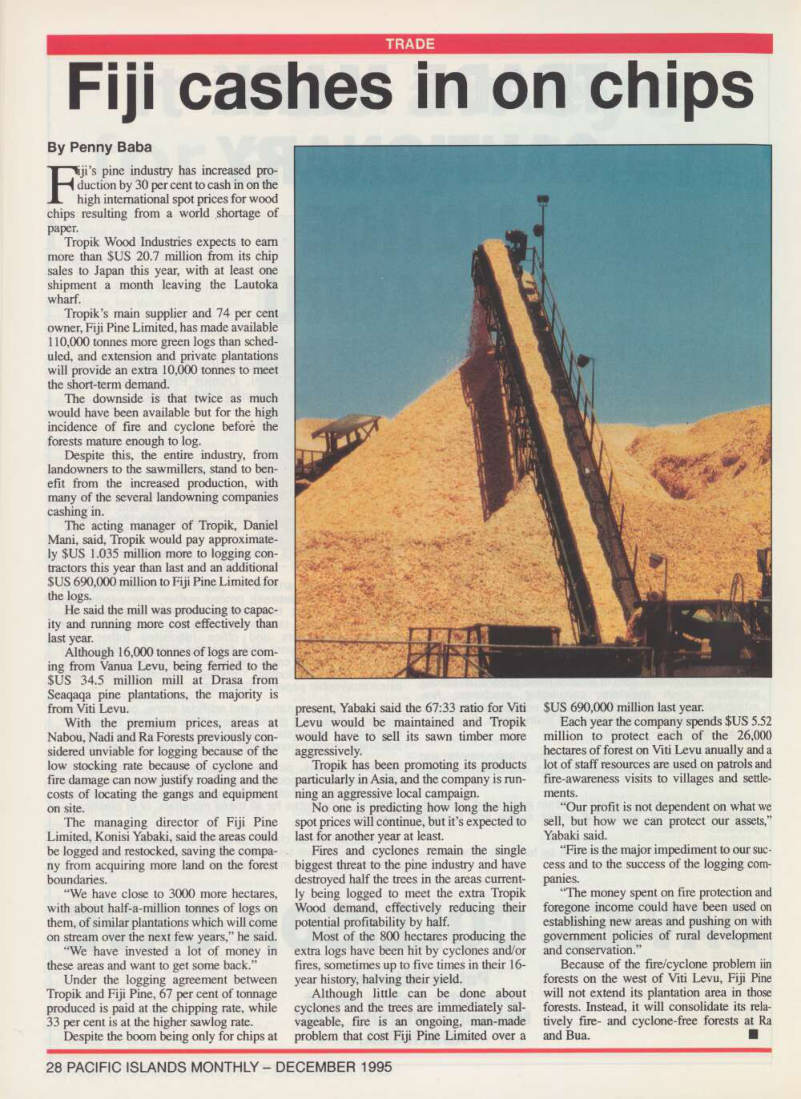
Trade
By Penny Baba
Fiji’s pine industry has increased pro duction by 30 per cent to cash in on the high international spot prices for wood chips resulting from a world shortage of paper.
Tropik Wood Industries expects to earn more than SUS 20.7 million from its chip sales to Japan this year, with at least one shipment a month leaving the Lautoka wharf.
Tropik’s main supplier and 74 per cent owner, Fiji Pine Limited, has made available 110,000 tonnes more green logs than sched uled, and extension and private plantations will provide an extra 10,000 tonnes to meet the short-term demand.
The downside is that twice as much would have been available but for the high incidence of fire and cyclone before the forests mature enough to log.
Despite this, the entire industry, from landowners to the sawmillers, stand to ben efit from the increased production, with many of the several landowning companies cashing in.
The acting manager of Tropik, Daniel Mani, said, Tropik would pay approximate ly SUS 1.035 million more to logging con tractors this year than last and an additional SUS 690,000 million to Fiji Pine Limited for the logs.
He said the mill was producing to capac ity and miming more cost effectively than last year.
Although 16,000 tonnes of logs are com ing from Vanua Levu, being ferried to the SUS 34.5 million mill at Drasa from Seaqaqa pine plantations, the majority is from Viti Levu.
With the premium prices, areas at Nabou, Nadi and Ra Forests previously con sidered unviable for logging because of the low stocking rate because of cyclone and fire damage can now justify reading and the costs of locating the gangs and equipment on site.
The managing director of Fiji Pine Limited, Konisi Yabaki, said the areas could be logged and restocked, saving the compa ny from acquiring more land on the forest boundaries.
“We have close to 3000 more hectares, with about half-a-million tonnes of logs on them, of similar plantations which will come on stream over the next few years,” he said.
“We have invested a lot of money in these areas and want to get some back.”
Under the logging agreement between Tropik and Fiji Pine, 67 per cent of tonnage produced is paid at the chipping rate, while 33 per cent is at the higher sawlog rate.
Despite the boom being only for chips at
present, Yabaki said the 67:33 ratio for Viti Levu would be maintained and Tropik would have to sell its sawn timber more aggressively.
Tropik has been promoting its products particularly in Asia, and the company is run ning an aggressive local campaign.
No one is predicting how long the high spot prices will continue, but it’s expected to last for another year at least.
Fires and cyclones remain the single biggest threat to the pine industry and have destroyed half the trees in the areas current ly being logged to meet the extra Tropik Wood demand, effectively reducing their potential profitability by half.
Most of the 800 hectares producing the extra logs have been hit by cyclones and/or fires, sometimes up to five times in their 16year history, halving their yield.
Although little can be done about cyclones and the trees are immediately sal vageable, fire is an ongoing, man-made problem that cost Fiji Pine Limited over a
SUS 690,000 million last year.
Each year the company spends SUS 5.52 million to protect each of the 26,000 hectares of forest on Viti Levu anually and a lot of staff resources are used on patrols and fire-awareness visits to villages and settle ments.
“Our profit is not dependent on what we sell, but how we can protect our assets,”
Yabaki said.
“Fire is the major impediment to our sue cess and to the success of the logging corn
panics.
“The money spent on fire protection and foregone income could have been used on establishing new areas and pushing on with government policies of rural development and conservation.”
Because of the fire/cyclone problem iin forests on the west of Viti Levu, Fiji Pine will not extend its plantation area in those forests. Instead, it will consolidate its rela lively fire- and cyclone-free forests at Ra and Bua. ■
The soaring success
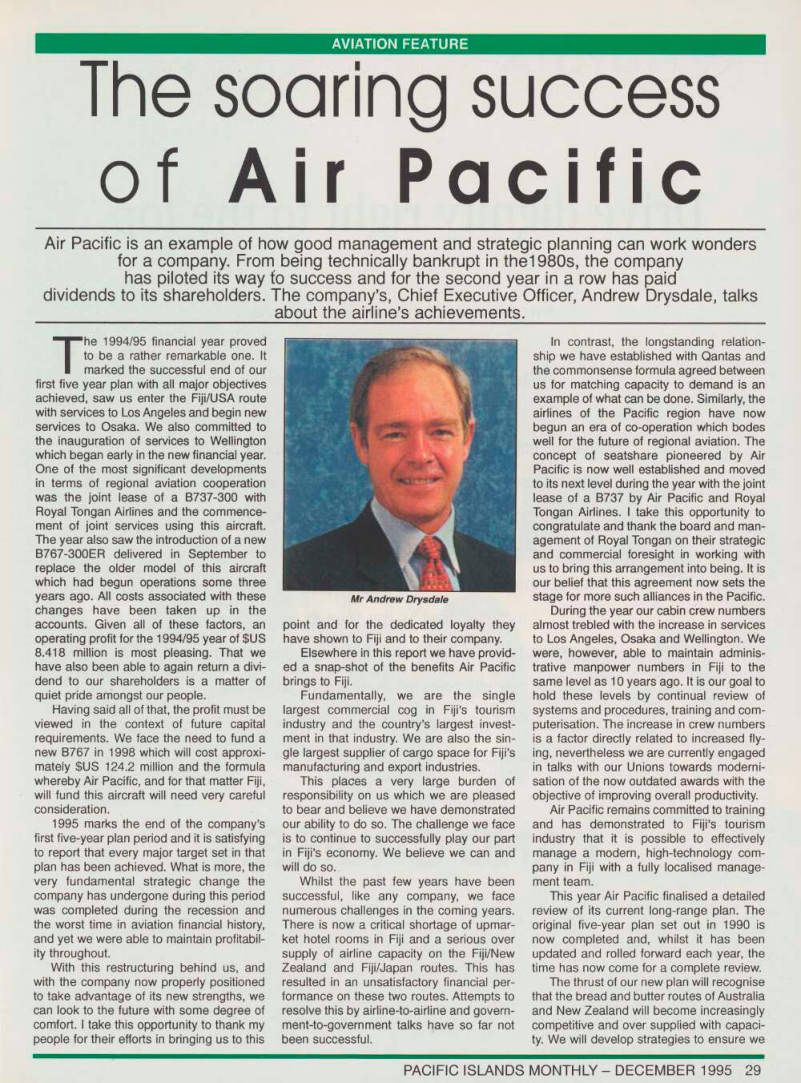


Aviation Feature
The soaring success of Air Pacific
Air Pacific is an example of how good management and strategic planning can work wonders for a company. From being technically bankrupt in thel9Bos, the company has piloted its way to success and for the second year in a row has paid dividends to its shareholders. The company’s, Chief Executive Officer, Andrew Drysdale, talks about the airline’s achievements.
The 1994/95 financial year proved to be a rather remarkable one. It marked the successful end of our first five year plan with all major objectives achieved, saw us enter the Fiji/USA route with services to Los Angeles and begin new services to Osaka. We also committed to the inauguration of services to Wellington which began early in the new financial year.
One of the most significant developments in terms of regional aviation cooperation was the joint lease of a 8737-300 with Royal Tongan Airlines and the commence ment of joint services using this aircraft.
The year also saw the introduction of a new 8767-300 ER delivered in September to replace the older model of this aircraft which had begun operations some three years ago. All costs associated with these changes have been taken up in the accounts. Given all of these factors, an operating profit for the 1994/95 year of SUS 8.418 million is most pleasing. That we have also been able to again return a divi dend to our shareholders is a matter of quiet pride amongst our people.
Having said all of that, the profit must be viewed in the context of future capital requirements. We face the need to fund a new 8767 in 1998 which will cost approxi mately SUS 124.2 million and the formula whereby Air Pacific, and for that matter Fiji, will fund this aircraft wilt need very careful consideration. 1995 marks the end of the company’s first five-year plan period and it is satisfying to report that every major target set in that plan has been achieved. What is more, the very fundamental strategic change the company has undergone during this period was completed during the recession and the worst time in aviation financial history, and yet we were able to maintain profitabil ity throughout.
With this restructuring behind us, and with the company now properly positioned to take advantage of its new strengths, we can look to the future with some degree of comfort. I take this opportunity to thank my people for their efforts in bringing us to this
point and for the dedicated loyalty they have shown to Fiji and to their company.
Elsewhere in this report we have provid ed a snap-shot of the benefits Air Pacific brings to Fiji.
Fundamentally, we are the single largest commercial cog in Fiji’s tourism industry and the country’s largest invest ment in that industry. We are also the sin gle largest supplier of cargo space for Fiji’s manufacturing and export industries.
This places a very large burden of responsibility on us which we are pleased to bear and believe we have demonstrated our ability to do so. The challenge we face is to continue to successfully play our part in Fiji’s economy. We believe we can and will do so.
Whilst the past few years have been successful, like any company, we face numerous challenges in the coming years.
There is now a critical shortage of upmar ket hotel rooms in Fiji and a serious over supply of airline capacity on the Fiji/New Zealand and Fiji/Japan routes. This has resulted in an unsatisfactory financial per formance on these two routes. Attempts to resolve this by airline-to-airline and govern ment-to-government talks have so far not been successful.
In contrast, the longstanding relation ship we have established with Qantas and the commonsense formula agreed between us for matching capacity to demand is an example of what can be done. Similarly, the airlines of the Pacific region have now begun an era of co-operation which bodes well for the future of regional aviation. The concept of seatshare pioneered by Air Pacific is now well established and moved to its next level during the year with the joint lease of a 8737 by Air Pacific and Royal Tongan Airlines. I take this opportunity to congratulate and thank the board and man agement of Royal Tongan on their strategic and commercial foresight in working with us to bring this arrangement into being. It is our belief that this agreement now sets the stage for more such alliances in the Pacific.
During the year our cabin crew numbers almost trebled with the increase in services to Los Angeles, Osaka and Wellington. We were, however, able to maintain adminis trative manpower numbers in Fiji to the same level as 10 years ago. It is our goal to hold these levels by continual review of systems and procedures, training and com puterisation. The increase in crew numbers is a factor directly related to increased fly ing, nevertheless we are currently engaged in talks with our Unions towards moderni sation of the now outdated awards with the objective of improving overall productivity.
Air Pacific remains committed to training and has demonstrated to Fiji’s tourism industry that it is possible to effectively manage a modern, high-technology com pany in Fiji with a fully localised manage ment team.
This year Air Pacific finalised a detailed review of its current long-range plan. The original five-year plan set out in 1990 is now completed and, whilst it has been updated and rolled forward each year, the time has now come for a complete review.
The thrust of our new plan will recognise that the bread and butter routes of Australia and New Zealand will become increasingly competitive and over supplied with capaci ty. We will develop strategies to ensure we
Mr Andrew Drysdale
maintain our market share in this very diffi cult environment. A major change from five years ago is that Asia is now also over-sup plied with capacity and yields are falling.
Again, strategies will be developed to ensure we hold our place in these markets and we will need to forge new and innova tive alliances to be able to do so. The thrust, however, will be to build our links to North America and beyond into Europe. To do so we will further develop the alliance with Qantas and to seek other affiliated partners beyond Los Angeles into Europe.
One aspect which will feature strongly in this plan is Fiji’s hotel room constraint. Air Pacific has already undertaken studies on the viability of constructing a new upmar ket hotel and is committed to acting as a catalyst to see this project to completion.
The past five years have seen very large strategic changes to Air Pacific. The next five years will see growth built upon this new base. We will see increasing com petition and stagnant or reducing yields. Air Pacific will respond by innovative market ing, differentiated high quality product, maximising the strategic benefit of the Nadi hub and by building a network of commer cial alliances. We are confident that the success of the past five years will continue.
An Historical Milestone
The end of this financial year saw the expiration of the Qantas Support Agreement, an alliance which was intro duced in 1984/85, when the airline was technically bankrupt, in order to ensure our continued operation.
Over the last five years this agreement has evolved into a firm, deeply-rooted but commercial business commitment by both
parties and it is pleasing that a new agree ment is now in place which continues this commercial relationship between the two companies.
Marketing
The selling of Fiji has become a major role for Air Pacific’s marketing effort in all regions. In the space of the last 12 months Air Pacific has invested in excess of SUS 48.3 million in mainstream advertising, pro motion, public relations, commission pay ments, familiarisation trips and other asso ciated marketing-related activities.
The investment obviously paid divi dends. For not only were visitor arrivals to Fiji at an all time record, total passengers carried on all international routes recorded a growth of 8.6 per cent. This result is even more pleasing when compared to the neg ative growth experienced the previous year.
The main focus of our marketing effort during the year obviously centred on the planning and subsequent launch of two new services, Los Angeles and Osaka.
North America
Following the board’s approval in December 1993, a once per week 8747 direct service to Los Angeles was launched in July. The service was specifically designed to boost dedicated North American vacationer numbers to Fiji.
Prior to the launch, nearly 70 per cent of North American traffic stopped over on the way to or from Australia and New Zealand - their main destinations.
To help achieve this objective of dedi cating holiday traffic to Fiji, a first was cre ated with appointment of the company’s only in-house tour wholesaling operation -
Air Pacific Holidays - operated by Brendan Holidays, a reputable South Pacific focused tour wholesaler based in California.
Other marketing initiatives, designed to stimulate activity and awareness of Fiji included participation in the largest-ever promotional campaign mounted by the Fiji Visitors Bureau and the local industry which saw over 30 participants from the Fiji plant visiting the major cities on the West Coast of the USA and Canada.
Australia
Australia is our most important source market. It was therefore encouraging to see this market experience a substantial turn around in the 1994/95 year.
As a result of a concerted and sustained promotional effort by the company, the Fiji Visitors Bureau and the industry in general, utilising press and television in key mar kets, a 10 per cent growth in carriage was achieved on the Australian routes. This helped creates a momentum which assist ed our performance in that market through the rest of the year, despite keen competi tion from overseas competitors and internal Australian destinations in particular.
The termination of the Qantas Support Agreement at the end of this financial year provided the opportunity for Air Pacific to conduct another review of its sales opera tion within Australia. A number of options, including self-representation using Air Pacific staff, were considered but in the end, a continuation of Qantas’ appointment as General Sales Agent, was considered to be the most cost effective solution.
New Zealand
The growth trend experienced in New
Modern jets which have helped carry Air Pacific to new destinations.
Zealand over past years continued in 1994/95 with increases coming mainly on the direct services between Auckland and Suva.
The airline’s growth, however, did not match the almost 31 per cent increase in visitor arrivals from New Zealand experi enced during the 1994 calendar year.
Market share loss was the result of addi tional capacity provided on the Nadi- Auckland route occasioned by increased through flights to Japan and North America by the competition.
This extraordinary growth in visitor arrivals is a positive development and places Fiji as the third most popular desti nation out of New Zealand.
Vfr Traffic
On both the Australian and New Zealand routes, good levels of VFR (visit ing friends and relatives) traffic was experi enced. This traffic is steadily assuming an increasing share of our carriage on the routes.
Japan
Air Pacific suffered a considerable set back in Japan with our Tokyo flights down almost 18 per cent on last year’s levels. A contributing factor to this reduction was the inability of a key market segment, honey mooners, to secure five-star accommoda tion in Fiji during peak season. In some instances overbookings resulted in clients being moved to other hotels. This influ enced some major Japanese wholesalers to seek alternative destinations for their honeymoon travellers.
A major industry campaign was launched in March of this year in Tokyo and Osaka to woo back the honeymooners and correct a misunderstanding that Fiji was continually fully booked.
The launch of the Osaka service in October added additional capacity (two 767 services per week) to the large Japan mar ket.
Additional capacity was mounted during the year by the competition, with three more flights operating out of Nagoya, pro ceeding the launch of the Osaka service.
Combined, the services created an over capacity on the Japan routes yielding a total visitor arrival increase of just 4 per cent for the year 1994.
Over the course of the year we reviewed our distribution process in Japan and our advertising agency relationship. Important changes were introduced in both areas and, effective the start of our new financial year, we will be working with a new adver tising agency partner in Japan.
Agreements
In May 1994, Air Pacific concluded a seat purchase agreement with Royal Tongan Airlines.
The Royal Tongan relationship then took a new and exciting turn shortly after the agreement was ratified when both air-
lines identified requirements for operating time on a 8737 aircraft. This led to discus sions with Ansett Worldwide Aviation Services in October, ultimately resulting in the joint leasing of a Boeing 737-300 series aircraft.
In late January of this year, a 8737-300 joined the fleet, embarking upon its maiden flight to Tonga on Saturday, January 28. On arrival in Tonga, a joint operating agree ment was signed by the chairmen of Royal Tongan Airlines and Air Pacific Limited.
A unique and distinctive feature of the aircraft is that it has Air Pacific livery on its port side and Royal Tongan colours on the starboard side.
This agreement was seen as a break through for regional air services and the beginning of an era of co-operation between regional airlines,. which should benefit struggling Pacific Island carriers.
Air Pacific: Where To From
Here?
Air Pacific has worked hard to achieve its status as a player in the world of aviation and tourism. We can now confidently stand and have our say on issues of importance to the future of our industry. Our senior executives are actively involved on boards and committees such as PATA, lATA and ASPA and are increasingly being called upon for contribution and advice.
We have positioned the airline as low cost, efficient, high quality, strategically located carrier; an entrepreneurial airline able to quickly seize opportunities when they arise.
The past five years have been spent changing Air Pacific from being a regional,
to an international airline. We’ve carefully prepared the ground work and have made ready for the next phase of growth which will primarily focus on the Northern Hemisphere.
To achieve the objectives and targets to the year 2000, strong strategic alliances will be necessary. These are now either in place or in the final stages of implementa tion.
Whilst we see our future direction clear ly, there is obviously still a very much polarised debate about the role of Air Pacific. The question continues to be asked as to whether we should focus on profit as a company or whether we exist to provide and cater for Fiji’s tourism infrastructure?
The answer is simple - without the prof its the infrastructure cannot be created and Fiji’s tourism industry will suffer.
The South West Pacific Basin is a grouping of small island nations that is becoming increasingly important to tourism flows and trends as the world seeks differ ent and more exotic holiday destinations.
Nadi, as the Hub of the Pacific, provides Air Pacific with a strong strategic position.
We are well situated geographically to han dle international traffic originating from both hemispheres and also occupy the unique position of being the logical hub for region al island traffic.
We have the product: The crews, the aircraft, the support services, the desire and above all the ability to take advantage of this unique geographical position we occupy. It bodes well for the future of Fiji’s international airline. ■
Preparing for greater heights and more destinations. Air Pacific pilots.
Advertisements & other items, pp. 30-34 (1 item)
Drive dignity right to the top.
® TOYOTA
Everyone who knows cars has no doubts about Land Cruiser’s ruggedness.
Yet how many know that its luxury rivals the finest high-priced cars?
Or that it’s got more room inside than many luxury sedans?
And because it’s a Toyota, Land Cruiser’s fit and finish, attention to detail, and graceful form speak of elegance as well as spacious comfort.
Yet you still get tough ladder frames and suspension built to take you as far off road as you want to go.
With power from 4.5-litre petrol or 4.2-litre diesel engines.
And it’s carefully protected from rust to last longer.
So if you’re going right to the top, this dignified car is ready to take you.
LAND CRUISER
DISTRIBUTORS/DEALERS
AMERICAN SAMOA BURNS PHILP MOTORS PH 633 4281 COOK ISLANDS PACIFIC MOTORS LTD. PH 20796 GUAM & MICRONESIA ...ATKINS KROLL, INC. PH 646-1876/9 KIRIBATI TARAWA MOTORS PH 21090 NORFOLK ISLAND BORRY’S PTY LTD. PH 22114 PAPUA NEW GUINEA ELA MOTORS PH 3229400 SOLOMON ISLAND ELA MOTORS PH 30314 TAHITI NIPPON AUTOMOTO PH 429819 VANUATU ASCO MOTORS PH 22341 WESTERN SAMOA ASCO MOTORS PH 20800
FIJI ASCO MOTORS PH 384i8
NEW CALEDONIA S.I.A.P. PH 275)2
SAIPAN MICROL CORPORATION PH 234911
TONGA ASCO MOTORS PH 235»
fe' If ,|| I
■ }<d i|* *iSS «1!W ■ .. - 1 1 t r.
GREAT NEWS FROM
AIR PACIFIC FOR OANTAS
FREQUENT FLYERS.
If you’re a Qantas Frequent Flyer, Air Pacific has news for you. Fiji’s international airline, has joined the Qantas Frequent Flyer program.
That means wherever you travel on Air Pacific - and we fly to fifteen destinations around the Pacific - you can earn valuable points in the Qantas Frequent Flyer program. And, you can redeem for travel on Air Pacific too.
Book now at any Air Pacific Sales Office or travel agent. Points will automatically be credited to you when you fly with Air Pacific.
r AIR PACIFIC
FIJI'S INTERNATIONAL AIRLINE
SUVA • NADI • MELBOURNE • SYDNEY • BRISBANE • AUCKLAND • CHRISTCHURCH • WELLINGTON • TOKYO • OSAKA • LOS ANGELES • PORT VILA • TONGA • HONIARA • APIA
WILSON ADDISON 07.955
as? - /V s.
Si X* ;
THE AIR BP NETWORK
IN AUSTRALASIA
Air BP provide aviation fuel at around 150
locations throughout Australia, New Zealand
and the South West Pacific.
A
Polynesian Airlines,
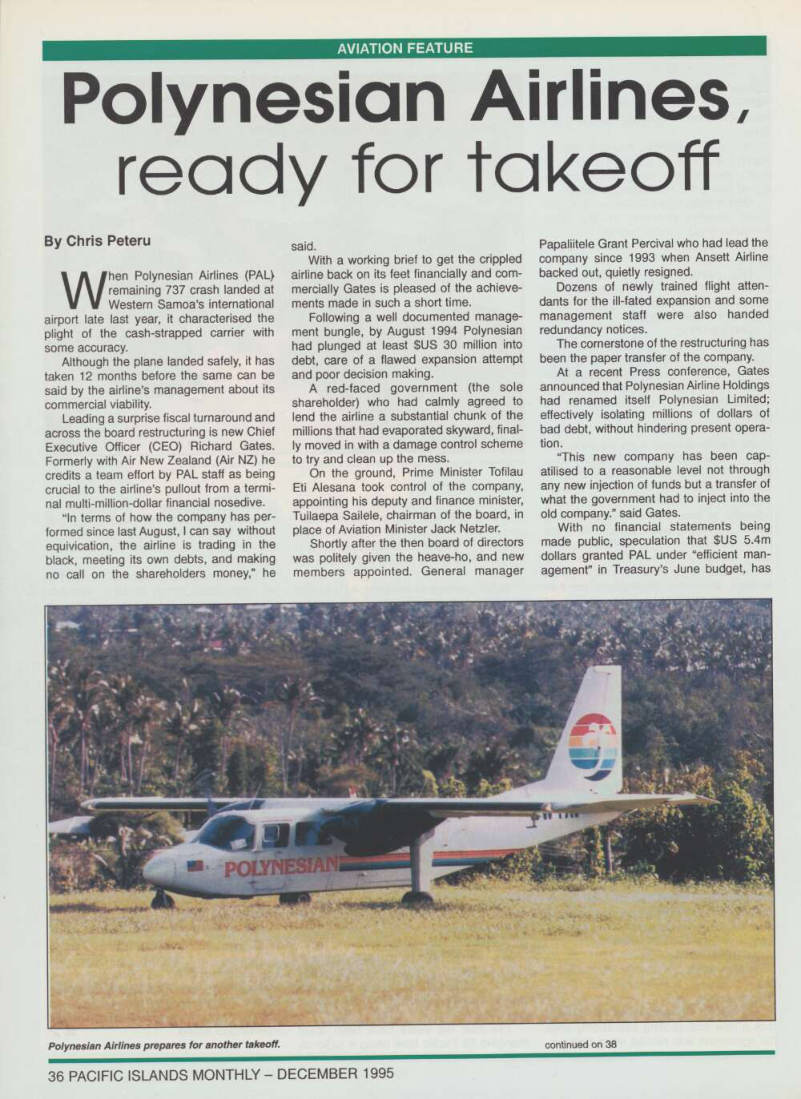
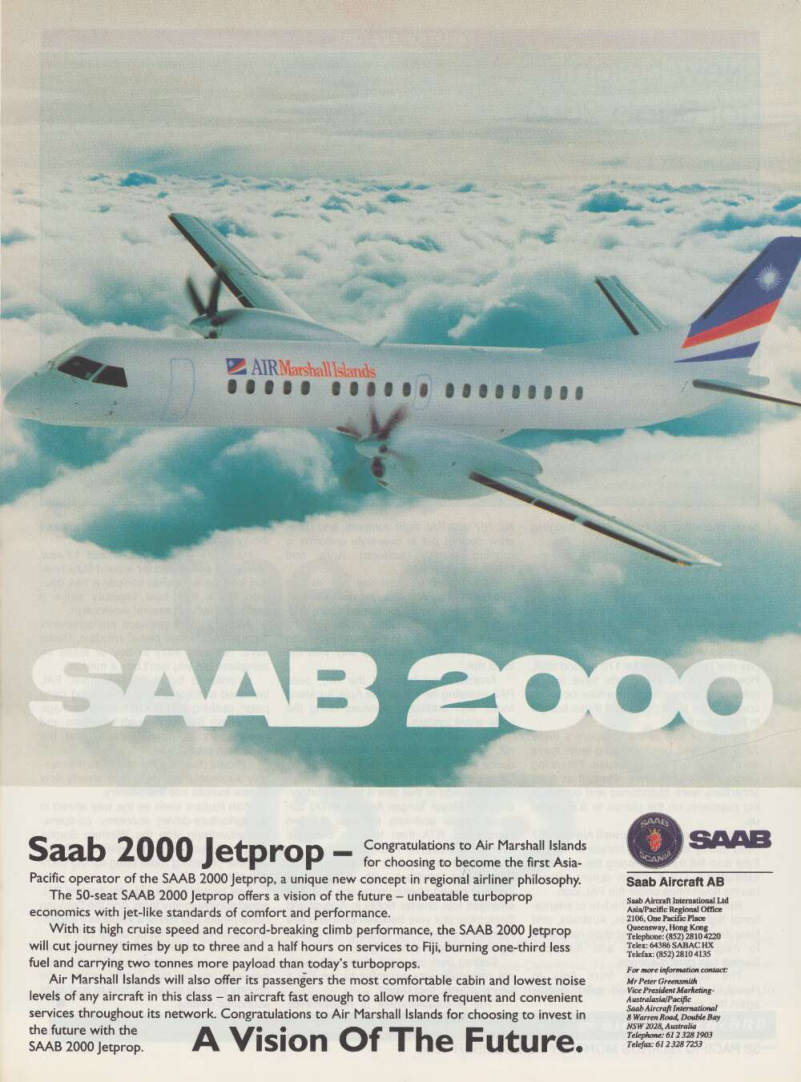
ready for takeoff
By Chris Peteru
When Polynesian Airlines (PAL) remaining 737 crash landed at Western Samoa’s international airport late last year, it characterised the plight of the cash-strapped carrier with some accuracy.
Although the plane landed safely, it has taken 12 months before the same can be said by the airline’s management about its commercial viability.
Leading a surprise fiscal turnaround and across the board restructuring is new Chief Executive Officer (CEO) Richard Gates.
Formerly with Air New Zealand (Air NZ) he credits a team effort by PAL staff as being crucial to the airline’s pullout from a termi nal multi-million-dollar financial nosedive.
“In terms of how the company has per formed since last August, I can say without equivication, the airline is trading in the black, meeting its own debts, and making no call on the shareholders money,” he
With a working brief to get the crippled airline back on its feet financially and commercially Gates is pleased of the achievements made in such a short time.
Following a well documented management bungle, by August 1994 Polynesian had plunged at least SUS 30 million into debt, care of a flawed expansion attempt and poor decision making.
A red-faced government (the sole shareholder) who had calmly agreed to lend the airline a substantial chunk of the millions that had evaporated skyward, finally moved in with a damage control scheme to try and clean up the mess.
On the ground, Prime Minister Tofilau Eti Alesana took control of the company, appointing his deputy and finance minister, Tuilaepa Sailele, chairman of the board, in place of Aviation Minister Jack Netzler.
Shortly after the then board of directors was politely given the heave-ho, and new members appointed. General manager
Papaliitele Grant Percival who had lead the company since 1993 when Ansett Airline backed out, quietly resigned, Dozens of newly trained flight atten dants for the ill-fated expansion and some management staff were also handed redundancy notices, The cornerstone of the restructuring has been the paper transfer of the company, At a recent Press conference, Gates announced that Polynesian Airline Holdings had renamed itself Polynesian Limited, effectively isolating millions of dollars of bad debt, without hindering present opera tion.
“This new company has been cap atilised to a reasonable level not through any new injection of funds but a transfer of what the government had to inject into the old company.” said Gates, With no financial statements being made public, speculation that SUS 5.4 m dollars granted PAL under efficient man agement in Treasury s June budget, has
continued on 38
Polynesian Airlines prepares for another takeoff.
been chanelled to bankroll the fledgling Polynesian Limited.
The move also provides the government, if it wants, the option to privatise in the long term, and tidies up the financial aspects cleanly, said Gates.
Employment contracts for most of the airline’s 350 staff under the new name have been drawn up and signed. Included is improved working conditions plus their first pay rise in eight years for 170 ground staff, However, all 30 PAL pilots have so far refused to sign, citing disparities between contracts for local pilots and those bought in from overseas.
In the air two of the company’s three 737 s that had been on long-term lease from the International Lease Financing Corporation (ILFC) were returned as flight schedules were abandoned and outstanding payments on the planes to ILFC piled U p Earlier, a lease on a Kuwaiti Airlines 767 used mainly to transport horses in the Far East also fell through, losing the airline an estimated $ US 3 million dollars without having flown once under the PAL logo.
Returning to a core schedule of international flights between Apia, Australia, and New Zealand, plus regular short-haul work to neighbouring Savaii and American Samoa has paid dividends.
The northern route from Apia to Honolulu which had been axed, begins again this month.
A code-share agreement, using an Air
NZ 767 with PAL flight numbers, and cabin crew decked out in new-style uniforms is running weekly between Apia and Honolulu.
Early 1996 that service will extend through to Los Angeles, providing in revenue terms a boost for the company balance sheet, believes Gates.
“It’s a step back into the North American market in a very measured way with the least risk.”
Another deal between the two, sees PAL assisting Air NZ on the Apia/Auckland route, with additional services using the code-share system.
Significantly, the association with Air NZ, may have signalled renewed confidence in the carrier from the airline industry following last year’s spectacular debacle, The downside of that saw a fruitful partnership with Royal Tongan Airlines (RTA) collapse amidst acrimony between the two companies. RTA then took its business over to Fiji-based Air Pacific.
More Brownie points were lost, when PAL broke contract with a big New Zealand-based charter company that had arranged four charter flights in August and September last year between Brisbane and Hamilton using PAL aircraft. Air Nauru agreed to take over the flights.
Getting back on good terms with earners regionally was essential to the PAL’s future growth, said Gates.
“The re-establishment of relationships after the poor performance of Polynesian in
the past was difficult but not as difficult as I thought it would be.”
Hardware wise, an additional 19-seat Twin Otter purchased for around SUS Imil lion from an Australian company, has dou bled PAL’s short-haul capacity since it came into service several weeks ago.
Alluding to the previous managements “Lets lease another plane” mindset, Gates says, “It’s very easy to buy or lease an aeroplane but you can’t buy a market”.
In order to boost market share, PAL launched a major first up advertising cam paign, pushing a $ US 400 holiday package to Western Samoa through television and newspapers in New Zealand, and the Australian print media, Officials describe the result as “remark ably successful” generating a steady flow of new tourists into the country, With tourism seen as the way ahead in an agriculture-driven economy, co-opera tive advertising with the Western Samoa Visitors Bureau is in the pipeline with the purpose of getting more bang for the corn pany’s buck.
Few people in the industry thought PAL would survive in any form. And the Samoan Government has learnt a valuable if expen sive lesson in how not to run an airline, The one redeeming the factor is that as PAL taxis returns more confidently onto runways around the Pacific region, the country still has an opportunity to control its economic destiny. ■
Advertisements & other items, p. 37 (1 item)
SAAB 2000 Jetprop. A Vision Of The Future.
Saab 2000 letOrOD— Congratulations to Air Marshall Islands “ w w w I for choosing to become the first Asia- Pacific operator of the SAAB 2000 Jetprop, a unique new concept in regional airliner philosophy.
The 50-seat SAAB 2000 Jetprop offers a vision of the future - unbeatable turboprop economics with jet-like standards of comfort and performance.
With its high cruise speed and record-breaking climb performance, the SAAB 2000 Jetprop will cut journey times by up to three and a half hours on services to Fiji, burning one-third less fuel and carrying two tonnes more payload than today’s turboprops.
Air Marshall Islands will also offer its passengers the most comfortable cabin and lowest noise levels of any aircraft in this class - an aircraft fast enough to allow more frequent and convenient services throughout its network. Congratulations to Air Marshall Islands for choosing to invest in SAAB 2000 Jetprop. A Vision Of The Future.
Saab Aircraft AB Saab Aircraft International Ltd Asia/Pacific Regional Office 2106, One Pacific Place Queensway, Hong Kong Telephone: (852) 2810 4220 Telex; 64386 SABACHX Telefax: (852) 2810 4135 For more information contact: Mr Peter Greensmith Vice President Marketing- A ustralasia/Pacific Saab Aircraft International 8 Warren Road, Double Bay NSW2O2B, Australia Telephone: 6123281903 Telefax: 612328 7253
New heights
for Saab 2000
The Saab 2000 Jet Prop has already after its first year of commercial service proved to be an international success with both opera tors and passengers. Lead operator Crossair of Switzerland has been joined by Deutsche BA of Germany, Regional Airline of France, Air Marshall Islands in the Pacific and GMWTS in the US. A total of 18 Saab 2000 s are now in service and have carried 420,000 passengers on nearly 16,000 flights.
Crossair of Switzerland put its first Saab 2000 Jet Prop into service in September 1994 and currently operates a fleet of 11 air craft out of a total firm commitment of 20 air craft and 25 options. The aircraft’s unique combination of jet-like performance and Turboprop economy has permitted Crossair to further build its extensive European net work with new “Market Maker” services soon to include Basel, Switzerland to Manchester, UK.
Andre Dose, Vice President Operations of Crossair says: “Saab 2000 has the same range and almost the same airspeed as a jet.
The Saab 2000 has really become the multi purpose tool in our fleet, serving a mixture of shorter and longer flights, fitting into jet pat terns and providing high frequency on busi ness routes such as Paris to Basel where it replaced the Avro RJ twice daily with five daily services”.
Josef Felder, Vice President Marketing of Crossair said: “We concentrated on the fact that once the passenger is seated he should have the same comfort level as on the (five abreast) Jumbolino. Our fully reclinable leather seats are amongst the widest of the narrowbody jets and with a seat pitch of 32 inches we are on par with that offered on the Airbus A 320, MDBO and Boeing 737, even with a full complement of passengers we have no problems in accommodating hand luggage”.
Deutsche BA of Friedrechshafen, Germany became European’s second Saab 2000 Jet Prop operator and currently oper ates three aircraft and is expecting another two later this year. Scheduled services are flown to major European business centers as well as feeder services into British Airways secondary London hub at Gatwick.
New long, thin routes into eastern Europe have been opened up and charter services of over two-and-a-half hours are routinely operated during weekends.
The third operator, Regional Airlines of Nantes, France, currently operates two Saab 2000 Jet Props. The airline applied the full “Market Maker” potential of the aircraft by introducing international services between a number of secondary cities for the first time.
New services include Lyon to Madrid, Barcelona Toulouse and Nantes to Clermont Ferrand and Milan.
Air Marshall Islands took delivery of its first Saab 2000 in June 1995 and immedi ately introduced it on the Majuro-to-Fiji route, about the same distance as from Stockholm to Casablanca. Sector lengths in this sparse ly populated part of the world are long and services benefit from the Saab 2000’s speed capability. The Saab 2000 cuts three-and-a half hours off the route time versus previous generation turboprops whilst burning one third less fuel. In addition the load carrying capability is increased by two tonnes. The President of the Marshall Islands, Amata Kabua this month briefed 15 heads of gov ernment at the South Pacific Forum on the Saab 2000’s “vital link” and its fundamental contribution to the area’s commercial devel opment. “The aircraft seats 36passengers instead of the usual fifty to 58 seat airliner configuration, now well established in service worldwide.” ■
Advertisements & other items, p. 39 (1 item)
We join
the dots.
1 P % % Air New Zealand is the airline linking the Pacific islands to New Zealand, Australia, North America, Asia, the U.K. and Europe. Our modern fleet of 7475, 767 s and 737 s now fly to Tonga, Fiji, New Caledonia, Norfolk Island, Tahiti, Western Samoa, the Cook Islands and Hawaii as well. Air New Zealand. No-one knows the South Pacific-and serves it-like we do. £ air new zeaiano © Air New Zealand Limited 1994.
SAATCHI INT 0459
South Pacific
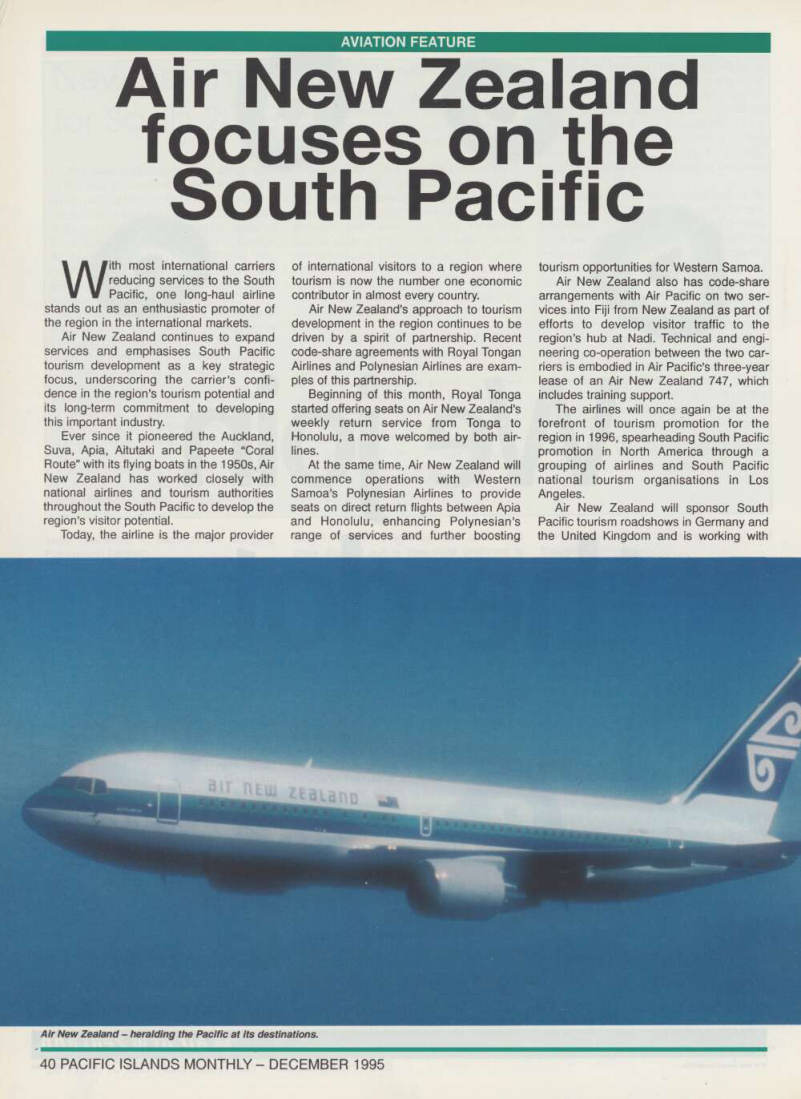
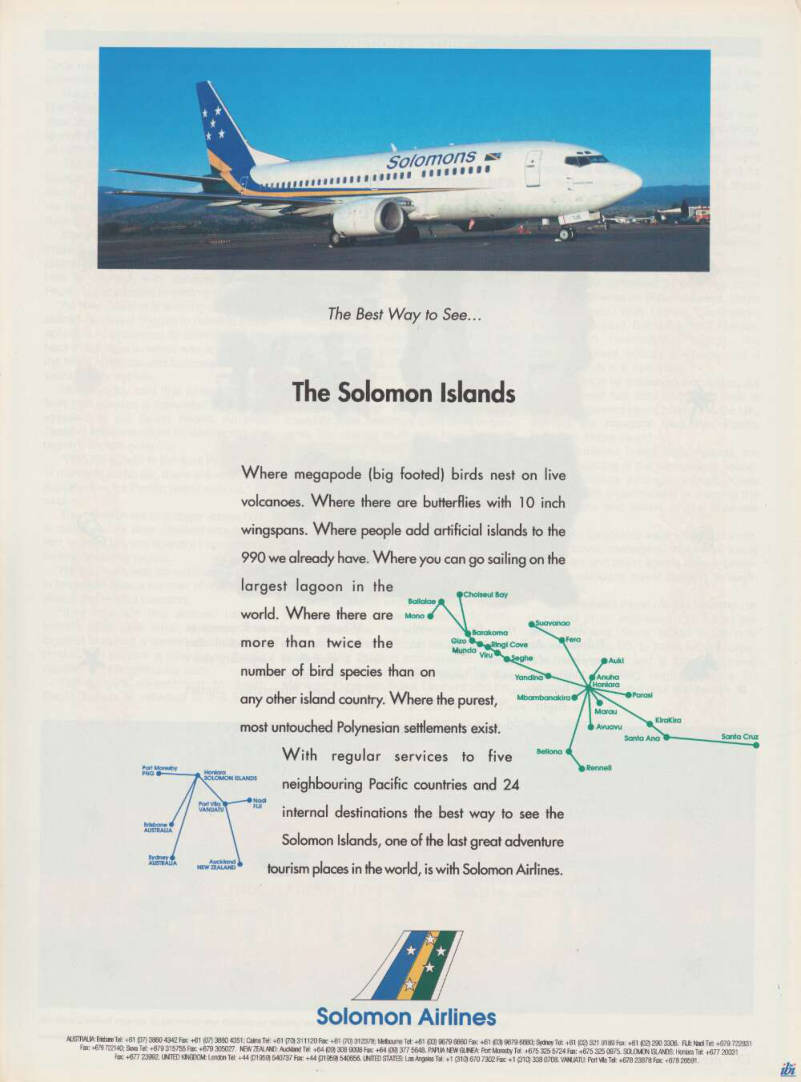
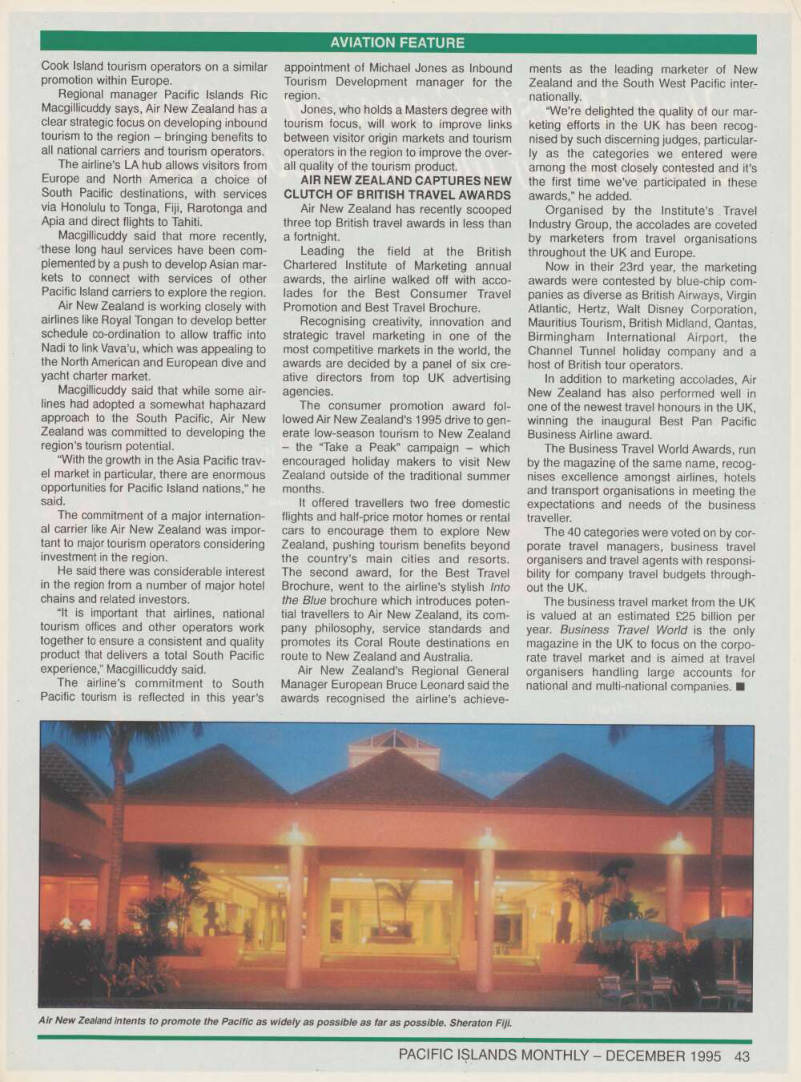
Air New Zealand focuses on the South Pacific
With most international carriers reducing services to the South Pacific, one long-haul airline stands out as an enthusiastic promoter of the region in the international markets.
Air New Zealand continues to expand services and emphasises South Pacific tourism development as a key strategic focus, underscoring the carrier’s confi dence in the region’s tourism potential and its long-term commitment to developing this important industry.
Ever since it pioneered the Auckland, Suva, Apia, Aitutaki and Papeete “Coral Route” with its flying boats in the 19505, Air New Zealand has worked closely with national airlines and tourism authorities throughout the South Pacific to develop the region’s visitor potential.
Today, the airline is the major provider
of international visitors to a region where tourism is now the number one economic contributor in almost every country.
Air New Zealand’s approach to tourism development in the region continues to be driven by a spirit of partnership. Recent code-share agreements with Royal Tongan Airlines and Polynesian Airlines are exam ples of this partnership.
Beginning of this month, Royal Tonga started offering seats on Air New Zealand’s weekly return service from Tonga to Honolulu, a move welcomed by both air lines.
At the same time, Air New Zealand will commence operations with Western Samoa’s Polynesian Airlines to provide seats on direct return flights between Apia and Honolulu, enhancing Polynesian’s range of services and further boosting
tourism opportunities for Western Samoa.
Air New Zealand also has code-share arrangements with Air Pacific on two ser vices into Fiji from New Zealand as part of efforts to develop visitor traffic to the region’s hub at Nadi. Technical and engi neering co-operation between the two car riers is embodied in Air Pacific’s three-year lease of an Air New Zealand 747, which includes training support.
The airlines will once again be at the forefront of tourism promotion for the region in 1996, spearheading South Pacific promotion in North America through a grouping of airlines and South Pacific national tourism organisations in Los Angeles.
Air New Zealand will sponsor South Pacific tourism roadshows in Germany and the United Kingdom and is working with
Air New Zealand - heralding the Pacific at its destinations.
Cook Island tourism operators on a similar promotion within Europe.
Regional manager Pacific Islands Ric Macgillicuddy says, Air New Zealand has a clear strategic focus on developing inbound tourism to the region - bringing benefits to all national carriers and tourism operators.
The airline’s LA hub allows visitors from Europe and North America a choice of South Pacific destinations, with services via Honolulu to Tonga, Fiji, Rarotonga and Apia and direct flights to Tahiti.
Macgillicuddy said that more recently, these long haul services have been com plemented by a push to develop Asian mar kets to connect with services of other Pacific Island carriers to explore the region.
Air New Zealand is working closely with airlines like Royal Tongan to develop better schedule co-ordination to allow traffic into Nadi to link Vava’u, which was appealing to the North American and European dive and yacht charter market.
Macgillicuddy said that while some air lines had adopted a somewhat haphazard approach to the South Pacific, Air New Zealand was committed to developing the region’s tourism potential.
“With the growth in the Asia Pacific trav el market in particular, there are enormous opportunities for Pacific Island nations,” he said.
The commitment of a major internation al carrier like Air New Zealand was impor tant to major tourism operators considering investment in the region.
He said there was considerable interest in the region from a number of major hotel chains and related investors.
“It is important that airlines, national tourism offices and other operators work together to ensure a consistent and quality product that delivers a total South Pacific experience,” Macgillicuddy said.
The airline’s commitment to South Pacific tourism is reflected in this year’s
appointment of Michael Jones as Inbound Tourism Development manager for the region.
Jones, who holds a Masters degree with tourism focus, will work to improve links between visitor origin markets and tourism operators in the region to improve the over all quality of the tourism product.
Air New Zealand Captures New
Clutch Of British Travel Awards
Air New Zealand has recently scooped three top British travel awards in less than a fortnight.
Leading the field at the British Chartered Institute of Marketing annual awards, the airline walked off with acco lades for the Best Consumer Travel Promotion and Best Travel Brochure.
Recognising creativity, innovation and strategic travel marketing in one of the most competitive markets in the world, the awards are decided by a panel of six cre ative directors from top UK advertising agencies.
The consumer promotion award fol lowed Air New Zealand’s 1995 drive to gen erate low-season tourism to New Zealand - the “Take a Peak” campaign - which encouraged holiday makers to visit New Zealand outside of the traditional summer months.
It offered travellers two free domestic flights and half-price motor homes or rental cars to encourage them to explore New Zealand, pushing tourism benefits beyond the country’s main cities and resorts.
The second award, for the Best Travel Brochure, went to the airline’s stylish Into the Blue brochure which introduces poten tial travellers to Air New Zealand, its com pany philosophy, service standards and promotes its Coral Route destinations en route to New Zealand and Australia.
Air New Zealand’s Regional General Manager European Bruce Leonard said the awards recognised the airline’s achieve
merits as the leading marketer of New Zealand and the South West Pacific inter nationally.
“We’re delighted the quality of our mar keting efforts in the UK has been recog nised by such discerning judges, particular ly as the categories we entered were among the most closely contested and it’s the first time we’ve participated in these awards,” he added.
Organised by the Institute’s Travel Industry Group, the accolades are coveted by marketers from travel organisations throughout the UK and Europe.
Now in their 23rd year, the marketing awards were contested by blue-chip com panies as diverse as British Airways, Virgin Atlantic, Hertz, Walt Disney Corporation, Mauritius Tourism, British Midland, Qantas, Birmingham International Airport, the Channel Tunnel holiday company and a host of British tour operators.
In addition to marketing accolades, Air New Zealand has also performed well in one of the newest travel honours in the UK, winning the inaugural Best Pan Pacific Business Airline award.
The Business Travel World Awards, run by the magazine of the same name, recog nises excellence amongst airlines, hotels and transport organisations in meeting the expectations and needs of the business traveller.
The 40 categories were voted on by cor porate travel managers, business travel organisers and travel agents with responsi bility for company travel budgets through out the UK.
The business travel market from the UK is valued at an estimated £25 billion per year. Business Travel World is the only magazine in the UK to focus on the corpo rate travel market and is aimed at travel organisers handling large accounts for national and multi-national companies. ■
Air New Zealand intents to promote the Pacific as widely as possible as far as possible. Sheraton Fiji.
Advertisements & other items, pp. 41-44 (1 item)
The Solomon Islands
The Best Way to See.
IChoiseul Bay Sydney#
AUSTRALIA
NEW ZEALAND
Where megapode (big footed) birds nest on live volcanoes. Where there are butterflies with 10 inch wingspans. Where people add artificial islands to the 990 we already have. Where you can go sailing on the
largest lagoon in the
Ballalae
world. Where there are Mono
more than twice the
number of bird species than on
any other island country. Where the purest, Mbambanakira
most untouched Polynesian settlements exist.
With regular services to five Bellona
neighbouring Pacific countries and 24
I internal destinations the best way to see the Solomon Islands, one of the last great adventure tourism places in the world, is with Solomon Airlines.
Suavanao mßarakoma
Gizo *-Ringi
MundaTTs mT Fera Ring! Cove Viru |(Am Auki Yandina lAnuha Honiara Parasi Marau I Avuavu KlraKira Santa Ana • Santa Cruz il
Solomon Airlines
AUSTRALIA: Brisbane Tel: +6l (07) 3860 4342 Fax: +6l (07) 3860 4351; Cairns Tel: +6l (70) 311120 Fax: +6l (70) 312378; Melbourne Tel: +6l (03) 9679 6860 Fax: +6l (03) 9679 6880; Sydney Tel: +6l (02) 321 9189 Fax' +6l (02) 290 3306 FIJI' Nadi Tel' +679 722831 Fax: +679 722140; Suva Tel: +679 315755 Fax: +679 305027. NEW ZEALAND: Auckland Tel: +64 (09) 308 9098 Fax: +64 (09) 377 5648. PAPUA NEW GUINEA: Port Moresby Tel: +675 325 5724 Fax: +675 325 0975. SOLOMON ISLANDS: Honiara Tel: +677 20031 Fax: +677 23992. UNITED KINGDOM: London Tel: +44 (01959) 540737 Fax; +44 (01959) 540656, UNITED STATES: Los Angeles Tel: +1 (310) 670 7302 Fax: +1 (310) 338 0708. VANUATU: Port Vila Tel; +678 23878 Fax; +678 26591.
Discover the heart of Polynesia.
'muMmimiumii iimiiui m ik Travelling the Pacific with Polynesian Airlines takes you to the very heart of Polynesia.
You're welcomed on board with
gentle friendliness.
In-flight you'll be offered a selection of world class cuisine and fine wines. You'll also enjoy our stateof-the-art in-flight information and entertainment - easily seen on television screens throughout the cabin.
You can experience Polynesian Airlines' special magic on an international route network that includes Australia, New Zealand, Fiji, Tonga, Cook Islands, Western Samoa, American Samoa and Hawaii.
Whether you choose Economy or Business Class you'll be looked after with a warmth of hospitality that's both natural and sincere.
For more information, contact Polynesian Airlines.
New Zealand; Australia: Western Samoa: Fax: 0800 800 993 008 633 737 (685) 21 261 (685) 20 023
POLYNESIAN AIRLINES
1 s wvftjw ■ *■ 9* $ f>.. • v / yj * r 4 Jy
MmP /
r: ChristensenDobbs 275
I'y f, y r <j Dtf Ty r<m EM m ry i?y <u ry *U “y ry r y "◄l Dy PQ= ry jl ry N 1
]four Majestic Connection to all the
Mysteries of the fabled South Sms
The Kingdom of Tonga with its ageold royal lineage, spans 2,000 years in time to reach back into ancient Polynesia.
Royal Tongan Airlines with its new-age technology, spans the South Pacific to serve every outpost from the kingdom at its centre.
San Francisco O Los Angeles ° O Honolulu / y Vava'u ,Samoa Fiji O O Q O Niue Sydney Tonga O O Auckland \ \ \
ROYAL
TONGAN
AIRLINES
AIRLINE OF THE KINGDOM OF TONGA
Kingdom of Tonga: Tel: +676 23414. Fax: +676 24056. Auckland, New Zealand: Tel: +64 (09) 379-4454 Fax: +64 (09) 377-5648. Sydney. Australia: Tel: +6l (02) 321-9126. Fax: +6l (02) 290-3641. Nadi, Fiji: Tel: +679 723-555. Fax: +679 720-085. Los Angeles, USA: Tel: +1 (310) 410-9734. Fax: +1 (310) 410 9451 Toll Free; 1 800 486 6426. United Kingdom; Tel: +44 1-0753-662738. Fax: +44 1-0753-663559.
O il il Wk 4a Ek <2 Wk W d -r/s. <A m Ek m a Ek Va Ek <A Ek 4a Niuafo'ou • Niuat ■ Vava'u • Ha'apai X Tongatapu ij Eua
a double-edged sword
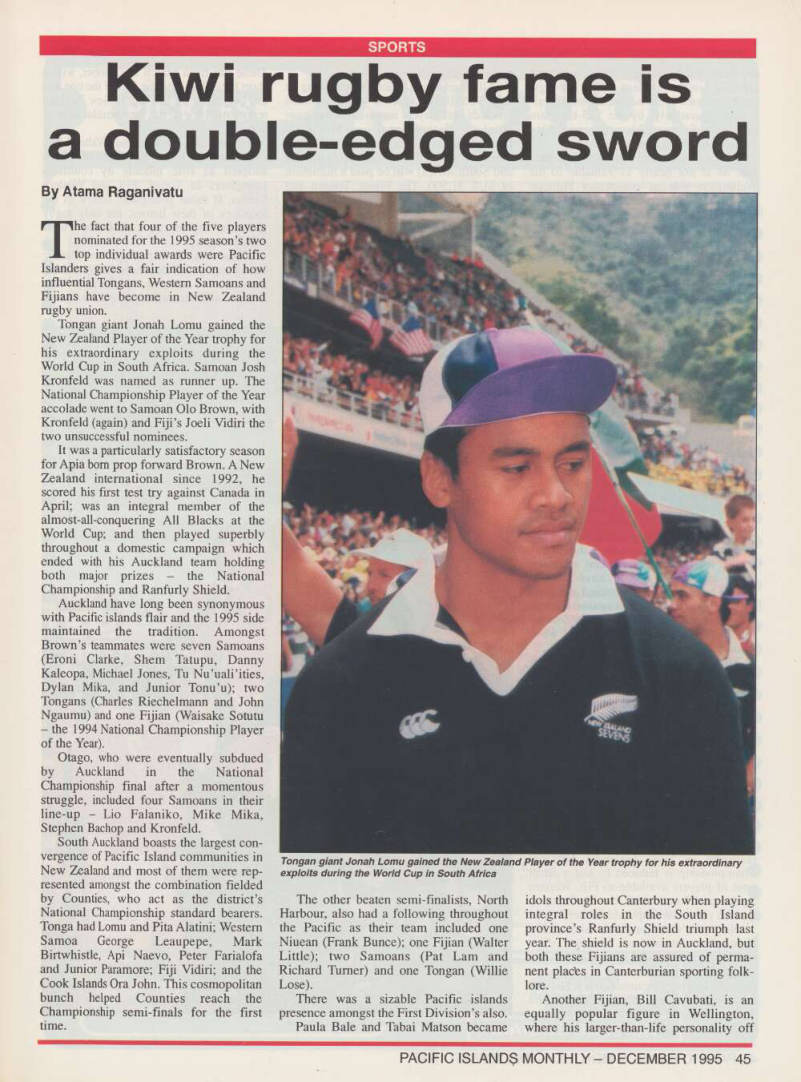
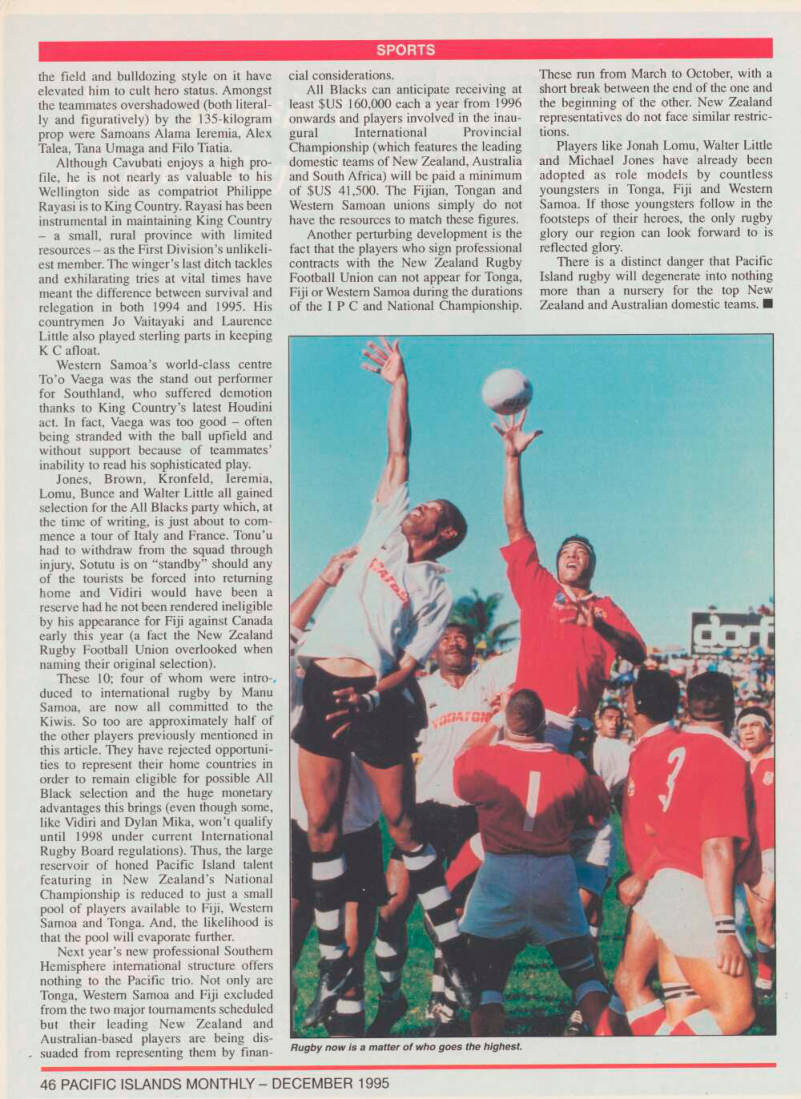
Sports
Kiwi rugby fame is a double-edged sword
By Atama Raganivatu
The fact that four of the five players nominated for the 1995 season’s two top individual awards were Pacific Islanders gives a fair indication of how influential Tongans, Western Samoans and Fijians have become in New Zealand
rugby union.
Tongan giant Jonah Lomu gained the New Zealand Player of the Year trophy for his extraordinary exploits during the World Cup in South Africa. Samoan Josh Kronfeld was named as runner up. The National Championship Player of the Year accolade went to Samoan 010 Brown, with Kronfeld (again) and Fiji’s Joeli Vidiri the two unsuccessful nominees.
It was a particularly satisfactory season for Apia bom prop forward Brown. A New Zealand international since 1992, he scored his first test try against Canada in April; was an integral member of the almost-all-conquering All Blacks at the World Cup; and then played superbly throughout a domestic campaign which ended with his Auckland team holding both major prizes - the National
Championship and Ranfurly Shield.
Auckland have long been synonymous with Pacific islands flair and the 1995 side maintained the tradition. Amongst Brown’s teammates were seven Samoans (Eroni Clarke, Shem Tatupu, Danny Kaleopa, Michael Jones, Tu Nu’uali’ities, Dylan Mika, and Junior Tonu’u); two Tongans (Charles Riechelmann and John Ngaumu) and one Fijian (Waisake Sotutu - the 1994 National Championship Player of the Year).
Otago, who were eventually subdued by Auckland in the National Championship final after a momentous struggle, included four Samoans in their line-up - Lio Falaniko, Mike Mika,
Stephen Bachop and Kronfeld.
South Auckland boasts the largest con vergence of Pacific Island communities in New Zealand and most of them were rep resented amongst the combination fielded by Counties, who act as the district’s National Championship standard bearers.
Tonga had Lomu and Pita Alatini; Western
Samoa George Leaupepe, Mark
Birtwhistle, Api Naevo, Peter Farialofa and Junior Paramore; Fiji Vidiri; and the Cook Islands Ora John. This cosmopolitan bunch helped Counties reach the Championship semi-finals for the first time.
The other beaten semi-finalists. North Harbour, also had a following throughout the Pacific as their team included one Niuean (Frank Bunce); one Fijian (Walter Little); two Samoans (Pat Lam and Richard Turner) and one Tongan (Willie Lose).
There was a sizable Pacific islands presence amongst the First Division’s also.
Paula Bale and Tabai Matson became
idols throughout Canterbury when playing integral roles in the South Island province’s Ranfurly Shield triumph last year. The shield is now in Auckland, but both these Fijians are assured of perma nent placbs in Canterburian sporting folk lore.
Another Fijian, Bill Cavubati, is an equally popular figure in Wellington, where his larger-than-life personality off
Tongan giant Jonah Lomu gained the New Zealand Player of the Year trophy for his extraordinary exploits during the World Cup in South Africa
the field and bulldozing style on it have elevated him to cult hero status. Amongst the teammates overshadowed (both literal
ly and figuratively) by the 135-kilogram
prop were Samoans Alama leremia, Alex Talea, Tana Umaga and Filo Tiatia.
Although Cavubati enjoys a high pro
file, he is not nearly as valuable to his
Wellington side as compatriot Philippe
Rayasi is to King Country. Rayasi has been instrumental in maintaining King Country - a small, rural province with limited resources - as the First Division’s unlikeli est member. The winger’s last ditch tackles and exhilarating tries at vital times have meant the difference between survival and relegation in both 1994 and 1995. His countrymen Jo Vaitayaki and Laurence Little also played sterling parts in keeping K C afloat.
Western Samoa’s world-class centre To’o Vaega was the stand out performer for Southland, who suffered demotion thanks to King Country’s latest Houdini act. In fact, Vaega was too good - often being stranded with the ball upfield and without support because of teammates’ inability to read his sophisticated play.
Jones, Brown, Kronfeld, leremia, Lomu, Bunce and Walter Little all gained selection for the All Blacks party which, at the time of writing, is just about to com mence a tour of Italy and France. Tonu’u had to withdraw from the squad through injury, Sotutu is on “standby” should any of the tourists be forced into returning home and Vidiri would have been a reserve had he not been rendered ineligible by his appearance for Fiji against Canada early this year (a fact the New Zealand Rugby Football Union overlooked when naming their original selection).
These 10; four of whom were intro-, duced to international rugby by Manu Samoa, are now all committed to the Kiwis. So too are approximately half of the other players previously mentioned in this article. They have rejected opportuni ties to represent their home countries in order to remain eligible for possible All Black selection and the huge monetary advantages this brings (even though some, like Vidiri and Dylan Mika, won’t qualify until 1998 under current International Rugby Board regulations). Thus, the large reservoir of honed Pacific Island talent featuring in New Zealand’s National Championship is reduced to just a small pool of players available to Fiji, Western Samoa and Tonga. And, the likelihood is that the pool will evaporate further.
Next year’s new professional Southern Hemisphere international structure offers nothing to the Pacific trio. Not only are Tonga, Western Samoa and Fiji excluded from the two major tournaments scheduled but their leading New Zealand and Australian-based players are being dis suaded from representing them by finan
cial considerations.
All Blacks can anticipate receiving at least SUS 160,000 each a year from 1996 onwards and players involved in the inau gural International Provincial
Championship (which features the leading
domestic teams of New Zealand, Australia and South Africa) will be paid a minimum of SUS 41,500. The Fijian, Tongan and Western Samoan unions simply do not have the resources to match these figures.
Another perturbing development is the fact that the players who sign professional contracts with the New Zealand Rugby Football Union can not appear for Tonga, Fiji or Western Samoa during the durations of the I P C and National Championship.
These run from March to October, with a short break between the end of the one and the beginning of the other. New Zealand representatives do not face similar restric tions.
Players like Jonah Lomu, Walter Little and Michael Jones have already been adopted as role models by countless youngsters in Tonga, Fiji and Western Samoa. If those youngsters follow in the footsteps of their heroes, the only rugby glory our region can look forward to is
reflected glory.
There is a distinct danger that Pacific
Island rugby will degenerate into nothing
more than a nursery for the top New Zealand and Australian domestic teams. ■
Rugby now is a matter of who goes the highest.
Advertisements & other items, p. 47 (1 item)
Auction
I * *»* * - W*’ ' * 7. £*»»£ : =s •r ; r —»-• T^rr- ~=ss ssss w"Mr» jairf : r^fr Jfii. *S B*S Under instructions from Mr Keith Williams Urgent sale required owing to the imminent delivery of a larger vessel.
"AWESOME"
TTte Name Says It All
70 ft of:
AWESOME SPEED
AWESOME STYLING
AWESOME QUALITY
Out of Water Condition Survey Report Available
Engineer's Condition Report Available
12 noon SATURDAY 2nd DECEMBER
This is one of the world's most exciting powerboats. Custom built by Lloyds Ships, Brisbane, Australia to DET NORSKE VERITAS IAI (R 54) Survey. Powered by dual 16V92 Ti Detroit diesels specially modified from new to produce 1530 hp each.
"Awesome" is capable of speeds well in excess of 40 knots
while maintaining excellent sea keeping qualities.
She is currently in Queensland Department of Transport survey to carry 22 passengers and two crew in commercial operation offshore. "Awesome" has been recently re-painted and is always maintained to the highest standards. She is the perfect high speed personal pleasure boat or luxury offshore commuter, suitable for the person who has everything and wants a lot more.
AUCTION ENQUIRIES, CONTRACT, SURVEY ETC:
John Leftwich Ph: 61 2 789 6211 Fax: 61 2 718 2243
INSPECTIONS:
Geoff Lovett
MCLAREN LOVETT MARINE PTY LTD
ID Marina Mirage, Sea World Drive Main Beach, Surfers Paradise Queensland, AUSTRALIA Ph: 61 7 5591 7363 Fax: 61 7 5591 7368 On the Site Sea World Drive Surfers Paradise, QUEENSLAND
AUSTRALIA
TERMS:
10% deposit on fall of hammer. Cash or bank cheque only.
Balance by 5 working days.
MARINE DIVISION
Pacific grip on grid iron football
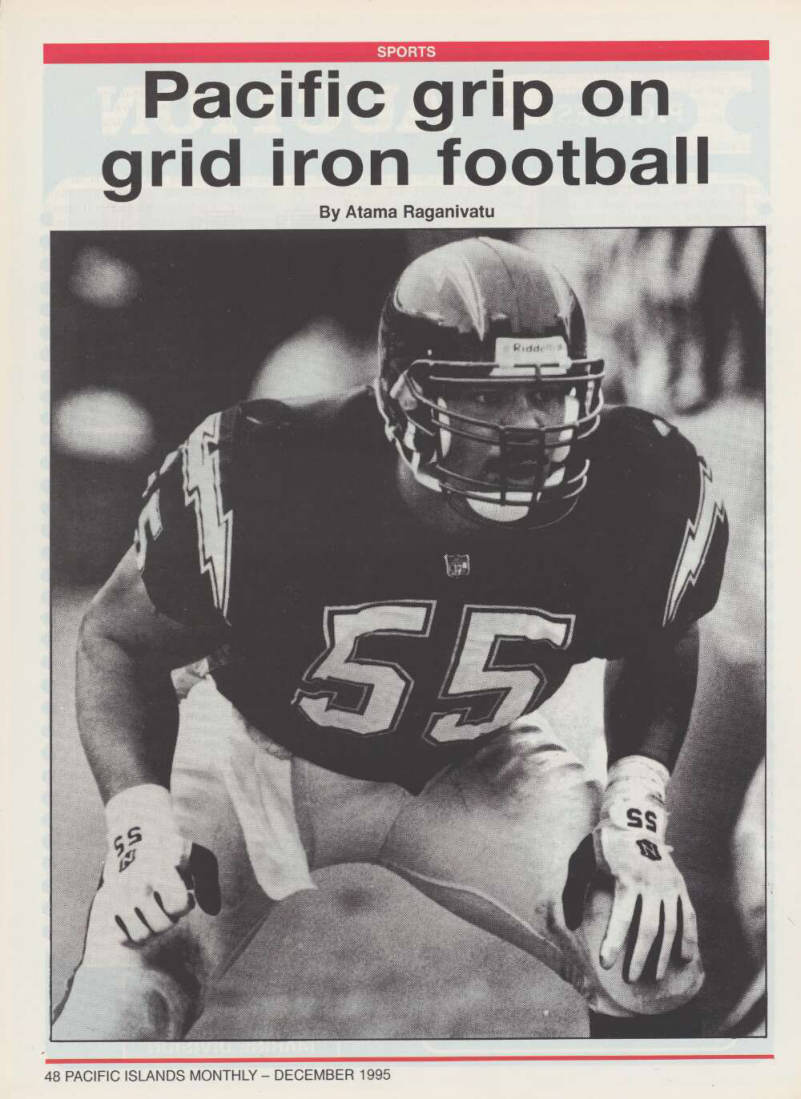
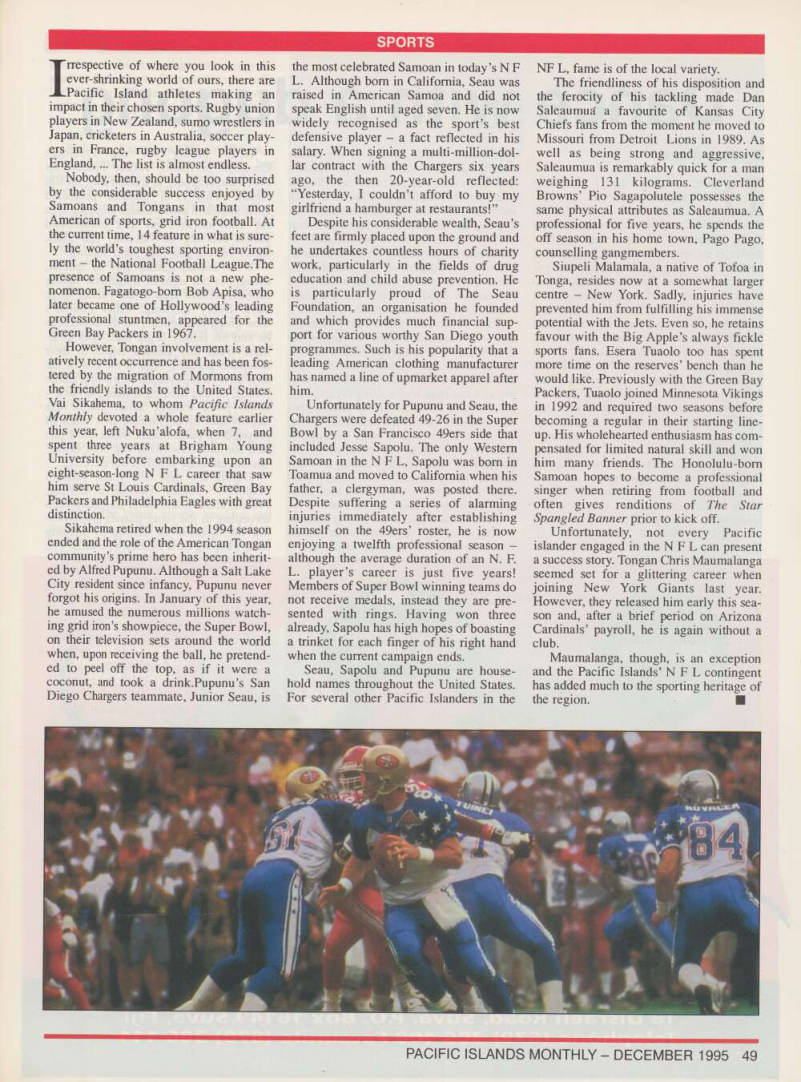
grid iron football
By Atama Raganivatu
Irrespective of where you look in this ever-shrinking world of ours, there are Pacific Island athletes making an impact in their chosen sports. Rugby union players in New Zealand, sumo wrestlers in Japan, cricketers in Australia, soccer players in France, rugby league players in England,... The list is almost endless.
Nobody, then, should be too surprised by the considerable success enjoyed by Samoans and Tongans in that most American of sports, grid iron football. At the current time, 14 feature in what is surely the world’s toughest sporting environ- the National Football League. The presence of Samoans is not a new phenomenon. Fagatogo-bom Bob Apisa, who later became one of Hollywood s leading professional stuntmen, appeared for the Green Bay Packers in 1967.
However, Tongan involvement is a relatively recent occurrence and has been fostered by the migration of Mormons from the friendly islands to the United States, Vai Sikahema, to whom Pacific Islands Monthly devoted a whole feature earlier this year, left Nukualofa, when 7, and spent three years at Brigham Young University before embarking upon an eight-season-long NFL career that saw him serve St Louis Cardinals, Green Bay Packers and Philadelphia Eagles with great distinction.
Sikahema retired when the 1994 season ended and the role of the American Tongan community’s prime hero has been inherited by Alfred Pupunu. Although a Salt Lake City resident since infancy, Pupunu never forgot his origins. In January of this year, he amused the numerous millions watching grid iron s showpiece, the Super Bowl, on their television sets around the world when, upon receiving the ball, he pretended to peel off the top, as if it were a coconut, and took a drink.Pupunu’s San Diego Chargers teammate. Junior Seau, is
the most celebrated Samoan in today’s N F L. Although bom in California, Seau was raised in American Samoa and did not speak English until aged seven. He is now widely recognised as the sport’s best defensive player - a fact reflected in his salary. When signing a multi-million-dollar contract with the Chargers six years ago, the then 20-year-old reflected; “Yesterday, I couldn’t afford to buy my girlfriend a hamburger at restaurants!”
Despite his considerable wealth, Seau’s feet are firmly placed upon the ground and he undertakes countless hours of charity work, particularly in the fields of drug education and child abuse prevention. He is particularly proud of The Seau Foundation, an organisation he founded and which provides much financial support for various worthy San Diego youth programmes. Such is his popularity that a leading American clothing manufacturer has named a line of upmarket apparel after him.
Unfortunately for Pupunu and Seau, the Chargers were defeated 49-26 in the Super Bowl by a San Francisco 49ers side that included Jesse Sapolu. The only Western Samoan in the NFL, Sapolu was bom in Toamua and moved to California when his father, a clergyman, was posted there, Despite suffering a series of alarming injuries immediately after establishing himself on the 49ers’ roster, he is now enjoying a twelfth professional season although the average duration of an N. F.
L. player’s career is just five years!
Members of Super Bowl winning teams do not receive medals, instead they are presented with rings. Having won three already, Sapolu has high hopes of boasting a trinket for each finger of his right hand when the current campaign ends.
Seau, Sapolu and Pupunu are household names throughout the United States, For several other Pacific Islanders in the
NF L, fame is of the local variety, The friendliness of his disposition and the ferocity of his tackling made Dan Saleaumua’ a favourite of Kansas City Chiefs fans from the moment he moved to Missouri from Detroit Lions in 1989. As well as being strong and aggressive, Saleaumua is remarkably quick for a man
weighing 131 kilograms. Cleveland
Browns’ Pio Sagapolutele possesses the same physical attributes as Saleaumua. A professional for five years, he spends the off season in his home town, Pago Pago,
counselling gangmembers.
Siupeli Malamala, a native of Tofoa in Tonga, resides now at a somewhat larger centre - New York. Sadly, injuries have prevented him from fulfilling his immense potential with the Jets. Even so, he retains favour with the Big Apple’s always fickle sports fans. Esera Tuaolo too has spent more time on the reserves’ bench than he would like. Previously with the Green Bay Packers, Tuaolo joined Minnesota Vikings in 1992 and required two seasons before becoming a regular in their starting line up. His wholehearted enthusiasm has corn pensated for limited natural skill and won him many friends. The Honolulu-born Samoan hopes to become a professional singer when retiring from football and often gives renditions of The Star Spangled Banner prior to kick off.
Unfortunately, not every Pacific islander engaged in the N F L can present a success story. Tongan Chris Maumalanga seemed set for a glittering career when joining New York Giants last year, However, they released him early this sea son and, after a brief period on Arizona Cardinals’ payroll, he is again without a club.
Maumalanga, though, is an exception and the Pacific Islands’ NFL contingent has added much to the sporting heritage of the region. ■
Dance with a dugong
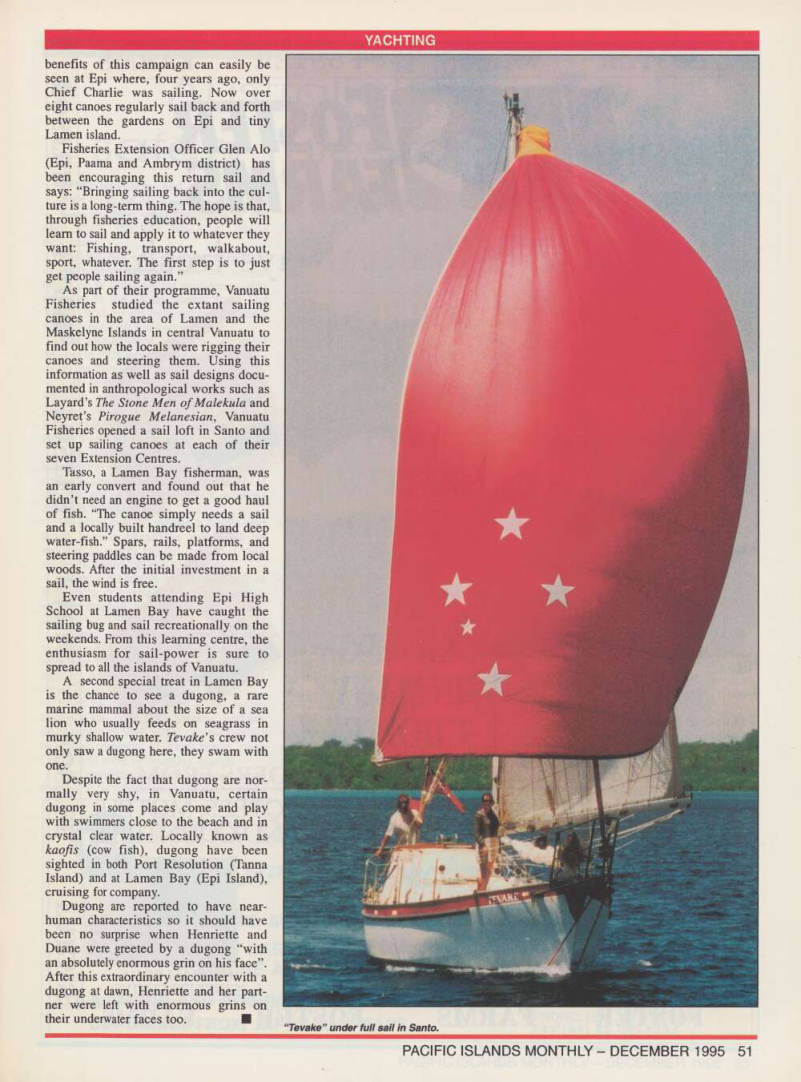
Yachting
By Sally Andrew
Duane Yates and Henriette
Schlupmann departed Sydney,
Australia, in 1994, headed for the South Pacific and new adventures. Their boat, Tevake, a 31-foot steel double ender, is named for the Pacific tropic-bird and also for the great Polynesian naviga tor from the Santa Cruz Reef Islands who used the stars, swells and other natural phenomena for his orientation on the sea.
Before his death in 1970, navigator Tevake shared his knowledge of tradi tional Polynesian techniques of ocean voyaging as described by Dr David Lewis in his recently republished book.
We, The Navigators. Although Tevake’s owner, Duane Yates, appreciates the sophistication and validity of ancient voyaging methods, he, like most modern day cruisers, navigates with all the latest mod-cons and equipment, including the
Global Positioning System.
Duane and his partner, Henriette, share a passion for the undersea and
underwater photography. After stopping
at Lord Howe and New Caledonia, Tevake arrived in northern Vanuatu, home
to the best wreck diving in the South Pacific. Henritte describes the hassles and the rewards of scuba diving: “Never mind the tedious filling of the tanks with the slow air-compressor, the time con suming assembly of the underwater cam eras and moody strobes far too early in the morning. (In Santo) we went as far as hitch-hiking attired in full scuba gear, tanks on our backs, fins and underwater cameras in hand, to reach the President Coolidge wreck in Luganville Channel.
“But at the end of this funny pilgrim age, we descended into an underwater dreamscape where the old liner’s carcass served as a house in which individual fish had their own territory. Boris, a wrasse as big as a sea-lion, was waiting for us at the bow hoping for some gift of fish; a spe cial lion-fish had taken residence in the
captain’s bathroom; a huge porcupine
fish usually fed at the entrance of the promenade deck; a large moray eel had found a home under a shark cage; an old angel fish and two red spotted rock-cods hovered in the cannon on the bow.
“Under the bow, in the strong current, I found an old sea-pen with which Poseidon could have written it all.”
After diving on the President Coolidge in Santo, Tevake. headed for Port Vila, stopping at Lamen Bay, on Epi Island. This is a popular protected anchorage and a convenient stopping spot for both northbound and southbound yachts cruising in Vanuatu. The black
sandy bottom provides good holding.
What makes Lamen Bay so special, though, is the sight of traditional sailing canoes, seldom seen in the Pacific these days. Every morning. Chief Charlie’s lime-green sail appears on the horizon as he and his family begin their daily com mute from tiny Lamen Island to their mainland gardens. And at the end of the day, their canoes loaded down with kakae (food), he and his neighbours sail back some hoist canvas sails, others use improvised ‘biodegradable sails’ made of propped-up palm fronds which work just fine for this downwind leg back home!
Unconventional perhaps, but effective.
During the past few years, Vanuatu Fisheries’ Senior Executive Officer, Francis Hickey, and other staff have been travelling to the outer islands proselytis ing the benefits of sailing by helping local guys rig their canoes with sails. The
benefits of this campaign can easily be seen at Epi where, four years ago, only Chief Charlie was sailing. Now over eight canoes regularly sail back and forth between the gardens on Epi and tiny Lamen island.
Fisheries Extension Officer Glen Alo (Epi, Paama and Ambrym district) has been encouraging this return sail and says: “Bringing sailing back into the cul ture is a long-term thing. The hope is that, through fisheries education, people will leam to sail and apply it to whatever they want; Fishing, transport, walkabout, sport, whatever. The first step is to just get people sailing again.”
As part of their programme, Vanuatu Fisheries studied the extant sailing canoes in the area of Lamen and the Maskelyne Islands in central Vanuatu to find out how the locals were rigging their canoes and steering them. Using this information as well as sail designs docu mented in anthropological works such as Layard’s The Stone Men of Malekula and Neyrefs Pirogue Melanesian, Vanuatu Fisheries opened a sail loft in Santo and set up sailing canoes at each of their seven Extension Centres.
Tasso, a Lamen Bay fisherman, was an early convert and found out that he didn’t need an engine to get a good haul of fish. “The canoe simply needs a sail and a locally built handreel to land deep water-fish.” Spars, rails, platforms, and steering paddles can be made from local woods. After the initial investment in a sail, the wind is free.
Even students attending Epi High School at Lamen Bay have caught the sailing bug and sail recreationally on the weekends. From this learning centre, the enthusiasm for sail-power is sure to spread to all the islands of Vanuatu.
A second special treat in Lamen Bay is the chance to see a dugong, a rare marine mammal about the size of a sea lion who usually feeds on seagrass in murky shallow water. Tevake’s crew not only saw a dugong here, they swam with one.
Despite the fact that dugong are nor mally very shy, in Vanuatu, certain dugong in some places come and play with swimmers close to the beach and in crystal clear water. Locally known as kaofis (cow fish), dugong have been sighted in both Port Resolution (Tanna Island) and at Lamen Bay (Epi Island), cruising for company.
Dugong are reported to have near human characteristics so it should have been no surprise when Henriette and Duane were greeted by a dugong “with an absolutely enormous grin on his face”.
After this extraordinary encounter with a dugong at dawn, Henriette and her part ner were left with enormous grins on their underwater faces too. ■
“Tevake” under full sail in Santo.
Advertisements & other items, pp. 50-52 (1 item)
■
/ / / y r / 'J/ x
FOSTER
FARMS
FOSTER
FARMS
co s 03 fa CO S 03 fa 03 fa H CO O fa
OSIER
FARMS.
Always natural. Always fresk.
r CO 03 pfkC*
OOVJVft*
fa 03 fa H co
iSg?
o fa
SINGLE
PACK
FOR BEST
VALUE,
QUALITY
AND
BETTER
HEALTH
AND
SELECTED
SERVINGS
IN MANY
CHOICES
a & M / • #•y' & S9*s 5^ 352
WE WELCOME STANDING ORDERS FROM
SUPERMARKETS, RESTAURANTS, HOTELS, MOTELS,
SHIPS, NEIGHBOURING ISLANDS AND COUNTRIES
S 3 O CO H S 3 SO ►*3 > SO 3 CO S 3 O CO H S 3 ss S 3 > so 3 CO S 3 O CO H S 3 SO
ALL TO:
MA-TAPULE INVESTMENT LIMITED
PH: (679) 312831 FAX: (679) 303757
SUVA, FIJI ISLANDS
fu i U * 1 J’’ I - *
EREMASI ROVA
(CHIEF EXECUTIVE)
FOSTER
FARMS
FOSTER
FARMS
safety rules for shipping
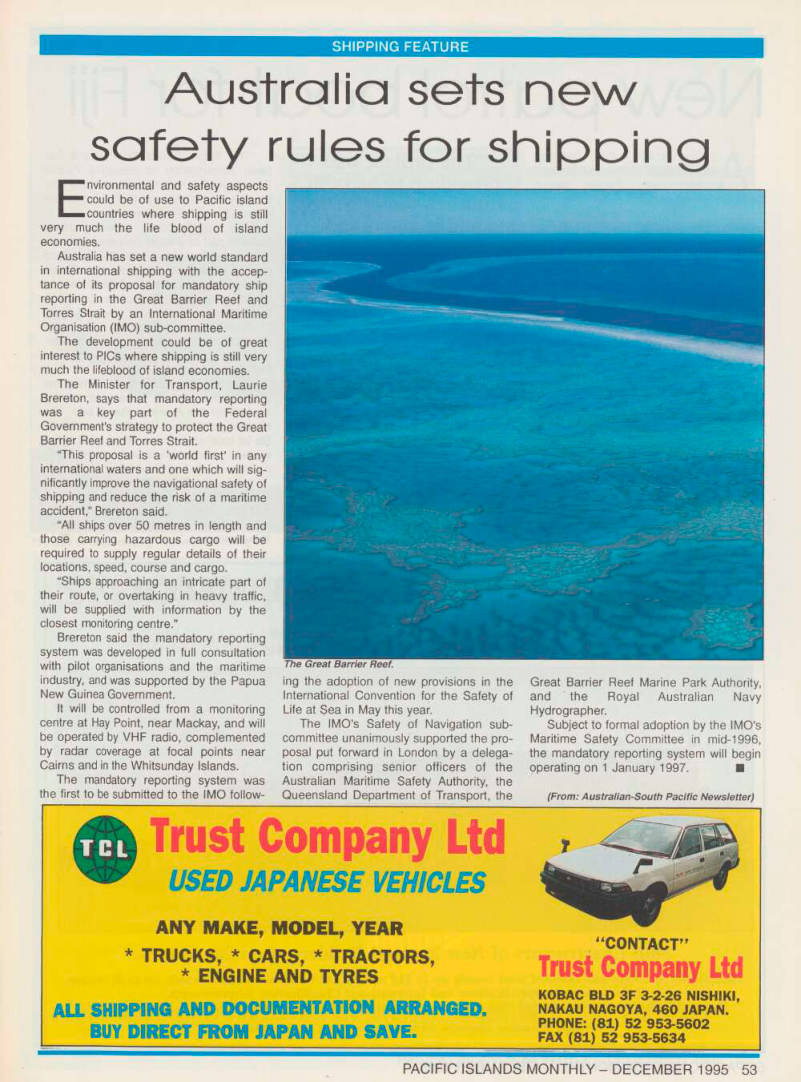
Australia sets new safety rules for shipping
Environmental and safety aspects could be of use to Pacific island countries where shipping is still very much the life blood of island economies.
Australia has set a new world standard in international shipping with the accep tance of its proposal for mandatory ship reporting in the Great Barrier Reef and Torres Strait by an International Maritime Organisation (IMO) sub-committee.
The development could be of great interest to PICs where shipping is still very much the lifeblood of island economies.
The Minister for Transport, Laurie Brereton, says that mandatory reporting was a key part of the Federal Government’s strategy to protect the Great Barrier Reef and Torres Strait.
“This proposal is a ‘world first’ in any international waters and one which will sig nificantly improve the navigational safety of shipping and reduce the risk of a maritime accident,” Brereton said.
“All ships over 50 metres in length and those carrying hazardous cargo will be required to supply regular details of their locations, speed, course and cargo.
“Ships approaching an intricate part of their route, or overtaking in heavy traffic, will be supplied with information by the closest monitoring centre.”
Brereton said the mandatory reporting system was developed in full consultation with pilot organisations and the maritime industry, and was supported by the Papua New Guinea Government.
It will be controlled from a monitoring centre at Hay Point, near Mackay, and will be operated by VHF radio, complemented by radar coverage at focal points near Cairns and in the Whitsunday Islands.
The mandatory reporting system was the first to be submitted to the IMO follow-
ing the adoption of new provisions in the International Convention for the Safety of Life at Sea in May this year.
The IMO’s Safety of Navigation subcommittee unanimously supported the proposal put forward in London by a delegation comprising senior officers of the Australian Maritime Safety Authority, the Queensland Department of Transport, the
Great Barrier Reef Marine Park Authority, and the Royal Australian Navy Hydrographer.
Subject to formal adoption by the IMO’s Maritime Safety Committee in mid-1996, the mandatory reporting system will begin operating on 1 January 1997. ■
(From: Australian-South Pacific Newsletter)
The Great Barrier Reef.
Advertisements & other items, p. 53 (2 items)
Shipping Feature
Trust Company Ltd
USED JAPANESE VEHICLES
ANY MAKE, MODEL, YEAR
* TRUCKS, * CARS, * TRACTORS,
* ENGINE AND TYRES
ALL SHIPPING AND DOCUMENTATION ARRANGED.
BUY DIRECT FROM JAPAN AND SAVE.
r
“CONTACT”
Trust Company Ltd
KOBAC BLD 3F 3-2-26 NISHIKI,
NAKAU NAGOYA, 460 JAPAN.
PHONE: (81) 52 953-5602
FAX (81) 52 953-5634
New patrol boat for Fiji
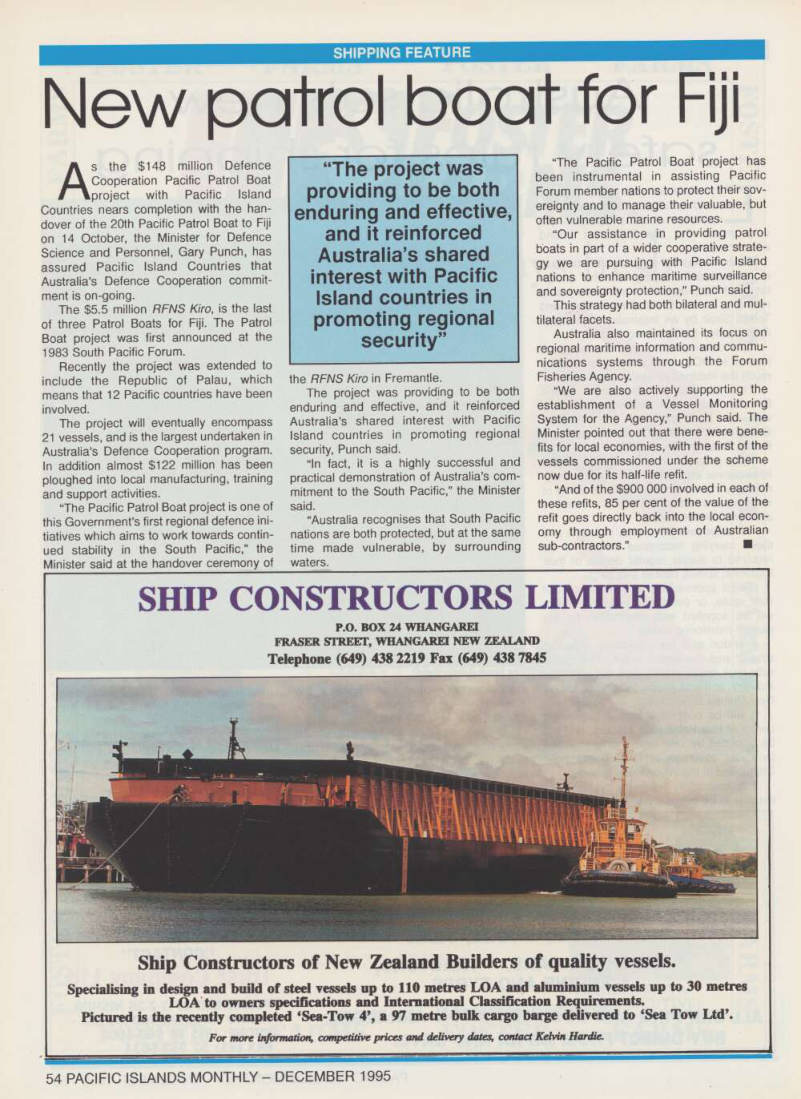
As the $l4B million Defence Cooperation Pacific Patrol Boat project with Pacific Island Countries nears completion with the han dover of the 20th Pacific Patrol Boat to Fiji on 14 October, the Minister for Defence Science and Personnel, Gary Punch, has assured Pacific Island Countries that Australia’s Defence Cooperation commit ment is on-going.
The $5.5 million RFNS Kiro, is the last of three Patrol Boats for Fiji. The Patrol Boat project was first announced at the 1983 South Pacific Forum.
Recently the project was extended to include the Republic of Palau, which means that 12 Pacific countries have been involved.
The project will eventually encompass 21 vessels, and is the largest undertaken in Australia’s Defence Cooperation program.
In addition almost $122 million has been ploughed into local manufacturing, training and support activities.
“The Pacific Patrol Boat project is one of this Government’s first regional defence ini tiatives which aims to work towards contin ued stability in the South Pacific,” the Minister said at the handover ceremony of
“The project was providing to be both enduring and effective, and it reinforced Australia’s shared interest with Pacific Island countries in
promoting regional
security”
the RFNS Kiro in Fremantle.
The project was providing to be both enduring and effective, and it reinforced Australia’s shared interest with Pacific Island countries in promoting regional security, Punch said.
“In fact, it is a highly successful and practical demonstration of Australia’s com mitment to the South Pacific,” the Minister said.
“Australia recognises that South Pacific nations are both protected, but at the same time made vulnerable, by surrounding
“The Pacific Patrol Boat project has been instrumental in assisting Pacific Forum member nations to protect their sov ereignty and to manage their valuable, but often vulnerable marine resources.
“Our assistance in providing patrol boats in part of a wider cooperative strate gy we are pursuing with Pacific Island nations to enhance maritime surveillance and sovereignty protection,” Punch said.
This strategy had both bilateral and mul tilateral facets.
Australia also maintained its focus on regional maritime information and commu nications systems through the Forum Fisheries Agency.
“We are also actively supporting the establishment of a Vessel Monitoring System for the Agency,” Punch said. The Minister pointed out that there were bene fits for local economies, with the first of the vessels commissioned under the scheme now due for its half-life refit.
“And of the $9OO 000 involved in each of these refits, 85 per cent of the value of the refit goes directly back into the local econ omy through employment of Australian sub-contractors.” ■
Advertisements & other items, pp. 54-56 (1 item)
Ship Constructors Limited
P.O. BOX 24 WHANGAREI
FRASER STREET, WHANGAREI NEW ZEALAND
Telephone (649) 438 2219 Fax (649) 438 7845 'f Bfc- Wt nr Ship Constructors of New Zealand Builders of quality vessels.
Specialising in design and build of steel vessels up to 110 metres LOA and aluminium vessels up to 30 metres LOA to owners specifications and International Classification Requirements.
Pictured is the recently completed ‘Sea-Tow 4’, a 97 metre bulk cargo barge delivered to ‘Sea Tow Ltd’.
For more information, competitive prices and delivery dates, contact Kelvin Hardie.
The type of vessel that Fiji received last month
SECOND HAND CONTAINERS
WHERE AND WHEN YOU WANT THEM IN THE PACIFIC If you need a flexible and safe storage space we have the ideal solution for you. Our second hand containers provide instant secure storage. Guaranteed to be wind and waterproof these containers are ideal for both temporary and longterm storage in Pacific conditions.
We can deliver to any island in the Pacific within a month and our rates have got to be the lowest you will find. All you need to do is tell us how many you want.
CONTACT:
PASCALE MARCONNET, BP 4757 NOUMEA, NEW CALEDONIA. TEL: (687) 28 7450. FAX: (687) 26 3248
Proudly serving the Pacific Islands since the 1920’5,
Blue Star Line continues to provide
fast reliable frequent services to Fiji, New Caledonia
and Tahiti
«*»• t It ... , *«« il—m mm U -
“W'ten
‘ M
“WStWi.
• M ■ s: “U* si^ «...
UN6
ais-siAR
une m Bt^'.snm»: a g
Wl'Hi
si ¥ *■— -It mag.
IT - * 4t mm
HHSH ItSlB
Pacific Island Service
Lost seamanship skills
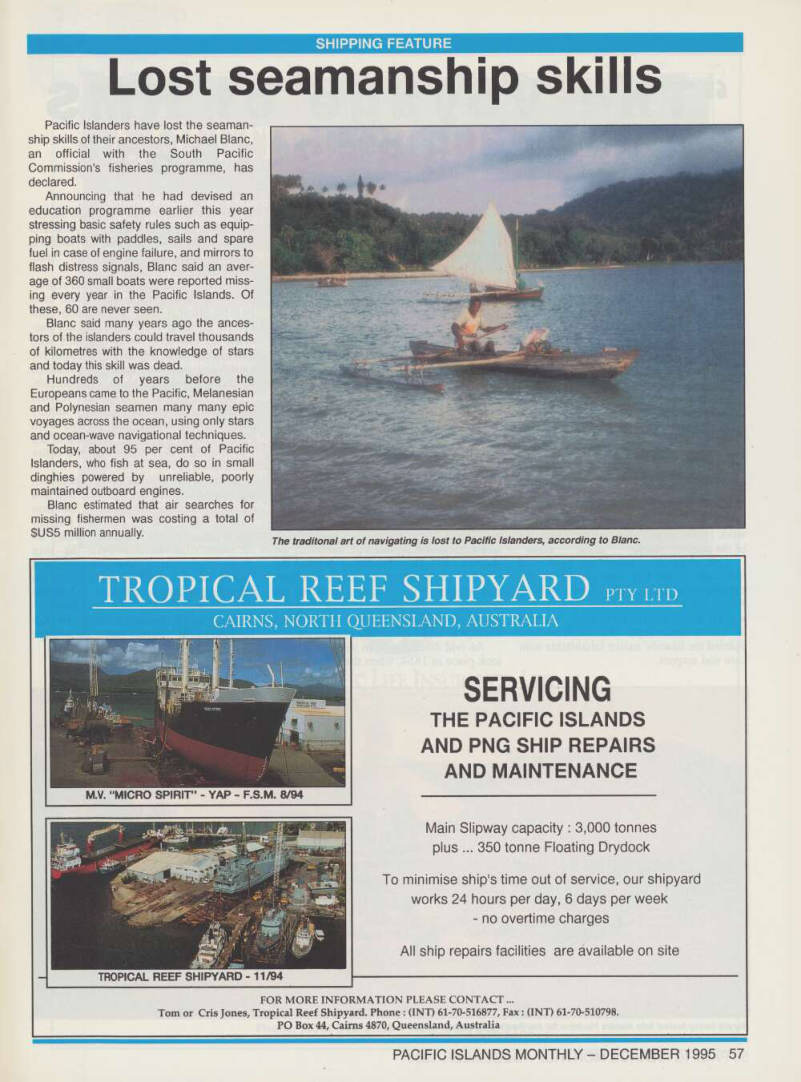
Pacific Islanders have lost the seaman ship skills of their ancestors, Michael Blanc, an official with the South Pacific Commission’s fisheries programme, has declared.
Announcing that he had devised an education programme earlier this year stressing basic safety rules such as equip ping boats with paddles, sails and spare fuel in case of engine failure, and mirrors to flash distress signals, Blanc said an aver age of 360 small boats were reported miss ing every year in the Pacific Islands. Of these, 60 are never seen.
Blanc said many years ago the ances tors of the islanders could travel thousands of kilometres with the knowledge of stars and today this skill was dead.
Hundreds of years before the Europeans came to the Pacific, Melanesian and Polynesian seamen many many epic voyages across the ocean, using only stars and ocean-wave navigational techniques.
Today, about 95 per cent of Pacific Islanders, who fish at sea, do so in small dinghies powered by unreliable, poorly maintained outboard engines.
Blanc estimated that air searches for missing fishermen was costing a total of SUSS million annually.
The traditonal art of navigating is lost to Pacific Islanders, according to Blanc.
Advertisements & other items, p. 57 (2 items)
Shipping Feature
Tropical Reef Shipyard
CAIRNS, NORTH QUEENSLAND, AUSTRALIA
PTY LTD
SlfllJ SI B am pi y TT,.:' 1 « M.V. “MICRO SPIRIT” - YAP - F.S.M. 8/94 Sfc
TROPICAL REEF SHIPYARD - 11/94
SERVICING
THE PACIFIC ISLANDS
AND PNG SHIP REPAIRS
AND MAINTENANCE
Main Slipway capacity : 3,000 tonnes plus ... 350 tonne Floating Drydock To minimise ship's time out of service, our shipyard works 24 hours per day, 6 days per week - no overtime charges All ship repairs facilities are available on site
FOR MORE INFORMATION PLEASE CONTACT ...
Tom or Cris Jones, Tropical Reef Shipyard. Phone : (INT) 61-70-516877, Fax : (INT) 61-70-510798.
PO Box 44, Cairns 4870, Queensland, Australia
Herald 1852-1861”
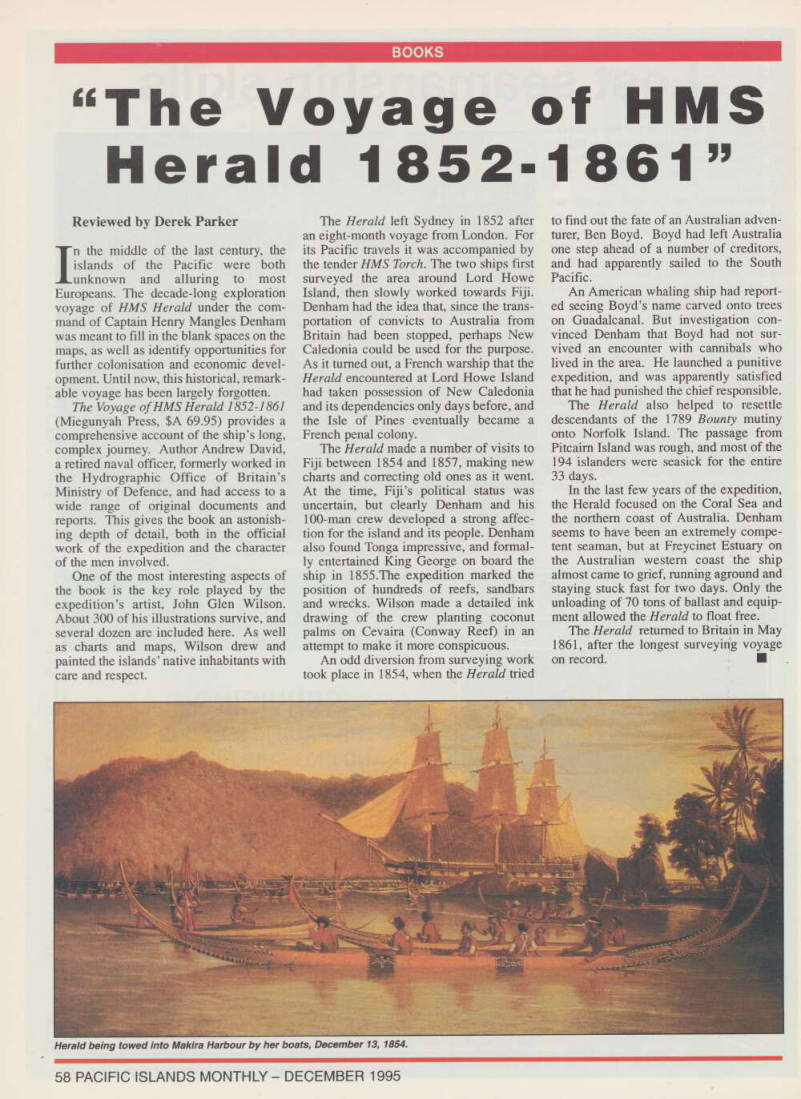
Books
“The Voyage of HMS Herald 1852-1861”
Reviewed by Derek Parker In the middle of the last century, the islands of the Pacific were both unknown and alluring to most Europeans. The decade-long exploration voyage of HMS Herald under the com-
mand of Captain Henry Mangles Denham
was meant to fill in the blank spaces on the maps, as well as identify opportunities for further colonisation and economic development. Until now, this historical, remarkable voyage has been largely forgotten.
The Voyage of HMS Herald 1852-1861 (Miegunyah Press, $A 69.95) provides a comprehensive account of the ship’s long, complex journey. Author Andrew David, a retired naval officer, formerly worked in the Hydrographic Office of Britain’s Ministry of Defence, and had access to a wide range of original documents and reports. This gives the book an astonishing depth of detail, both in the official work of the expedition and the character of the men involved.
One of the most interesting aspects of the book is the key role played by the expedition’s artist, John Glen Wilson, About 300 of his illustrations survive, and several dozen are included here. As well as charts and maps, Wilson drew and painted the islands’ native inhabitants with care and respect.
The Herald left Sydney in 1852 after an eight-month voyage from London. For its Pacific travels it was accompanied by the tender HMS Torch. The two ships first surveyed the area around Lord Howe Island, then slowly worked towards Fiji.
Denham had the idea that, since the transportation of convicts to Australia from Britain had been stopped, perhaps New Caledonia could be used for the purpose, As it turned out, a French warship that the Herald encountered at Lord Howe Island had taken possession of New Caledonia and its dependencies only days before, and the Isle of Pines eventually became a French penal colony.
The Herald made a number of visits to Fiji between 1854 and 1857, making new charts and correcting old ones as it went.
At the time, Fiji’s political status was uncertain, but clearly Denham and his 100-man crew developed a strong affection for the island and its people. Denham also found Tonga impressive, and formally entertained King George on board the ship in 1855. The expedition marked the position of hundreds of reefs, sandbars and wrecks. Wilson made a detailed ink drawing of the crew planting coconut palms on Cevaira (Conway Reef) in an attempt to make it more conspicuous.
An odd diversion from surveying work took place in 1854, when the Herald tried
to find out the fate of an Australian adven turer, Ben Boyd. Boyd had left Australia one step ahead of a number of creditors, and had apparently sailed to the South Pacific.
An American whaling ship had report ed seeing Boyd’s name carved onto trees on Guadalcanal. But investigation con vinced Denham that Boyd had not sur vived an encounter with cannibals who lived in the area. He launched a punitive expedition, and was apparently satisfied that he had punished the chief responsible.
The Herald also helped to resettle descendants of the 1789 Bounty mutiny onto Norfolk Island. The passage from Pitcairn Island was rough, and most of the 194 islanders were seasick for the entire 33 days.
In the last few years of the expedition, the Herald focused on the Coral Sea and the northern coast of Australia. Denham seems to have been an extremely compe tent seaman, but at Freycinet Estuary on the Australian western coast the ship almost came to grief, running aground and staying stuck fast for two days. Only the unloading of 70 tons of ballast and equip ment allowed the Herald to float free.
The Herald returned to Britain in May 1861, after the longest surveying voyage on record. ■
Herald being towed into Makira Harbour by her boats, December 13, 1854.
Advertisements & other items, pp. 59-60 (1 item)
I A Lifetime Of Services
10 l f 20 25 30 35 40 45 50 55 60
35 40 Grand Pacific Life Insurance offers you a lifetime of safe, secure products at very competitive rates. Choose from a full range of products such as
• Super Ordinary Life
• Super Universal • Non-Participating Whole Life • 10-Year Level Term • Flexible Premium Annuities • Group Life Insurance
• IRAs
• Graded Premium Whole Life I We've been dedicated to providing fast, personalized service for more than 35 years through local ownership and management.
That's why Grand Pacific Life is your Family ...throughout the Pacific.
Grand Pacific Life insurance, Lid. 45 0 5 m_
NATIONAL LIBRA!
OF AU STRALIA
■ w rr\ RY
- 6 MAR 1996
Grand (Pacific Life Insurance, Ltd.
A member of the Finance Factors Family 20 40 25 30 35 40 45 50 55 60 45
FEDERATED STATES
OF MICRONESIA
Actouka Executive Insurance Underwriters P.O. Box 55, Kolonia, Pohnpei, Federated States of Micronesia 96941 Pacific Basin Insurance & General Services, Inc P.O, Box 494, Chuuk State, Federated States of Micronesia 96942
TONGA
PesetiMa'afu Ins. & Finance, Ltd.
Private Bag 2, Taumoepeau Bldg.
Nukualofa, Tonga
GUAM
Great National Insurance Underwriters, Inc.
P.O. Box GA, Agana, Guam 96910
AMERICAN SAMOA
Mark Solofa Pacific Insurance & Finance, Inc.
P.O. Box 3149 Pago Pago, American Samoa 96799 Pacific Financial Corporation P.O. Box AT, Agana, Guam 96910 Takagi & Associates, Inc.
GCIC Bldg., Suite 100 414 W. Soledad Ave.
Agana, Guam 96910
MARSHALL ISLANDS
Marshalls Insurance Agency P.O. Box 113, Majuro, Marshall Islands 96960
WESTERN SAMOA
Mark Solofa Pacific Insurance & Finance, Inc.
P.O. Box 3149 Pago Pago, American Samoa 96799
NORTHERN MARIANAS
Pacific Basin Insurance Underwriters, Inc.
P.O. Box 710 Saipan, Mariana Islands 96950 Pacifica Insurance Underwriters, Inc.
P.O. Box 168, Saipan, Mariana Islands 96950 Grand Pacific Life Insurance, Ltd. *1164 Bishop Street, sth Floor, Honolulu, HI 96813 Phone: (808) 548-3363 • FAX: (808) 548-5122
The Mitsubishi Lancer; A family sedan that meets our own standards of stability and performance.
Lancer is ready when you are.
The rear multi-link suspension system is absolutely fearless. The independent McPherson struts up front are equal to the challenge of even the toughest road conditions. And an aggressive, fuel-efficient SOHC engine awaits your command.
The ground-hugging chassis holds comers tight. A powerful braking system holds you and your family secure.
And when you venture into the passing lane, this car holds nothing back.
Because Lancer was born to run.
It is a dazzling product of our total approach to car design, a philosophy you can feel the moment you get behind the wheel.
There is no compromise in Lancer’s construction. Every detail meets our exacting standards of stability and performance. Its unique handling instincts and spirited responsiveness are an expression of Mitsubishi’s driving commitment to excellence in every car we make.
Tfes, strictly speaking, Lancer is a family sedan. But the way it performs is something else.
MITSUBISHI LDNCER
What Drives You.
AMERICAN SAMOA: PACIFIC MARKETING INC. P.O. Box 698, Pago Pago, Tel. 699-9140 / AUSTRALIA: MITSUBISHI MOTORS AUSTRALIA LTD. 1284 South Road, Clovelly Park, South Australia, 5042, Tel. (08) 2757297 / FIJI: NIVIS MOTOR 8 MACHINERY CO. LTD. G.P.O. Box 150, Suva, Tel. 383411 / GUAM: TRIPLE J ENTERPRISES INC. PO. Box 6066, Tamuning, Tel. 6469126 / NEW CALEDONIA: SOCIETE D'IMPORTATION O'AUTO DU PACIFIQUE SUD S.A. RO. Box 438, Noumea, Tel. 272-562 / NEW ZEALAND: MITSUBISHI MOTORS NEW ZEALAND LTD. Private Bag. Porirua, Tel. 237-0109 / NORFOLK ISLAND: BORRY’S PTY LTD. PO. Box 169, Taylors Road, Burnt, Tel. 2114 / PAPUA NEW GUINEA: TOBA MOTORS PTY LTD. PO. Box 503, Port Moresby, Tel. 217-874 / SAIPAN: SAIPAN AUTOWORLD INC PO. Box 487, Tel 234-7133 / SOLOMON ISLANDS: HARVEST PACIFIC LTD. G.P.O. Box 888, Honiara, Tel. 30407 / TAHITI: SOPADEP S.A. B.P. 1617, Papeete, Tel. 427393 / TONGA: SITANI MAFI CO LTD PO Box 83, Nuku'Alota, Tel. 24044 / VANUATU: SOCOMETRA VANUATU LTD. B.P. 6, Port-Vila, Tel. 2314 / WESTERN SAMOA: MOTOR DISTRIBUTORS (SAMOA) LTD. P.O. Box 576, Apia, Tel. 20957 A
MITSUBISHI
MOTORS
CREATING TOGETHER