Nauru: Money
Pacific
Islands
Monthly
November 1995
m ■ • , i -w m m m
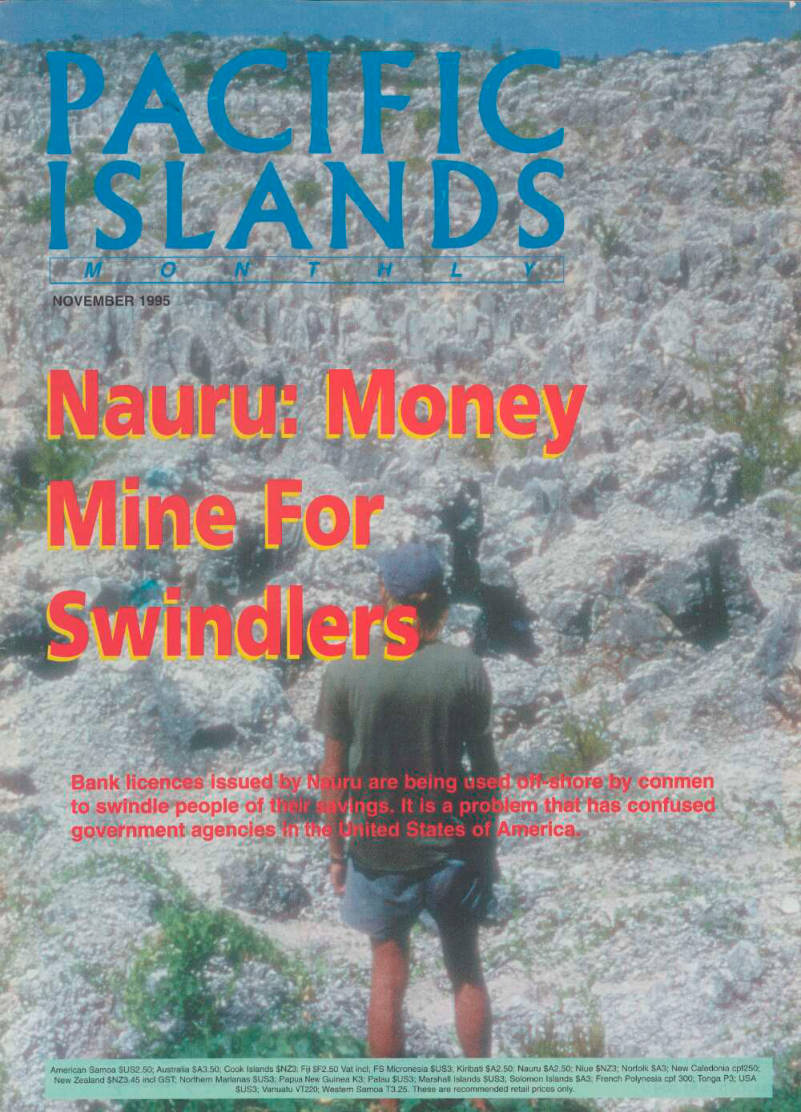
Nauru: Money
'ml fifiinSkrni Mr Will •
Bank licences issued by ASd by conmen !>1 Blem that has confused government agencies America. s
American Samoa SUS2.SO; Australia $A3.50; Cook Islands SNZ3; Fiji $F2.50 Val incl; FS Micronesia SUS 3; Kiribati $A2.50; Nauru $A2.50; Niue SNZ3; Norfolk SA3; New Caledonia cpf2so; New Zealand $NZ3.45 incl GST; Northern Marianas SUS 3; Papua New Guinea K 3; Palau SUS 3; Marshall Islands SUS 3; Solomon Islands SA3; French Polynesia cpf 300; Tonga P 3; USA SUS 3; Vanuatu VT22O; Western Samoa T 3.25. These are recommended retail prices only.
Advertisements & other items, pp. 2-5 (2 items)
Telikom
Papua New Guinea
* m.
'm m an 9*» X* «*» IS iiiii ■ •. o * v nTmTnnTMmnr :
tKf-f} -
- :: : “« . i, ; I rs=: 3'«? : r Telikom has set the pace in providing state-of-the-art telecommunications links within PNG and to anywhere around the world as we enter the 21st Century. For all your telecommunications needs, write to us at this address: Assistant General Manager
Telikom Marketing Department
P.O. Box 291
Waigani, Papua New Guinea
Tel: 675 300 5564 Fax: 675 300 5540 I
TELIKOM
flom wete neatly, talking!
muss
-ii-s
r ?
H u u »J r 4*
NZS
9002 N/ Winning F.T.1.8 Exporter Awards (B&l) twice in a row -1993 & 1994 is’nt enough for BIL.
BIL has one more feather in the cap...
Fiji's only wire/fence product company to be accredited to ISO 9002 certification.
A name you can always rely upon anywhere in the Pacific for 'reliable' quality chainlink fence, barbed wire, welded mesh, bright & galvanised nails.
ISO
9002
BPPL
BA INDUSTRIES LTD
P.O. Box 707, Ba, Fiji, Phone (679) 674 966, Fax (679) 676 700. ; v.
SN WM m mm llili m
g| lImH m ' a '
S.W.I.F.T.
' iOt WkJ*: V •.
We do more business in the Pacific
than anybody else.
With representation in eleven Pacific Island countries and a history of service in the region that dates back to 1901, it’s not hard to see why we do more business in this part of the world than anyone else!
Westpac’s international connections enable our clients to be kept right up to date with the latest movements and changes on the world markets. Our transacted quickly, efficiently and safely - anywhere in the world.
Letters of Credit, import/export finance, foreign exchange, forward cover and technical expertise - Westpac sets the standard, others follow!
If you have interests in the Pacific, it makes good sense to deal with the leader!
Talk to Westpac today. We’re in the Pacific to stay and we mean business!
“5.W.1.F.T.” computer network link ensures that our clients overseas business is You can hank on Westpac
INTERNATIONAL TRADE FINANCE
Pacific Branches: Cook Islands • Fiji • French Polynesia • New Caledonia • Niue • Solomon Islands • Vanuatu Subsidiary: Kiribati (Bank of Kiribati, Tarawa) Affiliates: Tonga (Bank of Tonga, Nukualofa) • Tuvalu (National Bank of Tuvalu, Funafuti) • Western Samoa (Pacific Commercial Bank Ltd., Apia) International Representation: Beijing • Hong Kong • Jakarta • Jersey • Kuala Lumpur • London • New York • Singapore • Sydney • Tokyo • Wellington 11#
Pacific
ISLANDS
MONTHLY
V 01.65 No. 11
THE NEWS MAGAZINE
NOVEMBER 1995
Inside
1i Cover: Nauru has lost million of dollars to swindlers and at the same time it is issuing bank licences used by swindlers. It is situation that has left US law enforcement agencies baffled.
6: Letters 8: Headlines 14: The Chinese tug of war 15: Trial 16: Entertainment 23: United Nations 26: The Region 28: Samoa’s new wealth 51: Fishing nets dividends 52: Manu Samoa 54: Sports. Ugly brawl. 56: Yachting 58: Books.
View
25: David Barber on New Zealand’s stand that aid alone will not be enough to help neighbouring Pacific Island countries.
Supplements
33: Fiji’s 25th anniversary celebration feature reflecting on the past and preparing for the future. 42: Telecommunications fea ture; the needs of the Pacific and services available.
Special Report
Ap 3 Fiji’s Chief Justice, J Sir Timoci Tuivaga, ij speaks about the country’s judiciary since independence
Advertisements & other items, p. 5 (1 item)
PUBLISHER: Brian O’ Flaherty
ACTING EDITOR:
Yunus Rashid
CORRESPONDENTS:
David North, Ed Rampell, lan Williams, Liz Thompson, Roman Grynberg, Wally Hiambohn, Lisa Williams, Patrick Decloitre, Barry Markowitz.
COLUMNISTS: David Barber (Wellington), Futa Helu (Tonga), Jemima Garrett (Sydney), Alfred Sasako (The Forum).
ADVERTISING SALES
Regional Sales - South Pacific Ashok Lai, Shailendra Kumar Tel (679) 304111, 303429, Fax (679) 303809.
Sydney, Canberra: Bob Hill Media Representation, Tel (61-2) 4164245, Fax (61-2) 4165064.
Brisbane: Jane Fewings Media and Advertising Associates Tel (61-7) 378 4522, Fax (61-7) 878 1071.
Adelaide: Hastwell Williamsons Representatives, Tel (61-8) 3799522, Fax (61-8) 3799735.
Melbourne: Brown Orr Fletcher Burrows (Aust) Pty Ltd.
Tel (61-3) 8265188, Fax (61-3) 8265644.
Auckland: McKay & Bowman, International Media Representatives Limited, Tel (64-9) 4190561, Fax (64-9) 4192243.
Japan: Universal Media Corporation, Tokyo, Tel (3) 3266626741, Cable: UNI-MEDIA Tokyo, Fax (3) 32626742.
Pacific Islands Monthly was founded 1930
(USPS 9522480).
A Fiji Times Limited production.
Cover prices are recommended retail only. Registered by Australia Post, Publication No. NBPI2IO. © Copyright Fiji Times Limited, 177 Victoria Parade, Suva, Fiji.
Tel (679) 304111, fax (679) 303809.
Pacific Islands Monthly is published monthly by Fiji Times Limited, a division of Nationwide News, 2 Holt Street, Surry Hills, Sydney, NSW 2010.
SEND ADDRESS CHANGES TO:
Pacific Islands Monthly, PO Box 1167, Suva, Fiji.
Typeset and printed by The Fiji Times Limited, 177 Victoria Parade, Suva, Fiji.
Letters
Reply to Grynberg
Dr Roman Grynberg’s analysis of the PNG crisis (PIM, September 95) fails in one important aspect: he (both in his for mer capacity as “economic adviser” and as journalist) and his ilk are part and parcel of the malaise he so well describes.
Economic advisers in particular are 10 a penny in the Pacific - every island has a few, never paid less than a hundred grand (in comparison to the average “local” wages being less than ‘ten grand’), invari ably recruited from the metropolitan coun tries where they were minor, but eager, bureaucrats in the service of aggressive
market capitalism.
Propelled into ‘top jobs’ advising min isters (even prime ministers) they taste ‘high life’ and ‘high society’ as they never have before. Invariably they have to travel with ‘their’ minister around the world, stay in top hotels and meet the movers and shakers of this world.
Once they finish their contracts (they weren’t clever enough to extend the good life permanently) and move back to minor positions in their home countries, they become ardent critics of the Island economies (especially of ministers who denied them another contract extension).
In a recent deposition at the ‘Wine Box’ inquiry in New Zealand, a former expatri ate Secretary of Finance of the Cook Islands noted that he and his family were threatened with regard to his courageous upholding of ‘financial ethics’ by minister so-and-so, and that the Prime Minister had a slush fund for his travel that was linked via a multiplier formula to one of the most expensive hotels in Paris.
To prove who knows what point, the former secretary added that his ‘own’ mul tiplier for such travel was just a notch below that of the prime mister’s. I have yet to meet an economic adviser who would recommend cutting his own outrageous
salary package.
Dr Grynberg’s contention that colonial ist Australia is to blame for the first histor ical phase of PNG’s woes gives way to blaming PNG for her second (and current) economic crisis.
This is simply to deny history; the neo colonial politics (not only by Australia) of the metropolitan governments drive relent lessly towards a neo-feudalistic economic system dominated by multinational oli
garchies.
Economic advisers are sent to PNG to assist in that effort. And what a fine job they are doing. The common people of PNG don’t stand a chance.
Dr Grynberg in his article dismisses
Marxist economic analysis - how can he when he just demonstrated one of the great Marxist theses (the first time round history is a tragedy, the second time round it is a farce)? When the critics themselves are collaborators with and beneficiaries of the status quo, what could be more farcical?
Dr Wolfgang Sperlich
PO Box 103
Alofi
Niue Island.
Japan; not foe
but friend
Lately, I read and heard in the media that three of our war veterans, mostly from Guadalcanal* were invited to attend a high -level function in London to commemorate the end of World War II in Europe.
Interestingly, a group of students from St Joseph’s were also invited to Australia to attend the 50th anniversary of the victo ry of Allied Forces in the Pacific.
Even our police and national security minister was invited to attend the 50th anniversary of the end of war held in Hawaii.
What is the use of attending these anniversaries? We all know that World War II is long gone and the Allied Forces were in fact the winners.
We are now in a new era and we must bear in mind that past is past. Besides, was the 50th Anniversary held here on our own soil in 1992 to commemorate the Allied victory over Guadalcanal not enough?
The point that I would like to raise here is that Japan, whose defeat is now being celebrated, is now Solomon Islands No. 1 friend and aid donor.
Economically, therefore, Japan has done a lot more for our young nation than any other country.
It is thus, an insult to our best and No. 1 friend to accept such invitations.
Wake up, Solomon Islanders, these invitations are obviously part and parcel of pure propaganda by western countries to uphold the perception that they are superi or.
To us, Solomon Islanders, now, Japan is in fact superior to any other nation, espe cially in this new era. Bear this is mind.
Long live Japan.
Koito Kwasi
Aenageo Village Solomon Islands
Open letter to
Chirac
We strongly protest the decision by French President Jacques Chirac to carry out further nuclear weapon tests at Mururoa Atoll.
Norfolk Island, in the South Pacific, has a population of 1800 dependent on tourism. As citizens with a special historic, ethnic and cultural connection with the people of Tahiti and Pitcairn Island, we believe that the interests of France and her people would be better served if you pur
sued peaceful, environmentally-friendly
policies.
There is no guarantee that at least some of the radioactive isotopes which the tests will release into the sub-marine structure of Mururoa Atoll will not escape into the biosphere and thus the food chain upon which we and other species in the Pacific depend. Those highly dangerous isotopes will remain radioactive for thousands of years and could affect the survival of many species of marine flora and fauna. It is likely that, having been adversely affected by radio isotopes, some species of birds which breed on Norfolk Island, such as the Wedge-tailed Shearwater Puffinus Pacificus, could end up dying in their breeding burrows on this or other Pacific islands.
In addition to the obvious potentially catastrophic environmental consequences of your decision, your case for undertaking further nuclear tests at Mururoa appears to lack both logic and common sense. If
nuclear testing were environmentally
harmless you would no doubt conduct them in France.
We support the citizens of France who are concerned over the harm the decision is doing to the world environment and France’s image, especially in the Pacific.
Cancel the tests and make France and the French people friends rather than enemies of the environment and peoples of the world.
Angela Guymer
President Norfolk Island Flora and Fauna Society
Ambassador to Earth
The desire of all people for peace can no longer be ignored! As the Ambassador to Earth for SIRIUS affairs my mission here can no longer be hidden. Hitherto the
existent mismanagement of EARTH affairs has been benignly tolerated.
However at this juncture the Cosmic Director of Intergalactic Affairs has deigned that all discord must now come to an end. The existing powers that be must either bring themselves into alignment with SIRIUS ’ intentions or face the regret table consequences.
No longer will petty tyrants and war ring politicos be allowed to carry on in a destructive manner.
The mass of humanity in its suffering and despair is crying out for PEACE.
The call has been heard. SIRIUS has answered.
Embassy of the star system SIRIUS Ambassador to Earth for SIRIUS Affairs
Martin Leo
Stamps wanted
I occasionally read Pacific Islands Monthly borrowed from the library; it’s good, up to date, and very interesting when you read about the tiny states in the Pacific, their progress, problems, etc.
Also, I collect stamps and I swap them with two people from Ukraine and Slovenia. We’re interested in Pacific stamps, of (1980-1995) New Zealand, and
Png.
I can’t afford to buy them all the time, it will bust my pension.
I would be happy with fine, used stamps, not mint/unused ones as they are too expensive? I’ll swap them for Australian, Indonesian, etc, ones. I would prefer commemorative ones.
Els Hear man
11 A Younger St Coburg, 3058, Vic. Australia
Tokelau bucket
Some years back, as a resident of Hawaii, I had in my possession a Tokelau bucket. Dry rot and termites have long since claimed it but I often recall that it was a very graceful example of primitive Oceania art vis-a-vis form following func tion. Data on the Tokelauans is quite sketchy hereabouts. I’d like to obtain a new bucket but do realise this is a long shot. Worth a try. It’s made either of drift wood or breadfruit wood.
F J Henry
10247 Pineaire Dr Sun City, AZ 85351, USA
Vanuatu diocese
THE Church of Melanesia in Vanuatu will inaugurate a new diocese in the Banks and Torres Islands on May 12 next year.
And Banks and Torres Islander, Reverend Father Charles Welchman Ling has been named bishop of the diocese.
Fr Ling comes from Motalava and he will be consecrated and installed bishop also on May 12. He was ordained a priest in 1969 and has since held a variety of postings in the Church of Melanesia, which covers Vanuatu and Solomon Islands. He was honoured for his work in translating the Bible.
Logging income drops
REVENUE from Solomon Islands’ export of logs dropped in the second quar ter of this year. The Central Bank of Solomon Islands said that was so because too many second-grade logs were export ed. The bank said overall, export receipts grew by 17 per cent in the June quarter, 12 per cent higher than in the same period last year.
Export increased for all major com modities except logs.
Import payments also increased by nearly 14 per cent, and were 24 per cent higher than a year ago.
Pacific’s new ship
BLUE Star Line has added a new ship, the 1308-container Melbourne Star, to its North American West Coast trade which serves New Zealand and Australia with eight to nine day frequency.
Blue Star Line and Columbus Line now operate six vessels off the US/Pacific Coast. Each ship holds a'minimum of 1000 containers which assures level capacity on every berth and for every sailing to Australia and New Zealand.
The Melbourne Star carries 680 refrig erated containers and has breakbulk capac ity of 168,000 cubic feet.
Nauru’s $230-million
clean-up campaign
NAURU, whose landscape has been ruined by years of phosphate mining, is to spend the next 23 years cleaning up the mess and rehabilitating the land. It will cost $230 million.
Phosphate on Nauru is expected to run out before 2000. It, however, has made the 7000 people of Nauru some of the wealth iest in the world with the country itself having invested in real estate and hotels in major centres worldwide.
The 21-square-kilometre island has been stripped of dense forest with four fifths of it looking like “a desert of jagged coral pinnacles - uninhabitable, unusable, a ghostly array of tombstones”, said Kinza Clodumar, the special adviser to President
Bernard Dowiyogo.
W Samoa wins millions
THE Government of Western Samoa has won a big legal and financial battle in California against an insurance company which refused to fully pay out on a claim following Hurricane Val in 1991.
The government was insured at the time with Affiliated FM Insurance for damages of up to SUS4S million in the event of a hurricane. After Val, the Government of Western Samoa claimed damages worth SUS6O million and claimed payment on the full insurance cover. But Affiliated paid only two install ments totalling SUS6.I million.
Western Samoa sued the insurance company. But the company disputed the amount claimed and counter-sued.
Western Samoa won the case and the court has ordered the insurance company to pay the full cover. The company is expected to appeal.
Don’t bank on them
FEDERAL authorities have issued for mal warnings about the following Nauru licensed banks, noting in each case “this entity may be operating a banking business in the United States without authoriza tion”: Allied Bank Corporation, New York, N.Y., Paragon Bank and Trust, Coral Gables, Florida, Wellington Bank of Commerce, Hollywood, California.
In addition, the State Banking
Department in California has warned Wellington in writing “to cease and desist from doing business in California without a licence from the Superintendent of Banks”.
US officials point out that Nauru’s Allied Bank is not to be confused with a legitimate bank with a similar name that operates in Ireland.
Who caused
diarrhoea?
SOLOMON Islands health and water authorities are at loggerheads over the cause of a serious outbreak of diarrhoea in the capital, Honiara.
The water authority says the water is free of contamination, and the outbreak could be airborne.
But the health ministry says that conta mination of the water supply is caused by faeces.
The Permanent Secretary of Health, Ngaiere Fineaganofo, says their tests prove the city’s water supply contains harmful bacteria from human and animal wastes.
She said instead of denying it, the water authority should come clean and inform the public that the water supply is contain inated.She said human lives were at risk and they needed to know the truth.
testing in the Pacific.
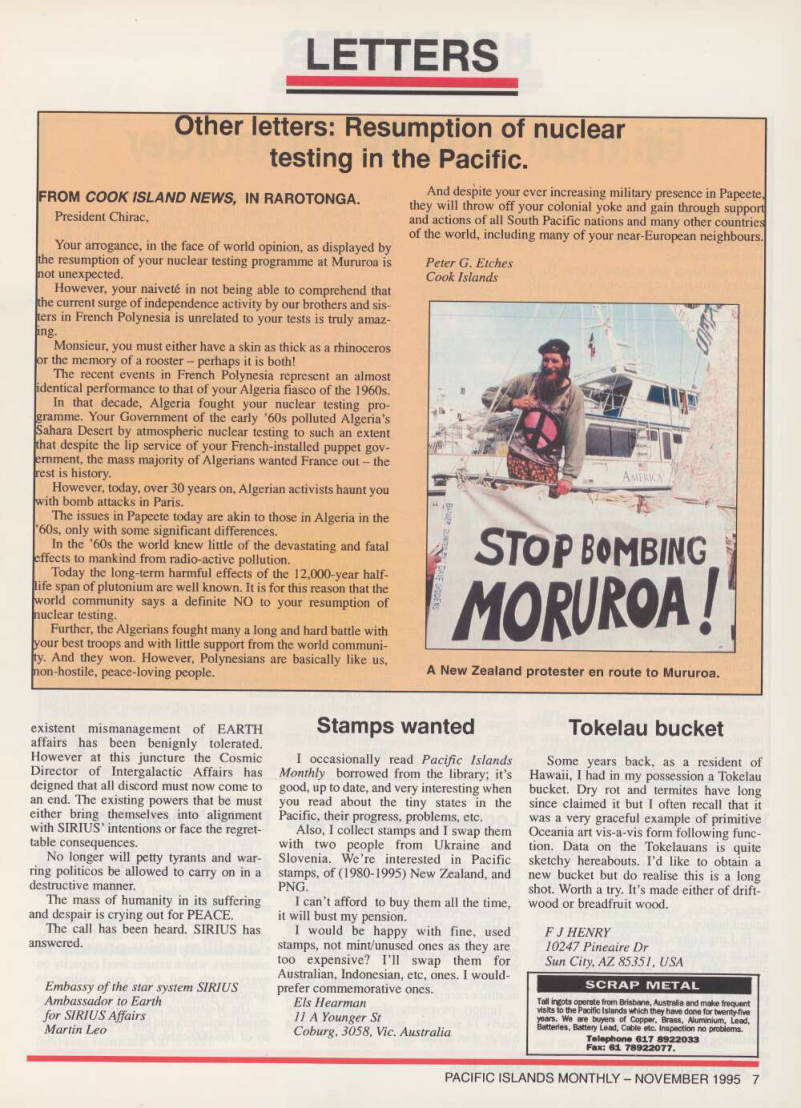
Other letters: Resumption of nuclear testing in the Pacific.
From Cook Island News, In Rarotonga.
President Chirac, Your arrogance, in the face of world opinion, as displayed by the resumption of your nuclear testing programme at Mururoa is not unexpected.
However, your naivete in not being able to comprehend that the current surge of independence activity by our brothers and sis ters in French Polynesia is unrelated to your tests is truly amaz ing.
Monsieur, you must either have a skin as thick as a rhinoceros or the memory of a rooster - perhaps it is both!
The recent events in French Polynesia represent an almost identical performance to that of your Algeria fiasco of the 19605.
In that decade, Algeria fought your nuclear testing pro gramme. Your Government of the early ’6os polluted Algeria’s Sahara Desert by atmospheric nuclear testing to such an extent that despite the lip service of your French-installed puppet gov ernment, the mass majority of Algerians wanted France out - the rest is history.
However, today, over 30 years on, Algerian activists haunt you with bomb attacks in Paris.
The issues in Papeete today are akin to those in Algeria in the ’6os, only with some significant differences.
In the ’6os the world knew little of the devastating and fatal effects to mankind from radio-active pollution.
Today the long-term harmful effects of the 12,000-year half life span of plutonium are well known. It is for this reason that the world community says a definite NO to your resumption of nuclear testing.
Further, the Algerians fought many a long and hard battle with your best troops and with little support from the world communi ty. And they won. However, Polynesians are basically like us, non-hostile, peace-loving people.
And despite your ever increasing military presence in Papeete, they will throw off your colonial yoke and gain through support and actions of all South Pacific nations and many other countries of the world, including many of your near-European neighbours.
Peter G. Etches
Cook Islands
A New Zealand protester en route to Mururoa.
Advertisements & other items, p. 7 (1 item)
Scrap Metal
Tall ingots operate from Brisbane, Australia and make frequent visits to the Pacific Islands which they have done for twenty-five years. We are buyers of Copper, Brass, Aluminium, Lead, Batteries, Battery Lead, Cable etc. Inspection no problems.
Telephone 617 8922033 Fax: 61 78922077.
Headlines
Fiji man gets life for murder
A 34-year-old Surrey (a suburb of Vancouver, British Columbia) man has been jailed for life, without possi bility of parole for 10 years, after he pleaded guilty to shooting and killing his wife because she was having an affair with someone else.
Shamim Khan, 34, originally from Ba, in Fiji, was initially charged with first degree murder of his wife of 11 years, Asida, 29, originally from Nadi, Fiji. But the charge was later reduced to second-degree murder, which allows parole after serving 10 years of the life-term (25 years).
First-degree murder convictions do not allow parole for 20 years. (Parole still has to be approved by parole boards, depend ing on the prisoner’s behaviour while in prison).
Justice William Selbie, of the Supreme Court at New Westminster, heard that Khan had no prior record or history of violence.
The couple had three children aged between two and nine years at the time of the murder.
The court heard that Asida was working at the White Spot restaurant on Scott Road and 72nd Avenue, in Delta, British Columbia (a suburb of Vancouver) and got intimately involved with another employee at the restaurant. The man she got involved with was seven years younger than her and was the assistant manager at the restaurant. He was bom in Fiji.
Khan found out about the affair and became agitated. Asida’s brother confirmed the story of the affair on November 13,1994, two days before the shooting.
In an attempt to salvage the marriage, a meeting was held in a parking lot between Khan, Asida, her 22-year-old boyfriend and her brother.
When Asida refused to end the affair, a scuffle broke out and Khan punched the boyfriend before he was pulled away by Asida’s brother, the court was told.
Khan and Asida’s brother then pulled her into their car and spirited her away to their home at 12923-87th Avenue, in Surrey. The boyfriend followed them home but left after being threatened with a weapon.
Another mediating session was held in the house with family members and a Muslim priest to try and get Khan and Asida’s marriage on track again, but this also failed.
On the morning of November 15, 1994 the boyfriend came to
the house again and was apparently was told by Asida to go away as Khan was in a rage, the court was told.
She spoke to him through a window from her living room on the ground floor of the two storey house. Khan heard them talk ing and flew into a rage. There was a fight and Asida ran out onto the street and towards her boyfriend.
But Khan chased her out and pulled her back into the house by her hair, screaming and shouting.
He made her sit and then shot her in the forehead twice from close range with a 22-calibre rifle as she sat on an armchair in the living room. The shots were fired from such a close range that powder bums were left on the victim’s face. She was look ing out onto the street where her boyfriend stood as she was shot.
Their three children were at home at the time but were in the basement, and Asida’s mother was in the house as well. There was one report that one of the children and Asida’s mother were watching as she was shot. But this could not be confirmed.
After the shooting, Khan called the 911 emergency line and told the police, in calm and measured tones, that he had shot his wife.
“Yes, I have shot my wife. I chased the guy away and I shot her,” he reportedly told the police.
Defence lawyer Harry Rankin said that Khan, a former janitor at the Surrey Memorial Hospital, would never be a danger to
society.
“This man will never be in trouble again - ever,” he said.
He said that in contrast the boyfriend was an arrogant young man who, despite carrying on the affair, had no intention of sup porting Asida and her children.
“This is the most obnoxious young man who had no commit ment,” RT Tankin said. “He had all the confidence of youth, all the arrogance of youth,” the lawyer said.
The senior crown prosecutor said the murder charge was reduced to second degree because of good negotiating between the crown and the defence.
Khan will have to report to a parole officer even when he is 60 years old.
The three children are believed to be living with their grand parents. *
ADB lends to Cook Islands
The Asian Development Bank has approved an 5DR1.977 million ($3 million equivalent) loan to the Cook Islands for relending to the Cook Islands Development Bank (CIDB) for meeting medium and long-term demand for devel opment finance in the islands.
The loan will be drawn from the Bank’s Special Funds resources, with a service charge of one percent per annum and repayment over 40 years, including a 10-year grace period.
The project will result in private-sector investment in develop ment projects, thereby stimulating economic growth and creat ing employment. It will generate approximately 310 new jobs, incremental investment of $7 million and sales of $9 million.
In addition, an advisory technical assistance grant of $250,000 will be made available to support the consolidation of business advisory services within CIDB and the expansion of existing services to provide national coverage.
As the borrower, the Cook Islands will bear the foreign exchange risk and relend to CIDB, as an intermediary, in New Zealand dollars, at an interest rate adjusted semi-annually to equal the bank’s lending rate on multi-currency loans from ordi nary capital resources. Repayment by CIDB will be over 15 years, including a grace period of three years. CIDB will use the proceeds of the loan to make sub-loans to development projects.
It is expected that the loan will be fully committed with three years, and completely disbursed within four years, of the date of loan effectiveness. Sub-loans may range in size between $1,200 and $300,000 equivalents.
The project is the third credit line to the CIDB to support devel opment projects undertaken by the private sector. Two credit lines, each worth $1.5 million, were approved in 1982 and 1992.
The bank’s strategy for the Cook Islands focuses on the need for private-sector development, and for a reduction in the current excessive public-sector involvement in business activities. The bank’s role is identified to support development of a policy envi ronment conducive to business activity, together with direct interventions to support private-sector development and improve the operation of the financial system.
The ADB is an international development finance institution engaged in promoting the economic and social progress of its developing member countries in the Asia-Pacific region. Its strategic objectives are the promotion of economic growth; the reduction of poverty; the improvement in the status of women; the development of human resources, including population plan ning; and the sound management of natural resources and the environment. ■
information highway

Entertainment
Drink and drive on the information highway
By Patrick Decloitre
It might be a surprising sight for those unfamiliar with the idea to see someone having a drink at a bar, but at the same time typing away on a computer. For the first time in the Pacific region, a concept already known in Europe has arrived; an Internet bar called Cyberbahn - a first in the Pacific.
To many ‘normal’ people in the South Pacific Island nations, Internet remains a remote concept. What is the concept of Internet? What does it mean to ‘surf’ on the “World Wide Web”?
It’s all about connecting a computer to a phone line through a modem. The con cept was introduced in the late 60s by the US Defence Department as a computer network. Then it was used for E-mail (electronic mail) exchange by American universities and the US Government departments. In 1991-1992, a new con cept, the World Wide Web (WWW), was introduced to a much larger public; the idea was to create a virtual publishing world. The outcome is that now, over 30 million people around the world are using what is generally referred to as “Internet”, explains Stuart Cameron, one of the direc tors of Cyberbahn, the company that set up the service in this Sydney Hotel bar (in the Circular Quay district).
The growth of the WWW was spectac ular; it started with just over a thousand ‘home pages’ (in fact, the computerised version of a magazine, whether it is in The Chicago Tribune or a Jazz monthly), and this year there are more than 60,000 avail able, according to Cameron.
“WWW is very versatile. You have full multimedia capability with sound, still images and video. You can call the latest weather satellite image, then go on to the music network and enquire on the local gigs in Sydney, ask for information about any country in the world, or read today’s issue of The Chicago Tribune. Really, it’s anything you can think of. Now, for the cost of a local call, it is possible to connect
your computer to Iceland,” says Cameron.
Do computers and alcohol mix well?
Apparently, yes: “Everybody here wants to come to continue work, or else they come for social reasons. We have all sorts of cus tomers; the young ones (in their 20s), who like to use the Internet and play pool, but also the 30-to-40-year-old customers who like to have a look at the stock market.
There are also quite a few tourists, so alto gether this is a large spectrum,” says Ben Carberry, assistant manager of the Sydney Paragon Hotel, where the Internet bar,
Cyberbahn, has been operating since July.
The advantages are, with this sort of facility, that you don’t need to have your
own computer - for SUS 11 per half an hour, you can connect to over 40,000 places around the world.
“The system has been designed for the first-timer (or ‘newbie’, but with all the speed and clarity demanded by an experi enced ‘net-head’. It’s the perfect introduc tion to the (Inter)net, as part of a group participating on the one machine or as an individual wanting to tinker with the new technology,” says Cameron.
The newcomer will quickly leam how to ‘serve’; it’s a matter of exploring through a list of topics called “book marks”.
Through these bookmarks you can have
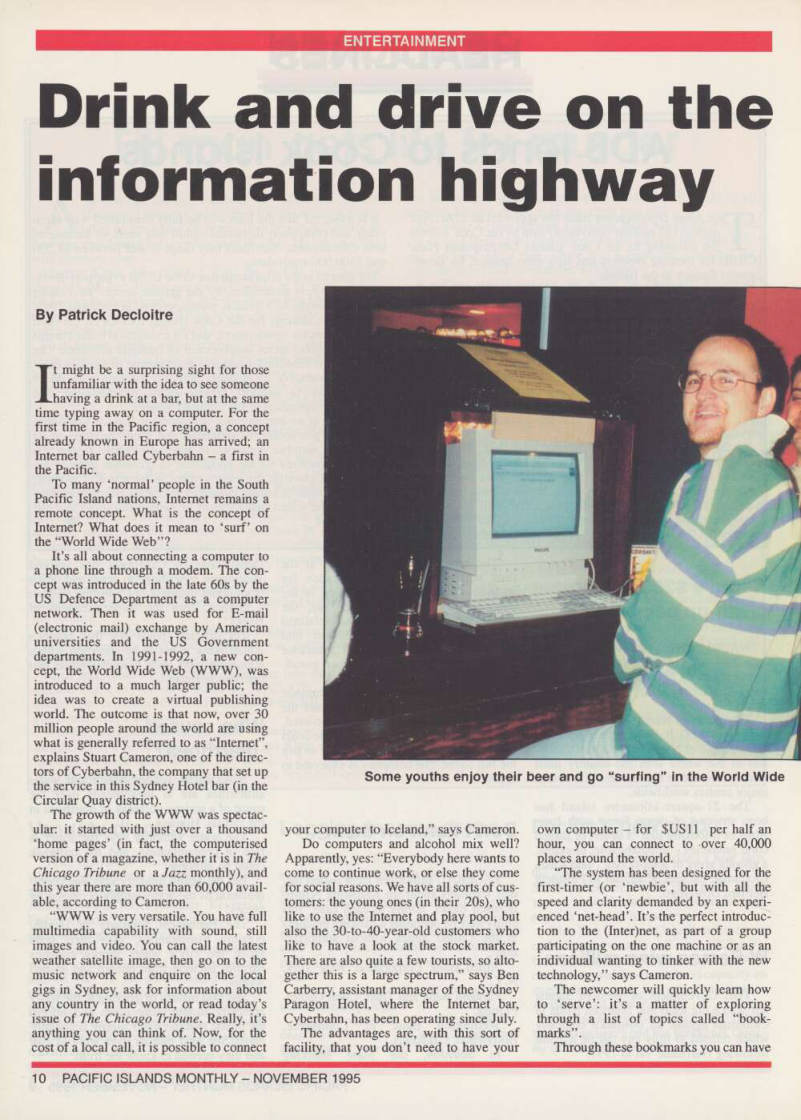
Some youths enjoy their beer and go “surfing” in the World Wide
access to topics as Rolling Stones maga zine, NASA, the Pentagon, Terminator movies, Batman Forever, Greenpeace, Jazz on Line, the French president, Hugh Grant, and so on.
Other ways of finding a topic are sim ply by entering a key word on a specific subject. ■
Web using Internet.
Advertisements & other items, p. 11 (1 item)
bring the markets
We can help 1
of the world
right to your door.
If you’ve been in business for any length of time, you know that half the battle is knowing the right people. But when you live on an island, making such contacts can be pretty difficult, not to mention expensive.
That’s where the South Pacific Trade Commission comes in. Our primary purpose in life is helping business people in the Pacific Islands become more successful.
Not only can we introduce you to key importers, agents or retailers around the world, we can also put you in contact with potential investors.
And we can assist exporters attend Australian trade fairs and exhibitions.
To give you an idea. In recent months we helped Western Samoa Breweries find an Australian agent to promote and distribute Vailima beer. We helped Teikabuti Fishing Co. redesign their tuna jerky packaging to conform to Australian standards. We arranged for the enrollment of five trainees in technical training courses in NSW and Qld. And we paid for six South Pacific companies to attend Fine Food Fair‘94 in Melbourne.
So if you need some help making the right contacts, just contact us. After all, you’ve nothing to lose and the rest of the world to gain.
We can help you with packaging designs that will appeal to new markets.
We can arrange training in business and technical skills for your employees.
SOUTH PACIFIC TRADE COMMISSION
50 Park Street, Sydney 2000. Telephone (612) 283 5933 Facsimile (612) 283 5948
Saga of the sacked
The Region
Saga of the sacked Auditor-General
By Alan Ah Mu
Four months have passed, yet the Western Samoan Government has not heeded an urgent call by mem bers of the public to either sack the sus pended Controller and Chief Auditor, or reinstate him.
Taxpayers are demanding to have a chief auditor back at work quickly to account for how their money was being spent.
Action is vital for the “just and efficient administration of the financial affairs of Western Samoa”, the Western Samoa Civil Liberties Society (WSCLS) urged to Prime Minister Tofilau Eti Alesana back in July.
But since suspending Sua Rimoni Ah Chong that month, the government has ignored the society’s concerns. Said WSCLS vice-president Anae Tony Pereira this month: “They should do the decent thing” and act.
The head of state, acting on the advice of the prime minister, may suspend a chief auditor when parliament is not is session, as was done. But under the constitution if parliament is in session, such a suspension becomes invalid at the end of the session and Sua “goes back to work”, Anae said.
That is if the chief auditor has not been
sacked by parliament during the session
first. This is hard to do because a two-third majority has first to establish that the chief auditor was misbehaving or suffering from an of infirmity of body or mind.
It would be up to the Human Rights Protection Party (HRPP) government to find instances of misbehaviour by Sua, but the chief auditor is presently well enough to drive a motor vehicle almost daily. Not all of the 33 HRPP members of parliament in the 49-seat parliament, will vote to sack Sua, Independent MP and former cabinet minister Le Tagaloa Pita said, “because it would be very stupid”, and because some government MPs are related to Sua.
After seeing his 1994 report “inappro priately” dealt with, and after a year of dis may, disappointment in Tofilau, a “strong leader” he’d believed would respond bet ter, apprehension about a commission picked to review what he thinks are already clear-cut functions of the Chief Auditor, Sua, also worried about the fate of
future reports, sued.
His lawsuit seeks a supreme court rul ing on the specific duties of the audit office and the defendants towards audit reports. Because what the government did was to get parliament to hand the chief auditor’s controversial 1994 audit report to a commission of inquiry, rather than to the Public Accounts Committee.
Criticised for agreeing to a commission of inquiry, opposition leader Tuiatua Tupua Tamasese Efi, said that was inevitable because the government, with a
big majority, wanted it.
So he opted to argue - unsuccessfully as it turned out - for the commission’s mem bers to be appointed from overseas for the sake of impartiality.
Inexplicably the government-appointed
commission confirmed “in the main, the irregularities outlined by the Controller and chief auditor”, then accused him of
levelling “flimsily composed” charges
against the ministers and of having gone beyond his powers of investigation.
Polynesian Airlines, for instance, funded by taxpayers but mismanaged to the point of near bankrupting the country, was one of the areas taboo to him, the commission said.
It cleared seven ministers and top pub lic servants of wrongdoing.
Tofilau said it shouldn’t be that some one chosen to do the government’s work should continue to do so while dissatisfied with and questioning the government, in explaining Sua’s suspension without pay.
“And not only that but (someone) whose dissatisfaction has reached the court,” said.
In an interview with the Samoa Observer, opposition leader Tuiatua said the suspension was a “sinister plot to inhibit the independence of the audit office and to defend corruption by attacking the credibility and competence of the audit office”, The neglect of accountability for tax payers’ money will continue until the gov ernment assembles parliament to decide the chief auditor’s fate.
Waiting for the supreme court to settle the dispute could stretch the neglect for longer than the WSCLS wants, especially as the chief auditor has filed another law suit, this time against the prime minister and cabinet to challenge his suspension and with appeals by either parties possible.
The appeal Court sits once a year.
The only dispute settled fairly quickly
was government restoring first Sua’s pay, then his government vehicle, apparently bowing to the argument that both things were included in the chief auditor’s legal salary package which should not have been withheld since he was only suspend ed, not sacked.
As it is, even before the supreme court hears the lawsuits it has to deal with a motion the Attorney-General’s Office act ing for the defendants filed to have the Parliament struck out as a defendant in the first lawsuit, based on the argument “you can’t sue Parliament”, defence counsel
Marion Bailey explained briefly. The
motion is scheduled to be heard this month.
Meanwhile no audit report sanctioned by the chief auditor will be tabled in par liament this year not a unique lapse in the country’s history but it defies the require ment by the constitution that audit reports be tabled annually.
Appointing an acting controller and chief auditor, as government has done “is not good enough”, WSCLS said. The posi tion is not recognised by the constitution and thus leaves the appointee with no “security of tenure”, and, added Anae, open to “intimidation”.
Matters need not have reached this stage, WSCLS said. When the government and the chief auditor had a “very serious difference of opinion” the prime minister, should have asked the supreme court for its opinion on the matter as empowered by the constitution to do so.
“It is unfortunate” Tofilau did not refer the matter to the court for it then forced Sua to do that himself, said the society, whose opinion had input from its lawyer members, including Anae and president Lesatele Rapi Vaai, also president of the Western Samoa Law Society, ‘who has since been appointed a magistrates court judge, effective next year.
Prolonging the present “inaction”, WSCLS said could mean the government does not want a chief auditor in place “in blatant disregard of the constitutional requirement for one to be in place.” Or that the prime minister had “improperly exer cised” his power of suspension, and in the circumstances could be seen as “an inter ference with justice” since a “judicial review” is to be held about the dispute.
Advertisements & other items, p. 13 (1 item)
Kingston
from our recently opened office in Suva Come to us for your ...
Infrastructure
Buildings
Industrial Geothermal Resource Management and the Environment ... needs Auckland Wellington Christchurch Invercargill Manila Jakarta Suva
KINGSTON
MORRISON
Engineers Planners Scientists For more information on the full range of our services, phone Kevin Wyborn GPO 32 Suva Fiji Tel & Fax +679 315 770
FORUM FISHERIES AGENCY. POST OF DEPUTY DIRECTOR The South Pacific Forum Fisheries Agency (FFA) is a regional organisation based in Honiara, Solomon Islands. It was established to coordinate regional fisheries policies and to promote the development of fisheries resources to ensure that maximum benefits are achieved by the peoples of the region from their fisheries.
Applications are invited for the position of Deputy Director, FFA from nationals of FFA member countries. Rule 17 for FFA Executive Appointments states that “Applicants must receive the endorsement of their Governments. Applicants that do not have the endorsement of Government will not be considered."
The Deputy Director is responsible directly to the Director for the provision of expert technical/professional advice and the efficient and effective conduct of the Agency's technical and professional activities. The activities include: • assume responsibility for the conduct of the Agency's technical and professional activities and provide direction on the execution of the Agency's work program; • oversee the preparation and implementation of approved regional fisheries development and management projects and initiatives; • liaise with Member Countries on their respective fisheries and management needs, including the development and evaluation of
country-specific projects;
• ensure the accuracy and timely dissemination of fisheries-related information to Member Countries; • maintain contact with regional and international organisations concerned with fisheries development and management in the region; • liaise with funding agencies concerning financial support for Agency activities, including financial reporting to donor agencies; • supervise personnel and administrative aspects of the Agency 7 s operations; and • assume the responsibilities of the Director in his absence.
Applicants are required to have advanced skills in the development, leadership, direction and evaluation of major technical/professional projects and also substantial and successful relevant experience in a multi-discipline environment. Applicants should possess a demonstrated understanding of the social, economic and political aspirations of the Pacific Islands peoples and proven ability to liaise with member and supporting Governments and organisations. An academic qualification in a fisheries related discipline, or similar, is
required.
The appointee will be based in Honiara, Solomon Islands but will be required to travel, mainly within the South Pacific region. A tax free salary for those recruited from outside of Solomon Islands at a regional level will apply, with attractive provisions for transportation, housing, child and educational allowances, recreation leave, insurance and superannuation.
Further information can be obtained from the Corporate Services Manager at the address below. Applicants are encouraged to forward their applications as soon as possible and should include the names and addresses of three referees. The closing date for submission of application is 31 December, 1995.
Applications should be addressed to: The Chairman, Forum Fisheries Committee, C/- Forum Fisheries Agency, P O Box 629, Honiara, Solomon Islands. Ph. (677) 21124; Fax: (677) 23 995.
The Chinese tug of war
Conflict
By lan Williams
Once again, this year Taiwan made its almost traditional bid for a sepa rate seat at the United Nations.
Until 1971 the South Pacific island voted on behalf of the whole of China until a restive General Assembly, on what US ambassador George Bush called “a day of infamy”, decided that there was only one China and its government was in Beijing, not Taipei. (Of course that was then.
During the Women’s conference ex- President Bush was being feted by and praising the “infamous” Chinese Government) The issue was put quite subtly, calling simply for a study to me made on how the Taiwanese people could be represented at the United Nations. After a three-hour committee session, in which many delega tions voiced their support for Taiwan to be admitted - as well as China - on the same basis as North and South Korea, or in the old days. East and West Germany, it was decided that there was “no consensus” on putting the issue on the agenda of the full Assembly. “No consensus” of course, means that the Chinese would be as unhap py as only they know how to be at any hint of support for Taiwan. That is perhaps why most of the world stayed silent on the issue. For example, Taiwan aided exiled President Jean-Bertrand Aristide of Haiti financially, and he spoke on their behalf a year ago - and almost provoked a Chinese veto of the UN mission that returned him to power.
Many members see that there is an anomaly in a 21-million-strong territory, one of the biggest trading nations in the world, being excluded, but see no way around the legal problems. After all, the one thing on which both Beijing and Taipei are unanimous is that there is only one China. It is just that they disagree which of them should represent it.
Taiwan’s current magnanimous stand of sharing representation at the United Nations was not apparent when they had the Security Council seat before 1971.
Since then, of course, things have changed. Taiwan has become democratic, while much of the Chinese economy has become capitalist, but Beijing is under standably hypersensitive to any sugges tions that detract from its legitimacy.
Despite that, 12 members defied the wrath
of Beijing by supporting the measure,
including, in the Pacific, the Solomons. In
Most of the 30 or so states that do recognise Taiwan are either very small, very poor, or both, allowing the People’s Republic to accuse the Taiwanese of dollar diplomacy.
But both sides have practised that.
speech and letter, the Solomons made an eloquent and reasoned intervention on behalf of the resolution that, without being too suspicious, indicated some homework done on the delegation’s behalf by the Taiwanese.
Papua New Guinea did not support Taiwan, despite the impression that many observers had that it was recognising Taipei earlier this year. In fact, PNG’s Sir Julius Chan explicitly denied that any such decision had been made when he visited the UN in October and reaffirmed that Port Moresby considers the People’s Republic of China to be the sole representative, while having close trading relations with Taiwan.
The other missing Taiwan supporter in the Pacific is Maxim Carlot of Vanuatu. A long-time member of the World Anti- Communist League, which has had close ties with some of Taiwan’s ruling party, Carlot’s government still recognises Beijing. Cynical observers assume that the French may have told him not to, but there
may also be serious difficulties in getting any such change through his coalition. So far, apart from the Solomons, the only other Pacific states recognising Taiwan are Nauru, Tonga, and Tuvalu, none of whom are members of the UN.
In fact, most of the 30 or so states that do recognise Taiwan are either very small, very poor, or both, allowing the People’s Republic to accuse the Taiwanese of dollar diplomacy. But both sides have practised that, as a look at the aid projects in the Caribbean islands, like Barbados, which recognises Beijing, and St. Vincent, which recognises Taipei, soon makes apparent. In a world where aid flows are drying up, one can hardly blame impoverished states for succumbing to temptation from one of two
economic giants.
The one thing that can be predicted is that the issue will be raised annually, but without some rapprochement between the mainland and Taiwan, its hope of success will remain slender - even if every mem ber of the Forum and AOSIS joined in.B
murder charge

Trial
Widow denies murder charge
Vanuatu’s most violent murder case to date has come up for hearing before the country’s supreme court.
The first day of hearing was October 9, 11 months since an Italian builder’s brutally clubbed body was found in the tray of his pick-up on the outskirts of Port Villa.
Standing trial is Francesco Picchi’s widow Luciana, 29. She pleaded not guilty to the charge of premeditated and inten tional murder when she appeared before the Chief Justice, Mr Justice Charles
Vaudin d’lmecourt.
Last November 28, Francesco Picchi was found dead at the bottom of a slope, slumped in the rear tray of his pick-up truck. His skull and back were badly dam aged and there were signs of strangulation.
At the time, Public Prosecutor John Baxter-Wright said the killing was the most violent murder of an expatriate in the island state’s history.
Baxter-Wright, in his opening submis sions, accused Picchi of the premeditated homicide of her husband.
For this, he said, she was helped by two
local accomplices George Tui and Perry
Jimmy, who confessed last April after being arrested by police in an unrelated case. They have since been remanded in
custody.
The prosecution, which heavily relies on the two accomplices’ statements, brought some 50 exhibits before the court, including photographs of the crime scene and of the body in the mortuary, blood stained-clothes, newspapers, a car mat, a car jack and samples of human hair.
Revealing his version of the facts, Baxter-Wright said the murder had been
planned many months ago. Picchi first started an affair with George Tui, who was employed in her husband’s building com pany. She then convinced him, in exchange for money, to help her kill her husband, with the help of another accom
plice, Jimmy.
In preparation for the crime, traditional wooden clubs (known in Vanuatu as nal nals and used for killing pigs) and wigs were bought by a housemaid.
On the night of November 28, 1994,
Baxter-Wright alleged, Picchi told her hus band she was going to play “a magic trick” on him. He then allowed her to blindfold him and tie his hands behind him to a chair.
Tui and Jimmy, who were waiting out side, came in and “set about a fatal and brutal attack” on the builder, Baxter-
Wright said, adding that both accomplices
said the young woman joined in the mur derous attack by covering her husband’s head in a plastic bag and strangling him with a rope.
Meanwhile, the housemaid was ordered to take the Picchi’s small crying child away to another room of the same house.
The prosecutor said after Picchi was killed, his body was taken to the bathroom to be washed. Bloodstained walls and floors were carefully wiped too, he said.
Luciana Picchi, throughout the prose cution’s expose, remained calm and was sometimes seen smiling.
The court which visited the crime scene on the first day of trial is expected to start the summing-up in two weeks’ time and deliver judgement. ■
The funeral of Francesco Picchi.
Advertisements & other items, p. 15 (1 item)
Tough
AS
NAILS
WIRE INDUSTRIES
(FIJI) LIMITED
Remembering Robert L
By Ed Rampeli
The musical, Stevenson by Heart, had its world premiere at Brigham
Young University-Hawaii in June.
The play is set in Samoa and depicts author Robert Louis Stevenson’s involve ment in the Samoan civil wars of the 1890 s, and the foreign intrigue that pro vided an imperial backdrop to these events.
Playwright Gene Levitt reveals the Tusitala (teller of tales) to be a politically engaged artist, dedicated to Samoan sover eignty. The man who wrote Dr Jekyll and Mr Hyde, Treasure Island, Kidnapped, et al, was already a rich and famous writer when he relocated to Samoa for health rea sons.
Stevenson used his pen and internation al standing to support the liberation strug gle of the high chief Mata’afa, who opposed the European-backed Malietoa, in the Great Powers’ bid to take over Samoa.
RLS is portrayed as being so gung ho in favour of indigenous rights that he ignores his fiction - and health - in order to devote himself to the Samoan nationalist cause.
He writes letter after letter to the world’s leading newspapers in order to spread word about the Samoan sovereignty move ment. This causes concern in several quar ters.
The colonial authorities are anxious over the Scotsman’s global reach, prestige, and influence. The Stevenson family is worried that his health is suffering from his political activities, and that the scribe’s devotion to Samoan freedom is making him neglect his fiction. The Stevensons aren’t the only ones nervous that Tusitala is overlooking his creative writing wherein lies this musical’s genius.
Four of Steven’s fictitious characters (five if you count Dr Jekyll’s dark side, Mr. Hyde) are nervous that if their creator continues to ignore his fiction in favour of writing political tracts, Stevenson’s liter ary star will fade. And, the characters assume, if RLS loses his public and is no longer read, his characters - who only live when someone reads the pages of the books they are in - will die along with Tusitala.
Dr Jekyll/Mr Hyde, Treasure Island pirate Long John Silver, Wiltshire and Uma (the lovers from RLS’s South Seas romance The Beach at Falesa) unite and conspire to kidnap the author of
Kidnapped. The conspirators’ goal is to
prevent Tusitala from expending any more
energy on Samoan politics and to force him to get back to writing what they - and just about everyone else - reasons is his raison d’etre: creating children’s stories, swashbucklers, and the like.
Gene Levitt’s script is deliciously witty
and satirical. Of course, since this play, like all plays, is written by a writer, Stevenson as the creator of his characters is able to foil the plotters by rewriting a different ending to their conspiracy.
The large cast is headed by Scott Holmes, star of stage and screen, in the title role. Holmes has appeared on Broadway in Godspell and Grease, and is currently seen in the TV soap opera As the World Turns Mika Tufuga-Valai of Asau, Western Samoa plays the Samoan narrator and RLS’s friend, Sa’ava. Alvina Gin-Nen from Auckland, NZ, is the archetypal South Seas sarong girl as Uma. Three scene-stealing performances are turned in
by the wickedly delightful Gary L.
Anderson as Jekyll (and Hyde!), Bill Ogilvie as Long John, and Keala Settle as the nanny Gummy.
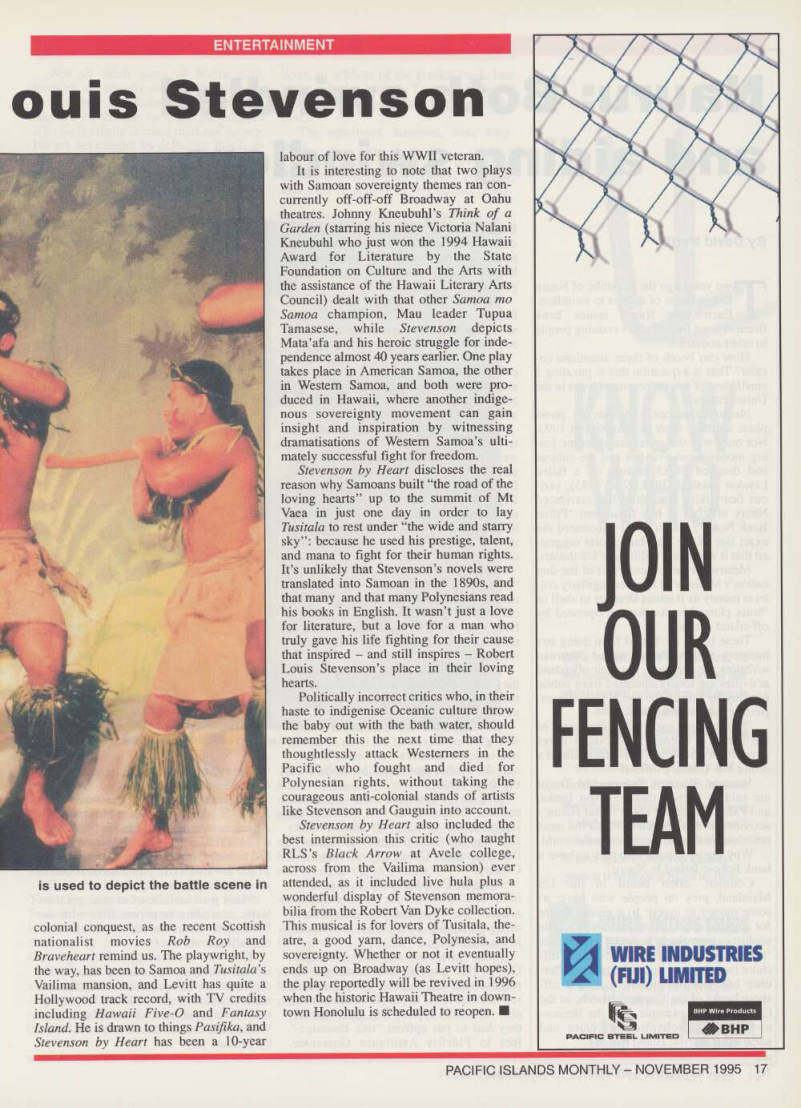
Vi’iga “Jr” Fuimaono, a Samoan cul tural adviser, depicts the Samoan aristocrat Mata’afa. In what may be a bit of crafty casting, his rival for power, the collabora tor Malietoa, is portrayed by a Tongan,Viliami Fehoko, an ambassador at the Tongan Village in the Polynesian Cultural Centre (PCC) next door to BYU- H. “ Stevenson by Heart ” draws on a lot of the abundant talent from neighbouring P.C.C A troupe of Samoan dancers enlivens the entertainment and the action; and imaginative battle scene is blocked out using the choreography of a Samoan siva.
Kudos to choreographer Vicki Nicholes and Samoan cultural adviser Lana Burgess for incorporating authentic Oceanic ele ments into the Broadway mode of expres sion, and using form to express content.
The set design by BYUH’s Craig Ferre is also quite creative and elaborate. The rotating set ranges from exteriors and inte riors of Stevenson’s Vailima mansion, to mural backdrops of Mt Vaea, Tusitala’ s
final resting place.
In terms of style and aesthetics, Stevenson by Heart may successfully unite the conventions of the Broadway musical and Polynesian aesthetics better than any other pieces of theatre. But the musical’s weakness, alas, is its music. None of the songs are of the toe-tapping, sing-along quality that has audiences humming the tunes after they leave the theatre, as with musicals like South Pacific. The music is pleasant but there is no big show stopper; Stevenson needs a knock-out number like
Bali Hai, Oklahoma!, or Old Man River.
Nevertheless, Levitt has penned a
drama with literary and political integrity.
Although he shows that - as in real life - Tusitala is consumed by the cause, Levitt has the courage not to back away from the premises that artists can be politically committed. And being from Scotland, Stevenson would know something about
The choreography of a Samoan siva Steven by Heart.
colonial conquest, as the recent Scottish nationalist movies Rob Roy and Braveheart remind us. The playwright, by the way, has been to Samoa and Tusitala' s Vailima mansion, and Levitt has quite a Hollywood track record, with TV credits including Hawaii Five-0 and Fantasy Island. He is drawn to things Pasifika, and Stevenson by Heart has been a 10-year
labour of love for this WWII veteran.
It is interesting to note that two plays with Samoan sovereignty themes ran con currently off-off-off Broadway at Oahu theatres. Johnny Kneubuhl’s Think of a Garden (starring his niece Victoria Nalani Kneubuhl who just won the 1994 Hawaii Award for Literature by the State Foundation on Culture and the Arts with the assistance of the Hawaii Literary Arts Council) dealt with that other Samoa mo Samoa champion, Mau leader Tupua Tamasese, while Stevenson depicts Mata’afa and his heroic struggle for inde pendence almost 40 years earlier. One play takes place in American Samoa, the other in Western Samoa, and both were pro duced in Hawaii, where another indige nous sovereignty movement can gain
insight and inspiration by witnessing
dramatisations of Western Samoa’s ulti mately successful fight for freedom.
Stevenson by Heart discloses the real reason why Samoans built “the road of the loving hearts” up to the summit of Mt Vaea in just one day in order to lay Tusitala to rest under “the wide and starry sky”: because he used his prestige, talent, and mana to fight for their human rights.
It’s unlikely that Stevenson’s novels were translated into Samoan in the 1890 s, and that many and that many Polynesians read his books in English. It wasn’t just a love for literature, but a love for a man who truly gave his life fighting for their cause that inspired - and still inspires - Robert Louis Stevenson’s place in their loving hearts.
Politically incorrect critics who, in their haste to indigenise Oceanic culture throw the baby out with the bath water, should remember this the next time that they thoughtlessly attack Westerners in the Pacific who fought and died for
Polynesian rights, without taking the
courageous anti-colonial stands of artists like Stevenson and Gauguin into account.
Stevenson by Heart also included the best intermission this critic (who taught RLS’s Black Arrow at Avele college, across from the Vailima mansion) ever attended, as it included live hula plus a wonderful display of Stevenson memora bilia from the Robert Van Dyke collection.
This musical is for lovers of Tusitala, the atre, a good yam, dance, Polynesia, and sovereignty. Whether or not it eventually ends up on Broadway (as Levitt hopes), the play reportedly will be revived in 1996 when the historic Hawaii Theatre in down town Honolulu is scheduled to reopen. ■
is used to depict the battle scene in
Advertisements & other items, p. 17 (2 items)
ouis Stevenson
ENTERTAINMENT
Join
OUR
FENCING
TEAM
WIRE INDUSTRIES
(FIJI) LIMITED
and aiding swindlers
Cover Story
Nauru: Both swindled and aiding swindlers
By David North
Two years ago the Republic of Nauru lost millions of dollars to swindlers.
Each year Nauru issues bank
licences used by swindlers conning people
in other countries.
How can booth of these situations co exist? That is a question that is puzzling a small band of law enforcement types in the United States.
Nauru’s finances - despite its phos phate wealth - were in shambles in 1993.
Not only was the government airline los ing money hand-over-fist and the cabinet had dropped SUS 3 million on a failed London musical (PIM, Nov. 1993), vari ous fast-talking smoothies had convinced Nauru officials to buy fraudulent “Prime Bank Notes”. Nauru never announced the exact size of the loss, but reports suggest ed that it was many millions of US dollars.
Meanwhile, an obscure unit of the tiny nation’s Ministry of Finance regularly col lects money as it issues licences to shell or ‘brass plaque’ banks that are operated by off-island conmen.
These banks are barred from doing any business within Nauru, so no Nauruan investors are ever hurt, but their off-island activities are totally obscured from public scrutiny by one of the world’s all-encom passing bank secrecy acts.
“Nauru won’t even tell us the names of the batiks it licenses, and Nauru never answers its mail or its faxes” complained a senior US Treasury official.
Vanuatu, Western Samoa, and Tonga are said to licence these conman banks, and Palau is thinking about it, but Nauru’s activities in this squalid field are the most notorious in the Pacific, if not in the world.
Why does it help a fraudster to have a bank license issued in Nauru?
Conmen, often based in the US Mainland, prey on people who have; a) some money to invest; b) a greedy desire for unusual rates of return; and c) little sophistication. Such potential victims, or ‘marks’, usually have heard about off shore banking, and do not know the differ ence between the closely regulated off shore banks of the Cayman Islands, in the Caribbean, for example, and the licence to-steal banks tolerated by Nauru and some other Pacific Island nations.
So conmen can talk glibly about “Prime Bank Notes” or “Bills of Exchange”, and other exotic (and fanciful) financial instru ments; and they wave their Nauruan bank licences as they weave their spell over the
gullible.
Or, in a more mundane manner - as federal court records in North Carolina show, the Nauruan licenses can be used to rob blue-collar folk of their life savings.
Donald Ray Moore, the North Carolina conman convicted on seven counts of mail and wire fraud in the Western District of North Carolina, managed to secure $1.5 million from duped investors.
He did this with few evident assets; he is small(s’2”). Black in a southern state, wears heavy glasses, speaks with a high pitched voice and has limited education.
But he also, according to his prosecutor, Bryan Whisler, has an air of earnest sin cerity, and he had purchased a Nauru bank licence for $lO,OOO. (Presumably, half the money went to Nauru, and half to a mid dleman.) Moore created a newsletter for his “Business Opportunity Club” and distrib uted it far and wide. His targets were blue collar people of limited education; his lures were low-cost loans and promises of remarkable returns on small-scale invest ments.
For example, he promised people that if they put $l5OO into one of his schemes their money would triple within 18 months.
He supported his fraudulent claims with glowing stories of his team of skilled international bankers (all make-believe) and the profits that could be made from off-shore banks.
To give his operation more of an inter national flavour he at first said that the international office of the Pioneer Development Bank (Nauru) was located in the booming Canadian oil town of
Calgary.
After the Canadian authorities got wind of his schemes and froze his Calgary bank account he switched the international office (really just a mail drop) to Grenade, in the Caribbean.
Meanwhile, he and his colleague, George Earl Landon, were hauling in the money from the gullible. They promised low-interest loans to people needing them; after the marks applied they were told that they had to put upfront “risk insurance” fees to Fidelity Assurance Guarantee,
which turned out to be a figment of the Moore-Landon imagination.
For instance, trial records show that John B Williams of Montgomery, Alabama, was told that his application for a $24,000 loan had been approved but he had to make, within 10 days, a payment of $l2OO towards a risk premium of $6OOO to get the loan processed.
Many paid such fees, but none got their loans, according to papers filed with the US District Court for the Western District of North Carolina.
This was, incidentally, what might be termed an equal opportunity fraud case; the fraudsters constituted an integrated team (Landon begin a White Virginian); the victims included both Blacks and Whites; and the con artists were convicted
by a mixed jury.
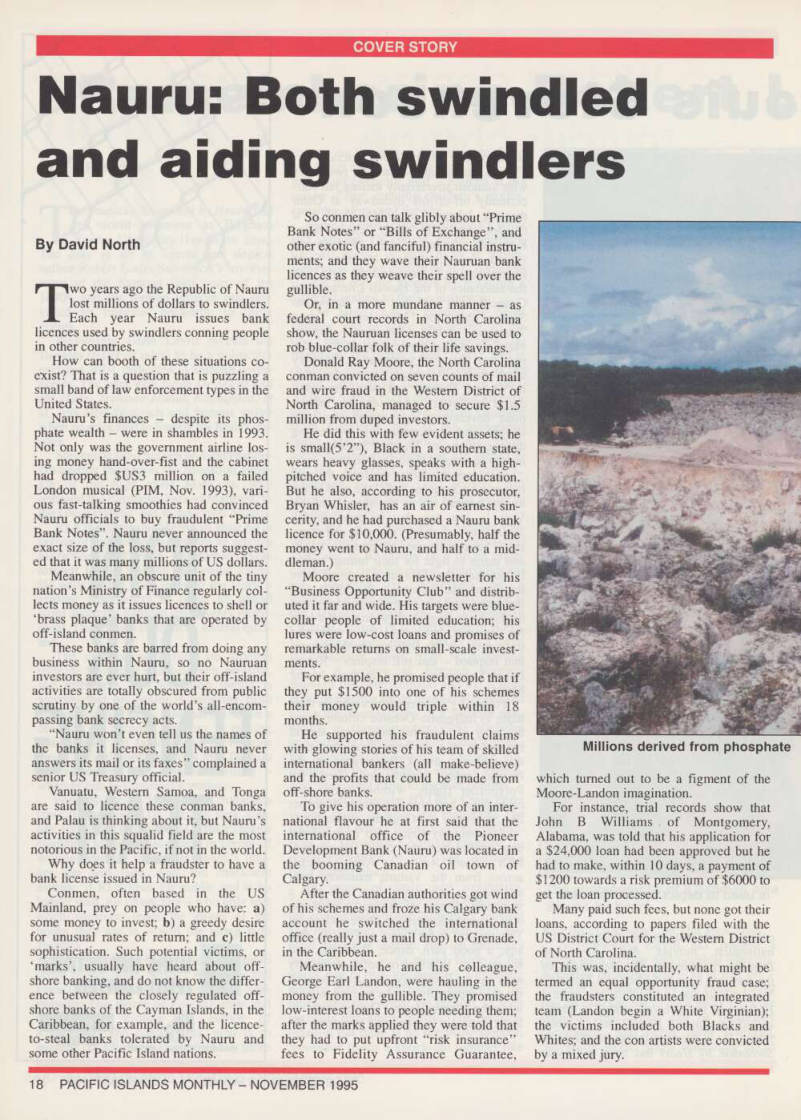
Millions derived from phosphate
Not all illicit users of Nauru bank licences are equally successful, however; in fact, there is a three-layer hierarchy of success. At the top there are the conmen who successfully defraud marks of money, but are not caught; by definition this is an invisible group. Then there are those, like Moore and Landon, who succeed in their frauds, but get caught. Finally (and law
enforcement types rarely discuss this sub population) there are the bumblers who send good money to Nauru for their licens es, but then fail to defraud anyone.
We found a couple of examples of these failures in conversations with East Coast bankers and with West Coast law-enforce ment authorities.
There is, in elegant quarters in New York City, a branch of the savvy French financial institution, Banque Indosuez. Its lawyers told me about several thwarted attempts to con bankers in mainland China.
Nauru had licensed the Jefferson Bank and Trust, Inc, and its operators, in turn, created “Bank Debenture Notes”, in the one-million to five-million range. The face of the documents indicated that Indosuez
Aval, an affiliate of the French bank, had endorsed the notes. Two officials of Indosuez Aval apparently had signed the notes.
The signatures, however, were forg eries.
Meanwhile, Jefferson had discounted the notes, making them look like bargains, and tried to sell them to Chinese banks.
The Chinese bankers, however, faxed Bank Indosuez in New York regarding their validity, and were told of the forg eries.
The lawyers for Bank Indosuez said that, to the best of their knowledge, no one had actually bought any of these phoney notes, and so the plot failed.
“Who signed the notes for Jefferson?” we asked.
The signatures, particularly after what appeared to be multiple photocopying and faxing, were inscrutable, was the answer.
The French bank reported all of the above to the US attorney’s office in Manhattan, but no one has been arrested as yet.
(continued on page 20)
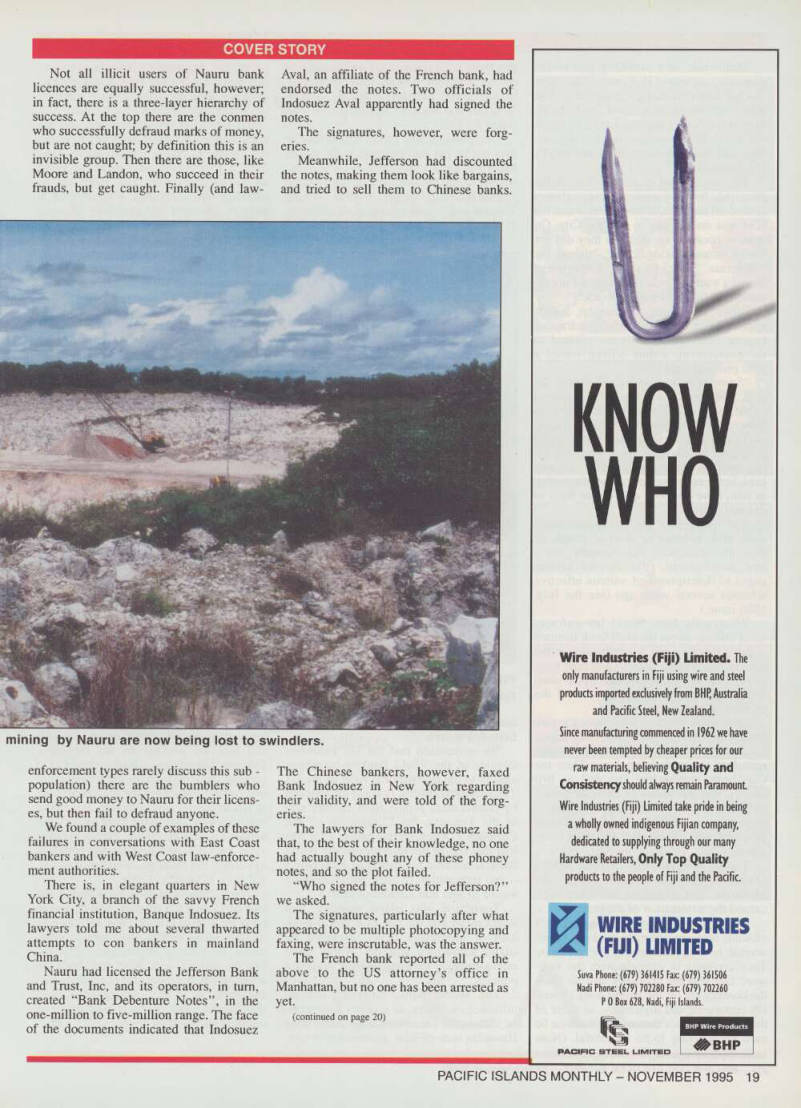
mining by Nauru are now being lost to swindlers.
Meanwhile, in a run-down part of the Armenian section of Hollywood (the tinsel city has low-rent districts too), there is an office of Wellington Bank and Trust.
Maybe it still uses that name, and maybe it doesn’t California authorities are not cer tain. And maybe it is an office and maybe an apartment.
We tried several times to talk with the principal, but a young associate always fended off the calls, telling us once that his boss was on his way to Mexico City. On another occasion he said that they did not have a Nauru banking licence - though the
California State Banking Department
issued a warning indicating that the organ isation, in fact, had such a license.
While discussing Wellington, which
apparently had not successfully defrauded anyone who subsequently complained to the government, a state official waxed a
little philosophical.
“Some of these guys are delusional,” he said, using the latest California euphemism “Some of them seem to believe the things that they write and say.”
Thus Nauru has (perhaps unwittingly) pulled off the ultimate fraud. The republic had sold, in some cases, useless phoney bank licences to overseas con-artists, who, in turn, have not been able to use them to defraud others.
The successful use of island-issued shell bank licences to defraud people of their life savings is, unfortunately, not a new development. PIM devoted several pages to descriptions of various effective schemes several years ago (see the July, 1986 issue.) What galls First World law-enforce ment officers about the shell bank licenses is that while they can, sometimes (as in the case of Mr Moore), convict a license user, other licences are being issued all the time.
Understandably, they want to cut off the problem at its source.
Once these licences were issued in tiny European nations, but then the larger, neighbouring countries lobbied for the repeal of the underlying laws. Then the Caribbean, notably the Brit and ex-Brit islands, was the source of these licenses but the UK’s Home Office (Justice Department) leaned on the officials involved, and the practice ended in those areas.
Then, briefly, the same pattern appeared in the Marshalls and the Marianas, but Mainland officials soon caused the termination of the practice.
Old Problem/New Approaches. US officials now are using, or thinking about, several new approaches to the problem.
They continue to struggle with the awk ward fact that the countries that do issue the licences are off the beaten track of both US commerce and diplomacy, so some of the pressure tactics that might otherwise be used are unlikely to be successful. (Note
that there is no resident US ambassador in any of the four nations now apparently issuing these licences - Nauru, Tonga, Vanuatu, and Western Samoa; nor is one slated for Palau.) One possible new tactic, which may or may not be put into practice, is the use of the World Bank’s influence on some of the islands to end the licensing of shell banks.
Potentially this might involve Tonga,
Vanuatu and Western Samoa, all members of the World Bank and all presumably
interested in securing more assistance from this source.
We understand that the US executive director of the World Bank, who relates closely to the international wing of the US
Treasury Department, is being approached
by enforcement people from another arm of the Treasury, the Comptroller of the Currency’s Office, on this matter. PIM was told that one of the priorities of the World Bank is sensible regulation of local banks - and termination of shell bank licensing would fit into that broader objective.
Translated into island realities, that might mean that the fate of a World Bank loan or investment being discussed by island authorities and the World Bank might hinge on the nation’s bank licensing
policies.
The World Bank, however, has no influence on Nauru, as it is not a member, so that tactic cannot be used there. One Hawaiian state official, a consumer-orient
ed lawyer, knowing of Nauru’s extensive real estate holdings in the US, suggested a domestic legal approach to force Nauru to pay attention to the shell bank issue.
“If I were in private practice, and my client had lost a bundle of money to some one with a Nauru-issued shell bank licence, I would consider indicting Nauru as a co-conspirator; and then, if the swindler were convicted, I would seek to
recover damages by attaching Nauru’s
holding in the US.”
He was not sure that he could win such a case - it is tough to sue sovereign gov ernments without their consent - but he was sure it would attract Nauru’s attention.
Another approach to Nauru’s bank licensing practices would be gentler and more indirect. It seems that the island has created a new position - that of consumer protection officer, and has hired a resident of the island, Louie Louie, to protect Nauruans from consumer fraud. He, in turn, is said to be making plans to come to the US. to leam how his peers in the vari ous American states handle their jobs.
Maybe he could be persuaded to help Nauru’s image among law-enforcement
people by encouraging his island col
leagues to terminate the licensing of the shell banks ... maybe.
The Palau Situation. Back in the pre- Associated State days, when actions of the OEK (Palau’s legislature) were subject to absolute veto by the Assistant Secretary of the US Department of Interior, the OEK passed bank secrecy legislation which would have permitted the licensing of shell banks.
The Assistant Secretary vetoed the bill.
Then, last year, Palau finally worked out the quasi-independence status that FSM and the Marshalls have long enjoyed; i.e. lots of US funding, US military protec tion, but no US direction over domestic affairs.
The legislature then re-passed all the legislation that Washington had vetoed, and sent the package to the President, Kuniwo Nakamura. Clearly this was a popular act of defiance of the former colo nial power - thumbing the legislative nose at Uncle Sam - and although Nakamura had real objections to the bank secrecy bill he faced a difficult choice: he could either upset the OEK and perhaps the populace by vetoing the package, or he could sign it, and hope to modify it later.
Nakamura chose the second option and told concerned US officials that he would press for a repeal of the bank secrecy leg islation. OEK leaders made similar com ments to visiting Washington officials.
Months passed and there has been no action as yet, but there also is no indication that Palau is, in fact, issuing licences to shell banks - but it could start doing so instantly should it so desire. ■
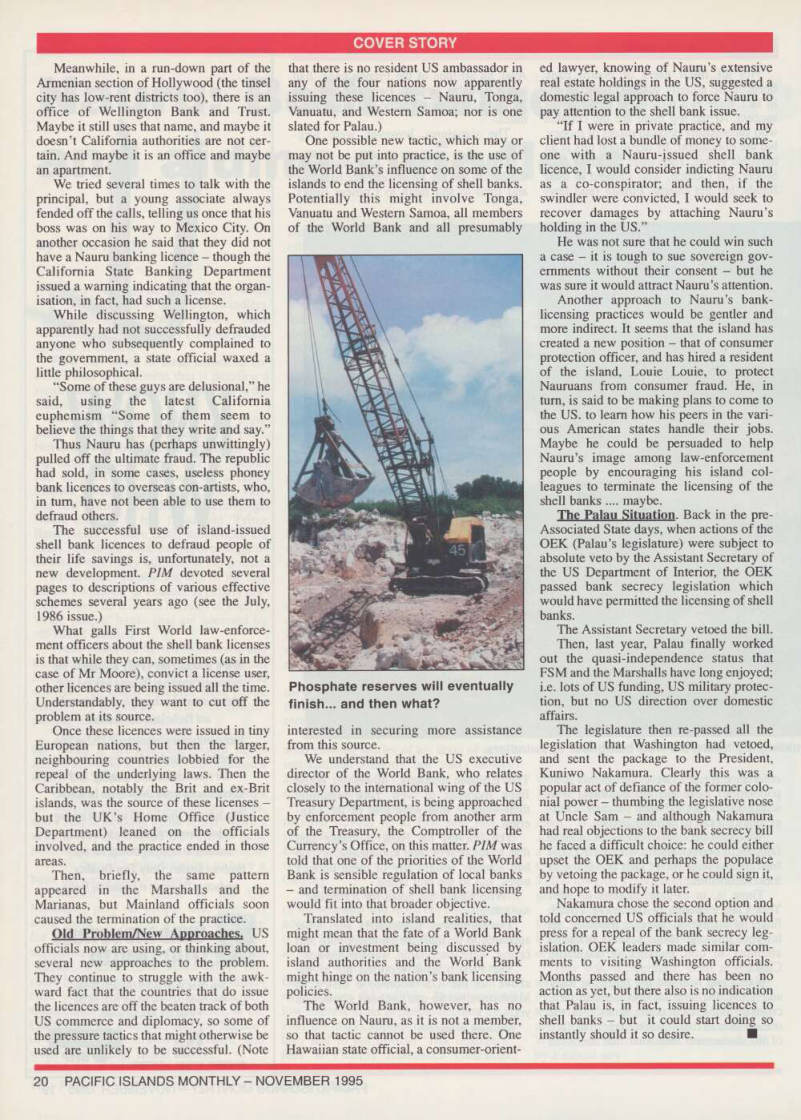
Phosphate reserves will eventually finish... and then what?
Advertisements & other items, pp. 19-22 (2 items)
Cover Story
Know
WHO
Wire Industries (Fiji) Limited. The only manufacturers in Fiji using wire and steel products imported exclusively from BHR Australia and Pacific Steel, New Zealand.
Since manufacturing commenced in 1962 we have never been tempted by cheaper prices for our raw materials, believing Quality and Consistency should always remain Paramount.
Wire Industries (Fiji) Limited take pride in being a wholly owned indigenous Fijian company, dedicated to supplying through our many Hardware Retailers, Only Top Quality products to the people of Fiji and the Pacific.
fa WIRE INDUSTRIES
(FIJI) LIMITED
Suva Phone: (679) 361415 Fax: (679) 361506 Nadi Phone: (679) 702280 Fax: (679) 702260 P 0 Box 628, Nadi, Fiji Islands.
BMP Wire Products
PACIFIC STEEL LIMITED
Invest in
New Caledonia
9 § E ° I < S Authorities in France and New Caledonia recently formed ADECAL : The Economic Development Bureau of New Caledonia.
Member of the "Invest in France Network", ADECAL advises foreign investors and entrepreneurs on doing business in New Caledonia, from tourism to industry.
Our free of charge services include: - Identification of opportunities and strategic alliances, - Liaison with government and local economic actors, - Assistance in financial negotiations and business plan preparation, - Advice on regulatory environment and bridging cultures.
Your contacts at ADECAL: Tourism and Domestic Business Development: Yann Pitollet International Projects: David H. Delisle x. i v.:X X' ■ ‘ X #5 r\ S. iu ■
ADECAL
15, rue Guynemer • PO Box 2384 • 98846 Noumea Cedex • New Caledonia • Tel: (687) 24 90 77 • Fax: (687) 24 90 87
1
FORUM SECRETARIAT
VACANCY
ENERGY ADVISER
(ECONOMICS & STATISTICS)
Applications are invited from suitably qualified and experienced persons, who must be nationals of a member state of the South Pacific Forum* for the position of Adviser (Economics & Statistics) with the Forum Secretariat's Energy Division.
The Forum Secretariat was established in 1972 by the South Pacific Forum to encourage economic and political co-operation between its member states, and between those states and the more industrialised countries. Under the control of a Secretary General, the Secretariat undertakes activities in a number of areas: economic development, legal and political, civil aviation, energy, maritime, telecommunications and trade. In pursuing these work programmes, the Secretariat works with a range of aid donor countries and organisations including Australia, New Zealand, Japan, France, EC, Canada and the UNDP.
The Energy Division aims to assist Forum Island Countries improve their capabilities to plan and manage their energy sectors. The Division implements a comprehensive energy sector development programme that covers all key energy subsectors and activities including general energy policy and planning, petroleum, electric power, renewable energy, and energy conservation and efficiency. The Division also assists in co-ordinating the activities of other organisations active in regional energy programmes, convenes Regional Energy Committee Meetings, provides technical advice and training services, and gathers and disseminates energy information and statistics to member countries.
The Energy Adviser will be required to establish a regional energy database and assist member countries with the further development of their national energy databases. Other duties will include, but not be limited to, providing policy and technical advice, preparing petroleum demand and pricing statistics, assisting in project development, administration and evaluation, and organising and conducting regional and in-country training.
Applicants should have tertiary qualifications in economics, science or engineering with a minimum of 5 years experience in a petroleum or energy-related field. Relevant experience in database development and management, preferably energy related, is required. Knowledge of MS Excel spreadsheet and Access database software would be highly desirable. Experience in energy policy development and programme management would be highly regarded. Applicants should have the ability to train personnel from Forum Island Countries, have good written and oral communication skills and be willing to travel throughout the region.
This appointment will carry an attractive remuneration package, payable in Fiji dollars. For non-Fiji citizens this is tax-free and includes housing allowance and child education allowances. Other benefits include superannuation payments and medical, life and travel insurance coverage. The appointee will be based at the Secretariat's Headquarters in Suva, Fiji. Appointment would be for three years.
Applications close on 30 November. They should contain full information on education and career backgrounds and should give names, addresses and telephone numbers of at least three referees with whom the applicant has been associated professionally.
Applications should be addressed to: The Secretary General Forum Secretariat Private Mail Bag, Suva, FIJI Phone: (679) 312600; Fax: (679) 305573 An information package is available on request from the Personnel Officer, on Telephone (679) 300134 Extension 334. For technical information about the position please contact Dick Goldberg, Director, Energy Division on Telephone (679) 300134 Extension 289. •Member states of the South Pacific Forum: Australia, the Cook Islands, Federated States of Micronesia, Fiji, Kiribati, Nauru, New Zealand, Niue, Palau, Papua New Guinea, Republic of the Marshall Islands, Solomon Islands, Tonga, Tuvalu, Vanuatu and Western Samoa.
50th anniversary
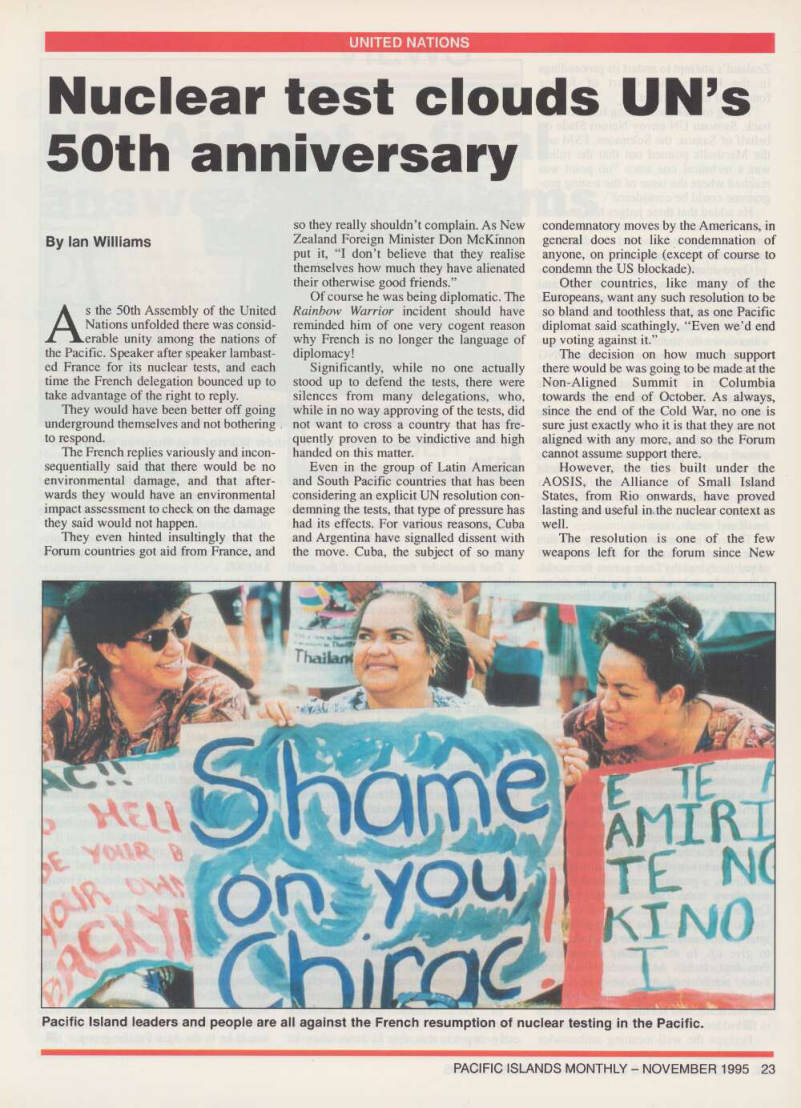
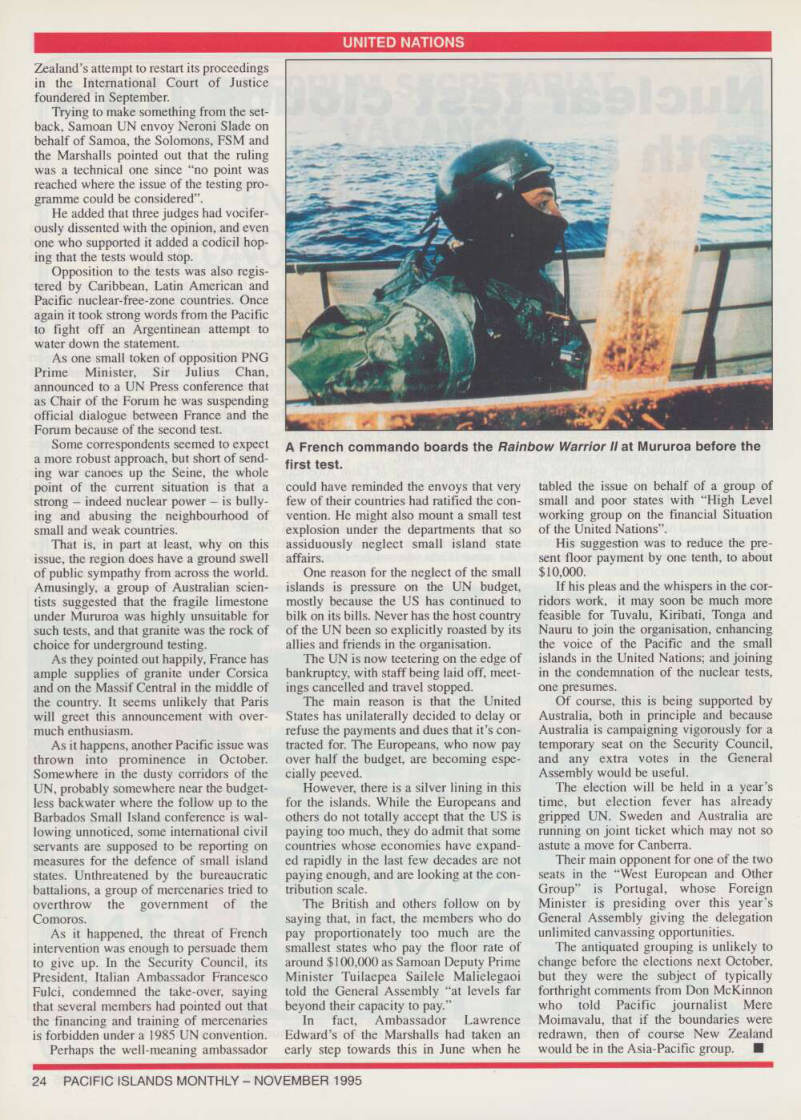
United Nations
Nuclear test clouds UN’s 50th anniversary
By lan Williams
As the 50th Assembly of the United Nations unfolded there was consid erable unity among the nations of the Pacific. Speaker after speaker lambast ed France for its nuclear tests, and each time the French delegation bounced up to take advantage of the right to reply.
They would have been better off going underground themselves and not bothering
to respond.
The French replies variously and incon sequentially said that there would be no environmental damage, and that after wards they would have an environmental impact assessment to check on the damage they said would not happen.
They even hinted insultingly that the Forum countries got aid from France, and
so they really shouldn’t complain. As New Zealand Foreign Minister Don McKinnon put it, “I don’t believe that they realise themselves how much they have alienated their otherwise good friends.”
Of course he was being diplomatic. The Rainbow Warrior incident should have reminded him of one very cogent reason why French is no longer the language of
diplomacy!
Significantly, while no one actually stood up to defend the tests, there were silences from many delegations, who, while in no way approving of the tests, did not want to cross a country that has fre quently proven to be vindictive and high handed on this matter.
Even in the group of Latin American and South Pacific countries that has been considering an explicit UN resolution con demning the tests, that type of pressure has had its effects. For various reasons, Cuba and Argentina have signalled dissent with the move. Cuba, the subject of so many
condemnatory moves by the Americans, in general does not like condemnation of anyone, on principle (except of course to condemn the US blockade).
Other countries, like many of the Europeans, want any such resolution to be so bland and toothless that, as one Pacific diplomat said scathingly, “Even we’d end
up voting against it.”
The decision on how much support there would be was going to be made at the Non-Aligned Summit in Columbia towards the end of October. As always, since the end of the Cold War, no one is sure just exactly who it is that they are not aligned with any more, and so the Forum cannot assume support there.
However, the ties built under the AOSIS, the Alliance of Small Island States, from Rio onwards, have proved lasting and useful imthe nuclear context as well.
The resolution is one of the few weapons left for the forum since New
Pacific island leaders and people are all against the French resumption of nuclear testing in the Pacific.
Zealand’s attempt to restart its proceedings in the International Court of Justice foundered in September.
Trying to make something from the set back, Samoan UN envoy Neroni Slade on behalf of Samoa, the Solomons, FSM and the Marshalls pointed out that the ruling was a technical one since “no point was reached where the issue of the testing pro gramme could be considered”.
He added that three judges had vocifer ously dissented with the opinion, and even one who supported it added a codicil hop ing that the tests would stop.
Opposition to the tests was also regis tered by Caribbean, Latin American and Pacific nuclear-free-zone countries. Once again it took strong words from the Pacific to fight off an Argentinean attempt to water down the statement.
As one small token of opposition PNG Prime Minister, Sir Julius Chan, announced to a UN Press conference that as Chair of the Forum he was suspending official dialogue between France and the Forum because of the second test.
Some correspondents seemed to expect a more robust approach, but short of send ing war canoes up the Seine, the whole point of the current situation is that a strong - indeed nuclear power - is bully
ing and abusing the neighbourhood of
small and weak countries.
That is, in part at least, why on this issue, the region does have a ground swell of public sympathy from across the world.
Amusingly, a group of Australian scien tists suggested that the fragile limestone under Mururoa was highly unsuitable for such tests, and that granite was the rock of
choice for underground testing.
As they pointed out happily, France has ample supplies of granite under Corsica and on the Massif Central in the middle of the country. It seems unlikely that Paris will greet this announcement with over much enthusiasm.
As it happens, another Pacific issue was thrown into prominence in October.
Somewhere in the dusty corridors of the UN, probably somewhere near the budget less backwater where the follow up to the Barbados Small Island conference is wal lowing unnoticed, some international civil servants are supposed to be reporting on measures for the defence of small island states. Unthreatened by the bureaucratic battalions, a group of mercenaries tried to overthrow the government of the Comoros.
As it happened, the threat of French intervention was enough to persuade them to give up. In the Security Council, its President, Italian Ambassador Francesco Fulci, condemned the take-over, saying that several members had pointed out that the financing and training of mercenaries is forbidden under a 1985 UN convention.
Perhaps the well-meaning ambassador
could have reminded the envoys that very few of their countries had ratified the con vention. He might also mount a small test explosion under the departments that so assiduously neglect small island state affairs.
One reason for the neglect of the small islands is pressure on the UN budget, mostly because the US has continued to bilk on its bills. Never has the host country of the UN been so explicitly roasted by its allies and friends in the organisation.
The UN is now teetering on the edge of bankruptcy, with staff being laid off, meet ings cancelled and travel stopped.
The main reason is that the United States has unilaterally decided to delay or refuse the payments and dues that it’s con tracted for. The Europeans, who now pay over half the budget, are becoming espe
cially peeved.
However, there is a silver lining in this for the islands. While the Europeans and others do not totally accept that the US is paying too much, they do admit that some countries whose economies have expand ed rapidly in the last few decades are not paying enough, and are looking at the con tribution scale.
The British and others follow on by saying that, in fact, the members who do pay proportionately too much are the smallest states who pay the floor rate of around $lOO,OOO as Samoan Deputy Prime
Minister Tuilaepea Sailele Malielegaoi
told the General Assembly “at levels far
beyond their capacity to pay.”
In fact. Ambassador Lawrence Edward’s of the Marshalls had taken an early step towards this in June when he
tabled the issue on behalf of a group of small and poor states with “High Level working group on the financial Situation of the United Nations”.
His suggestion was to reduce the pre sent floor payment by one tenth, to about
$Lo,Ooo.
If his pleas and the whispers in the cor ridors work, it may soon be much more feasible for Tuvalu, Kiribati, Tonga and Nauru to join the organisation, enhancing the voice of the Pacific and the small islands in the United Nations; and joining in the condemnation of the nuclear tests, one presumes.
Of course, this is being supported by Australia, both in principle and because Australia is campaigning vigorously for a temporary seat on the Security Council, and any extra votes in the General Assembly would be useful.
The election will be held in a year’s time, but election fever has already gripped UN. Sweden and Australia are running on joint ticket which may not so astute a move for Canberra.
Their main opponent for one of the two seats in the “West European and Other
Group” is Portugal, whose Foreign
Minister is presiding over this year’s General Assembly giving the delegation
unlimited canvassing opportunities.
The antiquated grouping is unlikely to
change before the elections next October, but they were the subject of typically forthright comments from Don McKinnon who told Pacific journalist Mere Moimavalu, that if the boundaries were redrawn, then of course New Zealand would be in the Asia-Pacific group. ■
A French commando boards the Rainbow Warrior II at Mururoa before the first test.
NZ: Aid not a final
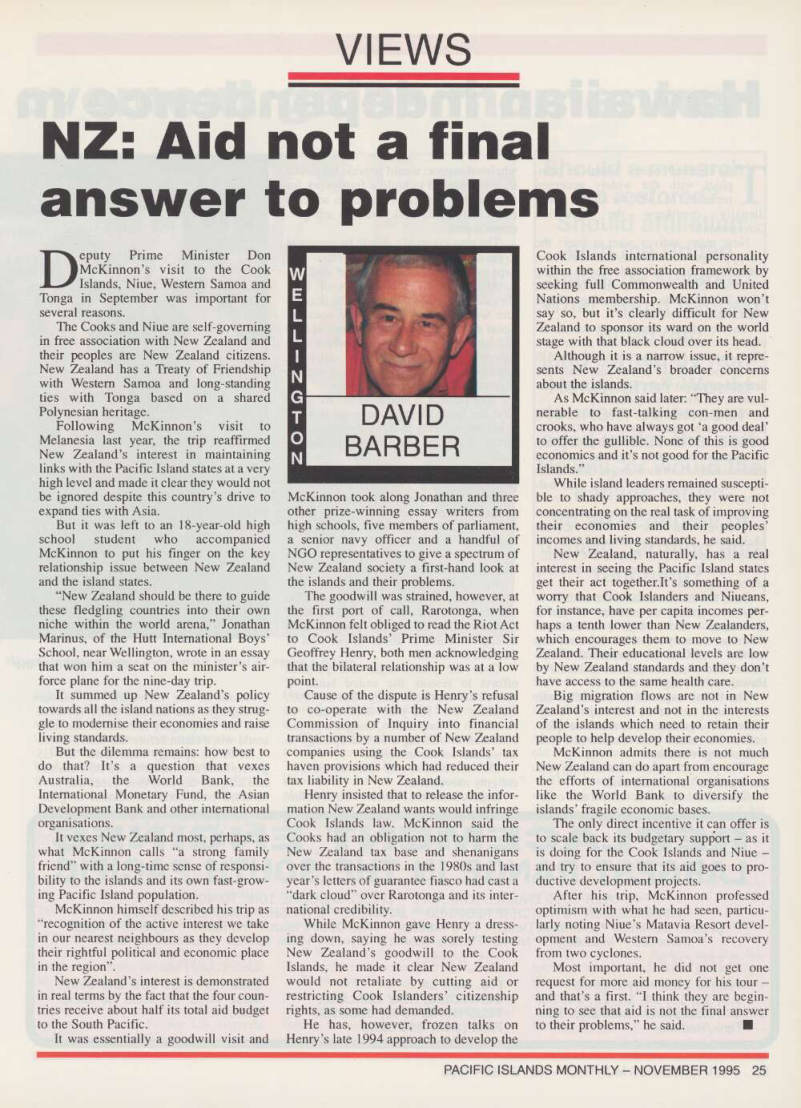
Views
NZ: Aid not a final answer to problems
Deputy Prime Minister Don McKinnon’s visit to the Cook Islands, Niue, Western Samoa and Tonga in September was important for several reasons.
The Cooks and Niue are self-governing in free association with New Zealand and their peoples are New Zealand citizens.
New Zealand has a Treaty of Friendship with Western Samoa and long-standing ties with Tonga based on a shared
Polynesian heritage.
Following McKinnon’s visit to Melanesia last year, the trip reaffirmed New Zealand’s interest in maintaining links with the Pacific Island states at a very high level and made it clear they would not be ignored despite this country’s drive to expand ties with Asia.
But it was left to an 18-year-old high school student who accompanied McKinnon to put his finger on the key relationship issue between New Zealand and the island states.
“New Zealand should be there to guide these fledgling countries into their own niche within the world arena,” Jonathan Marinus, of the Hutt International Boys’
School, near Wellington, wrote in an essay that won him a seat on the minister’s air force plane for the nine-day trip.
It summed up New Zealand’s policy towards all the island nations as they strug gle to modernise their economies and raise living standards.
But the dilemma remains: how best to do that? It’s a question that vexes Australia, the World Bank, the International Monetary Fund, the Asian Development Bank and other international
organisations.
It vexes New Zealand most, perhaps, as what McKinnon calls “a strong family friend” with a long-time sense of responsi bility to the islands and its own fast-grow ing Pacific Island population.
McKinnon himself described his trip as “recognition of the active interest we take in our nearest neighbours as they develop
their rightful political and economic place
in the region”.
New Zealand’s interest is demonstrated in real terms by the fact that the four coun tries receive about half its total aid budget to the South Pacific.
It was essentially a goodwill visit and
McKinnon took along Jonathan and three other prize-winning essay writers from high schools, five members of parliament, a senior navy officer and a handful of NGO representatives to give a spectrum of New Zealand society a first-hand look at the islands and their problems.
The goodwill was strained, however, at the first port of call, Rarotonga, when McKinnon felt obliged to read the Riot Act to Cook Islands’ Prime Minister Sir Geoffrey Henry, both men acknowledging that the bilateral relationship was at a low point.
Cause of the dispute is Henry’s refusal to co-operate with the New Zealand Commission of Inquiry into financial transactions by a number of New Zealand companies using the Cook Islands’ tax haven provisions which had reduced their tax liability in New Zealand.
Henry insisted that to release the infor mation New Zealand wants would infringe Cook Islands law. McKinnon said the Cooks had an obligation not to harm the New Zealand tax base and shenanigans over the transactions in the 1980 s and last year’s letters of guarantee fiasco had cast a “dark cloud” over Rarotonga and its inter
national credibility.
While McKinnon gave Henry a dress ing down, saying he was sorely testing New Zealand’s goodwill to the Cook Islands, he made it clear New Zealand would not retaliate by cutting aid or
restricting Cook Islanders’ citizenship
rights, as some had demanded.
He has, however, frozen talks on Henry’s late 1994 approach to develop the
Cook Islands international personality within the free association framework by seeking full Commonwealth and United Nations membership. McKinnon won’t say so, but it’s clearly difficult for New Zealand to sponsor its ward on the world stage with that black cloud over its head.
Although it is a narrow issue, it repre sents New Zealand’s broader concerns about the islands.
As McKinnon said later: “They are vul nerable to fast-talking con-men and crooks, who have always got ‘a good deal’ to offer the gullible. None of this is good economics and it’s not good for the Pacific Islands.”
While island leaders remained suscepti ble to shady approaches, they were not concentrating on the real task of improving their economies and their peoples’ incomes and living standards, he said.
New Zealand, naturally, has a real interest in seeing the Pacific Island states get their act together.lt’s something of a worry that Cook Islanders and Niueans, for instance, have per capita incomes per haps a tenth lower than New Zealanders, which encourages them to move to New Zealand. Their educational levels are low by New Zealand standards and they don’t have access to the same health care.
Big migration flows are not in New Zealand’s interest and not in the interests of the islands which need to retain their people to help develop their economies.
McKinnon admits there is not much New Zealand can do apart from encourage the efforts of international organisations like the World Bank to diversify the islands’ fragile economic bases.
The only direct incentive it can offer is to scale back its budgetary support - as it is doing for the Cook Islands and Niue and try to ensure that its aid goes to pro
ductive development projects.
After his trip, McKinnon professed optimism with what he had seen, particu larly noting Niue’s Matavia Resort devel opment and Western Samoa’s recovery from two cyclones.
Most important, he did not get one request for more aid money for his tour and that’s a first. “I think they are begin ning to see that aid is not the final answer to their problems,” he said. ■
Wellington
David
Barber
Hawaiian independence m[?]ovement gains momentum
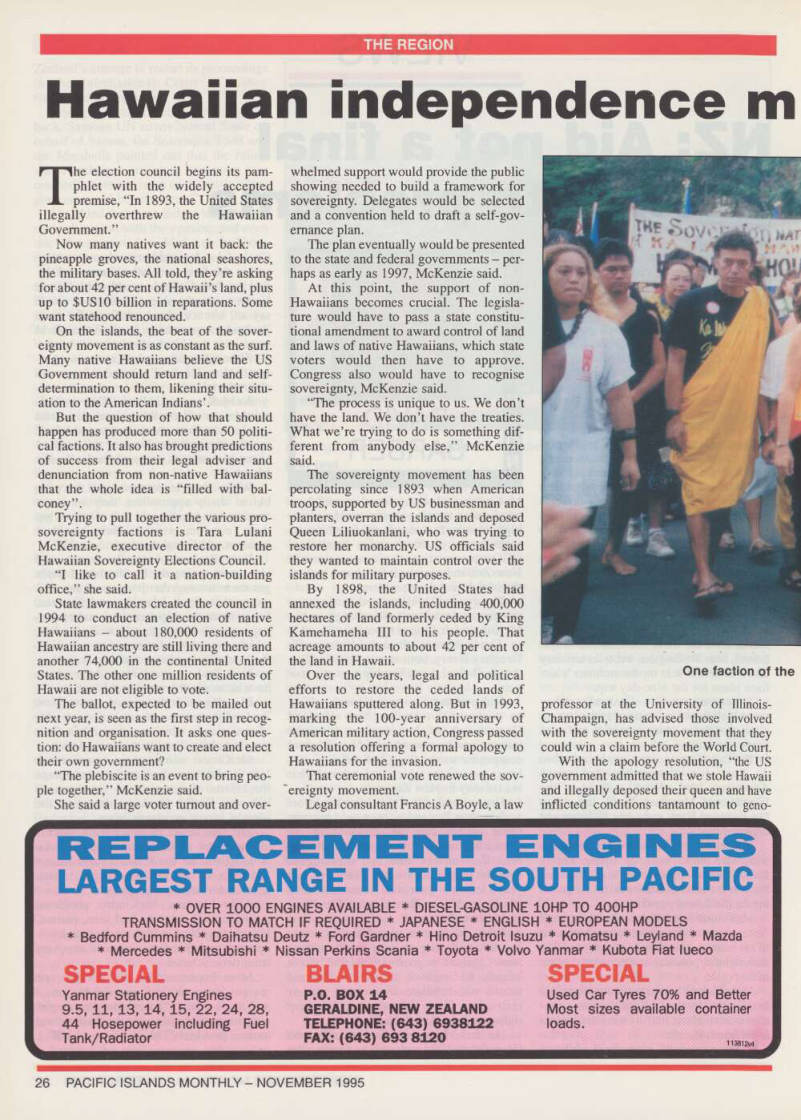
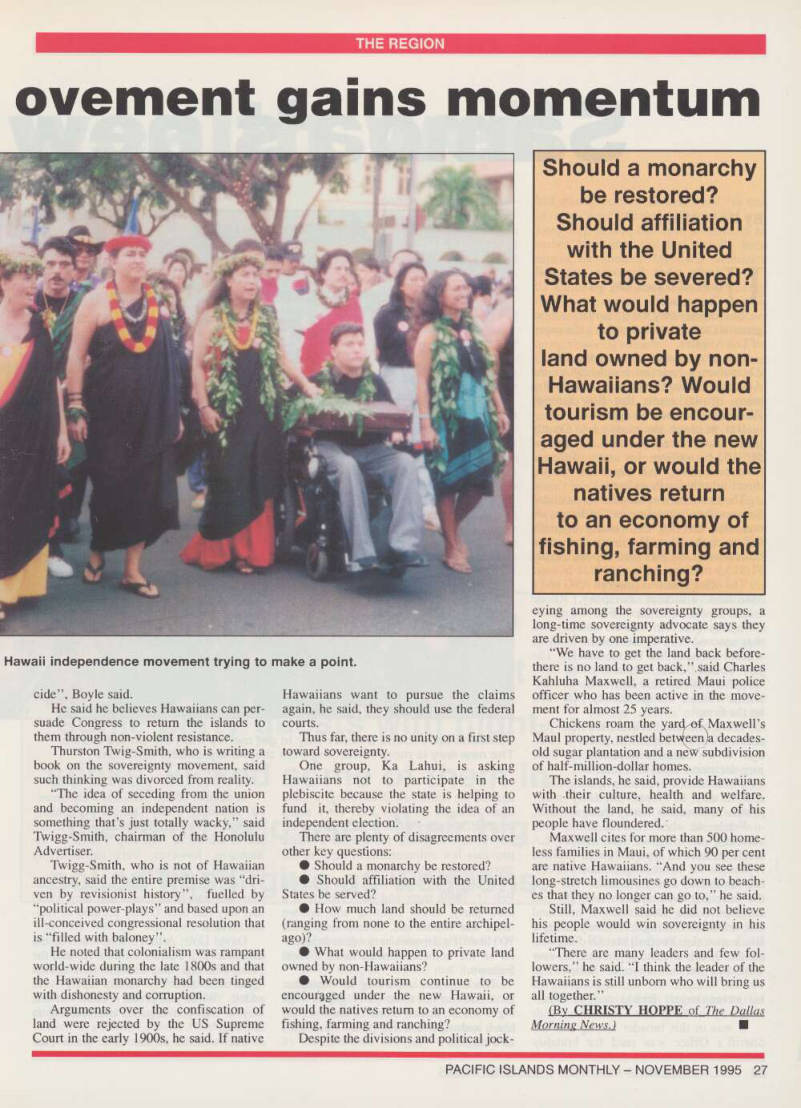
The Region
The election council begins its pam
phlet with the widely accepted
premise, “In 1893, the United States illegally overthrew the Hawaiian Government.”
Now many natives want it back: the pineapple groves, the national seashores, the military bases. All told, they’re asking for about 42 per cent of Hawaii’s land, plus up to SUSIO billion in reparations. Some want statehood renounced.
On the islands, the beat of the sover eignty movement is as constant as the surf.
Many native Hawaiians believe the US Government should return land and self determination to them, likening their situ ation to the American Indians’.
But the question of how that should happen has produced more than 50 politi cal factions. It also has brought predictions of success from their legal adviser and denunciation from non-native Hawaiians that the whole idea is “filled with bal coney”.
Trying to pull together the various pro sovereignty factions is Tara Lulani McKenzie, executive director of the Hawaiian Sovereignty Elections Council.
“I like to call it a nation-building office,” she said.
State lawmakers created the council in 1994 to conduct an election of native Hawaiians - about 180,000 residents of Hawaiian ancestry are still living there and another 74,000 in the continental United States. The other one million residents of Hawaii are not eligible to vote.
The ballot, expected to be mailed out next year, is seen as the first step in recog nition and organisation. It asks one ques tion: do Hawaiians want to create and elect their own government?
“The plebiscite is an event to bring peo ple together,” McKenzie said.
She said a large voter turnout and over
whelmed support would provide the public showing needed to build a framework for sovereignty. Delegates would be selected and a convention held to draft a self-gov
ernance plan.
The plan eventually would be presented
to the state and federal governments - per haps as early as 1997, McKenzie said.
At this point, the support of non- Hawaiians becomes crucial. The legisla ture would have to pass a state constitu tional amendment to award control of land and laws of native Hawaiians, which state voters would then have to approve.
Congress also would have to recognise sovereignty, McKenzie said.
“The process is unique to us. We don’t have the land. We don’t have the treaties.
What we’re trying to do is something dif ferent from anybody else,” McKenzie said.
The sovereignty movement has been percolating since 1893 when American troops, supported by US businessman and planters, overran the islands and deposed Queen Liliuokanlani, who was trying to restore her monarchy. US officials said they wanted to maintain control over the islands for military purposes.
By 1898, the United States had annexed the islands, including 400,000 hectares of land formerly ceded by King Kamehameha 111 to his people. That acreage amounts to about 42 per cent of the land in Hawaii.
Over the years, legal and political efforts to restore the ceded lands of Hawaiians sputtered along. But in 1993,
marking the 100-year anniversary of
American military action. Congress passed
a resolution offering a formal apology to Hawaiians for the invasion.
That ceremonial vote renewed the sov ereignty movement.
Legal consultant Francis A Boyle, a law
professor at the University of Illinois- Champaign, has advised those involved with the sovereignty movement that they could win a claim before the World Court.
With the apology resolution, “the US government admitted that we stole Hawaii and illegally deposed their queen and have inflicted conditions tantamount to geno
One faction of the
cide”, Boyle said.
He said he believes Hawaiians can per suade Congress to return the islands to them through non-violent resistance.
Thurston Twig-Smith, who is writing a book on the sovereignty movement, said such thinking was divorced from reality.
“The idea of seceding from the union and becoming an independent nation is
something that’s just totally wacky,” said
Twigg-Smith, chairman of the Honolulu Advertiser.
Twigg-Smith, who is not of Hawaiian ancestry, said the entire premise was “dri ven by revisionist history”, fuelled by “political power-plays” and based upon an ill-conceived congressional resolution that is “filled with baloney”.
He noted that colonialism was rampant world-wide during the late 1800 s and that the Hawaiian monarchy had been tinged
with dishonesty and corruption.
Arguments over the confiscation of land were rejected by the US Supreme Court in the early 1900 s, he said. If native
Hawaiians want to pursue the claims again, he said, they should use the federal courts.
Thus far, there is no unity on a first step
toward sovereignty.
One group, Ka Lahui, is asking Hawaiians not to participate in the plebiscite because the state is helping to fund it, thereby violating the idea of an
independent election;
There are plenty of disagreements over
other key questions:
• Should a monarchy be restored? • Should affiliation with the United States be served? • How much land should be returned (ranging from none to the entire archipel
ago)?
• What would happen to private land owned by non-Hawaiians? • Would tourism continue to be encouraged under the new Hawaii, or would the natives return to an economy of
fishing, farming and ranching?
Despite the divisions and political jock-
Should a monarchy be restored?
Should affiliation with the United States be severed?
What would happen to private land owned by non- Hawaiians? Would tourism be encour aged under the new Hawaii, or would the natives return to an economy of fishing, farming and ranchinq?
eying among the sovereignty groups, a long-time sovereignty advocate says they are driven by one imperative.
“We have to get the land back before there is no land to get back,” said Charles Kahluha Maxwell, a retired Maui police officer who has been active in the move ment for almost 25 years.
Chickens roam the yarcUof Maxwell’s Maul property, nestled bet\yeen)a decades old sugar plantation and a neW"subdivision of half-million-dollar homes.
The islands, he said, provide Hawaiians with their culture, health and welfare.
Without the land, he said, many of his people have floundered.' Maxwell cites for more than 500 home less families in Maui, of which 90 per cent are native Hawaiians. “And you see these long-stretch limousines go down to beach es that they no longer can go to,” he said.
Still, Maxwell said he did not believe his people would win sovereignty in his lifetime.
“There are many leaders and few fol lowers,” he said. “I think the leader of the Hawaiians is still unborn who will bring us all together.” (Bv CHRISTY HOPPE of The Dallas Morning News. ) ■
Hawaii independence movement trying to make a point.
Advertisements & other items, pp. 26-27 (2 items)
Replacement Engines
LARGEST RANGE IN THE SOUTH PACIFIC
* OVER 1000 ENGINES AVAILABLE * DIESEL-GASOLINE 10HP TO 400 HP TRANSMISSION TO MATCH IF REQUIRED * JAPANESE * ENGLISH ♦ EUROPEAN MODELS * Bedford Cummins * Daihatsu Deutz * Ford Gardner * Hino Detroit Isuzu * Komatsu * Leyland * Mazda * Mercedes * Mitsubishi * Nissan Perkins Scania * Toyota * Volvo Yanmar * Kubota Rat lueco
SPECIAL BLAIRS SPECIAL
Yanmar Stationery Engines P.O. BOX 14 Used Car Tyres 70% and Better 9.5, 11,13,14,15, 22, 24, 28, GERALDINE, NEW ZEALAND Most sizes available container 44 Hosepower including Fuel TELEPHONE: (643) 6938122 loads.
Tank/Radiator FAX: (643) 693 8120 113812v4
ovement gains momentum
27
THE REGION
PACIFIC ISLANDS MONTHLY - NOVEMBER 1995
ovement gains momentum
Samoa’s new wealth well
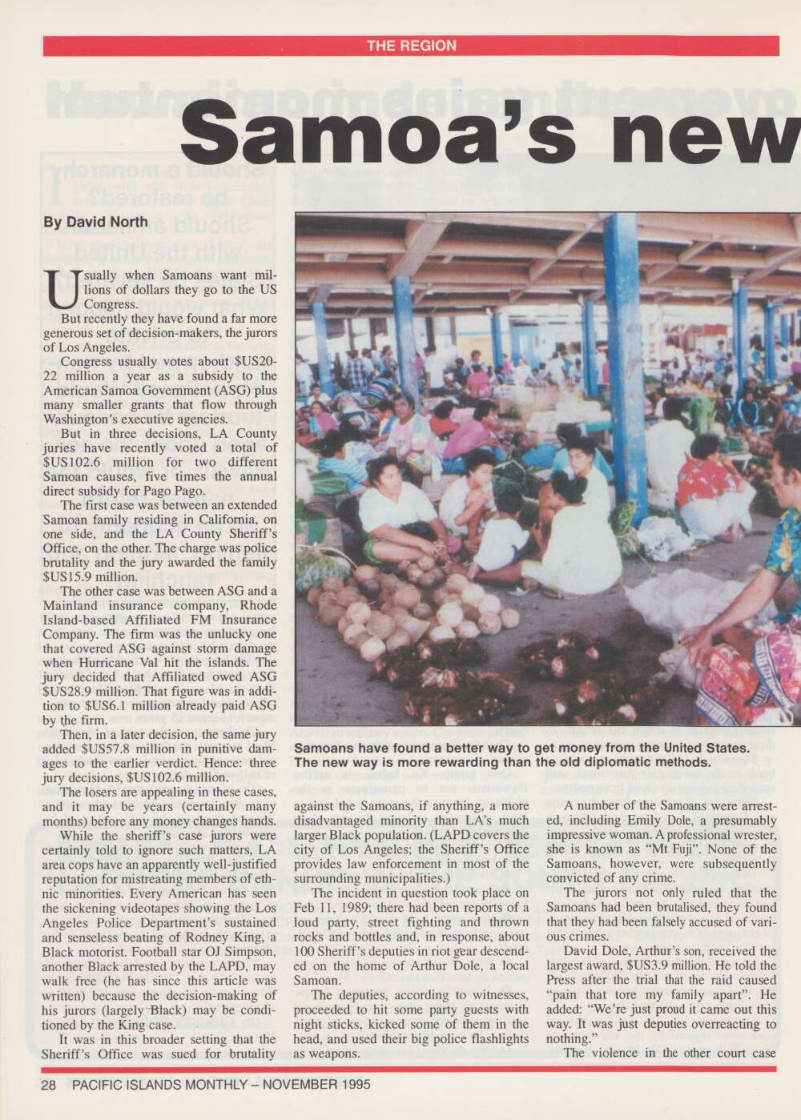
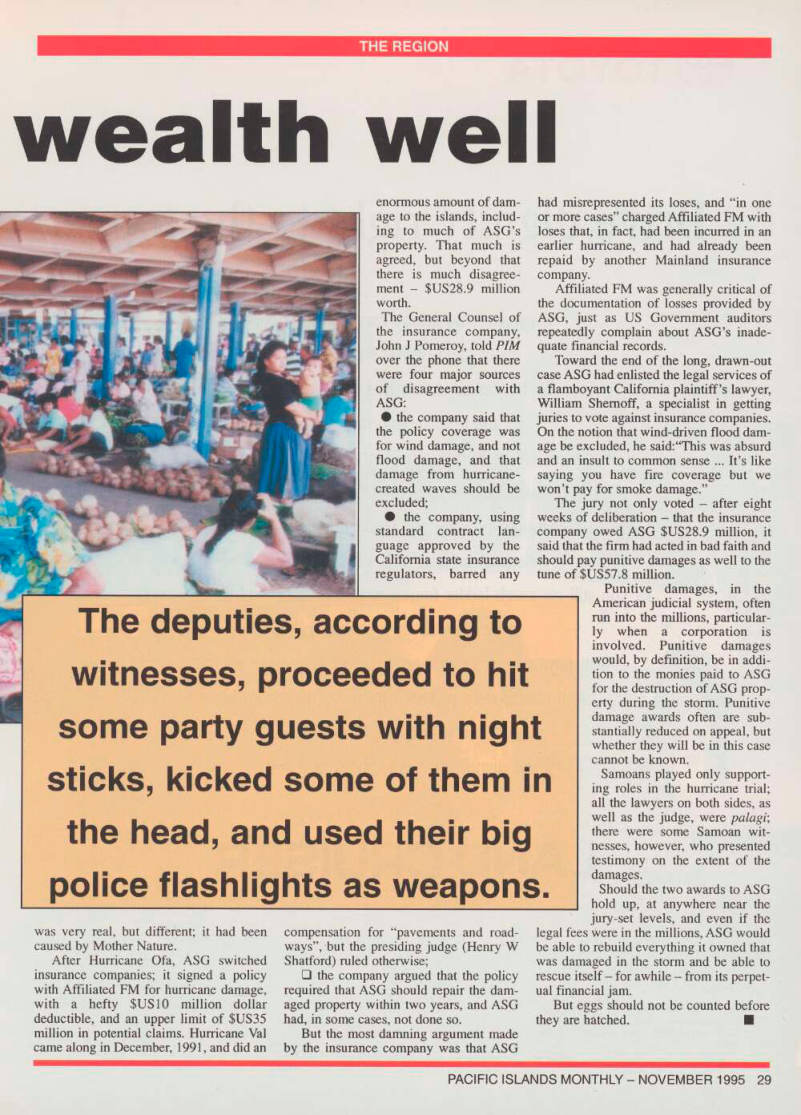
The Region
By David North
Usually when Samoans want mil lions of dollars they go to the US Congress.
But recently they have found a far more generous set of decision-makers, the jurors of Los Angeles.
Congress usually votes about SUS2O - million a year as a subsidy to the American Samoa Government (ASG) plus many smaller grants that flow through
Washington’s executive agencies.
But in three decisions, LA County juries have recently voted a total of SUS 102.6 million for two different Samoan causes, five times the annual direct subsidy for Pago Pago.
The first case was between an extended Samoan family residing in California, on one side, and the LA County Sheriff’s Office, on the other. The charge was police brutality and the jury awarded the family SUSIS.9 million.
The other case was between ASG and a Mainland insurance company, Rhode Island-based Affiliated FM Insurance Company. The firm was the unlucky one that covered ASG against storm damage when Hurricane Val hit the islands. The jury decided that Affiliated owed ASG SUS2B.9 million. That figure was in addi tion to SUS6.I million already paid ASG by the firm.
Then, in a later decision, the same jury added SUSS7.B million in punitive dam ages to the earlier verdict. Hence: three jury decisions, SUS 102.6 million.
The losers are appealing in these cases, and it may be years (certainly many months) before any money changes hands.
While the sheriff’s case jurors were certainly told to ignore such matters, LA area cops have an apparently well-justified reputation for mistreating members of eth nic minorities. Every American has seen
the sickening videotapes showing the Los
Angeles Police Department’s sustained
and senseless beating of Rodney King, a Black motorist. Football star OJ Simpson, another Black arrested by the LAPD, may walk free (he has since this article was written) because the decision-making of his jurors (largely Black) may be condi tioned by the King case.
It was in this broader setting that the Sheriff’s Office was sued for brutality
against the Samoans, if anything, a more disadvantaged minority than LA’s much larger Black population. (LAPD covers the city of Los Angeles; the Sheriff’s Office provides law enforcement in most of the surrounding municipalities.) The incident in question took place on Feb 11, 1989; there had been reports of a loud party, street fighting and thrown rocks and bottles and, in response, about 100 Sheriff’s deputies in riot gear descend ed on the home of Arthur Dole, a local Samoan.
The deputies, according to witnesses, proceeded to hit some party guests with night sticks, kicked some of them in the head, and used their big police flashlights as weapons.
A number of the Samoans were arrest ed, including Emily Dole, a presumably impressive woman. A professional wrester, she is known as “Mt Fuji”. None of the Samoans, however, were subsequently convicted of any crime.
The jurors not only ruled that the Samoans had been brutalised, they found that they had been falsely accused of vari ous crimes.
David Dole, Arthur’s son, received the largest award, SUS 3.9 million. He told the Press after the trial that the raid caused “pain that tore my family apart”. He added: “WeTe just proud it came out this way. It was just deputies overreacting to
nothing.”
The violence in the other court case
Samoans have found a better way to get money from the United States.
The new way is more rewarding than the old diplomatic methods.
The deputies, according to witnesses, proceeded to hit some party guests with night sticks, kicked some of them in the head, and used their big police flashlights as weapons.
was very real, but different; it had been caused by Mother Nature.
After Hurricane Ofa, ASG switched insurance companies; it signed a policy with Affiliated FM for hurricane damage, with a hefty SUSIO million dollar deductible, and an upper limit of SUS3S million in potential claims. Hurricane Val came along in December, 1991, and did an
compensation for “pavements and road ways”, but the presiding judge (Henry W Shatford) ruled otherwise; □ the company argued that the policy required that ASG should repair the dam aged property within two years, and ASG had, in some cases, not done so.
But the most damning argument made by the insurance company was that ASG
enormous amount of dam age to the islands, includ ing to much of ASG’s property. That much is
agreed, but beyond that
there is much disagree ment - SUS2B.9 million worth.
The General Counsel of the insurance company, John J Pomeroy, told PIM over the phone that there were four major sources of disagreement with
Asg:
• the company said that the policy coverage was for wind damage, and not flood damage, and that damage from hurricane created waves should be excluded; • the company, using standard contract lan guage approved by the California state insurance regulators, barred any
had misrepresented its loses, and “in one or more cases” charged Affiliated FM with loses that, in fact, had been incurred in an earlier hurricane, and had already been repaid by another Mainland insurance company.
Affiliated FM was generally critical of the documentation of losses provided by ASG, just as US Government auditors repeatedly complain about ASG’s inade quate financial records.
Toward the end of the long, drawn-out case ASG had enlisted the legal services of
a flamboyant California plaintiff’s lawyer,
William Shemoff, a specialist in getting juries to vote against insurance companies.
On the notion that wind-driven flood dam age be excluded, he said:“This was absurd and an insult to common sense ... It’s like saying you have fire coverage but we won’t pay for smoke damage.”
The jury not only voted - after eight weeks of deliberation - that the insurance company owed ASG SUS2B.9 million, it said that the firm had acted in bad faith and should pay punitive damages as well to the tune of SUSS7.B million.
Punitive damages, in the American judicial system, often run into the millions, particular ly when a corporation is involved. Punitive damages would, by definition, be in addi tion to the monies paid to ASG for the destruction of ASG prop erty during the storm. Punitive damage awards often are sub stantially reduced on appeal, but whether they will be in this case cannot be known.
Samoans played only support
ing roles in the hurricane trial; all the lawyers on both sides, as well as the judge, were palagv, there were some Samoan wit nesses, however, who presented testimony on the extent of the
damages.
Should the two awards to ASG hold up, at anywhere near the jury-set levels, and even if the
legal fees were in the millions, ASG would be able to rebuild everything it owned that was damaged in the storm and be able to rescue itself - for awhile - from its perpet ual financial jam.
But eggs should not be counted before they are hatched. ■
Advertisements & other items, pp. 29-32 (2 items)
wealth well
29
THE REGION
PACIFIC ISLANDS MONTHLY - NOVEMBER 1995
wealth well
Drive dignity right to the top.
<SB> TOYOTA
Everyone who knows cars has no doubts about Land Cruiser’s ruggedness.
Yet how many know that its luxury rivals the finest high-priced cars?
Or that it’s got more room inside than many luxury sedans?
And because it’s a Toyota, Land Cruiser’s fit and finish, attention to detail, and graceful form speak of elegance as well as spacious comfort.
Yet you still get tough ladder frames and suspension built to take you as far off road as you want to go.
With power from 4.5-litre petrol or 4.2-litre diesel engines.
And it’s carefully protected from rust to last longer.
So if you’re going right to the top, this dignified car is ready to take you.
LAND CRUISER
DISTRIBUTORS/DEALERS
AMERICAN SAMOA BURNS PHILP MOTORS PH 633-4281 COOK ISLANDS GUAM & MICRONESIA.. .ATKINS KROLL, INC. PH 646-1876/9 KIRIBATI NORFOLK ISLAND BORRY'S PTY LTD. PH 22114 PAPUA NEW GUINEA SOLOMON ISLAND ELA MOTORS PH 30314 TAHITI VANUATU ASCO MOTORS PH 22541 WESTERN SAMOA...
PACIFIC MOTORS LTD. PH 20796
.TARAWA MOTORS PH 21090
.ELA MOTORS PH 3229400
.NIPPON AUTOMOTO PH 429819
.ASCO MOTORS PH 20800
FIJI ASCO MOTORS PH
NEW CALEDONIA S.I.A.P. PH 275562
SAIPAN MICROL CORPORATION PH 234-5911
TONGA ASCO MOTORS PH 2 3 500
pi m
LAND
t
CRUISER
* - .. - ’sL . ••-,
FOSTER FARMS FOSTER FARMS FOSTER FARMS
FOSTER
FARMS
FOSTER FARMS
Foster
j
FARMS
Always natural. Always fresk.
mm s v)BV£ 00 iM
SVH6tE
pack
FOR BEST
VALUE,
QUALITY
AND
BETTER
HEALTH
AND
SELECTED
SERVINGS
IN MANY
CHOICES
£5 & ft ■7’ r -v- -'-v A'/v.V fiSWaUI.
WE WELCOME STANDING ORDERS FROM
SUPERMARKETS, RESTAURANTS, HOTELS, MOTELS,
SHIPS, NEIGHBOURING ISLANDS AND COUNTRIES
ALL ENQUIRIES TO:
MA-TAPULE INVESTMENT LIMITED
PH: (679) 312831 FAX: (679) 303757
SUVA, FIJI ISLANDS
Ik i m
EREMASIROVA
(CHIEF EXECUTIVE)
FOSTER FARMS
FOSTER FARMS
FOSTER FARMS FOSTER FARMS FOSTER FARMS
25 years of freedom
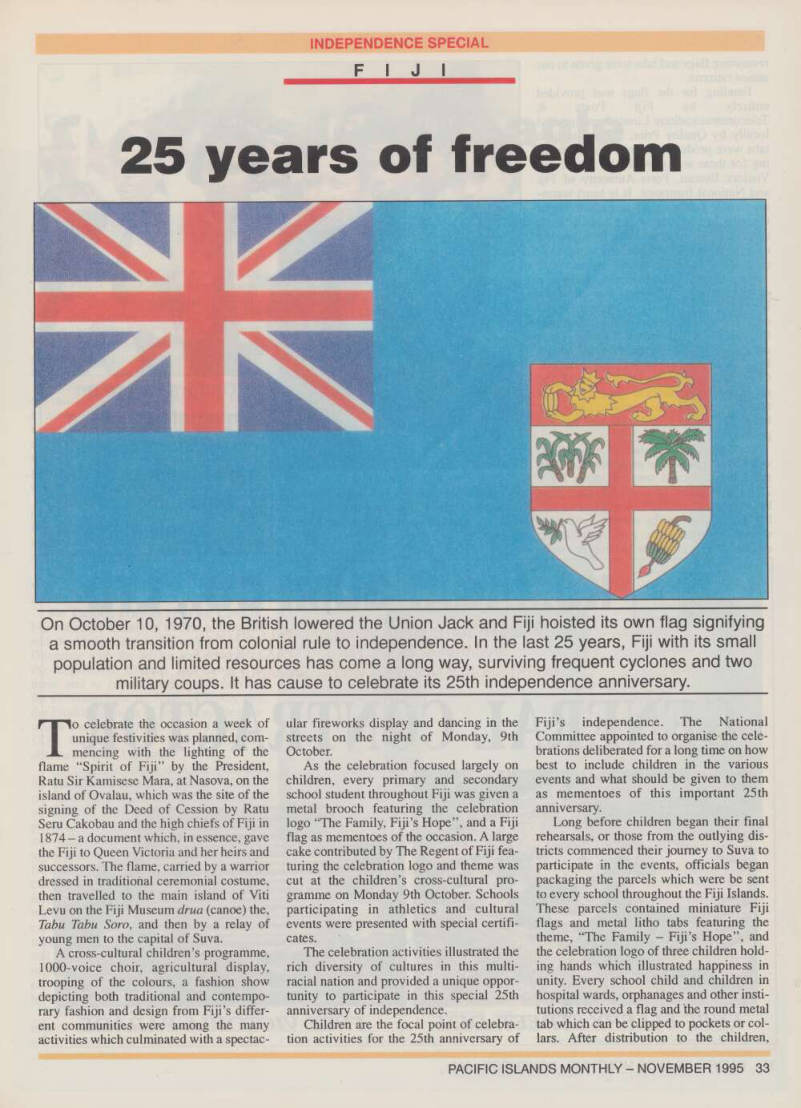

Independence Special
Fiji
To celebrate the occasion a week of unique festivities was planned, com mencing with the lighting of the flame “Spirit of Fiji” by the President, Ratu Sir Kamisese Mara, at Nasova, on the island of Ovalau, which was the site of the signing of the Deed of Cession by Ratu Seru Cakobau and the high chiefs of Fiji in 1874 - a document which, in essence, gave the Fiji to Queen Victoria and her heirs and successors. The flame, carried by a warrior dressed in traditional ceremonial costume, then travelled to the main island of Viti Levu on the Fiji Museum drua (canoe) the, Tabu Tabu Sow, and then by a relay of young men to the capital of Suva.
A cross-cultural children’s programme,
1000-voice choir, agricultural display,
trooping of the colours, a fashion show depicting both traditional and contempo rary fashion and design from Fiji’s differ ent communities were among the many activities which culminated with a spectac
ular fireworks display and dancing in the streets on the night of Monday, 9th October.
As the celebration focused largely on children, every primary and secondary school student throughout Fiji was given a metal brooch featuring the celebration logo “The Family, Fiji’s Hope”, and a Fiji flag as mementoes of the occasion. A large cake contributed by The Regent of Fiji fea turing the celebration logo and theme was cut at the children’s cross-cultural pro gramme on Monday 9th October. Schools participating in athletics and cultural events were presented with special certifi cates.
The celebration activities illustrated the rich diversity of cultures in this multi racial nation and provided a unique oppor tunity to participate in this special 25th anniversary of independence.
Children are the focal point of celebra tion activities for the 25th anniversary of
Fiji’s independence. The National Committee appointed to organise the cele brations deliberated for a long time on how best to include children in the various events and what should be given to them as mementoes of this important 25th anniversary.
Long before children began their final rehearsals, or those from the outlying dis tricts commenced their journey to Suva to participate in the events, officials began packaging the parcels which were be sent to every school throughout the Fiji Islands.
These parcels contained miniature Fiji flags and metal litho tabs featuring the theme, “The Family - Fiji’s Flope”, and the celebration logo of three children hold ing hands which illustrated happiness in unity. Every school child and children in hospital wards, orphanages and other insti tutions received a flag and the round metal tab which can be clipped to pockets or col lars. After distribution to the children.
On October 10, 1970, the British lowered the Union Jack and Fiji hoisted its own flag signifying a smooth transition from colonial rule to independence. In the last 25 years, Fiji with its small population and limited resources has come a long way, surviving frequent cyclones and two military coups. It has cause to celebrate its 25th independence anniversary.
remaining flags and tabs were given to our senior citizens.
Funding for the flags was provided entirely by Fiji Posts & Telecommunications Limited and printed locally by Quality Print. The metal litho tabs were produced in the USA and fund ing for these was provided by Fintel, Fiji Visitors Bureau, Ports Authority of Fiji and National Insurance. It is heart warm ing to note that when the manufacturers of the tabs had to arrange for new artwork suitable for the concave tabs, they paid the extra costs of this as their gift to the chil dren of Fiji on this special occasion.
The programme featured a children’s cross-cultural event which was the high light of the children’s programme. The organising committee for this comprised the ministry of education officials, teach ers in Suva and representatives of Vision Fiji, a non-govemmental organisation.
Child representatives from eight of the nine education districts provided items featuring cross-cultural programmes and between 7000 to 10,000 children partici pated in the programme.
A children’s mass choir of about 1000 voices was part of the programme to sing specially composed songs marking Fiji’s 25th anniversary of independence. The Police Band provided entertainment and led the children to the arena. Certificates were given to those who participated in the events and special prizes and trophies were
awarded to the winners. It is hoped that the memory of this celebration will inspire the children who are our future and our hope. ■
Children were an integral part of the celebrations to create an awareness of the importance of a stable Fiji.
Advertisements & other items, p. 34 (1 item)
General Contractor
KUMAGAI
KUMAGAI GUMI CO., LTD
140 RATU MARA ROAD, TEL: 387925
SAMABULA, SUVA, FIJI. FAX: 387943
CORRESPONDENCE: BOX 4474, SAMABULA, SUVA, FIJI
GENERAL CONTRACTOR
saaaa sab
SIS SUB M «•.!!•
SIS BUS 818 SMB
i mnmm mm mm j|| I aatta'-SiSiaiia
- „SS_!!B SIS B*lB
ass bus asssus BIBBia BiIBBKB H.'ißßiß msi 0: E*isfiiis stasia sanai »JB Htiß «)•« MIHH B,i«U ■!:« r
818 Bid S!:S SISSJ B
»»«»»»; fmum mmtyijm-mm-. w»\»J Eisaim »*«««■
Eli EE 9*9 SIS
■•••"’ ss Bis aits Bias'd ae ■mm *
FNPF ELLERY STREET, DEV,
FNPF VICTORIA PARADE
Fiji’s legal eagle
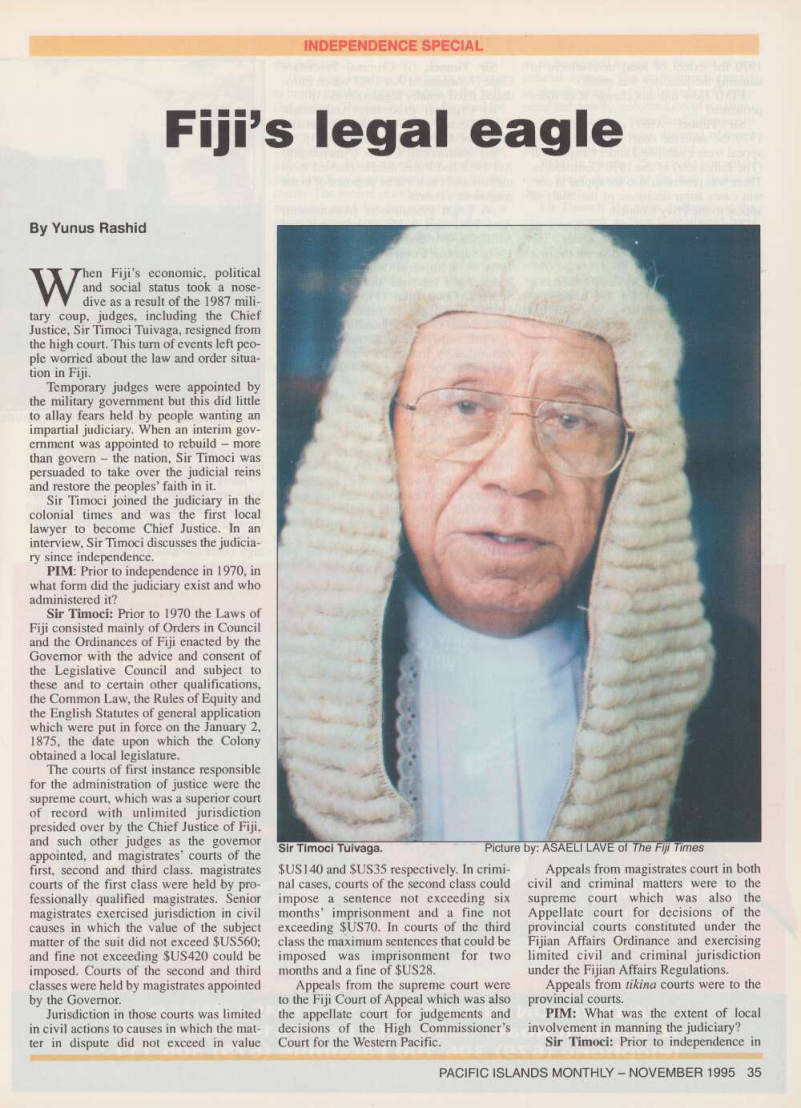

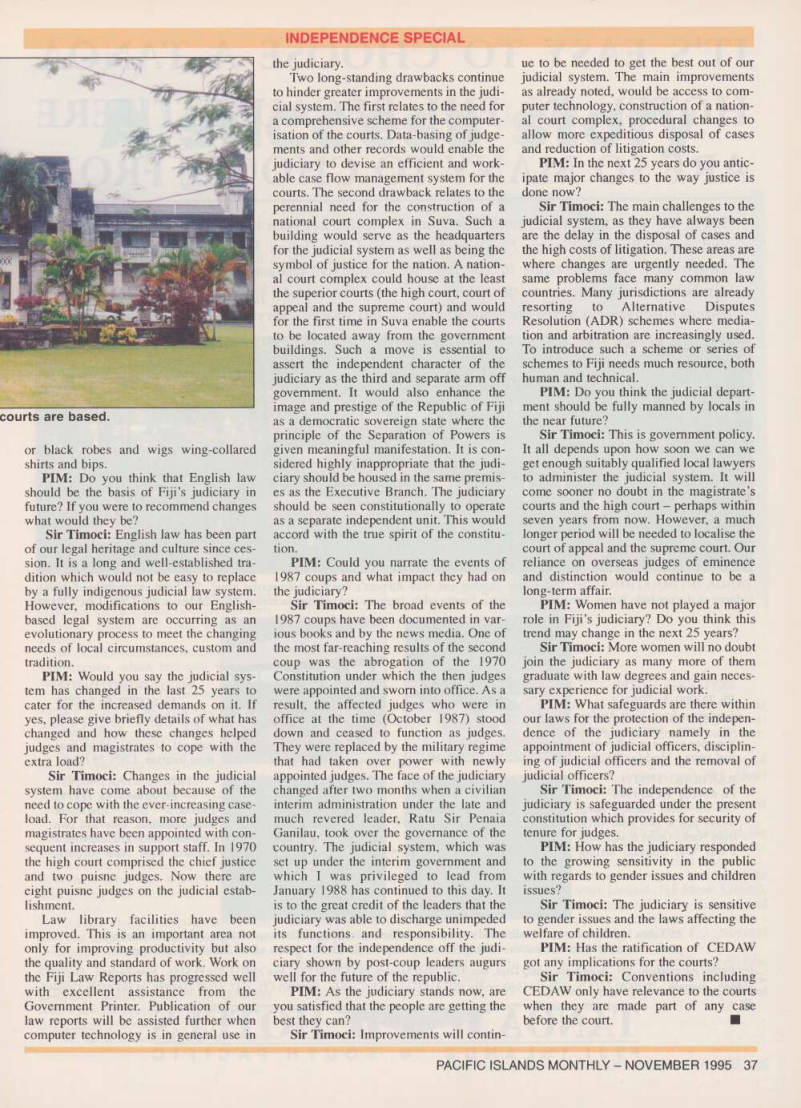
By Yunus Rashid
When Fiji’s economic, political
and social status took a nose dive as a result of the 1987 mili tary coup, judges, including the Chief Justice, Sir Timoci Tuivaga, resigned from the high court. This turn of events left peo ple worried about the law and order situa tion in Fiji.
Temporary judges were appointed by
the military government but this did little to allay fears held by people wanting an impartial judiciary. When an interim gov ernment was appointed to rebuild - more than govern - the nation. Sir Timoci was persuaded to take over the judicial reins and restore the peoples’ faith in it.
Sir Timoci joined the judiciary in the colonial times and was the first local lawyer to become Chief Justice. In an interview. Sir Timoci discusses the judicia ry since independence.
PIM: Prior to independence in 1970, in what form did the judiciary exist and who administered it?
Sir Timoci: Prior to 1970 the Laws of Fiji consisted mainly of Orders in Council and the Ordinances of Fiji enacted by the Governor with the advice and consent of the Legislative Council and subject to these and to certain other qualifications, the Common Law, the Rules of Equity and
the English Statutes of general application
which were put in force on the January 2, 1875, the date upon which the Colony obtained a local legislature.
The courts of first instance responsible for the administration of justice were the supreme court, which was a superior court of record with unlimited jurisdiction presided over by the Chief Justice of Fiji, and such other judges as the governor appointed, and magistrates’ courts of the first, second and third class, magistrates courts of the first class were held by pro
fessionally qualified magistrates. Senior
magistrates exercised jurisdiction in civil causes in which the value of the subject matter of the suit did not exceed SUSS6O; and fine not exceeding SUS42O could be imposed. Courts of the second and third
classes were held by magistrates appointed
by the Governor.
Jurisdiction in those courts was limited in civil actions to causes in which the mat ter in dispute did not exceed in value
SUSI4O and SUS3S respectively. In crimi nal cases, courts of the second class could impose a sentence not exceeding six months’ imprisonment and a fine not exceeding SUS7O. In courts of the third class the maximum sentences that could be imposed was imprisonment for two months and a fine of SUS2B.
Appeals from the supreme court were to the Fiji Court of Appeal which was also the appellate court for judgements and decisions of the High Commissioner’s Court for the Western Pacific.
Appeals from magistrates court in both civil and criminal matters were to the supreme court which was also the Appellate court for decisions of the provincial courts constituted under the Fijian Affairs Ordinance and exercising limited civil and criminal jurisdiction under the Fijian Affairs Regulations.
Appeals from tikina courts were to the
provincial courts.
PIM: What was the extent of local involvement in manning the judiciary?
Sir Timoci: Prior to independence in
Sir Timoci Tuivaga. Picture by: ASAELI LAVE of The Fiji Times
1970 the extent of local involvement in manning the judiciary was small.
PIM: How did this change after inde
pendence?
Sir Timoci: After independence in 1970 the supreme court and the court of appeal were established under Chapter VII (The Judicature) of the 1970 Constitution.
There was provision also for appeal in cer tain cases from decisions of the court of appeal to the Privy Council.
The newly constituted Fiji Court of Appeal was established under the Judicature Decree 1988 and sat for the first time on May 2, 1988.
The supreme court was established as a final appellate court for Fiji under the Judicature Decree 1988 in place of the Privy Council, to which the right of appeal ceased in October 1987 when Fiji became a Republic. At the same time the Constitution of 1970 was abrogated.
A new constitution of Fiji, which was promulgated on July 25, 1990, retained the supreme court as the final appeal tribunal for Fiji.
The chief justice is president of the court while other justices of the court may be appointed for one or more sessions or for a term not exceeding three years, jus tices of the court of appeal are ex-officio members and may be asked upon to partic ipate in any sitting or session of the court.
PIM: To date, what important judicial changes have been made?
Sir Timoci: (i) Criminal Procedure Code (Amendment Act 1983 which intro
duced fixed penalty legislation to Fiji).
ii) Criminal Procedure Amendment Code Decree 1988 which substantially modernised Criminal Procedure in Fiji. iii) Matrimonial Causes (Amendment) Act 1982 and Rules thereto enabled most matrimonial causes to be disposed of in the
magistrate’s courts.
iv) Legal Practitioners (Amendment) Acts 1981 and 1986; Maintenance and Affiliation (Amendment) Acts 1981 and 1986; Supreme Court (Amendment) Rules 1983, 1984; Supreme Court (Amendment) Rules 1988 (updated the Rules of the Supreme Court from 1976 to 1987; Fiji Court of Appeal (Amendment) Rules 1985; Small Claims Tribunal Rules 1994.
PIM: Until recently, the profession was dominated by Indian lawyers. What was the reason for more Fijians undertaking
legal studies?
Sir Timoci: Lack of financial resources has been the main reason why many Fijians were not able to study law. It was only in recent years when law scholarships became available to Fijians more freely that more Fijians studied law and became lawyers. Fijians who obtained law degrees increased significantly in the last three years. This trend should continue so long as law scholarships are available to
Fijians.
PIM: In the last 25 years have the for-
malities of the courts changed from being highly officious to being less formal?.
Sir Timoci: Court dress requirements have not changed except in the court of appeal. There the wig is no longer worn.
Lounge suit and tie with black robe is the preferred attire in that court. However, the high court continued to use either scarlet
Fiji’s government building where the
or black robes and wigs wing-collared shirts and bips.
PIM: Do you think that English law should be the basis of Fiji’s judiciary in future? If you were to recommend changes what would they be?
Sir Timoci: English law has been part of our legal heritage and culture since ces sion. It is a long and well-established tra dition which would not be easy to replace by a fully indigenous judicial law system.
However, modifications to our English based legal system are occurring as an evolutionary process to meet the changing needs of local circumstances, custom and tradition.
PIM: Would you say the judicial sys tem has changed in the last 25 years to cater for the increased demands on it. If yes, please give briefly details of what has changed and how these changes helped judges and magistrates to cope with the extra load?
Sir Timoci: Changes in the judicial system have come about because of the need to cope with the ever-increasing case load. For that reason, more judges and magistrates have been appointed with con sequent increases in support staff. In 1970 the high court comprised the chief justice and two puisne judges. Now there are eight puisne judges on the judicial estab lishment.
Law library facilities have been improved. This is an important area not only for improving productivity but also the quality and standard of work. Work on the Fiji Law Reports has progressed well with excellent assistance from the Government Printer. Publication of our law reports will be assisted further when computer technology is in general use in
the judiciary.
Two long-standing drawbacks continue to hinder greater improvements in the judi cial system. The first relates to the need for a comprehensive scheme for the computer isation of the courts. Data-basing of judge ments and other records would enable the judiciary to devise an efficient and work able case flow management system for the courts. The second drawback relates to the perennial need for the construction of a national court complex in Suva. Such a building would serve as the headquarters for the judicial system as well as being the symbol of justice for the nation. A nation al court complex could house at the least the superior courts (the high court, court of appeal and the supreme court) and would for the first time in Suva enable the courts to be located away from the government buildings. Such a move is essential to assert the independent character of the judiciary as the third and separate arm off government. It would also enhance the image and prestige of the Republic of Fiji as a democratic sovereign state where the principle of the Separation of Powers is given meaningful manifestation. It is con sidered highly inappropriate that the judi ciary should be housed in the same premis es as the Executive Branch. The judiciary should be seen constitutionally to operate as a separate independent unit. This would accord with the true spirit of the constitu tion.
PIM: Could you narrate the events of 1987 coups and what impact they had on
the judiciary?
Sir Timoci: The broad events of the 1987 coups have been documented in var ious books and by the news media. One of the most far-reaching results of the second coup was the abrogation of the 1970 Constitution under which the then judges were appointed and sworn into office. As a result, the affected judges who were in office at the time (October 1987) stood down and ceased to function as judges.
They were replaced by the military regime that had taken over power with newly appointed judges. The face of the judiciary changed after two months when a civilian interim administration under the late and much revered leader, Ratu Sir Penaia Ganilau, took over the governance of the country. The judicial system, which was set up under the interim government and which I was privileged to lead from January 1988 has continued to this day. It is to the great credit of the leaders that the judiciary was able to discharge unimpeded its functions and responsibility. The respect for the independence off the judi ciary shown by post-coup leaders augurs well for the future of the republic.
PIM: As the judiciary stands now, are you satisfied that the people are getting the best they can?
Sir Timoci: Improvements will contin
ue to be needed to get the best out of our judicial system. The main improvements as already noted, would be access to com puter technology, construction of a nation
al court complex, procedural changes to
allow more expeditious disposal of cases and reduction of litigation costs.
PIM: In the next 25 years do you antic ipate major changes to the way justice is done now?
Sir Timoci: The main challenges to the judicial system, as they have always been are the delay in the disposal of cases and the high costs of litigation. These areas are where changes are urgently needed. The same problems face many common law countries. Many jurisdictions are already resorting to Alternative Disputes Resolution (ADR) schemes where media tion and arbitration are increasingly used.
To introduce such a scheme or series of schemes to Fiji needs much resource, both human and technical.
PIM: Do you think the judicial depart ment should be fully manned by locals in the near future?
Sir Timoci: This is government policy.
It all depends upon how soon we can we get enough suitably qualified local lawyers to administer the judicial system. It will come sooner no doubt in the magistrate’s courts and the high court - perhaps within seven years from now. However, a much longer period will be needed to localise the court of appeal and the supreme court. Our reliance on overseas judges of eminence and distinction would continue to be a long-term affair.
PIM: Women have not played a major role in Fiji’s judiciary? Do you think this trend may change in the next 25 years?
Sir Timoci: More women will no doubt join the judiciary as many more of them graduate with law degrees and gain neces sary experience for judicial work.
PIM: What safeguards are there within our laws for the protection of the indepen dence of the judiciary namely in the appointment of judicial officers, disciplin ing of judicial officers and the removal of
judicial officers?
Sir Timoci: The independence of the judiciary is safeguarded under the present constitution which provides for security of tenure for judges.
PIM: How has the judiciary responded to the growing sensitivity in the public with regards to gender issues and children issues?
Sir Timoci: The judiciary is sensitive to gender issues and the laws affecting the welfare of children.
PIM: Has the ratification of CEDAW got any implications for the courts?
Sir Timoci: Conventions including CEDAW only have relevance to the courts when they are made part of any case before the court. ■
courts are based.
Advertisements & other items, pp. 36-38 (3 items)
Independence Special
3K
f / / / , ]f / V
IT'S EASY TO CHOOSE A TANOA
HOTEL IN FIJI BECAUSE THERE
ARE SO MANY TO CHOOSE FROM
In Fiji the 'tanoa bowl' is a symbol of welcome service has been built. In western Fiji you'll and hospitality. For over 25 years Tanoa find five Tanoa Hotels each with its own Hotels have used the tanoa in our logo to distinctive character. And when you stay at symbolize a commitment to the genuine Fiji any Tanoa Hotel you're free to visit the others Islands hospitality on which our reputation for and charge everything back to your room.
TANOA INTERNATIONAL HOTEL - Our flagship and Nadi Airport's finest, most popular hotel. 24 hour airconditioned dining indoors or the poolside Bistro. Fitness centre, sauna, beauty salon, business and meeting facilities: CNN 24 hours. Ph 720277 Fx 720191
SKYLODGE HOTEL
Ph 722200 Fx 720212 S minutes from Nadi Airport on eleven spacious acres.
Superior rooms or self contained units. Ideal for families.
RAKIRAKI HOTEL
Ph 694101 Fx 694545 On the main island's north shore, just a two hour drive from Nadi. Quiet & secluded: a real 'Old Colonial' setting. f a s a
WATERFRONT HOTEL
Ph 664777 Fx 665870 On Lautoka's foreshore, 20 minutes from Nadi International Airport. Ideal business location. CNN 24 hours.
TANOA APARTMENTS
Ph 723685 Fx 721193 Executive style apartment condominiums. One and two bedroom units; kitchenettes. 2 minutes from Nadi Airport.
All Tanoa Hotels feature airconditioned rooms with coffee/tea making facilities and fridge. All have swimming pools and many other amenities. Complimentary Airport shuttle for guests of all Nadi Airport locations.
For further information: Fiji - Sales & Marketing Dept, Box 9203, Nadi Airport, Ph (679) 722300, Fax 720212,T1x FJ 5186. New Zealand -Ph (0800) 656666. Australia - Ph (008) 221176, (02) 4182560, or Fax (02)4182561; USA/Canada - Ph (800) 521-7242, (213) 2561991, or Fax (213) 2560647.
TANOA
HOTELS
FIJI ISLANDS
SOUTH PACIFIC
Independence Special
A success story
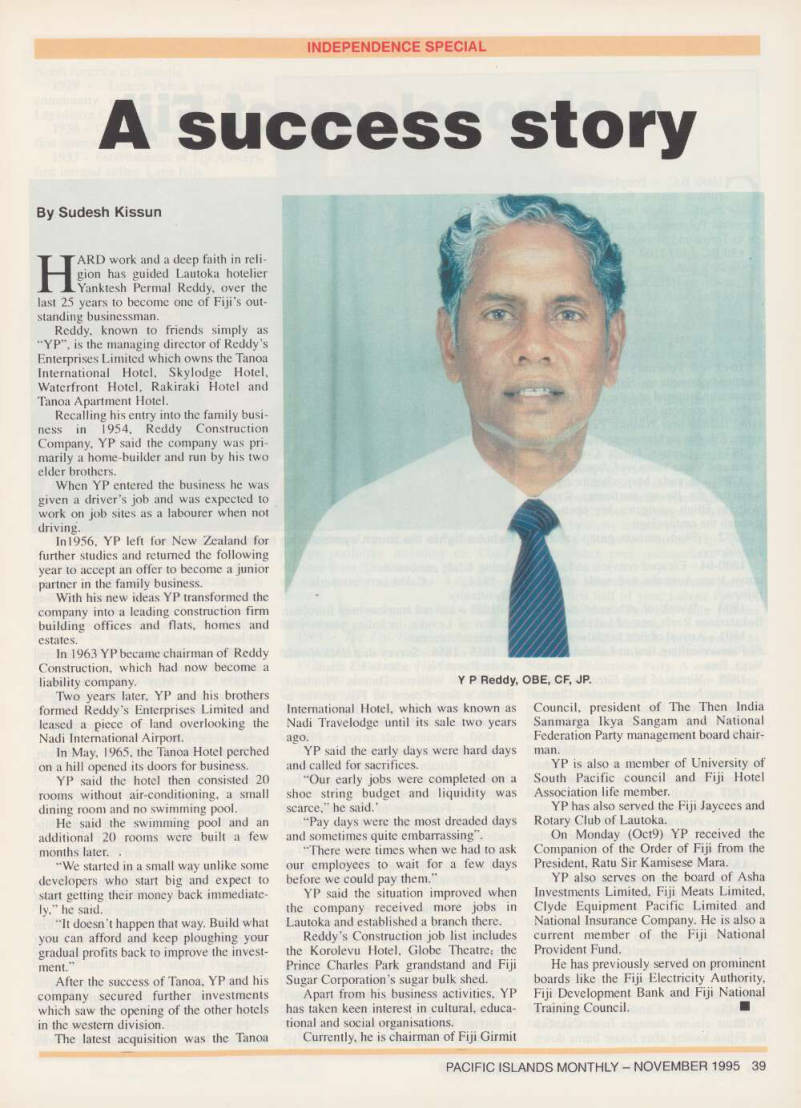
By Sudesh Kissun
HARD work and a deep faith in reli gion has guided Lautoka hotelier Yanktesh Permal Reddy, over the last 25 years to become one of Fiji’s out
standing businessman.
Reddy, known to friends simply as “YP”, is the managing director of Reddy’s Enterprises Limited which owns the Tanoa International Hotel, Skylodge Hotel, Waterfront Hotel, Rakiraki Hotel and Tanoa Apartment Hotel.
Recalling his entry into the family busi ness in 1954, Reddy Construction Company, YP said the company was pri marily a home-builder and run by his two elder brothers.
When YP entered the business he was given a driver’s job and was expected to work on job sites as a labourer when not driving.
In 1956, YP left for New Zealand for further studies and returned the following year to accept an offer to become a junior partner in the family business.
With his new ideas YP transformed the company into a leading construction firm building offices and flats, homes and estates.
In 1963 YP became chairman of Reddy Construction, which had now become a
liability company.
Two years later, YP and his brothers formed Reddy’s Enterprises Limited and leased a piece of land overlooking the Nadi International Airport.
In May, 1965, the Tanoa Hotel perched on a hill opened its doors for business.
YP said the hotel then consisted 20 rooms without air-conditioning, a small dining room and no swimming pool.
He said the swimming pool and an additional 20 rooms were built a few months later. .
"We started in a small way unlike some developers who start big and expect to start getting their money back immediate ly,” he said.
"It doesn’t happen that way. Build what you can afford and keep ploughing your gradual profits back to improve the invest ment.”
After the success of Tanoa, YP and his company secured further investments which saw the opening of the other hotels in the western division.
The latest acquisition was the Tanoa
International Hotel, which was known as Nadi Travelodge until its sale two years ago.
YP said the early days were hard days and called for sacrifices.
“Our early jobs were completed on a shoe string budget and liquidity was scarce,” he said.’
“Pay days were the most dreaded days and sometimes quite embarrassing”.
“There were times when we had to ask our employees to wait for a few days before we could pay them.”
YP said the situation improved when the company received more jobs in Lautoka and established a branch there.
Reddy’s Construction job list includes the Korolevu Hotel, Globe Theatre; the Prince Charles Park grandstand and Fiji Sugar Corporation’s sugar bulk shed.
Apart from his business activities, YP has taken keen interest in cultural, educa tional and social organisations.
Currently, he is chairman of Fiji Girmit
Council, president of The Then India Sanmarga Ikya Sangam and National Federation Party management board chair man.
YP is also a member of University of South Pacific council and Fiji Hotel Association life member.
YP has also served the Fiji Jaycees and Rotary Club of Lautoka.
On Monday (Oct 9) YP received the Companion of the Order of Fiji from the President, Ratu Sir Kamisese Mara.
YP also serves on the board of Asha Investments Limited, Fiji Meats Limited, Clyde Equipment Pacific Limited and National Insurance Company. He is also a current member of the Fiji National Provident Fund.
He has previously served on prominent
boards like the Fiji Electricity Authority,
Fiji Development Bank and Fiji National
Training Council. ■
Y P Reddy, Obe, Cf, Jp.
Advertisements & other items, p. 39 (1 item)
Independence Special
A chronology of Fiji
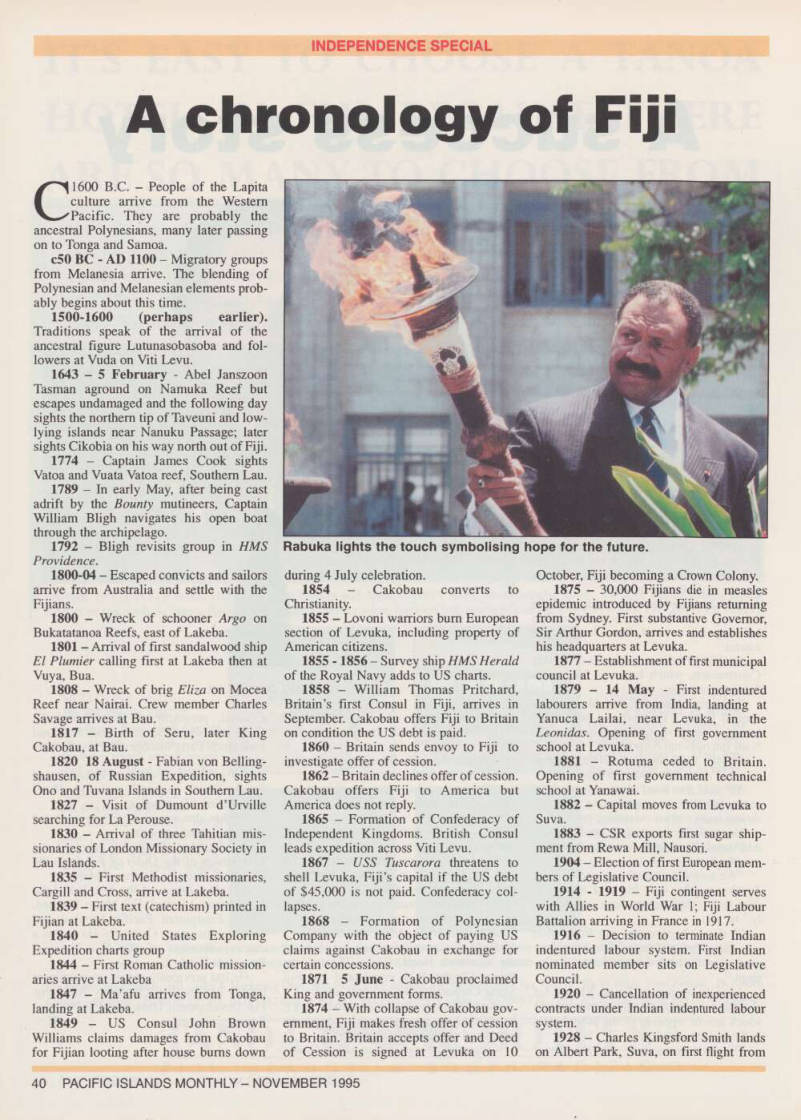
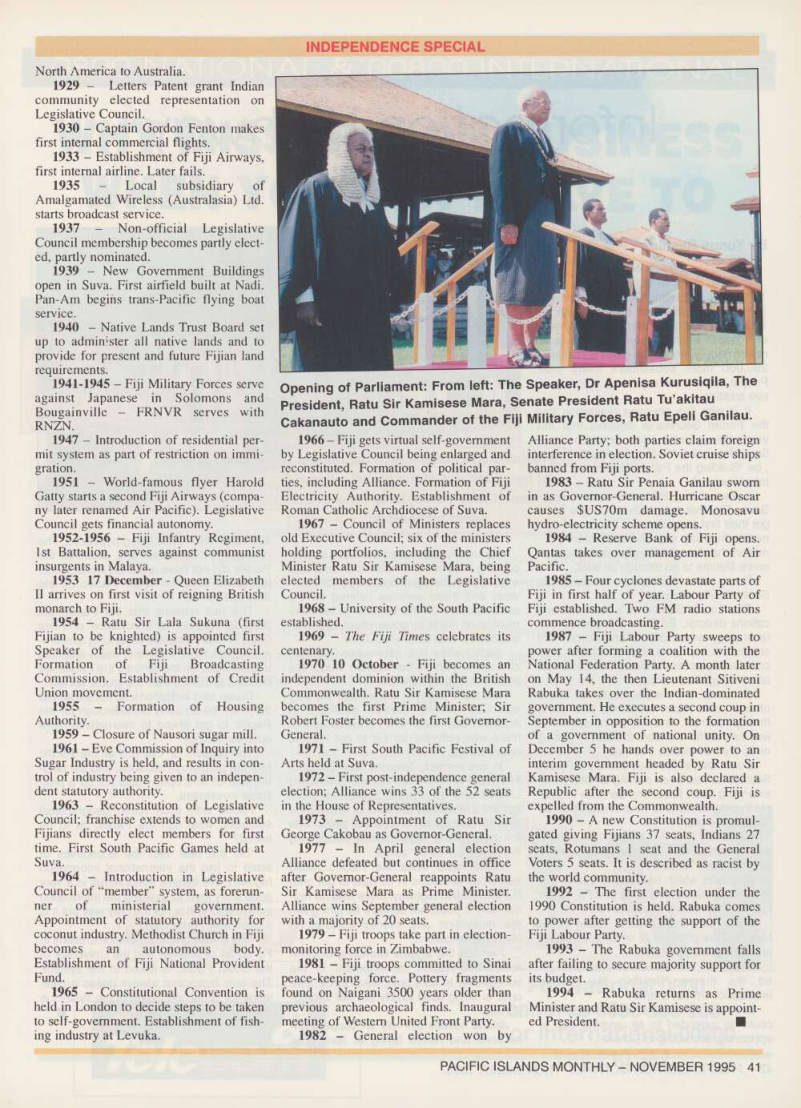
Cl 600 B.C. - People of the Lapita culture arrive from the Western Pacific. They are probably the ancestral Polynesians, many later passing on to Tonga and Samoa. c5O BC - AD 1100 - Migratory groups from Melanesia arrive. The blending of Polynesian and Melanesian elements prob ably begins about this time. 1500-1600 (perhaps earlier).
Traditions speak of the arrival of the ancestral figure Lutunasobasoba and fol lowers at Vuda on Viti Levu. 1643 - 5 February - Abel Janszoon Tasman aground on Namuka Reef but
escapes undamaged and the following day
sights the northern tip of Taveuni and low lying islands near Nanuku Passage; later sights Cikobia on his way north out of Fiji. 1774 - Captain James Cook sights Vatoa and Vuata Vatoa reef. Southern Lau. 1789 - In early May, after being cast adrift by the Bounty mutineers. Captain William Bligh navigates his open boat
through the archipelago.
1792 - Bligh revisits group in HMS Providence. 1800-04 - Escaped convicts and sailors arrive from Australia and settle with the Fijians. 1800 - Wreck of schooner Argo on Bukatatanoa Reefs, east of Lakeba. 1801 - Arrival of first sandalwood ship El Plumier calling first at Lakeba then at
Vuya, Bua.
1808 - Wreck of brig Eliza on Mocea Reef near Nairai. Crew member Charles Savage arrives at Bau. 1817 - Birth of Seru, later King Cakobau, at Bau. 1820 18 August - Fabian von Belling shausen, of Russian Expedition, sights Ono and Tuvana Islands in Southern Lau. 1827 - Visit of Dumount d’Urville searching for La Perouse. 1830 - Arrival of three Tahitian mis sionaries of London Missionary Society in Lau Islands. 1835 - First Methodist missionaries, Cargill and Cross, arrive at Lakeba. 1839 - First text (catechism) printed in Fijian at Lakeba. 1840 - United States Exploring Expedition charts group 1844 - First Roman Catholic mission aries arrive at Lakeba 1847 - Ma’afu arrives from Tonga, landing at Lakeba. 1849 - US Consul John Brown Williams claims damages from Cakobau for Fijian looting after house bums down
during 4 July celebration.
1854 - Cakobau converts to
Christianity.
1855 - Lovoni warriors bum European section of Levuka, including property of American citizens. 1855 -1856 - Survey ship HMS Herald of the Royal Navy adds to US charts. 1858 - William Thomas Pritchard, Britain’s first Consul in Fiji, arrives in September. Cakobau offers Fiji to Britain on condition the US debt is paid. 1860 - Britain sends envoy to Fiji to investigate offer of cession. 1862 - Britain declines offer of cession.
Cakobau offers Fiji to America but America does not reply. 1865 - Formation of Confederacy of Independent Kingdoms. British Consul leads expedition across Viti Levu. 1867 - USS Tuscarora threatens to shell Levuka, Fiji’s capital if the US debt of $45,000 is not paid. Confederacy col
lapses.
1868 - Formation of Polynesian Company with the object of paying US claims against Cakobau in exchange for certain concessions. 1871 5 June - Cakobau proclaimed King and government forms. 1874 - With collapse of Cakobau gov ernment, Fiji makes fresh offer of cession to Britain. Britain accepts offer and Deed of Cession is signed at Levuka on 10
October, Fiji becoming a Crown Colony.
1875 30,000 Fijians die in measles
epidemic introduced by Fijians returning
from Sydney. First substantive Governor, Sir Arthur Gordon, arrives and establishes his headquarters at Levuka. 1877 - Establishment of first municipal council at Levuka. 1879 - 14 May - First indentured labourers arrive from India, landing at Yanuca Lailai, near Levuka, in the Leonidas. Opening of first government school at Levuka. 1881 - Rotuma ceded to Britain.
Opening of first government technical school at Yanawai. 1882 - Capital moves from Levuka to Suva. 1883 - CSR exports first sugar ship ment from Rewa Mill, Nausori. 1904 - Election of first European mem bers of Legislative Council. 1914 - 1919 - Fiji contingent serves with Allies in World War 1; Fiji Labour Battalion arriving in France in 1917. 1916 - Decision to terminate Indian indentured labour system. First Indian nominated member sits on Legislative Council. 1920 - Cancellation of inexperienced contracts under Indian indentured labour system. 1928 - Charles Kingsford Smith lands on Albert Park, Suva, on first flight from
Rabuka lights the touch symbolising hope for the future.
North America to Australia. 1929 - Letters Patent grant Indian community elected representation on
Legislative Council.
1930 - Captain Gordon Fenton makes first internal commercial flights. 1933 - Establishment of Fiji Airways, first internal airline. Later fails. 1935 - Local subsidiary of Amalgamated Wireless (Australasia) Ltd. starts broadcast service. 1937 - Non-official Legislative Council membership becomes partly elect ed, partly nominated. 1939 - New Government Buildings open in Suva. First airfield built at Nadi.
Pan-Am begins trans-Pacific flying boat service. 1940 - Native Lands Trust Board set up to admin’Ster all native lands and to provide for present and future Fijian land requirements. 1941-1945 - Fiji Military Forces serve against Japanese in Solomons and Bougainville - FRNVR serves with
Rnzn.
1947 - Introduction of residential per mit system as part of restriction on immi gration. 1951 - World-famous flyer Harold Gatty starts a second Fiji Airways (compa ny later renamed Air Pacific). Legislative Council gets financial autonomy. 1952-1956 - Fiji Infantry Regiment, Ist Battalion, serves against communist insurgents in Malaya. 1953 17 December - Queen Elizabeth II arrives on first visit of reigning British monarch to Fiji. 1954 - Ratu Sir Lala Sukuna (first Fijian to be knighted) is appointed first Speaker of the Legislative Council.
Formation of Fiji Broadcasting Commission. Establishment of Credit Union movement. 1955 - Formation of Housing Authority. 1959 - Closure of Nausori sugar mill. 1961 - Eve Commission of Inquiry into Sugar Industry is held, and results in con trol of industry being given to an indepen dent statutory authority. 1963 - Reconstitution of Legislative Council; franchise extends to women and Fijians directly elect members for first time. First South Pacific Games held at Suva. 1964 - Introduction in Legislative Council of “member” system, as forerun ner of ministerial government.
Appointment of statutory authority for coconut industry. Methodist Church in Fiji becomes an autonomous body.
Establishment of Fiji National Provident Fund. 1965 - Constitutional Convention is held in London to decide steps to be taken to self-government. Establishment of fish ing industry at Levuka.
1966 - Fiji gets virtual self-government by Legislative Council being enlarged and reconstituted. Formation of political par ties, including Alliance. Formation of Fiji Electricity Authority. Establishment of Roman Catholic Archdiocese of Suva. 1967 - Council of Ministers replaces old Executive Council; six of the ministers
holding portfolios, including the Chief
Minister Ratu Sir Kamisese Mara, being elected members of the Legislative Council. 1968 - University of the South Pacific established. 1969 - The Fiji Times celebrates its centenary. 1970 10 October - Fiji becomes an independent dominion within the British Commonwealth. Ratu Sir Kamisese Mara becomes the first Prime Minister; Sir Robert Foster becomes the first Governor- General. 1971 - First South Pacific Festival of Arts held at Suva. 1972 - First post-independence general election; Alliance wins 33 of the 52 seats in the House of Representatives. 1973 - Appointment of Ratu Sir George Cakobau as Governor-General. 1977 - In April general election Alliance defeated but continues in office after Governor-General reappoints Ratu Sir Kamisese Mara as Prime Minister.
Alliance wins September general election with a majority of 20 seats. 1979 - Fiji troops take part in election monitoring force in Zimbabwe. 1981 - Fiji troops committed to Sinai
peace-keeping force. Pottery fragments
found on Naigani 3500 years older than
previous archaeological finds. Inaugural
meeting of Western United Front Party. 1982 - General election won by
Alliance Party; both parties claim foreign interference in election. Soviet cruise ships banned from Fiji ports. 1983 - Ratu Sir Penaia Ganilau sworn in as Governor-General. Hurricane Oscar causes SUS7Om damage. Monosavu hydro-electricity scheme opens. 1984 - Reserve Bank of Fiji opens.
Qantas takes over management of Air Pacific. 1985 - Four cyclones devastate parts of Fiji in first half of year. Labour Party of Fiji established. Two FM radio stations
commence broadcasting.
1987 - Fiji Labour Party sweeps to power after forming a coalition with the National Federation Party. A month later on May 14, the then Lieutenant Sitiveni Rabuka takes over the Indian-dominated government. He executes a second coup in September in opposition to the formation of a government of national unity. On December 5 he hands over power to an interim government headed by Ratu Sir Kamisese Mara. Fiji is also declared a Republic after the second coup. Fiji is expelled from the Commonwealth. 1990 - A new Constitution is promul gated giving Fijians 37 seats, Indians 27 seats, Rotumans 1 seat and the General Voters 5 seats. It is described as racist by the world community. 1992 - The first election under the 1990 Constitution is held. Rabuka comes to power after getting the support of the
Fiji Labour Party.
1993 - The Rabuka government falls after failing to secure majority support for
its budget.
1994 - Rabuka returns as Prime Minister and Ratu Sir Kamisese is appoint ed President. ■
Opening of Parliament: From left: The Speaker, Dr Apenisa Kurusiqila, The President, Ratu Sir Kamisese Mara, Senate President Ratu Tu’akitau Cakanauto and Commander of the Fiji Military Forces, Ratu Epeli Ganilau.
Information Highway
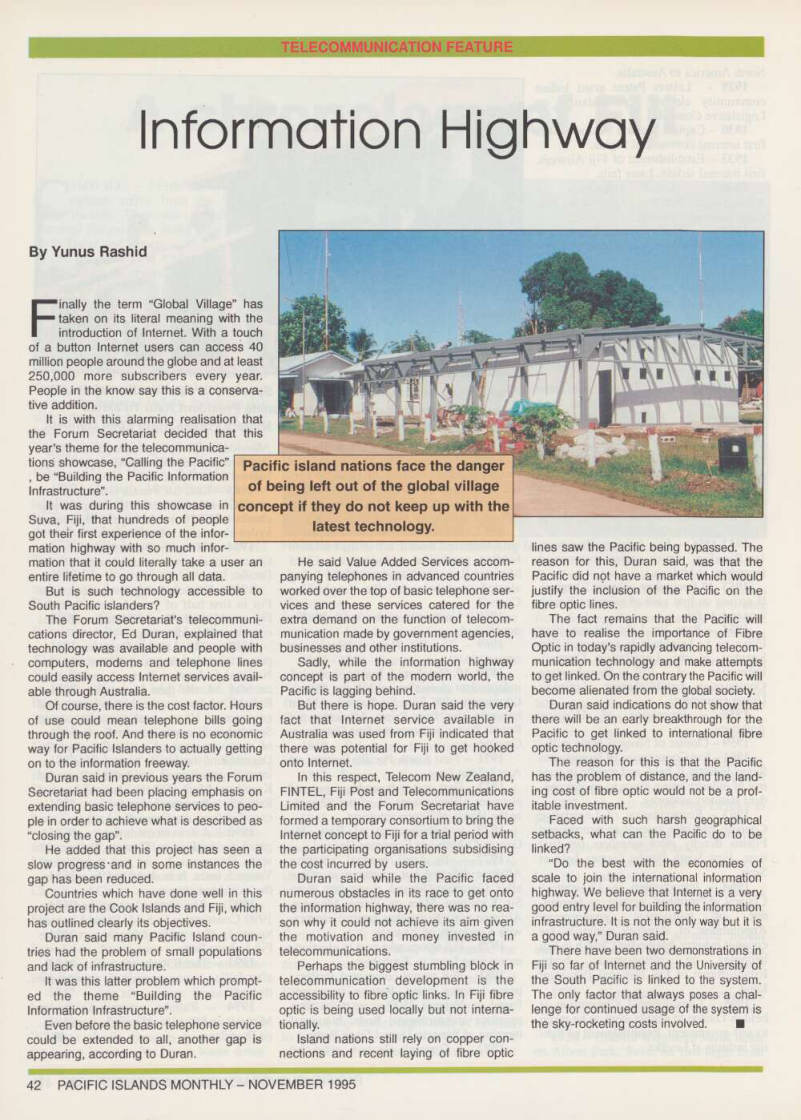
Telecommunication Feature
By Yunus Rashid
Finally the term “Global Village” has taken on its literal meaning with the introduction of Internet. With a touch of a button Internet users can access 40 million people around the globe and at least 250,000 more subscribers every year.
People in the know say this is a conserva tive addition.
It is with this alarming realisation that the Forum Secretariat decided that this
year’s theme for the telecommunica tions showcase, “Calling the Pacific” , be “Building the Pacific Information Infrastructure”.
It was during this showcase in Suva, Fiji, that hundreds of people got their first experience of the infor mation highway with so much infor
mation that it could literally take a user an entire lifetime to go through all data.
But is such technology accessible to South Pacific islanders?
The Forum Secretariat’s telecommuni cations director, Ed Duran, explained that technology was available and people with computers, modems and telephone lines could easily access Internet services avail able through Australia.
Of course, there is the cost factor. Flours of use could mean telephone bills going through the roof. And there is no economic way for Pacific Islanders to actually getting on to the information freeway.
Duran said in previous years the Forum Secretariat had been placing emphasis on extending basic telephone services to peo ple in order to achieve what is described as “closing the gap”.
Fie added that this project has seen a slow progress - and in some instances the gap has been reduced.
Countries which have done well in this project are the Cook Islands and Fiji, which has outlined clearly its objectives.
Duran said many Pacific Island coun tries had the problem of small populations and lack of infrastructure.
It was this latter problem which prompt ed the theme “Building the Pacific Information Infrastructure”.
Even before the basic telephone service could be extended to all, another gap is appearing, according to Duran.
Fie said Value Added Services accom panying telephones in advanced countries worked over the top of basic telephone ser vices and these services catered for the extra demand on the function of telecom munication made by government agencies, businesses and other institutions.
Sadly, while the information highway concept is part of the modern world, the Pacific is lagging behind.
But there is hope. Duran said the very fact that Internet service available in Australia was used from Fiji indicated that there was potential for Fiji to get hooked onto Internet.
In this respect, Telecom New Zealand, FINTEL, Fiji Post and Telecommunications Limited and the Forum Secretariat have formed a temporary consortium to bring the Internet concept to Fiji for a trial period with the participating organisations subsidising the cost incurred by users.
Duran said while the Pacific faced numerous obstacles in its race to get onto the information highway, there was no rea son why it could not achieve its aim given the motivation and money invested in telecommunications.
Perhaps the biggest stumbling block in telecommunication development is the accessibility to fibre optic links. In Fiji fibre optic is being used locally but not interna tionally.
Island nations still rely on copper con nections and recent laying of fibre optic
lines saw the Pacific being bypassed. The reason for this, Duran said, was that the Pacific did not have a market which would justify the inclusion of the Pacific on the fibre optic lines.
The fact remains that the Pacific will have to realise the importance of Fibre Optic in today’s rapidly advancing telecom munication technology and make attempts to get linked. On the contrary the Pacific will become alienated from the global society.
Duran said indications do not show that there will be an early breakthrough for the Pacific to get linked to international fibre optic technology.
The reason for this is that the Pacific has the problem of distance, and the land ing cost of fibre optic would not be a prof itable investment.
Faced with such harsh geographical setbacks, what can the Pacific do to be linked?
“Do the best with the economies of scale to join the international information highway. We believe that Internet is a very good entry level for building the information infrastructure. It is not the only way but it is a good way,” Duran said.
There have been two demonstrations in Fiji so far of Internet and the University of the South Pacific is linked to the system.
The only factor that always poses a chal lenge for continued usage of the system is the sky-rocketing costs involved. ■
Pacific island nations face the danger of being left out of the global village concept if they do not keep up with the latest technology.
Advertisements & other items, p. 43 (1 item)
Why Miss Out On Business
0800 NATIONAL & 00800 INTERNATIONAL
WHEN YOU DON’T HAVE TO
USING F.P.T.L 0800
If you haven't got a branch in every town or country, you might think a lot of potential customers are out of your reach. Far from it.
Encouraging customers to call from far off places is easy with Telecom 0800 National & 00800 International service. Because, not only is the call free, there's also just one number to remember.
To add to that, Telecom 0800 show you where customers call from, handy if you're wondering where to find new business. Beyond reaching customers, it can measure advertising, and help you answer every call.
That's why we believe Telecom 0800 can satisfy your needs and help improve your bottom line, no matter what kind of customer you're after For National 0800 call free 0800 300 000.
For international 00800 call 210 582.
FPTL, the good

Samaritan
By Yunus Rashid
For four years nobody detected that two children were being brutally abused by their parents in a suburb of Fiji’s capital Suva. Until one day neigh bours decided to investigate the persistent crying of children and stumbled upon two pathetic-looking children in tattered clothes with their bodies badly bruised.
The neighbourhood nurse was informed of the tragic situation and the children were taken to the comfort of Saint Christopher’s Home at Naulu - a twenty-minute drive from Suva.
When Marian and David (not their real names) aged three and four respectively, arrived at the Saint Christopher’s Home, they were taken in by Sister Claire Masina, who has dedicated her life to looking after neglected children for the last 27 years.
Marian and David are two of the 61 chil dren who are being looked after by the home in the hope that they will overcome their initial psychological trauma of being abused and abandoned by their parents and grow up to be respectable citizens of the country.
But the work is hard mainly because of financial constraints. The home was blessed in the 1970 s when an American left a generous portion of his estate for use by the home. While this generosity has helped the home survive over the years, the home is always in need of extra assistance to be able to give the children the best upbringing possible.
That is why Fiji Post and Telecommunications Limited’s offer of $U516,809 as donation was given an open-arm welcome by Sister Claire.
FPTL has started a new programme which incorporates its phone card busi ness.
The company has printed 8000 cards with the picture of Sister Claire and some children of the home and have called it the “Fund card”. The card which sells for SUS3.SO allows the buyer to make SUSI.4o worth of calls and donate three towards the Home.
The idea was thought of by the compa ny’s marketing manager, Peter Ah Koy, and
was implemented with the support of the Managing Director Winston Thompson.
Ah Koy explained that the $U516,809 would be given to the home as and when the cards are sold.
Sister Claire welcomed the offer saying such generosity allowed the home to do its best for the children who need more love and affection than other children because of their sufferings. ■
FPTL’s Managing Director Winston Thompson (left) donates a card to Sister Claire Masina.
Looking on are some of the 61 children hoping for a good future.
Advertisements & other items, p. 45 (1 item)
pari/j
We have one good reason
why you should make us your
i i(-- ! :: We have the answers to ALL your
business communication needs
We have the solution No matter what your business communication needs are, we have a solution for you. We offer a wide range of integrated communication systems designed for home offices, small businesses, corporations and multi-national organisations. only have solutions but also a nation-wide maintenance and support system to back-up our customers.
Call us now!
Talk to us today for all your business communication needs.
We want to be your partners !
Service At Fiji Posts and Telecommunications Ltd we not
%Ros &
Telecom
Call us toll free 0800 300 000
fIMEi
SUVA:TEL2IO 222 FAX: 3OS 071 lAUTOKA;TEL:66I II4 FAX: 663S67 LABASA:TEL:811800 FAX: 812766
GEORGE RUBINE 10*239
FPTL: Keeping you in touch

As a company that keeps up to date with the latest communica tion technology, Fiji Posts and Telecommunications Limited introduces yet another service for its customers.
What is a Calling Card? Calling from any phone (public or private) but charging to your own phone account.
How is this done?
The subscriber is issued with an account number. The account number is unique to the subscriber. The subscriber is also allocated a confidential PIN (personal Identification Number) How is the service connected?
Calling 017 connects on to the various regional operators as with the other OPS calls. The call class identification: (C Card) will appear on the Operator PC screens.
The operator will ask for the subscribers’ account number. The operator calls the verification supervisor in Suva who cross checks the account number against the
Pin.
If the account number and the PIN match the call is connected. Adding and deleting of customers’ numbers on the data base will be done by MIS.
How is switching done?
All calls are switched through the three main divisional areas-Central Eastern, Western and Northern. There is a verifica tion PC situated in Suva. The operators in the various Transit Exchanges will call the Suva supervisor to verify the account num ber against the PIN. When this is verified, the call will be put through.
How is Charging Done? $F1.50 is the monthly rental for provi sion of product Calling Card. The cost of the call will include the operator surcharge of SFI.IO (VAT Inclusive) plus the rate according to the duration of the call.
Calls have been tested from various exchanges and are working satisfactorily, including the coin box.
Allocation ‘of special pin numbers will require a premium price of SFSS (VAT Inclusive) this amount will cater for those wishing to have personalised PIN numbers.
MIS will provide S&E item code with the certification of procedures.
There will also be a charge for change of PIN numbers. It is $F5.50 (Vat Inclusive).
How will cards be issued?
Issue of cards will be carried out by centralised locations: it would be issued by the Customer Office C/E. Application forms from the West and the North will be processed in the regional offices. The
names and account numbers will be faxed or telexed to Customer Office Suva where the cards will be issued.
The expiry date will be at intervals of two years to allow follow up on: 1. Evaluating credit rating of customer 2. Accessing the customers decision to continue 3. Procedures for administering this task will need to be discussed between Regional Managers Customer Office and Product Telephone
Terms & Conditions For Call
Ing Card
These Terms & Conditions cover the use of a Fiji Telecom Calling Card. By using your card, or allowing the use of it, you agree to these terms and conditions.
The Telecom Calling Card Fiji Posts & Telecom Limited has issued a Telecom Calling Card to you as the Cardholder (this means the person to whom the card is issued by FPTL).
If you are a Cardholder (this means the person or company in whose name(s) the calls will be charged) all of these terms and conditions will cover the use of your card.
The card will remain the property of Fiji Posts & Telecom.
Telecom may from time to time contact you in relation to the use of the issued card.
Issuing Additional Fptl Call
Ing Cards
At the your request as the main Cardholder FPTL may issue additional cards (the Additional Card) to nominated persons (the additional Cardholder’s).
Each of these persons will be allocated the same PIN as the Main cardholder.
For the purposes of these terms and conditions the use of an additional card will be considered by FPTL to be the Main Cardholder’s use.
Importantly, this means you will be responsible for the use of an additional card by the additional Cardholder and you have authorised FPTL to charge any call made with an additional card to you.
The additional cardholder will be sent these terms and conditions.
Charges
By using the PIN and a Telecom Calling Card, any call made with your card (or an Additional Card where applicable will be charged to the Main Cardholder’s FPTL telephone account.
Unauthorised Use Of The Fptl
Calling Card
If a card is lost or stolen, the PIN becomes known to another person or you suspect misuse of the card has occurred you must notify Telecom immediately so that the card can be cancelled.
In that case, ring our Customer Office nationally and leave your name, account number, your PIN and the reason for your call. It is in our interest to advise Telecom of the details required as soon as possible.
You must confirm the details in writing with in seven days in writing to your Telecom Office.
FPTL may issue a replacement card after you have made notification in writing.
You will no longer be responsible for any unauthorised use of a card after you have notified FPTL.
Your responsibility for any unauthorised use of the card before you notify FPTL will be limited to. $50.00 for each card.
Fptl’S Rights To Cancel
Telecom may cancel your card without prior notice.
If Telecom cancels your card you will be required to return your card immediately to a Telecom Office.
You will still be responsible for all calls made up to the time of cancellation.
Exclusion Of Liability
Telecom will not accept responsibility for you not being able to make a telephone call by use of a card or if anything happens beyond Telecom’s control.
Changes To These Terms And
Conditions
These terms and conditions may be changed by Telecom from time to time.
Telecom will advise you of the changes by written notice to your last known address or by advertisement in newspapers at least one month prior to such changes taking effect.
Applications Of These Terms
And Conditions
These terms and conditions apply specifically to the Telecom Calling Cards and are in addition to any other agreement you may have with Telecom or with any of its subsidiary companies.
Lost & Stolen Numbers
Lost and Stolen numbers, call free 0800. ■
Let distance not be a barrier

Who is Vodafone? Vodafone Fiji Ltd is a subsidiary of Fiji Posts & Telecommunications Ltd and Vodafone Group Pic of United Kingdom.
Vodafone Fiji Ltd was launched on July 1, 1994 by the President of the Republic of Fiji, Ratu Sir Kamisese Mara.
What services are offered by Vodafone Fiji Ltd?
Vodafone specialises in mobile commu nications and its Fiji operation is based on a Pan-European Standard called Global System for Mobile (GSM). GSM uses digi tal technology and, as a consequence, offers superior speech quality over ana logue cellular networks.
Another important feature of GSM is its ability to be used in foreign (other) net works and this feature is termed roaming.
With roaming agreements with other com patible networks, we are increasing the coverage for the use of mobile phones overseas.
Vodafix Vodafone Fiji Ltd launched a new ser vice around the Vodafone Network to cater for the rural communities. This service termed Vodafix - the fixed phone wireless service, was jointly introduced by FPTL and Vodafone Fiji Ltd. This services is currently available to rural communities within the Vodafone coverage area.
Vodafix carries a low tariff plan, the monthly access is just SFII.OO while the calls from VodaFix are charged 33c per minute or part thereof anywhere in Fiji.
Unlike Vodafone, Vodafix is not mobile, it is permanently mounted in the house like other telephones. Because it is wireless, there is no limitation imposed by unavail ability of circuits or terrains, provided it is within the Vodafone coverage area.
What areas are covered by Vodafone?
Vodafone launched its service with 18 base stations covering Nausori to Ba along the Coral Coast, and is developing more base stations to enhance the coverage along this route. Vodafone coverage in the Northern division was launched in July 1995 with plans to implement two more sta tions around greater Labasa towards the end of 1995.
Vodafone coverage is limited to 35km from its base stations and uses microwave frequencies for transmission. These are some of the factors that prevent coverage to certain areas within the specific cover age area. Vodafone coverage is generally affected by high vegetation and buildings.
What is Vodafone’s product range?
Vodafone has two different types of mobile phones to offer, depending on your location and business needs.
Hand-Held Units Han-held units are low-powered units and they conveniently fit into your hand or pocket. Because thet are low powered, their operation can be affected in large buildings.
Car Phones Car phones are high-powered sets offering safety features such as hand-free operation, and are recommended for fre quent travellers.
How much does it cost to have a Vodafone?
Vodafones are purchased outright by the subscribers and like any other pur chase, the units are covered under warran ty for a specific period of time.
Apart from the unit price, the following rates apply: A once only Connection fee of SFIIO.OO and monthly access fee of $F44.00.
Calls made from a Vodafone are charged 61c per minute or part thereof.
People calling a Vodafone from a standard phone are also charged 61c a minute or part thereof.
Why does a mobile phone cost more in Fiji than In overseas?
Mobile phone prices are comparable anywhere in the world. The difference in price is normally attributed to currency rates, freight and duty.
Unlike certain overseas mobile opera tors who offer cheap prices on phones and then tie subscribers into long-term con tracts committing them to the network, Vodafone Fiji Ltd has only a one-year Network Service Agreement along with other standard conditions the subscriber signs for.
Who pays for the calls?
Like Fiji Posts & Telecommunications Ltd’s call charges, whoever makes a call, pays for that call. Therefore, a mobile sub scriber initiating a call will be charged for that call. Similarly, a Telecom subscriber calling a mobile will be charged for that call You are not charged for receiving a call.
The only time you are charged for receiving a call is when you have set a divert for incoming calls to another phone, and it is only the diverted portion that is charged to you. Calls received from Fiji while on roaming overseas are also charged to you.
What Value Added Services does Vodafone provide?
The value added services offered by Vodafone require no subscription fee, how ever, some of the services offered are also dependent on the feature of the mobile phone.
The Value Added Services currently available to Vodafone subscribers are:
VodaConnect This is an operator-assisted through connect service whereby a call from a mobile can be connected to another mobile or a standard telephone VodaConnect can be accessed by dialling 010 from mobile or 902010 from the FPTL telephone. Likewise a Telecom subscriber can be connected to a mobile subscriber. Only call charges apply and these are charged at normal Vodafone rate.
Vodaßill The itemised billing offered to Vodafone subscribers forms part of our commitment to better service and customer satisfaction.
The subscriber’s bill gives a complete breakdown, indicating the date, time, dura tion, number called and call charges for a particular call. Vodaßills can be paid at any ANZ bank branch in the country.
VodalD This feature is called Calling Line Identification (CLI) and is dependent on the phone feature. Mobile phones supporting CLI feature will display the calling party’s number before the call is answered. Mobile phones that support this feature are Mortola 82000, Ericsson GHI72, GHI9B, GH337 and Nokia 2110.
Vodafone subscribers wishing to sup press their phone numbers will be charged $F54.45 annually.
VodaMessage VodaMessage is the voice mail service offered to Vodafone subscribers. Calls to a Vodafone are diverted to the subscriber’s mail box when the subscriber is busy, there is no reply, when out of the coverage zone or when the mobile is switched off.
Vodafone subscribers can set uncondition al divert to their mail box if they wish to.
Normally, the divert leg of the call is charged, but in the case of the call being diverted to the mail box, the subscriber is not charged. Accessing mail box to retrieve the message is charged atnormal Vodafone rate. A five-second delay ensures that subscribers with no messages are not charged provided they hang up before five seconds.
VodaMessage will alert the presence of the new message through Short Message Service (SMS). Vodafone Fiji Ltd will be implementing a voice message alert by the end of this year. Once voice alert is imple mented, subscribers will be alerted by a voice prompt that there is a message wait ing.
Vodaßoam Vodafone subscribers can use their Vodafone in Australia. Roaming is one of the features of the GSM network. Vodafone Fiji Ltd subscribers (while in Australia) will be able to make and receive calls like they
do in Fiji. All calls made in Australia will be charged local Australian rates plus a sur charge of 32.25 per cent and will be billed here in Fiji with their Vodaßill.
VodaGroup This is the Closed User Group service offered to business organisations with a maximum of 10 members, the maximum being 100. Members within the group are charged 11c/minute for calls within the group, anywhere within the Vodafone cov erage area.
Members within the group can access other members by dialling short codes, nor mally three digits. This service is similar to a switchboard service. The difference being while the switchboard is confined to a com plex, VodaGroup applies to the whole Vodafone Network. Group members can move freely anywhere in the Vodafone net work and enjoy low call tariffs.
Calls made outside the group will be charged normal Vodafone rates.
VodaGroup members can receive calls directly from other mobiles or Telecom sub scribers.
VodaCare This is Vodafone’s 24-hour Customer
Care service. This service is offered 24 hours a day and 7 days a week. The ser vices offered are: 115 - Customer Care: This service is offered free of charge and assists cus tomers with their complaints and billing inquiries. 100 - Spotlight Service: This service is charged normal Vodafone rates and sub scribers are provided with general informa tion. Wakeup calls form part of this service.
Ill: This is the directory service for Vodafone subscribers. Directory service is charged normal Vodafone rate.
What is Vodafone’s commitment to support and service of Mobile phones?
Vodafone Fiji Ltd provides warranty to the mobile phones and also provides main tenance for the phones not covered by war ranty. The cost of repair is borne by the subscriber if repaired outside the warranty period.
Vodasure Vodafone Fiji Ltd is provides an insur ance protection through its Insurance com pany to safeguard mobile phones against theft, damage or loss. This insurance cover can be extended to your mobile by our
VodaSure insurance package.
How do I get a Vodafone?
Vodafones can be purchased through Vodafone Fiji Ltd or from its approved deal ers. Connection will be provided by Vodafone Fiji Ltd.
Can I buy a Mobile from overseas and use it here?
Mobile phones purchased from over seas can be used in Fiji, provided the mobile phones purchased confirm to GSM standards. However, you will be required to pay connection and monthly access fees.
How would I know that a mobile phone is a GSM standard phone?
GSM standard mobile phones require a smart card called Subscriber Interface Module (SIM) for its operation. SIMs come in two sizes, a credit-card size and a plug in module. GSM phones will have provision for inserting these cards into the phones.
Generally Mortola phones support credit card size SIMs and the slot where SIMs are inserted is marked by an arrow. Ericsson and Nokia phones support plug in SIMs, placed between the battery and the phone.
Phones that do not support SIMs are non GSM phones. ■
Want more business?
Why use FPTL 0800? • encourages immediate customer response to advertising • links businesses with customers any where in Fiji • automatically puts customers in touch with the right person • can provide a number to telephone 24 hours a day • ensures customer calls are answered without delay. improves Efficiency • Provides immediate customer response to new products and markets • Helps expand markets without large scale expansion of resources • Optimises the use of resources by matching the number of customer calls to the size of the office receiving them • Centralises customer response nation ally helping to cut costs or channel responses through regional offices for more appropriate treatment • Reduces expensive overheads needed for expansion • Only $20.00 per month rental charge and the normal unit charge for the calls Improves Customer Loyalty • Reduces the barriers between business and customer • Ensures the customer gets through immediately to the most appropriate per son
FPTL’s 0800 is an essential and afford able business tool for any organisation wishing to expand their business activity on overseas markets Every organisation wishing to expand its business activity beyond Fiji is faced with the same critical decision.
“How can business contacts be estab lished and maintained in a way that is worthwhile for prospects, customers and clients, yet affordable for us?”
For a growing number of Fiji leading off shore performers, the answer is a Telecom International 0800 number.
They’re capitalising on their presence in the marketplace by taking advantage of this widely accepted way of doing busi ness. In fact, they regard it as essential. • You’ll be providing better service Service is the key to increased enquiries and increased enquiries are the key to more business. That’s why a Telecom International 0800 number is so right.
Using Telecom International 0800 means it couldn’t be easier for prospects and customers to make contact. When a call is made, the overseas customer doesn’t have to pay or deal with operations, as the call comes through directly to the Fiji.
Orders and enquiries can be handled more quickly and contact will be more per sonal, with a Fiji flavour.
With Telecom International 0800 it is pos
sible to have a presence in a market with out having to go to the expense of actual ly locating the office there.
International 0800 is not expensive to use either. • You’ll be able to do it all from Fiji All billing and set-up administration for International 0800 numbers is done in Fiji.
You won’t have to contact any overseas telephone company to establish a num ber. You’ll be billed for International 00800 calls on your regular Telecom account. • You’ll be able to trial your ideas Being so affordable, a Telecom International 0800 number also provides the ideal means of test marketing a prod uct or service, especially if you have limit ed resources.
How you can make profitable use of your Telecom International 0800 number: Direct Response Advertising This is a major application for a International 0800 number. It will pay for you to prominently display your number on all overseas direct marketing and advertising literature. Making it easier for customers to contact you improves your chances of doing business with them.
Customer Service International 0800 numbers give cus tomers instant access to trained special ists, especially important in modern busi ness. ■
Advertisements & other items, pp. 49-50 (1 item)
ruimFun£
Get connected with VodaGroup and you could be saving upto 70% on telephone calls.
VodaGroup is a 3 digit short numbering “wireless extension” when calling vodafone to vodafone within your company.
At only 11 cents per minute you could be saving a big chunk at the end of the month.
And with Vodaßill, Vodafones’ itemised billing will keep track of your calls and flag any abuse.
Call Vodafone today and find a new way of reducing operational costs.
For enquiries please call toll free phone 0800 214 214 or the nearest Vodafone office
ruimFun£
R * oay cligital
SUVA : Phone : 312 000, Fax : 312 007.
LAUTOKA : Phone : 668 000, Fax : 668 007.
Who connects 40%
of the world s
mobile phone calls?
Ericsson has long been a world leader in mobile communications.
Since pioneering the early development of mobile telephony, we’ve continued to make many significant advances.
Ericsson created the technology behind Fiji’s and Australia’s new digital mobile networks. Our latest digital mobile handset is the most advanced of its kind in the world. And most of Australia’s mobile phone calls are switched by Ericsson equipment.
And, looking to the future, Ericsson is strongly committed to changing the very way you relate to the rapidly expanding telecommunications digital world.
Ericsson Australia Pty. Ltd.
ERICSSON
JWT EAC 006
Fishing training
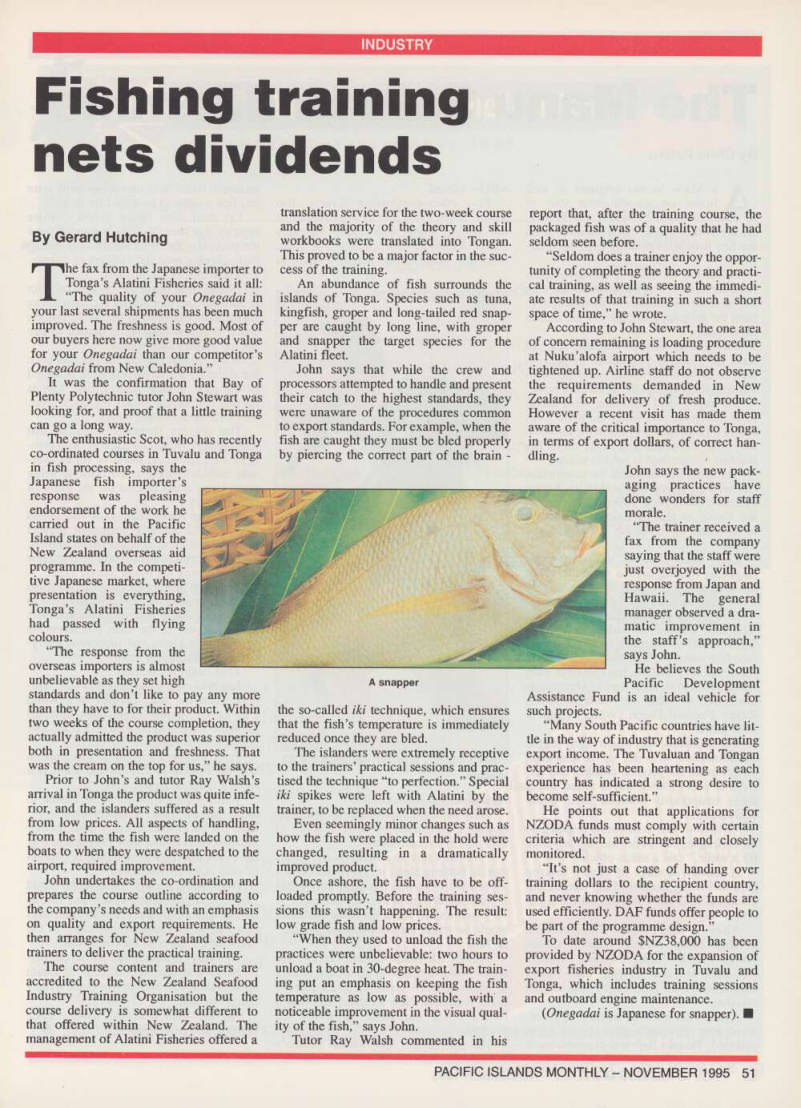
Industry
Fishing training nets dividends
By Gerard Hutching
The fax from the Japanese importer to Tonga’s Alatini Fisheries said it all: “The quality of your Onegadai in your last several shipments has been much improved. The freshness is good. Most of our buyers here now give more good value for your Onegadai than our competitor’s Onegadai from New Caledonia.”
It was the confirmation that Bay of Plenty Polytechnic tutor John Stewart was looking for, and proof that a little training can go a long way.
The enthusiastic Scot, who has recently co-ordinated courses in Tuvalu and Tonga
in fish processing, says the Japanese fish importer’s response was pleasing endorsement of the work he carried out in the Pacific Island states on behalf of the New Zealand overseas aid programme. In the competi tive Japanese market, where
presentation is everything,
Tonga’s Alatini Fisheries had passed with flying colours.
“The response from the overseas importers is almost unbelievable as they set high
standards and don’t like to pay any more than they have to for their product. Within two weeks of the course completion, they actually admitted the product was superior both in presentation and freshness. That was the cream on the top for us,” he says.
Prior to John’s and tutor Ray Walsh’s arrival in Tonga the product was quite inferior, and the islanders suffered as a result from low prices. All aspects of handling. from the time the fish were landed on the boats to when they were despatched to the airport, required improvement.
John undertakes the co-ordination and prepares the course outline according to the company’s needs and with an emphasis on quality and export requirements. He then arranges for New Zealand seafood trainers to deliver the practical training.
The course content and trainers are accredited to the New Zealand Seafood Industry Training Organisation but the course delivery is somewhat different to that offered within New Zealand. The management of Alatini Fisheries offered a
translation service for the two-week course and the majority of the theory and skill workbooks were translated into Tongan.
This proved to be a major factor in the suecess of the training.
An abundance of fish surrounds the islands of Tonga. Species such as tuna, kingfish, groper and long-tailed red snapper are caught by long line, with groper and snapper the target species for the Alatini fleet.
John says that while the crew and processors attempted to handle and present their catch to the highest standards, they were unaware of the procedures common to export standards. For example, when the fish are caught they must be bled properly by piercing the correct part of the brain -
the so-called iki technique, which ensures that the fish’s temperature is immediately reduced once they are bled.
The islanders were extremely receptive to the trainers’ practical sessions and prac tised the technique “to perfection.” Special iki spikes were left with Alatini by the trainer, to be replaced when the need arose.
Even seemingly minor changes such as how the fish were placed in the hold were changed, resulting in a dramatically improved product.
Once ashore, the fish have to be off loaded promptly. Before the training ses sions this wasn’t happening. The result: low grade fish and low prices.
“When they used to unload the fish the practices were unbelievable: two hours to unload a boat in 30-degree heat. The train ing put an emphasis on keeping the fish temperature as low as possible, with a noticeable improvement in the visual qual ity of the fish,” says John.
Tutor Ray Walsh commented in his
report that, after the training course, the packaged fish was of a quality that he had seldom seen before.
“Seldom does a trainer enjoy the oppor tunity of completing the theory and practi cal training, as well as seeing the immedi ate results of that training in such a short space of time,” he wrote, According to John Stewart, the one area
of concern remaining is loading procedure
at Nukualofa airport which needs to be tightened up. Airline staff do not observe the requirements demanded in New Zealand for delivery of fresh produce, However a recent visit has made them aware of the critical importance to Tonga, in terms of export dollars, of correct han
dling.
John says the new pack aging practices have done wonders for staff morale.
“The trainer received a fax from the company saying that the staff were just overjoyed with the response from Japan and Hawaii. The general manager observed a dra matic improvement in the staff’s approach,” says John.
He believes the South Pacific Development
Assistance Fund is an ideal vehicle for such projects.
“Many South Pacific countries have lit tle in the way of industry that is generating export income. The Tuvaluan and Tongan experience has been heartening as each country has indicated a strong desire to become self-sufficient.”
He points out that applications for NZODA funds must comply with certain criteria which are stringent and closely monitored.
“It’s not just a case of handing over training dollars to the recipient country, and never knowing whether the funds are used efficiently. DAF funds offer people to be part of the programme design.”
To date around SNZ3B,OOO has been provided by NZODA for the expansion of export fisheries industry in Tuvalu and Tonga, which includes training sessions and outboard engine maintenance. (Onegadai is Japanese for snapper). ■
A snapper
The Manu Samoa dilemma
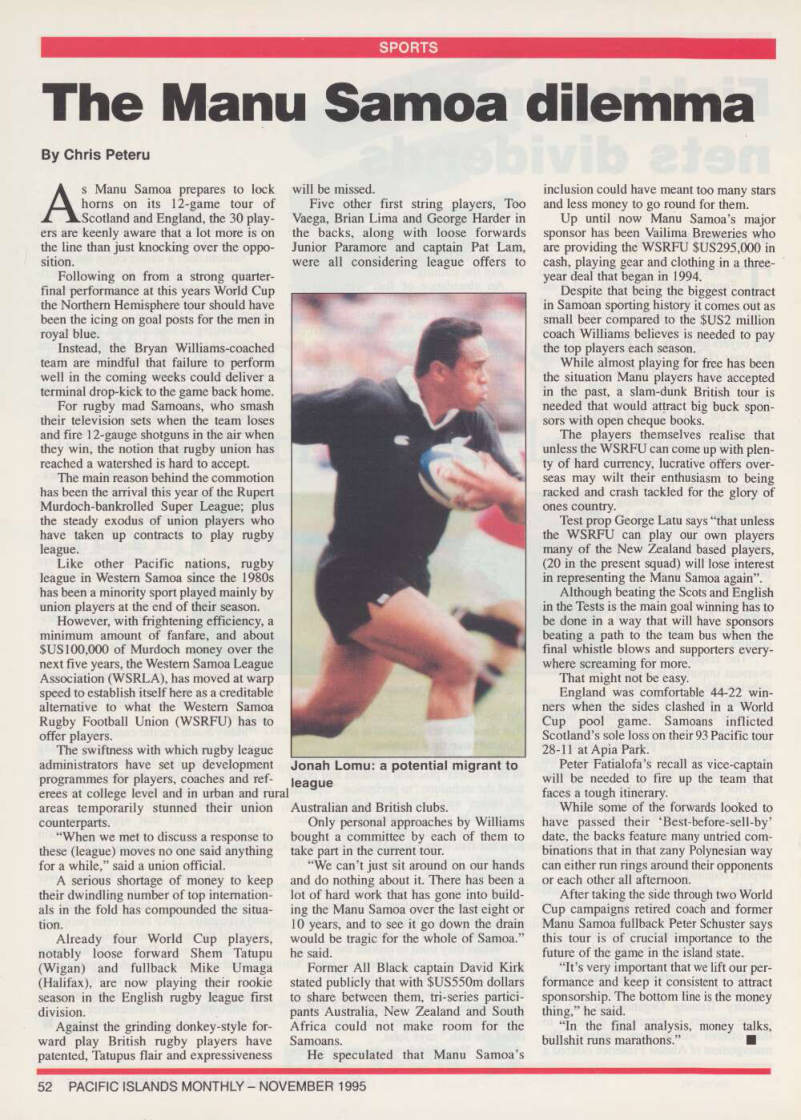
Sports
By Chris Peteru
As Manu Samoa prepares to lock horns on its 12-game tour of Scotland and England, the 30 play ers are keenly aware that a lot more is on the line than just knocking over the oppo sition.
Following on from a strong quarter final performance at this years World Cup the Northern Hemisphere tour should have been the icing on goal posts for the men in
royal blue.
Instead, the Bryan Williams-coached team are mindful that failure to perform well in the coming weeks could deliver a terminal drop-kick to the game back home.
For rugby mad Samoans, who smash their television sets when the team loses and fire 12-gauge shotguns in the air when they win, the notion that rugby union has reached a watershed is hard to accept.
The main reason behind the commotion has been the arrival this year of the Rupert
Murdoch-bankrolled Super League; plus
the steady exodus of union players who have taken up contracts to play rugby league.
Like other Pacific nations, rugby league in Western Samoa since the 1980 s has been a minority sport played mainly by union players at the end of their season.
However, with frightening efficiency, a minimum amount of fanfare, and about SUS 100,000 of Murdoch money over the next five years, the Western Samoa League Association (WSRLA), has moved at warp speed to establish itself here as a creditable alternative to what the Western Samoa Rugby Football Union (WSRFU) has to
offer players.
The swiftness with which rugby league administrators have set up development programmes for players, coaches and ref
erees at college level and in urban and rural
areas temporarily stunned their union counterparts.
“When we met to discuss a response to these (league) moves no one said anything for a while,” said a union official.
A serious shortage of money to keep their dwindling number of top internation als in the fold has compounded the situa tion.
Already four World Cup players, notably loose forward Shem Tatupu (Wigan) and fullback Mike Umaga (Halifax), are now playing their rookie season in the English rugby league first division.
Against the grinding donkey-style for ward play British rugby players have patented, Tatupus flair and expressiveness
will be missed.
Five other first string players, Too Vaega, Brian Lima and George Harder in the backs, along with loose forwards Junior Paramore and captain Pat Lam, were all considering league offers to
Australian and British clubs.
Only personal approaches by Williams
bought a committee by each of them to take part in the current tour.
“We can’t just sit around on our hands and do nothing about it. There has been a lot of hard work that has gone into build ing the Manu Samoa over the last eight or 10 years, and to see it go down the drain would be tragic for the whole of Samoa.” he said.
Former All Black captain David Kirk stated publicly that with SUSSSOm dollars to share between them, tri-series partici pants Australia, New Zealand and South Africa could not make room for the Samoans.
He speculated that Manu Samoa’s
inclusion could have meant too many stars and less money to go round for them.
Up until now Manu Samoa’s major sponsor has been Vailima Breweries who are providing the WSRFU $U5295,000 in cash, playing gear and clothing in a three year deal that began in 1994.
Despite that being the biggest contract in Samoan sporting history it comes out as small beer compared to the SUS 2 million coach Williams believes is needed to pay the top players each season.
While almost playing for free has been the situation Manu players have accepted in the past, a slam-dunk British tour is needed that would attract big buck spon sors with open cheque books.
The players themselves realise that unless the WSRFU can come up with plen ty of hard currency, lucrative offers over seas may wilt their enthusiasm to being racked and crash tackled for the glory of ones country.
Test prop George Latu says “that unless the WSRFU can play our own players many of the New Zealand based players, (20 in the present squad) will lose interest in representing the Manu Samoa again”.
Although beating the Scots and English
in the Tests is the main goal winning has to be done in a way that will have sponsors beating a path to the team bus when the final whistle blows and supporters every where screaming for more.
That might not be easy.
England was comfortable 44-22 win ners when the sides clashed in a World Cup pool game. Samoans inflicted Scotland’s sole loss on their 93 Pacific tour 28-11 at Apia Park.
Peter Fatialofa’s recall as vice-captain will be needed to fire up the team that
faces a tough itinerary.
While some of the forwards looked to
have passed their ‘Best-before-sell-by’
date, the backs feature many untried com binations that in that zany Polynesian way can either run rings around their opponents or each other all afternoon.
After taking the side through two World Cup campaigns retired coach and former Manu Samoa fullback Peter Schuster says this tour is of crucial importance to the future of the game in the island state.
“It’s very important that we lift our per formance and keep it consistent to attract sponsorship. The bottom line is the money thing,” he said.
“In the final analysis, money talks, bullshit runs marathons.” ■
Jonah Lomu: a potential migrant to league
Advertisements & other items, p. 53 (1 item)
Second Hand Containers
WA
MAM SAMOA ■ United Kingdom Tour
November/December 1995 PIM .GRAPHICS James Ranuku
SECOND HAND CONTAINERS
WHERE AND WHEN YOU WANT THEM IN THE PACIFIC If you need a flexible and safe storage space we have the ideal solution for you. Our second hand containers provide instant secure storage. Guaranteed to be wind and waterproof these containers are ideal for both temporary and longterm storage in Pacific conditions.
We can deliver to any island in the Pacific within a month and our rates have got to be the lowest you will find. All you need to do is tell us how many you want.
CONTACT:
PASCALE MARCONNET, BP 4757 NOUMEA, NEW CALEDONIA. TEL: (687) 28 7450. FAX: (687) 26 3248
Fiji’s ugliestregby brawl
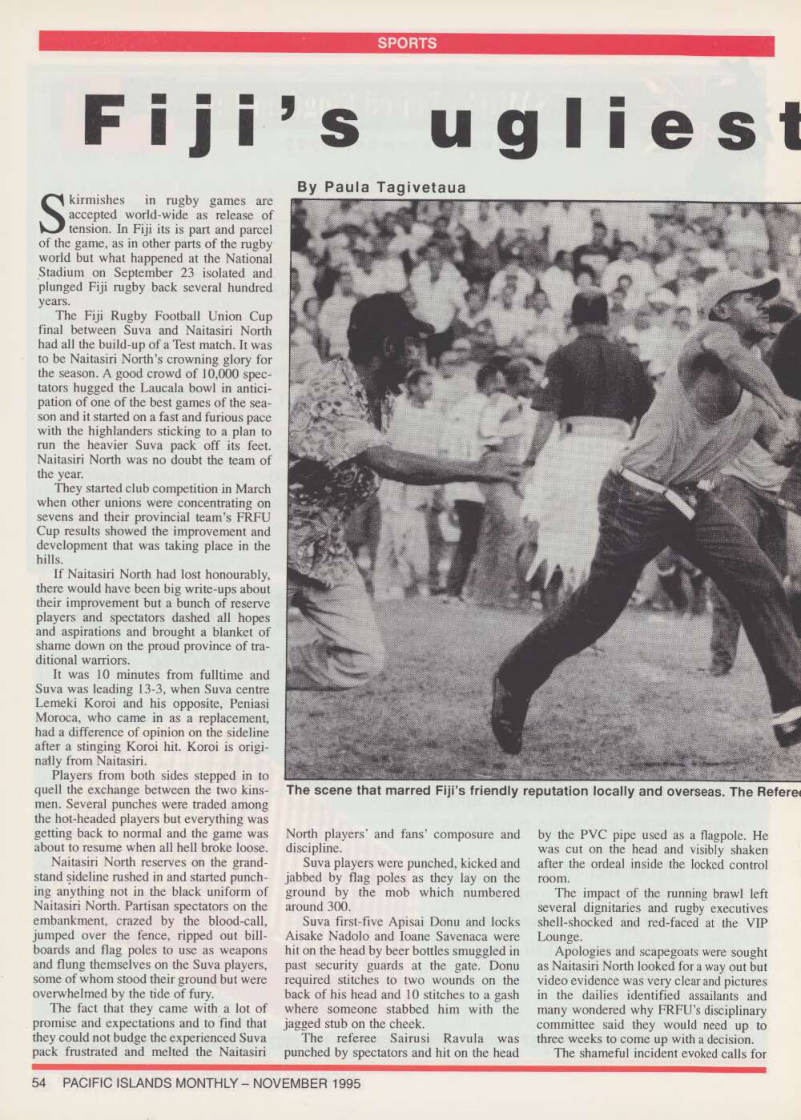
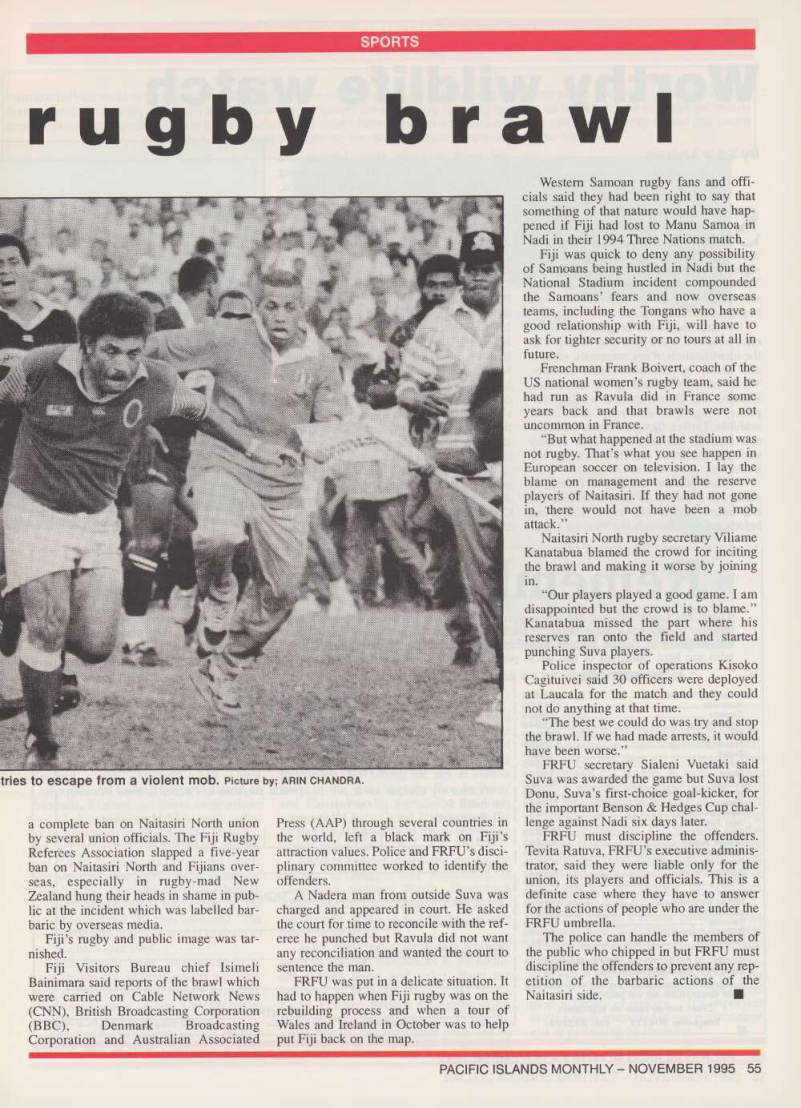
By Paula Tagivetaua
Skirmishes in rugby games are accepted world-wide as release of tension. In Fiji its is part and parcel of the game, as in other parts of the rugby world but what happened at the National Stadium on September 23 isolated and plunged Fiji rugby back several hundred years.
The Fiji Rugby Football Union Cup final between Suva and Naitasiri North had all the build-up of a Test match. It was to be Naitasiri North’s crowning glory for the season. A good crowd of 10,000 spec tators hugged the Laucala bowl in antici pation of one of the best games of the sea son and it started on a fast and furious pace with the highlanders sticking to a plan to run the heavier Suva pack off its feet.
Naitasiri North was no doubt the team of the year.
They started club competition in March when other unions were concentrating on sevens and their provincial team’s FRFU Cup results showed the improvement and development that was taking place in the hills.
If Naitasiri North had lost honourably, there would have been big write-ups about their improvement but a bunch of reserve players and spectators dashed all hopes and aspirations and brought a blanket of shame down on the proud province of tra ditional warriors.
It was 10 minutes from fulltime and Suva was leading 13-3, when Suva centre Lemeki Koroi and his opposite, Peniasi Moroca, who came in as a replacement, had a difference of opinion on the sideline after a stinging Koroi hit. Koroi is origi nally from Naitasiri.
Players from both sides stepped in to quell the exchange between the two kins men. Several punches were traded among the hot-headed players but everything was getting back to normal and the game was about to resume when all hell broke loose.
Naitasiri North reserves on the grand stand sideline rushed in and started punch ing anything not in the black uniform of Naitasiri North. Partisan spectators on the embankment, crazed by the blood-call, jumped over the fence, ripped out bill boards and flag poles to use as weapons and flung themselves on the Suva players, some of whom stood their ground but were overwhelmed by the tide of fury.
The fact that they came with a lot of promise and expectations and to find that they could not budge the experienced Suva pack frustrated and melted the Naitasiri
North players’ and fans’ composure and discipline.
Suva players were punched, kicked and jabbed by flag poles as they lay on the ground by the mob which numbered around 300.
Suva first-five Apisai Donu and locks Aisake Nadolo and loane Savenaca were hit on the head by beer bottles smuggled in past security guards at the gate. Donu required stitches to two wounds on the back of his head and 10 stitches to a gash where someone stabbed him with the jagged stub on the cheek.
The referee Sairusi Ravula was punched by spectators and hit on the head
by the PVC pipe used as a flagpole. He was cut on the head and visibly shaken after the ordeal inside the locked control room.
The impact of the running brawl left several dignitaries and rugby executives shell-shocked and red-faced at the VIP
Lounge.
Apologies and scapegoats were sought as Naitasiri North looked for a way out but video evidence was very clear and pictures in the dailies identified assailants and many wondered why FRFU’s disciplinary committee said they would need up to three weeks to come up with a decision, The shameful incident evoked calls for
The scene that marred Fiji’s friendly reputation locally and overseas. The Refer
a complete ban on Naitasiri North union by several union officials. The Fiji Rugby Referees Association slapped a five-year ban on Naitasiri North and Fijians over seas, especially in rugby-mad New Zealand hung their heads in shame in pub lic at the incident which was labelled bar baric by overseas media.
Fiji’s rugby and public image was tar nished.
Fiji Visitors Bureau chief Isimeli Bainimara said reports of the brawl which were carried on Cable Network News
(CNN), British Broadcasting Corporation
(BBC), Denmark Broadcasting Corporation and Australian Associated
Press (AAP) through several countries in the world, left a black mark on Fiji’s attraction values. Police and FRFU’s disci plinary committee worked to identify the offenders.
A Nadera man from outside Suva was charged and appeared in court. He asked the court for time to reconcile with the ref eree he punched but Ravula did not want any reconciliation and wanted the court to sentence the man.
FRFU was put in a delicate situation. It had to happen when Fiji rugby was on the rebuilding process and when a tour of Wales and Ireland in October was to help put Fiji back on the map.
Western Samoan rugby fans and offi cials said they had been right to say that something of that nature would have hap pened if Fiji had lost to Manu Samoa in Nadi in their 1994 Three Nations match.
Fiji was quick to deny any possibility of Samoans being hustled in Nadi but the National Stadium incident compounded the Samoans’ fears and now overseas teams, including the Tongans who have a good relationship with Fiji, will have to ask for tighter security or no tours at all in future.
Frenchman Frank Boivert, coach of the US national women’s rugby team, said he had run as Ravula did in France some years back and that brawls were not uncommon in France.
“But what happened at the stadium was not rugby. That’s what you see happen in European soccer on television. I lay the blame on management and the reserve players of Naitasiri. If they had not gone in, there would not have been a mob attack.”
Naitasiri North rugby secretary Viliame Kanatabua blamed the crowd for inciting the brawl and making it worse by joining in.
“Our players played a good game. I am disappointed but the crowd is to blame.”
Kanatabua missed the part where his reserves ran onto the field and started
punching Suva players.
Police inspector of operations Kisoko Cagituivei said 30 officers were deployed at Laucala for the match and they could not do anything at that time.
“The best we could do was try and stop the brawl. If we had made arrests, it would have been worse.”
FRFU secretary Sialeni Vuetaki said Suva was awarded the game but Suva lost Donu, Suva’s first-choice goal-kicker, for the important Benson & Hedges Cup chal lenge against Nadi six days later.
FRFU must discipline the offenders.
Tevita Ratuva, FRFU’s executive adminis trator, said they were liable only for the union, its players and officials. This is a definite case where they have to answer for the actions of people who are under the FRFU umbrella.
The police can handle the members of the public who chipped in but FRFU must discipline the offenders to prevent any rep etition of the barbaric actions of the Naitasiri side. ■
ties to escape from a violent mob. Picture by; ARIN CHANDRA.
Advertisements & other items, p. 55 (1 item)
rugby brawl
55
SPORTS
PACIFIC ISLANDS MONTHLY - NOVEMBER 1995
rugby brawl
Worthy wildlife watch
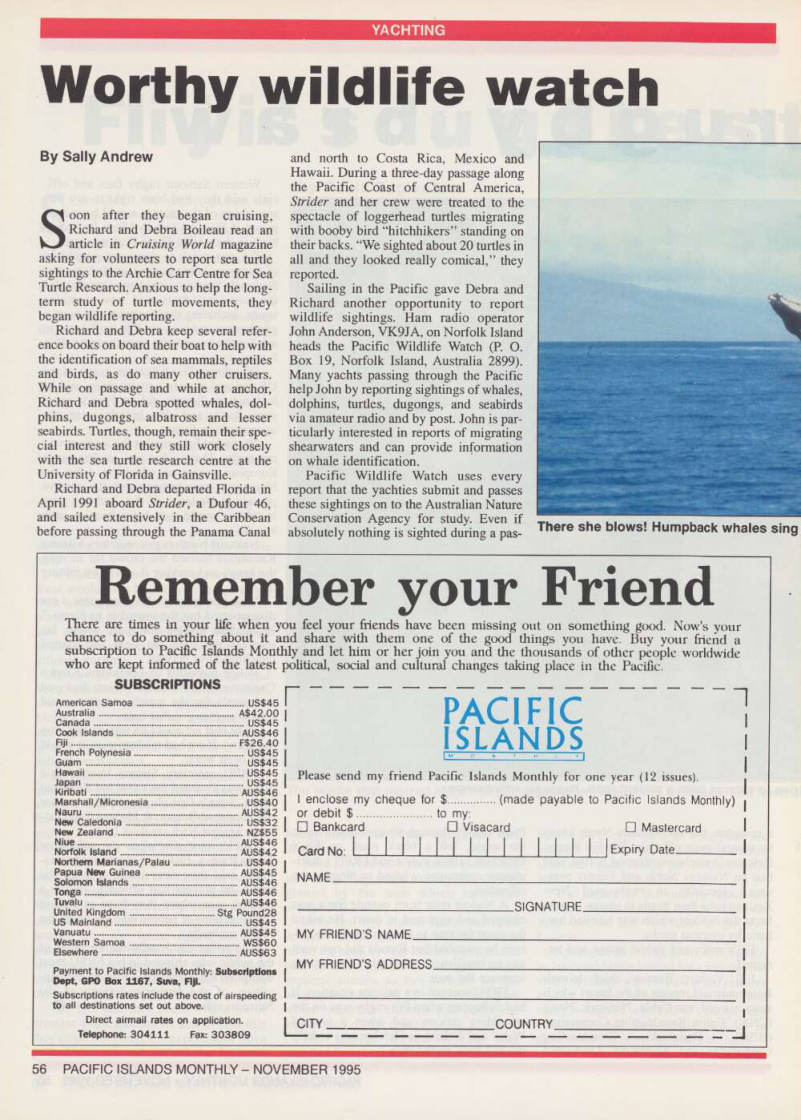
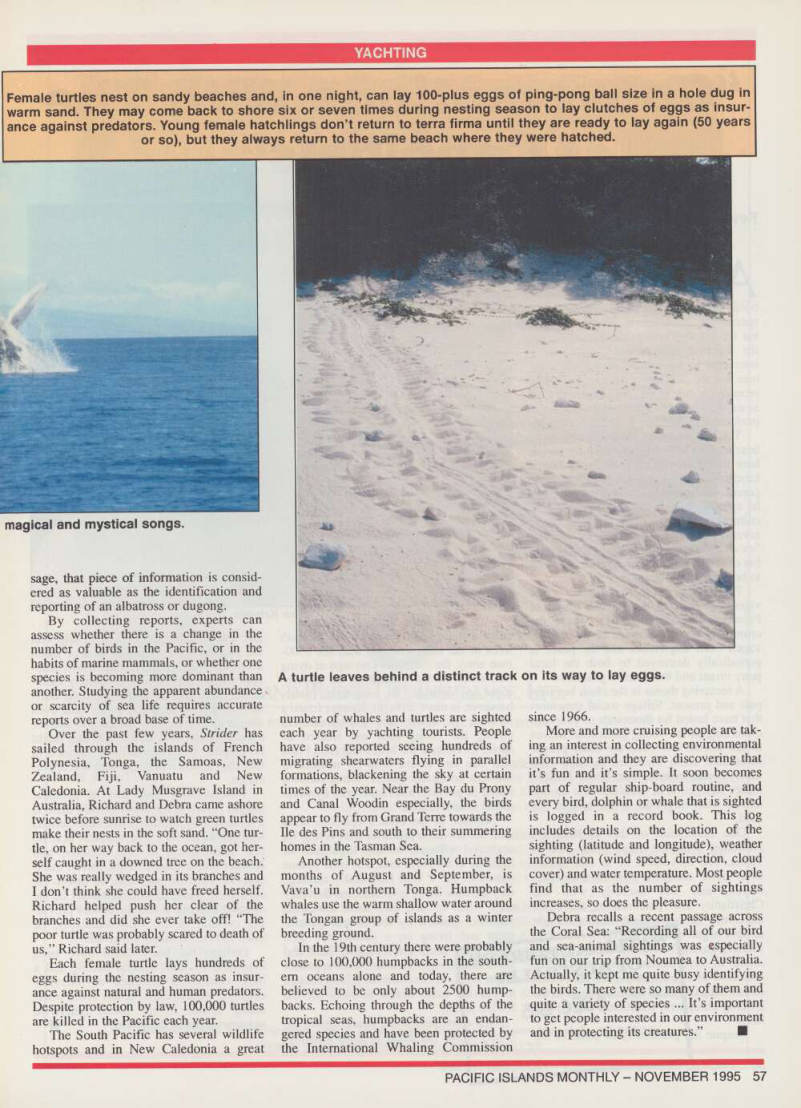
Yachting
By Sally Andrew
Soon after they began cruising,
Richard and Debra Boileau read an article in Cruising World magazine asking for volunteers to report sea turtle sightings to the Archie Carr Centre for Sea Turtle Research. Anxious to help the long term study of turtle movements, they began wildlife reporting.
Richard and Debra keep several refer ence books on board their boat to help with the identification of sea mammals, reptiles and birds, as do many other cruisers.
While on passage and while at anchor, Richard and Debra spotted whales, dol phins, dugongs, albatross and lesser seabirds. Turtles, though, remain their spe cial interest and they still work closely with the sea turtle research centre at the University of Florida in Gainsville.
Richard and Debra departed Florida in April 1991 aboard Strider, a Dufour 46, and sailed extensively in the Caribbean before passing through the Panama Canal
and north to Costa Rica, Mexico and Hawaii. During a three-day passage along the Pacific Coast of Central America, Strider and her crew were treated to the spectacle of loggerhead turtles migrating with booby bird “hitchhikers” standing on their backs. “We sighted about 20 turtles in all and they looked really comical,” they reported.
Sailing in the Pacific gave Debra and Richard another opportunity to report wildlife sightings. Ham radio operator John Anderson, VK9JA, on Norfolk Island heads the Pacific Wildlife Watch (P. O.
Box 19, Norfolk Island, Australia 2899).
Many yachts passing through the Pacific help John by reporting sightings of whales, dolphins, turtles, dugongs, and seabirds via amateur radio and by post. John is par ticularly interested in reports of migrating shearwaters and can provide information on whale identification.
Pacific Wildlife Watch uses every report that the yachties submit and passes these sightings on to the Australian Nature Conservation Agency for study. Even if absolutely nothing is sighted during a pas-
There she blows! Humpback whales sing
Female turtles nest on sandy beaches and, in one night, can lay 100-plus eggs of ping-pong ball size in a hole dug in warm sand. They may come back to shore six or seven times during nesting season to lay clutches of eggs as insur ance against predators. Young female hatchlings don’t return to terra firma until they are ready to lay again (50 years or so), but they always return to the same beach where they were hatched.
sage, that piece of information is consid ered as valuable as the identification and reporting of an albatross or dugong.
By collecting reports, experts can assess whether there is a change in the number of birds in the Pacific, or in the habits of marine mammals, or whether one species is becoming more dominant than another. Studying the apparent abundance or scarcity of sea life requires accurate reports over a broad base of time.
Over the past few years, Strider has sailed through the islands of French Polynesia, Tonga, the Samoas, New Zealand, Fiji, Vanuatu and New Caledonia. At Lady Musgrave Island in Australia, Richard and Debra came ashore twice before sunrise to watch green turtles make their nests in the soft sand. “One tur tle, on her way back to the ocean, got her self caught in a downed tree on the beach.' She was really wedged in its branches and I don’t think she could have freed herself.
Richard helped push her clear of the branches and did she ever take off! “The poor turtle was probably scared to death of us,” Richard said later.
Each female turtle lays hundreds of eggs during the nesting season as insur ance against natural and human predators.
Despite protection by law, 100,000 turtles are killed in the Pacific each year.
The South Pacific has several wildlife hotspots and in New Caledonia a great
number of whales and turtles are sighted each year by yachting tourists. People have also reported seeing hundreds of migrating shearwaters flying in parallel formations, blackening the sky at certain times of the year. Near the Bay du Prony and Canal Woodin especially, the birds appear to fly from Grand Terre towards the He des Pins and south to their summering homes in the Tasman Sea.
Another hotspot, especially during the months of August and September, is Vava’u in northern Tonga. Humpback whales use the warm shallow water around the Tongan group of islands as a winter breeding ground.
In the 19th century there were probably close to 100,000 humpbacks in the south ern oceans alone and today, there are believed to be only about 2500 hump backs. Echoing through the depths of the tropical seas, humpbacks are an endan gered species and have been protected by the International Whaling Commission
since 1966.
More and more cruising people are tak ing an interest in collecting environmental information and they are discovering that it’s fun and it’s simple. It soon becomes part of regular ship-board routine, and every bird, dolphin or whale that is sighted is logged in a record book. This log includes details on the location of the sighting (latitude and longitude), weather information (wind speed, direction, cloud cover) and water temperature. Most people find that as the number of sightings increases, so does the pleasure, Debra recalls a recent passage across the Coral Sea; “Recording all of our bird and sea-animal sightings was especially fun on our trip from Noumea to Australia, Actually, it kept me quite busy identifying the birds. There were so many of them and quite a variety of species ... It’s important to get people interested in our environment and in protecting its creatures.” ■
magical and mystical songs.
A turtle leaves behind a distinct track on its way to lay eggs.
Advertisements & other items, p. 56 (1 item)
Remember your Friend
There are times in your life when you feel your friends have been missing out on something good. Now’s your chance to do something about it and share with them one of the good things you have. Buy your friend a subscription to Pacific Islands Monthly and let him or her join you and the thousands of other people worldwide who are kept informed of the latest political, social and cultural changes taking place in the Pacific.
SUBSCRIPTIONS
American Samoa Australia Canada Cook Islands Fiji French Polynesia Guam Hawaii Japan Kiribati Marshall/Micronesia Nauru New Caledonia New Zealand Niue Norfolk Island ... US$45 A 542.00 ... US$45
.AUSS46
F 526.40 ... US$45 , US$45 ... US$45 ... US$45
,AUSS46
... US$4O
AUSS42
... US$32 ... NZ$55
AUSS46
AUSS42
r
PACIFIC
ISLANDS
1 Please send my friend Pacific Islands Monthly for one year (12 issues).
I I enclose my cheque for $ (made payable to Pacific Islands Monthly) or debit $ to my: I □ Bankcard □ Visacard □ Mastercard Card No:
Expiry Date.
Northern Marianas/Palau US$4O i Papua New Guinea AUSS4S • Solomon Islands AUSS46 .
Tonga AUSS46 Tuvalu AUSS46 1 United Kingdom Stg Pound2B I US Mainland US$45 I Vanuatu AUSS4S I Western Samoa WS$6O 1 Elsewhere AUSS63 Payment to Pacific Islands Monthly; Subscriptions I Dept, GPO Box 1167, Suva, FIJI.
Subscriptions rates include the cost of airspeeding I
NAME
MY FRIEND’S NAME
MY FRIEND'S ADDRESS
SIGNATURE
to all destinations set out above.
Direct airmail rates on application.
Telephone: 304111 Fax: 303809
[city
COUNTRY
I
“Conversations With The
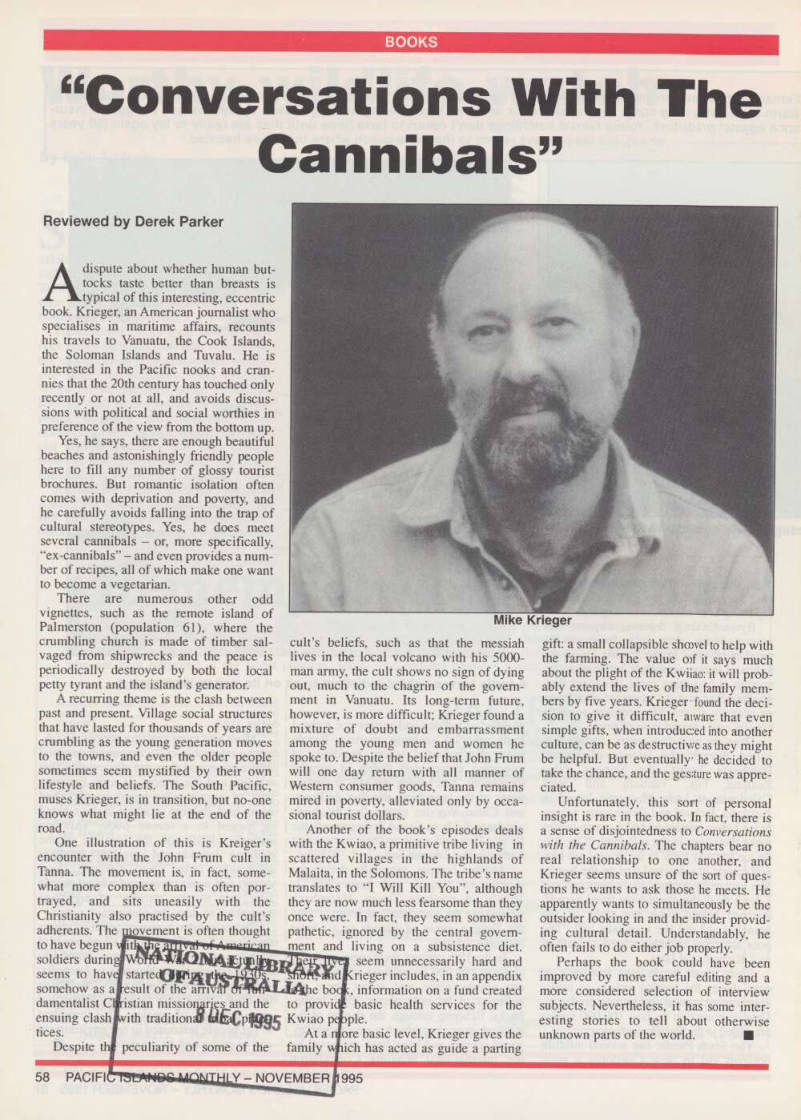
Books
“Conversations With The Cannibals”
Reviewed by Derek Parker
A dispute about whether human but tocks taste better than breasts is typical of this interesting, eccentric book. Krieger, an American journalist who specialises in maritime affairs, recounts his travels to Vanuatu, the Cook Islands, the Soloman Islands and Tuvalu. He is interested in the Pacific nooks and cran nies that the 20th century has touched only recently or not at all, and avoids discus sions with political and social worthies in preference of the view from the bottom up.
Yes, he says, there are enough beautiful
beaches and astonishingly friendly people
here to fill any number of glossy tourist brochures. But romantic isolation often comes with deprivation and poverty, and he carefully avoids falling into the trap of cultural stereotypes. Yes, he does meet several cannibals - or, more specifically, “ex-cannibals” - and even provides a num ber of recipes, all of which make one want to become a vegetarian.
There are numerous other odd vignettes, such as the remote island of Palmerston (population 61), where the crumbling church is made of timber sal vaged from shipwrecks and the peace is periodically destroyed by both the local petty tyrant and the island’s generator.
A recurring theme is the clash between past and present. Village social structures that have lasted for thousands of years are crumbling as the young generation moves to the towns, and even the older people sometimes seem mystified by their own lifestyle and beliefs. The South Pacific, muses Krieger, is in transition, but no-one knows what might lie at the end of the road.
One illustration of this is Kreiger’s encounter with the John Frum cult in Tanna. The movement is, in fact, some what more complex than is often por trayed, and sits uneasily with the
Christianity also practised by the cult’s
adherents. The movement is often thought
to have begun vf'tlkdie
soldiers duringiVro
seems to hava startetQpij^eth^^O^ 3 somehow as a result of the ottwiM damentalist CAastian missionaries and the
ensuing clash ivith traditional tiSCp^Q l
tices. I
Despite thl peculiarity of some of the
cult’s beliefs, such as that the messiah lives in the local volcano with his 5000man army, the cult shows no sign of dying out, much to the chagrin of the govern ment in Vanuatu. Its long-term future, however, is more difficult; Krieger found a mixture of doubt and embarrassment among the young men and women he spoke to. Despite the belief that John Frum will one day return with all manner of Western consumer goods, Tanna remains mired in poverty, alleviated only by occa sional tourist dollars.
Another of the book’s episodes deals with the Kwiao, a primitive tribe living in scattered villages in the highlands of Malaita, in the Solomons. The tribe’s name translates to “I Will Kill You”, although they are now much less fearsome than they once were. In fact, they seem somewhat
pathetic, ignored by the central govem
mentand living on a subsistence diet.
J'ueiL Myea seem unnecessarily hard and
t includes, in an appendix tt&he boc*, information on a fund created to provide basic health services for the
Kwiao pepple.
At a more basic level, Krieger gives the family wliich has acted as guide a parting
gift: a small collapsible shcovel to help with the farming. The value of it says much about the plight of the Kwiiao: it will prob ably extend the lives of thie family mem bers by five years. Krieger found the deci sion to give it difficult, aiware that even simple gifts, when introduced into another culture, can be as destructiv/e as they might be helpful. But eventually' he decided to take the chance, and the gesture was appre ciated.
Unfortunately, this sort of personal insight is rare in the book. In fact, there is a sense of disjointedness to Conversations with the Cannibals. The chapters bear no real relationship to one another, and Krieger seems unsure of the sort of ques tions he wants to ask those he meets. He apparently wants to simultaneously be the outsider looking in and the insider provid ing cultural detail. Understandably, he often fails to do either job properly.
Perhaps the book could have been improved by more careful editing and a more considered selection of interview subjects. Nevertheless, it has some inter esting stories to tell about otherwise unknown parts of the world. ■
Mike Krieger
Advertisements & other items, pp. 58-60 (2 items)
58
I I II II Ml I‘lHliH |lill |~H| Y MOVFMRFRfIQQS
1 A Lifetime Of Services
10 15 20 25 30 35 40 45 50 55 60
40 Grand Pacific Life Insurance offers you a lifetime of safe, secure products at very competitive rates. Choose from a full range of products such as
• Super Ordinary Life
• Super Universal • Non-Participating Whole Life • 10-Year Level Term • Flexible Premium Annuities • Group Life Insurance
• IRAs
• Graded Premium Whole Life A
We've been dedicated to providing fast,
personalized service for more than 35 years through local ownership and management.
That's why Grand Pacific Life is your Family for Life ...throughout the Pacific. 25 35 40 50
rand Pacific Life Insurance, Ltd.
3 1508 00475 973 " 9 member of the Finance Factors Family 40 45
FEDERATED STATES
OF MICRONESIA
Actouka Executive Insurance Underwriters P.O. Box 55, Kolonia, Pohnpei, Federated States of Micronesia 96941 Pacific Basin Insurance & General Services, Inc P.O. Box 494, Chuuk State, Federated States of Micronesia 96942
TONGA
Peseti Ma‘afu Ins. & Finance, Ltd.
Private Bag 2, Taumoepeau Bldg.
Nukualofa, Tonga
GUAM
Great National Insurance Underwriters, Inc.
P.O. Box GA, Agana, Guam 96910 Pacific Financial Corporation P.O. Box AT, Agana, Guam 96910 Takagi & Associates, Inc.
GCIC Bldg., Suite 100 414 W. Soledad Ave.
Agana, Guam 96910
MARSHALL ISLANDS
Marshalls Insurance Agency P.O. Box 113, Majuro, Marshall Islands 96960
AMERICAN SAMOA
Mark Solofa Pacific Insurance & Finance, Inc.
P.O. Box 3149 Pago Pago, American Samoa 96799
WESTERN SAMOA
Mark Solofa Pacific Insurance & Finance, Inc.
P.O. Box 3149 Pago Pago, American Samoa 96799
NORTHERN MARIANAS
Pacific Basin Insurance Underwriters, Inc.
P.O. Box 710 ■ Saipan, Mariana Islands 96950 Pacifica Insurance Underwriters, Inc.
P.O. Box 168, Saipan, Mariana Islands 96950 Grand Pacific Life Insurance, Ltd. *1164 Bishop Street, sth Floor, Honolulu, HI 96813 Phone: (808) 548-3363 • FAX: (808) 548-5122
a/ 7/7 * ■ I > St* i-; ■»' /** \
Born to run.
The Mitsubishi Lancer: A family sedan that meets our own standards of stability and performance.
Lancer is ready when you are.
The rear multi-link suspension system is absolutely fearless. The independent McPherson struts up front are equal to the challenge of even the toughest road conditions. And an aggressive, fuel-efficient SOHC engine awaits your command.
The ground-hugging chassis holds comers tight. A powerful braking system holds you and your family secure.
And when you venture into the passing lane, this car holds nothing back.
Because Lancer was born to run.
It is a dazzling product of our total approach to car design, a philosophy you can feel the moment you get behind the wheel.
There is no compromise in Lancer’s construction. Every detail meets our exacting standards of stability and performance. Its unique handling instincts and spirited responsiveness are an expression of Mitsubishi’s driving commitment to excellence in every car we make.
Yes, strictly speaking, Lancer is a family sedan. But the way it performs is something else.
MITSUBISHI LRNCER
What Drives You.
AMERICAN SAMOA: PACIFIC MARKETING INC. P.O. Box 698, Pago Pago, Tel. 699-9140 / AUSTRALIA: MITSUBISHI MOTORS AUSTRALIA LTD. 1284 South Road, Clovelly Park, South Australia, 5042, Tel. (08) 2757297 / FIJI: NIVIS MOTOR & MACHINERY CO. LTD. G.P.O. Box 150, Suva, Tel. 383411 / GUAM: TRIPLE J ENTERPRISES INC. PO. Box 6066, Tamuning, Tel. 6469126 / NEW CALEDONIA: SOCIETE DTMPORTATION D'AUTO DU PACIFIQUE SUD S.A. P.O. Box 438, Noumea, Tel. 272-562 / NEW ZEALAND: MITSUBISHI MOTORS NEW ZEALAND LTD. Private Bag. Porirua, Tel. 237-0109 / NORFOLK ISLAND: BORRY'S PTY LTD. P.O. Box 169, Taylors Road. Burnt, Tel. 2114 / PAPUA NEW GUINEA: TOBA MOTORS PTY LTD. P.O. Box 503, Port Moresby, Tel. 217-874/ SAIPAN: SAIPAN AUTOWORLD INC. P.O. Box 487, Tel. 234-7133 / SOLOMON ISLANDS: HARVEST PACIFIC LTD. G.P.O. Box 888, Honiara, Tel. 30407 / TAHITI: SOPADEP S.A. B.P. 1617, Papeete, Tel. 427393 / TONGA: SITANI MAFI CO., LTD. P.O. Box 83, Nuku Alofa, Tel. 24044 / VANUATU: SOCOMETRA VANUATU LTD. B.P. 6, Porl-Vila, Tel. 2314 / WESTERN SAMOA: MOTOR DISTRIBUTORS (SAMOA) LTD. P.O. Box 576, Apia, Tel. 20957 A
MITSUBISHI
MOTORS
CREATING TOGETHER