mystery
pp. 46-48 · Read in the full issue
Exploration
The Earhart mystery Sixty years later, the search continues
By David North
She has a powerful attraction. They
have been pursuing her for eight years now.
They have spent more than a million dollars on her, and now they are, as part of this effort, about to visit an uninhabited island in Kiribati for the fourth time.
She is Amelia Earhart, the famed, doomed American aviator of the 19305, who was last seen alive as she and her navigator, Fred Noonan, took off from Lae airport (in what is now Papua New Guinea) on July 2, 1937.
The island is Nikumaroro.
They are a team of 18 Americans and one Kiribati official, led by Richard Gillespie, who with his wife, Patricia Thrasher, has assembled a persuasive the ory about the mystery of Earhart and Noonan.
The organisation is called TIGHAR (The International Group for Historic Aircraft Recovery) and was scheduled to sail out of the Suva harbour on February 22, on what it hopes is its last mission to the island.
The TIGHAR theory runs counter to two earlier ones. First, there is the con spiratorial notion that Earhart was a spy
for the US government, and that she was
really looking for Japanese fortifications
in the Marshalls, and that the Japanese caught her and eventually killed her. (Many books and some movies have been based on this exciting but ill-supported idea.) Second, there is the easier-to-swallow, they-died-at-sea theory, long accepted by many observers. The plane simply ran out of gas, crashed, and those on board drowned. It has the advantage of simplic ity, but no proof has been found for it either.
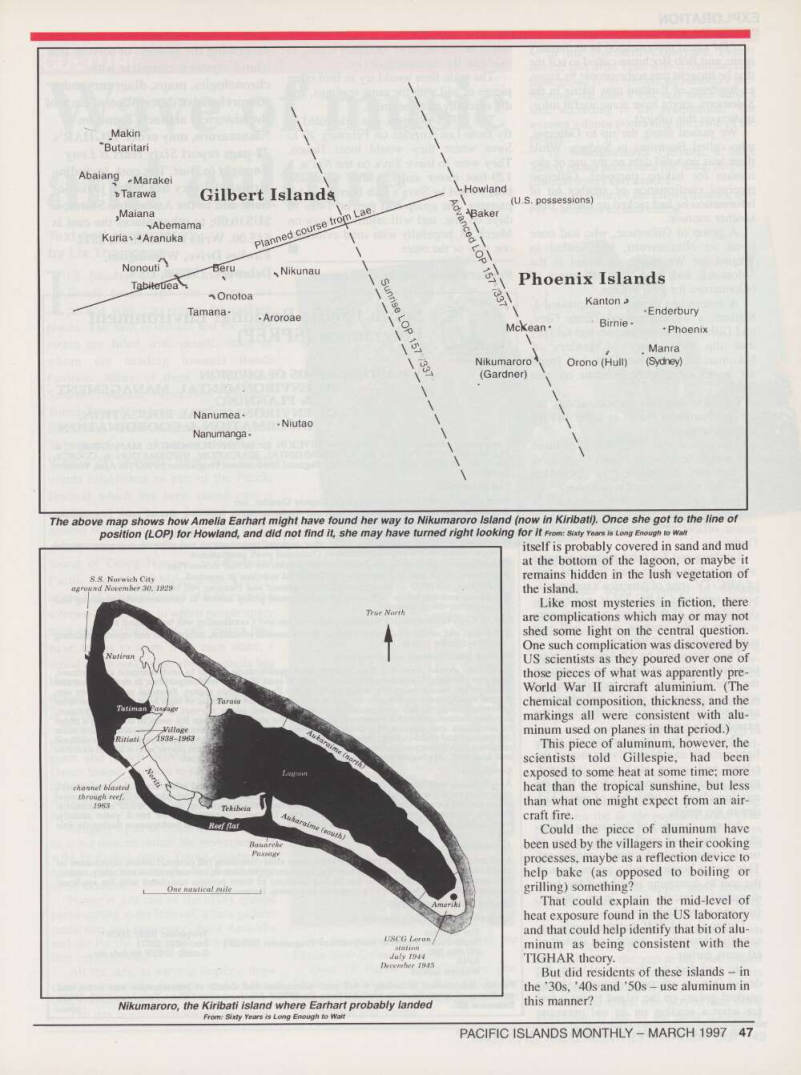
The TIGHAR approach is that neither Earhart nor her navigator were particular ly skilled with the rudimentary radios of the day, and that when they did not find Howland, the US island they were shoot ing for, they did what sensible aviators would do under the circumstances. They turned right along what navigators call the line of position (LOP) that should have covered Howland, and flew southeast looking for the island.
With little fuel left, they saw Nikumaroro, landed safely on it, and started (ineptly) radioing for help. The US Navy did not find them, and they died on the waterless island.
The TIGHAR team has combed avia tion history, checked out long-ignored radio logs from around the Pacific, and collected a lot of debris on Nikumaroro.
They have also sifted through the stories of the I-Kiribati settlers, who arrived on the island a year or so after Earhart’s dis appearance.
All of this evidence leads them to believe that the island was Eartharfs last
landing place.
Without getting into the details, TIGHAR has tapped some of the best lab oratories in the US, including that of the Federal Bureau of Investigation, to exam ine these bits of metal, plexiglass and leather.
TIGHAR has also enlisted a Pacific Islands Monthly reader, Sydney’s Rob Bochman, in the action, but we are getting ahead of our story.
The principal bits of evidence exam ined by TIGHAR consist of pieces of pre- World War II aircraft aluminium found on Nikumaroro, some of which are consis tent with the Lockheed Electra that Earhart flew out of Lae that hot day in 1937.
TIGHAR has heard stories about a white woman’s grave on the island, and found a shoe that was Earhart’s size, was of the appropriate age and was like the shoes that she was known to have worn.
But TIGHAR, despite three previous visits, has not found the plane itself, nor the bodies of the two Americans.
They are operating on the theory that some bits and pieces of the plane were used by the villagers, but that the plane
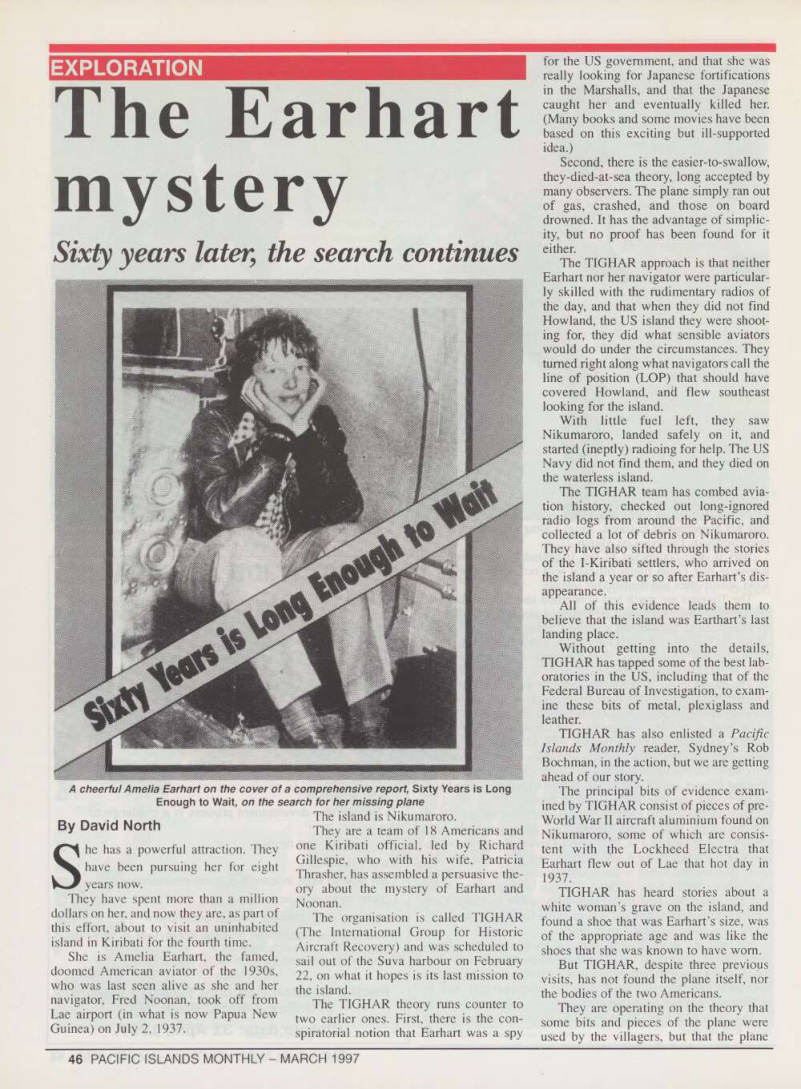
A cheerful Amelia Earhart on the cover of a comprehensive report, Sixty Years is Long Enough to Wait, on the search for her missing plane
itself is probably covered in sand and mud at the bottom of the lagoon, or maybe it remains hidden in the lush vegetation of the island.
Like most mysteries in fiction, there are complications which may or may not shed some light on the central question.
One such complication was discovered by US scientists as they poured over one of those pieces of what was apparently pre- World War II aircraft aluminium. (The chemical composition, thickness, and the markings all were consistent with alu minum used on planes in that period.) This piece of aluminum, however, the scientists told Gillespie, had been exposed to some heat at some time; more heat than the tropical sunshine, but less than what one might expect from an air craft fire.
Could the piece of aluminum have been used by the villagers in their cooking processes, maybe as a reflection device to help bake (as opposed to boiling or
grilling) something?
That could explain the mid-level of heat exposure found in the US laboratory and that could help identify that bit of alu minum as being consistent with the
TIGHAR theory.
But did residents of these islands - in the ’3os, ’4os and ’sos - use aluminum in this manner?
The above map shows how Amelia Earhart might have found her way to Nikumaroro Island (now in Kiribati). Once she got to the line of position (LOP) for Howland, and did not find it, she may have turned right looking for it From: sixty Years is Long Enough to wait
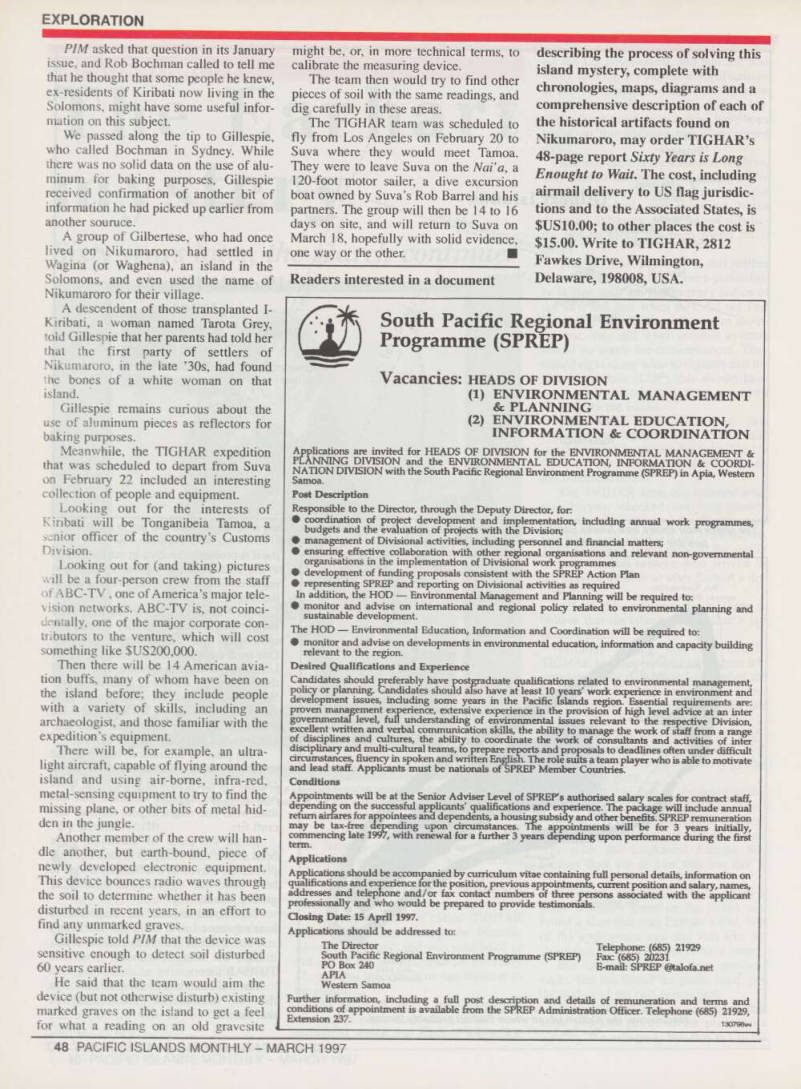
Nikumaroro, the Kiribati island where Earhart probably landed From: Sixty Years is Long Enough to Wait
PIM asked that question in its January issue, and Rob Bochman called to tell me that he thought that some people he knew, ex-residents of Kiribati now living in the Solomons, might have some useful infor mation on this subject.
We passed along the tip to Gillespie, who called Bochman in Sydney. While there was no solid data on the use of alu minum for baking purposes, Gillespie received confirmation of another bit of information he had picked up earlier from another souruce.
A group of Gilbertese, who had once lived on Nikumaroro, had settled in Wagina (or Waghena), an island in the Solomons, and even used the name of Nikumaroro for their village.
A descendent of those transplanted I- Kiribati, a woman named Tarota Grey, told Gillespie that her parents had told her that the first party of settlers of Nikumaroro, in the late ’3os, had found he bones of a white woman on that island.
Gillespie remains curious about the use of aluminum pieces as reflectors for
baking purposes.
Meanwhile, the TIGHAR expedition that was scheduled to depart from Suva on February 22 included an interesting collection of people and equipment.
Looking out for the interests of Kiribati will be Tonganibeia Tamoa, a senior officer of the country’s Customs Division.
Looking out for (and taking) pictures
will be a four-person crew from the staff of ABC-TV, one of America’s major tele vision networks. ABC-TV is, not coinci dcntally, one of the major corporate con tributors to the venture, which will cost something like SUS2OO,OOO.
Then there will be 14 American avia tion buffs, many of whom have been on the island before; they include people with a variety of skills, including an archaeologist, and those familiar with the expedition’s equipment.
There will be, for example, an ultra light aircraft, capable of flying around the island and using air-borne, infra-red, metal-sensing equipment to try to find the missing plane, or other bits of metal hid den in the jungle.
Another member of the crew will han dle another, but earth-bound, piece of
newly developed electronic equipment.
This device bounces radio waves through the soil to determine whether it has been disturbed in recent years, in an effort to find any unmarked graves.
Gillespie told PIM that the device was sensitive enough to detect soil disturbed 60 years earlier.
He said that the team would aim the device (but not otherwise disturb) existing marked graves on the island to get a feel for what a reading on an old gravesite .
might be, or, in more technical terms, to calibrate the measuring device.
The team then would try to find other pieces of soil with the same readings, and dig carefully in these areas.
The TIGHAR team was scheduled to fly from Los Angeles on February 20 to Suva where they would meet Tamoa.
They were to leave Suva on the Nai’a, a 120-foot motor sailer, a dive excursion boat owned by Suva’s Rob Barrel and his partners. The group will then be 14 to 16 days on site, and will return to Suva on March 18, hopefully with solid evidence, one way or the other. ■
Readers interested in a document
describing the process of solving this island mystery, complete with chronologies, maps, diagrams and a comprehensive description of each of the historical artifacts found on Nikumaroro, may order TIGHAR’s 48-page report Sixty Years is Long Enought to Wait. The cost, including airmail delivery to US flag jurisdic tions and to the Associated States, is $US10.00; to other places the cost is $15.00. Write to TIGHAR, 2812 Fawkes Drive, Wilmington, Delaware, 198008, USA.