Sevens glory for region's players
pp. 44-45 · Read in the full issue
region's players
By Atama Raganivatu
The South Pacific can be cautiously optimistic of capturing a rare snorting world chamnionshin sporting world championship when the World Rugby Union Sevens Cup is contested at Hong Kong from March 21 to 23.
The annual Hong Kong Sevens, long
the abreviated game’s most prestigious tournament, has been extended and polished this year to double as the official
world championship.
The first formally recognised world title was battled for in Edinburgh, Scotland, four years ago and looked but a pale imitation of the magnificent spectacle presented each March in the Crown Colony. Hong Kong is a far more appropriate home for it.
No country has tested more success in Hong Kong than Fiji and Fijian hopes will be high this time too. That buoyancy is justified, not only because of their own ability but also due to archrivals New
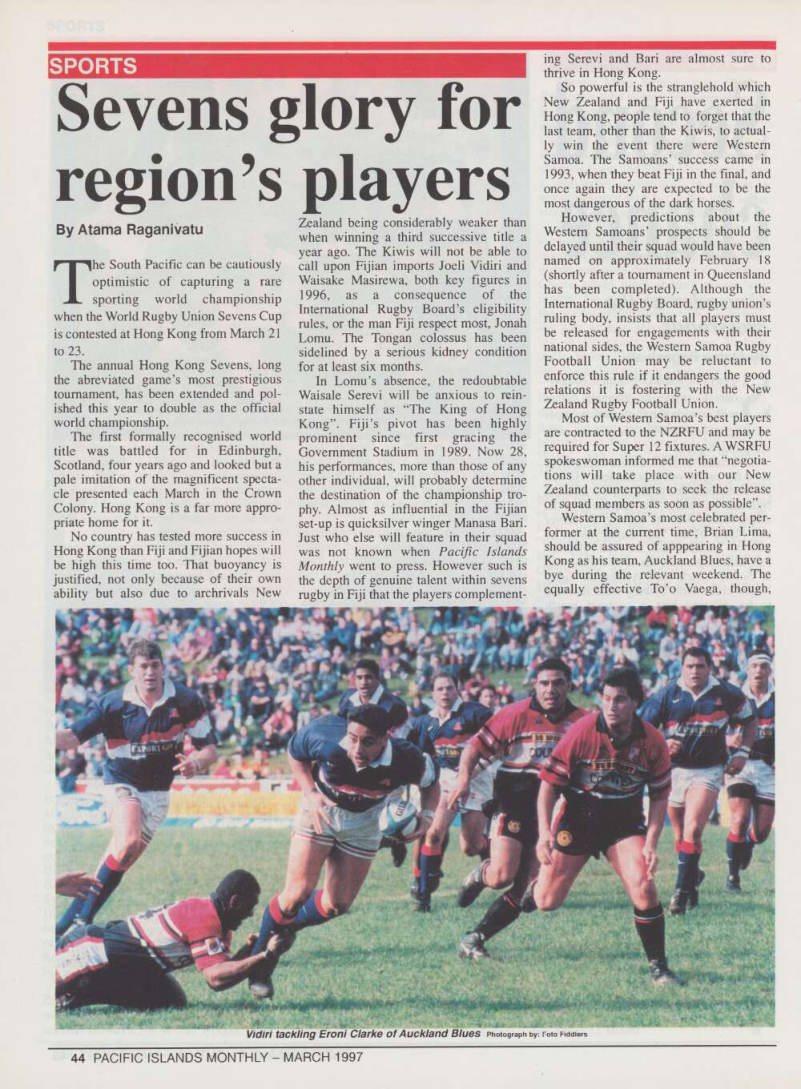
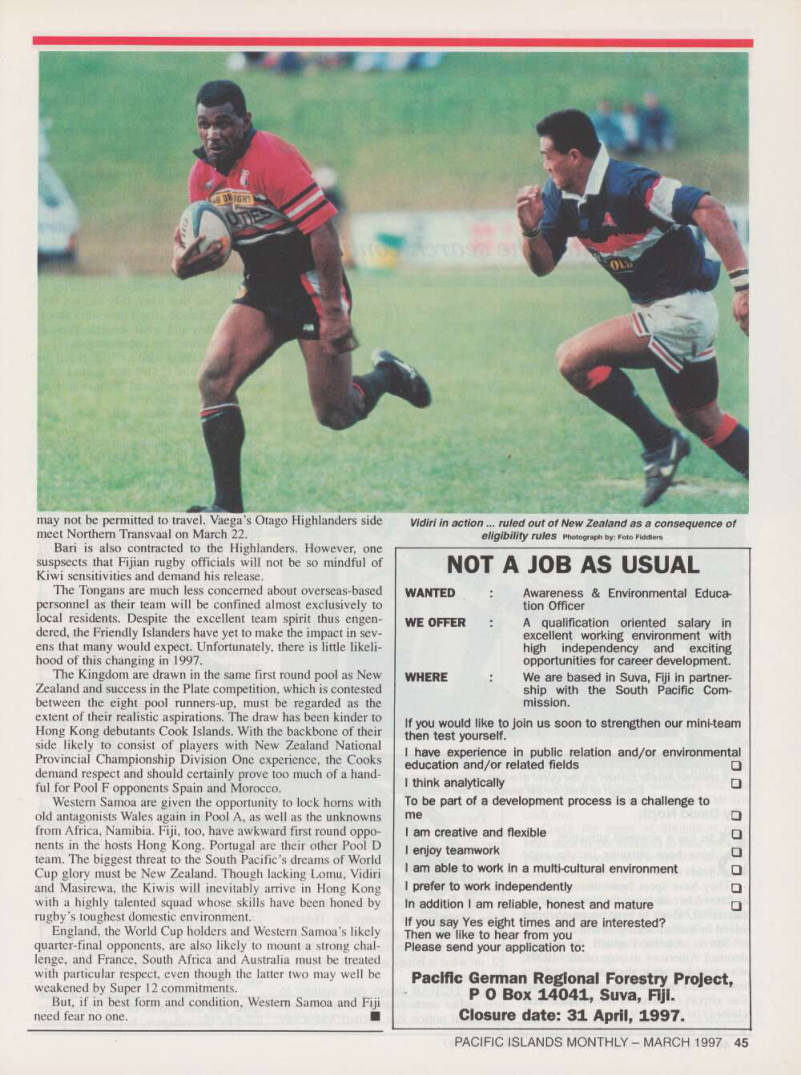
Zealand being considerably weaker than when winning a third successive title a year ago. The Kiwis will not be able to call upon Fijian imports Joeli Vidiri and Waisake Masirewa, both key figures in 1996, as a consequence of the International Rugby Board’s eligibility rules, or the man Fiji respect most, Jonah Lomu. The Tongan colossus has been sidelined by a serious kidney condition for at least six months.
In Lomu’s absence, the redoubtable Waisale Serevi will be anxious to rein state himself as “The King of Hong
Kong”. Fiji’s pivot has been highly
prominent since first gracing the Government Stadium in 1989. Now 28, his performances, more than those of any other individual, will probably determine the destination of the championship tro phy. Almost as influential in the Fijian set-up is quicksilver winger Manasa Bari.
Just who else will feature in their squad was not known when Pacific Islands Monthly went to press. However such is the depth of genuine talent within sevens rugby in Fiji that the players complement
ing Serevi and Bari are almost sure to thrive in Hong Kong.
So powerful is the stranglehold which New Zealand and Fiji have exerted in Hong Kong, people tend to forget that the last team, other than the Kiwis, to actual ly win the event there were Western Samoa. The Samoans’ success came in 1993, when they beat Fiji in the final, and once again they are expected to be the most dangerous of the dark horses.
However, predictions about the Western Samoans’ prospects should be delayed until their squad would have been named on approximately February 18 (shortly after a tournament in Queensland has been completed). Although the International Rugby Board, rugby union’s ruling body, insists that all players must be released for engagements with their national sides, the Western Samoa Rugby Football Union may be reluctant to enforce this rule if it endangers the good relations it is fostering with the New Zealand Rugby Football Union.
Most of Western Samoa’s best players are contracted to the NZRFU and may be required for Super 12 fixtures. A WSRFU spokeswoman informed me that “negotia tions will take place with our New Zealand counterparts to seek the release of squad members as soon as possible”.
Western Samoa’s most celebrated per former at the current time, Brian Lima, should be assured of apppearing in Hong Kong as his team, Auckland Blues, have a bye during the relevant weekend. The equally effective To’o Vaega, though,
Vidiri tackling Eroni Clarke of Auckland Blues Photograph by: Foto Fiddlers
may not be permitted to travel. Vaega’s Otago Highlanders side meet Northern Transvaal on March 22.
Bari is also contracted to the Highlanders. However, one suspsects that Fijian rugby officials will not be so mindful of Kiwi sensitivities and demand his release.
The Tongans are much less concerned about overseas-based personnel as their team will be confined almost exclusively to local residents. Despite the excellent team spirit thus engen dered, the Friendly Islanders have yet to make the impact in sev ens that many would expect. Unfortunately, there is little likeli hood of this changing in 1997.
The Kingdom are drawn in the same first round pool as New Zealand and success in the Plate competition, which is contested between the eight pool runners-up, must be regarded as the extent of their realistic aspirations. The draw has been kinder to Hong Kong debutants Cook Islands. With the backbone of their side likely to consist of players with New Zealand National Provincial Championship Division One experience, the Cooks demand respect and should certainly prove too much of a hand ful for Pool F opponents Spain and Morocco.
Western Samoa are given the opportunity to lock horns with old antagonists Wales again in Pool A, as well as the unknowns from Africa, Namibia. Fiji, too, have awkward first round oppo nents in the hosts Hong Kong. Portugal are their other Pool D team. The biggest threat to the South Pacific’s dreams of World Cup glory must be New Zealand. Though lacking Lomu, Vidiri and Masirewa, the Kiwis will inevitably arrive in Hong Kong with a highly talented squad whose skills have been honed by
rugby’s toughest domestic environment.
England, the World Cup holders and Western Samoa’s likely quarter-final opponents, are also likely to mount a strong chal lenge, and France, South Africa and Australia must be treated with particular respect, even though the latter two may well be weakened by Super 12 commitments.
But, if in best form and condition. Western Samoa and Fiji need fear no one. ■
Vidiri in action...ruled out of New Zealand as a consequence of eligibility rules Photograph by: Foto Fiddlers