What if?
p. 27 · Read in the full issue
Previous incident of ship’s engine failure adds to waste shipment controversy
By Bernadette Hussein
The Pacific Teal, carrier of the highly radioactive plutoni um waste through the South Pacific, suffered a serious engine failure on one of its previous voyages.
The British vessel suffered problems back in December, 1989 after it left Japan for Europe with a cargo of irradiated nuclear fuel collected from Japanese nuclear reactors.
Normally, the ship would have travelled back to Europe via the Panama Canal and Caribbean Sea. Instead, soon after the ship’s departure, the vessel was apparently directed to divert from its standard route due to the US invasion of Panama. The ship rerouted across the Indian Ocean and Cape of Good Hope and, in the course of this more demanding and protracted voy
age, the ship developed engine problems.
Records obtained by Greenpeace showed that when the ship finally arrived in Britain in February ,1990 it had developed a main engine fault and engineers found all main cylinder blocks cracked. Both the engines had to be completely removed and replaced and the Pacific Teal returned to service after sea trials in 1990. Greenpeace claims that British officials had never revealed this information. Concerns expressed were that if there was a main engine fault, there could have been total engine fail ure and loss of power. This is supported by the fact that engi neers found the cracked cylinder blocks.
If this happened during the voyage and if it encountered a
cyclone, it could have led to a disaster where it could have col lided against rocks or reefs and this impact could have led to cask failure and resulted in the release of radioactive material into the sea and air, Greenpeace said. A Greenpeace statement said given the inadequate design and testing of transport con tainers, it is possible that fire or impact or submersion/pressure could have breached the containers. A view which they say was shared by many experts who believed that the containers were inadequately designed and tested to withstand serious maritime accidents.
For example, the 1992 study by ECO Engineering of the US concluded that there was no substantive evidence to support any claim relative to the integrity of a cask exposed to the conse quences of maximum credible marine accident. These concerns were further heightened by the fact that the stainless-steel con tainers for the blocks had been constructed with flawed materi al. The stainless steel used was prone to sensitisation - a weak ening of the steel - which greatly reduced its resistance to cer tain types of corrosion and to mechanical impact.
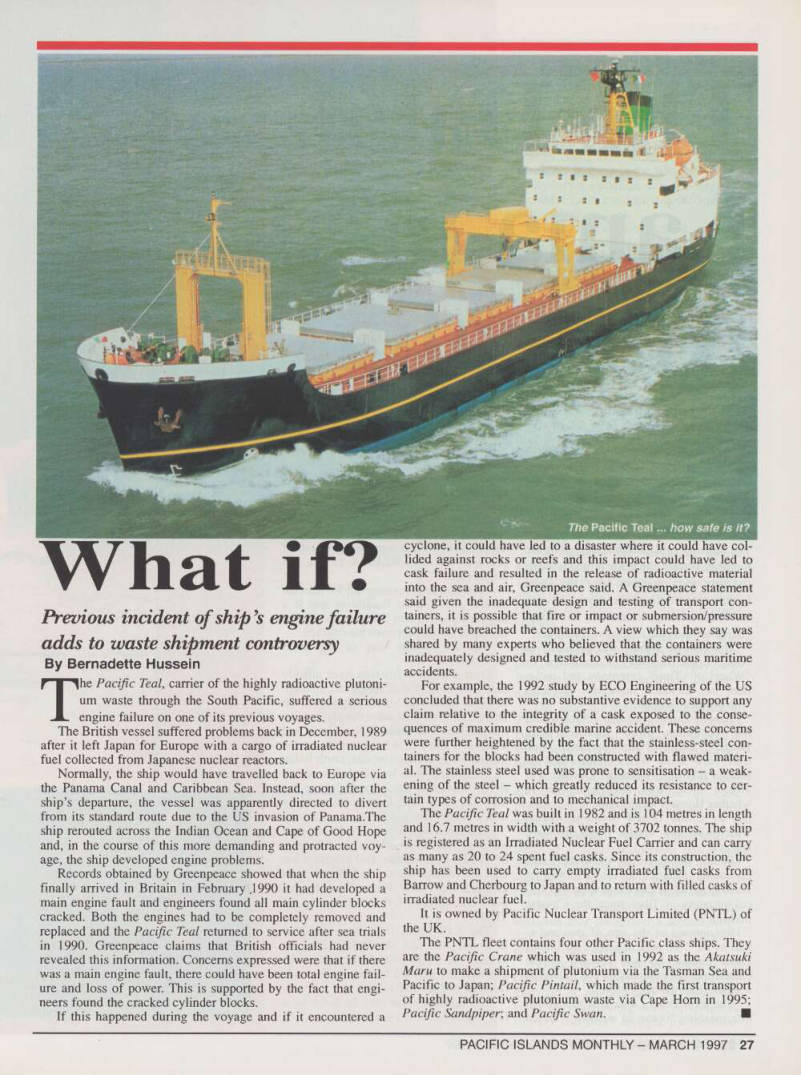
The Pacific Teal was built in 1982 and is 104 metres in length and 16.7 metres in width with a weight of 3702 tonnes. The ship is registered as an Irradiated Nuclear Fuel Carrier and can carry as many as 20 to 24 spent fuel casks. Since its construction, the ship has been used to carry empty irradiated fuel casks from Barrow and Cherbourg to Japan and to return with filled casks of irradiated nuclear fuel.
It is owned by Pacific Nuclear Transport Limited (PNTL) of the UK.
The PNTL fleet contains four other Pacific class ships. They are the Pacific Crane which was used in 1992 as the Akatsuki Maru to make a shipment of plutonium via the Tasman Sea and Pacific to Japan; Pacific Pintail, which made the first transport of highly radioactive plutonium waste via Cape Horn in 1995; Pacific Sandpiper, and Pacific Swan. ■
The Pacific Teal... how safe is it?