Lama in
pp. 28-30 · Read in the full issue
The Dalai Lama in Australia
Text and photography
by Liz Thompson
In the arrivals lounge of Sydney
Airport, Tibetan monks roll out white silk scarves, photographers vie for position, and a group of men and women stand with an enormous banner that wel comes the 14th Dalai Lama to Sydney.
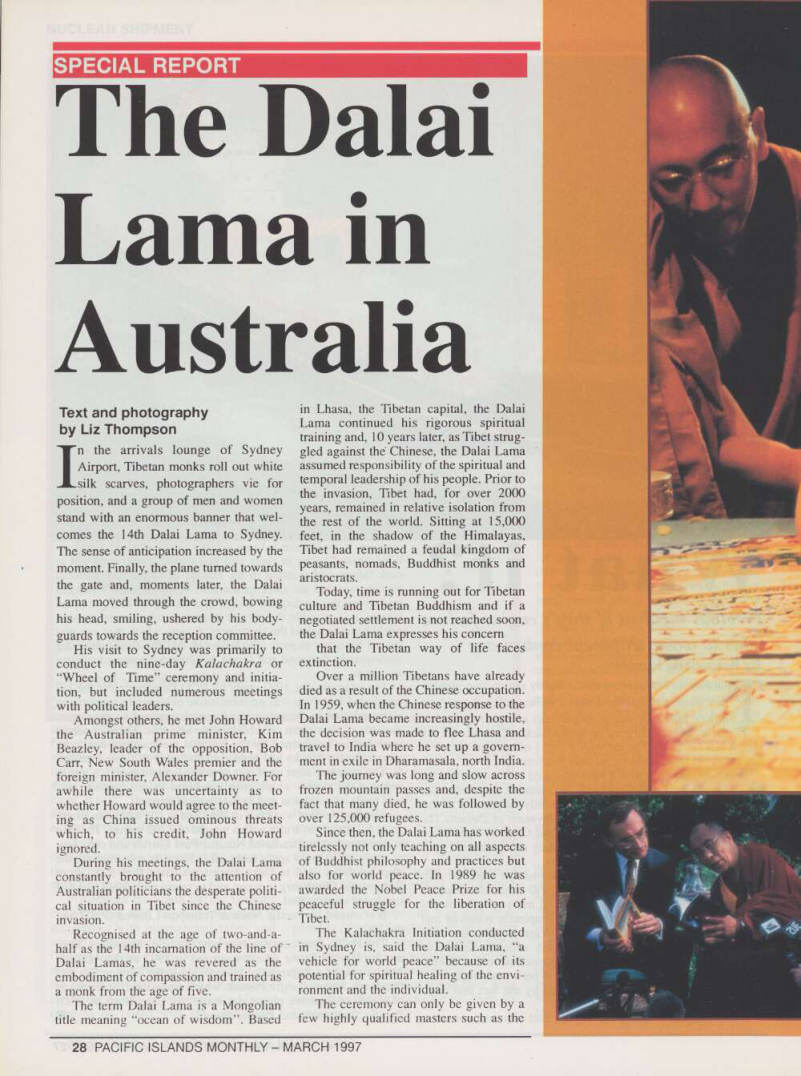
The sense of anticipation increased by the moment. Finally, the plane turned towards the gate and, moments later, the Dalai Lama moved through the crowd, bowing his head, smiling, ushered by his body guards towards the reception committee.
His visit to Sydney was primarily to conduct the nine-day Kalachakra or “Wheel of Time” ceremony and initia tion, but included numerous meetings with political leaders.
Amongst others, he met John Howard the Australian prime minister, Kim Beazley, leader of the opposition. Bob Carr, New South Wales premier and the foreign minister, Alexander Downer. For awhile there was uncertainty as to whether Howard would agree to the meet ing as China issued ominous threats which, to his credit, John Howard
ignored.
During his meetings, the Dalai Lama constantly brought to the attention of
Australian politicians the desperate politi
cal situation in Tibet since the Chinese invasion.
Recognised at the age of two-and-a half as the 14th incarnation of the line of Dalai Lamas, he was revered as the embodiment of compassion and trained as a monk from the age of five.
The term Dalai Lama is a Mongolian title meaning “ocean of wisdom”. Based
in Lhasa, the Tibetan capital, the Dalai Lama continued his rigorous spiritual training and, 10 years later, as Tibet strug gled against the Chinese, the Dalai Lama assumed responsibility of the spiritual and temporal leadership of his people. Prior to the invasion, Tibet had, for over 2000 years, remained in relative isolation from the rest of the world. Sitting at 15,000 feet, in the shadow of the Himalayas, Tibet had remained a feudal kingdom of peasants, nomads, Buddhist monks and aristocrats.
Today, time is running out for Tibetan culture and Tibetan Buddhism and if a negotiated settlement is not reached soon, the Dalai Lama expresses his concern that the Tibetan way of life faces extinction.
Over a million Tibetans have already died as a result of the Chinese occupation.
In 1959, when the Chinese response to the Dalai Lama became increasingly hostile, the decision was made to flee Lhasa and travel to India where he set up a govern ment in exile in Dharamasala, north India.
The journey was long and slow across frozen mountain passes and, despite the fact that many died, he was followed by over 125,000 refugees.
Since then, the Dalai Lama has worked tirelessly not only teaching on all aspects of Buddhist philosophy and practices but also for world peace. In 1989 he was awarded the Nobel Peace Prize for his peaceful struggle for the liberation of Tibet.
The Kalachakra Initiation conducted in Sydney is, said the Dalai Lama, “a vehicle for world peace” because of its potential for spiritual healing of the envi ronment and the individual.
The ceremony can only be given by a few highly qualified masters such as the
Dalai Lama and the Penchen Lama.
An elaborate affair, it involves 20 monks from Namgyel, the Dalai Lama’s monastery in Dharamasala. Of the hun dreds of Buddhist tantra, the Kalachakra is one of the most important. The Dalai Lama first gave this initiation when he was 19. Since then, he has conferred it 23 times, six of them in the West.
Sydney’s initiation was the first His the Dalai Lama conducted in the Southern Hemisphere.
The night prior to his arrival, a crew of hundreds of volunteers moved into the Hordern Pavilion and set up the stage which had been a year in the making.
Overnight they transformed the empty hall into a place of worship.
Beautiful folds of fabric hung across the pillars, tanka hung across the wall, the Dalai Lama’s throne was surrounded by flowers and offerings. With the help of
Western technology, design director
Yvonne Gold and her 50 workers turned what is usually a pop venue into a Tibetan gompa.
Using laser-cut shapes, lotus flowers, double dorje and wheels of dharma were painted and assembled into large architec tural friezes by volunteers around Sydney.
The crew worked throughout the night and when the Dalai Lama arrived at 6am the following morning, he expressed great pleasure at the meticulous attention paid to details.
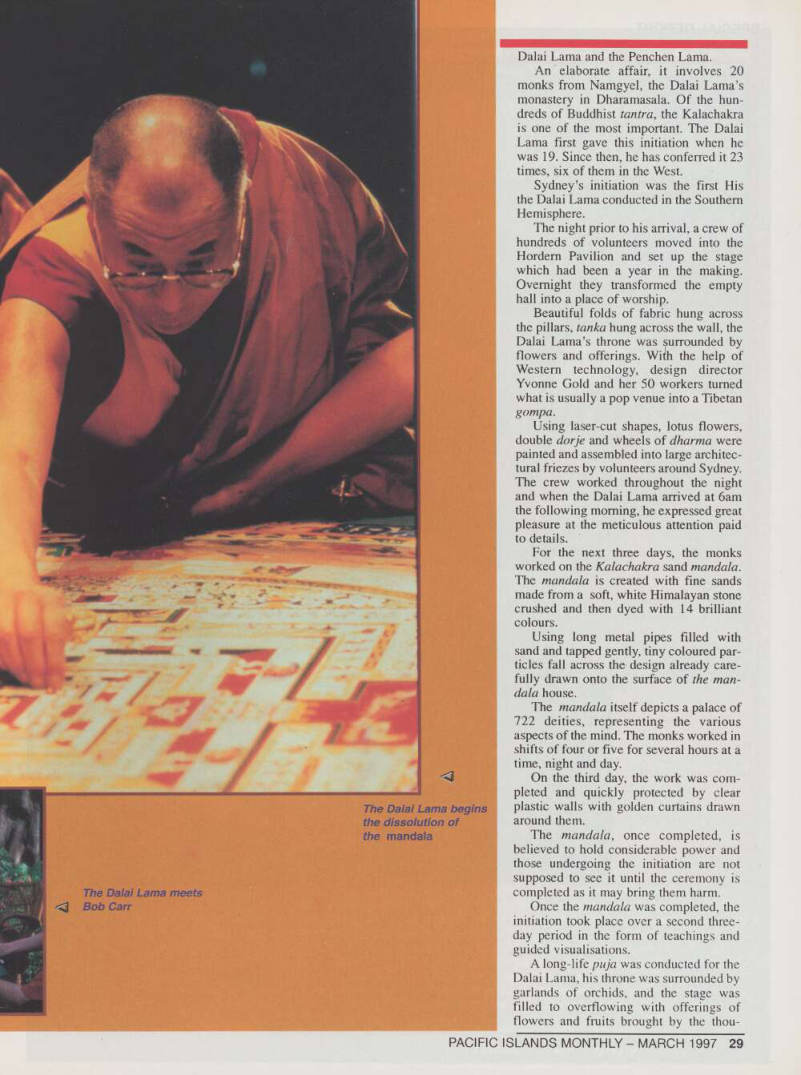
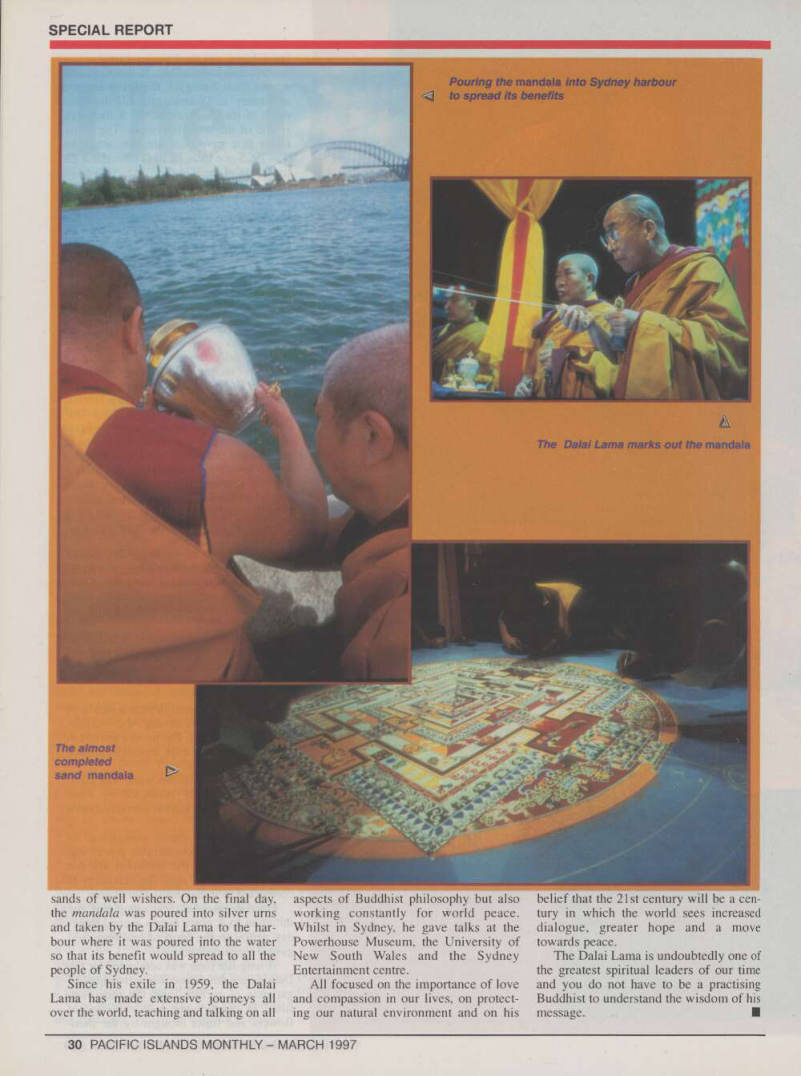
For the next three days, the monks worked on the Kalachakra sand mandala.
The mandala is created with fine sands made from a soft, white Himalayan stone crushed and then dyed with 14 brilliant colours.
Using long metal pipes filled with
sand and tapped gently, tiny coloured par ticles fall across the design already care fully drawn onto the surface of the man dala house.
The mandala itself depicts a palace of 722 deities, representing the various aspects of the mind. The monks worked in shifts of four or five for several hours at a time, night and day.
On the third day, the work was com
pleted and quickly protected by clear
plastic walls with golden curtains drawn around them.
The mandala , once completed, is believed to hold considerable power and those undergoing the initiation are not supposed to see it until the ceremony is completed as it may bring them harm.
Once the mandala was completed, the initiation took place over a second three day period in the form of teachings and guided visualisations.
A long-life puja was conducted for the Dalai Lama, his throne was surrounded by garlands of orchids, and the stage was filled to overflowing with offerings of flowers and fruits brought by the thou-
The Dalai Lama meets Bob Carr
The Dalai Lama begins the dissolution of the mandala
sands of well wishers. On the final day, the mandala was poured into silver ums and taken by the Dalai Lama to the har bour where it was poured into the water so that its benefit would spread to all the
people of Sydney.
Since his exile in 1959, the Dalai Lama has made extensive journeys all over the world, teaching and talking on all
aspects of Buddhist philosophy but also working constantly for world peace.
Whilst in Sydney, he gave talks at the Powerhouse Museum, the University of New South Wales and the Sydney Entertainment centre.
All focused on the importance of love and compassion in our lives, on protect ing our natural environment and on his
belief that the 21st century will be a cen tury in which the world sees increased dialogue, greater hope and a move towards peace.
The Dalai Lama is undoubtedly one of the greatest spiritual leaders of our time and you do not have to be a practising Buddhist to understand the wisdom of his message. ■
The almost completed sand mandate
Pouring the mandate into Sydney harbour to spread its benefits
The Dalai Lama marks out the mandate