How safe
pp. 25-26 · Read in the full issue
is safe?
Nuclear Shipment
Delegation attempts to fight protest against trans-shipment of nuclear waste through the Pacific with assurances of safety
By Mere Momoivalu
They came in quietly as if on a secret mission. But the business suits gave away the nature of the visit of the British, French and Japanese nuclear industry officials huddled under an open-thatched Fijian bare in the muggy Suva heat.
They definitely weren’t in town for the sun. They had been dispatched on a spe cial public relations exercise to the region to allay fears about the dangers of their supposed high-tech ship, the Pacific Teal, carrying highly radioactive plutonium waste across south-west Pacific waters.
The Pacific Teal had departed from Cherbourg, France, on January 13 for the
port of Mutsu Ogawara, Japan, travelling
via the Cape of Good Hope and south west Pacific with a mid-March arrival schedule. The officials, British Nuclear Fuels Limited’s (BNFL) Gavin Carter, Pacific Nuclear Transport Ltd’s (PNTL) Captain Graham Bates, COGEMA’s Jean Maillet and Overseas Reprocessing Committee’s (ORC) Yasuji Suzuki took great pains to give reassurance of the safety of the shipment. It was, they all said, “safe”, meeting the “highest” safety rating of the International Maritime
Organisation.
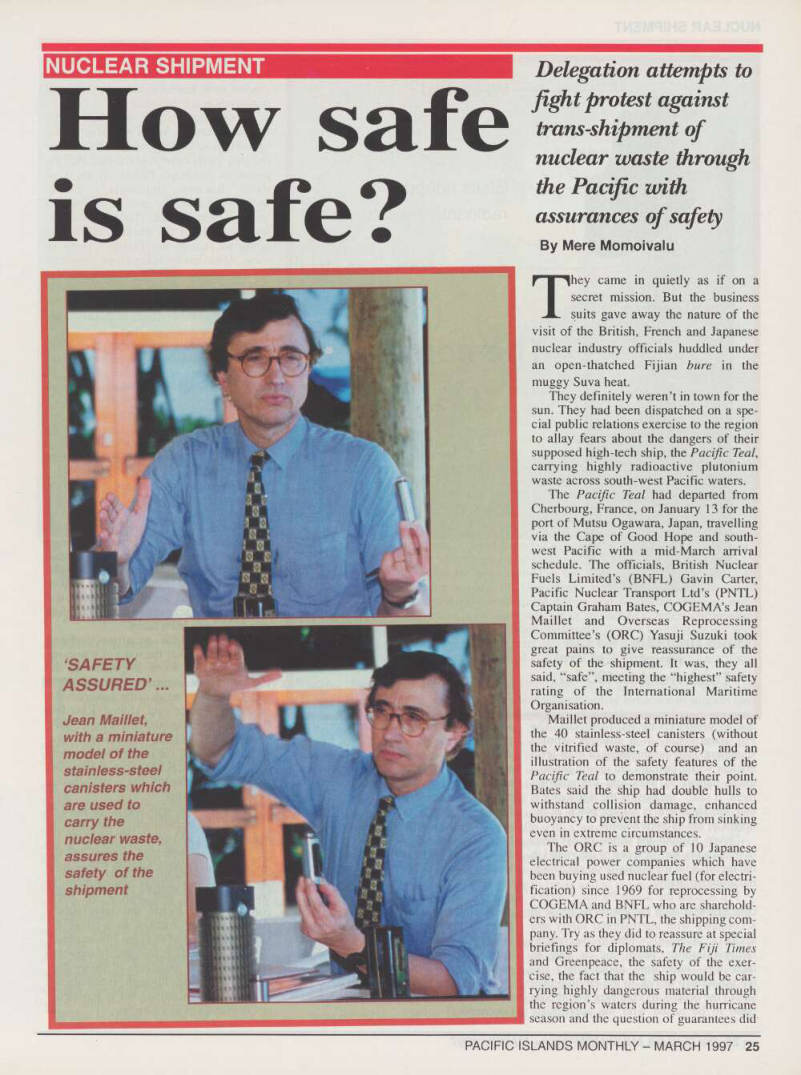
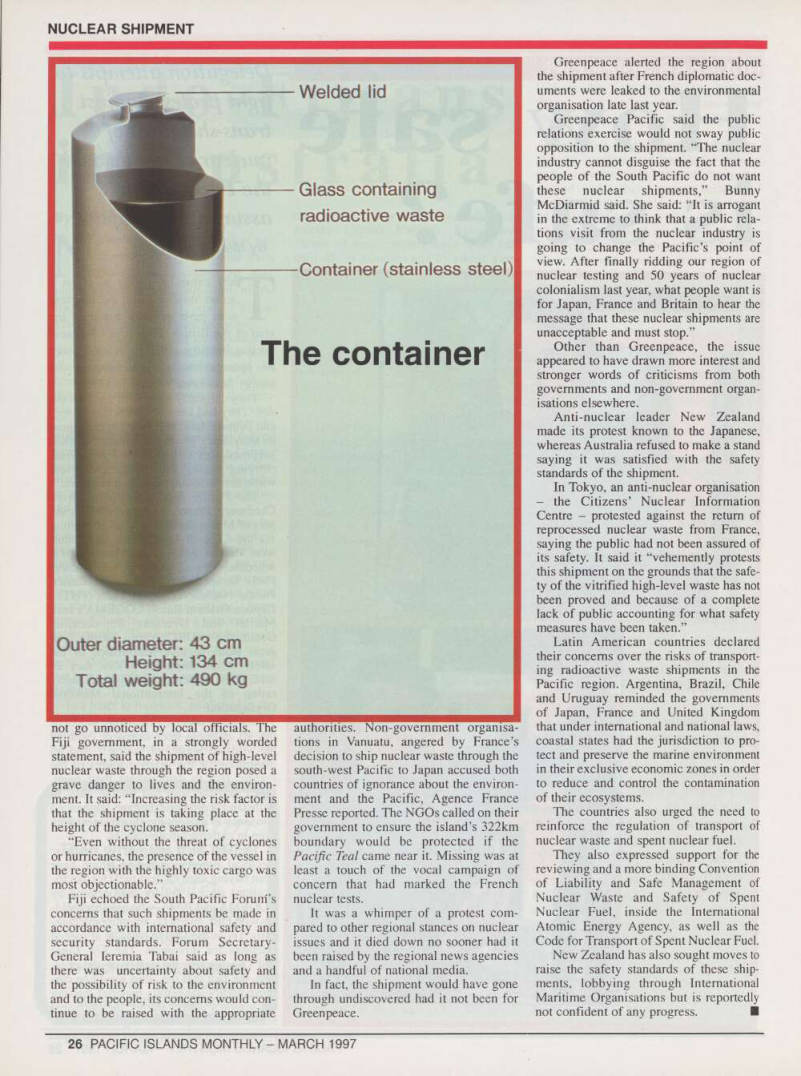
Maillet produced a miniature model of the 40 stainless-steel canisters (without the vitrified waste, of course) and an illustration of the safety features of the Pacific Teal to demonstrate their point.
Bates said the ship had double hulls to withstand collision damage, enhanced buoyancy to prevent the ship from sinking even in extreme circumstances.
The ORC is a group of 10 Japanese electrical power companies which have been buying used nuclear fuel (for electri fication) since 1969 for reprocessing by COGEMA and BNFL who are sharehold ers with ORC in PNTL, the shipping com pany. Try as they did to reassure at special briefings for diplomats, The Fiji Times and Greenpeace, the safety of the exer cise, the fact that the ship would be car
rying highly dangerous material through
the region’s waters during the hurricane season and the question of guarantees did
'Safety
Assured’...
Jean Maillet, with a miniature model of the stainless-steel canisters which are used to carry the nuclear waste, assures the safety of the shipment
not go unnoticed by local officials. The Fiji government, in a strongly worded statement, said the shipment of high-level nuclear waste through the region posed a grave danger to lives and the environ ment. It said: “Increasing the risk factor is that the shipment is taking place at the height of the cyclone season.
“Even without the threat of cyclones or hurricanes, the presence of the vessel in the region with the highly toxic cargo was
most objectionable.”
Fiji echoed the South Pacific Forum’s concerns that such shipments be made in accordance with international safety and
security standards. Forum Secretary-
General leremia Tabai said as long as there was uncertainty about safety and the possibility of risk to the environment and to the people, its concerns would con tinue to be raised with the appropriate
authorities. Non-govemment organisa tions in Vanuatu, angered by France’s decision to ship nuclear waste through the south-west Pacific to Japan accused both countries of ignorance about the environ ment and the Pacific, Agence France Presse reported. The NGOs called on their government to ensure the island’s 322 km boundary would be protected if the Pacific Teal came near it. Missing was at least a touch of the vocal campaign of concern that had marked the French nuclear tests.
It was a whimper of a protest com pared to other regional stances on nuclear issues and it died down no sooner had it been raised by the regional news agencies and a handful of national media.
In fact, the shipment would have gone through undiscovered had it not been for Greenpeace.
Greenpeace alerted the region about the shipment after French diplomatic doc uments were leaked to the environmental organisation late last year.
Greenpeace Pacific said the public relations exercise would not sway public opposition to the shipment. “The nuclear industry cannot disguise the fact that the people of the South Pacific do not want
these nuclear shipments,” Bunny
McDiarmid said. She said: “It is arrogant in the extreme to think that a public rela tions visit from the nuclear industry is going to change the Pacific’s point of view. After finally ridding our region of nuclear testing and 50 years of nuclear colonialism last year, what people want is for Japan, France and Britain to hear the message that these nuclear shipments are
unacceptable and must stop.”
Other than Greenpeace, the issue appeared to have drawn more interest and stronger words of criticisms from both governments and non-govemment organ isations elsewhere.
Anti-nuclear leader New Zealand made its protest known to the Japanese, whereas Australia refused to make a stand saying it was satisfied with the safety standards of the shipment.
In Tokyo, an anti-nuclear organisation - the Citizens’ Nuclear Information Centre - protested against the return of reprocessed nuclear waste from France, saying the public had not been assured of its safety. It said it “vehemently protests this shipment on the grounds that the safe ty of the vitrified high-level waste has not been proved and because of a complete lack of public accounting for what safety measures have been taken.”
Latin American countries declared their concerns over the risks of transport ing radioactive waste shipments in the Pacific region. Argentina, Brazil, Chile and Uruguay reminded the governments of Japan, France and United Kingdom that under international and national laws, coastal states had the jurisdiction to pro tect and preserve the marine environment in their exclusive economic zones in order to reduce and control the contamination of their ecosystems.
The countries also urged the need to reinforce the regulation of transport of nuclear waste and spent nuclear fuel.
They also expressed support for the reviewing and a more binding Convention of Liability and Safe Management of Nuclear Waste and Safety of Spent Nuclear Fuel, inside the International Atomic Energy Agency, as well as the Code for Transport of Spent Nuclear Fuel.
New Zealand has also sought moves to raise the safety standards of these ship
ments, lobbying through International
Maritime Organisations but is reportedly not confident of any progress. ■