Pacific spies
pp. 23-24 · Read in the full issue
Espionage
NX’s “secret espionage” network
By Arthur McCutchan
In mid-1984, Nicky Hager and a group of friends visited a communications station in Tangimoana. Owen Wilkes, a peace researcher who had studied intel ligence issues in Europe, had gone on hol iday nearby in 1983 and claimed the aeri als in the station were for something other than normal radio facilities for the nearby New Zealand Air Force base. Prior to Hager’s visit, a magazine (Peace link ) car ried a story based on Wilkes’ research into the station. So Hager and his friends were curious enough to go around to the place, noting down everything they saw - from the shapes of the aerials to the number plates on the vehicles in the car park.
A visit later to a post office provided Hager with the vehicle owners’ names, which he looked up in the index of annual public service staff lists in the library. And there they were, hidden in an obscure ministry of defence occupational class.
There were 80 other names on the list and they all belonged to employees of the Government Communications Security Bureau.
The GCSB, New Zealand’s largest intelligence agency, is the country’s most secret organisation, employing about 215
people.
But two years passed before he had time to investigate further.
It occurred to Hager that the identities of other GCSB staff could probably be located in other ministry of defence lists.
He obtained a ministry of defence internal phone directory and discovered that it did not contain the names of the ministry’s GCSB staff. By crossing out the names listed in the directory, he was left with the names of GCSB staff.
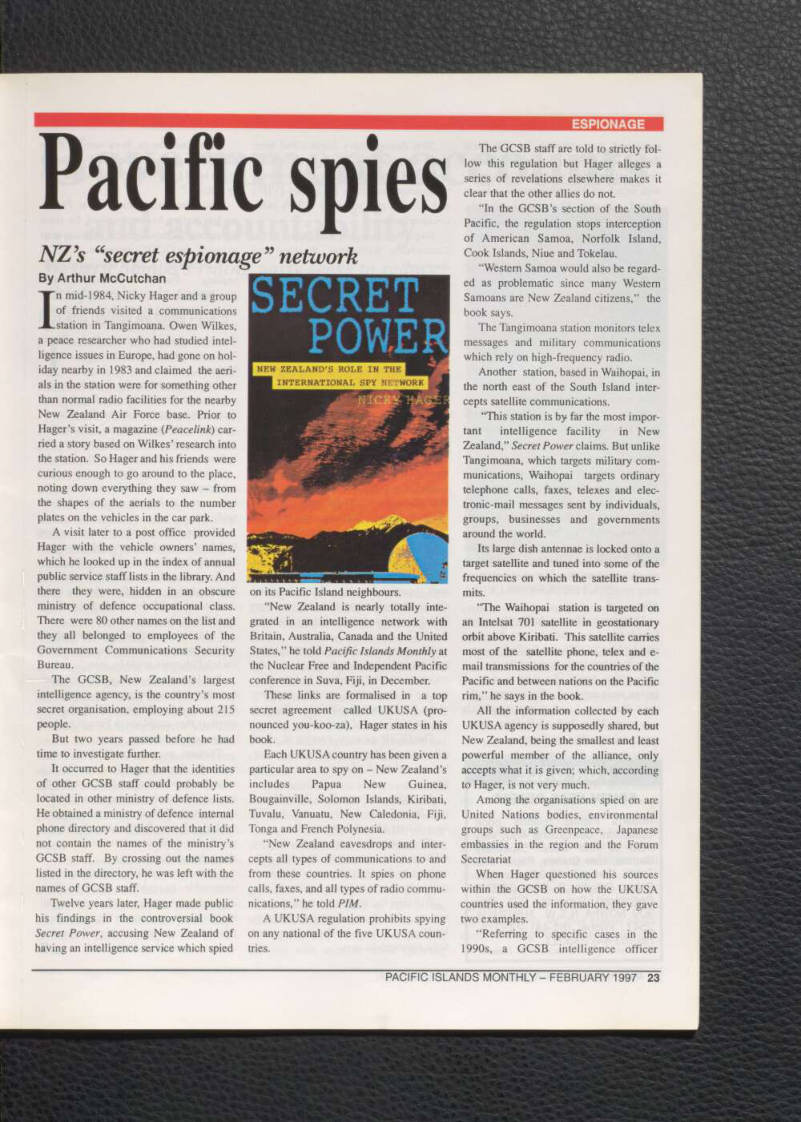
Twelve years later, Hager made public his findings in the controversial book Secret Power , accusing New Zealand of having an intelligence service which spied
on its Pacific Island neighbours.
“New Zealand is nearly totally inte grated in an intelligence network with Britain, Australia, Canada and the United States,” he told Pacific Islands Monthly at the Nuclear Free and Independent Pacific conference in Suva, Fiji, in December.
These links are formalised in a top secret agreement called UKUSA (pro nounced you-koo-za), Hager states in his book.
Each UKUSA country has been given a particular area to spy on - New Zealand’s includes Papua New Guinea, Bougainville, Solomon Islands, Kiribati, Tuvalu, Vanuatu, New Caledonia, Fiji,
Tonga and French Polynesia.
“New Zealand eavesdrops and inter cepts all types of communications to and from these countries. It spies on phone calls, faxes, and all types of radio commu nications,” he told PIM.
A UKUSA regulation prohibits spying
on any national of the five UKUSA coun tries.
The GCSB staff are told to strictly fol low this regulation but Hager alleges a series of revelations elsewhere makes it clear that the other allies do not.
“In the GCSB’s section of the South Pacific, the regulation stops interception of American Samoa, Norfolk Island, Cook Islands, Niue and Tokelau.
“Western Samoa would also be regard ed as problematic since many Western Samoans are New Zealand citizens,” the book says.
The Tangimoana station monitors telex messages and military communications which rely on high-frequency radio.
Another station, based in Waihopai, in the north east of the South Island inter cepts satellite communications.
“This station is by far the most impor tant intelligence facility in New Zealand,” Secret Power claims. But unlike Tangimoana, which targets military com
munications, Waihopai targets ordinary
telephone calls, faxes, telexes and elec tronic-mail messages sent by individuals, groups, businesses and governments around the world.
Its large dish antennae is locked onto a target satellite and tuned into some of the frequencies on which the satellite trans mits.
“The Waihopai station is targeted on an Intelsat 701 satellite in geostationary orbit above Kiribati. This satellite carries most of the satellite phone, telex and e mail transmissions for the countries of the Pacific and between nations on the Pacific rim,” he says in the book.
All the information collected by each UKUSA agency is supposedly shared, but New Zealand, being the smallest and least powerful member of the alliance, only accepts what it is given; which, according to Hager, is not very much.
Among the organisations spied on are United Nations bodies, environmental groups such as Greenpeace, Japanese embassies in the region and the Forum Secretariat When Hager questioned his sources within the GCSB on how the UKUSA countries used the information, they gave
two examples.
“Referring to specific cases in the 19905, a GCSB intelligence officer
explained that although he felt New Zealand was definitely ‘monitoring situa tions’ rather than meddling, Australia, with which all the intelligence was being shared, was quite likely to be using the information gained from Vanuatu commu nications to interfere and ‘throw its weight around’,” the book said.
The second example was from the mid-1980s when Kiribati was negotiating a fishing agreement with the then Soviet Union.
This was one of the few ways the small state could attain some economic indepen dence, but US fishing boats had been refusing to recognise its five-million square-kilometre exclusive economic zone and were fishing illegally.
“Proposals that the agreement include shore facilities for Soviet fishing boats led to alarmist publicity in Australia and New Zealand about the implications of a ‘Russian base’ in the South Pacific. This was despite the fact that large numbers of Soviet fishing boats used New Zealand ports, where the business they brought was welcomed,” the book states.
Tangimoana was directed to monitor Kiribati intensively and huge quantities of communications relating to the agreement were intercepted and shared with UKUSA allies.
Diplomatic efforts, aided by this secret knowledge, were made to stop the plans and, by March, 1985, the Kiribati govern ment had completely dropped the idea.
In 1994, details of a third method of spying were revealed, after an army offi cer’s diary was found - that the GCSB was using New Zealand Defence Force personnel to collect intelligence.
New Zealand navy frigates had been fitted with classified equipment because they could patrol close enough to intercept
short-range Very High Frequency (VHF)
and Ultra High Frequency (UHF) radio communications.
Hager has identified the frigates as the
Canterbury, Wellington, Waikato and
Southland.
“Whenever any of these ships are in port, you can be sure that they are moni toring communications on shore.
“Their crew could be enjoying a cock tail on land with government officials while back on the ship, others would be listening to mobile phones and police communications,” he told PIM.
When questioned on Hager’s allega tions, Vince Mcßride, deputy head of mis sion at the New Zealand Embassy in Suva said New Zealand’s official policy was not to comment on any intelligence mat ters.
But Hager, in his book, challenges the need for secrecy and the need for New Zealand, whose efforts he sees as rather ineffectual, to remain in the 50-year-old UKUSA alliance.
“The alliance is more like a Hells Angels gang on a quiet Monday night, with countries like New Zealand having almost no say in who will be beaten up on Friday night “... but it still goes along for the ride”.
Hager describes how NZ’s intelligence and security services fumbled on two major events which perhaps had the most impact on the Pacific - the 1985 bombing of the Greenpeace ship Rainbow Warrior, and the 1987 coup d’etat in Fiji.
The GCSB gave no warning at all of either event, Hager says, claiming they had no inkling of what was about to hap pen.
According to Hager, New Zealand sent two Special Air Services men to Fiji immediately after the coup in May.
“Soon after they went ashore, the two soldiers were recognised and one was arrested by Fijian soldiers who had been trained by the New Zealand military.”
With Fiji the centre of attention in the region, the New Zealand Security Intelligence Service decided it too wanted to be involved, he says.
“The situation in Suva was so tense that he (the SIS agent sent to Fiji) stayed in his hotel for a few days, achieving next
to nothing.”
Collecting information about French nuclear testing has been one of the main arguments NZ intelligence officials used to justify the GCSB’s existence.
A section of GCSB is devoted to inter cepting French communications.
Beginning in 1983, all the French mes sages intercepted by the Tangimoana sta tion were analysed, in particular the long distance radio links between Paris, Tahiti, Noumea and the nuclear testing site at Mururoa.
Hager says when the French section was started, “they did a lot of analysis of French police and military radio commu nications in New Caledonia”. During this period, tension was high between the indigenous Kanak people and the French.
“Needless to say, the information was not supplied to the Kanaks, who are seek ing an end to French colonial rule,” he said.
Most of the work of the French section had focused on testing on Mururoa and Fangataufa atolls.
By monitoring the movement of French aircraft to and from the test sites, they would be able to tell when something was about to happen.
“Also, as a nuclear test approached, tell-tale patterns in the messages sent from French Polynesia could be seen.”
But Hager says most of the informa tion they collected went to the Americans and the British, who wanted to find out as much as they could about French nuclear
weapons development.
Thirteen years after Wilkes’ initial research, the issue has developed into a major book, with the possibility of putting a new twist in relations between UKUSA countries, the UN, France, and more par ticularly, South Pacific Island nations, which have remained relatively quiet about the whole issue.
“I am aware that it is diplomatically impossible to publicly criticise New Zealand and Australia, but 1 am hoping all independent countries in the region will privately put pressure on New Zealand to change its policies,” Hager said. ■