Trading
pp. 20-22 · Read in the full issue
Economy
Trading places
Where does the Pacific fit in as the World Trade Organisation sets standards for free’ trade?
By Kalinga Seneviratne in Singapore
£ T" e are a f° rum such as this that we are T V all equal and we have a level playing field. However, when I con sider my inability to influence opinion, to mobilise razor-sharp executives who lobby convincingly on our behalf, to stage-manage events as they unfold, and my lack of authority to influence the debate, then I realise that there is no level playing field in trade, and some are indeed more equal than others,” said Isimeli Bose, Fiji’s minister for trade, industry and commerce, in his statement made to the plenary session of the Inaugural World Trade Organisation (WTO) Ministerial meeting in Singapore in December.
The Fijian minister articulated very clearly the feelings of a large number of developing countries represented here, who said in one way or another the same
thing.
That is, the WTO negotiation process is dominated by a handful of powerful rich countries known as the “Quads” the United States, Japan, the European Community and Canada - with the rest just making up the numbers to give legit imacy to whatever deal they come up with at the end.
Except for the first plenary session when Singapore Prime Minister Goh Chok Tong, Secretary-General of the WTO Renato Ruggeiro and most of the leading industrialised countries’ trade ministers spoke - speakers during the other sessions were addressing mainly
empty chairs.
Most delegates were busy elsewhere attending closed door meetings within the vast Singapore Convention Centre.
The developing countries of the south
came to the Singapore meeting looking
forward to a review of the implementa tion process of the Uruguay Round’s trade agreements made in Marrakesh two years ago. After five days of “negotia tions” they went away without such a review, but with more agreements to ply open their markets for developed country products - especially in Information Technology - and studies to look at labour standards, procurement and investment policies.
Most developing countries wanted a review of the implementation of WTO rules because many of them have faced domestic opposition when legislation was changed to fall in line with the Marrakesh agreements. Yet many others felt that the rich countries of the north were not keep ing their side of the bargain and were using measures outside the WTO agree ments, such as anti-dumping rules, to keep out cheaper imports from the south.
Developing countries were also opposed to the new issues of labour stan dards, procurements and investments coming within the WTO ambit because it could lead to the north using any such agreements to infringe on national
sovereignty.
All negotiations in WTO are made in secret, unlike other United Nations-spon sored global conferences, no journalists are allowed access to any of the meet ings, thus they had no idea about what
was discussed, debated or disagreed on.
The only sources of information were the press briefings by WTO officials and some ministers or through ‘off-the
record’ information given by delegation
heads to journalists.
“The problem with transparency and democracy here is that, even within the official process, that does not exist. You have a process they say operates via con sensus, but it’s mainly a consensus via ‘Quad’ countries,” Dr Walden Bello, co director of the Bangkok-based Focus On Global South research centre, told Pacific
Islands Monthly.
Dr Bello was one of many developing country representatives - both from non governmental organisations (NGO) and governmental delegations - attending the WTO meeting, who felt that the world’s premier body which aims to promote free trade worldwide would need to learn
something about democracy first.
Though the WTO has 127 member nations, it was clear to most of the partic ipants in Singapore that it was the “Quad” countries which set the agenda.
“The ‘Quad’ countries basically deter mine which issues are important and come to the floor, and which issues do not come to the floor,” explained Dr Bello.
Since WTO was set up nearly two years ago as a successor to GATT (General Agreement on Trade and Tariffs) the Singapore gathering was the first time that trade ministers of all the 127 member states met.
While GATT was basically a set of rules with no institutional foundation, the agreements WTO comes up with are legally binding on all member nations.
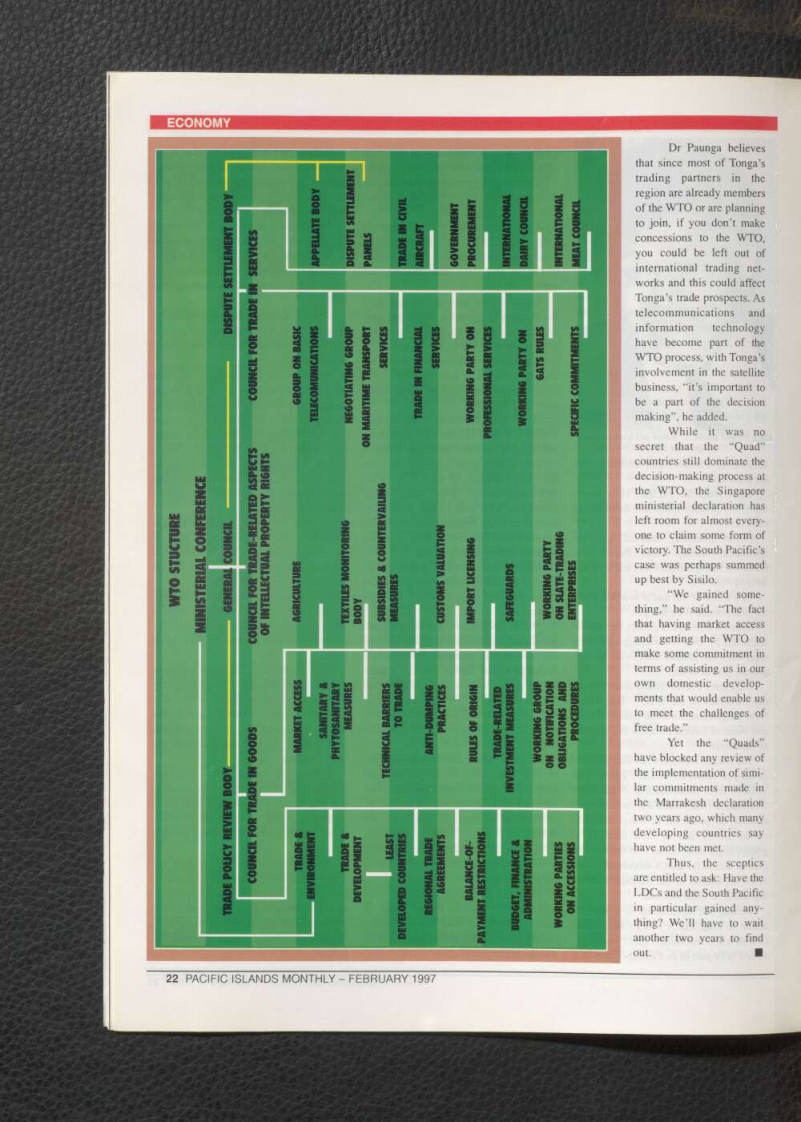
Compared with GATT - which dealt with only trade in merchandise goods - WTO covers trade in services and trade-related aspects of intellectual property rights. If the "Quads” have their way, very soon it could involve labour standards, invest ment policies and government tender pro cedures.
But, at the end of the Singapore con
ference, everyone, including the develop
ing countries, was giving a positive spin to the final outcome. Pakistan’s com merce minister, Muhammad Zubair Khan, said it was “a great victory for
developing countries and all those who supported us”.
What about the Pacific? How would the WTO process affect the small island economies?
“We’re generally satisfied with the document,” Kilroy Genia, Papua New Guinea’s foreign affairs and trade minis ter told PIM.
“It’s a new world and if you don’t join the process you’ll be left out.”
Kilroy’s comments reflect the dilem ma faced by most developing countries, especially the smaller ones, with no bar gaining power at all.
Only three Pacific Island countries are full members of the WTO - Fiji, Papua New Guinea and Solomon Islands. Tonga and Western Samoa attended the meeting as observers.
The Pacific members fall into the least developed countries or LDC category at WTO. The conference’s Ministerial Declaration (MD) made a commitment to address the problems of marginalisation of the LDCs and devoted three para graphs to put more focus into the way the plan of action for LDCs submitted by the WTO secretariat to the Singapore meet ing could be implemented.
Among the agreements is a plan of action to help LDCs benefit from trade liberalisation measures they would be forced to be part of as a member of WTO.
There’s also a commitment to help enhance the climate for investments in the LDCS and to help expand the markets for their products to developed country mar kets.
A major conference is to be organised with UNCTAD (United Nations Conference on Trade and Development) in 1997 to give more teeth to this agree ment.
“Certainly, we have not marginalised the developing countries but we are firm in our commitment to fight it by giving due attention to the LDCs ... growth of trade means better standards of living for all,” said Ruggeiro, defending the WTO against accussations that it’s a rich man’s club.
In an interview with PIM, Joshua Kalimoa, PNG’s secretary for commerce and industry, said that when they came to Singapore their main concern was over the marginalisation of the LDCs in the WTO negotiations. Even though PNG joined the WTO only in July 1995, they were keen to use the Singapore meeting to get more market access for LDC products to developed country markets.
“Market access for LDCs won’t be an issue in the future because the ministerial declaration has recognised it,” Kalimoa pointed out.
The Brussels-based Solomon Islands permanent representative to the EU and the head of their delegation to the WTO meeting, Robert Sisilo, agrees. “I think we did get our voice across,” he told PIM.
“In the declaration ... we had LDC meet ings every now and then, and he briefed us on what’s going on in the consulta tion.”
All three Pacific members emphasised in their statements to the plenary that
preferential trading arrangements they
have at present should remain beyond the 2000 deadline recommended by the
Wto.
“Our trade preferences are eroding with the gradual dismantling of preferen tial trade arrangements.
“This is a real threat to our survival,” said Bose. “Therefore at this stage we recognise the fact that we still cannot effi ciently trade on the global market place without preferences.”
Sisilo argues that they were able to get this point across into the ministerial dec laration “where there’s a reference to get
ting preferential treatment lifted gradually
rather than cutting it off in 2000”.
Another area where the Pacific Island members are facing problems in adhering to WTO rules is in tariff reductions.
Kolimoa said that this was a precondition PNG had to meet before joining the
Wto.
“When our accession to the WTO came, we had already begun the process and were prepared to meet all the obliga tions,” he said.
While PNG is very conscious that it is not killing its own industries in bringing down tariff protection, Kolimoa says that, by cutting down tariffs to around 10 per cent, it is making its import of raw mate rials cheaper for local industries. “That is one of the incentives we are giving to local industries,” he added, but admitting that tariff reduction had also reduced gov ernment revenue.
To plug the revenue gap, PNG has taken the indirect taxing path, such as increased royalties and tax on mining and petroleum leases, and a general goods and services tax, explained Kolimoa.
For Tonga, which attended the Singapore meeting as an observer, it is tarifff reduction which worries them. “To join the WTO we’ll have to reduce tariff rates.
“But in Tonga, a lot of government revenue relies on tariff. So it does not help much right now in joining the WTO,” said Dr Giulio Masasso T Paunga, minister for labour, commerce, industry and tourism, who headed Tonga’s delegation to the
WTO meeting.
However, Dr Paunga told PIM that the Tongan cabinet had taken a decision to join the WTO last year and now he is
looking at modifying economic planning
in the kingdom looking at other revenue posibilities.
“In order to join the WTO, there are certain compromises you have to make,” he admits. “That means you can’t contin ue a hundred per cent with some of the ways of economic planning. There have to be some changes made to domestic policy.”
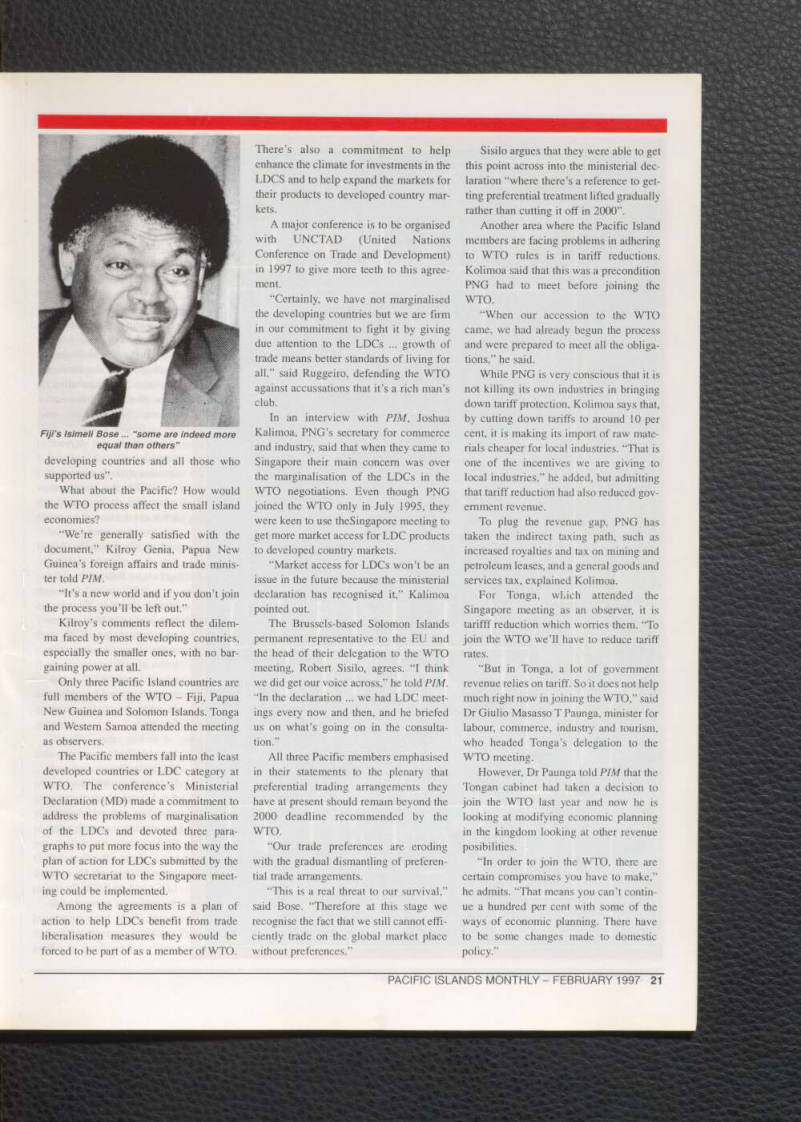
Fiji's Isimeli Bose ... “some are indeed more equal than others"
Dr Paunga believes that since most of Tonga’s trading partners in the
region are already members
of the WTO or are planning to join, if you don’t make concessions to the WTO, you could be left out of international trading net works and this could affect Tonga’s trade prospects. As telecommunications and
information technology
have become part of the WTO process, with Tonga’s involvement in the satellite business, “it’s important to be a part of the decision making”, he added.
While it was no secret that the “Quad” countries still dominate the decision-making process at the WTO, the Singapore ministerial declaration has left room for almost every one to claim some form of victory. The South Pacific’s case was perhaps summed up best by Sisilo.
“We gained some thing,” he said. “The fact that having market access and getting the WTO to make some commitment in terms of assisting us in our own domestic develop ments that would enable us to meet the challenges of free trade.”
Yet the “Quads” have blocked any review of the implementation of simi lar commitments made in the Marrakesh declaration two years ago, which many developing countries say have not been met.
Thus, the sceptics are entitled to ask: Have the LDCs and the South Pacific in particular gained any thing? We’ll have to wait another two years to find out. ■