Government accounts
pp. 25-26 · Read in the full issue
Politics
... and accountability
Western Samoa’s ruling party seeks to reduce chief auditor’s term
Text and photos by Chris Peteru The curtain on Western Samoa’s longest-running political sideshow could drop if the Human Rights Protection Party government gets its way during next month’s session of parliament.
At stake is the third reading of a bill to amend part of the constitution and, in doing so, end a chapter of embarrassments over alleged shaky deals reported by the country’s chief auditor, now under suspen sion.
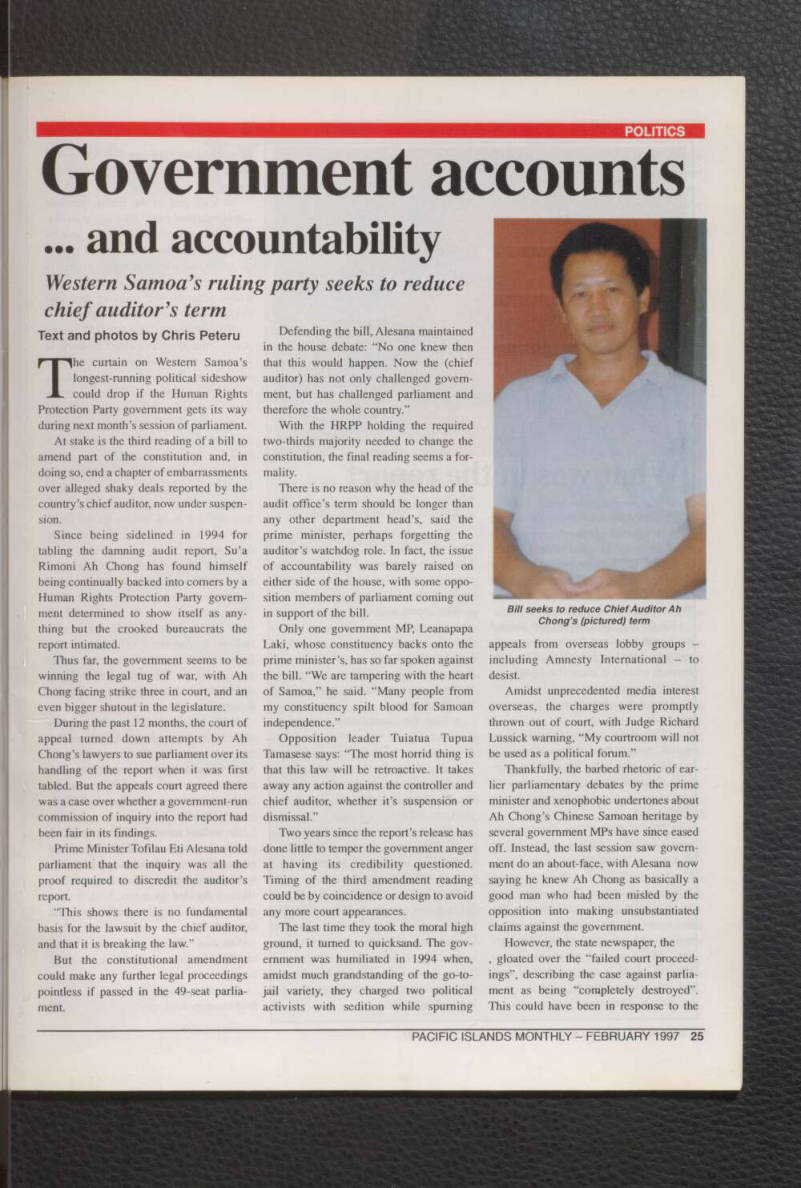
Since being sidelined in 1994 for tabling the damning audit report, Su’a Rimoni Ah Chong has found himself being continually backed into comers by a Human Rights Protection Party govern ment determined to show itself as any thing but the crooked bureaucrats the report intimated.
Thus far, the government seems to be winning the legal tug of war, with Ah Chong facing strike three in court, and an even bigger shutout in the legislature.
During the past 12 months, the court of appeal turned down attempts by Ah Chong’s lawyers to sue parliament over its handling of the report when it was first tabled. But the appeals court agreed there was a case over whether a government-run commission of inquiry into the report had been fair in its findings.
Prime Minister Tofilau Eti Alesana told parliament that the inquiry was all the proof required to discredit the auditor’s report.
“This shows there is no fundamental basis for the lawsuit by the chief auditor, and that it is breaking the law.”
But the constitutional amendment could make any further legal proceedings pointless if passed in the 49-seat parlia ment.
Defending the bill, Alesana maintained in the house debate: “No one knew then that this would happen. Now the (chief auditor) has not only challenged govern ment, but has challenged parliament and therefore the whole country.”
With the HRPP holding the required two-thirds majority needed to change the constitution, the final reading seems a for mality.
There is no reason why the head of the audit office’s term should be longer than any other department head’s, said the prime minister, perhaps forgetting the auditor’s watchdog role. In fact, the issue of accountability was barely raised on either side of the house, with some oppo sition members of parliament coming out in support of the bill.
Only one government MP, Leanapapa Laki, whose constituency backs onto the prime minister’s, has so far spoken against the bill. “We are tampering with the heart of Samoa,” he said. “Many people from my constituency spilt blood for Samoan
independence.”
Opposition leader Tuiatua Tupua Tamasese says: “The most horrid thing is that this law will be retroactive. It takes away any action against the controller and chief auditor, whether it’s suspension or dismissal.”
Two years since the report’s release has done little to temper the government anger at having its credibility questioned.
Timing of the third amendment reading could be by coincidence or design to avoid any more court appearances.
The last time they took the moral high ground, it turned to quicksand. The gov ernment was humiliated in 1994 when, amidst much grandstanding of the go-to
jail variety, they charged two political
activists with sedition while spuming
appeals from overseas lobby groups including Amnesty International - to desist.
Amidst unprecedented media interest overseas, the charges were promptly thrown out of court, with Judge Richard Lussick warning, “My courtroom will not be used as a political forum.”
Thankfully, the barbed rhetoric of ear lier parliamentary debates by the prime minister and xenophobic undertones about Ah Chong’s Chinese Samoan heritage by several government MPs have since eased off. Instead, the last session saw govern ment do an about-face, with Alesana now saying he knew Ah Chong as basically a good man who had been misled by the opposition into making unsubstantiated claims against the government.
However, the state newspaper, the , gloated over the “failed court proceed ings”, describing the case against parlia ment as being “completely destroyed”.
This could have been in response to the
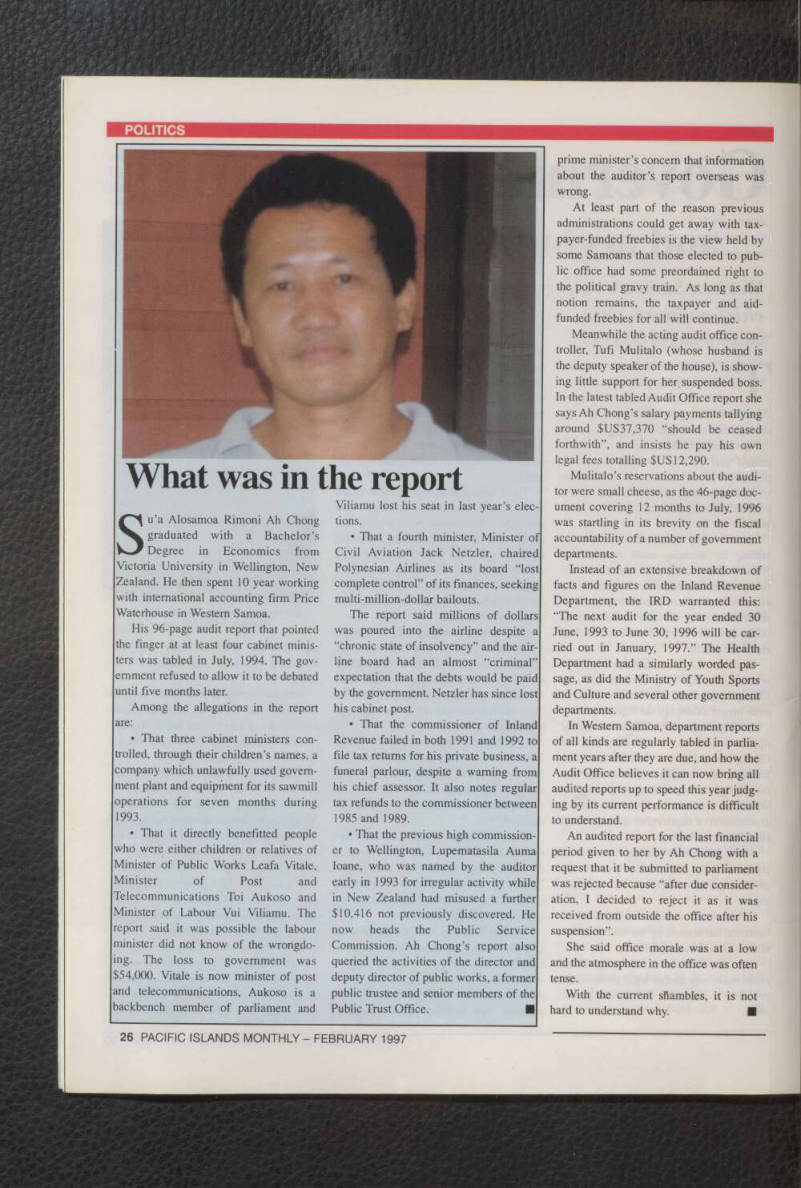
Bill seeks to reduce Chief Auditor Ah Chong’s (pictured) term
prime minister’s concern that information about the auditor’s report overseas was wrong.
At least part of the reason previous administrations could get away with tax payer-funded freebies is the view held by some Samoans that those elected to pub lic office had some preordained right to the political gravy train. As long as that notion remains, the taxpayer and aid funded freebies for all will continue.
Meanwhile the acting audit office con troller, Tufi Mulitalo (whose husband is the deputy speaker of the house), is show ing little support for her suspended boss.
In the latest tabled Audit Office report she says Ah Chong’s salary payments tallying around $U537,370 “should be ceased forthwith”, and insists he pay his own legal fees totalling SUS 12,290.
Mulitalo’s reservations about the audi tor were small cheese, as the 46-page doc ument covering 12 months to July, 1996 was startling in its brevity on the fiscal accountability of a number of government
departments.
Instead of an extensive breakdown of facts and figures on the Inland Revenue Department, the IRD warranted this; “The next audit for the year ended 30 June, 1993 to June 30, 1996 will be car ried out in January, 1997.” The Health Department had a similarly worded pas sage, as did the Ministry of Youth Sports and Culture and several other government
departments.
In Western Samoa, department reports of all kinds are regularly tabled in parlia ment years after they are due, and how the Audit Office believes it can now bring all audited reports up to speed this year judg ing by its current performance is difficult to understand.
An audited report for the last financial period given to her by Ah Chong with a request that it be submitted to parliament was rejected because “after due consider ation, I decided to reject it as it was received from outside the office after his suspension”.
She said office morale was at a low and the atmosphere in the office was often tense.
With the current shambles, it is not hard to understand why. ■