Celebrating
pp. 50-52 · Read in the full issue
Culture
Celebrating the Pacific
Sydney’s Pacific Wave Festival dispels stereotypes and common myths about Island cultures
By Lili Tuwai
For many Australians, perceptions of indigenous peoples in the Pacific Islands are limited to advertise ments of the friendly native selling an untouched paradise conveniently located in the region. Representations of Pacific peoples in the Australian media include the smiling Pacific face beckoning invita tion to come and discover the ‘other’; the threatening ‘gang’ of youths invading Sydney streets; or the ‘problem’ of the overstayer. Diverse identities make up Pacific Islander communities, though they are rendered invisible because the stereo types continue to have much currency in Australia today.
The Pacific Wave Festival recently staged in Sydney was an attempt by organisers to address issues around invis ibility and to showcase cultures and ideas
of the Pacific and Islander communities both in Australia and throughout the
region.
Pacific Wave was organised by The Performance Space, Casula Powerhouse Arts Centre and Bondi Pavilion Community Cultural Centre and ran from November 2 to 17.
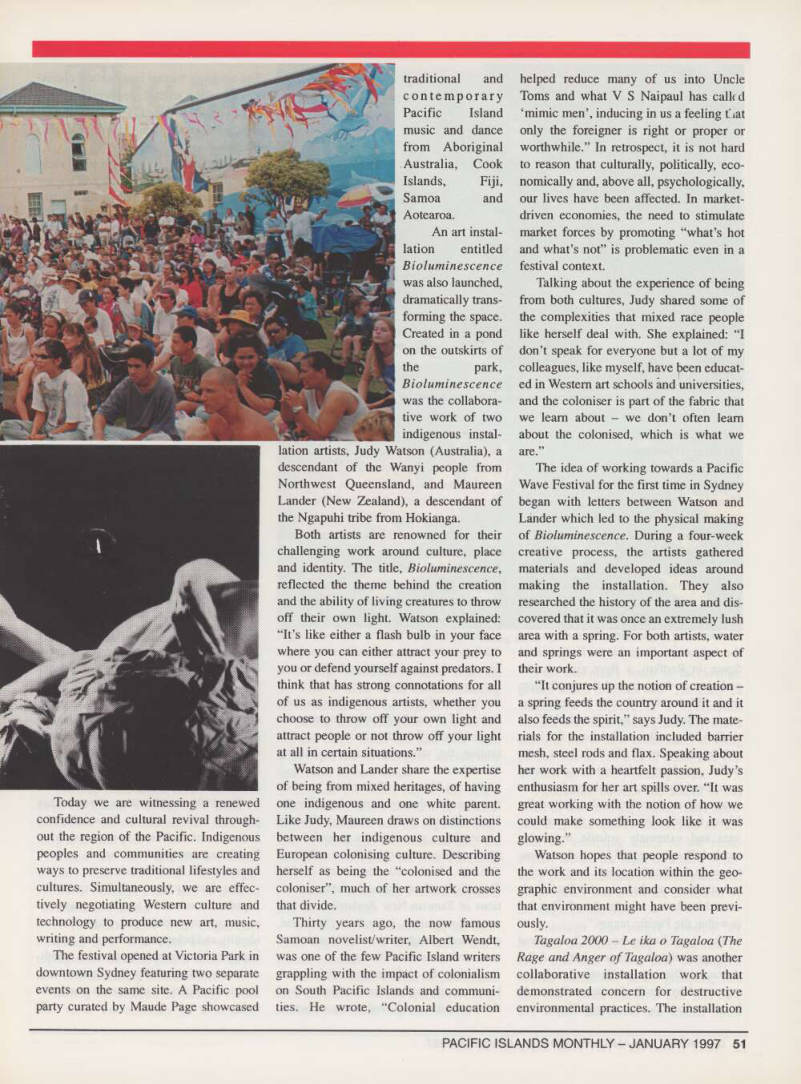
The festival included art exhibitions and a forum, performance works, commu nity celebrations and a contest between various Islander choirs. Guest performers from New Zealand included the Black Grace Dance Company, and a Samoan theatre group. Pacific Underground, pre sented a show called Tatau which used the ritual tattoo to investigate issues of identi-
ty for Pacific Islanders.
“For too long, our communities have been isolated and overlooked in the cele bration of our wonderful, diverse and rich cultures,” says Molly Thomas from Sydney’s South West Multicultural and
Community Centre.
“But not anymore,” she adds. “Pacific Wave represents the growing confidence of Pacific communities in presenting our cultures, stories, our young and old per formers alike.”
Photography: Heidrun Lorh
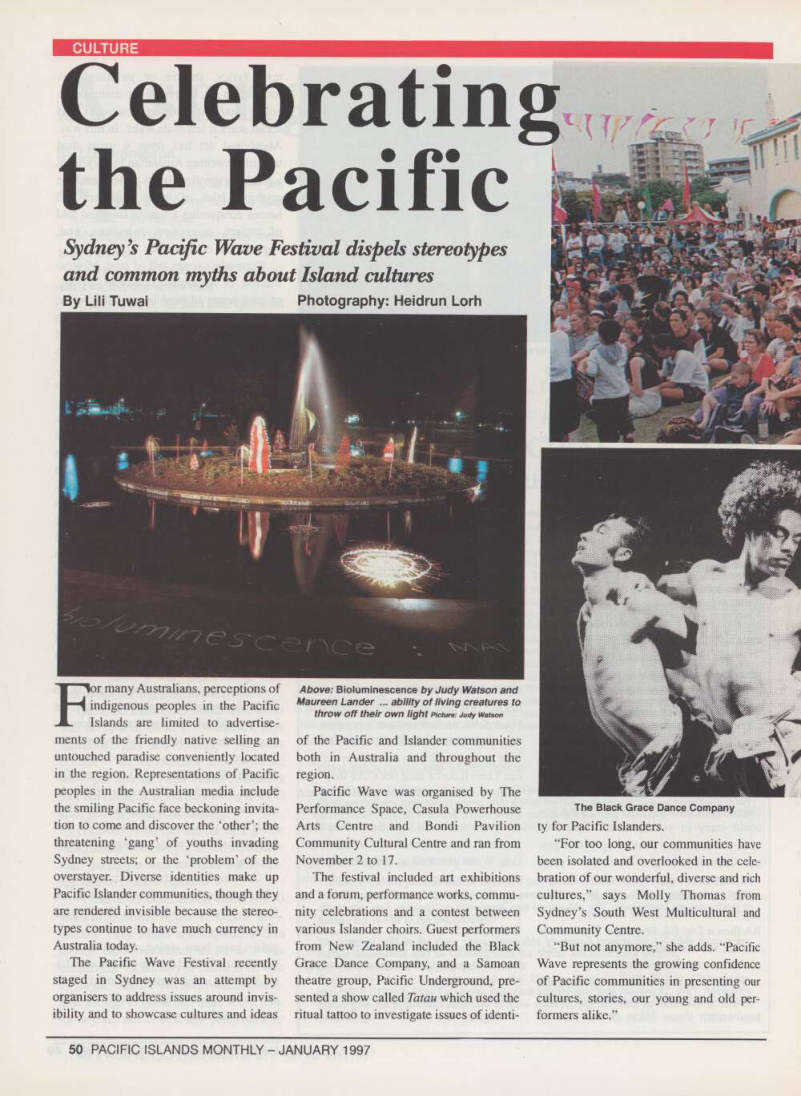
Above: Bioluminescence by Judy Watson and Maureen Lander ... ability of living creatures to throw off their own light Picture: Judy Watson
The Black Grace Dance Company
Today we are witnessing a renewed confidence and cultural revival through out the region of the Pacific. Indigenous peoples and communities are creating ways to preserve traditional lifestyles and cultures. Simultaneously, we are effec tively negotiating Western culture and technology to produce new art, music, writing and performance.
The festival opened at Victoria Park in downtown Sydney featuring two separate events on the same site. A Pacific pool party curated by Maude Page showcased
traditional and contemporary Pacific Island music and dance from Aboriginal Australia, Cook Islands, Fiji, Samoa and Aotearoa.
An art instal lation entitled Bioluminescence was also launched, dramatically trans forming the space.
Created in a pond on the outskirts of the park, Bioluminescence was the collabora tive work of two indigenous instal
lation artists, Judy Watson (Australia), a descendant of the Wanyi people from Northwest Queensland, and Maureen Lander (New Zealand), a descendant of the Ngapuhi tribe from Hokianga.
Both artists are renowned for their challenging work around culture, place and identity. The title, Bioluminescence , reflected the theme behind the creation and the ability of living creatures to throw off their own light. Watson explained: “It’s like either a flash bulb in your face where you can either attract your prey to you or defend yourself against predators. I think that has strong connotations for all of us as indigenous artists, whether you choose to throw off your own light and attract people or not throw off your light at all in certain situations.”
Watson and Lander share the expertise of being from mixed heritages, of having one indigenous and one white parent.
Like Judy, Maureen draws on distinctions between her indigenous culture and
European colonising culture. Describing
herself as being the “colonised and the coloniser”, much of her artwork crosses that divide.
Thirty years ago, the now famous Samoan novelist/writer, Albert Wendt, was one of the few Pacific Island writers grappling with the impact of colonialism on South Pacific Islands and communi ties. He wrote, “Colonial education
helped reduce many of us into Uncle Toms and what V S Naipaul has called ‘mimic men’, inducing in us a feeling f iat only the foreigner is right or proper or worthwhile.” In retrospect, it is not hard to reason that culturally, politically, eco nomically and, above all, psychologically, our lives have been affected. In market driven economies, the need to stimulate market forces by promoting “what’s hot and what’s not” is problematic even in a festival context.
Talking about the experience of being
from both cultures, Judy shared some of the complexities that mixed race people like herself deal with. She explained: “I don’t speak for everyone but a lot of my colleagues, like myself, have been educat ed in Western art schools and universities, and the coloniser is part of the fabric that we leam about - we don’t often learn about the colonised, which is what we are.”
The idea of working towards a Pacific Wave Festival for the first time in Sydney began with letters between Watson and Lander which led to the physical making of Bioluminescence. During a four-week creative process, the artists gathered materials and developed ideas around making the installation. They also researched the history of the area and dis covered that it was once an extremely lush area with a spring. For both artists, water and springs were an important aspect of their work.
“It conjures up the notion of creation a spring feeds the country around it and it also feeds the spirit,” says Judy. The mate rials for the installation included barrier mesh, steel rods and flax. Speaking about her work with a heartfelt passion, Judy’s enthusiasm for her art spills over. “It was great working with the notion of how we could make something look like it was
glowing.”
Watson hopes that people respond to the work and its location within the geo graphic environment and consider what that environment might have been previ
ously.
Tagaloa 2000 - Le ika o Tagaloa (The Rage and Anger of Tagaloa) was another collaborative installation work that demonstrated concern for destructive environmental practices. The installation
was a reminder that the Pacific Ocean was and continues to be a testing ground for the imperial powers.
A raised platform was positioned in the centre of the room covered with sand.
Placed on the sand was a wacky little stat ue made out of wood, wire and bolts, symbolising Tagaloa, the ancient god of
the sea throughout Polynesia.
The artists Stepan van Reiche, from Western Samoa, and Leo Tanoi, a Samoan artist living in Sydney, invited their audi ence to participate in their installation per
formance by registering their disgust at
the destruction. Staged at the Performance Space in Redfem, a flyer given to the audience as they entered the small room read: “Please feel free to express your anger right here and now. Raughhhh!”
Speaking with von Reiche at the festi val, he commented: “Yes it’s been won derful, we have celebrated our unique ness, our identities, our cultures but there is so much more to the Pacific. Personally, I have found political issues that are rele vant and extremely volatile not being tackled. People are still being shot some where in the Pacific, people are still being colonised somewhere in the Pacific. Is something being said for them? That too is within the Pacific region.”
On Arts Today the ABC’s national radio programme, presenter Louise Adler discussed “Notions of Exotica”, a forum organised by the Performance Space. In her introduction, she stated: “Europeans
and Americans have thought of the Pacific Islands as exotic since the first sighting of the region. In fact, there is a particularly American and European affliction that we would describe as the ‘South Sea Island Syndrome’, a cliche that involves tropical paradise, palm trees, one part blue lagoon, three parts a beautiful dancer performing the hula, frangipani inevitably behind one ear.” She told audiences that “European painters, writers, historians and others used to frequent the Pacific looking for this vision of earthy paradise”.
Adler stated, “We (Australians) might think that romantic and racist stereotypes like these have perished but they have, in
fact, proved remarkably persistent.”
At the forum, further discussions examined Australia’s limited representa tion of Pacific Islanders and cultures, cri tiquing the stereotypes and reclaiming identities.
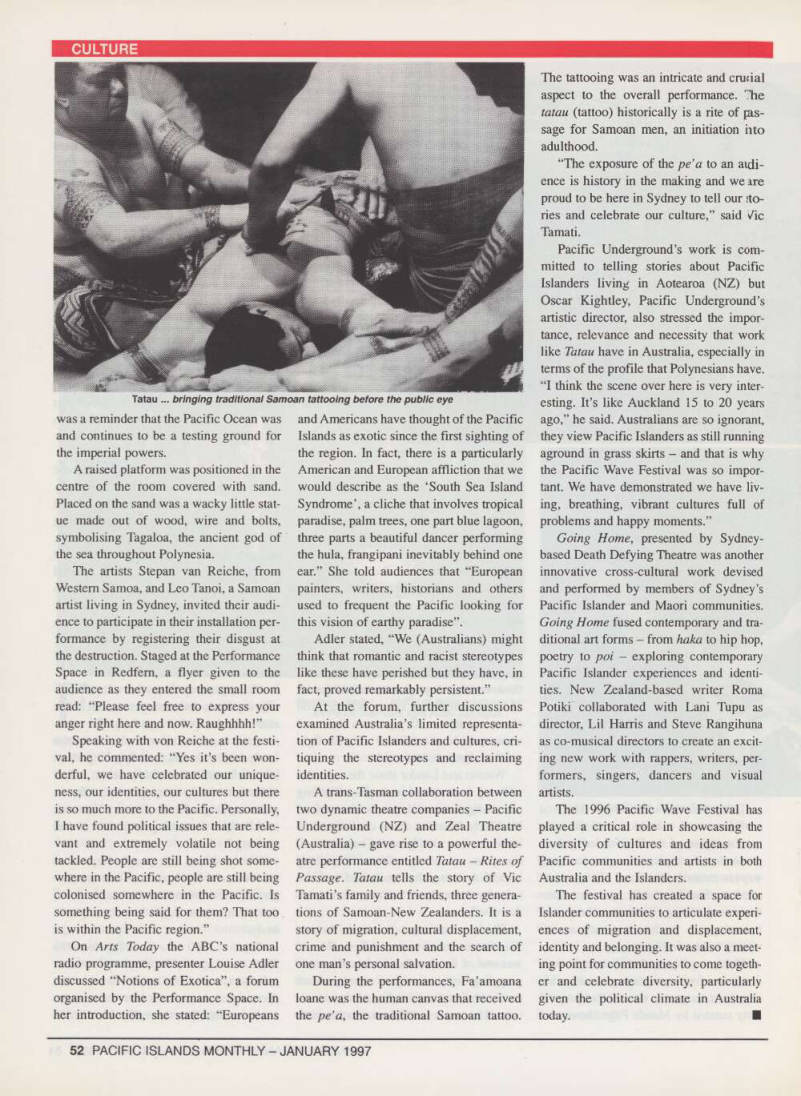
A trans-Tasman collaboration between two dynamic theatre companies - Pacific Underground (NZ) and Zeal Theatre (Australia) - gave rise to a powerful the atre performance entitled Tatau - Rites of Passage. Tatau tells the story of Vic Tamati’s family and friends, three genera tions of Samoan-New Zealanders. It is a story of migration, cultural displacement, crime and punishment and the search of one man’s personal salvation.
During the performances, Fa’amoana
loane was the human canvas that received the pe’a, the traditional Samoan tattoo.
The tattooing was an intricate and crucial aspect to the overall performance. The tatau (tattoo) historically is a rite of pas sage for Samoan men, an initiation hto adulthood.
“The exposure of the pe’a to an atdi ence is history in the making and we ire proud to be here in Sydney to tell our do ries and celebrate our culture,” said Vic Tamati.
Pacific Underground’s work is com mitted to telling stories about Pacific Islanders living in Aotearoa (NZ) but
Oscar Kightley, Pacific Underground’s
artistic director, also stressed the impor tance, relevance and necessity that work like Tatau have in Australia, especially in terms of the profile that Polynesians have.
“I think the scene over here is very inter esting. It’s like Auckland 15 to 20 years ago,” he said. Australians are so ignorant, they view Pacific Islanders as still running aground in grass skirts - and that is why the Pacific Wave Festival was so impor tant. We have demonstrated we have liv ing, breathing, vibrant cultures full of problems and happy moments.”
Going Home, presented by Sydney
based Death Defying Theatre was another innovative cross-cultural work devised and performed by members of Sydney’s Pacific Islander and Maori communities.
Going Home fused contemporary and tra ditional art forms - from haka to hip hop, poetry to poi - exploring contemporary Pacific Islander experiences and identi ties. New Zealand-based writer Roma Potiki collaborated with Lani Tupu as director, Lil Harris and Steve Rangihuna as co-musical directors to create an excit ing new work with rappers, writers, per formers, singers, dancers and visual artists.
The 1996 Pacific Wave Festival has played a critical role in showcasing the diversity of cultures and ideas from Pacific communities and artists in both Australia and the Islanders.
The festival has created a space for Islander communities to articulate experi ences of migration and displacement, identity and belonging. It was also a meet ing point for communities to come togeth er and celebrate diversity, particularly given the political climate in Australia today. ■
Tatau... bringing traditional Samoan tattooing before the public eye