A song of protest
pp. 48-49 · Read in the full issue
Music
By Liz Thompson
/ / m 200 years, us blacks are beaten down here too long JL on the dole My dignity I’m losing here and men tally I’m old There’s a system here that nails us ain’t we left out in the cold They took our life and liberty friend by they couldn’t buy our soul”
First verse of Cannot Buy My Soul by Kev Carmody.
Kev Carmody is one of the most polit ical singer songwriters in Australia. He has recorded three highly successful albums - Eulogy, Images & Illusions and Pillars of Society. He is constantly travel
ling, performing at gigs and festivals,
being interiewed, writing new songs in his quest to raise awareness. He uses music and songwriting as a form of protest.
“Selling the records isn’t the objective,” he points out. “It’s just propaganda as far as I’m concerned.”
As an Aboriginal child who suffered the atrocities of the white Australia assim ilation policy, he was forcibly removed from his family and land at the age of 10.
He’d only managed to stay at home as long as he did because whenever he or his brother heard a car approaching they would run off and hide in the scrub.
Once the authorities found him, there was no option but to go “because”, says Carmody, “they said to Mum, if you don’t do this - ‘let the children come with us, we’ll put you on Palm Island’, which is like the Alcatraz of Australia - ‘and we’ll split you up from your husband’.”
Carmody, who has the air of a gentle man, found when he got to the orphanage that “the people were so brutal and so sav age and so cruel to children”.
“I had never experienced that in my 10 years of existence in the Aboriginal com munity. They called it discipline. It was bloody sado-masochism as far as I was concerned.” Carmody is thankful he was 10 by the time he was removed and fortu nate enough to know that there was a real ity beyond this one. A few years later he
decided to get himself expelled from school, which he did - “hopped on a horse” and left town.
It is this experience and the experience of his people that has motivated his song writing. “Music,” he says when I ask him how he got into it, “got into me. I can never remember a time in my memory where there wasn’t music around. You
had to entertain yourself around a camp fire with music and storytelling. Some of those so-called illiterate people made up wonderful poems and rhymes and sto ries.” He recalls being back home on the land in the early 50s. “There was a big technological innovation when the old fella brought out a dry cell wireless and it was portable and you had to run an aerial
up a bloody tree. But to see our mob sit ting around the campfire at night time -1 heard the first reading of this earth-shat
tering piece of English literature, (Under
Milk Wood), and like this so-called illiter ate mob sitting around on the swag after tea of a night time, listening to this thing being serialised on the ABC and like dis cussing it like a university tutorial because it was oral, it wasn’t written. ‘Oh, that Polly Garter I wouldn’t be taking her out - she no good, she play up on you and that willy nilly postman he reads your bloody letter, stuff him, and that bloody butcher, he bloody put cat and dog in his bloody meat - stuff him.’ It was just amazing, they totally understood it.”
It was on the radio that Carmody first heard classical music. Up until then most of the instruments around him were either found in the natural environment or small
enough to transport easily. The family
travelled a lot, moving from camp to camp, from one mustering job to another.
“They would play gum leaves or bang on a bloody log or something. We had clapsticks or a mouth organ, anything you could carry in your pocket.” That was until one day a guy showed up with a gui tar. Carmody taught himself to play, studying music theory at night. He got himself a teacher and eventually took a degree with music as his elective. “I did a BA then a Dip Ed, became a high school teacher for six weeks - loved the kids, couldn’t stand the system.”
He left, started a Masters and dropped out after he dragged the only copy of his handwritten thesis 26km on the back of
his motorbike. He didn’t realise it had fallen, held only by a rope, until the docu ment was shredded.
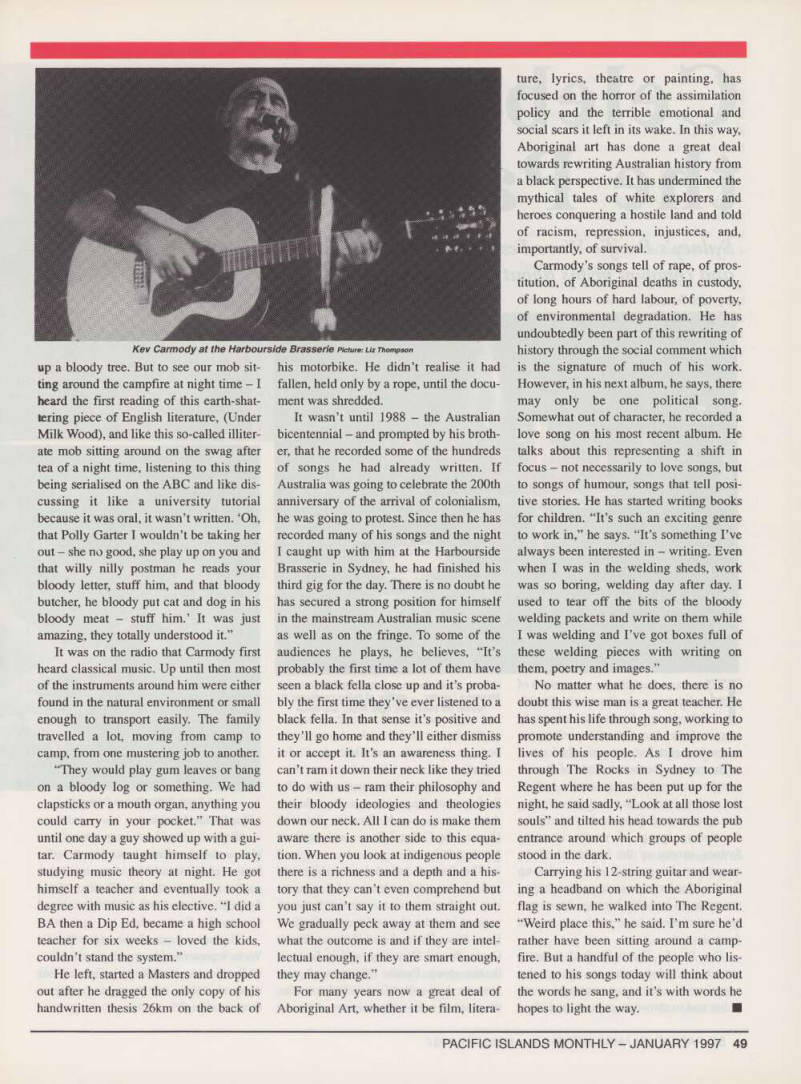
It wasn’t until 1988 - the Australian bicentennial - and prompted by his broth er, that he recorded some of the hundreds of songs he had already written. If Australia was going to celebrate the 200th anniversary of the arrival of colonialism, he was going to protest. Since then he has recorded many of his songs and the night I caught up with him at the Harbourside Brasserie in Sydney, he had finished his third gig for the day. There is no doubt he has secured a strong position for himself in the mainstream Australian music scene as well as on the fringe. To some of the audiences he plays, he believes, “It’s probably the first time a lot of them have seen a black fella close up and it’s proba bly the first time they’ve ever listened to a black fella. In that sense it’s positive and they’ll go home and they’ll either dismiss it or accept it. It’s an awareness thing. I can’t ram it down their neck like they tried to do with us - ram their philosophy and
their bloody ideologies and theologies
down our neck. All I can do is make them aware there is another side to this equa tion. When you look at indigenous people there is a richness and a depth and a his tory that they can’t even comprehend but you just can’t say it to them straight out.
We gradually peck away at them and see what the outcome is and if they are intel lectual enough, if they are smart enough,
they may change.”
For many years now a great deal of Aboriginal Art, whether it be film, litera
ture, lyrics, theatre or painting, has focused on the horror of the assimilation policy and the terrible emotional and social scars it left in its wake. In this way.
Aboriginal art has done a great deal towards rewriting Australian history from a black perspective. It has undermined the mythical tales of white explorers and heroes conquering a hostile land and told of racism, repression, injustices, and, importantly, of survival.
Carmody’s songs tell of rape, of pros titution, of Aboriginal deaths in custody, of long hours of hard labour, of poverty, of environmental degradation. He has undoubtedly been part of this rewriting of history through the social comment which is the signature of much of his work.
However, in his next album, he says, there may only be one political song.
Somewhat out of character, he recorded a love song on his most recent album. He talks about this representing a shift in focus - not necessarily to love songs, but to songs of humour, songs that tell posi tive stories. He has started writing books for children. “It’s such an exciting genre to work in,” he says. “It’s something I’ve always been interested in - writing. Even when I was in the welding sheds, work was so boring, welding day after day. I used to tear off the bits of the bloody welding packets and write on them while I was welding and I’ve got boxes full of
these welding pieces with writing on
them, poetry and images.”
No matter what he does, there is no doubt this wise man is a great teacher. He has spent his life through song, working to promote understanding and improve the lives of his people. As I drove him through The Rocks in Sydney to The Regent where he has been put up for the night, he said sadly, “Look at all those lost souls” and tilted his head towards the pub entrance around which groups of people stood in the dark.
Carrying his 12-string guitar and wear
ing a headband on which the Aboriginal flag is sewn, he walked into The Regent.
“Weird place this,” he said. I’m sure he’d rather have been sitting around a camp fire. But a handful of the people who lis tened to his songs today will think about the words he sang, and it’s with words he hopes to light the way. ■
Kev Carmody at the Harbourside Brasserie picture: Liz Thompson