Life of a master carver
pp. 46-47 · Read in the full issue
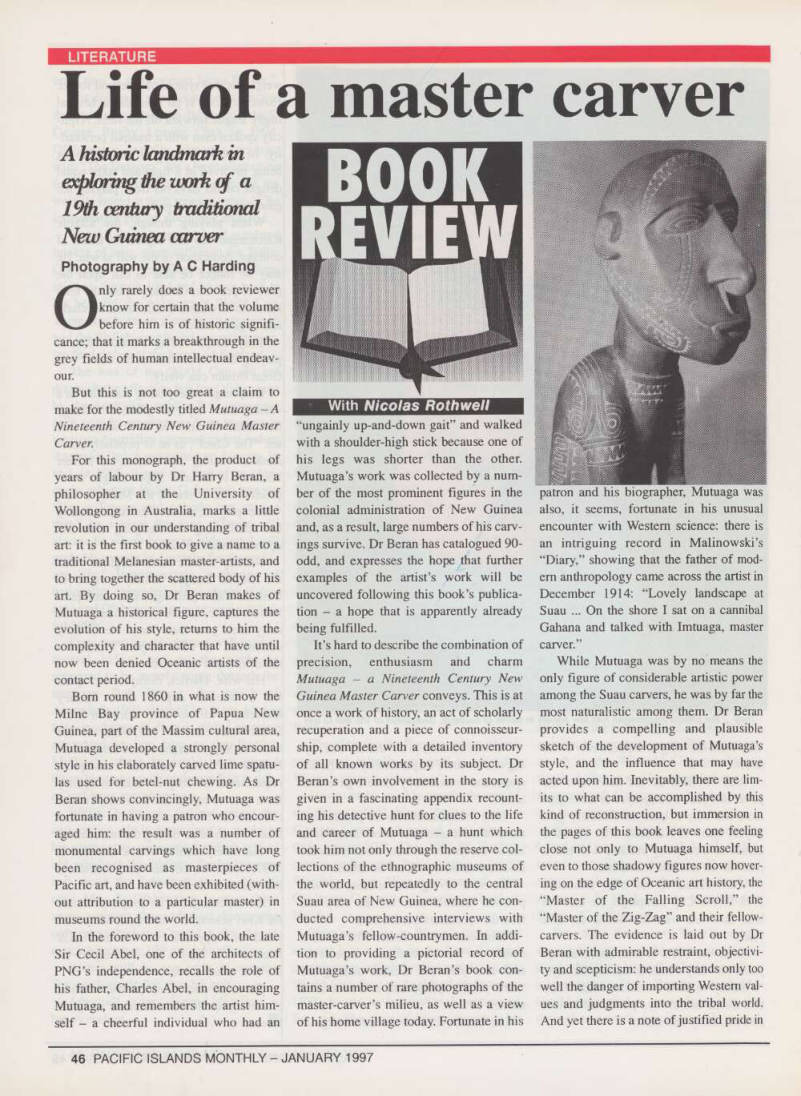
Literature
A historic landmark in exploring the work of a 19th century traditional New Guinea carver Photography by A C Harding
Only rarely does a book reviewer know for certain that the volume before him is of historic signifi cance; that it marks a breakthrough in the grey fields of human intellectual endeav our.
But this is not too great a claim to make for the modestly titled Mutuaga - A Nineteenth Century New Guinea Master Carver.
For this monograph, the product of years of labour by Dr Harry Beran, a philosopher at the University of Wollongong in Australia, marks a little revolution in our understanding of tribal art; it is the first book to give a name to a traditional Melanesian master-artists, and to bring together the scattered body of his art. By doing so. Dr Beran makes of Mutuaga a historical figure, captures the evolution of his style, returns to him the complexity and character that have until now been denied Oceanic artists of the
contact period.
Bom round 1860 in what is now the Milne Bay province of Papua New Guinea, part of the Massim cultural area,
Mutuaga developed a strongly personal
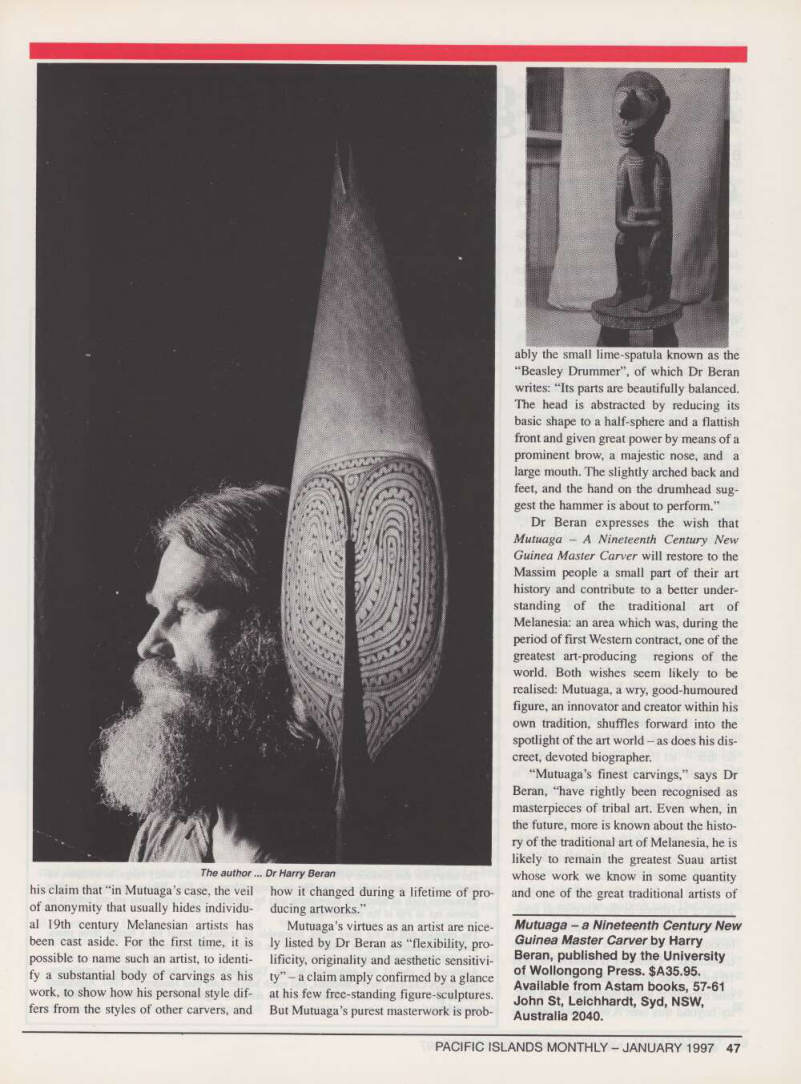
style in his elaborately carved lime spatu las used for betel-nut chewing. As Dr Beran shows convincingly, Mutuaga was fortunate in having a patron who encour aged him: the result was a number of monumental carvings which have long been recognised as masterpieces of Pacific art, and have been exhibited (with out attribution to a particular master) in museums round the world.
In the foreword to this book, the late Sir Cecil Abel, one of the architects of PNG’s independence, recalls the role of his father, Charles Abel, in encouraging Mutuaga, and remembers the artist him self - a cheerful individual who had an
“ungainly up-and-down gait” and walked with a shoulder-high stick because one of his legs was shorter than the other.
Mutuaga’s work was collected by a num ber of the most prominent figures in the colonial administration of New Guinea and, as a result, large numbers of his carv ings survive. Dr Beran has catalogued 90odd, and expresses the hope that further examples of the artist’s work will be uncovered following this book’s publica tion - a hope that is apparently already
being fulfilled.
It’s hard to describe the combination of precision, enthusiasm and charm Mutuaga - a Nineteenth Century New Guinea Master Carver conveys. This is at once a work of history, an act of scholarly recuperation and a piece of connoisseur ship, complete with a detailed inventory of all known works by its subject. Dr Beran’s own involvement in the story is
given in a fascinating appendix recount
ing his detective hunt for clues to the life and career of Mutuaga - a hunt which took him not only through the reserve col lections of the ethnographic museums of the world, but repeatedly to the central Suau area of New Guinea, where he con ducted comprehensive interviews with
Mutuaga’s fellow-countrymen. In addi
tion to providing a pictorial record of Mutuaga’s work. Dr Beran’s book con tains a number of rare photographs of the master-carver’s milieu, as well as a view of his home village today. Fortunate in his
patron and his biographer, Mutuaga was also, it seems, fortunate in his unusual encounter with Western science; there is an intriguing record in Malinowski’s “Diary,” showing that the father of mod em anthropology came across the artist in December 1914: “Lovely landscape at Suau ... On the shore I sat on a cannibal Gahana and talked with Imtuaga, master carver.”
While Mutuaga was by no means the only figure of considerable artistic power among the Suau carvers, he was by far the most naturalistic among them. Dr Beran
provides a compelling and plausible
sketch of the development of Mutuaga’s style, and the influence that may have acted upon him. Inevitably, there are lim its to what can be accomplished by this kind of reconstruction, but immersion in the pages of this book leaves one feeling close not only to Mutuaga himself, but even to those shadowy figures now hover ing on the edge of Oceanic art history, the “Master of the Falling Scroll,” the “Master of the Zig-Zag” and their fellow carvers. The evidence is laid out by Dr Beran with admirable restraint, objectivi ty and scepticism: he understands only too well the danger of importing Western val ues and judgments into the tribal world.
And yet there is a note of justified pride in
With Nicolas Roth well
his claim that “in Mutuaga’s case, the veil of anonymity that usually hides individual 19th century Melanesian artists has been cast aside. For the first time, it is possible to name such an artist, to identify a substantial body of carvings as his work, to show how his personal style differs from the styles of other carvers, and
how it changed during a lifetime of pro ducing artworks.”
Mutuaga’s virtues as an artist are nice ly listed by Dr Beran as “flexibility, pro lificity, originality and aesthetic sensitivi ty” - a claim amply confirmed by a glance at his few free-standing figure-sculptures.
But Mutuaga’s purest masterwork is prob-
ably the small lime-spatula known as the “Beasley Drummer”, of which Dr Beran writes: “Its parts are beautifully balanced.
The head is abstracted by reducing its basic shape to a half-sphere and a flattish front and given great power by means of a prominent brow, a majestic nose, and a large mouth. The slightly arched back and feet, and the hand on the drumhead sug gest the hammer is about to perform.”
Dr Beran expresses the wish that Mutuaga A Nineteenth Century New Guinea Master Carver will restore to the Massim people a small part of their art history and contribute to a better under standing of the traditional art of Melanesia: an area which was, during the period of first Western contract, one of the greatest art-producing regions of the world. Both wishes seem likely to be realised: Mutuaga, a wry, good-humoured figure, an innovator and creator within his own tradition, shuffles forward into the spotlight of the art world - as does his dis creet, devoted biographer.
“Mutuaga’s finest carvings,” says Dr Beran, “have rightly been recognised as masterpieces of tribal art. Even when, in the future, more is known about the histo ry of the traditional art of Melanesia, he is likely to remain the greatest Suau artist whose work we know in some quantity and one of the great traditional artists of
Mutuaga - a Nineteenth Century New Guinea Master Carver by Harry Beran, published by the University of Wollongong Press. $A35.95.
Available from Astam books, 57-61 John St, Leichhardt, Syd, NSW, Australia 2040.
The author...Dr Harry Beran