Tony emerges
pp. 44-45 · Read in the full issue
from shadows
By Atama Raganivatu
The New Zealand national rugby league selection’s recent three matches-to-nil Test series victory over Great Britain marked both the second clean sweep gained by the Kiwis since the two countries commenced playing each other in 1907 and Tony Iro’s ‘internation
al coming of age’.
Prior to him featuring prominently in the Lions’ demise, Iro’s entire career had been spent in the shadow of his younger brother, Kevin Iro.
It was Kevin who created a world
record when scoring 20 points against
Papua New Guinea on Test debut, it was Kevin who scored an extraordinary six tries in his first three British Challenge Cup final appearances at Wembley Stadium and it was Kevin who was wide ly tipped as Mai Meninga’s natural suc cessor as the World’s best centre in the late 1980 s.
Tony had only made a couple of senior appearances for the unsung Auckland club. Mount Albert, when, in 1987, he was
signed by English giants Wigan.
Wigan, it was believed at the time,
acquired Tony primarily to provide moral
support for Kevin, who had just joined them.
The older Iro (by five days short of one year) was initially required to play for Wigan’s reserve side.
However, he quickly caught the eye of the Riversiders’ New Zealand coach, Graham Lowe, and gained promotion to their senior XIII. The 1987-88 English season ended with Tony scoring a try at
Wembley as Wigan captured the
Challenge Cup with a victory over holders Halifax.
Tony’s exploits on Wigan’s right wing
secured him a berth in the New Zealand combination which faced Australia in the World Cup final at Auckland in October, 1988. It was an international baptism of fire and, like most of his team-mates, he
struggled against an inspired Kangaroos
lineup. A late try proved only a small con solation for Tony and the badly beaten Kiwis.
The New Zealand selectors forgave
Tony for that below-par performance and
he won seven more caps in the following two years a couple more against Australia, three opposing Great Britain and two for appearances against Papua New Guinea.
Iro left Wigan in 1990. While there, his fifty-first team outings yielded 23 tries and two Challenge Cup winner’s medals.
However, he has mixed feelings about the time spent at Central Park.
“Really, it was all a little bit too easy for me,” he concedes today. “I walked into a champion team almost immediately after arriving at Wigan. “I really didn’t have to come through the ranks and strive hard to gain success as most other young
players do.
“I don’t think that I appreciated how lucky I was back then and certainly didn’t work particularly hard to keep myself at the top because I did an awful lot of par
tying.”
Tony discovered that Australian rugby league was a totally different ball game upon moving to Manly with Lowe. In con trast to his experience in Britain, every match in the Winfield Cup provided a tough challenge and he struggled to come to terms with his new, much more exact
ing environment.
Kevin, who joined him a year later, lasted just two seasons with Manly before
returning to Britain. Tony, though, proved
more resilient and has remained in Australia. In 1994, he was transferred to
Sydney City Roosters.
By this time, as Tony’s career approached its twilight stage, most pun dits had written him off as little more than a journeyman. Then, Roosters coach Phil Gould provided a new lease on life through a masterly inspiration. He moved
Tony from the wing to the back row of the scrum.
Tony revelled in his new role; the power and pace he displayed in the engine room not only helped the Roosters gain respect again in Australia after almost a decade of mediocrity but also won him a recall to the international arena.
When called up for New Zealand’s 1995 World Cup campaign, he had not been involved with the Kiwis for five years.
However, Gould is reluctant to accept praise for Tony’s transformation. He says; “I hardly worked wonders with Tony because he has always possessed lots of athletic ability and skill.
“It was obvious to me that he was cry ing out for more responsibility and he has responded wonderfully since I gave it to him.”
Tony’s responsibilities are greater than those of most second-row forwards, for he has a vital role to perform when either the Roosters or the Kiwis are on attack.
Given a roving commission, he will position himself wide off the ruck and feed the speedsters outside him.
Tony can also be counted on when it comes to the conventional aspects of back-row play. He relishes making the “hard yards” upfield and is a rock-solid tackier.
His build (1.92 metres tall, 98kgs in
weight) is that typical of a second rower.
However, Tony is far from the archetypal rugby league forward off the field. A qui etly spoken man with a tranquil personal ity, he speaks proudly of never having being involved in a fight and takes equal delight on his days off from playing the guitar or a round of golf.
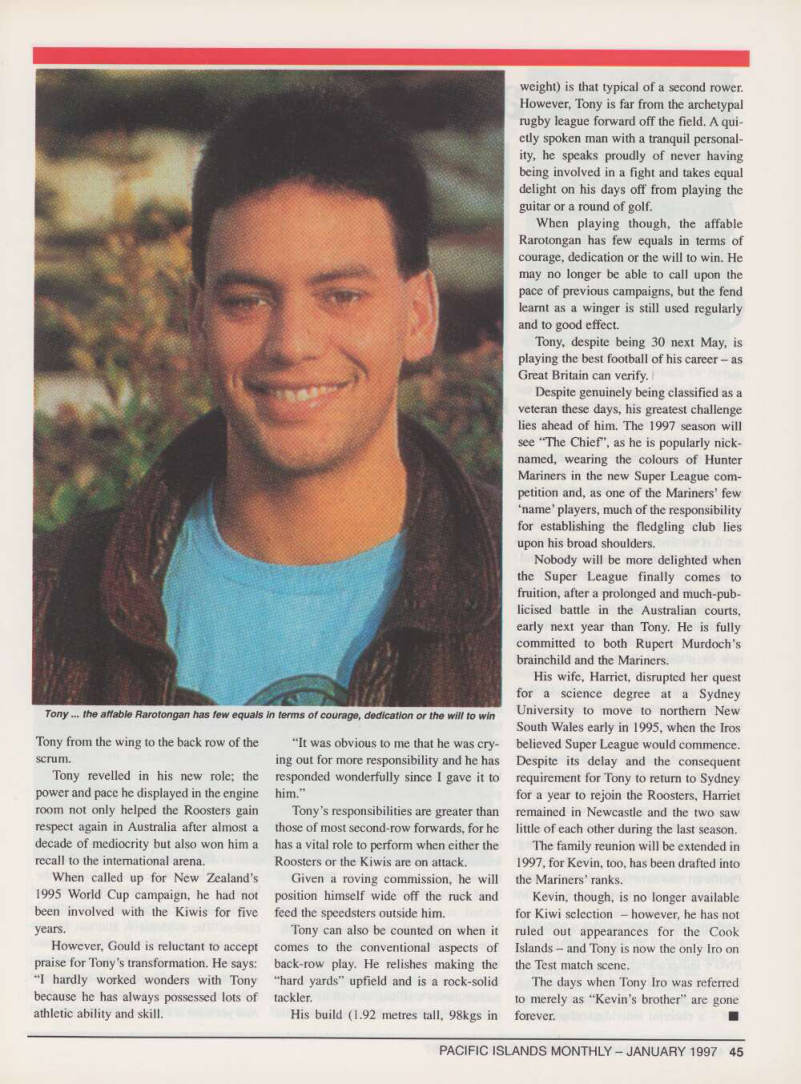
When playing though, the affable Rarotongan has few equals in terms of courage, dedication or the will to win. He may no longer be able to call upon the pace of previous campaigns, but the fend learnt as a winger is still used regularly and to good effect.
Tony, despite being 30 next May, is playing the best football of his career - as Great Britain can verify. I Despite genuinely being classified as a veteran these days, his greatest challenge lies ahead of him. The 1997 season will see “The Chief’, as he is popularly nick named, wearing the colours of Hunter Mariners in the new Super League com petition and, as one of the Mariners’ few ‘name’ players, much of the responsibility for establishing the fledgling club lies upon his broad shoulders.
Nobody will be more delighted when the Super League finally comes to fruition, after a prolonged and much-pub licised battle in the Australian courts, early next year than Tony. He is fully committed to both Rupert Murdoch’s brainchild and the Mariners.
His wife, Harriet, disrupted her quest for a science degree at a Sydney University to move to northern New South Wales early in 1995, when the Iros believed Super League would commence.
Despite its delay and the consequent requirement for Tony to return to Sydney for a year to rejoin the Roosters, Harriet remained in Newcastle and the two saw little of each other during the last season.
The family reunion will be extended in 1997, for Kevin, too, has been drafted into the Mariners’ ranks.
Kevin, though, is no longer available for Kiwi selection - however, he has not ruled out appearances for the Cook Islands - and Tony is now the only Iro on the Test match scene.
The days when Tony Iro was referred to merely as “Kevin’s brother” are gone forever. ■
Tony...the affable Rarotongan has few equals in terms of courage, dedication or the will to win