The first day
p. 42 · Read in the full issue
With the approach of die new millennium, Tafahi in northeastern Tonga has reserved die right to be die first to see die sun on January 1, 2000
By David North
When the dawn breaks on the millennium, January 1, 2000, the sun will first shine on Tafahi, a lightly-populated island in the
Kingdom of Tonga.
This was established recently by a retired geologist, writing to the New York Times.
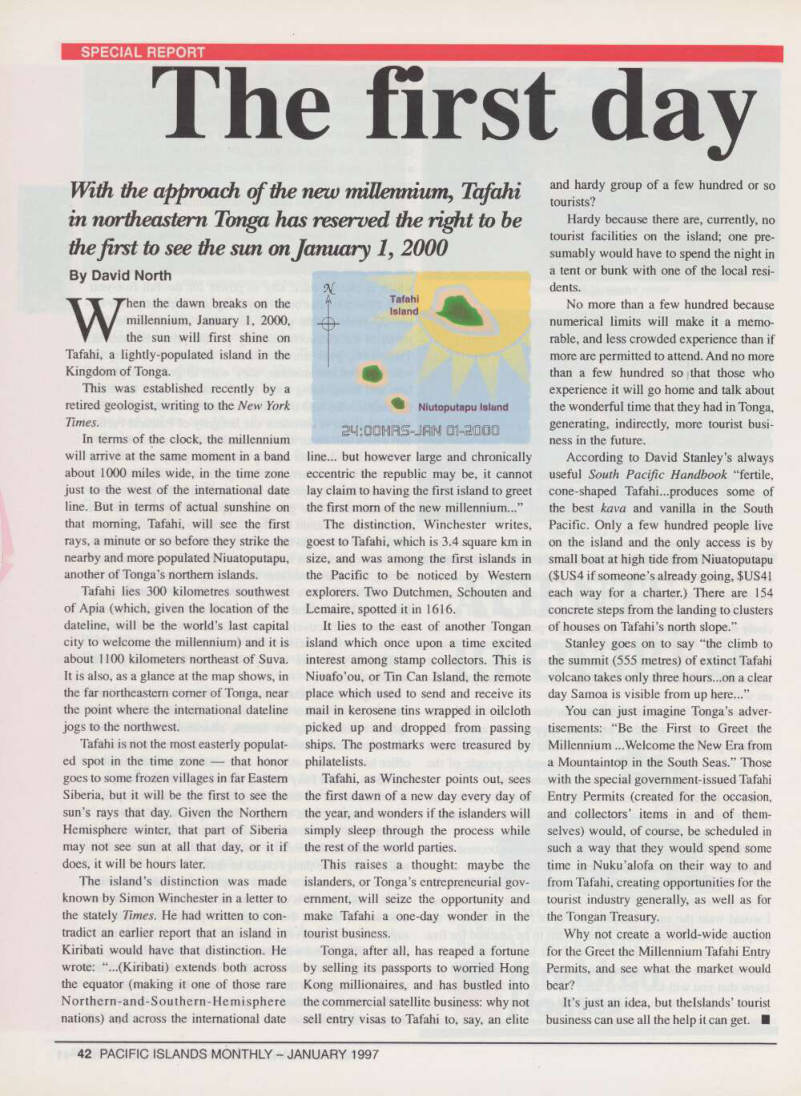
In terms of the clock, the millennium will arrive at the same moment in a band about 1000 miles wide, in the time zone just to the west of the international date line. But in terms of actual sunshine on that morning, Tafahi, will see the first rays, a minute or so before they strike the nearby and more populated Niuatoputapu, another of Tonga’s northern islands.
Tafahi lies 300 kilometres southwest of Apia (which, given the location of the dateline, will be the world’s last capital city to welcome the millennium) and it is about 1100 kilometers northeast of Suva.
It is also, as a glance at the map shows, in the far northeastern comer of Tonga, near the point where the international dateline jogs to the northwest.
Tafahi is not the most easterly populat ed spot in the time zone that honor goes to some frozen villages in far Eastern Siberia, but it will be the first to see the sun’s rays that day. Given the Northern Hemisphere winter, that part of Siberia may not see sun at all that day, or it if does, it will be hours later.
The island’s distinction was made known by Simon Winchester in a letter to the stately Times. He had written to con tradict an earlier report that an island in Kiribati would have that distinction. He wrote: “...(Kiribati) extends both across the equator (making it one of those rare
Northern-and-Southern-Hemisphere
nations) and across the international date
line... but however large and chronically eccentric the republic may be, it cannot lay claim to having the first island to greet the first mom of the new millennium...”
The distinction, Winchester writes, goest to Tafahi, which is 3.4 square km in size, and was among the first islands in the Pacific to be noticed by Western explorers. Two Dutchmen, Schouten and Lemaire, spotted it in 1616.
It lies to the east of another Tongan island which once upon a time excited interest among stamp collectors. This is Niuafo’ou, or Tin Can Island, the remote place which used to send and receive its mail in kerosene tins wrapped in oilcloth
picked up and dropped from passing
ships. The postmarks were treasured by
philatelists.
Tafahi, as Winchester points out, sees the first dawn of a new day every day of the year, and wonders if the islanders will simply sleep through the process while the rest of the world parties.
This raises a thought: maybe the islanders, or Tonga’s entrepreneurial gov ernment, will seize the opportunity and make Tafahi a one-day wonder in the tourist business.
Tonga, after all, has reaped a fortune by selling its passports to worried Hong Kong millionaires, and has bustled into the commercial satellite business: why not sell entry visas to Tafahi to, say, an elite
and hardy group of a few hundred or so tourists?
Hardy because there are, currently, no tourist facilities on the island; one pre sumably would have to spend the night in a tent or bunk with one of the local resi dents.
No more than a few hundred because numerical limits will make it a memo rable, and less crowded experience than if more are permitted to attend. And no more than a few hundred so (that those who experience it will go home and talk about the wonderful time that they had in Tonga, generating, indirectly, more tourist busi ness in the future.
According to David Stanley’s always
useful South Pacific Handbook “fertile, cone-shaped Tafahi...produces some of the best kava and vanilla in the South Pacific. Only a few hundred people live on the island and the only access is by small boat at high tide from Niuatoputapu (SUS 4 if someone’s already going, SUS4I each way for a charter.) There are 154 concrete steps from the landing to clusters of houses on Tafahi’s north slope.”
Stanley goes on to say “the climb to the summit (555 metres) of extinct Tafahi volcano takes only three hours...on a clear day Samoa is visible from up here...”
You can just imagine Tonga’s adver
tisements: “Be the First to Greet the Millennium ...Welcome the New Era from a Mountaintop in the South Seas.” Those with the special government-issued Tafahi Entry Permits (created for the occasion, and collectors’ items in and of them selves) would, of course, be scheduled in such a way that they would spend some time in Nuku’alofa on their way to and from Tafahi, creating opportunities for the tourist industry generally, as well as for
the Tongan Treasury.
Why not create a world-wide auction for the Greet the Millennium Tafahi Entry Permits, and see what the market would bear?
It’s just an idea, but thelslands’ tourist business can use all the help it can get. ■