Talking
pp. 39-41 · Read in the full issue
with Wingti
Pains Wingti has been involved in poli tics in Papua New Guinea since the 19705. He has either been prime minis ter or leader of the opposition for most of the past 10 years. Recently he returned to his home, Mt Hagen in the Western Highlands Province, to take up its governorship. Liz Thompson talks to him about his hopes for the province where he has implemented a series of new reforms which concentrate on three areas roads, education and health.
Photgraphy: Liz Thompson
PIM: What are your priorities in terms of improvements here in the Western Highlands?
Wingti: Our concern is mainly in social areas. We are con centrating on health, education and roads. We are not building new roads - just upgrading existing roads and making sure they are well maintained. We have completed the town roads and now we are moving into the rural areas and I predict that within five years most of the roads in the rural areas will be sealed.
Before this work, many roads were badly run down because the cost of maintaining them had not been built into the budget.
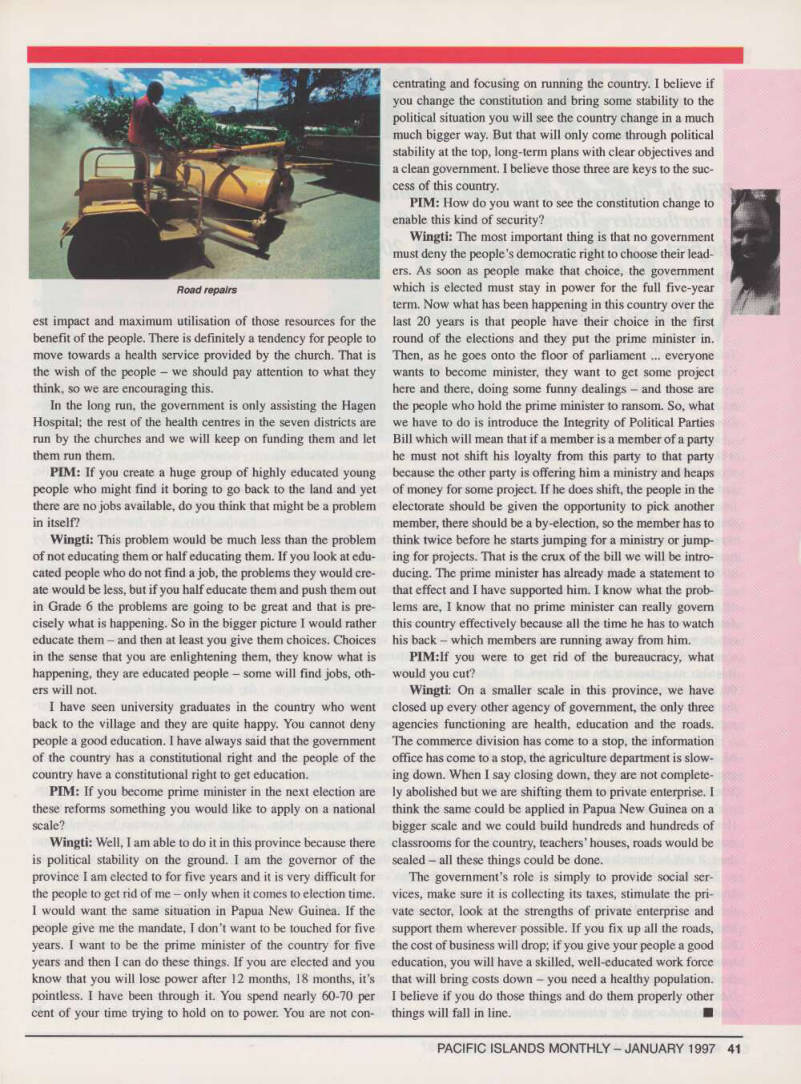
We had a lot of problems with roads throughout the province and even the town of Mt Hagen itself - it was like a cowboy town, you’d think you were driving a tractor or you were on the back of a horse or something. It’s a different place today. We have completely sealed the town and, I believe, as a result, the cost of business will come down. The maintenance cost of motor vehi cles, travelling costs, movement of equipment, the movement of teachers in the province - all these costs will start coming down and we will become more cost efficient. That is why we are spending a substantial proportion of the budget in this area. In fact, close to 40 per cent of the total budget is being spent on roads. This is what we are concentrating on.
The other most important area is education. The social prob-
lems Papua New Guinea is facing today have a lot to do with the lack of education; 60-70 per cent of young Papua New Guineans are not fully educated - they are pushed out of school at Grade 6 at the age of 11 or 12, they are very young and immature. When they are thrown out they are rejected by their parents because they could not go on to higher education. The system has failed them and this is the population which is the major source of our social problems. It is up to us as a government to give people a clear vision and provide our people a good education which takes them right up to Years 11 and 12. In this province, out of close to 30,000 young kids going to school, only 5000 get to high school and that is a very dangerous trend. Our role is to see that that figure increases. We want to create a situation where even tually no one is kicked out at Grade 6. That is why we are putting a lot of money into infrastructure, building new classrooms, teachers’ houses. The education expansion programme in the country must be backed up by an increase in the number of teachers in the country.
PIM: Are you certain that more children want to go on to higher education?
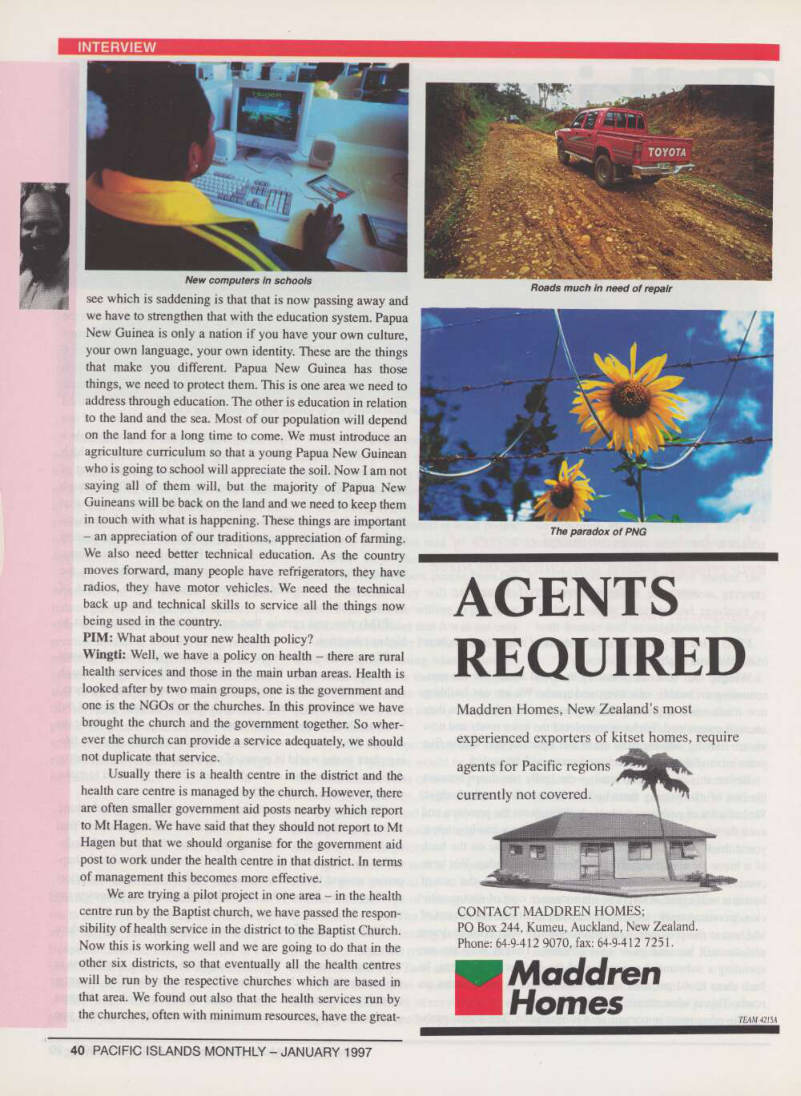
Wingti: They all want to go all Papua New Guineans want to go to high school. The problem is that there is not enough space in high school, not enough teachers, not enough teachers’ houses. That is why many young children have been pushed out because there is not enough room. Not only do we have to change this but we have to move with the changes that are tak ing place in the world in terms of communications. We are intro ducing computers into our high schools. Today you need to make your population computer literate.
We are going to spend some time looking at the curriculum.
In the past, the parents were sending their kids to school to find a job. This has got to totally change now - it has got to be edu cation to enlighten a person, to teach them about what is hap pening around the world, not to get a job as a number one prior ity. There may be no jobs, but at least Papua New Guineans are close to their land, close to their sea.
PIM: In what ways would you like to see the curriculum
change?
Wingti: There are several things that come to mind. One is the culture. Papua New Guinea is a very diversified country, diversity is its strength. There are many different tribes, different groups that have their own culture and one of the things that you
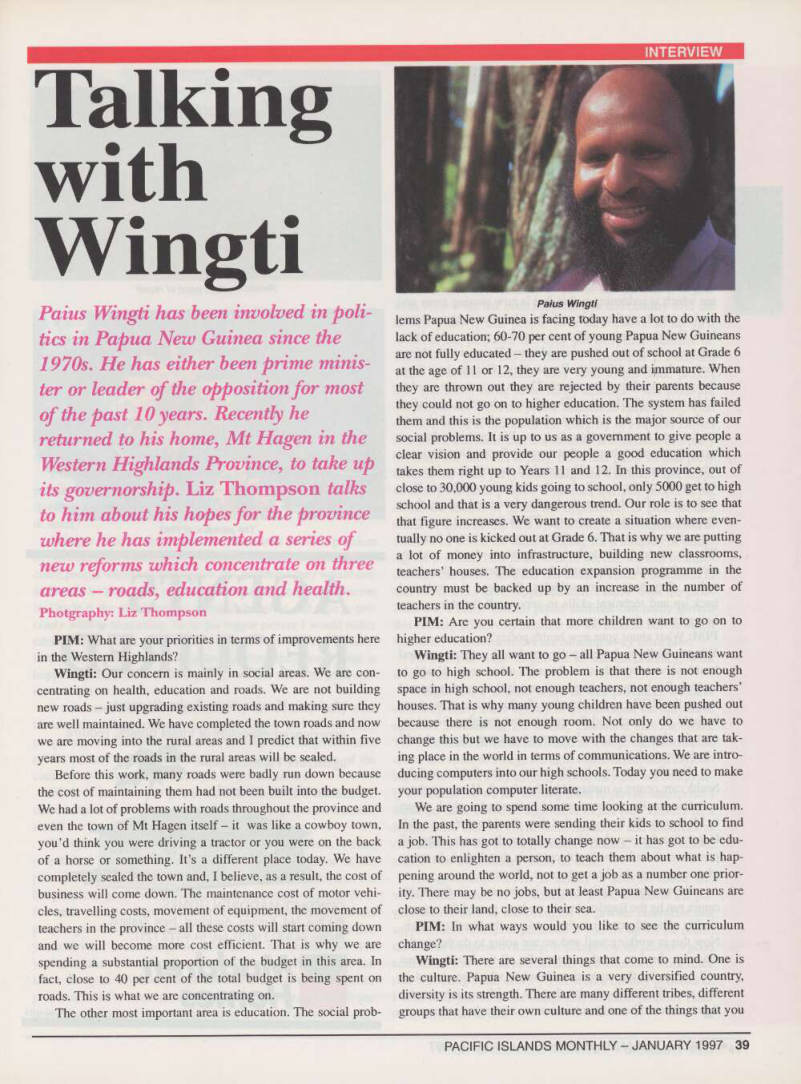
Paius Wingti
see which is saddening is that that is now passing away and we have to strengthen that with the education system. Papua New Guinea is only a nation if you have your own culture, your own language, your own identity. These are the things that make you different. Papua New Guinea has those things, we need to protect them. This is one area we need to address through education. The other is education in relation to the land and the sea. Most of our population will depend on the land for a long time to come. We must introduce an agriculture curriculum so that a young Papua New Guinean who is going to school will appreciate the soil. Now I am not saying all of them will, but the majority of Papua New Guineans will be back on the land and we need to keep them in touch with what is happening. These things are important - an appreciation of our traditions, appreciation of farming.
We also need better technical education. As the country moves forward, many people have refrigerators, they have radios, they have motor vehicles. We need the technical back up and technical skills to service all the things now being used in the country.
PIM: What about your new health policy?
Wingti: Well, we have a policy on health - there are rural health services and those in the main urban areas. Health is looked after by two main groups, one is the government and one is the NGOs or the churches. In this province we have brought the church and the government together. So wher ever the church can provide a service adequately, we should not duplicate that service.
Usually there is a health centre in the district and the health care centre is managed by the church. However, there are often smaller government aid posts nearby which report to Mt Hagen. We have said that they should not report to Mt Hagen but that we should organise for the government aid post to work under the health centre in that district. In terms of management this becomes more effective.
We are trying a pilot project in one area - in the health centre run by the Baptist church, we have passed the respon sibility of health service in the district to the Baptist Church.
Now this is working well and we are going to do that in the other six districts, so that eventually all the health centres will be run by the respective churches which are based in that area. We found out also that the health services run by the churches, often with minimum resources, have the great-
New computers in schools
Roads much in need of repair
The paradox of PNG
est impact and maximum utilisation of those resources for the benefit of the people. There is definitely a tendency for people to move towards a health service provided by the church. That is the wish of the people - we should pay attention to what they think, so we are encouraging this.
In the long run, the government is only assisting the Hagen Hospital; the rest of the health centres in the seven districts are run by the churches and we will keep on funding them and let them run them.
PIM: If you create a huge group of highly educated young people who might find it boring to go back to the land and yet there are no jobs available, do you think that might be a problem in itself?
Wingti: This problem would be much less than the problem of not educating them or half educating them. If you look at edu cated people who do not find a job, the problems they would cre ate would be less, but if you half educate them and push them out in Grade 6 the problems are going to be great and that is pre cisely what is happening. So in the bigger picture I would rather educate them - and then at least you give them choices. Choices in the sense that you are enlightening them, they know what is happening, they are educated people - some will find jobs, oth ers will not.
I have seen university graduates in the country who went back to the village and they are quite happy. You cannot deny people a good education. I have always said that the government of the country has a constitutional right and the people of the country have a constitutional right to get education.
PIM: If you become prime minister in the next election are these reforms something you would like to apply on a national scale?
Wingti: Well, I am able to do it in this province because there is political stability on the ground. I am the governor of the province I am elected to for five years and it is very difficult for the people to get rid of me - only when it comes to election time.
I would want the same situation in Papua New Guinea. If the people give me the mandate, I don’t want to be touched for five years. I want to be the prime minister of the country for five years and then I can do these things. If you are elected and you know that you will lose power after 12 months, 18 months, it’s pointless. I have been through it. You spend nearly 60-70 per cent of your time trying to hold on to power. You are not con
centrating and focusing on running the country. I believe if you change the constitution and bring some stability to the political situation you will see the country change in a much much bigger way. But that will only come through political stability at the top, long-term plans with clear objectives and a clean government. I believe those three are keys to the suc cess of this country.
PIM: How do you want to see the constitution change to enable this kind of security?
Wingti: The most important thing is that no government must deny the people’s democratic right to choose their lead ers. As soon as people make that choice, the government which is elected must stay in power for the full five-year term. Now what has been happening in this country over the last 20 years is that people have their choice in the first round of the elections and they put the prime minister in.
Then, as he goes onto the floor of parliament ... everyone wants to become minister, they want to get some project here and there, doing some funny dealings - and those are the people who hold the prime minister to ransom. So, what we have to do is introduce the Integrity of Political Parties Bill which will mean that if a member is a member of a party he must not shift his loyalty from this party to that party because the other party is offering him a ministry and heaps of money for some project. If he does shift, the people in the electorate should be given the opportunity to pick another member, there should be a by-election, so the member has to think twice before he starts jumping for a ministry or jump ing for projects. That is the crux of the bill we will be intro ducing. The prime minister has already made a statement to that effect and I have supported him. I know what the prob lems are, I know that no prime minister can really govern this country effectively because all the time he has to watch his back - which members are running away from him.
PIM:If you were to get rid of the bureaucracy, what would you cut?
Wingti: On a smaller scale in this province, we have closed up every other agency of government, the only three agencies functioning are health, education and the roads.
The commerce division has come to a stop, the information office has come to a stop, the agriculture department is slow ing down. When I say closing down, they are not complete ly abolished but we are shifting them to private enterprise. I think the same could be applied in Papua New Guinea on a bigger scale and we could build hundreds and hundreds of classrooms for the country, teachers’ houses, roads would be sealed - all these things could be done.
The government’s role is simply to provide social ser vices, make sure it is collecting its taxes, stimulate the pri vate sector, look at the strengths of private enterprise and support them wherever possible. If you fix up all the roads, the cost of business will drop; if you give your people a good education, you will have a skilled, well-educated work force that will bring costs down - you need a healthy population.
I believe if you do those things and do them properly other things will fall in line. ■
Road repairs