global warming
pp. 10-11 · Read in the full issue
Environment
Good news on global warming
By David North
Some years from now, if man’s habits do not change, global warm ing will melt the polar icecaps and the Pacific will wash over the low-lying islands: that’s the environmentalists’
warning.
Recently, however, three bits of good news on the subject have appeared - one scientific, one medical, and one political.
But before we deal with these cheerful items, it is useful to recall the enormous forces that threaten to perpetuate global
warming. They are ignorance, greed, and
momentum.
It is easy to ignore anything as hard to visualise as the weakening ozone layer over the globe that lets in more dangerous ultra-violet rays. What could be more invisible than ozone, holes in ozone, and
ultra-violet rays?
These are distant, fuzzy dangers, but the real costs of preventing them - lower usage of fossil fuels creating too much carbon dioxide - are much more obvious to the powerful First World interests who would rather not adjust their business pro cesses to save, say, the Bikinians from
having to move again.
It is easier to keep burning a lot of gas and oil, to continue to operate in the same old (momentum), and it certainly saves
money (greed).
Each bit of good news on global
warming has appeared quite independent
ly of the others, and the trio will probably be brought together here for the first time.
The scientific good news is that a much discussed theory has been tried in practice - in the Pacific Ocean hundreds of miles southwest of the Galapagos Islands - and it seems to work.
The notion is that if you put enough iron particles in the right part of the sea it will encourage the rapid growth of tiny creatures who will gobble up carbon diox
ide in the air, and thus help save the ozone
layer and prevent global warming.
The theory, set in motion 10 years ago by the late Dr John Martin, a California oceanographer, has been a controversial one for two reasons. The first and most straight-forward was that many scientists did not believe that Dr Martin’s experi ments (first carried out in bottles of sea water) could be replicated in the open ocean.
The second, and more convoluted, argument was this; many environmental ists reacted negatively to the suggestion, saying that it would take the pressure off the industrialists who wanted to continue their polluting ways. (Similarly, if you are a traffic safety enthusiast, and you want
lower highway speed limits, you might
greet the installation of collision-cushion ing airbags in cars as an excuse to drive at high speeds.) Because of these reasons and because of the expense involved, there were no field trials of Dr Martin’s idea for years.
Further, the first one was neithter a success nor a failure, as the seeded sea water began to show useful signs, but then that portion of the ocean was forced into the depths by neighbouring waters that were lighter (having less salt) than the
experimental waters.
As both scientists and sailors know, the ocean is unruly and will not always behave like a well-mannered group of test tubes.
But Dr Martin’s idea lingered after this death. More specifically, it relates to the differential incidence in the oceans of a tiny form of life, phytoplankton. In some parts of the ocean there is only one little phytoplankton to a drop of water, in other areas there are as many as 100,000 of them.
While the individual creatures are invisible to the naked eye, their collective presence is not; a stretch of sea with a
minimal incidence of phytoplankton is deep blue, with a lot of it, it turns brown or green. When there is a lot of it, it inter acts with the air, pulling carbon dioxide out of it - and thus helping to prevent
global warming.
But why are some parts of the sea rich in this stuff, and others not? Dr Martin puzzled over this, noticing that while some areas loaded with the nutrients phosphorus and nitrogen have lots of phy toplankton, other areas, equally blessed, do not.
He finally decided that the answer to the mystery might be another of nature’s building blocks, iron. Maybe the parts of the ocean - including parts of the tropical Pacific and the vast waters just North of Antarctica - without much phytoplankton were also low in iron.
He sprinkled some iron dust into bot tles of sea water from these regions and the phytoplankton bloomed.
The second sea test (scientists call it an in situ experiment) involved 990 pounds of iron filings (a relatively cheap com modity) and a 200-square-mile piece of the Pacific, which behaved well enough
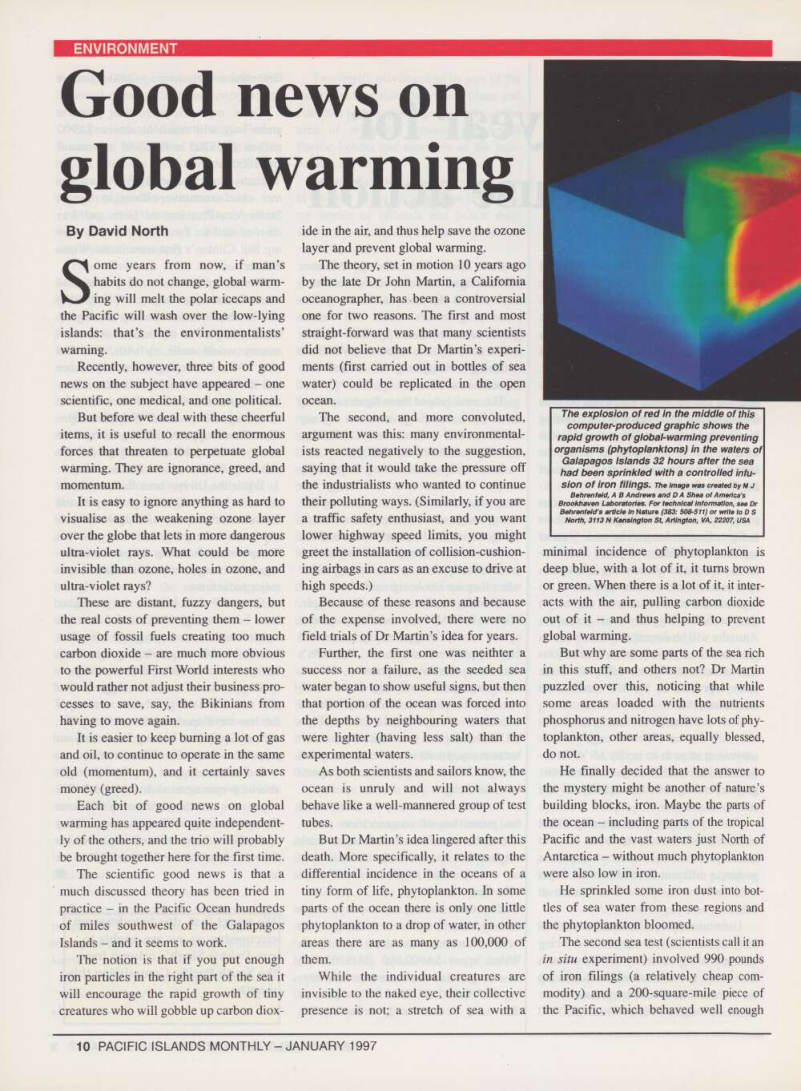
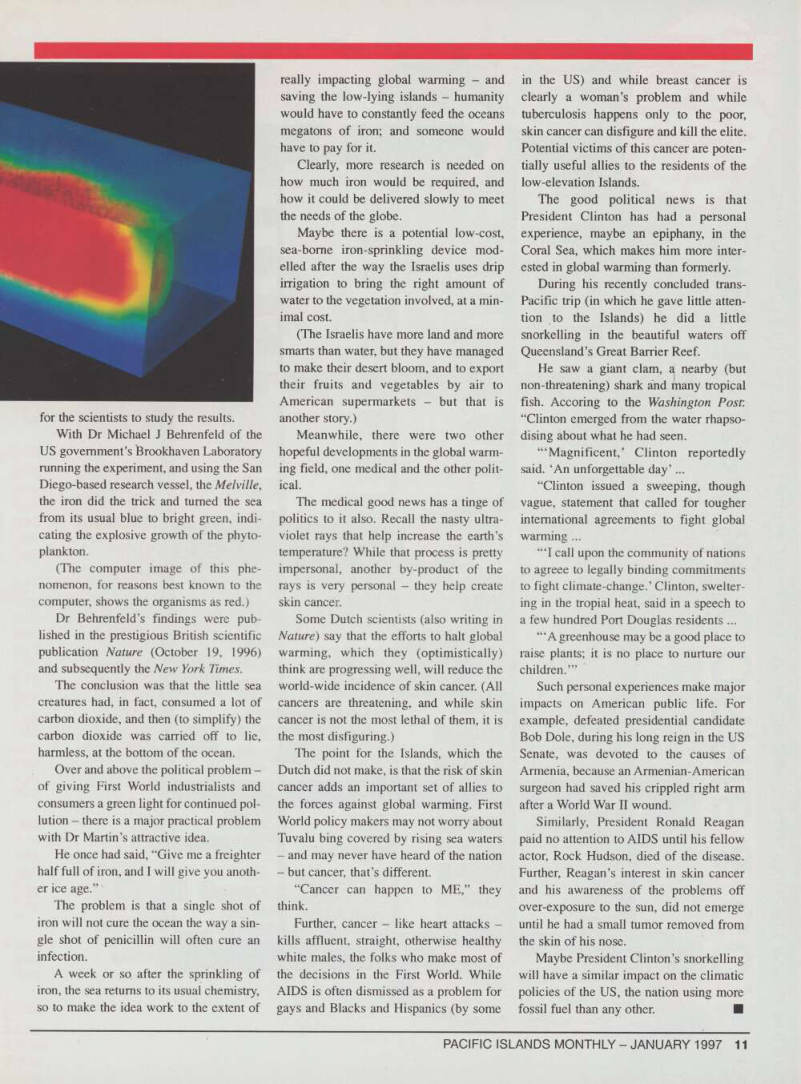
The explosion of red in the middle of this computer-produced graphic shows the
rapid growth of global-warming preventing
organisms (phytoplanktons) in the waters of Galapagos Islands 32 hours after the sea had been sprinkled with a controlled infu sion Of iron filings. The Image was created by M J Behrenfeld, A B Andrews and D A Shea of America’s Brookhaven Laboratories. For technical Information, see Dr Behrenfeld’s article In Nature (383: 508-511) or write to D S North, 3113 N Kensington St, Arlington, VA, 22207, USA
for the scientists to study the results.
With Dr Michael J Behrenfeld of the US government’s Brookhaven Laboratory running the experiment, and using the San Diego-based research vessel, the Melville, the iron did the trick and turned the sea from its usual blue to bright green, indi cating the explosive growth of the phyto plankton. (The computer image of this phe nomenon, for reasons best known to the computer, shows the organisms as red.) Dr Behrenfeld’s findings were pub lished in the prestigious British scientific publication Nature (October 19, 1996) and subsequently the New York Times.
The conclusion was that the little sea creatures had, in fact, consumed a lot of carbon dioxide, and then (to simplify) the carbon dioxide was carried off to lie, harmless, at the bottom of the ocean.
Over and above the political problem of giving First World industrialists and consumers a green light for continued pol lution - there is a major practical problem with Dr Martin’s attractive idea.
He once had said, “Give me a freighter half full of iron, and I will give you anoth er ice age.”
The problem is that a single shot of iron will not cure the ocean the way a sin gle shot of penicillin will often cure an infection.
A week or so after the sprinkling of iron, the sea returns to its usual chemistry, so to make the idea work to the extent of
really impacting global warming - and
saving the low-lying islands - humanity
would have to constantly feed the oceans megatons of iron; and someone would have to pay for it.
Clearly, more research is needed on how much iron would be required, and how it could be delivered slowly to meet the needs of the globe.
Maybe there is a potential low-cost, sea-borne iron-sprinkling device mod elled after the way the Israelis uses drip irrigation to bring the right amount of water to the vegetation involved, at a min imal cost. (The Israelis have more land and more smarts than water, but they have managed to make their desert bloom, and to export their fruits and vegetables by air to American supermarkets - but that is
another story.)
Meanwhile, there were two other hopeful developments in the global warm ing field, one medical and the other polit ical.
The medical good news has a tinge of politics to it also. Recall the nasty ultra violet rays that help increase the earth’s temperature? While that process is pretty impersonal, another by-product of the rays is very personal - they help create skin cancer.
Some Dutch scientists (also writing in Nature) say that the efforts to halt global warming, which they (optimistically) think are progressing well, will reduce the world-wide incidence of skin cancer. (All cancers are threatening, and while skin cancer is not the most lethal of them, it is the most disfiguring.) The point for the Islands, which the Dutch did not make, is that the risk of skin cancer adds an important set of allies to
the forces against global warming. First
World policy makers may not worry about Tuvalu bing covered by rising sea waters - and may never have heard of the nation - but cancer, that’s different.
“Cancer can happen to ME,” they think.
Further, cancer - like heart attacks kills affluent, straight, otherwise healthy white males, the folks who make most of the decisions in the First World. While AIDS is often dismissed as a problem for gays and Blacks and Hispanics (by some
in the US) and while breast cancer is clearly a woman’s problem and while tuberculosis happens only to the poor, skin cancer can disfigure and kill the elite.
Potential victims of this cancer are poten tially useful allies to the residents of the low-elevation Islands.
The good political news is that President Clinton has had a personal experience, maybe an epiphany, in the Coral Sea, which makes him more inter ested in global warming than formerly.
During his recently concluded trans pacific trip (in which he gave little atten tion to the Islands) he did a little snorkelling in the beautiful waters off Queensland’s Great Barrier Reef.
He saw a giant clam, a, nearby (but non-threatening) shark and many tropical fish. Accoring to the Washington Post.
“Clinton emerged from the water rhapso dising about what he had seen.
“‘Magnificent,’ Clinton reportedly said. ‘An unforgettable day’...
“Clinton issued a sweeping, though vague, statement that called for tougher international agreements to fight global warming ...
“T call upon the community of nations to agreee to legally binding commitments to fight climate-change.’ Clinton, swelter ing in the tropial heat, said in a speech to a few hundred Port Douglas residents ...
“‘A greenhouse may be a good place to raise plants; it is no place to nurture our children.’”
Such personal experiences make major impacts on American public life. For example, defeated presidential candidate Bob Dole, during his long reign in the US Senate, was devoted to the causes of Armenia, because an Armenian-American surgeon had saved his crippled right arm after a World War II wound.
Similarly, President Ronald Reagan paid no attention to AIDS until his fellow actor, Rock Hudson, died of the disease.
Further, Reagan’s interest in skin cancer and his awareness of the problems off over-exposure to the sun, did not emerge until he had a small tumor removed from the skin of his nose.
Maybe President Clinton’s snorkelling will have a similar impact on the climatic policies of the US, the nation using more fossil fuel than any other. ■