aspirations
pp. 7-9 · Read in the full issue
1997-the hopes and aspirations
1 997 is here. It could be a great year.
True, it is too early to say with a degree of certainty that 1997 will be a great year, but global changes taking place almost on a daily basis appear to be pointing that way.
One thing is certain. No one can dis miss the fact that as the last 100 years of this century draw to a close, men and women have never been surrounded by greater and more ample opportunities to excel. Yes, the possibility of failure also exists.
Great advances in technology have given mankind an added advantage. For instance, communicating with friends or business colleagues as well as advertising whatever product one has for sale is now at our fingertips.
Through the Internet, the information
super-highway is truly here.
Three years from now the annals will have closed on the last 100 years of this century.
A great century, it was. But one which would be remembered by the world’s 800 million malnourished and hungry people as a century whose achievements have been overshadowed by greed and individ ualism. Sad, but true.
In business and commerce, companies are turning out more profits than ever before. In the banking sector, for instance, profits continued to soar at the expense of encouraging ordinary people to save.
Machines are taking over from men and women whose livelihood depend on their employment, at least in the urban centres.
Interests paid on savings are stagnant or continue to nose-dive while lending rates remain abnormally and unreason ably high. Leniency on the part of gov ernments to allow commercial banks to
get away with this practice is mind-bog
gling.
Never before has one heard of a bank charging fees on clients’ savings. It is happening now - all in the name of the user-pay concept.
It’s all well and good, but some have the habit of stretching this beyond the imagination.
And so, as humanity takes the last bend on its race on the super-highway called the 90s, a lot more changes can be expected. Some for the better, others for the worse.
Here at the South Pacific Forum Secretariat, things are also changing.
In the last few years there have been debates about what the focus of this organisation should be as humanity stands on the verge of the next millenni um.
That question has now been resolved with the Secretariat’s governing body, known as the Forum Officials Committee, having approved the shift in
emphasis.
As of the beginning of this month, all technical programmes in the Secretariat would have ceased to function, except for the Energy Division. The division will continue to operate until a permanent home is found.
Civil Aviation, Maritime and Telecommunications divisions, on the other hand, have now closed shop.
Their contribution to the different sec tors in the overall development of the region cannot be disputed, thanks to the various donors who have made resources, including funding, available at the dispos al of the Secretariat to implement projects funded under these programmes.
Many of the personnel who had been involved in these programmes either from
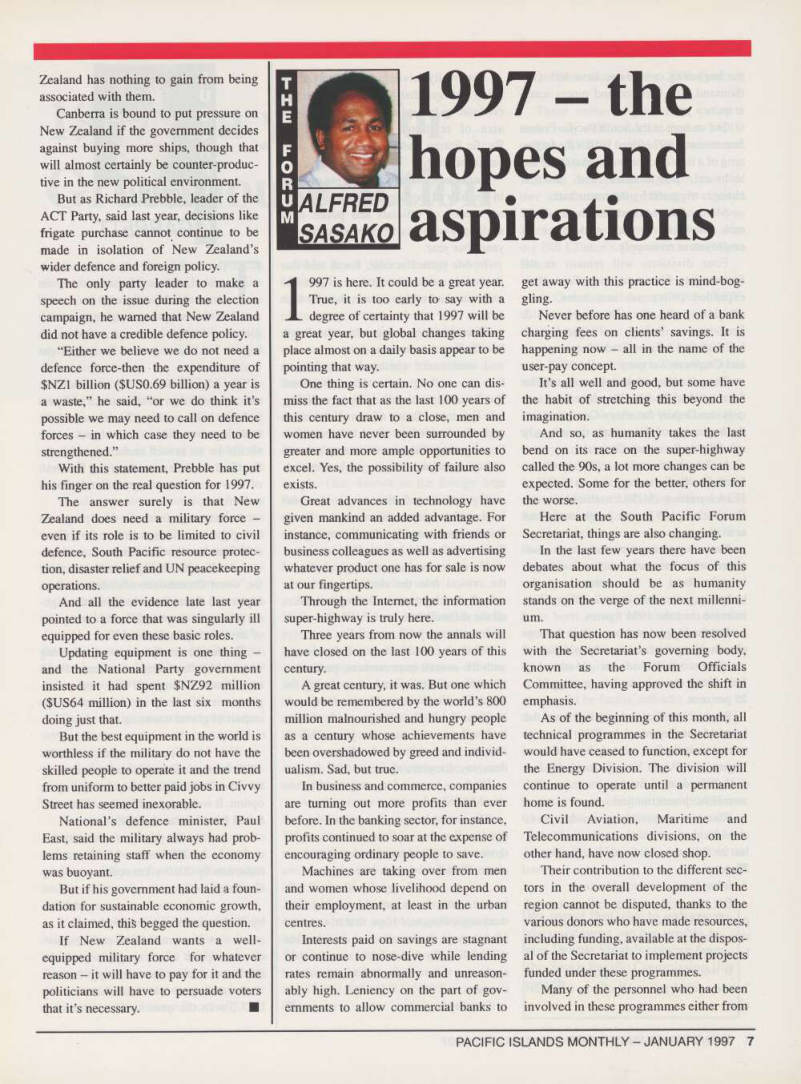
The Forum
Alfred
Sasako
the beginning or midway have left. One thousand nine hundred and ninety-seven is quite a year.
For us here at the South Pacific Forum Secretariat, 1997 indeed marks the begin ning of a new era: the out-migration of the technical programmes and internal
changes triggered by the restructure.
Many of the contract staff here will be new. New terms and conditions of
employment now apply.
Four divisions will remain at the Secretariat. Renamed to reflect their
expanded policy advisory roles, these
divisions are the Development & Economic Policy, Political & International Affairs, Trade & Investment and Corporate Services.
The year also marked the return of the Secretariat to the late 80s when there was
only one Deputy Secretary-General. As of
the beginning of this month, there is only
one Deputy Secretary-General.
In December, senior officials of the South Pacific Forum approved a budget of $F14.1 million (SUS9.B million) for the Secretariat’s 1997 work programmes and activities.
Drawn up to accommodate costs asso ciated with the major internal changes brought about by the restructuring, the budget registered an overall 9.3 per cent increase over the 1996 figures.
But the biggest increase was in the reg ular budget which comes from assessed member contributions or membership fees. Here, the increase was a staggering 25 per cent.
Papua New Guinea and Fiji bore the brunt of this increase. In Fiji’s case, its annual contribution went up by well over 16 per cent. Papua New Guinea’s lot is a cool 185 per cent increase over its 1996
membership contribution.
This year also marks an era for me as an individual. After six years, this is my last month with the South Pacific Forum Secretariat.
It has been a memorable time.
For my avid readers, colleagues and people that I have come to know through this column it has been a joy to work and know all of you.
It would have been impossible to say “vinaka vakalevu ” to all of you individu
ally.
I am really privileged to be part of the many changes that have taken place and continue to take place, particularly in the area of relations between the South Pacific Forum and members of the jour
nalist fraternity.
I remember vividly when I put my foot in the door of the Secretariat in 1991, hor ror stories of officials and police mar shalling journalists from meeting venues year after year.
In one particular case, I was told that journalists were marched to a pen-like enclosure and told to remain there or face arrest.
This was happening when the South Pacific Forum was in session.
I wasn’t sure whether I was afraid to face my colleagues in those situations.
But I was determined to play a mediating role in a truce. Being a journalist with an understanding of the need to meet dead lines, getting the bosses’ money’s worth and so on helped make my job a lot easi er.
But much of the credit for the improved relations between the South Pacific Forum and the media must go to Secretary-General leremia Tabai.
His understanding and appreciation of the critical role the media plays in the overall development in the region makes all the difference.
It made my job so easy.
While it is sad to leave, I am pleased with the overall improvement, particular ly with accessibility to leaders during the South Pacific Forum. Many of my col leagues, if not all, will agree with me that it is a lot easier now for journalists to arrange an interview with a Forum leader than, say, six years ago.
We have come a long way. And so we should have.
The world has so changed in the last decade that there is no more room for those who still harbour the idea of going it alone. We all need each other.
And so, to all my friends and col leagues, it’s been great knowing and working with you. I hope that in my next (and perhaps final) column, I shall be able to introduce my replacement out of the 43 applicants who responded to the adver tisement.
Goodbye! ■
This is the year when the industri alised nations of the world - the ones which produce 80 per cent of the Greenhouse gases which are causing global warming - have promised to set legally binding tragets to limit their gas emissions.
The high-level meeting at which the nations are to sign on takes place in Kyoto in Japan in December. The debate and the lobbying over the sort of targets which should be set is well under way with the Pacific Islands, as usual, in the forefront of moves to secure significant emission reductions.
At this stage there are four proposals being given serious consideration. Other solutions, based on minimal action or spe cial pleading, are being touted by some of the worst Greenhouse offenders such as Japan and Australia (which has the high est per capita output of Greenhouse gases of any country in the world).
The four main options are those being assessed by the Intergovernmental Panel on Climate Change (IPCC), the presti gious scientific body which is tracking the impact of global warming.
They are: • A 20 per cent reduction on the 1990 level of Greenhouse emissions by the year 2005. This is the most stringent option. It was proposed by the Alliance of Small Island States (AOSIS). • A 10 per cent reduction in emissions by 2005 and a 15-20 per cent reduction by 2010 - the option put up by Germany. • A five to 10 per cent reduction by 2010 - the British proposal. • A return to 1990 emission lev els - an option which simply extends the deadline for reductions already promised.
According to the scientists of the IPCC, even the most stringent measures
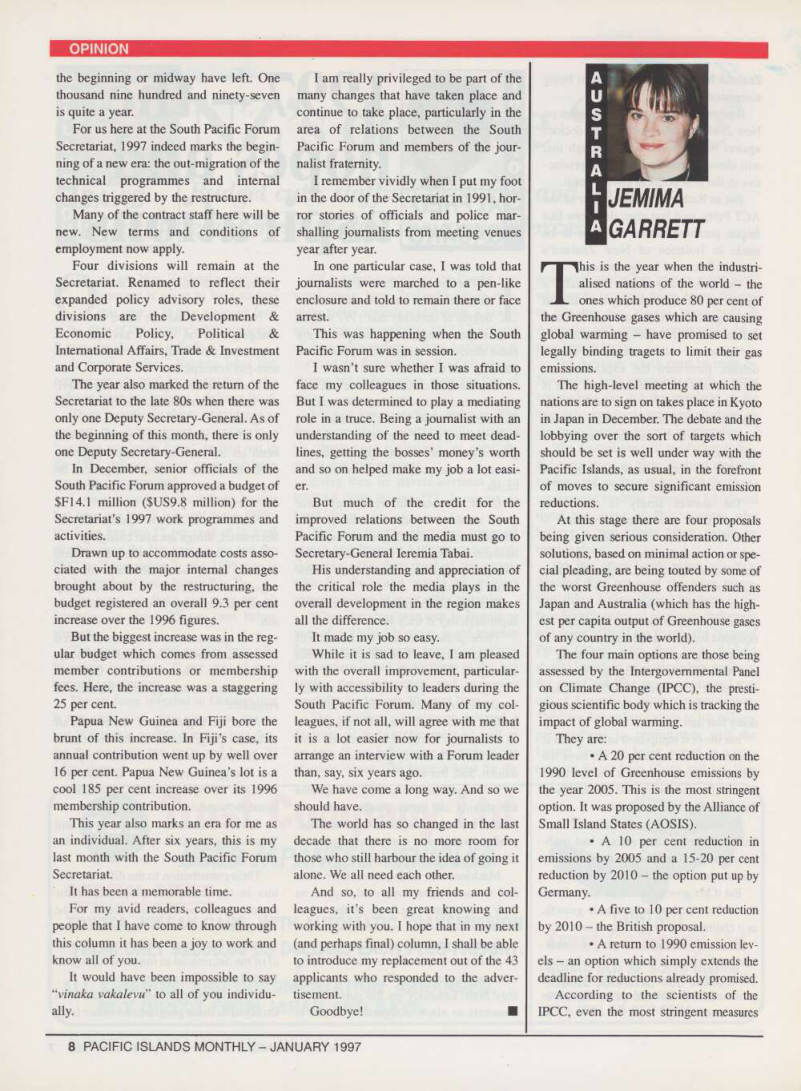
Jemima
Garrett
Australia
1997-a year for Greenhouse action
implemented by the Western nations alone, would not be enough to stabilise levels of carbon dioxide (the main Greenhouse gas) or stop sea level rises.
Despite that, it seems the AOSIS option is already an objective which is too utopian to win support.
Under President Bill Clinton, it has been the United States which has become the engine for Greenhouse action. During his visit to Australia in November, Clinton used his speech in Cairns to rebuff the Howard government’s refusal to accept
legally binding targets.
“I call upon the community of nations to agree to legally binding commitments to fight climate change,” he said. “Just as we have been allies for peace and free dom, we must be allies in the 21 st centu ry to protect the earth’s environment.”
Australia, however, was not moved. As the world’s biggest coal exporter, Australia will be disproportionately hit by Greenhouse targets. Prime Minister John Howard reiterated his view that to take the same approach as the US would cost
Australian jobs.
The Australian government says it can not reach the current weak targets and is continuing to push its policy of ‘differen tiation’, that is, different gas emission tar gets depending on the capacity of the country to comply.
Not surprisingly, it has come up with a scheme which would see it do least to reduce Greenhouse emissions. Japan is pushing a different form of tailored target and its scheme also places least burden on itself.
Unfortunately for Howard, the credi bility of the Australian position is being undermined by action by the New South Wales state government which is proving the current Greenhouse targets and more can be met with a little political will.
New South Wales Energy Minister Michael Egan has released figures which show that in the last year he has put in place programmes which will reduce greenhouse emissions by 8.25 million tonnes annually - an amount equivalent to removing a staggering 1.8 million cars from the state’s roads.
The work behind these figures is being done by a small government agency called the Sustainable Energy Development Authority (SEDA).
Some of its solutions are surprisingly simple. One, known as the Energy Star Programme, is aimed at reducing the energy usage of office equipment such as computer terminals, photocopiers and fax machines by ensuring that they switch automatically into a low-energy state when they are not being used.
Hi-tech manufacturers, such as Apple, Microsoft, IBM, Intel and Compaq, have agreed to sell Energy Star equipment and big employers, such as Australia’s telecommunications corporation, Telstra, are changing over to Energy Star. For tel stra alone, savings on electricity bills are estimated at more than SAS million (SUS 3.9 million) a year. Not only that, but because equipment is not being run at full strength 24 hours a day, it can be expect ed to last longer.
Another success story for SEDA is in
the promotion of co-generation plants.
These plants are ideal for industries which use both hot water and electricity as they use a single fuel to produce both more
effectively.
Rockdale Meats, a company which runs an abattoir and meat packing export business in central-western New South Wales, spent $A900,000 ($U5707,000) on a co-generation plant and is now sav ing $A300,000 ($U5235,000) a year on electricity costs and reducing its
Greenhouse emissions by 2000 tonnes a year.
Three more co-generation projects
under way will result in almost SA9OO million (SUS7O7 million) of investment and 1000 jobs.
Cathy Zoi, director of SEDA, is a for mer chief executive officer to United States Vice-President A 1 Gore and was chief of staff for Environment Policy dur ing Bill Clinton’s first term in the White House.
She is upbeat about the potential to meet Greenhouse targets. “We (NSW) will be able to meet virtually any legally binding target that the international com munity would come up with,” Ms Zoi said. “What I’m hoping is that other states and the Commonwealth and other coun tries around the world will look at it the same way as New South Wales and iden tify these opportunities which save money, create jobs and are good for the economy. They are there for the taking.”
While the US has been the main inter national force maintaining the pressure for industrialised nations to agree to bind ing Greenhouse gas emission targets, it is Europe which is setting the pace in ensur ing those targets commit countries to major reductions.
Germany and Britain, in particular, have been strong advocates of decisive action and are hoping to form a formidable bloc by bringing the entire European Union behind their campaign.
The latest information suggests that plan could be facing setbacks as some of the less developed members of the EU, such as Spain, are looking favourably on proposals which offer differentiation.
Indications suggest that the US might also be preparing to slide backwards. US negotiators attending last month’s Climate
Change meeting in Geneva were talking
of deadlines for mandatory targets which did not come into effect until 2010 or later. ■
We regret that, due to unforeseen circumstances, we are unable to run Debbie Singh’s column from the South Pacific Commission this month