Mururoa
pp. 14-16 · Read in the full issue
Cover Stories
Mururoa the untold story
By Bernadette Hussein
As he lay on his deathbed, a Tahitian who worked on Mururoa Atoll, wondered about the future of his country and its fight for indepen dence from France, having been subjected to nuclear testing in the region by the colonial power. The man died late last year from thyroid cancer.
Choosing an oar as a symbol of this struggle for freedom, the Tahitian worker asked that it be passed on to the people of East Timor in their similar fight against colonialism. In a simple but emotional ceremony on December 11, the oar was presented to the head of a delegation from East Timor at the Nuclear Freedom in the Pacific Conference in Suva, Fiji.
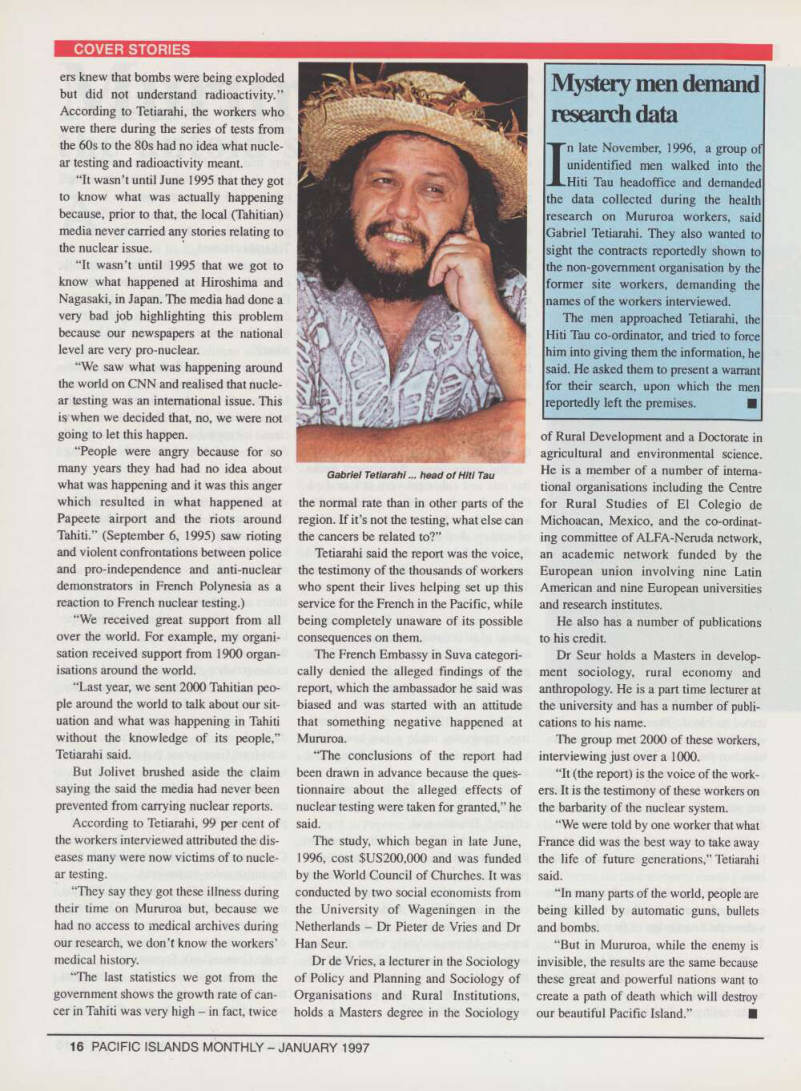
Gabriel Tetiarahi, co-ordinator of the Hiti Tau, a non-government organisation in Tahiti, told the conference that pressure on the French to stop their tests before schedule was the first step towards achieving the goal of independence. But, he reiterated, the end to testing did not mean that they were actually free.
France continued to conduct nuclear tests at Mururoa and Fangataufa atolls in
French Polynesia, despite international
protest, until last year. And the French government has maintained throughout that the tests did not present any adverse effects on the environment. The world has known very little of the nature of the French tests, carried out under tight secu rity, in the region and even less about the Tahitians working on the site and the nature of their work.
But just over 30 years after the first of the French tests, Hiti Tau has become the voice of these faceless workers with a recently compiled health report scheduled for release on January 28. After the last series of tests in 1995, Hiti Tau, with the Protestant Church of French Polynesia (E(n)glise Evangelique) initiated the first
comprehensive independent study on the
possible consequences of French nuclear tests on the health and wellbeing of the
people of French Polynesia. (Among
those interviewed were workers who had served on Mururoa during the first test in 1966 through to the last series of tests in 1995.) Perhaps more shocking than the medical findings are what the report states were the terms of the contracts signed by the workers pledging them not only to a lifestyle of silence on the activities at Mururoa, but denying access to their med ical records and effectively preventing the workers from seeking any compensation for possible health problems.
“When these workers were taken to Mururoa, they were made to sign con tracts which were designed to prohibit them from doing a number of things. The first condition was that they would never speak to anyone about the nature of their work,” Tetiarahi said.
“The second condition, that they (the workers) agreed to was that if they died while on Mururoa, the military would not allow their families access to information relating to their work, health and medical history.
“For the workers, it was just another job, a way of getting paid - so they did not ask any questions.”
“The French were very strict with their rules and if someone was found to be
breaking or disobeying them, they were
sent back to Papeete on the first flight out of Mururoa,” Tetiarahi said.
The French ambassador in Fiji, Michel Jolivet, said the confidentiality demanded by the workers’ contracts was natural practice with French governmental work.
It was “totally false and stupid gossip” that people were dying from cancer as a result of the Mururoa tests, Jolivet main tained.
People have gone there for years and no one has ever complained of contracting
cancer and the environment, he said.
However, he strongly denied that workers families were not provided access to medical reports.
But according to Tetiarahi about 90 per cent of the (1000) on-site workers (inter viewed) suffer from various types of can cers, including leukaemia and thyroid cancer.
“During the time we spent meeting and interviewing these workers, we noticed how some of them suffered from a partic ular kind of skin disorder. Their skin seemed to lack pigmentation - but, in fact, this was because there was no skin, just flesh,” Tetiarahi.
“It was really a sad sight, and when they pressed themselves too hard they
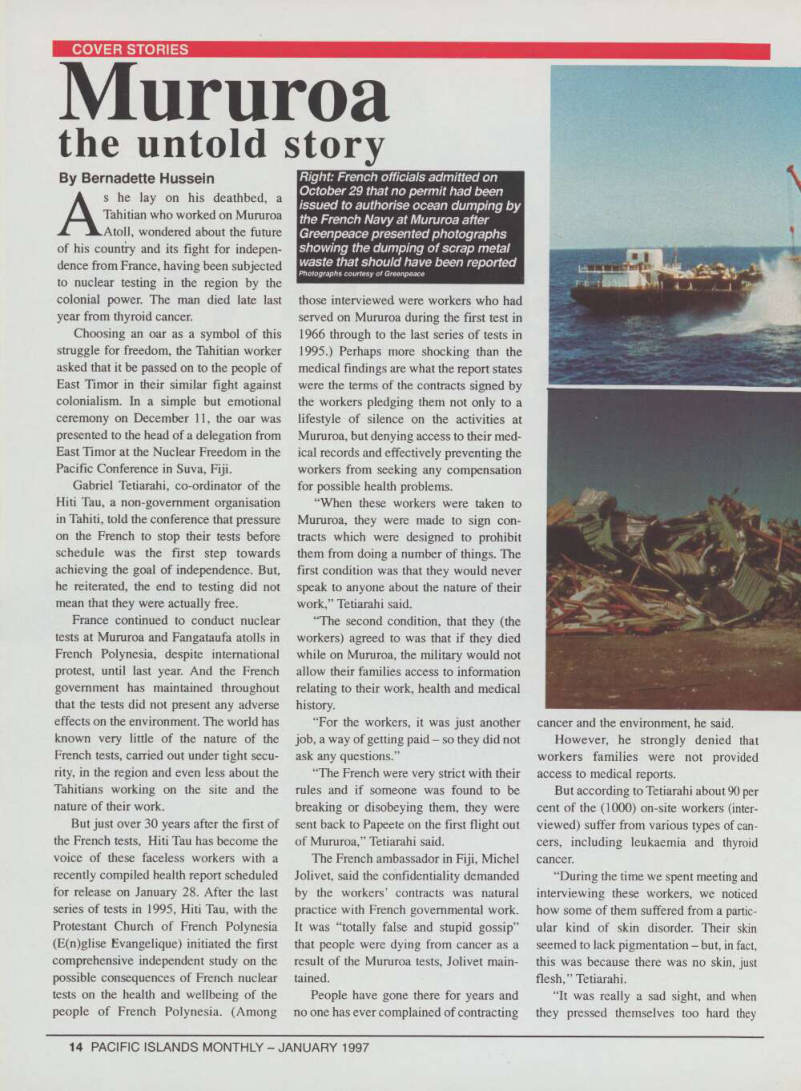
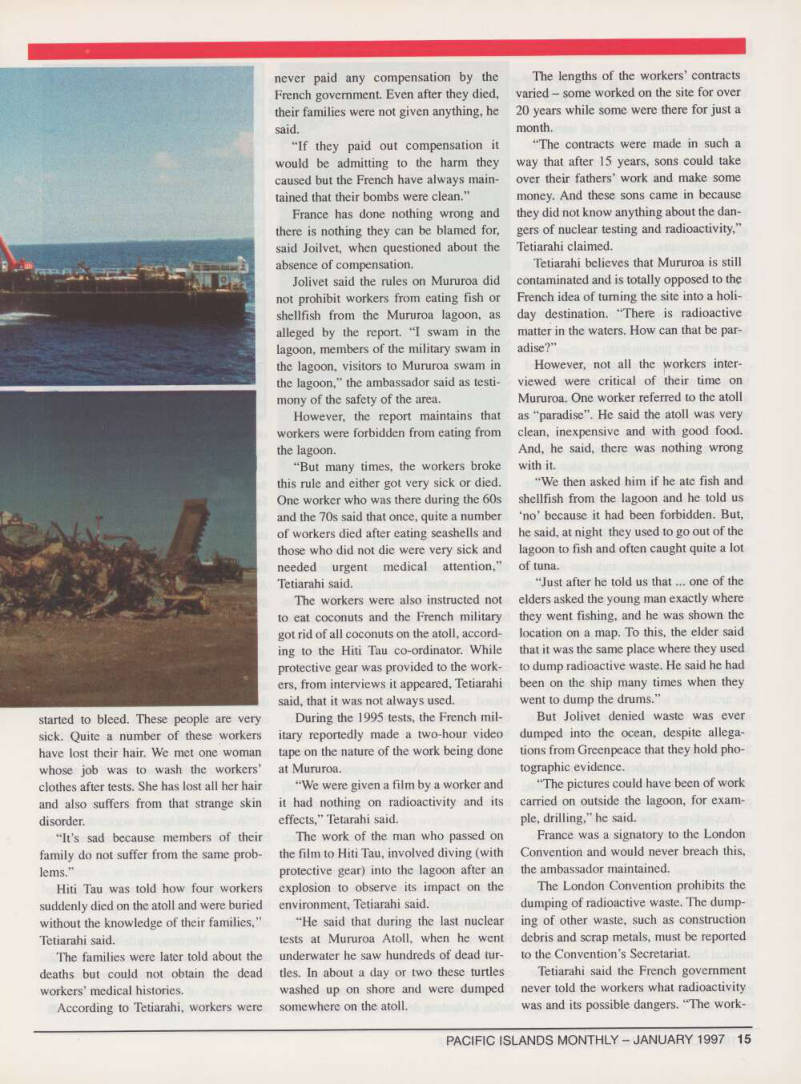
Right: French officials admitted on October 29 that no permit had been issued to authorise ocean dumping by the French Navy at Mururoa after Greenpeace presented photographs showing the dumping of scrap metal waste that should have been reported Photographs courtesy of Greenpeace
started to bleed. These people are very sick. Quite a number of these workers have lost their hair. We met one woman whose job was to wash the workers’ clothes after tests. She has lost all her hair and also suffers from that strange skin disorder.
“It’s sad because members of their family do not suffer from the same prob lems.”
Hiti Tau was told how four workers suddenly died on the atoll and were buried without the knowledge of their families,”
Tetiarahi said.
The families were later told about the deaths but could not obtain the dead workers’ medical histories.
According to Tetiarahi, workers were
never paid any compensation by the
French government. Even after they died, their families were not given anything, he said.
“If they paid out compensation it
would be admitting to the harm they caused but the French have always main tained that their bombs were clean.”
France has done nothing wrong and there is nothing they can be blamed for, said Joilvet, when questioned about the absence of compensation.
Jolivet said the rules on Mururoa did not prohibit workers from eating fish or shellfish from the Mururoa lagoon, as alleged by the report. “I swam in the lagoon, members of the military swam in the lagoon, visitors to Mururoa swam in the lagoon,” the ambassador said as testi mony of the safety of the area.
However, the report maintains that workers were forbidden from eating from
the lagoon.
“But many times, the workers broke this rule and either got very sick or died.
One worker who was there during the 60s and the 70s said that once, quite a number of workers died after eating seashells and those who did not die were very sick and needed urgent medical attention,”
Tetiarahi said.
The workers were also instructed not to eat coconuts and the French military got rid of all coconuts on the atoll, accord ing to the Hiti Tau co-ordinator. While protective gear was provided to the work ers, from interviews it appeared, Tetiarahi said, that it was not always used.
During the 1995 tests, the French mil itary reportedly made a two-hour video tape on the nature of the work being done at Mururoa.
“We were given a film by a worker and it had nothing on radioactivity and its effects,” Tetarahi said.
The work of the man who passed on the film to Hiti Tau, involved diving (with protective gear) into the lagoon after an explosion to observe its impact on the environment, Tetiarahi said.
“He said that during the last nuclear tests at Mururoa Atoll, when he went underwater he saw hundreds of dead tur tles. In about a day or two these turtles washed up on shore and were dumped somewhere on the atoll.
The lengths of the workers’ contracts varied - some worked on the site for over 20 years while some were there for just a month.
“The contracts were made in such a way that after 15 years, sons could take over their fathers’ work and make some money. And these sons came in because they did not know anything about the dan gers of nuclear testing and radioactivity,”
Tetiarahi claimed.
Tetiarahi believes that Mururoa is still contaminated and is totally opposed to the French idea of turning the site into a holi day destination. “There is radioactive matter in the waters. How can that be par adise?”
However, not all the workers inter viewed were critical of their time on Mururoa. One worker referred to the atoll as “paradise”. He said the atoll was very clean, inexpensive and with good food.
And, he said, there was nothing wrong with it.
“We then asked him if he ate fish and shellfish from the lagoon and he told us ‘no’ because it had been forbidden. But, he said, at night they used to go out of the lagoon to fish and often caught quite a lot of tuna.
“Just after he told us that... one of the elders asked the young man exactly where they went fishing, and he was shown the location on a map. To this, the elder said that it was the same place where they used to dump radioactive waste. He said he had been on the ship many times when they went to dump the drums.”
But Jolivet denied waste was ever dumped into the ocean, despite allega tions from Greenpeace that they hold pho
tographic evidence.
“The pictures could have been of work carried on outside the lagoon, for exam ple, drilling,” he said.
France was a signatory to the London Convention and would never breach this, the ambassador maintained.
The London Convention prohibits the dumping of radioactive waste. The dump ing of other waste, such as construction debris and scrap metals, must be reported to the Convention’s Secretariat.
Tetiarahi said the French government never told the workers what radioactivity was and its possible dangers. “The work
ers knew that bombs were being exploded but did not understand radioactivity.”
According to Tetiarahi, the workers who were there during the series of tests from the 60s to the 80s had no idea what nucle ar testing and radioactivity meant.
“It wasn’t until June 1995 that they got to know what was actually happening because, prior to that, the local (Tahitian) media never carried any stories relating to the nuclear issue.
“It wasn’t until 1995 that we got to know what happened at Hiroshima and Nagasaki, in Japan. The media had done a
very bad job highlighting this problem
because our newspapers at the national level are very pro-nuclear.
“We saw what was happening around the world on CNN and realised that nucle ar testing was an international issue. This is / when we decided that, no, we were not going to let this happen.
“People were angry because for so many years they had had no idea about what was happening and it was this anger which resulted in what happened at Papeete airport and the riots around Tahiti.” (September 6, 1995) saw rioting and violent confrontations between police and pro-independence and anti-nuclear demonstrators in French Polynesia as a reaction to French nuclear testing.) “We received great support from all over the world. For example, my organi sation received support from 1900 organ isations around the world.
“Last year, we sent 2000 Tahitian peo ple around the world to talk about our sit uation and what was happening in Tahiti without the knowledge of its people,”
Tetiarahi said.
But Jolivet brushed aside the claim saying the said the media had never been prevented from carrying nuclear reports.
According to Tetiarahi, 99 per cent of the workers interviewed attributed the dis eases many were now victims of to nucle
ar testing.
“They say they got these illness during their time on Mururoa but, because we had no access to medical archives during our research, we don’t know the workers’
medical history.
“The last statistics we got from the government shows the growth rate of can cer in Tahiti was very high - in fact, twice
the normal rate than in other parts of the region. If it’s not the testing, what else can the cancers be related to?”
Tetiarahi said the report was the voice, the testimony of the thousands of workers who spent their lives helping set up this service for the French in the Pacific, while being completely unaware of its possible consequences on them.
The French Embassy in Suva categori cally denied the alleged findings of the report, which the ambassador he said was biased and was started with an attitude that something negative happened at Mururoa.
“The conclusions of the report had been drawn in advance because the ques tionnaire about the alleged effects of nuclear testing were taken for granted,” he said.
The study, which began in late June, 1996, cost SUS2OO,OOO and was funded by the World Council of Churches. It was conducted by two social economists from the University of Wageningen in the Netherlands - Dr Pieter de Vries and Dr Han Seur.
Dr de Vries, a lecturer in the Sociology of Policy and Planning and Sociology of Organisations and Rural Institutions, holds a Masters degree in the Sociology
of Rural Development and a Doctorate in agricultural and environmental science.
He is a member of a number of interna tional organisations including the Centre for Rural Studies of El Colegio de Michoacan, Mexico, and the co-ordinat ing committee of ALFA-Neruda network, an academic network funded by the European union involving nine Latin American and nine European universities and research institutes.
He also has a number of publications to his credit.
Dr Seur holds a Masters in develop ment sociology, rural economy and anthropology. He is a part time lecturer at the university and has a number of publi cations to his name.
The group met 2000 of these workers, interviewing just over a 1000.
“It (the report) is the voice of the work ers. It is the testimony of these workers on the barbarity of the nuclear system.
“We were told by one worker that what France did was the best way to take away the life of future generations,” Tetiarahi said.
“In many parts of the world, people are being killed by automatic guns, bullets and bombs.
“But in Mururoa, while the enemy is invisible, the results are the same because these great and powerful nations want to create a path of death which will destroy our beautiful Pacific Island.” ■
Gabriel Tetiarahi...head of Hiti Tau