Feathers
pp. 54-56 · Read in the full issue
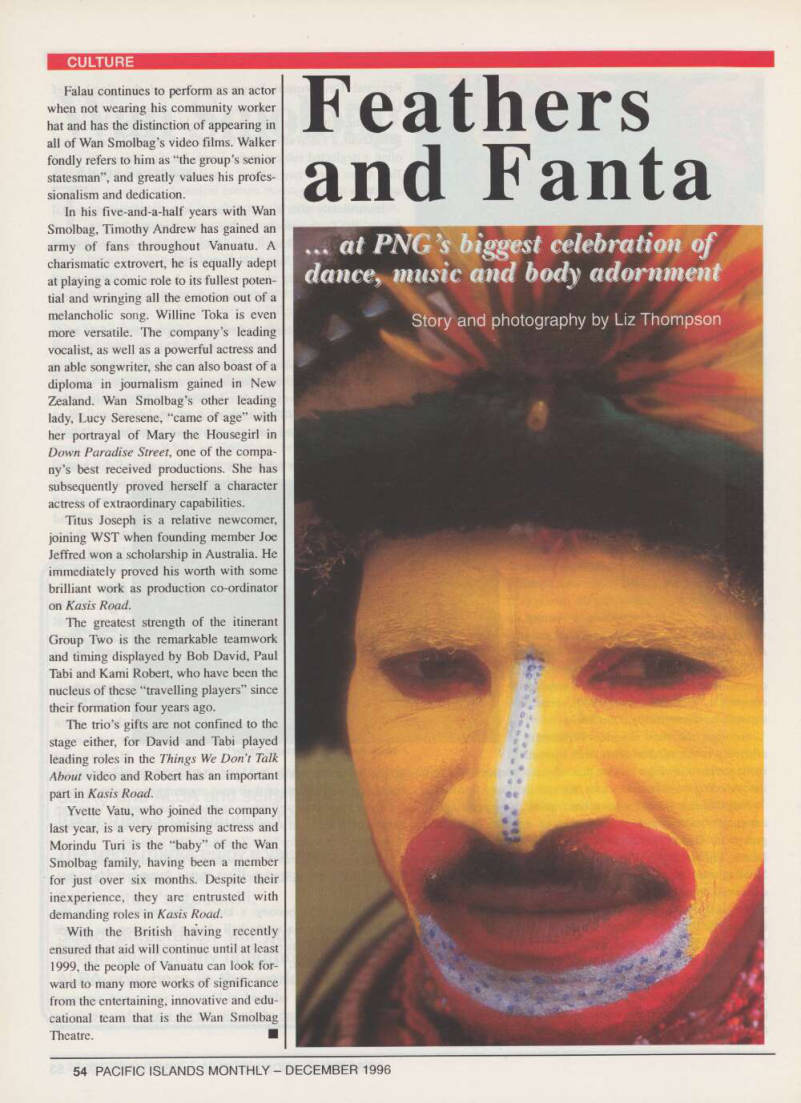
and FAnta
... at PNG’s biggest celebration of dance . music and body adornment
Story and photography by Liz Thompson
Nearly 150 clan groups gath ered at Goroka in the Papua New Guinea Highlands for the coun try’s biggest Sing Sing, a celebration of dance, music and body adornment. In anticipation of the four-day show, excite ment was building long before it began.
Trucks filled with men, women and chil
dren, singing and playing guitars, trav
elled along the Highlands Highway
towards Goroka. Many performers trav elled for days by boat, car or on foot, often walking through dense rainforest and over steep and hilly terrain.
On the first day of the show, as the mist slowly rose from the green valley floor and the peaks of the mountains became visible, thousands of performers gathered outside the main showground.
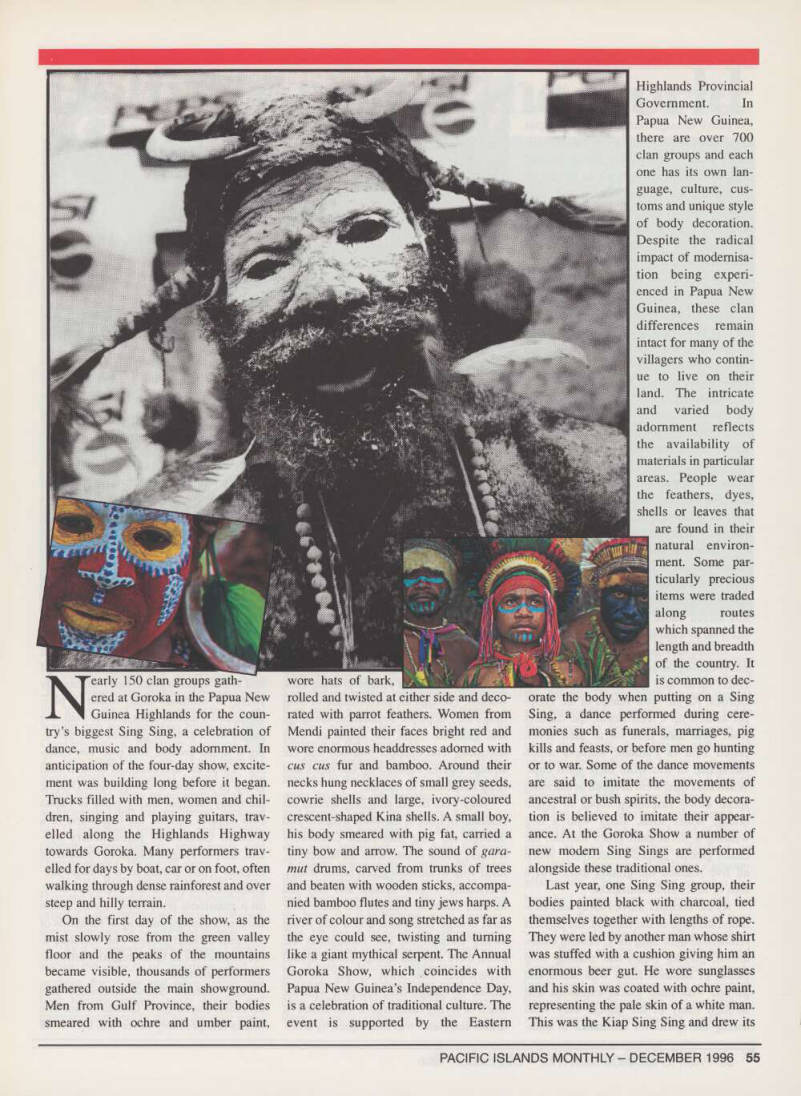
Men from Gulf Province, their bodies smeared with ochre and umber paint,
wore hats of bark,
rolled and twisted at either side and deco rated with parrot feathers. Women from Mendi painted their faces bright red and wore enormous headdresses adorned with cus cus fur and bamboo. Around their necks hung necklaces of small grey seeds, cowrie shells and large, ivory-coloured crescent-shaped Kina shells. A small boy, his body smeared with pig fat, carried a tiny bow and arrow. The sound of gara mut drums, carved from trunks of trees and beaten with wooden sticks, accompa nied bamboo flutes and tiny jews harps. A river of colour and song stretched as far as the eye could see, twisting and turning like a giant mythical serpent. The Annual Goroka Show, which coincides with Papua New Guinea’s Independence Day, is a celebration of traditional culture. The event is supported by the Eastern
Highlands Provincial Government. In Papua New Guinea, there are over 700 clan groups and each one has its own lan guage, culture, cus toms and unique style of body decoration.
Despite the radical impact of modernisa tion being experi enced in Papua New Guinea, these clan differences remain intact for many of the villagers who contin ue to live on their land. The intricate and varied body adornment reflects the availability of materials in particular areas. People wear the feathers, dyes, shells or leaves that
are found in their natural environ ment. Some par
ticularly precious
items were traded
along routes
which spanned the length and breadth of the country. It is common to dec
orate the body when putting on a Sing Sing, a dance performed during cere monies such as funerals, marriages, pig kills and feasts, or before men go hunting or to war. Some of the dance movements are said to imitate the movements of ancestral or bush spirits, the body decora tion is believed to imitate their appear ance. At the Goroka Show a number of new modem Sing Sings are performed alongside these traditional ones.
Last year, one Sing Sing group, their bodies painted black with charcoal, tied themselves together with lengths of rope.
They were led by another man whose shirt was stuffed with a cushion giving him an enormous beer gut. He wore sunglasses and his skin was coated with ochre paint, representing the pale skin of a white man.
This was the Kiap Sing Sing and drew its
strange inspiration from modem times. It referred to Australian Kiaps who walked on patrol through remote areas of Papua New Guinea keeping an eye on the vil
lages. Another Sing Sing group painted
official-looking red and white stripes on their shoulders with red ochre and lime, made truncheons of cardboard and marched in rows imitating the police.
Alongside all this sat the lurid reminder of commercial sponsors. Pepsi gave out cardboard visors at the toll gates, covered in their logo. Tru Kai rice pro moted the nutrdional quality of its prod uct by erecting a stage on which three burly Papua New Guinean men, their bod ies smeared with coconut oil, pouted and postured for most of Saturday afternoon.
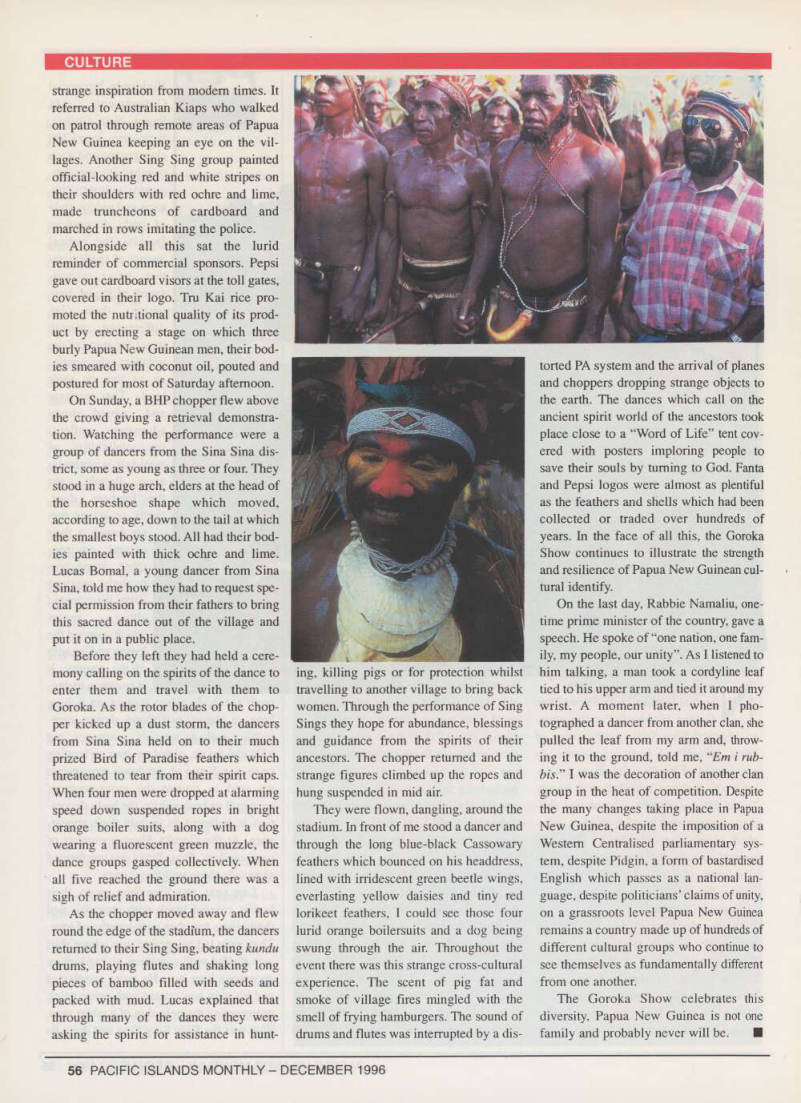
On Sunday, a BHP chopper flew above the crowd giving a retrieval demonstra tion. Watching the performance were a group of dancers from the Sina Sina dis trict, some as young as three or four. They stood in a huge arch, elders at the head of the horseshoe shape which moved, according to age, down to the tail at which the smallest boys stood. All had their bod ies painted with thick ochre and lime.
Lucas Bomal, a young dancer from Sina Sina, told me how they had to request spe cial permission from their fathers to bring this sacred dance out of the village and put it on in a public place.
Before they left they had held a cere mony calling on the spirits of the dance to enter them and travel with them to Goroka. As the rotor blades of the chop per kicked up a dust storm, the dancers from Sina Sina held on to their much prized Bird of Paradise feathers which threatened to tear from their spirit caps.
When four men were dropped at alarming speed down suspended ropes in bright orange boiler suits, along with a dog wearing a fluorescent green muzzle, the dance groups gasped collectively. When all five reached the ground there was a sigh of relief and admiration.
As the chopper moved away and flew round the edge of the stadium, the dancers returned to their Sing Sing, beating kundu drums, playing flutes and shaking long pieces of bamboo filled with seeds and packed with mud. Lucas explained that through many of the dances they were asking the spirits for assistance in hunt-
ing, killing pigs or for protection whilst travelling to another village to bring back women. Through the performance of Sing
Sings they hope for abundance, blessings
and guidance from the spirits of their ancestors. The chopper returned and the strange figures climbed up the ropes and hung suspended in mid air.
They were flown, dangling, around the stadium. In front of me stood a dancer and through the long blue-black Cassowary feathers which bounced on his headdress, lined with irridescent green beetle wings,
everlasting yellow daisies and tiny red
lorikeet feathers, I could see those four lurid orange boilersuits and a dog being swung through the air. Throughout the event there was this strange cross-cultural experience. The scent of pig fat and smoke of village fires mingled with the smell of frying hamburgers. The sound of drums and flutes was interrupted by a dis
torted PA system and the arrival of planes and choppers dropping strange objects to the earth. The dances which call on the ancient spirit world of the ancestors took place close to a “Word of Life” tent cov ered with posters imploring people to save their souls by turning to God. Fanta and Pepsi logos were almost as plentiful as the feathers and shells which had been collected or traded over hundreds of years. In the face of all this, the Goroka Show continues to illustrate the strength and resilience of Papua New Guinean cul
tural identify.
On the last day, Rabbie Namaliu, one time prime minister of the country, gave a speech. He spoke of “one nation, one fam ily, my people, our unity”. As I listened to him talking, a man took a cordyline leaf tied to his upper arm and tied it around my wrist. A moment later, when I pho tographed a dancer from another clan, she pulled the leaf from my arm and, throw ing it to the ground, told me, “Em i rub his.” I was the decoration of another clan group in the heat of competition. Despite the many changes taking place in Papua New Guinea, despite the imposition of a Western Centralised parliamentary sys tem, despite Pidgin, a form of bastardised English which passes as a national lan
guage, despite politicians’ claims of unity,
on a grassroots level Papua New Guinea remains a country made up of hundreds of different cultural groups who continue to see themselves as fundamentally different from one another.
The Goroka Show celebrates this diversity, Papua New Guinea is not one family and probably never will be. ■