Halfway round the world
pp. 57-58 · Read in the full issue
Yachting
By Sally Andrew
In 1989, in a pub halfway round the
world, 19-year-old adventurer Rory
McDougall decided to circumnavigate
the globe on a tiny catamaran. So he bought two red fibreglass hulls and built Cooking Fat, a Wharram-designed Tiki 21. Two years later, Rory set sail from the south coast of England bound for the South Pacific. Rory never intended to sail singlehanded but his girlfriend declared his 21-foot boat “too small” and his step brother succumbed to seasickness and claustrophobia. He set off alone.
At first, Rory did not enjoy life at sea.
Haunted by loneliness and frustration, he sailed Cookie harder and faster, knowing that in harbour he would find friends.
“As a neophyte singlehander, I didn’t realise the effects of isolation. And in pressing for more and more speed, the boat became wetter, more erratic and more uncomfortable, all by my own mak
ing.” Discouraged, Rory tried unsuccess
fully to sell Cookie in the Canary Islands.
Then he posted a “Crew Wanted” sign, and met a German backpacker. Together they sailed Cookie across the Atlantic, a 29-day passage from La Palma to St Maarten in the Caribbean.
After transitting the Panama Canal and arriving in the Pacific, Rory adopted a far more laid-back philosophy to voyaging and began to enjoy the journey. As long as on-board life was good, he felt, the voy age was satisfying. His goal became:
“Keeping going, keep positive. We’ll get
there eventually.” Rory learned to face and overcome his fears. By not pushing the boat, the ride became more comfort able. He began to relish the passagemak ing and sailed across the Pacific, stopping at Easter Island, Mangareva and Rarotonga, with a three-year work stop in New Zealand. Halfway round the world, Rory is now enjoying a long overdue
reunion with his father in Australia.
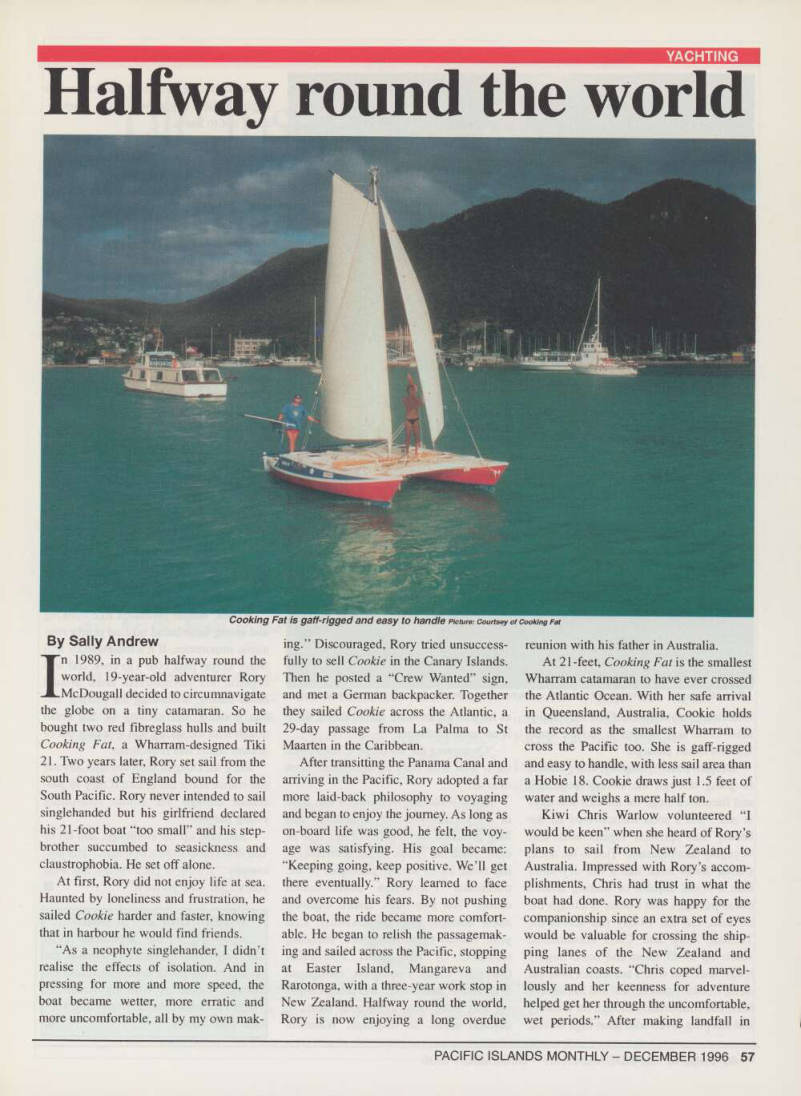
At 21-feet. Cooking Fat is the smallest Wharram catamaran to have ever crossed the Atlantic Ocean. With her safe arrival in Queensland, Australia, Cookie holds the record as the smallest Wharram to cross the Pacific too. She is gaff-rigged and easy to handle, with less sail area than a Hobie 18. Cookie draws just 1.5 feet of water and weighs a mere half ton.
Kiwi Chris Warlow volunteered “I would be keen” when she heard of Rory’s plans to sail from New Zealand to Australia. Impressed with Rory’s accom plishments, Chris had trust in what the boat had done. Rory was happy for the companionship since an extra set of eyes would be valuable for crossing the ship ping lanes of the New Zealand and Australian coasts. “Chris coped marvel lously and her keenness for adventure helped get her through the uncomfortable, wet periods.” After making landfall in
Cooking Fat is gaff-rigged and easy to handle Picture: Courtsey of Cooking Fat
Gladstone, her excitement was unrestrain able. Chris was thrilled at having made her first ocean passage.
Despite Chris’ company, Rory admits to going through the normal homesick and friendsick stage for the first few days at sea. “But I soon rediscovered all the
beauty and spiritual togetherness that
voyaging encompasses.” Tied to the dock, Cookie looks more like a fun day-sailer than a vessel capable of making serious ocean passages. But Cookie is a tough lit tle boat. On the 14-day trip across the Tasman, Rory and Chris encountered winds up to 45 knots and some mighty rough seas. But with a sea anchor over the stem, Cookie parks herself and life aboard becomes comfortable enough for cooking and sleeping. Even with mast-high waves,
as long as the sails are reefed down, there is no sense of danger.
“Quartering the sea helps. Cookie rides them well with only an occasional crest over us.”
James Wharram, designer of this style of Polynesian-inspired catamaran, has long preached the benefits of this type of craft. Since the 19505, he has been design ing boats based on the principles of the traditional Polynesian double-hulled canoe. The two hulls, lashed together, allow strength through flexibility. Last year, Matahi Greg Brightwell, founding president of the Maori Polynesian Outrigger Canoe Federation, challenged Wharram’s “borrowing” this design, argu ing that there were indigenous rights to cultural ideas. In response, Wharram
declared that the design of the Polynesian double-hulled canoe was “too magnifi cent” not to share.
Rory departed England with no elec
tronic devices aboard. Navigation was by sextant, stars and compass. Speed was judged by looking at the water passing beneath the hull. One exception was a bat tery-operated shortwave radio which gave him the BBC World Service and the “time tick”. Having an accurate fix on Universal Co-ordinated Time is essential in sextant
navigation.
A windvane nicknamed “Harry”, an ingenious mechanical steering device that responds to the wind’s direction, keeps Cookie on a course relative to the wind and consumes no electricity. Rain or shine, day or night, “Harry” steers the boat - as long as there is wind.
Rory keeps his sailing simple, but has added a few creature comforts. A solar panel and battery now provide power for a stereo, VHP, spotlight, and a fluorescent light in each hull. In port, Rory erects a green “harbour tent” which increases his living space and helps with water collec tion. A compact gas stove in the starboard hull sets up smartly and enables Rory to cook meals easily and quickly, with a minimum of fuss.
At sea, simple pleasures like cooking and eating fresh bread take on nearly ritu alistic importance. If it’s rough, Rory will heave to (or ‘park boat’) to cook and will organise his navigational tasks around
bread-baking, alternating the mixing, ris
ing, cooking and cooling of his bread dough with the taking and working out of sextant sights and reductions.
Rory McDougall believes that anyone can realise his or her dream if they’re pas
sionate enough. He enjoys motivating
young people.
“Just take up the challenge, and do it!
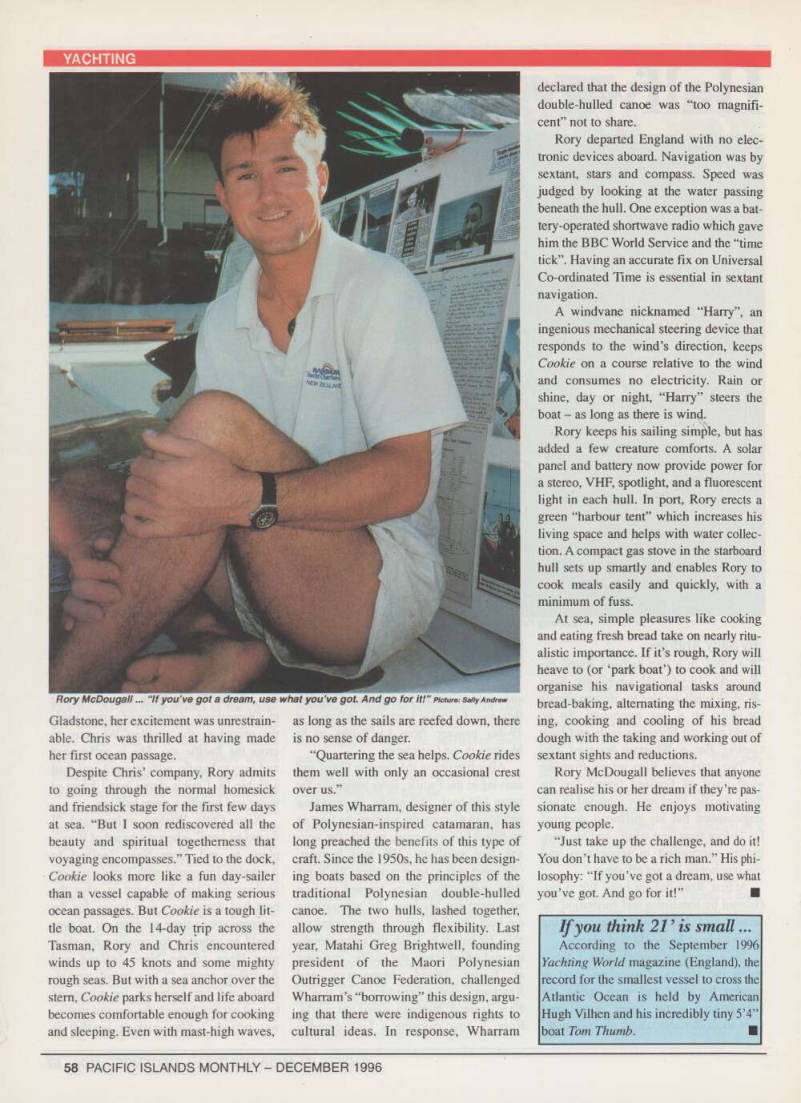
You don’t have to be a rich man.” His phi losophy: “If you’ve got a dream, use what you’ve got. And go for it!” ■
If you think 21 ’ is small...
According to the September 1996
Yachting World magazine (England), the
record for the smallest vessel to cross the Atlantic Ocean is held by American Hugh Vilhen and his incredibly tiny 5’4” boat Tom Thumb. ■
Rory McDougall... “If you’ve got a dream, use what you’ve got. And go for it!” Picture: Sally A ndrew