Wan Smolbag’s big influence
pp. 52-54 · Read in the full issue

Culture
By Atama Raganivatu
The concept of theatrical groups moving from community to community and enlightening the populace on health, environmental and social issues has been embraced enthusiastically by several South Pacific countries during recent years. Vanuatu’s Wan Smolbag Theatre is at the vanguard of this movement.
Wan Smolbag’s name is a testimony to its humble begin nings. In Bisla na, the local variety of Pidgin English, it means “One Small Bag” - which was the only thing needed to carry the fledgling company’s clothes and props.
Englishman Peter Walker was the driving force behind WST’s information and, as its director today, he remains a vital factor as it continues to thrive.
Walker trained as an actor in London before moving to Zimbabwe, where he worked as a teacher but remained active in amateur dramatics. While in Zimbabwe, he met compatriot Jo Dorras, a fellow teacher who was equally enthusiastic about the atre. When Dorras gained a position at Vila’s Malapra College, Walker moved to Vanuatu with her.
After discovering that Vanuatu offered little in organised community theatre compared with southern Africa’s flourishing
scene, Walker and Dorras, along with four locally bom drama devotees, formed Wan Smolbag in 1989. Initially, they were con tent to take their plays (all written by the English pair and all set in Vila) around the main island of Efate. However, when the cen tral government’s health department, environment unit and dis aster preparation unit all recognised the group as a highly effec tive means of communicating their recommendations to locali
ties far and wide, the six-strong company found itself performing in the republic’s outer regions too.
Wan Smolbag’s reputation soon spread beyond Vanuatu and, less than a year after its formation, the Australian federal government’s community Aid Abroad
organisation provided sufficient funding for
four actors to be employed full time.
In 1993, Britain’s Overseas Development Administration assumed responsibility as WST’s chief sponsor and, because of its continuing generosity, the the atre has expanded into an organisation employing 11 professional actors, an admin istrator, a community worker, a director and a scriptwriter (Dorras fills the latter posi tion). The company now consists of two sec tions. Group One is based in Vila, while Group Two travels, almost exclusively, around the outer islands.
Wan Smolbag also works closely with five other theatre groups in Vanuatu; two based in Vila and three in the exterior regions. The Australian branch of the Save the Children Fund provides financial back ing for those serving the villages.
The subjects tackled by WST range from spouse abuse to littering. They have
Bob David, left, is the policeman and Kami Robert is the crab in the children's play “The Litter Creatures"
promoted conservation, kindergartens, family
planning, sanitation, immunisation, indigenous
languages, the rights of the disabled, breast feed ing, drug abstinence and pure drinking water.
Their actors are skilled in the art of putting audiences at ease and conveying the messages of Dorras’ neatly crafted scripts in a manner far more effective than any sermon given by a gov ernment official.
Shortly after Wan Smolbag visits a village, its community worker, Charleon Falau (one of the company’s “originals” from 1989), returns to ascertain how convincing it has been.
Amongst the most tangible barometers of efficiency is the number of children immunised
in the weeks following a play on that subject, compared to a sim ilar preceding time. In some cases, the rate increased fourfold.
Neighbouring countries have been quick in recognising the company’s success and endeavouring to emulate it. Theatre groups in Guam, Micronesia, American Samoa, Solomon Islands, Fiji and Kiribati have all benefited from visits by Wan Smolbag in the past few years and the Vanuatuans regularly con duct workshops in Vila for actors throughout the South Pacific region. In particular, strong links have been established with Kiribati’s Te Itibwerere Theatre Group, WAC Theatre of Fiji and Mere Action from the Solomons. 1996 has been particularly busy for WST. The year com menced with it applying the finishing touches to a video version of its popular puppet play On The Reef, which explains in sim ple but striking terms the frailty of the Pacific Islands’ ecosys tem. On The Reef will be used extensively in the South Pacific
Regional Environment Programme Year of the Coral Reef
Campaign.
The next major project was the making of Things We Don’t Talk About, a video advancing the rights of disabled people - too often a neglected subject in the South Pacific. Things We Don’t Talk About stars Francis Ruru, a paraplegic who works fulltime with Wan Smolbag.
Immediately after a completing a cassette of environmental songs, WST undertook a whirlwind five-day-long tour of Honiara’s schools. Then, it was off to Fiji, where it provided the resources for a United Nations International Children’s Emergency Fund drug abuse workshop. A series of plays staged at schools back in Vila followed in conjunction with Mere Action.
This took Wan Smolbag through to September and its most ambitious enterprise yet - Kasis Road. This is purely a video production, not an adoption of a successful play, as all earlier ventures on the electronic medium have been. Ninety minutes long, it details the lives of a family living in a Vila shanty settle ment. As with all WST initiatives, Kasis Road contains moral messages and this time they concern population issues and fam
ily planning.
The theatre’s first full-length feature was filmed on location
on a set con structed upon land kindly loaned by the chief of Ifira.
Walker hopes that Kasis Road will divert Vanuatuans away, at least briefly, from the often violent Hollywood
action movies currently in vogue and help them appreciate the relevance and richness of their own contemporary culture.
Kasis Road may well prove as much a landmark in Vanutuan serious entertainment as the internationally acclaimed film Once Were Warriors was for New Zealand’s film industry.
Walker, though, has no doubt that Wan Smolbag will remain focused on Vanuatu, irrespective of what prestige it gains else where.
“We may have become a king of the media unit for the Pacific, but our main work shall always be touring the islands and urban settlements of Vanuatu with community plays in both English and Bislama,” he says.
The urbane Englishman is now happy to work in the back ground and let his talented ni-Vanuatu actors and actresses receive the lion’s share of plaudits for the magic they weave on the stage.
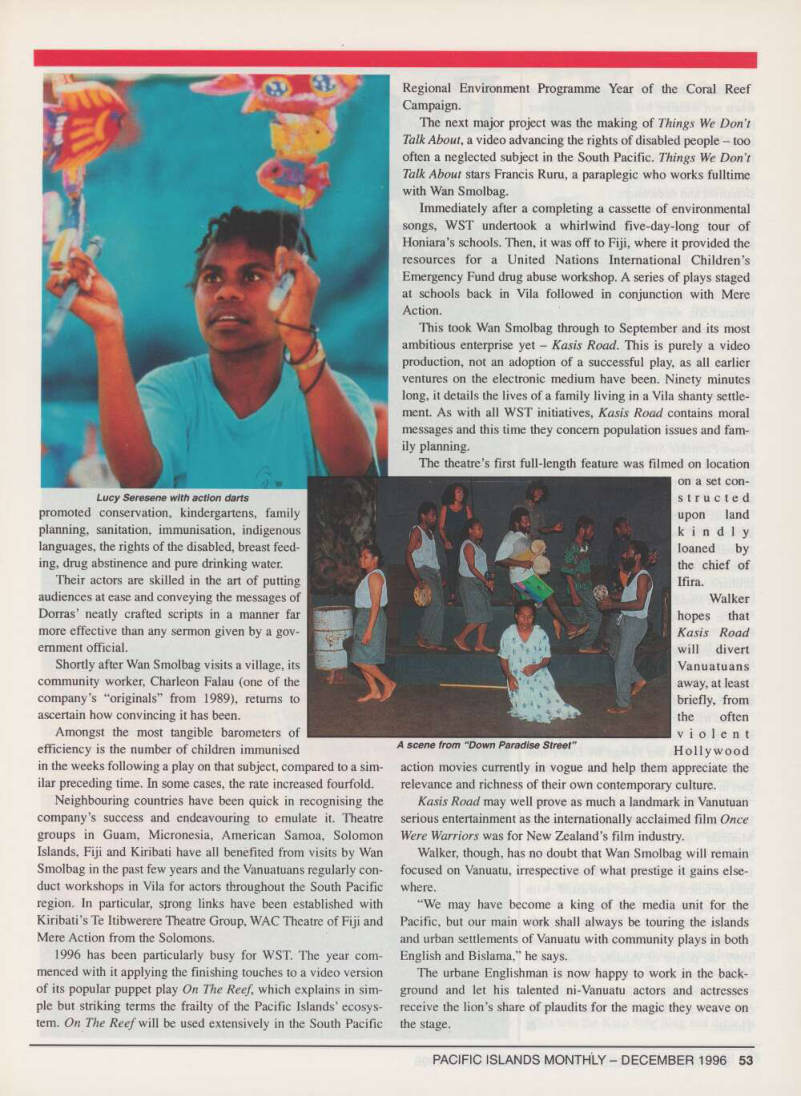
Lucy Seresene with action darts
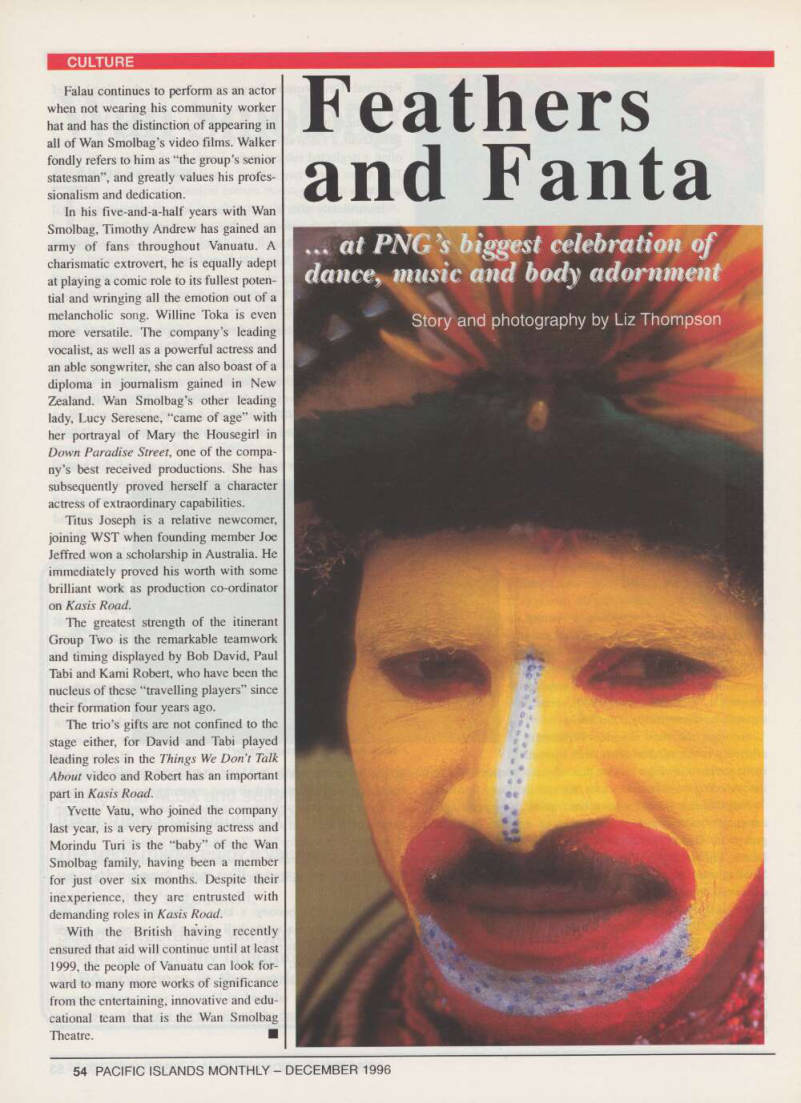
A scene from "Down Paradise Street"
Falau continues to perform as an actor when not wearing his community worker hat and has the distinction of appearing in all of Wan Smolbag’s video films. Walker fondly refers to him as “the group’s senior statesman”, and greatly values his profes sionalism and dedication.
In his five-and-a-half years with Wan
Smolbag, Timothy Andrew has gained an
army of fans throughout Vanuatu. A charismatic extrovert, he is equally adept at playing a comic role to its fullest poten tial and wringing all the emotion out of a melancholic song. Willine Toka is even more versatile. The company’s leading vocalist, as well as a powerful actress and an able songwriter, she can also boast of a
diploma in journalism gained in New
Zealand. Wan Smolbag’s other leading lady, Lucy Seresene, “came of age” with her portrayal of Mary the Housegirl in Down Paradise Street, one of the compa ny’s best received productions. She has subsequently proved herself a character actress of extraordinary capabilities.
Titus Joseph is a relative newcomer, joining WST when founding member Joe Jeffred won a scholarship in Australia. He immediately proved his worth with some brilliant work as production co-ordinator on Kasis Road.
The greatest strength of the itinerant Group Two is the remarkable teamwork and timing displayed by Bob David, Paul Tabi and Kami Robert, who have been the nucleus of these “travelling players” since their formation four years ago.
The trio’s gifts are not confined to the stage either, for David and Tabi played leading roles in the Things We Don’t Talk About video and Robert has an important part in Kasis Road.
Yvette Vatu, who joined the company last year, is a very promising actress and Morindu Turi is the “baby” of the Wan Smolbag family, having been a member for just over six months. Despite their inexperience, they are entrusted with demanding roles in Kasis Road.
With the British having recently ensured that aid will continue until at least 1999, the people of Vanuatu can look for ward to many more works of significance from the entertaining, innovative and edu cational team that is the Wan Smolbag Theatre. ■