Fatialofa hangs up his boots
pp. 46-47 · Read in the full issue
By Atama Raganivatu
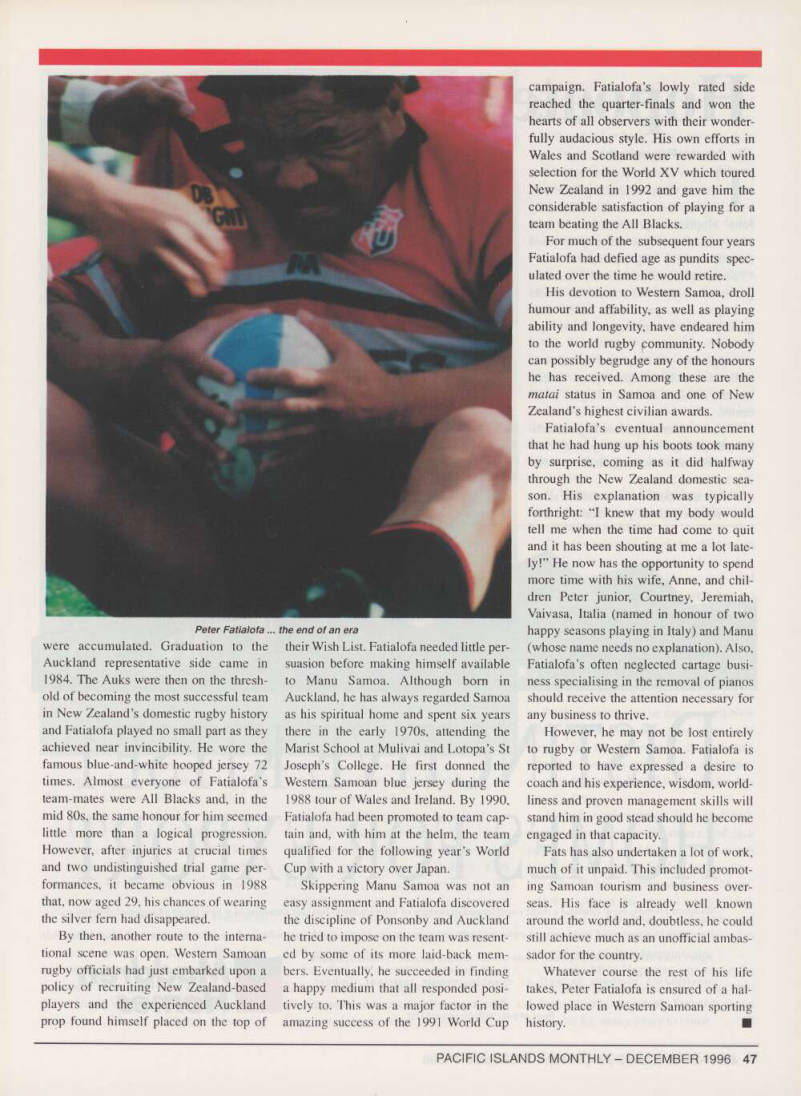
Manu Samoa icon Peter Fatialofa’s recent retirement almost certainly marked the end of an era.
A true blue amateur, “Fats” epitomised the traditional spirit of Western Samoan rugby from the moment he entered the international arena in 1988. Throughout the ensuing eight years, during which 37 Test caps were won, he selflessly served his country with little thought to the sacri fices made, both in terms of finance and family life. The advent of professional rugby has all but ensured that we won’t see Fatialofa’s like again.
Fatialofa has never been heard to utter a word begrudging any cent or second of the money and time he has devoted to rugby. The game, he states, “turned my life around” and provided the means by which he could, to use his words, “turn the comer”.
Although coming from a sporting fam
ily - both his father, Momoe, and elder brother, Senio, were Western Samoan boxing champions, other brothers have excelled in rugby and softball and a cousin (Rita Fatialofa) was once one of the world’s top netball players - Peter par ticipated in no organised sport at all until just before he turned 20.
Unlike Momoe and Senio, the teenage Fatialofa preferred his fighting to be informal - in the back streets of Auckland and for the benefit of Samoan gangs attempting to subdue their Tongan rivals.
“I was the Mike Tyson of K Road (the notorious Karangahape Road). A rebel without a cause,” he now claims.
Momoe’s death in 1980 proved to be the catalyst. Momoe was highly revered with in the Samoan community, having risen from wharf labourer to member of parlia ment in Apia. Realising that his own behaviour threatened the family’s hard won esteem, Fatialofa turned away from street brawling and pledged to concen trate on a more constructive activity.
Thus, Peter Fatialofa, the serious rugby player, came into being.
Fatialofa had by this time already been playing senior rugby for a year. When
asked by friends to turn out with the strug gling Grafton club he obliged without any great enthusiasm, appeared in the loose forwards and achieved little.
After deciding to become earnest in his endeavours on the rugby pitch, he set himself goals. The first was to gain a place in the Ponsonby senior XV.
Ponsonby is New Zealand’s most success
ful club and they greatly impressed
Fatialofa when inflicting a 70-point-plus hammering upon the hapless Grafton.
It took just over 12 months for Fatialofa, now converted into a prop for ward, to win his way into the Ponies’ pre mier selection from their third grade side.
The association was to last 15 years, dur ing which time eight Auckland club titles
were accumulated. Graduation to the Auckland representative side came in 1984. The Auks were then on the thresh old of becoming the most successful team in New Zealand’s domestic rugby history and Fatialofa played no small part as they achieved near invincibility. He wore the famous blue-and-white hooped jersey 72 times. Almost everyone of Fatialofa’s team-mates were All Blacks and, in the mid 80s, the same honour for him seemed little more than a logical progression.
However, after injuries at crucial times and two undistinguished trial game per formances, it became obvious in 1988 that, now aged 29. his chances of wearing the silver fern had disappeared.
By then, another route to the interna tional scene was open. Western Samoan rugby officials had just embarked upon a policy of recruiting New Zealand-based players and the experienced Auckland prop found himself placed on the top of
their Wish List. Fatialofa needed little per suasion before making himself available to Manu Samoa. Although born in Auckland, he has always regarded Samoa as his spiritual home and spent six years there in the early 19705, attending the Marist School at Mulivai and Lotopa’s St Joseph’s College. He first donned the Western Samoan blue jersey during the 1988 tour of Wales and Ireland. By 1990, Fatialofa had been promoted to team cap tain and, with him at the helm, the team qualified for the following year’s World
Cup with a victory over Japan.
Skippering Manu Samoa was not an easy assignment and Fatialofa discovered the discipline of Ponsonby and Auckland he tried to impose on the team was resent ed by some of its more laid-back mem bers. Eventually, he succeeded in finding a happy medium that all responded posi tively to. This was a major factor in the amazing success of the 1991 World Cup
campaign. Fatialofa’s lowly rated side reached the quarter-finals and won the hearts of all observers with their wonder fully audacious style. His own efforts in Wales and Scotland were rewarded with selection for the World XV which toured New Zealand in 1992 and gave him the considerable satisfaction of playing for a team beating the All Blacks.
For much of the subsequent four years Fatialofa had defied age as pundits spec ulated over the time he would retire.
His devotion to Western Samoa, droll humour and affability, as well as playing ability and longevity, have endeared him to the world rugby pommunity. Nobody can possibly begrudge any of the honours he has received. Among these are the matai status in Samoa and one of New Zealand’s highest civilian awards.
Fatialofa’s eventual announcement that he had hung up his boots took many by surprise, coming as it did halfway through the New Zealand domestic sea son. His explanation was typically forthright: “I knew that my body would tell me when the time had come to quit and it has been shouting at me a lot late ly!” He now has the opportunity to spend more time with his wife, Anne, and chil dren Peter junior, Courtney, Jeremiah, Vaivasa, Italia (named in honour of two happy seasons playing in Italy) and Manu (whose name needs no explanation). Also, Fatialofa’s often neglected cartage busi ness specialising in the removal of pianos should receive the attention necessary for any business to thrive.
However, he may not be lost entirely to rugby or Western Samoa. Fatialofa is reported to have expressed a desire to coach and his experience, wisdom, world liness and proven management skills will stand him in good stead should he become
engaged in that capacity.
Fats has also undertaken a lot of work, much of it unpaid. This included promot ing Samoan tourism and business over seas. His face is already well known around the world and, doubtless, he could still achieve much as an unofficial ambas sador for the country.
Whatever course the rest of his life takes, Peter Fatialofa is ensured of a hal lowed place in Western Samoan sporting history. ■
Peter Fatialofa ... the end of an era