Hopoate hits the heights
pp. 48-49 · Read in the full issue
By Atama Raganivatu
Tonga’s already considerable repu tation as producer of gifted foot ballers has been consolidated by John Hopoate’s performaces for the Manly side who were recently crowned
Australian rugby league premiers.
John, or Sione as Friendly Islanders prefer to call him, was bom at Fua’amoto and spent three years there before emi grating with his parents, Viliami and Mele.
Originally, the Hopoates intended to settle at Auckland and spent several months in New Zealand’s largest urban centre.
But, as Viliami experienced great diffi culty acquiring a worthwhile job, the fam ily was forced to move again and eventu
ally settled in Sydney.
While a schoolboy, John showed talent in a variety of sports, particularly basket
ball, rugby union, athletics and rugby league. It was his exploits in rugby league which gained the greatest attention though, and 54 tries in one season marked him as a player of exceptional promise in the 13-a-side code.
Selection for New South Wales at both Under-17 and Ul9 levels extended his fame and most of Sydney’s leading clubs strove to sign him on when he became eli gible for the senior ranks. Manly offered the best terms and so Hopoate became a
“Sea Eagle”.
It surprised many when Hopoate ini tially struggled in first grade, though the reason quickly became all too obvious.
He simply lacked the dedication neces sary to reach the top during those early days and, whenever asked why so much of his time was spent in nightclubs or par tying with friends, he blithely replied, “It’s just a black thing.”
But his attitude changed when he mar ried and became a father twice over, with the universal desire to provide the best possible standard of living for his family.
The new, hungry Hopoate took the 1995 Australian domestic season by storm. His 20 tries for the campaign were topped only by Manly teammate Steve Menzies, who clocked up just one more.
New South Wales introduced him to the senior representative arena when he played for their state |of origin selection.
Named in Tonga's squad for 1995’s Centenary World Cup, it appeared that Hopoate would make his international debut in their colours. However, Australia then provoked much controversy by lur ing him away at the 11 th hour and he was wearing a green and gold jersey when the tournament got under way.
His baptism at the game’s uppermost level was an unhappy one. Playing in the
Cup opener against England at London’s
Wembley Stadium, Hopoate spilled the
ball when heavily tackled late in the game and this led to the try which enabled the English Underdogs to win 20-16. He was
not required by the ultimately victorious
Kangaroos for the competition’s conclud ing stages.
Hopoate’s Wembley error reinforced the belief held by many that he lacked a big-match temperament. A fumble of the ball any five-year-old would have felt ashamed of marred his appearance for New South Wales and little was seen of him when Manly suffered a surprise
defeat by Sydney Bulldogs in the Australian premiership decider.
His critics again raised their voices when he appeared to have two brain storms during this year’s premiership
play-off game against Sydney City
Roosters and produced a couple of wild, ill-directed passes deep in defence.
Neither cost Manly a try and Hopoate went through the finals series without any further embarrassments.
In the premiership grand final, Hopoate tackled with ruthless efficiency all afternoon and consistently stretched St George’s defence when in possession. If
he has banished, once and for all, that ten dency to lose concentration, then a lack of commitment remains the one possible Achilles heel which may prevent him
from becoming a truly great player.
Over-indulgence in junk food while on holiday in America led to Hopoate turning up for preseason training with Manly this year six kilograms overweight. He failed to gain match fitness before the campaign commenced and spent time in reserve
grade, before eventually trimming down
and returning to his best as the finals
approached.
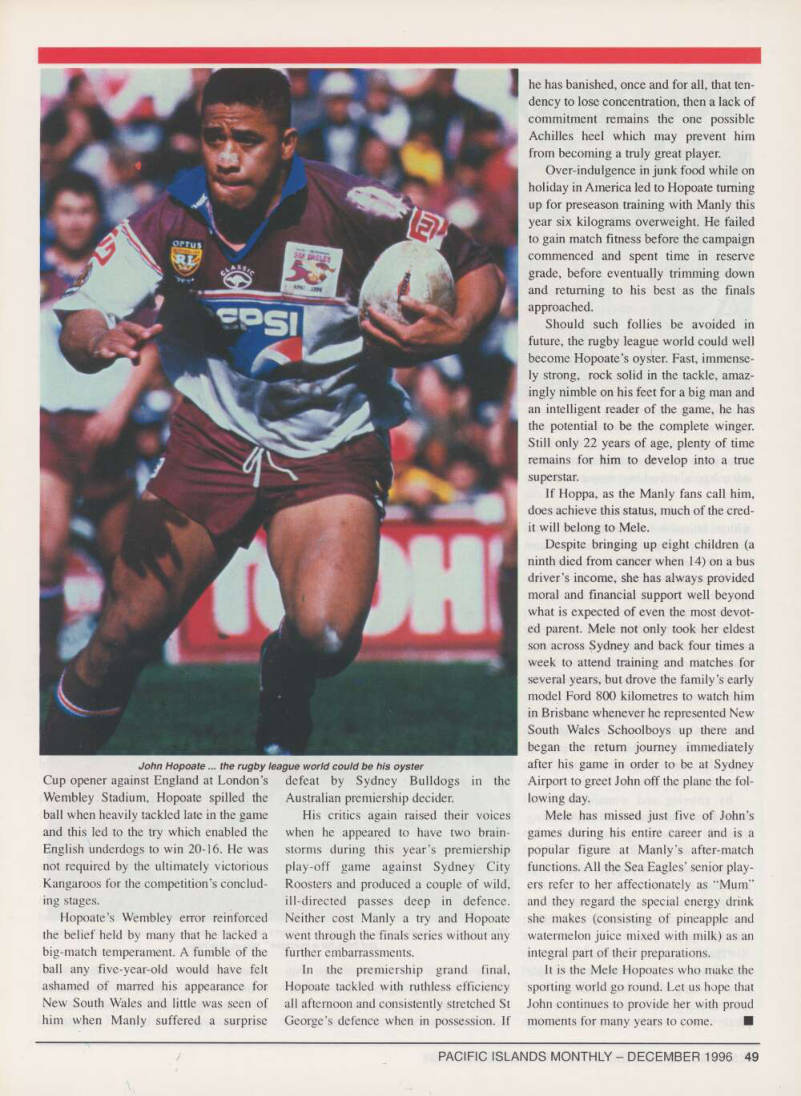
Should such follies be avoided in future, the rugby league world could well become Hopoate’s oysler. Fast, immense ly strong, rock solid in the tackle, amaz ingly nimble on his feet for a big man and an intelligent reader of the game, he has the potential to be the complete winger.
Still only 22 years of age, plenty of time remains for him to develop into a true superstar.
If Hoppa, as the Manly fans call him, does achieve this status, much of the cred it will belong to Mele.
Despite bringing up eight children (a ninth died from cancer when 14) on a bus driver’s income, she has always provided moral and financial support well beyond what is expected of even the most devot ed parent. Mele not only took her eldest son across Sydney and back four times a week to attend training and matches for several years, but drove the family’s early model Ford 800 kilometres to watch him in Brisbane whenever he represented New South Wales Schoolboys up there and began the return journey immediately after his game in order to be at Sydney Airport to greet John off the plane the fol
lowing day.
Mele has missed just five of John’s games during his entire career and is a
popular figure at Manly’s after-match
functions. All the Sea Eagles’ senior play ers refer to her affectionately as "Mum” and they regard the special energy drink she makes (consisting of pineapple and watermelon juice mixed with milk) as an integral part of their preparations.
It is the Mele Hopoates who make the sporting world go round. Let us hope that John continues to provide her with proud moments for many years to come. ■
John Hopoate ... the rugby league world could be his oyster