Muddied glory
pp. 44-45 · Read in the full issue
Sport
Fiji falls to NZ Maori after glorious season
By Netani Rika
New Zealand Maori 25, Fiji 10 In the end it all boiled down to two things - upper body strength and the ability to play rugby for the full 80 minutes.
For months before the Fiji-New Zealand Maori match at Fiji’s National Stadium, fans were in eager anticipation of what they expected to be a thriller. Fiji, with wins over Waikato, Southland, Poverty Bay, a Natal XV and Manu Samoa, were in top form. Their tour of New Zealand and South Africa had put them in good stead to face top interna tional teams, despite the side’s 18-43 loss to the Springboks in Johannesberg.
Fiji went into the game against the Maori wanting to play in the usual fluid and expansive style unique to the Fijians.
Maori coach Matt Te Pou said before the match that his team wanted to run the ball - that is, take the Fijian game to the Fijians.
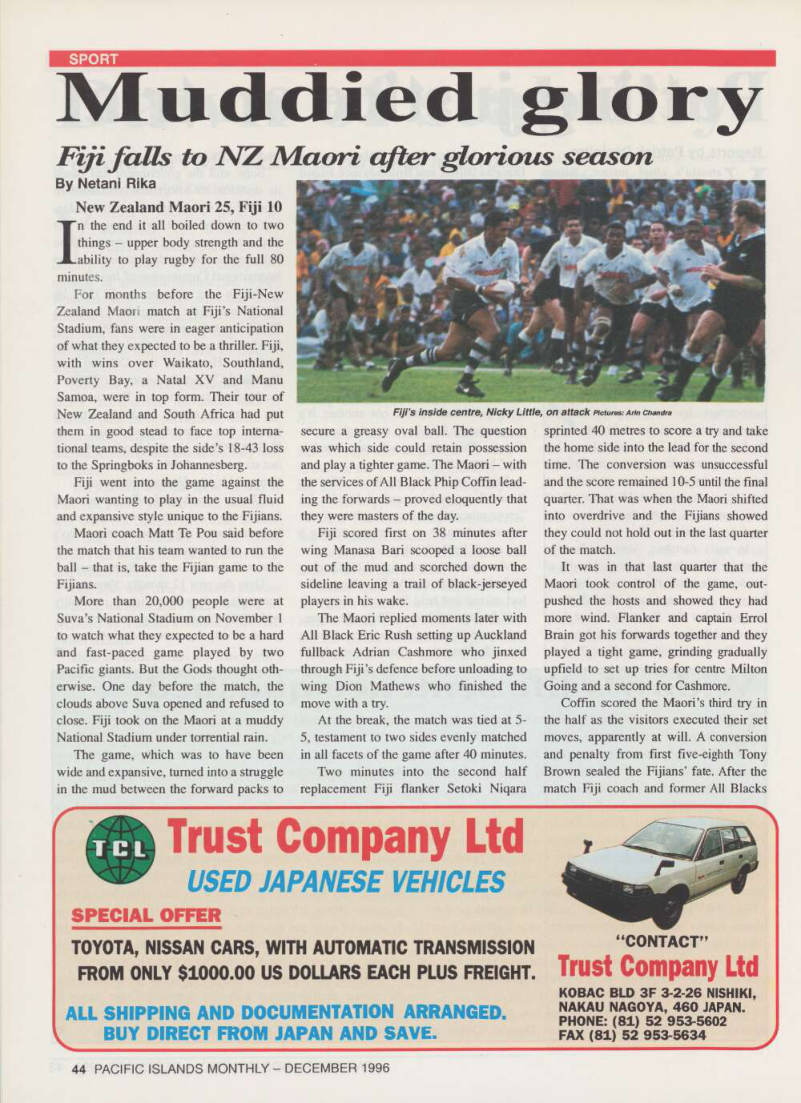
More than 20,000 people were at Suva’s National Stadium on November 1 to watch what they expected to be a hard and fast-paced game played by two Pacific giants. But the Gods thought oth erwise. One day before the match, the clouds above Suva opened and refused to close. Fiji took on the Maori at a muddy National Stadium under torrential rain.
The game, which was to have been wide and expansive, turned into a struggle in the mud between the forward packs to
secure a greasy oval ball. The question was which side could retain possession and play a tighter game. The Maori - with the services of All Black Phip Coffin lead ing the forwards - proved eloquently that they were masters of the day.
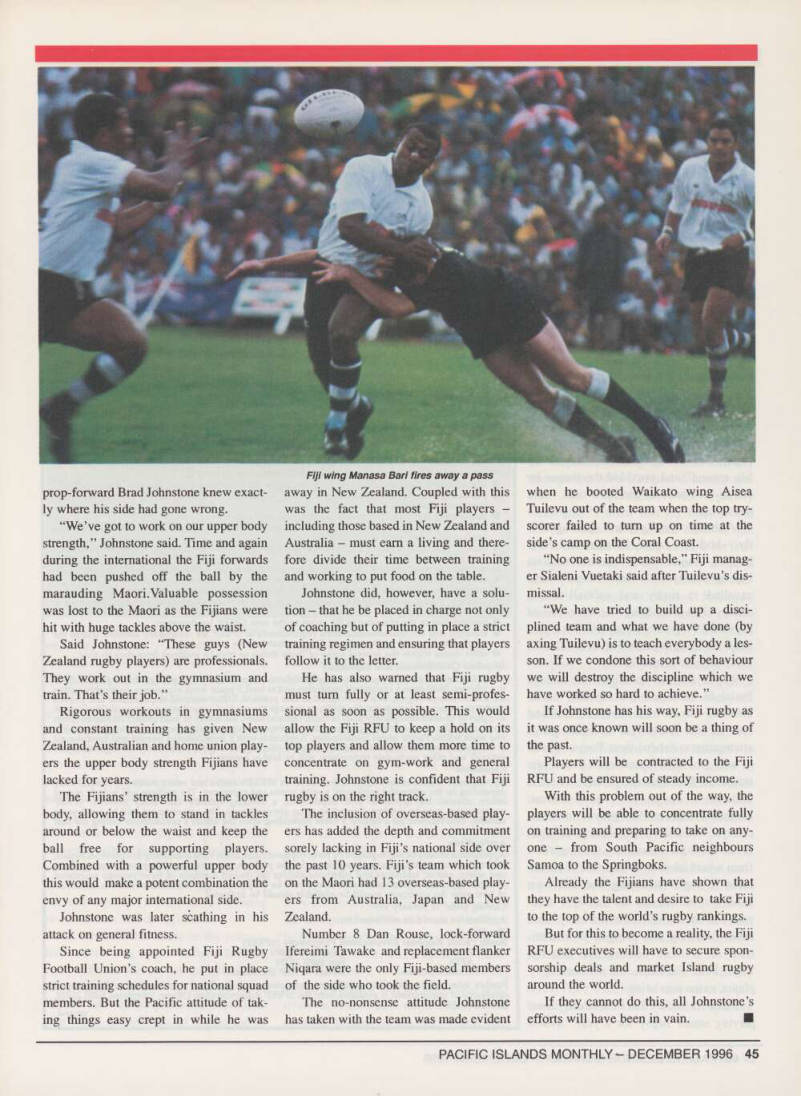
Fiji scored first on 38 minutes after wing Manasa Bari scooped a loose ball out of the mud and scorched down the sideline leaving a trail of black-jerseyed players in his wake.
The Maori replied moments later with All Black Eric Rush setting up Auckland fullback Adrian Cashmore who jinxed
through Fiji’s defence before unloading to
wing Dion Mathews who finished the move with a try.
At the break, the match was tied at 5- 5, testament to two sides evenly matched in all facets of the game after 40 minutes.
Two minutes into the second half replacement Fiji flanker Setoki Niqara
sprinted 40 metres to score a try and take the home side into the lead for the second time. The conversion was unsuccessful and the score remained 10-5 until the final quarter. That was when the Maori shifted into overdrive and the Fijians showed they could not hold out in the last quarter of the match.
It was in that last quarter that the Maori took control of the game, out pushed the hosts and showed they had more wind. Flanker and captain Errol Brain got his forwards together and they
played a tight game, grinding gradually
upfield to set up tries for centre Milton Going and a second for Cashmore.
Coffin scored the Maori’s third try in the half as the visitors executed their set moves, apparently at will. A conversion and penalty from first five-eighth Tony Brown sealed the Fijians’ fate. After the match Fiji coach and former All Blacks
Fiji’s inside centre, Nicky Little, on attack pictures: Ann Chandra
prop-forward Brad Johnstone knew exact ly where his side had gone wrong.
“We’ve got to work on our upper body strength,” Johnstone said. Time and again during the international the Fiji forwards had been pushed off the ball by the marauding Maori. Valuable possession was lost to the Maori as the Fijians were hit with huge tackles above the waist.
Said Johnstone: “These guys (New
Zealand rugby players) are professionals.
They work out in the gymnasium and train. That’s their job.”
Rigorous workouts in gymnasiums
and constant training has given New Zealand, Australian and home union play ers the upper body strength Fijians have lacked for years.
The Fijians’ strength is in the lower body, allowing them to stand in tackles around or below the waist and keep the ball free for supporting players.
Combined with a powerful upper body this would make a potent combination the envy of any major international side.
Johnstone was later scathing in his attack on general fitness.
Since being appointed Fiji Rugby
Football Union’s coach, he put in place strict training schedules for national squad members. But the Pacific attitude of tak ing things easy crept in while he was
away in New Zealand. Coupled with this was the fact that most Fiji players including those based in New Zealand and Australia - must earn a living and there fore divide their time between training and working to put food on the table.
Johnstone did, however, have a solu tion - that he be placed in charge not only of coaching but of putting in place a strict
training regimen and ensuring that players
follow it to the letter.
He has also warned that Fiji rugby must turn fully or at least semi-profes sional as soon as possible. This would allow the Fiji RFU to keep a hold on its top players and allow them more time to concentrate on gym-work and general training. Johnstone is confident that Fiji rugby is on the right track.
The inclusion of overseas-based play ers has added the depth and commitment sorely lacking in Fiji’s national side over the past 10 years. Fiji’s team which took on the Maori had 13 overseas-based play ers from Australia, Japan and New Zealand.
Number 8 Dan Rouse, lock-forward Ifereimi Tawake and replacement flanker
Niqara were the only Fiji-based members
of the side who took the field.
The no-nonsense attitude Johnstone has taken with the team was made evident
when he booted Waikato wing Aisea Tuilevu out of the team when the top try scorer failed to turn up on time at the side’s camp on the Coral Coast.
“No one is indispensable,” Fiji manag er Sialeni Vuetaki said after Tuilevu’s dis missal.
“We have tried to build up a disci plined team and what we have done (by axing Tuilevu) is to teach everybody a les son. If we condone this sort of behaviour we will destroy the discipline which we have worked so hard to achieve.”
If Johnstone has his way, Fiji rugby as it was once known will soon be a thing of the past.
Players will be contracted to the Fiji RFU and be ensured of steady income.
With this problem out of the way, the players will be able to concentrate fully on training and preparing to take on any one - from South Pacific neighbours Samoa to the Springboks.
Already the Fijians have shown that they have the talent and desire to take Fiji to the top of the world’s rugby rankings.
But for this to become a reality, the Fiji RFU executives will have to secure spon sorship deals and market Island rugby around the world.
If they cannot do this, all Johnstone’s efforts will have been in vain. ■
Fiji wing Manasa Bari fires away a pass